<?xml version="1.0" encoding="ISO-8859-1"?><article xmlns:mml="http://www.w3.org/1998/Math/MathML" xmlns:xlink="http://www.w3.org/1999/xlink" xmlns:xsi="http://www.w3.org/2001/XMLSchema-instance">
<front>
<journal-meta>
<journal-id>2007-4298</journal-id>
<journal-title><![CDATA[Botanical Sciences]]></journal-title>
<abbrev-journal-title><![CDATA[Bot. sci]]></abbrev-journal-title>
<issn>2007-4298</issn>
<publisher>
<publisher-name><![CDATA[Sociedad Botánica de México A.C.]]></publisher-name>
</publisher>
</journal-meta>
<article-meta>
<article-id>S2007-42982014000300007</article-id>
<title-group>
<article-title xml:lang="en"><![CDATA[Cacti community structure in a tropical Mexican dry forest under chronic disturbance]]></article-title>
<article-title xml:lang="es"><![CDATA[Estructura de la comunidad de cactáceas en una selva seca tropical mexicana bajo disturbio crónico]]></article-title>
</title-group>
<contrib-group>
<contrib contrib-type="author">
<name>
<surname><![CDATA[Arias-Medellín]]></surname>
<given-names><![CDATA[Luís Antonio]]></given-names>
</name>
<xref ref-type="aff" rid="A01"/>
</contrib>
<contrib contrib-type="author">
<name>
<surname><![CDATA[Flores-Palacios]]></surname>
<given-names><![CDATA[Alejandro]]></given-names>
</name>
<xref ref-type="aff" rid="A02"/>
</contrib>
<contrib contrib-type="author">
<name>
<surname><![CDATA[Martínez-Garza]]></surname>
<given-names><![CDATA[Cristina]]></given-names>
</name>
<xref ref-type="aff" rid="A02"/>
</contrib>
</contrib-group>
<aff id="A01">
<institution><![CDATA[,Universidad Autónoma del Estado de Morelos Facultad de Ciencias Biológicas ]]></institution>
<addr-line><![CDATA[Cuernavaca Morelos]]></addr-line>
<country>México</country>
</aff>
<aff id="A02">
<institution><![CDATA[,Universidad Autónoma del Estado de Morelos Centro de Investigación en Biodiversidad y Conservación ]]></institution>
<addr-line><![CDATA[Cuernavaca Morelos]]></addr-line>
<country>México</country>
</aff>
<pub-date pub-type="pub">
<day>00</day>
<month>00</month>
<year>2014</year>
</pub-date>
<pub-date pub-type="epub">
<day>00</day>
<month>00</month>
<year>2014</year>
</pub-date>
<volume>92</volume>
<numero>3</numero>
<fpage>405</fpage>
<lpage>415</lpage>
<copyright-statement/>
<copyright-year/>
<self-uri xlink:href="http://www.scielo.org.mx/scielo.php?script=sci_arttext&amp;pid=S2007-42982014000300007&amp;lng=en&amp;nrm=iso"></self-uri><self-uri xlink:href="http://www.scielo.org.mx/scielo.php?script=sci_abstract&amp;pid=S2007-42982014000300007&amp;lng=en&amp;nrm=iso"></self-uri><self-uri xlink:href="http://www.scielo.org.mx/scielo.php?script=sci_pdf&amp;pid=S2007-42982014000300007&amp;lng=en&amp;nrm=iso"></self-uri><abstract abstract-type="short" xml:lang="en"><p><![CDATA[When agricultural lands in formerly dry forest are abandoned, chronic disturbance by livestock grazing and wood extraction may set back successional processes precluding older dry forest structure from be reached. We compare cacti density, richness, diversity and evenness in twelve 50 × 50 m plots: six plots in secondary dry forest and six plots in older conserved dry forest at Sierra de Huautla, Central Mexico. Cacti were identified, the life-form of each species was recorded and size was measured to assign individuals into four life-stage classes. Nine cacti species were registered across both forest types. In this dry forest, richness, diversity and evenness of cacti community increased in sites under chronic disturbance, whereas density was not significantly affected. Size structure at community level in the conserved forest showed an increase of individuals with size, whereas in the secondary forest, size structure showed an uneven distribution of individuals, as in populations that regenerate by pulses. In the secondary forest, there was a lower proportion of adults and they were in average, smaller than those in the conserved forest. Chronic disturbance may eventually change cacti community structure, affecting animals that depend on large arboreal cacti for food, perches and/or refuge; therefore, maintenance of biodiversity will be at stake.]]></p></abstract>
<abstract abstract-type="short" xml:lang="es"><p><![CDATA[Cuando las tierras de cultivo son abandonadas, la ganadería extensiva y la extracción de productos naturales son perturbaciones crónicas que puede afectar el proceso de sucesión natural que llevaría a la selva estacional a su estructura original. Se comparó la densidad, riqueza, diversidad y equitatividad de la comunidad de cactáceas en 12 parcelas de 50 × 50 m: seis parcelas localizadas en la selva secundaria y seis parcelas en la selva conservada en Sierra de Huautla, centro de México. Todas las cactáceas fueron identificadas, se registró su forma de vida y todos los individuos se clasificaron en cuatro etapas de su ciclo de vida según el tamaño. Nueve especies de cactáceas fueron registradas en ambos tipos de selva. En esta selva estacional, la riqueza, diversidad y equitatividad de la comunidad de cactos aumentó en los sitios bajo perturbación crónica, mientras que la densidad no se vio afectada. En la selva conservada, la estructura de tamaños de la comunidad mostró un mayor número de individuos de tallas mayores, mientras que en la selva secundaria la estructura de tamaños mostró una distribución no uniforme de individuos, como sucede en poblaciones que muestran pulsos de regeneración. En la selva perturbada se registró una menor proporción de individuos adultos y estos fueron, en promedio, más pequeños que los registrados en la selva conservada. La perturbación crónica puede eventualmente cambiar la estructura de la comunidad de cactáceas con efectos negativos para los animales que dependen de la comida, perchas y refugios que brindan los grandes cactos arborescentes, lo que pondría en peligro el mantenimiento de la biodiversidad en este ecosistema.]]></p></abstract>
<kwd-group>
<kwd lng="en"><![CDATA[cattle ranching]]></kwd>
<kwd lng="en"><![CDATA[Opuntia spp.]]></kwd>
<kwd lng="en"><![CDATA[Pachycereus grandis]]></kwd>
<kwd lng="en"><![CDATA[restoration ecology]]></kwd>
<kwd lng="en"><![CDATA[secondary dry forest]]></kwd>
<kwd lng="en"><![CDATA[Sierra de Huautla]]></kwd>
<kwd lng="es"><![CDATA[ecología de la restauración]]></kwd>
<kwd lng="es"><![CDATA[ganadería]]></kwd>
<kwd lng="es"><![CDATA[Opuntia spp.]]></kwd>
<kwd lng="es"><![CDATA[Pachycereus grandis]]></kwd>
<kwd lng="es"><![CDATA[selva estacional secundaria]]></kwd>
<kwd lng="es"><![CDATA[Sierra de Huautla]]></kwd>
</kwd-group>
</article-meta>
</front><body><![CDATA[ <p align="justify"><font face="verdana" size="4">Ecolog&iacute;a</font></p>      	    <p align="justify"><font face="verdana" size="2">&nbsp;</font></p>         <p align="center"><font face="verdana" size="4"><b>Cacti community structure in a tropical Mexican dry forest under chronic disturbance</b></font></p>         <p align="justify"><font face="verdana" size="2">&nbsp;</font></p>         <p align="center"><font face="verdana" size="3"><b>Estructura de la comunidad de cact&aacute;ceas en una selva seca tropical mexicana bajo disturbio cr&oacute;nico</b></font></p>         <p align="justify"><font face="verdana" size="2">&nbsp;</font></p>         <p align="center"><font face="verdana" size="2"><b>Lu&iacute;s Antonio Arias&#45;Medell&iacute;n<sup>1</sup>, Alejandro Flores&#45;Palacios<sup>2</sup> and Cristina Mart&iacute;nez&#45;Garza<sup>2,3</sup></b></font></p>         <p align="justify"><font face="verdana" size="2">&nbsp;</font></p>         <p align="justify"><font face="verdana" size="2"><sup><i>1</i></sup><i> Facultad de Ciencias Biol&oacute;gicas, Universidad Aut&oacute;noma del Estado de Morelos, Cuernavaca, Morelos, M&eacute;xico. </i></font></p>         <p align="justify"><font face="verdana" size="2"><sup><i>2</i></sup><i> Centro de Investigaci&oacute;n en Biodiversidad y Conservaci&oacute;n, Universidad Aut&oacute;noma del Estado de Morelos, Cuernavaca, Morelos, M&eacute;xico.</i> </font></p>         ]]></body>
<body><![CDATA[<p align="justify"><font face="verdana" size="2"><sup><i>3</i></sup><i> Autor para la correspondencia:</i> <a href="mailto:cristina.martinez@uaem.mx">cristina.martinez@uaem.mx</a>.</font></p>         <p align="justify"><font face="verdana" size="2">&nbsp;</font></p>         <p align="justify"><font face="verdana" size="2">Received: April 13th, 2013     <br> Accepted: September 4th, 2013</font></p>         <p align="justify"><font face="verdana" size="2">&nbsp;</font></p>         <p align="justify"><font face="verdana" size="2"><b>Abstract</b></font></p>         <p align="justify"><font face="verdana" size="2">When agricultural lands in formerly dry forest are abandoned, chronic disturbance by livestock grazing and wood extraction may set back successional processes precluding older dry forest structure from be reached. We compare cacti density, richness, diversity and evenness in twelve 50 &times; 50 m plots: six plots in secondary dry forest and six plots in older conserved dry forest at Sierra de Huautla, Central Mexico. Cacti were identified, the life&#45;form of each species was recorded and size was measured to assign individuals into four life&#45;stage classes. Nine cacti species were registered across both forest types. In this dry forest, richness, diversity and evenness of cacti community increased in sites under chronic disturbance, whereas density was not significantly affected. Size structure at community level in the conserved forest showed an increase of individuals with size, whereas in the secondary forest, size structure showed an uneven distribution of individuals, as in populations that regenerate by pulses. In the secondary forest, there was a lower proportion of adults and they were in average, smaller than those in the conserved forest. Chronic disturbance may eventually change cacti community structure, affecting animals that depend on large arboreal cacti for food, perches and/or refuge; therefore, maintenance of biodiversity will be at stake.</font></p>         <p align="justify"><font face="verdana" size="2"><b>Key words:</b> cattle ranching, <i>Opuntia</i> spp., <i>Pachycereus grandis,</i> restoration ecology, secondary dry forest, Sierra de Huautla.</font></p>              <p align="justify"><font face="verdana" size="2">&nbsp;</font></p>         <p align="justify"><font face="verdana" size="2"><b>Resumen</b></font></p>         ]]></body>
<body><![CDATA[<p align="justify"><font face="verdana" size="2">Cuando las tierras de cultivo son abandonadas, la ganader&iacute;a extensiva y la extracci&oacute;n de productos naturales son perturbaciones cr&oacute;nicas que puede afectar el proceso de sucesi&oacute;n natural que llevar&iacute;a a la selva estacional a su estructura original. Se compar&oacute; la densidad, riqueza, diversidad y equitatividad de la comunidad de cact&aacute;ceas en 12 parcelas de 50 &times; 50 m: seis parcelas localizadas en la selva secundaria y seis parcelas en la selva conservada en Sierra de Huautla, centro de M&eacute;xico. Todas las cact&aacute;ceas fueron identificadas, se registr&oacute; su forma de vida y todos los individuos se clasificaron en cuatro etapas de su ciclo de vida seg&uacute;n el tama&ntilde;o. Nueve especies de cact&aacute;ceas fueron registradas en ambos tipos de selva. En esta selva estacional, la riqueza, diversidad y equitatividad de la comunidad de cactos aument&oacute; en los sitios bajo perturbaci&oacute;n cr&oacute;nica, mientras que la densidad no se vio afectada. En la selva conservada, la estructura de tama&ntilde;os de la comunidad mostr&oacute; un mayor n&uacute;mero de individuos de tallas mayores, mientras que en la selva secundaria la estructura de tama&ntilde;os mostr&oacute; una distribuci&oacute;n no uniforme de individuos, como sucede en poblaciones que muestran pulsos de regeneraci&oacute;n. En la selva perturbada se registr&oacute; una menor proporci&oacute;n de individuos adultos y estos fueron, en promedio, m&aacute;s peque&ntilde;os que los registrados en la selva conservada. La perturbaci&oacute;n cr&oacute;nica puede eventualmente cambiar la estructura de la comunidad de cact&aacute;ceas con efectos negativos para los animales que dependen de la comida, perchas y refugios que brindan los grandes cactos arborescentes, lo que pondr&iacute;a en peligro el mantenimiento de la biodiversidad en este ecosistema.</font></p>         <p align="justify"><font face="verdana" size="2"><b>Palabras clave:</b> ecolog&iacute;a de la restauraci&oacute;n, ganader&iacute;a, <i>Opuntia</i> spp., <i>Pachycereus grandis,</i> selva estacional secundaria, Sierra de Huautla.</font></p>              <p align="justify"><font face="verdana" size="2">&nbsp;</font></p>         <p align="justify"><font face="verdana" size="2">The Cactaceae family includes more than 2,000 species of many life forms, from smaller prostrate species to large arboreal ones (Barthlott and Hunt, 1993). Mexico has around 63 genera and 913 taxa (669 species and 244 subspecies); a high percentage of those species (35%) are considered threatened by the destruction of their habitat (Hern&aacute;ndez and God&iacute;nez, 1994; Hunt, 1999; Guzm&aacute;n <i>et al.,</i> 2003). Worldwide analysis has shown that Mexico is the most important country to preserve cacti diversity in different ecosystems as deserts, xerophitic shrub lands and tropical dry forests (Bravo&#45;Hollis, 1978; Bravo&#45;Hollis and S&aacute;nchez&#45;Mejorada, 1991a,b; Anderson, 2001; Ortega&#45;Baes and God&iacute;nez&#45;&Aacute;lvarez, 2006). In tropical dry forests, Cacta&#45;ceae is the third most important family by number of species (Trejo&#45;V&aacute;zquez, 1998); however, this family is seldom evaluated in this ecosystem, which is indeed the third one with the highest forest cover loss worldwide (Hansen <i>et al.,</i> 2010). Given that tropical dry forests are dominated by wind&#45;dispersed species, cacti represent an important source of fleshy fruits for birds and bats during the dry season (Naranjo <i>et al.,</i> 2003; Reyes&#45;Ag&uuml;ero <i>et al.,</i> 2006) when most of the tree species do not produce fruits (De Le&oacute;n&#45;Ibarra, 2005; Mart&iacute;nez&#45;Garza <i>et al.,</i> 2011). Therefore, the conservation of this family is crucial to maintain ecosystem processes, as trophic chains.</font></p>         <p align="justify"><font face="verdana" size="2">Chronosequences studies in tropical dry forests have shown that a forest structure similar to that of mature forest may be reached after more than 30 years of abandonment of agricultural land (Kennard, 2002; Ruiz <i>et al.,</i> 2005). However, young secondary forests originated from abandoned agricultural land where successional processes took place (Brown and Lugo, 1990; Finegan, 1996) may experience chronic disturbance; for example, in many areas with secondary forest, cattle graze and browse herbs and grasses at the understory and also at the lower foliage of trees (Stern <i>et al.,</i> 2002). Additionally, disturbance due to extraction of wood for timber, firewood or fence posts is frequent (Linares&#45;Palomino and Ponce, 2005). This kind of forest, with different ages and degrees of disturbance, now cover more area than conserved older forest in the tropics (Chazdon <i>et</i> al., 2007). After lands are no longer used for cultivation, chronic anthropogenic disturbance may continuously set back successional processes, precluding mature forest structure to be reached and threatening cactus species inhabiting those areas.</font></p>              <p align="justify"><font face="verdana" size="2">Disturbance may have positive or negative effects on populations of cacti. Some studies have shown that land use transformation and cattle ranching are the main factors affecting negatively the population dynamics of cactus species (e.g. del Castillo, 1987; Bowers, 1997; Martorell and Peters, 2009; Flores <i>et al.,</i> 2010). Other studies have revealed that moderate levels of human activities may increase densities of some globose species (Martorell and Peters, 2005; Portilla&#45;Alonso and Martorell, 2011). Demography of cactus species have been frequently studied (reviewed in God&iacute;nez&#45;&Aacute;lvarez <i>et al.,</i> 2003) but its community structure and the effect of disturbance on it has not been evaluated. We may expect a differential effect of disturbance in the structure of a community depending from dominant life&#45;form. For example, diversity, richness, and evenness of herbs and grasses increase under extensive cattle ranching in pasture&#45;lands (Nai&#45;Bregaglio <i>et al.,</i> 2002; Floyd <i>et al.,</i> 2003; Hayes and Holl, 2003), whereas livestock presence affects negatively tree richness and diversity in the dry forests (Roth, 1999; Gonz&aacute;lez&#45;Iturbe <i>et al.,</i> 2002; Stern <i>et al.,</i> 2002; VanderWerf, 2004). On the other hand, selective logging may not affect tree evenness in the dry forest (Monroy&#45;Ortiz, 1997), but livestock presence does (S&aacute;nchez&#45;Vel&aacute;squez <i>et</i> al., 2002). However, it is not known whether the effect of disturbance on cactus communities inhabiting the dry forest will follow patterns found in other ecosystems under chronic disturbance.</font></p>              <p align="justify"><font face="verdana" size="2">Population size structure is affected by recruitment and mortality rates. For cactus species, population size structure is frequently an uneven distribution of individuals in the different size classes (see Appendix 1 in God&iacute;nez&#45;&Aacute;lvarez <i>et al.,</i> 2003). The uneven population size structure is associated to events of recruitment in pulses favoured by the occasional coincidence of some suitable biotic and abiotic conditions, as rain, temperature, low herbivory and/or presence of nurse plants (God&iacute;nez&#45;&Aacute;lvarez <i>et al.,</i> 2003). A couple of studies in the dry forest have revealed that cacti show an uneven size distribution (Contreras and Valverde 2002; M&eacute;ndez <i>et</i> al., 2004). Other studies, also in the dry forest, have shown a decreasing number of cactus individuals with size (Ferrer&#45;Cervantes <i>et al.,</i> 2012; Valencia&#45;D&iacute;az et al., 2012) which is related to constant regeneration and lower mortality of adults (God&iacute;nez&#45;&Aacute;lvarez <i>et al.,</i> 2003). Irrespective of population size structure, neutral effect of disturbance on size structure of cactus species have been reported (e.g. ureta and Martorell, 2009). However, given that cattle may step on smaller life&#45;stage classes (del Castillo, 1987), regeneration of cacti in arid environments may be reduced and thus, individuals reaching adult stage may be fewer compared to habitats experienced undisturbed succession. Therefore, chronic anthropogenic disturbance in older secondary forest may result in an overall size structure similar to the one in the conserved forest but with a lower proportion of individuals from older life&#45;stages.</font></p>              <p align="justify"><font face="verdana" size="2">We investigated cacti community structure in two localities of the tropical dry forest of Sierra de Huautla, Morelos, central Mexico, in fragments of older conserved dry forest and in successional areas more than 30 years old which are frequently disturbed by livestock activities and selective extraction of wood (called from now on, secondary forest). We tested the following hypothesis: due to chronic disturbance, (1) density, diversity, richness, and evenness of cacti community differ in older conserved compared to secondary forest, and (2) the cacti community in the dry forest shows an uneven size structure with a lower proportion of adults in the secondary forest compared to the older forest.</font></p>              <p align="justify"><font face="verdana" size="2">&nbsp;</font></p>         <p align="justify"><font face="verdana" size="2"><b>Methods</b></font></p>         ]]></body>
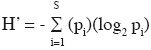
<body><![CDATA[<p align="justify"><font face="verdana" size="2"><i>Study area.</i> This study was carried out in lands close to the localities of El Lim&oacute;n de Cuauchichinola (1,220 m of altitude, called from now on El Lim&oacute;n) and Quilamula (1,070 m of altitude), both located within the Sierra de Huautla Biosphere Reserve, Morelos, central Mexico. The Reserve (18&deg; 20' 10" &#45; 18&deg; 34' 20" N and 98&deg; 51' 20" &#45; 98&deg; 08' 15" W) comprises 59,030 ha where the main vegetation type is tropical dry forest. Mean annual temperature is 24.5 &deg;C and average annual rainfall (1980&#45;2001) amounts to 840 mm (CONAGUA, Gerencia Regional Balsas, unpublished data), &#126;90% falling between late May and October. During the dry season (November to April), most of the trees lose their leaves. Soils are shallow (&lt; 30 cm in depth), with sandy&#45;loam texture (CONANP, 2005). In the Reserve, the most important plant families by decreasing number of species are Fabaceae, Poaceae, Asteraceae, Burseraceae, and Cactaceae (CONANP, 2005). More than 70% of species and genera of cacti reported for Morelos has been recorded in the Reserve: 12 genera and 28 species (Mart&iacute;nez&#45;Alvarado, 1985; CONANP, 2005). Most of the trees in this forest have compound leaves and some reach 8 to 12 m in high, with convex or flat canopies (Rzedowski, 1978).</font></p>              <p align="justify"><font face="verdana" size="2">The landscape in the Reserve is a mosaic of fragments of old and young tropical dry forest in different degrees of conservation, surrounded by agricultural lands and small towns. Two main forest types are recognized in the localities studied here: secondary forest and conserved forest. The secondary forest resulted from large parts of forest cleared more than 40 years ago (&#126;1970), which were used for maize cultivation for ca. 6 years, and later abandoned. The secondary forest has an average tree density (&gt; 5 cm diameter at breast height: 1.3 m) of 264 ind./ha from 14 species, from which <i>Acacia cochliacantha</i> (Fabaceae), <i>Ipomoea pauciflora</i> (Convolvulaceae), <i>Acacia farnesiana</i> (Fabaceae), and <i>Mimosa benthamii</i> (Fabaceae) are dominant (Mart&iacute;nez&#45;Garza <i>et al.,</i> 2011). These forests are chronically disturbed by anthropogenic activities: during the rainy season ca. 600 heads of livestock feed in these secondary forests (&#126;7 heads/ha); these heads of livestock are brought from neighbouring towns. Accordingly to land owners and current research (B. Maldonado, unpublished data), cattle are maintained in farms during the dry season but goats, pigs and horses graze in the secondary forest throughout the year. Wood extraction from the secondary forest is a common activity and villagers extract between 74 and 124 kg of wood per trip (Monroy&#45;Ortiz, 1997).</font></p>              <p align="justify"><font face="verdana" size="2">What we call conserved forest corresponds to older growth forest never deforested where cattle from neighbouring towns do not graze, although cattle from local owners occasionally do; nonetheless, cattle is never found in densities higher than 1 head/ha (G. Pacheco, local farmer, pers. comm.). In conserved forests, wood extraction is seldom practiced since the preferred tree species are not frequent (B. Maldonado, unpublished data). The most common canopy trees in the conserved forest are <i>Conzattia multiflora, Lysiloma acapulcense, L. divaricata</i> (Fabaceae), several species of <i>Bursera</i> (Burseraceae) and <i>Ceiba</i> (Bombacaceae) (CONANP, 2005). In this conserved forest, average tree density is 905 ind./ha (unpublished data). Native herbivores in both forest types are deer <i>(Odocoileus virginianus)</i> and rodents <i>(Lyomis</i> sp., <i>Baiomys</i> sp., <i>Sigmodon</i> sp.; D. Valenzuela, unpublished data).</font></p>              <p align="justify"><font face="verdana" size="2"><i>Sampling protocol.</i> In January 2006, 12 plots of 50 &times; 50 m were selected in both forest types (secondary and conserved forest) in El Lim&oacute;n (N = 6) and Quilamula (N = 6) for a total sampling area of 3 ha. Within each locality, we selected three plots in each forest type with similar slopes (&lt; 30%) and soil characteristics (J. Campo, unpublished data). These plots are part of a large project of restoration ecology which aims to favour the coexistence of biodiversity and the economic activities of the region using enrichment plantings and exclusion of disturbance (Mart&iacute;nez&#45;Garza <i>et al.,</i> 2011). Distance between localities is 8.67 km. Distance among plots ranged from 0.08 to 1.59 km. All cacti found within the plots were counted and measured in January 2007. To analyze population size structure, each individual was assigned to a life&#45;stage class (seedling, juvenile, pre&#45;reproductive, and reproductive adult) based in size and presence of reproductive structures (Mart&iacute;nez&#45;Alvarado, 1985; <a href="/img/revistas/bs/v92n3/a7t1.jpg" target="_blank">Table 1</a>).</font></p>              <p align="justify"><font face="verdana" size="2"><i>Statistical Analysis.</i> To evaluate cacti density between forest types overall species, a nested Analysis of Variance (ANOVA) was used, where forest type (secondary and conserved) was nested in locality (El Lim&oacute;n and Quila&#45;mula); forest type had three replicates in each locality. Data were transformed with the logarithm base 10 to fulfil ANOVA assumptions (Shapiro Wilk W = 0.95, <i>P</i> &lt; 0.64). To describe the community structure by forest type, dominance/diversity curves were constructed (Wilson, 1991). The Shannon&#45;Wiener diversity index (H') was calculated using the following formula:</font></p>              <p align="center"><font face="verdana" size="2"><img src="/img/revistas/bs/v92n3/a7s1.jpg"> (Magurran, 2004)</font></p>              <p align="justify"><font face="verdana" size="2">where H' is the species diversity index, S the number of species, and p<sub>i</sub> is the proportion of individuals from the total number of species that belongs to the species i. To estimate evenness, the Pielou index was used, but first we calculated the maximum evenness with the following formula:</font></p>              <p align="center"><font face="verdana" size="2">H<sub>max</sub> = log<sub>2</sub>S (Magurran, 2004)</font></p>              <p align="justify"><font face="verdana" size="2">where H<sub>max</sub> is the maximum species richness and S is the species richness observed. When the maximum species richness was calculated, the following formula was used to estimate the Pielou evenness index (Krebs, 1985): </font></p>         <p align="center"><font face="verdana" size="2">J = H/ H (Magurran, 2004)</font></p>         ]]></body>
<body><![CDATA[<p align="justify"><font face="verdana" size="2">where J is evenness, H<sub>max</sub> is the observed species richness and H is the maximum species richness. H' was used because it is clearly linked to the dominance/diversity curves (Wilson, 1991). H' and J were transformed with natural logarithms prior to analysis (Shapiro Wilk W = 0.94, <i>P</i> &lt; 0.51 and W = 0.93, <i>P</i> &lt; 0.35 respectively). H' values between forest types were compared using ?&#45;test for each locality (Zar, 1996).</font></p>              <p align="justify"><font face="verdana" size="2">The Simpson diversity index expresses the probability that two individuals taken randomly from a sample belong to the same species and is calculated as:</font></p>              <p align="center"><img src="/img/revistas/bs/v92n3/a7e2.jpg"></p>          <p align="justify"><font face="verdana" size="2">where p<sub>i</sub> is the proportion of the individual of the i species. As D increases, diversity decreases, so it is more commonly used as its inverse (D<sub>inv</sub> = 1/D). It takes values from 1 (when there is only one species) to the total species richness of the community (Magurran, 2004).</font></p>              <p align="justify"><font face="verdana" size="2">The Berger&#45;Parker index is a dominance measure that expresses the proportional abundance of the most abundant species:</font></p>              <p align="center"><font face="verdana" size="2">B = N<sub>max</sub>/N (Magurran, 2004)</font></p>              <p align="justify"><font face="verdana" size="2">where N<sub>max</sub> is the number of individuals of the most abundant species and N is the total number of individuals in the community. An increase of B indicates a decrease in evenness and diversity, so its reciprocal is used (B<sub>rec</sub> = 1&#45;B); therefore, an increase of B<sub>rec</sub> results in an increase in diversity and evenness (Magurran, 2004).</font></p>              <p align="justify"><font face="verdana" size="2">Community size structure (proportion of individuals overall species in each life&#45;stage class) between forest types was compared with Kolmogorov&#45;Smirnov tests and also individually for those species with enough sample size to run statistical analyses. Back&#45;transformed means and standard deviations are shown throughout results. The diversity indexes and species rank curves were calculated using Excel v12.0 and the statistical analyses were carried out using the program R version 2.14.1 (R Development Core Team, 2011).</font></p>              <p align="justify"><font face="verdana" size="2">&nbsp;</font></p>              <p align="justify"><font face="verdana" size="2"><b>Results</b></font></p>              ]]></body>
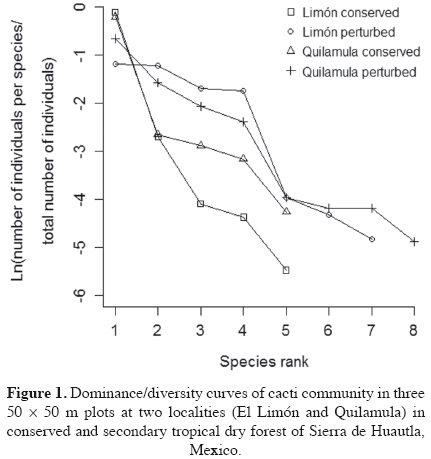
<body><![CDATA[<p align="justify"><font face="verdana" size="2">In total, 943 individuals from nine species were registered, measured and identified (<a href="/img/revistas/bs/v92n3/a7t2.jpg" target="_blank">Table 2</a>). Two large arboreal m height), three short arboreal (&gt; 3 m height), one large shrub (&#126; 2 m height), and three small size life&#45;forms (shrubs, prostrate and globose &lt; 60 cm height) were recorded. All species were registered in both forest types except for <i>Opuntia atropes</i> and <i>Pachycereus weberi,</i> which were found exclusively in the secondary forest (<a href="/img/revistas/bs/v92n3/a7t2.jpg" target="_blank">Table 2</a>). The large arboreal species <i>Pachycereus grandis</i> was the most abundant in conserved (70.65% of individuals) and secondary forest (31.75%; <a href="/img/revistas/bs/v92n3/a7t2.jpg" target="_blank">Table 2</a>, <a href="/img/revistas/bs/v92n3/a7t3.jpg" target="_blank">3</a>). After <i>P. grandis,</i> the short arboreal <i>O. velutina</i> (27%) and the prostrate <i>O. puberula</i> (22.59%) were the species with the highest abundance in the secondary forest, whereas the small shrub <i>O. pumila</i> (19%) was the most abundant in the conserved forest (<a href="/img/revistas/bs/v92n3/a7t2.jpg" target="_blank">Table 2</a>, <a href="/img/revistas/bs/v92n3/a7t3.jpg" target="_blank">3</a>). In average and taking into account all species and life&#45;stage classes, there was a higher cacti density in the secondary (309.14 &plusmn; 2.62 ind./ha) than in the conserved forest (119.69 &plusmn; 3.85 ind./ha). However, density was statistically similar in both forest types (F<sub>(2,</sub><sub>8)</sub> = 1.94, P &gt; 0.10).</font></p>              <p align="justify"><font face="verdana" size="2">The dominance/diversity curve showed that there was higher richness in the secondary than in the conserved forest. The dominance/diversity curve was steeper in the conserved forest (<a href="#f1">Figure 1</a>, <a href="/img/revistas/bs/v92n3/a7t4.jpg" target="_blank">Table 4</a>) suggesting higher richness and evenness in the secondary forests of both localities. The Shannon&#45;Wiener, inverse Simpson and the reciprocal of Berger&#45;Parker diversity index confirmed the result of the curves: a significantly higher indexes were found in the secondary forest (H' &gt; 1.39, D<sub>inv</sub> &gt; 2.88, B<sub>rec</sub> &gt; 0.53) than in the conserved forest (H' &gt; 0.42, D<sub>inv</sub> &gt; 1.23 B<sub>rec</sub> &gt; 0.82) from two localities (<i>t</i><sub>(2,8)</sub> = 4.8, <i>P</i> &lt; 0.005) due to both, a higher richness and a higher evenness in the secondary forest (<a href="#f1">Figure 1</a>, <a href="/img/revistas/bs/v92n3/a7t4.jpg" target="_blank">Table 4</a>).</font></p>              <p align="center"><font face="verdana" size="2"><a name="f1"></a></font></p>         <p align="center"><font face="verdana" size="2"><img src="/img/revistas/bs/v92n3/a7f1.jpg"></font></p>         <p align="justify"><font face="verdana" size="2"><i>Size structure.</i> At community level, the proportion of individuals in smaller life&#45;stage classes (seedlings and juveniles) was two times higher in the secondary forest compared to the conserved forest, whereas the proportion of reproductive adults was two times higher in the conserved forest (<a href="/img/revistas/bs/v92n3/a7t5.jpg" target="_blank">Table 5</a>). At community level, size structure was significantly different by forest type (D<sub>max</sub> = 310, <i>P</i> &lt; 0.001; <a href="/img/revistas/bs/v92n3/a7t5.jpg" target="_blank">Table 5</a>).</font></p>         <p align="justify"><font face="verdana" size="2">Two species, the large arboreal <i>Pachycereus grandis</i> and the small shrub <i>Opuntia pumila</i> had enough individuals at all life&#45;stage classes and in both forest types to run statistical analyses at species level. The population size structure of <i>P. grandis</i> showed that the proportion of individuals in the seedlings and juveniles life&#45;stage classes were 18 and three times higher, respectively in the secondary forest than in the conserved forest; whereas the proportion of individuals in pre&#45;reproductive and reproductive adults classes were almost three times lower in the secondary forest compared to the conserved forest (n = 66 in the secondary forest and n = 219 in the conserved forest, <a href="/img/revistas/bs/v92n3/a7f2.jpg" target="_blank">Figure 2A</a>). The population size structure of <i>P. grandis</i> showed significant differences between forest types (D<sub>max</sub> = 114, <i>P</i> &lt; 0.001).</font></p>              <p align="justify"><font face="verdana" size="2">The population size structure of <i>Opuntia pumila</i> showed that the proportion of seedlings and adults was higher in the conserved forest compared to the secondary forest, whereas the proportion of juveniles and pre&#45;reproductive adults were higher in the secondary forest (<a href="/img/revistas/bs/v92n3/a7f2.jpg" target="_blank">Figure 2B</a>; <a href="/img/revistas/bs/v92n3/a7t5.jpg" target="_blank">Table 5</a>). However, the population size structure of <i>O. pumila</i> was statistically similar between forest types (D<sub>max</sub> = 6, <i>P</i> &gt; 0.1).</font></p>              <p align="justify"><font face="verdana" size="2">&nbsp;</font></p>         <p align="justify"><font face="verdana" size="2"><b>Discussion</b></font></p>         <p align="justify"><font face="verdana" size="2">Richness, diversity and evenness of the community of cacti in the dry forest of Sierra de Huautla increased in sites under chronic disturbance whereas density was not significantly affected. Size structure at community level in the conserved forest showed an increase of individuals with size, whereas in the secondary forest size structure showed an uneven distribution of individuals, as in populations that regenerate by pulses. Further, in the perturbed forest, there was a lower proportion of adults and they were, in average, smaller than those recorded in the conserved forest.</font></p>              ]]></body>
<body><![CDATA[<p align="justify"><font face="verdana" size="2"><i>Community structure.</i> Studies at the population level have shown positive, negative or neutral effects of disturbance in cacti density. Some species (called ruderal cacti <i>sensu</i> Martorell and Peters, 2005) may benefit from moderate levels of human activities as the globose species <i>Coryphantha werdermannii</i> in Coahuila, North Mexico (Portilla&#45;Alonso and Martorell, 2011) and the cylindrical cactus <i>Echinocereus lindsayi</i> in Baja California, Mexico (Martorell <i>et al.,</i> 2012). In the present study, further analysis at species level revealed that <i>Opuntia velutina</i> and <i>O.puberula</i> were significantly more abundant in the secondary forest under chronic disturbance compared to the conserved forest (<i>t</i><sub>(1,10)</sub> = 2.6, <i>P</i> &lt; 0.05 and <i>t</i><sub>(1,10)</sub> = 6.4, <i>P</i> &lt; 0.0001, respectively). This is in agreement with a study in the dry forest of Yucatan, Mexico, where it was found that the globose cactus <i>Mammillaria gaumeri</i> benefits from an increase of light after moderate disturbance of the forest canopy (Cervera <i>et al.,</i> 2007). Further, four species evaluated in the present study showed similar abundance in secondary and conserved forest: <i>Coryphantha elephantidens</i> (<i>t</i><sub>(1,10)</sub> = 1.8, <i>P</i> &gt; 0.1), <i>Pachycereus grandis</i> (<i>t</i><sub>(1,10)</sub> = 0.9, <i>P</i> &gt; 0.4), <i>O. pumila</i> (<i>t</i><sub>(1,10)</sub>= 0.6, <i>P</i> &gt; 0.5) and <i>Stenoce&#45;reus beneckei </i>(<i>t</i><sub>(1,10)</sub> = 1.8, <i>P</i> &gt; 0.1). This was in agreement to the neutral effect of disturbance found for <i>Mammillaria crucigera</i> and <i>M. huitzilopochtli</i> in the Tehuacan Valley, Puebla, Mexico (Martorell and Peters, 2009). More than 60 % of the cactus species occurring in this dry forest showed neutral or positive effect of disturbance; this seems to be reflected in the neutral effect of disturbance in the density of the entire cacti community considering all life&#45;stage classes.</font></p>          <p align="justify"><font face="verdana" size="2">Cacti diversity, richness, and evenness increased in the secondary forest under chronic disturbance. These results are in agreement with what is known for smaller life&#45;forms, as grasses and herbs experiencing faster succession after disturbance. For example, in mountain grasslands of Argentina (Nai&#45;Bregaglio <i>et al.,</i> 2002) and in the tropical dry forest of Sierra de Huautla, Mexico (De la O&#45;Toris <i>et al.,</i> 2012), a higher diversity and richness of herbs and grasses was found in disturbed areas compared to conserved ones (but see Floyd <i>et al.,</i> 2003). In this study, seven out of nine cactus species and more than 55% of individuals registered in both forest types were &lt; 3 m in height. Therefore, the higher richness, diversity and evenness of cacti in the secondary forest may reveal the response to disturbance of the smaller life&#45;forms, similar to what happen to herbs and grasses in natural grasslands under chronic disturbance by livestock.</font></p>              <p align="justify"><font face="verdana" size="2">It is expected that cactus species inhabiting the secondary forest be a subset of those occurring at the conserved old forest. However, in this study, <i>Opuntia atropes</i> and <i>Pachycereus weberi</i> were only found in the secondary forest from one of the localities evaluated (Quilamula). These two species are used as food and also for feeding cattle (Luna&#45;Morales and Aguirre, 2001; L&oacute;pez&#45;Acosta <i>et al.,</i> 2008; Arias and Terrazas, 2009). <i>Opuntia atropes</i> (commonly named White nopal) is reported as native in various states in central Mexico (Guanajuato, Guerrero, Jalisco, Mexico, Michoacan and Morelos; Instituto de Biolog&iacute;a, 2013) and it is also used in traditional medicine and to build living fences (L&oacute;pez&#45;Acosta <i>et al.,</i> 2008). Further, <i>O. atropes</i> is one of the two species more frequently used as vegetable and therefore it has been cultivated probably since prehistoric times (Callen, 1967). <i>P. weberi</i> is also used as food for cattle and their seeds used to elaborate flatbread (tortillas), sauces (mole), and also for construction (Luna&#45;Morales and Aguirre, 2001; Arias and Terrazas, 2009). The presence of <i>P. weberi</i> has been registered in ancient homegardens and is usually tolerated in agricultural lands (Luna&#45;Morales and Aguirre, 2001). Many plant species widely used by people in the dry forest grow in sites under chronic disturbance (De la O&#45;Toris <i>et al.,</i> 2012; Maldonado <i>et al.,</i> 2013). The multiples uses of these two species and their presence in low density only in the secondary forest suggest that they could be heavily extracted at both forest and their populations have not recovered. In this study, the presence of two more cactus species in the secondary forest and a similar density of individuals between forest types increased community evenness; this forest structure seems to be the result of some cactus species been favoured by microenvironmental conditions whereas others were heavily extracted.</font></p>              <p align="justify"><font face="verdana" size="2"><i>Size structure.</i> In the conserved forest, the proportion of individuals increased with size in all the species, which is a structure seldom registered for cactus species (reviewed in God&iacute;nez&#45;&Aacute;lvarez <i>et al.,</i> 2003). In the arid region of Cuatro Cienegas, Coahuila, North Mexico, an increment of individuals with size was registered for the globose species <i>Coryphantha werdermannii,</i> at sites with very low disturbance (Portilla&#45;Alonso and Martorell, 2011). A higher proportion of individuals in the larger than the smaller size&#45;classes may be related to recruitment limitation (Nathan and Muller&#45;Landau, 2000); recruitment limitation may occur at saturated undisturbed communities with a continuous canopy due to unsuitable microenvironmental conditions for seed germination and recruitment (see e.g. Clark <i>et al.,</i> 1998). On the other hand, changes in size structure of cactus species due to disturbance has been registered in forest ecosystems. In the dry forest of the state of Veracruz, southeast Mexico, the cylindrical cactus <i>Mammillaria eriacantha</i> showed a decrease of individuals with size in most of the fragments evaluated (Valencia&#45;D&iacute;az <i>et al.,</i> 2012); that size structure is related to continuous regeneration (God&iacute;nez&#45;&Aacute;lvarez <i>et al.,</i> 2003). However, at the most disturbed fragment, the population of <i>M. eriacantha</i> showed an uneven size structure (Valencia&#45;D&iacute;az <i>et al.,</i> 2012). In this study, the large arboreal cactus <i>Pachycereus grandis</i> showed a change in size structure with disturbance similar to that registered for the entire cacti community, whereas the shrub&#45;like cactus <i>Opuntia pumila</i> showed a similar size structure in both forest types: the size structure related to constant regeneration. Therefore, a change in the size structure in the entire community and in the population of <i>P. grandis</i> due to disturbance may be the result of better recruitment conditions in the secondary forest.</font></p>              <p align="justify"><font face="verdana" size="2">In the conserved forest, the proportion of adults overall species was two times higher than the one recorded in the secondary forest, according to our hypothesis. These results are in line with others studies at population level; for example for <i>Ferocactus histrix</i> (del Castillo, 1987) and <i>Coryphantha wer&#45;dermannii</i> (Portilla&#45;Alonso and Martorell, 2011), a higher proportion of adults were found at the sites with less chronic disturbance. The proportion of adults under conditions of chronic disturbance may decrease due to high mortality of small size&#45;classes and slow growth rates (Jim&eacute;nez&#45;Sierra <i>et al.,</i> 2007; Alba&#45;Garc&iacute;a, 2011; Martorell <i>et al.,</i> 2012). Also, some studies have shown that even when recruitment is higher in grasslands, cacti growth faster in sites denuded of grasses (Mandujano <i>et al.,</i> 2001) because belowground competition (Briones <i>et al.,</i> 1996). This seems to be supported by the average height of adults of <i>Pachycereus grandis</i> in this study which was three times higher in the conserved forest (468 &plusmn; 43) compared to the secondary one (148 &plusmn; 81; <a href="/img/revistas/bs/v92n3/a7t3.jpg" target="_blank">Table 3</a>). In the conserved forest, the higher proportion of larger adults was probably due to higher growth rates and lower recruitment. Few studies have explored the regeneration mechanisms of dry forest trees (reviewed in Quesada <i>et al.,</i> 2009), whereas cactus species, with a variety of life&#45;forms, are seldom included in the studies of woody species or totally excluded from the ones evaluating understory vegetation. Therefore, the mechanisms that explain the size structure of cactus species in the dry forest and its changes with disturbance needs to be further explored.</font></p>              <p align="justify"><font face="verdana" size="2"><i>Implications for conservation and restoration of biodiversity in dry forests.</i> Secondary forests that resulted from land abandonment after anthropogenic activities now cover more areas than conserved forest (Chazdon <i>et al.,</i> 2007). These forests are important reservoir of biodiversity and because cactus populations may have different responses to disturbance, additional studies should be carry out to support management projects for their conservation (Martorell and Peters, 2009; Ureta and Martorell, 2009; Gonz&aacute;lez <i>et al.,</i> 2013). In this study, 18 cactus species previously reported for Sierra de Huautla Biosphere Reserve (Mart&iacute;nez&#45;Alvarado, 1985; CONANP, 2005) were not recorded in our plots probably because some of them are specialists of habitats not covered (e.g. rupicolous species). In these dry forests, some cactus species are specialists of uncommon microhabitats; conservation in those areas where many microhabitats are represented is crucial for cacti conservation (see e.g. Gibson <i>et al.,</i> 2011).</font></p>              <p align="justify"><font face="verdana" size="2">Studies of succession have shown that vegetation that tolerates very dry conditions may successfully invade degraded landscapes (Ewel, 1980). We believe this may be the case for <i>Opuntia puberula</i> and <i>O. velutina</i> which have densities of one order of magnitude higher in the secondary forest compared to the conserved forest. However, the higher densities in the secondary forest may also be the result of asexual reproduction. For example, in the Southern Chihuahuan Desert, sexual reproduction of <i>O. rastrera</i> is lower than asexual reproduction, because the latter is enough to maintain these populations (Mandujano <i>et al.,</i> 1996, 2001). Therefore, further studies should be conducted in the dry forest to evaluate if densities of <i>Opuntia</i> spp. are higher due to microclimatic conditions of secondary forests or to their asexual reproductive potential.</font></p>              <p align="justify"><font face="verdana" size="2">&nbsp;</font></p>         <p align="justify"><font face="verdana" size="2"><b>Conclusions</b></font></p>         <p align="justify"><font face="verdana" size="2">Chronic disturbance in this secondary forest during more than 30 years changed size structure of cactus species resulting in less adult individuals of reduced size. Under chronic disturbance, animals that depend on large arboreal cacti for food (i.e., bats, ants, bees, and butterflies) and perches or refuge (i.e., woodpecker) may move out affecting negatively many plant&#45;animals interactions and the maintenance of diversity derived from them (Noy&#45;Meir, 1974). For example, disturbed dry forests are usually dominated by trees with dry fruits dispersed by wind (Mart&iacute;nez&#45;Garza <i>et al.,</i> 2011) and therefore, these areas are not attractive to frugivores. One option to favour the coexistence of economic activities and biodiversity is to exclude fragments or medium size (e.g., <i>ca.</i> 0.25 to 1 ha) from chronic disturbance so younger cacti already recruiting may grow and reach older life&#45;stage classes and full size. Adult cacti offering fleshy fruits during the harsh dry season will attract many frugivore animals and favour the dispersal of forest species they consume in older conserved areas (Wolf and Mart&iacute;nez del Rio, 2003). Sites far away from seed sources may be protected from disturbance and enriched by planting arboreal cacti and trees with fleshy fruits. The maintenance of fragment of undisturbed forest within large areas under chronic anthropogenic disturbance may increase the quality of the landscape matrix (Vandermeer and Carvajal 2001; Mart&iacute;nez&#45;Garza and Howe, 2003), allowing plants and animals to survive as metapopulations in permanent agricultural landscapes.</font></p>              ]]></body>
<body><![CDATA[<p align="justify"><font face="verdana" size="2">&nbsp;</font></p>         <p align="justify"><font face="verdana" size="2"><b>Acknowledgments</b></font></p>         <p align="justify"><font face="verdana" size="2">We are grateful to Gerardo Pacheco and Rene Gadea for expert field assistance and to Carlos Martorell, Teresa Terrazas and one anonymous reviewer who provided constructive criticism of the manuscript. This work was supported by the Universidad Aut&oacute;noma del Estado de Morelos, the Mexican Program for the Improvement of Professors (PROMEP), granted to CM&#45;G (103.5/05/1901), the Cuerpo Acad&eacute;mico de Ecolog&iacute;a Evolutiva (PROMEP), and the National Council of Science and Technology of Mexico (CONACyT, Grant # 80027) granted to CM&#45;G. LAA received a scholarship from PROMEP (103.5/05/1901).</font></p>              <p align="justify"><font face="verdana" size="2">&nbsp;</font></p>         <p align="justify"><font face="verdana" size="2"><b>References</b></font></p>         <!-- ref --><p align="justify"><font face="verdana" size="2">Alba&#45;Garc&iacute;a L. 2011. Reclutamiento de especies le&ntilde;osas en la selva seca de Sierra de Huautla, Morelos, Mexico. Bs. Thesis. Universidad Aut&oacute;noma del Estado de Morelos, Cuernavaca, Morelos, Mexico. 57 pp. &lt;<a href="http://www.eco-index.org/search/results. cfm?ProjectID=1350" target="_blank">http://www.eco&#45;index.org/search/results. cfm?ProjectID=1350</a>&gt; (accessed August 2, 2013).    &nbsp;&nbsp;&nbsp;&nbsp;&nbsp;&nbsp;&nbsp;&nbsp;[&#160;<a href="javascript:void(0);" onclick="javascript: window.open('/scielo.php?script=sci_nlinks&ref=1777376&pid=S2007-4298201400030000700001&lng=','','width=640,height=500,resizable=yes,scrollbars=1,menubar=yes,');">Links</a>&#160;]<!-- end-ref --></font></p>              <!-- ref --><p align="justify"><font face="verdana" size="2">Anderson E.F. 2001. <i>The Cactus Family.</i> Timber Press, Portland.    &nbsp;&nbsp;&nbsp;&nbsp;&nbsp;&nbsp;&nbsp;&nbsp;[&#160;<a href="javascript:void(0);" onclick="javascript: window.open('/scielo.php?script=sci_nlinks&ref=1777378&pid=S2007-4298201400030000700002&lng=','','width=640,height=500,resizable=yes,scrollbars=1,menubar=yes,');">Links</a>&#160;]<!-- end-ref --></font></p>              <!-- ref --><p align="justify"><font face="verdana" size="2">Arias S. and Terrazas T. 2009. Taxonomic revision of <i>Pachycereus</i> (Cactaceae). <i>Systematic Botany</i> <b>34</b>:68&#45;83.    &nbsp;&nbsp;&nbsp;&nbsp;&nbsp;&nbsp;&nbsp;&nbsp;[&#160;<a href="javascript:void(0);" onclick="javascript: window.open('/scielo.php?script=sci_nlinks&ref=1777380&pid=S2007-4298201400030000700003&lng=','','width=640,height=500,resizable=yes,scrollbars=1,menubar=yes,');">Links</a>&#160;]<!-- end-ref --></font></p>              <!-- ref --><p align="justify"><font face="verdana" size="2">Barthlott W. and Hunt D.R. 1993. Cactaceae. In: Kubitski K., Rohwer J.G., Bittrich V. Eds., <i>The Families and Genera of Vascular Plants. Vol. II,</i> pp. 161&#45;197. Springer, Berlin.    &nbsp;&nbsp;&nbsp;&nbsp;&nbsp;&nbsp;&nbsp;&nbsp;[&#160;<a href="javascript:void(0);" onclick="javascript: window.open('/scielo.php?script=sci_nlinks&ref=1777382&pid=S2007-4298201400030000700004&lng=','','width=640,height=500,resizable=yes,scrollbars=1,menubar=yes,');">Links</a>&#160;]<!-- end-ref --></font></p>              <!-- ref --><p align="justify"><font face="verdana" size="2">Bowers J.E. 1997. Demographic patterns of <i>Ferocactus cylindraceus</i> in relation to substrate age and grazing history. <i>Plant Ecology</i> <b>133</b>:37&#45;48.    &nbsp;&nbsp;&nbsp;&nbsp;&nbsp;&nbsp;&nbsp;&nbsp;[&#160;<a href="javascript:void(0);" onclick="javascript: window.open('/scielo.php?script=sci_nlinks&ref=1777384&pid=S2007-4298201400030000700005&lng=','','width=640,height=500,resizable=yes,scrollbars=1,menubar=yes,');">Links</a>&#160;]<!-- end-ref --></font></p>              <!-- ref --><p align="justify"><font face="verdana" size="2">Bravo&#45;Hollis H. 1978. <i>Las Cact&aacute;ceas de M&eacute;xico. Vol. I.</i> 2<sup>a</sup> ed. Universidad Nacional Aut&oacute;noma de M&eacute;xico, Mexico City.    &nbsp;&nbsp;&nbsp;&nbsp;&nbsp;&nbsp;&nbsp;&nbsp;[&#160;<a href="javascript:void(0);" onclick="javascript: window.open('/scielo.php?script=sci_nlinks&ref=1777386&pid=S2007-4298201400030000700006&lng=','','width=640,height=500,resizable=yes,scrollbars=1,menubar=yes,');">Links</a>&#160;]<!-- end-ref --></font></p>              <!-- ref --><p align="justify"><font face="verdana" size="2">Bravo&#45;Hollis H. and S&aacute;nchez&#45;Mejorada H. 1991a. <i>Las Cact&aacute;ceas de M&eacute;xico. Vol II. 2<sup>a</sup></i> ed. Universidad Nacional Aut&oacute;noma de M&eacute;xico, Mexico City.    &nbsp;&nbsp;&nbsp;&nbsp;&nbsp;&nbsp;&nbsp;&nbsp;[&#160;<a href="javascript:void(0);" onclick="javascript: window.open('/scielo.php?script=sci_nlinks&ref=1777388&pid=S2007-4298201400030000700007&lng=','','width=640,height=500,resizable=yes,scrollbars=1,menubar=yes,');">Links</a>&#160;]<!-- end-ref --></font></p>              <!-- ref --><p align="justify"><font face="verdana" size="2">Bravo&#45;Hollis H. and S&aacute;nchez&#45;Mejorada H. 1991b. <i>Las Cact&aacute;ceas de M&eacute;xico. Vol III. 2<sup>a</sup></i> ed. Universidad Nacional Aut&oacute;noma de M&eacute;xico, Mexico City.    &nbsp;&nbsp;&nbsp;&nbsp;&nbsp;&nbsp;&nbsp;&nbsp;[&#160;<a href="javascript:void(0);" onclick="javascript: window.open('/scielo.php?script=sci_nlinks&ref=1777390&pid=S2007-4298201400030000700008&lng=','','width=640,height=500,resizable=yes,scrollbars=1,menubar=yes,');">Links</a>&#160;]<!-- end-ref --></font></p>              <!-- ref --><p align="justify"><font face="verdana" size="2">Briones O., Monta&ntilde;a C. and Ezcurra E. 1996. Competition between three Chihuahuan desert species: Evidence from plant size&#45;distance relations and root distribution. <i>Journal of Vegetation Science</i> <b>7</b>:453&#45;460</font>&nbsp;&nbsp;&nbsp;&nbsp;&nbsp;&nbsp;&nbsp;&nbsp;[&#160;<a href="javascript:void(0);" onclick="javascript: window.open('/scielo.php?script=sci_nlinks&ref=1777392&pid=S2007-4298201400030000700009&lng=','','width=640,height=500,resizable=yes,scrollbars=1,menubar=yes,');">Links</a>&#160;]<!-- end-ref --><!-- ref --><p align="justify"><font face="verdana" size="2">Brown S. and Lugo A.E. 1990. Tropical secondary forests. <i>Journal of Tropical Ecology</i> <b>6</b>:1&#45;32.    &nbsp;&nbsp;&nbsp;&nbsp;&nbsp;&nbsp;&nbsp;&nbsp;[&#160;<a href="javascript:void(0);" onclick="javascript: window.open('/scielo.php?script=sci_nlinks&ref=1777393&pid=S2007-4298201400030000700010&lng=','','width=640,height=500,resizable=yes,scrollbars=1,menubar=yes,');">Links</a>&#160;]<!-- end-ref --></font></p>              <!-- ref --><p align="justify"><font face="verdana" size="2">Callen E.O. 1967. Analysis of the Tehuac&aacute;n coprolites. In: Byers D.S. Ed. <i>Environment and Subsistence,</i> pp. 261&#45;289, University of Texas Press, Austin.    &nbsp;&nbsp;&nbsp;&nbsp;&nbsp;&nbsp;&nbsp;&nbsp;[&#160;<a href="javascript:void(0);" onclick="javascript: window.open('/scielo.php?script=sci_nlinks&ref=1777395&pid=S2007-4298201400030000700011&lng=','','width=640,height=500,resizable=yes,scrollbars=1,menubar=yes,');">Links</a>&#160;]<!-- end-ref --></font></p>              <!-- ref --><p align="justify"><font face="verdana" size="2">Cervera J.C., Andrade J.L., Graham E.A., Dur&aacute;n R., Jackson P.C. and Sim&aacute; J.L. 2007. Photosynthesis and optimal light microhabitats for a rare cactus, <i>Mammillaria gaumeri,</i> in two tropical ecosystems. <i>Biotropica</i> <b>39</b>:620&#45;627.    &nbsp;&nbsp;&nbsp;&nbsp;&nbsp;&nbsp;&nbsp;&nbsp;[&#160;<a href="javascript:void(0);" onclick="javascript: window.open('/scielo.php?script=sci_nlinks&ref=1777397&pid=S2007-4298201400030000700012&lng=','','width=640,height=500,resizable=yes,scrollbars=1,menubar=yes,');">Links</a>&#160;]<!-- end-ref --></font></p>              <!-- ref --><p align="justify"><font face="verdana" size="2">Chazdon R.L., Letcher S.G., van Breugel M., Mart&iacute;nez&#45;Ramos M., Bongers F. and Finegan B. 2007. Rates of change in tree communities of secondary Neotropical forests following major disturbances. <i>Philosophical Transactions of the Royal Society B Biological Sciences</i> <b>362</b>:273&#45;289.    &nbsp;&nbsp;&nbsp;&nbsp;&nbsp;&nbsp;&nbsp;&nbsp;[&#160;<a href="javascript:void(0);" onclick="javascript: window.open('/scielo.php?script=sci_nlinks&ref=1777399&pid=S2007-4298201400030000700013&lng=','','width=640,height=500,resizable=yes,scrollbars=1,menubar=yes,');">Links</a>&#160;]<!-- end-ref --></font></p>              ]]></body>
<body><![CDATA[<!-- ref --><p align="justify"><font face="verdana" size="2">Clark J.S., Macklin E. and Wood L. 1998. Stages and spatial scales of recruitment limitation in Southern Appalachian forests. <i>Ecological Monographs</i> <b>68</b>:213&#45;235.    &nbsp;&nbsp;&nbsp;&nbsp;&nbsp;&nbsp;&nbsp;&nbsp;[&#160;<a href="javascript:void(0);" onclick="javascript: window.open('/scielo.php?script=sci_nlinks&ref=1777401&pid=S2007-4298201400030000700014&lng=','','width=640,height=500,resizable=yes,scrollbars=1,menubar=yes,');">Links</a>&#160;]<!-- end-ref --></font></p>              <!-- ref --><p align="justify"><font face="verdana" size="2">CONANP. Comisi&oacute;n Nacional de &Aacute;reas Naturales Protegidas. 2005. Programa de Conservaci&oacute;n y Manejo Reserva de la Biosfera Sierra de Huautla M&eacute;xico. Comisi&oacute;n Nacional de &Aacute;reas Naturales Protegidas, Mexico, D.F.    &nbsp;&nbsp;&nbsp;&nbsp;&nbsp;&nbsp;&nbsp;&nbsp;[&#160;<a href="javascript:void(0);" onclick="javascript: window.open('/scielo.php?script=sci_nlinks&ref=1777403&pid=S2007-4298201400030000700015&lng=','','width=640,height=500,resizable=yes,scrollbars=1,menubar=yes,');">Links</a>&#160;]<!-- end-ref --></font></p>              <!-- ref --><p align="justify"><font face="verdana" size="2">Contreras C. and Valverde T. 2002. Evaluation of the conservation status of a rare cactus <i>(Mammillaria crucigera)</i> through the analysis of its population dynamics. <i>Journal of Arid Environments</i> <b>51</b>:89&#45;102</font>&nbsp;&nbsp;&nbsp;&nbsp;&nbsp;&nbsp;&nbsp;&nbsp;[&#160;<a href="javascript:void(0);" onclick="javascript: window.open('/scielo.php?script=sci_nlinks&ref=1777405&pid=S2007-4298201400030000700016&lng=','','width=640,height=500,resizable=yes,scrollbars=1,menubar=yes,');">Links</a>&#160;]<!-- end-ref --><!-- ref --><p align="justify"><font face="verdana" size="2">De la O&#45;Toris J., Maldonado B. and Mart&iacute;nez&#45;Garza C. 2012. Efecto de la perturbaci&oacute;n en la comunidad de herb&aacute;ceas nativas y ruderales de una selva estacional mexicana. <i>Botanical Sciences</i> <b>90</b>:469&#45;480.    &nbsp;&nbsp;&nbsp;&nbsp;&nbsp;&nbsp;&nbsp;&nbsp;[&#160;<a href="javascript:void(0);" onclick="javascript: window.open('/scielo.php?script=sci_nlinks&ref=1777406&pid=S2007-4298201400030000700017&lng=','','width=640,height=500,resizable=yes,scrollbars=1,menubar=yes,');">Links</a>&#160;]<!-- end-ref --></font></p>              <!-- ref --><p align="justify"><font face="verdana" size="2">De Le&oacute;n&#45;Ibarra M.A. 2005. Fenolog&iacute;a de especies de plantas con frutos carnosos y disponibilidad espacial y temporal de este recurso en la Reserva de la Biosfera Sierra de Huautla: Implicaciones para los vertebrados. Bc. thesis, Universidad Aut&oacute;noma del Estado de Morelos, Cuernavaca; Mexico. 76 pp.    &nbsp;&nbsp;&nbsp;&nbsp;&nbsp;&nbsp;&nbsp;&nbsp;[&#160;<a href="javascript:void(0);" onclick="javascript: window.open('/scielo.php?script=sci_nlinks&ref=1777408&pid=S2007-4298201400030000700018&lng=','','width=640,height=500,resizable=yes,scrollbars=1,menubar=yes,');">Links</a>&#160;]<!-- end-ref --></font></p>              <!-- ref --><p align="justify"><font face="verdana" size="2">del Castillo R.F. 1987. Efectos del disturbio y la orientaci&oacute;n de la ladera en <i>Ferocactus histrix. Cactaceas y Suculentas Mexicanas</i> <b>32</b>:8&#45;16.    &nbsp;&nbsp;&nbsp;&nbsp;&nbsp;&nbsp;&nbsp;&nbsp;[&#160;<a href="javascript:void(0);" onclick="javascript: window.open('/scielo.php?script=sci_nlinks&ref=1777410&pid=S2007-4298201400030000700019&lng=','','width=640,height=500,resizable=yes,scrollbars=1,menubar=yes,');">Links</a>&#160;]<!-- end-ref --></font></p>              <!-- ref --><p align="justify"><font face="verdana" size="2">Ewel J. 1980. Tropical succession: manifold routes to maturity. <i>Biotropica</i> <b>12</b>:2&#45;7.    &nbsp;&nbsp;&nbsp;&nbsp;&nbsp;&nbsp;&nbsp;&nbsp;[&#160;<a href="javascript:void(0);" onclick="javascript: window.open('/scielo.php?script=sci_nlinks&ref=1777412&pid=S2007-4298201400030000700020&lng=','','width=640,height=500,resizable=yes,scrollbars=1,menubar=yes,');">Links</a>&#160;]<!-- end-ref --></font></p>              <!-- ref --><p align="justify"><font face="verdana" size="2">Ferrer&#45;Cervantes M.E., M&eacute;ndez&#45;Gonz&aacute;lez M.E., Quintana&#45;Ascencio P.F., Dorantes A., Dzib G. and Dur&aacute;n R. 2012. Population dynamics of the cactus <i>Mammillaria gaumeri:</i> an integral projection model approach. <i>Population Ecology</i> <b>54</b>:321&#45;334.    &nbsp;&nbsp;&nbsp;&nbsp;&nbsp;&nbsp;&nbsp;&nbsp;[&#160;<a href="javascript:void(0);" onclick="javascript: window.open('/scielo.php?script=sci_nlinks&ref=1777414&pid=S2007-4298201400030000700021&lng=','','width=640,height=500,resizable=yes,scrollbars=1,menubar=yes,');">Links</a>&#160;]<!-- end-ref --></font></p>              <!-- ref --><p align="justify"><font face="verdana" size="2">Finegan B. 1996. Pattern and process in Neotropical secondary rain forests: The first 100 years of succession. <i>Trends in Ecology and Evolution</i> <b>11</b>:119&#45;124.    &nbsp;&nbsp;&nbsp;&nbsp;&nbsp;&nbsp;&nbsp;&nbsp;[&#160;<a href="javascript:void(0);" onclick="javascript: window.open('/scielo.php?script=sci_nlinks&ref=1777416&pid=S2007-4298201400030000700022&lng=','','width=640,height=500,resizable=yes,scrollbars=1,menubar=yes,');">Links</a>&#160;]<!-- end-ref --></font></p>              <!-- ref --><p align="justify"><font face="verdana" size="2">Flores M.A., Manzanero M.G.I., Golubov J., Monta&ntilde;a C. and Mandujano M. C. 2010. Demography of an endangered endemic rupicolous cactus. <i>Plant Ecology</i> <b>210</b>:53&#45;66.    &nbsp;&nbsp;&nbsp;&nbsp;&nbsp;&nbsp;&nbsp;&nbsp;[&#160;<a href="javascript:void(0);" onclick="javascript: window.open('/scielo.php?script=sci_nlinks&ref=1777418&pid=S2007-4298201400030000700023&lng=','','width=640,height=500,resizable=yes,scrollbars=1,menubar=yes,');">Links</a>&#160;]<!-- end-ref --></font></p>              <!-- ref --><p align="justify"><font face="verdana" size="2">Floyd M.L., Fleischner T.L., Hanna D. and Whitefield P. 2003. Effects of historic livestock grazing on vegetation at Chaco Culture National Historic Park, New Mexico. <i>Conservation Biology</i> <b>17</b>:1703&#45;1711.    &nbsp;&nbsp;&nbsp;&nbsp;&nbsp;&nbsp;&nbsp;&nbsp;[&#160;<a href="javascript:void(0);" onclick="javascript: window.open('/scielo.php?script=sci_nlinks&ref=1777420&pid=S2007-4298201400030000700024&lng=','','width=640,height=500,resizable=yes,scrollbars=1,menubar=yes,');">Links</a>&#160;]<!-- end-ref --></font></p>              <!-- ref --><p align="justify"><font face="verdana" size="2">Gibson L., Lee T.M., Koh L.P., Brook B.W., Gardner T.A., Barlow J., Peres C.A., Bradshaw C.J.A., Laurance W.F., Lovejoy T.E. and Sodhi N.S. 2011. Primary forests are irreplaceable for sustaining tropical biodiversity. <i>Nature</i> <b>478</b>:378&#45;381.    &nbsp;&nbsp;&nbsp;&nbsp;&nbsp;&nbsp;&nbsp;&nbsp;[&#160;<a href="javascript:void(0);" onclick="javascript: window.open('/scielo.php?script=sci_nlinks&ref=1777422&pid=S2007-4298201400030000700025&lng=','','width=640,height=500,resizable=yes,scrollbars=1,menubar=yes,');">Links</a>&#160;]<!-- end-ref --></font></p>              <!-- ref --><p align="justify"><font face="verdana" size="2">God&iacute;nez&#45;&Aacute;lvarez H., Valverde T. and Ortega&#45;Baes P. 2003. Demographic trends in the Cactaceae. <i>The Botanical Review</i> <b>69</b>:173&#45;203.    &nbsp;&nbsp;&nbsp;&nbsp;&nbsp;&nbsp;&nbsp;&nbsp;[&#160;<a href="javascript:void(0);" onclick="javascript: window.open('/scielo.php?script=sci_nlinks&ref=1777424&pid=S2007-4298201400030000700026&lng=','','width=640,height=500,resizable=yes,scrollbars=1,menubar=yes,');">Links</a>&#160;]<!-- end-ref --></font></p>              <!-- ref --><p align="justify"><font face="verdana" size="2">Gonz&aacute;lez&#45;Iturbe J.A., Olmsted I. and Tun&#45;Dzul F. 2002. Tropical dry forest recovery after long term Henequen (sisal, <i>Agave fourcroydes</i> Lem.) plantation in northern Yucatan, Mexico. <i>Forest Ecology and Management</i> <b>167</b>:67&#45;82.    &nbsp;&nbsp;&nbsp;&nbsp;&nbsp;&nbsp;&nbsp;&nbsp;[&#160;<a href="javascript:void(0);" onclick="javascript: window.open('/scielo.php?script=sci_nlinks&ref=1777426&pid=S2007-4298201400030000700027&lng=','','width=640,height=500,resizable=yes,scrollbars=1,menubar=yes,');">Links</a>&#160;]<!-- end-ref --></font></p>              <!-- ref --><p align="justify"><font face="verdana" size="2">Gonz&aacute;lez E.J., Rees M. and Martorell C. 2013. Identifying the demographic processes relevant for species conservation in human&#45;impacted areas: does the model matter? <i>Oecologia</i> <b>171</b>:347&#45;356.    &nbsp;&nbsp;&nbsp;&nbsp;&nbsp;&nbsp;&nbsp;&nbsp;[&#160;<a href="javascript:void(0);" onclick="javascript: window.open('/scielo.php?script=sci_nlinks&ref=1777428&pid=S2007-4298201400030000700028&lng=','','width=640,height=500,resizable=yes,scrollbars=1,menubar=yes,');">Links</a>&#160;]<!-- end-ref --></font></p>              <!-- ref --><p align="justify"><font face="verdana" size="2">Guzm&aacute;n U., Arias S. and D&aacute;vila P. 2003. Cat&aacute;logo de Cact&aacute;ceas Mexicanas. Universidad Nacional Aut&oacute;noma de M&eacute;xico, Comisi&oacute;n Nacional para el Conocimiento y Uso de la Biodiversidad. Mexico, D.F.    &nbsp;&nbsp;&nbsp;&nbsp;&nbsp;&nbsp;&nbsp;&nbsp;[&#160;<a href="javascript:void(0);" onclick="javascript: window.open('/scielo.php?script=sci_nlinks&ref=1777430&pid=S2007-4298201400030000700029&lng=','','width=640,height=500,resizable=yes,scrollbars=1,menubar=yes,');">Links</a>&#160;]<!-- end-ref --></font></p>              <!-- ref --><p align="justify"><font face="verdana" size="2">Hansen M.C., Stehman S.V. and Potapov PV. 2010. Quantification of global gross forest cover loss. <i>Proceedings of the National Academy of Sciences of the United States of America</i> <b>107</b>:8650&#45;8655.    &nbsp;&nbsp;&nbsp;&nbsp;&nbsp;&nbsp;&nbsp;&nbsp;[&#160;<a href="javascript:void(0);" onclick="javascript: window.open('/scielo.php?script=sci_nlinks&ref=1777432&pid=S2007-4298201400030000700030&lng=','','width=640,height=500,resizable=yes,scrollbars=1,menubar=yes,');">Links</a>&#160;]<!-- end-ref --></font></p>              <!-- ref --><p align="justify"><font face="verdana" size="2">Hayes G.F. and Holl K.D. 2003. Cattle grazing impacts on annual forbs and vegetation composition of mesic grasslands in California. <i>Conservation Biology</i> <b>17</b>:1694&#45;1702.    &nbsp;&nbsp;&nbsp;&nbsp;&nbsp;&nbsp;&nbsp;&nbsp;[&#160;<a href="javascript:void(0);" onclick="javascript: window.open('/scielo.php?script=sci_nlinks&ref=1777434&pid=S2007-4298201400030000700031&lng=','','width=640,height=500,resizable=yes,scrollbars=1,menubar=yes,');">Links</a>&#160;]<!-- end-ref --></font></p>              <!-- ref --><p align="justify"><font face="verdana" size="2">Hern&aacute;ndez H.M. and God&iacute;nez A.H. 1994. Contribuci&oacute;n al conocimiento de las cact&aacute;ceas mexicanas amenazadas. <i>Acta Botanica Mexicana</i> <b>26</b>:33&#45;52.    &nbsp;&nbsp;&nbsp;&nbsp;&nbsp;&nbsp;&nbsp;&nbsp;[&#160;<a href="javascript:void(0);" onclick="javascript: window.open('/scielo.php?script=sci_nlinks&ref=1777436&pid=S2007-4298201400030000700032&lng=','','width=640,height=500,resizable=yes,scrollbars=1,menubar=yes,');">Links</a>&#160;]<!-- end-ref --></font></p>              <!-- ref --><p align="justify"><font face="verdana" size="2">Hunt D. 1999. <i>CITES Cactaceae Checklist.</i> Royal Botanic Gardens, Kew London.    &nbsp;&nbsp;&nbsp;&nbsp;&nbsp;&nbsp;&nbsp;&nbsp;[&#160;<a href="javascript:void(0);" onclick="javascript: window.open('/scielo.php?script=sci_nlinks&ref=1777438&pid=S2007-4298201400030000700033&lng=','','width=640,height=500,resizable=yes,scrollbars=1,menubar=yes,');">Links</a>&#160;]<!-- end-ref --></font></p>              <!-- ref --><p align="justify"><font face="verdana" size="2">Instituto de Biolog&iacute;a. 2013. <i>Opuntia atropes</i> Rose &#45; IBUNAM:&#45;MEXU:OPUSsn243. UNIBIO: Colecciones Biol&oacute;gicas. 2010-07&#45;04. Universidad Nacional Aut&oacute;noma de M&eacute;xico. &lt;<a href="http://unibio.unam.mx/collections/specimens/urn/IBUNAM:MEXU:OPUSsn243" target="_blank">http://unibio.unam.mx/collections/specimens/urn/IBUNAM:MEXU:OPUSsn243</a>&gt; (accessed August 2, 2013).    &nbsp;&nbsp;&nbsp;&nbsp;&nbsp;&nbsp;&nbsp;&nbsp;[&#160;<a href="javascript:void(0);" onclick="javascript: window.open('/scielo.php?script=sci_nlinks&ref=1777440&pid=S2007-4298201400030000700034&lng=','','width=640,height=500,resizable=yes,scrollbars=1,menubar=yes,');">Links</a>&#160;]<!-- end-ref --></font></p>              <!-- ref --><p align="justify"><font face="verdana" size="2">Jim&eacute;nez&#45;Sierra C., Mandujano M.C. and Eguiarte L.E. 2007. Are populations of the candy barrel cactus <i>(Echinocactus platyacanthus)</i> in the desert of Tehuac&aacute;n, Mexico at risk? Population projection matrix and life table response analysis. <i>Biological Conservation</i> <b>135</b>:278&#45;292.    &nbsp;&nbsp;&nbsp;&nbsp;&nbsp;&nbsp;&nbsp;&nbsp;[&#160;<a href="javascript:void(0);" onclick="javascript: window.open('/scielo.php?script=sci_nlinks&ref=1777442&pid=S2007-4298201400030000700035&lng=','','width=640,height=500,resizable=yes,scrollbars=1,menubar=yes,');">Links</a>&#160;]<!-- end-ref --></font></p>              <!-- ref --><p align="justify"><font face="verdana" size="2">Kennard D.K. 2002. Secondary forest succession in a tropical dry forest: patterns of development across a 50&#45;year chronosequence in lowland Bolivia. <i>Journal of Tropical Ecology</i> <b>18</b>:53&#45;66.    &nbsp;&nbsp;&nbsp;&nbsp;&nbsp;&nbsp;&nbsp;&nbsp;[&#160;<a href="javascript:void(0);" onclick="javascript: window.open('/scielo.php?script=sci_nlinks&ref=1777444&pid=S2007-4298201400030000700036&lng=','','width=640,height=500,resizable=yes,scrollbars=1,menubar=yes,');">Links</a>&#160;]<!-- end-ref --></font></p>              <!-- ref --><p align="justify"><font face="verdana" size="2">Krebs C.J. 1985. <i>Ecology: The Experimental Analysis of Distribution and Abundance.</i> 3<sup>rd</sup> ed. Harper and Row, New York.    &nbsp;&nbsp;&nbsp;&nbsp;&nbsp;&nbsp;&nbsp;&nbsp;[&#160;<a href="javascript:void(0);" onclick="javascript: window.open('/scielo.php?script=sci_nlinks&ref=1777446&pid=S2007-4298201400030000700037&lng=','','width=640,height=500,resizable=yes,scrollbars=1,menubar=yes,');">Links</a>&#160;]<!-- end-ref --></font></p>              <!-- ref --><p align="justify"><font face="verdana" size="2">Linares&#45;Palomino R. and Ponce A.S.I. 2005. Tree community patterns in seasonally dry tropical forests in the Cerros de Amotape Cordillera, Tumbes, Peru. <i>Forest Ecology and Management</i> <b>209</b>:261&#45;272.    &nbsp;&nbsp;&nbsp;&nbsp;&nbsp;&nbsp;&nbsp;&nbsp;[&#160;<a href="javascript:void(0);" onclick="javascript: window.open('/scielo.php?script=sci_nlinks&ref=1777448&pid=S2007-4298201400030000700038&lng=','','width=640,height=500,resizable=yes,scrollbars=1,menubar=yes,');">Links</a>&#160;]<!-- end-ref --></font></p>              <!-- ref --><p align="justify"><font face="verdana" size="2">L&oacute;pez&#45;Acosta S., Nu&ntilde;o&#45;Romero R. and Torres&#45;Mor&aacute;n M.I. 2008. Prueba de significancia de tres m&eacute;todos para calcular el &aacute;rea de cladodios en plantas de nopal para verdura. In: Carvajal S. and Pimienta&#45;Barrios E. Eds. <i>Avances en la Investigaci&oacute;n en el CUCBA. Memorias de la XIX Semana de la Investigaci&oacute;n Cient&iacute;fica,</i> pp. 49&#45;53. Centro Universitario de Ciencias Biol&oacute;gicas y Agropecuarias, Guadalajara.    &nbsp;&nbsp;&nbsp;&nbsp;&nbsp;&nbsp;&nbsp;&nbsp;[&#160;<a href="javascript:void(0);" onclick="javascript: window.open('/scielo.php?script=sci_nlinks&ref=1777450&pid=S2007-4298201400030000700039&lng=','','width=640,height=500,resizable=yes,scrollbars=1,menubar=yes,');">Links</a>&#160;]<!-- end-ref --></font></p>              <!-- ref --><p align="justify"><font face="verdana" size="2">Luna&#45;Morales C.C. and Aguirre J.R. 2001. Traditional classification, utilization and ecological distribution of the Pachycereeae in Mixteca Baja, Mexico. <i>Interciencia</i> <b>26</b>:18&#45;24.    &nbsp;&nbsp;&nbsp;&nbsp;&nbsp;&nbsp;&nbsp;&nbsp;[&#160;<a href="javascript:void(0);" onclick="javascript: window.open('/scielo.php?script=sci_nlinks&ref=1777452&pid=S2007-4298201400030000700040&lng=','','width=640,height=500,resizable=yes,scrollbars=1,menubar=yes,');">Links</a>&#160;]<!-- end-ref --></font></p>              <!-- ref --><p align="justify"><font face="verdana" size="2">Magurran A.E. 2004. <i>Measuring Biological Diversity.</i> Blackwell Publishing. Oxford.    &nbsp;&nbsp;&nbsp;&nbsp;&nbsp;&nbsp;&nbsp;&nbsp;[&#160;<a href="javascript:void(0);" onclick="javascript: window.open('/scielo.php?script=sci_nlinks&ref=1777454&pid=S2007-4298201400030000700041&lng=','','width=640,height=500,resizable=yes,scrollbars=1,menubar=yes,');">Links</a>&#160;]<!-- end-ref --></font></p>              <!-- ref --><p align="justify"><font face="verdana" size="2">Maldonado B., Caballero J., Delgado&#45;Salinas A. and Lira R. 2013. Relationship between use value and ecological importance of floristic resources of seasonally dry tropical forest in the Balsas River Basin, Mexico. <i>Economic Botany</i> <b>67</b>:17&#45;29.    &nbsp;&nbsp;&nbsp;&nbsp;&nbsp;&nbsp;&nbsp;&nbsp;[&#160;<a href="javascript:void(0);" onclick="javascript: window.open('/scielo.php?script=sci_nlinks&ref=1777456&pid=S2007-4298201400030000700042&lng=','','width=640,height=500,resizable=yes,scrollbars=1,menubar=yes,');">Links</a>&#160;]<!-- end-ref --></font></p>              <!-- ref --><p align="justify"><font face="verdana" size="2">Mandujano M.C., Monta&ntilde;a C. and Eguiarte L.E. 1996. Reproductive ecology and inbreeding depression in <i>Opuntia rastrera</i> (Cactaceae) in the Chihuahuan Desert: Why are sexually derived recruitments so rare? <i>American Journal of Botany</i> <b>83</b>:63&#45;70.    &nbsp;&nbsp;&nbsp;&nbsp;&nbsp;&nbsp;&nbsp;&nbsp;[&#160;<a href="javascript:void(0);" onclick="javascript: window.open('/scielo.php?script=sci_nlinks&ref=1777458&pid=S2007-4298201400030000700043&lng=','','width=640,height=500,resizable=yes,scrollbars=1,menubar=yes,');">Links</a>&#160;]<!-- end-ref --></font></p>              <!-- ref --><p align="justify"><font face="verdana" size="2">Mandujano M.C., Monta&ntilde;a C., Franco M., Golubov J. and Flores&#45;Mart&iacute;nez A. 2001. Integration of demographic annual variability in a clonal desert cactus. <i>Ecology</i> <b>82</b>:344&#45;359.    &nbsp;&nbsp;&nbsp;&nbsp;&nbsp;&nbsp;&nbsp;&nbsp;[&#160;<a href="javascript:void(0);" onclick="javascript: window.open('/scielo.php?script=sci_nlinks&ref=1777460&pid=S2007-4298201400030000700044&lng=','','width=640,height=500,resizable=yes,scrollbars=1,menubar=yes,');">Links</a>&#160;]<!-- end-ref --></font></p>              <!-- ref --><p align="justify"><font face="verdana" size="2">Mart&iacute;nez&#45;Alvarado D. 1985. Las cact&aacute;ceas del estado de Morelos. Bch. Thesis, Universidad Aut&oacute;noma del Estado de Morelos, Cuernavaca, Mexico. 176 pp.    &nbsp;&nbsp;&nbsp;&nbsp;&nbsp;&nbsp;&nbsp;&nbsp;[&#160;<a href="javascript:void(0);" onclick="javascript: window.open('/scielo.php?script=sci_nlinks&ref=1777462&pid=S2007-4298201400030000700045&lng=','','width=640,height=500,resizable=yes,scrollbars=1,menubar=yes,');">Links</a>&#160;]<!-- end-ref --></font></p>              <!-- ref --><p align="justify"><font face="verdana" size="2">Mart&iacute;nez&#45;Garza C. and Howe H.F. 2003. Restoring tropical diversity: beating the time tax on species loss. <i>Journal of Applied Ecology</i> <b>40</b>:423&#45;429.    &nbsp;&nbsp;&nbsp;&nbsp;&nbsp;&nbsp;&nbsp;&nbsp;[&#160;<a href="javascript:void(0);" onclick="javascript: window.open('/scielo.php?script=sci_nlinks&ref=1777464&pid=S2007-4298201400030000700046&lng=','','width=640,height=500,resizable=yes,scrollbars=1,menubar=yes,');">Links</a>&#160;]<!-- end-ref --></font></p>              <!-- ref --><p align="justify"><font face="verdana" size="2">Mart&iacute;nez&#45;Garza C., Osorio&#45;Beristain M., Valenzuela&#45;Galv&aacute;n D. and Nicol&aacute;s&#45;Medina A. 2011. Intra and inter&#45;annual variation in seed rain in a secondary dry tropical forest excluded from chronic disturbance. <i>Forest Ecology and Management</i> <b>262</b>:2207&#45;2218.    &nbsp;&nbsp;&nbsp;&nbsp;&nbsp;&nbsp;&nbsp;&nbsp;[&#160;<a href="javascript:void(0);" onclick="javascript: window.open('/scielo.php?script=sci_nlinks&ref=1777466&pid=S2007-4298201400030000700047&lng=','','width=640,height=500,resizable=yes,scrollbars=1,menubar=yes,');">Links</a>&#160;]<!-- end-ref --></font></p>              <!-- ref --><p align="justify"><font face="verdana" size="2">Martorell C. and Peters E.M. 2005. The measurement of chronic disturbance and its effects on the threatened cactus <i>Mammillaria pectinifera. Biological Conservation</i> <b>124</b>:199&#45;207.    &nbsp;&nbsp;&nbsp;&nbsp;&nbsp;&nbsp;&nbsp;&nbsp;[&#160;<a href="javascript:void(0);" onclick="javascript: window.open('/scielo.php?script=sci_nlinks&ref=1777468&pid=S2007-4298201400030000700048&lng=','','width=640,height=500,resizable=yes,scrollbars=1,menubar=yes,');">Links</a>&#160;]<!-- end-ref --></font></p>              <!-- ref --><p align="justify"><font face="verdana" size="2">Martorell C. and Peters E.M. 2009. Disturbance&#45;response analysis: A method for rapid assessment of the threat to species in disturbed areas. <i>Conservation Biology</i> <b>23</b>:377&#45;387.    &nbsp;&nbsp;&nbsp;&nbsp;&nbsp;&nbsp;&nbsp;&nbsp;[&#160;<a href="javascript:void(0);" onclick="javascript: window.open('/scielo.php?script=sci_nlinks&ref=1777470&pid=S2007-4298201400030000700049&lng=','','width=640,height=500,resizable=yes,scrollbars=1,menubar=yes,');">Links</a>&#160;]<!-- end-ref --></font></p>              <!-- ref --><p align="justify"><font face="verdana" size="2">Martorell C., Garcill&aacute;n P.P. and Casillas F. 2012. Ruderality in extreme&#45;desert cacti? Population effects of chronic anthropogenic disturbance on <i>Echinocereus lindsayi. Population Ecology</i> <b>54</b>:335&#45;346.    &nbsp;&nbsp;&nbsp;&nbsp;&nbsp;&nbsp;&nbsp;&nbsp;[&#160;<a href="javascript:void(0);" onclick="javascript: window.open('/scielo.php?script=sci_nlinks&ref=1777472&pid=S2007-4298201400030000700050&lng=','','width=640,height=500,resizable=yes,scrollbars=1,menubar=yes,');">Links</a>&#160;]<!-- end-ref --></font></p>              <!-- ref --><p align="justify"><font face="verdana" size="2">M&eacute;ndez M., Dur&aacute;n R., Olmsted I. and Oyama K. 2004. Population dynamics of <i>Pterocereus gaumeri,</i> a rare and endemic columnar cactus of Mexico. <i>Biotropica</i> <b>36</b>:492&#45;504.    &nbsp;&nbsp;&nbsp;&nbsp;&nbsp;&nbsp;&nbsp;&nbsp;[&#160;<a href="javascript:void(0);" onclick="javascript: window.open('/scielo.php?script=sci_nlinks&ref=1777474&pid=S2007-4298201400030000700051&lng=','','width=640,height=500,resizable=yes,scrollbars=1,menubar=yes,');">Links</a>&#160;]<!-- end-ref --></font></p>              <!-- ref --><p align="justify"><font face="verdana" size="2">Monroy&#45;Ortiz C. 1997. La le&ntilde;a como recurso energ&eacute;tico, implicaciones ecol&oacute;gicas y etnobot&aacute;nicas. M. Sc. Thesis. Facultad de Ciencias, Universidad Nacional Aut&oacute;noma de M&eacute;xico, Mexico, D.F. 112 pp.    &nbsp;&nbsp;&nbsp;&nbsp;&nbsp;&nbsp;&nbsp;&nbsp;[&#160;<a href="javascript:void(0);" onclick="javascript: window.open('/scielo.php?script=sci_nlinks&ref=1777476&pid=S2007-4298201400030000700052&lng=','','width=640,height=500,resizable=yes,scrollbars=1,menubar=yes,');">Links</a>&#160;]<!-- end-ref --></font></p>              <!-- ref --><p align="justify"><font face="verdana" size="2">Nai&#45;Bregaglio M., Pucheta E. and Cabido M. 2002. El efecto del pastoreo sobre la diversidad flor&iacute;stica y estructural en pastizales de monta&ntilde;a del centro de Argentina. <i>Revista Chilena de Historia Natural</i> <b>75</b>:613&#45;623.    &nbsp;&nbsp;&nbsp;&nbsp;&nbsp;&nbsp;&nbsp;&nbsp;[&#160;<a href="javascript:void(0);" onclick="javascript: window.open('/scielo.php?script=sci_nlinks&ref=1777478&pid=S2007-4298201400030000700053&lng=','','width=640,height=500,resizable=yes,scrollbars=1,menubar=yes,');">Links</a>&#160;]<!-- end-ref --></font></p>              <!-- ref --><p align="justify"><font face="verdana" size="2">Naranjo M.E., Rengifo C. and Soriano P.J. 2003. Effect of ingestion by bats and birds on seed germination of <i>Stenocereus griseus</i> and <i>Subpilocereus repandus</i> (Cactaceae). <i>Journal Tropical Ecology</i> <b>19</b>:19&#45;25.    &nbsp;&nbsp;&nbsp;&nbsp;&nbsp;&nbsp;&nbsp;&nbsp;[&#160;<a href="javascript:void(0);" onclick="javascript: window.open('/scielo.php?script=sci_nlinks&ref=1777480&pid=S2007-4298201400030000700054&lng=','','width=640,height=500,resizable=yes,scrollbars=1,menubar=yes,');">Links</a>&#160;]<!-- end-ref --></font></p>              <!-- ref --><p align="justify"><font face="verdana" size="2">Nathan R. and Muller&#45;Landau H.C. 2000. Spatial patterns of seed dispersal, their determinants and consequences for recruitment. <i>Trends in Ecology and Evolution</i> <b>15</b>:278&#45;285.    &nbsp;&nbsp;&nbsp;&nbsp;&nbsp;&nbsp;&nbsp;&nbsp;[&#160;<a href="javascript:void(0);" onclick="javascript: window.open('/scielo.php?script=sci_nlinks&ref=1777482&pid=S2007-4298201400030000700055&lng=','','width=640,height=500,resizable=yes,scrollbars=1,menubar=yes,');">Links</a>&#160;]<!-- end-ref --></font></p>              <!-- ref --><p align="justify"><font face="verdana" size="2">Noy&#45;Meir I. 1974. Desert ecosystems: Higher trophic levels. <i>Annual Review of Ecology and Systematics</i> <b>5</b>:195&#45;214.    &nbsp;&nbsp;&nbsp;&nbsp;&nbsp;&nbsp;&nbsp;&nbsp;[&#160;<a href="javascript:void(0);" onclick="javascript: window.open('/scielo.php?script=sci_nlinks&ref=1777484&pid=S2007-4298201400030000700056&lng=','','width=640,height=500,resizable=yes,scrollbars=1,menubar=yes,');">Links</a>&#160;]<!-- end-ref --></font></p>              <!-- ref --><p align="justify"><font face="verdana" size="2">Ortega&#45;Baes P. and God&iacute;nez&#45;&Aacute;lvarez H. 2006. Global diversity and conservation priorities in the Cactaceae. <i>Biodiversity and Conservation</i> <b>15</b>:817&#45;827.    &nbsp;&nbsp;&nbsp;&nbsp;&nbsp;&nbsp;&nbsp;&nbsp;[&#160;<a href="javascript:void(0);" onclick="javascript: window.open('/scielo.php?script=sci_nlinks&ref=1777486&pid=S2007-4298201400030000700057&lng=','','width=640,height=500,resizable=yes,scrollbars=1,menubar=yes,');">Links</a>&#160;]<!-- end-ref --></font></p>              <!-- ref --><p align="justify"><font face="verdana" size="2">Portilla&#45;Alonso R.M. and Martorell C. 2011. Demographic consequences of chronic anthropogenic disturbance on three populations of the endangered globose cactus <i>Coryphantha werdermannii. Journal of Arid Environments</i> <b>75</b>:509&#45;515.    &nbsp;&nbsp;&nbsp;&nbsp;&nbsp;&nbsp;&nbsp;&nbsp;[&#160;<a href="javascript:void(0);" onclick="javascript: window.open('/scielo.php?script=sci_nlinks&ref=1777488&pid=S2007-4298201400030000700058&lng=','','width=640,height=500,resizable=yes,scrollbars=1,menubar=yes,');">Links</a>&#160;]<!-- end-ref --></font></p>              <!-- ref --><p align="justify"><font face="verdana" size="2">Quesada M., Sanchez&#45;Azofeifa G.A., Alvarez&#45;A&ntilde;orve M., Stoner K.E., Avila&#45;Cabadilla L., Calvo&#45;Alvarado J., Castillo A., Esp&iacute;rito&#45;Santo M.M., Fagundes M., Fernandes G.W., Gamon J., Lopezaraiza&#45;Mikel M., Lawrence D., Cerdeira M.L.P., Powers J.S., Neves F.D., Rosas&#45;Guerrero V., Sayago R. and Sanchez&#45;Montoya G. 2009. Succession and management of tropical dry forests in the Americas: Review and new perspectives. <i>Forest Ecology and Management</i> <b>258</b>:1014&#45;1024.    &nbsp;&nbsp;&nbsp;&nbsp;&nbsp;&nbsp;&nbsp;&nbsp;[&#160;<a href="javascript:void(0);" onclick="javascript: window.open('/scielo.php?script=sci_nlinks&ref=1777490&pid=S2007-4298201400030000700059&lng=','','width=640,height=500,resizable=yes,scrollbars=1,menubar=yes,');">Links</a>&#160;]<!-- end-ref --></font></p>              <!-- ref --><p align="justify"><font face="verdana" size="2">R Development Core Team. 2011. <i>R: A Language and Environment for Statistical Computing.</i> R Foundation for Statistical Computing, Vienna.    &nbsp;&nbsp;&nbsp;&nbsp;&nbsp;&nbsp;&nbsp;&nbsp;[&#160;<a href="javascript:void(0);" onclick="javascript: window.open('/scielo.php?script=sci_nlinks&ref=1777492&pid=S2007-4298201400030000700060&lng=','','width=640,height=500,resizable=yes,scrollbars=1,menubar=yes,');">Links</a>&#160;]<!-- end-ref --></font></p>              <!-- ref --><p align="justify"><font face="verdana" size="2">Reyes&#45;Ag&uuml;ero J.A., Aguirre J.R. and Valiente&#45;Banuet A. 2006. Reproductive biology of <i>Opuntia:</i> A review. <i>Journal of Arid Environments</i> <b>64</b>:549&#45;585.    &nbsp;&nbsp;&nbsp;&nbsp;&nbsp;&nbsp;&nbsp;&nbsp;[&#160;<a href="javascript:void(0);" onclick="javascript: window.open('/scielo.php?script=sci_nlinks&ref=1777494&pid=S2007-4298201400030000700061&lng=','','width=640,height=500,resizable=yes,scrollbars=1,menubar=yes,');">Links</a>&#160;]<!-- end-ref --></font></p>              <!-- ref --><p align="justify"><font face="verdana" size="2">Roth L.C. 1999. Anthropogenic change in subtropical dry forest during a century of settlement in Jaiqui Picado, Santiago Province, Dominican Republic. <i>Journal of Biogeography</i> <b>26</b>:739&#45;759.    &nbsp;&nbsp;&nbsp;&nbsp;&nbsp;&nbsp;&nbsp;&nbsp;[&#160;<a href="javascript:void(0);" onclick="javascript: window.open('/scielo.php?script=sci_nlinks&ref=1777496&pid=S2007-4298201400030000700062&lng=','','width=640,height=500,resizable=yes,scrollbars=1,menubar=yes,');">Links</a>&#160;]<!-- end-ref --></font></p>              <!-- ref --><p align="justify"><font face="verdana" size="2">Ruiz J., Fandi&ntilde;o M.C., Chazdon R.L. 2005. Vegetation structure, composition, and species richness across a 56&#45;year chronose&#45;quence of dry tropical forest on Providencia island, Colombia. <i>Biotropica</i> <b>37</b>:520&#45;530.    &nbsp;&nbsp;&nbsp;&nbsp;&nbsp;&nbsp;&nbsp;&nbsp;[&#160;<a href="javascript:void(0);" onclick="javascript: window.open('/scielo.php?script=sci_nlinks&ref=1777498&pid=S2007-4298201400030000700063&lng=','','width=640,height=500,resizable=yes,scrollbars=1,menubar=yes,');">Links</a>&#160;]<!-- end-ref --></font></p>              <!-- ref --><p align="justify"><font face="verdana" size="2">Rzedowski J. 1978. <i>Vegetaci&oacute;n de M&eacute;xico.</i> Limusa, Mexico, D.F.    &nbsp;&nbsp;&nbsp;&nbsp;&nbsp;&nbsp;&nbsp;&nbsp;[&#160;<a href="javascript:void(0);" onclick="javascript: window.open('/scielo.php?script=sci_nlinks&ref=1777500&pid=S2007-4298201400030000700064&lng=','','width=640,height=500,resizable=yes,scrollbars=1,menubar=yes,');">Links</a>&#160;]<!-- end-ref --></font></p>              <!-- ref --><p align="justify"><font face="verdana" size="2">S&aacute;nchez&#45;Vel&aacute;squez L.R., Hern&aacute;ndez&#45;Vargas G., Carranza&#45;M. M.A., Pineda&#45;L&oacute;pez M.R., Cuevas&#45;G. R. and Arag&oacute;n&#45;C. F. 2002. Estructura arb&oacute;rea del bosque tropical caducifolio usado para la ganader&iacute;a extensiva en el norte de la Sierra de Manantl&aacute;n, M&eacute;xico. Antagonismos de usos. <i>Polibot&aacute;nica </i><b>13</b>:25&#45;46.    &nbsp;&nbsp;&nbsp;&nbsp;&nbsp;&nbsp;&nbsp;&nbsp;[&#160;<a href="javascript:void(0);" onclick="javascript: window.open('/scielo.php?script=sci_nlinks&ref=1777502&pid=S2007-4298201400030000700065&lng=','','width=640,height=500,resizable=yes,scrollbars=1,menubar=yes,');">Links</a>&#160;]<!-- end-ref --></font></p>              <!-- ref --><p align="justify"><font face="verdana" size="2">Stern M., Quesada M. and Stoner K.E. 2002. Changes in composition and structure of a tropical dry forest following intermittent cattle grazing. <i>Revista de Biolog&iacute;a Tropical</i> <b>50</b>:1021&#45;1034.    &nbsp;&nbsp;&nbsp;&nbsp;&nbsp;&nbsp;&nbsp;&nbsp;[&#160;<a href="javascript:void(0);" onclick="javascript: window.open('/scielo.php?script=sci_nlinks&ref=1777504&pid=S2007-4298201400030000700066&lng=','','width=640,height=500,resizable=yes,scrollbars=1,menubar=yes,');">Links</a>&#160;]<!-- end-ref --></font></p>              <!-- ref --><p align="justify"><font face="verdana" size="2">Trejo&#45;V&aacute;zquez R.I. 1998. Distribuci&oacute;n y diversidad de selvas bajas de M&eacute;xico: relaciones con el clima y el suelo. Ph. D. Thesis. Facultad de Ciencias, Universidad Nacional Aut&oacute;noma de M&eacute;xico, M&eacute;xico, D.F. 210 pp.    &nbsp;&nbsp;&nbsp;&nbsp;&nbsp;&nbsp;&nbsp;&nbsp;[&#160;<a href="javascript:void(0);" onclick="javascript: window.open('/scielo.php?script=sci_nlinks&ref=1777506&pid=S2007-4298201400030000700067&lng=','','width=640,height=500,resizable=yes,scrollbars=1,menubar=yes,');">Links</a>&#160;]<!-- end-ref --></font></p>              <!-- ref --><p align="justify"><font face="verdana" size="2">Ureta C. and Martorell C. 2009. Identifying the impacts of chronic anthropogenic disturbance on two threatened cacti to provide guidelines for population&#45;dynamics restoration. <i>Biological Conservation</i> <b>142</b>:1992&#45;2001</font>&nbsp;&nbsp;&nbsp;&nbsp;&nbsp;&nbsp;&nbsp;&nbsp;[&#160;<a href="javascript:void(0);" onclick="javascript: window.open('/scielo.php?script=sci_nlinks&ref=1777508&pid=S2007-4298201400030000700068&lng=','','width=640,height=500,resizable=yes,scrollbars=1,menubar=yes,');">Links</a>&#160;]<!-- end-ref --><!-- ref --><p align="justify"><font face="verdana" size="2">Valencia&#45;D&iacute;az S., Flores&#45;Palacios A. and Castillo&#45;Campos G. 2012. Tama&ntilde;o poblacional y caracter&iacute;sticas del h&aacute;bitat de <i>Mammillaria eriacantha,</i> una cact&aacute;cea end&eacute;mica del centro de Veracruz, M&eacute;xico. <i>Botanical Sciences</i> <b>90</b>:195&#45;202.    &nbsp;&nbsp;&nbsp;&nbsp;&nbsp;&nbsp;&nbsp;&nbsp;[&#160;<a href="javascript:void(0);" onclick="javascript: window.open('/scielo.php?script=sci_nlinks&ref=1777509&pid=S2007-4298201400030000700069&lng=','','width=640,height=500,resizable=yes,scrollbars=1,menubar=yes,');">Links</a>&#160;]<!-- end-ref --></font></p>              ]]></body>
<body><![CDATA[<!-- ref --><p align="justify"><font face="verdana" size="2">Vandermeer J. and Carvajal R. 2001. Metapopulation dynamics and the quality of the matrix. <i>The American Naturalist</i> <b>158</b>:211&#45;220.    &nbsp;&nbsp;&nbsp;&nbsp;&nbsp;&nbsp;&nbsp;&nbsp;[&#160;<a href="javascript:void(0);" onclick="javascript: window.open('/scielo.php?script=sci_nlinks&ref=1777511&pid=S2007-4298201400030000700070&lng=','','width=640,height=500,resizable=yes,scrollbars=1,menubar=yes,');">Links</a>&#160;]<!-- end-ref --></font></p>              <!-- ref --><p align="justify"><font face="verdana" size="2">VanderWerf E.A. 2004. Demography of Hawai'i 'Elepaio: Variation with habitat disturbance and population density. <i>Ecology</i> <b>85</b>:770&#45;783.    &nbsp;&nbsp;&nbsp;&nbsp;&nbsp;&nbsp;&nbsp;&nbsp;[&#160;<a href="javascript:void(0);" onclick="javascript: window.open('/scielo.php?script=sci_nlinks&ref=1777513&pid=S2007-4298201400030000700071&lng=','','width=640,height=500,resizable=yes,scrollbars=1,menubar=yes,');">Links</a>&#160;]<!-- end-ref --></font></p>              <!-- ref --><p align="justify"><font face="verdana" size="2">Wilson J.B. 1991. Methods for fitting dominance/diversity curves. <i>Journal of Vegetation Science</i> <b>2</b>:35&#45;46.    &nbsp;&nbsp;&nbsp;&nbsp;&nbsp;&nbsp;&nbsp;&nbsp;[&#160;<a href="javascript:void(0);" onclick="javascript: window.open('/scielo.php?script=sci_nlinks&ref=1777515&pid=S2007-4298201400030000700072&lng=','','width=640,height=500,resizable=yes,scrollbars=1,menubar=yes,');">Links</a>&#160;]<!-- end-ref --></font></p>              <!-- ref --><p align="justify"><font face="verdana" size="2">Wolf B.O. and Mart&iacute;nez del Rio C. 2003. How important are columnar cacti as sources of water and nutrients for desert consumers? A review. <i>Isotopes in Environmental Health Studies</i> <b>39</b>:53&#45;67.    &nbsp;&nbsp;&nbsp;&nbsp;&nbsp;&nbsp;&nbsp;&nbsp;[&#160;<a href="javascript:void(0);" onclick="javascript: window.open('/scielo.php?script=sci_nlinks&ref=1777517&pid=S2007-4298201400030000700073&lng=','','width=640,height=500,resizable=yes,scrollbars=1,menubar=yes,');">Links</a>&#160;]<!-- end-ref --></font></p>              <!-- ref --><p align="justify"><font face="verdana" size="2">Zar J.H. 1996. <i>Biostatistical Analysis.</i> 3<sup>rd</sup> ed. Prentice&#45;Hall, Inc., Englewood Cliffs.    &nbsp;&nbsp;&nbsp;&nbsp;&nbsp;&nbsp;&nbsp;&nbsp;[&#160;<a href="javascript:void(0);" onclick="javascript: window.open('/scielo.php?script=sci_nlinks&ref=1777519&pid=S2007-4298201400030000700074&lng=','','width=640,height=500,resizable=yes,scrollbars=1,menubar=yes,');">Links</a>&#160;]<!-- end-ref --></font></p>      ]]></body>
<body><![CDATA[ ]]></body><back>
<ref-list>
<ref id="B1">
<nlm-citation citation-type="">
<person-group person-group-type="author">
<name>
<surname><![CDATA[Alba-García]]></surname>
<given-names><![CDATA[L.]]></given-names>
</name>
</person-group>
<source><![CDATA[Reclutamiento de especies leñosas en la selva seca de Sierra de Huautla, Morelos, Mexico]]></source>
<year>2011</year>
</nlm-citation>
</ref>
<ref id="B2">
<nlm-citation citation-type="book">
<person-group person-group-type="author">
<name>
<surname><![CDATA[Anderson]]></surname>
<given-names><![CDATA[E.F.]]></given-names>
</name>
</person-group>
<source><![CDATA[The Cactus Family]]></source>
<year>2001</year>
<publisher-loc><![CDATA[Portland ]]></publisher-loc>
<publisher-name><![CDATA[Timber Press]]></publisher-name>
</nlm-citation>
</ref>
<ref id="B3">
<nlm-citation citation-type="journal">
<person-group person-group-type="author">
<name>
<surname><![CDATA[Arias]]></surname>
<given-names><![CDATA[S.]]></given-names>
</name>
<name>
<surname><![CDATA[Terrazas]]></surname>
<given-names><![CDATA[T.]]></given-names>
</name>
</person-group>
<article-title xml:lang="en"><![CDATA[Taxonomic revision of Pachycereus (Cactaceae)]]></article-title>
<source><![CDATA[Systematic Botany]]></source>
<year>2009</year>
<volume>34</volume>
<page-range>68-83</page-range></nlm-citation>
</ref>
<ref id="B4">
<nlm-citation citation-type="book">
<person-group person-group-type="author">
<name>
<surname><![CDATA[Barthlott]]></surname>
<given-names><![CDATA[W.]]></given-names>
</name>
<name>
<surname><![CDATA[Hunt]]></surname>
<given-names><![CDATA[D.R.]]></given-names>
</name>
</person-group>
<article-title xml:lang="en"><![CDATA[Cactaceae]]></article-title>
<person-group person-group-type="editor">
<name>
<surname><![CDATA[Kubitski]]></surname>
<given-names><![CDATA[K.]]></given-names>
</name>
<name>
<surname><![CDATA[Rohwer]]></surname>
<given-names><![CDATA[J.G.]]></given-names>
</name>
<name>
<surname><![CDATA[Bittrich]]></surname>
<given-names><![CDATA[V.]]></given-names>
</name>
</person-group>
<source><![CDATA[The Families and Genera of Vascular Plants]]></source>
<year>1993</year>
<volume>II</volume>
<page-range>161-197</page-range><publisher-loc><![CDATA[Berlin ]]></publisher-loc>
<publisher-name><![CDATA[Springer]]></publisher-name>
</nlm-citation>
</ref>
<ref id="B5">
<nlm-citation citation-type="journal">
<person-group person-group-type="author">
<name>
<surname><![CDATA[Bowers]]></surname>
<given-names><![CDATA[J.E.]]></given-names>
</name>
</person-group>
<article-title xml:lang="en"><![CDATA[Demographic patterns of Ferocactus cylindraceus in relation to substrate age and grazing history]]></article-title>
<source><![CDATA[Plant Ecology]]></source>
<year>1997</year>
<volume>133</volume>
<page-range>37-48</page-range></nlm-citation>
</ref>
<ref id="B6">
<nlm-citation citation-type="book">
<person-group person-group-type="author">
<name>
<surname><![CDATA[Bravo-Hollis]]></surname>
<given-names><![CDATA[H.]]></given-names>
</name>
</person-group>
<source><![CDATA[Las Cactáceas de México]]></source>
<year>1978</year>
<volume>I</volume>
<edition>2</edition>
<publisher-loc><![CDATA[Mexico ]]></publisher-loc>
<publisher-name><![CDATA[Universidad Nacional Autónoma de México]]></publisher-name>
</nlm-citation>
</ref>
<ref id="B7">
<nlm-citation citation-type="book">
<person-group person-group-type="author">
<name>
<surname><![CDATA[Bravo-Hollis]]></surname>
<given-names><![CDATA[H.]]></given-names>
</name>
<name>
<surname><![CDATA[Sánchez-Mejorada]]></surname>
<given-names><![CDATA[H.]]></given-names>
</name>
</person-group>
<source><![CDATA[Las Cactáceas de México]]></source>
<year>1991</year>
<volume>II</volume>
<edition>2ª</edition>
<publisher-loc><![CDATA[Mexico ]]></publisher-loc>
<publisher-name><![CDATA[Universidad Nacional Autónoma de México]]></publisher-name>
</nlm-citation>
</ref>
<ref id="B8">
<nlm-citation citation-type="book">
<person-group person-group-type="author">
<name>
<surname><![CDATA[Bravo-Hollis]]></surname>
<given-names><![CDATA[H.]]></given-names>
</name>
<name>
<surname><![CDATA[Sánchez-Mejorada]]></surname>
<given-names><![CDATA[H.]]></given-names>
</name>
</person-group>
<source><![CDATA[Las Cactáceas de México]]></source>
<year>1991</year>
<volume>III</volume>
<edition>2ª</edition>
<publisher-loc><![CDATA[Mexico ]]></publisher-loc>
<publisher-name><![CDATA[Universidad Nacional Autónoma de México]]></publisher-name>
</nlm-citation>
</ref>
<ref id="B9">
<nlm-citation citation-type="journal">
<person-group person-group-type="author">
<name>
<surname><![CDATA[Briones]]></surname>
<given-names><![CDATA[O.]]></given-names>
</name>
<name>
<surname><![CDATA[Montaña]]></surname>
<given-names><![CDATA[C.]]></given-names>
</name>
<name>
<surname><![CDATA[Ezcurra]]></surname>
<given-names><![CDATA[E.]]></given-names>
</name>
</person-group>
<article-title xml:lang="en"><![CDATA[Competition between three Chihuahuan desert species: Evidence from plant size-distance relations and root distribution]]></article-title>
<source><![CDATA[Journal of Vegetation Science]]></source>
<year>1996</year>
<volume>7</volume>
<page-range>453-460</page-range></nlm-citation>
</ref>
<ref id="B10">
<nlm-citation citation-type="journal">
<person-group person-group-type="author">
<name>
<surname><![CDATA[Brown]]></surname>
<given-names><![CDATA[S.]]></given-names>
</name>
<name>
<surname><![CDATA[Lugo]]></surname>
<given-names><![CDATA[A.E.]]></given-names>
</name>
</person-group>
<article-title xml:lang="en"><![CDATA[Tropical secondary forests]]></article-title>
<source><![CDATA[Journal of Tropical Ecology]]></source>
<year>1990</year>
<volume>6</volume>
<page-range>1-32</page-range></nlm-citation>
</ref>
<ref id="B11">
<nlm-citation citation-type="book">
<person-group person-group-type="author">
<name>
<surname><![CDATA[Callen]]></surname>
<given-names><![CDATA[E.O.]]></given-names>
</name>
</person-group>
<article-title xml:lang="en"><![CDATA[Analysis of the Tehuacán coprolites]]></article-title>
<person-group person-group-type="editor">
<name>
<surname><![CDATA[Byers]]></surname>
<given-names><![CDATA[D.S.]]></given-names>
</name>
</person-group>
<source><![CDATA[Environment and Subsistence]]></source>
<year>1967</year>
<page-range>261-289</page-range><publisher-loc><![CDATA[Austin ]]></publisher-loc>
<publisher-name><![CDATA[University of Texas Press]]></publisher-name>
</nlm-citation>
</ref>
<ref id="B12">
<nlm-citation citation-type="journal">
<person-group person-group-type="author">
<name>
<surname><![CDATA[Cervera]]></surname>
<given-names><![CDATA[J.C.]]></given-names>
</name>
<name>
<surname><![CDATA[Andrade]]></surname>
<given-names><![CDATA[J.L.]]></given-names>
</name>
<name>
<surname><![CDATA[Graham]]></surname>
<given-names><![CDATA[E.A.]]></given-names>
</name>
<name>
<surname><![CDATA[Durán]]></surname>
<given-names><![CDATA[R.]]></given-names>
</name>
<name>
<surname><![CDATA[Jackson]]></surname>
<given-names><![CDATA[P.C.]]></given-names>
</name>
<name>
<surname><![CDATA[Simá]]></surname>
<given-names><![CDATA[J.L.]]></given-names>
</name>
</person-group>
<article-title xml:lang="en"><![CDATA[Photosynthesis and optimal light microhabitats for a rare cactus, Mammillaria gaumeri, in two tropical ecosystems]]></article-title>
<source><![CDATA[Biotropica]]></source>
<year>2007</year>
<volume>39</volume>
<page-range>620-627</page-range></nlm-citation>
</ref>
<ref id="B13">
<nlm-citation citation-type="journal">
<person-group person-group-type="author">
<name>
<surname><![CDATA[Chazdon]]></surname>
<given-names><![CDATA[R.L.]]></given-names>
</name>
<name>
<surname><![CDATA[Letcher]]></surname>
<given-names><![CDATA[S.G.]]></given-names>
</name>
<name>
<surname><![CDATA[van Breugel]]></surname>
<given-names><![CDATA[M.]]></given-names>
</name>
<name>
<surname><![CDATA[Martínez-Ramos]]></surname>
<given-names><![CDATA[M.]]></given-names>
</name>
<name>
<surname><![CDATA[Bongers]]></surname>
<given-names><![CDATA[F.]]></given-names>
</name>
<name>
<surname><![CDATA[Finegan]]></surname>
<given-names><![CDATA[B.]]></given-names>
</name>
</person-group>
<article-title xml:lang="en"><![CDATA[Rates of change in tree communities of secondary Neotropical forests following major disturbances]]></article-title>
<source><![CDATA[Philosophical Transactions of the Royal Society B Biological Sciences]]></source>
<year>2007</year>
<volume>362</volume>
<page-range>273-289</page-range></nlm-citation>
</ref>
<ref id="B14">
<nlm-citation citation-type="journal">
<person-group person-group-type="author">
<name>
<surname><![CDATA[Clark]]></surname>
<given-names><![CDATA[J.S.]]></given-names>
</name>
<name>
<surname><![CDATA[Macklin]]></surname>
<given-names><![CDATA[E.]]></given-names>
</name>
<name>
<surname><![CDATA[Wood]]></surname>
<given-names><![CDATA[L.]]></given-names>
</name>
</person-group>
<article-title xml:lang="en"><![CDATA[Stages and spatial scales of recruitment limitation in Southern Appalachian forests]]></article-title>
<source><![CDATA[Ecological Monographs]]></source>
<year>1998</year>
<volume>68</volume>
<page-range>213-235</page-range></nlm-citation>
</ref>
<ref id="B15">
<nlm-citation citation-type="book">
<collab>Comisión Nacional de Áreas Naturales Protegidas</collab>
<source><![CDATA[Programa de Conservación y Manejo Reserva de la Biosfera Sierra de Huautla México]]></source>
<year>2005</year>
<publisher-loc><![CDATA[D.F. ]]></publisher-loc>
<publisher-name><![CDATA[Comisión Nacional de Áreas Naturales Protegidas]]></publisher-name>
</nlm-citation>
</ref>
<ref id="B16">
<nlm-citation citation-type="journal">
<person-group person-group-type="author">
<name>
<surname><![CDATA[Contreras]]></surname>
<given-names><![CDATA[C.]]></given-names>
</name>
<name>
<surname><![CDATA[Valverde]]></surname>
<given-names><![CDATA[T.]]></given-names>
</name>
</person-group>
<article-title xml:lang="en"><![CDATA[Evaluation of the conservation status of a rare cactus (Mammillaria crucigera) through the analysis of its population dynamics]]></article-title>
<source><![CDATA[Journal of Arid Environments]]></source>
<year>2002</year>
<volume>51</volume>
<page-range>89-102</page-range></nlm-citation>
</ref>
<ref id="B17">
<nlm-citation citation-type="journal">
<person-group person-group-type="author">
<name>
<surname><![CDATA[De la O-Toris]]></surname>
<given-names><![CDATA[J.]]></given-names>
</name>
<name>
<surname><![CDATA[Maldonado]]></surname>
<given-names><![CDATA[B.]]></given-names>
</name>
<name>
<surname><![CDATA[Martínez-Garza]]></surname>
<given-names><![CDATA[C.]]></given-names>
</name>
</person-group>
<article-title xml:lang="es"><![CDATA[Efecto de la perturbación en la comunidad de herbáceas nativas y ruderales de una selva estacional mexicana]]></article-title>
<source><![CDATA[Botanical Sciences]]></source>
<year>2012</year>
<volume>90</volume>
<page-range>469-480</page-range></nlm-citation>
</ref>
<ref id="B18">
<nlm-citation citation-type="">
<person-group person-group-type="author">
<name>
<surname><![CDATA[De León-Ibarra]]></surname>
<given-names><![CDATA[M.A.]]></given-names>
</name>
</person-group>
<source><![CDATA[Fenología de especies de plantas con frutos carnosos y disponibilidad espacial y temporal de este recurso en la Reserva de la Biosfera Sierra de Huautla: Implicaciones para los vertebrados]]></source>
<year>2005</year>
</nlm-citation>
</ref>
<ref id="B19">
<nlm-citation citation-type="journal">
<person-group person-group-type="author">
<name>
<surname><![CDATA[del Castillo]]></surname>
<given-names><![CDATA[R.F.]]></given-names>
</name>
</person-group>
<article-title xml:lang="es"><![CDATA[Efectos del disturbio y la orientación de la ladera en Ferocactus histrix]]></article-title>
<source><![CDATA[Cactaceas y Suculentas Mexicanas]]></source>
<year>1987</year>
<volume>32</volume>
<page-range>8-16</page-range></nlm-citation>
</ref>
<ref id="B20">
<nlm-citation citation-type="journal">
<person-group person-group-type="author">
<name>
<surname><![CDATA[Ewel]]></surname>
<given-names><![CDATA[J.]]></given-names>
</name>
</person-group>
<article-title xml:lang="en"><![CDATA[Tropical succession: manifold routes to maturity]]></article-title>
<source><![CDATA[Biotropica]]></source>
<year>1980</year>
<volume>12</volume>
<page-range>2-7</page-range></nlm-citation>
</ref>
<ref id="B21">
<nlm-citation citation-type="journal">
<person-group person-group-type="author">
<name>
<surname><![CDATA[Ferrer-Cervantes]]></surname>
<given-names><![CDATA[M.E.]]></given-names>
</name>
<name>
<surname><![CDATA[Méndez-González]]></surname>
<given-names><![CDATA[M.E.]]></given-names>
</name>
<name>
<surname><![CDATA[Quintana-Ascencio]]></surname>
<given-names><![CDATA[P.F.]]></given-names>
</name>
<name>
<surname><![CDATA[Dorantes]]></surname>
<given-names><![CDATA[A.]]></given-names>
</name>
<name>
<surname><![CDATA[Dzib]]></surname>
<given-names><![CDATA[G.]]></given-names>
</name>
<name>
<surname><![CDATA[Durán]]></surname>
<given-names><![CDATA[R.]]></given-names>
</name>
</person-group>
<article-title xml:lang="en"><![CDATA[Population dynamics of the cactus Mammillaria gaumeri: an integral projection model approach]]></article-title>
<source><![CDATA[Population Ecology]]></source>
<year>2012</year>
<volume>54</volume>
<page-range>321-334</page-range></nlm-citation>
</ref>
<ref id="B22">
<nlm-citation citation-type="journal">
<person-group person-group-type="author">
<name>
<surname><![CDATA[Finegan]]></surname>
<given-names><![CDATA[B.]]></given-names>
</name>
</person-group>
<article-title xml:lang="en"><![CDATA[Pattern and process in Neotropical secondary rain forests: The first 100 years of succession]]></article-title>
<source><![CDATA[Trends in Ecology and Evolution]]></source>
<year>1996</year>
<volume>11</volume>
<page-range>119-124</page-range></nlm-citation>
</ref>
<ref id="B23">
<nlm-citation citation-type="journal">
<person-group person-group-type="author">
<name>
<surname><![CDATA[Flores]]></surname>
<given-names><![CDATA[M.A.]]></given-names>
</name>
<name>
<surname><![CDATA[Manzanero]]></surname>
<given-names><![CDATA[M.G.I.]]></given-names>
</name>
<name>
<surname><![CDATA[Golubov]]></surname>
<given-names><![CDATA[J.]]></given-names>
</name>
<name>
<surname><![CDATA[Montaña]]></surname>
<given-names><![CDATA[C.]]></given-names>
</name>
<name>
<surname><![CDATA[Mandujano]]></surname>
<given-names><![CDATA[M. C.]]></given-names>
</name>
</person-group>
<article-title xml:lang="en"><![CDATA[Demography of an endangered endemic rupicolous cactus]]></article-title>
<source><![CDATA[Plant Ecology]]></source>
<year>2010</year>
<volume>210</volume>
<page-range>53-66</page-range></nlm-citation>
</ref>
<ref id="B24">
<nlm-citation citation-type="journal">
<person-group person-group-type="author">
<name>
<surname><![CDATA[Floyd]]></surname>
<given-names><![CDATA[M.L.]]></given-names>
</name>
<name>
<surname><![CDATA[Fleischner]]></surname>
<given-names><![CDATA[T.L.]]></given-names>
</name>
<name>
<surname><![CDATA[Hanna]]></surname>
<given-names><![CDATA[D.]]></given-names>
</name>
<name>
<surname><![CDATA[Whitefield]]></surname>
<given-names><![CDATA[P.]]></given-names>
</name>
</person-group>
<article-title xml:lang="en"><![CDATA[Effects of historic livestock grazing on vegetation at Chaco Culture National Historic Park, New Mexico]]></article-title>
<source><![CDATA[Conservation Biology]]></source>
<year>2003</year>
<volume>17</volume>
<page-range>1703-1711</page-range></nlm-citation>
</ref>
<ref id="B25">
<nlm-citation citation-type="journal">
<person-group person-group-type="author">
<name>
<surname><![CDATA[Gibson]]></surname>
<given-names><![CDATA[L.]]></given-names>
</name>
<name>
<surname><![CDATA[Lee]]></surname>
<given-names><![CDATA[T.M.]]></given-names>
</name>
<name>
<surname><![CDATA[Koh]]></surname>
<given-names><![CDATA[L.P.]]></given-names>
</name>
<name>
<surname><![CDATA[Brook]]></surname>
<given-names><![CDATA[B.W.]]></given-names>
</name>
<name>
<surname><![CDATA[Gardner]]></surname>
<given-names><![CDATA[T.A.]]></given-names>
</name>
<name>
<surname><![CDATA[Barlow]]></surname>
<given-names><![CDATA[J.]]></given-names>
</name>
<name>
<surname><![CDATA[Peres]]></surname>
<given-names><![CDATA[C.A.]]></given-names>
</name>
<name>
<surname><![CDATA[Bradshaw]]></surname>
<given-names><![CDATA[C.J.A.]]></given-names>
</name>
<name>
<surname><![CDATA[Laurance]]></surname>
<given-names><![CDATA[W.F.]]></given-names>
</name>
<name>
<surname><![CDATA[Lovejoy]]></surname>
<given-names><![CDATA[T.E.]]></given-names>
</name>
<name>
<surname><![CDATA[Sodhi]]></surname>
<given-names><![CDATA[N.S.]]></given-names>
</name>
</person-group>
<article-title xml:lang="en"><![CDATA[Primary forests are irreplaceable for sustaining tropical biodiversity]]></article-title>
<source><![CDATA[Nature]]></source>
<year>2011</year>
<volume>478</volume>
<page-range>378-381</page-range></nlm-citation>
</ref>
<ref id="B26">
<nlm-citation citation-type="journal">
<person-group person-group-type="author">
<name>
<surname><![CDATA[Godínez-Álvarez]]></surname>
<given-names><![CDATA[H.]]></given-names>
</name>
<name>
<surname><![CDATA[Valverde]]></surname>
<given-names><![CDATA[T.]]></given-names>
</name>
<name>
<surname><![CDATA[Ortega-Baes]]></surname>
<given-names><![CDATA[P.]]></given-names>
</name>
</person-group>
<article-title xml:lang="en"><![CDATA[Demographic trends in the Cactaceae]]></article-title>
<source><![CDATA[The Botanical Review]]></source>
<year>2003</year>
<volume>69</volume>
<page-range>173-203</page-range></nlm-citation>
</ref>
<ref id="B27">
<nlm-citation citation-type="journal">
<person-group person-group-type="author">
<name>
<surname><![CDATA[González-Iturbe]]></surname>
<given-names><![CDATA[J.A.]]></given-names>
</name>
<name>
<surname><![CDATA[Olmsted]]></surname>
<given-names><![CDATA[I.]]></given-names>
</name>
<name>
<surname><![CDATA[Tun-Dzul]]></surname>
<given-names><![CDATA[F.]]></given-names>
</name>
</person-group>
<article-title xml:lang="en"><![CDATA[Tropical dry forest recovery after long term Henequen (sisal, Agave fourcroydes Lem.) plantation in northern Yucatan, Mexico]]></article-title>
<source><![CDATA[Forest Ecology and Management]]></source>
<year>2002</year>
<volume>167</volume>
<page-range>67-82</page-range></nlm-citation>
</ref>
<ref id="B28">
<nlm-citation citation-type="journal">
<person-group person-group-type="author">
<name>
<surname><![CDATA[González]]></surname>
<given-names><![CDATA[E.J.]]></given-names>
</name>
<name>
<surname><![CDATA[Rees]]></surname>
<given-names><![CDATA[M.]]></given-names>
</name>
<name>
<surname><![CDATA[Martorell]]></surname>
<given-names><![CDATA[C.]]></given-names>
</name>
</person-group>
<article-title xml:lang="en"><![CDATA[Identifying the demographic processes relevant for species conservation in human-impacted areas: does the model matter?]]></article-title>
<source><![CDATA[Oecologia]]></source>
<year>2013</year>
<volume>171</volume>
<page-range>347-356</page-range></nlm-citation>
</ref>
<ref id="B29">
<nlm-citation citation-type="book">
<person-group person-group-type="author">
<name>
<surname><![CDATA[Guzmán]]></surname>
<given-names><![CDATA[U.]]></given-names>
</name>
<name>
<surname><![CDATA[Arias]]></surname>
<given-names><![CDATA[S.]]></given-names>
</name>
<name>
<surname><![CDATA[Dávila]]></surname>
<given-names><![CDATA[P.]]></given-names>
</name>
</person-group>
<source><![CDATA[Catálogo de Cactáceas Mexicanas]]></source>
<year>2003</year>
<publisher-loc><![CDATA[D.F. ]]></publisher-loc>
<publisher-name><![CDATA[Universidad Nacional Autónoma de MéxicoComisión Nacional para el Conocimiento y Uso de la Biodiversidad]]></publisher-name>
</nlm-citation>
</ref>
<ref id="B30">
<nlm-citation citation-type="journal">
<person-group person-group-type="author">
<name>
<surname><![CDATA[Hansen]]></surname>
<given-names><![CDATA[M.C.]]></given-names>
</name>
<name>
<surname><![CDATA[Stehman]]></surname>
<given-names><![CDATA[S.V.]]></given-names>
</name>
<name>
<surname><![CDATA[Potapov]]></surname>
<given-names><![CDATA[PV.]]></given-names>
</name>
</person-group>
<article-title xml:lang="en"><![CDATA[Quantification of global gross forest cover loss]]></article-title>
<source><![CDATA[Proceedings of the National Academy of Sciences of the United States of America]]></source>
<year>2010</year>
<volume>107</volume>
<page-range>8650-8655</page-range></nlm-citation>
</ref>
<ref id="B31">
<nlm-citation citation-type="journal">
<person-group person-group-type="author">
<name>
<surname><![CDATA[Hayes]]></surname>
<given-names><![CDATA[G.F.]]></given-names>
</name>
<name>
<surname><![CDATA[Holl]]></surname>
<given-names><![CDATA[K.D.]]></given-names>
</name>
</person-group>
<article-title xml:lang="en"><![CDATA[Cattle grazing impacts on annual forbs and vegetation composition of mesic grasslands in California]]></article-title>
<source><![CDATA[Conservation Biology]]></source>
<year>2003</year>
<volume>17</volume>
<page-range>1694-1702</page-range></nlm-citation>
</ref>
<ref id="B32">
<nlm-citation citation-type="journal">
<person-group person-group-type="author">
<name>
<surname><![CDATA[Hernández]]></surname>
<given-names><![CDATA[H.M.]]></given-names>
</name>
<name>
<surname><![CDATA[Godínez]]></surname>
<given-names><![CDATA[A.H.]]></given-names>
</name>
</person-group>
<article-title xml:lang="es"><![CDATA[Contribución al conocimiento de las cactáceas mexicanas amenazadas]]></article-title>
<source><![CDATA[Acta Botanica Mexicana]]></source>
<year>1994</year>
<numero>26</numero>
<issue>26</issue>
<page-range>33-52</page-range></nlm-citation>
</ref>
<ref id="B33">
<nlm-citation citation-type="book">
<person-group person-group-type="author">
<name>
<surname><![CDATA[Hunt]]></surname>
<given-names><![CDATA[D.]]></given-names>
</name>
</person-group>
<source><![CDATA[CITES Cactaceae Checklist]]></source>
<year>1999</year>
<publisher-loc><![CDATA[Kew London ]]></publisher-loc>
<publisher-name><![CDATA[Royal Botanic Gardens]]></publisher-name>
</nlm-citation>
</ref>
<ref id="B34">
<nlm-citation citation-type="book">
<collab>Instituto de Biología</collab>
<source><![CDATA[Opuntia atropes Rose - IBUNAM:-MEXU:OPUSsn243. UNIBIO: Colecciones Biológicas. 2010-07-04]]></source>
<year>2013</year>
<publisher-name><![CDATA[Universidad Nacional Autónoma de México]]></publisher-name>
</nlm-citation>
</ref>
<ref id="B35">
<nlm-citation citation-type="journal">
<person-group person-group-type="author">
<name>
<surname><![CDATA[Jiménez-Sierra]]></surname>
<given-names><![CDATA[C.]]></given-names>
</name>
<name>
<surname><![CDATA[Mandujano]]></surname>
<given-names><![CDATA[M.C.]]></given-names>
</name>
<name>
<surname><![CDATA[Eguiarte]]></surname>
<given-names><![CDATA[L.E.]]></given-names>
</name>
</person-group>
<article-title xml:lang="en"><![CDATA[Are populations of the candy barrel cactus (Echinocactus platyacanthus) in the desert of Tehuacán, Mexico at risk? Population projection matrix and life table response analysis]]></article-title>
<source><![CDATA[Biological Conservation]]></source>
<year>2007</year>
<volume>135</volume>
<page-range>278-292</page-range></nlm-citation>
</ref>
<ref id="B36">
<nlm-citation citation-type="journal">
<person-group person-group-type="author">
<name>
<surname><![CDATA[Kennard]]></surname>
<given-names><![CDATA[D.K.]]></given-names>
</name>
</person-group>
<article-title xml:lang="en"><![CDATA[Secondary forest succession in a tropical dry forest: patterns of development across a 50-year chronosequence in lowland Bolivia]]></article-title>
<source><![CDATA[Journal of Tropical Ecology]]></source>
<year>2002</year>
<volume>18</volume>
<page-range>53-66</page-range></nlm-citation>
</ref>
<ref id="B37">
<nlm-citation citation-type="book">
<person-group person-group-type="author">
<name>
<surname><![CDATA[Krebs]]></surname>
<given-names><![CDATA[C.J.]]></given-names>
</name>
</person-group>
<source><![CDATA[Ecology: The Experimental Analysis of Distribution and Abundance]]></source>
<year>1985</year>
<edition>3rd</edition>
<publisher-loc><![CDATA[New York ]]></publisher-loc>
<publisher-name><![CDATA[Harper and Row]]></publisher-name>
</nlm-citation>
</ref>
<ref id="B38">
<nlm-citation citation-type="journal">
<person-group person-group-type="author">
<name>
<surname><![CDATA[Linares-Palomino]]></surname>
<given-names><![CDATA[R.]]></given-names>
</name>
<name>
<surname><![CDATA[Ponce]]></surname>
<given-names><![CDATA[A.S.I.]]></given-names>
</name>
</person-group>
<article-title xml:lang="en"><![CDATA[Tree community patterns in seasonally dry tropical forests in the Cerros de Amotape Cordillera, Tumbes, Peru]]></article-title>
<source><![CDATA[Forest Ecology and Management]]></source>
<year>2005</year>
<volume>209</volume>
<page-range>261-272</page-range></nlm-citation>
</ref>
<ref id="B39">
<nlm-citation citation-type="book">
<person-group person-group-type="author">
<name>
<surname><![CDATA[López-Acosta]]></surname>
<given-names><![CDATA[S.]]></given-names>
</name>
<name>
<surname><![CDATA[Nuño-Romero]]></surname>
<given-names><![CDATA[R.]]></given-names>
</name>
<name>
<surname><![CDATA[Torres-Morán]]></surname>
<given-names><![CDATA[M.I.]]></given-names>
</name>
</person-group>
<article-title xml:lang="es"><![CDATA[Prueba de significancia de tres métodos para calcular el área de cladodios en plantas de nopal para verdura]]></article-title>
<person-group person-group-type="editor">
<name>
<surname><![CDATA[Carvajal]]></surname>
<given-names><![CDATA[S.]]></given-names>
</name>
<name>
<surname><![CDATA[Pimienta-Barrios]]></surname>
<given-names><![CDATA[E.]]></given-names>
</name>
</person-group>
<source><![CDATA[Avances en la Investigación en el CUCBA. Memorias de la XIX Semana de la Investigación Científica]]></source>
<year>2008</year>
<page-range>49-53</page-range><publisher-loc><![CDATA[Guadalajara ]]></publisher-loc>
<publisher-name><![CDATA[Centro Universitario de Ciencias Biológicas y Agropecuarias]]></publisher-name>
</nlm-citation>
</ref>
<ref id="B40">
<nlm-citation citation-type="journal">
<person-group person-group-type="author">
<name>
<surname><![CDATA[Luna-Morales]]></surname>
<given-names><![CDATA[C.C.]]></given-names>
</name>
<name>
<surname><![CDATA[Aguirre]]></surname>
<given-names><![CDATA[J.R.]]></given-names>
</name>
</person-group>
<article-title xml:lang="es"><![CDATA[Traditional classification, utilization and ecological distribution of the Pachycereeae in Mixteca Baja, Mexico]]></article-title>
<source><![CDATA[Interciencia]]></source>
<year>2001</year>
<volume>26</volume>
<page-range>18-24</page-range></nlm-citation>
</ref>
<ref id="B41">
<nlm-citation citation-type="book">
<person-group person-group-type="author">
<name>
<surname><![CDATA[Magurran]]></surname>
<given-names><![CDATA[A.E.]]></given-names>
</name>
</person-group>
<source><![CDATA[Measuring Biological Diversity]]></source>
<year>2004</year>
<publisher-loc><![CDATA[Oxford ]]></publisher-loc>
<publisher-name><![CDATA[Blackwell Publishing]]></publisher-name>
</nlm-citation>
</ref>
<ref id="B42">
<nlm-citation citation-type="journal">
<person-group person-group-type="author">
<name>
<surname><![CDATA[Maldonado]]></surname>
<given-names><![CDATA[B.]]></given-names>
</name>
<name>
<surname><![CDATA[Caballero]]></surname>
<given-names><![CDATA[J.]]></given-names>
</name>
<name>
<surname><![CDATA[Delgado-Salinas]]></surname>
<given-names><![CDATA[A.]]></given-names>
</name>
<name>
<surname><![CDATA[Lira]]></surname>
<given-names><![CDATA[R.]]></given-names>
</name>
</person-group>
<article-title xml:lang="en"><![CDATA[Relationship between use value and ecological importance of floristic resources of seasonally dry tropical forest in the Balsas River Basin, Mexico]]></article-title>
<source><![CDATA[Economic Botany]]></source>
<year>2013</year>
<volume>67</volume>
<page-range>17-29</page-range></nlm-citation>
</ref>
<ref id="B43">
<nlm-citation citation-type="journal">
<person-group person-group-type="author">
<name>
<surname><![CDATA[Mandujano]]></surname>
<given-names><![CDATA[M.C.]]></given-names>
</name>
<name>
<surname><![CDATA[Montaña]]></surname>
<given-names><![CDATA[C.]]></given-names>
</name>
<name>
<surname><![CDATA[Eguiarte]]></surname>
<given-names><![CDATA[L.E.]]></given-names>
</name>
</person-group>
<article-title xml:lang="en"><![CDATA[Reproductive ecology and inbreeding depression in Opuntia rastrera (Cactaceae) in the Chihuahuan Desert: Why are sexually derived recruitments so rare?]]></article-title>
<source><![CDATA[American Journal of Botany]]></source>
<year>1996</year>
<volume>83</volume>
<page-range>63-70</page-range></nlm-citation>
</ref>
<ref id="B44">
<nlm-citation citation-type="journal">
<person-group person-group-type="author">
<name>
<surname><![CDATA[Mandujano]]></surname>
<given-names><![CDATA[M.C.]]></given-names>
</name>
<name>
<surname><![CDATA[Montaña]]></surname>
<given-names><![CDATA[C.]]></given-names>
</name>
<name>
<surname><![CDATA[Franco]]></surname>
<given-names><![CDATA[M.]]></given-names>
</name>
<name>
<surname><![CDATA[Golubov]]></surname>
<given-names><![CDATA[J.]]></given-names>
</name>
<name>
<surname><![CDATA[Flores-Martínez]]></surname>
<given-names><![CDATA[A.]]></given-names>
</name>
</person-group>
<article-title xml:lang="en"><![CDATA[Integration of demographic annual variability in a clonal desert cactus]]></article-title>
<source><![CDATA[Ecology]]></source>
<year>2001</year>
<volume>82</volume>
<page-range>344-359</page-range></nlm-citation>
</ref>
<ref id="B45">
<nlm-citation citation-type="">
<person-group person-group-type="author">
<name>
<surname><![CDATA[Martínez-Alvarado]]></surname>
<given-names><![CDATA[D.]]></given-names>
</name>
</person-group>
<source><![CDATA[Las cactáceas del estado de Morelos]]></source>
<year>1985</year>
<page-range>176</page-range></nlm-citation>
</ref>
<ref id="B46">
<nlm-citation citation-type="journal">
<person-group person-group-type="author">
<name>
<surname><![CDATA[Martínez-Garza]]></surname>
<given-names><![CDATA[C.]]></given-names>
</name>
<name>
<surname><![CDATA[Howe]]></surname>
<given-names><![CDATA[H.F.]]></given-names>
</name>
</person-group>
<article-title xml:lang="en"><![CDATA[Restoring tropical diversity: beating the time tax on species loss]]></article-title>
<source><![CDATA[Journal of Applied Ecology]]></source>
<year>2003</year>
<volume>40</volume>
<page-range>423-429</page-range></nlm-citation>
</ref>
<ref id="B47">
<nlm-citation citation-type="journal">
<person-group person-group-type="author">
<name>
<surname><![CDATA[Martínez-Garza]]></surname>
<given-names><![CDATA[C.]]></given-names>
</name>
<name>
<surname><![CDATA[Osorio-Beristain]]></surname>
<given-names><![CDATA[M.]]></given-names>
</name>
<name>
<surname><![CDATA[Valenzuela-Galván]]></surname>
<given-names><![CDATA[D.]]></given-names>
</name>
<name>
<surname><![CDATA[Nicolás-Medina]]></surname>
<given-names><![CDATA[A.]]></given-names>
</name>
</person-group>
<article-title xml:lang="en"><![CDATA[Intra and inter-annual variation in seed rain in a secondary dry tropical forest excluded from chronic disturbance]]></article-title>
<source><![CDATA[Forest Ecology and Management]]></source>
<year>2011</year>
<volume>262</volume>
<page-range>2207-2218</page-range></nlm-citation>
</ref>
<ref id="B48">
<nlm-citation citation-type="journal">
<person-group person-group-type="author">
<name>
<surname><![CDATA[Martorell]]></surname>
<given-names><![CDATA[C.]]></given-names>
</name>
<name>
<surname><![CDATA[Peters]]></surname>
<given-names><![CDATA[E.M.]]></given-names>
</name>
</person-group>
<article-title xml:lang="en"><![CDATA[The measurement of chronic disturbance and its effects on the threatened cactus Mammillaria pectinifera]]></article-title>
<source><![CDATA[Biological Conservation]]></source>
<year>2005</year>
<volume>124</volume>
<page-range>199-207</page-range></nlm-citation>
</ref>
<ref id="B49">
<nlm-citation citation-type="journal">
<person-group person-group-type="author">
<name>
<surname><![CDATA[Martorell]]></surname>
<given-names><![CDATA[C.]]></given-names>
</name>
<name>
<surname><![CDATA[Peters]]></surname>
<given-names><![CDATA[E.M.]]></given-names>
</name>
</person-group>
<article-title xml:lang="en"><![CDATA[Disturbance-response analysis: A method for rapid assessment of the threat to species in disturbed areas]]></article-title>
<source><![CDATA[Conservation Biology]]></source>
<year>2009</year>
<volume>23</volume>
<page-range>377-387</page-range></nlm-citation>
</ref>
<ref id="B50">
<nlm-citation citation-type="journal">
<person-group person-group-type="author">
<name>
<surname><![CDATA[Martorell]]></surname>
<given-names><![CDATA[C.]]></given-names>
</name>
<name>
<surname><![CDATA[Garcillán]]></surname>
<given-names><![CDATA[P.P.]]></given-names>
</name>
<name>
<surname><![CDATA[Casillas]]></surname>
<given-names><![CDATA[F.]]></given-names>
</name>
</person-group>
<article-title xml:lang="en"><![CDATA[Ruderality in extreme-desert cacti? Population effects of chronic anthropogenic disturbance on Echinocereus lindsayi]]></article-title>
<source><![CDATA[Population Ecology]]></source>
<year>2012</year>
<volume>54</volume>
<page-range>335-346</page-range></nlm-citation>
</ref>
<ref id="B51">
<nlm-citation citation-type="journal">
<person-group person-group-type="author">
<name>
<surname><![CDATA[Méndez]]></surname>
<given-names><![CDATA[M.]]></given-names>
</name>
<name>
<surname><![CDATA[Durán]]></surname>
<given-names><![CDATA[R.]]></given-names>
</name>
<name>
<surname><![CDATA[Olmsted]]></surname>
<given-names><![CDATA[I.]]></given-names>
</name>
<name>
<surname><![CDATA[Oyama]]></surname>
<given-names><![CDATA[K.]]></given-names>
</name>
</person-group>
<article-title xml:lang="en"><![CDATA[Population dynamics of Pterocereus gaumeri, a rare and endemic columnar cactus of Mexico]]></article-title>
<source><![CDATA[Biotropica]]></source>
<year>2004</year>
<volume>36</volume>
<page-range>492-504</page-range></nlm-citation>
</ref>
<ref id="B52">
<nlm-citation citation-type="">
<person-group person-group-type="author">
<name>
<surname><![CDATA[Monroy-Ortiz]]></surname>
<given-names><![CDATA[C.]]></given-names>
</name>
</person-group>
<source><![CDATA[La leña como recurso energético, implicaciones ecológicas y etnobotánicas]]></source>
<year>1997</year>
</nlm-citation>
</ref>
<ref id="B53">
<nlm-citation citation-type="journal">
<person-group person-group-type="author">
<name>
<surname><![CDATA[Nai-Bregaglio]]></surname>
<given-names><![CDATA[M.]]></given-names>
</name>
<name>
<surname><![CDATA[Pucheta]]></surname>
<given-names><![CDATA[E.]]></given-names>
</name>
<name>
<surname><![CDATA[Cabido]]></surname>
<given-names><![CDATA[M.]]></given-names>
</name>
</person-group>
<article-title xml:lang="es"><![CDATA[El efecto del pastoreo sobre la diversidad florística y estructural en pastizales de montaña del centro de Argentina]]></article-title>
<source><![CDATA[Revista Chilena de Historia Natural]]></source>
<year>2002</year>
<volume>75</volume>
<page-range>613-623</page-range></nlm-citation>
</ref>
<ref id="B54">
<nlm-citation citation-type="journal">
<person-group person-group-type="author">
<name>
<surname><![CDATA[Naranjo]]></surname>
<given-names><![CDATA[M.E.]]></given-names>
</name>
<name>
<surname><![CDATA[Rengifo]]></surname>
<given-names><![CDATA[C.]]></given-names>
</name>
<name>
<surname><![CDATA[Soriano]]></surname>
<given-names><![CDATA[P.J.]]></given-names>
</name>
</person-group>
<article-title xml:lang="en"><![CDATA[Effect of ingestion by bats and birds on seed germination of Stenocereus griseus and Subpilocereus repandus (Cactaceae)]]></article-title>
<source><![CDATA[Journal Tropical Ecology]]></source>
<year>2003</year>
<volume>19</volume>
<page-range>19-25</page-range></nlm-citation>
</ref>
<ref id="B55">
<nlm-citation citation-type="journal">
<person-group person-group-type="author">
<name>
<surname><![CDATA[Nathan]]></surname>
<given-names><![CDATA[R.]]></given-names>
</name>
<name>
<surname><![CDATA[Muller-Landau]]></surname>
<given-names><![CDATA[H.C.]]></given-names>
</name>
</person-group>
<article-title xml:lang="en"><![CDATA[Spatial patterns of seed dispersal, their determinants and consequences for recruitment]]></article-title>
<source><![CDATA[Trends in Ecology and Evolution]]></source>
<year>2000</year>
<volume>15</volume>
<page-range>278-285</page-range></nlm-citation>
</ref>
<ref id="B56">
<nlm-citation citation-type="journal">
<person-group person-group-type="author">
<name>
<surname><![CDATA[Noy-Meir]]></surname>
<given-names><![CDATA[I.]]></given-names>
</name>
</person-group>
<article-title xml:lang="en"><![CDATA[Desert ecosystems: Higher trophic levels]]></article-title>
<source><![CDATA[Annual Review of Ecology and Systematics]]></source>
<year>1974</year>
<volume>5</volume>
<page-range>195-214</page-range></nlm-citation>
</ref>
<ref id="B57">
<nlm-citation citation-type="journal">
<person-group person-group-type="author">
<name>
<surname><![CDATA[Ortega-Baes]]></surname>
<given-names><![CDATA[P.]]></given-names>
</name>
<name>
<surname><![CDATA[Godínez-Álvarez]]></surname>
<given-names><![CDATA[H.]]></given-names>
</name>
</person-group>
<article-title xml:lang="en"><![CDATA[Global diversity and conservation priorities in the Cactaceae]]></article-title>
<source><![CDATA[Biodiversity and Conservation]]></source>
<year>2006</year>
<volume>15</volume>
<page-range>817-827</page-range></nlm-citation>
</ref>
<ref id="B58">
<nlm-citation citation-type="journal">
<person-group person-group-type="author">
<name>
<surname><![CDATA[Portilla-Alonso]]></surname>
<given-names><![CDATA[R.M.]]></given-names>
</name>
<name>
<surname><![CDATA[Martorell]]></surname>
<given-names><![CDATA[C.]]></given-names>
</name>
</person-group>
<article-title xml:lang="en"><![CDATA[Demographic consequences of chronic anthropogenic disturbance on three populations of the endangered globose cactus Coryphantha werdermannii]]></article-title>
<source><![CDATA[Journal of Arid Environments]]></source>
<year>2011</year>
<volume>75</volume>
<page-range>509-515</page-range></nlm-citation>
</ref>
<ref id="B59">
<nlm-citation citation-type="journal">
<person-group person-group-type="author">
<name>
<surname><![CDATA[Quesada]]></surname>
<given-names><![CDATA[M.]]></given-names>
</name>
<name>
<surname><![CDATA[Sanchez-Azofeifa]]></surname>
<given-names><![CDATA[G.A.]]></given-names>
</name>
<name>
<surname><![CDATA[Alvarez-Añorve]]></surname>
<given-names><![CDATA[M.]]></given-names>
</name>
<name>
<surname><![CDATA[Stoner]]></surname>
<given-names><![CDATA[K.E.]]></given-names>
</name>
<name>
<surname><![CDATA[Avila-Cabadilla]]></surname>
<given-names><![CDATA[L.]]></given-names>
</name>
<name>
<surname><![CDATA[Calvo-Alvarado]]></surname>
<given-names><![CDATA[J.]]></given-names>
</name>
<name>
<surname><![CDATA[Castillo]]></surname>
<given-names><![CDATA[A.]]></given-names>
</name>
<name>
<surname><![CDATA[Espírito-Santo]]></surname>
<given-names><![CDATA[M.M.]]></given-names>
</name>
<name>
<surname><![CDATA[Fagundes]]></surname>
<given-names><![CDATA[M.]]></given-names>
</name>
<name>
<surname><![CDATA[Fernandes]]></surname>
<given-names><![CDATA[G.W.]]></given-names>
</name>
<name>
<surname><![CDATA[Gamon]]></surname>
<given-names><![CDATA[J.]]></given-names>
</name>
<name>
<surname><![CDATA[Lopezaraiza-Mikel]]></surname>
<given-names><![CDATA[M.]]></given-names>
</name>
<name>
<surname><![CDATA[Lawrence]]></surname>
<given-names><![CDATA[D.]]></given-names>
</name>
<name>
<surname><![CDATA[Cerdeira]]></surname>
<given-names><![CDATA[M.L.P.]]></given-names>
</name>
<name>
<surname><![CDATA[Powers]]></surname>
<given-names><![CDATA[J.S.]]></given-names>
</name>
<name>
<surname><![CDATA[Neves]]></surname>
<given-names><![CDATA[F.D.]]></given-names>
</name>
<name>
<surname><![CDATA[Rosas-Guerrero]]></surname>
<given-names><![CDATA[V.]]></given-names>
</name>
<name>
<surname><![CDATA[Sayago]]></surname>
<given-names><![CDATA[R.]]></given-names>
</name>
<name>
<surname><![CDATA[Sanchez-Montoya]]></surname>
<given-names><![CDATA[G.]]></given-names>
</name>
</person-group>
<article-title xml:lang="en"><![CDATA[Succession and management of tropical dry forests in the Americas: Review and new perspectives]]></article-title>
<source><![CDATA[Forest Ecology and Management]]></source>
<year>2009</year>
<volume>258</volume>
<page-range>1014-1024</page-range></nlm-citation>
</ref>
<ref id="B60">
<nlm-citation citation-type="book">
<collab>R Development Core Team</collab>
<source><![CDATA[R: A Language and Environment for Statistical Computing]]></source>
<year>2011</year>
<publisher-loc><![CDATA[Vienna ]]></publisher-loc>
<publisher-name><![CDATA[R Foundation for Statistical Computing]]></publisher-name>
</nlm-citation>
</ref>
<ref id="B61">
<nlm-citation citation-type="journal">
<person-group person-group-type="author">
<name>
<surname><![CDATA[Reyes-Agüero]]></surname>
<given-names><![CDATA[J.A.]]></given-names>
</name>
<name>
<surname><![CDATA[Aguirre]]></surname>
<given-names><![CDATA[J.R.]]></given-names>
</name>
<name>
<surname><![CDATA[Valiente-Banuet]]></surname>
<given-names><![CDATA[A.]]></given-names>
</name>
</person-group>
<article-title xml:lang="en"><![CDATA[Reproductive biology of Opuntia: A review]]></article-title>
<source><![CDATA[Journal of Arid Environments]]></source>
<year>2006</year>
<volume>64</volume>
<page-range>549-585</page-range></nlm-citation>
</ref>
<ref id="B62">
<nlm-citation citation-type="journal">
<person-group person-group-type="author">
<name>
<surname><![CDATA[Roth]]></surname>
<given-names><![CDATA[L.C.]]></given-names>
</name>
</person-group>
<article-title xml:lang="en"><![CDATA[Anthropogenic change in subtropical dry forest during a century of settlement in Jaiqui Picado, Santiago Province, Dominican Republic]]></article-title>
<source><![CDATA[Journal of Biogeography]]></source>
<year>1999</year>
<volume>26</volume>
<page-range>739-759</page-range></nlm-citation>
</ref>
<ref id="B63">
<nlm-citation citation-type="journal">
<person-group person-group-type="author">
<name>
<surname><![CDATA[Ruiz]]></surname>
<given-names><![CDATA[J.]]></given-names>
</name>
<name>
<surname><![CDATA[Fandiño]]></surname>
<given-names><![CDATA[M.C.]]></given-names>
</name>
<name>
<surname><![CDATA[Chazdon]]></surname>
<given-names><![CDATA[R.L.]]></given-names>
</name>
</person-group>
<article-title xml:lang="en"><![CDATA[Vegetation structure, composition, and species richness across a 56-year chronose-quence of dry tropical forest on Providencia island, Colombia]]></article-title>
<source><![CDATA[Biotropica]]></source>
<year>2005</year>
<volume>37</volume>
<page-range>520-530</page-range></nlm-citation>
</ref>
<ref id="B64">
<nlm-citation citation-type="book">
<person-group person-group-type="author">
<name>
<surname><![CDATA[Rzedowski]]></surname>
<given-names><![CDATA[J.]]></given-names>
</name>
</person-group>
<source><![CDATA[Vegetación de México]]></source>
<year>1978</year>
<publisher-loc><![CDATA[D.F. ]]></publisher-loc>
<publisher-name><![CDATA[Limusa]]></publisher-name>
</nlm-citation>
</ref>
<ref id="B65">
<nlm-citation citation-type="journal">
<person-group person-group-type="author">
<name>
<surname><![CDATA[Sánchez-Velásquez]]></surname>
<given-names><![CDATA[L.R.]]></given-names>
</name>
<name>
<surname><![CDATA[Hernández-Vargas]]></surname>
<given-names><![CDATA[G.]]></given-names>
</name>
<name>
<surname><![CDATA[Carranza-M.]]></surname>
<given-names><![CDATA[M.A.]]></given-names>
</name>
<name>
<surname><![CDATA[Pineda-López]]></surname>
<given-names><![CDATA[M.R.]]></given-names>
</name>
<name>
<surname><![CDATA[Cuevas-G.]]></surname>
<given-names><![CDATA[R.]]></given-names>
</name>
<name>
<surname><![CDATA[Aragón-C.]]></surname>
<given-names><![CDATA[F.]]></given-names>
</name>
</person-group>
<article-title xml:lang="es"><![CDATA[Estructura arbórea del bosque tropical caducifolio usado para la ganadería extensiva en el norte de la Sierra de Manantlán, México. Antagonismos de usos]]></article-title>
<source><![CDATA[Polibotánica]]></source>
<year>2002</year>
<numero>13</numero>
<issue>13</issue>
<page-range>25-46</page-range></nlm-citation>
</ref>
<ref id="B66">
<nlm-citation citation-type="journal">
<person-group person-group-type="author">
<name>
<surname><![CDATA[Stern]]></surname>
<given-names><![CDATA[M.]]></given-names>
</name>
<name>
<surname><![CDATA[Quesada]]></surname>
<given-names><![CDATA[M.]]></given-names>
</name>
<name>
<surname><![CDATA[Stoner]]></surname>
<given-names><![CDATA[K.E.]]></given-names>
</name>
</person-group>
<article-title xml:lang="en"><![CDATA[Changes in composition and structure of a tropical dry forest following intermittent cattle grazing]]></article-title>
<source><![CDATA[Revista de Biología Tropical]]></source>
<year>2002</year>
<volume>50</volume>
<page-range>1021-1034</page-range></nlm-citation>
</ref>
<ref id="B67">
<nlm-citation citation-type="">
<person-group person-group-type="author">
<name>
<surname><![CDATA[Trejo-Vázquez]]></surname>
<given-names><![CDATA[R.I.]]></given-names>
</name>
</person-group>
<source><![CDATA[Distribución y diversidad de selvas bajas de México: relaciones con el clima y el suelo]]></source>
<year>1998</year>
</nlm-citation>
</ref>
<ref id="B68">
<nlm-citation citation-type="journal">
<person-group person-group-type="author">
<name>
<surname><![CDATA[Ureta]]></surname>
<given-names><![CDATA[C.]]></given-names>
</name>
<name>
<surname><![CDATA[Martorell]]></surname>
<given-names><![CDATA[C.]]></given-names>
</name>
</person-group>
<article-title xml:lang="en"><![CDATA[Identifying the impacts of chronic anthropogenic disturbance on two threatened cacti to provide guidelines for population-dynamics restoration]]></article-title>
<source><![CDATA[Biological Conservation]]></source>
<year>2009</year>
<volume>142</volume>
<page-range>1992-2001</page-range></nlm-citation>
</ref>
<ref id="B69">
<nlm-citation citation-type="journal">
<person-group person-group-type="author">
<name>
<surname><![CDATA[Valencia-Díaz]]></surname>
<given-names><![CDATA[S.]]></given-names>
</name>
<name>
<surname><![CDATA[Flores-Palacios]]></surname>
<given-names><![CDATA[A.]]></given-names>
</name>
<name>
<surname><![CDATA[Castillo-Campos]]></surname>
<given-names><![CDATA[G.]]></given-names>
</name>
</person-group>
<article-title xml:lang="es"><![CDATA[Tamaño poblacional y características del hábitat de Mammillaria eriacantha, una cactácea endémica del centro de Veracruz, México]]></article-title>
<source><![CDATA[Botanical Sciences]]></source>
<year>2012</year>
<volume>90</volume>
<page-range>195-202</page-range></nlm-citation>
</ref>
<ref id="B70">
<nlm-citation citation-type="journal">
<person-group person-group-type="author">
<name>
<surname><![CDATA[Vandermeer]]></surname>
<given-names><![CDATA[J.]]></given-names>
</name>
<name>
<surname><![CDATA[Carvajal]]></surname>
<given-names><![CDATA[R.]]></given-names>
</name>
</person-group>
<article-title xml:lang="en"><![CDATA[Metapopulation dynamics and the quality of the matrix]]></article-title>
<source><![CDATA[The American Naturalist]]></source>
<year>2001</year>
<volume>158</volume>
<page-range>211-220</page-range></nlm-citation>
</ref>
<ref id="B71">
<nlm-citation citation-type="journal">
<person-group person-group-type="author">
<name>
<surname><![CDATA[VanderWerf]]></surname>
<given-names><![CDATA[E.A.]]></given-names>
</name>
</person-group>
<article-title xml:lang="en"><![CDATA[Demography of Hawai'i 'Elepaio: Variation with habitat disturbance and population density]]></article-title>
<source><![CDATA[Ecology]]></source>
<year>2004</year>
<volume>85</volume>
<page-range>770-783</page-range></nlm-citation>
</ref>
<ref id="B72">
<nlm-citation citation-type="journal">
<person-group person-group-type="author">
<name>
<surname><![CDATA[Wilson]]></surname>
<given-names><![CDATA[J.B.]]></given-names>
</name>
</person-group>
<article-title xml:lang="en"><![CDATA[Methods for fitting dominance/diversity curves]]></article-title>
<source><![CDATA[Journal of Vegetation Science]]></source>
<year>1991</year>
<volume>2</volume>
<page-range>35-46</page-range></nlm-citation>
</ref>
<ref id="B73">
<nlm-citation citation-type="journal">
<person-group person-group-type="author">
<name>
<surname><![CDATA[Wolf]]></surname>
<given-names><![CDATA[B.O.]]></given-names>
</name>
<name>
<surname><![CDATA[Martínez del Rio]]></surname>
<given-names><![CDATA[C.]]></given-names>
</name>
</person-group>
<article-title xml:lang="en"><![CDATA[How important are columnar cacti as sources of water and nutrients for desert consumers? A review]]></article-title>
<source><![CDATA[Isotopes in Environmental Health Studies]]></source>
<year>2003</year>
<volume>39</volume>
<page-range>53-67</page-range></nlm-citation>
</ref>
<ref id="B74">
<nlm-citation citation-type="book">
<person-group person-group-type="author">
<name>
<surname><![CDATA[Zar]]></surname>
<given-names><![CDATA[J.H.]]></given-names>
</name>
</person-group>
<source><![CDATA[Biostatistical Analysis]]></source>
<year>1996</year>
<edition>3rd</edition>
<publisher-loc><![CDATA[Englewood Cliffs ]]></publisher-loc>
<publisher-name><![CDATA[Prentice-Hall, Inc.]]></publisher-name>
</nlm-citation>
</ref>
</ref-list>
</back>
</article>