<?xml version="1.0" encoding="ISO-8859-1"?><article xmlns:mml="http://www.w3.org/1998/Math/MathML" xmlns:xlink="http://www.w3.org/1999/xlink" xmlns:xsi="http://www.w3.org/2001/XMLSchema-instance">
<front>
<journal-meta>
<journal-id>2007-4298</journal-id>
<journal-title><![CDATA[Botanical Sciences]]></journal-title>
<abbrev-journal-title><![CDATA[Bot. sci]]></abbrev-journal-title>
<issn>2007-4298</issn>
<publisher>
<publisher-name><![CDATA[Sociedad Botánica de México A.C.]]></publisher-name>
</publisher>
</journal-meta>
<article-meta>
<article-id>S2007-42982014000100010</article-id>
<title-group>
<article-title xml:lang="en"><![CDATA[Heat shock effect in breaking physical dormancy in seeds of Lupinus elegans and L. rotundiflorus from Jalisco, México]]></article-title>
<article-title xml:lang="es"><![CDATA[Efecto de inmersión en calor en el rompimiento de la latencia física de semillas de Lupinus elegans and L. rotundiflorus de Jalisco, México]]></article-title>
</title-group>
<contrib-group>
<contrib contrib-type="author">
<name>
<surname><![CDATA[Robles-Díaz]]></surname>
<given-names><![CDATA[Erika]]></given-names>
</name>
<xref ref-type="aff" rid="A01"/>
</contrib>
<contrib contrib-type="author">
<name>
<surname><![CDATA[Jurado]]></surname>
<given-names><![CDATA[Enrique]]></given-names>
</name>
<xref ref-type="aff" rid="A02"/>
</contrib>
<contrib contrib-type="author">
<name>
<surname><![CDATA[Ruiz-López]]></surname>
<given-names><![CDATA[Mario]]></given-names>
</name>
<xref ref-type="aff" rid="A03"/>
</contrib>
<contrib contrib-type="author">
<name>
<surname><![CDATA[Yáñez-éspinosa]]></surname>
<given-names><![CDATA[Laura]]></given-names>
</name>
<xref ref-type="aff" rid="A04"/>
</contrib>
<contrib contrib-type="author">
<name>
<surname><![CDATA[Flores]]></surname>
<given-names><![CDATA[Joel]]></given-names>
</name>
<xref ref-type="aff" rid="A01"/>
</contrib>
</contrib-group>
<aff id="A01">
<institution><![CDATA[,Instituto Potosino de Investigación Científica y Tecnológica División de Ciencias Ambientales ]]></institution>
<addr-line><![CDATA[San Luis Potosí San Luis Potosí]]></addr-line>
<country>Mexico</country>
</aff>
<aff id="A02">
<institution><![CDATA[,Universidad Autónoma de Nuevo León Facultad de Ciencias Forestales ]]></institution>
<addr-line><![CDATA[Linares Nuevo León]]></addr-line>
<country>Mexico</country>
</aff>
<aff id="A03">
<institution><![CDATA[,Universidad de Guadalajara Departamento de Botánica y Zoología Laboratorio de Biotecnología]]></institution>
<addr-line><![CDATA[Guadalajara Jalisco]]></addr-line>
<country>Mexico</country>
</aff>
<aff id="A04">
<institution><![CDATA[,Universidad Autónoma de San Luis Potosí Instituto de Investigación de Zonas Desérticas ]]></institution>
<addr-line><![CDATA[San Luis Potosí San Luis Potosí]]></addr-line>
<country>Mexico</country>
</aff>
<pub-date pub-type="pub">
<day>00</day>
<month>03</month>
<year>2014</year>
</pub-date>
<pub-date pub-type="epub">
<day>00</day>
<month>03</month>
<year>2014</year>
</pub-date>
<volume>92</volume>
<numero>1</numero>
<fpage>123</fpage>
<lpage>129</lpage>
<copyright-statement/>
<copyright-year/>
<self-uri xlink:href="http://www.scielo.org.mx/scielo.php?script=sci_arttext&amp;pid=S2007-42982014000100010&amp;lng=en&amp;nrm=iso"></self-uri><self-uri xlink:href="http://www.scielo.org.mx/scielo.php?script=sci_abstract&amp;pid=S2007-42982014000100010&amp;lng=en&amp;nrm=iso"></self-uri><self-uri xlink:href="http://www.scielo.org.mx/scielo.php?script=sci_pdf&amp;pid=S2007-42982014000100010&amp;lng=en&amp;nrm=iso"></self-uri><abstract abstract-type="short" xml:lang="en"><p><![CDATA[Most wild Lupinus spp. (Fabaceae) grow in pine and pine-oak forests with natural and induced fires. Their seeds have physical dormancy, which can be broken in response to appropriate environmental signals, such as high temperatures, humidity, and fire. We applied heat treatments to break seed dormancy of L. elegans and L. rotundiflorus from the State of Jalisco, Mexico, with different storage times (0, 1, and 2 yr for L. elegans and 0, 1, 2, 3, and 4 yr for L. rotundiflorus). One set of seeds were immersed in boiling water for 5, 10, and 15 s, another set were incubated in wet or dry sand at 100 °C, 120 °C, and 150 °C during 60 min and 90 min. Germination trials were set at 25 °C with 12 h of irradiance per day. For both species, no germination resulted after incubation at 120 and 150 °C. For L. rotundiflorus, germination was higher for seeds incubated in wet sand for 60 min than for those incubated for 90 min. Fresh seeds of L. rotundiflorus showed higher germination than stored seeds across treatments. After scariication with boiling water, fresh seeds of L. elegans, germinated more than those stored for 1 and 2 year, whereas incubation in wet and dry sand resulted in higher germination for 1 and 2 year old seeds than for fresh seeds. Our results may be useful for further studies to understand and predict ecological plant responses in Mexican forests.]]></p></abstract>
<abstract abstract-type="short" xml:lang="es"><p><![CDATA[La mayoría de las especies silvestres de Lupinus (Fabaceae) crecen en bosques de pino y pino-encino, en donde se presentan incendios naturales e inducidos. Sus semillas tienen latencia física, la cual puede ser rota en respuesta a señales ambientales como altas temperaturas, humedad y fuego. En esta investigación, se aplicaron tratamientos de calor para romper la latencia de semillas de L. elegans y L. rotundiflorus del estado de Jalisco, México, con diferentes tiempos de almacenamiento (0, 1 y 2 años para L. elegans y 0, 1, 2, 3 y 4 años para L. rotundiflorus). Un grupo de semillas fue sumergido en agua hirviendo por 5, 10 y 15 segundos, otro grupo fue incubado en arena húmeda o seca a 100, 120 y 150 °C durante 60 y 90 minutos. Las semillas se pusieron a germinar a 25 °C con fotoperíodo de 12 horas. Para ambas especies, no hubo germinación en semillas incubadas a 120 y 150 °C. Para L. rotundiflorus, la germinación fue más alta en semillas incubadas en arena húmeda por 60 minutos que por 90 minutos. Las semillas frescas de L. rotundiflorus mostraron mayor germinación que las almacenadas, en los distintos tratamientos. Después de la escariicación con agua hirviendo, las semillas frescas de L. elegans germinaron más que las almacenadas por 1 y 2 años, mientras que para las semillas almacenadas por 1 y 2 años la incubación en arena húmeda y seca resultó en mayor germinación que para las semillas frescas. Estos resultados podrían ser útiles para entender y predecir respuestas ecológicas de las plantas en bosques mexicanos.]]></p></abstract>
<kwd-group>
<kwd lng="en"><![CDATA[boiling water]]></kwd>
<kwd lng="en"><![CDATA[dry sand]]></kwd>
<kwd lng="en"><![CDATA[seed germination]]></kwd>
<kwd lng="en"><![CDATA[wet sand]]></kwd>
<kwd lng="es"><![CDATA[agua hirviendo]]></kwd>
<kwd lng="es"><![CDATA[arena húmeda]]></kwd>
<kwd lng="es"><![CDATA[arena seca]]></kwd>
<kwd lng="es"><![CDATA[germinación]]></kwd>
</kwd-group>
</article-meta>
</front><body><![CDATA[  	    <p align="justify"><font face="verdana" size="4">Ecolog&iacute;a</font></p>  	    <p align="justify"><font face="verdana" size="2">&nbsp;</font></p>  	    <p align="center"><font face="verdana" size="4"><b>Heat shock effect in breaking physical dormancy in seeds of <i>Lupinus elegans</i> and <i>L. rotundiflorus</i> from</b> <b>Jalisco, M&eacute;xico</b></font></p> 	    <p align="center">&nbsp;</p> 	    <p align="center"><font face="verdana" size="3"><b>Efecto de inmersi&oacute;n en calor en el rompimiento de la latencia f&iacute;sica de semillas de <i>Lupinus elegans and L. rotundiflorus</i> de Jalisco, M&eacute;xico</b></font></p>      <p align="center"><font face="verdana" size="2">&nbsp;</font></p>  	    <p align="center"><font face="verdana" size="2"><b>Erika Robles&#45;D&iacute;az<sup>1</sup>, Enrique Jurado<sup>2</sup>, Mario Ruiz&#45;L&oacute;pez<sup>3</sup>, Laura Y&aacute;&ntilde;ez&#45;&eacute;spinosa<sup>4</sup> and Joel Flores<sup>1,5</sup></b></font></p>  	    <p align="justify"><font face="verdana" size="2">&nbsp;</font></p>  	    <p align="justify"><font face="verdana" size="2"><sup><i>1</i></sup> <i>Divisi&oacute;n de Ciencias Ambientales, Instituto Potosino de Investigaci&oacute;n Cient&iacute;fica y Tecnol&oacute;gica, A.C.,</i> <i>San Luis Potos&iacute;, San Luis Potos&iacute;, Mexico</i></font></p>  	    ]]></body>
<body><![CDATA[<p align="justify"><font face="verdana" size="2"><i><sup>2</sup> Facultad de Ciencias Forestales, Universidad Aut&oacute;noma de Nuevo Le&oacute;n, Linares, Nuevo Le&oacute;n, Mexico</i></font></p>  	    <p align="justify"><font face="verdana" size="2"><i><sup>3</sup> Laboratorio de Biotecnolog&iacute;a, Departamento de Bot&aacute;nica y Zoolog&iacute;a, Universidad de Guadalajara, Guadalajara, Jalisco, Mexico</i></font></p>  	    <p align="justify"><font face="verdana" size="2"><i><sup>4</sup> Instituto de Investigaci&oacute;n de Zonas Des&eacute;rticas. Facultad de Ingenier&iacute;a. Universidad Aut&oacute;noma de San Luis Potos&iacute;, San Luis Potos&iacute;, San Luis Potos&iacute;, Mexico</i></font></p>  	    <p align="justify"><font face="verdana" size="2"><i><sup>5</sup> Corresponding author:</i> <a href="mailto:joel@ipicyt.edu.mx">joel@ipicyt.edu.mx</a></font></p>  	    <p align="justify"><font face="verdana" size="2">&nbsp;</font></p>  	    <p align="justify"><font face="verdana" size="2">Received: January 4th, 2013    <br> 	Accepted: May 9th, 2013</font></p>  	    <p align="justify"><font face="verdana" size="2">&nbsp;</font></p>  	    <p align="justify"><font face="verdana" size="2"><b>Abstract</b></font></p>  	    <p align="justify"><font face="verdana" size="2">Most wild <i>Lupinus</i> spp. (Fabaceae) grow in pine and pine&#45;oak forests with natural and induced fires. Their seeds have physical dormancy, which can be broken in response to appropriate environmental signals, such as high temperatures, humidity, and fire. We applied heat treatments to break seed dormancy of <i>L. elegans</i> and <i>L. rotundiflorus</i> from the State of Jalisco, Mexico, with different storage times (0, 1, and 2 yr for <i>L. elegans</i> and 0, 1, 2, 3, and 4 yr for <i>L. rotundiflorus).</i> One set of seeds were immersed in boiling water for 5, 10, and 15 s, another set were incubated in wet or dry sand at 100 &deg;C, 120 &deg;C, and 150 &deg;C during 60 min and 90 min. Germination trials were set at 25 &deg;C with 12 h of irradiance per day. For both species, no germination resulted after incubation at 120 and 150 &deg;C. For <i>L. rotundiflorus,</i> germination was higher for seeds incubated in wet sand for 60 min than for those incubated for 90 min. Fresh seeds of <i>L. rotundiflorus</i> showed higher germination than stored seeds across treatments. After scariication with boiling water, fresh seeds of <i>L. elegans,</i> germinated more than those stored for 1 and 2 year, whereas incubation in wet and dry sand resulted in higher germination for 1 and 2 year old seeds than for fresh seeds. Our results may be useful for further studies to understand and predict ecological plant responses in Mexican forests.</font></p>  	    ]]></body>
<body><![CDATA[<p align="justify"><font face="verdana" size="2"><b>Key words:</b> boiling water, dry sand, seed germination, wet sand.</font></p>  	    <p align="justify"><font face="verdana" size="2">&nbsp;</font></p>  	    <p align="justify"><font face="verdana" size="2"><b>Resumen</b></font></p>  	    <p align="justify"><font face="verdana" size="2">La mayor&iacute;a de las especies silvestres de <i>Lupinus</i> (Fabaceae) crecen en bosques de pino y pino&#45;encino, en donde se presentan incendios naturales e inducidos. Sus semillas tienen latencia f&iacute;sica, la cual puede ser rota en respuesta a se&ntilde;ales ambientales como altas temperaturas, humedad y fuego. En esta investigaci&oacute;n, se aplicaron tratamientos de calor para romper la latencia de semillas de <i>L. elegans</i> y <i>L. rotundiflorus</i> del estado de Jalisco, M&eacute;xico, con diferentes tiempos de almacenamiento (0, 1 y 2 a&ntilde;os para <i>L. elegans</i> y 0, 1, 2, 3 y 4 a&ntilde;os para <i>L. rotundiflorus).</i> Un grupo de semillas fue sumergido en agua hirviendo por 5, 10 y 15 segundos, otro grupo fue incubado en arena h&uacute;meda o seca a 100, 120 y 150 &deg;C durante 60 y 90 minutos. Las semillas se pusieron a germinar a 25 &deg;C con fotoper&iacute;odo de 12 horas. Para ambas especies, no hubo germinaci&oacute;n en semillas incubadas a 120 y 150 &deg;C. Para <i>L. rotundiflorus,</i> la germinaci&oacute;n fue m&aacute;s alta en semillas incubadas en arena h&uacute;meda por 60 minutos que por 90 minutos. Las semillas frescas de <i>L. rotundiflorus</i> mostraron mayor germinaci&oacute;n que las almacenadas, en los distintos tratamientos. Despu&eacute;s de la escariicaci&oacute;n con agua hirviendo, las semillas frescas de <i>L. elegans</i> germinaron m&aacute;s que las almacenadas por 1 y 2 a&ntilde;os, mientras que para las semillas almacenadas por 1 y 2 a&ntilde;os la incubaci&oacute;n en arena h&uacute;meda y seca result&oacute; en mayor germinaci&oacute;n que para las semillas frescas. Estos resultados podr&iacute;an ser &uacute;tiles para entender y predecir respuestas ecol&oacute;gicas de las plantas en bosques mexicanos.</font></p>  	    <p align="justify"><font face="verdana" size="2"><b>Palabras clave:</b> agua hirviendo, arena h&uacute;meda, arena seca, germinaci&oacute;n.</font></p>  	    <p align="justify"><font face="verdana" size="2">&nbsp;</font></p>  	    <p align="justify"><font face="verdana" size="2">Seed dormancy is a very common adaptive plant strategy in unpredictable and harsh environments (Jurado and Moles, 2003; Jurado and Flores, 2005). Seeds with physical dormancy (PY) have water&#45;impermeable seed or fruit coat, and are unable to imbibe water when placed in a moist environment (Baskin and Baskin, 2000; Venier <i>et al.,</i> 2012). Impermeability of seed or fruit coat is caused by one or more water impermeable palisade cell layers that form a physical barrier for water entry (Baskin and Baskin, 1998; Baskin <i>et al.,</i> 2000). PY as a seed trait has been documented for 17 families of angiosperms, like Cistaceae, Convolvulaceae, Fabaceae, Malvaceae, and Rhamnaceae (Baskin and Baskin, 1998; Baskin <i>et al.,</i> 2000; Baskin, 2003; Gama&#45;Arachchige <i>et al.,</i> 2010; Karaki <i>et al.,</i> 2012).</font></p>  	    <p align="justify"><font face="verdana" size="2">High temperatures have been suggested to break PY (Baskin and Baskin, 2000; P&eacute;rez&#45;S&aacute;nchez <i>et al.,</i> 2011). Temperature mediates natural breakdown of water impermeable seed layers in two main ways: (1) climatic, through the heating effect of solar radiation on the surface layers of dry soils, coupled with night&#45;time cooling, resulting in a combination of exposure to high temperatures and wide temperature fluctuations, and (2) fire&#45;related through the brief but intense heating on the surface layers of soil caused by fires (Probert, 2000). Several genera of the Fabaceae, like <i>Lupinus,</i> grow in pine and pine&#45;oak forests with natural and induced fires (Espinoza&#45;Mart&iacute;nez <i>et al.,</i> 2008; Mart&iacute;nez <i>et al.,</i> 2008; Mart&iacute;nez&#45;Hern&aacute;ndez and Rodr&iacute;guez&#45;Trejo, 2008; Zuloaga&#45;Aguilar <i>et al.,</i> 2010, 2011). Lupinus seeds have been found to have PY (Burns, 1959; Quinlivan, 1968; Dehgan <i>et al.,</i> 2003; Acosta&#45;Perc&aacute;stegui and Rodr&iacute;guez&#45;Trejo, 2005; Hern&aacute;ndez <i>et al.,</i> 2008; Mart&iacute;nez <i>et al.,</i> 2008; Bolin, 2009; Aldrete&#45;Ch&aacute;vez <i>et al.,</i> 2010; Zuloaga&#45;Aguilar <i>et al.,</i> 2010; 2011; Elliot <i>et al.,</i> 2011), and high temperatures have been suggested to break seed dormancy in several species as <i>L. varius</i> (Quinlivan, 1968) and <i>L. exaltatus</i> (Zuloaga&#45;Aguilar <i>et al.,</i> 2010; 2011), but not in <i>L. texensis</i> (Davis <i>et al.,</i> 1991), or <i>L. leptophyllus</i> (Aldrete&#45;Ch&aacute;vez <i>et al.,</i> 2010). Although, high temperatures can break seed dormancy, they can also affect seed viability either through accelerated "ageing" (Daws <i>et al.,</i> 2007), or by the impact of high temperatures on cellular processes (Probert, 2000), but this remains unexplored for <i>Lupinus</i> spp.</font></p>  	    <p align="justify"><font face="verdana" size="2">Seeds of <i>Lupinus</i> spp. are orthodox (desiccation&#45;tolerant) (Ellis <i>et al.,</i> 1987; Garnczarska <i>et al.,</i> 2009); thus, <i>ex situ</i> conservation of <i>Lupinus</i> may be achieved through seed storage. The effect that aging through storage and high temperatures might have on breaking seed dormancy of <i>Lupinus</i> spp. deserves exploring.</font></p>  	    <p align="justify"><font face="verdana" size="2"><i>Lupinus</i> includes 300 to 500 species occurring in the Mediterranean region and America. Usually they are annual or perennial herbs or shrubs. They have palmately compound or rarely simple leaves, and produce spiraled or whorled arrangement of flowers in a raceme (Sousa and Delgado, 1993). in Mexico nearly 100 wild species occur, 15 are native to the state of Jalisco (Ruiz and Sotelo, 2001).</font></p>  	    ]]></body>
<body><![CDATA[<p align="justify"><font face="verdana" size="2">The objective of this study was to evaluate the effect of combined pretreatments of elevated temperature and humidity, in breaking physical dormancy and promote germination of fresh and stored seeds of two <i>Lupinus</i> species <i>(L. elegans</i> H.B.K and <i>L. rotundiflorus</i> M.E.Jones) common to Jalisco, Mexico. We expected that heat may promote germination as a strategy to establish when competition is low, different temperatures represent fire intensities and also accelerate aging processes.</font></p>  	    <p align="justify"><font face="verdana" size="2">&nbsp;</font></p>  	    <p align="justify"><font face="verdana" size="2"><b>Materials and methods</b></font></p>  	    <p align="justify"><font face="verdana" size="2"><i>Study species and seed collection. Lupinus elegans</i> is a shrubby legume that grows in disturbed areas in pine and pine&#45;oak forests in Central Mexico, from 1,700 to 3,000 m in elevation (Ruiz&#45;Moreno <i>et al.,</i> 2000). It is a common ru&#45;deral species; it incorporates nitrogen into the soil and has potential for restoration practices (Alvarado&#45;Sosa <i>et al.,</i> 2007). In Jalisco it is found in Autl&aacute;n, Bola&ntilde;os, Cuautitl&aacute;n, G&oacute;mez Farias, Mezquitic, and Tecolotl&aacute;n (Ruiz&#45;Moreno <i>et al.,</i> 2000; Ruiz&#45;Moreno and Zamora&#45;Natera, 2006).</font></p>  	    <p align="justify"><font face="verdana" size="2"><i>Lupinus rotundiflorus</i> is found in open slopes growing alongside <i>Acacia</i> spp., shrubs of <i>Leucaena</i> spp., and arborescent <i>Ipomoea</i> spp. It occasionally grows in pine&#45;oak forests from 1,500 to 2,500 m in elevation, and often occurs in disturbed areas (McVaugh, 1987). In Jalisco it occurs in Mascota, Talpa, and Tapalpa (Ruiz&#45;Moreno and Zamora&#45;Natera, 2006).</font></p>  	    <p align="justify"><font face="verdana" size="2">The seeds of <i>Lupinus elegans</i> were obtained from "Sierra de Quila" at 1,780 m a.s.l. and those of <i>L. rotundiflorus</i> from "Tapalpa", Jalisco at 2,350 m a.s.l. The seeds were collected from at least 30 plants per species, and we obtained ca. 50 g of clean seed per species. We analyzed fresh, and 1 and 2 yr dry stored seeds of <i>L. elegans;</i> and fresh, and 1, 2, 3, and 4 yr dry stored seeds of <i>L. rotundiflorus.</i> We considered fresh seeds those collected two months (L. <i>rotundiflorus)</i> and four months <i>(L. elegans)</i> before the beginning of the lab experiment. All aged seeds were stored in paper&#45;bags at room temperature (22 &deg;C).</font></p>  	    <p align="justify"><font face="verdana" size="2"><i>Anatomical study of physical dormancy</i> (PY). Samples of three seeds were fixed in formalin&#45;ethanol&#45;glacial acetic acid (Ruzin, 1999), and longitudinally sectioned. Samples were mounted on a carbon double&#45;sided adhesive tape on metal pins and coated with sputter gold to analyze the structure of the testa with a scanning electron microscope (Quanta<sup>TM</sup> 200, FEI, OR, 20.00 Kb).</font></p>  	    <p align="justify"><font face="verdana" size="2"><i>Breaking dormancy in intact seeds.</i> The following experiments were applied to intact (not mechanically scariied) seeds in an attempt to break PY: (1) seeds dipped in boiling water for 5, 10, and 15 s; (2) seeds heated for 100, 120, and 150 &deg;C for 60 and 90 min on wet and dry sand. Treated and control seeds from both experiments were tested for germination at 25 &deg;C in a 12/12 hr light/dark germination chamber (model Lumistell ICP&#45;19d&#45;c/iv) for 30 days. We used a complete random design, with ive replicates of 20 seeds for each treatment. Seeds were placed in Petri dishes with water&#45;agar as substrate sealed with parailm (Parailm M, Pechiney Plastic Packaging, Chicago, Ill.). Germination percentages in each treatment were compared with those of control (non&#45;scariied seeds incubated) to determine the effectiveness of the dormancy&#45;breaking treatment. Germination was determined with emergence of the radicle. We analyzed fresh and 1 and 2 yr dry stored seeds of <i>L. elegans,</i> and fresh and 1, 2, 3, and 4 yr dry stored seeds of <i>L. rotundiflorus.</i></font></p>  	    <p align="justify"><font face="verdana" size="2"><i>Statistical analyses.</i> We conducted a two&#45;way ANOVA for the germination percentage data of each species for each experiment. Data were arcsine transformed to achieve normal distribution.</font></p>  	    <p align="justify"><font face="verdana" size="2">Storage time (five for <i>Lupinus rotundiflorus</i> and three for <i>L. elegans)</i> and pretreatment were the factors analyzed in the ANOVA for each experiment. Tukey tests were performed to determine the differences in means among treatments. All analyses were performed using JMP version 8.0.</font></p>  	    ]]></body>
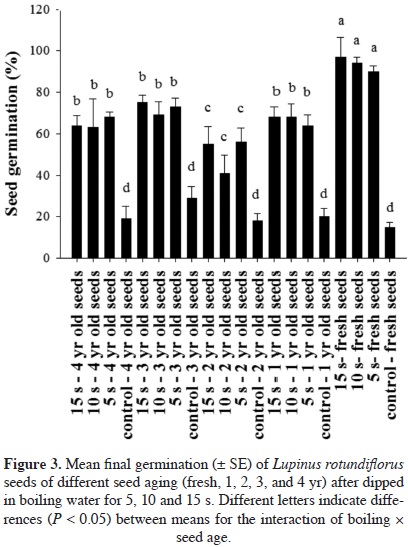
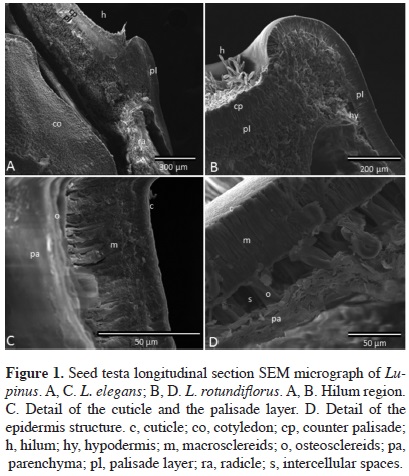
<body><![CDATA[<p align="justify"><font face="verdana" size="2">&nbsp;</font></p>  	    <p align="justify"><font face="verdana" size="2"><b>Results</b></font></p>  	    <p align="justify"><font face="verdana" size="2"><i>Anatomical study of physical dormancy (PY).</i> We provide direct evidence that fresh and stored seeds of the studied species possess PY by describing the basic structure of seed testa that results in a hard seed coat of <i>Lupinus</i> spp. We found in the seed testa longitudinal sections, four layers inwards from the surface: the cuticle, the epidermis, the hypodermis, and the inner parenchyma. The first barrier to imbibition is the waxy cuticle. The next layer is the epidermis, composed of thick&#45;walled macrosclereids with the long axis oriented perpendicularly to the surface, arranged in a compact palisade layer. Under the epidermis a single layer of osteosclereids separated by wide intercellular spaces forms the hypodermis, except under the hilum cleft where it is absent. The fourth innermost layer is parenchymatous, with six rows of tangentially collapsed endosperm remnant cells. At the hilum there is one external layer of macrosclereids forming a counter&#45;palisade layer placed above the palisade layer (<a href="#a10f1">Figure 1</a>).</font></p>  	    <p align="center"><font face="verdana" size="2"><a name="a10f1"></a></font></p>  	    <p align="center"><font face="verdana" size="2"><img src="/img/revistas/bs/v92n1/a10f1.jpg"></font></p>  	    <p align="justify"><font face="verdana" size="2"><i>Effect of pretreatments on seed germination.</i> For both species a higher germination percentage was observed for seeds pretreated in boiling water than for control seeds and those from the hot wet and dry sand experiment.</font></p>  	    <p align="justify"><font face="verdana" size="2"><i>Boiling water.</i> There was a significant effect of pretreatments <i>(F</i> = 48.19, df = 3, <i>P</i> &lt; 0.001) on the germination of <i>Lupinus elegans</i> seeds. Boiling water for 5, 10, and 15 s resulted in higher germination than control seeds (<a href="#a10t1">Table 1</a>). There was also a significant effect of seed age (F = 19.26, df = 2, <i>P</i> &lt; 0.001) in that pretreated fresh seeds germinated less (30 &plusmn; 4.12%) than pretreated seeds after 1 yr (57 &plusmn; 6.31%) or 2 yr (49.5 &plusmn; 7.09%) of dry storage. Interaction between pretreatment and seed age was not significant (<a href="#a10f2">Figure 2</a>; <i>F</i> = 1.55, df = 6, <i>P</i> = 0.18).</font></p>  	    <p align="center"><font face="verdana" size="2"><a name="a10t1"></a></font></p>  	    <p align="center"><font face="verdana" size="2"><img src="/img/revistas/bs/v92n1/a10t1.jpg"></font></p>  	    <p align="center"><font face="verdana" size="2"><a name="a10f2"></a></font></p>  	    ]]></body>
<body><![CDATA[<p align="center"><font face="verdana" size="2"><img src="/img/revistas/bs/v92n1/a10f2.jpg"></font></p>  	    <p align="justify"><font face="verdana" size="2">For <i>Lupinus rotundiflorus</i> seeds, there was a significant effect of pretreatments on germination <i>(F</i> = 82.00, df = 3, <i>P</i> &lt; 0.0001); boiling water for 5, 10, and 15 s resulted in higher germination than the control seeds (<a href="#a10t2">Table 2</a>). There was also a significant effect of seed age (F = 12.54, df = 4, <i>P</i> &lt; 0.0001); on average pretreated fresh seeds showed higher germination (71.5 &plusmn; 7.65 %) than seeds pretreated after 1 yr (55 &plusmn; 5.23 %), 2 yr (42.5 &plusmn; 4.83 %), 3 yr (61.5 &plusmn; 4.92 %), or 4 yr (53.5 &plusmn; 5.91 %) dry storage. Interaction between heat exposure in boiling water and storage time was significant (F = 2.1350, df = 12, <i>P</i> = 0.0233) in that 2 yr old seeds had similar low germination across pretreatments. Regardless of storage time, seeds germinated more after pretreatment than control seeds. Fresh seeds showed higher germination than older seeds with pretreatments (<a href="#a10f3">Figure 3</a>).</font></p>  	    <p align="center"><font face="verdana" size="2"><a name="a10t2"></a></font></p>  	    <p align="center"><font face="verdana" size="2"><img src="/img/revistas/bs/v92n1/a10t2.jpg"></font></p>  	    <p align="center"><font face="verdana" size="2"><a name="a10f3"></a></font></p>  	    <p align="center"><font face="verdana" size="2"><img src="/img/revistas/bs/v92n1/a10f3.jpg"></font></p>  	    <p align="justify"><font face="verdana" size="2"><i>Dry and wet sand.</i> There were differences in germination of <i>Lupinus elegans</i> seeds between pretreatments (F = 10.69, df = 4, <i>P</i> &lt; 0.0001). Germination was higher for seeds after wet sand incubation for 60 and 90 min at 100 &deg;C (29 &plusmn; 6.05% and 32.33 &plusmn; 6.91%, respectively) than for those incubated in dry sand (13.33 &plusmn; 4.13 % and 22.66 &plusmn; 5.68 %, respectively) at the same temperature and control seeds (7.33 &plusmn; 1.68%). Seeds exposed to temperatures of 120 and 150 &deg;C did not germinate. Storage time influenced germination <i>(F</i> = 83.83, df = 2, <i>P</i> &lt; 0.0001), in that the highest germination was obtained for seeds stored for 1 yr (42 &plusmn; 3.76%), followed by seeds stored for 2 yr (17.2 &plusmn; 3.48%) and fresh seeds (3.6 &plusmn; 0.98%). The interaction between pretreatment and storage time was significant (F = 5.38, df = 8, <i>P</i> &lt; 0.0001), in that 1 yr old seeds had higher germination than fresh seeds, and 2 yr old seeds after wet and dry sand incubation (<a href="#a10f4">Figure 4</a>).</font></p>  	    <p align="center"><font face="verdana" size="2"><a name="a10f4"></a></font></p>  	    <p align="center"><font face="verdana" size="2"><img src="/img/revistas/bs/v92n1/a10f4.jpg"></font></p>  	    <p align="justify"><font face="verdana" size="2">For <i>Lupinus rotundiflorus,</i> seeds exposed to temperatures of 120, and 150 &deg;C did not germinate. Wet sand incubation for 60 min at 100 &deg;C resulted in high germination (55.8 &plusmn; 4.48%) as well as dry sand incubation for 60 min (60.6 &plusmn; 4.47%), and 90 min (54 &plusmn; 4.58 %) compared to seeds incubated in moist sand for 90 min (32.4 &plusmn; 5.43%) and control seeds (20.2 &plusmn; 2.07%, <i>F</i> = 50.248, df = 4, <i>P</i> &lt; 0.0001). Storage time also affected germination, pretreated fresh seeds had higher germination (73.4 &plusmn; 6.28%) than pretreated seeds after 1 yr (38.6 &plusmn; 4.05%), 2 yr (27.6 &plusmn; 3.04%), 3 yr (45.8 &plusmn; 4.16%), or 4 yr (37.6 &plusmn; 3.58%) of dry storage (F = 49.870, df = 4, <i>P</i> &lt; 0.0001). The interaction between storage time and pretreatment was significant (F = 4.86, df = 16, <i>P</i> &lt; 0.0001), in that pretreated fresh seeds germinated more (at least 81%) than fresh untreated seeds (15 &plusmn; 2 %), and control and pretreated stored seeds (<a href="#a10t3">Table 3</a>).</font></p>  	    ]]></body>
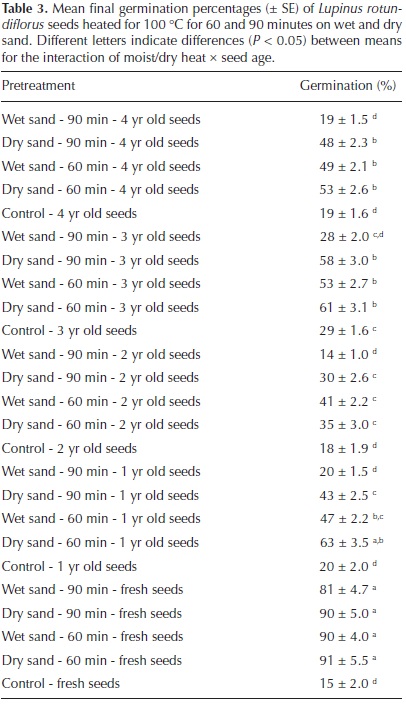
<body><![CDATA[<p align="center"><font face="verdana" size="2"><a name="a10t3"></a></font></p>  	    <p align="center"><font face="verdana" size="2"><img src="/img/revistas/bs/v92n1/a10t3.jpg"></font></p>  	    <p align="justify"><font face="verdana" size="2">&nbsp;</font></p>  	    <p align="justify"><font face="verdana" size="2"><b>Discussion</b></font></p>  	    <p align="justify"><font face="verdana" size="2">Seeds of the studied species were found to have structures that provide PY as for other species of Fabaceae with PY (de Souza and Marcos&#45;Filho, 2001). Heat shock caused by high temperatures influenced the breaking of seed dormancy of studied <i>Lupinus</i> species. In general, the pretreatment that resulted in higher germination was boiling water. This result is similar to that obtained for <i>L. varius</i> by Quinlivan (1968) and Karaguzel <i>et al.</i> (2004), as well as for <i>L. lepidus</i> by Elliott <i>et al.</i> (2011). However, it differs from results obtained by Bolin (2009) for <i>L. perennis.</i> For <i>L. polyphyllus</i> almost no germination was obtained after hot water exposure followed by 20 &deg;C incubation, but 60% germination was obtained after chilling at 5 &deg;C for six weeks to simulate winter followed by alternating diurnal temperatures of 15 &deg;C/7 &deg;C approximating spring conditions (Elliot <i>et al.,</i> 2011). This variation implies specific requirements among the species of <i>Lupinus</i> to break dormancy. Because <i>L. elegans</i> and <i>L. rotundiflorus</i> grow in high altitudes, the effect of chilling in breaking physical dormancy needs to be tested.</font></p>  	    <p align="justify"><font face="verdana" size="2">Pretreatment of wet or dry sand produced low germination percentages for <i>Lupinus elegans</i> (&lt; 40% in wet sand and &lt; 20% dry sand), and high germination for <i>L. rotundiflorus</i> (&gt; 70% in wet sand and &gt; 50% dry sand). This implies that species germination responses were not necessarily related to their phylogeny, but perhaps to their environment as suggested by Elliot <i>et al.</i> (2011) for three species of <i>Lupinus</i> of Washington, USA. These authors found that <i>L. lepidus</i> and <i>L. albicaulis,</i> species that are restricted to frequently burned prairies, had stronger responses to high pregermination temperature regimes. In contrast, <i>L. polyphyllus,</i> with a broader distribution showed less response to high pregermination temperatures, and minor response to fluctuating spring temperature regimes.</font></p>  	    <p align="justify"><font face="verdana" size="2">Temperatures above 100 &deg;C adversely affected germination of our species, suggesting that they are not adapted to germinate after very intense fires. Loss of viability after heat was probably due to embryo damage, as reported by Keeley <i>et al.</i> (1985) for <i>Marah macrocarpus, Paeonia californica, Stipa coronata,</i> and <i>Zigadenus fremontii,</i> as well as by Cruz <i>et al.</i> (2003) for <i>Erica australis</i> at 150 &deg;C. For some species in the Fabaceae, damage of seeds inhibiting germination has been found even at relatively low temperatures (&gt; 90 &deg;C). Martin <i>et al.</i> (1975) found that temperatures above 90 &deg;C were lethal for seeds of <i>Cassia, Desmodium, Galactia,</i> and <i>Lespedeza.</i> Stored seeds of <i>Lupinus elegans</i> showed higher germination than fresh seeds, suggesting that physical dormancy is lost with age. Therefore, this species probably has the ability to form seed banks in the soil. For <i>L. rotundiflorus</i> however, fresh seeds germinated more after being exposed to wet and dry hot sand, implying that physical dormancy can be easily broken by heat shock in the same year seeds were produced. This also implies that species germination responses are not necessarily related to their phylogeny.</font></p>  	    <p align="justify"><font face="verdana" size="2">Storage of seeds did not break their dormancy, but high temperatures did. High temperatures helped break seed dormancy, although high temperatures affected seed viability because 90 min treatments with dry or wet sand showed decreased germination compared with 60 min treatments for <i>Lupinus rotundiflorus.</i> Rapid 'accelerated' ageing by the impact of high temperatures might damage cellular structures (Daws <i>et al.,</i> 2007).</font></p>  	    <p align="justify"><font face="verdana" size="2">As it has been suggested for other species growing in harsh environments (Jurado and Flores, 2005), the hard and impermeable seed coat found for <i>Lupinus elegans</i> and <i>L. rotundiflorus</i> allows the seeds to endure the stressful high temperatures of open sites where these species occur. Our results on effect of heat on breaking seed dormancy is a irst approach to investigate the regeneration biology of species in pine and pine&#45;oak forests in Central Mexico and may be useful for further studies to understand and predict ecological plant responses in Mexican forests.</font></p>  	    <p align="justify"><font face="verdana" size="2">&nbsp;</font></p>  	    ]]></body>
<body><![CDATA[<p align="justify"><font face="verdana" size="2"><b>Acknowledgements</b></font></p>  	    <p align="justify"><font face="verdana" size="2">This study was supported by Consejo Nacional de Ciencia y Tecnolog&iacute;a&#45;Fondos Sectoriales&#45;Secretar&iacute;a de Medio Ambiente y Recursos Naturales (2006&#45;1&#45;23818). Robles&#45;D&iacute;az, E. was supported by a grant (090388) from Consejo Nacional de Ciencia y Tecnolog&iacute;a during her master degree studies at Instituto Potosino de Investigaci&oacute;n Cient&iacute;ica y Tecnol&oacute;gica. Araceli Patr&oacute;n (Divisi&oacute;n de Biolog&iacute;a Molecular&#45;IPICYT) provided assistance with SEM. We thank two anonymous reviewers for contributing to improve the manuscript.</font></p>  	    <p align="justify"><font face="verdana" size="2">&nbsp;</font></p>  	    <p align="justify"><font face="verdana" size="2"><b>Literature cited</b></font></p>  	    <!-- ref --><p align="justify"><font face="verdana" size="2">Acosta&#45;Perc&aacute;stegui J. and Rodr&iacute;guez&#45;Trejo D.A. 2005. Factors affecting germination and pregerminative treatments of <i>Lupinus montanus</i> seeds. <i>Interciencia</i> 30:576&#45;579.    &nbsp;&nbsp;&nbsp;&nbsp;&nbsp;&nbsp;&nbsp;&nbsp;[&#160;<a href="javascript:void(0);" onclick="javascript: window.open('/scielo.php?script=sci_nlinks&ref=1769509&pid=S2007-4298201400010001000001&lng=','','width=640,height=500,resizable=yes,scrollbars=1,menubar=yes,');">Links</a>&#160;]<!-- end-ref --></font></p>  	    <!-- ref --><p align="justify"><font face="verdana" size="2">Aldrete&#45;Ch&aacute;vez A., Rodr&iacute;guez&#45;Trejo D.A., Espinosa&#45;Hern&aacute;ndez V., Ojeda&#45;Trejo E., and de la Cruz&#45;Landero N. 2010. Effects of different scariication treatments on the germination of <i>Lupinus leptophyllus</i> seeds. <i>International Journal of Botany</i> 6:64&#45;68.    &nbsp;&nbsp;&nbsp;&nbsp;&nbsp;&nbsp;&nbsp;&nbsp;[&#160;<a href="javascript:void(0);" onclick="javascript: window.open('/scielo.php?script=sci_nlinks&ref=1769511&pid=S2007-4298201400010001000002&lng=','','width=640,height=500,resizable=yes,scrollbars=1,menubar=yes,');">Links</a>&#160;]<!-- end-ref --></font></p>  	    <!-- ref --><p align="justify"><font face="verdana" size="2">Alvarado&#45;Sosa P., Blanco&#45;Garc&iacute;a A. and Lindig&#45;Cisneros R. 2007. Test of alternative propagation conditions for Lupinus elegans Kunth plants, and effects on field survival. <i>Revista Fitotecnia Mexicana</i> 30:201&#45;204.    &nbsp;&nbsp;&nbsp;&nbsp;&nbsp;&nbsp;&nbsp;&nbsp;[&#160;<a href="javascript:void(0);" onclick="javascript: window.open('/scielo.php?script=sci_nlinks&ref=1769513&pid=S2007-4298201400010001000003&lng=','','width=640,height=500,resizable=yes,scrollbars=1,menubar=yes,');">Links</a>&#160;]<!-- end-ref --></font></p>  	    ]]></body>
<body><![CDATA[<!-- ref --><p align="justify"><font face="verdana" size="2">Baskin C.C. 2003. Breaking physical dormancy in seeds &#45; focussing on the lens. <i>New Phytologist</i> 158:229&#45;232.    &nbsp;&nbsp;&nbsp;&nbsp;&nbsp;&nbsp;&nbsp;&nbsp;[&#160;<a href="javascript:void(0);" onclick="javascript: window.open('/scielo.php?script=sci_nlinks&ref=1769515&pid=S2007-4298201400010001000004&lng=','','width=640,height=500,resizable=yes,scrollbars=1,menubar=yes,');">Links</a>&#160;]<!-- end-ref --></font></p>  	    <!-- ref --><p align="justify"><font face="verdana" size="2">Baskin C.C. and Baskin J.M. 1998. <i>Seeds: Ecology, Biogeography and Evolution of Dormancy and Germination.</i> Academic Press, San Diego.    &nbsp;&nbsp;&nbsp;&nbsp;&nbsp;&nbsp;&nbsp;&nbsp;[&#160;<a href="javascript:void(0);" onclick="javascript: window.open('/scielo.php?script=sci_nlinks&ref=1769517&pid=S2007-4298201400010001000005&lng=','','width=640,height=500,resizable=yes,scrollbars=1,menubar=yes,');">Links</a>&#160;]<!-- end-ref --></font></p>  	    <!-- ref --><p align="justify"><font face="verdana" size="2">Baskin J.M. and Baskin C.C. 2000. Evolutionary considerations of claims of physical dormancy&#45;break by microbial action and abrasion by soil particles. <i>Seed Science Research</i> 10:409&#45;413.    &nbsp;&nbsp;&nbsp;&nbsp;&nbsp;&nbsp;&nbsp;&nbsp;[&#160;<a href="javascript:void(0);" onclick="javascript: window.open('/scielo.php?script=sci_nlinks&ref=1769519&pid=S2007-4298201400010001000006&lng=','','width=640,height=500,resizable=yes,scrollbars=1,menubar=yes,');">Links</a>&#160;]<!-- end-ref --></font></p>  	    <!-- ref --><p align="justify"><font face="verdana" size="2">Baskin J.M., Baskin C.C. and Li X. 2000. Taxonomy, anatomy and evolution of physical dormancy in seeds. <i>Plant Species Biology</i> 15:139&#45;152.    &nbsp;&nbsp;&nbsp;&nbsp;&nbsp;&nbsp;&nbsp;&nbsp;[&#160;<a href="javascript:void(0);" onclick="javascript: window.open('/scielo.php?script=sci_nlinks&ref=1769521&pid=S2007-4298201400010001000007&lng=','','width=640,height=500,resizable=yes,scrollbars=1,menubar=yes,');">Links</a>&#160;]<!-- end-ref --></font></p>  	    <!-- ref --><p align="justify"><font face="verdana" size="2">Bolin J.F. 2009. Heat shock germination responses of three Eastern North American temperate species. <i>Castanea</i> 74:160&#45;167.    &nbsp;&nbsp;&nbsp;&nbsp;&nbsp;&nbsp;&nbsp;&nbsp;[&#160;<a href="javascript:void(0);" onclick="javascript: window.open('/scielo.php?script=sci_nlinks&ref=1769523&pid=S2007-4298201400010001000008&lng=','','width=640,height=500,resizable=yes,scrollbars=1,menubar=yes,');">Links</a>&#160;]<!-- end-ref --></font></p>  	    ]]></body>
<body><![CDATA[<!-- ref --><p align="justify"><font face="verdana" size="2">Burns R.E. 1959. Effect of acid scarification on lupine seed impermeability. <i>Plant Physiology</i> 34: 107&#45;108.    &nbsp;&nbsp;&nbsp;&nbsp;&nbsp;&nbsp;&nbsp;&nbsp;[&#160;<a href="javascript:void(0);" onclick="javascript: window.open('/scielo.php?script=sci_nlinks&ref=1769525&pid=S2007-4298201400010001000009&lng=','','width=640,height=500,resizable=yes,scrollbars=1,menubar=yes,');">Links</a>&#160;]<!-- end-ref --></font></p>  	    <!-- ref --><p align="justify"><font face="verdana" size="2">Cruz A., P&eacute;rez B., Velasco A. and Moreno J.M. 2003. Variability in seed germination at the interpopulation, intrapopulation and intraindividual levels of the shrub <i>Erica australis</i> in response to fire&#45;related cues. <i>Plant Ecology</i> 169:93&#45;103.    &nbsp;&nbsp;&nbsp;&nbsp;&nbsp;&nbsp;&nbsp;&nbsp;[&#160;<a href="javascript:void(0);" onclick="javascript: window.open('/scielo.php?script=sci_nlinks&ref=1769527&pid=S2007-4298201400010001000010&lng=','','width=640,height=500,resizable=yes,scrollbars=1,menubar=yes,');">Links</a>&#160;]<!-- end-ref --></font></p>  	    <!-- ref --><p align="justify"><font face="verdana" size="2">Davis T.D., George S.W., Upadhyaya A. and Parsons J. 1991. Improvement of seedling emergence of <i>Lupinus texensis</i> Hook. following seed scarification treatments. <i>Journal of Environmental Horticulture</i> 9:17&#45;21.    &nbsp;&nbsp;&nbsp;&nbsp;&nbsp;&nbsp;&nbsp;&nbsp;[&#160;<a href="javascript:void(0);" onclick="javascript: window.open('/scielo.php?script=sci_nlinks&ref=1769529&pid=S2007-4298201400010001000011&lng=','','width=640,height=500,resizable=yes,scrollbars=1,menubar=yes,');">Links</a>&#160;]<!-- end-ref --></font></p>  	    <!-- ref --><p align="justify"><font face="verdana" size="2">Daws M.I., Kabadajic A., Manger K. and Kranner I. 2007. Extreme thermo&#45;tolerance in seeds of desert succulents is related to maximum annual temperature. <i>South African Journal of Botany</i> 73:262&#45;265.    &nbsp;&nbsp;&nbsp;&nbsp;&nbsp;&nbsp;&nbsp;&nbsp;[&#160;<a href="javascript:void(0);" onclick="javascript: window.open('/scielo.php?script=sci_nlinks&ref=1769531&pid=S2007-4298201400010001000012&lng=','','width=640,height=500,resizable=yes,scrollbars=1,menubar=yes,');">Links</a>&#160;]<!-- end-ref --></font></p>  	    <!-- ref --><p align="justify"><font face="verdana" size="2">Dehgan B., Norcini J.G., Kabat S.M. and P&eacute;rez H.E. 2003. Effect of seed scarification and gibberellic acid treatment on seedling emergence of Sky&#45;Blue Lupine <i>(Lupinus diffusus). Journal of Environmental Horticulture</i> 21:64&#45;67.    &nbsp;&nbsp;&nbsp;&nbsp;&nbsp;&nbsp;&nbsp;&nbsp;[&#160;<a href="javascript:void(0);" onclick="javascript: window.open('/scielo.php?script=sci_nlinks&ref=1769533&pid=S2007-4298201400010001000013&lng=','','width=640,height=500,resizable=yes,scrollbars=1,menubar=yes,');">Links</a>&#160;]<!-- end-ref --></font></p>  	    ]]></body>
<body><![CDATA[<!-- ref --><p align="justify"><font face="verdana" size="2">de Souza, F.H.D. and Marcos&#45;Filho J. 2001. The seed coat as a modulator of seed environment relationships in Fabaceae. <i>Revista Brasileira de Botanica</i> 24:365&#45;375.    &nbsp;&nbsp;&nbsp;&nbsp;&nbsp;&nbsp;&nbsp;&nbsp;[&#160;<a href="javascript:void(0);" onclick="javascript: window.open('/scielo.php?script=sci_nlinks&ref=1769535&pid=S2007-4298201400010001000014&lng=','','width=640,height=500,resizable=yes,scrollbars=1,menubar=yes,');">Links</a>&#160;]<!-- end-ref --></font></p>  	    <!-- ref --><p align="justify"><font face="verdana" size="2">Elliott C.W., Fischer D.G. and LeRoy C.J. 2011. Germination of three native Lupinus species in response to temperature. <i>Northwest Science</i> 85:403&#45;410.    &nbsp;&nbsp;&nbsp;&nbsp;&nbsp;&nbsp;&nbsp;&nbsp;[&#160;<a href="javascript:void(0);" onclick="javascript: window.open('/scielo.php?script=sci_nlinks&ref=1769537&pid=S2007-4298201400010001000015&lng=','','width=640,height=500,resizable=yes,scrollbars=1,menubar=yes,');">Links</a>&#160;]<!-- end-ref --></font></p>  	    <!-- ref --><p align="justify"><font face="verdana" size="2">Ellis R.H., Hong T.D. and Roberts E.H. 1987. The development of desiccation&#45;tolerance and maximum seed quality during seed maturation in six grain legumes. <i>Annals of Botany</i> 59:23&#45;29.    &nbsp;&nbsp;&nbsp;&nbsp;&nbsp;&nbsp;&nbsp;&nbsp;[&#160;<a href="javascript:void(0);" onclick="javascript: window.open('/scielo.php?script=sci_nlinks&ref=1769539&pid=S2007-4298201400010001000016&lng=','','width=640,height=500,resizable=yes,scrollbars=1,menubar=yes,');">Links</a>&#160;]<!-- end-ref --></font></p>  	    <!-- ref --><p align="justify"><font face="verdana" size="2">Espinoza&#45;Mart&iacute;nez L.A., Rodr&iacute;guez&#45;Trejo D.A. and Zamudio&#45;S&aacute;nchez F.J. 2008. Sinecolog&iacute;a del sotobosque de <i>Pinus hartwegii</i> dos y tres a&ntilde;os despu&eacute;s de quemas prescritas. <i>Agrociencia</i> 42: 717&#45;730.    &nbsp;&nbsp;&nbsp;&nbsp;&nbsp;&nbsp;&nbsp;&nbsp;[&#160;<a href="javascript:void(0);" onclick="javascript: window.open('/scielo.php?script=sci_nlinks&ref=1769541&pid=S2007-4298201400010001000017&lng=','','width=640,height=500,resizable=yes,scrollbars=1,menubar=yes,');">Links</a>&#160;]<!-- end-ref --></font></p>  	    <!-- ref --><p align="justify"><font face="verdana" size="2">Gama&#45;Arachchige N.S., Baskin J.M., Geneve R.L. and Baskin C.C. 2010. Identification and characterization of the water gap in physically dormant seeds of Geraniaceae, with special reference to <i>Geranium carolinianum. Annals of Botany</i> 105:977&#45;990.    &nbsp;&nbsp;&nbsp;&nbsp;&nbsp;&nbsp;&nbsp;&nbsp;[&#160;<a href="javascript:void(0);" onclick="javascript: window.open('/scielo.php?script=sci_nlinks&ref=1769543&pid=S2007-4298201400010001000018&lng=','','width=640,height=500,resizable=yes,scrollbars=1,menubar=yes,');">Links</a>&#160;]<!-- end-ref --></font></p>  	    ]]></body>
<body><![CDATA[<!-- ref --><p align="justify"><font face="verdana" size="2">Garnczarska M., Bednarski W. and Jancelewicz M. 2009. Ability of lupine seeds to germinate and to tolerate desiccation as related to changes in free radical level and antioxidants in freshly harvested seeds. <i>Plant Physiology and Biochemistry</i> 47:56&#45;62.    &nbsp;&nbsp;&nbsp;&nbsp;&nbsp;&nbsp;&nbsp;&nbsp;[&#160;<a href="javascript:void(0);" onclick="javascript: window.open('/scielo.php?script=sci_nlinks&ref=1769545&pid=S2007-4298201400010001000019&lng=','','width=640,height=500,resizable=yes,scrollbars=1,menubar=yes,');">Links</a>&#160;]<!-- end-ref --></font></p>  	    <!-- ref --><p align="justify"><font face="verdana" size="2">Hern&aacute;ndez&#45;Ferretiz E., Rivera&#45;Mel&eacute;ndez R.K., Ramos&#45;Herrera O. J., Salinas&#45;P&eacute;rez F.C., Rodr&iacute;guez&#45;Monroy M. and Berm&uacute;dez&#45;Torres K. 2008. Effect of scarification treatments on germination of <i>Lupinus montanus</i> HBK Seeds. In: Palta J.A. and Berger J.B. Eds. 2008. <i>Lupinus for Health and Wealth. Proceedings of the 12th International Lupin Conference,</i> pp. 405&#45;409, Fremantle, Western Australia, International Lupin Association, Canterbury.    &nbsp;&nbsp;&nbsp;&nbsp;&nbsp;&nbsp;&nbsp;&nbsp;[&#160;<a href="javascript:void(0);" onclick="javascript: window.open('/scielo.php?script=sci_nlinks&ref=1769547&pid=S2007-4298201400010001000020&lng=','','width=640,height=500,resizable=yes,scrollbars=1,menubar=yes,');">Links</a>&#160;]<!-- end-ref --></font></p>  	    <!-- ref --><p align="justify"><font face="verdana" size="2">Jurado E. and Flores J. 2005. Is seed dormancy under environmental control or bound to plant traits? <i>Journal of Vegetation Science</i> 16:559&#45;564.    &nbsp;&nbsp;&nbsp;&nbsp;&nbsp;&nbsp;&nbsp;&nbsp;[&#160;<a href="javascript:void(0);" onclick="javascript: window.open('/scielo.php?script=sci_nlinks&ref=1769549&pid=S2007-4298201400010001000021&lng=','','width=640,height=500,resizable=yes,scrollbars=1,menubar=yes,');">Links</a>&#160;]<!-- end-ref --></font></p>  	    <!-- ref --><p align="justify"><font face="verdana" size="2">Jurado E. and Moles A. 2003. Germination deferment strategies. In: Nicol&aacute;s G., Bradford K.J., C&ocirc;me D. and Pritchard H.W. Eds. <i>The Biology of Seeds: Recent Research Advances,</i> pp. 381&#45;388, CABI Publishing, Wallingford.    &nbsp;&nbsp;&nbsp;&nbsp;&nbsp;&nbsp;&nbsp;&nbsp;[&#160;<a href="javascript:void(0);" onclick="javascript: window.open('/scielo.php?script=sci_nlinks&ref=1769551&pid=S2007-4298201400010001000022&lng=','','width=640,height=500,resizable=yes,scrollbars=1,menubar=yes,');">Links</a>&#160;]<!-- end-ref --></font></p>  	    <!-- ref --><p align="justify"><font face="verdana" size="2">Karaguzel O., Cakmakci S., Ortacesme V. and Aydinoglu B. 2004. Influence of seed coat treatments on germination and early seedling growth of <i>Lupinus varius</i> L. <i>Pakistan Journal of Botany</i> 36:65&#45;74.    &nbsp;&nbsp;&nbsp;&nbsp;&nbsp;&nbsp;&nbsp;&nbsp;[&#160;<a href="javascript:void(0);" onclick="javascript: window.open('/scielo.php?script=sci_nlinks&ref=1769553&pid=S2007-4298201400010001000023&lng=','','width=640,height=500,resizable=yes,scrollbars=1,menubar=yes,');">Links</a>&#160;]<!-- end-ref --></font></p>  	    ]]></body>
<body><![CDATA[<!-- ref --><p align="justify"><font face="verdana" size="2">Karaki T., Watanabe Y., Kondo T. and Koike T. 2012. Strophiole of seeds of the black locust acts as a water gap. <i>Plant Species Biology</i> 27:226&#45;232.    &nbsp;&nbsp;&nbsp;&nbsp;&nbsp;&nbsp;&nbsp;&nbsp;[&#160;<a href="javascript:void(0);" onclick="javascript: window.open('/scielo.php?script=sci_nlinks&ref=1769555&pid=S2007-4298201400010001000024&lng=','','width=640,height=500,resizable=yes,scrollbars=1,menubar=yes,');">Links</a>&#160;]<!-- end-ref --></font></p>  	    <!-- ref --><p align="justify"><font face="verdana" size="2">Keeley J.E., Morton B.A., Pedrosa A. and Trotter P 1985. Role of allelopathy, heat and charred wood in the germination of chaparral herbs and suffrutescents. <i>Journal of Ecology</i> 73:445&#45;458.    &nbsp;&nbsp;&nbsp;&nbsp;&nbsp;&nbsp;&nbsp;&nbsp;[&#160;<a href="javascript:void(0);" onclick="javascript: window.open('/scielo.php?script=sci_nlinks&ref=1769557&pid=S2007-4298201400010001000025&lng=','','width=640,height=500,resizable=yes,scrollbars=1,menubar=yes,');">Links</a>&#160;]<!-- end-ref --></font></p>  	    <!-- ref --><p align="justify"><font face="verdana" size="2">Martin R.E., Miller R.L. and Cushwa C.T. 1975. Germination response of legume seeds subjected to moist and dry heat. <i>Ecology</i> 56:1441&#45;1445.    &nbsp;&nbsp;&nbsp;&nbsp;&nbsp;&nbsp;&nbsp;&nbsp;[&#160;<a href="javascript:void(0);" onclick="javascript: window.open('/scielo.php?script=sci_nlinks&ref=1769559&pid=S2007-4298201400010001000026&lng=','','width=640,height=500,resizable=yes,scrollbars=1,menubar=yes,');">Links</a>&#160;]<!-- end-ref --></font></p>  	    <!-- ref --><p align="justify"><font face="verdana" size="2">Mart&iacute;nez J.M., Rodr&iacute;guez&#45;Trejo D.A., Guizar&#45;Nolazco E. and Bonilla&#45;Beas R. 2008. Escarificaci&oacute;n artificial y natural de la semilla de <i>Lupinus bilineatus</i> Benth. <i>Revista Chapingo Serie Ciencias Forestales y del Ambiente</i> 14:73&#45;79.    &nbsp;&nbsp;&nbsp;&nbsp;&nbsp;&nbsp;&nbsp;&nbsp;[&#160;<a href="javascript:void(0);" onclick="javascript: window.open('/scielo.php?script=sci_nlinks&ref=1769561&pid=S2007-4298201400010001000027&lng=','','width=640,height=500,resizable=yes,scrollbars=1,menubar=yes,');">Links</a>&#160;]<!-- end-ref --></font></p>  	    <!-- ref --><p align="justify"><font face="verdana" size="2">Mart&iacute;nez&#45;Hern&aacute;ndez O.C. and Rodr&iacute;guez&#45;Trejo D.A. 2008. Species diversity after prescribed burns at different intensities and seasons in a high altitude <i>Pinus hartwegii</i> forest. <i>Interciencia</i> 33:337&#45;344.    &nbsp;&nbsp;&nbsp;&nbsp;&nbsp;&nbsp;&nbsp;&nbsp;[&#160;<a href="javascript:void(0);" onclick="javascript: window.open('/scielo.php?script=sci_nlinks&ref=1769563&pid=S2007-4298201400010001000028&lng=','','width=640,height=500,resizable=yes,scrollbars=1,menubar=yes,');">Links</a>&#160;]<!-- end-ref --></font></p>  	    ]]></body>
<body><![CDATA[<!-- ref --><p align="justify"><font face="verdana" size="2">McVaugh R. 1987. <i>Flora Novo&#45;Galiciana: A descriptive account of the vascular plants of Western Mexico, Vol. 5 Leguminosae.</i> The University of Michigan Press, Ann Arbor.    &nbsp;&nbsp;&nbsp;&nbsp;&nbsp;&nbsp;&nbsp;&nbsp;[&#160;<a href="javascript:void(0);" onclick="javascript: window.open('/scielo.php?script=sci_nlinks&ref=1769565&pid=S2007-4298201400010001000029&lng=','','width=640,height=500,resizable=yes,scrollbars=1,menubar=yes,');">Links</a>&#160;]<!-- end-ref --></font></p>  	    <!-- ref --><p align="justify"><font face="verdana" size="2">P&eacute;rez&#45;S&aacute;nchez R.M., Jurado E., Chapa&#45;Vargas L. and Flores J. 2011. Seed germination of Southern Chihuahuan Desert plants in response to elevated temperatures. <i>Journal of Arid Environments</i> 75:978&#45;980.    &nbsp;&nbsp;&nbsp;&nbsp;&nbsp;&nbsp;&nbsp;&nbsp;[&#160;<a href="javascript:void(0);" onclick="javascript: window.open('/scielo.php?script=sci_nlinks&ref=1769567&pid=S2007-4298201400010001000030&lng=','','width=640,height=500,resizable=yes,scrollbars=1,menubar=yes,');">Links</a>&#160;]<!-- end-ref --></font></p>  	    <!-- ref --><p align="justify"><font face="verdana" size="2">Probert R.J. 2000. The role of temperature in the regulation of seed dormancy and germination. In: Fenner M. Ed. <i>Seeds: The Ecology of Regeneration in Plant Communities,</i> 2<sup>nd</sup> edition, 261&#45;292, CABI Publishing, Wallingford.    &nbsp;&nbsp;&nbsp;&nbsp;&nbsp;&nbsp;&nbsp;&nbsp;[&#160;<a href="javascript:void(0);" onclick="javascript: window.open('/scielo.php?script=sci_nlinks&ref=1769569&pid=S2007-4298201400010001000031&lng=','','width=640,height=500,resizable=yes,scrollbars=1,menubar=yes,');">Links</a>&#160;]<!-- end-ref --></font></p>      <!-- ref --><p align="justify"><font face="verdana" size="2">Quinlivan B.J. 1968. The softening of hard seeds of sand&#45;plain Lupin <i>(Lupinus varius</i> L.). <i>Australian Journal of Agricultural Research</i> 19:507&#45;515.    &nbsp;&nbsp;&nbsp;&nbsp;&nbsp;&nbsp;&nbsp;&nbsp;[&#160;<a href="javascript:void(0);" onclick="javascript: window.open('/scielo.php?script=sci_nlinks&ref=1769571&pid=S2007-4298201400010001000032&lng=','','width=640,height=500,resizable=yes,scrollbars=1,menubar=yes,');">Links</a>&#160;]<!-- end-ref --></font></p>  	    <!-- ref --><p align="justify"><font face="verdana" size="2">Ruiz L.M. and Sotelo A. 2001. Chemical composition, nutritive value, and toxicology evaluation of Mexican wild lupins. <i>Journal of Agricultural and Food Chemistry</i> 49:5336&#45;5339.    &nbsp;&nbsp;&nbsp;&nbsp;&nbsp;&nbsp;&nbsp;&nbsp;[&#160;<a href="javascript:void(0);" onclick="javascript: window.open('/scielo.php?script=sci_nlinks&ref=1769573&pid=S2007-4298201400010001000033&lng=','','width=640,height=500,resizable=yes,scrollbars=1,menubar=yes,');">Links</a>&#160;]<!-- end-ref --></font></p>  	    ]]></body>
<body><![CDATA[<!-- ref --><p align="justify"><font face="verdana" size="2">Ruiz&#45;Moreno J.J. and Zamora&#45;Natera J.F. 2006. Distribuci&oacute;n de algunos lupinos silvestre en la zona occidente de M&eacute;xico. In: Ba&ntilde;uelos P.J., Ruiz L.M., Soltero Q.R. and Casta&ntilde;eda V.H. Eds. <i>Lupinos del Occidente de M&eacute;xico: Estudios Biol&oacute;gico, Bioqu&iacute;mico y Toxicol&oacute;gico,</i> pp. 33&#45;52, Universidad de Guadalajara, Guadalajara.    &nbsp;&nbsp;&nbsp;&nbsp;&nbsp;&nbsp;&nbsp;&nbsp;[&#160;<a href="javascript:void(0);" onclick="javascript: window.open('/scielo.php?script=sci_nlinks&ref=1769575&pid=S2007-4298201400010001000034&lng=','','width=640,height=500,resizable=yes,scrollbars=1,menubar=yes,');">Links</a>&#160;]<!-- end-ref --></font></p>  	    <!-- ref --><p align="justify"><font face="verdana" size="2">Ruiz&#45;Moreno J.J., Ruiz&#45;Lopez M.M., Zamora&#45;Natera J.F. 2000. The genus <i>Lupinus:</i> Taxonomy and distribution in Jalisco, Mexico. In: van Santen E., Wink M., Weissmann S. and Romer P. Eds. <i>Lupin, an ancient crop for the new millennium: Proceedings of the 9th International Lupin Conference,</i> pp. 297&#45;300, M&uuml;ritz.    &nbsp;&nbsp;&nbsp;&nbsp;&nbsp;&nbsp;&nbsp;&nbsp;[&#160;<a href="javascript:void(0);" onclick="javascript: window.open('/scielo.php?script=sci_nlinks&ref=1769577&pid=S2007-4298201400010001000035&lng=','','width=640,height=500,resizable=yes,scrollbars=1,menubar=yes,');">Links</a>&#160;]<!-- end-ref --></font></p>      <!-- ref --><p align="justify"><font face="verdana" size="2">Ruzin S.E. 1999. <i>Plant Microtechnique and Microscopy.</i> Oxford University Press, New York.    &nbsp;&nbsp;&nbsp;&nbsp;&nbsp;&nbsp;&nbsp;&nbsp;[&#160;<a href="javascript:void(0);" onclick="javascript: window.open('/scielo.php?script=sci_nlinks&ref=1769579&pid=S2007-4298201400010001000036&lng=','','width=640,height=500,resizable=yes,scrollbars=1,menubar=yes,');">Links</a>&#160;]<!-- end-ref --></font></p>  	    <!-- ref --><p align="justify"><font face="verdana" size="2">Sousa M. and Delgado A. 1993. Mexican Leguminosae: Phytogeography, endemism and origins. In: Ramamoorthy T.P., Bye R., Lot A. and Fa J. Eds. <i>Biological Diversity of Mexico: Origins and Distribution,</i> pp. 459&#45;511, Oxford University Press, Oxford.    &nbsp;&nbsp;&nbsp;&nbsp;&nbsp;&nbsp;&nbsp;&nbsp;[&#160;<a href="javascript:void(0);" onclick="javascript: window.open('/scielo.php?script=sci_nlinks&ref=1769581&pid=S2007-4298201400010001000037&lng=','','width=640,height=500,resizable=yes,scrollbars=1,menubar=yes,');">Links</a>&#160;]<!-- end-ref --></font></p>  	    <!-- ref --><p align="justify"><font face="verdana" size="2">Venier P., Funes G. and Carrizo&#45;Garc&iacute;a C. 2012. Physical dormancy and histological features of seeds of ive Acacia species (Fabaceae) from xerophytic forests in central Argentina. <i>Flora</i> 207:39&#45;46.    &nbsp;&nbsp;&nbsp;&nbsp;&nbsp;&nbsp;&nbsp;&nbsp;[&#160;<a href="javascript:void(0);" onclick="javascript: window.open('/scielo.php?script=sci_nlinks&ref=1769583&pid=S2007-4298201400010001000038&lng=','','width=640,height=500,resizable=yes,scrollbars=1,menubar=yes,');">Links</a>&#160;]<!-- end-ref --></font></p>  	    ]]></body>
<body><![CDATA[<!-- ref --><p align="justify"><font face="verdana" size="2">Zuloaga&#45;Aguilar S., Briones O. and Orozco&#45;Segovia A. 2010. Effect of heat shock on germination of 23 plant species in pine&#45;oak and montane cloud forests in western Mexico. <i>International Journal of Wildland Fire</i> 19:759&#45;773.    &nbsp;&nbsp;&nbsp;&nbsp;&nbsp;&nbsp;&nbsp;&nbsp;[&#160;<a href="javascript:void(0);" onclick="javascript: window.open('/scielo.php?script=sci_nlinks&ref=1769585&pid=S2007-4298201400010001000039&lng=','','width=640,height=500,resizable=yes,scrollbars=1,menubar=yes,');">Links</a>&#160;]<!-- end-ref --></font></p>  	    <!-- ref --><p align="justify"><font face="verdana" size="2">Zuloaga&#45;Aguilar S., Briones O. and Orozco&#45;Segovia A. 2011. Seed germination of montane forest species in response to ash, smoke and heat shock in Mexico. <i>Acta Oecologica</i> 37:256&#45;262.    &nbsp;&nbsp;&nbsp;&nbsp;&nbsp;&nbsp;&nbsp;&nbsp;[&#160;<a href="javascript:void(0);" onclick="javascript: window.open('/scielo.php?script=sci_nlinks&ref=1769587&pid=S2007-4298201400010001000040&lng=','','width=640,height=500,resizable=yes,scrollbars=1,menubar=yes,');">Links</a>&#160;]<!-- end-ref --></font></p>      ]]></body><back>
<ref-list>
<ref id="B1">
<nlm-citation citation-type="journal">
<person-group person-group-type="author">
<name>
<surname><![CDATA[Acosta-Percástegui]]></surname>
<given-names><![CDATA[J.]]></given-names>
</name>
<name>
<surname><![CDATA[Rodríguez-Trejo]]></surname>
<given-names><![CDATA[D.A.]]></given-names>
</name>
</person-group>
<article-title xml:lang="en"><![CDATA[Factors affecting germination and pregerminative treatments of Lupinus montanus seeds]]></article-title>
<source><![CDATA[Interciencia]]></source>
<year>2005</year>
<volume>30</volume>
<page-range>576-579</page-range></nlm-citation>
</ref>
<ref id="B2">
<nlm-citation citation-type="journal">
<person-group person-group-type="author">
<name>
<surname><![CDATA[Aldrete-Chávez]]></surname>
<given-names><![CDATA[A.]]></given-names>
</name>
<name>
<surname><![CDATA[Rodríguez-Trejo]]></surname>
<given-names><![CDATA[D.A.]]></given-names>
</name>
<name>
<surname><![CDATA[Espinosa-Hernández]]></surname>
<given-names><![CDATA[V.]]></given-names>
</name>
<name>
<surname><![CDATA[Ojeda-Trejo]]></surname>
<given-names><![CDATA[E.]]></given-names>
</name>
<name>
<surname><![CDATA[de la Cruz-Landero]]></surname>
<given-names><![CDATA[N.]]></given-names>
</name>
</person-group>
<article-title xml:lang="en"><![CDATA[Effects of different scariication treatments on the germination of Lupinus leptophyllus seeds]]></article-title>
<source><![CDATA[International Journal of Botany]]></source>
<year>2010</year>
<volume>6</volume>
<page-range>64-68</page-range></nlm-citation>
</ref>
<ref id="B3">
<nlm-citation citation-type="journal">
<person-group person-group-type="author">
<name>
<surname><![CDATA[Alvarado-Sosa]]></surname>
<given-names><![CDATA[P.]]></given-names>
</name>
<name>
<surname><![CDATA[Blanco-García]]></surname>
<given-names><![CDATA[A.]]></given-names>
</name>
<name>
<surname><![CDATA[Lindig-Cisneros]]></surname>
<given-names><![CDATA[R.]]></given-names>
</name>
</person-group>
<article-title xml:lang="en"><![CDATA[Test of alternative propagation conditions for Lupinus elegans Kunth plants, and effects on field survival]]></article-title>
<source><![CDATA[Revista Fitotecnia Mexicana]]></source>
<year>2007</year>
<volume>30</volume>
<page-range>201-204</page-range></nlm-citation>
</ref>
<ref id="B4">
<nlm-citation citation-type="journal">
<person-group person-group-type="author">
<name>
<surname><![CDATA[Baskin]]></surname>
<given-names><![CDATA[C.C.]]></given-names>
</name>
</person-group>
<article-title xml:lang="en"><![CDATA[Breaking physical dormancy in seeds - focussing on the lens]]></article-title>
<source><![CDATA[New Phytologist]]></source>
<year>2003</year>
<volume>158</volume>
<page-range>229-232</page-range></nlm-citation>
</ref>
<ref id="B5">
<nlm-citation citation-type="book">
<person-group person-group-type="author">
<name>
<surname><![CDATA[Baskin]]></surname>
<given-names><![CDATA[C.C.]]></given-names>
</name>
<name>
<surname><![CDATA[Baskin]]></surname>
<given-names><![CDATA[J.M.]]></given-names>
</name>
</person-group>
<source><![CDATA[Seeds: Ecology, Biogeography and Evolution of Dormancy and Germination]]></source>
<year>1998</year>
<publisher-loc><![CDATA[San Diego ]]></publisher-loc>
<publisher-name><![CDATA[Academic Press]]></publisher-name>
</nlm-citation>
</ref>
<ref id="B6">
<nlm-citation citation-type="journal">
<person-group person-group-type="author">
<name>
<surname><![CDATA[Baskin]]></surname>
<given-names><![CDATA[J.M.]]></given-names>
</name>
<name>
<surname><![CDATA[Baskin]]></surname>
<given-names><![CDATA[C.C.]]></given-names>
</name>
</person-group>
<article-title xml:lang="en"><![CDATA[Evolutionary considerations of claims of physical dormancy-break by microbial action and abrasion by soil particles]]></article-title>
<source><![CDATA[Seed Science Research]]></source>
<year>2000</year>
<volume>10</volume>
<page-range>409-413</page-range></nlm-citation>
</ref>
<ref id="B7">
<nlm-citation citation-type="journal">
<person-group person-group-type="author">
<name>
<surname><![CDATA[Baskin]]></surname>
<given-names><![CDATA[J.M.]]></given-names>
</name>
<name>
<surname><![CDATA[Baskin]]></surname>
<given-names><![CDATA[C.C.]]></given-names>
</name>
<name>
<surname><![CDATA[Li]]></surname>
<given-names><![CDATA[X.]]></given-names>
</name>
</person-group>
<article-title xml:lang="en"><![CDATA[Taxonomy, anatomy and evolution of physical dormancy in seeds]]></article-title>
<source><![CDATA[Plant Species Biology]]></source>
<year>2000</year>
<volume>15</volume>
<page-range>139-152</page-range></nlm-citation>
</ref>
<ref id="B8">
<nlm-citation citation-type="journal">
<person-group person-group-type="author">
<name>
<surname><![CDATA[Bolin]]></surname>
<given-names><![CDATA[J.F.]]></given-names>
</name>
</person-group>
<article-title xml:lang="en"><![CDATA[Heat shock germination responses of three Eastern North American temperate species]]></article-title>
<source><![CDATA[Castanea]]></source>
<year>2009</year>
<volume>74</volume>
<page-range>160-167</page-range></nlm-citation>
</ref>
<ref id="B9">
<nlm-citation citation-type="journal">
<person-group person-group-type="author">
<name>
<surname><![CDATA[Burns]]></surname>
<given-names><![CDATA[R.E.]]></given-names>
</name>
</person-group>
<article-title xml:lang="en"><![CDATA[Effect of acid scarification on lupine seed impermeability]]></article-title>
<source><![CDATA[Plant Physiology]]></source>
<year>1959</year>
<volume>34</volume>
<page-range>107-108</page-range></nlm-citation>
</ref>
<ref id="B10">
<nlm-citation citation-type="journal">
<person-group person-group-type="author">
<name>
<surname><![CDATA[Cruz]]></surname>
<given-names><![CDATA[A.]]></given-names>
</name>
<name>
<surname><![CDATA[Pérez]]></surname>
<given-names><![CDATA[B.]]></given-names>
</name>
<name>
<surname><![CDATA[Velasco]]></surname>
<given-names><![CDATA[A.]]></given-names>
</name>
<name>
<surname><![CDATA[Moreno]]></surname>
<given-names><![CDATA[J.M.]]></given-names>
</name>
</person-group>
<article-title xml:lang="en"><![CDATA[Variability in seed germination at the interpopulation, intrapopulation and intraindividual levels of the shrub Erica australis in response to fire-related cues]]></article-title>
<source><![CDATA[Plant Ecology]]></source>
<year>2003</year>
<volume>169</volume>
<page-range>93-103</page-range></nlm-citation>
</ref>
<ref id="B11">
<nlm-citation citation-type="journal">
<person-group person-group-type="author">
<name>
<surname><![CDATA[Davis]]></surname>
<given-names><![CDATA[T.D.]]></given-names>
</name>
<name>
<surname><![CDATA[George]]></surname>
<given-names><![CDATA[S.W.]]></given-names>
</name>
<name>
<surname><![CDATA[Upadhyaya]]></surname>
<given-names><![CDATA[A.]]></given-names>
</name>
<name>
<surname><![CDATA[Parsons]]></surname>
<given-names><![CDATA[J.]]></given-names>
</name>
</person-group>
<article-title xml:lang="en"><![CDATA[Improvement of seedling emergence of Lupinus texensis Hook. following seed scarification treatments]]></article-title>
<source><![CDATA[Journal of Environmental Horticulture]]></source>
<year>1991</year>
<volume>9</volume>
<page-range>17-21</page-range></nlm-citation>
</ref>
<ref id="B12">
<nlm-citation citation-type="journal">
<person-group person-group-type="author">
<name>
<surname><![CDATA[Daws]]></surname>
<given-names><![CDATA[M.I.]]></given-names>
</name>
<name>
<surname><![CDATA[Kabadajic]]></surname>
<given-names><![CDATA[A.]]></given-names>
</name>
<name>
<surname><![CDATA[Manger]]></surname>
<given-names><![CDATA[K.]]></given-names>
</name>
<name>
<surname><![CDATA[Kranner]]></surname>
<given-names><![CDATA[I.]]></given-names>
</name>
</person-group>
<article-title xml:lang="en"><![CDATA[Extreme thermo-tolerance in seeds of desert succulents is related to maximum annual temperature]]></article-title>
<source><![CDATA[South African Journal of Botany]]></source>
<year>2007</year>
<volume>73</volume>
<page-range>262-265</page-range></nlm-citation>
</ref>
<ref id="B13">
<nlm-citation citation-type="journal">
<person-group person-group-type="author">
<name>
<surname><![CDATA[Dehgan]]></surname>
<given-names><![CDATA[B.]]></given-names>
</name>
<name>
<surname><![CDATA[Norcini]]></surname>
<given-names><![CDATA[J.G.]]></given-names>
</name>
<name>
<surname><![CDATA[Kabat]]></surname>
<given-names><![CDATA[S.M.]]></given-names>
</name>
<name>
<surname><![CDATA[Pérez]]></surname>
<given-names><![CDATA[H.E.]]></given-names>
</name>
</person-group>
<article-title xml:lang="en"><![CDATA[Effect of seed scarification and gibberellic acid treatment on seedling emergence of Sky-Blue Lupine (Lupinus diffusus)]]></article-title>
<source><![CDATA[Journal of Environmental Horticulture]]></source>
<year>2003</year>
<volume>21</volume>
<page-range>64-67</page-range></nlm-citation>
</ref>
<ref id="B14">
<nlm-citation citation-type="journal">
<person-group person-group-type="author">
<name>
<surname><![CDATA[de Souza]]></surname>
<given-names><![CDATA[F.H.D.]]></given-names>
</name>
<name>
<surname><![CDATA[Marcos-Filho]]></surname>
<given-names><![CDATA[J.]]></given-names>
</name>
</person-group>
<article-title xml:lang="en"><![CDATA[The seed coat as a modulator of seed environment relationships in Fabaceae]]></article-title>
<source><![CDATA[Revista Brasileira de Botanica]]></source>
<year>2001</year>
<volume>24</volume>
<page-range>365-375</page-range></nlm-citation>
</ref>
<ref id="B15">
<nlm-citation citation-type="journal">
<person-group person-group-type="author">
<name>
<surname><![CDATA[Elliott]]></surname>
<given-names><![CDATA[C.W.]]></given-names>
</name>
<name>
<surname><![CDATA[Fischer]]></surname>
<given-names><![CDATA[D.G.]]></given-names>
</name>
<name>
<surname><![CDATA[LeRoy]]></surname>
<given-names><![CDATA[C.J.]]></given-names>
</name>
</person-group>
<article-title xml:lang="en"><![CDATA[Germination of three native Lupinus species in response to temperature]]></article-title>
<source><![CDATA[Northwest Science]]></source>
<year>2011</year>
<volume>85</volume>
<page-range>403-410</page-range></nlm-citation>
</ref>
<ref id="B16">
<nlm-citation citation-type="journal">
<person-group person-group-type="author">
<name>
<surname><![CDATA[Ellis]]></surname>
<given-names><![CDATA[R.H.]]></given-names>
</name>
<name>
<surname><![CDATA[Hong]]></surname>
<given-names><![CDATA[T.D.]]></given-names>
</name>
<name>
<surname><![CDATA[Roberts]]></surname>
<given-names><![CDATA[E.H.]]></given-names>
</name>
</person-group>
<article-title xml:lang="en"><![CDATA[The development of desiccation-tolerance and maximum seed quality during seed maturation in six grain legumes]]></article-title>
<source><![CDATA[Annals of Botany]]></source>
<year>1987</year>
<volume>59</volume>
<page-range>23-29</page-range></nlm-citation>
</ref>
<ref id="B17">
<nlm-citation citation-type="journal">
<person-group person-group-type="author">
<name>
<surname><![CDATA[Espinoza-Martínez]]></surname>
<given-names><![CDATA[L.A.]]></given-names>
</name>
<name>
<surname><![CDATA[Rodríguez-Trejo]]></surname>
<given-names><![CDATA[D.A.]]></given-names>
</name>
<name>
<surname><![CDATA[Zamudio-Sánchez]]></surname>
<given-names><![CDATA[F.J.]]></given-names>
</name>
</person-group>
<article-title xml:lang="es"><![CDATA[Sinecología del sotobosque de Pinus hartwegii dos y tres años después de quemas prescritas]]></article-title>
<source><![CDATA[Agrociencia]]></source>
<year>2008</year>
<volume>42</volume>
<page-range>717-730</page-range></nlm-citation>
</ref>
<ref id="B18">
<nlm-citation citation-type="journal">
<person-group person-group-type="author">
<name>
<surname><![CDATA[Gama-Arachchige]]></surname>
<given-names><![CDATA[N.S.]]></given-names>
</name>
<name>
<surname><![CDATA[Baskin]]></surname>
<given-names><![CDATA[J.M.]]></given-names>
</name>
<name>
<surname><![CDATA[Geneve]]></surname>
<given-names><![CDATA[R.L.]]></given-names>
</name>
<name>
<surname><![CDATA[Baskin]]></surname>
<given-names><![CDATA[C.C.]]></given-names>
</name>
</person-group>
<article-title xml:lang="en"><![CDATA[Identification and characterization of the water gap in physically dormant seeds of Geraniaceae, with special reference to Geranium carolinianum]]></article-title>
<source><![CDATA[Annals of Botany]]></source>
<year>2010</year>
<volume>105</volume>
<page-range>977-990</page-range></nlm-citation>
</ref>
<ref id="B19">
<nlm-citation citation-type="journal">
<person-group person-group-type="author">
<name>
<surname><![CDATA[Garnczarska]]></surname>
<given-names><![CDATA[M.]]></given-names>
</name>
<name>
<surname><![CDATA[Bednarski]]></surname>
<given-names><![CDATA[W.]]></given-names>
</name>
<name>
<surname><![CDATA[Jancelewicz]]></surname>
<given-names><![CDATA[M.]]></given-names>
</name>
</person-group>
<article-title xml:lang="en"><![CDATA[Ability of lupine seeds to germinate and to tolerate desiccation as related to changes in free radical level and antioxidants in freshly harvested seeds]]></article-title>
<source><![CDATA[Plant Physiology and Biochemistry]]></source>
<year>2009</year>
<volume>47</volume>
<page-range>56-62</page-range></nlm-citation>
</ref>
<ref id="B20">
<nlm-citation citation-type="book">
<person-group person-group-type="author">
<name>
<surname><![CDATA[Hernández-Ferretiz]]></surname>
<given-names><![CDATA[E.]]></given-names>
</name>
<name>
<surname><![CDATA[Rivera-Meléndez]]></surname>
<given-names><![CDATA[R.K.]]></given-names>
</name>
<name>
<surname><![CDATA[Ramos-Herrera]]></surname>
<given-names><![CDATA[O. J.]]></given-names>
</name>
<name>
<surname><![CDATA[Salinas-Pérez]]></surname>
<given-names><![CDATA[F.C.]]></given-names>
</name>
<name>
<surname><![CDATA[Rodríguez-Monroy]]></surname>
<given-names><![CDATA[M.]]></given-names>
</name>
<name>
<surname><![CDATA[Bermúdez-Torres]]></surname>
<given-names><![CDATA[K.]]></given-names>
</name>
</person-group>
<article-title xml:lang="en"><![CDATA[Effect of scarification treatments on germination of Lupinus montanus HBK Seeds]]></article-title>
<person-group person-group-type="editor">
<name>
<surname><![CDATA[Palta]]></surname>
<given-names><![CDATA[J.A.]]></given-names>
</name>
<name>
<surname><![CDATA[Berger]]></surname>
<given-names><![CDATA[J.B.]]></given-names>
</name>
</person-group>
<source><![CDATA[Lupinus for Health and Wealth. Proceedings of the 12th International Lupin Conference]]></source>
<year>2008</year>
<month>20</month>
<day>08</day>
<page-range>405-409</page-range><publisher-loc><![CDATA[FremantleCanterbury ]]></publisher-loc>
<publisher-name><![CDATA[International Lupin Association]]></publisher-name>
</nlm-citation>
</ref>
<ref id="B21">
<nlm-citation citation-type="journal">
<person-group person-group-type="author">
<name>
<surname><![CDATA[Jurado]]></surname>
<given-names><![CDATA[E.]]></given-names>
</name>
<name>
<surname><![CDATA[Flores]]></surname>
<given-names><![CDATA[J.]]></given-names>
</name>
</person-group>
<article-title xml:lang="en"><![CDATA[Is seed dormancy under environmental control or bound to plant traits?]]></article-title>
<source><![CDATA[Journal of Vegetation Science]]></source>
<year>2005</year>
<volume>16</volume>
<page-range>559-564</page-range></nlm-citation>
</ref>
<ref id="B22">
<nlm-citation citation-type="book">
<person-group person-group-type="author">
<name>
<surname><![CDATA[Jurado]]></surname>
<given-names><![CDATA[E.]]></given-names>
</name>
<name>
<surname><![CDATA[Moles]]></surname>
<given-names><![CDATA[A.]]></given-names>
</name>
</person-group>
<article-title xml:lang="en"><![CDATA[Germination deferment strategies]]></article-title>
<person-group person-group-type="editor">
<name>
<surname><![CDATA[Nicolás]]></surname>
<given-names><![CDATA[G.]]></given-names>
</name>
<name>
<surname><![CDATA[Bradford]]></surname>
<given-names><![CDATA[K.J.]]></given-names>
</name>
<name>
<surname><![CDATA[Côme]]></surname>
<given-names><![CDATA[D.]]></given-names>
</name>
<name>
<surname><![CDATA[Pritchard]]></surname>
<given-names><![CDATA[H.W.]]></given-names>
</name>
</person-group>
<source><![CDATA[The Biology of Seeds: Recent Research Advances]]></source>
<year>2003</year>
<page-range>381-388</page-range><publisher-loc><![CDATA[Wallingford ]]></publisher-loc>
<publisher-name><![CDATA[CABI Publishing]]></publisher-name>
</nlm-citation>
</ref>
<ref id="B23">
<nlm-citation citation-type="journal">
<person-group person-group-type="author">
<name>
<surname><![CDATA[Karaguzel]]></surname>
<given-names><![CDATA[O.]]></given-names>
</name>
<name>
<surname><![CDATA[Cakmakci]]></surname>
<given-names><![CDATA[S.]]></given-names>
</name>
<name>
<surname><![CDATA[Ortacesme]]></surname>
<given-names><![CDATA[V.]]></given-names>
</name>
<name>
<surname><![CDATA[Aydinoglu]]></surname>
<given-names><![CDATA[B.]]></given-names>
</name>
</person-group>
<article-title xml:lang="en"><![CDATA[Influence of seed coat treatments on germination and early seedling growth of Lupinus varius L.]]></article-title>
<source><![CDATA[Pakistan Journal of Botany]]></source>
<year>2004</year>
<volume>36</volume>
<page-range>65-74</page-range></nlm-citation>
</ref>
<ref id="B24">
<nlm-citation citation-type="journal">
<person-group person-group-type="author">
<name>
<surname><![CDATA[Karaki]]></surname>
<given-names><![CDATA[T.]]></given-names>
</name>
<name>
<surname><![CDATA[Watanabe]]></surname>
<given-names><![CDATA[Y.]]></given-names>
</name>
<name>
<surname><![CDATA[Kondo]]></surname>
<given-names><![CDATA[T.]]></given-names>
</name>
<name>
<surname><![CDATA[Koike]]></surname>
<given-names><![CDATA[T.]]></given-names>
</name>
</person-group>
<article-title xml:lang="en"><![CDATA[Strophiole of seeds of the black locust acts as a water gap]]></article-title>
<source><![CDATA[Plant Species Biology]]></source>
<year>2012</year>
<volume>27</volume>
<page-range>226-232</page-range></nlm-citation>
</ref>
<ref id="B25">
<nlm-citation citation-type="journal">
<person-group person-group-type="author">
<name>
<surname><![CDATA[Keeley]]></surname>
<given-names><![CDATA[J.E.]]></given-names>
</name>
<name>
<surname><![CDATA[Morton]]></surname>
<given-names><![CDATA[B.A.]]></given-names>
</name>
<name>
<surname><![CDATA[Pedrosa]]></surname>
<given-names><![CDATA[A.]]></given-names>
</name>
<name>
<surname><![CDATA[Trotter]]></surname>
<given-names><![CDATA[P]]></given-names>
</name>
</person-group>
<article-title xml:lang="en"><![CDATA[Role of allelopathy, heat and charred wood in the germination of chaparral herbs and suffrutescents]]></article-title>
<source><![CDATA[Journal of Ecology]]></source>
<year>1985</year>
<volume>73</volume>
<page-range>445-458</page-range></nlm-citation>
</ref>
<ref id="B26">
<nlm-citation citation-type="journal">
<person-group person-group-type="author">
<name>
<surname><![CDATA[Martin]]></surname>
<given-names><![CDATA[R.E.]]></given-names>
</name>
<name>
<surname><![CDATA[Miller]]></surname>
<given-names><![CDATA[R.L.]]></given-names>
</name>
<name>
<surname><![CDATA[Cushwa]]></surname>
<given-names><![CDATA[C.T.]]></given-names>
</name>
</person-group>
<article-title xml:lang="en"><![CDATA[Germination response of legume seeds subjected to moist and dry heat]]></article-title>
<source><![CDATA[Ecology]]></source>
<year>1975</year>
<volume>56</volume>
<page-range>1441-1445</page-range></nlm-citation>
</ref>
<ref id="B27">
<nlm-citation citation-type="journal">
<person-group person-group-type="author">
<name>
<surname><![CDATA[Martínez]]></surname>
<given-names><![CDATA[J.M.]]></given-names>
</name>
<name>
<surname><![CDATA[Rodríguez-Trejo]]></surname>
<given-names><![CDATA[D.A.]]></given-names>
</name>
<name>
<surname><![CDATA[Guizar-Nolazco]]></surname>
<given-names><![CDATA[E.]]></given-names>
</name>
<name>
<surname><![CDATA[Bonilla-Beas]]></surname>
<given-names><![CDATA[R.]]></given-names>
</name>
</person-group>
<article-title xml:lang="es"><![CDATA[Escarificación artificial y natural de la semilla de Lupinus bilineatus Benth]]></article-title>
<source><![CDATA[Revista Chapingo Serie Ciencias Forestales y del Ambiente]]></source>
<year>2008</year>
<volume>14</volume>
<page-range>73-79</page-range></nlm-citation>
</ref>
<ref id="B28">
<nlm-citation citation-type="journal">
<person-group person-group-type="author">
<name>
<surname><![CDATA[Martínez-Hernández]]></surname>
<given-names><![CDATA[O.C.]]></given-names>
</name>
<name>
<surname><![CDATA[Rodríguez-Trejo]]></surname>
<given-names><![CDATA[D.A.]]></given-names>
</name>
</person-group>
<article-title xml:lang="en"><![CDATA[Species diversity after prescribed burns at different intensities and seasons in a high altitude Pinus hartwegii forest]]></article-title>
<source><![CDATA[Interciencia]]></source>
<year>2008</year>
<volume>33</volume>
<page-range>337-344</page-range></nlm-citation>
</ref>
<ref id="B29">
<nlm-citation citation-type="book">
<person-group person-group-type="author">
<name>
<surname><![CDATA[McVaugh]]></surname>
<given-names><![CDATA[R.]]></given-names>
</name>
</person-group>
<source><![CDATA[Flora Novo-Galiciana: A descriptive account of the vascular plants of Western Mexico, Vol. 5 Leguminosae]]></source>
<year>1987</year>
<publisher-loc><![CDATA[Ann Arbor ]]></publisher-loc>
<publisher-name><![CDATA[University of Michigan Press]]></publisher-name>
</nlm-citation>
</ref>
<ref id="B30">
<nlm-citation citation-type="journal">
<person-group person-group-type="author">
<name>
<surname><![CDATA[Pérez-Sánchez]]></surname>
<given-names><![CDATA[R.M.]]></given-names>
</name>
<name>
<surname><![CDATA[Jurado]]></surname>
<given-names><![CDATA[E.]]></given-names>
</name>
<name>
<surname><![CDATA[Chapa-Vargas]]></surname>
<given-names><![CDATA[L.]]></given-names>
</name>
<name>
<surname><![CDATA[Flores]]></surname>
<given-names><![CDATA[J.]]></given-names>
</name>
</person-group>
<article-title xml:lang="en"><![CDATA[Seed germination of Southern Chihuahuan Desert plants in response to elevated temperatures]]></article-title>
<source><![CDATA[Journal of Arid Environments]]></source>
<year>2011</year>
<volume>75</volume>
<page-range>978-980</page-range></nlm-citation>
</ref>
<ref id="B31">
<nlm-citation citation-type="book">
<person-group person-group-type="author">
<name>
<surname><![CDATA[Probert]]></surname>
<given-names><![CDATA[R.J.]]></given-names>
</name>
</person-group>
<article-title xml:lang="en"><![CDATA[The role of temperature in the regulation of seed dormancy and germination]]></article-title>
<person-group person-group-type="editor">
<name>
<surname><![CDATA[Fenner]]></surname>
<given-names><![CDATA[M.]]></given-names>
</name>
</person-group>
<source><![CDATA[Seeds: The Ecology of Regeneration in Plant Communities]]></source>
<year>2000</year>
<edition>2</edition>
<page-range>261-292</page-range><publisher-loc><![CDATA[Wallingford ]]></publisher-loc>
<publisher-name><![CDATA[CABI Publishing]]></publisher-name>
</nlm-citation>
</ref>
<ref id="B32">
<nlm-citation citation-type="journal">
<person-group person-group-type="author">
<name>
<surname><![CDATA[Quinlivan]]></surname>
<given-names><![CDATA[B.J.]]></given-names>
</name>
</person-group>
<article-title xml:lang="en"><![CDATA[The softening of hard seeds of sand-plain Lupin (Lupinus varius L.)]]></article-title>
<source><![CDATA[Australian Journal of Agricultural Research]]></source>
<year>1968</year>
<volume>19</volume>
<page-range>507-515</page-range></nlm-citation>
</ref>
<ref id="B33">
<nlm-citation citation-type="journal">
<person-group person-group-type="author">
<name>
<surname><![CDATA[Ruiz]]></surname>
<given-names><![CDATA[L.M.]]></given-names>
</name>
<name>
<surname><![CDATA[Sotelo]]></surname>
<given-names><![CDATA[A.]]></given-names>
</name>
</person-group>
<article-title xml:lang="en"><![CDATA[Chemical composition, nutritive value, and toxicology evaluation of Mexican wild lupins]]></article-title>
<source><![CDATA[Journal of Agricultural and Food Chemistry]]></source>
<year>2001</year>
<volume>49</volume>
<page-range>5336-5339</page-range></nlm-citation>
</ref>
<ref id="B34">
<nlm-citation citation-type="book">
<person-group person-group-type="author">
<name>
<surname><![CDATA[Ruiz-Moreno]]></surname>
<given-names><![CDATA[J.J.]]></given-names>
</name>
<name>
<surname><![CDATA[Zamora-Natera]]></surname>
<given-names><![CDATA[J.F.]]></given-names>
</name>
</person-group>
<article-title xml:lang="es"><![CDATA[Distribución de algunos lupinos silvestre en la zona occidente de México]]></article-title>
<person-group person-group-type="editor">
<name>
<surname><![CDATA[Bañuelos]]></surname>
<given-names><![CDATA[P.J.]]></given-names>
</name>
<name>
<surname><![CDATA[Ruiz]]></surname>
<given-names><![CDATA[L.M.]]></given-names>
</name>
<name>
<surname><![CDATA[Soltero]]></surname>
<given-names><![CDATA[Q.R.]]></given-names>
</name>
<name>
<surname><![CDATA[Castañeda]]></surname>
<given-names><![CDATA[V.H.]]></given-names>
</name>
</person-group>
<source><![CDATA[Lupinos del Occidente de México: Estudios Biológico, Bioquímico y Toxicológico]]></source>
<year>2006</year>
<page-range>33-52</page-range><publisher-loc><![CDATA[Guadalajara ]]></publisher-loc>
<publisher-name><![CDATA[Universidad de Guadalajara]]></publisher-name>
</nlm-citation>
</ref>
<ref id="B35">
<nlm-citation citation-type="">
<person-group person-group-type="author">
<name>
<surname><![CDATA[Ruiz-Moreno]]></surname>
<given-names><![CDATA[J.J.]]></given-names>
</name>
<name>
<surname><![CDATA[Ruiz-Lopez]]></surname>
<given-names><![CDATA[M.M.]]></given-names>
</name>
<name>
<surname><![CDATA[Zamora-Natera]]></surname>
<given-names><![CDATA[J.F.]]></given-names>
</name>
</person-group>
<article-title xml:lang="en"><![CDATA[The genus Lupinus: Taxonomy and distribution in Jalisco, Mexico]]></article-title>
<person-group person-group-type="editor">
<name>
<surname><![CDATA[van Santen]]></surname>
<given-names><![CDATA[E.]]></given-names>
</name>
<name>
<surname><![CDATA[Wink]]></surname>
<given-names><![CDATA[M.]]></given-names>
</name>
<name>
<surname><![CDATA[Weissmann]]></surname>
<given-names><![CDATA[S.]]></given-names>
</name>
<name>
<surname><![CDATA[Romer]]></surname>
<given-names><![CDATA[P.]]></given-names>
</name>
</person-group>
<source><![CDATA[Lupin, an ancient crop for the new millennium: Proceedings of the 9th International Lupin Conference]]></source>
<year>2000</year>
<page-range>297-300</page-range><publisher-loc><![CDATA[Müritz ]]></publisher-loc>
</nlm-citation>
</ref>
<ref id="B36">
<nlm-citation citation-type="book">
<person-group person-group-type="author">
<name>
<surname><![CDATA[Ruzin]]></surname>
<given-names><![CDATA[S.E.]]></given-names>
</name>
</person-group>
<source><![CDATA[Plant Microtechnique and Microscopy.]]></source>
<year>1999</year>
<publisher-loc><![CDATA[New York ]]></publisher-loc>
<publisher-name><![CDATA[Oxford University Press]]></publisher-name>
</nlm-citation>
</ref>
<ref id="B37">
<nlm-citation citation-type="book">
<person-group person-group-type="author">
<name>
<surname><![CDATA[Sousa]]></surname>
<given-names><![CDATA[M.]]></given-names>
</name>
<name>
<surname><![CDATA[Delgado]]></surname>
<given-names><![CDATA[A.]]></given-names>
</name>
</person-group>
<article-title xml:lang="en"><![CDATA[Mexican Leguminosae: Phytogeography, endemism and origins]]></article-title>
<person-group person-group-type="editor">
<name>
<surname><![CDATA[Ramamoorthy]]></surname>
<given-names><![CDATA[T.P.]]></given-names>
</name>
<name>
<surname><![CDATA[Bye]]></surname>
<given-names><![CDATA[R.]]></given-names>
</name>
<name>
<surname><![CDATA[Lot]]></surname>
<given-names><![CDATA[A.]]></given-names>
</name>
<name>
<surname><![CDATA[Fa]]></surname>
<given-names><![CDATA[J.]]></given-names>
</name>
</person-group>
<source><![CDATA[Biological Diversity of Mexico: Origins and Distribution]]></source>
<year>1993</year>
<page-range>459-511</page-range><publisher-loc><![CDATA[Oxford ]]></publisher-loc>
<publisher-name><![CDATA[Oxford University Press]]></publisher-name>
</nlm-citation>
</ref>
<ref id="B38">
<nlm-citation citation-type="journal">
<person-group person-group-type="author">
<name>
<surname><![CDATA[Venier]]></surname>
<given-names><![CDATA[P.]]></given-names>
</name>
<name>
<surname><![CDATA[Funes]]></surname>
<given-names><![CDATA[G.]]></given-names>
</name>
<name>
<surname><![CDATA[Carrizo-García]]></surname>
<given-names><![CDATA[C.]]></given-names>
</name>
</person-group>
<article-title xml:lang="en"><![CDATA[Physical dormancy and histological features of seeds of ive Acacia species (Fabaceae) from xerophytic forests in central Argentina]]></article-title>
<source><![CDATA[Flora]]></source>
<year>2012</year>
<volume>207</volume>
<page-range>39-46</page-range></nlm-citation>
</ref>
<ref id="B39">
<nlm-citation citation-type="journal">
<person-group person-group-type="author">
<name>
<surname><![CDATA[Zuloaga-Aguilar]]></surname>
<given-names><![CDATA[S.]]></given-names>
</name>
<name>
<surname><![CDATA[Briones]]></surname>
<given-names><![CDATA[O.]]></given-names>
</name>
<name>
<surname><![CDATA[Orozco-Segovia]]></surname>
<given-names><![CDATA[A.]]></given-names>
</name>
</person-group>
<article-title xml:lang="en"><![CDATA[Effect of heat shock on germination of 23 plant species in pine-oak and montane cloud forests in western Mexico]]></article-title>
<source><![CDATA[International Journal of Wildland Fire]]></source>
<year>2010</year>
<volume>19</volume>
<page-range>759-773</page-range></nlm-citation>
</ref>
<ref id="B40">
<nlm-citation citation-type="journal">
<person-group person-group-type="author">
<name>
<surname><![CDATA[Zuloaga-Aguilar]]></surname>
<given-names><![CDATA[S.]]></given-names>
</name>
<name>
<surname><![CDATA[Briones]]></surname>
<given-names><![CDATA[O.]]></given-names>
</name>
<name>
<surname><![CDATA[Orozco-Segovia]]></surname>
<given-names><![CDATA[A.]]></given-names>
</name>
</person-group>
<article-title xml:lang="en"><![CDATA[Seed germination of montane forest species in response to ash, smoke and heat shock in Mexico]]></article-title>
<source><![CDATA[Acta Oecologica]]></source>
<year>2011</year>
<volume>37</volume>
<page-range>256-262</page-range></nlm-citation>
</ref>
</ref-list>
</back>
</article>