<?xml version="1.0" encoding="ISO-8859-1"?><article xmlns:mml="http://www.w3.org/1998/Math/MathML" xmlns:xlink="http://www.w3.org/1999/xlink" xmlns:xsi="http://www.w3.org/2001/XMLSchema-instance">
<front>
<journal-meta>
<journal-id>2007-4298</journal-id>
<journal-title><![CDATA[Botanical Sciences]]></journal-title>
<abbrev-journal-title><![CDATA[Bot. sci]]></abbrev-journal-title>
<issn>2007-4298</issn>
<publisher>
<publisher-name><![CDATA[Sociedad Botánica de México A.C.]]></publisher-name>
</publisher>
</journal-meta>
<article-meta>
<article-id>S2007-42982014000100007</article-id>
<title-group>
<article-title xml:lang="en"><![CDATA[Floristic diversity and dynamics of Isla Rasa, Gulf of California - A globally important seabird island]]></article-title>
<article-title xml:lang="es"><![CDATA[Diversidad y dinámica florística de Isla Rasa, Golfo de California - Una isla de anidación de aves marinas de importancia global]]></article-title>
</title-group>
<contrib-group>
<contrib contrib-type="author">
<name>
<surname><![CDATA[Velarde]]></surname>
<given-names><![CDATA[Enriqueta]]></given-names>
</name>
<xref ref-type="aff" rid="A01"/>
</contrib>
<contrib contrib-type="author">
<name>
<surname><![CDATA[Wilder]]></surname>
<given-names><![CDATA[Benjamin T.]]></given-names>
</name>
<xref ref-type="aff" rid="A02"/>
</contrib>
<contrib contrib-type="author">
<name>
<surname><![CDATA[Felcer]]></surname>
<given-names><![CDATA[Richard S.]]></given-names>
</name>
<xref ref-type="aff" rid="A03"/>
<xref ref-type="aff" rid="A04"/>
</contrib>
<contrib contrib-type="author">
<name>
<surname><![CDATA[Ezcurra]]></surname>
<given-names><![CDATA[Exequiel]]></given-names>
</name>
<xref ref-type="aff" rid="A02"/>
<xref ref-type="aff" rid="A05"/>
</contrib>
</contrib-group>
<aff id="A01">
<institution><![CDATA[,Universidad Veracruzana Instituto de Ciencias Marinas y Pesquerías ]]></institution>
<addr-line><![CDATA[Boca del Río Veracruz]]></addr-line>
<country>Mexico</country>
</aff>
<aff id="A02">
<institution><![CDATA[,University of California Department of Botany and Plant Sciences ]]></institution>
<addr-line><![CDATA[Riverside California]]></addr-line>
<country>USA</country>
</aff>
<aff id="A03">
<institution><![CDATA[,University of Arizona Herbarium  ]]></institution>
<addr-line><![CDATA[Tucson Arizona]]></addr-line>
<country>USA</country>
</aff>
<aff id="A04">
<institution><![CDATA[,Sky Island Alliance  ]]></institution>
<addr-line><![CDATA[Tucson Arizona]]></addr-line>
<country>USA</country>
</aff>
<aff id="A05">
<institution><![CDATA[,University of California Institute for Mexico and the United States ]]></institution>
<addr-line><![CDATA[Riverside California]]></addr-line>
<country>USA</country>
</aff>
<pub-date pub-type="pub">
<day>00</day>
<month>03</month>
<year>2014</year>
</pub-date>
<pub-date pub-type="epub">
<day>00</day>
<month>03</month>
<year>2014</year>
</pub-date>
<volume>92</volume>
<numero>1</numero>
<fpage>89</fpage>
<lpage>101</lpage>
<copyright-statement/>
<copyright-year/>
<self-uri xlink:href="http://www.scielo.org.mx/scielo.php?script=sci_arttext&amp;pid=S2007-42982014000100007&amp;lng=en&amp;nrm=iso"></self-uri><self-uri xlink:href="http://www.scielo.org.mx/scielo.php?script=sci_abstract&amp;pid=S2007-42982014000100007&amp;lng=en&amp;nrm=iso"></self-uri><self-uri xlink:href="http://www.scielo.org.mx/scielo.php?script=sci_pdf&amp;pid=S2007-42982014000100007&amp;lng=en&amp;nrm=iso"></self-uri><abstract abstract-type="short" xml:lang="en"><p><![CDATA[Isla Rasa, a small (0.68 km²) but globally important seabird island in the Gulf of California, has a flora of only 14 vascular plant species found in three vegetation zones. Significant physical alteration of the island's surface and the introduction of non-native rodents, eradicated in 1995, add restoration ecology to the remarkable biology of the island. Over a century of botanical collections and observations record a consistently depauperate flora, best understood in the context of extreme aridity, isolation, and elevated levels of nitrogen and phosphorus from bird guano. The shaping factor of guano on the dearth of floristic diversity illustrates close connection between marine and terrestrial ecosystems in the Gulf of California. El Niño events that trigger collapses in marine productivity and crashes in seabird reproduction bring above-average winter rainfall pulses and rapid plant growth. Two new island records are reported (Rhizophora mangle and Viscainoa geniculata). Matched photographs show significant increase in the cholla cactus (Cylindropuntia fulgida) since 1971. Baseline knowledge of seabird breeding ecology and the flora of the island position Isla Rasa as a preeminent locality to study and monitor the ecological dynamics of a desert island in the context of restoration ecology and global environmental change.]]></p></abstract>
<abstract abstract-type="short" xml:lang="es"><p><![CDATA[Isla Rasa, una isla pequeña (0.68 km²) pero globalmente importante para la anidación de aves marinas en el Golfo de California, posee una flora de sólo 14 especies de plantas vasculares en tres zonas de vegetación. La importante alteración física de la superficie de la isla, y la introducción de dos especies de roedores, agregan la restauración ecológica debido a la erradicación de estos últimos en 1995, a la notable historia biológica de la isla. Más de un siglo de observaciones y colecciones botánicas registran una flora consistentemente depauperada, que se comprende mejor en el contexto de aridez extrema, aislamiento, y niveles elevados de nitrógeno y fósforo en el suelo provenientes del guano de las aves. El guano como factor de la baja diversidad florística ilustra la conexión entre los ecosistemas marinos y terrestres del Golfo de California. Los eventos de El Niño, que causan abatimiento en la productividad marina y colapsos en la reproducción de las aves, traen también eventos extraordinarios de lluvia y consecuentemente crecimiento vegetal. Dos nuevos registros insulares son reportados (Rhizophora mangle y Viscainoa geniculata), y fotografías comparadas revelan un incremento significativo en la cobertura de una especie de choya (Cylindropuntia fulgida) desde 1971. Una detallada línea de base de la ecología de aves marinas y de la flora insular ubican a Isla Rasa como una localidad destacada para el estudio y el monitoreo de la dinámica ecológica de una isla desértica, en el contexto de la restauración ecológica y los estudios de cambio ambiental global.]]></p></abstract>
<kwd-group>
<kwd lng="en"><![CDATA[biogeography]]></kwd>
<kwd lng="en"><![CDATA[ecosystem dynamics]]></kwd>
<kwd lng="en"><![CDATA[El Niño]]></kwd>
<kwd lng="en"><![CDATA[immigration]]></kwd>
<kwd lng="en"><![CDATA[islands]]></kwd>
<kwd lng="es"><![CDATA[biogeografía]]></kwd>
<kwd lng="es"><![CDATA[dinámica de ecosistemas]]></kwd>
<kwd lng="es"><![CDATA[El Niño]]></kwd>
<kwd lng="es"><![CDATA[inmigración]]></kwd>
<kwd lng="es"><![CDATA[islas]]></kwd>
</kwd-group>
</article-meta>
</front><body><![CDATA[  	    <p align="justify"><font face="verdana" size="4">Taxonom&iacute;a y flor&iacute;stica</font></p>  	    <p align="justify"><font face="verdana" size="2">&nbsp;</font></p>  	    <p align="center"><font face="verdana" size="4"><b>Floristic diversity and dynamics of Isla Rasa, Gulf of California &#45; A globally important seabird island</b></font></p> 	    <p align="center">&nbsp;</p> 	    <p align="center"><font face="verdana" size="3"><b>Diversidad y din&aacute;mica flor&iacute;stica de Isla Rasa, Golfo de California &#45; Una isla de anidaci&oacute;n de aves marinas de importancia global</b></font></p>      <p align="center"><font face="verdana" size="2">&nbsp;</font></p>  	    <p align="center"><font face="verdana" size="2"><b>Enriqueta Velarde<sup>1</sup>, Benjamin T. Wilder<sup>2</sup>'<sup>6</sup>, Richard S. Felcer<sup>3</sup>'<sup>4</sup> and Exequiel Ezcurra<sup>2</sup>'<sup>5</sup></b></font></p>  	    <p align="justify"><font face="verdana" size="2">&nbsp;</font></p>  	    <p align="justify"><font face="verdana" size="2"><sup><i>1</i></sup> <i>Instituto de Ciencias Marinas y Pesquer&iacute;as, Universidad Veracruzana, Boca del R&iacute;o, Veracruz, Mexico</i></font></p>      ]]></body>
<body><![CDATA[<p align="justify"><font face="verdana" size="2"><i><sup>2</sup> Department of Botany and Plant Sciences, University of California, Riverside, California, USA</i></font></p>  	    <p align="justify"><font face="verdana" size="2"><i><sup>3</sup> University of Arizona Herbarium, Tucson, Arizona, USA</i></font></p>  	    <p align="justify"><font face="verdana" size="2"><i><sup>4</sup> Sky Island Alliance, Tucson, Arizona, USA</i></font></p>  	    <p align="justify"><font face="verdana" size="2"><i><sup>5 </sup>University of California, Institute for Mexico and the United States (UC MEXUS)' Riverside, California, USA Corresponding author:</i> <a href="mailto:benjamin.wilder@email.ucr.edu">benjamin.wilder@email.ucr.edu</a></font></p>  	    <p align="justify"><font face="verdana" size="2">&nbsp;</font></p>  	    <p align="justify"><font face="verdana" size="2">Received: April 4th, 2013    <br> 	Accepted: June 16th, 2013</font></p>  	    <p align="justify"><font face="verdana" size="2">&nbsp;</font></p>  	    <p align="justify"><font face="verdana" size="2"><b>Abstract</b></font></p>  	    <p align="justify"><font face="verdana" size="2">Isla Rasa, a small (0.68 km<sup>2</sup>) but globally important seabird island in the Gulf of California, has a flora of only 14 vascular plant species found in three vegetation zones. Significant physical alteration of the island's surface and the introduction of non&#45;native rodents, eradicated in 1995, add restoration ecology to the remarkable biology of the island. Over a century of botanical collections and observations record a consistently depauperate flora, best understood in the context of extreme aridity, isolation, and elevated levels of nitrogen and phosphorus from bird guano. The shaping factor of guano on the dearth of floristic diversity illustrates close connection between marine and terrestrial ecosystems in the Gulf of California. El Ni&ntilde;o events that trigger collapses in marine productivity and crashes in seabird reproduction bring above&#45;average winter rainfall pulses and rapid plant growth. Two new island records are reported <i>(Rhizophora mangle</i> and <i>Viscainoa geniculata).</i> Matched photographs show significant increase in the cholla cactus <i>(Cylindropuntia fulgida)</i> since 1971. Baseline knowledge of seabird breeding ecology and the flora of the island position Isla Rasa as a preeminent locality to study and monitor the ecological dynamics of a desert island in the context of restoration ecology and global environmental change.</font></p>  	    ]]></body>
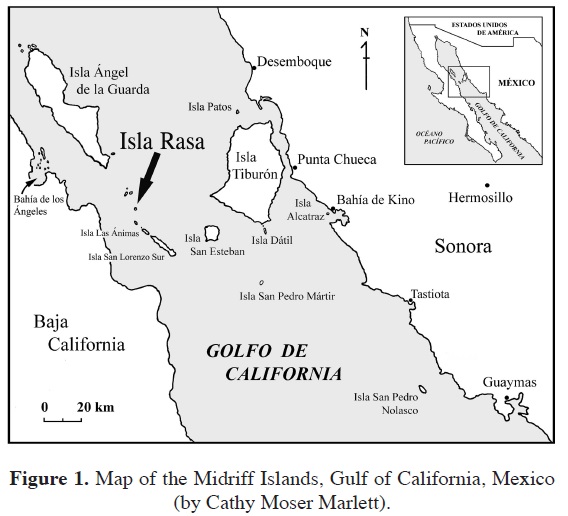
<body><![CDATA[<p align="justify"><font face="verdana" size="2"><b>Keywords:</b> biogeography, ecosystem dynamics, El Ni&ntilde;o, immigration, islands.</font></p>  	    <p align="justify"><font face="verdana" size="2">&nbsp;</font></p>  	    <p align="justify"><font face="verdana" size="2"><b>Resumen</b></font></p>  	    <p align="justify"><font face="verdana" size="2">Isla Rasa, una isla peque&ntilde;a (0.68 km<sup>2</sup>) pero globalmente importante para la anidaci&oacute;n de aves marinas en el Golfo de California, posee una flora de s&oacute;lo 14 especies de plantas vasculares en tres zonas de vegetaci&oacute;n. La importante alteraci&oacute;n f&iacute;sica de la superficie de la isla, y la introducci&oacute;n de dos especies de roedores, agregan la restauraci&oacute;n ecol&oacute;gica debido a la erradicaci&oacute;n de estos &uacute;ltimos en 1995, a la notable historia biol&oacute;gica de la isla. M&aacute;s de un siglo de observaciones y colecciones bot&aacute;nicas registran una flora consistentemente depauperada, que se comprende mejor en el contexto de aridez extrema, aislamiento, y niveles elevados de nitr&oacute;geno y f&oacute;sforo en el suelo provenientes del guano de las aves. El guano como factor de la baja diversidad flor&iacute;stica ilustra la conexi&oacute;n entre los ecosistemas marinos y terrestres del Golfo de California. Los eventos de El Ni&ntilde;o, que causan abatimiento en la productividad marina y colapsos en la reproducci&oacute;n de las aves, traen tambi&eacute;n eventos extraordinarios de lluvia y consecuentemente crecimiento vegetal. Dos nuevos registros insulares son reportados <i>(Rhizophora mangle</i> y <i>Viscainoa geniculata),</i> y fotograf&iacute;as comparadas revelan un incremento significativo en la cobertura de una especie de choya <i>(Cylindropuntia fulgida)</i> desde 1971. Una detallada l&iacute;nea de base de la ecolog&iacute;a de aves marinas y de la flora insular ubican a Isla Rasa como una localidad destacada para el estudio y el monitoreo de la din&aacute;mica ecol&oacute;gica de una isla des&eacute;rtica, en el contexto de la restauraci&oacute;n ecol&oacute;gica y los estudios de cambio ambiental global.</font></p>  	    <p align="justify"><font face="verdana" size="2"><b>Palabras clave:</b> biogeograf&iacute;a, din&aacute;mica de ecosistemas, El Ni&ntilde;o, inmigraci&oacute;n, islas.</font></p>  	    <p align="justify"><font face="verdana" size="2">&nbsp;</font></p>  	    <p align="justify"><font face="verdana" size="2">Interest in floristic diversity and vegetation dynamics has increased in recent times, mainly due to the progressively erratic nature of climate patterns and associated rates of biological change (Holmgren <i>et al.,</i> 2001). In particular, islands have factored into the foundational understanding of the natural world as discrete and often small habitat entities. Such studies have revealed mechanisms for species turnover and the possibility to perceive biological phenomena in isolation. In this respect, Isla Rasa in the Gulf of California has been a remarkable example of conservation, research, and restoration for the last 50 years. Observations in Rasa are particularly important because of the porous ocean&#45;land interface mediated by the abundant seabirds and inter&#45;annual climatic variability. For over 100 years human impacts had drastic effects on the island, during which, floristic observations and collections have regularly been made, accumulating over a centuries worth of baseline data for a long&#45;term ecological restoration project. The biological diversity and dynamics of this small island are reliable indicators of both local and global environmental (climatic and oceanographic) conditions and, as a result, valuable indicators of climatic change. Isla Rasa is, in some way, a resounding box where global scale phenomena are manifested and amplified.</font></p>  	    <p align="justify"><font face="verdana" size="2">Isla Rasa is a small (0.68 km<sup>2</sup>) desert island located in the rich upwelling region of the Midriff Islands of the Gulf of California, a region of globally high marine productivity (Murphy <i>et al.,</i> 2002; Vieyra <i>et al.,</i> 2009; <a href="#a7f1">Figures 1</a>, <a href="/img/revistas/bs/v92n1/a7f2.jpg" target="_blank">2</a>). The island supports the world's largest breeding populations of Heermann's Gulls <i>(Larus heermanni)</i> and Elegant Terns <i>(Thalasseus elegans;</i> Velarde and Anderson, 1994; Velarde <i>et al.,</i> 2005). Due to the massive numbers of these and other seabirds, the island is white&#45;washed in large amounts of guano and the corresponding high levels of nitrogen and phosphorus largely determine the plant species that can persist. In addition, to the harsh soil conditions, Rasa is isolated; formed from a recent volcanic eruption in the middle of the Gulf of California. It is ca. 20 km from the nearest point of the Baja California Peninsula, 38 km from the southwest corner of Isla Tibur&oacute;n near the Sonoran mainland, and 7.2 km from Partida, or Cardonosa, the nearest island. Isla Rasa is in one of the most arid regions of the Sonoran Desert and has relatively little topographic relief. Precipitation is scant and unpredictable, the largest amounts coming in pulses from winter rains associated with El Ni&ntilde;o events and rare warm&#45;season rain events from tropical storms that track up the Gulf of California (Garc&iacute;a, 1964). During summer months, and at other times of the year during El Ni&ntilde;o events, fog may occur due to warm air entering an area of cold ocean upwelling. Fog condenses on vegetation surfaces, especially cacti such as card&oacute;n <i>(Pachycereus pringlei),</i> pitaya agr&iacute;a ( <i>Stenocereus gummosus),</i> and cholla <i>(Cylindropuntia fulgida),</i> and can be a major source of moisture for some plants (Wilder and Felger, 2010). The combination of these factors yields a small, yet dynamic flora of 14 species.</font></p>  	    <p align="center"><font face="verdana" size="2"><a name="a7f1"></a></font></p>  	    <p align="center"><font face="verdana" size="2"><img src="/img/revistas/bs/v92n1/a7f1.jpg"></font></p>  	    ]]></body>
<body><![CDATA[<p align="justify"><font face="verdana" size="2">Isla Rasa is one of the youngest islands in the gulf, with an estimated age of only 10,000 years (Carre&ntilde;o and Helenes, 2002). The island is volcanic in origin, consisting mainly of massive and lesser fragments of basaltic rock among which a scant soil has accumulated, with a shoreline of basaltic boulders and a few low cliffs at the southeast end. There are several hills, the highest rising 30 m above sea level (<a href="/img/revistas/bs/v92n1/a7f3.jpg" target="_blank">Figure 3</a>). Most of the island, however, is nearly level, hence the Spanish name Rasa, which means flat or smooth (the name "Raza," meaning race, has been consistently misapplied to the island). There are three tidal lagoons, all on the northwest end of the island. The easternmost lagoon was artificially opened to the sea (in order to allow access for small skiffs) and drains completely at low tide. The other two are open to the sea only at highest tides and remain partially full at low tide. Most hills and the valleys between them (the latter originating from guano deposits from birds nesting on the island), as well as the tidal lagoons, are aligned approximately in a north northwest&#45;south southeast direction. Geologic studies indicate that the island is rising and the valleys at lower&#45;elevations must have been lagoons since soil&#45;core studies revealed mollusks in the process of fossilizing in the lower strata of sand, which overlay basaltic rock. Soil profiles elsewhere on the island show only guano over the basaltic rock (Vidal, 1967).</font></p>  	    <p align="justify"><font face="verdana" size="2">The most significant historic use of the island has been the extensive guanomining operations in the late nineteenth and early twentieth centuries. Thomas Bowen (2000) provides the best overview of such operations, highlights of which are provided here. The massive number of seabirds that used Rasa as a sanctuary for breeding, due to the absence of mammalian predators, deposited such quantities of guano that international companies exploited the resource. Guano mining began sometime before 1873, but exploitation was at low levels. Industrial extraction of the guano began in 1873 and continued into the 1910s, although at lower yields by the end of this era (Bowen, 2000). The guano mining operations required massive disturbance of the substrate: large numbers of medium size basalt boulders were manually removed by the miners from the hill surfaces and stacked into cairns (an estimated 11,200 structures; Bowen, 2000), and low long walls along many of the hills of the island. The pebbles left behind after the removal of these relatively large boulders created a surface resembling a desert pavement. The original substrate of the valleys, consisting of guano, was harvested using shovels and transported to boats. After guano mining ceased people began harvesting bird eggs in commercial quantities, reaching 50,000 eggs per year (Villa, 1976). Egg collection was practiced by local Baja California people who, in order to obtain fresh eggs for market, would travel to the island in small boats during the start of the laying season and destroy all eggs they could find so that the birds would lay fresh eggs (without developed embryos). A few days later they would collect the fresh eggs and take them to their towns for sale. This practice continued until 1964 when Rasa was given federal protection as a wildlife reserve.</font></p>  	    <p align="justify"><font face="verdana" size="2">In addition to disruption to the breeding habits and habitats of the sea birds during the years of guano mining and egg harvesting, house mice <i>(Mus musculus)</i> and black rats <i>(Rattus rattus)</i> became established. These introductions had significant effects on the sea bird populations and undoubtedly on some, if not all of the plants. The nesting populations (numbers unknown) of Craveri's Murrelet <i>(Synthliboramphus craven)</i> and Black&#45;vented Shearwater <i>(Puffinus opisthomelas)</i> were extirpated from the island, and the breeding success of Heermann's Gulls <i>(Larus heermanni)</i> and Elegant Terns <i>(Thalasseus elegans)</i> was drastically reduced.</font></p>  	    <p align="justify"><font face="verdana" size="2">The conservation story of Isla Rasa has multiple chapters and is central to the conservation of the Gulf of California as a whole. A popular article in <i>National Geographic</i> by Lewis Wayne Walker (1951) highlighted the natural wealth of the islands in the Gulf by documenting the awe&#45;inspiring gathering of hundreds of thousands of seabirds on the small desert island of Rasa. This article and associated popular media gained international recognition for the Gulf of California, which resulted in private donations made for the conservation and research of the seabird ecology on Rasa. This effort was headed by Dr. Bernardo Villa of the Instituto de Biolog&iacute;a of the Universidad Nacional Aut&oacute;noma de M&eacute;xico (UNAM) in Mexico City in the 1960s, with whom the lead author first traveled to the island and began her work. Concern grew over crashing seabird populations in the late 1950s and early 1960s, largely due to excessive egg collecting. An international collaboration between Mexican and American scientists, museum administrators, and local citizens petitioned the Mexican government to conserve Isla Rasa. Their work culminated in the island being declared a federally protected area in 1964 by the Mexican Federal Government under the official designation of <i>Zona de Reserva Natural y Refugio de Aves</i> (DOF, 1964). This foundation of conservation success led to continued scientific inquiry by researchers and students in the region, which grew into initiatives to expand understanding and conservation to other islands in the Gulf. Additional layers of protection have subsequently been afforded to Rasa and the Gulf as a whole. In 1978, Isla Rasa became part of the much larger protected area under the official designation of <i>&Aacute;rea de Protecci&oacute;n de Flora y Fauna Islas del Golfo de California</i> (DOF, 2000), which in 2005 were made a United Nations World Heritage site along with the marine and coastal protected areas of the Gulf of California. Because initially only the land portion of the islands was protected, in 2005 the waters around the group of islands between Partida and San Lorenzo, including Rasa, Salsipuedes and Las &Aacute;nimas, were protected under the official designation of <i>Parque Nacional exclusivamente la zona marina que circunda al complejo insular conocido como Archipi&eacute;lago de San Lorenzo</i> (DOF, 2005), and all the waters within five to seven nautical miles around these islands received protection as well. In February 2006, Isla Rasa was recognized as a wetland of international importance by the Ramsar Convention. In 2007 the waters included in Bah&iacute;a de los &Aacute;ngeles, Canal de Ballenas and Canal de Salsipuedes were declared a Biosphere Reserve under the name <i>Reserva de la Biosfera Bah&iacute;a de los &Aacute;ngeles, Canales de Ballenas y Salsipuedes</i> (DOF, 2007). From 1979 to the present, E. Velarde and her team have spent every spring monitoring the seabird&#45;breeding season on the island. The base of operations consists of a small house built in 1964 on the NW side of the island, close to the shores of the easternmost intertidal lagoon, by the <i>Secretar&iacute;a de Agricultura y Ganader&iacute;a,</i> the Mexican federal environmental agency of the time. This research team has been quantifying the populations and breeding and feeding ecology of the seabird species that nest on the island, and protecting the birds from egg collectors and other disturbances.</font></p>  	    <p align="justify"><font face="verdana" size="2">One of the most substantial conservation actions was the eradication of the introduced rodents (there are no native land mammals on the island). In 1993&#45;1994 the monitoring of the populations of these rodents was carried out in preparation for their eradication. The late Jes&uacute;s Ram&iacute;rez carried out the first island eradication program in Mexico, eradicating introduced rats and mice on Isla Rasa in 1995 (Ezcurra <i>et al.,</i> 2002). The work was done using modern rodenticides, which were placed over the entire island. Complete eradication was achieved in two months and immediate increases were seen in seabird breeding populations. This eradication effort served as a model for other similar initiatives, such as the elimination of the black rat on Isla San Pedro M&aacute;rtir, which was completed in 2007 (Samaniego&#45;Herrera <i>et al.,</i> 2008).</font></p>  	    <p align="justify"><font face="verdana" size="2">Due to the shaping forces the island fauna has on the plant life, we here provide a brief overview of the animals found on Isla Rasa. There is a plethora of literature of the subject, with especially important references in the different chapters of Case and Cody (1983) and Case <i>et al.</i> (2002).</font></p>  	    <p align="justify"><font face="verdana" size="2"><i>Birds.</i> Several studies focused on seabird breeding biology and physiology, including adaptations to the desert environment, which were done after the establishment of the protected area (see Velarde&#45;Gonz&aacute;lez, 1989 for overview). Over 80 species have been documented for the island (Velarde Gonz&aacute;lez, 1989; Cody and Velarde, 2002; Velarde personal observation). However, the most important ornithological aspect is that about 95 percent of the world population of two seabird species nest on the island in spring, from April through June: Heermann's Gull <i>(Larus heermanni),</i> with some 260,000 individuals, and Elegant Tern <i>(Thalasseus elegans)</i> with a 2008 nesting population of some 200,000 individuals, as well as the most important nesting population of Royal Terns <i>(Thalasseus maximus)</i> of North America with up to 17,000 individuals.</font></p>  	    <p align="justify"><font face="verdana" size="2">Bird surveys conducted before the guano extraction operations report Craveri's Murrelet <i>(Synthliboramphus craveri)</i> nesting on the island (Bent, 1919); while Black&#45;vented Shearwater <i>(Puffinus opisthomelas)</i> burrows could be seen in the early 1900s, after the cessation of guano mining (Bancroft, 1927). These two species had not been reported nesting on the island until recent evidence found by Velarde indicated these species are nesting there again (Velarde <i>et al.,</i> 2011).</font></p>  	    <p align="justify"><font face="verdana" size="2"><i>Reptiles.</i> The side&#45;blotched lizard <i>(Uta stansburiana)</i> and a gecko <i>(Phyllodactylus tinklei)</i> have been reported from the island (Murphy and Aguirre&#45;Le&oacute;n, 2002). One spiny chuckwalla, <i>Sauromalus hispidus,</i> was discovered in 2006 at the south end of the island (Velarde <i>et al.,</i> 2008). Several scats of the chuckwalla consisted of ca. 90 percent leaf material of the small coastal plant <i>Cressa truxillensis</i> that is abundant in the valley called Tapete Verde.</font></p>  	    <p align="justify"><font face="verdana" size="2"><i>Mammals.</i> No native land mammals or pinnipeds have been reported on the island. The nearby rock outcrops Roca Rasa and Roca Partida, however, have breeding colonies of California sea lions <i>(Zalophus californianus).</i> Bats are not known to occur on Rasa, although Isla Cardonosa (Partida Norte), only 7 km northwest from Rasa, has a significant population of fishing bats, <i>Myotis &#91;Pizonyx&#93; vivesi</i> (Maya, 1968).</font></p>  	    ]]></body>
<body><![CDATA[<p align="justify"><font face="verdana" size="2">It is the goal of this paper to highlight, through analysis of the floristic diversity and ecology of Isla Rasa, the unique stories of restoration conservation, ecological dynamics, and migration and extinction made possible with long&#45;term data sets.</font></p>  	    <p align="justify"><font face="verdana" size="2">&nbsp;</font></p>  	    <p align="justify"><font face="verdana" size="2"><b>Materials and Methods</b></font></p>  	    <p align="justify"><font face="verdana" size="2">A floristic list for Isla Rasa was compiled from collections beginning with those of Edward Palmer in 1890 (Vasey and Rose, 1890) to the present, and previous species lists for the island (Johnston, 1924; Gentry, 1949; Moran, 1983; Moran and Rebman, 2002). A rich history of botanical collections for over a century and at nearly 30&#45;year intervals provides a comprehensive long&#45;term record of the island flora. We searched for specimens from the island at the herbaria of the University of Arizona (ARIZ), San Diego Natural History Museum (SD), and other regional collections, including the California Academy of Sciences (CAS), the University of California, Berkeley (UC), and the Herbario Nacional, Universidad Nacional Aut&oacute;noma de M&eacute;xico, Mexico City (MEXU). We also made use of pertinent information regarding Isla Rasa specimens from databases at SD, the online Southwest Environmental Information Network (SEINet), and elsewhere, and information for select species of interest housed at other herbaria. Additional insights were gained by consulting the original field notes of botanists who visited the island, especially those of James Rodney Hastings (courtesy of Raymond Turner), Reid Moran (housed at SD; Moran 1936&#45;1993), and Ira L. Wiggins (housed at the CAS). The two new species records were discovered by E. Velarde, in addition to her records of the island flora through photos and field notes. Insight into the dynamics of the islands flora were aided by Velarde's observations made during her annual field seasons on the island, since 1979 during the seabird breeding period and the use of matched photos taken in March 1971 by Rodney Hastings and rephotographed in April 2012 by Thor Morales. Velarde's collections were made under a Mexican federal collecting permit and specimens are deposited at SD.</font></p>  	    <p align="justify"><font face="verdana" size="2">&nbsp;</font></p>  	    <p align="justify"><font face="verdana" size="2"><b>Results</b></font></p>  	    <p align="justify"><font face="verdana" size="2">The vascular flora is composed of 14 species in 13 genera and nine families. The Cactaceae are the most diverse family with five species in four genera. There are eight succulent species (three halophytic succulents and five xerophytic succulents, one of which is a columnar arborescent form, <i>Pachycereuspringlei;</i> Wilder <i>et al.,</i> 2008), three herbaceous perennials, and three shrubs (<a href="/img/revistas/bs/v92n1/a7t1.jpg" target="_blank">Table 1</a>). The 14 species are known to occur near the shore on nearby larger land masses. There are three main biogeographic distributional patterns: (1) Gulf of California region, eight species; (2) Mega&#45;Mexico pattern 1 (Rzedowski, 1991), <i>Arthrocnemum subterminalis</i> and <i>Distichlis littoralis;</i> and (3) New World and Cosmopolitan, four species (<a href="/img/revistas/bs/v92n1/a7t1.jpg" target="_blank">Table 1</a>).</font></p>  	    <p align="justify"><font face="verdana" size="2"><i>Vegetation.</i> The three major habitats on the island support three plant communities (Felger and Lowe, 1976; Felger and Wilder, 2012). These are (<a href="/img/revistas/bs/v92n1/a7f3.jpg" target="_blank">Figure 3</a>):</font></p>  	    <p align="justify"><font face="verdana" size="2">(I)&nbsp;Tidal lagoons <i>(esteros),</i> which support salt scrub species. The three lagoons on the island support a salt scrub community adapted to saline conditions and is composed of a salt grass <i>(Distichlis littoralis),</i> the three halophytic succulents <i>(Arthrocnemum subterminalis, Batis maritima,</i> and <i>Sesuvium portulacastrum),</i> and the recent arrival of a mangrove <i>(Rhizophora mangle).</i></font></p>  	    <p align="justify"><font face="verdana" size="2">(II)&nbsp;Guano flats support guano&#45;tolerant species. In the Midriff Region many of the smaller "bird islands" (e.g., Alcatraz, Patos, San Pedro M&aacute;rtir, and certain islands in Bah&iacute;a de Los &Aacute;ngeles) support species that are able to tolerate and in some cases thrive in soil conditions that are toxic for most plants (cactus diversity is relatively greater on these smaller islands than on larger islands, see Wilder <i>et al.,</i> 2008). On Rasa the classic guano&#45;adapted species common on "bird islands" in the Gulf are <i>Atriplex barclayana, Lycium brevipes,</i> and the recently recorded <i>Viscainoa geniculata. Cressa truxillensis</i> is the principal guano&#45;flat species in one of the valleys, which gives the Tapete Verde locality its name. Brackish water was found at the bottom of this valley when soil cores were taken, which may be an explanation for the density of <i>Cressa</i> (Felger <i>et al.,</i> 2012).</font></p>  	    ]]></body>
<body><![CDATA[<p align="justify"><font face="verdana" size="2">(III) Rocky areas of flats and hills support a highly limited desertscrub community. The subtle relief of this area supports all cactus species on the island and the saltbush, <i>Atriplex barclayana. Cylindropuntia fiulgida</i> var. <i>fulgida</i> is the dominant plant and forms impenetrable colonies, and probably is one of the densest populations of any species of <i>Cylindropuntia</i> in the entire Gulf of California region. <i>Cylindropuntia alcahes</i> occurs in a dense stand on the hill facing the easternmost lagoon. This latter cholla species and the other cactus species generally occur on Rasa as scattered single or relatively few individuals.</font></p>  	    <p align="justify"><font face="verdana" size="2"><i>Flora.</i> Previous checklists for the island flora (Johnston, 1924; Gentry, 1949; Moran, 1983; Moran and Rebman, 2002), collectively list 16 species for the island (including four species we treat as doubtful and excluded). We report 14 species, including two new records, <i>Rhizophora</i> and <i>Viscainoa.</i> An important aspect of our knowledge of the island's flora is the legacy of historical botanical collections (<a href="/img/revistas/bs/v92n1/a7t1.jpg" target="_blank">Table 1</a>). This solid baseline permits us to conclusively state these two new records are indeed recent immigrants, in light of their not having been documented over the last century. The following species list adheres to the following format: accepted scientific family name following APG III nomenclature (Angiosperm Phylogeny Group), selected synonyms (in brackets), vernacular names when known, first in Spanish (italics) then English, and the family in parentheses, and finally followed by the citation of a representative herbarium voucher anchoring the species to the island. We have seen all specimens cited. Species are listed in alphabetical order first by family and then by genus and species.</font></p>  	    <blockquote> 		    <p align="justify"><font face="verdana" size="2">1. <i>Sesuvium portulacastrum</i> L. Sea purslane (Aizoaceae). 26 Mar 1962, <i>Moran 8923</i> (SD).</font></p>  		    <p align="justify"><font face="verdana" size="2">2. <i>Arthrocnemum subterminalis</i> (Parish) Standley <i>&#91;Salicornia subterminalis</i> Parish&#93;. Pickleweed, glasswort (Amaranthaceae). 28 Apr 1966, <i>Moran 13066</i> (SD).</font></p>  		    <p align="justify"><font face="verdana" size="2">3. <i>Atriplex barclayana</i> (Bentham) Dietrich. <i>Chamizo, saladillo, oreja de burro;</i> costal saltbush (Amaranthaceae). 12 Feb 1890, <i>Palmer 158</i> (CAS).</font></p>  		    <p align="justify"><font face="verdana" size="2">4. <i>Batis maritima</i> Linnaeus. <i>Dedito;</i> saltwort (Bataceae). 21 Apr 1921, <i>Johnston 3217</i> (CAS).</font></p>  		    <p align="justify"><font face="verdana" size="2">5. <i>Cylindropuntia alcahes</i> (F.A.C.Weber) F.M.Knuth var. <i>alcahes &#91;Opuntia alcahes</i> F.A.C.Weber var. <i>alcahes&#93;. Choya;</i> Baja California cholla (Cactaceae). 26 Mar 1962, <i>Moran 8927</i> (SD).</font></p>  		    <p align="justify"><font face="verdana" size="2">6. <i>Cylindropuntia fulgida</i> (Engelmann) F.M.Kunth var. <i>fulgida &#91;Opuntia fulgida</i> Engelmann var. <i>fulgida&#93;. Choya;</i> chain&#45;fruit cholla (Cactaceae). 26 Mar 1962, <i>Moran 8926</i> (SD).</font></p>  		    <p align="justify"><font face="verdana" size="2">7. <i>Lophocereus schottii</i> (Engelmann) Britton &amp; Rose var. <i>schottii. Sinita, m&uacute;saro;</i> senita, old man cactus (Cactaceae). 12 May 2009, <i>Velarde</i> (photo #0915).</font></p>  		    ]]></body>
<body><![CDATA[<p align="justify"><font face="verdana" size="2">8. <i>Pachycereus pringlei</i> (S.Watson) Britton &amp; Rose. <i>Card&oacute;n, sag&uuml;eso</i> (Cactaceae). 26 Mar 1962, <i>Moran</i> observation (Moran, 1936&#45;1993).</font></p>  		    <p align="justify"><font face="verdana" size="2">9. <i>Stenocereus gummosus</i> (Engelmann) Gibson &amp; Horak. <i>Pitaya agria</i> (Cactaceae). 26 Mar 1962, <i>Moran</i> observation (Moran, 1936&#45;1993).</font></p>  		    <p align="justify"><font face="verdana" size="2">10. <i>Cressa truxillensis</i> Kunth. Alkali weed (Convolvulaceae). 21 Apr 1921, <i>Johnston 3209</i> (CAS).</font></p>  		    <p align="justify"><font face="verdana" size="2">11. <i>Distichlis littoralis</i> (Engelmann) H.Bell &amp; Columbus <i>&#91;Monanthochloe littoralis</i> Engelmann&#93;. <i>Zacate playero;</i> shore grass (Poaceae). 26 Mar 1962, <i>Moran 8925</i> (CAS).</font></p>  		    <p align="justify"><font face="verdana" size="2">12. <i>Rhizophora mangle</i> Linnaeus. <i>Mangle rojo;</i> red mangrove (Rhizophoraceae). 20 Apr 2008, <i>Velarde</i> (SD).</font></p>  		    <p align="justify"><font face="verdana" size="2">13. <i>Lycium brevipes</i> Bentham var. <i>brevipes. Salicieso, frutillo;</i> desert wolfberry (Solanaceae). 26 Mar 1962, <i>Moran 8919</i> (SD).</font></p>  		    <p align="justify"><font face="verdana" size="2">14. <i>Viscainoa geniculata</i> (Kellogg) Greene var. <i>geniculata</i>. <i>Guayac&aacute;n</i> (Zygophyllaceae). 20 Apr 2008, <i>Velarde</i> (SD).</font></p> 	</blockquote>  	    <p align="justify"><font face="verdana" size="2">Doubtful and excluded species (some authors have reported certain species on Rasa that we have not observed and do not accept as occurring on the island): <i>Atriplexpolycarpa</i> (Torrey) S.Watson. <i>Chamizo cenizo;</i> desert saltbush (Amaranthaceae).</font></p>  	    <p align="justify"><font face="verdana" size="2"><i>Cylindropuntia cholla</i> (F.A.C.Weber) Knuth <i>&#91;Opuntia cholla</i> F.A.C. Weber&#93;. <i>Choya</i> (Cactaceae). </font></p> 	    <p align="justify"><font face="verdana" size="2"><i>Stenocereus thurberi</i> (Engelmann) Buxbaum <i>&#91;Lemaireocereus thurberi</i> (Engelmann) Britton &amp; Rose&#93;. <i>Pitaya dulce;</i> organ pipe cactus (Cactaceae).</font></p>      ]]></body>
<body><![CDATA[<p align="justify"><font face="verdana" size="2"><i>Fouquieria diguetii</i> (Van Tieghem) I.M.Johnston &#91;F. <i>peninsularis</i> Nash&#93;. <i>Palo ad&aacute;n</i> (Fouquieriaceae).</font></p>  	    <p align="justify"><font face="verdana" size="2"><i>Notes and observations.</i> In 1962, coastal saltbush <i>(Atriplex barclayana)</i> was noted to be the most common plant on the island (Moran 1936&#45;1993). However, in dry periods it may be scarce, or not readily visible, as its abundance and distribution fluctuates dramatically, mostly as a result of oceanographic and climatic conditions, and may appear dominant in years of higher rainfall, such as El Ni&ntilde;o years. It has a very plastic growth form, being facultatively perennial or annual, seemingly capable of reproducing in a single season.</font></p>  	    <p align="justify"><font face="verdana" size="2">Chain&#45;fruit cholla <i>(Cylindropuntia fulgida),</i> a clonal species, has been increasing rapidly over the last decades and is now abundant on the island, forming colonies from fallen cladodes and fruits that readily form roots. Several of the rocky hills are partially to almost totally covered by it. Johnston (1924:1117) reported, "A <i>Cylindropuntia</i> apparently related to <i>O. cholla</i> is common on Raza and Pond islands. It is characterized by the habit of bearing enormous amounts of pendent many&#45;jointed fruit." <i>C. fulgida</i> and <i>C. cholla</i> are closely related and readily confused by the casual observer.</font></p>  	    <p align="justify"><font face="verdana" size="2"><i>Cylindropuntia alcahes</i> and especially <i>C. fulgida,</i> both have a negative impact on the nesting birds because many of the chicks and some of the adults that have territories contiguous to the chollas sometimes become impaled and trapped by the spines and generally die (<a href="/img/revistas/bs/v92n1/a7f4.jpg" target="_blank">Figure 4</a>). When tern chicks wander close to cholla stands in their walks to the island edge, some of them have the same fate. The increase in cholla coverage may have a significant impact on the seabirds with quite negative results.</font></p>  	    <p align="justify"><font face="verdana" size="2">Continued observation of the cholla expansion is being undertaken to determine the necessary, if any, management actions needed to buffer the two main seabird species nesting in Isla Rasa that are losing nesting space to the increase of cholla. In this situation it is important to recognize that the two main nesting seabirds on Rasa are included in the Mexican norm for species in risk NOM&#45;059&#45;SEMARNAT (2010), under the category "Special protection" (Pr), and Isla Rasa is the nesting site of approximately 95% of the world population of these species considered "quasiendemic" to the Gulf of California. Management decisions need to take into account all factors and address the conservation goals at hand.</font></p>  	    <p align="justify"><font face="verdana" size="2">There are about 20 large individuals of the giant card&oacute;n cactus <i>(Pachycereus pringlei)</i> on the island. Velarde noted that in 2004, nine years after the rats and mice were eradicated from the island, two small cardones appeared next to the house. The approximate recorded heights of these two plants were: 2004, 2 cm; 2005, 4 cm; 2006, 10 cm; 2008, 80 cm; 2009, 110 cm; 2010, 150 cm; 2013, 180 cm. These plants receive additional water from the nearby outdoor shower used by the researches. Additional plants, ca. 1 cm tall, were found in the same place in 2008, and were 2 to 4 cm tall in 2009. Presumably, the cardones have been producing seeds over the years, but the additional water and probably the eradication of rodents has favored the survival of new plants. The growth rate of these individuals is similar to that found for ca. 200 cardones in a long term plot on Isla San Pedro M&aacute;rtir between 2007 and 2012 (Wilder and Felger, 2010; Wilder unpublished data), which is far faster than previously recognized for this species.</font></p>  	    <p align="justify"><font face="verdana" size="2">One mangrove plant <i>(Rhizophora mangle),</i> first seen on the island in 2008 when it was ca. 0.5 m tall, occurs at the west end of the island, in the westernmost lagoon growing among saltwort <i>(Batis).</i> Photos in 2008 show a plant perhaps 3 or 4 years old, with stilt roots. Another individual was recorded in April 2013, with a height of about 50 cm. This individual was not seen in 2012 and may have established as a result of the heavier rainfalls recorded in the summer of 2012. The nearest red mangroves are at Bah&iacute;a de los &Aacute;ngeles (ca. 36 km to the northwest), which is the northernmost occurrence of this species in the Baja California peninsula, the next closest locality is on the northeast side of Isla Tibur&oacute;n (ca. 80 km to the east; see <a href="#a7f1">Figure 1</a>). It is most likely that the Isla Rasa colonizer originated from Bah&iacute;a Las &Aacute;nimas or further south on the Peninsula due to the predominant north to south currents in the region during the winter months (Beier and Ripa, 1999) and a lack of cross Gulf (east to west or west to east) current flow. This species requires daily tidal flooding and draining for its persistence, which does not occur where the two mangrove plants are found.</font></p>  	    <p align="justify"><font face="verdana" size="2">A single guayac&aacute;n <i>(Viscainoa geniculata)</i> was first seen on the island in 2006 as a one&#45;meter&#45;tall plant, already with flowers and fruits, and by 2013 had survived with no evident increase in size. It is at the southwest end of the island, close to the shore in the first area inland with soil after the shore boulders. This is the same place where a chuckwalla was found, next to an adult card&oacute;n, adjacent to the small valley&#45;area covered with <i>Cressa.</i></font></p>  	    <p align="justify"><font face="verdana" size="2"><i>Repeat photography.</i> The comparison of Rodney Hastings's 1971 images on Isla Rasa and Velarde's matches of 2012 show some stark changes in the vegetation (<a href="/img/revistas/bs/v92n1/a7f5.jpg" target="_blank">Figures 5</a> and <a href="/img/revistas/bs/v92n1/a7f6.jpg" target="_blank">6</a>). The hill depicted in <a href="/img/revistas/bs/v92n1/a7f5.jpg" target="_blank">Figure 5</a> in the 1971 image, taken from the southwest edge of Tapete Verde, looking towards the northwest, shows two small patches of chain&#45;fruit cholla on the left and right of the hill and a scattering of individuals on the middle right, whereas the 2012 image shows the hill almost completely blanketed in a dense cholla thicket <i>(Cylindropuntia fulgida).</i> The five young cardones <i>(Pachycereus pringlei)</i> on the left of the hill, the one on the right, and the</font></p>  	    <p align="justify"><font face="verdana" size="2">clump of the pitaya agria <i>(Stenocereus gummosus)</i> just right of center near the top of the hill in the 1971 image have all persisted and increased in stature by 2012. The halophytic saltscrub community in the foreground has remained stable. The second view (<a href="/img/revistas/bs/v92n1/a7f6.jpg" target="_blank">Figure 6</a>) is taken in the same valley, and from the same location, but looking towards the northeast. The card&oacute;n from 1971, which at that time had only a single cholla in its proximity, is noticeably thinner with much greater constrictions between growth segments in 2008. In 2012 the card&oacute;n is surrounded by a dense stand of chollas <i>(C. fulgida).</i> No appreciable change is detected in the vegetation of the valley, or the slope seen in the background.</font></p>  	    ]]></body>
<body><![CDATA[<p align="justify"><font face="verdana" size="2">&nbsp;</font></p>  	    <p align="justify"><font face="verdana" size="2"><b>Discussion</b></font></p>  	    <p align="justify"><font face="verdana" size="2">The unique geologic and anthropogenic legacy of the Isla Rasa helps shape the floristic diversity seen today, a depauperate assemblage of plant species. At the same time the interaction of one of the richest marine environments in the world and a harshly arid climate combine to form a flora both limited and fed by nutrients derived from the sea. This marine and terrestrial interconnection is mediated by oceanic driven climatic pulses such as El Ni&ntilde;o events. Many other oceanic islands surrounded by rich marine upwellings face conditions and limiting factors similar to that on Isla Rasa, e.g., the Galapagos in Ecuador and Socotra in Yemen, two of the most important desert insular biodiversity hotspots in the world.</font></p>  	    <p align="justify"><font face="verdana" size="2"><i>Conservation and restoration.</i> Beyond environmental stochasticity, changing conditions among the plants on Rasa may be attributed to the eradication of the non&#45;native rodents in 1995. There has been increased survival of seedling and small cardones, the cholla expansion may in part be due to release from predation of newly established clones, and the two new species <i>(Rhizophora</i> and <i>Viscainoa)</i> arrived post&#45;eradication. The response of the seabird breeding populations has been remarkable since the rodent eradication. The Elegant Terns, in particular, increased from 30,000 individuals in pre&#45;eradication years to 200,000 in 1999, and have remained high ever since (Velarde and Ezcurra, 2002). On other similar Gulf islands the rodents were known to eat vegetative material (Tershy <i>et al.,</i> 1992), and were quite active even in the intertidal areas of Rasa, particularly during the nine months of the year when seabirds were not nesting and there were no eggs, small chicks, and carcasses to consume.</font></p>  	    <p align="justify"><font face="verdana" size="2">Documenting the changes in flora and fauna on islands that have had non&#45;native rodents removed is critical in gauging the ecological effects of such management actions. The black rat eradication on Rasa was the first such action in Mexico, and thus serves as the preeminent model for anticipating the effects of non&#45;native species removal from other insular ecosystems, as removal of invasive species is an ever&#45;increasing reality in landscape management.</font></p>  	    <p align="justify"><font face="verdana" size="2"><i>Ecological dynamics.</i> There is direct evidence that the biological diversity of Rasa, at least the island's flora, species composition, and the population dynamics of the nesting sea birds, is not in a static condition, but changes over relatively short periods of time (Anderson <i>et al.</i> 2007, Bowen, 2013). Isla Rasa's location in the western Midriff Region of the Gulf of California, with one of the highest marine productivities in the world (Douglas <i>et al.,</i> 2007), is critical for the dense colonies of seabirds that seasonally nest on the island. It is these cold and productive waters that support the great diversity of marine life in the Gulf of California, of which the pelagic fish form the basis of the seabird diet.</font></p>  	    <p align="justify"><font face="verdana" size="2">The most significant fluctuations seen on Rasa are during El Ni&ntilde;o years. El Ni&ntilde;o waters enter the Gulf of California from the eastern Pacific and are propagated within the Gulf via coastal trapped waves. This influx of warm water leads to positive anomalies (high temperatures) that are greatest in the Midriff Island Region thermal fronts (Lav&iacute;n and Marinone, 2003). This warm water decreases coastal upwellings and results in the collapse of much of the primary productivity of the sea and forces long&#45;lived seabirds to skip breeding during these years of low food (Velarde and Ezcurra, 2002; Velarde <i>et al.,</i> 2004, Vieyra <i>et al.</i> 2009).</font></p>  	    <p align="justify"><font face="verdana" size="2">While marine productivity and the subsequent trophic levels suffer acute collapses during El Ni&ntilde;o years, winter precipitation tends to increase during these oceanographic anomalies, and terrestrial and insular habitats respond accordingly via a profusion of plant growth (Polis <i>et al.,</i> 1997; Holmgren <i>et al.,</i> 2001; Caso <i>et al.,</i> 2007). The prolific annual plant biomass in response to extreme rain events (El Ni&ntilde;o&#45;derived winter storms or warm season tropical storms) is especially prominent on guano rich bird islands due to the added nitrogen and phosphorus in the soil (Polis <i>et al.,</i> 1997; Stapp <i>et al.,</i> 1999). For example, in El Ni&ntilde;o years the facultative annual/herbaceous perennial <i>Atriplex barclayana</i> dominates the flats and rocky hills of Rasa (as well as Isla Patos, a bird island to the north of Isla Tibur&oacute;n), while it is relatively scarce in drought times. Similarly, on Isla San Pedro M&aacute;rtir, the annual cucurbit vine <i>Vaseyanthus insularis</i> blankets the island in response to infrequent tropical as well as El Ni&ntilde;o storms that strike the island (Wilder and Felger, 2010). It is in these periods of heavy precipitation that the flush of vegetation switches these small island ecosystems from dependence on allochthonous (external) input from the ocean to one driven by in situ terrestrial productivity that draws upon the influx of precipitation and the added nutrients in the guano rich soil (Polis <i>et al.,</i> 1997; Stapp <i>et al.,</i> 1999).</font></p>  	    <p align="justify"><font face="verdana" size="2">In addition, to the direct connections formed by seabirds and other organisms between the waters of the Gulf of California and the island ecosystems, certain species play a significant role in decreasing the insularity of the islands. Vagrant avian species, visitors, or unsuccessful colonizers, have been shown to appear on Midriff islands (Rose and Polis, 2000; Gallo&#45;Reynoso <i>et al.,</i> 2012). The visitation of these species, primarily terrestrial and marine avian species, is significantly linked to wet years associated with El Ni&ntilde;o events (Rose and Polis, 2000). These species can easily be viewed as potential dispersal agents for various plant species. In fact, the majority of the flora of Rasa is adapted to dispersal by birds. In these El Ni&ntilde;o years seabird nesting and their associated impact via tromping on the vegetation is diminished, but vagrant visitation increases. Thus, the establishment of immigrant plant species is likely higher.</font></p>  	    <p align="justify"><font face="verdana" size="2">The increase in the chain&#45;fruit cholla since 1971 is striking. It is not certain at what point within these four decades the increase began, and if the rodent eradication was responsible for, or accelerated this population expansion. It is interesting to note that this same species of cholla throughout its range has been observed to experience dramatic population dynamics. A once mighty and expansive population of <i>Cylindropuntia fulgida</i> var. <i>fulgida</i> in the deserts of the Pinacate Biosphere Reserve in northwestern Mexico in the early 1980s, consisted of thousands of plants, most ca. 2 m tall (Felger, 2000; Paul Dayton, unpublished photograph; Felger and Ezcurra, personal observations). In 2013, all that remains of this once dense grove are few individuals and decomposing skeletons. This species, like many cholla, forms clonal colonies from fallen cladodes and fruits that readily form roots. This species is triploid and the seeds are likely not viable (Rebman, 1995). Chain&#45;fruit cholla is estimated to have a life span on the order of 40 to 80 years (Turner <i>et al.,</i> 2003), and thus may have population fluctuations on a decadal time scale. The reliance on asexual reproduction results in stands of relatively even age, in which the oldest individuals in an aging stand that die off are not replaced. A population may eventually eliminate itself from a given locality (Turner <i>et al.,</i> 1995). Turner <i>et al.</i> (2003) via analysis of repeat photo stations throughout the southwest U.S. and northwest Mexico saw a net increase in <i>C. fulgida</i> of 23% at seventeen photo stations between 1928 and 1963, and a net increase of 35% at seventeen photo stations between 1963 and 1995. These patterns of expansion and contraction are clearly in line with our observations, and point to the chain&#45;fruit cholla being a fascinating indicator of long&#45;term ecological dynamics.</font></p>  	    ]]></body>
<body><![CDATA[<p align="justify"><font face="verdana" size="2"><i>Immigration.</i> In addition to the red mangrove on Rasa, a black mangrove <i>(Avicennia germinans)</i> was found in 2007 in halophytic wetland habitat on Isla Alcatraz off the coast of Bah&iacute;a Kino, Sonora (Felger and Wilder, 2012). Likewise, on the Pacific Coast of southern Baja California Sur black mangrove cover has substantially increased in the backwaters of lagoons in recent years (L&oacute;pez&#45;Medell&iacute;n <i>et al.,</i> 2011). This increase is explained by a combination of high tidal surges seen during El Ni&ntilde;o years that deposits the mangrove seedlings inland from the established forest, and a rise of sea level that maintains moist soil conditions allowing continued growth of the new seedlings (L&oacute;pez&#45;Medell&iacute;n <i>et al.,</i> 2011). Black mangrove occupies the landward zone with the shallowest water in coastal lagoons, while red mangrove <i>(Rhizophora)</i> consistently occupies the seaward zone with the deepest water throughout the Gulf of California (Felger <i>et al.,</i> 2001). The black mangrove of Isla Alcatraz was found ca. 70 m inland from the regular tide line in the upper fringes of the wetland, while the red mangrove on Rasa was found just above the regular tide line. It is possible that the recent mangroves on Islas Alcatraz and Rasa can be attributed to the tidal and sea level rise forces also at play in southern Baja California Sur, which can be further established via isotopic dating of the new Midriff Island individuals. However, it is also important to keep in mind that there are hundreds of thousands of the water dispersed viviparous mangrove seedlings throughout the Gulf, and their recent occurrence on Rasa will likely not lead to establishment due to the lack of daily tidal inundation.</font></p>  	    <p align="justify"><font face="verdana" size="2"><i>Viscainoa geniculata</i> is a Baja California&#45;Gulf of California regional endemic and is found on a majority of the Midriff Islands. The seed is covered in an oily orange aril that would make it attractive to birds, which are the likely dispersers (Turner <i>et al.,</i> 1995). The fruit of <i>V. geniculata</i> is a multi&#45;valved schizocarp that upon dehiscence splits into separate mericarps or sections that are still attached to the main fruit. The individual mericarps upon drying invert and become positioned beneath the seed, exposing and presenting the oil covered arillate seed to interested consumers. It is easy to envision fruit and seed consuming birds investigating these fruits and if not eating them, having the sticky seeds adhering to their feet or plumage. Although, mostly non&#45;resident, several species of Passeriformes birds have been observed on Isla Rasa on occasional basis, and they may have an important role in the dispersal of these plant species (Cody and Velarde, 2002).</font></p>  	    <p align="justify"><font face="verdana" size="2">In addition to the recent arrival of this species on Rasa, there is substantial evidence that <i>Viscainoa geniculata</i> is a colonizer of Isla San Pedro Martir where it has substantially increased in population size since its arrival sometime in the middle twentieth century (Wilder and Felger, 2010). This make species' recent colonization of two bird islands in the Gulf of California indicates the important role of birds as dispersal agents in this system as well as an expanding range for this species.</font></p>  	    <p align="justify"><font face="verdana" size="2">&nbsp;</font></p>  	    <p align="justify"><font face="verdana" size="2"><b>Conclusions</b></font></p>  	    <p align="justify"><font face="verdana" size="2">The baseline biodiversity and long&#45;term ecological data now established for Isla Rasa allow insights into the dynamic nature of life on this desert island. The marine and terrestrial environments have asynchronous productivity responses to global&#45;scale inter&#45;annual climatic variations, which set the stage for a system in constant flux. This connection between oceanic processes, a diverse trophic web, massive colonies of seabirds, and an impoverished flora limited by aridity and high levels of guano, allow for the careful study of Isla Rasa to perceive global phenomena. The eradication of rodents in 1995, the first in all of Mexico, and a changing climate further the unpredictable trajectory of this isolated ecosystem. Continued precise monitoring of the island flora is essential to understand the effects of rodent eradication and the associated ecosystem response. By harnessing over a century of biological knowledge for Rasa, we may begin to unravel the ecological mysteries at play not only within its small confines, but on distant shores as well.</font></p>  	    <p align="justify"><font face="verdana" size="2">&nbsp;</font></p>  	    <p align="justify"><font face="verdana" size="2"><b>Acknowledgments</b></font></p>  	    <p align="justify"><font face="verdana" size="2">This work was facilitated by the staff at several herbaria: principally the San Diego Natural History Museum (SD) and the University of Arizona (ARIZ), as well as Arizona State University (ASU), the California Academy of Sciences (CAS), and the U.S. National Herbarium (US). We are extremely grateful to Ray Turner for making available Rod Hastings's photos and field notes from his 1971 trip to Isla Rasa and to Thor Morales for assisting in matching these historic photos. Collections have been made under Mexican federal collecting permit under NOM&#45;126&#45;SEMAR&#45;NAT&#45;2000.</font></p>  	    <p align="justify"><font face="verdana" size="2">Velarde received support from the joint fund Fondo Mexicano para la Conservaci&oacute;n de la Naturaleza/Lindblad Expeditions&#45;National Geographic/Packard Foundation, as well as from the San Diego Natural History Museum, CONACYT, CONANP, two private donors, Sue Adams and Ruth Applegarth, and an anonymous donor through the San Diego Natural History Museum. The Mexican Navy provided marine transportation. As part of his graduate research at University of California, Riverside, Wilder received funding from the National Science Foundation Graduate Research Fellowship Program and the University of California Institute for Mexico and the United States (UC MEXUS). Felger received support from the Wallace Research Foundation, the David and Lucile Packard Foundation, and the World Wildlife Fund in collaboration with the &Aacute;rea de Protecci&oacute;n de Flora y Fauna (APFF) "Islas del Golfo de California" in Sonora, the Comisi&oacute;n Nacional de &Aacute;reas Naturales Protegidas (CONANP), and Secretar&iacute;a de Medio Ambiente y Recursos Naturales (SEMARNAT).</font></p>  	    ]]></body>
<body><![CDATA[<p align="justify"><font face="verdana" size="2">&nbsp;</font></p>  	    <p align="justify"><font face="verdana" size="2"><b>Literature Cited</b></font></p>  	    <!-- ref --><p align="justify"><font face="verdana" size="2">Anderson D.W., Henny C.J., Godinez&#45;Reyes C., Gress F., Palacios E.L., Santos del Prado K. and Bredy J. 2007. Size of the California Brown Pelican Metapopulation during a Non&#45;El Ni&ntilde;o Year. Open&#45;File Report 2007&#45;1299. Geological Survey, Reston. &lt;<a href="http://pubs.usgs.gov/of/2007/1299/pdf/ofr20071299.pdf" target="_blank">http://pubs.usgs.gov/of/2007/1299/pdf/ofr20071299.pdf</a>&gt; (accessed May 29, 2013).    &nbsp;&nbsp;&nbsp;&nbsp;&nbsp;&nbsp;&nbsp;&nbsp;[&#160;<a href="javascript:void(0);" onclick="javascript: window.open('/scielo.php?script=sci_nlinks&ref=1779267&pid=S2007-4298201400010000700001&lng=','','width=640,height=500,resizable=yes,scrollbars=1,menubar=yes,');">Links</a>&#160;]<!-- end-ref --></font></p>  	    <!-- ref --><p align="justify"><font face="verdana" size="2">Bancroft G. 1927. Notes on the Breeding Coastal and Insular Birds of Central Lower California. <i>The Condor</i> <b>29</b>:188&#45;195.    &nbsp;&nbsp;&nbsp;&nbsp;&nbsp;&nbsp;&nbsp;&nbsp;[&#160;<a href="javascript:void(0);" onclick="javascript: window.open('/scielo.php?script=sci_nlinks&ref=1779269&pid=S2007-4298201400010000700002&lng=','','width=640,height=500,resizable=yes,scrollbars=1,menubar=yes,');">Links</a>&#160;]<!-- end-ref --></font></p>  	    <!-- ref --><p align="justify"><font face="verdana" size="2">Beier E. and Ripa P. 1999. Seasonal Gyres in the Northern Gulf of California. <i>Journal of Physical Oceanography</i> <b>29</b>:305&#45;311.    &nbsp;&nbsp;&nbsp;&nbsp;&nbsp;&nbsp;&nbsp;&nbsp;[&#160;<a href="javascript:void(0);" onclick="javascript: window.open('/scielo.php?script=sci_nlinks&ref=1779271&pid=S2007-4298201400010000700003&lng=','','width=640,height=500,resizable=yes,scrollbars=1,menubar=yes,');">Links</a>&#160;]<!-- end-ref --></font></p>  	    <!-- ref --><p align="justify"><font face="verdana" size="2">Bent A.C. 1919. Life histories of North American diving birds, order Pygopodes. <i>Bulletin of the U.S. National Museum 107.</i> Government Print Office. Washington D.C.    &nbsp;&nbsp;&nbsp;&nbsp;&nbsp;&nbsp;&nbsp;&nbsp;[&#160;<a href="javascript:void(0);" onclick="javascript: window.open('/scielo.php?script=sci_nlinks&ref=1779273&pid=S2007-4298201400010000700004&lng=','','width=640,height=500,resizable=yes,scrollbars=1,menubar=yes,');">Links</a>&#160;]<!-- end-ref --></font></p>  	    ]]></body>
<body><![CDATA[<!-- ref --><p align="justify"><font face="verdana" size="2">Bowen T. 2000. <i>Unknown Island: Seri Indians, Europeans, and San Esteban Island in the Gulf of California.</i> University of New Mexico Press, Albuquerque.    &nbsp;&nbsp;&nbsp;&nbsp;&nbsp;&nbsp;&nbsp;&nbsp;[&#160;<a href="javascript:void(0);" onclick="javascript: window.open('/scielo.php?script=sci_nlinks&ref=1779275&pid=S2007-4298201400010000700005&lng=','','width=640,height=500,resizable=yes,scrollbars=1,menubar=yes,');">Links</a>&#160;]<!-- end-ref --></font></p>  	    <!-- ref --><p align="justify"><font face="verdana" size="2">Bowen T. 2013. The type locality of Craveri's Murrelet <i>(Synthliboramphus craveri). Marine Ornithology</i> <b>41</b>:49&#45;54.    &nbsp;&nbsp;&nbsp;&nbsp;&nbsp;&nbsp;&nbsp;&nbsp;[&#160;<a href="javascript:void(0);" onclick="javascript: window.open('/scielo.php?script=sci_nlinks&ref=1779277&pid=S2007-4298201400010000700006&lng=','','width=640,height=500,resizable=yes,scrollbars=1,menubar=yes,');">Links</a>&#160;]<!-- end-ref --></font></p>  	    <!-- ref --><p align="justify"><font face="verdana" size="2">Carre&ntilde;o A.L. and Helenes J. 2002. Geology and ages of the islands. In: Case T. J., Cody M.L. and Ezcurra E. Eds. <i>A New Island Biogeography of the Sea of Cort&eacute;s,</i> pp. 14&#45;40, Oxford University Press, New York.    &nbsp;&nbsp;&nbsp;&nbsp;&nbsp;&nbsp;&nbsp;&nbsp;[&#160;<a href="javascript:void(0);" onclick="javascript: window.open('/scielo.php?script=sci_nlinks&ref=1779279&pid=S2007-4298201400010000700007&lng=','','width=640,height=500,resizable=yes,scrollbars=1,menubar=yes,');">Links</a>&#160;]<!-- end-ref --></font></p>  	    <!-- ref --><p align="justify"><font face="verdana" size="2">Caso M., Gonz&aacute;lez&#45;Abraham C. and Ezcurra E. 2007. Divergent ecological effects of oceanographic anomalies on terrestrial ecosystems of the Mexican pacific coast. <i>Proceedings of the National Academy of Sciences of de United States of America</i> <b>104</b>:10530&#45;10535.    &nbsp;&nbsp;&nbsp;&nbsp;&nbsp;&nbsp;&nbsp;&nbsp;[&#160;<a href="javascript:void(0);" onclick="javascript: window.open('/scielo.php?script=sci_nlinks&ref=1779281&pid=S2007-4298201400010000700008&lng=','','width=640,height=500,resizable=yes,scrollbars=1,menubar=yes,');">Links</a>&#160;]<!-- end-ref --></font></p>  	    <!-- ref --><p align="justify"><font face="verdana" size="2">Case T.J. and Cody M.L., 1983. <i>Island Biogeography of the Sea of Cort&eacute;z.</i> University of California Press, Berkeley.    &nbsp;&nbsp;&nbsp;&nbsp;&nbsp;&nbsp;&nbsp;&nbsp;[&#160;<a href="javascript:void(0);" onclick="javascript: window.open('/scielo.php?script=sci_nlinks&ref=1779283&pid=S2007-4298201400010000700009&lng=','','width=640,height=500,resizable=yes,scrollbars=1,menubar=yes,');">Links</a>&#160;]<!-- end-ref --></font></p>  	    ]]></body>
<body><![CDATA[<!-- ref --><p align="justify"><font face="verdana" size="2">Case T.J., Cody M.L. and Ezcurra E., 2002. <i>A New Island Biogeography of the Sea of Cort&eacute;s.</i> Oxford University Press, New York.    &nbsp;&nbsp;&nbsp;&nbsp;&nbsp;&nbsp;&nbsp;&nbsp;[&#160;<a href="javascript:void(0);" onclick="javascript: window.open('/scielo.php?script=sci_nlinks&ref=1779285&pid=S2007-4298201400010000700010&lng=','','width=640,height=500,resizable=yes,scrollbars=1,menubar=yes,');">Links</a>&#160;]<!-- end-ref --></font></p>  	    <!-- ref --><p align="justify"><font face="verdana" size="2">Cody M.L. and Velarde E. 2002. Land Birds. In: Case T.J., Cody M.L. and Ezcurra E. Eds. <i>A New Island Biogeography of the Sea of Cort&eacute;s,</i> pp. 271&#45;312, Oxford University Press, New York.    &nbsp;&nbsp;&nbsp;&nbsp;&nbsp;&nbsp;&nbsp;&nbsp;[&#160;<a href="javascript:void(0);" onclick="javascript: window.open('/scielo.php?script=sci_nlinks&ref=1779287&pid=S2007-4298201400010000700011&lng=','','width=640,height=500,resizable=yes,scrollbars=1,menubar=yes,');">Links</a>&#160;]<!-- end-ref --></font></p>  	    <!-- ref --><p align="justify"><font face="verdana" size="2">DOF. Diario Oficial de la Federaci&oacute;n. 1964. Decreto del 30 de mayo. Declara la Zona de Reserva Natural y Refugio de Aves de Isla Rasa. M&eacute;xico, D.F.    &nbsp;&nbsp;&nbsp;&nbsp;&nbsp;&nbsp;&nbsp;&nbsp;[&#160;<a href="javascript:void(0);" onclick="javascript: window.open('/scielo.php?script=sci_nlinks&ref=1779289&pid=S2007-4298201400010000700012&lng=','','width=640,height=500,resizable=yes,scrollbars=1,menubar=yes,');">Links</a>&#160;]<!-- end-ref --></font></p>  	    <!-- ref --><p align="justify"><font face="verdana" size="2">DOF. Diario Oficial de la Federaci&oacute;n. 2000. Decreto del 7 de junio. Declara el &Aacute;rea de Protecci&oacute;n de Flora y Fauna "Islas del Golfo de California". M&eacute;xico, D.F</font>.    &nbsp;&nbsp;&nbsp;&nbsp;&nbsp;&nbsp;&nbsp;&nbsp;[&#160;<a href="javascript:void(0);" onclick="javascript: window.open('/scielo.php?script=sci_nlinks&ref=1779291&pid=S2007-4298201400010000700013&lng=','','width=640,height=500,resizable=yes,scrollbars=1,menubar=yes,');">Links</a>&#160;]<!-- end-ref --></p>  	    <!-- ref --><p align="justify"><font face="verdana" size="2">DOF. Diario Oficial de la Federaci&oacute;n. 2005. Decreto del 25 de abril. Declara el Parque Nacional exclusivamente la zona marina que circunda al complejo insular conocido como Archipi&eacute;lago de San Lorenzo, ubicada en el Golfo de California, frente a las costas del Municipio de Ensenada, Estado de Baja California, con una superficie total de 58,442&#45;80&#45;45,40 hect&aacute;reas. M&eacute;xico, D.F.    &nbsp;&nbsp;&nbsp;&nbsp;&nbsp;&nbsp;&nbsp;&nbsp;[&#160;<a href="javascript:void(0);" onclick="javascript: window.open('/scielo.php?script=sci_nlinks&ref=1779293&pid=S2007-4298201400010000700014&lng=','','width=640,height=500,resizable=yes,scrollbars=1,menubar=yes,');">Links</a>&#160;]<!-- end-ref --></font></p>  	    ]]></body>
<body><![CDATA[<!-- ref --><p align="justify"><font face="verdana" size="2">DOF. Diario Oficial de la Federaci&oacute;n. 2007. Decreto del 5 de junio. Declara la Reserva de la Biosfera la zona marina conocida como Bah&iacute;a de los &Aacute;ngeles, Canales de Ballenas y Salsipuedes, comprendiendo la zona federal mar&iacute;timo terrestre correspondiente a la porci&oacute;n de la costa oriental de la pen&iacute;nsula de Baja California, ubicada frente al Municipio de Ensenada, en el estado de Baja California. M&eacute;xico, D.F.    &nbsp;&nbsp;&nbsp;&nbsp;&nbsp;&nbsp;&nbsp;&nbsp;[&#160;<a href="javascript:void(0);" onclick="javascript: window.open('/scielo.php?script=sci_nlinks&ref=1779295&pid=S2007-4298201400010000700015&lng=','','width=640,height=500,resizable=yes,scrollbars=1,menubar=yes,');">Links</a>&#160;]<!-- end-ref --></font></p>  	    <!-- ref --><p align="justify"><font face="verdana" size="2">NOM&#45;059&#45;SEMARNAT&#45;2010. Protecci&oacute;n ambiental&#45;Especies nativas de M&eacute;xico de flora y fauna silvestre&#45;Categor&iacute;as de riesgo y especificaciones para su inclusi&oacute;n, exclusi&oacute;n o cambio&#45;Lista de especies en riesgo.    &nbsp;&nbsp;&nbsp;&nbsp;&nbsp;&nbsp;&nbsp;&nbsp;[&#160;<a href="javascript:void(0);" onclick="javascript: window.open('/scielo.php?script=sci_nlinks&ref=1779297&pid=S2007-4298201400010000700016&lng=','','width=640,height=500,resizable=yes,scrollbars=1,menubar=yes,');">Links</a>&#160;]<!-- end-ref --></font></p>  	    <!-- ref --><p align="justify"><font face="verdana" size="2">Douglas R., Gonzalez&#45;Yajimovich O., Ledesma&#45;Vazquez J. and Staines&#45;Urias F. 2007. Climate forcing, primary production and the distribution of Holocene biogenic sediments in the Gulf of California. <i>Quaternary Science Reviews</i> <b>26</b>:115&#45;129.    &nbsp;&nbsp;&nbsp;&nbsp;&nbsp;&nbsp;&nbsp;&nbsp;[&#160;<a href="javascript:void(0);" onclick="javascript: window.open('/scielo.php?script=sci_nlinks&ref=1779299&pid=S2007-4298201400010000700017&lng=','','width=640,height=500,resizable=yes,scrollbars=1,menubar=yes,');">Links</a>&#160;]<!-- end-ref --></font></p>  	    <!-- ref --><p align="justify"><font face="verdana" size="2">Ezcurra E., Bourill&oacute;n L., Cant&uacute; A., Mart&iacute;nez M.E. and Robles A. 2002. Ecological conservation. In: Case T.J., Cody M.L. and Ezcurra, E. Eds. <i>A New Island Biogeography of the Sea of Cort&eacute;s,</i> pp. 417&#45;444, Oxford University Press, New York.    &nbsp;&nbsp;&nbsp;&nbsp;&nbsp;&nbsp;&nbsp;&nbsp;[&#160;<a href="javascript:void(0);" onclick="javascript: window.open('/scielo.php?script=sci_nlinks&ref=1779301&pid=S2007-4298201400010000700018&lng=','','width=640,height=500,resizable=yes,scrollbars=1,menubar=yes,');">Links</a>&#160;]<!-- end-ref --></font></p>  	    <!-- ref --><p align="justify"><font face="verdana" size="2">Felger R.S. 2000. <i>Flora of the Gran Desierto and R&iacute;o Colorado of Northwestern Mexico.</i> The University of Arizona Press, Tucson.    &nbsp;&nbsp;&nbsp;&nbsp;&nbsp;&nbsp;&nbsp;&nbsp;[&#160;<a href="javascript:void(0);" onclick="javascript: window.open('/scielo.php?script=sci_nlinks&ref=1779303&pid=S2007-4298201400010000700019&lng=','','width=640,height=500,resizable=yes,scrollbars=1,menubar=yes,');">Links</a>&#160;]<!-- end-ref --></font></p>  	    ]]></body>
<body><![CDATA[<!-- ref --><p align="justify"><font face="verdana" size="2">Felger R.S. and Lowe C.H. 1976. The island and coastal vegetation and flora of the Gulf of California, Mexico. <i>Natural History Museum of Los Angeles County, Contributions in Science</i> 285:1&#45;59.    &nbsp;&nbsp;&nbsp;&nbsp;&nbsp;&nbsp;&nbsp;&nbsp;[&#160;<a href="javascript:void(0);" onclick="javascript: window.open('/scielo.php?script=sci_nlinks&ref=1779305&pid=S2007-4298201400010000700020&lng=','','width=640,height=500,resizable=yes,scrollbars=1,menubar=yes,');">Links</a>&#160;]<!-- end-ref --></font></p>  	    <!-- ref --><p align="justify"><font face="verdana" size="2">Felger R.S. and Wilder B.T. in collaboration with Romero&#45;Morales H. 2012. <i>Plant Life of a Desert Archipelago: Flora of the Sonoran Islands in the Gulf of California.</i> The University of Arizona Press, Tucson.    &nbsp;&nbsp;&nbsp;&nbsp;&nbsp;&nbsp;&nbsp;&nbsp;[&#160;<a href="javascript:void(0);" onclick="javascript: window.open('/scielo.php?script=sci_nlinks&ref=1779307&pid=S2007-4298201400010000700021&lng=','','width=640,height=500,resizable=yes,scrollbars=1,menubar=yes,');">Links</a>&#160;]<!-- end-ref --></font></p>  	    <!-- ref --><p align="justify"><font face="verdana" size="2">Felger R.S., Johnson M.B. and Wilson M.F. 2001. <i>The Trees of Sonora, Mexico.</i> Oxford University Press, New York.    &nbsp;&nbsp;&nbsp;&nbsp;&nbsp;&nbsp;&nbsp;&nbsp;[&#160;<a href="javascript:void(0);" onclick="javascript: window.open('/scielo.php?script=sci_nlinks&ref=1779309&pid=S2007-4298201400010000700022&lng=','','width=640,height=500,resizable=yes,scrollbars=1,menubar=yes,');">Links</a>&#160;]<!-- end-ref --></font></p>  	    <!-- ref --><p align="justify"><font face="verdana" size="2">Felger R.S., Austin D.F., Van Devender T.R., S&aacute;nchez&#45;Escalante J. and Costea M. 2012. Convolvulaceae of Sonora, Mexico. I. <i>Convolvulus, Cressa, Dichondra, Evolvulus, Ipomoea, Jacquemontia, Merremia, and Operculina. Botanical Research Institute of Texas</i> <b>6</b>:459&#45;527.    &nbsp;&nbsp;&nbsp;&nbsp;&nbsp;&nbsp;&nbsp;&nbsp;[&#160;<a href="javascript:void(0);" onclick="javascript: window.open('/scielo.php?script=sci_nlinks&ref=1779311&pid=S2007-4298201400010000700023&lng=','','width=640,height=500,resizable=yes,scrollbars=1,menubar=yes,');">Links</a>&#160;]<!-- end-ref --></font></p>  	    <!-- ref --><p align="justify"><font face="verdana" size="2">Gallo&#45;Reynoso J.P., Felger R.S. and Wilder B.T. 2012. Near colonization of a desert island by a tropical bird: Military Macaw (Ara <i>militaris)</i> at Isla San Pedro Nolasco, Sonora, Mexico. The <i>Southwestern Naturalist</i> <b>57</b>:459&#45;462.    &nbsp;&nbsp;&nbsp;&nbsp;&nbsp;&nbsp;&nbsp;&nbsp;[&#160;<a href="javascript:void(0);" onclick="javascript: window.open('/scielo.php?script=sci_nlinks&ref=1779313&pid=S2007-4298201400010000700024&lng=','','width=640,height=500,resizable=yes,scrollbars=1,menubar=yes,');">Links</a>&#160;]<!-- end-ref --></font></p>  	    ]]></body>
<body><![CDATA[<!-- ref --><p align="justify"><font face="verdana" size="2">Garc&iacute;a A.E. 1964. <i>Modificaciones al Sistema de Clasificaci&oacute;n Clim&aacute;tica de K&ouml;ppen para adaptarlo a las condiciones de la Rep&uacute;blica Mexicana.</i> Instituto de Geograf&iacute;a, Universidad Nacional Aut&oacute;noma de M&eacute;xico, M&eacute;xico, D.F.    &nbsp;&nbsp;&nbsp;&nbsp;&nbsp;&nbsp;&nbsp;&nbsp;[&#160;<a href="javascript:void(0);" onclick="javascript: window.open('/scielo.php?script=sci_nlinks&ref=1779315&pid=S2007-4298201400010000700025&lng=','','width=640,height=500,resizable=yes,scrollbars=1,menubar=yes,');">Links</a>&#160;]<!-- end-ref --></font></p>  	    <!-- ref --><p align="justify"><font face="verdana" size="2">Gentry H.S. 1949. <i>Land Plants Collected by the Valero III, Allan Hancock Pacific Expeditions 1937&#45;1941. Allan Hancock Pacific Expeditions 13.</i> University of Southern California Press. Los Angeles.    &nbsp;&nbsp;&nbsp;&nbsp;&nbsp;&nbsp;&nbsp;&nbsp;[&#160;<a href="javascript:void(0);" onclick="javascript: window.open('/scielo.php?script=sci_nlinks&ref=1779317&pid=S2007-4298201400010000700026&lng=','','width=640,height=500,resizable=yes,scrollbars=1,menubar=yes,');">Links</a>&#160;]<!-- end-ref --></font></p>  	    <!-- ref --><p align="justify"><font face="verdana" size="2">Holmgren M., Scheffer M., Ezcurra E., Guti&eacute;rrez J.R. and Mohren G.M.J. 2001. El Ni&ntilde;o effects on the dynamics of terrestrial ecosystems. <i>Trends in Ecology and Evolution</i> <b>16</b>:89&#45;94.    &nbsp;&nbsp;&nbsp;&nbsp;&nbsp;&nbsp;&nbsp;&nbsp;[&#160;<a href="javascript:void(0);" onclick="javascript: window.open('/scielo.php?script=sci_nlinks&ref=1779319&pid=S2007-4298201400010000700027&lng=','','width=640,height=500,resizable=yes,scrollbars=1,menubar=yes,');">Links</a>&#160;]<!-- end-ref --></font></p>  	    <!-- ref --><p align="justify"><font face="verdana" size="2">Johnston I.M. 1924. Expedition of the California Academy of Sciences to the Gulf of California in 1921: the botany (vascular plants). <i>Proceedings of the California Academy of Sciences, series 4</i> <b>12</b>:951&#45;1218.    &nbsp;&nbsp;&nbsp;&nbsp;&nbsp;&nbsp;&nbsp;&nbsp;[&#160;<a href="javascript:void(0);" onclick="javascript: window.open('/scielo.php?script=sci_nlinks&ref=1779321&pid=S2007-4298201400010000700028&lng=','','width=640,height=500,resizable=yes,scrollbars=1,menubar=yes,');">Links</a>&#160;]<!-- end-ref --></font></p>  	    <!-- ref --><p align="justify"><font face="verdana" size="2">Lav&iacute;n M.F. and Marinone S.G. 2003. An overview of the physical oceanography of the Gulf of California. In: Velasco Fuentes O.U., Sheinbaum J. and Ochoa J. Eds. <i>Nonlinear Processes in Geophysical Fluid Dynamics,</i> pp. 173&#45;204, Kluwer Academic Publishers, Dordrecht.    &nbsp;&nbsp;&nbsp;&nbsp;&nbsp;&nbsp;&nbsp;&nbsp;[&#160;<a href="javascript:void(0);" onclick="javascript: window.open('/scielo.php?script=sci_nlinks&ref=1779323&pid=S2007-4298201400010000700029&lng=','','width=640,height=500,resizable=yes,scrollbars=1,menubar=yes,');">Links</a>&#160;]<!-- end-ref --></font></p>  	    ]]></body>
<body><![CDATA[<!-- ref --><p align="justify"><font face="verdana" size="2">L&oacute;pez&#45;Medell&iacute;n X., Ezcurra E., Gonz&aacute;lez&#45;Abraham C., Hak J., Santiago L.S. and Sickman J.O. 2011. Oceanographic anomalies and sea&#45;level rise drive mangroves inland in the Pacific coast of Mexico. <i>Journal of Vegetation Science</i> <b>22</b>:143&#45;151.    &nbsp;&nbsp;&nbsp;&nbsp;&nbsp;&nbsp;&nbsp;&nbsp;[&#160;<a href="javascript:void(0);" onclick="javascript: window.open('/scielo.php?script=sci_nlinks&ref=1779325&pid=S2007-4298201400010000700030&lng=','','width=640,height=500,resizable=yes,scrollbars=1,menubar=yes,');">Links</a>&#160;]<!-- end-ref --></font></p>  	    <!-- ref --><p align="justify"><font face="verdana" size="2">Maya J.A. 1968. The Natural History of the fish&#45;eating bat, <i>Pizonyx vivesi.</i> Ph.D dissertation, University of Arizona, Tucson, 106 pp.    &nbsp;&nbsp;&nbsp;&nbsp;&nbsp;&nbsp;&nbsp;&nbsp;[&#160;<a href="javascript:void(0);" onclick="javascript: window.open('/scielo.php?script=sci_nlinks&ref=1779327&pid=S2007-4298201400010000700031&lng=','','width=640,height=500,resizable=yes,scrollbars=1,menubar=yes,');">Links</a>&#160;]<!-- end-ref --></font></p>  	    <!-- ref --><p align="justify"><font face="verdana" size="2">Moran R. 1936&#45;1993. The Field Notes of Reid Moran, The Flora of Baja California. San Diego Natural History Museum. Botany Department.&lt;<a href="http://bajaflora.org/MoranNotesSearch.aspx" target="_blank">http://bajaflora.org/MoranNotesSearch.aspx</a>&gt; (accessed 29 May, 2013)</font>&nbsp;&nbsp;&nbsp;&nbsp;&nbsp;&nbsp;&nbsp;&nbsp;[&#160;<a href="javascript:void(0);" onclick="javascript: window.open('/scielo.php?script=sci_nlinks&ref=1779329&pid=S2007-4298201400010000700032&lng=','','width=640,height=500,resizable=yes,scrollbars=1,menubar=yes,');">Links</a>&#160;]<!-- end-ref --><!-- ref --><p align="justify"><font face="verdana" size="2">Moran R. 1983. Plants on some smaller islands. In: Case T.J. and Cody M.L. Eds. <i>Island Biogeography in the Sea of Cort&eacute;z,</i> pp. 404&#45;406, University of California Press, Berkeley.    &nbsp;&nbsp;&nbsp;&nbsp;&nbsp;&nbsp;&nbsp;&nbsp;[&#160;<a href="javascript:void(0);" onclick="javascript: window.open('/scielo.php?script=sci_nlinks&ref=1779330&pid=S2007-4298201400010000700033&lng=','','width=640,height=500,resizable=yes,scrollbars=1,menubar=yes,');">Links</a>&#160;]<!-- end-ref --></font></p>  	    <!-- ref --><p align="justify"><font face="verdana" size="2">Moran R. and Rebman J.P. 2002. Plants on some small Gulf islands. In: Case T.J., Cody M.L. and Ezcurra E. Eds. <i>A New Island Biogeography of the Sea of Cort&eacute;s,</i> pp. 527&#45;534, Oxford University Press, New York.    &nbsp;&nbsp;&nbsp;&nbsp;&nbsp;&nbsp;&nbsp;&nbsp;[&#160;<a href="javascript:void(0);" onclick="javascript: window.open('/scielo.php?script=sci_nlinks&ref=1779332&pid=S2007-4298201400010000700034&lng=','','width=640,height=500,resizable=yes,scrollbars=1,menubar=yes,');">Links</a>&#160;]<!-- end-ref --></font></p>  	    <!-- ref --><p align="justify"><font face="verdana" size="2">Murphy R.W. and Aguirre&#45;L&eacute;on G. 2002. Distributional checklist of nonavian reptiles and amphibians on the islands in the Sea of Cort&eacute;s. In: Case T.J., Cody M.L. and Ezcurra E. Eds. <i>A New Island Biogeography of the Sea of Cort&eacute;s,</i> pp. 580&#45;585, Oxford University Press, New York.    &nbsp;&nbsp;&nbsp;&nbsp;&nbsp;&nbsp;&nbsp;&nbsp;[&#160;<a href="javascript:void(0);" onclick="javascript: window.open('/scielo.php?script=sci_nlinks&ref=1779334&pid=S2007-4298201400010000700035&lng=','','width=640,height=500,resizable=yes,scrollbars=1,menubar=yes,');">Links</a>&#160;]<!-- end-ref --></font></p>  	    <!-- ref --><p align="justify"><font face="verdana" size="2">Murphy R.W., Sanchez&#45;Pi&ntilde;ero F., Polis G.A. and Aalbu R.L. 2002. New measurements of area and distance for islands in the Sea of Cort&eacute;s. In: Case T.J., Cody M.L. and Ezcurra E. Eds. <i>A New Island Biogeography of the Sea of Cort&eacute;s,</i> pp. 447&#45;464, Oxford University Press, New York.    &nbsp;&nbsp;&nbsp;&nbsp;&nbsp;&nbsp;&nbsp;&nbsp;[&#160;<a href="javascript:void(0);" onclick="javascript: window.open('/scielo.php?script=sci_nlinks&ref=1779336&pid=S2007-4298201400010000700036&lng=','','width=640,height=500,resizable=yes,scrollbars=1,menubar=yes,');">Links</a>&#160;]<!-- end-ref --></font></p>  	    <!-- ref --><p align="justify"><font face="verdana" size="2">Polis G.A., Hurd S.D., Jackson C.T. and S&aacute;nchez Pi&ntilde;ero F. 1997. El Ni&ntilde;o effects on the dynamics and control of anisland ecosystem in the Gulf of California. <i>Ecology</i> <b>78</b>:1884&#45;1897.    &nbsp;&nbsp;&nbsp;&nbsp;&nbsp;&nbsp;&nbsp;&nbsp;[&#160;<a href="javascript:void(0);" onclick="javascript: window.open('/scielo.php?script=sci_nlinks&ref=1779338&pid=S2007-4298201400010000700037&lng=','','width=640,height=500,resizable=yes,scrollbars=1,menubar=yes,');">Links</a>&#160;]<!-- end-ref --></font></p>  	    <!-- ref --><p align="justify"><font face="verdana" size="2">Rebman J.P. 1995. Biosystematics of <i>Opuntia</i> subgenus <i>Cylindropuntia</i> (Cactaceae): The Chollas of Lower California, Mexico. Ph.D dissertation, Arizona State University, Tempe, 374 pp.    &nbsp;&nbsp;&nbsp;&nbsp;&nbsp;&nbsp;&nbsp;&nbsp;[&#160;<a href="javascript:void(0);" onclick="javascript: window.open('/scielo.php?script=sci_nlinks&ref=1779340&pid=S2007-4298201400010000700038&lng=','','width=640,height=500,resizable=yes,scrollbars=1,menubar=yes,');">Links</a>&#160;]<!-- end-ref --></font></p>  	    <!-- ref --><p align="justify"><font face="verdana" size="2">Rose M.D. and Polis G.A. 2000. On the insularity of islands. <i>Ecography</i> <b>23</b>:693&#45;701.    &nbsp;&nbsp;&nbsp;&nbsp;&nbsp;&nbsp;&nbsp;&nbsp;[&#160;<a href="javascript:void(0);" onclick="javascript: window.open('/scielo.php?script=sci_nlinks&ref=1779342&pid=S2007-4298201400010000700039&lng=','','width=640,height=500,resizable=yes,scrollbars=1,menubar=yes,');">Links</a>&#160;]<!-- end-ref --></font></p>  	    <!-- ref --><p align="justify"><font face="verdana" size="2">Rzedowski J. 1991. El endemismo en la flora fanerog&aacute;mica Mexicana: una apreciaci&oacute;n anal&iacute;tica preliminar. <i>Acta Botanica Mexicana</i> <b>15</b>:47&#45;64.    &nbsp;&nbsp;&nbsp;&nbsp;&nbsp;&nbsp;&nbsp;&nbsp;[&#160;<a href="javascript:void(0);" onclick="javascript: window.open('/scielo.php?script=sci_nlinks&ref=1779344&pid=S2007-4298201400010000700040&lng=','','width=640,height=500,resizable=yes,scrollbars=1,menubar=yes,');">Links</a>&#160;]<!-- end-ref --></font></p>  	    <!-- ref --><p align="justify"><font face="verdana" size="2">Samaniego&#45;Herrera A., Aguirre&#45;Mu&ntilde;oz A., F&eacute;lix&#45;Liz&aacute;rraga M., Valdez&#45;Villavicencio J., Gonz&aacute;lez&#45;G&oacute;mez R., Rodr&iacute;guez&#45;Malag&oacute;n M., Peralta&#45;Garc&iacute;a A., Torres&#45;Garc&iacute;a F., M&eacute;ndez F., Silva N., Soqui E., Howald G. and Tershy B.R. 2008. Restauraci&oacute;n ambiental de las Islas Farall&oacute;n de San Ignacio y San Pedro M&aacute;rtir, Golfo de California, M&eacute;xico: erradicaci&oacute;n de rata negra. In: Flores C.L.M. Ed. <i>Estudios de las Islas del Golfo de California,</i> pp. 167&#45;176, Once Rios Editores, Culiac&aacute;n.    &nbsp;&nbsp;&nbsp;&nbsp;&nbsp;&nbsp;&nbsp;&nbsp;[&#160;<a href="javascript:void(0);" onclick="javascript: window.open('/scielo.php?script=sci_nlinks&ref=1779346&pid=S2007-4298201400010000700041&lng=','','width=640,height=500,resizable=yes,scrollbars=1,menubar=yes,');">Links</a>&#160;]<!-- end-ref --></font></p>  	    <!-- ref --><p align="justify"><font face="verdana" size="2">Stapp P., Polis G.A. and Pi&ntilde;ero F. S. 1999. Stable isotopes reveal strong marine and El Ni&ntilde;o effects on island food webs. <i>Nature</i> <b>401</b>:467&#45;469.    &nbsp;&nbsp;&nbsp;&nbsp;&nbsp;&nbsp;&nbsp;&nbsp;[&#160;<a href="javascript:void(0);" onclick="javascript: window.open('/scielo.php?script=sci_nlinks&ref=1779348&pid=S2007-4298201400010000700042&lng=','','width=640,height=500,resizable=yes,scrollbars=1,menubar=yes,');">Links</a>&#160;]<!-- end-ref --></font></p>  	    <!-- ref --><p align="justify"><font face="verdana" size="2">Tershy B.R., Breese D., Angeles PA., Cervantes A.M., Mandujano H.M., Hern&aacute;ndez N.E. and C&oacute;rdoba A.A. 1992. Natural history and management of Isla San Pedro M&aacute;rtir. Report to Conservation International. Guaymas.    &nbsp;&nbsp;&nbsp;&nbsp;&nbsp;&nbsp;&nbsp;&nbsp;[&#160;<a href="javascript:void(0);" onclick="javascript: window.open('/scielo.php?script=sci_nlinks&ref=1779350&pid=S2007-4298201400010000700043&lng=','','width=640,height=500,resizable=yes,scrollbars=1,menubar=yes,');">Links</a>&#160;]<!-- end-ref --></font></p>  	    <!-- ref --><p align="justify"><font face="verdana" size="2">Turner R.M., Bowers J.E. and Burgess T.L. 1995. <i>Sonoran Desert Plants: An Ecological Atlas.</i> The University of Arizona Press, Tucson.    &nbsp;&nbsp;&nbsp;&nbsp;&nbsp;&nbsp;&nbsp;&nbsp;[&#160;<a href="javascript:void(0);" onclick="javascript: window.open('/scielo.php?script=sci_nlinks&ref=1779352&pid=S2007-4298201400010000700044&lng=','','width=640,height=500,resizable=yes,scrollbars=1,menubar=yes,');">Links</a>&#160;]<!-- end-ref --></font></p>  	    <!-- ref --><p align="justify"><font face="verdana" size="2">Turner R.M., Webb R.H., Bowers J.E. and Hastings J.R. 2003. <i>The</i> <i>Changing Mile Revisited: An Ecological Study of Vegetation Change with Time in the Lower Mile of an Arid and Semiarid Region.</i> The University of Arizona Press, Tucson.    &nbsp;&nbsp;&nbsp;&nbsp;&nbsp;&nbsp;&nbsp;&nbsp;[&#160;<a href="javascript:void(0);" onclick="javascript: window.open('/scielo.php?script=sci_nlinks&ref=1779354&pid=S2007-4298201400010000700045&lng=','','width=640,height=500,resizable=yes,scrollbars=1,menubar=yes,');">Links</a>&#160;]<!-- end-ref --></font></p>  	    <!-- ref --><p align="justify"><font face="verdana" size="2">Vasey G and Rose J.N. 1890. List of plants collected by Dr. Edward Palmer in Lower California and western Mexico in 1890. <i>Contributions from the United States National Herbarium</i> <b>1</b>:63&#45;90.    &nbsp;&nbsp;&nbsp;&nbsp;&nbsp;&nbsp;&nbsp;&nbsp;[&#160;<a href="javascript:void(0);" onclick="javascript: window.open('/scielo.php?script=sci_nlinks&ref=1779356&pid=S2007-4298201400010000700046&lng=','','width=640,height=500,resizable=yes,scrollbars=1,menubar=yes,');">Links</a>&#160;]<!-- end-ref --></font></p>  	    <!-- ref --><p align="justify"><font face="verdana" size="2">Velarde&#45;Gonz&aacute;lez M.E. 1989. Conducta y ecolog&iacute;a de la reproducci&oacute;n de la gaviota parda <i>(Larus heermanni)</i> en Isla Rasa, Baja California. Tesis de Doctorado en Ciencias (Biolog&iacute;a). Facultad de Ciencias, Universidad Nacional Aut&oacute;noma de M&eacute;xico, Mexico, D.F. 129 pp.    &nbsp;&nbsp;&nbsp;&nbsp;&nbsp;&nbsp;&nbsp;&nbsp;[&#160;<a href="javascript:void(0);" onclick="javascript: window.open('/scielo.php?script=sci_nlinks&ref=1779358&pid=S2007-4298201400010000700047&lng=','','width=640,height=500,resizable=yes,scrollbars=1,menubar=yes,');">Links</a>&#160;]<!-- end-ref --></font></p>  	    <!-- ref --><p align="justify"><font face="verdana" size="2">Velarde E. and Anderson D.W. 1994. Conservation and management of seabird islands in the Gulf of California: setbacks and successes. In: Nettleship D.N., Burger J. and Gochfeld M. Eds. <i>Seabirds on Islands: Threats, Case Studies and Action Plans,</i> pp. 229&#45;243, ICBP Technical Publication, Cambridge.    &nbsp;&nbsp;&nbsp;&nbsp;&nbsp;&nbsp;&nbsp;&nbsp;[&#160;<a href="javascript:void(0);" onclick="javascript: window.open('/scielo.php?script=sci_nlinks&ref=1779360&pid=S2007-4298201400010000700048&lng=','','width=640,height=500,resizable=yes,scrollbars=1,menubar=yes,');">Links</a>&#160;]<!-- end-ref --></font></p>  	    <!-- ref --><p align="justify"><font face="verdana" size="2">Velarde E. and Ezcurra E. 2002. Breeding dynamics of the Heermann's Gull. In: Case T.J., Cody M.L. and Ezcurra E. Eds. <i>A New Island Biogeography of the Sea of Cort&eacute;s,</i> pp. 313&#45;325, Oxford University Press, New York.    &nbsp;&nbsp;&nbsp;&nbsp;&nbsp;&nbsp;&nbsp;&nbsp;[&#160;<a href="javascript:void(0);" onclick="javascript: window.open('/scielo.php?script=sci_nlinks&ref=1779362&pid=S2007-4298201400010000700049&lng=','','width=640,height=500,resizable=yes,scrollbars=1,menubar=yes,');">Links</a>&#160;]<!-- end-ref --></font></p>  	    <!-- ref --><p align="justify"><font face="verdana" size="2">Velarde E., Hollingsworth B. and Rebman J. 2008. <i>Sauromalus hispidus. Herpetological Review</i> <b>39</b>:368.    &nbsp;&nbsp;&nbsp;&nbsp;&nbsp;&nbsp;&nbsp;&nbsp;[&#160;<a href="javascript:void(0);" onclick="javascript: window.open('/scielo.php?script=sci_nlinks&ref=1779364&pid=S2007-4298201400010000700050&lng=','','width=640,height=500,resizable=yes,scrollbars=1,menubar=yes,');">Links</a>&#160;]<!-- end-ref --></font></p>  	    <!-- ref --><p align="justify"><font face="verdana" size="2">Velarde E., Ezcurra E., Cisneros&#45;Mata M.A. and Lav&iacute;n M.F. 2004. Seabird ecology, El Ni&ntilde;o anomalies, and prediction of sardine fisheries in the Gulf of California. <i>Ecological Applications</i> <b>14</b>:607&#45;615.    &nbsp;&nbsp;&nbsp;&nbsp;&nbsp;&nbsp;&nbsp;&nbsp;[&#160;<a href="javascript:void(0);" onclick="javascript: window.open('/scielo.php?script=sci_nlinks&ref=1779366&pid=S2007-4298201400010000700051&lng=','','width=640,height=500,resizable=yes,scrollbars=1,menubar=yes,');">Links</a>&#160;]<!-- end-ref --></font></p>  	    <!-- ref --><p align="justify"><font face="verdana" size="2">Velarde E., Navarro C.J., Ruiz E.A. and Aguilar A. 2011. The status of Craveri's Murrelet <i>Synthliboramphus craveri</i> and reoccupation of a former nesting area. <i>Marine Ornithology</i> <b>39</b>:269&#45;273.    &nbsp;&nbsp;&nbsp;&nbsp;&nbsp;&nbsp;&nbsp;&nbsp;[&#160;<a href="javascript:void(0);" onclick="javascript: window.open('/scielo.php?script=sci_nlinks&ref=1779368&pid=S2007-4298201400010000700052&lng=','','width=640,height=500,resizable=yes,scrollbars=1,menubar=yes,');">Links</a>&#160;]<!-- end-ref --></font></p>  	    <!-- ref --><p align="justify"><font face="verdana" size="2">Velarde E., Cartron J.L.E., Drummond H., Anderson D.W., Reb&oacute;n Gallardo F., Palacios E. and Rodr&iacute;guez C. 2005. Nesting seabirds of the Gulf of California's Offshore islands: diversity, ecology and conservation. In: Cartron J.L.E., Ceballos G. and Felger R.S. Eds. <i>Biodiversity, Ecosystems, and Conservation in Northern Mexico,</i> pp. 452&#45;470, Oxford University Press, New York.    &nbsp;&nbsp;&nbsp;&nbsp;&nbsp;&nbsp;&nbsp;&nbsp;[&#160;<a href="javascript:void(0);" onclick="javascript: window.open('/scielo.php?script=sci_nlinks&ref=1779370&pid=S2007-4298201400010000700053&lng=','','width=640,height=500,resizable=yes,scrollbars=1,menubar=yes,');">Links</a>&#160;]<!-- end-ref --></font></p>  	    <!-- ref --><p align="justify"><font face="verdana" size="2">Vidal N. 1967. Aportaci&oacute;n al conocimiento de Isla Rasa, Baja California. Bachelor's dissertation. Universidad Nacional Aut&oacute;noma de M&eacute;xico. M&eacute;xico, D.F. 48 pp.    &nbsp;&nbsp;&nbsp;&nbsp;&nbsp;&nbsp;&nbsp;&nbsp;[&#160;<a href="javascript:void(0);" onclick="javascript: window.open('/scielo.php?script=sci_nlinks&ref=1779372&pid=S2007-4298201400010000700054&lng=','','width=640,height=500,resizable=yes,scrollbars=1,menubar=yes,');">Links</a>&#160;]<!-- end-ref --></font></p>  	    <!-- ref --><p align="justify"><font face="verdana" size="2">Vieyra L., Velarde E. and Ezcurra E. 2009. Effects of parental age and food availability on the reproductive success of Heermann's Gulls in the Gulf of California. <i>Ecology</i> <b>90</b>:1084&#45;1094.    &nbsp;&nbsp;&nbsp;&nbsp;&nbsp;&nbsp;&nbsp;&nbsp;[&#160;<a href="javascript:void(0);" onclick="javascript: window.open('/scielo.php?script=sci_nlinks&ref=1779374&pid=S2007-4298201400010000700055&lng=','','width=640,height=500,resizable=yes,scrollbars=1,menubar=yes,');">Links</a>&#160;]<!-- end-ref --></font></p>  	    <!-- ref --><p align="justify"><font face="verdana" size="2">Villa R.B. 1976. Isla Rasa, Baja California, enigma y paradigma. <i>Supervivencia</i> <b>2</b>:17&#45;29.    &nbsp;&nbsp;&nbsp;&nbsp;&nbsp;&nbsp;&nbsp;&nbsp;[&#160;<a href="javascript:void(0);" onclick="javascript: window.open('/scielo.php?script=sci_nlinks&ref=1779376&pid=S2007-4298201400010000700056&lng=','','width=640,height=500,resizable=yes,scrollbars=1,menubar=yes,');">Links</a>&#160;]<!-- end-ref --></font></p>  	    <!-- ref --><p align="justify"><font face="verdana" size="2">Walker L.W. 1951. Sea birds of Isla Raza. <i>National Geographic</i> <b>99</b>:239&#45;248.    &nbsp;&nbsp;&nbsp;&nbsp;&nbsp;&nbsp;&nbsp;&nbsp;[&#160;<a href="javascript:void(0);" onclick="javascript: window.open('/scielo.php?script=sci_nlinks&ref=1779378&pid=S2007-4298201400010000700057&lng=','','width=640,height=500,resizable=yes,scrollbars=1,menubar=yes,');">Links</a>&#160;]<!-- end-ref --></font></p>  	    <!-- ref --><p align="justify"><font face="verdana" size="2">Wilder B.T. and Felger R.S. 2010. Dwarf Giants, Guano, and Isolation: Vegetation and floristic diversity of San Pedro M&aacute;rtir Island, Gulf of California, Mexico. <i>Proceedings of the San Diego Society of Natural History</i> <b>42</b>:1&#45;24.    &nbsp;&nbsp;&nbsp;&nbsp;&nbsp;&nbsp;&nbsp;&nbsp;[&#160;<a href="javascript:void(0);" onclick="javascript: window.open('/scielo.php?script=sci_nlinks&ref=1779380&pid=S2007-4298201400010000700058&lng=','','width=640,height=500,resizable=yes,scrollbars=1,menubar=yes,');">Links</a>&#160;]<!-- end-ref --></font></p>  	    <!-- ref --><p align="justify"><font face="verdana" size="2">Wilder B.T., Felger R.S. and Romero&#45;Morales H. 2008. Succulent plant diversity of the Sonoran Islands, Gulf of California, Mexico. <i>Haseltonia</i> <b>14</b>:127&#45;160.    &nbsp;&nbsp;&nbsp;&nbsp;&nbsp;&nbsp;&nbsp;&nbsp;[&#160;<a href="javascript:void(0);" onclick="javascript: window.open('/scielo.php?script=sci_nlinks&ref=1779382&pid=S2007-4298201400010000700059&lng=','','width=640,height=500,resizable=yes,scrollbars=1,menubar=yes,');">Links</a>&#160;]<!-- end-ref --></font></p>      ]]></body><back>
<ref-list>
<ref id="B1">
<nlm-citation citation-type="book">
<person-group person-group-type="author">
<name>
<surname><![CDATA[Anderson]]></surname>
<given-names><![CDATA[D.W.]]></given-names>
</name>
<name>
<surname><![CDATA[Henny]]></surname>
<given-names><![CDATA[C.J.]]></given-names>
</name>
<name>
<surname><![CDATA[Godinez-Reyes]]></surname>
<given-names><![CDATA[C.]]></given-names>
</name>
<name>
<surname><![CDATA[Gress]]></surname>
<given-names><![CDATA[F.]]></given-names>
</name>
<name>
<surname><![CDATA[Palacios]]></surname>
<given-names><![CDATA[E.L.]]></given-names>
</name>
<name>
<surname><![CDATA[Santos del Prado]]></surname>
<given-names><![CDATA[K.]]></given-names>
</name>
<name>
<surname><![CDATA[Bredy]]></surname>
<given-names><![CDATA[J.]]></given-names>
</name>
</person-group>
<source><![CDATA[Size of the California Brown Pelican Metapopulation during a Non-El Niño Year. Open-File Report 2007-1299]]></source>
<year>2007</year>
<publisher-loc><![CDATA[Reston ]]></publisher-loc>
<publisher-name><![CDATA[Geological Survey]]></publisher-name>
</nlm-citation>
</ref>
<ref id="B2">
<nlm-citation citation-type="journal">
<person-group person-group-type="author">
<name>
<surname><![CDATA[Bancroft]]></surname>
<given-names><![CDATA[G.]]></given-names>
</name>
</person-group>
<article-title xml:lang="en"><![CDATA[Notes on the Breeding Coastal and Insular Birds of Central Lower California]]></article-title>
<source><![CDATA[The Condor]]></source>
<year>1927</year>
<volume>29</volume>
<page-range>188-195</page-range></nlm-citation>
</ref>
<ref id="B3">
<nlm-citation citation-type="journal">
<person-group person-group-type="author">
<name>
<surname><![CDATA[Beier]]></surname>
<given-names><![CDATA[E.]]></given-names>
</name>
<name>
<surname><![CDATA[Ripa]]></surname>
<given-names><![CDATA[P.]]></given-names>
</name>
</person-group>
<article-title xml:lang="en"><![CDATA[Seasonal Gyres in the Northern Gulf of California]]></article-title>
<source><![CDATA[Journal of Physical Oceanography]]></source>
<year>1999</year>
<volume>29</volume>
<page-range>305-311</page-range></nlm-citation>
</ref>
<ref id="B4">
<nlm-citation citation-type="journal">
<person-group person-group-type="author">
<name>
<surname><![CDATA[Bent]]></surname>
<given-names><![CDATA[A.C.]]></given-names>
</name>
</person-group>
<article-title xml:lang="en"><![CDATA[Life histories of North American diving birds, order Pygopodes]]></article-title>
<source><![CDATA[ulletin of the U.S. National Museum]]></source>
<year>1919</year>
<volume>107</volume>
<publisher-loc><![CDATA[Washington ]]></publisher-loc>
<publisher-name><![CDATA[Government Print Office]]></publisher-name>
</nlm-citation>
</ref>
<ref id="B5">
<nlm-citation citation-type="book">
<person-group person-group-type="author">
<name>
<surname><![CDATA[Bowen]]></surname>
<given-names><![CDATA[T.]]></given-names>
</name>
</person-group>
<source><![CDATA[Unknown Island: Seri Indians, Europeans, and San Esteban Island in the Gulf of California]]></source>
<year>2000</year>
<publisher-loc><![CDATA[Albuquerque ]]></publisher-loc>
<publisher-name><![CDATA[University of New Mexico Press]]></publisher-name>
</nlm-citation>
</ref>
<ref id="B6">
<nlm-citation citation-type="journal">
<person-group person-group-type="author">
<name>
<surname><![CDATA[Bowen]]></surname>
<given-names><![CDATA[T.]]></given-names>
</name>
</person-group>
<article-title xml:lang="en"><![CDATA[The type locality of Craveri's Murrelet (Synthliboramphus craveri)]]></article-title>
<source><![CDATA[Marine Ornithology]]></source>
<year>2013</year>
<volume>41</volume>
<page-range>49-54</page-range></nlm-citation>
</ref>
<ref id="B7">
<nlm-citation citation-type="book">
<person-group person-group-type="author">
<name>
<surname><![CDATA[Carreño]]></surname>
<given-names><![CDATA[A.L.]]></given-names>
</name>
<name>
<surname><![CDATA[Helenes]]></surname>
<given-names><![CDATA[J.]]></given-names>
</name>
</person-group>
<article-title xml:lang="en"><![CDATA[Geology and ages of the islands]]></article-title>
<person-group person-group-type="editor">
<name>
<surname><![CDATA[Case]]></surname>
<given-names><![CDATA[T. J.]]></given-names>
</name>
<name>
<surname><![CDATA[Cody]]></surname>
<given-names><![CDATA[M.L.]]></given-names>
</name>
<name>
<surname><![CDATA[Ezcurra]]></surname>
<given-names><![CDATA[E.]]></given-names>
</name>
</person-group>
<source><![CDATA[A New Island Biogeography of the Sea of Cortés]]></source>
<year>2002</year>
<page-range>14-40</page-range><publisher-loc><![CDATA[New York ]]></publisher-loc>
<publisher-name><![CDATA[Oxford University Press]]></publisher-name>
</nlm-citation>
</ref>
<ref id="B8">
<nlm-citation citation-type="journal">
<person-group person-group-type="author">
<name>
<surname><![CDATA[Caso]]></surname>
<given-names><![CDATA[M.]]></given-names>
</name>
<name>
<surname><![CDATA[González-Abraham]]></surname>
<given-names><![CDATA[C.]]></given-names>
</name>
<name>
<surname><![CDATA[Ezcurra]]></surname>
<given-names><![CDATA[E.]]></given-names>
</name>
</person-group>
<article-title xml:lang="en"><![CDATA[Divergent ecological effects of oceanographic anomalies on terrestrial ecosystems of the Mexican pacific coast]]></article-title>
<source><![CDATA[Proceedings of the National Academy of Sciences of de United States of America]]></source>
<year>2007</year>
<volume>104</volume>
<page-range>10530-10535</page-range></nlm-citation>
</ref>
<ref id="B9">
<nlm-citation citation-type="book">
<person-group person-group-type="author">
<name>
<surname><![CDATA[Case]]></surname>
<given-names><![CDATA[T.J.]]></given-names>
</name>
<name>
<surname><![CDATA[Cody]]></surname>
<given-names><![CDATA[M.L.]]></given-names>
</name>
</person-group>
<source><![CDATA[Island Biogeography of the Sea of Cortéz]]></source>
<year>1983</year>
<publisher-loc><![CDATA[Berkeley ]]></publisher-loc>
<publisher-name><![CDATA[University of California Press]]></publisher-name>
</nlm-citation>
</ref>
<ref id="B10">
<nlm-citation citation-type="book">
<person-group person-group-type="author">
<name>
<surname><![CDATA[Case]]></surname>
<given-names><![CDATA[T.J.]]></given-names>
</name>
<name>
<surname><![CDATA[Cody]]></surname>
<given-names><![CDATA[M.L.]]></given-names>
</name>
<name>
<surname><![CDATA[Ezcurra]]></surname>
<given-names><![CDATA[E.]]></given-names>
</name>
</person-group>
<source><![CDATA[A New Island Biogeography of the Sea of Cortés]]></source>
<year>2002</year>
<publisher-loc><![CDATA[New York ]]></publisher-loc>
<publisher-name><![CDATA[Oxford University Press]]></publisher-name>
</nlm-citation>
</ref>
<ref id="B11">
<nlm-citation citation-type="book">
<person-group person-group-type="author">
<name>
<surname><![CDATA[Cody]]></surname>
<given-names><![CDATA[M.L.]]></given-names>
</name>
<name>
<surname><![CDATA[Velarde]]></surname>
<given-names><![CDATA[E.]]></given-names>
</name>
</person-group>
<article-title xml:lang="en"><![CDATA[Land Birds]]></article-title>
<person-group person-group-type="editor">
<name>
<surname><![CDATA[Case]]></surname>
<given-names><![CDATA[T.J.]]></given-names>
</name>
<name>
<surname><![CDATA[Cody]]></surname>
<given-names><![CDATA[M.L.]]></given-names>
</name>
<name>
<surname><![CDATA[Ezcurra]]></surname>
<given-names><![CDATA[E.]]></given-names>
</name>
</person-group>
<source><![CDATA[A New Island Biogeography of the Sea of Cortés]]></source>
<year>2002</year>
<page-range>271-312</page-range><publisher-loc><![CDATA[New York ]]></publisher-loc>
<publisher-name><![CDATA[Oxford University Press]]></publisher-name>
</nlm-citation>
</ref>
<ref id="B12">
<nlm-citation citation-type="journal">
<source><![CDATA[DOF. Diario Oficial de la Federación]]></source>
<year>1964</year>
<publisher-loc><![CDATA[México ]]></publisher-loc>
</nlm-citation>
</ref>
<ref id="B13">
<nlm-citation citation-type="journal">
<source><![CDATA[DOF. Diario Oficial de la Federación]]></source>
<year>2000</year>
<publisher-loc><![CDATA[México ]]></publisher-loc>
</nlm-citation>
</ref>
<ref id="B14">
<nlm-citation citation-type="journal">
<source><![CDATA[DOF. Diario Oficial de la Federación]]></source>
<year>2005</year>
<publisher-loc><![CDATA[México ]]></publisher-loc>
</nlm-citation>
</ref>
<ref id="B15">
<nlm-citation citation-type="journal">
<source><![CDATA[DOF. Diario Oficial de la Federación]]></source>
<year>2007</year>
<publisher-loc><![CDATA[México ]]></publisher-loc>
</nlm-citation>
</ref>
<ref id="B16">
<nlm-citation citation-type="">
<source><![CDATA[NOM-059-SEMARNAT-2010. Protección ambiental-Especies nativas de México de flora y fauna silvestre-Categorías de riesgo y especificaciones para su inclusión, exclusión o cambio-Lista de especies en riesgo]]></source>
<year></year>
</nlm-citation>
</ref>
<ref id="B17">
<nlm-citation citation-type="journal">
<person-group person-group-type="author">
<name>
<surname><![CDATA[Douglas]]></surname>
<given-names><![CDATA[R.]]></given-names>
</name>
<name>
<surname><![CDATA[Gonzalez-Yajimovich]]></surname>
<given-names><![CDATA[O.]]></given-names>
</name>
<name>
<surname><![CDATA[Ledesma-Vazquez]]></surname>
<given-names><![CDATA[J.]]></given-names>
</name>
<name>
<surname><![CDATA[Staines-Urias]]></surname>
<given-names><![CDATA[F.]]></given-names>
</name>
</person-group>
<article-title xml:lang="en"><![CDATA[Climate forcing, primary production and the distribution of Holocene biogenic sediments in the Gulf of California]]></article-title>
<source><![CDATA[Quaternary Science Reviews]]></source>
<year>2007</year>
<volume>26</volume>
<page-range>115-129</page-range></nlm-citation>
</ref>
<ref id="B18">
<nlm-citation citation-type="book">
<person-group person-group-type="author">
<name>
<surname><![CDATA[Ezcurra]]></surname>
<given-names><![CDATA[E.]]></given-names>
</name>
<name>
<surname><![CDATA[Bourillón]]></surname>
<given-names><![CDATA[L.]]></given-names>
</name>
<name>
<surname><![CDATA[Cantú]]></surname>
<given-names><![CDATA[A.]]></given-names>
</name>
<name>
<surname><![CDATA[Martínez]]></surname>
<given-names><![CDATA[M.E.]]></given-names>
</name>
<name>
<surname><![CDATA[Robles]]></surname>
<given-names><![CDATA[A.]]></given-names>
</name>
</person-group>
<article-title xml:lang="en"><![CDATA[Ecological conservation]]></article-title>
<person-group person-group-type="editor">
<name>
<surname><![CDATA[Case]]></surname>
<given-names><![CDATA[T.J.]]></given-names>
</name>
<name>
<surname><![CDATA[Cody]]></surname>
<given-names><![CDATA[M.L.]]></given-names>
</name>
<name>
<surname><![CDATA[Ezcurra]]></surname>
<given-names><![CDATA[E.]]></given-names>
</name>
</person-group>
<source><![CDATA[A New Island Biogeography of the Sea of Cortés]]></source>
<year>2002</year>
<page-range>417-444</page-range><publisher-loc><![CDATA[New York ]]></publisher-loc>
<publisher-name><![CDATA[Oxford University Press]]></publisher-name>
</nlm-citation>
</ref>
<ref id="B19">
<nlm-citation citation-type="book">
<person-group person-group-type="author">
<name>
<surname><![CDATA[Felger]]></surname>
<given-names><![CDATA[R.S.]]></given-names>
</name>
</person-group>
<source><![CDATA[Flora of the Gran Desierto and Río Colorado of Northwestern Mexico]]></source>
<year>2000</year>
<publisher-loc><![CDATA[Tucson ]]></publisher-loc>
<publisher-name><![CDATA[The University of Arizona Press]]></publisher-name>
</nlm-citation>
</ref>
<ref id="B20">
<nlm-citation citation-type="journal">
<person-group person-group-type="author">
<name>
<surname><![CDATA[Felger]]></surname>
<given-names><![CDATA[R.S.]]></given-names>
</name>
<name>
<surname><![CDATA[Lowe]]></surname>
<given-names><![CDATA[C.H.]]></given-names>
</name>
</person-group>
<article-title xml:lang="en"><![CDATA[The island and coastal vegetation and flora of the Gulf of California, Mexico]]></article-title>
<source><![CDATA[Natural History Museum of Los Angeles County, Contributions in Science]]></source>
<year>1976</year>
<volume>285</volume>
<page-range>1-59</page-range></nlm-citation>
</ref>
<ref id="B21">
<nlm-citation citation-type="book">
<person-group person-group-type="author">
<name>
<surname><![CDATA[Felger]]></surname>
<given-names><![CDATA[R.S.]]></given-names>
</name>
<name>
<surname><![CDATA[Wilder]]></surname>
<given-names><![CDATA[B.T.]]></given-names>
</name>
<name>
<surname><![CDATA[Romero-Morales]]></surname>
<given-names><![CDATA[H.]]></given-names>
</name>
</person-group>
<source><![CDATA[Plant Life of a Desert Archipelago: Flora of the Sonoran Islands in the Gulf of California]]></source>
<year>2012</year>
<publisher-loc><![CDATA[Tucson ]]></publisher-loc>
<publisher-name><![CDATA[The University of Arizona Press]]></publisher-name>
</nlm-citation>
</ref>
<ref id="B22">
<nlm-citation citation-type="book">
<person-group person-group-type="author">
<name>
<surname><![CDATA[Felger]]></surname>
<given-names><![CDATA[R.S.]]></given-names>
</name>
<name>
<surname><![CDATA[Johnson]]></surname>
<given-names><![CDATA[M.B.]]></given-names>
</name>
<name>
<surname><![CDATA[Wilson]]></surname>
<given-names><![CDATA[M.F.]]></given-names>
</name>
</person-group>
<source><![CDATA[The Trees of Sonora, Mexico]]></source>
<year>2001</year>
<publisher-loc><![CDATA[New York ]]></publisher-loc>
<publisher-name><![CDATA[Oxford University Press]]></publisher-name>
</nlm-citation>
</ref>
<ref id="B23">
<nlm-citation citation-type="journal">
<person-group person-group-type="author">
<name>
<surname><![CDATA[Felger]]></surname>
<given-names><![CDATA[R.S.]]></given-names>
</name>
<name>
<surname><![CDATA[Austin]]></surname>
<given-names><![CDATA[D.F.]]></given-names>
</name>
<name>
<surname><![CDATA[Van Devender]]></surname>
<given-names><![CDATA[T.R.]]></given-names>
</name>
<name>
<surname><![CDATA[Sánchez-Escalante]]></surname>
<given-names><![CDATA[J.]]></given-names>
</name>
<name>
<surname><![CDATA[Costea]]></surname>
<given-names><![CDATA[M.]]></given-names>
</name>
</person-group>
<article-title xml:lang="en"><![CDATA[Convolvulaceae of Sonora, Mexico. I. Convolvulus, Cressa, Dichondra, Evolvulus, Ipomoea, Jacquemontia, Merremia, and Operculina]]></article-title>
<source><![CDATA[Botanical Research Institute of Texas]]></source>
<year>2012</year>
<volume>6</volume>
<page-range>459-527</page-range></nlm-citation>
</ref>
<ref id="B24">
<nlm-citation citation-type="journal">
<person-group person-group-type="author">
<name>
<surname><![CDATA[Gallo-Reynoso]]></surname>
<given-names><![CDATA[J.P.]]></given-names>
</name>
<name>
<surname><![CDATA[Felger]]></surname>
<given-names><![CDATA[R.S.]]></given-names>
</name>
<name>
<surname><![CDATA[Wilder]]></surname>
<given-names><![CDATA[B.T.]]></given-names>
</name>
</person-group>
<article-title xml:lang="en"><![CDATA[Near colonization of a desert island by a tropical bird: Military Macaw (Ara militaris) at Isla San Pedro Nolasco, Sonora, Mexico]]></article-title>
<source><![CDATA[The Southwestern Naturalist]]></source>
<year>2012</year>
<volume>57</volume>
<page-range>459-462</page-range></nlm-citation>
</ref>
<ref id="B25">
<nlm-citation citation-type="book">
<person-group person-group-type="author">
<name>
<surname><![CDATA[García]]></surname>
<given-names><![CDATA[A.E.]]></given-names>
</name>
</person-group>
<source><![CDATA[Modificaciones al Sistema de Clasificación Climática de Köppen para adaptarlo a las condiciones de la República Mexicana]]></source>
<year>1964</year>
<publisher-loc><![CDATA[México^eD.F. D.F.]]></publisher-loc>
<publisher-name><![CDATA[Instituto de Geografía, Universidad Nacional Autónoma de México]]></publisher-name>
</nlm-citation>
</ref>
<ref id="B26">
<nlm-citation citation-type="book">
<person-group person-group-type="author">
<name>
<surname><![CDATA[Gentry]]></surname>
<given-names><![CDATA[H.S.]]></given-names>
</name>
</person-group>
<source><![CDATA[Land Plants Collected by the Valero III, Allan Hancock Pacific Expeditions 1937-1941. Allan Hancock Pacific Expeditions 13]]></source>
<year>1949</year>
<publisher-loc><![CDATA[Los Angeles ]]></publisher-loc>
<publisher-name><![CDATA[University of Southern California Press]]></publisher-name>
</nlm-citation>
</ref>
<ref id="B27">
<nlm-citation citation-type="journal">
<person-group person-group-type="author">
<name>
<surname><![CDATA[Holmgren]]></surname>
<given-names><![CDATA[M.]]></given-names>
</name>
<name>
<surname><![CDATA[Scheffer]]></surname>
<given-names><![CDATA[M.]]></given-names>
</name>
<name>
<surname><![CDATA[Ezcurra]]></surname>
<given-names><![CDATA[E.]]></given-names>
</name>
<name>
<surname><![CDATA[Gutiérrez]]></surname>
<given-names><![CDATA[J.R.]]></given-names>
</name>
<name>
<surname><![CDATA[Mohren]]></surname>
<given-names><![CDATA[G.M.J.]]></given-names>
</name>
</person-group>
<article-title xml:lang="en"><![CDATA[El Niño effects on the dynamics of terrestrial ecosystems]]></article-title>
<source><![CDATA[Trends in Ecology and Evolution]]></source>
<year>2001</year>
<volume>16</volume>
<page-range>89-94</page-range></nlm-citation>
</ref>
<ref id="B28">
<nlm-citation citation-type="journal">
<person-group person-group-type="author">
<name>
<surname><![CDATA[Johnston]]></surname>
<given-names><![CDATA[I.M.]]></given-names>
</name>
</person-group>
<article-title xml:lang="en"><![CDATA[Expedition of the California Academy of Sciences to the Gulf of California in 1921: the botany (vascular plants)]]></article-title>
<source><![CDATA[Proceedings of the California Academy of Sciences, series 4]]></source>
<year>1924</year>
<volume>12</volume>
<page-range>951-1218</page-range></nlm-citation>
</ref>
<ref id="B29">
<nlm-citation citation-type="book">
<person-group person-group-type="author">
<name>
<surname><![CDATA[Lavín]]></surname>
<given-names><![CDATA[M.F.]]></given-names>
</name>
<name>
<surname><![CDATA[Marinone]]></surname>
<given-names><![CDATA[S.G.]]></given-names>
</name>
</person-group>
<article-title xml:lang="en"><![CDATA[An overview of the physical oceanography of the Gulf of California]]></article-title>
<person-group person-group-type="editor">
<name>
<surname><![CDATA[Velasco Fuentes]]></surname>
<given-names><![CDATA[O.U.]]></given-names>
</name>
<name>
<surname><![CDATA[Sheinbaum]]></surname>
<given-names><![CDATA[J.]]></given-names>
</name>
<name>
<surname><![CDATA[Ochoa]]></surname>
<given-names><![CDATA[J.]]></given-names>
</name>
</person-group>
<source><![CDATA[Nonlinear Processes in Geophysical Fluid Dynamics]]></source>
<year>2003</year>
<page-range>173-204</page-range><publisher-loc><![CDATA[Dordrecht ]]></publisher-loc>
<publisher-name><![CDATA[Kluwer Academic Publishers]]></publisher-name>
</nlm-citation>
</ref>
<ref id="B30">
<nlm-citation citation-type="journal">
<person-group person-group-type="author">
<name>
<surname><![CDATA[López-Medellín]]></surname>
<given-names><![CDATA[X.]]></given-names>
</name>
<name>
<surname><![CDATA[Ezcurra]]></surname>
<given-names><![CDATA[E.]]></given-names>
</name>
<name>
<surname><![CDATA[González-Abraham]]></surname>
<given-names><![CDATA[C.]]></given-names>
</name>
<name>
<surname><![CDATA[Hak]]></surname>
<given-names><![CDATA[J.]]></given-names>
</name>
<name>
<surname><![CDATA[Santiago]]></surname>
<given-names><![CDATA[L.S.]]></given-names>
</name>
<name>
<surname><![CDATA[Sickman]]></surname>
<given-names><![CDATA[J.O.]]></given-names>
</name>
</person-group>
<article-title xml:lang="en"><![CDATA[Oceanographic anomalies and sea-level rise drive mangroves inland in the Pacific coast of Mexico]]></article-title>
<source><![CDATA[Journal of Vegetation Science]]></source>
<year>2011</year>
<volume>22</volume>
<page-range>143-151</page-range></nlm-citation>
</ref>
<ref id="B31">
<nlm-citation citation-type="">
<person-group person-group-type="author">
<name>
<surname><![CDATA[Maya]]></surname>
<given-names><![CDATA[J.A.]]></given-names>
</name>
</person-group>
<source><![CDATA[The Natural History of the fish-eating bat, Pizonyx vivesi]]></source>
<year>1968</year>
<page-range>106</page-range></nlm-citation>
</ref>
<ref id="B32">
<nlm-citation citation-type="book">
<person-group person-group-type="author">
<name>
<surname><![CDATA[Moran]]></surname>
<given-names><![CDATA[R.]]></given-names>
</name>
</person-group>
<source><![CDATA[The Field Notes of Reid Moran, The Flora of Baja California]]></source>
<year>1936</year>
<month>-1</month>
<day>99</day>
<publisher-name><![CDATA[San Diego Natural History Museum. Botany Department]]></publisher-name>
</nlm-citation>
</ref>
<ref id="B33">
<nlm-citation citation-type="book">
<person-group person-group-type="author">
<name>
<surname><![CDATA[Moran]]></surname>
<given-names><![CDATA[R.]]></given-names>
</name>
</person-group>
<article-title xml:lang="en"><![CDATA[Plants on some smaller islands]]></article-title>
<person-group person-group-type="editor">
<name>
<surname><![CDATA[Case]]></surname>
<given-names><![CDATA[T.J.]]></given-names>
</name>
<name>
<surname><![CDATA[Cody]]></surname>
<given-names><![CDATA[M.L.]]></given-names>
</name>
</person-group>
<source><![CDATA[Island Biogeography in the Sea of Cortéz]]></source>
<year>1983</year>
<page-range>404-406</page-range><publisher-loc><![CDATA[Berkeley ]]></publisher-loc>
<publisher-name><![CDATA[University of California Press]]></publisher-name>
</nlm-citation>
</ref>
<ref id="B34">
<nlm-citation citation-type="book">
<person-group person-group-type="author">
<name>
<surname><![CDATA[Moran]]></surname>
<given-names><![CDATA[R.]]></given-names>
</name>
<name>
<surname><![CDATA[Rebman]]></surname>
<given-names><![CDATA[J.P.]]></given-names>
</name>
</person-group>
<article-title xml:lang="en"><![CDATA[Plants on some small Gulf islands]]></article-title>
<person-group person-group-type="editor">
<name>
<surname><![CDATA[Case]]></surname>
<given-names><![CDATA[T.J.]]></given-names>
</name>
<name>
<surname><![CDATA[Cody]]></surname>
<given-names><![CDATA[M.L.]]></given-names>
</name>
<name>
<surname><![CDATA[Ezcurra]]></surname>
<given-names><![CDATA[E.]]></given-names>
</name>
</person-group>
<source><![CDATA[A New Island Biogeography of the Sea of Cortés]]></source>
<year>2002</year>
<page-range>527-534</page-range><publisher-loc><![CDATA[New York ]]></publisher-loc>
<publisher-name><![CDATA[Oxford University Press]]></publisher-name>
</nlm-citation>
</ref>
<ref id="B35">
<nlm-citation citation-type="">
<person-group person-group-type="author">
<name>
<surname><![CDATA[Murphy]]></surname>
<given-names><![CDATA[R.W.]]></given-names>
</name>
<name>
<surname><![CDATA[Aguirre-Léon]]></surname>
<given-names><![CDATA[G.]]></given-names>
</name>
</person-group>
<article-title xml:lang="en"><![CDATA[Distributional checklist of nonavian reptiles and amphibians on the islands in the Sea of Cortés]]></article-title>
<person-group person-group-type="editor">
<name>
<surname><![CDATA[Case]]></surname>
<given-names><![CDATA[T.J.]]></given-names>
</name>
<name>
<surname><![CDATA[Cody]]></surname>
<given-names><![CDATA[M.L.]]></given-names>
</name>
<name>
<surname><![CDATA[Ezcurra]]></surname>
<given-names><![CDATA[E.]]></given-names>
</name>
</person-group>
<source><![CDATA[A New Island Biogeography of the Sea of Cortés]]></source>
<year>2002</year>
<page-range>580-585</page-range><publisher-loc><![CDATA[Oxford University PressNew York ]]></publisher-loc>
</nlm-citation>
</ref>
<ref id="B36">
<nlm-citation citation-type="book">
<person-group person-group-type="author">
<name>
<surname><![CDATA[Murphy]]></surname>
<given-names><![CDATA[R.W.]]></given-names>
</name>
<name>
<surname><![CDATA[Sanchez-Piñero]]></surname>
<given-names><![CDATA[F.]]></given-names>
</name>
<name>
<surname><![CDATA[Polis]]></surname>
<given-names><![CDATA[G.A.]]></given-names>
</name>
<name>
<surname><![CDATA[Aalbu]]></surname>
<given-names><![CDATA[R.L.]]></given-names>
</name>
</person-group>
<article-title xml:lang="en"><![CDATA[New measurements of area and distance for islands in the Sea of Cortés]]></article-title>
<person-group person-group-type="editor">
<name>
<surname><![CDATA[Case]]></surname>
<given-names><![CDATA[T.J.]]></given-names>
</name>
<name>
<surname><![CDATA[Cody]]></surname>
<given-names><![CDATA[M.L.]]></given-names>
</name>
<name>
<surname><![CDATA[Ezcurra]]></surname>
<given-names><![CDATA[E.]]></given-names>
</name>
</person-group>
<source><![CDATA[A New Island Biogeography of the Sea of Cortés]]></source>
<year>2002</year>
<page-range>447-464</page-range><publisher-loc><![CDATA[New York ]]></publisher-loc>
<publisher-name><![CDATA[Oxford University Press]]></publisher-name>
</nlm-citation>
</ref>
<ref id="B37">
<nlm-citation citation-type="journal">
<person-group person-group-type="author">
<name>
<surname><![CDATA[Polis]]></surname>
<given-names><![CDATA[G.A.]]></given-names>
</name>
<name>
<surname><![CDATA[Hurd]]></surname>
<given-names><![CDATA[S.D.]]></given-names>
</name>
<name>
<surname><![CDATA[Jackson]]></surname>
<given-names><![CDATA[C.T.]]></given-names>
</name>
<name>
<surname><![CDATA[Sánchez Piñero]]></surname>
<given-names><![CDATA[F.]]></given-names>
</name>
</person-group>
<article-title xml:lang="en"><![CDATA[El Niño effects on the dynamics and control of anisland ecosystem in the Gulf of California]]></article-title>
<source><![CDATA[Ecology]]></source>
<year>1997</year>
<volume>78</volume>
<page-range>1884-1897</page-range></nlm-citation>
</ref>
<ref id="B38">
<nlm-citation citation-type="">
<person-group person-group-type="author">
<name>
<surname><![CDATA[Rebman]]></surname>
<given-names><![CDATA[J.P.]]></given-names>
</name>
</person-group>
<source><![CDATA[Biosystematics of Opuntia subgenus Cylindropuntia (Cactaceae): The Chollas of Lower California, Mexico]]></source>
<year>1995</year>
<page-range>374</page-range></nlm-citation>
</ref>
<ref id="B39">
<nlm-citation citation-type="journal">
<person-group person-group-type="author">
<name>
<surname><![CDATA[Rose]]></surname>
<given-names><![CDATA[M.D.]]></given-names>
</name>
<name>
<surname><![CDATA[Polis]]></surname>
<given-names><![CDATA[G.A.]]></given-names>
</name>
</person-group>
<article-title xml:lang="en"><![CDATA[On the insularity of islands]]></article-title>
<source><![CDATA[Ecography]]></source>
<year>2000</year>
<volume>23</volume>
<page-range>693-701</page-range></nlm-citation>
</ref>
<ref id="B40">
<nlm-citation citation-type="journal">
<person-group person-group-type="author">
<name>
<surname><![CDATA[Rzedowski]]></surname>
<given-names><![CDATA[J.]]></given-names>
</name>
</person-group>
<article-title xml:lang="es"><![CDATA[El endemismo en la flora fanerogámica Mexicana: una apreciación analítica preliminar]]></article-title>
<source><![CDATA[Acta Botanica Mexicana]]></source>
<year>1991</year>
<volume>15</volume>
<page-range>47-64</page-range></nlm-citation>
</ref>
<ref id="B41">
<nlm-citation citation-type="book">
<person-group person-group-type="author">
<name>
<surname><![CDATA[Samaniego-Herrera]]></surname>
<given-names><![CDATA[A.]]></given-names>
</name>
<name>
<surname><![CDATA[Aguirre-Muñoz]]></surname>
<given-names><![CDATA[A.]]></given-names>
</name>
<name>
<surname><![CDATA[Félix-Lizárraga]]></surname>
<given-names><![CDATA[M.]]></given-names>
</name>
<name>
<surname><![CDATA[Valdez-Villavicencio]]></surname>
<given-names><![CDATA[J.]]></given-names>
</name>
<name>
<surname><![CDATA[González-Gómez]]></surname>
<given-names><![CDATA[R.]]></given-names>
</name>
<name>
<surname><![CDATA[Rodríguez-Malagón]]></surname>
<given-names><![CDATA[M.]]></given-names>
</name>
<name>
<surname><![CDATA[Peralta-García]]></surname>
<given-names><![CDATA[A.]]></given-names>
</name>
<name>
<surname><![CDATA[Torres-García]]></surname>
<given-names><![CDATA[F.]]></given-names>
</name>
<name>
<surname><![CDATA[Méndez]]></surname>
<given-names><![CDATA[F.]]></given-names>
</name>
<name>
<surname><![CDATA[Silva]]></surname>
<given-names><![CDATA[N.]]></given-names>
</name>
<name>
<surname><![CDATA[Soqui]]></surname>
<given-names><![CDATA[E.]]></given-names>
</name>
<name>
<surname><![CDATA[Howald]]></surname>
<given-names><![CDATA[G.]]></given-names>
</name>
<name>
<surname><![CDATA[Tershy]]></surname>
<given-names><![CDATA[B.R.]]></given-names>
</name>
</person-group>
<article-title xml:lang="es"><![CDATA[Restauración ambiental de las Islas Farallón de San Ignacio y San Pedro Mártir, Golfo de California, México: erradicación de rata negra]]></article-title>
<person-group person-group-type="editor">
<name>
<surname><![CDATA[Flores]]></surname>
<given-names><![CDATA[C.L.M.]]></given-names>
</name>
</person-group>
<source><![CDATA[Estudios de las Islas del Golfo de California]]></source>
<year>2008</year>
<page-range>167-176</page-range><publisher-loc><![CDATA[Culiacán ]]></publisher-loc>
<publisher-name><![CDATA[Once Rios Editores]]></publisher-name>
</nlm-citation>
</ref>
<ref id="B42">
<nlm-citation citation-type="journal">
<person-group person-group-type="author">
<name>
<surname><![CDATA[Stapp]]></surname>
<given-names><![CDATA[P.]]></given-names>
</name>
<name>
<surname><![CDATA[Polis]]></surname>
<given-names><![CDATA[G.A.]]></given-names>
</name>
<name>
<surname><![CDATA[Piñero]]></surname>
<given-names><![CDATA[F. S.]]></given-names>
</name>
</person-group>
<article-title xml:lang="en"><![CDATA[Stable isotopes reveal strong marine and El Niño effects on island food webs]]></article-title>
<source><![CDATA[Nature]]></source>
<year>1999</year>
<volume>401</volume>
<page-range>467-469</page-range></nlm-citation>
</ref>
<ref id="B43">
<nlm-citation citation-type="">
<person-group person-group-type="author">
<name>
<surname><![CDATA[Tershy]]></surname>
<given-names><![CDATA[B.R.]]></given-names>
</name>
<name>
<surname><![CDATA[Breese]]></surname>
<given-names><![CDATA[D.]]></given-names>
</name>
<name>
<surname><![CDATA[Angeles]]></surname>
<given-names><![CDATA[PA.]]></given-names>
</name>
<name>
<surname><![CDATA[Cervantes]]></surname>
<given-names><![CDATA[A.M.]]></given-names>
</name>
<name>
<surname><![CDATA[Mandujano]]></surname>
<given-names><![CDATA[H.M.]]></given-names>
</name>
<name>
<surname><![CDATA[Hernández]]></surname>
<given-names><![CDATA[N.E.]]></given-names>
</name>
<name>
<surname><![CDATA[Córdoba]]></surname>
<given-names><![CDATA[A.A.]]></given-names>
</name>
</person-group>
<source><![CDATA[Natural history and management of Isla San Pedro Mártir. Report to Conservation International]]></source>
<year>1992</year>
<publisher-loc><![CDATA[Guaymas ]]></publisher-loc>
</nlm-citation>
</ref>
<ref id="B44">
<nlm-citation citation-type="book">
<person-group person-group-type="author">
<name>
<surname><![CDATA[Turner]]></surname>
<given-names><![CDATA[R.M.]]></given-names>
</name>
<name>
<surname><![CDATA[Bowers]]></surname>
<given-names><![CDATA[J.E.]]></given-names>
</name>
<name>
<surname><![CDATA[Burgess]]></surname>
<given-names><![CDATA[T.L.]]></given-names>
</name>
</person-group>
<source><![CDATA[Sonoran Desert Plants: An Ecological Atlas]]></source>
<year>1995</year>
<publisher-loc><![CDATA[Tucson ]]></publisher-loc>
<publisher-name><![CDATA[The University of Arizona Press]]></publisher-name>
</nlm-citation>
</ref>
<ref id="B45">
<nlm-citation citation-type="book">
<person-group person-group-type="author">
<name>
<surname><![CDATA[Turner]]></surname>
<given-names><![CDATA[R.M.]]></given-names>
</name>
<name>
<surname><![CDATA[Webb]]></surname>
<given-names><![CDATA[R.H.]]></given-names>
</name>
<name>
<surname><![CDATA[Bowers]]></surname>
<given-names><![CDATA[J.E.]]></given-names>
</name>
<name>
<surname><![CDATA[Hastings]]></surname>
<given-names><![CDATA[J.R.]]></given-names>
</name>
</person-group>
<source><![CDATA[The Changing Mile Revisited: An Ecological Study of Vegetation Change with Time in the Lower Mile of an Arid and Semiarid Region]]></source>
<year>2003</year>
<publisher-loc><![CDATA[Tucson ]]></publisher-loc>
<publisher-name><![CDATA[The University of Arizona Press]]></publisher-name>
</nlm-citation>
</ref>
<ref id="B46">
<nlm-citation citation-type="journal">
<person-group person-group-type="author">
<name>
<surname><![CDATA[Vasey]]></surname>
<given-names><![CDATA[G]]></given-names>
</name>
<name>
<surname><![CDATA[Rose]]></surname>
<given-names><![CDATA[J.N.]]></given-names>
</name>
</person-group>
<source><![CDATA[Contributions from the United States National HerbariumList of plants collected by Dr. Edward Palmer in Lower California and western Mexico in 1890]]></source>
<year>1890</year>
<volume>1</volume>
<page-range>63-90</page-range></nlm-citation>
</ref>
<ref id="B47">
<nlm-citation citation-type="">
<person-group person-group-type="author">
<name>
<surname><![CDATA[Velarde-González]]></surname>
<given-names><![CDATA[M.E.]]></given-names>
</name>
</person-group>
<source><![CDATA[Conducta y ecología de la reproducción de la gaviota parda (Larus heermanni) en Isla Rasa, Baja California]]></source>
<year>1989</year>
<page-range>129</page-range></nlm-citation>
</ref>
<ref id="B48">
<nlm-citation citation-type="book">
<person-group person-group-type="author">
<name>
<surname><![CDATA[Velarde]]></surname>
<given-names><![CDATA[E.]]></given-names>
</name>
<name>
<surname><![CDATA[Anderson]]></surname>
<given-names><![CDATA[D.W.]]></given-names>
</name>
</person-group>
<article-title xml:lang="en"><![CDATA[Conservation and management of seabird islands in the Gulf of California: setbacks and successes]]></article-title>
<person-group person-group-type="editor">
<name>
<surname><![CDATA[Nettleship]]></surname>
<given-names><![CDATA[D.N.]]></given-names>
</name>
<name>
<surname><![CDATA[Burger]]></surname>
<given-names><![CDATA[J.]]></given-names>
</name>
<name>
<surname><![CDATA[Gochfeld]]></surname>
<given-names><![CDATA[M.]]></given-names>
</name>
</person-group>
<source><![CDATA[Seabirds on Islands: Threats, Case Studies and Action Plans]]></source>
<year>1994</year>
<page-range>229-243</page-range><publisher-loc><![CDATA[Cambridge ]]></publisher-loc>
<publisher-name><![CDATA[ICBP Technical Publication]]></publisher-name>
</nlm-citation>
</ref>
<ref id="B49">
<nlm-citation citation-type="book">
<person-group person-group-type="author">
<name>
<surname><![CDATA[Velarde]]></surname>
<given-names><![CDATA[E.]]></given-names>
</name>
<name>
<surname><![CDATA[Ezcurra]]></surname>
<given-names><![CDATA[E.]]></given-names>
</name>
</person-group>
<article-title xml:lang="en"><![CDATA[Breeding dynamics of the Heermann's Gull]]></article-title>
<person-group person-group-type="editor">
<name>
<surname><![CDATA[Case]]></surname>
<given-names><![CDATA[T.J.]]></given-names>
</name>
<name>
<surname><![CDATA[Cody]]></surname>
<given-names><![CDATA[M.L.]]></given-names>
</name>
<name>
<surname><![CDATA[Ezcurra]]></surname>
<given-names><![CDATA[E.]]></given-names>
</name>
</person-group>
<source><![CDATA[A New Island Biogeography of the Sea of Cortés]]></source>
<year>2002</year>
<page-range>313-325</page-range><publisher-loc><![CDATA[New York ]]></publisher-loc>
<publisher-name><![CDATA[Oxford University Press]]></publisher-name>
</nlm-citation>
</ref>
<ref id="B50">
<nlm-citation citation-type="journal">
<person-group person-group-type="author">
<name>
<surname><![CDATA[Velarde]]></surname>
<given-names><![CDATA[E.]]></given-names>
</name>
<name>
<surname><![CDATA[Hollingsworth]]></surname>
<given-names><![CDATA[B.]]></given-names>
</name>
<name>
<surname><![CDATA[Rebman]]></surname>
<given-names><![CDATA[J.]]></given-names>
</name>
</person-group>
<article-title xml:lang="en"><![CDATA[Sauromalus hispidus]]></article-title>
<source><![CDATA[Herpetological Review]]></source>
<year>2008</year>
<volume>39</volume>
<page-range>368</page-range></nlm-citation>
</ref>
<ref id="B51">
<nlm-citation citation-type="journal">
<person-group person-group-type="author">
<name>
<surname><![CDATA[Velarde]]></surname>
<given-names><![CDATA[E.]]></given-names>
</name>
<name>
<surname><![CDATA[Ezcurra]]></surname>
<given-names><![CDATA[E.]]></given-names>
</name>
<name>
<surname><![CDATA[Cisneros-Mata]]></surname>
<given-names><![CDATA[M.A.]]></given-names>
</name>
<name>
<surname><![CDATA[Lavín]]></surname>
<given-names><![CDATA[M.F.]]></given-names>
</name>
</person-group>
<article-title xml:lang="en"><![CDATA[Seabird ecology, El Niño anomalies, and prediction of sardine fisheries in the Gulf of California]]></article-title>
<source><![CDATA[Ecological Applications]]></source>
<year>2004</year>
<volume>14</volume>
<page-range>607-615</page-range></nlm-citation>
</ref>
<ref id="B52">
<nlm-citation citation-type="journal">
<person-group person-group-type="author">
<name>
<surname><![CDATA[Velarde]]></surname>
<given-names><![CDATA[E.]]></given-names>
</name>
<name>
<surname><![CDATA[Navarro]]></surname>
<given-names><![CDATA[C.J.]]></given-names>
</name>
<name>
<surname><![CDATA[Ruiz]]></surname>
<given-names><![CDATA[E.A.]]></given-names>
</name>
<name>
<surname><![CDATA[Aguilar]]></surname>
<given-names><![CDATA[A.]]></given-names>
</name>
</person-group>
<article-title xml:lang="en"><![CDATA[The status of Craveri's Murrelet Synthliboramphus craveri and reoccupation of a former nesting area]]></article-title>
<source><![CDATA[Marine Ornithology]]></source>
<year>2011</year>
<volume>39</volume>
<page-range>269-273</page-range></nlm-citation>
</ref>
<ref id="B53">
<nlm-citation citation-type="book">
<person-group person-group-type="author">
<name>
<surname><![CDATA[Velarde]]></surname>
<given-names><![CDATA[E.]]></given-names>
</name>
<name>
<surname><![CDATA[Cartron]]></surname>
<given-names><![CDATA[J.L.E.]]></given-names>
</name>
<name>
<surname><![CDATA[Drummond]]></surname>
<given-names><![CDATA[H.]]></given-names>
</name>
<name>
<surname><![CDATA[Anderson]]></surname>
<given-names><![CDATA[D.W.]]></given-names>
</name>
<name>
<surname><![CDATA[Rebón Gallardo]]></surname>
<given-names><![CDATA[F.]]></given-names>
</name>
<name>
<surname><![CDATA[Palacios]]></surname>
<given-names><![CDATA[E.]]></given-names>
</name>
<name>
<surname><![CDATA[Rodríguez]]></surname>
<given-names><![CDATA[C.]]></given-names>
</name>
</person-group>
<article-title xml:lang="en"><![CDATA[Nesting seabirds of the Gulf of California's Offshore islands: diversity, ecology and conservation]]></article-title>
<person-group person-group-type="editor">
<name>
<surname><![CDATA[Cartron]]></surname>
<given-names><![CDATA[J.L.E.]]></given-names>
</name>
<name>
<surname><![CDATA[Ceballos]]></surname>
<given-names><![CDATA[G.]]></given-names>
</name>
<name>
<surname><![CDATA[Felger]]></surname>
<given-names><![CDATA[R.S.]]></given-names>
</name>
</person-group>
<source><![CDATA[Biodiversity, Ecosystems, and Conservation in Northern Mexico]]></source>
<year>2005</year>
<page-range>452-470</page-range><publisher-loc><![CDATA[New York ]]></publisher-loc>
<publisher-name><![CDATA[Oxford University Press]]></publisher-name>
</nlm-citation>
</ref>
<ref id="B54">
<nlm-citation citation-type="">
<person-group person-group-type="author">
<name>
<surname><![CDATA[Vidal]]></surname>
<given-names><![CDATA[N.]]></given-names>
</name>
</person-group>
<source><![CDATA[Aportación al conocimiento de Isla Rasa, Baja California]]></source>
<year>1967</year>
<page-range>48</page-range></nlm-citation>
</ref>
<ref id="B55">
<nlm-citation citation-type="journal">
<person-group person-group-type="author">
<name>
<surname><![CDATA[Vieyra]]></surname>
<given-names><![CDATA[L.]]></given-names>
</name>
<name>
<surname><![CDATA[Velarde]]></surname>
<given-names><![CDATA[E.]]></given-names>
</name>
<name>
<surname><![CDATA[Ezcurra]]></surname>
<given-names><![CDATA[E.]]></given-names>
</name>
</person-group>
<article-title xml:lang="en"><![CDATA[Effects of parental age and food availability on the reproductive success of Heermann's Gulls in the Gulf of California]]></article-title>
<source><![CDATA[Ecology]]></source>
<year>2009</year>
<volume>90</volume>
<page-range>1084-1094</page-range></nlm-citation>
</ref>
<ref id="B56">
<nlm-citation citation-type="journal">
<person-group person-group-type="author">
<name>
<surname><![CDATA[Villa]]></surname>
<given-names><![CDATA[R.B.]]></given-names>
</name>
</person-group>
<article-title xml:lang="es"><![CDATA[Isla Rasa, Baja California, enigma y paradigma]]></article-title>
<source><![CDATA[Supervivencia]]></source>
<year>1976</year>
<volume>2</volume>
<page-range>17-29</page-range></nlm-citation>
</ref>
<ref id="B57">
<nlm-citation citation-type="journal">
<person-group person-group-type="author">
<name>
<surname><![CDATA[Walker]]></surname>
<given-names><![CDATA[L.W.]]></given-names>
</name>
</person-group>
<article-title xml:lang="en"><![CDATA[Sea birds of Isla Raza]]></article-title>
<source><![CDATA[National Geographic]]></source>
<year>1951</year>
<volume>99</volume>
<page-range>239-248</page-range></nlm-citation>
</ref>
<ref id="B58">
<nlm-citation citation-type="journal">
<person-group person-group-type="author">
<name>
<surname><![CDATA[Wilder]]></surname>
<given-names><![CDATA[B.T.]]></given-names>
</name>
<name>
<surname><![CDATA[Felger]]></surname>
<given-names><![CDATA[R.S.]]></given-names>
</name>
</person-group>
<article-title xml:lang="en"><![CDATA[Dwarf Giants, Guano, and Isolation: Vegetation and floristic diversity of San Pedro Mártir Island, Gulf of California, Mexico]]></article-title>
<source><![CDATA[Proceedings of the San Diego Society of Natural History]]></source>
<year>2010</year>
<volume>42</volume>
<page-range>1-24</page-range></nlm-citation>
</ref>
<ref id="B59">
<nlm-citation citation-type="journal">
<person-group person-group-type="author">
<name>
<surname><![CDATA[Wilder]]></surname>
<given-names><![CDATA[B.T.]]></given-names>
</name>
<name>
<surname><![CDATA[Felger]]></surname>
<given-names><![CDATA[R.S.]]></given-names>
</name>
<name>
<surname><![CDATA[Romero-Morales]]></surname>
<given-names><![CDATA[H.]]></given-names>
</name>
</person-group>
<article-title xml:lang="en"><![CDATA[Succulent plant diversity of the Sonoran Islands, Gulf of California, Mexico]]></article-title>
<source><![CDATA[Haseltonia]]></source>
<year>2008</year>
<volume>14</volume>
<page-range>127-160</page-range></nlm-citation>
</ref>
</ref-list>
</back>
</article>
