<?xml version="1.0" encoding="ISO-8859-1"?><article xmlns:mml="http://www.w3.org/1998/Math/MathML" xmlns:xlink="http://www.w3.org/1999/xlink" xmlns:xsi="http://www.w3.org/2001/XMLSchema-instance">
<front>
<journal-meta>
<journal-id>2007-4298</journal-id>
<journal-title><![CDATA[Botanical Sciences]]></journal-title>
<abbrev-journal-title><![CDATA[Bot. sci]]></abbrev-journal-title>
<issn>2007-4298</issn>
<publisher>
<publisher-name><![CDATA[Sociedad Botánica de México A.C.]]></publisher-name>
</publisher>
</journal-meta>
<article-meta>
<article-id>S2007-42982013000200010</article-id>
<title-group>
<article-title xml:lang="en"><![CDATA[Conditions for establishment of a key restoration species, Lupinus elegans Kunth, in a Mexican temperate forest]]></article-title>
<article-title xml:lang="es"><![CDATA[Condiciones para el establecimiento de una especie clave para la restauración, Lupinus elegans Kunth, en un bosque templado de México]]></article-title>
</title-group>
<contrib-group>
<contrib contrib-type="author">
<name>
<surname><![CDATA[Díaz-Rodríguez]]></surname>
<given-names><![CDATA[Berenice]]></given-names>
</name>
<xref ref-type="aff" rid="A01"/>
</contrib>
<contrib contrib-type="author">
<name>
<surname><![CDATA[del-Val]]></surname>
<given-names><![CDATA[Ek]]></given-names>
</name>
<xref ref-type="aff" rid="A01"/>
</contrib>
<contrib contrib-type="author">
<name>
<surname><![CDATA[Gómez-Romero]]></surname>
<given-names><![CDATA[Mariela]]></given-names>
</name>
<xref ref-type="aff" rid="A01"/>
</contrib>
<contrib contrib-type="author">
<name>
<surname><![CDATA[Gómez-Ruiz]]></surname>
<given-names><![CDATA[Pilar Angélica]]></given-names>
</name>
<xref ref-type="aff" rid="A02"/>
</contrib>
<contrib contrib-type="author">
<name>
<surname><![CDATA[Lindig-Cisneros]]></surname>
<given-names><![CDATA[Roberto]]></given-names>
</name>
<xref ref-type="aff" rid="A01"/>
</contrib>
</contrib-group>
<aff id="A01">
<institution><![CDATA[,Universidad Nacional Autónoma de México Centro de Investigaciones en Ecosistemas ]]></institution>
<addr-line><![CDATA[Morelia Michoacán]]></addr-line>
<country>México</country>
</aff>
<aff id="A02">
<institution><![CDATA[,Universidad Nacional de Colombia Sede Bogotá Facultad de Ciencias Departamento de Biología]]></institution>
<addr-line><![CDATA[Bogotá ]]></addr-line>
<country>Colombia</country>
</aff>
<pub-date pub-type="pub">
<day>00</day>
<month>00</month>
<year>2013</year>
</pub-date>
<pub-date pub-type="epub">
<day>00</day>
<month>00</month>
<year>2013</year>
</pub-date>
<volume>91</volume>
<numero>2</numero>
<fpage>225</fpage>
<lpage>232</lpage>
<copyright-statement/>
<copyright-year/>
<self-uri xlink:href="http://www.scielo.org.mx/scielo.php?script=sci_arttext&amp;pid=S2007-42982013000200010&amp;lng=en&amp;nrm=iso"></self-uri><self-uri xlink:href="http://www.scielo.org.mx/scielo.php?script=sci_abstract&amp;pid=S2007-42982013000200010&amp;lng=en&amp;nrm=iso"></self-uri><self-uri xlink:href="http://www.scielo.org.mx/scielo.php?script=sci_pdf&amp;pid=S2007-42982013000200010&amp;lng=en&amp;nrm=iso"></self-uri><abstract abstract-type="short" xml:lang="en"><p><![CDATA[Seedling establishment is essential to ensure the persistence of most plant populations. When the establishment of early successional species is hampered, the regeneration dynamics of plant communities may be altered, thus becoming an obstacle for ecological restoration practice. This is the case of Lupinus elegans (Fabaceae), a pioneer leguminous shrub of temperate forests that facilitates the establishment of other plant species. In this experiment, L. elegans seeds were planted in the same density within a landscape of abandoned agricultural fields, to determine site characteristics that favor the establishment of this species. By analyzing classification trees, the variables that explain L. elegans establishment were determined, before and after herbivory by Zygogeomus trichopus, an endemic gopher known as tuza de Nahuatzen, that prevented establishment of this species by 40%. The results showed that S-SW and SW-W orientations, a soil density &gt; 0.8047 g/cm³, a vegetation cover < 110%, and slopes &gt; 11.5° favored L. elegans establishment and minimized mortality caused by the gopher.]]></p></abstract>
<abstract abstract-type="short" xml:lang="es"><p><![CDATA[El establecimiento de plántulas es esencial para garantizar la permanencia de la mayoría de las poblaciones de plantas. Cuando el establecimiento de especies sucesionales tempranas se encuentra limitada, la dinámica de la regeneración de las comunidades de plantas puede alterarse, volviéndose un obstáculo para la práctica de la restauración ecológica. Este es el caso de Lupinus elegans (Fabaceae), una leguminosa arbustiva que facilita el establecimiento de otras especies vegetales. En este experimento se sembraron semillas de L. elegans en la misma densidad en un paisaje formado por campos agrícolas abandonados, para determinar las características del sitio favorables para establecimiento de esta especie. Con base en el análisis de árboles de clasificación, se determinaron las variables que explican el establecimiento de L. elegans, antes y después de eventos masivos de herbivoría por Zygogeomus trichopus, la cual es una tuza endémica, conocida como tuza de Nahuatzen, que redujo el establecimiento de L. elegans en un 40%. Los resultados indicaron que las orientaciones S-SO y SO-O, una densidad del suelo &gt; 0.8047 g/cm³, una cobertura vegetal < 110% y pendientes &gt; 11.5° favorecen el establecimiento de L. elegans y minimizan la mortalidad causada por la herbivoría por la tuza.]]></p></abstract>
<kwd-group>
<kwd lng="en"><![CDATA[Fabaceae]]></kwd>
<kwd lng="en"><![CDATA[germination]]></kwd>
<kwd lng="en"><![CDATA[herbivory]]></kwd>
<kwd lng="en"><![CDATA[interactions]]></kwd>
<kwd lng="en"><![CDATA[population]]></kwd>
<kwd lng="es"><![CDATA[Fabaceae]]></kwd>
<kwd lng="es"><![CDATA[germinación]]></kwd>
<kwd lng="es"><![CDATA[herbivoría]]></kwd>
<kwd lng="es"><![CDATA[interacciones]]></kwd>
<kwd lng="es"><![CDATA[poblaciones]]></kwd>
</kwd-group>
</article-meta>
</front><body><![CDATA[  	    <p align="justify"><font face="verdana" size="4">Restauraci&oacute;n ecol&oacute;gica</font></p>      <p align="justify"><font face="verdana" size="2">&nbsp;</font></p>  	    <p align="center"><font face="verdana" size="4"><b>Conditions for establishment of a key restoration species, <i>Lupinus elegans</i> Kunth, in a Mexican temperate forest</b></font></p>      <p align="center"><font face="verdana" size="2">&nbsp;</font></p>  	    <p align="center"><font face="verdana" size="3"><b>Condiciones para el establecimiento de una especie clave para la restauraci&oacute;n, <i>Lupinus elegans</i> Kunth, en un bosque templado de M&eacute;xico</b></font></p>      <p align="center"><font face="verdana" size="2">&nbsp;</font></p>  	    <p align="center"><font face="verdana" size="2"><b>Berenice D&iacute;az&#45;Rodr&iacute;guez<sup>1</sup>, Ek del&#45;Val<sup>1</sup>, Mariela G&oacute;mez&#45;Romero<sup>1</sup>, Pilar Ang&eacute;lica G&oacute;mez&#45;Ruiz<sup>2</sup>, and Roberto Lindig&#45;Cisneros<sup>1,3</sup></b></font></p>  	    <p align="justify"><font face="verdana" size="2">&nbsp;</font></p>  	    <p align="justify"><font face="verdana" size="2"><sup>1</sup> <i>Centro de Investigaciones en Ecosistemas, Universidad Nacional Aut&oacute;noma de M&eacute;xico. Morelia, Michoac&aacute;n, M&eacute;xico</i>.</font></p>  	    ]]></body>
<body><![CDATA[<p align="justify"><font face="verdana" size="2"><sup>2</sup> <i>Grupo de Restauraci&oacute;n Ecol&oacute;gica, Departamento de Biolog&iacute;a, Facultad de Ciencias, Sede Bogot&aacute;, Universidad Nacional de Colombia. Bogot&aacute;, Colombia</i>.</font></p>  	    <p align="justify"><font face="verdana" size="2"><sup>3</sup> <i>Author for correspondence</i>: <a href="mailto:rlindig@oikos.unam.mx">rlindig@oikos.unam.mx</a></font></p>  	    <p align="justify"><font face="verdana" size="2">&nbsp;</font></p>  	    <p align="justify"><font face="verdana" size="2">Received: April 24th, 2012    <br> 	Accepted: August 27th, 2012</font></p>  	    <p align="justify"><font face="verdana" size="2">&nbsp;</font></p>  	    <p align="justify"><font face="verdana" size="2"><b>Abstract</b></font></p>  	    <p align="justify"><font face="verdana" size="2">Seedling establishment is essential to ensure the persistence of most plant populations. When the establishment of early successional species is hampered, the regeneration dynamics of plant communities may be altered, thus becoming an obstacle for ecological restoration practice. This is the case of <i>Lupinus elegans</i> (Fabaceae), a pioneer leguminous shrub of temperate forests that facilitates the establishment of other plant species. In this experiment, <i>L. elegans</i> seeds were planted in the same density within a landscape of abandoned agricultural fields, to determine site characteristics that favor the establishment of this species. By analyzing classification trees, the variables that explain <i>L. elegans</i> establishment were determined, before and after herbivory by <i>Zygogeomus trichopus,</i> an endemic gopher known as tuza de <i>Nahuatzen,</i> that prevented establishment of this species by 40&#37;. The results showed that S&#45;SW and SW&#45;W orientations, a soil density &#62; 0.8047 g/cm<sup>3</sup>, a vegetation cover &#60; 110&#37;, and slopes &#62; 11.5&#176; favored <i>L. elegans</i> establishment and minimized mortality caused by the gopher.</font></p>  	    <p align="justify"><font face="verdana" size="2"><b>Key words:</b> Fabaceae, germination, herbivory, interactions, population.</font></p>  	    <p align="justify"><font face="verdana" size="2">&nbsp;</font></p>  	    ]]></body>
<body><![CDATA[<p align="justify"><font face="verdana" size="2"><b>Resumen</b></font></p>  	    <p align="justify"><font face="verdana" size="2">El establecimiento de pl&aacute;ntulas es esencial para garantizar la permanencia de la mayor&iacute;a de las poblaciones de plantas. Cuando el establecimiento de especies sucesionales tempranas se encuentra limitada, la din&aacute;mica de la regeneraci&oacute;n de las comunidades de plantas puede alterarse, volvi&eacute;ndose un obst&aacute;culo para la pr&aacute;ctica de la restauraci&oacute;n ecol&oacute;gica. Este es el caso de <i>Lupinus elegans</i> (Fabaceae), una leguminosa arbustiva que facilita el establecimiento de otras especies vegetales. En este experimento se sembraron semillas de <i>L. elegans</i> en la misma densidad en un paisaje formado por campos agr&iacute;colas abandonados, para determinar las caracter&iacute;sticas del sitio favorables para establecimiento de esta especie. Con base en el an&aacute;lisis de &aacute;rboles de clasificaci&oacute;n, se determinaron las variables que explican el establecimiento de <i>L. elegans,</i> antes y despu&eacute;s de eventos masivos de herbivor&iacute;a por <i>Zygogeomus trichopus,</i> la cual es una tuza end&eacute;mica, conocida como tuza de Nahuatzen, que redujo el establecimiento de <i>L. elegans</i> en un 40&#37;. Los resultados indicaron que las orientaciones S&#45;SO y SO&#45;O, una densidad del suelo &#62; 0.8047 g/cm<sup>3</sup>, una cobertura vegetal &#60; 110&#37; y pendientes &#62; 11.5&#176; favorecen el establecimiento de <i>L. elegans</i> y minimizan la mortalidad causada por la herbivor&iacute;a por la tuza.</font></p>  	    <p align="justify"><font face="verdana" size="2"><b>Palabras clave:</b> Fabaceae, germinaci&oacute;n, herbivor&iacute;a, interacciones, poblaciones.</font></p>  	    <p align="justify"><font face="verdana" size="2">&nbsp;</font></p>  	    <p align="justify"><font face="verdana" size="2">Seedling establishment is an essential step in the survival of plant populations (Zobel <i>et al.,</i> 2000). Successful seedling establishment depends not only on the particular seed characteristics but also requires a specific combination of biotic and abiotic conditions that will function as filters, thus defining the species that will colonize a particular site (Zobel <i>et al.,</i> 2000; Bustamante&#45;Sanchez <i>et al.</i> 2011). Abiotic filters include light, soil texture, nutrient availability, water availability, among others (Harper <i>et al.,</i> 1965; Harper and Benton, 1966; Titus and del Moral, 1998; Holl, 1999; Germino <i>et al.,</i> 2002; Jones and del Moral, 2005; Peters <i>et al.,</i> 2008); biotic filters include competition, herbivory, and facilitation (Connell and Slatyer 1977; Callaway and Walker 1997). It has thus been proposed that seeds and seedlings require safe sites that favor germination and initial seedling establishment (Eriksson and Ehrl&eacute;n, 1992), that in turn has a fundamental role in the distribution of plant species and population viability (M&uuml;nzbergov&aacute; and Herben, 2005). It is noteworthy that few authors mention that environmental conditions that foster seed germination are not always the most suitable for seedling establishment of the same species (Harper <i>et al.,</i> 1965; Harper and Benton, 1966; Titus and del Moral, 1998; Nathan and M&uuml;ller&#45;Landau, 2000; Jones and del Moral, 2005).</font></p>  	    <p align="justify"><font face="verdana" size="2">Among biotic interactions is of particular importance the characteristics of the plants already present in the site, since they might facilitate or hamper seedling establishment (Germino <i>et al.,</i> 2002; Holl, 2002; Jones and del Moral, 2005). Likewise, animal species contribute to seedling recruitment by dispersing seeds, or prevent it, by consuming seedlings or seeds or removing the soil, particularly if they are burrowing species (Dhillion, 1999; Edwards and Crawley, 1999; Holl, 1999).</font></p>  	    <p align="justify"><font face="verdana" size="2">In short, following the sequence of events that leads to successful plant establishment, the main factors that have been identified as hindering germination and seedling establishment are the presence and intensity of disturbance, and the characteristics of the site where the seeds are deposited (Eriksson and Ehrl&eacute;n, 1992; Holl, 1999; Nathan and M&uuml;ller&#45;Landau, 2000; Zobel <i>et al.,</i> 2000). Afterwards, once a seedling has established, herbivory may significantly affect species distribution and consequently the composition of the community (Ashton <i>et al.,</i> 1997; Edwards and Crawley, 1999; Edwards <i>et al.,</i> 1999; Nathan and M&uuml;ller&#45;Landau, 2000).</font></p>  	    <p align="justify"><font face="verdana" size="2">Most studies have focused on the microclimatic characteristics of safe sites as the determinant factors for seedling establishment (Harper <i>et al.,</i> 1965; Harper and Benton, 1966; Titus and del Moral, 1998; Holl, 1999; Germino <i>et al.,</i> 2002; Jones and del Moral, 2005). Nevertheless, it is important to consider other large scale factors that influence seedling establishment, such as topography, since they have a direct effect on variations at smaller scales (Germino <i>et al.,</i> 2002).</font></p>  	    <p align="justify"><font face="verdana" size="2">Our study model, <i>Lupinus elegans</i> (Fabaceae), is a leguminous shrub growing naturally in the temperate pine and oak forests of Mexico and Central America, mainly in regions where soil use has shifted to agriculture or livestock grazing (S&aacute;nchez, 1980; Medina <i>et al.,</i> 2000; Medina&#45;S&aacute;nchez and Lindig&#45;Cisneros, 2005; Alvarado&#45;Sosa <i>et al.,</i> 2007). The positive effect of <i>L. elegans</i> has already been evaluated under environmental restoration conditions and it has been shown that it induces an increase in plant species richness (Blanco&#45;Garc&iacute;a and Lindig&#45;Cisneros, 2005; Blanco&#45;Garc&iacute;a <i>et al.,</i> 2011; D&iacute;az&#45;Rodriguez <i>et al.,</i> 2012); other species of the genus act as nurse&#45;plants on the Neotropics (Vargas <i>et al.,</i> 2009). It is therefore, important to determine the factors that limit the establishment of <i>L. elegans</i> in disturbed sites within its natural distribution range in North America, particularly in areas with low&#45;nitrogen soils. The requirements for propagation of this species have already been tested under greenhouse conditions. Greenhouse propagated plants perform better than those sprouting from seeds planted on&#45;site (Alvarado&#45;Sosa <i>et al.,</i> 2007). However, nursery propagation is expensive and limits the use of this species for restoration purposes. Consequently, it is useful to find out which factors affect its establishment from seed under natural conditions that is to define the establishment limitations for <i>L. elegans,</i> to minimize costs of restoration efforts and improve our ecological understanding of this species. Nevertheless, it is difficult to discern which environmental variables are relevant for seedling establishment from a statistical perspective. A promising strategy is the use of classification trees. Classification tree analysis is a non&#45;parametric technique (De'ath and Fabricius, 2000) used mainly when there are several explanatory variables and guidance is needed to know which of these should be included in a model (Crawley, 2007). Thus, the objectives of the present study were to determine through the use of classification trees analysis, the factors (filters) that determine <i>L. elegans</i> seedling establishment. For this, the herbaceous richness in sites where <i>L. elegans</i> could be established was evaluated as well as the cover of the dominant herbaceous species, plot orientation, slope, soil density, and herbivory.</font></p>  	    <p align="justify"><font face="verdana" size="2">&nbsp;</font></p>  	    ]]></body>
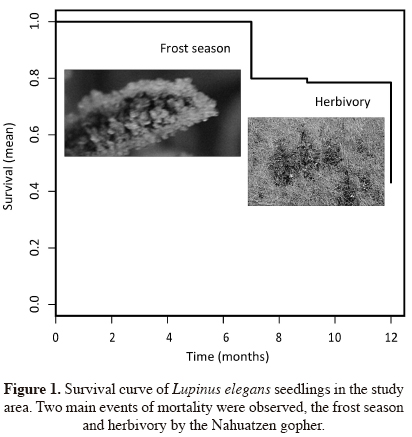
<body><![CDATA[<p align="justify"><font face="verdana" size="2"><b>Materials and methods</b></font></p>  	    <p align="justify"><font face="verdana" size="2"><i>Study site.</i> The indigenous community of San Juan Parangaricutiro (CINSJP) is located in the state of Michoac&aacute;n, Mexico at 2,750 m a.s.l., with an average temperature of 15.1 &#176;C, and an annual average rainfall of 1,200 mm. The landscape consists of pine <i>(Pinus pseudostrobus</i> and <i>Pinus montezumae),</i> pine&#45;oak forests (being the most common species: <i>Quercus crassifolia, Q. crassipes</i> and <i>Q. rugosa)</i> and at higher altitudes <i>Abies religiosa</i> forests (Medina <i>et al.,</i> 2000; Vel&aacute;zquez <i>et al.,</i> 2003). The study site is characterized by a mosaic of induced grasslands, mostly dominated by native species, established on abandoned agricultural fields, pine plantations from past reforestation programs, and fragments of natural forest. Patches of naturally grown <i>Lupinus elegans</i> are found mainly in the areas that have suffered some type of natural disturbance.</font></p>  	    <p align="justify"><font face="verdana" size="2"><i>Field experiment.</i> As part of a long&#45;term experiment, <i>Lupinus elegans</i> seeds were sown at the site in June 2008. The CINSJP allowed us to start up the experiment, in two hills in the process of reforestation (trees were planted in 2002 and 2003). A total of 42 plots of varying sizes of <i>L. elegans</i> were randomly established (16, 32, 64, and 128 m<sup>2</sup>). The different sizes responded to the need of determining long term effects that are not reported in this study. All plots, regardless of size, were sown with the same density of seeds per square meter, 0.32 gr/m<sup>2</sup> (G&oacute;mez&#45;Romero, 2006), by dropping individual seeds following an equally spaced grid. In September 2008 (during the rainy season) plant species richness in the four areas was assessed, and presence as well as percent cover of the three most abundant species in each plot were recorded. In addition, slope and orientation were measured, and soil samples were taken to quantify soil density in order to characterize the initial conditions. Furthermore, the number of <i>L. elegans</i> seedlings that sprouted from the seeds sowed were also counted. Seedlings were counted again in January, March and June 2009 (during the dry season). Seedling establishment was assessed as the number of plants in 10 m<sup>2</sup>, both before and after herbivory by <i>Zygogeomys trichopus</i> (the Nahuatzen gopher); taking into account the following variables for each of the 42 plots: plot orientation, slope, soil density, and plant cover. Plant cover was obtained by adding the cover percentages of the three most abundant species and as a result in some cases percentages greater than 100&#37; were recorded that reflect canopy overlapping.</font></p>  	    <p align="justify"><font face="verdana" size="2"><i>Statistical analysis.</i> To standardize the response variable the number of <i>Lupinus elegans</i> individuals in 10 m<sup>2</sup> was used because naturally occurring patches of this species are approximately of this size. As a first step, classification trees were obtained. The classification tree is formed by the repetitive division of the data, and these divisions are defined by simple rules based on the explanatory variables. Each one of the groups is characterized by the mean value of the response variable, the group size and the values of the response variable that define it (De'ath and Fabricius, 2000). This creates a structure similar to that of an inverted tree having a root node where all data are found, intermediate nodes, division points giving rise to each group to which a value has been assigned, and the terminal branches. Three classification trees were obtained: the first one assessing the variables that explained establishment prior to herbivory by the Nahuatzen gopher; the second to evaluate <i>L. elegans</i> survival after herbivory, and finally a classification tree to assess mortality caused by herbivory and to find out which of the explanatory variables were related to its occurrence. Nevertheless, this non&#45;parametric technique only reduces data variation by grouping, and does not imply that the groups are statistically different. Accordingly, we conducted parametric tests to evaluate the differences between the classification tree groups using one&#45;way ANOVA. It is important to note that the groups differ in the number of plots they contained, and therefore the degrees of freedom in the analyses may differ. Data presented are means and standard deviation unless noted otherwise. All statistical analyses were made using R (R Development Core Team, 2011).</font></p>  	    <p align="justify"><font face="verdana" size="2">&nbsp;</font></p>  	    <p align="justify"><font face="verdana" size="2"><b>Results</b></font></p>  	    <p align="justify"><font face="verdana" size="2">The plant community in the studied reforested areas does not include many herbaceous species. During the 2008 growing season 44 species were found, among these the following pioneer species, which are usually present in abandoned agricultural fields, were dominant: <i>Jaegeria hirta,Muhlenbergia macroura, Oenothera pubescens, Phacelia platycarpa,</i> and <i>Vulpia myuros.</i> The most abundant species in the four areas were <i>Vulpia myuros</i> (Poaceae) and <i>Trifolium amabile</i> (Fabaceae) with average percent cover of 20&#45;60&#37; and 5&#45;41&#37; respectively. All other species had percent cover lower than 10&#37;.</font></p>  	    <p align="justify"><font face="verdana" size="2">There was a low percent establishment of <i>Lupinus elegans</i> with respect to the amount of seeds sown. Two factors greatly affected its establishment: the frost season in December and January 2008&#45;2009 (six and seven months after seed sowing) that reduced the average survival by 20&#37; and the herbivory by the Nahuatzen gopher during June 2009 further reduced survival by almost 40&#37;. In June 2009 only 43.8&#37; of the seedlings recorded in September 2008 survived (1,090 seedlings three months after planting). Mortality occurred mainly among lower height individuals (<a href="#f1">Figure 1</a>).</font></p>  	    <p align="center"><font face="verdana" size="2"><a name="f1"></a></font></p>  	    <p align="center"><font face="verdana" size="2"><img src="/img/revistas/bs/v91n2/a10f1.jpg"></font></p>  	    ]]></body>
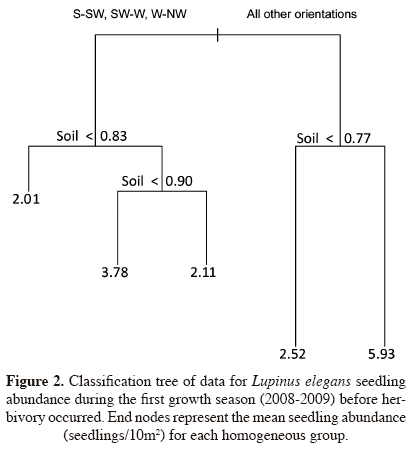
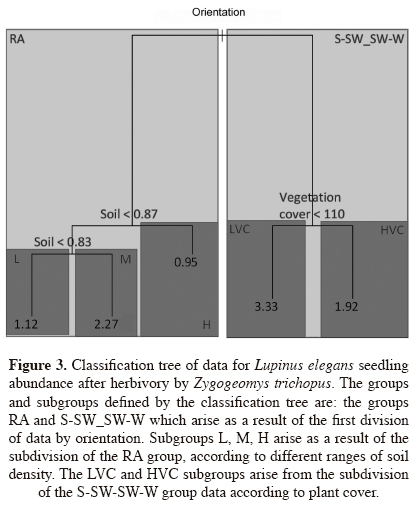
<body><![CDATA[<p align="center"><font face="verdana" size="2">&nbsp;</font></p>  	    <p align="justify"><font face="verdana" size="2">Since plots were allocated randomly, they differed with regards to their physical characteristics. With respect to plot orientation, the following number of plots had each: N&#45;NE (3), NE&#45;E (14), E&#45;SE (7), SE&#45;S (5), S&#45;SW (0), SW&#45;W (3), W&#45;NW (3), and NW&#45;N (7).</font></p>  	    <p align="justify"><font face="verdana" size="2"><i>Abiotic factors limiting L. elegans establishment.</i> Classification&#45;tree analysis of abundance data collected after the first growing season (and before herbivory), showed that out of the four variables assessed, only plot orientation and soil density grouped <i>Lupinus elegans</i> seedling abundance (<a href="#f2">Figure 2</a>). The first variable influencing seedling abundance was orientation, which divided the data into two groups: the first group included those plots having S&#45;SW, SW&#45;W and W&#45;NW orientations (to the left of the diagram), and the second included plots with the remaining orientations. Mean seedling abundance was 4.22 &#177; 2.47 individuals/10 m<sup>2</sup> for the first group and 2.71 &#177; 1.74 for the second. Mean soil densities of these groups were different according to an ANOVA analysis (F<sub>(1,46)</sub> = 5.81, <i>P</i> = 0.019).</font></p>  	    <p align="center"><font face="verdana" size="2"><a name="f2"></a></font></p>  	    <p align="center"><font face="verdana" size="2"><img src="/img/revistas/bs/v91n2/a10f2.jpg"></font></p>  	    <p align="center"><font face="verdana" size="2">&nbsp;</font></p>  	    <p align="justify"><font face="verdana" size="2">On the left branch of the classification tree, the next factor influencing seedling abundance was soil density, which divided the data into three subgroups: the first one defined by soil density lower than 0.83 g/cm<sup>3</sup>, average seedling abundance for plots in this group was 2.00 &#177; 1.53 individuals/10 m<sup>2</sup>; the second, that divides further in a group of soil densities between 0.83 and 0.90 g/cm<sup>3</sup> with an average abundance for <i>Lupinus elegans</i> seedlings of 3.78 individuals/10 m<sup>2</sup>, and finally the third subgroup with a soil density greater than 0.90 g/cm<sup>3</sup> and 2.11 individuals/10m<sup>2</sup> in average. According to ANOVA the differences between the groups classified with respect to soil density were marginally significant (F<sub>(2, 29)</sub> = 2.69, <i>P</i> = 0.084).</font></p>  	    <p align="justify"><font face="verdana" size="2">On the right branch the next relevant factor to group <i>Lupinus elegans</i> seedling abundance was also soil density; in this case two subgroups were formed: the first having soil densities lower than 0.77g/cm<sup>3</sup> and average seedling abundance 2.52 &#177; 1.54 individuals/10m<sup>2</sup>. The second group had soil densities greater than 0.77g/cm<sup>3</sup>, and an average seedling abundance of 5.93 &#177; 2.03 individuals/10m<sup>2</sup>, the latter is highest average density found. One&#45;way ANOVA showed that differences between these two groups were significant (F<sub>(1,12)</sub> = 12.54, <i>P</i> = 0.004).</font></p>  	    <p align="justify"><font face="verdana" size="2"><i>Zygogeomys trichopus herbivory.</i> The classification tree obtained from the same four explanatory variables, but after herbivory by gophers had occurred &#45; an action that drastically modified the number of survivors &#45;, showed that orientation, soil density, and plant cover explained <i>Lupinus elegans</i> seedling abundance (<a href="#f3">Figure 3</a>). The first variable influencing seedling abundance was orientation, which divided the data into two groups: the first including S&#45;SW and SW&#45;W, and another one for all the remaining orientations (RA). According to this analysis, on the left branch (RA group) the next factor influencing establishment was soil density, which divided it into three subgroups: the L subgroup, where soil density was lower than 0.83 g/cm<sup>3</sup> and average seedling abundance was 1.12 &#177; 0.99 individuals/10 m<sup>2</sup>; the M subgroup, defined by soil density between 0.83 and 0.87 g/cm<sup>3</sup>, had an average abundance of 2.27 &#177; 1.57 individuals/10 m<sup>2</sup>; and the H subgroup, defined by densities greater than 0.87 g/cm<sup>3</sup>, where average seedling abundance was 0.95 &#177; 1.01 individuals/10 m<sup>2</sup> (<a href="/img/revistas/bs/v91n2/a10f4.jpg" target="_blank">Fig. 4a</a>). Differences among these groups were marginally significant (F<sub>(2, 32)</sub> = 3.20, <i>P</i> = 0.054).</font></p>  	    <p align="center"><font face="verdana" size="2"><a name="f3"></a></font></p>  	    ]]></body>
<body><![CDATA[<p align="center"><font face="verdana" size="2"><img src="/img/revistas/bs/v91n2/a10f3.jpg"></font></p>  	    <p align="center"><font face="verdana" size="2">&nbsp;</font></p>  	    <p align="justify"><font face="verdana" size="2">In the S&#45;SW_SW&#45;W group the next relevant factor to explain <i>L. elegans</i> seedling abundance was plant cover. In this case, two subgroups were formed: the LVC subgroup, having plant cover lower than 110&#37; and average seedling abundance of 3.33 &#177; 1.33 individuals/10 cm<sup>3</sup>, the highest average for the dataset. If plant cover is greater than 110&#37; (HVC subgroup) this average was 1.91 &#177; 1.82 individuals/10 m<sup>2</sup>.</font></p>  	    <p align="justify"><font face="verdana" size="2">Once the variables that explained <i>Lupinus elegans</i> seedling abundance were identified, the effects of each were assessed. Thus, following the development of the classification tree, the first groups arising from the orientation explanatory variable are S&#45;SW_SW&#45;W and RA. According to the results obtained after herbivory in the foregoing analysis, the average number of plants per 10 m<sup>2</sup> for the S&#45;SW_SW&#45;W group is significantly greater (F<sub>(1,46)</sub> = 9.27, <i>P</i> = 0.003) than for the RA group (<a href="/img/revistas/bs/v91n2/a10f4.jpg" target="_blank">Figure 4b</a>). Plots with S&#45;SW and SW&#45;W orientations (the S&#45;SW_SW&#45;W group) facilitate <i>L. elegans</i> establishment since seedling abundance is greater (2.56 &#177; 1.&nbsp;71 individuals/10 m<sup>2</sup>) than in plots with other orientations (RA group 1.24 &#177; 1.18 individuals/10 m<sup>2</sup>).</font></p>  	    <p align="justify"><font face="verdana" size="2"><i>Conditions for herbivory by Zygogeomys trichopus.</i> Percent mortality of <i>L. elegans</i> seedlings was grouped using the same explanatory variables of the previous analysis to assess conditions that favor herbivory by <i>Zygogeomys trichopus.</i> Soil density, orientation and slope grouped the data in the classification tree of <a href="/img/revistas/bs/v91n2/a10f5.jpg" target="_blank">Figure 5</a>. The first variable is soil density, creating two groups: one for values lower and the second for values greater than 0.80 g/cm<sup>3</sup> (left branch, LSD and right branch, HSD, respectively). The difference between mortality of LSD (24.04 &#177; 30.3&#37;) and HSD (55.2 &#177; 33.45&#37;) was significant (F<sub>(1,46)</sub> = 10.16, <i>P</i> = 0.002)</font></p>  	    <p align="justify"><font face="verdana" size="2">The left branch (LSD) divided further into two groups depending on slope: the group SS with slopes lower than 11.&nbsp;5&#176; and a mortality of 44.7 &#177; 35.4&#37;, and the group IS with a slope higher than 11.5&#176; and mortality of 9.58 &#177; 15.1&#37;, differences being significant (F<sub>(1,15)</sub> = 7.92, <i>P</i> = 0.013). The right branch of the tree was also divided by slope forming two groups: VSS with slopes lower than 4.5&#176; and mortality of 32 &#177; 41&#37;, and IS2 with slopes greater than 4.5&#176; and a mortality of 59.65 &#177; 30.76&#37; (F<sub>(1,29)</sub> = 3.04, <i>P</i> = 0.091).</font></p>  	    <p align="justify"><font face="verdana" size="2">Group IS2 divided further by orientation: a first group (BF) including NE&#45;E and SW&#45;W plots with a mortality of 49.62 &#177; 30.46&#37;, and a second group (TR) of all remaining plots that showed a mortality of 68.25 &#177; 29.35&#37; (F(1, 24) = 2.51, P = 0.12). BF divided further by soil density into two branches: LD when soil density was lower than 0.89 g/cm<sup>3</sup>, with a mortality of 27.28 &#177; 24&#37;, and HD with soil density higher than 0.89 g/cm<sup>3</sup> and a mortality of 65.59 &#177; 24.54&#37; (F<sub>(1,10)</sub> = 7.21, <i>P</i> = 0.022).</font></p>  	    <p align="justify"><font face="verdana" size="2">&nbsp;</font></p>  	    <p align="justify"><font face="verdana" size="2"><b>Discussion</b></font></p>  	    <p align="justify"><font face="verdana" size="2"><i>Lupinus elegans</i> survival curve shows that there were two determinant factors for seedling survival: a severe winter and gopher herbivory, the latter having the most significant impact on species survival. Herbivory has been reported before as a cause of high mortality in plants of this species transplanted to restoration sites in the vicinity of the study area (Blanco&#45;Garc&iacute;a and Lindig&#45;Cisneros, 2005; Alvarado&#45;Sosa <i>et al.,</i> 2007). In addition to these two events, we identified abiotic and biotic factors that have an impact on plants established by seeding: plot orientation, slope, soil density, and plant cover. Soil and terrain features have been widely used to explain seedling establishment of other species, mainly because of the great diversity in edaphic conditions which provide seeds a variety of conditions for germination (Harper <i>et al.,</i> 1965; Titus and del Moral, 1998; Jones and del Moral, 2005).</font></p>  	    ]]></body>
<body><![CDATA[<p align="justify"><font face="verdana" size="2">As mentioned, classification trees allow the ranking of the assessed variables without implying that the groups formed are significantly different. Nevertheless, they provide a predictive tool that can be used to establish groups to be compared afterwards by parametric methods (Vayssi&egrave;res <i>et al.,</i> 2000). The combination of these two analytical approaches showed that orientation and soil density explain <i>Lupinus elegans</i> establishment. By using them in combination it was possible to define the optimal features of the establishment sites for this species in the study area, i. e., hillsides with S&#45;SW and SW&#45;W, orientations with a soil density close to 0.80 g/cm<sup>3</sup>, which have a larger density of individuals. A possible explanation could be that very loose soils do not provide sufficient support for plants to take root and establish (Goodman and Ennos, 1999). The study site has many areas where the soil had been removed by the burrowing activity of the Nahuatzen gopher, thus limiting the establishment of <i>L. elegans.</i> In regard to orientation, it is common knowledge that in the northern hemisphere, southern and western oriented hillsides are warmer because of their longer exposure to sunlight; therefore, early successional species that show greater resistance to unfavorable environmental conditions are more common than those that are sensitive to extreme conditions, as is the case of many late successional species (Olivero and Hix, 1998; Schlatter, 1994; Enciso <i>et al.,</i> 2000; Ram&iacute;rez&#45;Contreras and Rodr&iacute;guez&#45;Trejo, 2004).</font></p>  	    <p align="justify"><font face="verdana" size="2">Gopher activity and its effect on survival of <i>Lupinus elegans</i> were detected in the study area since September, causing direct damage to the seedlings and indirectly by soil removal. However, the greater damage caused by <i>Zygogeomys trichopus</i> herbivory occurred later. The classification tree after gopher herbivory showed that S&#45;SW and SW&#45;W orientations continued to be determinant for the establishment of the species. In contrast, the W&#45;NW orientation was no longer found among those favoring establishment. Soil density continued to be important and denser soils continued to hold a greater number of seedlings.</font></p>  	    <p align="justify"><font face="verdana" size="2">The results obtained by classification tree analysis showed that soil density had a determinant role in seedling mortality. This could be explained by the fact that gophers require firm soils to prevent their burrows from collapsing (Lacey <i>et al.,</i> 2000), thus they limit the establishment of <i>Lupinus elegans,</i> since seedlings and saplings of this species thrive better in the dense soils where gopher activity takes place. Herbivory is a limiting factor in the establishment of seedlings and survival of fully&#45;grown plants, and has a strong impact on plant mortality rates (Alverson <i>et al.,</i> 1988; Ben&iacute;tez&#45;Malvido, 1998; Crawley, 1997; Edwards and Crawley, 1999; Holl, 1999; del&#45;Val <i>et al.,</i> 2007). Herbivores can be particularly harmful for restoration when they remove the whole plant (Allen <i>et al.,</i> 2005; Blanco&#45;Garc&iacute;a and Lindig&#45;Cisneros, 2005; Sweeney <i>et al.,</i> 2007). It has been shown that herbivores are a limiting factor for plant survival under restoration conditions at many sites, showing an overall damage of 64&#37; in the restoration of tropical forests in Costa Rica (Holl and Quiros&#45;Nietzen, 1999) and of 78&#37; of seedlings of <i>Quercus rugosa</i> at restoration sites located close to Mexico City (Bonfil and Sober&oacute;n, 1999), major damage to restorations has been reported by browsing by wild boars (Mayer <i>et al.,</i> 2000), deer (Miller <i>et al.,</i> 1982), and elk (Johnston <i>et al.,</i> 2007).</font></p>  	    <p align="justify"><font face="verdana" size="2">In this study, the herbivory by <i>Zygogeomys trichopus</i> was determinant in the establishment of <i>Lupinus elegans,</i> since it clearly reduced the number of individuals observed within a three&#45;month period. However, <i>Z. trichopus</i> is an endemic and endangered species of the temperate regions of the state of Michoac&aacute;n (IUCN, 2012) and therefore if a temperate forest restoration effort is contemplating the use of <i>L. elegans,</i> it is important to take into account that it will not be possible to take measures to control the Nahautzen gopher population. Consequently, the number of seeds sown will need to be increased to compensate for herbivory losses, and it is advisable to sow them in slopes with SW&#45;W orientations (with plant cover lower than 100&#37;), and choosing high density soils. In many instances greater efforts are needed to reactivate natural environmental processes (Hobbs and Norton, 1996; Ashton <i>et al.,</i> 1997). Thus the use of facilitating plants such as <i>L. elegans</i> can be a good strategy for the restoration of a site, since many leguminous plants enrich degraded soils due to their nitrogen&#45;fixing capability, while providing establishment microsites for other species, therefore contributing to their restoration (Carrillo&#45;Garc&iacute;a <i>et al.,</i> 1999; Monroy&#45;Ata <i>et al.,</i> 2007; Blanco&#45;Garc&iacute;a <i>et al.,</i> 2011).</font></p>  	    <p align="justify"><font face="verdana" size="2">In order to make use of facilitating plants in restoration projects, it is first necessary to ensure the establishment of their seedlings and saplings. Even though <i>Lupinus elegans</i> is a species that grows naturally in disturbed sites, it requires certain conditions for seedling establishment. Trial tests such as the one conducted in this study allow us to set criteria for the establishment of plant species in restoration projects.</font></p>  	    <p align="justify"><font face="verdana" size="2">&nbsp;</font></p>  	    <p align="justify"><font face="verdana" size="2"><b>Acknowledgements</b></font></p>  	    <p align="justify"><font face="verdana" size="2">We thank the comunidad indigena de Nuevo San Juan Parangaricutiro for their support in conducting this research, to Posgrado en Ciencias Biologicas of UNAM and Consejo Nacional de Ciencia y Tecnologia (CONACYT) for a scholarship to B.D.&#45;R, and the useful comments of the reviewers of previous versions of this manuscript.</font></p>  	    <p align="justify"><font face="verdana" size="2">&nbsp;</font></p>  	    <p align="justify"><font face="verdana" size="2"><b>Literature cited</b></font></p>  	    ]]></body>
<body><![CDATA[<!-- ref --><p align="justify"><font face="verdana" size="2">Allen M.F., Allen E.B. and Gomez&#45;Pompa A. 2005. Effects of mycorrhizae and nontarget organisms on restoration of a seasonal tropical forest in Quintana Roo, Mexico: Factors limiting tree establishment. <i>Restoration Ecology</i> <b>13</b>:325&#45;333.    &nbsp;&nbsp;&nbsp;&nbsp;&nbsp;&nbsp;&nbsp;&nbsp;[&#160;<a href="javascript:void(0);" onclick="javascript: window.open('/scielo.php?script=sci_nlinks&ref=1761961&pid=S2007-4298201300020001000001&lng=','','width=640,height=500,resizable=yes,scrollbars=1,menubar=yes,');">Links</a>&#160;]<!-- end-ref --></font></p>  	    <!-- ref --><p align="justify"><font face="verdana" size="2">Alvarado&#45;Sosa P., Blanco&#45;Garc&iacute;a A. and Lindig&#45;Cisneros R. 2007. Test of alternative nursery propagation conditions for <i>Lupinus elegans</i> Kunth plants, and effects on field survival. <i>Revista Fitotecnia Mexicana</i> <b>30</b>:201&#45;204.    &nbsp;&nbsp;&nbsp;&nbsp;&nbsp;&nbsp;&nbsp;&nbsp;[&#160;<a href="javascript:void(0);" onclick="javascript: window.open('/scielo.php?script=sci_nlinks&ref=1761963&pid=S2007-4298201300020001000002&lng=','','width=640,height=500,resizable=yes,scrollbars=1,menubar=yes,');">Links</a>&#160;]<!-- end-ref --></font></p>  	    <!-- ref --><p align="justify"><font face="verdana" size="2">Alverson W.S., Waller D.M. and Solheim S.L. 1988. Forest too deer: edge effects in Northern Wisconsin. <i>Conservation Biology</i> <b>2</b>:348&#45;358.    &nbsp;&nbsp;&nbsp;&nbsp;&nbsp;&nbsp;&nbsp;&nbsp;[&#160;<a href="javascript:void(0);" onclick="javascript: window.open('/scielo.php?script=sci_nlinks&ref=1761965&pid=S2007-4298201300020001000003&lng=','','width=640,height=500,resizable=yes,scrollbars=1,menubar=yes,');">Links</a>&#160;]<!-- end-ref --></font></p>  	    <!-- ref --><p align="justify"><font face="verdana" size="2">Ashton P.M.S., Samarasinghe S.J., Gunatilleke I.A.U.N. and Gunatilleke C.V.S. 1997. Role of legumes in release of successionally arrested grasslands in the Central Hills of Sri Lanka. <i>Restoration Ecology</i> <b>5</b>:36&#45;43.    &nbsp;&nbsp;&nbsp;&nbsp;&nbsp;&nbsp;&nbsp;&nbsp;[&#160;<a href="javascript:void(0);" onclick="javascript: window.open('/scielo.php?script=sci_nlinks&ref=1761967&pid=S2007-4298201300020001000004&lng=','','width=640,height=500,resizable=yes,scrollbars=1,menubar=yes,');">Links</a>&#160;]<!-- end-ref --></font></p>  	    <!-- ref --><p align="justify"><font face="verdana" size="2">Ben&iacute;tez&#45;Malvido J. 1998. Impact of forest fragmentation on seedling abundance in a tropical rain forest. <i>Conservation Biology</i> <b>12</b>:380&#45;389.    &nbsp;&nbsp;&nbsp;&nbsp;&nbsp;&nbsp;&nbsp;&nbsp;[&#160;<a href="javascript:void(0);" onclick="javascript: window.open('/scielo.php?script=sci_nlinks&ref=1761969&pid=S2007-4298201300020001000005&lng=','','width=640,height=500,resizable=yes,scrollbars=1,menubar=yes,');">Links</a>&#160;]<!-- end-ref --></font></p>  	    ]]></body>
<body><![CDATA[<!-- ref --><p align="justify"><font face="verdana" size="2">Blanco&#45;Garc&iacute;a, A. and Lindig&#45;Cisneros R. 2005. Incorporating restoration in sustainable forestry management: using pine&#45;bark mulch to improve native species establishment on Tephra deposits. <i>Restoration Ecology</i> <b>13</b>:703&#45;709.    &nbsp;&nbsp;&nbsp;&nbsp;&nbsp;&nbsp;&nbsp;&nbsp;[&#160;<a href="javascript:void(0);" onclick="javascript: window.open('/scielo.php?script=sci_nlinks&ref=1761971&pid=S2007-4298201300020001000006&lng=','','width=640,height=500,resizable=yes,scrollbars=1,menubar=yes,');">Links</a>&#160;]<!-- end-ref --></font></p>  	    <!-- ref --><p align="justify"><font face="verdana" size="2">Blanco&#45;Garc&iacute;a A., S&aacute;enz&#45;Romero C., Martorell C., Alvarado&#45;Sosa P and Lindig&#45;Cisneros R. 2011. Nurse&#45;plant and mulching effects on three conifer species in a Mexican temperate forest. <i>Ecological Engineering</i> <b>37</b>:994&#45;998.    &nbsp;&nbsp;&nbsp;&nbsp;&nbsp;&nbsp;&nbsp;&nbsp;[&#160;<a href="javascript:void(0);" onclick="javascript: window.open('/scielo.php?script=sci_nlinks&ref=1761973&pid=S2007-4298201300020001000007&lng=','','width=640,height=500,resizable=yes,scrollbars=1,menubar=yes,');">Links</a>&#160;]<!-- end-ref --></font></p>  	    <!-- ref --><p align="justify"><font face="verdana" size="2">Bonfil C. and Sober&oacute;n J. 1999. <i>Quercus rugosa</i> seedling dynamics in relation to its re&#45;introduction in a disturbed Mexican landscape. <i>Applied Vegetation Science</i> <b>2</b>:189&#45;200.    &nbsp;&nbsp;&nbsp;&nbsp;&nbsp;&nbsp;&nbsp;&nbsp;[&#160;<a href="javascript:void(0);" onclick="javascript: window.open('/scielo.php?script=sci_nlinks&ref=1761975&pid=S2007-4298201300020001000008&lng=','','width=640,height=500,resizable=yes,scrollbars=1,menubar=yes,');">Links</a>&#160;]<!-- end-ref --></font></p>  	    <!-- ref --><p align="justify"><font face="verdana" size="2">Bustamante&#45;Sanchez M.A., Armesto J.J. and Halpern C.B. 2011. Biotic and abiotic controls on tree colonization in three early successional communities of Chilo&eacute; Island, Chile. <i>Journal of Ecology</i> <b>99</b>:288&#45;299.    &nbsp;&nbsp;&nbsp;&nbsp;&nbsp;&nbsp;&nbsp;&nbsp;[&#160;<a href="javascript:void(0);" onclick="javascript: window.open('/scielo.php?script=sci_nlinks&ref=1761977&pid=S2007-4298201300020001000009&lng=','','width=640,height=500,resizable=yes,scrollbars=1,menubar=yes,');">Links</a>&#160;]<!-- end-ref --></font></p>  	    <!-- ref --><p align="justify"><font face="verdana" size="2">Callaway R.M. and Walker L.R. 1997. Competition and facilitation: a synthetic approach to interactions in plant communities. <i>Ecology</i> <b>78</b>:1958&#45;1965.    &nbsp;&nbsp;&nbsp;&nbsp;&nbsp;&nbsp;&nbsp;&nbsp;[&#160;<a href="javascript:void(0);" onclick="javascript: window.open('/scielo.php?script=sci_nlinks&ref=1761979&pid=S2007-4298201300020001000010&lng=','','width=640,height=500,resizable=yes,scrollbars=1,menubar=yes,');">Links</a>&#160;]<!-- end-ref --></font></p>  	    ]]></body>
<body><![CDATA[<!-- ref --><p align="justify"><font face="verdana" size="2">Carrillo&#45;Garc&iacute;a A., Le&oacute;n de la Luz J.L., Bashan Y. and Bethlenfalvay G.J. 1999. Nurse plants, mycorrhizae, and plant establishment in a disturbed area of the Sonoran desert. <i>Restoration Ecology</i> <b>7</b>:321&#45;335.    &nbsp;&nbsp;&nbsp;&nbsp;&nbsp;&nbsp;&nbsp;&nbsp;[&#160;<a href="javascript:void(0);" onclick="javascript: window.open('/scielo.php?script=sci_nlinks&ref=1761981&pid=S2007-4298201300020001000011&lng=','','width=640,height=500,resizable=yes,scrollbars=1,menubar=yes,');">Links</a>&#160;]<!-- end-ref --></font></p>  	    <!-- ref --><p align="justify"><font face="verdana" size="2">Connell J.H. and Slatyer R.O. 1977. Mechanisms of succession in natural communities and their role in community stability and organization. <i>The American Naturalist</i> <b>111</b>:1119&#45;1144.    &nbsp;&nbsp;&nbsp;&nbsp;&nbsp;&nbsp;&nbsp;&nbsp;[&#160;<a href="javascript:void(0);" onclick="javascript: window.open('/scielo.php?script=sci_nlinks&ref=1761983&pid=S2007-4298201300020001000012&lng=','','width=640,height=500,resizable=yes,scrollbars=1,menubar=yes,');">Links</a>&#160;]<!-- end-ref --></font></p>  	    <!-- ref --><p align="justify"><font face="verdana" size="2">Crawley M.J. 1997. Plant&#45;herbivore dynamics. In: Crawley M.J. Ed. <i>Plant Ecology,</i> 2 ed., pp. 401&#45;474, Blackwell Publishing, Oxford.    &nbsp;&nbsp;&nbsp;&nbsp;&nbsp;&nbsp;&nbsp;&nbsp;[&#160;<a href="javascript:void(0);" onclick="javascript: window.open('/scielo.php?script=sci_nlinks&ref=1761985&pid=S2007-4298201300020001000013&lng=','','width=640,height=500,resizable=yes,scrollbars=1,menubar=yes,');">Links</a>&#160;]<!-- end-ref --></font></p>  	    <!-- ref --><p align="justify"><font face="verdana" size="2">Crawley M.J. 2007. <i>The R Book.</i> John Wiley &amp; Sons Ltd., West Sussex.    &nbsp;&nbsp;&nbsp;&nbsp;&nbsp;&nbsp;&nbsp;&nbsp;[&#160;<a href="javascript:void(0);" onclick="javascript: window.open('/scielo.php?script=sci_nlinks&ref=1761987&pid=S2007-4298201300020001000014&lng=','','width=640,height=500,resizable=yes,scrollbars=1,menubar=yes,');">Links</a>&#160;]<!-- end-ref --></font></p>  	    <!-- ref --><p align="justify"><font face="verdana" size="2">De'ath G. and Fabricius K.E. 2000. Classification and regression trees: a powerful yet simple technique for ecological data analysis. <i>Ecology</i> <b>81</b>:3178&#45;3192.    &nbsp;&nbsp;&nbsp;&nbsp;&nbsp;&nbsp;&nbsp;&nbsp;[&#160;<a href="javascript:void(0);" onclick="javascript: window.open('/scielo.php?script=sci_nlinks&ref=1761989&pid=S2007-4298201300020001000015&lng=','','width=640,height=500,resizable=yes,scrollbars=1,menubar=yes,');">Links</a>&#160;]<!-- end-ref --></font></p>  	    ]]></body>
<body><![CDATA[<!-- ref --><p align="justify"><font face="verdana" size="2">del&#45;Val E., Armesto J.J., Barbosa O. and Marquet PA. 2007. Effects of herbivory and patch size on tree seedling survivorship in a fog&#45;dependent coastal rainforest in semiarid Chile. <i>Oecologia</i> <b>153</b>:625&#45;632.    &nbsp;&nbsp;&nbsp;&nbsp;&nbsp;&nbsp;&nbsp;&nbsp;[&#160;<a href="javascript:void(0);" onclick="javascript: window.open('/scielo.php?script=sci_nlinks&ref=1761991&pid=S2007-4298201300020001000016&lng=','','width=640,height=500,resizable=yes,scrollbars=1,menubar=yes,');">Links</a>&#160;]<!-- end-ref --></font></p>  	    <!-- ref --><p align="justify"><font face="verdana" size="2">Dhillion S.S. 1999. Environmental heterogeneity, animal disturbances, microsite characteristics, and seedling establishment in a <i>Quercus havardii</i> community. <i>Restoration Ecology</i> <b>7</b>:399&#45;406.    &nbsp;&nbsp;&nbsp;&nbsp;&nbsp;&nbsp;&nbsp;&nbsp;[&#160;<a href="javascript:void(0);" onclick="javascript: window.open('/scielo.php?script=sci_nlinks&ref=1761993&pid=S2007-4298201300020001000017&lng=','','width=640,height=500,resizable=yes,scrollbars=1,menubar=yes,');">Links</a>&#160;]<!-- end-ref --></font></p>  	    <!-- ref --><p align="justify"><font face="verdana" size="2">D&iacute;az&#45;Rodr&iacute;guez B., Blanco&#45;Garc&iacute;a A., G&oacute;mez&#45;Romero M. and Lindig&#45;Cisneros R. 2012. Filling the gap: restoration of biodiversity for conservation in productive forest landscapes. <i>Ecological Engineering</i> <b>40</b>:88&#45;94.    &nbsp;&nbsp;&nbsp;&nbsp;&nbsp;&nbsp;&nbsp;&nbsp;[&#160;<a href="javascript:void(0);" onclick="javascript: window.open('/scielo.php?script=sci_nlinks&ref=1761995&pid=S2007-4298201300020001000018&lng=','','width=640,height=500,resizable=yes,scrollbars=1,menubar=yes,');">Links</a>&#160;]<!-- end-ref --></font></p>  	    <!-- ref --><p align="justify"><font face="verdana" size="2">Edwards G.R. and Crawley M.J. 1999. Rodent seed predation and seedling recruitment in mesic grassland. <i>Oecologia</i> <b>118</b>:288&#45;296.    &nbsp;&nbsp;&nbsp;&nbsp;&nbsp;&nbsp;&nbsp;&nbsp;[&#160;<a href="javascript:void(0);" onclick="javascript: window.open('/scielo.php?script=sci_nlinks&ref=1761997&pid=S2007-4298201300020001000019&lng=','','width=640,height=500,resizable=yes,scrollbars=1,menubar=yes,');">Links</a>&#160;]<!-- end-ref --></font></p>  	    <!-- ref --><p align="justify"><font face="verdana" size="2">Edwards G.R., Crawley M.J. and Heard M.S. 1999. Factors influencing molehill distribution in grassland: implications for controlling the damage caused by molehills. <i>Journal of Applied Ecology</i> <b>36</b>:434&#45;442.    &nbsp;&nbsp;&nbsp;&nbsp;&nbsp;&nbsp;&nbsp;&nbsp;[&#160;<a href="javascript:void(0);" onclick="javascript: window.open('/scielo.php?script=sci_nlinks&ref=1761999&pid=S2007-4298201300020001000020&lng=','','width=640,height=500,resizable=yes,scrollbars=1,menubar=yes,');">Links</a>&#160;]<!-- end-ref --></font></p>  	    ]]></body>
<body><![CDATA[<!-- ref --><p align="justify"><font face="verdana" size="2">Enciso J., Garc&iacute;a&#45;Fayos P and Cerd&agrave; A. 2000. Distribuci&oacute;n del banco de semillas en taludes de carretera: efecto de la orientaci&oacute;n y de la topograf&iacute;a. <i>Orsis</i> <b>15</b>:103&#45;113.    &nbsp;&nbsp;&nbsp;&nbsp;&nbsp;&nbsp;&nbsp;&nbsp;[&#160;<a href="javascript:void(0);" onclick="javascript: window.open('/scielo.php?script=sci_nlinks&ref=1762001&pid=S2007-4298201300020001000021&lng=','','width=640,height=500,resizable=yes,scrollbars=1,menubar=yes,');">Links</a>&#160;]<!-- end-ref --></font></p>  	    <!-- ref --><p align="justify"><font face="verdana" size="2">Eriksson O. and Ehrl&eacute;n J. 1992. Seed and microsite limitation of recruitment in plant populations. <i>Oecologia</i> <b>91</b>:360&#45;364.    &nbsp;&nbsp;&nbsp;&nbsp;&nbsp;&nbsp;&nbsp;&nbsp;[&#160;<a href="javascript:void(0);" onclick="javascript: window.open('/scielo.php?script=sci_nlinks&ref=1762003&pid=S2007-4298201300020001000022&lng=','','width=640,height=500,resizable=yes,scrollbars=1,menubar=yes,');">Links</a>&#160;]<!-- end-ref --></font></p>  	    <!-- ref --><p align="justify"><font face="verdana" size="2">Germino M.J., Smith W.K. and Resor A.C. 2002. Conifer seedling distribution and survival in an alpine&#45;treeline ecotone. <i>Plant Ecology</i> <b>162</b>:157&#45;168.    &nbsp;&nbsp;&nbsp;&nbsp;&nbsp;&nbsp;&nbsp;&nbsp;[&#160;<a href="javascript:void(0);" onclick="javascript: window.open('/scielo.php?script=sci_nlinks&ref=1762005&pid=S2007-4298201300020001000023&lng=','','width=640,height=500,resizable=yes,scrollbars=1,menubar=yes,');">Links</a>&#160;]<!-- end-ref --></font></p>  	    <!-- ref --><p align="justify"><font face="verdana" size="2">G&oacute;mez&#45;Romero M. 2006. Desarrollo del dosel de leguminosas bajo diversas condiciones de restauraci&oacute;n ecol&oacute;gica en bosques de pino&#45;encino de Michoac&aacute;n, M&eacute;xico. Master Thesis. Facultad de Biolog&iacute;a. Universidad Michoacana de San Nicol&aacute;s de Hidalgo, Michoac&aacute;n, M&eacute;xico. 149 pp.    &nbsp;&nbsp;&nbsp;&nbsp;&nbsp;&nbsp;&nbsp;&nbsp;[&#160;<a href="javascript:void(0);" onclick="javascript: window.open('/scielo.php?script=sci_nlinks&ref=1762007&pid=S2007-4298201300020001000024&lng=','','width=640,height=500,resizable=yes,scrollbars=1,menubar=yes,');">Links</a>&#160;]<!-- end-ref --></font></p>  	    <!-- ref --><p align="justify"><font face="verdana" size="2">Goodman A.M. and Ennos A.R. 1999. The effects of soil density on the morphology and anchorage mechanics of the root systems of sunflower and maize. <i>Annals of Botany</i> <b>83</b>:293&#45;302.    &nbsp;&nbsp;&nbsp;&nbsp;&nbsp;&nbsp;&nbsp;&nbsp;[&#160;<a href="javascript:void(0);" onclick="javascript: window.open('/scielo.php?script=sci_nlinks&ref=1762009&pid=S2007-4298201300020001000025&lng=','','width=640,height=500,resizable=yes,scrollbars=1,menubar=yes,');">Links</a>&#160;]<!-- end-ref --></font></p>  	    ]]></body>
<body><![CDATA[<!-- ref --><p align="justify"><font face="verdana" size="2">Harper J.L. and Benton R.A. 1966. The behaviour of seeds in soil: II. The germination of seeds on the surface of a water supplying substrate. <i>Journal of Ecology</i> <b>54</b>:151&#45;166.    &nbsp;&nbsp;&nbsp;&nbsp;&nbsp;&nbsp;&nbsp;&nbsp;[&#160;<a href="javascript:void(0);" onclick="javascript: window.open('/scielo.php?script=sci_nlinks&ref=1762011&pid=S2007-4298201300020001000026&lng=','','width=640,height=500,resizable=yes,scrollbars=1,menubar=yes,');">Links</a>&#160;]<!-- end-ref --></font></p>  	    <!-- ref --><p align="justify"><font face="verdana" size="2">Harper J.L., Williams J.T. and Sagar G.R. 1965.The behavior of seeds in soil: I. The heterogeneity of soil surfaces and its role in determining the establishment of plants from seed. <i>Journal of Ecology</i> <b>53</b>:273&#45;286.    &nbsp;&nbsp;&nbsp;&nbsp;&nbsp;&nbsp;&nbsp;&nbsp;[&#160;<a href="javascript:void(0);" onclick="javascript: window.open('/scielo.php?script=sci_nlinks&ref=1762013&pid=S2007-4298201300020001000027&lng=','','width=640,height=500,resizable=yes,scrollbars=1,menubar=yes,');">Links</a>&#160;]<!-- end-ref --></font></p>  	    <!-- ref --><p align="justify"><font face="verdana" size="2">Hobbs R.J. and Norton D.A. 1996. Towards a conceptual framework for restoration ecology. <i>Restoration Ecology</i> <b>4</b>:93&#45;110.    &nbsp;&nbsp;&nbsp;&nbsp;&nbsp;&nbsp;&nbsp;&nbsp;[&#160;<a href="javascript:void(0);" onclick="javascript: window.open('/scielo.php?script=sci_nlinks&ref=1762015&pid=S2007-4298201300020001000028&lng=','','width=640,height=500,resizable=yes,scrollbars=1,menubar=yes,');">Links</a>&#160;]<!-- end-ref --></font></p>      <!-- ref --><p align="justify"><font face="verdana" size="2">Holl K.D. and Quiros&#45;Nietzen E. 1999. The effect of rabbit herbivory on reforestation of abandoned pasture in southern Costa Rica. <i>Biological Conservation</i> <b>87</b>:391&#45;395.    &nbsp;&nbsp;&nbsp;&nbsp;&nbsp;&nbsp;&nbsp;&nbsp;[&#160;<a href="javascript:void(0);" onclick="javascript: window.open('/scielo.php?script=sci_nlinks&ref=1762017&pid=S2007-4298201300020001000029&lng=','','width=640,height=500,resizable=yes,scrollbars=1,menubar=yes,');">Links</a>&#160;]<!-- end-ref --></font></p>  	    <!-- ref --><p align="justify"><font face="verdana" size="2">Holl K.D. 1999. Factors limiting tropical rain forest regeneration in abandoned pasture: seed, rain, seed germination, microclimate, and soil. <i>Biotropica</i> <b>31</b>:229&#45;242.    &nbsp;&nbsp;&nbsp;&nbsp;&nbsp;&nbsp;&nbsp;&nbsp;[&#160;<a href="javascript:void(0);" onclick="javascript: window.open('/scielo.php?script=sci_nlinks&ref=1762019&pid=S2007-4298201300020001000030&lng=','','width=640,height=500,resizable=yes,scrollbars=1,menubar=yes,');">Links</a>&#160;]<!-- end-ref --></font></p>  	    ]]></body>
<body><![CDATA[<!-- ref --><p align="justify"><font face="verdana" size="2">Holl K.D. 2002. Effect of shrubs on tree seedling establishment in an abandoned tropical pasture. <i>Journal of Ecology</i> <b>90</b>:179&#45;187.    &nbsp;&nbsp;&nbsp;&nbsp;&nbsp;&nbsp;&nbsp;&nbsp;[&#160;<a href="javascript:void(0);" onclick="javascript: window.open('/scielo.php?script=sci_nlinks&ref=1762021&pid=S2007-4298201300020001000031&lng=','','width=640,height=500,resizable=yes,scrollbars=1,menubar=yes,');">Links</a>&#160;]<!-- end-ref --></font></p>  	    <!-- ref --><p align="justify"><font face="verdana" size="2">IUCN. International Union for the Conservation of Nature and Natural Resources. 2012. Red List of threatened Species. Version 2012.1 &#60;<a href="http://www.iucnredlist.org/" target="_blank">www.iucnredlist.org/</a>&#62; (consulted January, 12, 2012)</font>&nbsp;&nbsp;&nbsp;&nbsp;&nbsp;&nbsp;&nbsp;&nbsp;[&#160;<a href="javascript:void(0);" onclick="javascript: window.open('/scielo.php?script=sci_nlinks&ref=1762023&pid=S2007-4298201300020001000032&lng=','','width=640,height=500,resizable=yes,scrollbars=1,menubar=yes,');">Links</a>&#160;]<!-- end-ref --><!-- ref --><p align="justify"><font face="verdana" size="2">Johnston D.B., Cooper D.J. and Thompson H.N. 2007. Elk browsing increases aboveground growth of water&#45;stressed willows by modifying plant architecture. <i>Oecologia</i> <b>154</b>:467&#45;478.    &nbsp;&nbsp;&nbsp;&nbsp;&nbsp;&nbsp;&nbsp;&nbsp;[&#160;<a href="javascript:void(0);" onclick="javascript: window.open('/scielo.php?script=sci_nlinks&ref=1762024&pid=S2007-4298201300020001000033&lng=','','width=640,height=500,resizable=yes,scrollbars=1,menubar=yes,');">Links</a>&#160;]<!-- end-ref --></font></p>  	    <!-- ref --><p align="justify"><font face="verdana" size="2">Jones C.C. and R. del Moral. 2005. Effects of microsite conditions on seedling establishment on the foreland of Coleman Glacier. Washington. <i>Journal of Vegetation Science</i> <b>16</b>:293&#45;300.    &nbsp;&nbsp;&nbsp;&nbsp;&nbsp;&nbsp;&nbsp;&nbsp;[&#160;<a href="javascript:void(0);" onclick="javascript: window.open('/scielo.php?script=sci_nlinks&ref=1762026&pid=S2007-4298201300020001000034&lng=','','width=640,height=500,resizable=yes,scrollbars=1,menubar=yes,');">Links</a>&#160;]<!-- end-ref --></font></p>  	    <!-- ref --><p align="justify"><font face="verdana" size="2">Lacey E.A., Patton J.L. and Cameron G.N. 2000. <i>Life Underground: The Biology of Subterranean Rodents.</i> The University of Chicago Press, Chicago.    &nbsp;&nbsp;&nbsp;&nbsp;&nbsp;&nbsp;&nbsp;&nbsp;[&#160;<a href="javascript:void(0);" onclick="javascript: window.open('/scielo.php?script=sci_nlinks&ref=1762028&pid=S2007-4298201300020001000035&lng=','','width=640,height=500,resizable=yes,scrollbars=1,menubar=yes,');">Links</a>&#160;]<!-- end-ref --></font></p>  	    <!-- ref --><p align="justify"><font face="verdana" size="2">Mayer J.J., Nelson E.A. and Wike L.D. 2000. Selective depredation of planted hardwood seedlings by wild pigs in a wetland restoration area. <i>Ecological Engineering</i> <b>15</b>:S79&#45;S85.    &nbsp;&nbsp;&nbsp;&nbsp;&nbsp;&nbsp;&nbsp;&nbsp;[&#160;<a href="javascript:void(0);" onclick="javascript: window.open('/scielo.php?script=sci_nlinks&ref=1762030&pid=S2007-4298201300020001000036&lng=','','width=640,height=500,resizable=yes,scrollbars=1,menubar=yes,');">Links</a>&#160;]<!-- end-ref --></font></p>  	    <!-- ref --><p align="justify"><font face="verdana" size="2">Medina&#45;S&aacute;nchez E. and Lindig&#45;Cisneros R. 2005. Effect of scarification and growing media on seed germination of <i>Lupinus elegans</i> H.B.K. <i>Seed Science and Technology</i> <b>33</b>:237&#45;241.    &nbsp;&nbsp;&nbsp;&nbsp;&nbsp;&nbsp;&nbsp;&nbsp;[&#160;<a href="javascript:void(0);" onclick="javascript: window.open('/scielo.php?script=sci_nlinks&ref=1762032&pid=S2007-4298201300020001000037&lng=','','width=640,height=500,resizable=yes,scrollbars=1,menubar=yes,');">Links</a>&#160;]<!-- end-ref --></font></p>  	    <!-- ref --><p align="justify"><font face="verdana" size="2">Medina G.C., Guevara F.F., Mart&iacute;nez R.M.A., Silva S.P., Ch&aacute;vez C.M.A. and Garc&iacute;a R.I. 2000. Estudio flor&iacute;stico en el &aacute;rea de la comunidad ind&iacute;gena de Nuevo San Juan Parangaricutiro, Michoac&aacute;n, M&eacute;xico. <i>Acta Botanica Mexicana</i> <b>52</b>:5&#45;41.    &nbsp;&nbsp;&nbsp;&nbsp;&nbsp;&nbsp;&nbsp;&nbsp;[&#160;<a href="javascript:void(0);" onclick="javascript: window.open('/scielo.php?script=sci_nlinks&ref=1762034&pid=S2007-4298201300020001000038&lng=','','width=640,height=500,resizable=yes,scrollbars=1,menubar=yes,');">Links</a>&#160;]<!-- end-ref --></font></p>  	    <!-- ref --><p align="justify"><font face="verdana" size="2">Miller G.R., Kinnaird J.W. and Cummins R.P. 1982. Liability of saplings to browsing on a red deer range in the Scottish highlands. <i>Journal of Applied Ecology</i> <b>19</b>:941&#45;951.    &nbsp;&nbsp;&nbsp;&nbsp;&nbsp;&nbsp;&nbsp;&nbsp;[&#160;<a href="javascript:void(0);" onclick="javascript: window.open('/scielo.php?script=sci_nlinks&ref=1762036&pid=S2007-4298201300020001000039&lng=','','width=640,height=500,resizable=yes,scrollbars=1,menubar=yes,');">Links</a>&#160;]<!-- end-ref --></font></p>  	    <!-- ref --><p align="justify"><font face="verdana" size="2">Monroy&#45;Ata A., Est&eacute;vez&#45;Torres J., Garc&iacute;a&#45;S&aacute;nchez R. and R&iacute;os&#45;G&oacute;mez R. 2007. Establecimiento de plantas mediante el uso de micorrizas y de islas de recursos en un matorral xer&oacute;filo deteriorado. <i>Boletin de la Sociedad Bot&aacute;nica de M&eacute;xico</i> <b>80</b> (suppl.):49&#45;57.    &nbsp;&nbsp;&nbsp;&nbsp;&nbsp;&nbsp;&nbsp;&nbsp;[&#160;<a href="javascript:void(0);" onclick="javascript: window.open('/scielo.php?script=sci_nlinks&ref=1762038&pid=S2007-4298201300020001000040&lng=','','width=640,height=500,resizable=yes,scrollbars=1,menubar=yes,');">Links</a>&#160;]<!-- end-ref --></font></p>  	    <!-- ref --><p align="justify"><font face="verdana" size="2">M&uuml;nzbergov&aacute; Z. and Herben T. 2005. Seed, dispersal, microsite, habitat and recruitment limitation: identification of terms and concepts in studies of limitations. <i>Oecologia</i> <b>145</b>:1&#45;8.    &nbsp;&nbsp;&nbsp;&nbsp;&nbsp;&nbsp;&nbsp;&nbsp;[&#160;<a href="javascript:void(0);" onclick="javascript: window.open('/scielo.php?script=sci_nlinks&ref=1762040&pid=S2007-4298201300020001000041&lng=','','width=640,height=500,resizable=yes,scrollbars=1,menubar=yes,');">Links</a>&#160;]<!-- end-ref --></font></p>  	    <!-- ref --><p align="justify"><font face="verdana" size="2">Nathan R. and M&uuml;ller&#45;Landau H.C. 2000. Spatial patterns of seed dispersal, their determinants and consequences for recruitment. <i>Trends in Ecology and the Environment</i> <b>15</b>:278&#45;285.    &nbsp;&nbsp;&nbsp;&nbsp;&nbsp;&nbsp;&nbsp;&nbsp;[&#160;<a href="javascript:void(0);" onclick="javascript: window.open('/scielo.php?script=sci_nlinks&ref=1762042&pid=S2007-4298201300020001000042&lng=','','width=640,height=500,resizable=yes,scrollbars=1,menubar=yes,');">Links</a>&#160;]<!-- end-ref --></font></p>  	    <!-- ref --><p align="justify"><font face="verdana" size="2">Olivero A.M. and Hix D.M. 1998. Influence of aspect and stand age on ground flora of southeastern Ohio forest ecosystems. <i>Plant Ecology</i> <b>139</b>:177&#45;187.    &nbsp;&nbsp;&nbsp;&nbsp;&nbsp;&nbsp;&nbsp;&nbsp;[&#160;<a href="javascript:void(0);" onclick="javascript: window.open('/scielo.php?script=sci_nlinks&ref=1762044&pid=S2007-4298201300020001000043&lng=','','width=640,height=500,resizable=yes,scrollbars=1,menubar=yes,');">Links</a>&#160;]<!-- end-ref --></font></p>  	    <!-- ref --><p align="justify"><font face="verdana" size="2">Peters E.M., Martorell C. and Ezcurra E. 2008. Nurse rocks are more important than nurse plants in determining the distribution and establishment of globose cacti <i>(Mammillaria)</i> in the Tehuac&aacute;n Valley, Mexico. <i>Journal of Arid Environments</i> <b>72</b>:593&#45;601.    &nbsp;&nbsp;&nbsp;&nbsp;&nbsp;&nbsp;&nbsp;&nbsp;[&#160;<a href="javascript:void(0);" onclick="javascript: window.open('/scielo.php?script=sci_nlinks&ref=1762046&pid=S2007-4298201300020001000044&lng=','','width=640,height=500,resizable=yes,scrollbars=1,menubar=yes,');">Links</a>&#160;]<!-- end-ref --></font></p>  	    <!-- ref --><p align="justify"><font face="verdana" size="2">R Development Core Team. 2011. R: A language and environment for statistical computing. R Foundation for Statistical Computing, Vienna.    &nbsp;&nbsp;&nbsp;&nbsp;&nbsp;&nbsp;&nbsp;&nbsp;[&#160;<a href="javascript:void(0);" onclick="javascript: window.open('/scielo.php?script=sci_nlinks&ref=1762048&pid=S2007-4298201300020001000045&lng=','','width=640,height=500,resizable=yes,scrollbars=1,menubar=yes,');">Links</a>&#160;]<!-- end-ref --></font></p>  	    <!-- ref --><p align="justify"><font face="verdana" size="2">Ram&iacute;rez&#45;Contreras A. and Rodr&iacute;guez&#45;Trejo D.A. 2004. Efecto de calidad de planta, exposici&oacute;n y micrositio en una plantaci&oacute;n de <i>Quercus rugosa. Revista Chapingo Serie Ciencias Forestales y del Ambiente</i> <b>10</b>:5&#45;11.    &nbsp;&nbsp;&nbsp;&nbsp;&nbsp;&nbsp;&nbsp;&nbsp;[&#160;<a href="javascript:void(0);" onclick="javascript: window.open('/scielo.php?script=sci_nlinks&ref=1762050&pid=S2007-4298201300020001000046&lng=','','width=640,height=500,resizable=yes,scrollbars=1,menubar=yes,');">Links</a>&#160;]<!-- end-ref --></font></p>  	    <!-- ref --><p align="justify"><font face="verdana" size="2">S&aacute;nchez O. 1980. <i>La Flora del Valle de M&eacute;xico.</i> Ed. Herrero, M&eacute;xico, D.F.    &nbsp;&nbsp;&nbsp;&nbsp;&nbsp;&nbsp;&nbsp;&nbsp;[&#160;<a href="javascript:void(0);" onclick="javascript: window.open('/scielo.php?script=sci_nlinks&ref=1762052&pid=S2007-4298201300020001000047&lng=','','width=640,height=500,resizable=yes,scrollbars=1,menubar=yes,');">Links</a>&#160;]<!-- end-ref --></font></p>  	    <!-- ref --><p align="justify"><font face="verdana" size="2">Schlatter J.E. 1994. Requerimientos de sitio para la lenga, <i>Nothofaguspumillo</i> (Poepp. et Endl.) Krasser. <i>Bosque</i> <b>15</b>:3&#45;10.    &nbsp;&nbsp;&nbsp;&nbsp;&nbsp;&nbsp;&nbsp;&nbsp;[&#160;<a href="javascript:void(0);" onclick="javascript: window.open('/scielo.php?script=sci_nlinks&ref=1762054&pid=S2007-4298201300020001000048&lng=','','width=640,height=500,resizable=yes,scrollbars=1,menubar=yes,');">Links</a>&#160;]<!-- end-ref --></font></p>  	    <!-- ref --><p align="justify"><font face="verdana" size="2">Sweeney B.W., Czapka S.J. and Petrow L.C.A. 2007. How planting method, weed abatement, and herbivory affect afforestation success. <i>South Journal of Applied Forestry</i> <b>31</b>:85&#45;92.    &nbsp;&nbsp;&nbsp;&nbsp;&nbsp;&nbsp;&nbsp;&nbsp;[&#160;<a href="javascript:void(0);" onclick="javascript: window.open('/scielo.php?script=sci_nlinks&ref=1762056&pid=S2007-4298201300020001000049&lng=','','width=640,height=500,resizable=yes,scrollbars=1,menubar=yes,');">Links</a>&#160;]<!-- end-ref --></font></p>  	    <!-- ref --><p align="justify"><font face="verdana" size="2">Titus J.H. and del Moral R. 1998. Seedling establishment in different microsites on Mount St. Helens, Washington, USA. <i>Plant Ecology</i> <b>134</b>:13&#45;26.    &nbsp;&nbsp;&nbsp;&nbsp;&nbsp;&nbsp;&nbsp;&nbsp;[&#160;<a href="javascript:void(0);" onclick="javascript: window.open('/scielo.php?script=sci_nlinks&ref=1762058&pid=S2007-4298201300020001000050&lng=','','width=640,height=500,resizable=yes,scrollbars=1,menubar=yes,');">Links</a>&#160;]<!-- end-ref --></font></p>  	    <!-- ref --><p align="justify"><font face="verdana" size="2">Vayssi&egrave;res M.P., Plant R.E. and Allen&#45;D&iacute;az B.H. 2000. Classification trees: an alternative non&#45;parametric approach for predicting species distributions. <i>Journal of Vegetation Science</i> <b>11</b>:679&#45;694.    &nbsp;&nbsp;&nbsp;&nbsp;&nbsp;&nbsp;&nbsp;&nbsp;[&#160;<a href="javascript:void(0);" onclick="javascript: window.open('/scielo.php?script=sci_nlinks&ref=1762060&pid=S2007-4298201300020001000051&lng=','','width=640,height=500,resizable=yes,scrollbars=1,menubar=yes,');">Links</a>&#160;]<!-- end-ref --></font></p>  	    <!-- ref --><p align="justify"><font face="verdana" size="2">Vargas O., Le&oacute;n O. and Diaz E.A. 2009. <i>Restauraci&oacute;n Ecol&oacute;gica en Zonas invadidas por Retamo Espinoso y Plantaciones Forestales de Especies Ex&oacute;ticas.</i> Universidad Nacional de Colombia, Bogot&aacute;    &nbsp;&nbsp;&nbsp;&nbsp;&nbsp;&nbsp;&nbsp;&nbsp;[&#160;<a href="javascript:void(0);" onclick="javascript: window.open('/scielo.php?script=sci_nlinks&ref=1762062&pid=S2007-4298201300020001000052&lng=','','width=640,height=500,resizable=yes,scrollbars=1,menubar=yes,');">Links</a>&#160;]<!-- end-ref -->.</font></p>  	    <!-- ref --><p align="justify"><font face="verdana" size="2">Zobel M., Otsus J., Liira J., Moora M. and M&ouml;ls T. 2000. Is small&#45;scale species richness limited by seed availability or microsite availability? <i>Ecology</i> <b>81</b>:3274&#45;3282.    &nbsp;&nbsp;&nbsp;&nbsp;&nbsp;&nbsp;&nbsp;&nbsp;[&#160;<a href="javascript:void(0);" onclick="javascript: window.open('/scielo.php?script=sci_nlinks&ref=1762064&pid=S2007-4298201300020001000053&lng=','','width=640,height=500,resizable=yes,scrollbars=1,menubar=yes,');">Links</a>&#160;]<!-- end-ref --></font></p>      ]]></body><back>
<ref-list>
<ref id="B1">
<nlm-citation citation-type="journal">
<person-group person-group-type="author">
<name>
<surname><![CDATA[Allen]]></surname>
<given-names><![CDATA[M.F.]]></given-names>
</name>
<name>
<surname><![CDATA[Allen]]></surname>
<given-names><![CDATA[E.B.]]></given-names>
</name>
<name>
<surname><![CDATA[Gomez-Pompa]]></surname>
<given-names><![CDATA[A.]]></given-names>
</name>
</person-group>
<article-title xml:lang="en"><![CDATA[Effects of mycorrhizae and nontarget organisms on restoration of a seasonal tropical forest in Quintana Roo, Mexico: Factors limiting tree establishment]]></article-title>
<source><![CDATA[Restoration Ecology]]></source>
<year>2005</year>
<volume>13</volume>
<page-range>325-333</page-range></nlm-citation>
</ref>
<ref id="B2">
<nlm-citation citation-type="journal">
<person-group person-group-type="author">
<name>
<surname><![CDATA[Alvarado-Sosa]]></surname>
<given-names><![CDATA[P.]]></given-names>
</name>
<name>
<surname><![CDATA[Blanco-García]]></surname>
<given-names><![CDATA[A.]]></given-names>
</name>
<name>
<surname><![CDATA[Lindig-Cisneros]]></surname>
<given-names><![CDATA[R.]]></given-names>
</name>
</person-group>
<article-title xml:lang="en"><![CDATA[Test of alternative nursery propagation conditions for Lupinus elegans Kunth plants, and effects on field survival]]></article-title>
<source><![CDATA[Revista Fitotecnia Mexicana]]></source>
<year>2007</year>
<volume>30</volume>
<page-range>201-204</page-range></nlm-citation>
</ref>
<ref id="B3">
<nlm-citation citation-type="journal">
<person-group person-group-type="author">
<name>
<surname><![CDATA[Alverson]]></surname>
<given-names><![CDATA[W.S.]]></given-names>
</name>
<name>
<surname><![CDATA[Waller]]></surname>
<given-names><![CDATA[D.M.]]></given-names>
</name>
<name>
<surname><![CDATA[Solheim]]></surname>
<given-names><![CDATA[S.L.]]></given-names>
</name>
</person-group>
<article-title xml:lang="en"><![CDATA[Forest too deer: edge effects in Northern Wisconsin]]></article-title>
<source><![CDATA[Conservation Biology]]></source>
<year>1988</year>
<volume>2</volume>
<page-range>348-358</page-range></nlm-citation>
</ref>
<ref id="B4">
<nlm-citation citation-type="journal">
<person-group person-group-type="author">
<name>
<surname><![CDATA[Ashton]]></surname>
<given-names><![CDATA[P.M.S.]]></given-names>
</name>
<name>
<surname><![CDATA[Samarasinghe]]></surname>
<given-names><![CDATA[S.J.]]></given-names>
</name>
<name>
<surname><![CDATA[Gunatilleke]]></surname>
<given-names><![CDATA[I.A.U.N.]]></given-names>
</name>
<name>
<surname><![CDATA[Gunatilleke]]></surname>
<given-names><![CDATA[C.V.S.]]></given-names>
</name>
</person-group>
<article-title xml:lang="en"><![CDATA[Role of legumes in release of successionally arrested grasslands in the Central Hills of Sri Lanka]]></article-title>
<source><![CDATA[Restoration Ecology]]></source>
<year>1997</year>
<volume>5</volume>
<page-range>36-43</page-range></nlm-citation>
</ref>
<ref id="B5">
<nlm-citation citation-type="journal">
<person-group person-group-type="author">
<name>
<surname><![CDATA[Benítez-Malvido]]></surname>
<given-names><![CDATA[J.]]></given-names>
</name>
</person-group>
<article-title xml:lang="en"><![CDATA[Impact of forest fragmentation on seedling abundance in a tropical rain forest]]></article-title>
<source><![CDATA[Conservation Biology]]></source>
<year>1998</year>
<volume>12</volume>
<page-range>380-389</page-range></nlm-citation>
</ref>
<ref id="B6">
<nlm-citation citation-type="journal">
<person-group person-group-type="author">
<name>
<surname><![CDATA[Blanco-García]]></surname>
<given-names><![CDATA[A.]]></given-names>
</name>
<name>
<surname><![CDATA[Lindig-Cisneros]]></surname>
<given-names><![CDATA[R.]]></given-names>
</name>
</person-group>
<article-title xml:lang="en"><![CDATA[Incorporating restoration in sustainable forestry management: using pine-bark mulch to improve native species establishment on Tephra deposits]]></article-title>
<source><![CDATA[Restoration Ecology]]></source>
<year>2005</year>
<volume>13</volume>
<page-range>703-709</page-range></nlm-citation>
</ref>
<ref id="B7">
<nlm-citation citation-type="journal">
<person-group person-group-type="author">
<name>
<surname><![CDATA[Blanco-García]]></surname>
<given-names><![CDATA[A.]]></given-names>
</name>
<name>
<surname><![CDATA[Sáenz-Romero]]></surname>
<given-names><![CDATA[C.]]></given-names>
</name>
<name>
<surname><![CDATA[Martorell]]></surname>
<given-names><![CDATA[C.]]></given-names>
</name>
<name>
<surname><![CDATA[Alvarado-Sosa]]></surname>
<given-names><![CDATA[P]]></given-names>
</name>
<name>
<surname><![CDATA[Lindig-Cisneros]]></surname>
<given-names><![CDATA[R.]]></given-names>
</name>
</person-group>
<article-title xml:lang="en"><![CDATA[Nurse-plant and mulching effects on three conifer species in a Mexican temperate forest]]></article-title>
<source><![CDATA[Ecological Engineering]]></source>
<year>2011</year>
<volume>37</volume>
<page-range>994-998</page-range></nlm-citation>
</ref>
<ref id="B8">
<nlm-citation citation-type="journal">
<person-group person-group-type="author">
<name>
<surname><![CDATA[Bonfil]]></surname>
<given-names><![CDATA[C.]]></given-names>
</name>
<name>
<surname><![CDATA[Soberón]]></surname>
<given-names><![CDATA[J.]]></given-names>
</name>
</person-group>
<article-title xml:lang="en"><![CDATA[Quercus rugosa seedling dynamics in relation to its re-introduction in a disturbed Mexican landscape]]></article-title>
<source><![CDATA[Applied Vegetation Science]]></source>
<year>1999</year>
<volume>2</volume>
<page-range>189-200</page-range></nlm-citation>
</ref>
<ref id="B9">
<nlm-citation citation-type="journal">
<person-group person-group-type="author">
<name>
<surname><![CDATA[Bustamante-Sanchez]]></surname>
<given-names><![CDATA[M.A.]]></given-names>
</name>
<name>
<surname><![CDATA[Armesto]]></surname>
<given-names><![CDATA[J.J.]]></given-names>
</name>
<name>
<surname><![CDATA[Halpern]]></surname>
<given-names><![CDATA[C.B.]]></given-names>
</name>
</person-group>
<article-title xml:lang="en"><![CDATA[Biotic and abiotic controls on tree colonization in three early successional communities of Chiloé Island, Chile]]></article-title>
<source><![CDATA[Journal of Ecology]]></source>
<year>2011</year>
<volume>99</volume>
<page-range>288-299</page-range></nlm-citation>
</ref>
<ref id="B10">
<nlm-citation citation-type="journal">
<person-group person-group-type="author">
<name>
<surname><![CDATA[Callaway]]></surname>
<given-names><![CDATA[R.M.]]></given-names>
</name>
<name>
<surname><![CDATA[Walker]]></surname>
<given-names><![CDATA[L.R.]]></given-names>
</name>
</person-group>
<article-title xml:lang="en"><![CDATA[Competition and facilitation: a synthetic approach to interactions in plant communities]]></article-title>
<source><![CDATA[Ecology]]></source>
<year>1997</year>
<volume>78</volume>
<page-range>1958-1965</page-range></nlm-citation>
</ref>
<ref id="B11">
<nlm-citation citation-type="journal">
<person-group person-group-type="author">
<name>
<surname><![CDATA[Carrillo-García]]></surname>
<given-names><![CDATA[A.]]></given-names>
</name>
<name>
<surname><![CDATA[León de la Luz]]></surname>
<given-names><![CDATA[J.L.]]></given-names>
</name>
<name>
<surname><![CDATA[Bashan]]></surname>
<given-names><![CDATA[Y.]]></given-names>
</name>
<name>
<surname><![CDATA[Bethlenfalvay]]></surname>
<given-names><![CDATA[G.J.]]></given-names>
</name>
</person-group>
<article-title xml:lang="en"><![CDATA[Nurse plants, mycorrhizae, and plant establishment in a disturbed area of the Sonoran desert]]></article-title>
<source><![CDATA[Restoration Ecology]]></source>
<year>1999</year>
<volume>7</volume>
<page-range>321-335</page-range></nlm-citation>
</ref>
<ref id="B12">
<nlm-citation citation-type="journal">
<person-group person-group-type="author">
<name>
<surname><![CDATA[Connell]]></surname>
<given-names><![CDATA[J.H.]]></given-names>
</name>
<name>
<surname><![CDATA[Slatyer]]></surname>
<given-names><![CDATA[R.O.]]></given-names>
</name>
</person-group>
<article-title xml:lang="en"><![CDATA[Mechanisms of succession in natural communities and their role in community stability and organization]]></article-title>
<source><![CDATA[The American Naturalist]]></source>
<year>1977</year>
<volume>111</volume>
<page-range>1119-1144</page-range></nlm-citation>
</ref>
<ref id="B13">
<nlm-citation citation-type="book">
<person-group person-group-type="author">
<name>
<surname><![CDATA[Crawley]]></surname>
<given-names><![CDATA[M.J.]]></given-names>
</name>
</person-group>
<article-title xml:lang="en"><![CDATA[Plant-herbivore dynamics]]></article-title>
<person-group person-group-type="editor">
<name>
<surname><![CDATA[Crawley]]></surname>
<given-names><![CDATA[M.J.]]></given-names>
</name>
</person-group>
<source><![CDATA[Plant Ecology]]></source>
<year>1997</year>
<edition>2</edition>
<page-range>401-474</page-range><publisher-loc><![CDATA[Oxford ]]></publisher-loc>
<publisher-name><![CDATA[Blackwell Publishing]]></publisher-name>
</nlm-citation>
</ref>
<ref id="B14">
<nlm-citation citation-type="book">
<person-group person-group-type="author">
<name>
<surname><![CDATA[Crawley]]></surname>
<given-names><![CDATA[M.J.]]></given-names>
</name>
</person-group>
<source><![CDATA[The R Book]]></source>
<year>2007</year>
<publisher-loc><![CDATA[West Sussex ]]></publisher-loc>
<publisher-name><![CDATA[John Wiley & Sons Ltd.]]></publisher-name>
</nlm-citation>
</ref>
<ref id="B15">
<nlm-citation citation-type="journal">
<person-group person-group-type="author">
<name>
<surname><![CDATA[De'ath]]></surname>
<given-names><![CDATA[G.]]></given-names>
</name>
<name>
<surname><![CDATA[Fabricius]]></surname>
<given-names><![CDATA[K.E.]]></given-names>
</name>
</person-group>
<article-title xml:lang="en"><![CDATA[Classification and regression trees: a powerful yet simple technique for ecological data analysis]]></article-title>
<source><![CDATA[Ecology]]></source>
<year>2000</year>
<volume>81</volume>
<page-range>3178-3192</page-range></nlm-citation>
</ref>
<ref id="B16">
<nlm-citation citation-type="journal">
<person-group person-group-type="author">
<name>
<surname><![CDATA[del-Val]]></surname>
<given-names><![CDATA[E.]]></given-names>
</name>
<name>
<surname><![CDATA[Armesto]]></surname>
<given-names><![CDATA[J.J.]]></given-names>
</name>
<name>
<surname><![CDATA[Barbosa]]></surname>
<given-names><![CDATA[O.]]></given-names>
</name>
<name>
<surname><![CDATA[Marquet]]></surname>
<given-names><![CDATA[PA.]]></given-names>
</name>
</person-group>
<article-title xml:lang="en"><![CDATA[Effects of herbivory and patch size on tree seedling survivorship in a fog-dependent coastal rainforest in semiarid Chile]]></article-title>
<source><![CDATA[Oecologia]]></source>
<year>2007</year>
<volume>153</volume>
<page-range>625-632</page-range></nlm-citation>
</ref>
<ref id="B17">
<nlm-citation citation-type="journal">
<person-group person-group-type="author">
<name>
<surname><![CDATA[Dhillion]]></surname>
<given-names><![CDATA[S.S.]]></given-names>
</name>
</person-group>
<article-title xml:lang="en"><![CDATA[Environmental heterogeneity, animal disturbances, microsite characteristics, and seedling establishment in a Quercus havardii community]]></article-title>
<source><![CDATA[Restoration Ecology]]></source>
<year>1999</year>
<volume>7</volume>
<page-range>399-406</page-range></nlm-citation>
</ref>
<ref id="B18">
<nlm-citation citation-type="journal">
<person-group person-group-type="author">
<name>
<surname><![CDATA[Díaz-Rodríguez]]></surname>
<given-names><![CDATA[B.]]></given-names>
</name>
<name>
<surname><![CDATA[Blanco-García]]></surname>
<given-names><![CDATA[A.]]></given-names>
</name>
<name>
<surname><![CDATA[Gómez-Romero]]></surname>
<given-names><![CDATA[M.]]></given-names>
</name>
<name>
<surname><![CDATA[Lindig-Cisneros]]></surname>
<given-names><![CDATA[R.]]></given-names>
</name>
</person-group>
<article-title xml:lang="en"><![CDATA[Filling the gap: restoration of biodiversity for conservation in productive forest landscapes]]></article-title>
<source><![CDATA[Ecological Engineering]]></source>
<year>2012</year>
<volume>40</volume>
<page-range>88-94</page-range></nlm-citation>
</ref>
<ref id="B19">
<nlm-citation citation-type="journal">
<person-group person-group-type="author">
<name>
<surname><![CDATA[Edwards]]></surname>
<given-names><![CDATA[G.R.]]></given-names>
</name>
<name>
<surname><![CDATA[Crawley]]></surname>
<given-names><![CDATA[M.J.]]></given-names>
</name>
</person-group>
<article-title xml:lang="en"><![CDATA[Rodent seed predation and seedling recruitment in mesic grassland]]></article-title>
<source><![CDATA[Oecologia]]></source>
<year>1999</year>
<volume>118</volume>
<page-range>288-296</page-range></nlm-citation>
</ref>
<ref id="B20">
<nlm-citation citation-type="journal">
<person-group person-group-type="author">
<name>
<surname><![CDATA[Edwards]]></surname>
<given-names><![CDATA[G.R.]]></given-names>
</name>
<name>
<surname><![CDATA[Crawley]]></surname>
<given-names><![CDATA[M.J.]]></given-names>
</name>
<name>
<surname><![CDATA[Heard]]></surname>
<given-names><![CDATA[M.S.]]></given-names>
</name>
</person-group>
<article-title xml:lang="en"><![CDATA[Factors influencing molehill distribution in grassland: implications for controlling the damage caused by molehills]]></article-title>
<source><![CDATA[Journal of Applied Ecology]]></source>
<year>1999</year>
<volume>36</volume>
<page-range>434-442</page-range></nlm-citation>
</ref>
<ref id="B21">
<nlm-citation citation-type="journal">
<person-group person-group-type="author">
<name>
<surname><![CDATA[Enciso]]></surname>
<given-names><![CDATA[J.]]></given-names>
</name>
<name>
<surname><![CDATA[García-Fayos]]></surname>
<given-names><![CDATA[P]]></given-names>
</name>
<name>
<surname><![CDATA[Cerdà]]></surname>
<given-names><![CDATA[A.]]></given-names>
</name>
</person-group>
<article-title xml:lang="es"><![CDATA[Distribución del banco de semillas en taludes de carretera: efecto de la orientación y de la topografía]]></article-title>
<source><![CDATA[Orsis]]></source>
<year>2000</year>
<volume>15</volume>
<page-range>103-113</page-range></nlm-citation>
</ref>
<ref id="B22">
<nlm-citation citation-type="journal">
<person-group person-group-type="author">
<name>
<surname><![CDATA[Eriksson]]></surname>
<given-names><![CDATA[O.]]></given-names>
</name>
<name>
<surname><![CDATA[Ehrlén]]></surname>
<given-names><![CDATA[J.]]></given-names>
</name>
</person-group>
<article-title xml:lang="en"><![CDATA[Seed and microsite limitation of recruitment in plant populations]]></article-title>
<source><![CDATA[Oecologia]]></source>
<year>1992</year>
<volume>91</volume>
<page-range>360-364</page-range></nlm-citation>
</ref>
<ref id="B23">
<nlm-citation citation-type="journal">
<person-group person-group-type="author">
<name>
<surname><![CDATA[Germino]]></surname>
<given-names><![CDATA[M.J.]]></given-names>
</name>
<name>
<surname><![CDATA[Smith]]></surname>
<given-names><![CDATA[W.K.]]></given-names>
</name>
<name>
<surname><![CDATA[Resor]]></surname>
<given-names><![CDATA[A.C.]]></given-names>
</name>
</person-group>
<article-title xml:lang="en"><![CDATA[Conifer seedling distribution and survival in an alpine-treeline ecotone]]></article-title>
<source><![CDATA[Plant Ecology]]></source>
<year>2002</year>
<volume>162</volume>
<page-range>157-168</page-range></nlm-citation>
</ref>
<ref id="B24">
<nlm-citation citation-type="">
<person-group person-group-type="author">
<name>
<surname><![CDATA[Gómez-Romero]]></surname>
<given-names><![CDATA[M.]]></given-names>
</name>
</person-group>
<source><![CDATA[Desarrollo del dosel de leguminosas bajo diversas condiciones de restauración ecológica en bosques de pino-encino de Michoacán, México]]></source>
<year>2006</year>
</nlm-citation>
</ref>
<ref id="B25">
<nlm-citation citation-type="journal">
<person-group person-group-type="author">
<name>
<surname><![CDATA[Goodman]]></surname>
<given-names><![CDATA[A.M.]]></given-names>
</name>
<name>
<surname><![CDATA[Ennos]]></surname>
<given-names><![CDATA[A.R.]]></given-names>
</name>
</person-group>
<article-title xml:lang="en"><![CDATA[The effects of soil density on the morphology and anchorage mechanics of the root systems of sunflower and maize]]></article-title>
<source><![CDATA[Annals of Botany]]></source>
<year>1999</year>
<volume>83</volume>
<page-range>293-302</page-range></nlm-citation>
</ref>
<ref id="B26">
<nlm-citation citation-type="journal">
<person-group person-group-type="author">
<name>
<surname><![CDATA[Harper]]></surname>
<given-names><![CDATA[J.L.]]></given-names>
</name>
<name>
<surname><![CDATA[Benton]]></surname>
<given-names><![CDATA[R.A.]]></given-names>
</name>
</person-group>
<article-title xml:lang="en"><![CDATA[The behaviour of seeds in soil: II. The germination of seeds on the surface of a water supplying substrate]]></article-title>
<source><![CDATA[Journal of Ecology]]></source>
<year>1966</year>
<volume>54</volume>
<page-range>151-166</page-range></nlm-citation>
</ref>
<ref id="B27">
<nlm-citation citation-type="journal">
<person-group person-group-type="author">
<name>
<surname><![CDATA[Harper]]></surname>
<given-names><![CDATA[J.L.]]></given-names>
</name>
<name>
<surname><![CDATA[Williams]]></surname>
<given-names><![CDATA[J.T.]]></given-names>
</name>
<name>
<surname><![CDATA[Sagar]]></surname>
<given-names><![CDATA[G.R.]]></given-names>
</name>
</person-group>
<article-title xml:lang="en"><![CDATA[The behavior of seeds in soil: I. The heterogeneity of soil surfaces and its role in determining the establishment of plants from seed]]></article-title>
<source><![CDATA[Journal of Ecology]]></source>
<year>1965</year>
<volume>53</volume>
<page-range>273-286</page-range></nlm-citation>
</ref>
<ref id="B28">
<nlm-citation citation-type="journal">
<person-group person-group-type="author">
<name>
<surname><![CDATA[Hobbs]]></surname>
<given-names><![CDATA[R.J.]]></given-names>
</name>
<name>
<surname><![CDATA[Norton]]></surname>
<given-names><![CDATA[D.A.]]></given-names>
</name>
</person-group>
<article-title xml:lang="en"><![CDATA[Towards a conceptual framework for restoration ecology]]></article-title>
<source><![CDATA[Restoration Ecology]]></source>
<year>1996</year>
<volume>4</volume>
<page-range>93-110</page-range></nlm-citation>
</ref>
<ref id="B29">
<nlm-citation citation-type="journal">
<person-group person-group-type="author">
<name>
<surname><![CDATA[Holl]]></surname>
<given-names><![CDATA[K.D.]]></given-names>
</name>
<name>
<surname><![CDATA[Quiros-Nietzen]]></surname>
<given-names><![CDATA[E.]]></given-names>
</name>
</person-group>
<article-title xml:lang="en"><![CDATA[The effect of rabbit herbivory on reforestation of abandoned pasture in southern Costa Rica]]></article-title>
<source><![CDATA[Biological Conservation]]></source>
<year>1999</year>
<volume>87</volume>
<page-range>391-395</page-range></nlm-citation>
</ref>
<ref id="B30">
<nlm-citation citation-type="journal">
<person-group person-group-type="author">
<name>
<surname><![CDATA[Holl]]></surname>
<given-names><![CDATA[K.D.]]></given-names>
</name>
</person-group>
<article-title xml:lang="en"><![CDATA[Factors limiting tropical rain forest regeneration in abandoned pasture: seed, rain, seed germination, microclimate, and soil]]></article-title>
<source><![CDATA[Biotropica]]></source>
<year>1999</year>
<volume>31</volume>
<page-range>229-242</page-range></nlm-citation>
</ref>
<ref id="B31">
<nlm-citation citation-type="journal">
<person-group person-group-type="author">
<name>
<surname><![CDATA[Holl]]></surname>
<given-names><![CDATA[K.D.]]></given-names>
</name>
</person-group>
<article-title xml:lang="en"><![CDATA[Effect of shrubs on tree seedling establishment in an abandoned tropical pasture]]></article-title>
<source><![CDATA[Journal of Ecology]]></source>
<year>2002</year>
<volume>90</volume>
<page-range>179-187</page-range></nlm-citation>
</ref>
<ref id="B32">
<nlm-citation citation-type="">
<collab>International Union for the Conservation of Nature and Natural Resources</collab>
<source><![CDATA[Red List of threatened Species. Version 2012.1]]></source>
<year>2012</year>
</nlm-citation>
</ref>
<ref id="B33">
<nlm-citation citation-type="journal">
<person-group person-group-type="author">
<name>
<surname><![CDATA[Johnston]]></surname>
<given-names><![CDATA[D.B.]]></given-names>
</name>
<name>
<surname><![CDATA[Cooper]]></surname>
<given-names><![CDATA[D.J.]]></given-names>
</name>
<name>
<surname><![CDATA[Thompson]]></surname>
<given-names><![CDATA[H.N.]]></given-names>
</name>
</person-group>
<article-title xml:lang="en"><![CDATA[Elk browsing increases aboveground growth of water-stressed willows by modifying plant architecture]]></article-title>
<source><![CDATA[Oecologia]]></source>
<year>2007</year>
<volume>154</volume>
<page-range>467-478</page-range></nlm-citation>
</ref>
<ref id="B34">
<nlm-citation citation-type="journal">
<person-group person-group-type="author">
<name>
<surname><![CDATA[Jones]]></surname>
<given-names><![CDATA[C.C.]]></given-names>
</name>
<name>
<surname><![CDATA[del Moral]]></surname>
<given-names><![CDATA[R.]]></given-names>
</name>
</person-group>
<article-title xml:lang="en"><![CDATA[Effects of microsite conditions on seedling establishment on the foreland of Coleman Glacier. Washington]]></article-title>
<source><![CDATA[Journal of Vegetation Science]]></source>
<year>2005</year>
<volume>16</volume>
<page-range>293-300</page-range></nlm-citation>
</ref>
<ref id="B35">
<nlm-citation citation-type="book">
<person-group person-group-type="author">
<name>
<surname><![CDATA[Lacey]]></surname>
<given-names><![CDATA[E.A.]]></given-names>
</name>
<name>
<surname><![CDATA[Patton]]></surname>
<given-names><![CDATA[J.L.]]></given-names>
</name>
<name>
<surname><![CDATA[Cameron]]></surname>
<given-names><![CDATA[G.N.]]></given-names>
</name>
</person-group>
<source><![CDATA[Life Underground: The Biology of Subterranean Rodents]]></source>
<year>2000</year>
<publisher-loc><![CDATA[Chicago ]]></publisher-loc>
<publisher-name><![CDATA[The University of Chicago Press]]></publisher-name>
</nlm-citation>
</ref>
<ref id="B36">
<nlm-citation citation-type="journal">
<person-group person-group-type="author">
<name>
<surname><![CDATA[Mayer]]></surname>
<given-names><![CDATA[J.J.]]></given-names>
</name>
<name>
<surname><![CDATA[Nelson]]></surname>
<given-names><![CDATA[E.A.]]></given-names>
</name>
<name>
<surname><![CDATA[Wike]]></surname>
<given-names><![CDATA[L.D.]]></given-names>
</name>
</person-group>
<article-title xml:lang="en"><![CDATA[Selective depredation of planted hardwood seedlings by wild pigs in a wetland restoration area]]></article-title>
<source><![CDATA[Ecological Engineering]]></source>
<year>2000</year>
<volume>15</volume>
<page-range>S79-S85</page-range></nlm-citation>
</ref>
<ref id="B37">
<nlm-citation citation-type="journal">
<person-group person-group-type="author">
<name>
<surname><![CDATA[Medina-Sánchez]]></surname>
<given-names><![CDATA[E.]]></given-names>
</name>
<name>
<surname><![CDATA[Lindig-Cisneros]]></surname>
<given-names><![CDATA[R.]]></given-names>
</name>
</person-group>
<article-title xml:lang="en"><![CDATA[Effect of scarification and growing media on seed germination of Lupinus elegans H.B.K]]></article-title>
<source><![CDATA[Seed Science and Technology]]></source>
<year>2005</year>
<volume>33</volume>
<page-range>237-241</page-range></nlm-citation>
</ref>
<ref id="B38">
<nlm-citation citation-type="journal">
<person-group person-group-type="author">
<name>
<surname><![CDATA[Medina]]></surname>
<given-names><![CDATA[G.C.]]></given-names>
</name>
<name>
<surname><![CDATA[Guevara]]></surname>
<given-names><![CDATA[F.F.]]></given-names>
</name>
<name>
<surname><![CDATA[Martínez]]></surname>
<given-names><![CDATA[R.M.A.]]></given-names>
</name>
<name>
<surname><![CDATA[Silva]]></surname>
<given-names><![CDATA[S.P.]]></given-names>
</name>
<name>
<surname><![CDATA[Chávez]]></surname>
<given-names><![CDATA[C.M.A.]]></given-names>
</name>
<name>
<surname><![CDATA[García]]></surname>
<given-names><![CDATA[R.I.]]></given-names>
</name>
</person-group>
<article-title xml:lang="es"><![CDATA[Estudio florístico en el área de la comunidad indígena de Nuevo San Juan Parangaricutiro, Michoacán, México]]></article-title>
<source><![CDATA[Acta Botanica Mexicana]]></source>
<year>2000</year>
<volume>52</volume>
<page-range>5-41</page-range></nlm-citation>
</ref>
<ref id="B39">
<nlm-citation citation-type="journal">
<person-group person-group-type="author">
<name>
<surname><![CDATA[Miller]]></surname>
<given-names><![CDATA[G.R.]]></given-names>
</name>
<name>
<surname><![CDATA[Kinnaird]]></surname>
<given-names><![CDATA[J.W.]]></given-names>
</name>
<name>
<surname><![CDATA[Cummins]]></surname>
<given-names><![CDATA[R.P.]]></given-names>
</name>
</person-group>
<article-title xml:lang="en"><![CDATA[Liability of saplings to browsing on a red deer range in the Scottish highlands]]></article-title>
<source><![CDATA[Journal of Applied Ecology]]></source>
<year>1982</year>
<volume>19</volume>
<page-range>941-951</page-range></nlm-citation>
</ref>
<ref id="B40">
<nlm-citation citation-type="journal">
<person-group person-group-type="author">
<name>
<surname><![CDATA[Monroy-Ata]]></surname>
<given-names><![CDATA[A.]]></given-names>
</name>
<name>
<surname><![CDATA[Estévez-Torres]]></surname>
<given-names><![CDATA[J.]]></given-names>
</name>
<name>
<surname><![CDATA[García-Sánchez]]></surname>
<given-names><![CDATA[R.]]></given-names>
</name>
<name>
<surname><![CDATA[Ríos-Gómez]]></surname>
<given-names><![CDATA[R.]]></given-names>
</name>
</person-group>
<article-title xml:lang="es"><![CDATA[Establecimiento de plantas mediante el uso de micorrizas y de islas de recursos en un matorral xerófilo deteriorado]]></article-title>
<source><![CDATA[Boletin de la Sociedad Botánica de México]]></source>
<year>2007</year>
<volume>80</volume>
<numero>^ssuppl.</numero>
<issue>^ssuppl.</issue>
<supplement>suppl.</supplement>
<page-range>49-57</page-range></nlm-citation>
</ref>
<ref id="B41">
<nlm-citation citation-type="journal">
<person-group person-group-type="author">
<name>
<surname><![CDATA[Münzbergová]]></surname>
<given-names><![CDATA[Z.]]></given-names>
</name>
<name>
<surname><![CDATA[Herben]]></surname>
<given-names><![CDATA[T.]]></given-names>
</name>
</person-group>
<article-title xml:lang="en"><![CDATA[Seed, dispersal, microsite, habitat and recruitment limitation: identification of terms and concepts in studies of limitations]]></article-title>
<source><![CDATA[Oecologia]]></source>
<year>2005</year>
<volume>145</volume>
<page-range>1-8</page-range></nlm-citation>
</ref>
<ref id="B42">
<nlm-citation citation-type="journal">
<person-group person-group-type="author">
<name>
<surname><![CDATA[Nathan]]></surname>
<given-names><![CDATA[R.]]></given-names>
</name>
<name>
<surname><![CDATA[Müller-Landau]]></surname>
<given-names><![CDATA[H.C.]]></given-names>
</name>
</person-group>
<article-title xml:lang="en"><![CDATA[Spatial patterns of seed dispersal, their determinants and consequences for recruitment]]></article-title>
<source><![CDATA[Trends in Ecology and the Environment]]></source>
<year>2000</year>
<volume>15</volume>
<page-range>278-285</page-range></nlm-citation>
</ref>
<ref id="B43">
<nlm-citation citation-type="journal">
<person-group person-group-type="author">
<name>
<surname><![CDATA[Olivero]]></surname>
<given-names><![CDATA[A.M.]]></given-names>
</name>
<name>
<surname><![CDATA[Hix]]></surname>
<given-names><![CDATA[D.M.]]></given-names>
</name>
</person-group>
<article-title xml:lang="en"><![CDATA[Influence of aspect and stand age on ground flora of southeastern Ohio forest ecosystems]]></article-title>
<source><![CDATA[Plant Ecology]]></source>
<year>1998</year>
<volume>139</volume>
<page-range>177-187</page-range></nlm-citation>
</ref>
<ref id="B44">
<nlm-citation citation-type="journal">
<person-group person-group-type="author">
<name>
<surname><![CDATA[Peters]]></surname>
<given-names><![CDATA[E.M.]]></given-names>
</name>
<name>
<surname><![CDATA[Martorell]]></surname>
<given-names><![CDATA[C.]]></given-names>
</name>
<name>
<surname><![CDATA[Ezcurra]]></surname>
<given-names><![CDATA[E.]]></given-names>
</name>
</person-group>
<article-title xml:lang="en"><![CDATA[Nurse rocks are more important than nurse plants in determining the distribution and establishment of globose cacti (Mammillaria) in the Tehuacán Valley, Mexico]]></article-title>
<source><![CDATA[Journal of Arid Environments]]></source>
<year>2008</year>
<volume>72</volume>
<page-range>593-601</page-range></nlm-citation>
</ref>
<ref id="B45">
<nlm-citation citation-type="book">
<collab>R Development Core Team</collab>
<source><![CDATA[R: A language and environment for statistical computing]]></source>
<year>2011</year>
<publisher-loc><![CDATA[Vienna ]]></publisher-loc>
<publisher-name><![CDATA[R Foundation for Statistical Computing]]></publisher-name>
</nlm-citation>
</ref>
<ref id="B46">
<nlm-citation citation-type="journal">
<person-group person-group-type="author">
<name>
<surname><![CDATA[Ramírez-Contreras]]></surname>
<given-names><![CDATA[A.]]></given-names>
</name>
<name>
<surname><![CDATA[Rodríguez-Trejo]]></surname>
<given-names><![CDATA[D.A.]]></given-names>
</name>
</person-group>
<article-title xml:lang="es"><![CDATA[Efecto de calidad de planta, exposición y micrositio en una plantación de Quercus rugosa]]></article-title>
<source><![CDATA[Revista Chapingo Serie Ciencias Forestales y del Ambiente]]></source>
<year>2004</year>
<volume>10</volume>
<page-range>5-11</page-range></nlm-citation>
</ref>
<ref id="B47">
<nlm-citation citation-type="book">
<person-group person-group-type="author">
<name>
<surname><![CDATA[Sánchez]]></surname>
<given-names><![CDATA[O.]]></given-names>
</name>
</person-group>
<source><![CDATA[La Flora del Valle de México]]></source>
<year>1980</year>
<publisher-loc><![CDATA[México^eD.F. D.F.]]></publisher-loc>
<publisher-name><![CDATA[Herrero]]></publisher-name>
</nlm-citation>
</ref>
<ref id="B48">
<nlm-citation citation-type="journal">
<person-group person-group-type="author">
<name>
<surname><![CDATA[Schlatter]]></surname>
<given-names><![CDATA[J.E.]]></given-names>
</name>
</person-group>
<article-title xml:lang="es"><![CDATA[Requerimientos de sitio para la lenga, Nothofaguspumillo (Poepp. et Endl.) Krasser]]></article-title>
<source><![CDATA[Bosque]]></source>
<year>1994</year>
<volume>15</volume>
<page-range>3-10</page-range></nlm-citation>
</ref>
<ref id="B49">
<nlm-citation citation-type="journal">
<person-group person-group-type="author">
<name>
<surname><![CDATA[Sweeney]]></surname>
<given-names><![CDATA[B.W.]]></given-names>
</name>
<name>
<surname><![CDATA[Czapka]]></surname>
<given-names><![CDATA[S.J.]]></given-names>
</name>
<name>
<surname><![CDATA[Petrow]]></surname>
<given-names><![CDATA[L.C.A.]]></given-names>
</name>
</person-group>
<article-title xml:lang="en"><![CDATA[How planting method, weed abatement, and herbivory affect afforestation success]]></article-title>
<source><![CDATA[South Journal of Applied Forestry]]></source>
<year>2007</year>
<volume>31</volume>
<page-range>85-92</page-range></nlm-citation>
</ref>
<ref id="B50">
<nlm-citation citation-type="journal">
<person-group person-group-type="author">
<name>
<surname><![CDATA[Titus]]></surname>
<given-names><![CDATA[J.H.]]></given-names>
</name>
<name>
<surname><![CDATA[del Moral]]></surname>
<given-names><![CDATA[R.]]></given-names>
</name>
</person-group>
<article-title xml:lang="en"><![CDATA[Seedling establishment in different microsites on Mount St. Helens, Washington, USA]]></article-title>
<source><![CDATA[Plant Ecology]]></source>
<year>1998</year>
<volume>134</volume>
<page-range>13-26</page-range></nlm-citation>
</ref>
<ref id="B51">
<nlm-citation citation-type="journal">
<person-group person-group-type="author">
<name>
<surname><![CDATA[Vayssières]]></surname>
<given-names><![CDATA[M.P.]]></given-names>
</name>
<name>
<surname><![CDATA[Plant]]></surname>
<given-names><![CDATA[R.E.]]></given-names>
</name>
<name>
<surname><![CDATA[Allen-Díaz]]></surname>
<given-names><![CDATA[B.H.]]></given-names>
</name>
</person-group>
<article-title xml:lang="en"><![CDATA[Classification trees: an alternative non-parametric approach for predicting species distributions]]></article-title>
<source><![CDATA[Journal of Vegetation Science]]></source>
<year>2000</year>
<volume>11</volume>
<page-range>679-694</page-range></nlm-citation>
</ref>
<ref id="B52">
<nlm-citation citation-type="book">
<person-group person-group-type="author">
<name>
<surname><![CDATA[Vargas]]></surname>
<given-names><![CDATA[O.]]></given-names>
</name>
<name>
<surname><![CDATA[León]]></surname>
<given-names><![CDATA[O.]]></given-names>
</name>
<name>
<surname><![CDATA[Diaz]]></surname>
<given-names><![CDATA[E.A.]]></given-names>
</name>
</person-group>
<source><![CDATA[Restauración Ecológica en Zonas invadidas por Retamo Espinoso y Plantaciones Forestales de Especies Exóticas]]></source>
<year>2009</year>
<publisher-loc><![CDATA[Bogotá ]]></publisher-loc>
<publisher-name><![CDATA[Universidad Nacional de Colombia]]></publisher-name>
</nlm-citation>
</ref>
<ref id="B53">
<nlm-citation citation-type="journal">
<person-group person-group-type="author">
<name>
<surname><![CDATA[Zobel]]></surname>
<given-names><![CDATA[M.]]></given-names>
</name>
<name>
<surname><![CDATA[Otsus]]></surname>
<given-names><![CDATA[J.]]></given-names>
</name>
<name>
<surname><![CDATA[Liira]]></surname>
<given-names><![CDATA[J.]]></given-names>
</name>
<name>
<surname><![CDATA[Moora]]></surname>
<given-names><![CDATA[M.]]></given-names>
</name>
<name>
<surname><![CDATA[Möls]]></surname>
<given-names><![CDATA[T.]]></given-names>
</name>
</person-group>
<article-title xml:lang="en"><![CDATA[Is small-scale species richness limited by seed availability or microsite availability?]]></article-title>
<source><![CDATA[Ecology]]></source>
<year>2000</year>
<volume>81</volume>
<page-range>3274-3282</page-range></nlm-citation>
</ref>
</ref-list>
</back>
</article>