<?xml version="1.0" encoding="ISO-8859-1"?><article xmlns:mml="http://www.w3.org/1998/Math/MathML" xmlns:xlink="http://www.w3.org/1999/xlink" xmlns:xsi="http://www.w3.org/2001/XMLSchema-instance">
<front>
<journal-meta>
<journal-id>2007-4018</journal-id>
<journal-title><![CDATA[Revista Chapingo serie ciencias forestales y del ambiente]]></journal-title>
<abbrev-journal-title><![CDATA[Rev. Chapingo ser. cienc. for. ambient]]></abbrev-journal-title>
<issn>2007-4018</issn>
<publisher>
<publisher-name><![CDATA[Universidad Autónoma Chapingo, Coordinación de Revistas Institucionales]]></publisher-name>
</publisher>
</journal-meta>
<article-meta>
<article-id>S2007-40182015000200002</article-id>
<article-id pub-id-type="doi">10.5154/r.rchscfa.2014.07.031</article-id>
<title-group>
<article-title xml:lang="en"><![CDATA[Post-fire ecological restoration of a mixed Pinus-Quercus forest in northeastern Mexico]]></article-title>
<article-title xml:lang="es"><![CDATA[Restauración ecológica post-incendio de un bosque mixto de Pinus-Quercus del noreste de México]]></article-title>
</title-group>
<contrib-group>
<contrib contrib-type="author">
<name>
<surname><![CDATA[Alanís-Rodríguez]]></surname>
<given-names><![CDATA[Eduardo]]></given-names>
</name>
<xref ref-type="aff" rid="A01"/>
</contrib>
<contrib contrib-type="author">
<name>
<surname><![CDATA[Valdecantos-Dema]]></surname>
<given-names><![CDATA[Alejandro]]></given-names>
</name>
<xref ref-type="aff" rid="A02"/>
</contrib>
<contrib contrib-type="author">
<name>
<surname><![CDATA[Jiménez-Pérez]]></surname>
<given-names><![CDATA[Javier]]></given-names>
</name>
<xref ref-type="aff" rid="A01"/>
</contrib>
<contrib contrib-type="author">
<name>
<surname><![CDATA[Rubio-Camacho]]></surname>
<given-names><![CDATA[Ernesto A.]]></given-names>
</name>
<xref ref-type="aff" rid="A03"/>
</contrib>
<contrib contrib-type="author">
<name>
<surname><![CDATA[Yerena-Yamallel]]></surname>
<given-names><![CDATA[José I.]]></given-names>
</name>
<xref ref-type="aff" rid="A01"/>
</contrib>
<contrib contrib-type="author">
<name>
<surname><![CDATA[González-Tagle]]></surname>
<given-names><![CDATA[Marco A.]]></given-names>
</name>
<xref ref-type="aff" rid="A01"/>
</contrib>
</contrib-group>
<aff id="A01">
<institution><![CDATA[,Universidad Autónoma de Nuevo León Facultad de Ciencias Forestales ]]></institution>
<addr-line><![CDATA[Linares Nuevo León]]></addr-line>
<country>México</country>
</aff>
<aff id="A02">
<institution><![CDATA[,Instituto Nacional de Investigaciones Forestales, Agrícolas y Pecuarias Centro de Investigación Regional Pacífico Centro Campo Experimental Centro-Altos de Jalisco]]></institution>
<addr-line><![CDATA[Tepatitlán Jalisco]]></addr-line>
<country>México</country>
</aff>
<aff id="A03">
<institution><![CDATA[,Universidad de Alicante Departamento de Ecología ]]></institution>
<addr-line><![CDATA[Alicante ]]></addr-line>
<country>España</country>
</aff>
<pub-date pub-type="pub">
<day>00</day>
<month>08</month>
<year>2015</year>
</pub-date>
<pub-date pub-type="epub">
<day>00</day>
<month>08</month>
<year>2015</year>
</pub-date>
<volume>21</volume>
<numero>2</numero>
<fpage>157</fpage>
<lpage>170</lpage>
<copyright-statement/>
<copyright-year/>
<self-uri xlink:href="http://www.scielo.org.mx/scielo.php?script=sci_arttext&amp;pid=S2007-40182015000200002&amp;lng=en&amp;nrm=iso"></self-uri><self-uri xlink:href="http://www.scielo.org.mx/scielo.php?script=sci_abstract&amp;pid=S2007-40182015000200002&amp;lng=en&amp;nrm=iso"></self-uri><self-uri xlink:href="http://www.scielo.org.mx/scielo.php?script=sci_pdf&amp;pid=S2007-40182015000200002&amp;lng=en&amp;nrm=iso"></self-uri><abstract abstract-type="short" xml:lang="en"><p><![CDATA[This study was conducted in a burned Pinus-Quercus forest in Chipinque Ecological Park (NE Mexico), where several restoration measures were implemented after a wildfire. The main objectives of the study were to evaluate the establishment of planted Pinus pseudostrobus (Lindl.) seedlings, and analyze the effect of contour-felled logs on soil retention, ten years after treatment implementation. A 35 % plantation survival rate, which is considered unacceptable, was recorded. Contour-felled logs significantly improved soil retention, increasing soil depth by 25%. We conclude that post-fire restoration measures were successful and their use in the rehabilitation of burned Pinus-Quercus forests in Sierra Madre Oriental is recommended as they contribute to the establishment of a key species and reduce soil loss.]]></p></abstract>
<abstract abstract-type="short" xml:lang="es"><p><![CDATA[La presente investigación se desarrolló en un bosque de Pinus-Quercus en el Parque Ecológico Chipinque (noreste de México), el cual fue afectado por un incendio forestal y sometido a tratamiento de restauración ecológica. Los objetivos fueron evaluar el establecimiento artificial de Pinus pseudostrobus (Lindl.) y analizar el efecto de las barreras de retención de suelo después de 10 años de su instalación. Para ello se estableció un área de estudio con tratamiento de restauración ecológica y otra área sin tratamiento en las que se muestreó la comunidad vegetal y la profundidad del suelo. De acuerdo con los resultados, se registró 35 % de supervivencia de la plantación, la cual se considera como no aceptable. Las barreras de retención de suelo tuvieron efecto positivo, pues incrementaron la profundidad del suelo hasta 25 %. Con la investigación se concluye que las técnicas de restauración post-incendio aplicadas han sido eficaces, ya que incorporan una especie clave de ecosistemas maduros y evitan la pérdida de suelo por arrastre, por lo que se recomienda su uso en rodales de Pinus-Quercus afectados por incendios en la Sierra Madre Oriental.]]></p></abstract>
<kwd-group>
<kwd lng="en"><![CDATA[Reforestation]]></kwd>
<kwd lng="en"><![CDATA[Pinus pseudostrobus]]></kwd>
<kwd lng="en"><![CDATA[soil retention measures]]></kwd>
<kwd lng="en"><![CDATA[Chipinque Ecological Park]]></kwd>
<kwd lng="es"><![CDATA[Plantación]]></kwd>
<kwd lng="es"><![CDATA[Pinus pseudostrobus]]></kwd>
<kwd lng="es"><![CDATA[obras de retención de suelo]]></kwd>
<kwd lng="es"><![CDATA[Parque Ecológico Chipinque]]></kwd>
</kwd-group>
</article-meta>
</front><body><![CDATA[  	    <p align="center"><font face="verdana" size="4"><b>Post&#45;fire ecological restoration of a mixed <i>Pinus&#45;Quercus</i> forest in northeastern Mexico</b></font></p>  	    <p align="justify"><font face="verdana" size="2">&nbsp;</font></p>  	    <p align="center"><font face="verdana" size="3"><b>Restauraci&oacute;n ecol&oacute;gica post&#45;incendio de un bosque mixto de <i>Pinus&#45;Quercus</i> del noreste de M&eacute;xico</b></font></p>  	    <p align="justify"><font face="verdana" size="2">&nbsp;</font></p>  	    <p align="center"><font face="verdana" size="2"><b>Eduardo Alan&iacute;s&#45;Rodr&iacute;guez<sup>1*</sup>; Alejandro Valdecantos&#45;Dema<sup>2,3</sup>; Javier Jim&eacute;nez&#45;P&eacute;rez<sup>1</sup>; Ernesto A. Rubio&#45;Camacho<sup>4</sup>; Jos&eacute; I. Yerena&#45;Yamallel<sup>1</sup>; Marco A. Gonz&aacute;lez&#45;Tagle<sup>1</sup></b></font></p>  	    <p align="justify">&nbsp;</p>  	    <p align="justify"><font face="verdana" size="2"><sup><i>1</i></sup> <i>Facultad de Ciencias Forestales, Universidad Aut&oacute;noma de Nuevo Le&oacute;n. Carretera Linares&#45;Cd. Victoria km 145. Apartado postal 41, C. P. 67700. Linares, Nuevo Le&oacute;n, M&Eacute;XICO.</i> Correo&#45;e: <a href="mailto:eduardo.alanisrd@uanl.edu.mx">eduardo.alanisrd@uanl.edu.mx</a>, Tel.: (821) 21 2 48 95 ext. 232 <i>(*Autor para correspondencia).</i></font></p>  	    <p align="justify"><font face="verdana" size="2"><sup><i>2</i></sup> <i>Centro de Estudios Ambientales del Mediterr&aacute;neo. Parque Tecnol&oacute;gico, Charles R. Darwin n&uacute;m. 14. Valencia, ESPA&Ntilde;A.</i></font></p>  	    <p align="justify"><font face="verdana" size="2"><sup><i>3</i></sup> <i>Campo Experimental Centro&#45;Altos de Jalisco, Centro de Investigaci&oacute;n Regional Pac&iacute;fico Centro, INIFAP. km 8 Carretera libre Tepatitl&aacute;n&#45;Lagos de Moreno. Apartado postal 56, C. P. 47600. Jalisco, M&Eacute;XICO.</i></font></p>  	    ]]></body>
<body><![CDATA[<p align="justify"><font face="verdana" size="2"><sup><i>4</i></sup> <i>Departamento de Ecolog&iacute;a, Universidad de Alicante, Carretera San Vicente del Raspeig s/n &#45; 03690 San Vicente del Raspeig &#150; Alicante, ESPA&Ntilde;A.</i></font></p>  	    <p align="justify"><font face="verdana" size="2">&nbsp;</font></p>  	    <p align="justify"><font face="verdana" size="2">Received: July 31, 2014.    <br> 	Accepted: May 20, 2015.</font></p>  	    <p align="justify"><font face="verdana" size="2">&nbsp;</font></p>  	    <p align="justify"><font face="verdana" size="2"><b>ABSTRACT</b></font></p>  	    <p align="justify"><font face="verdana" size="2">This study was conducted in a burned <i>Pinus&#45;Quercus</i> forest in Chipinque Ecological Park (NE Mexico), where several restoration measures were implemented after a wildfire. The main objectives of the study were to evaluate the establishment of planted <i>Pinus pseudostrobus</i> (Lindl.) seedlings, and analyze the effect of contour&#45;felled logs on soil retention, ten years after treatment implementation. A 35 % plantation survival rate, which is considered unacceptable, was recorded. Contour&#45;felled logs significantly improved soil retention, increasing soil depth by 25%. We conclude that post&#45;fire restoration measures were successful and their use in the rehabilitation of burned <i>Pinus&#45;Quercus</i> forests in Sierra Madre Oriental is recommended as they contribute to the establishment of a key species and reduce soil loss.</font></p>  	    <p align="justify"><font face="verdana" size="2"><b>Keywords:</b> Reforestation, <i>Pinus pseudostrobus</i>, soil retention measures, Chipinque Ecological Park.</font></p>  	    <p align="justify"><font face="verdana" size="2">&nbsp;</font></p>  	    <p align="justify"><font face="verdana" size="2"><b>RESUMEN</b></font></p>  	    ]]></body>
<body><![CDATA[<p align="justify"><font face="verdana" size="2">La presente investigaci&oacute;n se desarroll&oacute; en un bosque de <i>Pinus&#45;Quercus</i> en el Parque Ecol&oacute;gico Chipinque (noreste de M&eacute;xico), el cual fue afectado por un incendio forestal y sometido a tratamiento de restauraci&oacute;n ecol&oacute;gica. Los objetivos fueron evaluar el establecimiento artificial de <i>Pinus pseudostrobus</i> (Lindl.) y analizar el efecto de las barreras de retenci&oacute;n de suelo despu&eacute;s de 10 a&ntilde;os de su instalaci&oacute;n. Para ello se estableci&oacute; un &aacute;rea de estudio con tratamiento de restauraci&oacute;n ecol&oacute;gica y otra &aacute;rea sin tratamiento en las que se muestre&oacute; la comunidad vegetal y la profundidad del suelo. De acuerdo con los resultados, se registr&oacute; 35 % de supervivencia de la plantaci&oacute;n, la cual se considera como no aceptable. Las barreras de retenci&oacute;n de suelo tuvieron efecto positivo, pues incrementaron la profundidad del suelo hasta 25 %. Con la investigaci&oacute;n se concluye que las t&eacute;cnicas de restauraci&oacute;n post&#45;incendio aplicadas han sido eficaces, ya que incorporan una especie clave de ecosistemas maduros y evitan la p&eacute;rdida de suelo por arrastre, por lo que se recomienda su uso en rodales de <i>Pinus&#45;Quercus</i> afectados por incendios en la Sierra Madre Oriental.</font></p>  	    <p align="justify"><font face="verdana" size="2"><b>Palabras clave:</b> Plantaci&oacute;n, <i>Pinus pseudostrobus</i>, obras de retenci&oacute;n de suelo, Parque Ecol&oacute;gico Chipinque.</font></p>  	    <p align="justify"><font face="verdana" size="2">&nbsp;</font></p>  	    <p align="justify"><font face="verdana" size="2"><b>INTRODUCTION</b></font></p>  	    <p align="justify"><font face="verdana" size="2">Wildfires are one of the most common disturbance factors in the temperate ecosystems of northeastern Mexico (Coahuila, Nuevo Le&oacute;n and Tamaulipas) (Alan&iacute;s&#45;Rodr&iacute;guez et al., 2011; Gonz&aacute;lez&#45;Tagle, Schwendenmann, P&eacute;rez, &amp; Schulz, 2008; Yocom et al., 2010). These forests have the potential for a frequent, low&#45;severity fire regime (Jardel&#45;Pel&aacute;ez, Alvarado&#45;Celestino, Morf&iacute;n&#45;Rios, Castillo&#45;Navarro, &amp; Flores&#45;Garnica, 2009; Rodr&iacute;guez&#45; Trejo, 2008); however, modification of the natural regime by fire suppression since 1930 (Yocom et al., 2010) has led to high fuel accumulation, favoring more intense and severe fires (Secretar&iacute;a del Medio Ambiente y Recursos Naturales &#91;SEMARNAT&#93;, 2014). Currently, wildfires are considered one of the most significant problems in northeastern Mexico. Both the number of fires and the affected area have increased in the last decade. In the northeastern region of Mexico, SEMARNAT (2014) reports an average of 11,658 ha&middot;yr<sup>&#45;1</sup> of burned area for the five&#45;year period from 2001 to 2005, 38,625 ha&middot;yr<sup>&#45;1</sup> for the period 2006&#45;2010, and 329,575 ha&middot;yr<sup>&#45;1</sup> for 2011&#45;2013. This problem also extends to protected natural areas such as Chipinque Ecological Park (hereafter referred to by its Spanish acronym PECh), located in Nuevo Le&oacute;n, Mexico.</font></p>  	    <p align="justify"><font face="verdana" size="2">In PECh, wildfires mainly affect <i>Pinus&#45;Quercus</i> forests (Gonz&aacute;lez&#45;Tagle, Schwendenmann, Jim&eacute;nez, &amp; Himmelsbach, 2007). These events, in addition to eliminating all or part of the vegetation, increase the vulnerability of the ecosystem to erosion, especially in areas of rugged terrain (Alan&iacute;s&#45;Rodr&iacute;guez et al., 2008; Benavides&#45;Solorio &amp; MacDonald, 2005). It is widely recognized that one of the main problems of wildfires, not just in the short term, is increased runoff and sediment production. Llovet, Ruiz&#45;Valera, Josa, and Vallejo (2009) studied the effects of fire in mature pine forests under Mediterranean conditions and found that the highest level of erosion took place three years after the fire, which is highly related to poor plant cover recovery.</font></p>  	    <p align="justify"><font face="verdana" size="2">According to research conducted in mature <i>Pinus&#45;Quercus</i> ecosystems in the region, the most abundant and dominant species is <i>Pinus pseudostrobus</i> (Lindl.) (Gonz&aacute;lez&#45;Tagle et al., 2007; Jim&eacute;nez, Aguirre, &amp; Kramer, 2001).This species, despite having thick bark that protects the meristems from the direct impact of fire, does not survive medium&#45; or high&#45;severity fires (Alan&iacute;s&#45;Rodr&iacute;guez et al., 2010). The presence of <i>P. pseudostrobus</i> in the area after a fire is determined by its seed bank, so frequent fires that prevent it from reaching reproductive maturity result in local and temporary loss of the species (Alanis&#45;Rodr&iacute;guez et al., 2008). Therefore, under these circumstances of repeated fires, the only way to recover the presence of key species is by artificial reintroduction (Pausas et al., 2004).</font></p>  	    <p align="justify"><font face="verdana" size="2">Wildfires have major impacts on certain ecological community indices. Alan&iacute;s&#45;Rodr&iacute;guez et al. (2008) observed, 10 years after a forest fire, notable changes in the abundance, diversity and frequency of the most important tree species of a mixed <i>Pinus&#45;Quercus</i> forest in northeastern Mexico. Similarly, there has been a significant decline in the dominance values and, as a result, an increase in the importance value indices of the most significant species in burned compared to unburned areas (Maldonado, Rodr&iacute;guez, Gu&iacute;zar, Vel&aacute;zquez, &amp; N&aacute;&ntilde;ez, 2009).</font></p>  	    <p align="justify"><font face="verdana" size="2">In priority management places, such as protected natural areas and ecological parks, it is common to act immediately after wildfires, both with the aim of reducing the impact and rehabilitating the area (Beghin et al., 2010) respectively. The most common practices worldwide are planting herbaceous (Infalt &amp; Young, 2008; Li, Liao, Jiang, Huang, &amp; He, 2010) and woody species (Jim&eacute;nez, Jurado, Aguirre, &amp; Estrada, 2005; Mata et al., 2010; Ortiz&#45;Rodr&iacute;guez &amp; Rodr&iacute;guez&#45;Trejo, 2008), mulching (de Wolfe, Santi, Ey, &amp; Gartner, 2008) and placing soil retention barriers (Myronidis, Emmanouloudis, Mitsopoulos, &amp; Riggos, 2010). In northeastern Mexico, the most common practices are reforesting with woody species and establishing soil retention barriers (Comisi&oacute;n Nacional Forestal &#91;CONAFOR&#93;, 2006). The objectives of these measures are, in extreme cases, to prevent irreversible degradation of the uppermost and most fertile soil layer, and to favor the establishment of key ecosystem species at risk of disappearing.</font></p>  	    <p align="justify"><font face="verdana" size="2">Ecological rehabilitation measures implemented in mixed <i>Pinus&#45;Quercus</i> forests in northeastern Mexico have been poorly evaluated and their effectiveness is still unknown. Because of this limited knowledge, it has not yet been determined whether these practices are to be recommended. It is hypothesized that the reforestation treatment will increase the density of <i>P. pseudostrobus</i> individuals, tree density and crown area in the medium term, and that soil conservation measures will increase soil retention. In this context, the objectives of this research are: 1) to evaluate the survival and vitality, in the medium term, of <i>P. pseudostrobus</i> individuals planted in a burned PECh area, 2) to estimate theabundance and crown area (dominance) variables of the plant communities, and 3) to analyze the effectiveness of the soil retention treatment.</font></p>  	    ]]></body>
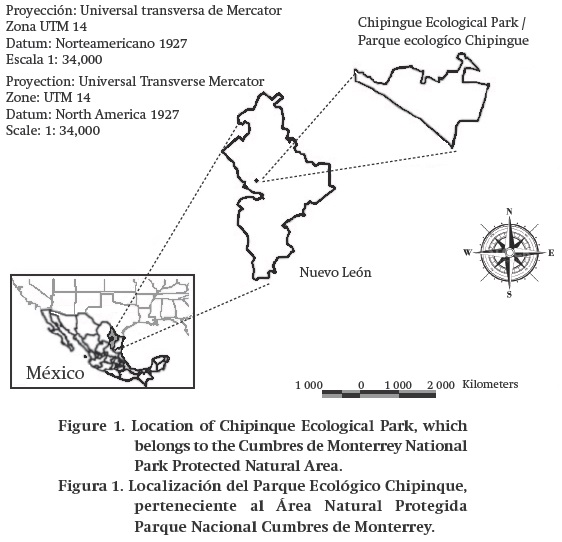
<body><![CDATA[<p align="justify"><font face="verdana" size="2">&nbsp;</font></p>  	    <p align="justify"><font face="verdana" size="2"><b>MATERIALS AND METHODS</b></font></p>  	    <p align="justify"><font face="verdana" size="2"><b>Study area</b></font></p>  	    <p align="justify"><font face="verdana" size="2">The study was conducted in Chipinque Ecological Park (PECh), which belongs to the Cumbres de Monterrey National Park Protected Natural Area (<a href="#f1">Figure 1</a>). PECh is located in San Pedro Garza Garc&iacute;a and Monterrey counties, Nuevo Le&oacute;n (northeastern Mexico). The research was conducted in a mixed <i>Pinus&#45;Quercus</i> stand at 1,125 m elevation, at geographic coordinates 100&deg; 18 and 100&deg; 24 WL, and 25&deg; 33' and 25&deg; 35' NL. Species that stand out for their abundance are <i>P. pseudostrobus</i>, <i>Quercus rysophylla</i> (Weath), <i>Q. laeta</i> (Liemb), <i>Q. polymorpha</i> (Schltdl. &amp; Cham.), <i>Q. laceyi</i> (Small) and <i>Q. canbyi</i> (Trel.) (Gonz&aacute;lez&#45;Tagle et al., 2008) According to the FAO&#45; UNESCO classification system (FAO, 1998), the soil corresponds to a Leptosol, characterized by being very shallow.</font></p>  	    <p align="center"><font face="verdana" size="2"><a name="f1"></a></font></p>  	    <p align="center"><font face="verdana" size="2"><img src="/img/revistas/rcscfa/v21n2/a2f1.jpg"></font></p>  	    <p align="justify"><font face="verdana" size="2">In April 1998, a wildfire affected 500 hectares of a mixed <i>Pinus&#45;Quercus</i> ecosystem in PECh (Alan&iacute;s&#45;Rodr&iacute;guez et al., 2010). The fire spread through both the surface and crown and lasted six days, burning plant elements (Alan&iacute;s&#45;Rodr&iacute;guez et al., 2008). Species of the genus <i>Quercus</i> suffered damage to the aerial part, but as a strategy they have the ability to resprout from underground structures, enabling them to quickly regenerate aerial tissues (Zavala&#45;Ch&aacute;vez, 2001). On the other hand, <i>P. pseudostrobus</i> is a species resistant to low&#45;intensity fire, thanks to its thick bark and physically protected terminal buds that allow recovering burned foliage, especially in young stages (Rodr&iacute;guez&#45;Trejo &amp; Ful&eacute;, 2003). In May 1998 an ecological rehabilitation project began on 480 ha, maintaining a 20&#45;ha area for natural secondary succession development. This area not subjected to restoration was used as a control in this study. The rehabilitation treatment, known as contour&#45;felled logs, consisted of placing burned tree material in contour lines perpendicular to the slope with a distance of 3 m from each other. This treatment's main objective was to control runoff and retain and accumulate soil (Myronidis et al., 2010; Robichaud, 2005). In September of the same year, coinciding with the period of greatest rainfall, the area was reforested with one&#45;year&#45;old <i>P. pseudostrobus</i> seedlings at a density of 2,000 individuals&middot;ha&#45;1. The seedlings had a height of 15 cm and were established with the rootball substrate. Dead seedlings were replaced annually over the next five years (1999&#45;2003). Species of the genus <i>Quercus</i> presented numerous shoots that were pruned during the years 1998 to 2003, leaving only the shoot with the largest diameter (Alan&iacute;s&#45;Rodr&iacute;guez et al., 2010). Pruning was carried out not only to promote the growth of the main shoo, but also to decrease <i>Quercus</i> leaf area and promote the growth of <i>P. pseudostrobus</i>, since it is a species with high light requirements (Alan&iacute;s&#45;Rodr&iacute;guez et al., 2008).</font></p>  	    <p align="justify"><font face="verdana" size="2"><b>Field assessment</b></font></p>  	    <p align="justify"><font face="verdana" size="2">In June 2008, 10 years after the fire, a medium&#45;term assessment was made of the rehabilitation treatment applied. For this reason, we established a study area with ecological rehabilitation treatment and another without treatment, wherein the plant community and soil depth were sampled.</font></p>  	    <p align="justify"><font face="verdana" size="2">The two areas had similar ecological conditions: a mixed <i>Pinus&#45;Quercus</i> ecosystem, dry climate, elevation between 1,100 and 1,150 m, Litosol soil, slope between 30 and 35&deg; and northeast exposure. In each area (with and without rehabilitation treatment) four plots of 10 x 10 m were established, totaling eight plots. This plot size has been used to evaluate plant communities in post&#45;fire regenerated areas of mixed <i>Pinus&#45;Quercus</i> forests (Alan&iacute;s&#45;Rodr&iacute;guez et al., 2008; Alan&iacute;s&#45;Rodr&iacute;guez et al., 2012) and areas with low&#45;growing vegetation (Canizales&#45;Vel&aacute;zquez et al., 2009). The areas had an equidistance of 20 m between them to avoid soil and elevation variations (Alan&iacute;s&#45;Rodr&iacute;guez et al., 2010). In the plots, all woody species with &ge; 1 cm stem diameter were identified and crown diameters were measured in a North&#45;South and East&#45;West direction. In the rehabilitated area all <i>pseudostrobus</i> individuals were classified according to their vigor, categorizing them as 1) Excellent, 2) Fair, and 3) Likely to die (modified classification of Flores &amp; Almanza, 1991). Individuals considered as excellent are those that were in the upper stratum (&ge; 6 m) with a vigorous crown and green needles. Fair individuals were those in the middle stratum (3&#45;6 m) with high crown competition conditions with <i>Quercus</i> spp. Finally, individuals in the likely to die category were those in the lower stratum (&lt;3 m) with a suppressed crown and mostly yellow needles.</font></p>  	    ]]></body>
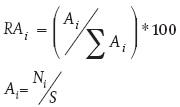
<body><![CDATA[<p align="justify"><font face="verdana" size="2">Soil depth was determined in the same plots where vegetation was assessed; a network of 5 x 5 m was established to define the sampling points at each intersection (nine points per site). Depth was measuredby digging with a shovel until reaching bedrock.</font></p>  	    <p align="justify"><font face="verdana" size="2"><b>Data analysis</b></font></p>  	    <p align="justify"><font face="verdana" size="2"><i>P. pseudostrobus</i> survival was estimated by de termining the proportion of live trees with respect to planted trees, using the formula of Ram&iacute;rez&#45;Delgadillo (2011):</font></p>  	    <p align="center"><font face="verdana" size="2"><img src="/img/revistas/rcscfa/v21n2/a2e1.jpg"></font></p>      <p align="justify"><font face="verdana" size="2">where:</font></p>  	    <p align="justify"><font face="verdana" size="2"><i>P</i> = Proportion of live trees</font></p>  	    <p align="justify"><font face="verdana" size="2"><i>a<sub>i</sub></i>= Number of live trees at site <i>i</i></font></p>  	    <p align="justify"><font face="verdana" size="2"><i>m<sub>i</sub></i>= Number of trees planted at site <i>i</i>.</font></p>  	    <p align="justify"><font face="verdana" size="2">The relative role of tree species was evaluated using the ecological indicators of abundance (RA<sub><i>i</i></sub>), dominance (RD<sub><i>i</i></sub>), frequency (RF<sub><i>i</i></sub>) and importance value index (IVI) as a means of valuation (Magurran, 1988). Specific relative abundance was estimated by applying the following equation:</font></p>  	    <p align="center"><font face="verdana" size="2">    ]]></body>
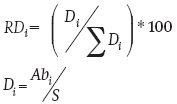
<body><![CDATA[<br> 	<img src="/img/revistas/rcscfa/v21n2/a2e2.jpg"></font></p>      <p align="justify"><font face="verdana" size="2">where:</font></p>  	    <p align="justify"><font face="verdana" size="2"><i>AR<sub>i</sub></i> = Relative abundance of species <i>i</i> relative to total abundance</font></p>  	    <p align="justify"><font face="verdana" size="2"><i>A<sub>i</sub></i> = Abundance of species <i>i</i></font></p>  	    <p align="justify"><font face="verdana" size="2"><i>N<sub>i</sub></i>= Number of individuals of species <i>i</i></font></p>  	    <p align="justify"><font face="verdana" size="2"><i>S</i> = Sampling area (ha)</font></p>  	    <p align="justify"><font face="verdana" size="2">Relative dominance (RD<sub><i>i</i></sub>) was estimated using:</font></p>  	    <p align="center"><font face="verdana" size="2"><img src="/img/revistas/rcscfa/v21n2/a2e3.jpg"></font></p>      <p align="justify"><font face="verdana" size="2">where:</font></p>  	    <p align="justify"><font face="verdana" size="2"><i>RD<sub>i</sub></i> = Relative dominance of species <i>i</i> relative to total dominance</font></p>  	    ]]></body>
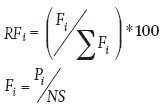
<body><![CDATA[<p align="justify"><font face="verdana" size="2"><i>D<sub>i</sub></i>= Dominance of species <i>i</i> (m<sup>2</sup>)</font></p>  	    <p align="justify"><font face="verdana" size="2"><i>Ca<sub>i</sub></i>= Crown area of species <i>i</i></font></p>  	    <p align="justify"><font face="verdana" size="2"><i>S</i> = Sampling area (ha)</font></p>  	    <p align="justify"><font face="verdana" size="2">Relative frequency (RF<i><sub>i</sub></i>) was obtained with the following equations:</font></p>  	    <p align="center"><font face="verdana" size="2"><img src="/img/revistas/rcscfa/v21n2/a2e4.jpg"></font></p>      <p align="justify"><font face="verdana" size="2">where:</font></p>  	    <p align="justify"><font face="verdana" size="2"><i>RF<sub>i</sub></i> = Relative frequency of species <i>i</i> relative to total frequency</font></p>  	    <p align="justify"><font face="verdana" size="2"><i>F<sub>i</sub></i> = Frequency of species <i>i</i></font></p>  	    <p align="justify"><font face="verdana" size="2"><i>Pi</i> = Frequency of species <i>i</i> in the plots</font></p>  	    <p align="justify"><font face="verdana" size="2"><i>TN</i> =Total number of plots</font></p>  	    ]]></body>
<body><![CDATA[<p align="justify"><font face="verdana" size="2">The Importance Value Index (IVI) was defined as:</font></p>  	    <p align="center"><font face="verdana" size="2"><img src="/img/revistas/rcscfa/v21n2/a2e5.jpg"></font></p>      <p align="justify"><font face="verdana" size="2">The structure of the community in terms of the abundance of each species was determined with rank&#45; abundance curve (Magurran, 1988). These curves describe the graphical relationshipbetween the absolute abundance value of species based on a sequential arrangement ranging from the most common to the rarest (Martella et al., 2012). The models tested were: 1) Poisson&#45;lognormal, 2) Weibull distribution and 3) Alonso &amp; Mc Kane's neutral distribution (Prado &amp; Dantas, 2014). The parameters were estimated with the maximum likelihood method and the best model was selected using the Akaike Information Criterion (AIC) where the best model is the one with the lowest AIC value (Prado &amp; Dantas, 2014). The analysis was carried out by means of R v3.1.2 (R Development Core Team, 2011), using the package "SADS" (Prado &amp; Dantas, 2014). Significant differences in the abundance and dominance of species and in soil depth between the areas with and without rehabilitation treatment were determined by an analysis of variance (<i>P</i> = 0.05) of a factor (treatment) with two levels (rehabilitated and non&#45;rehabilitated) using the statistical package SPSS v. 15.0 (SPSS, 2006).</font></p>  	    <p align="justify"><font face="verdana" size="2">&nbsp;</font></p>  	    <p align="justify"><font face="verdana" size="2"><b>RESULTS AND DISCUSSION</b></font></p>  	    <p align="justify"><font face="verdana" size="2">In the two evaluated areas (rehabilitated and non&#45; rehabilitated) of the mixed <i>Pinus&#45;Quercus</i> stand in PECh, 14 woody species comprising eight families and 10 genera were recorded. The rank&#45;abundance curve describes the graphical relationship of the density of the species based on a sequential arrangement ranging from the most abundant to the rarest (Martella et al., 2012). <a href="/img/revistas/rcscfa/v21n2/a2f2.jpg" target="_blank">Figure 2</a> shows the abundance of species in the rehabilitated and non&#45;rehabilitated areas; in both cases, the pattern is graphically fit to the Poisson&#45;lognormal distribution. In the non&#45;rehabilitated area, the AIC obtained with the Poisson&#45;lognormal distribution was 152.8, while with the Weibull distribution and the Zero&#45;Sum&#45;Multinomial goal it was 156.4 and 160.1, respectively. In the rehabilitated area, the AIC was 113.2 with the Poisson&#45;lognormal, while with the Weibull distribution and the Zero&#45;Sum&#45;multinomial goal it was 115.5 and 118.7, respectively. The Poisson&#45;lognormal distribution is documented for mature plant communities, where there are few families or species with high or low abundance values, with most having intermediate values (Long, Yang, &amp; Li, 2012; Martella et al., 2012; Matthews &amp; Whittaker, 2014).</font></p>  	    <p align="justify"><font face="verdana" size="2"><a href="/img/revistas/rcscfa/v21n2/a2t1.jpg" target="_blank">Table 1</a> reports the tree density and ecological indicators of the two evaluated areas (rehabilitated and non&#45;rehabilitated). The non&#45;rehabilitated area had a density of 5,300 &plusmn; 1,028 individuals&middot;ha<sup>&#45;1</sup> with a total crown area of 17,790 &plusmn; 963 m<sup>2</sup>&middot;ha<sup>&#45;1</sup>, while the rehabilitated area had a density of 3,231 &plusmn; 535 individuals&middot;ha<sup>&#45;1</sup> with a crown area of 13,117 &plusmn; 2,431 m<sup>2</sup>&middot;ha<sup>&#45;1</sup>. This means that both have greater than 100% cover and therefore overlapping crowns. According to the analysis of variance, the mean values of density (<i>F</i> = 2.788, <i>P</i> = 0.146) and crown area (<i>F</i> = 1.760, <i>P</i> = 0.233) of the plant communities showed no significant differences (<i>P</i> = 0.05) relative to the rehabilitation treatment.</font></p>  	    <p align="justify"><font face="verdana" size="2">The species with the highest IVI in both areas was <i>Q. rysophylla</i> (55.3 and 49.2% in the rehabilitated and non&#45;rehabilitated areas, respectively), being the most abundant, dominant and prevalent. Due to the reforestation measures, the species with the second highest IVI in the rehabilitated area was <i>P. pseudostrobus</i> with 15.7%. Analysis of variance by species showed significant differences, with <i>P. pseudostrobus</i> being more abundant (F = 14,764; P = 0.009) and dominant (F = 6.247, P = 0.047) in the rehabilitated area than in the control area. The remaining species showed no significant differences in their abundance and dominance.</font></p>  	    <p align="justify"><font face="verdana" size="2"><b>Reforestation analysis</b></font></p>  	    <p align="justify"><font face="verdana" size="2">In 2008, 35% survival of the 2,000 individuals&middot;ha<sup>&#45;1</sup> of <i>P. pseudostrobus</i> planted in the rehabilitated area in 1998 and in successive replacements of dead seedlings in the period 1999&#45;2003 was recorded. According to the classification of <i>P. pseudostrobus</i> individuals based on their vigor, 52 % of the pines were included in the excellent class, 7% in the fair class and 41% in the likely to die class. It should be noted that the specimens passed through the initial establishment and growth stages that are considered the most critical, since the seedlings are highly susceptible to extreme weather conditions such as extremely high winds, low or high temperatures, and low precipitation and relative humidity, among others(Jim&eacute;nez&#45;P&eacute;rez, Alan&iacute;s&#45;Rodr&iacute;guez, Gonz&aacute;lez&#45;Tagle, Aguirre&#45;Calder&oacute;n, &amp; Trevi&ntilde;o&#45;Garza, 2013).</font></p>  	    ]]></body>
<body><![CDATA[<p align="justify"><font face="verdana" size="2">Woody species established after the wildfire in the rehabilitation area showed high density and a crown area greater than 100 %, causing high competition for light. In order to ensure the good development of <i>P. pseudostrobus</i>, which is a sun&#45;loving species (Gonz&aacute;lez&#45; Tagle et al., 2008) it would be advisable to partly remove neighboring trees to reduce the crown overlap area and thus promote the optimal development of individuals (Alan&iacute;s&#45;Rodr&iacute;guez et al., 2008). Ecological rehabilitation as referred to in this study included the removal of all shoots except one in the Quercus sp individuals. However, 10 years after treatment, no significant differences (<i>P</i> = 0.05) in the crown cover of both species were observed, suggesting compensatory growth of replacement individuals (Alvarez, Villagra, Villalba, &amp; Debandi, 2013).</font></p>  	    <p align="justify"><font face="verdana" size="2">From a technical and economic standpoint, the plantation survival rate (35%) is not acceptable since CONAFOR, Mexico's National Forestry Commission, which funded the reforestation programs, requires 90% survival. Therefore, new scientific research aimed at increasing the effectiveness of reforestation methods, from quality plant production to improvements in the design, implementation and maintenance of forest plantations, is recommended. Based on the results of this research, we recommend prioritizing research that analyzes plantation management, particularly in the partial removal of neighboring trees to reduce the overlapping crown area and thus promote and increase the survival percentage of key species.</font></p>  	    <p align="justify"><font face="verdana" size="2"><b>Contour&#45;felled logs</b></font></p>  	    <p align="justify"><font face="verdana" size="2">Contour&#45;felled logs had a positive effect on soil accumulation (<i>F</i> = 10.124, <i>P</i> = 0.002). <a href="#f3">Figure 3</a> shows that the average soil depth in the area with contour&#45;felled logs was 24.7 &plusmn; 6.6 cm, while in the area without them it was 19.9 &plusmn; 6.8 cm, representing a relative increase of nearly 25 %. This indicates that the contour&#45;felled logs were efficient, so their use is recommended to prevent soil loss by entrainment in areas affected by fire at sites with biophysical conditions similar to those found in the Sierra Madre Oriental. Soil depth in this study is similar to that recorded by Salgado, L&oacute;pez, and Acosta (2006), who evaluated a Leptosol soil and determined a depth of 15 cm.</font></p>  	    <p align="center"><font face="verdana" size="2"><a name="f3"></a></font></p>  	    <p align="center"><font face="verdana" size="2"><img src="/img/revistas/rcscfa/v21n2/a2f3.jpg"></font></p>  	    <p align="justify"><font face="verdana" size="2">The soil amount retained by the contour&#45;felled logs over 10 years is high (479 m3&middot;ha&#45;1) compared with other research. It has been observed that soil accumulation, three years after placing contour&#45;felled logs, ranged from 5 m<sup>3</sup>&middot;ha<sup>&#45;1</sup> in Washington National Park (Robichaud, 2001) to 67 m<sup>3</sup>&middot;ha<sup>&#45;1</sup> in central Colorado(Wagenbrenner, MacDonald, &amp; Rough, 2006). Cases have also been reported such as that of the San Jacinto Mountains in California where 152 m<sup>3</sup>&middot;ha<sup>&#45;1</sup> were accumulated due to storms that occurred after a fire (Wohlgemuth, Hubbert, &amp; Robichaud, 2001).</font></p>  	    <p align="justify"><font face="verdana" size="2">It is important to mention that PECh has a rainy season with storms in summer (August to October), with September being the month with the highest incidence of rainfall, ranging between 80 and 90 mm (Instituto Nacional de Estad&iacute;stica, Geograf&iacute;a e Inform&aacute;tica &#91;INEGI&#93;, 1986). Because of the conditions of the area burned in the summer of 1998 (little plant cover, 30&#45;35&deg; slope and rainstorms), the soil was entrained and deposited in the contour&#45;felled logs.</font></p>  	    <p align="justify"><font face="verdana" size="2">&nbsp;</font></p>  	    <p align="justify"><font face="verdana" size="2"><b>CONCLUSIONS</b></font></p>  	    ]]></body>
<body><![CDATA[<p align="justify"><font face="verdana" size="2">Based on the results of this study, we conclude that: 1) from a technical and economic standpoint, the plantation survival rate (35%) is not acceptable as CONAFOR requires 90 % survival, so it is not recommended to undertake plantings without implementing appropriate techniques during the reforestation process; 2) the density and crown area of the plant communities in the treatment and control areas showed statistical similarity, meaning that the treatment did not increase those characteristics; and 3) that the contour&#45;felled logs used in post&#45;fire areas had a positive and significant effect on soil retention. This indicates that the soil retention barrier techniques have been effective, since they prevent soil loss by entrainment; therefore, they are recommended in post&#45;fire stands in the Sierra Madre Oriental at high risk of erosion.</font></p>  	    <p align="justify"><font face="verdana" size="2">&nbsp;</font></p>  	    <p align="justify"><font face="verdana" size="2"><b>ACKNOWLEDGMENTS</b></font></p>  	    <p align="justify"><font face="verdana" size="2">The authors thank Mexico's National Science and Technology Council (CONACYT) for awarding a scholarship to the first author. The authors acknowledge the support of: Lillian Belle Willcockson, Director General of Chipinque Ecological Park, for all the help provided; Glafiro J. Alan&iacute;s Flores for support in identifying species; and Perla Cecilia Garc&iacute;a Galindo, Erick I. Mel&eacute;ndez L&oacute;pez and Esa&uacute; Ian Moreno for their cooperation in field activities. The CEAM Foundation is fundedby Generalitat Valenciana.</font></p>  	    <p align="justify"><font face="verdana" size="2">&nbsp;</font></p>  	    <p align="justify"><font face="verdana" size="2"><b>REFERENCES</b></font></p>  	    <!-- ref --><p align="justify"><font face="verdana" size="2">Alan&iacute;s&#45;Rodr&iacute;guez, E., Aguirre&#45;Calder&oacute;n, &Oacute;., Jim&eacute;nez&#45;P&eacute;rez, J., Pando&#45;Moreno, M., Trevi&ntilde;o&#45;Garza, E. J., Aranda&#45; Ramos, R., &amp; Canizales&#45;Vel&aacute;zquez, P. A. (2010). Efecto de la severidad del fuego sobre la regeneraci&oacute;n asexual de especies le&ntilde;osas de un ecosistema mixto (<i>Pinus&#45;Quercus</i>) en el Parque Ecol&oacute;gico Chipinque, M&eacute;xico. <i>Interciencia</i>, <i>35</i>(9), 690&#150;695. Obtenido de <a href="http://www.redalyc.org/resumen.oa?id=33914212010" target="_blank">http://www.redalyc.org/resumen.oa?id=33914212010</a></font>&nbsp;&nbsp;&nbsp;&nbsp;&nbsp;&nbsp;&nbsp;&nbsp;[&#160;<a href="javascript:void(0);" onclick="javascript: window.open('/scielo.php?script=sci_nlinks&ref=6633255&pid=S2007-4018201500020000200001&lng=','','width=640,height=500,resizable=yes,scrollbars=1,menubar=yes,');">Links</a>&#160;]<!-- end-ref --><!-- ref --><p align="justify"><font face="verdana" size="2">Alan&iacute;s&#45;Rodr&iacute;guez, E., Jim&eacute;nez&#45;P&eacute;rez, J., Espinoza&#45;Vizcarra, D., Jurado&#45;Ybarra, E., Aguirre&#45;Calder&oacute;n, O. A., &amp; Gonz&aacute;lez&#45;Tagle, M. A. (2008). Evaluaci&oacute;n del estrato arb&oacute;reo en un &aacute;rea restaurada post&#45;incendio en el parque ecol&oacute;gico Chipinque, M&eacute;xico. <i>Revista Chapingo Serie Ciencias Forestales y del Ambiente</i>, <i>14</i>(2), 113&#150;118. Obtenido de <a href="http://www.chapingo.mx/revistas/%20forestales/contenido.php?id_revista_numero=38" target="_blank">http://www.chapingo.mx/revistas/ forestales/contenido.php?id_revista_numero=38</a></font>&nbsp;&nbsp;&nbsp;&nbsp;&nbsp;&nbsp;&nbsp;&nbsp;[&#160;<a href="javascript:void(0);" onclick="javascript: window.open('/scielo.php?script=sci_nlinks&ref=6633256&pid=S2007-4018201500020000200002&lng=','','width=640,height=500,resizable=yes,scrollbars=1,menubar=yes,');">Links</a>&#160;]<!-- end-ref --><!-- ref --><p align="justify"><font face="verdana" size="2">Alan&iacute;s&#45;Rodr&iacute;guez, E., Jim&eacute;nez&#45;P&eacute;rez, J., Valdecantos&#45;Dema, A., Pando&#45;Moreno, M., Aguirre&#45;Calder&oacute;n, O. A., &amp; Trevi&ntilde;o&#45;Garza, E. J. (2011). Caracterizaci&oacute;n de regeneraci&oacute;n le&ntilde;osa post&#45;incendio de un ecosistema templado del Parque Ecol&oacute;gico Chipinque, M&eacute;xico. <i>Revista Chapingo Serie Ciencias Forestales y del Ambiente</i>, <i>17</i>(1), 31&#150;39. doi: 10.5154/r.rchscfa.2010.05.032</font>&nbsp;&nbsp;&nbsp;&nbsp;&nbsp;&nbsp;&nbsp;&nbsp;[&#160;<a href="javascript:void(0);" onclick="javascript: window.open('/scielo.php?script=sci_nlinks&ref=6633257&pid=S2007-4018201500020000200003&lng=','','width=640,height=500,resizable=yes,scrollbars=1,menubar=yes,');">Links</a>&#160;]<!-- end-ref --><!-- ref --><p align="justify"><font face="verdana" size="2">Alan&iacute;s&#45;Rodr&iacute;guez, E., Jim&eacute;nez&#45;P&eacute;rez, J., Valdecantos&#45;Dema, A., Gonz&aacute;lez&#45;Tagle, M. A., Aguirre&#45;Calder&oacute;n, &Oacute;. A., &amp; Trevi&ntilde;o&#45;Garza, E. J. (2012). Composici&oacute;n y diversidad de la regeneraci&oacute;n natural en comunidades de <i>Pinus&#45;Quercus</i> sometidas a una alta recurrencia de incendios en el noreste de M&eacute;xico. <i>Revista Mexicana de Biodiversidad</i>, <i>83</i>(4), 1208&#150;1214. doi: 10.7550/rmb.29708</font>&nbsp;&nbsp;&nbsp;&nbsp;&nbsp;&nbsp;&nbsp;&nbsp;[&#160;<a href="javascript:void(0);" onclick="javascript: window.open('/scielo.php?script=sci_nlinks&ref=6633258&pid=S2007-4018201500020000200004&lng=','','width=640,height=500,resizable=yes,scrollbars=1,menubar=yes,');">Links</a>&#160;]<!-- end-ref --><!-- ref --><p align="justify"><font face="verdana" size="2">&Aacute;lvarez, J. A., Villagra, P. E., Villalba, R., &amp; Debandi, G. (2013). Effects of the pruning intensity and tree size on multi&#45;stemmed <i>Prosopis f lexuosa</i> trees in the Central Monte, Argentina. <i>Forest Ecology and Management</i>, <i>310</i>, 857&#150;864. doi:10.1016/j.foreco.2013.09.033</font>&nbsp;&nbsp;&nbsp;&nbsp;&nbsp;&nbsp;&nbsp;&nbsp;[&#160;<a href="javascript:void(0);" onclick="javascript: window.open('/scielo.php?script=sci_nlinks&ref=6633259&pid=S2007-4018201500020000200005&lng=','','width=640,height=500,resizable=yes,scrollbars=1,menubar=yes,');">Links</a>&#160;]<!-- end-ref --><!-- ref --><p align="justify"><font face="verdana" size="2">Beghin, R., Lingua, E., Garbarino, M., Lonati, M., Bovio, G., Motta, R., &amp; Marzano, R.(2010). <i>Pinussylvestris</i> forest regeneration under different post&#45;fire restoration practices in the northwestern Italian Alps. <i>Ecological Engineering</i>, <i>36</i>(10), 1365&#150;1372. doi:10.1016/j.ecoleng.2010.06.014</font>&nbsp;&nbsp;&nbsp;&nbsp;&nbsp;&nbsp;&nbsp;&nbsp;[&#160;<a href="javascript:void(0);" onclick="javascript: window.open('/scielo.php?script=sci_nlinks&ref=6633260&pid=S2007-4018201500020000200006&lng=','','width=640,height=500,resizable=yes,scrollbars=1,menubar=yes,');">Links</a>&#160;]<!-- end-ref --><!-- ref --><p align="justify"><font face="verdana" size="2">Benavides&#45;Solorio, J. D., &amp; MacDonald, L. H. (2005). Measurement and prediction of post&#45;fire erosion at the hillslope scale, Colorado Front Range. <i>International Journal of Wildland Fire</i>, <i>14</i>(4), 457&#150;474. doi: 10.1071/WF05042</font>&nbsp;&nbsp;&nbsp;&nbsp;&nbsp;&nbsp;&nbsp;&nbsp;[&#160;<a href="javascript:void(0);" onclick="javascript: window.open('/scielo.php?script=sci_nlinks&ref=6633261&pid=S2007-4018201500020000200007&lng=','','width=640,height=500,resizable=yes,scrollbars=1,menubar=yes,');">Links</a>&#160;]<!-- end-ref --><!-- ref --><p align="justify"><font face="verdana" size="2">Canizales&#45;Vel&aacute;zquez, P. A., Alan&iacute;s&#45;Rodr&iacute;guez, E., Aranda&#45;Ramos, R., Mata&#45;Balderas, J. M., Jim&eacute;nez&#45;P&eacute;rez, J., Alan&iacute;s&#45; Flores, G., ... Ruiz&#45;Bautista, M. G. (2009). Caracterizaci&oacute;n estructural del matorral submontano de la Sierra Madre Oriental, Nuevo Le&oacute;n, M&eacute;xico. <i>Revista Chapingo Serie Ciencias Forestales y del Ambiente</i>, <i>15</i>(2), 115&#150;120. Obtenido de <a href="http://www.chapingo.mx/revistas/forestales/contenido.php?id_revista_numero=40" target="_blank">http://www.chapingo.mx/revistas/forestales/contenido.php?id_revista_numero=40</a></font>&nbsp;&nbsp;&nbsp;&nbsp;&nbsp;&nbsp;&nbsp;&nbsp;[&#160;<a href="javascript:void(0);" onclick="javascript: window.open('/scielo.php?script=sci_nlinks&ref=6633262&pid=S2007-4018201500020000200008&lng=','','width=640,height=500,resizable=yes,scrollbars=1,menubar=yes,');">Links</a>&#160;]<!-- end-ref --><!-- ref --><p align="justify"><font face="verdana" size="2">Comisi&oacute;n Nacional Forestal (CONAFOR). (2006). <i>Protecci&oacute;n, restauraci&oacute;n y conservaci&oacute;n de suelos forestales: Manual de obras y pr&aacute;cticas.</i> M&eacute;xico: Autor.    &nbsp;&nbsp;&nbsp;&nbsp;&nbsp;&nbsp;&nbsp;&nbsp;[&#160;<a href="javascript:void(0);" onclick="javascript: window.open('/scielo.php?script=sci_nlinks&ref=6633263&pid=S2007-4018201500020000200009&lng=','','width=640,height=500,resizable=yes,scrollbars=1,menubar=yes,');">Links</a>&#160;]<!-- end-ref --></font></p>  	    <!-- ref --><p align="justify"><font face="verdana" size="2">DeWolfe, V. G., Santi, P. M., Ey, J., &amp; Gartner, J. E. (2008). Effective mitigation of debris flows at Lemon Dam, La Plata County, Colorado. <i>Geomorphology</i>, <i>96</i>(3&#45;4), 366&#150;377. doi: 10.1016/j.geomorph.2007.04.008</font>&nbsp;&nbsp;&nbsp;&nbsp;&nbsp;&nbsp;&nbsp;&nbsp;[&#160;<a href="javascript:void(0);" onclick="javascript: window.open('/scielo.php?script=sci_nlinks&ref=6633265&pid=S2007-4018201500020000200010&lng=','','width=640,height=500,resizable=yes,scrollbars=1,menubar=yes,');">Links</a>&#160;]<!-- end-ref --><!-- ref --><p align="justify"><font face="verdana" size="2">Food and Agriculture Organization of the United Nations (FAO). (1998). <i>World reference base for soil resources</i>. Rome: Author. Consultado 14&#45;01&#45;2014 en <a href="http://www.fao.org/docrep/w8594e/w8594e00.HTM" target="_blank">http://www.fao.org/docrep/w8594e/w8594e00.HTM</a></font>&nbsp;&nbsp;&nbsp;&nbsp;&nbsp;&nbsp;&nbsp;&nbsp;[&#160;<a href="javascript:void(0);" onclick="javascript: window.open('/scielo.php?script=sci_nlinks&ref=6633266&pid=S2007-4018201500020000200011&lng=','','width=640,height=500,resizable=yes,scrollbars=1,menubar=yes,');">Links</a>&#160;]<!-- end-ref --><!-- ref --><p align="justify"><font face="verdana" size="2">Flores, F. J. D., &amp; Almanza, P. B. E. (1991). Observaci&oacute;n sobre el arbolado de la "Alameda Zaragoza" del Saltillo, Coahuila, con especial referencia a su estado de vigorosidad. <i>Agraria</i>, <i>7</i>(1), 36&#150;47. Obtenido de <a href="http://www.uaaan.mx/DirInv/portal_agraria/agrariaV/Contenidos_agr_1a/Agraria07_01_91.pdf" target="_blank">http://www.uaaan.mx/DirInv/portal_agraria/agrariaV/Contenidos_agr_1a/Agraria07_01_91.pdf</a></font>&nbsp;&nbsp;&nbsp;&nbsp;&nbsp;&nbsp;&nbsp;&nbsp;[&#160;<a href="javascript:void(0);" onclick="javascript: window.open('/scielo.php?script=sci_nlinks&ref=6633267&pid=S2007-4018201500020000200012&lng=','','width=640,height=500,resizable=yes,scrollbars=1,menubar=yes,');">Links</a>&#160;]<!-- end-ref --><!-- ref --><p align="justify"><font face="verdana" size="2">Gonz&aacute;lez&#45;Tagle, M. A., Schwendenmann, L., Jim&eacute;nez, J., &amp; Himmelsbach, W. (2007). Reconstrucci&oacute;n del historial de incendios y estructura forestal en bosques mixtos de pino&#45;encino en la Sierra Madre Oriental. <i>Madera y Bosques</i>, <i>13</i>(2), 51&#150;63. Obtenido de <a href="http://redalyc.uaemex.mx/redalyc/pdf/617/61713205.pdf" target="_blank">http://redalyc.uaemex.mx/redalyc/pdf/617/61713205.pdf</a></font>&nbsp;&nbsp;&nbsp;&nbsp;&nbsp;&nbsp;&nbsp;&nbsp;[&#160;<a href="javascript:void(0);" onclick="javascript: window.open('/scielo.php?script=sci_nlinks&ref=6633268&pid=S2007-4018201500020000200013&lng=','','width=640,height=500,resizable=yes,scrollbars=1,menubar=yes,');">Links</a>&#160;]<!-- end-ref --><!-- ref --><p align="justify"><font face="verdana" size="2">Gonz&aacute;lez&#45;Tagle, M. A., Schwendenmann, L., P&eacute;rez, J. J., &amp; Schulz, R. (2008). Forest structure and woody plant species composition along a fire chronosequence in mixed pine&#150;oak forest in the Sierra Madre Oriental, Northeast Mexico. <i>Forest Ecology and Management</i>, <i>256</i>(1&#45;2), 161&#150;167. doi: 10.1016/j.foreco.2008.04.021</font>&nbsp;&nbsp;&nbsp;&nbsp;&nbsp;&nbsp;&nbsp;&nbsp;[&#160;<a href="javascript:void(0);" onclick="javascript: window.open('/scielo.php?script=sci_nlinks&ref=6633269&pid=S2007-4018201500020000200014&lng=','','width=640,height=500,resizable=yes,scrollbars=1,menubar=yes,');">Links</a>&#160;]<!-- end-ref --><!-- ref --><p align="justify"><font face="verdana" size="2">Instituto Nacional de Estad&iacute;stica Geograf&iacute;a e Inform&aacute;tica (INEGI). (1986). <i>S&iacute;ntesis Geogr&aacute;fica del Estado de Nuevo Le&oacute;n</i>. M&eacute;xico: Autor.    &nbsp;&nbsp;&nbsp;&nbsp;&nbsp;&nbsp;&nbsp;&nbsp;[&#160;<a href="javascript:void(0);" onclick="javascript: window.open('/scielo.php?script=sci_nlinks&ref=6633270&pid=S2007-4018201500020000200015&lng=','','width=640,height=500,resizable=yes,scrollbars=1,menubar=yes,');">Links</a>&#160;]<!-- end-ref --></font></p>  	    <!-- ref --><p align="justify"><font face="verdana" size="2">Infalt, S. B., &amp; Young, T. P. (2008). Forest restorationin campgrounds at Kings Canyon National Park, California. <i>Ecological Restoration</i>, <i>26</i>(4), 302&#150;310. doi: 10.3368/er.26.4.302</font>&nbsp;&nbsp;&nbsp;&nbsp;&nbsp;&nbsp;&nbsp;&nbsp;[&#160;<a href="javascript:void(0);" onclick="javascript: window.open('/scielo.php?script=sci_nlinks&ref=6633272&pid=S2007-4018201500020000200016&lng=','','width=640,height=500,resizable=yes,scrollbars=1,menubar=yes,');">Links</a>&#160;]<!-- end-ref --><!-- ref --><p align="justify"><font face="verdana" size="2">Jardel&#45;Pel&aacute;ez, E. J., Alvarado&#45;Celestino, E., Morf&iacute;n&#45;Rios, J. E., Castillo&#45;Navarro, F., &amp; Flores&#45;Garnica, J. G. (2009). <i>Reg&iacute;menes de fuego en ecosistemas forestales de M&eacute;xico</i>. M&eacute;xico: Mundi&#45;Prensa.    &nbsp;&nbsp;&nbsp;&nbsp;&nbsp;&nbsp;&nbsp;&nbsp;[&#160;<a href="javascript:void(0);" onclick="javascript: window.open('/scielo.php?script=sci_nlinks&ref=6633273&pid=S2007-4018201500020000200017&lng=','','width=640,height=500,resizable=yes,scrollbars=1,menubar=yes,');">Links</a>&#160;]<!-- end-ref --></font></p>  	    <!-- ref --><p align="justify"><font face="verdana" size="2">Jim&eacute;nez, J., Jurado, E., Aguirre, O., &amp; Estrada, E. (2005). Effect of grazing on restoration of endemic dwarf pine (<i>Pinus culminicola</i> Andresen et Beaman) populations in Northeastern Mexico. <i>Restoration Ecology</i>, <i>13</i>(1), 103&#150; 107. doi: 10.1111/j.1526&#45;100X.2005.00012.x</font>&nbsp;&nbsp;&nbsp;&nbsp;&nbsp;&nbsp;&nbsp;&nbsp;[&#160;<a href="javascript:void(0);" onclick="javascript: window.open('/scielo.php?script=sci_nlinks&ref=6633275&pid=S2007-4018201500020000200018&lng=','','width=640,height=500,resizable=yes,scrollbars=1,menubar=yes,');">Links</a>&#160;]<!-- end-ref --><!-- ref --><p align="justify"><font face="verdana" size="2">Jim&eacute;nez, P. J., Aguirre, C. O., &amp; Kramer, H. (2001). An&aacute;lisis de la estructura horizontal y vertical en un ecosistema multicohortal de pino&#45;encino en el norte de M&eacute;xico. <i>Investigaciones Agrarias: Sistema y Recursos Forestales</i>, <i>10</i>(2), 355&#150;366. Obtenido de <a href="http://www.inia.es/IASPF/2001/vol10-2/jimen.PDF" target="_blank">http://www.inia.es/IASPF/2001/vol10&#45;2/jimen.PDF</a></font>&nbsp;&nbsp;&nbsp;&nbsp;&nbsp;&nbsp;&nbsp;&nbsp;[&#160;<a href="javascript:void(0);" onclick="javascript: window.open('/scielo.php?script=sci_nlinks&ref=6633276&pid=S2007-4018201500020000200019&lng=','','width=640,height=500,resizable=yes,scrollbars=1,menubar=yes,');">Links</a>&#160;]<!-- end-ref --><!-- ref --><p align="justify"><font face="verdana" size="2">Jim&eacute;nez&#45;P&eacute;rez, J., Alan&iacute;s&#45;Rodr&iacute;guez, E., Gonz&aacute;lez&#45;Tagle, M. A., Aguirre&#45;Calder&oacute;n, O. A., &amp; Trevi&ntilde;o&#45;Garza, E. J. (2013). Characterizing regeneration of woody species in areas with different land&#45;history tenure in the Tamaulipan thornscrub, Mexico. <i>The Southwestern Naturalist</i>, <i>58</i>(3), 299&#150;304. doi: 10.1894/0038&#45;4909&#45;58.3.299</font>&nbsp;&nbsp;&nbsp;&nbsp;&nbsp;&nbsp;&nbsp;&nbsp;[&#160;<a href="javascript:void(0);" onclick="javascript: window.open('/scielo.php?script=sci_nlinks&ref=6633277&pid=S2007-4018201500020000200020&lng=','','width=640,height=500,resizable=yes,scrollbars=1,menubar=yes,');">Links</a>&#160;]<!-- end-ref --><!-- ref --><p align="justify"><font face="verdana" size="2">Li, L. F., Liao, J. X., Jiang, M. X., Huang, H. D., &amp; He, D. (2010). Effects of dry storage and water submersion on seed germination of 21 herbaceous species indigenous to the Three Gorges Reservoir Region: Plant Science Journal, 30(1), 99&#150;104. doi: 10.3724/SP.J.1142.2010.00099</font>&nbsp;&nbsp;&nbsp;&nbsp;&nbsp;&nbsp;&nbsp;&nbsp;[&#160;<a href="javascript:void(0);" onclick="javascript: window.open('/scielo.php?script=sci_nlinks&ref=6633278&pid=S2007-4018201500020000200021&lng=','','width=640,height=500,resizable=yes,scrollbars=1,menubar=yes,');">Links</a>&#160;]<!-- end-ref --><!-- ref --><p align="justify"><font face="verdana" size="2">Llovet, J., Ruiz&#45;Valera, M., Josa, R., &amp; Vallejo, V. R. (2009). Soil responses to fire in Mediterranean forest landscapes in relation to the previous stage of land abandonment. International Journal of Wildland Fire, 18(2), 222&#150;232. doi: 10.1071/WF07089</font>&nbsp;&nbsp;&nbsp;&nbsp;&nbsp;&nbsp;&nbsp;&nbsp;[&#160;<a href="javascript:void(0);" onclick="javascript: window.open('/scielo.php?script=sci_nlinks&ref=6633279&pid=S2007-4018201500020000200022&lng=','','width=640,height=500,resizable=yes,scrollbars=1,menubar=yes,');">Links</a>&#160;]<!-- end-ref --><!-- ref --><p align="justify"><font face="verdana" size="2">Long, W., Yang, X., &amp; Li, D. (2012). Patterns of species diversity and soil nutrients along a chronosequence of vegetation recovery in Hainan Island, South China. Ecological Research, 27(3), 561&#150;568. doi: 10.1007/s11284&#45;011&#45;0923&#45;3</font>&nbsp;&nbsp;&nbsp;&nbsp;&nbsp;&nbsp;&nbsp;&nbsp;[&#160;<a href="javascript:void(0);" onclick="javascript: window.open('/scielo.php?script=sci_nlinks&ref=6633280&pid=S2007-4018201500020000200023&lng=','','width=640,height=500,resizable=yes,scrollbars=1,menubar=yes,');">Links</a>&#160;]<!-- end-ref --><!-- ref --><p align="justify"><font face="verdana" size="2">Magurran, A. E. (1988). Ecological diversity and its measurement. New Jersey, USA: Princeton University Press.    &nbsp;&nbsp;&nbsp;&nbsp;&nbsp;&nbsp;&nbsp;&nbsp;[&#160;<a href="javascript:void(0);" onclick="javascript: window.open('/scielo.php?script=sci_nlinks&ref=6633281&pid=S2007-4018201500020000200024&lng=','','width=640,height=500,resizable=yes,scrollbars=1,menubar=yes,');">Links</a>&#160;]<!-- end-ref --></font></p>  	    <!-- ref --><p align="justify"><font face="verdana" size="2">Maldonado, M. M. de L., Rodr&iacute;guez, T. D. A., Gu&iacute;zar, N. E., Vel&aacute;zquez, M. J., &amp; N&aacute;&ntilde;ez, J. S. (2009). Reducci&oacute;n en riqueza de especies arb&oacute;reas por incendios en la Reserva Selva El Ocote, Chiapas. Ciencia Forestal en M&eacute;xico, 34(106), 127&#150;148. Obtenido de <a href="http://www.scielo.org.mx/pdf/cfm/v34n106/v34n106a7.pdf" target="_blank">http://www.scielo.org.mx/pdf/cfm/v34n106/v34n106a7.pdf</a></font>&nbsp;&nbsp;&nbsp;&nbsp;&nbsp;&nbsp;&nbsp;&nbsp;[&#160;<a href="javascript:void(0);" onclick="javascript: window.open('/scielo.php?script=sci_nlinks&ref=6633283&pid=S2007-4018201500020000200025&lng=','','width=640,height=500,resizable=yes,scrollbars=1,menubar=yes,');">Links</a>&#160;]<!-- end-ref --><!-- ref --><p align="justify"><font face="verdana" size="2">Martella, M. B., Trumper, E. V., Bellis, L. M., Renison, D., Giordano, P. F., Bazzano, G., &amp; Gleiser, R. M. (2012). Manual de ecolog&iacute;a. Evaluaci&oacute;n de la biodiversidad. REDUCA (Biolog&iacute;a), 5(1), 71&#150;115. Obtenido de <a href="http://revistareduca.es/index.php/biologia/article/viewFile/917/928" target="_blank">http://revistareduca.es/index.php/biologia/article/viewFile/917/928</a></font>&nbsp;&nbsp;&nbsp;&nbsp;&nbsp;&nbsp;&nbsp;&nbsp;[&#160;<a href="javascript:void(0);" onclick="javascript: window.open('/scielo.php?script=sci_nlinks&ref=6633284&pid=S2007-4018201500020000200026&lng=','','width=640,height=500,resizable=yes,scrollbars=1,menubar=yes,');">Links</a>&#160;]<!-- end-ref --><!-- ref --><p align="justify"><font face="verdana" size="2">Mata, B. J. M., Trevi&ntilde;o, G. E. J., Jim&eacute;nez, P. J., Aguirre, C. O. A., Alan&iacute;s, R. E., &amp; Salinas, C. W. E. (2010). Evaluaci&oacute;n de la siembra directa con especies de pino en la restauraci&oacute;n de un ecosistema semi&aacute;rido&#45;templado. Ciencia UANL, 13(1), 72&#150;77. Obtenido de <a href="http://www.redalyc.org/pdf/402/40211897011.pdf" target="_blank">http://www.redalyc.org/pdf/402/40211897011.pdf</a></font>&nbsp;&nbsp;&nbsp;&nbsp;&nbsp;&nbsp;&nbsp;&nbsp;[&#160;<a href="javascript:void(0);" onclick="javascript: window.open('/scielo.php?script=sci_nlinks&ref=6633285&pid=S2007-4018201500020000200027&lng=','','width=640,height=500,resizable=yes,scrollbars=1,menubar=yes,');">Links</a>&#160;]<!-- end-ref --><!-- ref --><p align="justify"><font face="verdana" size="2">Matthews, T. J., &amp; Whittaker, R. J. (2014). Fitting and comparing competing models of the species abundance distribution: Assessment and prospect. Frontiers of Biogeography, 6(2), 1&#150;18. Obtenido de <a href="http://escholarship.org/uc/item/3gz504j3" target="_blank">http://escholarship.org/uc/item/3gz504j3</a></font>&nbsp;&nbsp;&nbsp;&nbsp;&nbsp;&nbsp;&nbsp;&nbsp;[&#160;<a href="javascript:void(0);" onclick="javascript: window.open('/scielo.php?script=sci_nlinks&ref=6633286&pid=S2007-4018201500020000200028&lng=','','width=640,height=500,resizable=yes,scrollbars=1,menubar=yes,');">Links</a>&#160;]<!-- end-ref --><!-- ref --><p align="justify"><font face="verdana" size="2">Myronidis, D. I., Emmanouloudis, D. A., Mitsopoulos, I. A., &amp; Riggos, E. E. (2010). Soil erosion potential after fire and rehabilitation treatments in Greece. <i>Environmental Modeling &amp; Assessment, 15</i> (4), 239&#150;250. doi: 10.1007/s10666&#45;009&#45;9199&#45;1</font>&nbsp;&nbsp;&nbsp;&nbsp;&nbsp;&nbsp;&nbsp;&nbsp;[&#160;<a href="javascript:void(0);" onclick="javascript: window.open('/scielo.php?script=sci_nlinks&ref=6633287&pid=S2007-4018201500020000200029&lng=','','width=640,height=500,resizable=yes,scrollbars=1,menubar=yes,');">Links</a>&#160;]<!-- end-ref --><!-- ref --><p align="justify"><font face="verdana" size="2">Ortiz&#45;Rodr&iacute;guez, J. N., &amp; Rodr&iacute;guez&#45;Trejo, D. A. (2008). Incremento en biomasa y supervivencia de una plantaci&oacute;n de Pinus hartwegii Lindl. en &aacute;reas quemadas. <i>Revista Chapingo Serie Ciencias Forestales y del Ambiente, 14</i>(2), 89&#150;95. Obtenido de <a href="http://www.chapingo.mx/revistas/forestales/contenido.php?id_revista_numero=38" target="_blank">http://www.chapingo.mx/revistas/forestales/contenido.php?id_revista_numero=38</a></font>&nbsp;&nbsp;&nbsp;&nbsp;&nbsp;&nbsp;&nbsp;&nbsp;[&#160;<a href="javascript:void(0);" onclick="javascript: window.open('/scielo.php?script=sci_nlinks&ref=6633288&pid=S2007-4018201500020000200030&lng=','','width=640,height=500,resizable=yes,scrollbars=1,menubar=yes,');">Links</a>&#160;]<!-- end-ref --><!-- ref --><p align="justify"><font face="verdana" size="2">Pausas, J. G., Blad&eacute;, C., Valdecantos, A., Seva, J. P., Fuentes, D., Alloza, J. A., ... Vallejo, R. (2004). Pines and oaks in the restoration of Mediterranean landscapes of Spain: New perspectives for an old practice &#151; a review. <i>Plant Ecology</i>, 171(1&#45;2), 209&#150;220. doi: 10.1023/B:VEGE.0000029381.63336.20</font>&nbsp;&nbsp;&nbsp;&nbsp;&nbsp;&nbsp;&nbsp;&nbsp;[&#160;<a href="javascript:void(0);" onclick="javascript: window.open('/scielo.php?script=sci_nlinks&ref=6633289&pid=S2007-4018201500020000200031&lng=','','width=640,height=500,resizable=yes,scrollbars=1,menubar=yes,');">Links</a>&#160;]<!-- end-ref --><!-- ref --><p align="justify"><font face="verdana" size="2">Prado, P. I., &amp; Dantas, M. M. (2014). Sads: Maximum likelihood models for species abundance distributions. Consultado 02&#45;07&#45;2014 en <a href="http://cran.r-project.org/web/packages/sads/index.html" target="_blank">http://cran.r&#45;project.org/web/packages/sads/index.html</a></font>&nbsp;&nbsp;&nbsp;&nbsp;&nbsp;&nbsp;&nbsp;&nbsp;[&#160;<a href="javascript:void(0);" onclick="javascript: window.open('/scielo.php?script=sci_nlinks&ref=6633290&pid=S2007-4018201500020000200032&lng=','','width=640,height=500,resizable=yes,scrollbars=1,menubar=yes,');">Links</a>&#160;]<!-- end-ref --><!-- ref --><p align="justify"><font face="verdana" size="2">R Development Core Team. (2011). R: A language and environment for statistical computing. Vienna, Austria: R Foundation for Statistical Computing.    &nbsp;&nbsp;&nbsp;&nbsp;&nbsp;&nbsp;&nbsp;&nbsp;[&#160;<a href="javascript:void(0);" onclick="javascript: window.open('/scielo.php?script=sci_nlinks&ref=6633291&pid=S2007-4018201500020000200033&lng=','','width=640,height=500,resizable=yes,scrollbars=1,menubar=yes,');">Links</a>&#160;]<!-- end-ref --></font></p>  	    <!-- ref --><p align="justify"><font face="verdana" size="2">Ram&iacute;rez&#45;Delgadillo, M. (2011). <i>Metodolog&iacute;a para realizar y presentar los informes de sobrevivencia inicial (ISI) de las plantaciones forestales comerciales</i>. M&eacute;xico: Comisi&oacute;n Nacional Forestal.    &nbsp;&nbsp;&nbsp;&nbsp;&nbsp;&nbsp;&nbsp;&nbsp;[&#160;<a href="javascript:void(0);" onclick="javascript: window.open('/scielo.php?script=sci_nlinks&ref=6633293&pid=S2007-4018201500020000200034&lng=','','width=640,height=500,resizable=yes,scrollbars=1,menubar=yes,');">Links</a>&#160;]<!-- end-ref --></font></p>  	    <!-- ref --><p align="justify"><font face="verdana" size="2">Robichaud, P. R. (2001). Fire and erosion: Evaluating the effectiveness of a post&#45;fire rehabilitation treatment, contour&#45;felled logs. USA: American Society of Civil Engineers. doi:10.1061/40499(2000)36</font>&nbsp;&nbsp;&nbsp;&nbsp;&nbsp;&nbsp;&nbsp;&nbsp;[&#160;<a href="javascript:void(0);" onclick="javascript: window.open('/scielo.php?script=sci_nlinks&ref=6633295&pid=S2007-4018201500020000200035&lng=','','width=640,height=500,resizable=yes,scrollbars=1,menubar=yes,');">Links</a>&#160;]<!-- end-ref --><!-- ref --><p align="justify"><font face="verdana" size="2">Robichaud, P. R. (2005). Measurement of post&#45;fire hillslope erosion to evaluate and model rehabilitation treatment effectiveness and recovery. <i>International Journal of Wildland Fire</i>, <i>14</i>(4), 475&#150;485. doi: 10.1071/WF05031</font>&nbsp;&nbsp;&nbsp;&nbsp;&nbsp;&nbsp;&nbsp;&nbsp;[&#160;<a href="javascript:void(0);" onclick="javascript: window.open('/scielo.php?script=sci_nlinks&ref=6633296&pid=S2007-4018201500020000200036&lng=','','width=640,height=500,resizable=yes,scrollbars=1,menubar=yes,');">Links</a>&#160;]<!-- end-ref --><!-- ref --><p align="justify"><font face="verdana" size="2">Rodr&iacute;guez&#45;Trejo, D. A. (2008). Fire regimes, fire ecology, and fire management in Mexico. <i>AMBIO: A Journal of the Human Environment</i>, <i>37</i>(7), 548&#150;556. doi:10.1579/0044&#45;7447&#45;37.7.548</font>&nbsp;&nbsp;&nbsp;&nbsp;&nbsp;&nbsp;&nbsp;&nbsp;[&#160;<a href="javascript:void(0);" onclick="javascript: window.open('/scielo.php?script=sci_nlinks&ref=6633297&pid=S2007-4018201500020000200037&lng=','','width=640,height=500,resizable=yes,scrollbars=1,menubar=yes,');">Links</a>&#160;]<!-- end-ref --><!-- ref --><p align="justify"><font face="verdana" size="2">Rodr&iacute;guez&#45;Trejo, D. A.,&amp; Ful&eacute;, P. Z. (2003). Fire ecology ofMexican pines and a fire management proposal. <i>International Journal of Wildland Fire</i>, <i>12</i>(1), 23&#150;37. Obtenido de <a href="http://www.publish.csiro.au/paper/WF02040" target="_blank">http://www.publish.csiro.au/paper/WF02040</a></font>&nbsp;&nbsp;&nbsp;&nbsp;&nbsp;&nbsp;&nbsp;&nbsp;[&#160;<a href="javascript:void(0);" onclick="javascript: window.open('/scielo.php?script=sci_nlinks&ref=6633298&pid=S2007-4018201500020000200038&lng=','','width=640,height=500,resizable=yes,scrollbars=1,menubar=yes,');">Links</a>&#160;]<!-- end-ref --><!-- ref --><p align="justify"><font face="verdana" size="2">Salgado, E. J., L&oacute;pez, M. H. L., &amp; Acosta, J. O. (2006). Los suelos del Parque Nacional Vi&ntilde;ales, Pinar del R&iacute;o, Cuba. Condiciones gen&eacute;ticas y ambientales. <i>Cuadernos Geogr&aacute;ficos</i>, <i>38,</i> 195&#150;205. Obtenido de <a href="http://www.redalyc.org/articulo.oa?id=17103808" target="_blank">http://www.redalyc.org/articulo.oa?id=17103808</a></font>&nbsp;&nbsp;&nbsp;&nbsp;&nbsp;&nbsp;&nbsp;&nbsp;[&#160;<a href="javascript:void(0);" onclick="javascript: window.open('/scielo.php?script=sci_nlinks&ref=6633299&pid=S2007-4018201500020000200039&lng=','','width=640,height=500,resizable=yes,scrollbars=1,menubar=yes,');">Links</a>&#160;]<!-- end-ref --><!-- ref --><p align="justify"><font face="verdana" size="2">Secretar&iacute;a del Medio Ambiente y Recursos Naturales (SEMARNAT). (2014). Base de Datos Estad&iacute;sticos&#45;Badesniarn. Consultado 20&#45;02&#45;2014 en <a href="http://www.semarnat.gob.mx/temas/estadisticas-ambientales/badesniar" target="_blank">http://www.semarnat.gob.mx/temas/estadisticas&#45;ambientales/badesniar</a></font>&nbsp;&nbsp;&nbsp;&nbsp;&nbsp;&nbsp;&nbsp;&nbsp;[&#160;<a href="javascript:void(0);" onclick="javascript: window.open('/scielo.php?script=sci_nlinks&ref=6633300&pid=S2007-4018201500020000200040&lng=','','width=640,height=500,resizable=yes,scrollbars=1,menubar=yes,');">Links</a>&#160;]<!-- end-ref --><!-- ref --><p align="justify"><font face="verdana" size="2">SPSS Inc. (2006). SPSS software 15.0. Chicago, USA: Author.    &nbsp;&nbsp;&nbsp;&nbsp;&nbsp;&nbsp;&nbsp;&nbsp;[&#160;<a href="javascript:void(0);" onclick="javascript: window.open('/scielo.php?script=sci_nlinks&ref=6633301&pid=S2007-4018201500020000200041&lng=','','width=640,height=500,resizable=yes,scrollbars=1,menubar=yes,');">Links</a>&#160;]<!-- end-ref --></font></p>  	    <!-- ref --><p align="justify"><font face="verdana" size="2">Wagenbrenner, J. W., MacDonald, L. H., &amp; Rough, D. (2006). Effectiveness of three post&#45;fire rehabilitation treatments in the Colorado Front Range. <i>Hydrological Processes</i>, <i>20</i>(14), 2989&#150;3006. doi:10.1002/hyp.6146</font>&nbsp;&nbsp;&nbsp;&nbsp;&nbsp;&nbsp;&nbsp;&nbsp;[&#160;<a href="javascript:void(0);" onclick="javascript: window.open('/scielo.php?script=sci_nlinks&ref=6633303&pid=S2007-4018201500020000200042&lng=','','width=640,height=500,resizable=yes,scrollbars=1,menubar=yes,');">Links</a>&#160;]<!-- end-ref --><!-- ref --><p align="justify"><font face="verdana" size="2">Wohlgemuth, P. M., Hubbert, K. R., &amp; Robichaud, P. R. (2001). The effects of log erosion barriers on post&#45; fire hydrologic response and sediment yield in small forested watersheds, southern California. <i>Hydrological Processes</i>, <i>15</i>(15), 3053&#150;3066. doi:10.1002/hyp.391</font>&nbsp;&nbsp;&nbsp;&nbsp;&nbsp;&nbsp;&nbsp;&nbsp;[&#160;<a href="javascript:void(0);" onclick="javascript: window.open('/scielo.php?script=sci_nlinks&ref=6633304&pid=S2007-4018201500020000200043&lng=','','width=640,height=500,resizable=yes,scrollbars=1,menubar=yes,');">Links</a>&#160;]<!-- end-ref --><!-- ref --><p align="justify"><font face="verdana" size="2">Yocom, L. L., Ful&eacute;, P. Z., Brown, P. M., Cerano&#45;Paredes, J., Villanueva&#45;D&iacute;az, J., Falk, D. A., &amp; Cornejo&#45;Oviedo, E. (2010). El Ni&ntilde;o&#45;southern oscillation effect on a fire regime in northeastern Mexico has changed over time. <i>Ecology</i>, <i>91</i>(6), 1660&#150;1671. doi: 10.1890/09&#45;0845.1</font>&nbsp;&nbsp;&nbsp;&nbsp;&nbsp;&nbsp;&nbsp;&nbsp;[&#160;<a href="javascript:void(0);" onclick="javascript: window.open('/scielo.php?script=sci_nlinks&ref=6633305&pid=S2007-4018201500020000200044&lng=','','width=640,height=500,resizable=yes,scrollbars=1,menubar=yes,');">Links</a>&#160;]<!-- end-ref --><!-- ref --><p align="justify"><font face="verdana" size="2">Zavala&#45;Ch&aacute;vez, F. (2001). <i>Introducci&oacute;n a la ecolog&iacute;a de la regeneraci&oacute;n natural de encinos</i>. M&eacute;xico: Universidad Aut&oacute;noma Chapingo.    &nbsp;&nbsp;&nbsp;&nbsp;&nbsp;&nbsp;&nbsp;&nbsp;[&#160;<a href="javascript:void(0);" onclick="javascript: window.open('/scielo.php?script=sci_nlinks&ref=6633306&pid=S2007-4018201500020000200045&lng=','','width=640,height=500,resizable=yes,scrollbars=1,menubar=yes,');">Links</a>&#160;]<!-- end-ref --></font></p>      ]]></body><back>
<ref-list>
<ref id="B1">
<nlm-citation citation-type="journal">
<person-group person-group-type="author">
<name>
<surname><![CDATA[Alanís-Rodríguez]]></surname>
<given-names><![CDATA[E.]]></given-names>
</name>
<name>
<surname><![CDATA[Aguirre-Calderón]]></surname>
<given-names><![CDATA[Ó.]]></given-names>
</name>
<name>
<surname><![CDATA[Jiménez-Pérez]]></surname>
<given-names><![CDATA[J.]]></given-names>
</name>
<name>
<surname><![CDATA[Pando-Moreno]]></surname>
<given-names><![CDATA[M.]]></given-names>
</name>
<name>
<surname><![CDATA[Treviño-Garza]]></surname>
<given-names><![CDATA[E. J.]]></given-names>
</name>
<name>
<surname><![CDATA[Aranda- Ramos]]></surname>
<given-names><![CDATA[R.]]></given-names>
</name>
<name>
<surname><![CDATA[Canizales-Velázquez]]></surname>
<given-names><![CDATA[P. A.]]></given-names>
</name>
</person-group>
<article-title xml:lang="es"><![CDATA[Efecto de la severidad del fuego sobre la regeneración asexual de especies leñosas de un ecosistema mixto (Pinus-Quercus) en el Parque Ecológico Chipinque, México]]></article-title>
<source><![CDATA[Interciencia]]></source>
<year>2010</year>
<volume>35</volume>
<numero>9</numero>
<issue>9</issue>
<page-range>690-695</page-range></nlm-citation>
</ref>
<ref id="B2">
<nlm-citation citation-type="journal">
<person-group person-group-type="author">
<name>
<surname><![CDATA[Alanís-Rodríguez]]></surname>
<given-names><![CDATA[E.]]></given-names>
</name>
<name>
<surname><![CDATA[Jiménez-Pérez]]></surname>
<given-names><![CDATA[J.]]></given-names>
</name>
<name>
<surname><![CDATA[Espinoza-Vizcarra]]></surname>
<given-names><![CDATA[D.]]></given-names>
</name>
<name>
<surname><![CDATA[Jurado-Ybarra]]></surname>
<given-names><![CDATA[E.]]></given-names>
</name>
<name>
<surname><![CDATA[Aguirre-Calderón]]></surname>
<given-names><![CDATA[O. A.]]></given-names>
</name>
<name>
<surname><![CDATA[González-Tagle]]></surname>
<given-names><![CDATA[M. A.]]></given-names>
</name>
</person-group>
<article-title xml:lang="es"><![CDATA[Evaluación del estrato arbóreo en un área restaurada post-incendio en el parque ecológico Chipinque, México]]></article-title>
<source><![CDATA[Revista Chapingo Serie Ciencias Forestales y del Ambiente]]></source>
<year>2008</year>
<volume>14</volume>
<numero>2</numero>
<issue>2</issue>
<page-range>113-118</page-range></nlm-citation>
</ref>
<ref id="B3">
<nlm-citation citation-type="journal">
<person-group person-group-type="author">
<name>
<surname><![CDATA[Alanís-Rodríguez]]></surname>
<given-names><![CDATA[E.]]></given-names>
</name>
<name>
<surname><![CDATA[Jiménez-Pérez]]></surname>
<given-names><![CDATA[J.]]></given-names>
</name>
<name>
<surname><![CDATA[Valdecantos-Dema]]></surname>
<given-names><![CDATA[A.]]></given-names>
</name>
<name>
<surname><![CDATA[Pando-Moreno]]></surname>
<given-names><![CDATA[M.]]></given-names>
</name>
<name>
<surname><![CDATA[Aguirre-Calderón]]></surname>
<given-names><![CDATA[O. A.]]></given-names>
</name>
<name>
<surname><![CDATA[Treviño-Garza]]></surname>
<given-names><![CDATA[E. J.]]></given-names>
</name>
</person-group>
<article-title xml:lang="es"><![CDATA[Caracterización de regeneración leñosa post-incendio de un ecosistema templado del Parque Ecológico Chipinque, México]]></article-title>
<source><![CDATA[Revista Chapingo Serie Ciencias Forestales y del Ambiente]]></source>
<year>2011</year>
<volume>17</volume>
<numero>1</numero>
<issue>1</issue>
<page-range>31-39</page-range></nlm-citation>
</ref>
<ref id="B4">
<nlm-citation citation-type="journal">
<person-group person-group-type="author">
<name>
<surname><![CDATA[Alanís-Rodríguez]]></surname>
<given-names><![CDATA[E.]]></given-names>
</name>
<name>
<surname><![CDATA[Jiménez-Pérez]]></surname>
<given-names><![CDATA[J.]]></given-names>
</name>
<name>
<surname><![CDATA[Valdecantos-Dema]]></surname>
<given-names><![CDATA[A.]]></given-names>
</name>
<name>
<surname><![CDATA[González-Tagle]]></surname>
<given-names><![CDATA[M. A.]]></given-names>
</name>
<name>
<surname><![CDATA[Aguirre-Calderón]]></surname>
<given-names><![CDATA[Ó. A.]]></given-names>
</name>
<name>
<surname><![CDATA[Treviño-Garza]]></surname>
<given-names><![CDATA[E. J.]]></given-names>
</name>
</person-group>
<article-title xml:lang="es"><![CDATA[Composición y diversidad de la regeneración natural en comunidades de Pinus-Quercus sometidas a una alta recurrencia de incendios en el noreste de México]]></article-title>
<source><![CDATA[Revista Mexicana de Biodiversidad]]></source>
<year>2012</year>
<volume>83</volume>
<numero>4</numero>
<issue>4</issue>
<page-range>1208-1214</page-range></nlm-citation>
</ref>
<ref id="B5">
<nlm-citation citation-type="journal">
<person-group person-group-type="author">
<name>
<surname><![CDATA[Álvarez]]></surname>
<given-names><![CDATA[J. A.]]></given-names>
</name>
<name>
<surname><![CDATA[Villagra]]></surname>
<given-names><![CDATA[P. E.]]></given-names>
</name>
<name>
<surname><![CDATA[Villalba]]></surname>
<given-names><![CDATA[R.]]></given-names>
</name>
<name>
<surname><![CDATA[Debandi]]></surname>
<given-names><![CDATA[G.]]></given-names>
</name>
</person-group>
<article-title xml:lang="en"><![CDATA[Effects of the pruning intensity and tree size on multi-stemmed Prosopis f lexuosa trees in the Central Monte, Argentina]]></article-title>
<source><![CDATA[Forest Ecology and Management]]></source>
<year>2013</year>
<volume>310</volume>
<page-range>857-864</page-range></nlm-citation>
</ref>
<ref id="B6">
<nlm-citation citation-type="journal">
<person-group person-group-type="author">
<name>
<surname><![CDATA[Beghin]]></surname>
<given-names><![CDATA[R.]]></given-names>
</name>
<name>
<surname><![CDATA[Lingua]]></surname>
<given-names><![CDATA[E.]]></given-names>
</name>
<name>
<surname><![CDATA[Garbarino]]></surname>
<given-names><![CDATA[M.]]></given-names>
</name>
<name>
<surname><![CDATA[Lonati]]></surname>
<given-names><![CDATA[M.]]></given-names>
</name>
<name>
<surname><![CDATA[Bovio]]></surname>
<given-names><![CDATA[G.]]></given-names>
</name>
<name>
<surname><![CDATA[Motta]]></surname>
<given-names><![CDATA[R.]]></given-names>
</name>
<name>
<surname><![CDATA[Marzano]]></surname>
<given-names><![CDATA[R.]]></given-names>
</name>
</person-group>
<article-title xml:lang="en"><![CDATA[Pinussylvestris forest regeneration under different post-fire restoration practices in the northwestern Italian Alps]]></article-title>
<source><![CDATA[Ecological Engineering]]></source>
<year>2010</year>
<volume>36</volume>
<numero>10</numero>
<issue>10</issue>
<page-range>1365-1372</page-range></nlm-citation>
</ref>
<ref id="B7">
<nlm-citation citation-type="journal">
<person-group person-group-type="author">
<name>
<surname><![CDATA[Benavides-Solorio]]></surname>
<given-names><![CDATA[J. D.]]></given-names>
</name>
<name>
<surname><![CDATA[MacDonald]]></surname>
<given-names><![CDATA[L. H.]]></given-names>
</name>
</person-group>
<article-title xml:lang="en"><![CDATA[Measurement and prediction of post-fire erosion at the hillslope scale, Colorado Front Range]]></article-title>
<source><![CDATA[International Journal of Wildland Fire]]></source>
<year>2005</year>
<volume>14</volume>
<numero>4</numero>
<issue>4</issue>
<page-range>457-474</page-range></nlm-citation>
</ref>
<ref id="B8">
<nlm-citation citation-type="journal">
<person-group person-group-type="author">
<name>
<surname><![CDATA[Canizales-Velázquez]]></surname>
<given-names><![CDATA[P. A.]]></given-names>
</name>
<name>
<surname><![CDATA[Alanís-Rodríguez]]></surname>
<given-names><![CDATA[E.]]></given-names>
</name>
<name>
<surname><![CDATA[Aranda-Ramos]]></surname>
<given-names><![CDATA[R.]]></given-names>
</name>
<name>
<surname><![CDATA[Mata-Balderas]]></surname>
<given-names><![CDATA[J. M.]]></given-names>
</name>
<name>
<surname><![CDATA[Jiménez-Pérez]]></surname>
<given-names><![CDATA[J.]]></given-names>
</name>
<name>
<surname><![CDATA[Alanís- Flores]]></surname>
<given-names><![CDATA[G.]]></given-names>
</name>
<name>
<surname><![CDATA[Ruiz-Bautista]]></surname>
<given-names><![CDATA[M. G.]]></given-names>
</name>
</person-group>
<article-title xml:lang="es"><![CDATA[Caracterización estructural del matorral submontano de la Sierra Madre Oriental, Nuevo León, México]]></article-title>
<source><![CDATA[Revista Chapingo Serie Ciencias Forestales y del Ambiente]]></source>
<year>2009</year>
<volume>15</volume>
<numero>2</numero>
<issue>2</issue>
<page-range>115-120</page-range></nlm-citation>
</ref>
<ref id="B9">
<nlm-citation citation-type="">
<collab>Comisión Nacional Forestal</collab>
<source><![CDATA[Protección, restauración y conservación de suelos forestales: Manual de obras y prácticas]]></source>
<year>2006</year>
</nlm-citation>
</ref>
<ref id="B10">
<nlm-citation citation-type="journal">
<person-group person-group-type="author">
<name>
<surname><![CDATA[DeWolfe]]></surname>
<given-names><![CDATA[V. G.]]></given-names>
</name>
<name>
<surname><![CDATA[Santi]]></surname>
<given-names><![CDATA[P. M.]]></given-names>
</name>
<name>
<surname><![CDATA[Ey]]></surname>
<given-names><![CDATA[J.]]></given-names>
</name>
<name>
<surname><![CDATA[Gartner]]></surname>
<given-names><![CDATA[J. E.]]></given-names>
</name>
</person-group>
<article-title xml:lang="en"><![CDATA[Effective mitigation of debris flows at Lemon Dam, La Plata County, Colorado]]></article-title>
<source><![CDATA[Geomorphology]]></source>
<year>2008</year>
<volume>96</volume>
<numero>3</numero><numero>4</numero>
<issue>3</issue><issue>4</issue>
<page-range>366-377</page-range></nlm-citation>
</ref>
<ref id="B11">
<nlm-citation citation-type="">
<collab>Food and Agriculture Organization of the United Nations</collab>
<source><![CDATA[World reference base for soil resources]]></source>
<year>1998</year>
<publisher-loc><![CDATA[Rome ]]></publisher-loc>
</nlm-citation>
</ref>
<ref id="B12">
<nlm-citation citation-type="journal">
<person-group person-group-type="author">
<name>
<surname><![CDATA[Flores]]></surname>
<given-names><![CDATA[F. J. D.]]></given-names>
</name>
<name>
<surname><![CDATA[Almanza]]></surname>
<given-names><![CDATA[P. B. E.]]></given-names>
</name>
</person-group>
<article-title xml:lang="es"><![CDATA[Observación sobre el arbolado de la "Alameda Zaragoza" del Saltillo, Coahuila, con especial referencia a su estado de vigorosidad]]></article-title>
<source><![CDATA[Agraria]]></source>
<year>1991</year>
<volume>7</volume>
<numero>1</numero>
<issue>1</issue>
<page-range>36-47</page-range></nlm-citation>
</ref>
<ref id="B13">
<nlm-citation citation-type="journal">
<person-group person-group-type="author">
<name>
<surname><![CDATA[González-Tagle]]></surname>
<given-names><![CDATA[M. A.]]></given-names>
</name>
<name>
<surname><![CDATA[Schwendenmann]]></surname>
<given-names><![CDATA[L.]]></given-names>
</name>
<name>
<surname><![CDATA[Jiménez]]></surname>
<given-names><![CDATA[J.]]></given-names>
</name>
<name>
<surname><![CDATA[Himmelsbach]]></surname>
<given-names><![CDATA[W.]]></given-names>
</name>
</person-group>
<article-title xml:lang="es"><![CDATA[Reconstrucción del historial de incendios y estructura forestal en bosques mixtos de pino-encino en la Sierra Madre Oriental]]></article-title>
<source><![CDATA[Madera y Bosques]]></source>
<year>2007</year>
<volume>13</volume>
<numero>2</numero>
<issue>2</issue>
<page-range>51-63</page-range></nlm-citation>
</ref>
<ref id="B14">
<nlm-citation citation-type="journal">
<person-group person-group-type="author">
<name>
<surname><![CDATA[González-Tagle]]></surname>
<given-names><![CDATA[M. A.]]></given-names>
</name>
<name>
<surname><![CDATA[Schwendenmann]]></surname>
<given-names><![CDATA[L.]]></given-names>
</name>
<name>
<surname><![CDATA[Pérez]]></surname>
<given-names><![CDATA[J. J.]]></given-names>
</name>
<name>
<surname><![CDATA[Schulz]]></surname>
<given-names><![CDATA[R.]]></given-names>
</name>
</person-group>
<article-title xml:lang="en"><![CDATA[Forest structure and woody plant species composition along a fire chronosequence in mixed pine-oak forest in the Sierra Madre Oriental, Northeast Mexico]]></article-title>
<source><![CDATA[Forest Ecology and Management]]></source>
<year>2008</year>
<volume>256</volume>
<numero>1</numero><numero>2</numero>
<issue>1</issue><issue>2</issue>
<page-range>161-167</page-range></nlm-citation>
</ref>
<ref id="B15">
<nlm-citation citation-type="">
<collab>Instituto Nacional de Estadística Geografía e Informática</collab>
<source><![CDATA[Síntesis Geográfica del Estado de Nuevo León]]></source>
<year>1986</year>
</nlm-citation>
</ref>
<ref id="B16">
<nlm-citation citation-type="journal">
<person-group person-group-type="author">
<name>
<surname><![CDATA[Infalt]]></surname>
<given-names><![CDATA[S. B.]]></given-names>
</name>
<name>
<surname><![CDATA[Young]]></surname>
<given-names><![CDATA[T. P.]]></given-names>
</name>
</person-group>
<article-title xml:lang="en"><![CDATA[Forest restorationin campgrounds at Kings Canyon National Park, California]]></article-title>
<source><![CDATA[Ecological Restoration]]></source>
<year>2008</year>
<volume>26</volume>
<numero>4</numero>
<issue>4</issue>
<page-range>302-310</page-range></nlm-citation>
</ref>
<ref id="B17">
<nlm-citation citation-type="book">
<person-group person-group-type="author">
<name>
<surname><![CDATA[Jardel-Peláez]]></surname>
<given-names><![CDATA[E. J.]]></given-names>
</name>
<name>
<surname><![CDATA[Alvarado-Celestino]]></surname>
<given-names><![CDATA[E.]]></given-names>
</name>
<name>
<surname><![CDATA[Morfín-Rios]]></surname>
<given-names><![CDATA[J. E.]]></given-names>
</name>
<name>
<surname><![CDATA[Castillo-Navarro]]></surname>
<given-names><![CDATA[F.]]></given-names>
</name>
<name>
<surname><![CDATA[Flores-Garnica]]></surname>
<given-names><![CDATA[J. G.]]></given-names>
</name>
</person-group>
<source><![CDATA[Regímenes de fuego en ecosistemas forestales de México]]></source>
<year>2009</year>
<publisher-name><![CDATA[Mundi-Prensa]]></publisher-name>
</nlm-citation>
</ref>
<ref id="B18">
<nlm-citation citation-type="journal">
<person-group person-group-type="author">
<name>
<surname><![CDATA[Jiménez]]></surname>
<given-names><![CDATA[J.]]></given-names>
</name>
<name>
<surname><![CDATA[Jurado]]></surname>
<given-names><![CDATA[E.]]></given-names>
</name>
<name>
<surname><![CDATA[Aguirre]]></surname>
<given-names><![CDATA[O.]]></given-names>
</name>
<name>
<surname><![CDATA[Estrada]]></surname>
<given-names><![CDATA[E.]]></given-names>
</name>
</person-group>
<article-title xml:lang="en"><![CDATA[Effect of grazing on restoration of endemic dwarf pine (Pinus culminicola Andresen et Beaman) populations in Northeastern Mexico]]></article-title>
<source><![CDATA[Restoration Ecology]]></source>
<year>2005</year>
<volume>13</volume>
<numero>1</numero>
<issue>1</issue>
<page-range>103- 107</page-range></nlm-citation>
</ref>
<ref id="B19">
<nlm-citation citation-type="journal">
<person-group person-group-type="author">
<name>
<surname><![CDATA[Jiménez]]></surname>
<given-names><![CDATA[P. J.]]></given-names>
</name>
<name>
<surname><![CDATA[Aguirre]]></surname>
<given-names><![CDATA[C. O.]]></given-names>
</name>
<name>
<surname><![CDATA[Kramer]]></surname>
<given-names><![CDATA[H.]]></given-names>
</name>
</person-group>
<article-title xml:lang="es"><![CDATA[Análisis de la estructura horizontal y vertical en un ecosistema multicohortal de pino-encino en el norte de México]]></article-title>
<source><![CDATA[Investigaciones Agrarias: Sistema y Recursos Forestales]]></source>
<year>2001</year>
<volume>10</volume>
<numero>2</numero>
<issue>2</issue>
<page-range>366</page-range></nlm-citation>
</ref>
<ref id="B20">
<nlm-citation citation-type="journal">
<person-group person-group-type="author">
<name>
<surname><![CDATA[Jiménez-Pérez]]></surname>
<given-names><![CDATA[J.]]></given-names>
</name>
<name>
<surname><![CDATA[Alanís-Rodríguez]]></surname>
<given-names><![CDATA[E.]]></given-names>
</name>
<name>
<surname><![CDATA[González-Tagle]]></surname>
<given-names><![CDATA[M. A.]]></given-names>
</name>
<name>
<surname><![CDATA[Aguirre-Calderón]]></surname>
<given-names><![CDATA[O. A.]]></given-names>
</name>
<name>
<surname><![CDATA[Treviño-Garza]]></surname>
<given-names><![CDATA[E. J.]]></given-names>
</name>
</person-group>
<article-title xml:lang="en"><![CDATA[Characterizing regeneration of woody species in areas with different land-history tenure in the Tamaulipan thornscrub, Mexico]]></article-title>
<source><![CDATA[The Southwestern Naturalist]]></source>
<year>2013</year>
<volume>58</volume>
<numero>3</numero>
<issue>3</issue>
<page-range>299-304</page-range></nlm-citation>
</ref>
<ref id="B21">
<nlm-citation citation-type="journal">
<person-group person-group-type="author">
<name>
<surname><![CDATA[Li]]></surname>
<given-names><![CDATA[L. F.]]></given-names>
</name>
<name>
<surname><![CDATA[Liao]]></surname>
<given-names><![CDATA[J. X.]]></given-names>
</name>
<name>
<surname><![CDATA[Jiang]]></surname>
<given-names><![CDATA[M. X.]]></given-names>
</name>
<name>
<surname><![CDATA[Huang]]></surname>
<given-names><![CDATA[H. D.]]></given-names>
</name>
<name>
<surname><![CDATA[D.]]></surname>
<given-names><![CDATA[He]]></given-names>
</name>
</person-group>
<article-title xml:lang="en"><![CDATA[Effects of dry storage and water submersion on seed germination of 21 herbaceous species indigenous to the Three Gorges Reservoir Region]]></article-title>
<source><![CDATA[Plant Science Journal]]></source>
<year>2010</year>
<volume>30</volume>
<numero>1</numero>
<issue>1</issue>
<page-range>99-104</page-range></nlm-citation>
</ref>
<ref id="B22">
<nlm-citation citation-type="journal">
<person-group person-group-type="author">
<name>
<surname><![CDATA[Llovet]]></surname>
<given-names><![CDATA[J.]]></given-names>
</name>
<name>
<surname><![CDATA[Ruiz-Valera]]></surname>
<given-names><![CDATA[M.]]></given-names>
</name>
<name>
<surname><![CDATA[Josa]]></surname>
<given-names><![CDATA[R.]]></given-names>
</name>
<name>
<surname><![CDATA[Vallejo]]></surname>
<given-names><![CDATA[V. R.]]></given-names>
</name>
</person-group>
<article-title xml:lang="en"><![CDATA[Soil responses to fire in Mediterranean forest landscapes in relation to the previous stage of land abandonment]]></article-title>
<source><![CDATA[International Journal of Wildland Fire]]></source>
<year>2009</year>
<volume>18</volume>
<numero>2</numero>
<issue>2</issue>
<page-range>222-232</page-range></nlm-citation>
</ref>
<ref id="B23">
<nlm-citation citation-type="journal">
<person-group person-group-type="author">
<name>
<surname><![CDATA[Long]]></surname>
<given-names><![CDATA[W.]]></given-names>
</name>
<name>
<surname><![CDATA[Yang]]></surname>
<given-names><![CDATA[X.]]></given-names>
</name>
<name>
<surname><![CDATA[Li]]></surname>
<given-names><![CDATA[D.]]></given-names>
</name>
</person-group>
<article-title xml:lang="en"><![CDATA[Patterns of species diversity and soil nutrients along a chronosequence of vegetation recovery in Hainan Island, South China]]></article-title>
<source><![CDATA[Ecological Research]]></source>
<year>2012</year>
<volume>27</volume>
<numero>3</numero>
<issue>3</issue>
<page-range>561-568</page-range></nlm-citation>
</ref>
<ref id="B24">
<nlm-citation citation-type="book">
<person-group person-group-type="author">
<name>
<surname><![CDATA[Magurran]]></surname>
<given-names><![CDATA[A. E.]]></given-names>
</name>
</person-group>
<source><![CDATA[Ecological diversity and its measurement]]></source>
<year>1988</year>
<publisher-loc><![CDATA[New Jersey ]]></publisher-loc>
<publisher-name><![CDATA[Princeton University Press]]></publisher-name>
</nlm-citation>
</ref>
<ref id="B25">
<nlm-citation citation-type="journal">
<person-group person-group-type="author">
<name>
<surname><![CDATA[Maldonado]]></surname>
<given-names><![CDATA[M. M. de L.]]></given-names>
</name>
<name>
<surname><![CDATA[Rodríguez]]></surname>
<given-names><![CDATA[T. D. A.]]></given-names>
</name>
<name>
<surname><![CDATA[Guízar]]></surname>
<given-names><![CDATA[N. E.]]></given-names>
</name>
<name>
<surname><![CDATA[Velázquez]]></surname>
<given-names><![CDATA[M. J.]]></given-names>
</name>
<name>
<surname><![CDATA[Náñez]]></surname>
<given-names><![CDATA[J. S.]]></given-names>
</name>
</person-group>
<article-title xml:lang="es"><![CDATA[Reducción en riqueza de especies arbóreas por incendios en la Reserva Selva El Ocote, Chiapas]]></article-title>
<source><![CDATA[Ciencia Forestal en México]]></source>
<year>2009</year>
<volume>34</volume>
<numero>106</numero>
<issue>106</issue>
<page-range>127-148</page-range></nlm-citation>
</ref>
<ref id="B26">
<nlm-citation citation-type="journal">
<person-group person-group-type="author">
<name>
<surname><![CDATA[Martella]]></surname>
<given-names><![CDATA[M. B.]]></given-names>
</name>
<name>
<surname><![CDATA[Trumper]]></surname>
<given-names><![CDATA[E. V.]]></given-names>
</name>
<name>
<surname><![CDATA[Bellis]]></surname>
<given-names><![CDATA[L. M.]]></given-names>
</name>
<name>
<surname><![CDATA[Renison]]></surname>
<given-names><![CDATA[D.]]></given-names>
</name>
<name>
<surname><![CDATA[Giordano]]></surname>
<given-names><![CDATA[P. F.]]></given-names>
</name>
<name>
<surname><![CDATA[Bazzano]]></surname>
<given-names><![CDATA[G.]]></given-names>
</name>
<name>
<surname><![CDATA[Gleiser]]></surname>
<given-names><![CDATA[R. M.]]></given-names>
</name>
</person-group>
<article-title xml:lang="es"><![CDATA[Manual de ecología. Evaluación de la biodiversidad]]></article-title>
<source><![CDATA[REDUCA (Biología)]]></source>
<year>2012</year>
<volume>5</volume>
<numero>1</numero>
<issue>1</issue>
<page-range>71-115</page-range></nlm-citation>
</ref>
<ref id="B27">
<nlm-citation citation-type="journal">
<person-group person-group-type="author">
<name>
<surname><![CDATA[Mata]]></surname>
<given-names><![CDATA[B. J. M.]]></given-names>
</name>
<name>
<surname><![CDATA[Treviño]]></surname>
<given-names><![CDATA[G. E. J.]]></given-names>
</name>
<name>
<surname><![CDATA[Jiménez]]></surname>
<given-names><![CDATA[P. J.]]></given-names>
</name>
<name>
<surname><![CDATA[Aguirre]]></surname>
<given-names><![CDATA[C. O. A.]]></given-names>
</name>
<name>
<surname><![CDATA[Alanís]]></surname>
<given-names><![CDATA[R. E.]]></given-names>
</name>
<name>
<surname><![CDATA[Salinas]]></surname>
<given-names><![CDATA[C. W. E.]]></given-names>
</name>
</person-group>
<article-title xml:lang="es"><![CDATA[Evaluación de la siembra directa con especies de pino en la restauración de un ecosistema semiárido-templado]]></article-title>
<source><![CDATA[Ciencia UANL]]></source>
<year>2010</year>
<volume>13</volume>
<numero>1</numero>
<issue>1</issue>
<page-range>72-77</page-range></nlm-citation>
</ref>
<ref id="B28">
<nlm-citation citation-type="journal">
<person-group person-group-type="author">
<name>
<surname><![CDATA[Matthews]]></surname>
<given-names><![CDATA[T. J.]]></given-names>
</name>
<name>
<surname><![CDATA[Whittaker]]></surname>
<given-names><![CDATA[R. J.]]></given-names>
</name>
</person-group>
<article-title xml:lang="en"><![CDATA[Fitting and comparing competing models of the species abundance distribution: Assessment and prospect]]></article-title>
<source><![CDATA[Frontiers of Biogeography]]></source>
<year>2014</year>
<volume>6</volume>
<numero>2</numero>
<issue>2</issue>
<page-range>1-18</page-range></nlm-citation>
</ref>
<ref id="B29">
<nlm-citation citation-type="journal">
<person-group person-group-type="author">
<name>
<surname><![CDATA[Myronidis]]></surname>
<given-names><![CDATA[D. I.]]></given-names>
</name>
<name>
<surname><![CDATA[Emmanouloudis]]></surname>
<given-names><![CDATA[D. A.]]></given-names>
</name>
<name>
<surname><![CDATA[Mitsopoulos]]></surname>
<given-names><![CDATA[I. A.]]></given-names>
</name>
<name>
<surname><![CDATA[Riggos]]></surname>
<given-names><![CDATA[E. E.]]></given-names>
</name>
</person-group>
<article-title xml:lang="en"><![CDATA[Soil erosion potential after fire and rehabilitation treatments in Greece]]></article-title>
<source><![CDATA[Environmental Modeling & Assessment]]></source>
<year>2010</year>
<volume>15</volume>
<numero>4</numero>
<issue>4</issue>
<page-range>239-250</page-range></nlm-citation>
</ref>
<ref id="B30">
<nlm-citation citation-type="journal">
<person-group person-group-type="author">
<name>
<surname><![CDATA[Ortiz-Rodríguez]]></surname>
<given-names><![CDATA[J. N.]]></given-names>
</name>
<name>
<surname><![CDATA[Rodríguez-Trejo]]></surname>
<given-names><![CDATA[D. A.]]></given-names>
</name>
</person-group>
<article-title xml:lang="es"><![CDATA[Incremento en biomasa y supervivencia de una plantación de Pinus hartwegii Lindl. en áreas quemadas]]></article-title>
<source><![CDATA[Revista Chapingo Serie Ciencias Forestales y del Ambiente]]></source>
<year>2008</year>
<volume>14</volume>
<numero>2</numero>
<issue>2</issue>
<page-range>89-95</page-range></nlm-citation>
</ref>
<ref id="B31">
<nlm-citation citation-type="journal">
<person-group person-group-type="author">
<name>
<surname><![CDATA[Pausas]]></surname>
<given-names><![CDATA[J. G.]]></given-names>
</name>
<name>
<surname><![CDATA[Bladé]]></surname>
<given-names><![CDATA[C.]]></given-names>
</name>
<name>
<surname><![CDATA[Valdecantos]]></surname>
<given-names><![CDATA[A.]]></given-names>
</name>
<name>
<surname><![CDATA[Seva]]></surname>
<given-names><![CDATA[J. P.]]></given-names>
</name>
<name>
<surname><![CDATA[Fuentes]]></surname>
<given-names><![CDATA[D.]]></given-names>
</name>
<name>
<surname><![CDATA[Alloza]]></surname>
<given-names><![CDATA[J. A.]]></given-names>
</name>
<name>
<surname><![CDATA[Vallejo]]></surname>
<given-names><![CDATA[R.]]></given-names>
</name>
</person-group>
<article-title xml:lang="en"><![CDATA[Pines and oaks in the restoration of Mediterranean landscapes of Spain: New perspectives for an old practice - a review]]></article-title>
<source><![CDATA[Plant Ecology]]></source>
<year>2004</year>
<volume>171</volume>
<numero>1</numero><numero>2</numero>
<issue>1</issue><issue>2</issue>
<page-range>209-220</page-range></nlm-citation>
</ref>
<ref id="B32">
<nlm-citation citation-type="">
<person-group person-group-type="author">
<name>
<surname><![CDATA[Prado]]></surname>
<given-names><![CDATA[P. I.]]></given-names>
</name>
<name>
<surname><![CDATA[Dantas]]></surname>
<given-names><![CDATA[M. M.]]></given-names>
</name>
</person-group>
<source><![CDATA[Sads: Maximum likelihood models for species abundance distributions]]></source>
<year>2014</year>
</nlm-citation>
</ref>
<ref id="B33">
<nlm-citation citation-type="book">
<collab>R Development Core Team</collab>
<source><![CDATA[R: A language and environment for statistical computing]]></source>
<year>2011</year>
<publisher-loc><![CDATA[Vienna ]]></publisher-loc>
<publisher-name><![CDATA[R Foundation for Statistical Computing]]></publisher-name>
</nlm-citation>
</ref>
<ref id="B34">
<nlm-citation citation-type="book">
<person-group person-group-type="author">
<name>
<surname><![CDATA[Ramírez-Delgadillo]]></surname>
<given-names><![CDATA[M.]]></given-names>
</name>
</person-group>
<source><![CDATA[Metodología para realizar y presentar los informes de sobrevivencia inicial (ISI) de las plantaciones forestales comerciales]]></source>
<year>2011</year>
<publisher-loc><![CDATA[México ]]></publisher-loc>
<publisher-name><![CDATA[Comisión Nacional Forestal]]></publisher-name>
</nlm-citation>
</ref>
<ref id="B35">
<nlm-citation citation-type="book">
<person-group person-group-type="author">
<name>
<surname><![CDATA[Robichaud]]></surname>
<given-names><![CDATA[P. R.]]></given-names>
</name>
</person-group>
<source><![CDATA[Fire and erosion: Evaluating the effectiveness of a post-fire rehabilitation treatment, contour-felled logs]]></source>
<year>2001</year>
<publisher-name><![CDATA[American Society of Civil Engineers]]></publisher-name>
</nlm-citation>
</ref>
<ref id="B36">
<nlm-citation citation-type="journal">
<person-group person-group-type="author">
<name>
<surname><![CDATA[Robichaud]]></surname>
<given-names><![CDATA[P. R.]]></given-names>
</name>
</person-group>
<article-title xml:lang="en"><![CDATA[Measurement of post-fire hillslope erosion to evaluate and model rehabilitation treatment effectiveness and recovery]]></article-title>
<source><![CDATA[International Journal of Wildland Fire]]></source>
<year>2005</year>
<volume>14</volume>
<numero>4</numero>
<issue>4</issue>
<page-range>475-485</page-range></nlm-citation>
</ref>
<ref id="B37">
<nlm-citation citation-type="journal">
<person-group person-group-type="author">
<name>
<surname><![CDATA[Rodríguez-Trejo]]></surname>
<given-names><![CDATA[D. A.]]></given-names>
</name>
</person-group>
<article-title xml:lang="en"><![CDATA[Fire regimes, fire ecology, and fire management in Mexico]]></article-title>
<source><![CDATA[AMBIO: A Journal of the Human Environment]]></source>
<year>2008</year>
<volume>37</volume>
<numero>7</numero>
<issue>7</issue>
<page-range>548-556</page-range><page-range>10.1579/0044-7447-37.7.548</page-range></nlm-citation>
</ref>
<ref id="B38">
<nlm-citation citation-type="journal">
<person-group person-group-type="author">
<name>
<surname><![CDATA[Rodríguez-Trejo]]></surname>
<given-names><![CDATA[D. A.]]></given-names>
</name>
<name>
<surname><![CDATA[Fulé]]></surname>
<given-names><![CDATA[P. Z.]]></given-names>
</name>
</person-group>
<article-title xml:lang="en"><![CDATA[Fire ecology ofMexican pines and a fire management proposal.]]></article-title>
<source><![CDATA[International Journal of Wildland Fire]]></source>
<year>2003</year>
<volume>12</volume>
<numero>1</numero>
<issue>1</issue>
<page-range>23-37</page-range></nlm-citation>
</ref>
<ref id="B39">
<nlm-citation citation-type="journal">
<person-group person-group-type="author">
<name>
<surname><![CDATA[Salgado]]></surname>
<given-names><![CDATA[E. J.]]></given-names>
</name>
<name>
<surname><![CDATA[López]]></surname>
<given-names><![CDATA[M. H. L.]]></given-names>
</name>
<name>
<surname><![CDATA[Acosta]]></surname>
<given-names><![CDATA[J. O.]]></given-names>
</name>
</person-group>
<article-title xml:lang="es"><![CDATA[Los suelos del Parque Nacional Viñales, Pinar del Río, Cuba. Condiciones genéticas y ambientales]]></article-title>
<source><![CDATA[Cuadernos Geográficos]]></source>
<year>2006</year>
<volume>38</volume>
<page-range>195-205</page-range></nlm-citation>
</ref>
<ref id="B40">
<nlm-citation citation-type="">
<collab>Secretaría del Medio Ambiente y Recursos Naturales</collab>
<source><![CDATA[Base de Datos Estadísticos-Badesniarn]]></source>
<year>2014</year>
</nlm-citation>
</ref>
<ref id="B41">
<nlm-citation citation-type="">
<collab>SPSS Inc.</collab>
<source><![CDATA[SPSS software 15.0]]></source>
<year>2006</year>
<publisher-loc><![CDATA[Chicago ]]></publisher-loc>
</nlm-citation>
</ref>
<ref id="B42">
<nlm-citation citation-type="journal">
<person-group person-group-type="author">
<name>
<surname><![CDATA[Wagenbrenner]]></surname>
<given-names><![CDATA[J. W.]]></given-names>
</name>
<name>
<surname><![CDATA[MacDonald]]></surname>
<given-names><![CDATA[L. H.]]></given-names>
</name>
<name>
<surname><![CDATA[Rough]]></surname>
<given-names><![CDATA[D.]]></given-names>
</name>
</person-group>
<article-title xml:lang="en"><![CDATA[Effectiveness of three post-fire rehabilitation treatments in the Colorado Front Range]]></article-title>
<source><![CDATA[Hydrological Processes]]></source>
<year>2006</year>
<volume>20</volume>
<numero>14</numero>
<issue>14</issue>
<page-range>2989-3006</page-range></nlm-citation>
</ref>
<ref id="B43">
<nlm-citation citation-type="journal">
<person-group person-group-type="author">
<name>
<surname><![CDATA[Wohlgemuth]]></surname>
<given-names><![CDATA[P. M.]]></given-names>
</name>
<name>
<surname><![CDATA[Hubbert]]></surname>
<given-names><![CDATA[K. R.]]></given-names>
</name>
<name>
<surname><![CDATA[Robichaud]]></surname>
<given-names><![CDATA[P. R.]]></given-names>
</name>
</person-group>
<article-title xml:lang="en"><![CDATA[The effects of log erosion barriers on post- fire hydrologic response and sediment yield in small forested watersheds, southern California]]></article-title>
<source><![CDATA[Hydrological Processes]]></source>
<year>2001</year>
<volume>15</volume>
<numero>15</numero>
<issue>15</issue>
<page-range>3053-3066</page-range></nlm-citation>
</ref>
<ref id="B44">
<nlm-citation citation-type="journal">
<person-group person-group-type="author">
<name>
<surname><![CDATA[Yocom]]></surname>
<given-names><![CDATA[L. L.]]></given-names>
</name>
<name>
<surname><![CDATA[Fulé]]></surname>
<given-names><![CDATA[P. Z.]]></given-names>
</name>
<name>
<surname><![CDATA[Brown]]></surname>
<given-names><![CDATA[P. M.]]></given-names>
</name>
<name>
<surname><![CDATA[Cerano-Paredes]]></surname>
<given-names><![CDATA[J.]]></given-names>
</name>
<name>
<surname><![CDATA[Villanueva-Díaz]]></surname>
<given-names><![CDATA[J.]]></given-names>
</name>
<name>
<surname><![CDATA[Falk]]></surname>
<given-names><![CDATA[D. A.]]></given-names>
</name>
<name>
<surname><![CDATA[Cornejo-Oviedo]]></surname>
<given-names><![CDATA[E.]]></given-names>
</name>
</person-group>
<article-title xml:lang="en"><![CDATA[El Niño-southern oscillation effect on a fire regime in northeastern Mexico has changed over time]]></article-title>
<source><![CDATA[Ecology]]></source>
<year>2010</year>
<volume>91</volume>
<numero>6</numero>
<issue>6</issue>
<page-range>1660-1671</page-range></nlm-citation>
</ref>
<ref id="B45">
<nlm-citation citation-type="book">
<person-group person-group-type="author">
<name>
<surname><![CDATA[Zavala-Chávez]]></surname>
<given-names><![CDATA[F.]]></given-names>
</name>
</person-group>
<source><![CDATA[Introducción a la ecología de la regeneración natural de encinos]]></source>
<year>2001</year>
<publisher-name><![CDATA[Universidad Autónoma Chapingo]]></publisher-name>
</nlm-citation>
</ref>
</ref-list>
</back>
</article>