<?xml version="1.0" encoding="ISO-8859-1"?><article xmlns:mml="http://www.w3.org/1998/Math/MathML" xmlns:xlink="http://www.w3.org/1999/xlink" xmlns:xsi="http://www.w3.org/2001/XMLSchema-instance">
<front>
<journal-meta>
<journal-id>2007-3011</journal-id>
<journal-title><![CDATA[Concreto y cemento. Investigación y desarrollo]]></journal-title>
<abbrev-journal-title><![CDATA[Concr. cem. investig. desarro]]></abbrev-journal-title>
<issn>2007-3011</issn>
<publisher>
<publisher-name><![CDATA[Instituto Mexicano del Cemento y del Concreto A.C.]]></publisher-name>
</publisher>
</journal-meta>
<article-meta>
<article-id>S2007-30112009000100002</article-id>
<title-group>
<article-title xml:lang="en"><![CDATA[A novel method to predict concrete carbonation]]></article-title>
</title-group>
<contrib-group>
<contrib contrib-type="author">
<name>
<surname><![CDATA[Helene]]></surname>
<given-names><![CDATA[Paulo Roberto Do Lago]]></given-names>
</name>
<xref ref-type="aff" rid="A01"/>
</contrib>
<contrib contrib-type="author">
<name>
<surname><![CDATA[Castro-Borges]]></surname>
<given-names><![CDATA[Pedro]]></given-names>
</name>
<xref ref-type="aff" rid="A02"/>
</contrib>
</contrib-group>
<aff id="A01">
<institution><![CDATA[,Universidade de Sao Paulo Escola Politécnica ]]></institution>
<addr-line><![CDATA[Sao Paulo ]]></addr-line>
<country>Brasil</country>
</aff>
<aff id="A02">
<institution><![CDATA[,Instituto Politécnico Nacional Centro de Investigación y de Estudios Avanzados ]]></institution>
<addr-line><![CDATA[Mérida Yucatán]]></addr-line>
<country>México</country>
</aff>
<pub-date pub-type="pub">
<day>00</day>
<month>12</month>
<year>2009</year>
</pub-date>
<pub-date pub-type="epub">
<day>00</day>
<month>12</month>
<year>2009</year>
</pub-date>
<volume>1</volume>
<numero>1</numero>
<fpage>25</fpage>
<lpage>35</lpage>
<copyright-statement/>
<copyright-year/>
<self-uri xlink:href="http://www.scielo.org.mx/scielo.php?script=sci_arttext&amp;pid=S2007-30112009000100002&amp;lng=en&amp;nrm=iso"></self-uri><self-uri xlink:href="http://www.scielo.org.mx/scielo.php?script=sci_abstract&amp;pid=S2007-30112009000100002&amp;lng=en&amp;nrm=iso"></self-uri><self-uri xlink:href="http://www.scielo.org.mx/scielo.php?script=sci_pdf&amp;pid=S2007-30112009000100002&amp;lng=en&amp;nrm=iso"></self-uri><abstract abstract-type="short" xml:lang="en"><p><![CDATA[Although the causes, mechanisms, and factors which promote concrete carbonation have been widely studied, factors that come into play during concrete fabrication such as mix proportioning combinations - a critical factor influencing the rate of carbonation - have not been properly researched or modeled. The present work involved the fabrication of concrete samples with different slumps, cement contents, and water/cement ratios which were subjected to tests of accelerated carbonation. As reported in previous studies, the water/cement ratio had the greatest influence on concrete carbonation rates. Cement content did not influence the carbonation rate when the water/cement ratio was kept constant; however, if the workability was fixed, an increase in cement content led to a reduction in carbonation depth. By conducting this experiment, the main objective of the present study was to demonstrate how a mix design nomogram, a side from being a powerful tool for the practitioner, can serve to predict and reduce the degree of concrete carbonation by identifying the most appropriate mixture parameters.]]></p></abstract>
<abstract abstract-type="short" xml:lang="pt"><p><![CDATA[Embora as causas, mecanismos e fatores que promovem a carbonatação do concreto têm sido amplamente estudados, os fatores a considerar durante o fabrico do concreto, tais como as combinações da mistura - fator crítico que tem influência na taxa de carbonatação - ainda não foram adequadamente nem pesquisados, nem modelados. O presente trabalho abrangeu o fabrico de amostras de concreto, com diferentes assentamentos, conteúdo de cimento e diferentes proporções d'água / cimento, e essas amostras foram submetidas a testes de carbonatação acelerada. Como já foi exposto em estudos prévios, a maior influência na taxa de carbonatação do concreto tem sido dada pela proporção água / cimento. O teor de cimento não influenciou na taxa de carbonatação quando a proporção água / cimento foi mantida constante, porém, se a trabalhabilidade foi fixada, um acréscimo no teor de cimento levou para uma redução na profundidade da carbonatação. Ao realizar esta experiência, o principal objetivo deste estudo era demonstrar que um nomograma de desenho de misturas, além de ser uma ferramenta poderosa para o profissional, pode auxiliar para predizer e reduzir o grau de carbonatação do concreto, através da identificação daqueles parâmetros da mistura que sejam os mais adequados.]]></p></abstract>
<abstract abstract-type="short" xml:lang="es"><p><![CDATA[Si bien las causas, mecanismos y factores que promueven la carbonatación del concreto han sido ampliamente estudiadas, los factores a considerar durante la fabricación de concreto, tales como las combinaciones en la proporción de la mezcla - que es un factor que influye en la tasa de carbonatación - no han sido investigados ni modelados adecuadamente. El presente trabajo abarcó la elaboración de muestras de concreto con diferentes asentamientos, contenido de cemento y diversas proporciones de agua / cemento, muestras que fueron sometidas a pruebas de carbonatación acelerada. Como ya se informó en estudios previos, la mayor influencia en la tasa de carbonatación del concreto la tuvo la proporción agua / cemento. El contenido de cemento no influyó en la tasa de carbonatación cuando la proporción agua / cemento se mantuvo constante; sin embargo, si la trabajabilidad se mantenía constante, el incremento en el contenido de cemento dio lugar a una reducción de la profundidad de carbonatación. Mediante la realización de este experimento, el principal objetivo del presente estudio fue demostrar cómo un nomograma de diseño de mezcla, además de ser una herramienta poderosa para el profesional, puede servir en la predicción y reducción del grado de carbonatación del concreto, mediante la identificación de los parámetros más adecuados para la mezcla.]]></p></abstract>
<kwd-group>
<kwd lng="en"><![CDATA[Carbonation-C]]></kwd>
<kwd lng="en"><![CDATA[Corrosion-C]]></kwd>
<kwd lng="en"><![CDATA[Durability-C]]></kwd>
<kwd lng="en"><![CDATA[Concrete-E]]></kwd>
<kwd lng="en"><![CDATA[Mixture Proportion]]></kwd>
<kwd lng="pt"><![CDATA[C-Carbonatação]]></kwd>
<kwd lng="pt"><![CDATA[C-Corrosão]]></kwd>
<kwd lng="pt"><![CDATA[C-Durabilidade]]></kwd>
<kwd lng="pt"><![CDATA[E-Concreto]]></kwd>
<kwd lng="pt"><![CDATA[Proporção da Mistura]]></kwd>
<kwd lng="es"><![CDATA[C-Carbonatación]]></kwd>
<kwd lng="es"><![CDATA[C-Corrosión]]></kwd>
<kwd lng="es"><![CDATA[C-Durabilidad]]></kwd>
<kwd lng="es"><![CDATA[E-Concreto]]></kwd>
<kwd lng="es"><![CDATA[Proporción de Mezcla]]></kwd>
</kwd-group>
</article-meta>
</front><body><![CDATA[  	    <p align="center"><font face="verdana" size="4"><b>A novel method to predict concrete carbonation</b></font></p>  	    <p align="center"><font face="verdana" size="2">&nbsp;</font></p>  	    <p align="center"><font face="verdana" size="2"><b>Paulo Roberto Do Lago Helene<sup>a</sup> &amp; Pedro Castro&#45;Borges<sup>b</sup></b></font></p>  	    <p align="center"><font face="verdana" size="2">&nbsp;</font></p>  	    <p align="justify"><font face="verdana" size="2"><sup><i>a</i></sup> <i>Ingeniero Civil por la escuela polit&eacute;cnica de la Universidad del Especialista de S&atilde;o Paulo e ingeniero civil en Patolog&iacute;a de las Construcciones para el Instituto Eduardo Torroja de Madrid, Espa&ntilde;a. Doctor en ingenier&iacute;a con posdoctorado en la Universidad de California en Berkeley. Actualmente es Vicepresidente del Instituto Brasileiro do Concreto Ibrac&oacute;n, Msd, PhD. Profesor de Tiempo Completo de la Escola Polit&eacute;cnica de Universidades de Sao Paulo as&iacute; como Coordinador Internacional de la Red Rehabilitar CYTED de Education, Research &amp; Consultancy on Concrete Materials &amp; Structures.</i> Correo elecr&oacute;nico: <a href="mailto:paulo.helene@poli.usp.br">paulo.helene@poli.usp.br</a></font></p>  	    <p align="justify"><font face="verdana" size="2"><sup><i>b</i></sup> <i>Investigador titular del Centro de Investigaci&oacute;n y de Estudios Avanzados del Instituto Polit&eacute;cnico Nacional, Unidad M&eacute;rida, en Yucat&aacute;n (CINVESTAV). Adscrito al Departamento de F&iacute;sica Aplicada. Su l&iacute;nea investigaci&oacute;n est&aacute; relacionada con los aspectos b&aacute;sicos y aplicados de la durabilidad y deterioro de estructuras de concreto por efecto del medio ambiente.</i> Correo electr&oacute;nico: <a href="mailto:pcb1963@gmail.com">pcb1963@gmail.com</a>, <a href="mailto:pecasbor@gmail.com">pecasbor@gmail.com</a> y <a href="mailto:pcastro@mda.cinvestav.mx">pcastro@mda.cinvestav.mx</a></font></p>  	    <p align="justify"><font face="verdana" size="2">&nbsp;</font></p>  	    <p align="justify"><font face="verdana" size="2"><b>Abstract</b></font></p>  	    <p align="justify"><font face="verdana" size="2">Although the causes, mechanisms, and factors which promote concrete carbonation have been widely studied, factors that come into play during concrete fabrication such as mix proportioning combinations &#151; a critical factor influencing the rate of carbonation &#151; have not been properly researched or modeled. The present work involved the fabrication of concrete samples with different slumps, cement contents, and water/cement ratios which were subjected to tests of accelerated carbonation. As reported in previous studies, the water/cement ratio had the greatest influence on concrete carbonation rates. Cement content did not influence the carbonation rate when the water/cement ratio was kept constant; however, if the workability was fixed, an increase in cement content led to a reduction in carbonation depth. By conducting this experiment, the main objective of the present study was to demonstrate how a mix design nomogram, a side from being a powerful tool for the practitioner, can serve to predict and reduce the degree of concrete carbonation by identifying the most appropriate mixture parameters.</font></p>  	    ]]></body>
<body><![CDATA[<p align="justify"><font face="verdana" size="2"><b>Keywords:</b> Carbonation&#45;C; Corrosion&#45;C; Durability&#45;C; Concrete&#45;E; Mixture Proportion.</font></p> 	    <p align="justify">&nbsp;</p> 	    <p align="justify"><font face="verdana" size="2"><b>Resumo</b></font></p>     <p align="justify"><font face="verdana" size="2">Embora as causas, mecanismos e fatores que promovem a carbonata&ccedil;&atilde;o do concreto t&ecirc;m sido amplamente estudados, os fatores a considerar durante o fabrico do concreto, tais como as combina&ccedil;&otilde;es da mistura &#150; fator cr&iacute;tico que tem influ&ecirc;ncia na taxa de carbonata&ccedil;&atilde;o &#150; ainda n&atilde;o foram adequadamente nem pesquisados, nem modelados. O presente trabalho abrangeu o fabrico de amostras de concreto, com diferentes assentamentos, conte&uacute;do de cimento e diferentes propor&ccedil;&otilde;es d'&aacute;gua / cimento, e essas amostras foram submetidas a testes de carbonata&ccedil;&atilde;o acelerada.</font></p>  	    <p align="justify"><font face="verdana" size="2">Como j&aacute; foi exposto em estudos pr&eacute;vios, a maior influ&ecirc;ncia na taxa de carbonata&ccedil;&atilde;o do concreto tem sido dada pela propor&ccedil;&atilde;o &aacute;gua / cimento. O teor de cimento n&atilde;o influenciou na taxa de carbonata&ccedil;&atilde;o quando a propor&ccedil;&atilde;o &aacute;gua / cimento foi mantida constante, por&eacute;m, se a trabalhabilidade foi fixada, um acr&eacute;scimo no teor de cimento levou para uma redu&ccedil;&atilde;o na profundidade da carbonata&ccedil;&atilde;o. Ao realizar esta experi&ecirc;ncia, o principal objetivo deste estudo era demonstrar que um nomograma de desenho de misturas, al&eacute;m de ser uma ferramenta poderosa para o profissional, pode auxiliar para predizer e reduzir o grau de carbonata&ccedil;&atilde;o do concreto, atrav&eacute;s da identifica&ccedil;&atilde;o daqueles par&acirc;metros da mistura que sejam os mais adequados.</font></p>  	    <p align="justify"><font face="verdana" size="2"><b>Palavras&#45;chave:</b> C&#45;Carbonata&ccedil;&atilde;o; C&#45;Corros&atilde;o; C&#45;Durabilidade; E&#45;Concreto; Propor&ccedil;&atilde;o da Mistura.</font></p> 	    <p align="justify">&nbsp;	</p>     <p align="justify"><font face="verdana" size="2"><b>Resumen</b></font></p>  	    <p align="justify"><font face="verdana" size="2">Si bien las causas, mecanismos y factores que promueven la carbonataci&oacute;n del concreto han sido ampliamente estudiadas, los factores a considerar durante la fabricaci&oacute;n de concreto, tales como las combinaciones en la proporci&oacute;n de la mezcla &#150; que es un factor que influye en la tasa de carbonataci&oacute;n &#45; no han sido investigados ni modelados adecuadamente. El presente trabajo abarc&oacute; la elaboraci&oacute;n de muestras de concreto con diferentes asentamientos, contenido de cemento y diversas proporciones de agua / cemento, muestras que fueron sometidas a pruebas de carbonataci&oacute;n acelerada. Como ya se inform&oacute; en estudios previos, la mayor influencia en la tasa de carbonataci&oacute;n del concreto la tuvo la proporci&oacute;n agua / cemento. El contenido de cemento no influy&oacute; en la tasa de carbonataci&oacute;n cuando la proporci&oacute;n agua / cemento se mantuvo constante; sin embargo, si la trabajabilidad se manten&iacute;a constante, el incremento en el contenido de cemento dio lugar a una reducci&oacute;n de la profundidad de carbonataci&oacute;n. Mediante la realizaci&oacute;n de este experimento, el principal objetivo del presente estudio fue demostrar c&oacute;mo un nomograma de dise&ntilde;o de mezcla, adem&aacute;s de ser una herramienta poderosa para el profesional, puede servir en la predicci&oacute;n y reducci&oacute;n del grado de carbonataci&oacute;n del concreto, mediante la identificaci&oacute;n de los par&aacute;metros m&aacute;s adecuados para la mezcla.</font></p>  	    <p align="justify"><font face="verdana" size="2"><b>Palabras clave:</b> C&#45;Carbonataci&oacute;n, C&#45;Corrosi&oacute;n; C&#45;Durabilidad, E&#45;Concreto; Proporci&oacute;n de Mezcla.</font></p>  	    ]]></body>
<body><![CDATA[<p align="justify"><font face="verdana" size="2">&nbsp;</font></p>  	    <p align="justify"><font face="verdana" size="2"><b>1 Introduction</b></font></p>  	    <p align="justify"><font face="verdana" size="2">Structural concrete deterioration can take place due to a reaction between hydrated cement paste products and atmospheric CO<sub>2</sub>, which can occur in all environments, but mainly in dense urban cities where pollution and certain climatic conditions favor such process. This reaction reduces the pH of the concrete pore solution, leading to the corrosion of the embedded reinforcement steel bars and subsequent formation of cracks in the concrete which, in the end, results in a decrease in the residual service life of the structure. Carbonation rates vary depending on factors such as: type and amount of cement used, concrete porosity, curing time, and type and quantity of minerals added<sup>1,2</sup>. Additionally, carbonation rates in concrete structures can also be influenced by macro and microclimatic conditions, architectural design, environmental conditions such as humidity and insulation<sup>3</sup>, and the structure's position relative to sea level<sup>4</sup>. As a consequence of carbonation, concrete structures may exhibit changes in concrete properties such as compressive strength, superficial hardness and resistance to aggressive agents such as sulfates and AAR<sup>5</sup>. In this study, we refer to microclimatic conditions as those which affect specific portions of a concrete structure, while macroclimatic conditions pertain to a much larger spatial scale (city, region) and their effect is relevant for larger concrete extensions.</font></p>  	    <p align="justify"><font face="verdana" size="2">Concrete structures exposed to humid and/or warm environments, mainly in dense urban areas such as S&atilde;o Paulo, Brazil, suffer more from degradation due to carbonation. Detailed inspections of concrete structures belonging to public schools showed that 96% of the corrosion damage present in steel bars was caused by concrete carbonation<sup>6</sup>. This condition is also evident in other cities where carbonation of concrete structures has shown to cause corrosion of the reinforcement steel<sup>7</sup>.</font></p>  	    <p align="justify"><font face="verdana" size="2">Several models have been developed to predict the effect of several of the above&#45;mentioned factors on carbonation rates<sup>8,9</sup>. However, each model is limited to a specific set of conditions present only in the study system for which it was designed, and for this reason have shown to be of limited application. In this sense, mix design nomograms have been successfully implemented to predict concrete compressive strength and fracture toughness<sup>10</sup>, and more recently have been used to study durability parameters such as resistance to carbonation.</font></p>  	    <p align="justify"><font face="verdana" size="2">The objective of this investigation was to develop a new method to predict concrete carbonation depth as a function of cement content, water/cement ratio, or aggregate/cement ratio. In addition, we discuss the feasibility and limitations of nomograms, as well as step&#45;by&#45;step procedures which can be used to apply this methodology under different conditions.</font></p>  	    <p align="justify"><font face="verdana" size="2"><b>Research significance</b></font></p>  	    <p align="justify"><font face="verdana" size="2">Because carbonation of reinforced concrete can lead to corrosion of reinforcement steel bars, it is highly relevant that the concrete technologist specifies the appropriate concrete mixture proportion in order to minimize carbonation rates. This work proposes the use of a nomogram to determine the carbonation depth of concrete structures built with a wide range of concrete mixtures. This procedure represents a new tool to avoid, control, or reduce carbonation rates in concrete structures by determining which concrete mixture conditions such as water/cement ratio or cement content favor a reduction in carbonation depth.</font></p>  	    <p align="justify"><font face="verdana" size="2">&nbsp;</font></p>  	    <p align="justify"><font face="verdana" size="2"><b>2 Mix Design Nomogram</b></font></p>  	    ]]></body>
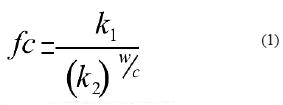
<body><![CDATA[<p align="justify"><font face="verdana" size="2">Mix design nomograms can be used to determine appropriate concrete mixture proportions according to fabrication purposes. They are based on Abram's law<sup>11</sup> which correlates concrete compressive strength with the water/cement (w/c) ratio for a determined level of cement hydration. This relationship can be extended to other properties, such as elasticity modulus and fracture energy<sup>10</sup>, as well as durability parameters such as carbonation which was the variable measured in this study.</font></p>  	    <p align="justify"><font face="verdana" size="2">For a given workability, the equation which best fits the tendency predicted by this law, generalized by Powers<sup>12</sup>, is:</font></p>  	    <p align="center"><font face="verdana" size="2"><img src="/img/revistas/ccid/v1n1/a2fo1.jpg"></font></p>  	    <p align="justify"><font face="verdana" size="2">where <i>fc</i> is compressive strength (MPa), while <i>k</i><sub><i>1</i></sub> and <i>k</i><sub><i>2</i></sub> are constants that depend on the materials used.</font></p>  	    <p align="justify"><font face="verdana" size="2">Lyse's law<sup>13</sup> correlates the water/cement ratio with the ratio between the amount of dry aggregate (fine + coarse) and the amount of cement. The equation that best fits this law is given by:</font></p>  	    <p align="center"><font face="verdana" size="2"><img src="/img/revistas/ccid/v1n1/a2fo2.jpg"></font></p>  	    <p align="justify"><font face="verdana" size="2">where <i>m</i> is the dry aggregate/cement ratio, and <i>k</i><sub><i>3</i></sub> and <i>k</i><sub><i>4</i></sub> are constants which depend on the materials used for a given workability.</font></p>  	    <p align="justify"><font face="verdana" size="2">Molinari's law correlates the cement content, <i>C</i>, with the aggregate/cement ratio, <i>m</i>. The equation that best fits this behavior is given by:</font></p>  	    <p align="center"><font face="verdana" size="2"><img src="/img/revistas/ccid/v1n1/a2fo3.jpg"></font></p>  	    <p align="justify"><font face="verdana" size="2">where <i>C</i> is the cement content (kg/m<sup>3</sup>), and <i>k</i><sub><i>5</i></sub> and <i>k</i><sub><i>6</i></sub> are constants.</font></p>  	    ]]></body>
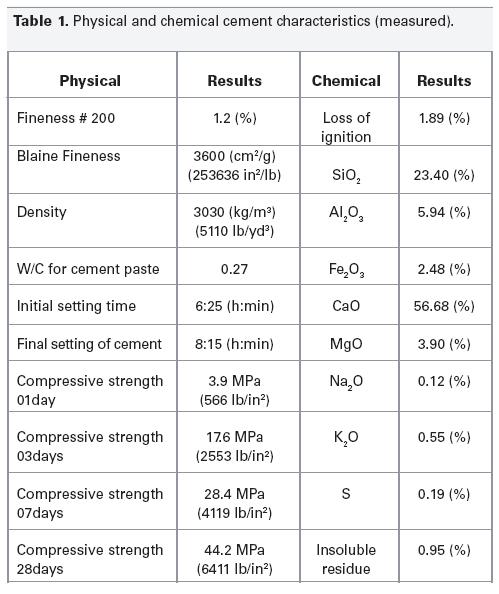
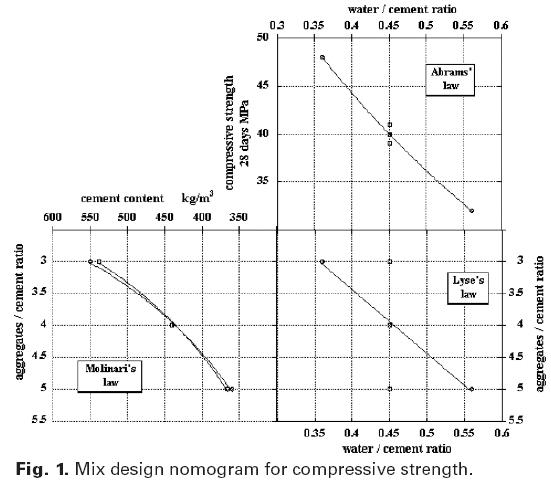
<body><![CDATA[<p align="justify"><font face="verdana" size="2"><a href="#f1">Figure 1</a>, shows how these laws can be combined to create a useful mix design nomogram for compressive strength, which can be applied for other concrete properties such as carbonation depth.</font></p>  	    <p align="center"><font face="verdana" size="2"><a name="f1"></a></font></p>  	    <p align="center"><font face="verdana" size="2"><img src="/img/revistas/ccid/v1n1/a2f1.jpg"></font></p>  	    <p align="justify"><font face="verdana" size="2">&nbsp;</font></p>  	    <p align="justify"><font face="verdana" size="2"><b>3 Experimental Procedure</b></font></p>  	    <p align="justify"><font face="verdana" size="2"><i>3.1 Materials</i></font></p>  	    <p align="justify"><font face="verdana" size="2">Type I blended Portland Cement was used according to (SM) ASTM C&#45;595; cement characteristics are given in <a href="#t1">Table 1</a>. Natural river sand, which met ASTM C&#45;33 standards, was employed as fine aggregate, with a maximum particle size of 4.8 mm (0.19 in), fineness modulus of 2.97, bulk specific gravity of 2,620 kg/m<sup>3</sup> (4,418 lb/yd<sup>3</sup>), and water absorption of 0.05% by mass. On the other hand, coarse crushed granite, which met ASTM C&#45;33 standards, was used as large aggregate, with a maximum particle size of 19 mm (0.75 in), fineness modulus of 6.76, bulk specific gravity of 2,680 kg/m<sup>3</sup> (4,519 lb/yd<sup>3</sup>), and water absorption of 0.6% by mass.</font></p>  	    <p align="center"><font face="verdana" size="2"><a name="t1"></a></font></p>  	    <p align="center"><font face="verdana" size="2"><img src="/img/revistas/ccid/v1n1/a2t1.jpg"></font></p>  	    <p align="justify"><font face="verdana" size="2"><i>3.2 Concrete mix proportions</i></font></p>  	    ]]></body>
<body><![CDATA[<p align="justify"><font face="verdana" size="2">Concrete mix proportions were defined in the concrete durability laboratory according to a pre&#45;established methodology<sup>14</sup>. The water/cement ratio was adjusted for a slump of 80 &plusmn; 10 mm (3.15 &plusmn; 0.39 in). The dry aggregate/cement ratio was fixed at 3, 4, and 5. Three water/cement ratios and three different slumps (workability), were tested. <a href="/img/revistas/ccid/v1n1/a2t2.jpg" target="_blank">Table 2</a> specifies all of the concrete mix proportions used in this study. This work reports results using different concrete mix proportions without the use of a plasticizer, because any kind of admixture can have an influence on the carbonation rate and, therefore, on the nomogram.</font></p>  	    <p align="justify"><font face="verdana" size="2"><i>3.3 Specimens</i></font></p>  	    <p align="justify"><font face="verdana" size="2">According to the procedure outlined in CPC&#45;18 RILEM<sup>15</sup>, 10 x 10 x 10 cm &#91;3.9" x 3.9"x 3.9"&#93; cubic concrete specimens were used to conduct the carbonation tests, using four specimens (replicates) per mixture proportion combination. Three 10 cm x 20 cm &#91;3.9" x 7.8"&#93; cylindrical specimens per mixture proportion, were tested for compressive strength. All specimens were cast and demolded 24 hrs later. The surface of the specimens was polished and cleaned to remove residual demolding agent. Next, specimens were stored for six days in a fog&#45;room at 21<sup>o</sup>C and 98% RH. Subsequently, in order to reduce and stabilize internal humidity, specimens were exposed for three hours to 50 &plusmn; 5&deg;C (122 &plusmn; 41&ordm;F) and 50 &plusmn; 10% RH. This assured that the concrete pores were unsaturated and not totally dry. Finally, specimens were kept for seven more days in a chamber at 23 &plusmn; 2&deg;C (73.4 &plusmn; 3.5&ordm;F) with 65 &plusmn; 5% RH. Carbonation tests were then conducted 14 days after casting the specimens.</font></p>  	    <p align="justify"><font face="verdana" size="2"><i>3.4 Carbonation tests</i></font></p>  	    <p align="justify"><font face="verdana" size="2">Carbonation depth, using phenolphthalein (<i>pH indicator 8.2 to 9.8)</i> and timolphthalein <i>(pH indicator 9.3 to 10.5)</i>, was measured 21, 28 and 42 days after the concrete specimens were cast, which was equivalent to seven, 14 and 28 days of exposure to a carbonation chamber. The carbonation chamber kept a constant temperature of 23 &plusmn; 2&deg;C (73.4 &plusmn; 3.5&ordm;F) and RH of 65 &plusmn; 5%, as well as a gas CO<sub>2</sub> effective concentration of 10%. Carbonation depth was measured according to the CPC&#45;18 RILEM procedure<sup>15</sup>. Compressive strength was determined according to ASTM C&#45;39.</font></p>  	    <p align="justify"><font face="verdana" size="2">Average carbonation depths based on measurements taken from each of the four faces of every specimen are presented in <a href="/img/revistas/ccid/v1n1/a2t2.jpg" target="_blank">Table 2</a> (values presented are after 7, 14 and 28 days of exposure to carbonation chamber conditions).</font></p>  	    <p align="justify"><font face="verdana" size="2">&nbsp;</font></p>  	    <p align="justify"><font face="verdana" size="2"><b>4 Results and Discussion</b></font></p>  	    <p align="justify"><font face="verdana" size="2"><a href="/img/revistas/ccid/v1n1/a2f2.jpg" target="_blank">Figure 2</a> shows a mix design nomogram built for 21, 28, and 42 days after casting the specimens. When mixture proportions are known, mix design nomograms are a useful tool to estimate the carbonation depth of any concrete structure, since the parameters employed fall well within the range used for concrete fabrication.</font></p>  	    <p align="justify"><font face="verdana" size="2">The mix design nomograms used in this study represent two concrete families: one with a constant slump (same workability), and the other with a constant water/cement ratio (same compressive strength). The ability to predict carbonation depth based on a variety of different mixtures depends on the possibility of testing a variety of available cement types, including those which contain slags, pozzolans, metakaolin, silica fume, calcite or fly ash. Based on the CPC&#45;RILEM procedure, <a href="/img/revistas/ccid/v1n1/a2f3.jpg" target="_blank">Figure 3</a> shows the influence of the water/cement ratio on the carbonation depth for concrete specimens built with each combination mixture, while <a href="/img/revistas/ccid/v1n1/a2f4.jpg" target="_blank">Figure 4</a> shows the evolution of carbonation levels over time for the studied concrete specimens. Diffusion equations can be used to estimate the carbonation depth as a function of time, using the well&#45;know model:</font></p>  	    ]]></body>
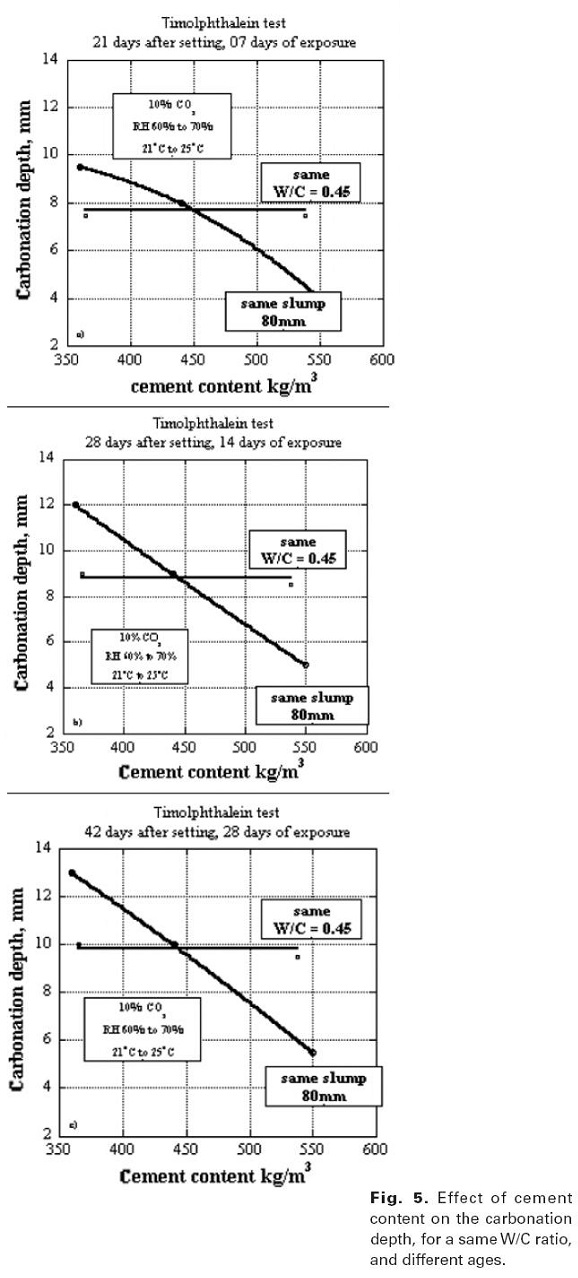
<body><![CDATA[<p align="center"><font face="verdana" size="2"><img src="/img/revistas/ccid/v1n1/a2fo4.jpg"></font></p>  	    <p align="justify"><font face="verdana" size="2">where <i>e</i><sub><i>CO2</i></sub> is the carbonation depth in mm (or in), and <i>k</i><sub><i>CO2</i></sub> is a constant expressed in mm/year<sup>1/2</sup> (in/year<sup>1/2</sup>) which depends on the materials used and environmental conditions.</font></p>  	    <p align="justify"><font face="verdana" size="2">To exemplify a complementary application of the nomogram used here it is possible to conduct a simplified transformation between accelerated and natural CO<sub>2</sub> exposure. Assuming that the humidity level in the accelerated carbonation chamber can be extrapolated to a natural environment, it is possible to consider the product of time by gas CO<sub>2</sub> concentration as a constant, as shown in eq. (5):</font></p>  	    <p align="justify"><font face="verdana" size="2"><img src="/img/revistas/ccid/v1n1/a2fo5.jpg"></font></p>  	    <p align="justify"><font face="verdana" size="2">where t is the time (days) under natural environmental conditions.</font></p>  	    <p align="justify"><font face="verdana" size="2">In this case, t would be of seven yr and eight mo. Using this transformation, the predicted carbonation depth after 50 years of service life is shown in <a href="/img/revistas/ccid/v1n1/a2t3.jpg" target="_blank">Table 3</a>.</font></p>  	    <p align="justify"><font face="verdana" size="2">Another application of the mix design nomogram is the development of concrete structures with specific properties. For example, the cement content and water/cement ratio for an admissible carbonation rate can be estimated from the nomograms. Carbonation data from several concrete families exposed not only to accelerated, but also to natural environmental conditions, are desirable in order to achieve a more accurate and effective application of mix design nomograms.</font></p>  	    <p align="justify"><font face="verdana" size="2"><a href="#f5">Fig. 5</a> compares the carbonation depth of concrete specimens cast with a constant slump (same workability), as well as concrete cast with a constant water/cement ratio (same compressive strength). As expected, the behavior of the former group indicated that cement content improves carbonation resistance if the slump is constant. On the other hand, the cement content has a negligible influence on carbonation penetration if the water/cement ratio is constant (see <a href="#f5">Fig. 5</a>). This result is not contradictory since cement content is usually associated with changes in water/cement ratio and, therefore, in the carbonation rate.</font></p>  	    <p align="center"><font face="verdana" size="2"><a name="f5"></a></font></p>  	    <p align="center"><font face="verdana" size="2"><img src="/img/revistas/ccid/v1n1/a2f5.jpg"></font></p>  	    ]]></body>
<body><![CDATA[<p align="justify"><font face="verdana" size="2">Previous studies have proposed that cement content can affect carbonation depths, assuming that can occur changes in alkaline reserve. This is true only when the slump (concrete workability) is held constant. If the water/cement ratio is held constant, the alkaline reserve does not change because the cement paste is always the same, regardless of the total amount of cement content used in the concrete mixture.</font></p>  	    <p align="justify"><font face="verdana" size="2"><a href="/img/revistas/ccid/v1n1/a2t3.jpg" target="_blank">Table 3</a> shows how concrete properties can be estimated from the mixture design nomogram. Although the data recorded in this study cannot be used to estimate carbonation rates for concrete made with other cement types or under different environment conditions, the method employed here to construct nomograms may represent a useful tool to understand the behavior of new concretes made with different materials. The water/cement ratio and slump are the most important factors in determining the properties of fresh and hardened concrete. Therefore, special caution must be taken in research studies in order to ensure that mixture proportion planning can, in fact, help to generate reliable results which allow generalizations.</font></p>  	    <p align="justify"><font face="verdana" size="2">&nbsp;</font></p>  	    <p align="justify"><font face="verdana" size="2"><b>5 Conclusions</b></font></p>  	    <p align="justify"><font face="verdana" size="2">First, it is important to underline that results reported based on the nomograms used pertain only to the materials and conditions tested here. If the methodology we used is not followed or environmental conditions vary with respect to this study, our predictions may change or even become invalid. For this reason, results obtained under different conditions should be used to design novel nomograms which are specific for the methodology and materials used (e.g., type of cement, aggregates, admixtures, etc.), as well as the environmental conditions present.</font></p>  	    <p align="justify"><font face="verdana" size="2">Results from this study confirmed that a greater water/cement ratio causes an increase in carbonation penetration in concrete structures with the same workability. In addition, we found that for concrete specimens with the same compressive strength, and made with the same materials, cement content had a negligible effect on the carbonation depth when the water/cement ratio was held constant.</font></p>  	    <p align="justify"><font face="verdana" size="2">Accelerated carbonation tests can be used to evaluate and predict the performance of a concrete mixture exposed to natural aggressive conditions when natural relative humidity (RH) is similar to that present in experimental conditions. New nomograms applicable to specimens constructed with a different concrete composition, as well as under different conditions can be fabricated if additional tests are performed.</font></p>  	    <p align="justify"><font face="verdana" size="2">The effect of the mixture parameters on concrete properties can be easily evaluated if the analysis is performed under two main conditions: constant workability or a constant water/cement ratio. By using all the information available from such nomogram, it is possible to determine mixture proportions which comply with predefined performance criteria.</font></p>  	    <p align="justify"><font face="verdana" size="2">In the present study, special attention was given to the relationship between the design of mixture proportions and degree of carbonation in concrete structures. This approach can be applied to other properties of concrete such as permeability, resistivity, elasticity modulus, among others.</font></p>  	    <p align="justify"><font face="verdana" size="2">&nbsp;</font></p>  	    ]]></body>
<body><![CDATA[<p align="justify"><font face="verdana" size="2"><b>Acknowledgments</b></font></p>  	    <p align="justify"><font face="verdana" size="2">The authors are indebted to Fernanda Pereira for her valuable assistance with laboratory tests. Also, the authors wish to acknowledge their institutes as well as FAPESP and CONACYT for financial support to conduct this research.</font></p>  	    <p align="justify"><font face="verdana" size="2">&nbsp;</font></p>  	    <p align="justify"><font face="verdana" size="2"><b>References</b></font></p>  	    <!-- ref --><p align="justify"><font face="verdana" size="2">&#91;1&#93; Baker, R., "Initiation period", in: <i>Corrosion of steel in concrete</i>, P. Schiessl (Ed.), Chapman &amp; Hall, London, UK, (1988), pp. 22&#45;25.    &nbsp;&nbsp;&nbsp;&nbsp;&nbsp;&nbsp;&nbsp;&nbsp;[&#160;<a href="javascript:void(0);" onclick="javascript: window.open('/scielo.php?script=sci_nlinks&ref=2158435&pid=S2007-3011200900010000200001&lng=','','width=640,height=500,resizable=yes,scrollbars=1,menubar=yes,');">Links</a>&#160;]<!-- end-ref --></font></p>  	    <!-- ref --><p align="justify"><font face="verdana" size="2">&#91;2&#93; Moreno, E. &amp; Sag&uuml;&eacute;s, A., "Carbonation&#45;induced corrosion on blended cement concrete mix designs for highway structures". <i>CORROSION/98</i>, Paper 636, NACE International, Houston, TX., (1998).    &nbsp;&nbsp;&nbsp;&nbsp;&nbsp;&nbsp;&nbsp;&nbsp;[&#160;<a href="javascript:void(0);" onclick="javascript: window.open('/scielo.php?script=sci_nlinks&ref=2158437&pid=S2007-3011200900010000200002&lng=','','width=640,height=500,resizable=yes,scrollbars=1,menubar=yes,');">Links</a>&#160;]<!-- end-ref --></font></p>  	    <!-- ref --><p align="justify"><font face="verdana" size="2">&#91;3&#93; Castro&#45;Borges, P.; V&eacute;leva, L. &amp; Garc&iacute;a, J., "Distribution of relative humidity and temperature in concrete exposed to a rural&#45;urban atmosphere" (in Spanish). <i>Proceedings of the XII National Congress of the Mexican Society of</i> <i>Electrochemistry</i>, Mexico. (1997), pp. 42&#45;50.    &nbsp;&nbsp;&nbsp;&nbsp;&nbsp;&nbsp;&nbsp;&nbsp;[&#160;<a href="javascript:void(0);" onclick="javascript: window.open('/scielo.php?script=sci_nlinks&ref=2158439&pid=S2007-3011200900010000200003&lng=','','width=640,height=500,resizable=yes,scrollbars=1,menubar=yes,');">Links</a>&#160;]<!-- end-ref --></font></p>  	    ]]></body>
<body><![CDATA[<!-- ref --><p align="justify"><font face="verdana" size="2">&#91;4&#93; Castro&#45;Borges, P.; Moreno, E. &amp; Genesc&aacute;, J. "Influence of marine micro&#45;climates on carbonation of reinforced concrete buildings", <i>Cement and Concrete Research,</i> 30 (10) (2000), pp. 1565&#45;1571.    &nbsp;&nbsp;&nbsp;&nbsp;&nbsp;&nbsp;&nbsp;&nbsp;[&#160;<a href="javascript:void(0);" onclick="javascript: window.open('/scielo.php?script=sci_nlinks&ref=2158441&pid=S2007-3011200900010000200004&lng=','','width=640,height=500,resizable=yes,scrollbars=1,menubar=yes,');">Links</a>&#160;]<!-- end-ref --></font></p>  	    <!-- ref --><p align="justify"><font face="verdana" size="2">&#91;5&#93; Verbeck, G. "Carbonation of Hydrated Portland Cement". <i>Bulletin 87</i>, Portland Cement Association (PCA), Washington, DC, (1958).    &nbsp;&nbsp;&nbsp;&nbsp;&nbsp;&nbsp;&nbsp;&nbsp;[&#160;<a href="javascript:void(0);" onclick="javascript: window.open('/scielo.php?script=sci_nlinks&ref=2158443&pid=S2007-3011200900010000200005&lng=','','width=640,height=500,resizable=yes,scrollbars=1,menubar=yes,');">Links</a>&#160;]<!-- end-ref --></font></p>  	    <!-- ref --><p align="justify"><font face="verdana" size="2">&#91;6&#93; Levy, S. &amp; Helene, P. "Rehabilitation of reinforced concrete schools in the State of S&atilde;o Paulo, Brazil", (in Portuguese). <i>Technical Report</i>, T&eacute;chne, PINI, n. 47, (2000).    &nbsp;&nbsp;&nbsp;&nbsp;&nbsp;&nbsp;&nbsp;&nbsp;[&#160;<a href="javascript:void(0);" onclick="javascript: window.open('/scielo.php?script=sci_nlinks&ref=2158445&pid=S2007-3011200900010000200006&lng=','','width=640,height=500,resizable=yes,scrollbars=1,menubar=yes,');">Links</a>&#160;]<!-- end-ref --></font></p>  	    <!-- ref --><p align="justify"><font face="verdana" size="2">&#91;7&#93; Moreno, E.; Castro&#45;Borges, P. &amp; Leal, J. "Carbonation&#45;induced corrosion of urban concrete buildings in Yucatan, Mexico". <i>CORROSION/2002</i>, paper 02220, NACE&#45;International, Houston, TX., (2002)</font>&nbsp;&nbsp;&nbsp;&nbsp;&nbsp;&nbsp;&nbsp;&nbsp;[&#160;<a href="javascript:void(0);" onclick="javascript: window.open('/scielo.php?script=sci_nlinks&ref=2158447&pid=S2007-3011200900010000200007&lng=','','width=640,height=500,resizable=yes,scrollbars=1,menubar=yes,');">Links</a>&#160;]<!-- end-ref --><!-- ref --><p align="justify"><font face="verdana" size="2">&#91;8&#93; Papadakis, V.; Fardis, M. &amp; Vayenas, C. "Effect of composition, environmental factors and cement&#45;lime mortar coating on concrete carbonation". <i>Materials and Structures,</i> 25 (1992), pp. 293&#45;304</font>&nbsp;&nbsp;&nbsp;&nbsp;&nbsp;&nbsp;&nbsp;&nbsp;[&#160;<a href="javascript:void(0);" onclick="javascript: window.open('/scielo.php?script=sci_nlinks&ref=2158448&pid=S2007-3011200900010000200008&lng=','','width=640,height=500,resizable=yes,scrollbars=1,menubar=yes,');">Links</a>&#160;]<!-- end-ref --><!-- ref --><p align="justify"><font face="verdana" size="2">&#91;9&#93; Papadakis, V.; Vayenas, C. &amp; Fardis, M. "Fundamental modeling and experimental investigation of concrete carbonation". <i>ACI Materials Journal,</i> 88 (4) (1991), pp. 363&#45;373.    &nbsp;&nbsp;&nbsp;&nbsp;&nbsp;&nbsp;&nbsp;&nbsp;[&#160;<a href="javascript:void(0);" onclick="javascript: window.open('/scielo.php?script=sci_nlinks&ref=2158449&pid=S2007-3011200900010000200009&lng=','','width=640,height=500,resizable=yes,scrollbars=1,menubar=yes,');">Links</a>&#160;]<!-- end-ref --></font></p>  	    ]]></body>
<body><![CDATA[<!-- ref --><p align="justify"><font face="verdana" size="2">&#91;10&#93; Monteiro, P.J.M.; Helene, P. &amp; Kang, S. "Designing Concrete Mixtures for Strength, Elastic Modulus and Fracture Energy". <i>Materials and Structures,</i> 26, (1993), pp. 443&#45;452.    &nbsp;&nbsp;&nbsp;&nbsp;&nbsp;&nbsp;&nbsp;&nbsp;[&#160;<a href="javascript:void(0);" onclick="javascript: window.open('/scielo.php?script=sci_nlinks&ref=2158451&pid=S2007-3011200900010000200010&lng=','','width=640,height=500,resizable=yes,scrollbars=1,menubar=yes,');">Links</a>&#160;]<!-- end-ref --></font></p>  	    <!-- ref --><p align="justify"><font face="verdana" size="2">&#91;11&#93;&nbsp;Abrams, D., "Design of concrete mixtures". Lewis <i>Institute Bulletin No 1 (Structural Materials Research Laboratory),</i> Chicago, (1918).    &nbsp;&nbsp;&nbsp;&nbsp;&nbsp;&nbsp;&nbsp;&nbsp;[&#160;<a href="javascript:void(0);" onclick="javascript: window.open('/scielo.php?script=sci_nlinks&ref=2158453&pid=S2007-3011200900010000200011&lng=','','width=640,height=500,resizable=yes,scrollbars=1,menubar=yes,');">Links</a>&#160;]<!-- end-ref --></font></p>  	    <!-- ref --><p align="justify"><font face="verdana" size="2">&#91;12&#93; Powers, T. "The Properties of Fresh Concrete", <i>Wiley,</i> New York, (1968)</font>&nbsp;&nbsp;&nbsp;&nbsp;&nbsp;&nbsp;&nbsp;&nbsp;[&#160;<a href="javascript:void(0);" onclick="javascript: window.open('/scielo.php?script=sci_nlinks&ref=2158455&pid=S2007-3011200900010000200012&lng=','','width=640,height=500,resizable=yes,scrollbars=1,menubar=yes,');">Links</a>&#160;]<!-- end-ref --><!-- ref --><p align="justify"><font face="verdana" size="2">&#91;13&#93; Lyse, I. "Test on consistence and strength of concrete having constant water content", <i>ASTM Proc. 32 (II),</i> (1932): pp. 629&#45;636.    &nbsp;&nbsp;&nbsp;&nbsp;&nbsp;&nbsp;&nbsp;&nbsp;[&#160;<a href="javascript:void(0);" onclick="javascript: window.open('/scielo.php?script=sci_nlinks&ref=2158456&pid=S2007-3011200900010000200013&lng=','','width=640,height=500,resizable=yes,scrollbars=1,menubar=yes,');">Links</a>&#160;]<!-- end-ref --></font></p>  	    <!-- ref --><p align="justify"><font face="verdana" size="2">&#91;14&#93; Helene, P. &amp; Terzian, P. "Concrete control and mix design manual (in Portuguese)", S&atilde;o Paulo, PINI, ISBN 85&#45;7266&#45;007&#45;0, 4<sup>th</sup> ed. (1992).    &nbsp;&nbsp;&nbsp;&nbsp;&nbsp;&nbsp;&nbsp;&nbsp;[&#160;<a href="javascript:void(0);" onclick="javascript: window.open('/scielo.php?script=sci_nlinks&ref=2158458&pid=S2007-3011200900010000200014&lng=','','width=640,height=500,resizable=yes,scrollbars=1,menubar=yes,');">Links</a>&#160;]<!-- end-ref --></font></p>  	    <!-- ref --><p align="justify"><font face="verdana" size="2">&#91;15&#93; RILEM CPC 18, "Measurement of hardened concrete carbonation depth", Draft <i>RILEM Recommendation in Materials and Structures,</i> 17, (1984).    &nbsp;&nbsp;&nbsp;&nbsp;&nbsp;&nbsp;&nbsp;&nbsp;[&#160;<a href="javascript:void(0);" onclick="javascript: window.open('/scielo.php?script=sci_nlinks&ref=2158460&pid=S2007-3011200900010000200015&lng=','','width=640,height=500,resizable=yes,scrollbars=1,menubar=yes,');">Links</a>&#160;]<!-- end-ref --></font></p>      ]]></body><back>
<ref-list>
<ref id="B1">
<label>1</label><nlm-citation citation-type="book">
<person-group person-group-type="author">
<name>
<surname><![CDATA[Baker]]></surname>
<given-names><![CDATA[R.]]></given-names>
</name>
</person-group>
<article-title xml:lang="en"><![CDATA[Initiation period]]></article-title>
<person-group person-group-type="editor">
<name>
<surname><![CDATA[Schiessl]]></surname>
<given-names><![CDATA[P.]]></given-names>
</name>
</person-group>
<source><![CDATA[Corrosion of steel in concrete]]></source>
<year>1988</year>
<page-range>22-25</page-range><publisher-loc><![CDATA[London ]]></publisher-loc>
<publisher-name><![CDATA[Chapman & Hall]]></publisher-name>
</nlm-citation>
</ref>
<ref id="B2">
<label>2</label><nlm-citation citation-type="book">
<person-group person-group-type="author">
<name>
<surname><![CDATA[Moreno]]></surname>
<given-names><![CDATA[E.]]></given-names>
</name>
<name>
<surname><![CDATA[Sagüés]]></surname>
<given-names><![CDATA[A.]]></given-names>
</name>
</person-group>
<source><![CDATA[Carbonation-induced corrosion on blended cement concrete mix designs for highway structures]]></source>
<year>1998</year>
<publisher-loc><![CDATA[Houston^eTX. TX.]]></publisher-loc>
<publisher-name><![CDATA[NACE International]]></publisher-name>
</nlm-citation>
</ref>
<ref id="B3">
<label>3</label><nlm-citation citation-type="">
<person-group person-group-type="author">
<name>
<surname><![CDATA[Castro-Borges]]></surname>
<given-names><![CDATA[P.]]></given-names>
</name>
<name>
<surname><![CDATA[Véleva]]></surname>
<given-names><![CDATA[L.]]></given-names>
</name>
<name>
<surname><![CDATA[García]]></surname>
<given-names><![CDATA[J.]]></given-names>
</name>
</person-group>
<article-title xml:lang="en"><![CDATA[Distribution of relative humidity and temperature in concrete exposed to a rural-urban atmosphere]]></article-title>
<source><![CDATA[Proceedings of the XII National Congress of the Mexican Society of Electrochemistry]]></source>
<year>1997</year>
<page-range>42-50</page-range></nlm-citation>
</ref>
<ref id="B4">
<label>4</label><nlm-citation citation-type="journal">
<person-group person-group-type="author">
<name>
<surname><![CDATA[Castro-Borges]]></surname>
<given-names><![CDATA[P.]]></given-names>
</name>
<name>
<surname><![CDATA[Moreno]]></surname>
<given-names><![CDATA[E.]]></given-names>
</name>
<name>
<surname><![CDATA[Genescá]]></surname>
<given-names><![CDATA[J.]]></given-names>
</name>
</person-group>
<article-title xml:lang="en"><![CDATA[Influence of marine micro-climates on carbonation of reinforced concrete buildings]]></article-title>
<source><![CDATA[Cement and Concrete Research]]></source>
<year>2000</year>
<volume>30</volume>
<numero>10</numero>
<issue>10</issue>
<page-range>1565-1571</page-range></nlm-citation>
</ref>
<ref id="B5">
<label>5</label><nlm-citation citation-type="book">
<person-group person-group-type="author">
<name>
<surname><![CDATA[Verbeck]]></surname>
<given-names><![CDATA[G.]]></given-names>
</name>
</person-group>
<source><![CDATA[Carbonation of Hydrated Portland Cement]]></source>
<year>1958</year>
<publisher-loc><![CDATA[Washington^eDC DC]]></publisher-loc>
<publisher-name><![CDATA[Portland Cement Association]]></publisher-name>
</nlm-citation>
</ref>
<ref id="B6">
<label>6</label><nlm-citation citation-type="">
<person-group person-group-type="author">
<name>
<surname><![CDATA[Levy]]></surname>
<given-names><![CDATA[S.]]></given-names>
</name>
<name>
<surname><![CDATA[Helene]]></surname>
<given-names><![CDATA[P.]]></given-names>
</name>
</person-group>
<source><![CDATA[Rehabilitation of reinforced concrete schools in the State of São Paulo, Brazil]]></source>
<year>2000</year>
</nlm-citation>
</ref>
<ref id="B7">
<label>7</label><nlm-citation citation-type="book">
<person-group person-group-type="author">
<name>
<surname><![CDATA[Moreno]]></surname>
<given-names><![CDATA[E.]]></given-names>
</name>
<name>
<surname><![CDATA[Castro-Borges]]></surname>
<given-names><![CDATA[P.]]></given-names>
</name>
<name>
<surname><![CDATA[Leal]]></surname>
<given-names><![CDATA[J.]]></given-names>
</name>
</person-group>
<source><![CDATA[Carbonation-induced corrosion of urban concrete buildings in Yucatan, Mexico]]></source>
<year>2002</year>
<publisher-loc><![CDATA[Houston^eTX. TX.]]></publisher-loc>
<publisher-name><![CDATA[NACE-International]]></publisher-name>
</nlm-citation>
</ref>
<ref id="B8">
<label>8</label><nlm-citation citation-type="journal">
<person-group person-group-type="author">
<name>
<surname><![CDATA[Papadakis]]></surname>
<given-names><![CDATA[V.]]></given-names>
</name>
<name>
<surname><![CDATA[Fardis]]></surname>
<given-names><![CDATA[M.]]></given-names>
</name>
<name>
<surname><![CDATA[Vayenas]]></surname>
<given-names><![CDATA[C.]]></given-names>
</name>
</person-group>
<article-title xml:lang="en"><![CDATA[Effect of composition, environmental factors and cement-lime mortar coating on concrete carbonation]]></article-title>
<source><![CDATA[Materials and Structures]]></source>
<year>1992</year>
<volume>25</volume>
<page-range>293-304</page-range></nlm-citation>
</ref>
<ref id="B9">
<label>9</label><nlm-citation citation-type="journal">
<person-group person-group-type="author">
<name>
<surname><![CDATA[Papadakis]]></surname>
<given-names><![CDATA[V.]]></given-names>
</name>
<name>
<surname><![CDATA[Vayenas]]></surname>
<given-names><![CDATA[C.]]></given-names>
</name>
<name>
<surname><![CDATA[Fardis]]></surname>
<given-names><![CDATA[M.]]></given-names>
</name>
</person-group>
<article-title xml:lang="en"><![CDATA[Fundamental modeling and experimental investigation of concrete carbonation]]></article-title>
<source><![CDATA[ACI Materials Journal]]></source>
<year>1991</year>
<volume>88</volume>
<numero>4</numero>
<issue>4</issue>
<page-range>363-373</page-range></nlm-citation>
</ref>
<ref id="B10">
<label>10</label><nlm-citation citation-type="journal">
<person-group person-group-type="author">
<name>
<surname><![CDATA[Monteiro]]></surname>
<given-names><![CDATA[P.J.M.]]></given-names>
</name>
<name>
<surname><![CDATA[Helene]]></surname>
<given-names><![CDATA[P.]]></given-names>
</name>
<name>
<surname><![CDATA[Kang]]></surname>
<given-names><![CDATA[S.]]></given-names>
</name>
</person-group>
<article-title xml:lang="en"><![CDATA[Designing Concrete Mixtures for Strength, Elastic Modulus and Fracture Energy]]></article-title>
<source><![CDATA[Materials and Structures]]></source>
<year>1993</year>
<volume>26</volume>
<page-range>443-452</page-range></nlm-citation>
</ref>
<ref id="B11">
<label>11</label><nlm-citation citation-type="journal">
<person-group person-group-type="author">
<name>
<surname><![CDATA[Abrams]]></surname>
<given-names><![CDATA[D.]]></given-names>
</name>
</person-group>
<article-title xml:lang="en"><![CDATA[Design of concrete mixtures]]></article-title>
<source><![CDATA[Lewis Institute Bulletin]]></source>
<year>1918</year>
<numero>1</numero>
<issue>1</issue>
<publisher-loc><![CDATA[Chicago ]]></publisher-loc>
<publisher-name><![CDATA[Structural Materials Research Laboratory]]></publisher-name>
</nlm-citation>
</ref>
<ref id="B12">
<label>12</label><nlm-citation citation-type="book">
<person-group person-group-type="author">
<name>
<surname><![CDATA[Powers]]></surname>
<given-names><![CDATA[T.]]></given-names>
</name>
</person-group>
<source><![CDATA[The Properties of Fresh Concrete]]></source>
<year>1968</year>
<publisher-loc><![CDATA[^eNew York New York]]></publisher-loc>
<publisher-name><![CDATA[Wiley]]></publisher-name>
</nlm-citation>
</ref>
<ref id="B13">
<label>13</label><nlm-citation citation-type="">
<person-group person-group-type="author">
<name>
<surname><![CDATA[Lyse]]></surname>
<given-names><![CDATA[I.]]></given-names>
</name>
</person-group>
<article-title xml:lang="en"><![CDATA[Test on consistence and strength of concrete having constant water content]]></article-title>
<source><![CDATA[ASTM Proc.]]></source>
<year>1932</year>
<volume>32</volume>
<page-range>629-636</page-range></nlm-citation>
</ref>
<ref id="B14">
<label>14</label><nlm-citation citation-type="book">
<person-group person-group-type="author">
<name>
<surname><![CDATA[Helene]]></surname>
<given-names><![CDATA[P.]]></given-names>
</name>
<name>
<surname><![CDATA[Terzian]]></surname>
<given-names><![CDATA[P.]]></given-names>
</name>
</person-group>
<source><![CDATA[Concrete control and mix design manual (in Portuguese)]]></source>
<year>1992</year>
<edition>4</edition>
<publisher-loc><![CDATA[São Paulo ]]></publisher-loc>
<publisher-name><![CDATA[PINI]]></publisher-name>
</nlm-citation>
</ref>
<ref id="B15">
<label>15</label><nlm-citation citation-type="">
<article-title xml:lang="en"><![CDATA[RILEM CPC 18, "Measurement of hardened concrete carbonation depth]]></article-title>
<source><![CDATA[Draft RILEM Recommendation in Materials and Structures]]></source>
<year>1984</year>
<volume>17</volume>
</nlm-citation>
</ref>
</ref-list>
</back>
</article>