<?xml version="1.0" encoding="ISO-8859-1"?><article xmlns:mml="http://www.w3.org/1998/Math/MathML" xmlns:xlink="http://www.w3.org/1999/xlink" xmlns:xsi="http://www.w3.org/2001/XMLSchema-instance">
<front>
<journal-meta>
<journal-id>2007-2422</journal-id>
<journal-title><![CDATA[Tecnología y ciencias del agua]]></journal-title>
<abbrev-journal-title><![CDATA[Tecnol. cienc. agua]]></abbrev-journal-title>
<issn>2007-2422</issn>
<publisher>
<publisher-name><![CDATA[Instituto Mexicano de Tecnología del Agua, Coordinación de Comunicación, Participación e Información]]></publisher-name>
</publisher>
</journal-meta>
<article-meta>
<article-id>S2007-24222012000100005</article-id>
<title-group>
<article-title xml:lang="en"><![CDATA[Filtering rates and functional response of selected zooplankton on the bacterium Vibrio cholerae Non O1 Non O139]]></article-title>
<article-title xml:lang="es"><![CDATA[Tasas de filtración y respuesta funcional de una selección de zooplancton sobre la bacteria Vibrio cholerae No O1 No O139]]></article-title>
</title-group>
<contrib-group>
<contrib contrib-type="author">
<name>
<surname><![CDATA[Ramírez]]></surname>
<given-names><![CDATA[Pedro]]></given-names>
</name>
<xref ref-type="aff" rid="A01"/>
</contrib>
<contrib contrib-type="author">
<name>
<surname><![CDATA[Tovar]]></surname>
<given-names><![CDATA[Abigail]]></given-names>
</name>
<xref ref-type="aff" rid="A01"/>
</contrib>
<contrib contrib-type="author">
<name>
<surname><![CDATA[Nandini]]></surname>
<given-names><![CDATA[S.]]></given-names>
</name>
<xref ref-type="aff" rid="A01"/>
</contrib>
<contrib contrib-type="author">
<name>
<surname><![CDATA[Sarma]]></surname>
<given-names><![CDATA[S.S.S.]]></given-names>
</name>
<xref ref-type="aff" rid="A01"/>
</contrib>
</contrib-group>
<aff id="A01">
<institution><![CDATA[,Universidad Nacional Autónoma de México  ]]></institution>
<addr-line><![CDATA[Tlalnepantla Estado de México]]></addr-line>
<country>México</country>
</aff>
<pub-date pub-type="pub">
<day>00</day>
<month>03</month>
<year>2012</year>
</pub-date>
<pub-date pub-type="epub">
<day>00</day>
<month>03</month>
<year>2012</year>
</pub-date>
<volume>3</volume>
<numero>1</numero>
<fpage>69</fpage>
<lpage>76</lpage>
<copyright-statement/>
<copyright-year/>
<self-uri xlink:href="http://www.scielo.org.mx/scielo.php?script=sci_arttext&amp;pid=S2007-24222012000100005&amp;lng=en&amp;nrm=iso"></self-uri><self-uri xlink:href="http://www.scielo.org.mx/scielo.php?script=sci_abstract&amp;pid=S2007-24222012000100005&amp;lng=en&amp;nrm=iso"></self-uri><self-uri xlink:href="http://www.scielo.org.mx/scielo.php?script=sci_pdf&amp;pid=S2007-24222012000100005&amp;lng=en&amp;nrm=iso"></self-uri><abstract abstract-type="short" xml:lang="en"><p><![CDATA[Vibrio cholerae strains frequently cause cholera outbreaks in tropical countries. It has been suggested that zooplankton play an important role in transmitting cholera from aquatic systems to their human hosts. It is also possible that zooplankton-which are known to have a range of diets, including bacteria, detritus, algae and other zooplankton-could also help to filter out Vibrio from the medium. Here we tested this hypothesis using 11 taxa of rotifers, cladocerans, copepods and ostracods. To determine feeding rates, 10 batches of each taxon were used; they were counted using a stereoscopic microscope and placed into individual test beakers. A control group was also established. An aliquot (10 ml) of the bacterial dilution (10-12) was added to each test beaker with a bacterial concentration (2.5 x 10(6)) that previously contained 50 ml of EPA sterile solution. Grazing time was 30 min, after which 2.5 ml formalin was added to each test tube to stop feeding. Functional response experiments were conducted with different dilutions of V. cholera, ranging from 10-1 to 10-12. The cladocerans, particularly Moina macrocopa, were most efficient at reducing bacterial densities while the rotifers were the least. The data are discussed with emphasis on the role of these zooplankton in controlling V. cholerae in nature.]]></p></abstract>
<abstract abstract-type="short" xml:lang="es"><p><![CDATA[La cepas de Vibrio cholerae frecuentemente causan brotes de cólera en los países tropicales. Se ha sugerido que el zooplancton desempeña un papel importante en la transmisión del cólera de los sistemas acuáticos a sus huéspedes humanos. También es posible que el zooplancton, del cual se conoce que se alimenta de diferentes tipos de dietas, incluyendo bacterias, detritus, algas e incluso de otros integrantes del mismo zooplancton, también pudiera ayudar en la eliminación de Vibrio del medio. En este trabajo se probó la hipótesis utilizando 11 taxones de rotíferos cladóceros, copépodos y ostracodos. Para las tasas de alimentación se utilizaron lotes de diez individuos de cada taxón, que se contaron en un microscopio estereoscópico y se colocaron en un vaso de precipitados; también se colocó un control. Una alícuota (10 ml) de la dilución bacteriana (10-12) se añadió a cada vaso de prueba, conteniendo una concentración bacteriana de (2.5 x 10(6)); en los vasos se habían colocado previamente 50 ml de solución EPA estéril. El tiempo de pastoreo fue de treinta minutos, después de lo cual se añadió a cada vaso de prueba 2.5 ml de formol para detener el consumo. Los experimentos de respuesta funcional se llevaron a cabo en diferentes diluciones de V. cholerae en rangos de 10-1 a 10-12. Los cladóceros, particularmente Moina macrocopa, fueron los más eficientes para reducir la densidad bacteriana, mientras los rotíferos fueron los menos. Los datos han sido discutidos con énfasis sobre el papel de este zooplancton para controlar V. cholerae en la naturaleza.]]></p></abstract>
<kwd-group>
<kwd lng="en"><![CDATA[zooplankton]]></kwd>
<kwd lng="en"><![CDATA[Vibrio cholerae]]></kwd>
<kwd lng="en"><![CDATA[filtering rates]]></kwd>
<kwd lng="en"><![CDATA[functional response]]></kwd>
<kwd lng="es"><![CDATA[zooplancton]]></kwd>
<kwd lng="es"><![CDATA[Vibrio cholerae]]></kwd>
<kwd lng="es"><![CDATA[tasas de filtración]]></kwd>
<kwd lng="es"><![CDATA[respuesta funcional]]></kwd>
</kwd-group>
</article-meta>
</front><body><![CDATA[  	    <p align="left"><font face="verdana" size="4">Art&iacute;culos t&eacute;cnicos</font></p>      <p align="center"><font face="verdana" size="2">&nbsp;</font></p>  	    <p align="center"><font face="verdana" size="4"><b>Filtering rates and functional response of selected zooplankton on the bacterium <i>Vibrio cholerae</i> Non O1 Non O139</b></font></p>      <p align="center"><font face="verdana" size="2">&nbsp;</font></p>  	    <p align="center"><font face="verdana" size="3"><b>Tasas de filtraci&oacute;n y respuesta funcional de una selecci&oacute;n de zooplancton sobre la bacteria <i>Vibrio cholerae</i> No O1 No O139</b></font></p>      <p align="center"><font face="verdana" size="2">&nbsp;</font></p>  	    <p align="center"><font face="verdana" size="2"><b>Pedro Ram&iacute;rez, Abigail Tovar, S. Nandini and S.S.S. Sarma</b></font></p>      <p align="justify"><font face="verdana" size="2">&nbsp;</font></p>  	    <p align="justify"><font face="verdana" size="2"><i>Universidad Nacional Aut&oacute;noma de M&eacute;xico.</i></font></p> 	    ]]></body>
<body><![CDATA[<p align="justify">&nbsp;</p> 	    <p align="justify"><font face="verdana" size="2"><b>Institutional direction of the authors</b></font></p>         <p align="justify"><font face="verdana" size="2"><i>Dr. Pedro Ram&iacute;rez Garc&iacute;a</i>    <br>       Universidad Nacional Aut&oacute;noma de M&eacute;xico    <br>       Facultad de Estudios Superiores Iztacala    <br>       Unidad de Investigaci&oacute;n Interdisciplinaria en Ciencias de la Salud y la Educaci&oacute;n (UIICSE)&#45;CyMA/Laboratorio de Bacteriolog&iacute;a    <br>       Avenida de Los Barrios 1, Colonia Los Reyes Iztacala    <br>       54090 Tlalnepantla, Estado de M&eacute;xico, M&eacute;xico    <br>       Tel&eacute;fono: &#43;52 (55) 56231 333, extensi&oacute;n 39724    <br>   <a href="mailto:micro@servidor.unam.mx">micro@servidor.unam.mx</a></font></p>         ]]></body>
<body><![CDATA[<p align="justify"><font face="verdana" size="2"><i>Bi&oacute;l. Abigail Tovar</i>    <br>       Universidad Nacional Aut&oacute;noma de M&eacute;xico    <br>       Unidad de Investigaci&oacute;n Interdisciplinaria en Ciencias de la Salud y la Educaci&oacute;n (UIICSE)&#45;CyMA/Laboratorio de Bacteriolog&iacute;a    <br>       Avenida de Los Barrios 1, Colonia Los Reyes Iztacala    <br>       54090 Tlalnepantla, Estado de M&eacute;xico, M&eacute;xico    <br>   <a href="mailto:abi0014@hotmail.com">abi0014@hotmail.com</a></font></p>         <p align="justify"><font face="verdana" size="2"><i>Dra. Nandini Sarma</i>    <br>       Universidad Nacional Aut&oacute;noma de M&eacute;xico    <br>       UMF/Laboratorio de Zoolog&iacute;a Acu&aacute;tica    <br>       Avenida de los Barrios 1, Colonia Los Reyes Iztacala    ]]></body>
<body><![CDATA[<br>       54090 Tlalnepantla, Estado de M&eacute;xico, M&eacute;xico    <br>       Tel&eacute;fono: &#43;52 (55) 5623 1125    <br>   <a href="mailto:nandini@servidor.unam.mx">nandini@servidor.unam.mx</a></font></p>         <p align="justify"><font face="verdana" size="2"><i>Dr. Sri Singaraju Subrahman Sarma</i>    <br>       Universidad Nacional Aut&oacute;noma de M&eacute;xico    <br>       UMF/Laboratorio de Zoolog&iacute;a Acu&aacute;tica    <br>       Avenida de Los Barrios 1, Colonia Los Reyes Iztacala    <br>       54090 Tlalnepantla, Estado de M&eacute;xico, M&eacute;xico    <br>       Tel&eacute;fono: &#43;52 (55) 56231 256    <br>   <a href="mailto:sarma@servidor.unam.mx">sarma@servidor.unam.mx</a></font></p>  	    ]]></body>
<body><![CDATA[<p align="justify"><font face="verdana" size="2">&nbsp;</font></p>  	    <p align="justify"><font face="verdana" size="2">Received: 30/07/10    <br> 	Accepted: 4/07/11</font></p>  	    <p align="justify"><font face="verdana" size="2">&nbsp;</font></p>  	    <p align="justify"><font face="verdana" size="2"><b>Abstract</b></font></p>  	    <p align="justify"><font face="verdana" size="2"><i>Vibrio cholerae</i> strains frequently cause cholera outbreaks in tropical countries. It has been suggested that zooplankton play an important role in transmitting cholera from aquatic systems to their human hosts. It is also possible that zooplankton&#151;which are known to have a range of diets, including bacteria, detritus, algae and other zooplankton&#151;could also help to filter out <i>Vibrio</i> from the medium. Here we tested this hypothesis using 11 taxa of rotifers, cladocerans, copepods and ostracods. To determine feeding rates, 10 batches of each taxon were used; they were counted using a stereoscopic microscope and placed into individual test beakers. A control group was also established. An aliquot (10 ml) of the bacterial dilution (10<sup>&#45;12</sup>) was added to each test beaker with a bacterial concentration (2.5 x 10<sup>6</sup>) that previously contained 50 ml of EPA sterile solution. Grazing time was 30 min, after which 2.5 ml formalin was added to each test tube to stop feeding. Functional response experiments were conducted with different dilutions of <i>V. cholera</i>, ranging from 10<sup>&#45;1</sup> to 10<sup>&#45;12</sup>. The cladocerans, particularly <i>Moina macrocopa</i>, were most efficient at reducing bacterial densities while the rotifers were the least. The data are discussed with emphasis on the role of these zooplankton in controlling <i>V. cholerae</i> in nature.</font></p>  	    <p align="justify"><font face="verdana" size="2"><b>Keywords:</b> zooplankton, <i>Vibrio cholerae</i>, filtering rates, functional response.</font></p>  	    <p align="justify"><font face="verdana" size="2">&nbsp;</font></p>  	    <p align="justify"><font face="verdana" size="2"><b>Resumen</b></font></p>  	    <p align="justify"><font face="verdana" size="2">La cepas de <i>Vibrio cholerae</i> frecuentemente causan brotes de c&oacute;lera en los pa&iacute;ses tropicales. Se ha sugerido que el zooplancton desempe&ntilde;a un papel importante en la transmisi&oacute;n del c&oacute;lera de los sistemas acu&aacute;ticos a sus hu&eacute;spedes humanos. Tambi&eacute;n es posible que el zooplancton, del cual se conoce que se alimenta de diferentes tipos de dietas, incluyendo bacterias, detritus, algas e incluso de otros integrantes del mismo zooplancton, tambi&eacute;n pudiera ayudar en la eliminaci&oacute;n de <i>Vibrio</i> del medio. En este trabajo se prob&oacute; la hip&oacute;tesis utilizando 11 taxones de rot&iacute;feros clad&oacute;ceros, cop&eacute;podos y ostracodos. Para las tasas de alimentaci&oacute;n se utilizaron lotes de diez individuos de cada tax&oacute;n, que se contaron en un microscopio estereosc&oacute;pico y se colocaron en un vaso de precipitados; tambi&eacute;n se coloc&oacute; un control. Una al&iacute;cuota (10 ml) de la diluci&oacute;n bacteriana (10<sup>&#45;12</sup>) se a&ntilde;adi&oacute; a cada vaso de prueba, conteniendo una concentraci&oacute;n bacteriana de (2.5 x 10<sup>6</sup>); en los vasos se hab&iacute;an colocado previamente 50 ml de soluci&oacute;n EPA est&eacute;ril. El tiempo de pastoreo fue de treinta minutos, despu&eacute;s de lo cual se a&ntilde;adi&oacute; a cada vaso de prueba 2.5 ml de formol para detener el consumo. Los experimentos de respuesta funcional se llevaron a cabo en diferentes diluciones de <i>V. cholerae</i> en rangos de 10<sup>&#45;1</sup> a 10<sup>&#45;12</sup>. Los clad&oacute;ceros, particularmente <i>Moina macrocopa</i>, fueron los m&aacute;s eficientes para reducir la densidad bacteriana, mientras los rot&iacute;feros fueron los menos. Los datos han sido discutidos con &eacute;nfasis sobre el papel de este zooplancton para controlar <i>V. cholerae</i> en la naturaleza.</font></p>  	    ]]></body>
<body><![CDATA[<p align="justify"><font face="verdana" size="2"><b>Palabras clave:</b> zooplancton, <i>Vibrio cholerae</i>, tasas de filtraci&oacute;n, respuesta funcional.</font></p>      <p align="justify"><font face="verdana" size="2">&nbsp;</font></p>  	    <p align="justify"><font face="verdana" size="2"><b>Introduction</b></font></p>  	    <p align="justify"><font face="verdana" size="2">One of the most common water borne diseases in the tropics is cholera, caused by <i>Vibrio cholerae</i>. Strains of <i>Vibrio</i>, commonly found in lakes, rivers, and estuaries are toxic when they enter their hosts (Colwell and Spira, 1992). Toxic and non&#45;toxic strains are known to co&#45;exist in several water bodies. In the coastal states of Mexico several strains have been recorded. Many species of <i>Vibrio</i> use chitin as the source of carbon (Meibom <i>et al</i>., 2004), which is one of the most common polymers in nature. In freshwaters, chitin is found in the carapace of microcrustaceans mainly cladocerans, copepods and ostracods. It has been hypothesized that copepods play an important role in transmitting cholera from the aquatic systems to their human hosts (Rawlings <i>et al</i>., 2007).</font></p>  	    <p align="justify"><font face="verdana" size="2">Microcrustaceans such as cladocerans, copepods and ostracods, along with rotifers often form the dominant biomass of plankton in freshwaters. Most of these organisms are filter feeders and are capable of consuming bacteria (Dodson and Frey, 2001; Wallace <i>et al</i>., 2006). The pseudotrochal cilia of <i>Brachionus</i> do have the capacity to filter small food particles (Kutikova, 1970). The generalist, non&#45;selective mode of feeding of cladocerans allows their extensive use in lake management for consuming and clearing cyanobacteria (Gulati <i>et al</i>., 1990). The capability of cladocerans to filter bacteria depends largely on the intersetular space between its thoracic limbs. It has been shown that certain genera such as <i>Daphnia</i> are more capable of adjusting their filtering apparatus and the intersetular distance so as to maximize their food intake (Ghadouani and Pinel&#45;Alloul, 2002).</font></p>  	    <p align="justify"><font face="verdana" size="2">Functional response studies, increasing prey consumption in relation to increasing prey availability, are elegant tools to determine the feeding rates of organisms. Most filter feeders show a Type I trend in functional responses, that is a direct relation in the increase in prey consumption with increasing prey availability (Jeschke <i>et al</i>., 2004). While it is well known that cladocerans can filter and consume bacteria in general, not much is known about these aspects with regard to <i>Vibrio</i>.</font></p>  	    <p align="justify"><font face="verdana" size="2">The canals of Xochimilco in Mexico City are the final remnants of a large lake that once covered the valley of Mexico (De la Lanza and Garc&iacute;a, 2002). Unfortunately, natural springs that once filled the lakes and canals have been exploited for drinking water and these water bodies are now filled partially with treated sewage water. Bacterial, including <i>V. cholerae</i> levels are therefore very high in these waters. Here we set out to compare the capability of several zooplankton taxa in consuming the <i>V. cholerae</i>. Here we did not use strains 01 and 0139 which have been known to cause outbreaks of cholera in several Asian and American countries (Estrada&#45;Garc&iacute;a and Mintz, 1996).</font></p>  	    <p align="justify"><font face="verdana" size="2">Bacterial contamination of freshwaters is on the rise, particularly in water bodies that receive treated waste waters to maintain their level. In Lake Xochimilco (Mexico City) we have observed high concentrations of the bacterium <i>Vibrio cholerae</i>, probably due to the fact that incompletely treated waste water is used to maintain the water level in the canals. In fresh waters, rotifers, cladocerans and photosynthetic flagellates are significant consumers of bacteria (Sanders and Porter, 1988; Monakov, 2003). Information is scarce on bacterivory by cladocerans in Mexico particularly on their capacity to feed on pathogenic bacteria. Here we compared the relative feeding efficiency of eleven zooplankton taxa, all found in Lake Xochimilco, on <i>V. cholerae</i> isolated from the same lake and cultured on TSBS medium.</font></p>  	    <p align="justify"><font face="verdana" size="2">&nbsp;</font></p>  	    <p align="justify"><font face="verdana" size="2"><b>Material and methods</b></font></p>  	    ]]></body>
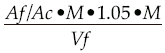
<body><![CDATA[<p align="justify"><font face="verdana" size="2">The zooplankton taxa used in this study were the rotifers <i>Plationus patulus, Brachionus havanaensis, B. rubens</i>; the cladocerans <i>Alona rectangula, Moina macrocopa, Ceriodaphnia dubia and Daphnia pulex</i>; the copepods <i>Leptodiaptomus sp., Eucyclops serrulatus, Elaphoidella grandidieri</i> and the ostracod <i>Heterocypris incongruens</i>. All the taxa were cloned and maintained on a diet of the green algae <i>Chlorella vulgaris or Scenedesmus acutus</i> at a density of 0.5x10<sup>6</sup> cells ml<sup>&#45;1</sup>. The species were cultured on moderately hard water (EPA medium), at a temperature of 23 &#177; 2&#176;C. The algal species were cultured on Bold medium (Borowitzka and Borowitzka, 1988). The algae were harvested after 8&#45;10 days, allowed to sediment in a refrigerator, decanted and enumerated using a Neubauer Haemocytometer. Cultures were changed twice a week when they were in one liter recipients.</font></p>  	    <p align="justify"><font face="verdana" size="2">A selected <i>Vibrio cholerae</i> strain Non O1 Non O139 isolated from Xochimilco lake in Mexico City was grown in Luria broth at 37&#176;C. In vitro growth kinetics of <i>V. cholerae</i> strain was determined as follows. An aliquot (50 ml) from the initial culture was transferred to individual flask (A) and was incubated at 37&#176;C on rotary shaker 18 h. The next step was to transfer 2 ml of this culture in 98 ml (B) of Luria broth and incubate it in the same condition; the growth was monitored by observing changes in the optical density at 630 nm over 4h; growth curves were performed in triplicate and the OD<sub>630</sub> measurements were averaged for each time to generate the growth curves. Immediately following inoculation an aliquot (0.1 ml) of the culture was removed, serially diluted (10<sup>&#45;7</sup> to 10<sup>&#45;12</sup>), and plated on TSA agar plates for cell enumeration. Once the number of bacteria corresponding to each dilution was determined, grazing experiments were initiated.</font></p>  	    <p align="justify"><font face="verdana" size="2">Before starting bacterial grazing, rotifers and cladocerans were introduced in EPA sterile solution for 1 hour, under starvation conditions. After that, the zooplankters were rinsed on a membrane 0.4 mm pore opening at low vacuum Millipore equipment and transferred to beaker with EPA solution. Ten individuals of each taxon were counted using a stereoscopic microscope and put it in each test beaker plus control. In all there were 48 recipients (11 taxa &#43; 1 control with four replicates each). An aliquot (10 ml) of the bacterial dilution (10<sup>&#45;12</sup>) was added to each 10 test beaker with bacterial concentration (2.5 x 10<sup>6</sup>) that previously contained 50 ml of EPA sterile solution. Grazing time was 30 min and past this time 2.5 ml formalin was add to each glass test to stop feeding.</font></p>  	    <p align="justify"><font face="verdana" size="2">To quantify bacterial consumption, samples (0.5 ml) from each beaker, without zooplankters, were filtered in 0.22 &micro;m polycarbonate membrane and stained with 50 &micro;l 4&acute;6&#45;diamino&#45;2&#45;phenylindole (DAPI) (Porter and Feig, 1980) 5&#45;10 min. Bacteria were counted using fluorescence microscope (Nikon E&#45;600) 100x, grid were counted in a field, consisting of 100 boxes and the counting was done by frame, horizontally. To calculate number of bacteria we applied the following formula:</font></p>  	    <p align="center"><font face="verdana" size="2"><img src="/img/revistas/tca/v3n1/a5e1.jpg"></font></p>  	    <p align="justify"><font face="verdana" size="2">Where:</font></p>  	    <p align="justify"><font face="verdana" size="2">A<i>&#402;</i> &#61; Filtration area</font></p>  	    <p align="justify"><font face="verdana" size="2">A<i>c</i> &#61; Counting unit area (square, line, grill or field)</font></p>  	    <p align="justify"><font face="verdana" size="2"><i>M</i> &#61; Average of bacteria</font></p>  	    <p align="justify"><font face="verdana" size="2">1.05 &#61; Correction factor for the formalin</font></p>  	    ]]></body>
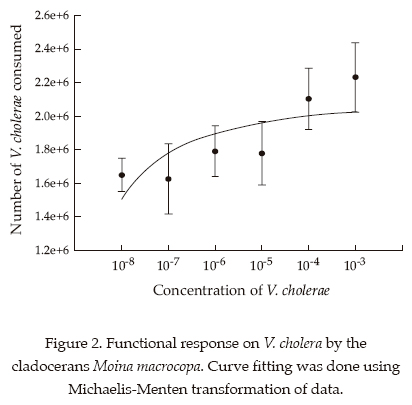
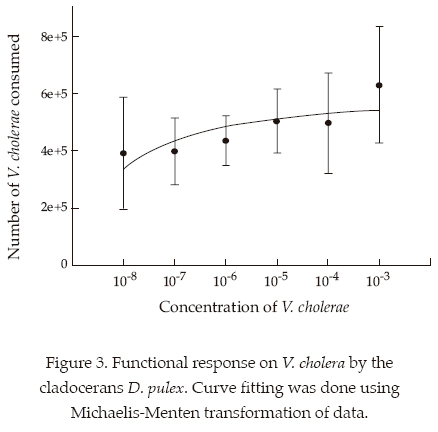
<body><![CDATA[<p align="justify"><font face="verdana" size="2">V<i>&#402;</i>&#61; Volume filtered</font></p>  	    <p align="justify"><font face="verdana" size="2"><i>D</i> &#61; Number of times the sample was diluted</font></p>  	    <p align="justify"><font face="verdana" size="2">To prepare functional response new dilution series were prepared from 10<sup>&#45;1</sup> to 10<sup>&#45;12</sup> and selected the interval 10<sup>&#45;3</sup> to 10<sup>&#45;8</sup>. With the results an ANOVA analysis was done to know the significant differences of consumption between different species tested and compared the percentage removal i.e. efficiency of bacterivory by the zooplankters tested.</font></p>  	    <p align="justify"><font face="verdana" size="2">&nbsp;</font></p>  	    <p align="justify"><font face="verdana" size="2"><b>Results</b></font></p>  	    <p align="justify"><font face="verdana" size="2">Our data indicate that although all the rotifers were able to filter <i>Vibrio</i> (<a href="#f1">figure 1</a>), none of them could decrease it significantly (P &#62; 0.05, one way ANOVA, <a href="/img/revistas/tca/v3n1/a5t1.jpg" target="_blank">table 1</a>). Among the micro&#45;crustaceans tested, the cladocerans could filter <i>Vibrio</i> better than the copepods and ostracods. Although the cladocerans were able to significantly reduce the density of the bacteria in relation to the controls (<i>P</i> &#60; 0.05, one way ANOVA, <a href="/img/revistas/tca/v3n1/a5t1.jpg" target="_blank">table 1</a>) there were no significant differences with relation to the body size of the test species (<a href="/img/revistas/tca/v3n1/a5t1.jpg" target="_blank">table 1</a>). Among the copepods and ostracod too, there was no difference in the ingestion rates in relation to the body size.</font></p>  	    <p align="center"><font face="verdana" size="2"><a name="f1"></a></font></p>  	    <p align="center"><font face="verdana" size="2"><img src="/img/revistas/tca/v3n1/a5f1.jpg"></font></p>  	    <p align="justify"><font face="verdana" size="2">The functional response of the cladocerans <i>Moina macrocopa</i> (<a href="#f2">figure 2</a>) and Daphnia pulex (<a href="#f3">figure 3</a>) showed a Type II response in that there was an increase in the number of bacteria consumed with increasing <i>V. cholerae</i> density. <i>Moina</i> was superior to <i>Daphnia</i> in relation to its filtering ability</font></p>  	    <p align="center"><font face="verdana" size="2"><a name="f2"></a></font></p>  	    ]]></body>
<body><![CDATA[<p align="center"><font face="verdana" size="2"><img src="/img/revistas/tca/v3n1/a5f2.jpg"></font></p>  	    <p align="center"><font face="verdana" size="2">&nbsp;</font></p>  	    <p align="center"><font face="verdana" size="2"><a name="f3"></a></font></p>  	    <p align="center"><font face="verdana" size="2"><img src="/img/revistas/tca/v3n1/a5f3.jpg"></font></p>  	    <p align="justify"><font face="verdana" size="2"><b>Discussion</b></font></p>  	    <p align="justify"><font face="verdana" size="2"><i>Vibrio cholerae</i>, the bacterium that causes cholera, occupies two distinct habitats: aquatic environments and human intestines. Although its activity in human hosts has received a great deal of attention because of its effect on human health, the microbe's behavior in natural ecosystems has received much less consideration. <i>V. cholerae</i> acts as a typical heterotrophic bacterium, while in aquatic environments mineralizing organic matter for reuse within the food web (Estrada&#45;Garc&iacute;a and Mintz, 1996). In addition, three key processes affect the microorganism's population dynamics and therefore its role in ecosystem processes: attachment to environmental substrates, and bacterivory.</font></p>  	    <p align="justify"><font face="verdana" size="2">Several rotifer taxa, but not all, are effective bacterivores. All the rotifers tested here belong to the <i>Brachionidae</i> which is capable of feeding on bacteria, detritus and algae in the size range of 2&#45;20 &micro;m (Monakov, 2003). Nevertheless, we observed that all these species were unable to significantly lower the concentrations of <i>V. cholerae</i>. It has been documented that these rotifers are not true bacteriophages (Monakov, 2003) and are unable to live on a diet of bacteria alone; smaller brachionids such as <i>Anuraeopsis fissa</i> are quite capable of living on and feeding on bacteria (Ooms&#45;Wilms, 1997; Ooms&#45;Wilms <i>et al</i>., 1995).</font></p>  	    <p align="justify"><font face="verdana" size="2">In this study we analyzed the consumption of <i>Vibrio</i> at a range of densities within the infective levels. The consumption of bacteria was higher at higher bacterial densities which indicate the utility of these cladoceran taxa in controlling high densities of <i>Vibrio</i> in nature. Among the cladocerans tested here we found that bacterivory on <i>V. cholerae</i> was highest by <i>Moina</i> and <i>Daphnia</i>. In terms of biomass, the former is more efficient at clearing bacteria than the latter. This has a significant application since <i>Moina</i> is more abundant and common throughout the year than <i>Daphnia</i> in Xochimilco (Nandini <i>et al</i>., 2005).</font></p>  	    <p align="justify"><font face="verdana" size="2">Several studies on cladocerans indicate that they show a Type II functional response on algal or cyanobacterial diets (Monakov, 2003). We also found that, both <i>Daphnia pulex</i> and <i>Moina macrocopa</i> showed similar trends on <i>V. cholera</i>. The ingestion rates were greater in <i>Moina macrocopa</i> than in <i>D. pulex</i>. It has been suggested that species such as <i>Moina macrocopa</i>, dominating eutrophic waters (Dumont and Negrea, 2002), often have fine meshes and are better capable of filtering bacteria. The ability of cladocerans to feed on bacteria largely depends on the intersetular space in their thoracic limbs (Brendelberger, 1991). This is not correlated to the body size of the cladoceran; for instance <i>Daphnia magna</i> is longer than <i>Diaphanosoma brachyurum</i> but the latter is more capable of filtering bacteria. This is the reason why correlations between bacterial filtering rates and body size of cladocerans are often not significant; results observed in this study too.</font></p>  	    <p align="justify"><font face="verdana" size="2">Copepods and ostracods are efficient bacteriopahges (Monakov, 2003 and articles cited therein). It has been well documented that <i>V. cholerae</i> has a high affinity for the carapace of copepods (Colwell and Spira 1992) but not much is known in this regard for cladocerans. In fact, it has also been suggested that grazing pressure could induce the shift from nontoxigenic to toxigenic strains (Lipp <i>et al</i>., 2002). It is also true, however, that the impact of grazing on bacterial community structure is a very poorly studied subject (J&uuml;rgens <i>et al</i>., 1994). It remains to be seen whether cladocerans feed preferentially on <i>V. cholerae</i> in the presence of an alternative diet and whether their ability to consume bacteria can offset a high production of <i>Vibrio</i> since it has been documented that this bacterium is capable of showing high growth rates on the chitinous carapace of cladocerans.</font></p>  	    ]]></body>
<body><![CDATA[<p align="justify"><font face="verdana" size="2">&nbsp;</font></p>  	    <p align="justify"><font face="verdana" size="2"><b>Acknowledgements</b></font></p>  	    <p align="justify"><font face="verdana" size="2">We thank financial assistance from PAPCA (Project 85; 2008&#45;2009).</font></p>  	    <p align="justify"><font face="verdana" size="2">&nbsp;</font></p>  	    <p align="justify"><font face="verdana" size="2"><b>References</b></font></p>  	    <!-- ref --><p align="justify"><font face="verdana" size="2">BOROWITZKA, M.A. and BOROWITZKA, L.J. <i>Micro&#45;algal biotechnology</i>. Cambridge: Cambridge University Press, 1988, 477 pp.    &nbsp;&nbsp;&nbsp;&nbsp;&nbsp;&nbsp;&nbsp;&nbsp;[&#160;<a href="javascript:void(0);" onclick="javascript: window.open('/scielo.php?script=sci_nlinks&ref=9727869&pid=S2007-2422201200010000500001&lng=','','width=640,height=500,resizable=yes,scrollbars=1,menubar=yes,');">Links</a>&#160;]<!-- end-ref --></font></p>  	    <!-- ref --><p align="justify"><font face="verdana" size="2">BRENDELBERGER, H. Filter mesh&#45;size of cladocerans predicts retention efficiency for bacteria. <i>Limnology and Oceanography</i>. Vol. 36, 1991, pp. 884&#45;894.    &nbsp;&nbsp;&nbsp;&nbsp;&nbsp;&nbsp;&nbsp;&nbsp;[&#160;<a href="javascript:void(0);" onclick="javascript: window.open('/scielo.php?script=sci_nlinks&ref=9727871&pid=S2007-2422201200010000500002&lng=','','width=640,height=500,resizable=yes,scrollbars=1,menubar=yes,');">Links</a>&#160;]<!-- end-ref --></font></p>  	    <!-- ref --><p align="justify"><font face="verdana" size="2">COLWELL, R.R. and SPIRA, W.M. The ecology of Vibrio cholerae. In <i>Current Topics in Infectious Disease. Cholera</i>. Barua, D. and Greenough III, W.B. (editors). New York: Plenum Publishing Corporation, 1992, pp. 107&#45;127.    &nbsp;&nbsp;&nbsp;&nbsp;&nbsp;&nbsp;&nbsp;&nbsp;[&#160;<a href="javascript:void(0);" onclick="javascript: window.open('/scielo.php?script=sci_nlinks&ref=9727873&pid=S2007-2422201200010000500003&lng=','','width=640,height=500,resizable=yes,scrollbars=1,menubar=yes,');">Links</a>&#160;]<!-- end-ref --></font></p>  	    <!-- ref --><p align="justify"><font face="verdana" size="2">DE LA LANZA, E.G. y GARC&Iacute;A, C.J.L. <i>Lagos y presas de M&eacute;xico. M&eacute;xico</i>, D.F.: AGT Editor, S.A., 2002, 680 pp.    &nbsp;&nbsp;&nbsp;&nbsp;&nbsp;&nbsp;&nbsp;&nbsp;[&#160;<a href="javascript:void(0);" onclick="javascript: window.open('/scielo.php?script=sci_nlinks&ref=9727875&pid=S2007-2422201200010000500004&lng=','','width=640,height=500,resizable=yes,scrollbars=1,menubar=yes,');">Links</a>&#160;]<!-- end-ref --></font></p>  	    <!-- ref --><p align="justify"><font face="verdana" size="2">DODSON, S.I. and FREY, D.G. Cladocera and other branchiopoda. In <i>Ecology and classification of North American Freshwater Invertebrates</i>. Thorp, J.H. and Covich, A.P. (editors), London: Academic Press, 2001, pp. 850&#45;914.    &nbsp;&nbsp;&nbsp;&nbsp;&nbsp;&nbsp;&nbsp;&nbsp;[&#160;<a href="javascript:void(0);" onclick="javascript: window.open('/scielo.php?script=sci_nlinks&ref=9727877&pid=S2007-2422201200010000500005&lng=','','width=640,height=500,resizable=yes,scrollbars=1,menubar=yes,');">Links</a>&#160;]<!-- end-ref --></font></p>  	    <!-- ref --><p align="justify"><font face="verdana" size="2">DUMONT, H. and NEGREA, S. Introduction to the Class Branchiopoda. In <i>Guides to the Identification of the Microinvertebrates of the Continental Waters of the World</i>. The Netherlands: Leyden Backhuys Publishers, 2002, 398 pp.    &nbsp;&nbsp;&nbsp;&nbsp;&nbsp;&nbsp;&nbsp;&nbsp;[&#160;<a href="javascript:void(0);" onclick="javascript: window.open('/scielo.php?script=sci_nlinks&ref=9727879&pid=S2007-2422201200010000500006&lng=','','width=640,height=500,resizable=yes,scrollbars=1,menubar=yes,');">Links</a>&#160;]<!-- end-ref --></font></p>  	    <!-- ref --><p align="justify"><font face="verdana" size="2">ESTRADA&#45;GARC&Iacute;A, T. and MINTZ, E.D. Cholera: Foodborne transmission and its prevention. <i>European Journal of Epidemiology</i>. Vol. 12, 1996, pp. 461&#45;469.    &nbsp;&nbsp;&nbsp;&nbsp;&nbsp;&nbsp;&nbsp;&nbsp;[&#160;<a href="javascript:void(0);" onclick="javascript: window.open('/scielo.php?script=sci_nlinks&ref=9727881&pid=S2007-2422201200010000500007&lng=','','width=640,height=500,resizable=yes,scrollbars=1,menubar=yes,');">Links</a>&#160;]<!-- end-ref --></font></p>  	    <!-- ref --><p align="justify"><font face="verdana" size="2">GULATI, R.D., LAMMENS, E.H.R.R, MEIJER, M.L., and VAN DONK, E. (editors). Biomanipulation. Tool for water management. <i>Hydrobiologia</i>. Vol. 200/201, ISSN00188158, 1990, pp. 1&#45;628.    &nbsp;&nbsp;&nbsp;&nbsp;&nbsp;&nbsp;&nbsp;&nbsp;[&#160;<a href="javascript:void(0);" onclick="javascript: window.open('/scielo.php?script=sci_nlinks&ref=9727883&pid=S2007-2422201200010000500008&lng=','','width=640,height=500,resizable=yes,scrollbars=1,menubar=yes,');">Links</a>&#160;]<!-- end-ref --></font></p>  	    <!-- ref --><p align="justify"><font face="verdana" size="2">GHADOUANI, A. and PINEL&#45;ALLOUL, B. Phenotypic plasticity in <i>Daphnia pulicaria</i> as an adaptation to high biomass of colonial and filamentous cyanobacteria: experimental evidence. <i>Journal of Plankton Research</i>. Vol. 24, 2002, pp. 1047&#45;1056.    &nbsp;&nbsp;&nbsp;&nbsp;&nbsp;&nbsp;&nbsp;&nbsp;[&#160;<a href="javascript:void(0);" onclick="javascript: window.open('/scielo.php?script=sci_nlinks&ref=9727885&pid=S2007-2422201200010000500009&lng=','','width=640,height=500,resizable=yes,scrollbars=1,menubar=yes,');">Links</a>&#160;]<!-- end-ref --></font></p>  	    <!-- ref --><p align="justify"><font face="verdana" size="2">JESCHKE, J.M., KOPP, M., and TOLLRIAN, R. Consumer&#45;food systems: why type I functional responses are exclusive to filter feeders. <i>Biological Reviews</i>. Vol. 79, 2004, pp. 337&#45;349.    &nbsp;&nbsp;&nbsp;&nbsp;&nbsp;&nbsp;&nbsp;&nbsp;[&#160;<a href="javascript:void(0);" onclick="javascript: window.open('/scielo.php?script=sci_nlinks&ref=9727887&pid=S2007-2422201200010000500010&lng=','','width=640,height=500,resizable=yes,scrollbars=1,menubar=yes,');">Links</a>&#160;]<!-- end-ref --></font></p>  	    <!-- ref --><p align="justify"><font face="verdana" size="2">J&Uuml;RGENS, K., ARNDT, H., and ROTHHAUPT, K.O. Zooplankton&#45;mediated changes of bacterial community structure. <i>Microbial Ecology</i>. Vol. 27, 1994, pp. 27&#45;42.    &nbsp;&nbsp;&nbsp;&nbsp;&nbsp;&nbsp;&nbsp;&nbsp;[&#160;<a href="javascript:void(0);" onclick="javascript: window.open('/scielo.php?script=sci_nlinks&ref=9727889&pid=S2007-2422201200010000500011&lng=','','width=640,height=500,resizable=yes,scrollbars=1,menubar=yes,');">Links</a>&#160;]<!-- end-ref --></font></p>  	    <!-- ref --><p align="justify"><font face="verdana" size="2">KUTIKOVA, L.A. Kolovratki fauny SSSR (The rotifer fauna of USSR). <i>Keys of the fauna of USSR</i> (in Russian). Vol. 104, 1970, 744 pp.    &nbsp;&nbsp;&nbsp;&nbsp;&nbsp;&nbsp;&nbsp;&nbsp;[&#160;<a href="javascript:void(0);" onclick="javascript: window.open('/scielo.php?script=sci_nlinks&ref=9727891&pid=S2007-2422201200010000500012&lng=','','width=640,height=500,resizable=yes,scrollbars=1,menubar=yes,');">Links</a>&#160;]<!-- end-ref --></font></p>  	    <!-- ref --><p align="justify"><font face="verdana" size="2">LIPP, E.K., HUQ, A., and COLWELL, R.R. Effects of Global Climate on Infectious Disease: the Cholera Model. <i>Clin. Microbiol. Rev</i>. Vol. 15, 2002, pp. 757&#45;770.    &nbsp;&nbsp;&nbsp;&nbsp;&nbsp;&nbsp;&nbsp;&nbsp;[&#160;<a href="javascript:void(0);" onclick="javascript: window.open('/scielo.php?script=sci_nlinks&ref=9727893&pid=S2007-2422201200010000500013&lng=','','width=640,height=500,resizable=yes,scrollbars=1,menubar=yes,');">Links</a>&#160;]<!-- end-ref --></font></p>  	    <!-- ref --><p align="justify"><font face="verdana" size="2">MEIBOM, K.L., LI, X.B., NIELSEN, A.T., WU, C.Y., ROSEMAN, S., and SCHOOLNIK, G.K. The <i>Vibrio cholerae</i> chitin utilization program. <i>Proc. Natl. Acad. Sci.</i> USA. Vol. 101, 2004, pp. 2524&#45;2529.    &nbsp;&nbsp;&nbsp;&nbsp;&nbsp;&nbsp;&nbsp;&nbsp;[&#160;<a href="javascript:void(0);" onclick="javascript: window.open('/scielo.php?script=sci_nlinks&ref=9727895&pid=S2007-2422201200010000500014&lng=','','width=640,height=500,resizable=yes,scrollbars=1,menubar=yes,');">Links</a>&#160;]<!-- end-ref --></font></p>  	    <!-- ref --><p align="justify"><font face="verdana" size="2">MONAKOV, A.V. <i>Feeding of freshwater invertebrates</i>. Ghent, Belgium: Kenobi Productions, 2003, pp. 373.    &nbsp;&nbsp;&nbsp;&nbsp;&nbsp;&nbsp;&nbsp;&nbsp;[&#160;<a href="javascript:void(0);" onclick="javascript: window.open('/scielo.php?script=sci_nlinks&ref=9727897&pid=S2007-2422201200010000500015&lng=','','width=640,height=500,resizable=yes,scrollbars=1,menubar=yes,');">Links</a>&#160;]<!-- end-ref --></font></p>  	    <!-- ref --><p align="justify"><font face="verdana" size="2">NANDINI, S., RAM&Iacute;REZ&#45;GARC&Iacute;A, P., and SARMA, S.S.S. Seasonal variation in the species diversity of planktonic rotifers from Lake Xochimilco (M&eacute;xico). <i>Journal of Freshwater Ecology</i>. Vol. 20, No. 2, 2005, pp. 287&#45;294.    &nbsp;&nbsp;&nbsp;&nbsp;&nbsp;&nbsp;&nbsp;&nbsp;[&#160;<a href="javascript:void(0);" onclick="javascript: window.open('/scielo.php?script=sci_nlinks&ref=9727899&pid=S2007-2422201200010000500016&lng=','','width=640,height=500,resizable=yes,scrollbars=1,menubar=yes,');">Links</a>&#160;]<!-- end-ref --></font></p>  	    <!-- ref --><p align="justify"><font face="verdana" size="2">OOMS&#45;WILMS, A.L., POSTEMA, G., and GULATI, R.D. Evaluation of bacterivory of Rotifera based on measurements of in situ ingestion of fluorescent particles, including some comparisons with Cladocera. <i>Journal of Plankton Research</i>. Vol. 17, 1995, pp. 1057&#45;1077.    &nbsp;&nbsp;&nbsp;&nbsp;&nbsp;&nbsp;&nbsp;&nbsp;[&#160;<a href="javascript:void(0);" onclick="javascript: window.open('/scielo.php?script=sci_nlinks&ref=9727901&pid=S2007-2422201200010000500017&lng=','','width=640,height=500,resizable=yes,scrollbars=1,menubar=yes,');">Links</a>&#160;]<!-- end-ref --></font></p>  	    <!-- ref --><p align="justify"><font face="verdana" size="2">OOMS&#45;WILMS, A.L. Are bacteria an important food source for rotifers in eutrophic lakes&#63; <i>Journal of Plankton Research</i>. Vol. 19, No. 8, 1997, pp. 1125&#45;1141.    &nbsp;&nbsp;&nbsp;&nbsp;&nbsp;&nbsp;&nbsp;&nbsp;[&#160;<a href="javascript:void(0);" onclick="javascript: window.open('/scielo.php?script=sci_nlinks&ref=9727903&pid=S2007-2422201200010000500018&lng=','','width=640,height=500,resizable=yes,scrollbars=1,menubar=yes,');">Links</a>&#160;]<!-- end-ref --></font></p>  	    <!-- ref --><p align="justify"><font face="verdana" size="2">PORTER, K.G. and FEIG, Y.S. The use of DAPI for identifying and counting aquatic microflora. <i>Limnol. Oceanogr</i>. Vol. 25, No. 5, 1980, pp. 943&#45;948.    &nbsp;&nbsp;&nbsp;&nbsp;&nbsp;&nbsp;&nbsp;&nbsp;[&#160;<a href="javascript:void(0);" onclick="javascript: window.open('/scielo.php?script=sci_nlinks&ref=9727905&pid=S2007-2422201200010000500019&lng=','','width=640,height=500,resizable=yes,scrollbars=1,menubar=yes,');">Links</a>&#160;]<!-- end-ref --></font></p>  	    <!-- ref --><p align="justify"><font face="verdana" size="2">RAWLINGS, T.K., RUIZ, G.M., and COLWELL, R.R. Association of <i>Vibrio cholerae</i> O1 El Tor and O139 Bengal with the Copepods <i>Acartia tonsa and Eurytemora affinis. Applied and Environmental Microbiology</i>. Vol. 73, 2007, pp. 7926&#45;7933.    &nbsp;&nbsp;&nbsp;&nbsp;&nbsp;&nbsp;&nbsp;&nbsp;[&#160;<a href="javascript:void(0);" onclick="javascript: window.open('/scielo.php?script=sci_nlinks&ref=9727907&pid=S2007-2422201200010000500020&lng=','','width=640,height=500,resizable=yes,scrollbars=1,menubar=yes,');">Links</a>&#160;]<!-- end-ref --></font></p>  	    <!-- ref --><p align="justify"><font face="verdana" size="2">SANDERS, R.W. and PORTER, K.G. Phagotrophic phytoflagellates. <i>Adv. Microb</i>. Ecol. Vol. 10, 1988, pp. 167&#45;192.    &nbsp;&nbsp;&nbsp;&nbsp;&nbsp;&nbsp;&nbsp;&nbsp;[&#160;<a href="javascript:void(0);" onclick="javascript: window.open('/scielo.php?script=sci_nlinks&ref=9727909&pid=S2007-2422201200010000500021&lng=','','width=640,height=500,resizable=yes,scrollbars=1,menubar=yes,');">Links</a>&#160;]<!-- end-ref --></font></p>  	    <!-- ref --><p align="justify"><font face="verdana" size="2">WALLACE, R.L., SNELL, T.W., RICCI, C., and NOGRADY, T. Rotifera Part 1: Biology, Ecology and Systematics. <i>Guides to the identification of the microinvertebrates of the continental waters of the world</i>. The Netherlands: Kenobi Productions Gent/Backhuys, Leyden, 2006, 299 pp.    &nbsp;&nbsp;&nbsp;&nbsp;&nbsp;&nbsp;&nbsp;&nbsp;[&#160;<a href="javascript:void(0);" onclick="javascript: window.open('/scielo.php?script=sci_nlinks&ref=9727911&pid=S2007-2422201200010000500022&lng=','','width=640,height=500,resizable=yes,scrollbars=1,menubar=yes,');">Links</a>&#160;]<!-- end-ref --></font></p>      ]]></body><back>
<ref-list>
<ref id="B1">
<nlm-citation citation-type="book">
<person-group person-group-type="author">
<name>
<surname><![CDATA[BOROWITZKA]]></surname>
<given-names><![CDATA[M.A.]]></given-names>
</name>
<name>
<surname><![CDATA[BOROWITZKA]]></surname>
<given-names><![CDATA[L.J.]]></given-names>
</name>
</person-group>
<source><![CDATA[Micro-algal biotechnology]]></source>
<year>1988</year>
<page-range>477</page-range><publisher-loc><![CDATA[Cambridge ]]></publisher-loc>
<publisher-name><![CDATA[Cambridge University Press]]></publisher-name>
</nlm-citation>
</ref>
<ref id="B2">
<nlm-citation citation-type="journal">
<person-group person-group-type="author">
<name>
<surname><![CDATA[BRENDELBERGER]]></surname>
<given-names><![CDATA[H.]]></given-names>
</name>
</person-group>
<article-title xml:lang="en"><![CDATA[Filter mesh-size of cladocerans predicts retention efficiency for bacteria]]></article-title>
<source><![CDATA[Limnology and Oceanography]]></source>
<year>1991</year>
<volume>36</volume>
<page-range>884-894</page-range></nlm-citation>
</ref>
<ref id="B3">
<nlm-citation citation-type="book">
<person-group person-group-type="author">
<name>
<surname><![CDATA[COLWELL]]></surname>
<given-names><![CDATA[R.R.]]></given-names>
</name>
<name>
<surname><![CDATA[SPIRA]]></surname>
<given-names><![CDATA[W.M.]]></given-names>
</name>
</person-group>
<article-title xml:lang="en"><![CDATA[The ecology of Vibrio cholerae]]></article-title>
<person-group person-group-type="editor">
<name>
<surname><![CDATA[Barua]]></surname>
<given-names><![CDATA[D.]]></given-names>
</name>
<name>
<surname><![CDATA[Greenough]]></surname>
<given-names><![CDATA[W.B.]]></given-names>
</name>
</person-group>
<source><![CDATA[Current Topics in Infectious Disease. Cholera]]></source>
<year>1992</year>
<page-range>107-127</page-range><publisher-loc><![CDATA[New York ]]></publisher-loc>
<publisher-name><![CDATA[Plenum Publishing Corporation]]></publisher-name>
</nlm-citation>
</ref>
<ref id="B4">
<nlm-citation citation-type="book">
<person-group person-group-type="author">
<name>
<surname><![CDATA[DE LA LANZA]]></surname>
<given-names><![CDATA[E.G.]]></given-names>
</name>
<name>
<surname><![CDATA[GARCÍA]]></surname>
<given-names><![CDATA[C.J.L.]]></given-names>
</name>
</person-group>
<source><![CDATA[Lagos y presas de México]]></source>
<year>2002</year>
<page-range>680</page-range><publisher-loc><![CDATA[México^eD.F. D.F.]]></publisher-loc>
<publisher-name><![CDATA[AGT Editor, S.A.]]></publisher-name>
</nlm-citation>
</ref>
<ref id="B5">
<nlm-citation citation-type="book">
<person-group person-group-type="author">
<name>
<surname><![CDATA[DODSON]]></surname>
<given-names><![CDATA[S.I.]]></given-names>
</name>
<name>
<surname><![CDATA[FREY]]></surname>
<given-names><![CDATA[D.G.]]></given-names>
</name>
</person-group>
<article-title xml:lang="en"><![CDATA[Cladocera and other branchiopoda]]></article-title>
<person-group person-group-type="editor">
<name>
<surname><![CDATA[Thorp]]></surname>
<given-names><![CDATA[J.H.]]></given-names>
</name>
<name>
<surname><![CDATA[Covich]]></surname>
<given-names><![CDATA[A.P.]]></given-names>
</name>
</person-group>
<source><![CDATA[Ecology and classification of North American Freshwater Invertebrates]]></source>
<year>2001</year>
<page-range>850-914</page-range><publisher-loc><![CDATA[London ]]></publisher-loc>
<publisher-name><![CDATA[Academic Press]]></publisher-name>
</nlm-citation>
</ref>
<ref id="B6">
<nlm-citation citation-type="book">
<person-group person-group-type="author">
<name>
<surname><![CDATA[DUMONT]]></surname>
<given-names><![CDATA[H.]]></given-names>
</name>
<name>
<surname><![CDATA[NEGREA]]></surname>
<given-names><![CDATA[S.]]></given-names>
</name>
</person-group>
<article-title xml:lang="en"><![CDATA[Introduction to the Class Branchiopoda]]></article-title>
<source><![CDATA[Guides to the Identification of the Microinvertebrates of the Continental Waters of the World]]></source>
<year>2002</year>
<page-range>398</page-range><publisher-name><![CDATA[Leyden Backhuys Publishers]]></publisher-name>
</nlm-citation>
</ref>
<ref id="B7">
<nlm-citation citation-type="journal">
<person-group person-group-type="author">
<name>
<surname><![CDATA[ESTRADA-GARCÍA]]></surname>
<given-names><![CDATA[T.]]></given-names>
</name>
<name>
<surname><![CDATA[MINTZ]]></surname>
<given-names><![CDATA[E.D.]]></given-names>
</name>
</person-group>
<article-title xml:lang="en"><![CDATA[Cholera: Foodborne transmission and its prevention]]></article-title>
<source><![CDATA[European Journal of Epidemiology]]></source>
<year>1996</year>
<volume>12</volume>
<page-range>461-469</page-range></nlm-citation>
</ref>
<ref id="B8">
<nlm-citation citation-type="journal">
<person-group person-group-type="author">
<name>
<surname><![CDATA[GULATI]]></surname>
<given-names><![CDATA[R.D.]]></given-names>
</name>
<name>
<surname><![CDATA[LAMMENS]]></surname>
<given-names><![CDATA[E.H.R.R]]></given-names>
</name>
<name>
<surname><![CDATA[MEIJER]]></surname>
<given-names><![CDATA[M.L.]]></given-names>
</name>
<name>
<surname><![CDATA[VAN DONK]]></surname>
<given-names><![CDATA[E.]]></given-names>
</name>
</person-group>
<article-title xml:lang="en"><![CDATA[Biomanipulation. Tool for water management]]></article-title>
<source><![CDATA[Hydrobiologia]]></source>
<year>1990</year>
<volume>200</volume><volume>201</volume>
<page-range>1-628</page-range></nlm-citation>
</ref>
<ref id="B9">
<nlm-citation citation-type="journal">
<person-group person-group-type="author">
<name>
<surname><![CDATA[GHADOUANI]]></surname>
<given-names><![CDATA[A.]]></given-names>
</name>
<name>
<surname><![CDATA[PINEL-ALLOUL]]></surname>
<given-names><![CDATA[B.]]></given-names>
</name>
</person-group>
<article-title xml:lang="en"><![CDATA[Phenotypic plasticity in Daphnia pulicaria as an adaptation to high biomass of colonial and filamentous cyanobacteria: experimental evidence]]></article-title>
<source><![CDATA[Journal of Plankton Research]]></source>
<year>2002</year>
<volume>24</volume>
<page-range>1047-1056</page-range></nlm-citation>
</ref>
<ref id="B10">
<nlm-citation citation-type="journal">
<person-group person-group-type="author">
<name>
<surname><![CDATA[JESCHKE]]></surname>
<given-names><![CDATA[J.M.]]></given-names>
</name>
<name>
<surname><![CDATA[KOPP]]></surname>
<given-names><![CDATA[M.]]></given-names>
</name>
<name>
<surname><![CDATA[TOLLRIAN]]></surname>
<given-names><![CDATA[R.]]></given-names>
</name>
</person-group>
<article-title xml:lang="en"><![CDATA[Consumer-food systems: why type I functional responses are exclusive to filter feeders]]></article-title>
<source><![CDATA[Biological Reviews]]></source>
<year>2004</year>
<volume>79</volume>
<page-range>337-349</page-range></nlm-citation>
</ref>
<ref id="B11">
<nlm-citation citation-type="journal">
<person-group person-group-type="author">
<name>
<surname><![CDATA[JÜRGENS]]></surname>
<given-names><![CDATA[K.]]></given-names>
</name>
<name>
<surname><![CDATA[ARNDT]]></surname>
<given-names><![CDATA[H.]]></given-names>
</name>
<name>
<surname><![CDATA[ROTHHAUPT]]></surname>
<given-names><![CDATA[K.O.]]></given-names>
</name>
</person-group>
<article-title xml:lang="en"><![CDATA[Zooplankton-mediated changes of bacterial community structure]]></article-title>
<source><![CDATA[Microbial Ecology]]></source>
<year>1994</year>
<volume>27</volume>
<page-range>27-42</page-range></nlm-citation>
</ref>
<ref id="B12">
<nlm-citation citation-type="journal">
<person-group person-group-type="author">
<name>
<surname><![CDATA[KUTIKOVA]]></surname>
<given-names><![CDATA[L.A.]]></given-names>
</name>
</person-group>
<article-title xml:lang="en"><![CDATA[Kolovratki fauny SSSR (The rotifer fauna of USSR)]]></article-title>
<source><![CDATA[Keys of the fauna of USSR (in Russian)]]></source>
<year>1970</year>
<volume>104</volume>
<page-range>744</page-range></nlm-citation>
</ref>
<ref id="B13">
<nlm-citation citation-type="journal">
<person-group person-group-type="author">
<name>
<surname><![CDATA[LIPP]]></surname>
<given-names><![CDATA[E.K.]]></given-names>
</name>
<name>
<surname><![CDATA[HUQ]]></surname>
<given-names><![CDATA[A.]]></given-names>
</name>
<name>
<surname><![CDATA[COLWELL]]></surname>
<given-names><![CDATA[R.R.]]></given-names>
</name>
</person-group>
<article-title xml:lang="en"><![CDATA[Effects of Global Climate on Infectious Disease: the Cholera Model]]></article-title>
<source><![CDATA[Clin. Microbiol. Rev.]]></source>
<year>2002</year>
<volume>15</volume>
<page-range>757-770</page-range></nlm-citation>
</ref>
<ref id="B14">
<nlm-citation citation-type="journal">
<person-group person-group-type="author">
<name>
<surname><![CDATA[MEIBOM]]></surname>
<given-names><![CDATA[K.L.]]></given-names>
</name>
<name>
<surname><![CDATA[LI]]></surname>
<given-names><![CDATA[X.B.]]></given-names>
</name>
<name>
<surname><![CDATA[NIELSEN]]></surname>
<given-names><![CDATA[A.T.]]></given-names>
</name>
<name>
<surname><![CDATA[WU]]></surname>
<given-names><![CDATA[C.Y.]]></given-names>
</name>
<name>
<surname><![CDATA[ROSEMAN]]></surname>
<given-names><![CDATA[S.]]></given-names>
</name>
<name>
<surname><![CDATA[SCHOOLNIK]]></surname>
<given-names><![CDATA[G.K.]]></given-names>
</name>
</person-group>
<article-title xml:lang="en"><![CDATA[The Vibrio cholerae chitin utilization program]]></article-title>
<source><![CDATA[Proc. Natl. Acad. Sci.]]></source>
<year>2004</year>
<volume>101</volume>
<page-range>2524-2529</page-range></nlm-citation>
</ref>
<ref id="B15">
<nlm-citation citation-type="book">
<person-group person-group-type="author">
<name>
<surname><![CDATA[MONAKOV]]></surname>
<given-names><![CDATA[A.V.]]></given-names>
</name>
</person-group>
<source><![CDATA[Feeding of freshwater invertebrates]]></source>
<year>2003</year>
<page-range>373</page-range><publisher-loc><![CDATA[Ghent ]]></publisher-loc>
<publisher-name><![CDATA[Kenobi Productions]]></publisher-name>
</nlm-citation>
</ref>
<ref id="B16">
<nlm-citation citation-type="journal">
<person-group person-group-type="author">
<name>
<surname><![CDATA[NANDINI]]></surname>
<given-names><![CDATA[S.]]></given-names>
</name>
<name>
<surname><![CDATA[RAMÍREZ-GARCÍA]]></surname>
<given-names><![CDATA[P.]]></given-names>
</name>
<name>
<surname><![CDATA[SARMA]]></surname>
<given-names><![CDATA[S.S.S.]]></given-names>
</name>
</person-group>
<article-title xml:lang="en"><![CDATA[Seasonal variation in the species diversity of planktonic rotifers from Lake Xochimilco (México)]]></article-title>
<source><![CDATA[Journal of Freshwater Ecology]]></source>
<year>2005</year>
<volume>20</volume>
<numero>2</numero>
<issue>2</issue>
<page-range>287-294</page-range></nlm-citation>
</ref>
<ref id="B17">
<nlm-citation citation-type="journal">
<person-group person-group-type="author">
<name>
<surname><![CDATA[OOMS-WILMS]]></surname>
<given-names><![CDATA[A.L.]]></given-names>
</name>
<name>
<surname><![CDATA[POSTEMA]]></surname>
<given-names><![CDATA[G.]]></given-names>
</name>
<name>
<surname><![CDATA[GULATI]]></surname>
<given-names><![CDATA[R.D.]]></given-names>
</name>
</person-group>
<article-title xml:lang="en"><![CDATA[Evaluation of bacterivory of Rotifera based on measurements of in situ ingestion of fluorescent particles, including some comparisons with Cladocera]]></article-title>
<source><![CDATA[Journal of Plankton Research]]></source>
<year>1995</year>
<volume>17</volume>
<page-range>1057-1077</page-range></nlm-citation>
</ref>
<ref id="B18">
<nlm-citation citation-type="journal">
<person-group person-group-type="author">
<name>
<surname><![CDATA[OOMS-WILMS]]></surname>
<given-names><![CDATA[A.L.]]></given-names>
</name>
</person-group>
<article-title xml:lang="en"><![CDATA[Are bacteria an important food source for rotifers in eutrophic lakes?]]></article-title>
<source><![CDATA[Journal of Plankton Research]]></source>
<year>1997</year>
<volume>19</volume>
<numero>8</numero>
<issue>8</issue>
<page-range>1125-1141</page-range></nlm-citation>
</ref>
<ref id="B19">
<nlm-citation citation-type="journal">
<person-group person-group-type="author">
<name>
<surname><![CDATA[PORTER]]></surname>
<given-names><![CDATA[K.G.]]></given-names>
</name>
<name>
<surname><![CDATA[FEIG]]></surname>
<given-names><![CDATA[Y.S.]]></given-names>
</name>
</person-group>
<article-title xml:lang="en"><![CDATA[The use of DAPI for identifying and counting aquatic microflora]]></article-title>
<source><![CDATA[Limnol. Oceanogr.]]></source>
<year>1980</year>
<volume>25</volume>
<numero>5</numero>
<issue>5</issue>
<page-range>943-948</page-range></nlm-citation>
</ref>
<ref id="B20">
<nlm-citation citation-type="journal">
<person-group person-group-type="author">
<name>
<surname><![CDATA[RAWLINGS]]></surname>
<given-names><![CDATA[T.K.]]></given-names>
</name>
<name>
<surname><![CDATA[RUIZ]]></surname>
<given-names><![CDATA[G.M.]]></given-names>
</name>
<name>
<surname><![CDATA[COLWELL]]></surname>
<given-names><![CDATA[R.R.]]></given-names>
</name>
</person-group>
<article-title xml:lang="en"><![CDATA[Association of Vibrio cholerae O1 El Tor and O139 Bengal with the Copepods Acartia tonsa and Eurytemora affinis]]></article-title>
<source><![CDATA[Applied and Environmental Microbiology]]></source>
<year>2007</year>
<volume>73</volume>
<page-range>7926-7933</page-range></nlm-citation>
</ref>
<ref id="B21">
<nlm-citation citation-type="journal">
<person-group person-group-type="author">
<name>
<surname><![CDATA[SANDERS]]></surname>
<given-names><![CDATA[R.W.]]></given-names>
</name>
<name>
<surname><![CDATA[PORTER]]></surname>
<given-names><![CDATA[K.G.]]></given-names>
</name>
</person-group>
<article-title xml:lang="en"><![CDATA[Phagotrophic phytoflagellates]]></article-title>
<source><![CDATA[Adv. Microb. Ecol.]]></source>
<year>1988</year>
<volume>10</volume>
<page-range>167-192</page-range></nlm-citation>
</ref>
<ref id="B22">
<nlm-citation citation-type="book">
<person-group person-group-type="author">
<name>
<surname><![CDATA[WALLACE]]></surname>
<given-names><![CDATA[R.L.]]></given-names>
</name>
<name>
<surname><![CDATA[SNELL]]></surname>
<given-names><![CDATA[T.W.]]></given-names>
</name>
<name>
<surname><![CDATA[RICCI]]></surname>
<given-names><![CDATA[C.]]></given-names>
</name>
<name>
<surname><![CDATA[NOGRADY]]></surname>
<given-names><![CDATA[T.]]></given-names>
</name>
</person-group>
<source><![CDATA[Rotifera Part 1: Biology, Ecology and Systematics. Guides to the identification of the microinvertebrates of the continental waters of the world]]></source>
<year>2006</year>
<page-range>299</page-range><publisher-name><![CDATA[Kenobi Productions Gent/Backhuys]]></publisher-name>
</nlm-citation>
</ref>
</ref-list>
</back>
</article>