<?xml version="1.0" encoding="ISO-8859-1"?><article xmlns:mml="http://www.w3.org/1998/Math/MathML" xmlns:xlink="http://www.w3.org/1999/xlink" xmlns:xsi="http://www.w3.org/2001/XMLSchema-instance">
<front>
<journal-meta>
<journal-id>2007-0705</journal-id>
<journal-title><![CDATA[Nova scientia]]></journal-title>
<abbrev-journal-title><![CDATA[Nova scientia]]></abbrev-journal-title>
<issn>2007-0705</issn>
<publisher>
<publisher-name><![CDATA[Universidad de La Salle Bajío A. C., Coordinación de Investigación]]></publisher-name>
</publisher>
</journal-meta>
<article-meta>
<article-id>S2007-07052015000100001</article-id>
<title-group>
<article-title xml:lang="en"><![CDATA[Approximate solutions for HIV-1 infection dynamics with cure rate]]></article-title>
<article-title xml:lang="es"><![CDATA[Soluciones aproximadas de la dinámica de infección de VIH-1 con tasa de curación]]></article-title>
</title-group>
<contrib-group>
<contrib contrib-type="author">
<name>
<surname><![CDATA[Vazquez-Leal]]></surname>
<given-names><![CDATA[H.]]></given-names>
</name>
<xref ref-type="aff" rid="A01"/>
</contrib>
<contrib contrib-type="author">
<name>
<surname><![CDATA[Boubaker]]></surname>
<given-names><![CDATA[K.]]></given-names>
</name>
<xref ref-type="aff" rid="A02"/>
</contrib>
<contrib contrib-type="author">
<name>
<surname><![CDATA[Marin-Hernandez]]></surname>
<given-names><![CDATA[A.]]></given-names>
</name>
<xref ref-type="aff" rid="A03"/>
</contrib>
<contrib contrib-type="author">
<name>
<surname><![CDATA[Huerta-Chua]]></surname>
<given-names><![CDATA[J.]]></given-names>
</name>
<xref ref-type="aff" rid="A04"/>
</contrib>
</contrib-group>
<aff id="A01">
<institution><![CDATA[,Universidad Veracruzana Electronic Instrumentation and Atmospheric Sciences School ]]></institution>
<addr-line><![CDATA[Xalapa Veracruz]]></addr-line>
<country>México</country>
</aff>
<aff id="A02">
<institution><![CDATA[,Université de Tunis École Supérieure de Sciences et Techniques de Tunis ]]></institution>
<addr-line><![CDATA[Mahdia ]]></addr-line>
<country>Tunisia</country>
</aff>
<aff id="A03">
<institution><![CDATA[,Universidad Veracruzana Department of Artificial Intelligence ]]></institution>
<addr-line><![CDATA[Xalapa Veracruz]]></addr-line>
<country>México</country>
</aff>
<aff id="A04">
<institution><![CDATA[,Universidad Veracruzana Civil Engineering School ]]></institution>
<addr-line><![CDATA[Poza Rica Veracruz]]></addr-line>
<country>México</country>
</aff>
<pub-date pub-type="pub">
<day>00</day>
<month>00</month>
<year>2015</year>
</pub-date>
<pub-date pub-type="epub">
<day>00</day>
<month>00</month>
<year>2015</year>
</pub-date>
<volume>7</volume>
<numero>13</numero>
<fpage>01</fpage>
<lpage>19</lpage>
<copyright-statement/>
<copyright-year/>
<self-uri xlink:href="http://www.scielo.org.mx/scielo.php?script=sci_arttext&amp;pid=S2007-07052015000100001&amp;lng=en&amp;nrm=iso"></self-uri><self-uri xlink:href="http://www.scielo.org.mx/scielo.php?script=sci_abstract&amp;pid=S2007-07052015000100001&amp;lng=en&amp;nrm=iso"></self-uri><self-uri xlink:href="http://www.scielo.org.mx/scielo.php?script=sci_pdf&amp;pid=S2007-07052015000100001&amp;lng=en&amp;nrm=iso"></self-uri><abstract abstract-type="short" xml:lang="en"><p><![CDATA[In this paper, two approximate solutions of HIV-1 infection dynamics model with cure rate are presented. The proposed solutions are obtained using homotopy perturbation method (HPM) and Boubaker Polynomials expansion scheme (BPES). A comparison of obtained solutions shows that HPM and BPES are powerful tools to solve nonlinear host viral infection models.]]></p></abstract>
<abstract abstract-type="short" xml:lang="es"><p><![CDATA[En este trabajo, se presentan dos soluciones aproximadas del modelo de la dinámica de infección de VIH-1 con tasa de curación. Las soluciones propuestas se obtienen usando el método de perturbación homotópica, por sus siglas en inglés (HPM) y el esquema de expansión polinomial de Boubaker por sus siglas en inglés (BPES). Al comparar las soluciones obtenidas vemos que HPM y BPES son herramientas muy potentes para resolver modelos no lineales de infecciones virales.]]></p></abstract>
<kwd-group>
<kwd lng="en"><![CDATA[CD4+T cells]]></kwd>
<kwd lng="en"><![CDATA[Homotopy Perturbation Method]]></kwd>
<kwd lng="en"><![CDATA[Boubaker Polynomials expansion scheme BPES]]></kwd>
<kwd lng="es"><![CDATA[Células CD4+T]]></kwd>
<kwd lng="es"><![CDATA[Método de Perturbación Homotópica HPM]]></kwd>
<kwd lng="es"><![CDATA[esquema de expansión polinomial de Boubaker BPES]]></kwd>
</kwd-group>
</article-meta>
</front><body><![CDATA[  	    <p align="justify"><font face="verdana" size="4">Ciencias Naturales e Ingenier&iacute;as</font></p>      <p align="center"><font face="verdana" size="2">&nbsp;</font></p>  	    <p align="center"><font face="verdana" size="4"><b>Approximate solutions for HIV&#45;1 infection dynamics with cure rate</b></font></p>      <p align="center"><font face="verdana" size="2">&nbsp;</font></p>  	    <p align="center"><font face="verdana" size="3"><b>Soluciones aproximadas de la din&aacute;mica de infecci&oacute;n de VIH&#45;1 con tasa de curaci&oacute;n</b></font></p>      <p align="center"><font face="verdana" size="2">&nbsp;</font></p>  	    <p align="center"><font face="verdana" size="2"><b>H. Vazquez&#45;Leal<sup>1</sup>, K. Boubaker<sup>2</sup>, A. Marin&#45;Hernandez<sup>3</sup> y J.</b> <b>Huerta&#45;Chua<sup>4</sup></b></font></p>  	    <p align="justify"><font face="verdana" size="2">&nbsp;</font></p>  	    <p align="justify"><font face="verdana" size="2"><sup><i>1</i></sup> <i>Electronic Instrumentation and Atmospheric Sciences School, Universidad Veracruzana, Xalapa, Veracruz, M&eacute;xico.</i> E&#45;mail: <a href="mailto:hvazquez@uv.mx"><u>hvazquez@uv.mx</u></a></font></p>  	    ]]></body>
<body><![CDATA[<p align="justify"><font face="verdana" size="2"><i><sup>2</sup> &Eacute;cole Sup&eacute;rieure de Sciences et Techniques de Tunis, Universit&eacute; de Tunis, Mahdia, Tunisia</i>.</font></p>  	    <p align="justify"><font face="verdana" size="2"><i><sup>3</sup> Department of Artificial Intelligence, Universidad Veracruzana, Xalapa, Veracruz, M&eacute;xico</i>.</font></p>  	    <p align="justify"><font face="verdana" size="2"><i><sup>4</sup> Civil Engineering School, Universidad Veracruzana, Poza Rica, Veracruz, M&eacute;xico</i>.</font></p>  	    <p align="justify"><font face="verdana" size="2">&nbsp;</font></p>  	    <p align="justify"><font face="verdana" size="2">Recepci&oacute;n: 09&#45;07&#45;2013    <br> 	Aceptaci&oacute;n: 28&#45;05&#45;2014</font></p>  	    <p align="justify"><font face="verdana" size="2">&nbsp;</font></p>  	    <p align="justify"><font face="verdana" size="2"><b>Abstract</b></font></p>  	    <p align="justify"><font face="verdana" size="2">In this paper, two approximate solutions of HIV&#45;1 infection dynamics model with cure rate are presented. The proposed solutions are obtained using homotopy perturbation method (HPM) and Boubaker Polynomials expansion scheme (BPES). A comparison of obtained solutions shows that HPM and BPES are powerful tools to solve nonlinear host viral infection models.</font></p>  	    <p align="justify"><font face="verdana" size="2"><b>Keywords:</b> CD4&#43;T cells, Homotopy Perturbation Method, Boubaker Polynomials expansion scheme BPES.</font></p>  	    ]]></body>
<body><![CDATA[<p align="justify"><font face="verdana" size="2">&nbsp;</font></p>  	    <p align="justify"><font face="verdana" size="2"><b>Resumen</b></font></p>  	    <p align="justify"><font face="verdana" size="2">En este trabajo, se presentan dos soluciones aproximadas del modelo de la din&aacute;mica de infecci&oacute;n de VIH&#45;1 con tasa de curaci&oacute;n. Las soluciones propuestas se obtienen usando el m&eacute;todo de perturbaci&oacute;n homot&oacute;pica, por sus siglas en ingl&eacute;s (HPM) y el esquema de expansi&oacute;n polinomial de Boubaker por sus siglas en ingl&eacute;s (BPES). Al comparar las soluciones obtenidas vemos que HPM y BPES son herramientas muy potentes para resolver modelos no lineales de infecciones virales.</font></p>  	    <p align="justify"><font face="verdana" size="2"><b>Palabras clave:</b> C&eacute;lulas CD4&#43;T, M&eacute;todo de Perturbaci&oacute;n Homot&oacute;pica HPM, esquema de expansi&oacute;n polinomial de Boubaker BPES.</font></p>  	    <p align="justify"><font face="verdana" size="2">&nbsp;</font></p>  	    <p align="justify"><font face="verdana" size="2"><b>1. Introduction:</b></font></p>  	    <p align="justify"><font face="verdana" size="2">In the last three decades, tremendous attention had been paid to establishing mathematical models to Human Immune&#45;deficiency Virus type 1 (HIV&#45;1) proliferation dynamics as AIDS (Acquired Immune Deficiency Syndrome) agent &#91;1&#45;15&#93;. It has been recorded that the main target of HIV&#45;1 infection is the population of CD4<sup>&#43;</sup> T&#45;cells, a class of lymphocytes which are abundant white blood immunity cells in plasma.</font></p>  	    <p align="justify"><font face="verdana" size="2">It is commonly known that HIV&#45;1 targets mainly CD4<sup>&#43;</sup> T&#45;cells and causes their death. It decreases the body's ability to fight infections. The standard infection process starts when HIV&#45;1 enters its target T&#45;cell and elaborates DNA copies of its viral RNA, with the help of the reverse transcriptase enzyme RT. Consequently, the viral DNA is inserted into the DNA of the infected cell; which will produce, from itself, viral particles that can bud off the cell and infect other cells.</font></p>  	    <p align="justify"><font face="verdana" size="2">Throughout the world, already over 16 million deaths at average age of 43 years have been caused by this virus &#91;2&#45;4&#93;; bringing into attention an increasing need to understand and study its action and dynamics. Mathematical models have been proven valuable in understanding the dynamics of HIV infection &#91;4&#45;6&#93;.</font></p>  	    <p align="justify"><font face="verdana" size="2">One of the earliest models to primary infection with HIV is the one developed by Perelson &#91;7&#93;, which considered a standard four&#45;population model involving uninfected CD4&#43; T cells, latently infected CD4<sup>&#43;</sup> T cells, productively infected CD4<sup>&#43;</sup> T cells, and virus population.</font></p>  	    ]]></body>
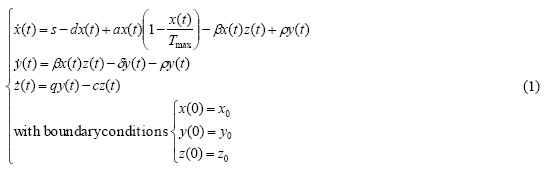
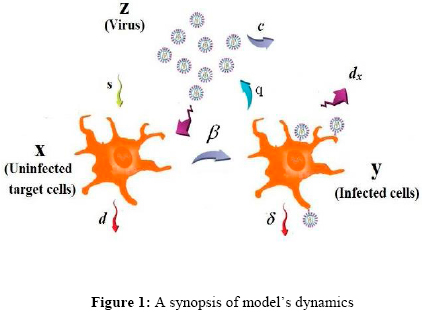
<body><![CDATA[<p align="justify"><font face="verdana" size="2">Unfortunately, the models for describing the dynamics of HIV infection for CD4&#43; cells are usually nonlinear differential equations with no known exact solution. Nonetheless, several methods are focused to find approximate solutions to nonlinear differential equations like: Homotopy perturbation method (HPM) &#91;16&#45;23&#93;, variational iteration method (VIM) &#91;24&#45;25&#93;, Boubaker Polynomials Expansion Scheme (BPES) &#91;26&#45;33&#93;, Homotopy Analysis Method (HAM) &#91;34&#93;, Generalized Homotopy Method &#91;35&#93;, among many others. Therefore, we propose a comparison between HPM and BPES methods by solving HIV&#45;1 infection dynamics with cure rate &#91;36&#93;.</font></p>  	    <p align="justify"><font face="verdana" size="2">The paper is organized as follows. Section 2 provides an idea about the model and its governing equations. We will describe the basic concepts of HPM in Section 3. Section 4 and Section 5 show the solution procedure for HIV using HPM and BPES, respectively. In Section 6, we discuss the obtained results. Finally, Section 7 summarizes the study and provides a global conclusion.</font></p>  	    <p align="justify"><font face="verdana" size="2">&nbsp;</font></p>  	    <p align="justify"><font face="verdana" size="2"><b>2. Governing equations and general assumptions</b></font></p>  	    <p align="justify"><font face="verdana" size="2">Simple and standard classic models for HIV&#45;1 proliferation dynamics &#91;7,9&#45;15&#93; are generally based on interacting features between three components like: infected and uninfected CD4<sup>&#43;</sup> T&#45;cells along with virus population (<a href="#f1">Fig. 1</a>).</font></p>  	    <p align="center"><font face="verdana" size="2"><a name="f1"></a></font></p>  	    <p align="center"><font face="verdana" size="2"><img src="/img/revistas/ns/v7n13/a1f1.jpg"></font></p>  	    <p align="justify"><font face="verdana" size="2">The following equations describe the evolution of the system &#91;36&#93;:</font></p>  	    <p align="center"><font face="verdana" size="2"><img src="/img/revistas/ns/v7n13/a1e1.jpg"></font></p>  	    <blockquote> 		    ]]></body>
<body><![CDATA[<p align="justify"><font face="verdana" size="2">with: x(t) : Uninfected target CD4<sup>&#43;</sup>T&#45;cells</font></p>  		    <p align="justify"><font face="verdana" size="2">y(t) : Productively infected CD4<sup>&#43;</sup>T&#45;cells</font></p>  		    <p align="justify"><font face="verdana" size="2">z(t) : Viral load of the virons</font></p>  		    <p align="justify"><font face="verdana" size="2"><i>s&nbsp;</i>: Represents the rate at which new T cells are created from sources</font></p>  		    <p align="justify"><font face="verdana" size="2">a&nbsp;: Maximum proliferation rate of target cells</font></p>  		    <p align="justify"><font face="verdana" size="2"><i>T<sub>max</sub></i>&nbsp;: T population density at which proliferation shuts off</font></p>  		    <p align="justify"><font face="verdana" size="2"><i>d&nbsp;</i>: Death rate of T cells</font></p>  		    <p align="justify"><font face="verdana" size="2"><i>&#946;&nbsp;</i>: Infection rate constant</font></p>  		    <p align="justify"><font face="verdana" size="2"><i>&#948;&nbsp;</i>: Death rate of infected cells</font></p>  		    <p align="justify"><font face="verdana" size="2"><i>q&nbsp;</i>: Reproductively rate of the infected cells</font></p>  		    ]]></body>
<body><![CDATA[<p align="justify"><font face="verdana" size="2">c&nbsp;: Clearance rate constant of virions</font></p>  		    <p align="justify"><font face="verdana" size="2"><i>p&nbsp;</i>: The rate of "cure," i.e. noncytolytic loss of infected cells</font></p> 	</blockquote>  	    <p align="justify"><font face="verdana" size="2">&nbsp;</font></p>  	    <p align="justify"><font face="verdana" size="2">The second equation in system (1) traduces anti&#45;retroviral effects in reference to eventual healing effects or entry in eclipse phase. It also expresses that the process of infection to the uninfected CD4<sup>&#43;</sup> T&#45;cells is in concordance to the mass action principle under mixing homogeneity. In this case, the concentration of new infected cells is proportional to the product <i>x(t) &#45; y(t)</i>.</font></p>  	    <p align="center"><font face="verdana" size="2"><a name="t1"></a></font></p>  	    <p align="center"><font face="verdana" size="2"><img src="/img/revistas/ns/v7n13/a1t1.jpg"></font></p>  	    <p align="justify"><font face="verdana" size="2">&nbsp;</font></p>  	    <p align="justify"><font face="verdana" size="2"><b>3. Basic concept of HPM method</b></font></p>  	    <p align="justify"><font face="verdana" size="2">The HPM method can be considered as a combination of the classical perturbation technique &#91;37,38&#93; and the homotopy (whose origin is in the topology) &#91;39&#45;40&#93;, but not restricted to a small parameter like traditional perturbation methods. For instance, HPM requires neither small parameter nor linearization, but only few iterations to obtain accurate solutions.</font></p>  	    <p align="justify"><font face="verdana" size="2">To figure out how HPM method works, consider a general nonlinear equation in the form</font></p>  	    ]]></body>
<body><![CDATA[<p align="center"><font face="verdana" size="2"><img src="/img/revistas/ns/v7n13/a1e2.jpg"></font></p>  	    <p align="justify"><font face="verdana" size="2">with the following boundary conditions:</font></p>  	    <p align="center"><font face="verdana" size="2"><img src="/img/revistas/ns/v7n13/a1e3.jpg"></font></p>  	    <p align="justify"><font face="verdana" size="2">where <i>A</i> is a general differential operator, <i>B</i> is a boundary operator, <i>&#402; (r)</i> a known analytical function, and &#915; is the domain boundary for &#937; . <i>A</i> can be divided into two operators <i>L</i> and <i>N</i>, where <i>L</i> is linear and <i>N</i> nonlinear; from this last statement, (2) can be rewritten as</font></p>  	    <p align="center"><font face="verdana" size="2"><img src="/img/revistas/ns/v7n13/a1e4.jpg"></font></p>  	    <p align="justify"><font face="verdana" size="2">Generally, a homotopy can be constructed in the form &#91;16&#45;18,37&#93;</font></p>  	    <p align="center"><font face="verdana" size="2"><img src="/img/revistas/ns/v7n13/a1e5.jpg"></font></p>  	    <p align="justify"><font face="verdana" size="2">where <i>p</i> is a homotopy parameter whose values are within the range of 0 and 1; <i>u<sub>0</sub></i> is the first approximation for the solution of (4) that satisfies boundary conditions.</font></p>  	    <p align="justify"><font face="verdana" size="2">When <i>p</i> &#8594; 0, (5) is reduced to</font></p>  	    <p align="center"><font face="verdana" size="2"><img src="/img/revistas/ns/v7n13/a1e6.jpg"></font></p>  	    ]]></body>
<body><![CDATA[<p align="justify"><font face="verdana" size="2">where operator <i>L</i> possesses trivial solution.</font></p>  	    <p align="justify"><font face="verdana" size="2">When <i>p</i> &#8594; 1, (5) is reduced to the original problem</font></p>  	    <p align="center"><font face="verdana" size="2"><img src="/img/revistas/ns/v7n13/a1e7.jpg"></font></p>  	    <p align="justify"><font face="verdana" size="2">Assuming that solution for (5) can be written as a power series of <i>p</i></font></p>  	    <p align="center"><font face="verdana" size="2"><img src="/img/revistas/ns/v7n13/a1e8.jpg"></font></p>  	    <p align="justify"><font face="verdana" size="2">Substituting (8) into (5) and equating identical powers of <i>p</i> terms, there can be found values for the sequence v<sub>0</sub>, v<sub>1</sub>, v<sub>2</sub>,...</font></p>  	    <p align="justify"><font face="verdana" size="2">When <i>p</i> &#8594; 1 in (8), it yields in the approximate solution for (4) in the form</font></p>  	    <p align="center"><font face="verdana" size="2"><img src="/img/revistas/ns/v7n13/a1e9.jpg"></font></p>  	    <p align="justify"><font face="verdana" size="2">&nbsp;</font></p>  	    <p align="justify"><font face="verdana" size="2"><b>4. Solution by using HPM method</b></font></p>  	    ]]></body>
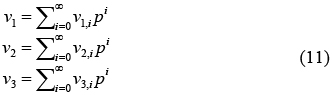
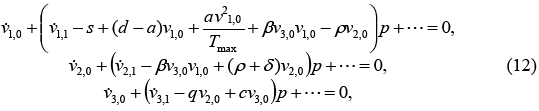
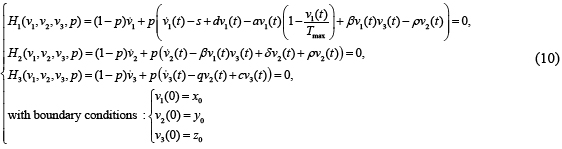
<body><![CDATA[<p align="justify"><font face="verdana" size="2">From (1) and (5), we establish the homotopy formulation</font></p>  	    <p align="center"><font face="verdana" size="2"><img src="/img/revistas/ns/v7n13/a1e10.jpg"></font></p>  	    <p align="justify"><font face="verdana" size="2">From (8), we assume that solution for (10) can be written as a power series of <i>p</i> as follows</font></p>  	    <p align="center"><font face="verdana" size="2"><img src="/img/revistas/ns/v7n13/a1e11.jpg"></font></p>  	    <p align="justify"><font face="verdana" size="2">Where v<sub><i>i,j</i></sub> (<i>i</i>&#61; 1,2,3, and <i>j</i>&#61;0,1,2,...), are functions yet to be determined. Substituting (11) into (10), and rearranging the coefficients of <i>p</i> powers, we have</font></p>  	    <p align="center"><font face="verdana" size="2"><img src="/img/revistas/ns/v7n13/a1e12.jpg"></font></p>  	    <p align="justify"><font face="verdana" size="2">In addition, in order to fulfil the boundary conditions, we consider v<sub>1,0</sub>(0) &#61; x<sub>0</sub>, v<sub>2,0</sub>(0) &#61; y<sub>0</sub> and v<sub>3</sub><sub>,0</sub>(0) &#61; z<sub>0</sub>. In order to obtain the unknown <i>v<sub>i,j</sub></i> (<i>i</i> &#61; 1,2,3, and <i>j</i> <i>&#61;1,2,3,...</i>), we must construct and solve the following system of equations, considering initial conditions <i>v<sub>i,j</sub></i> (0) &#61; 0 (<i>i</i> &#61;1,2,3, and <i>j</i> &#61;1,2,3,...)</font></p>  	    <p align="center"><font face="verdana" size="2"><img src="/img/revistas/ns/v7n13/a1e13.jpg"></font></p>  	    <p align="justify"><font face="verdana" size="2">Therefore,</font></p>  	    <p align="center"><font face="verdana" size="2"><img src="/img/revistas/ns/v7n13/a1e14.jpg"></font></p>  	    ]]></body>
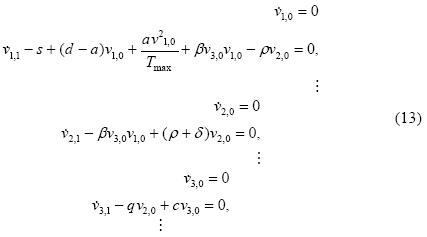
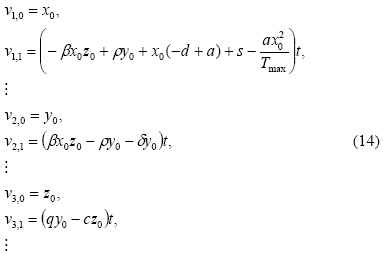
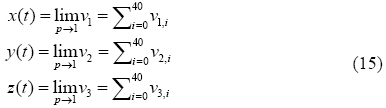
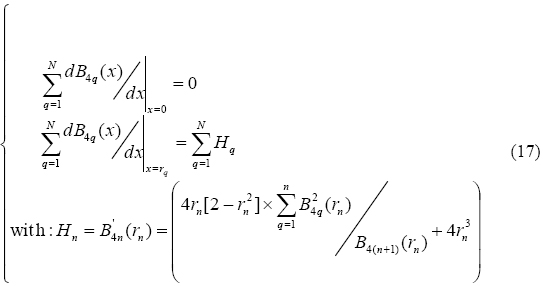
<body><![CDATA[<p align="justify"><font face="verdana" size="2">We obtained <i>v<sub>1,2</sub>,v<sub>2,2</sub>,v<sub>3,2</sub>,</i> and succeeding terms; nevertheless, because they were too</font></p>  	    <p align="justify"><font face="verdana" size="2">cumbersome, we skip them and use only the final results. Then, we obtain the 40&#45;th order approximation, considering <i>p</i> &#8594; 1 yields the approximate solution for (1) as</font></p>  	    <p align="center"><font face="verdana" size="2"><img src="/img/revistas/ns/v7n13/a1e15.jpg"></font></p>  	    <p align="justify"><font face="verdana" size="2">We set the values of parameters and initial conditions (<i>x</i>(0) &#61; <i>x<sub>0</sub>,</i> y(0) &#61; <i>y<sub>0</sub>,</i> and <i>z</i>(0) &#61; z<sub>0</sub>) as reported in <a href="#t1">Table 1</a> &#91;41&#93;. In order to increase the domain of convergence, we apply the Pad&eacute; &#91;20, 35&#93; approximant to (15) and obtain approximations of order x(t)<sub>&#91;15/15&#93;</sub>, <i>y(t</i> )<sub>&#91;14/15&#93;</sub>, and z(t)<sub>&#91;14/15&#93;</sub>.</font></p>  	    <p align="justify"><font face="verdana" size="2">&nbsp;</font></p>  	    <p align="justify"><font face="verdana" size="2"><b>5. Resolution using the Boubaker Polynomials Expansion Scheme BPES</b></font></p>  	    <p align="justify"><font face="verdana" size="2">The resolution of system (1) along with boundary conditions has been achieved using the Boubaker Polynomials Expansion Scheme (BPES) &#91;26&#45;33&#93;. This scheme is a resolution protocol, which has been successfully applied to several applied&#45;physics and mathematics problems. The BPES protocol ensures the validity of the related boundary conditions regardless of main equation features. The protocol uses the Boubaker polynomials first derivatives properties:</font></p>  	    <p align="center"><font face="verdana" size="2"><img src="/img/revistas/ns/v7n13/a1e16.jpg"></font></p>  	    <p align="justify"><font face="verdana" size="2">and</font></p>  	    <p align="center"><font face="verdana" size="2"><img src="/img/revistas/ns/v7n13/a1e17.jpg"></font></p>  	    ]]></body>
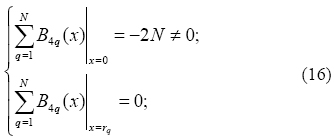
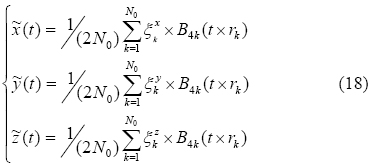
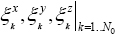
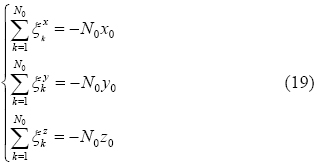
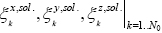
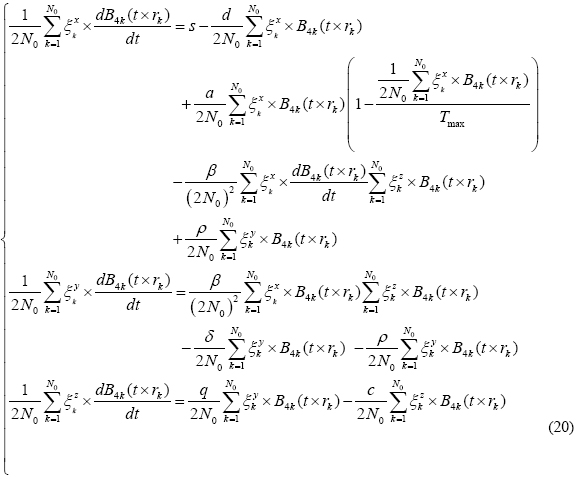
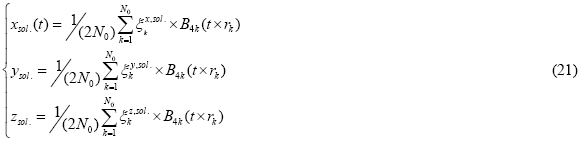
<body><![CDATA[<p align="justify"><font face="verdana" size="2">Several solutions have been proposed using BPES in many fields such as numerical analysis, theoretical physics, mathematical algorithms, heat transfer, homodynamic, material characterization, fuzzy systems modelling, and biology &#91;26&#45;33&#93;.</font></p>  	    <p align="justify"><font face="verdana" size="2">The resolution protocol is based on setting <img src="/img/revistas/ns/v7n13/a1i1.jpg"><i>(t)</i>, <i><img src="/img/revistas/ns/v7n13/a1i2.jpg">(t)</i>, and <i><img src="/img/revistas/ns/v7n13/a1i3.jpg">(t)</i> as estimators to the t&#45;dependent variables <i>x(t</i>), <i>y(t</i>), and z(t), respectively</font></p>  	    <p align="center"><font face="verdana" size="2"><img src="/img/revistas/ns/v7n13/a1e18.jpg"></font></p>  	    <p align="justify"><font face="verdana" size="2">where B<sub>4</sub><i><sub>k</sub></i> are the 4k&#45;order Boubaker polynomials &#91;29&#45;30&#93;, <i>r<sub>k</sub></i> are <i>B<sub>4k</sub></i> minimal positive roots, <i>N</i><sub>0</sub> is a prefixed integer, and <img src="/img/revistas/ns/v7n13/a1i4.jpg"> are unknown pondering real coefficients.</font></p>  	    <p align="justify"><font face="verdana" size="2">The main advantage of this formulation is the verification of boundary conditions, expressed in (1), in advance to the resolution process. In fact, thanks to the properties expressed in (16) and (17), these conditions are reduced to the inherently verified linear equations</font></p>  	    <p align="center"><font face="verdana" size="2"><img src="/img/revistas/ns/v7n13/a1e19.jpg"></font></p>  	    <p align="justify"><font face="verdana" size="2">The BPES solution for (1) is obtained, according to the principles of the BPES, by determining the non&#45;null set of coefficients <i><img src="/img/revistas/ns/v7n13/a1i5.jpg"></i>that minimizes the absolute difference between left and right sides of the following equations</font></p>  	    <p align="center"><font face="verdana" size="2"><img src="/img/revistas/ns/v7n13/a1e20.jpg"></font></p>  	    <p align="justify"><font face="verdana" size="2">The final solution is</font></p>  	    <p align="center"><font face="verdana" size="2"><img src="/img/revistas/ns/v7n13/a1e21.jpg"></font></p>  	    ]]></body>
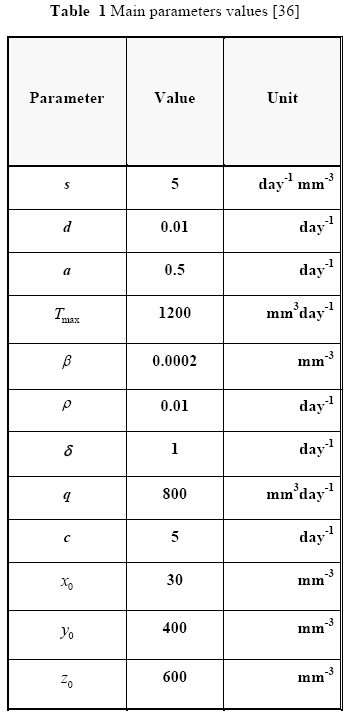
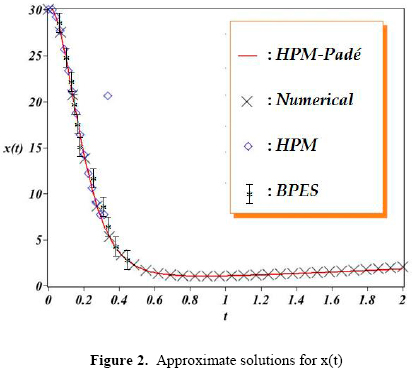
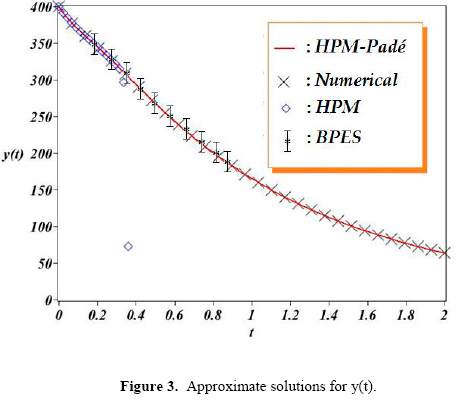
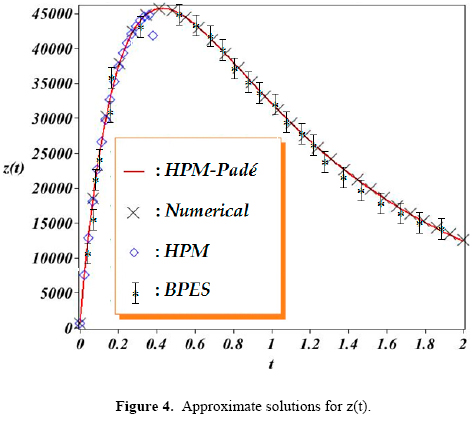
<body><![CDATA[<p align="justify"><font face="verdana" size="2">&nbsp;</font></p>  	    <p align="justify"><font face="verdana" size="2"><b>6. Results and analysis</b></font></p>  	    <p align="justify"><font face="verdana" size="2">In order to provide a reference point, the obtained results were compared to the numerical solution obtained using the Fehlberg fourth&#45;fifth order Runge&#45;Kutta method with degree four interpolant (RKF45) &#91;42,43&#93; built&#45;in routine from Maple 17 Software. The routine was configured using an absolute error of 10<sup>&#45;7</sup> and a relative error of 10<sup>&#45;6</sup>. <a href="#f2">Figure 2</a> through <a href="#f4">4</a> show the graphical comparison of the HPM (15), HPM&#45;Pad&eacute; and BPES (21) solutions. HPM and BPES solutions exhibit similar domains of convergence; the accuracy of both approximations decrease rapidly for t&#62;0.4 as depicted in <a href="#f2">figures 2</a>&#45;<a href="#f4">4</a> (<a href="#f2">2</a>,<a href="#f3">3</a> y<a href="#f4"> 4</a>). Nonetheless, from the same figures, we can observe that the HPM&#45;Pad&eacute; solution possesses wider domain of convergence than BPES and standard HPM.</font></p>  	    <p align="center"><font face="verdana" size="2"><a name="f2"></a></font></p>  	    <p align="center"><font face="verdana" size="2"><img src="/img/revistas/ns/v7n13/a1f2.jpg"></font></p>  	    <p align="center"><a name="f3"></a></p> 	    <p align="center"><font face="verdana" size="2"><img src="/img/revistas/ns/v7n13/a1f3.jpg"></font></p>      <p align="center"><font face="verdana" size="2"><a name="f4"></a></font></p>  	    <p align="center"><font face="verdana" size="2"><img src="/img/revistas/ns/v7n13/a1f4.jpg"></font></p>  	    <p align="justify"><font face="verdana" size="2">HPM&#45;Pad&eacute; technique is able to produce easy computable rational expression that exhibit a wide convergence region in comparison to polynomial solutions schemes. Nonetheless, further research is required in order to obtain solutions with even larger domain of convergence that can lead to a better understanding of the dynamics of the HIV infection and its relationship with the parameters of <a href="#t1">Table 1</a>.</font></p>  	    ]]></body>
<body><![CDATA[<p align="justify"><font face="verdana" size="2">&nbsp;</font></p>  	    <p align="justify"><font face="verdana" size="2"><b>7. Conclusion</b></font></p>  	    <p align="justify"><font face="verdana" size="2">In this paper, a comparison of HPM, HPM&#45;Pad&eacute; and BPES was studied by solving an HIV&#45;1 infection dynamics model with cure rate. The HPM&#45;Pad&eacute; solution exhibited a wider domain of convergence than HPM and BPES, reaching a good agreement to the exact solution for range <i>t</i> &#8712; &#91;o,2&#93;. Further research is required in order to obtain solution with larger domain of convergence that can lead to a better understanding of the dynamics of the HIV infection and the relationship with its parameters.</font></p>  	    <p align="justify"><font face="verdana" size="2">&nbsp;</font></p>  	    <p align="justify"><font face="verdana" size="2"><b>Acknowledgments</b></font></p>  	    <p align="justify"><font face="verdana" size="2">We gratefully acknowledge the financial support provided by the National Council for Science and Technology of Mexico (CONACyT) through grant CB&#45;2010&#45;01 &#35;157024.</font></p>  	    <p align="justify"><font face="verdana" size="2">&nbsp;</font></p>  	    <p align="justify"><font face="verdana" size="2"><b>References</b></font></p>  	    <!-- ref --><p align="justify"><font face="verdana" size="2">&#91;1&#93; M. A. Capistran, F. J. Solis, On the modeling of long&#45;term HIV&#45;1 infection dynamics, Mathematical and Comp. Modelling, Vol. 50 (5&#45;6) 777&#45;782, 2009.    &nbsp;&nbsp;&nbsp;&nbsp;&nbsp;&nbsp;&nbsp;&nbsp;[&#160;<a href="javascript:void(0);" onclick="javascript: window.open('/scielo.php?script=sci_nlinks&ref=5489305&pid=S2007-0705201500010000100001&lng=','','width=640,height=500,resizable=yes,scrollbars=1,menubar=yes,');">Links</a>&#160;]<!-- end-ref --></font></p>  	    ]]></body>
<body><![CDATA[<p align="justify"><font face="verdana" size="2">&#91;2&#93; R. Xu, Computers &#38; Mathematics with Applications, Global dynamics of an HIV&#45;1 infection model with distributed intracellular delays, Vol. 61(9) 2799&#45;2805, 2011.</font></p>  	    <!-- ref --><p align="justify"><font face="verdana" size="2">&#91;3&#93; R. Xu, Global stability of an HIV&#45;1 infection model with saturation infection and intracellular delay," Journal of Mathematical Analysis and Applications, Vol. 375 (1), 7581, 2011.    &nbsp;&nbsp;&nbsp;&nbsp;&nbsp;&nbsp;&nbsp;&nbsp;[&#160;<a href="javascript:void(0);" onclick="javascript: window.open('/scielo.php?script=sci_nlinks&ref=5489308&pid=S2007-0705201500010000100002&lng=','','width=640,height=500,resizable=yes,scrollbars=1,menubar=yes,');">Links</a>&#160;]<!-- end-ref --></font></p>  	    <p align="justify"><font face="verdana" size="2">&#91;4&#93; L. Rong, A.S. Perelson, J. Theor. Biol., Modeling HIV persistence, the latent reservoir, and viral blips, Vol. 260 308&#45;331, 2009.</font></p>  	    <!-- ref --><p align="justify"><font face="verdana" size="2">&#91;5&#93; S. Ruan, J. Wei, On the zeros of transcendental functions with applications to stability of delay differential equations with two delays, Dyn. of Continuous, Discrete and Impulsive Syst, Vol. 10, 863&#45;874, 2003.    &nbsp;&nbsp;&nbsp;&nbsp;&nbsp;&nbsp;&nbsp;&nbsp;[&#160;<a href="javascript:void(0);" onclick="javascript: window.open('/scielo.php?script=sci_nlinks&ref=5489311&pid=S2007-0705201500010000100003&lng=','','width=640,height=500,resizable=yes,scrollbars=1,menubar=yes,');">Links</a>&#160;]<!-- end-ref --></font></p>  	    <!-- ref --><p align="justify"><font face="verdana" size="2">&#91;6&#93; S. Ruan and J. Wei, Periodic solutions of planar systems with two delays, Proc. Royal Soc. Edinburgh Ser. A 129, 1017&#45;1032, 1999.    &nbsp;&nbsp;&nbsp;&nbsp;&nbsp;&nbsp;&nbsp;&nbsp;[&#160;<a href="javascript:void(0);" onclick="javascript: window.open('/scielo.php?script=sci_nlinks&ref=5489313&pid=S2007-0705201500010000100004&lng=','','width=640,height=500,resizable=yes,scrollbars=1,menubar=yes,');">Links</a>&#160;]<!-- end-ref --></font></p>  	    <!-- ref --><p align="justify"><font face="verdana" size="2">&#91;7&#93; A.S. Perelson, Modelling viral and immune system dynamics, Nat. Rev. Immunol., Vol. 2 28&#45;36, 2002.    &nbsp;&nbsp;&nbsp;&nbsp;&nbsp;&nbsp;&nbsp;&nbsp;[&#160;<a href="javascript:void(0);" onclick="javascript: window.open('/scielo.php?script=sci_nlinks&ref=5489315&pid=S2007-0705201500010000100005&lng=','','width=640,height=500,resizable=yes,scrollbars=1,menubar=yes,');">Links</a>&#160;]<!-- end-ref --></font></p>  	    ]]></body>
<body><![CDATA[<!-- ref --><p align="justify"><font face="verdana" size="2">&#91;8&#93; G. R&ouml;st, J.Wu, SEIR epidemiological model with varying infectivity and infinite delay, Math. Biosci. and Eng. Vol. 5, 389&#45;402, 2008.    &nbsp;&nbsp;&nbsp;&nbsp;&nbsp;&nbsp;&nbsp;&nbsp;[&#160;<a href="javascript:void(0);" onclick="javascript: window.open('/scielo.php?script=sci_nlinks&ref=5489317&pid=S2007-0705201500010000100006&lng=','','width=640,height=500,resizable=yes,scrollbars=1,menubar=yes,');">Links</a>&#160;]<!-- end-ref --></font></p>  	    <!-- ref --><p align="justify"><font face="verdana" size="2">&#91;9&#93; Y. Ding, and H. Ye, A fractional&#45;order differential equation model of HIV infection of CD4&#43; T&#45;cells, Mathematical and Computer Modelling, Vol. 50(3&#45;4) 386&#45;392, 2009.    &nbsp;&nbsp;&nbsp;&nbsp;&nbsp;&nbsp;&nbsp;&nbsp;[&#160;<a href="javascript:void(0);" onclick="javascript: window.open('/scielo.php?script=sci_nlinks&ref=5489319&pid=S2007-0705201500010000100007&lng=','','width=640,height=500,resizable=yes,scrollbars=1,menubar=yes,');">Links</a>&#160;]<!-- end-ref --></font></p>  	    <!-- ref --><p align="justify"><font face="verdana" size="2">&#91;10&#93; K. Wang, W. Wang, H. Pang, X. Liu, Complex dynamic behavior in a viral model with delayed immune response, Physica D, Vol. 226 197&#45;208, 2007.    &nbsp;&nbsp;&nbsp;&nbsp;&nbsp;&nbsp;&nbsp;&nbsp;[&#160;<a href="javascript:void(0);" onclick="javascript: window.open('/scielo.php?script=sci_nlinks&ref=5489321&pid=S2007-0705201500010000100008&lng=','','width=640,height=500,resizable=yes,scrollbars=1,menubar=yes,');">Links</a>&#160;]<!-- end-ref --></font></p>  	    <!-- ref --><p align="justify"><font face="verdana" size="2">&#91;11&#93; D. Finzi, M. Hermankova, T. Pierson, L.M. Carruth, C. Buck, R.E. Chaisson, T.C. Quinn, K. Chadwick, J. Margolick, R. Brookmeyer, J. Gallant, M. Markowitz, D.D. Ho, D.D. Richman, R.F. Siliciano, Identification of a Reservoir for HIV&#45;1 in Patients on Highly Active Antiretroviral Therapy, Science Vol. 278 (5341) 1295 &#45;1300, 1997</font>&nbsp;&nbsp;&nbsp;&nbsp;&nbsp;&nbsp;&nbsp;&nbsp;[&#160;<a href="javascript:void(0);" onclick="javascript: window.open('/scielo.php?script=sci_nlinks&ref=5489323&pid=S2007-0705201500010000100009&lng=','','width=640,height=500,resizable=yes,scrollbars=1,menubar=yes,');">Links</a>&#160;]<!-- end-ref --><!-- ref --><p align="justify"><font face="verdana" size="2">&#91;12&#93; P. Nelson, J. Murray, A. Perelson, A model of HIV&#45;1 pathogenesis that includes an intracellular delay, Math. Biosci., Vol. 163 (2) 201&#45;215, 2000.    &nbsp;&nbsp;&nbsp;&nbsp;&nbsp;&nbsp;&nbsp;&nbsp;[&#160;<a href="javascript:void(0);" onclick="javascript: window.open('/scielo.php?script=sci_nlinks&ref=5489324&pid=S2007-0705201500010000100010&lng=','','width=640,height=500,resizable=yes,scrollbars=1,menubar=yes,');">Links</a>&#160;]<!-- end-ref --></font></p>  	    <!-- ref --><p align="justify"><font face="verdana" size="2">&#91;13&#93; H. Zhu, X. Zou, Impact of delays in cell infection and virus production on HIV&#45;1 dynamics, Math. Medic. Bio., Vol. 25 (2) 99&#45;112, 2008.    &nbsp;&nbsp;&nbsp;&nbsp;&nbsp;&nbsp;&nbsp;&nbsp;[&#160;<a href="javascript:void(0);" onclick="javascript: window.open('/scielo.php?script=sci_nlinks&ref=5489326&pid=S2007-0705201500010000100011&lng=','','width=640,height=500,resizable=yes,scrollbars=1,menubar=yes,');">Links</a>&#160;]<!-- end-ref --></font></p>  	    <!-- ref --><p align="justify"><font face="verdana" size="2">&#91;14&#93; P. Nelson, A. Perelson, Mathematical analysis of delay differential equation models of HIV&#45;1 infection, Math. Bioscien, Vol 179 (1) 73&#45;94, 2002.    &nbsp;&nbsp;&nbsp;&nbsp;&nbsp;&nbsp;&nbsp;&nbsp;[&#160;<a href="javascript:void(0);" onclick="javascript: window.open('/scielo.php?script=sci_nlinks&ref=5489328&pid=S2007-0705201500010000100012&lng=','','width=640,height=500,resizable=yes,scrollbars=1,menubar=yes,');">Links</a>&#160;]<!-- end-ref --></font></p>  	    <!-- ref --><p align="justify"><font face="verdana" size="2">&#91;15&#93; J. Tam, Delay effect in a model for virus replication, IMA J. of Math. Applied to Medicine and Biol. Vol. 16(1) 29&#45;37, 1999.    &nbsp;&nbsp;&nbsp;&nbsp;&nbsp;&nbsp;&nbsp;&nbsp;[&#160;<a href="javascript:void(0);" onclick="javascript: window.open('/scielo.php?script=sci_nlinks&ref=5489330&pid=S2007-0705201500010000100013&lng=','','width=640,height=500,resizable=yes,scrollbars=1,menubar=yes,');">Links</a>&#160;]<!-- end-ref --></font></p>  	    <!-- ref --><p align="justify"><font face="verdana" size="2">&#91;16&#93; He, J. H., "Homotopy perturbation technique," Comput. Methods Appl. Mech. Eng., Vol.178, 257&#45;262, 1999.    &nbsp;&nbsp;&nbsp;&nbsp;&nbsp;&nbsp;&nbsp;&nbsp;[&#160;<a href="javascript:void(0);" onclick="javascript: window.open('/scielo.php?script=sci_nlinks&ref=5489332&pid=S2007-0705201500010000100014&lng=','','width=640,height=500,resizable=yes,scrollbars=1,menubar=yes,');">Links</a>&#160;]<!-- end-ref --></font></p>  	    <!-- ref --><p align="justify"><font face="verdana" size="2">&#91;17&#93; He, J. H., "A coupling method of a homotopy technique and a perturbation technique for non&#45;linear problems," Inter. J. Non&#45;linear Mech., Vol.35, 37&#45;43, 2000.    &nbsp;&nbsp;&nbsp;&nbsp;&nbsp;&nbsp;&nbsp;&nbsp;[&#160;<a href="javascript:void(0);" onclick="javascript: window.open('/scielo.php?script=sci_nlinks&ref=5489334&pid=S2007-0705201500010000100015&lng=','','width=640,height=500,resizable=yes,scrollbars=1,menubar=yes,');">Links</a>&#160;]<!-- end-ref --></font></p>  	    <!-- ref --><p align="justify"><font face="verdana" size="2">&#91;18&#93; He, J. H., "Homotopy perturbation method: a new nonlinear analytical technique," Appl. Math. Comput., Vol.135, 73&#45;79, 2003.    &nbsp;&nbsp;&nbsp;&nbsp;&nbsp;&nbsp;&nbsp;&nbsp;[&#160;<a href="javascript:void(0);" onclick="javascript: window.open('/scielo.php?script=sci_nlinks&ref=5489336&pid=S2007-0705201500010000100016&lng=','','width=640,height=500,resizable=yes,scrollbars=1,menubar=yes,');">Links</a>&#160;]<!-- end-ref --></font></p>  	    <!-- ref --><p align="justify"><font face="verdana" size="2">&#91;19&#93; H. Vazquez&#45;Leal, Y. Khan, G. Fern&aacute;ndez&#45;Anaya, et al., "A General Solution for Troesch's Problem," Mathematical Problems in Engineering, vol. 2012, Article ID 208375, 14 pages, 2012. doi:10.1155/2012/208375.    &nbsp;&nbsp;&nbsp;&nbsp;&nbsp;&nbsp;&nbsp;&nbsp;[&#160;<a href="javascript:void(0);" onclick="javascript: window.open('/scielo.php?script=sci_nlinks&ref=5489338&pid=S2007-0705201500010000100017&lng=','','width=640,height=500,resizable=yes,scrollbars=1,menubar=yes,');">Links</a>&#160;]<!-- end-ref --></font></p>  	    <!-- ref --><p align="justify"><font face="verdana" size="2">&#91;20&#93; Hector Vazquez&#45;Leal, Arturo Sarmiento&#45;Reyes, Yasir Khan, Uriel Filobello&#45;Nino, and Alejandro Diaz&#45;Sanchez, "Rational Biparameter Homotopy Perturbation Method and Laplace&#45;Pad&eacute; Coupled Version," Journal of Applied Mathematics, vol. 2012, Article ID 923975, 21 pages, 2012. doi:10.1155/2012/923975.    &nbsp;&nbsp;&nbsp;&nbsp;&nbsp;&nbsp;&nbsp;&nbsp;[&#160;<a href="javascript:void(0);" onclick="javascript: window.open('/scielo.php?script=sci_nlinks&ref=5489340&pid=S2007-0705201500010000100018&lng=','','width=640,height=500,resizable=yes,scrollbars=1,menubar=yes,');">Links</a>&#160;]<!-- end-ref --></font></p>  	    <!-- ref --><p align="justify"><font face="verdana" size="2">&#91;21&#93; H&eacute;ctor Vazquez&#45;Leal, "Rational Homotopy Perturbation Method," Journal of Applied Mathematics, vol. 2012, Article ID 490342, 14 pages, 2012. doi:10.1155/2012/490342.    &nbsp;&nbsp;&nbsp;&nbsp;&nbsp;&nbsp;&nbsp;&nbsp;[&#160;<a href="javascript:void(0);" onclick="javascript: window.open('/scielo.php?script=sci_nlinks&ref=5489342&pid=S2007-0705201500010000100019&lng=','','width=640,height=500,resizable=yes,scrollbars=1,menubar=yes,');">Links</a>&#160;]<!-- end-ref --></font></p>  	    <!-- ref --><p align="justify"><font face="verdana" size="2">&#91;22&#93; Yasir Khan, Hector Vazquez&#45;Leal, and Luis Hernandez&#45;Martinez, "Removal of Noise Oscillation Term Appearing in the Nonlinear Equation Solution," Journal of Applied Mathematics, vol. 2012, Article ID 387365, 9 pages, 2012. doi:10.1155/2012/387365.    &nbsp;&nbsp;&nbsp;&nbsp;&nbsp;&nbsp;&nbsp;&nbsp;[&#160;<a href="javascript:void(0);" onclick="javascript: window.open('/scielo.php?script=sci_nlinks&ref=5489344&pid=S2007-0705201500010000100020&lng=','','width=640,height=500,resizable=yes,scrollbars=1,menubar=yes,');">Links</a>&#160;]<!-- end-ref --></font></p>  	    <!-- ref --><p align="justify"><font face="verdana" size="2">&#91;23&#93; Hector Vazquez&#45;Leal, Roberto Castaneda&#45;Sheissa, Uriel Filobello&#45;Nino, Arturo Sarmiento&#45;Reyes, and Jesus Sanchez Orea, "High Accurate Simple Approximation of Normal Distribution Integral," Mathematical Problems in Engineering, vol. 2012, Article ID 124029, 22 pages, 2012. doi:10.1155/2012/124029.    &nbsp;&nbsp;&nbsp;&nbsp;&nbsp;&nbsp;&nbsp;&nbsp;[&#160;<a href="javascript:void(0);" onclick="javascript: window.open('/scielo.php?script=sci_nlinks&ref=5489346&pid=S2007-0705201500010000100021&lng=','','width=640,height=500,resizable=yes,scrollbars=1,menubar=yes,');">Links</a>&#160;]<!-- end-ref --></font></p>  	    <!-- ref --><p align="justify"><font face="verdana" size="2">&#91;24&#93; Y. Khan, H. V&aacute;zquez&#45;Leal, L. Hernandez&#45;Martinez and N. Faraz, "Variational iteration algorithm&#45;II for solving linear and non&#45;linear ODEs", International Journal of the Physical Sciences Vol. 7(25), pp. 3099&#45;4002, 29 June, 2012.    &nbsp;&nbsp;&nbsp;&nbsp;&nbsp;&nbsp;&nbsp;&nbsp;[&#160;<a href="javascript:void(0);" onclick="javascript: window.open('/scielo.php?script=sci_nlinks&ref=5489348&pid=S2007-0705201500010000100022&lng=','','width=640,height=500,resizable=yes,scrollbars=1,menubar=yes,');">Links</a>&#160;]<!-- end-ref --></font></p>  	    <!-- ref --><p align="justify"><font face="verdana" size="2">&#91;25&#93; He, J.H. Variational iteration method&#45;a kind of nonlinear analytical technique: Some examples, International Journal of Nonlinear Mechanics, 1999, 34 (4), 699&#45;708.    &nbsp;&nbsp;&nbsp;&nbsp;&nbsp;&nbsp;&nbsp;&nbsp;[&#160;<a href="javascript:void(0);" onclick="javascript: window.open('/scielo.php?script=sci_nlinks&ref=5489350&pid=S2007-0705201500010000100023&lng=','','width=640,height=500,resizable=yes,scrollbars=1,menubar=yes,');">Links</a>&#160;]<!-- end-ref --></font></p>  	    <!-- ref --><p align="justify"><font face="verdana" size="2">&#91;26&#93; M. Agida, A. S. Kumar, A Boubaker Polynomials Expansion Scheme solution to random Love equation in the case of a rational kernel, El. Journal of Theoretical Physics, 2010, 7, 319&#45;326.    &nbsp;&nbsp;&nbsp;&nbsp;&nbsp;&nbsp;&nbsp;&nbsp;[&#160;<a href="javascript:void(0);" onclick="javascript: window.open('/scielo.php?script=sci_nlinks&ref=5489352&pid=S2007-0705201500010000100024&lng=','','width=640,height=500,resizable=yes,scrollbars=1,menubar=yes,');">Links</a>&#160;]<!-- end-ref --></font></p>  	    <!-- ref --><p align="justify"><font face="verdana" size="2">&#91;27&#93; J. Ghanouchi, H. Labiadhand K. Boubaker, An attempt to solve the heat transfert equation in a model of pyrolysis spray using 4q&#45;order m&#45;Boubaker polynomials Int. J. of Heat and Technology, 2008, 26, 49&#45;53.    &nbsp;&nbsp;&nbsp;&nbsp;&nbsp;&nbsp;&nbsp;&nbsp;[&#160;<a href="javascript:void(0);" onclick="javascript: window.open('/scielo.php?script=sci_nlinks&ref=5489354&pid=S2007-0705201500010000100025&lng=','','width=640,height=500,resizable=yes,scrollbars=1,menubar=yes,');">Links</a>&#160;]<!-- end-ref --></font></p>  	    <!-- ref --><p align="justify"><font face="verdana" size="2">&#91;28&#93; S. Slama, J. Bessrour, K. Boubaker and M. Bouhafs, A dynamical model for investigation of A3 point maximal spatial evolution during resistance spot welding using Boubaker polynomials, Eur. Phys. J. Appl. Phys. 2008, 44, 317&#45;322.    &nbsp;&nbsp;&nbsp;&nbsp;&nbsp;&nbsp;&nbsp;&nbsp;[&#160;<a href="javascript:void(0);" onclick="javascript: window.open('/scielo.php?script=sci_nlinks&ref=5489356&pid=S2007-0705201500010000100026&lng=','','width=640,height=500,resizable=yes,scrollbars=1,menubar=yes,');">Links</a>&#160;]<!-- end-ref --></font></p>  	    <!-- ref --><p align="justify"><font face="verdana" size="2">&#91;29&#93; T. Ghrib, K. Boubakerand M. Bouhafs, Investigation of thermal diffusivity&#45;microhardness correlation extended to surface&#45;nitrured steel using Boubaker polynomials expansion, Modern Physics Letters B, 2008, 22, 2893&#45;2907.    &nbsp;&nbsp;&nbsp;&nbsp;&nbsp;&nbsp;&nbsp;&nbsp;[&#160;<a href="javascript:void(0);" onclick="javascript: window.open('/scielo.php?script=sci_nlinks&ref=5489358&pid=S2007-0705201500010000100027&lng=','','width=640,height=500,resizable=yes,scrollbars=1,menubar=yes,');">Links</a>&#160;]<!-- end-ref --></font></p>  	    <!-- ref --><p align="justify"><font face="verdana" size="2">&#91;30&#93; A. S. Kumar, An analytical solution to applied mathematics&#45;related Love's equation using the Boubaker Polynomials Expansion Scheme, Journal of the Franklin Institute, 2010, 347, 1755&#45;1761.    &nbsp;&nbsp;&nbsp;&nbsp;&nbsp;&nbsp;&nbsp;&nbsp;[&#160;<a href="javascript:void(0);" onclick="javascript: window.open('/scielo.php?script=sci_nlinks&ref=5489360&pid=S2007-0705201500010000100028&lng=','','width=640,height=500,resizable=yes,scrollbars=1,menubar=yes,');">Links</a>&#160;]<!-- end-ref --></font></p>  	    <!-- ref --><p align="justify"><font face="verdana" size="2">&#91;31&#93; S. Fridjine, M. Amlouk, A new parameter: An ABACUS for optimizig functional materials using the Boubaker polynomials expansion scheme, Modern Phys. Lett. B, 2009, 23, 2179&#45;2182.    &nbsp;&nbsp;&nbsp;&nbsp;&nbsp;&nbsp;&nbsp;&nbsp;[&#160;<a href="javascript:void(0);" onclick="javascript: window.open('/scielo.php?script=sci_nlinks&ref=5489362&pid=S2007-0705201500010000100029&lng=','','width=640,height=500,resizable=yes,scrollbars=1,menubar=yes,');">Links</a>&#160;]<!-- end-ref --></font></p>  	    <!-- ref --><p align="justify"><font face="verdana" size="2">&#91;32&#93; A. Milgram, The stability of the Boubaker polynomials expansion scheme (BPES)&#45;based solution to Lotka&#45;Volterra problem, J. of Theoretical Biology, 2011, 271, 157&#45;158.    &nbsp;&nbsp;&nbsp;&nbsp;&nbsp;&nbsp;&nbsp;&nbsp;[&#160;<a href="javascript:void(0);" onclick="javascript: window.open('/scielo.php?script=sci_nlinks&ref=5489364&pid=S2007-0705201500010000100030&lng=','','width=640,height=500,resizable=yes,scrollbars=1,menubar=yes,');">Links</a>&#160;]<!-- end-ref --></font></p>  	    <!-- ref --><p align="justify"><font face="verdana" size="2">&#91;33&#93; H. Rahmanov, A Solution to the non Linear Korteweg&#45;De&#45;Vries Equation in the Particular Case Dispersion&#45;Adsorption Problem in Porous Media Using the Spectral Boubaker Polynomials Expansion Scheme (BPES), Studies in Nonlinear Sciences, 2011, 2 (1) 46&#45;49.    &nbsp;&nbsp;&nbsp;&nbsp;&nbsp;&nbsp;&nbsp;&nbsp;[&#160;<a href="javascript:void(0);" onclick="javascript: window.open('/scielo.php?script=sci_nlinks&ref=5489366&pid=S2007-0705201500010000100031&lng=','','width=640,height=500,resizable=yes,scrollbars=1,menubar=yes,');">Links</a>&#160;]<!-- end-ref --></font></p>  	    <!-- ref --><p align="justify"><font face="verdana" size="2">&#91;34&#93; S. Li, S. Liao, An analytic approach to solve multiple solutions of a strongly nonlinear problem, Applied Mathematics and Computation, 2005, 169, 854&#45;865.    &nbsp;&nbsp;&nbsp;&nbsp;&nbsp;&nbsp;&nbsp;&nbsp;[&#160;<a href="javascript:void(0);" onclick="javascript: window.open('/scielo.php?script=sci_nlinks&ref=5489368&pid=S2007-0705201500010000100032&lng=','','width=640,height=500,resizable=yes,scrollbars=1,menubar=yes,');">Links</a>&#160;]<!-- end-ref --></font></p>  	    <!-- ref --><p align="justify"><font face="verdana" size="2">&#91;35&#93; Hector Vazquez&#45;Leal, Generalized homotopy method for solving nonlinear differential equations, Computational and Applied Mathematics, 2013, 14 pages, 10.1007/s40314&#45;013&#45;0060&#45;4.    &nbsp;&nbsp;&nbsp;&nbsp;&nbsp;&nbsp;&nbsp;&nbsp;[&#160;<a href="javascript:void(0);" onclick="javascript: window.open('/scielo.php?script=sci_nlinks&ref=5489370&pid=S2007-0705201500010000100033&lng=','','width=640,height=500,resizable=yes,scrollbars=1,menubar=yes,');">Links</a>&#160;]<!-- end-ref --></font></p>  	    <!-- ref --><p align="justify"><font face="verdana" size="2">&#91;36&#93; Xueyong Zhou, Xinyu Song, Xiangyun Shi, A differential equation model of HIV infection of CD4&#43; T&#45;cells with cure rate, Journal of Mathematical Analysis and Applications, Volume 342, Issue 2, 15 June 2008, Pages 1342&#45;1355, ISSN 0022&#45;247X, 10.1016/j.jmaa.2008.01.008.    &nbsp;&nbsp;&nbsp;&nbsp;&nbsp;&nbsp;&nbsp;&nbsp;[&#160;<a href="javascript:void(0);" onclick="javascript: window.open('/scielo.php?script=sci_nlinks&ref=5489372&pid=S2007-0705201500010000100034&lng=','','width=640,height=500,resizable=yes,scrollbars=1,menubar=yes,');">Links</a>&#160;]<!-- end-ref --></font></p>  	    <!-- ref --><p align="justify"><font face="verdana" size="2">&#91;37&#93; Filobello&#45;Nino U, H. Vazquez&#45;Leal, Y. Khan, A. Yildirim, V.M. Jimenez&#45; Fernandez, A.L. Herrera May, R. Castaneda&#45;Sheissa, and J.Cervantes&#45;Perez. Using Perturbation methods and Laplace&#45;Pad&eacute; approximation to solve nonlinear problems. Miskolc Mathematical Notes, 14 (1) 2013 89&#45;101 e&#45;ISSN: 1787&#45;2413.    &nbsp;&nbsp;&nbsp;&nbsp;&nbsp;&nbsp;&nbsp;&nbsp;[&#160;<a href="javascript:void(0);" onclick="javascript: window.open('/scielo.php?script=sci_nlinks&ref=5489374&pid=S2007-0705201500010000100035&lng=','','width=640,height=500,resizable=yes,scrollbars=1,menubar=yes,');">Links</a>&#160;]<!-- end-ref --></font></p>  	    <!-- ref --><p align="justify"><font face="verdana" size="2">&#91;38&#93; Hector Vazquez&#45;Leal, Uriel Filobello&#45;Nino, Ahmet Yildirim, Luis Hernandez&#45;Martinez, Roberto Castaneda&#45;Sheissa, Jesus Sanchez&#45;Orea, J. E. Molinar&#45;Solis and Alejandro Diaz&#45;Sanchez, "Transient and DC approximate expressions for diode circuits", IEICE Electron. Express, Vol. 9, No. 6, pp.522&#45;530, (2012).    &nbsp;&nbsp;&nbsp;&nbsp;&nbsp;&nbsp;&nbsp;&nbsp;[&#160;<a href="javascript:void(0);" onclick="javascript: window.open('/scielo.php?script=sci_nlinks&ref=5489376&pid=S2007-0705201500010000100036&lng=','','width=640,height=500,resizable=yes,scrollbars=1,menubar=yes,');">Links</a>&#160;]<!-- end-ref --></font></p>  	    <!-- ref --><p align="justify"><font face="verdana" size="2">&#91;39&#93; Hector Vazquez&#45;Leal, Luis Hernandez&#45;Martinez, Arturo Sarmiento&#45;Reyes, Roberto Casta&ntilde;eda&#45;Sheissa, and Agust&iacute;n Gallardo&#45;Del&#45;Angel, "Homotopy method with a formal stop criterion applied to circuit simulation", IEICE Electron. Express, Vol. 8, No. 21, pp.1808&#45;1815, 2011. DOI: 10.1587/elex.8.1808.    &nbsp;&nbsp;&nbsp;&nbsp;&nbsp;&nbsp;&nbsp;&nbsp;[&#160;<a href="javascript:void(0);" onclick="javascript: window.open('/scielo.php?script=sci_nlinks&ref=5489378&pid=S2007-0705201500010000100037&lng=','','width=640,height=500,resizable=yes,scrollbars=1,menubar=yes,');">Links</a>&#160;]<!-- end-ref --></font></p>  	    <!-- ref --><p align="justify"><font face="verdana" size="2">&#91;40&#93; Hector Vazquez&#45;Leal, Luis Hernandez&#45;Martinez, and Arturo Sarmiento&#45;Reyes, "Double&#45;Bounded Homotopy for analysing nonlinear resistive circuits", International Symposium on Circuits and Systems, Kobe, Japon, 2005pp. 3203&#45; 3206.    &nbsp;&nbsp;&nbsp;&nbsp;&nbsp;&nbsp;&nbsp;&nbsp;[&#160;<a href="javascript:void(0);" onclick="javascript: window.open('/scielo.php?script=sci_nlinks&ref=5489380&pid=S2007-0705201500010000100038&lng=','','width=640,height=500,resizable=yes,scrollbars=1,menubar=yes,');">Links</a>&#160;]<!-- end-ref --></font></p>  	    <!-- ref --><p align="justify"><font face="verdana" size="2">&#91;41&#93; Hector Vazquez&#45;Leal, Luis Hernandez&#45;Martinez, and Arturo Sarmiento&#45;Reyes, and Roberto Casta&ntilde;eda&#45;Sheissa, "Numerical continuation scheme for tracing the double bounded homotopy for analysing nonlinear circuits", International Conference on Communications, Circuits and Systems, Hong Kong, China, 2005,pp. 1122&#45; 1126.    &nbsp;&nbsp;&nbsp;&nbsp;&nbsp;&nbsp;&nbsp;&nbsp;[&#160;<a href="javascript:void(0);" onclick="javascript: window.open('/scielo.php?script=sci_nlinks&ref=5489382&pid=S2007-0705201500010000100039&lng=','','width=640,height=500,resizable=yes,scrollbars=1,menubar=yes,');">Links</a>&#160;]<!-- end-ref --></font></p>  	    <!-- ref --><p align="justify"><font face="verdana" size="2">&#91;42&#93; Enright, W.H.; Jackson, K.R.; Norsett, S.P. abd; Thomsen, P.G. Interpolants for Runge&#45;Kutta Formulas. ACM TOMS, Vol. 12, pp. 193&#45;218, 1986.    &nbsp;&nbsp;&nbsp;&nbsp;&nbsp;&nbsp;&nbsp;&nbsp;[&#160;<a href="javascript:void(0);" onclick="javascript: window.open('/scielo.php?script=sci_nlinks&ref=5489384&pid=S2007-0705201500010000100040&lng=','','width=640,height=500,resizable=yes,scrollbars=1,menubar=yes,');">Links</a>&#160;]<!-- end-ref --></font></p>  	    <!-- ref --><p align="justify"><font face="verdana" size="2">&#91;43&#93; Fehlberg, E. Klassische Runge&#45;Kutta&#45;Formeln vierter und niedrigerer Ordnung mit Schrittweiten&#45;Kontrolle und ihre Anwendung auf Waermeleitungsprobleme. Computing, Vol. 6, pp. 61&#45;71, 1970.    &nbsp;&nbsp;&nbsp;&nbsp;&nbsp;&nbsp;&nbsp;&nbsp;[&#160;<a href="javascript:void(0);" onclick="javascript: window.open('/scielo.php?script=sci_nlinks&ref=5489386&pid=S2007-0705201500010000100041&lng=','','width=640,height=500,resizable=yes,scrollbars=1,menubar=yes,');">Links</a>&#160;]<!-- end-ref --></font></p>      ]]></body><back>
<ref-list>
<ref id="B1">
<label>1</label><nlm-citation citation-type="journal">
<person-group person-group-type="author">
<name>
<surname><![CDATA[Capistran]]></surname>
<given-names><![CDATA[M. A.]]></given-names>
</name>
<name>
<surname><![CDATA[Solis]]></surname>
<given-names><![CDATA[F. J.]]></given-names>
</name>
</person-group>
<article-title xml:lang="en"><![CDATA[On the modeling of long-term HIV-1 infection dynamics]]></article-title>
<source><![CDATA[Mathematical and Comp. Modelling]]></source>
<year>2009</year>
<volume>50</volume>
<numero>5-6</numero>
<issue>5-6</issue>
<page-range>777-782</page-range></nlm-citation>
</ref>
<ref id="B2">
<label>3</label><nlm-citation citation-type="journal">
<person-group person-group-type="author">
<name>
<surname><![CDATA[Xu]]></surname>
<given-names><![CDATA[R.]]></given-names>
</name>
</person-group>
<article-title xml:lang="en"><![CDATA[Global stability of an HIV-1 infection model with saturation infection and intracellular delay]]></article-title>
<source><![CDATA[Journal of Mathematical Analysis and Applications]]></source>
<year>2011</year>
<volume>375</volume>
<numero>1</numero>
<issue>1</issue>
<page-range>7581</page-range></nlm-citation>
</ref>
<ref id="B3">
<label>5</label><nlm-citation citation-type="journal">
<person-group person-group-type="author">
<name>
<surname><![CDATA[Ruan]]></surname>
<given-names><![CDATA[S.]]></given-names>
</name>
<name>
<surname><![CDATA[Wei]]></surname>
<given-names><![CDATA[J.]]></given-names>
</name>
</person-group>
<article-title xml:lang="en"><![CDATA[On the zeros of transcendental functions with applications to stability of delay differential equations with two delays]]></article-title>
<source><![CDATA[Dyn. of Continuous, Discrete and Impulsive Syst]]></source>
<year>2003</year>
<volume>10</volume>
<page-range>863-874</page-range></nlm-citation>
</ref>
<ref id="B4">
<label>6</label><nlm-citation citation-type="journal">
<person-group person-group-type="author">
<name>
<surname><![CDATA[Ruan]]></surname>
<given-names><![CDATA[S.]]></given-names>
</name>
<name>
<surname><![CDATA[Wei]]></surname>
<given-names><![CDATA[J.]]></given-names>
</name>
</person-group>
<article-title xml:lang="en"><![CDATA[Periodic solutions of planar systems with two delays]]></article-title>
<source><![CDATA[Proc. Royal Soc. Edinburgh Ser. A]]></source>
<year>1999</year>
<volume>129</volume>
<page-range>1017-1032</page-range></nlm-citation>
</ref>
<ref id="B5">
<label>7</label><nlm-citation citation-type="journal">
<person-group person-group-type="author">
<name>
<surname><![CDATA[Perelson]]></surname>
<given-names><![CDATA[A.S.]]></given-names>
</name>
</person-group>
<article-title xml:lang="en"><![CDATA[Modelling viral and immune system dynamics]]></article-title>
<source><![CDATA[Nat. Rev. Immunol.]]></source>
<year>2002</year>
<volume>2</volume>
<page-range>28-36</page-range></nlm-citation>
</ref>
<ref id="B6">
<label>8</label><nlm-citation citation-type="journal">
<person-group person-group-type="author">
<name>
<surname><![CDATA[Röst]]></surname>
<given-names><![CDATA[G.]]></given-names>
</name>
<name>
<surname><![CDATA[Wu]]></surname>
<given-names><![CDATA[J.]]></given-names>
</name>
</person-group>
<article-title xml:lang="en"><![CDATA[SEIR epidemiological model with varying infectivity and infinite delay]]></article-title>
<source><![CDATA[Math. Biosci. and Eng.]]></source>
<year>2008</year>
<volume>5</volume>
<page-range>389-402</page-range></nlm-citation>
</ref>
<ref id="B7">
<label>9</label><nlm-citation citation-type="journal">
<person-group person-group-type="author">
<name>
<surname><![CDATA[Ding]]></surname>
<given-names><![CDATA[Y.]]></given-names>
</name>
<name>
<surname><![CDATA[Ye]]></surname>
<given-names><![CDATA[H.]]></given-names>
</name>
</person-group>
<article-title xml:lang="en"><![CDATA[A fractional-order differential equation model of HIV infection of CD4+ T-cells]]></article-title>
<source><![CDATA[Mathematical and Computer Modelling]]></source>
<year>2009</year>
<volume>50</volume>
<numero>3-4</numero>
<issue>3-4</issue>
<page-range>386-392</page-range></nlm-citation>
</ref>
<ref id="B8">
<label>10</label><nlm-citation citation-type="journal">
<person-group person-group-type="author">
<name>
<surname><![CDATA[Wang]]></surname>
<given-names><![CDATA[K.]]></given-names>
</name>
<name>
<surname><![CDATA[Wang]]></surname>
<given-names><![CDATA[W.]]></given-names>
</name>
<name>
<surname><![CDATA[Pang]]></surname>
<given-names><![CDATA[H.]]></given-names>
</name>
<name>
<surname><![CDATA[Liu]]></surname>
<given-names><![CDATA[X.]]></given-names>
</name>
</person-group>
<article-title xml:lang="en"><![CDATA[Complex dynamic behavior in a viral model with delayed immune response]]></article-title>
<source><![CDATA[Physica D]]></source>
<year>2007</year>
<volume>226</volume>
<page-range>197-208</page-range></nlm-citation>
</ref>
<ref id="B9">
<label>11</label><nlm-citation citation-type="journal">
<person-group person-group-type="author">
<name>
<surname><![CDATA[Finzi]]></surname>
<given-names><![CDATA[D.]]></given-names>
</name>
<name>
<surname><![CDATA[Hermankova]]></surname>
<given-names><![CDATA[M.]]></given-names>
</name>
<name>
<surname><![CDATA[Pierson]]></surname>
<given-names><![CDATA[T.]]></given-names>
</name>
<name>
<surname><![CDATA[Carruth]]></surname>
<given-names><![CDATA[L.M.]]></given-names>
</name>
<name>
<surname><![CDATA[Buck]]></surname>
<given-names><![CDATA[C.]]></given-names>
</name>
<name>
<surname><![CDATA[Chaisson]]></surname>
<given-names><![CDATA[R.E.]]></given-names>
</name>
<name>
<surname><![CDATA[Quinn]]></surname>
<given-names><![CDATA[T.C.]]></given-names>
</name>
<name>
<surname><![CDATA[Chadwick]]></surname>
<given-names><![CDATA[K.]]></given-names>
</name>
<name>
<surname><![CDATA[Margolick]]></surname>
<given-names><![CDATA[J.]]></given-names>
</name>
<name>
<surname><![CDATA[Brookmeyer]]></surname>
<given-names><![CDATA[R.]]></given-names>
</name>
<name>
<surname><![CDATA[Gallant]]></surname>
<given-names><![CDATA[J.]]></given-names>
</name>
<name>
<surname><![CDATA[Markowitz]]></surname>
<given-names><![CDATA[M.]]></given-names>
</name>
<name>
<surname><![CDATA[Ho]]></surname>
<given-names><![CDATA[D.D.]]></given-names>
</name>
<name>
<surname><![CDATA[Richman]]></surname>
<given-names><![CDATA[D.D.]]></given-names>
</name>
<name>
<surname><![CDATA[Siliciano]]></surname>
<given-names><![CDATA[R.F.]]></given-names>
</name>
</person-group>
<article-title xml:lang="en"><![CDATA[Identification of a Reservoir for HIV-1 in Patients on Highly Active Antiretroviral Therapy]]></article-title>
<source><![CDATA[Science]]></source>
<year>1997</year>
<volume>278</volume>
<numero>5341</numero>
<issue>5341</issue>
<page-range>1295 -1300</page-range></nlm-citation>
</ref>
<ref id="B10">
<label>12</label><nlm-citation citation-type="journal">
<person-group person-group-type="author">
<name>
<surname><![CDATA[Nelson]]></surname>
<given-names><![CDATA[P.]]></given-names>
</name>
<name>
<surname><![CDATA[Murray]]></surname>
<given-names><![CDATA[J.]]></given-names>
</name>
<name>
<surname><![CDATA[Perelson]]></surname>
<given-names><![CDATA[A.]]></given-names>
</name>
</person-group>
<article-title xml:lang="en"><![CDATA[A model of HIV-1 pathogenesis that includes an intracellular delay]]></article-title>
<source><![CDATA[Math. Biosci.]]></source>
<year>2000</year>
<volume>163</volume>
<numero>2</numero>
<issue>2</issue>
<page-range>201-215</page-range></nlm-citation>
</ref>
<ref id="B11">
<label>13</label><nlm-citation citation-type="journal">
<person-group person-group-type="author">
<name>
<surname><![CDATA[Zhu]]></surname>
<given-names><![CDATA[H.]]></given-names>
</name>
<name>
<surname><![CDATA[Zou]]></surname>
<given-names><![CDATA[X.]]></given-names>
</name>
</person-group>
<article-title xml:lang="en"><![CDATA[Impact of delays in cell infection and virus production on HIV-1 dynamics]]></article-title>
<source><![CDATA[Math. Medic. Bio.]]></source>
<year>2008</year>
<volume>25</volume>
<numero>2</numero>
<issue>2</issue>
<page-range>99-112</page-range></nlm-citation>
</ref>
<ref id="B12">
<label>14</label><nlm-citation citation-type="journal">
<person-group person-group-type="author">
<name>
<surname><![CDATA[Nelson]]></surname>
<given-names><![CDATA[P.]]></given-names>
</name>
<name>
<surname><![CDATA[Perelson]]></surname>
<given-names><![CDATA[A.]]></given-names>
</name>
</person-group>
<article-title xml:lang="en"><![CDATA[Mathematical analysis of delay differential equation models of HIV-1 infection]]></article-title>
<source><![CDATA[Math. Bioscien]]></source>
<year>2002</year>
<volume>179</volume>
<numero>1</numero>
<issue>1</issue>
<page-range>73-94</page-range></nlm-citation>
</ref>
<ref id="B13">
<label>15</label><nlm-citation citation-type="journal">
<person-group person-group-type="author">
<name>
<surname><![CDATA[Tam]]></surname>
<given-names><![CDATA[J.]]></given-names>
</name>
</person-group>
<article-title xml:lang="en"><![CDATA[Delay effect in a model for virus replication]]></article-title>
<source><![CDATA[IMA J. of Math. Applied to Medicine and Biol. Vol.]]></source>
<year>1999</year>
<volume>16</volume>
<numero>1</numero>
<issue>1</issue>
<page-range>29-37</page-range></nlm-citation>
</ref>
<ref id="B14">
<label>16</label><nlm-citation citation-type="journal">
<person-group person-group-type="author">
<name>
<surname><![CDATA[He]]></surname>
<given-names><![CDATA[J. H.]]></given-names>
</name>
</person-group>
<article-title xml:lang="en"><![CDATA[Homotopy perturbation technique]]></article-title>
<source><![CDATA[Comput. Methods Appl. Mech. Eng.]]></source>
<year>1999</year>
<volume>178</volume>
<page-range>257-262</page-range></nlm-citation>
</ref>
<ref id="B15">
<label>17</label><nlm-citation citation-type="journal">
<person-group person-group-type="author">
<name>
<surname><![CDATA[He]]></surname>
<given-names><![CDATA[J. H.]]></given-names>
</name>
</person-group>
<article-title xml:lang="en"><![CDATA[A coupling method of a homotopy technique and a perturbation technique for non-linear problems]]></article-title>
<source><![CDATA[Inter. J. Non-linear Mech.]]></source>
<year>2000</year>
<volume>35</volume>
<page-range>37-43</page-range></nlm-citation>
</ref>
<ref id="B16">
<label>18</label><nlm-citation citation-type="journal">
<person-group person-group-type="author">
<name>
<surname><![CDATA[He]]></surname>
<given-names><![CDATA[J. H.]]></given-names>
</name>
</person-group>
<article-title xml:lang="en"><![CDATA[Homotopy perturbation method: a new nonlinear analytical technique]]></article-title>
<source><![CDATA[Appl. Math. Comput.]]></source>
<year>2003</year>
<volume>135</volume>
<page-range>73-79</page-range></nlm-citation>
</ref>
<ref id="B17">
<label>19</label><nlm-citation citation-type="journal">
<person-group person-group-type="author">
<name>
<surname><![CDATA[Vazquez-Leal]]></surname>
<given-names><![CDATA[H.]]></given-names>
</name>
<name>
<surname><![CDATA[Khan]]></surname>
<given-names><![CDATA[Y.]]></given-names>
</name>
<name>
<surname><![CDATA[Fernández-Anaya]]></surname>
<given-names><![CDATA[G.]]></given-names>
</name>
</person-group>
<article-title xml:lang="en"><![CDATA[A General Solution for Troesch's Problem]]></article-title>
<source><![CDATA[Mathematical Problems in Engineering]]></source>
<year>2012</year>
<volume>2012</volume>
<page-range>14</page-range></nlm-citation>
</ref>
<ref id="B18">
<label>20</label><nlm-citation citation-type="journal">
<person-group person-group-type="author">
<name>
<surname><![CDATA[Vazquez-Leal]]></surname>
<given-names><![CDATA[Hector]]></given-names>
</name>
<name>
<surname><![CDATA[Sarmiento-Reyes]]></surname>
<given-names><![CDATA[Arturo]]></given-names>
</name>
<name>
<surname><![CDATA[Khan]]></surname>
<given-names><![CDATA[Yasir]]></given-names>
</name>
<name>
<surname><![CDATA[Filobello-Nino]]></surname>
<given-names><![CDATA[Uriel]]></given-names>
</name>
<name>
<surname><![CDATA[Diaz-Sanchez]]></surname>
<given-names><![CDATA[Alejandro]]></given-names>
</name>
</person-group>
<article-title xml:lang="en"><![CDATA[Rational Biparameter Homotopy Perturbation Method and Laplace-Padé Coupled Version]]></article-title>
<source><![CDATA[Journal of Applied Mathematics]]></source>
<year>2012</year>
<volume>2012</volume>
<page-range>21</page-range></nlm-citation>
</ref>
<ref id="B19">
<label>21</label><nlm-citation citation-type="journal">
<person-group person-group-type="author">
<name>
<surname><![CDATA[Vazquez-Leal]]></surname>
<given-names><![CDATA[Héctor]]></given-names>
</name>
</person-group>
<article-title xml:lang="en"><![CDATA[Rational Homotopy Perturbation Method]]></article-title>
<source><![CDATA[Journal of Applied Mathematics]]></source>
<year>2012</year>
<volume>2012</volume>
<page-range>14</page-range></nlm-citation>
</ref>
<ref id="B20">
<label>22</label><nlm-citation citation-type="journal">
<person-group person-group-type="author">
<name>
<surname><![CDATA[Khan]]></surname>
<given-names><![CDATA[Yasir]]></given-names>
</name>
<name>
<surname><![CDATA[Vazquez-Leal]]></surname>
<given-names><![CDATA[Hector]]></given-names>
</name>
<name>
<surname><![CDATA[Hernandez-Martinez]]></surname>
<given-names><![CDATA[Luis]]></given-names>
</name>
</person-group>
<article-title xml:lang="en"><![CDATA[Removal of Noise Oscillation Term Appearing in the Nonlinear Equation Solution]]></article-title>
<source><![CDATA[Journal of Applied Mathematics]]></source>
<year>2012</year>
<numero>2012</numero>
<issue>2012</issue>
<page-range>9</page-range></nlm-citation>
</ref>
<ref id="B21">
<label>23</label><nlm-citation citation-type="journal">
<person-group person-group-type="author">
<name>
<surname><![CDATA[Vazquez-Leal]]></surname>
<given-names><![CDATA[Hector]]></given-names>
</name>
<name>
<surname><![CDATA[Castaneda-Sheissa]]></surname>
<given-names><![CDATA[Roberto]]></given-names>
</name>
<name>
<surname><![CDATA[Filobello-Nino]]></surname>
<given-names><![CDATA[Uriel]]></given-names>
</name>
<name>
<surname><![CDATA[Sarmiento-Reyes]]></surname>
<given-names><![CDATA[Arturo]]></given-names>
</name>
<name>
<surname><![CDATA[Sanchez Orea]]></surname>
<given-names><![CDATA[Jesus]]></given-names>
</name>
</person-group>
<article-title xml:lang="en"><![CDATA[High Accurate Simple Approximation of Normal Distribution Integral]]></article-title>
<source><![CDATA[Mathematical Problems in Engineering]]></source>
<year>2012</year>
<volume>2012</volume>
<page-range>22</page-range></nlm-citation>
</ref>
<ref id="B22">
<label>24</label><nlm-citation citation-type="journal">
<person-group person-group-type="author">
<name>
<surname><![CDATA[Khan]]></surname>
<given-names><![CDATA[Y.]]></given-names>
</name>
<name>
<surname><![CDATA[Vázquez-Leal]]></surname>
<given-names><![CDATA[H.]]></given-names>
</name>
<name>
<surname><![CDATA[Hernandez-Martinez]]></surname>
<given-names><![CDATA[L.]]></given-names>
</name>
<name>
<surname><![CDATA[Faraz]]></surname>
<given-names><![CDATA[N.]]></given-names>
</name>
</person-group>
<article-title xml:lang="en"><![CDATA[Variational iteration algorithm-II for solving linear and non-linear ODEs]]></article-title>
<source><![CDATA[International Journal of the Physical Sciences]]></source>
<year>29 J</year>
<month>un</month>
<day>e,</day>
<volume>7</volume>
<numero>25</numero>
<issue>25</issue>
<page-range>3099-4002</page-range></nlm-citation>
</ref>
<ref id="B23">
<label>25</label><nlm-citation citation-type="journal">
<person-group person-group-type="author">
<name>
<surname><![CDATA[He]]></surname>
<given-names><![CDATA[J.H.]]></given-names>
</name>
</person-group>
<article-title xml:lang="en"><![CDATA[Variational iteration method-a kind of nonlinear analytical technique: Some examples]]></article-title>
<source><![CDATA[International Journal of Nonlinear Mechanics]]></source>
<year>1999</year>
<volume>34</volume>
<numero>4</numero>
<issue>4</issue>
<page-range>699-708</page-range></nlm-citation>
</ref>
<ref id="B24">
<label>26</label><nlm-citation citation-type="journal">
<person-group person-group-type="author">
<name>
<surname><![CDATA[Agida]]></surname>
<given-names><![CDATA[M.]]></given-names>
</name>
<name>
<surname><![CDATA[Kumar]]></surname>
<given-names><![CDATA[A. S.]]></given-names>
</name>
<name>
<surname><![CDATA[Boubaker]]></surname>
<given-names><![CDATA[A]]></given-names>
</name>
</person-group>
<article-title xml:lang="en"><![CDATA[Polynomials Expansion Scheme solution to random Love equation in the case of a rational kernel]]></article-title>
<source><![CDATA[El. Journal of Theoretical Physics]]></source>
<year>2010</year>
<volume>7</volume>
<page-range>319-326</page-range></nlm-citation>
</ref>
<ref id="B25">
<label>27</label><nlm-citation citation-type="journal">
<person-group person-group-type="author">
<name>
<surname><![CDATA[Ghanouchi]]></surname>
<given-names><![CDATA[J.]]></given-names>
</name>
<name>
<surname><![CDATA[Labiadhand]]></surname>
<given-names><![CDATA[H.]]></given-names>
</name>
<name>
<surname><![CDATA[Boubaker]]></surname>
<given-names><![CDATA[K.]]></given-names>
</name>
</person-group>
<article-title xml:lang="en"><![CDATA[An attempt to solve the heat transfert equation in a model of pyrolysis spray using 4q-order m-Boubaker polynomials]]></article-title>
<source><![CDATA[Int. J. of Heat and Technology]]></source>
<year>2008</year>
<volume>26</volume>
<page-range>49-53</page-range></nlm-citation>
</ref>
<ref id="B26">
<label>28</label><nlm-citation citation-type="journal">
<person-group person-group-type="author">
<name>
<surname><![CDATA[Slama]]></surname>
<given-names><![CDATA[S.]]></given-names>
</name>
<name>
<surname><![CDATA[Bessrour]]></surname>
<given-names><![CDATA[J.]]></given-names>
</name>
<name>
<surname><![CDATA[Boubaker]]></surname>
<given-names><![CDATA[K.]]></given-names>
</name>
<name>
<surname><![CDATA[Bouhafs]]></surname>
<given-names><![CDATA[M.]]></given-names>
</name>
</person-group>
<article-title xml:lang="en"><![CDATA[A dynamical model for investigation of A3 point maximal spatial evolution during resistance spot welding using Boubaker polynomials]]></article-title>
<source><![CDATA[Eur. Phys. J. Appl. Phys.]]></source>
<year>2008</year>
<volume>44</volume>
<page-range>317-322</page-range></nlm-citation>
</ref>
<ref id="B27">
<label>29</label><nlm-citation citation-type="journal">
<person-group person-group-type="author">
<name>
<surname><![CDATA[Ghrib]]></surname>
<given-names><![CDATA[T.]]></given-names>
</name>
<name>
<surname><![CDATA[Boubakerand]]></surname>
<given-names><![CDATA[K.]]></given-names>
</name>
<name>
<surname><![CDATA[Bouhafs]]></surname>
<given-names><![CDATA[M.]]></given-names>
</name>
</person-group>
<article-title xml:lang="en"><![CDATA[Investigation of thermal diffusivity-microhardness correlation extended to surface-nitrured steel using Boubaker polynomials expansion]]></article-title>
<source><![CDATA[Modern Physics Letters B]]></source>
<year>2008</year>
<volume>22</volume>
<page-range>2893-2907</page-range></nlm-citation>
</ref>
<ref id="B28">
<label>30</label><nlm-citation citation-type="journal">
<person-group person-group-type="author">
<name>
<surname><![CDATA[Kumar]]></surname>
<given-names><![CDATA[A. S.]]></given-names>
</name>
</person-group>
<article-title xml:lang="en"><![CDATA[An analytical solution to applied mathematics-related Love's equation using the Boubaker Polynomials Expansion Scheme]]></article-title>
<source><![CDATA[Journal of the Franklin Institute]]></source>
<year>2010</year>
<volume>347</volume>
<page-range>1755-1761</page-range></nlm-citation>
</ref>
<ref id="B29">
<label>31</label><nlm-citation citation-type="journal">
<person-group person-group-type="author">
<name>
<surname><![CDATA[Fridjine]]></surname>
<given-names><![CDATA[S.]]></given-names>
</name>
<name>
<surname><![CDATA[Amlouk]]></surname>
<given-names><![CDATA[M.]]></given-names>
</name>
</person-group>
<article-title xml:lang="en"><![CDATA[A new parameter: An ABACUS for optimizig functional materials using the Boubaker polynomials expansion scheme]]></article-title>
<source><![CDATA[Modern Phys. Lett. B]]></source>
<year>2009</year>
<volume>23</volume>
<page-range>2179-2182</page-range></nlm-citation>
</ref>
<ref id="B30">
<label>32</label><nlm-citation citation-type="journal">
<person-group person-group-type="author">
<name>
<surname><![CDATA[Milgram]]></surname>
<given-names><![CDATA[A.]]></given-names>
</name>
</person-group>
<article-title xml:lang="en"><![CDATA[The stability of the Boubaker polynomials expansion scheme (BPES)-based solution to Lotka-Volterra problem]]></article-title>
<source><![CDATA[J. of Theoretical Biology]]></source>
<year>2011</year>
<volume>271</volume>
<page-range>157-158</page-range></nlm-citation>
</ref>
<ref id="B31">
<label>33</label><nlm-citation citation-type="journal">
<person-group person-group-type="author">
<name>
<surname><![CDATA[Rahmanov]]></surname>
<given-names><![CDATA[H.]]></given-names>
</name>
</person-group>
<article-title xml:lang="en"><![CDATA[A Solution to the non Linear Korteweg-De-Vries Equation in the Particular Case Dispersion-Adsorption Problem in Porous Media Using the Spectral Boubaker Polynomials Expansion Scheme (BPES)]]></article-title>
<source><![CDATA[Studies in Nonlinear Sciences]]></source>
<year>2011</year>
<volume>2</volume>
<numero>1</numero>
<issue>1</issue>
<page-range>46-49</page-range></nlm-citation>
</ref>
<ref id="B32">
<label>34</label><nlm-citation citation-type="journal">
<person-group person-group-type="author">
<name>
<surname><![CDATA[Li]]></surname>
<given-names><![CDATA[S.]]></given-names>
</name>
<name>
<surname><![CDATA[Liao]]></surname>
<given-names><![CDATA[S.]]></given-names>
</name>
</person-group>
<article-title xml:lang="en"><![CDATA[An analytic approach to solve multiple solutions of a strongly nonlinear problem]]></article-title>
<source><![CDATA[Applied Mathematics and Computation]]></source>
<year>2005</year>
<volume>169</volume>
<page-range>854-865</page-range></nlm-citation>
</ref>
<ref id="B33">
<label>35</label><nlm-citation citation-type="journal">
<person-group person-group-type="author">
<name>
<surname><![CDATA[Vazquez-Leal]]></surname>
<given-names><![CDATA[Hector]]></given-names>
</name>
</person-group>
<article-title xml:lang="en"><![CDATA[Generalized homotopy method for solving nonlinear differential equations]]></article-title>
<source><![CDATA[Computational and Applied Mathematics]]></source>
<year>2013</year>
<page-range>14</page-range></nlm-citation>
</ref>
<ref id="B34">
<label>36</label><nlm-citation citation-type="journal">
<person-group person-group-type="author">
<name>
<surname><![CDATA[Zhou]]></surname>
<given-names><![CDATA[Xueyong]]></given-names>
</name>
<name>
<surname><![CDATA[Song]]></surname>
<given-names><![CDATA[Xinyu]]></given-names>
</name>
<name>
<surname><![CDATA[Shi]]></surname>
<given-names><![CDATA[Xiangyun]]></given-names>
</name>
</person-group>
<article-title xml:lang="en"><![CDATA[A differential equation model of HIV infection of CD4+ T-cells with cure rate]]></article-title>
<source><![CDATA[Journal of Mathematical Analysis and Applications]]></source>
<year>15 J</year>
<month>un</month>
<day>e </day>
<volume>342</volume>
<numero>2</numero>
<issue>2</issue>
<page-range>1342-1355</page-range></nlm-citation>
</ref>
<ref id="B35">
<label>37</label><nlm-citation citation-type="journal">
<person-group person-group-type="author">
<name>
<surname><![CDATA[Filobello-Nino]]></surname>
<given-names><![CDATA[U]]></given-names>
</name>
<name>
<surname><![CDATA[Vazquez-Leal]]></surname>
<given-names><![CDATA[H.]]></given-names>
</name>
<name>
<surname><![CDATA[Khan]]></surname>
<given-names><![CDATA[Y.]]></given-names>
</name>
<name>
<surname><![CDATA[Yildirim]]></surname>
<given-names><![CDATA[A.]]></given-names>
</name>
<name>
<surname><![CDATA[Jimenez- Fernandez]]></surname>
<given-names><![CDATA[V.M.]]></given-names>
</name>
<name>
<surname><![CDATA[Herrera May]]></surname>
<given-names><![CDATA[A.L.]]></given-names>
</name>
<name>
<surname><![CDATA[Castaneda-Sheissa]]></surname>
<given-names><![CDATA[R.]]></given-names>
</name>
<name>
<surname><![CDATA[Cervantes-Perez]]></surname>
<given-names><![CDATA[J.]]></given-names>
</name>
</person-group>
<article-title xml:lang="en"><![CDATA[Using Perturbation methods and Laplace-Padé approximation to solve nonlinear problems]]></article-title>
<source><![CDATA[Miskolc Mathematical Notes]]></source>
<year>2013</year>
<volume>14</volume>
<numero>1</numero>
<issue>1</issue>
<page-range>89-101</page-range></nlm-citation>
</ref>
<ref id="B36">
<label>38</label><nlm-citation citation-type="journal">
<person-group person-group-type="author">
<name>
<surname><![CDATA[Vazquez-Leal]]></surname>
<given-names><![CDATA[Hector]]></given-names>
</name>
<name>
<surname><![CDATA[Filobello-Nino]]></surname>
<given-names><![CDATA[Uriel]]></given-names>
</name>
<name>
<surname><![CDATA[Yildirim]]></surname>
<given-names><![CDATA[Ahmet]]></given-names>
</name>
<name>
<surname><![CDATA[Hernandez-Martinez]]></surname>
<given-names><![CDATA[Luis]]></given-names>
</name>
<name>
<surname><![CDATA[Castaneda-Sheissa]]></surname>
<given-names><![CDATA[Roberto]]></given-names>
</name>
<name>
<surname><![CDATA[Sanchez-Orea]]></surname>
<given-names><![CDATA[Jesus]]></given-names>
</name>
<name>
<surname><![CDATA[Molinar-Solis]]></surname>
<given-names><![CDATA[J. E.]]></given-names>
</name>
<name>
<surname><![CDATA[Diaz-Sanchez]]></surname>
<given-names><![CDATA[Alejandro]]></given-names>
</name>
</person-group>
<article-title xml:lang="en"><![CDATA[Transient and DC approximate expressions for diode circuits]]></article-title>
<source><![CDATA[IEICE Electron. Express]]></source>
<year>2012</year>
<volume>9</volume>
<numero>6</numero>
<issue>6</issue>
<page-range>522-530</page-range></nlm-citation>
</ref>
<ref id="B37">
<label>39</label><nlm-citation citation-type="journal">
<person-group person-group-type="author">
<name>
<surname><![CDATA[Vazquez-Leal]]></surname>
<given-names><![CDATA[Hector]]></given-names>
</name>
<name>
<surname><![CDATA[Hernandez-Martinez]]></surname>
<given-names><![CDATA[Luis]]></given-names>
</name>
<name>
<surname><![CDATA[Sarmiento-Reyes]]></surname>
<given-names><![CDATA[Arturo]]></given-names>
</name>
<name>
<surname><![CDATA[Castañeda-Sheissa]]></surname>
<given-names><![CDATA[Roberto]]></given-names>
</name>
<name>
<surname><![CDATA[Gallardo-Del-Angel]]></surname>
<given-names><![CDATA[Agustín]]></given-names>
</name>
</person-group>
<article-title xml:lang="en"><![CDATA[Homotopy method with a formal stop criterion applied to circuit simulation]]></article-title>
<source><![CDATA[IEICE Electron. Express]]></source>
<year>2011</year>
<volume>8</volume>
<numero>21</numero>
<issue>21</issue>
<page-range>1808-1815</page-range></nlm-citation>
</ref>
<ref id="B38">
<label>40</label><nlm-citation citation-type="">
<person-group person-group-type="author">
<name>
<surname><![CDATA[Vazquez-Leal]]></surname>
<given-names><![CDATA[Hector]]></given-names>
</name>
<name>
<surname><![CDATA[Hernandez-Martinez]]></surname>
<given-names><![CDATA[Luis]]></given-names>
</name>
<name>
<surname><![CDATA[Sarmiento-Reyes]]></surname>
<given-names><![CDATA[Arturo]]></given-names>
</name>
</person-group>
<article-title xml:lang="en"><![CDATA[Double-Bounded Homotopy for analysing nonlinear resistive circuits]]></article-title>
<source><![CDATA[International Symposium on Circuits and Systems]]></source>
<year>2005</year>
<page-range>3203- 3206</page-range><publisher-loc><![CDATA[Kobe ]]></publisher-loc>
</nlm-citation>
</ref>
<ref id="B39">
<label>41</label><nlm-citation citation-type="">
<person-group person-group-type="author">
<name>
<surname><![CDATA[Vazquez-Leal]]></surname>
<given-names><![CDATA[Hector]]></given-names>
</name>
<name>
<surname><![CDATA[Hernandez-Martinez]]></surname>
<given-names><![CDATA[Luis]]></given-names>
</name>
<name>
<surname><![CDATA[Sarmiento-Reyes]]></surname>
<given-names><![CDATA[Arturo]]></given-names>
</name>
<name>
<surname><![CDATA[Castañeda-Sheissa]]></surname>
<given-names><![CDATA[Roberto]]></given-names>
</name>
</person-group>
<article-title xml:lang="en"><![CDATA[Numerical continuation scheme for tracing the double bounded homotopy for analysing nonlinear circuits]]></article-title>
<source><![CDATA[International Conference on Communications, Circuits and Systems]]></source>
<year>2005</year>
<page-range>1122- 1126</page-range><publisher-loc><![CDATA[Hong Kong ]]></publisher-loc>
</nlm-citation>
</ref>
<ref id="B40">
<label>42</label><nlm-citation citation-type="journal">
<person-group person-group-type="author">
<name>
<surname><![CDATA[Enright]]></surname>
<given-names><![CDATA[W.H.]]></given-names>
</name>
<name>
<surname><![CDATA[Jackson]]></surname>
<given-names><![CDATA[K.R.]]></given-names>
</name>
<name>
<surname><![CDATA[Norsett]]></surname>
<given-names><![CDATA[S.P.]]></given-names>
</name>
<name>
<surname><![CDATA[Thomsen]]></surname>
<given-names><![CDATA[P.G.]]></given-names>
</name>
</person-group>
<article-title xml:lang="en"><![CDATA[Interpolants for Runge-Kutta Formulas]]></article-title>
<source><![CDATA[ACM TOMS]]></source>
<year>1986</year>
<volume>12</volume>
<page-range>193-218</page-range></nlm-citation>
</ref>
<ref id="B41">
<label>43</label><nlm-citation citation-type="journal">
<person-group person-group-type="author">
<name>
<surname><![CDATA[Fehlberg]]></surname>
<given-names><![CDATA[E.]]></given-names>
</name>
</person-group>
<article-title xml:lang="de"><![CDATA[Klassische Runge-Kutta-Formeln vierter und niedrigerer Ordnung mit Schrittweiten-Kontrolle und ihre Anwendung auf Waermeleitungsprobleme]]></article-title>
<source><![CDATA[Computing]]></source>
<year>1970</year>
<volume>6</volume>
<page-range>61-71</page-range></nlm-citation>
</ref>
</ref-list>
</back>
</article>