<?xml version="1.0" encoding="ISO-8859-1"?><article xmlns:mml="http://www.w3.org/1998/Math/MathML" xmlns:xlink="http://www.w3.org/1999/xlink" xmlns:xsi="http://www.w3.org/2001/XMLSchema-instance">
<front>
<journal-meta>
<journal-id>2007-0705</journal-id>
<journal-title><![CDATA[Nova scientia]]></journal-title>
<abbrev-journal-title><![CDATA[Nova scientia]]></abbrev-journal-title>
<issn>2007-0705</issn>
<publisher>
<publisher-name><![CDATA[Universidad de La Salle Bajío A. C., Coordinación de Investigación]]></publisher-name>
</publisher>
</journal-meta>
<article-meta>
<article-id>S2007-07052014000200009</article-id>
<title-group>
<article-title xml:lang="en"><![CDATA[Approximate solutions for the model of evolution of cocaine consumption in Spain using HPM and BPEs methods]]></article-title>
<article-title xml:lang="es"><![CDATA[Soluciones aproximadas para el modelo de la evolución del consumo de la cocaína en España utilizando el Método de Perturbación Homotópica y el Método de Expansión Polinomial de Boubaker]]></article-title>
</title-group>
<contrib-group>
<contrib contrib-type="author">
<name>
<surname><![CDATA[Vazquez-Leal]]></surname>
<given-names><![CDATA[H.]]></given-names>
</name>
<xref ref-type="aff" rid="A01"/>
</contrib>
<contrib contrib-type="author">
<name>
<surname><![CDATA[Boubaker]]></surname>
<given-names><![CDATA[K.]]></given-names>
</name>
<xref ref-type="aff" rid="A02"/>
</contrib>
</contrib-group>
<aff id="A01">
<institution><![CDATA[,Universidad Veracruzana Facultad de Instrumentación Electrónica ]]></institution>
<addr-line><![CDATA[Jalapa Veracruz]]></addr-line>
<country>México</country>
</aff>
<aff id="A02">
<institution><![CDATA[,Universite de Tunis El Manar École Supérieure de Sciences et Techniques de Tunis ]]></institution>
<addr-line><![CDATA[Túnez ]]></addr-line>
<country>Túnez</country>
</aff>
<pub-date pub-type="pub">
<day>00</day>
<month>00</month>
<year>2014</year>
</pub-date>
<pub-date pub-type="epub">
<day>00</day>
<month>00</month>
<year>2014</year>
</pub-date>
<volume>6</volume>
<numero>12</numero>
<fpage>171</fpage>
<lpage>189</lpage>
<copyright-statement/>
<copyright-year/>
<self-uri xlink:href="http://www.scielo.org.mx/scielo.php?script=sci_arttext&amp;pid=S2007-07052014000200009&amp;lng=en&amp;nrm=iso"></self-uri><self-uri xlink:href="http://www.scielo.org.mx/scielo.php?script=sci_abstract&amp;pid=S2007-07052014000200009&amp;lng=en&amp;nrm=iso"></self-uri><self-uri xlink:href="http://www.scielo.org.mx/scielo.php?script=sci_pdf&amp;pid=S2007-07052014000200009&amp;lng=en&amp;nrm=iso"></self-uri><abstract abstract-type="short" xml:lang="es"><p><![CDATA[En este trabajo, dos métodos son aplicados a un sistema de ecuaciones diferenciales no lineales que modela la evolución del consumo de cocaína en España. Consideraciones teóricas han sido detalladas como guías para demostrar la potencia y la confiabilidad de ambos métodos. Al comparar los resultados obtenidos empleando éstas técnicas se revela que son muy eficientes y convenientes.]]></p></abstract>
<abstract abstract-type="short" xml:lang="en"><p><![CDATA[In this paper, two methods are applied to a system of nonlinear differential equations that models the evolution of consumption of cocaine in Spain. Theoretical considerations have been detailed as guides to demonstrate the ability and reliability of both methods. Comparing results obtained by employing these techniques revealed that they are effective and convenient.]]></p></abstract>
<kwd-group>
<kwd lng="es"><![CDATA[Consumo de cocaína]]></kwd>
<kwd lng="es"><![CDATA[ecuaciones diferenciales no lineales]]></kwd>
<kwd lng="es"><![CDATA[modelos matemáticos]]></kwd>
<kwd lng="en"><![CDATA[Cocaine consumption]]></kwd>
<kwd lng="en"><![CDATA[nonlinear differential equations]]></kwd>
<kwd lng="en"><![CDATA[mathematical models]]></kwd>
</kwd-group>
</article-meta>
</front><body><![CDATA[  	    <p align="justify"><font face="verdana" size="4">Ciencias Naturales e Ingenier&iacute;as&nbsp;</font></p>  	    <p align="center"><font face="verdana" size="2">&nbsp;</font></p>  	    <p align="center"><font face="verdana" size="4"><b>Approximate solutions for the model of evolution of cocaine consumption in Spain using HPM and BPEs methods</b></font></p>  	    <p align="center"><font face="verdana" size="2">&nbsp;</font></p>  	    <p align="center"><font face="verdana" size="3"><b>Soluciones aproximadas para el modelo de la evoluci&oacute;n del consumo de la coca&iacute;na en Espa&ntilde;a utilizando el M&eacute;todo de Perturbaci&oacute;n Homot&oacute;pica y el M&eacute;todo de</b> <b>Expansi&oacute;n Polinomial de Boubaker</b></font></p>  	    <p align="center"><font face="verdana" size="2">&nbsp;</font></p>  	    <p align="center"><font face="verdana" size="2"><b>H. Vazquez&#45;Leal<sup>1</sup> and K. Boubaker<sup>2</sup></b></font></p>  	    <p align="justify"><font face="verdana" size="2">&nbsp;</font></p>  	    <p align="justify"><font face="verdana" size="2"><i><sup>1</sup>Facultad de Instrumentaci&oacute;n Electr&oacute;nica, Universidad Veracruzana, M&eacute;xico</i></font></p>  	    ]]></body>
<body><![CDATA[<p align="justify"><font face="verdana" size="2"><i><sup>2</sup>&Eacute;cole Sup&eacute;rieure de Sciences et Techniques de Tunis, Universit&eacute; de Tunis, T&uacute;nez</i></font></p>  	    <p align="justify"><font face="verdana" size="2"></font></p>  	    <p align="justify"><font face="verdana" size="2">H&eacute;ctor V&aacute;zquez&#45;Leal. E&#45;mail: <a href="mailto:hvazquez@uv.mx">hvazquez@uv.mx</a></font></p>  	    <p align="justify"><font face="verdana" size="2">&nbsp;</font></p>  	    <p align="justify"><font face="verdana" size="2">Recepci&oacute;n: 24&#45;07&#45;2013    <br> 	Aceptaci&oacute;n: 18&#45;03&#45;2014</font></p>  	    <p align="justify"><font face="verdana" size="2">&nbsp;</font></p>  	    <p align="justify"><font face="verdana" size="2"><b>Resumen</b></font></p>  	    <p align="justify"><font face="verdana" size="2">En este trabajo, dos m&eacute;todos son aplicados a un sistema de ecuaciones diferenciales no lineales que modela la evoluci&oacute;n del consumo de coca&iacute;na en Espa&ntilde;a. Consideraciones te&oacute;ricas han sido detalladas como gu&iacute;as para demostrar la potencia y la confiabilidad de ambos m&eacute;todos. Al comparar los resultados obtenidos empleando &eacute;stas t&eacute;cnicas se revela que son muy eficientes y convenientes.</font></p>  	    <p align="justify"><font face="verdana" size="2"><b>Palabras clave<i>:</i></b> Consumo de coca&iacute;na, ecuaciones diferenciales no lineales, modelos matem&aacute;ticos.</font></p>  	    ]]></body>
<body><![CDATA[<p align="justify"><font face="verdana" size="2">&nbsp;</font></p>  	    <p align="justify"><font face="verdana" size="2"><b>Abstract</b></font></p>  	    <p align="justify"><font face="verdana" size="2">In this paper, two methods are applied to a system of nonlinear differential equations that models the evolution of consumption of cocaine in Spain. Theoretical considerations have been detailed as guides to demonstrate the ability and reliability of both methods. Comparing results obtained by employing these techniques revealed that they are effective and convenient.</font></p>  	    <p align="justify"><font face="verdana" size="2"><b>Keywords<i>:</i></b> Cocaine consumption, nonlinear differential equations, mathematical models.</font></p>  	    <p align="justify"><font face="verdana" size="2">&nbsp;</font></p>  	    <p align="justify"><font face="verdana" size="2"><b>1. Introduction</b></font></p>  	    <p align="justify"><font face="verdana" size="2">Many physical phenomena are modelled, commonly, using nonlinear differential equations, which is a straightforward method to describe the behaviour of their dynamics. Several methods are focused to find approximate solutions to nonlinear differential equations like: Homotopy perturbation method (HPM) &#91;1&#45;4,7&#45;10,12&#93;, variational iteration method (VIM) &#91;13&#45;17&#93;, Boubaker Polynomials Expansion Scheme (BPES) &#91;18&#45;37,46&#93;, Rational Homotopy Perturbation Method&#91;5,6,46&#93;, nonliearities distribution homotopy perturbation method &#91;11&#93;, among many others.</font></p>  	    <p align="justify"><font face="verdana" size="2">Epidemic models are an important area of research, due to the need of professionals to predict the behaviour of epidemics over the population; this kind of information can help governments to take important decisions related to the public health policy. In particular, addictions are dangerous epidemics that can cause severe damage to the economy of the countries. Most models which describe cocaine consumption evolution in limited spatial ranges are mainly based on either rational addiction or classical lifetime&#45;utility functions approaches. The first models correlate current, past, and future consumption to the raw demand for cocaine, while second one quantify needs and consumption in terms of unmeasured life cycle variables, time discount factor, and lagged consumption marginal utility. In Spain, many early numerical studies have outlined the particularities of consumption dynamics. Barrio <i>et al.</i> &#91;47&#93; proposed epidemic models, while De la Fuente <i>et al.</i> &#91;48&#93; and Torrens <i>et al.</i> &#91;49&#93; introduced treatment variables and human behaviour patterns, respectively. Therefore, we propose to obtain approximate solutions for the model of evolution of cocaine consumption in Spain reported in &#91;50&#93; using HPM, HPM coupled with Pad&eacute; &#91;54&#93; approximant &#91;5,38&#93; and BPES methods.</font></p>  	    <p align="justify"><font face="verdana" size="2">This paper is structured as follows. In Section 2, we present the model of evolution of cocaine consumption in Spain. Sections 3 and 4 present the fundamentals about HPM and BPES methods, respectively. The solutions obtained using both methods are explained in Section 5. Comparisons between the two methods and some other results presented in recent literature are provided in Section 6. Section 7 provides the conclusions about this work.</font></p>  	    <p align="justify"><font face="verdana" size="2">&nbsp;</font></p>  	    ]]></body>
<body><![CDATA[<p align="justify"><font face="verdana" size="2"><b>2. Model for evolution of cocaine consumption in Spain</b></font></p>  	    <p align="justify"><font face="verdana" size="2">The following equations describe the evolution of the system &#91;50&#93; (see <a href="/img/revistas/ns/v6n12/a9f1.jpg" target="_blank">Figure 1</a> for model synopsis)</font></p>  	    <p align="justify"><font face="verdana" size="2"><img src="/img/revistas/ns/v6n12/a9fo1.jpg"></font></p>  	    <p align="justify"><font face="verdana" size="2">where the variables are defined as follows:</font></p>  	    <blockquote> 		    <p align="justify"><font face="verdana" size="2">I. &#45; <i>y<sub>1</sub>(t)</i> No consumers&#45; The population of individuals who have never consumed cocaine.</font></p>  		    <p align="justify"><font face="verdana" size="2">II. &#45; <i>y<sub>2</sub>(t)</i> Occasional consumers &#45; The population of individuals who have consumed cocaine sometimes in their lives.</font></p>  		    <p align="justify"><font face="verdana" size="2">III. &#45; <i>y<sub>3</sub>(t)</i> Regular consumers &#45; The population of individuals who have consumed cocaine sometimes during last year.</font></p>  		    <p align="justify"><font face="verdana" size="2">IV. &#45; <i>y<sub>4</sub>(t)</i> Habitual consumers &#45; The population of individuals who have consumed cocaine sometimes during last month.</font></p>             <p align="justify"><font face="verdana" size="2">V. We assume that the population size is normalized and constant, then . <i>P=1</i></font></p> 	</blockquote>  	    ]]></body>
<body><![CDATA[<p align="justify"><font face="verdana" size="2">As reported in Ref. &#91;50&#93;, the definition of parameters is:</font></p>  	    <blockquote> 		    <p align="justify"><font face="verdana" size="2">I. &#956; = 0.01years<sup>&#45;1</sup> &#45; Represents the average birth rate in Spain.</font></p>  		    <p align="justify"><font face="verdana" size="2">II. &szlig; = 0.09614 &#45; Represents the transmission rate due to social pressure to consume cocaine.</font></p>  		    <p align="justify"><font face="verdana" size="2">III. &#947; <b>=</b> 0.0596 &#45; Shows the rate at which an occasional consumer becomes a regular consumer.</font></p>  		    <p align="justify"><font face="verdana" size="2">IV. &#963; = 0.0579 &#45; Provides the rate at which a regular consumer becomes a habitual consumer.</font></p>  		    <p align="justify"><font face="verdana" size="2">V. &#949; = 0.0000456 years<sup>1</sup> &#45; Represents the rate at which a habitual consumer leaves cocaine consumption due to therapy programs.</font></p>  		    <p align="justify"><font face="verdana" size="2">VI. d = 0.008388years <sup>&#45;1</sup> &#45; The average death rate in Spain.</font></p>  		    <p align="justify"><font face="verdana" size="2">VII.d<sub>c</sub> = 0.01636years<sup>&#45;1</sup> &#45; The augmented death rate due to drug consumption.</font></p>  		    <p align="justify"><font face="verdana" size="2">VIII. As reported in Ref. &#91;50&#93;, initial conditions deduced from statistics of population from Spain are: y<sub>1</sub>(0) = r<sub>1</sub> = 0.944 y<sub>2</sub>(0) = r<sub>1</sub> = 0.034<sub>,</sub> y<sub>3</sub>(0) = r<sub>3</sub> = 0.018, and y<sub>4</sub>(0) = r<sub>4</sub> = 0.004<sub>.</sub><sub></sub></font></p> 	</blockquote>  	    ]]></body>
<body><![CDATA[<p align="justify"><font face="verdana" size="2">The Ref. &#91;47&#93; and &#91;48&#93; stated that interaction within the four classes of population has different patterns, particularly when the population size is supposed to be constant. Example, if we mix regular and habitual consumers, a big amount of information is lost.</font></p>  	    <p align="justify"><font face="verdana" size="2">In Ref. &#91;50&#93; the authors report the model (1) and its qualitative characteristics. Nonetheless, in this work we propose some approximate solutions for Eq. (1) based in HPM, HPM&#45;Pad&eacute; and BPES.</font></p>  	    <p align="justify"><font face="verdana" size="2">&nbsp;</font></p>  	    <p align="justify"><font face="verdana" size="2"><b>3. Fundaments of the homotopy perturbation method</b></font></p>  	    <p align="justify"><font face="verdana" size="2">The homotopy perturbation method HPM &#91;1&#45;13&#93; can be considered as a combination of the classical perturbation technique &#91;38,39&#93; and the homotopy (whose origin is in the topology) &#91;40&#45;45&#93;, but not restricted to a small parameter like traditional perturbation methods. For example, HPM requires neither small parameter nor linearization, but only few iterations to obtain accurate solutions.</font></p>  	    <p align="justify"><font face="verdana" size="2">To figure out how HPM method works, consider a general nonlinear equation in the form</font></p>  	    <p align="justify"><font face="verdana" size="2">A(u) &#45; f (r) = 0, r&#8712;&#937;&nbsp;(2)</font></p>  	    <p align="justify"><font face="verdana" size="2">with the following boundary conditions</font></p>  	    <p align="justify"><font face="verdana" size="2"><b><img src="/img/revistas/ns/v6n12/a9fo3.jpg"></b></font></p>  	    <p align="justify"><font face="verdana" size="2">where A is a general differential operator, B is a boundary operator, f (r) a known analytical&nbsp;function, &#915; is the boundary of domain &#937; and &#948;u/ &#948;&#951; denotes differentiation along the normal&nbsp;drawn outwards from &#937; &#91;3,4&#93;. A can be divided into two operators, L and N, where L is linear&nbsp;and N nonlinear; from this last statement, Eq. (2) can be rewritten as&nbsp;</font></p>  	    ]]></body>
<body><![CDATA[<p align="justify"><font face="verdana" size="2">L(u) + N (u) - f (r) = 0 (4)</font></p>  	    <p align="justify"><font face="verdana" size="2">Generally, a homotopy can be constructed in the form &#91;1&#45;3&#93;</font></p>  	    <p align="justify"><font face="verdana" size="2">H(v,p)= (1&#45;p)&#91;L(v)&#45;L (u<sub>0</sub>)&#93;+p&#91;L(v)+ N(v)&#45;f(r)&#93; = 0 p &#8712;&#91;0,1&#93;, r &#8712;&#937; (5)</font></p>  	    <p align="justify"><font face="verdana" size="2">where p is a homotopy a parameter whose values are within range of 0 and 1, u<sub>0</sub> is the first approximation for the solution of Eq. (2) that satisfies the boundary conditions.</font></p>  	    <p align="justify"><font face="verdana" size="2">When p&#8594;0, (5) is reduced to</font></p>  	    <p align="justify"><font face="verdana" size="2">L(v) &#45; L(u<sub>0</sub>)=0,&nbsp;(6)</font></p>  	    <p align="justify"><font face="verdana" size="2">here, operator L possesses trivial solution v = u<sub>0</sub>.</font></p>  	    <p align="justify"><font face="verdana" size="2">When p &#8594; 1, Eq. (5) is reduced to the original problem</font></p>  	    <p align="justify"><font face="verdana" size="2">N(v) + L(v) &#45; f (r )=0. (7)</font></p>  	    <p align="justify"><font face="verdana" size="2">Assuming that solution for Eq. (5) can be written as a power series of p .</font></p>  	    ]]></body>
<body><![CDATA[<p align="justify"><font face="verdana" size="2">v = v<sub>0</sub> + v<sub>1</sub>p + v<sub>2</sub>p<sup>2</sup> +... (8)</font></p>  	    <p align="justify"><font face="verdana" size="2">Substituting Eq. (8) into Eq. (5) and equating identical powers of p terms it is possible to find values for the sequence v<sub>0</sub>, v<sub>1</sub>, v<sub>2</sub>,... ; where v<sub>0</sub> fulfil the boundary conditions of Eq. (2), and the following terms v<sub>1</sub>, v<sub>2</sub>,... are set to zero at the boundary conditions.</font></p>  	    <p align="justify"><font face="verdana" size="2">When p &#8594; 1 in (8), it yields to the approximate solution for Eq. (2) in the form</font></p>  	    <p align="justify"><font face="verdana" size="2"><img src="/img/revistas/ns/v6n12/a9fo9.jpg"></font></p> 	    <p align="justify"><font face="verdana" size="2">&nbsp;</font></p>  	    <p align="justify"><font face="verdana" size="2"><b>4. Fundaments of the Boubaker Polynomials Expansion Scheme BPES</b></font></p>  	    <p align="justify"><font face="verdana" size="2">The resolution of system (2) along with boundary conditions has been achieved using the Boubaker Polynomials Expansion Scheme BPES &#91;18&#45;37&#93;. This scheme is a resolution protocol which has been successfully applied to several applied&#45;physics and mathematics problems. The BPES protocol ensures the validity of the related boundary conditions regardless of main equation features. The Boubaker Polynomials expansion scheme BPES is based on the Boubaker polynomials first derivatives properties</font></p>  	    <p align="justify"><img src="/img/revistas/ns/v6n12/a9fo10.jpg"></p>      <p align="justify"><font face="verdana" size="2">Several solutions have been proposed through the BPES in many fields such as numerical analysis, theoretical physics, mathematical algorithms, heat transfer, homodynamic, material characterization, fuzzy systems modelling, and biology &#91;18&#45;37&#93;.</font></p> 	    <p align="justify"><font face="verdana" size="2">&nbsp;</font></p>  	    ]]></body>
<body><![CDATA[<p align="justify"><font face="verdana" size="2"><b>5. Approximations of case study</b></font></p>  	    <p align="justify"><font face="verdana" size="2"><b>5.1 Solution using HPM method</b></font></p>  	    <p align="justify"><font face="verdana" size="2">Using Eq. (5), we establish the following HPM formulation</font></p>  	    <p align="justify"><font face="verdana" size="2"><img src="/img/revistas/ns/v6n12/a9fo12.jpg"></font></p>  	    <p align="justify"><font face="verdana" size="2">Where prime denotes differentiation with respect to time , and the initial approximations</font></p>  	    <p align="justify"><font face="verdana" size="2"><img src="/img/revistas/ns/v6n12/a9fo13.jpg"></font></p>  	    <p align="justify"><font face="verdana" size="2">From Eq. (8), we assume that the solution for Eq. (12) can be written as a power series of as follows</font></p>  	    <p align="justify"><font face="verdana" size="2"><img src="/img/revistas/ns/v6n12/a9fo14.jpg"></font></p>  	    <p align="justify"><font face="verdana" size="2">We substitute Eq. (14) into Eq. (12), regrouping terms, and equating those with identical powers of p it is possible to fulfil boundary condition for Eq. (17); it follows that v<sub>j,k</sub>(0) = 0 (j = 1,2,3,4. and k = 1,2,3,...) for the homotopy map. The results are recast in the following systems of differential equations</font></p>  	    <p align="justify"><font face="verdana" size="2"><img src="/img/revistas/ns/v6n12/a9fo15.jpg"></font></p>  	    ]]></body>
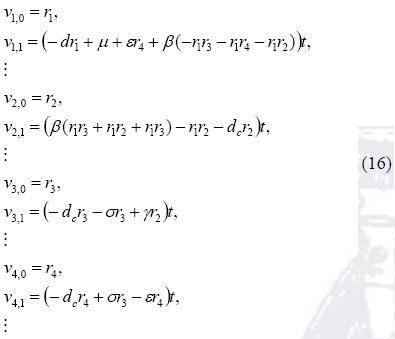
<body><![CDATA[<p align="justify"><font face="verdana" size="2">Solving Eq. (15) yields</font></p>  	    <p align="justify"><font face="verdana" size="2"><img src="/img/revistas/ns/v6n12/a9fo16.jpg"></font></p>  	    <p align="justify"><font face="verdana" size="2">Substituting Eq. (16) into Eq. (14) and calculating the limit when p&#8594;1, we obtain the 20th&#45;order approximation</font></p>  	    <p align="justify"><font face="verdana" size="2"><img src="/img/revistas/ns/v6n12/a9fo17.jpg"></font></p>  	    <p align="justify"><font face="verdana" size="2">We apply parameter values and initial conditions presented in Section 2 to Eq. (17). Next, we apply the resummation method denominated Pad&eacute; approximation &#91;5,38,54&#93;, to obtain the approximations y<sub>1</sub>(t)<sub>&#91;12/12&#93;</sub>, y<sub>2</sub>(t)<sub>&#91;12/12&#93;</sub>,y<sub>3</sub>(t)<sub>&#91;8/14&#93;</sub>, and y<sub>4</sub>(t)<sub>&#91;12/12&#93;</sub>, which possesses larger domain of convergence than Eq. (17) as we will see in the discussion section. We will denominate to such coupling of methods as HPM&#45;Pad&eacute;. From experimentation, we notice that at least a 20th&#45;order approximation (see Eq. (17)) was required to give enough information to the Pad&eacute; approximant to recast and predict the behaviour of (1) for a larger domain than the power series (17) as depicted in <a href="/img/revistas/ns/v6n12/a9f2.jpg" target="_blank">figure 2</a> in Section 6.</font></p>  	    <p align="justify"><font face="verdana" size="2"><b>5.2 Solution using the Boubaker Polynomials Expansion Scheme</b> BPES</font></p>  	    <p align="justify"><font face="verdana" size="2">The resolution protocol is based on setting <img src="/img/revistas/ns/v6n12/a9yn.jpg">as estimators to the t&#45;dependent variables<img src="/img/revistas/ns/v6n12/a9y.jpg"></font></p>  	    <p align="justify"><font face="verdana" size="2"><img src="/img/revistas/ns/v6n12/a9fo18.jpg"></font></p>  	    <p align="justify"><font face="verdana" size="2">where B<sub>4k</sub> are the 4k&#45;order Boubaker polynomials &#91;23&#45;33&#93;, r<sub>k</sub> are B<sub>4k</sub> minimal positive roots, N<sub>0</sub> is a prefixed integer, and <img src="/img/revistas/ns/v6n12/a9smk.jpg">&nbsp;are unknown pondering real coefficients.</font></p>  	    <p align="justify"><font face="verdana" size="2">The main advantage of this formulation is the verification of initial conditions with respect to time, expressed in Eq. (1), in advance to the resolution process. In fact, thanks to the properties expressed in Eq. (10) and Eq. (11), these conditions are reduced to the inherently verified linear equations</font></p>  	    ]]></body>
<body><![CDATA[<p align="justify"><font face="verdana" size="2"><img src="/img/revistas/ns/v6n12/a9fo19.jpg"></font></p>  	    <p align="justify"><font face="verdana" size="2">The BPES solution for Eq. (1) is obtained, according to the principles of the BPES, by determining the non&#45;null set of coefficients <img src="/img/revistas/ns/v6n12/a9smkc.jpg">that minimizes the absolute difference between left and right sides of the following equations, which follow a majoring of the sum <img src="/img/revistas/ns/v6n12/a9p.jpg"></font></p>      <p align="justify"><font face="verdana" size="2"><img src="/img/revistas/ns/v6n12/a9fo20.jpg"></font></p>  	    <p align="justify"><font face="verdana" size="2">Where N<sub>0</sub>=241 order to maintain a high accuracy and the size constrained.</font></p>  	    <p align="justify"><font face="verdana" size="2">The final solution is obtained by substituting the obtained values of the coefficients <img src="/img/revistas/ns/v6n12/a9smkc.jpg"> in Eq. (18).</font></p>      <p align="justify"><font face="verdana" size="2">&nbsp;</font></p>  	    <p align="justify"><font face="verdana" size="2"><b>6. Results plots and discussion</b></font></p>  	    <p align="justify"><font face="verdana" size="2"><a href="/img/revistas/ns/v6n12/a9f2.jpg" target="_blank">Figures 2</a> and <a href="/img/revistas/ns/v6n12/a9f3.jpg" target="_blank">3</a> shows a comparison between the Fehlberg fourth&#45;fifth order Runge&#45;Kutta method with degree four interpolant (RKF45) &#91;52, 53&#93; solution (built&#45;in function of Maple software for Eq. (1), HPM, HPM&#45;Pad&eacute;, and BPES approximations. In order to obtain a good numerical reference the accuracy of RKF45 was set to an absolute error of 10<sup>&#45;7</sup>and relative error of10<sup>&#45;6</sup>. Moreover, <a href="/img/revistas/ns/v6n12/a9f2.jpg" target="_blank">Figure 2 (a)</a> shows, for all solutions, a non&#45;uniform decreasing profile for the population of individuals who have never consumed cocaine. This feature is a master key for understanding transmission dynamics. In fact, for the given value of transmission rate (&#946; = 0.09614 ), it was expected that a short period of constancy (0&lt; t &lt;8) is followed by an avalanche of contamination. Divergence between numerical and analytical solutions is recorded for the period t &gt;40 for BPES , t &gt;40 for HPM and t &gt;80 for HPM&#45;Pad&eacute;. Therefore, HPM&#45;Pad&eacute; exhibited a wider domain of convergence. This is due to the known characteristic of the Pad&eacute; resummation method &#91;54&#93; to recast and predict the behaviour of power series solutions; increasing notoriously the domain of convergence. The BPES and HPM approximations exhibit a poor convergence in contrast to HPM&#45;Pad&eacute; because equations (17) and (18) are pure polynomial solutions while HPM&#45;Pad&eacute; produces rational expressions. BPES method is merely based on strict respect of initial conditions; consequently BPES protocol is less sensitive to long term dynamics than HPM. For perusal, references &#91;25&#45;29&#93; evoke this item for "avalanche of contamination"&#45;like long term perturbation. Since the difference concerns only the population of occasional consumers or individuals who have never consumed cocaine, it can be formulated that long&#45;term prediction among safe population cannot be subjected to analytical modelling, oppositely to that of regular and habitual consumers groups. This phenomenon has been already recorded by S&aacute;nchez et al. &#91;51&#93;.</font></p>  	    <p align="justify"><font face="verdana" size="2">&nbsp;</font></p>  	    <p align="justify"><font face="verdana" size="2"><b>7. Conclusion</b></font></p>  	    ]]></body>
<body><![CDATA[<p align="justify"><font face="verdana" size="2">In this paper, powerful analytical methods Homotopy Perturbation Method (HPM) and Boubaker Polynomials Expansion Scheme (BPES) are presented to construct analytical solutions for the model of evolution of cocaine consumption in Spain. The numerical experiments are presented to support the theoretical results. In order to enlarge the domain of convergence of the HPM polynomials, we apply the Pad&eacute; resummation method. Therefore, the HPM&#45;Pad&eacute; solution exhibited a wider domain of convergence than HPM and BPES, reaching a good agreement with exact solution for the range t&#8712;&#91;0,80&#93;. Further research is required in order to obtain solution with larger domain of convergence that can lead to a better understanding of the dynamics of the cocaine consumption in Spain and the relationship with its parameters.</font></p>  	    <p align="justify"><font face="verdana" size="2">&nbsp;</font></p>  	    <p align="justify"><font face="verdana" size="2"><b>Acknowledgments</b></font></p>  	    <p align="justify"><font face="verdana" size="2">We gratefully acknowledge the financial support of the National Council for Science and Technology of Mexico (CONACyT) through Grant CB&#45;2010&#45;01 #157024. The first author would like to acknowledge Rogelio&#45;Alejandro Callejas&#45;Molina and Roberto Ruiz&#45;G&oacute;mez for their contribution to this project.</font></p>  	    <p align="justify"><font face="verdana" size="2">&nbsp;</font></p>  	    <p align="justify"><font face="verdana" size="2"><b>References</b></font></p>  	    <!-- ref --><p align="justify"><font face="verdana" size="2">&#91;1&#93; He, J. H., "Homotopy perturbation technique," Comput. Methods Appl. Mech. Eng., Vol.178, 257&#150;262, 1999.    &nbsp;&nbsp;&nbsp;&nbsp;&nbsp;&nbsp;&nbsp;&nbsp;[&#160;<a href="javascript:void(0);" onclick="javascript: window.open('/scielo.php?script=sci_nlinks&ref=5489019&pid=S2007-0705201400020000900001&lng=','','width=640,height=500,resizable=yes,scrollbars=1,menubar=yes,');">Links</a>&#160;]<!-- end-ref --></font></p>  	    <!-- ref --><p align="justify"><font face="verdana" size="2">&#91;2&#93; He, J. H., "A coupling method of a homotopy technique and a perturbation technique for non&#45;linear problems," Inter. J. Non&#45;linear Mech., Vol.35, 37&#150;43, 2000.    &nbsp;&nbsp;&nbsp;&nbsp;&nbsp;&nbsp;&nbsp;&nbsp;[&#160;<a href="javascript:void(0);" onclick="javascript: window.open('/scielo.php?script=sci_nlinks&ref=5489021&pid=S2007-0705201400020000900002&lng=','','width=640,height=500,resizable=yes,scrollbars=1,menubar=yes,');">Links</a>&#160;]<!-- end-ref --></font></p>  	    ]]></body>
<body><![CDATA[<!-- ref --><p align="justify"><font face="verdana" size="2">&#91;3&#93; He, J. H., "Homotopy perturbation method: a new nonlinear analytical technique," Appl. Math. Comput., Vol.135, 73&#150;79, 2003.    &nbsp;&nbsp;&nbsp;&nbsp;&nbsp;&nbsp;&nbsp;&nbsp;[&#160;<a href="javascript:void(0);" onclick="javascript: window.open('/scielo.php?script=sci_nlinks&ref=5489023&pid=S2007-0705201400020000900003&lng=','','width=640,height=500,resizable=yes,scrollbars=1,menubar=yes,');">Links</a>&#160;]<!-- end-ref --></font></p>  	    <!-- ref --><p align="justify"><font face="verdana" size="2">&#91;4&#93; H. Vazquez&#45;Leal, Y. Khan, G. Fern&aacute;ndez&#45;Anaya, et al., "A General Solution for Troesch's Problem," Mathematical Problems in Engineering, vol. 2012, Article ID 208375, 14 pages, 2012. doi:10.1155/2012/208375.    &nbsp;&nbsp;&nbsp;&nbsp;&nbsp;&nbsp;&nbsp;&nbsp;[&#160;<a href="javascript:void(0);" onclick="javascript: window.open('/scielo.php?script=sci_nlinks&ref=5489025&pid=S2007-0705201400020000900004&lng=','','width=640,height=500,resizable=yes,scrollbars=1,menubar=yes,');">Links</a>&#160;]<!-- end-ref --></font></p>  	    <!-- ref --><p align="justify"><font face="verdana" size="2">&#91;5&#93; H. Vazquez&#45;Leal, A. Sarmiento&#45;Reyes, Y. Khan, U. Filobello&#45;Ni&ntilde;o, and A. Diaz&#45;Sanchez, "Rational Biparameter Homotopy Perturbation Method and Laplace&#45;Pad&eacute; Coupled Version," Journal of Applied Mathematics, vol. 2012, IN PRESS.    &nbsp;&nbsp;&nbsp;&nbsp;&nbsp;&nbsp;&nbsp;&nbsp;[&#160;<a href="javascript:void(0);" onclick="javascript: window.open('/scielo.php?script=sci_nlinks&ref=5489027&pid=S2007-0705201400020000900005&lng=','','width=640,height=500,resizable=yes,scrollbars=1,menubar=yes,');">Links</a>&#160;]<!-- end-ref --></font></p>  	    <!-- ref --><p align="justify"><font face="verdana" size="2">&#91;6&#93; H. V&aacute;zquez&#45;Leal, "Rational Homotopy Perturbation Method," Journal of Applied Mathematics, vol. 2012, Article ID 490342, 14 pages, 2012. doi:10.1155/2012/490342.    &nbsp;&nbsp;&nbsp;&nbsp;&nbsp;&nbsp;&nbsp;&nbsp;[&#160;<a href="javascript:void(0);" onclick="javascript: window.open('/scielo.php?script=sci_nlinks&ref=5489029&pid=S2007-0705201400020000900006&lng=','','width=640,height=500,resizable=yes,scrollbars=1,menubar=yes,');">Links</a>&#160;]<!-- end-ref --></font></p>  	    <!-- ref --><p align="justify"><font face="verdana" size="2">&#91;7&#93; Y. Khan, H. V&aacute;zquez&#45;Leal, and L. Hernandez&#45;Mart&iacute;nez, "Removal of Noise Oscillation Term Appearing in the Nonlinear Equation Solution," Journal of Applied Mathematics, vol. 2012, Article ID 387365, 9 pages, 2012. doi:10.1155/2012/387365.    &nbsp;&nbsp;&nbsp;&nbsp;&nbsp;&nbsp;&nbsp;&nbsp;[&#160;<a href="javascript:void(0);" onclick="javascript: window.open('/scielo.php?script=sci_nlinks&ref=5489031&pid=S2007-0705201400020000900007&lng=','','width=640,height=500,resizable=yes,scrollbars=1,menubar=yes,');">Links</a>&#160;]<!-- end-ref --></font></p>  	    ]]></body>
<body><![CDATA[<!-- ref --><p align="justify"><font face="verdana" size="2">&#91;8&#93; U. Filobello&#45;Nino, H. Vazquez&#45;Leal, Y. Khan, A. Yildirim, D. Pereyra&#45;Diaz, A. Perez&#45;Sesma, L. Hernandez&#45;Martinez, J. Sanchez&#45;Orea, R. Castaneda&#45;Sheissa, F. Rabago&#45;Bernal, "HPM applied to solve nonlinear circuits: a study case", Appl. Math. Sci., Vol. 6, 2012, no. 85&#45;88, 4331&#45;4344.    &nbsp;&nbsp;&nbsp;&nbsp;&nbsp;&nbsp;&nbsp;&nbsp;[&#160;<a href="javascript:void(0);" onclick="javascript: window.open('/scielo.php?script=sci_nlinks&ref=5489033&pid=S2007-0705201400020000900008&lng=','','width=640,height=500,resizable=yes,scrollbars=1,menubar=yes,');">Links</a>&#160;]<!-- end-ref --></font></p>  	    <!-- ref --><p align="justify"><font face="verdana" size="2">&#91;9&#93; H. Vazquez&#45;Leal, Y. Khan, U. Filobello&#45;Nino, A. Sarmiento&#45;Reyes, A. Diaz&#45;Sanchez and L.F. Cisneros&#45;Sinencio, "Fixed&#45;Term Homotopy," Journal of Applied Mathematics, 2013, IN PRESS.    &nbsp;&nbsp;&nbsp;&nbsp;&nbsp;&nbsp;&nbsp;&nbsp;[&#160;<a href="javascript:void(0);" onclick="javascript: window.open('/scielo.php?script=sci_nlinks&ref=5489035&pid=S2007-0705201400020000900009&lng=','','width=640,height=500,resizable=yes,scrollbars=1,menubar=yes,');">Links</a>&#160;]<!-- end-ref --></font></p>  	    <!-- ref --><p align="justify"><font face="verdana" size="2">&#91;10&#93; U. Filobello&#45;Nino, Hector Vazquez&#45;Leal, R. Castaneda&#45;Sheissa, A. Yildirim, L. Hernandez&#45;Martinez, D. Pereyra&#45;Diaz, A. Perez&#45;Sesma and C. Hoyos&#45;Reyes, "An approximate solution of Blasius equation by using HPM method", Asian Journal of Mathematics &amp; Statistics, 2012, Vol. 5, pp. 50&#45;59, DOI: 103923/ajms.2012.50.59.    &nbsp;&nbsp;&nbsp;&nbsp;&nbsp;&nbsp;&nbsp;&nbsp;[&#160;<a href="javascript:void(0);" onclick="javascript: window.open('/scielo.php?script=sci_nlinks&ref=5489037&pid=S2007-0705201400020000900010&lng=','','width=640,height=500,resizable=yes,scrollbars=1,menubar=yes,');">Links</a>&#160;]<!-- end-ref --></font></p>  	    <!-- ref --><p align="justify"><font face="verdana" size="2">&#91;11&#93; H. V&aacute;zquez&#45;Leal, U. Filobello&#45;Ni&ntilde;o, R. Casta&ntilde;eda&#45;Sheissa, L. Hern&aacute;ndez&#45;Mart&iacute;nez, and A. Sarmiento&#45;Reyes, "Modified HPMs Inspired by Homotopy Continuation Methods," Mathematical Problems in Engineering, vol. 2012, Article ID 309123, 19 pages, 2012. doi:10.1155/2012/309123.    &nbsp;&nbsp;&nbsp;&nbsp;&nbsp;&nbsp;&nbsp;&nbsp;[&#160;<a href="javascript:void(0);" onclick="javascript: window.open('/scielo.php?script=sci_nlinks&ref=5489039&pid=S2007-0705201400020000900011&lng=','','width=640,height=500,resizable=yes,scrollbars=1,menubar=yes,');">Links</a>&#160;]<!-- end-ref --></font></p>  	    <!-- ref --><p align="justify"><font face="verdana" size="2">&#91;12&#93; H. Vazquez&#45;Leal, R. Castaneda&#45;Sheissa, U. Filobello&#45;Nino, A. Sarmiento&#45;Reyes, and J. Sanchez&#45;Orea, "High Accurate Simple Approximation of Normal Distribution Integral," Mathematical Problems in Engineering, vol. 2012, Article ID 124029, 22 pages, 2012. doi:10.1155/2012/124029.    &nbsp;&nbsp;&nbsp;&nbsp;&nbsp;&nbsp;&nbsp;&nbsp;[&#160;<a href="javascript:void(0);" onclick="javascript: window.open('/scielo.php?script=sci_nlinks&ref=5489041&pid=S2007-0705201400020000900012&lng=','','width=640,height=500,resizable=yes,scrollbars=1,menubar=yes,');">Links</a>&#160;]<!-- end-ref --></font></p>  	    ]]></body>
<body><![CDATA[<!-- ref --><p align="justify"><font face="verdana" size="2">&#91;13&#93; Y. Khan, H. V&aacute;zquez&#45;Leal, L. Hernandez&#45;Mart&iacute;nez and N. Faraz, "Variational iteration algorithm&#45;II for solving linear and non&#45;linear ODEs", International Journal of the Physical Sciences Vol. 7(25), pp. 3099&#45;4002, 29 June, 2012.    &nbsp;&nbsp;&nbsp;&nbsp;&nbsp;&nbsp;&nbsp;&nbsp;[&#160;<a href="javascript:void(0);" onclick="javascript: window.open('/scielo.php?script=sci_nlinks&ref=5489043&pid=S2007-0705201400020000900013&lng=','','width=640,height=500,resizable=yes,scrollbars=1,menubar=yes,');">Links</a>&#160;]<!-- end-ref --></font></p>  	    <!-- ref --><p align="justify"><font face="verdana" size="2">&#91;14&#93; He, J.H. Variational iteration method&#45;a kind of nonlinear analytical technique: Some examples, International Journal of Nonlinear Mechanics, 1999, 34 (4), 699&#45;708.    &nbsp;&nbsp;&nbsp;&nbsp;&nbsp;&nbsp;&nbsp;&nbsp;[&#160;<a href="javascript:void(0);" onclick="javascript: window.open('/scielo.php?script=sci_nlinks&ref=5489045&pid=S2007-0705201400020000900014&lng=','','width=640,height=500,resizable=yes,scrollbars=1,menubar=yes,');">Links</a>&#160;]<!-- end-ref --></font></p>  	    <!-- ref --><p align="justify"><font face="verdana" size="2">&#91;15&#93; He, J.H. Variational iteration method&#45;Some recent results and new interpretations. Journal of Computational and Applied Mathematics, 2007, 207,3&#45;17.    &nbsp;&nbsp;&nbsp;&nbsp;&nbsp;&nbsp;&nbsp;&nbsp;[&#160;<a href="javascript:void(0);" onclick="javascript: window.open('/scielo.php?script=sci_nlinks&ref=5489047&pid=S2007-0705201400020000900015&lng=','','width=640,height=500,resizable=yes,scrollbars=1,menubar=yes,');">Links</a>&#160;]<!-- end-ref --></font></p>  	    <!-- ref --><p align="justify"><font face="verdana" size="2">&#91;16&#93; He, J.H. Variational iteration method for autonomous ordinary differential systems. Applied Mathematics and Com putation, 2000, 114, 115&#45;123.    &nbsp;&nbsp;&nbsp;&nbsp;&nbsp;&nbsp;&nbsp;&nbsp;[&#160;<a href="javascript:void(0);" onclick="javascript: window.open('/scielo.php?script=sci_nlinks&ref=5489049&pid=S2007-0705201400020000900016&lng=','','width=640,height=500,resizable=yes,scrollbars=1,menubar=yes,');">Links</a>&#160;]<!-- end-ref --></font></p>  	    <!-- ref --><p align="justify"><font face="verdana" size="2">&#91;17&#93; He, J.H. Variational iteration method for autonomous ordinary differential systems. Applied Mathematics and Computation, 2000, 114 (2&#45;3), 115&#45;123.    &nbsp;&nbsp;&nbsp;&nbsp;&nbsp;&nbsp;&nbsp;&nbsp;[&#160;<a href="javascript:void(0);" onclick="javascript: window.open('/scielo.php?script=sci_nlinks&ref=5489051&pid=S2007-0705201400020000900017&lng=','','width=640,height=500,resizable=yes,scrollbars=1,menubar=yes,');">Links</a>&#160;]<!-- end-ref --></font></p>  	    ]]></body>
<body><![CDATA[<!-- ref --><p align="justify"><font face="verdana" size="2">&#91;18&#93; M. Agida, A. S. Kumar, A Boubaker Polynomials Expansion Scheme solution to random Love equation in the case of a rational kernel, El. Journal of Theoretical Physics, 2010, 7, 319&#45;326.    &nbsp;&nbsp;&nbsp;&nbsp;&nbsp;&nbsp;&nbsp;&nbsp;[&#160;<a href="javascript:void(0);" onclick="javascript: window.open('/scielo.php?script=sci_nlinks&ref=5489053&pid=S2007-0705201400020000900018&lng=','','width=640,height=500,resizable=yes,scrollbars=1,menubar=yes,');">Links</a>&#160;]<!-- end-ref --></font></p>  	    <!-- ref --><p align="justify"><font face="verdana" size="2">&#91;19&#93; A. Yildirim, S. T. Mohyud&#45;Din, D. H. Zhang, Analytical solutions to the pulsed Klein&#45;Gordon equation using Modified Variational Iteration Method (MVIM) and Boubaker Polynomials Expansion Scheme (BPES), Computers and Mathematics with Applications, 2010, 59 2473&#45;2477.    &nbsp;&nbsp;&nbsp;&nbsp;&nbsp;&nbsp;&nbsp;&nbsp;[&#160;<a href="javascript:void(0);" onclick="javascript: window.open('/scielo.php?script=sci_nlinks&ref=5489055&pid=S2007-0705201400020000900019&lng=','','width=640,height=500,resizable=yes,scrollbars=1,menubar=yes,');">Links</a>&#160;]<!-- end-ref --></font></p>  	    <!-- ref --><p align="justify"><font face="verdana" size="2">&#91;20&#93; J. Ghanouchi, H. Labiadhand K. Boubaker, An attempt to solve the heat transfert equation in a model of pyrolysis spray using 4q&#45;order m&#45;Boubaker polynomials Int. J. of Heat and Technology, 2008, 26, 49&#45;53</font>&nbsp;&nbsp;&nbsp;&nbsp;&nbsp;&nbsp;&nbsp;&nbsp;[&#160;<a href="javascript:void(0);" onclick="javascript: window.open('/scielo.php?script=sci_nlinks&ref=5489057&pid=S2007-0705201400020000900020&lng=','','width=640,height=500,resizable=yes,scrollbars=1,menubar=yes,');">Links</a>&#160;]<!-- end-ref --><!-- ref --><p align="justify"><font face="verdana" size="2">&#91;21&#93; S. Slama, J. Bessrour, K. Boubaker and M. Bouhafs, A dynamical model for investigation of A3 point maximal spatial evolution during resistance spot welding using Boubaker polynomials, Eur. Phys. J. Appl. Phys. 2008, 44, 317&#45;322</font>&nbsp;&nbsp;&nbsp;&nbsp;&nbsp;&nbsp;&nbsp;&nbsp;[&#160;<a href="javascript:void(0);" onclick="javascript: window.open('/scielo.php?script=sci_nlinks&ref=5489058&pid=S2007-0705201400020000900021&lng=','','width=640,height=500,resizable=yes,scrollbars=1,menubar=yes,');">Links</a>&#160;]<!-- end-ref --><!-- ref --><p align="justify"><font face="verdana" size="2">&#91;22&#93; S. Slama, M. Bouhafsand K. B. Ben Mahmoud,ABoubaker Polynomials Solution to Heat Equation for Monitoring A3 Point Evolution During Resistance Spot Welding, International Journal of Heat and Technology, 2008, 26(2), 141&#45;146.    &nbsp;&nbsp;&nbsp;&nbsp;&nbsp;&nbsp;&nbsp;&nbsp;[&#160;<a href="javascript:void(0);" onclick="javascript: window.open('/scielo.php?script=sci_nlinks&ref=5489059&pid=S2007-0705201400020000900022&lng=','','width=640,height=500,resizable=yes,scrollbars=1,menubar=yes,');">Links</a>&#160;]<!-- end-ref --></font></p>  	    <!-- ref --><p align="justify"><font face="verdana" size="2">&#91;23&#93; S. Lazzez, K.B. Ben Mahmoud, S. Abroug, F. Saadallah, M. Amlouk, A Boubaker polynomials expansion scheme (BPES)&#45;related protocol for measuring sprayed thin films thermal characteristics, Current Applied Physics,2009, 9 (5), 1129&#45;1133</font>&nbsp;&nbsp;&nbsp;&nbsp;&nbsp;&nbsp;&nbsp;&nbsp;[&#160;<a href="javascript:void(0);" onclick="javascript: window.open('/scielo.php?script=sci_nlinks&ref=5489061&pid=S2007-0705201400020000900023&lng=','','width=640,height=500,resizable=yes,scrollbars=1,menubar=yes,');">Links</a>&#160;]<!-- end-ref --><!-- ref --><p align="justify"><font face="verdana" size="2">&#91;24&#93; T. Ghrib, K. Boubakerand M. Bouhafs, Investigation of thermal diffusivity&#45;microhardness correlation extended to surface&#45;nitrured steel using Boubaker polynomials expansion, Modern Physics Letters B, 2008, 22, 2893&#45;2907</font>&nbsp;&nbsp;&nbsp;&nbsp;&nbsp;&nbsp;&nbsp;&nbsp;[&#160;<a href="javascript:void(0);" onclick="javascript: window.open('/scielo.php?script=sci_nlinks&ref=5489062&pid=S2007-0705201400020000900024&lng=','','width=640,height=500,resizable=yes,scrollbars=1,menubar=yes,');">Links</a>&#160;]<!-- end-ref --><!-- ref --><p align="justify"><font face="verdana" size="2">&#91;25&#93; S. Fridjine, K.B. Ben Mahmoud, M. Amlouk, M. Bouhafs, A study of sulfur/selenium substitution effects on physical and mechanical properties of vacuum&#45;grown ZnS1&#45;xSex compounds using Boubaker polynomials expansion scheme (BPES), Journal of Alloys and Compounds, 2009, 479 (1&#45;2), 457&#45;461</font>&nbsp;&nbsp;&nbsp;&nbsp;&nbsp;&nbsp;&nbsp;&nbsp;[&#160;<a href="javascript:void(0);" onclick="javascript: window.open('/scielo.php?script=sci_nlinks&ref=5489063&pid=S2007-0705201400020000900025&lng=','','width=640,height=500,resizable=yes,scrollbars=1,menubar=yes,');">Links</a>&#160;]<!-- end-ref --><!-- ref --><p align="justify"><font face="verdana" size="2">&#91;26&#93; C. Kh&eacute;lia, K. Boubaker, T. Ben Nasrallah, M. Amlouk, S. Belgacem, Morphological and thermal properties of &#946;&#45;SnS2 sprayed thin films using Boubaker polynomials expansion, Journal of Alloys and Compounds, 2009, 477(1&#45;2), 461&#45;467</font>&nbsp;&nbsp;&nbsp;&nbsp;&nbsp;&nbsp;&nbsp;&nbsp;[&#160;<a href="javascript:void(0);" onclick="javascript: window.open('/scielo.php?script=sci_nlinks&ref=5489064&pid=S2007-0705201400020000900026&lng=','','width=640,height=500,resizable=yes,scrollbars=1,menubar=yes,');">Links</a>&#160;]<!-- end-ref --><!-- ref --><p align="justify"><font face="verdana" size="2">&#91;27&#93; K.B. Ben Mahmoud, M. Amlouk, The 3D Amlouk&#150;Boubakerexpansivity&#150;energy gap&#150;Vickers hardness abacus: A new tool for optimizing semiconductor thin film materials, Materials Letters, 2009, 63 (12), 991&#45;994</font>&nbsp;&nbsp;&nbsp;&nbsp;&nbsp;&nbsp;&nbsp;&nbsp;[&#160;<a href="javascript:void(0);" onclick="javascript: window.open('/scielo.php?script=sci_nlinks&ref=5489065&pid=S2007-0705201400020000900027&lng=','','width=640,height=500,resizable=yes,scrollbars=1,menubar=yes,');">Links</a>&#160;]<!-- end-ref --><!-- ref --><p align="justify"><font face="verdana" size="2">&#91;28&#93; M. Dada, O.B. Awojoyogbe, K. Boubaker, Heat transfer spray model: An improved theoretical thermal time&#45;response to uniform layers deposit using Bessel and Boubaker polynomials, Current Applied Physics, Volume 9, Issue 3 (2009) 622&#45;624.    &nbsp;&nbsp;&nbsp;&nbsp;&nbsp;&nbsp;&nbsp;&nbsp;[&#160;<a href="javascript:void(0);" onclick="javascript: window.open('/scielo.php?script=sci_nlinks&ref=5489066&pid=S2007-0705201400020000900028&lng=','','width=640,height=500,resizable=yes,scrollbars=1,menubar=yes,');">Links</a>&#160;]<!-- end-ref --></font></p>  	    <!-- ref --><p align="justify"><font face="verdana" size="2">&#91;29&#93; S. Tabatabaei, T. Zhao, , O. Awojoyogbe, F. Moses, Cut&#45;off cooling velocity profiling inside a keyhole model using the Boubaker polynomials expansion scheme, Int.J. Heat Mass Transfer, 2009, 45, 1247&#45;1255.    &nbsp;&nbsp;&nbsp;&nbsp;&nbsp;&nbsp;&nbsp;&nbsp;[&#160;<a href="javascript:void(0);" onclick="javascript: window.open('/scielo.php?script=sci_nlinks&ref=5489068&pid=S2007-0705201400020000900029&lng=','','width=640,height=500,resizable=yes,scrollbars=1,menubar=yes,');">Links</a>&#160;]<!-- end-ref --></font></p>  	    <!-- ref --><p align="justify"><font face="verdana" size="2">&#91;30&#93; A. Belhadj, J. Bessrour, M. Bouhafs, L. Barrallier, Experimental and theoretical cooling velocity profile inside laser welded metals using keyhole approximation and Boubaker polynomials expansion, J. of Thermal Analysis and Calorimetry, 2009, 97, 911&#45;920.    &nbsp;&nbsp;&nbsp;&nbsp;&nbsp;&nbsp;&nbsp;&nbsp;[&#160;<a href="javascript:void(0);" onclick="javascript: window.open('/scielo.php?script=sci_nlinks&ref=5489070&pid=S2007-0705201400020000900030&lng=','','width=640,height=500,resizable=yes,scrollbars=1,menubar=yes,');">Links</a>&#160;]<!-- end-ref --></font></p>  	    <!-- ref --><p align="justify"><font face="verdana" size="2">&#91;31&#93; A. Belhadj, O. Onyango, N. Rozibaeva, Boubaker Polynomials Expansion Scheme&#45;Related Heat Transfer Investigation Inside Keyhole Model , J. Thermophys. Heat Transf. 2009, 23 639&#45;642.    &nbsp;&nbsp;&nbsp;&nbsp;&nbsp;&nbsp;&nbsp;&nbsp;[&#160;<a href="javascript:void(0);" onclick="javascript: window.open('/scielo.php?script=sci_nlinks&ref=5489072&pid=S2007-0705201400020000900031&lng=','','width=640,height=500,resizable=yes,scrollbars=1,menubar=yes,');">Links</a>&#160;]<!-- end-ref --></font></p>  	    <!-- ref --><p align="justify"><font face="verdana" size="2">&#91;32&#93; P. Barry, A. Hennessy, Meixner&#45;Type results for Riordan arrays and associated integer sequences, section 6: The Boubaker polynomials, Journal of Integer Sequences, 2010, 13,1&#45;34.    &nbsp;&nbsp;&nbsp;&nbsp;&nbsp;&nbsp;&nbsp;&nbsp;[&#160;<a href="javascript:void(0);" onclick="javascript: window.open('/scielo.php?script=sci_nlinks&ref=5489074&pid=S2007-0705201400020000900032&lng=','','width=640,height=500,resizable=yes,scrollbars=1,menubar=yes,');">Links</a>&#160;]<!-- end-ref --></font></p>  	    <!-- ref --><p align="justify"><font face="verdana" size="2">&#91;33&#93; A. S. Kumar, An analytical solution to applied mathematics&#45;related Love's equation using the Boubaker Polynomials Expansion Scheme, Journal of the Franklin Institute, 2010, 347, 1755&#45;1761.    &nbsp;&nbsp;&nbsp;&nbsp;&nbsp;&nbsp;&nbsp;&nbsp;[&#160;<a href="javascript:void(0);" onclick="javascript: window.open('/scielo.php?script=sci_nlinks&ref=5489076&pid=S2007-0705201400020000900033&lng=','','width=640,height=500,resizable=yes,scrollbars=1,menubar=yes,');">Links</a>&#160;]<!-- end-ref --></font></p>  	    <!-- ref --><p align="justify"><font face="verdana" size="2">&#91;34&#93; S. Fridjine, M. Amlouk, A new parameter: An ABACUS for optimizig functional materials using the Boubaker polynomials expansion scheme, Modern Phys. Lett. B, 2009, 23, 2179&#45;2182</font>&nbsp;&nbsp;&nbsp;&nbsp;&nbsp;&nbsp;&nbsp;&nbsp;[&#160;<a href="javascript:void(0);" onclick="javascript: window.open('/scielo.php?script=sci_nlinks&ref=5489078&pid=S2007-0705201400020000900034&lng=','','width=640,height=500,resizable=yes,scrollbars=1,menubar=yes,');">Links</a>&#160;]<!-- end-ref --><!-- ref --><p align="justify"><font face="verdana" size="2">&#91;35&#93; M. Benhaliliba, Benouis, C.E., Boubaker, K., Amlouk M., Amlouk, A., A New Guide To Thermally Optimized Doped Oxides Monolayer Spray&#45;grown Solar Cells: The Amlouk&#45;boubaker Optothermal Expansivity &#968;ab in the book : Solar Cells &#45; New Aspects and Solutions, Edited by: Leonid A. Kosyachenko, &#91;ISBN 978&#45;953&#45;307&#45;761&#45;1, by InTech&#93;, 2011, 27&#45;41.    &nbsp;&nbsp;&nbsp;&nbsp;&nbsp;&nbsp;&nbsp;&nbsp;[&#160;<a href="javascript:void(0);" onclick="javascript: window.open('/scielo.php?script=sci_nlinks&ref=5489079&pid=S2007-0705201400020000900035&lng=','','width=640,height=500,resizable=yes,scrollbars=1,menubar=yes,');">Links</a>&#160;]<!-- end-ref --></font></p>  	    <!-- ref --><p align="justify"><font face="verdana" size="2">&#91;36&#93; A. Milgram, The stability of the Boubaker polynomials expansion scheme (BPES)&#45;based solution to Lotka&#45;Volterra problem, J. of Theoretical Biology, 2011, 271, 157&#45;158.    &nbsp;&nbsp;&nbsp;&nbsp;&nbsp;&nbsp;&nbsp;&nbsp;[&#160;<a href="javascript:void(0);" onclick="javascript: window.open('/scielo.php?script=sci_nlinks&ref=5489081&pid=S2007-0705201400020000900036&lng=','','width=640,height=500,resizable=yes,scrollbars=1,menubar=yes,');">Links</a>&#160;]<!-- end-ref --></font></p>  	    ]]></body>
<body><![CDATA[<!-- ref --><p align="justify"><font face="verdana" size="2">&#91;37&#93; H. Rahmanov, A Solution to the non Linear Korteweg&#45;De&#45;Vries Equation in the Particular Case Dispersion&#45;Adsorption Problem in Porous Media Using the Spectral Boubaker Polynomials Expansion Scheme (BPES), Studies in Nonlinear Sciences, 2011, 2 (1) 46&#45;49.    &nbsp;&nbsp;&nbsp;&nbsp;&nbsp;&nbsp;&nbsp;&nbsp;[&#160;<a href="javascript:void(0);" onclick="javascript: window.open('/scielo.php?script=sci_nlinks&ref=5489083&pid=S2007-0705201400020000900037&lng=','','width=640,height=500,resizable=yes,scrollbars=1,menubar=yes,');">Links</a>&#160;]<!-- end-ref --></font></p>  	    <!-- ref --><p align="justify"><font face="verdana" size="2">&#91;38&#93; U. Filobello&#45;Nino, H. Vazquez&#45;Leal, Y. Khan, A. Yildirim, V.M. Jimenez&#45;Fernandez, A.L. Herrera&#45;May, R. Castaneda&#45;Sheissa, and J.Cervantes&#45;Perez, "Perturbation method and Laplace&#150;Pad&eacute; approximation to solve nonlinear problems", Miskolc Mathematical Notes, 14(1), pp. 89&#45;101, 2013.    &nbsp;&nbsp;&nbsp;&nbsp;&nbsp;&nbsp;&nbsp;&nbsp;[&#160;<a href="javascript:void(0);" onclick="javascript: window.open('/scielo.php?script=sci_nlinks&ref=5489085&pid=S2007-0705201400020000900038&lng=','','width=640,height=500,resizable=yes,scrollbars=1,menubar=yes,');">Links</a>&#160;]<!-- end-ref --></font></p>  	    <!-- ref --><p align="justify"><font face="verdana" size="2">&#91;39&#93; H. Vazquez&#45;Leal, U. Filobello&#45;Nino, A. Yildirim, L. Hernandez&#45;Martinez, R. Castaneda&#45;Sheissa, J. Sanchez&#45;Orea, J. E. Molinar&#45;Solis and Alejandro Diaz&#45;Sanchez, "Transient and DC approximate expressions for diode circuits", IEICE Electron. Express, Vol. 9, No. 6, pp.522&#45;530, (2012).    &nbsp;&nbsp;&nbsp;&nbsp;&nbsp;&nbsp;&nbsp;&nbsp;[&#160;<a href="javascript:void(0);" onclick="javascript: window.open('/scielo.php?script=sci_nlinks&ref=5489087&pid=S2007-0705201400020000900039&lng=','','width=640,height=500,resizable=yes,scrollbars=1,menubar=yes,');">Links</a>&#160;]<!-- end-ref --></font></p>  	    <!-- ref --><p align="justify"><font face="verdana" size="2">&#91;40&#93; H. Vazquez&#45;Leal, L. Hernandez&#45;Martinez, A. Sarmiento&#45;Reyes, R. Castaneda&#45;Sheissa, and A. Gallardo&#45;Del&#45;Angel, "Homotopy method with a formal stop criterion applied to circuit simulation", IEICE Electron. Express, Vol. 8, No. 21, pp.1808&#45;1815, 2011. DOI: 10.1587/elex.8.1808.    &nbsp;&nbsp;&nbsp;&nbsp;&nbsp;&nbsp;&nbsp;&nbsp;[&#160;<a href="javascript:void(0);" onclick="javascript: window.open('/scielo.php?script=sci_nlinks&ref=5489089&pid=S2007-0705201400020000900040&lng=','','width=640,height=500,resizable=yes,scrollbars=1,menubar=yes,');">Links</a>&#160;]<!-- end-ref --></font></p>  	    <!-- ref --><p align="justify"><font face="verdana" size="2">&#91;41&#93; H. Vazquez&#45;Leal, L. Hernandez&#45;Martinez, and A. Sarmiento&#45;Reyes, "Double&#45;Bounded Homotopy for analysing nonlinear resistive circuits", International Symposium on Circuits and Systems, Kobe, Japon, 2005pp. 3203&#45; 3206.    &nbsp;&nbsp;&nbsp;&nbsp;&nbsp;&nbsp;&nbsp;&nbsp;[&#160;<a href="javascript:void(0);" onclick="javascript: window.open('/scielo.php?script=sci_nlinks&ref=5489091&pid=S2007-0705201400020000900041&lng=','','width=640,height=500,resizable=yes,scrollbars=1,menubar=yes,');">Links</a>&#160;]<!-- end-ref --></font></p>  	    ]]></body>
<body><![CDATA[<!-- ref --><p align="justify"><font face="verdana" size="2">&#91;42&#93; H. Vazquez&#45;Leal, L. Hernandez&#45;Martinez, A. Sarmiento&#45;Reyes, and R. Castaneda&#45;Sheissa, "Numerical continuation scheme for tracing the double bounded homotopy for analysing nonlinear circuits", International Conference on Communications, Circuits and Systems, Hong Kong, China, 2005,pp. 1122&#45; 1126.    &nbsp;&nbsp;&nbsp;&nbsp;&nbsp;&nbsp;&nbsp;&nbsp;[&#160;<a href="javascript:void(0);" onclick="javascript: window.open('/scielo.php?script=sci_nlinks&ref=5489093&pid=S2007-0705201400020000900042&lng=','','width=640,height=500,resizable=yes,scrollbars=1,menubar=yes,');">Links</a>&#160;]<!-- end-ref --></font></p>  	    <!-- ref --><p align="justify"><font face="verdana" size="2">&#91;43&#93; H. Vazquez&#45;Leal , A. Sarmiento&#45;Reyes, Y. Khan, A. Y&#305;ld&#305;r&#305;m, U. Filobello&#45;Nino, R. Castaneda&#45;Sheissa, A.L. Herrera&#45;May, V.M. Jimenez&#45;Fernandez, S.F. Hernandez&#45;Machuca, L. Cuellar&#45;Hernandez, "New aspects of double bounded polynomial homotopy", British Journal of Mathematics &amp; Computer Science, 2013, IN PRESS.    &nbsp;&nbsp;&nbsp;&nbsp;&nbsp;&nbsp;&nbsp;&nbsp;[&#160;<a href="javascript:void(0);" onclick="javascript: window.open('/scielo.php?script=sci_nlinks&ref=5489095&pid=S2007-0705201400020000900043&lng=','','width=640,height=500,resizable=yes,scrollbars=1,menubar=yes,');">Links</a>&#160;]<!-- end-ref --></font></p>  	    <!-- ref --><p align="justify"><font face="verdana" size="2">&#91;44&#93; H. Vazquez&#45;Leal , R. Castaneda&#45;Sheissa, A. Y&#305;ld&#305;r&#305;m, Y. Khan, A. Sarmiento&#45;Reyes, V. Jimenez&#45;Fernandez, A.L. Herrera&#45;May, U. Filobello&#45;Nino, F. Rabago&#45;Bernal, C. Hoyos&#45;Reyes, "Biparameter homotopy&#45;based direct current simulation of multistable circuits", British Journal of Mathematics &amp; Computer Science, 2(3):137&#45;150, 2012.    &nbsp;&nbsp;&nbsp;&nbsp;&nbsp;&nbsp;&nbsp;&nbsp;[&#160;<a href="javascript:void(0);" onclick="javascript: window.open('/scielo.php?script=sci_nlinks&ref=5489097&pid=S2007-0705201400020000900044&lng=','','width=640,height=500,resizable=yes,scrollbars=1,menubar=yes,');">Links</a>&#160;]<!-- end-ref --></font></p>  	    <!-- ref --><p align="justify"><font face="verdana" size="2">&#91;45&#93; H. Vazquez&#45;Leal, A. Marin&#45;Hernandez, Y. Khan, A. Y&#305;ld&#305;r&#305;m, U. Filobello&#45;Nino, R. Castaneda&#45;Sheissa, V.M. Jimenez&#45;Fernandez, "Exploring Collision&#45;free Path Planning by Using Homotopy Continuation Methods", APPLIED MATHEMATICS AND COMPUTATION, ELSEVIER, 2013. IN PRESS.    &nbsp;&nbsp;&nbsp;&nbsp;&nbsp;&nbsp;&nbsp;&nbsp;[&#160;<a href="javascript:void(0);" onclick="javascript: window.open('/scielo.php?script=sci_nlinks&ref=5489099&pid=S2007-0705201400020000900045&lng=','','width=640,height=500,resizable=yes,scrollbars=1,menubar=yes,');">Links</a>&#160;]<!-- end-ref --></font></p>  	    <!-- ref --><p align="justify"><font face="verdana" size="2">&#91;46&#93; H. Vazquez&#45;Leal, Karem Boubaker, L. Hernandez&#45;Martinez, and J. Huerta&#45;Chua, "Approximation for Transient of Nonlinear Circuits using RHPM and BPES methods", Journal of Electrical and Computer Engineering, 2013. IN PRESS.    &nbsp;&nbsp;&nbsp;&nbsp;&nbsp;&nbsp;&nbsp;&nbsp;[&#160;<a href="javascript:void(0);" onclick="javascript: window.open('/scielo.php?script=sci_nlinks&ref=5489101&pid=S2007-0705201400020000900046&lng=','','width=640,height=500,resizable=yes,scrollbars=1,menubar=yes,');">Links</a>&#160;]<!-- end-ref --></font></p>  	    ]]></body>
<body><![CDATA[<!-- ref --><p align="justify"><font face="verdana" size="2">&#91;47&#93; Barrio G, Vicente J, Bravo MJ, De la Fuente L. The epidemiology of cocaine use in Spain. Drug Alcohol Depend 1993;35:45&#150;57.    &nbsp;&nbsp;&nbsp;&nbsp;&nbsp;&nbsp;&nbsp;&nbsp;[&#160;<a href="javascript:void(0);" onclick="javascript: window.open('/scielo.php?script=sci_nlinks&ref=5489103&pid=S2007-0705201400020000900047&lng=','','width=640,height=500,resizable=yes,scrollbars=1,menubar=yes,');">Links</a>&#160;]<!-- end-ref --></font></p>  	    <!-- ref --><p align="justify"><font face="verdana" size="2">&#91;48&#93; De la Fuente L, Lardelli P, Barrio G, Vicente J, Luna JD. Declining prevalence of injection as main route of administration among heroin users treated in Spain, 1991&#150;1993. Eur J Public Health 1997;7:421&#45;6.    &nbsp;&nbsp;&nbsp;&nbsp;&nbsp;&nbsp;&nbsp;&nbsp;[&#160;<a href="javascript:void(0);" onclick="javascript: window.open('/scielo.php?script=sci_nlinks&ref=5489105&pid=S2007-0705201400020000900048&lng=','','width=640,height=500,resizable=yes,scrollbars=1,menubar=yes,');">Links</a>&#160;]<!-- end-ref --></font></p>  	    <!-- ref --><p align="justify"><font face="verdana" size="2">&#91;49&#93; Torrens M, San L, Peri JM, Oll&eacute; JM. Cocaine abuse among heroin addicts in Spain. Drug Alcohol Depend 1991;27:29&#45;34</font>&nbsp;&nbsp;&nbsp;&nbsp;&nbsp;&nbsp;&nbsp;&nbsp;[&#160;<a href="javascript:void(0);" onclick="javascript: window.open('/scielo.php?script=sci_nlinks&ref=5489107&pid=S2007-0705201400020000900049&lng=','','width=640,height=500,resizable=yes,scrollbars=1,menubar=yes,');">Links</a>&#160;]<!-- end-ref --><!-- ref --><p align="justify"><font face="verdana" size="2">&#91;50&#93; F.J. Santonja, I.C. Lombana, M. Rubio, E. S&aacute;nchez, J. Villanueva, A network model for the short&#45;term prediction of the evolution of cocaine consumption in Spain, Mathematical and Computer Modelling, Volume 52, Issues 7&#150;8, October 2010, Pages 1023&#45;1029, ISSN 0895&#45;7177, 10.1016/j.mcm.2010.02.032.    &nbsp;&nbsp;&nbsp;&nbsp;&nbsp;&nbsp;&nbsp;&nbsp;[&#160;<a href="javascript:void(0);" onclick="javascript: window.open('/scielo.php?script=sci_nlinks&ref=5489108&pid=S2007-0705201400020000900050&lng=','','width=640,height=500,resizable=yes,scrollbars=1,menubar=yes,');">Links</a>&#160;]<!-- end-ref --></font></p>  	    <!-- ref --><p align="justify"><font face="verdana" size="2">&#91;51&#93; E. S&aacute;nchez, R.&#45;J. Villanueva, F.&#45;J. Santonja, Ma Rubio, Predicting cocaine consumption in Spain: A mathematical modelling approach, Drugs: Education, Prevention, and Policy, 2011, Vol. 18, No. 2 : Pages 108&#45;115.    &nbsp;&nbsp;&nbsp;&nbsp;&nbsp;&nbsp;&nbsp;&nbsp;[&#160;<a href="javascript:void(0);" onclick="javascript: window.open('/scielo.php?script=sci_nlinks&ref=5489110&pid=S2007-0705201400020000900051&lng=','','width=640,height=500,resizable=yes,scrollbars=1,menubar=yes,');">Links</a>&#160;]<!-- end-ref --></font></p>  	    <!-- ref --><p align="justify"><font face="verdana" size="2">&#91;52&#93; W.H. Enright, K.R. Jackson, S.P. abd Norsett, and P.G. Thomsen. Interpolants for runge&#45;kutta formulas. ACM TOMS, 12:193&#150;218, 1986.    &nbsp;&nbsp;&nbsp;&nbsp;&nbsp;&nbsp;&nbsp;&nbsp;[&#160;<a href="javascript:void(0);" onclick="javascript: window.open('/scielo.php?script=sci_nlinks&ref=5489112&pid=S2007-0705201400020000900052&lng=','','width=640,height=500,resizable=yes,scrollbars=1,menubar=yes,');">Links</a>&#160;]<!-- end-ref --></font></p>  	    <!-- ref --><p align="justify"><font face="verdana" size="2">&#91;53&#93; E. Fehlberg. Klassische runge&#45;kutta&#45;formeln vierter und niedrigerer ordnung mit schrittweiten&#45;kontrolle und ihre anwendung auf waermeleitungsprobleme. Computing, 6:61&#150;71, 1970.    &nbsp;&nbsp;&nbsp;&nbsp;&nbsp;&nbsp;&nbsp;&nbsp;[&#160;<a href="javascript:void(0);" onclick="javascript: window.open('/scielo.php?script=sci_nlinks&ref=5489114&pid=S2007-0705201400020000900053&lng=','','width=640,height=500,resizable=yes,scrollbars=1,menubar=yes,');">Links</a>&#160;]<!-- end-ref --></font></p>  	    <!-- ref --><p align="justify"><font face="verdana" size="2">&#91;54&#93; Hector Vazquez&#45;Leal and Francisco Guerrero, "Application of series method with Pad&eacute; and Laplace&#45;Pad&eacute; resummation methods to solve a model for the evolution of smoking habit in Spain", Computational and Applied Mathematics, 2013. DOI: 10.1007/s40314&#45;013&#45;0054&#45;2.    &nbsp;&nbsp;&nbsp;&nbsp;&nbsp;&nbsp;&nbsp;&nbsp;[&#160;<a href="javascript:void(0);" onclick="javascript: window.open('/scielo.php?script=sci_nlinks&ref=5489116&pid=S2007-0705201400020000900054&lng=','','width=640,height=500,resizable=yes,scrollbars=1,menubar=yes,');">Links</a>&#160;]<!-- end-ref --></font></p>      ]]></body><back>
<ref-list>
<ref id="B1">
<label>1</label><nlm-citation citation-type="journal">
<person-group person-group-type="author">
<name>
<surname><![CDATA[He]]></surname>
<given-names><![CDATA[J. H.]]></given-names>
</name>
</person-group>
<article-title xml:lang="en"><![CDATA[Homotopy perturbation technique]]></article-title>
<source><![CDATA[Comput. Methods Appl. Mech. Eng.]]></source>
<year>1999</year>
<volume>178</volume>
<page-range>257-262</page-range></nlm-citation>
</ref>
<ref id="B2">
<label>2</label><nlm-citation citation-type="journal">
<person-group person-group-type="author">
<name>
<surname><![CDATA[He]]></surname>
<given-names><![CDATA[J. H.]]></given-names>
</name>
</person-group>
<article-title xml:lang="en"><![CDATA[A coupling method of a homotopy technique and a perturbation technique for non-linear problems]]></article-title>
<source><![CDATA[Inter. J. Non-linear Mech.]]></source>
<year>2000</year>
<volume>35</volume>
<page-range>37-43</page-range></nlm-citation>
</ref>
<ref id="B3">
<label>3</label><nlm-citation citation-type="journal">
<person-group person-group-type="author">
<name>
<surname><![CDATA[He]]></surname>
<given-names><![CDATA[J. H.]]></given-names>
</name>
</person-group>
<article-title xml:lang="en"><![CDATA[Homotopy perturbation method: a new nonlinear analytical technique]]></article-title>
<source><![CDATA[Appl. Math. Comput.]]></source>
<year>2003</year>
<volume>135</volume>
<page-range>73-79</page-range></nlm-citation>
</ref>
<ref id="B4">
<label>4</label><nlm-citation citation-type="journal">
<person-group person-group-type="author">
<name>
<surname><![CDATA[Vazquez-Leal]]></surname>
<given-names><![CDATA[H.]]></given-names>
</name>
<name>
<surname><![CDATA[Khan]]></surname>
<given-names><![CDATA[Y.]]></given-names>
</name>
<name>
<surname><![CDATA[Fernández-Anaya]]></surname>
<given-names><![CDATA[G.]]></given-names>
</name>
</person-group>
<article-title xml:lang="en"><![CDATA[A General Solution for Troesch's Problem]]></article-title>
<source><![CDATA[Mathematical Problems in Engineering]]></source>
<year>2012</year>
<volume>2012</volume>
<page-range>14</page-range></nlm-citation>
</ref>
<ref id="B5">
<label>5</label><nlm-citation citation-type="journal">
<person-group person-group-type="author">
<name>
<surname><![CDATA[Vazquez-Leal]]></surname>
<given-names><![CDATA[H.]]></given-names>
</name>
<name>
<surname><![CDATA[Sarmiento-Reyes]]></surname>
<given-names><![CDATA[A.]]></given-names>
</name>
<name>
<surname><![CDATA[Khan]]></surname>
<given-names><![CDATA[Y.]]></given-names>
</name>
<name>
<surname><![CDATA[Filobello-Niño]]></surname>
<given-names><![CDATA[U.]]></given-names>
</name>
<name>
<surname><![CDATA[Diaz-Sanchez]]></surname>
<given-names><![CDATA[A.]]></given-names>
</name>
</person-group>
<article-title xml:lang="en"><![CDATA[Rational Biparameter Homotopy Perturbation Method and Laplace-Padé Coupled Version]]></article-title>
<source><![CDATA[Journal of Applied Mathematics]]></source>
<year></year>
<volume>2012</volume>
</nlm-citation>
</ref>
<ref id="B6">
<label>6</label><nlm-citation citation-type="journal">
<person-group person-group-type="author">
<name>
<surname><![CDATA[Vázquez-Leal]]></surname>
<given-names><![CDATA[H.]]></given-names>
</name>
</person-group>
<article-title xml:lang="en"><![CDATA[Rational Homotopy Perturbation Method]]></article-title>
<source><![CDATA[Journal of Applied Mathematics]]></source>
<year>2012</year>
<volume>2012</volume>
<page-range>14</page-range></nlm-citation>
</ref>
<ref id="B7">
<label>7</label><nlm-citation citation-type="journal">
<person-group person-group-type="author">
<name>
<surname><![CDATA[Khan]]></surname>
<given-names><![CDATA[Y.]]></given-names>
</name>
<name>
<surname><![CDATA[Vázquez-Leal]]></surname>
<given-names><![CDATA[H.]]></given-names>
</name>
<name>
<surname><![CDATA[Hernandez-Martínez]]></surname>
<given-names><![CDATA[L.]]></given-names>
</name>
</person-group>
<article-title xml:lang="en"><![CDATA[Removal of Noise Oscillation Term Appearing in the Nonlinear Equation Solution]]></article-title>
<source><![CDATA[Journal of Applied Mathematics]]></source>
<year>2012</year>
<volume>2012</volume>
<page-range>9</page-range></nlm-citation>
</ref>
<ref id="B8">
<label>8</label><nlm-citation citation-type="journal">
<person-group person-group-type="author">
<name>
<surname><![CDATA[Filobello-Nino]]></surname>
<given-names><![CDATA[U.]]></given-names>
</name>
<name>
<surname><![CDATA[Vazquez-Leal]]></surname>
<given-names><![CDATA[H.]]></given-names>
</name>
<name>
<surname><![CDATA[Khan]]></surname>
<given-names><![CDATA[Y.]]></given-names>
</name>
<name>
<surname><![CDATA[Yildirim]]></surname>
<given-names><![CDATA[A.]]></given-names>
</name>
<name>
<surname><![CDATA[Pereyra-Diaz]]></surname>
<given-names><![CDATA[D.]]></given-names>
</name>
<name>
<surname><![CDATA[Perez-Sesma]]></surname>
<given-names><![CDATA[A.]]></given-names>
</name>
<name>
<surname><![CDATA[Hernandez-Martinez]]></surname>
<given-names><![CDATA[L.]]></given-names>
</name>
<name>
<surname><![CDATA[Sanchez-Orea]]></surname>
<given-names><![CDATA[J.]]></given-names>
</name>
<name>
<surname><![CDATA[Castaneda-Sheissa]]></surname>
<given-names><![CDATA[R.]]></given-names>
</name>
<name>
<surname><![CDATA[Rabago-Bernal]]></surname>
<given-names><![CDATA[F.]]></given-names>
</name>
</person-group>
<article-title xml:lang="en"><![CDATA[HPM applied to solve nonlinear circuits: a study case]]></article-title>
<source><![CDATA[Appl. Math. Sci.]]></source>
<year>2012</year>
<volume>6</volume>
<page-range>85-88</page-range><page-range>4331-4344</page-range></nlm-citation>
</ref>
<ref id="B9">
<label>9</label><nlm-citation citation-type="journal">
<person-group person-group-type="author">
<name>
<surname><![CDATA[Vazquez-Leal]]></surname>
<given-names><![CDATA[H.]]></given-names>
</name>
<name>
<surname><![CDATA[Khan]]></surname>
<given-names><![CDATA[Y.]]></given-names>
</name>
<name>
<surname><![CDATA[Filobello-Nino]]></surname>
<given-names><![CDATA[U.]]></given-names>
</name>
<name>
<surname><![CDATA[Sarmiento-Reyes]]></surname>
<given-names><![CDATA[A.]]></given-names>
</name>
<name>
<surname><![CDATA[Diaz-Sanchez]]></surname>
<given-names><![CDATA[A.]]></given-names>
</name>
<name>
<surname><![CDATA[Cisneros-Sinencio]]></surname>
<given-names><![CDATA[L.F.]]></given-names>
</name>
</person-group>
<article-title xml:lang="en"><![CDATA[Fixed-Term Homotopy]]></article-title>
<source><![CDATA[Journal of Applied Mathematics]]></source>
<year>2013</year>
</nlm-citation>
</ref>
<ref id="B10">
<label>10</label><nlm-citation citation-type="journal">
<person-group person-group-type="author">
<name>
<surname><![CDATA[Filobello-Nino]]></surname>
<given-names><![CDATA[U.]]></given-names>
</name>
<name>
<surname><![CDATA[Vazquez-Leal]]></surname>
<given-names><![CDATA[Hector]]></given-names>
</name>
<name>
<surname><![CDATA[Castaneda-Sheissa]]></surname>
<given-names><![CDATA[R.]]></given-names>
</name>
<name>
<surname><![CDATA[Yildirim]]></surname>
<given-names><![CDATA[A.]]></given-names>
</name>
<name>
<surname><![CDATA[Hernandez-Martinez]]></surname>
<given-names><![CDATA[L.]]></given-names>
</name>
<name>
<surname><![CDATA[Pereyra-Diaz]]></surname>
<given-names><![CDATA[D.]]></given-names>
</name>
<name>
<surname><![CDATA[Perez-Sesma]]></surname>
<given-names><![CDATA[A.]]></given-names>
</name>
<name>
<surname><![CDATA[Hoyos-Reyes]]></surname>
<given-names><![CDATA[C.]]></given-names>
</name>
</person-group>
<article-title xml:lang="en"><![CDATA[An approximate solution of Blasius equation by using HPM method]]></article-title>
<source><![CDATA[Asian Journal of Mathematics & Statistics]]></source>
<year>2012</year>
<volume>5</volume>
<page-range>50-59</page-range></nlm-citation>
</ref>
<ref id="B11">
<label>11</label><nlm-citation citation-type="journal">
<person-group person-group-type="author">
<name>
<surname><![CDATA[Vázquez-Leal]]></surname>
<given-names><![CDATA[H.]]></given-names>
</name>
<name>
<surname><![CDATA[Filobello-Niño]]></surname>
<given-names><![CDATA[U.]]></given-names>
</name>
<name>
<surname><![CDATA[Castañeda-Sheissa]]></surname>
<given-names><![CDATA[R.]]></given-names>
</name>
<name>
<surname><![CDATA[Hernández-Martínez]]></surname>
<given-names><![CDATA[L.]]></given-names>
</name>
<name>
<surname><![CDATA[Sarmiento-Reyes]]></surname>
<given-names><![CDATA[A.]]></given-names>
</name>
</person-group>
<article-title xml:lang="en"><![CDATA[Modified HPMs Inspired by Homotopy Continuation Methods]]></article-title>
<source><![CDATA[Mathematical Problems in Engineering]]></source>
<year>2012</year>
<volume>2012</volume>
<page-range>19</page-range></nlm-citation>
</ref>
<ref id="B12">
<label>12</label><nlm-citation citation-type="journal">
<person-group person-group-type="author">
<name>
<surname><![CDATA[Vazquez-Leal]]></surname>
<given-names><![CDATA[H.]]></given-names>
</name>
<name>
<surname><![CDATA[Castaneda-Sheissa]]></surname>
<given-names><![CDATA[R.]]></given-names>
</name>
<name>
<surname><![CDATA[Filobello-Nino]]></surname>
<given-names><![CDATA[U.]]></given-names>
</name>
<name>
<surname><![CDATA[Sarmiento-Reyes]]></surname>
<given-names><![CDATA[A.]]></given-names>
</name>
<name>
<surname><![CDATA[Sanchez-Orea]]></surname>
<given-names><![CDATA[J.]]></given-names>
</name>
</person-group>
<article-title xml:lang="en"><![CDATA[High Accurate Simple Approximation of Normal Distribution Integral]]></article-title>
<source><![CDATA[Mathematical Problems in Engineering]]></source>
<year>2012</year>
<volume>2012</volume>
<page-range>22</page-range></nlm-citation>
</ref>
<ref id="B13">
<label>13</label><nlm-citation citation-type="journal">
<person-group person-group-type="author">
<name>
<surname><![CDATA[Khan]]></surname>
<given-names><![CDATA[Y.]]></given-names>
</name>
<name>
<surname><![CDATA[Vázquez-Leal]]></surname>
<given-names><![CDATA[H.]]></given-names>
</name>
<name>
<surname><![CDATA[Hernandez-Martínez]]></surname>
<given-names><![CDATA[L.]]></given-names>
</name>
<name>
<surname><![CDATA[Faraz]]></surname>
<given-names><![CDATA[N.]]></given-names>
</name>
</person-group>
<article-title xml:lang="en"><![CDATA[Variational iteration algorithm-II for solving linear and non-linear ODEs]]></article-title>
<source><![CDATA[International Journal of the Physical Sciences]]></source>
<year>29 J</year>
<month>un</month>
<day>e,</day>
<volume>7</volume>
<numero>25</numero>
<issue>25</issue>
<page-range>3099-4002</page-range></nlm-citation>
</ref>
<ref id="B14">
<label>14</label><nlm-citation citation-type="journal">
<person-group person-group-type="author">
<name>
<surname><![CDATA[He]]></surname>
<given-names><![CDATA[J.H.]]></given-names>
</name>
</person-group>
<article-title xml:lang="en"><![CDATA[Variational iteration method-a kind of nonlinear analytical technique: Some examples]]></article-title>
<source><![CDATA[International Journal of Nonlinear Mechanics]]></source>
<year>1999</year>
<volume>34</volume>
<numero>4</numero>
<issue>4</issue>
<page-range>699-708</page-range></nlm-citation>
</ref>
<ref id="B15">
<label>15</label><nlm-citation citation-type="journal">
<person-group person-group-type="author">
<name>
<surname><![CDATA[He]]></surname>
<given-names><![CDATA[J.H.]]></given-names>
</name>
</person-group>
<article-title xml:lang="en"><![CDATA[Variational iteration method-Some recent results and new interpretations]]></article-title>
<source><![CDATA[Journal of Computational and Applied Mathematics]]></source>
<year>2007</year>
<volume>207</volume>
<page-range>3-17</page-range></nlm-citation>
</ref>
<ref id="B16">
<label>16</label><nlm-citation citation-type="journal">
<person-group person-group-type="author">
<name>
<surname><![CDATA[He]]></surname>
<given-names><![CDATA[J.H.]]></given-names>
</name>
</person-group>
<article-title xml:lang="en"><![CDATA[Variational iteration method for autonomous ordinary differential systems]]></article-title>
<source><![CDATA[Applied Mathematics and Com putation]]></source>
<year>2000</year>
<volume>114</volume>
<page-range>115-123</page-range></nlm-citation>
</ref>
<ref id="B17">
<label>17</label><nlm-citation citation-type="journal">
<person-group person-group-type="author">
<name>
<surname><![CDATA[He]]></surname>
<given-names><![CDATA[J.H.]]></given-names>
</name>
</person-group>
<article-title xml:lang="en"><![CDATA[Variational iteration method for autonomous ordinary differential systems]]></article-title>
<source><![CDATA[Applied Mathematics and Computation]]></source>
<year>2000</year>
<volume>114</volume>
<numero>2</numero>
<issue>2</issue>
<page-range>115-123</page-range></nlm-citation>
</ref>
<ref id="B18">
<label>18</label><nlm-citation citation-type="journal">
<person-group person-group-type="author">
<name>
<surname><![CDATA[Agida]]></surname>
<given-names><![CDATA[M.]]></given-names>
</name>
<name>
<surname><![CDATA[Kumar]]></surname>
<given-names><![CDATA[A. S.]]></given-names>
</name>
</person-group>
<article-title xml:lang="en"><![CDATA[A Boubaker Polynomials Expansion Scheme solution to random Love equation in the case of a rational kernel]]></article-title>
<source><![CDATA[El. Journal of Theoretical Physics]]></source>
<year>2010</year>
<volume>7</volume>
<page-range>319-326</page-range></nlm-citation>
</ref>
<ref id="B19">
<label>19</label><nlm-citation citation-type="journal">
<person-group person-group-type="author">
<name>
<surname><![CDATA[Yildirim]]></surname>
<given-names><![CDATA[A.]]></given-names>
</name>
<name>
<surname><![CDATA[Mohyud-Din]]></surname>
<given-names><![CDATA[S. T.]]></given-names>
</name>
<name>
<surname><![CDATA[Zhang]]></surname>
<given-names><![CDATA[D. H.]]></given-names>
</name>
</person-group>
<article-title xml:lang="en"><![CDATA[Analytical solutions to the pulsed Klein-Gordon equation using Modified Variational Iteration Method (MVIM) and Boubaker Polynomials Expansion Scheme (BPES)]]></article-title>
<source><![CDATA[Computers and Mathematics with Applications]]></source>
<year>2010</year>
<volume>59</volume>
<page-range>2473-2477</page-range></nlm-citation>
</ref>
<ref id="B20">
<label>20</label><nlm-citation citation-type="journal">
<person-group person-group-type="author">
<name>
<surname><![CDATA[Ghanouchi]]></surname>
<given-names><![CDATA[J.]]></given-names>
</name>
<name>
<surname><![CDATA[Labiadhand]]></surname>
<given-names><![CDATA[H.]]></given-names>
</name>
<name>
<surname><![CDATA[Boubaker]]></surname>
<given-names><![CDATA[K.]]></given-names>
</name>
</person-group>
<article-title xml:lang="en"><![CDATA[An attempt to solve the heat transfert equation in a model of pyrolysis spray using 4q-order m-Boubaker polynomials]]></article-title>
<source><![CDATA[Int. J. of Heat and Technology]]></source>
<year>2008</year>
<volume>26</volume>
<page-range>49-53</page-range></nlm-citation>
</ref>
<ref id="B21">
<label>21</label><nlm-citation citation-type="journal">
<person-group person-group-type="author">
<name>
<surname><![CDATA[Slama]]></surname>
<given-names><![CDATA[S.]]></given-names>
</name>
<name>
<surname><![CDATA[Bessrour]]></surname>
<given-names><![CDATA[J.]]></given-names>
</name>
<name>
<surname><![CDATA[Boubaker]]></surname>
<given-names><![CDATA[K.]]></given-names>
</name>
<name>
<surname><![CDATA[Bouhafs]]></surname>
<given-names><![CDATA[M.]]></given-names>
</name>
</person-group>
<article-title xml:lang="en"><![CDATA[A dynamical model for investigation of A3 point maximal spatial evolution during resistance spot welding using Boubaker polynomials]]></article-title>
<source><![CDATA[Eur. Phys. J. Appl. Phys]]></source>
<year>2008</year>
<volume>44</volume>
<page-range>317-322</page-range></nlm-citation>
</ref>
<ref id="B22">
<label>22</label><nlm-citation citation-type="journal">
<person-group person-group-type="author">
<name>
<surname><![CDATA[Slama]]></surname>
<given-names><![CDATA[S.]]></given-names>
</name>
<name>
<surname><![CDATA[Bouhafsand]]></surname>
<given-names><![CDATA[M.]]></given-names>
</name>
<name>
<surname><![CDATA[Ben Mahmoud]]></surname>
<given-names><![CDATA[K. B.]]></given-names>
</name>
</person-group>
<article-title xml:lang="en"><![CDATA[ABoubaker Polynomials Solution to Heat Equation for Monitoring A3 Point Evolution During Resistance Spot Welding]]></article-title>
<source><![CDATA[International Journal of Heat and Technology]]></source>
<year>2008</year>
<volume>26</volume>
<numero>2</numero>
<issue>2</issue>
<page-range>141-146</page-range></nlm-citation>
</ref>
<ref id="B23">
<label>23</label><nlm-citation citation-type="journal">
<person-group person-group-type="author">
<name>
<surname><![CDATA[Lazzez]]></surname>
<given-names><![CDATA[S.]]></given-names>
</name>
<name>
<surname><![CDATA[Ben Mahmoud]]></surname>
<given-names><![CDATA[K.B.]]></given-names>
</name>
<name>
<surname><![CDATA[Abroug]]></surname>
<given-names><![CDATA[S.]]></given-names>
</name>
<name>
<surname><![CDATA[Saadallah]]></surname>
<given-names><![CDATA[F.]]></given-names>
</name>
<name>
<surname><![CDATA[Amlouk]]></surname>
<given-names><![CDATA[M.]]></given-names>
</name>
</person-group>
<article-title xml:lang="en"><![CDATA[A Boubaker polynomials expansion scheme (BPES)-related protocol for measuring sprayed thin films thermal characteristics]]></article-title>
<source><![CDATA[Current Applied Physics]]></source>
<year>2009</year>
<volume>9</volume>
<numero>5</numero>
<issue>5</issue>
<page-range>1129-1133</page-range></nlm-citation>
</ref>
<ref id="B24">
<label>24</label><nlm-citation citation-type="journal">
<person-group person-group-type="author">
<name>
<surname><![CDATA[Ghrib]]></surname>
<given-names><![CDATA[T.]]></given-names>
</name>
<name>
<surname><![CDATA[Boubakerand]]></surname>
<given-names><![CDATA[K.]]></given-names>
</name>
<name>
<surname><![CDATA[Bouhafs]]></surname>
<given-names><![CDATA[M.]]></given-names>
</name>
</person-group>
<article-title xml:lang="en"><![CDATA[Investigation of thermal diffusivity-microhardness correlation extended to surface-nitrured steel using Boubaker polynomials expansion]]></article-title>
<source><![CDATA[Modern Physics Letters B,]]></source>
<year>2008</year>
<volume>22</volume>
<page-range>2893-2907</page-range></nlm-citation>
</ref>
<ref id="B25">
<label>25</label><nlm-citation citation-type="journal">
<person-group person-group-type="author">
<name>
<surname><![CDATA[Fridjine]]></surname>
<given-names><![CDATA[S.]]></given-names>
</name>
<name>
<surname><![CDATA[Ben Mahmoud]]></surname>
<given-names><![CDATA[K.B.]]></given-names>
</name>
<name>
<surname><![CDATA[Amlouk]]></surname>
<given-names><![CDATA[M.]]></given-names>
</name>
<name>
<surname><![CDATA[Bouhafs]]></surname>
<given-names><![CDATA[M.]]></given-names>
</name>
</person-group>
<article-title xml:lang="en"><![CDATA[A study of sulfur/selenium substitution effects on physical and mechanical properties of vacuum-grown ZnS1&#8722;xSex compounds using Boubaker polynomials expansion scheme (BPES)]]></article-title>
<source><![CDATA[Journal of Alloys and Compounds]]></source>
<year>2009</year>
<volume>479</volume>
<numero>1-2</numero>
<issue>1-2</issue>
<page-range>457-461</page-range></nlm-citation>
</ref>
<ref id="B26">
<label>26</label><nlm-citation citation-type="journal">
<person-group person-group-type="author">
<name>
<surname><![CDATA[Khélia]]></surname>
<given-names><![CDATA[C.]]></given-names>
</name>
<name>
<surname><![CDATA[Boubaker]]></surname>
<given-names><![CDATA[K.]]></given-names>
</name>
<name>
<surname><![CDATA[Ben Nasrallah]]></surname>
<given-names><![CDATA[T.]]></given-names>
</name>
<name>
<surname><![CDATA[Amlouk]]></surname>
<given-names><![CDATA[M.]]></given-names>
</name>
<name>
<surname><![CDATA[Belgacem]]></surname>
<given-names><![CDATA[S.]]></given-names>
</name>
</person-group>
<article-title xml:lang="en"><![CDATA[Morphological and thermal properties of &#946;-SnS2 sprayed thin films using Boubaker polynomials expansion]]></article-title>
<source><![CDATA[Journal of Alloys and Compounds]]></source>
<year>2009</year>
<volume>477</volume>
<numero>1</numero>
<issue>1</issue>
<page-range>461-467</page-range></nlm-citation>
</ref>
<ref id="B27">
<label>27</label><nlm-citation citation-type="journal">
<person-group person-group-type="author">
<name>
<surname><![CDATA[Ben Mahmoud]]></surname>
<given-names><![CDATA[K.B.]]></given-names>
</name>
<name>
<surname><![CDATA[Amlouk]]></surname>
<given-names><![CDATA[M.]]></given-names>
</name>
</person-group>
<article-title xml:lang="en"><![CDATA[The 3D Amlouk-Boubakerexpansivity-energy gap-Vickers hardness abacus: A new tool for optimizing semiconductor thin film materials]]></article-title>
<source><![CDATA[Materials Letters]]></source>
<year>2009</year>
<volume>63</volume>
<numero>12</numero>
<issue>12</issue>
<page-range>991-994</page-range></nlm-citation>
</ref>
<ref id="B28">
<label>28</label><nlm-citation citation-type="journal">
<person-group person-group-type="author">
<name>
<surname><![CDATA[Dada]]></surname>
<given-names><![CDATA[M.]]></given-names>
</name>
<name>
<surname><![CDATA[Awojoyogbe]]></surname>
<given-names><![CDATA[O.B.]]></given-names>
</name>
<name>
<surname><![CDATA[Boubaker]]></surname>
<given-names><![CDATA[K.]]></given-names>
</name>
</person-group>
<article-title xml:lang="en"><![CDATA[Heat transfer spray model: An improved theoretical thermal time-response to uniform layers deposit using Bessel and Boubaker polynomials]]></article-title>
<source><![CDATA[Current Applied Physics]]></source>
<year>2009</year>
<volume>9</volume>
<numero>3</numero>
<issue>3</issue>
<page-range>622-624</page-range></nlm-citation>
</ref>
<ref id="B29">
<label>29</label><nlm-citation citation-type="journal">
<person-group person-group-type="author">
<name>
<surname><![CDATA[Tabatabaei]]></surname>
<given-names><![CDATA[S.]]></given-names>
</name>
<name>
<surname><![CDATA[Zhao]]></surname>
<given-names><![CDATA[T.]]></given-names>
</name>
<name>
<surname><![CDATA[Awojoyogbe]]></surname>
<given-names><![CDATA[O.]]></given-names>
</name>
<name>
<surname><![CDATA[Moses]]></surname>
<given-names><![CDATA[F.]]></given-names>
</name>
</person-group>
<article-title xml:lang="en"><![CDATA[Cut-off cooling velocity profiling inside a keyhole model using the Boubaker polynomials expansion scheme]]></article-title>
<source><![CDATA[Int.J. Heat Mass Transfer]]></source>
<year>2009</year>
<volume>45</volume>
<page-range>1247-1255</page-range></nlm-citation>
</ref>
<ref id="B30">
<label>30</label><nlm-citation citation-type="journal">
<person-group person-group-type="author">
<name>
<surname><![CDATA[Belhadj]]></surname>
<given-names><![CDATA[A.]]></given-names>
</name>
<name>
<surname><![CDATA[Bessrour]]></surname>
<given-names><![CDATA[J.]]></given-names>
</name>
<name>
<surname><![CDATA[Bouhafs]]></surname>
<given-names><![CDATA[M.]]></given-names>
</name>
<name>
<surname><![CDATA[Barrallier]]></surname>
<given-names><![CDATA[L.]]></given-names>
</name>
</person-group>
<article-title xml:lang="en"><![CDATA[Experimental and theoretical cooling velocity profile inside laser welded metals using keyhole approximation and Boubaker polynomials expansion]]></article-title>
<source><![CDATA[J. of Thermal Analysis and Calorimetry]]></source>
<year>2009</year>
<volume>97</volume>
<page-range>911-920</page-range></nlm-citation>
</ref>
<ref id="B31">
<label>31</label><nlm-citation citation-type="journal">
<person-group person-group-type="author">
<name>
<surname><![CDATA[Belhadj]]></surname>
<given-names><![CDATA[A.]]></given-names>
</name>
<name>
<surname><![CDATA[Onyango]]></surname>
<given-names><![CDATA[O.]]></given-names>
</name>
<name>
<surname><![CDATA[Rozibaeva]]></surname>
<given-names><![CDATA[N.]]></given-names>
</name>
</person-group>
<article-title xml:lang="en"><![CDATA[Boubaker Polynomials Expansion Scheme-Related Heat Transfer Investigation Inside Keyhole Model]]></article-title>
<source><![CDATA[J. Thermophys. Heat Transf.]]></source>
<year>2009</year>
<volume>23</volume>
<page-range>639-642</page-range></nlm-citation>
</ref>
<ref id="B32">
<label>32</label><nlm-citation citation-type="journal">
<person-group person-group-type="author">
<name>
<surname><![CDATA[Barry]]></surname>
<given-names><![CDATA[P.]]></given-names>
</name>
<name>
<surname><![CDATA[Hennessy]]></surname>
<given-names><![CDATA[A.]]></given-names>
</name>
</person-group>
<article-title xml:lang="en"><![CDATA[Meixner-Type results for Riordan arrays and associated integer sequences, section 6: The Boubaker polynomials]]></article-title>
<source><![CDATA[Journal of Integer Sequences]]></source>
<year>2010</year>
<volume>13</volume>
<page-range>1-34</page-range></nlm-citation>
</ref>
<ref id="B33">
<label>33</label><nlm-citation citation-type="journal">
<person-group person-group-type="author">
<name>
<surname><![CDATA[Kumar]]></surname>
<given-names><![CDATA[A. S.]]></given-names>
</name>
</person-group>
<article-title xml:lang="en"><![CDATA[An analytical solution to applied mathematics-related Love's equation using the Boubaker Polynomials Expansion Scheme]]></article-title>
<source><![CDATA[Journal of the Franklin Institute]]></source>
<year>2010</year>
<volume>347</volume>
<page-range>1755-1761</page-range></nlm-citation>
</ref>
<ref id="B34">
<label>34</label><nlm-citation citation-type="journal">
<person-group person-group-type="author">
<name>
<surname><![CDATA[Fridjine]]></surname>
<given-names><![CDATA[S.]]></given-names>
</name>
<name>
<surname><![CDATA[Amlouk]]></surname>
<given-names><![CDATA[M.]]></given-names>
</name>
</person-group>
<article-title xml:lang="en"><![CDATA[A new parameter: An ABACUS for optimizig functional materials using the Boubaker polynomials expansion scheme]]></article-title>
<source><![CDATA[Modern Phys. Lett. B]]></source>
<year>2009</year>
<volume>23</volume>
<page-range>2179-2182</page-range></nlm-citation>
</ref>
<ref id="B35">
<label>35</label><nlm-citation citation-type="book">
<person-group person-group-type="author">
<name>
<surname><![CDATA[Benhaliliba]]></surname>
<given-names><![CDATA[M.]]></given-names>
</name>
<name>
<surname><![CDATA[Benouis]]></surname>
<given-names><![CDATA[C.E.]]></given-names>
</name>
<name>
<surname><![CDATA[Boubaker]]></surname>
<given-names><![CDATA[K.]]></given-names>
</name>
<name>
<surname><![CDATA[Amlouk]]></surname>
<given-names><![CDATA[M.]]></given-names>
</name>
<name>
<surname><![CDATA[Amlouk]]></surname>
<given-names><![CDATA[A.]]></given-names>
</name>
</person-group>
<article-title xml:lang="en"><![CDATA[A New Guide To Thermally Optimized Doped Oxides Monolayer Spray-grown Solar Cells: The Amlouk-boubaker Optothermal Expansivity &#968;ab]]></article-title>
<person-group person-group-type="editor">
<name>
<surname><![CDATA[Kosyachenko]]></surname>
<given-names><![CDATA[Leonid A.]]></given-names>
</name>
</person-group>
<source><![CDATA[Solar Cells - New Aspects and Solutions]]></source>
<year>2011</year>
<page-range>27-41</page-range><publisher-name><![CDATA[InTech]]></publisher-name>
</nlm-citation>
</ref>
<ref id="B36">
<label>36</label><nlm-citation citation-type="journal">
<person-group person-group-type="author">
<name>
<surname><![CDATA[Milgram]]></surname>
<given-names><![CDATA[A.]]></given-names>
</name>
</person-group>
<article-title xml:lang="en"><![CDATA[The stability of the Boubaker polynomials expansion scheme (BPES)-based solution to Lotka-Volterra problem]]></article-title>
<source><![CDATA[J. of Theoretical Biology]]></source>
<year>2011</year>
<volume>271</volume>
<page-range>157-158</page-range></nlm-citation>
</ref>
<ref id="B37">
<label>37</label><nlm-citation citation-type="journal">
<person-group person-group-type="author">
<name>
<surname><![CDATA[Rahmanov]]></surname>
<given-names><![CDATA[H.]]></given-names>
</name>
</person-group>
<article-title xml:lang="en"><![CDATA[A Solution to the non Linear Korteweg-De-Vries Equation in the Particular Case Dispersion-Adsorption Problem in Porous Media Using the Spectral Boubaker Polynomials Expansion Scheme (BPES)]]></article-title>
<source><![CDATA[Studies in Nonlinear Sciences]]></source>
<year>2011</year>
<volume>2</volume>
<numero>1</numero>
<issue>1</issue>
<page-range>46-49</page-range></nlm-citation>
</ref>
<ref id="B38">
<label>38</label><nlm-citation citation-type="journal">
<person-group person-group-type="author">
<name>
<surname><![CDATA[Filobello-Nino]]></surname>
<given-names><![CDATA[U.]]></given-names>
</name>
<name>
<surname><![CDATA[Vazquez-Leal]]></surname>
<given-names><![CDATA[H.]]></given-names>
</name>
<name>
<surname><![CDATA[Khan]]></surname>
<given-names><![CDATA[Y.]]></given-names>
</name>
<name>
<surname><![CDATA[Yildirim]]></surname>
<given-names><![CDATA[A.]]></given-names>
</name>
<name>
<surname><![CDATA[Jimenez-Fernandez]]></surname>
<given-names><![CDATA[V.M.]]></given-names>
</name>
<name>
<surname><![CDATA[Herrera-May]]></surname>
<given-names><![CDATA[A.L.]]></given-names>
</name>
<name>
<surname><![CDATA[Castaneda-Sheissa]]></surname>
<given-names><![CDATA[R.]]></given-names>
</name>
<name>
<surname><![CDATA[Cervantes-Perez]]></surname>
<given-names><![CDATA[J.]]></given-names>
</name>
</person-group>
<article-title xml:lang="en"><![CDATA[Perturbation method and Laplace-Padé approximation to solve nonlinear problems]]></article-title>
<source><![CDATA[Miskolc Mathematical Notes]]></source>
<year>2013</year>
<volume>14</volume>
<numero>1</numero>
<issue>1</issue>
<page-range>89-101</page-range></nlm-citation>
</ref>
<ref id="B39">
<label>39</label><nlm-citation citation-type="journal">
<person-group person-group-type="author">
<name>
<surname><![CDATA[Vazquez-Leal]]></surname>
<given-names><![CDATA[H.]]></given-names>
</name>
<name>
<surname><![CDATA[Filobello-Nino]]></surname>
<given-names><![CDATA[U.]]></given-names>
</name>
<name>
<surname><![CDATA[Yildirim]]></surname>
<given-names><![CDATA[A.]]></given-names>
</name>
<name>
<surname><![CDATA[Hernandez-Martinez]]></surname>
<given-names><![CDATA[L.]]></given-names>
</name>
<name>
<surname><![CDATA[Castaneda-Sheissa]]></surname>
<given-names><![CDATA[R.]]></given-names>
</name>
<name>
<surname><![CDATA[Sanchez-Orea]]></surname>
<given-names><![CDATA[J.]]></given-names>
</name>
<name>
<surname><![CDATA[Molinar-Solis]]></surname>
<given-names><![CDATA[J. E.]]></given-names>
</name>
<name>
<surname><![CDATA[Diaz-Sanchez]]></surname>
<given-names><![CDATA[Alejandro]]></given-names>
</name>
</person-group>
<article-title xml:lang="en"><![CDATA[Transient and DC approximate expressions for diode circuits]]></article-title>
<source><![CDATA[IEICE Electron. Express]]></source>
<year>2012</year>
<volume>9</volume>
<numero>6</numero>
<issue>6</issue>
<page-range>522-530</page-range></nlm-citation>
</ref>
<ref id="B40">
<label>40</label><nlm-citation citation-type="journal">
<person-group person-group-type="author">
<name>
<surname><![CDATA[Vazquez-Leal]]></surname>
<given-names><![CDATA[H.]]></given-names>
</name>
<name>
<surname><![CDATA[Hernandez-Martinez]]></surname>
<given-names><![CDATA[L.]]></given-names>
</name>
<name>
<surname><![CDATA[Sarmiento-Reyes]]></surname>
<given-names><![CDATA[A.]]></given-names>
</name>
<name>
<surname><![CDATA[Castaneda-Sheissa]]></surname>
<given-names><![CDATA[R.]]></given-names>
</name>
<name>
<surname><![CDATA[Gallardo-Del-Angel]]></surname>
<given-names><![CDATA[A.]]></given-names>
</name>
</person-group>
<article-title xml:lang="en"><![CDATA[Homotopy method with a formal stop criterion applied to circuit simulation]]></article-title>
<source><![CDATA[IEICE Electron. Express]]></source>
<year>2011</year>
<volume>8</volume>
<numero>21</numero>
<issue>21</issue>
<page-range>1808-1815</page-range></nlm-citation>
</ref>
<ref id="B41">
<label>41</label><nlm-citation citation-type="">
<person-group person-group-type="author">
<name>
<surname><![CDATA[Vazquez-Leal]]></surname>
<given-names><![CDATA[H.]]></given-names>
</name>
<name>
<surname><![CDATA[Hernandez-Martinez]]></surname>
<given-names><![CDATA[L.]]></given-names>
</name>
<name>
<surname><![CDATA[Sarmiento-Reyes]]></surname>
<given-names><![CDATA[A.]]></given-names>
</name>
</person-group>
<article-title xml:lang="en"><![CDATA[Double-Bounded Homotopy for analysing nonlinear resistive circuits]]></article-title>
<source><![CDATA[International Symposium on Circuits and Systems]]></source>
<year>2005</year>
<page-range>3203- 3206</page-range><publisher-loc><![CDATA[Kobe ]]></publisher-loc>
</nlm-citation>
</ref>
<ref id="B42">
<label>42</label><nlm-citation citation-type="">
<person-group person-group-type="author">
<name>
<surname><![CDATA[Vazquez-Leal]]></surname>
<given-names><![CDATA[H.]]></given-names>
</name>
<name>
<surname><![CDATA[Hernandez-Martinez]]></surname>
<given-names><![CDATA[L.]]></given-names>
</name>
<name>
<surname><![CDATA[Sarmiento-Reyes]]></surname>
<given-names><![CDATA[A.]]></given-names>
</name>
<name>
<surname><![CDATA[Castaneda-Sheissa]]></surname>
<given-names><![CDATA[R.]]></given-names>
</name>
</person-group>
<article-title xml:lang="en"><![CDATA[Numerical continuation scheme for tracing the double bounded homotopy for analysing nonlinear circuits]]></article-title>
<source><![CDATA[International Conference on Communications, Circuits and Systems]]></source>
<year>2005</year>
<page-range>1122- 1126</page-range><publisher-loc><![CDATA[Hong Kong ]]></publisher-loc>
</nlm-citation>
</ref>
<ref id="B43">
<label>43</label><nlm-citation citation-type="journal">
<person-group person-group-type="author">
<name>
<surname><![CDATA[Vazquez-Leal]]></surname>
<given-names><![CDATA[H.]]></given-names>
</name>
<name>
<surname><![CDATA[Sarmiento-Reyes]]></surname>
<given-names><![CDATA[A.]]></given-names>
</name>
<name>
<surname><![CDATA[Khan]]></surname>
<given-names><![CDATA[Y.]]></given-names>
</name>
<name>
<surname><![CDATA[Y&#305;ld&#305;r&#305;m]]></surname>
<given-names><![CDATA[A.]]></given-names>
</name>
<name>
<surname><![CDATA[Filobello-Nino]]></surname>
<given-names><![CDATA[U.]]></given-names>
</name>
<name>
<surname><![CDATA[Castaneda-Sheissa]]></surname>
<given-names><![CDATA[R.]]></given-names>
</name>
<name>
<surname><![CDATA[Herrera-May]]></surname>
<given-names><![CDATA[A.L.]]></given-names>
</name>
<name>
<surname><![CDATA[Jimenez-Fernandez]]></surname>
<given-names><![CDATA[V.M.]]></given-names>
</name>
<name>
<surname><![CDATA[Hernandez-Machuca]]></surname>
<given-names><![CDATA[S.F.]]></given-names>
</name>
<name>
<surname><![CDATA[Cuellar-Hernandez]]></surname>
<given-names><![CDATA[L.]]></given-names>
</name>
</person-group>
<article-title xml:lang="en"><![CDATA[New aspects of double bounded polynomial homotopy]]></article-title>
<source><![CDATA[British Journal of Mathematics & Computer Science]]></source>
<year>2013</year>
</nlm-citation>
</ref>
<ref id="B44">
<label>44</label><nlm-citation citation-type="journal">
<person-group person-group-type="author">
<name>
<surname><![CDATA[Vazquez-Leal]]></surname>
<given-names><![CDATA[H.]]></given-names>
</name>
<name>
<surname><![CDATA[Castaneda-Sheissa]]></surname>
<given-names><![CDATA[R.]]></given-names>
</name>
<name>
<surname><![CDATA[Y&#305;ld&#305;r&#305;m]]></surname>
<given-names><![CDATA[A.]]></given-names>
</name>
<name>
<surname><![CDATA[Khan]]></surname>
<given-names><![CDATA[Y.]]></given-names>
</name>
<name>
<surname><![CDATA[Sarmiento-Reyes]]></surname>
<given-names><![CDATA[A.]]></given-names>
</name>
<name>
<surname><![CDATA[Jimenez-Fernandez]]></surname>
<given-names><![CDATA[V.]]></given-names>
</name>
<name>
<surname><![CDATA[Herrera-May]]></surname>
<given-names><![CDATA[A.L.]]></given-names>
</name>
<name>
<surname><![CDATA[Filobello-Nino]]></surname>
<given-names><![CDATA[U.]]></given-names>
</name>
<name>
<surname><![CDATA[Rabago-Bernal]]></surname>
<given-names><![CDATA[F.]]></given-names>
</name>
<name>
<surname><![CDATA[Hoyos-Reyes]]></surname>
<given-names><![CDATA[C.]]></given-names>
</name>
</person-group>
<article-title xml:lang="en"><![CDATA[Biparameter homotopy-based direct current simulation of multistable circuits]]></article-title>
<source><![CDATA[British Journal of Mathematics & Computer Science]]></source>
<year>2012</year>
<volume>2</volume>
<numero>3</numero>
<issue>3</issue>
<page-range>137-150</page-range></nlm-citation>
</ref>
<ref id="B45">
<label>45</label><nlm-citation citation-type="journal">
<person-group person-group-type="author">
<name>
<surname><![CDATA[Vazquez-Leal]]></surname>
<given-names><![CDATA[H.]]></given-names>
</name>
<name>
<surname><![CDATA[Marin-Hernandez]]></surname>
<given-names><![CDATA[A.]]></given-names>
</name>
<name>
<surname><![CDATA[Khan]]></surname>
<given-names><![CDATA[Y.]]></given-names>
</name>
<name>
<surname><![CDATA[Y&#305;ld&#305;r&#305;m]]></surname>
<given-names><![CDATA[A.]]></given-names>
</name>
<name>
<surname><![CDATA[Filobello-Nino]]></surname>
<given-names><![CDATA[U.]]></given-names>
</name>
<name>
<surname><![CDATA[Castaneda-Sheissa]]></surname>
<given-names><![CDATA[R.]]></given-names>
</name>
<name>
<surname><![CDATA[Jimenez-Fernandez]]></surname>
<given-names><![CDATA[V.M.]]></given-names>
</name>
</person-group>
<article-title xml:lang="en"><![CDATA["Exploring Collision-free Path Planning by Using Homotopy Continuation Methods]]></article-title>
<source><![CDATA[APPLIED MATHEMATICS AND COMPUTATION]]></source>
<year>2013</year>
<publisher-name><![CDATA[ELSEVIER]]></publisher-name>
</nlm-citation>
</ref>
<ref id="B46">
<label>46</label><nlm-citation citation-type="journal">
<person-group person-group-type="author">
<name>
<surname><![CDATA[Vazquez-Leal]]></surname>
<given-names><![CDATA[H.]]></given-names>
</name>
<name>
<surname><![CDATA[Boubaker]]></surname>
<given-names><![CDATA[Karem]]></given-names>
</name>
<name>
<surname><![CDATA[Hernandez-Martinez]]></surname>
<given-names><![CDATA[L.]]></given-names>
</name>
<name>
<surname><![CDATA[Huerta-Chua]]></surname>
<given-names><![CDATA[J.]]></given-names>
</name>
</person-group>
<article-title xml:lang="en"><![CDATA[Approximation for Transient of Nonlinear Circuits using RHPM and BPES methods]]></article-title>
<source><![CDATA[Journal of Electrical and Computer Engineering]]></source>
<year>2013</year>
</nlm-citation>
</ref>
<ref id="B47">
<label>47</label><nlm-citation citation-type="journal">
<person-group person-group-type="author">
<name>
<surname><![CDATA[Barrio]]></surname>
<given-names><![CDATA[G]]></given-names>
</name>
<name>
<surname><![CDATA[Vicente]]></surname>
<given-names><![CDATA[J]]></given-names>
</name>
<name>
<surname><![CDATA[Bravo]]></surname>
<given-names><![CDATA[MJ]]></given-names>
</name>
<name>
<surname><![CDATA[De la Fuente]]></surname>
<given-names><![CDATA[L.]]></given-names>
</name>
</person-group>
<article-title xml:lang="en"><![CDATA[The epidemiology of cocaine use in Spain]]></article-title>
<source><![CDATA[Drug Alcohol Depend]]></source>
<year>1993</year>
<volume>35</volume>
<page-range>45-57</page-range></nlm-citation>
</ref>
<ref id="B48">
<label>48</label><nlm-citation citation-type="journal">
<person-group person-group-type="author">
<name>
<surname><![CDATA[De la Fuente]]></surname>
<given-names><![CDATA[L]]></given-names>
</name>
<name>
<surname><![CDATA[Lardelli]]></surname>
<given-names><![CDATA[P]]></given-names>
</name>
<name>
<surname><![CDATA[Barrio]]></surname>
<given-names><![CDATA[G]]></given-names>
</name>
<name>
<surname><![CDATA[Vicente]]></surname>
<given-names><![CDATA[J]]></given-names>
</name>
<name>
<surname><![CDATA[Luna]]></surname>
<given-names><![CDATA[JD]]></given-names>
</name>
</person-group>
<article-title xml:lang="en"><![CDATA[Declining prevalence of injection as main route of administration among heroin users treated in Spain, 1991-1993]]></article-title>
<source><![CDATA[Eur J Public Health]]></source>
<year>1997</year>
<volume>7</volume>
<page-range>421-6</page-range></nlm-citation>
</ref>
<ref id="B49">
<label>49</label><nlm-citation citation-type="journal">
<person-group person-group-type="author">
<name>
<surname><![CDATA[Torrens]]></surname>
<given-names><![CDATA[M]]></given-names>
</name>
<name>
<surname><![CDATA[San]]></surname>
<given-names><![CDATA[L]]></given-names>
</name>
<name>
<surname><![CDATA[Peri]]></surname>
<given-names><![CDATA[JM]]></given-names>
</name>
<name>
<surname><![CDATA[Ollé]]></surname>
<given-names><![CDATA[JM]]></given-names>
</name>
</person-group>
<source><![CDATA[Drug Alcohol DependCocaine abuse among heroin addicts in Spain]]></source>
<year>1991</year>
<volume>27</volume>
<page-range>29-34</page-range></nlm-citation>
</ref>
<ref id="B50">
<label>50</label><nlm-citation citation-type="journal">
<person-group person-group-type="author">
<name>
<surname><![CDATA[Santonja]]></surname>
<given-names><![CDATA[F.J.]]></given-names>
</name>
<name>
<surname><![CDATA[Lombana]]></surname>
<given-names><![CDATA[I.C.]]></given-names>
</name>
<name>
<surname><![CDATA[Rubio]]></surname>
<given-names><![CDATA[M.]]></given-names>
</name>
<name>
<surname><![CDATA[Sánchez]]></surname>
<given-names><![CDATA[E.]]></given-names>
</name>
<name>
<surname><![CDATA[Villanueva]]></surname>
<given-names><![CDATA[J.]]></given-names>
</name>
</person-group>
<article-title xml:lang="en"><![CDATA[A network model for the short-term prediction of the evolution of cocaine consumption in Spain]]></article-title>
<source><![CDATA[Mathematical and Computer Modelling]]></source>
<year>Octo</year>
<month>be</month>
<day>r </day>
<volume>52</volume>
<numero>7</numero>
<issue>7</issue>
<page-range>1023-1029</page-range></nlm-citation>
</ref>
<ref id="B51">
<label>51</label><nlm-citation citation-type="journal">
<person-group person-group-type="author">
<name>
<surname><![CDATA[Sánchez]]></surname>
<given-names><![CDATA[E.]]></given-names>
</name>
<name>
<surname><![CDATA[Villanueva]]></surname>
<given-names><![CDATA[R.-J.]]></given-names>
</name>
<name>
<surname><![CDATA[Santonja]]></surname>
<given-names><![CDATA[F.-J.]]></given-names>
</name>
<name>
<surname><![CDATA[Rubio]]></surname>
<given-names><![CDATA[Ma]]></given-names>
</name>
</person-group>
<article-title xml:lang="en"><![CDATA[Predicting cocaine consumption in Spain: A mathematical modelling approach]]></article-title>
<source><![CDATA[Drugs: Education, Prevention, and Policy]]></source>
<year>2011</year>
<volume>18</volume>
<numero>2</numero>
<issue>2</issue>
<page-range>108-115</page-range></nlm-citation>
</ref>
<ref id="B52">
<label>52</label><nlm-citation citation-type="journal">
<person-group person-group-type="author">
<name>
<surname><![CDATA[Enright]]></surname>
<given-names><![CDATA[W.H.]]></given-names>
</name>
<name>
<surname><![CDATA[Jackson]]></surname>
<given-names><![CDATA[K.R.]]></given-names>
</name>
<name>
<surname><![CDATA[abd Norsett]]></surname>
<given-names><![CDATA[S.P.]]></given-names>
</name>
<name>
<surname><![CDATA[Thomsen]]></surname>
<given-names><![CDATA[P.G.]]></given-names>
</name>
</person-group>
<article-title xml:lang="en"><![CDATA[Interpolants for runge-kutta formulas]]></article-title>
<source><![CDATA[ACM TOMS]]></source>
<year>1986</year>
<volume>12</volume>
<page-range>193-218</page-range></nlm-citation>
</ref>
<ref id="B53">
<label>53</label><nlm-citation citation-type="journal">
<person-group person-group-type="author">
<name>
<surname><![CDATA[Fehlberg]]></surname>
<given-names><![CDATA[E.]]></given-names>
</name>
</person-group>
<article-title xml:lang="de"><![CDATA[Klassische runge-kutta-formeln vierter und niedrigerer ordnung mit schrittweiten-kontrolle und ihre anwendung auf waermeleitungsprobleme]]></article-title>
<source><![CDATA[Computing]]></source>
<year>1970</year>
<volume>6</volume>
<page-range>61-71</page-range></nlm-citation>
</ref>
<ref id="B54">
<label>54</label><nlm-citation citation-type="journal">
<person-group person-group-type="author">
<name>
<surname><![CDATA[Vazquez-Leal]]></surname>
<given-names><![CDATA[Hector]]></given-names>
</name>
<name>
<surname><![CDATA[Guerrero]]></surname>
<given-names><![CDATA[Francisco]]></given-names>
</name>
</person-group>
<article-title xml:lang="en"><![CDATA[Application of series method with Padé and Laplace-Padé resummation methods to solve a model for the evolution of smoking habit in Spain]]></article-title>
<source><![CDATA[Computational and Applied Mathematics]]></source>
<year>2013</year>
</nlm-citation>
</ref>
</ref-list>
</back>
</article>