<?xml version="1.0" encoding="ISO-8859-1"?><article xmlns:mml="http://www.w3.org/1998/Math/MathML" xmlns:xlink="http://www.w3.org/1999/xlink" xmlns:xsi="http://www.w3.org/2001/XMLSchema-instance">
<front>
<journal-meta>
<journal-id>2007-0705</journal-id>
<journal-title><![CDATA[Nova scientia]]></journal-title>
<abbrev-journal-title><![CDATA[Nova scientia]]></abbrev-journal-title>
<issn>2007-0705</issn>
<publisher>
<publisher-name><![CDATA[Universidad de La Salle Bajío A. C., Coordinación de Investigación]]></publisher-name>
</publisher>
</journal-meta>
<article-meta>
<article-id>S2007-07052014000100002</article-id>
<title-group>
<article-title xml:lang="en"><![CDATA[Study of Space Charge in SC Shield / XLPE Interface and Mid-Voltage Cable Perfomance]]></article-title>
<article-title xml:lang="es"><![CDATA[Estudio de la carga de espacio en la interface capa semiconductora/XLPE y la eficiencia en cables de media tensión]]></article-title>
</title-group>
<contrib-group>
<contrib contrib-type="author">
<name>
<surname><![CDATA[Tamayo Ávila]]></surname>
<given-names><![CDATA[Idalberto]]></given-names>
</name>
<xref ref-type="aff" rid="A01"/>
</contrib>
<contrib contrib-type="author">
<name>
<surname><![CDATA[Nieto Jalil]]></surname>
<given-names><![CDATA[José Manuel]]></given-names>
</name>
<xref ref-type="aff" rid="A02"/>
</contrib>
<contrib contrib-type="author">
<name>
<surname><![CDATA[Viteri]]></surname>
<given-names><![CDATA[Jorge]]></given-names>
</name>
<xref ref-type="aff" rid="A01"/>
</contrib>
<contrib contrib-type="author">
<name>
<surname><![CDATA[Belana]]></surname>
<given-names><![CDATA[Juan]]></given-names>
</name>
<xref ref-type="aff" rid="A03"/>
</contrib>
<contrib contrib-type="author">
<name>
<surname><![CDATA[Diego]]></surname>
<given-names><![CDATA[José Antonio]]></given-names>
</name>
<xref ref-type="aff" rid="A03"/>
</contrib>
</contrib-group>
<aff id="A01">
<institution><![CDATA[,Universidad Tecnológica Equinoccial  ]]></institution>
<addr-line><![CDATA[Quito Pichincha]]></addr-line>
<country>Ecuador</country>
</aff>
<aff id="A02">
<institution><![CDATA[,Instituto Tecnológico y de Estudios Superiores de Monterrey  ]]></institution>
<addr-line><![CDATA[Guaymas Sonora]]></addr-line>
<country>México</country>
</aff>
<aff id="A03">
<institution><![CDATA[,Universitat Politécnica de Catalunya  ]]></institution>
<addr-line><![CDATA[Barcelona ]]></addr-line>
<country>España</country>
</aff>
<pub-date pub-type="pub">
<day>00</day>
<month>00</month>
<year>2014</year>
</pub-date>
<pub-date pub-type="epub">
<day>00</day>
<month>00</month>
<year>2014</year>
</pub-date>
<volume>6</volume>
<numero>11</numero>
<fpage>12</fpage>
<lpage>24</lpage>
<copyright-statement/>
<copyright-year/>
<self-uri xlink:href="http://www.scielo.org.mx/scielo.php?script=sci_arttext&amp;pid=S2007-07052014000100002&amp;lng=en&amp;nrm=iso"></self-uri><self-uri xlink:href="http://www.scielo.org.mx/scielo.php?script=sci_abstract&amp;pid=S2007-07052014000100002&amp;lng=en&amp;nrm=iso"></self-uri><self-uri xlink:href="http://www.scielo.org.mx/scielo.php?script=sci_pdf&amp;pid=S2007-07052014000100002&amp;lng=en&amp;nrm=iso"></self-uri><abstract abstract-type="short" xml:lang="es"><p><![CDATA[Se estudiaron tres cables experimentales de media tensión: C2, C3 y C4; con aislamiento de polietileno reticulado (XLPE) denominados: Medio, Alto y Bajo en los test de perforación con tensiones sobre 150 kV. Los tres cables han sido medidos sistemáticamente mediante las técnicas del Pulso Electroacústico (PEA) y de las Corrientes de Despolarización Estimuladas Térmicamente (TSDC) usando un voltaje de polarización de 120 kV en muestras tal y como se reciben, tratadas térmicamente a 90 ºC y 120 ºC durante 672 horas. Las medidas de carga interna en el cable C4 son de un orden del doble que en los cables C2 y C3. El fenómeno de carga interfacial ha sido estudiado por espectroscopia infrarroja mediante la técnica de Reflectancia Total Atenuada (ATR) y muestra que hay componentes que migran, se difunden y se trasportan desde la capa semiconductora externa hacia el aislamiento de polietileno reticulado durante el tratamiento térmico del cable. Las medidas por PEA usando un campo eléctrico de 120 KV/mm muestran la formación y propagación de paquetes de carga de espacio desde el semiconductor (SC) hacia el aislamiento. Estos resultados son coherentes con las medidas mediante TSDC que muestran diferencias entre las áreas bajo la curva de corriente en función de la temperatura para los tres cables C2, C3 y C4 que es el resultado de la carga acumulada. Para resumir, la combinación de las mediciones PEA, TSDC y ATR son herramientas útiles para la comprensión de los procesos de relajación de carga de espacio y la eficiencia de los cables con aislamiento de XLPE.]]></p></abstract>
<abstract abstract-type="short" xml:lang="en"><p><![CDATA[Three experimental mid-voltage cables , C 2, C3 and C4 with cross-linked polyethylene (XLPE) isolation, rated respectively as Medium, High and Low in perforation tests over 150KV, are studied. All these cables have been systematically measured by Electroacoustic Pulse (PEA) and Thermally Stimulated with Depolarization Currents (TSDC), using 120KV of polarization voltage in samples as received, annealed at 90kV and 120ºC up to 672 hours. Measured internal charge of cable C4 at least doubles that of cables C2 and C3. The interfacial phenomenon has been studied by Infrared spectroscopy measurements Attenuated total reflectance (ATR) that show chemical components that migrate, spread, and transport from the external semiconductor layer to the cross-linked polyethene isolation during the thermic treatment of the cable. The PEA measurements using 120 kV/mm electric field showed the formation and propagation of space charge packet from SC to isolation. These results are coherent with TSDC measurements that also show differences in the areas under the curve of current as a function of temperature for each cable type C 2, C3and C 4. This is a result of the amount of charge accumulated. To sum up, combination of PEA, TSDC and ATR measurements is a useful tool in understanding charge relaxation processes and XLPE cable performance.]]></p></abstract>
<kwd-group>
<kwd lng="es"><![CDATA[Carga de espacio]]></kwd>
<kwd lng="es"><![CDATA[polietileno reticulado (XLPE)]]></kwd>
<kwd lng="es"><![CDATA[Corrientes de Despolarización Estimuladas Térmicamente (TSDC)]]></kwd>
<kwd lng="es"><![CDATA[Pulso Electroacústico (PEA)]]></kwd>
<kwd lng="es"><![CDATA[Reflectancia Total Atenuada (ATR)]]></kwd>
<kwd lng="en"><![CDATA[Space charge]]></kwd>
<kwd lng="en"><![CDATA[crosslinked polyethylene (XLPE)]]></kwd>
<kwd lng="en"><![CDATA[Thermally Stimulated Depolarization Currents (TSDC)]]></kwd>
<kwd lng="en"><![CDATA[Electroacouscic Pulse (PEA)]]></kwd>
<kwd lng="en"><![CDATA[Attenuated Total Reflectance (ATR)]]></kwd>
</kwd-group>
</article-meta>
</front><body><![CDATA[ 
	    <p align="justify"><font face="verdana" size="4">Ciencias naturales e ingenier&iacute;as</font></p>

	    <p align="justify"><font face="verdana" size="2">&nbsp;</font></p>

	    <p align="center"><font face="verdana" size="4"><b>Study of Space Charge in SC Shield / XLPE Interface and Mid&#45;Voltage Cable Perfomance</b></font></p>

	    <p align="justify"><font face="verdana" size="2">&nbsp;</font></p>

	    <p align="center"><font face="verdana" size="3"><b>Estudio de la carga de espacio en la interface capa semiconductora/XLPE y la eficiencia en cables de media tensi&oacute;n</b></font></p>

	    <p align="justify"><font face="verdana" size="2">&nbsp;</font></p>

	    <p align="center"><font face="verdana" size="2"><b>Idalberto Tamayo &Aacute;vila<sup>1</sup>, Jos&eacute; Manuel Nieto Jalil<sup>2</sup>, Jorge Viteri<sup>1</sup>, Juan Belana<sup>3</sup> y Jos&eacute; Antonio Diego<sup>3</sup></b></font></p>

	    <p align="justify"><font face="verdana" size="2">&nbsp;</font></p>

	    <p align="justify"><font face="verdana" size="2"><sup><i>1</i></sup> <i>Universidad Tecnol&oacute;gica Equinoccial, Facultad de Ciencias de la Ingenier&iacute;a, Campus Occidental. Quito, Ecuador.</i></font></p>

	    ]]></body>
<body><![CDATA[<p align="justify"><font face="verdana" size="2"><i><sup>2</sup> Departamento de ingenier&iacute;a y Arquitectura, Instituto Tecnol&oacute;gico y de Estudios Superior de Monterrey Campus Sonora Norte, M&eacute;xico.</i> E&#45;mail: <a href="mailto:jnietoj@itesm.mx">jnietoj@itesm.mx</a>.</font></p>

	    <p align="justify"><font face="verdana" size="2"><i><sup>3</sup> Departament F&iacute;sica i Enginyeria Nuclear, Universitat Polit&eacute;cnica de Catalunya, Espa&ntilde;a.</i></font></p>

	    <p align="justify"><font face="verdana" size="2">&nbsp;</font></p>

	    <p align="justify"><font face="verdana" size="2">Recepci&oacute;n: 13&#45;03&#45;2013    <br>
	Aceptaci&oacute;n: 26&#45;06&#45;2013</font></p>

	    <p align="justify"><font face="verdana" size="2">&nbsp;</font></p>

	    <p align="justify"><font face="verdana" size="2"><b>Resumen</b></font></p>

	    <p align="justify"><font face="verdana" size="2">Se estudiaron tres cables experimentales de media tensi&oacute;n: C2, C3 y C4; con aislamiento de polietileno reticulado (XLPE) denominados: Medio, Alto y Bajo en los test de perforaci&oacute;n con tensiones sobre 150 kV. Los tres cables han sido medidos sistem&aacute;ticamente mediante las t&eacute;cnicas del Pulso Electroac&uacute;stico (PEA) y de las Corrientes de Despolarizaci&oacute;n Estimuladas T&eacute;rmicamente (TSDC) usando un voltaje de polarizaci&oacute;n de 120 kV en muestras tal y como se reciben, tratadas t&eacute;rmicamente a 90 &ordm;C y 120 &ordm;C durante 672 horas. Las medidas de carga interna en el cable C4 son de un orden del doble que en los cables C2 y C3. El fen&oacute;meno de carga interfacial ha sido estudiado por espectroscopia infrarroja mediante la t&eacute;cnica de Reflectancia Total Atenuada (ATR) y muestra que hay componentes que migran, se difunden y se trasportan desde la capa semiconductora externa hacia el aislamiento de polietileno reticulado durante el tratamiento t&eacute;rmico del cable.</font></p>

	    <p align="justify"><font face="verdana" size="2">Las medidas por PEA usando un campo el&eacute;ctrico de 120 KV/mm muestran la formaci&oacute;n y propagaci&oacute;n de paquetes de carga de espacio desde el semiconductor (SC) hacia el aislamiento. Estos resultados son coherentes con las medidas mediante TSDC que muestran diferencias entre las &aacute;reas bajo la curva de corriente en funci&oacute;n de la temperatura para los tres cables C2, C3 y C4 que es el resultado de la carga acumulada. Para resumir, la combinaci&oacute;n de las mediciones PEA, TSDC y ATR son herramientas &uacute;tiles para la comprensi&oacute;n de los procesos de relajaci&oacute;n de carga de espacio y la eficiencia de los cables con aislamiento de XLPE.</font></p>

	    <p align="justify"><font face="verdana" size="2"><b>Palabras clave:</b> Carga de espacio, polietileno reticulado (XLPE), Corrientes de Despolarizaci&oacute;n Estimuladas T&eacute;rmicamente (TSDC), Pulso Electroac&uacute;stico (PEA), Reflectancia Total Atenuada (ATR).</font></p>

	    ]]></body>
<body><![CDATA[<p align="justify"><font face="verdana" size="2">&nbsp;</font></p>

	    <p align="justify"><font face="verdana" size="2"><b>Abstract</b></font></p>

	    <p align="justify"><font face="verdana" size="2">Three experimental mid&#45;voltage cables , <i>C</i> 2, C3 and <i>C</i>4 with cross&#45;linked polyethylene (XLPE) isolation, rated respectively as Medium, High and Low in perforation tests over <i>150KV</i>, are studied. All these cables have been systematically measured by Electroacoustic Pulse (PEA) and Thermally Stimulated with Depolarization Currents (TSDC), using 120KV of polarization voltage in samples as received, annealed at 90<i>kV</i> and 120<i><sup>o</sup>C</i> up to 672 hours. Measured internal charge of cable <i>C</i>4 at least doubles that of cables <i>C</i>2 and <i>C</i>3. The interfacial phenomenon has been studied by Infrared spectroscopy measurements Attenuated total reflectance (ATR) that show chemical components that migrate, spread, and transport from the external semiconductor layer to the cross&#45;linked polyethene isolation during the thermic treatment of the cable.</font></p>

	    <p align="justify"><font face="verdana" size="2">The PEA measurements using  <img src="/img/revistas/ns/v6n11/a2i1.jpg"> electric field showed the formation and propagation of space charge packet from SC to isolation. These results are coherent with TSDC measurements that also show differences in the areas under the curve of current as a function of temperature for each cable type <i>C</i> 2, C3and <i>C</i> 4. This is a result of the amount of charge accumulated. To sum up, combination of PEA, TSDC and ATR measurements is a useful tool in understanding charge relaxation processes and XLPE cable performance.</font></p>

	    <p align="justify"><font face="verdana" size="2"><b>Keywords:</b> Space charge, crosslinked polyethylene (XLPE), Thermally Stimulated Depolarization Currents (TSDC), Electroacouscic Pulse (PEA), Attenuated Total Reflectance (ATR).</font></p>

	    <p align="justify"><font face="verdana" size="2">&nbsp;</font></p>

	    <p align="justify"><font face="verdana" size="2"><b>Introduction</b></font></p>

	    <p align="justify"><font face="verdana" size="2">The presence of space charge in XLPE in dielectrics material not only affects the value of its electric field and its conductive properties but also plays an important role in aging processes (Dissado, 1998). From an applied point of view, for mid&#45;voltage cable, the study of space charge formation and relaxation processes is especially interesting as they condition cable lifetime. Polyethylene (PE) is a linear semi&#45;crystalline non polar polymer that is used in such cable insulation and the conduction processes observed can be associated with free charge (Tamayo, 2003). In industrial applications, PE is commonly cross&#45;linked (XLPE) by the addition of some chemical additives (cross&#45;linking agents) and heating, up to a temperature higher than 200<i><sup>o</sup>C</i> to produce a vulcanization reaction. This process introduces several cross&#45;linking by products that influence materials' conductive properties.</font></p>

	    <p align="justify"><font face="verdana" size="2">The development of new techniques for determining space charge profiles in insulators (Sessler, 1999) has renewed the interest in the study of space charge in dielectric materials in recent years. These studies have shown that the formation of space charge profiles in XLPE, used in cable insulation, is greatly influenced by several factors, including the cross&#45;linking byproducts, antioxidants, oxidation of the material, temperature, electrode type, and other circumstances of the manufacturing process that must be taken into account (Hozumi, 1996; Bambery, 1996; and Suzuoky&nbsp;I et al, 1991).</font></p>

	    <p align="justify"><font face="verdana" size="2">Previous works showed that cable semiconducting shields (SC) play an important role in charge trapping processes in XLPE. The charge that arises was previously trapped in defects that diffuse from the SC layers. Infrared spectroscopy (IR) analysis showed that this diffusion of defects into the XLPE bulk takes place in a continuous way when the sample is annealed at temperatures above 80<i><sup>o</sup>C</i> (Tamayo et al, 2004). Diffused defects act as traps for the charge that is injected from the electrodes if a polarizing electric field is present. There are numerous works dealing with the formation and propagation of space charge packet in the XLPE bulk, the influence of antioxidant(Kon et al, 1999), by&#45;products cross&#45;linked, acetophenone concentration (Tamayo, 2011). In our case we have focused our work on studying the interface and chemistry influence because in other works it has been shown that the external interface is more significant than the internal interface (Vissouvanadin et al, 2009). In this work, three experimental cables supplied by General Cable S.A., each one with quite different perforation test results, are systematically measured.</font></p>

	    ]]></body>
<body><![CDATA[<p align="justify"><font face="verdana" size="2">The main goal to achieve is to obtain a correlation between cable characteristics and measured results. Following this purpose, several samples were annealed at <i>T<sub>a</sub> =</i> 90<i><sup>o</sup>C</i> and <i>T<sub>a</sub> =</i> 120<i><sup>o</sup>C</i> for different times <i>t<sub>a</sub></i> between 0 and 672 hours, and the charge distribution profile and the diffusion of chemical components from the semiconducting external shield into the XLPE isolation is measured. In the PEA measures, the charge accumulated near outer semiconducting electrode is related with the charge obtained by TSCD. Finally, we have obtained by PEA technique that the chemical composition of the semiconductor shield affect the formation of space charge packet and you propagation velocity in Low Density Polyethylene LDPE. The anterior results they are in accordance with the perforation test on <i>C</i> 2, C3 and <i>C</i> 4 cables.</font></p>

	    <p align="justify"><font face="verdana" size="2">&nbsp;</font></p>

	    <p align="justify"><font face="verdana" size="2"><b>Experimental</b></font></p>

	    <p align="justify"><font face="verdana" size="2"><b>Samples</b></font></p>

	    <p align="justify"><font face="verdana" size="2">Cable samples were supplied by General Cable S.A <a href="/img/revistas/ns/v6n11/a2f1.jpg" target="_blank">Figure 1</a> and consisted of a cylindrical insulating XLPE (3) layer with 8.00<i>mm</i> and 13.00<i>mm</i> of inner and outer radius, respectively. The samples had two 0.60mm thick semiconductor shields based on EVA and Carbon Black (2,4) in contact with the inner and external surfaces of XLPE. The aluminium conductor (1) has been used as a positive electrode, while outer semiconductor (4) as a negative electrode, the copper screen (5) and the PVC cover (6) were removed during the sample manufacturing.</font></p>

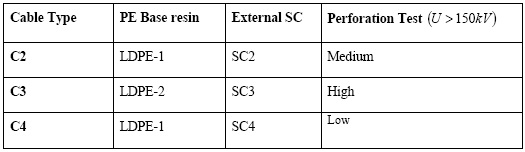
	    <p align="justify"><font face="verdana" size="2">Three experimental cables (<i>C</i> 2, C3 and <i>C</i> 4) were prepared using different PE crosslinking agent base resin (PE1, PE2) and different external semiconducting shields (SC1, SC2). Cables were evaluated by perforation tests at General Cable S.A., delivering quite different results. The following table summarizes each cable properties.</font></p>

	    <p align="center"><font face="verdana" size="2"><img src="/img/revistas/ns/v6n11/a2i2.jpg"></font></p>

	    <p align="justify"><font face="verdana" size="2"><b>Charge distribution measurements in cables and LDPE films in touch with the semiconductor shields</b> <i>C</i> 2, C3 and <i>C</i> 4.</font></p>

	    <p align="justify"><font face="verdana" size="2">Charge distribution measurements were performed by the Pulsed Electro&#45;Acoustic method (PEA). In this technique a pulsed electric field of 450 <i>V</i> amplitude and 80<i>ns</i> length is applied to the sample inducing the oscillation of space charge present through the material. The resulting pressure wave, related to the space charge distribution, is recorded as a function of time. More detailed explanation of this technique can be found in excellent treatises &#91;8&#93;. The PEA experimental set&#45;up used in this work was commercial PEA equipment "Techimp PEA cable system". A "Spellman SL10" 130<i>kV</i> high voltage power supply was used to polarize cable samples, and data was recorded by means of a "Tektronix TDS 5032" digital oscilloscope. The measuring procedure consisted on a 2 hours polarization time (<i>t<sub>p</sub></i>) at room temperature, and 120<i>kV</i> applied voltage (<i>V<sub>P</sub></i>). Charge distribution was measured continuously during polarization and 30 minutes more after removing the electric field. Samples consisted in 1.5<i>m</i> long cable sections conveniently arranged for measurements. The total measuring section length was 10<i>cm</i>.</font></p>

	    <p align="justify"><font face="verdana" size="2">Samples of LDPE of 0.150mm thick were taken and dried during 24 hours under vacuum at room temperature, then the samples of the outer semiconductor 12<i>mm</i> in diameter in the cables <i>C</i>2, C3and <i>C</i>4 were cut and used as electrodes during the measurement through the technical PEA applying an electric field of <img src="/img/revistas/ns/v6n11/a2i1.jpg">, and an amplitude pulse of <i>300V</i> and 40<i>ns</i> length.</font></p>

	    ]]></body>
<body><![CDATA[<p align="justify"><font face="verdana" size="2"><b>TSDC measurements</b></font></p>

	    <p align="justify"><font face="verdana" size="2">The samples that were polarized during the measurements, using the PEA technique, were cut without altering the zone where there were PEA measures and got the download details TSDC technique from 50 up to 120<i><sup>o</sup>C</i> at a speed of global warming of <img src="/img/revistas/ns/v6n11/a2i3.jpg"> in system prepared conveniently to obtain the intensity of the download stream as a function of temperature. The area under the curve Intensity vs Temperature is the amount of charge involved in the depolarization current.</font></p>

	    <p align="justify"><font face="verdana" size="2"><b>ATR measurements</b></font></p>

	    <p align="justify"><font face="verdana" size="2">Attenuated Total Reflectance (ATR) measurements were performed with a 'Nicolet 510M spectrometer of germanium optical in samples of outer semiconductors <i>C</i>2 , <i>C</i>3 and <i>C</i>4 of 12<i>mm</i> diameter. In XLPE sheets, circular samples 0.250<i>mm</i> thick were cut directly from the original cable with mechanical methods. We also analyzed the LDPE film circular samples on diameter 12<i>mm</i> and 0.150<i>mm</i>thick in contact with the outer semiconductor shield <i>C</i>2 , <i>C</i>3 and <i>C</i>4 cables during the PEA measurements with field <img src="/img/revistas/ns/v6n11/a2i1.jpg">.</font></p>

	    <p align="justify"><font face="verdana" size="2">&nbsp;</font></p>

	    <p align="justify"><font face="verdana" size="2"><b>Results and discussion</b></font></p>

	    <p align="justify"><font face="verdana" size="2"><b>PEA measurement as received cables</b></font></p>

	    <p align="justify"><font face="verdana" size="2">The <a href="/img/revistas/ns/v6n11/a2f2.jpg" target="_blank">Figure 2</a> show measurements of received cables at 0.50<i>mm</i> depth in XLPE insulating from the outer semiconductor shield. We can observe clear differences between them. Cable <i>C</i>4 shows much higher internal charge than the other two cables. However, cable C3 that performs better than <i>C</i>2 in perforation tests, shows higher internal charge as well. In all cases a distribution of trapped charge, injected from the external semiconductor electrode, can be observed.</font></p>

	    <p align="justify"><font face="verdana" size="2"><b>Space charge packed&#45;lite in LDPE films in touch with the cables <i>C</i>2, C3 and <i>C</i>4 semiconductor shields</b></font></p>

	    <p align="justify"><font face="verdana" size="2">In <a href="/img/revistas/ns/v6n11/a2f3.jpg" target="_blank">figure 3</a>, the formation and propagation of the packed space charge from SC to LDPE films 0.150<i>mm</i> thickness can be observed. The results are according to the tests perforation. The semiconductor SC3 has a lower contribution to the formation of packages and the intensity is smaller than in SC2 and SC4. In LDPE films in touch with the SC4 the propagation speed of the packed is in order to <img src="/img/revistas/ns/v6n11/a2i4.jpg"> while in two other cases is <img src="/img/revistas/ns/v6n11/a2i5.jpg">.</font></p>

	    ]]></body>
<body><![CDATA[<p align="justify"><font face="verdana" size="2"><b>PEA and TSDC measurement in cables annealed at 90<i><sup>o</sup>C</i>.</b></font></p>

	    <p align="justify"><font face="verdana" size="2">With the goal of clarifying the results obtained in the measures technique on the cable <i>C</i>3 , we have proceeded to study using the thermal aging in the cable samples because of the perforation test we carried at 90<sup>o</sup> <i>C</i> temperature. In <a href="/img/revistas/ns/v6n11/a2f4.jpg" target="_blank">figure 4b</a>) the PEA measurements in cables annealed 672 hours at 90<sup>o</sup> <i>C</i> let you set that the <i>C</i>4 cable has more charge accumulated in comparison with <i>C</i>3 and <i>C</i>2. These results are consistent with the findings by TSDC (<a href="/img/revistas/ns/v6n11/a2f5.jpg" target="_blank">figure 5b</a>). We can observe that the three cables, also after annealing internal charge distribution in all cables, follow similar relation as in the received samples but with less internal charge (<a href="/img/revistas/ns/v6n11/a2f4.jpg" target="_blank">figure 4a</a>) and a decrease of the charge with the PEA measurements. However, in C3 there is still more charge accumulated than in cable <i>C</i>2.</font></p>

	    <p align="justify"><font face="verdana" size="2"><b>PEA and TSDC measurement in cables annealed at 120 &deg;c.</b></font></p>

	    <p align="justify"><font face="verdana" size="2">To speed up the effect of the temperature we proceeded to anneal the cables for 672 hours at 120 &deg;C and repeat the measures by PEA and TSDC. In <a href="/img/revistas/ns/v6n11/a2f4.jpg" target="_blank">figures 4c</a>) and <a href="/img/revistas/ns/v6n11/a2f5.jpg" target="_blank">5c</a>) we finally see that cable C3 has less charge than cables <i>C</i> 2 and <i>C</i> 4. While the charge in cable C3 tend to decrease, in cables <i>C</i>2 and <i>C</i>4 it tends to increase. The above associates the differences in the process of cross&#45;linking these cables.</font></p>

	    <p align="justify"><font face="verdana" size="2"><b>ATR spectra in xlpe layer in touch with the semiconductor <i>C</i> 2, C3 and <i>C</i> 4.</b></font></p>

	    <p align="justify"><font face="verdana" size="2">In <a href="/img/revistas/ns/v6n11/a2f6.jpg" target="_blank">figure 6a</a>) we show the spectra ATR for the layer of XLPE in contact with the semiconductor screens of cables 2, 3 and 4 without heat treatment. We can clearly see that in the XLPE cables 2 and 4 there is band absorption from1557, 1638, 1742, 3300 <i>cm</i><sup>&#45;1</sup> that is not of the XLPE. The bands1557, 1638 and 3300<i>cm</i> <sup>1</sup> are of the azodicarbonamide ADA, and the band 1742<i>cm</i><sup>&#45;1</sup> corresponds to the Ethylene Vinyl Acetate EVA.</font></p>

	    <p align="justify"><font face="verdana" size="2"><a href="/img/revistas/ns/v6n11/a2f6.jpg" target="_blank">Figure 6b</a>) shows the spectra ATR of layer of XLPE in contact with the semiconductor cables annealed during 672 hours at 90<i><sup>o</sup>C</i>. We see a decrease in the absorption bands and if you are annealed for 672 hours to 120<i><sup>o</sup>C</i> <a href="/img/revistas/ns/v6n11/a2f6.jpg" target="_blank">figure 6c</a>) notes further declines.</font></p>

	    <p align="justify"><font face="verdana" size="2">The azodicarbonamide (C<sub>2</sub><i>H</i><sub>4</sub><i>O</i><sub>2</sub><i>N</i><sub>4</sub>) is a strong organic foaming agent of heat decomposition type. The decomposition temperature range is small. This product can be decomposed into N<sub>2</sub>, <i>CO</i>, <i>CO</i><sub>2</sub>, used as a foaming agent for producing several foamed plastics.</font></p>

	    <p align="justify"><font face="verdana" size="2">The presence of the absorption bands of azodiacarbonamide that are detected in the polyethen isolation XLPE are the consequence of the diffusion process from the semiconductor layer, meaning that the azodiacarbonamide is in the external semiconductor layer in the XLPE during the process of fabrication of the cable in that itself it reaches temperatures higher than 200 &deg;C during the reaction of vulcanization.</font></p>

	    <p align="justify"><font face="verdana" size="2">The decrease of the intensity of the bands of absorptions with the heat treatment of the samples to 90<sup>o</sup> <i>C</i> and 120<sup>o</sup> <i>C</i> seems to be related with the decomposition of the azodicarbonamide that contributes with the space charge input on the interface which it has been detected by PEA and TSDC explained previously.</font></p>

	    ]]></body>
<body><![CDATA[<p align="justify"><font face="verdana" size="2">&nbsp;</font></p>

	    <p align="justify"><font face="verdana" size="2"><b>Conclusions</b></font></p>

	    <p align="justify"><font face="verdana" size="2">We believe that the presence of azodicarbonamide on the external semiconductor facilitates the transport of electrical charge toward the isolation of XLPE. During the manufacturing process of the cable there is dissemination of azodicarbonamide toward the external surface of the XLPE, creating a porous structure and defects that serve as centers of accumulation of charge.</font></p>

	    <p align="justify"><font face="verdana" size="2">The heat treatment of the cable to 90 <i><sup>o</sup>C</i> and 120 <i><sup>o</sup>C</i> causes a decrease in the amount of azodicarbonamide in the outer layer of the isolation of XLPE either by decomposition or by a new broadcast toward the inner layers.</font></p>

	    <p align="justify"><font face="verdana" size="2">In the external interface there is a more significant presence of charge and is due to the external semiconductor shield structures. It has to be manipulated and flexible for their application, and the additives are necessary. The semiconductor shield of the cable C3 does not have azodicarbonamide; this contribution had an improved performance before the perforation test.</font></p>

	    <p align="justify"><font face="verdana" size="2">We initially detected more charge by means of the techniques PEA and TSDC, but the heat treatment improved the behavior with regard to the cables <i>C</i> 2 and <i>C</i> 4. This may be due to the fact that the cable C3 contains a resin commercial basis (LDPE&#45;2) different from <i>C</i>2 and <i>C</i> 4. The influence of temperature can cause a higher degree of cross&#45;linking and the elimination of by&#45;products of the reaction of reticulated.</font></p>

	    <p align="justify"><font face="verdana" size="2">&nbsp;</font></p>

	    <p align="justify"><font face="verdana" size="2"><b>References</b></font></p>

	    <!-- ref --><p align="justify"><font face="verdana" size="2">Bambery, K.R and Fleming. R. J. The temperature dependence of space charge accumulation in cross&#45;linked polyethylene. IEEE. 1996. Pp 16&#45;21.    &nbsp;&nbsp;&nbsp;&nbsp;&nbsp;&nbsp;&nbsp;&nbsp;[&#160;<a href="javascript:void(0);" onclick="javascript: window.open('/scielo.php?script=sci_nlinks&ref=5484262&pid=S2007-0705201400010000200001&lng=','','width=640,height=500,resizable=yes,scrollbars=1,menubar=yes,');">Links</a>&#160;]<!-- end-ref --></font></p>

	    ]]></body>
<body><![CDATA[<!-- ref --><p align="justify"><font face="verdana" size="2">Chen Fu, M. (2003) Space charge measurement in polymer insulated power cables using flat ground electrode PEA system, IEE Proceedings Science Measurement and Technology, Vol.150, Iss.2, pp.89.    &nbsp;&nbsp;&nbsp;&nbsp;&nbsp;&nbsp;&nbsp;&nbsp;[&#160;<a href="javascript:void(0);" onclick="javascript: window.open('/scielo.php?script=sci_nlinks&ref=5484264&pid=S2007-0705201400010000200002&lng=','','width=640,height=500,resizable=yes,scrollbars=1,menubar=yes,');">Links</a>&#160;]<!-- end-ref --></font></p>

	    <!-- ref --><p align="justify"><font face="verdana" size="2">Dissado, L.A (1998). What role played by space charge on the breakdown an ageing of polymers. Proceedings of the 3rd International Conference on Electric Charge in Solid Insulators, Soci&eacute;t&eacute; Fran&ccedil;aise du Vide, Tours, France, pp 141&#45;150.    &nbsp;&nbsp;&nbsp;&nbsp;&nbsp;&nbsp;&nbsp;&nbsp;[&#160;<a href="javascript:void(0);" onclick="javascript: window.open('/scielo.php?script=sci_nlinks&ref=5484266&pid=S2007-0705201400010000200003&lng=','','width=640,height=500,resizable=yes,scrollbars=1,menubar=yes,');">Links</a>&#160;]<!-- end-ref --></font></p>

	    <!-- ref --><p align="justify"><font face="verdana" size="2">Hozumi, N. Space Charge Behavior in Electrical Insultaion Under High Fieds.IEEE 1996 pp 3&#45;8.    &nbsp;&nbsp;&nbsp;&nbsp;&nbsp;&nbsp;&nbsp;&nbsp;[&#160;<a href="javascript:void(0);" onclick="javascript: window.open('/scielo.php?script=sci_nlinks&ref=5484268&pid=S2007-0705201400010000200004&lng=','','width=640,height=500,resizable=yes,scrollbars=1,menubar=yes,');">Links</a>&#160;]<!-- end-ref --></font></p>

	    <!-- ref --><p align="justify"><font face="verdana" size="2">Kon H, Suzuoky Y, MIzutani T ; Suzuki T. Study os Space Charge Behaviour in Polyethylene for Power Cable Insulation by Laser&#45;induced pressure&#45;pulse Technique&#45; Effects of Antioxidants. Trans IEE Japan, BcVol 114&#45;A pp 243.251, 1999.    &nbsp;&nbsp;&nbsp;&nbsp;&nbsp;&nbsp;&nbsp;&nbsp;[&#160;<a href="javascript:void(0);" onclick="javascript: window.open('/scielo.php?script=sci_nlinks&ref=5484270&pid=S2007-0705201400010000200005&lng=','','width=640,height=500,resizable=yes,scrollbars=1,menubar=yes,');">Links</a>&#160;]<!-- end-ref --></font></p>

	    <!-- ref --><p align="justify"><font face="verdana" size="2">Sessler G.M. (1999). Electrets, 3rd &eacute;d.; Gerhard&#45;Multhaupt, R., Ed.; Laplacian: Morgan Hill, CA, Vol. 2, Chapter 10, pp 41&#45;80.    &nbsp;&nbsp;&nbsp;&nbsp;&nbsp;&nbsp;&nbsp;&nbsp;[&#160;<a href="javascript:void(0);" onclick="javascript: window.open('/scielo.php?script=sci_nlinks&ref=5484272&pid=S2007-0705201400010000200006&lng=','','width=640,height=500,resizable=yes,scrollbars=1,menubar=yes,');">Links</a>&#160;]<!-- end-ref --></font></p>

	    ]]></body>
<body><![CDATA[<!-- ref --><p align="justify"><font face="verdana" size="2">Suzuoky, Y; Furuta T; Yamada H. Han S.O, Mizutani T. Study of space charge in polyethylene by Direct probing Effects of Oxidation. IEEE Transactions on Electrical Insulation. Vol 26 No 6, 1991. Pp 1073&#45;1079.    &nbsp;&nbsp;&nbsp;&nbsp;&nbsp;&nbsp;&nbsp;&nbsp;[&#160;<a href="javascript:void(0);" onclick="javascript: window.open('/scielo.php?script=sci_nlinks&ref=5484274&pid=S2007-0705201400010000200007&lng=','','width=640,height=500,resizable=yes,scrollbars=1,menubar=yes,');">Links</a>&#160;]<!-- end-ref --></font></p>

	    <!-- ref --><p align="justify"><font face="verdana" size="2">Tamayo Idalberto, Belana J., Ca&ntilde;adas J.C., Diego J.A., Mudarra M. , Sellar&aacute;s J. (2003) Thermally Stimulated Depolarization Currents of Crosslinked Polyethylene Relaxations in the Fusion Range of Temperatures". J Polym Sci Part B: Polym. Phys, 41, 1412&#45;1421.    &nbsp;&nbsp;&nbsp;&nbsp;&nbsp;&nbsp;&nbsp;&nbsp;[&#160;<a href="javascript:void(0);" onclick="javascript: window.open('/scielo.php?script=sci_nlinks&ref=5484276&pid=S2007-0705201400010000200008&lng=','','width=640,height=500,resizable=yes,scrollbars=1,menubar=yes,');">Links</a>&#160;]<!-- end-ref --></font></p>

	    <!-- ref --><p align="justify"><font face="verdana" size="2">Tamayo Idalberto, Belana J., Diego J. A., Ca&ntilde;adas J. C., Mudarra M., Sellar&egrave;s J. (2004). Space Charge Studies of Crosslinked Polyethylene Midvoltage Cable Insulation by Thermally Stimulated Depolarization Current, Infrared/Fourier Transform Infrared, and Scanning Electron Microscopy. J. Polym. Sci. Part B: Polym. Phys., vol. 42, pp. 4164&#45;4174.    &nbsp;&nbsp;&nbsp;&nbsp;&nbsp;&nbsp;&nbsp;&nbsp;[&#160;<a href="javascript:void(0);" onclick="javascript: window.open('/scielo.php?script=sci_nlinks&ref=5484278&pid=S2007-0705201400010000200009&lng=','','width=640,height=500,resizable=yes,scrollbars=1,menubar=yes,');">Links</a>&#160;]<!-- end-ref --></font></p>

	    <!-- ref --><p align="justify"><font face="verdana" size="2">Tamayo Idalberto, Diego J. A., Orrit J.(2007) Space Charge Measurements in XLPE Insulated Mid&#45;Voltage Cable: Correlation whit Cable Performance". JICABLE 2007, SEE, Versailles, France. pp 331&#45;336.    &nbsp;&nbsp;&nbsp;&nbsp;&nbsp;&nbsp;&nbsp;&nbsp;[&#160;<a href="javascript:void(0);" onclick="javascript: window.open('/scielo.php?script=sci_nlinks&ref=5484280&pid=S2007-0705201400010000200010&lng=','','width=640,height=500,resizable=yes,scrollbars=1,menubar=yes,');">Links</a>&#160;]<!-- end-ref --></font></p>

	    <!-- ref --><p align="justify"><font face="verdana" size="2">Tamayo Idalberto, &Ocirc;rrit J., Diego J.A.,Belana J and Ca&ntilde;adas J. (2011) Influence of EVA&#45;carbon Black based SC&#45;shield in Free Charge Genertation and Propagation in LDPE. 14<sup>th</sup> International Symposium on Electrets. Montpellier. France pp 97&#45;98.    &nbsp;&nbsp;&nbsp;&nbsp;&nbsp;&nbsp;&nbsp;&nbsp;[&#160;<a href="javascript:void(0);" onclick="javascript: window.open('/scielo.php?script=sci_nlinks&ref=5484282&pid=S2007-0705201400010000200011&lng=','','width=640,height=500,resizable=yes,scrollbars=1,menubar=yes,');">Links</a>&#160;]<!-- end-ref --></font></p>

	    ]]></body>
<body><![CDATA[<!-- ref --><p align="justify"><font face="verdana" size="2">Vissouvanadin B., Le Roy, Teyssedre S, Laurent G., Denizet C., Mammeri I., Poisson M. (2009). Impact of conditioning on space charge formation in XLPE under DC electrical stress. Properties and Applications of Dielectric Materials. ICPADM 2009. IEEE 9th International Conference on the, On page(s): 961 &#45; 964, Volume: Issue: 19&#45;23.    &nbsp;&nbsp;&nbsp;&nbsp;&nbsp;&nbsp;&nbsp;&nbsp;[&#160;<a href="javascript:void(0);" onclick="javascript: window.open('/scielo.php?script=sci_nlinks&ref=5484284&pid=S2007-0705201400010000200012&lng=','','width=640,height=500,resizable=yes,scrollbars=1,menubar=yes,');">Links</a>&#160;]<!-- end-ref --></font></p>
     ]]></body><back>
<ref-list>
<ref id="B1">
<nlm-citation citation-type="book">
<person-group person-group-type="author">
<name>
<surname><![CDATA[Bambery]]></surname>
<given-names><![CDATA[K.R]]></given-names>
</name>
<name>
<surname><![CDATA[Fleming]]></surname>
<given-names><![CDATA[R. J.]]></given-names>
</name>
</person-group>
<source><![CDATA[The temperature dependence of space charge accumulation in cross-linked polyethylene.]]></source>
<year>1996</year>
<page-range>16-21</page-range><publisher-name><![CDATA[IEEE]]></publisher-name>
</nlm-citation>
</ref>
<ref id="B2">
<nlm-citation citation-type="journal">
<person-group person-group-type="author">
<name>
<surname><![CDATA[Chen Fu]]></surname>
<given-names><![CDATA[M.]]></given-names>
</name>
</person-group>
<article-title xml:lang="en"><![CDATA[Space charge measurement in polymer insulated power cables using flat ground electrode PEA system]]></article-title>
<source><![CDATA[IEE Proceedings Science Measurement and Technology]]></source>
<year>2003</year>
<volume>150</volume>
<numero>2</numero>
<issue>2</issue>
<page-range>89</page-range></nlm-citation>
</ref>
<ref id="B3">
<nlm-citation citation-type="book">
<person-group person-group-type="author">
<name>
<surname><![CDATA[Dissado]]></surname>
<given-names><![CDATA[L.A]]></given-names>
</name>
</person-group>
<article-title xml:lang="en"><![CDATA[What role played by space charge on the breakdown an ageing of polymers]]></article-title>
<source><![CDATA[Proceedings of the 3rd International Conference on Electric Charge in Solid Insulators]]></source>
<year>1998</year>
<page-range>141-150</page-range><publisher-loc><![CDATA[Tours ]]></publisher-loc>
<publisher-name><![CDATA[Société Française du Vide]]></publisher-name>
</nlm-citation>
</ref>
<ref id="B4">
<nlm-citation citation-type="book">
<person-group person-group-type="author">
<name>
<surname><![CDATA[Hozumi]]></surname>
<given-names><![CDATA[N.]]></given-names>
</name>
</person-group>
<source><![CDATA[Space Charge Behavior in Electrical Insultaion Under High Fieds]]></source>
<year>1996</year>
<page-range>3-8</page-range><publisher-name><![CDATA[IEEE]]></publisher-name>
</nlm-citation>
</ref>
<ref id="B5">
<nlm-citation citation-type="journal">
<person-group person-group-type="author">
<name>
<surname><![CDATA[Kon]]></surname>
<given-names><![CDATA[H]]></given-names>
</name>
<name>
<surname><![CDATA[Suzuoky]]></surname>
<given-names><![CDATA[Y]]></given-names>
</name>
<name>
<surname><![CDATA[MIzutani]]></surname>
<given-names><![CDATA[T]]></given-names>
</name>
<name>
<surname><![CDATA[Suzuki]]></surname>
<given-names><![CDATA[T]]></given-names>
</name>
</person-group>
<article-title xml:lang="en"><![CDATA[Study os Space Charge Behaviour in Polyethylene for Power Cable Insulation by Laser-induced pressure-pulse Technique- Effects of Antioxidants]]></article-title>
<source><![CDATA[IEE Japan]]></source>
<year>1999</year>
<volume>114-A</volume>
<page-range>243.251</page-range></nlm-citation>
</ref>
<ref id="B6">
<nlm-citation citation-type="book">
<person-group person-group-type="author">
<name>
<surname><![CDATA[Sessler]]></surname>
<given-names><![CDATA[G.M.]]></given-names>
</name>
<name>
<surname><![CDATA[Gerhard-Multhaupt]]></surname>
<given-names><![CDATA[R.]]></given-names>
</name>
</person-group>
<source><![CDATA[Electrets]]></source>
<year>1999</year>
<volume>2</volume>
<edition>3rd</edition>
<page-range>41-80</page-range><publisher-loc><![CDATA[Laplacian^eCA CA]]></publisher-loc>
<publisher-name><![CDATA[Morgan Hill]]></publisher-name>
</nlm-citation>
</ref>
<ref id="B7">
<nlm-citation citation-type="journal">
<person-group person-group-type="author">
<name>
<surname><![CDATA[Suzuoky]]></surname>
<given-names><![CDATA[Y]]></given-names>
</name>
<name>
<surname><![CDATA[Furuta]]></surname>
<given-names><![CDATA[T]]></given-names>
</name>
<name>
<surname><![CDATA[Yamada]]></surname>
<given-names><![CDATA[H]]></given-names>
</name>
<name>
<surname><![CDATA[Han]]></surname>
<given-names><![CDATA[S.O]]></given-names>
</name>
<name>
<surname><![CDATA[Mizutani]]></surname>
<given-names><![CDATA[T.]]></given-names>
</name>
</person-group>
<article-title xml:lang="en"><![CDATA[Study of space charge in polyethylene by Direct probing Effects of Oxidation]]></article-title>
<source><![CDATA[IEEE Transactions on Electrical Insulation.]]></source>
<year>1991</year>
<volume>26</volume>
<numero>6</numero>
<issue>6</issue>
<page-range>1073-1079</page-range></nlm-citation>
</ref>
<ref id="B8">
<nlm-citation citation-type="journal">
<person-group person-group-type="author">
<name>
<surname><![CDATA[Tamayo]]></surname>
<given-names><![CDATA[Idalberto]]></given-names>
</name>
<name>
<surname><![CDATA[Belana]]></surname>
<given-names><![CDATA[J.]]></given-names>
</name>
<name>
<surname><![CDATA[Cañadas]]></surname>
<given-names><![CDATA[J.C.]]></given-names>
</name>
<name>
<surname><![CDATA[Diego]]></surname>
<given-names><![CDATA[J.A]]></given-names>
</name>
<name>
<surname><![CDATA[Mudarra]]></surname>
<given-names><![CDATA[M.]]></given-names>
</name>
<name>
<surname><![CDATA[Sellarás]]></surname>
<given-names><![CDATA[J.]]></given-names>
</name>
</person-group>
<article-title xml:lang="en"><![CDATA[Thermally Stimulated Depolarization Currents of Crosslinked Polyethylene Relaxations in the Fusion Range of Temperatures]]></article-title>
<source><![CDATA[J Polym Sci]]></source>
<year>2003</year>
<volume>41</volume>
<page-range>1412-1421</page-range></nlm-citation>
</ref>
<ref id="B9">
<nlm-citation citation-type="journal">
<person-group person-group-type="author">
<name>
<surname><![CDATA[Tamayo]]></surname>
<given-names><![CDATA[Idalberto]]></given-names>
</name>
<name>
<surname><![CDATA[Belana]]></surname>
<given-names><![CDATA[J.]]></given-names>
</name>
<name>
<surname><![CDATA[Diego]]></surname>
<given-names><![CDATA[J. A.]]></given-names>
</name>
<name>
<surname><![CDATA[Cañadas]]></surname>
<given-names><![CDATA[J. C.]]></given-names>
</name>
<name>
<surname><![CDATA[Mudarra]]></surname>
<given-names><![CDATA[M.]]></given-names>
</name>
<name>
<surname><![CDATA[Sellarès]]></surname>
<given-names><![CDATA[J.]]></given-names>
</name>
</person-group>
<article-title xml:lang="en"><![CDATA[Space Charge Studies of Crosslinked Polyethylene Midvoltage Cable Insulation by Thermally Stimulated Depolarization Current, Infrared/Fourier Transform Infrared, and Scanning Electron Microscopy]]></article-title>
<source><![CDATA[J. Polym. Sci.]]></source>
<year>2004</year>
<volume>42</volume>
<page-range>4164-41</page-range></nlm-citation>
</ref>
<ref id="B10">
<nlm-citation citation-type="">
<person-group person-group-type="author">
<name>
<surname><![CDATA[Tamayo]]></surname>
<given-names><![CDATA[Idalberto]]></given-names>
</name>
<name>
<surname><![CDATA[Diego]]></surname>
<given-names><![CDATA[J. A.]]></given-names>
</name>
<name>
<surname><![CDATA[Orrit]]></surname>
<given-names><![CDATA[J.]]></given-names>
</name>
</person-group>
<article-title xml:lang="en"><![CDATA[Space Charge Measurements in XLPE Insulated Mid-Voltage Cable: Correlation whit Cable Performance]]></article-title>
<collab>JICABLE</collab>
<source><![CDATA[SEE]]></source>
<year>2007</year>
<month>20</month>
<day>07</day>
<page-range>331-336</page-range><publisher-loc><![CDATA[Versailles ]]></publisher-loc>
</nlm-citation>
</ref>
<ref id="B11">
<nlm-citation citation-type="">
<person-group person-group-type="author">
<name>
<surname><![CDATA[Tamayo]]></surname>
<given-names><![CDATA[Idalberto]]></given-names>
</name>
<name>
<surname><![CDATA[Ôrrit]]></surname>
<given-names><![CDATA[J.]]></given-names>
</name>
<name>
<surname><![CDATA[Diego]]></surname>
<given-names><![CDATA[J.A.]]></given-names>
</name>
<name>
<surname><![CDATA[Belana]]></surname>
<given-names><![CDATA[J]]></given-names>
</name>
<name>
<surname><![CDATA[Cañadas]]></surname>
<given-names><![CDATA[J.]]></given-names>
</name>
</person-group>
<source><![CDATA[Influence of EVA-carbon Black based SC-shield in Free Charge Genertation and Propagation in LDPE]]></source>
<year>2011</year>
<page-range>97-98</page-range><publisher-loc><![CDATA[Montpellier ]]></publisher-loc>
</nlm-citation>
</ref>
<ref id="B12">
<nlm-citation citation-type="journal">
<person-group person-group-type="author">
<name>
<surname><![CDATA[Vissouvanadin]]></surname>
<given-names><![CDATA[B.]]></given-names>
</name>
<name>
<surname><![CDATA[Le Roy]]></surname>
</name>
<name>
<surname><![CDATA[Teyssedre]]></surname>
<given-names><![CDATA[S]]></given-names>
</name>
<name>
<surname><![CDATA[Laurent]]></surname>
<given-names><![CDATA[G.]]></given-names>
</name>
<name>
<surname><![CDATA[Denizet]]></surname>
<given-names><![CDATA[C.]]></given-names>
</name>
<name>
<surname><![CDATA[Mammeri]]></surname>
<given-names><![CDATA[I.]]></given-names>
</name>
<name>
<surname><![CDATA[Poisson]]></surname>
<given-names><![CDATA[M.]]></given-names>
</name>
</person-group>
<article-title xml:lang="en"><![CDATA[Impact of conditioning on space charge formation in XLPE under DC electrical stress. Properties and Applications of Dielectric Materials]]></article-title>
<source><![CDATA[ICPADM]]></source>
<year>2009</year>
<month>20</month>
<day>09</day>
<volume>19</volume>
<numero>23</numero>
<issue>23</issue>
<page-range>961 - 964</page-range></nlm-citation>
</ref>
</ref-list>
</back>
</article>
