<?xml version="1.0" encoding="ISO-8859-1"?><article xmlns:mml="http://www.w3.org/1998/Math/MathML" xmlns:xlink="http://www.w3.org/1999/xlink" xmlns:xsi="http://www.w3.org/2001/XMLSchema-instance">
<front>
<journal-meta>
<journal-id>2007-0705</journal-id>
<journal-title><![CDATA[Nova scientia]]></journal-title>
<abbrev-journal-title><![CDATA[Nova scientia]]></abbrev-journal-title>
<issn>2007-0705</issn>
<publisher>
<publisher-name><![CDATA[Universidad de La Salle Bajío A. C., Coordinación de Investigación]]></publisher-name>
</publisher>
</journal-meta>
<article-meta>
<article-id>S2007-07052013000100006</article-id>
<title-group>
<article-title xml:lang="en"><![CDATA[Dynamics of holes wave-packets under Rashba spin-orbit coupling]]></article-title>
<article-title xml:lang="es"><![CDATA[Dinámica de paquetes de ondas de huecos bajo acoplamiento espín-órbita tipo Rashba]]></article-title>
</title-group>
<contrib-group>
<contrib contrib-type="author">
<name>
<surname><![CDATA[Cuan]]></surname>
<given-names><![CDATA[R.]]></given-names>
</name>
<xref ref-type="aff" rid="A01"/>
</contrib>
<contrib contrib-type="author">
<name>
<surname><![CDATA[Diago-Cisneros]]></surname>
<given-names><![CDATA[L.]]></given-names>
</name>
<xref ref-type="aff" rid="A02"/>
</contrib>
</contrib-group>
<aff id="A01">
<institution><![CDATA[,Universidad de La Habana Facultad de Física ]]></institution>
<addr-line><![CDATA[La Habana ]]></addr-line>
<country>Cuba</country>
</aff>
<aff id="A02">
<institution><![CDATA[,Universidad Iberoamericana Departamento de Física y Matemáticas ]]></institution>
<addr-line><![CDATA[México Distrito Federal]]></addr-line>
<country>México</country>
</aff>
<pub-date pub-type="pub">
<day>00</day>
<month>00</month>
<year>2013</year>
</pub-date>
<pub-date pub-type="epub">
<day>00</day>
<month>00</month>
<year>2013</year>
</pub-date>
<volume>5</volume>
<numero>9</numero>
<fpage>76</fpage>
<lpage>88</lpage>
<copyright-statement/>
<copyright-year/>
<self-uri xlink:href="http://www.scielo.org.mx/scielo.php?script=sci_arttext&amp;pid=S2007-07052013000100006&amp;lng=en&amp;nrm=iso"></self-uri><self-uri xlink:href="http://www.scielo.org.mx/scielo.php?script=sci_abstract&amp;pid=S2007-07052013000100006&amp;lng=en&amp;nrm=iso"></self-uri><self-uri xlink:href="http://www.scielo.org.mx/scielo.php?script=sci_pdf&amp;pid=S2007-07052013000100006&amp;lng=en&amp;nrm=iso"></self-uri><abstract abstract-type="short" xml:lang="en"><p><![CDATA[The dynamics of a Gaussian wave-packet of heavy holes is studied in the presence of Rashba spin-orbit interaction for a quasi-one-dimensional semiconductor system. A finite-difference scheme, based on the Cayley approach, has been extended to solve the time-dependent Schrödinger equation for holes. It is shown the phenomenon of hole-spin precession via a numerical simulation of the temporal evolution of the components of the wave-packet. It is possible to evaluate relevant parameters, e. g. dimensions and the spin polarization flip-time, when a spin field effect transistor device, is modeled for holes as carriers.]]></p></abstract>
<abstract abstract-type="short" xml:lang="es"><p><![CDATA[Se estudia la dinámica de un paquete de ondas gaussiano de huecos pesados, en presencia de interacción espín-órbita tipo Rashba, para un sistema semiconductor cuasi-unidimensional. Se utiliza un esquema en diferencias finitas, basado en la aproximación de Cayley, y se extiende a la solución de la ecuación de Schrödinger dependiente del tiempo para huecos. Se muestra el fenómeno de la precesión del espín de los huecos, a través de una simulación numérica de la evolución temporal de las componentes del paquete. Es posible evaluar parámetros relevantes, e. g. dimensiones y tiempos de inversión de la polarización, en un dispositivo modelado como transistor de efecto campo de espín, que utilice en calidad de portadores a los huecos.]]></p></abstract>
<kwd-group>
<kwd lng="en"><![CDATA[Spintronics]]></kwd>
<kwd lng="en"><![CDATA[spin-orbit coupling]]></kwd>
<kwd lng="en"><![CDATA[spin-polarized transport in semiconductors]]></kwd>
<kwd lng="en"><![CDATA[spin field effect transistors]]></kwd>
<kwd lng="es"><![CDATA[Espintrónica]]></kwd>
<kwd lng="es"><![CDATA[acoplamiento espín-órbita]]></kwd>
<kwd lng="es"><![CDATA[transporte espín polarizado en semiconductores]]></kwd>
<kwd lng="es"><![CDATA[transistor de efecto campo de espín]]></kwd>
</kwd-group>
</article-meta>
</front><body><![CDATA[  	    <p align="justify"><font face="verdana" size="4">Ciencias naturales e ingenier&iacute;as</font></p>      <p align="justify"><font face="verdana" size="2">&nbsp;</font></p>  	    <p align="center"><font face="verdana" size="4"><b>Dynamics of holes wave&#45;packets under Rashba spin&#45;orbit coupling</b></font></p>      <p align="center"><font face="verdana" size="2">&nbsp;</font></p>  	    <p align="center"><font face="verdana" size="3"><b>Din&aacute;mica de paquetes de ondas de huecos bajo acoplamiento esp&iacute;n&#45;&oacute;rbita tipo Rashba</b></font></p>      <p align="justify"><font face="verdana" size="2">&nbsp;</font></p>  	    <p align="center"><font face="verdana" size="2"><b>R. Cuan<sup>1</sup> y L. Diago&#45;Cisneros<sup>1,</sup> <sup>2</sup></b></font></p>  	    <p align="justify"><font face="verdana" size="2">&nbsp;</font></p>  	    <p align="justify"><font face="verdana" size="2"><sup>1</sup> <i>Facultad de F&iacute;sica. Universidad de La Habana, Cuba</i>. </font></p>  	    ]]></body>
<body><![CDATA[<p align="justify"><font face="verdana" size="2"><sup>2</sup> <i>Departamento de F&iacute;sica y Matem&aacute;ticas, Universidad Iberoamericana, M&eacute;xico</i>. </font></p>     <p align="justify">&nbsp;</p>  	    <p align="justify"><font face="verdana" size="2"><i>R. Cuan</i>. E&#45;mail: <a href="mailto:rcuan@fisica.uh.cu"><u>rcuan@fisica.uh.cu</u></a> </font><font face="verdana" size="2"><i>L. Diago&#45;Cisneros</i>. E&#45;mail: <a href="mailto:ldiago@fisica.uh.cu"><u>ldiago@fisica.uh.cu</u></a></font>.</p>     <p align="justify">&nbsp;</p>  	    <p align="justify"><font face="verdana" size="2">Recepci&oacute;n: 04&#45;05&#45;2012&nbsp;    <br> 	Aceptaci&oacute;n: 12&#45;10&#45;2012</font></p>  	    <p align="justify"><font face="verdana" size="2">&nbsp;</font></p>  	    <p align="justify"><font face="verdana" size="2"><b>Abstract</b></font></p>  	    <p align="justify"><font face="verdana" size="2">The dynamics of a Gaussian wave&#45;packet of heavy holes is studied in the presence of Rashba spin&#45;orbit interaction for a <i>quasi</i>&#45;one&#45;dimensional semiconductor system. A finite&#45;difference scheme, based on the Cayley approach, has been extended to solve the time&#45;dependent Schr&ouml;dinger equation for holes. It is shown the phenomenon of hole&#45;spin precession <i>via</i> a numerical simulation of the temporal evolution of the components of the wave&#45;packet. It is possible to evaluate relevant parameters, <i>e. g.</i> dimensions and the spin polarization flip&#45;time, when a spin field effect transistor device, is modeled for holes as carriers.</font></p>  	    <p align="justify"><font face="verdana" size="2"><b>Keywords:</b> Spintronics, spin&#45;orbit coupling, spin&#45;polarized transport in semiconductors, spin field effect transistors.</font></p>  	    ]]></body>
<body><![CDATA[<p align="justify"><font face="verdana" size="2">&nbsp;</font></p>  	    <p align="justify"><font face="verdana" size="2"><b>Resumen</b></font></p>  	    <p align="justify"><font face="verdana" size="2">Se estudia la din&aacute;mica de un paquete de ondas gaussiano de huecos pesados, en presencia de interacci&oacute;n esp&iacute;n&#45;&oacute;rbita tipo Rashba, para un sistema semiconductor <i>cuasi</i>&#45;unidimensional. Se utiliza un esquema en diferencias finitas, basado en la aproximaci&oacute;n de Cayley, y se extiende a la soluci&oacute;n de la ecuaci&oacute;n de Schr&ouml;dinger dependiente del tiempo para huecos. Se muestra el fen&oacute;meno de la precesi&oacute;n del esp&iacute;n de los huecos, a trav&eacute;s de una simulaci&oacute;n num&eacute;rica de la evoluci&oacute;n temporal de las componentes del paquete. Es posible evaluar par&aacute;metros relevantes, <i>e. g.</i> dimensiones y tiempos de inversi&oacute;n de la polarizaci&oacute;n, en un dispositivo modelado como transistor de efecto campo de esp&iacute;n, que utilice en calidad de portadores a los huecos.</font></p>  	    <p align="justify"><font face="verdana" size="2"><b>Palabras clave:</b> Espintr&oacute;nica, acoplamiento esp&iacute;n&#45;&oacute;rbita, transporte esp&iacute;n polarizado en semiconductores, transistor de efecto campo de esp&iacute;n.</font></p>  	    <p align="justify"><font face="verdana" size="2">&nbsp;</font></p>  	    <p align="justify"><font face="verdana" size="2"><b>Introduction</b></font></p>  	    <p align="justify"><font face="verdana" size="2">The recent interest in the electron spin has opened a new frontier field in Nanosciences named Spintronics (Awschalom and Flatt&eacute; 2007, 135). One of the more important mechanisms for the spin manipulation in semiconductors systems is the Rashba spin&#45;orbit interaction (SOI&#45;R) (Bychkov and Rashba 1984, 6039). The SOI&#45;R arises as consequence of a potential gradient transversal to the carries movement. It is responsible for carrier spin precession and also breaks the two&#45;fold degeneracy in a typically parabolic dispersion laws. The SOI&#45;R is the key ingredient&nbsp;of the Datta and Das spin field effect transistor (SFET), one of the foundational theoretical works&nbsp;in Spintronics (Datta and Das 1990, 665).&nbsp;</font></p>  	    <p align="justify"><font face="verdana" size="2">In recent years, SOI&#45;R in quasi&#45;one&#45;dimensional (Q&#45;1D) semiconductors systems become&nbsp;important, due to the abundance of physical phenomena and applications (Guzenko <i>et al.</i> 2006, 031202; S&aacute;nchez <i>et al.</i> 2008, 035315). In addition, the sources of spin dephasing become&nbsp;neglectable when the angular carrier's distribution is restricted to a Q&#45;1D channel (H&auml;usler 2004,&nbsp;115313). Governale and Z&uuml;licke, in a study on the possibility of a non&#45;magnetic spin filter,&nbsp;proposed a Hamiltonian that adequately describes the SOI&#45;R for Q&#45;1D holes systems (Governale&nbsp;and Z&uuml;licke 2003, 257).</font></p>  	    <p align="justify"><font face="verdana" size="2">One of the first numerical works in quantum transport of electronics wave&#45;packets was achieved by Goldberg <i>et al.</i> (Goldberg <i>et al.</i> 1967, 177). The numerical technique used, based on the Finite Difference Method, allows to solve the time&#45;dependent Schr&ouml;dinger equation for Hamiltonians without explicit temporal dependence. The Goldberg formalism has been used in the study of the spin&#45;dependent dynamics of electronics (Tung and Lee 1996, 507; Tung and Lee 1996, 2122; Ochoa&#45;Fajardo 2006, 26; Bonfanti&#45;Escalera 2008, 18) and holes (Cuan and Diago&#45;Cisneros 2010, 212) wave&#45;packets. The latter case corresponds to calculation of spin&#45;resolved kinetics coefficients in the scattering on stationary potential barriers under SOI&#45;R.</font></p>  	    <p align="justify"><font face="verdana" size="2">The aim of this report is to apply the Goldberg formalism to study the time evolution of a holes Gaussian wave&#45;packet under SOI&#45;R in Q&#45;1D systems, described by the Governale and Z&uuml;licke Hamiltonian. Also analyze the behavior of the spin components of the packet, mainly the spin precession, in order to obtain useful predictions.</font></p>  	    ]]></body>
<body><![CDATA[<p align="justify"><font face="verdana" size="2">&nbsp;</font></p>  	    <p align="justify"><font face="verdana" size="2"><b>Theoretical Model</b></font></p>  	    <p align="justify"><font face="verdana" size="2">For typical experimental parameters, only the first heavy hole sub&#45;band is occupied (Governale and Z&uuml;licke 2003, 257; Pala <i>et al.</i> 2004, 045304; Winkler <i>et al.</i> 2002, 155303), thereby in this theoretical model all non&#45;conducting sub&#45;bands will be neglected. Will be considered, in addition, a strictly one&#45;dimensional system arranged along the <i>z</i> axis (positive direction will be assumed as the transport direction). The SOI&#45;R dependent dynamics of the heavy holes on the Bloch representation <i>D</i><sub>&#8532;</sub> of the angular momentum, with the basis <img src="/img/revistas/ns/v5n9/a6i1.jpg"> will be described through the Hamiltonian</font></p>  	    <p align="center"><font face="verdana" size="2"><img src="/img/revistas/ns/v5n9/a6e1.jpg"></font></p>  	    <p align="justify"><font face="verdana" size="2">taking the energy reference in the sub&#45;band minimum. In the first term <i>&#978; = &#978;<sub>1</sub>&#151;</i>(2/5)(2<i>&#978;</i><sub>2</sub> + 3<i>&#978;</i><sub>3</sub>), where <i>&#978;<sub>i</sub></i> represents the L&uuml;ttinger parameters, m<sub>0</sub> is the free electron mass and <i>I</i><sub>2</sub> is the identity matrix (2 x 2). The second term corresponds to the SOI&#45;R for the one&#45;dimensional heavy hole case (Governale and Z&uuml;licke 2003, 257), where <i>&#946;</i> is related with the strength of the SOI&#45;R for the first heavy hole sub&#45;band (Winkler <i>et al.</i> 2002, 155303), and <i>&#963;<sub>y</sub></i> is one of the Pauli matrices.</font></p>  	    <p align="justify"><font face="verdana" size="2">In the energy spectrum for the Hamiltonian (1) appear unfolded branches, one for each spin polarization, in the form</font></p>  	    <p align="center"><font face="verdana" size="2"><img src="/img/revistas/ns/v5n9/a6e2.jpg"></font></p>  	    <p align="justify"><font face="verdana" size="2">As a result, both spin components travel with different group velocity.</font></p>  	    <p align="center"><font face="verdana" size="2"><img src="/img/revistas/ns/v5n9/a6e3.jpg"></font></p>  	    <p align="justify"><font face="verdana" size="2">&nbsp;</font></p>  	    ]]></body>
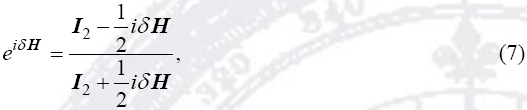
<body><![CDATA[<p align="justify"><font face="verdana" size="2"><b>Numerical Integration</b></font></p>  	    <p align="justify"><font face="verdana" size="2">We assumed the Hartree atomic units system. The time&#45;dependent Schr&ouml;dinger equation has the form</font></p>  	    <p align="center"><font face="verdana" size="2"><img src="/img/revistas/ns/v5n9/a6e4.jpg"></font></p>  	    <p align="justify"><font face="verdana" size="2">where <b><img src="/img/revistas/ns/v5n9/a6i2.jpg"></b> is a spinor. Since the Hamiltonian (1) is time independent, the formal solution of (4) can be written as</font></p>  	    <p align="center"><font face="verdana" size="2"><img src="/img/revistas/ns/v5n9/a6e5.jpg"></font></p>  	    <p align="justify"><font face="verdana" size="2">&nbsp;</font></p>  	    <p align="justify"><font face="verdana" size="2">In order to transform the time evolution equation (5) into a finite difference equation, the temporal variable will be designed by the index <i>n</i> and the positional variable by the index <i>j,</i> such that <b><i><img src="/img/revistas/ns/v5n9/a6i3.jpg"></i></b>. It will then have <i>z</i> &#8594; j&ograve; F2 &ograve; and <i>t</i> &#8594; <i>n&#948;,</i> with &ograve; and <i>&#948;</i> as the width of the space and time partitions respectively, <i>j =</i> 0,1,2,...,<i>J</i> and <i>n =</i> 0,1,2,...,with J and N the total number of partitions. The equation (5) will take the form</font></p>  	    <p align="center"><font face="verdana" size="2"><img src="/img/revistas/ns/v5n9/a6e6.jpg"></font></p>  	    <p align="justify"><font face="verdana" size="2">&nbsp;</font></p>  	    <p align="justify"><font face="verdana" size="2">Using the Cayley approach for the time evolution operator (Goldberg <i>et al.</i> 1967, 177)</font></p>  	    ]]></body>
<body><![CDATA[<p align="center"><font face="verdana" size="2"><img src="/img/revistas/ns/v5n9/a6e7.jpg"></font></p>     <p align="justify"><font face="verdana" size="2">the equation (6) take the form</font></p>  	    <p align="center"><font face="verdana" size="2"><img src="/img/revistas/ns/v5n9/a6e8.jpg"></font></p>     <p align="justify"><font face="verdana" size="2">Since the Hamiltonian (1) is non&#45;diagonal (see equation (4)), the expression (8) leads to a coupled equations system for <i>&#968;</i><sub><i>1</i></sub> and <i>&#968;</i><sub><i>2</i></sub> due to the SOI&#45;R. In order to uncouple the system we propose the orthogonal transformation</font></p>  	    <p align="center"><font face="verdana" size="2"><img src="/img/revistas/ns/v5n9/a6e9.jpg"></font></p>     <p align="justify"><font face="verdana" size="2">Substituting in (8) and multiplying by U properly we have</font></p>  	    <p align="center"><font face="verdana" size="2"><img src="/img/revistas/ns/v5n9/a6e10.jpg"></font></p> 	    <p align="justify"><font face="verdana" size="2">where</font></p>  	    <p align="center"><font face="verdana" size="2"><img src="/img/revistas/ns/v5n9/a6e11.jpg"></font></p>     <p align="justify"><font face="verdana" size="2">The equations system (10) is now uncoupled for the new spinor <b><i><img src="/img/revistas/ns/v5n9/a6i4.jpg"></i></b> Hereinafter will be only described the process of solution for <i>&#934;</i><sub>1</sub>The case of <i>&#934;</i><sub>2</sub> could be solve likewise. For simplicity, hereafter the subscripts are omitted accordingly.</font></p>  	    ]]></body>
<body><![CDATA[<p align="justify"><font face="verdana" size="2">Taking into account the form of the <i>quasi&#45;momenta</i> operators <i><img src="/img/revistas/ns/v5n9/a6i5.jpg"></i> the form of the differentials operators in finite difference (Jordan 1950, 164)</font></p>  	    <p align="center"><font face="verdana" size="2"><img src="/img/revistas/ns/v5n9/a6e12.jpg"></font></p>  	    <p align="justify"><font face="verdana" size="2">the recurrence equation for <i>&#934;</i><sub>1</sub>in (10), after a relatively simple algebra, takes the explicit form</font></p>  	    <p align="center"><font face="verdana" size="2"><a href="/img/revistas/ns/v5n9/a6e13.jpg" target="_blank"><img src="/img/revistas/ns/v5n9/a6e13_th.jpg"></a></font></p>  	    <p align="center"><font face="verdana" size="2"><a href="/img/revistas/ns/v5n9/a6e13.jpg" target="_blank">Haga clic para agrandar</a></font>	</p>     <p align="justify"><font face="verdana" size="2">where &#8496;<i><img src="/img/revistas/ns/v5n9/a6i6.jpg"></i> are dimensionless parameters. The equation (13) can be written as</font></p>  	    <p align="center"><font face="verdana" size="2"><img src="/img/revistas/ns/v5n9/a6e14.jpg"></font></p>  	    <p align="justify"><font face="verdana" size="2">with</font></p>  	    <p align="center"><font face="verdana" size="2"><img src="/img/revistas/ns/v5n9/a6e15.jpg"></font></p>     <p align="justify"><font face="verdana" size="2">Following the standard procedure (Goldberg <i>et al.</i> 1967, 177), it is assumed that the temporal&#45;spatial evolution is given by an expression of the form.</font></p>  	    ]]></body>
<body><![CDATA[<p align="center"><font face="verdana" size="2"><img src="/img/revistas/ns/v5n9/a6e16.jpg"></font></p>     <p align="justify"><font face="verdana" size="2">where auxiliary functions are defined <i>A<sub>j</sub> =</i> A( z) and <i>B<sup>n</sup><sub>j</sub> = B( z, t</i>). Substituting (15) in (14) leads</font></p>  	    <p align="center"><font face="verdana" size="2"><img src="/img/revistas/ns/v5n9/a6e17.jpg"></font></p>     <p align="justify"><font face="verdana" size="2">This equation is identical to equation (15) written for <i>j</i> &#150;1. Comparing (16) and (15) leads to recurrent expressions for <i>A<sub>j</sub></i> and <i>B<sup>n</sup><sub>j</sub></i></font></p>  	    <p align="center"><font face="verdana" size="2"><i><img src="/img/revistas/ns/v5n9/a6e18.jpg"></i></font></p>     <p align="justify"><font face="verdana" size="2">For the initial values in the recurrent equations (17), we suppose that our physical system is in a one&#45;dimensional box of length L, such that</font></p>  	    <p align="center"><font face="verdana" size="2"><img src="/img/revistas/ns/v5n9/a6e19.jpg"></font></p>     <p align="justify"><font face="verdana" size="2">In our difference scheme we have <i>z =</i> 0 &#8594; <i>j =</i> 0 and <i>L = J&ograve;.</i> Taking into account(9), the condition (18) is transformed into</font></p>  	    <p align="center"><font face="verdana" size="2"><img src="/img/revistas/ns/v5n9/a6e20.jpg"></font></p>     <p align="justify"><font face="verdana" size="2">With the condition (19) in mind, let us write the equation (14) for <i>j =</i> 1</font></p>  	    ]]></body>
<body><![CDATA[<p align="center"><font face="verdana" size="2"><img src="/img/revistas/ns/v5n9/a6e21.jpg"></font></p>  	    <p align="justify"><font face="verdana" size="2">By comparing to (15) we reach</font></p>     <p align="center"><font face="verdana" size="2"><img src="/img/revistas/ns/v5n9/a6e22.jpg"></font></p>     <p align="justify"><font face="verdana" size="2">The initial condition <i><b>&#934;</b><sup>0</sup><sub>j</sub></i> <i>&#8704;<sub>j</sub></i> is easily obtained, considering the transformation (9), from the initial condition of the original problem</font></p>  	    <p align="center"><font face="verdana" size="2"><img src="/img/revistas/ns/v5n9/a6e23.jpg"></font></p>     <p align="justify"><font face="verdana" size="2">where has been considered a Gaussian wave&#45;packet spm&#45;polanzed along the positive <i>z</i> direction, with spatial dispersion <i>&#916;z</i> and initial position z<sub>0</sub>.</font></p>  	    <p align="justify"><font face="verdana" size="2">Taking into account (17), (21) and (22) is straightforward to obtain <i>A<sub>j</sub></i> and <i>B</i><i><sup>n</sup><sub>j</sub></i> <i>&#8704;<sub>j</sub></i><sub>,n</sub>. Writing (14) in the form</font></p>  	    <p align="center"><font face="verdana" size="2"><img src="/img/revistas/ns/v5n9/a6e24.jpg"></font></p>     <p align="justify"><font face="verdana" size="2">and noting that <i><b>&#934;</b><sup>n</sup><sub>j</sub>=</i> 0 <i>&#8704;<sub>n</sub></i>, it is possible to construct the solution <i><b>&#934;</b><sup>n</sup><sub>j</sub></i> <i>&#8704;<sub>j</sub></i><sub>,n</sub>space traveling back to front: <i>j = J</i>, <i>j = J</i>&#150;1,...,<i>j =</i> 0. Once obtained <i><b>&#934;</b></i><sub>1</sub> and <i><b>&#934;</b></i><sub>2</sub>, using the transformation (9), is recovered original solution <b><i><img src="/img/revistas/ns/v5n9/a6i7.jpg"></i></b></font></p>     <p align="justify"><font face="verdana" size="2">&nbsp;</font></p>  	    ]]></body>
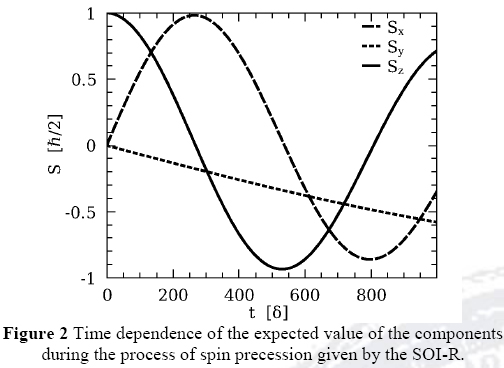
<body><![CDATA[<p align="justify"><font face="verdana" size="2"><b>Numerical Results</b></font></p>  	    <p align="justify"><font face="verdana" size="2">In the results shown below, it has been chosen as spatial partition &ograve; = 1.89 <i>a.u.</i> and temporal partition <i>&#948; =</i> 7.14 <i>a.u.</i> as well as the physical parameters related to the GaAs (Vurgaftman <i>et at.</i> 2001, 5815) <i>&#958; =</i> 0.75 and <i>&#951;</i> <b><i>=</i></b> 0.005, the latter proportional to the parameter <i>&#946;</i> related to the strength of the SOI&#45;R.</font></p>  	    <p align="justify"><font face="verdana" size="2"><a href="#f1">Fig. 1</a> shows the temporal evolution of the spin components of the wave&#45;packet <img src="/img/revistas/ns/v5n9/a6i8.jpg"> along the <i>z</i> direction. At the first instant of time <i>t = 0&#948;</i> only the component <img src="/img/revistas/ns/v5n9/a6i9.jpg"> is nonzero, which is consistent with the choice of the initial condition of the spin polarization of the packet. As the packet travels, <i>e.g. t =</i> 250&#948;, the component <i><img src="/img/revistas/ns/v5n9/a6i10.jpg"></i> increases  while <b><img src="/img/revistas/ns/v5n9/a6i9.jpg"></b> decreases, as a result of spin precession process induced by the SOI&#45;R. As the spin presses with <i>t</i> &#91;see <a href="#f2">Fig. 2</a> and <a href="#f3">3</a>&#93;, it do not represent a well&#45;defined quantum number. Thus, the time&#45;line probabilities shown in <a href="#f1">Fig.1</a>, by no means can be expected as universal for the present system. This behavior is observed during the whole evolution of the packet. It is further noted that after a time, e.g. <i>t</i>=1000&#948;, both spin components of the packet are displaced, relative to each other, because they move with different group velocities &#91;see equation (3)&#93;. Despite this spatial shift, it is not possible to obtain a spin&#45;filter behavior (Governale and Z&uuml;licke 2003, 257), because there is not any symmetry&#45;breaking mechanism here. The latest exclude the possibility for segregating particles with a defined spin&#45;polarization. Even by placing a dispersive obstacle, e.g. a potential barrier, in the transport channel of our system, none filter phenomenon could be detected, for the same reasons commented above. Notice that the packet travels almost without spreading. This could be guarantee by taking the initial and boundary condition using the stationary phase time approach, which has showed the better results dealing with electronic wave&#45;packets (Pereyra and Simanjuntak 2007, 056604).</font></p> 	    <p align="center"><font face="verdana" size="2"><a name="f1"></a></font></p>     <p align="center"><font face="verdana" size="2"><img src="/img/revistas/ns/v5n9/a6f1.jpg"></font></p>         <p align="center"><font face="verdana" size="2"><a name="f2"></a></font></p>     <p align="center"><font face="verdana" size="2"><img src="/img/revistas/ns/v5n9/a6f2.jpg" alt=""></font></p>     <p align="center"><font face="verdana" size="2"><a name="f3"></a></font></p>  	    <p align="center"><font face="verdana" size="2"><img src="/img/revistas/ns/v5n9/a6f3.jpg"></font></p>  	    <p align="justify"><font face="verdana" size="2">&nbsp;</font></p>  	    ]]></body>
<body><![CDATA[<p align="justify"><font face="verdana" size="2">In order to provide some qualitative comparison, we focus to the total time needed for our hole packet travel the entire system (length 1420 &#197;), which is similar to that obtained by Tung and Lee (Tung and Lee 1996, 2122), where the dispersion of an electronic wave&#45;packet in a particular potential structure (length 3050 &#197;) was studied.</font></p>  	    <p align="justify"><font face="verdana" size="2">It is of particular interest in Spintronics devices as SFET, to know exactly the spin precession of a carrier under SOI&#45;R. <a href="#f2">Fig. 2</a> shows the time dependence of the spin expected value</font></p>  	    <p align="center"><font face="verdana" size="2"><img src="/img/revistas/ns/v5n9/a6e25.jpg"></font></p>  	    <p align="justify"><font face="verdana" size="2">where <b><i>&#963;</i></b><i><sub>i</sub></i> are the Pauli matrices. Worthwhile noticing, that is possible to evaluate the spin polarization flip&#45;time <i>t<sub>sf</sub></i>, which is the time during what a maximum spin z&#45;component turns into a minimum one. This occur at <i>t<sub>sf</sub> =</i> 530&#948;, <i>i.e., t<sub>sf</sub> =</i> 3784.2 <i>a.u.,</i> as can be straightforwardly estimated from <a href="#f2">Fig.2</a> &#91;see the time&#45;axis allocation for S<sub>z</sub> &#8776;&#45;1(full line)&#93;. Despite that the "velocity" of holes are slower than the electrons, the spin polarization flip&#45;time are shorter, <i>i.e.</i> the SOI&#45;R is more efficiently for holes (Gvozdic' and Ekenberg 2006, 377).</font></p>  	    <p align="justify"><font face="verdana" size="2">It is clearly seen as <i>S<sub>x</sub></i> and <i>S<sub>z</sub></i> oscillate with a certain damping, determined by the decrease of <i>S<sub>y</sub></i>, since they satisfy <img src="/img/revistas/ns/v5n9/a6i11.jpg"> This suggests that the spin precession takes place around y&#45;oriented axis. The last suitably matches with an effective magnetic field (Bychkov and Rashba 1984, 6039; Datta and Das 1990, 665; Cuan and Diago&#45;Cisneros 2010, 212), whose wave&#45;vector dependence is of the form <i>B<sub>eff</sub></i> &#126; <i>k x n</i><b><i>,</i></b> being <b><i>n =</i></b> (1,0,0) the potential&#45;gradient direction. It is expected that <i>S<sub>x</sub></i> and <i>S<sub>z</sub></i> approach asymptotically to zero as <i>S<sub>y</sub></i> goes to &#45;1 as a result of a conservative requirement, so the spin finally remains on the direction of <b><i>B</i></b><i><sub>eff</sub></i>. A clearer description of the spin precession process described above, can be seen in <a href="#f3">Fig. 3</a>. In this figure, we visualize a parameterized trace of the extreme point for the spin vector <i><img src="/img/revistas/ns/v5n9/a6i12.jpg">.</i> Thereby we are graphically showing how evolves each expected value of (24) during the complete temporal interval under consideration. As a bonus, from this 3D&#45;perspective plot, becomes possible to qualitatively verify the fulfillment of the conservation constrain.</font>	</p> 	    <p align="center"><img src="/img/revistas/ns/v5n9/a6i11.jpg"></p> 	    <p align="center">&nbsp;</p>     <p align="justify"><font face="verdana" size="2"><b>Conclusions</b></font></p>  	    <p align="justify"><font face="verdana" size="2">We have successfully extended the formalism of Goldberg <i>et al.</i> to study the dynamics of holes wave&#45;packets in <i>quasi&#45;</i> one&#45;dimensional systems in the presence of Rashba spin&#45;orbit interaction. Our numerical model reproduces the expected phenomenology, <i>i. e.,</i> the spatial displacement of the spin&#45;up eigen&#45;states respect to the spin&#45;down ones &#45;&#45;due to the different group velocity values&#45;&#45; , and the spin precession process induced by the SOI&#45;R. Additionally, we were able to estimate the polarization flip&#45;time for the z&#45;component of the spin to be approximately 530&#948;, being similar to the typically founded in the specialized literature which is of the order of 10<sup>&#150;13</sup> s. We consider the present study could attract interest, whenever a spin field effect I transistor device, is modeled for holes as carriers.</font></p>  	    <p align="justify"><font face="verdana" size="2">&nbsp;</font></p>  	    ]]></body>
<body><![CDATA[<p align="justify"><font face="verdana" size="2"><b>References</b></font></p>  	    <!-- ref --><p align="justify"><font face="verdana" size="2">Awschalom, David. D. and Michael. E. Flatt&eacute;. (2007). Challenges for semiconductor Spintronics. Nature Phys. 3:153&#45;159.    &nbsp;&nbsp;&nbsp;&nbsp;&nbsp;&nbsp;&nbsp;&nbsp;[&#160;<a href="javascript:void(0);" onclick="javascript: window.open('/scielo.php?script=sci_nlinks&ref=5479153&pid=S2007-0705201300010000600001&lng=','','width=640,height=500,resizable=yes,scrollbars=1,menubar=yes,');">Links</a>&#160;]<!-- end-ref --></font></p>  	    <!-- ref --><p align="justify"><font face="verdana" size="2">Bonfanti&#45;Escalera, Giacomo G. (2008). Inecuaci&oacute;n de Heisenberg entre tiempo y energ&iacute;a: Interpretaciones, Falacias y Aplicaciones. Diploma Thesis, Universidad Iberoamericana&#45;Universidad de La Habana.    &nbsp;&nbsp;&nbsp;&nbsp;&nbsp;&nbsp;&nbsp;&nbsp;[&#160;<a href="javascript:void(0);" onclick="javascript: window.open('/scielo.php?script=sci_nlinks&ref=5479155&pid=S2007-0705201300010000600002&lng=','','width=640,height=500,resizable=yes,scrollbars=1,menubar=yes,');">Links</a>&#160;]<!-- end-ref --></font></p>  	    <!-- ref --><p align="justify"><font face="verdana" size="2">Bychkov, Yu. A. and Emmanuel I. Rashba. (1984). Oscillatory effects and the magnetic susceptibility of carriers in inversion layers. J. Phys. C: Solid State Phys. 17: 6039&#45;6045.    &nbsp;&nbsp;&nbsp;&nbsp;&nbsp;&nbsp;&nbsp;&nbsp;[&#160;<a href="javascript:void(0);" onclick="javascript: window.open('/scielo.php?script=sci_nlinks&ref=5479157&pid=S2007-0705201300010000600003&lng=','','width=640,height=500,resizable=yes,scrollbars=1,menubar=yes,');">Links</a>&#160;]<!-- end-ref --></font></p>  	    <!-- ref --><p align="justify"><font face="verdana" size="2">Cuan, R. and L. Diago&#45;Cisneros. (2010). Dispersi&oacute;n dependiente del esp&iacute;n de paquetes de ondas de huecos en hilos cu&aacute;nticos. Rev. Cub. Fis. 27 (2B): 212&#45;218.    &nbsp;&nbsp;&nbsp;&nbsp;&nbsp;&nbsp;&nbsp;&nbsp;[&#160;<a href="javascript:void(0);" onclick="javascript: window.open('/scielo.php?script=sci_nlinks&ref=5479159&pid=S2007-0705201300010000600004&lng=','','width=640,height=500,resizable=yes,scrollbars=1,menubar=yes,');">Links</a>&#160;]<!-- end-ref --></font></p>  	    <!-- ref --><p align="justify"><font face="verdana" size="2">Datta, Supriyo and Biswajit Das. (1990). Electronic analog of the electro&#45;optic modulator. Appl. Phys. Lett. 56 (7): 665&#45;667.    &nbsp;&nbsp;&nbsp;&nbsp;&nbsp;&nbsp;&nbsp;&nbsp;[&#160;<a href="javascript:void(0);" onclick="javascript: window.open('/scielo.php?script=sci_nlinks&ref=5479161&pid=S2007-0705201300010000600005&lng=','','width=640,height=500,resizable=yes,scrollbars=1,menubar=yes,');">Links</a>&#160;]<!-- end-ref --></font></p>  	    <!-- ref --><p align="justify"><font face="verdana" size="2">Goldberg, Abraham, Harry M. Schey and Judah L. Schwartz. (1967). Computer&#45;generated motion pictures of one&#45;dimensional quantum&#45;mechanical transmission and reflection phenomena. Am. J. Phys. 35 (3): 177&#45;186.    &nbsp;&nbsp;&nbsp;&nbsp;&nbsp;&nbsp;&nbsp;&nbsp;[&#160;<a href="javascript:void(0);" onclick="javascript: window.open('/scielo.php?script=sci_nlinks&ref=5479163&pid=S2007-0705201300010000600006&lng=','','width=640,height=500,resizable=yes,scrollbars=1,menubar=yes,');">Links</a>&#160;]<!-- end-ref --></font></p>  	    <!-- ref --><p align="justify"><font face="verdana" size="2">Governale, Michele and Ulrich Z&uuml;licke. (2003). Filtering spin with tunnel&#45;coupled hole quantum wires. J. Supercond 16 (2): 257&#45;260.    &nbsp;&nbsp;&nbsp;&nbsp;&nbsp;&nbsp;&nbsp;&nbsp;[&#160;<a href="javascript:void(0);" onclick="javascript: window.open('/scielo.php?script=sci_nlinks&ref=5479165&pid=S2007-0705201300010000600007&lng=','','width=640,height=500,resizable=yes,scrollbars=1,menubar=yes,');">Links</a>&#160;]<!-- end-ref --></font></p>  	    <!-- ref --><p align="justify"><font face="verdana" size="2">Guzenko, V. A., J. Knobbe, H. Hardtdegen, Th. Sch&auml;pers and A. Bringer. (2006). Rashba effect in InGaAs/InP parallel quantum wires. Appl. Phys. Lett 88 (3): 032102 1&#45;3.    &nbsp;&nbsp;&nbsp;&nbsp;&nbsp;&nbsp;&nbsp;&nbsp;[&#160;<a href="javascript:void(0);" onclick="javascript: window.open('/scielo.php?script=sci_nlinks&ref=5479167&pid=S2007-0705201300010000600008&lng=','','width=640,height=500,resizable=yes,scrollbars=1,menubar=yes,');">Links</a>&#160;]<!-- end-ref --></font></p>  	    <!-- ref --><p align="justify"><font face="verdana" size="2">Gvozdic', D. M. and U. Ekenberg. (2006). Investigation of the super&#45;efficient Rashba effect by W. simulation of Shubnikov&#45;de Haas oscillations in a two&#45;dimensional hole gas. Physica E 34: 377&#45;380.    &nbsp;&nbsp;&nbsp;&nbsp;&nbsp;&nbsp;&nbsp;&nbsp;[&#160;<a href="javascript:void(0);" onclick="javascript: window.open('/scielo.php?script=sci_nlinks&ref=5479169&pid=S2007-0705201300010000600009&lng=','','width=640,height=500,resizable=yes,scrollbars=1,menubar=yes,');">Links</a>&#160;]<!-- end-ref --></font></p>  	    <!-- ref --><p align="justify"><font face="verdana" size="2">H&auml;usler, Wolfgang. (2004). Dephasing in Rashba spin precession along multichannel quantum wires and nanotubes. Phys. Rev. B 70: 115313 1&#45;6.    &nbsp;&nbsp;&nbsp;&nbsp;&nbsp;&nbsp;&nbsp;&nbsp;[&#160;<a href="javascript:void(0);" onclick="javascript: window.open('/scielo.php?script=sci_nlinks&ref=5479171&pid=S2007-0705201300010000600010&lng=','','width=640,height=500,resizable=yes,scrollbars=1,menubar=yes,');">Links</a>&#160;]<!-- end-ref --></font></p>  	    <!-- ref --><p align="justify"><font face="verdana" size="2">Jordan, Charles. (1950). Calculus of finite differences. New York: Chelsea Publishing Company.    &nbsp;&nbsp;&nbsp;&nbsp;&nbsp;&nbsp;&nbsp;&nbsp;[&#160;<a href="javascript:void(0);" onclick="javascript: window.open('/scielo.php?script=sci_nlinks&ref=5479173&pid=S2007-0705201300010000600011&lng=','','width=640,height=500,resizable=yes,scrollbars=1,menubar=yes,');">Links</a>&#160;]<!-- end-ref --></font></p>  	    <!-- ref --><p align="justify"><font face="verdana" size="2">Ochoa&#45;Fajardo, Marysol. (2006). Estudio de la din&aacute;mica de paquetes de onda esp&iacute;n polarizados en presencia de acoplamiento esp&iacute;n&#45;&oacute;rbita. Diploma Thesis, Universidad Aut&oacute;noma de Baja California.    &nbsp;&nbsp;&nbsp;&nbsp;&nbsp;&nbsp;&nbsp;&nbsp;[&#160;<a href="javascript:void(0);" onclick="javascript: window.open('/scielo.php?script=sci_nlinks&ref=5479175&pid=S2007-0705201300010000600012&lng=','','width=640,height=500,resizable=yes,scrollbars=1,menubar=yes,');">Links</a>&#160;]<!-- end-ref --></font></p>  	    <!-- ref --><p align="justify"><font face="verdana" size="2">Pala, Marco G., Michele Governale, J&uuml;rgen K&ouml;nig, Ulrich Z&uuml;licke and Giuseppe Iannaccone. (2004). Two&#45;dimensional hole precession in an all&#45;semiconductor spin field effect transistor. Phys. Rev. B 69: 045304 1&#45;9.    &nbsp;&nbsp;&nbsp;&nbsp;&nbsp;&nbsp;&nbsp;&nbsp;[&#160;<a href="javascript:void(0);" onclick="javascript: window.open('/scielo.php?script=sci_nlinks&ref=5479177&pid=S2007-0705201300010000600013&lng=','','width=640,height=500,resizable=yes,scrollbars=1,menubar=yes,');">Links</a>&#160;]<!-- end-ref --></font></p>  	    <!-- ref --><p align="justify"><font face="verdana" size="2">Pereyra, Pedro and Herbert P. Simanjuntak. (2007), Time evolution of electromagnetic wave packets through superlattices: Evidence for superluminal velocities. Phys. Rev. E 75: 056604 1&#45;7.    &nbsp;&nbsp;&nbsp;&nbsp;&nbsp;&nbsp;&nbsp;&nbsp;[&#160;<a href="javascript:void(0);" onclick="javascript: window.open('/scielo.php?script=sci_nlinks&ref=5479179&pid=S2007-0705201300010000600014&lng=','','width=640,height=500,resizable=yes,scrollbars=1,menubar=yes,');">Links</a>&#160;]<!-- end-ref --></font></p>  	    <!-- ref --><p align="justify"><font face="verdana" size="2">S&aacute;nchez, David, Lloren&ccedil; Serra and Mahn&#45;Soo Choi. (2008). Strongly modulated transmission of a spin&#45;split quantum wire with local Rashba interaction. Phys. Rev. B 77: 035315 1&#45;11.    &nbsp;&nbsp;&nbsp;&nbsp;&nbsp;&nbsp;&nbsp;&nbsp;[&#160;<a href="javascript:void(0);" onclick="javascript: window.open('/scielo.php?script=sci_nlinks&ref=5479181&pid=S2007-0705201300010000600015&lng=','','width=640,height=500,resizable=yes,scrollbars=1,menubar=yes,');">Links</a>&#160;]<!-- end-ref --></font></p>  	    <!-- ref --><p align="justify"><font face="verdana" size="2">Tung, Hsin&#45;Han and Chien&#45;Ping Lee. (1996). An energy band&#45;pass filter using superlattice structures. IEEE Journal of Quantum Electronics 32 (3): 507&#45;512.    &nbsp;&nbsp;&nbsp;&nbsp;&nbsp;&nbsp;&nbsp;&nbsp;[&#160;<a href="javascript:void(0);" onclick="javascript: window.open('/scielo.php?script=sci_nlinks&ref=5479183&pid=S2007-0705201300010000600016&lng=','','width=640,height=500,resizable=yes,scrollbars=1,menubar=yes,');">Links</a>&#160;]<!-- end-ref --></font></p>  	    <!-- ref --><p align="justify"><font face="verdana" size="2">Tung, Hsin&#45;Han and Chien&#45;Ping Lee. (1996). A novel energy filter using semiconductor superlattices and its application to tunneling time calculations. IEEE Journal of Quantum Electronics 32 (12): 2122&#45;2127.    &nbsp;&nbsp;&nbsp;&nbsp;&nbsp;&nbsp;&nbsp;&nbsp;[&#160;<a href="javascript:void(0);" onclick="javascript: window.open('/scielo.php?script=sci_nlinks&ref=5479185&pid=S2007-0705201300010000600017&lng=','','width=640,height=500,resizable=yes,scrollbars=1,menubar=yes,');">Links</a>&#160;]<!-- end-ref --></font></p>  	    <!-- ref --><p align="justify"><font face="verdana" size="2">Vurgaftman, I., J. R. Meyer and L. R. Ram&#45;Mohan. (2001). Band parameters for III&#45;V compound semiconductors and their alloys. J. Appl. Phys. 89 (11): 5815&#45;5875.    &nbsp;&nbsp;&nbsp;&nbsp;&nbsp;&nbsp;&nbsp;&nbsp;[&#160;<a href="javascript:void(0);" onclick="javascript: window.open('/scielo.php?script=sci_nlinks&ref=5479187&pid=S2007-0705201300010000600018&lng=','','width=640,height=500,resizable=yes,scrollbars=1,menubar=yes,');">Links</a>&#160;]<!-- end-ref --></font></p>  	    <!-- ref --><p align="justify"><font face="verdana" size="2">Winkler, R., H. Noh, E. Tutuc and M. Shayegan. (2002). Anomalous Rashba spin splitting in two&#45;dimensional hole systems. Phys. Rev. B, 65: 155303 1&#45;4.    &nbsp;&nbsp;&nbsp;&nbsp;&nbsp;&nbsp;&nbsp;&nbsp;[&#160;<a href="javascript:void(0);" onclick="javascript: window.open('/scielo.php?script=sci_nlinks&ref=5479189&pid=S2007-0705201300010000600019&lng=','','width=640,height=500,resizable=yes,scrollbars=1,menubar=yes,');">Links</a>&#160;]<!-- end-ref --></font></p>      ]]></body><back>
<ref-list>
<ref id="B1">
<nlm-citation citation-type="journal">
<person-group person-group-type="author">
<name>
<surname><![CDATA[Awschalom]]></surname>
<given-names><![CDATA[David. D.]]></given-names>
</name>
<name>
<surname><![CDATA[Flatté]]></surname>
<given-names><![CDATA[Michael. E.]]></given-names>
</name>
</person-group>
<article-title xml:lang="en"><![CDATA[Challenges for semiconductor Spintronics]]></article-title>
<source><![CDATA[Nature Phys.]]></source>
<year>2007</year>
<volume>3</volume>
<page-range>153-159</page-range></nlm-citation>
</ref>
<ref id="B2">
<nlm-citation citation-type="book">
<person-group person-group-type="author">
<name>
<surname><![CDATA[Bonfanti-Escalera]]></surname>
<given-names><![CDATA[Giacomo G.]]></given-names>
</name>
</person-group>
<source><![CDATA[Inecuación de Heisenberg entre tiempo y energía: Interpretaciones, Falacias y Aplicaciones]]></source>
<year>2008</year>
<publisher-name><![CDATA[Universidad IberoamericanaUniversidad de La Habana]]></publisher-name>
</nlm-citation>
</ref>
<ref id="B3">
<nlm-citation citation-type="journal">
<person-group person-group-type="author">
<name>
<surname><![CDATA[Bychkov]]></surname>
<given-names><![CDATA[Yu. A.]]></given-names>
</name>
<name>
<surname><![CDATA[Rashba]]></surname>
<given-names><![CDATA[Emmanuel I.]]></given-names>
</name>
</person-group>
<article-title xml:lang="en"><![CDATA[Oscillatory effects and the magnetic susceptibility of carriers in inversion layers]]></article-title>
<source><![CDATA[J. Phys. C]]></source>
<year>1984</year>
<volume>17</volume>
<page-range>6039-6045</page-range></nlm-citation>
</ref>
<ref id="B4">
<nlm-citation citation-type="">
<person-group person-group-type="author">
<name>
<surname><![CDATA[Cuan]]></surname>
<given-names><![CDATA[R.]]></given-names>
</name>
<name>
<surname><![CDATA[Diago-Cisneros]]></surname>
<given-names><![CDATA[L.]]></given-names>
</name>
</person-group>
<source><![CDATA[]]></source>
<year>2010</year>
</nlm-citation>
</ref>
<ref id="B5">
<nlm-citation citation-type="journal">
<person-group person-group-type="author">
<name>
<surname><![CDATA[Datta]]></surname>
<given-names><![CDATA[Supriyo]]></given-names>
</name>
<name>
<surname><![CDATA[Das]]></surname>
<given-names><![CDATA[Biswajit]]></given-names>
</name>
</person-group>
<article-title xml:lang="en"><![CDATA[Electronic analog of the electro-optic modulator]]></article-title>
<source><![CDATA[Appl. Phys. Lett.]]></source>
<year>1990</year>
<volume>56</volume>
<numero>7</numero>
<issue>7</issue>
<page-range>665-667</page-range></nlm-citation>
</ref>
<ref id="B6">
<nlm-citation citation-type="journal">
<person-group person-group-type="author">
<name>
<surname><![CDATA[Goldberg]]></surname>
<given-names><![CDATA[Abraham]]></given-names>
</name>
<name>
<surname><![CDATA[Schey]]></surname>
<given-names><![CDATA[Harry M.]]></given-names>
</name>
<name>
<surname><![CDATA[Schwartz]]></surname>
<given-names><![CDATA[Judah L.]]></given-names>
</name>
</person-group>
<article-title xml:lang="en"><![CDATA[Computer-generated motion pictures of one-dimensional quantum-mechanical transmission and reflection phenomena]]></article-title>
<source><![CDATA[Am. J. Phys.]]></source>
<year>1967</year>
<volume>35</volume>
<numero>3</numero>
<issue>3</issue>
<page-range>177-186</page-range></nlm-citation>
</ref>
<ref id="B7">
<nlm-citation citation-type="journal">
<person-group person-group-type="author">
<name>
<surname><![CDATA[Governale]]></surname>
<given-names><![CDATA[Michele]]></given-names>
</name>
<name>
<surname><![CDATA[Zülicke]]></surname>
<given-names><![CDATA[Ulrich]]></given-names>
</name>
</person-group>
<article-title xml:lang="en"><![CDATA[Filtering spin with tunnel-coupled hole quantum wires]]></article-title>
<source><![CDATA[J. Supercond]]></source>
<year>2003</year>
<volume>16</volume>
<numero>2</numero>
<issue>2</issue>
<page-range>257-260</page-range></nlm-citation>
</ref>
<ref id="B8">
<nlm-citation citation-type="journal">
<person-group person-group-type="author">
<name>
<surname><![CDATA[Guzenko]]></surname>
<given-names><![CDATA[V. A.]]></given-names>
</name>
<name>
<surname><![CDATA[Knobbe]]></surname>
<given-names><![CDATA[J.]]></given-names>
</name>
<name>
<surname><![CDATA[Hardtdegen]]></surname>
<given-names><![CDATA[H.]]></given-names>
</name>
<name>
<surname><![CDATA[Schäpers]]></surname>
<given-names><![CDATA[Th.]]></given-names>
</name>
<name>
<surname><![CDATA[Bringer]]></surname>
<given-names><![CDATA[A.]]></given-names>
</name>
</person-group>
<article-title xml:lang="en"><![CDATA[Rashba effect in InGaAs/InP parallel quantum wires]]></article-title>
<source><![CDATA[Appl. Phys. Lett]]></source>
<year>2006</year>
<volume>88</volume>
<numero>3</numero>
<issue>3</issue>
<page-range>1-3</page-range></nlm-citation>
</ref>
<ref id="B9">
<nlm-citation citation-type="journal">
<person-group person-group-type="author">
<name>
<surname><![CDATA[Gvozdic']]></surname>
<given-names><![CDATA[D. M.]]></given-names>
</name>
<name>
<surname><![CDATA[Ekenberg]]></surname>
<given-names><![CDATA[U.]]></given-names>
</name>
</person-group>
<article-title xml:lang="en"><![CDATA[Investigation of the super-efficient Rashba effect by W. simulation of Shubnikov-de Haas oscillations in a two-dimensional hole gas]]></article-title>
<source><![CDATA[Physica E]]></source>
<year>2006</year>
<volume>34</volume>
<page-range>377-380</page-range></nlm-citation>
</ref>
<ref id="B10">
<nlm-citation citation-type="journal">
<person-group person-group-type="author">
<name>
<surname><![CDATA[Häusler]]></surname>
<given-names><![CDATA[Wolfgang]]></given-names>
</name>
</person-group>
<article-title xml:lang="en"><![CDATA[Dephasing in Rashba spin precession along multichannel quantum wires and nanotubes]]></article-title>
<source><![CDATA[Phys. Rev. B]]></source>
<year>2004</year>
<volume>70</volume>
<page-range>1-6</page-range></nlm-citation>
</ref>
<ref id="B11">
<nlm-citation citation-type="book">
<person-group person-group-type="author">
<name>
<surname><![CDATA[Jordan]]></surname>
<given-names><![CDATA[Charles]]></given-names>
</name>
</person-group>
<source><![CDATA[Calculus of finite differences]]></source>
<year>1950</year>
<publisher-loc><![CDATA[New York ]]></publisher-loc>
<publisher-name><![CDATA[Chelsea Publishing Company]]></publisher-name>
</nlm-citation>
</ref>
<ref id="B12">
<nlm-citation citation-type="book">
<person-group person-group-type="author">
<name>
<surname><![CDATA[Ochoa-Fajardo]]></surname>
<given-names><![CDATA[Marysol]]></given-names>
</name>
</person-group>
<source><![CDATA[Estudio de la dinámica de paquetes de onda espín polarizados en presencia de acoplamiento espín-órbita]]></source>
<year>2006</year>
<publisher-name><![CDATA[Universidad Autónoma de Baja California]]></publisher-name>
</nlm-citation>
</ref>
<ref id="B13">
<nlm-citation citation-type="journal">
<person-group person-group-type="author">
<name>
<surname><![CDATA[Pala]]></surname>
<given-names><![CDATA[Marco G.]]></given-names>
</name>
<name>
<surname><![CDATA[Governale]]></surname>
<given-names><![CDATA[Michele]]></given-names>
</name>
<name>
<surname><![CDATA[König]]></surname>
<given-names><![CDATA[Jürgen]]></given-names>
</name>
<name>
<surname><![CDATA[Zülicke]]></surname>
<given-names><![CDATA[Ulrich]]></given-names>
</name>
<name>
<surname><![CDATA[Iannaccone]]></surname>
<given-names><![CDATA[Giuseppe]]></given-names>
</name>
</person-group>
<article-title xml:lang="en"><![CDATA[Two-dimensional hole precession in an all-semiconductor spin field effect transistor]]></article-title>
<source><![CDATA[Phys. Rev. B]]></source>
<year>2004</year>
<volume>69</volume>
<page-range>1-9</page-range></nlm-citation>
</ref>
<ref id="B14">
<nlm-citation citation-type="journal">
<person-group person-group-type="author">
<name>
<surname><![CDATA[Pereyra]]></surname>
<given-names><![CDATA[Pedro]]></given-names>
</name>
<name>
<surname><![CDATA[Simanjuntak]]></surname>
<given-names><![CDATA[Herbert P.]]></given-names>
</name>
</person-group>
<article-title xml:lang="en"><![CDATA[Time evolution of electromagnetic wave packets through superlattices: Evidence for superluminal velocities]]></article-title>
<source><![CDATA[Phys. Rev. E]]></source>
<year>2007</year>
<volume>75</volume>
<page-range>1-7</page-range></nlm-citation>
</ref>
<ref id="B15">
<nlm-citation citation-type="journal">
<person-group person-group-type="author">
<name>
<surname><![CDATA[Sánchez]]></surname>
<given-names><![CDATA[David]]></given-names>
</name>
<name>
<surname><![CDATA[Serra]]></surname>
<given-names><![CDATA[Llorenç]]></given-names>
</name>
<name>
<surname><![CDATA[Mahn-Soo]]></surname>
<given-names><![CDATA[Choi]]></given-names>
</name>
</person-group>
<source><![CDATA[Phys. Rev. B]]></source>
<year></year>
<volume>77</volume>
<page-range>1-11</page-range></nlm-citation>
</ref>
<ref id="B16">
<nlm-citation citation-type="journal">
<person-group person-group-type="author">
<name>
<surname><![CDATA[Hsin-Han]]></surname>
<given-names><![CDATA[Tung]]></given-names>
</name>
<name>
<surname><![CDATA[Chien-Ping]]></surname>
<given-names><![CDATA[Lee]]></given-names>
</name>
</person-group>
<article-title xml:lang="en"><![CDATA[An energy band-pass filter using superlattice structures]]></article-title>
<source><![CDATA[IEEE Journal of Quantum Electronics]]></source>
<year>1996</year>
<volume>32</volume>
<numero>3</numero>
<issue>3</issue>
<page-range>507-512</page-range></nlm-citation>
</ref>
<ref id="B17">
<nlm-citation citation-type="journal">
<person-group person-group-type="author">
<name>
<surname><![CDATA[Hsin-Han]]></surname>
<given-names><![CDATA[Tung]]></given-names>
</name>
<name>
<surname><![CDATA[Chien-Ping]]></surname>
<given-names><![CDATA[Lee]]></given-names>
</name>
</person-group>
<article-title xml:lang="en"><![CDATA[A novel energy filter using semiconductor superlattices and its application to tunneling time calculations]]></article-title>
<source><![CDATA[IEEE Journal of Quantum Electronics]]></source>
<year>1996</year>
<volume>32</volume>
<numero>12</numero>
<issue>12</issue>
<page-range>2122-2127</page-range></nlm-citation>
</ref>
<ref id="B18">
<nlm-citation citation-type="journal">
<person-group person-group-type="author">
<name>
<surname><![CDATA[Vurgaftman]]></surname>
<given-names><![CDATA[I.]]></given-names>
</name>
<name>
<surname><![CDATA[Meyer]]></surname>
<given-names><![CDATA[J. R.]]></given-names>
</name>
<name>
<surname><![CDATA[Ram-Mohan]]></surname>
<given-names><![CDATA[L. R.]]></given-names>
</name>
</person-group>
<article-title xml:lang="en"><![CDATA[Band parameters for III-V compound semiconductors and their alloys]]></article-title>
<source><![CDATA[J. Appl. Phys.]]></source>
<year>2001</year>
<volume>89</volume>
<numero>11</numero>
<issue>11</issue>
<page-range>5815-5875</page-range></nlm-citation>
</ref>
<ref id="B19">
<nlm-citation citation-type="journal">
<person-group person-group-type="author">
<name>
<surname><![CDATA[Winkler]]></surname>
<given-names><![CDATA[R.]]></given-names>
</name>
<name>
<surname><![CDATA[Noh]]></surname>
<given-names><![CDATA[H.]]></given-names>
</name>
<name>
<surname><![CDATA[Tutuc]]></surname>
<given-names><![CDATA[E.]]></given-names>
</name>
<name>
<surname><![CDATA[Shayegan]]></surname>
<given-names><![CDATA[M.]]></given-names>
</name>
</person-group>
<article-title xml:lang="en"><![CDATA[Anomalous Rashba spin splitting in two-dimensional hole systems]]></article-title>
<source><![CDATA[Phys. Rev. B]]></source>
<year>2002</year>
<volume>65</volume>
<page-range>1-4</page-range></nlm-citation>
</ref>
</ref-list>
</back>
</article>