<?xml version="1.0" encoding="ISO-8859-1"?><article xmlns:mml="http://www.w3.org/1998/Math/MathML" xmlns:xlink="http://www.w3.org/1999/xlink" xmlns:xsi="http://www.w3.org/2001/XMLSchema-instance">
<front>
<journal-meta>
<journal-id>2007-0705</journal-id>
<journal-title><![CDATA[Nova scientia]]></journal-title>
<abbrev-journal-title><![CDATA[Nova scientia]]></abbrev-journal-title>
<issn>2007-0705</issn>
<publisher>
<publisher-name><![CDATA[Universidad de La Salle Bajío A. C., Coordinación de Investigación]]></publisher-name>
</publisher>
</journal-meta>
<article-meta>
<article-id>S2007-07052012000200004</article-id>
<title-group>
<article-title xml:lang="en"><![CDATA[Spread in time of some bacterial infectious diseases: a mathematical model]]></article-title>
<article-title xml:lang="es"><![CDATA[Propagación temporal de algunas enfermedades bacterianas: un modelo matemático]]></article-title>
</title-group>
<contrib-group>
<contrib contrib-type="author">
<name>
<surname><![CDATA[Cipolatti]]></surname>
<given-names><![CDATA[R.]]></given-names>
</name>
<xref ref-type="aff" rid="A01"/>
</contrib>
<contrib contrib-type="author">
<name>
<surname><![CDATA[López Gondar]]></surname>
<given-names><![CDATA[J.]]></given-names>
</name>
<xref ref-type="aff" rid="A02"/>
</contrib>
<contrib contrib-type="author">
<name>
<surname><![CDATA[Siqueira]]></surname>
<given-names><![CDATA[E.]]></given-names>
</name>
<xref ref-type="aff" rid="A01"/>
</contrib>
</contrib-group>
<aff id="A01">
<institution><![CDATA[,Universidad Federal de Río de Janeiro Departamento de Métodos Matemáticos ]]></institution>
<addr-line><![CDATA[ ]]></addr-line>
<country>Brasil</country>
</aff>
<aff id="A02">
<institution><![CDATA[,Universidad Federal de Río de Janeiro Departamento de Matemática Aplicada ]]></institution>
<addr-line><![CDATA[ ]]></addr-line>
<country>Brasil</country>
</aff>
<pub-date pub-type="pub">
<day>00</day>
<month>00</month>
<year>2012</year>
</pub-date>
<pub-date pub-type="epub">
<day>00</day>
<month>00</month>
<year>2012</year>
</pub-date>
<volume>4</volume>
<numero>8</numero>
<fpage>42</fpage>
<lpage>65</lpage>
<copyright-statement/>
<copyright-year/>
<self-uri xlink:href="http://www.scielo.org.mx/scielo.php?script=sci_arttext&amp;pid=S2007-07052012000200004&amp;lng=en&amp;nrm=iso"></self-uri><self-uri xlink:href="http://www.scielo.org.mx/scielo.php?script=sci_abstract&amp;pid=S2007-07052012000200004&amp;lng=en&amp;nrm=iso"></self-uri><self-uri xlink:href="http://www.scielo.org.mx/scielo.php?script=sci_pdf&amp;pid=S2007-07052012000200004&amp;lng=en&amp;nrm=iso"></self-uri><abstract abstract-type="short" xml:lang="en"><p><![CDATA[We introduce a new theoretical model to describe the dynamics of transmission for a certain class of bacterial infectious diseases. The propagation mechanism considered is the one concerning direct personal contact. Immunity factors, if present, will be ignored, but in our calculations is included the existence of an incubation period for the contagious infection. The effects of public health campaigns on the spread of the disease are also considered and the inclusion of a certain parameter &#949; to measure the efficiency of such attempts is proposed.]]></p></abstract>
<abstract abstract-type="short" xml:lang="es"><p><![CDATA[Introducimos aquí un nuevo modelo teórico para describir la dinámica de transmisión a que responden algunas enfermedades infecciosas bacterianas. El mecanismo de propagación considerado es el de contacto personal directo. La presencia de factores de inmunidad es ignorada, pero el modelo incorpora la existencia de un período de incubación para la enfermedad. Los posibles efectos de campañas educativas de salud pública, orientadas a controlar la propagación, son incluidos y se introduce un cierto parámetro &#949; para cuantificar la eficiencia de ese tipo de recurso.]]></p></abstract>
<kwd-group>
<kwd lng="en"><![CDATA[Infectious diseases]]></kwd>
<kwd lng="en"><![CDATA[nonlinear delay equations]]></kwd>
<kwd lng="en"><![CDATA[asymptotic behavior]]></kwd>
<kwd lng="es"><![CDATA[enfermedades infecciosas]]></kwd>
<kwd lng="es"><![CDATA[ecuaciones no lineales de retraso]]></kwd>
<kwd lng="es"><![CDATA[comportamiento asintónico]]></kwd>
</kwd-group>
</article-meta>
</front><body><![CDATA[  	    <p align="justify"><font face="verdana" size="4">Ciencias naturales e ingenier&iacute;as</font></p>      <p align="justify"><font face="verdana" size="2">&nbsp;</font></p>  	    <p align="center"><font face="verdana" size="4"><b>Spread in time of some bacterial infectious diseases: a mathematical model</b></font></p> 	    <p align="center">&nbsp;</p> 	    <p align="center"><font face="verdana" size="3"><b>Propagaci&oacute;n temporal de algunas enfermedades bacterianas: un modelo matem&aacute;tico</b></font></p>     <p align="center"><font face="verdana" size="2">&nbsp;</font></p>  	    <p align="center"><font face="verdana" size="2"><b>R. Cipolatti<sup>1</sup>, J. L&oacute;pez Gondar<sup>2, 3</sup> y E. Siqueira<sup>1</sup></b></font></p>  	    <p align="justify"><font face="verdana" size="2">&nbsp;</font></p>  	    <p align="justify"><font face="verdana" size="2"><sup><i>1</i></sup><i>&nbsp;Departamento de M&eacute;todos Matem&aacute;ticos, Universidad Federal de R&iacute;o de Janeiro, Brasil.</i></font></p>  	    ]]></body>
<body><![CDATA[<p align="justify"><font face="verdana" size="2"><i><sup>2</sup> Departamento de Matem&aacute;tica Aplicada, Universidad Federal de R&iacute;o de Janeiro, Brasil.</i></font></p>  	    <p align="justify"><font face="verdana" size="2"><i><sup>3</sup> Instituto de Matem&aacute;tica, Universidad Federal de R&iacute;o de Janeiro,</i> <i>Brasil.</i></font></p> 	    <p align="justify">&nbsp;</p> 	    <p align="justify"><font face="verdana" size="2">Instituto de Matem&aacute;tica, Universidad Federal de R&iacute;o de Janeiro, C.P. 68530, Rio de Janeiro, Brasil. E&#45;mail: <a href="mailto:gondarj@yahoo.es"><u>gondarj@yahoo.es</u></a></font></p>      <p align="justify"><font face="verdana" size="2">&nbsp;</font></p>  	    <p align="justify"><font face="verdana" size="2">Recepci&oacute;n: 26&#45;04&#45;2012&nbsp;    <br> 	Aceptaci&oacute;n: 15&#45;05&#45;2012</font></p> 	    <p align="justify">&nbsp;</p> 	    <p align="justify"><font size="2" face="verdana"><b>Abstract</b></font></p>     <p align="justify"><font face="verdana" size="2">We introduce a new theoretical model to describe the dynamics of transmission for a certain class of bacterial infectious diseases. The propagation mechanism considered is the one concerning direct personal contact. Immunity factors, if present, will be ignored, but in our calculations is included the existence of an incubation period for the contagious infection. The effects of public health campaigns on the spread of the disease are also considered and the inclusion of a certain parameter &#949; to measure the efficiency of such attempts is proposed.</font></p>  	    ]]></body>
<body><![CDATA[<p align="justify"><font face="verdana" size="2"><b>Key words:</b> Infectious diseases, nonlinear delay equations, asymptotic behavior.</font></p> 	    <p align="justify">&nbsp;</p> 	    <p align="justify"><font face="verdana" size="2"><b>Resumen</b></font></p>     <p align="justify"><font face="verdana" size="2">Introducimos aqu&iacute; un nuevo modelo te&oacute;rico para describir la din&aacute;mica de transmisi&oacute;n a que responden algunas enfermedades infecciosas bacterianas. El mecanismo de propagaci&oacute;n considerado es el de contacto personal directo. La presencia de factores de inmunidad es ignorada, pero el modelo incorpora la existencia de un per&iacute;odo de incubaci&oacute;n para la enfermedad. Los posibles efectos de campa&ntilde;as educativas de salud p&uacute;blica, orientadas a controlar la propagaci&oacute;n, son incluidos y se introduce un cierto par&aacute;metro &#949; para cuantificar la eficiencia de ese tipo de recurso.</font></p>         <p align="justify"><font face="verdana" size="2"><b>Palabras clave:</b> enfermedades infecciosas, ecuaciones no lineales de retraso, comportamiento asint&oacute;nico.</font></p>         <p align="justify">&nbsp;</p>         <p align="justify"><font face="verdana" size="2"><b>1. Introduction</b></font></p>     <p align="justify"><font face="verdana" size="2">Infectious diseases represent not only a kind of social problem but also a source of economically harmful effects. Expenses with medical assistance as well as with prophylactic actions are usually the best&#45;known negative effects, although the loss of productivity equally plays an important role. Because of these and other reasons, a lot of papers and books have been devoted during the last decades to obtain and describe mathematical models capable to reproduce, in a relatively reliable form, the dynamics of transmission for different types of contagious diseases (see, for instance &#91;6,8,10,12,13,14,15,16,17&#93; and the references therein). From the historical point of view it is fair to emphasize at this point that the pioneer in the formulation and application of deterministic models to the study of contagious diseases, was the Dutch&#45;Swiss mathematician Daniel Bernoulli. In 1760, he developed a mathematical method to investigate the effectiveness of variolation (also referred to as inoculation) against smallpox &#91;1&#93;. Smallpox is an infectious disease, unique to humans, of viral origin.</font></p>  	    <p align="justify"><font face="verdana" size="2">In this paper we won't deal with viral diseases, but with a certain kind of infectious bacterial illness like pneumonia or tuberculosis, for instance, subjected to an adequate outpatient treatment. Such kinds of diseases are transmitted only by direct contact (without the participation of any kind of vector) and, in order to construct our simplified model, we shall start considering that the sample resembles a geographically homogeneous and dense population distribution. To ensure that all potential physical contacts among individuals be equally likely to occur, we assume that the population is concentrated in a small enough spatial region. We also assume that there exists a maximum time interval T<sub>0</sub> (the same for all infected individuals) during which an individual can withstand without medical assistance being a carrier of the infection. After this time, any recovery attempt is doomed to failure and, in general, the patient dies. For shorter times, however, the cure, following a proper treatment, is guaranteed. It is just for this reason that we shall consider that all the infectious individuals will be subjected to an adequate medical treatment, at most up to T<sub>0</sub>. This maximal time can be reduced, in the best of the cases, to the value T<sub>1</sub> &#60; T<sub>0</sub> by means of adopting more efficient health politics: for example, through campaigns to alert the population, with the objective to seek for medical help as soon as the first symptoms of the disease appear.</font></p>  	    <p align="justify"><font face="verdana" size="2">The infection process begins with a contact between a susceptible individual and an infectious one. From this moment, the first individual is contaminated (infected, but not yet infectious) remaining in such a state during a time t<sub>0</sub> &#60; T<sub>1</sub> after which he becomes a disease transmission agent. Such an interval is called the incubation period &#91;1&#93;. Under these considerations and including some additional hypothesis, we construct in Section 2 a mathematical model to study the dynamics of transmission in the presence of proper medical assistance. In Section 3, a mathematical analysis of the system of integral equations, which represents the model previously obtained, is performed. To conclude, in Section 4 an alternative to reduce endemic levels is proposed and some conditions under which the disease can be definitively eliminated from the population (here considered as a closed system by hypothesis), are described. Numerical results and final comments are also included in this section.</font></p>  	    ]]></body>
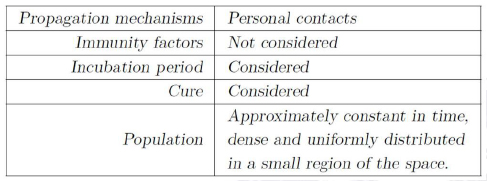
<body><![CDATA[<p align="justify"><font face="verdana" size="2">&nbsp;</font></p>  	    <p align="justify"><font face="verdana" size="2"><b><i>2.</i> Developing the mathematical model</b></font></p>  	    <p align="justify"><font face="verdana" size="2">The main hypothesis that we shall use here can be summarized as follows.</font></p>  	    <p align="center"><font face="verdana" size="2"><img src="/img/revistas/ns/v4n8/a4i1.jpg"></font></p>  	    <p align="justify"><font face="verdana" size="2">On the other hand, our universe is constituted by three different co&#45;existing classes:</font></p>  	    <blockquote> 		    <p align="justify"><font face="verdana" size="2">a)&nbsp;the class S of susceptible people (neither infected nor infectious),</font></p>  		    <p align="justify"><font face="verdana" size="2">b)&nbsp;the class I of infectious or infective individuals (those capable to transmit the infection) and</font></p>  		    <p align="justify"><font face="verdana" size="2">c)&nbsp;the class C of contaminated individuals, which are infected but can't transmit the infection yet.</font></p> 	</blockquote>  	    <p align="justify"><font face="verdana" size="2">Using the total size N of closed host population as a normalization factor, one can associate to the classes declared above the probabilities S<sub>0</sub>(t), I<sub>0</sub>(t) and C<sub>0</sub>(t), respectively; where</font></p>  	    ]]></body>
<body><![CDATA[<p align="center"><font face="verdana" size="2"><img src="/img/revistas/ns/v4n8/a4e1.jpg"></font></p>  	    <p align="justify"><font face="verdana" size="2">&nbsp;</font></p>  	    <p align="justify"><font face="verdana" size="2">represents the probability to find an infected individual in the population and So(t) &#43; Do(t) = 1.</font></p>  	    <p align="justify"><font face="verdana" size="2">Let us also introduce a function of two variables P<sub>0</sub>(t, &#964; ), P<sub>0</sub> : &#923; &#8594; &#91;0, 1&#93;, where</font></p>  	    <p align="center"><font face="verdana" size="2"><img src="/img/revistas/ns/v4n8/a4e2.jpg"></font></p>     <p align="justify"><font face="verdana" size="2">which represents the probability that someone infected at <span style="font-size:10.0pt;font-family:&quot;Verdana&quot;,&quot;sans-serif&quot;">&#964;</span> remains infected at t. This function is I supposed to have the following heuristic properties:</font></p>      <p align="center"><font face="verdana" size="2"><img src="/img/revistas/ns/v4n8/a4e3.jpg"></font></p>  	    <p align="left"><font face="verdana" size="2">&nbsp;</font></p>  	    <p align="justify"><font face="verdana" size="2"><b>Remark 2.1:</b> In most situations we can consider the probability P0 in the form</font></p>  	    <p align="justify"><font face="verdana" size="2">P<sub>0</sub>(t, &#964; ) = &#966;<sub>0</sub>(t &#45; &#964; ), where &#966;<sub>0</sub> : &#91;0, &#43; &#8734;) &#8594; R satisfies</font></p>  	    ]]></body>
<body><![CDATA[<p align="center"><font face="verdana" size="2"><img src="/img/revistas/ns/v4n8/a4e4.jpg"></font></p>  	    <p align="justify"><font face="verdana" size="2">&nbsp;</font><font face="verdana" size="2">An adequate contact&#45;propagation equation can be written as &#91;2,3&#93;:</font></p>     <p align="center"><font face="verdana" size="2"><img src="/img/revistas/ns/v4n8/a4e5.jpg"></font></p>  	    <p align="justify"><font face="verdana" size="2">where g(&#964;) is the rate of the infection process (number of new infected individuals per unit time, at the instant &#964; , divided by N ). Notice, from Eq. (2.5), that if one wants to describe the probability to find an infected individual at time t, the integration should be performed only along the interval &#91;t &#45; T<sub>0</sub>, t&#93;, just because of the existence of a maximum recovery time T<sub>0</sub>. Taking into account that among all the possible contacts the only ones that could transmit the infection are those involving infective and susceptible individuals, the probability of an infectious contact to occur is I<sub>0</sub>(t)S<sub>0</sub>(t) = I<sub>0</sub>(t)&#91;1 &#45; D<sub>0</sub>(t)&#93;. Then, denoting by &#945;(&#964;) the capacity to infect, which we shall define in this case as the probability per unit time that a susceptible in contact with an infectious becomes infected, we obtain g(&#964; ) = &#945;(&#964;)I<sub>0</sub>(&#964; )&#91;1 &#45; D<sub>0</sub>(&#964; )&#93;, where &#945;(&#964;) is a positive function on &#91;&#45;T<sub>0</sub>, &#43; &#8734;).</font></p>  	    <p align="justify"><font face="verdana" size="2">Under these considerations, the contact&#45;propagation equation Eq. (2.5) adopts the form</font></p>  	    <p align="center"><font face="verdana" size="2"><img src="/img/revistas/ns/v4n8/a4e6.jpg"></font></p>  	    <p align="justify"><font face="verdana" size="2">&nbsp;</font></p>  	    <p align="justify"><font face="verdana" size="2">On the other hand, taking into account that any individual contaminated at t must remain in such a state only up to t &#43; t<sub>0</sub> (probability 1) before becoming infectious, we have</font></p>  	    <p align="center"><font face="verdana" size="2"><img src="/img/revistas/ns/v4n8/a4e7.jpg"></font></p>  	    <p align="justify"><font face="verdana" size="2">The equations (2.1), (2.6) and (2.7) now should be written as the system which describes de dynamics of the disease, namely</font></p>     ]]></body>
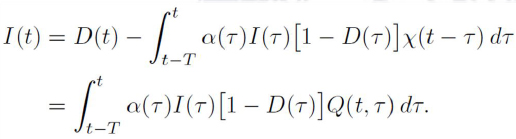
<body><![CDATA[<p align="center"><font face="verdana" size="2"><img src="/img/revistas/ns/v4n8/a4e8.jpg"></font></p>  	    <p align="justify"><font face="verdana" size="2">Notice that if t<sub>0</sub> = 0, D<sub>0</sub>(t) = I<sub>0</sub>(t) and the system (2.8) reduces to an equation for D<sub>0</sub>(t), which coincides with the one proposed by Cooke&#45;Yorke &#91;5&#93; in their model for gonorrhea. Furthermore, it is important to point out that the infectious individuals can also contaminate susceptible ones even when they do not stay together at the same place and at the same time (a situation not considered in the present model). This is possible if the bacteria involved can remain active in the environment during certain time interval large enough. This situation could be identified as an indirect contact and, to describe it, we need to introduce new time delays in the integral equations, as it has been done in &#91;4,9&#93;</font></p>  	    <p align="justify"><font face="verdana" size="2">Observe that to obtain meaningful solutions for the system (2.8), it is necessary to guarantee that</font></p>  	    <p align="center"><font face="verdana" size="2"><img src="/img/revistas/ns/v4n8/a4e9.jpg"></font></p>  	    <p align="justify"><font face="verdana" size="2">As the above inequalities imply that</font></p>  	    <p align="center"><font face="verdana" size="2"><img src="/img/revistas/ns/v4n8/a4e10_th.jpg"></font></p>  	    <p align="center"><font face="verdana" size="2"><a href="/img/revistas/ns/v4n8/a4e10.jpg" target="_blank">Haga clic para agrandar</a></font></p>  	    <p align="justify"><font face="verdana" size="2">&nbsp;</font></p>  	    <p align="justify"><font face="verdana" size="2">it is easy to see that</font></p>  	    <p align="center"><font face="verdana" size="2"><img src="/img/revistas/ns/v4n8/a4e11.jpg"></font></p>  	    ]]></body>
<body><![CDATA[<p align="justify"><font face="verdana" size="2">is a sufficient condition for solutions which actually represent probabilities.</font></p>  	    <p align="justify"><font face="verdana" size="2">&nbsp;</font></p>  	    <p align="justify"><font face="verdana" size="2"><b>3. Mathematical Analysis of the Model</b></font></p>  	    <p align="justify"><font face="verdana" size="2">In this section we present some results on the dynamic of the solutions for the system (2.8). Before proceeding with the analysis, it is convenient to write this system as a vector integral I equation. Let <i>&#967;</i> : &#8477; &#8594; &#8477; be the characteristic function of the interval &#91;0, t<sub>0</sub>)&#93;, i.e.,</font></p>     <p align="center"><font face="verdana" size="2"><img src="/img/revistas/ns/v4n8/a4e12.jpg"></font></p>  	    <p align="justify"><font face="verdana" size="2">Then, omitting for the moment the subscripts to simplify the notation, the equation (2.7) can be written as</font></p>     <p align="center"><font face="verdana" size="2"><img src="/img/revistas/ns/v4n8/a4e13.jpg"></font></p>  	    <p align="justify"><font face="verdana" size="2">Moreover, since C = D &#45; I , we have</font></p>     <p align="center"><font face="verdana" size="2"><img src="/img/revistas/ns/v4n8/a4e14.jpg"></font></p>  	    <p align="justify"><font face="verdana" size="2">&nbsp;</font></p>  	    ]]></body>
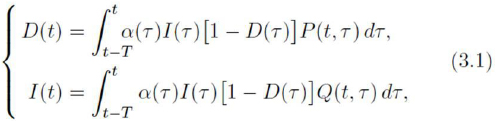
<body><![CDATA[<p align="justify"><font face="verdana" size="2">where Q(t, &#964; ): = P (t, &#964; ) &#45; <i>&#967;</i> (t &#45; &#964;). So, we have the system </font></p>  	    <p align="center"><font face="verdana" size="2"><img src="/img/revistas/ns/v4n8/a4e15.jpg"></font></p>  	    <p align="justify"><font face="verdana" size="2">&nbsp;</font></p>  	    <p align="justify"><font face="verdana" size="2">Now, we are in position to write (3.1) as a vector equation. Let us consider the vector functions</font></p>  	    <p align="center"><font face="verdana" size="2"><img src="/img/revistas/ns/v4n8/a4e16.jpg"></font></p>  	    <p align="justify"><font face="verdana" size="2">&nbsp;</font></p>  	    <p align="justify"><font face="verdana" size="2">With this notation, the system (3.1) can be written as</font></p>  	    <p align="center"><font face="verdana" size="2"><img src="/img/revistas/ns/v4n8/a4e17.jpg"></font></p>  	    <p align="justify"><span lang=EN-US style='font-size:10.0pt;font-family:"Verdana","sans-serif"'>where  	&#120021; : <span style="font-size:10.0pt;font-family:&quot;Cambria Math&quot;,&quot;serif&quot;">&#8477;<sup>2</sup>&#8594;&#8477;</span> is defined by &#120021;<font face="verdana" size="2">&#91;</font>(<i>x</i>,<i>y</i>)&#93;:= <i>y</i>(1&#151;<i>x</i>).</span>	</p>     <p align="justify"><font face="verdana" size="2">Let L<sup>&#8734;</sup>(&#45;T, &#43; &#8734;) be the space of Lebesgue measurable and bounded functions on &#91;&#45;T, &#43; &#8734;) endowed with the usual norm k k<sub>L</sub><sup>&#8734;</sup>, namely,</font></p>     ]]></body>
<body><![CDATA[<p align="center"><img src="../img/revistas/ns/v4n8/a4e18.jpg"></p>     <p align="justify"><font face="verdana" size="2">We denote  	&#120141; = L<sup>&#8734;</sup>(T, + &#8734;) x L<sup>&#8734;</sup>(T, +&#8734;), which is a Banach space for the norm </font><span lang=EN-US style='font-size:10.0pt;font-family:"Verdana","sans-serif"'><font face="verdana" size="2">&#8741;<b><i>E</i></b>&#8741;v= ess sup &#123;&#8741;<b><i>E</i></b></font></span><span lang=EN-US><font face="verdana" size="2">(<i>&#964;</i>)</font></span><span lang=EN-US style='font-size:10.0pt;font-family:"Verdana","sans-serif"'><font face="verdana" size="2">&#8741;;<i> &#964; &#8805; -T</i>&#125;, </font></span><span lang=EN-US><font face="verdana" size="2">where </font></span><span lang=EN-US style='font-size:10.0pt;font-family:"Verdana","sans-serif"'><font face="verdana" size="2">&#8741; &#8741; is the usual infinit</font></span><span lang=EN-US><font face="verdana" size="2">e<span style="font-size:10.0pt;font-family:&quot;Verdana&quot;,&quot;sans-serif&quot;">-</span>norm of <span style="font-size:10.0pt;font-family:&quot;Cambria Math&quot;,&quot;serif&quot;">&#8477;</span><sup>2</sup>, i.e, &#8741;<i>u</i>&#8741;= max&#123;&#8739;x&#8739;,&#8739;y&#8739;&#125;, for all for <i>u</i> = (<i>x</i>,<i>y</i>) &#8712; </font></span><span style="font-size:10.0pt;font-family:&quot;Cambria Math&quot;,&quot;serif&quot;">&#8477;<font face="verdana" size="2"><sup>2</sup>.</font></span></p>     <p align="center">&nbsp;</p> 	    <p align="justify"><font face="verdana" size="2">In view of the model we have in mind, it is natural to restrict our analysis to the solutions E &#8712; V, </font><font face="verdana" size="2">E (t) = (D(t), I (t)) such that D(t), I (t) &#8712; &#91;0, 1&#93; for all t &#8805; &#45;T . Moreover, since D(t) &#8805; I (t), we can consider the following set of "admissible functions".</font></p>      <p align="center"><font face="verdana" size="2"><img src="/img/revistas/ns/v4n8/a4e19.jpg"></font></p>  	    <p align="justify"><font face="verdana" size="2">&nbsp;</font></p>  	    <p align="justify"><font face="verdana" size="2">It is clear that A is a bounded and closed subset of V</font></p>  	    <p align="justify"><font face="verdana" size="2">In what follows, we consider the set &#923; defined by (2.2) and the vector function P : &#923; &#8594; &#91;0, 1&#93; x &#91;0, 1&#93;, P = (P, Q) as defined in (3.2). We also assume that &#945; is a positive and locally Lebesgue integrable function in (&#45;T, &#43; &#8734;)</font></p>  	    <p align="center"><font face="verdana" size="2"><img src="/img/revistas/ns/v4n8/a4e20.jpg"></font></p>  	    <p align="justify"><font face="verdana" size="2">Definition: Let E <sub>init</sub> &#8712; V. We will say that a function E &#8712; V is an admissible solution of Eq. (3.3) generated by E <sub>init</sub> if E &#8712; A and</font></p>     ]]></body>
<body><![CDATA[<p align="center"><font face="verdana" size="2"><img src="/img/revistas/ns/v4n8/a4e21.jpg"></font></p>  	    <p align="justify"><font face="verdana" size="2">The following propositions establish uniqueness and existence of solutions for the Eq. (3.3). Their proofs are based on standard methods involving Gronwall inequality and Banach Fixed Point Theorem and will be omitted.</font></p>     <p align="justify"><font face="verdana" size="2">Proposition 3.1: Let &#945; satisfying (3.5) and E <sub>init</sub> &#8712; V. If E<sub>1</sub> and E<sub>2</sub> are admissible solutions of Eq. </font><font face="verdana" size="2">(3.3) generated by E <sub>init</sub>, then E<sub>1</sub>(t) = E<sub>2</sub>(t) for all t &gt; 0.</font></p>     <p align="justify"><font face="verdana" size="2">For the existence of solutions, we consider the functions r<sub>D</sub> (t) and r<sub>I</sub> (t) defined by</font></p>      <p align="center"><font face="verdana" size="2"><img src="/img/revistas/ns/v4n8/a4e22.jpg"></font></p>  	    <p align="justify"><font face="verdana" size="2">In the particular case where &#945; is constant and P (t, &#964; ) = &#966;(t &#45; &#964; ), these two functions are constant with values given by</font></p>     <p align="center"><font face="verdana" size="2"><img src="/img/revistas/ns/v4n8/a4e23.jpg"></font></p>  	    <p align="justify"><font face="verdana" size="2">respectively.</font></p>  	    <p align="justify"><font face="verdana" size="2"><b>Proposition 3.2:</b> Assume that &alpha; satisfies (3.5) and r<sub>D</sub> (t) &#8804; 4 for all t &#8805; 0. For each E <sub>init</sub>&#8712; A, there exists E , a unique admissible solution of Eq. (3.3) generated by E <sub>init</sub>.</font></p>  	    <p align="justify"><font face="verdana" size="2"><b>Remark 3.3:</b> To prove Proposition 3.2 we consider the set</font></p>  	    ]]></body>
<body><![CDATA[<p align="center"><font face="verdana" size="2"><img src="/img/revistas/ns/v4n8/a4e24.jpg"></font></p>  	    <p align="justify"><font face="verdana" size="2">which is a closed and bounded subset of V and we apply Banach's Fixed Point Theorem to the operator &#934; : <b>A</b> (E <sub>init</sub>) <b>&rarr; A</b> (E <sub>init</sub>) defined as &#934; &#91;E&#93;(t) = E <sub>init</sub>(t) almost everywhere in &#91;&#45; T , 0&#93; and, for t &gt; 0,</font></p>     <p align="center"><font face="verdana" size="2"><img src="/img/revistas/ns/v4n8/a4e25.jpg"></font></p>  	    <p align="justify"><font face="verdana" size="2">By this approach, the condition r<sub>D</sub> (t) <b>&#8804;</b> 4 becomes necessary because, otherwise, the set A(E <sub>init</sub>) defined in (3.8) may not be an invariant set for the operator &#934;. Indeed, consider for instance E (t) = (c<sub>1</sub>, c<sub>2</sub> ) for all t <b>&#8805;</b> &#45; T , where 0 <b>&#8804;</b> c<sub>2</sub> <b>&#8804;</b> c<sub>1</sub> <b>&#8804;</b> 1. Then,</font></p>     <p align="center"><font face="verdana" size="2"><img src="/img/revistas/ns/v4n8/a4e26.jpg"></font></p>  	    <p align="justify"><font face="verdana" size="2">and we have &#934;&#91;E &#93;  	&#8713;  <b>A</b> if we choose c<sub>1</sub> and c<sub>2</sub> such that c<sub>2</sub> (1 &#45; c<sub>1</sub> ) <b>&gt;</b> 1/4.</font></p>  	    <p align="justify"><font face="verdana" size="2"><b>Remark 3.4:</b> As an immediate consequence of the absolute continuity of the Lebesgue integral, it follows that E is continuous on the interval &#93;0, &#43; &#8734; &#91;. In order to assure its continuity in &#91;&#45; T , &#43; &#8734; &#91;, it is sufficient to assume that E <sub>init</sub> is continuous on &#91;&#45; T , 0&#93; and satisfies the following compatibility condition:</font></p>  	    <p align="center"><font face="verdana" size="2"><img src="/img/revistas/ns/v4n8/a4e27.jpg"></font></p>  	    <p align="justify"><font face="verdana" size="2">&nbsp;</font></p>  	    <p align="justify"><font face="verdana" size="2">&#8226; <b>Asymptotic Behavior:</b></font></p>  	    ]]></body>
<body><![CDATA[<p align="justify"><font face="verdana" size="2">In this subsection we shall study the asymptotic behavior of the solutions assuming that r<sub>I</sub> (t) &#8804; 1 for t large enough.</font></p>  	    <p align="justify"><font face="verdana" size="2">Theorem 3.5: (a) Assume that a satisfies (3.5) and r<sub>D</sub> (t) &#8804; 4 for all t &#8805; 0. Let E = (D, I) be the unique admissible solution of Eq. (3.3) generated by E<sub>init</sub> &#8712; A.<b> </b>If</font></p>  	    <p align="center"><font face="verdana" size="2"><img src="/img/revistas/ns/v4n8/a4e28.jpg"></font></p>  	    <p align="justify"><font face="verdana" size="2">&nbsp;</font></p>  	    <p align="justify"><font face="verdana" size="2">then there exist C, M, L &gt; 0 such that</font></p>  	    <p align="center"><font face="verdana" size="2"><img src="/img/revistas/ns/v4n8/a4e29.jpg"></font></p>  	    <p align="justify"><font face="verdana" size="2">(b) Moreover, if &#945; is constant, P (t, &#964; ) = &#966;(t &minus; &#964; ) and they are such that</font></p>     <p align="center"><font face="verdana" size="2"><img src="/img/revistas/ns/v4n8/a4e30.jpg"></font></p>  	    <p align="justify"><font face="verdana" size="2">then</font></p>  	    <p align="center"><font face="verdana" size="2"><img src="/img/revistas/ns/v4n8/a4e31.jpg"></font></p>  	    ]]></body>
<body><![CDATA[<p align="justify"><font face="verdana" size="2">&nbsp;</font></p>  	    <p align="justify"><font face="verdana" size="2"><b>Proof:</b> (a) We assume that the condition (3.11) holds. Then, there exist 0 &#8804; &#961; &lt; 1 and M &gt; 0 such that r<sub>I</sub> (t) &#8804; &#961; for all t &#8805; M . If we denote E (t) = (D(t)), we have</font></p>  	    <p align="center"><font face="verdana" size="2"><img src="/img/revistas/ns/v4n8/a4e32_th.jpg"></font></p>  	    <p align="center"><font face="verdana" size="2"><a href="/img/revistas/ns/v4n8/a4e32.jpg" target="_blank">Haga clic para agrandar</a></font></p>  	    <p align="center"><font face="verdana" size="2">&nbsp;</font></p>  	    <p align="justify"><font face="verdana" size="2">If we define &#966;(s): = sup{<i>&#298;</i>(&#964;); <i>&#964;</i> &#8712; &#91;s, &#43; &#8734;)}, then we have for <i>t &#8805; M,</i></font></p>  	    <p align="center"><font face="verdana" size="2"><img src="/img/revistas/ns/v4n8/a4e33.jpg"></font></p>  	    <p align="justify"><font face="verdana" size="2">Now, by noting that &#934;(s) is a decreasing function, it follows that sup{&#934;(s) ; s &#8805; t} = &#934;(t). Hence, taking the supremum for t &#8805; s in (3.15), we obtain</font></p>     <p align="center"><font face="verdana" size="2"><img src="/img/revistas/ns/v4n8/a4e34.jpg"></font></p>  	    <p align="justify"><font face="verdana" size="2">By considering successively s = M &#43; T , M &#43; 2T , . . ., we have</font></p>     ]]></body>
<body><![CDATA[<p align="center"><font face="verdana" size="2"><img src="/img/revistas/ns/v4n8/a4e35.jpg"></font></p>  	    <p align="justify"><font face="verdana" size="2">Therefore, for t &gt; M and k &#8712; N such that t &#8712; &#91;M &#43; kT , M &#43; (k &#43; 1)T ), we have</font></p>     <p align="center"><font face="verdana" size="2"><img src="/img/revistas/ns/v4n8/a4e36.jpg"></font></p>  	    <p align="justify"><font face="verdana" size="2">where c: = e<sup>&minus;(M +T )L</sup> &#934;(M ) and L: = &minus; ln &#961;/T . Moreover,</font></p>     <p align="center"><font face="verdana" size="2"><img src="/img/revistas/ns/v4n8/a4e37_th.jpg"></font></p>  	    <p align="center"><font face="verdana" size="2"><a href="/img/revistas/ns/v4n8/a4e37.jpg" target="_blank">Haga clic para agrandar</a></font></p>  	    <p align="justify"><font face="verdana" size="2">and we obtain kE (t)k = D(t) &#8804; C e<sup>&#45;Lt</sup> , &#8704; t &#8805; M , where C : = 4ce<sup>LT</sup> . Being so, the proof of part (a) is complete.</font></p>  	    <p align="justify"><font face="verdana" size="2">(b) Now, we assume that &#945; is constant, P (t, &#964;) = &#966;(t &#45; &#964; ) and that they are such that (3.13) holds. We notice, first of all, that I (&#964; ) &#8804; D(&#964;) implies</font></p>  	    <p align="center"><font face="verdana" size="2"><img src="/img/revistas/ns/v4n8/a4e38.jpg"></font></p>  	    <p align="justify"><font face="verdana" size="2">In particular, since 0 &#8804; I (t) &#8804; 1, we have the following inequalities that will be useful in the sequel:</font></p>     ]]></body>
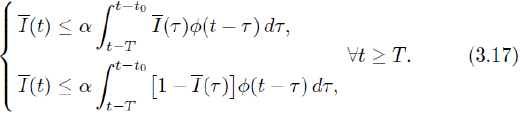
<body><![CDATA[<p align="center"><font face="verdana" size="2"><img src="/img/revistas/ns/v4n8/a4e39.jpg"></font></p>  	    <p align="justify"><font face="verdana" size="2">&nbsp;</font></p>  	    <p align="justify"><font face="verdana" size="2">In order to obtain (3.14), we shall prove by mathematical induction the following inequality</font></p>  	    <p align="center"><font face="verdana" size="2"><img src="/img/revistas/ns/v4n8/a4e40.jpg"></font></p>  	    <p align="justify"><font face="verdana" size="2"><i>Step</i> <i>1</i> : Let n = 1. From (3.13) and (3.17)<sub>2</sub>, it follows that</font></p>     <p align="center"><font face="verdana" size="2"><img src="/img/revistas/ns/v4n8/a4e41.jpg"></font></p>  	    <p align="justify"><font face="verdana" size="2">from which we deduce that</font></p>     <p align="center"><font face="verdana" size="2"><img src="/img/revistas/ns/v4n8/a4e42.jpg"></font></p>  	    <p align="justify"><font face="verdana" size="2"><i>Step 2:</i> Now, we assume that (3.18) holds for n = k. Then, from (3.17)<sub>1</sub>, we have</font></p>     <p align="center"><font face="verdana" size="2"><img src="/img/revistas/ns/v4n8/a4e43.jpg"></font></p>  	    ]]></body>
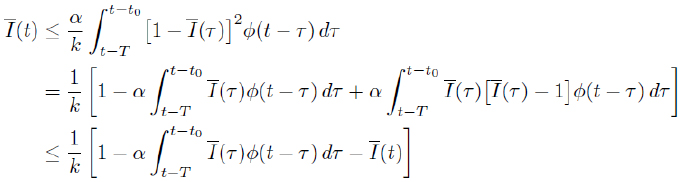
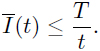
<body><![CDATA[<p align="justify"><font face="verdana" size="2">so kI(t) &#8804; 1 &#45; I(t) for all t &#8805; kT. Substituting in Eq. (3.16) and remembering that I(&#964;) &#8804; D(&#964;), we have for t &#8805; (k &#43; 1)T,</font></p>     <p align="center"><font face="verdana" size="2"><a href="/img/revistas/ns/v4n8/a4e44.jpg" target="_blank"><img src="/img/revistas/ns/v4n8/a4e44_th.jpg"></a></font></p>  	    <p align="center"><font face="verdana" size="2"><a href="/img/revistas/ns/v4n8/a4e44.jpg" target="_blank">Haga clic para agrandar</a></font></p>  	    <p align="justify"><font face="verdana" size="2">&nbsp;</font></p>  	    <p align="justify"><font face="verdana" size="2">and conclude that (3.18) holds for n = k &#43; 1.</font></p>  	    <p align="justify"><font face="verdana" size="2">Notice that (3.18) and (3.17)<sub>1</sub> implies that I (t) &#8804; (n &#43; 1)<sup>&#45;1</sup>for all t &#8805; nT . Hence, for nT &#8804; t &#8804; (n &#43; 1)T , we have</font></p>  	    <p align="center"><font face="verdana" size="2"><img src="/img/revistas/ns/v4n8/a4e45.jpg"></font></p>  	    <p align="justify"><font face="verdana" size="2">On the other hand, since 0 &#8804; D(t ) &#8804; 1, we obtain for t &gt; T ,</font></p>     <p align="center"><font face="verdana" size="2"><a href="/img/revistas/ns/v4n8/a4e46.jpg" target="_blank"><img src="/img/revistas/ns/v4n8/a4e46_th.jpg"></a></font></p>  	    <p align="center"><font face="verdana" size="2"><a href="/img/revistas/ns/v4n8/a4e46.jpg" target="_blank">Haga clic para agrandar</a></font></p>  	    ]]></body>
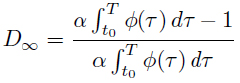
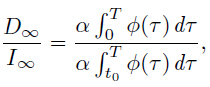
<body><![CDATA[<p align="justify"><font face="verdana" size="2">and the proof is complete.</font></p>     <p align="justify"><font face="verdana" size="2">&nbsp;</font></p>  	    <p align="justify"><font face="verdana" size="2">&#8226; <b>Stationary solutions:</b></font></p>  	    <p align="justify"><font face="verdana" size="2">As we will see now, under certain conditions, the system (3.1) admits nontrivial stationary solutions, i.e., nonzero solutions that do not depend on time. Notice that the trivial vector E (t) = (0, 0) is always a solution. Moreover, if &#945;(t) = &#945; &gt; 0 is constant and P (t, &#964; ) = &#966;(t &#45; &#964; ), where &#966; satisfies (2.4), then, assuming that E (t) = (D<sub>&#8734;</sub>, 1<sub>&#8734;</sub>) is a constant solution, we have from (3.1),</font></p>  	    <p align="center"><font face="verdana" size="2"><img src="/img/revistas/ns/v4n8/a4e47.jpg"></font></p>  	    <p align="justify"><font face="verdana" size="2">&nbsp;</font></p>  	    <p align="justify"><font face="verdana" size="2">So, for I<sub>&#8734;</sub> = 0, we get from the second equation of (3.19),</font></p>  	    <p align="center"><font face="verdana" size="2"><img src="/img/revistas/ns/v4n8/a4e48.jpg"></font></p>  	    <p align="justify"><font face="verdana" size="2">and since</font></p>  	    <p align="center"><font face="verdana" size="2"><img src="/img/revistas/ns/v4n8/a4e49.jpg"></font></p>  	    ]]></body>
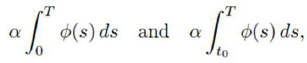
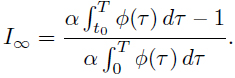
<body><![CDATA[<p align="justify"><font face="verdana" size="2">we get</font></p>  	    <p align="center"><font face="verdana" size="2"><img src="/img/revistas/ns/v4n8/a4e50.jpg"></font></p>  	    <p align="justify"><font face="verdana" size="2">It is important to point out that if &#961; := &#945; <img src="/img/revistas/ns/v4n8/a4i2.jpg"> &#966;(&#964;) d&#964; &#60; 1, the above stationary solutions are inadmissible for the problem we are considering, i.e., (D<sub>&#8734;</sub> , I<sub>&#8734;</sub>)  <span lang=EN-US style='font-size:10.0pt;font-family:"Verdana","sans-serif"'>&#8713;</span><b> A.</b></font></p>     <p align="justify"><font face="verdana" size="2">Nevertheless, in this case, any admissible solution converges to zero exponentially, as proved in Theorem 3.5. Moreover, I<sub>&#8734;</sub> = D<sub>&#8734;</sub> = 0 if &#961; = 1 and, again, Theorem 3.5 assures that any admissible solution converges to zero. Besides, if &#961; &gt; 1, numerical u experiments lead us to expect that the following global asymptotic behavior for any solution E (t) holds:</font></p>  	    <p align="center"><font face="verdana" size="2"><img src="/img/revistas/ns/v4n8/a4e51.jpg"></font></p>  	    <p align="justify"><font face="verdana" size="2">&nbsp;</font></p>  	    <p align="justify"><font face="verdana" size="2"><b>4. Reduction of endemic levels, numerical results and conclusions</b></font></p>  	    <p align="justify"><font face="verdana" size="2">The probability function P<sub>0</sub> (t, &#964;) described in Eq. (2.3) depends, among other factors, on the time between the instant at which infectious individuals begin to feel the symptoms of the disease and the one when they will seek and obtain medical assistance. This individualized response time, as noted in Section 1, can not be greater than T<sub>0</sub> because, if so, the patient will die. On the other hand, the response time has also a lower bound t<sub>0</sub> (the incubation time). Let us now suppose that we develop an intensive educational campaign directing people to seek for medical care as soon as they perceive the symptoms of the disease. If the affected people respond favorably to that effort, in a greater or lesser extent, a new probability P<sub>&#978;</sub> : &#923; &#8594; R, instead of P<sub>0</sub> (t, &#964; ), must be considered. Like Eq. (2.3), we assume that</font></p>  	    <p align="center"><font face="verdana" size="2"><a href="/img/revistas/ns/v4n8/a4e52.jpg" target="_blank"><img src="/img/revistas/ns/v4n8/a4e52_th.jpg"></a></font></p>  	    <p align="center"><font face="verdana" size="2"><a href="/img/revistas/ns/v4n8/a4e52.jpg" target="_blank">Haga clic para agrandar</a></font><font face="verdana" size="2">&nbsp;</font></p>     ]]></body>
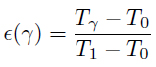
<body><![CDATA[<p align="justify"><font face="verdana" size="2">where T<sub>1</sub> &#8804; T<sub>&#978;</sub> &#8804; T<sub>0</sub> is a new maximum recovery time for each case. Moreover, new probabilities to find contaminated, infective and susceptible individuals must be introduced and we shall denote them by C<sub>&#978;</sub>(t), I<sub>&#978;</sub> (t) and S<sub>&#978;</sub>(t), respectively; being D<sub>&#978;</sub>(t) = I<sub>&#978;</sub>(t) &#43; C<sub>&#978;</sub>(t) and S<sub>&#978;</sub>(t) &#43; D<sub>&#978;</sub> (t) = 1. Being so, equations (2.8) now should be written as</font></p>  	    <p align="center"><font face="verdana" size="2"><a href="/img/revistas/ns/v4n8/a4e53.jpg" target="_blank"><img src="/img/revistas/ns/v4n8/a4e53_th.jpg"></a></font></p>  	    <p align="center"><font face="verdana" size="2"><a href="/img/revistas/ns/v4n8/a4e53.jpg" target="_blank">Haga clic para agrandar</a></font></p>  	    <p align="justify"><font face="verdana" size="2">&nbsp;</font></p>  	    <p align="justify"><font face="verdana" size="2">In fact, the system (4.2) can be regarded as a family of systems depending on the parameter <sub>&#978;</sub> <sub>&#8712;</sub> &#91;0, 1&#93;, where <sub>&#978;</sub> = 0 corresponds to the case in which no public health campaign is carried out.</font></p>  	    <p align="justify"><font face="verdana" size="2">It is obvious that all the results obtained in Section 3 also hold in this situation. Notice that under the hypothesis mentioned above, the value of the integral r<sub>I</sub> (t) introduced in (3.7), should be smaller for P = P<sub>&#978;</sub> than for P = P<sub>0</sub> . This fact allows to reduce the "standard" endemic levels of the disease in the affected population or, even, it could contribute to eliminate the illness itself, as we shall see below.</font></p>  	    <p align="justify"><font face="verdana" size="2">At this point, to characterize in a certain sense the efficiency of the efforts invested in order to reduce the number of people infected, it would be reasonably to define the function Q(<sub>&#978;</sub>) as</font></p>  	    <p align="center"><font face="verdana" size="2"><img src="/img/revistas/ns/v4n8/a4e54.jpg"></font></p>  	    <p align="justify"><font face="verdana" size="2">where</font></p>  	    <p align="center"><font face="verdana" size="2"><img src="/img/revistas/ns/v4n8/a4e55.jpg"></font></p>  	    ]]></body>
<body><![CDATA[<p align="justify"><font face="verdana" size="2">&nbsp;</font></p>  	    <p align="justify"><font face="verdana" size="2">and T<sub>0</sub>, T<sub>1</sub> as already introduced in Section 1.</font></p>  	    <p align="justify"><font face="verdana" size="2">Notice that if &#945; is constant and P<sub>&#978;</sub> (t, &#964;) = &#966;<sub>&#978;</sub> (t &#45; &#964;), we have</font></p> 	    <p align="center"><img src="../img/revistas/ns/v4n8/a4e55b.jpg"></p>      <p align="justify"><font face="verdana" size="2">In particular, if &#934; : (0, 1) &#45; &#91;0, 1&#93; is a decreasing function and if we define</font></p>  	    <p align="center"><font face="verdana" size="2"><img src="/img/revistas/ns/v4n8/a4e56.jpg"></font></p>  	    <p align="justify"><font face="verdana" size="2">then (4.3) reduces to</font></p>  	    <p align="center"><font face="verdana" size="2"><img src="/img/revistas/ns/v4n8/a4e57.jpg"></font></p>  	    <p align="justify"><font face="verdana" size="2">and we obtain T<sub>&#978;</sub> = T<sub>0</sub> &#43; Q(<sub>&#978;</sub>) T<sub>1</sub> &#45; T<sub>0</sub> .</font></p>  	    <p align="justify"><font face="verdana" size="2">It would be useful to point out that this last formula works only in the case T<sub>&#978;</sub>&#60; T<sub>0</sub> (? &gt; 0), while Eq. (4.3) also includes the case T<sub>&#978;</sub>= T<sub>0</sub> for all ? , at which, in spite of the efforts developed, some people insist to seek for medical assistance only when they are very sick.</font></p>  	    ]]></body>
<body><![CDATA[<p align="justify"><font face="verdana" size="2">&nbsp;</font></p>  	    <p align="justify"><font face="verdana" size="2">&#8226; <b>Numerical simulations:</b></font></p>  	    <p align="justify"><font face="verdana" size="2">In order to illustrate the time evolution behavior of the infection process governed by our model, we shall perform some numerical simulations. As it can be seen from the system (4.2), computational calculations in this direction demand a previous knowledge of part of the history of the illness evolution: more specifically, the history corresponding to the interval &#45; T<sub>0</sub> &#8804; t &#8804; 0. Taking into account that our present purpose is only to exemplify and not to reproduce real situations, we may look at arbitrary functions to characterize I<sub>&#978;</sub>(&#964;) and D<sub>&#978;</sub>(&#964;) in the above mentioned interval. Furthermore, the capacity of infection &#945; will be considered as a constant.</font></p>  	    <p align="justify"><font face="verdana" size="2">For the numeric simulations, we consider T<sub>0</sub> = 10, T<sub>1</sub> = 5, t<sub>0</sub> = 4 and E <sub>init</sub>(t) = (0.5, 0.4). In each of the <a href="/img/revistas/ns/v4n8/a4f1.jpg" target="_blank">Figs. 1</a>&#45;<a href="/img/revistas/ns/v4n8/a4f4.jpg" target="_blank">4</a>, (<a href="/img/revistas/ns/v4n8/a4f2.jpg" target="_blank">Figs. 2</a>, <a href="/img/revistas/ns/v4n8/a4f3.jpg" target="_blank">3</a>, <a href="/img/revistas/ns/v4n8/a4f5.jpg" target="_blank">5</a>, <a href="/img/revistas/ns/v4n8/a4f6.jpg" target="_blank">6</a>) corresponding to the values &#945; = 0.5, 0.7, 1.0, and 1.3, respectively, we present the graphics of D<sub>&#978;i</sub> (t), (i = 1, 2, 3), for <sub>&#978;1</sub> = 0, <sub>&#978;</sub><sub>2</sub> = 0.4, <sub>&#978;3</sub> = 0.8, T<sub>&#978;</sub><sub>i</sub>= T<sub>0</sub> &#43; <sub>&#978;</sub><sub>i</sub> (T<sub>1</sub> &#45; T<sub>0</sub> ) and P<sub>&#978;i</sub> (t, &#964; ) = &#966;<sub><sub>&#978;i</sub></sub>(t &#45; &#964; ), where</font></p>  	    <p align="center"><font face="verdana" size="2"><img src="/img/revistas/ns/v4n8/a4e58.jpg"></font></p>  	    <p align="center"><font face="verdana" size="2">&nbsp;</font></p>  	    <p align="justify"><font face="verdana" size="2">&nbsp;</font></p>  	    <p align="justify"><font face="verdana" size="2"><b>Conclusions:</b></font></p>  	    <p align="justify"><font face="verdana" size="2">In this paper we develop a model constituted by a system of delay integral equations, in order to perform a systematic study of the spread in time of some infectious bacterial diseases. It is supposed that the type of illness we deal with in the present article has a finite time to be successfully treated but also that, if this time is exhausted and the patient continues without medical assistance, he will unavoidably die. Other fundamental as well as simplifying working hypothesis are also listed in Sections 1 and 2. As a first attempt in understanding the dynamics of transmission, the possible presence of immunity factors was ignored (compatible with diseases like pneumonia and tuberculosis rather than with diphtheria and whooping cough, for example, for which there already exist vaccines), but the presence of a certain latent period for the illness is included, resembling a more realistic situation. Once the model was developed, we carried out the analysis concerning the assymptotic bahavior of solutions and we present numerical simulations to illustrate the trends of the spread of the disease over time. Some important properties were found and the ones we consider more relevant are summarized below.</font></p>  	    <p align="justify"><font face="verdana" size="2">An interesting feature of this model is that it is possible to extinguish the infection process and, consequently, the disease itself, as can be seen in the figures above. Indeed, from Theorem 3.5 one concludes that all solutions of Eq. (3.3) decay to zero if &#961;<sub>&#978;</sub> &#8804; 1 (exponentially if &#961;<sub>&#978;</sub>&#60; 1). Hence, &#961;<sub>1</sub> &#60; 1 is a sufficient condition for the existence of some 0 &#8804; <sub>&#978;</sub> &#60; 1 which ensures the abortion of the transmission process and with it the extinction of the disease. Furthermore, one also intuit from these figures that when there are no conditions to extinguish the disease, the functions D(t) (I (t)) tends to a constant value characterizing an endemic situation. The introduction in this work of the parameter Q, which can be obtained experimentally by indirect measurements, allows estimating an index connected with the efficiency of the efforts displayed to eliminate the disease or, at least, to reduce the corresponding endemic levels.</font></p>  	    ]]></body>
<body><![CDATA[<p align="justify"><font face="verdana" size="2">Studies considering space&#45;time spreading are also now in progress and will be published elsewhere.</font></p>  	    <p align="justify"><font face="verdana" size="2">&nbsp;</font></p>  	    <p align="justify"><font face="verdana" size="2"><b>Acknowledgements</b></font></p>  	    <p align="justify"><font face="verdana" size="2">The authors would like to acknowledge Alexandre Siqueira (Funda&#231;&atilde;o Oswaldo Cruz) for useful discussions.</font></p>  	    <p align="justify"><font face="verdana" size="2">&nbsp;</font></p>  	    <p align="justify"><font face="verdana" size="2"><b>References</b></font></p>  	    <!-- ref --><p align="justify"><font face="verdana" size="2">&#91;1&#93; Bailey, N.J.T.: The mathematical theory of infectious diseases and its applications; Griffin, London, 1975.    &nbsp;&nbsp;&nbsp;&nbsp;&nbsp;&nbsp;&nbsp;&nbsp;[&#160;<a href="javascript:void(0);" onclick="javascript: window.open('/scielo.php?script=sci_nlinks&ref=5476897&pid=S2007-0705201200020000400001&lng=','','width=640,height=500,resizable=yes,scrollbars=1,menubar=yes,');">Links</a>&#160;]<!-- end-ref --></font></p>  	    <!-- ref --><p align="justify"><font face="verdana" size="2">&#91;2&#93; Bellmann, R., Cooke, K.L.: Differential&#45;difference equations; Math. in Sciences and Engineering, Academic Press, 1963.    &nbsp;&nbsp;&nbsp;&nbsp;&nbsp;&nbsp;&nbsp;&nbsp;[&#160;<a href="javascript:void(0);" onclick="javascript: window.open('/scielo.php?script=sci_nlinks&ref=5476899&pid=S2007-0705201200020000400002&lng=','','width=640,height=500,resizable=yes,scrollbars=1,menubar=yes,');">Links</a>&#160;]<!-- end-ref --></font></p>  	    ]]></body>
<body><![CDATA[<!-- ref --><p align="justify"><font face="verdana" size="2">&#91;3&#93; Capasso, V.: Mathematical structure of epidemic systems ; Springer&#45;Verlag, 1993.    &nbsp;&nbsp;&nbsp;&nbsp;&nbsp;&nbsp;&nbsp;&nbsp;[&#160;<a href="javascript:void(0);" onclick="javascript: window.open('/scielo.php?script=sci_nlinks&ref=5476901&pid=S2007-0705201200020000400003&lng=','','width=640,height=500,resizable=yes,scrollbars=1,menubar=yes,');">Links</a>&#160;]<!-- end-ref --><!-- ref --> &#91;4&#93; Cipolatti, R., Lopez Gondar, J.: Dynamics of a virtual virus infection process in volving a spatial distribution of interacting computers ; Applicable Analysis: An International Journal, 1563&#45;504X, Volume 84, Issue 1, (2005,) pp. 49&#45;65.    &nbsp;&nbsp;&nbsp;&nbsp;&nbsp;&nbsp;&nbsp;&nbsp;[&#160;<a href="javascript:void(0);" onclick="javascript: window.open('/scielo.php?script=sci_nlinks&ref=5476902&pid=S2007-0705201200020000400004&lng=','','width=640,height=500,resizable=yes,scrollbars=1,menubar=yes,');">Links</a>&#160;]<!-- end-ref --></font></p>  	    <!-- ref --><p align="justify"><font face="verdana" size="2">&#91;5&#93; Cooke, K.L., Yorke, J.A.: Some equations modelling growth processes and gonorrhea epidemics ; Mathematical Biosciences, #16 (1973), pp. 75&#45;101.    &nbsp;&nbsp;&nbsp;&nbsp;&nbsp;&nbsp;&nbsp;&nbsp;[&#160;<a href="javascript:void(0);" onclick="javascript: window.open('/scielo.php?script=sci_nlinks&ref=5476904&pid=S2007-0705201200020000400005&lng=','','width=640,height=500,resizable=yes,scrollbars=1,menubar=yes,');">Links</a>&#160;]<!-- end-ref --></font></p>  	    <!-- ref --><p align="justify"><font face="verdana" size="2">&#91;6&#93; Cui, C., Sun, Y., Zhu, H.: The impact of media on the control of infectious diseases; Journal of Dynamics and Differential Equations, Vol. 20, No. 1, (2008), pp. 31&#45;53.    &nbsp;&nbsp;&nbsp;&nbsp;&nbsp;&nbsp;&nbsp;&nbsp;[&#160;<a href="javascript:void(0);" onclick="javascript: window.open('/scielo.php?script=sci_nlinks&ref=5476906&pid=S2007-0705201200020000400006&lng=','','width=640,height=500,resizable=yes,scrollbars=1,menubar=yes,');">Links</a>&#160;]<!-- end-ref --></font></p>  	    <!-- ref --><p align="justify"><font face="verdana" size="2">&#91;7&#93; Driver, R.D.: Ordinary and delay differential equations ; Applied Mathematical Sciences #20, Springer&#45;Verlag, 1977.    &nbsp;&nbsp;&nbsp;&nbsp;&nbsp;&nbsp;&nbsp;&nbsp;[&#160;<a href="javascript:void(0);" onclick="javascript: window.open('/scielo.php?script=sci_nlinks&ref=5476908&pid=S2007-0705201200020000400007&lng=','','width=640,height=500,resizable=yes,scrollbars=1,menubar=yes,');">Links</a>&#160;]<!-- end-ref --></font></p>  	    <!-- ref --><p align="justify"><font face="verdana" size="2">&#91;8&#93; Diekmann, O., Heesterbeek, J.A.P.: Mathematical epidemiology of infectious diseases. Model building, analysis and interpretation ; John Wiley &amp; Sons, Ltd., Chischester, 2000.    &nbsp;&nbsp;&nbsp;&nbsp;&nbsp;&nbsp;&nbsp;&nbsp;[&#160;<a href="javascript:void(0);" onclick="javascript: window.open('/scielo.php?script=sci_nlinks&ref=5476910&pid=S2007-0705201200020000400008&lng=','','width=640,height=500,resizable=yes,scrollbars=1,menubar=yes,');">Links</a>&#160;]<!-- end-ref --></font></p>  	    <!-- ref --><p align="justify"><font face="verdana" size="2">&#91;9&#93; Lopez Gondar, J., Cipolatti, R.: A mathematical model for virus infectious in a system of interacting computers; Comp. Appl. Math., Vol. 22, No. 2, (2003), 209&#45;231.    &nbsp;&nbsp;&nbsp;&nbsp;&nbsp;&nbsp;&nbsp;&nbsp;[&#160;<a href="javascript:void(0);" onclick="javascript: window.open('/scielo.php?script=sci_nlinks&ref=5476912&pid=S2007-0705201200020000400009&lng=','','width=640,height=500,resizable=yes,scrollbars=1,menubar=yes,');">Links</a>&#160;]<!-- end-ref --></font></p>  	    <!-- ref --><p align="justify"><font face="verdana" size="2">&#91;10&#93; Ghosh, M., Chandra, P., Sinha, P., Shukla, J.B.: Modelling the spread of bacterial infectious disease with environmental effect in a logistically growing human population; Nonlinear Anaysis: Real World Applications, No. 7, (2006), 341&#45;363.    &nbsp;&nbsp;&nbsp;&nbsp;&nbsp;&nbsp;&nbsp;&nbsp;[&#160;<a href="javascript:void(0);" onclick="javascript: window.open('/scielo.php?script=sci_nlinks&ref=5476914&pid=S2007-0705201200020000400010&lng=','','width=640,height=500,resizable=yes,scrollbars=1,menubar=yes,');">Links</a>&#160;]<!-- end-ref --></font></p>  	    <!-- ref --><p align="justify"><font face="verdana" size="2">&#91;11&#93; Hale, J.: Theory of functional differential equations ; Applied Mathematical Sciences #3, Springer&#45;Verlag, 1977.    &nbsp;&nbsp;&nbsp;&nbsp;&nbsp;&nbsp;&nbsp;&nbsp;[&#160;<a href="javascript:void(0);" onclick="javascript: window.open('/scielo.php?script=sci_nlinks&ref=5476916&pid=S2007-0705201200020000400011&lng=','','width=640,height=500,resizable=yes,scrollbars=1,menubar=yes,');">Links</a>&#160;]<!-- end-ref --></font></p>  	    <!-- ref --><p align="justify"><font face="verdana" size="2">&#91;12&#93; Hethcode, H.D., Tudor, D.W.: Integral equation models for endemic infectious diseases ; Journal of Mathematical Biology, No. 9, (1980), 37&#45;47.    &nbsp;&nbsp;&nbsp;&nbsp;&nbsp;&nbsp;&nbsp;&nbsp;[&#160;<a href="javascript:void(0);" onclick="javascript: window.open('/scielo.php?script=sci_nlinks&ref=5476918&pid=S2007-0705201200020000400012&lng=','','width=640,height=500,resizable=yes,scrollbars=1,menubar=yes,');">Links</a>&#160;]<!-- end-ref --></font></p>  	    <!-- ref --><p align="justify"><font face="verdana" size="2">&#91;13&#93; Hethcode, H.D., Stech, H.W., Driessch, P.: Stability analysis for models of&nbsp;diseases without immunity ; Journal of Mathematical Biology, No. 13, (1981), 185&#45;198.    &nbsp;&nbsp;&nbsp;&nbsp;&nbsp;&nbsp;&nbsp;&nbsp;[&#160;<a href="javascript:void(0);" onclick="javascript: window.open('/scielo.php?script=sci_nlinks&ref=5476920&pid=S2007-0705201200020000400013&lng=','','width=640,height=500,resizable=yes,scrollbars=1,menubar=yes,');">Links</a>&#160;]<!-- end-ref --></font></p>  	    <!-- ref --><p align="justify"><font face="verdana" size="2">&#91;14&#93; Li, J., Zou, X.: Modeling spatial spread of infectious diseases with a fixed latent&nbsp;period in a spatially continuous domain ; Bulletin of Mathematical Biology, Vol. 71, (2009),&nbsp; 2048&#45;2079.    &nbsp;&nbsp;&nbsp;&nbsp;&nbsp;&nbsp;&nbsp;&nbsp;[&#160;<a href="javascript:void(0);" onclick="javascript: window.open('/scielo.php?script=sci_nlinks&ref=5476922&pid=S2007-0705201200020000400014&lng=','','width=640,height=500,resizable=yes,scrollbars=1,menubar=yes,');">Links</a>&#160;]<!-- end-ref --></font></p>  	    <!-- ref --><p align="justify"><font face="verdana" size="2">&#91;15&#93; Liu, Y., Cui, J.A.: The impact of media coverage on the dynamics of infectiuous&nbsp;disease ; International Journal of Biomathematics, V. 1, No. 1, (2008), 65&#45;74.    &nbsp;&nbsp;&nbsp;&nbsp;&nbsp;&nbsp;&nbsp;&nbsp;[&#160;<a href="javascript:void(0);" onclick="javascript: window.open('/scielo.php?script=sci_nlinks&ref=5476924&pid=S2007-0705201200020000400015&lng=','','width=640,height=500,resizable=yes,scrollbars=1,menubar=yes,');">Links</a>&#160;]<!-- end-ref -->&nbsp;</font></p>  	    <!-- ref --><p align="justify"><font face="verdana" size="2">&#91;16&#93; Mohtashemi, M., Levins, R.: Transient dynamics and early diagnostics in&nbsp; infectious diseases ; Journal of Mathematical Biology, Vol. 43, (2001), pp. 446&#45;470.    &nbsp;&nbsp;&nbsp;&nbsp;&nbsp;&nbsp;&nbsp;&nbsp;[&#160;<a href="javascript:void(0);" onclick="javascript: window.open('/scielo.php?script=sci_nlinks&ref=5476926&pid=S2007-0705201200020000400016&lng=','','width=640,height=500,resizable=yes,scrollbars=1,menubar=yes,');">Links</a>&#160;]<!-- end-ref -->&nbsp;</font></p>  	    <!-- ref --><p align="justify"><font face="verdana" size="2">&#91;17&#93; Niculescu, S&#45;I., Kim, P.S., Gu, K., Lee, P.P., Levy, D.: Stability crossing&nbsp; boundaries of delay systems modeling immune dynamics in leukemia ; Discrete and&nbsp; Continuous Dynamic Systems, serie B, V. 10, No. 1, (2010), 129&#45;156<i>.    &nbsp;&nbsp;&nbsp;&nbsp;&nbsp;&nbsp;&nbsp;&nbsp;[&#160;<a href="javascript:void(0);" onclick="javascript: window.open('/scielo.php?script=sci_nlinks&ref=5476928&pid=S2007-0705201200020000400017&lng=','','width=640,height=500,resizable=yes,scrollbars=1,menubar=yes,');">Links</a>&#160;]<!-- end-ref --></i></font></p>      ]]></body><back>
<ref-list>
<ref id="B1">
<label>1</label><nlm-citation citation-type="book">
<person-group person-group-type="author">
<name>
<surname><![CDATA[Bailey]]></surname>
<given-names><![CDATA[N.J.T.]]></given-names>
</name>
</person-group>
<source><![CDATA[The mathematical theory of infectious diseases and its applications]]></source>
<year>1975</year>
<publisher-loc><![CDATA[London ]]></publisher-loc>
<publisher-name><![CDATA[Griffin]]></publisher-name>
</nlm-citation>
</ref>
<ref id="B2">
<label>2</label><nlm-citation citation-type="book">
<person-group person-group-type="author">
<name>
<surname><![CDATA[Bellmann]]></surname>
<given-names><![CDATA[R.]]></given-names>
</name>
<name>
<surname><![CDATA[Cooke]]></surname>
<given-names><![CDATA[K.L.]]></given-names>
</name>
</person-group>
<source><![CDATA[Differential-difference equations; Math. in Sciences and Engineering]]></source>
<year>1963</year>
<publisher-name><![CDATA[Academic Press]]></publisher-name>
</nlm-citation>
</ref>
<ref id="B3">
<label>3</label><nlm-citation citation-type="book">
<person-group person-group-type="author">
<name>
<surname><![CDATA[Capasso]]></surname>
<given-names><![CDATA[V.]]></given-names>
</name>
</person-group>
<source><![CDATA[Mathematical structure of epidemic systems]]></source>
<year>1993</year>
<publisher-name><![CDATA[Springer-Verlag]]></publisher-name>
</nlm-citation>
</ref>
<ref id="B4">
<label>4</label><nlm-citation citation-type="journal">
<person-group person-group-type="author">
<name>
<surname><![CDATA[Cipolatti]]></surname>
<given-names><![CDATA[R.]]></given-names>
</name>
<name>
<surname><![CDATA[Lopez Gondar]]></surname>
<given-names><![CDATA[J.]]></given-names>
</name>
</person-group>
<article-title xml:lang="en"><![CDATA[Dynamics of a virtual virus infection process in volving a spatial distribution of interacting computers]]></article-title>
<source><![CDATA[Applicable Analysis: An International Journal]]></source>
<year>2005</year>
<volume>84</volume>
<numero>1</numero>
<issue>1</issue>
<page-range>49-65</page-range></nlm-citation>
</ref>
<ref id="B5">
<label>5</label><nlm-citation citation-type="journal">
<person-group person-group-type="author">
<name>
<surname><![CDATA[Cooke]]></surname>
<given-names><![CDATA[K.L.]]></given-names>
</name>
<name>
<surname><![CDATA[Yorke]]></surname>
<given-names><![CDATA[J.A.]]></given-names>
</name>
</person-group>
<article-title xml:lang="en"><![CDATA[Some equations modelling growth processes and gonorrhea epidemics]]></article-title>
<source><![CDATA[Mathematical Biosciences]]></source>
<year>1973</year>
<numero>16</numero>
<issue>16</issue>
<page-range>75-101</page-range></nlm-citation>
</ref>
<ref id="B6">
<label>6</label><nlm-citation citation-type="journal">
<person-group person-group-type="author">
<name>
<surname><![CDATA[Cui]]></surname>
<given-names><![CDATA[C.]]></given-names>
</name>
<name>
<surname><![CDATA[Sun]]></surname>
<given-names><![CDATA[Y.]]></given-names>
</name>
<name>
<surname><![CDATA[Zhu]]></surname>
<given-names><![CDATA[H.]]></given-names>
</name>
</person-group>
<article-title xml:lang="en"><![CDATA[The impact of media on the control of infectious diseases]]></article-title>
<source><![CDATA[Journal of Dynamics and Differential Equations]]></source>
<year>2008</year>
<volume>20</volume>
<numero>1</numero>
<issue>1</issue>
<page-range>31-53</page-range></nlm-citation>
</ref>
<ref id="B7">
<label>7</label><nlm-citation citation-type="journal">
<person-group person-group-type="author">
<name>
<surname><![CDATA[Driver]]></surname>
<given-names><![CDATA[R.D.]]></given-names>
</name>
</person-group>
<article-title xml:lang="en"><![CDATA[Ordinary and delay differential equations]]></article-title>
<source><![CDATA[Applied Mathematical Sciences]]></source>
<year>1977</year>
<numero>20</numero>
<issue>20</issue>
<publisher-name><![CDATA[Springer-Verlag]]></publisher-name>
</nlm-citation>
</ref>
<ref id="B8">
<label>8</label><nlm-citation citation-type="book">
<person-group person-group-type="author">
<name>
<surname><![CDATA[Diekmann]]></surname>
<given-names><![CDATA[O.]]></given-names>
</name>
<name>
<surname><![CDATA[Heesterbeek]]></surname>
<given-names><![CDATA[J.A.P.]]></given-names>
</name>
</person-group>
<source><![CDATA[Mathematical epidemiology of infectious diseases. Model building, analysis and interpretation]]></source>
<year>2000</year>
<publisher-loc><![CDATA[Chischester ]]></publisher-loc>
<publisher-name><![CDATA[John Wiley & Sons, Ltd.]]></publisher-name>
</nlm-citation>
</ref>
<ref id="B9">
<label>9</label><nlm-citation citation-type="journal">
<person-group person-group-type="author">
<name>
<surname><![CDATA[Lopez Gondar]]></surname>
<given-names><![CDATA[J.]]></given-names>
</name>
<name>
<surname><![CDATA[Cipolatti]]></surname>
<given-names><![CDATA[R.]]></given-names>
</name>
</person-group>
<article-title xml:lang="en"><![CDATA[A mathematical model for virus infectious in a system of interacting computers]]></article-title>
<source><![CDATA[Comp. Appl. Math.]]></source>
<year>2003</year>
<volume>22</volume>
<numero>2</numero>
<issue>2</issue>
<page-range>209-231</page-range></nlm-citation>
</ref>
<ref id="B10">
<label>10</label><nlm-citation citation-type="journal">
<person-group person-group-type="author">
<name>
<surname><![CDATA[Ghosh]]></surname>
<given-names><![CDATA[M.]]></given-names>
</name>
<name>
<surname><![CDATA[Chandra]]></surname>
<given-names><![CDATA[P.]]></given-names>
</name>
<name>
<surname><![CDATA[Sinha]]></surname>
<given-names><![CDATA[P.]]></given-names>
</name>
<name>
<surname><![CDATA[Shukla]]></surname>
<given-names><![CDATA[J.B.]]></given-names>
</name>
</person-group>
<article-title xml:lang="en"><![CDATA[Modelling the spread of bacterial infectious disease with environmental effect in a logistically growing human population; Nonlinear Anaysis]]></article-title>
<source><![CDATA[Real World Applications]]></source>
<year>2006</year>
<numero>7</numero>
<issue>7</issue>
<page-range>341-363</page-range></nlm-citation>
</ref>
<ref id="B11">
<label>11</label><nlm-citation citation-type="journal">
<person-group person-group-type="author">
<name>
<surname><![CDATA[Hale]]></surname>
<given-names><![CDATA[J.]]></given-names>
</name>
</person-group>
<article-title xml:lang="en"><![CDATA[Theory of functional differential equations]]></article-title>
<source><![CDATA[Applied Mathematical Sciences]]></source>
<year>1977</year>
<numero>3</numero>
<issue>3</issue>
<publisher-name><![CDATA[Springer-Verlag]]></publisher-name>
</nlm-citation>
</ref>
<ref id="B12">
<label>12</label><nlm-citation citation-type="journal">
<person-group person-group-type="author">
<name>
<surname><![CDATA[Hethcode]]></surname>
<given-names><![CDATA[H.D.]]></given-names>
</name>
<name>
<surname><![CDATA[Tudor]]></surname>
<given-names><![CDATA[D.W.]]></given-names>
</name>
</person-group>
<article-title xml:lang="en"><![CDATA[Integral equation models for endemic infectious diseases]]></article-title>
<source><![CDATA[Journal of Mathematical Biology]]></source>
<year>1980</year>
<numero>9</numero>
<issue>9</issue>
<page-range>37-47</page-range></nlm-citation>
</ref>
<ref id="B13">
<label>13</label><nlm-citation citation-type="journal">
<person-group person-group-type="author">
<name>
<surname><![CDATA[Hethcode]]></surname>
<given-names><![CDATA[H.D.]]></given-names>
</name>
<name>
<surname><![CDATA[Stech]]></surname>
<given-names><![CDATA[H.W.]]></given-names>
</name>
<name>
<surname><![CDATA[Driessch]]></surname>
<given-names><![CDATA[P.]]></given-names>
</name>
</person-group>
<article-title xml:lang="en"><![CDATA[Stability analysis for models of diseases without immunity]]></article-title>
<source><![CDATA[Journal of Mathematical Biology]]></source>
<year>1981</year>
<numero>13</numero>
<issue>13</issue>
<page-range>185-198</page-range></nlm-citation>
</ref>
<ref id="B14">
<label>14</label><nlm-citation citation-type="journal">
<person-group person-group-type="author">
<name>
<surname><![CDATA[Li]]></surname>
<given-names><![CDATA[J.]]></given-names>
</name>
<name>
<surname><![CDATA[Zou]]></surname>
<given-names><![CDATA[X.]]></given-names>
</name>
</person-group>
<article-title xml:lang="en"><![CDATA[Modeling spatial spread of infectious diseases with a fixed latent period in a spatially continuous domain]]></article-title>
<source><![CDATA[Bulletin of Mathematical Biology]]></source>
<year>2009</year>
<volume>71</volume>
<page-range>2048-2079</page-range></nlm-citation>
</ref>
<ref id="B15">
<label>15</label><nlm-citation citation-type="journal">
<person-group person-group-type="author">
<name>
<surname><![CDATA[Liu]]></surname>
<given-names><![CDATA[Y.]]></given-names>
</name>
<name>
<surname><![CDATA[Cui]]></surname>
<given-names><![CDATA[J.A.]]></given-names>
</name>
</person-group>
<article-title xml:lang="en"><![CDATA[The impact of media coverage on the dynamics of infectiuous disease]]></article-title>
<source><![CDATA[International Journal of Biomathematics]]></source>
<year>2008</year>
<volume>1</volume>
<numero>1</numero>
<issue>1</issue>
<page-range>65-74</page-range></nlm-citation>
</ref>
<ref id="B16">
<label>16</label><nlm-citation citation-type="journal">
<person-group person-group-type="author">
<name>
<surname><![CDATA[Mohtashemi]]></surname>
<given-names><![CDATA[M.]]></given-names>
</name>
<name>
<surname><![CDATA[Levins]]></surname>
<given-names><![CDATA[R.]]></given-names>
</name>
</person-group>
<article-title xml:lang="en"><![CDATA[Transient dynamics and early diagnostics in infectious diseases]]></article-title>
<source><![CDATA[Journal of Mathematical Biology]]></source>
<year>2001</year>
<volume>43</volume>
<page-range>446-470</page-range></nlm-citation>
</ref>
<ref id="B17">
<label>17</label><nlm-citation citation-type="journal">
<person-group person-group-type="author">
<name>
<surname><![CDATA[Niculescu]]></surname>
<given-names><![CDATA[S-I.]]></given-names>
</name>
<name>
<surname><![CDATA[Kim]]></surname>
<given-names><![CDATA[P.S.]]></given-names>
</name>
<name>
<surname><![CDATA[Gu]]></surname>
<given-names><![CDATA[K.]]></given-names>
</name>
<name>
<surname><![CDATA[Lee]]></surname>
<given-names><![CDATA[P.P.]]></given-names>
</name>
<name>
<surname><![CDATA[Levy]]></surname>
<given-names><![CDATA[D.]]></given-names>
</name>
</person-group>
<article-title xml:lang="en"><![CDATA[Stability crossing boundaries of delay systems modeling immune dynamics in leukemia]]></article-title>
<source><![CDATA[Discrete and Continuous Dynamic Systems, serie B]]></source>
<year>2010</year>
<volume>10</volume>
<numero>1</numero>
<issue>1</issue>
<page-range>129-156</page-range></nlm-citation>
</ref>
</ref-list>
</back>
</article>