<?xml version="1.0" encoding="ISO-8859-1"?><article xmlns:mml="http://www.w3.org/1998/Math/MathML" xmlns:xlink="http://www.w3.org/1999/xlink" xmlns:xsi="http://www.w3.org/2001/XMLSchema-instance">
<front>
<journal-meta>
<journal-id>2007-0705</journal-id>
<journal-title><![CDATA[Nova scientia]]></journal-title>
<abbrev-journal-title><![CDATA[Nova scientia]]></abbrev-journal-title>
<issn>2007-0705</issn>
<publisher>
<publisher-name><![CDATA[Universidad de La Salle Bajío A. C., Coordinación de Investigación]]></publisher-name>
</publisher>
</journal-meta>
<article-meta>
<article-id>S2007-07052010000200005</article-id>
<title-group>
<article-title xml:lang="en"><![CDATA[Non perturbative expansion for the Generalized Hubbard Model]]></article-title>
<article-title xml:lang="es"><![CDATA[Desarrollo No Perturbativo para el Modelo de Hubbard Generalizado]]></article-title>
</title-group>
<contrib-group>
<contrib contrib-type="author">
<name>
<surname><![CDATA[Zandron]]></surname>
<given-names><![CDATA[Oscar P.]]></given-names>
</name>
<xref ref-type="aff" rid="A01"/>
</contrib>
</contrib-group>
<aff id="A01">
<institution><![CDATA[,Universidad Nacional de Rosario Facultad de Ciencias Exactas, Ingeniería y Agrimensura ]]></institution>
<addr-line><![CDATA[Rosario Santa Fe]]></addr-line>
<country>Argentina</country>
</aff>
<pub-date pub-type="pub">
<day>00</day>
<month>00</month>
<year>2010</year>
</pub-date>
<pub-date pub-type="epub">
<day>00</day>
<month>00</month>
<year>2010</year>
</pub-date>
<volume>2</volume>
<numero>4</numero>
<fpage>77</fpage>
<lpage>92</lpage>
<copyright-statement/>
<copyright-year/>
<self-uri xlink:href="http://www.scielo.org.mx/scielo.php?script=sci_arttext&amp;pid=S2007-07052010000200005&amp;lng=en&amp;nrm=iso"></self-uri><self-uri xlink:href="http://www.scielo.org.mx/scielo.php?script=sci_abstract&amp;pid=S2007-07052010000200005&amp;lng=en&amp;nrm=iso"></self-uri><self-uri xlink:href="http://www.scielo.org.mx/scielo.php?script=sci_pdf&amp;pid=S2007-07052010000200005&amp;lng=en&amp;nrm=iso"></self-uri><abstract abstract-type="short" xml:lang="en"><p><![CDATA[In this paper we extend previous results obtained in the framework of the Lagrangian formalism for the normal-state case to the superconducting state. The non-perturbative expansion applied to the generalized Hubbard model describing N-fold-degenerate correlated bands for large-N is considered. The standard Feynman diagrammatics is obtained and the renormalized physical quantities for this model are computed and analyzed. Our purpose is to obtain the 1/N corrections to the renormalized boson and fermion propagators for a state with Cooper-pair condensation.]]></p></abstract>
<abstract abstract-type="short" xml:lang="es"><p><![CDATA[Se extienden a un estado superconductor nuestros resultados previamente obtenidos para un estado normal en el marco del formalismo Lagrangiano. Se considera la expansión no-perturbativa a N grande aplicada a un modelo generalizado de Hubbard describiendo N bandas degeneradas correlacionadas. Se obtienen la diagramática Feynman del modelo y se calculan y analizan las cantidades físicas renormalizadas. Nuestro propósito es obtener la corrección 1/N de los propagadores bosónico y fermiónico renormalizados cuando se tiene en cuenta un estado de condensación de pares de Cooper.]]></p></abstract>
<kwd-group>
<kwd lng="en"><![CDATA[Lagrangian formalism]]></kwd>
<kwd lng="en"><![CDATA[Hubbard model]]></kwd>
<kwd lng="en"><![CDATA[Feynman diagrammatics]]></kwd>
<kwd lng="es"><![CDATA[Lagrangiano]]></kwd>
<kwd lng="es"><![CDATA[Modelo de Hubbard]]></kwd>
<kwd lng="es"><![CDATA[Diagramática de Feynman]]></kwd>
</kwd-group>
</article-meta>
</front><body><![CDATA[  	    <p align="justify"><font face="verdana" size="4">Ciencias Naturales e Ingenier&iacute;as</font></p>      <p align="justify"><font face="verdana" size="2">&nbsp;</font></p>  	    <p align="center"><font face="verdana" size="4"><b>Non perturbative expansion for the Generalized Hubbard Model</b></font></p>      <p align="center"><font face="verdana" size="2">&nbsp;</font></p>  	    <p align="center"><font face="verdana" size="3"><b>Desarrollo No Perturbativo para el Modelo de Hubbard Generalizado</b></font></p>      <p align="center"><font face="verdana" size="2">&nbsp;</font></p>  	    <p align="center"><font face="verdana" size="2"><b>Oscar P. Zandron</b></font></p>  	    <p align="justify"><font face="verdana" size="2">&nbsp;</font></p>  	    <p align="justify"><font face="verdana" size="2"><i>Facultad de Ciencias Exactas, Ingenier&iacute;a y Agrimensura de la Universidad Nacional de Rosario. Argentina.</i> E&#45;Mail: <a href="mailto:ozandron@ifir&#45;conicet.gov.ar">ozandron@ifir&#45;conicet.gov.ar</a></font></p>  	    ]]></body>
<body><![CDATA[<p align="justify"><font face="verdana" size="2"><i>Consejo Nacional de Investigaciones Cient&iacute;ficas y T&eacute;cnicas, Argentina.</i></font></p>  	    <p align="justify"><font face="verdana" size="2">&nbsp;</font></p>  	    <p align="justify"><font face="verdana" size="2">Recepci&oacute;n: 11&#45;03&#45;10&nbsp;    <br> 	Aceptaci&oacute;n: 07&#45;05&#45;10</font></p>  	    <p align="justify"><font face="verdana" size="2">&nbsp;</font></p>  	    <p align="justify"><font face="verdana" size="2"><b>Abstract</b></font></p>  	    <p align="justify"><font face="verdana" size="2">In this paper we extend previous results obtained in the framework of the Lagrangian formalism for the normal&#45;state case to the superconducting state. The non&#45;perturbative expansion applied to the generalized Hubbard model describing N&#45;fold&#45;degenerate correlated bands for large&#45;N is considered. The standard Feynman diagrammatics is obtained and the renormalized physical quantities for this model are computed and analyzed. Our purpose is to obtain the 1/<i>N</i> corrections to the renormalized boson and fermion propagators for a state with Cooper&#45;pair condensation.</font></p>  	    <p align="justify"><font face="verdana" size="2"><b>Keywords:</b> Lagrangian formalism, Hubbard model, Feynman diagrammatics.</font></p>  	    <p align="justify"><font face="verdana" size="2">&nbsp;</font></p>  	    <p align="justify"><font face="verdana" size="2"><b>Resumen</b></font></p>  	    ]]></body>
<body><![CDATA[<p align="justify"><font face="verdana" size="2">Se extienden a un estado superconductor nuestros resultados previamente obtenidos para un estado normal en el marco del formalismo Lagrangiano. Se considera la expansi&oacute;n no&#45;perturbativa a N grande aplicada a un modelo generalizado de Hubbard describiendo <i>N</i> bandas degeneradas correlacionadas. Se obtienen la diagram&aacute;tica Feynman del modelo y se calculan y analizan las cantidades f&iacute;sicas renormalizadas. Nuestro prop&oacute;sito es obtener la correcci&oacute;n <i>1/N</i> de los propagadores bos&oacute;nico y fermi&oacute;nico renormalizados cuando se tiene en cuenta un estado de condensaci&oacute;n de pares de Cooper.</font></p>  	    <p align="justify"><font face="verdana" size="2"><b>Palabras claves:</b> Lagrangiano, Modelo de Hubbard, Diagram&aacute;tica de Feynman.</font></p>  	    <p align="justify"><font face="verdana" size="2">&nbsp;</font></p>  	    <p align="justify"><font face="verdana" size="2"><b>1. Introduction</b></font></p>  	    <p align="justify"><font face="verdana" size="2">Many problems concerning the superconductivity of strongly correlated systems within the context of the generalized Hubbard model were treated by using the decoupled slave&#45;boson representation (Kotliar and Liu 1988, 5142; Grilli and Kotliar 1990, 1170 and Tandon, Wang and Kotliar 1999, 2046) &#91;1, 2&#93;. In this papers, the generalized Hubbard model describing N&#45;fold&#45;degenerate correlated bands in the infinite&#45;U limit by means of the large&#45;N expansion was studied. From slave&#45;boson techniques, thus it contributes to the dynamics of fermion, Fermi&#45;liquid properties of strongly correlated systems were studied. In turn, it is shown that the <i>1/N</i> corrections give rise to different superconducting instabilities according to the band structure and the filling factor.</font></p>  	    <p align="justify"><font face="verdana" size="2">As it is known, the slave&#45;particle models exhibit a local gauge invariance which is destroyed in the mean field approximation. This local gauge invariance has associated a first class constraint which is difficult to handle in the path&#45;integral formalism.</font></p>  	    <p align="justify"><font face="verdana" size="2">The Hubbard operator representation naturally allows to study the electronic effects (Izyumov 1997, 445 and Coleman, Hopkinson and P&eacute;pin 2001, 140) &#91;3, 4&#93;, we have developed a Lagrangian formalism whose Lagrangian is written in terms of the Hubbard X&#45;operators. So, the field variables are directly the Hubbard X&#45;operators (Foussats, Greco and Zandron 1999, 238; Foussats, Greco, Repetto, Zandron and Zandron 2000, 5849; Foussats, Repetto, Zandron and Zandron 2002, 1053 and Abecasis and Zandron 2007, 1861) &#91;5, 6, 7, 8&#93;. In this approach, the Hubbard X&#45;operators representing the real physical excitations are treated as indivisible objects and no decoupling scheme is used.</font></p>  	    <p align="justify"><font face="verdana" size="2">Next, by using the path&#45;integral technique, the correlation generating functional and the effective Lagrangian were constructed. This is the quantization of the model by constructing the standard Feynman diagrammatics in terms of the Hubbard X&#45;operators.</font></p>  	    <p align="justify"><font face="verdana" size="2">Later on, in Ref. &#91;7&#93; the quantization of the t&#45;J model in terms of the Hubbard X&#45;operators for the normal state was given. The non&#45;perturbative formalism for the generalized Hubbard model was analyzed. This was done by means of a new large&#45;N expansion in the infinite&#45;U limit carried out on our Lagrangian formalism for the t&#45;J model. The parameter N represent the number of the electronic degrees of freedom per site and <i>1/N</i> can be considered as a small parameter.</font></p>  	    <p align="justify"><font face="verdana" size="2">Thus, defining proper propagators and vertices the standard Feynman diagrammatics of the model is given, so, the bosonic and the fermionic self&#45;energies can be renormalized. From these renormalized quantities several physical properties can be evaluated and the results were confronted with others previously obtained. The free boson propagator, of order <i>1/N,</i> is renormalized by series of fermionic bubbles whose contributions are also of order <i>1/N</i>. In relation to these problems it is therefore important to take into account previous results for the Hubbard model describing dipolar bosons in optical lattices (Liang, Liang and Liu 2003, 436 and Xie and Liu 2004, 456) &#91;9, 10&#93;.</font></p>  	    ]]></body>
<body><![CDATA[<p align="justify"><font face="verdana" size="2">The generalized Lagrangian model was checked by explicit computation of charge&#45;charge and spin&#45;spin correlation functions (Foussats and Greco 2002, 1951) &#91;11&#93;. The agreement with previous results is excellent and gives a strong test of our Lagrangian approach as well as of the large&#45;N expansion.</font></p>  	    <p align="justify"><font face="verdana" size="2">Using the Dyson equation the renormalized fermionic propagator can be evaluated at order <i>1/N</i> by solving the correspondent equations self&#45;consistently. The self&#45;consistent method of solution for the equations involving the dressed fermion propagator, is the usual, such as that one in the Hamiltonian formalism for the decoupled slave&#45;boson representation (Grilli and Kotliar 1990, 1170; Kotliar and Liu 1988, 5142 and Tandon, Wang and Kotliar, 1999, 2046) &#91;12, 13, 14&#93;.</font></p>  	    <p align="justify"><font face="verdana" size="2">Having shown how our model is useful to describe the normal state i.e, the state in which the Cooper&#45;pair amplitude &#60; c<sub>k&#8593;</sub> , c<sub>&#45;k&#8595;</sub> &#62; is zero because of the number conservation.</font></p>  	    <p align="justify"><font face="verdana" size="2">The key feature of the frequently used Bardeen&#45;Cooper&#45;Schriefer (BCS) theory is the Cooper&#45;pair condensation. The simplest model, which permits the description of the superconducting state, is given by the BCS reduced Hamiltonian formalism. The BCS integral equation is introduced by means of the Gor'kov's method. Next, the superconducting state is incorporated into the formalism by using the Nambu matrix notation (Nambu 1960, 648 and Allen and Mitrov&iacute;c 1982, 1) &#91;15, 16&#93;.</font></p>  	    <p align="justify"><font face="verdana" size="2">The purpose of the present paper is to make possible the description of the superconducting state in the framework of our Lagrangian formalism when the pair of states <i>(k</i>&#8593;, <i>&#45;k</i>&#8595;<i>)</i> is coherently occupied. This is done by introducing the Nambu matrix notation in the new non&#45;perturbative large&#45;N expansion for the generalized Hubbard model proposed in Ref. &#91;7&#93;.</font></p>  	    <p align="justify"><font face="verdana" size="2">The aim is to give the formulas for the renormalized physical quantities, such as self&#45;energies and propagators to leading order in <i>1/N</i> for the superconducting state with Cooper&#45;pair condensation.</font></p>  	    <p align="justify"><font face="verdana" size="2">The paper is organized as follows. In section 2, the main results of sections 2 and 3 of Ref. &#91;7&#93; are collected, and the Nambu notation is introduced. Next, by using the Nambu matrix notation the Feynman diagrammatics is analyzed up to one loop. In section 3, by using the resulting expression, the <i>1/N</i> correction to the total fermion self&#45;energy for both the normal and the superconducting states are evaluated. The conclusions are given in section 4.</font></p>  	    <p align="justify"><font face="verdana" size="2">&nbsp;</font></p>  	    <p align="justify"><font face="verdana" size="2"><b>2. Nambu notation: Definitions and Diagrammatics</b></font></p>  	    <p align="justify"><font face="verdana" size="2">For the slave&#45;boson representation for the generalized Hubbard model describing N&#45;fold&#45;degenerate correlated bands, the non&#45;perturbative large&#45;N expansion technique is used routinely, Refs. &#91;12,13,14&#93;. Also the large&#45;N expansion was used in functional theories written in terms of the X&#45;operators (Zeyher and Kul&iacute;c 1996, 2850 and Zeyher and Greco 1998, 473) &#91;17, 18&#93;, and was shown that in order <i>1/N</i> the method gives different results for superconductivity.</font></p>  	    ]]></body>
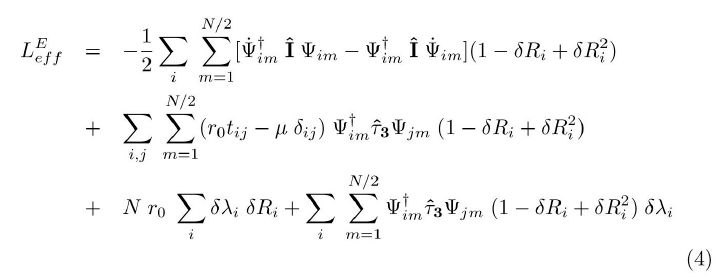
<body><![CDATA[<p align="justify"><font face="verdana" size="2">By using our Lagrangian model written in the framework of the path&#45;integral formalism a new non&#45;perturbative large N&#45;expansion was proposed, Ref. &#91;7&#93;. The generalized Hubbard model is described by means of the introduction of a set of fermion field <i>&#402;<sub>ip</sub></i> , in such a way that their proportionality with the fermion&#45;like Hubbard <i>X<sub>i</sub><sup>0p</sup></i> operators is maintained for all order in the large&#45;N expansion. Looking at the Lagrangian equation (2.17) of Ref. &#91;7&#93;, we see that it is sufficient to retain terms up to order <i>&#948;R<sub>i</sub><sup>2</sup></i> to take into account all the terms of order <i>1/N.</i> Thus the Lagrangian is written:</font></p>  	    <p align="center"><font face="verdana" size="2"><a href="/img/revistas/ns/v2n4/a5e1.jpg" target="_blank"><img src="/img/revistas/ns/v2n4/a5e1_th.jpg"></a></font></p>  	    <p align="center"><font face="verdana" size="2"><a href="/img/revistas/ns/v2n4/a5e1.jpg" target="_blank">Haga clic para agrandar</a></font></p>  	    <p align="justify"><font face="verdana" size="2">In Ref. &#91;7&#93; is proved that our Lagrangian formalism for the t&#45;J model is a second&#45;class constrained system. The physical quantities such as propagators and vertices were renormalized by means of the introduction of proper ghost fields. Therefore in the present paper we assume that all the physical quantities we must handle were previously renormalized.</font></p>  	    <p align="justify"><font face="verdana" size="2">Thus we can easily construct the diagrammatics from the Lagrangian (1) in the U&#45;infinite limit (<i>J<sub>ij</sub></i> &#61; 0).</font></p>  	    <p align="justify"><font face="verdana" size="2">Taking into account the superconducting state, the renormalized fermion propagator &#284;<sub>(</sub><i><sub>D</sub></i><sub>)</sub> is a 2x2 matrix schematically written:</font></p>  	    <p align="center"><font face="verdana" size="2"><img src="/img/revistas/ns/v2n4/a5e2.jpg"></font></p>  	    <p align="justify"><font face="verdana" size="2">where the diagonal elements with the two arrows pointing in the same direction are the normal fermionic propagators, while the non&#45;diagonal elements with the two arrows pointing in the opposite direction are the anomalous fermionic propagators.</font></p>  	    <p align="justify"><font face="verdana" size="2">Introduce the Nambu matrix notation is a simple way of describing the fermionic sector when the complete fermionic propagator is of the form (2), Ref. &#91;15&#93;. In this notation the two&#45;component fermionic field operator &#968;<i><sub>im</sub>(x,&#964;) </i>is given by:</font></p>  	    <p align="center"><font face="verdana" size="2"><img src="/img/revistas/ns/v2n4/a5e3.jpg"></font></p>  	    ]]></body>
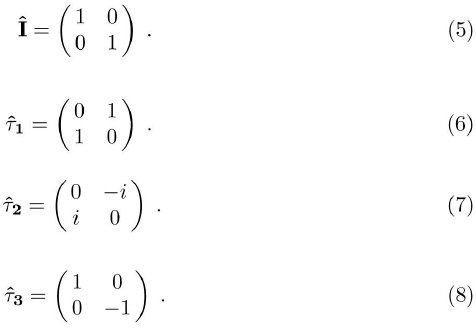
<body><![CDATA[<p align="justify"><font face="verdana" size="2">The Lagrangian (1) in terms of the field operator &#968;<i><sub>im</sub>(x,&#964;)</i>is written:</font></p>  	    <p align="center"><font face="verdana" size="2"><a href="/img/revistas/ns/v2n4/a5e4.jpg" target="_blank"><img src="/img/revistas/ns/v2n4/a5e4_th.jpg"></a></font></p>  	    <p align="center"><font face="verdana" size="2"><a href="/img/revistas/ns/v2n4/a5e4.jpg" target="_blank">Haga clic para agrandar</a></font></p>  	    <p align="justify"><font face="verdana" size="2">where we have named <i>&#956;</i> &#61; <i>&#956;</i>' &#150; <i>&#955;<sub>0</sub>.</i></font></p>  	    <p align="justify"><font face="verdana" size="2">We can see from the equation (4) that the bosonic sector (third term) described by the two field components <i>(&#948;R<sub>i</sub>, &#948;&#955;<sub>i</sub>)</i> remains unchanged, and the fermionic sector (first, second and fourth terms) was written by using the 2x2 Pauli matrices <b>I</b> and <i>&#964;</i><sub>3</sub>. Therefore, to describe non&#45;diagonal quantities that appear in the fermionic propagator when considering the superconducting state, the four Pauli matrices are introduced.</font></p>  	    <p align="center"><font face="verdana" size="2"><img src="/img/revistas/ns/v2n4/a5e5.jpg"></font></p>  	    <p align="justify"><font face="verdana" size="2">The two&#45;component fermionic field operator (3) in the momentum space reads:</font></p>  	    <p align="center"><font face="verdana" size="2"><img src="/img/revistas/ns/v2n4/a5e9.jpg"></font></p>  	    <p align="justify"><font face="verdana" size="2">and</font></p>  	    <p align="center"><font face="verdana" size="2"><img src="/img/revistas/ns/v2n4/a5e10.jpg"></font></p>  	    ]]></body>
<body><![CDATA[<p align="justify"><font face="verdana" size="2">Using the previous notation, we study the diagrammatics for both normal and superconducting states with the objetive to find the equation for the total fermion self&#45;energy and hence to write the renormalized fermion propagators to leading order of large&#45;N expansion.</font></p>  	    <p align="justify"><font face="verdana" size="2">The Feynman rules and the diagrammatics can be obtained, and compute the <i>1/N</i> corrections to the propagators, we will study the structure of the model to one loop.</font></p>  	    <p align="justify"><font face="verdana" size="2">The equations are written in the momentum space, and so once the Fourier transformation was performed, the bilinear parts of the Lagrangian (4) give rise to the field propagators and the remaining pieces are represented by vertices.</font></p>  	    <p align="justify"><font face="verdana" size="2">The boson sector remains unchanged, and the free boson propagator associated with the two component boson field <i>&#948;X<sup>&#945;</sup> &#61; (&#948; R, &#948; &#955;)</i> , is of order <i>1/N</i> and it is written:</font></p>  	    <p align="center"><font face="verdana" size="2"><img src="/img/revistas/ns/v2n4/a5e11.jpg"></font></p>  	    <p align="justify"><font face="verdana" size="2">where the quantities <i>q</i> and <i>&#969;<sub>n</sub></i> are respectively the momentum and the Matsubara frequency of the bosonic field.</font></p>  	    <p align="justify"><font face="verdana" size="2">We wear the free propagator (11) using the Dyson equation <i>D<sub>ab</sub> <sup>&#45;</sup></i><sup>1</sup><i> &#61; D<sub>(o)ab</sub> <sup>&#45;</sup></i><sup>1</sup><b><i> <img src="/img/revistas/ns/v2n4/a5i1.jpg"></i></b> &#91;7&#93;, equations (4.4) and (4.5), the boson self&#45;energy and the dressed components <i>D<sub>RR</sub>(q,</i> <i>&#969;<sub>n</sub></i>), <i>D<sub>&#955;R</sub> (q, &#969;<sub>n</sub></i>) and <i>D<sub>&#955;&#955;</sub> (q, &#969;<sub>n</sub></i>) of the matricial boson propagator were found.</font></p>  	    <p align="justify"><font face="verdana" size="2">The renormalized boson propagator we found is the suitable one that permits us to evaluate for instance the <i>1/N</i> correction to the fermion self&#45;energy.</font></p>  	    <p align="justify"><font face="verdana" size="2">It is important to note that when only the normal state is considered, our diagrammatics was checked by computing numerically the charge&#45;charge and spin&#45;spin correlation functions on the square lattice for nearest&#45;neighbor hopping <i>t,</i> Ref. &#91;11&#93;. The results are in agreement with previous ones arising from the slave&#45;boson model as well as from the functional X&#45;operators canonical approach (Gehlhoff and Zeyher 1965, 4635 and Wang 1992, 155) &#91;19, 20&#93;.</font></p>  	    <p align="justify"><font face="verdana" size="2">The bilinear fermionic part of the Lagrangian (4) in the momentum space reads:</font></p>  	    ]]></body>
<body><![CDATA[<p align="center"><font face="verdana" size="2"><img src="/img/revistas/ns/v2n4/a5e12.jpg"></font></p>  	    <p align="justify"><font face="verdana" size="2">where the 2x2 matrix &#284;<sub>(0)</sub> <sup>&#45;1</sup> is given by:</font></p>  	    <p align="center"><font face="verdana" size="2"><img src="/img/revistas/ns/v2n4/a5e13.jpg"></font></p>  	    <p align="justify"><font face="verdana" size="2">and whose determinant is written:</font></p>  	    <p align="center"><font face="verdana" size="2"><img src="/img/revistas/ns/v2n4/a5e14.jpg"></font></p>  	    <p align="justify"><font face="verdana" size="2">where was defined <i>&#949;<sub>k</sub> &#61; &#150;r<sub>0</sub>t </i><b>&#931;</b><i><sub>I</sub></i> exp(<i>&#150;il</i> <i>&#183; k)</i>; and <b>I</b> is the lattice vector.</font></p>  	    <p align="justify"><font face="verdana" size="2">The quantities <i>k</i> and <i>v<sub>n</sub></i> are respectively the momentum and the Matsubara frequency of the fermionic field.</font></p>  	    <p align="justify"><font face="verdana" size="2">Therefore the free fermion propagator &#284;<sub>(0)</sub> is:</font></p>  	    <p align="center"><font face="verdana" size="2"><img src="/img/revistas/ns/v2n4/a5e15.jpg"></font></p>  	    <p align="justify"><font face="verdana" size="2">where we call &#916;<i><sub>k</sub> &#61; (&#949;<sub>k</sub> &#45;</i> <i>&#956;),</i> having the property &#916;<i><sub>k</sub></i> <i>&#61; &#45;</i>&#916;<i><sub>k</sub>.</i> From this property it can be seen that:</font></p>  	    ]]></body>
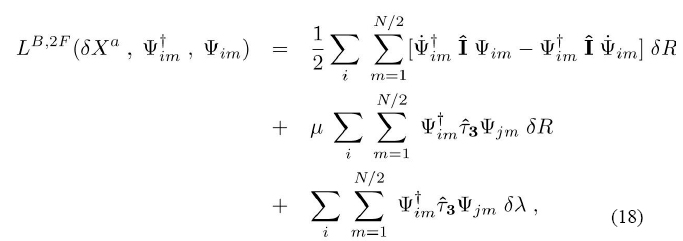
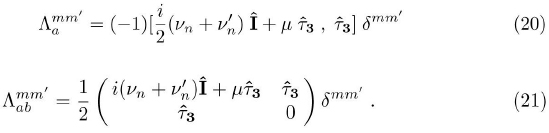
<body><![CDATA[<p align="center"><font face="verdana" size="2"><img src="/img/revistas/ns/v2n4/a5e16.jpg"></font></p>  	    <p align="justify"><font face="verdana" size="2">For noninteracting band electrons, the off&#45;diagonal elements in (2) vanish, and the element <i>G<sub>(0)11</sub></i> has the usual scalar form &#45; <i>iv<sub>n</sub> &#45;</i>&#916;<i><sub>k</sub></i> <sup>&#45;1</sup> Ref. &#91;7&#93;.</font></p>  	    <p align="justify"><font face="verdana" size="2">The matrix equation (15) in terms of the Pauli matrices can be written:</font></p>  	    <p align="center"><font face="verdana" size="2"><img src="/img/revistas/ns/v2n4/a5e17.jpg"></font></p>  	    <p align="justify"><font face="verdana" size="2">Examining the equation (4) it can be seen that the three&#45;leg (one boson&#45;two fermions) and four&#45;leg (two bosons&#45;two fermions) vertices, are respectively originated by the following pieces of that Lagrangian:</font></p>  	    <p align="center"><font face="verdana" size="2"><a href="/img/revistas/ns/v2n4/a5e18.jpg" target="_blank"><img src="/img/revistas/ns/v2n4/a5e18_th.jpg"></a></font></p>  	    <p align="center"><font face="verdana" size="2"><a href="/img/revistas/ns/v2n4/a5e18.jpg" target="_blank">Haga clic para agrandar</a></font></p>  	    <p align="center"><font face="verdana" size="2"><a href="/img/revistas/ns/v2n4/a5e19.jpg" target="_blank"><img src="/img/revistas/ns/v2n4/a5e19_th.jpg"></a></font></p>  	    <p align="center"><font face="verdana" size="2"><a href="/img/revistas/ns/v2n4/a5e19.jpg" target="_blank">Haga clic para agrandar</a></font></p>  	    <p align="justify"><font face="verdana" size="2">Therefore the vertices can be written:</font></p>  	    ]]></body>
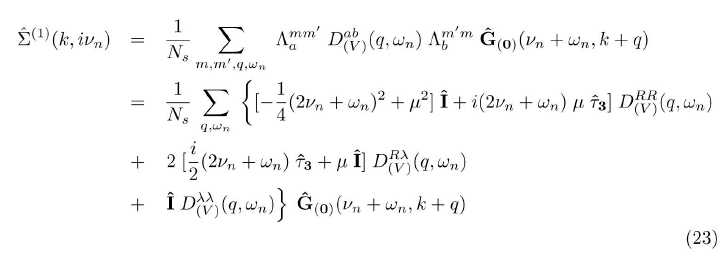
<body><![CDATA[<p align="center"><font face="verdana" size="2"><img src="/img/revistas/ns/v2n4/a5e20.jpg"></font></p>  	    <p align="center"><font face="verdana" size="2">&nbsp;</font></p>  	    <p align="center"><font face="verdana" size="2">&nbsp;</font></p>  	    <p align="justify"><font face="verdana" size="2">Thus, the Feynman diagrammatics the expression for the <i>1/N</i> correction to the fermion self&#45;energy for the normal and the superconducting states can be written.</font></p>  	    <p align="justify"><font face="verdana" size="2">&nbsp;</font></p>  	    <p align="justify"><font face="verdana" size="2"><b>3. The fermion self&#45;energy for the normal and the superconducting states, 1/N correction</b></font></p>  	    <p align="justify"><font face="verdana" size="2">In the introduction it was mentioned that the simplest model suitable to describe the superconducting state is given by the BCS reduced Hamiltonian formalism. In the normal state such formalism reduces to Migdal's theory whose essence is to use only the lowest order Feynman diagram provided by the reduced Hamiltonian (Bardeen, Cooper and Schrieffer 1957, 1175) &#91;21&#93;.</font></p>  	    <p align="justify"><font face="verdana" size="2">In this model the total fermion self&#45;energy &#931; for the normal state is given by the sum of contributions corresponding to the following two one&#45;loop diagrams:</font></p>  	    <p align="center"><font face="verdana" size="2"><img src="/img/revistas/ns/v2n4/a5e22.jpg"></font></p>  	    <p align="justify"><font face="verdana" size="2">In the Nambu matrix notation the matrices <img src="/img/revistas/ns/v2n4/a5i2.jpg"> and <img src="/img/revistas/ns/v2n4/a5i3.jpg"> respectively are written:</font></p>  	    ]]></body>
<body><![CDATA[<p align="center"><font face="verdana" size="2"><a href="/img/revistas/ns/v2n4/a5e23.jpg" target="_blank"><img src="/img/revistas/ns/v2n4/a5e23_th.jpg"></a></font></p>  	    <p align="center"><font face="verdana" size="2"><a href="/img/revistas/ns/v2n4/a5e23.jpg" target="_blank">Haga clic para agrandar</a></font></p>  	    <p align="center"><font face="verdana" size="2"><a href="/img/revistas/ns/v2n4/a5e24.jpg" target="_blank"><img src="/img/revistas/ns/v2n4/a5e24_th.jpg"></a></font></p>  	    <p align="center"><font face="verdana" size="2"><a href="/img/revistas/ns/v2n4/a5e24.jpg" target="_blank">Haga clic para agrandar</a></font></p>  	    <p align="justify"><font face="verdana" size="2">From the above equations the <i>1/N</i> correction to the fermion self&#45;energy can be computed, Ref. &#91;13&#93;.</font></p>  	    <p align="justify"><font face="verdana" size="2">Alternatively the matrices <img src="/img/revistas/ns/v2n4/a5i2.jpg"> and <img src="/img/revistas/ns/v2n4/a5i3.jpg"> can be written:</font></p>  	    <p align="center"><font face="verdana" size="2"><img src="/img/revistas/ns/v2n4/a5e25.jpg"></font></p>  	    <p align="center"><font face="verdana" size="2"><img src="/img/revistas/ns/v2n4/a5e26.jpg"></font></p>  	    <p align="justify"><font face="verdana" size="2">where:</font></p>  	    <p align="center"><font face="verdana" size="2"><img src="/img/revistas/ns/v2n4/a5e27.jpg"></font></p>  	    ]]></body>
<body><![CDATA[<p align="center"><font face="verdana" size="2"><img src="/img/revistas/ns/v2n4/a5e28.jpg"></font></p>  	    <p align="center"><font face="verdana" size="2"><img src="/img/revistas/ns/v2n4/a5e29.jpg"></font></p>  	    <p align="center"><font face="verdana" size="2"><img src="/img/revistas/ns/v2n4/a5e30.jpg"></font></p>  	    <p align="justify"><font face="verdana" size="2">Therefore, for the normal state the total fermion self&#45;energy is a diagonal matrix which in terms of the Pauli matrices can be explicitly written as follows:</font></p>  	    <p align="center"><font face="verdana" size="2"><img src="/img/revistas/ns/v2n4/a5e31.jpg"></font></p>  	    <p align="justify"><font face="verdana" size="2">The fermionic dressed propagator is defined by means of the Dyson equation:</font></p>  	    <p align="center"><font face="verdana" size="2"><img src="/img/revistas/ns/v2n4/a5i4.jpg"></font></p>  	    <p align="justify"><font face="verdana" size="2">The above equations are suitable to describe the leading <i>1/N</i> corrections for the normal state in the generalized Hubbard model describing N&#45;fold&#45;degenerate correlated bands in the infinite&#45;U limit. They were obtained by means of a new non&#45;perturbative large&#45;N expansion in the framework of our Lagrangian model.</font></p>  	    <p align="justify"><font face="verdana" size="2">Now the superconducting state must be incorporated. By looking at the expression of the fermionic self&#45;energy (equation (32)) we assume that the most general form to write the total self&#45;energy in terms of the Pauli matrices is:</font></p>  	    <p align="center"><font face="verdana" size="2"><img src="/img/revistas/ns/v2n4/a5e32.jpg"></font></p>  	    ]]></body>
<body><![CDATA[<p align="justify"><font face="verdana" size="2">where Z, <i>&#967;</i> , <i>&#934;</i> and <i><img src="/img/revistas/ns/v2n4/a5i5.jpg"></i>are four independent arbitrary functions.</font></p>  	    <p align="justify"><font face="verdana" size="2">When the superconducting state is taken into account the "anomalous" dressed fermionic propagator also is determined by the Dyson equation, consequently:</font></p>  	    <p align="center"><font face="verdana" size="2"><img src="/img/revistas/ns/v2n4/a5e33.jpg"></font></p>  	    <p align="justify"><font face="verdana" size="2">This matrix can be inverted, and it results:</font></p>  	    <p align="center"><font face="verdana" size="2"><img src="/img/revistas/ns/v2n4/a5e34.jpg"></font></p>  	    <p align="justify"><font face="verdana" size="2">where:</font></p>  	    <p align="center"><font face="verdana" size="2"><img src="/img/revistas/ns/v2n4/a5e35.jpg"></font></p>  	    <p align="justify"><font face="verdana" size="2">It is clear that the Dyson perturbation series for the matrix <i>&#284;<sub>(D</sub></i><sub>)</sub> turns out to be identical to that for G<i><sub>(D</sub></i><sub>)</sub>. The only difference is that <i>&#284;<sub>(D</sub></i><sub>)</sub>is a matrix and that factors of the Pauli matrices are attached in the interaction matrix elements.</font></p>  	    <p align="justify"><font face="verdana" size="2">Since in the normal state the fermionic propagator <i>&#284;</i><sub>(</sub><i><sub>D</sub></i><sub>)</sub> is diagonal, it is clear that the both arbitrary functions <i>&#934;</i> and <img src="/img/revistas/ns/v2n4/a5i5.jpg"> must vanish. The arbitrary functions <i>Z</i> and <i>X</i> &ordf;are univocally determined by the normal state, and in order to verify the property (16) both quantities must be even functions of <i>iv<sub>n</sub>.</i> The "normal" solution <i>&#934;</i> <i>&#61;</i> <i><img src="/img/revistas/ns/v2n4/a5i5.jpg"> &#61;</i> 0 always exists. So, the functions <i>Z</i> and <i>X</i> in the normal state remain defined by the following equations:</font></p>  	    <p align="center"><font face="verdana" size="2"><img src="/img/revistas/ns/v2n4/a5e36.jpg"></font></p>  	    ]]></body>
<body><![CDATA[<p align="center"><font face="verdana" size="2"><img src="/img/revistas/ns/v2n4/a5e37.jpg"></font></p>  	    <p align="justify"><font face="verdana" size="2">where it was assumed that everything is even in the momentum <i>k</i>.</font></p>  	    <p align="justify"><font face="verdana" size="2">Furthermore we assume that the property (16) is maintained in the superconducting state, and so is necessary that <i>&#934;<sup>2</sup></i> <b><i>&#43; <img src="/img/revistas/ns/v2n4/a5i6.jpg"></i></b> must be also an even function in <i>iv<sub>n</sub>.</i> Moreover, it is possible to see that <i>&#934;</i> and <img src="/img/revistas/ns/v2n4/a5i5.jpg"> satisfy identical nonlinear equations. Consequently, except a proportionality factor (phase factor) both functions must be equals. When a solution <i>&#934;,</i> <img src="/img/revistas/ns/v2n4/a5i5.jpg"> with one or both functions different from zero exists, it is possible to show that it describes the state with Cooper&#45;pair condensation (the superconducting state) (Bardeen and Stephen 1964, 1485) &#91;22&#93;.</font></p>  	    <p align="justify"><font face="verdana" size="2">The simplest solution is to take <i>&#934;</i> &#8800; 0 and <b><i><img src="../img/revistas/ns/v2n4/a5i5.jpg"> &#61;</i></b> 0 corresponding to fix the phase factor. This is possible because the physical observables cannot depend of this phase. This choice is equivalent to write the self&#45;energy in terms of the real Pauli matrices.</font></p>      <p align="justify"><font face="verdana" size="2">As it occurs in the normal&#45;state case, the equation for the total fermionic self&#45;energy must be solved self&#45;consistently by using the equation (34). As it is usual the explicit computation is carried out by introducing the spectral representation of the boson propagator.</font></p>  	    <p align="justify"><font face="verdana" size="2">&nbsp;</font></p>  	    <p align="justify"><font face="verdana" size="2"><b>Conclusions</b></font></p>  	    <p align="justify"><font face="verdana" size="2">The BCS theory is the model capable to describe the superconducting state. The Cooper&#45;pair amplitude &#60; c<sub><i>k</i>&#8593;</sub> , c<sub>&#45;<i>k</i>&#8595;</sub> &#62;which is zero in the normal&#45;state due to the number conservation becomes finite bellow Tc. An important feature of BCS theory is the Cooper&#45;pair condensation, in this approach the pair of states (<i>k</i>&#8593;, <i>&#45;k</i>&#8595;) is occupied coherently. The simplest model which permits such behavior is the BCS reduced Hamiltonian model.</font></p>  	    <p align="justify"><font face="verdana" size="2">A Lagrangian family that can be mapped in the slave&#45;boson representation was previously studied, Ref. &#91;7&#93;. In the case of the normal&#45;state the nonperturbative formalism for the generalized Hubbard model by using a new large&#45;N expansion in the infinite&#45;U limit was given. The standard Feynman diagrammatics was constructed, in order to compute the <i>1/N</i> correction to the boson propagator. The structure of the model was examined in detail up to one loop. The renormalized boson propagator we found is the suitable one that permits us to evaluate the <i>1/N</i> correction to the fermion self&#45;energy. In the normal&#45;state case, the diagrammatics was checked by computing numerically the charge&#45;charge and spin&#45;spin correlation functions on the square lattice for nearest&#45;neighbor hopping <i>t</i>. The results obtained in Ref. &#91;11&#93; are in agreement with previous one arising from the slave&#45;boson model as well as from the functional X&#45;operators canonical approach.</font></p>  	    <p align="justify"><font face="verdana" size="2">In the present paper, by using the Nambu matrix notation we have rewritten the Lagrangian for the t&#45;J model and the Feynman diagrammatics was constructed but now taking into account the superconducting state. In this situation propagators and vertices were again evaluated. The renormalized physical quantities to leading order in <i>1/N</i> were computed, and the equation for the total fermion self&#45;energy which must be solved self&#45;consistently was found. So, we have given the theoretical framework suitable to describe the superconducting state in the Lagrangian formalism for the generalized Hubbard model.</font></p>  	    ]]></body>
<body><![CDATA[<p align="justify"><font face="verdana" size="2">&nbsp;</font></p>  	    <p align="justify"><font face="verdana" size="2"><b>References</b></font></p>  	    <!-- ref --><p align="justify"><font face="verdana" size="2">&#91;1&#93;&nbsp;G. Kotliar and J. Liu, Phys. Review B <b>38</b> (1988) 5142;    &nbsp;&nbsp;&nbsp;&nbsp;&nbsp;&nbsp;&nbsp;&nbsp;[&#160;<a href="javascript:void(0);" onclick="javascript: window.open('/scielo.php?script=sci_nlinks&ref=5469207&pid=S2007-0705201000020000500001&lng=','','width=640,height=500,resizable=yes,scrollbars=1,menubar=yes,');">Links</a>&#160;]<!-- end-ref --><!-- ref --> M. Grilli and G. Kotliar, Physical Review Letters <b>64</b> (1990) 1170.    &nbsp;&nbsp;&nbsp;&nbsp;&nbsp;&nbsp;&nbsp;&nbsp;[&#160;<a href="javascript:void(0);" onclick="javascript: window.open('/scielo.php?script=sci_nlinks&ref=5469208&pid=S2007-0705201000020000500002&lng=','','width=640,height=500,resizable=yes,scrollbars=1,menubar=yes,');">Links</a>&#160;]<!-- end-ref --></font></p>  	    <!-- ref --><p align="justify"><font face="verdana" size="2">&#91;2&#93; A. Tandon, Z. Wang and G. Kotliar, Physical Review Letters <b>83</b> (1999) 2046.    &nbsp;&nbsp;&nbsp;&nbsp;&nbsp;&nbsp;&nbsp;&nbsp;[&#160;<a href="javascript:void(0);" onclick="javascript: window.open('/scielo.php?script=sci_nlinks&ref=5469210&pid=S2007-0705201000020000500003&lng=','','width=640,height=500,resizable=yes,scrollbars=1,menubar=yes,');">Links</a>&#160;]<!-- end-ref --></font></p>  	    <!-- ref --><p align="justify"><font face="verdana" size="2">&#91;3&#93; A. Izyumov, Physics &#45; Uspekhi <b>40</b> (1997) 445.    &nbsp;&nbsp;&nbsp;&nbsp;&nbsp;&nbsp;&nbsp;&nbsp;[&#160;<a href="javascript:void(0);" onclick="javascript: window.open('/scielo.php?script=sci_nlinks&ref=5469212&pid=S2007-0705201000020000500004&lng=','','width=640,height=500,resizable=yes,scrollbars=1,menubar=yes,');">Links</a>&#160;]<!-- end-ref --></font></p>  	    <!-- ref --><p align="justify"><font face="verdana" size="2">&#91;4&#93; P. Coleman, J. Hopkinson and C. P&eacute;pin, Phys. Review B <b>63</b> (2001) 140.    &nbsp;&nbsp;&nbsp;&nbsp;&nbsp;&nbsp;&nbsp;&nbsp;[&#160;<a href="javascript:void(0);" onclick="javascript: window.open('/scielo.php?script=sci_nlinks&ref=5469214&pid=S2007-0705201000020000500005&lng=','','width=640,height=500,resizable=yes,scrollbars=1,menubar=yes,');">Links</a>&#160;]<!-- end-ref --></font></p>  	    <!-- ref --><p align="justify"><font face="verdana" size="2">&#91;5&#93; A. Foussats, A. Greco and O. S. Zandron, Annals of Physics (NY) <b>275</b> (1999), 238.    &nbsp;&nbsp;&nbsp;&nbsp;&nbsp;&nbsp;&nbsp;&nbsp;[&#160;<a href="javascript:void(0);" onclick="javascript: window.open('/scielo.php?script=sci_nlinks&ref=5469216&pid=S2007-0705201000020000500006&lng=','','width=640,height=500,resizable=yes,scrollbars=1,menubar=yes,');">Links</a>&#160;]<!-- end-ref --></font></p>  	    <!-- ref --><p align="justify"><font face="verdana" size="2">&#91;6&#93; A. Foussats, A. Greco, C. Repetto, O. P. Zandron and O. S. Zandron, Journal of Physics A <b>33</b> (2000) 5849.    &nbsp;&nbsp;&nbsp;&nbsp;&nbsp;&nbsp;&nbsp;&nbsp;[&#160;<a href="javascript:void(0);" onclick="javascript: window.open('/scielo.php?script=sci_nlinks&ref=5469218&pid=S2007-0705201000020000500007&lng=','','width=640,height=500,resizable=yes,scrollbars=1,menubar=yes,');">Links</a>&#160;]<!-- end-ref --></font></p>  	    <!-- ref --><p align="justify"><font face="verdana" size="2">&#91;7&#93; A. Foussats, C. Repetto, O. P. Zandron and O. S. Zandron, International Journal of Theoretical Physics <b>41</b> (2002) 1053, and bibliography counted in therein.    &nbsp;&nbsp;&nbsp;&nbsp;&nbsp;&nbsp;&nbsp;&nbsp;[&#160;<a href="javascript:void(0);" onclick="javascript: window.open('/scielo.php?script=sci_nlinks&ref=5469220&pid=S2007-0705201000020000500008&lng=','','width=640,height=500,resizable=yes,scrollbars=1,menubar=yes,');">Links</a>&#160;]<!-- end-ref --></font></p>  	    <!-- ref --><p align="justify"><font face="verdana" size="2">&#91;8&#93; C. Abecasis and O. Zandron, "Diagrammatics and Feynman rules in the Lagrangian theory based on the spl(2,1) graded algebra", International Journal of Modern Physics B <b>21</b> (2007) 1861.    &nbsp;&nbsp;&nbsp;&nbsp;&nbsp;&nbsp;&nbsp;&nbsp;[&#160;<a href="javascript:void(0);" onclick="javascript: window.open('/scielo.php?script=sci_nlinks&ref=5469222&pid=S2007-0705201000020000500009&lng=','','width=640,height=500,resizable=yes,scrollbars=1,menubar=yes,');">Links</a>&#160;]<!-- end-ref --></font></p>  	    <!-- ref --><p align="justify"><font face="verdana" size="2">&#91;9&#93; J. J. Liang, J. Q. Liang and W. M. Liu, Phys Rev. A <b>68</b> (2003) 436.    &nbsp;&nbsp;&nbsp;&nbsp;&nbsp;&nbsp;&nbsp;&nbsp;[&#160;<a href="javascript:void(0);" onclick="javascript: window.open('/scielo.php?script=sci_nlinks&ref=5469224&pid=S2007-0705201000020000500010&lng=','','width=640,height=500,resizable=yes,scrollbars=1,menubar=yes,');">Links</a>&#160;]<!-- end-ref --></font></p>  	    <!-- ref --><p align="justify"><font face="verdana" size="2">&#91;10&#93; Z. W. Xie and W. M. Liu, Phys. Rev. A <b>70</b> (2004) 456.    &nbsp;&nbsp;&nbsp;&nbsp;&nbsp;&nbsp;&nbsp;&nbsp;[&#160;<a href="javascript:void(0);" onclick="javascript: window.open('/scielo.php?script=sci_nlinks&ref=5469226&pid=S2007-0705201000020000500011&lng=','','width=640,height=500,resizable=yes,scrollbars=1,menubar=yes,');">Links</a>&#160;]<!-- end-ref --></font></p>  	    <!-- ref --><p align="justify"><font face="verdana" size="2">&#91;11&#93;&nbsp;A. Foussats and A. Greco, Phys. Rev. B <b>65</b> (2002) 195107.    &nbsp;&nbsp;&nbsp;&nbsp;&nbsp;&nbsp;&nbsp;&nbsp;[&#160;<a href="javascript:void(0);" onclick="javascript: window.open('/scielo.php?script=sci_nlinks&ref=5469228&pid=S2007-0705201000020000500012&lng=','','width=640,height=500,resizable=yes,scrollbars=1,menubar=yes,');">Links</a>&#160;]<!-- end-ref --></font></p>  	    <!-- ref --><p align="justify"><font face="verdana" size="2">&#91;12&#93; M. Grilli and G. Kotliar, G, Phys. Rev. Lett <b>64</b> (1990) 1170.    &nbsp;&nbsp;&nbsp;&nbsp;&nbsp;&nbsp;&nbsp;&nbsp;[&#160;<a href="javascript:void(0);" onclick="javascript: window.open('/scielo.php?script=sci_nlinks&ref=5469230&pid=S2007-0705201000020000500013&lng=','','width=640,height=500,resizable=yes,scrollbars=1,menubar=yes,');">Links</a>&#160;]<!-- end-ref --></font></p>  	    <!-- ref --><p align="justify"><font face="verdana" size="2">&#91;13&#93; G. Kotliar and J. Liu, Physical Review: Condensed Matter B <b>38</b> (1988) 5142.    &nbsp;&nbsp;&nbsp;&nbsp;&nbsp;&nbsp;&nbsp;&nbsp;[&#160;<a href="javascript:void(0);" onclick="javascript: window.open('/scielo.php?script=sci_nlinks&ref=5469232&pid=S2007-0705201000020000500014&lng=','','width=640,height=500,resizable=yes,scrollbars=1,menubar=yes,');">Links</a>&#160;]<!-- end-ref --></font></p>  	    <!-- ref --><p align="justify"><font face="verdana" size="2">&#91;14&#93; A. Tandon, Z. Wang and G. Kotliar, Phys. Rev. Lett <b>83</b> (1999) 2046.    &nbsp;&nbsp;&nbsp;&nbsp;&nbsp;&nbsp;&nbsp;&nbsp;[&#160;<a href="javascript:void(0);" onclick="javascript: window.open('/scielo.php?script=sci_nlinks&ref=5469234&pid=S2007-0705201000020000500015&lng=','','width=640,height=500,resizable=yes,scrollbars=1,menubar=yes,');">Links</a>&#160;]<!-- end-ref --></font></p>  	    <!-- ref --><p align="justify"><font face="verdana" size="2">&#91;15&#93; Y. Nambu, Phys. Rev. <b>117</b> (1960) 648.    &nbsp;&nbsp;&nbsp;&nbsp;&nbsp;&nbsp;&nbsp;&nbsp;[&#160;<a href="javascript:void(0);" onclick="javascript: window.open('/scielo.php?script=sci_nlinks&ref=5469236&pid=S2007-0705201000020000500016&lng=','','width=640,height=500,resizable=yes,scrollbars=1,menubar=yes,');">Links</a>&#160;]<!-- end-ref --></font></p>  	    <!-- ref --><p align="justify"><font face="verdana" size="2">&#91;16&#93; P.B. Allen and B. Mitrov&iacute;c, Theory of Superconducting Tc, Solid State Physics 37 (1982) 1.    &nbsp;&nbsp;&nbsp;&nbsp;&nbsp;&nbsp;&nbsp;&nbsp;[&#160;<a href="javascript:void(0);" onclick="javascript: window.open('/scielo.php?script=sci_nlinks&ref=5469238&pid=S2007-0705201000020000500017&lng=','','width=640,height=500,resizable=yes,scrollbars=1,menubar=yes,');">Links</a>&#160;]<!-- end-ref --></font></p>  	    <!-- ref --><p align="justify"><font face="verdana" size="2">&#91;17&#93; R. Zeyher and M. Kul&iacute;c, Phys Rev. B <b>53</b> (1996) 2850.    &nbsp;&nbsp;&nbsp;&nbsp;&nbsp;&nbsp;&nbsp;&nbsp;[&#160;<a href="javascript:void(0);" onclick="javascript: window.open('/scielo.php?script=sci_nlinks&ref=5469240&pid=S2007-0705201000020000500018&lng=','','width=640,height=500,resizable=yes,scrollbars=1,menubar=yes,');">Links</a>&#160;]<!-- end-ref --></font></p>  	    <!-- ref --><p align="justify"><font face="verdana" size="2">&#91;18&#93; R. Zeyher and A. Greco, Eur. Phys. J.B. 6 (1998) 473.    &nbsp;&nbsp;&nbsp;&nbsp;&nbsp;&nbsp;&nbsp;&nbsp;[&#160;<a href="javascript:void(0);" onclick="javascript: window.open('/scielo.php?script=sci_nlinks&ref=5469242&pid=S2007-0705201000020000500019&lng=','','width=640,height=500,resizable=yes,scrollbars=1,menubar=yes,');">Links</a>&#160;]<!-- end-ref --></font></p>  	    <!-- ref --><p align="justify"><font face="verdana" size="2">&#91;19&#93; L. Gehlhoff and R. Zeyher, Physical Review B <b>52</b> (1965) 4635.    &nbsp;&nbsp;&nbsp;&nbsp;&nbsp;&nbsp;&nbsp;&nbsp;[&#160;<a href="javascript:void(0);" onclick="javascript: window.open('/scielo.php?script=sci_nlinks&ref=5469244&pid=S2007-0705201000020000500020&lng=','','width=640,height=500,resizable=yes,scrollbars=1,menubar=yes,');">Links</a>&#160;]<!-- end-ref --></font></p>  	    <!-- ref --><p align="justify"><font face="verdana" size="2">&#91;20&#93; Z. Wang, International Journal of Modern Physics B <b>6</b> (1992) 155.    &nbsp;&nbsp;&nbsp;&nbsp;&nbsp;&nbsp;&nbsp;&nbsp;[&#160;<a href="javascript:void(0);" onclick="javascript: window.open('/scielo.php?script=sci_nlinks&ref=5469246&pid=S2007-0705201000020000500021&lng=','','width=640,height=500,resizable=yes,scrollbars=1,menubar=yes,');">Links</a>&#160;]<!-- end-ref --></font></p>  	    <!-- ref --><p align="justify"><font face="verdana" size="2">&#91;21&#93; J. Bardeen, L.N. Cooper and J.R. Schrieffer, Phys. Rev. <b>108</b> 1175 (1957).    &nbsp;&nbsp;&nbsp;&nbsp;&nbsp;&nbsp;&nbsp;&nbsp;[&#160;<a href="javascript:void(0);" onclick="javascript: window.open('/scielo.php?script=sci_nlinks&ref=5469248&pid=S2007-0705201000020000500022&lng=','','width=640,height=500,resizable=yes,scrollbars=1,menubar=yes,');">Links</a>&#160;]<!-- end-ref --></font></p>  	    <!-- ref --><p align="justify"><font face="verdana" size="2">&#91;22&#93; J. Bardeen and M. Stephen, Phys. Rev. A <b>136</b> 1485 (1964).    &nbsp;&nbsp;&nbsp;&nbsp;&nbsp;&nbsp;&nbsp;&nbsp;[&#160;<a href="javascript:void(0);" onclick="javascript: window.open('/scielo.php?script=sci_nlinks&ref=5469250&pid=S2007-0705201000020000500023&lng=','','width=640,height=500,resizable=yes,scrollbars=1,menubar=yes,');">Links</a>&#160;]<!-- end-ref --></font></p>      ]]></body><back>
<ref-list>
<ref id="B1">
<label>1</label><nlm-citation citation-type="journal">
<person-group person-group-type="author">
<name>
<surname><![CDATA[Kotliar]]></surname>
<given-names><![CDATA[G.]]></given-names>
</name>
<name>
<surname><![CDATA[Liu]]></surname>
<given-names><![CDATA[J.]]></given-names>
</name>
</person-group>
<source><![CDATA[Phys. Review B]]></source>
<year>1988</year>
<volume>38</volume>
<page-range>5142</page-range></nlm-citation>
</ref>
<ref id="B2">
<nlm-citation citation-type="journal">
<person-group person-group-type="author">
<name>
<surname><![CDATA[Grilli]]></surname>
<given-names><![CDATA[M.]]></given-names>
</name>
<name>
<surname><![CDATA[Kotliar]]></surname>
<given-names><![CDATA[G.]]></given-names>
</name>
</person-group>
<source><![CDATA[Physical Review Letters]]></source>
<year>1990</year>
<volume>64</volume>
<page-range>1170</page-range></nlm-citation>
</ref>
<ref id="B3">
<label>2</label><nlm-citation citation-type="journal">
<person-group person-group-type="author">
<name>
<surname><![CDATA[Tandon]]></surname>
<given-names><![CDATA[A.]]></given-names>
</name>
<name>
<surname><![CDATA[Wang]]></surname>
<given-names><![CDATA[Z.]]></given-names>
</name>
<name>
<surname><![CDATA[Kotliar]]></surname>
<given-names><![CDATA[G.]]></given-names>
</name>
</person-group>
<source><![CDATA[Physical Review Letters]]></source>
<year>1999</year>
<volume>83</volume>
<page-range>2046</page-range></nlm-citation>
</ref>
<ref id="B4">
<label>3</label><nlm-citation citation-type="journal">
<person-group person-group-type="author">
<name>
<surname><![CDATA[Izyumov]]></surname>
<given-names><![CDATA[A.]]></given-names>
</name>
</person-group>
<source><![CDATA[Physics - Uspekhi]]></source>
<year>1997</year>
<volume>40</volume>
<page-range>445</page-range></nlm-citation>
</ref>
<ref id="B5">
<label>4</label><nlm-citation citation-type="journal">
<person-group person-group-type="author">
<name>
<surname><![CDATA[Coleman]]></surname>
<given-names><![CDATA[P.]]></given-names>
</name>
<name>
<surname><![CDATA[Hopkinson]]></surname>
<given-names><![CDATA[J.]]></given-names>
</name>
<name>
<surname><![CDATA[Pépin]]></surname>
<given-names><![CDATA[C.]]></given-names>
</name>
</person-group>
<source><![CDATA[Phys. Review B]]></source>
<year>2001</year>
<volume>63</volume>
<page-range>140</page-range></nlm-citation>
</ref>
<ref id="B6">
<label>5</label><nlm-citation citation-type="journal">
<person-group person-group-type="author">
<name>
<surname><![CDATA[Foussats]]></surname>
<given-names><![CDATA[A.]]></given-names>
</name>
<name>
<surname><![CDATA[Greco]]></surname>
<given-names><![CDATA[A.]]></given-names>
</name>
<name>
<surname><![CDATA[Zandron]]></surname>
<given-names><![CDATA[O. S.]]></given-names>
</name>
</person-group>
<source><![CDATA[Annals of Physics]]></source>
<year>1999</year>
<volume>275</volume>
<page-range>238</page-range><publisher-loc><![CDATA[NY ]]></publisher-loc>
</nlm-citation>
</ref>
<ref id="B7">
<label>6</label><nlm-citation citation-type="journal">
<person-group person-group-type="author">
<name>
<surname><![CDATA[Foussats]]></surname>
<given-names><![CDATA[A.]]></given-names>
</name>
<name>
<surname><![CDATA[Greco]]></surname>
<given-names><![CDATA[A.]]></given-names>
</name>
<name>
<surname><![CDATA[Repetto]]></surname>
<given-names><![CDATA[C.]]></given-names>
</name>
<name>
<surname><![CDATA[Zandron]]></surname>
<given-names><![CDATA[O. P.]]></given-names>
</name>
<name>
<surname><![CDATA[Zandron]]></surname>
<given-names><![CDATA[O. S.]]></given-names>
</name>
</person-group>
<source><![CDATA[Journal of Physics A]]></source>
<year>2000</year>
<volume>33</volume>
<page-range>5849</page-range></nlm-citation>
</ref>
<ref id="B8">
<label>7</label><nlm-citation citation-type="journal">
<person-group person-group-type="author">
<name>
<surname><![CDATA[Foussats]]></surname>
<given-names><![CDATA[A.]]></given-names>
</name>
<name>
<surname><![CDATA[Repetto]]></surname>
<given-names><![CDATA[C.]]></given-names>
</name>
<name>
<surname><![CDATA[Zandron]]></surname>
<given-names><![CDATA[O. P.]]></given-names>
</name>
<name>
<surname><![CDATA[Zandron]]></surname>
<given-names><![CDATA[O. S.]]></given-names>
</name>
</person-group>
<source><![CDATA[International Journal of Theoretical Physics]]></source>
<year>2002</year>
<volume>41</volume>
<page-range>1053</page-range></nlm-citation>
</ref>
<ref id="B9">
<label>8</label><nlm-citation citation-type="journal">
<person-group person-group-type="author">
<name>
<surname><![CDATA[Abecasis]]></surname>
<given-names><![CDATA[C.]]></given-names>
</name>
<name>
<surname><![CDATA[Zandron]]></surname>
<given-names><![CDATA[O.]]></given-names>
</name>
</person-group>
<article-title xml:lang="en"><![CDATA[Diagrammatics and Feynman rules in the Lagrangian theory based on the spl(2,1) graded algebra]]></article-title>
<source><![CDATA[International Journal of Modern Physics B]]></source>
<year>2007</year>
<volume>21</volume>
<page-range>1861</page-range></nlm-citation>
</ref>
<ref id="B10">
<label>9</label><nlm-citation citation-type="journal">
<person-group person-group-type="author">
<name>
<surname><![CDATA[Liang]]></surname>
<given-names><![CDATA[J. J.]]></given-names>
</name>
<name>
<surname><![CDATA[Liang]]></surname>
<given-names><![CDATA[J. Q.]]></given-names>
</name>
<name>
<surname><![CDATA[Liu]]></surname>
<given-names><![CDATA[W. M.]]></given-names>
</name>
</person-group>
<source><![CDATA[Phys Rev. A]]></source>
<year>2003</year>
<volume>68</volume>
<page-range>436</page-range></nlm-citation>
</ref>
<ref id="B11">
<label>10</label><nlm-citation citation-type="journal">
<person-group person-group-type="author">
<name>
<surname><![CDATA[Xie]]></surname>
<given-names><![CDATA[Z. W.]]></given-names>
</name>
<name>
<surname><![CDATA[Liu]]></surname>
<given-names><![CDATA[W. M.]]></given-names>
</name>
</person-group>
<source><![CDATA[Phys. Rev. A]]></source>
<year>2004</year>
<volume>70</volume>
<page-range>456</page-range></nlm-citation>
</ref>
<ref id="B12">
<label>11</label><nlm-citation citation-type="journal">
<person-group person-group-type="author">
<name>
<surname><![CDATA[Foussats]]></surname>
<given-names><![CDATA[A.]]></given-names>
</name>
<name>
<surname><![CDATA[Greco]]></surname>
<given-names><![CDATA[A.]]></given-names>
</name>
</person-group>
<source><![CDATA[Phys. Rev. B]]></source>
<year>2002</year>
<volume>65</volume>
<page-range>195107</page-range></nlm-citation>
</ref>
<ref id="B13">
<label>12</label><nlm-citation citation-type="journal">
<person-group person-group-type="author">
<name>
<surname><![CDATA[Grilli]]></surname>
<given-names><![CDATA[M.]]></given-names>
</name>
<name>
<surname><![CDATA[G. Kotliar]]></surname>
<given-names><![CDATA[G]]></given-names>
</name>
</person-group>
<source><![CDATA[Phys. Rev. Lett]]></source>
<year>1990</year>
<volume>64</volume>
<page-range>1170</page-range></nlm-citation>
</ref>
<ref id="B14">
<label>13</label><nlm-citation citation-type="journal">
<person-group person-group-type="author">
<name>
<surname><![CDATA[Kotliar]]></surname>
<given-names><![CDATA[G.]]></given-names>
</name>
<name>
<surname><![CDATA[Liu]]></surname>
<given-names><![CDATA[J.]]></given-names>
</name>
</person-group>
<source><![CDATA[Physical Review: Condensed Matter B]]></source>
<year>1988</year>
<volume>38</volume>
<page-range>5142</page-range></nlm-citation>
</ref>
<ref id="B15">
<label>14</label><nlm-citation citation-type="journal">
<person-group person-group-type="author">
<name>
<surname><![CDATA[Tandon]]></surname>
<given-names><![CDATA[A.]]></given-names>
</name>
<name>
<surname><![CDATA[Wang]]></surname>
<given-names><![CDATA[Z.]]></given-names>
</name>
<name>
<surname><![CDATA[Kotliar]]></surname>
<given-names><![CDATA[G.]]></given-names>
</name>
</person-group>
<source><![CDATA[Phys. Rev. Lett]]></source>
<year>1999</year>
<volume>83</volume>
<page-range>2046</page-range></nlm-citation>
</ref>
<ref id="B16">
<label>15</label><nlm-citation citation-type="journal">
<person-group person-group-type="author">
<name>
<surname><![CDATA[Nambu]]></surname>
<given-names><![CDATA[Y.]]></given-names>
</name>
</person-group>
<source><![CDATA[Phys. Rev.]]></source>
<year>1960</year>
<volume>117</volume>
<page-range>648</page-range></nlm-citation>
</ref>
<ref id="B17">
<label>16</label><nlm-citation citation-type="journal">
<person-group person-group-type="author">
<name>
<surname><![CDATA[Allen]]></surname>
<given-names><![CDATA[P.B.]]></given-names>
</name>
<name>
<surname><![CDATA[Mitrovíc]]></surname>
<given-names><![CDATA[B.]]></given-names>
</name>
</person-group>
<article-title xml:lang="en"><![CDATA[Theory of Superconducting Tc]]></article-title>
<source><![CDATA[Solid State Physics]]></source>
<year>1982</year>
<volume>37</volume>
<page-range>1</page-range></nlm-citation>
</ref>
<ref id="B18">
<label>17</label><nlm-citation citation-type="journal">
<person-group person-group-type="author">
<name>
<surname><![CDATA[Zeyher]]></surname>
<given-names><![CDATA[R.]]></given-names>
</name>
<name>
<surname><![CDATA[Kulíc]]></surname>
<given-names><![CDATA[M.]]></given-names>
</name>
</person-group>
<source><![CDATA[Phys Rev. B]]></source>
<year>1996</year>
<volume>53</volume>
<page-range>2850</page-range></nlm-citation>
</ref>
<ref id="B19">
<label>18</label><nlm-citation citation-type="journal">
<person-group person-group-type="author">
<name>
<surname><![CDATA[Zeyher]]></surname>
<given-names><![CDATA[R.]]></given-names>
</name>
<name>
<surname><![CDATA[Greco]]></surname>
<given-names><![CDATA[A.]]></given-names>
</name>
</person-group>
<source><![CDATA[Eur. Phys. J.B.]]></source>
<year>1998</year>
<volume>6</volume>
<page-range>473</page-range></nlm-citation>
</ref>
<ref id="B20">
<label>19</label><nlm-citation citation-type="journal">
<person-group person-group-type="author">
<name>
<surname><![CDATA[Gehlhoff]]></surname>
<given-names><![CDATA[L.]]></given-names>
</name>
<name>
<surname><![CDATA[Zeyher]]></surname>
<given-names><![CDATA[R.]]></given-names>
</name>
</person-group>
<source><![CDATA[Physical Review B]]></source>
<year>1965</year>
<volume>52</volume>
<page-range>4635</page-range></nlm-citation>
</ref>
<ref id="B21">
<label>20</label><nlm-citation citation-type="journal">
<person-group person-group-type="author">
<name>
<surname><![CDATA[Wang]]></surname>
<given-names><![CDATA[Z.]]></given-names>
</name>
</person-group>
<source><![CDATA[International Journal of Modern Physics B]]></source>
<year>1992</year>
<volume>6</volume>
<page-range>155</page-range></nlm-citation>
</ref>
<ref id="B22">
<label>21</label><nlm-citation citation-type="journal">
<person-group person-group-type="author">
<name>
<surname><![CDATA[Bardeen]]></surname>
<given-names><![CDATA[J.]]></given-names>
</name>
<name>
<surname><![CDATA[Cooper]]></surname>
<given-names><![CDATA[L.N.]]></given-names>
</name>
<name>
<surname><![CDATA[Schrieffer]]></surname>
<given-names><![CDATA[J.R.]]></given-names>
</name>
</person-group>
<source><![CDATA[Phys. Rev.]]></source>
<year>1957</year>
<volume>108</volume>
<page-range>1175</page-range></nlm-citation>
</ref>
<ref id="B23">
<label>22</label><nlm-citation citation-type="journal">
<person-group person-group-type="author">
<name>
<surname><![CDATA[Bardeen]]></surname>
<given-names><![CDATA[J.]]></given-names>
</name>
<name>
<surname><![CDATA[Stephen]]></surname>
<given-names><![CDATA[M.]]></given-names>
</name>
</person-group>
<source><![CDATA[Phys. Rev. A]]></source>
<year>1964</year>
<volume>136</volume>
<page-range>1485</page-range></nlm-citation>
</ref>
</ref-list>
</back>
</article>