<?xml version="1.0" encoding="ISO-8859-1"?><article xmlns:mml="http://www.w3.org/1998/Math/MathML" xmlns:xlink="http://www.w3.org/1999/xlink" xmlns:xsi="http://www.w3.org/2001/XMLSchema-instance">
<front>
<journal-meta>
<journal-id>1870-6622</journal-id>
<journal-title><![CDATA[EconoQuantum]]></journal-title>
<abbrev-journal-title><![CDATA[EconoQuantum]]></abbrev-journal-title>
<issn>1870-6622</issn>
<publisher>
<publisher-name><![CDATA[Universidad de Guadalajara]]></publisher-name>
</publisher>
</journal-meta>
<article-meta>
<article-id>S1870-66222013000100002</article-id>
<title-group>
<article-title xml:lang="en"><![CDATA[Reaching the optimal growth: The role of labor market institutions]]></article-title>
</title-group>
<contrib-group>
<contrib contrib-type="author">
<name>
<surname><![CDATA[Quintero Rojas]]></surname>
<given-names><![CDATA[Coralia Azucena]]></given-names>
</name>
<xref ref-type="aff" rid="A01"/>
</contrib>
</contrib-group>
<aff id="A01">
<institution><![CDATA[,Universidad de Guanajuato Departamento de Economía y Finanzas ]]></institution>
<addr-line><![CDATA[ ]]></addr-line>
</aff>
<pub-date pub-type="pub">
<day>00</day>
<month>06</month>
<year>2013</year>
</pub-date>
<pub-date pub-type="epub">
<day>00</day>
<month>06</month>
<year>2013</year>
</pub-date>
<volume>10</volume>
<numero>1</numero>
<fpage>27</fpage>
<lpage>36</lpage>
<copyright-statement/>
<copyright-year/>
<self-uri xlink:href="http://www.scielo.org.mx/scielo.php?script=sci_arttext&amp;pid=S1870-66222013000100002&amp;lng=en&amp;nrm=iso"></self-uri><self-uri xlink:href="http://www.scielo.org.mx/scielo.php?script=sci_abstract&amp;pid=S1870-66222013000100002&amp;lng=en&amp;nrm=iso"></self-uri><self-uri xlink:href="http://www.scielo.org.mx/scielo.php?script=sci_pdf&amp;pid=S1870-66222013000100002&amp;lng=en&amp;nrm=iso"></self-uri><abstract abstract-type="short" xml:lang="en"><p><![CDATA[We develop a general equilibrium model of endogenous growth with trade unions and other labor market institutions. We show that it is possible to reach the optimal growth rate by compensating the distortions on the goods-sector due to the growth process with the distortions induced by the labor market rigidities.]]></p></abstract>
<abstract abstract-type="short" xml:lang="es"><p><![CDATA[En este trabajo se desarrolla un modelo de crecimiento endógeno con sindicatos y otras instituciones propias del mercado laboral. En este contexto se demuestra que es posible alcanzar la tasa de crecimiento social compensando las distorsiones en el mercado de bienes con aquéllas inducidas por las instituciones laborales.]]></p></abstract>
<kwd-group>
<kwd lng="en"><![CDATA[endogenous growth]]></kwd>
<kwd lng="en"><![CDATA[optimal growth]]></kwd>
<kwd lng="en"><![CDATA[labor market institutions]]></kwd>
</kwd-group>
</article-meta>
</front><body><![CDATA[ <p align="justify"><font face="verdana" size="4">Art&iacute;culos</font></p>              <p align="justify"><font face="verdana" size="2">&nbsp;</font></p>	              <p align="center"><font face="verdana" size="4"><b>Reaching the optimal growth: The role of labor market institutions</b></font></p>              <p align="center"><font face="verdana" size="2">&nbsp;</font></p>	              <p align="center"><font face="verdana" size="2"><b>Coralia Azucena Quintero Rojas<sup>1</sup></b></font></p>	              <p align="justify"><font face="verdana" size="2">&nbsp;</font></p>	              <p align="justify"><font face="verdana" size="2"><i><sup>1</sup> Universidad de Guanajuato, Departamento de Econom&iacute;a y Finanzas, DCEA. Agradezco los comentarios hechos por los dictaminadores an&oacute;nimos que hicieron que el art&iacute;culo se enriqueciera.</i></font></p>              <p align="justify"><font face="verdana" size="2">&nbsp;</font></p>	              <p align="justify"><font face="verdana" size="2">Recepci&oacute;n: 30/06/2011    <br> Aceptaci&oacute;n: 01/06/2012</font></p>              ]]></body>
<body><![CDATA[<p align="justify"><font face="verdana" size="2">&nbsp;</font></p>              <p align="justify"><font face="verdana" size="2"><b>Abstract</b></font></p>              <p align="justify"><font face="verdana" size="2">We develop a general equilibrium model of endogenous growth with trade unions and other labor market institutions. We show that it is possible to reach the optimal growth rate by compensating the distortions on the goods&#45;sector due to the growth process with the distortions induced by the labor market rigidities.</font></p>              <p align="justify"><font face="verdana" size="2"><b>Keywords:</b> endogenous growth, optimal growth, labor market institutions.</font></p>              <p align="justify"><font face="verdana" size="2"><b>JEL Clasification:</b> J5, O3, O4.</font></p>              <p align="justify"><font face="verdana" size="2">&nbsp;</font></p>              <p align="justify"><font face="verdana" size="2"><b>Resumen</b></font></p>              <p align="justify"><font face="verdana" size="2">En este trabajo se desarrolla un modelo de crecimiento end&oacute;geno con sindicatos y otras instituciones propias del mercado laboral. En este contexto se demuestra que es posible alcanzar la tasa de crecimiento social compensando las distorsiones en el mercado de bienes con aqu&eacute;llas inducidas por las instituciones laborales.</font></p>              <p align="justify"><font face="verdana" size="2">&nbsp;</font></p>              <p align="justify"><font face="verdana" size="2"><b><i>Introduction</i></b></font></p>              ]]></body>
<body><![CDATA[<p align="justify"><font face="verdana" size="2">In this paper, we extend the basic model of technological change of Aghion and Howitt (1992) to introduce trade unions and other labor market institutions such as labor taxes on labor income and unemployment benefits. This provides us with a straightforward context to analyze the optimality problems that derive from the basic market imperfections associated to technological innovation. As in the basic model, growth is primarily driven by a sequence of quality&#45;improving innovations, each of which destroys the rents generated by previous innovations. This creative destruction in the economic growth process could lead either to insufficient or excessive economic growth. This is mainly explained by the distortions on the goods&#45;sector induced by the monopolistic rents generated by R&amp;D. However, we show that when the institutions and rigidities present in the labor market of many developed economies are acknowledged by the model, the optimal growth rate could be reached by compensating the goods&#45;market distortions with those produced by the labor market rigidities. In our simple framework, the market power of incumbent firms is also related to the bargaining problem with labor, which makes the assumption of the existence of unions more natural.</font></p>	              <p align="justify"><font face="verdana" size="2">The introduction of unions and other labor institutions in endogenous growth models has already been treated in the vast literature concerned with the impact of growth on employment and the other way around. For instance, also building on the Schumpeterian framework of Aghion and Howitt (1992), we can cite a few contributions: Lingens (2003) treats the impact of trade unions in a model with two kind of skills and shows that the bargain over the wage rate of low&#45;skilled workers causes unemployment but the growth effect is ambiguous. Mortensen (2005) finds a negative effect of labor market policy variables on unemployment, but an ambiguous effect on growth.</font></p>	              <p align="justify"><font face="verdana" size="2">Adjemian, Langot, and Quintero&#45;Rojas (2010) analyze how the frictions in the labor market simultaneously affect the economic growth and the long run unemployment and show that increases in the labor costs or in the power of trade unions lead to higher unemployment and lower growth. On the other side, Palokangas (2004) supports the hypothesis of a positive growth impact of trade unions in a two&#45;sector economy with R&amp;D&#45;driven growth in a high&#45;tech sector and a stagnant low&#45;tech sector.</font></p>	              <p align="justify"><font face="verdana" size="2">All these contributions share an aspect: they feature Schumpeterian endogenous growth and analyze the impact of unionization, or a higher union bargaining power, and other labor market variables on growth and employment. Our paper takes distance from this and contributes to the current literature by analyzing optimality issues in the presence of a variety of labor&#45;market related distortions.</font></p>              <p align="justify"><font face="verdana" size="2">&nbsp;</font></p>              <p align="justify"><font face="verdana" size="2"><b><i>The model</i></b></font></p>	              <p align="justify"><font face="verdana" size="2">As in the basic model of Aghion and Howitt (1992, 1998): (<i>i</i>) Growth is generated by innovations that improve the quality of products and destroy the result of previous innovations by making them obsolete. (<i>ii</i>) Innovations are the result of random discoveries produced by research activity driven by profits. Additionally, we have the following hypothesis characterizing the labor market: (<i>iii</i>) There is a union representing the workers' interests that bargains over the wages. (<i>iv</i>) Employed workers pay a tax on their labor income whereas unemployed workers receive an unemployment compensation.</font></p>	              <p align="justify">&nbsp;</p>         <p align="justify"><font face="verdana" size="2"><i>Basic Framework</i></font></p>	          <p align="justify"><font face="verdana" size="2">The economy is populated by <i>L</i> identical individuals, with <i>L</i> constant over time. Preferences are represented by the welfare function</font></p>	              ]]></body>
<body><![CDATA[<p align="center"><font face="verdana" size="2"><img src="/img/revistas/ecoqu/v10n1/a2ec1.jpg"></font></p>	              <p align="justify"><font face="verdana" size="2">&#961; &#60; 0 is the subjective rate of time preference and <i>C<sub>t</sub></i> is the individual's consumption of the final good at time <i>t</i>. Since there is risk neutrality, the interest rate equals the discount parameter. Every individual offers one unit of labor per unit of time, at zero cost.</font></p>	              <p align="justify"><font face="verdana" size="2">The final good, which is consumed, is produced by perfectly competitive firms that use the latest vintage of intermediate input <i>x<sub>v</sub></i><sub><i>t</i></sub> with the technology<sup><a href="#notas">2</a></sup></font></p>              <p align="center"><font face="verdana" size="2"><img src="/img/revistas/ecoqu/v10n1/a2ec2.jpg"></font></p>	              <p align="justify"><font face="verdana" size="2"><i>A<sub>v</sub></i> is the productivity of the intermediate product and is determined by the number of technical improvements realized up to date <i>t</i>. Innovations improve the quality of intermediate products: an innovation creates a new variety of intermediate product whose productivity is larger by a multiplicative factor <i>q</i> &gt; 1 than the previous intermediate product</font></p>	              <p align="center"><font face="verdana" size="2"><img src="/img/revistas/ecoqu/v10n1/a2ec3.jpg"></font></p>	              <p align="justify"><font face="verdana" size="2">Final output sector is perfectly competitive, so that the profits of the final output producer are</font></p>	              <p align="center"><font face="verdana" size="2"><img src="/img/revistas/ecoqu/v10n1/a2ec4.jpg"></font></p>	              <p align="justify"><font face="verdana" size="2">from the profit maximization we deduce that the marginal productivity of intermediate product in this sector is equal to the price</font></p>	              <p align="center"><font face="verdana" size="2"><img src="/img/revistas/ecoqu/v10n1/a2ec5.jpg"></font></p>	              ]]></body>
<body><![CDATA[<p align="justify"><font face="verdana" size="2">At each time, individuals may be employed on the intermediate product sector, trying their hand at R&amp;D or unemployed. The intermediate product sector uses a one&#45;to&#45;one technology, so that one unit of labor produces one unit of intermediate output. Let us denote <i>x<sub>v</sub></i> the amount of labor devoted to the intermediate product sector, <i>n<sub>v</sub></i> the quantity of labor in the research sector, and <i>u<sub>v</sub></i> the quantity of unemployed labor. Then, we have the following labor constraint:</font></p>	              <p align="center"><font face="verdana" size="2"><img src="/img/revistas/ecoqu/v10n1/a2ec6.jpg"></font></p>	              <p align="justify"><font face="verdana" size="2">where the subindex &#965; stands for the current intermediate product variety.</font></p>	              <p align="justify"><font face="verdana" size="2">The employed workers pay a tax &#964; on their labor income whereas the unemployed receive some unemployment benefits <i>B</i>, so that the government faces the following balanced&#45;budget constraint:</font></p>	              <p align="center"><font face="verdana" size="2"><img src="/img/revistas/ecoqu/v10n1/a2ec7.jpg"></font></p>	              <p align="justify"><font face="verdana" size="2">Then, any change in the revenue caused by changes in taxes and subsidies is rebated to household through the lump&#45;sum transfer T. <i>The value of one innovation.</i></font></p>              <p align="justify"><font face="verdana" size="2">Technology improvements lead to good&#45;specific public knowledge allowing to start improvement efforts upon the current vintage. Innovations arrive randomly at a Poisson rate <i>hn<sub>v</sub></i> &gt; 0, where <i>h &gt; 0</i> a parameter indicating the productivity of the research technology.<a href="#notas"><sup>3</sup></a></font></p>	              <p align="justify"><font face="verdana" size="2">Firms which innovate can monopolize the production of the new intermediate product. Consequently, innovations create three externalities:</font></p>	              <blockquote>         <p align="justify"><font face="verdana" size="2">1. &#9;The monopoly rent obtained by the innovator is generally smaller than the surplus induced by the innovation.</font></p>         ]]></body>
<body><![CDATA[<p align="justify"><font face="verdana" size="2">2. &#9;Every innovation increases A and then the productivity of future research, since knowledge is a non&#45;rival good.</font></p>         <p align="justify"><font face="verdana" size="2">3. &#9;Previous goods are destroyed.</font></p>     </blockquote>              <p align="justify"><font face="verdana" size="2">If the current vintage is &#965;, the value or expected payoff of next innovation, denoted by <i>V<sub>&#965; + 1</sub> </i>is defined as the net discounted value of an asset yielding <i>&#960;<sub>&#965; + 1</sub></i>  per period, until the arrival of next innovation, at the arrival rate <i>hn</i><sub>&#965; + 1</sub> That is:</font></p>	              <p align="center"><font face="verdana" size="2"><img src="/img/revistas/ecoqu/v10n1/a2ec8.jpg"></font></p>	              <p align="justify"><font face="verdana" size="2">where &#960; are the instantaneous monopolistic profits earned by the successful innovator, given by:</font></p>	              <p align="center"><font face="verdana" size="2"><img src="/img/revistas/ecoqu/v10n1/a2ec9.jpg"></font></p>              <p align="justify"><font face="verdana" size="2">Finally, the size of the R&amp;D sector is deduced from the fact that individuals can choose between production or research activities, so that the following arbitrage condition holds:</font></p>	              <p align="center"><font face="verdana" size="2"><img src="/img/revistas/ecoqu/v10n1/a2ec10.jpg"></font></p>	              <p align="justify"><font face="verdana" size="2">That is, since labor can be freely allocated, the net value of one hour of work in the production sector (left hand side) must be equal to the expected value of one hour devoted to research (right hand side).<sup><a href="#notas">4</a></sup></font></p>         <p align="justify">&nbsp;</p>         ]]></body>
<body><![CDATA[<p align="justify"><font size="2" face="verdana"><i>Wage bargaining and labor demand</i></font> </p>     <p align="justify"><font face="verdana" size="2">The wage rate is the solution to the bargaining problem between the monopolistic producer and the trade union representing the workers' interests. After the wage bargaining process, under the right to manage assumption, the firms determine their optimal labor demand taking as given the bargained labor cost per employee.</font></p>	              <p align="justify"><font face="verdana" size="2">Substituting the expression for <i>p<sub>&#965; + 1</sub></i> from equation (5) into equation (9), and solving the maximization problem we get:</font></p>	              <p align="center"><font face="verdana" size="2"><img src="/img/revistas/ecoqu/v10n1/a2ec11.jpg"></font></p>	              <p align="justify"><font face="verdana" size="2">We model the bargaining process as a generalized Nash bargaining game, with union's relative bargaining power <i>&#946;</i>. If agents don't agree, workers get the unemployment benefits and the monopolist makes zero profits. Given the bargained wages, the firm chooses the level of employment that maximizes her profit flow. That is,</font></p>	              <p align="center"><font face="verdana" size="2"><img src="/img/revistas/ecoqu/v10n1/a2ec12.jpg"></font></p>	              <p align="justify"><font face="verdana" size="2">with and <img src="/img/revistas/ecoqu/v10n1/a2ec12_a.jpg">.</font></p>	              <p align="justify">&nbsp;</p>         <p align="justify"><font face="verdana" size="2"><i>Equilibrium</i></font></p>	          <p align="justify"><font face="verdana" size="2">Given <i>r &gt; 0</i>, the equilibrium is defined as follows:</font></p>	              ]]></body>
<body><![CDATA[<p align="justify"><font face="verdana" size="2"><b>Wage rule:</b> The normalized wage rate is given by the solution of the Nash game,<sup><a href="#notas">5</a></sup></font></p>	              <p align="center"><font face="verdana" size="2"><img src="/img/revistas/ecoqu/v10n1/a2ec13.jpg"></font></p>	              <p align="justify"><font face="verdana" size="2"><b>Labor demand:</b> Given (13), the labor demand (11) becomes</font></p>	              <p align="center"><font face="verdana" size="2"><img src="/img/revistas/ecoqu/v10n1/a2ec14.jpg"></font></p>	              <p align="justify"><font face="verdana" size="2"><b>Labor allocated to research:</b> The size of the R&amp;D sector is determined by the free entry condition (10):</font></p>	              <p align="center"><font face="verdana" size="2"><img src="/img/revistas/ecoqu/v10n1/a2ec15.jpg"></font></p>	              <p align="justify"><font face="verdana" size="2"><b>Unemployment:</b> Substituting (14) and (19) into (6) gives the unemployment level:</font></p>	              <p align="center"><font face="verdana" size="2"><img src="/img/revistas/ecoqu/v10n1/a2ec16.jpg"></font></p>	              <p align="justify">&nbsp;</p>         <p align="justify"><font face="verdana" size="2"><i>Stationary Growth</i></font></p>	          ]]></body>
<body><![CDATA[<p align="justify"><font face="verdana" size="2">The stationary solution, denoted by (<i>w,x,n,u</i>) satisfies equations (13) to (16):</font></p>	              <p align="center"><font face="verdana" size="2"><img src="/img/revistas/ecoqu/v10n1/a2ec17.jpg"></font></p>	              <p align="center"><font face="verdana" size="2"><img src="/img/revistas/ecoqu/v10n1/a2ec18.jpg"></font></p>	              <p align="center"><font face="verdana" size="2"><img src="/img/revistas/ecoqu/v10n1/a2ec19.jpg"></font></p>	              <p align="center"><font face="verdana" size="2"><img src="/img/revistas/ecoqu/v10n1/a2ec20.jpg"></font></p>	              <p align="justify"><font face="verdana" size="2">Finally, let us compute the average rate of growth. There are <i>hndt</i> innovations over every small interval of time. Every innovation increases output by <i>q</i>. Then,</font></p>	              <p align="center"><font face="verdana" size="2"><img src="/img/revistas/ecoqu/v10n1/a2ec21.jpg"></font></p>	              <p align="justify"><font face="verdana" size="2">Taking natural logarithms and rearranging terms:</font></p>	              <p align="center"><font face="verdana" size="2"><img src="/img/revistas/ecoqu/v10n1/a2ec22.jpg"></font></p>	              <p align="justify"><font face="verdana" size="2">&nbsp;</font></p>	              ]]></body>
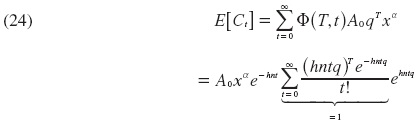
<body><![CDATA[<p align="justify"><font face="verdana" size="2"><b><i>The optimal economic growth</i></b></font></p>              <p align="justify"><font face="verdana" size="2">The optimal growth rate <i>g</i><sup>*</sup> is determined by the optimal level of research <i>n</i><sup>* </sup>that would be chosen by a social planner whose objective was to maximize the expected welfare <i>E(U)</i>. Since consumption is a random variable that takes the values <img src="/img/revistas/ecoqu/v10n1/a2ec22_a.jpg"> with probability &#934; (<i>T,t</i>) that there is exactly t innovations between time 0 and time t, given by:</font></p>              <p align="center"><font face="verdana" size="2"><img src="/img/revistas/ecoqu/v10n1/a2ec23.jpg"></font></p>	              <p align="justify"><font face="verdana" size="2">From this, the expected consumption is computed as follows<sup><a href="#notas">6</a></sup></font></p>	              <p align="center"><font face="verdana" size="2"><img src="/img/revistas/ecoqu/v10n1/a2ec24.jpg"></font></p>	              <p align="justify"><font face="verdana" size="2">Then, the expected welfare becomes:</font></p>              <p align="center"><font face="verdana" size="2"><img src="/img/revistas/ecoqu/v10n1/a2ec25.jpg"></font></p>	              <p align="justify"><font face="verdana" size="2">Hence the social planner will choose (<i>x,n</i>) to maximize the expected present value of lifetime consumption, subject to the labor constraint <i>L = x + n</i>.<sup><a href="#notas">7</a></sup> Then,</font></p>	              <p align="center"><font face="verdana" size="2"><img src="/img/revistas/ecoqu/v10n1/a2ec26.jpg"></font></p>	              <p align="justify"><font face="verdana" size="2">Given this level of research, the optimal growth rate is <i>g<sup>*</sup> = hn<sup>* </sup></i>ln(<i>q</i>).</font></p>	              ]]></body>
<body><![CDATA[<p align="justify"><font face="verdana" size="2">&nbsp;</font></p>	              <p align="justify"><font face="verdana" size="2"><b><i>Equilibrium growth v.s. optimal growth</i></b></font></p>              <p align="justify"><font face="verdana" size="2">Given that the average growth rate is proportional to the number of researchers, it is sufficient to compare the optimal level of research with the equilibrium level of our economy. In order to simplify the comparison between <i>n</i><sup>*</sup> and <i>n</i> we rewrite (26) and (19) respectively as:</font></p>	              <p align="center"><font face="verdana" size="2"><img src="/img/revistas/ecoqu/v10n1/a2ec27.jpg"></font></p>	              <p align="center"><font face="verdana" size="2"><img src="/img/revistas/ecoqu/v10n1/a2ec28.jpg"></font></p>	              <p align="justify"><font face="verdana" size="2">As in the Aghion and Howitt (1992)'s model, we find the following basic differences between <i>n</i><sup>*</sup> and <i>n</i>:</font></p>              <p align="justify"><font face="verdana" size="2"><b>D1</b>&#9;The social discount rate <i>r&#151;hn</i><sup>*</sup> (<i>q</i>&#151;1) is less than the private discount rate <i>r + hn</i> ("intertemporal&#45;spillover effect").</font></p>	              <p align="justify"><font face="verdana" size="2"><b>D2</b>&#9;The private monopolist is unable to appropriate the whole output flow, but just a fraction (1 &#151;&#945;).</font></p>	              <p align="justify"><font face="verdana" size="2"><b>D3</b> &#9;The factor (<i>q</i>&#151;1) corresponds to the so&#45;called "business&#45;stealing" effect, whereby the successful monopolist destroys the surplus attributable to the previous generation of intermediate good by making it obsolete.</font></p>	              <p align="justify"><font face="verdana" size="2">Whereas distortions D1 and D2 tend to make the average growth rate less than optimal, D3 tends to make it greater. Due to the offsetting nature of these effects, the market average growth rate may be more or less than optimal. These three distortions summarize the main welfare implications of introducing creative destruction in the process of economic growth: <i>laissez&#45;faire</i> growth may be either insufficient or excessive.</font></p>	              ]]></body>
<body><![CDATA[<p align="justify"><font face="verdana" size="2">Additionally, we have two other differences due to the rigidities on the labor market, say:</font></p>	              <p align="justify"><font face="verdana" size="2"><b>D4</b> &#9;The optimal employment <i>L &#151; n</i><sup>*</sup> is bigger that the equilibrium employment <i>L &#151; n &#151; u</i> This is directly due to the bargaining power of unions.</font></p>	              <p align="justify"><font face="verdana" size="2"><b>D5</b> &#9;Global labor occupation (employment and R&amp;D) is affected by a factor 1/(1 &#151; <i>&#964;</i>)a cause of the distortive effect of taxes.</font></p>	              <p align="justify"><font face="verdana" size="2">Clearly, D4 tends to make the average growth rate less than optimal. In contrast, D5 is growth enhancing only when 1 &#45; <i>&#964;</i> &lt; 1 <i>i.e., when</i> <i>&#964;</i> &gt; 0. Nevertheless, the stark difference between distortions due to <i>D1&#150; D3</i> and those due to <i>D4&#150; D5</i>, is that the two lasts depend on labor&#45;market policy variables that, at least theoretically, can be controlled by the policy makers. This naturally suggest the question of whether variations in the policy variables, already present in the labor market, can reduce the gap between the optimal and the equilibrium growth rates caused by distortions <i>D1</i> to <i>D3</i>. In other words, we are interested on issues as the following:</font></p>              <p align="justify"><font face="verdana" size="2"><i>n &gt; n<sup>*</sup></i>: If the negative externality that new innovators exert upon incumbent firms (D3) dominates, which kind of policy adjustments could be done to converge to the optimum?</font></p>	              <p align="justify"><font face="verdana" size="2"><i>n &lt; n<sup>*</sup></i>: &#9;Conversely, if the intertemporal&#45;spillover and the appropriability effects dominate (D1 and D2) and which policy could foster growth?</font></p>              <p align="justify"><font face="verdana" size="2">To answer these questions, we look to the impact of the policy variable <i>&#964;</i> on the research level:</font></p>              <p align="justify"><font face="verdana" size="2"><b>Proposition</b>. An increase in taxes leads to: (<i>a</i>) lower employment, (<i>b</i>) lower labor allocated to R&amp;D and (<i>c</i>) higher unemployment.</font></p>	              <blockquote>	           <p align="justify"><font face="verdana" size="2"><b>Proof:</b></font></p>	           ]]></body>
<body><![CDATA[<p align="justify"><font face="verdana" size="2">(a.):</font></p>     </blockquote>              <p align="center"><font face="verdana" size="2"><img src="/img/revistas/ecoqu/v10n1/a2ec29.jpg"></font></p>	              <blockquote>	           <p align="justify"><font face="verdana" size="2">(b.):</font></p>	           <p align="justify"><font face="verdana" size="2">Expression (19) can be rewritten as:</font></p>     </blockquote>              <p align="center"><font face="verdana" size="2"><img src="/img/revistas/ecoqu/v10n1/a2ec30.jpg"></font></p>	              <p align="justify"><font face="verdana" size="2">From this:</font></p>	              <p align="center"><font face="verdana" size="2"><img src="/img/revistas/ecoqu/v10n1/a2ec31.jpg"></font></p>	              <p align="justify"><font face="verdana" size="2"><b>(c.):</b> From expressions (29), (30) and (6) it is easily deduced that <img src="/img/revistas/ecoqu/v10n1/a2der.jpg">.</font></p>              <p align="justify"><font face="verdana" size="2">This suggests that when growth is excessive, some labor market rigidities are desirable because they can help to reduce the gap between the equilibrium rate of growth and the optimal one. In particular:</font></p>	              ]]></body>
<body><![CDATA[<p align="justify"><font face="verdana" size="2"><b>Corollary.</b></font></p>	              <p align="justify"><font face="verdana" size="2"><b>C1</b>. &#9;When the economic growth is suboptimal, the optimal rate can be reached by subsidizing labor.</font></p>	              <p align="justify"><font face="verdana" size="2"><b>C2</b>. &#9;Conversely, when the economic growth is excessive, the optimal rate can be reached by increasing labor taxes.</font></p>	              <p align="justify"><font face="verdana" size="2">&nbsp;</font></p>	              <p align="justify"><font face="verdana" size="2"><b><i>Conclusion</i></b></font></p>              <p align="justify"><font face="verdana" size="2">In this paper, we have shown the potential possibility of reaching the optimal growth rate using a simple growth model based on Aghion and Howitt (1992). We extended the basic framework by introducing a labor union, which bargains wages with monopolistic firms, and other labor market institutions such as labor taxes on labor income and unemployment benefits. We analyzed the several imperfections to shed light on how to reach the optimal growth rate by compensating the distortions on the goods&#45;sector due to the growth process with the distortions induced by the labor market rigidities.</font></p>	              <p align="justify"><font face="verdana" size="2">Even if our framework is so stylized that is not directly applicable to the actual problems related to growth, this theoretical exercise highlights interesting mechanisms and adds to the rich literature on Schumpeterian growth theory.</font></p>	              <p align="justify"><font face="verdana" size="2">&nbsp;</font></p>              <p align="justify"><font face="verdana" size="2"><b><i>References</i></b></font></p>	              <!-- ref --><p align="justify"><font face="verdana" size="2">Adjemian, S., F. Langot, and C. Quintero&#45;Rojas (2010). "How do Labor Market Institutions affect the Link between Growth and Unemployment: the case of European countries", <i>The European Journal of Comparative Economics</i>, 7.    &nbsp;&nbsp;&nbsp;&nbsp;&nbsp;&nbsp;&nbsp;&nbsp;[&#160;<a href="javascript:void(0);" onclick="javascript: window.open('/scielo.php?script=sci_nlinks&ref=3062388&pid=S1870-6622201300010000200001&lng=','','width=640,height=500,resizable=yes,scrollbars=1,menubar=yes,');">Links</a>&#160;]<!-- end-ref --></font></p>	              <!-- ref --><p align="justify"><font face="verdana" size="2">Aghion, P., and P. Howitt (1992). "A Model of Growth through Creative Destruction", <i>Econometrica</i>, (60).    &nbsp;&nbsp;&nbsp;&nbsp;&nbsp;&nbsp;&nbsp;&nbsp;[&#160;<a href="javascript:void(0);" onclick="javascript: window.open('/scielo.php?script=sci_nlinks&ref=3062390&pid=S1870-6622201300010000200002&lng=','','width=640,height=500,resizable=yes,scrollbars=1,menubar=yes,');">Links</a>&#160;]<!-- end-ref --></font></p>	              <!-- ref --><p align="justify"><font face="verdana" size="2">&#45;&#45;&#45;&#45;&#45;&#45;&#45;&#45;&#45;&#45; (1998). Endogenous Growth Theory. MIT.    &nbsp;&nbsp;&nbsp;&nbsp;&nbsp;&nbsp;&nbsp;&nbsp;[&#160;<a href="javascript:void(0);" onclick="javascript: window.open('/scielo.php?script=sci_nlinks&ref=3062392&pid=S1870-6622201300010000200003&lng=','','width=640,height=500,resizable=yes,scrollbars=1,menubar=yes,');">Links</a>&#160;]<!-- end-ref --></font></p>	              <!-- ref --><p align="justify"><font face="verdana" size="2">Lingens, J. (2003). "The impact of a unionised labor market in a Schumpeterian growth model", <i>Labour Economics</i>, (10), 91&#45;104.    &nbsp;&nbsp;&nbsp;&nbsp;&nbsp;&nbsp;&nbsp;&nbsp;[&#160;<a href="javascript:void(0);" onclick="javascript: window.open('/scielo.php?script=sci_nlinks&ref=3062394&pid=S1870-6622201300010000200004&lng=','','width=640,height=500,resizable=yes,scrollbars=1,menubar=yes,');">Links</a>&#160;]<!-- end-ref --></font></p>	              <!-- ref --><p align="justify"><font face="verdana" size="2">Mortensen, D. T. (2005). "Growth, Unemployment and Labor Market Policy", <i>Journal of the European Economic Association</i>.    &nbsp;&nbsp;&nbsp;&nbsp;&nbsp;&nbsp;&nbsp;&nbsp;[&#160;<a href="javascript:void(0);" onclick="javascript: window.open('/scielo.php?script=sci_nlinks&ref=3062396&pid=S1870-6622201300010000200005&lng=','','width=640,height=500,resizable=yes,scrollbars=1,menubar=yes,');">Links</a>&#160;]<!-- end-ref --></font></p>	              <!-- ref --><p align="justify"><font face="verdana" size="2">Palokangas, T. (2004). "Union&#45;Firm Bargaining, Productivity Improvement and Endogenous Growth", <i>Labour</i>, 18.    &nbsp;&nbsp;&nbsp;&nbsp;&nbsp;&nbsp;&nbsp;&nbsp;[&#160;<a href="javascript:void(0);" onclick="javascript: window.open('/scielo.php?script=sci_nlinks&ref=3062398&pid=S1870-6622201300010000200006&lng=','','width=640,height=500,resizable=yes,scrollbars=1,menubar=yes,');">Links</a>&#160;]<!-- end-ref --></font></p>              <p align="justify"><font face="verdana" size="2">&nbsp;</font></p>	              <p align="justify"><font face="verdana" size="2"><b><a name="notas"></a>Notas</b></font></p>              <p align="justify"><font face="verdana" size="2"><sup>2</sup> Results are qualitatively the same if we assume instead a continuum of perfectly substitute intermediate inputs.</font></p>	              <p align="justify"><font face="verdana" size="2"><sup>3</sup> There are <i>hn<sub>&#965;</sub>dt</i> innovations over the small interval of time &#91;<i>t,t + dt</i>&#93;</font></p>	              <p align="justify"><font face="verdana" size="2"><sup>4</sup> Equivalently, the opportunity cost of <i>R &amp; D</i> is the hourly net wage prevailing in the intermediate product sector, (1 &#151; <i>&#964;</i>)<i>w<sub>&#965;</sub></i> , times the expected duration of the innovation process, <img src="/img/revistas/ecoqu/v10n1/a2ecn4.jpg">.</font></p>              <p align="justify"><font face="verdana" size="2"><sup>5</sup> It is easy to show by contradiction that <img src="/img/revistas/ecoqu/v10n1/a2ecn5.jpg"></font></p>	              <p align="justify"><font face="verdana" size="2"><sup>6</sup> The underbraced term is equal to 1 because it is the accumulative sum of Poisson probabilities.</font></p>              <p align="justify"><font face="verdana" size="2"><sup>7</sup> Obviously, in an optimal setting there is no unemployment.</font></p>       ]]></body><back>
<ref-list>
<ref id="B1">
<nlm-citation citation-type="journal">
<person-group person-group-type="author">
<name>
<surname><![CDATA[Adjemian]]></surname>
<given-names><![CDATA[S.]]></given-names>
</name>
<name>
<surname><![CDATA[Langot]]></surname>
<given-names><![CDATA[F.]]></given-names>
</name>
<name>
<surname><![CDATA[Quintero-Rojas]]></surname>
<given-names><![CDATA[C.]]></given-names>
</name>
</person-group>
<article-title xml:lang="en"><![CDATA[How do Labor Market Institutions affect the Link between Growth and Unemployment: the case of European countries]]></article-title>
<source><![CDATA[The European Journal of Comparative Economics]]></source>
<year>2010</year>
<numero>7</numero>
<issue>7</issue>
</nlm-citation>
</ref>
<ref id="B2">
<nlm-citation citation-type="journal">
<person-group person-group-type="author">
<name>
<surname><![CDATA[Aghion]]></surname>
<given-names><![CDATA[P.]]></given-names>
</name>
<name>
<surname><![CDATA[Howitt]]></surname>
<given-names><![CDATA[P.]]></given-names>
</name>
</person-group>
<article-title xml:lang="en"><![CDATA[A Model of Growth through Creative Destruction]]></article-title>
<source><![CDATA[Econometrica]]></source>
<year>1992</year>
<numero>60</numero>
<issue>60</issue>
</nlm-citation>
</ref>
<ref id="B3">
<nlm-citation citation-type="book">
<person-group person-group-type="author">
<name>
<surname><![CDATA[Aghion]]></surname>
<given-names><![CDATA[P.]]></given-names>
</name>
</person-group>
<person-group person-group-type="editor">
<name>
</name>
</person-group>
<source><![CDATA[Endogenous Growth Theory]]></source>
<year>1998</year>
<publisher-name><![CDATA[MIT]]></publisher-name>
</nlm-citation>
</ref>
<ref id="B4">
<nlm-citation citation-type="journal">
<person-group person-group-type="author">
<name>
<surname><![CDATA[Lingens]]></surname>
<given-names><![CDATA[J.]]></given-names>
</name>
</person-group>
<source><![CDATA[Labour EconomicsThe impact of a unionised labor market in a Schumpeterian growth model]]></source>
<year>2003</year>
<numero>10</numero>
<issue>10</issue>
<page-range>91-104</page-range></nlm-citation>
</ref>
<ref id="B5">
<nlm-citation citation-type="journal">
<person-group person-group-type="author">
<name>
<surname><![CDATA[Mortensen]]></surname>
<given-names><![CDATA[D. T.]]></given-names>
</name>
</person-group>
<article-title xml:lang="en"><![CDATA[Growth, Unemployment and Labor Market Policy]]></article-title>
<source><![CDATA[Journal of the European Economic Association]]></source>
<year>2005</year>
</nlm-citation>
</ref>
<ref id="B6">
<nlm-citation citation-type="journal">
<person-group person-group-type="author">
<name>
<surname><![CDATA[Palokangas]]></surname>
<given-names><![CDATA[T.]]></given-names>
</name>
</person-group>
<article-title xml:lang="en"><![CDATA[Union-Firm Bargaining, Productivity Improvement and Endogenous Growth]]></article-title>
<source><![CDATA[Labour]]></source>
<year>2004</year>
<numero>18</numero>
<issue>18</issue>
</nlm-citation>
</ref>
</ref-list>
</back>
</article>