<?xml version="1.0" encoding="ISO-8859-1"?><article xmlns:mml="http://www.w3.org/1998/Math/MathML" xmlns:xlink="http://www.w3.org/1999/xlink" xmlns:xsi="http://www.w3.org/2001/XMLSchema-instance">
<front>
<journal-meta>
<journal-id>1870-6622</journal-id>
<journal-title><![CDATA[EconoQuantum]]></journal-title>
<abbrev-journal-title><![CDATA[EconoQuantum]]></abbrev-journal-title>
<issn>1870-6622</issn>
<publisher>
<publisher-name><![CDATA[Universidad de Guadalajara]]></publisher-name>
</publisher>
</journal-meta>
<article-meta>
<article-id>S1870-66222012000100002</article-id>
<title-group>
<article-title xml:lang="en"><![CDATA[Temporary stabilization: a Fréchet-Weibull extreme value distribution approach]]></article-title>
</title-group>
<contrib-group>
<contrib contrib-type="author">
<name>
<surname><![CDATA[Venegas-Martínez]]></surname>
<given-names><![CDATA[Francisco]]></given-names>
</name>
<xref ref-type="aff" rid="A01"/>
</contrib>
<contrib contrib-type="author">
<name>
<surname><![CDATA[Ortiz-Arango]]></surname>
<given-names><![CDATA[Francisco]]></given-names>
</name>
<xref ref-type="aff" rid="A02"/>
</contrib>
<contrib contrib-type="author">
<name>
<surname><![CDATA[Ortiz-Ramírez]]></surname>
<given-names><![CDATA[Ambrosio]]></given-names>
</name>
<xref ref-type="aff" rid="A03"/>
</contrib>
</contrib-group>
<aff id="A01">
<institution><![CDATA[,Instituto Politécnico Nacional Escuela Superior de Economía ]]></institution>
<addr-line><![CDATA[México Distrito Federal]]></addr-line>
<country>México</country>
</aff>
<aff id="A02">
<institution><![CDATA[,Universidad Panamericana Escuela de Ciencias Económicas y Empresariales ]]></institution>
<addr-line><![CDATA[México Distrito Federal]]></addr-line>
<country>México</country>
</aff>
<aff id="A03">
<institution><![CDATA[,Instituto Politécnico Nacional Escuela Superior de Economía ]]></institution>
<addr-line><![CDATA[México Distrito Federal]]></addr-line>
<country>México</country>
</aff>
<pub-date pub-type="pub">
<day>00</day>
<month>06</month>
<year>2012</year>
</pub-date>
<pub-date pub-type="epub">
<day>00</day>
<month>06</month>
<year>2012</year>
</pub-date>
<volume>9</volume>
<numero>1</numero>
<fpage>35</fpage>
<lpage>55</lpage>
<copyright-statement/>
<copyright-year/>
<self-uri xlink:href="http://www.scielo.org.mx/scielo.php?script=sci_arttext&amp;pid=S1870-66222012000100002&amp;lng=en&amp;nrm=iso"></self-uri><self-uri xlink:href="http://www.scielo.org.mx/scielo.php?script=sci_abstract&amp;pid=S1870-66222012000100002&amp;lng=en&amp;nrm=iso"></self-uri><self-uri xlink:href="http://www.scielo.org.mx/scielo.php?script=sci_pdf&amp;pid=S1870-66222012000100002&amp;lng=en&amp;nrm=iso"></self-uri><abstract abstract-type="short" xml:lang="en"><p><![CDATA[This paper develops, in a small open economy of pure exchange framework, a stochastic model of exchange-rate-based inflation stabilization plan that is expected to be temporary. Agents have expectations of devaluation driven by a mixed diffusion-jump process where the expected size of a possible devaluation is supposed to have an extreme value distribution of the Fréchet-Weibull type. Consumption and wealth equilibrium dynamics are examined when such a stabilization plan is implemented. It is assumed that financial markets are incomplete, that is, there are more risk factors than risky assets. Finally, the effects of exogenous shocks on economic welfare are assessed.]]></p></abstract>
<abstract abstract-type="short" xml:lang="es"><p><![CDATA[Esta investigación desarrolla, en el marco de una economía pequeña y abierta, un modelo estocástico de un plan de estabilización de precios que toma como un ancla nominal al tipo de cambio y en donde se espera que dicho plan sea temporal. Los agentes tienen expectativas de devaluación conducidas por un proceso mixto de difusión con saltos en donde el tamaño esperado de una posible devaluación tiene una distribución de valores extremos del tipo Fréchet-Weibull. Las dinámicas de equilibrio del consumo y la riqueza son examinadas cuando un plan de estabilización es implementado. Se supone que los mercados financieros son incompletos, es decir, hay más factores de riesgo que activos riesgosos. Por último, se evalúan los efectos de choques externos en el bienestar económico.]]></p></abstract>
<kwd-group>
<kwd lng="en"><![CDATA[inflation stabilization]]></kwd>
<kwd lng="en"><![CDATA[extreme values]]></kwd>
</kwd-group>
</article-meta>
</front><body><![CDATA[ <p align="justify"><font face="verdana" size="4">Art&iacute;culos</font></p>              <p align="justify"><font face="verdana" size="2">&nbsp;</font></p>              <p align="center"><font face="verdana" size="4"><b>Temporary stabilization: a Fr&eacute;chet&#45;Weibull extreme value distribution approach</b></font></p>              <p align="center"><font face="verdana" size="2">&nbsp;</font></p>              <p align="center"><font face="verdana" size="2"><b>Francisco Venegas&#45;Mart&iacute;nez<sup>1</sup>, Francisco Ortiz&#45;Arango<sup>2</sup>, Ambrosio Ortiz&#45;Ram&iacute;rez<sup>3</sup></b></font></p>              <p align="justify"><font face="verdana" size="2">&nbsp;</font></p>              <p align="justify"><font face="verdana" size="2"><sup><i>1</i></sup> <i>Escuela Superior de Econom&iacute;a, IPN, E&#45;mail:</i> <a href="mailto:fvenegasini@yahoo.com.mx">fvenegasini@yahoo.com.mx</a>.</font></p>              <p align="justify"><font face="verdana" size="2"><sup><i>2</i></sup> <i>Escuela de Ciencias Econ&oacute;micas y Empresariales, Universidad Panamericana, E&#45;mail:</i> <a href="mailto:fortizar@up.edu.mx">fortizar@up.edu.mx</a>.</font></p>              <p align="justify"><font face="verdana" size="2"><sup><i>3</i></sup> <i>Escuela Superior de Econom&iacute;a, IPN, E&#45;mail:</i> <a href="mailto:a7ortiz@gmail.com">a7ortiz@gmail.com</a>.</font></p>              <p align="justify"><font face="verdana" size="2">&nbsp;</font></p>              ]]></body>
<body><![CDATA[<p align="justify"><font face="verdana" size="2">Recepci&oacute;n: 16/11/2010.    <br>     Aceptaci&oacute;n: 05/09/2011.</font></p>              <p align="justify"><font face="verdana" size="2">&nbsp;</font></p>              <p align="justify"><font face="verdana" size="2"><b>Abstract</b></font></p>              <p align="justify"><font face="verdana" size="2">This paper develops, in a small open economy of pure exchange framework, a stochastic model of exchange&#45;rate&#45;based inflation stabilization plan that is expected to be temporary. Agents have expectations of devaluation driven by a mixed diffusion&#45;jump process where the expected size of a possible devaluation is supposed to have an extreme value distribution of the Fr&eacute;chet&#45;Weibull type. Consumption and wealth equilibrium dynamics are examined when such a stabilization plan is implemented. It is assumed that financial markets are incomplete, that is, there are more risk factors than risky assets. Finally, the effects of exogenous shocks on economic welfare are assessed.</font></p>              <p align="justify"><font face="verdana" size="2"><b>Keywords:</b> inflation stabilization, extreme values.</font></p>              <p align="justify"><font face="verdana" size="2"><b>JEL</b> <b>Classification:</b> F31, F41.</font></p>              <p align="justify"><font face="verdana" size="2">&nbsp;</font></p>              <p align="justify"><font face="verdana" size="2"><b>Resumen</b></font></p>              <p align="justify"><font face="verdana" size="2">Esta investigaci&oacute;n desarrolla, en el marco de una econom&iacute;a peque&ntilde;a y abierta, un modelo estoc&aacute;stico de un plan de estabilizaci&oacute;n de precios que toma como un ancla nominal al tipo de cambio y en donde se espera que dicho plan sea temporal. Los agentes tienen expectativas de devaluaci&oacute;n conducidas por un proceso mixto de difusi&oacute;n con saltos en donde el tama&ntilde;o esperado de una posible devaluaci&oacute;n tiene una distribuci&oacute;n de valores extremos del tipo Fr&eacute;chet&#45;Weibull. Las din&aacute;micas de equilibrio del consumo y la riqueza son examinadas cuando un plan de estabilizaci&oacute;n es implementado. Se supone que los mercados financieros son incompletos, es decir, hay m&aacute;s factores de riesgo que activos riesgosos. Por &uacute;ltimo, se eval&uacute;an los efectos de choques externos en el bienestar econ&oacute;mico.</font></p>              ]]></body>
<body><![CDATA[<p align="justify"><font face="verdana" size="2">&nbsp;</font></p>              <p align="justify"><font face="verdana" size="2"><b><i>Introduction</i></b></font></p>              <p align="justify"><font face="verdana" size="2">Between 1900 and 2000, emerging economies managing a fixed exchange&#45;rate, a fixed rate of devaluation, an adjustable band or a convertibility plan, like Brazil, Ecuador, Thailand, Korea, Indonesia, Russia, Bosnia, Turkey, among others, had a major financial crisis. These regimes have simply not proved viable over time, especially for countries integrated or integrating into international capital markets. In most cases, the public in these countries anticipated that the stabilization plan was going to be temporary, resulting in a large expansion of consumption of durable goods and an extreme devaluation. Surprisingly, in 2008, as of April 31, according to the IMF, at least 88 of the world countries have one of the above exchange&#45;rate regimes, as it is shown below in <a href="/img/revistas/ecoqu/v9n1/a2t1.jpg" target="_blank">Table 1</a>. The lessons, from these episodes, that should be taken into account by policymakers when devising a corrective devaluation, especially if financial markets are incomplete, is that public expectations and consumption dynamics generated by exchange&#45;rate&#45;based stabilization plans may increase imports producing unsustainable deficit in the current account of the balance of payments.</font></p>              <p align="justify"><font face="verdana" size="2">The experience in most of these countries brings the credibility of stabilization programs to our attention. In most cases, the public was skeptical about government's commitment to defend a regime where the exchange rate was taken as a nominal anchor. In many cases, the final outcome was a consumption boom and an extreme devaluation putting an end to an exchange&#45;rate&#45;based stabilization program.<sup><a href="#nota">4</a></sup></font></p>              <p align="justify"><font face="verdana" size="2">In Calvo and Reinhart's (2002) paper "Fear of floating", it has emphasized that many countries that claim to have floating exchange rates do not, in practice, allow the rate to float freely, but instead use interest rate and intervention policies to affect its behavior. From this, they draw two conclusions: in first place, that it is incorrect to claim that countries are moving away from adjustable&#45;peg systems. Secondly, that since countries hanker after fixed exchange rates for good reasons, they would be well advised to adopt hard pegs. In their paper, Calvo y Reinhart also investigate whether countries are, indeed, moving as far to the corners as official labels suggest. Since verifying the existence of a hard peg is trivial, their focus is on the other end of the flexibility spectrum. Specifically, they examine whether countries that claim they are floating their currency are, indeed, doing so.</font></p>              <p align="justify"><font face="verdana" size="2">Policymakers now warn against the use of a fixed rate of devaluation or an adjustable band in countries open to capital flows. This belief that intermediate regimes between fixed exchange&#45;rate and free floating are unsustainable is known as the bipolar view (see, for instance, Fischer, 2001). The proportion of IMF members with intermediate arrangements fell during the 1990s, while the use of hard pegs and more flexible arrangements grow. Also, <a href="/img/revistas/ecoqu/v9n1/a2t2.jpg" target="_blank">Table 2</a> shows the evolution of de facto exchange &#45;rate arrangements.</font></p>              <p align="justify"><font face="verdana" size="2">Studies in the literature on temporary stabilization based on a semi fixed exchange&#45;rate that have considered a stochastic setting are, for instance, Drazen and Helpman (1988) examining stabilization with exchange&#45;rate management under uncertainty, Calvo and Drazen (1997) contemplating uncertainty in the permanence of economic reforms,<sup><a href="#nota">5</a></sup> and Mendoza and Uribe (1996) and (1998) modeling exogenous and endogenous probabilities of devaluation, respectively. On the other hand, Venegas&#45;Mart&iacute;nez (2000)&nbsp;and (2001), (2006a) has studied exchange&#45;rate&#45;based stabilization with imperfect credibility; Venegas&#45;Mart&iacute;nez (2006b) has examined the impact of fiscal policy exchange&#45;rate&#45;based stabilization with imperfect credibility, and Venegas&#45;Mart&iacute;nez (2010) has valued the real option of waiting when consumption can be delayed in exchange&#45;rate&#45;based inflation stabilization program. It is also important to highlight the work of Uribe (2002) and Uribe and Mendoza (2000) regarding the explanation of the order of magnitude of the unexpected consumption booms and the incorporation of uncertainty in the analysis of temporary stabilization plans. Also, in Mendoza (2001)&nbsp;the benefits of dollarization when the stabilization policy lacks credibility and financial markets are imperfect are examined. Finally, Akgiray and Booth (1988) have made clear that both monetary policy and targets involve different parameters of the exchange&#45;rate distribution, this in the spirit of the Lucas' critique.</font></p>              <p align="justify"><font face="verdana" size="2">While the above literature has provided considerable theoretical advancement, there are some issues on credibility and uncertainty that still need to be explained, as remarked in: Helpman and Razin (1987), Kiguel and Liviatan (1992), V&eacute;gh (1992), and Rebelo and V&eacute;gh (1995). First, in the existing models, it is missing a plausible explanation of the lack of credibility. Secondly, most models forget that what makes a stabilization inflation program temporary is uncertainty.</font></p>              <p align="justify"><font face="verdana" size="2">This paper develops, in small open economy setting, a stochastic model of exchange&#45;rate&#45;based stabilization recognizing the role of extreme movements in the dynamics of the expectations of devaluation. It is assumed that the expectations of devaluation follow a mixed diffusion&#45;jump process where a Brownian motion drives the rate of devaluation and a Poisson determines the number of possible devaluations. The expected size of a possible devaluation is supposed to have an extreme value distribution of the Fr&eacute;chet&#45;Weibull type. It is important to point out that incorporating an extreme value distribution of the Fr&eacute;chet&#45;Weibull type for the exchange&#45;rate stochastic dynamics extends the work in Venegas&#45;Mart&iacute;nez (2000) and (2006a).</font></p>              <p align="justify"><font face="verdana" size="2">In the framework of partial equilibrium, the proposed model will assume that contingent&#45;claims markets for hedging against devaluation are unavailable. In this context and assuming logarithmic utility, which provides risk&#45;averse agents, we shall examine the equilibrium dynamics of consumption and real wealth when a stabilization program is implemented and the size of devaluation is expected to follow an extreme value Fr&eacute;chet distribution. We shall also study the effects on economic welfare and consumption of once&#45;and&#45;for&#45;all changes in the parameters determining the expectations. The model is developed under the following two main assumptions: the revenue raised by seignorage is not rebated back to the agents and policy variables are stochastic. Finally, it is important to mention that the proposed model derives tractable closed&#45;forms solutions that make much easier the understanding of the key issues in the analysis of temporary stabilization when the expected size of a possible devaluation is supposed to have an extreme value distribution.</font></p>              ]]></body>
<body><![CDATA[<p align="justify"><font face="verdana" size="2">This research is organized as follows. In the next section, we work out a one&#45;good, cash&#45;in&#45;advance, stochastic model where a representative agent has expectations of devaluation driven by a mixed diffusion&#45;jump process where the expected size of a possible devaluation is supposed to have an extreme value distribution. Through section 3, we solve the consumer's decision problem. In section 4, we undertake several policy experiments through comparative statics exercises. In section 5, we examine the impact of exogenous shock on economic welfare. In section 6, we study the dynamic behavior of wealth and consumption, and address a number of exchange&#45;rate policy issues. Finally, in section 7, we present conclusions, acknowledge limitations, and make suggestions for further research.</font></p>              <p align="justify"><font face="verdana" size="2">&nbsp;</font></p>              <p align="justify"><font face="verdana" size="2"><i><b>Structure of the economy</b></i></font></p>              <p align="justify"><font face="verdana" size="2">In what follows, we set up the characteristics of the economy under study. The behavior of both the exchange rate and the available assets will be introduced.</font></p>              <p align="justify"><font face="verdana" size="2"><i>Exchange rate dynamics</i></font></p>              <p align="justify"><font face="verdana" size="2">In order to derive solutions which are analytically tractable, the structure of the economy will be kept as simple as possible. Let us consider a small open economy<sup><a href="#nota">6</a></sup> with a single infinitely lived consumer in a world with a single perishable consumption good. We assume that the good is freely traded, and its domestic price level, <i>P<sub>t</sub></i>, the purchasing power parity condition, namely</font></p>              <p align="center"><font face="verdana" size="2"><img src="/img/revistas/ecoqu/v9n1/a2e1.jpg"></font></p>              <p align="justify"><font face="verdana" size="2">Where <i>P*<sub>t</sub></i> is the foreign&#45;currency price of the good in the rest of world, and <i>e<sub>t</sub></i> is the nominal exchange rate. Throughout the paper, we will assume, for the sake of simplicity, that <i>P*<sub>t</sub></i> is equal to 1. We also assume that the exchange&#45;rate initial value, <i>e<sub>0</sub>,</i> is known and equal to 1.</font></p>              <p align="justify"><font face="verdana" size="2">In what follows, we will suppose that the ongoing uncertainty in the dynamics of the expected rate of devaluation, and therefore in the inflation rate, is generated by the following process geometric Brownian motion combined with Poisson jumps of a random sizes driven by extreme value distributions of the Fr&eacute;chet&#45;Weibull type:</font></p>              <p align="center"><font face="verdana" size="2"><img src="/img/revistas/ecoqu/v9n1/a2e2.jpg"></font></p>              ]]></body>
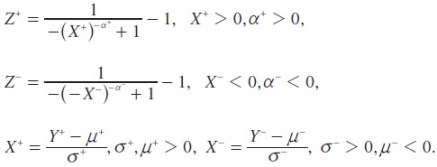
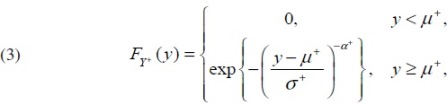
<body><![CDATA[<p align="justify"><font face="verdana" size="2">where the trend &micro; &isin; &#8476; (a real number) is the expected (annualized) mean of the exchange rate, <i>&#963;&gt;</i> 0 is the instantaneous (annualized) volatility of the exchange rate, <i>(W<sub>t</sub></i>)<sub>t<u>&gt;</u>0</sub> is a Brownian motion defined on a fixed probability space (<i>&#937;, F, (F<sup>W</sup><sub>t</sub>)<sub>t&#8712;</sub></i><sub>&#91;</sub><i><sub>0,T</sub></i><sub>&#93;</sub>,<i> P<sub>W</sub></i>) to model small movements in the exchange rate, and dN<sub>t</sub><sup>+</sup> and dN<sub>t</sub><sup>&#45;</sup> are both Poisson processes with intensity parameters <i>&#955;<sup>+</sup></i> and <i>&#955;<sup>&#45;</sup></i> representing the number of upward and downward jumps, respectively, of the exchange rate per unit of time. We will assume that <i>&#955;<sup>+</sup> &gt; &#955;<sup>&#45;</sup></i>. The size of the upward and downward jumps satisfy, respectively,</font></p>              <p align="center"><font face="verdana" size="2"><img src="/img/revistas/ecoqu/v9n1/a2r1.jpg"></font></p>              <p align="justify"><font face="verdana" size="2">We also suppose that <i>Y<sup>+</sup></i> is an extreme value Fr&eacute;chet random variable with parameters <i>&#945;<sup>+</sup>, &micro;<sup>+</sup></i> and <i>&#963;<sup>+</sup> &gt; 0</i>, that is, <i>Y</i><sup>+</sup> has cumulative distribution function given by</font></p>              <p align="center"><font face="verdana" size="2"><img src="/img/revistas/ecoqu/v9n1/a2e3.jpg"></font></p>              <p align="justify"><font face="verdana" size="2">and <i>Y<sup>&#45;</sup></i> is an extreme value Weibull random variable with parameters <i>&#945;<sup>&#45;</sup></i> and <i>&micro;<sup>&#45;</sup></i> &lt; 0, <i>&#963;<sup>&#45;</sup></i> &gt; 0, that is, <i>Y</i><sup>&#45;</sup> has cumulative distribution function defined by</font></p>              <p align="center"><font face="verdana" size="2"><img src="/img/revistas/ecoqu/v9n1/a2e4.jpg"></font></p>              <p align="justify"><font face="verdana" size="2">The corresponding densities satisfy</font></p>              <p align="center"><font face="verdana" size="2"><img src="/img/revistas/ecoqu/v9n1/a2r2.jpg"></font></p>              <p align="justify"><font face="verdana" size="2">and</font></p>              <p align="center"><font face="verdana" size="2"><img src="/img/revistas/ecoqu/v9n1/a2r3.jpg"></font></p>              ]]></body>
<body><![CDATA[<p align="center"><font face="verdana" size="2">&nbsp;</font></p>              <p align="justify"><font face="verdana" size="2"><a href="/img/revistas/ecoqu/v9n1/a2f1.jpg" target="_blank">Figure 1</a> shows a Weibull and a Fr&eacute;chet densities with given parameter values.</font></p>              <p align="justify"><font face="verdana" size="2">Notice now that if <i>&#963;<sup>+</sup></i> &gt; 2, then</font></p>              <p align="center"><font face="verdana" size="2"><img src="/img/revistas/ecoqu/v9n1/a2r4.jpg"></font></p>              <p align="justify"><font face="verdana" size="2">Expressions for E &#91;<i>Y</i><sup>&#45;</sup>&#93;, E &#91;(<i>Y</i><sup>&#45;</sup>)<sup>2</sup> &#93; , and Var &#91;<i>Y</i><sup>&#45;</sup>&#93; are similar to that given above. On the other hand, since the number of expected devaluations <i>(i.e.,</i> upward jumps in the exchange rate) per unit of time follows a Poisson process d<i>N<sup>+</sup><sub>t</sub></i> with intensity <i>&#955;<sup>+</sup></i> , we have that</font></p>              <p align="center"><font face="verdana" size="2"><img src="/img/revistas/ecoqu/v9n1/a2r5.jpg"></font></p>              <p align="justify"><font face="verdana" size="2">and</font></p>              <p align="center"><font face="verdana" size="2"><img src="/img/revistas/ecoqu/v9n1/a2r6.jpg"></font></p>              <p align="justify"><font face="verdana" size="2">so that</font></p>              <p align="center"><font face="verdana" size="2"><img src="/img/revistas/ecoqu/v9n1/a2r7.jpg"></font></p>              ]]></body>
<body><![CDATA[<p align="justify"><font face="verdana" size="2">where <i>o</i>(d<i>t</i>)/d<i>t &rarr;</i> 0 as d<i>t &rarr;</i> 0. The process d<i>N<sub><sup>&#45;</sup>t</sub></i> satisfies similar conditions to the above ones.</font></p>              <p align="justify"><font face="verdana" size="2">&nbsp;</font></p>              <p align="justify"><font face="verdana" size="2"><i><b>Assets available in the economy</b></i></font></p>              <p align="justify"><font face="verdana" size="2">The representative consumer holds two real assets: real cash balances, <i>m<sub>t</sub> = M<sub>t</sub>/P<sub>t</sub></i>, where <i>M<sub>t</sub></i> is the nominal stock of money, and an international bond, <i>b<sub>t</sub></i>. The bond pays a constant real interest rate <i>r (i.e.,</i> it pays <i>r</i> units of the consumption good per unit of time). Thus, the consumer's real wealth, <i>a<sub>t</sub></i>, is defined by</font></p>              <p align="center"><font face="verdana" size="2"><img src="/img/revistas/ecoqu/v9n1/a2e5.jpg"></font></p>              <p align="justify"><font face="verdana" size="2">where the initial real wealth a<sub>0</sub> is exogenously determined. Although this is a limitation of the proposed model, this will be used to think of the decision making process of the representative agent as a stochastic optimal control problem in continuous time. Furthermore, we assume that the rest of the world does not hold domestic currency. Consider a cash&#45;in&#45;advance constraint of the Clower type:</font></p>              <p align="center"><font face="verdana" size="2"><img src="/img/revistas/ecoqu/v9n1/a2e6.jpg"></font></p>              <p align="justify"><font face="verdana" size="2">where <i>c<sub>t</sub></i> is consumption, and <i>&#968;<sup>&#45;1</sup> &gt;</i> <i>0</i> is the time that money must be held to finance consumption. Condition (6) is critical in linking exchange&#45;rate dynamics with consumption. Observe that</font></p>              <p align="center"><font face="verdana" size="2"><img src="/img/revistas/ecoqu/v9n1/a2r8.jpg"></font></p>              <p align="justify"><font face="verdana" size="2">In the sequel, we will assume that the error <i>o(&#968;<sup>&#45;1</sup>)</i> is negligible. In this case, devaluation acts as a stochastic tax on real cash balances.</font></p>              ]]></body>
<body><![CDATA[<p align="justify"><font face="verdana" size="2">The stochastic rate of return of holding real cash balances, d<i>r<sub>m</sub></i>, is simply the percentage change in the price of money in terms of goods. By applying Ito's lemma to the inverse of the price level, with (2) as the equation driven the underlying process (see, for instance, Venegas&#45;Mart&iacute;nez, 2008), we get</font></p>              <p align="center"><font face="verdana" size="2"><img src="/img/revistas/ecoqu/v9n1/a2e7.jpg"></font></p>              <p align="justify"><font face="verdana" size="2">Hence, the stochastic rate of return of holding real cash balances, <i>dR<sub>m</sub></i>, is given by</font></p>              <p align="center"><font face="verdana" size="2"><img src="/img/revistas/ecoqu/v9n1/a2e8.jpg"></font></p>              <p align="justify"><font face="verdana" size="2">&nbsp;</font></p>              <p align="justify"><font face="verdana" size="2"><i><b>The consumer's choice problem</b></i></font></p>              <p align="justify"><font face="verdana" size="2">The stochastic consumer's real wealth accumulation in terms of the portfolio shares <i>w<sub>t</sub> = m<sub>t</sub></i>/<i>a<sub>t</sub>, </i>1 <i>&#45; w<sub>t</sub> = b<sub>t</sub></i>/<i>a<sub>t</sub>,</i> and consumption, <i>c<sub>t</sub></i>, is given by</font></p>              <p align="center"><font face="verdana" size="2"><img src="/img/revistas/ecoqu/v9n1/a2r9.jpg"></font></p>              <p align="justify"><font face="verdana" size="2">with <i>a<sub>0</sub></i> exogenously determined. Thus,</font></p>              <p align="center"><font face="verdana" size="2"><img src="/img/revistas/ecoqu/v9n1/a2e9.jpg"></font></p>              ]]></body>
<body><![CDATA[<p align="justify"><font face="verdana" size="2">where <i>&#961; = &#968; + r + &micro; &#45; &#963;<sup>2</sup></i>.</font></p>              <p align="justify"><font face="verdana" size="2">The von Neumann&#45;Morgenstern utility at time <i>t = 0, V<sub>0</sub>,</i> of the competitive risk&#45;averse consumer is assumed to have the time&#45;separable form:</font></p>              <p align="center"><font face="verdana" size="2"><img src="/img/revistas/ecoqu/v9n1/a2e10.jpg"></font></p>              <p align="justify"><font face="verdana" size="2">where E<sub>0</sub> is the conditional expectation on all available information at <i>t =</i> 0. To avoid unnecessary complex dynamics in consumption, we assume that the agent's subjective discount rate has been set equal to the constant real international interest rate, <i>r.</i> We consider the logarithmic utility function in order to derive closed&#45;form solutions and make the analysis tractable.</font></p>              <p align="justify"><font face="verdana" size="2"><i>First order conditions for a an interior solution</i></font></p>              <p align="justify"><font face="verdana" size="2">The Hamilton&#45;Jacobi&#45;Bellman equation for the stochastic optimal control problem of maximizing utility, with log(<i>c<sub>t</sub></i>) = log(<i>&#936;a<sub>t</sub>w<sub>t</sub></i>), and assuming that <i>Y<sup>+</sup></i> and <i>Y</i><sup>&#45;</sup> are stochastically independent of d<i>N<sub>t</sub><sup>+</sup></i> and d<i>N<sub>t</sub><sup>&#45;</sup></i>, respectively, is given by (see, for instance, Venegas&#45;Mart&iacute;nez, 2008).</font></p>              <p align="center"><font face="verdana" size="2"><img src="/img/revistas/ecoqu/v9n1/a2e11.jpg"></font></p>              <p align="justify"><font face="verdana" size="2">The first&#45;order condition for an interior solution is:</font></p>              <p align="center"><font face="verdana" size="2"><img src="/img/revistas/ecoqu/v9n1/a2r10.jpg"></font></p>              <p align="justify"><font face="verdana" size="2">Given the exponential time discounting in (10), we postulate <i>I (a<sub>t</sub>,</i> t) in a time&#45;separable form as:</font></p>              ]]></body>
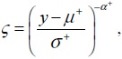
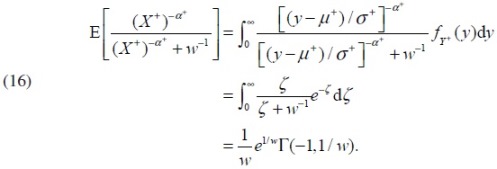
<body><![CDATA[<p align="center"><font face="verdana" size="2"><img src="/img/revistas/ecoqu/v9n1/a2e12.jpg"></font></p>              <p align="justify"><font face="verdana" size="2">where <i>&#946;<sub>0</sub></i> and <i>&#946;<sub>1</sub></i> are both to be determined from (11). In this case, we obtain</font></p>              <p align="center"><font face="verdana" size="2"><img src="/img/revistas/ecoqu/v9n1/a2e13.jpg"></font></p>              <p align="justify"><font face="verdana" size="2">Where</font></p>              <p align="center"><font face="verdana" size="2"><img src="/img/revistas/ecoqu/v9n1/a2e14.jpg"></font></p>              <p align="justify"><font face="verdana" size="2">Notice that the arguments in the logarithmic function above are both positive. We compute the first&#45;order conditions by using</font></p>              <p align="center"><font face="verdana" size="2"><img src="/img/revistas/ecoqu/v9n1/a2r11.jpg"></font></p>              <p align="justify"><font face="verdana" size="2">In this case, we find that <i>w<sub>t</sub> &#926; w</i> is time&#45;invariant and</font></p>              <p align="center"><font face="verdana" size="2"><img src="/img/revistas/ecoqu/v9n1/a2e15.jpg"></font></p>              <p align="justify"><font face="verdana" size="2">By defining the change of variable</font></p>              ]]></body>
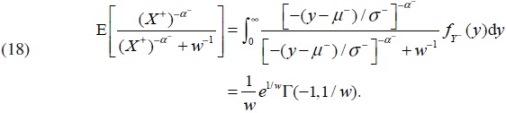
<body><![CDATA[<p align="center"><font face="verdana" size="2"><img src="/img/revistas/ecoqu/v9n1/a2r12.jpg"></font></p>              <p align="justify"><font face="verdana" size="2">the first expectation can be written as</font></p>              <p align="center"><font face="verdana" size="2"><img src="/img/revistas/ecoqu/v9n1/a2e16.jpg"></font></p>              <p align="justify"><font face="verdana" size="2">where</font></p>              <p align="center"><font face="verdana" size="2"><img src="/img/revistas/ecoqu/v9n1/a2r13.jpg"></font></p>              <p align="justify"><font face="verdana" size="2">and, for small <i>w</i> , in fact for 0 &lt; <i>w &lt;</i> <i>1</i>, we have the following approximation:</font></p>              <p align="center"><font face="verdana" size="2"><img src="/img/revistas/ecoqu/v9n1/a2e17.jpg"></font></p>              <p align="justify"><font face="verdana" size="2">where &#915; ( .,. ) is the upper incomplete Gamma function. Similarly,</font></p>              <p align="center"><font face="verdana" size="2"><img src="/img/revistas/ecoqu/v9n1/a2e18.jpg"></font></p>              <p align="justify"><font face="verdana" size="2">Hence, from (16), (17) and (18), the first order condition can be written as</font></p>              ]]></body>
<body><![CDATA[<p align="center"><font face="verdana" size="2"><img src="/img/revistas/ecoqu/v9n1/a2e19.jpg"></font></p>              <p align="justify"><font face="verdana" size="2">where <i>&#955; = &#955;<sup>+</sup> &#45; &#955;<sup>&#45;</sup> .</i> <a href="/img/revistas/ecoqu/v9n1/a2f2.jpg" target="_blank">Figure 2</a> shows the graph of the function &#915; ( 0,1 / <i>w</i>).</font></p>              <p align="justify"><font face="verdana" size="2">If we assume that 0 &lt; <i>w &lt;</i> <i>1</i> and use (17), then we may leave out the error term and write the first order condition as</font></p>              <p align="center"><font face="verdana" size="2"><img src="/img/revistas/ecoqu/v9n1/a2e20.jpg"></font></p>              <p align="justify"><font face="verdana" size="2">Once an optimal <i>w</i> is chosen, coefficients <i>&#946;<sub>0</sub></i> and <i>&#946;<sub>1</sub></i> are determined as follows</font></p>              <p align="center"><font face="verdana" size="2"><img src="/img/revistas/ecoqu/v9n1/a2r14.jpg"></font></p>              <p align="justify"><font face="verdana" size="2">or</font></p>              <p align="center"><font face="verdana" size="2"><img src="/img/revistas/ecoqu/v9n1/a2r15.jpg"></font></p>              <p align="justify"><font face="verdana" size="2">which leads to</font></p>              <p align="center"><font face="verdana" size="2"><img src="/img/revistas/ecoqu/v9n1/a2e21.jpg"></font></p>              ]]></body>
<body><![CDATA[<p align="justify"><font face="verdana" size="2">and</font></p>              <p align="center"><font face="verdana" size="2"><img src="/img/revistas/ecoqu/v9n1/a2r16.jpg"></font></p>              <p align="justify"><font face="verdana" size="2">Thus,</font></p>              <p align="center"><font face="verdana" size="2"><img src="/img/revistas/ecoqu/v9n1/a2r17.jpg"></font></p>              <p align="justify"><font face="verdana" size="2">which is a quadratic homogeneous equation with real solutions</font></p>              <p align="center"><font face="verdana" size="2"><img src="/img/revistas/ecoqu/v9n1/a2e22.jpg"></font></p>              <p align="justify"><font face="verdana" size="2">and</font></p>              <p align="center"><font face="verdana" size="2"><img src="/img/revistas/ecoqu/v9n1/a2r18.jpg"></font></p>              <p align="justify"><font face="verdana" size="2">Notice that always <i>0 &lt; &#968; + &micro; + &#955;</i> and that <i>iff</i></font></p>              <p align="center"><font face="verdana" size="2"><img src="/img/revistas/ecoqu/v9n1/a2r19.jpg"></font></p>              ]]></body>
<body><![CDATA[<p align="justify"><font face="verdana" size="2"><i>iff 0</i> <i>&lt;</i> w<sup>+</sup> &lt; 1. <a href="/img/revistas/ecoqu/v9n1/a2f3.jpg" target="_blank">Figure 3</a> shows <i>w<sup>+</sup></i> as a function of <i>&#961; + &#955;</i> and <i>&#963;<sup>2</sup></i> with a constant value of <i>r.</i></font></p>              <p align="justify"><font face="verdana" size="2">&nbsp;</font></p>              <p align="justify"><font face="verdana" size="2"><i><b>Policy experiments and comparative statics</b></i></font></p>              <p align="justify"><font face="verdana" size="2">In this section, we carry out some comparative statics experiments regarding the optimal share <i>w<sup>+</sup></i>. We will see the effects of changes in the mean expected rate of inflation <i>&#956;</i>, the instantaneous volatility of inflation and the total intensity parameter <i>&#955;</i> on <i>w<sup>+</sup></i>. By differentiating the first order condition, we get</font></p>              <p align="center"><font face="verdana" size="2"><img src="/img/revistas/ecoqu/v9n1/a2e23.jpg"></font></p>              <p align="justify"><font face="verdana" size="2">where</font></p>              <p align="center"><font face="verdana" size="2"><img src="/img/revistas/ecoqu/v9n1/a2r20.jpg"></font></p>              <p align="justify"><font face="verdana" size="2">We are now in a position to derive our first result: a once&#45;and&#45;for&#45;all increase in the rate of devaluation, which results in an increase in the future opportunity cost of purchasing goods, leads to a permanent decrease in the proportion of wealth devoted to future consumption. To see this, it is enough to use (23) to find that</font></p>              <p align="center"><font face="verdana" size="2"><img src="/img/revistas/ecoqu/v9n1/a2e24.jpg"></font></p>              <p align="justify"><font face="verdana" size="2">Notice also that a once&#45;and&#45;for&#45;all increase in the inverse of the variance of the diffusion component will produce a contrary effect to that of <i><sup>&iexcl;</sup></i> on <i>w<sup>+</sup></i> since</font></p>              ]]></body>
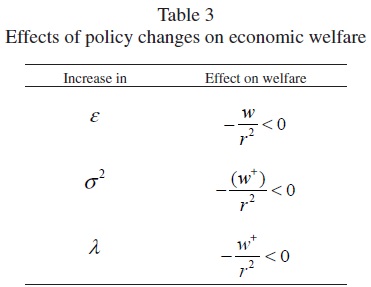
<body><![CDATA[<p align="center"><font face="verdana" size="2"><img src="/img/revistas/ecoqu/v9n1/a2e25.jpg"></font></p>              <p align="justify"><font face="verdana" size="2">In other words, the consumer sets aside a larger proportion of wealth to maintain real monetary balances to finance consumption, in order to deal with a higher variance in consumption prices.</font></p>              <p align="justify"><font face="verdana" size="2">Another result is the response of the equilibrium share of real monetary balances, <i>w<sup>+</sup></i> to once&#45;and&#45;for&#45;all changes in the total&#45;intensity parameter, <i>&#955;</i>. A once&#45;and&#45;for&#45;all increase in the expected number of extreme devaluations per unit of time causes an increase in the future opportunity cost of purchasing goods. This, in turn, permanently decreases the proportion of wealth set aside for future consumption. From (11), we get</font></p>              <p align="center"><font face="verdana" size="2"><img src="/img/revistas/ecoqu/v9n1/a2e26.jpg"></font></p>              <p align="justify"><font face="verdana" size="2">&nbsp;</font></p>              <p align="justify"><font face="verdana" size="2"><i><b>Impact on economic welfare</b></i></font></p>              <p align="justify"><font face="verdana" size="2">We will now assess the effects of exogenous shocks on economic welfare. As usual, the welfare criterion, <i>W,</i> of the representative individual is the maximized utility starting from the initial real wealth, <i>a<sub>0</sub></i>. Therefore, welfare is given by</font></p>              <p align="center"><font face="verdana" size="2"><img src="/img/revistas/ecoqu/v9n1/a2e27.jpg"></font></p>              <p align="justify"><font face="verdana" size="2"><a href="#t3">Table 3</a> shows the impacts on welfare of once&#45;and&#45;for&#45;all changes in the mean expected rate of devaluation, the inverse of volatility, the probability of devaluation, and the expected size from devaluation.</font></p>              <p align="center"><font face="verdana" size="2"><a name="t3"></a></font></p>              ]]></body>
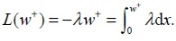
<body><![CDATA[<p align="center"><font face="verdana" size="2"><img src="/img/revistas/ecoqu/v9n1/a2t3.jpg"></font></p>              <p align="justify"><font face="verdana" size="2">In order to compute economic welfare <i>W</i>, we need to find, explicitly, <i>L(w<sup>+</sup>)</i>. To this end, we use the same change of variable as in (16), so</font></p>              <p align="center"><font face="verdana" size="2"><img src="/img/revistas/ecoqu/v9n1/a2e28.jpg"></font></p>              <p align="justify"><font face="verdana" size="2">It is important to point out that (16) can be also obtained by differentiating (28)</font></p>              <p align="center"><font face="verdana" size="2"><img src="/img/revistas/ecoqu/v9n1/a2r21.jpg"></font></p>              <p align="justify"><font face="verdana" size="2">Notice also that since there is a differentiation process of <i>L(w<sup>+</sup></i>) in the first order condition, we may use now the approximation &#915;(0,1 / <i>w<sup>+</sup></i>) = <i>we<sup>&#45;1/w</sup></i> (1 + <i>O</i>(<i>w</i>)), thus</font></p>              <p align="center"><font face="verdana" size="2"><img src="/img/revistas/ecoqu/v9n1/a2r22.jpg"></font></p>              <p align="justify"><font face="verdana" size="2">&nbsp;</font></p>              <p align="justify"><font face="verdana" size="2"><i><b>Wealth, consumption and dynamic implications</b></i></font></p>              <p align="justify"><font face="verdana" size="2">We now derive the stochastic process that generates wealth when the optimal share is applied. After substituting the optimal share <i>w<sup>+</sup></i> into (9), we get</font></p>              ]]></body>
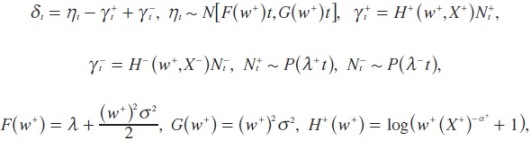
<body><![CDATA[<p align="center"><font face="verdana" size="2"><img src="/img/revistas/ecoqu/v9n1/a2e29.jpg"></font></p>              <p align="justify"><font face="verdana" size="2">The solution to the above stochastic differential equation, conditional on <i>a<sub>0</sub></i>, is</font></p>              <p align="center"><font face="verdana" size="2"><img src="/img/revistas/ecoqu/v9n1/a2e30.jpg"></font></p>              <p align="justify"><font face="verdana" size="2">where</font></p>              <p align="center"><font face="verdana" size="2"><img src="/img/revistas/ecoqu/v9n1/a2r23.jpg"></font></p>              <p align="justify"><font face="verdana" size="2">and</font></p>              <p align="center"><font face="verdana" size="2"><img src="/img/revistas/ecoqu/v9n1/a2r24.jpg"></font></p>              <p align="justify"><font face="verdana" size="2">Notice that</font></p>              <p align="center"><font face="verdana" size="2"><img src="/img/revistas/ecoqu/v9n1/a2e31.jpg"></font></p>              <p align="justify"><font face="verdana" size="2">In virtue of (6), the stochastic process for consumption, in (30), can be written as</font></p>              ]]></body>
<body><![CDATA[<p align="center"><font face="verdana" size="2"><img src="/img/revistas/ecoqu/v9n1/a2e32.jpg"></font></p>              <p align="justify"><font face="verdana" size="2">This indicates that, in the absence of contingent&#45;claims markets, the devaluation risk has an effect on wealth via the uncertainty in<i> &#948;<sub>t</sub></i>, that is, uncertainty changes the opportunity set faced by the consumer. On the other hand, the devaluation risk also affects the composition of portfolio shares via its effects on <i>w<sup>+</sup></i>. Thus, a policy change will be accompanied by both wealth and substitution effects. We cannot determine the level of consumption in our stochastic framework. We can only compute the probability that, at a given time, a certain level of consumption occurs. Notice, however, that by Jensen's inequality, mean consumption satisfies:</font></p>              <p align="center"><font face="verdana" size="2"><img src="/img/revistas/ecoqu/v9n1/a2e32b.jpg"></font></p>              <p align="justify"><font face="verdana" size="2">In contrast with our stochastic setting, <i>c<sub>t</sub><sup>+</sup></i> shows a dynamic behavior, even if the rate of devaluation were expected to remain fixed forever. This is because <i>&#948;<sub>t</sub></i> is a time&#45;varying, state&#45;contingent variable. We may conclude that uncertainty is the clue to rationalize richer consumption dynamics that could not be obtained from deterministic models.</font></p>              <p align="justify"><font face="verdana" size="2"><i>Consumption booms</i></font></p>              <p align="justify"><font face="verdana" size="2">Next, we will analyze a policy of the form:</font></p>              <p align="center"><font face="verdana" size="2"><img src="/img/revistas/ecoqu/v9n1/a2e33.jpg"></font></p>              <p align="justify"><font face="verdana" size="2">where <i>T</i> is exogenously determined, and &#949;<sub>1</sub> &lt; &#949;<sub>2</sub>, as in Calvo (1986). Notice that in our stochastic setting, there is a lack of credibility even if we do not change the four parameters since agents always assign some probability to the event of currency devaluation. Let us examine the response of consumption to (33). From (32), we may write</font></p>              <p align="center"><font face="verdana" size="2"><img src="/img/revistas/ecoqu/v9n1/a2r26.jpg"></font></p>              <p align="justify"><font face="verdana" size="2">where h<sub>T</sub> (&#916;; &#949;<sup><sub>1</sub></sup>, &#949;<sub>2</sub>) &#926; exp{&#45;&#948;<sub>T</sub>( &#949;<sub>1</sub> ) &#45; &#948;<sub>T&#916;</sub> ( &#949;<sub>1</sub> ))} tends to 1 as &#916; &rarr; 0<sub><sup><sup>+</sup></sup></sub> a.s. (almost surely). The limit means that although the stationary components of the parameters of <i>&#951;<sub>t</sub></i> and <i>&#947;<sub>t</sub></i> are different before and after time <i>T</i> , such a difference becomes negligible when &#916; &rarr; 0<sub><sup><sup>+</sup></sup></sub> . Consequently,</font></p>              ]]></body>
<body><![CDATA[<p align="center"><font face="verdana" size="2"><img src="/img/revistas/ecoqu/v9n1/a2e34.jpg"></font></p>              <p align="justify"><font face="verdana" size="2">We also notice that w<sub>2</sub><sup>+</sup> / w<sub>1</sub><sup>+</sup> <i>&lt;</i> 1, together with (34), imply <img src="/img/revistas/ecoqu/v9n1/a2r29.jpg"> a.s., indicating a jump (boom) in consumption at time <i>T</i> . If <i>&#949;</i> were to be constant forever, i.e., if &#949;<sub>t</sub> = &#949;<sub>2</sub> for all <i>t <u>&gt;</u> 0</i>, then we would have</font></p>              <p align="center"><font face="verdana" size="2"><img src="/img/revistas/ecoqu/v9n1/a2e35.jpg"></font></p>              <p align="justify"><font face="verdana" size="2">On the right&#45;hand side of (35), the factor <i>h<sub>t</sub></i> ( &#916;; &#949;<sup><sub>1</sub></sup>, &#949;<sub>2</sub> ) &rarr; 1 as &#916; &rarr; 0<sub><sup><sup>+</sup></sup></sub> a.s. Hence, consumption would be continuous a.s. for all <i>t</i>. If the plan is expected to be temporary, then <i><img src="/img/revistas/ecoqu/v9n1/a2r29.jpg"></i> a.s., indicating a jump in consumption at <i>T</i>, as we have shown</font></p>              <p align="justify"><font face="verdana" size="2">&nbsp;</font></p>              <p align="justify"><font face="verdana" size="2"><i><b>Conclusions</b></i></font></p>              <p align="justify"><font face="verdana" size="2">The "credibility literature" has by now exhausted a class of deterministic models aimed at explaining consumption dynamics. Most of the existing models ignore uncertainty providing a very elaborate economic interpretation of why uncertainty needs to be considered. After all, what produces expected temporariness is uncertainty. We have presented a stochastic model of exchange&#45;rate&#45;based stabilization with imperfect credibility where agents have expectations of devaluation driven by a mixed diffusion&#45;jump process and the expected size of a possible devaluation is supposed to have an extreme value distribution of the Fr&eacute;chet&#45;Weibull type. An important feature of our formulation is that there is a lack of credibility even if we do not change the parameters determining the expectations of devaluation. By using a logarithmic utility, we have derived closed&#45;form solutions to examine the dynamic implications of uncertainty. These explicit solutions have made much easier the understanding of the key issues of temporary programs.</font></p>              <p align="justify"><font face="verdana" size="2">Our stochastic framework, in which a Poisson process drives the expectations of devaluation and the expected size of a possible devaluation is supposed to have an extreme value distribution of the Fr&eacute;chet&#45;Weibull type, provides new elements to carry out comparative statics experiments and empirical research on some observed regularities in temporary stabilization that still need to be explained.</font></p>              <p align="justify"><font face="verdana" size="2">The broad message of this paper, although only demonstrated for a particular case of utility index, is that public expectations and consumption dynamics generated by exchange&#45;rate&#45;based stabilization plans are linked through fragile relationships. Therefore, policymakers should consider these elements with great caution when devising a corrective devaluation, especially if contingent&#45;claims markets are absent.</font></p>              <p align="justify"><font face="verdana" size="2">It is worthwhile mentioning that the results obtained strongly depend on the assumption of logarithmic utility, which is a limit case of the family of constant relative risk aversion utility functions. The extension of our stochastic analysis to such a family does not provide closed&#45;form solutions, and results might be only obtained via numerical methods. Needless to say, additional research is required in this direction.</font></p>              ]]></body>
<body><![CDATA[<p align="justify"><font face="verdana" size="2">The model can be obviously extended in several ways, for instance, more research should be undertaken in adding both non tradable and durable goods; this, of course, will provide more realistic assumptions. This extension will lead to more complex transitional dynamics, but results will certainly be richer.</font></p>              <p align="justify"><font face="verdana" size="2">&nbsp;</font></p>              <p align="justify"><font face="verdana" size="2"><i><b>References</b></i></font></p>              <!-- ref --><p align="justify"><font face="verdana" size="2">Akgiray, V. and G. G. Booth (1988). Mixed Difussion&#45;Jump Process Modeling of Exchange Rate Movements, <i>The Review of Economics and Statistics,</i> Vol. 70, No. 4, pp. 631&#45;637.    &nbsp;&nbsp;&nbsp;&nbsp;&nbsp;&nbsp;&nbsp;&nbsp;[&#160;<a href="javascript:void(0);" onclick="javascript: window.open('/scielo.php?script=sci_nlinks&ref=3015246&pid=S1870-6622201200010000200001&lng=','','width=640,height=500,resizable=yes,scrollbars=1,menubar=yes,');">Links</a>&#160;]<!-- end-ref --></font></p>              <!-- ref --><p align="justify"><font face="verdana" size="2">Calvo, G. A. and C. Reinhart (2002). Fear of Floating, <i>Quarterly Journal of Economics,</i> Vol. 107, No. 2, pp. 379&#45;408.    &nbsp;&nbsp;&nbsp;&nbsp;&nbsp;&nbsp;&nbsp;&nbsp;[&#160;<a href="javascript:void(0);" onclick="javascript: window.open('/scielo.php?script=sci_nlinks&ref=3015248&pid=S1870-6622201200010000200002&lng=','','width=640,height=500,resizable=yes,scrollbars=1,menubar=yes,');">Links</a>&#160;]<!-- end-ref --></font></p>              <!-- ref --><p align="justify"><font face="verdana" size="2">Calvo, G. A. (1986). Temporary Stabilization: Predetermined Exchange Rates. <i>Journal</i> <i>of Political Economy,</i> Vol. 94, No. 6, pp. 1319&#45;1329.    &nbsp;&nbsp;&nbsp;&nbsp;&nbsp;&nbsp;&nbsp;&nbsp;[&#160;<a href="javascript:void(0);" onclick="javascript: window.open('/scielo.php?script=sci_nlinks&ref=3015250&pid=S1870-6622201200010000200003&lng=','','width=640,height=500,resizable=yes,scrollbars=1,menubar=yes,');">Links</a>&#160;]<!-- end-ref --></font></p>              <!-- ref --><p align="justify"><font face="verdana" size="2">Calvo, G. A. and A. Drazen (1998). Uncertain Duration of Reform: Dynamic Implications. <i>Macroeconomic Dynamics,</i> Vol. 2, No. December, pp. 443&#45;455.    &nbsp;&nbsp;&nbsp;&nbsp;&nbsp;&nbsp;&nbsp;&nbsp;[&#160;<a href="javascript:void(0);" onclick="javascript: window.open('/scielo.php?script=sci_nlinks&ref=3015252&pid=S1870-6622201200010000200004&lng=','','width=640,height=500,resizable=yes,scrollbars=1,menubar=yes,');">Links</a>&#160;]<!-- end-ref --></font></p>              <!-- ref --><p align="justify"><font face="verdana" size="2">Calvo, G. A. and C. A. V&eacute;gh, (1998). Inflation Stabilization and Balance&#45;of&#45;Payments Crises in Developing Countries, in: J. Taylor and M. Woodford, eds., Handbook of Macroeconomics, North Holland.    &nbsp;&nbsp;&nbsp;&nbsp;&nbsp;&nbsp;&nbsp;&nbsp;[&#160;<a href="javascript:void(0);" onclick="javascript: window.open('/scielo.php?script=sci_nlinks&ref=3015254&pid=S1870-6622201200010000200005&lng=','','width=640,height=500,resizable=yes,scrollbars=1,menubar=yes,');">Links</a>&#160;]<!-- end-ref --></font></p>              <!-- ref --><p align="justify"><font face="verdana" size="2">Drazen, A. and E. Helpman (1988). Stabilization with Exchange Rate Management under Uncertainty, in: E. Helpman, A. Razin, and E. Sadka, eds., Economic Effects of the Government Budget. MIT Press, Cambridge, MA.    &nbsp;&nbsp;&nbsp;&nbsp;&nbsp;&nbsp;&nbsp;&nbsp;[&#160;<a href="javascript:void(0);" onclick="javascript: window.open('/scielo.php?script=sci_nlinks&ref=3015256&pid=S1870-6622201200010000200006&lng=','','width=640,height=500,resizable=yes,scrollbars=1,menubar=yes,');">Links</a>&#160;]<!-- end-ref --></font></p>              <!-- ref --><p align="justify"><font face="verdana" size="2">Fischer, S. (2001). Exchange Rate Regimes: Is the Bipolar View Correct? <i>Journal of Economic Perspectives,</i> Vol. 15, No. 2, pp. 85&#45;106.    &nbsp;&nbsp;&nbsp;&nbsp;&nbsp;&nbsp;&nbsp;&nbsp;[&#160;<a href="javascript:void(0);" onclick="javascript: window.open('/scielo.php?script=sci_nlinks&ref=3015258&pid=S1870-6622201200010000200007&lng=','','width=640,height=500,resizable=yes,scrollbars=1,menubar=yes,');">Links</a>&#160;]<!-- end-ref --></font></p>              <!-- ref --><p align="justify"><font face="verdana" size="2">Helpman, E. and A. Razin (1987). Exchange Rate Management: Intertemporal TradeOffs. <i>American Economic Review,</i> Vol. 77, No. 1, pp. 107&#45;123.    &nbsp;&nbsp;&nbsp;&nbsp;&nbsp;&nbsp;&nbsp;&nbsp;[&#160;<a href="javascript:void(0);" onclick="javascript: window.open('/scielo.php?script=sci_nlinks&ref=3015260&pid=S1870-6622201200010000200008&lng=','','width=640,height=500,resizable=yes,scrollbars=1,menubar=yes,');">Links</a>&#160;]<!-- end-ref --></font></p>              <!-- ref --><p align="justify"><font face="verdana" size="2">Kiguel, M. and N. Liviatan (1992). The Business Cycle Associated with Exchange&#45;Rate&#45;Based Stabilization. <i>The World Bank Economic Review,</i> Vol. 6, No. 2, pp. 279&#45;305.    &nbsp;&nbsp;&nbsp;&nbsp;&nbsp;&nbsp;&nbsp;&nbsp;[&#160;<a href="javascript:void(0);" onclick="javascript: window.open('/scielo.php?script=sci_nlinks&ref=3015262&pid=S1870-6622201200010000200009&lng=','','width=640,height=500,resizable=yes,scrollbars=1,menubar=yes,');">Links</a>&#160;]<!-- end-ref --></font></p>              <!-- ref --><p align="justify"><font face="verdana" size="2">Mendoza, E. G. (2001). The Benefits of Dollarization when Stabilization Policy Lacks Credibility and Financial Markets are Imperfect. <i>Journal of Money, Credit and</i> <i>Banking,</i> Vol. 33, No. 2, pp. 440&#45;474.    &nbsp;&nbsp;&nbsp;&nbsp;&nbsp;&nbsp;&nbsp;&nbsp;[&#160;<a href="javascript:void(0);" onclick="javascript: window.open('/scielo.php?script=sci_nlinks&ref=3015264&pid=S1870-6622201200010000200010&lng=','','width=640,height=500,resizable=yes,scrollbars=1,menubar=yes,');">Links</a>&#160;]<!-- end-ref --></font></p>              <!-- ref --><p align="justify"><font face="verdana" size="2">Mendoza, E. G. and M. Uribe (1996). The Syndrome of Exchange&#45;Rate&#45;Based Stabilization and Uncertain Duration of Currency Pegs. International Finance Discussion Paper No. 548, Board of Governors of the Federal Reserve System.    &nbsp;&nbsp;&nbsp;&nbsp;&nbsp;&nbsp;&nbsp;&nbsp;[&#160;<a href="javascript:void(0);" onclick="javascript: window.open('/scielo.php?script=sci_nlinks&ref=3015266&pid=S1870-6622201200010000200011&lng=','','width=640,height=500,resizable=yes,scrollbars=1,menubar=yes,');">Links</a>&#160;]<!-- end-ref --></font></p>              <!-- ref --><p align="justify"><font face="verdana" size="2">Mendoza, E. G. and M. Uribe (1998). The Business Cycles of Currency Speculations: A Revision of a Mundellian Framework. International Finance Discussion Paper No. 617, Board of Governors of the Federal Reserve System.    &nbsp;&nbsp;&nbsp;&nbsp;&nbsp;&nbsp;&nbsp;&nbsp;[&#160;<a href="javascript:void(0);" onclick="javascript: window.open('/scielo.php?script=sci_nlinks&ref=3015268&pid=S1870-6622201200010000200012&lng=','','width=640,height=500,resizable=yes,scrollbars=1,menubar=yes,');">Links</a>&#160;]<!-- end-ref --></font></p>              <!-- ref --><p align="justify"><font face="verdana" size="2">Rebelo, S. and C. A. V&eacute;gh (1995). Real Effects of Exchange Rate Based Stabilization: An Analysis of Competing Theories. Working paper no. 5197 (National Bureau of Economic Research).    &nbsp;&nbsp;&nbsp;&nbsp;&nbsp;&nbsp;&nbsp;&nbsp;[&#160;<a href="javascript:void(0);" onclick="javascript: window.open('/scielo.php?script=sci_nlinks&ref=3015270&pid=S1870-6622201200010000200013&lng=','','width=640,height=500,resizable=yes,scrollbars=1,menubar=yes,');">Links</a>&#160;]<!-- end-ref --></font></p>              <!-- ref --><p align="justify"><font face="verdana" size="2">Uribe, M. (2002). The Price&#45;Consumption Puzzle of Currency Pegs. <i>Journal of</i> <i>Monetary Economics,</i> Vol. 49. No. 3, pp. 533&#45;569.    &nbsp;&nbsp;&nbsp;&nbsp;&nbsp;&nbsp;&nbsp;&nbsp;[&#160;<a href="javascript:void(0);" onclick="javascript: window.open('/scielo.php?script=sci_nlinks&ref=3015272&pid=S1870-6622201200010000200014&lng=','','width=640,height=500,resizable=yes,scrollbars=1,menubar=yes,');">Links</a>&#160;]<!-- end-ref --></font></p>              <!-- ref --><p align="justify"><font face="verdana" size="2">Uribe, M. and E. G. Mendoza (2000). Devaluation Risk and the Business&#45;Cycle Implications of Exchange Rate Management. Carnegie&#45;Rochester Conference Series on Public Policy, Vol. 53, No. 1, pp. 239&#45;296.    &nbsp;&nbsp;&nbsp;&nbsp;&nbsp;&nbsp;&nbsp;&nbsp;[&#160;<a href="javascript:void(0);" onclick="javascript: window.open('/scielo.php?script=sci_nlinks&ref=3015274&pid=S1870-6622201200010000200015&lng=','','width=640,height=500,resizable=yes,scrollbars=1,menubar=yes,');">Links</a>&#160;]<!-- end-ref --></font></p>              <!-- ref --><p align="justify"><font face="verdana" size="2">V&eacute;gh, C. A. (1992). Stopping High Inflation: An Analytical Overview. International Monetary Fund Staff Papers, Vol. 39, No. 3, pp. 626&#45;695.    &nbsp;&nbsp;&nbsp;&nbsp;&nbsp;&nbsp;&nbsp;&nbsp;[&#160;<a href="javascript:void(0);" onclick="javascript: window.open('/scielo.php?script=sci_nlinks&ref=3015276&pid=S1870-6622201200010000200016&lng=','','width=640,height=500,resizable=yes,scrollbars=1,menubar=yes,');">Links</a>&#160;]<!-- end-ref --></font></p>              <!-- ref --><p align="justify"><font face="verdana" size="2">Venegas&#45;Mart&iacute;nez, F. (2000). Utilidad, aprendizaje y estabilizaci&oacute;n. <i>Gaceta de</i> <i>Econom&iacute;a,</i> A&ntilde;o 5, No. 10, pp. 153&#45;169.    &nbsp;&nbsp;&nbsp;&nbsp;&nbsp;&nbsp;&nbsp;&nbsp;[&#160;<a href="javascript:void(0);" onclick="javascript: window.open('/scielo.php?script=sci_nlinks&ref=3015278&pid=S1870-6622201200010000200017&lng=','','width=640,height=500,resizable=yes,scrollbars=1,menubar=yes,');">Links</a>&#160;]<!-- end-ref --></font></p>              <!-- ref --><p align="justify"><font face="verdana" size="2">Venegas&#45;Mart&iacute;nez, F. (2001). Temporary Stabilization: A Stochastic Analysis. <i>Journal</i> <i>of Economic Dynamics and Control,</i> Vol. 25, No. 9, pp. 1429&#45;1449.    &nbsp;&nbsp;&nbsp;&nbsp;&nbsp;&nbsp;&nbsp;&nbsp;[&#160;<a href="javascript:void(0);" onclick="javascript: window.open('/scielo.php?script=sci_nlinks&ref=3015280&pid=S1870-6622201200010000200018&lng=','','width=640,height=500,resizable=yes,scrollbars=1,menubar=yes,');">Links</a>&#160;]<!-- end-ref --></font></p>              <!-- ref --><p align="justify"><font face="verdana" size="2">Venegas&#45;Mart&iacute;nez, F. (2006a). Stochastic Temporary Stabilization: Undiversifiable Devaluation and Income Risks. <i>Economic Modelling,</i> Vol. 23, No. 1, pp. 157&#45;173.    &nbsp;&nbsp;&nbsp;&nbsp;&nbsp;&nbsp;&nbsp;&nbsp;[&#160;<a href="javascript:void(0);" onclick="javascript: window.open('/scielo.php?script=sci_nlinks&ref=3015282&pid=S1870-6622201200010000200019&lng=','','width=640,height=500,resizable=yes,scrollbars=1,menubar=yes,');">Links</a>&#160;]<!-- end-ref --></font></p>              <!-- ref --><p align="justify"><font face="verdana" size="2">Venegas&#45;Mart&iacute;nez, F. (2006b). Fiscal Policy in a Stochastic Temporary Stabilization Model: Undiversifiable Devaluation Risk. <i>Journal of World Economic Review,</i> Vol. 1, No. 1, pp. 13&#45;38.    &nbsp;&nbsp;&nbsp;&nbsp;&nbsp;&nbsp;&nbsp;&nbsp;[&#160;<a href="javascript:void(0);" onclick="javascript: window.open('/scielo.php?script=sci_nlinks&ref=3015284&pid=S1870-6622201200010000200020&lng=','','width=640,height=500,resizable=yes,scrollbars=1,menubar=yes,');">Links</a>&#160;]<!-- end-ref --></font></p>              <!-- ref --><p align="justify"><font face="verdana" size="2">Venegas&#45;Mart&iacute;nez, F. (2008). Riesgos financieros y econ&oacute;micos. Productos derivados y decisiones econ&oacute;micas bajo incertidumbre. Cengage Learning, 2<sup>a</sup>. ed., M&eacute;xico.    &nbsp;&nbsp;&nbsp;&nbsp;&nbsp;&nbsp;&nbsp;&nbsp;[&#160;<a href="javascript:void(0);" onclick="javascript: window.open('/scielo.php?script=sci_nlinks&ref=3015286&pid=S1870-6622201200010000200021&lng=','','width=640,height=500,resizable=yes,scrollbars=1,menubar=yes,');">Links</a>&#160;]<!-- end-ref --></font></p>              <!-- ref --><p align="justify"><font face="verdana" size="2">Venegas&#45;Mart&iacute;nez, F (2010). Planes no cre&iacute;bles de estabilizaci&oacute;n de precios, riesgo cambiario y opciones reales para posponer consumo: un an&aacute;lisis con volatilidad estoc&aacute;stica. <i>El Trimestre Econ&oacute;mico,</i> Vol. 77, No. 4, No. 308, pp. 899&#45;936.    &nbsp;&nbsp;&nbsp;&nbsp;&nbsp;&nbsp;&nbsp;&nbsp;[&#160;<a href="javascript:void(0);" onclick="javascript: window.open('/scielo.php?script=sci_nlinks&ref=3015288&pid=S1870-6622201200010000200022&lng=','','width=640,height=500,resizable=yes,scrollbars=1,menubar=yes,');">Links</a>&#160;]<!-- end-ref --></font></p>              <p align="justify"><font face="verdana" size="2">&nbsp;</font></p>              <p align="justify"><font face="verdana" size="2"><b><a name="nota"></a>Notas</b></font></p>              <p align="justify"><font face="verdana" size="2"><sup>4</sup> The inflation stabilization programs, which took place in Latin America in the 1990's, have been widely documented. We direct the reader to the references contained in Calvo and V&eacute;gh (1998). In Latin America, the exception was the case of Peru, that left the nominal exchange rate float. Moreover, stabilization in Argentina was not based on an intermediate regime but in a hard peg; a currency board was used.</font></p>              ]]></body>
<body><![CDATA[<p align="justify"><font face="verdana" size="2"><sup>5</sup> Though Calvo and Drazen (1998) focus on the duration of economic reforms, their results can be translated into an exchange&#45;rate&#45;based disinflation context. It is also important to point out that while Drazen and Help&#45;man (1988), and Calvo and Drazen (1997) are mainly concerned with studying uncertainty about the timing of stabilization, we are interested in dealing with uncertainty about the exchange rate dynamics.</font></p>              <p align="justify"><font face="verdana" size="2"><sup>6</sup> We are mainly concern with small and open economies with a regime including a devaluation rate.</font></p>      ]]></body><back>
<ref-list>
<ref id="B1">
<nlm-citation citation-type="journal">
<person-group person-group-type="author">
<name>
<surname><![CDATA[Akgiray]]></surname>
<given-names><![CDATA[V.]]></given-names>
</name>
<name>
<surname><![CDATA[Booth]]></surname>
<given-names><![CDATA[G. G.]]></given-names>
</name>
</person-group>
<article-title xml:lang="en"><![CDATA[Mixed Difussion-Jump Process Modeling of Exchange Rate Movements]]></article-title>
<source><![CDATA[The Review of Economics and Statistics]]></source>
<year>1988</year>
<volume>70</volume>
<numero>4</numero>
<issue>4</issue>
<page-range>631-637</page-range></nlm-citation>
</ref>
<ref id="B2">
<nlm-citation citation-type="journal">
<person-group person-group-type="author">
<name>
<surname><![CDATA[Calvo]]></surname>
<given-names><![CDATA[G. A.]]></given-names>
</name>
<name>
<surname><![CDATA[Reinhart]]></surname>
<given-names><![CDATA[C.]]></given-names>
</name>
</person-group>
<article-title xml:lang="en"><![CDATA[Fear of Floating]]></article-title>
<source><![CDATA[Quarterly Journal of Economics]]></source>
<year>2002</year>
<volume>107</volume>
<numero>2</numero>
<issue>2</issue>
<page-range>379-408</page-range></nlm-citation>
</ref>
<ref id="B3">
<nlm-citation citation-type="journal">
<person-group person-group-type="author">
<name>
<surname><![CDATA[Calvo]]></surname>
<given-names><![CDATA[G. A.]]></given-names>
</name>
</person-group>
<article-title xml:lang="en"><![CDATA[Temporary Stabilization: Predetermined Exchange Rates]]></article-title>
<source><![CDATA[Journal of Political Economy]]></source>
<year>1986</year>
<volume>94</volume>
<numero>6</numero>
<issue>6</issue>
<page-range>1319-1329</page-range></nlm-citation>
</ref>
<ref id="B4">
<nlm-citation citation-type="journal">
<person-group person-group-type="author">
<name>
<surname><![CDATA[Calvo]]></surname>
<given-names><![CDATA[G. A.]]></given-names>
</name>
<name>
<surname><![CDATA[Drazen]]></surname>
<given-names><![CDATA[A.]]></given-names>
</name>
</person-group>
<article-title xml:lang="en"><![CDATA[Uncertain Duration of Reform: Dynamic Implications]]></article-title>
<source><![CDATA[Macroeconomic Dynamics]]></source>
<year>1998</year>
<volume>2</volume>
<page-range>443-455</page-range></nlm-citation>
</ref>
<ref id="B5">
<nlm-citation citation-type="book">
<person-group person-group-type="author">
<name>
<surname><![CDATA[Calvo]]></surname>
<given-names><![CDATA[G. A.]]></given-names>
</name>
<name>
<surname><![CDATA[Végh]]></surname>
<given-names><![CDATA[C. A.]]></given-names>
</name>
<name>
<surname><![CDATA[Taylor]]></surname>
<given-names><![CDATA[J.]]></given-names>
</name>
<name>
<surname><![CDATA[Woodford]]></surname>
<given-names><![CDATA[M.]]></given-names>
</name>
</person-group>
<source><![CDATA[Inflation Stabilization and Balance-of-Payments Crises in Developing Countries]]></source>
<year>1998</year>
<publisher-loc><![CDATA[^eNorth Holland North Holland]]></publisher-loc>
<publisher-name><![CDATA[Handbook of Macroeconomics]]></publisher-name>
</nlm-citation>
</ref>
<ref id="B6">
<nlm-citation citation-type="book">
<person-group person-group-type="author">
<name>
<surname><![CDATA[Drazen]]></surname>
<given-names><![CDATA[A.]]></given-names>
</name>
<name>
<surname><![CDATA[Helpman]]></surname>
<given-names><![CDATA[E.]]></given-names>
</name>
<name>
<surname><![CDATA[Helpman]]></surname>
<given-names><![CDATA[E.]]></given-names>
</name>
<name>
<surname><![CDATA[Razin]]></surname>
<given-names><![CDATA[A.]]></given-names>
</name>
<name>
<surname><![CDATA[Sadka]]></surname>
<given-names><![CDATA[E.]]></given-names>
</name>
</person-group>
<source><![CDATA[Stabilization with Exchange Rate Management under Uncertainty]]></source>
<year>1988</year>
<publisher-loc><![CDATA[CambridgeMA ]]></publisher-loc>
<publisher-name><![CDATA[MIT Press]]></publisher-name>
</nlm-citation>
</ref>
<ref id="B7">
<nlm-citation citation-type="journal">
<person-group person-group-type="author">
<name>
<surname><![CDATA[Fischer]]></surname>
<given-names><![CDATA[S.]]></given-names>
</name>
</person-group>
<article-title xml:lang="en"><![CDATA[Exchange Rate Regimes: Is the Bipolar View Correct?]]></article-title>
<source><![CDATA[Journal of Economic Perspectives]]></source>
<year>2001</year>
<volume>15</volume>
<numero>2</numero>
<issue>2</issue>
<page-range>85-106</page-range></nlm-citation>
</ref>
<ref id="B8">
<nlm-citation citation-type="journal">
<person-group person-group-type="author">
<name>
<surname><![CDATA[Helpman]]></surname>
<given-names><![CDATA[E.]]></given-names>
</name>
<name>
<surname><![CDATA[Razin]]></surname>
<given-names><![CDATA[A.]]></given-names>
</name>
</person-group>
<article-title xml:lang="en"><![CDATA[Exchange Rate Management: Intertemporal TradeOffs]]></article-title>
<source><![CDATA[American Economic Review]]></source>
<year>1987</year>
<volume>77</volume>
<numero>1</numero>
<issue>1</issue>
<page-range>107-123</page-range></nlm-citation>
</ref>
<ref id="B9">
<nlm-citation citation-type="journal">
<person-group person-group-type="author">
<name>
<surname><![CDATA[Kiguel]]></surname>
<given-names><![CDATA[M.]]></given-names>
</name>
<name>
<surname><![CDATA[Liviatan]]></surname>
<given-names><![CDATA[N.]]></given-names>
</name>
</person-group>
<article-title xml:lang="en"><![CDATA[The Business Cycle Associated with Exchange-Rate-Based Stabilization]]></article-title>
<source><![CDATA[The World Bank Economic Review]]></source>
<year>1992</year>
<volume>6</volume>
<numero>2</numero>
<issue>2</issue>
<page-range>279-305</page-range></nlm-citation>
</ref>
<ref id="B10">
<nlm-citation citation-type="journal">
<person-group person-group-type="author">
<name>
<surname><![CDATA[Mendoza]]></surname>
<given-names><![CDATA[E. G.]]></given-names>
</name>
</person-group>
<article-title xml:lang="en"><![CDATA[The Benefits of Dollarization when Stabilization Policy Lacks Credibility and Financial Markets are Imperfect]]></article-title>
<source><![CDATA[Journal of Money, Credit and Banking]]></source>
<year>2001</year>
<volume>33</volume>
<numero>2</numero>
<issue>2</issue>
<page-range>440-474</page-range></nlm-citation>
</ref>
<ref id="B11">
<nlm-citation citation-type="book">
<person-group person-group-type="author">
<name>
<surname><![CDATA[Mendoza]]></surname>
<given-names><![CDATA[E. G.]]></given-names>
</name>
<name>
<surname><![CDATA[Uribe]]></surname>
<given-names><![CDATA[M.]]></given-names>
</name>
</person-group>
<source><![CDATA[The Syndrome of Exchange-Rate-Based Stabilization and Uncertain Duration of Currency Pegs]]></source>
<year>1996</year>
<publisher-name><![CDATA[Board of Governors of the Federal Reserve System]]></publisher-name>
</nlm-citation>
</ref>
<ref id="B12">
<nlm-citation citation-type="book">
<person-group person-group-type="author">
<name>
<surname><![CDATA[Mendoza]]></surname>
<given-names><![CDATA[E. G.]]></given-names>
</name>
<name>
<surname><![CDATA[Uribe]]></surname>
<given-names><![CDATA[M.]]></given-names>
</name>
</person-group>
<source><![CDATA[The Business Cycles of Currency Speculations: A Revision of a Mundellian Framework]]></source>
<year>1998</year>
<publisher-name><![CDATA[Board of Governors of the Federal Reserve System]]></publisher-name>
</nlm-citation>
</ref>
<ref id="B13">
<nlm-citation citation-type="book">
<person-group person-group-type="author">
<name>
<surname><![CDATA[Rebelo]]></surname>
<given-names><![CDATA[S.]]></given-names>
</name>
<name>
<surname><![CDATA[Végh]]></surname>
<given-names><![CDATA[C. A.]]></given-names>
</name>
</person-group>
<source><![CDATA[Real Effects of Exchange Rate Based Stabilization: An Analysis of Competing Theories]]></source>
<year>1995</year>
<publisher-name><![CDATA[National Bureau of Economic Research]]></publisher-name>
</nlm-citation>
</ref>
<ref id="B14">
<nlm-citation citation-type="journal">
<person-group person-group-type="author">
<name>
<surname><![CDATA[Uribe]]></surname>
<given-names><![CDATA[M.]]></given-names>
</name>
</person-group>
<article-title xml:lang="en"><![CDATA[The Price-Consumption Puzzle of Currency Pegs]]></article-title>
<source><![CDATA[Journal of Monetary Economics]]></source>
<year>2002</year>
<volume>49</volume>
<numero>3</numero>
<issue>3</issue>
<page-range>533-569</page-range></nlm-citation>
</ref>
<ref id="B15">
<nlm-citation citation-type="journal">
<person-group person-group-type="author">
<name>
<surname><![CDATA[Uribe]]></surname>
<given-names><![CDATA[M.]]></given-names>
</name>
<name>
<surname><![CDATA[Mendoza]]></surname>
<given-names><![CDATA[E. G.]]></given-names>
</name>
</person-group>
<article-title xml:lang="en"><![CDATA[Devaluation Risk and the Business-Cycle Implications of Exchange Rate Management]]></article-title>
<source><![CDATA[Carnegie-Rochester Conference Series on Public Policy]]></source>
<year>2000</year>
<volume>53</volume>
<numero>1</numero>
<issue>1</issue>
<page-range>239-296</page-range></nlm-citation>
</ref>
<ref id="B16">
<nlm-citation citation-type="journal">
<person-group person-group-type="author">
<name>
<surname><![CDATA[Végh]]></surname>
<given-names><![CDATA[C. A.]]></given-names>
</name>
</person-group>
<article-title xml:lang="en"><![CDATA[Stopping High Inflation: An Analytical Overview]]></article-title>
<source><![CDATA[International Monetary Fund Staff Papers]]></source>
<year>1992</year>
<volume>39</volume>
<numero>3</numero>
<issue>3</issue>
<page-range>626-695</page-range></nlm-citation>
</ref>
<ref id="B17">
<nlm-citation citation-type="journal">
<person-group person-group-type="author">
<name>
<surname><![CDATA[Venegas-Martínez]]></surname>
<given-names><![CDATA[F.]]></given-names>
</name>
</person-group>
<article-title xml:lang="es"><![CDATA[Utilidad, aprendizaje y estabilización]]></article-title>
<source><![CDATA[Gaceta de Economía]]></source>
<year>2000</year>
<volume>5</volume>
<numero>10</numero>
<issue>10</issue>
<page-range>153-169</page-range></nlm-citation>
</ref>
<ref id="B18">
<nlm-citation citation-type="journal">
<person-group person-group-type="author">
<name>
<surname><![CDATA[Venegas-Martínez]]></surname>
<given-names><![CDATA[F.]]></given-names>
</name>
</person-group>
<article-title xml:lang="en"><![CDATA[Temporary Stabilization: A Stochastic Analysis]]></article-title>
<source><![CDATA[Journal of Economic Dynamics and Control]]></source>
<year>2001</year>
<volume>25</volume>
<numero>9</numero>
<issue>9</issue>
<page-range>1429-1449</page-range></nlm-citation>
</ref>
<ref id="B19">
<nlm-citation citation-type="journal">
<person-group person-group-type="author">
<name>
<surname><![CDATA[Venegas-Martínez]]></surname>
<given-names><![CDATA[F.]]></given-names>
</name>
</person-group>
<article-title xml:lang="en"><![CDATA[Stochastic Temporary Stabilization: Undiversifiable Devaluation and Income Risks]]></article-title>
<source><![CDATA[Economic Modelling]]></source>
<year>2006</year>
<volume>23</volume>
<numero>1</numero>
<issue>1</issue>
<page-range>157-173</page-range></nlm-citation>
</ref>
<ref id="B20">
<nlm-citation citation-type="journal">
<person-group person-group-type="author">
<name>
<surname><![CDATA[Venegas-Martínez]]></surname>
<given-names><![CDATA[F.]]></given-names>
</name>
</person-group>
<article-title xml:lang="en"><![CDATA[Fiscal Policy in a Stochastic Temporary Stabilization Model: Undiversifiable Devaluation Risk]]></article-title>
<source><![CDATA[Journal of World Economic Review]]></source>
<year>2006</year>
<volume>1</volume>
<numero>1</numero>
<issue>1</issue>
<page-range>13-38</page-range></nlm-citation>
</ref>
<ref id="B21">
<nlm-citation citation-type="book">
<person-group person-group-type="author">
<name>
<surname><![CDATA[Venegas-Martínez]]></surname>
<given-names><![CDATA[F.]]></given-names>
</name>
</person-group>
<source><![CDATA[Riesgos financieros y económicos. Productos derivados y decisiones económicas bajo incertidumbre]]></source>
<year>2008</year>
<edition>2</edition>
<publisher-loc><![CDATA[México ]]></publisher-loc>
<publisher-name><![CDATA[Cengage Learning]]></publisher-name>
</nlm-citation>
</ref>
<ref id="B22">
<nlm-citation citation-type="journal">
<person-group person-group-type="author">
<name>
<surname><![CDATA[Venegas-Martínez]]></surname>
<given-names><![CDATA[F]]></given-names>
</name>
</person-group>
<article-title xml:lang="es"><![CDATA[Planes no creíbles de estabilización de precios, riesgo cambiario y opciones reales para posponer consumo: un análisis con volatilidad estocástica]]></article-title>
<source><![CDATA[El Trimestre Económico]]></source>
<year>2010</year>
<volume>77</volume>
<numero>4</numero><numero>308</numero>
<issue>4</issue><issue>308</issue>
<page-range>899-936</page-range></nlm-citation>
</ref>
</ref-list>
</back>
</article>