<?xml version="1.0" encoding="ISO-8859-1"?><article xmlns:mml="http://www.w3.org/1998/Math/MathML" xmlns:xlink="http://www.w3.org/1999/xlink" xmlns:xsi="http://www.w3.org/2001/XMLSchema-instance">
<front>
<journal-meta>
<journal-id>1870-3453</journal-id>
<journal-title><![CDATA[Revista mexicana de biodiversidad]]></journal-title>
<abbrev-journal-title><![CDATA[Rev. Mex. Biodiv.]]></abbrev-journal-title>
<issn>1870-3453</issn>
<publisher>
<publisher-name><![CDATA[Instituto de Biología]]></publisher-name>
</publisher>
</journal-meta>
<article-meta>
<article-id>S1870-34532014000500023</article-id>
<article-id pub-id-type="doi">10.7550/rmb.44392</article-id>
<title-group>
<article-title xml:lang="en"><![CDATA[Panbiogeography of the Santa María Amajac area, Hidalgo, Mexico]]></article-title>
<article-title xml:lang="es"><![CDATA[Panbiogeografía del área de Santa María Amajac, Hidalgo, México]]></article-title>
</title-group>
<contrib-group>
<contrib contrib-type="author">
<name>
<surname><![CDATA[Palma-Ramírez]]></surname>
<given-names><![CDATA[Arturo]]></given-names>
</name>
<xref ref-type="aff" rid="A01"/>
</contrib>
<contrib contrib-type="author">
<name>
<surname><![CDATA[Goyenechea]]></surname>
<given-names><![CDATA[Irene]]></given-names>
</name>
<xref ref-type="aff" rid="A02"/>
</contrib>
<contrib contrib-type="author">
<name>
<surname><![CDATA[Castillo-Cerón]]></surname>
<given-names><![CDATA[Jesús M.]]></given-names>
</name>
<xref ref-type="aff" rid="A03"/>
</contrib>
</contrib-group>
<aff id="A01">
<institution><![CDATA[,Servicio Geológico Mexicano Léxico Estratigráfico ]]></institution>
<addr-line><![CDATA[San Luis Potosí ]]></addr-line>
<country>México</country>
</aff>
<aff id="A02">
<institution><![CDATA[,Universidad Autónoma del Estado de Hidalgo Laboratorio de Sistemática Molecular ]]></institution>
<addr-line><![CDATA[Pachuca Hidalgo]]></addr-line>
<country>México</country>
</aff>
<aff id="A03">
<institution><![CDATA[,Universidad Autónoma del Estado de Hidalgo Museo de Paleontología ]]></institution>
<addr-line><![CDATA[Pachuca Hidalgo]]></addr-line>
<country>México</country>
</aff>
<pub-date pub-type="pub">
<day>00</day>
<month>00</month>
<year>2014</year>
</pub-date>
<pub-date pub-type="epub">
<day>00</day>
<month>00</month>
<year>2014</year>
</pub-date>
<volume>85</volume>
<numero>4</numero>
<fpage>1228</fpage>
<lpage>1234</lpage>
<copyright-statement/>
<copyright-year/>
<self-uri xlink:href="http://www.scielo.org.mx/scielo.php?script=sci_arttext&amp;pid=S1870-34532014000500023&amp;lng=en&amp;nrm=iso"></self-uri><self-uri xlink:href="http://www.scielo.org.mx/scielo.php?script=sci_abstract&amp;pid=S1870-34532014000500023&amp;lng=en&amp;nrm=iso"></self-uri><self-uri xlink:href="http://www.scielo.org.mx/scielo.php?script=sci_pdf&amp;pid=S1870-34532014000500023&amp;lng=en&amp;nrm=iso"></self-uri><abstract abstract-type="short" xml:lang="en"><p><![CDATA[The Santa María Amajac paleolake is located in the central portion of Hidalgo, Mexico. Twenty-seven fossil taxa of aquatic and terrestrial plants, gastropods, ostracods, amphibians, and mammals identified previously in the area of the paleolake were selected and their distribution in America during the Late Pliocene- Pleistocene was analyzed using the panbiogeographic method. As a result of the overlap of 27 individual tracks, 5 generalized tracks were obtained: I) Western North American, II) Central North American, III) Eastern North American, IV) Mesoamerican, and V) South American. The generalized tracks are consistent with previous proposals for extant gymnosperms, amphibians, sauropsids, birds, mammals, aquatic plants, insects, beetles, and nematodes, suggesting that distribution patterns have prevailed since the late Pliocene (Blancan). Four biogeographic nodes were identified, 2 situated in North America, in California and Colorado, the third located in the Santa María Amajac area in central Mexico, and the fourth located in Central America.]]></p></abstract>
<abstract abstract-type="short" xml:lang="es"><p><![CDATA[El paleolago de Santa María Amajac se ubica en la parte central del estado de Hidalgo, México. Se seleccionaron 27 taxones fósiles pertenecientes a plantas acuáticas y terrestres, gasterópodos, ostrácodos, anfibios y mamíferos que habían sido previamente identificados en el área del paleolago, y se analizó su distribución en América durante el Plioceno Tardío- Pleistoceno a través del método panbiogeográfico. Como resultado de la superposición de los 27 trazos individuales se obtuvieron 5 trazos generalizados: I) norteamericano occidental, II) norteamericano central, III) norteamerciano oriental, IV) mesoamericano y V) sudamericano. Los trazos generalizados coinciden con los propuestos para gimnospermas, anfibios, saurópsidos, aves, mamíferos, plantas acuáticas, insectos, coleópteros y nemátodos recientes; lo que indica que los patrones de distribución han prevalecido desde el Plioceno tardío (Blancano). Se identificaron 4 nodos; 2 localizados en Estados Unidos de Norteamérica, en California y Colorado, otro localizado en el área de Santa María Amajac, en la parte central del país y el último en Centroamérica.]]></p></abstract>
<kwd-group>
<kwd lng="en"><![CDATA[paleolake]]></kwd>
<kwd lng="en"><![CDATA[track analysis]]></kwd>
<kwd lng="en"><![CDATA[node]]></kwd>
<kwd lng="en"><![CDATA[birds]]></kwd>
<kwd lng="en"><![CDATA[mammals]]></kwd>
<kwd lng="en"><![CDATA[fossils]]></kwd>
<kwd lng="es"><![CDATA[paleolago]]></kwd>
<kwd lng="es"><![CDATA[análisis de trazos]]></kwd>
<kwd lng="es"><![CDATA[nodo]]></kwd>
<kwd lng="es"><![CDATA[aves]]></kwd>
<kwd lng="es"><![CDATA[mamíferos]]></kwd>
<kwd lng="es"><![CDATA[fósiles]]></kwd>
</kwd-group>
</article-meta>
</front><body><![CDATA[ 
	    <p align="justify"><font face="verdana" size="4">Biogeograf&iacute;a</font></p>

	    <p align="justify"><font face="verdana" size="2">&nbsp;</font></p>

	    <p align="center"><font face="verdana" size="4"><b>Panbiogeography of the Santa Mar&iacute;a Amajac area, Hidalgo, Mexico</b></font></p>

	    <p align="center"><font face="verdana" size="2">&nbsp;</font></p>

	    <p align="center"><font face="verdana" size="3"><b>Panbiogeograf&iacute;a del &aacute;rea de Santa Mar&iacute;a Amajac, Hidalgo, M&eacute;xico</b></font></p>

	    <p align="center"><font face="verdana" size="2">&nbsp;</font></p>

	    <p align="center"><font face="verdana" size="2"><b>Arturo Palma&#45;Ram&iacute;rez<sup>1</sup>, Irene Goyenechea<sup>2*</sup> and Jes&uacute;s M. Castillo&#45;Cer&oacute;n<sup>3</sup></b></font></p>

	    <p align="justify"><font face="verdana" size="2">&nbsp;</font></p>

	    <p align="justify"><font face="verdana" size="2"><sup><i>1 </i></sup><i>L&eacute;xico Estratigr&aacute;fico, Servicio Geol&oacute;gico Mexicano. Av. Mariano Jim&eacute;nez 465, 78280 San Luis Potos&iacute;, San Luis Potos&iacute;, Mexico.</i><i></i></font></p>

	    ]]></body>
<body><![CDATA[<p align="justify"><font face="verdana" size="2"><sup><i>2</i></sup><i> Laboratorio de Sistem&aacute;tica Molecular, Universidad Aut&oacute;noma del Estado de Hidalgo. Ciudad Universitaria, Carretera Pachuca Tulancingo s/n Km. 4.5, 42184 Mineral de la Reforma, Hidalgo, Mexico. </i>* <a href="mailto:%20ireneg28@gmail.com">ireneg28@gmail.com</a><i></i></font></p>

	    <p align="justify"><font face="verdana" size="2"><sup><i>3</i></sup><i> Museo de Paleontolog&iacute;a, Universidad Aut&oacute;noma del Estado de Hidalgo. Ciudad Universitaria, Carretera Pachuca Tulancingo s/n Km. 4.5, 42184 Mineral de la Reforma, Hidalgo, Mexico.</i><i></i></font></p>

	    <p align="justify"><font face="verdana" size="2">&nbsp;</font></p>

	    <p align="justify"><font face="verdana" size="2">Recibido: 07 febrero 2014    <br>
	Aceptado: 05 junio 2014</font></p>

	    <p align="justify"><font face="verdana" size="2">&nbsp;</font></p>

	    <p align="justify"><font face="verdana" size="2"><b>Abstract</b></font></p>

	    <p align="justify"><font face="verdana" size="2">The Santa Mar&iacute;a Amajac paleolake is located in the central portion of Hidalgo, Mexico. Twenty&#45;seven fossil taxa of aquatic and terrestrial plants, gastropods, ostracods, amphibians, and mammals identified previously in the area of the paleolake were selected and their distribution in America during the Late Pliocene&#45; Pleistocene was analyzed using the panbiogeographic method. As a result of the overlap of 27 individual tracks, 5 generalized tracks were obtained: <i>I)</i> Western North American, <i>II)</i> Central North American, <i>III)</i> Eastern North American, <i>IV)</i> Mesoamerican, and <i>V)</i> South American. The generalized tracks are consistent with previous proposals for extant gymnosperms, amphibians, sauropsids, birds, mammals, aquatic plants, insects, beetles, and nematodes, suggesting that distribution patterns have prevailed since the late Pliocene (Blancan). Four biogeographic nodes were identified, 2 situated in North America, in California and Colorado, the third located in the Santa Mar&iacute;a Amajac area in central Mexico, and the fourth located in Central America.</font></p>

	    <p align="justify"><font face="verdana" size="2"><b>Key words</b>: paleolake, track analysis, node, birds, mammals, fossils.</font></p>

	    <p align="justify"><font face="verdana" size="2">&nbsp;</font></p>

	    ]]></body>
<body><![CDATA[<p align="justify"><font face="verdana" size="2"><b>Resumen</b></font></p>

	    <p align="justify"><font face="verdana" size="2">El paleolago de Santa Mar&iacute;a Amajac se ubica en la parte central del estado de Hidalgo, M&eacute;xico. Se seleccionaron 27 taxones f&oacute;siles pertenecientes a plantas acu&aacute;ticas y terrestres, gaster&oacute;podos, ostr&aacute;codos, anfibios y mam&iacute;feros que hab&iacute;an sido previamente identificados en el &aacute;rea del paleolago, y se analiz&oacute; su distribuci&oacute;n en Am&eacute;rica durante el Plioceno Tard&iacute;o&#45; Pleistoceno a trav&eacute;s del m&eacute;todo panbiogeogr&aacute;fico. Como resultado de la superposici&oacute;n de los 27 trazos individuales se obtuvieron 5 trazos generalizados: <i>I)</i> norteamericano occidental, <i>II)</i> norteamericano central, <i>III)</i> norteamerciano oriental, <i>IV)</i> mesoamericano y <i>V)</i> sudamericano. Los trazos generalizados coinciden con los propuestos para gimnospermas, anfibios, saur&oacute;psidos, aves, mam&iacute;feros, plantas acu&aacute;ticas, insectos, cole&oacute;pteros y nem&aacute;todos recientes; lo que indica que los patrones de distribuci&oacute;n han prevalecido desde el Plioceno tard&iacute;o (Blancano). Se identificaron 4 nodos; 2 localizados en Estados Unidos de Norteam&eacute;rica, en California y Colorado, otro localizado en el &aacute;rea de Santa Mar&iacute;a Amajac, en la parte central del pa&iacute;s y el &uacute;ltimo en Centroam&eacute;rica.</font></p>

	    <p align="justify"><font face="verdana" size="2"><b>Palabras clave</b>: paleolago, an&aacute;lisis de trazos, nodo, aves, mam&iacute;feros, f&oacute;siles.</font></p>

	    <p align="justify"><font face="verdana" size="2">&nbsp;</font></p>

	    <p align="justify"><font face="verdana" size="2"><b>Introduction</b></font></p>

	    <p align="justify"><font face="verdana" size="2">Traditionally, panbiogeographic studies have had a neontological approach. The underestimation or exclusion of the fossil record in this research program has been pointed out by different authors (Crisci and Morrone, 1992; Cox and Moore, 1993). Nevertheless, Craw et al. (1999) mentioned that fossils are important in panbiogeography because they could extend the distributional area of taxa, and represent the minimal age of a group, which is not necessarily equivalent to the time of the phylogenetic origin of that group. This contrasts with the traditional dispersalist point of view, where biogeographic hypotheses are based upon the place of first occurrence of a group in the fossil record (Candela and Morrone, 2003). In Mexico, the fossil record is abundant and there are localities ranging from the Precambrian (541 million years ago) to the Holocene (Recent). However, given the geological history of the country and the nature of the fossil record, some periods and environments are represented more frequently than others, and some biological groups are widely documented, while in others the information is scarce or absent (Arroyo&#45;Cabrales et al., 2008). Lacustrine environments are distinct because their biota could be preserved in the fossil record (Arroyo&#45;Cabrales et al., 2008). In Mexico, there is no marine or terrestrial fossil record revealing the total biological richness of a specific place as a reference to understanding current diversity (Arroyo&#45;Cabrales et al., 2008). The Santa Mar&iacute;a Amajac paleolake is located in the central part of Hidalgo, and the paleofauna has been the subject of several studies. Its fossils include plants, ostracods, gastropods, fishes, amphibians, and mammals, among other groups (Aguilar and Ortiz, 2000; Aguilar et al., 2002; Aguilar&#45;Aguilar and Contreras&#45;Medina, 2003; Mart&iacute;nez&#45;Becerra, 2003; Hern&aacute;ndez&#45;L&oacute;pez, 2006; Mart&iacute;nez&#45;Mart&iacute;nez and Velasco de Le&oacute;n, 2006; Flores&#45;Camargo et al., 2009, Palma&#45;Ram&iacute;rez, 2012; Zayas&#45;Ocelotl, 2013).</font></p>

	    <p align="justify"><font face="verdana" size="2">The aim of this study was to determine distributional patterns of different taxa making up the paleobiota in the Santa Mar&iacute;a Amajac paleolake through a panbiogeographic approach. This work represents the first analysis of its kind in Mexico that uses a significant number of fossil taxa under a panbiogeographical approach. The panbiogeographic method was originally proposed by Leon Croizat (1958) with the statement "Earth and Life evolve together", meaning that there is a correlated history among 3 factors working as one: space, time, and form (Morrone, 2001; Crisci et al., 2003). Panbiogeography emphasizes the spatial or geographical dimension of biodiversity, which allows a better understanding of evolutionary patterns and processes (Craw et al., 1999). Also, it highlights the importance of geographical distribution in maps (Crisci et al., 2003). This method identifies spatial homologies, which indicate the preexistence of ancestral biotas (Grehan, 2001), clarifying the interrelationships between biogeographic areas, and also recognizing transition zones (Ruggiero and Ezcurra, 2003).</font></p>

	    <p align="justify"><font face="verdana" size="2">Panbiogeography allows the possibility of recognizing whether certain areas have a complex origin (Morrone, 2001), suggesting localities for future cladistic biogeographic analyses (Contreras&#45;Medina and Eliosa&#45;Le&oacute;n, 2001). Additionally, this method is especially useful in paleontology, where phylogenetic data of most of the groups is dubious or even incomplete (Gallo et al., 2013).</font></p>

	    <p align="justify"><font face="verdana" size="2">&nbsp;</font></p>

	    <p align="justify"><font face="verdana" size="2"><b>Materials and methods</b></font></p>

	    ]]></body>
<body><![CDATA[<p align="justify"><font face="verdana" size="2">An exhaustive search for fossil distributional records in America from the taxa identified in the area of Santa Mar&iacute;a Amajac was conducted. The data analyzed corresponded to the ages determined according to the chronology based on the presence of North American land mammals (NALMA), proposed by different authors (Castillo&#45;Cer&oacute;n et al., 1996; Carranza&#45;Casta&ntilde;eda, 2006; Palma&#45;Ram&iacute;rez, 2012): Blancan (Late Pliocene), Irvingtonian (Late Pliocene&#45; Early Pleistocene), and Rancholabrean (Late Pleistocene). Geographic distributions were obtained from the literature (Kurt&eacute;n and Anderson, 1980; Carranza&#45;Casta&ntilde;eda, 1991; Castillo&#45;Cer&oacute;n et al., 1996; Edmund, 1996), and supplemented by the available records of online databases of several scientific institutions, as well as the website: The Paleobiology Database (<a href="http://www.paleodb.org/cgi&#45;bin/bridge.pl" target="_blank">http://www.paleodb.org/cgi&#45;bin/bridge.pl</a>). Taxa were used at the taxonomic level of genus, as in many cases a specific identification was not possible. If fossils were considered at the specific level, the number of records gathered would diminish considerably.</font></p>

	    <p align="justify"><font face="verdana" size="2"><i>Track analysis</i>. Panbiogeography involves 3 principal concepts: individual track, generalized or standard track, and node (Crisci et al., 2003). An individual track represents the spatial coordinates of a species or group of related species in space (Liria, 1999; Crisci et al., 2003). Operationally, individual tracks are line graphs drawn on a map of connected localities or distributional areas, according to geographical proximity (Crisci et al., 2003). Spatially congruent individual tracks of unrelated taxa constitute a generalized track, which provides a spatial criterion for biogeographic homology (Morrone and Crisci, 1995), and suggest shared histories within biotas (Torres&#45;Miranda and Luna&#45;Vega, 2006). When 2 or more generalized tracks converge or overlap in an area, a biogeographic node is identified. A node is considered a complex area. This means that different ancestral biotic and geologic fragments interrelate in space&#45;time, as a consequence of terrane collision, docking, or suturing (Morrone and Crisci, 1995). Nodes are dynamic biogeographic boundaries where remnant fragments of different ancestral biotas came into contact (Crisci et al., 2003). In this work, we constructed individual tracks for those taxa distributed in the Amajac paleolake (<a href="#t1">Table 1</a>): 12 plants (11 terrestrial and 1 aquatic), 3 ostracods, 1 gastropod, 2 amphibians, and 9 mammals. Individual tracks were obtained by plotting localities of each taxon on present&#45;day American continent maps, employing ArcView 3.3 software (ESRI, 2002), and connecting them by minimum spanning trees using the Trazos2004 extension (Rojas&#45;Parra, 2004). Generalized tracks and biogeographic nodes were drawn by hand. Due to the scale used in this research, individual tracks were not oriented, as has been done in other panbiogeographic studies (Morrone, 2004, 2009). Generalized tracks were obtained by superimposing the 27 individual tracks for each genus that correspond to the 27 genera included. Generalized tracks were outlined where 2 or more individual tracks overlap (Croizat, 1958; Grehan, 2001; Morrone, 2004; Torres&#45;Miranda and Luna&#45;Vega, 2006). Once the generalized tracks were delimited, nodes were identified in places where 2 or more of these tracks converged.</font></p>

	    <p align="center"><font face="verdana" size="2"><a name="t1"></a></font></p>

	    <p align="center"><font face="verdana" size="2"><img src="/img/revistas/rmbiodiv/v85n4/a23t1.jpg"></font></p>

	    <p align="justify"><font face="verdana" size="2">&nbsp;</font></p>

	    <p align="justify"><font face="verdana" size="2"><b>Results</b></font></p>

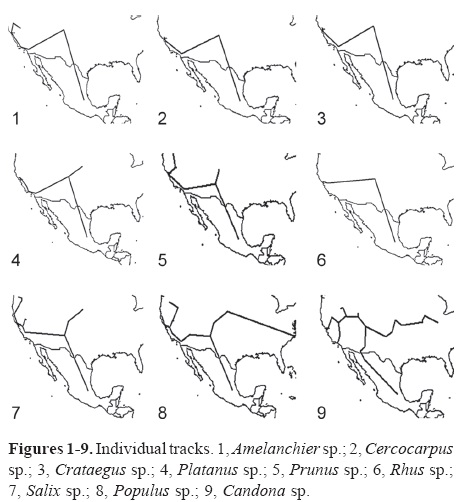
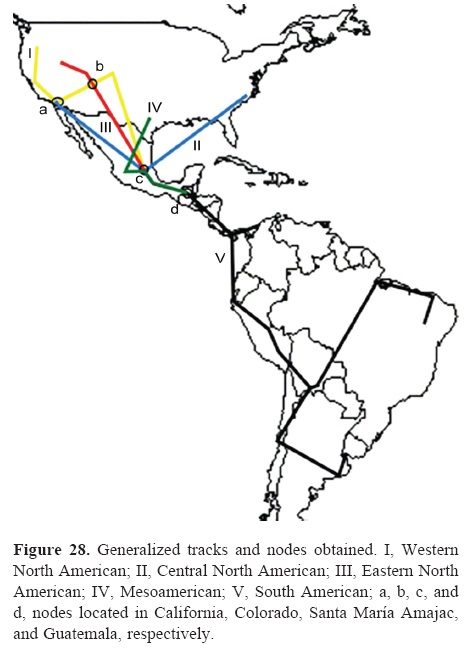
	    <p align="justify"><font face="verdana" size="2">We constructed 27 individual tracks for the analyzed taxa (<a href="#f1">Figures 1</a>&#45;<a href="#f19">27</a>) (<a href="#f1">2&#45;9</a>, <a href="#f10">10&#45;18</a>, <a href="#f19">19&#45;27</a>). Overlapping of individual tracks allowed the identification of 5 generalized tracks and 4 nodes (<a href="#f28">Figure 28</a>). Four of the generalized tracks are located in northern Mexico and northern and central North America. The fifth generalized track extends from southern Mexico to Central America, and southwestern South America. We list the taxa that support the 5 generalized tracks in <a href="/img/revistas/rmbiodiv/v85n4/a23t2.jpg" target="_blank">table 2</a>. The Western North American generalized track (track I) extends from the northwestern United States to California, where it overlaps with one of the edges of the Central North American generalized track (track II); where the Western North American generalized track turns to Colorado, it reaches Mexico through the Sierra Madre Oriental, and reaches the east&#45;central portion of the Mexican Transvolcanic Belt (MTB), where it overlaps with generalized tracks II, III, and IV. Both edges of the generalized track II overlie the generalized tracks I, III, and IV in the east&#45;central portion of the MTB. One branch of the generalized track II, extends from southern California, and passes through the west coast of Mexico, while the other edge descends from the northeastern United States across the Gulf of Mexico. The Eastern North American generalized track (track III) comes from the central part of the United States, where it overlies one of the branches of the generalized track I, and reaches the central part of Mexico overlapping with the generalized tracks I, II, and IV. The Mesoamerican generalized track (track IV) extends from the southeastern United States and descends to the west&#45;central portion of the MTB; it moves to the east&#45;central part of the MTB, where it overlaps with generalized tracks I, II, and III. Track IV runs to Central America, where it overlies the eastern edge of the South American generalized track (track V). The latter extends to the Andes, where it bifurcates to the Amazon basin on one side, and to the Andes mountain range on the other. We identified 4 nodes. The first is located in California, United States. The second is situated in the west&#45;central United States, in Colorado. The third is located in the Santa Mar&iacute;a Amajac area, in Hidalgo, in the east&#45;central MTB. The fourth is situated in Central America, in Guatemala.</font></p>

	    <p align="center"><font face="verdana" size="2"><a name="f1"></a></font></p>

	    <p align="center"><font face="verdana" size="2"><img src="/img/revistas/rmbiodiv/v85n4/a23f1.jpg"></font></p>

	    <p align="center"><font face="verdana" size="2"><a name="f10"></a></font></p>

	    ]]></body>
<body><![CDATA[<p align="center"><font face="verdana" size="2"><img src="/img/revistas/rmbiodiv/v85n4/a23f10.jpg"></font></p>

	    <p align="center"><font face="verdana" size="2"><a name="f19"></a></font></p>

	    <p align="center"><font face="verdana" size="2"><img src="/img/revistas/rmbiodiv/v85n4/a23f19.jpg"></font></p>
    <p align="center"><font face="verdana" size="2"><a name="f28"></a></font></p>

	    <p align="center"><font face="verdana" size="2"><img src="/img/revistas/rmbiodiv/v85n4/a23f28.jpg"></font></p>

	    <p align="justify">&nbsp;</p>
	    <p align="justify"><font face="verdana" size="2"><b>Discussion</b></font></p>
        <p align="justify"><font face="verdana" size="2">Four of the 5 generalized tracks retrieved by the analysis (<a href="#f28">Figure 28</a>) display an east&#45;west distribution pattern that agrees with a previous hypothesis of an Atlantic&#45;Pacific division along the Isthmus of Tehuantepec (Corona et al., 2007; Escalante et al., 2007; and Le&oacute;n&#45;Paniagua et al., 2007). The fifth generalized track (South American) is the only generalized track that resembles the Great American Biotic Interchange between North and South America during the late Cenozoic, where 2 of the fossil mammals that support the track are Holarctic taxa, while <i>Pampatherium mexicanum</i> is a Neotropical taxon.</font></p>
        <p align="justify"><font face="verdana" size="2">The 5 generalized tracks retrieved by the analysis coincide partially with those proposed by Contreras&#45;Medina and Eliosa&#45;Le&oacute;n (2001) for the distribution of extant gymnosperms, amphibians, reptiles, birds, mammals, and insects. The Western North American generalized track is congruent with the track that Mart&iacute;nez&#45;Mart&iacute;nez (2008) recovered with fossil records of 3 genera of aquatic plants (<i>Nymphaea</i>, <i>Scirpus</i>, and <i>Typha</i>). This track extends from the western United States to the Santa Mar&iacute;a Amajac area, in western Mexico. The Mesoamerican generalized track has been retrieved before and partially coincides with the Southern Mesoamerican track proposed by M&aacute;rquez and Morrone (2003) and with the Mesoamerican track proposed by Toledo et al. (2007). The South American generalized track agrees in its Central American portion with the track proposed by Asiain et al. (2010) based on beetles, with the track proposed by Mart&iacute;nez&#45;Mart&iacute;nez (2008) for aquatic plants, and with the track that Escalante et al. (2011) recovered with nematodes and rodents. The latter coincides with the South American generalized track as well, but only as far as Colombia.</font></p>

    <p align="justify"><font face="verdana" size="2">One of the nodes retrieved by the analysis, overlapping tracks III and IV, is located within the Mexican Transition zone proposed by Halffter (1978, 1987) and delimited by Morrone (2006) using the distribution of extant taxa. These authors proposed the Mexican Transition zone as an area where Nearctic and Neotropical elements from the southern United States, Mexico, and Central America overlap. Other authors (Aguayo and Tr&aacute;paga, 1996; Torres&#45;Miranda and Luna&#45;Vega, 2006) have already recovered nodes in the MTB.</font></p>

	    ]]></body>
<body><![CDATA[<p align="justify"><font face="verdana" size="2">The biogeographic affinity of the Mexican biota has been discussed previously from a paleontological viewpoint by Carranza&#45;Casta&ntilde;eda and Ferrusqu&iacute;a&#45;Villafranca, (1978) and Carranza&#45;Casta&ntilde;eda, (2006), as well as from a neontological perspective (Rzedowski, 1978; Contreras&#45;Medina and Eliosa&#45;Le&oacute;n, 2001; Morrone, 2010). The generalized tracks identified in our analysis support the idea of a combined origin of the Mexican biota relating Laurasian and Gondwanan components in the central portion of the country. Mexico's topographic and geographical characteristics have promoted a great variety of ecosystems and one of the highest levels of biodiversity worldwide (Flores&#45;Villela and G&eacute;rez, 1989). In the central portion of the country the ecological and geological diversity is shown along with evidence of the integration of different organisms, mainly mammals, from the Nearctic region with immigrants from South America. Tracks obtained with the fossil biota of Santa Mar&iacute;a Amajac resemble those discovered with extant biotas, suggesting that distribution patterns have prevailed since late Pliocene (Blancan), because Mexico's geological configuration experienced minimal changes in the last 2 million years, and those changes shown in the central portion of the country are due to climatic variations more than geological modifications (Kurt&eacute;n and Anderson, 1980).</font></p>

	    <p align="justify"><font face="verdana" size="2">&nbsp;</font></p>

	    <p align="justify"><font face="verdana" size="2"><b>Acknowledgments</b></font></p>

	    <p align="justify"><font face="verdana" size="2">We want to acknowledge the Paleontology Lab at the UAEH where this research was done. APR acknowledges Conacyt for the scholarship number 229929. We thank referees for their comments, which significantly contributed to improving this publication.</font></p>

	    <p align="justify"><font face="verdana" size="2">&nbsp;</font></p>

	    <p align="justify"><font face="verdana" size="2"><b>Literature cited</b></font></p>

	    <!-- ref --><p align="justify"><font face="verdana" size="2">Aguayo, J. E. and R. Tr&aacute;paga. 1996. Geodin&aacute;mica de M&eacute;xico y minerales del mar. Fondo de Cultura Econ&oacute;mica. M&eacute;xico, D. F. 106 p.    &nbsp;&nbsp;&nbsp;&nbsp;&nbsp;&nbsp;&nbsp;&nbsp;[&#160;<a href="javascript:void(0);" onclick="javascript: window.open('/scielo.php?script=sci_nlinks&ref=7643008&pid=S1870-3453201400050002300001&lng=','','width=640,height=500,resizable=yes,scrollbars=1,menubar=yes,');">Links</a>&#160;]<!-- end-ref --></font></p>

	    <!-- ref --><p align="justify"><font face="verdana" size="2">Aguilar, F. and M. E. Ortiz. 2000. Estudio paleoecol&oacute;gico de la flora plioc&eacute;nica de Santa Mar&iacute;a Amajac, Hidalgo: Inferencia del paleoclima y de la paleocomunidad. Bachelor's thesis, Facultad de Ciencias, Universidad Nacional Aut&oacute;noma de M&eacute;xico. M&eacute;xico, D. F. 79 p.    &nbsp;&nbsp;&nbsp;&nbsp;&nbsp;&nbsp;&nbsp;&nbsp;[&#160;<a href="javascript:void(0);" onclick="javascript: window.open('/scielo.php?script=sci_nlinks&ref=7643010&pid=S1870-3453201400050002300002&lng=','','width=640,height=500,resizable=yes,scrollbars=1,menubar=yes,');">Links</a>&#160;]<!-- end-ref --></font></p>

	    ]]></body>
<body><![CDATA[<!-- ref --><p align="justify"><font face="verdana" size="2">Aguilar, F., A. Silva&#45;Pineda and M. P. Velasco&#45;de Le&oacute;n. 2002. Registro de <i>Equisetum</i> <i>hyemale</i> en el Plioceno de la regi&oacute;n de Santa Mar&iacute;a Amajac, Hidalgo, M&eacute;xico. VII Congreso Latinoamericano y II Congreso Colombiano de Bot&aacute;nica. Cartagena de Indias, Colombia. Asociaci&oacute;n Latinoamericana de Bot&aacute;nica. p. 378.    &nbsp;&nbsp;&nbsp;&nbsp;&nbsp;&nbsp;&nbsp;&nbsp;[&#160;<a href="javascript:void(0);" onclick="javascript: window.open('/scielo.php?script=sci_nlinks&ref=7643012&pid=S1870-3453201400050002300003&lng=','','width=640,height=500,resizable=yes,scrollbars=1,menubar=yes,');">Links</a>&#160;]<!-- end-ref --></font></p>

	    <!-- ref --><p align="justify"><font face="verdana" size="2">Aguilar&#45;Aguilar, R. and R. Contreras&#45;Medina. 2003. La distribuci&oacute;n de los mam&iacute;feros marinos de M&eacute;xico: un enfoque panbiogeogr&aacute;fico. <i>In</i> Introducci&oacute;n a la biogeograf&iacute;a en Latinoam&eacute;rica: teor&iacute;as, conceptos, m&eacute;todos y aplicaciones, J. Llorente&#45;Bousquets and J. J. Morrone (eds.). Las Prensas de Ciencias, Facultad de Ciencias. UNAM. M&eacute;xico, D. F. p. 213&#45;219.    &nbsp;&nbsp;&nbsp;&nbsp;&nbsp;&nbsp;&nbsp;&nbsp;[&#160;<a href="javascript:void(0);" onclick="javascript: window.open('/scielo.php?script=sci_nlinks&ref=7643014&pid=S1870-3453201400050002300004&lng=','','width=640,height=500,resizable=yes,scrollbars=1,menubar=yes,');">Links</a>&#160;]<!-- end-ref --></font></p>

	    <!-- ref --><p align="justify"><font face="verdana" size="2">Arroyo&#45;Cabrales, J., A. L. Carre&ntilde;o, S. Lozano&#45;Garc&iacute;a and M. Montellano&#45;Ballesteros. 2008. La diversidad en el pasado. <i>In</i> Capital natural de M&eacute;xico, vol. I: Conocimiento actual de la biodiversidad. Conabio. M&eacute;xico, D.F. p. 227&#45;262.    &nbsp;&nbsp;&nbsp;&nbsp;&nbsp;&nbsp;&nbsp;&nbsp;[&#160;<a href="javascript:void(0);" onclick="javascript: window.open('/scielo.php?script=sci_nlinks&ref=7643016&pid=S1870-3453201400050002300005&lng=','','width=640,height=500,resizable=yes,scrollbars=1,menubar=yes,');">Links</a>&#160;]<!-- end-ref --></font></p>

	    <!-- ref --><p align="justify"><font face="verdana" size="2">Asiain, J., J. M&aacute;rquez and J. J. Morrone. 2010. Track analysis of the species of <i>Agrodes</i> and <i>Plochionocerus</i> (Coleoptera: Staphylinidae). Revista Mexicana de Biodiversidad 81:177&#45;181.    &nbsp;&nbsp;&nbsp;&nbsp;&nbsp;&nbsp;&nbsp;&nbsp;[&#160;<a href="javascript:void(0);" onclick="javascript: window.open('/scielo.php?script=sci_nlinks&ref=7643018&pid=S1870-3453201400050002300006&lng=','','width=640,height=500,resizable=yes,scrollbars=1,menubar=yes,');">Links</a>&#160;]<!-- end-ref --></font></p>

	    <!-- ref --><p align="justify"><font face="verdana" size="2">Candela, A. M. and J. J. Morrone. 2003. Biogeograf&iacute;a de puercoespines neotropicales (Rodentia: Hystricognathi): Integrando datos f&oacute;siles y actuales a trav&eacute;s de un enfoque panbiogeogr&aacute;fico. Ameghiniana 40:1&#45;19.    &nbsp;&nbsp;&nbsp;&nbsp;&nbsp;&nbsp;&nbsp;&nbsp;[&#160;<a href="javascript:void(0);" onclick="javascript: window.open('/scielo.php?script=sci_nlinks&ref=7643020&pid=S1870-3453201400050002300007&lng=','','width=640,height=500,resizable=yes,scrollbars=1,menubar=yes,');">Links</a>&#160;]<!-- end-ref --></font></p>

	    ]]></body>
<body><![CDATA[<!-- ref --><p align="justify"><font face="verdana" size="2">Carranza&#45;Casta&ntilde;eda, O. 1991. Faunas de vertebrados f&oacute;siles del Terciario tard&iacute;o del &aacute;rea de San Miguel de Allende, Guanajuato. M&eacute;xico, D. F. III Congreso Nacional de Paleontolog&iacute;a, Sociedad Mexicana de Paleontolog&iacute;a, memorias. p. 20.    &nbsp;&nbsp;&nbsp;&nbsp;&nbsp;&nbsp;&nbsp;&nbsp;[&#160;<a href="javascript:void(0);" onclick="javascript: window.open('/scielo.php?script=sci_nlinks&ref=7643022&pid=S1870-3453201400050002300008&lng=','','width=640,height=500,resizable=yes,scrollbars=1,menubar=yes,');">Links</a>&#160;]<!-- end-ref --></font></p>

	    <!-- ref --><p align="justify"><font face="verdana" size="2">Carranza&#45;Casta&ntilde;eda, O. 2006. Late Tertiary fossil localities in central M&eacute;xico between 19&#176; 23&#176;N. <i>In</i> Advances in late Tertiary Vertebrate Paleontology in Mexico and the Great American biotic interchange, O. Carranza&#45;Casta&ntilde;eda and E. H. Lindsay (eds.). Universidad Nacional Aut&oacute;noma de M&eacute;xico, Instituto de Geolog&iacute;a y Centro de Geociencias, M&eacute;xico, D. F. Special Publication 4. p. 45&#45;60.    &nbsp;&nbsp;&nbsp;&nbsp;&nbsp;&nbsp;&nbsp;&nbsp;[&#160;<a href="javascript:void(0);" onclick="javascript: window.open('/scielo.php?script=sci_nlinks&ref=7643024&pid=S1870-3453201400050002300009&lng=','','width=640,height=500,resizable=yes,scrollbars=1,menubar=yes,');">Links</a>&#160;]<!-- end-ref --></font></p>

	    <!-- ref --><p align="justify"><font face="verdana" size="2">Carranza&#45;Casta&ntilde;eda, O. and I. Ferrusqu&iacute;a&#45;Villafranca. 1978. Nuevas investigaciones sobre la fauna Rancho El Ocote, Plioceno Medio de Guanajuato, M&eacute;xico; informe preliminar. Universidad Nacional Aut&oacute;noma de M&eacute;xico. Instituto de Geolog&iacute;a 2: 163&#45;166.    &nbsp;&nbsp;&nbsp;&nbsp;&nbsp;&nbsp;&nbsp;&nbsp;[&#160;<a href="javascript:void(0);" onclick="javascript: window.open('/scielo.php?script=sci_nlinks&ref=7643026&pid=S1870-3453201400050002300010&lng=','','width=640,height=500,resizable=yes,scrollbars=1,menubar=yes,');">Links</a>&#160;]<!-- end-ref --></font></p>

	    <!-- ref --><p align="justify"><font face="verdana" size="2">Castillo&#45;Cer&oacute;n, J. M., M. A. Cabral&#45;Perdomo and O. Carranza&#45;Casta&ntilde;eda. 1996. Vertebrados f&oacute;siles del Estado de Hidalgo. Universidad Aut&oacute;noma del Estado de Hidalgo. Pachuca. 127 p.    &nbsp;&nbsp;&nbsp;&nbsp;&nbsp;&nbsp;&nbsp;&nbsp;[&#160;<a href="javascript:void(0);" onclick="javascript: window.open('/scielo.php?script=sci_nlinks&ref=7643028&pid=S1870-3453201400050002300011&lng=','','width=640,height=500,resizable=yes,scrollbars=1,menubar=yes,');">Links</a>&#160;]<!-- end-ref --></font></p>

	    <!-- ref --><p align="justify"><font face="verdana" size="2">Contreras&#45;Medina, R. and H. Eliosa&#45;Le&oacute;n. 2001. Una visi&oacute;n panbiogeogr&aacute;fica preliminar de M&eacute;xico. <i>In</i> Introducci&oacute;n a la biogeograf&iacute;a en Latinoam&eacute;rica: teor&iacute;as, conceptos, m&eacute;todos y aplicaciones, J. Llorente&#45;Bousquets and J. J. Morrone (eds.). Las Prensas de Ciencias, Facultad de Ciencias, UNAM. Mexico, D. F. p. 197&#45;211.    &nbsp;&nbsp;&nbsp;&nbsp;&nbsp;&nbsp;&nbsp;&nbsp;[&#160;<a href="javascript:void(0);" onclick="javascript: window.open('/scielo.php?script=sci_nlinks&ref=7643030&pid=S1870-3453201400050002300012&lng=','','width=640,height=500,resizable=yes,scrollbars=1,menubar=yes,');">Links</a>&#160;]<!-- end-ref --></font></p>

	    ]]></body>
<body><![CDATA[<!-- ref --><p align="justify"><font face="verdana" size="2">Corona, A. M., V. H. Toledo and J. J. Morrone. 2007. Does the Trans&#45;mexican Volcanic Belt represent a natural biogeographic unit? An analysis of the distributional patterns of Coleoptera. Journal of Biogeography 34:1008&#45;1015.    &nbsp;&nbsp;&nbsp;&nbsp;&nbsp;&nbsp;&nbsp;&nbsp;[&#160;<a href="javascript:void(0);" onclick="javascript: window.open('/scielo.php?script=sci_nlinks&ref=7643032&pid=S1870-3453201400050002300013&lng=','','width=640,height=500,resizable=yes,scrollbars=1,menubar=yes,');">Links</a>&#160;]<!-- end-ref --></font></p>

	    <!-- ref --><p align="justify"><font face="verdana" size="2">Cox, C. B. and P. D. Moore. 1993. Biogeography: an ecological and evolutionary approach. Blackwell Scientific Publications, Oxford. 326 p.    &nbsp;&nbsp;&nbsp;&nbsp;&nbsp;&nbsp;&nbsp;&nbsp;[&#160;<a href="javascript:void(0);" onclick="javascript: window.open('/scielo.php?script=sci_nlinks&ref=7643034&pid=S1870-3453201400050002300014&lng=','','width=640,height=500,resizable=yes,scrollbars=1,menubar=yes,');">Links</a>&#160;]<!-- end-ref --></font></p>

	    <!-- ref --><p align="justify"><font face="verdana" size="2">Craw, R. C., J. R. Grehan and M. J. Heads. 1999. Panbiogeography: Tracking the history of life. Oxford University Press. Biogeography series 11. Oxford. 229 p.    &nbsp;&nbsp;&nbsp;&nbsp;&nbsp;&nbsp;&nbsp;&nbsp;[&#160;<a href="javascript:void(0);" onclick="javascript: window.open('/scielo.php?script=sci_nlinks&ref=7643036&pid=S1870-3453201400050002300015&lng=','','width=640,height=500,resizable=yes,scrollbars=1,menubar=yes,');">Links</a>&#160;]<!-- end-ref --></font></p>

	    <!-- ref --><p align="justify"><font face="verdana" size="2">Crisci, J. V., L. Katinas and P. Posadas. 2003. Historical biogeography. An introduction. Harvard University Press. Massachusetts. 250 p.    &nbsp;&nbsp;&nbsp;&nbsp;&nbsp;&nbsp;&nbsp;&nbsp;[&#160;<a href="javascript:void(0);" onclick="javascript: window.open('/scielo.php?script=sci_nlinks&ref=7643038&pid=S1870-3453201400050002300016&lng=','','width=640,height=500,resizable=yes,scrollbars=1,menubar=yes,');">Links</a>&#160;]<!-- end-ref --></font></p>

	    <!-- ref --><p align="justify"><font face="verdana" size="2">Crisci, J. V. and J. J. Morrone. 1992. Panbiogeograf&iacute;a y biogeograf&iacute;a clad&iacute;stica: Paradigmas actuales de la biogeograf&iacute;a hist&oacute;rica. Ciencias Special Number 6:87&#45;97.    &nbsp;&nbsp;&nbsp;&nbsp;&nbsp;&nbsp;&nbsp;&nbsp;[&#160;<a href="javascript:void(0);" onclick="javascript: window.open('/scielo.php?script=sci_nlinks&ref=7643040&pid=S1870-3453201400050002300017&lng=','','width=640,height=500,resizable=yes,scrollbars=1,menubar=yes,');">Links</a>&#160;]<!-- end-ref --></font></p>

	    ]]></body>
<body><![CDATA[<!-- ref --><p align="justify"><font face="verdana" size="2">Croizat, L. 1958. Panbiogeography. Vols. 1 and 2. Published by the author. Caracas.    &nbsp;&nbsp;&nbsp;&nbsp;&nbsp;&nbsp;&nbsp;&nbsp;[&#160;<a href="javascript:void(0);" onclick="javascript: window.open('/scielo.php?script=sci_nlinks&ref=7643042&pid=S1870-3453201400050002300018&lng=','','width=640,height=500,resizable=yes,scrollbars=1,menubar=yes,');">Links</a>&#160;]<!-- end-ref --></font></p>

	    <!-- ref --><p align="justify"><font face="verdana" size="2">Edmund, A. F. 1996. A review of the Pleistocene giant Armadillos (Mammalia, Xenarthra, Pampatheriide). <i>In</i> Palentology and paleoenvironments of Late Cenozoic mammals: tributes to career of C. S. (Rufus) Churcher, K. M. Stewart and K. L. Seymour (eds.). University of Toronto Press. Toronto. p. 300&#45;321.    &nbsp;&nbsp;&nbsp;&nbsp;&nbsp;&nbsp;&nbsp;&nbsp;[&#160;<a href="javascript:void(0);" onclick="javascript: window.open('/scielo.php?script=sci_nlinks&ref=7643044&pid=S1870-3453201400050002300019&lng=','','width=640,height=500,resizable=yes,scrollbars=1,menubar=yes,');">Links</a>&#160;]<!-- end-ref --></font></p>

	    <!-- ref --><p align="justify"><font face="verdana" size="2">Escalante, T., E. A. Mart&iacute;nez&#45;Salazar, J. Falc&oacute;n&#45;Ord&aacute;z, M. Linaje and R. Guerreo. 2011. An&aacute;lisis panbiogeogr&aacute;fico de <i>Vexillata</i> (Nematoda:Ornithostrongylidae) y sus hu&eacute;spedes (Mammalia: Rodentia). Acta Zool&oacute;gica Mexicana (n.s.) 27:25&#45;46.    &nbsp;&nbsp;&nbsp;&nbsp;&nbsp;&nbsp;&nbsp;&nbsp;[&#160;<a href="javascript:void(0);" onclick="javascript: window.open('/scielo.php?script=sci_nlinks&ref=7643046&pid=S1870-3453201400050002300020&lng=','','width=640,height=500,resizable=yes,scrollbars=1,menubar=yes,');">Links</a>&#160;]<!-- end-ref --></font></p>

	    <!-- ref --><p align="justify"><font face="verdana" size="2">Escalante, T., G. Rodr&iacute;guez, N. Cao, M. C. Ebach and J. J. Morrone. 2007. Cladistic biogeographic analysis suggests an early Caribbean diversification in Mexico. Naturwissenschaften 94:561&#45;565.    &nbsp;&nbsp;&nbsp;&nbsp;&nbsp;&nbsp;&nbsp;&nbsp;[&#160;<a href="javascript:void(0);" onclick="javascript: window.open('/scielo.php?script=sci_nlinks&ref=7643048&pid=S1870-3453201400050002300021&lng=','','width=640,height=500,resizable=yes,scrollbars=1,menubar=yes,');">Links</a>&#160;]<!-- end-ref --></font></p>

	    <!-- ref --><p align="justify"><font face="verdana" size="2">ESRI, 2002. ArcView GIS ver. 3.3. Environmental Systems Research Institute, New York.    &nbsp;&nbsp;&nbsp;&nbsp;&nbsp;&nbsp;&nbsp;&nbsp;[&#160;<a href="javascript:void(0);" onclick="javascript: window.open('/scielo.php?script=sci_nlinks&ref=7643050&pid=S1870-3453201400050002300022&lng=','','width=640,height=500,resizable=yes,scrollbars=1,menubar=yes,');">Links</a>&#160;]<!-- end-ref --></font></p>

	    ]]></body>
<body><![CDATA[<!-- ref --><p align="justify"><font face="verdana" size="2">Flores&#45;Camargo, D. G., M. P. Velasco&#45;de Le&oacute;n and E. Naranjo&#45;Garc&iacute;a. 2009. Estudio taxon&oacute;mico y paleoecol&oacute;gico de moluscos de agua dulce en el Plioceno del Estado de Hidalgo, M&eacute;xico. XI Congreso Nacional de Paleontolog&iacute;a, Sociedad Mexicana de Paleontolog&iacute;a. Quer&eacute;taro. p. 24.    &nbsp;&nbsp;&nbsp;&nbsp;&nbsp;&nbsp;&nbsp;&nbsp;[&#160;<a href="javascript:void(0);" onclick="javascript: window.open('/scielo.php?script=sci_nlinks&ref=7643052&pid=S1870-3453201400050002300023&lng=','','width=640,height=500,resizable=yes,scrollbars=1,menubar=yes,');">Links</a>&#160;]<!-- end-ref --></font></p>

	    <!-- ref --><p align="justify"><font face="verdana" size="2">Flores&#45;Villela, O. and P. Gerez. 1989. Conservaci&oacute;n en M&eacute;xico: s&iacute;ntesis sobre vertebrados terrestres, vegetaci&oacute;n y uso de suelo. Inireb&#45;Conservation International. p. 302.    &nbsp;&nbsp;&nbsp;&nbsp;&nbsp;&nbsp;&nbsp;&nbsp;[&#160;<a href="javascript:void(0);" onclick="javascript: window.open('/scielo.php?script=sci_nlinks&ref=7643054&pid=S1870-3453201400050002300024&lng=','','width=640,height=500,resizable=yes,scrollbars=1,menubar=yes,');">Links</a>&#160;]<!-- end-ref --></font></p>

	    <!-- ref --><p align="justify"><font face="verdana" size="2">Gallo, V., L. S. Avilla, R. C. L. Pereira and B. A. Absolon. 2013. Distributional patterns of herbivore megammals during the Late Pleistocene of South America. Anais da Academia Brasileira de Ci&ecirc;ncias 85:533&#45;546.    &nbsp;&nbsp;&nbsp;&nbsp;&nbsp;&nbsp;&nbsp;&nbsp;[&#160;<a href="javascript:void(0);" onclick="javascript: window.open('/scielo.php?script=sci_nlinks&ref=7643056&pid=S1870-3453201400050002300025&lng=','','width=640,height=500,resizable=yes,scrollbars=1,menubar=yes,');">Links</a>&#160;]<!-- end-ref --></font></p>

	    <!-- ref --><p align="justify"><font face="verdana" size="2">Grehan, J. R. 2001. Panbiogeograf&iacute;a y la geograf&iacute;a de la vida. <i>In</i> Introducci&oacute;n a la biogeograf&iacute;a en Latinoam&eacute;rica: teor&iacute;as, conceptos, m&eacute;todos y aplicaciones,yd J. Llorente&#45;Bousquets and J. J. Morrone (eds.). Las Prensas de Ciencias, Facultad de Ciencias. UNAM. M&eacute;xico, D.F. p. 181&#45;185.    &nbsp;&nbsp;&nbsp;&nbsp;&nbsp;&nbsp;&nbsp;&nbsp;[&#160;<a href="javascript:void(0);" onclick="javascript: window.open('/scielo.php?script=sci_nlinks&ref=7643058&pid=S1870-3453201400050002300026&lng=','','width=640,height=500,resizable=yes,scrollbars=1,menubar=yes,');">Links</a>&#160;]<!-- end-ref --></font></p>

	    <!-- ref --><p align="justify"><font face="verdana" size="2">Halffter, G. 1978. Un nuevo patr&oacute;n de dispersi&oacute;n en la Zona de Transici&oacute;n Mexicana: el mesoamericano de monta&ntilde;a. Folia Entomol&oacute;gica Mexicana 39&#45;40:219&#45;22.    &nbsp;&nbsp;&nbsp;&nbsp;&nbsp;&nbsp;&nbsp;&nbsp;[&#160;<a href="javascript:void(0);" onclick="javascript: window.open('/scielo.php?script=sci_nlinks&ref=7643060&pid=S1870-3453201400050002300027&lng=','','width=640,height=500,resizable=yes,scrollbars=1,menubar=yes,');">Links</a>&#160;]<!-- end-ref --></font></p>

	    ]]></body>
<body><![CDATA[<!-- ref --><p align="justify"><font face="verdana" size="2">Halffter, G. 1987. Biogeography of the montane entomofauna of Mexico and Central America. Annual Review of Entomology 32:95&#45;114.    &nbsp;&nbsp;&nbsp;&nbsp;&nbsp;&nbsp;&nbsp;&nbsp;[&#160;<a href="javascript:void(0);" onclick="javascript: window.open('/scielo.php?script=sci_nlinks&ref=7643062&pid=S1870-3453201400050002300028&lng=','','width=640,height=500,resizable=yes,scrollbars=1,menubar=yes,');">Links</a>&#160;]<!-- end-ref --></font></p>

	    <!-- ref --><p align="justify"><font face="verdana" size="2">Hern&aacute;ndez&#45;L&oacute;pez, R. 2006. Descripci&oacute;n de la flora f&oacute;sil de una localidad de Santa Mar&iacute;a Amajac, Hidalgo. Bachelor's thesis, Universidad Aut&oacute;noma del Estado de Hidalgo. Pachuca. 92 p.    &nbsp;&nbsp;&nbsp;&nbsp;&nbsp;&nbsp;&nbsp;&nbsp;[&#160;<a href="javascript:void(0);" onclick="javascript: window.open('/scielo.php?script=sci_nlinks&ref=7643064&pid=S1870-3453201400050002300029&lng=','','width=640,height=500,resizable=yes,scrollbars=1,menubar=yes,');">Links</a>&#160;]<!-- end-ref --></font></p>

	    <!-- ref --><p align="justify"><font face="verdana" size="2">Kurt&eacute;n, B. and E. Anderson. 1980. Pleistocene Mammals of North America. Columbia University Press. New York. 447 p.    &nbsp;&nbsp;&nbsp;&nbsp;&nbsp;&nbsp;&nbsp;&nbsp;[&#160;<a href="javascript:void(0);" onclick="javascript: window.open('/scielo.php?script=sci_nlinks&ref=7643066&pid=S1870-3453201400050002300030&lng=','','width=640,height=500,resizable=yes,scrollbars=1,menubar=yes,');">Links</a>&#160;]<!-- end-ref --></font></p>

	    <!-- ref --><p align="justify"><font face="verdana" size="2">Le&oacute;n&#45;Paniagua, L., A. G. Navarro&#45;Sig&uuml;enza, B. E. Hern&aacute;ndez&#45;Ba&ntilde;os and J. C. Morales. 2007. Diversification of the arboreal mice of the genus <i>Habromys</i> (Rodentia: Cricetidae: Neotominae) in the Mesoamerican highlands. Molecular Phylogenetics and Evolution 42:653&#45;664.    &nbsp;&nbsp;&nbsp;&nbsp;&nbsp;&nbsp;&nbsp;&nbsp;[&#160;<a href="javascript:void(0);" onclick="javascript: window.open('/scielo.php?script=sci_nlinks&ref=7643068&pid=S1870-3453201400050002300031&lng=','','width=640,height=500,resizable=yes,scrollbars=1,menubar=yes,');">Links</a>&#160;]<!-- end-ref --></font></p>

	    <!-- ref --><p align="justify"><font face="verdana" size="2">Liria, J. 2009. Sistemas de informaci&oacute;n geogr&aacute;fica y an&aacute;lisis espaciales: un m&eacute;todo combinado para realizar estudios panbiogeogr&aacute;ficos. Revista Mexicana de Biodiversidad 79:281&#45;284.    &nbsp;&nbsp;&nbsp;&nbsp;&nbsp;&nbsp;&nbsp;&nbsp;[&#160;<a href="javascript:void(0);" onclick="javascript: window.open('/scielo.php?script=sci_nlinks&ref=7643070&pid=S1870-3453201400050002300032&lng=','','width=640,height=500,resizable=yes,scrollbars=1,menubar=yes,');">Links</a>&#160;]<!-- end-ref --></font></p>

	    ]]></body>
<body><![CDATA[<p align="justify"><font face="verdana" size="2">M&aacute;rquez, J. and J. J. Morrone. 2003. An&aacute;lisis panbiogeogr&aacute;fico de de las especies de <i>Heterolinus</i> y <i>Homalolinus</i> (Coleoptera: Staphylinidae: Xantholinini. Acta Zool&oacute;gica Mexicana (nueva serie) 90:15&#45;25.</font></p>

	    <!-- ref --><p align="justify"><font face="verdana" size="2">Mart&iacute;nez&#45;Becerra, C. A. 2003. Estudio anat&oacute;mico de las aletas impares de los Goodeidos f&oacute;siles procedentes de Sanctorum (Formaci&oacute;n Atotonilco El Grande), Hidalgo. Bachelor's thesis. Facultad de Estudios Superiores de Zaragoza, Universidad Nacional Aut&oacute;noma de M&eacute;xico. M&eacute;xico, D. F. 37 p.    &nbsp;&nbsp;&nbsp;&nbsp;&nbsp;&nbsp;&nbsp;&nbsp;[&#160;<a href="javascript:void(0);" onclick="javascript: window.open('/scielo.php?script=sci_nlinks&ref=7643073&pid=S1870-3453201400050002300033&lng=','','width=640,height=500,resizable=yes,scrollbars=1,menubar=yes,');">Links</a>&#160;]<!-- end-ref --></font></p>

	    <!-- ref --><p align="justify"><font face="verdana" size="2">Mart&iacute;nez&#45;Mart&iacute;nez, P. 2008. Paleobiogeograf&iacute;a y diversidad de tres g&eacute;neros de plantas acu&aacute;ticas f&oacute;siles (<i>Typha</i>, <i>Scirpus</i> y <i>Nymphaea</i>). Bachelor's thesis. Universidad Nacional Aut&oacute;noma de M&eacute;xico. M&eacute;xico, D. F. 61 p.    &nbsp;&nbsp;&nbsp;&nbsp;&nbsp;&nbsp;&nbsp;&nbsp;[&#160;<a href="javascript:void(0);" onclick="javascript: window.open('/scielo.php?script=sci_nlinks&ref=7643075&pid=S1870-3453201400050002300034&lng=','','width=640,height=500,resizable=yes,scrollbars=1,menubar=yes,');">Links</a>&#160;]<!-- end-ref --></font></p>

	    <!-- ref --><p align="justify"><font face="verdana" size="2">Mart&iacute;nez&#45;Mart&iacute;nez, P. and P. Velasco&#45;de Le&oacute;n. 2006. Plantas acu&aacute;ticas del Plioceno de las localidades de Santa Mar&iacute;a Amajac y Sanctorum, Hidalgo, M&eacute;xico. IX Congreso Latinoamericano de Bot&aacute;nica. Memorias, 18&#45;25 junio, Santo Domingo. 536 p.    &nbsp;&nbsp;&nbsp;&nbsp;&nbsp;&nbsp;&nbsp;&nbsp;[&#160;<a href="javascript:void(0);" onclick="javascript: window.open('/scielo.php?script=sci_nlinks&ref=7643077&pid=S1870-3453201400050002300035&lng=','','width=640,height=500,resizable=yes,scrollbars=1,menubar=yes,');">Links</a>&#160;]<!-- end-ref --></font></p>

	    <!-- ref --><p align="justify"><font face="verdana" size="2">Morrone, J. J. 2001. Sistem&aacute;tica, biogeograf&iacute;a, evoluci&oacute;n: los patrones de la biodiversidad en tiempo&#45;espacio. Las Prensas de Ciencias, Facultad de Ciencias, M&eacute;xico, D.F. 124 p.    &nbsp;&nbsp;&nbsp;&nbsp;&nbsp;&nbsp;&nbsp;&nbsp;[&#160;<a href="javascript:void(0);" onclick="javascript: window.open('/scielo.php?script=sci_nlinks&ref=7643079&pid=S1870-3453201400050002300036&lng=','','width=640,height=500,resizable=yes,scrollbars=1,menubar=yes,');">Links</a>&#160;]<!-- end-ref --></font></p>

	    <!-- ref --><p align="justify"><font face="verdana" size="2">Morrone, J. J. 2004. Panbiogeograf&iacute;a, componentes bi&oacute;ticos y zonas de transici&oacute;n. Revista Brasileira de Entomolog&iacute;a 48:149&#45;162.    &nbsp;&nbsp;&nbsp;&nbsp;&nbsp;&nbsp;&nbsp;&nbsp;[&#160;<a href="javascript:void(0);" onclick="javascript: window.open('/scielo.php?script=sci_nlinks&ref=7643081&pid=S1870-3453201400050002300037&lng=','','width=640,height=500,resizable=yes,scrollbars=1,menubar=yes,');">Links</a>&#160;]<!-- end-ref --></font></p>

	    <!-- ref --><p align="justify"><font face="verdana" size="2">Morrone, J. J. 2006. Biogeographic areas and transition zones of Latin America and the Caribbean islands based on panbiogeographic and cladistic analyses of the entomofauna. Annual Review of Entomology 51:467&#45;491.    &nbsp;&nbsp;&nbsp;&nbsp;&nbsp;&nbsp;&nbsp;&nbsp;[&#160;<a href="javascript:void(0);" onclick="javascript: window.open('/scielo.php?script=sci_nlinks&ref=7643083&pid=S1870-3453201400050002300038&lng=','','width=640,height=500,resizable=yes,scrollbars=1,menubar=yes,');">Links</a>&#160;]<!-- end-ref --></font></p>

	    <!-- ref --><p align="justify"><font face="verdana" size="2">Morrone, J. J. 2009. Evolutionary biogeography: an integrative approach with case studies. Columbia University Press. New York. 304 p.    &nbsp;&nbsp;&nbsp;&nbsp;&nbsp;&nbsp;&nbsp;&nbsp;[&#160;<a href="javascript:void(0);" onclick="javascript: window.open('/scielo.php?script=sci_nlinks&ref=7643085&pid=S1870-3453201400050002300039&lng=','','width=640,height=500,resizable=yes,scrollbars=1,menubar=yes,');">Links</a>&#160;]<!-- end-ref --></font></p>

	    <!-- ref --><p align="justify"><font face="verdana" size="2">Morrone, J. J. 2010. Fundamental biogeographic patterns across the Mexican Transition Zone: an evolutionary approach. Ecography 33:355&#45;361.    &nbsp;&nbsp;&nbsp;&nbsp;&nbsp;&nbsp;&nbsp;&nbsp;[&#160;<a href="javascript:void(0);" onclick="javascript: window.open('/scielo.php?script=sci_nlinks&ref=7643087&pid=S1870-3453201400050002300040&lng=','','width=640,height=500,resizable=yes,scrollbars=1,menubar=yes,');">Links</a>&#160;]<!-- end-ref --></font></p>

	    <!-- ref --><p align="justify"><font face="verdana" size="2">Morrone, J. J. and J. V. Crisci. 1995. Historical biogeography: introduction to methods. Annual Review of Ecology and Systematics 26:373&#45;401.    &nbsp;&nbsp;&nbsp;&nbsp;&nbsp;&nbsp;&nbsp;&nbsp;[&#160;<a href="javascript:void(0);" onclick="javascript: window.open('/scielo.php?script=sci_nlinks&ref=7643089&pid=S1870-3453201400050002300041&lng=','','width=640,height=500,resizable=yes,scrollbars=1,menubar=yes,');">Links</a>&#160;]<!-- end-ref --></font></p>

	    <!-- ref --><p align="justify"><font face="verdana" size="2">Palma&#45;Ram&iacute;rez, A. 2012. Estratigraf&iacute;a, panbiogeograf&iacute;a y paleomagnetismo del &aacute;rea de Santa Mar&iacute;a Amajac, Hidalgo, M&eacute;xico. M. Sc. Thesis. Universidad Aut&oacute;noma del Estado de Hidalgo, Pachuca. 72 p.    &nbsp;&nbsp;&nbsp;&nbsp;&nbsp;&nbsp;&nbsp;&nbsp;[&#160;<a href="javascript:void(0);" onclick="javascript: window.open('/scielo.php?script=sci_nlinks&ref=7643091&pid=S1870-3453201400050002300042&lng=','','width=640,height=500,resizable=yes,scrollbars=1,menubar=yes,');">Links</a>&#160;]<!-- end-ref --></font></p>

	    <!-- ref --><p align="justify"><font face="verdana" size="2">Rojas&#45;Parra, C. A. 2004. Una herramienta automatizada para realizar an&aacute;lisis panbiogeogr&aacute;ficos. Biogeograf&iacute;a 1:31&#45;33.    &nbsp;&nbsp;&nbsp;&nbsp;&nbsp;&nbsp;&nbsp;&nbsp;[&#160;<a href="javascript:void(0);" onclick="javascript: window.open('/scielo.php?script=sci_nlinks&ref=7643093&pid=S1870-3453201400050002300043&lng=','','width=640,height=500,resizable=yes,scrollbars=1,menubar=yes,');">Links</a>&#160;]<!-- end-ref --></font></p>

	    <!-- ref --><p align="justify"><font face="verdana" size="2">Ruggiero, A. and C. Ezcurra. 2003. Regiones y transiciones biogeogr&aacute;ficas: complementariedad de los an&aacute;lisis en biogeograf&iacute;a hist&oacute;rica y ecol&oacute;gica. <i>In</i> Una perspectiva latinoamericana de la biogeograf&iacute;a, J. J. Morrone and J. Llorente (eds.). Facultad de Ciencias. M&eacute;xico, D. F. p. 141&#45;154.    &nbsp;&nbsp;&nbsp;&nbsp;&nbsp;&nbsp;&nbsp;&nbsp;[&#160;<a href="javascript:void(0);" onclick="javascript: window.open('/scielo.php?script=sci_nlinks&ref=7643095&pid=S1870-3453201400050002300044&lng=','','width=640,height=500,resizable=yes,scrollbars=1,menubar=yes,');">Links</a>&#160;]<!-- end-ref --></font></p>

	    <!-- ref --><p align="justify"><font face="verdana" size="2">Rzedowski, J. 1978. La vegetaci&oacute;n de M&eacute;xico. Editorial Limusa. Mexico, D. F. 432 p.    &nbsp;&nbsp;&nbsp;&nbsp;&nbsp;&nbsp;&nbsp;&nbsp;[&#160;<a href="javascript:void(0);" onclick="javascript: window.open('/scielo.php?script=sci_nlinks&ref=7643097&pid=S1870-3453201400050002300045&lng=','','width=640,height=500,resizable=yes,scrollbars=1,menubar=yes,');">Links</a>&#160;]<!-- end-ref --></font></p>

	    <!-- ref --><p align="justify"><font face="verdana" size="2">Toledo, V. H., A. M. Corona and J. J. Morrone. 2007. Track analysis of the Mexican species of Cerambycidae (Insecta, Coleoptera). Revista Brasileira de Entomologia 51:131&#45;137.    &nbsp;&nbsp;&nbsp;&nbsp;&nbsp;&nbsp;&nbsp;&nbsp;[&#160;<a href="javascript:void(0);" onclick="javascript: window.open('/scielo.php?script=sci_nlinks&ref=7643099&pid=S1870-3453201400050002300046&lng=','','width=640,height=500,resizable=yes,scrollbars=1,menubar=yes,');">Links</a>&#160;]<!-- end-ref --></font></p>

	    <!-- ref --><p align="justify"><font face="verdana" size="2">Torres&#45;Miranda, A.M. and I. Luna&#45;Vega. 2006. An&aacute;lisis de trazos para establecer &aacute;reas de conservaci&oacute;n en la Faja Volc&aacute;nica Transmexicana. Interciencia 31:849&#45;855.    &nbsp;&nbsp;&nbsp;&nbsp;&nbsp;&nbsp;&nbsp;&nbsp;[&#160;<a href="javascript:void(0);" onclick="javascript: window.open('/scielo.php?script=sci_nlinks&ref=7643101&pid=S1870-3453201400050002300047&lng=','','width=640,height=500,resizable=yes,scrollbars=1,menubar=yes,');">Links</a>&#160;]<!-- end-ref --></font></p>

	    <!-- ref --><p align="justify"><font face="verdana" size="2">Zayas&#45;Ocelotl, L. 2013. Interpretaci&oacute;n clim&aacute;tica de dos localidades f&oacute;siles en Santa Mar&iacute;a Amajac, Hidalgo, con base en la arquitectura foliar. M. Sc. Thesis. Universidad Aut&oacute;noma del Estado de Hidalgo, Pachuca. 102 p.    &nbsp;&nbsp;&nbsp;&nbsp;&nbsp;&nbsp;&nbsp;&nbsp;[&#160;<a href="javascript:void(0);" onclick="javascript: window.open('/scielo.php?script=sci_nlinks&ref=7643103&pid=S1870-3453201400050002300048&lng=','','width=640,height=500,resizable=yes,scrollbars=1,menubar=yes,');">Links</a>&#160;]<!-- end-ref --></font></p>
     ]]></body><back>
<ref-list>
<ref id="B1">
<nlm-citation citation-type="book">
<person-group person-group-type="author">
<name>
<surname><![CDATA[Aguayo]]></surname>
<given-names><![CDATA[J. E.]]></given-names>
</name>
<name>
<surname><![CDATA[Trápaga]]></surname>
<given-names><![CDATA[R.]]></given-names>
</name>
</person-group>
<source><![CDATA[Geodinámica de México y minerales del mar]]></source>
<year>1996</year>
<page-range>106</page-range><publisher-loc><![CDATA[^eD. F. D. F.]]></publisher-loc>
<publisher-name><![CDATA[Fondo de Cultura Económica. México]]></publisher-name>
</nlm-citation>
</ref>
<ref id="B2">
<nlm-citation citation-type="">
<person-group person-group-type="author">
<name>
<surname><![CDATA[Aguilar]]></surname>
<given-names><![CDATA[F.]]></given-names>
</name>
<name>
<surname><![CDATA[Ortiz]]></surname>
<given-names><![CDATA[M. E.]]></given-names>
</name>
</person-group>
<source><![CDATA[Estudio paleoecológico de la flora pliocénica de Santa María Amajac, Hidalgo: Inferencia del paleoclima y de la paleocomunidad]]></source>
<year>2000</year>
<page-range>79</page-range></nlm-citation>
</ref>
<ref id="B3">
<nlm-citation citation-type="book">
<person-group person-group-type="author">
<name>
<surname><![CDATA[Aguilar]]></surname>
<given-names><![CDATA[F.]]></given-names>
</name>
<name>
<surname><![CDATA[Silva-Pineda]]></surname>
<given-names><![CDATA[A.]]></given-names>
</name>
<name>
<surname><![CDATA[Velasco-de León]]></surname>
<given-names><![CDATA[M. P.]]></given-names>
</name>
</person-group>
<article-title xml:lang="es"><![CDATA[Registro de Equisetum hyemale en el Plioceno de la región de Santa María Amajac, Hidalgo, México]]></article-title>
<source><![CDATA[VII Congreso Latinoamericano y II Congreso Colombiano de Botánica]]></source>
<year>2002</year>
<page-range>378</page-range><publisher-loc><![CDATA[Cartagena de Indias ]]></publisher-loc>
<publisher-name><![CDATA[Asociación Latinoamericana de Botánica]]></publisher-name>
</nlm-citation>
</ref>
<ref id="B4">
<nlm-citation citation-type="book">
<person-group person-group-type="author">
<name>
<surname><![CDATA[Aguilar-Aguilar]]></surname>
<given-names><![CDATA[R.]]></given-names>
</name>
<name>
<surname><![CDATA[Contreras-Medina]]></surname>
<given-names><![CDATA[R.]]></given-names>
</name>
</person-group>
<article-title xml:lang="es"><![CDATA[La distribución de los mamíferos marinos de México: un enfoque panbiogeográfico]]></article-title>
<person-group person-group-type="editor">
<name>
<surname><![CDATA[Llorente-Bousquets]]></surname>
<given-names><![CDATA[J.]]></given-names>
</name>
<name>
<surname><![CDATA[Morrone]]></surname>
<given-names><![CDATA[J. J.]]></given-names>
</name>
</person-group>
<source><![CDATA[Introducción a la biogeografía en Latinoamérica: teorías, conceptos, métodos y aplicaciones]]></source>
<year>2003</year>
<page-range>213-219</page-range><publisher-loc><![CDATA[México^eD. F. D. F.]]></publisher-loc>
<publisher-name><![CDATA[Las Prensas de Ciencias, Facultad de Ciencias. UNAM]]></publisher-name>
</nlm-citation>
</ref>
<ref id="B5">
<nlm-citation citation-type="book">
<person-group person-group-type="author">
<name>
<surname><![CDATA[Arroyo-Cabrales]]></surname>
<given-names><![CDATA[J.]]></given-names>
</name>
<name>
<surname><![CDATA[Carreño]]></surname>
<given-names><![CDATA[A. L.]]></given-names>
</name>
<name>
<surname><![CDATA[Lozano-García]]></surname>
<given-names><![CDATA[S.]]></given-names>
</name>
<name>
<surname><![CDATA[Montellano-Ballesteros]]></surname>
<given-names><![CDATA[M.]]></given-names>
</name>
</person-group>
<article-title xml:lang="es"><![CDATA[La diversidad en el pasado]]></article-title>
<source><![CDATA[Capital natural de México, vol. I: Conocimiento actual de la biodiversidad]]></source>
<year>2008</year>
<page-range>227-262</page-range><publisher-loc><![CDATA[México^eD.F. D.F.]]></publisher-loc>
<publisher-name><![CDATA[Conabio]]></publisher-name>
</nlm-citation>
</ref>
<ref id="B6">
<nlm-citation citation-type="journal">
<person-group person-group-type="author">
<name>
<surname><![CDATA[Asiain]]></surname>
<given-names><![CDATA[J.]]></given-names>
</name>
<name>
<surname><![CDATA[Márquez]]></surname>
<given-names><![CDATA[J.]]></given-names>
</name>
<name>
<surname><![CDATA[Morrone]]></surname>
<given-names><![CDATA[J. J.]]></given-names>
</name>
</person-group>
<article-title xml:lang="en"><![CDATA[Track analysis of the species of Agrodes and Plochionocerus (Coleoptera: Staphylinidae)]]></article-title>
<source><![CDATA[Revista Mexicana de Biodiversidad]]></source>
<year>2010</year>
<volume>81</volume>
<page-range>177-181</page-range></nlm-citation>
</ref>
<ref id="B7">
<nlm-citation citation-type="journal">
<person-group person-group-type="author">
<name>
<surname><![CDATA[Candela]]></surname>
<given-names><![CDATA[A. M.]]></given-names>
</name>
<name>
<surname><![CDATA[Morrone]]></surname>
<given-names><![CDATA[J. J.]]></given-names>
</name>
</person-group>
<article-title xml:lang="es"><![CDATA[Biogeografía de puercoespines neotropicales (Rodentia: Hystricognathi): Integrando datos fósiles y actuales a través de un enfoque panbiogeográfico]]></article-title>
<source><![CDATA[Ameghiniana]]></source>
<year>2003</year>
<volume>40</volume>
<page-range>1-19</page-range></nlm-citation>
</ref>
<ref id="B8">
<nlm-citation citation-type="book">
<person-group person-group-type="author">
<name>
<surname><![CDATA[Carranza-Castañeda]]></surname>
<given-names><![CDATA[O.]]></given-names>
</name>
</person-group>
<article-title xml:lang="es"><![CDATA[Faunas de vertebrados fósiles del Terciario tardío del área de San Miguel de Allende, Guanajuato. México, D. F.]]></article-title>
<source><![CDATA[III Congreso Nacional de Paleontología]]></source>
<year>1991</year>
<page-range>20</page-range><publisher-name><![CDATA[Sociedad Mexicana de Paleontología]]></publisher-name>
</nlm-citation>
</ref>
<ref id="B9">
<nlm-citation citation-type="book">
<person-group person-group-type="author">
<name>
<surname><![CDATA[Carranza-Castañeda]]></surname>
<given-names><![CDATA[O]]></given-names>
</name>
</person-group>
<article-title xml:lang="en"><![CDATA[Late Tertiary fossil localities in central México between 19° 23°N]]></article-title>
<person-group person-group-type="editor">
<name>
<surname><![CDATA[Carranza-Castañeda]]></surname>
<given-names><![CDATA[O.]]></given-names>
</name>
<name>
<surname><![CDATA[Lindsay]]></surname>
<given-names><![CDATA[E. H.]]></given-names>
</name>
</person-group>
<source><![CDATA[Advances in late Tertiary Vertebrate Paleontology in Mexico and the Great American biotic interchange]]></source>
<year>2006</year>
<page-range>45-60</page-range><publisher-loc><![CDATA[México^eD. F. D. F.]]></publisher-loc>
<publisher-name><![CDATA[Universidad Nacional Autónoma de México, Instituto de Geología y Centro de Geociencias]]></publisher-name>
</nlm-citation>
</ref>
<ref id="B10">
<nlm-citation citation-type="book">
<person-group person-group-type="author">
<name>
<surname><![CDATA[Carranza-Castañeda]]></surname>
<given-names><![CDATA[O.]]></given-names>
</name>
<name>
<surname><![CDATA[Ferrusquía-Villafranca]]></surname>
<given-names><![CDATA[I.]]></given-names>
</name>
</person-group>
<source><![CDATA[Nuevas investigaciones sobre la fauna Rancho El Ocote, Plioceno Medio de Guanajuato, México; informe preliminar]]></source>
<year>1978</year>
<volume>2</volume>
<page-range>163-166</page-range><publisher-name><![CDATA[Universidad Nacional Autónoma de México. Instituto de Geología]]></publisher-name>
</nlm-citation>
</ref>
<ref id="B11">
<nlm-citation citation-type="book">
<person-group person-group-type="author">
<name>
<surname><![CDATA[Castillo-Cerón]]></surname>
<given-names><![CDATA[J. M.]]></given-names>
</name>
<name>
<surname><![CDATA[Cabral-Perdomo]]></surname>
<given-names><![CDATA[M. A.]]></given-names>
</name>
<name>
<surname><![CDATA[Carranza-Castañeda]]></surname>
<given-names><![CDATA[O.]]></given-names>
</name>
</person-group>
<source><![CDATA[Vertebrados fósiles del Estado de Hidalgo]]></source>
<year>1996</year>
<page-range>127</page-range><publisher-loc><![CDATA[Pachuca ]]></publisher-loc>
<publisher-name><![CDATA[Universidad Autónoma del Estado de Hidalgo]]></publisher-name>
</nlm-citation>
</ref>
<ref id="B12">
<nlm-citation citation-type="book">
<person-group person-group-type="author">
<name>
<surname><![CDATA[Contreras-Medina]]></surname>
<given-names><![CDATA[R.]]></given-names>
</name>
<name>
<surname><![CDATA[Eliosa-León]]></surname>
<given-names><![CDATA[H.]]></given-names>
</name>
</person-group>
<article-title xml:lang="es"><![CDATA[Una visión panbiogeográfica preliminar de México]]></article-title>
<person-group person-group-type="editor">
<name>
<surname><![CDATA[Llorente-Bousquets]]></surname>
<given-names><![CDATA[J.]]></given-names>
</name>
<name>
<surname><![CDATA[Morrone]]></surname>
<given-names><![CDATA[J. J.]]></given-names>
</name>
</person-group>
<source><![CDATA[Introducción a la biogeografía en Latinoamérica: teorías, conceptos, métodos y aplicaciones]]></source>
<year>2001</year>
<page-range>197-211</page-range><publisher-loc><![CDATA[Mexico^eD. F. D. F.]]></publisher-loc>
<publisher-name><![CDATA[Las Prensas de Ciencias, Facultad de Ciencias, UNAM]]></publisher-name>
</nlm-citation>
</ref>
<ref id="B13">
<nlm-citation citation-type="journal">
<person-group person-group-type="author">
<name>
<surname><![CDATA[Corona]]></surname>
<given-names><![CDATA[A. M.]]></given-names>
</name>
<name>
<surname><![CDATA[Toledo]]></surname>
<given-names><![CDATA[V. H.]]></given-names>
</name>
<name>
<surname><![CDATA[Morrone]]></surname>
<given-names><![CDATA[J. J.]]></given-names>
</name>
</person-group>
<article-title xml:lang="en"><![CDATA[Does the Trans-mexican Volcanic Belt represent a natural biogeographic unit? An analysis of the distributional patterns of Coleoptera]]></article-title>
<source><![CDATA[Journal of Biogeography]]></source>
<year>2007</year>
<volume>34</volume>
<page-range>1008-1015</page-range></nlm-citation>
</ref>
<ref id="B14">
<nlm-citation citation-type="book">
<person-group person-group-type="author">
<name>
<surname><![CDATA[Cox]]></surname>
<given-names><![CDATA[C. B.]]></given-names>
</name>
<name>
<surname><![CDATA[Moore]]></surname>
<given-names><![CDATA[P. D.]]></given-names>
</name>
</person-group>
<source><![CDATA[Biogeography: an ecological and evolutionary approach]]></source>
<year>1993</year>
<page-range>326</page-range><publisher-loc><![CDATA[Oxford ]]></publisher-loc>
<publisher-name><![CDATA[Blackwell Scientific Publications]]></publisher-name>
</nlm-citation>
</ref>
<ref id="B15">
<nlm-citation citation-type="book">
<person-group person-group-type="author">
<name>
<surname><![CDATA[Craw]]></surname>
<given-names><![CDATA[R. C.]]></given-names>
</name>
<name>
<surname><![CDATA[Grehan]]></surname>
<given-names><![CDATA[J. R.]]></given-names>
</name>
<name>
<surname><![CDATA[Heads]]></surname>
<given-names><![CDATA[M. J.]]></given-names>
</name>
</person-group>
<source><![CDATA[Panbiogeography: Tracking the history of life]]></source>
<year>1999</year>
<page-range>229</page-range><publisher-loc><![CDATA[Oxford ]]></publisher-loc>
<publisher-name><![CDATA[Oxford University Press]]></publisher-name>
</nlm-citation>
</ref>
<ref id="B16">
<nlm-citation citation-type="book">
<person-group person-group-type="author">
<name>
<surname><![CDATA[Crisci]]></surname>
<given-names><![CDATA[J. V.]]></given-names>
</name>
<name>
<surname><![CDATA[Katinas]]></surname>
<given-names><![CDATA[L.]]></given-names>
</name>
<name>
<surname><![CDATA[Posadas]]></surname>
<given-names><![CDATA[P.]]></given-names>
</name>
</person-group>
<source><![CDATA[Historical biogeography. An introduction]]></source>
<year>2003</year>
<page-range>250</page-range><publisher-loc><![CDATA[Massachusetts ]]></publisher-loc>
<publisher-name><![CDATA[Harvard University Press]]></publisher-name>
</nlm-citation>
</ref>
<ref id="B17">
<nlm-citation citation-type="journal">
<person-group person-group-type="author">
<name>
<surname><![CDATA[Crisci]]></surname>
<given-names><![CDATA[J. V.]]></given-names>
</name>
<name>
<surname><![CDATA[Morrone]]></surname>
<given-names><![CDATA[J. J.]]></given-names>
</name>
</person-group>
<article-title xml:lang="es"><![CDATA[Panbiogeografía y biogeografía cladística: Paradigmas actuales de la biogeografía histórica]]></article-title>
<source><![CDATA[Ciencias Special Number]]></source>
<year>1992</year>
<volume>6</volume>
<page-range>87-97</page-range></nlm-citation>
</ref>
<ref id="B18">
<nlm-citation citation-type="">
<person-group person-group-type="author">
<name>
<surname><![CDATA[Croizat]]></surname>
<given-names><![CDATA[L.]]></given-names>
</name>
</person-group>
<source><![CDATA[Panbiogeography]]></source>
<year>1958</year>
<volume>1 and 2</volume>
<publisher-loc><![CDATA[Caracas ]]></publisher-loc>
</nlm-citation>
</ref>
<ref id="B19">
<nlm-citation citation-type="book">
<person-group person-group-type="author">
<name>
<surname><![CDATA[Edmund]]></surname>
<given-names><![CDATA[A. F]]></given-names>
</name>
</person-group>
<article-title xml:lang="en"><![CDATA[A review of the Pleistocene giant Armadillos (Mammalia, Xenarthra, Pampatheriide)]]></article-title>
<person-group person-group-type="editor">
<name>
<surname><![CDATA[Stewart]]></surname>
<given-names><![CDATA[K. M.]]></given-names>
</name>
<name>
<surname><![CDATA[Seymour]]></surname>
<given-names><![CDATA[K. L.]]></given-names>
</name>
</person-group>
<source><![CDATA[Palentology and paleoenvironments of Late Cenozoic mammals: tributes to career of C. S. (Rufus) Churcher]]></source>
<year>1996</year>
<page-range>300-321</page-range><publisher-loc><![CDATA[Toronto ]]></publisher-loc>
<publisher-name><![CDATA[University of Toronto Press]]></publisher-name>
</nlm-citation>
</ref>
<ref id="B20">
<nlm-citation citation-type="journal">
<person-group person-group-type="author">
<name>
<surname><![CDATA[Escalante]]></surname>
<given-names><![CDATA[T.]]></given-names>
</name>
<name>
<surname><![CDATA[Martínez-Salazar]]></surname>
<given-names><![CDATA[E. A.]]></given-names>
</name>
<name>
<surname><![CDATA[Falcón-Ordáz]]></surname>
<given-names><![CDATA[J.]]></given-names>
</name>
<name>
<surname><![CDATA[Linaje]]></surname>
<given-names><![CDATA[M.]]></given-names>
</name>
<name>
<surname><![CDATA[Guerreo]]></surname>
<given-names><![CDATA[R.]]></given-names>
</name>
</person-group>
<article-title xml:lang="en"><![CDATA[Análisis panbiogeográfico de Vexillata (Nematoda:Ornithostrongylidae) y sus huéspedes (Mammalia: Rodentia)]]></article-title>
<source><![CDATA[Acta Zoológica Mexicana]]></source>
<year>2011</year>
<volume>27</volume>
<page-range>25-46</page-range></nlm-citation>
</ref>
<ref id="B21">
<nlm-citation citation-type="journal">
<person-group person-group-type="author">
<name>
<surname><![CDATA[Escalante]]></surname>
<given-names><![CDATA[T.]]></given-names>
</name>
<name>
<surname><![CDATA[Rodríguez]]></surname>
<given-names><![CDATA[G.]]></given-names>
</name>
<name>
<surname><![CDATA[Cao]]></surname>
<given-names><![CDATA[N.]]></given-names>
</name>
<name>
<surname><![CDATA[Ebach]]></surname>
<given-names><![CDATA[M. C.]]></given-names>
</name>
<name>
<surname><![CDATA[Morrone]]></surname>
<given-names><![CDATA[J. J.]]></given-names>
</name>
</person-group>
<article-title xml:lang="en"><![CDATA[Cladistic biogeographic analysis suggests an early Caribbean diversification in Mexico]]></article-title>
<source><![CDATA[Naturwissenschaften]]></source>
<year>2007</year>
<volume>94</volume>
<page-range>561-565</page-range></nlm-citation>
</ref>
<ref id="B22">
<nlm-citation citation-type="book">
<collab>ESRI</collab>
<source><![CDATA[ArcView GIS ver. 3.3]]></source>
<year>2002</year>
<publisher-loc><![CDATA[New York ]]></publisher-loc>
<publisher-name><![CDATA[Environmental Systems Research Institute]]></publisher-name>
</nlm-citation>
</ref>
<ref id="B23">
<nlm-citation citation-type="book">
<person-group person-group-type="author">
<name>
<surname><![CDATA[Flores-Camargo]]></surname>
<given-names><![CDATA[D. G.]]></given-names>
</name>
<name>
<surname><![CDATA[Velasco-de León]]></surname>
<given-names><![CDATA[M. P.]]></given-names>
</name>
<name>
<surname><![CDATA[Naranjo-García]]></surname>
<given-names><![CDATA[E.]]></given-names>
</name>
</person-group>
<article-title xml:lang="es"><![CDATA[Estudio taxonómico y paleoecológico de moluscos de agua dulce en el Plioceno del Estado de Hidalgo, México]]></article-title>
<source><![CDATA[XI Congreso Nacional de Paleontología]]></source>
<year>2009</year>
<page-range>24</page-range><publisher-loc><![CDATA[Querétaro ]]></publisher-loc>
<publisher-name><![CDATA[Sociedad Mexicana de Paleontología]]></publisher-name>
</nlm-citation>
</ref>
<ref id="B24">
<nlm-citation citation-type="book">
<person-group person-group-type="author">
<name>
<surname><![CDATA[Flores-Villela]]></surname>
<given-names><![CDATA[O.]]></given-names>
</name>
<name>
<surname><![CDATA[Gerez]]></surname>
<given-names><![CDATA[P.]]></given-names>
</name>
</person-group>
<source><![CDATA[Conservación en México: síntesis sobre vertebrados terrestres, vegetación y uso de suelo]]></source>
<year>1989</year>
<page-range>302</page-range><publisher-name><![CDATA[Inireb-Conservation International]]></publisher-name>
</nlm-citation>
</ref>
<ref id="B25">
<nlm-citation citation-type="journal">
<person-group person-group-type="author">
<name>
<surname><![CDATA[Gallo]]></surname>
<given-names><![CDATA[V.]]></given-names>
</name>
<name>
<surname><![CDATA[Avilla]]></surname>
<given-names><![CDATA[L. S.]]></given-names>
</name>
<name>
<surname><![CDATA[Pereira]]></surname>
<given-names><![CDATA[R. C. L.]]></given-names>
</name>
<name>
<surname><![CDATA[Absolon]]></surname>
<given-names><![CDATA[B. A.]]></given-names>
</name>
</person-group>
<article-title xml:lang="en"><![CDATA[Distributional patterns of herbivore megammals during the Late Pleistocene of South America]]></article-title>
<source><![CDATA[Anais da Academia Brasileira de Ciências]]></source>
<year>2013</year>
<volume>85</volume>
<page-range>533-546</page-range></nlm-citation>
</ref>
<ref id="B26">
<nlm-citation citation-type="book">
<person-group person-group-type="author">
<name>
<surname><![CDATA[Grehan]]></surname>
<given-names><![CDATA[J. R]]></given-names>
</name>
</person-group>
<article-title xml:lang="es"><![CDATA[Panbiogeografía y la geografía de la vida]]></article-title>
<person-group person-group-type="editor">
<name>
<surname><![CDATA[Llorente-Bousquets]]></surname>
<given-names><![CDATA[J.]]></given-names>
</name>
<name>
<surname><![CDATA[Morrone]]></surname>
<given-names><![CDATA[J. J.]]></given-names>
</name>
</person-group>
<source><![CDATA[Introducción a la biogeografía en Latinoamérica: teorías, conceptos, métodos y aplicaciones]]></source>
<year>2001</year>
<page-range>181-185</page-range><publisher-loc><![CDATA[México^eD.F. D.F.]]></publisher-loc>
<publisher-name><![CDATA[Las Prensas de Ciencias, Facultad de Ciencias. UNAM]]></publisher-name>
</nlm-citation>
</ref>
<ref id="B27">
<nlm-citation citation-type="journal">
<person-group person-group-type="author">
<name>
<surname><![CDATA[Halffter]]></surname>
<given-names><![CDATA[G]]></given-names>
</name>
</person-group>
<article-title xml:lang="es"><![CDATA[Un nuevo patrón de dispersión en la Zona de Transición Mexicana: el mesoamericano de montaña]]></article-title>
<source><![CDATA[Folia Entomológica Mexicana]]></source>
<year>1978</year>
<volume>39-40</volume>
<page-range>219-22</page-range></nlm-citation>
</ref>
<ref id="B28">
<nlm-citation citation-type="journal">
<person-group person-group-type="author">
<name>
<surname><![CDATA[Halffter]]></surname>
<given-names><![CDATA[G]]></given-names>
</name>
</person-group>
<article-title xml:lang="en"><![CDATA[Biogeography of the montane entomofauna of Mexico and Central America]]></article-title>
<source><![CDATA[Annual Review of Entomology]]></source>
<year>1987</year>
<volume>32</volume>
<page-range>95-114</page-range></nlm-citation>
</ref>
<ref id="B29">
<nlm-citation citation-type="">
<person-group person-group-type="author">
<name>
<surname><![CDATA[Hernández-López]]></surname>
<given-names><![CDATA[R]]></given-names>
</name>
</person-group>
<source><![CDATA[Descripción de la flora fósil de una localidad de Santa María Amajac, Hidalgo]]></source>
<year>2006</year>
<page-range>92</page-range></nlm-citation>
</ref>
<ref id="B30">
<nlm-citation citation-type="book">
<person-group person-group-type="author">
<name>
<surname><![CDATA[Kurtén]]></surname>
<given-names><![CDATA[B.]]></given-names>
</name>
<name>
<surname><![CDATA[Anderson]]></surname>
<given-names><![CDATA[E.]]></given-names>
</name>
</person-group>
<source><![CDATA[Pleistocene Mammals of North America]]></source>
<year>1980</year>
<page-range>447</page-range><publisher-loc><![CDATA[New York ]]></publisher-loc>
<publisher-name><![CDATA[Columbia University Press]]></publisher-name>
</nlm-citation>
</ref>
<ref id="B31">
<nlm-citation citation-type="journal">
<person-group person-group-type="author">
<name>
<surname><![CDATA[León-Paniagua]]></surname>
<given-names><![CDATA[L.]]></given-names>
</name>
<name>
<surname><![CDATA[Navarro-Sigüenza]]></surname>
<given-names><![CDATA[A. G.]]></given-names>
</name>
<name>
<surname><![CDATA[Hernández-Baños]]></surname>
<given-names><![CDATA[B. E.]]></given-names>
</name>
<name>
<surname><![CDATA[Morales]]></surname>
<given-names><![CDATA[J. C.]]></given-names>
</name>
</person-group>
<article-title xml:lang="es"><![CDATA[Diversification of the arboreal mice of the genus Habromys (Rodentia: Cricetidae: Neotominae) in the Mesoamerican highlands]]></article-title>
<source><![CDATA[Molecular Phylogenetics and Evolution]]></source>
<year>2007</year>
<volume>42</volume>
<page-range>653-664</page-range></nlm-citation>
</ref>
<ref id="B32">
<nlm-citation citation-type="journal">
<person-group person-group-type="author">
<name>
<surname><![CDATA[Liria]]></surname>
<given-names><![CDATA[J]]></given-names>
</name>
</person-group>
<article-title xml:lang="es"><![CDATA[Sistemas de información geográfica y análisis espaciales: un método combinado para realizar estudios panbiogeográficos]]></article-title>
<source><![CDATA[Revista Mexicana de Biodiversidad]]></source>
<year>2009</year>
<volume>79</volume>
<page-range>281-284</page-range></nlm-citation>
</ref>
<ref id="B33">
<nlm-citation citation-type="">
<person-group person-group-type="author">
<name>
<surname><![CDATA[Martínez-Becerra]]></surname>
<given-names><![CDATA[C. A]]></given-names>
</name>
</person-group>
<source><![CDATA[Estudio anatómico de las aletas impares de los Goodeidos fósiles procedentes de Sanctorum (Formación Atotonilco El Grande), Hidalgo]]></source>
<year>2003</year>
<page-range>37</page-range></nlm-citation>
</ref>
<ref id="B34">
<nlm-citation citation-type="">
<person-group person-group-type="author">
<name>
<surname><![CDATA[Martínez-Martínez]]></surname>
<given-names><![CDATA[P]]></given-names>
</name>
</person-group>
<source><![CDATA[Paleobiogeografía y diversidad de tres géneros de plantas acuáticas fósiles (Typha, Scirpus y Nymphaea)]]></source>
<year>2008</year>
<page-range>61</page-range></nlm-citation>
</ref>
<ref id="B35">
<nlm-citation citation-type="">
<person-group person-group-type="author">
<name>
<surname><![CDATA[Martínez-Martínez]]></surname>
<given-names><![CDATA[P.]]></given-names>
</name>
<name>
<surname><![CDATA[Velasco-de León]]></surname>
<given-names><![CDATA[P.]]></given-names>
</name>
</person-group>
<article-title xml:lang="es"><![CDATA[Plantas acuáticas del Plioceno de las localidades de Santa María Amajac y Sanctorum, Hidalgo, México]]></article-title>
<source><![CDATA[IX Congreso Latinoamericano de Botánica. Memorias, 18-25 junio]]></source>
<year>2006</year>
<page-range>536</page-range><publisher-loc><![CDATA[Santo Domingo ]]></publisher-loc>
</nlm-citation>
</ref>
<ref id="B36">
<nlm-citation citation-type="book">
<person-group person-group-type="author">
<name>
<surname><![CDATA[Morrone]]></surname>
<given-names><![CDATA[J. J]]></given-names>
</name>
</person-group>
<source><![CDATA[Sistemática, biogeografía, evolución: los patrones de la biodiversidad en tiempo-espacio]]></source>
<year>2001</year>
<page-range>124</page-range><publisher-loc><![CDATA[México^eD.F. D.F.]]></publisher-loc>
<publisher-name><![CDATA[Las Prensas de Ciencias, Facultad de Ciencias]]></publisher-name>
</nlm-citation>
</ref>
<ref id="B37">
<nlm-citation citation-type="journal">
<person-group person-group-type="author">
<name>
<surname><![CDATA[Morrone]]></surname>
<given-names><![CDATA[J. J]]></given-names>
</name>
</person-group>
<article-title xml:lang="es"><![CDATA[Panbiogeografía, componentes bióticos y zonas de transición]]></article-title>
<source><![CDATA[Revista Brasileira de Entomología]]></source>
<year>2004</year>
<volume>48</volume>
<page-range>149-162</page-range></nlm-citation>
</ref>
<ref id="B38">
<nlm-citation citation-type="journal">
<person-group person-group-type="author">
<name>
<surname><![CDATA[Morrone]]></surname>
<given-names><![CDATA[J. J]]></given-names>
</name>
</person-group>
<article-title xml:lang="en"><![CDATA[Biogeographic areas and transition zones of Latin America and the Caribbean islands based on panbiogeographic and cladistic analyses of the entomofauna]]></article-title>
<source><![CDATA[Annual Review of Entomology]]></source>
<year>2006</year>
<volume>51</volume>
<page-range>467-491</page-range></nlm-citation>
</ref>
<ref id="B39">
<nlm-citation citation-type="book">
<person-group person-group-type="author">
<name>
<surname><![CDATA[Morrone]]></surname>
</name>
</person-group>
<source><![CDATA[Evolutionary biogeography: an integrative approach with case studies]]></source>
<year>2009</year>
<page-range>304</page-range><publisher-loc><![CDATA[New York ]]></publisher-loc>
<publisher-name><![CDATA[Columbia University Press]]></publisher-name>
</nlm-citation>
</ref>
<ref id="B40">
<nlm-citation citation-type="journal">
<person-group person-group-type="author">
<name>
<surname><![CDATA[Morrone]]></surname>
<given-names><![CDATA[J. J]]></given-names>
</name>
</person-group>
<article-title xml:lang="en"><![CDATA[Fundamental biogeographic patterns across the Mexican Transition Zone: an evolutionary approach]]></article-title>
<source><![CDATA[Ecography]]></source>
<year>2010</year>
<volume>33</volume>
<page-range>355-361</page-range></nlm-citation>
</ref>
<ref id="B41">
<nlm-citation citation-type="journal">
<person-group person-group-type="author">
<name>
<surname><![CDATA[Morrone]]></surname>
<given-names><![CDATA[J. J.]]></given-names>
</name>
<name>
<surname><![CDATA[Crisci]]></surname>
<given-names><![CDATA[J. V.]]></given-names>
</name>
</person-group>
<article-title xml:lang="en"><![CDATA[Historical biogeography: introduction to methods]]></article-title>
<source><![CDATA[Annual Review of Ecology and Systematics]]></source>
<year>1995</year>
<volume>26</volume>
<page-range>373-401</page-range></nlm-citation>
</ref>
<ref id="B42">
<nlm-citation citation-type="">
<person-group person-group-type="author">
<name>
<surname><![CDATA[Palma-Ramírez]]></surname>
<given-names><![CDATA[A]]></given-names>
</name>
</person-group>
<source><![CDATA[Estratigrafía, panbiogeografía y paleomagnetismo del área de Santa María Amajac, Hidalgo, México]]></source>
<year>2012</year>
<page-range>72</page-range></nlm-citation>
</ref>
<ref id="B43">
<nlm-citation citation-type="journal">
<person-group person-group-type="author">
<name>
<surname><![CDATA[Rojas-Parra]]></surname>
<given-names><![CDATA[C. A]]></given-names>
</name>
</person-group>
<article-title xml:lang="es"><![CDATA[Una herramienta automatizada para realizar análisis panbiogeográficos]]></article-title>
<source><![CDATA[Biogeografía]]></source>
<year>2004</year>
<volume>1</volume>
<page-range>31-33</page-range></nlm-citation>
</ref>
<ref id="B44">
<nlm-citation citation-type="book">
<person-group person-group-type="author">
<name>
<surname><![CDATA[Ruggiero]]></surname>
<given-names><![CDATA[A.]]></given-names>
</name>
<name>
<surname><![CDATA[Ezcurra]]></surname>
<given-names><![CDATA[C.]]></given-names>
</name>
</person-group>
<article-title xml:lang="es"><![CDATA[Regiones y transiciones biogeográficas: complementariedad de los análisis en biogeografía histórica y ecológica]]></article-title>
<person-group person-group-type="editor">
<name>
<surname><![CDATA[Morrone]]></surname>
<given-names><![CDATA[J. J.]]></given-names>
</name>
<name>
<surname><![CDATA[Llorente]]></surname>
<given-names><![CDATA[J.]]></given-names>
</name>
</person-group>
<source><![CDATA[Una perspectiva latinoamericana de la biogeografía]]></source>
<year>2003</year>
<page-range>141-154</page-range><publisher-loc><![CDATA[México^eD. F. D. F.]]></publisher-loc>
<publisher-name><![CDATA[Facultad de Ciencias]]></publisher-name>
</nlm-citation>
</ref>
<ref id="B45">
<nlm-citation citation-type="book">
<person-group person-group-type="author">
<name>
<surname><![CDATA[Rzedowski]]></surname>
<given-names><![CDATA[J]]></given-names>
</name>
</person-group>
<source><![CDATA[La vegetación de México]]></source>
<year>1978</year>
<page-range>432</page-range><publisher-loc><![CDATA[Mexico^eD. F. D. F.]]></publisher-loc>
<publisher-name><![CDATA[Editorial Limusa]]></publisher-name>
</nlm-citation>
</ref>
<ref id="B46">
<nlm-citation citation-type="journal">
<person-group person-group-type="author">
<name>
<surname><![CDATA[Toledo]]></surname>
<given-names><![CDATA[V. H.]]></given-names>
</name>
<name>
<surname><![CDATA[Corona]]></surname>
<given-names><![CDATA[A. M.]]></given-names>
</name>
<name>
<surname><![CDATA[Morrone]]></surname>
<given-names><![CDATA[J. J.]]></given-names>
</name>
</person-group>
<article-title xml:lang="en"><![CDATA[Track analysis of the Mexican species of Cerambycidae (Insecta, Coleoptera)]]></article-title>
<source><![CDATA[Revista Brasileira de Entomologia]]></source>
<year>2007</year>
<volume>51</volume>
<page-range>131-137</page-range></nlm-citation>
</ref>
<ref id="B47">
<nlm-citation citation-type="journal">
<person-group person-group-type="author">
<name>
<surname><![CDATA[Torres-Miranda]]></surname>
<given-names><![CDATA[A.M.]]></given-names>
</name>
<name>
<surname><![CDATA[Luna-Vega]]></surname>
<given-names><![CDATA[I.]]></given-names>
</name>
</person-group>
<article-title xml:lang="es"><![CDATA[Análisis de trazos para establecer áreas de conservación en la Faja Volcánica Transmexicana]]></article-title>
<source><![CDATA[Interciencia]]></source>
<year>2006</year>
<volume>31</volume>
<page-range>849-855</page-range></nlm-citation>
</ref>
<ref id="B48">
<nlm-citation citation-type="">
<person-group person-group-type="author">
<name>
<surname><![CDATA[Zayas-Ocelotl]]></surname>
<given-names><![CDATA[L]]></given-names>
</name>
</person-group>
<source><![CDATA[Interpretación climática de dos localidades fósiles en Santa María Amajac, Hidalgo, con base en la arquitectura foliar]]></source>
<year>2013</year>
<page-range>102</page-range></nlm-citation>
</ref>
</ref-list>
</back>
</article>