<?xml version="1.0" encoding="ISO-8859-1"?><article xmlns:mml="http://www.w3.org/1998/Math/MathML" xmlns:xlink="http://www.w3.org/1999/xlink" xmlns:xsi="http://www.w3.org/2001/XMLSchema-instance">
<front>
<journal-meta>
<journal-id>1870-3453</journal-id>
<journal-title><![CDATA[Revista mexicana de biodiversidad]]></journal-title>
<abbrev-journal-title><![CDATA[Rev. Mex. Biodiv.]]></abbrev-journal-title>
<issn>1870-3453</issn>
<publisher>
<publisher-name><![CDATA[Instituto de Biología]]></publisher-name>
</publisher>
</journal-meta>
<article-meta>
<article-id>S1870-34532014000500001</article-id>
<article-id pub-id-type="doi">10.7550/rmb.35264</article-id>
<title-group>
<article-title xml:lang="en"><![CDATA[New records of aphyllophoroid fungi from Aguascalientes, Mexico and an approach to their ecological preferences]]></article-title>
<article-title xml:lang="es"><![CDATA[Nuevos registros de hongos afiloforoides de Aguascalientes, México y una aproximación a sus preferencias ecológicas]]></article-title>
</title-group>
<contrib-group>
<contrib contrib-type="author">
<name>
<surname><![CDATA[Urbizu]]></surname>
<given-names><![CDATA[Miren]]></given-names>
</name>
<xref ref-type="aff" rid="A01"/>
</contrib>
<contrib contrib-type="author">
<name>
<surname><![CDATA[Siqueiros]]></surname>
<given-names><![CDATA[María Elena]]></given-names>
</name>
<xref ref-type="aff" rid="A02"/>
</contrib>
<contrib contrib-type="author">
<name>
<surname><![CDATA[Abrego]]></surname>
<given-names><![CDATA[Nerea]]></given-names>
</name>
<xref ref-type="aff" rid="A01"/>
</contrib>
<contrib contrib-type="author">
<name>
<surname><![CDATA[Salcedo]]></surname>
<given-names><![CDATA[Isabel]]></given-names>
</name>
<xref ref-type="aff" rid="A01"/>
</contrib>
</contrib-group>
<aff id="A01">
<institution><![CDATA[,Universidad del País Vasco Departamento de Biología Vegetal y Ecología Laboratorio de Botánica]]></institution>
<addr-line><![CDATA[Bilbao Vizcaya]]></addr-line>
<country>España</country>
</aff>
<aff id="A02">
<institution><![CDATA[,Universidad Autónoma de Aguascalientes Centro de Ciencias Básicas Departamento de Biología]]></institution>
<addr-line><![CDATA[Aguascalientes ]]></addr-line>
<country>México</country>
</aff>
<pub-date pub-type="pub">
<day>00</day>
<month>00</month>
<year>2014</year>
</pub-date>
<pub-date pub-type="epub">
<day>00</day>
<month>00</month>
<year>2014</year>
</pub-date>
<volume>85</volume>
<numero>4</numero>
<fpage>1007</fpage>
<lpage>1018</lpage>
<copyright-statement/>
<copyright-year/>
<self-uri xlink:href="http://www.scielo.org.mx/scielo.php?script=sci_arttext&amp;pid=S1870-34532014000500001&amp;lng=en&amp;nrm=iso"></self-uri><self-uri xlink:href="http://www.scielo.org.mx/scielo.php?script=sci_abstract&amp;pid=S1870-34532014000500001&amp;lng=en&amp;nrm=iso"></self-uri><self-uri xlink:href="http://www.scielo.org.mx/scielo.php?script=sci_pdf&amp;pid=S1870-34532014000500001&amp;lng=en&amp;nrm=iso"></self-uri><abstract abstract-type="short" xml:lang="en"><p><![CDATA[Little is known of wood-inhabiting aphyllophoroid fungi in some Mexican territories. The State of Aguascalientes is an example: there have been few records of these fungi until now. The main objective of this study is to provide a preliminary inventory of the wood-inhabiting aphyllophoroid species of the state. The fieldwork was carried out by sampling the principal plant communities during the main period of basidiomata production in 2011. A preliminary list of 81 species is presented, 55 of these recorded for the first time in the state. Additionally, a non-metric multidimensional scaling (MDS) analysis was conducted to explore the fungal communities. Based on the vegetation, 3 significantly differentiated aphyllophoroid community groups were identified: temperate forests, scrublands and deciduous tropical forest. The highest species richness was found in oak forests.]]></p></abstract>
<abstract abstract-type="short" xml:lang="es"><p><![CDATA[Los hongos afiloforoides lignícolas están poco estudiados en algunos territorios de México. El estado de Aguascalientes es un ejemplo de ello, ya que hasta ahora poseía escasas citas de estos hongos. El objetivo principal de este trabajo fue hacer un inventario preliminar de hongos afiloforoides lignícolas para el territorio. Para ello se muestrearon varios tipos de comunidades vegetales durante el periodo óptimo para la producción de basidiomas de los hongos en 2011. Se presenta una lista de 81 especies, de las cuales 55 son nuevas citas para el estado. Para analizar la comunidad fúngica con base en la vegetación, se aplicó el método de análisis de escalamiento multidimensional no métrico (MDS) con el que se formaron 3 grupos significativos: los bosques templados, los matorrales y la selva baja caducifolia. Asimismo, cabe señalar que el bosque de encino fue la comunidad vegetal con mayor riqueza en especies estudiadas.]]></p></abstract>
<kwd-group>
<kwd lng="en"><![CDATA[Aphyllophoroid community]]></kwd>
<kwd lng="en"><![CDATA[corticioid fungi]]></kwd>
<kwd lng="en"><![CDATA[fungal diversity]]></kwd>
<kwd lng="en"><![CDATA[plant community]]></kwd>
<kwd lng="en"><![CDATA[polyporoid fungi]]></kwd>
<kwd lng="es"><![CDATA[Comunidad de afiloforoides]]></kwd>
<kwd lng="es"><![CDATA[hongos corticioides]]></kwd>
<kwd lng="es"><![CDATA[diversidad fúngica]]></kwd>
<kwd lng="es"><![CDATA[hongos poliporoides]]></kwd>
<kwd lng="es"><![CDATA[comunidad vegetal]]></kwd>
</kwd-group>
</article-meta>
</front><body><![CDATA[ 
	    <p align="justify"><font face="verdana" size="4">Taxonom&iacute;a y sistem&aacute;tica</font></p>

	    <p align="justify"><font face="verdana" size="2">&nbsp;</font></p>

	    <p align="center"><font face="verdana" size="4"><b>New records of aphyllophoroid fungi from Aguascalientes, Mexico and an approach to their ecological preferences</b></font></p>

	    <p align="center"><font face="verdana" size="2">&nbsp;</font></p>

	    <p align="center"><font face="verdana" size="3"><b>Nuevos registros de hongos afiloforoides de Aguascalientes, M&eacute;xico y una aproximaci&oacute;n a sus preferencias ecol&oacute;gicas</b></font></p>

	    <p align="center"><font face="verdana" size="2">&nbsp;</font></p>

	    <p align="center"><font face="verdana" size="2"><b>Miren Urbizu<sup>1*</sup>, Mar&iacute;a Elena Siqueiros<sup>2</sup>, Nerea Abrego<sup>1</sup> and Isabel Salcedo<sup>1</sup></b></font></p>

	    <p align="justify"><font face="verdana" size="2">&nbsp;</font></p>

	    <p align="justify"><font face="verdana" size="2"><sup><i>1</i></sup><i> Laboratorio de Bot&aacute;nica, Departamento de Biolog&iacute;a Vegetal y Ecolog&iacute;a, Universidad del Pa&iacute;s Vasco/Euskal Herriko Unibertsitatea (UPV/EHU). Apartado 48080, Bizkaia, Espa&ntilde;a.</i></font> <font face="verdana" size="2">* <a href="mailto:miren.urbizu@gmail.com">miren.urbizu@gmail.com</a></font></p>

	    ]]></body>
<body><![CDATA[<p align="justify"><font face="verdana" size="2"><sup><i>2</i></sup><i> Centro de Ciencias B&aacute;sicas, Departamento de Biolog&iacute;a, Universidad Aut&oacute;noma de Aguascalientes. Av. Universidad 940, 20100 Aguascalientes, Aguascalientes, M&eacute;xico.</i></font></p>

	    <p align="justify">&nbsp;</p>
	    <p align="justify"><font face="verdana" size="2">Recibido: 21 enero 2013    <br>
	Aceptado: 04 marzo 2014</font></p>

	    <p align="justify"><font face="verdana" size="2">&nbsp;</font></p>

	    <p align="justify"><font face="verdana" size="2"><b>Abstract</b></font></p>

	    <p align="justify"><font face="verdana" size="2">Little is known of wood&#45;inhabiting aphyllophoroid fungi in some Mexican territories. The State of Aguascalientes is an example: there have been few records of these fungi until now. The main objective of this study is to provide a preliminary inventory of the wood&#45;inhabiting aphyllophoroid species of the state. The fieldwork was carried out by sampling the principal plant communities during the main period of basidiomata production in 2011. A preliminary list of 81 species is presented, 55 of these recorded for the first time in the state. Additionally, a non&#45;metric multidimensional scaling (MDS) analysis was conducted to explore the fungal communities. Based on the vegetation, 3 significantly differentiated aphyllophoroid community groups were identified: temperate forests, scrublands and deciduous tropical forest. The highest species richness was found in oak forests.</font></p>

	    <p align="justify"><font face="verdana" size="2"><b>Key words</b>: Aphyllophoroid community, corticioid fungi, fungal diversity, plant community, polyporoid fungi.</font></p>

	    <p align="justify"><font face="verdana" size="2">&nbsp;</font></p>

	    <p align="justify"><font face="verdana" size="2"><b>Resumen</b></font></p>

	    ]]></body>
<body><![CDATA[<p align="justify"><font face="verdana" size="2">Los hongos afiloforoides lign&iacute;colas est&aacute;n poco estudiados en algunos territorios de M&eacute;xico. El estado de Aguascalientes es un ejemplo de ello, ya que hasta ahora pose&iacute;a escasas citas de estos hongos. El objetivo principal de este trabajo fue hacer un inventario preliminar de hongos afiloforoides lign&iacute;colas para el territorio. Para ello se muestrearon varios tipos de comunidades vegetales durante el periodo &oacute;ptimo para la producci&oacute;n de basidiomas de los hongos en 2011. Se presenta una lista de 81 especies, de las cuales 55 son nuevas citas para el estado. Para analizar la comunidad f&uacute;ngica con base en la vegetaci&oacute;n, se aplic&oacute; el m&eacute;todo de an&aacute;lisis de escalamiento multidimensional no m&eacute;trico (MDS) con el que se formaron 3 grupos significativos: los bosques templados, los matorrales y la selva baja caducifolia. Asimismo, cabe se&ntilde;alar que el bosque de encino fue la comunidad vegetal con mayor riqueza en especies estudiadas.</font></p>

	    <p align="justify"><font face="verdana" size="2"><b>Palabras clave</b>: Comunidad de afiloforoides, hongos corticioides, diversidad f&uacute;ngica, hongos poliporoides, comunidad vegetal.</font></p>

	    <p align="justify"><font face="verdana" size="2">&nbsp;</font></p>

	    <p align="justify"><font face="verdana" size="2"><b>Introduction</b></font></p>

	    <p align="justify"><font face="verdana" size="2">The few studies that exist for wood&#45;inhabiting fungi in Mexico are quite recent. Interest in studying these organisms has recently increased, as wood&#45;inhabiting fungi are an ecologically important and highly diverse group (Stokland et al., 2012). Furthermore, the wide variety of landscapes in Mexico suggests that wood&#45;inhabiting fungi may be highly diverse. In fact, it has been observed that high woody plant diversity is related to a high diversity of wood&#45;inhabiting fungal species (Heilmann&#45;Clausen et al., 2005; Unterseher et al., 2005). The diversity of the aphyllophoroid fungi is known to be influenced by several factors, of which host species diversity is one of the most important (&Oacute;dor et al., 2006). Actually, wood&#45;inhabiting fungal species are very specific to their hosts, and fungal communities are significantly different depending on the vegetation type (Heilmann&#45;Clausen et al., 2005; Unterseher et al., 2005). Thus, wood&#45;inhabiting fungi represent one of the most diverse groups of wood&#45;decaying organisms (Stokland et al<i>.,</i> 2012). The most frequent wood&#45;inhabiting fungal species belong to the Basidiomycota, including 2 main groups: polyporoid and corticioid fungi. These 2 groups have traditionally been placed in the order Aphyllophorales, but the molecular approach has drastically changed this classical classification (Hibbett et al., 2007; Matheny et al., 2007).</font></p>

	    <p align="justify"><font face="verdana" size="2">Concerning studies on Mexican fungi published to date, e.g. Valenzuela et al. (2002, 2004, 2005, 2006, 2010, 2012a and 2012b), Raymundo and Valenzuela (2003), Monta&ntilde;o et al. (2006), Marmolejo and M&eacute;ndez&#45;Cortes (2007), Raymundo et al. (2009), Amalfi et al. (2012), Contreras&#45;Pacheco et al. (2012) and Salinas&#45;Salgado et al. (2012). It is worth mentioning that although a large number of new records of fungi species have been published, some fungal groups and some parts of Mexico have not been thoroughly explored. This is the case of some aphyllophoroid fungi, and particularly corticioid fungi, which have not been properly studied until now. Among the territories not studied in depth, the state of Aguascalientes stands out: although it is an important area with numerous protected sites, few mycological studies have been conducted. According to our bibliographic resources, the only published work on Aguascalientes (Pardav&eacute; et al., 2007) reports 342 mushroom species, of which 46 were polyporoid and only 2 were corticioid.</font></p>

	    <p align="justify"><font face="verdana" size="2">Aguascalientes is located in the center of Mexico, and has 2 climate types: it is mostly arid, but in the western mountains, areas of temperate climate can be found (Inegi, 2008). These climates have generated a variety of vegetation types in the state. Based on species dominance, Rodr&iacute;guez et al. (2011) classifies 28 types of natural plant communities in Aguascalientes, the main ones being needle leaf, mixed and broadleaf forest, high scrubland, deciduous tropical forest, subtropical scrubland, arid open forest, arid and semiarid scrubland. The principal genera of trees and bushes in the state are <i>Quercus</i>, <i>Pinus</i>, <i>Juniperus</i>, <i>Arbutus</i>, <i>Arctostaphylos</i>, <i>Acacia</i>, <i>Ipomoea</i>, <i>Prosopis, Yucca</i> and <i>Opuntia</i>. In an attempt to preserve the natural resources of Aguascalientes, 25% of the territory has been placed under some degree of official protection (Lozano and Estrada, 2008). The following sites have been designated as natural parks: Sierra Fr&iacute;a (112 090 ha), Sierra del Laurel (19 195 ha), Cerro del Muerto (5 862 ha) and Serran&iacute;a Juan Grande (2 589 ha).</font></p>

	    <p align="justify"><font face="verdana" size="2">Considering the high vegetation diversity, the number of protected areas in Aguascalientes and the fact that wood&#45;inhabiting aphyllophoroid fungi are a relatively unexplored group in the territory, the objectives of this study are: <i>1)</i> to provide a preliminary inventory of the wood&#45;inhabiting aphyllophoroid species for the state, and <i>2)</i> to compare the aphyllophoroid communities of the plant communities sampled.</font></p>

	    <p align="justify"><font face="verdana" size="2">&nbsp;</font></p>

	    <p align="justify"><font face="verdana" size="2"><b>Materials and methods</b></font></p>

	    ]]></body>
<body><![CDATA[<p align="justify"><font face="verdana" size="2">The study plots were located in the following different localities and municipalities of the state of Aguascalientes: San Jos&eacute; de Gracia (Sierra Fr&iacute;a, Cerro El Color&iacute;n, Cerro de la Calavera, Rancho Pe&ntilde;a Azul), Calvillo (Sierra del Laurel, Presa de los Serna, Palo Alto, El terrero de los L&oacute;pez), Aguascalientes (El Ocote), Jes&uacute;s Mar&iacute;a (Cerro del Muerto, Gracias a Dios, Milpillas, Tapias Viejas, Presa Los Arquitos) and El Llano (Serran&iacute;a Juan Grande). The sites studied were grouped according to their matching proximity and vegetation type (<a href="/img/revistas/rmbiodiv/v85n4/html/a1ap.html" target="_blank">Appendix</a>). The geographical coordinates of the plots are displayed on the map of vegetation of Aguascalientes (<a href="/img/revistas/rmbiodiv/v85n4/a1f1.jpg" target="_blank">Fig. 1</a>).</font></p>

	    <p align="justify"><font face="verdana" size="2">The fieldwork was carried out in 2011, during the most favorable period for basidomata production (from July to September). Basidiomata collected were placed in paper bags in the field, and then dried and frozen for 72 hours in the laboratory. The date, locality, type of vegetation and host species data were recorded for each specimen. The dried material was identified by microscopic analyses using a Nikon light microscope. The preparations were made in Congo red KOH 5%, Melzer's reagent, and sulphovanilline. Voucher specimens have been deposited in the BIO&#45;Fungi Herbarium in the University of the Basque Country (Spain).</font></p>

	    <p align="justify"><font face="verdana" size="2">Species were identified mostly following Eriksson and Ryvarden (1973, 1975, 1976); Eriksson et al. (1978, 1981, 1984); Breitenbach and Kr&auml;nzlin (1986); Gilbertson and Ryvarden (1986); Hjortstam et al. (1987, 1988); Teller&iacute;a and Melo (1995); Bernicchia (2005); Bernicchia and Gorj&oacute;n (2010). Specific literature was consulted, such as Burdsall (1985); Langer (1994); K&otilde;ljalg (1996); N&uacute;&ntilde;ez and Ryvarden (1997); L&eacute;ger (1998); Boidin and Gilles (1988). Fungal names were updated according to Index Fungorum (2013) (<a href="http://www.indexfungorum.org" target="_blank">www.indexfungorum.org</a>).</font></p>

	    <p align="justify"><font face="verdana" size="2">Species richness (S) and the Shannon diversity index &#91;H'= &#45;&#931;pi Ln (pi)&#93; were calculated to explore and compare the number of species found in the different types of vegetation. Similarly, multivariate analysis was carried out to evaluate and compare aphyllophoroid communities, using the PRIMER 6 software package (Clarke and Gorley, 2006). As well, the Bray&#45;Curtis resemblance index was used to gauge the similarity of aphyllophoroid communities (Clarke and Warwick, 2001). A non&#45;metric multidimensional scaling (MDS) analysis was conducted to observe the grouping of aphyllophoroid communities of the different plant communities based on presence/absence data. Cluster classification analysis was also superimposed on the MDS to show the percentage of similarity between aphyllophoroid communities. Finally, a Simprof permutation test was run to find statistical differences between the groups formed.</font></p>

	    <p align="justify"><font face="verdana" size="2">&nbsp;</font></p>

	    <p align="justify"><font face="verdana" size="2"><b>Results</b></font></p>

	    <p align="justify"><font face="verdana" size="2">In total, 308 specimens were collected during the sampling period, from which 81 species were identified (<a href="/img/revistas/rmbiodiv/v85n4/a1t1.jpg" target="_blank">Table 1</a>). These species belonged to 43 genera, distributed into 18 families and some species in <i>Incertae sedis</i>. The best&#45;represented families were <i>Phanerochaetaceae</i> J&uuml;lich (with 14 species), <i>Meruliaceae</i> P. Karst. (12 species), <i>Polyporaceae</i> Fr. ex Corda (10) and <i>Hymenochaetaceae</i> L&eacute;v. (8). <i>Phanerochaete</i> P. Karst. and <i>Hyphoderma</i> Wallr. were the genera with the highest number of recorded species (10 and 5 respectively). The most frequent species were <i>Phanerochaete galactites</i> (Bourdot and Galzin) J. Erikss. and Ryvarden (20 specimens), <i>Peniophora albobadia</i> (Schwein.) Boidin (17), <i>Hyphoderma litschaueri</i> (Burt) J. Erikss. and &#197;. Strid (15) and <i>Schizopora paradoxa</i> (Schrad.) Donk (10).</font></p>

	    <p align="justify"><font face="verdana" size="2">Among the species studied, 55 are recorded for the first time in the state of Aguascalientes, and these are indicated by an asterisk in <a href="/img/revistas/rmbiodiv/v85n4/a1t1.jpg" target="_blank">Table 1</a>. Likewise, most of these are little known in the remaining Mexican states.</font></p>

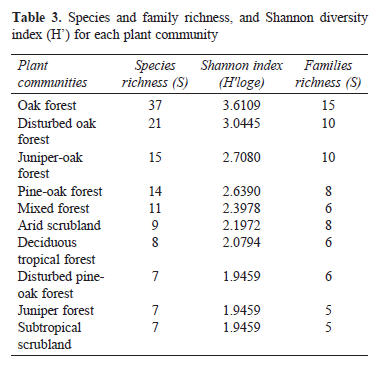
	    <p align="justify"><font face="verdana" size="2">The genus <i>Quercus</i> had significantly more aphyllophoroid species than substrates of other genera. However, when the host species were analyzed one by one, <i>Arctostaphylos pungens,</i> <i>Quercus eduardii</i> and <i>Q. potosina,</i> were found to be the species that held most aphyllophoroid species (<a href="#t2">Table 2</a>). Similarly, the highest fungal diversity was found in oak forest with 37 species and a diversity of 3.6 (H'= 3.6), followed by disturbed oak forest with 21 species and H'= 3.0 (<a href="#t3">Table 3</a>). By contrast scrubland, deciduous tropical forest and juniper forest had the lowest fungal diversity with less than 10 species and H'&lt; 2.2 each (<a href="#t3">Table 3</a>)</font></p>

	    <p align="center"><font face="verdana" size="2"><a name="t2"></a></font></p>

	    ]]></body>
<body><![CDATA[<p align="center"><font face="verdana" size="2"><img src="/img/revistas/rmbiodiv/v85n4/a1t2.jpg"></font></p>

	    <p align="center"><font face="verdana" size="2"><a name="t3"></a></font></p>

	    <p align="center"><font face="verdana" size="2"><img src="/img/revistas/rmbiodiv/v85n4/a1t3.jpg"></font></p>

	    <p align="justify"><font face="verdana" size="2">Oak forest and disturbed oak forest had the highest number of fungal species and families (<a href="/img/revistas/rmbiodiv/v85n4/a1f2.jpg" target="_blank">Fig. 2</a>), while subtropical scrubland forest, juniper forest and arid scrubland had the lowest species and family richness. Nevertheless, the plant communities with the highest species diversity had a lower family/species proportion value than the plant communities, which denotes a lower species diversity. That is, in the subtropical scrubland, juniper forest and arid scrubland the probability of a species belonging to a different family was found to be higher than in oak forest and disturbed oak forest. In fact, almost all of the species found in these plant communities belonged to different families.</font></p>

	    <p align="justify"><font face="verdana" size="2">In the MDS analysis, 3 significantly differentiated groups were identified by the Simprof procedure (<a href="/img/revistas/rmbiodiv/v85n4/a1f3.jpg" target="_blank">Fig. 3</a>). The principal factor for the differentiation of fungal composition was the woody species of the different plant communities. In fact, the plant communities with <i>Quercus</i> species constituted one distinct group, those with scrub species formed another and those with tropical species comprised a third. Likewise, within each group the similarity of the aphyllophoroid communities was higher when more woody species were shared.</font></p>

	    <p align="justify"><font face="verdana" size="2">Regarding the species composition of the different plant communities, temperate forests have in common some species that are known as cosmopolites. Examples include <i>H. litschaueri</i>, <i>Peniophorella praetermissa</i>, <i>Phanerochaete galactites</i>, <i>P. laevis</i> (Fr.) J. Erikss. and Ryvarden and <i>P. sordida</i> (P. Karst.) J. Erikss and Ryvarden.</font></p>

	    <p align="justify"><font face="verdana" size="2">&nbsp;</font></p>

	    <p align="justify"><font face="verdana" size="2"><b>Discussion</b></font></p>

	    <p align="justify"><font face="verdana" size="2">Although the fieldwork for this study was carried out within a year, 81 species were identified. According to our data, 55 species were recorded for the first time in the area (these species are marked with an asterisk in <a href="/img/revistas/rmbiodiv/v85n4/a1t1.jpg" target="_blank">Table 1</a>).</font></p>

	    <p align="justify"><font face="verdana" size="2">Different patterns of species distribution were observed. Many of the species documented have a wide distribution, and occur in most continents, e.g. <i>P. praetermissa,</i> <i>P. sordida</i> and <i>S. paradoxa,</i> which are well known from deciduous forests and occur on a wide range of substrates (Breitenbach and Kr&auml;nzlin, 1986). Other species are exclusive to the Americas, such as <i>Inonotus quercustris</i>, which is known from the USA on <i>Quercus nigra</i> (Gilbertson and Ryvarden, 1986); from Mexico in Quer&eacute;taro State on <i>Quercus</i> sp. (Valenzuela et al., 2013) and from Argentina on <i>Lithraea ternifolia</i> and on <i>Acacia caven</i> (Urcelay and Rajchenberg, 1999)<i>.</i> Likewise<i>, P. albobadia</i> has been recorded from Mexico, USA, Central and South America on several substrates (Nakasone, 1990). Finally, other species that have previously been considered as American are currently being cited in other territories, e.g. <i>Phanerochaete xerophila</i> Burds., which has been reported by Burdsall (1985) as a common species from the Sonoran Desert, growing on dead fallen branches of shrubs, cacti and on <i>Prosopis velutina</i>. In our study we found this species on <i>Quercus</i> sp. in oak and pine&#45;oak forests. The same species has also been reported from Uruguay on <i>Scutia buxifolia</i> (Mart&iacute;nez and Nakasone 2005) and from Cabo Verde on <i>Sarcostenma daltonii</i>, <i>Prosopis</i> sp., and on <i>Phoenix atlantica</i> (Teller&iacute;a pers. comm.). Another example is <i>Porostereum crassum</i>, which is a common species in America and was first reported from Spain by Salcedo and Olariaga (2008). The number of aphyllophoroid species was found to be higher in temperate forests than in scrublands. This could be partially explained by the exceptionally dry conditions of the sampling year. In fact, the scrublands were particularly affected that year, while forests conserved more humid conditions required for basidiomata production. Thus, few specimens were gathered in scrublands and those collected were mostly in poor condition for identification. Therefore, the potential of scrublands to host mycobiota could be higher than observed in this study.</font></p>

	    ]]></body>
<body><![CDATA[<p align="justify"><font face="verdana" size="2">The MDS result was expected, as most fungal species are specific to their host (Stokland et al., 2012). The similarities in terms of woody plant composition between the different plant communities were reflected in the structure of the aphyllophoroid community. The first group identified corresponded to temperate forest formations, which share many woody plant species (e. g.	<i>Quercus</i> spp., <i>Arctostaphyllos pungens</i>, etc.) and also have similar climate conditions that influence the fungal guild structure. Most of the species that appeared in all the temperate forest plant communities have a cosmopolitan distribution, e.g. <i>H. litschaueri</i>, <i>P. praetermissa</i> and <i>P. galactites</i> (Bernicchia and Gorj&oacute;n, 2010). The second group, formed by arid and subtropical scrublands, also shares some species (cacti, <i>Acacia</i> spp. and <i>Mimosa</i> spp.) and similar climate conditions. <i>Peniophora albobadia</i> and <i>P. rimosus</i> were found in both types of scrubland. These species are characterized by being more common to the tropics, to warm and arid zones, although they are almost cosmopolitan (Boidin, 1994; Ryvarden and Gilbertson, 1994; Bernicchia, 2005). The only species that was not common to both types of scrubland (<i>Phanerochaete cacaina</i> (Bourdot and Galzin) Burds. and Gilb.) grew on <i>Ipomoea murucoides</i>, which is one of the woody plant species that differentiates between the 2 types. Nevertheless, this species does not seem to be exclusive in this plant community, since it has been reported on <i>Pinus</i> in Europe and the USA (Burdsall, 1985; Eriksson et al., 1978). Finally, the fungal composition of deciduous tropical forest proved to be the most dissimilar of all the plant communities. This plant community is dominated by woody species that do not occur anywhere else in Aguascalientes (<i>Manihot</i> sp., <i>Ceiba</i> sp., <i>Amphipterygium adstringens</i>, among others), which could explain the dissimilarities in fungal composition. However, this result must be taken with caution since the majority of the species identified were cosmopolitan, although some tropical species also appeared (<i>Subulicystidium perlongisporum</i> Boidin and Gilles). Further investigations are needed to determine if this trend is maintained throughout deciduous tropical forest.</font></p>

	    <p align="justify"><font face="verdana" size="2">&nbsp;</font></p>

	    <p align="justify"><font face="verdana" size="2"><b>Acknowledgements</b></font></p>

	    <p align="justify"><font face="verdana" size="2">To the working group of the botany lab of the UAA for their support in fieldwork, and especially Gabriela Delgadillo Quesada for coming with us to the sampling sites, her help has been invaluable. We thank the two anonymous reviewers for thoroughly reviewing the manuscript and for their constructive comments.</font></p>

	    <p align="justify"><font face="verdana" size="2">&nbsp;</font></p>

	    <p align="justify"><font face="verdana" size="2"><b>Literature cited</b></font></p>

	    <!-- ref --><p align="justify"><font face="verdana" size="2">Amalfi, M., T. Raymundo, R. Valenzuela and C. Decock. 2012. <i>Fomitiporia cupressicola</i> sp. nov., parasite on <i>Cupressus arizonica</i>, and additional unnamed clades in the southern USA and northern Mexico, evidenced by multilocus phylogenetic analyses. Mycologia 104:880&#45;893.    &nbsp;&nbsp;&nbsp;&nbsp;&nbsp;&nbsp;&nbsp;&nbsp;[&#160;<a href="javascript:void(0);" onclick="javascript: window.open('/scielo.php?script=sci_nlinks&ref=7673353&pid=S1870-3453201400050000100001&lng=','','width=640,height=500,resizable=yes,scrollbars=1,menubar=yes,');">Links</a>&#160;]<!-- end-ref --></font></p>

	    <!-- ref --><p align="justify"><font face="verdana" size="2">Bernicchia, A. 2005. Polyporaceae. Candusso. Italy. 808 p.    &nbsp;&nbsp;&nbsp;&nbsp;&nbsp;&nbsp;&nbsp;&nbsp;[&#160;<a href="javascript:void(0);" onclick="javascript: window.open('/scielo.php?script=sci_nlinks&ref=7673355&pid=S1870-3453201400050000100002&lng=','','width=640,height=500,resizable=yes,scrollbars=1,menubar=yes,');">Links</a>&#160;]<!-- end-ref --></font></p>

	    ]]></body>
<body><![CDATA[<!-- ref --><p align="justify"><font face="verdana" size="2">Bernicchia, A. and S. P. Gorj&oacute;n. 2010. Corticiaceae s. l. Cadusso. Italy. 1008 p.    &nbsp;&nbsp;&nbsp;&nbsp;&nbsp;&nbsp;&nbsp;&nbsp;[&#160;<a href="javascript:void(0);" onclick="javascript: window.open('/scielo.php?script=sci_nlinks&ref=7673357&pid=S1870-3453201400050000100003&lng=','','width=640,height=500,resizable=yes,scrollbars=1,menubar=yes,');">Links</a>&#160;]<!-- end-ref --></font></p>

	    <!-- ref --><p align="justify"><font face="verdana" size="2">Boidin, J. 1994. Les Peniophoraceae des parties temp&eacute;r&eacute;es et froides de l'h&eacute;misph&egrave;re nord (Basidiomycotina). Bulletin mensuel de la Soci&eacute;t&eacute; linn&eacute;enne de Lyon 63:317&#45;334.    &nbsp;&nbsp;&nbsp;&nbsp;&nbsp;&nbsp;&nbsp;&nbsp;[&#160;<a href="javascript:void(0);" onclick="javascript: window.open('/scielo.php?script=sci_nlinks&ref=7673359&pid=S1870-3453201400050000100004&lng=','','width=640,height=500,resizable=yes,scrollbars=1,menubar=yes,');">Links</a>&#160;]<!-- end-ref --></font></p>

	    <!-- ref --><p align="justify"><font face="verdana" size="2">Boidin, J. and G. Gilles. 1988. Basidiomyc&egrave;tes aphyllophorales de IIIe de la R&eacute;union XII &#45; le genre <i>Subulicystidium</i> Parmasto. Bulletin de la Soci&eacute;t&eacute; Mycologique de France. 104:191&#45;198.    &nbsp;&nbsp;&nbsp;&nbsp;&nbsp;&nbsp;&nbsp;&nbsp;[&#160;<a href="javascript:void(0);" onclick="javascript: window.open('/scielo.php?script=sci_nlinks&ref=7673361&pid=S1870-3453201400050000100005&lng=','','width=640,height=500,resizable=yes,scrollbars=1,menubar=yes,');">Links</a>&#160;]<!-- end-ref --></font></p>

	    <!-- ref --><p align="justify"><font face="verdana" size="2">Breitenbach, J. and F. Kr&auml;nzlin. 1986. Fungi of Switzerland. Vol 2. Mykologia Luzern. Switzerland. 412 p.    &nbsp;&nbsp;&nbsp;&nbsp;&nbsp;&nbsp;&nbsp;&nbsp;[&#160;<a href="javascript:void(0);" onclick="javascript: window.open('/scielo.php?script=sci_nlinks&ref=7673363&pid=S1870-3453201400050000100006&lng=','','width=640,height=500,resizable=yes,scrollbars=1,menubar=yes,');">Links</a>&#160;]<!-- end-ref --></font></p>

	    <!-- ref --><p align="justify"><font face="verdana" size="2">Burdsall, H. H. Jr. 1985. A contribution to the Taxonomy of the Genus <i>Phanerochaete</i>. Mycologia memoir No. 10 J. Cramer. Braunschweig. 165 p.    &nbsp;&nbsp;&nbsp;&nbsp;&nbsp;&nbsp;&nbsp;&nbsp;[&#160;<a href="javascript:void(0);" onclick="javascript: window.open('/scielo.php?script=sci_nlinks&ref=7673365&pid=S1870-3453201400050000100007&lng=','','width=640,height=500,resizable=yes,scrollbars=1,menubar=yes,');">Links</a>&#160;]<!-- end-ref --></font></p>

	    ]]></body>
<body><![CDATA[<!-- ref --><p align="justify"><font face="verdana" size="2">Clarke, K. R. and R. M. Warwick. 2001. Change in marine communities: an approach to statistical analysis and interpretation. Plymouth, UK: PRIMER&#45;E Ltd. 171 p.    &nbsp;&nbsp;&nbsp;&nbsp;&nbsp;&nbsp;&nbsp;&nbsp;[&#160;<a href="javascript:void(0);" onclick="javascript: window.open('/scielo.php?script=sci_nlinks&ref=7673367&pid=S1870-3453201400050000100008&lng=','','width=640,height=500,resizable=yes,scrollbars=1,menubar=yes,');">Links</a>&#160;]<!-- end-ref --></font></p>

	    <!-- ref --><p align="justify"><font face="verdana" size="2">Clarke, K. R. and R. N. Gorley. 2006. PRIMER v6: User manual/tutorial, PRIMER&#45;E, Plymouth UK.    &nbsp;&nbsp;&nbsp;&nbsp;&nbsp;&nbsp;&nbsp;&nbsp;[&#160;<a href="javascript:void(0);" onclick="javascript: window.open('/scielo.php?script=sci_nlinks&ref=7673369&pid=S1870-3453201400050000100009&lng=','','width=640,height=500,resizable=yes,scrollbars=1,menubar=yes,');">Links</a>&#160;]<!-- end-ref --></font></p>

	    <!-- ref --><p align="justify"><font face="verdana" size="2">Contreras&#45;Pacheco, M. M., L. P&eacute;rez&#45;Ram&iacute;rez and J. Cifuentes&#45;Blanco. 2012. Estudio taxon&oacute;mico de hongos corticioides (Hymenomycetes: Fungi) poco conocidos en M&eacute;xico. Revista Mexicana de Biodiversidad 83:15&#45;22.    &nbsp;&nbsp;&nbsp;&nbsp;&nbsp;&nbsp;&nbsp;&nbsp;[&#160;<a href="javascript:void(0);" onclick="javascript: window.open('/scielo.php?script=sci_nlinks&ref=7673371&pid=S1870-3453201400050000100010&lng=','','width=640,height=500,resizable=yes,scrollbars=1,menubar=yes,');">Links</a>&#160;]<!-- end-ref --></font></p>

	    <!-- ref --><p align="justify"><font face="verdana" size="2">Eriksson, J. and L. Ryvarden. 1973. The Corticiaceae of North Europe (<i>Aleurodiscus&#45;Confertobasidium</i>). Vol. 2. Fungiflora. Oslo. p. 59&#45;286.    &nbsp;&nbsp;&nbsp;&nbsp;&nbsp;&nbsp;&nbsp;&nbsp;[&#160;<a href="javascript:void(0);" onclick="javascript: window.open('/scielo.php?script=sci_nlinks&ref=7673373&pid=S1870-3453201400050000100011&lng=','','width=640,height=500,resizable=yes,scrollbars=1,menubar=yes,');">Links</a>&#160;]<!-- end-ref --></font></p>

	    <!-- ref --><p align="justify"><font face="verdana" size="2">Eriksson, J. and L. Ryvarden. 1975. The Corticiaceae of North Europe (<i>Coronicium&#45;Hyphoderma</i>). Vol. 3. Fungiflora. Oslo. p. 287&#45;546.    &nbsp;&nbsp;&nbsp;&nbsp;&nbsp;&nbsp;&nbsp;&nbsp;[&#160;<a href="javascript:void(0);" onclick="javascript: window.open('/scielo.php?script=sci_nlinks&ref=7673375&pid=S1870-3453201400050000100012&lng=','','width=640,height=500,resizable=yes,scrollbars=1,menubar=yes,');">Links</a>&#160;]<!-- end-ref --></font></p>

	    ]]></body>
<body><![CDATA[<!-- ref --><p align="justify"><font face="verdana" size="2">Eriksson, J. and L. Ryvarden. 1976. The Corticiaceae of North Europe (<i>Hyphodermella&#45;Mycoacia</i>). Vol. 4. Fungiflora. Oslo. p. 547&#45;886.    &nbsp;&nbsp;&nbsp;&nbsp;&nbsp;&nbsp;&nbsp;&nbsp;[&#160;<a href="javascript:void(0);" onclick="javascript: window.open('/scielo.php?script=sci_nlinks&ref=7673377&pid=S1870-3453201400050000100013&lng=','','width=640,height=500,resizable=yes,scrollbars=1,menubar=yes,');">Links</a>&#160;]<!-- end-ref --></font></p>

	    <!-- ref --><p align="justify"><font face="verdana" size="2">Eriksson, J., K. Hjortstam and L. Ryvarden. 1978. The Corticiaceae of North Europe (<i>Mycoaciella&#45;Phanerochaete</i>). Vol. 5. Fungiflora. Oslo. p. 887&#45;1048.    &nbsp;&nbsp;&nbsp;&nbsp;&nbsp;&nbsp;&nbsp;&nbsp;[&#160;<a href="javascript:void(0);" onclick="javascript: window.open('/scielo.php?script=sci_nlinks&ref=7673379&pid=S1870-3453201400050000100014&lng=','','width=640,height=500,resizable=yes,scrollbars=1,menubar=yes,');">Links</a>&#160;]<!-- end-ref --></font></p>

	    <!-- ref --><p align="justify"><font face="verdana" size="2">Eriksson, J., K. Hjortstam and L. Ryvarden. 1981. The Corticiaceae of North Europe (<i>Phlebia&#45;Sarcodontia</i>). Vol. 6. Fungiflora. Oslo. p. 1049&#45;1276.    &nbsp;&nbsp;&nbsp;&nbsp;&nbsp;&nbsp;&nbsp;&nbsp;[&#160;<a href="javascript:void(0);" onclick="javascript: window.open('/scielo.php?script=sci_nlinks&ref=7673381&pid=S1870-3453201400050000100015&lng=','','width=640,height=500,resizable=yes,scrollbars=1,menubar=yes,');">Links</a>&#160;]<!-- end-ref --></font></p>

	    <!-- ref --><p align="justify"><font face="verdana" size="2">Eriksson, J., K. Hjortstam and L. Ryvarden. 1984. The Corticiaceae of North Europe (<i>Schizopora&#45; Suillosporium</i>). Vol. 7. Fungiflora. Oslo. p. 1279&#45;1449.    &nbsp;&nbsp;&nbsp;&nbsp;&nbsp;&nbsp;&nbsp;&nbsp;[&#160;<a href="javascript:void(0);" onclick="javascript: window.open('/scielo.php?script=sci_nlinks&ref=7673383&pid=S1870-3453201400050000100016&lng=','','width=640,height=500,resizable=yes,scrollbars=1,menubar=yes,');">Links</a>&#160;]<!-- end-ref --></font></p>

	    <!-- ref --><p align="justify"><font face="verdana" size="2">Gilbertson, R. L. and L. Ryvarden. 1986. North American polypores II. Fungiflora. Oslo. 433 p.    &nbsp;&nbsp;&nbsp;&nbsp;&nbsp;&nbsp;&nbsp;&nbsp;[&#160;<a href="javascript:void(0);" onclick="javascript: window.open('/scielo.php?script=sci_nlinks&ref=7673385&pid=S1870-3453201400050000100017&lng=','','width=640,height=500,resizable=yes,scrollbars=1,menubar=yes,');">Links</a>&#160;]<!-- end-ref --></font></p>

	    ]]></body>
<body><![CDATA[<!-- ref --><p align="justify"><font face="verdana" size="2">Heilmann&#45;Clausen, J., E. Aude and M. Christensen. 2005. Cryptogamn communities on decaying deciduous wood: does tree species diversity matter? Biodiversity and Conservation 114:2061&#45;2078.    &nbsp;&nbsp;&nbsp;&nbsp;&nbsp;&nbsp;&nbsp;&nbsp;[&#160;<a href="javascript:void(0);" onclick="javascript: window.open('/scielo.php?script=sci_nlinks&ref=7673387&pid=S1870-3453201400050000100018&lng=','','width=640,height=500,resizable=yes,scrollbars=1,menubar=yes,');">Links</a>&#160;]<!-- end-ref --></font></p>

	    <!-- ref --><p align="justify"><font face="verdana" size="2">Hibbett, D. S., M. Binder, J. F. Bischoff, M. Blackwell, P. F. Cannon, O. E. Eriksson, S. Huhndorf, T. James, P. M. Kirk, R. L&uuml;cking, H. Thorsten Lumbsch, F. Lutzoni, P. B. Matheny, D. J. Mclaughlin, M. J. Powell, S. Redhead, C. L. Schoch, J. W. Spatafora, J. A. Stalpers, R. Vilgalys, M. C. Aime, A. Aptroot, R. Bauer, D. Begerow, G. L. Benny, L. A. Castlebury, P. W. Crous, Y. Dai, W. Gams, D. M. Geiser, G. W. Griffith, C. Gueidan, D. L. Hawksworth, G. Hestmark, K. Hosaka, R. A. Humber, K. D. Hyde, J. E. Ironside, U. K&otilde;ljalg, C. P. Kurtzman, K. Larsson, R. Lichtwardt, J. Longcore, J. Mi&#261;dlikowska, A. Miller, J. Moncalvo, S. Mozley&#45;Standridge, F. Oberwinkler, E. Parmasto, V. Reeb, J. D. Rogers, C. Roux, L. Ryvarden, J. P. Sampaio, A. Sch&uuml;&#223;ler, J. Sugiyama, R. G. Thorn, L. Tibell, W. A. Untereiner, C. Walker, Z. Wang, A. Weir, M. Weiss, M. M. White, K. Winka, Y. Yao, and N. Zhang. 2007. A higher&#45;level phylogenetic classification of the Fungi. Mycological Research 111:509&#45;547.    &nbsp;&nbsp;&nbsp;&nbsp;&nbsp;&nbsp;&nbsp;&nbsp;[&#160;<a href="javascript:void(0);" onclick="javascript: window.open('/scielo.php?script=sci_nlinks&ref=7673389&pid=S1870-3453201400050000100019&lng=','','width=640,height=500,resizable=yes,scrollbars=1,menubar=yes,');">Links</a>&#160;]<!-- end-ref --></font></p>

	    <!-- ref --><p align="justify"><font face="verdana" size="2">Hjortstam, K., K. H. Larsson and L. Ryvarden. 1987. The Corticiaceae of North Europe (Introduction and keys). Vol. 1. Fungiflora. Oslo. 59 p.    &nbsp;&nbsp;&nbsp;&nbsp;&nbsp;&nbsp;&nbsp;&nbsp;[&#160;<a href="javascript:void(0);" onclick="javascript: window.open('/scielo.php?script=sci_nlinks&ref=7673391&pid=S1870-3453201400050000100020&lng=','','width=640,height=500,resizable=yes,scrollbars=1,menubar=yes,');">Links</a>&#160;]<!-- end-ref --></font></p>

	    <!-- ref --><p align="justify"><font face="verdana" size="2">Hjortstam, K., K. H. Larsson and L. Ryvarden. 1988. The Corticiaceae of North Europe (<i>Thanatephorus&#45;Ypsilonidium</i>). Vol. 8. Fungiflora. Oslo. p. 1450&#45;1631.    &nbsp;&nbsp;&nbsp;&nbsp;&nbsp;&nbsp;&nbsp;&nbsp;[&#160;<a href="javascript:void(0);" onclick="javascript: window.open('/scielo.php?script=sci_nlinks&ref=7673393&pid=S1870-3453201400050000100021&lng=','','width=640,height=500,resizable=yes,scrollbars=1,menubar=yes,');">Links</a>&#160;]<!-- end-ref --></font></p>

	    <!-- ref --><p align="justify"><font face="verdana" size="2">Inegi (Instituto Nacional de Estad&iacute;stica y Geograf&iacute;a). 2008. Descripci&oacute;n del medio f&iacute;sico I: climas. <i>In</i> La biodiversidad en Aguascalientes: estudio de estado. H. &Aacute;vila, E. D. Melgarejo and A. Cruz (eds). Comisi&oacute;n Nacional para el Conocimiento y Uso de la Biodiversidad (Conabio), Instituto del Medio Ambiente del Estado de Aguascalientes (Imae), Universidad Aut&oacute;noma de Aguascalientes (UAA). M&eacute;xico, D. F. p. 37&#45;42.    &nbsp;&nbsp;&nbsp;&nbsp;&nbsp;&nbsp;&nbsp;&nbsp;[&#160;<a href="javascript:void(0);" onclick="javascript: window.open('/scielo.php?script=sci_nlinks&ref=7673395&pid=S1870-3453201400050000100022&lng=','','width=640,height=500,resizable=yes,scrollbars=1,menubar=yes,');">Links</a>&#160;]<!-- end-ref --></font></p>

	    ]]></body>
<body><![CDATA[<!-- ref --><p align="justify"><font face="verdana" size="2">K&otilde;ljalg, U. 1996. <i>Tomentella</i> (Basidiomycota) and related genera in Temperate Eurasia. Fungiflora. Oslo. 213 p.    &nbsp;&nbsp;&nbsp;&nbsp;&nbsp;&nbsp;&nbsp;&nbsp;[&#160;<a href="javascript:void(0);" onclick="javascript: window.open('/scielo.php?script=sci_nlinks&ref=7673397&pid=S1870-3453201400050000100023&lng=','','width=640,height=500,resizable=yes,scrollbars=1,menubar=yes,');">Links</a>&#160;]<!-- end-ref --></font></p>

	    <!-- ref --><p align="justify"><font face="verdana" size="2">Langer, E. 1994. Die Gattung <i>Hyphodontia</i> John Eriksson. Bibliotheca Mycologica 154:1&#45;298.    &nbsp;&nbsp;&nbsp;&nbsp;&nbsp;&nbsp;&nbsp;&nbsp;[&#160;<a href="javascript:void(0);" onclick="javascript: window.open('/scielo.php?script=sci_nlinks&ref=7673399&pid=S1870-3453201400050000100024&lng=','','width=640,height=500,resizable=yes,scrollbars=1,menubar=yes,');">Links</a>&#160;]<!-- end-ref --></font></p>

	    <!-- ref --><p align="justify"><font face="verdana" size="2">L&eacute;ger, J. C. 1998. Le genre <i>Hymenochaete</i> L&eacute;veill&eacute;. J. Cramer. Berlin. 319 p.    &nbsp;&nbsp;&nbsp;&nbsp;&nbsp;&nbsp;&nbsp;&nbsp;[&#160;<a href="javascript:void(0);" onclick="javascript: window.open('/scielo.php?script=sci_nlinks&ref=7673401&pid=S1870-3453201400050000100025&lng=','','width=640,height=500,resizable=yes,scrollbars=1,menubar=yes,');">Links</a>&#160;]<!-- end-ref --></font></p>

	    <!-- ref --><p align="justify"><font face="verdana" size="2">Lozano, L. F. and V. E. Estrada. 2008. Conservaci&oacute;n de la biodiversidad. <i>In</i> La biodiversidad en Aguascalientes: estudio de estado. H. &Aacute;vila, E. D. Melgarejo and A. Cruz (eds). Comisi&oacute;n Nacional para el Conocimiento y Uso de la Biodiversidad (Conabio), Instituto del Medio Ambiente del Estado de Aguascalientes (Imae), Universidad Aut&oacute;noma de Aguascalientes (UAA). M&eacute;xico, D. F. 385 p.    &nbsp;&nbsp;&nbsp;&nbsp;&nbsp;&nbsp;&nbsp;&nbsp;[&#160;<a href="javascript:void(0);" onclick="javascript: window.open('/scielo.php?script=sci_nlinks&ref=7673403&pid=S1870-3453201400050000100026&lng=','','width=640,height=500,resizable=yes,scrollbars=1,menubar=yes,');">Links</a>&#160;]<!-- end-ref --></font></p>

	    <!-- ref --><p align="justify"><font face="verdana" size="2">Marmolejo J. G. and H. M&eacute;ndez&#45;Cortes. 2007. Diversidad de hongos causantes de pudrici&oacute;n de la madera en cinco especies de pinos en Nuevo Le&oacute;n, M&eacute;xico. Revista Mexicana de Micolog&iacute;a 25:51&#45;57.    &nbsp;&nbsp;&nbsp;&nbsp;&nbsp;&nbsp;&nbsp;&nbsp;[&#160;<a href="javascript:void(0);" onclick="javascript: window.open('/scielo.php?script=sci_nlinks&ref=7673405&pid=S1870-3453201400050000100027&lng=','','width=640,height=500,resizable=yes,scrollbars=1,menubar=yes,');">Links</a>&#160;]<!-- end-ref --></font></p>

	    ]]></body>
<body><![CDATA[<!-- ref --><p align="justify"><font face="verdana" size="2">Mart&iacute;nez, S. and K. K. Nakasone. 2005. The genus <i>Phanerochaete</i> (Corticiaceae, Basidiomycotina) sensu lato in Uruguay. Sydowia 57:94&#45;101.    &nbsp;&nbsp;&nbsp;&nbsp;&nbsp;&nbsp;&nbsp;&nbsp;[&#160;<a href="javascript:void(0);" onclick="javascript: window.open('/scielo.php?script=sci_nlinks&ref=7673407&pid=S1870-3453201400050000100028&lng=','','width=640,height=500,resizable=yes,scrollbars=1,menubar=yes,');">Links</a>&#160;]<!-- end-ref --></font></p>

	    <!-- ref --><p align="justify"><font face="verdana" size="2">Matheny, P. B., Z. Wang, M. Binder, J. M. Curtis, Y. W. Lim, R. Henrik Nilsson, K. W. Hughes, V. Hofstetter, J. F. Ammirati, C. L. Schoch, E. Langer, G. Langer, D. J. Mclaughlin, A. W. Wilson, T. Fr&#248;slev, Z. Ge, R. W. Kerrigan, J. C. Slot, Z. Yang, T. J. Baroni, M. Fischer, K. Hosaka, K. Matsuura, M. T. Seidl, J. Vauras and D. S. Hibbett. 2007. Contributions of rpb2 and tef1 to the phylogeny of mushrooms and allies (Basidiomycota, Fungi). Molecular Phylogenetics and Evolution. 43:430&#45;451.    &nbsp;&nbsp;&nbsp;&nbsp;&nbsp;&nbsp;&nbsp;&nbsp;[&#160;<a href="javascript:void(0);" onclick="javascript: window.open('/scielo.php?script=sci_nlinks&ref=7673409&pid=S1870-3453201400050000100029&lng=','','width=640,height=500,resizable=yes,scrollbars=1,menubar=yes,');">Links</a>&#160;]<!-- end-ref --></font></p>

	    <!-- ref --><p align="justify"><font face="verdana" size="2">Monta&ntilde;o, A., R. Valenzuela, A. S&aacute;nchez, M. Coronado and M. Esqueda. 2006. Aphyllophorales de Sonora, M&eacute;xico, I. Algunas especies de la Reserva Forestal Nacional y Refugio de Fauna Silvestre Ajos&#45;Bavispe. Revista Mexicana de Micolog&iacute;a 23:17&#45;26.    &nbsp;&nbsp;&nbsp;&nbsp;&nbsp;&nbsp;&nbsp;&nbsp;[&#160;<a href="javascript:void(0);" onclick="javascript: window.open('/scielo.php?script=sci_nlinks&ref=7673411&pid=S1870-3453201400050000100030&lng=','','width=640,height=500,resizable=yes,scrollbars=1,menubar=yes,');">Links</a>&#160;]<!-- end-ref --></font></p>

	    <!-- ref --><p align="justify"><font face="verdana" size="2">Nakasone, K. K. 1990. Cultural studies and identification of wood&#45;inhabiting Corticiaceae and selected Hymenomycetes from North America. Mycologia Memoirs 15:1&#45;412.    &nbsp;&nbsp;&nbsp;&nbsp;&nbsp;&nbsp;&nbsp;&nbsp;[&#160;<a href="javascript:void(0);" onclick="javascript: window.open('/scielo.php?script=sci_nlinks&ref=7673413&pid=S1870-3453201400050000100031&lng=','','width=640,height=500,resizable=yes,scrollbars=1,menubar=yes,');">Links</a>&#160;]<!-- end-ref --></font></p>

	    <!-- ref --><p align="justify"><font face="verdana" size="2">N&uacute;&ntilde;ez, M. and L. Ryvarden. 1997. The genus <i>Aleurodiscus</i> (Basidiomycotina). Fungiflora. Oslo. 164 p.    &nbsp;&nbsp;&nbsp;&nbsp;&nbsp;&nbsp;&nbsp;&nbsp;[&#160;<a href="javascript:void(0);" onclick="javascript: window.open('/scielo.php?script=sci_nlinks&ref=7673415&pid=S1870-3453201400050000100032&lng=','','width=640,height=500,resizable=yes,scrollbars=1,menubar=yes,');">Links</a>&#160;]<!-- end-ref --></font></p>

	    ]]></body>
<body><![CDATA[<!-- ref --><p align="justify"><font face="verdana" size="2">&Oacute;dor, P., J. Heilmann&#45;Clausen, M. Christensen, E. Aude, K. Dort, A. Piltaver, I. Siller, M. Veerkamp, R. Walleym, T. Standovar, A.Van Hees, J. Kosec , N. Matocec, H. Pardav&eacute; L. M., L. Flores&#45;Pardav&eacute;, V. Franco&#45;Ruiz&#45;Esparza and M. Robledo&#45;Cort&eacute;s. 2007. Contribuci&oacute;n al conocimiento de los hongos (Macromicetos) de la Sierra Fr&iacute;a, Aguascalientes. Universidad Aut&oacute;noma de Aguascalientes. Investigaci&oacute;n y Ciencia 37:4&#45;12.    &nbsp;&nbsp;&nbsp;&nbsp;&nbsp;&nbsp;&nbsp;&nbsp;[&#160;<a href="javascript:void(0);" onclick="javascript: window.open('/scielo.php?script=sci_nlinks&ref=7673417&pid=S1870-3453201400050000100033&lng=','','width=640,height=500,resizable=yes,scrollbars=1,menubar=yes,');">Links</a>&#160;]<!-- end-ref --></font></p>

	    <!-- ref --><p align="justify"><font face="verdana" size="2">Raymundo, T. and R. Valenzuela. 2003. Los Polipor&aacute;ceos de M&eacute;xico VI. Los hongos Poliporoides del estado de Oaxaca. Polibot&aacute;nica 16:79&#45;111.    &nbsp;&nbsp;&nbsp;&nbsp;&nbsp;&nbsp;&nbsp;&nbsp;[&#160;<a href="javascript:void(0);" onclick="javascript: window.open('/scielo.php?script=sci_nlinks&ref=7673419&pid=S1870-3453201400050000100034&lng=','','width=640,height=500,resizable=yes,scrollbars=1,menubar=yes,');">Links</a>&#160;]<!-- end-ref --></font></p>

	    <!-- ref --><p align="justify"><font face="verdana" size="2">Raymundo, T., R. Valenzuela and M. Esqueda. 2009. The family <i>Hymenochaetaceae</i> from M&eacute;xico 4. New records from Sierra de &Aacute;lamos&#45;R&iacute;o Cuchujaqui Biosphere Reserve. Mycotaxon 110:387&#45;398.    &nbsp;&nbsp;&nbsp;&nbsp;&nbsp;&nbsp;&nbsp;&nbsp;[&#160;<a href="javascript:void(0);" onclick="javascript: window.open('/scielo.php?script=sci_nlinks&ref=7673421&pid=S1870-3453201400050000100035&lng=','','width=640,height=500,resizable=yes,scrollbars=1,menubar=yes,');">Links</a>&#160;]<!-- end-ref --></font></p>

	    <!-- ref --><p align="justify"><font face="verdana" size="2">Rodr&iacute;guez&#45;&Aacute;valos, J. A. 2014. An&aacute;lisis espacial de la vegetaci&oacute;n de Aguascalientes. Distribuci&oacute;n geogr&aacute;fica y descripci&oacute;n de las comunidades vegetales naturales de Aguascalientes. Tesis, Facultad de Ciencias B&aacute;sicas, Universidad Aut&oacute;noma de Aguascalientes. Aguascalientes. 295 p.    &nbsp;&nbsp;&nbsp;&nbsp;&nbsp;&nbsp;&nbsp;&nbsp;[&#160;<a href="javascript:void(0);" onclick="javascript: window.open('/scielo.php?script=sci_nlinks&ref=7673423&pid=S1870-3453201400050000100036&lng=','','width=640,height=500,resizable=yes,scrollbars=1,menubar=yes,');">Links</a>&#160;]<!-- end-ref --></font></p>

	    <!-- ref --><p align="justify"><font face="verdana" size="2">Ryvarden, L. and R. L. Gilbertson. 1994. European polypores (<i>Meripilus&#45;Tyromyces</i>). Vol. 2. Fungiflora. Oslo. p. 394&#45;743.    &nbsp;&nbsp;&nbsp;&nbsp;&nbsp;&nbsp;&nbsp;&nbsp;[&#160;<a href="javascript:void(0);" onclick="javascript: window.open('/scielo.php?script=sci_nlinks&ref=7673425&pid=S1870-3453201400050000100037&lng=','','width=640,height=500,resizable=yes,scrollbars=1,menubar=yes,');">Links</a>&#160;]<!-- end-ref --></font></p>

	    ]]></body>
<body><![CDATA[<!-- ref --><p align="justify"><font face="verdana" size="2">Salcedo, I. and I. Olariaga. 2008. <i>Phanerochaete crassa</i> (L&eacute;v.) Burds., nueva cita para la micoflora de la pen&iacute;nsula ib&eacute;rica. Revista Catalana de Micolog&iacute;a 30:93&#45;99.    &nbsp;&nbsp;&nbsp;&nbsp;&nbsp;&nbsp;&nbsp;&nbsp;[&#160;<a href="javascript:void(0);" onclick="javascript: window.open('/scielo.php?script=sci_nlinks&ref=7673427&pid=S1870-3453201400050000100038&lng=','','width=640,height=500,resizable=yes,scrollbars=1,menubar=yes,');">Links</a>&#160;]<!-- end-ref --></font></p>

	    <!-- ref --><p align="justify"><font face="verdana" size="2">Salinas&#45;Salgado, E., R. Valenzuela, T. Raymundo, M. Cipriano&#45;Salazar, B. Cruz&#45;Lagunas and E. Hern&aacute;ndez&#45;Castro. 2012. Macromicetos xil&oacute;fagos del bosque tropical caducifolio en el municipio de Cocula, Guerrero, M&eacute;xico. Polibot&aacute;nica 34:137&#45;155.    &nbsp;&nbsp;&nbsp;&nbsp;&nbsp;&nbsp;&nbsp;&nbsp;[&#160;<a href="javascript:void(0);" onclick="javascript: window.open('/scielo.php?script=sci_nlinks&ref=7673429&pid=S1870-3453201400050000100039&lng=','','width=640,height=500,resizable=yes,scrollbars=1,menubar=yes,');">Links</a>&#160;]<!-- end-ref --></font></p>

	    <!-- ref --><p align="justify"><font face="verdana" size="2">Stokland, J. N., J. Siitonen and B. G. Jonsson. 2012. Biodiversity in Dead Wood. Cambridge. Oslo. 509 p.    &nbsp;&nbsp;&nbsp;&nbsp;&nbsp;&nbsp;&nbsp;&nbsp;[&#160;<a href="javascript:void(0);" onclick="javascript: window.open('/scielo.php?script=sci_nlinks&ref=7673431&pid=S1870-3453201400050000100040&lng=','','width=640,height=500,resizable=yes,scrollbars=1,menubar=yes,');">Links</a>&#160;]<!-- end-ref --></font></p>

	    <!-- ref --><p align="justify"><font face="verdana" size="2">Teller&iacute;a, M. T. and I. Melo. 1995. Flora Mycologica Ib&eacute;rica. Vol. 1 (Aphyllophorales resupinatae non poroides, I. <i>Acanthobasidium&#45;Cystostereum</i>) Real Jard&iacute;n Bot&aacute;nico / J. Cramer. Spain. 223 p.    &nbsp;&nbsp;&nbsp;&nbsp;&nbsp;&nbsp;&nbsp;&nbsp;[&#160;<a href="javascript:void(0);" onclick="javascript: window.open('/scielo.php?script=sci_nlinks&ref=7673433&pid=S1870-3453201400050000100041&lng=','','width=640,height=500,resizable=yes,scrollbars=1,menubar=yes,');">Links</a>&#160;]<!-- end-ref --></font></p>

	    <!-- ref --><p align="justify"><font face="verdana" size="2">Unterseher, M., P. Otto and W. Morawetz. 2005. Species richness and substrate specificity of lignicolous fungi in the canopy of a temperate, mixed deciduous forest. Mycological Progress 4:117&#45;132.    &nbsp;&nbsp;&nbsp;&nbsp;&nbsp;&nbsp;&nbsp;&nbsp;[&#160;<a href="javascript:void(0);" onclick="javascript: window.open('/scielo.php?script=sci_nlinks&ref=7673435&pid=S1870-3453201400050000100042&lng=','','width=640,height=500,resizable=yes,scrollbars=1,menubar=yes,');">Links</a>&#160;]<!-- end-ref --></font></p>

	    ]]></body>
<body><![CDATA[<!-- ref --><p align="justify"><font face="verdana" size="2">Urcelay, C. and M. Rajchenberg. 1999. Two North American <i>Inonotus</i> (Hymenochaetaceae, Aphyllophorales) found in Argentina. Mycotaxon 72:417&#45;422.    &nbsp;&nbsp;&nbsp;&nbsp;&nbsp;&nbsp;&nbsp;&nbsp;[&#160;<a href="javascript:void(0);" onclick="javascript: window.open('/scielo.php?script=sci_nlinks&ref=7673437&pid=S1870-3453201400050000100043&lng=','','width=640,height=500,resizable=yes,scrollbars=1,menubar=yes,');">Links</a>&#160;]<!-- end-ref --></font></p>

	    <!-- ref --><p align="justify"><font face="verdana" size="2">Valenzuela, R., C. P. De la Huerta and R. Fern&aacute;ndez. 2002. Los Polipor&aacute;ceos de M&eacute;xico V. Algunas especies del norte del estado de Quer&eacute;taro. Polibot&aacute;nica 14:85&#45;122.    &nbsp;&nbsp;&nbsp;&nbsp;&nbsp;&nbsp;&nbsp;&nbsp;[&#160;<a href="javascript:void(0);" onclick="javascript: window.open('/scielo.php?script=sci_nlinks&ref=7673439&pid=S1870-3453201400050000100044&lng=','','width=640,height=500,resizable=yes,scrollbars=1,menubar=yes,');">Links</a>&#160;]<!-- end-ref --></font></p>

	    <!-- ref --><p align="justify"><font face="verdana" size="2">Valenzuela, R., T. Raymundo and R. Fern&aacute;ndez. 2004. Los Polipor&aacute;ceos de M&eacute;xico VII. Primer registro de <i>Perenniporia phloiophila</i> Gilbertson and M. Blackwell y <i>Trechispora regularis</i> (Murril) Liberta. Polibot&aacute;nica 17:103&#45;106.    &nbsp;&nbsp;&nbsp;&nbsp;&nbsp;&nbsp;&nbsp;&nbsp;[&#160;<a href="javascript:void(0);" onclick="javascript: window.open('/scielo.php?script=sci_nlinks&ref=7673441&pid=S1870-3453201400050000100045&lng=','','width=640,height=500,resizable=yes,scrollbars=1,menubar=yes,');">Links</a>&#160;]<!-- end-ref --></font></p>

	    <!-- ref --><p align="justify"><font face="verdana" size="2">Valenzuela, R., T. Raymundo and J. Cifuentes. 2005. La Familia Hymenochaetaceae en M&eacute;xico II. Especies poco conocidas del g&eacute;nero <i>Phellinus</i>. Revista Mexicana de Micolog&iacute;a 20:13&#45;19.    &nbsp;&nbsp;&nbsp;&nbsp;&nbsp;&nbsp;&nbsp;&nbsp;[&#160;<a href="javascript:void(0);" onclick="javascript: window.open('/scielo.php?script=sci_nlinks&ref=7673443&pid=S1870-3453201400050000100046&lng=','','width=640,height=500,resizable=yes,scrollbars=1,menubar=yes,');">Links</a>&#160;]<!-- end-ref --></font></p>

	    <!-- ref --><p align="justify"><font face="verdana" size="2">Valenzuela, R., M. R. Palacios&#45;Pacheco, T. Raymundo and S. Bautista&#45;Hern&aacute;ndez. 2006. Especies de Polipor&aacute;ceos poco conocidos en M&eacute;xico. Revista Mexicana de Biodiversidad 77:35&#45;49.    &nbsp;&nbsp;&nbsp;&nbsp;&nbsp;&nbsp;&nbsp;&nbsp;[&#160;<a href="javascript:void(0);" onclick="javascript: window.open('/scielo.php?script=sci_nlinks&ref=7673445&pid=S1870-3453201400050000100047&lng=','','width=640,height=500,resizable=yes,scrollbars=1,menubar=yes,');">Links</a>&#160;]<!-- end-ref --></font></p>

	    ]]></body>
<body><![CDATA[<!-- ref --><p align="justify"><font face="verdana" size="2">Valenzuela, R., T. Raymundo, J. Cifuentes, G. Castillo, M. Amalfi and C. Decock. 2010. Two undescribed species of <i>Phylloporia</i> from Mexico based on morphological and phylogenetic evidence. Mycological progress 10:341&#45;349.    &nbsp;&nbsp;&nbsp;&nbsp;&nbsp;&nbsp;&nbsp;&nbsp;[&#160;<a href="javascript:void(0);" onclick="javascript: window.open('/scielo.php?script=sci_nlinks&ref=7673447&pid=S1870-3453201400050000100048&lng=','','width=640,height=500,resizable=yes,scrollbars=1,menubar=yes,');">Links</a>&#160;]<!-- end-ref --></font></p>

	    <!-- ref --><p align="justify"><font face="verdana" size="2">Valenzuela, R., T. Raymundo, C. Decock and M. Esqueda. 2012a. Aphyllophoroid fungi from Sonora, M&eacute;xico 2. New records from Sierra de &Aacute;lamos&#45;R&iacute;o Cuchujaqui Biosphere Reserve. Mycotaxon 122:51&#45;59.    &nbsp;&nbsp;&nbsp;&nbsp;&nbsp;&nbsp;&nbsp;&nbsp;[&#160;<a href="javascript:void(0);" onclick="javascript: window.open('/scielo.php?script=sci_nlinks&ref=7673449&pid=S1870-3453201400050000100049&lng=','','width=640,height=500,resizable=yes,scrollbars=1,menubar=yes,');">Links</a>&#160;]<!-- end-ref --></font></p>

	    <!-- ref --><p align="justify"><font face="verdana" size="2">Valenzuela, R., T. Raymundo, J. Cifuentes, M. Esqueda, M. Amalfi and C. Decock. 2012b. <i>Coltriciella sonorensis</i> sp. nov. (Basidiomycota, Hymenochaetales) from Mexico: evidence from morphology and DNA sequence data. Mycological Progress 11:181&#45;189.    &nbsp;&nbsp;&nbsp;&nbsp;&nbsp;&nbsp;&nbsp;&nbsp;[&#160;<a href="javascript:void(0);" onclick="javascript: window.open('/scielo.php?script=sci_nlinks&ref=7673451&pid=S1870-3453201400050000100050&lng=','','width=640,height=500,resizable=yes,scrollbars=1,menubar=yes,');">Links</a>&#160;]<!-- end-ref --></font></p>

	    <!-- ref --><p align="justify"><font face="verdana" size="2">Valenzuela, R., T. Raymundo and J. Cifuentes. 2013. El G&eacute;nero <i>Inonotus</i> (Hymenochaetales: Agaricomycetes) en M&eacute;xico. Revista Mexicana de Biodiversidad 84 (Supl. Micolog&iacute;a):S70&#45;S90.    &nbsp;&nbsp;&nbsp;&nbsp;&nbsp;&nbsp;&nbsp;&nbsp;[&#160;<a href="javascript:void(0);" onclick="javascript: window.open('/scielo.php?script=sci_nlinks&ref=7673453&pid=S1870-3453201400050000100051&lng=','','width=640,height=500,resizable=yes,scrollbars=1,menubar=yes,');">Links</a>&#160;]<!-- end-ref --></font></p>
     ]]></body><back>
<ref-list>
<ref id="B1">
<nlm-citation citation-type="journal">
<person-group person-group-type="author">
<name>
<surname><![CDATA[Amalfi]]></surname>
<given-names><![CDATA[M.]]></given-names>
</name>
<name>
<surname><![CDATA[Raymundo]]></surname>
<given-names><![CDATA[T.]]></given-names>
</name>
<name>
<surname><![CDATA[Valenzuela]]></surname>
<given-names><![CDATA[R.]]></given-names>
</name>
<name>
<surname><![CDATA[Decock]]></surname>
<given-names><![CDATA[C.]]></given-names>
</name>
</person-group>
<article-title xml:lang="en"><![CDATA[Fomitiporia cupressicola sp. nov., parasite on Cupressus arizonica, and additional unnamed clades in the southern USA and northern Mexico, evidenced by multilocus phylogenetic analyses]]></article-title>
<source><![CDATA[Mycologia]]></source>
<year>2012</year>
<volume>104</volume>
<page-range>880-893</page-range></nlm-citation>
</ref>
<ref id="B2">
<nlm-citation citation-type="book">
<person-group person-group-type="author">
<name>
<surname><![CDATA[Bernicchia]]></surname>
<given-names><![CDATA[A.]]></given-names>
</name>
</person-group>
<source><![CDATA[Polyporaceae]]></source>
<year>2005</year>
<page-range>808</page-range><publisher-name><![CDATA[Candusso]]></publisher-name>
</nlm-citation>
</ref>
<ref id="B3">
<nlm-citation citation-type="book">
<person-group person-group-type="author">
<name>
<surname><![CDATA[Bernicchia]]></surname>
<given-names><![CDATA[A.]]></given-names>
</name>
<name>
<surname><![CDATA[Gorjón]]></surname>
<given-names><![CDATA[S. P.]]></given-names>
</name>
</person-group>
<source><![CDATA[Corticiaceae s. l.]]></source>
<year>2010</year>
<page-range>1008</page-range><publisher-name><![CDATA[Cadusso]]></publisher-name>
</nlm-citation>
</ref>
<ref id="B4">
<nlm-citation citation-type="journal">
<person-group person-group-type="author">
<name>
<surname><![CDATA[Boidin]]></surname>
<given-names><![CDATA[J.]]></given-names>
</name>
</person-group>
<article-title xml:lang="fr"><![CDATA[Les Peniophoraceae des parties tempérées et froides de l'hémisphère nord (Basidiomycotina)]]></article-title>
<source><![CDATA[Bulletin mensuel de la Société linnéenne de Lyon]]></source>
<year>1994</year>
<volume>63</volume>
<page-range>317-334</page-range></nlm-citation>
</ref>
<ref id="B5">
<nlm-citation citation-type="journal">
<person-group person-group-type="author">
<name>
<surname><![CDATA[Boidin]]></surname>
<given-names><![CDATA[J.]]></given-names>
</name>
<name>
<surname><![CDATA[Gilles]]></surname>
<given-names><![CDATA[G.]]></given-names>
</name>
</person-group>
<article-title xml:lang="fr"><![CDATA[Basidiomycètes aphyllophorales de IIIe de la Réunion XII - le genre Subulicystidium Parmasto]]></article-title>
<source><![CDATA[Bulletin de la Société Mycologique de France]]></source>
<year>1988</year>
<volume>104</volume>
<page-range>191-198</page-range></nlm-citation>
</ref>
<ref id="B6">
<nlm-citation citation-type="book">
<person-group person-group-type="author">
<name>
<surname><![CDATA[Breitenbach]]></surname>
<given-names><![CDATA[J.]]></given-names>
</name>
<name>
<surname><![CDATA[Kränzlin]]></surname>
<given-names><![CDATA[F.]]></given-names>
</name>
</person-group>
<source><![CDATA[Fungi of Switzerland]]></source>
<year>1986</year>
<volume>2</volume>
<page-range>412</page-range><publisher-name><![CDATA[Mykologia Luzern]]></publisher-name>
</nlm-citation>
</ref>
<ref id="B7">
<nlm-citation citation-type="book">
<person-group person-group-type="author">
<name>
<surname><![CDATA[Burdsall]]></surname>
<given-names><![CDATA[H. H. Jr.]]></given-names>
</name>
</person-group>
<source><![CDATA[A contribution to the Taxonomy of the Genus Phanerochaete]]></source>
<year>1985</year>
<page-range>165</page-range><publisher-loc><![CDATA[Braunschweig ]]></publisher-loc>
<publisher-name><![CDATA[J. Cramer]]></publisher-name>
</nlm-citation>
</ref>
<ref id="B8">
<nlm-citation citation-type="book">
<person-group person-group-type="author">
<name>
<surname><![CDATA[Clarke]]></surname>
<given-names><![CDATA[K. R.]]></given-names>
</name>
<name>
<surname><![CDATA[Warwick]]></surname>
<given-names><![CDATA[R. M.]]></given-names>
</name>
</person-group>
<source><![CDATA[Change in marine communities: an approach to statistical analysis and interpretation]]></source>
<year>2001</year>
<page-range>171</page-range><publisher-loc><![CDATA[Plymouth ]]></publisher-loc>
<publisher-name><![CDATA[PRIMER-E Ltd.]]></publisher-name>
</nlm-citation>
</ref>
<ref id="B9">
<nlm-citation citation-type="book">
<person-group person-group-type="author">
<name>
<surname><![CDATA[Clarke]]></surname>
<given-names><![CDATA[K. R.]]></given-names>
</name>
<name>
<surname><![CDATA[Gorley]]></surname>
<given-names><![CDATA[R. N.]]></given-names>
</name>
</person-group>
<source><![CDATA[PRIMER v6: User manual/tutorial]]></source>
<year>2006</year>
<publisher-loc><![CDATA[Plymouth ]]></publisher-loc>
<publisher-name><![CDATA[PRIMER-E]]></publisher-name>
</nlm-citation>
</ref>
<ref id="B10">
<nlm-citation citation-type="journal">
<person-group person-group-type="author">
<name>
<surname><![CDATA[Contreras-Pacheco]]></surname>
<given-names><![CDATA[M. M.]]></given-names>
</name>
<name>
<surname><![CDATA[Pérez-Ramírez]]></surname>
<given-names><![CDATA[L.]]></given-names>
</name>
<name>
<surname><![CDATA[Cifuentes-Blanco]]></surname>
<given-names><![CDATA[J.]]></given-names>
</name>
</person-group>
<article-title xml:lang="es"><![CDATA[Estudio taxonómico de hongos corticioides (Hymenomycetes: Fungi) poco conocidos en México]]></article-title>
<source><![CDATA[Revista Mexicana de Biodiversidad]]></source>
<year>2012</year>
<volume>83</volume>
<page-range>15-22</page-range></nlm-citation>
</ref>
<ref id="B11">
<nlm-citation citation-type="book">
<person-group person-group-type="author">
<name>
<surname><![CDATA[Eriksson]]></surname>
<given-names><![CDATA[J.]]></given-names>
</name>
<name>
<surname><![CDATA[Ryvarden]]></surname>
<given-names><![CDATA[L.]]></given-names>
</name>
</person-group>
<source><![CDATA[The Corticiaceae of North Europe (Aleurodiscus-Confertobasidium)]]></source>
<year>1973</year>
<volume>2</volume>
<page-range>59-286</page-range><publisher-loc><![CDATA[Oslo ]]></publisher-loc>
<publisher-name><![CDATA[Fungiflora]]></publisher-name>
</nlm-citation>
</ref>
<ref id="B12">
<nlm-citation citation-type="book">
<person-group person-group-type="author">
<name>
<surname><![CDATA[Eriksson]]></surname>
<given-names><![CDATA[J.]]></given-names>
</name>
<name>
<surname><![CDATA[Ryvarden]]></surname>
<given-names><![CDATA[L.]]></given-names>
</name>
</person-group>
<source><![CDATA[The Corticiaceae of North Europe (Coronicium-Hyphoderma)]]></source>
<year>1975</year>
<volume>3</volume>
<page-range>287-546</page-range><publisher-loc><![CDATA[Oslo ]]></publisher-loc>
<publisher-name><![CDATA[Fungiflora]]></publisher-name>
</nlm-citation>
</ref>
<ref id="B13">
<nlm-citation citation-type="book">
<person-group person-group-type="author">
<name>
<surname><![CDATA[Eriksson]]></surname>
<given-names><![CDATA[J.]]></given-names>
</name>
<name>
<surname><![CDATA[Ryvarden]]></surname>
<given-names><![CDATA[L.]]></given-names>
</name>
</person-group>
<source><![CDATA[The Corticiaceae of North Europe (Hyphodermella-Mycoacia)]]></source>
<year>1976</year>
<volume>4</volume>
<page-range>547-886</page-range><publisher-loc><![CDATA[Oslo ]]></publisher-loc>
<publisher-name><![CDATA[Fungiflora]]></publisher-name>
</nlm-citation>
</ref>
<ref id="B14">
<nlm-citation citation-type="book">
<person-group person-group-type="author">
<name>
<surname><![CDATA[Eriksson]]></surname>
<given-names><![CDATA[J.]]></given-names>
</name>
<name>
<surname><![CDATA[Hjortstam]]></surname>
<given-names><![CDATA[K.]]></given-names>
</name>
<name>
<surname><![CDATA[Ryvarden]]></surname>
<given-names><![CDATA[L.]]></given-names>
</name>
</person-group>
<source><![CDATA[The Corticiaceae of North Europe (Mycoaciella-Phanerochaete)]]></source>
<year>1978</year>
<volume>5</volume>
<page-range>887-1048</page-range><publisher-loc><![CDATA[Oslo ]]></publisher-loc>
<publisher-name><![CDATA[Fungiflora]]></publisher-name>
</nlm-citation>
</ref>
<ref id="B15">
<nlm-citation citation-type="book">
<person-group person-group-type="author">
<name>
<surname><![CDATA[Eriksson]]></surname>
<given-names><![CDATA[J.]]></given-names>
</name>
<name>
<surname><![CDATA[Hjortstam]]></surname>
<given-names><![CDATA[K.]]></given-names>
</name>
<name>
<surname><![CDATA[Ryvarden]]></surname>
<given-names><![CDATA[L.]]></given-names>
</name>
</person-group>
<source><![CDATA[The Corticiaceae of North Europe (Phlebia-Sarcodontia)]]></source>
<year>1981</year>
<volume>6</volume>
<page-range>1049-1276</page-range><publisher-loc><![CDATA[Oslo ]]></publisher-loc>
<publisher-name><![CDATA[Fungiflora]]></publisher-name>
</nlm-citation>
</ref>
<ref id="B16">
<nlm-citation citation-type="book">
<person-group person-group-type="author">
<name>
<surname><![CDATA[Eriksson]]></surname>
<given-names><![CDATA[J.]]></given-names>
</name>
<name>
<surname><![CDATA[Hjortstam]]></surname>
<given-names><![CDATA[K.]]></given-names>
</name>
<name>
<surname><![CDATA[Ryvarden]]></surname>
<given-names><![CDATA[L.]]></given-names>
</name>
</person-group>
<source><![CDATA[The Corticiaceae of North Europe (Schizopora- Suillosporium)]]></source>
<year>1984</year>
<volume>7</volume>
<page-range>1279-1449</page-range><publisher-loc><![CDATA[Oslo ]]></publisher-loc>
<publisher-name><![CDATA[Fungiflora]]></publisher-name>
</nlm-citation>
</ref>
<ref id="B17">
<nlm-citation citation-type="book">
<person-group person-group-type="author">
<name>
<surname><![CDATA[Gilbertson]]></surname>
<given-names><![CDATA[R. L.]]></given-names>
</name>
<name>
<surname><![CDATA[Ryvarden]]></surname>
<given-names><![CDATA[L.]]></given-names>
</name>
</person-group>
<source><![CDATA[North American polypores II]]></source>
<year>1986</year>
<page-range>433</page-range><publisher-loc><![CDATA[Oslo ]]></publisher-loc>
<publisher-name><![CDATA[Fungiflora]]></publisher-name>
</nlm-citation>
</ref>
<ref id="B18">
<nlm-citation citation-type="journal">
<person-group person-group-type="author">
<name>
<surname><![CDATA[Heilmann-Clausen]]></surname>
<given-names><![CDATA[J.]]></given-names>
</name>
<name>
<surname><![CDATA[Aude]]></surname>
<given-names><![CDATA[E.]]></given-names>
</name>
<name>
<surname><![CDATA[Christensen]]></surname>
<given-names><![CDATA[M.]]></given-names>
</name>
</person-group>
<article-title xml:lang="en"><![CDATA[Cryptogamn communities on decaying deciduous wood: does tree species diversity matter?]]></article-title>
<source><![CDATA[Biodiversity and Conservation]]></source>
<year>2005</year>
<volume>114</volume>
<page-range>2061-2078</page-range></nlm-citation>
</ref>
<ref id="B19">
<nlm-citation citation-type="journal">
<person-group person-group-type="author">
<name>
<surname><![CDATA[Hibbett]]></surname>
<given-names><![CDATA[D. S.]]></given-names>
</name>
<name>
<surname><![CDATA[Binder]]></surname>
<given-names><![CDATA[M.]]></given-names>
</name>
<name>
<surname><![CDATA[Bischoff]]></surname>
<given-names><![CDATA[J. F.]]></given-names>
</name>
<name>
<surname><![CDATA[Blackwell]]></surname>
<given-names><![CDATA[M.]]></given-names>
</name>
<name>
<surname><![CDATA[Cannon]]></surname>
<given-names><![CDATA[P. F.]]></given-names>
</name>
<name>
<surname><![CDATA[Eriksson]]></surname>
<given-names><![CDATA[O. E.]]></given-names>
</name>
<name>
<surname><![CDATA[Huhndorf]]></surname>
<given-names><![CDATA[S.]]></given-names>
</name>
<name>
<surname><![CDATA[James]]></surname>
<given-names><![CDATA[T.]]></given-names>
</name>
<name>
<surname><![CDATA[Kirk]]></surname>
<given-names><![CDATA[P. M.]]></given-names>
</name>
<name>
<surname><![CDATA[Lücking]]></surname>
<given-names><![CDATA[R.]]></given-names>
</name>
<name>
<surname><![CDATA[Thorsten Lumbsch]]></surname>
<given-names><![CDATA[H.]]></given-names>
</name>
<name>
<surname><![CDATA[Lutzoni]]></surname>
<given-names><![CDATA[F.]]></given-names>
</name>
<name>
<surname><![CDATA[Matheny]]></surname>
<given-names><![CDATA[P. B.]]></given-names>
</name>
<name>
<surname><![CDATA[Mclaughlin]]></surname>
<given-names><![CDATA[D. J.]]></given-names>
</name>
<name>
<surname><![CDATA[Powell]]></surname>
<given-names><![CDATA[M. J.]]></given-names>
</name>
<name>
<surname><![CDATA[Redhead]]></surname>
<given-names><![CDATA[S.]]></given-names>
</name>
<name>
<surname><![CDATA[Schoch]]></surname>
<given-names><![CDATA[C. L.]]></given-names>
</name>
<name>
<surname><![CDATA[Spatafora]]></surname>
<given-names><![CDATA[J. W.]]></given-names>
</name>
<name>
<surname><![CDATA[Stalpers]]></surname>
<given-names><![CDATA[J. A.]]></given-names>
</name>
<name>
<surname><![CDATA[Vilgalys]]></surname>
<given-names><![CDATA[R.]]></given-names>
</name>
<name>
<surname><![CDATA[Aime]]></surname>
<given-names><![CDATA[M. C.]]></given-names>
</name>
<name>
<surname><![CDATA[Aptroot]]></surname>
<given-names><![CDATA[A.]]></given-names>
</name>
<name>
<surname><![CDATA[Bauer]]></surname>
<given-names><![CDATA[R.]]></given-names>
</name>
<name>
<surname><![CDATA[Begerow]]></surname>
<given-names><![CDATA[D.]]></given-names>
</name>
<name>
<surname><![CDATA[Benny]]></surname>
<given-names><![CDATA[G. L.]]></given-names>
</name>
<name>
<surname><![CDATA[Castlebury]]></surname>
<given-names><![CDATA[L. A.]]></given-names>
</name>
<name>
<surname><![CDATA[Crous]]></surname>
<given-names><![CDATA[P. W.]]></given-names>
</name>
<name>
<surname><![CDATA[Dai]]></surname>
<given-names><![CDATA[Y.]]></given-names>
</name>
<name>
<surname><![CDATA[Gams]]></surname>
<given-names><![CDATA[W.]]></given-names>
</name>
<name>
<surname><![CDATA[Geiser]]></surname>
<given-names><![CDATA[D. M.]]></given-names>
</name>
<name>
<surname><![CDATA[Griffith]]></surname>
<given-names><![CDATA[G. W.]]></given-names>
</name>
<name>
<surname><![CDATA[Gueidan]]></surname>
<given-names><![CDATA[C.]]></given-names>
</name>
<name>
<surname><![CDATA[Hawksworth]]></surname>
<given-names><![CDATA[D. L.]]></given-names>
</name>
<name>
<surname><![CDATA[Hestmark]]></surname>
<given-names><![CDATA[G.]]></given-names>
</name>
<name>
<surname><![CDATA[Hosaka]]></surname>
<given-names><![CDATA[K.]]></given-names>
</name>
<name>
<surname><![CDATA[Humber]]></surname>
<given-names><![CDATA[R. A.]]></given-names>
</name>
<name>
<surname><![CDATA[Hyde]]></surname>
<given-names><![CDATA[K. D.]]></given-names>
</name>
<name>
<surname><![CDATA[Ironside]]></surname>
<given-names><![CDATA[J. E.]]></given-names>
</name>
<name>
<surname><![CDATA[Kõljalg]]></surname>
<given-names><![CDATA[U.]]></given-names>
</name>
<name>
<surname><![CDATA[Kurtzman]]></surname>
<given-names><![CDATA[C. P.]]></given-names>
</name>
<name>
<surname><![CDATA[Larsson]]></surname>
<given-names><![CDATA[K.]]></given-names>
</name>
<name>
<surname><![CDATA[Lichtwardt]]></surname>
<given-names><![CDATA[R.]]></given-names>
</name>
<name>
<surname><![CDATA[Longcore]]></surname>
<given-names><![CDATA[J.]]></given-names>
</name>
<name>
<surname><![CDATA[Mi&#261;dlikowska]]></surname>
<given-names><![CDATA[J.]]></given-names>
</name>
<name>
<surname><![CDATA[Miller]]></surname>
<given-names><![CDATA[A.]]></given-names>
</name>
<name>
<surname><![CDATA[Moncalvo]]></surname>
<given-names><![CDATA[J.]]></given-names>
</name>
<name>
<surname><![CDATA[Mozley-Standridge]]></surname>
<given-names><![CDATA[S.]]></given-names>
</name>
<name>
<surname><![CDATA[Oberwinkler]]></surname>
<given-names><![CDATA[F.]]></given-names>
</name>
<name>
<surname><![CDATA[Parmasto]]></surname>
<given-names><![CDATA[E.]]></given-names>
</name>
<name>
<surname><![CDATA[Reeb]]></surname>
<given-names><![CDATA[V.]]></given-names>
</name>
<name>
<surname><![CDATA[Rogers]]></surname>
<given-names><![CDATA[J. D.]]></given-names>
</name>
<name>
<surname><![CDATA[Roux]]></surname>
<given-names><![CDATA[C.]]></given-names>
</name>
<name>
<surname><![CDATA[Ryvarden]]></surname>
<given-names><![CDATA[L.]]></given-names>
</name>
<name>
<surname><![CDATA[Sampaio]]></surname>
<given-names><![CDATA[J. P.]]></given-names>
</name>
<name>
<surname><![CDATA[Schüßler]]></surname>
<given-names><![CDATA[A.]]></given-names>
</name>
<name>
<surname><![CDATA[Sugiyama]]></surname>
<given-names><![CDATA[J.]]></given-names>
</name>
<name>
<surname><![CDATA[Thorn]]></surname>
<given-names><![CDATA[R. G.]]></given-names>
</name>
<name>
<surname><![CDATA[Tibell]]></surname>
<given-names><![CDATA[L.]]></given-names>
</name>
<name>
<surname><![CDATA[Untereiner]]></surname>
<given-names><![CDATA[W. A.]]></given-names>
</name>
<name>
<surname><![CDATA[Walker]]></surname>
<given-names><![CDATA[C.]]></given-names>
</name>
<name>
<surname><![CDATA[Wang]]></surname>
<given-names><![CDATA[Z.]]></given-names>
</name>
<name>
<surname><![CDATA[Weir]]></surname>
<given-names><![CDATA[A.]]></given-names>
</name>
<name>
<surname><![CDATA[Weiss]]></surname>
<given-names><![CDATA[M.]]></given-names>
</name>
<name>
<surname><![CDATA[White]]></surname>
<given-names><![CDATA[M. M.]]></given-names>
</name>
<name>
<surname><![CDATA[Winka]]></surname>
<given-names><![CDATA[K.]]></given-names>
</name>
<name>
<surname><![CDATA[Yao]]></surname>
<given-names><![CDATA[Y.]]></given-names>
</name>
<name>
<surname><![CDATA[Zhang]]></surname>
<given-names><![CDATA[N.]]></given-names>
</name>
</person-group>
<article-title xml:lang="en"><![CDATA[A higher-level phylogenetic classification of the Fungi]]></article-title>
<source><![CDATA[Mycological Research]]></source>
<year>2007</year>
<volume>111</volume>
<page-range>509-547</page-range></nlm-citation>
</ref>
<ref id="B20">
<nlm-citation citation-type="book">
<person-group person-group-type="author">
<name>
<surname><![CDATA[Hjortstam]]></surname>
<given-names><![CDATA[K.]]></given-names>
</name>
<name>
<surname><![CDATA[Larsson]]></surname>
<given-names><![CDATA[K. H.]]></given-names>
</name>
<name>
<surname><![CDATA[Ryvarden]]></surname>
<given-names><![CDATA[L.]]></given-names>
</name>
</person-group>
<source><![CDATA[The Corticiaceae of North Europe (Introduction and keys)]]></source>
<year>1987</year>
<volume>1</volume>
<page-range>59</page-range><publisher-loc><![CDATA[Oslo ]]></publisher-loc>
<publisher-name><![CDATA[Fungiflora]]></publisher-name>
</nlm-citation>
</ref>
<ref id="B21">
<nlm-citation citation-type="book">
<person-group person-group-type="author">
<name>
<surname><![CDATA[Hjortstam]]></surname>
<given-names><![CDATA[K.]]></given-names>
</name>
<name>
<surname><![CDATA[Larsson]]></surname>
<given-names><![CDATA[K. H.]]></given-names>
</name>
<name>
<surname><![CDATA[Ryvarden]]></surname>
<given-names><![CDATA[L.]]></given-names>
</name>
</person-group>
<source><![CDATA[The Corticiaceae of North Europe (Thanatephorus-Ypsilonidium)]]></source>
<year>1988</year>
<volume>8</volume>
<page-range>1450-1631</page-range><publisher-loc><![CDATA[Oslo ]]></publisher-loc>
<publisher-name><![CDATA[Fungiflora]]></publisher-name>
</nlm-citation>
</ref>
<ref id="B22">
<nlm-citation citation-type="book">
<collab>Instituto Nacional de Estadística y Geografía</collab>
<article-title xml:lang="es"><![CDATA[Descripción del medio físico I: climas]]></article-title>
<person-group person-group-type="author">
<name>
<surname><![CDATA[Ávila]]></surname>
<given-names><![CDATA[H.]]></given-names>
</name>
<name>
<surname><![CDATA[Melgarejo]]></surname>
<given-names><![CDATA[E. D.]]></given-names>
</name>
<name>
<surname><![CDATA[Cruz]]></surname>
<given-names><![CDATA[A.]]></given-names>
</name>
</person-group>
<source><![CDATA[La biodiversidad en Aguascalientes: estudio de estado]]></source>
<year>2008</year>
<page-range>37-42</page-range><publisher-loc><![CDATA[México^eD. F. D. F.]]></publisher-loc>
<publisher-name><![CDATA[Comisión Nacional para el Conocimiento y Uso de la BiodiversidadInstituto del Medio Ambiente del Estado de AguascalientesUniversidad Autónoma de Aguascalientes]]></publisher-name>
</nlm-citation>
</ref>
<ref id="B23">
<nlm-citation citation-type="book">
<person-group person-group-type="author">
<name>
<surname><![CDATA[Kõljalg]]></surname>
<given-names><![CDATA[U.]]></given-names>
</name>
</person-group>
<source><![CDATA[Tomentella (Basidiomycota) and related genera in Temperate Eurasia]]></source>
<year>1996</year>
<page-range>213</page-range><publisher-loc><![CDATA[Oslo ]]></publisher-loc>
<publisher-name><![CDATA[Fungiflora]]></publisher-name>
</nlm-citation>
</ref>
<ref id="B24">
<nlm-citation citation-type="journal">
<person-group person-group-type="author">
<name>
<surname><![CDATA[Langer]]></surname>
<given-names><![CDATA[E.]]></given-names>
</name>
</person-group>
<article-title xml:lang="de"><![CDATA[Die Gattung Hyphodontia John Eriksson]]></article-title>
<source><![CDATA[Bibliotheca Mycologica]]></source>
<year>1994</year>
<volume>154</volume>
<page-range>1-298</page-range></nlm-citation>
</ref>
<ref id="B25">
<nlm-citation citation-type="book">
<person-group person-group-type="author">
<name>
<surname><![CDATA[Léger]]></surname>
<given-names><![CDATA[J. C.]]></given-names>
</name>
</person-group>
<source><![CDATA[Le genre Hymenochaete Léveillé]]></source>
<year>1998</year>
<page-range>319</page-range><publisher-loc><![CDATA[Berlin ]]></publisher-loc>
<publisher-name><![CDATA[J. Cramer]]></publisher-name>
</nlm-citation>
</ref>
<ref id="B26">
<nlm-citation citation-type="book">
<person-group person-group-type="author">
<name>
<surname><![CDATA[Lozano]]></surname>
<given-names><![CDATA[L. F.]]></given-names>
</name>
<name>
<surname><![CDATA[Estrada]]></surname>
<given-names><![CDATA[V. E.]]></given-names>
</name>
</person-group>
<article-title xml:lang="es"><![CDATA[Conservación de la biodiversidad]]></article-title>
<person-group person-group-type="editor">
<name>
<surname><![CDATA[Ávila]]></surname>
<given-names><![CDATA[H.]]></given-names>
</name>
<name>
<surname><![CDATA[Melgarejo]]></surname>
<given-names><![CDATA[E. D.]]></given-names>
</name>
<name>
<surname><![CDATA[Cruz]]></surname>
<given-names><![CDATA[A.]]></given-names>
</name>
</person-group>
<source><![CDATA[La biodiversidad en Aguascalientes: estudio de estado]]></source>
<year>2008</year>
<page-range>385</page-range><publisher-loc><![CDATA[México^eD. F. D. F.]]></publisher-loc>
<publisher-name><![CDATA[Comisión Nacional para el Conocimiento y Uso de la BiodiversidadInstituto del Medio Ambiente del Estado de AguascalientesUniversidad Autónoma de Aguascalientes]]></publisher-name>
</nlm-citation>
</ref>
<ref id="B27">
<nlm-citation citation-type="journal">
<person-group person-group-type="author">
<name>
<surname><![CDATA[Marmolejo]]></surname>
<given-names><![CDATA[J. G.]]></given-names>
</name>
<name>
<surname><![CDATA[Méndez-Cortes]]></surname>
<given-names><![CDATA[H.]]></given-names>
</name>
</person-group>
<article-title xml:lang="es"><![CDATA[Diversidad de hongos causantes de pudrición de la madera en cinco especies de pinos en Nuevo León, México]]></article-title>
<source><![CDATA[Revista Mexicana de Micología]]></source>
<year>2007</year>
<volume>25</volume>
<page-range>51-57</page-range></nlm-citation>
</ref>
<ref id="B28">
<nlm-citation citation-type="journal">
<person-group person-group-type="author">
<name>
<surname><![CDATA[Martínez]]></surname>
<given-names><![CDATA[S.]]></given-names>
</name>
<name>
<surname><![CDATA[Nakasone]]></surname>
<given-names><![CDATA[K. K.]]></given-names>
</name>
</person-group>
<article-title xml:lang="en"><![CDATA[The genus Phanerochaete (Corticiaceae, Basidiomycotina) sensu lato in Uruguay]]></article-title>
<source><![CDATA[Sydowia]]></source>
<year>2005</year>
<volume>57</volume>
<page-range>94-101</page-range></nlm-citation>
</ref>
<ref id="B29">
<nlm-citation citation-type="journal">
<person-group person-group-type="author">
<name>
<surname><![CDATA[Matheny]]></surname>
<given-names><![CDATA[P. B.]]></given-names>
</name>
<name>
<surname><![CDATA[Wang]]></surname>
<given-names><![CDATA[Z.]]></given-names>
</name>
<name>
<surname><![CDATA[Binder]]></surname>
<given-names><![CDATA[M.]]></given-names>
</name>
<name>
<surname><![CDATA[Curtis]]></surname>
<given-names><![CDATA[J. M.]]></given-names>
</name>
<name>
<surname><![CDATA[Lim]]></surname>
<given-names><![CDATA[Y. W.]]></given-names>
</name>
<name>
<surname><![CDATA[Henrik Nilsson]]></surname>
<given-names><![CDATA[R.]]></given-names>
</name>
<name>
<surname><![CDATA[Hughes]]></surname>
<given-names><![CDATA[K. W.]]></given-names>
</name>
<name>
<surname><![CDATA[Hofstetter]]></surname>
<given-names><![CDATA[V.]]></given-names>
</name>
<name>
<surname><![CDATA[Ammirati]]></surname>
<given-names><![CDATA[J. F.]]></given-names>
</name>
<name>
<surname><![CDATA[Schoch]]></surname>
<given-names><![CDATA[C. L.]]></given-names>
</name>
<name>
<surname><![CDATA[Langer]]></surname>
<given-names><![CDATA[E.]]></given-names>
</name>
<name>
<surname><![CDATA[Langer]]></surname>
<given-names><![CDATA[G.]]></given-names>
</name>
<name>
<surname><![CDATA[Mclaughlin]]></surname>
<given-names><![CDATA[D. J.]]></given-names>
</name>
<name>
<surname><![CDATA[Wilson]]></surname>
<given-names><![CDATA[A. W.]]></given-names>
</name>
<name>
<surname><![CDATA[Frøslev]]></surname>
<given-names><![CDATA[T.]]></given-names>
</name>
<name>
<surname><![CDATA[Ge]]></surname>
<given-names><![CDATA[Z.]]></given-names>
</name>
<name>
<surname><![CDATA[Kerrigan]]></surname>
<given-names><![CDATA[R. W.]]></given-names>
</name>
<name>
<surname><![CDATA[Slot]]></surname>
<given-names><![CDATA[J. C.]]></given-names>
</name>
<name>
<surname><![CDATA[Yang]]></surname>
<given-names><![CDATA[Z.]]></given-names>
</name>
<name>
<surname><![CDATA[Baroni]]></surname>
<given-names><![CDATA[T. J.]]></given-names>
</name>
<name>
<surname><![CDATA[Fischer]]></surname>
<given-names><![CDATA[M.]]></given-names>
</name>
<name>
<surname><![CDATA[Hosaka]]></surname>
<given-names><![CDATA[K.]]></given-names>
</name>
<name>
<surname><![CDATA[Matsuura]]></surname>
<given-names><![CDATA[K.]]></given-names>
</name>
<name>
<surname><![CDATA[Seidl]]></surname>
<given-names><![CDATA[M. T.]]></given-names>
</name>
<name>
<surname><![CDATA[Vauras]]></surname>
<given-names><![CDATA[J.]]></given-names>
</name>
<name>
<surname><![CDATA[Hibbett]]></surname>
<given-names><![CDATA[D. S.]]></given-names>
</name>
</person-group>
<article-title xml:lang="en"><![CDATA[Contributions of rpb2 and tef1 to the phylogeny of mushrooms and allies (Basidiomycota, Fungi)]]></article-title>
<source><![CDATA[Molecular Phylogenetics and Evolution]]></source>
<year>2007</year>
<volume>43</volume>
<page-range>430-451</page-range></nlm-citation>
</ref>
<ref id="B30">
<nlm-citation citation-type="journal">
<person-group person-group-type="author">
<name>
<surname><![CDATA[Montaño]]></surname>
<given-names><![CDATA[A.]]></given-names>
</name>
<name>
<surname><![CDATA[Valenzuela]]></surname>
<given-names><![CDATA[R.]]></given-names>
</name>
<name>
<surname><![CDATA[Sánchez]]></surname>
<given-names><![CDATA[A.]]></given-names>
</name>
<name>
<surname><![CDATA[Coronado]]></surname>
<given-names><![CDATA[M.]]></given-names>
</name>
<name>
<surname><![CDATA[Esqueda]]></surname>
<given-names><![CDATA[M.]]></given-names>
</name>
</person-group>
<article-title xml:lang="es"><![CDATA[Aphyllophorales de Sonora, México, I. Algunas especies de la Reserva Forestal Nacional y Refugio de Fauna Silvestre Ajos-Bavispe]]></article-title>
<source><![CDATA[Revista Mexicana de Micología]]></source>
<year>2006</year>
<volume>23</volume>
<page-range>17-26</page-range></nlm-citation>
</ref>
<ref id="B31">
<nlm-citation citation-type="">
<person-group person-group-type="author">
<name>
<surname><![CDATA[Nakasone]]></surname>
<given-names><![CDATA[K. K.]]></given-names>
</name>
</person-group>
<source><![CDATA[Cultural studies and identification of wood-inhabiting Corticiaceae and selected Hymenomycetes from North America]]></source>
<year>1990</year>
<page-range>1-412</page-range></nlm-citation>
</ref>
<ref id="B32">
<nlm-citation citation-type="book">
<person-group person-group-type="author">
<name>
<surname><![CDATA[Núñez]]></surname>
<given-names><![CDATA[M.]]></given-names>
</name>
<name>
<surname><![CDATA[Ryvarden]]></surname>
<given-names><![CDATA[L.]]></given-names>
</name>
</person-group>
<source><![CDATA[The genus Aleurodiscus (Basidiomycotina)]]></source>
<year>1997</year>
<page-range>164</page-range><publisher-loc><![CDATA[Oslo ]]></publisher-loc>
<publisher-name><![CDATA[Fungiflora]]></publisher-name>
</nlm-citation>
</ref>
<ref id="B33">
<nlm-citation citation-type="journal">
<person-group person-group-type="author">
<name>
<surname><![CDATA[Ódor]]></surname>
<given-names><![CDATA[P.]]></given-names>
</name>
<name>
<surname><![CDATA[Heilmann-Clausen]]></surname>
<given-names><![CDATA[J.]]></given-names>
</name>
<name>
<surname><![CDATA[Christensen]]></surname>
<given-names><![CDATA[M.]]></given-names>
</name>
<name>
<surname><![CDATA[Aude]]></surname>
<given-names><![CDATA[E.]]></given-names>
</name>
<name>
<surname><![CDATA[Dort]]></surname>
<given-names><![CDATA[K.]]></given-names>
</name>
<name>
<surname><![CDATA[Piltaver]]></surname>
<given-names><![CDATA[A.]]></given-names>
</name>
<name>
<surname><![CDATA[Siller]]></surname>
<given-names><![CDATA[I.]]></given-names>
</name>
<name>
<surname><![CDATA[Veerkamp]]></surname>
<given-names><![CDATA[M.]]></given-names>
</name>
<name>
<surname><![CDATA[Walleym]]></surname>
<given-names><![CDATA[R.]]></given-names>
</name>
<name>
<surname><![CDATA[Standovar]]></surname>
<given-names><![CDATA[T.]]></given-names>
</name>
<name>
<surname><![CDATA[Van Hees]]></surname>
<given-names><![CDATA[A.]]></given-names>
</name>
<name>
<surname><![CDATA[Kosec]]></surname>
<given-names><![CDATA[J.]]></given-names>
</name>
<name>
<surname><![CDATA[Matocec]]></surname>
<given-names><![CDATA[N.]]></given-names>
</name>
<name>
<surname><![CDATA[Pardavé]]></surname>
<given-names><![CDATA[H.]]></given-names>
</name>
<name>
<surname><![CDATA[Flores-Pardavé]]></surname>
<given-names><![CDATA[L. M., L.]]></given-names>
</name>
<name>
<surname><![CDATA[Franco-Ruiz-Esparza]]></surname>
<given-names><![CDATA[V.]]></given-names>
</name>
<name>
<surname><![CDATA[Robledo-Cortés]]></surname>
<given-names><![CDATA[M.]]></given-names>
</name>
</person-group>
<article-title xml:lang="es"><![CDATA[Contribución al conocimiento de los hongos (Macromicetos) de la Sierra Fría, Aguascalientes]]></article-title>
<source><![CDATA[Investigación y Ciencia]]></source>
<year>2007</year>
<numero>37</numero>
<issue>37</issue>
<page-range>4-12</page-range></nlm-citation>
</ref>
<ref id="B34">
<nlm-citation citation-type="journal">
<person-group person-group-type="author">
<name>
<surname><![CDATA[Raymundo]]></surname>
<given-names><![CDATA[T.]]></given-names>
</name>
<name>
<surname><![CDATA[Valenzuela]]></surname>
<given-names><![CDATA[R.]]></given-names>
</name>
</person-group>
<article-title xml:lang="es"><![CDATA[Los Poliporáceos de México VI. Los hongos Poliporoides del estado de Oaxaca]]></article-title>
<source><![CDATA[Polibotánica]]></source>
<year>2003</year>
<numero>16</numero>
<issue>16</issue>
<page-range>79-111</page-range></nlm-citation>
</ref>
<ref id="B35">
<nlm-citation citation-type="journal">
<person-group person-group-type="author">
<name>
<surname><![CDATA[Raymundo]]></surname>
<given-names><![CDATA[T.]]></given-names>
</name>
<name>
<surname><![CDATA[Valenzuela]]></surname>
<given-names><![CDATA[R.]]></given-names>
</name>
<name>
<surname><![CDATA[Esqueda]]></surname>
<given-names><![CDATA[M.]]></given-names>
</name>
</person-group>
<article-title xml:lang="en"><![CDATA[The family Hymenochaetaceae from México 4. New records from Sierra de Álamos-Río Cuchujaqui Biosphere Reserve]]></article-title>
<source><![CDATA[Mycotaxon]]></source>
<year>2009</year>
<volume>110</volume>
<page-range>387-398</page-range></nlm-citation>
</ref>
<ref id="B36">
<nlm-citation citation-type="book">
<person-group person-group-type="author">
<name>
<surname><![CDATA[Rodríguez-Ávalos]]></surname>
<given-names><![CDATA[J. A.]]></given-names>
</name>
</person-group>
<source><![CDATA[Análisis espacial de la vegetación de Aguascalientes. Distribución geográfica y descripción de las comunidades vegetales naturales de Aguascalientes]]></source>
<year>2014</year>
<page-range>295</page-range><publisher-loc><![CDATA[Aguascalientes ]]></publisher-loc>
<publisher-name><![CDATA[Facultad de Ciencias Básicas, Universidad Autónoma de Aguascalientes]]></publisher-name>
</nlm-citation>
</ref>
<ref id="B37">
<nlm-citation citation-type="book">
<person-group person-group-type="author">
<name>
<surname><![CDATA[Ryvarden]]></surname>
<given-names><![CDATA[L.]]></given-names>
</name>
<name>
<surname><![CDATA[Gilbertson]]></surname>
<given-names><![CDATA[R. L.]]></given-names>
</name>
</person-group>
<source><![CDATA[European polypores (Meripilus-Tyromyces)]]></source>
<year>1994</year>
<volume>2</volume>
<page-range>394-743</page-range><publisher-loc><![CDATA[Oslo ]]></publisher-loc>
<publisher-name><![CDATA[Fungiflora]]></publisher-name>
</nlm-citation>
</ref>
<ref id="B38">
<nlm-citation citation-type="journal">
<person-group person-group-type="author">
<name>
<surname><![CDATA[Salcedo]]></surname>
<given-names><![CDATA[I.]]></given-names>
</name>
<name>
<surname><![CDATA[Olariaga]]></surname>
<given-names><![CDATA[I.]]></given-names>
</name>
</person-group>
<article-title xml:lang="es"><![CDATA[Phanerochaete crassa (Lév.) Burds., nueva cita para la micoflora de la península ibérica]]></article-title>
<source><![CDATA[Revista Catalana de Micología]]></source>
<year>2008</year>
<volume>30</volume>
<page-range>93-99</page-range></nlm-citation>
</ref>
<ref id="B39">
<nlm-citation citation-type="journal">
<person-group person-group-type="author">
<name>
<surname><![CDATA[Salinas-Salgado]]></surname>
<given-names><![CDATA[E.]]></given-names>
</name>
<name>
<surname><![CDATA[Valenzuela]]></surname>
<given-names><![CDATA[R.]]></given-names>
</name>
<name>
<surname><![CDATA[Raymundo]]></surname>
<given-names><![CDATA[T.]]></given-names>
</name>
<name>
<surname><![CDATA[Cipriano-Salazar]]></surname>
<given-names><![CDATA[M.]]></given-names>
</name>
<name>
<surname><![CDATA[Cruz-Lagunas]]></surname>
<given-names><![CDATA[B.]]></given-names>
</name>
<name>
<surname><![CDATA[Hernández-Castro]]></surname>
<given-names><![CDATA[E.]]></given-names>
</name>
</person-group>
<article-title xml:lang="es"><![CDATA[Macromicetos xilófagos del bosque tropical caducifolio en el municipio de Cocula, Guerrero, México]]></article-title>
<source><![CDATA[Polibotánica]]></source>
<year>2012</year>
<numero>34</numero>
<issue>34</issue>
<page-range>137-155</page-range></nlm-citation>
</ref>
<ref id="B40">
<nlm-citation citation-type="">
<person-group person-group-type="author">
<name>
<surname><![CDATA[Stokland]]></surname>
<given-names><![CDATA[J. N.]]></given-names>
</name>
<name>
<surname><![CDATA[Siitonen]]></surname>
<given-names><![CDATA[J.]]></given-names>
</name>
<name>
<surname><![CDATA[Jonsson]]></surname>
<given-names><![CDATA[B. G.]]></given-names>
</name>
</person-group>
<source><![CDATA[Biodiversity in Dead Wood]]></source>
<year>2012</year>
<page-range>509</page-range><publisher-loc><![CDATA[CambridgeOslo ]]></publisher-loc>
</nlm-citation>
</ref>
<ref id="B41">
<nlm-citation citation-type="book">
<person-group person-group-type="author">
<name>
<surname><![CDATA[Tellería]]></surname>
<given-names><![CDATA[M. T.]]></given-names>
</name>
<name>
<surname><![CDATA[Melo]]></surname>
<given-names><![CDATA[I.]]></given-names>
</name>
</person-group>
<source><![CDATA[Flora Mycologica Ibérica. Vol. 1 (Aphyllophorales resupinatae non poroides, I. Acanthobasidium-Cystostereum)]]></source>
<year>1995</year>
<page-range>223</page-range><publisher-name><![CDATA[Real Jardín BotánicoJ. Cramer]]></publisher-name>
</nlm-citation>
</ref>
<ref id="B42">
<nlm-citation citation-type="journal">
<person-group person-group-type="author">
<name>
<surname><![CDATA[Unterseher]]></surname>
<given-names><![CDATA[M.]]></given-names>
</name>
<name>
<surname><![CDATA[Otto]]></surname>
<given-names><![CDATA[P.]]></given-names>
</name>
<name>
<surname><![CDATA[Morawetz]]></surname>
<given-names><![CDATA[W.]]></given-names>
</name>
</person-group>
<article-title xml:lang="en"><![CDATA[Species richness and substrate specificity of lignicolous fungi in the canopy of a temperate, mixed deciduous forest]]></article-title>
<source><![CDATA[Mycological Progress]]></source>
<year>2005</year>
<volume>4</volume>
<page-range>117-132</page-range></nlm-citation>
</ref>
<ref id="B43">
<nlm-citation citation-type="journal">
<person-group person-group-type="author">
<name>
<surname><![CDATA[Urcelay]]></surname>
<given-names><![CDATA[C.]]></given-names>
</name>
<name>
<surname><![CDATA[Rajchenberg]]></surname>
<given-names><![CDATA[M.]]></given-names>
</name>
</person-group>
<article-title xml:lang="en"><![CDATA[Two North American Inonotus (Hymenochaetaceae, Aphyllophorales) found in Argentina]]></article-title>
<source><![CDATA[Mycotaxon]]></source>
<year>1999</year>
<volume>72</volume>
<page-range>417-422</page-range></nlm-citation>
</ref>
<ref id="B44">
<nlm-citation citation-type="journal">
<person-group person-group-type="author">
<name>
<surname><![CDATA[Valenzuela]]></surname>
<given-names><![CDATA[R.]]></given-names>
</name>
<name>
<surname><![CDATA[De la Huerta]]></surname>
<given-names><![CDATA[C. P.]]></given-names>
</name>
<name>
<surname><![CDATA[Fernández]]></surname>
<given-names><![CDATA[R.]]></given-names>
</name>
</person-group>
<article-title xml:lang="es"><![CDATA[Los Poliporáceos de México V. Algunas especies del norte del estado de Querétaro]]></article-title>
<source><![CDATA[Polibotánica]]></source>
<year>2002</year>
<numero>14</numero>
<issue>14</issue>
<page-range>85-122</page-range></nlm-citation>
</ref>
<ref id="B45">
<nlm-citation citation-type="journal">
<person-group person-group-type="author">
<name>
<surname><![CDATA[Valenzuela]]></surname>
<given-names><![CDATA[R.]]></given-names>
</name>
<name>
<surname><![CDATA[Raymundo]]></surname>
<given-names><![CDATA[T.]]></given-names>
</name>
<name>
<surname><![CDATA[Fernández]]></surname>
<given-names><![CDATA[R.]]></given-names>
</name>
</person-group>
<article-title xml:lang="es"><![CDATA[Los Poliporáceos de México VII. Primer registro de Perenniporia phloiophila Gilbertson and M. Blackwell y Trechispora regularis (Murril) Liberta]]></article-title>
<source><![CDATA[Polibotánica]]></source>
<year>2004</year>
<numero>17</numero>
<issue>17</issue>
<page-range>103-106</page-range></nlm-citation>
</ref>
<ref id="B46">
<nlm-citation citation-type="journal">
<person-group person-group-type="author">
<name>
<surname><![CDATA[Valenzuela]]></surname>
<given-names><![CDATA[R.]]></given-names>
</name>
<name>
<surname><![CDATA[Raymundo]]></surname>
<given-names><![CDATA[T.]]></given-names>
</name>
<name>
<surname><![CDATA[Cifuentes]]></surname>
<given-names><![CDATA[J.]]></given-names>
</name>
</person-group>
<article-title xml:lang="es"><![CDATA[La Familia Hymenochaetaceae en México II. Especies poco conocidas del género Phellinus.]]></article-title>
<source><![CDATA[Revista Mexicana de Micología]]></source>
<year>2005</year>
<volume>20</volume>
<page-range>13-19</page-range></nlm-citation>
</ref>
<ref id="B47">
<nlm-citation citation-type="journal">
<person-group person-group-type="author">
<name>
<surname><![CDATA[Valenzuela]]></surname>
<given-names><![CDATA[R.]]></given-names>
</name>
<name>
<surname><![CDATA[Palacios-Pacheco]]></surname>
<given-names><![CDATA[M. R.]]></given-names>
</name>
<name>
<surname><![CDATA[Raymundo]]></surname>
<given-names><![CDATA[T.]]></given-names>
</name>
<name>
<surname><![CDATA[Bautista-Hernández]]></surname>
<given-names><![CDATA[S.]]></given-names>
</name>
</person-group>
<article-title xml:lang="es"><![CDATA[Especies de Poliporáceos poco conocidos en México]]></article-title>
<source><![CDATA[Revista Mexicana de Biodiversidad]]></source>
<year>2006</year>
<volume>77</volume>
<page-range>35-49</page-range></nlm-citation>
</ref>
<ref id="B48">
<nlm-citation citation-type="journal">
<person-group person-group-type="author">
<name>
<surname><![CDATA[Valenzuela]]></surname>
<given-names><![CDATA[R.]]></given-names>
</name>
<name>
<surname><![CDATA[Raymundo]]></surname>
<given-names><![CDATA[T.]]></given-names>
</name>
<name>
<surname><![CDATA[Cifuentes]]></surname>
<given-names><![CDATA[J.]]></given-names>
</name>
<name>
<surname><![CDATA[Castillo]]></surname>
<given-names><![CDATA[G.]]></given-names>
</name>
<name>
<surname><![CDATA[Amalfi]]></surname>
<given-names><![CDATA[M.]]></given-names>
</name>
<name>
<surname><![CDATA[Decock]]></surname>
<given-names><![CDATA[C.]]></given-names>
</name>
</person-group>
<article-title xml:lang="en"><![CDATA[Two undescribed species of Phylloporia from Mexico based on morphological and phylogenetic evidence]]></article-title>
<source><![CDATA[Mycological progress]]></source>
<year>2010</year>
<volume>10</volume>
<page-range>341-349</page-range></nlm-citation>
</ref>
<ref id="B49">
<nlm-citation citation-type="journal">
<person-group person-group-type="author">
<name>
<surname><![CDATA[Valenzuela]]></surname>
<given-names><![CDATA[R.]]></given-names>
</name>
<name>
<surname><![CDATA[Raymundo]]></surname>
<given-names><![CDATA[T.]]></given-names>
</name>
<name>
<surname><![CDATA[Decock]]></surname>
<given-names><![CDATA[C.]]></given-names>
</name>
<name>
<surname><![CDATA[Esqueda]]></surname>
<given-names><![CDATA[M.]]></given-names>
</name>
</person-group>
<article-title xml:lang="en"><![CDATA[Aphyllophoroid fungi from Sonora, México 2. New records from Sierra de Álamos-Río Cuchujaqui Biosphere Reserve]]></article-title>
<source><![CDATA[Mycotaxon]]></source>
<year>2012</year>
<month>a</month>
<volume>122</volume>
<page-range>51-59</page-range></nlm-citation>
</ref>
<ref id="B50">
<nlm-citation citation-type="journal">
<person-group person-group-type="author">
<name>
<surname><![CDATA[Valenzuela]]></surname>
<given-names><![CDATA[R.]]></given-names>
</name>
<name>
<surname><![CDATA[Raymundo]]></surname>
<given-names><![CDATA[T.]]></given-names>
</name>
<name>
<surname><![CDATA[Cifuentes]]></surname>
<given-names><![CDATA[J.]]></given-names>
</name>
<name>
<surname><![CDATA[Esqueda]]></surname>
<given-names><![CDATA[M.]]></given-names>
</name>
<name>
<surname><![CDATA[Amalfi]]></surname>
<given-names><![CDATA[M.]]></given-names>
</name>
<name>
<surname><![CDATA[Decock]]></surname>
<given-names><![CDATA[C.]]></given-names>
</name>
</person-group>
<article-title xml:lang="en"><![CDATA[Coltriciella sonorensis sp. nov. (Basidiomycota, Hymenochaetales) from Mexico: evidence from morphology and DNA sequence data]]></article-title>
<source><![CDATA[Mycological Progress]]></source>
<year>2012</year>
<month>b</month>
<volume>11</volume>
<page-range>181-189</page-range></nlm-citation>
</ref>
<ref id="B51">
<nlm-citation citation-type="journal">
<person-group person-group-type="author">
<name>
<surname><![CDATA[Valenzuela]]></surname>
<given-names><![CDATA[R.]]></given-names>
</name>
<name>
<surname><![CDATA[Raymundo]]></surname>
<given-names><![CDATA[T.]]></given-names>
</name>
<name>
<surname><![CDATA[Cifuentes]]></surname>
<given-names><![CDATA[J.]]></given-names>
</name>
</person-group>
<article-title xml:lang="es"><![CDATA[El Género Inonotus (Hymenochaetales: Agaricomycetes) en México]]></article-title>
<source><![CDATA[Revista Mexicana de Biodiversidad]]></source>
<year>2013</year>
<volume>84</volume>
<page-range>S70-S90</page-range></nlm-citation>
</ref>
</ref-list>
</back>
</article>
