<?xml version="1.0" encoding="ISO-8859-1"?><article xmlns:mml="http://www.w3.org/1998/Math/MathML" xmlns:xlink="http://www.w3.org/1999/xlink" xmlns:xsi="http://www.w3.org/2001/XMLSchema-instance">
<front>
<journal-meta>
<journal-id>1870-3453</journal-id>
<journal-title><![CDATA[Revista mexicana de biodiversidad]]></journal-title>
<abbrev-journal-title><![CDATA[Rev. Mex. Biodiv.]]></abbrev-journal-title>
<issn>1870-3453</issn>
<publisher>
<publisher-name><![CDATA[Instituto de Biología]]></publisher-name>
</publisher>
</journal-meta>
<article-meta>
<article-id>S1870-34532014000100001</article-id>
<article-id pub-id-type="doi">10.7550/rmb.36354</article-id>
<title-group>
<article-title xml:lang="en"><![CDATA[Stramentopappus congestiflorus (Asteraceae: Vernonieae: Leiboldiinae) a new species from Oaxaca, Mexico]]></article-title>
<article-title xml:lang="es"><![CDATA[Stramentopappus congestiflorus (Asteraceae: Vernonieae: Leiboldiinae) una nueva especie de Oaxaca, México]]></article-title>
</title-group>
<contrib-group>
<contrib contrib-type="author">
<name>
<surname><![CDATA[Redonda-Martínez]]></surname>
<given-names><![CDATA[Rosario]]></given-names>
</name>
<xref ref-type="aff" rid="A02"/>
</contrib>
<contrib contrib-type="author">
<name>
<surname><![CDATA[Villaseñor]]></surname>
<given-names><![CDATA[José Luis]]></given-names>
</name>
<xref ref-type="aff" rid="A01"/>
</contrib>
</contrib-group>
<aff id="A01">
<institution><![CDATA[,Universidad Nacional Autónoma de México Instituto de Biología Departamento de Botánica]]></institution>
<addr-line><![CDATA[México D. F.]]></addr-line>
<country>México</country>
</aff>
<aff id="A02">
<institution><![CDATA[,Universidad Nacional Autónoma de México Instituto de Biología Posgrado en Ciencias Biológicas]]></institution>
<addr-line><![CDATA[México D. F.]]></addr-line>
<country>México</country>
</aff>
<pub-date pub-type="pub">
<day>00</day>
<month>00</month>
<year>2014</year>
</pub-date>
<pub-date pub-type="epub">
<day>00</day>
<month>00</month>
<year>2014</year>
</pub-date>
<volume>85</volume>
<numero>1</numero>
<fpage>1</fpage>
<lpage>8</lpage>
<copyright-statement/>
<copyright-year/>
<self-uri xlink:href="http://www.scielo.org.mx/scielo.php?script=sci_arttext&amp;pid=S1870-34532014000100001&amp;lng=en&amp;nrm=iso"></self-uri><self-uri xlink:href="http://www.scielo.org.mx/scielo.php?script=sci_abstract&amp;pid=S1870-34532014000100001&amp;lng=en&amp;nrm=iso"></self-uri><self-uri xlink:href="http://www.scielo.org.mx/scielo.php?script=sci_pdf&amp;pid=S1870-34532014000100001&amp;lng=en&amp;nrm=iso"></self-uri><abstract abstract-type="short" xml:lang="en"><p><![CDATA[Stramentopappus congestiflorus Redonda-Martínez and Villaseñor (Asteraceae: Vernonieae: Leiboldiinae) from Sierra de Juárez in Oaxaca, Mexico, is described and illustrated. It is distinguished from the other species of the genus by its tightly-clustered capitula forming glomerules and by fewer florets per capitulum. A key to the 2 species is provided.]]></p></abstract>
<abstract abstract-type="short" xml:lang="es"><p><![CDATA[Se describe e ilustra Stramentopappus congestiflorus Redonda-Martínez y Villaseñor (Asteraceae: Vernonieae: Leiboldiinae) de la sierra de Juárez en el estado de Oaxaca, México. Se diferencia de la otra especie del género por las cabezuelas agrupadas en glomérulos y la menor cantidad de flores por cabezuela. Se incluye una clave para las 2 especies del género.]]></p></abstract>
<kwd-group>
<kwd lng="en"><![CDATA[Bolanosa]]></kwd>
<kwd lng="en"><![CDATA[Leiboldia]]></kwd>
<kwd lng="en"><![CDATA[Compositae]]></kwd>
<kwd lng="es"><![CDATA[Bolanosa]]></kwd>
<kwd lng="es"><![CDATA[Leiboldia]]></kwd>
<kwd lng="es"><![CDATA[Compositae]]></kwd>
</kwd-group>
</article-meta>
</front><body><![CDATA[  	    <p align="justify"><font face="verdana" size="4">Taxonom&iacute;a y sistem&aacute;tica</font></p>  	    <p align="justify"><font face="verdana" size="2">&nbsp;</font></p>  	    <p align="center"><font face="verdana" size="4"><i><b>Stramentopappus congestiflorus</b></i> <b>(Asteraceae: Vernonieae: Leiboldiinae) a new species from Oaxaca, Mexico</b></font></p>  	    <p align="center"><font face="verdana" size="2">&nbsp;</font></p>  	    <p align="center"><font face="verdana" size="3"><i><b>Stramentopappus congestiflorus</b></i> <b>(Asteraceae: Vernonieae: Leiboldiinae) una nueva especie de Oaxaca, M&eacute;xico</b></font></p>  	    <p align="center"><font face="verdana" size="2">&nbsp;</font></p>  	    <p align="center"><font face="verdana" size="2"><b>Rosario Redonda&#45;Mart&iacute;nez<sup>1,2</sup>* y Jos&eacute; Luis Villase&ntilde;or<sup>1</sup></b></font></p>  	    <p align="justify"><font face="verdana" size="2">&nbsp;</font></p>  	    <p align="justify"><font face="verdana" size="2"><sup><i>1</i></sup><i> Departamento de Bot&aacute;nica, Instituto de Biolog&iacute;a, Universidad Nacional Aut&oacute;noma de M&eacute;xico, Apartado postal 70&#45;233, 04510 M&eacute;xico, D. F.,</i> <i>M&eacute;xico.</i>* <a href="mailto:mrrm.unam@yahoo.com.mx">mrrm.unam@yahoo.com.mx</a>.</font></p>  	    ]]></body>
<body><![CDATA[<p align="justify"><font face="verdana" size="2"><i><sup>2</sup> Posgrado en Ciencias Biol&oacute;gicas, Instituto de Biolog&iacute;a, Universidad Nacional Aut&oacute;noma de M&eacute;xico, Apartado postal 70&#45;233, 04510 M&eacute;xico, D. F., M&eacute;xico.</i></font></p>  	    <p align="justify"><font face="verdana" size="2">&nbsp;</font></p>  	    <p align="justify"><font face="verdana" size="2">Recibido: 12 marzo 2013    <br> 	Aceptado: 26 julio 2013</font></p>  	    <p align="justify"><font face="verdana" size="2">&nbsp;</font></p>  	    <p align="justify"><font face="verdana" size="2"><b>Abstract</b></font></p>  	    <p align="justify"><font face="verdana" size="2"><i>Stramentopappus congestiflorus</i> Redonda&#45;Mart&iacute;nez and Villase&ntilde;or (Asteraceae: Vernonieae: Leiboldiinae) from Sierra de Ju&aacute;rez in Oaxaca, Mexico, is described and illustrated. It is distinguished from the other species of the genus by its tightly&#45;clustered capitula forming glomerules and by fewer florets per capitulum. A key to the 2 species is provided.</font></p>  	    <p align="justify"><font face="verdana" size="2"><b>Key words:</b> <i>Bolanosa</i>, <i>Leiboldia</i>, Compositae.</font></p>  	    <p align="justify"><font face="verdana" size="2">&nbsp;</font></p>  	    <p align="justify"><font face="verdana" size="2"><b>Resumen</b></font></p>  	    ]]></body>
<body><![CDATA[<p align="justify"><font face="verdana" size="2">Se describe e ilustra <i>Stramentopappus congestiflorus</i> Redonda&#45;Mart&iacute;nez y Villase&ntilde;or (Asteraceae: Vernonieae: Leiboldiinae) de la sierra de Ju&aacute;rez en el estado de Oaxaca, M&eacute;xico. Se diferencia de la otra especie del g&eacute;nero por las cabezuelas agrupadas en glom&eacute;rulos y la menor cantidad de flores por cabezuela. Se incluye una clave para las 2 especies del g&eacute;nero.</font></p>  	    <p align="justify"><font face="verdana" size="2"><b>Palabras clave:</b> <i>Bolanosa</i>, <i>Leiboldia</i>, Compositae.</font></p>  	    <p align="justify"><font face="verdana" size="2">&nbsp;</font></p>  	    <p align="justify"><font face="verdana" size="2"><b>Introduction</b></font></p>  	    <p align="justify"><font face="verdana" size="2"><i>Stramentopappus</i> H. Rob. and V.A. Funk is distinguished from other genera in the tribe Vernonieae (Asteraceae) by the occurrence of a conspicuous callous at the achene's apex and by its short (less than a third of the corolla's length) multiseriate straw&#45;yellow pappus located on the outside of the apical callous. It was described as a monotypic genus, closely related to <i>Leiboldia</i> Schltdl. ex Gleason, and <i>Lepidonia</i> S.F. Blake (Robinson and Funk, 1987). It is reported from the northern mountains of the state of Oaxaca, locally referred to as Sierra de Ju&aacute;rez. <i>Stramentopappus</i> is placed in subtribe Leiboldiinae H. Rob., along with <i>Bolanosa</i> A. Gray, <i>Leiboldia</i>, and <i>Lepidonia</i> (Keeley and Robinson, 2009). These 4 genera share several characters that support recognizing the subtribe Leiboldiinae as a monophyletic group; among them are the synflorescences composed of few heads with many florets, 4 or 5 ribbed achenes, the usually deciduous pappus, and a chromosome number n= 19. Despite their shared characters, each genus shows particular distinguishing features; <i>Bolanosa</i> is characterized by a paleaceous receptacle (like the type of <i>Lepidonia</i>) and sericeous achenes; <i>Leiboldia</i> has white&#45;tomentose stems, lower leaf surfaces and phyllaries, and the capitula are closely grouped in glomerules surrounded by elliptic&#45;ovate bracts (this last character is shared with <i>Bolanosa</i>). Finally, <i>Lepidonia</i> can be distinguished by the velutinous (rarely white tomentose) foliar pubescence, and the phyllaries with apical appendages.</font></p>  	    <p align="justify"><font face="verdana" size="2">Several undetermined or misidentified specimens studied during the revision of herbarium specimens of subtribe Leiboldiinae in several Mexican and foreign herbaria, represent a new species in the genus <i>Stramentopappus</i>, differing from the only known species <i>Stramentopappus pooleae</i> (B.L. Turner) H. Rob. and V.A. Funk, by their capitula clustered in sessile glomerules or on very short peduncles (vs. conspicuously pedunculate heads in few&#45;headed coymbs), fewer florets per capitulum (vs. more than 100 florets per capitulum) and oblong phyllaries (vs. subulate). Both species share the reduced, straw&#45;yellow multiseriate pappus located outside the achene's apical callus, the latter less developed in the new taxon than in <i>S. pooleae</i> (<a href="/img/revistas/rmbiodiv/v85n1/a1f1.jpg" target="_blank">Fig. 1</a>). Other characters in common are the tomentulose pubescence of leaves and young branches, the triangular apical anther appendages, and the numerous lenticels on branches and stems. Finally, the known geographical distribution of both taxa is limited to a few localities in the mountains of northern Oaxaca.</font></p>  	    <p align="justify"><font face="verdana" size="2">&nbsp;</font></p>  	    <p align="justify"><font face="verdana" size="2"><b>Materials and methods</b></font></p>  	    <p align="justify"><font face="verdana" size="2">Herbarium specimens of the subtribe Leiboldiinae housed in several Mexican herbaria were revised, especially those at MEXU, FCME, IEB (Thiers, 2013). Several specimens of the new taxon were identified as <i>Stramentoppappus pooleae</i>, <i>Vernonia alamanii</i> DC., and <i>Vernonia karviskiana</i> DC. subsp. <i>inuloides</i> (DC.) S. B. Jones.</font></p>  	    <p align="justify"><font face="verdana" size="2">In order to evaluate the taxonomic circumscription of the new taxon and other closely related taxa, a multivariate analysis was carried out. Specimens of S<i>tramentopappus pooleae</i>, <i>Bolanosa coulteri</i> A. Gray, and <i>Leiboldia</i> with which this new taxon could be confused were included in the analysis. Morphological similarity was assessed among 5 taxa (OTUs) comparing 14 morphological characters (<a href="/img/revistas/rmbiodiv/v85n1/a1t1.jpg" target="_blank">Table 1</a>) mostly codified as presence&#45;absence (<a href="/img/revistas/rmbiodiv/v85n1/a1t2.jpg" target="_blank">Table 2</a>). The clustering analysis was obtained through the use of Manhattan distances coefficient and the UPGMA procedure. In addition, a principal coordinate analysis using the same data matrix (<a href="/img/revistas/rmbiodiv/v85n1/a1t2.jpg" target="_blank">Table 2</a>) was accomplished. All these analyses were carried out using the Ntsys 2.02i program (Rohlf, 1998).</font></p>  	    ]]></body>
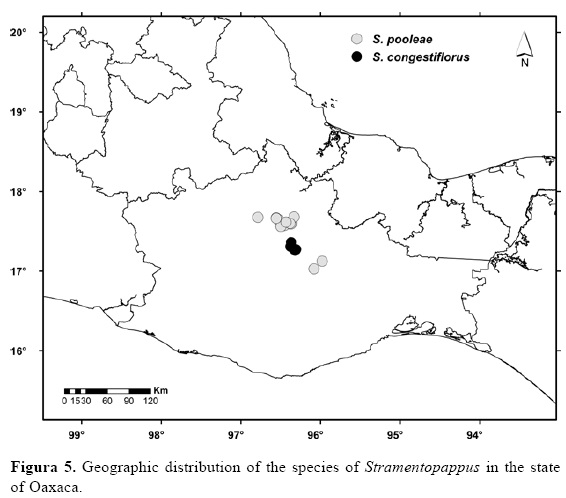
<body><![CDATA[<p align="justify"><font face="verdana" size="2">&nbsp;</font></p>  	    <p align="justify"><font face="verdana" size="2"><b>Description</b></font></p>  	    <p align="justify"><font face="verdana" size="2"><i><b>Stramentopappus congestiflorus</b></i> Redonda&#45;Mart&iacute;nez and Villase&ntilde;or, sp. nov.</font></p>  	    <p align="justify"><font face="verdana" size="2"><i>Type:</i> Oaxaca, Mexico. Distrito de Ixtl&aacute;n. Municipio de Santiago Laxopa: sierra de Ju&aacute;rez, camino de Natividad a Talea, 2.5 km al S de la desviaci&oacute;n a Yalina (Comedor Maravillas) 17&#176;15'25" N, 96&#176;19'03" O, 2 700 m, 3 ago 1985, <i>D. H. Lorence 4700</i> (Holotype: MEXU). <a href="/img/revistas/rmbiodiv/v85n1/a1f2.jpg" target="_blank">Fig. 2</a>.</font></p>  	    <p align="justify"><font face="verdana" size="2">Differt a <i>S. pooleae</i> capitulis in glomerulis aggretatis et flosculis per capitulum minus numerosis.</font></p>  	    <p align="justify"><font face="verdana" size="2">Shrubs or subshrubs 1.5&#45;2.0 m tall. Stems striate, tomentulose or glabrescent, with numerous lenticels. Leaves alternate, petioles 0.8&#45;1.2 cm long, blades elliptic&#45;ovate, 8.0&#45;13.0 cm long, 3.0&#45;5.0 cm wide, both surfaces bearing with short stipitate&#45;glandular hairs, the abaxial surface tomentulose when young, glabrescent with age; leaf base acute, sometimes decurrent along petiole, apex apiculate, margins serrate. Capitula 12&#45;20, homogamous, discoid, sessile forming glomerules or short pedunculate, peduncles 1.0&#45;3.0 mm long; involucre campanulate, 11.0&#45;13.0 mm long, 8.0&#45;11.0 mm wide; phyllaries 6 or 7 seriate, graduate, oblong&#45;lanceolate, apices obtuse&#45;mucronate, tomentulose&#45;glandular or glabrescent with age, outer series 5.0&#45;6.0 mm long, 3.0&#45;3.5 mm, inner series 8.0&#45;10.0 mm long, 2.0&#45;3.0 mm wide. Florets 20&#45;30 per capitulum, corollas purple, actinomorpic; 7.0&#45;12.0 mm long, tube 4.0&#45;8.0 mm long, lobes 3.0&#45;4.0 mm long, provided with short stipitate&#45;glandular hairs, throat poorly defined; anthers 3.0&#45;4.0 mm long, glabrous, apical anther appendages triangular, base sagittate; style branches elongate, acute, pilose, 2.0&#45;3.0 mm long. Achenes obovate (<a href="/img/revistas/rmbiodiv/v85n1/a1f3.jpg" target="_blank">Fig. 3</a>), glabrous, 4 or 5 ribbed, 2.0&#45;3.0 mm long; pappus setae capillary, multiseriate, deciduous, 3.0&#45;5.0 mm long. Pollen 40.0&#45;50.0 &#956;m diameter, subechinolophate, tricolporate, with perforated tectum (<a href="/img/revistas/rmbiodiv/v85n1/a1f4.jpg" target="_blank">Fig. 4</a>).</font></p>  	    <p align="justify"><font face="verdana" size="2"><i>Taxonomic summary</i></font></p>  	    <p align="justify"><font face="verdana" size="2"><i>Distribution:</i> endemic of the state of Oaxaca, at present only known from Sierra de Ju&aacute;rez in northern Oaxaca, District of Ixtl&aacute;n (<a href="#f5">Fig. 5</a>). It is difficult to clearly establish the conservation status due to the environmental policies implemented by inhabitants of the region, difficult access to the area of distribution and lack of floristic knowledge of the area.</font></p>  	    <p align="center"><font face="verdana" size="2"><a name="f5"></a></font></p>  	    <p align="center"><font face="verdana" size="2"><img src="/img/revistas/rmbiodiv/v85n1/a1f5.jpg"></font></p>  	    ]]></body>
<body><![CDATA[<p align="justify"><font face="verdana" size="2"><i>Phenology:</i> flowers and fruits from May to September.</font></p>  	    <p align="justify"><font face="verdana" size="2"><i>Habitat:</i> pine oak and humid mountain forests, at elevations between 2 300&#45;2 850 m, and generally associated with species of <i>M</i><i>eliosma</i> Blume (Sabiaceae), <i>Ocotea</i> Aubl. (Lauraceae), <i>Persea</i> Mill. (Lauraceae), and <i>Prunus</i> L. (Rosaceae).</font></p>  	    <p align="justify"><font face="verdana" size="2"><i>Etymology:</i> the specific epithet alludes to the capitula aggregated into glomerules.</font></p>  	    <p align="justify"><font face="verdana" size="2"><i>Additional material examined:</i> Oaxaca. Distrito de Ixtl&aacute;n. Municipio de Capulalpan de M&eacute;ndez: NE del r&iacute;o Natividad 17&#176;18'20" N, 96&#176;22'35" O, 2 370 m, 27 sep 2002, <i>S. Figueroa</i> y <i>F. Y. Guzm&aacute;n 289</i> (FCME, MEXU); 7 sep 2003, <i>S. Figueroa</i> y <i>F. Y. Guzm&aacute;n 671</i> (MEXU).</font></p>  	    <p align="justify"><font face="verdana" size="2">Municipio de Santa Mar&iacute;a Yalina: sierra de Ju&aacute;rez, camino de Capulalpan a Talea, 2.5 km al N de la desviaci&oacute;n a Yalina 17&#176;16'25" N, 96&#176;18'29" O, 2 850 m, 31 may 1983, <i>D. H. Lorence 4221</i> (MEXU). Municipio de San Miguel Yotao: sierra Norte, 4 km al SO de Yotao, alrededores de Llano Mach&iacute;n camino a Capulalpan, 17&#176;21'47" N, 96&#176;22'05"    <br> 	O, 2 300 m, 17 jun 1997, <i>S. Acosta 2799</i> (IEB, MEXU).</font></p>  	    <p align="justify"><font face="verdana" size="2">&nbsp;</font></p>  	    <p align="justify"><font face="verdana" size="2">Key to the species of the genus <i>Stramentopappus</i>.</font></p>  	<table width="580" border="0"> <tbody>   <tr>     <td>    <p align="justify"><font face="verdana" size="2">1. Capitula clustered in glomerules; peduncles less than 3 mm long; phyllary apices obtuse&#45;mucronate; florets &#8804; 30 per capitulum&#9;<i>..........................................................................................S. congestiflorus</i></font></p></td>   </tr>   <tr>     <td>    <p align="justify"><font face="verdana" size="2">1. Capitula clustered in lax corymbs; peduncles 5 mm long or more; phyllary apices subulate; florets &#8805; 100 per capitulum&#9;<i>...........................................................................................S. pooleae</i></font></p></td>   </tr> </tbody> </table>     ]]></body>
<body><![CDATA[<p align="justify"><font face="verdana" size="2"><i>Remarks.</i> <i>Stramentopappus congestiflorus</i> could be confused with <i>B. coulteri</i> or <i>Leiboldia</i> spp. based on the capitula clustered in glomerules. However, the lack of bracts surrounding the glomerules distinguishes <i>Stramentopappus</i> from the 2 latter genera. Additionally, this new species also lacks the white&#45;tomentose pubescence on the mature branches, the leaf undersurface, and the phyllaries which are characteristic of <i>Bolanosa</i> and <i>Leiboldia</i>. The straw&#45;yellow multiseriate pappus and the geographical distribution of this new species also help separate these taxa.</font></p>     <p align="justify"><font face="verdana" size="2"><i>Stramentopappus congestiflorus</i> is only known from 5 collections from the District of Ixtl&aacute;n; <i>S. pooleae</i> has a wider distribution, including the districts of Choapan, Cuicatl&aacute;n, Ixtl&aacute;n, Mixe, and Tuxtepec (<a href="#f5">Fig. 5</a>). <i>Leiboldia</i> does not occur in the sierra de Ju&aacute;rez (Oaxaca) where <i>Stramentoppapus</i> is found, and similarly, <i>Bolanosa</i> is more widely distributed and is found in west&#45;central Mexico in the states of Guanajuato, Jalisco, Michoac&aacute;n, and Zacatecas; <i>Leiboldia</i> is found mostly in the mountains of eastern and southern Mexico in the states of Hidalgo, Oaxaca, Quer&eacute;taro, Puebla and Veracruz.</font></p>  	    <p align="justify"><font face="verdana" size="2"><i>Multivariate analysis.</i> The clustering analysis is summarized in the phenogram illustrated in <a href="/img/revistas/rmbiodiv/v85n1/a1f6.jpg" target="_blank">figure 6</a>. Two main groups can be observed, the first is formed by <i>B. coulteri</i> and <i>Leiboldia</i> (including <i>L</i>. <i>guerreroana</i> (S.B. Jones) H. Rob. and <i>L</i>. <i>serrata</i> (D. Don) Gleason) and the second by the 2 species of <i>Stramentopappus</i>. The ordination analysis also resulted in a similar distinction among taxa as that observed in the clustering analysis (<a href="/img/revistas/rmbiodiv/v85n1/a1f7.jpg" target="_blank">Fig. 7</a>). The first principal coordinate clearly separates the species of <i>Stramentopappus</i> from the species in other genera. The loading values of the main characters in each coordinate are given in <a href="/img/revistas/rmbiodiv/v85n1/a1t3.jpg" target="_blank">table 3</a>. Results of these analyses further support the conclusion that there is a new taxon and its proper placement is in the genus <i>Stramentopappus</i>.</font></p>  	    <p align="justify"><font face="verdana" size="2">&nbsp;</font></p>  	    <p align="justify"><font face="verdana" size="2"><b>Acknowledgments</b></font></p>  	    <p align="justify"><font face="verdana" size="2">The first author would like to thank the Posgrado en Ciencias Biol&oacute;gicas, UNAM and Conacyt for support (grant 263523) to carry out graduate studies in the Botany Department, Instituto de Biolog&iacute;a. Claudio Delgadillo, Rosaura Grether, Rosalinda Medina and Fernando Chiang revised the manuscript and made important suggestions to improve it. Also to the anonymous referees that have helped to improve the text. Mar&iacute;a del Rosario Garc&iacute;a&#45;Pe&ntilde;a helped with the management of type material and Berenit Mendoza&#45;Garfias, assisted with the use of the scanning electronic microscope and sample pictures. We thank the curators of the cited herbaria for the facilities provided to review the material.</font></p>  	    <p align="justify"><font face="verdana" size="2">&nbsp;</font></p>  	    <p align="justify"><font face="verdana" size="2"><b>Literature cited</b></font></p>  	    <!-- ref --><p align="justify"><font face="verdana" size="2">Keeley, S. C. and H. Robinson. 2009. Vernonieae. <i>In</i> Systematics, evolution and biogeography of the Compositae, V. A. Funk, A. Susanna, T. F. Stuessy and R. J. Bayer (eds.). IAPT. Vienna. p. 439&#45;469.    &nbsp;&nbsp;&nbsp;&nbsp;&nbsp;&nbsp;&nbsp;&nbsp;[&#160;<a href="javascript:void(0);" onclick="javascript: window.open('/scielo.php?script=sci_nlinks&ref=7641443&pid=S1870-3453201400010000100001&lng=','','width=640,height=500,resizable=yes,scrollbars=1,menubar=yes,');">Links</a>&#160;]<!-- end-ref --></font></p>  	    ]]></body>
<body><![CDATA[<!-- ref --><p align="justify"><font face="verdana" size="2">Robinson, H. and V. A. Funk. 1987. A phylogenetic analysis of <i>Leiboldia</i>, <i>Lepidonia</i>, and a new genus <i>Stramentopappus</i> (Vernonieae: Asteraceae). Botanische Jahrb&uuml;cher f&uuml;r Systematik, Pflanzengeschichte und Pflanzengeographie. Leipzig 108:213&#45;228.    &nbsp;&nbsp;&nbsp;&nbsp;&nbsp;&nbsp;&nbsp;&nbsp;[&#160;<a href="javascript:void(0);" onclick="javascript: window.open('/scielo.php?script=sci_nlinks&ref=7641445&pid=S1870-3453201400010000100002&lng=','','width=640,height=500,resizable=yes,scrollbars=1,menubar=yes,');">Links</a>&#160;]<!-- end-ref --></font></p>  	    <!-- ref --><p align="justify"><font face="verdana" size="2">Rohlf, F. J. 1998. NTSYS&#45;pc. Numerical taxonomy and multivariate analysis system. Ver. 2.02i. Exeter Software, New York.    &nbsp;&nbsp;&nbsp;&nbsp;&nbsp;&nbsp;&nbsp;&nbsp;[&#160;<a href="javascript:void(0);" onclick="javascript: window.open('/scielo.php?script=sci_nlinks&ref=7641447&pid=S1870-3453201400010000100003&lng=','','width=640,height=500,resizable=yes,scrollbars=1,menubar=yes,');">Links</a>&#160;]<!-- end-ref --></font></p>  	    <!-- ref --><p align="justify"><font face="verdana" size="2">Thiers, B. (continuously updated). Index Herbariorum: a global directory of public herbaria and associated staff. New York Botanical Garden's Virtual Herbarium. <a href="http://sweetgum.nybg.org/ih/" target="_blank">http://sweetgum.nybg.org/ih/</a>; last access: 21.VI.2013.    &nbsp;&nbsp;&nbsp;&nbsp;&nbsp;&nbsp;&nbsp;&nbsp;[&#160;<a href="javascript:void(0);" onclick="javascript: window.open('/scielo.php?script=sci_nlinks&ref=7641449&pid=S1870-3453201400010000100004&lng=','','width=640,height=500,resizable=yes,scrollbars=1,menubar=yes,');">Links</a>&#160;]<!-- end-ref --></font></p>      ]]></body><back>
<ref-list>
<ref id="B1">
<nlm-citation citation-type="book">
<person-group person-group-type="author">
<name>
<surname><![CDATA[Keeley]]></surname>
<given-names><![CDATA[S. C.]]></given-names>
</name>
<name>
<surname><![CDATA[Robinson]]></surname>
<given-names><![CDATA[H.]]></given-names>
</name>
</person-group>
<article-title xml:lang="en"><![CDATA[Vernonieae]]></article-title>
<person-group person-group-type="editor">
<name>
<surname><![CDATA[Funk]]></surname>
<given-names><![CDATA[V. A.]]></given-names>
</name>
<name>
<surname><![CDATA[Susanna]]></surname>
<given-names><![CDATA[A.]]></given-names>
</name>
<name>
<surname><![CDATA[Stuessy]]></surname>
<given-names><![CDATA[T. F.]]></given-names>
</name>
<name>
<surname><![CDATA[Bayer]]></surname>
<given-names><![CDATA[R. J.]]></given-names>
</name>
</person-group>
<source><![CDATA[Systematics, evolution and biogeography of the Compositae]]></source>
<year>2009</year>
<page-range>439-469</page-range><publisher-loc><![CDATA[Vienna ]]></publisher-loc>
<publisher-name><![CDATA[IAPT]]></publisher-name>
</nlm-citation>
</ref>
<ref id="B2">
<nlm-citation citation-type="journal">
<person-group person-group-type="author">
<name>
<surname><![CDATA[Robinson]]></surname>
<given-names><![CDATA[H.]]></given-names>
</name>
<name>
<surname><![CDATA[Funk]]></surname>
<given-names><![CDATA[V. A.]]></given-names>
</name>
</person-group>
<article-title xml:lang="en"><![CDATA[A phylogenetic analysis of Leiboldia, Lepidonia, and a new genus Stramentopappus (Vernonieae: Asteraceae)]]></article-title>
<source><![CDATA[Botanische Jahrbücher für Systematik, Pflanzengeschichte und Pflanzengeographie]]></source>
<year>1987</year>
<volume>108</volume>
<page-range>213-228</page-range><publisher-loc><![CDATA[Leipzig ]]></publisher-loc>
</nlm-citation>
</ref>
<ref id="B3">
<nlm-citation citation-type="">
<person-group person-group-type="author">
<name>
<surname><![CDATA[Rohlf]]></surname>
<given-names><![CDATA[F. J.]]></given-names>
</name>
</person-group>
<source><![CDATA[NTSYS-pc. Numerical taxonomy and multivariate analysis system. Ver. 2.02i. Exeter Software]]></source>
<year>1998</year>
<publisher-loc><![CDATA[New York ]]></publisher-loc>
</nlm-citation>
</ref>
<ref id="B4">
<nlm-citation citation-type="">
<person-group person-group-type="author">
<name>
<surname><![CDATA[Thiers]]></surname>
<given-names><![CDATA[B]]></given-names>
</name>
</person-group>
<source><![CDATA[Index Herbariorum: a global directory of public herbaria and associated staff. New York Botanical Garden's Virtual Herbarium]]></source>
<year>21.V</year>
<month>I.</month>
<day>20</day>
</nlm-citation>
</ref>
</ref-list>
</back>
</article>
