<?xml version="1.0" encoding="ISO-8859-1"?><article xmlns:mml="http://www.w3.org/1998/Math/MathML" xmlns:xlink="http://www.w3.org/1999/xlink" xmlns:xsi="http://www.w3.org/2001/XMLSchema-instance">
<front>
<journal-meta>
<journal-id>1870-3453</journal-id>
<journal-title><![CDATA[Revista mexicana de biodiversidad]]></journal-title>
<abbrev-journal-title><![CDATA[Rev. Mex. Biodiv.]]></abbrev-journal-title>
<issn>1870-3453</issn>
<publisher>
<publisher-name><![CDATA[Instituto de Biología]]></publisher-name>
</publisher>
</journal-meta>
<article-meta>
<article-id>S1870-34532013000400012</article-id>
<article-id pub-id-type="doi">10.7550/rmb.32149</article-id>
<title-group>
<article-title xml:lang="en"><![CDATA[Sclerophylly in mangrove tree species from South Brazil]]></article-title>
<article-title xml:lang="es"><![CDATA[Esclerofilia de las especies de manglares del sur de Brasil]]></article-title>
</title-group>
<contrib-group>
<contrib contrib-type="author">
<name>
<surname><![CDATA[Sereneski-de Lima]]></surname>
<given-names><![CDATA[Carolina]]></given-names>
</name>
<xref ref-type="aff" rid="A01"/>
</contrib>
<contrib contrib-type="author">
<name>
<surname><![CDATA[Torres-Boeger]]></surname>
<given-names><![CDATA[María Regina]]></given-names>
</name>
<xref ref-type="aff" rid="A02"/>
</contrib>
<contrib contrib-type="author">
<name>
<surname><![CDATA[Larcher-de Carvalho]]></surname>
<given-names><![CDATA[Letícia]]></given-names>
</name>
<xref ref-type="aff" rid="A02"/>
</contrib>
<contrib contrib-type="author">
<name>
<surname><![CDATA[Pelozzo]]></surname>
<given-names><![CDATA[Andressa]]></given-names>
</name>
<xref ref-type="aff" rid="A01"/>
</contrib>
<contrib contrib-type="author">
<name>
<surname><![CDATA[Soffiatti]]></surname>
<given-names><![CDATA[Patricia]]></given-names>
</name>
<xref ref-type="aff" rid="A01"/>
</contrib>
</contrib-group>
<aff id="A01">
<institution><![CDATA[,Universidade Federal do Paraná Programa de Pós Graduação em Botânica Departamento de Botânica]]></institution>
<addr-line><![CDATA[Curitiba PR]]></addr-line>
<country>Brasil</country>
</aff>
<aff id="A02">
<institution><![CDATA[,Universidade Federal do Paraná Programa de Pós-Graduação em Ecologia e Conservação Setor de Ciências Biológicas]]></institution>
<addr-line><![CDATA[Curitiba PR]]></addr-line>
<country>Brasil</country>
</aff>
<pub-date pub-type="pub">
<day>00</day>
<month>12</month>
<year>2013</year>
</pub-date>
<pub-date pub-type="epub">
<day>00</day>
<month>12</month>
<year>2013</year>
</pub-date>
<volume>84</volume>
<numero>4</numero>
<fpage>1159</fpage>
<lpage>1166</lpage>
<copyright-statement/>
<copyright-year/>
<self-uri xlink:href="http://www.scielo.org.mx/scielo.php?script=sci_arttext&amp;pid=S1870-34532013000400012&amp;lng=en&amp;nrm=iso"></self-uri><self-uri xlink:href="http://www.scielo.org.mx/scielo.php?script=sci_abstract&amp;pid=S1870-34532013000400012&amp;lng=en&amp;nrm=iso"></self-uri><self-uri xlink:href="http://www.scielo.org.mx/scielo.php?script=sci_pdf&amp;pid=S1870-34532013000400012&amp;lng=en&amp;nrm=iso"></self-uri><abstract abstract-type="short" xml:lang="en"><p><![CDATA[Sclerophylly, a morphological trait that defines coriaceous and hard leaves, is presently accepted as a non-specific response to environments with acting multiple stresses. In mangroves, features such as flooded and unconsolidated soil, low availability of oxygen, and high salinity characterize this stressful environment. From 2 mangroves areas in the coast of Paraná state, leaves of 3 species (Rhizophora mangle, Laguncularia racemosa and Avicennia schaueriana) were collected and analyzed nutritionally and morphologically. Sclerophylly indices (Rizzini index and specific leaf area) indicated that all species are sclerophyllous. Considering nutritional and morphological traits, only some of them suggest sclerophylly, such as total leaf thickness in all species, the presence of a sub-epidermal layer in Rhizophora mangle and Avicennia schaueriana and sclereids in Rhizophora mangle. Comparatively, leaves presented different degrees of sclerophylly, in the following order: R. mangle > L. racemosa > A. schaueriana, considering all characteristics analyzed. This gradient of sclerophylly appears to be consequence of different strategies developed by each species in response to the stressful abiotic conditions of mangroves, especially the mechanisms for salinity tolerance.]]></p></abstract>
<abstract abstract-type="short" xml:lang="es"><p><![CDATA[La esclerofilia es un rasgo morfológico que define hojas coriáceas y duras. Actualmente se acepta como una respuesta no específica a los ambientes con múltiples factores estresantes. Los manglares se consideran un ambiente estresante debido a sus suelos inundados y no consolidados, una baja disponibilidad de oxígeno y la alta salinidad. En 2 áreas de manglar en la costa del estado de Paraná, se recolectaron hojas de 3 especies de mangle (Rhizophora mangle, Laguncularia racemosa y Avicennia schaueriana) y se realizaron análisis nutricionales y morfológicas. Los índices de esclerofilia (índice de Rizzini y área específica foliar) indicaron que todas las especies son esclerófilas. Considerando los rasgos nutricionales y morfológicos, sólo unos pocos indican esclerofilia, como la espesura total de la hoja para todas las especies, la presencia de un estrato subepidérmico en Rhizophora mangle y en Avicennia schaueriana, y esclereidas en Rhizophora mangle. Comparando todos los caracteres analizados, las hojas presentaron diferente grados de esclerofilia, en el siguiente orden: R. mangle > L. racemosa > A. schaueriana. Este gradiente de esclerofilia parece ser consecuencia de las diferentes estrategias desarrolladas por cada especie en respuesta a las condiciones abióticas estresantes de los manglares, especialmente, como mecanismos para tolerar la salinidad.]]></p></abstract>
<kwd-group>
<kwd lng="en"><![CDATA[leaf morphology]]></kwd>
<kwd lng="en"><![CDATA[nutrient concentration]]></kwd>
<kwd lng="en"><![CDATA[salinity]]></kwd>
<kwd lng="en"><![CDATA[sclerophylly index]]></kwd>
<kwd lng="en"><![CDATA[specific leaf area]]></kwd>
<kwd lng="es"><![CDATA[morfología foliar]]></kwd>
<kwd lng="es"><![CDATA[concentración de nutrientes]]></kwd>
<kwd lng="es"><![CDATA[salinidad]]></kwd>
<kwd lng="es"><![CDATA[índice de esclerofilia]]></kwd>
<kwd lng="es"><![CDATA[área específica foliar]]></kwd>
</kwd-group>
</article-meta>
</front><body><![CDATA[  	    <p align="justify"><font face="verdana" size="4">Anatom&iacute;a</font></p>  	    <p align="justify"><font face="verdana" size="2">&nbsp;</font></p>  	    <p align="center"><font face="verdana" size="4"><b>Sclerophylly in mangrove tree species from South Brazil</b></font></p>  	    <p align="justify"><font face="verdana" size="2">&nbsp;</font></p>  	    <p align="center"><font face="verdana" size="3"><b>Esclerofilia de las especies de manglares del sur de Brasil</b></font></p>  	    <p align="justify"><font face="verdana" size="2">&nbsp;</font></p>  	    <p align="center"><font face="verdana" size="2"><b>Carolina Sereneski&#45;de Lima<sup>1</sup>, Mar&iacute;a Regina Torres&#45;Boeger<sup>2</sup>*, Let&iacute;cia Larcher&#45;de Carvalho<sup>2</sup>, Andressa Pelozzo<sup>1</sup> and Patricia Soffiatti<sup>1</sup></b></font></p>  	    <p align="justify"><font face="verdana" size="2">&nbsp;</font></p>  	    <p align="justify"><font face="verdana" size="2"><sup><i>1</i></sup> <i>Universidade Federal do Paran&aacute;, Programa de P&oacute;s Gradua&#231;&atilde;o em Bot&acirc;nica, Departamento de Bot&acirc;nica, Caixa Postal 19031, 81531&#45;990 Curitiba, PR, Brasil.</i></font></p>  	    ]]></body>
<body><![CDATA[<p align="justify"><font face="verdana" size="2"><i><sup>2</sup> Universidade Federal do Paran&aacute;, Programa de P&oacute;s&#45;Gradua</i>&#231;&atilde;o em Ecologia e Conserva<i>&#231;&atilde;</i>o, Setor de Ci&ecirc;ncias Biol&oacute;gicas, Caixa Postal 19031, 81531&#45;990 Curitiba, PR, Brasil. *<a href="mailto:rboeger@ufpr.br">rboeger@ufpr.br</a></font></p>  	    <p align="justify"><font face="verdana" size="2">&nbsp;</font></p>  	    <p align="justify"><font face="verdana" size="2">Recibido: 17 junio 2012    <br> 	Aaceptado: 27 junio 2013</font></p>  	    <p align="justify"><font face="verdana" size="2">&nbsp;</font></p>  	    <p align="justify"><font face="verdana" size="2"><b>Abstract</b></font></p>  	    <p align="justify"><font face="verdana" size="2">Sclerophylly, a morphological trait that defines coriaceous and hard leaves, is presently accepted as a non&#45;specific response to environments with acting multiple stresses. In mangroves, features such as flooded and unconsolidated soil, low availability of oxygen, and high salinity characterize this stressful environment. From 2 mangroves areas in the coast of Paran&aacute; state, leaves of 3 species <i>(Rhizophora mangle, Laguncularia racemosa</i> and <i>Avicennia schaueriana)</i> were collected and analyzed nutritionally and morphologically. Sclerophylly indices (Rizzini index and specific leaf area) indicated that all species are sclerophyllous. Considering nutritional and morphological traits, only some of them suggest sclerophylly, such as total leaf thickness in all species, the presence of a sub&#45;epidermal layer in <i>Rhizophora mangle</i> and <i>Avicennia schaueriana</i> and sclereids in <i>Rhizophora mangle.</i> Comparatively, leaves presented different degrees of sclerophylly, in the following order: <i>R. mangle</i> &gt; <i>L. racemosa</i> &gt; <i>A. schaueriana,</i> considering all characteristics analyzed. This gradient of sclerophylly appears to be consequence of different strategies developed by each species in response to the stressful abiotic conditions of mangroves, especially the mechanisms for salinity tolerance.</font></p>  	    <p align="justify"><font face="verdana" size="2"><b>Key words:</b> leaf morphology, nutrient concentration, salinity, sclerophylly index, specific leaf area.</font></p>  	    <p align="justify"><font face="verdana" size="2">&nbsp;</font></p>  	    <p align="justify"><font face="verdana" size="2"><b>Resumen</b></font></p>  	    ]]></body>
<body><![CDATA[<p align="justify"><font face="verdana" size="2">La esclerofilia es un rasgo morfol&oacute;gico que define hojas cori&aacute;ceas y duras. Actualmente se acepta como una respuesta no espec&iacute;fica a los ambientes con m&uacute;ltiples factores estresantes. Los manglares se consideran un ambiente estresante debido a sus suelos inundados y no consolidados, una baja disponibilidad de ox&iacute;geno y la alta salinidad. En 2 &aacute;reas de manglar en la costa del estado de Paran&aacute;, se recolectaron hojas de 3 especies de mangle <i>(Rhizophora mangle, Laguncularia racemosa</i> y <i>Avicennia schaueriana)</i> y se realizaron an&aacute;lisis nutricionales y morfol&oacute;gicas. Los &iacute;ndices de esclerofilia (&iacute;ndice de Rizzini y &aacute;rea espec&iacute;fica foliar) indicaron que todas las especies son escler&oacute;filas. Considerando los rasgos nutricionales y morfol&oacute;gicos, s&oacute;lo unos pocos indican esclerofilia, como la espesura total de la hoja para todas las especies, la presencia de un estrato subepid&eacute;rmico en <i>Rhizophora mangle</i> y en <i>Avicennia schaueriana,</i> y esclereidas en <i>Rhizophora mangle.</i> Comparando todos los caracteres analizados, las hojas presentaron diferente grados de esclerofilia, en el siguiente orden: <i>R. mangle &gt; L. racemosa &gt; A. schaueriana.</i> Este gradiente de esclerofilia parece ser consecuencia de las diferentes estrategias desarrolladas por cada especie en respuesta a las condiciones abi&oacute;ticas estresantes de los manglares, especialmente, como mecanismos para tolerar la salinidad.</font></p>  	    <p align="justify"><font face="verdana" size="2"><b>Palabras clave:</b> morfolog&iacute;a foliar, concentraci&oacute;n de nutrientes, salinidad, &iacute;ndice de esclerofilia, &aacute;rea espec&iacute;fica foliar.</font></p>  	    <p align="justify"><font face="verdana" size="2">&nbsp;</font></p>  	    <p align="justify"><font face="verdana" size="2"><b>Introduction</b></font></p>  	    <p align="justify"><font face="verdana" size="2">Sclerophylly was initially defined by Schimper (1903) to distinguish xeromorphic plants with leathery leaves of the Mediterranean region from those exhibiting succulence or leaflessness (Edwards et al., 2000). Later, sclerophylly was interpreted as a morpho&#45;physiological adaptation of plants as a response to low soil fertility of tropical forests, mainly nitrogen and phosphorous (Loveless, 1962), and as a defense against herbivory (Choong et al., 1992).</font></p>  	    <p align="justify"><font face="verdana" size="2">Nowadays, sclerophylly is accepted as a non&#45;specific response to a wide range of environmental stresses (Read et al., 2006). It can be adaptive, enhancing leaf longevity and photosynthetic efficiency across a range of stressful environments (Turner, 1994), or non adaptive, resulting from the combination of morphological and physiological traits that result in more stress resistant leaves (Read et al., 2006).</font></p>  	    <p align="justify"><font face="verdana" size="2">Leathery leaves characterize sclerophylly and are a consequence of the presence of mechanical tissues (Shimper, 1903). Therefore, sclerophylly can be measured by indices that utilize leaf dry mass and leaf area. Specific leaf area (SLA), which represents the investment of photosynthetic mass by area unit, has been extensively used as a sclerophylly index (Camerik and Werger, 1981; Marin and Medina, 1981; Bongers and Popma, 1990; Witkowski and Lamont, 1991; Perez, 1994; Groom and Lamont, 1999; Boeger and Wisniewski, 2003), due to the ease of data collection (Witkowski and Lamont, 1991). Besides that, SLA is a measure of relative growth of species (Vendramini et al., 2002). Leaves with low mean values of SLA have more mechanical tissues, making leaves more leathery and hard, with lower growth rates. Another sclerophylly index is the Rizzini index (Rizzini, 1976), that relates leaf dry mass and leaf surface and classifies leaves as sclerophyllous when those values are higher than 0.6.</font></p>  	    <p align="justify"><font face="verdana" size="2">Although leaf hardness of sclerophyllous plants can be determined mainly by the amount of mechanical tissue, the combination of morpho&#45;anatomical traits such as leaf thickness, thick cuticle and epidermis, presence of hypodermis, palisade/spongy parenchyma ratio &gt; 1, compacted mesophyll and high crude fibers/crude proteins ratio can also generate rigidity in leaves (Turner, 1994; Read and Sanson, 2003). According to Turner (1994), the degree of sclerophylly can be evaluated by the morphological characteristics mentioned above, besides the values of AEF and foliar Nitrogen and Phosphorous concentrations.</font></p>  	    <p align="justify"><font face="verdana" size="2">Mangroves are located in protected coastal areas, in the tropics and sub&#45;tropics (Shaeffer&#45;Novelli, 1995), and are characterized by muddy soils rich in nutrients. Mangrove forests are constantly submitted to limiting environmental conditions such as high salinity, unconsolidated substrate, low oxygenation and frequent submersion by tides (Schaeffer&#45;Novelli et al., 2000; Paraguassu and Silva, 2007).</font></p>  	    <p align="justify"><font face="verdana" size="2">Although mangrove trees present thick and leathery leaves, mangroves are not classified as a sclerophyllous environment. The few studies about sclerophylly in mangroves evaluated species separately and only in experimental conditions of different salinities and nutrient concentrations (Feller, 1996; Sobrado, 2005). Species such as <i>Rhizophora mangle</i> are classified as sclerophyllous only in high salinity concentration (Feller, 1996). However, under uncontrolled conditions, the occurrence of sclerophylly in mangrove species can be considered a strategy of the plants to enhance the efficiency of water use (Naidoo, 2010).</font></p>  	    ]]></body>
<body><![CDATA[<p align="justify"><font face="verdana" size="2">This study evaluated if the 3 most representative tree species from South Brazilian mangroves are sclerophyllous according to a) sclerophyllous indices (SLA and Rizzini index), b) leaf Nitrogen and Phosphorous concentrations, and c) presence of morphological traits that indicate sclerophylly (sensu Turner, 1994). Our hypothesis is that all studied mangrove species are sclerophyllous, caused by stressful environmental conditions, such as high salinity.</font></p>  	    <p align="justify"><font face="verdana" size="2">&nbsp;</font></p>  	    <p align="justify"><font face="verdana" size="2"><b>Materials and methods</b></font></p>  	    <p align="justify"><font face="verdana" size="2">This study was conducted in the Antonina Bay, Paran&aacute;, Brazil (25&deg;29'57" S, 48&deg;42'44" W). The Antonina Bay is a large water body, with irregular shape, that occupies 3 882 km<sup>2</sup> (F&aacute;varo et al., 2007). The climate is classified as Cfa type, according to Koppen's classification, i.e. subtropical, mesothermic, with hot summers, without a dry season. The average temperature is 20.5&deg; C, with 16.7&deg; C and 26.4&deg; C minimum and maximum values, respectively. The annual precipitation is 2 773 mm. The soil type is Histosol thiomorphic sapric salic/sodic (EMBRAPA, 2009). Measurements of salinity of the interstitial water varied from 13.2 to 19% and the potential redox varied from &#45;294.8 to &#45;347.8 mV.</font></p>  	    <p align="justify"><font face="verdana" size="2">In the studied area, 3 tree species were identified: <i>Rhizophora mangle</i> L. (Rhizophoraceae), <i>Avicennia schaueriana</i> Stapf and Leachman (Acanthaceae) and <i>Laguncularia racemosa</i> (L.) Gaertn (Combretaceae). Fifteen individuals of each species were selected, each at least, 8 m high. From each individual, 30 totally expanded and mature leaves were collected between the third and the sixth nodes, from 5 to 7 branches directly exposed to sunlight. Senescent and juvenile leaves were discarded due the potential presence of chlorose or injuries, or to avoid using leaves not fully developed. Of a total of 450 leaves collected for each species, 150 were used for analyses of morphology, 30 were used for anatomy, and 270 for chemistry.</font></p>  	    <p align="justify"><font face="verdana" size="2">For each leaf, we measured the following parameters: <i>1)</i> leaf thickness of the median region of the lamina, with a digital caliper; <i>2)</i> dry mass, estimated with a digital analytical balance, from previously dehydrated leaves; <i>3)</i> leaf area (cm<sup>2</sup>), measured from images obtained with a flatbed scanner calibrated with Sigma Scan PRO software (version 5.0, SPSS Inc., Chicago, IL, USA), and <i>4)</i> specific leaf area (SLA)= leaf area (cm<sup>2</sup>)/leaf dry mass (g) and sclerophylly index (IE)= leaf dry mass (g)/2 x leaf area (dm<sup>2</sup>), according to Rizzini (1976). This latter index defines sclerophylly as IE&gt; 0.6 and mesophylly as IE&lt; 0.6. Leaf density (DF, g.cm<sup>&#45;3</sup>) was estimated by the following equation: specific leaf mass (leaf dry mass (g)/leaf area (cm<sup>2</sup>))*1/thickness.</font></p>  	    <p align="justify"><font face="verdana" size="2">Salt secretion gland density (mm<sup>2</sup>) was estimated from clear nail polish imprints from the median region of the epidermal surface of leaves, for 30 leaves, using a light microscope coupled with a camera lucida.</font></p>  	    <p align="justify"><font face="verdana" size="2">For anatomical analysis, leaves were fixed in FAA 70 and conserved in ethanol 70%. Previously fixed plant material was sectioned transversally on the median region of the leaf laminas, with a razor blade then cleared with sodium hypochlorite 10%, stained with Toluidine Blue 1% and mounted in glycerin. In the transverse sections, adaxial and abaxial epidermis, sub&#45;epidermal layers, palisade and spongy parenchyma thickness and total thickness were measured. The ratio palisade/spongy parenchyma was calculated. All</font></p>  	    <p align="justify"><font face="verdana" size="2">The nitric&#45;perchloric digestion (Martins and Reissmann, 2007) was used for phosphorus (P); potassium (K) and sodium (Na) analysis. For nitrogen (N), the determination was made by the Kjeldahl method (Souza 1999). All elements determinations were made by coupled plasma optical emission spectrometry (OES) with argon source.</font></p>  	    <p align="justify"><font face="verdana" size="2">For every quantitative variable, mean and respective standard deviations were calculated. To test for morphological differences among species, we used Anova, with 5% significance. Post&#45;hoc Tukey's test was performed to test for differences between pairs of means, using the software Statistica version 7.0, (Statsoft, Inc., Tulsa, OK, USA). Also, we tested the correlation (Pearson's Correlation) with morphological traits and leaf nutrients (nitrogen, phosphorus, potassium and sodium). In all cases, we tested the homogeneity of the variances using the test of Levene (Zar 1999), when necessary, data were log&#45;transformed.</font></p>  	    ]]></body>
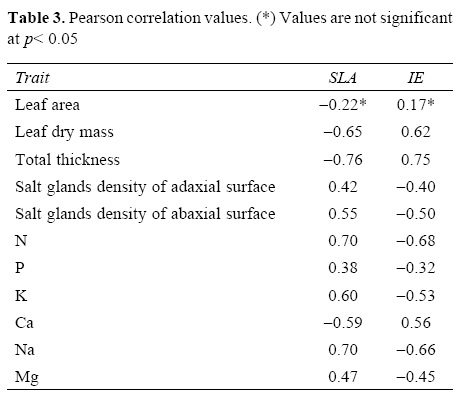
<body><![CDATA[<p align="justify"><font face="verdana" size="2">&nbsp;</font></p>  	    <p align="justify"><font face="verdana" size="2"><b>Results</b></font></p>  	    <p align="justify"><font face="verdana" size="2">All 3 species studied presented quantitative differences related to leaf morphology. The leaves of <i>Rhizophora mangle</i> showed the higher values of leaf area and leaf dry mass and lower values for total thickness of the lamina, when compared to <i>Avicennia schaueriana</i> and <i>Laguncularia racemosa</i> (<a href="/img/revistas/rmbiodiv/v84n4/a12t1.jpg" target="_blank">Table 1</a>).</font></p>  	    <p align="justify"><font face="verdana" size="2"><i>Avicennia schaueriana</i> presented lower mean values of leaf area, dry mass and total leaf thickness. However, this species presented the highest mean values of specific leaf area (<a href="/img/revistas/rmbiodiv/v84n4/a12t1.jpg" target="_blank">Table 1</a>), followed by <i>R. mangle</i> and <i>L. racemosa.</i> Considering the sclerophylly index <i>(sensu</i> Rizzini), the highest mean values were observed in <i>L. racemosa,</i> followed by <i>R. mangle</i> and <i>A. schaueriana.</i> In spite of the significant differences among species, all of them were classified as sclerophyllous (<a href="/img/revistas/rmbiodiv/v84n4/a12t1.jpg" target="_blank">Table 1</a>). Leaf density was the only variable similar among all 3 species (<a href="/img/revistas/rmbiodiv/v84n4/a12t1.jpg" target="_blank">Table 1</a>).</font></p>  	    <p align="justify"><font face="verdana" size="2"><i>Avicennia schaueriana</i> presented the highest density of salt glands /mm<sup>2</sup>, in both epidermis surfaces, followed by <i>L. racemosa</i> and <i>R. mangle</i> (<a href="/img/revistas/rmbiodiv/v84n4/a12t1.jpg" target="_blank">Table 1</a>). <i>Avicennia schaueriana</i> showed the highest density of salt glands on the adaxial surface, while <i>L. racemosa</i> presented higher density on the abaxial surface. <i>Rhizophora mangle</i> presented salt secretion structures only on the abaxial surface.</font></p>  	    <p align="justify"><font face="verdana" size="2">The leaf lamina of the 3 studied species has a uniseriate epidermis, covered by the cuticle (<a href="/img/revistas/rmbiodiv/v84n4/a12f1.jpg" target="_blank">Figs. 1a, c, e</a>). The leaf is hypostomatic in <i>A. schaueriana</i> (<a href="/img/revistas/rmbiodiv/v84n4/a12f1.jpg" target="_blank">Fig. 1a</a>) and R. mangle (<a href="/img/revistas/rmbiodiv/v84n4/a12f1.jpg" target="_blank">Fig. 1c</a>) and amphistomatic in <i>L. racemosa</i> (<a href="/img/revistas/rmbiodiv/v84n4/a12f1.jpg" target="_blank">Fig. 1e</a>). Salt glands (<a href="/img/revistas/rmbiodiv/v84n4/a12f1.jpg" target="_blank">Fig. 1d</a>) occur on both leaf surfaces in <i>A. schaueriana</i> and <i>L. racemosa</i> and on the adaxial surface of <i>R. mangle.</i> In <i>A. schaueriana,</i> besides salt glands, glandular trichomes are present on the abaxial surface (<a href="/img/revistas/rmbiodiv/v84n4/a12f1.jpg" target="_blank">Fig. 1b</a>) in large quantities widely covering the surface forming an indumentum.</font></p>  	    <p align="justify"><font face="verdana" size="2">Internally to the epidermis, a sub&#45;epidermal layer occurs in <i>A. schaueriana</i> leaves, formed by 3 or 4 layers of cells on the adaxial surface (<a href="/img/revistas/rmbiodiv/v84n4/a12f1.jpg" target="_blank">Fig. 1a</a>). In <i>R. mangle,</i> the sub&#45;epidermal layer is composed by 5 to 7 layers (<a href="/img/revistas/rmbiodiv/v84n4/a12f1.jpg" target="_blank">Fig. 1e</a>).</font></p>  	    <p align="justify"><font face="verdana" size="2">The mesophyll is heterogeneous in all species. The palisade parenchyma presented 3 to 5 layers in <i>A. schaueriana</i> (<a href="/img/revistas/rmbiodiv/v84n4/a12f1.jpg" target="_blank">Fig. 1a</a>), 2 to 3 in <i>L. racemosa</i> (<a href="/img/revistas/rmbiodiv/v84n4/a12f1.jpg" target="_blank">Fig. 1c</a>), and 1 to 2 layers in <i>R. mangle</i> (<a href="/img/revistas/rmbiodiv/v84n4/a12f1.jpg" target="_blank">Fig. 1e</a>). The spongy parenchyma varied between 6 to 8 layers in <i>A. schaueriana</i> (<a href="/img/revistas/rmbiodiv/v84n4/a12f1.jpg" target="_blank">Fig. 1a</a>), 12 to 14 in <i>L. racemosa</i> (<a href="/img/revistas/rmbiodiv/v84n4/a12f1.jpg" target="_blank">Fig. 1c</a>), and 9 to 10 layers in <i>R. mangle</i> (<a href="/img/revistas/rmbiodiv/v84n4/a12f1.jpg" target="_blank">Fig. 1e</a>). Collateral vascular bundles are scattered in the mesophyll. In <i>R. mangle,</i> H&#45;shaped sclereids were observed immersed in the mesophyll (<a href="/img/revistas/rmbiodiv/v84n4/a12f1.jpg" target="_blank">Fig. 1f</a>).</font></p>  	    <p align="justify"><font face="verdana" size="2">All 3 species showed significantly distinct values of nutrient concentrations (<a href="/img/revistas/rmbiodiv/v84n4/a12t2.jpg" target="_blank">Table 2</a>). <i>Avicennia schaueriana</i> showed higher concentrations of N, K, P and Na, when compared to <i>L. racemosa</i> and <i>R. mangle.</i> Lower concentrations of N, K and Na were found in L. racemosa. The mean values of nutrient concentration followed this order: <i>A. schaueriana:</i> N&gt;K&gt;Mg&gt;Na&gt;Ca&gt;P; <i>L. racemosa:</i> Ca&gt;N&gt;K&gt;Na&gt;Mg&gt;P and <i>R. mangle:</i> N&gt;Ca&gt;K&gt;Na&gt;Mg&gt;P (<a href="/img/revistas/rmbiodiv/v84n4/a12t2.jpg" target="_blank">Table 2</a>). In the 3 species studied, P presented the lower concentration related to other nutrients, while Na maintained higher values. Other nutrients varied in concentration values among the 3 species.</font></p>  	    <p align="justify"><font face="verdana" size="2">Specific leaf area was directly correlated with N, K and Na concentration and inversely correlated with leaf dry mass and total leaf thickness (<a href="#t3">Table 3</a>). The sclerophylly index <i>(sensu</i> Rizzini) showed the same correlations but inversely to SLA, since this index (leaf dry mass/leaf area) is proportionally inverse to SLA (leaf area/ leaf dry mass) (<a href="#t3">Table 3</a>).</font></p>  	    ]]></body>
<body><![CDATA[<p align="center"><font face="verdana" size="2"><a name="t3"></a></font></p>  	    <p align="center"><font face="verdana" size="2"><img src="/img/revistas/rmbiodiv/v84n4/a12t3.jpg"></font></p>  	    <p align="justify"><font face="verdana" size="2">&nbsp;</font></p>  	    <p align="justify"><font face="verdana" size="2"><b>Discussion</b></font></p>  	    <p align="justify"><font face="verdana" size="2">The leaves from the 3 species studied are sclerophyllous according to both indices used, although these values were significantly different between species. <i>Laguncularia racemosa</i> was the most sclerophyllous species among them. Values similar to those observed in the present study for <i>L. racemosa</i> were reported for: <i>1)</i> two perennial species from the Venezuelan savannas (Montes and Medina, 1977); <i>2)</i> species from the upper region of Rio Negro, Amazonia (Medina et al., 1990); <i>3)</i> tree species of initial stages of succession in the coastal forest of South Brazil (Boeger and Wisniewski, 2003), and <i>4)</i> species of a very dry Venezuelan forest (Marin and Medina, 1981). All these forest types are considered sclerophyllous. Lower values of SLA were found for <i>A. germinans</i> in different mangroves in the Maranh&auml;o state (Goncalves&#45;Alvim et al., 2001), compared to the values obtained in this study.</font></p>  	    <p align="justify"><font face="verdana" size="2">The studies that have used SLA as the sclerophylly index related this condition with different types of stress such as low soil fertility and water deficit (Sobrado and Medina, 1980; Medina et al., 1990; Boeger and Wisniewski, 2003) and high light intensities (Groom and Lamont, 1997; Mendes et al., 2001). The low values of SLA suggest that leaves invest more in dry mass per area unit, especially in mechanical tissues. According to Wilson et al. (1999), leaves with low values of SLA occur in environments with low availability of resources, where the retention of these resources is of high priority.</font></p>  	    <p align="justify"><font face="verdana" size="2">One of the difficulties in the use of SLA as an index of sclerophylly is the lack of parameters for comparison. Although many studies show that low values of SLA indicate sclerophylly, there are no values establishing the limit between sclerophylly and mesophylly, such as those defined for the Rizzini index. Furthermore, the use of SLA as an index of sclerophylly has been criticized since it ignores the fact that plant tissues are made of distinct components that generate distinct mechanical properties, which interfere with the calculation of SLA (Edwards et al., 2000). Sclerophylly could be a result of different processes such as lignification, cutinization, and/or silification, which can occur isolated or combined, influencing the SLA values (Beadle, 1966; Balsamo et al., 2003).</font></p>  	    <p align="justify"><font face="verdana" size="2">SLA is strongly and inversely correlated with total leaf thickness (<a href="#t3">Table 3</a>), indicating that small differences on leaf thickness can influence SLA values (Witkoswski and Lamont, 1991). This is evident when the mean values of leaf density of the studied species were compared with each other, because the leaf density equation takes leaf thickness into consideration. On the other hand, while SLA is different among species, the leaf density average is similar among them (<a href="/img/revistas/rmbiodiv/v84n4/a12t2.jpg" target="_blank">Table 2</a>).</font></p>  	    <p align="justify"><font face="verdana" size="2">The leaf thickness of the studied species results mainly from the combination of several layers of sub&#45;epidermal and clorophyll parenchyma cells. Both sub&#45;epidermical layers and spongy parenchyma in <i>L. racemosa</i> are formed by large cells, which probably perform a water storage function.</font></p>  	    <p align="justify"><font face="verdana" size="2">Regarding the morphological traits used as sclerophylly indicators <i>(sensu</i> Turner, 1994), the studied species presented only some of the characteristics (<a href="/img/revistas/rmbiodiv/v84n4/a12t4.jpg" target="_blank">Table 4</a>): thick leaves (&gt; 450 urn) in all species, presence of a hypodermis in <i>R. mangle</i> and <i>A. schaueriana</i> and sclereids in <i>R. mangle.</i> Considering this set of traits, only <i>A. schaueriana</i> and <i>R. mangle</i> can be considered sclerophyllous (<a href="/img/revistas/rmbiodiv/v84n4/a12t4.jpg" target="_blank">Table 4</a>), while <i>L. racemosa</i> can be considered sclerophyllous only according to the sclerophylly indices (SLA and Rizzini).</font></p>  	    ]]></body>
<body><![CDATA[<p align="justify"><font face="verdana" size="2">The mean concentrations of nutrients were either higher or similar to values of other mangrove species (Cuzzuol and Campos, 2001; Bernini et al., 2010). The N and P mean values obtained in this study were higher than values for sclerophyllous leaves (Montes and Medina, 1977; Medina et al., 1990), indicating that the sclerophylly observed in our study is not determined by soil oligotrophy. Soil N and P appear not to be limited in the mangrove system.</font></p>  	    <p align="justify"><font face="verdana" size="2">One of the few studies that considered <i>R. mangle</i> as sclerophyllous is Feller's study (1996) of dwarf trees of <i>R. mangle</i> from Twin Cays (Belize), due to soil oligotrophy caused by P deficiency. In that study, experiments with soil P enrichment demonstrated a reduction on the degree of sclerophylly of the species, through the reduction of hypodermis thickness and, consequently, reduction of the lamina thickness, corroborating with the sclerophylly hypothesis by P soil deficiency (Loveless, 1962; Feller, 1996). However, leaves from dwarf <i>R. mangle</i> trees that were 1100 urn thick were considered sclerophyllous, while leaves 600 &#956;m thick were not (Feller, 1996). The leaves of the dwarf red mangrove trees are thicker than the leaves from trees evaluated in the present study (450 &#956;m).</font></p>  	    <p align="justify"><font face="verdana" size="2">The mean concentration of leaf Na of the studied species was similar to mangrove species from Rio de Janeiro state (Bernini et al., 2010). This concentration can be considered within the expected limits (0.5 to 30 g.kg<sup>&#45;1</sup>; Finck, 1969), and is probably due to the presence of several adaptations of these species to high salinity through the dilution of Na in water storage tissue, salt secretion, and excretion mechanisms, as well as the low values of salinity of interstitial water, when compared to other mangroves (Feller, 1996; Naidoo, 2010).</font></p>  	    <p align="justify"><font face="verdana" size="2">Associated to water storage tissues, all species presented salt glands, with variations in density and position on the lamina surface. This variation of salt glands among species appears to be influenced by the degree of tolerance of each species to salinity and by the different mechanisms of elimination of Na (Tomlinson, 1986; Parida and Jha, 2010). According to different authors, species of <i>Laguncularia</i> are salt secretors, <i>Rhizophora</i> species are salt excluders and salt accumulators, and<i>Avicennia</i> species are concomitantly secretors, "excluders" and accumulators (Parida and Jha, 2010).</font></p>  	    <p align="justify"><font face="verdana" size="2">Although SLA and the Rizzini index indicated that the leaves studied are sclerophyllous, the morphological and nutritional traits did not. The only leaf trait that indicates sclerophylly for all species is leaf thickness, due to the presence of several layers of parenchyma tissue or the combination of palisade parenchyma and sub&#45;epidermal tissue (hypodermis).</font></p>  	    <p align="justify"><font face="verdana" size="2">In this study, we were able to classify leaves according to different degrees of sclerophylly, considering all analyzed characteristics, in the following decreasing order: <i>R. mangle</i> &gt; <i>L. racemosa</i> &gt; <i>A. schaueriana.</i> This sclerophyllous gradient appears to be a consequence of the different strategies these mangrove species developed to survive in an environment with multiple stresses, especially mechanisms for salt tolerance.</font></p>  	    <p align="justify"><font face="verdana" size="2">However, it is important to point out that the evaluated morphological traits, such as leaf thickness and dry mass, are highly plastic and depend on environmental conditions, which may result in populations with distinct levels of sclerophylly depending on the site conditions. Our results showed that the sclerophylly classification should not be based solely on sclerophylly indices, but must also consider other morphological and nutritional traits. Sclerophylly is a complex mechanism involving several leaf features that interact on different scales, reflecting multiple effects.</font></p>  	    <p align="justify"><font face="verdana" size="2">&nbsp;</font></p>  	    <p align="justify"><font face="verdana" size="2"><b>Acknowledgements</b></font></p>  	    <p align="justify"><font face="verdana" size="2">To Funda&#231;&atilde;o Arauc&aacute;ria and Petrobr&aacute;s&#45;BR for financial support; to the Brazilian Project for Federal Universities (REUNI) for a scholarship to the first author; Ellie Anne L&oacute;pez Barrera and Guillermo &Aacute;ngeles for Spanish version of the abstract and the Brazilian Research Council (CNPq) for providing fellowship to MRT Boeger (process No. 309386/2007&#45;1).</font></p>  	    ]]></body>
<body><![CDATA[<p align="justify"><font face="verdana" size="2">&nbsp;</font></p>  	    <p align="justify"><font face="verdana" size="2"><b>Literature cited</b></font></p>  	    <!-- ref --><p align="justify"><font face="verdana" size="2">Balsamo, R. A., A. M. Bauer, S. D. Davis and B. M. Rice. 2003. Leaf biomechanics, morphology, and anatomy of the deciduous mesophyte <i>Prunus serrulata</i> (Rosaceae) and the evergreen sclerophyllous shrub <i>Heteromeles arbutifolia</i> (Rosaceae). American Journal of Botany 90:72&#45;77.    &nbsp;&nbsp;&nbsp;&nbsp;&nbsp;&nbsp;&nbsp;&nbsp;[&#160;<a href="javascript:void(0);" onclick="javascript: window.open('/scielo.php?script=sci_nlinks&ref=7598764&pid=S1870-3453201300040001200001&lng=','','width=640,height=500,resizable=yes,scrollbars=1,menubar=yes,');">Links</a>&#160;]<!-- end-ref --></font></p>  	    <!-- ref --><p align="justify"><font face="verdana" size="2">Beadle, N. C. W. 1966. Soil phosphate and its role in molding segments of the Autralian flora and vegetation, with special reference to xeromorphy and sclerophylly. Ecology 47:992&#45;1007.    &nbsp;&nbsp;&nbsp;&nbsp;&nbsp;&nbsp;&nbsp;&nbsp;[&#160;<a href="javascript:void(0);" onclick="javascript: window.open('/scielo.php?script=sci_nlinks&ref=7598766&pid=S1870-3453201300040001200002&lng=','','width=640,height=500,resizable=yes,scrollbars=1,menubar=yes,');">Links</a>&#160;]<!-- end-ref --></font></p>  	    <!-- ref --><p align="justify"><font face="verdana" size="2">Bernini, E., M. A. B. Silva, T. M. S. Carmo and G. R. F. Cuzzuol. 2010. Spatial and temporal variation of the nutrients in the sediment and leaves of two Brazilian mangrove species and their role in the retention of environmental heavy metals. Brazilian Journal of Plant Physiology 22:177&#45;187.    &nbsp;&nbsp;&nbsp;&nbsp;&nbsp;&nbsp;&nbsp;&nbsp;[&#160;<a href="javascript:void(0);" onclick="javascript: window.open('/scielo.php?script=sci_nlinks&ref=7598768&pid=S1870-3453201300040001200003&lng=','','width=640,height=500,resizable=yes,scrollbars=1,menubar=yes,');">Links</a>&#160;]<!-- end-ref --></font></p>  	    <!-- ref --><p align="justify"><font face="verdana" size="2">Boeger, M. R. T. and C. Wisniewski. 2003. Compara&ccedil;&atilde;o da morfologia foliar de esp&eacute;cies arb&oacute;reas de tr&egrave;s est&aacute;gios sucessionais distintos de floresta ombr&oacute;fila densa (Floresta Atl&agrave;ntica) no Sul do Brasil. Revista Brasileira de Bot&aacute;nica 26:61&#45;72.    &nbsp;&nbsp;&nbsp;&nbsp;&nbsp;&nbsp;&nbsp;&nbsp;[&#160;<a href="javascript:void(0);" onclick="javascript: window.open('/scielo.php?script=sci_nlinks&ref=7598770&pid=S1870-3453201300040001200004&lng=','','width=640,height=500,resizable=yes,scrollbars=1,menubar=yes,');">Links</a>&#160;]<!-- end-ref --></font></p>      ]]></body>
<body><![CDATA[<!-- ref --><p align="justify"><font face="verdana" size="2">Bongers, F. J. and J. Popma. 1990. Leaf characteristics of the tropical rain forest flora of Los Tuxtlas, Mexico. Botanical Gazette 151:354&#45;365.    &nbsp;&nbsp;&nbsp;&nbsp;&nbsp;&nbsp;&nbsp;&nbsp;[&#160;<a href="javascript:void(0);" onclick="javascript: window.open('/scielo.php?script=sci_nlinks&ref=7598772&pid=S1870-3453201300040001200005&lng=','','width=640,height=500,resizable=yes,scrollbars=1,menubar=yes,');">Links</a>&#160;]<!-- end-ref --></font></p>  	    <!-- ref --><p align="justify"><font face="verdana" size="2">Camerik, A. M. and M. J. A. Werger. 1981. Leaf characteristics of the flora of the high plateau of Itatiaia, Brazil. Biotropica 13:39&#45;48.    &nbsp;&nbsp;&nbsp;&nbsp;&nbsp;&nbsp;&nbsp;&nbsp;[&#160;<a href="javascript:void(0);" onclick="javascript: window.open('/scielo.php?script=sci_nlinks&ref=7598774&pid=S1870-3453201300040001200006&lng=','','width=640,height=500,resizable=yes,scrollbars=1,menubar=yes,');">Links</a>&#160;]<!-- end-ref --></font></p>  	    <!-- ref --><p align="justify"><font face="verdana" size="2">Choong, M. F., P. W. Lucas, J. S. Y. Ong, B. Pereira, H. T. W. Tan and I. M. Turner. 1992. Leaf fracture toughness and sclerophylly: their correlations and ecological implications. New Phytologist 121:597&#45;610.    &nbsp;&nbsp;&nbsp;&nbsp;&nbsp;&nbsp;&nbsp;&nbsp;[&#160;<a href="javascript:void(0);" onclick="javascript: window.open('/scielo.php?script=sci_nlinks&ref=7598776&pid=S1870-3453201300040001200007&lng=','','width=640,height=500,resizable=yes,scrollbars=1,menubar=yes,');">Links</a>&#160;]<!-- end-ref --></font></p>  	    <!-- ref --><p align="justify"><font face="verdana" size="2">Cuzzuol, G. R. F. and A. Campos. 2001. Aspectos nutricionais na vegeta&ccedil;&atilde;o de manguezal do estu&aacute;rio do Rio Mucuri, Bahia, Brasil. Revista Brasileira de Bot&aacute;nica 24:227&#45;234.    &nbsp;&nbsp;&nbsp;&nbsp;&nbsp;&nbsp;&nbsp;&nbsp;[&#160;<a href="javascript:void(0);" onclick="javascript: window.open('/scielo.php?script=sci_nlinks&ref=7598778&pid=S1870-3453201300040001200008&lng=','','width=640,height=500,resizable=yes,scrollbars=1,menubar=yes,');">Links</a>&#160;]<!-- end-ref --></font></p>  	    <!-- ref --><p align="justify"><font face="verdana" size="2">Edwards, C., J. Read and G. Sanson. 2000. Characterizing sclerophylly: some mechanical properties of leaves from heath and forest. Oecologia 123:158&#45;167.    &nbsp;&nbsp;&nbsp;&nbsp;&nbsp;&nbsp;&nbsp;&nbsp;[&#160;<a href="javascript:void(0);" onclick="javascript: window.open('/scielo.php?script=sci_nlinks&ref=7598780&pid=S1870-3453201300040001200009&lng=','','width=640,height=500,resizable=yes,scrollbars=1,menubar=yes,');">Links</a>&#160;]<!-- end-ref --></font></p>  	    ]]></body>
<body><![CDATA[<!-- ref --><p align="justify"><font face="verdana" size="2">Embrapa. 2009. Sistema Brasileiro de Classifica&ccedil;&atilde;o de Solos. Brasilia: Embrapa&#45;SPI; Embrapa&#45;Solos. Rio de Janeiro. 306 p.    &nbsp;&nbsp;&nbsp;&nbsp;&nbsp;&nbsp;&nbsp;&nbsp;[&#160;<a href="javascript:void(0);" onclick="javascript: window.open('/scielo.php?script=sci_nlinks&ref=7598782&pid=S1870-3453201300040001200010&lng=','','width=640,height=500,resizable=yes,scrollbars=1,menubar=yes,');">Links</a>&#160;]<!-- end-ref --></font></p>      <!-- ref --><p align="justify"><font face="verdana" size="2">F&aacute;varo, L. F., E. C. Oliveira and N. F. Verani. 2007. Estrutura da popula&#231;&atilde;o e aspectos reprodutivos do peixe&#45;rei <i>Atherinella brasiliensis</i> (Quoy and Gaimard) (Atheriniformes, Atherinopsidae) em &aacute;reas rasas do complexo estuarino de Paranagu&aacute;, Paran&aacute;, Brasil. Revista Brasileira de Zoologia 24:1150&#45;1156.    &nbsp;&nbsp;&nbsp;&nbsp;&nbsp;&nbsp;&nbsp;&nbsp;[&#160;<a href="javascript:void(0);" onclick="javascript: window.open('/scielo.php?script=sci_nlinks&ref=7598784&pid=S1870-3453201300040001200011&lng=','','width=640,height=500,resizable=yes,scrollbars=1,menubar=yes,');">Links</a>&#160;]<!-- end-ref --></font></p>  	    <!-- ref --><p align="justify"><font face="verdana" size="2">Feller, I. C. 1996. Effects of nutrient enrichment on leaf anatomy of dwarf <i>Rhizophora mangle</i> L. (red mangrove). Biotropica 28:13&#45;22.    &nbsp;&nbsp;&nbsp;&nbsp;&nbsp;&nbsp;&nbsp;&nbsp;[&#160;<a href="javascript:void(0);" onclick="javascript: window.open('/scielo.php?script=sci_nlinks&ref=7598786&pid=S1870-3453201300040001200012&lng=','','width=640,height=500,resizable=yes,scrollbars=1,menubar=yes,');">Links</a>&#160;]<!-- end-ref --></font></p>  	    <!-- ref --><p align="justify"><font face="verdana" size="2">Finck, A. 1969. Pflanzen&#45;ern&aacute;hrung in sticaworten. Kiel: Verlag Ferdinand Hirt. Goncalves&#45;Alvim, S. J., M. C. F. Santos and G. W. Fernandes. 2001. Leaf gall abundance on <i>Avicennia germinans</i> (Avicenniaceae) along an interstitial salinity gradient. Biotropica 33:69&#45;77.    &nbsp;&nbsp;&nbsp;&nbsp;&nbsp;&nbsp;&nbsp;&nbsp;[&#160;<a href="javascript:void(0);" onclick="javascript: window.open('/scielo.php?script=sci_nlinks&ref=7598788&pid=S1870-3453201300040001200013&lng=','','width=640,height=500,resizable=yes,scrollbars=1,menubar=yes,');">Links</a>&#160;]<!-- end-ref --></font></p>  	    <!-- ref --><p align="justify"><font face="verdana" size="2">Groom, P. K. and B. B. Lamont. 1997. Xerophytic implications of increased sclerophylly: interactions with water and light in <i>Hakea psilorrhyncha</i> seedlings. New Phytologist136: 231&#45;237.    &nbsp;&nbsp;&nbsp;&nbsp;&nbsp;&nbsp;&nbsp;&nbsp;[&#160;<a href="javascript:void(0);" onclick="javascript: window.open('/scielo.php?script=sci_nlinks&ref=7598790&pid=S1870-3453201300040001200014&lng=','','width=640,height=500,resizable=yes,scrollbars=1,menubar=yes,');">Links</a>&#160;]<!-- end-ref --></font></p>  	    ]]></body>
<body><![CDATA[<!-- ref --><p align="justify"><font face="verdana" size="2">Groom, P. K. and B. B. Lamont. 1999. Which common indices of sclerophylly best reflect differences in leaf structure? Ecoscience 6:471&#45;474.    &nbsp;&nbsp;&nbsp;&nbsp;&nbsp;&nbsp;&nbsp;&nbsp;[&#160;<a href="javascript:void(0);" onclick="javascript: window.open('/scielo.php?script=sci_nlinks&ref=7598792&pid=S1870-3453201300040001200015&lng=','','width=640,height=500,resizable=yes,scrollbars=1,menubar=yes,');">Links</a>&#160;]<!-- end-ref --></font></p>  	    <!-- ref --><p align="justify"><font face="verdana" size="2">Loveless, A. R. 1962. Further evidences to support a nutritional interpretation of sclerophylly. Annals of Botany 26:549&#45;561.    &nbsp;&nbsp;&nbsp;&nbsp;&nbsp;&nbsp;&nbsp;&nbsp;[&#160;<a href="javascript:void(0);" onclick="javascript: window.open('/scielo.php?script=sci_nlinks&ref=7598794&pid=S1870-3453201300040001200016&lng=','','width=640,height=500,resizable=yes,scrollbars=1,menubar=yes,');">Links</a>&#160;]<!-- end-ref --></font></p>  	    <!-- ref --><p align="justify"><font face="verdana" size="2">Marin, D. and E. Medina. 1981. Duraci&oacute;n foliar, contenido de nutrientes y esclerofilia en &aacute;rboles de un bosque muy seco tropical. Acta Cient&iacute;fica Venezoelana 32:508&#45;514.    &nbsp;&nbsp;&nbsp;&nbsp;&nbsp;&nbsp;&nbsp;&nbsp;[&#160;<a href="javascript:void(0);" onclick="javascript: window.open('/scielo.php?script=sci_nlinks&ref=7598796&pid=S1870-3453201300040001200017&lng=','','width=640,height=500,resizable=yes,scrollbars=1,menubar=yes,');">Links</a>&#160;]<!-- end-ref --></font></p>  	    <!-- ref --><p align="justify"><font face="verdana" size="2">Martins, A. P. L. and C. B. Reissmann. 2007. Material Vegetal e as Rotinas Laboratoriais nos Procedimientos Qu&iacute;mico&#45;Anal&iacute;ticos. Scientia Agraria 8:1&#45;17.    &nbsp;&nbsp;&nbsp;&nbsp;&nbsp;&nbsp;&nbsp;&nbsp;[&#160;<a href="javascript:void(0);" onclick="javascript: window.open('/scielo.php?script=sci_nlinks&ref=7598798&pid=S1870-3453201300040001200018&lng=','','width=640,height=500,resizable=yes,scrollbars=1,menubar=yes,');">Links</a>&#160;]<!-- end-ref --></font></p>  	    <!-- ref --><p align="justify"><font face="verdana" size="2">Mendes, M. M., L. C. Gazarini and M. L. Rodrigues. 2001. Acclimation of <i>Myrtus communis</i> to contrasting Mediterranean light environments &#45; effects on structure and chemical composition of foliage and plant water relations. Environmental and Experimental Botany 45:165&#45;178.    &nbsp;&nbsp;&nbsp;&nbsp;&nbsp;&nbsp;&nbsp;&nbsp;[&#160;<a href="javascript:void(0);" onclick="javascript: window.open('/scielo.php?script=sci_nlinks&ref=7598800&pid=S1870-3453201300040001200019&lng=','','width=640,height=500,resizable=yes,scrollbars=1,menubar=yes,');">Links</a>&#160;]<!-- end-ref --></font></p>  	    ]]></body>
<body><![CDATA[<!-- ref --><p align="justify"><font face="verdana" size="2">Medina, E., V. Garcia and E. Cuevas. 1990. Sclerophylly and oligotrophic environments: relationships between leaf structure, mineral nutrient content, and drought resistance in tropical rainforests of the upper Rio Negro region. Biotropica 22:51&#45;64.    &nbsp;&nbsp;&nbsp;&nbsp;&nbsp;&nbsp;&nbsp;&nbsp;[&#160;<a href="javascript:void(0);" onclick="javascript: window.open('/scielo.php?script=sci_nlinks&ref=7598802&pid=S1870-3453201300040001200020&lng=','','width=640,height=500,resizable=yes,scrollbars=1,menubar=yes,');">Links</a>&#160;]<!-- end-ref --></font></p>  	    <!-- ref --><p align="justify"><font face="verdana" size="2">Montes, R. and E. Medina. 1977. Seasonal changes in nutrient content of leaves of savanna trees with different ecological behavior. Geografia y Ecologia Tropical 4:295&#45;307.    &nbsp;&nbsp;&nbsp;&nbsp;&nbsp;&nbsp;&nbsp;&nbsp;[&#160;<a href="javascript:void(0);" onclick="javascript: window.open('/scielo.php?script=sci_nlinks&ref=7598804&pid=S1870-3453201300040001200021&lng=','','width=640,height=500,resizable=yes,scrollbars=1,menubar=yes,');">Links</a>&#160;]<!-- end-ref --></font></p>  	    <!-- ref --><p align="justify"><font face="verdana" size="2">Naidoo, G. 2010. Ecophysiological differences between fringe and dwarf <i>Avicennia marina</i> mangroves. Trees 24:667&#45;673.    &nbsp;&nbsp;&nbsp;&nbsp;&nbsp;&nbsp;&nbsp;&nbsp;[&#160;<a href="javascript:void(0);" onclick="javascript: window.open('/scielo.php?script=sci_nlinks&ref=7598806&pid=S1870-3453201300040001200022&lng=','','width=640,height=500,resizable=yes,scrollbars=1,menubar=yes,');">Links</a>&#160;]<!-- end-ref --></font></p>  	    <!-- ref --><p align="justify"><font face="verdana" size="2">Paraguassu, L. A. A. and M. N. Silva. 2007. Caracteriza&#231;&atilde;o fitossociol&oacute;gica do manguezal de Porto de Sau&iacute;pe, Entre Rios, Bahia. Di&aacute;logos and Ciencia 12:1&#45;11.    &nbsp;&nbsp;&nbsp;&nbsp;&nbsp;&nbsp;&nbsp;&nbsp;[&#160;<a href="javascript:void(0);" onclick="javascript: window.open('/scielo.php?script=sci_nlinks&ref=7598808&pid=S1870-3453201300040001200023&lng=','','width=640,height=500,resizable=yes,scrollbars=1,menubar=yes,');">Links</a>&#160;]<!-- end-ref --></font></p>  	    <!-- ref --><p align="justify"><font face="verdana" size="2">Parida, A. K. and B. Jha. 2010. Salt tolerance mechanisms in mangroves: a review. Trees 24:199&#45;217.    &nbsp;&nbsp;&nbsp;&nbsp;&nbsp;&nbsp;&nbsp;&nbsp;[&#160;<a href="javascript:void(0);" onclick="javascript: window.open('/scielo.php?script=sci_nlinks&ref=7598810&pid=S1870-3453201300040001200024&lng=','','width=640,height=500,resizable=yes,scrollbars=1,menubar=yes,');">Links</a>&#160;]<!-- end-ref --></font></p>  	    ]]></body>
<body><![CDATA[<!-- ref --><p align="justify"><font face="verdana" size="2">Perez, C. 1994. Indexes of sclerophylly in relation to the chemical&#45;quality of litter and to the potential mineralization of nitrogen in the surface soils of Olivillo (Aextoxicon&#45;puntactum R&#45;ET&#45;PAV) forests in Chile. Revista Chilena de Historia Natural 67:101&#45;109.    &nbsp;&nbsp;&nbsp;&nbsp;&nbsp;&nbsp;&nbsp;&nbsp;[&#160;<a href="javascript:void(0);" onclick="javascript: window.open('/scielo.php?script=sci_nlinks&ref=7598812&pid=S1870-3453201300040001200025&lng=','','width=640,height=500,resizable=yes,scrollbars=1,menubar=yes,');">Links</a>&#160;]<!-- end-ref --></font></p>  	    <!-- ref --><p align="justify"><font face="verdana" size="2">Read, J. and G. D. Sanson. 2003. Caracterizing sclerophylly: the mechanical properties of a diverse range of leaf types. The Phytologist 160:81&#45;99.    &nbsp;&nbsp;&nbsp;&nbsp;&nbsp;&nbsp;&nbsp;&nbsp;[&#160;<a href="javascript:void(0);" onclick="javascript: window.open('/scielo.php?script=sci_nlinks&ref=7598814&pid=S1870-3453201300040001200026&lng=','','width=640,height=500,resizable=yes,scrollbars=1,menubar=yes,');">Links</a>&#160;]<!-- end-ref --></font></p>  	    <!-- ref --><p align="justify"><font face="verdana" size="2">Read, J., G. D. Sanson, M. Garine&#45;Wichatitsky and T. Jaffr&eacute;. 2006. Sclerophylly in two contrasting tropical environments: low nutrients vs. low rainfall. American Journal of Botany 93:1601&#45;1604.    &nbsp;&nbsp;&nbsp;&nbsp;&nbsp;&nbsp;&nbsp;&nbsp;[&#160;<a href="javascript:void(0);" onclick="javascript: window.open('/scielo.php?script=sci_nlinks&ref=7598816&pid=S1870-3453201300040001200027&lng=','','width=640,height=500,resizable=yes,scrollbars=1,menubar=yes,');">Links</a>&#160;]<!-- end-ref --></font></p>  	    <!-- ref --><p align="justify"><font face="verdana" size="2">Rizzini, C. T. 1976. Tratado de Fitogeografia do Brasil. USP, S&atilde;o Paulo. 317 p.    &nbsp;&nbsp;&nbsp;&nbsp;&nbsp;&nbsp;&nbsp;&nbsp;[&#160;<a href="javascript:void(0);" onclick="javascript: window.open('/scielo.php?script=sci_nlinks&ref=7598818&pid=S1870-3453201300040001200028&lng=','','width=640,height=500,resizable=yes,scrollbars=1,menubar=yes,');">Links</a>&#160;]<!-- end-ref --></font></p>  	    <!-- ref --><p align="justify"><font face="verdana" size="2">Schaeffer&#45;Novelli, Y. 1995. Manguezal: ecossistema entre a terra e o mar. S&atilde;o Paulo, Caribbean Ecological Research. 150 p.    &nbsp;&nbsp;&nbsp;&nbsp;&nbsp;&nbsp;&nbsp;&nbsp;[&#160;<a href="javascript:void(0);" onclick="javascript: window.open('/scielo.php?script=sci_nlinks&ref=7598820&pid=S1870-3453201300040001200029&lng=','','width=640,height=500,resizable=yes,scrollbars=1,menubar=yes,');">Links</a>&#160;]<!-- end-ref --></font></p>  	    ]]></body>
<body><![CDATA[<!-- ref --><p align="justify"><font face="verdana" size="2">Schaeffer&#45;Novelli, Y., G. Cintr&oacute;n&#45;Molero, M. L. G. Soares and T. De&#45;Rosa. 2000. Brazilian mangroves. Aquatic Ecosystem Health and Management 3:561&#45;570.    &nbsp;&nbsp;&nbsp;&nbsp;&nbsp;&nbsp;&nbsp;&nbsp;[&#160;<a href="javascript:void(0);" onclick="javascript: window.open('/scielo.php?script=sci_nlinks&ref=7598822&pid=S1870-3453201300040001200030&lng=','','width=640,height=500,resizable=yes,scrollbars=1,menubar=yes,');">Links</a>&#160;]<!-- end-ref --></font></p>  	    <!-- ref --><p align="justify"><font face="verdana" size="2">Schimper, A. F. W. 1903. Plant&#45;geography upon a physiological basis. Clarendon Press, Oxford. 159 p.    &nbsp;&nbsp;&nbsp;&nbsp;&nbsp;&nbsp;&nbsp;&nbsp;[&#160;<a href="javascript:void(0);" onclick="javascript: window.open('/scielo.php?script=sci_nlinks&ref=7598824&pid=S1870-3453201300040001200031&lng=','','width=640,height=500,resizable=yes,scrollbars=1,menubar=yes,');">Links</a>&#160;]<!-- end-ref --></font></p>  	    <!-- ref --><p align="justify"><font face="verdana" size="2">Sobrado, M. A. 2005. Leaf characteristics and gas exchange of the mangrove <i>Laguncularia racemosa</i> as affected by salinity. Photosynthetica 43:217&#45;221.    &nbsp;&nbsp;&nbsp;&nbsp;&nbsp;&nbsp;&nbsp;&nbsp;[&#160;<a href="javascript:void(0);" onclick="javascript: window.open('/scielo.php?script=sci_nlinks&ref=7598826&pid=S1870-3453201300040001200032&lng=','','width=640,height=500,resizable=yes,scrollbars=1,menubar=yes,');">Links</a>&#160;]<!-- end-ref --></font></p>  	    <!-- ref --><p align="justify"><font face="verdana" size="2">Sobrado, M. A. and E. Medina. 1980. General morphology, anatomical structure and nutrient content of sclerophyllous leaves of the 'Bana' vegetation of Amazonas. Oecologia 45:341&#45;345.    &nbsp;&nbsp;&nbsp;&nbsp;&nbsp;&nbsp;&nbsp;&nbsp;[&#160;<a href="javascript:void(0);" onclick="javascript: window.open('/scielo.php?script=sci_nlinks&ref=7598828&pid=S1870-3453201300040001200033&lng=','','width=640,height=500,resizable=yes,scrollbars=1,menubar=yes,');">Links</a>&#160;]<!-- end-ref --></font></p>  	    <!-- ref --><p align="justify"><font face="verdana" size="2">Silva, F. C. 1999. Manual de an&aacute;lises qu&iacute;micas de solos, plantas e fertilizantes. Embrapa Solos, Brasilia. 370 p.    &nbsp;&nbsp;&nbsp;&nbsp;&nbsp;&nbsp;&nbsp;&nbsp;[&#160;<a href="javascript:void(0);" onclick="javascript: window.open('/scielo.php?script=sci_nlinks&ref=7598830&pid=S1870-3453201300040001200034&lng=','','width=640,height=500,resizable=yes,scrollbars=1,menubar=yes,');">Links</a>&#160;]<!-- end-ref --></font></p>  	    ]]></body>
<body><![CDATA[<!-- ref --><p align="justify"><font face="verdana" size="2">Tomlinson, P. B. (ed.). 1986. Family: Avicenniaceae. <i>In</i> The Botany of Mangroves, Cambridge University Press, Cambridge. p. 186&#45;207.    &nbsp;&nbsp;&nbsp;&nbsp;&nbsp;&nbsp;&nbsp;&nbsp;[&#160;<a href="javascript:void(0);" onclick="javascript: window.open('/scielo.php?script=sci_nlinks&ref=7598832&pid=S1870-3453201300040001200035&lng=','','width=640,height=500,resizable=yes,scrollbars=1,menubar=yes,');">Links</a>&#160;]<!-- end-ref --></font></p>  	    <!-- ref --><p align="justify"><font face="verdana" size="2">Turner, I. M. 1994. A quantitative analysis of leaf form in woody plants from the world's major broad leaved forest types. Journal of Biogeography 21:413&#45;419.    &nbsp;&nbsp;&nbsp;&nbsp;&nbsp;&nbsp;&nbsp;&nbsp;[&#160;<a href="javascript:void(0);" onclick="javascript: window.open('/scielo.php?script=sci_nlinks&ref=7598834&pid=S1870-3453201300040001200036&lng=','','width=640,height=500,resizable=yes,scrollbars=1,menubar=yes,');">Links</a>&#160;]<!-- end-ref --></font></p>  	    <!-- ref --><p align="justify"><font face="verdana" size="2">Vendramini, F., S. D&iacute;az, D. E. Gurvich, P. J. Wilson, K. Thompson and J. G. Hodgson. 2002. Leaf traits as indicators of resource&#45;use strategy in floras with succulent species. New Phytologist 154:147&#45;157.    &nbsp;&nbsp;&nbsp;&nbsp;&nbsp;&nbsp;&nbsp;&nbsp;[&#160;<a href="javascript:void(0);" onclick="javascript: window.open('/scielo.php?script=sci_nlinks&ref=7598836&pid=S1870-3453201300040001200037&lng=','','width=640,height=500,resizable=yes,scrollbars=1,menubar=yes,');">Links</a>&#160;]<!-- end-ref --></font></p>  	    <!-- ref --><p align="justify"><font face="verdana" size="2">Wilson, P. J., K. Thompson, and J. G. Hodgson. 1999. Specific leaf area and dry matter content as alternative predictors of plant strategies. New Phytologist 143:155&#45;162</font>&nbsp;&nbsp;&nbsp;&nbsp;&nbsp;&nbsp;&nbsp;&nbsp;[&#160;<a href="javascript:void(0);" onclick="javascript: window.open('/scielo.php?script=sci_nlinks&ref=7598838&pid=S1870-3453201300040001200038&lng=','','width=640,height=500,resizable=yes,scrollbars=1,menubar=yes,');">Links</a>&#160;]<!-- end-ref --><!-- ref --><p align="justify"><font face="verdana" size="2">Witkowski, E. T. F. and B. B. Lamont. 1991. Leaf specific mass confounds leaf density and thickness. Oecologia 88: 86&#45;493.    &nbsp;&nbsp;&nbsp;&nbsp;&nbsp;&nbsp;&nbsp;&nbsp;[&#160;<a href="javascript:void(0);" onclick="javascript: window.open('/scielo.php?script=sci_nlinks&ref=7598839&pid=S1870-3453201300040001200039&lng=','','width=640,height=500,resizable=yes,scrollbars=1,menubar=yes,');">Links</a>&#160;]<!-- end-ref --></font></p>  	    <!-- ref --><p align="justify"><font face="verdana" size="2">Zar, J. H. 1999. Biostatistical analysis. Prentice&#45;Hall, New Jersey. 663 p.    &nbsp;&nbsp;&nbsp;&nbsp;&nbsp;&nbsp;&nbsp;&nbsp;[&#160;<a href="javascript:void(0);" onclick="javascript: window.open('/scielo.php?script=sci_nlinks&ref=7598841&pid=S1870-3453201300040001200040&lng=','','width=640,height=500,resizable=yes,scrollbars=1,menubar=yes,');">Links</a>&#160;]<!-- end-ref --></font></p>      ]]></body><back>
<ref-list>
<ref id="B1">
<nlm-citation citation-type="journal">
<person-group person-group-type="author">
<name>
<surname><![CDATA[Balsamo]]></surname>
<given-names><![CDATA[R. A.]]></given-names>
</name>
<name>
<surname><![CDATA[Bauer]]></surname>
<given-names><![CDATA[A. M.]]></given-names>
</name>
<name>
<surname><![CDATA[Davis]]></surname>
<given-names><![CDATA[S. D.]]></given-names>
</name>
<name>
<surname><![CDATA[Rice]]></surname>
<given-names><![CDATA[B. M.]]></given-names>
</name>
</person-group>
<article-title xml:lang="en"><![CDATA[Leaf biomechanics, morphology, and anatomy of the deciduous mesophyte Prunus serrulata (Rosaceae) and the evergreen sclerophyllous shrub Heteromeles arbutifolia (Rosaceae)]]></article-title>
<source><![CDATA[American Journal of Botany]]></source>
<year>2003</year>
<volume>90</volume>
<page-range>72-77</page-range></nlm-citation>
</ref>
<ref id="B2">
<nlm-citation citation-type="journal">
<person-group person-group-type="author">
<name>
<surname><![CDATA[Beadle]]></surname>
<given-names><![CDATA[N. C. W]]></given-names>
</name>
</person-group>
<article-title xml:lang="en"><![CDATA[Soil phosphate and its role in molding segments of the Autralian flora and vegetation, with special reference to xeromorphy and sclerophylly]]></article-title>
<source><![CDATA[Ecology]]></source>
<year>1966</year>
<volume>47</volume>
<page-range>992-1007</page-range></nlm-citation>
</ref>
<ref id="B3">
<nlm-citation citation-type="journal">
<person-group person-group-type="author">
<name>
<surname><![CDATA[Bernini]]></surname>
<given-names><![CDATA[E.]]></given-names>
</name>
<name>
<surname><![CDATA[Silva]]></surname>
<given-names><![CDATA[M. A. B.]]></given-names>
</name>
<name>
<surname><![CDATA[Carmo]]></surname>
<given-names><![CDATA[T. M. S.]]></given-names>
</name>
<name>
<surname><![CDATA[Cuzzuol]]></surname>
<given-names><![CDATA[G. R. F.]]></given-names>
</name>
</person-group>
<article-title xml:lang="en"><![CDATA[Spatial and temporal variation of the nutrients in the sediment and leaves of two Brazilian mangrove species and their role in the retention of environmental heavy metals]]></article-title>
<source><![CDATA[Brazilian Journal of Plant Physiology]]></source>
<year>2010</year>
<volume>22</volume>
<page-range>177-187</page-range></nlm-citation>
</ref>
<ref id="B4">
<nlm-citation citation-type="journal">
<person-group person-group-type="author">
<name>
<surname><![CDATA[Boeger]]></surname>
<given-names><![CDATA[M. R. T.]]></given-names>
</name>
<name>
<surname><![CDATA[Wisniewski]]></surname>
<given-names><![CDATA[C.]]></given-names>
</name>
</person-group>
<article-title xml:lang="pt"><![CDATA[Comparação da morfologia foliar de espécies arbóreas de très estágios sucessionais distintos de floresta ombrófila densa (Floresta Atlàntica) no Sul do Brasil]]></article-title>
<source><![CDATA[Revista Brasileira de Botánica]]></source>
<year>2003</year>
<volume>26</volume>
<page-range>61-72</page-range></nlm-citation>
</ref>
<ref id="B5">
<nlm-citation citation-type="journal">
<person-group person-group-type="author">
<name>
<surname><![CDATA[Bongers]]></surname>
<given-names><![CDATA[F. J.]]></given-names>
</name>
<name>
<surname><![CDATA[Popma]]></surname>
<given-names><![CDATA[J.]]></given-names>
</name>
</person-group>
<article-title xml:lang="en"><![CDATA[Leaf characteristics of the tropical rain forest flora of Los Tuxtlas, Mexico]]></article-title>
<source><![CDATA[Botanical Gazette]]></source>
<year>1990</year>
<volume>151</volume>
<page-range>354-365</page-range></nlm-citation>
</ref>
<ref id="B6">
<nlm-citation citation-type="journal">
<person-group person-group-type="author">
<name>
<surname><![CDATA[Camerik]]></surname>
<given-names><![CDATA[A. M.]]></given-names>
</name>
<name>
<surname><![CDATA[Werger]]></surname>
<given-names><![CDATA[M. J. A.]]></given-names>
</name>
</person-group>
<article-title xml:lang="en"><![CDATA[Leaf characteristics of the flora of the high plateau of Itatiaia, Brazil]]></article-title>
<source><![CDATA[Biotropica]]></source>
<year>1981</year>
<volume>13</volume>
<page-range>39-48</page-range></nlm-citation>
</ref>
<ref id="B7">
<nlm-citation citation-type="journal">
<person-group person-group-type="author">
<name>
<surname><![CDATA[Choong]]></surname>
<given-names><![CDATA[M. F.]]></given-names>
</name>
<name>
<surname><![CDATA[Lucas]]></surname>
<given-names><![CDATA[P. W.]]></given-names>
</name>
<name>
<surname><![CDATA[Ong]]></surname>
<given-names><![CDATA[J. S. Y.]]></given-names>
</name>
<name>
<surname><![CDATA[Pereira]]></surname>
<given-names><![CDATA[B.]]></given-names>
</name>
<name>
<surname><![CDATA[Tan]]></surname>
<given-names><![CDATA[H. T. W.]]></given-names>
</name>
<name>
<surname><![CDATA[Turner]]></surname>
<given-names><![CDATA[I. M.]]></given-names>
</name>
</person-group>
<article-title xml:lang="en"><![CDATA[Leaf fracture toughness and sclerophylly: their correlations and ecological implications]]></article-title>
<source><![CDATA[New Phytologist]]></source>
<year>1992</year>
<volume>121</volume>
<page-range>597-610</page-range></nlm-citation>
</ref>
<ref id="B8">
<nlm-citation citation-type="journal">
<person-group person-group-type="author">
<name>
<surname><![CDATA[Cuzzuol]]></surname>
<given-names><![CDATA[G. R. F.]]></given-names>
</name>
<name>
<surname><![CDATA[Campos]]></surname>
<given-names><![CDATA[A.]]></given-names>
</name>
</person-group>
<article-title xml:lang="pt"><![CDATA[Aspectos nutricionais na vegetação de manguezal do estuário do Rio Mucuri, Bahia, Brasil]]></article-title>
<source><![CDATA[Revista Brasileira de Botánica]]></source>
<year>2001</year>
<volume>24</volume>
<page-range>227-234</page-range></nlm-citation>
</ref>
<ref id="B9">
<nlm-citation citation-type="journal">
<person-group person-group-type="author">
<name>
<surname><![CDATA[Edwards]]></surname>
<given-names><![CDATA[C.]]></given-names>
</name>
<name>
<surname><![CDATA[Read]]></surname>
<given-names><![CDATA[J.]]></given-names>
</name>
<name>
<surname><![CDATA[Sanson]]></surname>
<given-names><![CDATA[G.]]></given-names>
</name>
</person-group>
<article-title xml:lang="en"><![CDATA[Characterizing sclerophylly: some mechanical properties of leaves from heath and forest]]></article-title>
<source><![CDATA[Oecologia]]></source>
<year>2000</year>
<volume>123</volume>
<page-range>158-167</page-range></nlm-citation>
</ref>
<ref id="B10">
<nlm-citation citation-type="book">
<collab>Embrapa</collab>
<source><![CDATA[Sistema Brasileiro de Classificação de Solos]]></source>
<year>2009</year>
<page-range>306</page-range><publisher-loc><![CDATA[BrasiliaRio de Janeiro ]]></publisher-loc>
<publisher-name><![CDATA[Embrapa-SPIEmbrapa-Solos]]></publisher-name>
</nlm-citation>
</ref>
<ref id="B11">
<nlm-citation citation-type="journal">
<person-group person-group-type="author">
<name>
<surname><![CDATA[Fávaro]]></surname>
<given-names><![CDATA[L. F.]]></given-names>
</name>
<name>
<surname><![CDATA[Oliveira]]></surname>
<given-names><![CDATA[E. C.]]></given-names>
</name>
<name>
<surname><![CDATA[Verani]]></surname>
<given-names><![CDATA[N. F.]]></given-names>
</name>
</person-group>
<article-title xml:lang="en"><![CDATA[Estrutura da população e aspectos reprodutivos do peixe-rei Atherinella brasiliensis (Quoy and Gaimard) (Atheriniformes, Atherinopsidae) em áreas rasas do complexo estuarino de Paranaguá, Paraná, Brasil]]></article-title>
<source><![CDATA[Revista Brasileira de Zoologia]]></source>
<year>2007</year>
<volume>24</volume>
<page-range>1150-1156</page-range></nlm-citation>
</ref>
<ref id="B12">
<nlm-citation citation-type="journal">
<person-group person-group-type="author">
<name>
<surname><![CDATA[Feller]]></surname>
<given-names><![CDATA[I. C]]></given-names>
</name>
</person-group>
<article-title xml:lang="en"><![CDATA[Effects of nutrient enrichment on leaf anatomy of dwarf Rhizophora mangle L. (red mangrove)]]></article-title>
<source><![CDATA[Biotropica]]></source>
<year>1996</year>
<volume>28</volume>
<page-range>13-22</page-range></nlm-citation>
</ref>
<ref id="B13">
<nlm-citation citation-type="journal">
<person-group person-group-type="author">
<name>
<surname><![CDATA[Finck]]></surname>
<given-names><![CDATA[A.]]></given-names>
</name>
</person-group>
<article-title xml:lang="de"><![CDATA[Pflanzen-ernáhrung in sticaworten]]></article-title>
<person-group person-group-type="editor">
<name>
<surname><![CDATA[Goncalves-Alvim]]></surname>
<given-names><![CDATA[S. J.]]></given-names>
</name>
<name>
<surname><![CDATA[Santos]]></surname>
<given-names><![CDATA[M. C. F.]]></given-names>
</name>
<name>
<surname><![CDATA[Fernandes]]></surname>
<given-names><![CDATA[G. W.]]></given-names>
</name>
</person-group>
<source><![CDATA[BiotropicaLeaf gall abundance on Avicennia germinans (Avicenniaceae) along an interstitial salinity gradient]]></source>
<year>1969</year>
<month>20</month>
<day>01</day>
<volume>33</volume>
<page-range>69-77</page-range></nlm-citation>
</ref>
<ref id="B14">
<nlm-citation citation-type="journal">
<person-group person-group-type="author">
<name>
<surname><![CDATA[Groom]]></surname>
<given-names><![CDATA[P. K.]]></given-names>
</name>
<name>
<surname><![CDATA[Lamont]]></surname>
<given-names><![CDATA[B. B.]]></given-names>
</name>
</person-group>
<article-title xml:lang="en"><![CDATA[Xerophytic implications of increased sclerophylly: interactions with water and light in Hakea psilorrhyncha seedlings]]></article-title>
<source><![CDATA[New Phytologist]]></source>
<year>1997</year>
<volume>136</volume>
<page-range>231-237</page-range></nlm-citation>
</ref>
<ref id="B15">
<nlm-citation citation-type="journal">
<person-group person-group-type="author">
<name>
<surname><![CDATA[Groom]]></surname>
<given-names><![CDATA[P. K.]]></given-names>
</name>
<name>
<surname><![CDATA[Lamont]]></surname>
<given-names><![CDATA[B. B.]]></given-names>
</name>
</person-group>
<article-title xml:lang="en"><![CDATA[Which common indices of sclerophylly best reflect differences in leaf structure?]]></article-title>
<source><![CDATA[Ecoscience]]></source>
<year>1999</year>
<volume>6</volume>
<page-range>471-474</page-range></nlm-citation>
</ref>
<ref id="B16">
<nlm-citation citation-type="journal">
<person-group person-group-type="author">
<name>
<surname><![CDATA[Loveless]]></surname>
<given-names><![CDATA[A. R]]></given-names>
</name>
</person-group>
<article-title xml:lang="en"><![CDATA[Further evidences to support a nutritional interpretation of sclerophylly]]></article-title>
<source><![CDATA[Annals of Botany]]></source>
<year>1962</year>
<volume>26</volume>
<page-range>549-561</page-range></nlm-citation>
</ref>
<ref id="B17">
<nlm-citation citation-type="journal">
<person-group person-group-type="author">
<name>
<surname><![CDATA[Marin]]></surname>
<given-names><![CDATA[D.]]></given-names>
</name>
<name>
<surname><![CDATA[Medina]]></surname>
<given-names><![CDATA[E.]]></given-names>
</name>
</person-group>
<article-title xml:lang="es"><![CDATA[Duración foliar, contenido de nutrientes y esclerofilia en árboles de un bosque muy seco tropical]]></article-title>
<source><![CDATA[Acta Científica Venezoelana]]></source>
<year>1981</year>
<volume>32</volume>
<page-range>508-514</page-range></nlm-citation>
</ref>
<ref id="B18">
<nlm-citation citation-type="journal">
<person-group person-group-type="author">
<name>
<surname><![CDATA[Martins]]></surname>
<given-names><![CDATA[A. P. L.]]></given-names>
</name>
<name>
<surname><![CDATA[Reissmann]]></surname>
<given-names><![CDATA[C. B.]]></given-names>
</name>
</person-group>
<article-title xml:lang="pt"><![CDATA[Material Vegetal e as Rotinas Laboratoriais nos Procedimientos Químico-Analíticos]]></article-title>
<source><![CDATA[Scientia Agraria]]></source>
<year>2007</year>
<volume>8</volume>
<page-range>1-17</page-range></nlm-citation>
</ref>
<ref id="B19">
<nlm-citation citation-type="journal">
<person-group person-group-type="author">
<name>
<surname><![CDATA[Mendes]]></surname>
<given-names><![CDATA[M. M.]]></given-names>
</name>
<name>
<surname><![CDATA[Gazarini]]></surname>
<given-names><![CDATA[L. C.]]></given-names>
</name>
<name>
<surname><![CDATA[Rodrigues]]></surname>
<given-names><![CDATA[M. L.]]></given-names>
</name>
</person-group>
<article-title xml:lang="en"><![CDATA[Acclimation of Myrtus communis to contrasting Mediterranean light environments - effects on structure and chemical composition of foliage and plant water relations]]></article-title>
<source><![CDATA[Environmental and Experimental Botany]]></source>
<year>2001</year>
<volume>45</volume>
<page-range>165-178</page-range></nlm-citation>
</ref>
<ref id="B20">
<nlm-citation citation-type="journal">
<person-group person-group-type="author">
<name>
<surname><![CDATA[Medina]]></surname>
<given-names><![CDATA[E.]]></given-names>
</name>
<name>
<surname><![CDATA[Garcia]]></surname>
<given-names><![CDATA[V.]]></given-names>
</name>
<name>
<surname><![CDATA[Cuevas]]></surname>
<given-names><![CDATA[E.]]></given-names>
</name>
</person-group>
<article-title xml:lang="en"><![CDATA[Sclerophylly and oligotrophic environments: relationships between leaf structure, mineral nutrient content, and drought resistance in tropical rainforests of the upper Rio Negro region]]></article-title>
<source><![CDATA[Biotropica]]></source>
<year>1990</year>
<volume>22</volume>
<page-range>51-64</page-range></nlm-citation>
</ref>
<ref id="B21">
<nlm-citation citation-type="journal">
<person-group person-group-type="author">
<name>
<surname><![CDATA[Montes]]></surname>
<given-names><![CDATA[R.]]></given-names>
</name>
<name>
<surname><![CDATA[Medina]]></surname>
<given-names><![CDATA[E.]]></given-names>
</name>
</person-group>
<article-title xml:lang="en"><![CDATA[Seasonal changes in nutrient content of leaves of savanna trees with different ecological behavior]]></article-title>
<source><![CDATA[Geografia y Ecologia Tropical]]></source>
<year>1977</year>
<volume>4</volume>
<page-range>295-307</page-range></nlm-citation>
</ref>
<ref id="B22">
<nlm-citation citation-type="journal">
<person-group person-group-type="author">
<name>
<surname><![CDATA[Naidoo]]></surname>
<given-names><![CDATA[G]]></given-names>
</name>
</person-group>
<article-title xml:lang="en"><![CDATA[Ecophysiological differences between fringe and dwarf Avicennia marina mangroves]]></article-title>
<source><![CDATA[Trees]]></source>
<year>2010</year>
<volume>24</volume>
<page-range>667-673</page-range></nlm-citation>
</ref>
<ref id="B23">
<nlm-citation citation-type="journal">
<person-group person-group-type="author">
<name>
<surname><![CDATA[Paraguassu]]></surname>
<given-names><![CDATA[L. A. A.]]></given-names>
</name>
<name>
<surname><![CDATA[Silva]]></surname>
<given-names><![CDATA[M. N.]]></given-names>
</name>
</person-group>
<article-title xml:lang="en"><![CDATA[Caracterização fitossociológica do manguezal de Porto de Sauípe, Entre Rios, Bahia]]></article-title>
<source><![CDATA[Diálogos and Ciencia]]></source>
<year>2007</year>
<volume>12</volume>
<page-range>1-11</page-range></nlm-citation>
</ref>
<ref id="B24">
<nlm-citation citation-type="journal">
<person-group person-group-type="author">
<name>
<surname><![CDATA[Parida]]></surname>
<given-names><![CDATA[A. K.]]></given-names>
</name>
<name>
<surname><![CDATA[Jha]]></surname>
<given-names><![CDATA[B.]]></given-names>
</name>
</person-group>
<article-title xml:lang="en"><![CDATA[Salt tolerance mechanisms in mangroves: a review]]></article-title>
<source><![CDATA[Trees]]></source>
<year>2010</year>
<volume>24</volume>
<page-range>199-217</page-range></nlm-citation>
</ref>
<ref id="B25">
<nlm-citation citation-type="journal">
<person-group person-group-type="author">
<name>
<surname><![CDATA[Perez]]></surname>
<given-names><![CDATA[C]]></given-names>
</name>
</person-group>
<article-title xml:lang="en"><![CDATA[Indexes of sclerophylly in relation to the chemical-quality of litter and to the potential mineralization of nitrogen in the surface soils of Olivillo (Aextoxicon-puntactum R-ET-PAV) forests in Chile]]></article-title>
<source><![CDATA[Revista Chilena de Historia Natural]]></source>
<year>1994</year>
<volume>67</volume>
<page-range>101-109</page-range></nlm-citation>
</ref>
<ref id="B26">
<nlm-citation citation-type="journal">
<person-group person-group-type="author">
<name>
<surname><![CDATA[Read]]></surname>
<given-names><![CDATA[J.]]></given-names>
</name>
<name>
<surname><![CDATA[Sanson]]></surname>
<given-names><![CDATA[G. D.]]></given-names>
</name>
</person-group>
<article-title xml:lang="en"><![CDATA[Caracterizing sclerophylly: the mechanical properties of a diverse range of leaf types]]></article-title>
<source><![CDATA[The Phytologist]]></source>
<year>2003</year>
<volume>160</volume>
<page-range>81-99</page-range></nlm-citation>
</ref>
<ref id="B27">
<nlm-citation citation-type="journal">
<person-group person-group-type="author">
<name>
<surname><![CDATA[Read]]></surname>
<given-names><![CDATA[J.]]></given-names>
</name>
<name>
<surname><![CDATA[Sanson]]></surname>
<given-names><![CDATA[G. D.]]></given-names>
</name>
<name>
<surname><![CDATA[Garine-Wichatitsky]]></surname>
<given-names><![CDATA[M.]]></given-names>
</name>
<name>
<surname><![CDATA[Jaffré]]></surname>
<given-names><![CDATA[T.]]></given-names>
</name>
</person-group>
<article-title xml:lang="en"><![CDATA[Sclerophylly in two contrasting tropical environments: low nutrients vs. low rainfall]]></article-title>
<source><![CDATA[American Journal of Botany]]></source>
<year>2006</year>
<volume>93</volume>
<page-range>1601-1604</page-range></nlm-citation>
</ref>
<ref id="B28">
<nlm-citation citation-type="book">
<person-group person-group-type="author">
<name>
<surname><![CDATA[Rizzini]]></surname>
<given-names><![CDATA[C. T]]></given-names>
</name>
</person-group>
<source><![CDATA[Tratado de Fitogeografia do Brasil]]></source>
<year>1976</year>
<page-range>317</page-range><publisher-loc><![CDATA[São Paulo ]]></publisher-loc>
<publisher-name><![CDATA[USP]]></publisher-name>
</nlm-citation>
</ref>
<ref id="B29">
<nlm-citation citation-type="book">
<person-group person-group-type="author">
<name>
<surname><![CDATA[Schaeffer-Novelli]]></surname>
<given-names><![CDATA[Y]]></given-names>
</name>
</person-group>
<source><![CDATA[Manguezal: ecossistema entre a terra e o mar]]></source>
<year>1995</year>
<page-range>150</page-range><publisher-loc><![CDATA[São Paulo ]]></publisher-loc>
<publisher-name><![CDATA[Caribbean Ecological Research]]></publisher-name>
</nlm-citation>
</ref>
<ref id="B30">
<nlm-citation citation-type="journal">
<person-group person-group-type="author">
<name>
<surname><![CDATA[Schaeffer-Novelli]]></surname>
<given-names><![CDATA[Y.]]></given-names>
</name>
<name>
<surname><![CDATA[Cintrón-Molero]]></surname>
<given-names><![CDATA[G.]]></given-names>
</name>
<name>
<surname><![CDATA[Soares]]></surname>
<given-names><![CDATA[M. L. G.]]></given-names>
</name>
<name>
<surname><![CDATA[De-Rosa]]></surname>
<given-names><![CDATA[T.]]></given-names>
</name>
</person-group>
<article-title xml:lang="en"><![CDATA[Brazilian mangroves]]></article-title>
<source><![CDATA[Aquatic Ecosystem Health and Management]]></source>
<year>2000</year>
<volume>3</volume>
<page-range>561-570</page-range></nlm-citation>
</ref>
<ref id="B31">
<nlm-citation citation-type="book">
<person-group person-group-type="author">
<name>
<surname><![CDATA[Schimper]]></surname>
<given-names><![CDATA[A. F. W]]></given-names>
</name>
</person-group>
<source><![CDATA[Plant-geography upon a physiological basis]]></source>
<year>1903</year>
<page-range>159</page-range><publisher-loc><![CDATA[Oxford ]]></publisher-loc>
<publisher-name><![CDATA[Clarendon Press]]></publisher-name>
</nlm-citation>
</ref>
<ref id="B32">
<nlm-citation citation-type="journal">
<person-group person-group-type="author">
<name>
<surname><![CDATA[Sobrado]]></surname>
<given-names><![CDATA[M. A]]></given-names>
</name>
</person-group>
<article-title xml:lang="en"><![CDATA[Leaf characteristics and gas exchange of the mangrove Laguncularia racemosa as affected by salinity]]></article-title>
<source><![CDATA[Photosynthetica]]></source>
<year>2005</year>
<volume>43</volume>
<page-range>217-221</page-range></nlm-citation>
</ref>
<ref id="B33">
<nlm-citation citation-type="journal">
<person-group person-group-type="author">
<name>
<surname><![CDATA[Sobrado]]></surname>
<given-names><![CDATA[M. A.]]></given-names>
</name>
<name>
<surname><![CDATA[Medina]]></surname>
<given-names><![CDATA[E.]]></given-names>
</name>
</person-group>
<article-title xml:lang="en"><![CDATA[General morphology, anatomical structure and nutrient content of sclerophyllous leaves of the 'Bana' vegetation of Amazonas]]></article-title>
<source><![CDATA[Oecologia]]></source>
<year>1980</year>
<volume>45</volume>
<page-range>341-345</page-range></nlm-citation>
</ref>
<ref id="B34">
<nlm-citation citation-type="book">
<person-group person-group-type="author">
<name>
<surname><![CDATA[Silva]]></surname>
<given-names><![CDATA[F. C]]></given-names>
</name>
</person-group>
<source><![CDATA[Manual de análises químicas de solos, plantas e fertilizantes]]></source>
<year>1999</year>
<page-range>370</page-range><publisher-loc><![CDATA[Brasilia ]]></publisher-loc>
<publisher-name><![CDATA[Embrapa Solos]]></publisher-name>
</nlm-citation>
</ref>
<ref id="B35">
<nlm-citation citation-type="book">
<person-group person-group-type="author">
<name>
<surname><![CDATA[Tomlinson]]></surname>
<given-names><![CDATA[P. B.]]></given-names>
</name>
</person-group>
<article-title xml:lang="en"><![CDATA[Family: Avicenniaceae]]></article-title>
<source><![CDATA[The Botany of Mangroves]]></source>
<year>1986</year>
<page-range>186-207</page-range><publisher-loc><![CDATA[Cambridge ]]></publisher-loc>
<publisher-name><![CDATA[Cambridge University Press]]></publisher-name>
</nlm-citation>
</ref>
<ref id="B36">
<nlm-citation citation-type="journal">
<person-group person-group-type="author">
<name>
<surname><![CDATA[Turner]]></surname>
<given-names><![CDATA[I. M]]></given-names>
</name>
</person-group>
<article-title xml:lang="en"><![CDATA[A quantitative analysis of leaf form in woody plants from the world's major broad leaved forest types]]></article-title>
<source><![CDATA[Journal of Biogeography]]></source>
<year>1994</year>
<volume>21</volume>
<page-range>413-419</page-range></nlm-citation>
</ref>
<ref id="B37">
<nlm-citation citation-type="journal">
<person-group person-group-type="author">
<name>
<surname><![CDATA[Vendramini]]></surname>
<given-names><![CDATA[F.]]></given-names>
</name>
<name>
<surname><![CDATA[Díaz]]></surname>
<given-names><![CDATA[S.]]></given-names>
</name>
<name>
<surname><![CDATA[Gurvich]]></surname>
<given-names><![CDATA[D. E.]]></given-names>
</name>
<name>
<surname><![CDATA[Wilson]]></surname>
<given-names><![CDATA[P. J.]]></given-names>
</name>
<name>
<surname><![CDATA[Thompson]]></surname>
<given-names><![CDATA[K.]]></given-names>
</name>
<name>
<surname><![CDATA[Hodgson]]></surname>
<given-names><![CDATA[J. G.]]></given-names>
</name>
</person-group>
<article-title xml:lang="en"><![CDATA[Leaf traits as indicators of resource-use strategy in floras with succulent species]]></article-title>
<source><![CDATA[New Phytologist]]></source>
<year>2002</year>
<volume>154</volume>
<page-range>147-157</page-range></nlm-citation>
</ref>
<ref id="B38">
<nlm-citation citation-type="journal">
<person-group person-group-type="author">
<name>
<surname><![CDATA[Wilson]]></surname>
<given-names><![CDATA[P. J.]]></given-names>
</name>
<name>
<surname><![CDATA[Thompson]]></surname>
<given-names><![CDATA[K.]]></given-names>
</name>
<name>
<surname><![CDATA[Hodgson]]></surname>
<given-names><![CDATA[J. G.]]></given-names>
</name>
</person-group>
<article-title xml:lang="en"><![CDATA[Specific leaf area and dry matter content as alternative predictors of plant strategies]]></article-title>
<source><![CDATA[New Phytologist]]></source>
<year>1999</year>
<volume>143</volume>
<page-range>155-162</page-range></nlm-citation>
</ref>
<ref id="B39">
<nlm-citation citation-type="journal">
<person-group person-group-type="author">
<name>
<surname><![CDATA[Witkowski]]></surname>
<given-names><![CDATA[E. T. F.]]></given-names>
</name>
<name>
<surname><![CDATA[Lamont]]></surname>
<given-names><![CDATA[B. B.]]></given-names>
</name>
</person-group>
<article-title xml:lang="en"><![CDATA[Leaf specific mass confounds leaf density and thickness]]></article-title>
<source><![CDATA[Oecologia]]></source>
<year>1991</year>
<volume>88</volume>
<page-range>86-493</page-range></nlm-citation>
</ref>
<ref id="B40">
<nlm-citation citation-type="book">
<person-group person-group-type="author">
<name>
<surname><![CDATA[Zar]]></surname>
<given-names><![CDATA[J. H]]></given-names>
</name>
</person-group>
<source><![CDATA[Biostatistical analysis]]></source>
<year>1999</year>
<page-range>663</page-range><publisher-loc><![CDATA[New Jersey ]]></publisher-loc>
<publisher-name><![CDATA[Prentice-Hall]]></publisher-name>
</nlm-citation>
</ref>
</ref-list>
</back>
</article>
