<?xml version="1.0" encoding="ISO-8859-1"?><article xmlns:mml="http://www.w3.org/1998/Math/MathML" xmlns:xlink="http://www.w3.org/1999/xlink" xmlns:xsi="http://www.w3.org/2001/XMLSchema-instance">
<front>
<journal-meta>
<journal-id>1870-3453</journal-id>
<journal-title><![CDATA[Revista mexicana de biodiversidad]]></journal-title>
<abbrev-journal-title><![CDATA[Rev. Mex. Biodiv.]]></abbrev-journal-title>
<issn>1870-3453</issn>
<publisher>
<publisher-name><![CDATA[Instituto de Biología]]></publisher-name>
</publisher>
</journal-meta>
<article-meta>
<article-id>S1870-34532012000400027</article-id>
<article-id pub-id-type="doi">10.7550/rmb.30966</article-id>
<title-group>
<article-title xml:lang="en"><![CDATA[Phylogenetic measures applied to the conservation of Mexican marsupials]]></article-title>
<article-title xml:lang="es"><![CDATA[Medidas filogenéticas aplicadas para la conservación de los marsupiales mexicanos]]></article-title>
</title-group>
<contrib-group>
<contrib contrib-type="author">
<name>
<surname><![CDATA[Medina-Romero]]></surname>
<given-names><![CDATA[Margarita]]></given-names>
</name>
<xref ref-type="aff" rid="A01"/>
</contrib>
<contrib contrib-type="author">
<name>
<surname><![CDATA[Goyenechea]]></surname>
<given-names><![CDATA[Irene]]></given-names>
</name>
<xref ref-type="aff" rid="A02"/>
</contrib>
<contrib contrib-type="author">
<name>
<surname><![CDATA[Castillo-Cerón]]></surname>
<given-names><![CDATA[Jesús]]></given-names>
</name>
<xref ref-type="aff" rid="A01"/>
</contrib>
</contrib-group>
<aff id="A01">
<institution><![CDATA[,Universidad Autónoma del Estado de Hidalgo Centro de Investigaciones Biológicas Museo de Paleontología]]></institution>
<addr-line><![CDATA[Pachuca Hidalgo]]></addr-line>
<country>México</country>
</aff>
<aff id="A02">
<institution><![CDATA[,Universidad Autónoma del Estado de Hidalgo Centro de Investigaciones Biológicas Laboratorio de Sistemática Molecular]]></institution>
<addr-line><![CDATA[Pachuca Hidalgo]]></addr-line>
<country>México</country>
</aff>
<pub-date pub-type="pub">
<day>00</day>
<month>12</month>
<year>2012</year>
</pub-date>
<pub-date pub-type="epub">
<day>00</day>
<month>12</month>
<year>2012</year>
</pub-date>
<volume>83</volume>
<numero>4</numero>
<fpage>1215</fpage>
<lpage>1226</lpage>
<copyright-statement/>
<copyright-year/>
<self-uri xlink:href="http://www.scielo.org.mx/scielo.php?script=sci_arttext&amp;pid=S1870-34532012000400027&amp;lng=en&amp;nrm=iso"></self-uri><self-uri xlink:href="http://www.scielo.org.mx/scielo.php?script=sci_abstract&amp;pid=S1870-34532012000400027&amp;lng=en&amp;nrm=iso"></self-uri><self-uri xlink:href="http://www.scielo.org.mx/scielo.php?script=sci_pdf&amp;pid=S1870-34532012000400027&amp;lng=en&amp;nrm=iso"></self-uri><abstract abstract-type="short" xml:lang="en"><p><![CDATA[The didelphimorphs in Mexico are found all over the country except for the Baja California Peninsula. The aim of this study was to use 3 methods to assess the phylogenetic diversity of the species Marmosa mexicana, Tlacuatzin canescens, Caluromys derbianus, Chironectes minimus, Didelphis marsupialis, Didelphis virginiana, Metachirus nudicaudatus, and Philander opossum, and to determine the potential conservation areas for these mammals. Phylogenetic information was included to measure the taxonomic weighting, taxonomic dispersion, and taxonomic distinctness within the Mexican biogeographic provinces. In addition, a gap analysis was performed to show which protected areas contain the didelphimorphs listed under a conservation category. Considering phylogenetic diversity with the former analysis, results indicate that the biogeographic provinces most important for conservation of didelphimorphs are the Gulf of Mexico, the Pacific Coast, and Oaxaca, although Soconusco and Sierra Madre del Sur also have to be considered. We also observed that not all of the richest sites corresponded with current protected areas. This study is important because it employed different conservation approaches based on phylogenetic measures and was focused on Mexican marsupials, of which 1 species is endemic and 2 are of conservation concern.]]></p></abstract>
<abstract abstract-type="short" xml:lang="es"><p><![CDATA[El orden Didelphimorphia se encuentra distribuido en todo México excepto en la península de Baja California. En este trabajo se evaluó la diversidad filogenética para las especies Marmosa mexicana, Tlacuatzin canescens, Caluromys derbianus, Chironectes minimus, Didelphis marsupialis, Didelphis virginiana, Metachirus nudicaudatus y Philander opossum, y se determinaron las áreas potenciales de conservación para estos organismos. Para realizar los análisis de peso taxonómico, dispersión taxonómica y diferenciación taxonómica se incluyó información filogenética. También se realizó un análisis de vacíos y omisiones (gap analysis) para evaluar si las áreas protegidas contienen a los didelfimorfos bajo alguna categoría de protección. Al combinar los resultados de todos los análisis se concluyó que las provincias biogeográficas más importantes en la conservación de los marsupiales son la del Golfo de México, Costa del Pacífico y Oaxaca, pero también son importantes Soconusco y la Sierra Madre del Sur. Se identificaron sitios de gran riqueza específica que no corresponden con la ubicación de áreas naturales protegidas. Por último este estudio es importante por emplear diferentes medidas filogenéticas que pueden ser usadas en conservación de los marsupiales mexicanos, de los cuales dos especies se encuentran bajo alguna categoría de conservación y una es endémica.]]></p></abstract>
<kwd-group>
<kwd lng="en"><![CDATA[didelphimorphs]]></kwd>
<kwd lng="en"><![CDATA[gap analysis]]></kwd>
<kwd lng="en"><![CDATA[phylogenetic diversity]]></kwd>
<kwd lng="en"><![CDATA[taxonomic dispersion]]></kwd>
<kwd lng="en"><![CDATA[taxonomic distinctness]]></kwd>
<kwd lng="en"><![CDATA[taxonomic weight]]></kwd>
<kwd lng="es"><![CDATA[didelfimorfos]]></kwd>
<kwd lng="es"><![CDATA[análisis de vacíos]]></kwd>
<kwd lng="es"><![CDATA[diversidad filogenética]]></kwd>
<kwd lng="es"><![CDATA[dispersión taxonómica]]></kwd>
<kwd lng="es"><![CDATA[diferenciación taxonómica]]></kwd>
<kwd lng="es"><![CDATA[peso taxonómico]]></kwd>
</kwd-group>
</article-meta>
</front><body><![CDATA[  	    <p align="justify"><font face="verdana" size="4">Conservaci&oacute;n</font></p>  	    <p align="justify"><font face="verdana" size="2">&nbsp;</font></p>  	    <p align="center"><font face="verdana" size="4"><b>Phylogenetic measures applied to the conservation of Mexican marsupials</b></font></p>  	    <p align="justify"><font face="verdana" size="2">&nbsp;</font></p>  	    <p align="center"><font face="verdana" size="3"><b>Medidas filogen&eacute;ticas aplicadas para la conservaci&oacute;n de los marsupiales mexicanos</b></font></p>  	    <p align="justify"><font face="verdana" size="2">&nbsp;</font></p>  	    <p align="center"><font face="verdana" size="2"><b>Margarita Medina&#45;Romero<sup>1</sup>, Irene Goyenechea<sup>2</sup>* and Jes&uacute;s Castillo&#45;Cer&oacute;n<sup>1</sup></b></font></p>  	    <p align="justify"><font face="verdana" size="2">&nbsp;</font></p>  	    <p align="justify"><font face="verdana" size="2"><i><sup>1</sup> Museo de Paleontolog&iacute;a, Centro de Investigaciones Biol&oacute;gicas, Universidad Aut&oacute;noma del Estado de Hidalgo. Apartado postal 1&#45;397, 42001 Pachuca, Hidalgo, M&eacute;xico.</i></font></p>  	    ]]></body>
<body><![CDATA[<p align="justify"><font face="verdana" size="2"><i><sup>2</sup> Laboratorio de Sistem&aacute;tica Molecular, Centro de Investigaciones Biol&oacute;gicas, Universidad Aut&oacute;noma del Estado de Hidalgo. Apartado postal 1&#45;69, 42001 Pachuca, Hidalgo, M&eacute;xico.</i> *<a href="mailto:ireneg28@gmail.com">ireneg28@gmail.com</a></font></p>  	    <p align="justify"><font face="verdana" size="2">&nbsp;</font></p>  	    <p align="justify"><font face="verdana" size="2">Recibido: 30 marzo 2012    <br> 	Aceptado: 02 julio 2012</font></p>  	    <p align="justify"><font face="verdana" size="2">&nbsp;</font></p>  	    <p align="justify"><font face="verdana" size="2"><b>Abstract</b></font></p>  	    <p align="justify"><font face="verdana" size="2">The didelphimorphs in Mexico are found all over the country except for the Baja California Peninsula. The aim of this study was to use 3 methods to assess the phylogenetic diversity of the species <i>Marmosa mexicana, Tlacuatzin canescens, Caluromys derbianus, Chironectes minimus, Didelphis marsupialis, Didelphis virginiana, Metachirus nudicaudatus,</i> and <i>Philander opossum,</i> and to determine the potential conservation areas for these mammals. Phylogenetic information was included to measure the taxonomic weighting, taxonomic dispersion, and taxonomic distinctness within the Mexican biogeographic provinces. In addition, a gap analysis was performed to show which protected areas contain the didelphimorphs listed under a conservation category. Considering phylogenetic diversity with the former analysis, results indicate that the biogeographic provinces most important for conservation of didelphimorphs are the Gulf of Mexico, the Pacific Coast, and Oaxaca, although Soconusco and Sierra Madre del Sur also have to be considered. We also observed that not all of the richest sites corresponded with current protected areas. This study is important because it employed different conservation approaches based on phylogenetic measures and was focused on Mexican marsupials, of which 1 species is endemic and 2 are of conservation concern.</font></p>  	    <p align="justify"><font face="verdana" size="2"><b>Key words:</b> didelphimorphs, gap analysis, phylogenetic diversity, taxonomic dispersion, taxonomic distinctness, taxonomic weight.</font></p>  	    <p align="justify"><font face="verdana" size="2">&nbsp;</font></p>  	    <p align="justify"><font face="verdana" size="2"><b>Resumen</b></font></p>  	    ]]></body>
<body><![CDATA[<p align="justify"><font face="verdana" size="2">El orden Didelphimorphia se encuentra distribuido en todo M&eacute;xico excepto en la pen&iacute;nsula de Baja California. En este trabajo se evalu&oacute; la diversidad filogen&eacute;tica para las especies <i>Marmosa mexicana, Tlacuatzin canescens, Caluromys derbianus, Chironectes minimus, Didelphis marsupialis, Didelphis virginiana, Metachirus nudicaudatus</i> y <i>Philander opossum,</i> y se determinaron las &aacute;reas potenciales de conservaci&oacute;n para estos organismos. Para realizar los an&aacute;lisis de peso taxon&oacute;mico, dispersi&oacute;n taxon&oacute;mica y diferenciaci&oacute;n taxon&oacute;mica se incluy&oacute; informaci&oacute;n filogen&eacute;tica. Tambi&eacute;n se realiz&oacute; un an&aacute;lisis de vac&iacute;os y omisiones (gap analysis) para evaluar si las &aacute;reas protegidas contienen a los didelfimorfos bajo alguna categor&iacute;a de protecci&oacute;n. Al combinar los resultados de todos los an&aacute;lisis se concluy&oacute; que las provincias biogeogr&aacute;ficas m&aacute;s importantes en la conservaci&oacute;n de los marsupiales son la del Golfo de M&eacute;xico, Costa del Pac&iacute;fico y Oaxaca, pero tambi&eacute;n son importantes Soconusco y la Sierra Madre del Sur. Se identificaron sitios de gran riqueza espec&iacute;fica que no corresponden con la ubicaci&oacute;n de &aacute;reas naturales protegidas. Por &uacute;ltimo este estudio es importante por emplear diferentes medidas filogen&eacute;ticas que pueden ser usadas en conservaci&oacute;n de los marsupiales mexicanos, de los cuales dos especies se encuentran bajo alguna categor&iacute;a de conservaci&oacute;n y una es end&eacute;mica.</font></p>  	    <p align="justify"><font face="verdana" size="2"><b>Palabras clave:</b> didelfimorfos, an&aacute;lisis de vac&iacute;os, diversidad filogen&eacute;tica, dispersi&oacute;n taxon&oacute;mica, diferenciaci&oacute;n taxon&oacute;mica, peso taxon&oacute;mico.</font></p>  	    <p align="justify"><font face="verdana" size="2">&nbsp;</font></p>  	    <p align="justify"><font face="verdana" size="2"><b>Introduction</b></font></p>  	    <p align="justify"><font face="verdana" size="2">Over the last 30 years, conservation biology has improved the quality of information used in diversity studies. When the species is considered the unit of analysis, results can provide important information on conservation decision&#45;making if they include phylogenetic diversity and complementarity (Eguiarte et al., 1999). Traditionally, species richness in areas was analyzed giving the same value to all the taxa. In recent times, distinct taxa have different conservation priorities when threatened; also, different conservation values are given to species when they are not part of the same phylogenetic group (Atkinson, 1989).</font></p>  	    <p align="justify"><font face="verdana" size="2">Didelphimorphs are American marsupials distributed along the entire American Continent. They are an ancient group present since the Cretaceous. South America has a vast number of endemic species and the highest diversity. In Mexico, marsupials are distributed throughout the country except Baja California Peninsula, but their highest richness and diversity is in the southern part of the country (Ceballos y Oliva, 2005). Species under protection are <i>Caluromys derbianus</i> and <i>Metachirus nudicaudatus</i> listed as threatened, and <i>Chironectes minimus</i> listed as in danger of extinction (SEMARNAT, 2010).</font></p>  	    <p align="justify"><font face="verdana" size="2">Conserving American marsupials is important from an evolutionary, biogeographical, ecological, and morphological point of view due to the features kept from the Australasian radiations. Different methods used to analyze taxonomic distinctness depend on spatial and taxonomic scale and the quality of data. It is important to consider that to make the best conservation decisions, priority of areas is not based only on possession of a high number of species, but also on the evolutionary history of the species (Eguiarte et al., 1999; Martin&#45;Piera, 1999). In contrast, the method of gap analysis compares places with high biological richness with protected areas to propose new places for conservation (Scott et al., 1987; Boj&oacute;rquez and Flores&#45;Villela, 1991). The aim of this work was to determine which of the Mexican biogeographic provinces <i>(sensu</i> Arriaga et al., 1997) have the highest phylogenetic diversity of didelphimorph mammals and which of these provinces are most relevant for conservation considering different approaches. We used the taxonomic weight measure by Vane&#45;Wright et al. (1991), the taxonomic dispersion measure proposed by Williams et al. (1991), and the taxonomic distinctness measure of Warwick and Clarke (1995). Then we used gap analysis to identify which protected areas include the highest richness of didelphimorphs, to verify whether the species are protected in any of these areas, and to identify places that should be protected.</font></p>  	    <p align="justify"><font face="verdana" size="2">&nbsp;</font></p>  	    <p align="justify"><font face="verdana" size="2"><b>Materials and methods</b></font></p>  	    <p align="justify"><font face="verdana" size="2"><i>Data.</i> A phylogenetic analysis was performed with PAUP* 4.0 b10 (Swofford, 1999). For maximum&#45;parsimony analysis, all the characters were equally weighted based on the phylogenetic relationships inferred by Voss and Jansa (2003). Heuristic searches were performed with 1 000 random additions of taxa and a tree&#45;bisection reconnection (TBR) algorithm was used for the branch swapping with nodal support assessed by 1 000 bootstrap replicates. <i>Caluromys derbianus</i> was added to the data matrix and the codification of characters was based on previous published descriptions (Voss and Jansa, 2003; Bucher and Hoffman, 1980).</font></p>  	    ]]></body>
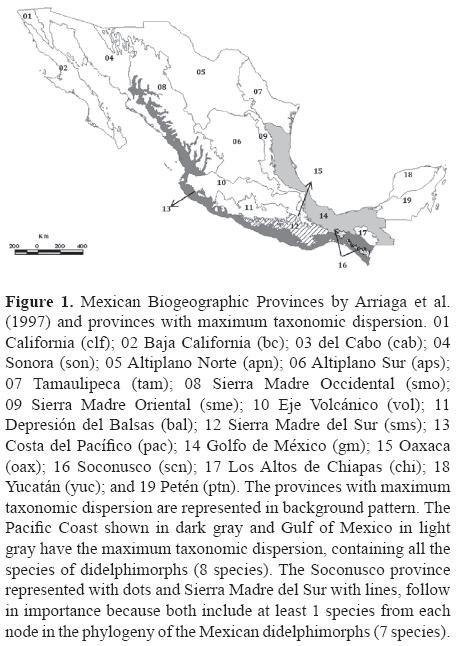
<body><![CDATA[<p align="justify"><font face="verdana" size="2">The data matrix of 45 taxa and 71 morphological&#45;karyological characters (Voss and Jansa, 2003; Bucher and Hoffman, 1980) is shown in <a href="/img/revistas/rmbiodiv/v83n4/html/a27apendice1.htm" target="_blank">Appendix</a>. The cladogram obtained was the result of a bootstrap analysis, which was used for the taxonomic weight method.</font></p>  	    <p align="justify"><font face="verdana" size="2">Taxonomic dispersion, taxonomic distinctness, and gap analysis were performed based on georreferenced data from 5 electronic databases of zoological collections for the 8 species of didelphimorphs present in Mexico: <i>Marmosa mexicana</i> Merriam, 1897; <i>Tlacuatzin canescens</i> Allen, 1893, Voss and Jansa, 2003; <i>Caluromys derbianus</i> Waterhouse, 1841; <i>Chironectes minimus</i> Zimmerman, 1780; <i>Didelphis marsupialis</i> Linnaeus, 1758; <i>Didelphis virginiana</i> Kerr, 1792; <i>Metachirus nudicaudatus</i> Desmarest, 1817; and <i>Philander opossum</i> Linnaeus, 1758. Data were retrieved from SNIB (Sistema Nacional de Informaci&oacute;n sobre Biodiversidad) of CONABIO, AMNH (American Museum of Natural History), MaNis (Mammal Network Information System), GBIF (Global Biodiversity Information), and REMIB (Red Mundial de Informaci&oacute;n sobre Biodiversidad). The final data set included 1 828 records taxonomically validated by experts from each database and a georeferenced site or locality where the organism was collected. Species collection records were assigned to 16 of the19 biogeographic provinces of Mexico (<a href="#f1">Fig. 1</a>) defined by Arriaga et al. (1997); the remaining 3 correspond to California, Baja California, and el Cabo provinces, where didelphimorphs are absent.</font></p>  	    <p align="center"><font face="verdana" size="2"><a name="f1"></a></font></p>  	    <p align="center"><font face="verdana" size="2"><img src="/img/revistas/rmbiodiv/v83n4/a27f1.jpg"></font></p>  	    <p align="justify"><font face="verdana" size="2"><i>Phylogenetic methods. a) Taxonomic weight and complementarity.</i> Proposed by Vane&#45;Wright et al. (1991), the taxonomic weight and complementarity method identifies diversity critical points. Like the taxonomic dispersion method (below), it takes into account phylogenetic and biogeographic information. This method does not consider whether species are plesiomorphic or apomorphic before the analysis is performed (Vane&#45;Wright et al., 1991), but it considers monophyletic groups within taxa. The difference between taxonomic weight and taxonomic dispersion is that the former includes the taxonomic weight for each species and uses complementarity to detect and propose possible protected areas. Complementarity identifies the minimum number of protected areas needed to ensure the maximum number of species (Williams, 2001).</font></p>  	    <p align="justify"><font face="verdana" size="2">The analysis of taxonomic weight included the 45 species of didelphimorphs in order to avoid sampling error from including only the Mexican species. In this work we only presented the results for Mexican opossums. We used 4 taxonomic measures (I), (Q), (W), and (P), to evaluate the information on the cladogram. The first index (I) corresponds to the number of monophyletic groups to which each species belongs; this value reflects the number of nodes from the root of the tree to the node subtending the terminal taxon. The basal phylogenetic weight (Q) is the sum of I divided by the smallest value of I. The number of taxa that contribute to the total diversity of the group (W), is the total sum of Q divided by the minimum value of Q. The measure (P) is the percentage of the W value for each taxon, and is the result of the multiplication of each value of W times one hundred and divided by the total of W (Vane&#45;Wright et al., 1991). The taxonomic singularity percentage (P%) was calculated to identify areas of highest priority in didelphimorphs conservation. Areas with 100 (P%) were the best option for conservation, but also the sets of areas that summed to 100.</font></p>  	    <p align="justify"><font face="verdana" size="2">Once the value of W was obtained, the distributions of the didelphimorphs in the biogeographic provinces and the phylogenetic information were included to prioritize using complementarity.</font></p>  	    <p align="justify"><font face="verdana" size="2"><i>b) Taxonomic dispersion</i> (Williams et al., 1991). We constructed a data matrix of taxa <i>vs.</i> biogeographical provinces (8x16) and coded the presence or absence of taxa to identify areas with the highest number of taxa in regard to the phylogeny of didelphimorphs (Voss and Jansa, 2003; modified by Medina&#45;Romero, 2007). Those areas that include all taxa possess the maximum dispersion. Areas of interest are those with the highest representation of species in the subclades when it is not possible to protect all species (Williams et al., 1991).</font></p>  	    <p align="justify"><font face="verdana" size="2"><i>c)&nbsp;Taxonomic distinctness.</i> Warwick and Clarke (1995) proposed this method to synthesize the path of relationships in a sample. They described the mean taxonomic distance between 2 organisms selected randomly in the phylogeny or in the Linnaean taxonomy for the entire species community. This method avoids the requirement of having resolved phylogenies, which are unknown for many taxonomic groups, but it is essential to have a Linnaean classification that reflects the different relationships of similarity between species (Clarke and Warwick, 1998a, b, 2001; Warwick and Clarke, 1995, 1998). We only used the average taxonomic distinctnes proposed by Warwick and Clarke (1995), because the order Didelphimorphia comprises 8 species in Mexico and no other taxa were included to strengthen the analysis.</font></p>  	    <p align="justify"><font face="verdana" size="2">To obtain this value, 2 matrices with the taxonomic classification of didelphimorphs were prepared in Excel. The first matrix included different Linnaean categories (species, genus, family, order, superorder, subclass, and class); the second matrix was scored for presence or absence of taxa for each of the biogeographic provinces. Fourteen provinces were included under the criteria of having 3 or more taxa in each one. The provinces of Sonora (son) and the Altiplano del Norte (apn) were not included because they contained only 2 and 1 species, respectively. The average taxonomic distinctness values and a funnel graph were obtained with the program Primer 5 (PRIMER&#45;E, 2001; Clarke and Warwick, 2001).</font></p>  	    ]]></body>
<body><![CDATA[<p align="justify"><font face="verdana" size="2"><i>d)&nbsp;Gap analysis.</i> Gap analysis is a cartographic technique proposed by Scott et al. (1987) to compare areas with high species richness and location of protected areas (Miller, 1994). There are 163 protected areas in Mexico (CONANP, 2007); the map used for the analysis included only 35 areas where the highest species richness for didelphimorphs was found based on results from taxonomic dispersion, taxonomic weight, and taxonomic distinctness (<a href="#f2">Fig. 2</a>).</font></p>  	    <p align="center"><font face="verdana" size="2"><a name="f2"></a></font></p>  	    <p align="center"><font face="verdana" size="2"><img src="/img/revistas/rmbiodiv/v83n4/a27f2.jpg"></font></p>  	    <p align="justify"><font face="verdana" size="2">&nbsp;</font></p>  	    <p align="justify"><font face="verdana" size="2"><b>Results</b></font></p>  	    <p align="justify"><font face="verdana" size="2">We obtained a total of 100 trees and one strict consensus cladogram for the order Didelphimorphia (<a href="/img/revistas/rmbiodiv/v83n4/a27f3.jpg" target="_blank">Fig. 3</a>).The resulting values for the most parsimonious trees were length= 189 steps, consistency index= 0.481 and retention index= 0.830. The hypothesis shown was strongly supported by the bootstrap analysis.</font></p>  	    <p align="justify"><font face="verdana" size="2"><i>a) Taxonomic weight and complementarity.</i> The analysis of taxonomic weight showed <i>C. derbianus, T. canescens, M. mexicana,</i> and <i>M. nudicaudatus</i> as the most plesiomorphic taxa with the highest taxonomic weight of 3.00 (<a href="/img/revistas/rmbiodiv/v83n4/a27f3.jpg" target="_blank">Fig. 3</a>), followed by <i>C. minimus</i> with a value of 2.00, <i>D. marsupialis</i> and <i>Philander opossum</i> with a value of 1.20, and the lowest taxonomic weight was for <i>D. virginiana</i> with a value of 1.00. Based on the taxonomic singularity percentage, the provinces with the highest priority were the Gulf of Mexico (gm) and the Pacific Coast (pac) with 100% of phylogenetic information (20.40), followed by Soconusco (scn) and the Sierra Madre del Sur (sms) with 85.3%. The percentages of phylogenetic information for each biogeographic province are shown in <a href="/img/revistas/rmbiodiv/v83n4/a27f4.jpg" target="_blank">Fig. 4</a>. The taxonomic weight index is used along with complementarity to prioritize crucial areas for conservation. Applying this, the counterpart area for the Sierra Madre del Sur (sms) province is Soconusco (scn); the former province preserves all taxa except <i>Metachirus nudicaudatus</i> with 85.3% of phylogenetic information, but this species is included in the latter province with 14.7%. In other words, these 2 provinces include all 8 species of didelphimorphs in Mexico. Another possible complementarity hypothesis is the province of Soconusco with 85.3% of phylogenetic information, which is complemented by the 14.7% of Chiapas province.</font></p>  	    <p align="justify"><font face="verdana" size="2"><i>b) Taxonomic dispersion.</i> The Gulf of Mexico (gm) and Pacific Coast (pac) provinces had the highest taxonomic dispersion (Wtotal= 20.40 equivalent to 100%; <a href="/img/revistas/rmbiodiv/v83n4/a27f4.jpg" target="_blank">Fig. 4</a>). All species of didelphimorphs occur in both areas (<a href="#f1">Fig. 1</a>). Assuming that it is not always possible to protect all species, the area with the highest taxonomic dispersion is the Soconusco province (scn; <a href="/img/revistas/rmbiodiv/v83n4/a27f4.jpg" target="_blank">Fig. 4</a>), because it includes at least 1 species from each node in the phylogeny of the didelphimorphs and 7 of the 8 species distributed in Mexico <i>(C. derbianus, C. minimus, D. marsupialis, D. virginiana, P. opossum, M. nudicaudatus,</i> and <i>M. mexicana).</i> Another important province is the Sierra Madre del Sur (sms), because it includes the same species as Soconusco except the narrow endemic, <i>T. canescens,</i> and it also includes <i>M. nudicaudatus</i> (<a href="#f1">Fig. 1</a>); that is why it is preferred over the rest of the biogeographic provinces.</font></p>  	    <p align="center"><font face="verdana" size="2"><a href="/img/revistas/rmbiodiv/v83n4/a27f5.jpg" target="_blank">Figure 5</a></font></p>  	    <p align="justify"><font face="verdana" size="2"><i>c)&nbsp;Taxonomic distinctness.</i> The area with the highest taxonomic distinctness was the Oaxaca (oax) province with a value of 38.1. This province includes <i>C. derbianus</i> and <i>T. canescens</i> (endemic to Mexico), but 2 species are absent, <i>M. nudicaudatus</i> and <i>C. minimus,</i> both listed as protected (SEMARNAT, 2010). The provinces of Sonora (son) and the Altiplano del Norte (apn) were not included because they contained only 2 and 1 species, respectively.</font></p>  	    ]]></body>
<body><![CDATA[<p align="justify"><font face="verdana" size="2"><i>d)&nbsp;Gap analysis.</i> A total of 35 protected areas were identified within the biogeographic provinces of Pacific Coast, Gulf of Mexico, Soconusco, Sierra Madre del Sur, and Oaxaca (<a href="/img/revistas/rmbiodiv/v83n4/a27t1.jpg" target="_blank">Table 1</a>). The gap analysis comparing the species' shared in the protected areas (<a href="/img/revistas/rmbiodiv/v83n4/a27t2.jpg" target="_blank">Table 2</a>) indicates that Palenque has 5 species, and Los Tuxtlas and Ca&ntilde;&oacute;n del R&iacute;o Blanco 4 species each (<a href="/img/revistas/rmbiodiv/v83n4/a27f6.jpg" target="_blank">Fig. 6</a>). None of the protected areas contained all species of marsupials. Palenque had the highest number of didelphimorph species. Moreover, it included <i>C. minimus</i> and <i>C. derbianus,</i> which are listed as "protected" and "threatened" respectively (SEMARNAT, 2010).</font></p>  	    <p align="justify"><font face="verdana" size="2">&nbsp;</font></p>  	    <p align="justify"><font face="verdana" size="2"><b>Discussion</b></font></p>  	    <p align="justify"><font face="verdana" size="2">The application of biogeographic methods for conservation has led to a different perspective for making better proposals in this topic (Whittaker et al., 2005). Under this assumption we used different biogeographic methods to analyze and to assess priorities in conservation status for the didelphimorphs species in the natural protected areas of Mexico by combining taxonomic distinctness, taxonomic weight, taxonomic dispersion, complementarity, and gap analysis, although we are aware that there are other biogeographic and ecological methods available.</font></p>  	    <p align="justify"><font face="verdana" size="2">Previous studies on Mexican marsupials using taxonomic dispersion were not found even though this method integrates distribution and taxonomic relationships of didelphimorphs to establish possible areas for conservation. Taxonomic dispersion and taxonomic weight gave us similar results and indicate that the southern portions of the Gulf of Mexico and the Pacific Coast, followed by the Soconusco and the Sierra Madre del Sur, are important for didelphimorphs conservation. The taxonomic distinctness analysis shows that the province of Oaxaca stands out as the most important area for didelphimorphs conservation. Areas with maximum taxonomic dispersion were the Gulf of Mexico and the Pacific Coast. These provinces have a large territorial extension, and the 8 didelphimorphs species were located only in the southern portion of these areas. If it is not always possible to protect all species, the Soconusco and the Sierra Madre del Sur provinces should be the subsequent conservation areas considered in order of importance, where at least 1 taxon from each node of the cladogram is found, even though <i>M. nudicaudatus</i> is not included within the Sierra Madre del Sur. Gap analysis showed that most of the didelphimorphs richness is found in protected areas, including <i>C. derbianus</i> and <i>C. minimus,</i> which are in risk of extinction. Nevertheless we can propose to establish a biological corridor connecting the protected areas, focusing on those of the most southern part of the country, to strengthen dispersal among these mammals and to guarantee the protection of <i>M. nudicaudatus</i> and <i>C. minimus,</i> both with distributions restricted to the area mentioned above.</font></p>  	    <p align="justify"><font face="verdana" size="2">Taxonomic distinctness measures have been applied to conservation biology in different ways. Bhat and Magurran (2006), working with fish, argued that these measures have a vast potential for environmental evaluation and conservation biology. Garcia&#45;Marmolejo et al. (2008) employed these measures to establish conservation priorities for Neotropical mammals. They determined that Oaxaca and Chiapas were the areas with the highest specific diversity. Our results show that Oaxaca is also an area with high taxonomic distinctness for marsupials. Garcia&#45;Marmolejo et al. (2008) evaluated the overlapping of panbiogeographic nodes with protected areas, and found that 1 site of highest diversity richness for mammals was found in Los Altos de Chiapas, which included 2 didelphimorphs, <i>M. mexicana</i> and <i>C. derbianus.</i> This information partially coincides with our results where Palenque is considered the richest area for didelphimorphs. These results from Mexican marsupials represent another example of the usage of these measures to assess terrestrial mammal conservation biology.</font></p>  	    <p align="justify"><font face="verdana" size="2">Using gap analysis and herpetofauna data, Ochoa&#45;Ochoa and Flores&#45;Villela (2006) found that approximately 40% of the protected areas of Mexico coincided with places of high richness for these organisms. Additionally, Urbina&#45;Cardona and Flores&#45;Villela (2010) found that the hotspot areas were concentrated in the southeast part of Mexico, which is congruent with our results for marsupials. The above results also agree with the latitudinal and richness patterns proposed by Ceballos and Oliva (2005) and Ceballos (2007), who established that the highest richness of Mexican marsupials occurs in southern Mexico, and that the reserves with the highest species number are located in tropical forest areas.</font></p>  	    <p align="justify"><font face="verdana" size="2">Based on the results of our work, we noticed that it is better to combine different methods to make decisions, because a better conservation proposal can be obtained. This approach has been applied in different works; for example, Torres&#45;Miranda et al. (2011) used complementarity, richness, and endemism patterns of red oaks in Mexico and Central America, and V&aacute;zquez and Valenzuela&#45;Galv&aacute;n (2009) studied mammals with the same methods. Both studies coincide with our results in locating the highest richness area for plants and mammals in southern Mexico. Also the results of V&aacute;zquez et al. (2009) employing complementarity with mammals are congruent with our results in that the Pacific Coast, Sierra Madre del Sur, and Soconusco are the most species rich areas in the country. Finally, our results partially coincide with Escalante et al. (2009), who used optimality criterion, parsimony analysis of endemicity, and niche modelling methods and concluded that the regions of the central Pacific Coast, Chiapas, Transmexican volcanic belt, and the Yucat&aacute;n Peninsula should be considered as endemism areas which partially correspond to similar areas in our study.</font></p>  	    <p align="justify"><font face="verdana" size="2">&nbsp;</font></p>  	    <p align="justify"><font face="verdana" size="2"><b>Acknowledgements</b></font></p>  	    ]]></body>
<body><![CDATA[<p align="justify"><font face="verdana" size="2">We thank D. Gernandt and A. Contreras for comments and corrections to an earlier version of the manuscript. This work was partially funded by Projects FOMIX&#45;CONACyT Hidalgo 43761 "Diversidad Biol&oacute;gica del Estado de Hidalgo", and 95828 "Diversidad Biol&oacute;gica del Estado de Hidalgo (segunda fase)".</font></p>  	    <p align="justify"><font face="verdana" size="2">&nbsp;</font></p>  	    <p align="justify"><font face="verdana" size="2"><b>Literature cited</b></font></p>  	    <!-- ref --><p align="justify"><font face="verdana" size="2">Arriaga, L. C., C. Aguilar, D. Espinosa&#45;Organista and R. Jim&eacute;nez. 1997. Regionalizaci&oacute;n ecol&oacute;gica y biogeogr&aacute;fica de M&eacute;xico. Taller de la Comisi&oacute;n Nacional para el Conocimiento y Uso de la Biodiversidad CONABIO. M&eacute;xico, D. F. <a href="http://www.biodiversidad.gob.mx/pais/pdf/CapNatMex/Vol%20I/I01_Elconocimientobiog.pdf" target="_blank">http://www.biodiversidad.gob.mx/pais/pdf/CapNatMex/Vol%20I/I01_Elconocimientobiog.pdf</a>; last access: 29.II.2012.    &nbsp;&nbsp;&nbsp;&nbsp;&nbsp;&nbsp;&nbsp;&nbsp;[&#160;<a href="javascript:void(0);" onclick="javascript: window.open('/scielo.php?script=sci_nlinks&ref=7578435&pid=S1870-3453201200040002700001&lng=','','width=640,height=500,resizable=yes,scrollbars=1,menubar=yes,');">Links</a>&#160;]<!-- end-ref --></font></p>  	    <!-- ref --><p align="justify"><font face="verdana" size="2">Atkinson, I. 1989. Introduced animals and extinctions. <i>In</i> Conservation for the twenty first century, D. Western and M. Pearl (eds.). Oxford University Press, New York. p. 54&#45;69.    &nbsp;&nbsp;&nbsp;&nbsp;&nbsp;&nbsp;&nbsp;&nbsp;[&#160;<a href="javascript:void(0);" onclick="javascript: window.open('/scielo.php?script=sci_nlinks&ref=7578437&pid=S1870-3453201200040002700002&lng=','','width=640,height=500,resizable=yes,scrollbars=1,menubar=yes,');">Links</a>&#160;]<!-- end-ref --></font></p>  	    <!-- ref --><p align="justify"><font face="verdana" size="2">Bhat, A. and A. E. Magurran. 2006. Taxonomic distinctness in a linear system: a test using a tropical freshwater fish assemblage. Ecography 29:104&#45;110.    &nbsp;&nbsp;&nbsp;&nbsp;&nbsp;&nbsp;&nbsp;&nbsp;[&#160;<a href="javascript:void(0);" onclick="javascript: window.open('/scielo.php?script=sci_nlinks&ref=7578439&pid=S1870-3453201200040002700003&lng=','','width=640,height=500,resizable=yes,scrollbars=1,menubar=yes,');">Links</a>&#160;]<!-- end-ref --></font></p>  	    <!-- ref --><p align="justify"><font face="verdana" size="2">Bojorquez&#45;Tapia, L. A. and O. Flores&#45;Villela. 1991. Aspectos Legales y Metodol&oacute;gicos de la Bioconservaci&oacute;n en M&eacute;xico. <i>In</i> Memorias del Seminario sobre conservaci&oacute;n de la Diversidad Biol&oacute;gica en M&eacute;xico, J. Llorente&#45;Bousquets, H. E. Ponce, O. Flores&#45;Villela. (eds.). M&eacute;xico, D. F. No. 2. p.1&#45;23.    &nbsp;&nbsp;&nbsp;&nbsp;&nbsp;&nbsp;&nbsp;&nbsp;[&#160;<a href="javascript:void(0);" onclick="javascript: window.open('/scielo.php?script=sci_nlinks&ref=7578441&pid=S1870-3453201200040002700004&lng=','','width=640,height=500,resizable=yes,scrollbars=1,menubar=yes,');">Links</a>&#160;]<!-- end-ref --></font></p>  	    <!-- ref --><p align="justify"><font face="verdana" size="2">Bucher, J. and R. Hoffmann. 1980. <i>Caluromys derbianus.</i> American Society of Mammalogists 140:1&#45;4.    &nbsp;&nbsp;&nbsp;&nbsp;&nbsp;&nbsp;&nbsp;&nbsp;[&#160;<a href="javascript:void(0);" onclick="javascript: window.open('/scielo.php?script=sci_nlinks&ref=7578443&pid=S1870-3453201200040002700005&lng=','','width=640,height=500,resizable=yes,scrollbars=1,menubar=yes,');">Links</a>&#160;]<!-- end-ref --></font></p>  	    <!-- ref --><p align="justify"><font face="verdana" size="2">Ceballos G. and G. Oliva. 2005. Los mam&iacute;feros silvestres de M&eacute;xico. 1<sup>a</sup> edici&oacute;n CONABIO y Fondo de Cultura Econ&oacute;mica. M&eacute;xico, D. F. 986 p.    &nbsp;&nbsp;&nbsp;&nbsp;&nbsp;&nbsp;&nbsp;&nbsp;[&#160;<a href="javascript:void(0);" onclick="javascript: window.open('/scielo.php?script=sci_nlinks&ref=7578445&pid=S1870-3453201200040002700006&lng=','','width=640,height=500,resizable=yes,scrollbars=1,menubar=yes,');">Links</a>&#160;]<!-- end-ref --></font></p>  	    <!-- ref --><p align="justify"><font face="verdana" size="2">Ceballos, G. 2007. Conservation priorities for mammals in megadiverse Mexico: the efficiency of reserve networks. Ecological Applications 17:569&#45;578.    &nbsp;&nbsp;&nbsp;&nbsp;&nbsp;&nbsp;&nbsp;&nbsp;[&#160;<a href="javascript:void(0);" onclick="javascript: window.open('/scielo.php?script=sci_nlinks&ref=7578447&pid=S1870-3453201200040002700007&lng=','','width=640,height=500,resizable=yes,scrollbars=1,menubar=yes,');">Links</a>&#160;]<!-- end-ref --></font></p>  	    <!-- ref --><p align="justify"><font face="verdana" size="2">Clarke, K. R. and R. M. Warwick.1998a. Quantifying structural redundancy in ecological communities. Oecologia 113:278&#45;289.    &nbsp;&nbsp;&nbsp;&nbsp;&nbsp;&nbsp;&nbsp;&nbsp;[&#160;<a href="javascript:void(0);" onclick="javascript: window.open('/scielo.php?script=sci_nlinks&ref=7578449&pid=S1870-3453201200040002700008&lng=','','width=640,height=500,resizable=yes,scrollbars=1,menubar=yes,');">Links</a>&#160;]<!-- end-ref --></font></p>  	    <!-- ref --><p align="justify"><font face="verdana" size="2">Clarke, K. R. and R. M. Warwick. 1998b. A taxonomic distinctness index and its statistical properties. Journal of Applied Ecology 35:523&#45;53.    &nbsp;&nbsp;&nbsp;&nbsp;&nbsp;&nbsp;&nbsp;&nbsp;[&#160;<a href="javascript:void(0);" onclick="javascript: window.open('/scielo.php?script=sci_nlinks&ref=7578451&pid=S1870-3453201200040002700009&lng=','','width=640,height=500,resizable=yes,scrollbars=1,menubar=yes,');">Links</a>&#160;]<!-- end-ref --></font></p>  	    <!-- ref --><p align="justify"><font face="verdana" size="2">Clarke, K. R. and R. M. Warwick. 2001. Change in marine communities: an approach to statistical analysis and interpretation, 2nd ed. PRIMER&#45;E, Plymouth. p. 172.    &nbsp;&nbsp;&nbsp;&nbsp;&nbsp;&nbsp;&nbsp;&nbsp;[&#160;<a href="javascript:void(0);" onclick="javascript: window.open('/scielo.php?script=sci_nlinks&ref=7578453&pid=S1870-3453201200040002700010&lng=','','width=640,height=500,resizable=yes,scrollbars=1,menubar=yes,');">Links</a>&#160;]<!-- end-ref --></font></p>  	    <!-- ref --><p align="justify"><font face="verdana" size="2">CONANP (Comisi&oacute;n Nacional de &Aacute;reas Naturales Protegidas). 2007. Mapa de &aacute;reas naturales protegidas de M&eacute;xico. <a href="http://www.conanp.gob.mx/regionales/" target="_blank">http://www.conanp.gob.mx/regionales/</a>; last access: 29.II.2012.    &nbsp;&nbsp;&nbsp;&nbsp;&nbsp;&nbsp;&nbsp;&nbsp;[&#160;<a href="javascript:void(0);" onclick="javascript: window.open('/scielo.php?script=sci_nlinks&ref=7578455&pid=S1870-3453201200040002700011&lng=','','width=640,height=500,resizable=yes,scrollbars=1,menubar=yes,');">Links</a>&#160;]<!-- end-ref --></font></p>  	    <!-- ref --><p align="justify"><font face="verdana" size="2">Eguiarte, L. E., J. Larson&#45;Guerra, J. Nu&ntilde;ez&#45;Farf&aacute;n, J. Mart&iacute;nez&#45;Palacios, A. Santos&#45;del Prado and H. T. Arita. 1999. Diversidad Filogen&eacute;tica y conservaci&oacute;n: ejemplos a diferentes escalas y una propuesta a nivel poblacional para <i>Agave victoriae&#45;reginae</i> en el desierto de Chihuahua, M&eacute;xico. Revista Chilena de Historia Natural 72:475&#45;492.    &nbsp;&nbsp;&nbsp;&nbsp;&nbsp;&nbsp;&nbsp;&nbsp;[&#160;<a href="javascript:void(0);" onclick="javascript: window.open('/scielo.php?script=sci_nlinks&ref=7578457&pid=S1870-3453201200040002700012&lng=','','width=640,height=500,resizable=yes,scrollbars=1,menubar=yes,');">Links</a>&#160;]<!-- end-ref --></font></p>  	    <!-- ref --><p align="justify"><font face="verdana" size="2">Escalante, T., C. Szumik and J. J. Morrone. 2009. Areas of endemism of Mexican mammals reanalysis applying the optimality criterion. Biological Journal of the Linnean Society 98:468&#45;478.    &nbsp;&nbsp;&nbsp;&nbsp;&nbsp;&nbsp;&nbsp;&nbsp;[&#160;<a href="javascript:void(0);" onclick="javascript: window.open('/scielo.php?script=sci_nlinks&ref=7578459&pid=S1870-3453201200040002700013&lng=','','width=640,height=500,resizable=yes,scrollbars=1,menubar=yes,');">Links</a>&#160;]<!-- end-ref --></font></p>  	    <!-- ref --><p align="justify"><font face="verdana" size="2">Garc&iacute;a&#45;Marmolejo, G., T. Escalante and J. J. Morrone. 2008. Establecimiento de prioridades para la conservaci&oacute;n de mam&iacute;feros terrestres neotropicales de M&eacute;xico. Mastozoolog&iacute;a Neotropical 15:41&#45;65.    &nbsp;&nbsp;&nbsp;&nbsp;&nbsp;&nbsp;&nbsp;&nbsp;[&#160;<a href="javascript:void(0);" onclick="javascript: window.open('/scielo.php?script=sci_nlinks&ref=7578461&pid=S1870-3453201200040002700014&lng=','','width=640,height=500,resizable=yes,scrollbars=1,menubar=yes,');">Links</a>&#160;]<!-- end-ref --></font></p>  	    <!-- ref --><p align="justify"><font face="verdana" size="2">Mart&iacute;n&#45;Piera, F. 1999. Apuntes sobre biodiversidad y conservaci&oacute;n de insectos: dilemas, ficciones y &iquest;soluciones? Versi&oacute;n electr&oacute;nica del art&iacute;culo publicado. Bolet&iacute;n de la Sociedad Entomol&oacute;gica Aragonesa 20:25&#45;55.    &nbsp;&nbsp;&nbsp;&nbsp;&nbsp;&nbsp;&nbsp;&nbsp;[&#160;<a href="javascript:void(0);" onclick="javascript: window.open('/scielo.php?script=sci_nlinks&ref=7578463&pid=S1870-3453201200040002700015&lng=','','width=640,height=500,resizable=yes,scrollbars=1,menubar=yes,');">Links</a>&#160;]<!-- end-ref --></font></p>  	    <!-- ref --><p align="justify"><font face="verdana" size="2">Medina&#45;Romero, M. 2007. Biogeograf&iacute;a del Orden Didelphimorphia en M&eacute;xico. Thesis. Universidad Aut&oacute;noma del Estado de Hidalgo (UAEH). M&eacute;xico. 88 p.    &nbsp;&nbsp;&nbsp;&nbsp;&nbsp;&nbsp;&nbsp;&nbsp;[&#160;<a href="javascript:void(0);" onclick="javascript: window.open('/scielo.php?script=sci_nlinks&ref=7578465&pid=S1870-3453201200040002700016&lng=','','width=640,height=500,resizable=yes,scrollbars=1,menubar=yes,');">Links</a>&#160;]<!-- end-ref --></font></p>  	    <!-- ref --><p align="justify"><font face="verdana" size="2">Miller, R. I. 1994. Setting the scene. <i>In</i> Mapping the Diversity of Nature. R. I. Miller (ed.). Chapman and Hall, London. p. 3&#45;17.    &nbsp;&nbsp;&nbsp;&nbsp;&nbsp;&nbsp;&nbsp;&nbsp;[&#160;<a href="javascript:void(0);" onclick="javascript: window.open('/scielo.php?script=sci_nlinks&ref=7578467&pid=S1870-3453201200040002700017&lng=','','width=640,height=500,resizable=yes,scrollbars=1,menubar=yes,');">Links</a>&#160;]<!-- end-ref --></font></p>  	    <!-- ref --><p align="justify"><font face="verdana" size="2">Ochoa&#45;Ochoa, L. M. and O. Flores&#45;Villela. 2006. &Aacute;reas de Diversidad de Endemismo de la Herpetofauna Mexicana. UNAM, CONABIO. M&eacute;xico, D. F. p. 211.    &nbsp;&nbsp;&nbsp;&nbsp;&nbsp;&nbsp;&nbsp;&nbsp;[&#160;<a href="javascript:void(0);" onclick="javascript: window.open('/scielo.php?script=sci_nlinks&ref=7578469&pid=S1870-3453201200040002700018&lng=','','width=640,height=500,resizable=yes,scrollbars=1,menubar=yes,');">Links</a>&#160;]<!-- end-ref --></font></p>  	    <!-- ref --><p align="justify"><font face="verdana" size="2">PRIMER LTD. 2001. Plymouth Routines In Multivariate Ecological Research PRIMER ver 5.2.4. Plymouth United Kingdom. p. 243&#45;256.    &nbsp;&nbsp;&nbsp;&nbsp;&nbsp;&nbsp;&nbsp;&nbsp;[&#160;<a href="javascript:void(0);" onclick="javascript: window.open('/scielo.php?script=sci_nlinks&ref=7578471&pid=S1870-3453201200040002700019&lng=','','width=640,height=500,resizable=yes,scrollbars=1,menubar=yes,');">Links</a>&#160;]<!-- end-ref --></font></p>  	    <!-- ref --><p align="justify"><font face="verdana" size="2">Scott, J. M., B. Csuti, J. D. Jacobi and J. E. Estes. 1987. Species Richness. Bioscience 37:782&#45;788.    &nbsp;&nbsp;&nbsp;&nbsp;&nbsp;&nbsp;&nbsp;&nbsp;[&#160;<a href="javascript:void(0);" onclick="javascript: window.open('/scielo.php?script=sci_nlinks&ref=7578473&pid=S1870-3453201200040002700020&lng=','','width=640,height=500,resizable=yes,scrollbars=1,menubar=yes,');">Links</a>&#160;]<!-- end-ref --></font></p>  	    <!-- ref --><p align="justify"><font face="verdana" size="2">SEMARNAT (Secretar&iacute;a de Medio Ambiente y Recursos Naturales). 2010. Norma Oficial Mexicana NOM&#45;059&#45;ECOL&#45;2010. Protecci&oacute;n ambiental&#45;especies nativas de M&eacute;xico de Flora y fauna silvestres&#45;Categor&iacute;as de riesgo y especificaciones para su inclusi&oacute;n, exclusi&oacute;n o cambio&#45;lista de especies en riesgo. Diario oficial de la federaci&oacute;n, 30 de diciembre de 2010. p. 1&#45;78.    &nbsp;&nbsp;&nbsp;&nbsp;&nbsp;&nbsp;&nbsp;&nbsp;[&#160;<a href="javascript:void(0);" onclick="javascript: window.open('/scielo.php?script=sci_nlinks&ref=7578475&pid=S1870-3453201200040002700021&lng=','','width=640,height=500,resizable=yes,scrollbars=1,menubar=yes,');">Links</a>&#160;]<!-- end-ref --></font></p>  	    <!-- ref --><p align="justify"><font face="verdana" size="2">Swofford, D. L. 1999. PAUP*. Phylogenetic analysis using parsimony (and other methods). Ver 4. Sinauer Associated. Sunderland.    &nbsp;&nbsp;&nbsp;&nbsp;&nbsp;&nbsp;&nbsp;&nbsp;[&#160;<a href="javascript:void(0);" onclick="javascript: window.open('/scielo.php?script=sci_nlinks&ref=7578477&pid=S1870-3453201200040002700022&lng=','','width=640,height=500,resizable=yes,scrollbars=1,menubar=yes,');">Links</a>&#160;]<!-- end-ref --></font></p>  	    <!-- ref --><p align="justify"><font face="verdana" size="2">Torres&#45;Miranda, A., I. Luna&#45;Vega and K. Oyama. 2011. Conservation Biogeography of red oaks <i>(Quercus</i> section Lobatae) in Mexico and Central America. American Journal of Botany 98:290&#45;305.    &nbsp;&nbsp;&nbsp;&nbsp;&nbsp;&nbsp;&nbsp;&nbsp;[&#160;<a href="javascript:void(0);" onclick="javascript: window.open('/scielo.php?script=sci_nlinks&ref=7578479&pid=S1870-3453201200040002700023&lng=','','width=640,height=500,resizable=yes,scrollbars=1,menubar=yes,');">Links</a>&#160;]<!-- end-ref --></font></p>  	    <!-- ref --><p align="justify"><font face="verdana" size="2">Urbina&#45;Cardona, J. N. and O. Flores&#45;Villela. 2010. Ecological&#45;Niche Modeling and Prioritization of Conservation&#45;Area Networks for Mexican Herpetofauna. Conservation Biology 24:1031&#45;1041.    &nbsp;&nbsp;&nbsp;&nbsp;&nbsp;&nbsp;&nbsp;&nbsp;[&#160;<a href="javascript:void(0);" onclick="javascript: window.open('/scielo.php?script=sci_nlinks&ref=7578481&pid=S1870-3453201200040002700024&lng=','','width=640,height=500,resizable=yes,scrollbars=1,menubar=yes,');">Links</a>&#160;]<!-- end-ref --></font></p>  	    <!-- ref --><p align="justify"><font face="verdana" size="2">Vane&#45;Wright, R. I., C. J. Humphries and P. H. Williams. 1991. "What to protect? Systematics and the agony of a choice. Biological Conservation 55:235&#45;254.    &nbsp;&nbsp;&nbsp;&nbsp;&nbsp;&nbsp;&nbsp;&nbsp;[&#160;<a href="javascript:void(0);" onclick="javascript: window.open('/scielo.php?script=sci_nlinks&ref=7578483&pid=S1870-3453201200040002700025&lng=','','width=640,height=500,resizable=yes,scrollbars=1,menubar=yes,');">Links</a>&#160;]<!-- end-ref --></font></p>  	    <!-- ref --><p align="justify"><font face="verdana" size="2">V&aacute;zquez, L. and D. Valenzuela&#45;Galv&aacute;n. 2009. Que tan bien representados est&aacute;n los mam&iacute;feros mexicanos en la red federal de &aacute;reas naturales protegidas del pa&iacute;s? Revista Mexicana de Biodiversidad 80:249&#45;285.    &nbsp;&nbsp;&nbsp;&nbsp;&nbsp;&nbsp;&nbsp;&nbsp;[&#160;<a href="javascript:void(0);" onclick="javascript: window.open('/scielo.php?script=sci_nlinks&ref=7578485&pid=S1870-3453201200040002700026&lng=','','width=640,height=500,resizable=yes,scrollbars=1,menubar=yes,');">Links</a>&#160;]<!-- end-ref --></font></p>  	    <!-- ref --><p align="justify"><font face="verdana" size="2">V&aacute;zquez, L., Bustamante C. G. and D. G. Bahena&#45;Arce. 2009. Area Selection for conservation of Mexican mammals. Animal Biodiversity and Conservation 32:29&#45;39.    &nbsp;&nbsp;&nbsp;&nbsp;&nbsp;&nbsp;&nbsp;&nbsp;[&#160;<a href="javascript:void(0);" onclick="javascript: window.open('/scielo.php?script=sci_nlinks&ref=7578487&pid=S1870-3453201200040002700027&lng=','','width=640,height=500,resizable=yes,scrollbars=1,menubar=yes,');">Links</a>&#160;]<!-- end-ref --></font></p>  	    <!-- ref --><p align="justify"><font face="verdana" size="2">Voss S. R. and S. H. Jansa. 2003. Phylogenetic studies on didelphid marsupials II. Nonmolecular data and new IRBP sequences: separate and combined analyses of Didelphine relationships with denser taxon sampling. Bulletin of the American Museum of Natural History 276:1&#45;82.    &nbsp;&nbsp;&nbsp;&nbsp;&nbsp;&nbsp;&nbsp;&nbsp;[&#160;<a href="javascript:void(0);" onclick="javascript: window.open('/scielo.php?script=sci_nlinks&ref=7578489&pid=S1870-3453201200040002700028&lng=','','width=640,height=500,resizable=yes,scrollbars=1,menubar=yes,');">Links</a>&#160;]<!-- end-ref --></font></p>  	    <!-- ref --><p align="justify"><font face="verdana" size="2">Warwick, R. M. and K. R. Clarke. 1995. New 'biodiversity' measures reveal a decrease in taxonomic distinctness with increasing stress. Marine Ecology and Progress Series 129:301&#45;305.    &nbsp;&nbsp;&nbsp;&nbsp;&nbsp;&nbsp;&nbsp;&nbsp;[&#160;<a href="javascript:void(0);" onclick="javascript: window.open('/scielo.php?script=sci_nlinks&ref=7578491&pid=S1870-3453201200040002700029&lng=','','width=640,height=500,resizable=yes,scrollbars=1,menubar=yes,');">Links</a>&#160;]<!-- end-ref --></font></p>  	    <!-- ref --><p align="justify"><font face="verdana" size="2">Warwick, R. M. and K. R. Clarke. 1998. Taxonomic distinctness and environmental assessment. Journal of Applied Ecology 35:532&#45;543.    &nbsp;&nbsp;&nbsp;&nbsp;&nbsp;&nbsp;&nbsp;&nbsp;[&#160;<a href="javascript:void(0);" onclick="javascript: window.open('/scielo.php?script=sci_nlinks&ref=7578493&pid=S1870-3453201200040002700030&lng=','','width=640,height=500,resizable=yes,scrollbars=1,menubar=yes,');">Links</a>&#160;]<!-- end-ref --></font></p>  	    <!-- ref --><p align="justify"><font face="verdana" size="2">Williams, P. H. 2001. Complementarity. <i>In</i> Encyclopedia of biodiversity, vol. I. S. A. Levin (ed.). Academic Press. p. 813&#45;829.    &nbsp;&nbsp;&nbsp;&nbsp;&nbsp;&nbsp;&nbsp;&nbsp;[&#160;<a href="javascript:void(0);" onclick="javascript: window.open('/scielo.php?script=sci_nlinks&ref=7578495&pid=S1870-3453201200040002700031&lng=','','width=640,height=500,resizable=yes,scrollbars=1,menubar=yes,');">Links</a>&#160;]<!-- end-ref --></font></p>  	    <!-- ref --><p align="justify"><font face="verdana" size="2">Williams, P. H., C. H. Humphries and R. I. Vane&#45;Wright. 1991. Measuring biodiversity for choosing conservation areas: taxonomic relatedness for conservation priorities. Australian Systematic Botany 4:665&#45;679.    &nbsp;&nbsp;&nbsp;&nbsp;&nbsp;&nbsp;&nbsp;&nbsp;[&#160;<a href="javascript:void(0);" onclick="javascript: window.open('/scielo.php?script=sci_nlinks&ref=7578497&pid=S1870-3453201200040002700032&lng=','','width=640,height=500,resizable=yes,scrollbars=1,menubar=yes,');">Links</a>&#160;]<!-- end-ref --></font></p>  	    <!-- ref --><p align="justify"><font face="verdana" size="2">Whittaker, R. J., M. B. Ara&uacute;jo, P. Jepson, R. J. Ladle, J. E. M. Watson and K. J. Willis. 2005. Conservation biogeography: assessment and prospect. Diversity and Distributions 11:3&#45;23.    &nbsp;&nbsp;&nbsp;&nbsp;&nbsp;&nbsp;&nbsp;&nbsp;[&#160;<a href="javascript:void(0);" onclick="javascript: window.open('/scielo.php?script=sci_nlinks&ref=7578499&pid=S1870-3453201200040002700033&lng=','','width=640,height=500,resizable=yes,scrollbars=1,menubar=yes,');">Links</a>&#160;]<!-- end-ref --></font></p>      ]]></body><back>
<ref-list>
<ref id="B1">
<nlm-citation citation-type="book">
<person-group person-group-type="author">
<name>
<surname><![CDATA[Arriaga]]></surname>
<given-names><![CDATA[L. C.]]></given-names>
</name>
<name>
<surname><![CDATA[Aguilar]]></surname>
<given-names><![CDATA[C.]]></given-names>
</name>
<name>
<surname><![CDATA[Espinosa-Organista]]></surname>
<given-names><![CDATA[D.]]></given-names>
</name>
<name>
<surname><![CDATA[Jiménez]]></surname>
<given-names><![CDATA[R.]]></given-names>
</name>
</person-group>
<source><![CDATA[Regionalización ecológica y biogeográfica de México]]></source>
<year>1997</year>
<publisher-loc><![CDATA[México^eD. F. D. F.]]></publisher-loc>
<publisher-name><![CDATA[Taller de la Comisión Nacional para el Conocimiento y Uso de la Biodiversidad CONABIO]]></publisher-name>
</nlm-citation>
</ref>
<ref id="B2">
<nlm-citation citation-type="book">
<person-group person-group-type="author">
<name>
<surname><![CDATA[Atkinson]]></surname>
<given-names><![CDATA[I]]></given-names>
</name>
</person-group>
<article-title xml:lang="en"><![CDATA[Introduced animals and extinctions]]></article-title>
<person-group person-group-type="editor">
<name>
<surname><![CDATA[Western]]></surname>
<given-names><![CDATA[D.]]></given-names>
</name>
<name>
<surname><![CDATA[Pearl]]></surname>
<given-names><![CDATA[M.]]></given-names>
</name>
</person-group>
<source><![CDATA[Conservation for the twenty first century]]></source>
<year>1989</year>
<page-range>54-69</page-range><publisher-loc><![CDATA[New York ]]></publisher-loc>
<publisher-name><![CDATA[Oxford University Press]]></publisher-name>
</nlm-citation>
</ref>
<ref id="B3">
<nlm-citation citation-type="journal">
<person-group person-group-type="author">
<name>
<surname><![CDATA[Bhat]]></surname>
<given-names><![CDATA[A.]]></given-names>
</name>
<name>
<surname><![CDATA[Magurran]]></surname>
<given-names><![CDATA[A. E.]]></given-names>
</name>
</person-group>
<article-title xml:lang="en"><![CDATA[Taxonomic distinctness in a linear system: a test using a tropical freshwater fish assemblage]]></article-title>
<source><![CDATA[Ecography]]></source>
<year>2006</year>
<volume>29</volume>
<page-range>104-110</page-range></nlm-citation>
</ref>
<ref id="B4">
<nlm-citation citation-type="">
<person-group person-group-type="author">
<name>
<surname><![CDATA[Bojorquez-Tapia]]></surname>
<given-names><![CDATA[L. A.]]></given-names>
</name>
<name>
<surname><![CDATA[Flores-Villela]]></surname>
<given-names><![CDATA[O.]]></given-names>
</name>
</person-group>
<article-title xml:lang="es"><![CDATA[Aspectos Legales y Metodológicos de la Bioconservación en México]]></article-title>
<person-group person-group-type="editor">
<name>
<surname><![CDATA[Llorente-Bousquets]]></surname>
<given-names><![CDATA[J.]]></given-names>
</name>
<name>
<surname><![CDATA[Ponce]]></surname>
<given-names><![CDATA[H. E.]]></given-names>
</name>
<name>
<surname><![CDATA[Flores-Villela.]]></surname>
<given-names><![CDATA[O.]]></given-names>
</name>
</person-group>
<source><![CDATA[Memorias del Seminario sobre conservación de la Diversidad Biológica en México]]></source>
<year>1991</year>
<page-range>1-23</page-range><publisher-loc><![CDATA[México^eD. F. D. F.]]></publisher-loc>
</nlm-citation>
</ref>
<ref id="B5">
<nlm-citation citation-type="journal">
<person-group person-group-type="author">
<name>
<surname><![CDATA[Bucher]]></surname>
<given-names><![CDATA[J.]]></given-names>
</name>
<name>
<surname><![CDATA[Hoffmann]]></surname>
<given-names><![CDATA[R.]]></given-names>
</name>
</person-group>
<article-title xml:lang="en"><![CDATA[Caluromys derbianus]]></article-title>
<source><![CDATA[American Society of Mammalogists]]></source>
<year>1980</year>
<volume>140</volume>
<page-range>1-4</page-range></nlm-citation>
</ref>
<ref id="B6">
<nlm-citation citation-type="book">
<person-group person-group-type="author">
<name>
<surname><![CDATA[Ceballos]]></surname>
<given-names><![CDATA[G.]]></given-names>
</name>
<name>
<surname><![CDATA[Oliva]]></surname>
<given-names><![CDATA[G.]]></given-names>
</name>
</person-group>
<source><![CDATA[Los mamíferos silvestres de México]]></source>
<year>2005</year>
<edition>1a</edition>
<page-range>986</page-range><publisher-loc><![CDATA[México^eD. F. D. F.]]></publisher-loc>
<publisher-name><![CDATA[CONABIOFondo de Cultura Económica]]></publisher-name>
</nlm-citation>
</ref>
<ref id="B7">
<nlm-citation citation-type="journal">
<person-group person-group-type="author">
<name>
<surname><![CDATA[Ceballos]]></surname>
<given-names><![CDATA[G]]></given-names>
</name>
</person-group>
<article-title xml:lang="en"><![CDATA[Conservation priorities for mammals in megadiverse Mexico: the efficiency of reserve networks]]></article-title>
<source><![CDATA[Ecological Applications]]></source>
<year>2007</year>
<volume>17</volume>
<page-range>569-578</page-range></nlm-citation>
</ref>
<ref id="B8">
<nlm-citation citation-type="journal">
<person-group person-group-type="author">
<name>
<surname><![CDATA[Clarke]]></surname>
<given-names><![CDATA[K. R.]]></given-names>
</name>
<name>
<surname><![CDATA[Warwick.]]></surname>
<given-names><![CDATA[R. M.]]></given-names>
</name>
</person-group>
<article-title xml:lang="en"><![CDATA[Quantifying structural redundancy in ecological communities]]></article-title>
<source><![CDATA[Oecologia]]></source>
<year>1998</year>
<volume>113</volume>
<page-range>278-289</page-range></nlm-citation>
</ref>
<ref id="B9">
<nlm-citation citation-type="journal">
<person-group person-group-type="author">
<name>
<surname><![CDATA[Clarke]]></surname>
<given-names><![CDATA[K. R.]]></given-names>
</name>
<name>
<surname><![CDATA[Warwick]]></surname>
<given-names><![CDATA[R. M.]]></given-names>
</name>
</person-group>
<article-title xml:lang="en"><![CDATA[A taxonomic distinctness index and its statistical properties]]></article-title>
<source><![CDATA[Journal of Applied Ecology]]></source>
<year>1998</year>
<volume>35</volume>
<page-range>523-53</page-range></nlm-citation>
</ref>
<ref id="B10">
<nlm-citation citation-type="book">
<person-group person-group-type="author">
<name>
<surname><![CDATA[Clarke]]></surname>
<given-names><![CDATA[K. R.]]></given-names>
</name>
<name>
<surname><![CDATA[Warwick]]></surname>
<given-names><![CDATA[R. M.]]></given-names>
</name>
</person-group>
<source><![CDATA[Change in marine communities: an approach to statistical analysis and interpretation]]></source>
<year>2001</year>
<edition>2nd</edition>
<page-range>172</page-range><publisher-loc><![CDATA[Plymouth ]]></publisher-loc>
<publisher-name><![CDATA[PRIMER-E]]></publisher-name>
</nlm-citation>
</ref>
<ref id="B11">
<nlm-citation citation-type="">
<collab>Comisión Nacional de Áreas Naturales Protegidas</collab>
<source><![CDATA[Mapa de áreas naturales protegidas de México]]></source>
<year>2007</year>
</nlm-citation>
</ref>
<ref id="B12">
<nlm-citation citation-type="journal">
<person-group person-group-type="author">
<name>
<surname><![CDATA[Eguiarte]]></surname>
<given-names><![CDATA[L. E.]]></given-names>
</name>
<name>
<surname><![CDATA[Larson-Guerra]]></surname>
<given-names><![CDATA[J.]]></given-names>
</name>
<name>
<surname><![CDATA[Nuñez-Farfán]]></surname>
<given-names><![CDATA[J.]]></given-names>
</name>
<name>
<surname><![CDATA[Martínez-Palacios]]></surname>
<given-names><![CDATA[J.]]></given-names>
</name>
<name>
<surname><![CDATA[Santos-del Prado]]></surname>
<given-names><![CDATA[A.]]></given-names>
</name>
<name>
<surname><![CDATA[Arita]]></surname>
<given-names><![CDATA[H. T.]]></given-names>
</name>
</person-group>
<article-title xml:lang="es"><![CDATA[Diversidad Filogenética y conservación: ejemplos a diferentes escalas y una propuesta a nivel poblacional para Agave victoriae-reginae en el desierto de Chihuahua, México]]></article-title>
<source><![CDATA[Revista Chilena de Historia Natural]]></source>
<year>1999</year>
<volume>72</volume>
<page-range>475-492</page-range></nlm-citation>
</ref>
<ref id="B13">
<nlm-citation citation-type="journal">
<person-group person-group-type="author">
<name>
<surname><![CDATA[Escalante]]></surname>
<given-names><![CDATA[T.]]></given-names>
</name>
<name>
<surname><![CDATA[Szumik]]></surname>
<given-names><![CDATA[C.]]></given-names>
</name>
<name>
<surname><![CDATA[Morrone]]></surname>
<given-names><![CDATA[J. J.]]></given-names>
</name>
</person-group>
<article-title xml:lang="en"><![CDATA[Areas of endemism of Mexican mammals reanalysis applying the optimality criterion]]></article-title>
<source><![CDATA[Biological Journal of the Linnean Society]]></source>
<year>2009</year>
<volume>98</volume>
<page-range>468-478</page-range></nlm-citation>
</ref>
<ref id="B14">
<nlm-citation citation-type="journal">
<person-group person-group-type="author">
<name>
<surname><![CDATA[García-Marmolejo]]></surname>
<given-names><![CDATA[G.]]></given-names>
</name>
<name>
<surname><![CDATA[Escalante]]></surname>
<given-names><![CDATA[T.]]></given-names>
</name>
<name>
<surname><![CDATA[Morrone]]></surname>
<given-names><![CDATA[J. J.]]></given-names>
</name>
</person-group>
<article-title xml:lang="es"><![CDATA[Establecimiento de prioridades para la conservación de mamíferos terrestres neotropicales de México]]></article-title>
<source><![CDATA[Mastozoología Neotropical]]></source>
<year>2008</year>
<volume>15</volume>
<page-range>41-65</page-range></nlm-citation>
</ref>
<ref id="B15">
<nlm-citation citation-type="journal">
<person-group person-group-type="author">
<name>
<surname><![CDATA[Martín-Piera]]></surname>
<given-names><![CDATA[F]]></given-names>
</name>
</person-group>
<article-title xml:lang="es"><![CDATA[Apuntes sobre biodiversidad y conservación de insectos: dilemas, ficciones y ¿soluciones? Versión electrónica del artículo publicado]]></article-title>
<source><![CDATA[Boletín de la Sociedad Entomológica Aragonesa]]></source>
<year>1999</year>
<volume>20</volume>
<page-range>25-55</page-range></nlm-citation>
</ref>
<ref id="B16">
<nlm-citation citation-type="">
<person-group person-group-type="author">
<name>
<surname><![CDATA[Medina-Romero]]></surname>
<given-names><![CDATA[M.]]></given-names>
</name>
</person-group>
<source><![CDATA[Biogeografía del Orden Didelphimorphia en México]]></source>
<year>2007</year>
<page-range>88</page-range></nlm-citation>
</ref>
<ref id="B17">
<nlm-citation citation-type="book">
<person-group person-group-type="author">
<name>
<surname><![CDATA[Miller]]></surname>
<given-names><![CDATA[R. I]]></given-names>
</name>
</person-group>
<article-title xml:lang="en"><![CDATA[Setting the scene]]></article-title>
<person-group person-group-type="editor">
<name>
<surname><![CDATA[Miller]]></surname>
<given-names><![CDATA[R. I.]]></given-names>
</name>
</person-group>
<source><![CDATA[Mapping the Diversity of Nature]]></source>
<year>1994</year>
<page-range>3-17</page-range><publisher-loc><![CDATA[London ]]></publisher-loc>
<publisher-name><![CDATA[Chapman and Hall]]></publisher-name>
</nlm-citation>
</ref>
<ref id="B18">
<nlm-citation citation-type="book">
<person-group person-group-type="author">
<name>
<surname><![CDATA[Ochoa-Ochoa]]></surname>
<given-names><![CDATA[L. M.]]></given-names>
</name>
<name>
<surname><![CDATA[Flores-Villela]]></surname>
<given-names><![CDATA[O.]]></given-names>
</name>
</person-group>
<source><![CDATA[Áreas de Diversidad de Endemismo de la Herpetofauna Mexicana]]></source>
<year>2006</year>
<page-range>211</page-range><publisher-loc><![CDATA[México^eD. F. D. F.]]></publisher-loc>
<publisher-name><![CDATA[UNAMCONABIO]]></publisher-name>
</nlm-citation>
</ref>
<ref id="B19">
<nlm-citation citation-type="">
<collab>PRIMER LTD</collab>
<source><![CDATA[Plymouth Routines In Multivariate Ecological Research PRIMER ver 5.2.4]]></source>
<year>2001</year>
<page-range>243-256</page-range><publisher-loc><![CDATA[Plymouth ]]></publisher-loc>
</nlm-citation>
</ref>
<ref id="B20">
<nlm-citation citation-type="journal">
<person-group person-group-type="author">
<name>
<surname><![CDATA[Scott]]></surname>
<given-names><![CDATA[J. M.]]></given-names>
</name>
<name>
<surname><![CDATA[Csuti]]></surname>
<given-names><![CDATA[B.]]></given-names>
</name>
<name>
<surname><![CDATA[Jacobi]]></surname>
<given-names><![CDATA[J. D.]]></given-names>
</name>
<name>
<surname><![CDATA[Estes]]></surname>
<given-names><![CDATA[J. E.]]></given-names>
</name>
</person-group>
<article-title xml:lang="en"><![CDATA[Species Richness]]></article-title>
<source><![CDATA[Bioscience]]></source>
<year>1987</year>
<volume>37</volume>
<page-range>782-788</page-range></nlm-citation>
</ref>
<ref id="B21">
<nlm-citation citation-type="journal">
<collab>Secretaría de Medio Ambiente y Recursos Naturales</collab>
<article-title xml:lang="es"><![CDATA[Norma Oficial Mexicana NOM-059-ECOL-2010. Protección ambiental-especies nativas de México de Flora y fauna silvestres-Categorías de riesgo y especificaciones para su inclusión, exclusión o cambio-lista de especies en riesgo]]></article-title>
<source><![CDATA[Diario oficial de la federación]]></source>
<year>2010</year>
<month>30</month>
<day> d</day>
<page-range>1-78</page-range></nlm-citation>
</ref>
<ref id="B22">
<nlm-citation citation-type="book">
<person-group person-group-type="author">
<name>
<surname><![CDATA[Swofford]]></surname>
<given-names><![CDATA[D. L.]]></given-names>
</name>
</person-group>
<source><![CDATA[PAUP*. Phylogenetic analysis using parsimony (and other methods). Ver 4]]></source>
<year>1999</year>
<publisher-loc><![CDATA[Sunderland ]]></publisher-loc>
<publisher-name><![CDATA[Sinauer Associated]]></publisher-name>
</nlm-citation>
</ref>
<ref id="B23">
<nlm-citation citation-type="journal">
<person-group person-group-type="author">
<name>
<surname><![CDATA[Torres-Miranda]]></surname>
<given-names><![CDATA[A.]]></given-names>
</name>
<name>
<surname><![CDATA[Luna-Vega]]></surname>
<given-names><![CDATA[I.]]></given-names>
</name>
<name>
<surname><![CDATA[Oyama]]></surname>
<given-names><![CDATA[K.]]></given-names>
</name>
</person-group>
<article-title xml:lang="en"><![CDATA[Conservation Biogeography of red oaks (Quercus section Lobatae) in Mexico and Central America]]></article-title>
<source><![CDATA[American Journal of Botany]]></source>
<year>2011</year>
<volume>98</volume>
<page-range>290-305</page-range></nlm-citation>
</ref>
<ref id="B24">
<nlm-citation citation-type="journal">
<person-group person-group-type="author">
<name>
<surname><![CDATA[Urbina-Cardona]]></surname>
<given-names><![CDATA[J. N.]]></given-names>
</name>
<name>
<surname><![CDATA[Flores-Villela]]></surname>
<given-names><![CDATA[O.]]></given-names>
</name>
</person-group>
<article-title xml:lang="en"><![CDATA[Ecological-Niche Modeling and Prioritization of Conservation-Area Networks for Mexican Herpetofauna]]></article-title>
<source><![CDATA[Conservation Biology]]></source>
<year>2010</year>
<volume>24</volume>
<page-range>1031-1041</page-range></nlm-citation>
</ref>
<ref id="B25">
<nlm-citation citation-type="journal">
<person-group person-group-type="author">
<name>
<surname><![CDATA[Vane-Wright]]></surname>
<given-names><![CDATA[R. I.]]></given-names>
</name>
<name>
<surname><![CDATA[Humphries]]></surname>
<given-names><![CDATA[C. J.]]></given-names>
</name>
<name>
<surname><![CDATA[Williams]]></surname>
<given-names><![CDATA[P. H.]]></given-names>
</name>
</person-group>
<article-title xml:lang="en"><![CDATA["What to protect? Systematics and the agony of a choice]]></article-title>
<source><![CDATA[Biological Conservation]]></source>
<year>1991</year>
<volume>55</volume>
<page-range>235-254</page-range></nlm-citation>
</ref>
<ref id="B26">
<nlm-citation citation-type="journal">
<person-group person-group-type="author">
<name>
<surname><![CDATA[Vázquez]]></surname>
<given-names><![CDATA[L.]]></given-names>
</name>
<name>
<surname><![CDATA[Valenzuela-Galván]]></surname>
<given-names><![CDATA[D.]]></given-names>
</name>
</person-group>
<article-title xml:lang="en"><![CDATA[Que tan bien representados están los mamíferos mexicanos en la red federal de áreas naturales protegidas del país]]></article-title>
<source><![CDATA[Revista Mexicana de Biodiversidad]]></source>
<year>2009</year>
<volume>80</volume>
<page-range>249-285</page-range></nlm-citation>
</ref>
<ref id="B27">
<nlm-citation citation-type="journal">
<person-group person-group-type="author">
<name>
<surname><![CDATA[Vázquez]]></surname>
<given-names><![CDATA[L.]]></given-names>
</name>
<name>
<surname><![CDATA[Bustamante]]></surname>
<given-names><![CDATA[C. G.]]></given-names>
</name>
<name>
<surname><![CDATA[Bahena-Arce]]></surname>
<given-names><![CDATA[D. G.]]></given-names>
</name>
</person-group>
<article-title xml:lang="en"><![CDATA[Area Selection for conservation of Mexican mammals]]></article-title>
<source><![CDATA[Animal Biodiversity and Conservation]]></source>
<year>2009</year>
<volume>32</volume>
<page-range>29-39</page-range></nlm-citation>
</ref>
<ref id="B28">
<nlm-citation citation-type="journal">
<person-group person-group-type="author">
<name>
<surname><![CDATA[Voss]]></surname>
<given-names><![CDATA[S. R.]]></given-names>
</name>
<name>
<surname><![CDATA[Jansa]]></surname>
<given-names><![CDATA[S. H.]]></given-names>
</name>
</person-group>
<article-title xml:lang="en"><![CDATA[Phylogenetic studies on didelphid marsupials II. Nonmolecular data and new IRBP sequences: separate and combined analyses of Didelphine relationships with denser taxon sampling]]></article-title>
<source><![CDATA[Bulletin of the American Museum of Natural History]]></source>
<year>2003</year>
<volume>276</volume>
<page-range>1-82</page-range></nlm-citation>
</ref>
<ref id="B29">
<nlm-citation citation-type="journal">
<person-group person-group-type="author">
<name>
<surname><![CDATA[Warwick]]></surname>
<given-names><![CDATA[R. M.]]></given-names>
</name>
<name>
<surname><![CDATA[Clarke]]></surname>
<given-names><![CDATA[K. R.]]></given-names>
</name>
</person-group>
<article-title xml:lang="en"><![CDATA[New 'biodiversity' measures reveal a decrease in taxonomic distinctness with increasing stress]]></article-title>
<source><![CDATA[Marine Ecology and Progress Series]]></source>
<year>1995</year>
<volume>129</volume>
<page-range>301-305</page-range></nlm-citation>
</ref>
<ref id="B30">
<nlm-citation citation-type="journal">
<person-group person-group-type="author">
<name>
<surname><![CDATA[Warwick]]></surname>
<given-names><![CDATA[R. M.]]></given-names>
</name>
<name>
<surname><![CDATA[Clarke]]></surname>
<given-names><![CDATA[K. R.]]></given-names>
</name>
</person-group>
<article-title xml:lang="en"><![CDATA[Taxonomic distinctness and environmental assessment]]></article-title>
<source><![CDATA[Journal of Applied Ecology]]></source>
<year>1998</year>
<volume>35</volume>
<page-range>532-543</page-range></nlm-citation>
</ref>
<ref id="B31">
<nlm-citation citation-type="book">
<person-group person-group-type="author">
<name>
<surname><![CDATA[Williams]]></surname>
<given-names><![CDATA[P. H]]></given-names>
</name>
</person-group>
<article-title xml:lang="en"><![CDATA[Complementarity]]></article-title>
<person-group person-group-type="editor">
<name>
<surname><![CDATA[Levin]]></surname>
<given-names><![CDATA[S. A.]]></given-names>
</name>
</person-group>
<source><![CDATA[Encyclopedia of biodiversity]]></source>
<year>2001</year>
<volume>I</volume>
<page-range>813-829</page-range><publisher-name><![CDATA[Academic Press]]></publisher-name>
</nlm-citation>
</ref>
<ref id="B32">
<nlm-citation citation-type="journal">
<person-group person-group-type="author">
<name>
<surname><![CDATA[Williams]]></surname>
<given-names><![CDATA[P. H.]]></given-names>
</name>
<name>
<surname><![CDATA[Humphries]]></surname>
<given-names><![CDATA[C. H.]]></given-names>
</name>
<name>
<surname><![CDATA[Vane-Wright]]></surname>
<given-names><![CDATA[R. I.]]></given-names>
</name>
</person-group>
<article-title xml:lang="en"><![CDATA[Measuring biodiversity for choosing conservation areas: taxonomic relatedness for conservation priorities]]></article-title>
<source><![CDATA[Australian Systematic Botany]]></source>
<year>1991</year>
<volume>4</volume>
<page-range>665-679</page-range></nlm-citation>
</ref>
<ref id="B33">
<nlm-citation citation-type="journal">
<person-group person-group-type="author">
<name>
<surname><![CDATA[Whittaker]]></surname>
<given-names><![CDATA[R. J.]]></given-names>
</name>
<name>
<surname><![CDATA[Araújo]]></surname>
<given-names><![CDATA[M. B.]]></given-names>
</name>
<name>
<surname><![CDATA[Jepson]]></surname>
<given-names><![CDATA[P.]]></given-names>
</name>
<name>
<surname><![CDATA[Ladle]]></surname>
<given-names><![CDATA[R. J.]]></given-names>
</name>
<name>
<surname><![CDATA[Watson]]></surname>
<given-names><![CDATA[J. E. M.]]></given-names>
</name>
<name>
<surname><![CDATA[Willis]]></surname>
<given-names><![CDATA[K. J.]]></given-names>
</name>
</person-group>
<article-title xml:lang="en"><![CDATA[Conservation biogeography: assessment and prospect]]></article-title>
<source><![CDATA[Diversity and Distributions]]></source>
<year>2005</year>
<volume>11</volume>
<page-range>3-23</page-range></nlm-citation>
</ref>
</ref-list>
</back>
</article>
