<?xml version="1.0" encoding="ISO-8859-1"?><article xmlns:mml="http://www.w3.org/1998/Math/MathML" xmlns:xlink="http://www.w3.org/1999/xlink" xmlns:xsi="http://www.w3.org/2001/XMLSchema-instance">
<front>
<journal-meta>
<journal-id>1870-3453</journal-id>
<journal-title><![CDATA[Revista mexicana de biodiversidad]]></journal-title>
<abbrev-journal-title><![CDATA[Rev. Mex. Biodiv.]]></abbrev-journal-title>
<issn>1870-3453</issn>
<publisher>
<publisher-name><![CDATA[Instituto de Biología]]></publisher-name>
</publisher>
</journal-meta>
<article-meta>
<article-id>S1870-34532012000400014</article-id>
<article-id pub-id-type="doi">10.7550/rmb.26165</article-id>
<title-group>
<article-title xml:lang="en"><![CDATA[Threatened Neotropical mollusks: analysis of shape differences in three endemic snails from High Paraná River by geometric morphometrics]]></article-title>
<article-title xml:lang="es"><![CDATA[Moluscos neotropicales amenazados: análisis de diferencias de forma en tres caracoles endémicos del río Alto Paraná mediante morfometría geométrica]]></article-title>
</title-group>
<contrib-group>
<contrib contrib-type="author">
<name>
<surname><![CDATA[Vogler]]></surname>
<given-names><![CDATA[Roberto E.]]></given-names>
</name>
<xref ref-type="aff" rid="A01"/>
<xref ref-type="aff" rid="A02"/>
</contrib>
<contrib contrib-type="author">
<name>
<surname><![CDATA[Beltramino]]></surname>
<given-names><![CDATA[Ariel A.]]></given-names>
</name>
<xref ref-type="aff" rid="A01"/>
<xref ref-type="aff" rid="A03"/>
</contrib>
<contrib contrib-type="author">
<name>
<surname><![CDATA[Gutiérrez-Gregoric]]></surname>
<given-names><![CDATA[Diego E.]]></given-names>
</name>
<xref ref-type="aff" rid="A01"/>
<xref ref-type="aff" rid="A02"/>
</contrib>
<contrib contrib-type="author">
<name>
<surname><![CDATA[Peso]]></surname>
<given-names><![CDATA[Juana G.]]></given-names>
</name>
<xref ref-type="aff" rid="A04"/>
</contrib>
<contrib contrib-type="author">
<name>
<surname><![CDATA[Griffin]]></surname>
<given-names><![CDATA[Miguel]]></given-names>
</name>
<xref ref-type="aff" rid="A02"/>
<xref ref-type="aff" rid="A04"/>
</contrib>
<contrib contrib-type="author">
<name>
<surname><![CDATA[Rumi]]></surname>
<given-names><![CDATA[Alejandra]]></given-names>
</name>
<xref ref-type="aff" rid="A01"/>
<xref ref-type="aff" rid="A02"/>
</contrib>
</contrib-group>
<aff id="A01">
<institution><![CDATA[,Universidad Nacional de La Plata Facultad de Ciencias Naturales y Museo División Zoología Invertebrados]]></institution>
<addr-line><![CDATA[La Plata ]]></addr-line>
<country>Argentina</country>
</aff>
<aff id="A02">
<institution><![CDATA[,Consejo Nacional de Investigaciones Científicas y Técnicas  ]]></institution>
<addr-line><![CDATA[ ]]></addr-line>
<country>Argentina</country>
</aff>
<aff id="A03">
<institution><![CDATA[,Agencia Nacional de Promoción Científica y Tecnológica  ]]></institution>
<addr-line><![CDATA[ ]]></addr-line>
<country>Argentina</country>
</aff>
<aff id="A04">
<institution><![CDATA[,Universidad Nacional de Misiones Facultad de Ciencias Exactas, Químicas y Naturales Laboratorio de Plancton y Bentos]]></institution>
<addr-line><![CDATA[Posadas ]]></addr-line>
<country>Argentina</country>
</aff>
<aff id="A05">
<institution><![CDATA[,Universidad Nacional de La Plata Facultad de Ciencias Naturales y Museo División Paleozoología Invertebrados]]></institution>
<addr-line><![CDATA[La Plata ]]></addr-line>
<country>Argentina</country>
</aff>
<pub-date pub-type="pub">
<day>00</day>
<month>12</month>
<year>2012</year>
</pub-date>
<pub-date pub-type="epub">
<day>00</day>
<month>12</month>
<year>2012</year>
</pub-date>
<volume>83</volume>
<numero>4</numero>
<fpage>1045</fpage>
<lpage>1052</lpage>
<copyright-statement/>
<copyright-year/>
<self-uri xlink:href="http://www.scielo.org.mx/scielo.php?script=sci_arttext&amp;pid=S1870-34532012000400014&amp;lng=en&amp;nrm=iso"></self-uri><self-uri xlink:href="http://www.scielo.org.mx/scielo.php?script=sci_abstract&amp;pid=S1870-34532012000400014&amp;lng=en&amp;nrm=iso"></self-uri><self-uri xlink:href="http://www.scielo.org.mx/scielo.php?script=sci_pdf&amp;pid=S1870-34532012000400014&amp;lng=en&amp;nrm=iso"></self-uri><abstract abstract-type="short" xml:lang="en"><p><![CDATA[Variation in shape among a living and 2 extinct aquatic snails of the genus Aylacostoma, using a geometric morphometric method of thin plate splines and multivariate analysis was investigated. The analysis was performed to evaluate the diagnostic capability of this method and to explore shell shape differences, due to the lack of other data, in an attempt to answer why only 1 of the species persisted in the wild. Sixteen landmarks in a bi-dimensional space for 32 shells of type, paratype and reference specimens deposited in museums of Argentina were defined. Analysis was successful in assigning individual specimens to particular species. Statistically significant differences in last whorl, aperture, and spire were found for the first 4 non-uniform components explaining an 85% of local variation observed. Differences could be related to a differential use of habitat and/or to the degree of exposure to water current. More globose shell found in the extinct species could be associated to habitats and substrata with the highest water currents, whereas the more stylized shell in the third species could be related to a preference for more protected habitats, like those where it presently occurs.]]></p></abstract>
<abstract abstract-type="short" xml:lang="es"><p><![CDATA[La variación de forma entre una especie viviente y dos extintas de caracoles acuáticos del género Aylacostoma, fue investigada mediante el método de morfometría geométrica de "thin plate splines" y análisis multivariado. El análisis se realizó para evaluar la capacidad diagnóstica del método y explorar las diferencias de forma de conchilla, debido a la falta de otros datos, en un intento por responder por qué sólo una de las especies persistió en la naturaleza. Dieciséis "landmarks" fueron definidos en un espacio bi-dimensional para 32 conchillas de ejemplares tipo, paratipo y de referencia depositados en museos de Argentina. El análisis fue exitoso en la asignación de los individuos a especies particulares. Se encontraron diferencias significativas en el último anfracto, apertura y espira respecto de los 4 primeros componentes no uniformes, que explicaron el 85% de la variación observada. Estas diferencias podrían vincularse a un uso diferencial del hábitat y/o al grado de exposición a la corriente. La conchilla más globosa en las especies extintas pudo estar asociada a hábitats y sustratos con mayores corrientes, mientras que la conchilla más estilizada en la tercera especie podría estar relacionada con la preferencia por hábitats más protegidos, como los que actualmente habita.]]></p></abstract>
<kwd-group>
<kwd lng="en"><![CDATA[Argentina]]></kwd>
<kwd lng="en"><![CDATA[Aylacostoma]]></kwd>
<kwd lng="en"><![CDATA[freshwater]]></kwd>
<kwd lng="en"><![CDATA[native species]]></kwd>
<kwd lng="en"><![CDATA[Paraguay]]></kwd>
<kwd lng="en"><![CDATA[TPS]]></kwd>
<kwd lng="es"><![CDATA[agua dulce]]></kwd>
<kwd lng="es"><![CDATA[Argentina]]></kwd>
<kwd lng="es"><![CDATA[Aylacostoma]]></kwd>
<kwd lng="es"><![CDATA[especies nativas]]></kwd>
<kwd lng="es"><![CDATA[Paraguay]]></kwd>
<kwd lng="es"><![CDATA[TPS]]></kwd>
</kwd-group>
</article-meta>
</front><body><![CDATA[  	    <p align="justify"><font face="verdana" size="4">Anatom&iacute;a</font></p>  	    <p align="justify"><font face="verdana" size="2">&nbsp;</font></p>  	    <p align="center"><font face="verdana" size="4"><b>Threatened Neotropical mollusks: analysis of shape differences in three endemic snails from High Paran&aacute; River by geometric morphometrics</b></font></p>  	    <p align="justify"><font face="verdana" size="2">&nbsp;</font></p>  	    <p align="center"><font face="verdana" size="3"><b>Moluscos neotropicales amenazados: an&aacute;lisis de diferencias de forma en tres caracoles end&eacute;micos del r&iacute;o Alto Paran&aacute; mediante morfometr&iacute;a geom&eacute;trica</b></font></p>  	    <p align="justify"><font face="verdana" size="2">&nbsp;</font></p>  	    <p align="center"><font face="verdana" size="2"><b>Roberto E. Vogler<sup>1,2</sup>*, Ariel A. Beltramino<sup>1,3</sup>, Diego E. Guti&eacute;rrez&#45;Gregoric<sup>1,2</sup>, Juana G. Peso<sup>4</sup>, Miguel Griffin<sup>2,4</sup> and Alejandra Rumi<sup>1,2</sup></b></font></p>  	    <p align="justify"><font face="verdana" size="2">&nbsp;</font></p>  	    <p align="justify"><font face="verdana" size="2"><i><sup>1</sup> Divisi&oacute;n Zoolog&iacute;a Invertebrados, Facultad de Ciencias Naturales y Museo, Universidad Nacional de La Plata. Paseo del Bosque s/n (B1900FWA), La Plata, Argentina.</i> *<a href="mailto:robertovogler@fcnym.unlp.edu.ar">robertovogler@fcnym.unlp.edu.ar</a>; <a href="mailto:robertovogler@yahoo.com.ar">robertovogler@yahoo.com.ar</a></font></p>  	    ]]></body>
<body><![CDATA[<p align="justify"><font face="verdana" size="2"><i><sup>2</sup> Consejo Nacional de Investigaciones Cient&iacute;ficas y T&eacute;cnicas (CONICET), Argentina.</i></font></p>  	    <p align="justify"><font face="verdana" size="2"><i><sup>3</sup> Agencia Nacional de Promoci&oacute;n Cient&iacute;fica y Tecnol&oacute;gica (ANPCyT), Argentina.</i></font></p>  	    <p align="justify"><font face="verdana" size="2"><i><sup>4</sup> Laboratorio de Plancton y Bentos, Facultad de Ciencias Exactas, Qu&iacute;micas y Naturales. Universidad Nacional de Misiones, Rivadavia 2370 (N3300LDX), Posadas, Argentina.</i></font></p>  	    <p align="justify"><font face="verdana" size="2"><i><sup>5</sup> Divisi&oacute;n Paleozoolog&iacute;a Invertebrados, Facultad de Ciencias Naturales y Museo, Universidad Nacional de La Plata. Paseo del Bosque s/n (B1900FWA), La Plata, Argentina.</i></font></p>  	    <p align="justify"><font face="verdana" size="2">&nbsp;</font></p>  	    <p align="justify"><font face="verdana" size="2">Recibido: 17 julio 2011    <br> 	Aceptado: 11 mayo 2012</font></p>  	    <p align="justify"><font face="verdana" size="2">&nbsp;</font></p>  	    <p align="justify"><font face="verdana" size="2"><b>Abstract</b></font></p>  	    <p align="justify"><font face="verdana" size="2">Variation in shape among a living and 2 extinct aquatic snails of the genus <i>Aylacostoma,</i> using a geometric morphometric method of thin plate splines and multivariate analysis was investigated. The analysis was performed to evaluate the diagnostic capability of this method and to explore shell shape differences, due to the lack of other data, in an attempt to answer why only 1 of the species persisted in the wild. Sixteen landmarks in a bi&#45;dimensional space for 32 shells of type, paratype and reference specimens deposited in museums of Argentina were defined. Analysis was successful in assigning individual specimens to particular species. Statistically significant differences in last whorl, aperture, and spire were found for the first 4 non&#45;uniform components explaining an 85% of local variation observed. Differences could be related to a differential use of habitat and/or to the degree of exposure to water current. More globose shell found in the extinct species could be associated to habitats and substrata with the highest water currents, whereas the more stylized shell in the third species could be related to a preference for more protected habitats, like those where it presently occurs.</font></p>  	    ]]></body>
<body><![CDATA[<p align="justify"><font face="verdana" size="2"><b>Key words:</b> Argentina, <i>Aylacostoma,</i> freshwater, native species, Paraguay, TPS.</font></p>  	    <p align="justify"><font face="verdana" size="2">&nbsp;</font></p>  	    <p align="justify"><font face="verdana" size="2"><b>Resumen</b></font></p>  	    <p align="justify"><font face="verdana" size="2">La variaci&oacute;n de forma entre una especie viviente y dos extintas de caracoles acu&aacute;ticos del g&eacute;nero <i>Aylacostoma,</i> fue investigada mediante el m&eacute;todo de morfometr&iacute;a geom&eacute;trica de "thin plate splines" y an&aacute;lisis multivariado. El an&aacute;lisis se realiz&oacute; para evaluar la capacidad diagn&oacute;stica del m&eacute;todo y explorar las diferencias de forma de conchilla, debido a la falta de otros datos, en un intento por responder por qu&eacute; s&oacute;lo una de las especies persisti&oacute; en la naturaleza. Diecis&eacute;is "landmarks" fueron definidos en un espacio bi&#45;dimensional para 32 conchillas de ejemplares tipo, paratipo y de referencia depositados en museos de Argentina. El an&aacute;lisis fue exitoso en la asignaci&oacute;n de los individuos a especies particulares. Se encontraron diferencias significativas en el &uacute;ltimo anfracto, apertura y espira respecto de los 4 primeros componentes no uniformes, que explicaron el 85% de la variaci&oacute;n observada. Estas diferencias podr&iacute;an vincularse a un uso diferencial del h&aacute;bitat y/o al grado de exposici&oacute;n a la corriente. La conchilla m&aacute;s globosa en las especies extintas pudo estar asociada a h&aacute;bitats y sustratos con mayores corrientes, mientras que la conchilla m&aacute;s estilizada en la tercera especie podr&iacute;a estar relacionada con la preferencia por h&aacute;bitats m&aacute;s protegidos, como los que actualmente habita.</font></p>  	    <p align="justify"><font face="verdana" size="2"><b>Palabras clave:</b> agua dulce, Argentina, <i>Aylacostoma,</i> especies nativas, Paraguay, TPS.</font></p>  	    <p align="justify"><font face="verdana" size="2">&nbsp;</font></p>  	    <p align="justify"><font face="verdana" size="2"><b>Introduction</b></font></p>  	    <p align="justify"><font face="verdana" size="2">Freshwater gastropods are found on every continent and in nearly all aquatic habitats (Strong et al., 2008). South America still lacks global estimates of species richness of mollusks (Leveque et al., 2005), although local diversity estimates for large South American rivers (i.e. Uruguay, Paran&aacute; and R&iacute;o de la Plata) and their tributaries, indicate that diversity of freshwater gastropods in this continent might be very high, including faunas that are sometimes extremely speciose and frequently do not occur in other continents (L&eacute;v&ecirc;que et al., 2005; Guti&eacute;rrez&#45;Gregoric et al., 2006; Rumi et al., 2006, 2008; Strong et al., 2008; N&uacute;&ntilde;ez et al., 2010). Nonetheless, many native snail populations are declining in numbers as a consequence of continuous degradation and destruction of their natural ecosystems because of unabated human activity (Rumi et al., 2006; Strong et al., 2008; Darrigran and Damborenea, 2011).</font></p>  	    <p align="justify"><font face="verdana" size="2">The genus <i>Aylacostoma</i> Spix, 1827 is included in the gastropod family Thiaridae Gill, 1871. The understanding of Thiaridae has notably increased in recent times (e.g. Glaubrecht, 1996, 1999, 2006; Michel, 2004; Gomez et al., 2011; Strong et al., 2011). However, although more than 30 species of <i>Aylacostoma</i> from Central and South America are reported in the literature (e.g. Simone, 2006), the genus has never been comprehensively revised. Excepting some anatomical data (i.e. Hylton&#45;Scott, 1953; Morrison, 1954; Simone, 2001) and 2 phylogenetic studies based on comparative morphology (Simone, 2001, 2011), current knowledge of species of <i>Aylacostoma</i> is based solely on original descriptions and records of their occurrence as published in inventories of molluscan or benthic faunas (e.g. Souza et al., 2008; Jorcin et al., 2009).</font></p>  	    <p align="justify"><font face="verdana" size="2">The occurrence of species of this genus in Argentina and Paraguay was first reported by Hylton&#45;Scott (1953, 1954). She described <i>A. guaraniticum</i> (Hylton&#45;Scott, 1953), <i>A. chloroticum</i> Hylton&#45;Scott, 1954 and <i>A. stigmaticum</i> Hylton&#45;Scott, 1954 (<a href="/img/revistas/rmbiodiv/v83n4/a14f1.jpg" target="_blank">Fig. 1</a>). These species are considered viviparous, they reproduce by parthenogenesis and no males have been reported (Quintana and Mercado&#45;Laczk&oacute;, 1997; Ostrowski de N&uacute;&ntilde;ez and Quintana, 2008). Of the 3 species, the only available anatomical data is for <i>A. guaraniticum</i> (Hylton&#45;Scott, 1953), whereas for the other species only shells have been described (Hylton&#45;Scott, 1954).</font></p>  	    ]]></body>
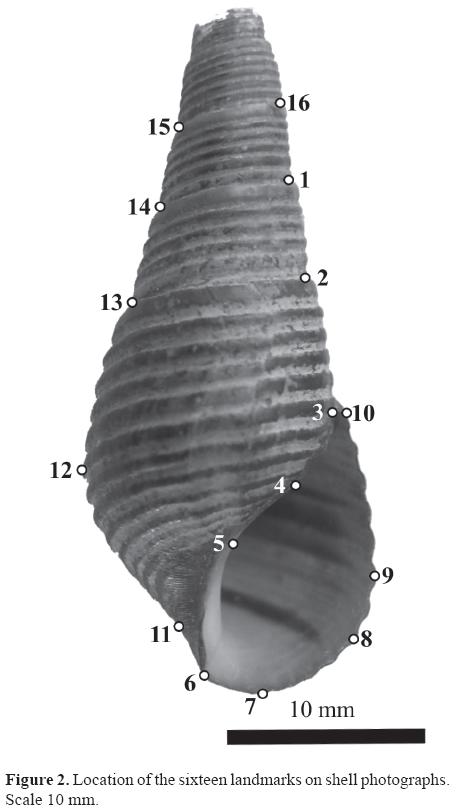
<body><![CDATA[<p align="justify"><font face="verdana" size="2">The 3 species were recorded in highly oxygenated freshwater habitats near the Yacyret&aacute;&#45;Apip&eacute; rapids in the Paran&aacute; River (Argentina&#45;Paraguay), between the Argentine cities of Ituzaing&oacute; (27&deg;37' S, 56&deg;40' W) and Posadas (27&deg;20' S, 55&deg;55' W) (Ostrowski de N&uacute;&ntilde;ez and Quintana, 2008). Fifty years later, these endemic species were threatened by extinction as the result of major alteration in the flow regime along the rapids. Such alteration was caused by the construction of the Yacyret&aacute; Binational Hydroelectric power plant (Seddon, 2000; Ostrowski de Nu&ntilde;ez and Quintana, 2008). Of the 3 species described until 1993 (before impoundment), only <i>A. chloroticum</i> still persists currently in 2 relictual populations at the upstream section of the reservoir (Ostrowski de Nu&ntilde;ez and Quintana, 2008) while <i>A. guaraniticum</i> and <i>A. stigmaticum</i> are categorized as extinct in the wild (Mansur, 2000a, b).</font></p>  	    <p align="justify"><font face="verdana" size="2">The 3 species from Argentina&#45;Paraguay constitute the southernmost record of the entire South and Central American range of the genus and are supposed to represent closely related species (Castellanos, 1981). However, the lack of previous studies and the absence of soft parts deposited in museum collections, jointly with the extinction in the wild of <i>A. guaraniticum</i> and <i>A. stigmaticum,</i> have hampered further insight into their anatomy, biology, ecology and evolution.</font></p>  	    <p align="justify"><font face="verdana" size="2">Shape analysis is a fundamental part of much biological research and an indispensable technique in the identification of species (Adams et al., 2004), and may be a valuable tool for understanding species in which no other information is available. Information about the shape of an organism can be quickly and precisely captured by processing digital images with the "landmark methods" of geometric morphometries that quantifies deformations of morphometric points in coordinate space and separate size and shape variation as a standard part of the analysis. Landmark methods have demonstrated to be very effective, particularly when combined with multivariate statistical techniques (Rohlf et al., 1996; Cadrin, 2000; Zelditch et al., 2004; Conde&#45;Pad&iacute;n et al., 2007).</font></p>  	    <p align="justify"><font face="verdana" size="2">Considering that morphology could reflect special adaptations to some environmental features, we investigated if the geometric morphometric analysis will allow characterizing shell shape in these <i>Aylacostoma</i> species, in an attempt to answer why only 1 of these species persisted in the wild. Also we evaluate the diagnostic capability of this method for referring individual specimens to particular species; especially given that the anatomy is unknown.</font></p>  	    <p align="justify"><font face="verdana" size="2">&nbsp;</font></p>  	    <p align="justify"><font face="verdana" size="2"><b>Material and methods</b></font></p>  	    <p align="justify"><font face="verdana" size="2">Samples examined include 32 shells of <i>Aylacostoma</i> from Argentina and Paraguay hosted in the Argentine Museum of Natural Sciences "Bernardino Rivadavia" &#45;MACN&#45; (Buenos Aires, Argentina); La Plata Museum &#45;MLP&#45; (La Plata, Argentina) and the National University of Misiones &#45;UNaM&#45; (Posadas, Argentina). This study was based only on museum material, given the lack of living populations of <i>A. stigmaticum</i> and <i>A. guaraniticum</i> (Mansur, 2000a, b). Neither fixed specimens, soft parts, radulae nor previous studies of them (except for original descriptions) were found in museum collections and published reports.</font></p>  	    <p align="justify"><font face="verdana" size="2">All the material include type, paratype and reference adult specimens of <i>A. guaraniticum</i> (MACN&#45;In N&deg; 29251; MLP N&deg; 11213; UNaM CR&#45;1; total length range &#91;last 3 whorls&#93;: 24.70 &#45; 34.76 mm); <i>A. stigmaticum</i> (MACN&#45;In N&deg; 488&#45;2; MLP N&deg; 10963/64/65; UNaM CR&#45;1; total length range &#91;last 3 whorls&#93;: 21.89 &#45; 27.88 mm) and <i>A. chloroticum</i> (MLP N&deg; 10958 and 11596; UNaM CR&#45;1; total length range &#91;last 3 whorls&#93;: 23.17 &#45; 33.76 mm).</font></p>  	    <p align="justify"><font face="verdana" size="2">All specimens were photographed with a Samsung SL&#45;76 camera (8 mega pixels definition). The same shell orientation was used for all specimens, with coiling axis of shell on the y&#45;axis and aperture on the same plane as the camera objective (Carvajal&#45;Rodr&iacute;guez et al., 2005, 2006). All images included a 5 cm graded scale. Sixteen landmarks were selected along the shell perimeter in order to capture differences in all regions of the shell (<a href="#f2">Fig. 2</a>), following a criterion similar to that of Conde&#45;Pad&iacute;n et al. (2007) (<a href="/img/revistas/rmbiodiv/v83n4/a14t1.jpg" target="_blank">Table 1</a>).</font></p>  	    <p align="center"><font face="verdana" size="2"><a name="f2"></a></font></p>  	    ]]></body>
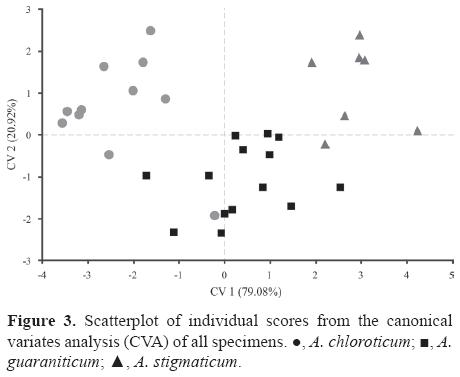
<body><![CDATA[<p align="center"><font face="verdana" size="2"><img src="/img/revistas/rmbiodiv/v83n4/a14f2.jpg"></font></p>  	    <p align="justify"><font face="verdana" size="2">As stated by Carvajal&#45;Rodr&iacute;guez et al. (2005) in a study of <i>Littorina</i> snails, these points do not necessarily represent homologous landmarks &#45;from a developmental point of view&#45; in different specimens, although they allow to capture and analyze objectively and repeatably, shell shape in species of <i>Aylacostoma.</i> Six landmarks (LM4, LM5, LM8, LM9, LM11, LM12) were treated as sliding semi&#45;landmarks by using TPSUTIL version 1.44 (Rohlf, 2009), thus relaxing the homology criterion.</font></p>  	    <p align="justify"><font face="verdana" size="2">The raw coordinate configurations of all specimens were aligned (i.e. translated, rotated and scaled to match one another) using the Generalized Procrustes Analysis (GPA) procedure to eliminate variation due to differences in scale and orientation, which establishes an average configuration by minimizing the sum of squared distances between homologous landmarks from different specimens (Rohlf and Slice, 1990; Rohlf, 1999; Rufino et al., 2006). This average configuration of landmarks resulting from GPA or tangent configuration (Cavalcanti et al., 1999) served as the "reference configuration" in subsequent calculations. For each specimen, a variable for size (centroid size) and a set of variables for shape (uniform and non&#45;uniform components) of shell shape were also obtained. Centroid size is obtained as a scaling factor during GPA (Bookstein, 1991; Conde&#45;Padin et al., 2007). The 2 uniform components describe differences that affect equally all parts of the shell (global differences). In contrast, non&#45;uniform components account for local shape deformations of the reference configuration at different spatial scales (Conde&#45;Padin et al., 2007).</font></p>  	    <p align="justify"><font face="verdana" size="2">The coordinates of all aligned specimens were used for the thin plate splines &#45;TPS&#45; and relative warp analysis &#45;RWA&#45; (Bookstein, 1989, 1991; Rohlf, 1993), in order to analyze and display the direction of shape differences among species. In the TPS method, a hypothetical infinitely thin metal plate (grid) is fitted over the reference configuration, which is then deformed until it matches exactly the target shape (Bookstein, 1989, 1991; Rohlf et al., 1996). Relative warps (RWs) are the principal components of any kind of shape variables and reflect the major trends in shape variation (Rufino et al., 2006).</font></p>  	    <p align="justify"><font face="verdana" size="2">Landmark data were obtained by digitizing images of the shells as in <a href="#f2">Fig. 2</a>, using software TPSDIG version 2.12 (Rohlf, 2008) to generate coordinates. Relative warp analysis and computation of partial warp scores were computed using TPSRELW version 1.49 (Rohlf, 2010) with the scaling option &#945; = 0 that weighs all landmarks equally and is considered to be more appropriate for systematic studies (Loy et al., 1993; Rohlf, 1993; Rohlf et al., 1996; Cavalcanti et al., 1999).</font></p>  	    <p align="justify"><font face="verdana" size="2">The first 4 derived morphometric variables studied (RWs1&#45;4) were included in a non&#45;parametric MANOVA (NP&#45;MANOVA) (Anderson, 2001) based on Mahalanobis distance (9 999 permutations), in order to test the significance of the mean shell shape of the species. After NP&#45;MANOVA, a canonical variates analysis (CVA) was conducted on the same first 4 RWs, in order to maximize the separation between groups (Zelditch et al., 2004), to estimate misclassification rates, and to evaluate the shape differences that best distinguish among the 3 species (M&aacute;rquez et al., 2010). TPS deformation grids along the canonical axes were generated in TPSREGR version 1.38 (Rohlf, 2011).</font></p>  	    <p align="justify"><font face="verdana" size="2">Statistical analyses were performed with PAST, version 2.14 (Hammer et al., 2001). Most of the programs used in this study are available at <a href="http://life.bio.sunysb.edu/morph/" target="_blank">http://life.bio.sunysb.edu/morph/</a></font></p>  	    <p align="justify"><font face="verdana" size="2">&nbsp;</font></p>  	    <p align="justify"><font face="verdana" size="2"><b>Results</b></font></p>  	    <p align="justify"><font face="verdana" size="2">Relative warp analysis showed that approximately 85% of the local shell variation is explained by the first 4 RWs (i.e. RW1= 57.41%; RW2= 13.15%; RW3= 8.78%; RW4= 5.48%). The NP&#45;MANOVA conducted in order to test the significance of the mean shell shape of the 3 species was higly significant (F= 7.164, <i><i>p=</i></i> 0.0001). Shape differences among species were maximized using CVA, and species were successfully discriminated (<a href="#f3">Fig. 3</a>, <a href="/img/revistas/rmbiodiv/v83n4/a14t2.jpg" target="_blank">Table 2</a>). The CV1 (explaining 79.08% of the observed variation) can discriminate among the 3 species at the same time, while CV2 (explaining 20.92% of the observed variation) only discriminates between <i>A. guaraniticum</i> and the others (<a href="#f3">Fig. 3</a>).</font></p>  	    ]]></body>
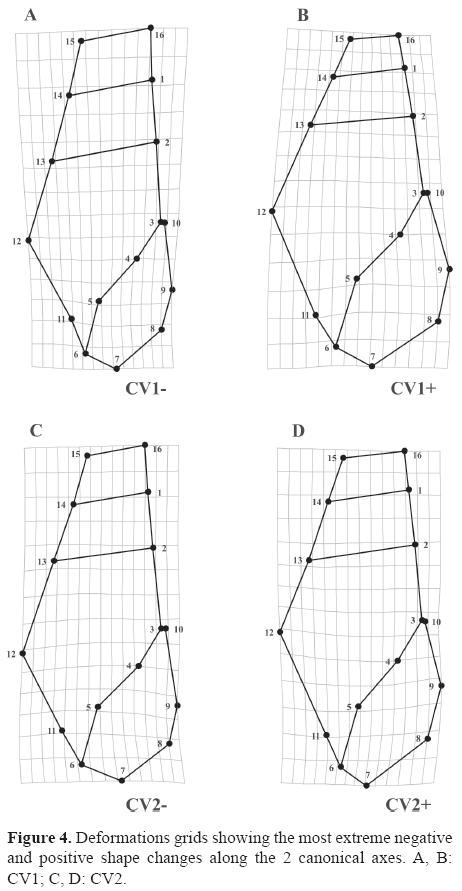
<body><![CDATA[<p align="center"><font face="verdana" size="2"><a name="f3"></a></font></p>  	    <p align="center"><font face="verdana" size="2"><img src="/img/revistas/rmbiodiv/v83n4/a14f3.jpg"></font></p>  	    <p align="justify"><font face="verdana" size="2">External landmarks and those that represent the aperture were connected by lines for an easier visualization of the meaning of deformations (<a href="#f4">Fig. 4</a>). When analyzed from the lowest to the highest scores, first canonical axis can be mainly described as an expansion of the last whorl and aperture, involving almost all landmarks in the area. Also an antero&#45;posterior contraction of spire was observed, showing an upward displacement of landmark pair defining the lower suture of penultimate whorl (LM13&#45;LM2), as well as a downward and inwards displacement of landmark pair located on the upper suture of antepenultimate whorl (LM15&#45;LM16) (<a href="#f4">Figs. 4A, B</a>). In turn, when analyzed from the lowest to highest scores, the second canonical axis reveals no noticeable differences in spire shape, and variation was mostly associated to last whorl including an upward displacement of LM12 and a shrinking of LM6 and LM7 (<a href="#f4">Figs. 4C, D</a>).</font></p>  	    <p align="center"><font face="verdana" size="2"><a name="f4"></a></font></p>  	    <p align="center"><font face="verdana" size="2"><img src="/img/revistas/rmbiodiv/v83n4/a14f4.jpg"></font></p>  	    <p align="justify"><font face="verdana" size="2">&nbsp;</font></p>  	    <p align="justify"><font face="verdana" size="2"><b>Discussion</b></font></p>  	    <p align="justify"><font face="verdana" size="2">Thin plate splines methods are increasingly used for morphometric research because they: <i>i)</i> allow complete separation of size and shape into distinct variables; <i>ii)</i> permit segregation of shape into uniform and non&#45;uniform components; <i>iii)</i> have powerful means to visualize morphologic differences; <i>iv)</i> enable the incorporation of shape variables derived from geometric morphometric analyses into commonly used multivariate analyses; <i>v)</i> are cheap, and <i>vi)</i> employ user&#45;friendly software (Anderson and Roopnarine, 2005; Carvajal&#45;Rodr&iacute;guez et al., 2005).</font></p>  	    <p align="justify"><font face="verdana" size="2">Application of geometric morphometric methods has demonstrated to be very useful in determining both intra (e.g. Palmer et al., 2004; Krapivka et al., 2007; M&aacute;rquez et al., 2010; Valladares et al., 2010) and interspecific groups in mollusks (e.g. Ferson et al., 1985; Innes and Bates, 1999; Dommergues et al., 2003; Aguirre et al., 2006; Rufino et al., 2006). Like bivalves, gastropods have hard shells which make them excellent candidates for shape analysis by means of geometric morphometrics (e.g. Carvajal&#45;Rodr&iacute;guez et al., 2005, 2006), as no deformation occurs during manipulation.</font></p>  	    <p align="justify"><font face="verdana" size="2">In this study, significant differences in shell shape were found in the available museum material for <i>A. guaraniticum, A. chloroticum</i> and <i>A. stigmaticum</i> and almost 95% of the individual specimens were correctly assigned to species. We believe that the success of the method in revealing these differences seems to provide a robust basis to examine the morphological variation in these mollusks. This geometric sensivity has been noted by others in revealing shape differences in populations and specimens of sibling species of <i>Littorina</i> or British rough periwinkles (Carvajal&#45;Rodr&iacute;guez et al., 2005; Conde&#45;Pad&iacute;n et al., 2007) and sibling species of <i>Nassarius</i> (Carvajal&#45;Rodr&iacute;guez et al., 2006). In the species studied here, the main shape differences evidenced along canonical axes can be summarized as changes in spire, last whorl and aperture. The most notorious discriminating differences were concentrated on CV1, where the species shape varies in a range from more stylized shells in <i>A. chloroticum</i> to more globose shells in <i>A. stigmaticum.</i></font></p>  	    ]]></body>
<body><![CDATA[<p align="justify"><font face="verdana" size="2">The detection of 2 statistically significant variables, which summarize the main differences in shape among the 3 species, is interesting because previous geometric morphometric studies in gastropods have suggested that an interpretation of shape in simple biological terms is possible (Carvajal&#45;Rodr&iacute;guez et al., 2005; Conde&#45;Pad&iacute;n et al., 2007). As an example Conde&#45;Pad&iacute;n et al. (2007) proposed that the more globose shell found in an ecotype of <i>Littorina saxatilis</i> (Olivi, 1792) is possibly related with the need for resisting crab attacks, which are common where this ecotype lives. Unfortunately, no interpretations of this nature &#45;as could be resistance to molluscivorous fish&#45; can be inferred for the <i>Aylacostoma</i> species from the Paran&aacute; River because of: <i>i)</i> the disappearance in 1993 of the rapids where the species lived (Quintana and Mercado&#45;Laczk&oacute;, 1997); <i>ii)</i> the extinction in the wild of <i>A. guaraniticum</i> and <i>A. stigmaticum</i> (Quintana and Mercado&#45;Laczk&oacute;, 1997; Mansur, 2000a, b), and <i>iii)</i> the lack of previous studies. Nevertheless, considering that the 3 species inhabited highly oxygenated shallow freshwater habitats in the rapids (Quintana and Mercado&#45;Laczk&oacute;, 1997), it seems probable that the differences between the 3 species regarding last whorl, aperture and spire shapes could possibly be explained by a differential use of the habitat and/or perhaps by different degrees of exposure to water currents.</font></p>  	    <p align="justify"><font face="verdana" size="2">As previously demonstrated for other freshwater snails (Greenwood and Thorp, 2001), a larger foot could be related to the ability to avoid being dislodged by waves. Thus, we hypothesized that the more globose shell and more oval aperture found in <i>A. stigmaticum,</i> followed to a lesser degree by <i>A. guaraniticum,</i> may be associated to habitats and substrata with the highest water currents in the rapids. Contrarily, the stylized shell seen in <i>A. chloroticum</i> may be related to the preference for more protected habitats as those found at the upstream section of the Yacyret&aacute; Reservoir, where 2 relictual populations of <i>A. chloroticum</i> still persist (Ostrowski de Nu&ntilde;ez and Quintana, 2008). Further studies should be made on these populations to test our hypothesis.</font></p>  	    <p align="justify"><font face="verdana" size="2">Finally, we believe that geometric approaches should not be limited only to the species of <i>Aylacostoma</i> from the Argentina and Paraguay as we consider that they are valuable analytical tools for quantifying and exploring the shape, that together with other data (e.g. anatomical, morphological, ecological and genetical) could contribute to the revision of this particular group of mollusks.</font></p>  	    <p align="justify"><font face="verdana" size="2">&nbsp;</font></p>  	    <p align="justify"><font face="verdana" size="2"><b>Acknowledgements</b></font></p>  	    <p align="justify"><font face="verdana" size="2">We thank Dra. Ver&oacute;nica N&uacute;&ntilde;ez, Dr. Rolando Gonz&aacute;lez&#45;Jos&eacute; and two anonymous reviewers for their helpful comments and suggestions.</font></p>  	    <p align="justify"><font face="verdana" size="2">&nbsp;</font></p>  	    <p align="justify"><font face="verdana" size="2"><b>Literature cited</b></font></p>  	    <!-- ref --><p align="justify"><font face="verdana" size="2">Adams, D., F. Rohlfand D. Slice. 2004. Geometric morphometrics: ten years of progress following the 'revolution'. The Italian Journal of Zoology 71:5&#45;16.    &nbsp;&nbsp;&nbsp;&nbsp;&nbsp;&nbsp;&nbsp;&nbsp;[&#160;<a href="javascript:void(0);" onclick="javascript: window.open('/scielo.php?script=sci_nlinks&ref=7574804&pid=S1870-3453201200040001400001&lng=','','width=640,height=500,resizable=yes,scrollbars=1,menubar=yes,');">Links</a>&#160;]<!-- end-ref --></font></p>  	    ]]></body>
<body><![CDATA[<!-- ref --><p align="justify"><font face="verdana" size="2">Aguirre, M. L., S. I. Perez and Y. N. Sirch. 2006. Morphological variability of <i>Brachidontes</i> Swainson (Bivalvia, Mytilidae) in the marine Quaternary of Argentina (SW Atlantic). Palaeogeography, Palaeoclimatology, Palaeoecology 239:100&#45;125.    &nbsp;&nbsp;&nbsp;&nbsp;&nbsp;&nbsp;&nbsp;&nbsp;[&#160;<a href="javascript:void(0);" onclick="javascript: window.open('/scielo.php?script=sci_nlinks&ref=7574806&pid=S1870-3453201200040001400002&lng=','','width=640,height=500,resizable=yes,scrollbars=1,menubar=yes,');">Links</a>&#160;]<!-- end-ref --></font></p>  	    <!-- ref --><p align="justify"><font face="verdana" size="2">Anderson, M. J. 2001. A new method for non&#45;parametric multivariate analysis of variance. Austral Ecology 26:32&#45;46.    &nbsp;&nbsp;&nbsp;&nbsp;&nbsp;&nbsp;&nbsp;&nbsp;[&#160;<a href="javascript:void(0);" onclick="javascript: window.open('/scielo.php?script=sci_nlinks&ref=7574808&pid=S1870-3453201200040001400003&lng=','','width=640,height=500,resizable=yes,scrollbars=1,menubar=yes,');">Links</a>&#160;]<!-- end-ref --></font></p>  	    <!-- ref --><p align="justify"><font face="verdana" size="2">Anderson, L. C. and P. D. Roopnarine. 2005. Role of constraint and selection in the morphologic evolution of <i>Caryocorbula</i> (Mollusca: Corbulidae) from the Caribbean Neogene. Palaeontologia Electronica 8:32A:18p.    &nbsp;&nbsp;&nbsp;&nbsp;&nbsp;&nbsp;&nbsp;&nbsp;[&#160;<a href="javascript:void(0);" onclick="javascript: window.open('/scielo.php?script=sci_nlinks&ref=7574810&pid=S1870-3453201200040001400004&lng=','','width=640,height=500,resizable=yes,scrollbars=1,menubar=yes,');">Links</a>&#160;]<!-- end-ref --></font></p>  	    <!-- ref --><p align="justify"><font face="verdana" size="2">Bookstein, F. L. 1989. Principal warps: thin&#45;plate splines and the decomposition of deformations. IEEE Transactions on Pattern Analysis and Machine Intelligence 11:567&#45;585.    &nbsp;&nbsp;&nbsp;&nbsp;&nbsp;&nbsp;&nbsp;&nbsp;[&#160;<a href="javascript:void(0);" onclick="javascript: window.open('/scielo.php?script=sci_nlinks&ref=7574812&pid=S1870-3453201200040001400005&lng=','','width=640,height=500,resizable=yes,scrollbars=1,menubar=yes,');">Links</a>&#160;]<!-- end-ref --></font></p>  	    <!-- ref --><p align="justify"><font face="verdana" size="2">Bookstein, F. L. 1991. Morphometric tools for landmark data. Cambridge University Press, New York. 435 p.    &nbsp;&nbsp;&nbsp;&nbsp;&nbsp;&nbsp;&nbsp;&nbsp;[&#160;<a href="javascript:void(0);" onclick="javascript: window.open('/scielo.php?script=sci_nlinks&ref=7574814&pid=S1870-3453201200040001400006&lng=','','width=640,height=500,resizable=yes,scrollbars=1,menubar=yes,');">Links</a>&#160;]<!-- end-ref --></font></p>  	    ]]></body>
<body><![CDATA[<!-- ref --><p align="justify"><font face="verdana" size="2">Cadrin, S. X. 2000. Advances in morphometric identification of fishery stocks. Reviews in Fish Biology and Fisheries 10:91&#45;112.    &nbsp;&nbsp;&nbsp;&nbsp;&nbsp;&nbsp;&nbsp;&nbsp;[&#160;<a href="javascript:void(0);" onclick="javascript: window.open('/scielo.php?script=sci_nlinks&ref=7574816&pid=S1870-3453201200040001400007&lng=','','width=640,height=500,resizable=yes,scrollbars=1,menubar=yes,');">Links</a>&#160;]<!-- end-ref --></font></p>  	    <!-- ref --><p align="justify"><font face="verdana" size="2">Carvajal&#45;Rodr&iacute;guez, A., P. Conde&#45;Pad&iacute;n and E. Rol&aacute;n&#45;&Aacute;lvarez. 2005. Decomposing shell form into size and shape by geometric&#45;morphometric methods in two sympatric ecotypes of <i>Littorina saxatilis.</i> Journal of Molluscan Studies 71:313&#45;318.    &nbsp;&nbsp;&nbsp;&nbsp;&nbsp;&nbsp;&nbsp;&nbsp;[&#160;<a href="javascript:void(0);" onclick="javascript: window.open('/scielo.php?script=sci_nlinks&ref=7574818&pid=S1870-3453201200040001400008&lng=','','width=640,height=500,resizable=yes,scrollbars=1,menubar=yes,');">Links</a>&#160;]<!-- end-ref --></font></p>  	    <!-- ref --><p align="justify"><font face="verdana" size="2">Carvajal&#45;Rodr&iacute;guez, A., J. Guerra&#45;Varela, B. Fern&aacute;ndez, E. Rol&aacute;n and E. Rol&aacute;n&#45;&Aacute;lvarez. 2006. An example of the application of geometric morphometric tools to the morphological diagnosis of two sibling species in <i>Nassarius</i> (Mollusca, Prosobranchia). Iberus 24:81&#45;88.    &nbsp;&nbsp;&nbsp;&nbsp;&nbsp;&nbsp;&nbsp;&nbsp;[&#160;<a href="javascript:void(0);" onclick="javascript: window.open('/scielo.php?script=sci_nlinks&ref=7574820&pid=S1870-3453201200040001400009&lng=','','width=640,height=500,resizable=yes,scrollbars=1,menubar=yes,');">Links</a>&#160;]<!-- end-ref --></font></p>  	    <!-- ref --><p align="justify"><font face="verdana" size="2">Castellanos, Z. A. 1981. La familia Thiaridae, Morrison 1952 en la Argentina. <i>In</i> Fauna de agua dulce de la Rep&uacute;blica Argentina. Moluscos gaster&oacute;podos, R. A. Ringuelet (ed.). Vol. 15, fas 3. FECIC, Buenos Aires. p. 7&#45;18.    &nbsp;&nbsp;&nbsp;&nbsp;&nbsp;&nbsp;&nbsp;&nbsp;[&#160;<a href="javascript:void(0);" onclick="javascript: window.open('/scielo.php?script=sci_nlinks&ref=7574822&pid=S1870-3453201200040001400010&lng=','','width=640,height=500,resizable=yes,scrollbars=1,menubar=yes,');">Links</a>&#160;]<!-- end-ref --></font></p>  	    <!-- ref --><p align="justify"><font face="verdana" size="2">Cavalcanti, M. J., L. R. Monteiro and P. R. D. Lopes.1999. Landmark&#45;based morphometric analysis in selected species of serranid fishes (Perciformes: Teleostei). Zoological Studies 38:287&#45;294.    &nbsp;&nbsp;&nbsp;&nbsp;&nbsp;&nbsp;&nbsp;&nbsp;[&#160;<a href="javascript:void(0);" onclick="javascript: window.open('/scielo.php?script=sci_nlinks&ref=7574824&pid=S1870-3453201200040001400011&lng=','','width=640,height=500,resizable=yes,scrollbars=1,menubar=yes,');">Links</a>&#160;]<!-- end-ref --></font></p>  	    ]]></body>
<body><![CDATA[<!-- ref --><p align="justify"><font face="verdana" size="2">Conde&#45;Pad&iacute;n, P., J. W. Grahame and E. Rol&aacute;n&#45;&Aacute;lvarez. 2007. Detecting shape differences in species of the <i>Littorina</i> <i>saxatilis</i> complex by morphometric analysis. Journal of Molluscan Studies 73:147&#45;154.    &nbsp;&nbsp;&nbsp;&nbsp;&nbsp;&nbsp;&nbsp;&nbsp;[&#160;<a href="javascript:void(0);" onclick="javascript: window.open('/scielo.php?script=sci_nlinks&ref=7574826&pid=S1870-3453201200040001400012&lng=','','width=640,height=500,resizable=yes,scrollbars=1,menubar=yes,');">Links</a>&#160;]<!-- end-ref --></font></p>  	    <!-- ref --><p align="justify"><font face="verdana" size="2">Darrigran, G. and C. Damborenea. 2011. Ecosystem engineering impact of <i>Limnoperna fortunei</i> in South America. Zoological Science 28:1&#45;7.    &nbsp;&nbsp;&nbsp;&nbsp;&nbsp;&nbsp;&nbsp;&nbsp;[&#160;<a href="javascript:void(0);" onclick="javascript: window.open('/scielo.php?script=sci_nlinks&ref=7574828&pid=S1870-3453201200040001400013&lng=','','width=640,height=500,resizable=yes,scrollbars=1,menubar=yes,');">Links</a>&#160;]<!-- end-ref --></font></p>  	    <!-- ref --><p align="justify"><font face="verdana" size="2">Dommergues, E., J. L. Dommergues, F. Magniez, P. Neige and E. P. Verrecchia. 2003. Geometric measurements analysis versus Fourier series analysis for shape characterization using the gastropod shell <i>(Trivia)</i> as an example. Mathematical Geology 35:887&#45;894.    &nbsp;&nbsp;&nbsp;&nbsp;&nbsp;&nbsp;&nbsp;&nbsp;[&#160;<a href="javascript:void(0);" onclick="javascript: window.open('/scielo.php?script=sci_nlinks&ref=7574830&pid=S1870-3453201200040001400014&lng=','','width=640,height=500,resizable=yes,scrollbars=1,menubar=yes,');">Links</a>&#160;]<!-- end-ref --></font></p>  	    <!-- ref --><p align="justify"><font face="verdana" size="2">Ferson, S., F. J. Rohlf and R. K. Koehn. 1985. Measuring shape variation of two dimensional outlines. Systematic Zoology 34:59&#45;68.    &nbsp;&nbsp;&nbsp;&nbsp;&nbsp;&nbsp;&nbsp;&nbsp;[&#160;<a href="javascript:void(0);" onclick="javascript: window.open('/scielo.php?script=sci_nlinks&ref=7574832&pid=S1870-3453201200040001400015&lng=','','width=640,height=500,resizable=yes,scrollbars=1,menubar=yes,');">Links</a>&#160;]<!-- end-ref --></font></p>  	    <!-- ref --><p align="justify"><font face="verdana" size="2">Glaubrecht, M. 1996. Evolutions&ouml;kologie und Systematik am Beispiel von S&uuml;b&#45; und Brackwasserschnecken (Mollusca: Caenogastropoda: Cerithioidea): Ontogenese&#45;Strategien, pal&auml;ontologische Befunde und Historische Zoogeographie. Backhuys Publishers, Leiden. 544 p.    &nbsp;&nbsp;&nbsp;&nbsp;&nbsp;&nbsp;&nbsp;&nbsp;[&#160;<a href="javascript:void(0);" onclick="javascript: window.open('/scielo.php?script=sci_nlinks&ref=7574834&pid=S1870-3453201200040001400016&lng=','','width=640,height=500,resizable=yes,scrollbars=1,menubar=yes,');">Links</a>&#160;]<!-- end-ref --></font></p>  	    ]]></body>
<body><![CDATA[<!-- ref --><p align="justify"><font face="verdana" size="2">Glaubrecht, M. 1999. Systematics and the evolution of viviparity in tropical freshwater gastropods (Cerithioidea: Thiaridae sensu lato) &#45; an overview. Courier Forschungs&#45;Institut Senckenberg 215:91&#45;96.    &nbsp;&nbsp;&nbsp;&nbsp;&nbsp;&nbsp;&nbsp;&nbsp;[&#160;<a href="javascript:void(0);" onclick="javascript: window.open('/scielo.php?script=sci_nlinks&ref=7574836&pid=S1870-3453201200040001400017&lng=','','width=640,height=500,resizable=yes,scrollbars=1,menubar=yes,');">Links</a>&#160;]<!-- end-ref --></font></p>  	    <!-- ref --><p align="justify"><font face="verdana" size="2">Glaubrecht, M. 2006. Independent evolution of reproductive modes in viviparous freshwater Cerithioidea (Gastropoda, Sorbeoconcha): a brief review. Basteria 69 (Suppl. 3):28&#45;32.    &nbsp;&nbsp;&nbsp;&nbsp;&nbsp;&nbsp;&nbsp;&nbsp;[&#160;<a href="javascript:void(0);" onclick="javascript: window.open('/scielo.php?script=sci_nlinks&ref=7574838&pid=S1870-3453201200040001400018&lng=','','width=640,height=500,resizable=yes,scrollbars=1,menubar=yes,');">Links</a>&#160;]<!-- end-ref --></font></p>  	    <!-- ref --><p align="justify"><font face="verdana" size="2">Gomez, M. I., E. E. Strong and M. Glaubrecht. 2011. Redescription and anatomy of the viviparous freshwater gastropod <i>Hemisinus lineolatus</i> (W. Wood, 1828) from Jamaica (Cerithioidea, Thiaridae). Malacologia 53:229&#45;250.    &nbsp;&nbsp;&nbsp;&nbsp;&nbsp;&nbsp;&nbsp;&nbsp;[&#160;<a href="javascript:void(0);" onclick="javascript: window.open('/scielo.php?script=sci_nlinks&ref=7574840&pid=S1870-3453201200040001400019&lng=','','width=640,height=500,resizable=yes,scrollbars=1,menubar=yes,');">Links</a>&#160;]<!-- end-ref --></font></p>  	    <!-- ref --><p align="justify"><font face="verdana" size="2">Greenwood, K. S. and J. H. Thorp. 2001. Aspects of ecology and conservation of sympatric, prosobranch snails in a large river. Hydrobiologia 455:229&#45;236.    &nbsp;&nbsp;&nbsp;&nbsp;&nbsp;&nbsp;&nbsp;&nbsp;[&#160;<a href="javascript:void(0);" onclick="javascript: window.open('/scielo.php?script=sci_nlinks&ref=7574842&pid=S1870-3453201200040001400020&lng=','','width=640,height=500,resizable=yes,scrollbars=1,menubar=yes,');">Links</a>&#160;]<!-- end-ref --></font></p>  	    <!-- ref --><p align="justify"><font face="verdana" size="2">Guti&eacute;rrez&#45;Gregoric, D. E., V. N&uacute;&ntilde;ez, A. Rumi and M. A. Roche. 2006. Freshwater gastropods from Del Plata Basin, Argentina checklist and new locality records. Comunicaciones de la Sociedad Malacol&oacute;gica del Uruguay 9:51&#45;60.    &nbsp;&nbsp;&nbsp;&nbsp;&nbsp;&nbsp;&nbsp;&nbsp;[&#160;<a href="javascript:void(0);" onclick="javascript: window.open('/scielo.php?script=sci_nlinks&ref=7574844&pid=S1870-3453201200040001400021&lng=','','width=640,height=500,resizable=yes,scrollbars=1,menubar=yes,');">Links</a>&#160;]<!-- end-ref --></font></p>  	    ]]></body>
<body><![CDATA[<!-- ref --><p align="justify"><font face="verdana" size="2">Hammer, &#216;., D. A. T. Harper and P. D. Ryan. 2001. PAST: Paleontological Statistics Software Package for Education and Data Analysis. Palaeontologia Electronica 4:9. <a href="http://palaeo&#45;electronica.org/2001_1/past/issue1_01.htm" target="_blank">http://palaeo&#45;electronica.org/2001_1/past/issue1_01.htm</a>; 4:1:4:9 p.    &nbsp;&nbsp;&nbsp;&nbsp;&nbsp;&nbsp;&nbsp;&nbsp;[&#160;<a href="javascript:void(0);" onclick="javascript: window.open('/scielo.php?script=sci_nlinks&ref=7574846&pid=S1870-3453201200040001400022&lng=','','width=640,height=500,resizable=yes,scrollbars=1,menubar=yes,');">Links</a>&#160;]<!-- end-ref --></font></p>  	    <!-- ref --><p align="justify"><font face="verdana" size="2">Hylton&#45;Scott, M. I. 1953. El g&eacute;nero <i>Hemisinus (Melaniidae)</i> en la costa fluvial argentina (Mol. Prosobr.). Physis 20:438&#45;443.    &nbsp;&nbsp;&nbsp;&nbsp;&nbsp;&nbsp;&nbsp;&nbsp;[&#160;<a href="javascript:void(0);" onclick="javascript: window.open('/scielo.php?script=sci_nlinks&ref=7574848&pid=S1870-3453201200040001400023&lng=','','width=640,height=500,resizable=yes,scrollbars=1,menubar=yes,');">Links</a>&#160;]<!-- end-ref --></font></p>  	    <!-- ref --><p align="justify"><font face="verdana" size="2">Hylton&#45;Scott, M. I. 1954. Dos nuevos melanidos del Alto Paran&aacute; (Mol. Prosobr.). Neotropica 1:45&#45;48.    &nbsp;&nbsp;&nbsp;&nbsp;&nbsp;&nbsp;&nbsp;&nbsp;[&#160;<a href="javascript:void(0);" onclick="javascript: window.open('/scielo.php?script=sci_nlinks&ref=7574850&pid=S1870-3453201200040001400024&lng=','','width=640,height=500,resizable=yes,scrollbars=1,menubar=yes,');">Links</a>&#160;]<!-- end-ref --></font></p>  	    <!-- ref --><p align="justify"><font face="verdana" size="2">Innes, D. J. and J. A. Bates. 1999. Morphological variation of <i>Mytilus edulis</i> and <i>Mytilus trossulus</i> in eastern Newfoundland. Marine Biology 133:691&#45;699.    &nbsp;&nbsp;&nbsp;&nbsp;&nbsp;&nbsp;&nbsp;&nbsp;[&#160;<a href="javascript:void(0);" onclick="javascript: window.open('/scielo.php?script=sci_nlinks&ref=7574852&pid=S1870-3453201200040001400025&lng=','','width=640,height=500,resizable=yes,scrollbars=1,menubar=yes,');">Links</a>&#160;]<!-- end-ref --></font></p>  	    <!-- ref --><p align="justify"><font face="verdana" size="2">Jorcin, A., M. G. Nogueira and R. Belmont. 2009. Spatial and temporal distribution of the zoobenthos community during the filling up period of Porto Primavera Reservoir (Paran&aacute; River, Brazil). Brazilian Journal of Biology 69:19&#45;29.    &nbsp;&nbsp;&nbsp;&nbsp;&nbsp;&nbsp;&nbsp;&nbsp;[&#160;<a href="javascript:void(0);" onclick="javascript: window.open('/scielo.php?script=sci_nlinks&ref=7574854&pid=S1870-3453201200040001400026&lng=','','width=640,height=500,resizable=yes,scrollbars=1,menubar=yes,');">Links</a>&#160;]<!-- end-ref --></font></p>  	    ]]></body>
<body><![CDATA[<!-- ref --><p align="justify"><font face="verdana" size="2">Krapivka, S., J. E. Toro, A. C. Alcap&aacute;n, M. Astorga, P. Presa, M. P&eacute;rez and R. Gui&ntilde;ez. 2007. Shell&#45;shape variation along the latitudinal range of the Chilean blue mussel <i>Mytilus chilensis</i> (Hupe 1854). Aquaculture Research 38:1770&#45;1777.    &nbsp;&nbsp;&nbsp;&nbsp;&nbsp;&nbsp;&nbsp;&nbsp;[&#160;<a href="javascript:void(0);" onclick="javascript: window.open('/scielo.php?script=sci_nlinks&ref=7574856&pid=S1870-3453201200040001400027&lng=','','width=640,height=500,resizable=yes,scrollbars=1,menubar=yes,');">Links</a>&#160;]<!-- end-ref --></font></p>  	    <!-- ref --><p align="justify"><font face="verdana" size="2">L&eacute;v&ecirc;que, C., E. V. Balian and K. Martens. 2005. An assessment of animal species diversity in continental waters. Hydrobiologia 542:39&#45;67.    &nbsp;&nbsp;&nbsp;&nbsp;&nbsp;&nbsp;&nbsp;&nbsp;[&#160;<a href="javascript:void(0);" onclick="javascript: window.open('/scielo.php?script=sci_nlinks&ref=7574858&pid=S1870-3453201200040001400028&lng=','','width=640,height=500,resizable=yes,scrollbars=1,menubar=yes,');">Links</a>&#160;]<!-- end-ref --></font></p>  	    <!-- ref --><p align="justify"><font face="verdana" size="2">Loy, A., M. Corti and L. F. Marcus. 1993. Landmark data: size and shape analysis in systematics. A case study on Old World Talpidae (Mammalia, Insectivora). <i>In</i> Contributions to morphometrics, L. F. Marcus, E. Bello and A. Garc&iacute;a&#45;Valdecasas (eds.). Museo Nacional de Ciencias Naturales, Madrid. p. 215&#45;240.    &nbsp;&nbsp;&nbsp;&nbsp;&nbsp;&nbsp;&nbsp;&nbsp;[&#160;<a href="javascript:void(0);" onclick="javascript: window.open('/scielo.php?script=sci_nlinks&ref=7574860&pid=S1870-3453201200040001400029&lng=','','width=640,height=500,resizable=yes,scrollbars=1,menubar=yes,');">Links</a>&#160;]<!-- end-ref --></font></p>  	    <!-- ref --><p align="justify"><font face="verdana" size="2">Mansur, M. C. D. 2000a. <i>Aylacostoma guaraniticum.</i> IUCN 2011. IUCN Red List of Threatened Species. Version 2011.1. <a href="http://www.iucnredlist.org" target="_blank">http://www.iucnredlist.org</a>; last consult: 18.VII.2011.    &nbsp;&nbsp;&nbsp;&nbsp;&nbsp;&nbsp;&nbsp;&nbsp;[&#160;<a href="javascript:void(0);" onclick="javascript: window.open('/scielo.php?script=sci_nlinks&ref=7574862&pid=S1870-3453201200040001400030&lng=','','width=640,height=500,resizable=yes,scrollbars=1,menubar=yes,');">Links</a>&#160;]<!-- end-ref --></font></p>  	    <!-- ref --><p align="justify"><font face="verdana" size="2">Mansur, M. C. D. 2000b. <i>Aylacostoma stigmaticum.</i> IUCN 2011. IUCN Red List of Threatened Species. Version 2011.1. <a href="http://www.iucnredlist.org" target="_blank">http://www.iucnredlist.org</a>; last access: 18.VII.2011.    &nbsp;&nbsp;&nbsp;&nbsp;&nbsp;&nbsp;&nbsp;&nbsp;[&#160;<a href="javascript:void(0);" onclick="javascript: window.open('/scielo.php?script=sci_nlinks&ref=7574864&pid=S1870-3453201200040001400031&lng=','','width=640,height=500,resizable=yes,scrollbars=1,menubar=yes,');">Links</a>&#160;]<!-- end-ref --></font></p>  	    ]]></body>
<body><![CDATA[<!-- ref --><p align="justify"><font face="verdana" size="2">M&aacute;rquez, F., J. Robledo, G. Escati&#45;Pe&ntilde;aloza and S. Van der Molen. 2010. Use of different geometric morphometrics tools for the discrimination of phenotypic stocks of the striped clam <i>Ameghinomya antiqua</i> (Veneridae) in north Patagonia, Argentina. Fisheries Research 101:127&#45;131.    &nbsp;&nbsp;&nbsp;&nbsp;&nbsp;&nbsp;&nbsp;&nbsp;[&#160;<a href="javascript:void(0);" onclick="javascript: window.open('/scielo.php?script=sci_nlinks&ref=7574866&pid=S1870-3453201200040001400032&lng=','','width=640,height=500,resizable=yes,scrollbars=1,menubar=yes,');">Links</a>&#160;]<!-- end-ref --></font></p>  	    <!-- ref --><p align="justify"><font face="verdana" size="2">Michel, E. 2004. <i>Vinundu,</i> a new genus ofgastropod (Cerithioidea: 'Thiaridae') with two species from Lake Tanganyika, East Africa, and its molecular phylogenetic relationships. Journal of Molluscan Studies 70:1&#45;19.    &nbsp;&nbsp;&nbsp;&nbsp;&nbsp;&nbsp;&nbsp;&nbsp;[&#160;<a href="javascript:void(0);" onclick="javascript: window.open('/scielo.php?script=sci_nlinks&ref=7574868&pid=S1870-3453201200040001400033&lng=','','width=640,height=500,resizable=yes,scrollbars=1,menubar=yes,');">Links</a>&#160;]<!-- end-ref --></font></p>  	    <!-- ref --><p align="justify"><font face="verdana" size="2">Morrison, J. P. E. 1954. The relationship of Old and New World Melanians. Proceedings of the United States National Museum 103:357&#45;394.    &nbsp;&nbsp;&nbsp;&nbsp;&nbsp;&nbsp;&nbsp;&nbsp;[&#160;<a href="javascript:void(0);" onclick="javascript: window.open('/scielo.php?script=sci_nlinks&ref=7574870&pid=S1870-3453201200040001400034&lng=','','width=640,height=500,resizable=yes,scrollbars=1,menubar=yes,');">Links</a>&#160;]<!-- end-ref --></font></p>  	    <!-- ref --><p align="justify"><font face="verdana" size="2">N&uacute;&ntilde;ez, V., D. E. Guti&eacute;rrez&#45;Gregoric and A. Rumi. 2010. Freshwater gastropods provinces from Argentina. Malacologia 53:47&#45;60.    &nbsp;&nbsp;&nbsp;&nbsp;&nbsp;&nbsp;&nbsp;&nbsp;[&#160;<a href="javascript:void(0);" onclick="javascript: window.open('/scielo.php?script=sci_nlinks&ref=7574872&pid=S1870-3453201200040001400035&lng=','','width=640,height=500,resizable=yes,scrollbars=1,menubar=yes,');">Links</a>&#160;]<!-- end-ref --></font></p>  	    <!-- ref --><p align="justify"><font face="verdana" size="2">Ostrowski de N&uacute;&ntilde;ez, M. and M. G. Quintana. 2008. The life cycle of <i>Stephanoprora aylacostoma</i> n.sp. (Digenea: Echinostomatidae), parasite of the threatened snail <i>Aylacostoma chloroticum</i> (Prosobranchia, Thiaridae), in Argentina. Parasitology Research 102:647&#45;655.    &nbsp;&nbsp;&nbsp;&nbsp;&nbsp;&nbsp;&nbsp;&nbsp;[&#160;<a href="javascript:void(0);" onclick="javascript: window.open('/scielo.php?script=sci_nlinks&ref=7574874&pid=S1870-3453201200040001400036&lng=','','width=640,height=500,resizable=yes,scrollbars=1,menubar=yes,');">Links</a>&#160;]<!-- end-ref --></font></p>  	    ]]></body>
<body><![CDATA[<!-- ref --><p align="justify"><font face="verdana" size="2">Palmer, M., G. X. Pons and M. Linde. 2004. Discriminating between geographical groups of a Mediterranean commercial clam <i>(Chamelea gallina</i> (L.): Veneridae) by shape analysis. Fisheries Research 67:93&#45;98.    &nbsp;&nbsp;&nbsp;&nbsp;&nbsp;&nbsp;&nbsp;&nbsp;[&#160;<a href="javascript:void(0);" onclick="javascript: window.open('/scielo.php?script=sci_nlinks&ref=7574876&pid=S1870-3453201200040001400037&lng=','','width=640,height=500,resizable=yes,scrollbars=1,menubar=yes,');">Links</a>&#160;]<!-- end-ref --></font></p>  	    <!-- ref --><p align="justify"><font face="verdana" size="2">Quintana, M. G. and A. C. Mercado&#45;Laczk&oacute;. 1997. Caracoles de los r&aacute;pidos en Yacyret&aacute;. Ciencia Hoy 7:22&#45;31.    &nbsp;&nbsp;&nbsp;&nbsp;&nbsp;&nbsp;&nbsp;&nbsp;[&#160;<a href="javascript:void(0);" onclick="javascript: window.open('/scielo.php?script=sci_nlinks&ref=7574878&pid=S1870-3453201200040001400038&lng=','','width=640,height=500,resizable=yes,scrollbars=1,menubar=yes,');">Links</a>&#160;]<!-- end-ref --></font></p>  	    <!-- ref --><p align="justify"><font face="verdana" size="2">Rohlf, F. J. and D. Slice. 1990. Extensions of the Procrustes method for the optimal superimposition of landmarks. Systematic Zoology 39:40&#45;59.    &nbsp;&nbsp;&nbsp;&nbsp;&nbsp;&nbsp;&nbsp;&nbsp;[&#160;<a href="javascript:void(0);" onclick="javascript: window.open('/scielo.php?script=sci_nlinks&ref=7574880&pid=S1870-3453201200040001400039&lng=','','width=640,height=500,resizable=yes,scrollbars=1,menubar=yes,');">Links</a>&#160;]<!-- end-ref --></font></p>  	    <!-- ref --><p align="justify"><font face="verdana" size="2">Rohlf, F. J. 1993. Relative warp analysis and an example of its application to mosquito wings. <i>In</i> Contributions to morphometrics, L. F. Marcus, E. Bello and A. Garc&iacute;a&#45;Valdecasas (eds.). Museo Nacional de Ciencias Naturales, Madrid. p. 131&#45;159.    &nbsp;&nbsp;&nbsp;&nbsp;&nbsp;&nbsp;&nbsp;&nbsp;[&#160;<a href="javascript:void(0);" onclick="javascript: window.open('/scielo.php?script=sci_nlinks&ref=7574882&pid=S1870-3453201200040001400040&lng=','','width=640,height=500,resizable=yes,scrollbars=1,menubar=yes,');">Links</a>&#160;]<!-- end-ref --></font></p>  	    <!-- ref --><p align="justify"><font face="verdana" size="2">Rohlf, F. J., A. Loy and M. Corti. 1996. Morphometric analysis of old world Talpidae (Mammalia, Insectivora) using partial&#45;warp scores. Systematic Biology 45:344&#45;362.    &nbsp;&nbsp;&nbsp;&nbsp;&nbsp;&nbsp;&nbsp;&nbsp;[&#160;<a href="javascript:void(0);" onclick="javascript: window.open('/scielo.php?script=sci_nlinks&ref=7574884&pid=S1870-3453201200040001400041&lng=','','width=640,height=500,resizable=yes,scrollbars=1,menubar=yes,');">Links</a>&#160;]<!-- end-ref --></font></p>  	    ]]></body>
<body><![CDATA[<!-- ref --><p align="justify"><font face="verdana" size="2">Rohlf, F. J. 1999. Shape Statistics: Procrustes superimpositions and tangent spaces. Journal of Classification 16:197&#45;223.    &nbsp;&nbsp;&nbsp;&nbsp;&nbsp;&nbsp;&nbsp;&nbsp;[&#160;<a href="javascript:void(0);" onclick="javascript: window.open('/scielo.php?script=sci_nlinks&ref=7574886&pid=S1870-3453201200040001400042&lng=','','width=640,height=500,resizable=yes,scrollbars=1,menubar=yes,');">Links</a>&#160;]<!-- end-ref --></font></p>  	    <!-- ref --><p align="justify"><font face="verdana" size="2">Rohlf, F. J. 2008. TPSDIG: Version 2.12. New York State University at Stony Brook.    &nbsp;&nbsp;&nbsp;&nbsp;&nbsp;&nbsp;&nbsp;&nbsp;[&#160;<a href="javascript:void(0);" onclick="javascript: window.open('/scielo.php?script=sci_nlinks&ref=7574888&pid=S1870-3453201200040001400043&lng=','','width=640,height=500,resizable=yes,scrollbars=1,menubar=yes,');">Links</a>&#160;]<!-- end-ref --></font></p>  	    <!-- ref --><p align="justify"><font face="verdana" size="2">Rohlf, F. J. 2009. TPSUTIL: Version 1.44. New York State University at Stony Brook.    &nbsp;&nbsp;&nbsp;&nbsp;&nbsp;&nbsp;&nbsp;&nbsp;[&#160;<a href="javascript:void(0);" onclick="javascript: window.open('/scielo.php?script=sci_nlinks&ref=7574890&pid=S1870-3453201200040001400044&lng=','','width=640,height=500,resizable=yes,scrollbars=1,menubar=yes,');">Links</a>&#160;]<!-- end-ref --></font></p>  	    <!-- ref --><p align="justify"><font face="verdana" size="2">Rohlf, F. J. 2010. TPSRELW: Version 1.49. New York State University at Stony Brook.    &nbsp;&nbsp;&nbsp;&nbsp;&nbsp;&nbsp;&nbsp;&nbsp;[&#160;<a href="javascript:void(0);" onclick="javascript: window.open('/scielo.php?script=sci_nlinks&ref=7574892&pid=S1870-3453201200040001400045&lng=','','width=640,height=500,resizable=yes,scrollbars=1,menubar=yes,');">Links</a>&#160;]<!-- end-ref --></font></p>  	    <!-- ref --><p align="justify"><font face="verdana" size="2">Rohlf, F. J. 2011. TPSREGR: Version 1.38. New York State University at Stony Brook.    &nbsp;&nbsp;&nbsp;&nbsp;&nbsp;&nbsp;&nbsp;&nbsp;[&#160;<a href="javascript:void(0);" onclick="javascript: window.open('/scielo.php?script=sci_nlinks&ref=7574894&pid=S1870-3453201200040001400046&lng=','','width=640,height=500,resizable=yes,scrollbars=1,menubar=yes,');">Links</a>&#160;]<!-- end-ref --></font></p>  	    ]]></body>
<body><![CDATA[<!-- ref --><p align="justify"><font face="verdana" size="2">Rufino, M. M., M. B. Gaspar, A. M. Pereira and P. Vasconcelos. 2006. Use of shape to distinguish <i>Chamelea gallina</i> and <i>Chamellea striatula</i> (Bivalvia: Veneridae): linear and geometric morphometrics methods. Journal of Morphology 267:1433&#45;1440.    &nbsp;&nbsp;&nbsp;&nbsp;&nbsp;&nbsp;&nbsp;&nbsp;[&#160;<a href="javascript:void(0);" onclick="javascript: window.open('/scielo.php?script=sci_nlinks&ref=7574896&pid=S1870-3453201200040001400047&lng=','','width=640,height=500,resizable=yes,scrollbars=1,menubar=yes,');">Links</a>&#160;]<!-- end-ref --></font></p>  	    <!-- ref --><p align="justify"><font face="verdana" size="2">Rumi, A., D. E. Guti&eacute;rrez&#45;Gregoric, V. N&uacute;&ntilde;ez, I. I. C&eacute;sar, M. A. Roche, M. P. Tassara, S. M. Mart&iacute;n and M. F. L&oacute;pez&#45;Armengol. 2006. Freshwater Gastropoda from Argentina: species richness, distribution patterns, and an evaluation of endangered species. Malacologia 49:189&#45;208.    &nbsp;&nbsp;&nbsp;&nbsp;&nbsp;&nbsp;&nbsp;&nbsp;[&#160;<a href="javascript:void(0);" onclick="javascript: window.open('/scielo.php?script=sci_nlinks&ref=7574898&pid=S1870-3453201200040001400048&lng=','','width=640,height=500,resizable=yes,scrollbars=1,menubar=yes,');">Links</a>&#160;]<!-- end-ref --></font></p>  	    <!-- ref --><p align="justify"><font face="verdana" size="2">Rumi, A., D. E. Guti&eacute;rrez&#45;Gregoric, V. N&uacute;&ntilde;ez and G. A. Darrigran. 2008. Latin American malacology. Freshwater mollusks from Argentina. International Journal of Tropical Biology 56:77&#45;111.    &nbsp;&nbsp;&nbsp;&nbsp;&nbsp;&nbsp;&nbsp;&nbsp;[&#160;<a href="javascript:void(0);" onclick="javascript: window.open('/scielo.php?script=sci_nlinks&ref=7574900&pid=S1870-3453201200040001400049&lng=','','width=640,height=500,resizable=yes,scrollbars=1,menubar=yes,');">Links</a>&#160;]<!-- end-ref --></font></p>  	    <!-- ref --><p align="justify"><font face="verdana" size="2">Seddon, M. B. 2000. Molluscan biodiversity and the impact of large dams. IUCN, Switzerland. 42 p.    &nbsp;&nbsp;&nbsp;&nbsp;&nbsp;&nbsp;&nbsp;&nbsp;[&#160;<a href="javascript:void(0);" onclick="javascript: window.open('/scielo.php?script=sci_nlinks&ref=7574902&pid=S1870-3453201200040001400050&lng=','','width=640,height=500,resizable=yes,scrollbars=1,menubar=yes,');">Links</a>&#160;]<!-- end-ref --></font></p>  	    <!-- ref --><p align="justify"><font face="verdana" size="2">Simone, L. R. L. 2001. Phylogenetic analyses of Cerithioidea (Mollusca: Caenogastropoda) based on comparative morphology. Arquivos de Zoologia 36:147&#45;263.    &nbsp;&nbsp;&nbsp;&nbsp;&nbsp;&nbsp;&nbsp;&nbsp;[&#160;<a href="javascript:void(0);" onclick="javascript: window.open('/scielo.php?script=sci_nlinks&ref=7574904&pid=S1870-3453201200040001400051&lng=','','width=640,height=500,resizable=yes,scrollbars=1,menubar=yes,');">Links</a>&#160;]<!-- end-ref --></font></p>  	    ]]></body>
<body><![CDATA[<!-- ref --><p align="justify"><font face="verdana" size="2">Simone, L. R. L. 2006. Land and freshwater molluscs of Brazil. EGB Fapesp, Sao Paulo. 390 p.    &nbsp;&nbsp;&nbsp;&nbsp;&nbsp;&nbsp;&nbsp;&nbsp;[&#160;<a href="javascript:void(0);" onclick="javascript: window.open('/scielo.php?script=sci_nlinks&ref=7574906&pid=S1870-3453201200040001400052&lng=','','width=640,height=500,resizable=yes,scrollbars=1,menubar=yes,');">Links</a>&#160;]<!-- end-ref --></font></p>  	    <!-- ref --><p align="justify"><font face="verdana" size="2">Simone, L. R. L. 2011. Phylogeny of the Caenogastropoda (Mollusca) based on comparative morphology. Arquivos de Zoologia 42:161&#45;323.    &nbsp;&nbsp;&nbsp;&nbsp;&nbsp;&nbsp;&nbsp;&nbsp;[&#160;<a href="javascript:void(0);" onclick="javascript: window.open('/scielo.php?script=sci_nlinks&ref=7574908&pid=S1870-3453201200040001400053&lng=','','width=640,height=500,resizable=yes,scrollbars=1,menubar=yes,');">Links</a>&#160;]<!-- end-ref --></font></p>  	    <!-- ref --><p align="justify"><font face="verdana" size="2">Souza, G. T. R., M. H. Machado, M. L. G. G. Dias, F. H. Yamada, J. P. A. Pagotto and G. C. Pavanelli. 2008. Composifao e sazonalidade dos moluscos do Alto Rio Paran&aacute;, Brasil, e sua potencialidade como hospedeiros intermedi&aacute;rios de digen&eacute;ticos. Acta Scientiarum &#45; Biological Sciences 30:309&#45;314.    &nbsp;&nbsp;&nbsp;&nbsp;&nbsp;&nbsp;&nbsp;&nbsp;[&#160;<a href="javascript:void(0);" onclick="javascript: window.open('/scielo.php?script=sci_nlinks&ref=7574910&pid=S1870-3453201200040001400054&lng=','','width=640,height=500,resizable=yes,scrollbars=1,menubar=yes,');">Links</a>&#160;]<!-- end-ref --></font></p>  	    <!-- ref --><p align="justify"><font face="verdana" size="2">Strong, E. E., O. Gargominy, W. F. Ponder and P. Bouchet. 2008. Global diversity of gastropods (Gastropoda; Mollusca) in freshwater. Hydrobiologia 595:149&#45;166.    &nbsp;&nbsp;&nbsp;&nbsp;&nbsp;&nbsp;&nbsp;&nbsp;[&#160;<a href="javascript:void(0);" onclick="javascript: window.open('/scielo.php?script=sci_nlinks&ref=7574912&pid=S1870-3453201200040001400055&lng=','','width=640,height=500,resizable=yes,scrollbars=1,menubar=yes,');">Links</a>&#160;]<!-- end-ref --></font></p>  	    <!-- ref --><p align="justify"><font face="verdana" size="2">Strong, E. E., D. J. Colgan, J. M. Healy, C. Lydeard, W. F. Ponder and M. Glaubrecht. 2011. Phylogeny of the gastropod superfamily Cerithioidea using morphology and molecules. Zoological Journal of the Linnean Society 162:43&#45;89.    &nbsp;&nbsp;&nbsp;&nbsp;&nbsp;&nbsp;&nbsp;&nbsp;[&#160;<a href="javascript:void(0);" onclick="javascript: window.open('/scielo.php?script=sci_nlinks&ref=7574914&pid=S1870-3453201200040001400056&lng=','','width=640,height=500,resizable=yes,scrollbars=1,menubar=yes,');">Links</a>&#160;]<!-- end-ref --></font></p>  	    ]]></body>
<body><![CDATA[<!-- ref --><p align="justify"><font face="verdana" size="2">Valladares, A., G. Manr&iacute;quez and B. Su&aacute;rez&#45;Isla. 2010. Shell shape variation in populations of <i>Mytilus chilensis</i> (Hupe 1854) from southern Chile: a geometric morphometric approach. Marine Biology 157:2731&#45;2738.    &nbsp;&nbsp;&nbsp;&nbsp;&nbsp;&nbsp;&nbsp;&nbsp;[&#160;<a href="javascript:void(0);" onclick="javascript: window.open('/scielo.php?script=sci_nlinks&ref=7574916&pid=S1870-3453201200040001400057&lng=','','width=640,height=500,resizable=yes,scrollbars=1,menubar=yes,');">Links</a>&#160;]<!-- end-ref --></font></p>  	    <!-- ref --><p align="justify"><font face="verdana" size="2">Zelditch, M. L., D. L. Swiderski, H. D. Sheets and W. L. Fink. 2004. Geometric morphometrics for biologists. Elsevier Academic Press, New York. 443 p.    &nbsp;&nbsp;&nbsp;&nbsp;&nbsp;&nbsp;&nbsp;&nbsp;[&#160;<a href="javascript:void(0);" onclick="javascript: window.open('/scielo.php?script=sci_nlinks&ref=7574918&pid=S1870-3453201200040001400058&lng=','','width=640,height=500,resizable=yes,scrollbars=1,menubar=yes,');">Links</a>&#160;]<!-- end-ref --></font></p>      ]]></body><back>
<ref-list>
<ref id="B1">
<nlm-citation citation-type="journal">
<person-group person-group-type="author">
<name>
<surname><![CDATA[Adams]]></surname>
<given-names><![CDATA[D.]]></given-names>
</name>
<name>
<surname><![CDATA[Rohlfand D. Slice]]></surname>
<given-names><![CDATA[F.]]></given-names>
</name>
</person-group>
<article-title xml:lang="en"><![CDATA[Geometric morphometrics: ten years of progress following the 'revolution']]></article-title>
<source><![CDATA[The Italian Journal of Zoology]]></source>
<year>2004</year>
<volume>71</volume>
<page-range>5-16</page-range></nlm-citation>
</ref>
<ref id="B2">
<nlm-citation citation-type="journal">
<person-group person-group-type="author">
<name>
<surname><![CDATA[Aguirre]]></surname>
<given-names><![CDATA[M. L.]]></given-names>
</name>
<name>
<surname><![CDATA[Perez]]></surname>
<given-names><![CDATA[S. I.]]></given-names>
</name>
<name>
<surname><![CDATA[Sirch]]></surname>
<given-names><![CDATA[Y. N.]]></given-names>
</name>
</person-group>
<article-title xml:lang="en"><![CDATA[Morphological variability of Brachidontes Swainson (Bivalvia, Mytilidae) in the marine Quaternary of Argentina (SW Atlantic)]]></article-title>
<source><![CDATA[Palaeogeography, Palaeoclimatology, Palaeoecology]]></source>
<year>2006</year>
<volume>239</volume>
<page-range>100-125</page-range></nlm-citation>
</ref>
<ref id="B3">
<nlm-citation citation-type="journal">
<person-group person-group-type="author">
<name>
<surname><![CDATA[Anderson]]></surname>
<given-names><![CDATA[M. J]]></given-names>
</name>
</person-group>
<article-title xml:lang="en"><![CDATA[A new method for non-parametric multivariate analysis of variance]]></article-title>
<source><![CDATA[Austral Ecology]]></source>
<year>2001</year>
<volume>26</volume>
<page-range>32-46</page-range></nlm-citation>
</ref>
<ref id="B4">
<nlm-citation citation-type="journal">
<person-group person-group-type="author">
<name>
<surname><![CDATA[Anderson]]></surname>
<given-names><![CDATA[L. C.]]></given-names>
</name>
<name>
<surname><![CDATA[Roopnarine]]></surname>
<given-names><![CDATA[P. D.]]></given-names>
</name>
</person-group>
<article-title xml:lang="en"><![CDATA[Role of constraint and selection in the morphologic evolution of Caryocorbula (Mollusca: Corbulidae) from the Caribbean Neogene]]></article-title>
<source><![CDATA[Palaeontologia Electronica]]></source>
<year>2005</year>
<volume>8</volume>
<numero>32A</numero>
<issue>32A</issue>
<page-range>18</page-range></nlm-citation>
</ref>
<ref id="B5">
<nlm-citation citation-type="journal">
<person-group person-group-type="author">
<name>
<surname><![CDATA[Bookstein]]></surname>
<given-names><![CDATA[F. L]]></given-names>
</name>
</person-group>
<article-title xml:lang="en"><![CDATA[Principal warps: thin-plate splines and the decomposition of deformations]]></article-title>
<source><![CDATA[IEEE Transactions on Pattern Analysis and Machine Intelligence]]></source>
<year>1989</year>
<volume>11</volume>
<page-range>567-585</page-range></nlm-citation>
</ref>
<ref id="B6">
<nlm-citation citation-type="book">
<person-group person-group-type="author">
<name>
<surname><![CDATA[Bookstein]]></surname>
<given-names><![CDATA[F. L]]></given-names>
</name>
</person-group>
<source><![CDATA[Morphometric tools for landmark data]]></source>
<year>1991</year>
<page-range>435</page-range><publisher-loc><![CDATA[New York ]]></publisher-loc>
<publisher-name><![CDATA[Cambridge University Press]]></publisher-name>
</nlm-citation>
</ref>
<ref id="B7">
<nlm-citation citation-type="journal">
<person-group person-group-type="author">
<name>
<surname><![CDATA[Cadrin]]></surname>
<given-names><![CDATA[S. X]]></given-names>
</name>
</person-group>
<article-title xml:lang="en"><![CDATA[Advances in morphometric identification of fishery stocks]]></article-title>
<source><![CDATA[Reviews in Fish Biology and Fisheries]]></source>
<year>2000</year>
<volume>10</volume>
<page-range>91-112</page-range></nlm-citation>
</ref>
<ref id="B8">
<nlm-citation citation-type="journal">
<person-group person-group-type="author">
<name>
<surname><![CDATA[Carvajal-Rodríguez]]></surname>
<given-names><![CDATA[A.]]></given-names>
</name>
<name>
<surname><![CDATA[Conde-Padín]]></surname>
<given-names><![CDATA[P.]]></given-names>
</name>
<name>
<surname><![CDATA[Rolán-Álvarez]]></surname>
<given-names><![CDATA[E.]]></given-names>
</name>
</person-group>
<article-title xml:lang="en"><![CDATA[Decomposing shell form into size and shape by geometric-morphometric methods in two sympatric ecotypes of Littorina saxatilis]]></article-title>
<source><![CDATA[Journal of Molluscan Studies]]></source>
<year>2005</year>
<volume>71</volume>
<page-range>313-318</page-range></nlm-citation>
</ref>
<ref id="B9">
<nlm-citation citation-type="journal">
<person-group person-group-type="author">
<name>
<surname><![CDATA[Carvajal-Rodríguez]]></surname>
<given-names><![CDATA[A.]]></given-names>
</name>
<name>
<surname><![CDATA[Guerra-Varela]]></surname>
<given-names><![CDATA[J.]]></given-names>
</name>
<name>
<surname><![CDATA[Fernández]]></surname>
<given-names><![CDATA[B.]]></given-names>
</name>
<name>
<surname><![CDATA[Rolán]]></surname>
<given-names><![CDATA[E.]]></given-names>
</name>
<name>
<surname><![CDATA[Rolán-Álvarez]]></surname>
<given-names><![CDATA[E.]]></given-names>
</name>
</person-group>
<article-title xml:lang="en"><![CDATA[An example of the application of geometric morphometric tools to the morphological diagnosis of two sibling species in Nassarius (Mollusca, Prosobranchia)]]></article-title>
<source><![CDATA[Iberus]]></source>
<year>2006</year>
<volume>24</volume>
<page-range>81-88</page-range></nlm-citation>
</ref>
<ref id="B10">
<nlm-citation citation-type="book">
<person-group person-group-type="author">
<name>
<surname><![CDATA[Castellanos]]></surname>
<given-names><![CDATA[Z. A]]></given-names>
</name>
</person-group>
<article-title xml:lang="es"><![CDATA[La familia Thiaridae, Morrison 1952 en la Argentina]]></article-title>
<person-group person-group-type="editor">
<name>
<surname><![CDATA[Ringuelet]]></surname>
<given-names><![CDATA[R. A.]]></given-names>
</name>
</person-group>
<source><![CDATA[Fauna de agua dulce de la República Argentina. Moluscos gasterópodos]]></source>
<year>1981</year>
<volume>15</volume>
<page-range>7-18</page-range><publisher-loc><![CDATA[Buenos Aires ]]></publisher-loc>
<publisher-name><![CDATA[FECIC]]></publisher-name>
</nlm-citation>
</ref>
<ref id="B11">
<nlm-citation citation-type="journal">
<person-group person-group-type="author">
<name>
<surname><![CDATA[Cavalcanti]]></surname>
<given-names><![CDATA[M. J.]]></given-names>
</name>
<name>
<surname><![CDATA[Monteiro]]></surname>
<given-names><![CDATA[L. R.]]></given-names>
</name>
<name>
<surname><![CDATA[Lopes.]]></surname>
<given-names><![CDATA[P. R. D.]]></given-names>
</name>
</person-group>
<article-title xml:lang="en"><![CDATA[Landmark-based morphometric analysis in selected species of serranid fishes (Perciformes: Teleostei)]]></article-title>
<source><![CDATA[Zoological Studies]]></source>
<year>1999</year>
<volume>38</volume>
<page-range>287-294</page-range></nlm-citation>
</ref>
<ref id="B12">
<nlm-citation citation-type="journal">
<person-group person-group-type="author">
<name>
<surname><![CDATA[Conde-Padín]]></surname>
<given-names><![CDATA[P.]]></given-names>
</name>
<name>
<surname><![CDATA[Grahame]]></surname>
<given-names><![CDATA[J. W.]]></given-names>
</name>
<name>
<surname><![CDATA[Rolán-Álvarez]]></surname>
<given-names><![CDATA[E.]]></given-names>
</name>
</person-group>
<article-title xml:lang="en"><![CDATA[Detecting shape differences in species of the Littorina saxatilis complex by morphometric analysis]]></article-title>
<source><![CDATA[Journal of Molluscan Studies]]></source>
<year>2007</year>
<volume>73</volume>
<page-range>147-154</page-range></nlm-citation>
</ref>
<ref id="B13">
<nlm-citation citation-type="journal">
<person-group person-group-type="author">
<name>
<surname><![CDATA[Darrigran]]></surname>
<given-names><![CDATA[G.]]></given-names>
</name>
<name>
<surname><![CDATA[Damborenea]]></surname>
<given-names><![CDATA[C.]]></given-names>
</name>
</person-group>
<article-title xml:lang="en"><![CDATA[Ecosystem engineering impact of Limnoperna fortunei in South America]]></article-title>
<source><![CDATA[Zoological Science]]></source>
<year>2011</year>
<volume>28</volume>
<page-range>1-7</page-range></nlm-citation>
</ref>
<ref id="B14">
<nlm-citation citation-type="journal">
<person-group person-group-type="author">
<name>
<surname><![CDATA[Dommergues]]></surname>
<given-names><![CDATA[E.]]></given-names>
</name>
<name>
<surname><![CDATA[Dommergues]]></surname>
<given-names><![CDATA[J. L.]]></given-names>
</name>
<name>
<surname><![CDATA[Magniez]]></surname>
<given-names><![CDATA[F.]]></given-names>
</name>
<name>
<surname><![CDATA[Neige]]></surname>
<given-names><![CDATA[P.]]></given-names>
</name>
<name>
<surname><![CDATA[Verrecchia]]></surname>
<given-names><![CDATA[E. P.]]></given-names>
</name>
</person-group>
<article-title xml:lang="en"><![CDATA[Geometric measurements analysis versus Fourier series analysis for shape characterization using the gastropod shell (Trivia) as an example]]></article-title>
<source><![CDATA[Mathematical Geology]]></source>
<year>2003</year>
<volume>35</volume>
<page-range>887-894</page-range></nlm-citation>
</ref>
<ref id="B15">
<nlm-citation citation-type="journal">
<person-group person-group-type="author">
<name>
<surname><![CDATA[Ferson]]></surname>
<given-names><![CDATA[S.]]></given-names>
</name>
<name>
<surname><![CDATA[Rohlf]]></surname>
<given-names><![CDATA[F. J.]]></given-names>
</name>
<name>
<surname><![CDATA[Koehn]]></surname>
<given-names><![CDATA[R. K.]]></given-names>
</name>
</person-group>
<article-title xml:lang="en"><![CDATA[Measuring shape variation of two dimensional outlines]]></article-title>
<source><![CDATA[Systematic Zoology]]></source>
<year>1985</year>
<volume>34</volume>
<page-range>59-68</page-range></nlm-citation>
</ref>
<ref id="B16">
<nlm-citation citation-type="book">
<person-group person-group-type="author">
<name>
<surname><![CDATA[Glaubrecht]]></surname>
<given-names><![CDATA[M]]></given-names>
</name>
</person-group>
<source><![CDATA[Evolutionsökologie und Systematik am Beispiel von Süb- und Brackwasserschnecken (Mollusca: Caenogastropoda: Cerithioidea): Ontogenese-Strategien, paläontologische Befunde und Historische Zoogeographie]]></source>
<year>1996</year>
<page-range>544</page-range><publisher-loc><![CDATA[Leiden ]]></publisher-loc>
<publisher-name><![CDATA[Backhuys Publishers]]></publisher-name>
</nlm-citation>
</ref>
<ref id="B17">
<nlm-citation citation-type="journal">
<person-group person-group-type="author">
<name>
<surname><![CDATA[Glaubrecht]]></surname>
<given-names><![CDATA[M]]></given-names>
</name>
</person-group>
<article-title xml:lang="en"><![CDATA[Systematics and the evolution of viviparity in tropical freshwater gastropods (Cerithioidea: Thiaridae sensu lato) - an overview]]></article-title>
<source><![CDATA[Courier Forschungs-Institut Senckenberg]]></source>
<year>1999</year>
<volume>215</volume>
<page-range>91-96</page-range></nlm-citation>
</ref>
<ref id="B18">
<nlm-citation citation-type="journal">
<person-group person-group-type="author">
<name>
<surname><![CDATA[Glaubrecht]]></surname>
<given-names><![CDATA[M]]></given-names>
</name>
</person-group>
<article-title xml:lang="en"><![CDATA[Independent evolution of reproductive modes in viviparous freshwater Cerithioidea (Gastropoda, Sorbeoconcha): a brief review]]></article-title>
<source><![CDATA[Basteria]]></source>
<year>2006</year>
<volume>69</volume>
<numero>^s3</numero>
<issue>^s3</issue>
<supplement>3</supplement>
<page-range>28-32</page-range></nlm-citation>
</ref>
<ref id="B19">
<nlm-citation citation-type="journal">
<person-group person-group-type="author">
<name>
<surname><![CDATA[Gomez]]></surname>
<given-names><![CDATA[M. I.]]></given-names>
</name>
<name>
<surname><![CDATA[Strong]]></surname>
<given-names><![CDATA[E. E.]]></given-names>
</name>
<name>
<surname><![CDATA[Glaubrecht]]></surname>
<given-names><![CDATA[M.]]></given-names>
</name>
</person-group>
<article-title xml:lang="en"><![CDATA[Redescription and anatomy of the viviparous freshwater gastropod Hemisinus lineolatus (W. Wood, 1828) from Jamaica (Cerithioidea, Thiaridae)]]></article-title>
<source><![CDATA[Malacologia]]></source>
<year>2011</year>
<volume>53</volume>
<page-range>229-250</page-range></nlm-citation>
</ref>
<ref id="B20">
<nlm-citation citation-type="journal">
<person-group person-group-type="author">
<name>
<surname><![CDATA[Greenwood]]></surname>
<given-names><![CDATA[K. S.]]></given-names>
</name>
<name>
<surname><![CDATA[Thorp]]></surname>
<given-names><![CDATA[J. H.]]></given-names>
</name>
</person-group>
<article-title xml:lang="en"><![CDATA[Aspects of ecology and conservation of sympatric, prosobranch snails in a large river]]></article-title>
<source><![CDATA[Hydrobiologia]]></source>
<year>2001</year>
<volume>455</volume>
<page-range>229-236</page-range></nlm-citation>
</ref>
<ref id="B21">
<nlm-citation citation-type="journal">
<person-group person-group-type="author">
<name>
<surname><![CDATA[Gutiérrez-Gregoric]]></surname>
<given-names><![CDATA[D. E.]]></given-names>
</name>
<name>
<surname><![CDATA[Núñez]]></surname>
<given-names><![CDATA[V.]]></given-names>
</name>
<name>
<surname><![CDATA[Rumi]]></surname>
<given-names><![CDATA[A.]]></given-names>
</name>
<name>
<surname><![CDATA[Roche]]></surname>
<given-names><![CDATA[M. A.]]></given-names>
</name>
</person-group>
<article-title xml:lang="en"><![CDATA[Freshwater gastropods from Del Plata Basin, Argentina checklist and new locality records]]></article-title>
<source><![CDATA[Comunicaciones de la Sociedad Malacológica del Uruguay]]></source>
<year>2006</year>
<volume>9</volume>
<page-range>51-60</page-range></nlm-citation>
</ref>
<ref id="B22">
<nlm-citation citation-type="journal">
<person-group person-group-type="author">
<name>
<surname><![CDATA[Hammer]]></surname>
<given-names><![CDATA[Ø.]]></given-names>
</name>
<name>
<surname><![CDATA[Harper]]></surname>
<given-names><![CDATA[D. A. T.]]></given-names>
</name>
<name>
<surname><![CDATA[Ryan]]></surname>
<given-names><![CDATA[P. D.]]></given-names>
</name>
</person-group>
<article-title xml:lang="en"><![CDATA[PAST: Paleontological Statistics Software Package for Education and Data Analysis]]></article-title>
<source><![CDATA[Palaeontologia Electronica]]></source>
<year>2001</year>
<volume>4</volume>
<numero>9</numero>
<issue>9</issue>
<page-range>9</page-range></nlm-citation>
</ref>
<ref id="B23">
<nlm-citation citation-type="journal">
<person-group person-group-type="author">
<name>
<surname><![CDATA[Hylton-Scott]]></surname>
<given-names><![CDATA[M. I]]></given-names>
</name>
</person-group>
<article-title xml:lang="es"><![CDATA[El género Hemisinus (Melaniidae) en la costa fluvial argentina (Mol. Prosobr.)]]></article-title>
<source><![CDATA[Physis]]></source>
<year>1953</year>
<volume>20</volume>
<page-range>438-443</page-range></nlm-citation>
</ref>
<ref id="B24">
<nlm-citation citation-type="journal">
<person-group person-group-type="author">
<name>
<surname><![CDATA[Hylton-Scott]]></surname>
<given-names><![CDATA[M. I]]></given-names>
</name>
</person-group>
<article-title xml:lang="es"><![CDATA[Dos nuevos melanidos del Alto Paraná (Mol. Prosobr.)]]></article-title>
<source><![CDATA[Neotropica]]></source>
<year>1954</year>
<volume>1</volume>
<page-range>45-48</page-range></nlm-citation>
</ref>
<ref id="B25">
<nlm-citation citation-type="journal">
<person-group person-group-type="author">
<name>
<surname><![CDATA[Innes]]></surname>
<given-names><![CDATA[D. J.]]></given-names>
</name>
<name>
<surname><![CDATA[Bates]]></surname>
<given-names><![CDATA[J. A.]]></given-names>
</name>
</person-group>
<article-title xml:lang="en"><![CDATA[Morphological variation of Mytilus edulis and Mytilus trossulus in eastern Newfoundland]]></article-title>
<source><![CDATA[Marine Biology]]></source>
<year>1999</year>
<volume>133</volume>
<page-range>691-699</page-range></nlm-citation>
</ref>
<ref id="B26">
<nlm-citation citation-type="journal">
<person-group person-group-type="author">
<name>
<surname><![CDATA[Jorcin]]></surname>
<given-names><![CDATA[A.]]></given-names>
</name>
<name>
<surname><![CDATA[Nogueira]]></surname>
<given-names><![CDATA[M. G.]]></given-names>
</name>
<name>
<surname><![CDATA[Belmont]]></surname>
<given-names><![CDATA[R.]]></given-names>
</name>
</person-group>
<article-title xml:lang="en"><![CDATA[Spatial and temporal distribution of the zoobenthos community during the filling up period of Porto Primavera Reservoir (Paraná River, Brazil)]]></article-title>
<source><![CDATA[Brazilian Journal of Biology]]></source>
<year>2009</year>
<volume>69</volume>
<page-range>19-29</page-range></nlm-citation>
</ref>
<ref id="B27">
<nlm-citation citation-type="journal">
<person-group person-group-type="author">
<name>
<surname><![CDATA[Krapivka]]></surname>
<given-names><![CDATA[S.]]></given-names>
</name>
<name>
<surname><![CDATA[Toro]]></surname>
<given-names><![CDATA[J. E.]]></given-names>
</name>
<name>
<surname><![CDATA[Alcapán]]></surname>
<given-names><![CDATA[A. C.]]></given-names>
</name>
<name>
<surname><![CDATA[Astorga]]></surname>
<given-names><![CDATA[M.]]></given-names>
</name>
<name>
<surname><![CDATA[Presa]]></surname>
<given-names><![CDATA[P.]]></given-names>
</name>
<name>
<surname><![CDATA[Pérez]]></surname>
<given-names><![CDATA[M.]]></given-names>
</name>
<name>
<surname><![CDATA[Guiñez]]></surname>
<given-names><![CDATA[R.]]></given-names>
</name>
</person-group>
<article-title xml:lang="en"><![CDATA[Shell-shape variation along the latitudinal range of the Chilean blue mussel Mytilus chilensis (Hupe 1854)]]></article-title>
<source><![CDATA[Aquaculture Research]]></source>
<year>2007</year>
<volume>38</volume>
<page-range>1770-1777</page-range></nlm-citation>
</ref>
<ref id="B28">
<nlm-citation citation-type="journal">
<person-group person-group-type="author">
<name>
<surname><![CDATA[Lévêque]]></surname>
<given-names><![CDATA[C.]]></given-names>
</name>
<name>
<surname><![CDATA[Balian]]></surname>
<given-names><![CDATA[E. V.]]></given-names>
</name>
<name>
<surname><![CDATA[Martens]]></surname>
<given-names><![CDATA[K.]]></given-names>
</name>
</person-group>
<article-title xml:lang="en"><![CDATA[An assessment of animal species diversity in continental waters]]></article-title>
<source><![CDATA[Hydrobiologia]]></source>
<year>2005</year>
<volume>542</volume>
<page-range>39-67</page-range></nlm-citation>
</ref>
<ref id="B29">
<nlm-citation citation-type="book">
<person-group person-group-type="author">
<name>
<surname><![CDATA[Loy]]></surname>
<given-names><![CDATA[A.]]></given-names>
</name>
<name>
<surname><![CDATA[Corti]]></surname>
<given-names><![CDATA[M.]]></given-names>
</name>
<name>
<surname><![CDATA[Marcus]]></surname>
<given-names><![CDATA[L. F.]]></given-names>
</name>
</person-group>
<article-title xml:lang="en"><![CDATA[Landmark data: size and shape analysis in systematics. A case study on Old World Talpidae (Mammalia, Insectivora)]]></article-title>
<person-group person-group-type="editor">
<name>
<surname><![CDATA[Marcus]]></surname>
<given-names><![CDATA[L. F.]]></given-names>
</name>
<name>
<surname><![CDATA[Bello]]></surname>
<given-names><![CDATA[E.]]></given-names>
</name>
<name>
<surname><![CDATA[García-Valdecasas]]></surname>
<given-names><![CDATA[A.]]></given-names>
</name>
</person-group>
<source><![CDATA[Contributions to morphometrics]]></source>
<year>1993</year>
<page-range>215-240</page-range><publisher-loc><![CDATA[Madrid ]]></publisher-loc>
<publisher-name><![CDATA[Museo Nacional de Ciencias Naturales]]></publisher-name>
</nlm-citation>
</ref>
<ref id="B30">
<nlm-citation citation-type="">
<person-group person-group-type="author">
<name>
<surname><![CDATA[Mansur]]></surname>
<given-names><![CDATA[M. C. D.]]></given-names>
</name>
</person-group>
<source><![CDATA[Aylacostoma guaraniticum. IUCN 2011. IUCN Red List of Threatened Species. Version 2011.1]]></source>
<year>2000</year>
</nlm-citation>
</ref>
<ref id="B31">
<nlm-citation citation-type="">
<person-group person-group-type="author">
<name>
<surname><![CDATA[Mansur]]></surname>
<given-names><![CDATA[M. C. D.]]></given-names>
</name>
</person-group>
<source><![CDATA[Aylacostoma stigmaticum. IUCN 2011. IUCN Red List of Threatened Species. Version 2011.1]]></source>
<year>2000</year>
</nlm-citation>
</ref>
<ref id="B32">
<nlm-citation citation-type="journal">
<person-group person-group-type="author">
<name>
<surname><![CDATA[Márquez]]></surname>
<given-names><![CDATA[F.]]></given-names>
</name>
<name>
<surname><![CDATA[Robledo]]></surname>
<given-names><![CDATA[J.]]></given-names>
</name>
<name>
<surname><![CDATA[Escati-Peñaloza]]></surname>
<given-names><![CDATA[G.]]></given-names>
</name>
<name>
<surname><![CDATA[Van der Molen]]></surname>
<given-names><![CDATA[S.]]></given-names>
</name>
</person-group>
<article-title xml:lang="en"><![CDATA[Use of different geometric morphometrics tools for the discrimination of phenotypic stocks of the striped clam Ameghinomya antiqua (Veneridae) in north Patagonia, Argentina]]></article-title>
<source><![CDATA[Fisheries Research]]></source>
<year>2010</year>
<volume>101</volume>
<page-range>127-131</page-range></nlm-citation>
</ref>
<ref id="B33">
<nlm-citation citation-type="journal">
<person-group person-group-type="author">
<name>
<surname><![CDATA[Michel]]></surname>
<given-names><![CDATA[E]]></given-names>
</name>
</person-group>
<article-title xml:lang="en"><![CDATA[Vinundu, a new genus ofgastropod (Cerithioidea: 'Thiaridae') with two species from Lake Tanganyika, East Africa, and its molecular phylogenetic relationships]]></article-title>
<source><![CDATA[Journal of Molluscan Studies]]></source>
<year>2004</year>
<volume>70</volume>
<page-range>1-19</page-range></nlm-citation>
</ref>
<ref id="B34">
<nlm-citation citation-type="journal">
<person-group person-group-type="author">
<name>
<surname><![CDATA[Morrison]]></surname>
<given-names><![CDATA[J. P. E]]></given-names>
</name>
</person-group>
<article-title xml:lang="en"><![CDATA[The relationship of Old and New World Melanians]]></article-title>
<source><![CDATA[Proceedings of the United States National Museum]]></source>
<year>1954</year>
<volume>103</volume>
<page-range>357-394</page-range></nlm-citation>
</ref>
<ref id="B35">
<nlm-citation citation-type="journal">
<person-group person-group-type="author">
<name>
<surname><![CDATA[Núñez]]></surname>
<given-names><![CDATA[V.]]></given-names>
</name>
<name>
<surname><![CDATA[Gutiérrez-Gregoric]]></surname>
<given-names><![CDATA[D. E.]]></given-names>
</name>
<name>
<surname><![CDATA[Rumi]]></surname>
<given-names><![CDATA[A.]]></given-names>
</name>
</person-group>
<article-title xml:lang="en"><![CDATA[Freshwater gastropods provinces from Argentina]]></article-title>
<source><![CDATA[Malacologia]]></source>
<year>2010</year>
<volume>53</volume>
<page-range>47-60</page-range></nlm-citation>
</ref>
<ref id="B36">
<nlm-citation citation-type="journal">
<person-group person-group-type="author">
<name>
<surname><![CDATA[Ostrowski de Núñez]]></surname>
<given-names><![CDATA[M.]]></given-names>
</name>
<name>
<surname><![CDATA[Quintana]]></surname>
<given-names><![CDATA[M. G.]]></given-names>
</name>
</person-group>
<article-title xml:lang="en"><![CDATA[The life cycle of Stephanoprora aylacostoma n.sp. (Digenea: Echinostomatidae), parasite of the threatened snail Aylacostoma chloroticum (Prosobranchia, Thiaridae), in Argentina]]></article-title>
<source><![CDATA[Parasitology Research]]></source>
<year>2008</year>
<volume>102</volume>
<page-range>647-655</page-range></nlm-citation>
</ref>
<ref id="B37">
<nlm-citation citation-type="journal">
<person-group person-group-type="author">
<name>
<surname><![CDATA[Palmer]]></surname>
<given-names><![CDATA[M.]]></given-names>
</name>
<name>
<surname><![CDATA[Pons]]></surname>
<given-names><![CDATA[G. X.]]></given-names>
</name>
<name>
<surname><![CDATA[Linde]]></surname>
<given-names><![CDATA[M.]]></given-names>
</name>
</person-group>
<article-title xml:lang="en"><![CDATA[Discriminating between geographical groups of a Mediterranean commercial clam (Chamelea gallina (L.): Veneridae) by shape analysis]]></article-title>
<source><![CDATA[Fisheries Research]]></source>
<year>2004</year>
<volume>67</volume>
<page-range>93-98</page-range></nlm-citation>
</ref>
<ref id="B38">
<nlm-citation citation-type="journal">
<person-group person-group-type="author">
<name>
<surname><![CDATA[Quintana]]></surname>
<given-names><![CDATA[M. G.]]></given-names>
</name>
<name>
<surname><![CDATA[Mercado-Laczkó]]></surname>
<given-names><![CDATA[A. C.]]></given-names>
</name>
</person-group>
<article-title xml:lang="es"><![CDATA[Caracoles de los rápidos en Yacyretá]]></article-title>
<source><![CDATA[Ciencia Hoy]]></source>
<year>1997</year>
<volume>7</volume>
<page-range>22-31</page-range></nlm-citation>
</ref>
<ref id="B39">
<nlm-citation citation-type="journal">
<person-group person-group-type="author">
<name>
<surname><![CDATA[Rohlf]]></surname>
<given-names><![CDATA[F. J.]]></given-names>
</name>
<name>
<surname><![CDATA[Slice]]></surname>
<given-names><![CDATA[D.]]></given-names>
</name>
</person-group>
<article-title xml:lang="en"><![CDATA[Extensions of the Procrustes method for the optimal superimposition of landmarks]]></article-title>
<source><![CDATA[Systematic Zoology]]></source>
<year>1990</year>
<volume>39</volume>
<page-range>40-59</page-range></nlm-citation>
</ref>
<ref id="B40">
<nlm-citation citation-type="book">
<person-group person-group-type="author">
<name>
<surname><![CDATA[Rohlf]]></surname>
<given-names><![CDATA[F. J]]></given-names>
</name>
</person-group>
<article-title xml:lang="en"><![CDATA[Relative warp analysis and an example of its application to mosquito wings]]></article-title>
<person-group person-group-type="editor">
<name>
<surname><![CDATA[Marcus]]></surname>
<given-names><![CDATA[L. F.]]></given-names>
</name>
<name>
<surname><![CDATA[Bello]]></surname>
<given-names><![CDATA[E.]]></given-names>
</name>
<name>
<surname><![CDATA[García-Valdecasas]]></surname>
<given-names><![CDATA[A.]]></given-names>
</name>
</person-group>
<source><![CDATA[Contributions to morphometrics]]></source>
<year>1993</year>
<page-range>131-159</page-range><publisher-loc><![CDATA[Madrid ]]></publisher-loc>
<publisher-name><![CDATA[Museo Nacional de Ciencias Naturales]]></publisher-name>
</nlm-citation>
</ref>
<ref id="B41">
<nlm-citation citation-type="journal">
<person-group person-group-type="author">
<name>
<surname><![CDATA[Rohlf]]></surname>
<given-names><![CDATA[F. J.]]></given-names>
</name>
<name>
<surname><![CDATA[Loy]]></surname>
<given-names><![CDATA[A.]]></given-names>
</name>
<name>
<surname><![CDATA[Corti]]></surname>
<given-names><![CDATA[M.]]></given-names>
</name>
</person-group>
<article-title xml:lang="en"><![CDATA[Morphometric analysis of old world Talpidae (Mammalia, Insectivora) using partial-warp scores]]></article-title>
<source><![CDATA[Systematic Biology]]></source>
<year>1996</year>
<volume>45</volume>
<page-range>344-362</page-range></nlm-citation>
</ref>
<ref id="B42">
<nlm-citation citation-type="journal">
<person-group person-group-type="author">
<name>
<surname><![CDATA[Rohlf]]></surname>
<given-names><![CDATA[F. J]]></given-names>
</name>
</person-group>
<article-title xml:lang="en"><![CDATA[Shape Statistics: Procrustes superimpositions and tangent spaces]]></article-title>
<source><![CDATA[Journal of Classification]]></source>
<year>1999</year>
<volume>16</volume>
<page-range>197-223</page-range></nlm-citation>
</ref>
<ref id="B43">
<nlm-citation citation-type="book">
<person-group person-group-type="author">
<name>
<surname><![CDATA[Rohlf]]></surname>
<given-names><![CDATA[F. J.]]></given-names>
</name>
</person-group>
<source><![CDATA[TPSDIG: Version 2.12]]></source>
<year>2008</year>
<publisher-loc><![CDATA[New York ]]></publisher-loc>
<publisher-name><![CDATA[State University at Stony Brook]]></publisher-name>
</nlm-citation>
</ref>
<ref id="B44">
<nlm-citation citation-type="book">
<person-group person-group-type="author">
<name>
<surname><![CDATA[Rohlf]]></surname>
<given-names><![CDATA[F. J.]]></given-names>
</name>
</person-group>
<source><![CDATA[TPSUTIL: Version 1.44]]></source>
<year>2009</year>
<publisher-loc><![CDATA[New York ]]></publisher-loc>
<publisher-name><![CDATA[State University at Stony Brook]]></publisher-name>
</nlm-citation>
</ref>
<ref id="B45">
<nlm-citation citation-type="book">
<person-group person-group-type="author">
<name>
<surname><![CDATA[Rohlf]]></surname>
<given-names><![CDATA[F. J.]]></given-names>
</name>
</person-group>
<source><![CDATA[TPSRELW: Version 1.49]]></source>
<year>2010</year>
<publisher-loc><![CDATA[New York ]]></publisher-loc>
<publisher-name><![CDATA[State University at Stony Brook]]></publisher-name>
</nlm-citation>
</ref>
<ref id="B46">
<nlm-citation citation-type="book">
<person-group person-group-type="author">
<name>
<surname><![CDATA[Rohlf]]></surname>
<given-names><![CDATA[F. J.]]></given-names>
</name>
</person-group>
<source><![CDATA[TPSREGR: Version 1.38]]></source>
<year>2011</year>
<publisher-loc><![CDATA[New York ]]></publisher-loc>
<publisher-name><![CDATA[State University at Stony Brook]]></publisher-name>
</nlm-citation>
</ref>
<ref id="B47">
<nlm-citation citation-type="journal">
<person-group person-group-type="author">
<name>
<surname><![CDATA[Rufino]]></surname>
<given-names><![CDATA[M. M.]]></given-names>
</name>
<name>
<surname><![CDATA[Gaspar]]></surname>
<given-names><![CDATA[M. B.]]></given-names>
</name>
<name>
<surname><![CDATA[Pereira]]></surname>
<given-names><![CDATA[A. M.]]></given-names>
</name>
<name>
<surname><![CDATA[Vasconcelos]]></surname>
<given-names><![CDATA[P.]]></given-names>
</name>
</person-group>
<article-title xml:lang="en"><![CDATA[Use of shape to distinguish Chamelea gallina and Chamellea striatula (Bivalvia: Veneridae): linear and geometric morphometrics methods]]></article-title>
<source><![CDATA[Journal of Morphology]]></source>
<year>2006</year>
<volume>267</volume>
<page-range>1433-1440</page-range></nlm-citation>
</ref>
<ref id="B48">
<nlm-citation citation-type="journal">
<person-group person-group-type="author">
<name>
<surname><![CDATA[Rumi]]></surname>
<given-names><![CDATA[A.]]></given-names>
</name>
<name>
<surname><![CDATA[Gutiérrez-Gregoric]]></surname>
<given-names><![CDATA[D. E.]]></given-names>
</name>
<name>
<surname><![CDATA[Núñez]]></surname>
<given-names><![CDATA[V.]]></given-names>
</name>
<name>
<surname><![CDATA[César]]></surname>
<given-names><![CDATA[I. I.]]></given-names>
</name>
<name>
<surname><![CDATA[Roche]]></surname>
<given-names><![CDATA[M. A.]]></given-names>
</name>
<name>
<surname><![CDATA[Tassara]]></surname>
<given-names><![CDATA[M. P.]]></given-names>
</name>
<name>
<surname><![CDATA[Martín]]></surname>
<given-names><![CDATA[S. M.]]></given-names>
</name>
<name>
<surname><![CDATA[López-Armengol]]></surname>
<given-names><![CDATA[M. F.]]></given-names>
</name>
</person-group>
<article-title xml:lang="en"><![CDATA[Freshwater Gastropoda from Argentina: species richness, distribution patterns, and an evaluation of endangered species]]></article-title>
<source><![CDATA[Malacologia]]></source>
<year>2006</year>
<volume>49</volume>
<page-range>189-208</page-range></nlm-citation>
</ref>
<ref id="B49">
<nlm-citation citation-type="journal">
<person-group person-group-type="author">
<name>
<surname><![CDATA[Rumi]]></surname>
<given-names><![CDATA[A.]]></given-names>
</name>
<name>
<surname><![CDATA[Gutiérrez-Gregoric]]></surname>
<given-names><![CDATA[D. E.]]></given-names>
</name>
<name>
<surname><![CDATA[Núñez]]></surname>
<given-names><![CDATA[V.]]></given-names>
</name>
<name>
<surname><![CDATA[Darrigran]]></surname>
<given-names><![CDATA[G. A.]]></given-names>
</name>
</person-group>
<article-title xml:lang="en"><![CDATA[Latin American malacology. Freshwater mollusks from Argentina]]></article-title>
<source><![CDATA[International Journal of Tropical Biology]]></source>
<year>2008</year>
<volume>56</volume>
<page-range>77-111</page-range></nlm-citation>
</ref>
<ref id="B50">
<nlm-citation citation-type="book">
<person-group person-group-type="author">
<name>
<surname><![CDATA[Seddon]]></surname>
<given-names><![CDATA[M. B]]></given-names>
</name>
</person-group>
<source><![CDATA[Molluscan biodiversity and the impact of large dams]]></source>
<year>2000</year>
<page-range>42</page-range><publisher-loc><![CDATA[Switzerland ]]></publisher-loc>
<publisher-name><![CDATA[IUCN]]></publisher-name>
</nlm-citation>
</ref>
<ref id="B51">
<nlm-citation citation-type="journal">
<person-group person-group-type="author">
<name>
<surname><![CDATA[Simone]]></surname>
<given-names><![CDATA[L. R. L]]></given-names>
</name>
</person-group>
<article-title xml:lang="en"><![CDATA[Phylogenetic analyses of Cerithioidea (Mollusca: Caenogastropoda) based on comparative morphology]]></article-title>
<source><![CDATA[Arquivos de Zoologia]]></source>
<year>2001</year>
<volume>36</volume>
<page-range>147-263</page-range></nlm-citation>
</ref>
<ref id="B52">
<nlm-citation citation-type="book">
<person-group person-group-type="author">
<name>
<surname><![CDATA[Simone]]></surname>
<given-names><![CDATA[L. R. L]]></given-names>
</name>
</person-group>
<source><![CDATA[Land and freshwater molluscs of Brazil]]></source>
<year>2006</year>
<page-range>390</page-range><publisher-loc><![CDATA[Sao Paulo ]]></publisher-loc>
<publisher-name><![CDATA[EGB Fapesp]]></publisher-name>
</nlm-citation>
</ref>
<ref id="B53">
<nlm-citation citation-type="journal">
<person-group person-group-type="author">
<name>
<surname><![CDATA[Simone]]></surname>
<given-names><![CDATA[L. R. L]]></given-names>
</name>
</person-group>
<article-title xml:lang="en"><![CDATA[Phylogeny of the Caenogastropoda (Mollusca) based on comparative morphology]]></article-title>
<source><![CDATA[Arquivos de Zoologia]]></source>
<year>2011</year>
<volume>42</volume>
<page-range>161-323</page-range></nlm-citation>
</ref>
<ref id="B54">
<nlm-citation citation-type="journal">
<person-group person-group-type="author">
<name>
<surname><![CDATA[Souza]]></surname>
<given-names><![CDATA[G. T. R.]]></given-names>
</name>
<name>
<surname><![CDATA[Machado]]></surname>
<given-names><![CDATA[M. H.]]></given-names>
</name>
<name>
<surname><![CDATA[G. Dias]]></surname>
<given-names><![CDATA[M. L. G.]]></given-names>
</name>
<name>
<surname><![CDATA[Yamada]]></surname>
<given-names><![CDATA[F. H.]]></given-names>
</name>
<name>
<surname><![CDATA[Pagotto]]></surname>
<given-names><![CDATA[J. P. A.]]></given-names>
</name>
<name>
<surname><![CDATA[Pavanelli]]></surname>
<given-names><![CDATA[G. C.]]></given-names>
</name>
</person-group>
<article-title xml:lang="pt"><![CDATA[Composifao e sazonalidade dos moluscos do Alto Rio Paraná, Brasil, e sua potencialidade como hospedeiros intermediários de digenéticos]]></article-title>
<source><![CDATA[Acta Scientiarum - Biological Sciences]]></source>
<year>2008</year>
<volume>30</volume>
<page-range>309-314</page-range></nlm-citation>
</ref>
<ref id="B55">
<nlm-citation citation-type="journal">
<person-group person-group-type="author">
<name>
<surname><![CDATA[Strong]]></surname>
<given-names><![CDATA[E. E.]]></given-names>
</name>
<name>
<surname><![CDATA[Gargominy]]></surname>
<given-names><![CDATA[O.]]></given-names>
</name>
<name>
<surname><![CDATA[Ponder]]></surname>
<given-names><![CDATA[W. F.]]></given-names>
</name>
<name>
<surname><![CDATA[Bouchet]]></surname>
<given-names><![CDATA[P.]]></given-names>
</name>
</person-group>
<article-title xml:lang="en"><![CDATA[Global diversity of gastropods (Gastropoda; Mollusca) in freshwater]]></article-title>
<source><![CDATA[Hydrobiologia]]></source>
<year>2008</year>
<volume>595</volume>
<page-range>149-166</page-range></nlm-citation>
</ref>
<ref id="B56">
<nlm-citation citation-type="journal">
<person-group person-group-type="author">
<name>
<surname><![CDATA[Strong]]></surname>
<given-names><![CDATA[E. E.]]></given-names>
</name>
<name>
<surname><![CDATA[Colgan]]></surname>
<given-names><![CDATA[D. J.]]></given-names>
</name>
<name>
<surname><![CDATA[Healy]]></surname>
<given-names><![CDATA[J. M.]]></given-names>
</name>
<name>
<surname><![CDATA[Lydeard]]></surname>
<given-names><![CDATA[C.]]></given-names>
</name>
<name>
<surname><![CDATA[Ponder]]></surname>
<given-names><![CDATA[W. F.]]></given-names>
</name>
<name>
<surname><![CDATA[Glaubrecht]]></surname>
<given-names><![CDATA[M.]]></given-names>
</name>
</person-group>
<article-title xml:lang="en"><![CDATA[Phylogeny of the gastropod superfamily Cerithioidea using morphology and molecules]]></article-title>
<source><![CDATA[Zoological Journal of the Linnean Society]]></source>
<year>2011</year>
<volume>162</volume>
<page-range>43-89</page-range></nlm-citation>
</ref>
<ref id="B57">
<nlm-citation citation-type="journal">
<person-group person-group-type="author">
<name>
<surname><![CDATA[Valladares]]></surname>
<given-names><![CDATA[A.]]></given-names>
</name>
<name>
<surname><![CDATA[Manríquez]]></surname>
<given-names><![CDATA[G.]]></given-names>
</name>
<name>
<surname><![CDATA[Suárez-Isla]]></surname>
<given-names><![CDATA[B.]]></given-names>
</name>
</person-group>
<article-title xml:lang="en"><![CDATA[Shell shape variation in populations of Mytilus chilensis (Hupe 1854) from southern Chile: a geometric morphometric approach]]></article-title>
<source><![CDATA[Marine Biology]]></source>
<year>2010</year>
<volume>157</volume>
<page-range>2731-2738</page-range></nlm-citation>
</ref>
<ref id="B58">
<nlm-citation citation-type="book">
<person-group person-group-type="author">
<name>
<surname><![CDATA[Zelditch]]></surname>
<given-names><![CDATA[M. L.]]></given-names>
</name>
<name>
<surname><![CDATA[Swiderski]]></surname>
<given-names><![CDATA[D. L.]]></given-names>
</name>
<name>
<surname><![CDATA[Sheets]]></surname>
<given-names><![CDATA[H. D.]]></given-names>
</name>
<name>
<surname><![CDATA[Fink]]></surname>
<given-names><![CDATA[W. L.]]></given-names>
</name>
</person-group>
<source><![CDATA[Geometric morphometrics for biologists]]></source>
<year>2004</year>
<page-range>443</page-range><publisher-loc><![CDATA[New York ]]></publisher-loc>
<publisher-name><![CDATA[Elsevier Academic Press]]></publisher-name>
</nlm-citation>
</ref>
</ref-list>
</back>
</article>