<?xml version="1.0" encoding="ISO-8859-1"?><article xmlns:mml="http://www.w3.org/1998/Math/MathML" xmlns:xlink="http://www.w3.org/1999/xlink" xmlns:xsi="http://www.w3.org/2001/XMLSchema-instance">
<front>
<journal-meta>
<journal-id>1870-3453</journal-id>
<journal-title><![CDATA[Revista mexicana de biodiversidad]]></journal-title>
<abbrev-journal-title><![CDATA[Rev. Mex. Biodiv.]]></abbrev-journal-title>
<issn>1870-3453</issn>
<publisher>
<publisher-name><![CDATA[Instituto de Biología]]></publisher-name>
</publisher>
</journal-meta>
<article-meta>
<article-id>S1870-34532011000400032</article-id>
<title-group>
<article-title xml:lang="en"><![CDATA[Ecological niche shifts and environmental space anisotropy: a cautionary note]]></article-title>
<article-title xml:lang="es"><![CDATA[Desplazamientos en el nicho y la anisotropía del espacio ambiental: una nota precautoria]]></article-title>
</title-group>
<contrib-group>
<contrib contrib-type="author">
<name>
<surname><![CDATA[Soberón]]></surname>
<given-names><![CDATA[Jorge]]></given-names>
</name>
<xref ref-type="aff" rid="A01"/>
</contrib>
<contrib contrib-type="author">
<name>
<surname><![CDATA[Townsend Peterson]]></surname>
<given-names><![CDATA[A]]></given-names>
</name>
</contrib>
</contrib-group>
<aff id="A01">
<institution><![CDATA[,university of kansas Biodiversity Institute and Department of Ecology and Evolutionary Biology ]]></institution>
<addr-line><![CDATA[ ]]></addr-line>
</aff>
<pub-date pub-type="pub">
<day>00</day>
<month>12</month>
<year>2011</year>
</pub-date>
<pub-date pub-type="epub">
<day>00</day>
<month>12</month>
<year>2011</year>
</pub-date>
<volume>82</volume>
<numero>4</numero>
<fpage>1348</fpage>
<lpage>1355</lpage>
<copyright-statement/>
<copyright-year/>
<self-uri xlink:href="http://www.scielo.org.mx/scielo.php?script=sci_arttext&amp;pid=S1870-34532011000400032&amp;lng=en&amp;nrm=iso"></self-uri><self-uri xlink:href="http://www.scielo.org.mx/scielo.php?script=sci_abstract&amp;pid=S1870-34532011000400032&amp;lng=en&amp;nrm=iso"></self-uri><self-uri xlink:href="http://www.scielo.org.mx/scielo.php?script=sci_pdf&amp;pid=S1870-34532011000400032&amp;lng=en&amp;nrm=iso"></self-uri><abstract abstract-type="short" xml:lang="en"><p><![CDATA[The anisotropic structure of climatic space may cause significant (and to a large extent unappreciated) non-evolutionary niche shifts. This can be seen mostly in the context of spatial transferability of ecological niche models. We explore this effect using a virtual species in the United States. We created a simple virtual species by postulating its fundamental niche as an ellipse in a two-dimensional realistic climatic space. The climatic combinations defined by the ellipse were projected in the geography of the United States and 2 regions of equal area were selected. The structure of niche in the 2 areas is compared. It is shown that the 2 regions have differently positioned subsets of the environmental space, which creates "shifts" in the realized niches despite the fact that no evolution and no biotic interactions are present. The most parsimonious hypothesis when ecological niche modeling reveals shifts in the realized niche is that environmental space is heterogeneous. Without considering differences in the structure of environmental space no speculation about niche evolution or the role of competitors should be attempted.]]></p></abstract>
<abstract abstract-type="short" xml:lang="es"><p><![CDATA[La estructura anisotrópica del espacio climático puede causar desplazamientos significativos no evolutivos en los nichos de las especies. Este efecto poco apreciado en la literatura se manifiesta con gran claridad cuando se realizan transferencias espaciales de modelos de nicho ecológico. Se explora este efecto utilizando una especie virtual en los Estados Unidos. Se creó una especie virtual simplificada postulando su nicho fundamental en forma de una elipse en un espacio realista de 2 dimensiones. Las combinaciones climáticas definidas por la elipse se proyectaron en la geografía de los Estados Unidos y se seleccionaron 2 regiones de igual superficie espacial. Se compara la estructura del nicho en las 2 regiones, mostrando que estas 2 regiones espaciales presentan subconjuntos distintos del espacio de variables ambientales, lo cual induce "desplazamientos" en los nichos realizados, a despecho de que no existió evolución del nicho fundamental y de que no hay competidores ni otras interacciones bióticas presentes. Al modelar nichos ecológicos y transferirlos espacialmente, si se revelan desplazamientos en los nichos realizados, la hipótesis más parsimoniosa para explicar los desplazamientos es que el espacio ambiental tiene diferente estructura en las diferentes localidades. Sin considerar la estructura del espacio ambiental no debe especularse sobre evolución del nicho, ni sobre posibles efectos bióticos sobre él.]]></p></abstract>
<kwd-group>
<kwd lng="en"><![CDATA[fundamental niche]]></kwd>
<kwd lng="en"><![CDATA[realized niche]]></kwd>
<kwd lng="en"><![CDATA[existing niche]]></kwd>
<kwd lng="en"><![CDATA[ecological niche modeling]]></kwd>
<kwd lng="en"><![CDATA[species distribution modeling]]></kwd>
<kwd lng="en"><![CDATA[environmental space]]></kwd>
<kwd lng="es"><![CDATA[nicho fundamental]]></kwd>
<kwd lng="es"><![CDATA[nicho realizado]]></kwd>
<kwd lng="es"><![CDATA[nicho existente]]></kwd>
<kwd lng="es"><![CDATA[modelación de nichos ecológicos]]></kwd>
<kwd lng="es"><![CDATA[modelación de distribuciones de especies]]></kwd>
<kwd lng="es"><![CDATA[espacio medioambiental]]></kwd>
</kwd-group>
</article-meta>
</front><body><![CDATA[  	    <p align="justify"><font face="verdana" size="4">Notas de opini&oacute;n</font></p> 	    <p align="center"><font face="verdana" size="2">&nbsp;</font></p> 	    <p align="center"><font face="verdana" size="4"><b>Ecological niche shifts and environmental space anisotropy: a cautionary note</b></font></p> 	    <p align="center"><font face="verdana" size="2">&nbsp;</font></p> 	    <p align="center"><font face="verdana" size="3"><b>Desplazamientos en el nicho y la anisotrop&iacute;a del espacio ambiental: una nota precautoria</b></font></p> 	    <p align="center"><font face="verdana" size="2">&nbsp;</font></p> 	    <p align="center"><font face="verdana" size="2"><b>Jorge Sober&oacute;n<sup>*</sup> and A. Townsend Peterson</b></font></p> 	    <p align="justify"><font face="verdana" size="2">&nbsp;</font></p> 	    <p align="justify"><font face="verdana" size="2"><i>Biodiversity Institute and Department of Ecology and Evolutionary Biology, University of Kansas. Dyche Hall, 1345 Jayhawk Boulevard. Lawrence, KS 66045 USA.</i></font> <font face="verdana" size="2"><sup>*</sup><a href="mailto:jsoberon@ku.edu" target="_blank">jsoberon@ku.edu</a></font>.</p> 	    ]]></body>
<body><![CDATA[<p align="justify"><font face="verdana" size="2">&nbsp;</font></p> 	    <p align="justify"><font face="verdana" size="2">Recibido: 15 marzo 2011;    <br>     aceptado: 11 junio 2011</font></p> 	    <p align="justify"><font face="verdana" size="2">&nbsp;</font></p> 	    <p align="justify"><font face="verdana" size="2"><b>Abstract</b></font></p> 	    <p align="justify"><font face="verdana" size="2">The anisotropic structure of climatic space may cause significant (and to a large extent unappreciated) non&#150;evolutionary niche shifts. This can be seen mostly in the context of spatial transferability of ecological niche models. We explore this effect using a virtual species in the United States. We created a simple virtual species by postulating its fundamental niche as an ellipse in a two&#150;dimensional realistic climatic space. The climatic combinations defined by the ellipse were projected in the geography of the United States and 2 regions of equal area were selected. The structure of niche in the 2 areas is compared. It is shown that the 2 regions have differently positioned subsets of the environmental space, which creates "shifts" in the realized niches despite the fact that no evolution and no biotic interactions are present. The most parsimonious hypothesis when ecological niche modeling reveals shifts in the realized niche is that environmental space is heterogeneous. Without considering differences in the structure of environmental space no speculation about niche evolution or the role of competitors should be attempted.</font></p> 	    <p align="justify"><font face="verdana" size="2"><b>Key words:</b> fundamental niche, realized niche, existing niche, ecological niche modeling, species distribution modeling, environmental space.</font></p> 	    <p align="justify"><font face="verdana" size="2">&nbsp;</font></p> 	    <p align="justify"><font face="verdana" size="2"><b>Resumen</b></font></p> 	    <p align="justify"><font face="verdana" size="2">La estructura anisotr&oacute;pica del espacio clim&aacute;tico puede causar desplazamientos significativos no evolutivos en los nichos de las especies. Este efecto poco apreciado en la literatura se manifiesta con gran claridad cuando se realizan transferencias espaciales de modelos de nicho ecol&oacute;gico. Se explora este efecto utilizando una especie virtual en los Estados Unidos. Se cre&oacute; una especie virtual simplificada postulando su nicho fundamental en forma de una elipse en un espacio realista de 2 dimensiones. Las combinaciones clim&aacute;ticas definidas por la elipse se proyectaron en la geograf&iacute;a de los Estados Unidos y se seleccionaron 2 regiones de igual superficie espacial. Se compara la estructura del nicho en las 2 regiones, mostrando que estas 2 regiones espaciales presentan subconjuntos distintos del espacio de variables ambientales, lo cual induce "desplazamientos" en los nichos realizados, a despecho de que no existi&oacute; evoluci&oacute;n del nicho fundamental y de que no hay competidores ni otras interacciones bi&oacute;ticas presentes. Al modelar nichos ecol&oacute;gicos y transferirlos espacialmente, si se revelan desplazamientos en los nichos realizados, la hip&oacute;tesis m&aacute;s parsimoniosa para explicar los desplazamientos es que el espacio ambiental tiene diferente estructura en las diferentes localidades. Sin considerar la estructura del espacio ambiental no debe especularse sobre evoluci&oacute;n del nicho, ni sobre posibles efectos bi&oacute;ticos sobre &eacute;l.</font></p> 	    ]]></body>
<body><![CDATA[<p align="justify"><font face="verdana" size="2"><b>Palabras clave:</b> nicho fundamental, nicho realizado, nicho existente, modelaci&oacute;n de nichos ecol&oacute;gicos, modelaci&oacute;n de distribuciones de especies, espacio medioambiental.</font></p> 	    <p align="justify"><font face="verdana" size="2">&nbsp;</font></p> 	    <p align="justify"><font size="2" face="verdana"><b>Introduction</b></font></p> 	    <p align="justify"><font size="2" face="verdana">Ecological niche modeling (ENM) is increasingly being used to predict potential ranges of invasive species (Sober&oacute;n et al., 2001; Peterson, 2003; Thuiller et al., 2005; Ficetola et al., 2007). An important assumption in making such exercises feasible is that of conservatism in the ecological niche characteristics (Peterson et al., 1999; Ackerly, 2003; Wiens and Graham, 2005; Peterson, 2011): in essence, the idea that the position and shape of the fundamental ecological niche evolve slowly relative to the invasion process. If the fundamental niche of a species is not conserved, a species would be able to invade novel regions of the world presenting environmental conditions very different from the original ones, and predictivity of the phenomenon would be nil. Similar reasoning applies to many other applications of the niche modeling idea: forecasting effects of global climate change (Thomas et al., 2004), hindcasting historical distributions (Waltari et al., 2007), etc.</font></p> 	    <p align="justify"><font face="verdana" size="2">Several recent studies have concluded that particular species invasions are associated with niche shifts (Broennimann et al., 2007; Fitzpatrick et al., 2007; Medley, 2010). These shifts are evidenced by displacements in the position of clouds of invaded&#150;range occurrence points in environmental space relative to the environmental space of the native range. Niche shifts have been attributed to evolution of the fundamental niche, or to changes in its expression owing to presence of competitors, predators, or pathogens (Randin et al., 2006; Broennimann et al., 2007). However, another possible cause is simply that the structure of the environmental space differs between the 2 regions where the species is being studied (Elith and Graham, 2009). This last possibility is not always considered carefully, although the problem was recognized in the early niche measurement literature (Colwell and Futuyma, 1971; Green, 1971; Carnes and Slade, 1982). Nonetheless, this point has deep implications for niche modeling and for analysis of niche conservatism and shifts.</font></p> 	    <p align="justify"><font face="verdana" size="2">To clarify the issue, we begin by establishing some terminology. Using terminology and symbols may appear unnecessary, if not downright pedantic, but in the end it helps significantly to prevent confusion when referring to complex relationships between concepts. Ecological niche modeling moves in a duality (Colwell and Rangel, 2009) of a geographic space (<b>G</b>) and the space (<b>E</b>) of environmental combinations of scenopoetic variables (Hutchinson, 1978), as illustrated in <a href="/img/revistas/rmbiodiv/v82n4/a32f1.jpg" target="_blank">Figure 1</a>. <b>G</b>, the geographic region relevant to the problem at hand is divided into a grid, and for every cell <i>g</i> in <b>G</b>, we have a vector  <img src="/img/revistas/rmbiodiv/v82n4/a32s1.jpg"> of environmental variables. Geographic information systems allow mapping from portions of <b>G</b> to <b>E</b> and <i>vice versa</i> (Guisan and Zimmermann, 2000). Typically, E&#150;spaces are anisotropic (in the sense that its aspect changes with direction: see scatterplot in <a href="/img/revistas/rmbiodiv/v82n4/a32f1.jpg" target="_blank">Fig. 1</a>) and very irregular in shape, mostly at large geographic extents, a quality not frequently mentioned in the niche modeling literature.</font></p> 	    <p align="justify"><font face="verdana" size="2">The fundamental niche, <b>N</b><sub><i>F</i></sub> (Hutchinson, 1957), is the multivariate range of physiological tolerances to variables like temperature, water availability, etc., within which a species will have positive intrinsic population growth rates (Birch, 1953; Hooper et al., 2008). It is feasible to transform such biophysical, microclimatic ranges into broader climatic terms (Kearney and Porter, 2009), allowing one to express niches in terms of coarse&#150;grained environmental variables. Jackson and Overpeck (2000) identified the idea of a "potential niche", which we denote by <b>N</b><sup>*</sup><sub><i>F</i></sub>. This is the intersection of the fundamental niche with the available environmental space (Green, 1971): <b>N</b><sup>*</sup><sub><i>F</i></sub> = <b>N</b><sub><i>F</i></sub> <img src="/img/revistas/rmbiodiv/v82n4/a32s2.jpg"> <b>E</b>. <i>In</i> other words, <b>N</b><sup>*</sup><sub><i>F</i></sub> is the set of climatic features actually existing on the relevant landscape and time, that coincides with the physiological requirements of the species. Notice that E and therefore <b>N</b><sup>*</sup><sub><i>F</i></sub> depend on the focal region under study: the same fundamental niche in a changed reference region may produce a different <b>N</b><sup>*</sup><sub><i>F</i></sub>. As illustrated in <a href="/img/revistas/rmbiodiv/v82n4/a32f1.jpg" target="_blank">Figure 1</a>, geographically, the environments in <b>N</b><sup>*</sup><sub><i>F</i></sub> are found in the actual occupied range (blue regions denoted by <b>G</b><sub><i>0</i></sub>), and also in the remaining regions in <b>G</b> that potentially could be invaded because they are also suitable (denoted by <b>G</b><sub><i>I</i></sub>) but still inaccessible. The realized niche, NR, is the subset of <b>E</b> in the occupied area (<b>G<i></i></b><i><sub>0</sub></i>) of the species. <i>In</i> symbols</font></p> 	    <p align="center"><img src="/img/revistas/rmbiodiv/v82n4/a32e1.jpg"></p> 	    <p align="justify"><font size="2" face="verdana">Where the simbol &#951; (Go) represents the environments in Go. This simple set relation expresses that the environments constituting the realized niche are equal to the environments in the actual, occupied area of distribution, and in turn these are a subset of those existing environments in the area of reference that intersect with the fundamental niche. This is a very important equation that may be regarded as the fundamental hypothesis of niche modeling, and verbally it has been known since Hutchinson (1957). He proposed that <b>N</b><i><sub>R</sub></i> would be smaller than <b>N<i></i></b><i><sub>F</sub></i> owing only to the effect of negative biotic interactions (Colwell and Futuyma, 1971; Austin, 1999). More recent authors have stressed that NR should be a subset of <b>N<i></i></b><i><sub>F</sub></i>, because, first, what has geographic existence is <b>N</b><sup>*</sup><sub><i>F</i></sub>, which almost certainly is smaller than <b>N<i></i></b><i><sub>F</sub></i>, and second, because <b>N</b><sup>*</sup><sub><i>F</i></sub> can be reduced by interactions like competition, or not expressed fully by lack of dispersal capacities of the species (Jackson and Overpeck, 2000; Pulliam, 2000; Svenning and Skov, 2004; Sober&oacute;n and Peterson, 2005; Pearson, 2007; Colwell and Rangel, 2009). Operationally, <b>N<i></i></b><i><sub>F</sub></i> may only be measured experimentally, or based on first principles of physiology and biophysics (Kearney and Porter, 2009), taking into account the fact that adaptation to local conditions may create subpopulations with slightly different ranges of tolerances (Labra et al., 2009), and that strictly speaking, one cannot ever measure the fundamental niche, but only assess the probability that an environment is part of it (Godsoe, 2009). On the other hand, <b>N</b><i><sub>R</sub></i> can only be estimated from unbiased observations of both presences and absences, since the results of interactions are difficult to anticipate. The difference between <b>N<i></i></b><i><sub>F</sub></i> and <b>N</b><i><sub>R</sub></i>, taking into account the actual structure of <b>E</b>, is major, so failing to consider it confuses interpretation considerably.</font></p> 	    <p align="justify"><font face="verdana" size="2">For the sake of simplicity and illustration, we assume that <b>N<i></i></b><i><sub>F</sub></i> can be represented using convex shapes that contain environments favorable for the species (Maguire, 1973). Notice, however, that neither <b>N</b><sup>*</sup><sub><i>F</i></sub> nor <b>N</b><i><sub>R</sub></i> should be expected to be convex in shape, since <b>N</b><sup>*</sup><sub><i>F</i></sub> might have been distorted by the shape of E, and <b>N</b><i><sub>R</sub></i> by movement limitations or biological interactions. The 3 sets <b>N</b><i><sub>F</sub></i>, <b>N</b><sup>*</sup><sub><i>F</i></sub> and <b>N</b><i><sub>R</sub></i> can be measured in terms of their position, shape and size (Jackson and Overpeck, 2000; Pearman et al., 2007; Rangel et al., 2007); what matters most from the perspective of niche conservatism is whether the position of NF within E is changing, and at what speed (Sober&oacute;n and Nakamura, 2009).</font></p> 	    ]]></body>
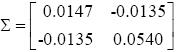
<body><![CDATA[<p align="justify"><font face="verdana" size="2">However, as we said before, measuring the <b>N<i></i></b><i><sub>F</sub></i> can only be done, generally speaking, mechanistically or experimentally (Kearney, 2006; Sober&oacute;n, 2007; Kearney and Porter, 2009). The widely used correlative methods estimate vaguely defined objects: an area of distribution somewhere between the actual and the potential (Jim&eacute;nez&#150;Valverde et al., 2008), and thus the corresponding environmental subsets lie between <b>N</b><sup>*</sup><sub><i>F</i></sub> and <b>N</b><i><sub>R</sub></i>, as expressed in equation (1). Unfortunately when presence&#150;only data is used, without extra information it is impossible to assess where exactly the position of the estimate lies (Sober&oacute;n, 2010). If, however, distributions are modeled using correlative methods that include unbiased data documenting absences, most likely one gets an estimation of the actual occupied area of the species, GO, with associated <b>N</b><i><sub>R</sub></i>= &#951;(<b>G</b><sub>0</sub>). At the other extreme, lacking data on absences and resorting only to envelope methods, it is likely that estimates shift towards the potential area of distribution (<b>G</b><sub>0</sub><b>G</b><i><sub>I</sub></i>), and therefore the environmental space associated with &#951;(<b>G</b><sub>0</sub><b>G</b><i><sub>I</sub></i>) shifts more towards N*F (Jim&eacute;nez&#150;Valverde et al., 2008). In any case, correlative methods clearly do not provide immediate evidence about shifts in the NF, but only, indirectly, about <b>N</b><sup>*</sup><sub><i>F</i></sub> and <b>N</b><i><sub>R</sub></i>.</font></p> 	    <p align="justify"><font face="verdana" size="2">Observing displacements in <b>N</b><i><sub>R</sub></i> estimates for the native and invaded ranges of <i>Centaurea maculosa</i>, Broennimann et al. (2007) suggested 2 explanations: (i) genuine evolutionary change in <b>N</b><sub><i>F</i></sub>, or (ii) actions of ecological factors like lack of suitable habitat or presence of competitors are modifying the <b>N</b><i><sub>R</sub></i>. In a paper discussing transferability of predictions of species distributions, Randin et al. (2006) also explained niche shifts by differences in land&#150;use history, phenotypic plasticity, and the ranges of environmental predictors being different. Dormann et al. (2010), studying climatic niche conservation in European mammals, were also aware of the possibility that differences in niche space may affect results, and developed a test to check whether "climate niches" (without specification of whether it is the fundamental, the realized or an intermediate) of sister species are affected by the underlying structure of E&#150;space. Their test appears to be valid as regards to realized niches, but perhaps not so if used as evidence of fundamental niche conservatism.</font></p> 	    <p align="justify"><font face="verdana" size="2">Finally, in a very recent paper, Godsoe (2010) used virtual species with identical environmental requirements (i.e., fundamental niches) to explore how gradients and dispersal limitations affect the capacity of different methods to detect differences in both fundamental and realized niches. His results further illustrate the difficulties of making inferences about the fundamental niches on the basis of observed distributional data.</font></p> 	    <p align="justify"><font face="verdana" size="2">These results are very recent, and the implications of anisotropy of E&#150;space for studying fundamental niche conservatism have not been appreciated widely. The structure of existing environmental combinations may vary radically from 1 region of <b>G</b> to another, and through time as well, so species with conserved <b>N</b><sub><i>F</i></sub> may have <b>N</b><i><sub>R</sub></i> significantly shifted in different regions, just because the environmental combinations available in 2 regions of the planet are different. This point is key in interpreting niche conservatism, as we will show below.</font></p> 	    <p align="justify"><font face="verdana" size="2">&nbsp;</font></p> 	    <p align="justify"><font size="2" face="verdana"><b>Materials and methods</b></font></p> 	    <p align="justify"><font size="2" face="verdana">We illustrate the effect of differences in existing conditions on <b>N</b><i><sub>R</sub></i> by constructing a virtual species with a known hypothetical fundamental niche, in a world with no biotic interactions, and unlimited ability to expand within a given region. To construct the <b>E</b> space, we start with the 19 bioclimatic variables in WorldClim (Hijmans et al., 2005) for the Western Hemisphere, at a spatial resolution of 5'. To reduce dimensionality and standardize variables, we performed a z&#150;transformation of the data and then a PCA analysis. The first 5 components explain almost 98% of the variance, but we used just the first 2 axes (which explain around 90%) in order to simplify the figures. We assumed a 2&#150;dimensional ellipsoid as the fundamental niche for the hypothetical species using the following equation:</font></p> 	    <p align="center"><img src="/img/revistas/rmbiodiv/v82n4/a32e2.jpg"></p> 	    <p align="justify"><font size="2" face="verdana">where <b>x</b> are vectors of 2 coordinates, &micro;= (&#150;0.295, 0.4407) is the centroid of <b>N</b><sub><i>F</i></sub>, and</font></p> 	    <p align="center"><img src="/img/revistas/rmbiodiv/v82n4/a32e3.jpg"></p> 	    ]]></body>
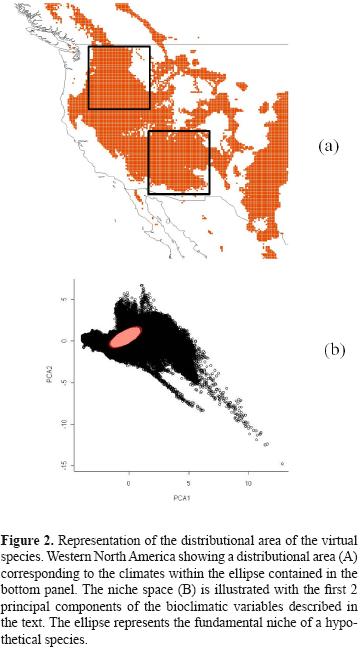
<body><![CDATA[<p align="justify"><font size="2" face="verdana">is a covariance matrix with eigenvectors and eigenvalues determining the directions of the axes of the <b>N</b><sup>*</sup><sub><i>F</i></sub> and its area (Legendre and Legendre, 1998). The above parameters define the ellipse illustrated in <a href="#f2">Figures 2</a> and <a href="/img/revistas/rmbiodiv/v82n4/a32f3.jpg" target="_blank">3</a>. Its intersection with the 2&#150;dimensional E space (<b>N</b><sup>*</sup><sub><i>F</i></sub>) is projected to geographic space as a potential distributional area. For the sake of illustration, we selected 2 equal&#150;sized regions in the United States (<a href="/img/revistas/rmbiodiv/v82n4/a32f3.jpg" target="_blank">Figs. 3A, B</a>), each containing environments within <b>N</b><i><sub>F</sub></i>.</font></p>         <p align="center"><font face="verdana" size="2"><a name="f2"></a></font></p>      <p align="center"><font face="verdana" size="2"><img src="/img/revistas/rmbiodiv/v82n4/a32f2.jpg"></font></p> 	    <p align="justify"><font face="verdana" size="2">To compare results we followed Broennimann et al. (2007) and analyzed the data using between&#150;classes inertia analysis (Doledec et al., 2000) with the ade4 package of R which gave an inter&#150;inertia ratio of 0.273, with a p &lt; 10<sup>&#150;5</sup>, obtained by Monte Carlo simulation with 10 000 replicates. Inertia analysis explores the position and shape of clouds of points in environmental space by studying their distance to the centroid of the entire available space, and the degree of scatter on a vector linking the global centroid to the centroid of one particular cloud of points. Other methods to compare niche shifts exist (Warren et al., 2008), but we wanted to use one that has already been used to document niche shifts in an evolutionary context.</font></p> 	    <p align="justify"><font face="verdana" size="2">&nbsp;</font></p> 	    <p align="justify"><font size="2" face="verdana"><b>Results</b></font></p> 	    <p align="justify"><font size="2" face="verdana">The occurrence points falling in <b>N</b><sup>*</sup><sub><i>F</i></sub> of the species in the northern and southern regions in the map, respectively, are shown as blue and red in <a href="/img/revistas/rmbiodiv/v82n4/a32f3.jpg" target="_blank">Figure (3)</a>, respectively. Despite wide overall overlap, the climatic combinations corresponding to the 2 ranges are different, and a species capable of reaching every grid cell would have different <b>N</b><sup>*</sup><sub><i>F</i></sub> (and thus realized niche) in the northern and the southern regions. This result holds true even assuming: (i) constant NF, (ii) no competitors or interactors of any kind, and (iii) full dispersal equilibrium within each subregion.</font></p> 	    <p align="justify"><font face="verdana" size="2">We plot the <b>N</b><sup>*</sup><sub><i>F</i></sub> of the 2 regions (<a href="/img/revistas/rmbiodiv/v82n4/a32f4.jpg" target="_blank">Fig. 4</a>), showing substantial niche shift between them. This result parallels strikingly the niche shifts observed by Broennimann et al. (2007) when analyzing invasion by <i>Centaurea</i>, which they explained in evolutionary or ecological terms. Our example, however, mimics realized niche shifts resulting only from the anisotropy of E&#150;space, which may be frequently be a more parsimonious explanation for niche shifts.</font></p> 	    <p align="justify"><font face="verdana" size="2">&nbsp;</font></p> 	    <p align="justify"><font size="2" face="verdana"><b>Discussion</b></font></p> 	    ]]></body>
<body><![CDATA[<p align="justify"><font size="2" face="verdana">The conclusion is straightforward: documenting shifts in an estimated realized niche, which is what correlative methods most likely do, yields little information about the evolution of the fundamental niche, since shifts in <b>N</b><i><sub>R</sub></i> result from combinations of evolutionary, ecological and geographic effects. Without ancillary information, documenting shifts in estimates of <b>N</b><i><sub>R</sub></i> does not inform about changes in the physiologically&#150; defined <b>N</b><i><sub>R</sub></i>, nor about ecological changes in <b>N</b><sub><i>F</i></sub>. The correct null hypothesis when transferring niche predictions spatially should be lack of change in the centroids of the <b>N</b><i><sub>R</sub></i> conditioned to the anisotropies in <b>E</b>; in other words, appropriate comparisons will include considerations of the structure and composition of the <b>E</b> space in each region. Such tests have been implemented in the background similarity tests of Warren et al. (2008), which consider niche differences relative to a specific area of interest, and see also Dormann et al. (2010) and Godsoe (2010). Notice, however, that documenting stasis in the <b>N</b><sub><i>R</i></sub> probably implies stasis in <b>N</b><i><sub>F</sub></i> as well.</font></p> 	    <p align="justify"><font face="verdana" size="2">Beginning with Broennimann (2007) and Fitzpatrick et al. (2007), numerous studies have addressed the question of niche shifts during the invasion process (Pearman et al., 2007; Broennimann and Guisan, 2008; R&ouml;dder and L&ouml;tters, 2009; Dormann et al., 2010; Medley, 2010). <i>In</i> general, they have concluded that niche shifts are occurring, an idea with which we concur if the understanding is that they refer to the realized niche. As should be clear from the example we have presented herein, the question of which niche is shifting is crucial. It is clear that the same fundamental niche <b>N</b><sub><i>F</i></sub>, expressed in different regions with correspondingly distinct environmental spaces <b>E</b>' and <b>E</b>'' will produce different existing fundamental niches and therefore, in all likelihood, different NR, even in the absence of competitors and evolutionary processes.</font></p> 	    <p align="justify"><font face="verdana" size="2">The idea that niche comparisons should be performed in relation to available ecological space is not new. The literature of niche measures very often makes explicit reference to available ecological space (Colwell and Futuyma, 1971; Green, 1971; Doledec et al., 2000; Elith and Burgman, 2002; Hirzel et al., 2002; Calenge et al., 2008; Warren et al., 2008; Dormann et al., 2010). It is important that niche modelers appreciate more fully the fact that environmental spaces are highly heterogeneous and that attempts to understand changes in either <b>N</b><sub><i>F</i></sub> or <b>N</b><i><sub>R</sub></i>, must therefore take into account the structure of the available environmental space <b>E</b>. The problem of the definition of the available niche space is a deep one, which is the subject of a separate treatment (Barve et al., 2011).</font></p> 	    <p align="justify"><font face="verdana" size="2">&nbsp;</font></p> 	    <p align="justify"><font size="2" face="verdana"><b>Acknowledgements</b></font></p> 	    <p align="justify"><font size="2" face="verdana">We thank our colleagues in the KU Niche Modeling Group for helpful discussions, and to David Ackerly, Olivier Broennimann and 2 anonymous referees for their comments. This work was partially financed by a Microsoft Research grant.</font></p> 	    <p align="justify"><font face="verdana" size="2">&nbsp;</font></p> 	    <p align="justify"><font size="2" face="verdana"><b>Literature cited</b></font></p> 	    <!-- ref --><p align="justify"><font size="2" face="verdana">Ackerly, D. D. 2003. Community assembly, niche conservatism, and adaptive evolution in changing environments. International Journal of Plant Science 164:S165&#150;S184.    &nbsp;&nbsp;&nbsp;&nbsp;&nbsp;&nbsp;&nbsp;&nbsp;[&#160;<a href="javascript:void(0);" onclick="javascript: window.open('/scielo.php?script=sci_nlinks&ref=7553503&pid=S1870-3453201100040003200001&lng=','','width=640,height=500,resizable=yes,scrollbars=1,menubar=yes,');">Links</a>&#160;]<!-- end-ref --></font></p> 	    ]]></body>
<body><![CDATA[<!-- ref --><p align="justify"><font face="verdana" size="2">Austin, M. 1999. A silent clash of paradigms: some inconsistencies in community ecology. Oikos 86:170&#150;178.    &nbsp;&nbsp;&nbsp;&nbsp;&nbsp;&nbsp;&nbsp;&nbsp;[&#160;<a href="javascript:void(0);" onclick="javascript: window.open('/scielo.php?script=sci_nlinks&ref=7553505&pid=S1870-3453201100040003200002&lng=','','width=640,height=500,resizable=yes,scrollbars=1,menubar=yes,');">Links</a>&#160;]<!-- end-ref --></font></p> 	    <!-- ref --><p align="justify"><font face="verdana" size="2">Barve, N., V. Barve, A. Jim&eacute;nez&#150;Valverde, A. Lira&#150;Noriega, S. P. Maher, A. T. Peterson, J. Sober&oacute;n and F. Villalobos. 2011. The crucial role of the accessible area in ecological niche modeling and species distribution modeling. Ecological Modelling 222:1810&#150;1819.    &nbsp;&nbsp;&nbsp;&nbsp;&nbsp;&nbsp;&nbsp;&nbsp;[&#160;<a href="javascript:void(0);" onclick="javascript: window.open('/scielo.php?script=sci_nlinks&ref=7553507&pid=S1870-3453201100040003200003&lng=','','width=640,height=500,resizable=yes,scrollbars=1,menubar=yes,');">Links</a>&#160;]<!-- end-ref --></font></p> 	    <!-- ref --><p align="justify"><font face="verdana" size="2">Birch, L. C. 1953. Experimental background to the study of the distribution and abundance of insects: I. The influence of temperature, moisture and food on the innate capacity for increase of three grain beetles. Ecology 34:698&#150;711.    &nbsp;&nbsp;&nbsp;&nbsp;&nbsp;&nbsp;&nbsp;&nbsp;[&#160;<a href="javascript:void(0);" onclick="javascript: window.open('/scielo.php?script=sci_nlinks&ref=7553509&pid=S1870-3453201100040003200004&lng=','','width=640,height=500,resizable=yes,scrollbars=1,menubar=yes,');">Links</a>&#160;]<!-- end-ref --></font></p> 	    <!-- ref --><p align="justify"><font face="verdana" size="2">Broennimann, O. and A. Guisan. 2008. Predicting current and future biological invasions: both native and invaded ranges matter. Biology Letters 4:585&#150;589.    &nbsp;&nbsp;&nbsp;&nbsp;&nbsp;&nbsp;&nbsp;&nbsp;[&#160;<a href="javascript:void(0);" onclick="javascript: window.open('/scielo.php?script=sci_nlinks&ref=7553511&pid=S1870-3453201100040003200005&lng=','','width=640,height=500,resizable=yes,scrollbars=1,menubar=yes,');">Links</a>&#160;]<!-- end-ref --></font></p> 	    <!-- ref --><p align="justify"><font face="verdana" size="2">Broennimann, O., U. A. Treier, H. Muller&#150;Schaerer, W. Thuiller, A. T. Peterson and A. Guisan. 2007. Evidence of climatic niche shift during biological invasion. Ecology Letters 10:701&#150;709.    &nbsp;&nbsp;&nbsp;&nbsp;&nbsp;&nbsp;&nbsp;&nbsp;[&#160;<a href="javascript:void(0);" onclick="javascript: window.open('/scielo.php?script=sci_nlinks&ref=7553513&pid=S1870-3453201100040003200006&lng=','','width=640,height=500,resizable=yes,scrollbars=1,menubar=yes,');">Links</a>&#160;]<!-- end-ref --></font></p> 	    ]]></body>
<body><![CDATA[<!-- ref --><p align="justify"><font face="verdana" size="2">Calenge, C., G. Darmon, M. Basille, A. Loison and J. M. Jullien. 2008. The factorial decomposition of the Mahalanobis distances in habitat selection studies. Ecology 89:555&#150;566.    &nbsp;&nbsp;&nbsp;&nbsp;&nbsp;&nbsp;&nbsp;&nbsp;[&#160;<a href="javascript:void(0);" onclick="javascript: window.open('/scielo.php?script=sci_nlinks&ref=7553515&pid=S1870-3453201100040003200007&lng=','','width=640,height=500,resizable=yes,scrollbars=1,menubar=yes,');">Links</a>&#160;]<!-- end-ref --></font></p> 	    <!-- ref --><p align="justify"><font face="verdana" size="2">Carnes, B. A. and N. Slade. 1982. Some comments on niche analysis in canonical space. Ecology 63:888&#150;893.    &nbsp;&nbsp;&nbsp;&nbsp;&nbsp;&nbsp;&nbsp;&nbsp;[&#160;<a href="javascript:void(0);" onclick="javascript: window.open('/scielo.php?script=sci_nlinks&ref=7553517&pid=S1870-3453201100040003200008&lng=','','width=640,height=500,resizable=yes,scrollbars=1,menubar=yes,');">Links</a>&#160;]<!-- end-ref --></font></p> 	    <!-- ref --><p align="justify"><font face="verdana" size="2">Colwell, R. K. and D. Futuyma. 1971. On the measurement of niche breadth and overlap. Ecology 52:567&#150;576.    &nbsp;&nbsp;&nbsp;&nbsp;&nbsp;&nbsp;&nbsp;&nbsp;[&#160;<a href="javascript:void(0);" onclick="javascript: window.open('/scielo.php?script=sci_nlinks&ref=7553519&pid=S1870-3453201100040003200009&lng=','','width=640,height=500,resizable=yes,scrollbars=1,menubar=yes,');">Links</a>&#160;]<!-- end-ref --></font></p> 	    <!-- ref --><p align="justify"><font face="verdana" size="2">Colwell, R. K. and T. F. Rangel. 2009. Hutchinson's duality: the once and future niche. Proceedings of the National Academy of Sciences USA 106:19644&#150;19650.    &nbsp;&nbsp;&nbsp;&nbsp;&nbsp;&nbsp;&nbsp;&nbsp;[&#160;<a href="javascript:void(0);" onclick="javascript: window.open('/scielo.php?script=sci_nlinks&ref=7553521&pid=S1870-3453201100040003200010&lng=','','width=640,height=500,resizable=yes,scrollbars=1,menubar=yes,');">Links</a>&#160;]<!-- end-ref --></font></p> 	    <!-- ref --><p align="justify"><font face="verdana" size="2">Doledec, S., D. Chessel and C. Gimaret&#150;Carpentier. 2000. Niche separation in community analysis: A new method. Ecology 81:2914&#150;2927.    &nbsp;&nbsp;&nbsp;&nbsp;&nbsp;&nbsp;&nbsp;&nbsp;[&#160;<a href="javascript:void(0);" onclick="javascript: window.open('/scielo.php?script=sci_nlinks&ref=7553523&pid=S1870-3453201100040003200011&lng=','','width=640,height=500,resizable=yes,scrollbars=1,menubar=yes,');">Links</a>&#160;]<!-- end-ref --></font></p> 	    ]]></body>
<body><![CDATA[<!-- ref --><p align="justify"><font face="verdana" size="2">Dormann, C. F., B. Gruber, M. Winter and D. Hermann. 2010. Evolution of climate niches in European mammals? Biology Letters 6:229&#150;232.    &nbsp;&nbsp;&nbsp;&nbsp;&nbsp;&nbsp;&nbsp;&nbsp;[&#160;<a href="javascript:void(0);" onclick="javascript: window.open('/scielo.php?script=sci_nlinks&ref=7553525&pid=S1870-3453201100040003200012&lng=','','width=640,height=500,resizable=yes,scrollbars=1,menubar=yes,');">Links</a>&#160;]<!-- end-ref --></font></p> 	    <!-- ref --><p align="justify"><font face="verdana" size="2">Elith, J. and M. Burgman. 2002. Predictions and their validation: Rare plants in the central highlands, Victoria. <i>In</i> Predicting species occurrences: issues of scale and accuracy, J. M. Scott, P. J. Heglund and M. L. Morrison (eds.). Island Press, Washington, D.C. p. 303&#150;313.    &nbsp;&nbsp;&nbsp;&nbsp;&nbsp;&nbsp;&nbsp;&nbsp;[&#160;<a href="javascript:void(0);" onclick="javascript: window.open('/scielo.php?script=sci_nlinks&ref=7553527&pid=S1870-3453201100040003200013&lng=','','width=640,height=500,resizable=yes,scrollbars=1,menubar=yes,');">Links</a>&#160;]<!-- end-ref --></font></p> 	    <!-- ref --><p align="justify"><font face="verdana" size="2">Elith, J. and C. Graham. 2009. Do they? How do they? WHY do they differ? On finding reasons for differing performances of species distribution models. Ecography 32:66&#150;77.    &nbsp;&nbsp;&nbsp;&nbsp;&nbsp;&nbsp;&nbsp;&nbsp;[&#160;<a href="javascript:void(0);" onclick="javascript: window.open('/scielo.php?script=sci_nlinks&ref=7553529&pid=S1870-3453201100040003200014&lng=','','width=640,height=500,resizable=yes,scrollbars=1,menubar=yes,');">Links</a>&#160;]<!-- end-ref --></font></p> 	    <!-- ref --><p align="justify"><font face="verdana" size="2">Ficetola, G. F., W. Thuiller and C. Miaud. 2007. Prediction and validation of the potential global distribution of a problematic alien invasive species &#150;&#150; The American bullfrog. Diversity and Distributions 13:476&#150;485.    &nbsp;&nbsp;&nbsp;&nbsp;&nbsp;&nbsp;&nbsp;&nbsp;[&#160;<a href="javascript:void(0);" onclick="javascript: window.open('/scielo.php?script=sci_nlinks&ref=7553531&pid=S1870-3453201100040003200015&lng=','','width=640,height=500,resizable=yes,scrollbars=1,menubar=yes,');">Links</a>&#160;]<!-- end-ref --></font></p> 	    <!-- ref --><p align="justify"><font face="verdana" size="2">Fitzpatrick, M. C., J. E. Weltzin, N. Sanders and R. R. Dunn. 2007. The biogeography of prediction error: why does the introduced range of the fire ant over&#150;predict its native range? Global Ecology and Biogeography 16:24&#150;33.    &nbsp;&nbsp;&nbsp;&nbsp;&nbsp;&nbsp;&nbsp;&nbsp;[&#160;<a href="javascript:void(0);" onclick="javascript: window.open('/scielo.php?script=sci_nlinks&ref=7553533&pid=S1870-3453201100040003200016&lng=','','width=640,height=500,resizable=yes,scrollbars=1,menubar=yes,');">Links</a>&#160;]<!-- end-ref --></font></p> 	    ]]></body>
<body><![CDATA[<!-- ref --><p align="justify"><font face="verdana" size="2">Godsoe, W. 2009. I can't define the niche but I know it when I see it: a formal link between statistical theory and the ecological niche. Oikos 119:53&#150;60.    &nbsp;&nbsp;&nbsp;&nbsp;&nbsp;&nbsp;&nbsp;&nbsp;[&#160;<a href="javascript:void(0);" onclick="javascript: window.open('/scielo.php?script=sci_nlinks&ref=7553535&pid=S1870-3453201100040003200017&lng=','','width=640,height=500,resizable=yes,scrollbars=1,menubar=yes,');">Links</a>&#160;]<!-- end-ref --></font></p> 	    <!-- ref --><p align="justify"><font face="verdana" size="2">Godsoe, W. 2010. Regional variation exaggerates ecological divergence in niche models. Systematic Biology 59:298&#150;306.    &nbsp;&nbsp;&nbsp;&nbsp;&nbsp;&nbsp;&nbsp;&nbsp;[&#160;<a href="javascript:void(0);" onclick="javascript: window.open('/scielo.php?script=sci_nlinks&ref=7553537&pid=S1870-3453201100040003200018&lng=','','width=640,height=500,resizable=yes,scrollbars=1,menubar=yes,');">Links</a>&#160;]<!-- end-ref --></font></p> 	    <!-- ref --><p align="justify"><font face="verdana" size="2">Green, R. H. 1971. A multivariate statistical approach to the Hutchinsonian niche: bivalve molluscs of central Canada. Ecology 52:544&#150;556.    &nbsp;&nbsp;&nbsp;&nbsp;&nbsp;&nbsp;&nbsp;&nbsp;[&#160;<a href="javascript:void(0);" onclick="javascript: window.open('/scielo.php?script=sci_nlinks&ref=7553539&pid=S1870-3453201100040003200019&lng=','','width=640,height=500,resizable=yes,scrollbars=1,menubar=yes,');">Links</a>&#160;]<!-- end-ref --></font></p> 	    <!-- ref --><p align="justify"><font face="verdana" size="2">Guisan, A. and N. Zimmermann. 2000. Predictive habitat distribution models in ecology. Ecological Modelling 135:147&#150;186.    &nbsp;&nbsp;&nbsp;&nbsp;&nbsp;&nbsp;&nbsp;&nbsp;[&#160;<a href="javascript:void(0);" onclick="javascript: window.open('/scielo.php?script=sci_nlinks&ref=7553541&pid=S1870-3453201100040003200020&lng=','','width=640,height=500,resizable=yes,scrollbars=1,menubar=yes,');">Links</a>&#160;]<!-- end-ref --></font></p> 	    <!-- ref --><p align="justify"><font face="verdana" size="2">Hijmans, R. J., S. Cameron, J. Parra, P. G. Jones and A. Jarvis. 2005. Very high resolution interpolated climate surfaces for global land areas. International Journal of Climatology 25:1965&#150;1978.    &nbsp;&nbsp;&nbsp;&nbsp;&nbsp;&nbsp;&nbsp;&nbsp;[&#160;<a href="javascript:void(0);" onclick="javascript: window.open('/scielo.php?script=sci_nlinks&ref=7553543&pid=S1870-3453201100040003200021&lng=','','width=640,height=500,resizable=yes,scrollbars=1,menubar=yes,');">Links</a>&#160;]<!-- end-ref --></font></p> 	    ]]></body>
<body><![CDATA[<!-- ref --><p align="justify"><font face="verdana" size="2">Hirzel, A. H., J. Hausser, D. Chessel and N. Perrin. 2002. Ecological&#150;niche factor analysis: how to compute habitat&#150;suitability maps without absence data? Ecology 83:2027&#150;2036.    &nbsp;&nbsp;&nbsp;&nbsp;&nbsp;&nbsp;&nbsp;&nbsp;[&#160;<a href="javascript:void(0);" onclick="javascript: window.open('/scielo.php?script=sci_nlinks&ref=7553545&pid=S1870-3453201100040003200022&lng=','','width=640,height=500,resizable=yes,scrollbars=1,menubar=yes,');">Links</a>&#160;]<!-- end-ref --></font></p> 	    <!-- ref --><p align="justify"><font face="verdana" size="2">Hooper, H., R. Connon, A. Callaghan, G. Fryer, S. Yarwood&#150;Buchanan, J. Biggs, S. Maund, T. Hutchinson and R. M. Sibly. 2008. The ecological niche of <i>Daphnia magna</i> characterized using population growth rate. Ecology 89:1015&#150;1022.    &nbsp;&nbsp;&nbsp;&nbsp;&nbsp;&nbsp;&nbsp;&nbsp;[&#160;<a href="javascript:void(0);" onclick="javascript: window.open('/scielo.php?script=sci_nlinks&ref=7553547&pid=S1870-3453201100040003200023&lng=','','width=640,height=500,resizable=yes,scrollbars=1,menubar=yes,');">Links</a>&#160;]<!-- end-ref --></font></p> 	    <!-- ref --><p align="justify"><font face="verdana" size="2">Hutchinson, G. E. 1957. Concluding remarks. Cold Spring harbor Symposia on Quantitative Biology 22:415&#150;427.    &nbsp;&nbsp;&nbsp;&nbsp;&nbsp;&nbsp;&nbsp;&nbsp;[&#160;<a href="javascript:void(0);" onclick="javascript: window.open('/scielo.php?script=sci_nlinks&ref=7553549&pid=S1870-3453201100040003200024&lng=','','width=640,height=500,resizable=yes,scrollbars=1,menubar=yes,');">Links</a>&#160;]<!-- end-ref --></font></p> 	    <!-- ref --><p align="justify"><font face="verdana" size="2">Hutchinson, G. E. 1978. An Introduction to Population Ecology. Yale University Press, New Haven. 260 p.    &nbsp;&nbsp;&nbsp;&nbsp;&nbsp;&nbsp;&nbsp;&nbsp;[&#160;<a href="javascript:void(0);" onclick="javascript: window.open('/scielo.php?script=sci_nlinks&ref=7553551&pid=S1870-3453201100040003200025&lng=','','width=640,height=500,resizable=yes,scrollbars=1,menubar=yes,');">Links</a>&#160;]<!-- end-ref --></font></p> 	    <!-- ref --><p align="justify"><font face="verdana" size="2">Jackson, S. T. and J. T. Overpeck. 2000. Responses of plant populations and communities to environmental changes of the late Quaternary. Paleobiology 26 (Supplement):194&#150;220.    &nbsp;&nbsp;&nbsp;&nbsp;&nbsp;&nbsp;&nbsp;&nbsp;[&#160;<a href="javascript:void(0);" onclick="javascript: window.open('/scielo.php?script=sci_nlinks&ref=7553553&pid=S1870-3453201100040003200026&lng=','','width=640,height=500,resizable=yes,scrollbars=1,menubar=yes,');">Links</a>&#160;]<!-- end-ref --></font></p> 	    ]]></body>
<body><![CDATA[<!-- ref --><p align="justify"><font face="verdana" size="2">Jim&eacute;nez&#150;Valverde, A., J. M. Lobo and J. Hortal. 2008. Not as good as they seem: the importance of concept in species distribution modelling. Diversity and Distributions 14:885&#150;890.    &nbsp;&nbsp;&nbsp;&nbsp;&nbsp;&nbsp;&nbsp;&nbsp;[&#160;<a href="javascript:void(0);" onclick="javascript: window.open('/scielo.php?script=sci_nlinks&ref=7553555&pid=S1870-3453201100040003200027&lng=','','width=640,height=500,resizable=yes,scrollbars=1,menubar=yes,');">Links</a>&#160;]<!-- end-ref --></font></p> 	    <!-- ref --><p align="justify"><font face="verdana" size="2">Kearney, M. 2006. Habitat, environment and niche: what are we modelling? Oikos 115:186&#150;191.    &nbsp;&nbsp;&nbsp;&nbsp;&nbsp;&nbsp;&nbsp;&nbsp;[&#160;<a href="javascript:void(0);" onclick="javascript: window.open('/scielo.php?script=sci_nlinks&ref=7553557&pid=S1870-3453201100040003200028&lng=','','width=640,height=500,resizable=yes,scrollbars=1,menubar=yes,');">Links</a>&#160;]<!-- end-ref --></font></p> 	    <!-- ref --><p align="justify"><font face="verdana" size="2">Kearney, M. and W. P. Porter. 2009. Mechanistic niche modelling: combining physiological and spatial data to predict species' ranges. Ecology Letters 12:334&#150;350.    &nbsp;&nbsp;&nbsp;&nbsp;&nbsp;&nbsp;&nbsp;&nbsp;[&#160;<a href="javascript:void(0);" onclick="javascript: window.open('/scielo.php?script=sci_nlinks&ref=7553559&pid=S1870-3453201100040003200029&lng=','','width=640,height=500,resizable=yes,scrollbars=1,menubar=yes,');">Links</a>&#160;]<!-- end-ref --></font></p> 	    <!-- ref --><p align="justify"><font face="verdana" size="2">Labra, A., J. Pienaar and T. F. Hansen. 2009. Evolution of thermal physiology in <i>Liolaemus lizards</i>: adaptation, phylogenetic inertia, and niche tracking. The American Naturalist 174:204&#150;220.    &nbsp;&nbsp;&nbsp;&nbsp;&nbsp;&nbsp;&nbsp;&nbsp;[&#160;<a href="javascript:void(0);" onclick="javascript: window.open('/scielo.php?script=sci_nlinks&ref=7553561&pid=S1870-3453201100040003200030&lng=','','width=640,height=500,resizable=yes,scrollbars=1,menubar=yes,');">Links</a>&#160;]<!-- end-ref --></font></p> 	    <!-- ref --><p align="justify"><font face="verdana" size="2">Legendre, P. and L. Legendre. 1998. Numerical Ecology. Secon Edition edition. Elsevier Scientific Publishing Company, Amsterdam. 853 p.    &nbsp;&nbsp;&nbsp;&nbsp;&nbsp;&nbsp;&nbsp;&nbsp;[&#160;<a href="javascript:void(0);" onclick="javascript: window.open('/scielo.php?script=sci_nlinks&ref=7553563&pid=S1870-3453201100040003200031&lng=','','width=640,height=500,resizable=yes,scrollbars=1,menubar=yes,');">Links</a>&#160;]<!-- end-ref --></font></p> 	    ]]></body>
<body><![CDATA[<!-- ref --><p align="justify"><font face="verdana" size="2">Maguire, B. 1973. Niche response structure and the analytical potentials of its relationship to the habitat. American Naturalist 107:213&#150;246.    &nbsp;&nbsp;&nbsp;&nbsp;&nbsp;&nbsp;&nbsp;&nbsp;[&#160;<a href="javascript:void(0);" onclick="javascript: window.open('/scielo.php?script=sci_nlinks&ref=7553565&pid=S1870-3453201100040003200032&lng=','','width=640,height=500,resizable=yes,scrollbars=1,menubar=yes,');">Links</a>&#160;]<!-- end-ref --></font></p> 	    <!-- ref --><p align="justify"><font face="verdana" size="2">Medley, K. A. 2010. Niche shifts during the global invasion of the Asian tiger mosquito, <i>Aedes albopictus</i> Skuse (Culicidae), revelaed by reciprocal distribution models. Global Ecology and Biogeography 19:122&#150;133.    &nbsp;&nbsp;&nbsp;&nbsp;&nbsp;&nbsp;&nbsp;&nbsp;[&#160;<a href="javascript:void(0);" onclick="javascript: window.open('/scielo.php?script=sci_nlinks&ref=7553567&pid=S1870-3453201100040003200033&lng=','','width=640,height=500,resizable=yes,scrollbars=1,menubar=yes,');">Links</a>&#160;]<!-- end-ref --></font></p> 	    <!-- ref --><p align="justify"><font face="verdana" size="2">Pearman, P. B., A. Guisan, O. Broennimann and C. Randin. 2007. Niche dynamics in space and time. Trends in Ecology &amp; Evolution 23:149&#150;158.    &nbsp;&nbsp;&nbsp;&nbsp;&nbsp;&nbsp;&nbsp;&nbsp;[&#160;<a href="javascript:void(0);" onclick="javascript: window.open('/scielo.php?script=sci_nlinks&ref=7553569&pid=S1870-3453201100040003200034&lng=','','width=640,height=500,resizable=yes,scrollbars=1,menubar=yes,');">Links</a>&#160;]<!-- end-ref --></font></p> 	    <!-- ref --><p align="justify"><font face="verdana" size="2">Pearson, R. G. 2007. Species' distribution modeling for conservation educators and practitioners. Synthesis. American Museum of Natural History, New York. 50 p.    &nbsp;&nbsp;&nbsp;&nbsp;&nbsp;&nbsp;&nbsp;&nbsp;[&#160;<a href="javascript:void(0);" onclick="javascript: window.open('/scielo.php?script=sci_nlinks&ref=7553571&pid=S1870-3453201100040003200035&lng=','','width=640,height=500,resizable=yes,scrollbars=1,menubar=yes,');">Links</a>&#160;]<!-- end-ref --></font></p> 	    <!-- ref --><p align="justify"><font face="verdana" size="2">Peterson, A. T. 2003. Predicting the geography of species' invasions via ecological niche modeling. Quarterly Review of Biology 78:419&#150;433.    &nbsp;&nbsp;&nbsp;&nbsp;&nbsp;&nbsp;&nbsp;&nbsp;[&#160;<a href="javascript:void(0);" onclick="javascript: window.open('/scielo.php?script=sci_nlinks&ref=7553573&pid=S1870-3453201100040003200036&lng=','','width=640,height=500,resizable=yes,scrollbars=1,menubar=yes,');">Links</a>&#160;]<!-- end-ref --></font></p> 	    ]]></body>
<body><![CDATA[<!-- ref --><p align="justify"><font face="verdana" size="2">Peterson, A. T. 2011. Ecological niche conservatism: a time&#150;structured review of evidence. Journal of Biogeography <i>In</i> press.    &nbsp;&nbsp;&nbsp;&nbsp;&nbsp;&nbsp;&nbsp;&nbsp;[&#160;<a href="javascript:void(0);" onclick="javascript: window.open('/scielo.php?script=sci_nlinks&ref=7553575&pid=S1870-3453201100040003200037&lng=','','width=640,height=500,resizable=yes,scrollbars=1,menubar=yes,');">Links</a>&#160;]<!-- end-ref --></font></p> 	    <!-- ref --><p align="justify"><font face="verdana" size="2">Peterson, A. T., J. Sober&oacute;n and V. S&aacute;nchez&#150;Cordero. 1999. Conservatism of ecological niches in evolutionary time. Science 285:1265&#150;1267.    &nbsp;&nbsp;&nbsp;&nbsp;&nbsp;&nbsp;&nbsp;&nbsp;[&#160;<a href="javascript:void(0);" onclick="javascript: window.open('/scielo.php?script=sci_nlinks&ref=7553577&pid=S1870-3453201100040003200038&lng=','','width=640,height=500,resizable=yes,scrollbars=1,menubar=yes,');">Links</a>&#160;]<!-- end-ref --></font></p> 	    <!-- ref --><p align="justify"><font face="verdana" size="2">Pulliam, R. 2000. On the relationship between niche and distribution. Ecology Letters 3:349&#150;361.    &nbsp;&nbsp;&nbsp;&nbsp;&nbsp;&nbsp;&nbsp;&nbsp;[&#160;<a href="javascript:void(0);" onclick="javascript: window.open('/scielo.php?script=sci_nlinks&ref=7553579&pid=S1870-3453201100040003200039&lng=','','width=640,height=500,resizable=yes,scrollbars=1,menubar=yes,');">Links</a>&#160;]<!-- end-ref --></font></p> 	    <!-- ref --><p align="justify"><font face="verdana" size="2">Randin, C. F., T. Dirnbock, S. Dullinger, N. Zimmermann, M. Zappa and A. Guisan. 2006. Are niche&#150;based models transferable in space? Journal of Biogeography 33:1689&#150;1703.    &nbsp;&nbsp;&nbsp;&nbsp;&nbsp;&nbsp;&nbsp;&nbsp;[&#160;<a href="javascript:void(0);" onclick="javascript: window.open('/scielo.php?script=sci_nlinks&ref=7553581&pid=S1870-3453201100040003200040&lng=','','width=640,height=500,resizable=yes,scrollbars=1,menubar=yes,');">Links</a>&#160;]<!-- end-ref --></font></p> 	    <!-- ref --><p align="justify"><font face="verdana" size="2">Rangel, T. F., J. A. Diniz&#150;Filho and R. K. Colwell. 2007. Species richness and evolutionary niche dynamics: a spatial pattern&#150;oriented simulation experiment. American Naturalist 170:602&#150;616.    &nbsp;&nbsp;&nbsp;&nbsp;&nbsp;&nbsp;&nbsp;&nbsp;[&#160;<a href="javascript:void(0);" onclick="javascript: window.open('/scielo.php?script=sci_nlinks&ref=7553583&pid=S1870-3453201100040003200041&lng=','','width=640,height=500,resizable=yes,scrollbars=1,menubar=yes,');">Links</a>&#160;]<!-- end-ref --></font></p> 	    ]]></body>
<body><![CDATA[<!-- ref --><p align="justify"><font face="verdana" size="2">R&ouml;dder, D. and S. L&ouml;tters. 2009. Niche shift versus niche conservatism? Climatic characteristics of the native and invasive ranges of the Mediterranean house gecko (<i>Hemidactylus turcicus</i>). Global Ecology and Biogeography 18:674&#150;687.    &nbsp;&nbsp;&nbsp;&nbsp;&nbsp;&nbsp;&nbsp;&nbsp;[&#160;<a href="javascript:void(0);" onclick="javascript: window.open('/scielo.php?script=sci_nlinks&ref=7553585&pid=S1870-3453201100040003200042&lng=','','width=640,height=500,resizable=yes,scrollbars=1,menubar=yes,');">Links</a>&#160;]<!-- end-ref --></font></p> 	    <!-- ref --><p align="justify"><font face="verdana" size="2">Sober&oacute;n, J. 2007. Grinnellian and Eltonian niches and geographic distributions of species. Ecology Letters 10:1115&#150;1123.    &nbsp;&nbsp;&nbsp;&nbsp;&nbsp;&nbsp;&nbsp;&nbsp;[&#160;<a href="javascript:void(0);" onclick="javascript: window.open('/scielo.php?script=sci_nlinks&ref=7553587&pid=S1870-3453201100040003200043&lng=','','width=640,height=500,resizable=yes,scrollbars=1,menubar=yes,');">Links</a>&#160;]<!-- end-ref --></font></p> 	    <!-- ref --><p align="justify"><font face="verdana" size="2">Sober&oacute;n, J. 2010. Niche and distributional range: a population ecology perspective. Ecography 33:159&#150;167.    &nbsp;&nbsp;&nbsp;&nbsp;&nbsp;&nbsp;&nbsp;&nbsp;[&#160;<a href="javascript:void(0);" onclick="javascript: window.open('/scielo.php?script=sci_nlinks&ref=7553589&pid=S1870-3453201100040003200044&lng=','','width=640,height=500,resizable=yes,scrollbars=1,menubar=yes,');">Links</a>&#160;]<!-- end-ref --></font></p> 	    <!-- ref --><p align="justify"><font face="verdana" size="2">Sober&oacute;n, J., J. Golubov and J. Sarukhan. 2001. The importance of <i>Opuntia</i> in Mexico and routes of invasion and impact of <i>Cactoblastis cactorum</i> (Lepidoptera: Pyralidae). Florida Entomologist 84:486&#150;492.    &nbsp;&nbsp;&nbsp;&nbsp;&nbsp;&nbsp;&nbsp;&nbsp;[&#160;<a href="javascript:void(0);" onclick="javascript: window.open('/scielo.php?script=sci_nlinks&ref=7553591&pid=S1870-3453201100040003200045&lng=','','width=640,height=500,resizable=yes,scrollbars=1,menubar=yes,');">Links</a>&#160;]<!-- end-ref --></font></p> 	    <!-- ref --><p align="justify"><font face="verdana" size="2">Sober&oacute;n, J. and M. Nakamura. 2009. Niches and distributional areas: concepts, methods and assumptions. Proceedings of the National Academy of Sciences USA 106:19644&#150;19650.    &nbsp;&nbsp;&nbsp;&nbsp;&nbsp;&nbsp;&nbsp;&nbsp;[&#160;<a href="javascript:void(0);" onclick="javascript: window.open('/scielo.php?script=sci_nlinks&ref=7553593&pid=S1870-3453201100040003200046&lng=','','width=640,height=500,resizable=yes,scrollbars=1,menubar=yes,');">Links</a>&#160;]<!-- end-ref --></font></p> 	    ]]></body>
<body><![CDATA[<!-- ref --><p align="justify"><font face="verdana" size="2">Sober&oacute;n, J. and A. T. Peterson. 2005. Interpretation of models of fundamental ecological niches and species' distributional areas. Biodiversity Informatics 2:1&#150;10.    &nbsp;&nbsp;&nbsp;&nbsp;&nbsp;&nbsp;&nbsp;&nbsp;[&#160;<a href="javascript:void(0);" onclick="javascript: window.open('/scielo.php?script=sci_nlinks&ref=7553595&pid=S1870-3453201100040003200047&lng=','','width=640,height=500,resizable=yes,scrollbars=1,menubar=yes,');">Links</a>&#160;]<!-- end-ref --></font></p> 	    <!-- ref --><p align="justify"><font face="verdana" size="2">Svenning, J. C. and F. Skov. 2004. Limited filling of the potential range in European tree species. Ecology Letters 7:565&#150;573.    &nbsp;&nbsp;&nbsp;&nbsp;&nbsp;&nbsp;&nbsp;&nbsp;[&#160;<a href="javascript:void(0);" onclick="javascript: window.open('/scielo.php?script=sci_nlinks&ref=7553597&pid=S1870-3453201100040003200048&lng=','','width=640,height=500,resizable=yes,scrollbars=1,menubar=yes,');">Links</a>&#160;]<!-- end-ref --></font></p> 	    <!-- ref --><p align="justify"><font face="verdana" size="2">Thomas, C. D., A. Cameron, R. E. Green, M. Bakkenes, L. J. Beaumont, Y. C. Collingham, B. F. N. Erasmus, M. Ferreira de Siqueira, A. Grainger, L. Hannah, L. Hughes, B. Huntley, A. S. Van Jaarsveld, G. E. Midgely, L. Miles, M. A. Ortega&#150;Huerta, A. T. Peterson, O. L. Phillips and S. E. Williams. 2004. Extinction risk from climate change. Nature 427:145&#150;148.    &nbsp;&nbsp;&nbsp;&nbsp;&nbsp;&nbsp;&nbsp;&nbsp;[&#160;<a href="javascript:void(0);" onclick="javascript: window.open('/scielo.php?script=sci_nlinks&ref=7553599&pid=S1870-3453201100040003200049&lng=','','width=640,height=500,resizable=yes,scrollbars=1,menubar=yes,');">Links</a>&#160;]<!-- end-ref --></font></p> 	    <!-- ref --><p align="justify"><font face="verdana" size="2">Thuiller, W., D. M. Richardson, P. Pysek, G. F. Midgley, G. O. Hughes and M. Rouget. 2005. Niche&#150;based modelling as a tool for predicting the risk of alien plant invasions at a global scale. Global Change Biology 11:2234&#150;2250.    &nbsp;&nbsp;&nbsp;&nbsp;&nbsp;&nbsp;&nbsp;&nbsp;[&#160;<a href="javascript:void(0);" onclick="javascript: window.open('/scielo.php?script=sci_nlinks&ref=7553601&pid=S1870-3453201100040003200050&lng=','','width=640,height=500,resizable=yes,scrollbars=1,menubar=yes,');">Links</a>&#160;]<!-- end-ref --></font></p> 	    <!-- ref --><p align="justify"><font face="verdana" size="2">Waltari, E., R. J. Hijmans, A. T. Peterson, A. Ny&aacute;ri, S. L. Perkins and R. P. Guralnick. 2007. Locating Pleistocene refugia: comparing phylogeographic and ecological niche model predictions. PLoS ONE 2:e563.    &nbsp;&nbsp;&nbsp;&nbsp;&nbsp;&nbsp;&nbsp;&nbsp;[&#160;<a href="javascript:void(0);" onclick="javascript: window.open('/scielo.php?script=sci_nlinks&ref=7553603&pid=S1870-3453201100040003200051&lng=','','width=640,height=500,resizable=yes,scrollbars=1,menubar=yes,');">Links</a>&#160;]<!-- end-ref --></font></p> 	    ]]></body>
<body><![CDATA[<!-- ref --><p align="justify"><font face="verdana" size="2">Warren, D., R. Glor and M. Turelli. 2008. Environmental niche equivalency versus conservatism: quantitative approaches to niche evolution. Evolution 62:2868&#150;2883.    &nbsp;&nbsp;&nbsp;&nbsp;&nbsp;&nbsp;&nbsp;&nbsp;[&#160;<a href="javascript:void(0);" onclick="javascript: window.open('/scielo.php?script=sci_nlinks&ref=7553605&pid=S1870-3453201100040003200052&lng=','','width=640,height=500,resizable=yes,scrollbars=1,menubar=yes,');">Links</a>&#160;]<!-- end-ref --></font></p> 	    <!-- ref --><p align="justify"><font face="verdana" size="2">Wiens, J. and C. Graham. 2005. Niche conservatism: integrating evolution, ecology and conservation biology. Annual Review of Ecology and Systematics 36:519&#150;539.    &nbsp;&nbsp;&nbsp;&nbsp;&nbsp;&nbsp;&nbsp;&nbsp;[&#160;<a href="javascript:void(0);" onclick="javascript: window.open('/scielo.php?script=sci_nlinks&ref=7553607&pid=S1870-3453201100040003200053&lng=','','width=640,height=500,resizable=yes,scrollbars=1,menubar=yes,');">Links</a>&#160;]<!-- end-ref --></font></p>      ]]></body><back>
<ref-list>
<ref id="B1">
<nlm-citation citation-type="journal">
<person-group person-group-type="author">
<name>
<surname><![CDATA[Ackerly]]></surname>
<given-names><![CDATA[D. D]]></given-names>
</name>
</person-group>
<article-title xml:lang="en"><![CDATA[Community assembly, niche conservatism, and adaptive evolution in changing environments]]></article-title>
<source><![CDATA[International Journal of Plant Science]]></source>
<year>2003</year>
<volume>164</volume>
<page-range>S165-S184</page-range></nlm-citation>
</ref>
<ref id="B2">
<nlm-citation citation-type="journal">
<person-group person-group-type="author">
<name>
<surname><![CDATA[Austin]]></surname>
<given-names><![CDATA[M]]></given-names>
</name>
</person-group>
<article-title xml:lang="en"><![CDATA[A silent clash of paradigms: some inconsistencies in community ecology]]></article-title>
<source><![CDATA[Oikos]]></source>
<year>1999</year>
<volume>86</volume>
<page-range>170-178</page-range></nlm-citation>
</ref>
<ref id="B3">
<nlm-citation citation-type="journal">
<person-group person-group-type="author">
<name>
<surname><![CDATA[Barve]]></surname>
<given-names><![CDATA[N.]]></given-names>
</name>
<name>
<surname><![CDATA[Barve]]></surname>
<given-names><![CDATA[V.]]></given-names>
</name>
<name>
<surname><![CDATA[Jiménez-Valverde]]></surname>
<given-names><![CDATA[A.]]></given-names>
</name>
<name>
<surname><![CDATA[Lira-Noriega]]></surname>
<given-names><![CDATA[A.]]></given-names>
</name>
<name>
<surname><![CDATA[Maher]]></surname>
<given-names><![CDATA[S. P.]]></given-names>
</name>
<name>
<surname><![CDATA[Peterson]]></surname>
<given-names><![CDATA[A. T.]]></given-names>
</name>
<name>
<surname><![CDATA[Soberón]]></surname>
<given-names><![CDATA[J.]]></given-names>
</name>
<name>
<surname><![CDATA[Villalobos]]></surname>
<given-names><![CDATA[F.]]></given-names>
</name>
</person-group>
<article-title xml:lang="en"><![CDATA[The crucial role of the accessible area in ecological niche modeling and species distribution modeling]]></article-title>
<source><![CDATA[Ecological Modelling]]></source>
<year>2011</year>
<volume>222</volume>
<page-range>1810-1819</page-range></nlm-citation>
</ref>
<ref id="B4">
<nlm-citation citation-type="journal">
<person-group person-group-type="author">
<name>
<surname><![CDATA[Birch]]></surname>
<given-names><![CDATA[L. C]]></given-names>
</name>
</person-group>
<article-title xml:lang="en"><![CDATA[Experimental background to the study of the distribution and abundance of insects: I. The influence of temperature, moisture and food on the innate capacity for increase of three grain beetles]]></article-title>
<source><![CDATA[Ecology]]></source>
<year>1953</year>
<volume>34</volume>
<page-range>698-711</page-range></nlm-citation>
</ref>
<ref id="B5">
<nlm-citation citation-type="journal">
<person-group person-group-type="author">
<name>
<surname><![CDATA[Broennimann]]></surname>
<given-names><![CDATA[O.]]></given-names>
</name>
<name>
<surname><![CDATA[Guisan]]></surname>
<given-names><![CDATA[A.]]></given-names>
</name>
</person-group>
<article-title xml:lang="en"><![CDATA[Predicting current and future biological invasions: both native and invaded ranges matter]]></article-title>
<source><![CDATA[Biology Letters]]></source>
<year>2008</year>
<volume>4</volume>
<page-range>585-589</page-range></nlm-citation>
</ref>
<ref id="B6">
<nlm-citation citation-type="journal">
<person-group person-group-type="author">
<name>
<surname><![CDATA[Broennimann]]></surname>
<given-names><![CDATA[O.]]></given-names>
</name>
<name>
<surname><![CDATA[Treier]]></surname>
<given-names><![CDATA[U. A.]]></given-names>
</name>
<name>
<surname><![CDATA[Muller-Schaerer]]></surname>
<given-names><![CDATA[H.]]></given-names>
</name>
<name>
<surname><![CDATA[Thuiller]]></surname>
<given-names><![CDATA[W.]]></given-names>
</name>
<name>
<surname><![CDATA[Peterson]]></surname>
<given-names><![CDATA[A. T.]]></given-names>
</name>
<name>
<surname><![CDATA[Guisan]]></surname>
<given-names><![CDATA[A.]]></given-names>
</name>
</person-group>
<article-title xml:lang="en"><![CDATA[Evidence of climatic niche shift during biological invasion]]></article-title>
<source><![CDATA[Ecology Letters]]></source>
<year>2007</year>
<volume>10</volume>
<page-range>701-709</page-range></nlm-citation>
</ref>
<ref id="B7">
<nlm-citation citation-type="journal">
<person-group person-group-type="author">
<name>
<surname><![CDATA[Calenge]]></surname>
<given-names><![CDATA[C.]]></given-names>
</name>
<name>
<surname><![CDATA[Darmon]]></surname>
<given-names><![CDATA[G.]]></given-names>
</name>
<name>
<surname><![CDATA[Basille]]></surname>
<given-names><![CDATA[M.]]></given-names>
</name>
<name>
<surname><![CDATA[Loison]]></surname>
<given-names><![CDATA[A.]]></given-names>
</name>
<name>
<surname><![CDATA[Jullien]]></surname>
<given-names><![CDATA[J. M.]]></given-names>
</name>
</person-group>
<article-title xml:lang="en"><![CDATA[The factorial decomposition of the Mahalanobis distances in habitat selection studies]]></article-title>
<source><![CDATA[Ecology]]></source>
<year>2008</year>
<volume>89</volume>
<page-range>555-566</page-range></nlm-citation>
</ref>
<ref id="B8">
<nlm-citation citation-type="journal">
<person-group person-group-type="author">
<name>
<surname><![CDATA[Carnes]]></surname>
<given-names><![CDATA[B. A.]]></given-names>
</name>
<name>
<surname><![CDATA[Slade]]></surname>
<given-names><![CDATA[N.]]></given-names>
</name>
</person-group>
<article-title xml:lang="en"><![CDATA[Some comments on niche analysis in canonical space]]></article-title>
<source><![CDATA[Ecology]]></source>
<year>1982</year>
<volume>63</volume>
<page-range>888-893</page-range></nlm-citation>
</ref>
<ref id="B9">
<nlm-citation citation-type="journal">
<person-group person-group-type="author">
<name>
<surname><![CDATA[Colwell]]></surname>
<given-names><![CDATA[R. K.]]></given-names>
</name>
<name>
<surname><![CDATA[Futuyma]]></surname>
<given-names><![CDATA[D.]]></given-names>
</name>
</person-group>
<article-title xml:lang="en"><![CDATA[On the measurement of niche breadth and overlap]]></article-title>
<source><![CDATA[Ecology]]></source>
<year>1971</year>
<volume>52</volume>
<page-range>567-576</page-range></nlm-citation>
</ref>
<ref id="B10">
<nlm-citation citation-type="journal">
<person-group person-group-type="author">
<name>
<surname><![CDATA[Colwell]]></surname>
<given-names><![CDATA[R. K.]]></given-names>
</name>
<name>
<surname><![CDATA[Rangel]]></surname>
<given-names><![CDATA[T. F.]]></given-names>
</name>
</person-group>
<article-title xml:lang="en"><![CDATA[Hutchinson's duality: the once and future niche]]></article-title>
<source><![CDATA[Proceedings of the National Academy of Sciences USA]]></source>
<year>2009</year>
<volume>106</volume>
<page-range>19644-19650</page-range></nlm-citation>
</ref>
<ref id="B11">
<nlm-citation citation-type="journal">
<person-group person-group-type="author">
<name>
<surname><![CDATA[Doledec]]></surname>
<given-names><![CDATA[S.]]></given-names>
</name>
<name>
<surname><![CDATA[Chessel]]></surname>
<given-names><![CDATA[D.]]></given-names>
</name>
<name>
<surname><![CDATA[Gimaret-Carpentier]]></surname>
<given-names><![CDATA[C.]]></given-names>
</name>
</person-group>
<article-title xml:lang="en"><![CDATA[Niche separation in community analysis: A new method]]></article-title>
<source><![CDATA[Ecology]]></source>
<year>2000</year>
<volume>81</volume>
<page-range>2914-2927</page-range></nlm-citation>
</ref>
<ref id="B12">
<nlm-citation citation-type="journal">
<person-group person-group-type="author">
<name>
<surname><![CDATA[Dormann]]></surname>
<given-names><![CDATA[C. F.]]></given-names>
</name>
<name>
<surname><![CDATA[Gruber]]></surname>
<given-names><![CDATA[B.]]></given-names>
</name>
<name>
<surname><![CDATA[Winter]]></surname>
<given-names><![CDATA[M.]]></given-names>
</name>
<name>
<surname><![CDATA[Hermann]]></surname>
<given-names><![CDATA[D.]]></given-names>
</name>
</person-group>
<article-title xml:lang="en"><![CDATA[Evolution of climate niches in European mammals?]]></article-title>
<source><![CDATA[Biology Letters]]></source>
<year>2010</year>
<volume>6</volume>
<page-range>229-232</page-range></nlm-citation>
</ref>
<ref id="B13">
<nlm-citation citation-type="book">
<person-group person-group-type="author">
<name>
<surname><![CDATA[Elith]]></surname>
<given-names><![CDATA[J.]]></given-names>
</name>
<name>
<surname><![CDATA[Burgman]]></surname>
<given-names><![CDATA[M.]]></given-names>
</name>
</person-group>
<article-title xml:lang="en"><![CDATA[Predictions and their validation: Rare plants in the central highlands, Victoria]]></article-title>
<person-group person-group-type="editor">
<name>
<surname><![CDATA[Scott]]></surname>
<given-names><![CDATA[J. M.]]></given-names>
</name>
<name>
<surname><![CDATA[Heglund]]></surname>
<given-names><![CDATA[P. J.]]></given-names>
</name>
<name>
<surname><![CDATA[Morrison]]></surname>
<given-names><![CDATA[M. L.]]></given-names>
</name>
</person-group>
<source><![CDATA[Predicting species occurrences: issues of scale and accuracy]]></source>
<year>2002</year>
<page-range>303-313</page-range><publisher-loc><![CDATA[Washington, D.C ]]></publisher-loc>
<publisher-name><![CDATA[Island Press]]></publisher-name>
</nlm-citation>
</ref>
<ref id="B14">
<nlm-citation citation-type="journal">
<person-group person-group-type="author">
<name>
<surname><![CDATA[Elith]]></surname>
<given-names><![CDATA[J.]]></given-names>
</name>
<name>
<surname><![CDATA[Graham]]></surname>
<given-names><![CDATA[C.]]></given-names>
</name>
</person-group>
<article-title xml:lang="en"><![CDATA[Do they? How do they? WHY do they differ? On finding reasons for differing performances of species distribution models]]></article-title>
<source><![CDATA[Ecography]]></source>
<year>2009</year>
<volume>32</volume>
<page-range>66-77</page-range></nlm-citation>
</ref>
<ref id="B15">
<nlm-citation citation-type="journal">
<person-group person-group-type="author">
<name>
<surname><![CDATA[Ficetola]]></surname>
<given-names><![CDATA[G. F.]]></given-names>
</name>
<name>
<surname><![CDATA[Thuiller]]></surname>
<given-names><![CDATA[W.]]></given-names>
</name>
<name>
<surname><![CDATA[Miaud]]></surname>
<given-names><![CDATA[C.]]></given-names>
</name>
</person-group>
<article-title xml:lang="en"><![CDATA[Prediction and validation of the potential global distribution of a problematic alien invasive species -- The American bullfrog]]></article-title>
<source><![CDATA[Diversity and Distributions]]></source>
<year>2007</year>
<volume>13</volume>
<page-range>476-485</page-range></nlm-citation>
</ref>
<ref id="B16">
<nlm-citation citation-type="journal">
<person-group person-group-type="author">
<name>
<surname><![CDATA[Fitzpatrick]]></surname>
<given-names><![CDATA[M. C.]]></given-names>
</name>
<name>
<surname><![CDATA[Weltzin]]></surname>
<given-names><![CDATA[J. E.]]></given-names>
</name>
<name>
<surname><![CDATA[Sanders]]></surname>
<given-names><![CDATA[N.]]></given-names>
</name>
<name>
<surname><![CDATA[Dunn]]></surname>
<given-names><![CDATA[R. R.]]></given-names>
</name>
</person-group>
<article-title xml:lang="en"><![CDATA[The biogeography of prediction error: why does the introduced range of the fire ant over-predict its native range?]]></article-title>
<source><![CDATA[Global Ecology and Biogeography]]></source>
<year>2007</year>
<volume>16</volume>
<page-range>24-33</page-range></nlm-citation>
</ref>
<ref id="B17">
<nlm-citation citation-type="journal">
<person-group person-group-type="author">
<name>
<surname><![CDATA[Godsoe]]></surname>
<given-names><![CDATA[W]]></given-names>
</name>
</person-group>
<article-title xml:lang="en"><![CDATA[I can't define the niche but I know it when I see it: a formal link between statistical theory and the ecological niche]]></article-title>
<source><![CDATA[Oikos]]></source>
<year>2009</year>
<volume>119</volume>
<page-range>53-60</page-range></nlm-citation>
</ref>
<ref id="B18">
<nlm-citation citation-type="journal">
<person-group person-group-type="author">
<name>
<surname><![CDATA[Godsoe]]></surname>
<given-names><![CDATA[W]]></given-names>
</name>
</person-group>
<article-title xml:lang="en"><![CDATA[Regional variation exaggerates ecological divergence in niche models]]></article-title>
<source><![CDATA[Systematic Biology]]></source>
<year>2010</year>
<volume>59</volume>
<page-range>298-306</page-range></nlm-citation>
</ref>
<ref id="B19">
<nlm-citation citation-type="journal">
<person-group person-group-type="author">
<name>
<surname><![CDATA[Green]]></surname>
<given-names><![CDATA[R. H]]></given-names>
</name>
</person-group>
<article-title xml:lang="en"><![CDATA[A multivariate statistical approach to the Hutchinsonian niche: bivalve molluscs of central Canada]]></article-title>
<source><![CDATA[Ecology]]></source>
<year>1971</year>
<volume>52</volume>
<page-range>544-556</page-range></nlm-citation>
</ref>
<ref id="B20">
<nlm-citation citation-type="journal">
<person-group person-group-type="author">
<name>
<surname><![CDATA[Guisan]]></surname>
<given-names><![CDATA[A.]]></given-names>
</name>
<name>
<surname><![CDATA[Zimmermann]]></surname>
<given-names><![CDATA[N.]]></given-names>
</name>
</person-group>
<article-title xml:lang="en"><![CDATA[Predictive habitat distribution models in ecology]]></article-title>
<source><![CDATA[Ecological Modelling]]></source>
<year>2000</year>
<volume>135</volume>
<page-range>147-186</page-range></nlm-citation>
</ref>
<ref id="B21">
<nlm-citation citation-type="journal">
<person-group person-group-type="author">
<name>
<surname><![CDATA[Hijmans]]></surname>
<given-names><![CDATA[R. J.]]></given-names>
</name>
<name>
<surname><![CDATA[Cameron]]></surname>
<given-names><![CDATA[S.]]></given-names>
</name>
<name>
<surname><![CDATA[Parra]]></surname>
<given-names><![CDATA[J.]]></given-names>
</name>
<name>
<surname><![CDATA[Jones]]></surname>
<given-names><![CDATA[P. G.]]></given-names>
</name>
<name>
<surname><![CDATA[Jarvis]]></surname>
<given-names><![CDATA[A.]]></given-names>
</name>
</person-group>
<article-title xml:lang="en"><![CDATA[Very high resolution interpolated climate surfaces for global land areas]]></article-title>
<source><![CDATA[International Journal of Climatology]]></source>
<year>2005</year>
<volume>25</volume>
<page-range>1965-1978</page-range></nlm-citation>
</ref>
<ref id="B22">
<nlm-citation citation-type="journal">
<person-group person-group-type="author">
<name>
<surname><![CDATA[Hirzel]]></surname>
<given-names><![CDATA[A. H.]]></given-names>
</name>
<name>
<surname><![CDATA[Hausser]]></surname>
<given-names><![CDATA[J.]]></given-names>
</name>
<name>
<surname><![CDATA[Chessel]]></surname>
<given-names><![CDATA[D.]]></given-names>
</name>
<name>
<surname><![CDATA[Perrin]]></surname>
<given-names><![CDATA[N.]]></given-names>
</name>
</person-group>
<article-title xml:lang="en"><![CDATA[Ecological-niche factor analysis: how to compute habitat-suitability maps without absence data?]]></article-title>
<source><![CDATA[Ecology]]></source>
<year>2002</year>
<volume>83</volume>
<page-range>2027-2036</page-range></nlm-citation>
</ref>
<ref id="B23">
<nlm-citation citation-type="journal">
<person-group person-group-type="author">
<name>
<surname><![CDATA[Hooper]]></surname>
<given-names><![CDATA[H.]]></given-names>
</name>
<name>
<surname><![CDATA[Connon]]></surname>
<given-names><![CDATA[R.]]></given-names>
</name>
<name>
<surname><![CDATA[Callaghan]]></surname>
<given-names><![CDATA[A.]]></given-names>
</name>
<name>
<surname><![CDATA[Fryer]]></surname>
<given-names><![CDATA[G.]]></given-names>
</name>
<name>
<surname><![CDATA[Yarwood-Buchanan]]></surname>
<given-names><![CDATA[S.]]></given-names>
</name>
<name>
<surname><![CDATA[Biggs]]></surname>
<given-names><![CDATA[J.]]></given-names>
</name>
<name>
<surname><![CDATA[Maund]]></surname>
<given-names><![CDATA[S.]]></given-names>
</name>
<name>
<surname><![CDATA[Hutchinson]]></surname>
<given-names><![CDATA[T.]]></given-names>
</name>
<name>
<surname><![CDATA[Sibly]]></surname>
<given-names><![CDATA[R. M.]]></given-names>
</name>
</person-group>
<article-title xml:lang="en"><![CDATA[The ecological niche of Daphnia magna characterized using population growth rate]]></article-title>
<source><![CDATA[Ecology]]></source>
<year>2008</year>
<volume>89</volume>
<page-range>1015-1022</page-range></nlm-citation>
</ref>
<ref id="B24">
<nlm-citation citation-type="journal">
<person-group person-group-type="author">
<name>
<surname><![CDATA[Hutchinson]]></surname>
<given-names><![CDATA[G. E]]></given-names>
</name>
</person-group>
<article-title xml:lang="en"><![CDATA[Concluding remarks]]></article-title>
<source><![CDATA[Cold Spring harbor Symposia on Quantitative Biology]]></source>
<year>1957</year>
<volume>22</volume>
<page-range>415-427</page-range></nlm-citation>
</ref>
<ref id="B25">
<nlm-citation citation-type="book">
<person-group person-group-type="author">
<name>
<surname><![CDATA[Hutchinson]]></surname>
<given-names><![CDATA[G. E]]></given-names>
</name>
</person-group>
<source><![CDATA[An Introduction to Population Ecology]]></source>
<year>1978</year>
<page-range>260</page-range><publisher-loc><![CDATA[New Haven ]]></publisher-loc>
<publisher-name><![CDATA[Yale University Press]]></publisher-name>
</nlm-citation>
</ref>
<ref id="B26">
<nlm-citation citation-type="journal">
<person-group person-group-type="author">
<name>
<surname><![CDATA[Jackson]]></surname>
<given-names><![CDATA[S. T.]]></given-names>
</name>
<name>
<surname><![CDATA[Overpeck]]></surname>
<given-names><![CDATA[J. T.]]></given-names>
</name>
</person-group>
<article-title xml:lang="en"><![CDATA[Responses of plant populations and communities to environmental changes of the late Quaternary]]></article-title>
<source><![CDATA[Paleobiology]]></source>
<year>2000</year>
<volume>26</volume>
<page-range>194-220</page-range></nlm-citation>
</ref>
<ref id="B27">
<nlm-citation citation-type="journal">
<person-group person-group-type="author">
<name>
<surname><![CDATA[Jiménez-Valverde]]></surname>
<given-names><![CDATA[A.]]></given-names>
</name>
<name>
<surname><![CDATA[Lobo]]></surname>
<given-names><![CDATA[J. M.]]></given-names>
</name>
<name>
<surname><![CDATA[Hortal]]></surname>
<given-names><![CDATA[J.]]></given-names>
</name>
</person-group>
<article-title xml:lang="en"><![CDATA[Not as good as they seem: the importance of concept in species distribution modelling]]></article-title>
<source><![CDATA[Diversity and Distributions]]></source>
<year>2008</year>
<volume>14</volume>
<page-range>885-890</page-range></nlm-citation>
</ref>
<ref id="B28">
<nlm-citation citation-type="journal">
<person-group person-group-type="author">
<name>
<surname><![CDATA[Kearney]]></surname>
<given-names><![CDATA[M]]></given-names>
</name>
</person-group>
<article-title xml:lang="en"><![CDATA[Habitat, environment and niche: what are we modelling]]></article-title>
<source><![CDATA[Oikos]]></source>
<year>2006</year>
<volume>115</volume>
<page-range>186-191</page-range></nlm-citation>
</ref>
<ref id="B29">
<nlm-citation citation-type="journal">
<person-group person-group-type="author">
<name>
<surname><![CDATA[Kearney]]></surname>
<given-names><![CDATA[M.]]></given-names>
</name>
<name>
<surname><![CDATA[Porter]]></surname>
<given-names><![CDATA[W. P.]]></given-names>
</name>
</person-group>
<article-title xml:lang="en"><![CDATA[Mechanistic niche modelling: combining physiological and spatial data to predict species' ranges]]></article-title>
<source><![CDATA[Ecology Letters]]></source>
<year>2009</year>
<volume>12</volume>
<page-range>334-350</page-range></nlm-citation>
</ref>
<ref id="B30">
<nlm-citation citation-type="journal">
<person-group person-group-type="author">
<name>
<surname><![CDATA[Labra]]></surname>
<given-names><![CDATA[A.]]></given-names>
</name>
<name>
<surname><![CDATA[Pienaar]]></surname>
<given-names><![CDATA[J.]]></given-names>
</name>
<name>
<surname><![CDATA[Hansen]]></surname>
<given-names><![CDATA[T. F.]]></given-names>
</name>
</person-group>
<article-title xml:lang="en"><![CDATA[Evolution of thermal physiology in Liolaemus lizards: adaptation, phylogenetic inertia, and niche tracking]]></article-title>
<source><![CDATA[The American Naturalist]]></source>
<year>2009</year>
<volume>174</volume>
<page-range>204-220</page-range></nlm-citation>
</ref>
<ref id="B31">
<nlm-citation citation-type="book">
<person-group person-group-type="author">
<name>
<surname><![CDATA[Legendre]]></surname>
<given-names><![CDATA[P.]]></given-names>
</name>
<name>
<surname><![CDATA[Legendre]]></surname>
<given-names><![CDATA[L.]]></given-names>
</name>
</person-group>
<source><![CDATA[Numerical Ecology]]></source>
<year>1998</year>
<edition>Secon</edition>
<page-range>853</page-range><publisher-loc><![CDATA[Amsterdam ]]></publisher-loc>
<publisher-name><![CDATA[Elsevier Scientific Publishing Company]]></publisher-name>
</nlm-citation>
</ref>
<ref id="B32">
<nlm-citation citation-type="journal">
<person-group person-group-type="author">
<name>
<surname><![CDATA[Maguire]]></surname>
<given-names><![CDATA[B]]></given-names>
</name>
</person-group>
<article-title xml:lang="en"><![CDATA[Niche response structure and the analytical potentials of its relationship to the habitat]]></article-title>
<source><![CDATA[American Naturalist]]></source>
<year>1973</year>
<volume>107</volume>
<page-range>213-246</page-range></nlm-citation>
</ref>
<ref id="B33">
<nlm-citation citation-type="journal">
<person-group person-group-type="author">
<name>
<surname><![CDATA[Medley]]></surname>
<given-names><![CDATA[K. A]]></given-names>
</name>
</person-group>
<article-title xml:lang="en"><![CDATA[Niche shifts during the global invasion of the Asian tiger mosquito, Aedes albopictus Skuse (Culicidae), revelaed by reciprocal distribution models]]></article-title>
<source><![CDATA[Global Ecology and Biogeography]]></source>
<year>2010</year>
<volume>19</volume>
<page-range>122-133</page-range></nlm-citation>
</ref>
<ref id="B34">
<nlm-citation citation-type="journal">
<person-group person-group-type="author">
<name>
<surname><![CDATA[Pearman]]></surname>
<given-names><![CDATA[P. B.]]></given-names>
</name>
<name>
<surname><![CDATA[Guisan]]></surname>
<given-names><![CDATA[A.]]></given-names>
</name>
<name>
<surname><![CDATA[Broennimann]]></surname>
<given-names><![CDATA[O.]]></given-names>
</name>
<name>
<surname><![CDATA[Randin]]></surname>
<given-names><![CDATA[C.]]></given-names>
</name>
</person-group>
<article-title xml:lang="en"><![CDATA[Niche dynamics in space and time]]></article-title>
<source><![CDATA[Trends in Ecology & Evolution]]></source>
<year>2007</year>
<volume>23</volume>
<page-range>149-158</page-range></nlm-citation>
</ref>
<ref id="B35">
<nlm-citation citation-type="book">
<person-group person-group-type="author">
<name>
<surname><![CDATA[Pearson]]></surname>
<given-names><![CDATA[R. G]]></given-names>
</name>
</person-group>
<source><![CDATA[Species' distribution modeling for conservation educators and practitioners. Synthesis]]></source>
<year>2007</year>
<page-range>50</page-range><publisher-loc><![CDATA[New York ]]></publisher-loc>
<publisher-name><![CDATA[American Museum of Natural History]]></publisher-name>
</nlm-citation>
</ref>
<ref id="B36">
<nlm-citation citation-type="journal">
<person-group person-group-type="author">
<name>
<surname><![CDATA[Peterson]]></surname>
<given-names><![CDATA[A. T]]></given-names>
</name>
</person-group>
<article-title xml:lang="en"><![CDATA[Predicting the geography of species' invasions via ecological niche modeling]]></article-title>
<source><![CDATA[Quarterly Review of Biology]]></source>
<year>2003</year>
<volume>78</volume>
<page-range>419-433</page-range></nlm-citation>
</ref>
<ref id="B37">
<nlm-citation citation-type="journal">
<person-group person-group-type="author">
<name>
<surname><![CDATA[Peterson]]></surname>
<given-names><![CDATA[A. T.]]></given-names>
</name>
</person-group>
<article-title xml:lang="en"><![CDATA[Ecological niche conservatism: a time-structured review of evidence]]></article-title>
<source><![CDATA[Journal of Biogeography]]></source>
<year>2011</year>
</nlm-citation>
</ref>
<ref id="B38">
<nlm-citation citation-type="journal">
<person-group person-group-type="author">
<name>
<surname><![CDATA[Peterson]]></surname>
<given-names><![CDATA[A. T.]]></given-names>
</name>
<name>
<surname><![CDATA[Soberón]]></surname>
<given-names><![CDATA[J.]]></given-names>
</name>
<name>
<surname><![CDATA[Sánchez-Cordero]]></surname>
<given-names><![CDATA[V.]]></given-names>
</name>
</person-group>
<article-title xml:lang="en"><![CDATA[Conservatism of ecological niches in evolutionary time]]></article-title>
<source><![CDATA[Science]]></source>
<year>1999</year>
<volume>285</volume>
<page-range>1265-1267</page-range></nlm-citation>
</ref>
<ref id="B39">
<nlm-citation citation-type="journal">
<person-group person-group-type="author">
<name>
<surname><![CDATA[Pulliam]]></surname>
<given-names><![CDATA[R]]></given-names>
</name>
</person-group>
<article-title xml:lang="en"><![CDATA[On the relationship between niche and distribution]]></article-title>
<source><![CDATA[Ecology Letters]]></source>
<year>2000</year>
<volume>3</volume>
<page-range>349-361</page-range></nlm-citation>
</ref>
<ref id="B40">
<nlm-citation citation-type="journal">
<person-group person-group-type="author">
<name>
<surname><![CDATA[Randin]]></surname>
<given-names><![CDATA[C. F.]]></given-names>
</name>
<name>
<surname><![CDATA[Dirnbock]]></surname>
<given-names><![CDATA[T.]]></given-names>
</name>
<name>
<surname><![CDATA[Dullinger]]></surname>
<given-names><![CDATA[S.]]></given-names>
</name>
<name>
<surname><![CDATA[Zimmermann]]></surname>
<given-names><![CDATA[N.]]></given-names>
</name>
<name>
<surname><![CDATA[Zappa]]></surname>
<given-names><![CDATA[M.]]></given-names>
</name>
<name>
<surname><![CDATA[Guisan]]></surname>
<given-names><![CDATA[A.]]></given-names>
</name>
</person-group>
<article-title xml:lang="en"><![CDATA[Are niche-based models transferable in space?]]></article-title>
<source><![CDATA[Journal of Biogeography]]></source>
<year>2006</year>
<volume>33</volume>
<page-range>1689-1703</page-range></nlm-citation>
</ref>
<ref id="B41">
<nlm-citation citation-type="journal">
<person-group person-group-type="author">
<name>
<surname><![CDATA[Rangel]]></surname>
<given-names><![CDATA[T. F.]]></given-names>
</name>
<name>
<surname><![CDATA[Diniz-Filho]]></surname>
<given-names><![CDATA[J. A.]]></given-names>
</name>
<name>
<surname><![CDATA[Colwell]]></surname>
<given-names><![CDATA[R. K.]]></given-names>
</name>
</person-group>
<article-title xml:lang="en"><![CDATA[Species richness and evolutionary niche dynamics: a spatial pattern-oriented simulation experiment]]></article-title>
<source><![CDATA[American Naturalist]]></source>
<year>2007</year>
<volume>170</volume>
<page-range>602-616</page-range></nlm-citation>
</ref>
<ref id="B42">
<nlm-citation citation-type="journal">
<person-group person-group-type="author">
<name>
<surname><![CDATA[Rödder]]></surname>
<given-names><![CDATA[D.]]></given-names>
</name>
<name>
<surname><![CDATA[Lötters]]></surname>
<given-names><![CDATA[S.]]></given-names>
</name>
</person-group>
<article-title xml:lang="en"><![CDATA[Niche shift versus niche conservatism? Climatic characteristics of the native and invasive ranges of the Mediterranean house gecko (Hemidactylus turcicus)]]></article-title>
<source><![CDATA[Global Ecology and Biogeography]]></source>
<year>2009</year>
<volume>18</volume>
<page-range>674-687</page-range></nlm-citation>
</ref>
<ref id="B43">
<nlm-citation citation-type="journal">
<person-group person-group-type="author">
<name>
<surname><![CDATA[Soberón]]></surname>
<given-names><![CDATA[J]]></given-names>
</name>
</person-group>
<article-title xml:lang="en"><![CDATA[Grinnellian and Eltonian niches and geographic distributions of species]]></article-title>
<source><![CDATA[Ecology Letters]]></source>
<year>2007</year>
<volume>10</volume>
<page-range>1115-1123</page-range></nlm-citation>
</ref>
<ref id="B44">
<nlm-citation citation-type="journal">
<person-group person-group-type="author">
<name>
<surname><![CDATA[Soberón]]></surname>
<given-names><![CDATA[J]]></given-names>
</name>
</person-group>
<article-title xml:lang="en"><![CDATA[Niche and distributional range: a population ecology perspective]]></article-title>
<source><![CDATA[Ecography]]></source>
<year>2010</year>
<volume>33</volume>
<page-range>159-167</page-range></nlm-citation>
</ref>
<ref id="B45">
<nlm-citation citation-type="journal">
<person-group person-group-type="author">
<name>
<surname><![CDATA[Soberón]]></surname>
<given-names><![CDATA[J.]]></given-names>
</name>
<name>
<surname><![CDATA[Golubov]]></surname>
<given-names><![CDATA[J.]]></given-names>
</name>
<name>
<surname><![CDATA[Sarukhan]]></surname>
<given-names><![CDATA[J.]]></given-names>
</name>
</person-group>
<article-title xml:lang="en"><![CDATA[The importance of Opuntia in Mexico and routes of invasion and impact of Cactoblastis cactorum (Lepidoptera: Pyralidae)]]></article-title>
<source><![CDATA[Florida Entomologist]]></source>
<year>2001</year>
<volume>84</volume>
<page-range>486-492</page-range></nlm-citation>
</ref>
<ref id="B46">
<nlm-citation citation-type="journal">
<person-group person-group-type="author">
<name>
<surname><![CDATA[Soberón]]></surname>
<given-names><![CDATA[J.]]></given-names>
</name>
<name>
<surname><![CDATA[Nakamura]]></surname>
<given-names><![CDATA[M.]]></given-names>
</name>
</person-group>
<article-title xml:lang="en"><![CDATA[Niches and distributional areas: concepts, methods and assumptions]]></article-title>
<source><![CDATA[Proceedings of the National Academy of Sciences USA]]></source>
<year>2009</year>
<volume>106</volume>
<page-range>19644-19650</page-range></nlm-citation>
</ref>
<ref id="B47">
<nlm-citation citation-type="journal">
<person-group person-group-type="author">
<name>
<surname><![CDATA[Soberón]]></surname>
<given-names><![CDATA[J.]]></given-names>
</name>
<name>
<surname><![CDATA[Peterson]]></surname>
<given-names><![CDATA[A. T.]]></given-names>
</name>
</person-group>
<article-title xml:lang="en"><![CDATA[Interpretation of models of fundamental ecological niches and species' distributional areas]]></article-title>
<source><![CDATA[Biodiversity Informatics]]></source>
<year>2005</year>
<volume>2</volume>
<page-range>1-10</page-range></nlm-citation>
</ref>
<ref id="B48">
<nlm-citation citation-type="journal">
<person-group person-group-type="author">
<name>
<surname><![CDATA[Svenning]]></surname>
<given-names><![CDATA[J. C.]]></given-names>
</name>
<name>
<surname><![CDATA[Skov]]></surname>
<given-names><![CDATA[F.]]></given-names>
</name>
</person-group>
<article-title xml:lang="en"><![CDATA[Limited filling of the potential range in European tree species]]></article-title>
<source><![CDATA[Ecology Letters]]></source>
<year>2004</year>
<volume>7</volume>
<page-range>565-573</page-range></nlm-citation>
</ref>
<ref id="B49">
<nlm-citation citation-type="journal">
<person-group person-group-type="author">
<name>
<surname><![CDATA[Thomas]]></surname>
<given-names><![CDATA[C. D.]]></given-names>
</name>
<name>
<surname><![CDATA[Cameron]]></surname>
<given-names><![CDATA[A.]]></given-names>
</name>
<name>
<surname><![CDATA[Green]]></surname>
<given-names><![CDATA[R. E.]]></given-names>
</name>
<name>
<surname><![CDATA[Bakkenes]]></surname>
<given-names><![CDATA[M.]]></given-names>
</name>
<name>
<surname><![CDATA[Beaumont]]></surname>
<given-names><![CDATA[L. J.]]></given-names>
</name>
<name>
<surname><![CDATA[Collingham]]></surname>
<given-names><![CDATA[Y. C.]]></given-names>
</name>
<name>
<surname><![CDATA[Erasmus]]></surname>
<given-names><![CDATA[B. F. N.]]></given-names>
</name>
<name>
<surname><![CDATA[Ferreira de Siqueira]]></surname>
<given-names><![CDATA[M.]]></given-names>
</name>
<name>
<surname><![CDATA[Grainger]]></surname>
<given-names><![CDATA[A.]]></given-names>
</name>
<name>
<surname><![CDATA[Hannah]]></surname>
<given-names><![CDATA[L.]]></given-names>
</name>
<name>
<surname><![CDATA[Hughes]]></surname>
<given-names><![CDATA[L.]]></given-names>
</name>
<name>
<surname><![CDATA[Huntley]]></surname>
<given-names><![CDATA[B.]]></given-names>
</name>
<name>
<surname><![CDATA[Van Jaarsveld]]></surname>
<given-names><![CDATA[A. S.]]></given-names>
</name>
<name>
<surname><![CDATA[Midgely]]></surname>
<given-names><![CDATA[G. E.]]></given-names>
</name>
<name>
<surname><![CDATA[Miles]]></surname>
<given-names><![CDATA[L.]]></given-names>
</name>
<name>
<surname><![CDATA[Ortega-Huerta]]></surname>
<given-names><![CDATA[M. A.]]></given-names>
</name>
<name>
<surname><![CDATA[Peterson]]></surname>
<given-names><![CDATA[A. T.]]></given-names>
</name>
<name>
<surname><![CDATA[Phillips]]></surname>
<given-names><![CDATA[O. L.]]></given-names>
</name>
<name>
<surname><![CDATA[Williams]]></surname>
<given-names><![CDATA[S. E.]]></given-names>
</name>
</person-group>
<article-title xml:lang="en"><![CDATA[Extinction risk from climate change]]></article-title>
<source><![CDATA[Nature]]></source>
<year>2004</year>
<volume>427</volume>
<page-range>145-148</page-range></nlm-citation>
</ref>
<ref id="B50">
<nlm-citation citation-type="journal">
<person-group person-group-type="author">
<name>
<surname><![CDATA[Thuiller]]></surname>
<given-names><![CDATA[W.]]></given-names>
</name>
<name>
<surname><![CDATA[Richardson]]></surname>
<given-names><![CDATA[D. M.]]></given-names>
</name>
<name>
<surname><![CDATA[Pysek]]></surname>
<given-names><![CDATA[P.]]></given-names>
</name>
<name>
<surname><![CDATA[Midgley]]></surname>
<given-names><![CDATA[G. F.]]></given-names>
</name>
<name>
<surname><![CDATA[Hughes]]></surname>
<given-names><![CDATA[G. O.]]></given-names>
</name>
<name>
<surname><![CDATA[Rouget]]></surname>
<given-names><![CDATA[M.]]></given-names>
</name>
</person-group>
<article-title xml:lang="en"><![CDATA[Niche-based modelling as a tool for predicting the risk of alien plant invasions at a global scale]]></article-title>
<source><![CDATA[Global Change Biology]]></source>
<year>2005</year>
<volume>11</volume>
<page-range>2234-2250</page-range></nlm-citation>
</ref>
<ref id="B51">
<nlm-citation citation-type="journal">
<person-group person-group-type="author">
<name>
<surname><![CDATA[Waltari]]></surname>
<given-names><![CDATA[E.]]></given-names>
</name>
<name>
<surname><![CDATA[Hijmans]]></surname>
<given-names><![CDATA[R. J.]]></given-names>
</name>
<name>
<surname><![CDATA[Peterson]]></surname>
<given-names><![CDATA[A. T.]]></given-names>
</name>
<name>
<surname><![CDATA[Nyári]]></surname>
<given-names><![CDATA[A.]]></given-names>
</name>
<name>
<surname><![CDATA[Perkins]]></surname>
<given-names><![CDATA[S. L.]]></given-names>
</name>
<name>
<surname><![CDATA[Guralnick]]></surname>
<given-names><![CDATA[R. P.]]></given-names>
</name>
</person-group>
<article-title xml:lang="en"><![CDATA[Locating Pleistocene refugia: comparing phylogeographic and ecological niche model predictions]]></article-title>
<source><![CDATA[PLoS ONE]]></source>
<year>2007</year>
<volume>2</volume>
<page-range>e563</page-range></nlm-citation>
</ref>
<ref id="B52">
<nlm-citation citation-type="journal">
<person-group person-group-type="author">
<name>
<surname><![CDATA[Warren]]></surname>
<given-names><![CDATA[D.]]></given-names>
</name>
<name>
<surname><![CDATA[Glor]]></surname>
<given-names><![CDATA[R.]]></given-names>
</name>
<name>
<surname><![CDATA[Turelli]]></surname>
<given-names><![CDATA[M.]]></given-names>
</name>
</person-group>
<article-title xml:lang="en"><![CDATA[Environmental niche equivalency versus conservatism: quantitative approaches to niche evolution]]></article-title>
<source><![CDATA[Evolution]]></source>
<year>2008</year>
<volume>62</volume>
<page-range>2868-2883</page-range></nlm-citation>
</ref>
<ref id="B53">
<nlm-citation citation-type="journal">
<person-group person-group-type="author">
<name>
<surname><![CDATA[Wiens]]></surname>
<given-names><![CDATA[J.]]></given-names>
</name>
<name>
<surname><![CDATA[Graham]]></surname>
<given-names><![CDATA[C.]]></given-names>
</name>
</person-group>
<article-title xml:lang="en"><![CDATA[Niche conservatism: integrating evolution, ecology and conservation biology]]></article-title>
<source><![CDATA[Annual Review of Ecology and Systematics]]></source>
<year>2005</year>
<volume>36</volume>
<page-range>519-539</page-range></nlm-citation>
</ref>
</ref-list>
</back>
</article>