<?xml version="1.0" encoding="ISO-8859-1"?><article xmlns:mml="http://www.w3.org/1998/Math/MathML" xmlns:xlink="http://www.w3.org/1999/xlink" xmlns:xsi="http://www.w3.org/2001/XMLSchema-instance">
<front>
<journal-meta>
<journal-id>1870-3453</journal-id>
<journal-title><![CDATA[Revista mexicana de biodiversidad]]></journal-title>
<abbrev-journal-title><![CDATA[Rev. Mex. Biodiv.]]></abbrev-journal-title>
<issn>1870-3453</issn>
<publisher>
<publisher-name><![CDATA[Instituto de Biología]]></publisher-name>
</publisher>
</journal-meta>
<article-meta>
<article-id>S1870-34532011000200022</article-id>
<title-group>
<article-title xml:lang="en"><![CDATA[Mixed bird flocks: patterns of activity and species composition in a region of the Central Andes of Colombia]]></article-title>
<article-title xml:lang="es"><![CDATA[Bandadas mixtas de aves: patrones de actividad y composición de especies en una región de la Cordillera Central de los Andes de Colombia]]></article-title>
</title-group>
<contrib-group>
<contrib contrib-type="author">
<name>
<surname><![CDATA[Arbeláez-Cortés]]></surname>
<given-names><![CDATA[Enrique]]></given-names>
</name>
<xref ref-type="aff" rid="A02"/>
</contrib>
<contrib contrib-type="author">
<name>
<surname><![CDATA[Rodríguez-Correa]]></surname>
<given-names><![CDATA[Hernando A.]]></given-names>
</name>
<xref ref-type="aff" rid="A03"/>
</contrib>
<contrib contrib-type="author">
<name>
<surname><![CDATA[Restrepo-Chica]]></surname>
<given-names><![CDATA[Manuela]]></given-names>
</name>
<xref ref-type="aff" rid="A01"/>
</contrib>
</contrib-group>
<aff id="A01">
<institution><![CDATA[,Universidad del Quindío Facultad de Educación ]]></institution>
<addr-line><![CDATA[Quindío ]]></addr-line>
<country>Colombia</country>
</aff>
<aff id="A02">
<institution><![CDATA[,Universidad Nacional Autónoma de México Departamento de Biología Evolutiva Museo de Zoología]]></institution>
<addr-line><![CDATA[México D.F]]></addr-line>
<country>México</country>
</aff>
<aff id="A03">
<institution><![CDATA[,Universidad Nacional Autónoma de México Centro de Investigaciones en Ecosistemas ]]></institution>
<addr-line><![CDATA[Morelia Michoacán]]></addr-line>
<country>México</country>
</aff>
<pub-date pub-type="pub">
<day>00</day>
<month>06</month>
<year>2011</year>
</pub-date>
<pub-date pub-type="epub">
<day>00</day>
<month>06</month>
<year>2011</year>
</pub-date>
<volume>82</volume>
<numero>2</numero>
<fpage>639</fpage>
<lpage>651</lpage>
<copyright-statement/>
<copyright-year/>
<self-uri xlink:href="http://www.scielo.org.mx/scielo.php?script=sci_arttext&amp;pid=S1870-34532011000200022&amp;lng=en&amp;nrm=iso"></self-uri><self-uri xlink:href="http://www.scielo.org.mx/scielo.php?script=sci_abstract&amp;pid=S1870-34532011000200022&amp;lng=en&amp;nrm=iso"></self-uri><self-uri xlink:href="http://www.scielo.org.mx/scielo.php?script=sci_pdf&amp;pid=S1870-34532011000200022&amp;lng=en&amp;nrm=iso"></self-uri><abstract abstract-type="short" xml:lang="en"><p><![CDATA[Mixed bird flocks are groups of individuals from different species that travel and forage together. Such groups are common in several bird communities around the world. We present species composition and activity patterns of mixed bird flocks in a region of the Central Andes of Colombia. We compared the number of species per flock, as well as the number of flocks among 3 different habitats. We tested hypotheses concerning the flocks daily activity and the co-occurrences of species within them. We recorded 75 species, and the species number per flock varied from 4 to 21. Our data suggest that habitat affects the number of flocks but not their species number, and that the activity of flocks is similar throughout the day. In addition, the association of birds in flocks is affected by interspecific facilitation, with some species co-occurrences found more times than expected by chance. We hypothesize that some tanager species could have a role in flock cohesion. We witnessed 2 predator attacks upon flocks, a number of agonistic interactions among flock members, and squirrels following bird flocks. Our results meet some general patterns described for mixed bird flocks.]]></p></abstract>
<abstract abstract-type="short" xml:lang="es"><p><![CDATA[Las bandadas mixtas de aves son grupos de individuos de diferentes especies que viajan y forrajean juntos, y son comunes en varias comunidades de aves alrededor del mundo. Presentamos la composición de especies y los patrones de actividad de las bandadas mixtas de aves en una región de la Cordillera Central de los Andes Colombianos. Comparamos el número de especies por bandada y el número de bandadas en 3 hábitats distintos. Evaluamos hipótesis relacionadas con la actividad de las bandadas durante el día y la presencia simultánea de especies en estos grupos. Observamos 75 especies, y el número de especies por bandada varió entre 4 y 21. Nuestros datos indican que el hábitat parece afectar el número de bandadas pero no su número de especies y que la actividad de las bandadas es similar durante el día. La asociación de especies en bandadas parece estar influida por facilitación intraespecífica y algunas especies se presentan simultáneamente más de lo esperado por azar. Hipotetizamos que algunas tangaras pueden tener un papel en la cohesión de las bandadas. Observamos 2 ataques de depredadores, así como varias interacciones hostiles entre miembros de las bandadas y la participación de ardillas. Nuestros resultados se ajustan a ciertos patrones descritos para las bandadas mixtas.]]></p></abstract>
<kwd-group>
<kwd lng="en"><![CDATA[La Patasola Natural Reserve]]></kwd>
<kwd lng="en"><![CDATA[montane forest]]></kwd>
<kwd lng="en"><![CDATA[Quindío]]></kwd>
<kwd lng="en"><![CDATA[species richness]]></kwd>
<kwd lng="en"><![CDATA[South America]]></kwd>
<kwd lng="es"><![CDATA[Reserva Natural La Patasola]]></kwd>
<kwd lng="es"><![CDATA[bosque montano]]></kwd>
<kwd lng="es"><![CDATA[Quindío]]></kwd>
<kwd lng="es"><![CDATA[riqueza de especies]]></kwd>
<kwd lng="es"><![CDATA[Sudamérica]]></kwd>
</kwd-group>
</article-meta>
</front><body><![CDATA[  	    <p align="justify"><font face="verdana" size="4">Ecolog&iacute;a</font></p>  	    <p align="justify"><font face="verdana" size="2">&nbsp;</font></p>  	    <p align="center"><font face="verdana" size="4"><b>Mixed bird flocks: patterns of activity and species composition in a region of the Central Andes of Colombia</b></font></p>  	    <p align="center"><font face="verdana" size="2">&nbsp;</font></p>  	    <p align="center"><font face="verdana" size="3"><b>Bandadas mixtas de aves: patrones de actividad y composici&oacute;n de especies en una regi&oacute;n de la Cordillera Central de los Andes de Colombia</b></font></p>  	    <p align="center"><font face="verdana" size="2">&nbsp;</font></p>  	    <p align="center"><font face="verdana" size="2"><b>Enrique Arbel&aacute;ez&#45;Cort&eacute;s<sup>1,2*</sup>, Hernando A. Rodr&iacute;guez&#45;Correa<sup>1,3</sup> and Manuela Restrepo&#45;Chica<sup>1</sup></b></font></p>  	    <p align="justify"><font face="verdana" size="2">&nbsp;</font></p>  	    <p align="justify"><font face="verdana" size="2"><sup><i>1</i></sup> <i>Semillero de Investigaci&oacute;n en Aves. Programa de Licenciatura en Biolog&iacute;a y Educaci&oacute;n Ambiental. Facultad de Educaci&oacute;n. Universidad del Quind&iacute;o.</i> <i>Cra 15, Cll 12 N, Armenia, Quind&iacute;o. Colombia.</i> <i>*Correspondent:</i> <a href="mailto:enriquearbelaez@gmail.com">enriquearbelaez@gmail.com</a></font></p>  	    ]]></body>
<body><![CDATA[<p align="justify"><font face="verdana" size="2"><sup><i>2</i></sup> <i>Museo de Zoolog&iacute;a. Departamento de Biolog&iacute;a Evolutiva. Facultad de Ciencias. Universidad Nacional Aut&oacute;noma de M&eacute;xico. Apartado postal 70&#45;399,</i> <i>04510, M&eacute;xico D.F., M&eacute;xico.</i></font></p>  	    <p align="justify"><font face="verdana" size="2"><sup><i>3</i></sup> <i>Centro de Investigaciones en Ecosistemas. Universidad Nacional Aut&oacute;noma de M&eacute;xico. Antigua carretera a P&aacute;tzcuaro N&uacute;m. 8701. Col. San Jos&eacute; de</i> <i>la Huerta, 58190 Morelia, Michoac&aacute;n, M&eacute;xico.</i></font></p>  	    <p align="justify"><font face="verdana" size="2">&nbsp;</font></p>  	    <p align="justify"><font face="verdana" size="2">Recibido: 15 abril 2010    <br> 	Aceptado: 09 septiembre 2010</font></p>  	    <p align="justify"><font face="verdana" size="2">&nbsp;</font></p>  	    <p align="justify"><font face="verdana" size="2"><b>Abstract</b></font></p>  	    <p align="justify"><font face="verdana" size="2">Mixed bird flocks are groups of individuals from different species that travel and forage together. Such groups are common in several bird communities around the world. We present species composition and activity patterns of mixed bird flocks in a region of the Central Andes of Colombia. We compared the number of species per flock, as well as the number of flocks among 3 different habitats. We tested hypotheses concerning the flocks daily activity and the co&#45;occurrences of species within them. We recorded 75 species, and the species number per flock varied from 4 to 21. Our data suggest that habitat affects the number of flocks but not their species number, and that the activity of flocks is similar throughout the day. In addition, the association of birds in flocks is affected by interspecific facilitation, with some species co&#45;occurrences found more times than expected by chance. We hypothesize that some tanager species could have a role in flock cohesion. We witnessed 2 predator attacks upon flocks, a number of agonistic interactions among flock members, and squirrels following bird flocks. Our results meet some general patterns described for mixed bird flocks.</font></p>  	    <p align="justify"><font face="verdana" size="2"><b>Key words:</b> La Patasola Natural Reserve, montane forest, Quind&iacute;o, species richness, South America.</font></p>  	    <p align="justify"><font face="verdana" size="2">&nbsp;</font></p>  	    ]]></body>
<body><![CDATA[<p align="justify"><font face="verdana" size="2"><b>Resumen</b></font></p>  	    <p align="justify"><font face="verdana" size="2">Las bandadas mixtas de aves son grupos de individuos de diferentes especies que viajan y forrajean juntos, y son comunes en varias comunidades de aves alrededor del mundo. Presentamos la composici&oacute;n de especies y los patrones de actividad de las bandadas mixtas de aves en una regi&oacute;n de la Cordillera Central de los Andes Colombianos. Comparamos el n&uacute;mero de especies por bandada y el n&uacute;mero de bandadas en 3 h&aacute;bitats distintos. Evaluamos hip&oacute;tesis relacionadas con la actividad de las bandadas durante el d&iacute;a y la presencia simult&aacute;nea de especies en estos grupos. Observamos 75 especies, y el n&uacute;mero de especies por bandada vari&oacute; entre 4 y 21. Nuestros datos indican que el h&aacute;bitat parece afectar el n&uacute;mero de bandadas pero no su n&uacute;mero de especies y que la actividad de las bandadas es similar durante el d&iacute;a. La asociaci&oacute;n de especies en bandadas parece estar influida por facilitaci&oacute;n intraespec&iacute;fica y algunas especies se presentan simult&aacute;neamente m&aacute;s de lo esperado por azar. Hipotetizamos que algunas tangaras pueden tener un papel en la cohesi&oacute;n de las bandadas. Observamos 2 ataques de depredadores, as&iacute; como varias interacciones hostiles entre miembros de las bandadas y la participaci&oacute;n de ardillas. Nuestros resultados se ajustan a ciertos patrones descritos para las bandadas mixtas.</font></p>  	    <p align="justify"><font face="verdana" size="2"><b>Palabras clave:</b> Reserva Natural La Patasola, bosque montano, Quind&iacute;o, riqueza de especies, Sudam&eacute;rica.</font></p>  	    <p align="justify"><font face="verdana" size="2">&nbsp;</font></p>  	    <p align="justify"><font face="verdana" size="2"><b>Introduction</b></font></p>  	    <p align="justify"><font face="verdana" size="2">Heterospecific groups, defined as wild groups of animals made up of individuals of different species traveling and feeding together, are a common phenomenon in different habitats around the world. These groups have been documented for birds, mammals, and fishes (Morse, 1977; Terborgh, 1990; Haugaasen and Peres, 2008; Goodale et al., 2010), and their occurrence in such diverse lineages suggests an adaptive value. In general, heterospecific groups of birds have been studied in more detail (Morse, 1977). Mixed bird flocks, also known as avian mixed&#45;species flocks or mixed bird parties, are ubiquitous phenomena, and represent a conspicuous and prevalent characteristic of many habitats (e.g., Powell, 1985; Terborgh, 1990; Jullien and Clobert, 2000; Sridhar et al., 2009).</font></p>  	    <p align="justify"><font face="verdana" size="2">Mixed bird flocks (referred hereafter as MBFs) result from attractions among their participants and not from an external concentration of food resources (Morse, 1977; Powell, 1985; Sridhar et al., 2009). MBFs are different from bird feeding aggregations that form around clumped resources such as water, fruiting trees, or army ant swarms (Diamond and Terborgh, 1967; Morse, 1977; Powell, 1985; Sridhar et al., 2009). MBFs show wide variation in size, temporary cohesion, and strength of association (Terborgh, 1990; Sridhar et al., 2009). The species that join MBFs have been divided into groups according to their role in the cohesion of the flock (e.g., Moynihan, 1979; Munn and Terborgh, 1979; Powell, 1985; Sridhar et al., 2009). In general, these species groups are depicted as leaders/followers or nuclear/satellites, and their species seem to obtain different benefits in their association with MBFs (Sridhar et al., 2009).</font></p>  	    <p align="justify"><font face="verdana" size="2">Two major non&#45;mutually exclusive hypotheses have been proposed to explain why and how birds might benefit from flocking behavior (e.g., Morse, 1977; Jullien and Clobert, 2000; Sridhar et al., 2009). The first suggests that birds can get feeding benefits from joining flocks by obtaining food more efficiently than when solitary (Morse, 1977; Munn and Terborgh, 1979; Powell, 1985; Jullien and Clobert, 2000; Sridhar et al., 2009). Alternatively, the second hypothesis considers the flock as a strategy for predator avoidance through several behavioral mechanisms (Morse, 1977; Powell, 1985; Jullien and Clobert, 2000; Sridhar et al., 2009). Further, MBFs may simultaneously confer more than one benefit upon their members, and it is possible that each species obtains different benefits while staying in MBFs (Morse, 1977; Moynihan, 1979). Nevertheless, the MBFs may also generate costs for their participants such as an increase in competition and aggressiveness, changes in foraging patterns, and increases in predation risk because these groups are more noisy and conspicuous than the solitary foragers (Short, 1961; Jones, 1977; Hutto, 1994; Jullien and Clobert, 2000). In fact, previous studies have tested these hypotheses, but no consensus has arisen on the primary cause involved in the formation of MBFs (e.g., Gaddis, 1980; Thiollay, 1999; Hino, 2000; Goodale and Kotagama, 2006; Sridhar et al., 2009).</font></p>  	    <p align="justify"><font face="verdana" size="2">Altogether, MBFs in different habitats and at various latitudinal and altitudinal sites appear to have some features in common, but others are highly distinct (Poulsen, 1996). Studies of MBFs have illustrated several patterns. First, the number of species in MBFs in 1 locality reflects the local bird richness (Hutto, 1994; Latta and Wunderle, 1996; Boh&oacute;rquez, 2003; Brandt et al., 2009; Per&oacute;n and Crochet, 2009). Second, forest fragmentation and habitat differences affect MBF activity and species composition (Croxall, 1974; Munn, 1985; Stouffer and Bierregaard, 1995; Maldonado&#45;Coelho and Marini, 2000; Develey and Stouffer, 2001; Lee et al., 2005; Sridhar and Sankar, 2008). Third, species typically acting solitary in 1 type of habitat (e.g., forest) could be found as part of MBFs in adjacent habitats (e.g., open areas) (Tubelis et al., 2006; Tubelis, 2007; P&eacute;ron and Crochet, 2009). Fourth, MBFs exhibit variation in their activity throughout the day (Eguchi et al., 1993; Poulsen, 1996; Machado, 1999; Farley et al., 2008), and changes in their frequency and composition throughout the year (Davis, 1946; Dean, 1990; Machado, 1999; Develey and Peres, 2000; Maldonado&#45;Coelho and Marini, 2003; Tubelis, 2007). Fifth, species with cohesive roles seem to occur in mono&#45;specific flocks and exhibit some special plumage color pattern or particular behavioral traits (Moynihan, 1979; Powell, 1985; Tubelis, 2007; Goodale and Beauchamp, 2010). Sixth, predation risk is a factor leading to the formation of MBFs (Morse, 1977; Tubelis, 2007; Sridhar et al., 2009). Finally, migrant species can seasonally influence the composition of MBFs (Hutto, 1994; Machado, 1999; Maldonado&#45;Coelho and Marini, 2003).</font></p>  	    <p align="justify"><font face="verdana" size="2">To test the generality of these patterns, comparisons can be drawn with information gathered about MBFs in complex and highly diverse biological systems such as the Andean avifauna of northern South America, for which the documentation of this phenomenon is scarce (Moynihan, 1979; Poulsen, 1996; Montero, 1999; Boh&oacute;rquez, 2003). Considering the latter, we focused our efforts in this study to document some of the mentioned patterns of MBFs in a region of the Central Andes of Colombia by (1) describing species composition of MBFs; (2) comparing the number of species per MBF among different habitats; (3) checking for variation in the number of MBFs among different habitats and through time; (4) evaluating if there is evidence of cohesion in these groups by testing the hypothesis that species join MBFs randomly; and (5) placing our data in the framework of other studies conducted around the world.</font></p>  	    ]]></body>
<body><![CDATA[<p align="justify"><font face="verdana" size="2">&nbsp;</font></p>  	    <p align="justify"><font face="verdana" size="2"><b>Materials and methods</b></font></p>  	    <p align="justify"><font face="verdana" size="2"><i>Study area</i>. We conducted field work at La Patasola natural reserve (4&deg;41'N 75&deg;33'W, 2 200&#150;2 600 m asl); the site is considered an Important Bird Area (Bird Life International 2010). This natural reserve is located in the Salento Municipality of Quind&iacute;o Department on the western slope of the Central Andes of Colombia. The avifauna of the area includes about 170 species, among which several are Colombian endemics or endangered species, such as <i>Penelope perspicax</i>, <i>Odontophorus</i> <i>hyperythrus</i>, <i>Andigena nigrirostris</i>, <i>Leptosittaca</i> <i>branickii</i>, <i>Chlorochrysa nitid&iacute;sima</i>, and <i>Saltator cinctus</i> (Arbel&aacute;ez&#45;Cort&eacute;s, 2007; Fundasilvestre, unpublished data). The reserve encompasses 150 ha, and is located within a zone of very humid sub&#45;montane forest with steep topography. The landscape is composed of different habitats such as mature old growth forest, secondary old growth forest, early secondary forest, and commercial forestry plantations of <i>Pinus</i> sp. and <i>Eucalyptus</i> sp. Around 50% of the reserve's area was covered by livestock pastures and early secondary forest 50 years ago (Fundaci&oacute;n Ecoandina/ WCS Colombia, unpublished document). In fact, some patches of such pastures still remain in the zone. Shrubs and trees in the study area belong to more than 59 species from 30 families, of which Asteraceae, Cunoniaceae, Melastomataceae, and Rubiaceae are the most common. Some genera such as <i>Miconia</i> (Melastomataceae), <i>Guettarda</i> (Rubiaceae), and <i>Ocotea</i> (Lauraceae) are also common. Species such as <i>Cecropia telealba</i>, <i>Aegiphila bogotensis</i>, <i>Axinaea</i> <i>macrophylla</i>, <i>Wettinia kalbreyeri</i>, and <i>Guettarda</i> <i>chiriguensis</i> are frequent in the area (Fundaci&oacute;n Ecoandina/ WCS Colombia, unpublished document; authors' pers. obs.).</font></p>  	    <p align="justify"><font face="verdana" size="2">We conducted MBF observations along 3 sections ranging from 2 to 3 km in length. Each section was located in a different type of habitat and was separated from other sections by 0.5 to 1.5 km. Section A was located in 50&#45;year&#45;old second growth forest. This section is bordered by a road, and has a 10 to 15 m height canopy with some emerging trees that reach up to 21 m, and a dense understory of shrubs up to 4.5 m high. Section B was located in 15&#45;year&#45;old scrubby second growth. This section is crossed by a path, and harbors principally shrubs between 3.5 and 4.5 m in height. It also contains some scattered groves with trees up to 7.5 m and a narrow patch of old growth forest along one stream. Section C was located in a mature old growth forest with low human intervention on a steep slope near a river (R&iacute;o Boqu&iacute;a). This section is crossed by a narrow path. The canopy of section C is 9&#150;12 m in height, and the open understory includes growing trees up to 3.5 m. It is necessary to note that all these sections are intermixed in different degrees and do not represent a linear gradient. We chose these sections because they are representative of the habitats at La Patasola and reflect the condition of other montane forests along the Colombian Andes. We took precautions to ensure that the time of surveys in each section was the same. Despite the fact that the 3 sections were not separated by long distances or by some kind of barrier, we consider our observation scheme as useful for our aims related to describing patterns in MBFs among sections representing different habitats and through time, not centered on documenting differences related to spatial separation.</font></p>  	    <p align="justify"><font face="verdana" size="2"><i>Data collection</i>. Data collection was carried out by conducting 4 field trips between September of 2006 and February of 2007. Each field trip lasted 3 to 4 days, including observations for a total of 108 hours (36 hours in each section). We defined a MBF as 1 group of 2 or more individuals of different species moving around actively, showing evidence of cohesion (e.g., constant vocalizations and individuals moving in the same direction) without the presence of an external concentration of food resources. A similar definition for MBF was used in other studies (e.g., Morse, 1977; Develey and Stouffer, 1999; Maldonado&#45;Coelho and Marini, 2000; Ippi and Trejo, 2003; Tubelis et al., 2006). The differentiation of the MBFs from another kind of birds groups, like frugivorous birds foraging in trees, is straightforward due to the conspicuousness of MBFs being enhanced by the fact that they tend to remain continually on the move (Morse, 1977).</font></p>  	    <p align="justify"><font face="verdana" size="2">MBFs in the Andes and other areas of South America seem to be loosely structured, presenting turnover of individuals and lacking territoriality (Poulsen, 1996; Aleixo, 1997; Herzog et al., 2002). A similar result was reported for MBFs in Asia (Kotagama and Goodale, 2004). It is suggestive that the same MBF is not maintained for a long time. However, to avoid taking data from the same MBF repeatedly we used 3 different strategies. First, we checked the direction of movement of each MBF and compared that with the next MBF detected, assuring that it was coming from a different direction. Second, we conducted observations in each section for only 3 hours daily, avoiding prolonged continuous observations in the same place. For this reason we divided each day into sampling periods as follows: (1) 06:00&#150;09:00 hours; (2) 09:00&#150;12:00 hours; and 3) 14:30&#150;17:30 hours. Third, there were at least 10 days between each pair of field trips.</font></p>  	    <p align="justify"><font face="verdana" size="2">We carried out observations along the main trail present in each section (see above). We detected MBFs by observations through binoculars, since there was extreme multi species bird activity. Once a MBF was located, it was followed and observed as long as possible, noting the time of detection and the species composition. Other information on agonistic interactions among constituent members, predator attacks upon them, and the number of co&#45;specific individuals was observed when the opportunity arose. For some MBFs we did not document the species composition; these cases were excluded from the analyses dealing with the number of species. For the species observed, we followed the taxonomic treatment of Remsen et al. (2010), and classified them according to their occurrence in MBFs as: regular (present in 25 % or more of the MBFs), common (10&#150;24.9%), uncommon (3&#150;9.9%), and rare (&lt; 2.9 %) following Machado (1999).</font></p>  	    <p align="justify"><font face="verdana" size="2"><i>Data analyses</i>. To verify if the set of species recorded joining MBFs were well represented in our observations, we used EstimateS 7.5 (Colwell, 2005) to construct a species accumulation curve, considering each MBF as a sample unit. Additionally, we used the following analyses performed in PAST 3 (Hammer et al., 2001) and XLSTAT to test specific hypotheses. First, we checked for variation in the number of MBFs and for changes in the occurrence of frequent species throughout the study using a &#967;<sup>2</sup> test comparing data from our 4 field trips. Second, we tested whether agonistic interactions among individuals in one flock were related with species number using a Fisher's exact test and grouping MBFs in 2 categories: &lt;10 species and &ge;10 species. Third, we evaluated differences in the number of MBFs and in the number of species per MBF among the 3 sections by using Kruskal&#150;Wallis ANOVAs, considering observations from each 3 hour periods as a single sample. It was followed by a Mann Whitney pairwise comparison. We used these non&#45;parametric tests because our data were not normally distributed (Shapiro&#45;Wilk test W &lt; 0.91 p &lt; 0.003). Furthermore, to test for differences in the activity of MBFs during the day we used a &#967;<sup>2</sup> test to compare the number of MBFs observed in each hour of the day. Finally, we used 2 different approaches to test if species joined MBFs on a random basis. On one hand, we tested the effect of facilitation among species in the cohesion of MBFs, as a whole using CoOccur version 1.0 (Ladau et al., 2008). This program uses null models to analyze a matrix of species presence/absence in different sites (MBFs in our case), and tests hypotheses about facilitation and competition among a set of given species. For this analysis we grouped the species by family following Remsen et al. (2010). On the other hand, we conducted multiple &#967;<sup>2</sup> and Fisher's exact tests to detect which species pairs co&#45;occurred in MBFs more than expected by chance. These comparisons were carried out only for species present in 4 or more MBFs. This last approximation and some variants have been used previously to test association among species in MBFs (e.g. Jones, 1977; Hutto, 1994; Latta and Wunderle, 1996). Although those 2 analyses test hypotheses related with the association of species in MBFs, they are conducted at 2 different, but complementary, levels: in a general level of the study zone MBFs as a whole in the case of CoOccur and at a particular level of species pairs in the case of &#967;<sup>2</sup> and Fisher's tests.</font></p>  	    <p align="justify"><font face="verdana" size="2">&nbsp;</font></p>  	    <p align="justify"><font face="verdana" size="2"><b>Results</b></font></p>  	    ]]></body>
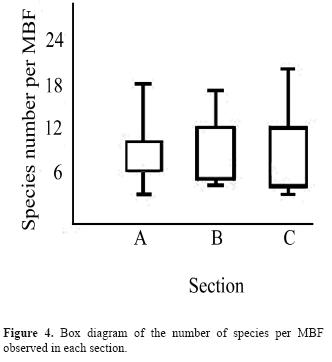
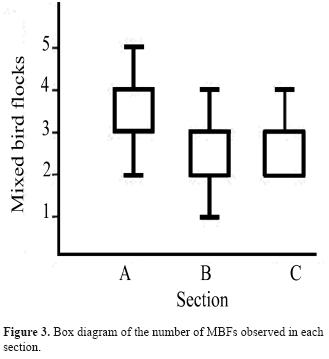
<body><![CDATA[<p align="justify"><font face="verdana" size="2">We detected a total of 104 MBFs. Of these, 71 were observed under conditions that allowed us to document their species composition, and were included in the analyses that consider the number of species. We recorded a total of 75 species joining MBFs (<a href="/img/revistas/rmbiodiv/v82n2/html/a22a.htm" target="_blank">Appendix</a>). The species accumulation curve did not reach an asymptote. However, the number of new species decreased with sample effort, and the singleton curve peaked and began to decline, indicating that our sample is representative of the species that join MBFs in this area (<a href="/img/revistas/rmbiodiv/v82n2/a22f1.jpg" target="_blank">Figure 1</a>). A great proportion of the recorded species did not join flocks regularly. According to the species occurrence in the MBFs we classified 12 as regular, 13 as common, 26 as uncommon, and 24 as rare (<a href="/img/revistas/rmbiodiv/v82n2/html/a22a.htm" target="_blank">Appendix</a>). A total of 4 Neartic&#45;Neotropical migrant species were recorded in MBFs; 2 of which, <i>Dendroica</i> <i>fusca</i> and <i>Mniotilta varia</i>, were regular in the flocks.</font></p>  	    <p align="justify"><font face="verdana" size="2">In general MBFs were conspicuous and noisy. We followed each MBF for periods ranging from 5 to 45 min. The individuals in the MBF were moving principally up in the trees, although some species (e.g., <i>Synallaxis azarae</i>, <i>Atlapetes albinucha</i>, and <i>Cinnycerthia unirufa</i>) were seen in shrubs. The number of species per MBF varied from 4 to 21 (mean= 9.43, s.d.= 4.1, n= 71; <a href="/img/revistas/rmbiodiv/v82n2/a22f2.jpg" target="_blank">Figure 2</a>). We observed that some species like <i>Aulacorhynchus prasinus</i>, <i>Andigena</i> <i>nigrirostris</i>, and <i>Turdus fuscater</i> followed some MBFs, but did not join them in a consistent manner. These species were observed moving behind the MBF, exhibiting more pauses, and proceeding slower than the other species in the flock. On the other hand, we managed to observe monospecific pairs or groups of species (e.g., <i>Anisognathus somptuosus</i>, <i>Tangara heinei</i>, <i>T. vassorii</i>, <i>T. nigroviridis</i>, <i>Chlorospingus</i> <i>ophthalmicus</i>, <i>Dendroica fusca</i>, and <i>Atlapetes schistaceus</i>) in several MBFs. Likewise, we observed, on 8 occasions, squirrels (<i>Sciurus</i> sp.) joining MBFs. Among the regular species only the migrant <i>Mniotilta varia</i> presented variation in its number throughout the duration of this study (&#967;<sup>2</sup>= 13.3, 3 d.f. 3, p&lt;0.01). We failed to observe this species on the first field trip, but it was a regular in the following 3 surveys. Although this study was conducted during 5 months, the number of MBFs did not change significantly through time (&#967;<sup>2</sup>= 2.3; 3 d.f.; p= 0.51, n= 104). In addition, around 13 % of the MBFs were observed during rainy periods in which constituent individuals did not decrease their activity. We witnessed 2 predator attacks upon MBFs and several agonistic interactions among members of MBFs. During the 2 predator attacks, we observed that different individuals in the MBF gave simultaneous alarm calls from different places followed by an evasive behavior. In the first case, a raptor (possibly <i>Buteo magnirostris</i>) was involved. In the second instance, a group of 5 <i>Cyanocorax yncas</i> approached a MBF, which elicited an evasive behavior by the members of the MBF after one of the jays vocalized. We detected 16 agonistic interactions among individuals in 10 MBFs, but we only identified the involved species on 9 occasions. Ten species were involved in agonistic behaviors, and 4 interactions were intraspecific among individuals of: <i>Dendrocolaptes</i> <i>picumnus</i>, <i>Chlorospingus ophthalmicus</i>, <i>Dendroica fusca</i>, and <i>Atlapetes schistaceus</i>. Although the majority of agonistic interactions were recorded within MBFs with 10 or more species, our analysis did not indicate an association between the number of species and the occurrence of agonistic events (Fisher's exact test, p= 0.12, n= 16).</font></p>  	    <p align="justify"><font face="verdana" size="2">We detected significant differences in the number of MBFs among the 3 sections surveyed (Kruskal&#45;Wallis ANOVA, H= 7.49, p= 0.024, n= 104; <a href="#f3">Figure 3</a>). The Mann&#45;Whitney pairwise comparisons indicated that the differences were significant among section A and B (p= 0.018) and section A and C (p= 0.024). However, the number of species per MBF did not show significant differences among sections (Kruskal&#45;Wallis ANOVA, H= 0.15, p= 0.93, n= 71; <a href="#f4">Figure 4</a>). In addition, the number of MBFs did not change along the hours of the day (&#967;<sup>2</sup>= 6.25, 8 f.d., p= 0.62, n= 104; <a href="/img/revistas/rmbiodiv/v82n2/a22f5.jpg" target="_blank">Figure 5</a>), but 2 activity peaks were observed: 1 in the middle of the morning (9&#45;10 h) and another at the end of the afternoon (16:30&#150;17:30 h). The results of the co&#45;occurrence/facilitation test received a p&#45;value of 0, with a maximum power of 1; suggesting that the co&#45;occurrence pattern between MBFs species is affected by interspecific facilitation interactions. We obtained additional evidence for non&#45;random co&#45;occurrences of species pairs in MBFs using a set of &#967;<sup>2</sup> and Fisher's exact tests. Of the 1275 species pair comparisons performed; 17 were significant (p &lt; 0.01) (<a href="#t1">Table 1</a>). And of these co&#45;occurrences, 15 were positive and 2 negative. However, because of the multiple comparisons conducted and an &#945;= 0.01, 12 associations could be deemed significant only by chance. Several tanager species (family Thraupidae) were found in the positive co&#45;occurrences. The only 2 negative co&#45;occurrences were between <i>Myioborus miniatus</i> and 2 <i>Tangara</i> species.</font></p>  	    <p align="center"><font face="verdana" size="2"><a name="f3"></a></font></p>  	    <p align="center"><font face="verdana" size="2"><img src="/img/revistas/rmbiodiv/v82n2/a22f3.jpg"></font></p>  	    <p align="center"><font face="verdana" size="2"><a name="f4"></a></font></p>  	    <p align="center"><font face="verdana" size="2"><img src="/img/revistas/rmbiodiv/v82n2/a22f4.jpg"></font></p>  	    <p align="center"><font face="verdana" size="2"><a name="t1"></a></font></p>  	    <p align="center"><font face="verdana" size="2"><img src="/img/revistas/rmbiodiv/v82n2/a22t1.jpg"></font></p>  	    <p align="justify"><font face="verdana" size="2">&nbsp;</font></p>  	    ]]></body>
<body><![CDATA[<p align="justify"><font face="verdana" size="2"><b>Discussion</b></font></p>  	    <p align="justify"><font face="verdana" size="2">Our data indicate that around 43% of the total species known from the studied region participated in MBFs. Similar proportions of species joining MBFs have been reported for other South American avian communities in the Bolivian Andes (Remsen, 1985), the Atlantic forest (Aleixo, 1997), and the <i>Cerrado</i> (Tubelis et al., 2006; Tubelis, 2007). Comparing our results with other studies from the Neotropics, which report the participation of 10 to 120 species (mean= 60 species) (Davis, 1946; Moynihan, 1979; Powell, 1979; Ewert and Askins, 1991; Hutto, 1994; Latta and Wunderle, 1996; Poulsen, 1996; Aleixo, 1997; Machado, 1999; Montero, 1999; Develey and Peres, 2000; Herzog et al., 2002; Boh&oacute;rquez, 2003; Brandt et al., 2009), the number of species joining MBFs in our study area is among the highest. These results follow the general pattern that the number of species joining MBFs in one zone is a reflection of the local species pool (Hutto, 1994; Latta and Wunderle, 1996; Boh&oacute;rquez, 2003; Brandt et al., 2009; Per&oacute;n and Crochet, 2009). Additionally, the frequency of MBFs and the mean number of species per MBF in our study zone are among the highest documented for the Andes (Moynihan, 1979; Herzog et al, 2002; Montero, 1999; Boh&oacute;rquez, 2003; Poulsen, 1996), a region that apparently contains MBFs composed of more species than other regions in South America (e.g. <i>Cerrado</i>, Tubelis, 2007). All these data lead us to conclude that MBFs represent a biologically important feature of the bird community in this region of the Colombian Andes.</font></p>  	    <p align="justify"><font face="verdana" size="2">Among the bird species recorded joining MBFs, we noticed a consistent participation of 2 migrants, a pattern documented by other studies in different Neotropical regions (Ewert and Askins, 1991; Hutto, 1994; Latta and Wunderle, 1996). This pattern could be explained as a result of migrant individuals joining MBFs in order to obtain local information about foraging resources or predators (Smith, 1975). We also detected variation in the association with MBFs over time only for the migrant <i>Mniotilta varia</i>. Variation in yearly species composition and richness of MBFs may be a result of seasonal presence or absence of these migrant species in the zone (e.g., Develey and Peres, 2000).</font></p>  	    <p align="justify"><font face="verdana" size="2">Concerning the singular joining of large birds and squirrels to MBFs, the inconsistent participation of <i>T.</i> <i>fuscater</i> and <i>A. prasinus</i> in MBFs could be caused by their abrupt movements and large body size, which promotes a break&#45;up of small species groups (Moynihan, 1979). However, we do not exclude the possibility that the evasion of toucanets (<i>Aulacorhynchus</i> sp.) is because they are occasional predators of small birds (Moynihan, 1979; E. Arbel&aacute;ez&#45;Cort&eacute;s, pers. obs.). Our observation of squirrels following MBFs contributes additional data to the documentation of this phenomenon around the world (Chapin, 1932; McClure, 1967; Partridge and Ashcroft, 1976; Moynihan, 1979; Paschoal and Galetti, 1995; Kotagama and Goodale, 2004; Buitr&oacute;n&#45;Jurado and Toba, 2007; Sridhar and Sankar, 2008). In the Neotropics some squirrel species such as <i>Sciurus granatensis</i>, <i>S. ingrami</i>, and <i>Mycrosciurus flaviventer</i> exhibit a tendency to develop different interspecific relationships (Moynihan, 1979; Paschoal and Galetti, 1995; Buitr&oacute;n&#45;Jurado and Toba, 2007). All this evidence together with some data on tree shrews, monkeys, and coatis joining MBFs (Stresemann, 1917; Kotagama and Goodale, 2004; Beisiegel, 2007), lead us to believe that heterospecific groups of birds and mammals are a general phenomenon.</font></p>  	    <p align="justify"><font face="verdana" size="2">Documented predator attacks on MBFs are rather scarce (e.g., Morse, 1970; Powell, 1985; Herzog et al., 2002; Ippi and Trejo, 2003; Tubelis, 2007), but the behavioral response that we witnessed of MBFs members to predators was similar to the one documented in many flocking species that call while sitting motionless subsequent to being alerted (Morse, 1970; Morse, 1977). These vocalizations are generally believed to confuse their predators by virtue of being given simultaneously from many locations (Morse, 1977). We consider it noteworthy that one predatory attack involved a jay and not a raptor. Although there exists at least one other report of a response of MBFs to jays (<i>Cyanocorax cristatellus</i>, Silva, 1980 cited in Tubelis, 2007), and some jays are predators of small birds (Moynihan, 1979), <i>C. yncax</i> has not been previously reported as a predator (H. &Aacute;lvarez&#45;L&oacute;pez pers. com.). As such, this positive response of the flock members to the presence of <i>C. yncax</i> could be considered as derived from an "inappropriate stimulus" (Morse, 1970). However, our 2 observations support the idea that species joining MBFs have mechanisms of alert and reaction against potential predators.</font></p>  	    <p align="justify"><font face="verdana" size="2">Temporal variation in the activity of MBFs has been reported at different scales in many localities (e.g., Powell, 1979; Machado, 1999; Herzog et al., 2002; Farley et al., 2008). However, we found that the number of MBFs did not change during the 5 months of our study. Although a similar pattern has been found in other Neotropical sites (Munn, 1985; Boh&oacute;rquez, 2003), many studies indicate variation in MBFs in relation to reproductive season or fluctuation in resources (Davis, 1946; Powell, 1979; Dean, 1990; Machado, 1999; Develey and Peres, 2000). Therefore, it is possible that some variation could occur in the frequency of MBFs in the region throughout the year, but our data were not suitable to detect this pattern. Additionally, our data indicate that the number of MBFs did not vary throughout the day. This same pattern has been documented in other studies (Partridge and Ashcroft, 1976; Dean, 1990), and could be regarded as evidence for the hypothesis that advantages obtained by species joining MBFs do not change during the day. We did not conduct systematic observations around noon, but occasional observations showed that MBFs were active at these hours too. In contrast with our data, many studies have detected variation in the number of MBFs throughout the day (Eguchi et al., 1993; Poulsen, 1996; Machado, 1999; Montero, 1999, Boh&oacute;rquez, 2003; Farley et al., 2008; Herzog et al., 2002). This contrast suggests that in different regions a diverse number of issues are involved in the formation and maintenance of MBFs. Finally, we observed MBFs during the rain. Other authors also have recorded MBFs in rainy periods (Morse, 1970; Moynihan, 1979; Montero, 1999). This phenomenon has been explained as a strategy to offset the diminution of insect biomass (Montero, 1999; Boh&oacute;rquez, 2003).</font></p>  	    <p align="justify"><font face="verdana" size="2">Although we did not detect variation in the number of species found per MBF among the 3 different sections we surveyed, habitat differences affect MBFs richness in other localities around the world (Maldonado&#45;Coelho and Marini, 2000; Lee et al., 2005). For example, in the Amazonas region, MBF richness is lower in areas in early regeneration stages (Maldonado&#45;Coelho and Marini, 2000). Also, significant changes in the number of species per flock among different habitats have been documented in Asia (Lee et al., 2005), but the latter study was conducted under different conditions (an escalating gradient of anthropogenic modification, including forest and urban areas) than those presented in our study area. The stability in the number of species per MBF in our study region could be due to the fact that scrubby second growth harbors some groves and is near to larger forest patches (see Methods). Likewise, MBFs could be promoting the use of open areas by forest birds (Dolby and Grubb, 2000; Tubelis et al., 2006; P&eacute;ron and Crochet, 2009). These factors potentially are precluding the decrease in number of species per MBF in the scrubby second growth in our study area.</font></p>  	    <p align="justify"><font face="verdana" size="2">In contrast with our species richness results, the number of MBFs was affected by the vegetation stage in the sections studied. The number of MBFs was low in sections B and C, while it was significant in section A. It is known that in Neotropical lowlands, understory MBFs tend to avoid open areas with low vegetation (Develey and Stouffer, 2001); while the canopy MBFs prefer to stand in continuous canopy, thus avoiding dangers and energetic consumption associated with flying through discontinuous vegetation (Munn, 1985). In the scrubby second growth area (section B), we observed MBFs traveling principally in the tallest trees and bushes. Something similar has been observed in Brazil where the effect of secondary growth on MBFs seems to be related with the kind of vegetation present, and the MBFs have been observed using secondary areas near the forest fragments (Stouffer and Bierregaard, 1995; Borges and Stouffer, 1999). We consider this a plausible explanation for the slight decrease of MBFs documented between sections A and B, representing different habitats. However, our results are somewhat puzzling, as the differences were also between section A and C, both with forest habitats, and not between sections B and C, which represent different habitats.</font></p>  	    <p align="justify"><font face="verdana" size="2">We are aware that some concerns could arise because the study area was small (e.g., results did not show differences among habitats because MBFs can move through the entire zone). However as we have said in the methods this study is not centered on documenting differences related to spatial separation. To deal with this issue it is necessary to consider that the home range of MBFs in different localities has been reported to vary from 0.8 to 15.4 ha (mean= 7 ha, n= 12) (Morse, 1970; Buskirk et al, 1972; Munn and Terborgh, 1979; Poulsen, 1996), which could be used to indicate that in the study zone a single MBF does not move through the entire area. Finally, the study area is not isolated; it is connected with other larger continuous forests (e.g., Santuario de Fauna y Flora Otun&#45;Quimbaya). As a result the MBFs could be moving in a greater area where they could be "choosing" the habitats.</font></p>  	    <p align="justify"><font face="verdana" size="2">In general, our results indicate that MBFs forage and travel through secondary growth habitats with bushes and scattered trees in a similar manner as they do in old growth forests. It seems to be evidence for another kind of advantage gained by individuals joining MBFs. which is the greater use of adjacent vegetation patches (Tubelis et al, 2006). This result could have implications for bird conservation in landscape mosaics like the ones found in the Colombian Andes. In these landscapes MBFs could cross areas with early vegetation stages, allowing several species, including those of special conservation concern, to reach other forests or forest patches. MBFs traveling through secondary forest or narrow forest corridors have been witnesses in other localities in this same region of the Colombian Andes (Arbel&aacute;ez&#45;Cort&eacute;s obs. pers). However, specially designed studies would be necessary to test the relation of MBFs and conservation biology issues in the Andes, as has been studied in other regions of the world (e.g., Sridhar and Sankar, 2008).</font></p>  	    ]]></body>
<body><![CDATA[<p align="justify"><font face="verdana" size="2">Although the benefits that a species get from participating in MBFs could come from being with the flock as a whole, not being with a particular species in the flock (Goodale and Beauchamp, 2010), our results do not support this hypothesis. Conversely, this study supports the idea that the MBFs are cohesive groups where some species are present because others are present too. However, previous studies have reported higher numbers of positive associations between species pairs than the number found in our study (Jones, 1977; Eguchi et al., 1993; Hutto, 1994; Latta and Wunderle, 1996; Boh&oacute;rquez, 2003; P&eacute;ron and Crochet, 2009). Principally, species in the family Thraupidae, the tanagers, were found in the positive associations. This could have some kind of biological meaning such as a role of these species in the cohesion of the MBFs in the study area. We avoid characterizing the kind of role of any of these species (e.g., nuclear, core, leader) because we did not obtain data to that extent. However, we found that several tanagers were frequent in the MBFs, and on many occasions were observed in pairs or in small groups. Furthermore, other studies in the Colombian Andes (Moynihan, 1979; Boh&oacute;rquez, 2003) and Brazilian <i>Cerrado</i> (Tubelis, 2007) indicated that Thraupidae species are characteristic of MBFs and could have a nuclear role. It is known that tanagers form groups synchronized in movement, speed, and direction around which other species can join, conforming a MBF (Moynihan, 1979; Munn, 1985; Machado, 1999). Likewise, <i>Anisognathus</i> <i>somptuosus</i>, <i>Tangara nigroviridis, T. heineii</i>, <i>T. arthus</i>, and <i>T. ruficervix</i> meet some characteristics of nuclear species (<i>sensu</i> Moynihan, 1979) such as colorful plumage and the formation of mono&#45;specific groups. Some of these species have been reported also as nuclear in a different region of the Colombian Andes (Moynihan, 1979; Boh&oacute;rquez, 2003). All this information indicates that tanagers have an important role in the formation and maintenance of MBFs in the Andes. Additionally, we consider that other species, such as <i>Chlorospingus ophthalmicus</i>, <i>C.</i> <i>canigularis</i>, and <i>Atlapetes albinucha</i>, could have similar roles in MBFs. These species were usually seen in pairs or groups in MBFs where tanagers were absent.</font></p>  	    <p align="justify"><font face="verdana" size="2">In conclusion, our study documents that MBFs of this part of the Andes meet some general patterns described in other regions. Examples of these are: (1) the number of species joining MBFs in the area reflects the local species pool; (2) MBFs are cohesive groups where some species pairs co&#45;occurrences are not driven by chance; (3) squirrels occasionally follow MBFs; (4) MBFs have alert and reaction mechanisms targeted against potential predators. However, our results also differ from the general pattern reported in previous studies; for example, (1) different habitats do not affect the number of species per MBF; (2) MBFs can use early secondary growth in a similar manner as more mature forest habitats; (3) the number of MBFs did not show significant differences throughout the day. Additionally, a few aspects pertinent to the number and kind of species that make up MBFs in our study area differed from observations of previous studies. We hope that this study will enrich the understanding of this biological phenomenon and contribute to the knowledge of the overwhelming biodiversity of the Colombian Andes.</font></p>  	    <p align="justify"><font face="verdana" size="2">&nbsp;</font></p>  	    <p align="justify"><font face="verdana" size="2"><b>Acknowledgments</b></font></p>  	    <p align="justify"><font face="verdana" size="2">This work is a product of the semillero de investigaci&oacute;n en aves de la Universidad del Quind&iacute;o. We are grateful to the Universidad del Quind&iacute;o and their Vicerrector&iacute;a de Investigaciones for providing financial support for our field work. H&eacute;ctor F. G&oacute;mez and Fundasilvestre helped us with logistic support during field work. Adolfo Navarro&#45;Sig&uuml;enza, &Aacute;rp&aacute;d S. Ny&aacute;ri, Morelia Camacho&#45;Cervantes, Clara I. Bohorqu&eacute;z, and Ralf Strewe made valuable comments and corrections on initial versions of this manuscript. We also thank to 2 anonymous referees for their valuable corrections that helped improve this paper. EAC and HRC also acknowledges CONACyT&#45;Mexico for a graduate studies scholarship during the writing of this manuscript.</font></p>  	    <p align="justify"><font face="verdana" size="2">&nbsp;</font></p>  	    <p align="justify"><font face="verdana" size="2"><b>Literature cited</b></font></p>  	    <!-- ref --><p align="justify"><font face="verdana" size="2">Aleixo, A. 1997. Composition of mixed&#45;species bird flocks and abundance of flocking species in a semideciduous forest of southeastern Brazil. Ararajuba 5:11&#45;18.    &nbsp;&nbsp;&nbsp;&nbsp;&nbsp;&nbsp;&nbsp;&nbsp;[&#160;<a href="javascript:void(0);" onclick="javascript: window.open('/scielo.php?script=sci_nlinks&ref=7539303&pid=S1870-3453201100020002200001&lng=','','width=640,height=500,resizable=yes,scrollbars=1,menubar=yes,');">Links</a>&#160;]<!-- end-ref --></font></p>  	    <!-- ref --><p align="justify"><font face="verdana" size="2">Amaral, P. P. and J. Ragusa&#45;Netto. 2008. Bird mixed&#150;flocks and nuclear species in a tecoma savanna in the Pantanal. Brazilian Journal of Biology 68:511&#45;518.    &nbsp;&nbsp;&nbsp;&nbsp;&nbsp;&nbsp;&nbsp;&nbsp;[&#160;<a href="javascript:void(0);" onclick="javascript: window.open('/scielo.php?script=sci_nlinks&ref=7539305&pid=S1870-3453201100020002200002&lng=','','width=640,height=500,resizable=yes,scrollbars=1,menubar=yes,');">Links</a>&#160;]<!-- end-ref --></font></p>  	    <!-- ref --><p align="justify"><font face="verdana" size="2">Arbel&aacute;ez&#45;Cort&eacute;s, E. 2007. Registro fotogr&aacute;fico de algunas especies de la avifauna de la Reserva Natural "La Patasola", Quind&iacute;o, Colombia. Bolet&iacute;n SAO 1:149&#45;163.    &nbsp;&nbsp;&nbsp;&nbsp;&nbsp;&nbsp;&nbsp;&nbsp;[&#160;<a href="javascript:void(0);" onclick="javascript: window.open('/scielo.php?script=sci_nlinks&ref=7539307&pid=S1870-3453201100020002200003&lng=','','width=640,height=500,resizable=yes,scrollbars=1,menubar=yes,');">Links</a>&#160;]<!-- end-ref --></font></p>  	    <!-- ref --><p align="justify"><font face="verdana" size="2">Beisiegel, B. d. M. 2007. Foraging association between coatis (<i>Nasua</i> <i>nasua</i>) and birds of the Atlantic Forest, Brazil. Biotropica 39:283&#45;285.    &nbsp;&nbsp;&nbsp;&nbsp;&nbsp;&nbsp;&nbsp;&nbsp;[&#160;<a href="javascript:void(0);" onclick="javascript: window.open('/scielo.php?script=sci_nlinks&ref=7539309&pid=S1870-3453201100020002200004&lng=','','width=640,height=500,resizable=yes,scrollbars=1,menubar=yes,');">Links</a>&#160;]<!-- end-ref --></font></p>  	    <!-- ref --><p align="justify"><font face="verdana" size="2">Bird Life International, 2010. Data zone. Online URL: <a href="http://www.birdlife.org/datazone/index.html" target="_blank">http://www.birdlife.org/datazone/index.html</a>. Last access: 14.03.2010.    &nbsp;&nbsp;&nbsp;&nbsp;&nbsp;&nbsp;&nbsp;&nbsp;[&#160;<a href="javascript:void(0);" onclick="javascript: window.open('/scielo.php?script=sci_nlinks&ref=7539311&pid=S1870-3453201100020002200005&lng=','','width=640,height=500,resizable=yes,scrollbars=1,menubar=yes,');">Links</a>&#160;]<!-- end-ref --></font></p>  	    <!-- ref --><p align="justify"><font face="verdana" size="2">Boh&oacute;rquez, C. I. 2003. Mixed&#45;species bird flocks in a montane cloud forest of Colombia. Ornitologia Neotropical 14:67&#45;78.    &nbsp;&nbsp;&nbsp;&nbsp;&nbsp;&nbsp;&nbsp;&nbsp;[&#160;<a href="javascript:void(0);" onclick="javascript: window.open('/scielo.php?script=sci_nlinks&ref=7539313&pid=S1870-3453201100020002200006&lng=','','width=640,height=500,resizable=yes,scrollbars=1,menubar=yes,');">Links</a>&#160;]<!-- end-ref --></font></p>  	    <!-- ref --><p align="justify"><font face="verdana" size="2">Borges, S. H. and P. C. Stouffer. 1999. Bird communities in two types of anthropogenic successional vegetation in central Amazonia. Condor 101:529&#45;536.    &nbsp;&nbsp;&nbsp;&nbsp;&nbsp;&nbsp;&nbsp;&nbsp;[&#160;<a href="javascript:void(0);" onclick="javascript: window.open('/scielo.php?script=sci_nlinks&ref=7539315&pid=S1870-3453201100020002200007&lng=','','width=640,height=500,resizable=yes,scrollbars=1,menubar=yes,');">Links</a>&#160;]<!-- end-ref --></font></p>  	    <!-- ref --><p align="justify"><font face="verdana" size="2">Brandt, C. S., H. Hasenack, R. R. Laps and S. M. Hartz. 2009. Composition of mixed&#45;species bird flocks in forest fragments of southern Brazil. Zoologia 26:488&#45;498.    &nbsp;&nbsp;&nbsp;&nbsp;&nbsp;&nbsp;&nbsp;&nbsp;[&#160;<a href="javascript:void(0);" onclick="javascript: window.open('/scielo.php?script=sci_nlinks&ref=7539317&pid=S1870-3453201100020002200008&lng=','','width=640,height=500,resizable=yes,scrollbars=1,menubar=yes,');">Links</a>&#160;]<!-- end-ref --></font></p>  	    <!-- ref --><p align="justify"><font face="verdana" size="2">Buitr&oacute;n&#45;Jurado, G. and M. Tobar. 2007. Posible asociaci&oacute;n de la ardilla enana <i>Microsciurus flaviventer</i> (Rodentia:Sciuridae) y bandadas mixtas de aves en la amazon&iacute;a ecuatoriana. Mastozoolog&iacute;a Neotropical 14:235&#45;240.    &nbsp;&nbsp;&nbsp;&nbsp;&nbsp;&nbsp;&nbsp;&nbsp;[&#160;<a href="javascript:void(0);" onclick="javascript: window.open('/scielo.php?script=sci_nlinks&ref=7539319&pid=S1870-3453201100020002200009&lng=','','width=640,height=500,resizable=yes,scrollbars=1,menubar=yes,');">Links</a>&#160;]<!-- end-ref --></font></p>  	    <!-- ref --><p align="justify"><font face="verdana" size="2">Buskirk, W. H., G. V. N. Powell, J. F. Wittenberger, R. E. Buskirk and T. U. Powell. 1972. Interspecific bird flocks in tropical highland Panama. Auk 89:612&#45;624.    &nbsp;&nbsp;&nbsp;&nbsp;&nbsp;&nbsp;&nbsp;&nbsp;[&#160;<a href="javascript:void(0);" onclick="javascript: window.open('/scielo.php?script=sci_nlinks&ref=7539321&pid=S1870-3453201100020002200010&lng=','','width=640,height=500,resizable=yes,scrollbars=1,menubar=yes,');">Links</a>&#160;]<!-- end-ref --></font></p>  	    <!-- ref --><p align="justify"><font face="verdana" size="2">Chapin, J. P. 1932. The birds of the Belgian Congo. Part 1. Bulletin of the American Museum of Natural History 65:1&#45;736</font>&nbsp;&nbsp;&nbsp;&nbsp;&nbsp;&nbsp;&nbsp;&nbsp;[&#160;<a href="javascript:void(0);" onclick="javascript: window.open('/scielo.php?script=sci_nlinks&ref=7539323&pid=S1870-3453201100020002200011&lng=','','width=640,height=500,resizable=yes,scrollbars=1,menubar=yes,');">Links</a>&#160;]<!-- end-ref --><!-- ref --><p align="justify"><font face="verdana" size="2">Colwell, R. K. 2005. <i>EstimateS</i>: Statistical estimation of species richness and shared species from samples. Version 7.5. Online URL: purl.oclc.org/estimates</font>&nbsp;&nbsp;&nbsp;&nbsp;&nbsp;&nbsp;&nbsp;&nbsp;[&#160;<a href="javascript:void(0);" onclick="javascript: window.open('/scielo.php?script=sci_nlinks&ref=7539324&pid=S1870-3453201100020002200012&lng=','','width=640,height=500,resizable=yes,scrollbars=1,menubar=yes,');">Links</a>&#160;]<!-- end-ref --><!-- ref --><p align="justify"><font face="verdana" size="2">Croxall, J. P. 1976. The composition and behaviour of some mixed&#45;species bird flocks in sarawak. Ibis 118:333&#45;343.    &nbsp;&nbsp;&nbsp;&nbsp;&nbsp;&nbsp;&nbsp;&nbsp;[&#160;<a href="javascript:void(0);" onclick="javascript: window.open('/scielo.php?script=sci_nlinks&ref=7539325&pid=S1870-3453201100020002200013&lng=','','width=640,height=500,resizable=yes,scrollbars=1,menubar=yes,');">Links</a>&#160;]<!-- end-ref --></font></p>  	    <!-- ref --><p align="justify"><font face="verdana" size="2">Davis, D. E. 1946. A seasonal analysis of mixed flocks of birds in Brazil. Ecology 27:168&#45;181.    &nbsp;&nbsp;&nbsp;&nbsp;&nbsp;&nbsp;&nbsp;&nbsp;[&#160;<a href="javascript:void(0);" onclick="javascript: window.open('/scielo.php?script=sci_nlinks&ref=7539327&pid=S1870-3453201100020002200014&lng=','','width=640,height=500,resizable=yes,scrollbars=1,menubar=yes,');">Links</a>&#160;]<!-- end-ref --></font></p>  	    <!-- ref --><p align="justify"><font face="verdana" size="2">Dean, S. 1990. Composition and seasonality of mixed&#45;species flocks of insectivorous birds. Notornis 37:27&#45;36.    &nbsp;&nbsp;&nbsp;&nbsp;&nbsp;&nbsp;&nbsp;&nbsp;[&#160;<a href="javascript:void(0);" onclick="javascript: window.open('/scielo.php?script=sci_nlinks&ref=7539329&pid=S1870-3453201100020002200015&lng=','','width=640,height=500,resizable=yes,scrollbars=1,menubar=yes,');">Links</a>&#160;]<!-- end-ref --></font></p>  	    <!-- ref --><p align="justify"><font face="verdana" size="2">Develey, P. F. and C. A. Peres. 2000. Resource seasonality and the structure of mixed species bird flocks in a coastal Atlantic forest of southeastern Brazil. Journal of Tropical Ecology 16:33&#45;53.    &nbsp;&nbsp;&nbsp;&nbsp;&nbsp;&nbsp;&nbsp;&nbsp;[&#160;<a href="javascript:void(0);" onclick="javascript: window.open('/scielo.php?script=sci_nlinks&ref=7539331&pid=S1870-3453201100020002200016&lng=','','width=640,height=500,resizable=yes,scrollbars=1,menubar=yes,');">Links</a>&#160;]<!-- end-ref --></font></p>  	    <!-- ref --><p align="justify"><font face="verdana" size="2">Develey, P. F. and P. C. Stouffer. 2001. Effects of roads on movements by understory birds in mixed&#45;species flocks in central Amazonian Brazil. Conservation Biology 15:1416&#45;1422.    &nbsp;&nbsp;&nbsp;&nbsp;&nbsp;&nbsp;&nbsp;&nbsp;[&#160;<a href="javascript:void(0);" onclick="javascript: window.open('/scielo.php?script=sci_nlinks&ref=7539333&pid=S1870-3453201100020002200017&lng=','','width=640,height=500,resizable=yes,scrollbars=1,menubar=yes,');">Links</a>&#160;]<!-- end-ref --></font></p>  	    <!-- ref --><p align="justify"><font face="verdana" size="2">Diamond, J. M. and J. W. Terborgh. 1967. Observations on bird distribution and feeding assemblages along the Rio Callaria, Deparment of Loreto, Peru. Wilson Bulletin 79:273&#45;282.    &nbsp;&nbsp;&nbsp;&nbsp;&nbsp;&nbsp;&nbsp;&nbsp;[&#160;<a href="javascript:void(0);" onclick="javascript: window.open('/scielo.php?script=sci_nlinks&ref=7539335&pid=S1870-3453201100020002200018&lng=','','width=640,height=500,resizable=yes,scrollbars=1,menubar=yes,');">Links</a>&#160;]<!-- end-ref --></font></p>  	    <!-- ref --><p align="justify"><font face="verdana" size="2">Dolby, A. S. and T. G. Grubb Jr. 2000. Social context affect risk taking by satellite species in a mixed&#45;species foraging group. Behavioural Ecology 11:110&#45;114.    &nbsp;&nbsp;&nbsp;&nbsp;&nbsp;&nbsp;&nbsp;&nbsp;[&#160;<a href="javascript:void(0);" onclick="javascript: window.open('/scielo.php?script=sci_nlinks&ref=7539337&pid=S1870-3453201100020002200019&lng=','','width=640,height=500,resizable=yes,scrollbars=1,menubar=yes,');">Links</a>&#160;]<!-- end-ref --></font></p>  	    <!-- ref --><p align="justify"><font face="verdana" size="2">Eguchi, K., S. Yamagishi and V. Randrianasolo. 1993. The composition and foraging behaviour of mixed&#45;species flocks of forest&#45;living birds in Madagascar. Ibis 135:91&#45;96.    &nbsp;&nbsp;&nbsp;&nbsp;&nbsp;&nbsp;&nbsp;&nbsp;[&#160;<a href="javascript:void(0);" onclick="javascript: window.open('/scielo.php?script=sci_nlinks&ref=7539339&pid=S1870-3453201100020002200020&lng=','','width=640,height=500,resizable=yes,scrollbars=1,menubar=yes,');">Links</a>&#160;]<!-- end-ref --></font></p>  	    <!-- ref --><p align="justify"><font face="verdana" size="2">Ewert, D. N. and R. A. Askins. 1991. Flocking behavior of migratory warblers in winter in the Virgin Islands. Condor 93:864&#45;868.    &nbsp;&nbsp;&nbsp;&nbsp;&nbsp;&nbsp;&nbsp;&nbsp;[&#160;<a href="javascript:void(0);" onclick="javascript: window.open('/scielo.php?script=sci_nlinks&ref=7539341&pid=S1870-3453201100020002200021&lng=','','width=640,height=500,resizable=yes,scrollbars=1,menubar=yes,');">Links</a>&#160;]<!-- end-ref --></font></p>  	    <!-- ref --><p align="justify"><font face="verdana" size="2">Farley, E. A., K. E. Sieving and T. A. Contreras. 2008. Characterizing complex mixed&#45;species bird flocks using an objective method for determining species participation. Journal of Ornithology 149:451&#45;468.    &nbsp;&nbsp;&nbsp;&nbsp;&nbsp;&nbsp;&nbsp;&nbsp;[&#160;<a href="javascript:void(0);" onclick="javascript: window.open('/scielo.php?script=sci_nlinks&ref=7539343&pid=S1870-3453201100020002200022&lng=','','width=640,height=500,resizable=yes,scrollbars=1,menubar=yes,');">Links</a>&#160;]<!-- end-ref --></font></p>  	    <!-- ref --><p align="justify"><font face="verdana" size="2">Gaddis, P. 1980. Mixed flocks, accipiters, and antipredator behavior. Condor 82:348&#45;349.    &nbsp;&nbsp;&nbsp;&nbsp;&nbsp;&nbsp;&nbsp;&nbsp;[&#160;<a href="javascript:void(0);" onclick="javascript: window.open('/scielo.php?script=sci_nlinks&ref=7539345&pid=S1870-3453201100020002200023&lng=','','width=640,height=500,resizable=yes,scrollbars=1,menubar=yes,');">Links</a>&#160;]<!-- end-ref --></font></p>  	    <!-- ref --><p align="justify"><font face="verdana" size="2">Goodale, E. and G. Beauchamp. 2010. The relationship between leadership and gregariousness in mixed&#45;species bird flocks. Journal of Avian Biology 41:99&#45;103.    &nbsp;&nbsp;&nbsp;&nbsp;&nbsp;&nbsp;&nbsp;&nbsp;[&#160;<a href="javascript:void(0);" onclick="javascript: window.open('/scielo.php?script=sci_nlinks&ref=7539347&pid=S1870-3453201100020002200024&lng=','','width=640,height=500,resizable=yes,scrollbars=1,menubar=yes,');">Links</a>&#160;]<!-- end-ref --></font></p>  	    <!-- ref --><p align="justify"><font face="verdana" size="2">Goodale, E. and S. W. Kotagama. 2006. Vocal mimicry by a passerine bird attracts other species involved in mixed&#45;species flocks. Animal Behaviour 72:471&#45;477.    &nbsp;&nbsp;&nbsp;&nbsp;&nbsp;&nbsp;&nbsp;&nbsp;[&#160;<a href="javascript:void(0);" onclick="javascript: window.open('/scielo.php?script=sci_nlinks&ref=7539349&pid=S1870-3453201100020002200025&lng=','','width=640,height=500,resizable=yes,scrollbars=1,menubar=yes,');">Links</a>&#160;]<!-- end-ref --></font></p>  	    <!-- ref --><p align="justify"><font face="verdana" size="2">Goodale, E., G. Beauchamp, R. D. Magrath, J. C. Nieh, and G. D. Ruxton. 2010. Interspecific information transfer influences animal community structure. Trends in Ecology and Evolution 25: 354&#45;361.    &nbsp;&nbsp;&nbsp;&nbsp;&nbsp;&nbsp;&nbsp;&nbsp;[&#160;<a href="javascript:void(0);" onclick="javascript: window.open('/scielo.php?script=sci_nlinks&ref=7539351&pid=S1870-3453201100020002200026&lng=','','width=640,height=500,resizable=yes,scrollbars=1,menubar=yes,');">Links</a>&#160;]<!-- end-ref --></font></p>  	    <!-- ref --><p align="justify"><font face="verdana" size="2">Hammer, O., D. A. T. Harper and P. D. Ryan. 2001. PAST: Palaeontological Statistics software package for education and data analysis. Online URL: htt://folk.uio.no/ohammer/past/</font>&nbsp;&nbsp;&nbsp;&nbsp;&nbsp;&nbsp;&nbsp;&nbsp;[&#160;<a href="javascript:void(0);" onclick="javascript: window.open('/scielo.php?script=sci_nlinks&ref=7539353&pid=S1870-3453201100020002200027&lng=','','width=640,height=500,resizable=yes,scrollbars=1,menubar=yes,');">Links</a>&#160;]<!-- end-ref --><!-- ref --><p align="justify"><font face="verdana" size="2">Haugaasen, T. and C. A. Peres. 2008. Associations between primates and other mammals in a central Amazonian forest landscape. Primates 49: 219&#45;222.    &nbsp;&nbsp;&nbsp;&nbsp;&nbsp;&nbsp;&nbsp;&nbsp;[&#160;<a href="javascript:void(0);" onclick="javascript: window.open('/scielo.php?script=sci_nlinks&ref=7539354&pid=S1870-3453201100020002200028&lng=','','width=640,height=500,resizable=yes,scrollbars=1,menubar=yes,');">Links</a>&#160;]<!-- end-ref --></font></p>  	    ]]></body>
<body><![CDATA[<!-- ref --><p align="justify"><font face="verdana" size="2">Herzog, S. K., A. R. Soria A., Troncoso J. and E. Matthysen. 2002. Composition and spatial structure of avian mixed&#45;species flocks in a high&#45;Andean <i>Polylepis</i> forest in Bolivia. Ecotropica 8:133&#45;143.    &nbsp;&nbsp;&nbsp;&nbsp;&nbsp;&nbsp;&nbsp;&nbsp;[&#160;<a href="javascript:void(0);" onclick="javascript: window.open('/scielo.php?script=sci_nlinks&ref=7539356&pid=S1870-3453201100020002200029&lng=','','width=640,height=500,resizable=yes,scrollbars=1,menubar=yes,');">Links</a>&#160;]<!-- end-ref --></font></p>  	    <!-- ref --><p align="justify"><font face="verdana" size="2">Hino, T. 2000. Intraspecific differences in benefits from feeding in mixed&#45;species flocks. Journal of Avian Biology 31:441&#45;446.    &nbsp;&nbsp;&nbsp;&nbsp;&nbsp;&nbsp;&nbsp;&nbsp;[&#160;<a href="javascript:void(0);" onclick="javascript: window.open('/scielo.php?script=sci_nlinks&ref=7539358&pid=S1870-3453201100020002200030&lng=','','width=640,height=500,resizable=yes,scrollbars=1,menubar=yes,');">Links</a>&#160;]<!-- end-ref --></font></p>  	    <!-- ref --><p align="justify"><font face="verdana" size="2">Hutto, R. L. 1994. The composition and social organization of mixed&#45;species flocks in a tropical deciduous forest in western Mexico. Condor 96:105&#45;118.    &nbsp;&nbsp;&nbsp;&nbsp;&nbsp;&nbsp;&nbsp;&nbsp;[&#160;<a href="javascript:void(0);" onclick="javascript: window.open('/scielo.php?script=sci_nlinks&ref=7539360&pid=S1870-3453201100020002200031&lng=','','width=640,height=500,resizable=yes,scrollbars=1,menubar=yes,');">Links</a>&#160;]<!-- end-ref --></font></p>  	    <!-- ref --><p align="justify"><font face="verdana" size="2">Ippi, S. and A. Trejo. 2003. Din&aacute;mica y estructura de bandadas mixtas de aves en un bosque de Lenga (<i>Nothofagus pumilio</i>) del Noroeste de la Patagonia Argentina. Ornitolologia Neotropical 14:353&#45;362.    &nbsp;&nbsp;&nbsp;&nbsp;&nbsp;&nbsp;&nbsp;&nbsp;[&#160;<a href="javascript:void(0);" onclick="javascript: window.open('/scielo.php?script=sci_nlinks&ref=7539362&pid=S1870-3453201100020002200032&lng=','','width=640,height=500,resizable=yes,scrollbars=1,menubar=yes,');">Links</a>&#160;]<!-- end-ref --></font></p>  	    <!-- ref --><p align="justify"><font face="verdana" size="2">Jones, S. E. 1977. Coexistence in mixed species antwren flocks. Oikos 29:366&#45;375.    &nbsp;&nbsp;&nbsp;&nbsp;&nbsp;&nbsp;&nbsp;&nbsp;[&#160;<a href="javascript:void(0);" onclick="javascript: window.open('/scielo.php?script=sci_nlinks&ref=7539364&pid=S1870-3453201100020002200033&lng=','','width=640,height=500,resizable=yes,scrollbars=1,menubar=yes,');">Links</a>&#160;]<!-- end-ref --></font></p>  	    ]]></body>
<body><![CDATA[<!-- ref --><p align="justify"><font face="verdana" size="2">Jullien, M. and J. Clobert. 2000. The survival value of flocking in Neotropical birds: reality or fiction? Ecology 81:3416&#45;3430.    &nbsp;&nbsp;&nbsp;&nbsp;&nbsp;&nbsp;&nbsp;&nbsp;[&#160;<a href="javascript:void(0);" onclick="javascript: window.open('/scielo.php?script=sci_nlinks&ref=7539366&pid=S1870-3453201100020002200034&lng=','','width=640,height=500,resizable=yes,scrollbars=1,menubar=yes,');">Links</a>&#160;]<!-- end-ref --></font></p>  	    <!-- ref --><p align="justify"><font face="verdana" size="2">Kotagama, S. and E. Goodale. 2004. The composition and spatial organization of mixed&#45;species flocks in a Sri Lankan rainforest. Forktail 20:63&#45;70.    &nbsp;&nbsp;&nbsp;&nbsp;&nbsp;&nbsp;&nbsp;&nbsp;[&#160;<a href="javascript:void(0);" onclick="javascript: window.open('/scielo.php?script=sci_nlinks&ref=7539368&pid=S1870-3453201100020002200035&lng=','','width=640,height=500,resizable=yes,scrollbars=1,menubar=yes,');">Links</a>&#160;]<!-- end-ref --></font></p>  	    <!-- ref --><p align="justify"><font face="verdana" size="2">Ladau, J., S. J. Ryan and S. J. Schwager. 2008. CoOccur: Software for implementing robust null model tests in ecology. Online URL: <a href="http://www.santafe.edu/~jladau/CoOccur" target="_blank">www.santafe.edu/~jladau/CoOccur</a>.    &nbsp;&nbsp;&nbsp;&nbsp;&nbsp;&nbsp;&nbsp;&nbsp;[&#160;<a href="javascript:void(0);" onclick="javascript: window.open('/scielo.php?script=sci_nlinks&ref=7539370&pid=S1870-3453201100020002200036&lng=','','width=640,height=500,resizable=yes,scrollbars=1,menubar=yes,');">Links</a>&#160;]<!-- end-ref --></font></p>  	    <!-- ref --><p align="justify"><font face="verdana" size="2">Latta, S. C. and J. M. Wunderle Jr. 1996. The composition and foraging ecology of mixed&#45;species flocks in pine forests of Hispaniola. Condor 98:595&#45;607.    &nbsp;&nbsp;&nbsp;&nbsp;&nbsp;&nbsp;&nbsp;&nbsp;[&#160;<a href="javascript:void(0);" onclick="javascript: window.open('/scielo.php?script=sci_nlinks&ref=7539372&pid=S1870-3453201100020002200037&lng=','','width=640,height=500,resizable=yes,scrollbars=1,menubar=yes,');">Links</a>&#160;]<!-- end-ref --></font></p>  	    <!-- ref --><p align="justify"><font face="verdana" size="2">Lee, T. M., M. C. K. Soh, N. Sodhi, L. P. Koh and S. L. H. Lim. 2005. Effects of habitat disturbance on mixed species bird flocks in a tropical sub&#45;montane rainforest. Biological Conservation 122:193&#45;204.    &nbsp;&nbsp;&nbsp;&nbsp;&nbsp;&nbsp;&nbsp;&nbsp;[&#160;<a href="javascript:void(0);" onclick="javascript: window.open('/scielo.php?script=sci_nlinks&ref=7539374&pid=S1870-3453201100020002200038&lng=','','width=640,height=500,resizable=yes,scrollbars=1,menubar=yes,');">Links</a>&#160;]<!-- end-ref --></font></p>  	    ]]></body>
<body><![CDATA[<!-- ref --><p align="justify"><font face="verdana" size="2">Machado, C. G. 1999. A composi&ccedil;&atilde;o dos bandos mistos de aves na Mata Atl&acirc;ntica da Serra de Paranapicaba, no sudeste Brasileiro. Revista Brasileira de Biologia 59:75&#45;85.    &nbsp;&nbsp;&nbsp;&nbsp;&nbsp;&nbsp;&nbsp;&nbsp;[&#160;<a href="javascript:void(0);" onclick="javascript: window.open('/scielo.php?script=sci_nlinks&ref=7539376&pid=S1870-3453201100020002200039&lng=','','width=640,height=500,resizable=yes,scrollbars=1,menubar=yes,');">Links</a>&#160;]<!-- end-ref --></font></p>  	    <!-- ref --><p align="justify"><font face="verdana" size="2">Maldonado&#45;Coelho, M. and M. A. Marini. 2000. Effects of forest fragment size and successional stage on mixed&#45;species bird flocks in Southeastern Brazil. Condor 102:585&#45;592.    &nbsp;&nbsp;&nbsp;&nbsp;&nbsp;&nbsp;&nbsp;&nbsp;[&#160;<a href="javascript:void(0);" onclick="javascript: window.open('/scielo.php?script=sci_nlinks&ref=7539378&pid=S1870-3453201100020002200040&lng=','','width=640,height=500,resizable=yes,scrollbars=1,menubar=yes,');">Links</a>&#160;]<!-- end-ref --></font></p>  	    <!-- ref --><p align="justify"><font face="verdana" size="2">Maldonado&#45;Coelho, M. and M. A. Marini, 2003. Composi&ccedil;&atilde;o de bandos mistos de aves em fragmentos de mata atl&acirc;ntica no Sudeste do Brasil. Pap&eacute;is Avulsos de Zoologia, Museu de Zoologia da Universidade de S&atilde;o Paulo 43:31&#45;54.    &nbsp;&nbsp;&nbsp;&nbsp;&nbsp;&nbsp;&nbsp;&nbsp;[&#160;<a href="javascript:void(0);" onclick="javascript: window.open('/scielo.php?script=sci_nlinks&ref=7539380&pid=S1870-3453201100020002200041&lng=','','width=640,height=500,resizable=yes,scrollbars=1,menubar=yes,');">Links</a>&#160;]<!-- end-ref --></font></p>  	    <!-- ref --><p align="justify"><font face="verdana" size="2">McClure, H. E. 1967. The composition of mixed species flocks in lowland and sub&#45;montane forest of Malaya. Wilson Bulletin 79:131&#45;154.    &nbsp;&nbsp;&nbsp;&nbsp;&nbsp;&nbsp;&nbsp;&nbsp;[&#160;<a href="javascript:void(0);" onclick="javascript: window.open('/scielo.php?script=sci_nlinks&ref=7539382&pid=S1870-3453201100020002200042&lng=','','width=640,height=500,resizable=yes,scrollbars=1,menubar=yes,');">Links</a>&#160;]<!-- end-ref --></font></p>  	    <!-- ref --><p align="justify"><font face="verdana" size="2">Montero, H. A. 1999. Composici&oacute;n, organizaci&oacute;n y comportamiento de bandadas mixtas en un bosque de niebla en los Farallones de Cali. Tesis de Grado Biolog&iacute;a. Universidad del Valle. Cali. Colombia. 70 p.    &nbsp;&nbsp;&nbsp;&nbsp;&nbsp;&nbsp;&nbsp;&nbsp;[&#160;<a href="javascript:void(0);" onclick="javascript: window.open('/scielo.php?script=sci_nlinks&ref=7539384&pid=S1870-3453201100020002200043&lng=','','width=640,height=500,resizable=yes,scrollbars=1,menubar=yes,');">Links</a>&#160;]<!-- end-ref --></font></p>  	    ]]></body>
<body><![CDATA[<!-- ref --><p align="justify"><font face="verdana" size="2">Morse, D. H. 1970. Ecological aspects of some mixed&#45;species foraging flocks of birds. Ecological Monographs 40:119&#45;168.    &nbsp;&nbsp;&nbsp;&nbsp;&nbsp;&nbsp;&nbsp;&nbsp;[&#160;<a href="javascript:void(0);" onclick="javascript: window.open('/scielo.php?script=sci_nlinks&ref=7539386&pid=S1870-3453201100020002200044&lng=','','width=640,height=500,resizable=yes,scrollbars=1,menubar=yes,');">Links</a>&#160;]<!-- end-ref --></font></p>  	    <!-- ref --><p align="justify"><font face="verdana" size="2">Morse, D. H. 1977. Feeding behaviour and predator avoidance in heterospecific groups. BioScience 27:332&#45;339.    &nbsp;&nbsp;&nbsp;&nbsp;&nbsp;&nbsp;&nbsp;&nbsp;[&#160;<a href="javascript:void(0);" onclick="javascript: window.open('/scielo.php?script=sci_nlinks&ref=7539388&pid=S1870-3453201100020002200045&lng=','','width=640,height=500,resizable=yes,scrollbars=1,menubar=yes,');">Links</a>&#160;]<!-- end-ref --></font></p>  	    <!-- ref --><p align="justify"><font face="verdana" size="2">Moynihan, M. 1979. Geographic variation in social behavior and in adaptations to competition among Andean birds. Publications of the Nuttall Ornithological Club 18:89&#45;147.    &nbsp;&nbsp;&nbsp;&nbsp;&nbsp;&nbsp;&nbsp;&nbsp;[&#160;<a href="javascript:void(0);" onclick="javascript: window.open('/scielo.php?script=sci_nlinks&ref=7539390&pid=S1870-3453201100020002200046&lng=','','width=640,height=500,resizable=yes,scrollbars=1,menubar=yes,');">Links</a>&#160;]<!-- end-ref --></font></p>  	    <!-- ref --><p align="justify"><font face="verdana" size="2">Munn, C. A. 1985. Permanent canopy and understory flocks in Amazonia: species composition and population density. Neotropical Ornithology. Ornitological Monographs 36:683&#45;711.    &nbsp;&nbsp;&nbsp;&nbsp;&nbsp;&nbsp;&nbsp;&nbsp;[&#160;<a href="javascript:void(0);" onclick="javascript: window.open('/scielo.php?script=sci_nlinks&ref=7539392&pid=S1870-3453201100020002200047&lng=','','width=640,height=500,resizable=yes,scrollbars=1,menubar=yes,');">Links</a>&#160;]<!-- end-ref --></font></p>  	    <!-- ref --><p align="justify"><font face="verdana" size="2">Munn, C. A. and J. W. Terborgh. 1979. Multi&#45;species territoriality in Neotropical foraging flocks. Condor 81:338&#45;347.    &nbsp;&nbsp;&nbsp;&nbsp;&nbsp;&nbsp;&nbsp;&nbsp;[&#160;<a href="javascript:void(0);" onclick="javascript: window.open('/scielo.php?script=sci_nlinks&ref=7539394&pid=S1870-3453201100020002200048&lng=','','width=640,height=500,resizable=yes,scrollbars=1,menubar=yes,');">Links</a>&#160;]<!-- end-ref --></font></p>  	    ]]></body>
<body><![CDATA[<!-- ref --><p align="justify"><font face="verdana" size="2">Partridge, L. and R. Ashcroft. 1976. Mixed&#45;species flocks of birds in hill forest in Ceylon. Condor 78:449&#45;453.    &nbsp;&nbsp;&nbsp;&nbsp;&nbsp;&nbsp;&nbsp;&nbsp;[&#160;<a href="javascript:void(0);" onclick="javascript: window.open('/scielo.php?script=sci_nlinks&ref=7539396&pid=S1870-3453201100020002200049&lng=','','width=640,height=500,resizable=yes,scrollbars=1,menubar=yes,');">Links</a>&#160;]<!-- end-ref --></font></p>  	    <!-- ref --><p align="justify"><font face="verdana" size="2">Paschoal, M. and M. Galetti. 1995. Seasonal food use by neotropical squirrel <i>Sciurus ingrami</i> in Southeastern Brazil. Biotropica 27:268&#45;273.    &nbsp;&nbsp;&nbsp;&nbsp;&nbsp;&nbsp;&nbsp;&nbsp;[&#160;<a href="javascript:void(0);" onclick="javascript: window.open('/scielo.php?script=sci_nlinks&ref=7539398&pid=S1870-3453201100020002200050&lng=','','width=640,height=500,resizable=yes,scrollbars=1,menubar=yes,');">Links</a>&#160;]<!-- end-ref --></font></p>  	    <!-- ref --><p align="justify"><font face="verdana" size="2">P&eacute;ron, G. and P. A. Crochet. 2009. Edge effect and structure of mixed&#45;species bird flocks in an Afrotropical lowland forest. Journal of Ornithology 150:585&#45;599.    &nbsp;&nbsp;&nbsp;&nbsp;&nbsp;&nbsp;&nbsp;&nbsp;[&#160;<a href="javascript:void(0);" onclick="javascript: window.open('/scielo.php?script=sci_nlinks&ref=7539400&pid=S1870-3453201100020002200051&lng=','','width=640,height=500,resizable=yes,scrollbars=1,menubar=yes,');">Links</a>&#160;]<!-- end-ref --></font></p>  	    <!-- ref --><p align="justify"><font face="verdana" size="2">Poulsen, B. O. 1996. Structure, dynamics, home range and activity pattern of mixed&#45;species bird flocks in a montane alder&#45;dominated secondary forest in Ecuador. Journal of Tropical Ecology 12:333&#45;343.    &nbsp;&nbsp;&nbsp;&nbsp;&nbsp;&nbsp;&nbsp;&nbsp;[&#160;<a href="javascript:void(0);" onclick="javascript: window.open('/scielo.php?script=sci_nlinks&ref=7539402&pid=S1870-3453201100020002200052&lng=','','width=640,height=500,resizable=yes,scrollbars=1,menubar=yes,');">Links</a>&#160;]<!-- end-ref --></font></p>  	    <!-- ref --><p align="justify"><font face="verdana" size="2">Powell, G. V. N. 1979. Structure and dynamics of interspecific flocks in a mid&#45;elevation neotropical forest. Auk 96:375&#45;390.    &nbsp;&nbsp;&nbsp;&nbsp;&nbsp;&nbsp;&nbsp;&nbsp;[&#160;<a href="javascript:void(0);" onclick="javascript: window.open('/scielo.php?script=sci_nlinks&ref=7539404&pid=S1870-3453201100020002200053&lng=','','width=640,height=500,resizable=yes,scrollbars=1,menubar=yes,');">Links</a>&#160;]<!-- end-ref --></font></p>  	    ]]></body>
<body><![CDATA[<!-- ref --><p align="justify"><font face="verdana" size="2">Powell, G. V. N. 1985. Sociobiology and adaptive significance of interspecific foraging flocks in the Neotropics. Neotropical Ornithology. Ornitological Monographs 36:713&#45;732.    &nbsp;&nbsp;&nbsp;&nbsp;&nbsp;&nbsp;&nbsp;&nbsp;[&#160;<a href="javascript:void(0);" onclick="javascript: window.open('/scielo.php?script=sci_nlinks&ref=7539406&pid=S1870-3453201100020002200054&lng=','','width=640,height=500,resizable=yes,scrollbars=1,menubar=yes,');">Links</a>&#160;]<!-- end-ref --></font></p>  	    <!-- ref --><p align="justify"><font face="verdana" size="2">Remsen, J. V. 1985. Community organization and ecology of birds of high elevation humid forest of the Bolivian Andes. Ornithological Monographs 36:733&#45;756.    &nbsp;&nbsp;&nbsp;&nbsp;&nbsp;&nbsp;&nbsp;&nbsp;[&#160;<a href="javascript:void(0);" onclick="javascript: window.open('/scielo.php?script=sci_nlinks&ref=7539408&pid=S1870-3453201100020002200055&lng=','','width=640,height=500,resizable=yes,scrollbars=1,menubar=yes,');">Links</a>&#160;]<!-- end-ref --></font></p>  	    <!-- ref --><p align="justify"><font face="verdana" size="2">Remsen, J. V. Jr., A. Jaramillo, M. Nores, J. F. Pacheco, M. B. Robbins, T. S. Schulenberg, F. G. Stiles, J. M. C. da Silva, D. F. Stotz and K. J. Zimmer. 2010. A classification of the bird species of South America. American Ornithologists' Union. Online URL <a href="http://www.museum.lsu.edu/~Remsen/SACCBaseline.html" target="_blank">http://www.museum.lsu.edu/~Remsen/SACCBaseline.html</a>. last access: 15.02.2010.    &nbsp;&nbsp;&nbsp;&nbsp;&nbsp;&nbsp;&nbsp;&nbsp;[&#160;<a href="javascript:void(0);" onclick="javascript: window.open('/scielo.php?script=sci_nlinks&ref=7539410&pid=S1870-3453201100020002200056&lng=','','width=640,height=500,resizable=yes,scrollbars=1,menubar=yes,');">Links</a>&#160;]<!-- end-ref --></font></p>  	    <!-- ref --><p align="justify"><font face="verdana" size="2">Short, L. L. Jr. 1961. Interspecies flocking of birds of montane forest in Oaxaca, Mexico. Wilson Bulletin 73:341&#45;347.    &nbsp;&nbsp;&nbsp;&nbsp;&nbsp;&nbsp;&nbsp;&nbsp;[&#160;<a href="javascript:void(0);" onclick="javascript: window.open('/scielo.php?script=sci_nlinks&ref=7539412&pid=S1870-3453201100020002200057&lng=','','width=640,height=500,resizable=yes,scrollbars=1,menubar=yes,');">Links</a>&#160;]<!-- end-ref --></font></p>  	    <!-- ref --><p align="justify"><font face="verdana" size="2">Smith, G. N. 1975. "Spshing noise": biological significance of its attraction and nonattraction by birds. Proceedings of Natural Academy of Science USA 72:1411&#45;1414.    &nbsp;&nbsp;&nbsp;&nbsp;&nbsp;&nbsp;&nbsp;&nbsp;[&#160;<a href="javascript:void(0);" onclick="javascript: window.open('/scielo.php?script=sci_nlinks&ref=7539414&pid=S1870-3453201100020002200058&lng=','','width=640,height=500,resizable=yes,scrollbars=1,menubar=yes,');">Links</a>&#160;]<!-- end-ref --></font></p>  	    ]]></body>
<body><![CDATA[<!-- ref --><p align="justify"><font face="verdana" size="2">Sridhar, H., G. Beauchamp and K. Shanker. 2009. Why do birds participate in mixed&#45;species foraging flocks? A large&#45;scale synthesis. Animal Behaviour 78:337&#45;347.    &nbsp;&nbsp;&nbsp;&nbsp;&nbsp;&nbsp;&nbsp;&nbsp;[&#160;<a href="javascript:void(0);" onclick="javascript: window.open('/scielo.php?script=sci_nlinks&ref=7539416&pid=S1870-3453201100020002200059&lng=','','width=640,height=500,resizable=yes,scrollbars=1,menubar=yes,');">Links</a>&#160;]<!-- end-ref --></font></p>  	    <!-- ref --><p align="justify"><font face="verdana" size="2">Sridhar, H. and K. Sankar. 2008. Effects of habitat degradation on mixed&#45;species bird flocks in Indian rain forest. Journal of Tropical Ecology 24:135&#45;147.    &nbsp;&nbsp;&nbsp;&nbsp;&nbsp;&nbsp;&nbsp;&nbsp;[&#160;<a href="javascript:void(0);" onclick="javascript: window.open('/scielo.php?script=sci_nlinks&ref=7539418&pid=S1870-3453201100020002200060&lng=','','width=640,height=500,resizable=yes,scrollbars=1,menubar=yes,');">Links</a>&#160;]<!-- end-ref --></font></p>  	    <!-- ref --><p align="justify"><font face="verdana" size="2">Stouffer, P. C. and J. R. O. Bierregaard.1995. Use of Amazonian forest fragments by understory insectivorous birds. Ecology 76:2429&#45;2445.    &nbsp;&nbsp;&nbsp;&nbsp;&nbsp;&nbsp;&nbsp;&nbsp;[&#160;<a href="javascript:void(0);" onclick="javascript: window.open('/scielo.php?script=sci_nlinks&ref=7539420&pid=S1870-3453201100020002200061&lng=','','width=640,height=500,resizable=yes,scrollbars=1,menubar=yes,');">Links</a>&#160;]<!-- end-ref --></font></p>  	    <!-- ref --><p align="justify"><font face="verdana" size="2">Stresemann, E. 1917. Uber gemischte Vogel&#45;schwarme. Verhandlungen der Ornithologischen Gesellschaft in Bayern 13:127&#45;151.    &nbsp;&nbsp;&nbsp;&nbsp;&nbsp;&nbsp;&nbsp;&nbsp;[&#160;<a href="javascript:void(0);" onclick="javascript: window.open('/scielo.php?script=sci_nlinks&ref=7539422&pid=S1870-3453201100020002200062&lng=','','width=640,height=500,resizable=yes,scrollbars=1,menubar=yes,');">Links</a>&#160;]<!-- end-ref --></font></p>  	    <!-- ref --><p align="justify"><font face="verdana" size="2">Terborgh, J. 1990. Mixed flocks and polyspecific associations: costs and benefits of mixed groups to birds and monkeys. American Journal of Primatology 21:87&#45;100.    &nbsp;&nbsp;&nbsp;&nbsp;&nbsp;&nbsp;&nbsp;&nbsp;[&#160;<a href="javascript:void(0);" onclick="javascript: window.open('/scielo.php?script=sci_nlinks&ref=7539424&pid=S1870-3453201100020002200063&lng=','','width=640,height=500,resizable=yes,scrollbars=1,menubar=yes,');">Links</a>&#160;]<!-- end-ref --></font></p>  	    ]]></body>
<body><![CDATA[<!-- ref --><p align="justify"><font face="verdana" size="2">Thiollay, J&#45;M. 1999. Frequency of mixed species flocking in tropical forest birds and correlates of predation risk: an intertropical comparison. Journal of Avian Biology 30:282&#45;294.    &nbsp;&nbsp;&nbsp;&nbsp;&nbsp;&nbsp;&nbsp;&nbsp;[&#160;<a href="javascript:void(0);" onclick="javascript: window.open('/scielo.php?script=sci_nlinks&ref=7539426&pid=S1870-3453201100020002200064&lng=','','width=640,height=500,resizable=yes,scrollbars=1,menubar=yes,');">Links</a>&#160;]<!-- end-ref --></font></p>  	    <!-- ref --><p align="justify"><font face="verdana" size="2">Tubelis, D. P., A. Cowling and C. Donnelly. 2006. The role of mixed&#45;species flocks in the use of adjacent savannas by forest birds in central Cerrado, Brazil. Austral Ecology 31:38&#45;45.    &nbsp;&nbsp;&nbsp;&nbsp;&nbsp;&nbsp;&nbsp;&nbsp;[&#160;<a href="javascript:void(0);" onclick="javascript: window.open('/scielo.php?script=sci_nlinks&ref=7539428&pid=S1870-3453201100020002200065&lng=','','width=640,height=500,resizable=yes,scrollbars=1,menubar=yes,');">Links</a>&#160;]<!-- end-ref --></font></p>  	    <!-- ref --><p align="justify"><font face="verdana" size="2">Tubelis, D. P. 2007. Mixed&#45;species flocks of birds in the Cerrado, South America: a review. Ornitolog&iacute;a Neotropical 18:75&#45;97.    &nbsp;&nbsp;&nbsp;&nbsp;&nbsp;&nbsp;&nbsp;&nbsp;[&#160;<a href="javascript:void(0);" onclick="javascript: window.open('/scielo.php?script=sci_nlinks&ref=7539430&pid=S1870-3453201100020002200066&lng=','','width=640,height=500,resizable=yes,scrollbars=1,menubar=yes,');">Links</a>&#160;]<!-- end-ref --></font></p>      ]]></body><back>
<ref-list>
<ref id="B1">
<nlm-citation citation-type="journal">
<person-group person-group-type="author">
<name>
<surname><![CDATA[Aleixo]]></surname>
<given-names><![CDATA[A]]></given-names>
</name>
</person-group>
<article-title xml:lang="en"><![CDATA[Composition of mixed-species bird flocks and abundance of flocking species in a semideciduous forest of southeastern Brazil]]></article-title>
<source><![CDATA[Ararajuba]]></source>
<year>1997</year>
<volume>5</volume>
<page-range>11-18</page-range></nlm-citation>
</ref>
<ref id="B2">
<nlm-citation citation-type="journal">
<person-group person-group-type="author">
<name>
<surname><![CDATA[Amaral]]></surname>
<given-names><![CDATA[P. P.]]></given-names>
</name>
<name>
<surname><![CDATA[Ragusa-Netto]]></surname>
<given-names><![CDATA[J.]]></given-names>
</name>
</person-group>
<article-title xml:lang="en"><![CDATA[Bird mixed-flocks and nuclear species in a tecoma savanna in the Pantanal]]></article-title>
<source><![CDATA[Brazilian Journal of Biology]]></source>
<year>2008</year>
<volume>68</volume>
<page-range>511-518</page-range></nlm-citation>
</ref>
<ref id="B3">
<nlm-citation citation-type="journal">
<person-group person-group-type="author">
<name>
<surname><![CDATA[Arbeláez-Cortés]]></surname>
<given-names><![CDATA[E]]></given-names>
</name>
</person-group>
<article-title xml:lang="es"><![CDATA[Registro fotográfico de algunas especies de la avifauna de la Reserva Natural "La Patasola", Quindío, Colombia]]></article-title>
<source><![CDATA[Boletín SAO]]></source>
<year>2007</year>
<volume>1</volume>
<page-range>149-163</page-range></nlm-citation>
</ref>
<ref id="B4">
<nlm-citation citation-type="journal">
<person-group person-group-type="author">
<name>
<surname><![CDATA[Beisiegel]]></surname>
<given-names><![CDATA[B. d. M.]]></given-names>
</name>
</person-group>
<article-title xml:lang="en"><![CDATA[Foraging association between coatis (Nasua nasua) and birds of the Atlantic Forest, Brazil]]></article-title>
<source><![CDATA[Biotropica]]></source>
<year>2007</year>
<volume>39</volume>
<page-range>283-285</page-range></nlm-citation>
</ref>
<ref id="B5">
<nlm-citation citation-type="">
<collab>Bird Life International</collab>
<source><![CDATA[Data zone]]></source>
<year>2010</year>
</nlm-citation>
</ref>
<ref id="B6">
<nlm-citation citation-type="journal">
<person-group person-group-type="author">
<name>
<surname><![CDATA[Bohórquez]]></surname>
<given-names><![CDATA[C. I]]></given-names>
</name>
</person-group>
<article-title xml:lang="en"><![CDATA[Mixed-species bird flocks in a montane cloud forest of Colombia]]></article-title>
<source><![CDATA[Ornitologia Neotropical]]></source>
<year>2003</year>
<volume>14</volume>
<page-range>67-78</page-range></nlm-citation>
</ref>
<ref id="B7">
<nlm-citation citation-type="journal">
<person-group person-group-type="author">
<name>
<surname><![CDATA[Borges]]></surname>
<given-names><![CDATA[S. H.]]></given-names>
</name>
<name>
<surname><![CDATA[Stouffer]]></surname>
<given-names><![CDATA[P. C.]]></given-names>
</name>
</person-group>
<article-title xml:lang="en"><![CDATA[Bird communities in two types of anthropogenic successional vegetation in central Amazonia]]></article-title>
<source><![CDATA[Condor]]></source>
<year>1999</year>
<volume>101</volume>
<page-range>529-536</page-range></nlm-citation>
</ref>
<ref id="B8">
<nlm-citation citation-type="journal">
<person-group person-group-type="author">
<name>
<surname><![CDATA[Brandt]]></surname>
<given-names><![CDATA[C. S.]]></given-names>
</name>
<name>
<surname><![CDATA[Hasenack]]></surname>
<given-names><![CDATA[H.]]></given-names>
</name>
<name>
<surname><![CDATA[Laps]]></surname>
<given-names><![CDATA[R. R.]]></given-names>
</name>
<name>
<surname><![CDATA[Hartz]]></surname>
<given-names><![CDATA[S. M.]]></given-names>
</name>
</person-group>
<article-title xml:lang="en"><![CDATA[Composition of mixed-species bird flocks in forest fragments of southern Brazil]]></article-title>
<source><![CDATA[Zoologia]]></source>
<year>2009</year>
<volume>26</volume>
<page-range>488-498</page-range></nlm-citation>
</ref>
<ref id="B9">
<nlm-citation citation-type="journal">
<person-group person-group-type="author">
<name>
<surname><![CDATA[Buitrón-Jurado]]></surname>
<given-names><![CDATA[G.]]></given-names>
</name>
<name>
<surname><![CDATA[Tobar]]></surname>
<given-names><![CDATA[M.]]></given-names>
</name>
</person-group>
<article-title xml:lang="en"><![CDATA[Posible asociación de la ardilla enana Microsciurus flaviventer (Rodentia:Sciuridae) y bandadas mixtas de aves en la amazonía ecuatoriana]]></article-title>
<source><![CDATA[Mastozoología Neotropical]]></source>
<year>2007</year>
<volume>14</volume>
<page-range>235-240</page-range></nlm-citation>
</ref>
<ref id="B10">
<nlm-citation citation-type="journal">
<person-group person-group-type="author">
<name>
<surname><![CDATA[Buskirk]]></surname>
<given-names><![CDATA[W. H.]]></given-names>
</name>
<name>
<surname><![CDATA[Powell]]></surname>
<given-names><![CDATA[G. V. N.]]></given-names>
</name>
<name>
<surname><![CDATA[Wittenberger]]></surname>
<given-names><![CDATA[J. F.]]></given-names>
</name>
<name>
<surname><![CDATA[Buskirk]]></surname>
<given-names><![CDATA[R. E.]]></given-names>
</name>
<name>
<surname><![CDATA[Powell]]></surname>
<given-names><![CDATA[T. U.]]></given-names>
</name>
</person-group>
<article-title xml:lang="en"><![CDATA[Interspecific bird flocks in tropical highland Panama]]></article-title>
<source><![CDATA[Auk]]></source>
<year>1972</year>
<volume>89</volume>
<page-range>612-624</page-range></nlm-citation>
</ref>
<ref id="B11">
<nlm-citation citation-type="journal">
<person-group person-group-type="author">
<name>
<surname><![CDATA[Chapin]]></surname>
<given-names><![CDATA[J. P.]]></given-names>
</name>
</person-group>
<article-title xml:lang="en"><![CDATA[The birds of the Belgian Congo. Part 1]]></article-title>
<source><![CDATA[Bulletin of the American Museum of Natural History]]></source>
<year>1932</year>
<volume>65</volume>
<page-range>1-736</page-range></nlm-citation>
</ref>
<ref id="B12">
<nlm-citation citation-type="">
<person-group person-group-type="author">
<name>
<surname><![CDATA[Colwell]]></surname>
<given-names><![CDATA[R. K.]]></given-names>
</name>
</person-group>
<source><![CDATA[EstimateS: Statistical estimation of species richness and shared species from samples. Version 7.5.]]></source>
<year>2005</year>
</nlm-citation>
</ref>
<ref id="B13">
<nlm-citation citation-type="journal">
<person-group person-group-type="author">
<name>
<surname><![CDATA[Croxall]]></surname>
<given-names><![CDATA[J. P]]></given-names>
</name>
</person-group>
<article-title xml:lang="en"><![CDATA[The composition and behaviour of some mixed-species bird flocks in sarawak]]></article-title>
<source><![CDATA[Ibis]]></source>
<year>1976</year>
<volume>118</volume>
<page-range>333-343</page-range></nlm-citation>
</ref>
<ref id="B14">
<nlm-citation citation-type="journal">
<person-group person-group-type="author">
<name>
<surname><![CDATA[Davis]]></surname>
<given-names><![CDATA[D. E]]></given-names>
</name>
</person-group>
<article-title xml:lang="en"><![CDATA[A seasonal analysis of mixed flocks of birds in Brazil]]></article-title>
<source><![CDATA[Ecology]]></source>
<year>1946</year>
<volume>27</volume>
<page-range>168-181</page-range></nlm-citation>
</ref>
<ref id="B15">
<nlm-citation citation-type="journal">
<person-group person-group-type="author">
<name>
<surname><![CDATA[Dean]]></surname>
<given-names><![CDATA[S]]></given-names>
</name>
</person-group>
<article-title xml:lang="en"><![CDATA[Composition and seasonality of mixed-species flocks of insectivorous birds]]></article-title>
<source><![CDATA[Notornis]]></source>
<year>1990</year>
<volume>37</volume>
<page-range>27-36</page-range></nlm-citation>
</ref>
<ref id="B16">
<nlm-citation citation-type="journal">
<person-group person-group-type="author">
<name>
<surname><![CDATA[Develey]]></surname>
<given-names><![CDATA[P. F.]]></given-names>
</name>
<name>
<surname><![CDATA[Peres]]></surname>
<given-names><![CDATA[C. A.]]></given-names>
</name>
</person-group>
<article-title xml:lang="en"><![CDATA[Resource seasonality and the structure of mixed species bird flocks in a coastal Atlantic forest of southeastern Brazil]]></article-title>
<source><![CDATA[Journal of Tropical Ecology]]></source>
<year>2000</year>
<volume>16</volume>
<page-range>33-53</page-range></nlm-citation>
</ref>
<ref id="B17">
<nlm-citation citation-type="journal">
<person-group person-group-type="author">
<name>
<surname><![CDATA[Develey]]></surname>
<given-names><![CDATA[P. F.]]></given-names>
</name>
<name>
<surname><![CDATA[Stouffer]]></surname>
<given-names><![CDATA[P. C.]]></given-names>
</name>
</person-group>
<article-title xml:lang="en"><![CDATA[Effects of roads on movements by understory birds in mixed-species flocks in central Amazonian Brazil]]></article-title>
<source><![CDATA[Conservation Biology]]></source>
<year>2001</year>
<volume>15</volume>
<page-range>1416-1422</page-range></nlm-citation>
</ref>
<ref id="B18">
<nlm-citation citation-type="journal">
<person-group person-group-type="author">
<name>
<surname><![CDATA[Diamond]]></surname>
<given-names><![CDATA[J. M.]]></given-names>
</name>
<name>
<surname><![CDATA[Terborgh]]></surname>
<given-names><![CDATA[J. W.]]></given-names>
</name>
</person-group>
<article-title xml:lang="en"><![CDATA[Observations on bird distribution and feeding assemblages along the Rio Callaria, Deparment of Loreto, Peru]]></article-title>
<source><![CDATA[Wilson Bulletin]]></source>
<year>1967</year>
<volume>79</volume>
<page-range>273-282</page-range></nlm-citation>
</ref>
<ref id="B19">
<nlm-citation citation-type="journal">
<person-group person-group-type="author">
<name>
<surname><![CDATA[Dolby]]></surname>
<given-names><![CDATA[A. S.]]></given-names>
</name>
<name>
<surname><![CDATA[Grubb Jr]]></surname>
<given-names><![CDATA[T. G.]]></given-names>
</name>
</person-group>
<article-title xml:lang="en"><![CDATA[Social context affect risk taking by satellite species in a mixed-species foraging group]]></article-title>
<source><![CDATA[Behavioural Ecology]]></source>
<year>2000</year>
<volume>11</volume>
<page-range>110-114</page-range></nlm-citation>
</ref>
<ref id="B20">
<nlm-citation citation-type="journal">
<person-group person-group-type="author">
<name>
<surname><![CDATA[Eguchi]]></surname>
<given-names><![CDATA[K.]]></given-names>
</name>
<name>
<surname><![CDATA[Yamagishi]]></surname>
<given-names><![CDATA[S.]]></given-names>
</name>
<name>
<surname><![CDATA[Randrianasolo]]></surname>
<given-names><![CDATA[V.]]></given-names>
</name>
</person-group>
<article-title xml:lang="en"><![CDATA[The composition and foraging behaviour of mixed-species flocks of forest-living birds in Madagascar]]></article-title>
<source><![CDATA[Ibis]]></source>
<year>1993</year>
<volume>135</volume>
<page-range>91-96</page-range></nlm-citation>
</ref>
<ref id="B21">
<nlm-citation citation-type="journal">
<person-group person-group-type="author">
<name>
<surname><![CDATA[Ewert]]></surname>
<given-names><![CDATA[D. N.]]></given-names>
</name>
<name>
<surname><![CDATA[Askins]]></surname>
<given-names><![CDATA[R. A.]]></given-names>
</name>
</person-group>
<article-title xml:lang="en"><![CDATA[Flocking behavior of migratory warblers in winter in the Virgin Islands]]></article-title>
<source><![CDATA[Condor]]></source>
<year>1991</year>
<volume>93</volume>
<page-range>864-868</page-range></nlm-citation>
</ref>
<ref id="B22">
<nlm-citation citation-type="journal">
<person-group person-group-type="author">
<name>
<surname><![CDATA[Farley]]></surname>
<given-names><![CDATA[E. A.]]></given-names>
</name>
<name>
<surname><![CDATA[Sieving]]></surname>
<given-names><![CDATA[K. E.]]></given-names>
</name>
<name>
<surname><![CDATA[Contreras]]></surname>
<given-names><![CDATA[T. A.]]></given-names>
</name>
</person-group>
<article-title xml:lang="en"><![CDATA[Characterizing complex mixed-species bird flocks using an objective method for determining species participation]]></article-title>
<source><![CDATA[Journal of Ornithology]]></source>
<year>2008</year>
<volume>149</volume>
<page-range>451-468</page-range></nlm-citation>
</ref>
<ref id="B23">
<nlm-citation citation-type="journal">
<person-group person-group-type="author">
<name>
<surname><![CDATA[Gaddis]]></surname>
<given-names><![CDATA[P]]></given-names>
</name>
</person-group>
<article-title xml:lang="en"><![CDATA[Mixed flocks, accipiters, and antipredator behavior]]></article-title>
<source><![CDATA[Condor]]></source>
<year>1980</year>
<volume>82</volume>
<page-range>348-349</page-range></nlm-citation>
</ref>
<ref id="B24">
<nlm-citation citation-type="journal">
<person-group person-group-type="author">
<name>
<surname><![CDATA[Goodale]]></surname>
<given-names><![CDATA[E.]]></given-names>
</name>
<name>
<surname><![CDATA[Beauchamp]]></surname>
<given-names><![CDATA[G.]]></given-names>
</name>
</person-group>
<article-title xml:lang="en"><![CDATA[The relationship between leadership and gregariousness in mixed-species bird flocks]]></article-title>
<source><![CDATA[Journal of Avian Biology]]></source>
<year>2010</year>
<volume>41</volume>
<page-range>99-103</page-range></nlm-citation>
</ref>
<ref id="B25">
<nlm-citation citation-type="journal">
<person-group person-group-type="author">
<name>
<surname><![CDATA[Goodale]]></surname>
<given-names><![CDATA[E.]]></given-names>
</name>
<name>
<surname><![CDATA[Kotagama]]></surname>
<given-names><![CDATA[S. W.]]></given-names>
</name>
</person-group>
<article-title xml:lang="en"><![CDATA[Vocal mimicry by a passerine bird attracts other species involved in mixed-species flocks]]></article-title>
<source><![CDATA[Animal Behaviour]]></source>
<year>2006</year>
<volume>72</volume>
<page-range>471-477</page-range></nlm-citation>
</ref>
<ref id="B26">
<nlm-citation citation-type="journal">
<person-group person-group-type="author">
<name>
<surname><![CDATA[Goodale]]></surname>
<given-names><![CDATA[E.]]></given-names>
</name>
<name>
<surname><![CDATA[Beauchamp]]></surname>
<given-names><![CDATA[G.]]></given-names>
</name>
<name>
<surname><![CDATA[Magrath]]></surname>
<given-names><![CDATA[R. D.]]></given-names>
</name>
<name>
<surname><![CDATA[Nieh]]></surname>
<given-names><![CDATA[J. C.]]></given-names>
</name>
<name>
<surname><![CDATA[G. D. Ruxton]]></surname>
<given-names><![CDATA[and]]></given-names>
</name>
</person-group>
<article-title xml:lang="en"><![CDATA[Interspecific information transfer influences animal community structure]]></article-title>
<source><![CDATA[Trends in Ecology and Evolution]]></source>
<year>2010</year>
<volume>25</volume>
<page-range>354-361</page-range></nlm-citation>
</ref>
<ref id="B27">
<nlm-citation citation-type="">
<person-group person-group-type="author">
<name>
<surname><![CDATA[Hammer]]></surname>
<given-names><![CDATA[O.]]></given-names>
</name>
<name>
<surname><![CDATA[Harper]]></surname>
<given-names><![CDATA[D. A. T.]]></given-names>
</name>
<name>
<surname><![CDATA[Ryan]]></surname>
<given-names><![CDATA[P. D.]]></given-names>
</name>
</person-group>
<source><![CDATA[PAST: Palaeontological Statistics software package for education and data analysis]]></source>
<year>2001</year>
</nlm-citation>
</ref>
<ref id="B28">
<nlm-citation citation-type="journal">
<person-group person-group-type="author">
<name>
<surname><![CDATA[Haugaasen]]></surname>
<given-names><![CDATA[T.]]></given-names>
</name>
<name>
<surname><![CDATA[Peres]]></surname>
<given-names><![CDATA[C. A.]]></given-names>
</name>
</person-group>
<article-title xml:lang="en"><![CDATA[Associations between primates and other mammals in a central Amazonian forest landscape]]></article-title>
<source><![CDATA[Primates]]></source>
<year>2008</year>
<volume>49</volume>
<page-range>219-222</page-range></nlm-citation>
</ref>
<ref id="B29">
<nlm-citation citation-type="journal">
<person-group person-group-type="author">
<name>
<surname><![CDATA[Herzog]]></surname>
<given-names><![CDATA[S. K.]]></given-names>
</name>
<name>
<surname><![CDATA[A. R. Soria]]></surname>
<given-names><![CDATA[A.]]></given-names>
</name>
<name>
<surname><![CDATA[Troncoso]]></surname>
<given-names><![CDATA[J.]]></given-names>
</name>
<name>
<surname><![CDATA[Matthysen]]></surname>
<given-names><![CDATA[E.]]></given-names>
</name>
</person-group>
<article-title xml:lang="en"><![CDATA[Composition and spatial structure of avian mixed-species flocks in a high-Andean Polylepis forest in Bolivia]]></article-title>
<source><![CDATA[Ecotropica]]></source>
<year>2002</year>
<volume>8</volume>
<page-range>133-143</page-range></nlm-citation>
</ref>
<ref id="B30">
<nlm-citation citation-type="journal">
<person-group person-group-type="author">
<name>
<surname><![CDATA[Hino]]></surname>
<given-names><![CDATA[T]]></given-names>
</name>
</person-group>
<article-title xml:lang="en"><![CDATA[Intraspecific differences in benefits from feeding in mixed-species flocks]]></article-title>
<source><![CDATA[Journal of Avian Biology]]></source>
<year>2000</year>
<volume>31</volume>
<page-range>441-446</page-range></nlm-citation>
</ref>
<ref id="B31">
<nlm-citation citation-type="journal">
<person-group person-group-type="author">
<name>
<surname><![CDATA[Hutto]]></surname>
<given-names><![CDATA[R. L]]></given-names>
</name>
</person-group>
<article-title xml:lang="en"><![CDATA[The composition and social organization of mixed-species flocks in a tropical deciduous forest in western Mexico]]></article-title>
<source><![CDATA[Condor]]></source>
<year>1994</year>
<volume>96</volume>
<page-range>105-118</page-range></nlm-citation>
</ref>
<ref id="B32">
<nlm-citation citation-type="journal">
<person-group person-group-type="author">
<name>
<surname><![CDATA[Ippi]]></surname>
<given-names><![CDATA[S.]]></given-names>
</name>
<name>
<surname><![CDATA[Trejo]]></surname>
<given-names><![CDATA[A.]]></given-names>
</name>
</person-group>
<article-title xml:lang="es"><![CDATA[Dinámica y estructura de bandadas mixtas de aves en un bosque de Lenga (Nothofagus pumilio) del Noroeste de la Patagonia Argentina]]></article-title>
<source><![CDATA[Ornitolologia Neotropical]]></source>
<year>2003</year>
<volume>14</volume>
<page-range>353-362</page-range></nlm-citation>
</ref>
<ref id="B33">
<nlm-citation citation-type="journal">
<person-group person-group-type="author">
<name>
<surname><![CDATA[Jones]]></surname>
<given-names><![CDATA[S. E]]></given-names>
</name>
</person-group>
<article-title xml:lang="en"><![CDATA[Coexistence in mixed species antwren flocks]]></article-title>
<source><![CDATA[Oikos]]></source>
<year>1977</year>
<volume>29</volume>
<page-range>366-375</page-range></nlm-citation>
</ref>
<ref id="B34">
<nlm-citation citation-type="journal">
<person-group person-group-type="author">
<name>
<surname><![CDATA[Jullien]]></surname>
<given-names><![CDATA[M.]]></given-names>
</name>
<name>
<surname><![CDATA[Clobert]]></surname>
<given-names><![CDATA[J.]]></given-names>
</name>
</person-group>
<article-title xml:lang="en"><![CDATA[The survival value of flocking in Neotropical birds: reality or fiction]]></article-title>
<source><![CDATA[Ecology]]></source>
<year>2000</year>
<volume>81</volume>
<page-range>3416-3430</page-range></nlm-citation>
</ref>
<ref id="B35">
<nlm-citation citation-type="journal">
<person-group person-group-type="author">
<name>
<surname><![CDATA[Kotagama]]></surname>
<given-names><![CDATA[S.]]></given-names>
</name>
<name>
<surname><![CDATA[Goodale]]></surname>
<given-names><![CDATA[E.]]></given-names>
</name>
</person-group>
<article-title xml:lang="en"><![CDATA[The composition and spatial organization of mixed-species flocks in a Sri Lankan rainforest]]></article-title>
<source><![CDATA[Forktail]]></source>
<year>2004</year>
<volume>20</volume>
<page-range>63-70</page-range></nlm-citation>
</ref>
<ref id="B36">
<nlm-citation citation-type="">
<person-group person-group-type="author">
<name>
<surname><![CDATA[Ladau]]></surname>
<given-names><![CDATA[J.]]></given-names>
</name>
<name>
<surname><![CDATA[Ryan]]></surname>
<given-names><![CDATA[S. J.]]></given-names>
</name>
<name>
<surname><![CDATA[Schwager]]></surname>
<given-names><![CDATA[S. J.]]></given-names>
</name>
</person-group>
<source><![CDATA[CoOccur: Software for implementing robust null model tests in ecology]]></source>
<year>2008</year>
</nlm-citation>
</ref>
<ref id="B37">
<nlm-citation citation-type="journal">
<person-group person-group-type="author">
<name>
<surname><![CDATA[Latta]]></surname>
<given-names><![CDATA[S. C.]]></given-names>
</name>
<name>
<surname><![CDATA[Wunderle Jr]]></surname>
<given-names><![CDATA[J. M.]]></given-names>
</name>
</person-group>
<article-title xml:lang="en"><![CDATA[The composition and foraging ecology of mixed-species flocks in pine forests of Hispaniola]]></article-title>
<source><![CDATA[Condor]]></source>
<year>1996</year>
<volume>98</volume>
<page-range>595-607</page-range></nlm-citation>
</ref>
<ref id="B38">
<nlm-citation citation-type="journal">
<person-group person-group-type="author">
<name>
<surname><![CDATA[Lee]]></surname>
<given-names><![CDATA[T. M.]]></given-names>
</name>
<name>
<surname><![CDATA[Soh]]></surname>
<given-names><![CDATA[M. C. K.]]></given-names>
</name>
<name>
<surname><![CDATA[Sodhi]]></surname>
<given-names><![CDATA[N.]]></given-names>
</name>
<name>
<surname><![CDATA[Koh]]></surname>
<given-names><![CDATA[L. P.]]></given-names>
</name>
<name>
<surname><![CDATA[Lim]]></surname>
<given-names><![CDATA[S. L. H.]]></given-names>
</name>
</person-group>
<article-title xml:lang="en"><![CDATA[Effects of habitat disturbance on mixed species bird flocks in a tropical sub-montane rainforest]]></article-title>
<source><![CDATA[Biological Conservation]]></source>
<year>2005</year>
<volume>122</volume>
<page-range>193-204</page-range></nlm-citation>
</ref>
<ref id="B39">
<nlm-citation citation-type="journal">
<person-group person-group-type="author">
<name>
<surname><![CDATA[Machado]]></surname>
<given-names><![CDATA[C. G]]></given-names>
</name>
</person-group>
<article-title xml:lang="pt"><![CDATA[A composição dos bandos mistos de aves na Mata Atlântica da Serra de Paranapicaba, no sudeste Brasileiro]]></article-title>
<source><![CDATA[Revista Brasileira de Biologia]]></source>
<year>1999</year>
<volume>59</volume>
<page-range>75-85</page-range></nlm-citation>
</ref>
<ref id="B40">
<nlm-citation citation-type="journal">
<person-group person-group-type="author">
<name>
<surname><![CDATA[Maldonado-Coelho]]></surname>
<given-names><![CDATA[M.]]></given-names>
</name>
<name>
<surname><![CDATA[Marini]]></surname>
<given-names><![CDATA[M. A.]]></given-names>
</name>
</person-group>
<article-title xml:lang="en"><![CDATA[Effects of forest fragment size and successional stage on mixed-species bird flocks in Southeastern Brazil]]></article-title>
<source><![CDATA[Condor]]></source>
<year>2000</year>
<volume>102</volume>
<page-range>585-592</page-range></nlm-citation>
</ref>
<ref id="B41">
<nlm-citation citation-type="journal">
<person-group person-group-type="author">
<name>
<surname><![CDATA[Maldonado-Coelho]]></surname>
<given-names><![CDATA[M.]]></given-names>
</name>
<name>
<surname><![CDATA[Marini]]></surname>
<given-names><![CDATA[M. A.]]></given-names>
</name>
</person-group>
<article-title xml:lang="pt"><![CDATA[Composição de bandos mistos de aves em fragmentos de mata atlântica no Sudeste do Brasil]]></article-title>
<source><![CDATA[Papéis Avulsos de Zoologia, Museu de Zoologia da Universidade de São Paulo]]></source>
<year>2003</year>
<volume>43</volume>
<page-range>31-54</page-range></nlm-citation>
</ref>
<ref id="B42">
<nlm-citation citation-type="journal">
<person-group person-group-type="author">
<name>
<surname><![CDATA[McClure]]></surname>
<given-names><![CDATA[H. E]]></given-names>
</name>
</person-group>
<article-title xml:lang="en"><![CDATA[The composition of mixed species flocks in lowland and sub-montane forest of Malaya]]></article-title>
<source><![CDATA[Wilson Bulletin]]></source>
<year>1967</year>
<volume>79</volume>
<page-range>131-154</page-range></nlm-citation>
</ref>
<ref id="B43">
<nlm-citation citation-type="">
<person-group person-group-type="author">
<name>
<surname><![CDATA[Montero]]></surname>
<given-names><![CDATA[H. A.]]></given-names>
</name>
</person-group>
<source><![CDATA[Composición, organización y comportamiento de bandadas mixtas en un bosque de niebla en los Farallones de Cali]]></source>
<year>1999</year>
<page-range>70</page-range></nlm-citation>
</ref>
<ref id="B44">
<nlm-citation citation-type="journal">
<person-group person-group-type="author">
<name>
<surname><![CDATA[Morse]]></surname>
<given-names><![CDATA[D. H]]></given-names>
</name>
</person-group>
<article-title xml:lang="en"><![CDATA[Ecological aspects of some mixed-species foraging flocks of birds]]></article-title>
<source><![CDATA[Ecological Monographs]]></source>
<year>1970</year>
<volume>40</volume>
<page-range>119-168</page-range></nlm-citation>
</ref>
<ref id="B45">
<nlm-citation citation-type="journal">
<person-group person-group-type="author">
<name>
<surname><![CDATA[Morse]]></surname>
<given-names><![CDATA[D. H]]></given-names>
</name>
</person-group>
<article-title xml:lang="en"><![CDATA[Feeding behaviour and predator avoidance in heterospecific groups]]></article-title>
<source><![CDATA[BioScience]]></source>
<year>1977</year>
<volume>27</volume>
<page-range>332-339</page-range></nlm-citation>
</ref>
<ref id="B46">
<nlm-citation citation-type="journal">
<person-group person-group-type="author">
<name>
<surname><![CDATA[Moynihan]]></surname>
<given-names><![CDATA[M]]></given-names>
</name>
</person-group>
<article-title xml:lang="en"><![CDATA[Geographic variation in social behavior and in adaptations to competition among Andean birds]]></article-title>
<source><![CDATA[Publications of the Nuttall Ornithological Club]]></source>
<year>1979</year>
<volume>18</volume>
<page-range>89-147</page-range></nlm-citation>
</ref>
<ref id="B47">
<nlm-citation citation-type="journal">
<person-group person-group-type="author">
<name>
<surname><![CDATA[Munn]]></surname>
<given-names><![CDATA[C. A]]></given-names>
</name>
</person-group>
<article-title xml:lang="en"><![CDATA[Permanent canopy and understory flocks in Amazonia: species composition and population density. Neotropical Ornithology]]></article-title>
<source><![CDATA[Ornitological Monographs]]></source>
<year>1985</year>
<volume>36</volume>
<page-range>683-711</page-range></nlm-citation>
</ref>
<ref id="B48">
<nlm-citation citation-type="journal">
<person-group person-group-type="author">
<name>
<surname><![CDATA[Munn]]></surname>
<given-names><![CDATA[C. A.]]></given-names>
</name>
<name>
<surname><![CDATA[Terborgh]]></surname>
<given-names><![CDATA[J. W.]]></given-names>
</name>
</person-group>
<article-title xml:lang="en"><![CDATA[Multi-species territoriality in Neotropical foraging flocks]]></article-title>
<source><![CDATA[Condor]]></source>
<year>1979</year>
<volume>81</volume>
<page-range>338-347</page-range></nlm-citation>
</ref>
<ref id="B49">
<nlm-citation citation-type="journal">
<person-group person-group-type="author">
<name>
<surname><![CDATA[Partridge]]></surname>
<given-names><![CDATA[L.]]></given-names>
</name>
<name>
<surname><![CDATA[Ashcroft]]></surname>
<given-names><![CDATA[R.]]></given-names>
</name>
</person-group>
<article-title xml:lang="en"><![CDATA[Mixed-species flocks of birds in hill forest in Ceylon]]></article-title>
<source><![CDATA[Condor]]></source>
<year>1976</year>
<volume>78</volume>
<page-range>449-453</page-range></nlm-citation>
</ref>
<ref id="B50">
<nlm-citation citation-type="journal">
<person-group person-group-type="author">
<name>
<surname><![CDATA[Paschoal]]></surname>
<given-names><![CDATA[M.]]></given-names>
</name>
<name>
<surname><![CDATA[Galetti]]></surname>
<given-names><![CDATA[M.]]></given-names>
</name>
</person-group>
<article-title xml:lang="en"><![CDATA[Seasonal food use by neotropical squirrel Sciurus ingrami in Southeastern Brazil]]></article-title>
<source><![CDATA[Biotropica]]></source>
<year>1995</year>
<volume>27</volume>
<page-range>268-273</page-range></nlm-citation>
</ref>
<ref id="B51">
<nlm-citation citation-type="journal">
<person-group person-group-type="author">
<name>
<surname><![CDATA[Péron]]></surname>
<given-names><![CDATA[G.]]></given-names>
</name>
<name>
<surname><![CDATA[Crochet]]></surname>
<given-names><![CDATA[P. A.]]></given-names>
</name>
</person-group>
<article-title xml:lang="en"><![CDATA[Edge effect and structure of mixed-species bird flocks in an Afrotropical lowland forest]]></article-title>
<source><![CDATA[Journal of Ornithology]]></source>
<year>2009</year>
<volume>150</volume>
<page-range>585-599</page-range></nlm-citation>
</ref>
<ref id="B52">
<nlm-citation citation-type="journal">
<person-group person-group-type="author">
<name>
<surname><![CDATA[Poulsen]]></surname>
<given-names><![CDATA[B. O]]></given-names>
</name>
</person-group>
<article-title xml:lang="en"><![CDATA[Structure, dynamics, home range and activity pattern of mixed-species bird flocks in a montane alder-dominated secondary forest in Ecuador]]></article-title>
<source><![CDATA[Journal of Tropical Ecology]]></source>
<year>1996</year>
<volume>12</volume>
<page-range>333-343</page-range></nlm-citation>
</ref>
<ref id="B53">
<nlm-citation citation-type="journal">
<person-group person-group-type="author">
<name>
<surname><![CDATA[Powell]]></surname>
<given-names><![CDATA[G. V. N]]></given-names>
</name>
</person-group>
<article-title xml:lang="en"><![CDATA[Structure and dynamics of interspecific flocks in a mid-elevation neotropical forest]]></article-title>
<source><![CDATA[Auk]]></source>
<year>1979</year>
<volume>96</volume>
<page-range>375-390</page-range></nlm-citation>
</ref>
<ref id="B54">
<nlm-citation citation-type="journal">
<person-group person-group-type="author">
<name>
<surname><![CDATA[Powell]]></surname>
<given-names><![CDATA[G. V. N]]></given-names>
</name>
</person-group>
<article-title xml:lang="en"><![CDATA[Sociobiology and adaptive significance of interspecific foraging flocks in the Neotropics. Neotropical Ornithology]]></article-title>
<source><![CDATA[Ornitological Monographs]]></source>
<year>1985</year>
<volume>36</volume>
<page-range>713-732</page-range></nlm-citation>
</ref>
<ref id="B55">
<nlm-citation citation-type="journal">
<person-group person-group-type="author">
<name>
<surname><![CDATA[Remsen]]></surname>
<given-names><![CDATA[J. V]]></given-names>
</name>
</person-group>
<article-title xml:lang="en"><![CDATA[Community organization and ecology of birds of high elevation humid forest of the Bolivian Andes]]></article-title>
<source><![CDATA[Ornithological Monographs]]></source>
<year>1985</year>
<volume>36</volume>
<page-range>733-756</page-range></nlm-citation>
</ref>
<ref id="B56">
<nlm-citation citation-type="">
<person-group person-group-type="author">
<name>
<surname><![CDATA[Remsen]]></surname>
<given-names><![CDATA[J. V.]]></given-names>
</name>
<name>
<surname><![CDATA[Jaramillo]]></surname>
<given-names><![CDATA[A.]]></given-names>
</name>
<name>
<surname><![CDATA[Nores]]></surname>
<given-names><![CDATA[M.]]></given-names>
</name>
<name>
<surname><![CDATA[Pacheco]]></surname>
<given-names><![CDATA[J. F.]]></given-names>
</name>
<name>
<surname><![CDATA[Robbins]]></surname>
<given-names><![CDATA[M. B.]]></given-names>
</name>
<name>
<surname><![CDATA[Schulenberg]]></surname>
<given-names><![CDATA[T. S]]></given-names>
</name>
<name>
<surname><![CDATA[Stiles]]></surname>
<given-names><![CDATA[F. G.]]></given-names>
</name>
<name>
<surname><![CDATA[Silva]]></surname>
<given-names><![CDATA[J. M. C. da]]></given-names>
</name>
<name>
<surname><![CDATA[Stotz]]></surname>
<given-names><![CDATA[D. F.]]></given-names>
</name>
<name>
<surname><![CDATA[Zimmer]]></surname>
<given-names><![CDATA[K. J.]]></given-names>
</name>
</person-group>
<source><![CDATA[A classification of the bird species of South America. American Ornithologists' Union]]></source>
<year>2010</year>
</nlm-citation>
</ref>
<ref id="B57">
<nlm-citation citation-type="journal">
<person-group person-group-type="author">
<name>
<surname><![CDATA[Short]]></surname>
<given-names><![CDATA[L. L.]]></given-names>
</name>
</person-group>
<article-title xml:lang="en"><![CDATA[Interspecies flocking of birds of montane forest in Oaxaca, Mexico]]></article-title>
<source><![CDATA[Wilson Bulletin]]></source>
<year>1961</year>
<volume>73</volume>
<page-range>341-347</page-range></nlm-citation>
</ref>
<ref id="B58">
<nlm-citation citation-type="journal">
<person-group person-group-type="author">
<name>
<surname><![CDATA[Smith]]></surname>
<given-names><![CDATA[G. N]]></given-names>
</name>
</person-group>
<article-title xml:lang="en"><![CDATA["Spshing noise": biological significance of its attraction and nonattraction by birds]]></article-title>
<source><![CDATA[Proceedings of Natural Academy of Science USA]]></source>
<year>1975</year>
<volume>72</volume>
<page-range>1411-1414</page-range></nlm-citation>
</ref>
<ref id="B59">
<nlm-citation citation-type="journal">
<person-group person-group-type="author">
<name>
<surname><![CDATA[Sridhar]]></surname>
<given-names><![CDATA[H.]]></given-names>
</name>
<name>
<surname><![CDATA[Beauchamp]]></surname>
<given-names><![CDATA[G.]]></given-names>
</name>
<name>
<surname><![CDATA[Shanker]]></surname>
<given-names><![CDATA[K.]]></given-names>
</name>
</person-group>
<article-title xml:lang="en"><![CDATA[Why do birds participate in mixed-species foraging flocks? A large-scale synthesis]]></article-title>
<source><![CDATA[Animal Behaviour]]></source>
<year>2009</year>
<volume>78</volume>
<page-range>337-347</page-range></nlm-citation>
</ref>
<ref id="B60">
<nlm-citation citation-type="journal">
<person-group person-group-type="author">
<name>
<surname><![CDATA[Sridhar]]></surname>
<given-names><![CDATA[H.]]></given-names>
</name>
<name>
<surname><![CDATA[Sankar]]></surname>
<given-names><![CDATA[K.]]></given-names>
</name>
</person-group>
<article-title xml:lang="en"><![CDATA[Effects of habitat degradation on mixed-species bird flocks in Indian rain forest]]></article-title>
<source><![CDATA[Journal of Tropical Ecology]]></source>
<year>2008</year>
<volume>24</volume>
<page-range>135-147</page-range></nlm-citation>
</ref>
<ref id="B61">
<nlm-citation citation-type="journal">
<person-group person-group-type="author">
<name>
<surname><![CDATA[Stouffer]]></surname>
<given-names><![CDATA[P. C.]]></given-names>
</name>
<name>
<surname><![CDATA[Bierregaard.]]></surname>
<given-names><![CDATA[J. R. O.]]></given-names>
</name>
</person-group>
<article-title xml:lang="en"><![CDATA[Use of Amazonian forest fragments by understory insectivorous birds]]></article-title>
<source><![CDATA[Ecology]]></source>
<year>1995</year>
<volume>76</volume>
<page-range>2429-2445</page-range></nlm-citation>
</ref>
<ref id="B62">
<nlm-citation citation-type="journal">
<person-group person-group-type="author">
<name>
<surname><![CDATA[Stresemann]]></surname>
<given-names><![CDATA[E]]></given-names>
</name>
</person-group>
<article-title xml:lang="en"><![CDATA[Uber gemischte Vogel-schwarme]]></article-title>
<source><![CDATA[Verhandlungen der Ornithologischen Gesellschaft in Bayern]]></source>
<year>1917</year>
<volume>13</volume>
<page-range>127-151</page-range></nlm-citation>
</ref>
<ref id="B63">
<nlm-citation citation-type="journal">
<person-group person-group-type="author">
<name>
<surname><![CDATA[Terborgh]]></surname>
<given-names><![CDATA[J]]></given-names>
</name>
</person-group>
<article-title xml:lang="en"><![CDATA[Mixed flocks and polyspecific associations: costs and benefits of mixed groups to birds and monkeys]]></article-title>
<source><![CDATA[American Journal of Primatology]]></source>
<year>1990</year>
<volume>21</volume>
<page-range>87-100</page-range></nlm-citation>
</ref>
<ref id="B64">
<nlm-citation citation-type="journal">
<person-group person-group-type="author">
<name>
<surname><![CDATA[Thiollay]]></surname>
<given-names><![CDATA[J-M.]]></given-names>
</name>
</person-group>
<article-title xml:lang="en"><![CDATA[Frequency of mixed species flocking in tropical forest birds and correlates of predation risk: an intertropical comparison]]></article-title>
<source><![CDATA[Journal of Avian Biology]]></source>
<year>1999</year>
<volume>30</volume>
<page-range>282-294</page-range></nlm-citation>
</ref>
<ref id="B65">
<nlm-citation citation-type="journal">
<person-group person-group-type="author">
<name>
<surname><![CDATA[Tubelis]]></surname>
<given-names><![CDATA[D. P.]]></given-names>
</name>
<name>
<surname><![CDATA[Cowling]]></surname>
<given-names><![CDATA[A.]]></given-names>
</name>
<name>
<surname><![CDATA[Donnelly]]></surname>
<given-names><![CDATA[C.]]></given-names>
</name>
</person-group>
<article-title xml:lang="en"><![CDATA[The role of mixed-species flocks in the use of adjacent savannas by forest birds in central Cerrado, Brazil]]></article-title>
<source><![CDATA[Austral Ecology]]></source>
<year>2006</year>
<volume>31</volume>
<page-range>38-45</page-range></nlm-citation>
</ref>
<ref id="B66">
<nlm-citation citation-type="journal">
<person-group person-group-type="author">
<name>
<surname><![CDATA[Tubelis]]></surname>
<given-names><![CDATA[D. P]]></given-names>
</name>
</person-group>
<article-title xml:lang="en"><![CDATA[Mixed-species flocks of birds in the Cerrado, South America: a review]]></article-title>
<source><![CDATA[Ornitología Neotropical]]></source>
<year>2007</year>
<volume>18</volume>
<page-range>75-97</page-range></nlm-citation>
</ref>
</ref-list>
</back>
</article>