<?xml version="1.0" encoding="ISO-8859-1"?><article xmlns:mml="http://www.w3.org/1998/Math/MathML" xmlns:xlink="http://www.w3.org/1999/xlink" xmlns:xsi="http://www.w3.org/2001/XMLSchema-instance">
<front>
<journal-meta>
<journal-id>1870-3453</journal-id>
<journal-title><![CDATA[Revista mexicana de biodiversidad]]></journal-title>
<abbrev-journal-title><![CDATA[Rev. Mex. Biodiv.]]></abbrev-journal-title>
<issn>1870-3453</issn>
<publisher>
<publisher-name><![CDATA[Instituto de Biología]]></publisher-name>
</publisher>
</journal-meta>
<article-meta>
<article-id>S1870-34532011000100029</article-id>
<title-group>
<article-title xml:lang="en"><![CDATA[The ringtail tonguefish, Symphurus ocellaris, a new addition to the marine fish fauna of Mexico (Cynoglossidae, Pleuronectiformes)]]></article-title>
<article-title xml:lang="es"><![CDATA[La lengua cola ocelada, Symphurus ocellaris, una nueva adición a la ictiofauna de México (Cynoglossidae, Pleuronectiformes)]]></article-title>
</title-group>
<contrib-group>
<contrib contrib-type="author">
<name>
<surname><![CDATA[van der Heiden]]></surname>
<given-names><![CDATA[Albert M.]]></given-names>
</name>
<xref ref-type="aff" rid="A01"/>
</contrib>
<contrib contrib-type="author">
<name>
<surname><![CDATA[Ruiz-Guerrero]]></surname>
<given-names><![CDATA[Marcela]]></given-names>
</name>
<xref ref-type="aff" rid="A01"/>
</contrib>
<contrib contrib-type="author">
<name>
<surname><![CDATA[Plascencia-González]]></surname>
<given-names><![CDATA[Héctor G.]]></given-names>
</name>
<xref ref-type="aff" rid="A01"/>
</contrib>
</contrib-group>
<aff id="A01">
<institution><![CDATA[,Centro de Investigación en Alimentación y Desarrollo, A. C.  ]]></institution>
<addr-line><![CDATA[Mazatlán Sinaloa]]></addr-line>
<country>México</country>
</aff>
<pub-date pub-type="pub">
<day>00</day>
<month>03</month>
<year>2011</year>
</pub-date>
<pub-date pub-type="epub">
<day>00</day>
<month>03</month>
<year>2011</year>
</pub-date>
<volume>82</volume>
<numero>1</numero>
<fpage>305</fpage>
<lpage>310</lpage>
<copyright-statement/>
<copyright-year/>
<self-uri xlink:href="http://www.scielo.org.mx/scielo.php?script=sci_arttext&amp;pid=S1870-34532011000100029&amp;lng=en&amp;nrm=iso"></self-uri><self-uri xlink:href="http://www.scielo.org.mx/scielo.php?script=sci_abstract&amp;pid=S1870-34532011000100029&amp;lng=en&amp;nrm=iso"></self-uri><self-uri xlink:href="http://www.scielo.org.mx/scielo.php?script=sci_pdf&amp;pid=S1870-34532011000100029&amp;lng=en&amp;nrm=iso"></self-uri><abstract abstract-type="short" xml:lang="en"><p><![CDATA[Eleven specimens of the ringtail tonguefish, Symphurus ocellaris Munroe and Robertson, 2005, were obtained from off the coasts of Chiapas and Colima, Mexico. Previously, this species was known only from the 2 type specimens collected off the Pacific coast of Panama. Our finding constitutes the first record of the species in Mexico and the second known occurrence of the species. The northern distribution limit of S. ocellaris is now extended by 11.5 degrees latitude or about 3 400 km of the eastern Pacific coastline, from Panama to Colima, Mexico.]]></p></abstract>
<abstract abstract-type="short" xml:lang="es"><p><![CDATA[Se recolectaron 11 individuos de la especie lengua cola ocelada, Symphurus ocellaris Munroe y Robertson, 2005, frente a las costas de Chiapas y Colima, México. Hasta el momento, la especie sólo era conocida a partir de 2 ejemplares tipo recolectados frente a la costa pacífica de Panamá. El presente descubrimiento constituye el primer registro para México y un segundo reporte conocido de la especie. Se extiende el ámbito de distribución norteña de la especie en 11.5 grados de latitud (aproximadamente 3 400 km de línea de costa del Pacífico oriental), desde Panamá hasta Colima, México.]]></p></abstract>
<kwd-group>
<kwd lng="en"><![CDATA[range extension]]></kwd>
<kwd lng="en"><![CDATA[geographical distribution]]></kwd>
<kwd lng="en"><![CDATA[eastern Pacific]]></kwd>
<kwd lng="en"><![CDATA[Panama]]></kwd>
<kwd lng="en"><![CDATA[Mexico]]></kwd>
<kwd lng="es"><![CDATA[ampliación]]></kwd>
<kwd lng="es"><![CDATA[ámbito geográfico]]></kwd>
<kwd lng="es"><![CDATA[Pacífico oriental]]></kwd>
<kwd lng="es"><![CDATA[Panamá]]></kwd>
<kwd lng="es"><![CDATA[México]]></kwd>
</kwd-group>
</article-meta>
</front><body><![CDATA[  	    <p align="justify"><font face="verdana" size="4">Nota cient&iacute;fica</font></p> 	    <p align="center"><font face="verdana" size="2">&nbsp;</font></p> 	    <p align="center"><font face="verdana" size="4"><b>The ringtail tonguefish, <i>Symphurus</i> ocellaris</i>, a new addition to the marine fish fauna of Mexico (Cynoglossidae, Pleuronectiformes).</b></font></p> 	    <p align="center"><font face="verdana" size="2">&nbsp;</font></p> 	    <p align="center"><font face="verdana" size="3"><b>La lengua cola ocelada, <i>Symphurus</i> ocellaris</i>, una nueva adici&oacute;n a la ictiofauna de M&eacute;xico (Cynoglossidae, Pleuronectiformes).</b></font></p> 	    <p align="center"><font face="verdana" size="2">&nbsp;</font></p> 	    <p align="center"><font face="verdana" size="2"><b>Albert M. van der Heiden*, Marcela Ruiz&#150;Guerrero and H&eacute;ctor G. Plascencia&#150;Gonz&aacute;lez</b></font></p> 	    <p align="center"><font face="verdana" size="2">&nbsp;</font></p> 	    <p align="justify"><font face="verdana" size="2"><i>Centro de Investigaci&oacute;n en Alimentaci&oacute;n y Desarrollo, A. C. &#150; Unidad Mazatl&aacute;n en Acuicultura y Manejo Ambiental, Av. S&aacute;balo&#150;Cerritos s/n "Estero del Yugo" Apartado postal 711, 82010 Mazatl&aacute;n, Sinaloa, M&eacute;xico.</i></font></p> 	    ]]></body>
<body><![CDATA[<p align="justify"><font face="verdana" size="2">&nbsp;</font></p> 	    <p align="justify"><font face="verdana" size="2"><b>*Correspondencia:</b>    <br>     <a href="mailto:albert@ciad.mx">    albert@ciad.mx</a></font></p> 	    <p align="justify"><font face="verdana" size="2">&nbsp;</font></p> 	    <p align="justify"><font face="verdana" size="2">Recibido: 26 agosto 2009    <br>     Aceptado: 28 mayo 2010</font></p> 	    <p align="justify"><font face="verdana" size="2">&nbsp;</font></p> 	    <p align="justify"><font face="verdana" size="2"><b>Abstract</b></font></p> 	    <p align="justify"><font face="verdana" size="2">Eleven specimens of the ringtail tonguefish, <i>Symphurus</i> ocellaris</i> Munroe and Robertson, 2005, were obtained from off the coasts of Chiapas and Colima, Mexico. Previously, this species was known only from the 2 type specimens collected off the Pacific coast of Panama. Our finding constitutes the first record of the species in Mexico and the second known occurrence of the species. The northern distribution limit of <i>S. ocellaris</i> is now extended by 11.5 degrees latitude or about 3 400 km of the eastern Pacific coastline, from Panama to Colima, Mexico.</font></p> 	    <p align="justify"><font face="verdana" size="2"><b>Key words:</b> range extension, geographical distribution, eastern Pacific, Panama, Mexico.</font></p> 	    ]]></body>
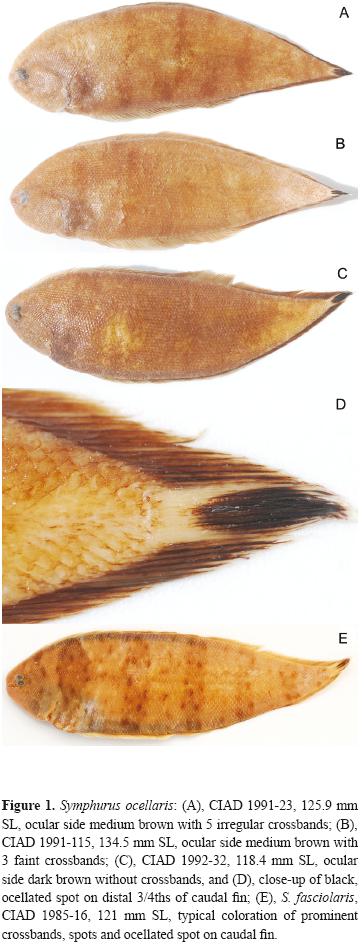
<body><![CDATA[<p align="justify"><font face="verdana" size="2">&nbsp;</font></p> 	    <p align="justify"><font face="verdana" size="2"><b>Resumen</b></font></p> 	    <p align="justify"><font face="verdana" size="2">Se recolectaron 11 individuos de la especie lengua cola ocelada, <i>Symphurus</i> ocellaris</i> Munroe y Robertson, 2005, frente a las costas de Chiapas y Colima, M&eacute;xico. Hasta el momento, la especie s&oacute;lo era conocida a partir de 2 ejemplares tipo recolectados frente a la costa pac&iacute;fica de Panam&aacute;. El presente descubrimiento constituye el primer registro para M&eacute;xico y un segundo reporte conocido de la especie. Se extiende el &aacute;mbito de distribuci&oacute;n norte&ntilde;a de la especie en 11.5 grados de latitud (aproximadamente 3 400 km de l&iacute;nea de costa del Pac&iacute;fico oriental), desde Panam&aacute; hasta Colima, M&eacute;xico.</font></p> 	    <p align="justify"><font face="verdana" size="2"><b>Palabras clave:</b> ampliaci&oacute;n, &aacute;mbito geogr&aacute;fico, Pac&iacute;fico oriental, Panam&aacute;, M&eacute;xico.</font></p> 	    <p align="justify"><font face="verdana" size="2">&nbsp;</font></p> 	    <p align="justify"><font face="verdana" size="2">The symphurine tonguefishes of the eastern Pacific were poorly known and difficult to identify until around 1990, when T. H. Munroe and collaborators published a series of descriptions of new species belonging to the genus <i>Symphurus</i>, mostly based on the dissertation of Mahadeva (1956): Munroe and Mahadeva (1989), Mahadeva and Munroe (1990), Munroe (1990), Munroe and Nizinski (1990), and Munroe et al. (1991). Recently, a new species of tonguefish, <i>Symphurus</i> ocellaris</i> Munroe and Robertson, 2005, was described from the Pacific coast of Panama, based on 2 specimens, increasing the number of eastern Pacific species of <i>Symphurus</i> to 18 (Munroe et al., 1995; Munroe and Robertson, 2005).</font></p> 	    <p align="justify"><font face="verdana" size="2">Several specimens of <i>S. ocellaris</i> were obtained during an extensive collecting effort for demersal fishes on the continental shelf of the Gulf of Tehuantepec in 1991&#150;1992 and 2 additional specimens were caught in the coastal waters off the state of Colima in 1996. Only recently, however, could the specimens be classified as <i>S. ocellaris</i> (<a href="#f1">Fig. 1A&#150;D</a>), after having examined all the <i>Symphurus</i> specimens in our institutional fish collection (CIAD) obtained from many cruises carried out along the eastern Pacific coast of Mexico, including the Gulf of California.</font></p> 	    <p align="center"><font face="verdana" size="2"><a name="f1"></a></font></p> 	    <p align="center"><font face="verdana" size="2"><img src="/img/revistas/rmbiodiv/v82n1/a29f1.jpg"></font></p> 	    <p align="justify"><font face="verdana" size="2">Methods for counts and measurements and general terminology are according to Munroe (1998). Institutional abbreviations are as listed in Leviton et al. (1985); Centro de Investigaci&oacute;n en Alimentaci&oacute;n y Desarrollo, A. C. is abbreviated as CIAD. The common English and Spanish name used here, ringtail tonguefish and lengua cola ocelada, are taken from Robertson and Allen (2006).</font></p> 	    ]]></body>
<body><![CDATA[<p align="justify"><font face="verdana" size="2">The external morphology of our symphurine tonguefishes collected from off the coasts of Colima and Chiapas corresponds to that of the type material of <i>S. ocellaris</i> from Panama provided by Munroe and Robertson (2005); only the pupillary operculum is somewhat less conspicuous in our specimens. Our specimens and the types of <i>S. ocellaris</i> also coincide in measurements and counts, except, however, for the interdigitation (ID) pattern of proximal dorsal&#150;fin pterygiophores and neural spines (<a href="/img/revistas/rmbiodiv/v82n1/a29t1.jpg" target="_blank">Tables 1</a> and <a href="/img/revistas/rmbiodiv/v82n1/a29t2.jpg" target="_blank">2</a>). The predominant ID arrangement in our specimens is 1&#150;4&#150;3&#150;2&#150;2 (present in 9 out of 11; <a href="/img/revistas/rmbiodiv/v82n1/a29f2.jpg" target="_blank">Fig. 2</a>) whereas both type specimens of <i>S. ocellaris</i> have a 1&#150;3&#150;4&#150;2&#150;2 ID pattern.</font></p> 	    <p align="justify"><font face="verdana" size="2">In view of the fact that Munroe (1992) and Munroe and Robertson (2005) stated that the ID pattern serves as an important diagnostic character for the identification of symphurine tonguefishes it is essential to address the discrepancy mentioned above. The 1&#150;4&#150;3&#150;2&#150;2 ID arrangement, typically present in our specimens, only occurs in but 2 eastern Pacific <i>Symphurus</i> species, <i>S. fasciolaris</i> and <i>S. leei</i> (predominant 1&#150;4&#150;3&#150;2&#150;2 ID pattern 69% and 62% and variant ID pattern 1&#150;3&#150;4&#150;2&#150;2, 6% and 7%, respectively; number of specimens 39 and 198, respectively; Munroe, 1992). However, compared to our specimens, <i>Symphurus leei</i> differs in general body shape, in lacking the ocellated caudal spot, and in presenting a higher number of dorsal&#150; and anal&#150;fin rays (93&#150;104 and 78&#150;88 vs. 93&#150;97 and 76&#150;81) whereas S. fasciolaris, although possessing a prominent, ocellated caudal spot, differs noticeably in general body shape and size (at least 162 mm SL vs. 135 mm maximum SL), in number of caudal&#150;fin rays (10 vs. 12, an extremely conservative character within the species of the genus) and in overall body coloration (see coloration below). Thus none of our specimens pertain to <i>S. leei</i> or <i>S. fasciolaris.</i></font></p> 	    <p align="justify"><font face="verdana" size="2">Notwithstanding the difference in predominant ID pattern, we considered our specimens to be conspecific with <i>S. ocellaris</i> because of their similarity in measurements, meristics, external morphology, and presence of a prominent ocellated caudal spot (see below). Identifying our specimens as <i>S. ocellaris</i> was also supported by the results obtained by Castillo Vel&aacute;zquez (2001) who perceived an opposite situation in ID pattern between specimens of <i>S. chabanaudi</i> captured along a short geographic range (n = 22; 26&deg;49' and 16&deg;11' northern latitude; from Baja California Sur to Guerrero, Mexico) and Munroe's 1992 specimens captured over a very wide range (n = 132; from the northern Gulf of California to Colombia): predominant 1&#150;4&#150;3&#150;2&#150;2 ID pattern (59.1%) and 1&#150;5&#150;3&#150;2&#150;2 variant ID pattern (40.9%) vs. the predominant 1&#150;5&#150;3&#150;2&#150;2 (53%) and variant pattern 1&#150;4&#150;3&#150;2&#150;2 (14%), respectively. Apart from weakening the importance of ID patterns as a diagnostic character in species identification, <i>S. chabanaudi</i>, at least within part of its geographic range, represents a third eastern Pacific <i>Symphurus</i> species that shares the predominant 1&#150;4&#150;3&#150;2&#150;2 pattern with our specimens, and thus a comparison is necessary. <i>Symphurus chabanaudi</i> may be larger in size than our specimens (maximum SL at least 233 mm, common to 210 mm SL vs. 135 mm maximum SL) and it lacks the ocellated caudal spot, and possesses a higher number of dorsal&#150; and anal&#150;fin rays (98&#150;109 and 82&#150;92 vs. 93&#150;97 and 76&#150;81 in our specimens).</font></p> 	    <p align="justify"><font face="verdana" size="2">Additional arguments in considering our specimens to be conspecific with <i>S. ocellaris</i> are the following. The description of <i>S. ocellaris</i> was only based on 2 specimens, which, according to Munroe and Robertson (2005), makes it difficult to determine whether the 1&#150;3&#150;4 pattern is the predominant one for this species. Also, the 1&#150;3&#150;4&#150;2&#150;2 ID pattern found in both type specimens of <i>S. ocellaris</i> is a highly unusual one among the 77 species currently recognized in the genus <i>Symphurus</i>. Only one other species, S. callopterus, features this predominant ID pattern, although only in 64% of the 191 specimens examined and the variant pattern being 1&#150;4&#150;3&#150;2&#150;2 in 14% of them, which is the same variant pattern as in our specimens. <i>Symphurus callopterus</i>, however, lacks the ocellated caudal spot, and possesses a higher number of dorsal&#150; and anal&#150;fin rays, 105&#150;114 and 91&#150;88 vs. 93&#150;97 and 76&#150;81 in our specimens (Munroe, 1992; Munroe and Robertson, 2005; Eschmeyer and Fricke, 2009). In addition, fidelity for a predominant ID pattern may be low; according to Munroe (1992), although average fidelity for the predominant ID pattern in 69 species was approximately 78% per species, values ranged from 37 to 100% per species.</font></p> 	    <p align="justify"><font face="verdana" size="2">The coloration in alcohol of our specimens conforms in many aspects with the detailed description given by Munroe and Robertson (2005). Some differences in coloration on the ocular side, however, were observed: 1 specimen is dark brown instead of light to medium brown (<a href="#f1">Fig. 1C</a>); all specimens are devoid of the numerous, small, irregular white markings present in the type material; all except 3 of our specimens show 1 to 5 irregular, faint to prominent crossbands (<a href="#f1">Fig. 1A, B</a>); head and body scales are more uniformly brown, instead of having their distal halves darker than their proximal halves, but present the posterior margins distinctly outlined with dark pigment. In all specimens, the isthmus is devoid of pigment and the blind side does not present the interrupted, medial series of dark spots located deep within the dermis of the posterior third of the body of the paratype. The number of anterior dorsal&#150;fin rays without pigmentation ranges from 0 to 5 (1 specimen with all rays pigmented, 1 specimen with 1, 3 with 2, 3 with 3, 2 with 4, and 1 with 5 rays unpigmented) instead of 2 to 4 for the type specimens (holotype 2, paratype 4). Among all 18 eastern Pacific species of the genus <i>Symphurus</i>, besides <i>S. ocellaris</i>, only S. fasciolaris presents an ocellated spot on the caudal fin (<a href="#f1">Fig. 1E</a>; Munroe and Robertson, 2005).</font></p> 	    <p align="justify"><font face="verdana" size="2">The 2 type specimens of <i>S. ocellaris</i> were caught near Coiba Island, off the Pacific coast of Panama. Given that no additional specimens of this species are reported upon in the literature, our findings extend the distributional range of the species northwards by about 11.5 degrees latitude or 3 400 km of coastline and constitute the first record of <i>S. ocellaris</i> in Mexico. Since the type material was collected at 7&#150;20 m depth, Munroe and Robertson (2005) believed the species to be a shallow&#150;water occupant. Considering, however, that all our specimens were obtained from deeper waters, between 23 and 64 m, <i>S. ocellaris</i> is to be classified as a shallow&#150; to medium&#150;deep water form. As well as the holotype, our specimens were obtained over soft bottom by otter trawl.</font></p> 	    <p align="justify"><font face="verdana" size="2">Material examined (measurements are in SL): <i>Symphurus</i> ocellaris</i>: Mexico, Colima: CIAD 1996&#150;17, 2(115.5&#150;116.9 mm), DEM&#150;III, depth 20&#150;40 m, off Playa El Coco. Golfo de Tehuantepec, Chiapas: CIAD 1991&#150;23, 2(121.2&#150;125.9 mm), CEEMEX&#150;P4, station 19A, depth 34 m, off Barra de Tonal&aacute; (15&deg;53.8' N &#150; 93&deg;54.4' W); CIAD 1991&#150;115, 2(114.8&#150;134.5 mm), CEEMEX&#150;P5, station 19, depth 35 m, off Barra de Tonal&aacute; (15&deg;54.0' N &#150; 93&deg;55.1' W); CIAD 1992&#150;32, 1(118.4 mm), CEEMEX&#150;P7, station 29, depth 42 m, off mouth of R&iacute;o Nicol&aacute;s (14&deg;58.5' N &#150; 92&deg;59.9' W); CIAD 1991&#150;35, 1(114.0 mm), CEEMEX&#150;P4, station 37, depth 23 m, off Barra de San Sim&oacute;n (14&deg;42.4' N &#150; 92&deg;32.3' W); CIAD 1991&#150;36, 1(107.3 mm), CEEMEX&#150;P4, station 38, depth 45, off Barra de San Sim&oacute;n (14&deg;29.9' N &#150; 92&deg;31.0' W); CIAD 1991&#150;37, 1(119.7 mm), CEEMEX&#150;P4, station 39, depth 64 m, off Barra de San Sim&oacute;n (14&deg;21.7' N &#150; 92&deg;32.9' W); SIO 91&#150;76 (ex CIAD 1991&#150;29), 1(114.0 mm), CEEMEX&#150;P4, station 28, depth 28 m, off R&iacute;o Nicol&aacute;s (15&deg;08.3' N &#150; 92&deg;58.7' W). <i>Symphurus</i> fasciolaris: Mexico, Golfo de California, CIAD 1985&#150;16, 5(117&#150;134 mm), CORTES 2, station 37, depth 36 m, Norte de Rocas Consag (31&deg;15.2' N &#150; 114&deg;22.1' W).</font></p> 	    <p align="justify"><font face="verdana" size="2">Specimens from the Gulf of Tehuantepec were collected during the CEEMEX cruises with the R/V <i>El Puma</i> (Commission of the European Communities Contracts TS2.0213.E and CI1.0431.E). Specimens from Colima were obtained during the DEMERSAL cruises with the R/V BIP V and provided by Luz Estela Rodr&iacute;guez Ibarra. Valerie Williams Holland kindly revised the manuscript for correct use of the English language. Valent&iacute;n Zambrana Torres generously put his medical equipment at our disposal and provided the high quality radiographs. Levid Torres Guzm&aacute;n's interest and support of our research is also greatly appreciated.</font></p> 	    <p align="justify">&nbsp;</p> 	    <p align="justify"><font face="verdana" size="2"><b>Literature cited</b></font></p> 	    ]]></body>
<body><![CDATA[<!-- ref --><p align="justify"><font face="verdana" size="2">Castillo Vel&aacute;zquez, R. 2001. Taxonom&iacute;a del g&eacute;nero <i>Symphurus</i> (Pisces: Pleuronectiformes), de la costa noroccidental y central del Pac&iacute;fico mexicano. MSc thesis, Facultad de Ciencias, Universidad Nacional Aut&oacute;noma de M&eacute;xico. M&eacute;xico, D. F. 84 p.    &nbsp;&nbsp;&nbsp;&nbsp;&nbsp;&nbsp;&nbsp;&nbsp;[&#160;<a href="javascript:void(0);" onclick="javascript: window.open('/scielo.php?script=sci_nlinks&ref=7533840&pid=S1870-3453201100010002900001&lng=','','width=640,height=500,resizable=yes,scrollbars=1,menubar=yes,');">Links</a>&#160;]<!-- end-ref --></font></p> 	    <!-- ref --><p align="justify"><font face="verdana" size="2">Eschmeyer, W.N. and R. Fricke (eds.). 2009. Catalog of Fishes electronic version (updated 2 July 2009). <a href="http://research.calacademy.org/ichthyology/catalog/fishcatsearch.html" target="_blank">http://research.calacademy.org/ichthyology/catalog/fishcatsearch.html</a>; 10.VIII.2009</font>&nbsp;&nbsp;&nbsp;&nbsp;&nbsp;&nbsp;&nbsp;&nbsp;[&#160;<a href="javascript:void(0);" onclick="javascript: window.open('/scielo.php?script=sci_nlinks&ref=7533842&pid=S1870-3453201100010002900002&lng=','','width=640,height=500,resizable=yes,scrollbars=1,menubar=yes,');">Links</a>&#160;]<!-- end-ref --><!-- ref --><p align="justify"><font face="verdana" size="2">Leviton, A. E., R. H. Gibbs Jr., E. Heal and C. E. Dawson. 1985. Standards in herpetology and ichthyology. Part I. Standard symbolic codes for institutional resource collections in herpetology and ichthyology. Copeia 1985:802&#150;832.    &nbsp;&nbsp;&nbsp;&nbsp;&nbsp;&nbsp;&nbsp;&nbsp;[&#160;<a href="javascript:void(0);" onclick="javascript: window.open('/scielo.php?script=sci_nlinks&ref=7533843&pid=S1870-3453201100010002900003&lng=','','width=640,height=500,resizable=yes,scrollbars=1,menubar=yes,');">Links</a>&#160;]<!-- end-ref --></font></p> 	    <!-- ref --><p align="justify"><font face="verdana" size="2">Mahadeva, M. N. 1956. A review of the tonguefishes of the eastern Pacific, with descriptions of six new species. Ph.D. thesis, University of California at Los Angeles, California. 272 p.    &nbsp;&nbsp;&nbsp;&nbsp;&nbsp;&nbsp;&nbsp;&nbsp;[&#160;<a href="javascript:void(0);" onclick="javascript: window.open('/scielo.php?script=sci_nlinks&ref=7533845&pid=S1870-3453201100010002900004&lng=','','width=640,height=500,resizable=yes,scrollbars=1,menubar=yes,');">Links</a>&#160;]<!-- end-ref --></font></p> 	    <!-- ref --><p align="justify"><font face="verdana" size="2">Mahadeva, M. N. and T. A. Munroe. 1990. Three new species of symphurine tonguefishes from tropical and warm temperate waters of the eastern Pacific (<i>Symphurus</i>: Cynoglossidae: Pleuronectiformes). Proceedings of the Biological Society of Washington 103:931&#150;954.    &nbsp;&nbsp;&nbsp;&nbsp;&nbsp;&nbsp;&nbsp;&nbsp;[&#160;<a href="javascript:void(0);" onclick="javascript: window.open('/scielo.php?script=sci_nlinks&ref=7533847&pid=S1870-3453201100010002900005&lng=','','width=640,height=500,resizable=yes,scrollbars=1,menubar=yes,');">Links</a>&#160;]<!-- end-ref --></font></p> 	    <!-- ref --><p align="justify"><font face="verdana" size="2">Munroe, T. A. 1990. <i>Symphurus melanurus</i> Clark, 1936, a senior synonym for the eastern Pacific tonguefishes, <i>S. seychellensis</i> Chabanaud, 1955, and <i>S. sechurae</i> Hildebrand, 1946. Copeia 1990:229&#150;232.    &nbsp;&nbsp;&nbsp;&nbsp;&nbsp;&nbsp;&nbsp;&nbsp;[&#160;<a href="javascript:void(0);" onclick="javascript: window.open('/scielo.php?script=sci_nlinks&ref=7533849&pid=S1870-3453201100010002900006&lng=','','width=640,height=500,resizable=yes,scrollbars=1,menubar=yes,');">Links</a>&#160;]<!-- end-ref --></font></p> 	    <!-- ref --><p align="justify"><font face="verdana" size="2">Munroe, T. A. 1992. Interdigitation pattern of dorsal&#150;fin pterygiophores and neural spines, an important diagnostic character for symphurine tonguefishes (<i>Symphurus</i>: Cynoglossidae: Pleuronectiformes). Bulletin of Marine Science 50:357&#150;403.    &nbsp;&nbsp;&nbsp;&nbsp;&nbsp;&nbsp;&nbsp;&nbsp;[&#160;<a href="javascript:void(0);" onclick="javascript: window.open('/scielo.php?script=sci_nlinks&ref=7533851&pid=S1870-3453201100010002900007&lng=','','width=640,height=500,resizable=yes,scrollbars=1,menubar=yes,');">Links</a>&#160;]<!-- end-ref --></font></p> 	    <!-- ref --><p align="justify"><font face="verdana" size="2">Munroe, T. A. 1998. Systematics and ecology of tonguefishes of the genus <i>Symphurus</i> (Cynoglossidae: Pleuronectiformes) from the western Atlantic Ocean. Fishery Bulletin 96:1&#150;182.    &nbsp;&nbsp;&nbsp;&nbsp;&nbsp;&nbsp;&nbsp;&nbsp;[&#160;<a href="javascript:void(0);" onclick="javascript: window.open('/scielo.php?script=sci_nlinks&ref=7533853&pid=S1870-3453201100010002900008&lng=','','width=640,height=500,resizable=yes,scrollbars=1,menubar=yes,');">Links</a>&#160;]<!-- end-ref --></font></p> 	    <!-- ref --><p align="justify"><font face="verdana" size="2">Munroe, T. A. and M. N. Mahadeva. 1989. <i>Symphurus callopterus</i> (Cynoglossidae, Pleuronectiformes), a new deepwater tonguefish from the eastern Pacific. Proceedings of the Biological Society of Washington 102:458&#150;467.    &nbsp;&nbsp;&nbsp;&nbsp;&nbsp;&nbsp;&nbsp;&nbsp;[&#160;<a href="javascript:void(0);" onclick="javascript: window.open('/scielo.php?script=sci_nlinks&ref=7533855&pid=S1870-3453201100010002900009&lng=','','width=640,height=500,resizable=yes,scrollbars=1,menubar=yes,');">Links</a>&#160;]<!-- end-ref --></font></p> 	    <!-- ref --><p align="justify"><font face="verdana" size="2">Munroe, T. A. and M. S. Nizinski. 1990. <i>Symphurus</i> melasmatotheca and S. undecimplerus (Cynoglossidae, Pleuronectiformes), two new eastern Pacific tonguefishes with eleven caudal&#150;fin rays. Copeia 1990:985&#150;996.    &nbsp;&nbsp;&nbsp;&nbsp;&nbsp;&nbsp;&nbsp;&nbsp;[&#160;<a href="javascript:void(0);" onclick="javascript: window.open('/scielo.php?script=sci_nlinks&ref=7533857&pid=S1870-3453201100010002900010&lng=','','width=640,height=500,resizable=yes,scrollbars=1,menubar=yes,');">Links</a>&#160;]<!-- end-ref --></font></p> 	    <!-- ref --><p align="justify"><font face="verdana" size="2">Munroe, T. A. and D. R. Robertson. 2005. <i>Symphurus</i> ocellaris</i>, a new shallow&#150;water symphurine tonguefish collected off Pacific Panama (Pleuronectiformes: Cynoglossidae). Proceedings of the Biological Society of Washington 118:576&#150;581.    &nbsp;&nbsp;&nbsp;&nbsp;&nbsp;&nbsp;&nbsp;&nbsp;[&#160;<a href="javascript:void(0);" onclick="javascript: window.open('/scielo.php?script=sci_nlinks&ref=7533859&pid=S1870-3453201100010002900011&lng=','','width=640,height=500,resizable=yes,scrollbars=1,menubar=yes,');">Links</a>&#160;]<!-- end-ref --></font></p> 	    <!-- ref --><p align="justify"><font face="verdana" size="2">Munroe, T. A., F. Krupp and M. Schneider. 1995. Cynoglossidae. In Gu&iacute;a FAO para la identificaci&oacute;n de especies para los fines de la pesca. Pac&iacute;fico centro&#150;oriental. Vol. 2. Vertebrados. Parte 1., W. Fischer, F. Krupp, W. Schneider, C. Sommer, K. E. Carpenter and V. H. Niem (eds.). FAO, Roma. p. 1039&#150;1059.    &nbsp;&nbsp;&nbsp;&nbsp;&nbsp;&nbsp;&nbsp;&nbsp;[&#160;<a href="javascript:void(0);" onclick="javascript: window.open('/scielo.php?script=sci_nlinks&ref=7533861&pid=S1870-3453201100010002900012&lng=','','width=640,height=500,resizable=yes,scrollbars=1,menubar=yes,');">Links</a>&#160;]<!-- end-ref --></font></p> 	    <!-- ref --><p align="justify"><font face="verdana" size="2">Munroe, T. A., M. S. Nizinski and M. N. Mahadeva. 1991. <i>Symphurus prolatinaris</i>, a new species of shallow&#150;water tonguefish (Pleuronectiformes: Cynoglossidae) from the eastern Pacific. Proceedings of the Biological Society of Washington 104:448&#150;458.    &nbsp;&nbsp;&nbsp;&nbsp;&nbsp;&nbsp;&nbsp;&nbsp;[&#160;<a href="javascript:void(0);" onclick="javascript: window.open('/scielo.php?script=sci_nlinks&ref=7533863&pid=S1870-3453201100010002900013&lng=','','width=640,height=500,resizable=yes,scrollbars=1,menubar=yes,');">Links</a>&#160;]<!-- end-ref --></font></p> 	    <!-- ref --><p align="justify"><font face="verdana" size="2">Robertson, D. R. and G. R. Allen. 2006. Shorefishes of the tropical eastern Pacific: an information system. DVD version 2.0. Smithsonian Tropical Research Institute, Balboa, Panam&aacute; (English and Spanish).    &nbsp;&nbsp;&nbsp;&nbsp;&nbsp;&nbsp;&nbsp;&nbsp;[&#160;<a href="javascript:void(0);" onclick="javascript: window.open('/scielo.php?script=sci_nlinks&ref=7533865&pid=S1870-3453201100010002900014&lng=','','width=640,height=500,resizable=yes,scrollbars=1,menubar=yes,');">Links</a>&#160;]<!-- end-ref --></font></p>      ]]></body><back>
<ref-list>
<ref id="B1">
<nlm-citation citation-type="">
<person-group person-group-type="author">
<name>
<surname><![CDATA[Castillo Velázquez]]></surname>
<given-names><![CDATA[R]]></given-names>
</name>
</person-group>
<source><![CDATA[Taxonomía del género Symphurus (Pisces: Pleuronectiformes), de la costa noroccidental y central del Pacífico mexicano]]></source>
<year>2001</year>
<page-range>84</page-range></nlm-citation>
</ref>
<ref id="B2">
<nlm-citation citation-type="">
<person-group person-group-type="author">
<name>
<surname><![CDATA[Eschmeyer]]></surname>
<given-names><![CDATA[W.N]]></given-names>
</name>
<name>
<surname><![CDATA[Fricke]]></surname>
<given-names><![CDATA[R]]></given-names>
</name>
</person-group>
<source><![CDATA[Catalog of Fishes electronic version]]></source>
<year>2009</year>
</nlm-citation>
</ref>
<ref id="B3">
<nlm-citation citation-type="journal">
<person-group person-group-type="author">
<name>
<surname><![CDATA[Leviton]]></surname>
<given-names><![CDATA[A. E]]></given-names>
</name>
<name>
<surname><![CDATA[Gibbs]]></surname>
<given-names><![CDATA[R. H]]></given-names>
</name>
<name>
<surname><![CDATA[Heal]]></surname>
<given-names><![CDATA[E]]></given-names>
</name>
<name>
<surname><![CDATA[Dawson]]></surname>
<given-names><![CDATA[C. E]]></given-names>
</name>
</person-group>
<article-title xml:lang="en"><![CDATA[Standards in herpetology and ichthyology. Part I. Standard symbolic codes for institutional resource collections in herpetology and ichthyology]]></article-title>
<source><![CDATA[Copeia]]></source>
<year>1985</year>
<volume>1985</volume>
<page-range>802-832</page-range></nlm-citation>
</ref>
<ref id="B4">
<nlm-citation citation-type="">
<person-group person-group-type="author">
<name>
<surname><![CDATA[Mahadeva]]></surname>
<given-names><![CDATA[M. N]]></given-names>
</name>
</person-group>
<source><![CDATA[A review of the tonguefishes of the eastern Pacific, with descriptions of six new species]]></source>
<year>1956</year>
<page-range>272</page-range></nlm-citation>
</ref>
<ref id="B5">
<nlm-citation citation-type="journal">
<person-group person-group-type="author">
<name>
<surname><![CDATA[Mahadeva]]></surname>
<given-names><![CDATA[M. N]]></given-names>
</name>
<name>
<surname><![CDATA[Munroe]]></surname>
<given-names><![CDATA[T. A]]></given-names>
</name>
</person-group>
<article-title xml:lang="en"><![CDATA[Three new species of symphurine tonguefishes from tropical and warm temperate waters of the eastern Pacific (Symphurus: Cynoglossidae: Pleuronectiformes)]]></article-title>
<source><![CDATA[Proceedings of the Biological Society of Washington]]></source>
<year>1990</year>
<volume>103</volume>
<page-range>931-954</page-range></nlm-citation>
</ref>
<ref id="B6">
<nlm-citation citation-type="journal">
<person-group person-group-type="author">
<name>
<surname><![CDATA[Munroe]]></surname>
<given-names><![CDATA[T. A]]></given-names>
</name>
</person-group>
<article-title xml:lang="en"><![CDATA[Symphurus melanurus Clark, 1936, a senior synonym for the eastern Pacific tonguefishes, S. seychellensis Chabanaud, 1955, and S. sechurae Hildebrand, 1946]]></article-title>
<source><![CDATA[Copeia]]></source>
<year>1990</year>
<volume>1990</volume>
<page-range>229-232</page-range></nlm-citation>
</ref>
<ref id="B7">
<nlm-citation citation-type="journal">
<person-group person-group-type="author">
<name>
<surname><![CDATA[Munroe]]></surname>
<given-names><![CDATA[T. A]]></given-names>
</name>
</person-group>
<article-title xml:lang="en"><![CDATA[Interdigitation pattern of dorsal-fin pterygiophores and neural spines, an important diagnostic character for symphurine tonguefishes (Symphurus: Cynoglossidae: Pleuronectiformes)]]></article-title>
<source><![CDATA[Bulletin of Marine Science]]></source>
<year>1992</year>
<volume>50</volume>
<page-range>357-403</page-range></nlm-citation>
</ref>
<ref id="B8">
<nlm-citation citation-type="journal">
<person-group person-group-type="author">
<name>
<surname><![CDATA[Munroe]]></surname>
<given-names><![CDATA[T. A]]></given-names>
</name>
</person-group>
<article-title xml:lang="en"><![CDATA[Systematics and ecology of tonguefishes of the genus Symphurus (Cynoglossidae: Pleuronectiformes) from the western Atlantic Ocean]]></article-title>
<source><![CDATA[Fishery Bulletin]]></source>
<year>1998</year>
<volume>96</volume>
<page-range>1-182</page-range></nlm-citation>
</ref>
<ref id="B9">
<nlm-citation citation-type="journal">
<person-group person-group-type="author">
<name>
<surname><![CDATA[Munroe]]></surname>
<given-names><![CDATA[T. A]]></given-names>
</name>
<name>
<surname><![CDATA[Mahadeva]]></surname>
<given-names><![CDATA[M. N]]></given-names>
</name>
</person-group>
<article-title xml:lang="en"><![CDATA[Symphurus callopterus (Cynoglossidae, Pleuronectiformes), a new deepwater tonguefish from the eastern Pacific]]></article-title>
<source><![CDATA[Proceedings of the Biological Society of Washington]]></source>
<year>1989</year>
<volume>102</volume>
<page-range>458-467</page-range></nlm-citation>
</ref>
<ref id="B10">
<nlm-citation citation-type="journal">
<person-group person-group-type="author">
<name>
<surname><![CDATA[Munroe]]></surname>
<given-names><![CDATA[T. A]]></given-names>
</name>
<name>
<surname><![CDATA[Nizinski]]></surname>
<given-names><![CDATA[M. S]]></given-names>
</name>
</person-group>
<article-title xml:lang="en"><![CDATA[Symphurus melasmatotheca and S. undecimplerus (Cynoglossidae, Pleuronectiformes), two new eastern Pacific tonguefishes with eleven caudal-fin rays]]></article-title>
<source><![CDATA[Copeia]]></source>
<year>1990</year>
<volume>1990</volume>
<page-range>985-996</page-range></nlm-citation>
</ref>
<ref id="B11">
<nlm-citation citation-type="journal">
<person-group person-group-type="author">
<name>
<surname><![CDATA[Munroe]]></surname>
<given-names><![CDATA[T. A]]></given-names>
</name>
<name>
<surname><![CDATA[Robertson]]></surname>
<given-names><![CDATA[D. R]]></given-names>
</name>
</person-group>
<article-title xml:lang="en"><![CDATA[Symphurus ocellaris, a new shallow-water symphurine tonguefish collected off Pacific Panama (Pleuronectiformes: Cynoglossidae)]]></article-title>
<source><![CDATA[Proceedings of the Biological Society of Washington]]></source>
<year>2005</year>
<volume>118</volume>
<page-range>576-581</page-range></nlm-citation>
</ref>
<ref id="B12">
<nlm-citation citation-type="book">
<person-group person-group-type="author">
<name>
<surname><![CDATA[Munroe]]></surname>
<given-names><![CDATA[T. A]]></given-names>
</name>
<name>
<surname><![CDATA[Krupp]]></surname>
<given-names><![CDATA[F]]></given-names>
</name>
<name>
<surname><![CDATA[Schneider]]></surname>
<given-names><![CDATA[M]]></given-names>
</name>
</person-group>
<article-title xml:lang="en"><![CDATA[Cynoglossidae]]></article-title>
<person-group person-group-type="editor">
<name>
<surname><![CDATA[Fischer]]></surname>
<given-names><![CDATA[W]]></given-names>
</name>
<name>
<surname><![CDATA[Krupp]]></surname>
<given-names><![CDATA[F]]></given-names>
</name>
<name>
<surname><![CDATA[Schneider]]></surname>
<given-names><![CDATA[W]]></given-names>
</name>
<name>
<surname><![CDATA[Sommer]]></surname>
<given-names><![CDATA[C]]></given-names>
</name>
<name>
<surname><![CDATA[Carpenter]]></surname>
<given-names><![CDATA[K. E]]></given-names>
</name>
<name>
<surname><![CDATA[Niem]]></surname>
<given-names><![CDATA[V. H]]></given-names>
</name>
</person-group>
<source><![CDATA[Guía FAO para la identificación de especies para los fines de la pesca. Pacífico centro-oriental. Vol. 2. Vertebrados. Parte 1.]]></source>
<year>1995</year>
<page-range>1039-1059</page-range><publisher-loc><![CDATA[Roma ]]></publisher-loc>
<publisher-name><![CDATA[FAO]]></publisher-name>
</nlm-citation>
</ref>
<ref id="B13">
<nlm-citation citation-type="journal">
<person-group person-group-type="author">
<name>
<surname><![CDATA[Munroe]]></surname>
<given-names><![CDATA[T. A]]></given-names>
</name>
<name>
<surname><![CDATA[Nizinski]]></surname>
<given-names><![CDATA[M. S]]></given-names>
</name>
<name>
<surname><![CDATA[Mahadeva]]></surname>
<given-names><![CDATA[M. N]]></given-names>
</name>
</person-group>
<article-title xml:lang="en"><![CDATA[Symphurus prolatinaris, a new species of shallow-water tonguefish (Pleuronectiformes: Cynoglossidae) from the eastern Pacific]]></article-title>
<source><![CDATA[Proceedings of the Biological Society of Washington]]></source>
<year>1991</year>
<volume>104</volume>
<page-range>448-458</page-range></nlm-citation>
</ref>
<ref id="B14">
<nlm-citation citation-type="book">
<person-group person-group-type="author">
<name>
<surname><![CDATA[Robertson]]></surname>
<given-names><![CDATA[D. R]]></given-names>
</name>
<name>
<surname><![CDATA[Allen]]></surname>
<given-names><![CDATA[G. R]]></given-names>
</name>
</person-group>
<source><![CDATA[Shorefishes of the tropical eastern Pacific: an information system]]></source>
<year>2006</year>
<publisher-loc><![CDATA[Balboa ]]></publisher-loc>
<publisher-name><![CDATA[Smithsonian Tropical Research Institute]]></publisher-name>
</nlm-citation>
</ref>
</ref-list>
</back>
</article>
