<?xml version="1.0" encoding="ISO-8859-1"?><article xmlns:mml="http://www.w3.org/1998/Math/MathML" xmlns:xlink="http://www.w3.org/1999/xlink" xmlns:xsi="http://www.w3.org/2001/XMLSchema-instance">
<front>
<journal-meta>
<journal-id>1870-3453</journal-id>
<journal-title><![CDATA[Revista mexicana de biodiversidad]]></journal-title>
<abbrev-journal-title><![CDATA[Rev. Mex. Biodiv.]]></abbrev-journal-title>
<issn>1870-3453</issn>
<publisher>
<publisher-name><![CDATA[Instituto de Biología]]></publisher-name>
</publisher>
</journal-meta>
<article-meta>
<article-id>S1870-34532011000100025</article-id>
<title-group>
<article-title xml:lang="en"><![CDATA[Where has Aristolochia tricaudata (ARISTOLOCHIACEAE) gone? New record of a critically endangered species in Oaxaca, Mexico]]></article-title>
<article-title xml:lang="es"><![CDATA[¿A dónde ha ido Aristolochia tricaudata (ARISTOLOCHIACEAE)? Registro nuevo de una especie amenazada en Oaxaca, México]]></article-title>
</title-group>
<contrib-group>
<contrib contrib-type="author">
<name>
<surname><![CDATA[Rivera-Hernández]]></surname>
<given-names><![CDATA[Jaime Ernesto]]></given-names>
</name>
<xref ref-type="aff" rid="A01"/>
</contrib>
<contrib contrib-type="author">
<name>
<surname><![CDATA[Samain]]></surname>
<given-names><![CDATA[Marie-Stéphanie]]></given-names>
</name>
<xref ref-type="aff" rid="A02"/>
</contrib>
</contrib-group>
<aff id="A01">
<institution><![CDATA[,Centro de Estudios Geográficos, Biológicos y Comunitarios, Sociedad Civil  ]]></institution>
<addr-line><![CDATA[Córdoba Veracruz]]></addr-line>
<country>México</country>
</aff>
<aff id="A02">
<institution><![CDATA[,Research Group Spermatophytes Department of Biology ]]></institution>
<addr-line><![CDATA[ Gent]]></addr-line>
<country>Belgium</country>
</aff>
<pub-date pub-type="pub">
<day>00</day>
<month>03</month>
<year>2011</year>
</pub-date>
<pub-date pub-type="epub">
<day>00</day>
<month>03</month>
<year>2011</year>
</pub-date>
<volume>82</volume>
<numero>1</numero>
<fpage>281</fpage>
<lpage>285</lpage>
<copyright-statement/>
<copyright-year/>
<self-uri xlink:href="http://www.scielo.org.mx/scielo.php?script=sci_arttext&amp;pid=S1870-34532011000100025&amp;lng=en&amp;nrm=iso"></self-uri><self-uri xlink:href="http://www.scielo.org.mx/scielo.php?script=sci_abstract&amp;pid=S1870-34532011000100025&amp;lng=en&amp;nrm=iso"></self-uri><self-uri xlink:href="http://www.scielo.org.mx/scielo.php?script=sci_pdf&amp;pid=S1870-34532011000100025&amp;lng=en&amp;nrm=iso"></self-uri><abstract abstract-type="short" xml:lang="en"><p><![CDATA[During fieldwork in San Juan Teponaxtla, Oaxaca, 3 individuals of Aristolochia tricaudata Lemaire, a very rare species threatened with extinction, were observed with flowers and fruits. Although this species is present in many botanical gardens, fruits have never been observed. Conservation actions are urgently required to protect this species in the wild.]]></p></abstract>
<abstract abstract-type="short" xml:lang="es"><p><![CDATA[Durante un recorrido de campo en San Juan Teponaxtla, Oaxaca, fueron observados tres individuos con flores y frutos de Aristolochia tricaudata Lemaire, una muy rara especie amenazada con la extinción. Aunque esta especie está presente en muchos jardines botánicos, los frutos nunca habían sido observados. Debido a lo restringido de su distribución, esta especie requiere de acciones de conservación urgentes para su protección en la naturaleza.]]></p></abstract>
<kwd-group>
<kwd lng="en"><![CDATA[Aristolochia tricaudata]]></kwd>
<kwd lng="en"><![CDATA[Mexico]]></kwd>
<kwd lng="en"><![CDATA[Oaxaca]]></kwd>
<kwd lng="en"><![CDATA[Chiapas]]></kwd>
<kwd lng="en"><![CDATA[critically endangered]]></kwd>
<kwd lng="es"><![CDATA[Aristolochia tricaudata]]></kwd>
<kwd lng="es"><![CDATA[México]]></kwd>
<kwd lng="es"><![CDATA[Oaxaca]]></kwd>
<kwd lng="es"><![CDATA[Chiapas]]></kwd>
<kwd lng="es"><![CDATA[críticamente amenazada]]></kwd>
</kwd-group>
</article-meta>
</front><body><![CDATA[  	    <p align="justify"><font face="verdana" size="4">Nota cient&iacute;fica</font></p> 	    <p align="center"><font face="verdana" size="2">&nbsp;</font></p> 	    <p align="center"><font face="verdana" size="4"><b>Where has <i>Aristolochia</i> tricaudata</i> (ARISTOLOCHIACEAE) gone? New record of a critically endangered species in Oaxaca, Mexico</b></font></p> 	    <p align="center"><font face="verdana" size="2">&nbsp;</font></p> 	    <p align="center"><font face="verdana" size="3"><b>&iquest;A d&oacute;nde ha ido <i>Aristolochia</i> tricaudata</i> (ARISTOLOCHIACEAE)? Registro nuevo de una especie amenazada en Oaxaca, M&eacute;xico</b></font></p> 	    <p align="center"><font face="verdana" size="2">&nbsp;</font></p> 	    <p align="center"><font face="verdana" size="2"><b>Jaime Ernesto Rivera&#150;Hern&aacute;ndez<sup>1*</sup> and Marie&#150;St&eacute;phanie Samain<sup>2</sup></b></font></p> 	    <p align="justify"><font face="verdana" size="2">&nbsp;</font></p> 	    <p align="justify"><font face="verdana" size="2"><sup><i>1 </i></sup><i>Centro de Estudios Geogr&aacute;ficos, Biol&oacute;gicos y Comunitarios, Sociedad Civil (GEOBICOM, S.C.). Santa Mar&iacute;a 13 Infonavit. San Rom&aacute;n, 95542 C&oacute;rdoba, Veracruz, M&eacute;xico.</i></font></p> 	    ]]></body>
<body><![CDATA[<p align="justify"><font face="verdana" size="2"><i><sup>2 </sup>Ghent University, Department of Biology, Research Group Spermatophytes, K. L. Ledeganckstraat 35 B&#150;9000 Gent, Belgium.</i></font></p> 	    <p align="justify"><font face="verdana" size="2">&nbsp;</font></p> 	    <p align="justify"><font face="verdana" size="2"><b>*Correspondent:</b>    <br>     <a href="mailto:jriverah@geobicom.org">jriverah@geobicom.org</a></font></p> 	    <p align="justify"><font face="verdana" size="2">&nbsp;</font></p> 	    <p align="justify"><font face="verdana" size="2">Recibido: 26 marzo 2010    <br>     Aceptado: 31 mayo 2010</font></p> 	    <p align="justify"><font face="verdana" size="2">&nbsp;</font></p> 	    <p align="justify"><font face="verdana" size="2"><b>Abstract</b></font></p> 	    <p align="justify"><font face="verdana" size="2">During fieldwork in San Juan Teponaxtla, Oaxaca, 3 individuals of <i>Aristolochia</i> tricaudata</i> Lemaire, a very rare species threatened with extinction, were observed with flowers and fruits. Although this species is present in many botanical gardens, fruits have never been observed. Conservation actions are urgently required to protect this species in the wild.</font></p> 	    ]]></body>
<body><![CDATA[<p align="justify"><font face="verdana" size="2"><b>Key words:</b> <i>Aristolochia</i> tricaudata</i>, Mexico, Oaxaca, Chiapas, critically endangered.</font></p> 	    <p align="justify"><font face="verdana" size="2">&nbsp;</font></p> 	    <p align="justify"><font face="verdana" size="2"><b>Resumen</b></font></p> 	    <p align="justify"><font face="verdana" size="2">Durante un recorrido de campo en San Juan Teponaxtla, Oaxaca, fueron observados tres individuos con flores y frutos de <i>Aristolochia</i> tricaudata</i> Lemaire, una muy rara especie amenazada con la extinci&oacute;n. Aunque esta especie est&aacute; presente en muchos jardines bot&aacute;nicos, los frutos nunca hab&iacute;an sido observados. Debido a lo restringido de su distribuci&oacute;n, esta especie requiere de acciones de conservaci&oacute;n urgentes para su protecci&oacute;n en la naturaleza.</font></p> 	    <p align="justify"><font face="verdana" size="2"><b>Palabras clave:</b> <i>Aristolochia</i> tricaudata</i>, M&eacute;xico, Oaxaca, Chiapas, cr&iacute;ticamente amenazada.</font></p> 	    <p align="justify"><font face="verdana" size="2">&nbsp;</font></p> 	    <p align="justify"><font face="verdana" size="2">The family <i>Aristolochia</i>ceae is a member of the magnoliid order Piperales, which also includes Hydnoraceae, Lactoridaceae, Piperaceae, and Saururaceae (e.g. Nickrent et al., 2002, Wanke et al., 2007; APG III, 2009). <i>Aristolochia</i>ceae consists of approximately 600 species and is divided into 2 monophyletic subfamilies, Asaroideae and Aristolochioideae (e.g. Huber, 1993; Neinhuis et al., 2005). Subfamily Asaroideae contains 2 herbaceous genera, <i>Asarum</i> and <i>Saruma</i>, whereas the number of genera within subfamily Aristolochioideae is still under debate as the generic limits of <i>Aristolochia</i> itself are unclear (Wanke et al., 2006). The genus <i>Aristolochia</i> s.l. includes approximately 500 species, and growth forms within this genus vary from herbs, lianas, and shrubs to small trees. The species generally occur in warm, tropical, and subtropical areas with Mexico being a centre of diversity. According to Ortega&#150;Ortiz and Ortega&#150;Ortiz (1997) and Kelly (2000), there are approximately 65 species in Mexico.</font></p> 	    <p align="justify"><font face="verdana" size="2">The systematic knowledge of <i>Aristolochia</i> in Mexico is more or less restricted to 2 revisions based on herbarium specimens of hexandrous and pentandrous species, respectively (Pfeifer, 1966, 1970). Since then, some new species have been described and several floristic studies have been performed, e.g. for the Flora de Veracruz (Ortega&#150;Ortiz et Ortega&#150;Ortiz, 1997) and for the Flora del Valle de Tehuac&aacute;n&#150;Cuicatl&aacute;n (Kelly, 2000). However, comprehensive studies of the occurrence, distribution, and phylogenetic relationships of the Mexican species have not yet been carried out. Nevertheless, it is clear that many species are restricted to few localities.</font></p> 	    <p align="justify"><font face="verdana" size="2">One of these very rare species is <i>Aristolochia</i> tricaudata</i> Lemaire, which was observed with flowers and fruits in May 2008 during fieldwork for the project "The Biodiversity and Ethnobiology of San Juan Teponaxtla, Oaxaca" developed by the Centro de Estudios Geogr&aacute;ficos, Biol&oacute;gicos y Comunitarios, S.C. (Rivera Hern&aacute;ndez et al., 2009). In one of the transects carried out in the field, 3 individuals were found in the transition between tropical rainforest and cloud forest, at 1 220 meters above sea level, growing together with <i>Terminalia</i> (Combretaceae), <i>Calatola</i> (Icacinaceae), <i>Amphitecna</i> (Bignoniaceae), and <i>Clusia</i> (Clusiaceae). This locality was revisited in September 2009 and flowers and fruits were again observed (S. Isnard and S. Wagner, pers. comm.). While looking for other records of this species in herbaria, we found 3 more vouchers from Oaxaca and Chiapas, which report <i>A. tricaudata</i> from cloud forest and tropical rainforest, growing between 900 and 1 375 m altitude amongst other species together with <i>Coccoloba</i> (Polygonaceae) and <i>Quararibea</i> (Malvaceae).</font></p> 	    <p align="justify"><font face="verdana" size="2"><i>Aristolochia</i> tricaudata</i> belongs to <i>Aristolochia</i> subgenus <i>Isotrema</i> (Wanke et al., 2006), and is most closely related to <i>A. arborea</i> and <i>A. salvadorensis</i> (Neinhuis et al., 2005; Ohi&#150;Toma et al., 2006). It is a multi&#150;stemmed, leaning shrub up to 3&#150;4 m tall, built according to the Troll architectural model (Hall&eacute;, 2004) with conspicuous trimerous flowers with 3 fused sepals, each with a long pendent appendage (<a href="/img/revistas/rmbiodiv/v82n1/a25f1.jpg" target="_blank">Fig. 1</a>). In contrast with the observations of Pfeifer (1966), who only mentioned the flowers as 'solitary in the leaf axils (?)', they are both cauliflorous and developing in the leaf axils. The species is regularly cultivated in botanical gardens, but the plants have never been observed to set fruit. Hence, it is probable that the species has only once been introduced to Botanical Gardens, presumedly from the type collection. However, studying the genotypic diversity of the botanical garden accessions might elucidate this mystery.</font></p> 	    ]]></body>
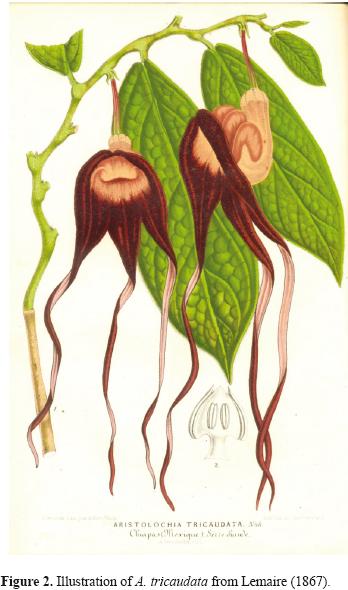
<body><![CDATA[<p align="justify"><font face="verdana" size="2">The Belgian botanist Auguste Boniface Ghiesbreght (1810&#150;1893) collected the type specimen of <i>A. tricaudata</i> in Chiapas, without mentioning the precise locality. He sent living specimens to the famous nursery of Ambroise Verschaffelt in Gent, Belgium, from where the species was distributed to many European collections. In 1865, Charles Antoine Lemaire mentioned <i>A. tricaudata</i> with a provisional short description in the horticultural journal L'Illustration Horticole, edited by him and owned by Verschaffelt (Lemaire, 1865). In 1867, he described the species in this same journal, accompanied by a splendid illustration which is reproduced here (Lemaire, 1867; <a href="#f2">Fig. 2</a>). Pfeifer (1966) wrote a relatively short description of <i>A. tricaudata</i> based on 2 herbarium collections, the type and a specimen which could not be located. An emended description is provided below, including the fruit and seed characters that never have been described before.</font></p> 	    <p align="center"><font face="verdana" size="2"><a name="f2"></a></font></p> 	    <p align="center"><font face="verdana" size="2"><img src="/img/revistas/rmbiodiv/v82n1/a25f2.jpg"></font></p> 	    <p align="justify"><font face="verdana" size="2"><b><i>Aristolochia</i> tricaudata</i></b> Lem., Illust. Hort. 14: 121&#150;123, t. 522, 1867. Type: MEXICO. Chiapas: without precise locality, <i>Ghiesbreght</i> 800 (K!). Synonym: <i>Isotrema tricaudatum</i> (Lem.) H. Huber, Mitt. Bot. Staatssamml. M&uuml;nchen 3: 551. 1960.</font></p> 	    <p align="justify"><font face="verdana" size="2">Shrub up to 3&#150;4 m high; branches zigzag with slightly swollen nodes; leaves simple, alternate, petiole 1&#150;2 cm long, tomentulose; lamina 10&#150;23 cm long, 5&#150;12 cm wide, ovate, obovate or lanceolate, base rounded to obtuse, apex acuminate (the type also has 2 leaves with bidentate apex), margin entire, adaxial side dark green, glabrous; abaxial side whitish green, tomentulose along the veins; venation pinnate and brochidodromous, pseudostipules absent; bracteoles absent, flowers dark red to reddish brown, mouth whitish, outer surface of the flower whitish to pinkish, solitary, pendent from the trunk or from leaf axils on the older portions of the branches, trimerous, zygomorphic, 8&#150;16 cm long, 5&#150;7 cm wide, perianth consisting of 3 fused sepals forming a strongly curved tube, appendages of each sepal 5&#150;15 cm long, anthers 6, carpels 6, styles and stigmas fused into a three&#150;lobed gynostemium with each lobe carrying 2 anthers; fruit an oblong 6&#150;locular septicidal capsule, dehiscing by valves, when immature yellowish&#150;greenish with reddish brown lines on the raised midvein of each component carpel, speckled reddish brown along this midvein, sutures sunken, fruit when mature dark brown, 3&#150;8 cm long, 1.8&#150;2 cm wide, valves strongly recurved and separate from each other, pedicel not split as in many other <i>Aristolochia</i> species; seeds ovate with a pointed apex, flattened, dorsally slightly convex, ventrally slightly concave, dark reddish brown, up to 5 mm long and 3 mm wide, funiculus flattened against the seed, lignified, as long as the seed, 0.7&#150;0.8 mm broad.</font></p> 	    <p align="justify"><font face="verdana" size="2">Additional specimens examined: OAXACA: Distrito Cuicatl&aacute;n, Mpio. San Juan Tepeuxila, El Campamento, San Juan Teponaxtla, 1 220 m, 9 May 2008 (flowers), <i>J. Rivera&#150;Hern&aacute;ndez 4288</i> (MEXU, CORU, GENT), 30 July 2008 (fruits), <i>J. Rivera&#150;Hern&aacute;ndez 4379</i> (MEXU, CORU, GENT). Distrito Teotitl&aacute;n, Mpio. San Jos&eacute; Tenango, aproximadamente 400 m de San Mart&iacute;n Caballero, por la vereda a Tenango, 1 375 m, 21 January 2002 (fruit), X. Munn E., D. Garc&iacute;a and F. Mendoza 1824 (XAL, MEXU). Distrito Tuxtepec, Mpio. San Felipe Usila, Cerro Verde, 1 140 m, 25 May 1991, <i>J.I. Calzada and J. M&uacute;gica 16975</i> (IEB, MEXU). CHIAPAS: Mpio. Tila, Colonia Kokijaz, 900 m, 25 July 1983, <i>A. M&eacute;ndez Ton</i> (Alush Shilom Ton) 6400 (MEXU, XAL).</font></p> 	    <p align="justify"><font face="verdana" size="2">Sterile specimens of <i>A. tricaudata</i> resemble <i>A. arborea</i> but cannot be confused when flowers are present. <i>Aristolochia arborea</i> is cauliflorous with the flowers originating at the base of the trunk in racemose clusters and imitating the fruit body of mushrooms.</font></p> 	    <p align="justify"><font face="verdana" size="2">The vernacular name "guaco" or "flor de guaco" is given to most of the species of <i>Aristolochia</i> in Mexico. Before the observation of <i>A. tricaudata</i> in San Juan Teponaxtla, the inhabitants did not know this species, probably due to its scarce abundance. Since then, they have named it "i'ho d&uacute;vi", which means "small tree" in Cuicatec, because the term "shrub" does not exist in this language.</font></p> 	    <p align="justify"><font face="verdana" size="2">The discovery of the population in Teponaxtla brings the total amount of recorded localities to 5: 3 in the north of Oaxaca, 1 in the north of Chiapas, and finally the unknown type locality in Chiapas (<a href="/img/revistas/rmbiodiv/v82n1/a25f3.jpg" target="_blank">Fig. 3</a>). Only the collections from Oaxaca are relatively recent, and a visit of all localities is necessary to assess the size, viability, and specific threats for each population. The very small population of <i>A. tricaudata</i> in Teponaxtla is protected by the local community, which strictly forbids any collection of plants or parts of them. If not already the case, local inhabitants living near the other localities need to be informed about the status of this species.</font></p> 	    <p align="justify"><font face="verdana" size="2">The inclusion of <i>A. tricaudata</i> in the NOM&#150;059&#150;SEMARNAT&#150;2010 list (SEMARNAT, 2010) of species protected by Mexican law, with the category of "En Peligro de Extinci&oacute;n" is urgent, and also its inclusion in the IUCN Red List (International Union for Conservation of Nature and Natural Resources) with the category of "Critically endangered" or "Endangered" is recommended.</font></p> 	    ]]></body>
<body><![CDATA[<p align="justify"><font face="verdana" size="2">Many thanks to the San Juan Teponaxtla inhabitants and the Comisariado de Bienes Comunales 2006&#150;2008 for the permit to work in their territory and all the support of the fieldwork. We are very grateful to the Rufford Small Grants Foundation, University of Kent, the Universidad Veracruzana and PACMYC&#150;CONACULTA who financially supported the project, to Graciela Alc&aacute;ntara Salinas and Antoev&aacute;n Vergara for their help with fieldwork and to Paul Goetghebeur (Ghent University, Belgium), Christoph Neinhuis, Stefan Wanke, Sandrine Isnard, and Sarah Wagner (TU Dresden, Germany), as well as 2 anonymous reviewers for constructive comments. Thanks also to the curators of the herbaria K and MEXU for the permission to borrow material for study. All our collections of <i>A. tricaudata</i> were supported by a collecting license with the number SGPA/DGVS/01148/08 granted to the first author.</font></p> 	    <p align="justify"><font face="verdana" size="2">&nbsp;</font></p> 	    <p align="justify"><font face="verdana" size="2"><b>Literature cited</b></font></p> 	    <!-- ref --><p align="justify"><font face="verdana" size="2">APG III. 2009. An update of the Angiosperm Phylogeny Group classification for the orders and families of flowering plants: APG III. Botanical Journal of the Linnean Society 161:105&#150;121.    &nbsp;&nbsp;&nbsp;&nbsp;&nbsp;&nbsp;&nbsp;&nbsp;[&#160;<a href="javascript:void(0);" onclick="javascript: window.open('/scielo.php?script=sci_nlinks&ref=7575662&pid=S1870-3453201100010002500001&lng=','','width=640,height=500,resizable=yes,scrollbars=1,menubar=yes,');">Links</a>&#160;]<!-- end-ref --></font></p> 	    <!-- ref --><p align="justify"><font face="verdana" size="2">Hall&eacute;, F. 2004. Architecture des Plantes. JPC Edition. 162 p.    &nbsp;&nbsp;&nbsp;&nbsp;&nbsp;&nbsp;&nbsp;&nbsp;[&#160;<a href="javascript:void(0);" onclick="javascript: window.open('/scielo.php?script=sci_nlinks&ref=7575664&pid=S1870-3453201100010002500002&lng=','','width=640,height=500,resizable=yes,scrollbars=1,menubar=yes,');">Links</a>&#160;]<!-- end-ref --></font></p> 	    <!-- ref --><p align="justify"><font face="verdana" size="2">Huber, H. 1993. <i>Aristolochia</i>ceae. In The Families and Genera of Vascular Plants, volume 2, K.    &nbsp;&nbsp;&nbsp;&nbsp;&nbsp;&nbsp;&nbsp;&nbsp;[&#160;<a href="javascript:void(0);" onclick="javascript: window.open('/scielo.php?script=sci_nlinks&ref=7575666&pid=S1870-3453201100010002500003&lng=','','width=640,height=500,resizable=yes,scrollbars=1,menubar=yes,');">Links</a>&#160;]<!-- end-ref --></font></p> 	    <!-- ref --><p align="justify"><font face="verdana" size="2">Kubitzki, J. G. Rohwer and V. Bittrich (eds.). Springer&#150;Verlag, Berlin:129&#150;137.    &nbsp;&nbsp;&nbsp;&nbsp;&nbsp;&nbsp;&nbsp;&nbsp;[&#160;<a href="javascript:void(0);" onclick="javascript: window.open('/scielo.php?script=sci_nlinks&ref=7575668&pid=S1870-3453201100010002500004&lng=','','width=640,height=500,resizable=yes,scrollbars=1,menubar=yes,');">Links</a>&#160;]<!-- end-ref --></font></p> 	    <!-- ref --><p align="justify"><font face="verdana" size="2">Kelly, L. M. 2000. <i>Aristolochia</i>ceae. <i>In</i> Flora del Valle de Tehuac&aacute;n&#150;Cuicatl&aacute;n, Fasc. 29. A. Novelo Retana (ed.). Instituto de Biolog&iacute;a, Universidad Nacional Aut&oacute;noma de M&eacute;xico, M&eacute;xico, D. F. 8 p.    &nbsp;&nbsp;&nbsp;&nbsp;&nbsp;&nbsp;&nbsp;&nbsp;[&#160;<a href="javascript:void(0);" onclick="javascript: window.open('/scielo.php?script=sci_nlinks&ref=7575670&pid=S1870-3453201100010002500005&lng=','','width=640,height=500,resizable=yes,scrollbars=1,menubar=yes,');">Links</a>&#160;]<!-- end-ref --></font></p> 	    <!-- ref --><p align="justify"><font face="verdana" size="2">Lemaire, C. 1865. Miscellan&eacute;es: <i>Aristolochia</i> tricaudata</i>. L'Illustration Horticole 12:97&#150;98.    &nbsp;&nbsp;&nbsp;&nbsp;&nbsp;&nbsp;&nbsp;&nbsp;[&#160;<a href="javascript:void(0);" onclick="javascript: window.open('/scielo.php?script=sci_nlinks&ref=7575672&pid=S1870-3453201100010002500006&lng=','','width=640,height=500,resizable=yes,scrollbars=1,menubar=yes,');">Links</a>&#160;]<!-- end-ref --></font></p> 	    <!-- ref --><p align="justify"><font face="verdana" size="2">Lemaire, C. 1867. <i>Aristolochia</i> tricaudata</i>. Aristoloche &agrave; trois queues (fleurs!). L'Illustration Horticole 14:121&#150;123, t. 522.    &nbsp;&nbsp;&nbsp;&nbsp;&nbsp;&nbsp;&nbsp;&nbsp;[&#160;<a href="javascript:void(0);" onclick="javascript: window.open('/scielo.php?script=sci_nlinks&ref=7575674&pid=S1870-3453201100010002500007&lng=','','width=640,height=500,resizable=yes,scrollbars=1,menubar=yes,');">Links</a>&#160;]<!-- end-ref --></font></p> 	    <!-- ref --><p align="justify"><font face="verdana" size="2">Neinhuis, C., S. Wanke, K. W. Hilu, K. M&uuml;ller and T. Borsch. 2005. Phylogeny of <i>Aristolochia</i>ceae based on parsimony, likelihood, and Bayesian analyses of <i>trnL&#150;trnF </i>sequences. Plant Systematics and Evolution 250:7&#150;26.    &nbsp;&nbsp;&nbsp;&nbsp;&nbsp;&nbsp;&nbsp;&nbsp;[&#160;<a href="javascript:void(0);" onclick="javascript: window.open('/scielo.php?script=sci_nlinks&ref=7575676&pid=S1870-3453201100010002500008&lng=','','width=640,height=500,resizable=yes,scrollbars=1,menubar=yes,');">Links</a>&#160;]<!-- end-ref --></font></p> 	    <!-- ref --><p align="justify"><font face="verdana" size="2">Nickrent, D. L., D. E. Soltis, A. Blarer, Y.&#150;L. Qiu, P. S. Soltis and M. Zanis (2002). Molecular data place Hydnoraceae with <i>Aristolochia</i>ceae. American Journal of Botany 89:1809&#150;1817.    &nbsp;&nbsp;&nbsp;&nbsp;&nbsp;&nbsp;&nbsp;&nbsp;[&#160;<a href="javascript:void(0);" onclick="javascript: window.open('/scielo.php?script=sci_nlinks&ref=7575678&pid=S1870-3453201100010002500009&lng=','','width=640,height=500,resizable=yes,scrollbars=1,menubar=yes,');">Links</a>&#160;]<!-- end-ref --></font></p> 	    <!-- ref --><p align="justify"><font face="verdana" size="2">Ohi&#150;Toma, T., T. Sugawara, H. Murata, S. Wanke, C. Neinhuis and J. Murata. 2006. Molecular phylogeny of <i>Aristolochia sensu lato</i> (Aristolochiaceae) based on sequences of <i>rbcL, matK</i>, and <i>phyA </i>genes, with special reference to differentiation of chromosome numbers. Systematic Botany 31:481&#150;492.    &nbsp;&nbsp;&nbsp;&nbsp;&nbsp;&nbsp;&nbsp;&nbsp;[&#160;<a href="javascript:void(0);" onclick="javascript: window.open('/scielo.php?script=sci_nlinks&ref=7575680&pid=S1870-3453201100010002500010&lng=','','width=640,height=500,resizable=yes,scrollbars=1,menubar=yes,');">Links</a>&#160;]<!-- end-ref --></font></p> 	    <!-- ref --><p align="justify"><font face="verdana" size="2">Ortega&#150;Ortiz, J. F. and R.V. Ortega&#150;Ortiz. 1997. Aristolochiaceae. <i>In</i> Flora de Veracruz, Fasc. 99. V. Sosa (ed.). Instituto de Ecolog&iacute;a, A.C., Xalapa, Veracruz and Universidad de California, Riverside, California. 46 p.    &nbsp;&nbsp;&nbsp;&nbsp;&nbsp;&nbsp;&nbsp;&nbsp;[&#160;<a href="javascript:void(0);" onclick="javascript: window.open('/scielo.php?script=sci_nlinks&ref=7575682&pid=S1870-3453201100010002500011&lng=','','width=640,height=500,resizable=yes,scrollbars=1,menubar=yes,');">Links</a>&#160;]<!-- end-ref --></font></p> 	    <!-- ref --><p align="justify"><font face="verdana" size="2">Pfeifer, H. W. 1966. Revision of the North and Central American hexandrous species of <i>Aristolochia</i> (Aristolochiaceae). Annals of the Missouri Botanical Garden 53:115&#150;196.    &nbsp;&nbsp;&nbsp;&nbsp;&nbsp;&nbsp;&nbsp;&nbsp;[&#160;<a href="javascript:void(0);" onclick="javascript: window.open('/scielo.php?script=sci_nlinks&ref=7575684&pid=S1870-3453201100010002500012&lng=','','width=640,height=500,resizable=yes,scrollbars=1,menubar=yes,');">Links</a>&#160;]<!-- end-ref --></font></p> 	    <!-- ref --><p align="justify"><font face="verdana" size="2">Pfeifer, H. W. 1970. Taxonomic revision of the pentandrous species of <i>Aristolochia</i>. The University of Connecticut Publication Series:1&#150;134.    &nbsp;&nbsp;&nbsp;&nbsp;&nbsp;&nbsp;&nbsp;&nbsp;[&#160;<a href="javascript:void(0);" onclick="javascript: window.open('/scielo.php?script=sci_nlinks&ref=7575686&pid=S1870-3453201100010002500013&lng=','','width=640,height=500,resizable=yes,scrollbars=1,menubar=yes,');">Links</a>&#160;]<!-- end-ref --></font></p> 	    <!-- ref --><p align="justify"><font face="verdana" size="2">Rivera Hern&aacute;ndez, J. E., G. Alc&aacute;ntara Salinas and A. Vergara Villamil. 2009. Gu&iacute;a Ecotur&iacute;stica de la Biodiversidad y la Cultura de San Juan Teponaxtla, Cuicatl&aacute;n, Oaxaca. Centro de Estudios Geogr&aacute;ficos, Biol&oacute;gicos y Comunitarios, S.C., Rufford Small Grants Foundation y PACMYC&#150;Conaculta. C&oacute;rdoba, Veracruz, M&eacute;xico. 216 p.    &nbsp;&nbsp;&nbsp;&nbsp;&nbsp;&nbsp;&nbsp;&nbsp;[&#160;<a href="javascript:void(0);" onclick="javascript: window.open('/scielo.php?script=sci_nlinks&ref=7575688&pid=S1870-3453201100010002500014&lng=','','width=640,height=500,resizable=yes,scrollbars=1,menubar=yes,');">Links</a>&#160;]<!-- end-ref --></font></p> 	    <!-- ref --><p align="justify"><font face="verdana" size="2">SEMARNAT. 2010. Norma Oficial Mexicana NOM&#150;059&#150;SEMARNAT&#150;2010, Protecci&oacute;n ambiental&#150;Especies nativas de M&eacute;xico de flora y fauna silvestres&#150;Categor&iacute;as de riesgo y especificaciones para su inclusi&oacute;n, exclusi&oacute;n o cambio&#150;Lista de especies en riesgo. Diario Oficial de la Federaci&oacute;n. Jueves 30 de diciembre de 2010. Segunda Secci&oacute;n. p. 1&#150;77.    &nbsp;&nbsp;&nbsp;&nbsp;&nbsp;&nbsp;&nbsp;&nbsp;[&#160;<a href="javascript:void(0);" onclick="javascript: window.open('/scielo.php?script=sci_nlinks&ref=7575690&pid=S1870-3453201100010002500015&lng=','','width=640,height=500,resizable=yes,scrollbars=1,menubar=yes,');">Links</a>&#160;]<!-- end-ref --></font></p> 	    <!-- ref --><p align="justify"><font face="verdana" size="2">Wanke, S., F. Gonz&aacute;lez and C. Neinhuis. 2006. Systematics of pipevines &#150; combining morphological and fast&#150;evolving molecular characters to investigate the relationships within subfamily Aristolochioideae (<i>Aristolochia</i>ceae). International Journal of Plant Sciences 167:1215&#150;1227.    &nbsp;&nbsp;&nbsp;&nbsp;&nbsp;&nbsp;&nbsp;&nbsp;[&#160;<a href="javascript:void(0);" onclick="javascript: window.open('/scielo.php?script=sci_nlinks&ref=7575692&pid=S1870-3453201100010002500016&lng=','','width=640,height=500,resizable=yes,scrollbars=1,menubar=yes,');">Links</a>&#160;]<!-- end-ref --></font></p> 	    <!-- ref --><p align="justify"><font face="verdana" size="2">Wanke, S., M. A. Jaramillo, T. Borsch, M. S. Samain, D. Quandt and C. Neinhuis. 2007. Evolution of the Piperales &#150; <i>matK</i> and <i>trnK</i> intron sequence data reveal lineage specific resolution contrast. Molecular Phylogenetics and Evolution 42:477&#150;497.    &nbsp;&nbsp;&nbsp;&nbsp;&nbsp;&nbsp;&nbsp;&nbsp;[&#160;<a href="javascript:void(0);" onclick="javascript: window.open('/scielo.php?script=sci_nlinks&ref=7575694&pid=S1870-3453201100010002500017&lng=','','width=640,height=500,resizable=yes,scrollbars=1,menubar=yes,');">Links</a>&#160;]<!-- end-ref --></font></p>      ]]></body><back>
<ref-list>
<ref id="B1">
<nlm-citation citation-type="journal">
<collab>APG III</collab>
<article-title xml:lang="en"><![CDATA[An update of the Angiosperm Phylogeny Group classification for the orders and families of flowering plants: APG III]]></article-title>
<source><![CDATA[Botanical Journal of the Linnean Society]]></source>
<year>2009</year>
<volume>161</volume>
<page-range>105-121</page-range></nlm-citation>
</ref>
<ref id="B2">
<nlm-citation citation-type="book">
<person-group person-group-type="author">
<name>
<surname><![CDATA[Hallé]]></surname>
<given-names><![CDATA[F]]></given-names>
</name>
</person-group>
<source><![CDATA[Architecture des Plantes]]></source>
<year>2004</year>
<page-range>162</page-range><publisher-name><![CDATA[JPC Edition]]></publisher-name>
</nlm-citation>
</ref>
<ref id="B3">
<nlm-citation citation-type="journal">
<person-group person-group-type="author">
<name>
<surname><![CDATA[Huber]]></surname>
<given-names><![CDATA[H]]></given-names>
</name>
</person-group>
<article-title xml:lang="en"><![CDATA[Aristolochiaceae]]></article-title>
<source><![CDATA[The Families and Genera of Vascular Plants]]></source>
<year>1993</year>
<volume>2</volume>
</nlm-citation>
</ref>
<ref id="B4">
<nlm-citation citation-type="book">
<person-group person-group-type="author">
<name>
<surname><![CDATA[Kubitzki]]></surname>
<given-names><![CDATA[J]]></given-names>
</name>
<name>
<surname><![CDATA[Rohwer]]></surname>
<given-names><![CDATA[G]]></given-names>
</name>
<name>
<surname><![CDATA[Bittrich]]></surname>
<given-names><![CDATA[V]]></given-names>
</name>
</person-group>
<source><![CDATA[]]></source>
<year></year>
<page-range>129-137</page-range><publisher-loc><![CDATA[Berlin ]]></publisher-loc>
<publisher-name><![CDATA[SpringerVerlag]]></publisher-name>
</nlm-citation>
</ref>
<ref id="B5">
<nlm-citation citation-type="book">
<person-group person-group-type="author">
<name>
<surname><![CDATA[Kelly]]></surname>
<given-names><![CDATA[L. M]]></given-names>
</name>
</person-group>
<article-title xml:lang="es"><![CDATA[Aristolochiaceae]]></article-title>
<person-group person-group-type="editor">
<name>
<surname><![CDATA[Novelo Retana]]></surname>
<given-names><![CDATA[A]]></given-names>
</name>
</person-group>
<source><![CDATA[Flora del Valle de Tehuacán-Cuicatlán]]></source>
<year>2000</year>
<volume>29</volume>
<page-range>8</page-range><publisher-loc><![CDATA[México^eD. F D. F]]></publisher-loc>
<publisher-name><![CDATA[Instituto de Biología, Universidad Nacional Autónoma de México]]></publisher-name>
</nlm-citation>
</ref>
<ref id="B6">
<nlm-citation citation-type="journal">
<person-group person-group-type="author">
<name>
<surname><![CDATA[Lemaire]]></surname>
<given-names><![CDATA[C]]></given-names>
</name>
</person-group>
<article-title xml:lang="en"><![CDATA[Miscellanées: Aristolochia tricaudata]]></article-title>
<source><![CDATA[L'Illustration Horticole]]></source>
<year>1865</year>
<volume>12</volume>
<page-range>97-98</page-range></nlm-citation>
</ref>
<ref id="B7">
<nlm-citation citation-type="journal">
<person-group person-group-type="author">
<name>
<surname><![CDATA[Lemaire]]></surname>
<given-names><![CDATA[C]]></given-names>
</name>
</person-group>
<article-title xml:lang="en"><![CDATA[Aristolochia tricaudata. Aristoloche à trois queues (fleurs!)]]></article-title>
<source><![CDATA[L'Illustration Horticole]]></source>
<year>1867</year>
<volume>14</volume>
<page-range>121-123</page-range></nlm-citation>
</ref>
<ref id="B8">
<nlm-citation citation-type="journal">
<person-group person-group-type="author">
<name>
<surname><![CDATA[Neinhuis]]></surname>
<given-names><![CDATA[C]]></given-names>
</name>
<name>
<surname><![CDATA[Wanke]]></surname>
<given-names><![CDATA[S]]></given-names>
</name>
<name>
<surname><![CDATA[Hilu]]></surname>
<given-names><![CDATA[K. W]]></given-names>
</name>
<name>
<surname><![CDATA[Müller]]></surname>
<given-names><![CDATA[K]]></given-names>
</name>
<name>
<surname><![CDATA[Borsch]]></surname>
<given-names><![CDATA[T]]></given-names>
</name>
</person-group>
<article-title xml:lang="en"><![CDATA[Phylogeny of Aristolochiaceae based on parsimony, likelihood, and Bayesian analyses of trnL-trnF sequences]]></article-title>
<source><![CDATA[Plant Systematics and Evolution]]></source>
<year>2005</year>
<volume>250</volume>
<page-range>7-26</page-range></nlm-citation>
</ref>
<ref id="B9">
<nlm-citation citation-type="journal">
<person-group person-group-type="author">
<name>
<surname><![CDATA[Nickrent]]></surname>
<given-names><![CDATA[D. L]]></given-names>
</name>
<name>
<surname><![CDATA[Soltis]]></surname>
<given-names><![CDATA[D. E]]></given-names>
</name>
<name>
<surname><![CDATA[Blarer]]></surname>
<given-names><![CDATA[A]]></given-names>
</name>
<name>
<surname><![CDATA[Qiu]]></surname>
<given-names><![CDATA[Y.-L]]></given-names>
</name>
<name>
<surname><![CDATA[Soltis]]></surname>
<given-names><![CDATA[P. S]]></given-names>
</name>
<name>
<surname><![CDATA[Zanis]]></surname>
<given-names><![CDATA[M]]></given-names>
</name>
</person-group>
<article-title xml:lang="en"><![CDATA[Molecular data place Hydnoraceae with Aristolochiaceae]]></article-title>
<source><![CDATA[American Journal of Botany]]></source>
<year>2002</year>
<volume>89</volume>
<page-range>1809-1817</page-range></nlm-citation>
</ref>
<ref id="B10">
<nlm-citation citation-type="journal">
<person-group person-group-type="author">
<name>
<surname><![CDATA[Ohi-Toma]]></surname>
<given-names><![CDATA[T]]></given-names>
</name>
<name>
<surname><![CDATA[Sugawara]]></surname>
<given-names><![CDATA[T]]></given-names>
</name>
<name>
<surname><![CDATA[Murata]]></surname>
<given-names><![CDATA[H]]></given-names>
</name>
<name>
<surname><![CDATA[Wanke]]></surname>
<given-names><![CDATA[S]]></given-names>
</name>
<name>
<surname><![CDATA[Neinhuis]]></surname>
<given-names><![CDATA[C]]></given-names>
</name>
<name>
<surname><![CDATA[Murata]]></surname>
<given-names><![CDATA[J]]></given-names>
</name>
</person-group>
<article-title xml:lang="en"><![CDATA[Molecular phylogeny of Aristolochia sensu lato (Aristolochiaceae) based on sequences of rbcL, matK, and phyA genes, with special reference to differentiation of chromosome numbers]]></article-title>
<source><![CDATA[Systematic Botany]]></source>
<year>2006</year>
<volume>31</volume>
<page-range>481-492</page-range></nlm-citation>
</ref>
<ref id="B11">
<nlm-citation citation-type="book">
<person-group person-group-type="author">
<name>
<surname><![CDATA[Ortega-Ortiz]]></surname>
<given-names><![CDATA[J. F]]></given-names>
</name>
<name>
<surname><![CDATA[Ortega-Ortiz]]></surname>
<given-names><![CDATA[R.V]]></given-names>
</name>
</person-group>
<article-title xml:lang="es"><![CDATA[Aristolochiaceae]]></article-title>
<person-group person-group-type="editor">
<name>
<surname><![CDATA[Sosa]]></surname>
<given-names><![CDATA[V]]></given-names>
</name>
</person-group>
<source><![CDATA[Flora de Veracruz]]></source>
<year>1997</year>
<page-range>46</page-range><publisher-loc><![CDATA[Xalapa^eVeracruzRiverside^eCalifornia VeracruzCalifornia]]></publisher-loc>
<publisher-name><![CDATA[Instituto de Ecología, A.CUniversidad de California]]></publisher-name>
</nlm-citation>
</ref>
<ref id="B12">
<nlm-citation citation-type="journal">
<person-group person-group-type="author">
<name>
<surname><![CDATA[Pfeifer]]></surname>
<given-names><![CDATA[H. W]]></given-names>
</name>
</person-group>
<article-title xml:lang="en"><![CDATA[Revision of the North and Central American hexandrous species of Aristolochia (Aristolochiaceae)]]></article-title>
<source><![CDATA[Annals of the Missouri Botanical Garden]]></source>
<year>1966</year>
<volume>53</volume>
<page-range>115-196</page-range></nlm-citation>
</ref>
<ref id="B13">
<nlm-citation citation-type="journal">
<person-group person-group-type="author">
<name>
<surname><![CDATA[Pfeifer]]></surname>
<given-names><![CDATA[H. W]]></given-names>
</name>
</person-group>
<article-title xml:lang="en"><![CDATA[Taxonomic revision of the pentandrous species of Aristolochia]]></article-title>
<source><![CDATA[The University of Connecticut Publication Series]]></source>
<year>1970</year>
<page-range>1-134</page-range></nlm-citation>
</ref>
<ref id="B14">
<nlm-citation citation-type="book">
<person-group person-group-type="author">
<name>
<surname><![CDATA[Rivera Hernández]]></surname>
<given-names><![CDATA[J. E]]></given-names>
</name>
<name>
<surname><![CDATA[Alcántara Salinas]]></surname>
<given-names><![CDATA[G]]></given-names>
</name>
<name>
<surname><![CDATA[Vergara Villamil]]></surname>
<given-names><![CDATA[A]]></given-names>
</name>
</person-group>
<source><![CDATA[Guía Ecoturística de la Biodiversidad y la Cultura de San Juan Teponaxtla, Cuicatlán, Oaxaca]]></source>
<year>2009</year>
<page-range>216</page-range><publisher-loc><![CDATA[Córdoba^eVeracruz Veracruz]]></publisher-loc>
<publisher-name><![CDATA[Centro de Estudios Geográficos, Biológicos y Comunitarios, S.CRufford Small Grants FoundationPACMYCConaculta]]></publisher-name>
</nlm-citation>
</ref>
<ref id="B15">
<nlm-citation citation-type="journal">
<collab>SEMARNAT</collab>
<article-title xml:lang="es"><![CDATA[Norma Oficial Mexicana NOM-059-SEMARNAT-2010, Protección ambiental-Especies nativas de México de flora y fauna silvestres-Categorías de riesgo y especificaciones para su inclusión, exclusión o cambio-Lista de especies en riesgo]]></article-title>
<source><![CDATA[Diario Oficial de la Federación]]></source>
<year>2010</year>
<month>30</month>
<day> d</day>
<page-range>1-77</page-range></nlm-citation>
</ref>
<ref id="B16">
<nlm-citation citation-type="journal">
<person-group person-group-type="author">
<name>
<surname><![CDATA[Wanke]]></surname>
<given-names><![CDATA[S]]></given-names>
</name>
<name>
<surname><![CDATA[González]]></surname>
<given-names><![CDATA[F]]></given-names>
</name>
<name>
<surname><![CDATA[Neinhuis]]></surname>
<given-names><![CDATA[C]]></given-names>
</name>
</person-group>
<article-title xml:lang="en"><![CDATA[Systematics of pipevines - combining morphological and fast-evolving molecular characters to investigate the relationships within subfamily Aristolochioideae (Aristolochiaceae)]]></article-title>
<source><![CDATA[International Journal of Plant Sciences]]></source>
<year>2006</year>
<volume>167</volume>
<page-range>1215-1227</page-range></nlm-citation>
</ref>
<ref id="B17">
<nlm-citation citation-type="journal">
<person-group person-group-type="author">
<name>
<surname><![CDATA[Wanke]]></surname>
<given-names><![CDATA[S]]></given-names>
</name>
<name>
<surname><![CDATA[Jaramillo]]></surname>
<given-names><![CDATA[M. A]]></given-names>
</name>
<name>
<surname><![CDATA[Borsch]]></surname>
<given-names><![CDATA[T]]></given-names>
</name>
<name>
<surname><![CDATA[Samain]]></surname>
<given-names><![CDATA[M. S]]></given-names>
</name>
<name>
<surname><![CDATA[Quandt]]></surname>
<given-names><![CDATA[D]]></given-names>
</name>
<name>
<surname><![CDATA[Neinhuis]]></surname>
<given-names><![CDATA[C]]></given-names>
</name>
</person-group>
<article-title xml:lang="en"><![CDATA[Evolution of the Piperales - matK and trnK intron sequence data reveal lineage specific resolution contrast]]></article-title>
<source><![CDATA[Molecular Phylogenetics and Evolution]]></source>
<year>2007</year>
<volume>42</volume>
<page-range>477-497</page-range></nlm-citation>
</ref>
</ref-list>
</back>
</article>
