<?xml version="1.0" encoding="ISO-8859-1"?><article xmlns:mml="http://www.w3.org/1998/Math/MathML" xmlns:xlink="http://www.w3.org/1999/xlink" xmlns:xsi="http://www.w3.org/2001/XMLSchema-instance">
<front>
<journal-meta>
<journal-id>1870-3453</journal-id>
<journal-title><![CDATA[Revista mexicana de biodiversidad]]></journal-title>
<abbrev-journal-title><![CDATA[Rev. Mex. Biodiv.]]></abbrev-journal-title>
<issn>1870-3453</issn>
<publisher>
<publisher-name><![CDATA[Instituto de Biología]]></publisher-name>
</publisher>
</journal-meta>
<article-meta>
<article-id>S1870-34532010000300033</article-id>
<title-group>
<article-title xml:lang="en"><![CDATA[A new record of Atractus boettgeri (Serpentes: Colubridae), with notes on taxonomy and natural history]]></article-title>
<article-title xml:lang="es"><![CDATA[Un registro nuevo de Atractus boettgeri (Serpentes: Colubridae), con comentarios sobre la taxonomía e historia natural de la especie]]></article-title>
</title-group>
<contrib-group>
<contrib contrib-type="author">
<name>
<surname><![CDATA[Salazar-Bravo]]></surname>
<given-names><![CDATA[Jorge]]></given-names>
</name>
<xref ref-type="aff" rid="A01"/>
</contrib>
<contrib contrib-type="author">
<name>
<surname><![CDATA[Vargas]]></surname>
<given-names><![CDATA[Julieta]]></given-names>
</name>
<xref ref-type="aff" rid="A02"/>
</contrib>
<contrib contrib-type="author">
<name>
<surname><![CDATA[Jimenez-Ruiz]]></surname>
<given-names><![CDATA[Agustín]]></given-names>
</name>
<xref ref-type="aff" rid="A03"/>
</contrib>
<contrib contrib-type="author">
<name>
<surname><![CDATA[Savage]]></surname>
<given-names><![CDATA[Jay M.]]></given-names>
</name>
<xref ref-type="aff" rid="A04"/>
</contrib>
</contrib-group>
<aff id="A01">
<institution><![CDATA[,Texas Tech University Department of Biological Sciences ]]></institution>
<addr-line><![CDATA[Lubbock Texas]]></addr-line>
<country>USA</country>
</aff>
<aff id="A02">
<institution><![CDATA[,Colección Boliviana de Fauna  ]]></institution>
<addr-line><![CDATA[La Paz ]]></addr-line>
<country>Bolivia</country>
</aff>
<aff id="A03">
<institution><![CDATA[,Southern Illinois University Department of Zoology ]]></institution>
<addr-line><![CDATA[ Illinois]]></addr-line>
<country>USA</country>
</aff>
<aff id="A04">
<institution><![CDATA[,Rana Dorada Enterprises, S.A.  ]]></institution>
<addr-line><![CDATA[San Diego CA]]></addr-line>
<country>USA</country>
</aff>
<pub-date pub-type="pub">
<day>00</day>
<month>12</month>
<year>2010</year>
</pub-date>
<pub-date pub-type="epub">
<day>00</day>
<month>12</month>
<year>2010</year>
</pub-date>
<volume>81</volume>
<numero>3</numero>
<fpage>925</fpage>
<lpage>929</lpage>
<copyright-statement/>
<copyright-year/>
<self-uri xlink:href="http://www.scielo.org.mx/scielo.php?script=sci_arttext&amp;pid=S1870-34532010000300033&amp;lng=en&amp;nrm=iso"></self-uri><self-uri xlink:href="http://www.scielo.org.mx/scielo.php?script=sci_abstract&amp;pid=S1870-34532010000300033&amp;lng=en&amp;nrm=iso"></self-uri><self-uri xlink:href="http://www.scielo.org.mx/scielo.php?script=sci_pdf&amp;pid=S1870-34532010000300033&amp;lng=en&amp;nrm=iso"></self-uri><abstract abstract-type="short" xml:lang="en"><p><![CDATA[We report a range extension of Atractus boettgeri, a rare snake endemic to Bolivia. This species differs from Atractus taeniatus by a higher segmental count (well outside the range for A. taeniatus) and by having only 6 maxillary teeth as opposed to 8-9 in A. taeniatus. In addition, A. boettgeri differs from A. emmeli in having 6-6 supralabials (versus 7-7) and fewer ventrals (175-177 versus 181-189 in females). All known records of A. boettgeri indicate an association between this species and the Cerrado vegetation of central Bolivia. This report is also unique in that the specimen reported herein was found in the stomach of a Common Long-Nosed Armadillo (Dasypus novemcinctus).]]></p></abstract>
<abstract abstract-type="short" xml:lang="es"><p><![CDATA[Se reporta una extensión de en la distribución de la especie Atractus boettgeri, una serpiente endémica de Bolivia. Esta especie se diferencia de A. taeniatus por tener un número segmental muy por encima del intervalo descrito para A. taeniatus y por tener sólo 6 dientes maxilares, en vez de 8-9 en A. taeniatus. Además, A. boettgeri se diferencia de A. emmeli por tener escamas supralabiales en patrón 6-6 (en vez de 7-7) y tener un conteo de escamas ventrales menor en hembras (175-177 versus 181-189). Incluyendo éste, todos los registros conocidos para A. boettgeri parecen estar asociados con la vegetación del Cerrado en Bolivia. El ejemplar se encontró en el estómago del tatú común (Dasypus novemcinctus).]]></p></abstract>
<kwd-group>
<kwd lng="en"><![CDATA[Atractus boettgeri]]></kwd>
<kwd lng="en"><![CDATA[Atractus taeniatus]]></kwd>
<kwd lng="en"><![CDATA[Atractus emmeli]]></kwd>
<kwd lng="en"><![CDATA[Bolivia]]></kwd>
<kwd lng="es"><![CDATA[Atractus boettgeri]]></kwd>
<kwd lng="es"><![CDATA[Atractus taeniatus]]></kwd>
<kwd lng="es"><![CDATA[Atractus emmeli]]></kwd>
<kwd lng="es"><![CDATA[Bolivia]]></kwd>
</kwd-group>
</article-meta>
</front><body><![CDATA[ <p align="justify"><font face="verdana" size="4">Notas cient&iacute;ficas</font></p>     <p align="justify"><font face="verdana" size="2">&nbsp;</font></p>     <p align="center"><font face="verdana" size="4"><b>A new record of <i>Atractus boettgeri</i> (Serpentes: Colubridae), with notes on taxonomy and natural history</b></font></p>     <p align="center"><font face="verdana" size="2">&nbsp;</font></p>     <p align="center"><font face="verdana" size="3"><b>Un registro nuevo de <i>Atractus boettgeri</i> (Serpentes: Colubridae), con comentarios sobre la taxonom&iacute;a e historia natural de la especie</b></font></p>     <p align="center"><font face="verdana" size="2">&nbsp;</font></p>     <p align="center"><font face="verdana" size="2"><b>Jorge Salazar&#150;Bravo<sup>1*</sup>, Julieta Vargas<sup>2</sup>, Agust&iacute;n Jimenez&#150;Ruiz<sup>3</sup> and Jay M. Savage<sup>4</sup></b></font></p>     <p align="justify"><font face="verdana" size="2">&nbsp;</font></p>     <p align="justify"><font face="verdana" size="2"><sup><i>1</i></sup><i> Department of Biological Sciences, Texas Tech University, Lubbock, Texas 79409, USA.</i> *Correspondent: <a href="mailto:j.salazar&#150;bravo@ttu.edu">j.salazar&#150;bravo@ttu.edu</a></font></p>     <p align="justify"><font face="verdana" size="2"><sup><i>2</i></sup><i> Colecci&oacute;n Boliviana de Fauna, casilla 8706, La Paz, Bolivia</i></font></p> 				    ]]></body>
<body><![CDATA[<p align="justify"><font face="verdana" size="2"><i><sup>3</sup> Department of Zoology, Southern Illinois University, Carbondale, Illinois 62901&#150;6501, USA.</i></font></p> 				    <p align="justify"><font face="verdana" size="2"><i><sup>4</sup> Rana Dorada Enterprises, S.A., San Diego, CA 92116&#150;2490, USA.</i></font></p> 				    <p align="justify"><font face="verdana" size="2">&nbsp;</font></p> 				    <p align="justify"><font face="verdana" size="2">Recibido: 06 febrero 2009     <br> 				  Aceptado: 20 enero 2010 </font></p> 				    <p align="justify"><font face="verdana" size="2">&nbsp;</font></p> 				    <p align="justify"><font face="verdana" size="2"><b>Abstract</b></font></p> 				    <p align="justify"><font face="verdana" size="2">We report a range extension of <i>Atractus boettgeri</i>, a rare snake endemic to Bolivia. This species differs from <i>Atractus taeniatus</i> by a higher segmental count (well outside the range for <i>A. taeniatus</i>) and by having only 6 maxillary teeth as opposed to 8&#150;9 in <i>A. taeniatus</i>. In addition, <i>A. boettgeri</i> differs from <i>A. emmeli</i> in having 6&#150;6 supralabials (versus 7&#150;7) and fewer ventrals (175&#150;177 versus 181&#150;189 in females). All known records of <i>A. boettgeri</i> indicate an association between this species and the Cerrado vegetation of central Bolivia. This report is also unique in that the specimen reported herein was found in the stomach of a Common Long&#150;Nosed Armadillo (<i>Dasypus novemcinctus</i>).</font></p> 				    <p align="justify"><font face="verdana" size="2"><b>Key words:</b> <i>Atractus boettgeri</i>, <i>Atractus taeniatus</i>, <i>Atractus emmeli</i>, Bolivia.</font></p> 				    <p align="justify"><font face="verdana" size="2">&nbsp;</font></p> 				    ]]></body>
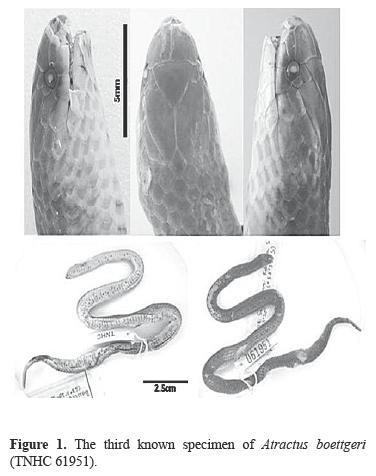
<body><![CDATA[<p align="justify"><font face="verdana" size="2"><b>Resumen</b></font></p> 				    <p align="justify"><font face="verdana" size="2">Se reporta una extensi&oacute;n de en la distribuci&oacute;n de la especie <i>Atractus boettgeri</i>, una serpiente end&eacute;mica de Bolivia. Esta especie se diferencia de <i>A. taeniatus</i> por tener un n&uacute;mero segmental muy por encima del intervalo descrito para <i>A. taeniatus</i> y por tener s&oacute;lo 6 dientes maxilares, en vez de 8&#150;9 en <i>A. taeniatus</i>. Adem&aacute;s, <i>A. boettgeri</i> se diferencia de <i>A. emmeli</i> por tener escamas supralabiales en patr&oacute;n 6&#150;6 (en vez de 7&#150;7) y tener un conteo de escamas ventrales menor en hembras (175&#150;177 versus 181&#150;189). Incluyendo &eacute;ste, todos los registros conocidos para <i>A. boettgeri</i> parecen estar asociados con la vegetaci&oacute;n del Cerrado en Bolivia. El ejemplar se encontr&oacute; en el est&oacute;mago del tat&uacute; com&uacute;n (<i>Dasypus novemcinctus</i>).</font></p> 				    <p align="justify"><font face="verdana" size="2"><b>Palabras claves:</b> <i>Atractus boettgeri</i>, <i>Atractus taeniatus</i>, <i>Atractus emmeli</i>, Bolivia.</font></p> 				    <p align="justify"><font face="verdana" size="2">&nbsp;</font></p> 				    <p align="justify"><font face="verdana" size="2">The genus <i>Atractus</i> includes over 100 species of semi&#150;fossorial colubrids distributed from eastern Panama (Myers, 2003) to southern Brazil and northern Argentina (Giraudo and Scrocchi, 2000; Schargel and Castoe, 2003). At present, the taxonomy of <i>Atractus</i> is poorly understood, in part due to the paucity of museum records, but also due to the lack of a modern revision on a continental scale (Passos et al., 2005). The available data suggest that most species in the genus have restricted distributions (Jorge da Silva Jr et al., 2005), although it has also been suggested that this may be a sampling artifact of their semi&#150;fossorial habits (see Myers, 2003 for a discussion on Panamanian species). Regardless, little is known about the ecology or evolution of many of its species (see Zaher et al., 2005 for an exception). <i>Atractus boettgeri</i> is a Bolivian endemic (Gonz&aacute;lez and Reichle, 2003) currently known from only 2 localities in central Bolivia: the type locality in Cochabamba (Cunha and Nascemento, 1983) and a second locality in the Department of Santa Cruz (McCoy, 1971). Here we report a third locality and specimen of <i>A. boettgeri</i> from the Department of El Beni; this new record extends the known range of the species almost 100 km east of the type locality and more than 300 km north of the Santa Cruz de la Sierra record.</font></p> 				    <p align="justify"><font face="verdana" size="2">A specimen of <i>Atractus boettgeri</i> was found in the stomach of a Common Long&#150;Nosed Armadillo (<i>Dasypus novemcinctus</i>) at the following specific locality: Bolivia; Department Beni: 1.4 km N of San Pablo; 15&deg; 14' 32"S and 63&deg; 52' 43" W (GPS datum WGS 84), 195 m elev. Both, the position of the snake in the digestive tract of the armadillo and the condition of the snake suggest that it had been ingested no more than a couple of hours before the armadillo was shot (at ca. 5 a.m.) by local farmers. The snake is currently cataloged in the Herpetology Division of the Texas Natural History Collections, University of Texas at Austin (TNHC 61951). The skull of the armadillo is cataloged in the Division of Mammals at the Museum of Southwestern Biology, University of New Mexico (MSB 99077).</font></p> 				    <p align="justify"><font face="verdana" size="2">The snake is a female with a standard length of 244 mm and a tail length of 19 mm (7.2% of total length). There had been some digestion of the anterior head region (<a href="#f1">Fig 1</a>), but it is clearly a representative of the colubrid genus <i>Atractus</i> because it has only 1 pair of genials and 1+2 temporals. Other scutellation features are: dorsal scales smooth in 15&#150;15&#150;15 rows; rostral smaller than either prefrontal; internasals small, much less than half the size of either prefrontal; prefrontals long, at least one and a half times as long as broad; loreal elongate, bordering orbit; no preocular; postoculars 1&#150;1; temporals 1+2/1+2; 6&#150;6 supralabials, 3&#150;4/3&#150;4 bordering orbit; infralabials 7&#150;7, 4 bordering genials; subcloacal plate entire; ventrals 175; subcaudals 25; ventrals plus subcaudals 200; 6 maxillary teeth.</font></p> 				    <p align="center"><font face="verdana" size="2"><a name="f1"></a></font></p> 				    <p align="center"><font face="verdana" size="2"><img src="/img/revistas/rmbiodiv/v81n3/a33f1.jpg"></font></p> 				    <p align="justify"><font face="verdana" size="2">A brown head cap extends from the tip of the snout back to the level of the posterior margin of the orbit. The cap is followed by a lighter brown head band extending across the posterior part of the head onto the first dorsal scale row. This appears to be a light head band probably suffused with darker pigment ontogenetically. The dorsal and caudal surfaces are brown with considerable dark pigment concentrated at the tip of some scales to produce scattered dark spots. These spots tend to line up as a faint dark middorsal stripe on the posterior part of the body. The labials, chin, and throat are light with some brown spotting. The venter is yellowish and speckled with brown pigment which tends to be concentrated as irregular broken lines on the posterior margin of each ventral. The subcaudals are heavily marked with brown.</font></p> 				    ]]></body>
<body><![CDATA[<p align="justify"><font face="verdana" size="2"><i>On the specific identity of TNHC 61951.</i></font></p> 				    <p align="justify"><font face="verdana" size="2">Three species described originally from Bolivia were considered as possibly conspecific with our specimen: <i>Atractus boettgeri</i>  Boulenger, 1896 (Bolivia: Cochabamba: Sierra de las Yungas), <i>Atractus emmeli</i> Boettger, 1888 (Bolivia: La Paz: R&iacute;o Mapiri, 490 m), and <i>Atractus taeniatus</i> Griffin, 1916 (from Bolivia: Santa Cruz: Santa Cruz de la Sierra, 480 m). The type specimens for these names agree with TNHC 61951in having 15&#150;15&#150;15 dorsal scale rows, and in the number and conformation of the head scales, except they have 2&#150;2 postoculars instead of 1&#150;1. Moreover, <i>A. emmeli</i> differs from the other 2 species and TNHC 61951 in having 7&#150;7 supralabials. Segmental counts of the type specimens of the 3 candidate species are presented in <a href="/img/revistas/rmbiodiv/v81n3/a33t1.jpg" target="_blank">Table 1</a>. The types of both <i>A. emmeli</i> and <i>A. boettgeri</i> have essentially uniform dark upper surfaces, but that of <i>A. taeniatus</i> has a light head band bordered posteriorly by a dark band, a dark middorsal stripe, and a dark midventral stripe on a light ground color.</font></p> 				    <p align="justify"><font face="verdana" size="2">Boulenger (1896) listed additional examples of <i>Atractus emmeli</i> from Bolivia with the following segmental counts: 2 males with 158&#150;167 ventrals, 27 subcaudals; 185&#150;194 totals; and 3 females with 181&#150;189 ventrals, 21&#150;26 subcaudals; 202&#150;215 totals. He also referred a female specimen from Belem do Para, Brazil to <i>A. emmeli</i>. The segmental counts (161 ventrals, 16 subcaudals, and 177 total) are well below those for females from Bolivia (181&#150;189; 21&#150;26; 202&#150;215) and this snake doubtless represents a different species. Schmidt and Walker (1943) identified a specimen at the Universidad de Arequipa from an unknown locality in Peru as <i>A. emmeli</i>. The snake is a female with 188 ventrals, 22 subcaudals; 210 totals, and has dark spots in its dorsal pattern. We suspect that this is an undescribed Peruvian species and have not used its characteristics in comparisons. </font></p> 				    <p align="justify"><font face="verdana" size="2"> McCoy (1971) reported on an additional specimen (CM 2822, a female) of a putative <i>A. boettgeri</i> from Bolivia: Santa Cruz: Santa Cruz de la Sierra (480 m), with 175 ventrals, 22 subcaudals (total 197). He also reported a male of <i>A. taeniatus</i> (CM 2932) with 151 ventrals, 23 subcaudals (total 174) from Bolivia: Santa Cruz: Buenavista, 400 m. The upper surfaces of the male were uniform brown, a light head band was present, and the ventrals were light with dark edges. The upper surfaces of the female were brown and the venter spotted with brown. McCoy (1971) concluded that the differences in scale counts between <i>A. boettgeri</i> and <i>A. taeniatus</i> were due to sexual dimorphism and that the presence of a light head band was a juvenile feature as the Buenavista specimen was 149 mm in total length. On this foundation, he consequently synonymized <i>A. taeniatus</i> with <i>A. boettgeri</i>.</font></p> 				    <p align="justify"><font face="verdana" size="2">Williams and Gudynas (1991) described samples from Argentina (Buenos Aires, Entre R&iacute;os and Missiones Provinces), which conformed closely in coloration with the type of <i>A. taeniatus</i>. In their series of 2 males and 4 females the segmental counts were 146&#150;150 ventrals, 24&#150;33 subcaudals and 141&#150;153 ventrals, 25&#150;30 subcaudals, respectively. Maxillary teeth numbered 8&#150;9 and all had a light head band. The dorsal pattern consisted of a regular to irregular mid&#150;dorsal dark stripe or a series of elongate dark spots corresponding to an interrupted mid&#150;dorsal stripe; the venter was yellow with only small brown spots not organized into a distinct midventral stripe. The type of <i>A. boettgeri</i> and McCoy's Santa Cruz de la Sierra specimen (both females) had 177 and 175 ventrals, 20 and 22 subcaudals, respectively, for a total of 197 in both examples. Williams and Gudynas (1991) concluded that <i>A. boettgeri</i> was a valid taxon as there was no overlap in segmental counts with the larger sample of <i>A. taeniatus</i> from Argentina. Both of these species co&#150;occur at Santa Cruz de la Sierra, further confirming their validity.</font></p> 				    <p align="justify"><font face="verdana" size="2"><i>Atractus emmeli</i> (Boettger, 1888; Boulenger, 1896) differs from both <i>A. boettgeri</i> and <i>A. taeniatus</i> in having 158&#150;170 ventrals in males and 181&#150;189 in females compared with <i>A. boettgeri</i> with 175&#150;177 ventrals in females, and <i>A. taeniatus</i> with 146&#150;152 ventrals in males, 141&#150;153 in females. It also has 7&#150;7 supralabials versus 6&#150;6 in the other 2 species. </font></p> 				    <p align="justify"><font face="verdana" size="2">The snake reported here (TNHC 61951) has segmental counts (175 ventrals, 25 subcaudals; 200 totals) well outside the range for <i>A. taeniatus</i>. It further differs from <i>A. taeniatus</i> in having 6 maxillary teeth in contrast to 8&#150;9 in the latter. It differs from <i>A. emmeli</i> in having 6&#150;6 supralabials (versus 7&#150;7) and fewer ventrals (175&#150;177 versus 181&#150;189 in females). We thus conclude that it is the third known representative of <i>A. boettgeri</i>. Interestingly, the dorsal pattern in this snake is reminiscent of that in <i>A. taeniatus</i>, having a series of interrupted elongate spots in place of the mid&#150;dorsal dark stripe, while the type of <i>A. boettgeri</i> and the specimen reported by McCoy (1971) have an essentially uniform pattern. As pointed out by Savage (1960), this is not an uncommon level of intraspecific variation in coloration for <i>Atractus</i>.</font></p> 				    <p align="justify"><font face="verdana" size="2">Detailed comparisons between the holotype of <i>A. boettgeri</i> and various specimens of A. albuquerquei were conducted by Zaher et al. (2005). Except for the fact that the snake reported here (TNHC 61951) shows the highest count of subcaudals of any of the 3 known specimens of <i>A. boettgeri</i> (25, instead of 20 in the holotype and 23 in the specimen reported by McCoy, 1971), and that it shows only 1 postocular scale on both sides (versus 2+2 in both the holotype and McCoy's specimen), all differences reported in Zaher et al. (2005) between boettgeri and albuquerquei are also evident for TNHC 61951. Moreover, our specimen resembles the holotype of <i>A. boettgeri</i> depicted in Zaher et al. (2005) in all qualitative characters.</font></p> 				    <p align="justify"><font face="verdana" size="2">The 3 known records of <i>A. boettgeri</i> are associated with the Cerrado savannas of central Bolivia (<a href="/img/revistas/rmbiodiv/v81n3/a33f2.jpg" target="_blank">Fig 2</a>). Interestingly, the Cerrado biome was recognized by Myers et al. (2000) as a center of high endemism for several groups of vertebrates, including reptiles (&gt;20% of endemism). In fact, the Cerrado is included among the 25 biodiversity hotspots of the world because of its large number of endemic species and the high levels of human disturbance (Myers et al., 2000). </font></p> 				    <p align="justify"><font face="verdana" size="2">Snakes have been reported from the diet of the Common Long&#150;Nosed Armadillo in Alabama and Florida (Breece and Dusi, 1985; Wirtz et al., 1985), but apparently not from South America (Redford, 1985; Anacleto, 2007). Several general accounts of armadillo ecology mention the fact that some species feed on small vertebrates. Our report and that of Bezerra et al. (2001) support these claims at least for colubrid snakes and mice, respectively. Large quantities of soil and a few insects (Formicidae, Scarabeidae) were also found in the stomach of the Long&#150;Nosed Armadillo.</font></p> 				    ]]></body>
<body><![CDATA[<p align="justify"><font face="verdana" size="2">We thank the Colecci&oacute;n Boliviana de Fauna for granting the permits to work in Bolivia. Special thanks to Jon Dunnum (Division of Mammals, Museum of Southwestern Biology, University of New Mexico) for confirming the identification of the armadillo. This research was supported in part by a grant from the National Science Foundation to M.L. Jameson and F.C. Ocampo (NSF&#150;DBI 0500767).</font></p> 				    <p align="justify"><font face="verdana" size="2">&nbsp;</font></p> 				    <p align="justify"><font face="verdana" size="2"><b>Literature cited</b></font></p> 				    <!-- ref --><p align="justify"><font face="verdana" size="2">Anacleto, T. 2007. Food habits of four armadillo species in the Cerrado area, Mato Grosso, Brazil. Zoological Studies 46:529&#150;537.    &nbsp;&nbsp;&nbsp;&nbsp;&nbsp;&nbsp;&nbsp;&nbsp;[&#160;<a href="javascript:void(0);" onclick="javascript: window.open('/scielo.php?script=sci_nlinks&ref=7546173&pid=S1870-3453201000030003300001&lng=','','width=640,height=500,resizable=yes,scrollbars=1,menubar=yes,');">Links</a>&#160;]<!-- end-ref --></font></p> 				    <!-- ref --><p align="justify"><font face="verdana" size="2">Bezerra, A. M. R., F. H. G. Rodrigues and A. P. Carmignotto. 2001. Predation of rodents by the yellow armadillo (<i>Euphractus sexcinctus</i>) in Cerrado of the Central Brazil. Mammalia 65:86&#150;88.    &nbsp;&nbsp;&nbsp;&nbsp;&nbsp;&nbsp;&nbsp;&nbsp;[&#160;<a href="javascript:void(0);" onclick="javascript: window.open('/scielo.php?script=sci_nlinks&ref=7546175&pid=S1870-3453201000030003300002&lng=','','width=640,height=500,resizable=yes,scrollbars=1,menubar=yes,');">Links</a>&#160;]<!-- end-ref --></font></p> 				    <!-- ref --><p align="justify"><font face="verdana" size="2">Boettger, O. 1888. Beitrag zur Reptilien des oberen Beni in Bolivia. Bericht der Senckenbergischen Naturforschenden Gesellschaft in Frankfurt am Main 1888:191&#150;199.    &nbsp;&nbsp;&nbsp;&nbsp;&nbsp;&nbsp;&nbsp;&nbsp;[&#160;<a href="javascript:void(0);" onclick="javascript: window.open('/scielo.php?script=sci_nlinks&ref=7546177&pid=S1870-3453201000030003300003&lng=','','width=640,height=500,resizable=yes,scrollbars=1,menubar=yes,');">Links</a>&#160;]<!-- end-ref --></font></p> 				    <!-- ref --><p align="justify"><font face="verdana" size="2">Boulenger, G. A. 1896. Catalogue of the snakes in the British Museum (Natural History). Vol. 3. Taylor &amp; Francis, xiv + 727 p.    &nbsp;&nbsp;&nbsp;&nbsp;&nbsp;&nbsp;&nbsp;&nbsp;[&#160;<a href="javascript:void(0);" onclick="javascript: window.open('/scielo.php?script=sci_nlinks&ref=7546179&pid=S1870-3453201000030003300004&lng=','','width=640,height=500,resizable=yes,scrollbars=1,menubar=yes,');">Links</a>&#160;]<!-- end-ref --></font></p> 				    <!-- ref --><p align="justify"><font face="verdana" size="2">Breece G. A. and J. L. Dusi. 1985. Food habits and home ranges of the common long&#150;nosed armadillo <i>Dasypus novemcinctus</i> in Alabama. <i>In</i> Ecology of armadillos, sloths, and vermilinguas, G. G. Montgomery (ed.). Smithsonian Institution Press. Washington, D.C. p. 419&#150;428.    &nbsp;&nbsp;&nbsp;&nbsp;&nbsp;&nbsp;&nbsp;&nbsp;[&#160;<a href="javascript:void(0);" onclick="javascript: window.open('/scielo.php?script=sci_nlinks&ref=7546181&pid=S1870-3453201000030003300005&lng=','','width=640,height=500,resizable=yes,scrollbars=1,menubar=yes,');">Links</a>&#160;]<!-- end-ref --> </font></p> 				    <!-- ref --><p align="justify"><font face="verdana" size="2">Cunha, O. R. Da and F.P. Do Nascimento. 1983, Of&iacute;dios da Amaz&ocirc;nia XX&#150;as esp&eacute;cies de <i>Atractus</i> Wagler, 1828, na Amaz&ocirc;nia oriental e Maranh&atilde;o. (Ophidia, Colubridae). Boletim Museu Paraense E. Goeldi, nova serie Zoologia 123:1&#150;38.    &nbsp;&nbsp;&nbsp;&nbsp;&nbsp;&nbsp;&nbsp;&nbsp;[&#160;<a href="javascript:void(0);" onclick="javascript: window.open('/scielo.php?script=sci_nlinks&ref=7546183&pid=S1870-3453201000030003300006&lng=','','width=640,height=500,resizable=yes,scrollbars=1,menubar=yes,');">Links</a>&#160;]<!-- end-ref --></font></p> 				    <!-- ref --><p align="justify"><font face="verdana" size="2">Giraudo, A. R. and G. J. Scrocchi. 2000. The genus <i>Atractus</i> (Serpentes: Colubridae) in north&#150;eastern Argentina. Herpetological Journal 10:81&#150;90.    &nbsp;&nbsp;&nbsp;&nbsp;&nbsp;&nbsp;&nbsp;&nbsp;[&#160;<a href="javascript:void(0);" onclick="javascript: window.open('/scielo.php?script=sci_nlinks&ref=7546185&pid=S1870-3453201000030003300007&lng=','','width=640,height=500,resizable=yes,scrollbars=1,menubar=yes,');">Links</a>&#160;]<!-- end-ref --></font></p> 				    <!-- ref --><p align="justify"><font face="verdana" size="2">Gonz&aacute;lez, L. and S. Reichle. 2003. Lista de reptiles presentes en Bolivia. Anexo 3. <i>In</i> Biodiversidad: La riqueza de Bolivia. Estado de conocimiento y conservaci&oacute;n, P. Ibisch and G. M&eacute;rida (eds.). Ministerio de Desarrollo Sostenible. Editorial FAN, Santa Cruz de la Sierra, Bolivia. p. 587&#150;589.    &nbsp;&nbsp;&nbsp;&nbsp;&nbsp;&nbsp;&nbsp;&nbsp;[&#160;<a href="javascript:void(0);" onclick="javascript: window.open('/scielo.php?script=sci_nlinks&ref=7546187&pid=S1870-3453201000030003300008&lng=','','width=640,height=500,resizable=yes,scrollbars=1,menubar=yes,');">Links</a>&#160;]<!-- end-ref --></font></p> 				    <!-- ref --><p align="justify"><font face="verdana" size="2">Griffin, L. E. 1916. A catalog of the Ophidia from South America at present (June, 1916) contained in the Carnegie Museum, with descriptions of some new species. Memoirs of the Carnegie Museum 7:163&#150;228.    &nbsp;&nbsp;&nbsp;&nbsp;&nbsp;&nbsp;&nbsp;&nbsp;[&#160;<a href="javascript:void(0);" onclick="javascript: window.open('/scielo.php?script=sci_nlinks&ref=7546189&pid=S1870-3453201000030003300009&lng=','','width=640,height=500,resizable=yes,scrollbars=1,menubar=yes,');">Links</a>&#160;]<!-- end-ref --></font></p> 				    <!-- ref --><p align="justify"><font face="verdana" size="2">Jorge Da Silva Jr, N., H. L. R. Silva, R. S. Ribeiro, I. Souza and C. D. A. Souza. 2005. A new species in the genus <i>Atractus</i> Wagler, 1928 (Colubridae: Dipsadinae) in the Cerrado region of Central Brazil. Papeis Avulsos de Zoologia (Sao Paulo) 45:33&#150;39.    &nbsp;&nbsp;&nbsp;&nbsp;&nbsp;&nbsp;&nbsp;&nbsp;[&#160;<a href="javascript:void(0);" onclick="javascript: window.open('/scielo.php?script=sci_nlinks&ref=7546191&pid=S1870-3453201000030003300010&lng=','','width=640,height=500,resizable=yes,scrollbars=1,menubar=yes,');">Links</a>&#160;]<!-- end-ref --></font></p> 				    <!-- ref --><p align="justify"><font face="verdana" size="2">Josse, C., G. Navarro, P. Comer, R. Evans, D. Faber&#150;Langendoen, M. Fellows, G. Kittel, S. Menard, M. Pyne, M. Reid, K. Schulz, K. Snow and J. Teague. 2003. Ecological systems of Latin America and the Caribbean: A working classification of terrestrial systems. Natureserve, Arlington. 47 p.    &nbsp;&nbsp;&nbsp;&nbsp;&nbsp;&nbsp;&nbsp;&nbsp;[&#160;<a href="javascript:void(0);" onclick="javascript: window.open('/scielo.php?script=sci_nlinks&ref=7546193&pid=S1870-3453201000030003300011&lng=','','width=640,height=500,resizable=yes,scrollbars=1,menubar=yes,');">Links</a>&#160;]<!-- end-ref --></font></p> 				    <!-- ref --><p align="justify"><font face="verdana" size="2">McCoy, C. J. 1971. Comments on Bolivian <i>Atractus</i> (Serpentes, Colubridae). Herpetologica 27:314&#150;316.    &nbsp;&nbsp;&nbsp;&nbsp;&nbsp;&nbsp;&nbsp;&nbsp;[&#160;<a href="javascript:void(0);" onclick="javascript: window.open('/scielo.php?script=sci_nlinks&ref=7546195&pid=S1870-3453201000030003300012&lng=','','width=640,height=500,resizable=yes,scrollbars=1,menubar=yes,');">Links</a>&#160;]<!-- end-ref --></font></p> 				    <!-- ref --><p align="justify"><font face="verdana" size="2">Myers, C. W. 2003. Rare snakes &#150; Five new species from eastern Panama: Reviews of northern <i>Atractus</i> and southern Geophis (Colubridae: Dipsadinae). American Museum Novitates 391:1&#150;47.    &nbsp;&nbsp;&nbsp;&nbsp;&nbsp;&nbsp;&nbsp;&nbsp;[&#160;<a href="javascript:void(0);" onclick="javascript: window.open('/scielo.php?script=sci_nlinks&ref=7546197&pid=S1870-3453201000030003300013&lng=','','width=640,height=500,resizable=yes,scrollbars=1,menubar=yes,');">Links</a>&#160;]<!-- end-ref --></font></p> 				    <!-- ref --><p align="justify"><font face="verdana" size="2">Myers, N., R. Mittermier, C. Mittermier, G. Fonseca and J. Kent 2000. Biodiversity hotspots for conservation priorities. Nature 403:853&#150;858.    &nbsp;&nbsp;&nbsp;&nbsp;&nbsp;&nbsp;&nbsp;&nbsp;[&#160;<a href="javascript:void(0);" onclick="javascript: window.open('/scielo.php?script=sci_nlinks&ref=7546199&pid=S1870-3453201000030003300014&lng=','','width=640,height=500,resizable=yes,scrollbars=1,menubar=yes,');">Links</a>&#160;]<!-- end-ref --> </font></p> 				    <!-- ref --><p align="justify"><font face="verdana" size="2">Passos, P., R. Fernandes and N. Zanella. 2005. A new species of <i>Atractus</i> (Serpentes: Colubridae) from southern Brazil. Herpetologica 61:209&#150;218.    &nbsp;&nbsp;&nbsp;&nbsp;&nbsp;&nbsp;&nbsp;&nbsp;[&#160;<a href="javascript:void(0);" onclick="javascript: window.open('/scielo.php?script=sci_nlinks&ref=7546201&pid=S1870-3453201000030003300015&lng=','','width=640,height=500,resizable=yes,scrollbars=1,menubar=yes,');">Links</a>&#160;]<!-- end-ref --></font></p> 				    <!-- ref --><p align="justify"><font face="verdana" size="2">Redford, K. H. 1985. Foods habits of armadillos (Xenarthra: Dasypodidae).<i> In</i> Ecology of armadillos, sloths, and vermilinguas, G. G. Montgomery (ed.). Smithsonian Institution Press, Washington, D.C. p. 429&#150;437.    &nbsp;&nbsp;&nbsp;&nbsp;&nbsp;&nbsp;&nbsp;&nbsp;[&#160;<a href="javascript:void(0);" onclick="javascript: window.open('/scielo.php?script=sci_nlinks&ref=7546203&pid=S1870-3453201000030003300016&lng=','','width=640,height=500,resizable=yes,scrollbars=1,menubar=yes,');">Links</a>&#160;]<!-- end-ref --></font></p> 				    <!-- ref --><p align="justify"><font face="verdana" size="2">Savage, J. M. 1960. A revision of the Ecuadorian snakes of the colubrid genus <i>Atractus</i>. Miscellaneous Publications Museum of Zoology, University of Michigan 112:1&#150;86.    &nbsp;&nbsp;&nbsp;&nbsp;&nbsp;&nbsp;&nbsp;&nbsp;[&#160;<a href="javascript:void(0);" onclick="javascript: window.open('/scielo.php?script=sci_nlinks&ref=7546205&pid=S1870-3453201000030003300017&lng=','','width=640,height=500,resizable=yes,scrollbars=1,menubar=yes,');">Links</a>&#160;]<!-- end-ref --> </font></p> 				    <!-- ref --><p align="justify"><font face="verdana" size="2">Schargel, W. E. and T. A. Castoe. 2003. The hemipenes of some snakes of the semifossorial genus <i>Atractus</i>, with comments on variation in the genus. Journal of Herpetology 37:718&#150;721.    &nbsp;&nbsp;&nbsp;&nbsp;&nbsp;&nbsp;&nbsp;&nbsp;[&#160;<a href="javascript:void(0);" onclick="javascript: window.open('/scielo.php?script=sci_nlinks&ref=7546207&pid=S1870-3453201000030003300018&lng=','','width=640,height=500,resizable=yes,scrollbars=1,menubar=yes,');">Links</a>&#160;]<!-- end-ref --></font></p> 				    <!-- ref --><p align="justify"><font face="verdana" size="2">Schmidt, K. P. and W. F. Walker, Jr. 1943. Peruvian snakes from the University of Arequipa. Zoological Series of Field Museum of Natural History 24:279&#150;296.    &nbsp;&nbsp;&nbsp;&nbsp;&nbsp;&nbsp;&nbsp;&nbsp;[&#160;<a href="javascript:void(0);" onclick="javascript: window.open('/scielo.php?script=sci_nlinks&ref=7546209&pid=S1870-3453201000030003300019&lng=','','width=640,height=500,resizable=yes,scrollbars=1,menubar=yes,');">Links</a>&#160;]<!-- end-ref --></font></p> 				    <!-- ref --><p align="justify"><font face="verdana" size="2">Williams, J. D. and E. Gudynas. 1991. Revalidation and redescription of <i>Atractus taeniatus</i> Griffin, 1916 (Serpentes: Colubridae). Contribuciones en Biologia Centro Investigacion y Promocion Franciscano y Ecologia Centro Educacion Don Orione 15:1&#150;8.    &nbsp;&nbsp;&nbsp;&nbsp;&nbsp;&nbsp;&nbsp;&nbsp;[&#160;<a href="javascript:void(0);" onclick="javascript: window.open('/scielo.php?script=sci_nlinks&ref=7546211&pid=S1870-3453201000030003300020&lng=','','width=640,height=500,resizable=yes,scrollbars=1,menubar=yes,');">Links</a>&#160;]<!-- end-ref --></font></p> 				    <!-- ref --><p align="justify"><font face="verdana" size="2">Wirtz W. O., D. H. Austin and G. W. Dekle. 1985. Food habits of the common long&#150;nosed armadillo <i>Dasypus novemcinctus</i> in Florida, 1960&#150;1961. <i>In</i> Ecology of armadillos, sloths, and vermilinguas, G. G. Montgomery (ed.). Smithsonian Institution Press, Washington, D.C. p. 439&#150;451.    &nbsp;&nbsp;&nbsp;&nbsp;&nbsp;&nbsp;&nbsp;&nbsp;[&#160;<a href="javascript:void(0);" onclick="javascript: window.open('/scielo.php?script=sci_nlinks&ref=7546213&pid=S1870-3453201000030003300021&lng=','','width=640,height=500,resizable=yes,scrollbars=1,menubar=yes,');">Links</a>&#160;]<!-- end-ref --></font></p> 				    <!-- ref --><p align="justify"><font face="verdana" size="2">Zaher, H., I. Souza, D. J. Gower, E. Hingst&#150;Zaher and N. Jorge Da Silva, Jr. 2005. Redescription of <i>Atractus albuquerquei</i> (Serpentes: Colubridae: Dipsadinae), with comments on geographical distribution and intraspecific variation. Papeis Avulsos de Zoologia (S&atilde;o Paulo) 45:19&#150;32.    &nbsp;&nbsp;&nbsp;&nbsp;&nbsp;&nbsp;&nbsp;&nbsp;[&#160;<a href="javascript:void(0);" onclick="javascript: window.open('/scielo.php?script=sci_nlinks&ref=7546215&pid=S1870-3453201000030003300022&lng=','','width=640,height=500,resizable=yes,scrollbars=1,menubar=yes,');">Links</a>&#160;]<!-- end-ref --></font></p>      ]]></body><back>
<ref-list>
<ref id="B1">
<nlm-citation citation-type="journal">
<person-group person-group-type="author">
<name>
<surname><![CDATA[Anacleto]]></surname>
<given-names><![CDATA[T]]></given-names>
</name>
</person-group>
<article-title xml:lang="en"><![CDATA[Food habits of four armadillo species in the Cerrado area, Mato Grosso, Brazil]]></article-title>
<source><![CDATA[Zoological Studies]]></source>
<year>2007</year>
<volume>46</volume>
<page-range>529-537</page-range></nlm-citation>
</ref>
<ref id="B2">
<nlm-citation citation-type="journal">
<person-group person-group-type="author">
<name>
<surname><![CDATA[Bezerra]]></surname>
<given-names><![CDATA[A. M. R]]></given-names>
</name>
<name>
<surname><![CDATA[Rodrigues]]></surname>
<given-names><![CDATA[F. H. G]]></given-names>
</name>
<name>
<surname><![CDATA[Carmignotto]]></surname>
<given-names><![CDATA[A. P]]></given-names>
</name>
</person-group>
<article-title xml:lang="en"><![CDATA[Predation of rodents by the yellow armadillo (Euphractus sexcinctus) in Cerrado of the Central Brazil]]></article-title>
<source><![CDATA[Mammalia]]></source>
<year>2001</year>
<volume>65</volume>
<page-range>86-88</page-range></nlm-citation>
</ref>
<ref id="B3">
<nlm-citation citation-type="journal">
<person-group person-group-type="author">
<name>
<surname><![CDATA[Boettger]]></surname>
<given-names><![CDATA[O]]></given-names>
</name>
</person-group>
<article-title xml:lang="en"><![CDATA[Beitrag zur Reptilien des oberen Beni in Bolivia]]></article-title>
<source><![CDATA[Bericht der Senckenbergischen Naturforschenden Gesellschaft in Frankfurt am Main]]></source>
<year>1888</year>
<volume>1888</volume>
<page-range>191-199</page-range></nlm-citation>
</ref>
<ref id="B4">
<nlm-citation citation-type="book">
<person-group person-group-type="author">
<name>
<surname><![CDATA[Boulenger]]></surname>
<given-names><![CDATA[G. A]]></given-names>
</name>
</person-group>
<source><![CDATA[Catalogue of the snakes in the British Museum (Natural History)]]></source>
<year>1896</year>
<volume>3</volume>
<page-range>727</page-range><publisher-name><![CDATA[Taylor & Francis]]></publisher-name>
</nlm-citation>
</ref>
<ref id="B5">
<nlm-citation citation-type="book">
<person-group person-group-type="author">
<name>
<surname><![CDATA[Breece]]></surname>
<given-names><![CDATA[G. A]]></given-names>
</name>
<name>
<surname><![CDATA[Dusi]]></surname>
<given-names><![CDATA[J. L]]></given-names>
</name>
</person-group>
<article-title xml:lang="en"><![CDATA[Food habits and home ranges of the common long-nosed armadillo Dasypus novemcinctus in Alabama]]></article-title>
<person-group person-group-type="editor">
<name>
<surname><![CDATA[Montgomery]]></surname>
<given-names><![CDATA[G. G]]></given-names>
</name>
</person-group>
<source><![CDATA[Ecology of armadillos, sloths, and vermilinguas]]></source>
<year>1985</year>
<page-range>419-428</page-range><publisher-loc><![CDATA[Washington^eD.C D.C]]></publisher-loc>
<publisher-name><![CDATA[Smithsonian Institution Press]]></publisher-name>
</nlm-citation>
</ref>
<ref id="B6">
<nlm-citation citation-type="journal">
<person-group person-group-type="author">
<name>
<surname><![CDATA[Cunha]]></surname>
<given-names><![CDATA[O. R. Da]]></given-names>
</name>
<name>
<surname><![CDATA[Nascimento]]></surname>
<given-names><![CDATA[F.P. Do]]></given-names>
</name>
</person-group>
<article-title xml:lang="pt"><![CDATA[Ofídios da Amazônia XX-as espécies de Atractus Wagler, 1828, na Amazônia oriental e Maranhão. (Ophidia, Colubridae)]]></article-title>
<source><![CDATA[Boletim Museu Paraense E. Goeldi, nova serie Zoologia]]></source>
<year>1983</year>
<volume>123</volume>
<page-range>1-38</page-range></nlm-citation>
</ref>
<ref id="B7">
<nlm-citation citation-type="journal">
<person-group person-group-type="author">
<name>
<surname><![CDATA[Giraudo]]></surname>
<given-names><![CDATA[A. R]]></given-names>
</name>
<name>
<surname><![CDATA[Scrocchi]]></surname>
<given-names><![CDATA[G. J]]></given-names>
</name>
</person-group>
<article-title xml:lang="en"><![CDATA[The genus Atractus (Serpentes: Colubridae) in north-eastern Argentina]]></article-title>
<source><![CDATA[Herpetological Journal]]></source>
<year>2000</year>
<volume>10</volume>
<page-range>81-90</page-range></nlm-citation>
</ref>
<ref id="B8">
<nlm-citation citation-type="book">
<person-group person-group-type="author">
<name>
<surname><![CDATA[González]]></surname>
<given-names><![CDATA[L]]></given-names>
</name>
<name>
<surname><![CDATA[Reichle]]></surname>
<given-names><![CDATA[S]]></given-names>
</name>
</person-group>
<article-title xml:lang="es"><![CDATA[Lista de reptiles presentes en Bolivia. Anexo 3]]></article-title>
<person-group person-group-type="editor">
<name>
<surname><![CDATA[Ibisch]]></surname>
<given-names><![CDATA[P]]></given-names>
</name>
<name>
<surname><![CDATA[Mérida]]></surname>
<given-names><![CDATA[G]]></given-names>
</name>
</person-group>
<source><![CDATA[Biodiversidad: La riqueza de Bolivia. Estado de conocimiento y conservación]]></source>
<year>2003</year>
<page-range>587-589</page-range><publisher-loc><![CDATA[Santa Cruz de la Sierra ]]></publisher-loc>
<publisher-name><![CDATA[Ministerio de Desarrollo SostenibleEditorial FAN]]></publisher-name>
</nlm-citation>
</ref>
<ref id="B9">
<nlm-citation citation-type="journal">
<person-group person-group-type="author">
<name>
<surname><![CDATA[Griffin]]></surname>
<given-names><![CDATA[L. E]]></given-names>
</name>
</person-group>
<article-title xml:lang="en"><![CDATA[A catalog of the Ophidia from South America at present (June, 1916) contained in the Carnegie Museum, with descriptions of some new species]]></article-title>
<source><![CDATA[Memoirs of the Carnegie Museum]]></source>
<year>1916</year>
<volume>7</volume>
<page-range>163-228</page-range></nlm-citation>
</ref>
<ref id="B10">
<nlm-citation citation-type="journal">
<person-group person-group-type="author">
<name>
<surname><![CDATA[Jorge Da Silva Jr]]></surname>
<given-names><![CDATA[N]]></given-names>
</name>
<name>
<surname><![CDATA[Silva]]></surname>
<given-names><![CDATA[H. L. R]]></given-names>
</name>
<name>
<surname><![CDATA[Ribeiro]]></surname>
<given-names><![CDATA[R. S]]></given-names>
</name>
<name>
<surname><![CDATA[Souza]]></surname>
<given-names><![CDATA[I]]></given-names>
</name>
<name>
<surname><![CDATA[Souza]]></surname>
<given-names><![CDATA[C. D. A]]></given-names>
</name>
</person-group>
<article-title xml:lang="en"><![CDATA[A new species in the genus Atractus Wagler, 1928 (Colubridae: Dipsadinae) in the Cerrado region of Central Brazil]]></article-title>
<source><![CDATA[Papeis Avulsos de Zoologia]]></source>
<year>2005</year>
<volume>45</volume>
<page-range>33-39</page-range></nlm-citation>
</ref>
<ref id="B11">
<nlm-citation citation-type="book">
<person-group person-group-type="author">
<name>
<surname><![CDATA[Josse]]></surname>
<given-names><![CDATA[C]]></given-names>
</name>
<name>
<surname><![CDATA[Navarro]]></surname>
<given-names><![CDATA[G]]></given-names>
</name>
<name>
<surname><![CDATA[Comer]]></surname>
<given-names><![CDATA[P]]></given-names>
</name>
<name>
<surname><![CDATA[Evans]]></surname>
<given-names><![CDATA[R]]></given-names>
</name>
<name>
<surname><![CDATA[Faber-Langendoen]]></surname>
<given-names><![CDATA[D]]></given-names>
</name>
<name>
<surname><![CDATA[Fellows]]></surname>
<given-names><![CDATA[M]]></given-names>
</name>
<name>
<surname><![CDATA[Kittel]]></surname>
<given-names><![CDATA[G]]></given-names>
</name>
<name>
<surname><![CDATA[Menard]]></surname>
<given-names><![CDATA[S]]></given-names>
</name>
<name>
<surname><![CDATA[Pyne]]></surname>
<given-names><![CDATA[M]]></given-names>
</name>
<name>
<surname><![CDATA[Reid]]></surname>
<given-names><![CDATA[M]]></given-names>
</name>
<name>
<surname><![CDATA[Schulz]]></surname>
<given-names><![CDATA[K]]></given-names>
</name>
<name>
<surname><![CDATA[Snow]]></surname>
<given-names><![CDATA[K]]></given-names>
</name>
<name>
<surname><![CDATA[Teague]]></surname>
<given-names><![CDATA[J]]></given-names>
</name>
</person-group>
<source><![CDATA[Ecological systems of Latin America and the Caribbean: A working classification of terrestrial systems]]></source>
<year>2003</year>
<page-range>47</page-range><publisher-loc><![CDATA[Arlington ]]></publisher-loc>
<publisher-name><![CDATA[Natureserve]]></publisher-name>
</nlm-citation>
</ref>
<ref id="B12">
<nlm-citation citation-type="journal">
<person-group person-group-type="author">
<name>
<surname><![CDATA[McCoy]]></surname>
<given-names><![CDATA[C. J]]></given-names>
</name>
</person-group>
<article-title xml:lang="en"><![CDATA[Comments on Bolivian Atractus (Serpentes, Colubridae)]]></article-title>
<source><![CDATA[Herpetologica]]></source>
<year>1971</year>
<volume>27</volume>
<page-range>314-316</page-range></nlm-citation>
</ref>
<ref id="B13">
<nlm-citation citation-type="journal">
<person-group person-group-type="author">
<name>
<surname><![CDATA[Myers]]></surname>
<given-names><![CDATA[C. W]]></given-names>
</name>
</person-group>
<article-title xml:lang="en"><![CDATA[Rare snakes - Five new species from eastern Panama: Reviews of northern Atractus and southern Geophis (Colubridae: Dipsadinae)]]></article-title>
<source><![CDATA[American Museum Novitates]]></source>
<year>2003</year>
<volume>391</volume>
<page-range>1-47</page-range></nlm-citation>
</ref>
<ref id="B14">
<nlm-citation citation-type="journal">
<person-group person-group-type="author">
<name>
<surname><![CDATA[Myers]]></surname>
<given-names><![CDATA[N]]></given-names>
</name>
<name>
<surname><![CDATA[Mittermier]]></surname>
<given-names><![CDATA[R]]></given-names>
</name>
<name>
<surname><![CDATA[Mittermier]]></surname>
<given-names><![CDATA[C]]></given-names>
</name>
<name>
<surname><![CDATA[Fonseca]]></surname>
<given-names><![CDATA[G]]></given-names>
</name>
<name>
<surname><![CDATA[Kent]]></surname>
<given-names><![CDATA[J]]></given-names>
</name>
</person-group>
<article-title xml:lang="en"><![CDATA[Biodiversity hotspots for conservation priorities]]></article-title>
<source><![CDATA[Nature]]></source>
<year>2000</year>
<volume>403</volume>
<page-range>853-858</page-range></nlm-citation>
</ref>
<ref id="B15">
<nlm-citation citation-type="journal">
<person-group person-group-type="author">
<name>
<surname><![CDATA[Passos]]></surname>
<given-names><![CDATA[P]]></given-names>
</name>
<name>
<surname><![CDATA[Fernandes]]></surname>
<given-names><![CDATA[R]]></given-names>
</name>
<name>
<surname><![CDATA[Zanella]]></surname>
<given-names><![CDATA[N]]></given-names>
</name>
</person-group>
<article-title xml:lang="en"><![CDATA[A new species of Atractus (Serpentes: Colubridae) from southern Brazil]]></article-title>
<source><![CDATA[Herpetologica]]></source>
<year>2005</year>
<volume>61</volume>
<page-range>209-218</page-range></nlm-citation>
</ref>
<ref id="B16">
<nlm-citation citation-type="book">
<person-group person-group-type="author">
<name>
<surname><![CDATA[Redford]]></surname>
<given-names><![CDATA[K. H]]></given-names>
</name>
</person-group>
<article-title xml:lang="en"><![CDATA[Foods habits of armadillos (Xenarthra: Dasypodidae)]]></article-title>
<person-group person-group-type="editor">
<name>
<surname><![CDATA[Montgomery]]></surname>
<given-names><![CDATA[G. G]]></given-names>
</name>
</person-group>
<source><![CDATA[Ecology of armadillos, sloths, and vermilinguas]]></source>
<year>1985</year>
<page-range>429-437</page-range><publisher-loc><![CDATA[Washington^eD.C D.C]]></publisher-loc>
<publisher-name><![CDATA[Smithsonian Institution Press]]></publisher-name>
</nlm-citation>
</ref>
<ref id="B17">
<nlm-citation citation-type="journal">
<person-group person-group-type="author">
<name>
<surname><![CDATA[Savage]]></surname>
<given-names><![CDATA[J. M]]></given-names>
</name>
</person-group>
<article-title xml:lang="en"><![CDATA[A revision of the Ecuadorian snakes of the colubrid genus Atractus]]></article-title>
<source><![CDATA[Miscellaneous Publications Museum of Zoology]]></source>
<year>1960</year>
<volume>112</volume>
<page-range>1-86</page-range><publisher-name><![CDATA[University of Michigan]]></publisher-name>
</nlm-citation>
</ref>
<ref id="B18">
<nlm-citation citation-type="journal">
<person-group person-group-type="author">
<name>
<surname><![CDATA[Schargel]]></surname>
<given-names><![CDATA[W. E]]></given-names>
</name>
<name>
<surname><![CDATA[Castoe]]></surname>
<given-names><![CDATA[T. A]]></given-names>
</name>
</person-group>
<article-title xml:lang="en"><![CDATA[The hemipenes of some snakes of the semifossorial genus Atractus, with comments on variation in the genus]]></article-title>
<source><![CDATA[Journal of Herpetology]]></source>
<year>2003</year>
<volume>37</volume>
<page-range>718-721</page-range></nlm-citation>
</ref>
<ref id="B19">
<nlm-citation citation-type="journal">
<person-group person-group-type="author">
<name>
<surname><![CDATA[Schmidt]]></surname>
<given-names><![CDATA[K. P]]></given-names>
</name>
<name>
<surname><![CDATA[Walker]]></surname>
<given-names><![CDATA[W. F]]></given-names>
</name>
</person-group>
<article-title xml:lang="en"><![CDATA[Peruvian snakes from the University of Arequipa]]></article-title>
<source><![CDATA[Zoological Series of Field Museum of Natural History]]></source>
<year>1943</year>
<volume>24</volume>
<page-range>279-296</page-range></nlm-citation>
</ref>
<ref id="B20">
<nlm-citation citation-type="journal">
<person-group person-group-type="author">
<name>
<surname><![CDATA[Williams]]></surname>
<given-names><![CDATA[J. D]]></given-names>
</name>
<name>
<surname><![CDATA[Gudynas]]></surname>
<given-names><![CDATA[E]]></given-names>
</name>
</person-group>
<article-title xml:lang="en"><![CDATA[Revalidation and redescription of Atractus taeniatus Griffin, 1916 (Serpentes: Colubridae)]]></article-title>
<source><![CDATA[Contribuciones en Biologia Centro Investigacion y Promocion Franciscano y Ecologia Centro Educacion Don Orione]]></source>
<year>1991</year>
<volume>15</volume>
<page-range>1-8</page-range></nlm-citation>
</ref>
<ref id="B21">
<nlm-citation citation-type="book">
<person-group person-group-type="author">
<name>
<surname><![CDATA[Wirtz]]></surname>
<given-names><![CDATA[W. O]]></given-names>
</name>
<name>
<surname><![CDATA[Austin]]></surname>
<given-names><![CDATA[D. H]]></given-names>
</name>
<name>
<surname><![CDATA[Dekle]]></surname>
<given-names><![CDATA[G. W]]></given-names>
</name>
</person-group>
<article-title xml:lang="en"><![CDATA[Food habits of the common long-nosed armadillo Dasypus novemcinctus in Florida, 1960-1961]]></article-title>
<person-group person-group-type="editor">
<name>
<surname><![CDATA[Montgomery]]></surname>
<given-names><![CDATA[G. G]]></given-names>
</name>
</person-group>
<source><![CDATA[Ecology of armadillos, sloths, and vermilinguas]]></source>
<year>1985</year>
<page-range>439-451</page-range><publisher-loc><![CDATA[Washington^eD.C D.C]]></publisher-loc>
<publisher-name><![CDATA[Smithsonian Institution Press]]></publisher-name>
</nlm-citation>
</ref>
<ref id="B22">
<nlm-citation citation-type="journal">
<person-group person-group-type="author">
<name>
<surname><![CDATA[Zaher]]></surname>
<given-names><![CDATA[H]]></given-names>
</name>
<name>
<surname><![CDATA[Souza]]></surname>
<given-names><![CDATA[I]]></given-names>
</name>
<name>
<surname><![CDATA[Gower]]></surname>
<given-names><![CDATA[D. J]]></given-names>
</name>
<name>
<surname><![CDATA[Hingst-Zaher]]></surname>
<given-names><![CDATA[E]]></given-names>
</name>
<name>
<surname><![CDATA[Silva]]></surname>
<given-names><![CDATA[N. Jorge Da]]></given-names>
</name>
</person-group>
<article-title xml:lang="en"><![CDATA[Redescription of Atractus albuquerquei (Serpentes: Colubridae: Dipsadinae), with comments on geographical distribution and intraspecific variation]]></article-title>
<source><![CDATA[Papeis Avulsos de Zoologia (São Paulo)]]></source>
<year>2005</year>
<volume>45</volume>
<page-range>19-32</page-range></nlm-citation>
</ref>
</ref-list>
</back>
</article>
