<?xml version="1.0" encoding="ISO-8859-1"?><article xmlns:mml="http://www.w3.org/1998/Math/MathML" xmlns:xlink="http://www.w3.org/1999/xlink" xmlns:xsi="http://www.w3.org/2001/XMLSchema-instance">
<front>
<journal-meta>
<journal-id>1870-3453</journal-id>
<journal-title><![CDATA[Revista mexicana de biodiversidad]]></journal-title>
<abbrev-journal-title><![CDATA[Rev. Mex. Biodiv.]]></abbrev-journal-title>
<issn>1870-3453</issn>
<publisher>
<publisher-name><![CDATA[Instituto de Biología]]></publisher-name>
</publisher>
</journal-meta>
<article-meta>
<article-id>S1870-34532010000300030</article-id>
<title-group>
<article-title xml:lang="en"><![CDATA[Intestinal helminths of Lutjanus griseus (Perciformes: Lutjanidae) from three environments in Yucatán (Mexico), with a checklist of its parasites in the Gulf of Mexico and Caribbean region]]></article-title>
<article-title xml:lang="es"><![CDATA[Helmintos intestinales de Lutjanus griseus (Peciformes: Lutjanidae) recolectados en tres ambientes de Yucatán (México), con una lista de sus parásitos en las regiones del golfo de México y el Caribe]]></article-title>
</title-group>
<contrib-group>
<contrib contrib-type="author">
<name>
<surname><![CDATA[Argáez-García]]></surname>
<given-names><![CDATA[Nelly]]></given-names>
</name>
<xref ref-type="aff" rid="A01"/>
</contrib>
<contrib contrib-type="author">
<name>
<surname><![CDATA[Guillén-Hernández]]></surname>
<given-names><![CDATA[Sergio]]></given-names>
</name>
<xref ref-type="aff" rid="A02"/>
</contrib>
<contrib contrib-type="author">
<name>
<surname><![CDATA[Aguirre-Macedo]]></surname>
<given-names><![CDATA[M. Leopoldina]]></given-names>
</name>
<xref ref-type="aff" rid="A01"/>
</contrib>
</contrib-group>
<aff id="A01">
<institution><![CDATA[,Instituto Politécnico Nacional Centro de Investigación y Estudios Avanzados ]]></institution>
<addr-line><![CDATA[Mérida Yucatán]]></addr-line>
<country>Mexico</country>
</aff>
<aff id="A02">
<institution><![CDATA[,Universidad Autónoma de Yucatán Campus de Ciencias Biológicas y Agropecuarias Departamento de Biología Marina]]></institution>
<addr-line><![CDATA[Mérida Yucatán]]></addr-line>
<country>México</country>
</aff>
<pub-date pub-type="pub">
<day>00</day>
<month>12</month>
<year>2010</year>
</pub-date>
<pub-date pub-type="epub">
<day>00</day>
<month>12</month>
<year>2010</year>
</pub-date>
<volume>81</volume>
<numero>3</numero>
<fpage>903</fpage>
<lpage>912</lpage>
<copyright-statement/>
<copyright-year/>
<self-uri xlink:href="http://www.scielo.org.mx/scielo.php?script=sci_arttext&amp;pid=S1870-34532010000300030&amp;lng=en&amp;nrm=iso"></self-uri><self-uri xlink:href="http://www.scielo.org.mx/scielo.php?script=sci_abstract&amp;pid=S1870-34532010000300030&amp;lng=en&amp;nrm=iso"></self-uri><self-uri xlink:href="http://www.scielo.org.mx/scielo.php?script=sci_pdf&amp;pid=S1870-34532010000300030&amp;lng=en&amp;nrm=iso"></self-uri><abstract abstract-type="short" xml:lang="en"><p><![CDATA[A survey of intestinal helminth parasites of the gray snapper, Lutjanus griseus, collected at the estuarine coastal lagoon of Celestún and off the coast of the localities of Chelem and Progreso (Yucatán, Mexico) is presented together with a checklist of gray snapper intestinal helminths in the Gulf of Mexico and the Caribben region. Twenty helminth species were found at the Yucatán localities. Eigth of these have previously been reported in the Gulf of Mexico and the Caribbean region and 12 are new records for L. griseus, which increases the number of species recorded for gray snapper in the region to 44. Only 8 helminth species were recorded from fishes collected inside the coastal lagoon, while all 20 were found in fishes from offshore. Differences in species composition and infection parameters of each helminth species between both habitats are presented and discussed, together with similarities in species composition of the intestinal helminth fauna of L. griseus from Yucatán with those reported for the same host species in the Atlantic coast of USA, the Gulf of Mexico and the Caribbean regions.]]></p></abstract>
<abstract abstract-type="short" xml:lang="es"><p><![CDATA[En este trabajo se presentan los resultados del análisis helmintológico de los tractos digestivos de pargos Lutjanus griseus colectados en la laguna costera de Celestún y en la zona marina frente a las localidades de Chelem y Progreso (Yucatán, México) junto con una lista de los helmintos intestinales registrados para esta especie de hospedero en el golfo de México y la región del Caribe. Veinte especies de helmintos fueron recuperadas en las localidades de Yucatán. Solamente 8 de éstas se han registrado previamente en el golfo de México y el mar Caribe. Doce especies de helmintos son nuevos registros para L. griseus, incrementando así a 44 el número de especies para este hospedero en la región. Solo 8 especies de helmintos se recuperaron de los peces colectados en la laguna costera, mientras que todas las 20 especies se encontraron en peces colectados en la zona marina. Las diferencias en la composición de especies y los parámetros de infección de cada uno de los helmintos intestinales respecto a los peces colectados en los 3 diferentes hábitats son analizadas. Así mismo, se discute la similitud entre la helmintofauna intestinal de L. griseus en Yucatán con la registrada para la región del Atlántico de EUA, el golfo de México y el mar Caribe.]]></p></abstract>
<kwd-group>
<kwd lng="en"><![CDATA[Caribbean Sea]]></kwd>
<kwd lng="en"><![CDATA[marine fishes]]></kwd>
<kwd lng="en"><![CDATA[Mexico]]></kwd>
<kwd lng="en"><![CDATA[parasites]]></kwd>
<kwd lng="es"><![CDATA[mar Caribe]]></kwd>
<kwd lng="es"><![CDATA[peces marinos]]></kwd>
<kwd lng="es"><![CDATA[México]]></kwd>
<kwd lng="es"><![CDATA[parásitos]]></kwd>
</kwd-group>
</article-meta>
</front><body><![CDATA[ <p align="justify"><font face="verdana" size="4">Notas cient&iacute;ficas</font></p>     <p align="justify"><font face="verdana" size="2">&nbsp;</font></p>     <p align="center"><font face="verdana" size="4"><b>Intestinal helminths of <i>Lutjanus griseus</i> (Perciformes: Lutjanidae) from three environments in Yucat&aacute;n (Mexico), with a checklist of its parasites in the Gulf of Mexico and Caribbean region</b></font></p>     <p align="center"><font face="verdana" size="2">&nbsp;</font></p>     <p align="center"><font face="verdana" size="3"><b>Helmintos intestinales de <i>Lutjanus griseus</i> (Peciformes: Lutjanidae) recolectados en tres ambientes de Yucat&aacute;n (M&eacute;xico), con una lista de sus par&aacute;sitos en las regiones del golfo de M&eacute;xico y el Caribe</b></font></p>     <p align="center"><font face="verdana" size="2">&nbsp;</font></p>     <p align="center"><font face="verdana" size="2"><b>Nelly Arg&aacute;ez&#150;Garc&iacute;a<sup>1</sup>, Sergio Guill&eacute;n&#150;Hern&aacute;ndez<sup>2</sup> and M. Leopoldina Aguirre&#150;Macedo<sup>1</sup>*</b></font></p>     <p align="justify"><font face="verdana" size="2">&nbsp;</font></p>     <p align="justify"><font face="verdana" size="2"><sup><i>1</i></sup><i> Laboratorio de Parasitolog&iacute;a, Centro de Investigaci&oacute;n y Estudios Avanzados del IPN, Carretera Antigua a Progreso Km. 6, Cordemex 97310 M&eacute;rida, Yucat&aacute;n, Mexico.</i> *Correspondent: <a href="mailto:leo@mda.cinvestav.mx">leo@mda.cinvestav.mx</a></font></p>     <p align="justify"><font face="verdana" size="2"><sup><i>2</i></sup><i> Departamento de Biolog&iacute;a Marina, Campus de Ciencias Biol&oacute;gicas y Agropecuarias, Universidad Aut&oacute;noma de Yucat&aacute;n, M&eacute;rida, Yucat&aacute;n, M&eacute;xico.</i></font></p> 				    ]]></body>
<body><![CDATA[<p align="justify"><font face="verdana" size="2">&nbsp;</font></p> 				    <p align="justify"><font face="verdana" size="2">Recibido: 17 agosto 2009     <br> 				  Aceptado: 06 febrero 2010 				</font></p> 				    <p align="justify"><font face="verdana" size="2">&nbsp;</font></p> 				    <p align="justify"><font face="verdana" size="2"><b>Abstract</b></font></p> 				    <p align="justify"><font face="verdana" size="2">A survey of intestinal helminth parasites of the gray snapper, <i>Lutjanus griseus</i>, collected at the estuarine coastal lagoon of Celest&uacute;n and off the coast of the localities of Chelem and Progreso (Yucat&aacute;n, Mexico) is presented together with a checklist of gray snapper intestinal helminths in the Gulf of Mexico and the Caribben region. Twenty helminth species were found at the Yucat&aacute;n localities. Eigth of these have previously been reported in the Gulf of Mexico and the Caribbean region and 12 are new records for <i>L. griseus</i>, which increases the number of species recorded for gray snapper in the region to 44. Only 8 helminth species were recorded from fishes collected inside the coastal lagoon, while all 20 were found in fishes from offshore. Differences in species composition and infection parameters of each helminth species between both habitats are presented and discussed, together with similarities in species composition of the intestinal helminth fauna of <i>L. griseus</i> from Yucat&aacute;n with those reported for the same host species in the Atlantic coast of USA, the Gulf of Mexico and the Caribbean regions.</font></p> 				    <p align="justify"><font face="verdana" size="2"><b>Key words:</b> Caribbean Sea, marine fishes, Mexico, parasites.</font></p> 				    <p align="justify"><font face="verdana" size="2">&nbsp;</font></p> 				    <p align="justify"><font face="verdana" size="2"><b>Resumen</b></font></p> 				    <p align="justify"><font face="verdana" size="2">En este trabajo se presentan los resultados del an&aacute;lisis helmintol&oacute;gico de los tractos digestivos de pargos <i>Lutjanus griseus</i> colectados en la laguna costera de Celest&uacute;n y en la zona marina frente a las localidades de Chelem y Progreso (Yucat&aacute;n, M&eacute;xico) junto con una lista de los helmintos intestinales registrados para esta especie de hospedero en el golfo de M&eacute;xico y la regi&oacute;n del Caribe. Veinte especies de helmintos fueron recuperadas en las localidades de Yucat&aacute;n. Solamente 8 de &eacute;stas se han registrado previamente en el golfo de M&eacute;xico y el mar Caribe. Doce especies de helmintos son nuevos registros para <i>L. griseus</i>, incrementando as&iacute; a 44 el n&uacute;mero de especies para este hospedero en la regi&oacute;n. Solo 8 especies de helmintos se recuperaron de los peces colectados en la laguna costera, mientras que todas las 20 especies se encontraron en peces colectados en la zona marina. Las diferencias en la composici&oacute;n de especies y los par&aacute;metros de infecci&oacute;n de cada uno de los helmintos intestinales respecto a los peces colectados en los 3 diferentes h&aacute;bitats son analizadas. As&iacute; mismo, se discute la similitud entre la helmintofauna intestinal de <i>L. griseus</i> en Yucat&aacute;n con la registrada para la regi&oacute;n del Atl&aacute;ntico de EUA, el golfo de M&eacute;xico y el mar Caribe.</font></p> 				    ]]></body>
<body><![CDATA[<p align="justify"><font face="verdana" size="2"><b>Palabras clave:</b> mar Caribe, peces marinos, M&eacute;xico, par&aacute;sitos.</font></p> 			 			 				    <p align="justify"><font face="verdana" size="2">&nbsp;</font></p> 				    <p align="justify"><font face="verdana" size="2">The gray snapper, <i>Lutjanus griseus</i> (Linnaeus) (Lutjanidae: Perciformes) is found throughout the Gulf of Mexico and the Caribbean Sea, and is one of the most important species for commercial fisheries in the Yucat&aacute;n Peninsula (Mexicano&#150;C&iacute;ntora et al., 2007). Due to its high market value and low levels of commercial harvest, this species has been considerate a good candidate for aquaculture and stock enhancement since the 1970s (Riley et al., 2008). If the aquaculture of this species is going to be developed, it will be necessary to know which parasites could increase under high density conditions. Unfortunately, information on the helminth parasite fauna associated with this species in the Southeast of Mexico is limited to taxonomical records and only 4 published studies exist (Salgado&#150;Maldonado, 1979; Lamothe&#150;Argumedo et al., 1997). In addition, there are no records on the infection parameters for the helminth parasites of this fish species in area.</font></p> 				    <p align="justify"><font face="verdana" size="2">In this paper, we present a survey of helminth species of the digestive tract of <i>L. griseus</i> in specimens collected in Yucat&aacute;n at the coastal lagoon of Celest&uacute;n (20&deg;45' to 20&deg;58' N; 90&deg;15' to 90&deg;25' W), a nursery locality, and 2 offshore habitats for adult fish, namely the localities of Chelem (21&deg; 16' 22.72" N 89&deg; 45' 0.53" W) and Progreso (21&deg; 20' 46.44" N 89&deg; 40' 33.06" W) as well a survey of published records of intestinal helminthes of the gray snapper in the Gulf of Mexico and the Caribbean Sea. Differences in species composition and the infection parameters of the parasite fauna between the coastal lagoon habitat and the 2 offshore habitats in Yucat&aacute;n are analyzed and discussed, together with similarities in species composition of the intestinal helminth fauna of <i>L. griseus</i> from Yucat&aacute;n with those reported for the same host species in the Atlantic coast of USA, the Gulf of Mexico and the Caribbean regions.</font></p> 				    <p align="justify"><font face="verdana" size="2">A total of 114 specimens of <i>L. griseus</i> were examined from April 2000 to August 2001; 68 were collected at the coastal lagoon of Celest&uacute;n, while 21 and 25 offshore of the localities of Progreso and Chelem, respectively (<a href="#f1">Fig. 1</a>).</font></p> 				    <p align="center"><font face="verdana" size="2"><a name="f1"></a></font></p> 				    <p align="center"><font face="verdana" size="2"><img src="/img/revistas/rmbiodiv/v81n3/a30f1.jpg"></font></p> 				    <p align="justify"><font face="verdana" size="2">Fish specimens from Celest&uacute;n lagoon were caught with hook and line, while those from Chelem and Progreso were provided by local fishermen, who caught the fish with hook and line at 22 m depth. Fish were transported on ice to the laboratory immediately after being captured, where they were examined for the presence of intestinal helminths. Before examination, each specimen was weighed (g) and measured (mm). All helminths were studied in fresh, counted <i><i>in situ</i></i> and then preserved in 70% ethanol and processed for subsequent identification following conventional helminthological methods (see Vidal&#150;Mart&iacute;nez et al., 2001). Voucher specimens were deposited at the Colecci&oacute;n Nacional de Helmintos (CNHE), Instituto de Biolog&iacute;a, UNAM (Mexico City) and at the Colecci&oacute;n del Laboratorio de Parasitolog&iacute;a (CHCM) CINVESTAV del IPN, Unidad M&eacute;rida (Yucat&aacute;n, Mexico). </font></p> 				    <p align="justify"><font face="verdana" size="2">One&#150;way ANOVA was used to test for differences in host length among localities. Prevalence and mean abundance values were calculated for each helminth species at each locality following Bush et al. (1997). Similarity in prevalence and mean abundance values between localities were calculated using the percentage similarity index (Magurran, 2004). Intestinal helminth parasite records from the literature were classified in 7 geographical categories: the Atlantic (AT), with records from Atlantic coast of Florida, Bermudas and Bahamas; the North Gulf of Mexico (NGM), with records from the Gulf of Mexico coast of the Peninsula of Florida to Texas and Tortugas Island; the South Gulf of Mexico (SGM), including Campeche and Yucat&aacute;n, Mexico; the Caribbean North (CN), records from the Greater Antillas including Puerto Rico, Cuba, Jamaica, Dominican Republic and Haiti; Caribbean West (CW) including records from Costa Rica, Nicaragua, Honduras, Guatemala, Belize and the Mexican Caribbean; Caribbean East (CE) all Lesser Antillas and the Caribbean South (CS), including records from Panama, Venezuela and Colombia. Similarity between intestinal helminth fauna of <i>L. griseus</i> reported among regions was calculated using Jaccard similarity index (Magurran, 2004).</font></p> 				    <p align="justify"><font face="verdana" size="2">Fish lengths from Celest&uacute;n were significantly smaller on average (133&plusmn;80 mm) than those from Progreso (346&plusmn;92 mm) and Chelem (338&plusmn;71 mm) (F2,93= 171.13; P &lt; 0.05). A total of 20 species of helminths (18 found as adult stages and 2 as larval stages) were collected from the 114 fish specimens examined; of these species, 11 belonged to Trematoda, 4 to Nematoda, 4 to Acanthocephala, and 1 to Cestoda. All 20 species were present in specimens from Progreso, 10 of the 20 were found in Chelem specimens (1 as larval stage) and 8 were found in Celest&uacute;n (1 as larval stage) (<a href="/img/revistas/rmbiodiv/v81n3/a30t1.jpg" target="_blank">Table 1</a>). </font></p> 				    ]]></body>
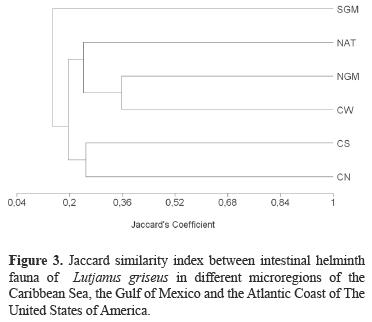
<body><![CDATA[<p align="justify"><font face="verdana" size="2">Prevalence, intensity range, and mean abundance values are presented for each helminth species and locality in <a href="/img/revistas/rmbiodiv/v81n3/a30t1.jpg" target="_blank">Table 1</a>. Only 7 of the 20 helminth species were shared between localities, and for most helminth species the highest prevalence values were found for fish caught off Progreso (<a href="/img/revistas/rmbiodiv/v81n3/a30t1.jpg" target="_blank">Table 1</a>). Although fish specimens from Chelem and Celest&uacute;n shared 80% of their helminth species composition, prevalence and mean abundance values were more similar between helminth species shared by specimens from Progreso and Chelem (<a href="#f2">Fig. 2</a>). </font></p> 				    <p align="center"><font face="verdana" size="2"><a name="f2"></a></font></p> 				    <p align="center"><font face="verdana" size="2"><img src="/img/revistas/rmbiodiv/v81n3/a30f2.jpg"></font></p>  				    <p align="justify"><font face="verdana" size="2">A total of 32 intestinal helminth species (21 trematodes, 3 cestodes, six nematodes and 2 acanthocephalans) for <i>L. griseus</i> in the North Atlantic, the Gulf of Mexico and the Caribbean Sea records were recovered from the literature, of which only 5 belong to Mexico (<a href="/img/revistas/rmbiodiv/v81n3/a30t2.jpg" target="_blank">Table 2</a>). Only 1 species (<i>Metadena adglobosa</i> Manter, 1947) has been recorded for all 6 geographical regions (GR), 2 helminth species were present in 5 GR (Hamacreadium mutabile Linton, 1910 and <i>Stephanostomun casum</i> (Linton 1910)), 2 more only in 4 GR (<i>Helicometrina nimia</i> Linton 1910 and <i>Metadena globosa</i> (Linton, 1910)) and all the rest were present in 3 or less GR with 58% of the species being recorded only in just 1 GR each. Overall species similarity between geographical regions was 0.24 &plusmn; 0.08. The largest similarity value was found between the helminth fauna of the North Gulf of Mexico and the West Caribbean regions (0.36, <a href="#f3">Fig. 3</a>). </font></p> 				    <p align="center"><font face="verdana" size="2"><a name="f3"></a></font></p> 				    <p align="center"><font face="verdana" size="2"><img src="/img/revistas/rmbiodiv/v81n3/a30f3.jpg"></font></p> 				    <p align="justify"><font face="verdana" size="2">Prior to this study, 32 helminth species were known to parasitize <i>L. griseus</i> in the Gulf of Mexico and throughout the Caribbean Sea (<a href="/img/revistas/rmbiodiv/v81n3/a30t2.jpg" target="_blank">Table 2</a>). Our data indicate that 12 of the 20 species found at the 3 study sites in Yucat&aacute;n are new records for <i>L. griseus</i>, increasing the total number of helminth species recorded for this host species to 4. Similar to intestinal helminth communities of other marine fish species from the region, helminth species composition of <i>L. griseus</i> in Yucat&aacute;n localities is composed mainly of trematodes (11 trematodes, 4 nematodes, 4 acanthocephalans and 1 cestode). For example, 6 of the 11 intestinal parasite species reported for Epinephelus morio by Moravec et al. (1997) were trematodes (in addition to 1 cestode, 3 nematodes, and 1 acanthocephalan), and 6 of the 11 species reported in the gut of Trachinotus carolinus were also trematodes (including also 1 cestode and 4 nematodes) (S&aacute;nchez&#150;Ram&iacute;rez and Vidal&#150;Mart&iacute;nez, 2002). In addition, 6 of 10 intestinal parasite species reported for <i>Cichlasoma urophthalmus</i> at Celest&uacute;n coastal lagoon were also trematodes (including also 3 cestodes and 1 acanthocephalan) (Salgado&#150;Maldonado and Kennedy, 1997). Such findings agree with an overall pattern of dominance by trematodes in <i>L. griseus</i> as shown by the parasites associated to fish in the Gulf of Mexico and Caribbbean sea, since 20 of the 32 helminth species previously recorded were trematodes (<a href="/img/revistas/rmbiodiv/v81n3/a30t2.jpg" target="_blank">Table 2</a>). </font></p> 				    <p align="justify"><font face="verdana" size="2">Four out of the 7 helminth species shared by the sampled specimens across the 3 localities in Yucat&aacute;n were specialist trematodes to the fish family Lutjanidae (<i>M. adglobosa</i>, <i>Metadena globosa</i>, Paracryptogonimus neoamericanus and <i>Stephanostomum casum</i>), whereas the remaining 3 helminths are generalist species which can be found in fish species belonging to various families (see Yamaguti, 1971; Amin, 1998) </font></p> 				    <p align="justify"><font face="verdana" size="2">Presently, the only life cycles for helminth parasites of the gray snapper which have been relatively well described are those of the trematodes <i>M. adglobosa</i>, <i>Hamacreadium gullela</i> and <i>H. mutabile</i>, of which the first species uses <i>Cerithium</i> snails as first intermediate hosts, while <i>H. gullela</i> and <i>H. mutabile</i> use <i>Astraea</i> snails (McCoy 1929, 1930). In addition, <i>Lucania parva</i> and <i>Opsanus beta</i> serve as second intermediate hosts of <i>M. adglobosa</i>. Finally, <i>Cyprinodon variegatus</i>, <i>Gambusia affinis</i> and <i>Poecilia latipinna</i> have been successfully used as experimental second intermediate hosts of <i>M. adglobosa</i> (Schroeder, 1965). </font></p> 				    <p align="justify"><font face="verdana" size="2">We expected that the total number of helminth species and helminth species composition in gray snappers from Chelem would be similar to that of snappers from Progreso because specimens from these 2 localities were similar in size (<a href="/img/revistas/rmbiodiv/v81n3/a30t1.jpg" target="_blank">Table 1</a>) and were caught in open coastal waters from sites that are relatively close to each other. However, species number and composition were more similar between snapper specimens collected off Chelem and from the Celest&uacute;n coastal lagoon. Despite this unexpected result, prevalence and abundance values of shared helminth species were more similar between Progreso and Chelem, than between Celest&uacute;n and Chelem (<a href="#f2">Figure 2</a>). Although, Schroeder (1965) suggested that the helminth fauna of the gray snapper is replaced by new species after fish leave coastal lagoons, our results show an addition of species for specimens from offshore localities as all the helminth species found in specimens from the coastal lagoon were also present in specimens from Progreso and Chelem. One explanation for this finding is that the offshore specimens sampled had not spent enough time in this habitat to exhibit a replacement of parasite species previously acquired at the coastal lagoon. Given that all parasite species recorded at the coastal lagoon site were also found at the offshore sites, perhaps the most reasonable hypothesis is that the gray snapper specimens sampled offshore are subject to rather slow replacement process of parasite species. On the other hand, it is been reported that as gray snappers increase in size, so do the diversity and volume of items they feed on in coastal lagoons and offshore habitats (Samano&#150;Zapata et al. 1998). This condition may explain the great similarity in prevalence and mean abundance values for parasite species in specimens from Chelem and Progreso, as well as the increase in parasite species richness for specimens from Progreso. </font></p> 				    ]]></body>
<body><![CDATA[<p align="justify"><font face="verdana" size="2">The small values of Jaccard's similarity between the helminth fauna for the 6 geographical regions suggest that there is either a large component of helminth species associated to each particular area, with only a small percentage (11%) corresponding to helminth species widely distributed in the whole region, or that more extensive studies are needed in each region which would permit a more even comparison among regions. For example, most of the records of some geographical regions come from only 1 or 2 articles were only a particular locality was examined in contrast to our data that come from 3 localities and a larger number of fish. </font></p> 				    <p align="justify"><font face="verdana" size="2">The authors would like to acknowledge Agustin Jim&eacute;nez Ruiz from Department of Zoology, Southern Illinois University, Virginia Le&oacute;n&#150;R&egrave;gagnon, and Luis Garc&iacute;a Prieto from the Instituto de Biolog&iacute;a, Universidad Nacional Aut&oacute;noma de Mexico (Mexico, D.F.) for providing important references; thanks also to Rod Bray (Natural History Museum), David Gonz&aacute;lez&#150;Sol&iacute;s (Colegio de la Frontera Sur, Chetumal) and Guillermo Salgado&#150;Maldonado (Instituto de Biolog&iacute;a, UNAM) who helped with the identification of the hemiurid trematodes, nematodes and acanthocephalans, respectively. Tom&aacute;s Scholz and Victor M. Vidal&#150;Mat&iacute;nez provided comments on an earlier version of the manuscript. Clara Vivas&#150;Rodriguez and Gregory Arjona from CINVESTAV&#150;IPN provided technical support. This study was funded by CONACyT (grant no. 44590).</font></p> 				    <p align="justify"><font face="verdana" size="2">&nbsp;</font></p> 				    <p align="justify"><font face="verdana" size="2"><b>Literature cited</b></font></p> 				    <!-- ref --><p align="justify"><font face="verdana" size="2">Amin, O. 1998. Acanthocephala. Marine flora and fauna of the Eastern United States. NOAA Technical Report NMFS, no. 135. 32 p.    &nbsp;&nbsp;&nbsp;&nbsp;&nbsp;&nbsp;&nbsp;&nbsp;[&#160;<a href="javascript:void(0);" onclick="javascript: window.open('/scielo.php?script=sci_nlinks&ref=7529381&pid=S1870-3453201000030003000001&lng=','','width=640,height=500,resizable=yes,scrollbars=1,menubar=yes,');">Links</a>&#160;]<!-- end-ref --></font></p> 				    <!-- ref --><p align="justify"><font face="verdana" size="2">Barreto, A. L, 1922. Revis&atilde;o da fam&iacute;lia Cucullanidae Barreto, 1916. (1). Mem&oacute;rias do Instituto Oswaldo Cruz 14: 68&#150;87.    &nbsp;&nbsp;&nbsp;&nbsp;&nbsp;&nbsp;&nbsp;&nbsp;[&#160;<a href="javascript:void(0);" onclick="javascript: window.open('/scielo.php?script=sci_nlinks&ref=7529383&pid=S1870-3453201000030003000002&lng=','','width=640,height=500,resizable=yes,scrollbars=1,menubar=yes,');">Links</a>&#160;]<!-- end-ref --></font></p> 				    <!-- ref --><p align="justify"><font face="verdana" size="2">Bosques&#150;Rodr&iacute;guez, J. L. 2004. Metazoan parasites of Snappers, Lutjanidae (Pisces) from Puerto Rico. Tesis maestr&iacute;a, Universidad de Puerto Rico, Campus Mayag&uuml;e. 178 p.    &nbsp;&nbsp;&nbsp;&nbsp;&nbsp;&nbsp;&nbsp;&nbsp;[&#160;<a href="javascript:void(0);" onclick="javascript: window.open('/scielo.php?script=sci_nlinks&ref=7529385&pid=S1870-3453201000030003000003&lng=','','width=640,height=500,resizable=yes,scrollbars=1,menubar=yes,');">Links</a>&#160;]<!-- end-ref --></font></p> 				    ]]></body>
<body><![CDATA[<!-- ref --><p align="justify"><font face="verdana" size="2">Bush, A. O., K. D. Lafferty, J. M. Lotz and A. W. Shostak 1997. Parasitology meets ecology on its own terms: Margolis et al. revisited. Journal of Parasitology 83:575&#150;583.    &nbsp;&nbsp;&nbsp;&nbsp;&nbsp;&nbsp;&nbsp;&nbsp;[&#160;<a href="javascript:void(0);" onclick="javascript: window.open('/scielo.php?script=sci_nlinks&ref=7529387&pid=S1870-3453201000030003000004&lng=','','width=640,height=500,resizable=yes,scrollbars=1,menubar=yes,');">Links</a>&#160;]<!-- end-ref --></font></p> 				    <!-- ref --><p align="justify"><font face="verdana" size="2">Cable, R. M. and B. A. Mafarachisi. 1970. Acanthocephala of the genus <i>Gorgorhynchoides</i> parasitic in marine fishes. Indian Veterinary Research Institute H. D. Srivastava Commemorative Volume. p. 255&#150;261.    &nbsp;&nbsp;&nbsp;&nbsp;&nbsp;&nbsp;&nbsp;&nbsp;[&#160;<a href="javascript:void(0);" onclick="javascript: window.open('/scielo.php?script=sci_nlinks&ref=7529389&pid=S1870-3453201000030003000005&lng=','','width=640,height=500,resizable=yes,scrollbars=1,menubar=yes,');">Links</a>&#160;]<!-- end-ref --></font></p> 				    <!-- ref --><p align="justify"><font face="verdana" size="2">Dyer, W. G., E. H. Williams Jr. and L. Bunkley&#150;Williams. 1985. Digenetic trematodes of marine fishes of the western and southwestern coast of Puerto Rico. Proceedings of the Helminthological Society of Washington 52:85&#150;94.    &nbsp;&nbsp;&nbsp;&nbsp;&nbsp;&nbsp;&nbsp;&nbsp;[&#160;<a href="javascript:void(0);" onclick="javascript: window.open('/scielo.php?script=sci_nlinks&ref=7529391&pid=S1870-3453201000030003000006&lng=','','width=640,height=500,resizable=yes,scrollbars=1,menubar=yes,');">Links</a>&#160;]<!-- end-ref --></font></p> 				    <!-- ref --><p align="justify"><font face="verdana" size="2">Dyer, W.G., E. H. Williams Jr. and L. Bunkley&#150;Williams. 1992. <i>Homalometron dowgialloi</i> sp. n. (Homalometridae) from <i>Haemulon flavolineatum</i> and additional records of digenetic trematodes of marine fishes in the West Indies. Proceedings of the Helminthlogical Society of Washington 59:182&#150;189.    &nbsp;&nbsp;&nbsp;&nbsp;&nbsp;&nbsp;&nbsp;&nbsp;[&#160;<a href="javascript:void(0);" onclick="javascript: window.open('/scielo.php?script=sci_nlinks&ref=7529393&pid=S1870-3453201000030003000007&lng=','','width=640,height=500,resizable=yes,scrollbars=1,menubar=yes,');">Links</a>&#160;]<!-- end-ref --></font></p> 				    <!-- ref --><p align="justify"><font face="verdana" size="2">Dyer, W. G., E. H. Williams Jr. and L. Bunkley&#150;Williams. 1998. Some digenetic trematodes of marine fishes from Puerto Rico. Caribbean Journal of Sciences 34:141&#150;146.    &nbsp;&nbsp;&nbsp;&nbsp;&nbsp;&nbsp;&nbsp;&nbsp;[&#160;<a href="javascript:void(0);" onclick="javascript: window.open('/scielo.php?script=sci_nlinks&ref=7529395&pid=S1870-3453201000030003000008&lng=','','width=640,height=500,resizable=yes,scrollbars=1,menubar=yes,');">Links</a>&#160;]<!-- end-ref --></font></p> 				    ]]></body>
<body><![CDATA[<!-- ref --><p align="justify"><font face="verdana" size="2">Fischthal, J. H. 1977. Some digenetic trematodes of marine fishes from the barrier reef and reef lagoon of Belize. Zoological Scripta 6:81&#150;88.    &nbsp;&nbsp;&nbsp;&nbsp;&nbsp;&nbsp;&nbsp;&nbsp;[&#160;<a href="javascript:void(0);" onclick="javascript: window.open('/scielo.php?script=sci_nlinks&ref=7529397&pid=S1870-3453201000030003000009&lng=','','width=640,height=500,resizable=yes,scrollbars=1,menubar=yes,');">Links</a>&#160;]<!-- end-ref --></font></p> 				    <!-- ref --><p align="justify"><font face="verdana" size="2">Gonz&aacute;lez&#150;Nava, M.E. 1994. Helmintos endopar&aacute;sitos (Trematoda: Digenea) en ocho especies de peces de agua salobre y marina de la laguna de Celest&uacute;n, Yucat&aacute;n, M&eacute;xico. B. S. Thesis, Facultad de Biolog&iacute;a, Universidad Veracruzana,Tuxpam, Veracruz, Mexico. 91 p.    &nbsp;&nbsp;&nbsp;&nbsp;&nbsp;&nbsp;&nbsp;&nbsp;[&#160;<a href="javascript:void(0);" onclick="javascript: window.open('/scielo.php?script=sci_nlinks&ref=7529399&pid=S1870-3453201000030003000010&lng=','','width=640,height=500,resizable=yes,scrollbars=1,menubar=yes,');">Links</a>&#160;]<!-- end-ref --></font></p> 				    <!-- ref --><p align="justify"><font face="verdana" size="2">Gonz&aacute;lez&#150;Sol&iacute;s, D., N. Arg&aacute;ez&#150;Garc&iacute;a and S. Guill&eacute;n&#150;Hern&aacute;ndez. 2002. <i>Dichelyne</i> (<i>Dichelyne</i>) <i>bonacii</i> n. sp. (Nematoda: Cucullanidae) from the gray snapper <i>Lutjanus griseus</i> and the black grouper <i>Mycteroperca bonaci</i> of the coast of Yucat&aacute;n, Mexico. Systematic Parasitology 53:109&#150;113.    &nbsp;&nbsp;&nbsp;&nbsp;&nbsp;&nbsp;&nbsp;&nbsp;[&#160;<a href="javascript:void(0);" onclick="javascript: window.open('/scielo.php?script=sci_nlinks&ref=7529401&pid=S1870-3453201000030003000011&lng=','','width=640,height=500,resizable=yes,scrollbars=1,menubar=yes,');">Links</a>&#160;]<!-- end-ref --></font></p> 				    <!-- ref --><p align="justify"><font face="verdana" size="2">Gonz&aacute;lez&#150;Sol&iacute;s, D., V. M. Tuz&#150;Paredes and M. A. Quintanal&#150;Loria. 2007. <i>Cucullanus pargi</i> sp. n. (Nematoda: Cucullanidae) from the gray snapper <i>Lutjanus griseus</i> off the southern coast of Quintana Roo. Folia Parasitologica 54:220&#150;224.    &nbsp;&nbsp;&nbsp;&nbsp;&nbsp;&nbsp;&nbsp;&nbsp;[&#160;<a href="javascript:void(0);" onclick="javascript: window.open('/scielo.php?script=sci_nlinks&ref=7529403&pid=S1870-3453201000030003000012&lng=','','width=640,height=500,resizable=yes,scrollbars=1,menubar=yes,');">Links</a>&#160;]<!-- end-ref --></font></p> 				    <!-- ref --><p align="justify"><font face="verdana" size="2">Hanson, M. L. 1950. Some digenetic trematodes of marine fishes of Bermuda. Proceedings of the Helminthological Society of Washington 17:74&#150;89.    &nbsp;&nbsp;&nbsp;&nbsp;&nbsp;&nbsp;&nbsp;&nbsp;[&#160;<a href="javascript:void(0);" onclick="javascript: window.open('/scielo.php?script=sci_nlinks&ref=7529405&pid=S1870-3453201000030003000013&lng=','','width=640,height=500,resizable=yes,scrollbars=1,menubar=yes,');">Links</a>&#160;]<!-- end-ref --></font></p> 				    ]]></body>
<body><![CDATA[<!-- ref --><p align="justify"><font face="verdana" size="2">Lamothe&#150;Argumedo, R., L. Garc&iacute;a&#150;Prieto, D. Osorio&#150;Sarabia and G. P&eacute;rez&#150;Ponce de Le&oacute;n. 1997. Cat&aacute;logo de la Colecci&oacute;n Nacional de Helmintos. Instituto de Biolog&iacute;a, UNAM&#150;Comisi&oacute;n Nacional para el Conocimiento y Uso de la Biodiversidad. 211 p.    &nbsp;&nbsp;&nbsp;&nbsp;&nbsp;&nbsp;&nbsp;&nbsp;[&#160;<a href="javascript:void(0);" onclick="javascript: window.open('/scielo.php?script=sci_nlinks&ref=7529407&pid=S1870-3453201000030003000014&lng=','','width=640,height=500,resizable=yes,scrollbars=1,menubar=yes,');">Links</a>&#160;]<!-- end-ref --></font></p> 				    <!-- ref --><p align="justify"><font face="verdana" size="2">Linton, E. 1907. Notes on parasites of Bermuda fishes. Proceedings of the Natural Museum 33:85&#150;126.    &nbsp;&nbsp;&nbsp;&nbsp;&nbsp;&nbsp;&nbsp;&nbsp;[&#160;<a href="javascript:void(0);" onclick="javascript: window.open('/scielo.php?script=sci_nlinks&ref=7529409&pid=S1870-3453201000030003000015&lng=','','width=640,height=500,resizable=yes,scrollbars=1,menubar=yes,');">Links</a>&#160;]<!-- end-ref --></font></p> 				    <!-- ref --><p align="justify"><font face="verdana" size="2">Linton, E. 1908. Helminth fauna of the Dry Tortugas. I. Cestodes. Publications of the Carnegie Institute of Washington 102:157&#150;190.    &nbsp;&nbsp;&nbsp;&nbsp;&nbsp;&nbsp;&nbsp;&nbsp;[&#160;<a href="javascript:void(0);" onclick="javascript: window.open('/scielo.php?script=sci_nlinks&ref=7529411&pid=S1870-3453201000030003000016&lng=','','width=640,height=500,resizable=yes,scrollbars=1,menubar=yes,');">Links</a>&#160;]<!-- end-ref --></font></p> 				    <!-- ref --><p align="justify"><font face="verdana" size="2">Linton, E. 1910. Helminth Fauna of the Dry Tortugas. II Trematodes. Publication of the Carnegie Institute of Washington 133:11&#150;98.    &nbsp;&nbsp;&nbsp;&nbsp;&nbsp;&nbsp;&nbsp;&nbsp;[&#160;<a href="javascript:void(0);" onclick="javascript: window.open('/scielo.php?script=sci_nlinks&ref=7529413&pid=S1870-3453201000030003000017&lng=','','width=640,height=500,resizable=yes,scrollbars=1,menubar=yes,');">Links</a>&#160;]<!-- end-ref --></font></p> 				    <!-- ref --><p align="justify"><font face="verdana" size="2">MacCallum, G. A. 1917. Some new forms of parasitic worms. Zoopathology 1:43&#150;75.    &nbsp;&nbsp;&nbsp;&nbsp;&nbsp;&nbsp;&nbsp;&nbsp;[&#160;<a href="javascript:void(0);" onclick="javascript: window.open('/scielo.php?script=sci_nlinks&ref=7529415&pid=S1870-3453201000030003000018&lng=','','width=640,height=500,resizable=yes,scrollbars=1,menubar=yes,');">Links</a>&#160;]<!-- end-ref --></font></p> 				    ]]></body>
<body><![CDATA[<!-- ref --><p align="justify"><font face="verdana" size="2">Magurran, A. 2004. Measuring Ecological diversity. Blakwell Publishers, London. 256 p.    &nbsp;&nbsp;&nbsp;&nbsp;&nbsp;&nbsp;&nbsp;&nbsp;[&#160;<a href="javascript:void(0);" onclick="javascript: window.open('/scielo.php?script=sci_nlinks&ref=7529417&pid=S1870-3453201000030003000019&lng=','','width=640,height=500,resizable=yes,scrollbars=1,menubar=yes,');">Links</a>&#160;]<!-- end-ref --></font></p> 				    <!-- ref --><p align="justify"><font face="verdana" size="2">Manter, H. W. 1947. The digenetic trematodes of marine fish of Tortugas Florida. American Midland Naturalist 38:257&#150;416.    &nbsp;&nbsp;&nbsp;&nbsp;&nbsp;&nbsp;&nbsp;&nbsp;[&#160;<a href="javascript:void(0);" onclick="javascript: window.open('/scielo.php?script=sci_nlinks&ref=7529419&pid=S1870-3453201000030003000020&lng=','','width=640,height=500,resizable=yes,scrollbars=1,menubar=yes,');">Links</a>&#160;]<!-- end-ref --> </font></p> 				    <!-- ref --><p align="justify"><font face="verdana" size="2">Mexicano&#150;C&iacute;ntora, G., C. O. Leonce&#150;Valencia, S. Salas and M. E. Vega&#150;Cendejas. Recursos Pesqueros de Yucat&aacute;n: Fichas t&eacute;cnicas y referencias bibliogr&aacute;ficas. Centro de Investigaci&oacute;n y de Estudios Avanzados del IPN (CINVESTAV) Unidad M&eacute;rida. M&eacute;rida, Yucat&aacute;n, M&eacute;xico, 150 p.    &nbsp;&nbsp;&nbsp;&nbsp;&nbsp;&nbsp;&nbsp;&nbsp;[&#160;<a href="javascript:void(0);" onclick="javascript: window.open('/scielo.php?script=sci_nlinks&ref=7529421&pid=S1870-3453201000030003000021&lng=','','width=640,height=500,resizable=yes,scrollbars=1,menubar=yes,');">Links</a>&#160;]<!-- end-ref --> </font></p> 				    <!-- ref --><p align="justify"><font face="verdana" size="2">McCoy, O. R. 1930. Experimental studies on 2 fish trematodes of the genus <i>Hamacreadium</i> (Family Allocreadiidae). Journal of Parasitology 17:1&#150;13.    &nbsp;&nbsp;&nbsp;&nbsp;&nbsp;&nbsp;&nbsp;&nbsp;[&#160;<a href="javascript:void(0);" onclick="javascript: window.open('/scielo.php?script=sci_nlinks&ref=7529423&pid=S1870-3453201000030003000022&lng=','','width=640,height=500,resizable=yes,scrollbars=1,menubar=yes,');">Links</a>&#160;]<!-- end-ref --></font></p> 				    <!-- ref --><p align="justify"><font face="verdana" size="2">Moravec, F., V. M. Vidal&#150;Mart&iacute;nez, J. Vargas&#150;V&aacute;zquez, C. Vivas&#150;Rodr&iacute;guez, D. Gonz&aacute;lez&#150;Sol&iacute;s, E. Mendoza&#150;Franco, R. Sim&aacute;&#150;&Aacute;lvarez and J. G&uuml;emez&#150;Ricalde. 1997. Helminth parasites of <i>Epinephelus morio</i> (Pisces: Serranidae) of the Yucat&aacute;n Peninsula, southeastern Mexico. Folia Parasitologica 44:255&#150;266.    &nbsp;&nbsp;&nbsp;&nbsp;&nbsp;&nbsp;&nbsp;&nbsp;[&#160;<a href="javascript:void(0);" onclick="javascript: window.open('/scielo.php?script=sci_nlinks&ref=7529425&pid=S1870-3453201000030003000023&lng=','','width=640,height=500,resizable=yes,scrollbars=1,menubar=yes,');">Links</a>&#160;]<!-- end-ref --></font></p> 				    ]]></body>
<body><![CDATA[<!-- ref --><p align="justify"><font face="verdana" size="2">Nahhas, M. F. and R. M. Cable.1964. Digenetic and Aspidogastrid Trematodes from marine fishes of Cura&ccedil;ao and Jamaica. Tulane Studies in Zoology and Botany 11:167&#150;228.    &nbsp;&nbsp;&nbsp;&nbsp;&nbsp;&nbsp;&nbsp;&nbsp;[&#160;<a href="javascript:void(0);" onclick="javascript: window.open('/scielo.php?script=sci_nlinks&ref=7529427&pid=S1870-3453201000030003000024&lng=','','width=640,height=500,resizable=yes,scrollbars=1,menubar=yes,');">Links</a>&#160;]<!-- end-ref --></font></p> 				    <!-- ref --><p align="justify"><font face="verdana" size="2">Overstreet, R. M. 1969. Digenetic trematodes of marine teleost fishes from Biscayne Bay, Florida. Tulane Studies in Zoology and Botany 15:119&#150;176.    &nbsp;&nbsp;&nbsp;&nbsp;&nbsp;&nbsp;&nbsp;&nbsp;[&#160;<a href="javascript:void(0);" onclick="javascript: window.open('/scielo.php?script=sci_nlinks&ref=7529429&pid=S1870-3453201000030003000025&lng=','','width=640,height=500,resizable=yes,scrollbars=1,menubar=yes,');">Links</a>&#160;]<!-- end-ref --></font></p> 				    <!-- ref --><p align="justify"><font face="verdana" size="2">Rees, G. 1970. Some helminth parasites of fishes of Bermuda and an account of the attachment organ of <i>Alcicornis carangis</i> MacCallum, 1917 (Digenea: Bucephalidae). Parasitology 60:195&#150;221.    &nbsp;&nbsp;&nbsp;&nbsp;&nbsp;&nbsp;&nbsp;&nbsp;[&#160;<a href="javascript:void(0);" onclick="javascript: window.open('/scielo.php?script=sci_nlinks&ref=7529431&pid=S1870-3453201000030003000026&lng=','','width=640,height=500,resizable=yes,scrollbars=1,menubar=yes,');">Links</a>&#160;]<!-- end-ref --></font></p> 				    <!-- ref --><p align="justify"><font face="verdana" size="2">Riley, K. L., E. J. Chesney and T. R. Tiersch, 2008. Field collection, handling, and refrigerated storage of sperm of red snapper and gray snapper. North American Journal of Aquaculture 70:356&#150;364.    &nbsp;&nbsp;&nbsp;&nbsp;&nbsp;&nbsp;&nbsp;&nbsp;[&#160;<a href="javascript:void(0);" onclick="javascript: window.open('/scielo.php?script=sci_nlinks&ref=7529433&pid=S1870-3453201000030003000027&lng=','','width=640,height=500,resizable=yes,scrollbars=1,menubar=yes,');">Links</a>&#160;]<!-- end-ref --></font></p> 				    <!-- ref --><p align="justify"><font face="verdana" size="2">Salgado&#150;Maldonado, G. 1979. Acantoc&eacute;falos de peces VI. Hallazgo de <i>Gorgorhynchoides</i> bullocki Cable y Mafarachisi 1970 (Acantocephala: Arhythmacantidae) y descripci&oacute;n de algunos de sus estados juveniles. Anales del Instituto de Biolog&iacute;a. Universidad Nacional Aut&oacute;noma de M&eacute;xico, Serie Zoolog&iacute;a 50: 35&#150;50.    &nbsp;&nbsp;&nbsp;&nbsp;&nbsp;&nbsp;&nbsp;&nbsp;[&#160;<a href="javascript:void(0);" onclick="javascript: window.open('/scielo.php?script=sci_nlinks&ref=7529435&pid=S1870-3453201000030003000028&lng=','','width=640,height=500,resizable=yes,scrollbars=1,menubar=yes,');">Links</a>&#160;]<!-- end-ref --></font></p> 				    ]]></body>
<body><![CDATA[<!-- ref --><p align="justify"><font face="verdana" size="2">Salgado&#150;Maldonado G. and C. R. Kennedy. 1997. Richness and similarity of helminth communities in the tropical fish <i>Cichlasoma urophthalmus</i> from the Yucat&aacute;n Peninsula, Mexico. Parasitology 114:581&#150;590.    &nbsp;&nbsp;&nbsp;&nbsp;&nbsp;&nbsp;&nbsp;&nbsp;[&#160;<a href="javascript:void(0);" onclick="javascript: window.open('/scielo.php?script=sci_nlinks&ref=7529437&pid=S1870-3453201000030003000029&lng=','','width=640,height=500,resizable=yes,scrollbars=1,menubar=yes,');">Links</a>&#160;]<!-- end-ref --></font></p> 				    <!-- ref --><p align="justify"><font face="verdana" size="2">Samano&#150;Zapata, J. C., M. E. Vega&#150;Cendejas and M. Hern&aacute;ndez&#150;De Santillana..1998. Alimentary ecology and trophyc interactions of juveniles "pargo mulato" (<i>Lutjanus griseus</i> Lineaus, 1758) and "rubia" (<i>L. sinagris</i> Lineaus, 1958) from the noroccidental coast of the Yucat&aacute;n Peninsula, Mexico. Proceedings of the Gulf and Caribbean Fisheries Institute 50:804&#150;826.    &nbsp;&nbsp;&nbsp;&nbsp;&nbsp;&nbsp;&nbsp;&nbsp;[&#160;<a href="javascript:void(0);" onclick="javascript: window.open('/scielo.php?script=sci_nlinks&ref=7529439&pid=S1870-3453201000030003000030&lng=','','width=640,height=500,resizable=yes,scrollbars=1,menubar=yes,');">Links</a>&#160;]<!-- end-ref --></font></p> 				    <!-- ref --><p align="justify"><font face="verdana" size="2">S&aacute;nchez&#150;Ram&iacute;rez, C. and V. M. Vidal&#150;Mart&iacute;nez. 2002. Metazoan parasite infracommunities of Florida Pompano (<i>Trachinotus carolinus</i>) from the coast of the Yucat&aacute;n Peninsula, Mexico. Journal Parasitology 88:1087&#150;1094.    &nbsp;&nbsp;&nbsp;&nbsp;&nbsp;&nbsp;&nbsp;&nbsp;[&#160;<a href="javascript:void(0);" onclick="javascript: window.open('/scielo.php?script=sci_nlinks&ref=7529441&pid=S1870-3453201000030003000031&lng=','','width=640,height=500,resizable=yes,scrollbars=1,menubar=yes,');">Links</a>&#160;]<!-- end-ref --></font></p> 				    <!-- ref --><p align="justify"><font face="verdana" size="2">Schroeder, R. E. 1965. Ecology of the intestinal trematodes of Gray Snapper, <i>Lutjanus griseus</i>, near Lower Matecumbe Key, Florida, with a description of a new species. In  Studies in tropical Oceanography No. 10. Investigations of the Gray Snapper <i>Lutjanus griseus</i>, W. A. Starck (ed.). University of Miami Press. Coral Gables, Florida. p. 168&#150;221.    &nbsp;&nbsp;&nbsp;&nbsp;&nbsp;&nbsp;&nbsp;&nbsp;[&#160;<a href="javascript:void(0);" onclick="javascript: window.open('/scielo.php?script=sci_nlinks&ref=7529443&pid=S1870-3453201000030003000032&lng=','','width=640,height=500,resizable=yes,scrollbars=1,menubar=yes,');">Links</a>&#160;]<!-- end-ref --></font></p> 				    <!-- ref --><p align="justify"><font face="verdana" size="2">Siddiqi, A. H., R. M. Cable. 1960. Digenetic Trematodes of marine fishes of Puerto Rico. Scientific Survey of Puerto Rico and the Virgen Islands. New York Academy of Science 17:257&#150;369.    &nbsp;&nbsp;&nbsp;&nbsp;&nbsp;&nbsp;&nbsp;&nbsp;[&#160;<a href="javascript:void(0);" onclick="javascript: window.open('/scielo.php?script=sci_nlinks&ref=7529445&pid=S1870-3453201000030003000033&lng=','','width=640,height=500,resizable=yes,scrollbars=1,menubar=yes,');">Links</a>&#160;]<!-- end-ref --></font></p> 				    ]]></body>
<body><![CDATA[<!-- ref --><p align="justify"><font face="verdana" size="2">V&eacute;lez, I.1987. Sobre la fauna de trematodos en peces marinos de la familia Lutjanidae en el Mar Caribe. Actualidades Biol&oacute;gicas 16:70&#150;84.    &nbsp;&nbsp;&nbsp;&nbsp;&nbsp;&nbsp;&nbsp;&nbsp;[&#160;<a href="javascript:void(0);" onclick="javascript: window.open('/scielo.php?script=sci_nlinks&ref=7529447&pid=S1870-3453201000030003000034&lng=','','width=640,height=500,resizable=yes,scrollbars=1,menubar=yes,');">Links</a>&#160;]<!-- end-ref --></font></p> 				    <!-- ref --><p align="justify"><font face="verdana" size="2">Vidal&#150;Mart&iacute;nez, V. M., M. L. Aguirre&#150;Macedo, T. Scholz, D. Gonz&aacute;lez&#150;Sol&iacute;s and E. F. Mendoza&#150;Franco. 2001. Atlas of the helminth parasites of cichlid fish of M&eacute;xico, Academia, Praha. 165 p.    &nbsp;&nbsp;&nbsp;&nbsp;&nbsp;&nbsp;&nbsp;&nbsp;[&#160;<a href="javascript:void(0);" onclick="javascript: window.open('/scielo.php?script=sci_nlinks&ref=7529449&pid=S1870-3453201000030003000035&lng=','','width=640,height=500,resizable=yes,scrollbars=1,menubar=yes,');">Links</a>&#160;]<!-- end-ref --></font></p> 				    <!-- ref --><p align="justify"><font face="verdana" size="2">Williams, E. H. 1983. New host records for some nematode parasites of fishes from Alabama and Adjacent Waters. Proceedings of the Helminthological Society of Washington 50:178&#150;182.    &nbsp;&nbsp;&nbsp;&nbsp;&nbsp;&nbsp;&nbsp;&nbsp;[&#160;<a href="javascript:void(0);" onclick="javascript: window.open('/scielo.php?script=sci_nlinks&ref=7529451&pid=S1870-3453201000030003000036&lng=','','width=640,height=500,resizable=yes,scrollbars=1,menubar=yes,');">Links</a>&#160;]<!-- end-ref --> </font></p> 				    <!-- ref --><p align="justify"><font face="verdana" size="2">Zambrano, J. L. F., C. S. Rojas and Y. R. Leon. 2003. Parasites in juveniles of <i>Lutjanus griseus</i> (Pisces: Lutjanidae) at La Restinga Lagoon, Margarita Island, Venezuela. Interciencia 28:463&#150;468.    &nbsp;&nbsp;&nbsp;&nbsp;&nbsp;&nbsp;&nbsp;&nbsp;[&#160;<a href="javascript:void(0);" onclick="javascript: window.open('/scielo.php?script=sci_nlinks&ref=7529453&pid=S1870-3453201000030003000037&lng=','','width=640,height=500,resizable=yes,scrollbars=1,menubar=yes,');">Links</a>&#160;]<!-- end-ref --> </font></p>      ]]></body><back>
<ref-list>
<ref id="B1">
<nlm-citation citation-type="">
<person-group person-group-type="author">
<name>
<surname><![CDATA[Amin]]></surname>
<given-names><![CDATA[O]]></given-names>
</name>
</person-group>
<source><![CDATA[Acanthocephala. Marine flora and fauna of the Eastern United States]]></source>
<year>1998</year>
<page-range>32</page-range></nlm-citation>
</ref>
<ref id="B2">
<nlm-citation citation-type="journal">
<person-group person-group-type="author">
<name>
<surname><![CDATA[Barreto]]></surname>
<given-names><![CDATA[A. L]]></given-names>
</name>
</person-group>
<article-title xml:lang="pt"><![CDATA[Revisão da família Cucullanidae Barreto, 1916]]></article-title>
<source><![CDATA[Memórias do Instituto Oswaldo Cruz]]></source>
<year>1922</year>
<volume>14</volume>
<page-range>68-87</page-range></nlm-citation>
</ref>
<ref id="B3">
<nlm-citation citation-type="">
<person-group person-group-type="author">
<name>
<surname><![CDATA[Bosques-Rodríguez]]></surname>
<given-names><![CDATA[J. L]]></given-names>
</name>
</person-group>
<source><![CDATA[Metazoan parasites of Snappers, Lutjanidae (Pisces) from Puerto Rico]]></source>
<year>2004</year>
<page-range>178</page-range></nlm-citation>
</ref>
<ref id="B4">
<nlm-citation citation-type="journal">
<person-group person-group-type="author">
<name>
<surname><![CDATA[Bush]]></surname>
<given-names><![CDATA[A. O]]></given-names>
</name>
<name>
<surname><![CDATA[Lafferty]]></surname>
<given-names><![CDATA[K. D]]></given-names>
</name>
<name>
<surname><![CDATA[Lotz]]></surname>
<given-names><![CDATA[J. M]]></given-names>
</name>
<name>
<surname><![CDATA[Shostak]]></surname>
<given-names><![CDATA[A. W]]></given-names>
</name>
</person-group>
<article-title xml:lang="en"><![CDATA[Parasitology meets ecology on its own terms: Margolis et al. revisited]]></article-title>
<source><![CDATA[Journal of Parasitology]]></source>
<year>1997</year>
<volume>83</volume>
<page-range>575-583</page-range></nlm-citation>
</ref>
<ref id="B5">
<nlm-citation citation-type="book">
<person-group person-group-type="author">
<name>
<surname><![CDATA[Cable]]></surname>
<given-names><![CDATA[R. M]]></given-names>
</name>
<name>
<surname><![CDATA[Mafarachisi]]></surname>
<given-names><![CDATA[B. A]]></given-names>
</name>
</person-group>
<source><![CDATA[Acanthocephala of the genus Gorgorhynchoides parasitic in marine fishes]]></source>
<year>1970</year>
<page-range>255-261</page-range><publisher-name><![CDATA[Indian Veterinary Research Institute H. D. Srivastava]]></publisher-name>
</nlm-citation>
</ref>
<ref id="B6">
<nlm-citation citation-type="journal">
<person-group person-group-type="author">
<name>
<surname><![CDATA[Dyer]]></surname>
<given-names><![CDATA[W. G]]></given-names>
</name>
<name>
<surname><![CDATA[Williams]]></surname>
<given-names><![CDATA[E. H]]></given-names>
</name>
<name>
<surname><![CDATA[Bunkley-Williams]]></surname>
<given-names><![CDATA[L]]></given-names>
</name>
</person-group>
<article-title xml:lang="en"><![CDATA[Digenetic trematodes of marine fishes of the western and southwestern coast of Puerto Rico]]></article-title>
<source><![CDATA[Proceedings of the Helminthological Society of Washington]]></source>
<year>1985</year>
<volume>52</volume>
<page-range>85-94</page-range></nlm-citation>
</ref>
<ref id="B7">
<nlm-citation citation-type="journal">
<person-group person-group-type="author">
<name>
<surname><![CDATA[Dyer]]></surname>
<given-names><![CDATA[W.G]]></given-names>
</name>
<name>
<surname><![CDATA[Williams]]></surname>
<given-names><![CDATA[E. H]]></given-names>
</name>
<name>
<surname><![CDATA[Bunkley-Williams]]></surname>
<given-names><![CDATA[L]]></given-names>
</name>
</person-group>
<article-title xml:lang="en"><![CDATA[Homalometron dowgialloi sp. n. (Homalometridae) from Haemulon flavolineatum and additional records of digenetic trematodes of marine fishes in the West Indies]]></article-title>
<source><![CDATA[Proceedings of the Helminthlogical Society of Washington]]></source>
<year>1992</year>
<volume>59</volume>
<page-range>182-189</page-range></nlm-citation>
</ref>
<ref id="B8">
<nlm-citation citation-type="journal">
<person-group person-group-type="author">
<name>
<surname><![CDATA[Dyer]]></surname>
<given-names><![CDATA[W. G]]></given-names>
</name>
<name>
<surname><![CDATA[Williams]]></surname>
<given-names><![CDATA[E. H]]></given-names>
</name>
<name>
<surname><![CDATA[Bunkley-Williams]]></surname>
<given-names><![CDATA[L]]></given-names>
</name>
</person-group>
<article-title xml:lang="en"><![CDATA[Some digenetic trematodes of marine fishes from Puerto Rico]]></article-title>
<source><![CDATA[Caribbean Journal of Sciences]]></source>
<year>1998</year>
<volume>34</volume>
<page-range>141-146</page-range></nlm-citation>
</ref>
<ref id="B9">
<nlm-citation citation-type="journal">
<person-group person-group-type="author">
<name>
<surname><![CDATA[Fischthal]]></surname>
<given-names><![CDATA[J. H]]></given-names>
</name>
</person-group>
<article-title xml:lang="en"><![CDATA[Some digenetic trematodes of marine fishes from the barrier reef and reef lagoon of Belize]]></article-title>
<source><![CDATA[Zoological Scripta]]></source>
<year>1977</year>
<volume>6</volume>
<page-range>81-88</page-range></nlm-citation>
</ref>
<ref id="B10">
<nlm-citation citation-type="">
<person-group person-group-type="author">
<name>
<surname><![CDATA[González-Nava]]></surname>
<given-names><![CDATA[M.E]]></given-names>
</name>
</person-group>
<source><![CDATA[Helmintos endoparásitos (Trematoda: Digenea) en ocho especies de peces de agua salobre y marina de la laguna de Celestún, Yucatán, México. B. S]]></source>
<year>1994</year>
<page-range>91</page-range></nlm-citation>
</ref>
<ref id="B11">
<nlm-citation citation-type="journal">
<person-group person-group-type="author">
<name>
<surname><![CDATA[González-Solís]]></surname>
<given-names><![CDATA[D]]></given-names>
</name>
<name>
<surname><![CDATA[Argáez-García]]></surname>
<given-names><![CDATA[N]]></given-names>
</name>
<name>
<surname><![CDATA[Guillén-Hernández]]></surname>
<given-names><![CDATA[S]]></given-names>
</name>
</person-group>
<article-title xml:lang="en"><![CDATA[Dichelyne (Dichelyne) bonacii n. sp. (Nematoda: Cucullanidae) from the gray snapper Lutjanus griseus and the black grouper Mycteroperca bonaci of the coast of Yucatán, Mexico]]></article-title>
<source><![CDATA[Systematic Parasitology]]></source>
<year>2002</year>
<volume>53</volume>
<page-range>109-113</page-range></nlm-citation>
</ref>
<ref id="B12">
<nlm-citation citation-type="journal">
<person-group person-group-type="author">
<name>
<surname><![CDATA[González-Solís]]></surname>
<given-names><![CDATA[D]]></given-names>
</name>
<name>
<surname><![CDATA[Tuz-Paredes]]></surname>
<given-names><![CDATA[V. M]]></given-names>
</name>
<name>
<surname><![CDATA[Quintanal-Loria]]></surname>
<given-names><![CDATA[M. A]]></given-names>
</name>
</person-group>
<article-title xml:lang="en"><![CDATA[Cucullanus pargi sp. n. (Nematoda: Cucullanidae) from the gray snapper Lutjanus griseus off the southern coast of Quintana Roo]]></article-title>
<source><![CDATA[Folia Parasitologica]]></source>
<year>2007</year>
<volume>54</volume>
<page-range>220-224</page-range></nlm-citation>
</ref>
<ref id="B13">
<nlm-citation citation-type="journal">
<person-group person-group-type="author">
<name>
<surname><![CDATA[Hanson]]></surname>
<given-names><![CDATA[M. L]]></given-names>
</name>
</person-group>
<article-title xml:lang="en"><![CDATA[Some digenetic trematodes of marine fishes of Bermuda]]></article-title>
<source><![CDATA[Proceedings of the Helminthological Society of Washington]]></source>
<year>1950</year>
<volume>17</volume>
<page-range>74-89</page-range></nlm-citation>
</ref>
<ref id="B14">
<nlm-citation citation-type="book">
<person-group person-group-type="author">
<name>
<surname><![CDATA[Lamothe-Argumedo]]></surname>
<given-names><![CDATA[R]]></given-names>
</name>
<name>
<surname><![CDATA[García-Prieto]]></surname>
<given-names><![CDATA[L]]></given-names>
</name>
<name>
<surname><![CDATA[Osorio-Sarabia]]></surname>
<given-names><![CDATA[D]]></given-names>
</name>
<name>
<surname><![CDATA[Pérez-Ponce de León]]></surname>
<given-names><![CDATA[G]]></given-names>
</name>
</person-group>
<source><![CDATA[Catálogo de la Colección Nacional de Helmintos]]></source>
<year>1997</year>
<page-range>211</page-range><publisher-name><![CDATA[Instituto de Biología, UNAMComisión Nacional para el Conocimiento y Uso de la Biodiversidad]]></publisher-name>
</nlm-citation>
</ref>
<ref id="B15">
<nlm-citation citation-type="journal">
<person-group person-group-type="author">
<name>
<surname><![CDATA[Linton]]></surname>
<given-names><![CDATA[E]]></given-names>
</name>
</person-group>
<article-title xml:lang="en"><![CDATA[Notes on parasites of Bermuda fishes]]></article-title>
<source><![CDATA[Proceedings of the Natural Museum]]></source>
<year>1907</year>
<volume>33</volume>
<page-range>85-126</page-range></nlm-citation>
</ref>
<ref id="B16">
<nlm-citation citation-type="journal">
<person-group person-group-type="author">
<name>
<surname><![CDATA[Linton]]></surname>
<given-names><![CDATA[E]]></given-names>
</name>
</person-group>
<article-title xml:lang="en"><![CDATA[Helminth fauna of the Dry Tortugas. I. Cestodes]]></article-title>
<source><![CDATA[Publications of the Carnegie Institute of Washington]]></source>
<year>1908</year>
<volume>102</volume>
<page-range>157-190</page-range></nlm-citation>
</ref>
<ref id="B17">
<nlm-citation citation-type="journal">
<person-group person-group-type="author">
<name>
<surname><![CDATA[Linton]]></surname>
<given-names><![CDATA[E]]></given-names>
</name>
</person-group>
<article-title xml:lang="en"><![CDATA[Helminth Fauna of the Dry Tortugas. II Trematodes]]></article-title>
<source><![CDATA[Publication of the Carnegie Institute of Washington]]></source>
<year>1910</year>
<volume>133</volume>
<page-range>11-98</page-range></nlm-citation>
</ref>
<ref id="B18">
<nlm-citation citation-type="journal">
<person-group person-group-type="author">
<name>
<surname><![CDATA[MacCallum]]></surname>
<given-names><![CDATA[G. A]]></given-names>
</name>
</person-group>
<article-title xml:lang="en"><![CDATA[Some new forms of parasitic worms]]></article-title>
<source><![CDATA[Zoopathology]]></source>
<year>1917</year>
<volume>1</volume>
<page-range>43-75</page-range></nlm-citation>
</ref>
<ref id="B19">
<nlm-citation citation-type="book">
<person-group person-group-type="author">
<name>
<surname><![CDATA[Magurran]]></surname>
<given-names><![CDATA[A]]></given-names>
</name>
</person-group>
<source><![CDATA[Measuring Ecological diversity]]></source>
<year>2004</year>
<page-range>256</page-range><publisher-loc><![CDATA[London ]]></publisher-loc>
<publisher-name><![CDATA[Blakwell Publishers]]></publisher-name>
</nlm-citation>
</ref>
<ref id="B20">
<nlm-citation citation-type="journal">
<person-group person-group-type="author">
<name>
<surname><![CDATA[Manter]]></surname>
<given-names><![CDATA[H. W]]></given-names>
</name>
</person-group>
<article-title xml:lang="en"><![CDATA[The digenetic trematodes of marine fish of Tortugas Florida]]></article-title>
<source><![CDATA[American Midland Naturalist]]></source>
<year>1947</year>
<volume>38</volume>
<page-range>257-416</page-range></nlm-citation>
</ref>
<ref id="B21">
<nlm-citation citation-type="book">
<person-group person-group-type="author">
<name>
<surname><![CDATA[Mexicano-Cíntora]]></surname>
<given-names><![CDATA[G]]></given-names>
</name>
<name>
<surname><![CDATA[Leonce-Valencia]]></surname>
<given-names><![CDATA[C. O]]></given-names>
</name>
<name>
<surname><![CDATA[Salas]]></surname>
<given-names><![CDATA[S]]></given-names>
</name>
<name>
<surname><![CDATA[Vega-Cendejas]]></surname>
<given-names><![CDATA[M. E]]></given-names>
</name>
</person-group>
<source><![CDATA[Recursos Pesqueros de Yucatán: Fichas técnicas y referencias bibliográficas]]></source>
<year></year>
<page-range>150</page-range><publisher-loc><![CDATA[Mérida^eYucatán Yucatán]]></publisher-loc>
<publisher-name><![CDATA[Centro de Investigación y de Estudios Avanzados del IPN (CINVESTAV)]]></publisher-name>
</nlm-citation>
</ref>
<ref id="B22">
<nlm-citation citation-type="journal">
<person-group person-group-type="author">
<name>
<surname><![CDATA[McCoy]]></surname>
<given-names><![CDATA[O. R]]></given-names>
</name>
</person-group>
<article-title xml:lang="en"><![CDATA[Experimental studies on 2 fish trematodes of the genus Hamacreadium (Family Allocreadiidae)]]></article-title>
<source><![CDATA[Journal of Parasitology]]></source>
<year>1930</year>
<volume>17</volume>
<page-range>1-13</page-range></nlm-citation>
</ref>
<ref id="B23">
<nlm-citation citation-type="journal">
<person-group person-group-type="author">
<name>
<surname><![CDATA[Moravec]]></surname>
<given-names><![CDATA[F]]></given-names>
</name>
<name>
<surname><![CDATA[Vidal-Martínez]]></surname>
<given-names><![CDATA[V. M]]></given-names>
</name>
<name>
<surname><![CDATA[Vargas-Vázquez]]></surname>
<given-names><![CDATA[J]]></given-names>
</name>
<name>
<surname><![CDATA[Vivas-Rodríguez]]></surname>
<given-names><![CDATA[C]]></given-names>
</name>
<name>
<surname><![CDATA[González-Solís]]></surname>
<given-names><![CDATA[D]]></given-names>
</name>
<name>
<surname><![CDATA[Mendoza-Franco]]></surname>
<given-names><![CDATA[E]]></given-names>
</name>
<name>
<surname><![CDATA[Simá-Álvarez]]></surname>
<given-names><![CDATA[R]]></given-names>
</name>
<name>
<surname><![CDATA[Güemez-Ricalde]]></surname>
<given-names><![CDATA[J]]></given-names>
</name>
</person-group>
<article-title xml:lang="en"><![CDATA[Helminth parasites of Epinephelus morio (Pisces: Serranidae) of the Yucatán Peninsula, southeastern Mexico]]></article-title>
<source><![CDATA[Folia Parasitologica]]></source>
<year>1997</year>
<volume>44</volume>
<page-range>255-266</page-range></nlm-citation>
</ref>
<ref id="B24">
<nlm-citation citation-type="journal">
<person-group person-group-type="author">
<name>
<surname><![CDATA[Nahhas]]></surname>
<given-names><![CDATA[M. F]]></given-names>
</name>
<name>
<surname><![CDATA[Cable]]></surname>
<given-names><![CDATA[R. M]]></given-names>
</name>
</person-group>
<article-title xml:lang="en"><![CDATA[Digenetic and Aspidogastrid Trematodes from marine fishes of Curaçao and Jamaica]]></article-title>
<source><![CDATA[Tulane Studies in Zoology and Botany]]></source>
<year>1964</year>
<volume>11</volume>
<page-range>167-228</page-range></nlm-citation>
</ref>
<ref id="B25">
<nlm-citation citation-type="journal">
<person-group person-group-type="author">
<name>
<surname><![CDATA[Overstreet]]></surname>
<given-names><![CDATA[R. M]]></given-names>
</name>
</person-group>
<article-title xml:lang="en"><![CDATA[Digenetic trematodes of marine teleost fishes from Biscayne Bay, Florida]]></article-title>
<source><![CDATA[Tulane Studies in Zoology and Botany]]></source>
<year>1969</year>
<volume>15</volume>
<page-range>119-176</page-range></nlm-citation>
</ref>
<ref id="B26">
<nlm-citation citation-type="journal">
<person-group person-group-type="author">
<name>
<surname><![CDATA[Rees]]></surname>
<given-names><![CDATA[G]]></given-names>
</name>
</person-group>
<article-title xml:lang="en"><![CDATA[Some helminth parasites of fishes of Bermuda and an account of the attachment organ of Alcicornis carangis MacCallum, 1917 (Digenea: Bucephalidae)]]></article-title>
<source><![CDATA[Parasitology]]></source>
<year>1970</year>
<volume>60</volume>
<page-range>195-221</page-range></nlm-citation>
</ref>
<ref id="B27">
<nlm-citation citation-type="journal">
<person-group person-group-type="author">
<name>
<surname><![CDATA[Riley]]></surname>
<given-names><![CDATA[K. L]]></given-names>
</name>
<name>
<surname><![CDATA[Chesney]]></surname>
<given-names><![CDATA[E. J]]></given-names>
</name>
<name>
<surname><![CDATA[Tiersch]]></surname>
<given-names><![CDATA[T. R]]></given-names>
</name>
</person-group>
<article-title xml:lang="en"><![CDATA[Field collection, handling, and refrigerated storage of sperm of red snapper and gray snapper]]></article-title>
<source><![CDATA[North American Journal of Aquaculture]]></source>
<year>2008</year>
<volume>70</volume>
<page-range>356-364</page-range></nlm-citation>
</ref>
<ref id="B28">
<nlm-citation citation-type="journal">
<person-group person-group-type="author">
<name>
<surname><![CDATA[Salgado-Maldonado]]></surname>
<given-names><![CDATA[G]]></given-names>
</name>
</person-group>
<article-title xml:lang="es"><![CDATA[Acantocéfalos de peces VI. Hallazgo de Gorgorhynchoides bullocki Cable y Mafarachisi 1970 (Acantocephala: Arhythmacantidae) y descripción de algunos de sus estados juveniles]]></article-title>
<source><![CDATA[Anales del Instituto de Biología. Universidad Nacional Autónoma de México, Serie Zoología]]></source>
<year>1979</year>
<volume>50</volume>
<page-range>35-50</page-range></nlm-citation>
</ref>
<ref id="B29">
<nlm-citation citation-type="journal">
<person-group person-group-type="author">
<name>
<surname><![CDATA[Salgado-Maldonado]]></surname>
<given-names><![CDATA[G]]></given-names>
</name>
<name>
<surname><![CDATA[Kennedy]]></surname>
<given-names><![CDATA[C. R]]></given-names>
</name>
</person-group>
<article-title xml:lang="en"><![CDATA[Richness and similarity of helminth communities in the tropical fish Cichlasoma urophthalmus from the Yucatán Peninsula, Mexico]]></article-title>
<source><![CDATA[Parasitology]]></source>
<year>1997</year>
<volume>114</volume>
<page-range>581-590</page-range></nlm-citation>
</ref>
<ref id="B30">
<nlm-citation citation-type="journal">
<person-group person-group-type="author">
<name>
<surname><![CDATA[Samano-Zapata]]></surname>
<given-names><![CDATA[J. C]]></given-names>
</name>
<name>
<surname><![CDATA[Vega-Cendejas]]></surname>
<given-names><![CDATA[M. E]]></given-names>
</name>
<name>
<surname><![CDATA[Hernández-De Santillana]]></surname>
<given-names><![CDATA[M]]></given-names>
</name>
</person-group>
<article-title xml:lang="en"><![CDATA[Alimentary ecology and trophyc interactions of juveniles "pargo mulato" (Lutjanus griseus Lineaus, 1758) and "rubia" (L. sinagris Lineaus, 1958) from the noroccidental coast of the Yucatán Peninsula, Mexico]]></article-title>
<source><![CDATA[Proceedings of the Gulf and Caribbean Fisheries Institute]]></source>
<year>1998</year>
<volume>50</volume>
<page-range>804-826</page-range></nlm-citation>
</ref>
<ref id="B31">
<nlm-citation citation-type="journal">
<person-group person-group-type="author">
<name>
<surname><![CDATA[Sánchez-Ramírez]]></surname>
<given-names><![CDATA[C]]></given-names>
</name>
<name>
<surname><![CDATA[Vidal-Martínez]]></surname>
<given-names><![CDATA[V. M]]></given-names>
</name>
</person-group>
<article-title xml:lang="en"><![CDATA[Metazoan parasite infracommunities of Florida Pompano (Trachinotus carolinus) from the coast of the Yucatán Peninsula, Mexico]]></article-title>
<source><![CDATA[Journal Parasitology]]></source>
<year>2002</year>
<volume>88</volume>
<page-range>1087-1094</page-range></nlm-citation>
</ref>
<ref id="B32">
<nlm-citation citation-type="book">
<person-group person-group-type="author">
<name>
<surname><![CDATA[Schroeder]]></surname>
<given-names><![CDATA[R. E]]></given-names>
</name>
</person-group>
<article-title xml:lang="en"><![CDATA[Ecology of the intestinal trematodes of Gray Snapper, Lutjanus griseus, near Lower Matecumbe Key, Florida, with a description of a new species]]></article-title>
<person-group person-group-type="editor">
<name>
<surname><![CDATA[Starck]]></surname>
<given-names><![CDATA[W. A]]></given-names>
</name>
</person-group>
<source><![CDATA[Studies in tropical Oceanography No. 10. Investigations of the Gray Snapper Lutjanus griseus]]></source>
<year>1965</year>
<page-range>168-221</page-range><publisher-loc><![CDATA[Coral Gables^eFlorida Florida]]></publisher-loc>
<publisher-name><![CDATA[University of Miami Press]]></publisher-name>
</nlm-citation>
</ref>
<ref id="B33">
<nlm-citation citation-type="journal">
<person-group person-group-type="author">
<name>
<surname><![CDATA[Siddiqi]]></surname>
<given-names><![CDATA[A. H]]></given-names>
</name>
<name>
<surname><![CDATA[Cable]]></surname>
<given-names><![CDATA[R. M]]></given-names>
</name>
</person-group>
<article-title xml:lang="en"><![CDATA[Digenetic Trematodes of marine fishes of Puerto Rico. Scientific Survey of Puerto Rico and the Virgen Islands]]></article-title>
<source><![CDATA[New York Academy of Science]]></source>
<year>1960</year>
<volume>17</volume>
<page-range>257-369</page-range></nlm-citation>
</ref>
<ref id="B34">
<nlm-citation citation-type="journal">
<person-group person-group-type="author">
<name>
<surname><![CDATA[Vélez]]></surname>
<given-names><![CDATA[I]]></given-names>
</name>
</person-group>
<article-title xml:lang="es"><![CDATA[Sobre la fauna de trematodos en peces marinos de la familia Lutjanidae en el Mar Caribe]]></article-title>
<source><![CDATA[Actualidades Biológicas]]></source>
<year>1987</year>
<volume>16</volume>
<page-range>70-84</page-range></nlm-citation>
</ref>
<ref id="B35">
<nlm-citation citation-type="book">
<person-group person-group-type="author">
<name>
<surname><![CDATA[Vidal-Martínez]]></surname>
<given-names><![CDATA[V. M]]></given-names>
</name>
<name>
<surname><![CDATA[Aguirre-Macedo]]></surname>
<given-names><![CDATA[M. L]]></given-names>
</name>
<name>
<surname><![CDATA[Scholz]]></surname>
<given-names><![CDATA[T]]></given-names>
</name>
<name>
<surname><![CDATA[González-Solís]]></surname>
<given-names><![CDATA[D]]></given-names>
</name>
<name>
<surname><![CDATA[Mendoza-Franco]]></surname>
<given-names><![CDATA[E. F]]></given-names>
</name>
</person-group>
<source><![CDATA[]]></source>
<year>2001</year>
<page-range>165</page-range><publisher-loc><![CDATA[Praha ]]></publisher-loc>
<publisher-name><![CDATA[Academia]]></publisher-name>
</nlm-citation>
</ref>
<ref id="B36">
<nlm-citation citation-type="journal">
<person-group person-group-type="author">
<name>
<surname><![CDATA[Williams]]></surname>
<given-names><![CDATA[E. H]]></given-names>
</name>
</person-group>
<article-title xml:lang="en"><![CDATA[New host records for some nematode parasites of fishes from Alabama and Adjacent Waters]]></article-title>
<source><![CDATA[Proceedings of the Helminthological Society of Washington]]></source>
<year>1983</year>
<volume>50</volume>
<page-range>178-182</page-range></nlm-citation>
</ref>
<ref id="B37">
<nlm-citation citation-type="journal">
<person-group person-group-type="author">
<name>
<surname><![CDATA[Zambrano]]></surname>
<given-names><![CDATA[J. L. F]]></given-names>
</name>
<name>
<surname><![CDATA[Rojas]]></surname>
<given-names><![CDATA[C. S]]></given-names>
</name>
<name>
<surname><![CDATA[Leon]]></surname>
<given-names><![CDATA[Y. R]]></given-names>
</name>
</person-group>
<article-title xml:lang="es"><![CDATA[Parasites in juveniles of Lutjanus griseus (Pisces: Lutjanidae) at La Restinga Lagoon, Margarita Island, Venezuela]]></article-title>
<source><![CDATA[Interciencia]]></source>
<year>2003</year>
<volume>28</volume>
<page-range>463-468</page-range></nlm-citation>
</ref>
</ref-list>
</back>
</article>