<?xml version="1.0" encoding="ISO-8859-1"?><article xmlns:mml="http://www.w3.org/1998/Math/MathML" xmlns:xlink="http://www.w3.org/1999/xlink" xmlns:xsi="http://www.w3.org/2001/XMLSchema-instance">
<front>
<journal-meta>
<journal-id>1870-3453</journal-id>
<journal-title><![CDATA[Revista mexicana de biodiversidad]]></journal-title>
<abbrev-journal-title><![CDATA[Rev. Mex. Biodiv.]]></abbrev-journal-title>
<issn>1870-3453</issn>
<publisher>
<publisher-name><![CDATA[Instituto de Biología]]></publisher-name>
</publisher>
</journal-meta>
<article-meta>
<article-id>S1870-34532010000100017</article-id>
<title-group>
<article-title xml:lang="en"><![CDATA[Appendicularian distribution and diversity in the southern Gulf of Mexico]]></article-title>
<article-title xml:lang="es"><![CDATA[Distribución y diversidad de apendicularias en el sur del golfo de México]]></article-title>
</title-group>
<contrib-group>
<contrib contrib-type="author">
<name>
<surname><![CDATA[Flores-Coto]]></surname>
<given-names><![CDATA[César]]></given-names>
</name>
<xref ref-type="aff" rid="A01"/>
</contrib>
<contrib contrib-type="author">
<name>
<surname><![CDATA[Sanvicente-Añorve]]></surname>
<given-names><![CDATA[Laura]]></given-names>
</name>
<xref ref-type="aff" rid="A01"/>
</contrib>
<contrib contrib-type="author">
<name>
<surname><![CDATA[Sánchez-Ramírez]]></surname>
<given-names><![CDATA[Marina]]></given-names>
</name>
<xref ref-type="aff" rid="A02"/>
</contrib>
</contrib-group>
<aff id="A01">
<institution><![CDATA[,Universidad Nacional Autónoma de México Instituto de Ciencias del Mar y Limnología ]]></institution>
<addr-line><![CDATA[México D.F.]]></addr-line>
<country>México</country>
</aff>
<aff id="A02">
<institution><![CDATA[,Instituto Politécnico Nacional Escuela Nacional de Ciencias Biológicas ]]></institution>
<addr-line><![CDATA[México D.F.]]></addr-line>
<country>México</country>
</aff>
<pub-date pub-type="pub">
<day>00</day>
<month>04</month>
<year>2010</year>
</pub-date>
<pub-date pub-type="epub">
<day>00</day>
<month>04</month>
<year>2010</year>
</pub-date>
<volume>81</volume>
<numero>1</numero>
<fpage>123</fpage>
<lpage>131</lpage>
<copyright-statement/>
<copyright-year/>
<self-uri xlink:href="http://www.scielo.org.mx/scielo.php?script=sci_arttext&amp;pid=S1870-34532010000100017&amp;lng=en&amp;nrm=iso"></self-uri><self-uri xlink:href="http://www.scielo.org.mx/scielo.php?script=sci_abstract&amp;pid=S1870-34532010000100017&amp;lng=en&amp;nrm=iso"></self-uri><self-uri xlink:href="http://www.scielo.org.mx/scielo.php?script=sci_pdf&amp;pid=S1870-34532010000100017&amp;lng=en&amp;nrm=iso"></self-uri><abstract abstract-type="short" xml:lang="en"><p><![CDATA[The diversity and distribution of appendicularians on the continental shelf and upper part of the oceanic sea in the southern Gulf of Mexico is analyzed here for the first time. Samples were collected in September 2003 using a fine mesh net. Twenty species were identified, of which Fritillaria venusta and Pelagopleura oppressa are first records for the Gulf of Mexico. Oikopleura species occur throughout the area, with greatest abundances in the upwelling waters of the inner shelf off Yucatán and Campeche. The greatest abundances of Fritillaria species and of the other genera were recorded in the mid, outer shelf, and oceanic areas of Campeche and Tabasco that are influenced by continental water discharges and an oceanic gyre. Diversity and abundance varied in differing directions, with high abundance and low diversity characterizing the costal areas and low abundance and high diversity in the mid, outer shelf, and oceanic areas. The distribution of appendicularian species appears to be influenced by upwelling currents, gyres, water column depth, continental water discharges, salinity, and temperature. However, it could be assumed that the reasons behind these physical environmental factors include the food supply, a short life cycle, and high reproductive efficiency, factors that are commonly associated with distribution.]]></p></abstract>
<abstract abstract-type="short" xml:lang="es"><p><![CDATA[Se analiza por primera vez la diversidad y distribución de las apendicularias en la capa superficial de la columna de agua de la plataforma continental del sur del Golfo de México. Las muestra se recolectaron en septiembre de 2003 usando una malla fina- Se identificaron 22 especies de las cuales Fritillaria venusta y Pelagopleura opresa tienen aquí su primer registro para el Golfo de México. Las especies de Oikopleura ocurrieron en toda el área con sus mayores abundancias en aguas de surgencia que corren sobre la plataforma de Yucatán y Campeche. La mayor abundancia de las especies de Fritillaria y de los otros géneros se registro en la plataforma media, externa y área oceánica de Campeche y Tabasco que están influenciadas por las descargas de aguas continentales y un giro oceánico. La diversidad y abundancia varían en sentido contrario una de otra; alta abundancia y baja diversidad caracterizan a las áreas costeras, en tanto baja abundancia y alta diversidad ocurren en la plataforma media, externa y área oceánica. La distribución de las especies parece estar influenciada por las corrientes de la surgencia, giros, profundidad del área, descargas de aguas continentales, salinidad y temperatura. Sin embargo, puede asumirse que detrás de estos factores físicos están la disponibilidad de alimento, el corto ciclo de vida y la alta eficiencia reproductiva, como los factores mas comúnmente asociados a su distribución.]]></p></abstract>
<kwd-group>
<kwd lng="en"><![CDATA[pelagic tunicates]]></kwd>
<kwd lng="en"><![CDATA[upwelling]]></kwd>
<kwd lng="en"><![CDATA[continental shelf]]></kwd>
<kwd lng="en"><![CDATA[ecology]]></kwd>
<kwd lng="es"><![CDATA[tunicados pelágicos]]></kwd>
<kwd lng="es"><![CDATA[surgencia]]></kwd>
<kwd lng="es"><![CDATA[plataforma continental]]></kwd>
<kwd lng="es"><![CDATA[ecología]]></kwd>
</kwd-group>
</article-meta>
</front><body><![CDATA[  				    <p align="justify"><font face="verdana" size="4">Ecolog&iacute;a</font></p> 				    <p align="center"><font face="verdana" size="2">&nbsp;</font></p> 				    <p align="center"><font face="verdana" size="4"><b>Appendicularian distribution and diversity in the southern Gulf of Mexico</b></font></p> 				    <p align="center"><font face="verdana" size="2">&nbsp;</font></p> 				    <p align="center"><font face="verdana" size="3"><b>Distribuci&oacute;n y diversidad de apendicularias en el sur del golfo de M&eacute;xico</b></font></p> 				    <p align="center"><font face="verdana" size="2">&nbsp;</font></p> 				    <p align="center"><font face="verdana" size="2"><b>C&eacute;sar Flores&#150;Coto<sup>1 *</sup>, Laura Sanvicente&#150;A&ntilde;orve<sup>1</sup> and Marina S&aacute;nchez&#150;Ram&iacute;rez<sup>2</sup></b></font></p> 				    <p align="justify"><font face="verdana" size="2">&nbsp;</font></p> 				    <p align="justify"><font face="verdana" size="2"><i><sup>1</sup> Instituto de Ciencias del Mar y Limnolog&iacute;a, Universidad Nacional Aut&oacute;noma de M&eacute;xico, Circuito Exterior, Cd. Universitaria, 04510, M&eacute;xico, D.F., M&eacute;xico.</i></font></p> 				    ]]></body>
<body><![CDATA[<p align="justify"><font face="verdana" size="2"><i><sup>2</sup> Escuela Nacional de Ciencias Biol&oacute;gicas, Instituto Polit&eacute;cnico Nacional. Prolongaci&oacute;n de Carpio S/N, 11340 M&eacute;xico, D.F., M&eacute;xico.</i></font></p> 				    <p align="justify"><font face="verdana" size="2">&nbsp;</font></p> 				    <p align="justify"><font face="verdana" size="2"><b><sup>*</sup>Correspondent author:</b>    <br> 			      <a href="mailto:coto@cmarl.unam.mx">coto@cmarl.unam.mx</a></font></p> 				    <p align="justify"><font face="verdana" size="2">&nbsp;</font></p> 				    <p align="justify"><font face="verdana" size="2">Recibido: 07 mayo 2008    <br> 				  Aceptado: 04 noviembre 2009 			    </font></p> 				    <p align="justify"><font face="verdana" size="2">&nbsp;</font></p> 				    <p align="justify"><font face="verdana" size="2"><b>Abstract</b></font></p> 				    <p align="justify"><font face="verdana" size="2">The diversity and distribution of appendicularians on the continental shelf and upper part of the oceanic sea in the southern Gulf of Mexico is analyzed here for the first time. Samples were collected in September 2003 using a fine mesh net. Twenty species were identified, of which <i>Fritillaria venusta</i> and <i>Pelagopleura oppressa</i> are first records for the Gulf of Mexico. <i>Oikopleura</i> species occur throughout the area, with greatest abundances in the upwelling waters of the inner shelf off Yucat&aacute;n and Campeche. The greatest abundances of <i>Fritillaria</i> species and of the other genera were recorded in the mid, outer shelf, and oceanic areas of Campeche and Tabasco that are influenced by continental water discharges and an oceanic gyre. Diversity and abundance varied in differing directions, with high abundance and low diversity characterizing the costal areas and low abundance and high diversity in the mid, outer shelf, and oceanic areas. The distribution of appendicularian species appears to be influenced by upwelling currents, gyres, water column depth, continental water discharges, salinity, and temperature. However, it could be assumed that the reasons behind these physical environmental factors include the food supply, a short life cycle, and high reproductive efficiency, factors that are commonly associated with distribution.</font></p> 				    ]]></body>
<body><![CDATA[<p align="justify"><font face="verdana" size="2"><b>Key words:</b> pelagic tunicates, upwelling, continental shelf, ecology.</font></p> 				    <p align="justify"><font face="verdana" size="2">&nbsp;</font></p> 				    <p align="justify"><font face="verdana" size="2"><b>Resumen</b></font></p> 				    <p align="justify"><font face="verdana" size="2">Se analiza por primera vez la diversidad y distribuci&oacute;n de las apendicularias en la capa superficial de la columna de agua de la plataforma continental del sur del Golfo de M&eacute;xico. Las muestra se recolectaron en septiembre de 2003 usando una malla fina&#150; Se identificaron 22 especies de las cuales Fritillaria venusta y Pelagopleura opresa tienen aqu&iacute; su primer registro para el Golfo de M&eacute;xico. Las especies de <i>Oikopleura</i> ocurrieron en toda el &aacute;rea con sus mayores abundancias en aguas de surgencia que corren sobre la plataforma de Yucat&aacute;n y Campeche. La mayor abundancia de las especies de <i>Fritillaria</i> y de los otros g&eacute;neros se registro en la plataforma media, externa y &aacute;rea oce&aacute;nica de Campeche y Tabasco que est&aacute;n influenciadas por las descargas de aguas continentales y un giro oce&aacute;nico. La diversidad y abundancia var&iacute;an en sentido contrario una de otra; alta abundancia y baja diversidad caracterizan a las &aacute;reas costeras, en tanto baja abundancia y alta diversidad ocurren en la plataforma media, externa y &aacute;rea oce&aacute;nica. La distribuci&oacute;n de las especies parece estar influenciada por las corrientes de la surgencia, giros, profundidad del &aacute;rea, descargas de aguas continentales, salinidad y temperatura. Sin embargo, puede asumirse que detr&aacute;s de estos factores f&iacute;sicos est&aacute;n la disponibilidad de alimento, el corto ciclo de vida y la alta eficiencia reproductiva, como los factores mas com&uacute;nmente asociados a su distribuci&oacute;n.</font></p> 				    <p align="justify"><font face="verdana" size="2"><b>Palabras clave:</b> tunicados pel&aacute;gicos, surgencia, plataforma continental, ecolog&iacute;a.</font></p> 				    <p align="justify"><font face="verdana" size="2">&nbsp;</font></p> 				    <p align="justify"><font face="verdana" size="2"><b>Introduction</b></font></p> 				    <p align="justify"><font face="verdana" size="2">Appendicularians constitute one of the small zooplankton groups that have received little attention, in spite of their relative abundance and ecological importance. Factors that make this group important include the part that it plays in the rapid transfer of energy toward higher trophic levels through filtering of nanoplankton and picoplankton particles and of dissolved organic matter (Flood et al., 1992; Deibel, 1998; Gorsky and Fenaux, 1998), and the high reproductive rates of the species (Hopcroft and Roof, 1995; Hopcroft et al., 1998).</font></p> 				    <p align="justify"><font face="verdana" size="2">Most of the studies that have been carried out during the past 15 years on this group have focused on population and physiological aspects (Flood et al., 1992; Hopcroft and Roff, 1995, 1998; Nakamura et al., 1997; Cima et al., 2002; Brena et al., 2003), and few have dealt with its distribution.</font></p> 				    <p align="justify"><font face="verdana" size="2">Basic studies on the composition, distribution, and seasonality of appendicularians in the Gulf of Mexico are scarce. In fact, only 5 papers are related to these topics, and include those of Brooks and Kelner (1908) for the Tortugas, Florida, a study which also includes the description of a new species; Tokioka and Suarez&#150;Caabro (1956) for Cuba, which reported 13 species; Flores&#150;Coto (1965, 1974) for the reef system off Veracruz, which reported 20 species; and Lohmann (1916; <i>fide</i> Tokioka and Suarez&#150;Caabro, 1956) who mentioned 8 species.</font></p> 				    ]]></body>
<body><![CDATA[<p align="justify"><font face="verdana" size="2">Thus, many aspects of the diversity, distribution, seasonal abundance and environmental factors that influence these matters are yet to be investigated.</font></p> 				    <p align="justify"><font face="verdana" size="2">This study analyzes the diversity and species distribution of appendicularians in the southern Gulf of Mexico, mainly on the continental shelf, in relation to the environmental parameters.</font></p> 				    <p align="justify"><font face="verdana" size="2">&nbsp;</font></p> 				    <p align="justify"><font face="verdana" size="2"><b>Materials and methods</b></font></p> 				    <p align="justify"><font face="verdana" size="2">The study area is located at 18&#150;22&deg;N and 88&#150;95&deg;W, and includes the continental shelf off the coasts of Tabasco, Campeche and Yucat&aacute;n (<a href="/img/revistas/rmbiodiv/v81n1/a17f1.jpg" target="_blank">Fig. 1</a>).</font></p> 				    <p align="justify"><font face="verdana" size="2">The shelf north of the Yucat&aacute;n Peninsula is very wide (about 150 km). The hydrodynamics on the shelf are regulated by a branch of the Yucat&aacute;n Current with upwelling off Cabo Catoche (Besonov et al., 1971; Furnas and Smayda, 1987; Merino, 1997; Zavala&#150;Hidalgo et al., 2003). The Tabasco shelf is only 50 km wide and is influenced by a variety of continental water outflows (Shirasago&#150;German, 1991, Rivera&#150;Arriaga and Borges&#150;Souza, 2006). Water circulation in Campeche Bay is predominantly cyclonic (Monreal&#150;G&oacute;mez and Salas de Leon, 1990).</font></p> 				    <p align="justify"><font face="verdana" size="2">Samples were collected at 107 stations during the SGM8 cruise from September 3<sup>rd</sup> to October 8<sup>th</sup>. A Neil Brown Mark III CTD was used to record conductivity, temperature and pressure throughout the water column. Biological samples were obtained by vertical sampling along the first 50 m of the water column, using a 30 cm diameter and 200 &micro;m mesh size conical net with a flow meter to calculate the volume of filtered water. The samples were fixed with 4% formalin and were processed in the laboratory to separate the appendicularians.</font></p> 				    <p align="justify"><font face="verdana" size="2">Correlations between species abundance and the environmental parameters were determined by means of a multiple regression and a canonical correspondence analysis, in order to evaluate the influence of environmental factors on the distribution of the species. The Shannon&#150;Wiener diversity index was also obtained.</font></p> 				    <p align="justify"><font face="verdana" size="2">&nbsp;</font></p> 				    <p align="justify"><font face="verdana" size="2"><b>Results</b></font></p> 				    ]]></body>
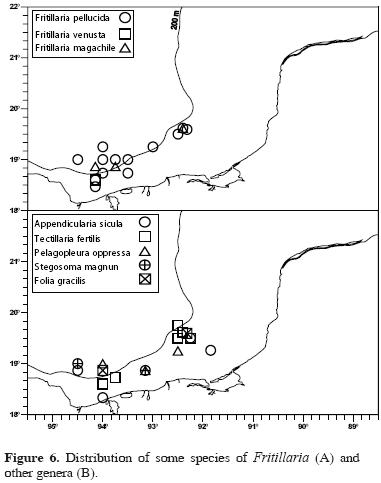
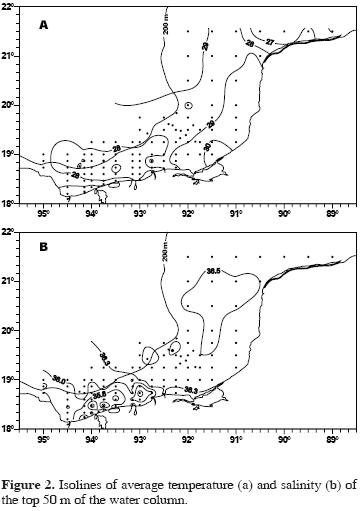
<body><![CDATA[<p align="justify"><font face="verdana" size="2">The highest temperatures were recorded on the inner and mid shelf of Campeche, and the lowest in 2 areas, one off the eastern Yucat&aacute;n shelf that is influenced by upwelling and the other in the coastal area of Tabasco that receives freshwater discharges (<a href="#f2">Fig. 2a</a>).</font></p> 				    <p align="center"><font face="verdana" size="2"><a name="f2"></a></font></p> 				    <p align="center"><font face="verdana" size="2"><img src="/img/revistas/rmbiodiv/v81n1/a17f2.jpg"></font></p> 				    <p align="justify"><font face="verdana" size="2">The highest salinities were recorded on the wide shelf off Yucat&aacute;n and the lowest on the Tabasco shelf off the main freshwater discharge areas (<a href="#f2">Fig. 2b</a>).</font></p> 				    <p align="justify"><font face="verdana" size="2">Twenty species were collected, of which <i>Oikopleura longicauda</i> (70.3%), <i>O. fusiformis</i> (13.6%), <i>Fritillaria haplostoma</i> (10.1%), <i>F. borealis</i> (2.3%), and <i>O. rufescens</i> (1.0%) represented &gt;97% of the total abundance. The other 15 species were very scarce, each representing &lt;1%. Eight of these were present in 5 or less sampling stations (<a href="/img/revistas/rmbiodiv/v81n1/a17t1.jpg" target="_blank">Table 1</a>).</font></p> 				    <p align="justify"><font face="verdana" size="2">The 2 most abundant species, <i>Oikopleura</i> longicauda (<a href="/img/revistas/rmbiodiv/v81n1/a17f3.jpg" target="_blank">Fig. 3A</a>) and O. fusiformis (<a href="/img/revistas/rmbiodiv/v81n1/a17f3.jpg" target="_blank">Fig. 3B</a>), were widely distributed throughout the study area and occurred in 95.3% and 71.9% of the stations respectively.</font></p> 				    <p align="justify"><font face="verdana" size="2">Other species including <i>O. rufescens</i> (<a href="/img/revistas/rmbiodiv/v81n1/a17f3.jpg" target="_blank">Fig. 3C</a>), <i>O. dioica</i> (<a href="/img/revistas/rmbiodiv/v81n1/a17f3.jpg" target="_blank">Fig. 3D</a>), <i>O. cophocerca</i> (<a href="/img/revistas/rmbiodiv/v81n1/a17f4.jpg" target="_blank">Fig. 4A</a>) and <i>O. parva</i> (<a href="/img/revistas/rmbiodiv/v81n1/a17f4.jpg" target="_blank">Fig. 4B</a>) were much less abundant but had relatively wide distributions. <i>Oikopleura gracilis</i> (<a href="/img/revistas/rmbiodiv/v81n1/a17f4.jpg" target="_blank">Fig. 4C</a>) was collected only on the Tabasco&#150;Campeche shelf, in contrast with <i>O. intermedia</i> (<a href="/img/revistas/rmbiodiv/v81n1/a17f4.jpg" target="_blank">Fig. 4D</a>) that was restricted to the Yucat&aacute;n shelf.</font></p> 				    <p align="justify"><font face="verdana" size="2">The remaining species were less widely distributed. <i>Fritillaria venusta</i> was collected at only 1 station but was more abundant than <i>Tectillaria fertilis, F. megachile, Pelagopleura oppressa, Stegosoma magnum</i>, and <i>Folia gracilis</i> (<a href="/img/revistas/rmbiodiv/v81n1/a17t1.jpg" target="_blank">Table 1</a>).</font></p> 				    <p align="justify"><font face="verdana" size="2"><i>Fritillaria</i> species were practically absent on the Yucat&aacute;n shelf, and their greatest densities were recorded on the Tabasco shelf. The species <i>F. haplostoma</i> (<a href="/img/revistas/rmbiodiv/v81n1/a17f5.jpg" target="_blank">Fig. 5A</a>), <i>F. borealis</i> (<a href="/img/revistas/rmbiodiv/v81n1/a17f5.jpg" target="_blank">Fig. 5B</a>), and <i>F. formica</i> (<a href="/img/revistas/rmbiodiv/v81n1/a17f5.jpg" target="_blank">Fig. 5C</a>) were collected at 1 or 2 stations on the Yucat&aacute;n shelf with very low abundances. <i>Fritillaria haplostoma</i>, the most abundant species of the genus, was relitvely abundant on the Campeche shelf, while <i>F. fraudax</i> (<a href="/img/revistas/rmbiodiv/v81n1/a17f5.jpg" target="_blank">Fig. 5D</a>) and the other species of this genus (<a href="#f6">Fig. 6</a>) were present in low numbers in this area, and were found mainly on the narrow Tabasco shelf. <i>Fritillaria venusta</i> was found at only 1 station on the Tabasco shelf (<a href="#f6">Figs. 6</a>). The species of the other genera had low abundances and frequencies of occurrence, and were collected at the oceanic and outer shelf stations off Tabasco (<a href="#f6">Fig. 6</a>).</font></p> 				    <p align="center"><font face="verdana" size="2"><a name="f6"></a></font></p> 				    ]]></body>
<body><![CDATA[<p align="center"><font face="verdana" size="2"><img src="/img/revistas/rmbiodiv/v81n1/a17f6.jpg"></font></p> 				    <p align="justify"><font face="verdana" size="2">The diversity index (Shannon&#150;Wiener) fluctuated from zero at some stations to 3.4 bits/individual at those where 10 species were recorded. The lowest values were at the coastal stations at depths of 30 m, mainly in the Yucat&aacute;n and Campeche areas, with other notably low values occurring at depths between 30 and 75 m (<a href="/img/revistas/rmbiodiv/v81n1/a17f7.jpg" target="_blank">Fig. 7</a>). One to 3 species were recorded at these stations. One species only, <i>O. longicauda</i>, was found in 9 stations. The low diversity is a reflection of the high density and wide distribution of the <i>Oikopleura</i> genus.</font></p> 				    <p align="justify"><font face="verdana" size="2">The greatest diversity values (&gt;2.75 bits/individual) were recorded for the stations located off Tabasco, particularly the outer shelf and oceanic stations where very low densities were recorded, as well as for a few stations in the adjacent areas of the Campeche shelf. These values are related to the presence of species of genera different from <i>Oikopleura</i> and <i>Fritillaria</i>.</font></p> 				    <p align="justify"><font face="verdana" size="2">The results of the multiple regression analysis between species abundance and the parameters indicate a significant negative correlation (p&lt;0.05) between depth and <i>O. longicauda, O. parva</i> and <i>F. haplostoma</i>, between salinity and <i>F. borealis, F. formica</i> and <i>O. dioica</i>, and between temperature and <i>F. fraudax</i>. The very uncommon species were not included in the analysis.</font></p> 				    <p align="justify"><font face="verdana" size="2">Similarly, the canonical correspondence analysis indicated that <i>F. formica, F. borealis, A. sicula</i> and <i>O. dioica</i> occurred in areas of lower salinity, whereas <i>F. megachile</i> was present in areas of higher salinity. <i>Oikopleura longicauda</i> tended to be found in shallow low temperature areas, while <i>S. magnum, F. pellucida, O. gracilis</i> and <i>Folia gracilis</i> occurred in the outer shelf and oceanic stations at higher temperatures (<a href="/img/revistas/rmbiodiv/v81n1/a17f8.jpg" target="_blank">Fig. 8</a>).</font></p> 				    <p align="justify"><font face="verdana" size="2">&nbsp;</font></p> 				    <p align="justify"><font face="verdana" size="2"><b>Discussion</b></font></p> 				    <p align="justify"><font face="verdana" size="2">Of the 20 identified species, <i>Fritillaria venusta</i> and <i>Pelagopleura oppressa</i> are first records for the Gulf of Mexico. Apart from these 20 species, Flores&#150;Coto (1971) had previously recorded the species <i>O. albicans, Althofia tumida, F. aequatorialis, K. oce&aacute;nica</i> and <i>T. veracruzana</i> for the Veracruz reefs, which provide a total of 25 species recorded for the Gulf of Mexico.</font></p> 				    <p align="justify"><font face="verdana" size="2">The recording of <i>O. longicauda</i> as a dominant species is added to the list of studies that have found it to be the dominant species in tropical and subtropical waters around the world (Tokioka and Suarez&#150;Cabro, 1956; Flores&#150;Coto, 1974; Esnal, 1979, 1999; Hopcroft and Roof, 1998; Aravena and Palma, 2002).</font></p> 				    <p align="justify"><font face="verdana" size="2">The oceanic versus neritic nature for most species has not been definitively established, but <i>P. oppressa, S. magnum, T. fertilis, A. sicula</i> and <i>F. gracilis</i> have most frequently been found in oceanic as opposed to neritic waters, whereas <i>O. dioca</i> has been found more frequently in coastal areas (Tokioka and Suarez&#150;Cabro, 1956; Fenaux, 1963; Zoppi de Roa, 1971; Esnal, 1972; Castellanos et al., 1994; Esnal and Castro, 1977; Capitanio and Esnal, 1997), in agreement with ourr findings.</font></p> 				    ]]></body>
<body><![CDATA[<p align="justify"><font face="verdana" size="2">It should be noted that, with respect to the distribution of this group, diversity and abundance presented opposite trends and divided the study area into 2 regions. Whereas the greatest diversity and lowest abundance occurred in the outer shelf and oceanic stations off Tabasco, the lowest diversity and greatest abundance was observed at the shallow stations off Campeche and Yucat&aacute;n. The latter region, where <i>Oikopleura</i> species were abundant and <i>Fritillaria</i> species and other genera were practically absent, lies under the influence of a branch of the Yucat&aacute;n current that is formed by clear upwelling waters (Besonov et al., 1971; Merino, 1997) that reach the shallow areas of Campeche and occasionally those of Tabasco (Inoue and Welsh, 1997; Zavala Hidalgo et al., 2003). In contrast, the mid and outer shelf of Tabasco, where most of the <i>Fritillaria</i> species and other genera occurred, is subject to continental water discharges, as well as a cyclonic gyre (Besonov et al., 1971; Salas de Le&oacute;n et al., 1998).</font></p> 				    <p align="justify"><font face="verdana" size="2">The results indicate a significant negative relationship between <i>O. longicauda, O. parva</i> and <i>F. haplostoma</i> and depth, between <i>F. fraudax</i> and temperature, and between <i>O. dioca, F. borealis</i> and <i>F. formica</i> and salinity. Nevertheless, these relationships did not explain the dissimilar genera and species distribution between the deep and shallow areas, as mentioned above.</font></p> 				    <p align="justify"><font face="verdana" size="2">All the observed species have been characterised as tropical and subtropical inhabitants of neritic and oceanic waters, throughout wide ranges of salinity and temperature.</font></p> 				    <p align="justify"><font face="verdana" size="2">Different populations of the same species may be adapted to different ranges depending on the locality (Fenaux et al., 1998; L&oacute;pez&#150;Urrutia et al., 2005). Tomita et al. (2003) suggested that the spatial patterns of appendicularians in Toyama Bay were more likely the result of biological factors than of physical factors.</font></p> 				    <p align="justify"><font face="verdana" size="2">It is probable that the salinity and temperature in the study area could have a more evident effect on distribution as a consequence of large seasonal variations in continental water discharges, mixing processes, currents, gyres and other climatologically related activities, as previous studies have suggested for meso&#150;scale distribution patterns of ichthyoplankton (Salas de Le&oacute;n et al., 1998; Sanvicente et al., 2000).</font></p> 				    <p align="justify"><font face="verdana" size="2">Although currents, oceanic gyres, continental water discharges, depth, salinity and temperature appear to be the main factors that determined the distributions and abundances recorded in this study, similarly uneven distributions have been observed elsewhere (Bojorbern and Forneris 1956a, 1956b; Fenaux, 1963; Nakamura et al., 1977; Aldridge, 1982; Capitanio and Esnal, 1998; Brena et al., 2003). These being independent of the local Gulf of Mexico physical factors, other factors must be considered. We assume that the food supply, a short life cycle, and high reproductive efficiency (massive production) are factors commonly associated with distribution (Hopcroft and Roof, 1995, 1998; Capitanio and Esnal, 1998; Cima et al., 2002). Food supply could probably be the main factor, as appendicularians do not store energy in lipid deposits (Gorky and Fenaux, 1998). Consequently, the presence and abundance of this group of animals should indicate environments rich in detritus of ingestible size and quality.</font></p> 				    <p align="justify"><font face="verdana" size="2">&nbsp;</font></p> 				    <p align="justify"><font face="verdana" size="2"><b>Acknowledgements</b></font></p> 				    <p align="justify"><font face="verdana" size="2">The authors thank Faustino Zavala for the technical support provided. The samples for this study were collected during the "Monitoreo Ambiental del Sur del Golfo de M&eacute;xico", PEMEX Program SGM8.</font></p> 				    <p align="justify"><font face="verdana" size="2">&nbsp;</font></p> 				    ]]></body>
<body><![CDATA[<p align="justify"><font face="verdana" size="2"><b>Literature cited</b></font></p> 				    <!-- ref --><p align="justify"><font face="verdana" size="2">Alldredge, A. L. 1982. Aggregation of spawning appendicularians in surface windrows. Bulletin of Marine Science 32:250&#150;254.</font>&nbsp;&nbsp;&nbsp;&nbsp;&nbsp;&nbsp;&nbsp;&nbsp;[&#160;<a href="javascript:void(0);" onclick="javascript: window.open('/scielo.php?script=sci_nlinks&ref=7544413&pid=S1870-3453201000010001700001&lng=','','width=640,height=500,resizable=yes,scrollbars=1,menubar=yes,');">Links</a>&#160;]<!-- end-ref --> 				    <!-- ref --><p align="justify"><font face="verdana" size="2">Aravena, G., S. Palma. 2002. Taxonomic identification of appendicularians collected in epipelagic waters off northern Chile (Tunicata, Appendicularia). Revista Chilena de Historia Natural 75:307&#150;325.</font>&nbsp;&nbsp;&nbsp;&nbsp;&nbsp;&nbsp;&nbsp;&nbsp;[&#160;<a href="javascript:void(0);" onclick="javascript: window.open('/scielo.php?script=sci_nlinks&ref=7544415&pid=S1870-3453201000010001700002&lng=','','width=640,height=500,resizable=yes,scrollbars=1,menubar=yes,');">Links</a>&#160;]<!-- end-ref --> 				    <!-- ref --><p align="justify"><font face="verdana" size="2">Besonov, N., O. Gonz&aacute;lez and A. Elizarov. 1971. Resultados de las investigaciones Cubano&#150;sovi&eacute;ticas en el Banco de Campeche. Coloquio sobre Investigaciones y Recursos del Mar Caribe y Regiones Adyacentes, Curasao, Antillas Holandesas, 1968. UNESCO, Paris. 318&#150;323 p.</font>&nbsp;&nbsp;&nbsp;&nbsp;&nbsp;&nbsp;&nbsp;&nbsp;[&#160;<a href="javascript:void(0);" onclick="javascript: window.open('/scielo.php?script=sci_nlinks&ref=7544417&pid=S1870-3453201000010001700003&lng=','','width=640,height=500,resizable=yes,scrollbars=1,menubar=yes,');">Links</a>&#160;]<!-- end-ref --> 				    <!-- ref --><p align="justify"><font face="verdana" size="2">Bj&ouml;rnberg, T. K. and L. Forneris. 1956a. On the uneven distribution of the copelata of the Fernando Noronha area. Boletin Instituto Oceanografico S&atilde;o Paulo 7:105&#150;111.</font>&nbsp;&nbsp;&nbsp;&nbsp;&nbsp;&nbsp;&nbsp;&nbsp;[&#160;<a href="javascript:void(0);" onclick="javascript: window.open('/scielo.php?script=sci_nlinks&ref=7544419&pid=S1870-3453201000010001700004&lng=','','width=640,height=500,resizable=yes,scrollbars=1,menubar=yes,');">Links</a>&#160;]<!-- end-ref --> 				    <!-- ref --><p align="justify"><font face="verdana" size="2">Bj&ouml;rnberg, T. K. and L. Forneris. 1956b. On the uneven distribution of the copelata of the Alcatrazes area. Boletin Instituto Oceanografico S&atilde;o Paulo 7:113&#150;115.</font>&nbsp;&nbsp;&nbsp;&nbsp;&nbsp;&nbsp;&nbsp;&nbsp;[&#160;<a href="javascript:void(0);" onclick="javascript: window.open('/scielo.php?script=sci_nlinks&ref=7544421&pid=S1870-3453201000010001700005&lng=','','width=640,height=500,resizable=yes,scrollbars=1,menubar=yes,');">Links</a>&#160;]<!-- end-ref --> 				    <!-- ref --><p align="justify"><font face="verdana" size="2">Brena, C., Cima, F. and P. Burighel. 2003. The highly specialized gut of Fritillaridae (Appendicularia: Tunicata). Marine Biology 143:57&#150;71.</font>&nbsp;&nbsp;&nbsp;&nbsp;&nbsp;&nbsp;&nbsp;&nbsp;[&#160;<a href="javascript:void(0);" onclick="javascript: window.open('/scielo.php?script=sci_nlinks&ref=7544423&pid=S1870-3453201000010001700006&lng=','','width=640,height=500,resizable=yes,scrollbars=1,menubar=yes,');">Links</a>&#160;]<!-- end-ref --> 				    <!-- ref --><p align="justify"><font face="verdana" size="2">Brooks, W. K. and C. Kellner. 1908. Tunicata of the Gulf Stream. Part IV. <i>Oikopleura tortugensis</i>, a new appendicularian from the Tortugas, Florida, with notes on its embryology. Papers of Tortugas Laboratory. Carnegie Institute of Washington 1:89&#150;94.</font>&nbsp;&nbsp;&nbsp;&nbsp;&nbsp;&nbsp;&nbsp;&nbsp;[&#160;<a href="javascript:void(0);" onclick="javascript: window.open('/scielo.php?script=sci_nlinks&ref=7544425&pid=S1870-3453201000010001700007&lng=','','width=640,height=500,resizable=yes,scrollbars=1,menubar=yes,');">Links</a>&#160;]<!-- end-ref --> 				    <!-- ref --><p align="justify"><font face="verdana" size="2">Capitanio, F. L. and G. B. Esnal. 1997. Appendicularian distribution in the Rio de la Plata estuary and adjacent areas. Neritica Curitiva 11:37&#150;48.</font>&nbsp;&nbsp;&nbsp;&nbsp;&nbsp;&nbsp;&nbsp;&nbsp;[&#160;<a href="javascript:void(0);" onclick="javascript: window.open('/scielo.php?script=sci_nlinks&ref=7544427&pid=S1870-3453201000010001700008&lng=','','width=640,height=500,resizable=yes,scrollbars=1,menubar=yes,');">Links</a>&#160;]<!-- end-ref --> 				    <!-- ref --><p align="justify"><font face="verdana" size="2">Castellanos, I., R. Gasca and G. Esnal. 1994. Apendicularias de dos sitemas costeros del mar Caribe. Sian Ka&aacute;n Serie Documentos 2:18&#150;22.</font>&nbsp;&nbsp;&nbsp;&nbsp;&nbsp;&nbsp;&nbsp;&nbsp;[&#160;<a href="javascript:void(0);" onclick="javascript: window.open('/scielo.php?script=sci_nlinks&ref=7544429&pid=S1870-3453201000010001700009&lng=','','width=640,height=500,resizable=yes,scrollbars=1,menubar=yes,');">Links</a>&#160;]<!-- end-ref --> 				    <!-- ref --><p align="justify"><font face="verdana" size="2">Cima, F., C. Brena and P. Burighel. 2002. Multifarius activities of gut epithelium in an appendicularian (<i>Oikopleura</i> dioca: Tunicata). Marine Biology 1421:479&#150;490.</font>&nbsp;&nbsp;&nbsp;&nbsp;&nbsp;&nbsp;&nbsp;&nbsp;[&#160;<a href="javascript:void(0);" onclick="javascript: window.open('/scielo.php?script=sci_nlinks&ref=7544431&pid=S1870-3453201000010001700010&lng=','','width=640,height=500,resizable=yes,scrollbars=1,menubar=yes,');">Links</a>&#160;]<!-- end-ref --> 				    <!-- ref --><p align="justify"><font face="verdana" size="2">Deibel, D. 1998. Feeding and metabolism of appendicularia. <i>In</i> The Biology of Pelagic Tunicates, Q. Bone (ed.). Oxford University Press, Oxford. p. 139&#150;149.</font>&nbsp;&nbsp;&nbsp;&nbsp;&nbsp;&nbsp;&nbsp;&nbsp;[&#160;<a href="javascript:void(0);" onclick="javascript: window.open('/scielo.php?script=sci_nlinks&ref=7544433&pid=S1870-3453201000010001700011&lng=','','width=640,height=500,resizable=yes,scrollbars=1,menubar=yes,');">Links</a>&#160;]<!-- end-ref --> 				    <!-- ref --><p align="justify"><font face="verdana" size="2">Esnal, G. 1972. Apendicularias de la desembocadura del R&iacute;o de la Plata. Physis 31:259&#150;272.</font>&nbsp;&nbsp;&nbsp;&nbsp;&nbsp;&nbsp;&nbsp;&nbsp;[&#160;<a href="javascript:void(0);" onclick="javascript: window.open('/scielo.php?script=sci_nlinks&ref=7544435&pid=S1870-3453201000010001700012&lng=','','width=640,height=500,resizable=yes,scrollbars=1,menubar=yes,');">Links</a>&#160;]<!-- end-ref --> 				    <!-- ref --><p align="justify"><font face="verdana" size="2">Esnal, G. 1979. Caracter&iacute;sticas generales de la distribuci&oacute;n de los tunicados pel&aacute;gicos del Atl&aacute;ntico sudoccidental, con algunas observaciones morfol&oacute;gicas. Physis 38:91&#150;102.</font>&nbsp;&nbsp;&nbsp;&nbsp;&nbsp;&nbsp;&nbsp;&nbsp;[&#160;<a href="javascript:void(0);" onclick="javascript: window.open('/scielo.php?script=sci_nlinks&ref=7544437&pid=S1870-3453201000010001700013&lng=','','width=640,height=500,resizable=yes,scrollbars=1,menubar=yes,');">Links</a>&#160;]<!-- end-ref --> 				    <!-- ref --><p align="justify"><font face="verdana" size="2">Esnal, G. 1999. Appendicularia. <i>In</i> South Atlantic Zooplankton, D. Boltovskoy (ed.). Backhuys Publishers Netherlands. p. 1375&#150;1399.</font>&nbsp;&nbsp;&nbsp;&nbsp;&nbsp;&nbsp;&nbsp;&nbsp;[&#160;<a href="javascript:void(0);" onclick="javascript: window.open('/scielo.php?script=sci_nlinks&ref=7544439&pid=S1870-3453201000010001700014&lng=','','width=640,height=500,resizable=yes,scrollbars=1,menubar=yes,');">Links</a>&#160;]<!-- end-ref --> 				    <!-- ref --><p align="justify"><font face="verdana" size="2">Esnal, G. and R. J. Castro. 1977. Distributional and biometrical study of appendicularians from the west South Atlantic Ocean. Hydrobiology 56:241&#150;246.</font>&nbsp;&nbsp;&nbsp;&nbsp;&nbsp;&nbsp;&nbsp;&nbsp;[&#160;<a href="javascript:void(0);" onclick="javascript: window.open('/scielo.php?script=sci_nlinks&ref=7544441&pid=S1870-3453201000010001700015&lng=','','width=640,height=500,resizable=yes,scrollbars=1,menubar=yes,');">Links</a>&#160;]<!-- end-ref --> 				    <!-- ref --><p align="justify"><font face="verdana" size="2">Fenaux, R. 1963. Ecologie et Biologie des Appendiculaires Mediterraneens (Villefranche&#150;sur&#150;mer). Laboratorie Arago. Vie et Milieu 16:1&#150;142.</font>&nbsp;&nbsp;&nbsp;&nbsp;&nbsp;&nbsp;&nbsp;&nbsp;[&#160;<a href="javascript:void(0);" onclick="javascript: window.open('/scielo.php?script=sci_nlinks&ref=7544443&pid=S1870-3453201000010001700016&lng=','','width=640,height=500,resizable=yes,scrollbars=1,menubar=yes,');">Links</a>&#160;]<!-- end-ref --> 				    <!-- ref --><p align="justify"><font face="verdana" size="2">Fenaux, R., Q. Bone and D. Deibel. (1998). Appendicularian distribution and zoogeograpgy. <i>In</i> The biology of pelagic tunicates, Q. Bone (ed.). Oxford University Press, Great Britain. p. 259&#150;264.</font>&nbsp;&nbsp;&nbsp;&nbsp;&nbsp;&nbsp;&nbsp;&nbsp;[&#160;<a href="javascript:void(0);" onclick="javascript: window.open('/scielo.php?script=sci_nlinks&ref=7544445&pid=S1870-3453201000010001700017&lng=','','width=640,height=500,resizable=yes,scrollbars=1,menubar=yes,');">Links</a>&#160;]<!-- end-ref --> 				    <!-- ref --><p align="justify"><font face="verdana" size="2">Flood, P. R., D. Deibel and C. C. Morris. 1992. Filtration of colloidal melanin from the sea water by planktonic tunicates. Nature 355:630&#150;632.</font>&nbsp;&nbsp;&nbsp;&nbsp;&nbsp;&nbsp;&nbsp;&nbsp;[&#160;<a href="javascript:void(0);" onclick="javascript: window.open('/scielo.php?script=sci_nlinks&ref=7544447&pid=S1870-3453201000010001700018&lng=','','width=640,height=500,resizable=yes,scrollbars=1,menubar=yes,');">Links</a>&#160;]<!-- end-ref --> 				    <!-- ref --><p align="justify"><font face="verdana" size="2">Flores&#150;Coto, C. 1965. Notas preliminares sobre la identificaci&oacute;n de las apendicularias de las aguas veracruzanas. Anales del Instituto de Biolog&iacute;a, Universidad Nacional Aut&oacute;noma de M&eacute;xico 36:293&#150;296.</font>&nbsp;&nbsp;&nbsp;&nbsp;&nbsp;&nbsp;&nbsp;&nbsp;[&#160;<a href="javascript:void(0);" onclick="javascript: window.open('/scielo.php?script=sci_nlinks&ref=7544449&pid=S1870-3453201000010001700019&lng=','','width=640,height=500,resizable=yes,scrollbars=1,menubar=yes,');">Links</a>&#160;]<!-- end-ref --> 				    <!-- ref --><p align="justify"><font face="verdana" size="2">Flores&#150;Coto, C. 1974. Contribuci&oacute;n al conocimiento de las apendicularias del arrecife "La Blanquilla" Veracruz, M&eacute;xico, con descripci&oacute;n de una nueva especie. Anales del Centro de Ciencias del Mar y Limnolog&iacute;a, Universidad Nacional Aut&oacute;noma de M&eacute;xico 1:41&#150;60.</font>&nbsp;&nbsp;&nbsp;&nbsp;&nbsp;&nbsp;&nbsp;&nbsp;[&#160;<a href="javascript:void(0);" onclick="javascript: window.open('/scielo.php?script=sci_nlinks&ref=7544451&pid=S1870-3453201000010001700020&lng=','','width=640,height=500,resizable=yes,scrollbars=1,menubar=yes,');">Links</a>&#160;]<!-- end-ref --> 				    <!-- ref --><p align="justify"><font face="verdana" size="2">Furnas, M. J. and T. J. Smayda. 1987. Inputs of subthermocline waters and nitrate onto the Campeche Bank. Continental Shelf Research 7:161&#150;175.</font>&nbsp;&nbsp;&nbsp;&nbsp;&nbsp;&nbsp;&nbsp;&nbsp;[&#160;<a href="javascript:void(0);" onclick="javascript: window.open('/scielo.php?script=sci_nlinks&ref=7544453&pid=S1870-3453201000010001700021&lng=','','width=640,height=500,resizable=yes,scrollbars=1,menubar=yes,');">Links</a>&#160;]<!-- end-ref --> 				    <!-- ref --><p align="justify"><font face="verdana" size="2">Gorsky, G. and R. Fenaux. 1998. The role of appendicularia in marine food webs. <i>In</i> The Biology of Pelagic Tunicates, Q. Bone (ed.). Oxford University Press, Oxford. p. 161&#150;169.</font>&nbsp;&nbsp;&nbsp;&nbsp;&nbsp;&nbsp;&nbsp;&nbsp;[&#160;<a href="javascript:void(0);" onclick="javascript: window.open('/scielo.php?script=sci_nlinks&ref=7544455&pid=S1870-3453201000010001700022&lng=','','width=640,height=500,resizable=yes,scrollbars=1,menubar=yes,');">Links</a>&#160;]<!-- end-ref --> 				    <!-- ref --><p align="justify"><font face="verdana" size="2">Hopcroft, R. R. and J. C. Roff. 1995. Zooplankton growth rates: extraordinary production by the larvacean <i>Oikopleura dioca</i> in tropical waters. Journal of Plankton Research 17:205&#150;220.</font>&nbsp;&nbsp;&nbsp;&nbsp;&nbsp;&nbsp;&nbsp;&nbsp;[&#160;<a href="javascript:void(0);" onclick="javascript: window.open('/scielo.php?script=sci_nlinks&ref=7544457&pid=S1870-3453201000010001700023&lng=','','width=640,height=500,resizable=yes,scrollbars=1,menubar=yes,');">Links</a>&#160;]<!-- end-ref --> 				    <!-- ref --><p align="justify"><font face="verdana" size="2">Hopcroft, R. R. and J. C. Roff. 1998. Production of tropical larvaceans in Kingston Harbour, Jamaica: Are we ignoring an important secondary producer. Journal of Plankton Research 20:557&#150;569.</font>&nbsp;&nbsp;&nbsp;&nbsp;&nbsp;&nbsp;&nbsp;&nbsp;[&#160;<a href="javascript:void(0);" onclick="javascript: window.open('/scielo.php?script=sci_nlinks&ref=7544459&pid=S1870-3453201000010001700024&lng=','','width=640,height=500,resizable=yes,scrollbars=1,menubar=yes,');">Links</a>&#160;]<!-- end-ref --> 				    <!-- ref --><p align="justify"><font face="verdana" size="2">Hopcroft, R. R., J. C. Roff and H. A. Bouman. 1998. Zooplankton growth rates: The larvaceans <i>Appendicularia, Fritillaria</i> and <i>Oikopleura</i> in tropical waters. Journal of Plankton Research 20:539&#150;555.</font>&nbsp;&nbsp;&nbsp;&nbsp;&nbsp;&nbsp;&nbsp;&nbsp;[&#160;<a href="javascript:void(0);" onclick="javascript: window.open('/scielo.php?script=sci_nlinks&ref=7544461&pid=S1870-3453201000010001700025&lng=','','width=640,height=500,resizable=yes,scrollbars=1,menubar=yes,');">Links</a>&#160;]<!-- end-ref --> 				    <!-- ref --><p align="justify"><font face="verdana" size="2">Inoue, M. and S. E. Welsh. 1997. Numerical simulation of Gulf of Mexico circulation under present and glacial climatic conditions. U.S. Deptartament of the Interior. Minerals Management Service, Gulf of Mexico OCS Region. p. 27&#150;30.</font>&nbsp;&nbsp;&nbsp;&nbsp;&nbsp;&nbsp;&nbsp;&nbsp;[&#160;<a href="javascript:void(0);" onclick="javascript: window.open('/scielo.php?script=sci_nlinks&ref=7544463&pid=S1870-3453201000010001700026&lng=','','width=640,height=500,resizable=yes,scrollbars=1,menubar=yes,');">Links</a>&#160;]<!-- end-ref --> 				    <!-- ref --><p align="justify"><font face="verdana" size="2">L&oacute;pez&#150;Urrutia, A., R. P. Harris, J. L. Acu&ntilde;a, U. Bamstedt, P. R. Food, H. J. Fyhn, B. Gasser, G. Gorsky, X. Irigoien and M. B. Martinussen. (2005). A comparison of appendicularian seasonal cycles in 4 distinct European coastal environments. <i>In</i> Response of marine ecosystems to Global change, G. Gorsky, M. J. Youngblut and D. Dibel (eds.). Contemporary Publishing International, Paris. p. 255&#150;276.</font>&nbsp;&nbsp;&nbsp;&nbsp;&nbsp;&nbsp;&nbsp;&nbsp;[&#160;<a href="javascript:void(0);" onclick="javascript: window.open('/scielo.php?script=sci_nlinks&ref=7544465&pid=S1870-3453201000010001700027&lng=','','width=640,height=500,resizable=yes,scrollbars=1,menubar=yes,');">Links</a>&#160;]<!-- end-ref --> 				    <!-- ref --><p align="justify"><font face="verdana" size="2">Merino, M. 1997. Upwelling on the Yucatan shelf: hydrographic evidence. Journal of Marine Systems 13:101&#150;121.</font>&nbsp;&nbsp;&nbsp;&nbsp;&nbsp;&nbsp;&nbsp;&nbsp;[&#160;<a href="javascript:void(0);" onclick="javascript: window.open('/scielo.php?script=sci_nlinks&ref=7544467&pid=S1870-3453201000010001700028&lng=','','width=640,height=500,resizable=yes,scrollbars=1,menubar=yes,');">Links</a>&#160;]<!-- end-ref --> 				    <!-- ref --><p align="justify"><font face="verdana" size="2">Monreal&#150;G&oacute;mez, M. A. and D. A. Salas de Le&oacute;n. 1990. Simulaci&oacute;n de la circulaci&oacute;n en la Bah&iacute;a de Campeche. Geofisica Internacional 29:101&#150;111.</font>&nbsp;&nbsp;&nbsp;&nbsp;&nbsp;&nbsp;&nbsp;&nbsp;[&#160;<a href="javascript:void(0);" onclick="javascript: window.open('/scielo.php?script=sci_nlinks&ref=7544469&pid=S1870-3453201000010001700029&lng=','','width=640,height=500,resizable=yes,scrollbars=1,menubar=yes,');">Links</a>&#160;]<!-- end-ref --> 				    <!-- ref --><p align="justify"><font face="verdana" size="2">Nakamura, Y., K. Suzuki, S. Suzuki and J. Hiromi. 1997. Production of <i>Oikopleura dioica</i> (Appendicularia) following a picoplankton "bloom" in a eutrophic coastal area. Journal of Plankton Research 19:113&#150;124.</font>&nbsp;&nbsp;&nbsp;&nbsp;&nbsp;&nbsp;&nbsp;&nbsp;[&#160;<a href="javascript:void(0);" onclick="javascript: window.open('/scielo.php?script=sci_nlinks&ref=7544471&pid=S1870-3453201000010001700030&lng=','','width=640,height=500,resizable=yes,scrollbars=1,menubar=yes,');">Links</a>&#160;]<!-- end-ref --> 				    <!-- ref --><p align="justify"><font face="verdana" size="2">Rivera&#150;Arriaga, E. and G. Borges&#150;Souza. 2008. El gran ecosistema marino del Golfo de M&eacute;xico. Perspectivas para su manejo. Jaina Bolet&iacute;n informativo 16:30&#150;48.</font>&nbsp;&nbsp;&nbsp;&nbsp;&nbsp;&nbsp;&nbsp;&nbsp;[&#160;<a href="javascript:void(0);" onclick="javascript: window.open('/scielo.php?script=sci_nlinks&ref=7544473&pid=S1870-3453201000010001700031&lng=','','width=640,height=500,resizable=yes,scrollbars=1,menubar=yes,');">Links</a>&#160;]<!-- end-ref --> 				    <!-- ref --><p align="justify"><font face="verdana" size="2">Salas de Le&oacute;n, D., Monreal&#150;G&oacute;mez, M. A., L. Sanvicente&#150;A&ntilde;orve, and C. Flores&#150;Coto. 1998. Influence de la circulation &agrave; long terme sur la r&eacute;partition des organismes zooplanctoniques dans la Baie de Campeche, Mexique. Oceanologica Acta 21:87&#150;93.</font>&nbsp;&nbsp;&nbsp;&nbsp;&nbsp;&nbsp;&nbsp;&nbsp;[&#160;<a href="javascript:void(0);" onclick="javascript: window.open('/scielo.php?script=sci_nlinks&ref=7544475&pid=S1870-3453201000010001700032&lng=','','width=640,height=500,resizable=yes,scrollbars=1,menubar=yes,');">Links</a>&#160;]<!-- end-ref --> 				    <!-- ref --><p align="justify"><font face="verdana" size="2">Sanvicente&#150;A&ntilde;orve, L., C. Flores&#150;Coto and X. Chiappa&#150;Carrara. 2000. Temporal and spatial scales of ichthyoplankton distribution in the southern Gulf of Mexico. Estuarine, Coastal and Shelf Science 51:463&#150;475.</font>&nbsp;&nbsp;&nbsp;&nbsp;&nbsp;&nbsp;&nbsp;&nbsp;[&#160;<a href="javascript:void(0);" onclick="javascript: window.open('/scielo.php?script=sci_nlinks&ref=7544477&pid=S1870-3453201000010001700033&lng=','','width=640,height=500,resizable=yes,scrollbars=1,menubar=yes,');">Links</a>&#160;]<!-- end-ref --> 				    <!-- ref --><p align="justify"><font face="verdana" size="2">Shirazago&#150;German, B. 1991. Hidrograf&iacute;a y an&aacute;lisis frontognenico en el sur de la bah&iacute;a de Campeche. Tesis maestr&iacute;a, Colegio de Ciencias y Humanidades, Universidad Nacional Aut&oacute;noma de M&eacute;xico. 160 p.</font>&nbsp;&nbsp;&nbsp;&nbsp;&nbsp;&nbsp;&nbsp;&nbsp;[&#160;<a href="javascript:void(0);" onclick="javascript: window.open('/scielo.php?script=sci_nlinks&ref=7544479&pid=S1870-3453201000010001700034&lng=','','width=640,height=500,resizable=yes,scrollbars=1,menubar=yes,');">Links</a>&#160;]<!-- end-ref --> 				    <!-- ref --><p align="justify"><font face="verdana" size="2">Tokioka, T. 1960. studies on the distribution of appendicularians and some thaliaceans of the nprth Pacific, with some morphological notes. Publications of Seto Marine Biological Laboratory VII:351&#150;443.</font>&nbsp;&nbsp;&nbsp;&nbsp;&nbsp;&nbsp;&nbsp;&nbsp;[&#160;<a href="javascript:void(0);" onclick="javascript: window.open('/scielo.php?script=sci_nlinks&ref=7544481&pid=S1870-3453201000010001700035&lng=','','width=640,height=500,resizable=yes,scrollbars=1,menubar=yes,');">Links</a>&#160;]<!-- end-ref --> 				    <!-- ref --><p align="justify"><font face="verdana" size="2">Tokioka, T. y J. Su&aacute;rez&#150;Caabro. 1956. Apendicularias de los mares cubanos. Memorias de la Sociedad Cubana de Historia Natural 23:37&#150;95.</font>&nbsp;&nbsp;&nbsp;&nbsp;&nbsp;&nbsp;&nbsp;&nbsp;[&#160;<a href="javascript:void(0);" onclick="javascript: window.open('/scielo.php?script=sci_nlinks&ref=7544483&pid=S1870-3453201000010001700036&lng=','','width=640,height=500,resizable=yes,scrollbars=1,menubar=yes,');">Links</a>&#160;]<!-- end-ref --> 				    <!-- ref --><p align="justify"><font face="verdana" size="2">Tomita, M., N. Shiga and T. Ikeda. 2003. Seasonal occurrence and vertical distribution of appendicularians in Toyama Bay, southern Japan Sea. Journal of Plankton Research 25:579&#150;589.</font>&nbsp;&nbsp;&nbsp;&nbsp;&nbsp;&nbsp;&nbsp;&nbsp;[&#160;<a href="javascript:void(0);" onclick="javascript: window.open('/scielo.php?script=sci_nlinks&ref=7544485&pid=S1870-3453201000010001700037&lng=','','width=640,height=500,resizable=yes,scrollbars=1,menubar=yes,');">Links</a>&#160;]<!-- end-ref --> 				    <!-- ref --><p align="justify"><font face="verdana" size="2">Zavala&#150;Hidalgo, J., S. L. Morey and J. O'Brien. 2003. Seasonal circulation on the western shelf of the Gulf of Mexico using a high&#150;resolution numerical model. Journal of Geophysical Research 108: NO. C12, 3389, doi: 10.1029/2003JC001879.</font>&nbsp;&nbsp;&nbsp;&nbsp;&nbsp;&nbsp;&nbsp;&nbsp;[&#160;<a href="javascript:void(0);" onclick="javascript: window.open('/scielo.php?script=sci_nlinks&ref=7544487&pid=S1870-3453201000010001700038&lng=','','width=640,height=500,resizable=yes,scrollbars=1,menubar=yes,');">Links</a>&#160;]<!-- end-ref --> 				    <!-- ref --><p align="justify"><font face="verdana" size="2">Zoppi de Roa, E., 1971. Apendicularias de la regi&oacute;n oriental de Venezuela. Studies on the fauna of Cura&ccedil;ao and other Caribbean islands 38:77&#150;109.</font>&nbsp;&nbsp;&nbsp;&nbsp;&nbsp;&nbsp;&nbsp;&nbsp;[&#160;<a href="javascript:void(0);" onclick="javascript: window.open('/scielo.php?script=sci_nlinks&ref=7544489&pid=S1870-3453201000010001700039&lng=','','width=640,height=500,resizable=yes,scrollbars=1,menubar=yes,');">Links</a>&#160;]<!-- end-ref --> ]]></body><back>
<ref-list>
<ref id="B1">
<nlm-citation citation-type="journal">
<person-group person-group-type="author">
<name>
<surname><![CDATA[Alldredge]]></surname>
<given-names><![CDATA[A. L.]]></given-names>
</name>
</person-group>
<article-title xml:lang="en"><![CDATA[Aggregation of spawning appendicularians in surface windrows]]></article-title>
<source><![CDATA[Bulletin of Marine Science]]></source>
<year>1982</year>
<volume>32</volume>
<page-range>250-254</page-range></nlm-citation>
</ref>
<ref id="B2">
<nlm-citation citation-type="journal">
<person-group person-group-type="author">
<name>
<surname><![CDATA[Aravena]]></surname>
<given-names><![CDATA[G]]></given-names>
</name>
<name>
<surname><![CDATA[Palma]]></surname>
<given-names><![CDATA[S.]]></given-names>
</name>
</person-group>
<article-title xml:lang="en"><![CDATA[Taxonomic identification of appendicularians collected in epipelagic waters off northern Chile (Tunicata, Appendicularia)]]></article-title>
<source><![CDATA[Revista Chilena de Historia Natural]]></source>
<year>2002</year>
<volume>75</volume>
<page-range>307-325</page-range></nlm-citation>
</ref>
<ref id="B3">
<nlm-citation citation-type="book">
<person-group person-group-type="author">
<name>
<surname><![CDATA[Besonov]]></surname>
<given-names><![CDATA[N.]]></given-names>
</name>
<name>
<surname><![CDATA[González]]></surname>
<given-names><![CDATA[O.]]></given-names>
</name>
<name>
<surname><![CDATA[Elizarov]]></surname>
<given-names><![CDATA[A.]]></given-names>
</name>
</person-group>
<source><![CDATA[Resultados de las investigaciones Cubano-soviéticas en el Banco de Campeche. Coloquio sobre Investigaciones y Recursos del Mar Caribe y Regiones Adyacentes, Curasao, Antillas Holandesas, 1968]]></source>
<year>1971</year>
<page-range>318-323</page-range><publisher-loc><![CDATA[Paris ]]></publisher-loc>
<publisher-name><![CDATA[UNESCO]]></publisher-name>
</nlm-citation>
</ref>
<ref id="B4">
<nlm-citation citation-type="journal">
<person-group person-group-type="author">
<name>
<surname><![CDATA[Björnberg]]></surname>
<given-names><![CDATA[T. K.]]></given-names>
</name>
<name>
<surname><![CDATA[Forneris]]></surname>
<given-names><![CDATA[L.]]></given-names>
</name>
</person-group>
<article-title xml:lang="en"><![CDATA[On the uneven distribution of the copelata of the Fernando Noronha area]]></article-title>
<source><![CDATA[Boletin Instituto Oceanografico São Paulo]]></source>
<year>1956</year>
<month>a</month>
<volume>7</volume>
<page-range>105-111</page-range></nlm-citation>
</ref>
<ref id="B5">
<nlm-citation citation-type="journal">
<person-group person-group-type="author">
<name>
<surname><![CDATA[Björnberg]]></surname>
<given-names><![CDATA[T. K.]]></given-names>
</name>
<name>
<surname><![CDATA[Forneris]]></surname>
<given-names><![CDATA[L.]]></given-names>
</name>
</person-group>
<article-title xml:lang="en"><![CDATA[On the uneven distribution of the copelata of the Alcatrazes area]]></article-title>
<source><![CDATA[Boletin Instituto Oceanografico São Paulo]]></source>
<year>1956</year>
<month>b</month>
<volume>7</volume>
<page-range>113-115</page-range></nlm-citation>
</ref>
<ref id="B6">
<nlm-citation citation-type="journal">
<person-group person-group-type="author">
<name>
<surname><![CDATA[Brena]]></surname>
<given-names><![CDATA[C]]></given-names>
</name>
<name>
<surname><![CDATA[Cima]]></surname>
<given-names><![CDATA[F.]]></given-names>
</name>
<name>
<surname><![CDATA[Burighel]]></surname>
<given-names><![CDATA[P.]]></given-names>
</name>
</person-group>
<article-title xml:lang="en"><![CDATA[The highly specialized gut of Fritillaridae (Appendicularia:Tunicata)]]></article-title>
<source><![CDATA[Marine Biology]]></source>
<year>2003</year>
<volume>143</volume>
<page-range>57-71</page-range></nlm-citation>
</ref>
<ref id="B7">
<nlm-citation citation-type="journal">
<person-group person-group-type="author">
<name>
<surname><![CDATA[Brooks]]></surname>
<given-names><![CDATA[W. K.]]></given-names>
</name>
<name>
<surname><![CDATA[Kellner]]></surname>
<given-names><![CDATA[C.]]></given-names>
</name>
</person-group>
<article-title xml:lang="en"><![CDATA[Tunicata of the Gulf Stream: Part IV. Oikopleura tortugensis, a new appendicularian from the Tortugas, Florida, with notes on its embryology]]></article-title>
<source><![CDATA[Papers of Tortugas Laboratory]]></source>
<year>1908</year>
<volume>1</volume>
<page-range>89-94</page-range><publisher-name><![CDATA[Carnegie Institute of Washington]]></publisher-name>
</nlm-citation>
</ref>
<ref id="B8">
<nlm-citation citation-type="journal">
<person-group person-group-type="author">
<name>
<surname><![CDATA[Capitanio]]></surname>
<given-names><![CDATA[F. L.]]></given-names>
</name>
<name>
<surname><![CDATA[Esnal]]></surname>
<given-names><![CDATA[G. B.]]></given-names>
</name>
</person-group>
<article-title xml:lang="es"><![CDATA[Appendicularian distribution in the Rio de la Plata estuary and adjacent areas]]></article-title>
<source><![CDATA[Neritica Curitiva]]></source>
<year>1997</year>
<volume>11</volume>
<page-range>37-48</page-range></nlm-citation>
</ref>
<ref id="B9">
<nlm-citation citation-type="journal">
<person-group person-group-type="author">
<name>
<surname><![CDATA[Castellanos]]></surname>
<given-names><![CDATA[I]]></given-names>
</name>
<name>
<surname><![CDATA[Gasca]]></surname>
<given-names><![CDATA[R.]]></given-names>
</name>
<name>
<surname><![CDATA[Esnal]]></surname>
<given-names><![CDATA[G.]]></given-names>
</name>
</person-group>
<article-title xml:lang="es"><![CDATA[Apendicularias de dos sitemas costeros del mar Caribe]]></article-title>
<source><![CDATA[Sian Kaán Serie Documentos]]></source>
<year>1994</year>
<volume>2</volume>
<page-range>18-22</page-range></nlm-citation>
</ref>
<ref id="B10">
<nlm-citation citation-type="journal">
<person-group person-group-type="author">
<name>
<surname><![CDATA[Cima]]></surname>
<given-names><![CDATA[F.]]></given-names>
</name>
<name>
<surname><![CDATA[Brena]]></surname>
<given-names><![CDATA[C.]]></given-names>
</name>
<name>
<surname><![CDATA[Burighel]]></surname>
<given-names><![CDATA[P.]]></given-names>
</name>
</person-group>
<article-title xml:lang="en"><![CDATA[Multifarius activities of gut epithelium in an appendicularian (Oikopleura dioca: Tunicata)]]></article-title>
<source><![CDATA[Marine Biology]]></source>
<year>2002</year>
<volume>1421</volume>
<page-range>479-490</page-range></nlm-citation>
</ref>
<ref id="B11">
<nlm-citation citation-type="book">
<person-group person-group-type="author">
<name>
<surname><![CDATA[Deibel]]></surname>
<given-names><![CDATA[D.]]></given-names>
</name>
</person-group>
<article-title xml:lang="en"><![CDATA[Feeding and metabolism of appendicularia]]></article-title>
<person-group person-group-type="editor">
<name>
<surname><![CDATA[Bone]]></surname>
<given-names><![CDATA[Q.]]></given-names>
</name>
</person-group>
<source><![CDATA[The Biology of Pelagic Tunicates]]></source>
<year>1998</year>
<page-range>139-149</page-range><publisher-loc><![CDATA[Oxford ]]></publisher-loc>
<publisher-name><![CDATA[Oxford University Press]]></publisher-name>
</nlm-citation>
</ref>
<ref id="B12">
<nlm-citation citation-type="journal">
<person-group person-group-type="author">
<name>
<surname><![CDATA[Esnal]]></surname>
<given-names><![CDATA[G.]]></given-names>
</name>
</person-group>
<article-title xml:lang="es"><![CDATA[Apendicularias de la desembocadura del Río de la Plata]]></article-title>
<source><![CDATA[Physis]]></source>
<year>1972</year>
<volume>31</volume>
<page-range>259-272</page-range></nlm-citation>
</ref>
<ref id="B13">
<nlm-citation citation-type="journal">
<person-group person-group-type="author">
<name>
<surname><![CDATA[Esnal]]></surname>
<given-names><![CDATA[G.]]></given-names>
</name>
</person-group>
<article-title xml:lang="es"><![CDATA[Características generales de la distribución de los tunicados pelágicos del Atlántico sudoccidental, con algunas observaciones morfológicas]]></article-title>
<source><![CDATA[Physis]]></source>
<year>1979</year>
<volume>38</volume>
<page-range>91-102</page-range></nlm-citation>
</ref>
<ref id="B14">
<nlm-citation citation-type="book">
<person-group person-group-type="author">
<name>
<surname><![CDATA[Esnal]]></surname>
<given-names><![CDATA[G.]]></given-names>
</name>
</person-group>
<article-title xml:lang="en"><![CDATA[Appendicularia]]></article-title>
<person-group person-group-type="editor">
<name>
<surname><![CDATA[Boltovskoy]]></surname>
<given-names><![CDATA[D.]]></given-names>
</name>
</person-group>
<source><![CDATA[South Atlantic Zooplankton]]></source>
<year>1999</year>
<page-range>1375-1399</page-range><publisher-name><![CDATA[Backhuys Publishers Netherlands]]></publisher-name>
</nlm-citation>
</ref>
<ref id="B15">
<nlm-citation citation-type="journal">
<person-group person-group-type="author">
<name>
<surname><![CDATA[Esnal]]></surname>
<given-names><![CDATA[G.]]></given-names>
</name>
<name>
<surname><![CDATA[Castro]]></surname>
<given-names><![CDATA[R. J.]]></given-names>
</name>
</person-group>
<article-title xml:lang="en"><![CDATA[Distributional and biometrical study of appendicularians from the west South Atlantic Ocean]]></article-title>
<source><![CDATA[Hydrobiology]]></source>
<year>1977</year>
<volume>56</volume>
<page-range>241-246</page-range></nlm-citation>
</ref>
<ref id="B16">
<nlm-citation citation-type="journal">
<person-group person-group-type="author">
<name>
<surname><![CDATA[Fenaux]]></surname>
<given-names><![CDATA[R.]]></given-names>
</name>
</person-group>
<article-title xml:lang="fr"><![CDATA[Ecologie et Biologie des Appendiculaires Mediterraneens (Villefranche-sur-mer). Laboratorie Arago]]></article-title>
<source><![CDATA[Vie et Milieu]]></source>
<year>1963</year>
<volume>16</volume>
<page-range>1-142</page-range></nlm-citation>
</ref>
<ref id="B17">
<nlm-citation citation-type="book">
<person-group person-group-type="author">
<name>
<surname><![CDATA[Fenaux]]></surname>
<given-names><![CDATA[R.]]></given-names>
</name>
<name>
<surname><![CDATA[Bone]]></surname>
<given-names><![CDATA[Q.]]></given-names>
</name>
<name>
<surname><![CDATA[Deibel]]></surname>
<given-names><![CDATA[D.]]></given-names>
</name>
</person-group>
<article-title xml:lang="en"><![CDATA[Appendicularian distribution and zoogeograpgy]]></article-title>
<person-group person-group-type="editor">
<name>
<surname><![CDATA[Bone]]></surname>
<given-names><![CDATA[Q.]]></given-names>
</name>
</person-group>
<source><![CDATA[The biology of pelagic tunicates]]></source>
<year>1998</year>
<page-range>259-264</page-range><publisher-name><![CDATA[Oxford University Press]]></publisher-name>
</nlm-citation>
</ref>
<ref id="B18">
<nlm-citation citation-type="journal">
<person-group person-group-type="author">
<name>
<surname><![CDATA[Flood]]></surname>
<given-names><![CDATA[P. R]]></given-names>
</name>
<name>
<surname><![CDATA[Deibel]]></surname>
<given-names><![CDATA[D.]]></given-names>
</name>
<name>
<surname><![CDATA[Morris]]></surname>
<given-names><![CDATA[C. C.]]></given-names>
</name>
</person-group>
<article-title xml:lang="en"><![CDATA[Filtration of colloidal melanin from the sea water by planktonic tunicates]]></article-title>
<source><![CDATA[Nature]]></source>
<year>1992</year>
<volume>355</volume>
<page-range>630-632</page-range></nlm-citation>
</ref>
<ref id="B19">
<nlm-citation citation-type="journal">
<person-group person-group-type="author">
<name>
<surname><![CDATA[Flores-Coto]]></surname>
<given-names><![CDATA[C.]]></given-names>
</name>
</person-group>
<article-title xml:lang="es"><![CDATA[Notas preliminares sobre la identificación de las apendicularias de las aguas veracruzanas]]></article-title>
<source><![CDATA[Anales del Instituto de Biología, Universidad Nacional Autónoma de México]]></source>
<year>1965</year>
<volume>36</volume>
<page-range>293-296</page-range></nlm-citation>
</ref>
<ref id="B20">
<nlm-citation citation-type="journal">
<person-group person-group-type="author">
<name>
<surname><![CDATA[Flores-Coto]]></surname>
<given-names><![CDATA[C.]]></given-names>
</name>
</person-group>
<article-title xml:lang="es"><![CDATA[Contribución al conocimiento de las apendicularias del arrecife "La Blanquilla" Veracruz, México, con descripción de una nueva especie]]></article-title>
<source><![CDATA[Anales del Centro de Ciencias del Mar y Limnología, Universidad Nacional Autónoma de México]]></source>
<year>1974</year>
<volume>1</volume>
<page-range>41-60</page-range></nlm-citation>
</ref>
<ref id="B21">
<nlm-citation citation-type="journal">
<person-group person-group-type="author">
<name>
<surname><![CDATA[Furnas]]></surname>
<given-names><![CDATA[M. J.]]></given-names>
</name>
<name>
<surname><![CDATA[Smayda]]></surname>
<given-names><![CDATA[T. J.]]></given-names>
</name>
</person-group>
<article-title xml:lang="en"><![CDATA[Inputs of subthermocline waters and nitrate onto the Campeche Bank]]></article-title>
<source><![CDATA[Continental Shelf Research]]></source>
<year>1987</year>
<volume>7</volume>
<page-range>161-175</page-range></nlm-citation>
</ref>
<ref id="B22">
<nlm-citation citation-type="book">
<person-group person-group-type="author">
<name>
<surname><![CDATA[Gorsky]]></surname>
<given-names><![CDATA[G.]]></given-names>
</name>
<name>
<surname><![CDATA[Fenaux]]></surname>
<given-names><![CDATA[R.]]></given-names>
</name>
</person-group>
<article-title xml:lang="en"><![CDATA[The role of appendicularia in marine food webs]]></article-title>
<person-group person-group-type="editor">
<name>
<surname><![CDATA[Bone]]></surname>
<given-names><![CDATA[Q.]]></given-names>
</name>
</person-group>
<source><![CDATA[The Biology of Pelagic Tunicates]]></source>
<year>1998</year>
<page-range>161-169</page-range><publisher-loc><![CDATA[Oxford ]]></publisher-loc>
<publisher-name><![CDATA[Oxford University Press]]></publisher-name>
</nlm-citation>
</ref>
<ref id="B23">
<nlm-citation citation-type="journal">
<person-group person-group-type="author">
<name>
<surname><![CDATA[Hopcroft]]></surname>
<given-names><![CDATA[R. R.]]></given-names>
</name>
<name>
<surname><![CDATA[Roff]]></surname>
<given-names><![CDATA[J. C.]]></given-names>
</name>
</person-group>
<article-title xml:lang="en"><![CDATA[Zooplankton growth rates: extraordinary production by the larvacean Oikopleura dioca in tropical waters]]></article-title>
<source><![CDATA[Journal of Plankton Research]]></source>
<year>1995</year>
<volume>17</volume>
<page-range>205-220</page-range></nlm-citation>
</ref>
<ref id="B24">
<nlm-citation citation-type="journal">
<person-group person-group-type="author">
<name>
<surname><![CDATA[Hopcroft]]></surname>
<given-names><![CDATA[R. R.]]></given-names>
</name>
<name>
<surname><![CDATA[Roff]]></surname>
<given-names><![CDATA[J. C.]]></given-names>
</name>
</person-group>
<article-title xml:lang="en"><![CDATA[Production of tropical larvaceans in Kingston Harbour, Jamaica: Are we ignoring an important secondary producer]]></article-title>
<source><![CDATA[Journal of Plankton Research]]></source>
<year>1998</year>
<volume>20</volume>
<page-range>557-569</page-range></nlm-citation>
</ref>
<ref id="B25">
<nlm-citation citation-type="journal">
<person-group person-group-type="author">
<name>
<surname><![CDATA[Hopcroft]]></surname>
<given-names><![CDATA[R. R.]]></given-names>
</name>
<name>
<surname><![CDATA[Roff]]></surname>
<given-names><![CDATA[J. C.]]></given-names>
</name>
<name>
<surname><![CDATA[Bouman]]></surname>
<given-names><![CDATA[H. A.]]></given-names>
</name>
</person-group>
<article-title xml:lang="en"><![CDATA[Zooplankton growth rates: The larvaceans Appendicularia, Fritillaria and Oikopleura in tropical waters]]></article-title>
<source><![CDATA[Journal of Plankton Research]]></source>
<year>1998</year>
<volume>20</volume>
<page-range>539-555</page-range></nlm-citation>
</ref>
<ref id="B26">
<nlm-citation citation-type="book">
<person-group person-group-type="author">
<name>
<surname><![CDATA[Inoue]]></surname>
<given-names><![CDATA[M.]]></given-names>
</name>
<name>
<surname><![CDATA[Welsh]]></surname>
<given-names><![CDATA[S. E.]]></given-names>
</name>
</person-group>
<source><![CDATA[Numerical simulation of Gulf of Mexico circulation under present and glacial climatic conditions]]></source>
<year>1997</year>
<page-range>27-30</page-range><publisher-name><![CDATA[U.S. Deptartament of the Interior. Minerals Management Service, Gulf of Mexico OCS Region]]></publisher-name>
</nlm-citation>
</ref>
<ref id="B27">
<nlm-citation citation-type="book">
<person-group person-group-type="author">
<name>
<surname><![CDATA[López–Urrutia]]></surname>
<given-names><![CDATA[A.]]></given-names>
</name>
<name>
<surname><![CDATA[Harris]]></surname>
<given-names><![CDATA[R. P.]]></given-names>
</name>
<name>
<surname><![CDATA[Acuña]]></surname>
<given-names><![CDATA[J. L.]]></given-names>
</name>
<name>
<surname><![CDATA[Bamstedt]]></surname>
<given-names><![CDATA[U.]]></given-names>
</name>
<name>
<surname><![CDATA[Food]]></surname>
<given-names><![CDATA[P. R.]]></given-names>
</name>
<name>
<surname><![CDATA[Fyhn]]></surname>
<given-names><![CDATA[H. J.]]></given-names>
</name>
<name>
<surname><![CDATA[Gasser]]></surname>
<given-names><![CDATA[B.]]></given-names>
</name>
<name>
<surname><![CDATA[Gorsky]]></surname>
<given-names><![CDATA[G.]]></given-names>
</name>
<name>
<surname><![CDATA[Irigoien]]></surname>
<given-names><![CDATA[X.]]></given-names>
</name>
<name>
<surname><![CDATA[Martinussen]]></surname>
<given-names><![CDATA[M. B.]]></given-names>
</name>
</person-group>
<article-title xml:lang="en"><![CDATA[A comparison of appendicularian seasonal cycles in 4 distinct European coastal environments]]></article-title>
<person-group person-group-type="editor">
<name>
<surname><![CDATA[Gorsky]]></surname>
<given-names><![CDATA[G.]]></given-names>
</name>
<name>
<surname><![CDATA[Youngblut]]></surname>
<given-names><![CDATA[M. J.]]></given-names>
</name>
<name>
<surname><![CDATA[Dibel]]></surname>
<given-names><![CDATA[D.]]></given-names>
</name>
</person-group>
<source><![CDATA[Response of marine ecosystems to Global change]]></source>
<year>2005</year>
<page-range>255–276</page-range><publisher-loc><![CDATA[Paris ]]></publisher-loc>
<publisher-name><![CDATA[Contemporary Publishing International]]></publisher-name>
</nlm-citation>
</ref>
<ref id="B28">
<nlm-citation citation-type="journal">
<person-group person-group-type="author">
<name>
<surname><![CDATA[Merino]]></surname>
<given-names><![CDATA[M.]]></given-names>
</name>
</person-group>
<article-title xml:lang="en"><![CDATA[Upwelling on the Yucatan shelf: hydrographic evidence]]></article-title>
<source><![CDATA[Journal of Marine Systems]]></source>
<year>1997</year>
<volume>13</volume>
<page-range>101-121</page-range></nlm-citation>
</ref>
<ref id="B29">
<nlm-citation citation-type="journal">
<person-group person-group-type="author">
<name>
<surname><![CDATA[Monreal-Gómez]]></surname>
<given-names><![CDATA[M. A.]]></given-names>
</name>
<name>
<surname><![CDATA[Salas de León]]></surname>
<given-names><![CDATA[D. A.]]></given-names>
</name>
</person-group>
<article-title xml:lang="es"><![CDATA[Simulación de la circulación en la Bahía de Campeche]]></article-title>
<source><![CDATA[Geofisica Internacional]]></source>
<year>1990</year>
<volume>29</volume>
<page-range>101-111</page-range></nlm-citation>
</ref>
<ref id="B30">
<nlm-citation citation-type="journal">
<person-group person-group-type="author">
<name>
<surname><![CDATA[Nakamura]]></surname>
<given-names><![CDATA[Y]]></given-names>
</name>
<name>
<surname><![CDATA[Suzuki]]></surname>
<given-names><![CDATA[K.]]></given-names>
</name>
<name>
<surname><![CDATA[Suzuki]]></surname>
<given-names><![CDATA[S.]]></given-names>
</name>
<name>
<surname><![CDATA[Hiromi]]></surname>
<given-names><![CDATA[J.]]></given-names>
</name>
</person-group>
<article-title xml:lang="en"><![CDATA[Production of Oikopleura dioica (Appendicularia) following a picoplankton "bloom" in a eutrophic coastal area]]></article-title>
<source><![CDATA[Journal of Plankton Research]]></source>
<year>1997</year>
<volume>19</volume>
<page-range>113-124</page-range></nlm-citation>
</ref>
<ref id="B31">
<nlm-citation citation-type="journal">
<person-group person-group-type="author">
<name>
<surname><![CDATA[Rivera-Arriaga]]></surname>
<given-names><![CDATA[E.]]></given-names>
</name>
<name>
<surname><![CDATA[Borges-Souza]]></surname>
<given-names><![CDATA[G.]]></given-names>
</name>
</person-group>
<article-title xml:lang="es"><![CDATA[El gran ecosistema marino del Golfo de México: Perspectivas para su manejo]]></article-title>
<source><![CDATA[Jaina Boletín informativo]]></source>
<year>2008</year>
<volume>16</volume>
<page-range>30-48</page-range></nlm-citation>
</ref>
<ref id="B32">
<nlm-citation citation-type="journal">
<person-group person-group-type="author">
<name>
<surname><![CDATA[Salas de León]]></surname>
<given-names><![CDATA[D]]></given-names>
</name>
<name>
<surname><![CDATA[Monreal-Gómez]]></surname>
<given-names><![CDATA[M. A]]></given-names>
</name>
<name>
<surname><![CDATA[Sanvicente-Añorve]]></surname>
<given-names><![CDATA[L.]]></given-names>
</name>
<name>
<surname><![CDATA[Flores-Coto]]></surname>
<given-names><![CDATA[C.]]></given-names>
</name>
</person-group>
<article-title xml:lang="fr"><![CDATA[Influence de la circulation à long terme sur la répartition des organismes zooplanctoniques dans la Baie de Campeche, Mexique]]></article-title>
<source><![CDATA[Oceanologica Acta]]></source>
<year>1998</year>
<volume>21</volume>
<page-range>87-93</page-range></nlm-citation>
</ref>
<ref id="B33">
<nlm-citation citation-type="journal">
<person-group person-group-type="author">
<name>
<surname><![CDATA[Sanvicente-Añorve]]></surname>
<given-names><![CDATA[L]]></given-names>
</name>
<name>
<surname><![CDATA[Flores-Coto]]></surname>
<given-names><![CDATA[C.]]></given-names>
</name>
<name>
<surname><![CDATA[Chiappa-Carrara]]></surname>
<given-names><![CDATA[X.]]></given-names>
</name>
</person-group>
<article-title xml:lang="en"><![CDATA[Temporal and spatial scales of ichthyoplankton distribution in the southern Gulf of Mexico]]></article-title>
<source><![CDATA[Estuarine, Coastal and Shelf Science]]></source>
<year>2000</year>
<volume>51</volume>
<page-range>463-475</page-range></nlm-citation>
</ref>
<ref id="B34">
<nlm-citation citation-type="">
<person-group person-group-type="author">
<name>
<surname><![CDATA[Shirazago-German]]></surname>
<given-names><![CDATA[B.]]></given-names>
</name>
</person-group>
<source><![CDATA[Hidrografía y análisis frontognenico en el sur de la bahía de Campeche]]></source>
<year>1991</year>
<page-range>160</page-range></nlm-citation>
</ref>
<ref id="B35">
<nlm-citation citation-type="journal">
<person-group person-group-type="author">
<name>
<surname><![CDATA[Tokioka]]></surname>
<given-names><![CDATA[T.]]></given-names>
</name>
</person-group>
<article-title xml:lang="en"><![CDATA[studies on the distribution of appendicularians and some thaliaceans of the nprth Pacific, with some morphological notes]]></article-title>
<source><![CDATA[Publications of Seto Marine Biological Laboratory]]></source>
<year>1960</year>
<volume>VII</volume>
<page-range>351-443</page-range></nlm-citation>
</ref>
<ref id="B36">
<nlm-citation citation-type="journal">
<person-group person-group-type="author">
<name>
<surname><![CDATA[Tokioka]]></surname>
<given-names><![CDATA[T.]]></given-names>
</name>
<name>
<surname><![CDATA[Suárez-Caabro]]></surname>
<given-names><![CDATA[J.]]></given-names>
</name>
</person-group>
<article-title xml:lang="es"><![CDATA[Apendicularias de los mares cubanos]]></article-title>
<source><![CDATA[Memorias de la Sociedad Cubana de Historia Natural]]></source>
<year>1956</year>
<volume>23</volume>
<page-range>37-95</page-range></nlm-citation>
</ref>
<ref id="B37">
<nlm-citation citation-type="journal">
<person-group person-group-type="author">
<name>
<surname><![CDATA[Tomita]]></surname>
<given-names><![CDATA[M]]></given-names>
</name>
<name>
<surname><![CDATA[Shiga]]></surname>
<given-names><![CDATA[N.]]></given-names>
</name>
<name>
<surname><![CDATA[Ikeda]]></surname>
<given-names><![CDATA[T.]]></given-names>
</name>
</person-group>
<article-title xml:lang="en"><![CDATA[Seasonal occurrence and vertical distribution of appendicularians in Toyama Bay, southern Japan Sea]]></article-title>
<source><![CDATA[Journal of Plankton Research]]></source>
<year>2003</year>
<volume>25</volume>
<page-range>579-589</page-range></nlm-citation>
</ref>
<ref id="B38">
<nlm-citation citation-type="journal">
<person-group person-group-type="author">
<name>
<surname><![CDATA[Zavala-Hidalgo]]></surname>
<given-names><![CDATA[J.]]></given-names>
</name>
<name>
<surname><![CDATA[Morey]]></surname>
<given-names><![CDATA[S. L.]]></given-names>
</name>
<name>
<surname><![CDATA[O'Brien]]></surname>
<given-names><![CDATA[J.]]></given-names>
</name>
</person-group>
<article-title xml:lang="en"><![CDATA[Seasonal circulation on the western shelf of the Gulf of Mexico using a high-resolution numerical model]]></article-title>
<source><![CDATA[Journal of Geophysical Research]]></source>
<year>2003</year>
<volume>108</volume>
<numero>C12</numero>
<issue>C12</issue>
<page-range>3389</page-range></nlm-citation>
</ref>
<ref id="B39">
<nlm-citation citation-type="journal">
<person-group person-group-type="author">
<name>
<surname><![CDATA[Zoppi de Roa]]></surname>
<given-names><![CDATA[E.]]></given-names>
</name>
</person-group>
<article-title xml:lang="es"><![CDATA[Apendicularias de la región oriental de Venezuela]]></article-title>
<source><![CDATA[Studies on the fauna of Curaçao and other Caribbean islands]]></source>
<year>1971</year>
<volume>38</volume>
<page-range>77-109</page-range></nlm-citation>
</ref>
</ref-list>
</back>
</article>