<?xml version="1.0" encoding="ISO-8859-1"?><article xmlns:mml="http://www.w3.org/1998/Math/MathML" xmlns:xlink="http://www.w3.org/1999/xlink" xmlns:xsi="http://www.w3.org/2001/XMLSchema-instance">
<front>
<journal-meta>
<journal-id>1870-3453</journal-id>
<journal-title><![CDATA[Revista mexicana de biodiversidad]]></journal-title>
<abbrev-journal-title><![CDATA[Rev. Mex. Biodiv.]]></abbrev-journal-title>
<issn>1870-3453</issn>
<publisher>
<publisher-name><![CDATA[Instituto de Biología]]></publisher-name>
</publisher>
</journal-meta>
<article-meta>
<article-id>S1870-34532010000100004</article-id>
<title-group>
<article-title xml:lang="en"><![CDATA[Hohenbergia mesoamericana (Bromeliaceae), first record of the genus for Mesoamerica]]></article-title>
<article-title xml:lang="es"><![CDATA[Hohenbergia mesoamericana (Bromeliaceae), primer registro del género para Mesoamérica]]></article-title>
</title-group>
<contrib-group>
<contrib contrib-type="author">
<name>
<surname><![CDATA[Ramírez-Morillo]]></surname>
<given-names><![CDATA[Ivón M.]]></given-names>
</name>
<xref ref-type="aff" rid="A01"/>
</contrib>
<contrib contrib-type="author">
<name>
<surname><![CDATA[Carnevali]]></surname>
<given-names><![CDATA[Germán]]></given-names>
</name>
<xref ref-type="aff" rid="A01"/>
</contrib>
<contrib contrib-type="author">
<name>
<surname><![CDATA[Cetzal-Ix]]></surname>
<given-names><![CDATA[William]]></given-names>
</name>
<xref ref-type="aff" rid="A02"/>
</contrib>
</contrib-group>
<aff id="A01">
<institution><![CDATA[,Centro de Investigación Científica de Yucatán, A. C. (CICY). Unidad de Recursos Naturales-Herbario CICY ]]></institution>
<addr-line><![CDATA[Mérida Yucatán]]></addr-line>
<country>México</country>
</aff>
<aff id="A02">
<institution><![CDATA[,El Colegio de la Frontera Sur (ECOSUR) Unidad Chetumal ]]></institution>
<addr-line><![CDATA[Chetumal Quintana Roo]]></addr-line>
<country>México</country>
</aff>
<pub-date pub-type="pub">
<day>00</day>
<month>04</month>
<year>2010</year>
</pub-date>
<pub-date pub-type="epub">
<day>00</day>
<month>04</month>
<year>2010</year>
</pub-date>
<volume>81</volume>
<numero>1</numero>
<fpage>21</fpage>
<lpage>26</lpage>
<copyright-statement/>
<copyright-year/>
<self-uri xlink:href="http://www.scielo.org.mx/scielo.php?script=sci_arttext&amp;pid=S1870-34532010000100004&amp;lng=en&amp;nrm=iso"></self-uri><self-uri xlink:href="http://www.scielo.org.mx/scielo.php?script=sci_abstract&amp;pid=S1870-34532010000100004&amp;lng=en&amp;nrm=iso"></self-uri><self-uri xlink:href="http://www.scielo.org.mx/scielo.php?script=sci_pdf&amp;pid=S1870-34532010000100004&amp;lng=en&amp;nrm=iso"></self-uri><abstract abstract-type="short" xml:lang="en"><p><![CDATA[Hohenbergia mesoamericana I. Ramírez, Carnevali et Cetzal is proposed as new, described, and illustrated. Because the genus was previously known only from the Antilles, Colombia, Venezuela, and Brazil, this new species represents the first record of Hohenbergia for Mexico and Mesoamerica. The new species is morphologically similar to the Jamaican H. spinulosa Mez in having the bracts subtending the spikes far exceeding them (especially the lowermost) and green petals, but differs in several characters, including a more elongate peduncle and rachis resulting in a less dense inflorescence, shorter floral bracts, and pedicellate spikes. The conservation status of the new species is evaluated as critically endangered (CR) according to IUCN criteria.]]></p></abstract>
<abstract abstract-type="short" xml:lang="es"><p><![CDATA[Hohenbergia mesoamericana I. Ramírez, Carnevali et Cetzal se propone como especie nueva, se describe y se ilustra. El género era conocido solamente de las Antillas, Brasil, Venezuela y Colombia; por ello, este nuevo taxón representa el primer registro de Hohenbergia para Mesoamérica y México. Hohenbergia mesoamericana es morfológicamente similar a H. spinulosa Mez de Jamaica, por presentar las brácteas de las espigas muy largas (especialmente las basales) y los pétalos verdes. Sin embargo, difiere de ella en varios caracteres, incluyendo el pedúnculo y raquis de la inflorescencia más largos, brácteas florales más cortas y espigas pediceladas. El estado de conservación de la especie nueva es evaluado como críticamente amenazado (CR) según los criterios del IUCN.]]></p></abstract>
<kwd-group>
<kwd lng="en"><![CDATA[Bromelioideae]]></kwd>
<kwd lng="en"><![CDATA[biogeographical disjunction]]></kwd>
<kwd lng="en"><![CDATA[conservation]]></kwd>
<kwd lng="en"><![CDATA[IUCN criteria]]></kwd>
<kwd lng="en"><![CDATA[Mexico]]></kwd>
<kwd lng="en"><![CDATA[Yucatan Peninsula]]></kwd>
<kwd lng="es"><![CDATA[Bromelioideae]]></kwd>
<kwd lng="es"><![CDATA[conservación]]></kwd>
<kwd lng="es"><![CDATA[criterios IUCN]]></kwd>
<kwd lng="es"><![CDATA[disyunción geográfica]]></kwd>
<kwd lng="es"><![CDATA[México]]></kwd>
<kwd lng="es"><![CDATA[península de Yucatán]]></kwd>
</kwd-group>
</article-meta>
</front><body><![CDATA[  			    <p align="justify"><font face="verdana" size="4">Taxonom&iacute;a y sistem&aacute;tica</font></p> 				    <p align="center"><font face="verdana" size="2">&nbsp;</font></p> 				 				    <p align="center"><font face="verdana" size="4"><b><i>Hohenbergia mesoamericana</i> (Bromeliaceae), first record of the genus for Mesoamerica</b></font></p> 				 				    <p align="center"><font face="verdana" size="2">&nbsp;</font></p> 				    <p align="center"><font face="verdana" size="3"><b><i>Hohenbergia mesoamericana</i> (Bromeliaceae), primer registro del g&eacute;nero para Mesoam&eacute;rica</b></font></p> 				    <p align="center"><font face="verdana" size="2">&nbsp;</font></p> 				    <p align="center"><font face="verdana" size="2"><b>Iv&oacute;n M. Ram&iacute;rez&#150;Morillo<sup>1 *</sup>, Germ&aacute;n Carnevali<sup>1</sup> and William Cetzal&#150;Ix<sup>1, 2</sup></b></font></p> 				    <p align="justify"><font face="verdana" size="2">&nbsp;</font></p> 				    <p align="justify"><font face="verdana" size="2"><i><sup>1</sup> Centro de Investigaci&oacute;n Cient&iacute;fica de Yucat&aacute;n, A. C. (CICY). Unidad de Recursos Naturales&#150;Herbario CICY. Calle 43 # 130. Colonia Chuburn&aacute; de Hidalgo, 97200 M&eacute;rida, Yucat&aacute;n, M&eacute;xico.</i></font></p> 				    ]]></body>
<body><![CDATA[<p align="justify"><font face="verdana" size="2"><i><sup>2</sup> El Colegio de la Frontera Sur (ECOSUR), Unidad Chetumal, Av. del Centenario km 5.5, 77000 Chetumal, Quintana Roo, M&eacute;xico.</i></font></p> 				    <p align="justify"><font face="verdana" size="2">&nbsp;</font></p> 				    <p align="justify"><font face="verdana" size="2"><b><sup>* </sup>Correspondent:</b><a href="mailto:ramirez@cicy.mx">    <br> 			    ramirez@cicy.mx</a></font></p> 				    <p align="justify"><font face="verdana" size="2">&nbsp;</font></p> 				    <p align="justify"><font face="verdana" size="2">Recibido: 01 diciembre 2008    <br> 				  Aceptado: 01 junio 2009 			    </font></p> 				    <p align="justify"><font face="verdana" size="2">&nbsp;</font></p> 				    <p align="justify"><font face="verdana" size="2"><b>Abstract</b></font></p> 				    <p align="justify"><font face="verdana" size="2"><i>Hohenbergia mesoamericana</i> I. Ram&iacute;rez, Carnevali et Cetzal is proposed as new, described, and illustrated. Because the genus was previously known only from the Antilles, Colombia, Venezuela, and Brazil, this new species represents the first record of <i>Hohenbergia</i> for Mexico and Mesoamerica. The new species is morphologically similar to the Jamaican <i>H. spinulosa</i> Mez in having the bracts subtending the spikes far exceeding them (especially the lowermost) and green petals, but differs in several characters, including a more elongate peduncle and rachis resulting in a less dense inflorescence, shorter floral bracts, and pedicellate spikes. The conservation status of the new species is evaluated as critically endangered (CR) according to IUCN criteria.</font></p> 				    ]]></body>
<body><![CDATA[<p align="justify"><font face="verdana" size="2"><b>Key words:</b> Bromelioideae, biogeographical disjunction, conservation, IUCN criteria, Mexico, Yucatan Peninsula.</font></p> 				    <p align="justify"><font face="verdana" size="2">&nbsp;</font></p> 				    <p align="justify"><font face="verdana" size="2"><b>Resumen</b></font></p> 				    <p align="justify"><font face="verdana" size="2"><i>Hohenbergia mesoamericana</i> I. Ram&iacute;rez, Carnevali et Cetzal se propone como especie nueva, se describe y se ilustra. El g&eacute;nero era conocido solamente de las Antillas, Brasil, Venezuela y Colombia; por ello, este nuevo tax&oacute;n representa el primer registro de <i>Hohenbergia</i> para Mesoam&eacute;rica y M&eacute;xico. <i>Hohenbergia mesoamericana</i> es morfol&oacute;gicamente similar a <i>H. spinulosa</i> Mez de Jamaica, por presentar las br&aacute;cteas de las espigas muy largas (especialmente las basales) y los p&eacute;talos verdes. Sin embargo, difiere de ella en varios caracteres, incluyendo el ped&uacute;nculo y raquis de la inflorescencia m&aacute;s largos, br&aacute;cteas florales m&aacute;s cortas y espigas pediceladas. El estado de conservaci&oacute;n de la especie nueva es evaluado como cr&iacute;ticamente amenazado (CR) seg&uacute;n los criterios del IUCN.</font></p> 				    <p align="justify"><font face="verdana" size="2"><b>Palabras clave:</b> Bromelioideae, conservaci&oacute;n, criterios IUCN, disyunci&oacute;n geogr&aacute;fica, M&eacute;xico, pen&iacute;nsula de Yucat&aacute;n.</font></p> 				    <p align="justify"><font face="verdana" size="2">&nbsp;</font></p> 				    <p align="justify"><font face="verdana" size="2"><b>Introduction</b></font></p> 				    <p align="justify"><font face="verdana" size="2">The genus <i>Hohenbergia</i> Schult. et Schult. f. comprises 61 species (Luther, 2006), distributed from the West Indies to Brazil, with most of the species reported from Brazil (ca. 73%), most of these (ca. 60%) coming from the state of Bahia. Another large component of the genus comes from the Antilles (ca. 27% of the species). There is a disjunct species in the western slopes of Andean Colombia (<i>H. andina</i> Betancur), a geographical distribution suggesting long&#150;distance dispersal.</font></p> 				    <p align="justify"><font face="verdana" size="2">Plants of <i>Hohenbergia</i> are characterized by their terrestrial, saxicolous, or epiphytic habit, and by their stemless rosettes bearing several to many rosulate leaves, with the blades being spinose&#150;serrate. The inflorescence scape is well developed, the rachis mostly bipinnate and lax, though it is rarely digitate or simple. The flowers are perfect in terete strobiles, or on sessile or subsessile branches. The sepals are asymmetric, mostly very shortly connate, and the petals bear appendages with well developed scales. The stamens are included, with those from series I being free, and those from series II being partially adnate to the petals. The epigynous tube in the flower is shallow or lacking. The ovary remains distinct from the pedicel in fruit, the pollen displays 2 or 4 pores, the placentas are mostly apical, bearing ovules that are obtuse to long&#150;caudate (Smith and Till, 1998).</font></p> 				    <p align="justify"><font face="verdana" size="2">The genus has been divided into 2 subgenera, <i>Hohenbergia</i> and <i>Wittmackiopsis</i> Mez. The former comprises taxa from eastern Brazil, with 1 species (<i>H. stellata</i> Schult. f.) ranging into Venezuela and the Lesser Antilles. Subgenus <i>Hohenbergia</i> features ovules that are mostly caudate (obtuse in <i>H. utriculosa</i> Ule), leaves with independent sclerenchyma fascicles, inflorescences that are amply tripinnate in most species (rarely digitate or simple, e.g., <i>H. littoralis</i> L. B. Sm.), and petals that are purple, blue, rose, yellow, or green, more rarely white (<i>H. rosea</i> L. B. Sm. et R. W. Read). Species in subgenus <i>Wittmackiopsis</i> Mez were thought to be restricted to the Greater Antilles until this report. They are characterized by flowers with obtuse ovules, leaves without independent sclerenchyma fascicles, elongate inflorescences with the branches bipinnate or rarely with a few basal branches forked (<i>H. jamaicana</i> L. B. Sm. and Proctor). The petals are usually white or rarely green, doubtfully blue in <i>H. caymanensis</i> Britton ex L. B. Sm. (Smith and Till, 1998).</font></p> 				    ]]></body>
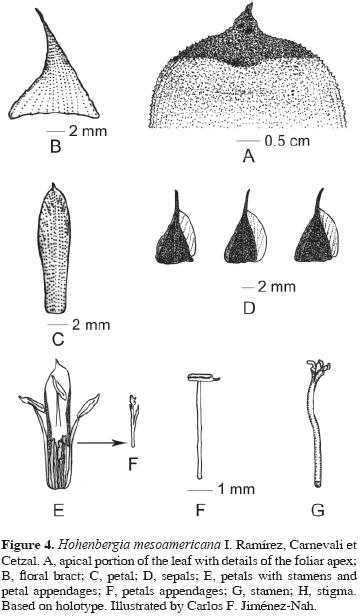
<body><![CDATA[<p align="justify"><font face="verdana" size="2">The subfamily Bromelioideae is composed of 31 genera and 722 species (Stevens, 2001 onwards) and is most diverse in Brazil. In Mexico, only 21 species of this subfamily have been reported (Espejo et al., 2004), of which only a few are restricted to the country. These include a single species of <i>Aechmea</i> Ruiz et Pav. (<i>A. matudae</i> L. B. Sm.), 2 species of <i>Bromelia</i> L. (<i>B. palmeri</i> Mez and <i>B. hemisphaerica</i> Lam.) and <i>Greigia</i> Regel (<i>G. juareziana</i> L. B. Sm and <i>G. vanhyningii</i> L. B. Sm.), and the genus <i>Ursulaea</i> Read et Baensch with 2 species &#91;<i>U. macvaughii</i> (L.B. Sm.) Read et Baensch and <i>U. tuitensis</i> (Maga&ntilde;a et E. J. Lott) Read et Baensch&#93;. The Yucat&aacute;n Peninsula is even more species&#150;poor with only 2 species of <i>Bromelia</i> and 3 of <i>Aechmea</i> represented, none of them endemic but instead widely ranging species.</font></p> 				    <p align="justify"><font face="verdana" size="2">There are 31 species of Bromeliaceae currently known from the Mexican states of the Yucat&aacute;n Peninsula, <i>i.e.</i>, Campeche, Yucat&aacute;n, and Quintana Roo (modified from Ram&iacute;rez and Carnevali, 1999, Espejo et al., 2004, Ram&iacute;rez et al., 2004). They belong to the following genera: <i>Aechmea, Bromelia, Catopsis</i> Griseb., <i>Hechtia</i> Klotszch, <i>Tillandsia</i> L., and <i>Vriesea</i> Lindl.</font></p> 				    <p align="justify"><font face="verdana" size="2">During the course of botanical exploration of the eastern section of the Mexican Yucat&aacute;n Peninsula, we found a population of plants referable to the genus <i>Hohenbergia</i>. The species has proven not to be conspecific with any of the previously proposed taxa in the genus and is herein described as new. This constitutes the first report of the genus for Mexico and the Central American mainland.</font></p> 				    <p align="justify"><font face="verdana" size="2">&nbsp;</font></p> 				    <p align="justify"><font face="verdana" size="2"><b>Description</b></font></p> 				    <p align="justify"><font face="verdana" size="2"><i>Hohenbergia mesoamericana</i> I. Ram&iacute;rez, Carnevali et Cetzal, sp. nov. <a href="#f1">Fig.1</a>, <a href="#f2">fig.2</a>, <a href="/img/revistas/rmbiodiv/v81n1/a4f3.jpg" target="_blank">fig.3</a>, <a href="#f4">fig.4</a>. Type: MEXICO. Quintana Roo: municipio Solidaridad, predio Punta Young, rancho Estrella del Sur, fracci&oacute;n B y rancho Estrella del Sur, fracci&oacute;n C, flexi&oacute;n derecha del km 266 + 200, de la carretera federal 307 Reforma Agraria&#150;Puerto Ju&aacute;rez, tramo Tulum &#150; Playa del Carmen, 20&deg;32'33''N, 87&deg;9'50''W, 10 Marzo 2008, a nivel del mar, William Cetzal Ix 20 (holotype CICY (3 sheets); isotype MO (3 sheets).</font></p> 				    <p align="center"><font face="verdana" size="2"><a name="f1"></a></font></p> 				    <p align="center"><font face="verdana" size="2"><img src="/img/revistas/rmbiodiv/v81n1/a4f1.jpg"></font></p> 				    <p align="center"><font face="verdana" size="2">&nbsp;</font></p> 				    <p align="center"><font face="verdana" size="2"><a name="f2"></a></font></p> 				    ]]></body>
<body><![CDATA[<p align="center"><font face="verdana" size="2"><img src="/img/revistas/rmbiodiv/v81n1/a4f2.jpg"></font></p> 				    <p align="center"><font face="verdana" size="2">&nbsp;</font></p> 				    <p align="center"><font face="verdana" size="2"><a name="f4"></a></font></p> 				    <p align="center"><font face="verdana" size="2"><img src="/img/revistas/rmbiodiv/v81n1/a4f4.jpg"></font></p> 				    <p align="justify"><font face="verdana" size="2"><i>Species haec H. spinulosae Mez similis sed inflorescentia proportione longiore, multo laxiore, 1&#150;pinnata (vs. 2&#150;pinnata), ramis cylindricis 3.2&#150;4.9 cm longis (vs. fusiformibus, 1.8&#150;2.2 cm longis), pedicellatis (vs. plerumque sessilibus), bracteis primariis proportione brevioribus et sepalis brevioribus (11.4 vs. 7.5 mm longis) differt.</i></font></p> 				    <p align="justify"><font face="verdana" size="2">Plant terrestrial, acaulescent, rosulate, flowering ca. 140 cm tall. Leaves ca. 130 cm long, strap&#150;shaped, soft&#150;coriaceous; foliar sheaths 13&#150;15 cm long, 14&#150;15 cm wide, quadrangular, overlapping and forming a basal tank, green but turning black castaneous due to the detritus filling the tank, glabrous, entire, part of the margins hyaline; blades ca. 120 cm long, 14 cm wide at base, 11.2 cm wide at the middle, 4 cm wide near the apex, strap&#150;shaped, not narrowed toward the base, slightly attenuating towards the apex, both surfaces green, slightly and sparsely verrucose, strongly nervate when dry, margins finely serrulate, spines up to 1 mm long, dark castaneous, unevenly distributed, curved, apex 1.5 cm wide, abruptly and shortly acuminate, blackish, acute and distinctly cuspidate, sclerotic, apicule 5 mm long. Inflorescence a panicle, fertile part of inflorescence (rachis) 24 cm long; scape 54 cm long, 5&#150;6 mm diameter, much shorter than leaves, green, erect, terete, stout, densely white&#150;lanate, internodes 5&#150;9 cm long, alternating sizes, i.e., not decreasing in size toward the apex; scape bracts 9&#150;12.5 cm long, 0.5&#150;1 cm wide, long triangular, acute, longer than internodes, rarely shorter than internodes, green, margins finely serrate, white&#150;lepidote on both surfaces, thinly membranaceous, nervate when dry, curved upwards; primary bracts like scape bracts but narrower, 2.4&#150;8.2 cm long, 4&#150;6 mm wide, thinly membranaceous, green, white&#150;lepidote both surfaces, margins sparsely serrate, spines ca. 1 mm long; spikes 21, polystichous, 3.2&#150;4.9 cm long, 2&#150;2.5 cm wide when flattened, 2.5&#150;3 cm apart, oblong in general shape, forming an acute angle with the rachis, the lower ones much shorter than primary bracts, upper ones twice as long than primary bracts, spikes pedicellate, pedicels 3&#150;5 mm long, terete, white&#150;floccose; flowers polystichous, 15&#150;21 per spike, 16 mm long, sessile; floral bracts 12 mm long, 5.6 mm wide, wide triangular, green, acute then abruptly and long acuminate, margins sinuose, apex light&#150;green, white&#150;lepidote both surfaces, nervate, as long or slightly shorter than sepals; sepals 11.4 mm long, 4 mm wide, free, erect, asymmetrical, green, ovate&#150;triangular in general shape; petals 12.5 mm long, 3 mm wide, elliptic, erect, apex incurved, multinerved, green, basally white, membranaceous, with 2 appendages, these ca. 3.9&#150;4.2 mm long, located at both sides of the base of the filaments of the stamens, white, 2&#150;3&#150;furcate apically, margins fimbriate; filaments 9 mm long, white, the antipetalous filaments adnate to the middle part of the petals; anthers 2.7 mm long, 0.5 mm wide, mucronate, versatile, white, pollen yellow; ovary 7.5 mm long, 5.8 mm wide, inferior, ovoid, green, slightly white&#150;lepidote at base, ovules obtuse, stigma longer than stamens in anthesis, green, with 3 stigmatic conduplicate (but not spiraled) twisted lobes. Fruit 4&#150;4.2 mm long, 2&#150;2.3 mm diameter, ovoid, immature seeds, 0.2&#150;0.3 mm long, ovoid, orange.</font></p> 				    <p align="justify"><font face="verdana" size="2">&nbsp;</font></p> 				    <p align="justify"><font face="verdana" size="2"><b>Taxonomic summary</b></font></p> 				    <p align="justify"><font face="verdana" size="2"><i>Hohenbergia mesoamericana</i> is only known as an epiphyte growing on the low portion of tree trunks, very close to the forest floor, with the roots surrounded by dry leaves, in low deciduous forests dominated by <i>Erythroxylum confusum</i> Britton (Erythroxylaceae), at sea level. This type of vegetation is typically found over limestone outcrops. This highly endangered type of vegetation is the home of many of the regional Yucat&aacute;n Peninsula endemics (Dur&aacute;n et al., 1998, Carnevali et al., 2003), including this novelty.</font></p> 				    <p align="justify"><font face="verdana" size="2">The specific epithet highlights that this is the only species of <i>Hohenbergia</i> known from the Mesoamerican subcontinent.</font></p> 				    ]]></body>
<body><![CDATA[<p align="justify"><font face="verdana" size="2">&nbsp;</font></p> 				    <p align="justify"><font face="verdana" size="2"><b>Remarks</b></font></p> 				    <p align="justify"><font face="verdana" size="2"><i>Hohenbergia mesoamericana</i> appears to be most similar to <i>H. spinulosa</i> Mez, from Jamaica (portrayed in Baensch and Baensch, 1994: 111), with which it shares the general habit, the relatively short inflorescence, the extremely long bracts subtending the primary spikes, and the flowers with green petals. These 2 are apparently the only species of <i>Hohenbergia</i> subgenus <i>Wittmackiopsis</i> Mez with truly green petals; all others display white petals (or apparently blue in <i>H. caymanensis</i>). However, <i>H. mesoamericana</i> is readily distinguished from <i>H. spinulosa</i> by means of several inflorescence and floral characters. In <i>H. mesoamericana</i> the inflorescences are relatively longer, conspicuously laxer, and with the bracts subtending the primary spikes relatively shorter. In <i>H. mesoamericana</i> the bracts subtending the lowermost spikes are 2.5&#150;3 times longer than the spikes, whereas in <i>H. spinulosa</i> they are at least 6&#150;7 times longer. The spikes are 20&#150;22 in number, 3.2&#150;4.9 cm long, and cylindrical in <i>H. mesoamericana</i> while they exceed 40 in number, are 1.8&#150;2.2 cm long, and fusiform in the Jamaican taxon. In <i>H. mesoamericana</i> the floral bracts are 12 mm long while they exceed 15 mm in <i>H. spinulosa</i>. The sepals in <i>Hohenbergia</i> spinulosa are ca. 7.5 mm long, but 11.4 mm long in <i>H. mesoamericana</i>. Furthermore, the foliar spines are shorter in <i>H. mesoamericana</i> (1 vs. 2 mm long).</font></p> 				    <p align="justify"><font face="verdana" size="2">This is the first record of the genus <i>Hohenbergia</i> from Mesoamerica or elsewhere in the American mainland north of Colombia and Venezuela. Whether its mainland distribution is due to vicariance from an ancestral distribution or is due to a long&#150;range dispersal event remains to be investigated. The emerged portions of the Antillean Plate have apparently never been in contact with the emerged portions of modern&#150;day Mesoamerica (Coney, 1982). This fact apparently precludes vicariance as an explanation for the current disjunct distribution of <i>Hohenbergia</i> subg. <i>Wittmackiopsis</i>. The Antillean Plate was closest (probably ca. 300 km) to the then&#150;emerged eastern portion of the current day Yucat&aacute;n Peninsula during its SW&#150;NE migration at the Paleogene&#150;Eocene border (40&#150;50 my). The emerged portion of the Antillean Plate then diverged westward. Based on floristic similarities it has been concluded that the floristic relationships of the Yucat&aacute;n Peninsula are closer to northern Mesoamerica (Estrada&#150;Loera, 1991, Carnevali et al., 2003) than to the Antilles, despite the fact that the westernmost tip of Cuba is only ca. 200 km from the easternmost tip of the Yucat&aacute;n Peninsula. The most striking feature of the Yucat&aacute;n Peninsula and the Antillean floras is not what elements they share, but those that are missing from each area. In the Bromeliaceae, very few species are shared between the Antilles and the Mesoamerican mainland (Smith and Downs, 1979). In another large and mainly epiphytic family, the Orchidaceae, there are several endemic genera in the Antilles that are totally absent from the Mesoamerican mainland (<i>Broughtonia</i> R. Br., <i>Tolumnia</i> Raf., <i>Tetramicra</i> Lindl., <i>Quisqueya</i> Dod, <i>Dilomilis</i> Raf., <i>Psychilis</i> Raf., etc.). Similarly, many Mesoamerican orchid genera are absent from the Antilles. This evidence strongly suggests a long history of isolation between the 2 areas. However, there is a small but distinct Antillean element in the flora of current day Yucat&aacute;n Peninsula, which requires an explanation. A "stepping stone" migration through the several small islands that constituted the emerged portions of the Antillean Plate into the Yucat&aacute;n Peninsula at various times during the eastward drift of the Antillean plate is a likely explanation for this small but conspicuous Antillean element. Thus, <i>H. mesoamericana</i> or its common ancestor with other species of <i>Hohenbergia</i> subg. <i>Wittmackiopsis</i>, most likely arrived into the Mesoamerican mainland in this fashion. The apparently small phenetical divergence between the Mesoamerican taxon and the rest of the subgenus is, however, noteworthy, suggesting a recent invasion of the mainland by this bromeliad group. Today's Jamaica is located more than a thousand kilometers from the only known locality of <i>H. mesoamericana</i>, thus making highly unlikely recent long range dispersal. An alternative explanation could be the frequent hurricanes occurring in the Caribbean, which could have been a factor in the dispersal of the Antillean elements found in the Yucat&aacute;n Peninsula (and other areas of Mesoamerica), allowing for the transportation of propagules (wind&#150;borne seeds) or of stray birds carrying the seeds of <i>Hohenbergia</i> in their guts. Examples of this kind of dispersal in other plant groups occurring in the Yucat&aacute;n Peninsula are taxa such as Jacquinia arborea Vahl (Theophrastaceae), Canella winterana (L.) Gaertn. (Canellaceae), and Senna polyphylla (Jacq.) H. S. Irwin et Barneby (Fabaceae), among several others. A phylogenetic analysis of the genus <i>Hohenbergia</i>, coupled with a molecular&#150;clock hypothesis would be required to test these alternative biogeographical scenarios as explanations for the disjunct distribution of <i>Hohenbergia</i> subg. <i>Wittmackiopsis</i>.</font></p> 				    <p align="justify"><font face="verdana" size="2">According to the IUCN (2001), <i>Hohenbergia mesoamericana</i> would be classified as critically endangered (CR) since it meets criterion D. The species is known from a single population consisting of probably only 2&#150;3 plants/genotypes. Furthermore, the habitat where it grows, a low&#150;stature, thorn forest or arid tropical scrub that is associated with rocky outcrops close to the sea along the eastern coast of the Yucat&aacute;n Peninsula, is severely fragmented due to human activities, particularly tourist developments. The lone population known was discovered during a vegetation assessment required by federal law prior to the construction of a series of condominiums and other tourist developments. Since no measures were taken at the time to protect the few plants located, this population may already be extinct. <i>Hohenbergia mesoamericana</i> remains to be rediscovered in 1 or more of a series of isolated patches of this severely fragmented habitat, all of them bound to disappear given that they lie within the so&#150;called "Riviera Maya". With any luck, populations of this species will be discovered within the boundaries of the Sian Ka'an Biosphere Reserve, which lies 50 km to the south, where extensive tracts of suitable habitat still exist in relatively good condition. Fortunately, a small cutting of the plant was brought into cultivation and vegetatively reproduced; these propagules now survive in several plant collections, at CICY's Jard&iacute;n Bot&aacute;nico Regional "X&iacute;itbal'neek" (M&eacute;rida, Yucat&aacute;n), and at the Jard&iacute;n Bot&aacute;nico "Dr. Alfredo Barrera Mar&iacute;n" (Chetumal, Quintana Roo). Once the plants are brought into flower, we will attempt to reproduce <i>Hohenbergia mesoamericana</i> by seeds.</font></p> 				    <p align="justify"><font face="verdana" size="2">&nbsp;</font></p> 				    <p align="justify"><font face="verdana" size="2"><b>Acknowledgments</b></font></p> 				    <p align="justify"><font face="verdana" size="2">The authors are grateful to Carlos F. Jim&eacute;nez&#150;Nah for illustrating the flowers of the species, to Harry Luther for his assistance in the identification of the new taxon, to Juan Andr&eacute;s Barrag&aacute;n Gudi&ntilde;o for field assistance. Rodrigo Duno (CICY) provided a critical review of an earlier draft of this paper. Thanks to 2 anonymous reviewers whose comments improved the quality of this paper.</font></p> 				    <p align="justify"><font face="verdana" size="2">&nbsp;</font></p> 				    <p align="justify"><font face="verdana" size="2"><b>Literature cited</b></font></p> 				    ]]></body>
<body><![CDATA[<!-- ref --><p align="justify"><font face="verdana" size="2">Baensch, U. and U. Baensch. 1994. Blooming Bromeliads. Tropic Beauty Publishers. Nassau, Bahamas. 270 p.</font>&nbsp;&nbsp;&nbsp;&nbsp;&nbsp;&nbsp;&nbsp;&nbsp;[&#160;<a href="javascript:void(0);" onclick="javascript: window.open('/scielo.php?script=sci_nlinks&ref=7512822&pid=S1870-3453201000010000400001&lng=','','width=640,height=500,resizable=yes,scrollbars=1,menubar=yes,');">Links</a>&#160;]<!-- end-ref --> 				    <!-- ref --><p align="justify"><font face="verdana" size="2">Carnevali, G., I. Ram&iacute;rez&#150;Morillo and J. A. Gonz&aacute;lez&#150;Iturbe. 2003. Flora y vegetaci&oacute;n de la Pen&iacute;nsula de Yucat&aacute;n. <i>In</i> Naturaleza y Sociedad del &Aacute;rea Maya: pasado, presente y futuro, P. Colunga Garc&iacute;a&#150;Mar&iacute;n and A. Larqu&eacute;&#150;Saavedra (eds.). Centro de Investigaci&oacute;n Cient&iacute;fica de Yucat&aacute;n, A. C. M&eacute;rida, Yucat&aacute;n, M&eacute;xico. p. 53&#150;68.</font>&nbsp;&nbsp;&nbsp;&nbsp;&nbsp;&nbsp;&nbsp;&nbsp;[&#160;<a href="javascript:void(0);" onclick="javascript: window.open('/scielo.php?script=sci_nlinks&ref=7512824&pid=S1870-3453201000010000400002&lng=','','width=640,height=500,resizable=yes,scrollbars=1,menubar=yes,');">Links</a>&#160;]<!-- end-ref --> 				    <!-- ref --><p align="justify"><font face="verdana" size="2">Coney, P. J. 1982. Plate Tectonic Constraints on the Biogeography of Middle America and the Caribbean Region. Annals of the Missouri Botanical Garden 69:432&#150;443.</font>&nbsp;&nbsp;&nbsp;&nbsp;&nbsp;&nbsp;&nbsp;&nbsp;[&#160;<a href="javascript:void(0);" onclick="javascript: window.open('/scielo.php?script=sci_nlinks&ref=7512826&pid=S1870-3453201000010000400003&lng=','','width=640,height=500,resizable=yes,scrollbars=1,menubar=yes,');">Links</a>&#160;]<!-- end-ref --> 				    <!-- ref --><p align="justify"><font face="verdana" size="2">Dur&aacute;n, R., J. C. Trejo&#150;Torres and G. Ibarra&#150;Manr&iacute;quez. 1998. Endemic phytotaxa of the Peninsula of Yucat&aacute;n. Harvard Papers in Botany 3:263&#150;314.</font>&nbsp;&nbsp;&nbsp;&nbsp;&nbsp;&nbsp;&nbsp;&nbsp;[&#160;<a href="javascript:void(0);" onclick="javascript: window.open('/scielo.php?script=sci_nlinks&ref=7512828&pid=S1870-3453201000010000400004&lng=','','width=640,height=500,resizable=yes,scrollbars=1,menubar=yes,');">Links</a>&#160;]<!-- end-ref --> 				    <!-- ref --><p align="justify"><font face="verdana" size="2">Espejo&#150;Serna, A., A. R. L&oacute;pez&#150;Ferrari, I. Ram&iacute;rez&#150;Morillo, B. K. Holst, H. Luther and W. Till. 2004. Checklist of Mexican Bromeliaceae with notes on species distribution and levels of endemism. Selbyana 25:33&#150;86.</font>&nbsp;&nbsp;&nbsp;&nbsp;&nbsp;&nbsp;&nbsp;&nbsp;[&#160;<a href="javascript:void(0);" onclick="javascript: window.open('/scielo.php?script=sci_nlinks&ref=7512830&pid=S1870-3453201000010000400005&lng=','','width=640,height=500,resizable=yes,scrollbars=1,menubar=yes,');">Links</a>&#160;]<!-- end-ref --> 				    ]]></body>
<body><![CDATA[<!-- ref --><p align="justify"><font face="verdana" size="2">Estrada&#150;Loera, E. 1991. Phytogeographic relationships of the Yucatan Peninsula. Journal of Biogeography 18:687&#150;697.</font>&nbsp;&nbsp;&nbsp;&nbsp;&nbsp;&nbsp;&nbsp;&nbsp;[&#160;<a href="javascript:void(0);" onclick="javascript: window.open('/scielo.php?script=sci_nlinks&ref=7512832&pid=S1870-3453201000010000400006&lng=','','width=640,height=500,resizable=yes,scrollbars=1,menubar=yes,');">Links</a>&#160;]<!-- end-ref --> 				    <!-- ref --><p align="justify"><font face="verdana" size="2">International Union for Conservation of Nature and Natural Resources (IUCN) &#91;Uni&oacute;n Internacional para la Conservaci&oacute;n de la Naturaleza y Recursos Naturales (UICN).&#93; 2001. IUCN Red List Categories and Criteria, Version 3.1. IUCN, Gland, Switzerland and Cambridge, United Kingdom. <a href="http://www.iucn.org/" target="_blank">http://www.iucn.org</a>.</font>&nbsp;&nbsp;&nbsp;&nbsp;&nbsp;&nbsp;&nbsp;&nbsp;[&#160;<a href="javascript:void(0);" onclick="javascript: window.open('/scielo.php?script=sci_nlinks&ref=7512834&pid=S1870-3453201000010000400007&lng=','','width=640,height=500,resizable=yes,scrollbars=1,menubar=yes,');">Links</a>&#160;]<!-- end-ref --> 				    <!-- ref --><p align="justify"><font face="verdana" size="2">Luther, H. E. 2006. An alphabetical list of bromeliad binomials. Bromeliad Society International. Sarasota, Florida. 119 p.</font>&nbsp;&nbsp;&nbsp;&nbsp;&nbsp;&nbsp;&nbsp;&nbsp;[&#160;<a href="javascript:void(0);" onclick="javascript: window.open('/scielo.php?script=sci_nlinks&ref=7512836&pid=S1870-3453201000010000400008&lng=','','width=640,height=500,resizable=yes,scrollbars=1,menubar=yes,');">Links</a>&#160;]<!-- end-ref --> 				    <!-- ref --><p align="justify"><font face="verdana" size="2">Ram&iacute;rez&#150;Morillo, I. and G. Carnevali. 1999. A new taxon of <i>Tillandsia</i>, some new records, and a checklist of the Bromeliaceae from the Yucat&aacute;n Pen&iacute;nsula. Harvard Papers in Botany 4:185&#150;194.</font>&nbsp;&nbsp;&nbsp;&nbsp;&nbsp;&nbsp;&nbsp;&nbsp;[&#160;<a href="javascript:void(0);" onclick="javascript: window.open('/scielo.php?script=sci_nlinks&ref=7512838&pid=S1870-3453201000010000400009&lng=','','width=640,height=500,resizable=yes,scrollbars=1,menubar=yes,');">Links</a>&#160;]<!-- end-ref --> 				    <!-- ref --><p align="justify"><font face="verdana" size="2">Ram&iacute;rez&#150;Morillo, I., G. Carnevali and F. Chi&#150;May, 2004. Gu&iacute;a Ilustrada de las Bromeliaceae de la porci&oacute;n mexicana de la Pen&iacute;nsula de Yucat&aacute;n. Centro de Investigaci&oacute;n Cient&iacute;fica de Yucat&aacute;n&#150;PNUD. M&eacute;rida. 124 p.</font>&nbsp;&nbsp;&nbsp;&nbsp;&nbsp;&nbsp;&nbsp;&nbsp;[&#160;<a href="javascript:void(0);" onclick="javascript: window.open('/scielo.php?script=sci_nlinks&ref=7512840&pid=S1870-3453201000010000400010&lng=','','width=640,height=500,resizable=yes,scrollbars=1,menubar=yes,');">Links</a>&#160;]<!-- end-ref --> 				    ]]></body>
<body><![CDATA[<!-- ref --><p align="justify"><font face="verdana" size="2">Smith, L. B. and R. J. Downs. 1979. Bromelioideae (Bromeliaceae). Flora Neotropica Monograph 14, Part 3. New York Botanical Garden. Bronx, New York. p. 1493&#150;2142.</font>&nbsp;&nbsp;&nbsp;&nbsp;&nbsp;&nbsp;&nbsp;&nbsp;[&#160;<a href="javascript:void(0);" onclick="javascript: window.open('/scielo.php?script=sci_nlinks&ref=7512842&pid=S1870-3453201000010000400011&lng=','','width=640,height=500,resizable=yes,scrollbars=1,menubar=yes,');">Links</a>&#160;]<!-- end-ref --> 				    <!-- ref --><p align="justify"><font face="verdana" size="2">Smith, L. B. and W. Till 1998. Bromeliaceae. <i>In</i> The families and genera of Vascular Plants, K. Kubitzki (ed.). Springer, Berlin. p. 74&#150;99.</font>&nbsp;&nbsp;&nbsp;&nbsp;&nbsp;&nbsp;&nbsp;&nbsp;[&#160;<a href="javascript:void(0);" onclick="javascript: window.open('/scielo.php?script=sci_nlinks&ref=7512844&pid=S1870-3453201000010000400012&lng=','','width=640,height=500,resizable=yes,scrollbars=1,menubar=yes,');">Links</a>&#160;]<!-- end-ref --> 				    <!-- ref --><p align="justify"><font face="verdana" size="2">Stevens, P. F. (2001 onwards). Angiosperm Phylogeny Website. Version 9, June 2008 &#91;and more or less continuously updated since 2001&#93;: <a href="http://www.mobot.org/mobot/research/apweb/" target="_blank">http://www.mobot.org/mobot/research/apweb/</a></font>&nbsp;&nbsp;&nbsp;&nbsp;&nbsp;&nbsp;&nbsp;&nbsp;[&#160;<a href="javascript:void(0);" onclick="javascript: window.open('/scielo.php?script=sci_nlinks&ref=7512846&pid=S1870-3453201000010000400013&lng=','','width=640,height=500,resizable=yes,scrollbars=1,menubar=yes,');">Links</a>&#160;]<!-- end-ref --> ]]></body><back>
<ref-list>
<ref id="B1">
<nlm-citation citation-type="book">
<person-group person-group-type="author">
<name>
<surname><![CDATA[Baensch]]></surname>
<given-names><![CDATA[U.]]></given-names>
</name>
<name>
<surname><![CDATA[Baensch]]></surname>
<given-names><![CDATA[U.]]></given-names>
</name>
</person-group>
<source><![CDATA[Blooming Bromeliads]]></source>
<year>1994</year>
<page-range>270</page-range><publisher-loc><![CDATA[Nassau ]]></publisher-loc>
<publisher-name><![CDATA[Tropic Beauty Publishers]]></publisher-name>
</nlm-citation>
</ref>
<ref id="B2">
<nlm-citation citation-type="book">
<person-group person-group-type="author">
<name>
<surname><![CDATA[Carnevali]]></surname>
<given-names><![CDATA[G.]]></given-names>
</name>
<name>
<surname><![CDATA[Ramírez-Morillo]]></surname>
<given-names><![CDATA[I.]]></given-names>
</name>
<name>
<surname><![CDATA[González-Iturbe]]></surname>
<given-names><![CDATA[J. A.]]></given-names>
</name>
</person-group>
<article-title xml:lang="es"><![CDATA[Flora y vegetación de la Península de Yucatán]]></article-title>
<person-group person-group-type="editor">
<name>
<surname><![CDATA[Colunga García-Marín]]></surname>
<given-names><![CDATA[P.]]></given-names>
</name>
<name>
<surname><![CDATA[Larqué-Saavedra]]></surname>
<given-names><![CDATA[A.]]></given-names>
</name>
</person-group>
<source><![CDATA[Naturaleza y Sociedad del Área Maya: pasado, presente y futuro]]></source>
<year>2003</year>
<page-range>53-68</page-range><publisher-loc><![CDATA[Mérida^eYucatán Yucatán]]></publisher-loc>
<publisher-name><![CDATA[Centro de Investigación Científica de Yucatán, A. C.]]></publisher-name>
</nlm-citation>
</ref>
<ref id="B3">
<nlm-citation citation-type="journal">
<person-group person-group-type="author">
<name>
<surname><![CDATA[Coney]]></surname>
<given-names><![CDATA[P. J.]]></given-names>
</name>
</person-group>
<article-title xml:lang="en"><![CDATA[Plate Tectonic Constraints on the Biogeography of Middle America and the Caribbean Region]]></article-title>
<source><![CDATA[Annals of the Missouri Botanical Garden]]></source>
<year>1982</year>
<volume>69</volume>
<page-range>432-443</page-range></nlm-citation>
</ref>
<ref id="B4">
<nlm-citation citation-type="journal">
<person-group person-group-type="author">
<name>
<surname><![CDATA[Durán]]></surname>
<given-names><![CDATA[R.]]></given-names>
</name>
<name>
<surname><![CDATA[Trejo-Torres]]></surname>
<given-names><![CDATA[J. C.]]></given-names>
</name>
<name>
<surname><![CDATA[Ibarra-Manríquez]]></surname>
<given-names><![CDATA[G.]]></given-names>
</name>
</person-group>
<article-title xml:lang="en"><![CDATA[Endemic phytotaxa of the Peninsula of Yucatán]]></article-title>
<source><![CDATA[Harvard Papers in Botany]]></source>
<year>1998</year>
<volume>3</volume>
<page-range>263-314</page-range></nlm-citation>
</ref>
<ref id="B5">
<nlm-citation citation-type="journal">
<person-group person-group-type="author">
<name>
<surname><![CDATA[Espejo-Serna]]></surname>
<given-names><![CDATA[A]]></given-names>
</name>
<name>
<surname><![CDATA[López-Ferrari]]></surname>
<given-names><![CDATA[A. R.]]></given-names>
</name>
<name>
<surname><![CDATA[Ramírez-Morillo]]></surname>
<given-names><![CDATA[I.]]></given-names>
</name>
<name>
<surname><![CDATA[Holst]]></surname>
<given-names><![CDATA[B. K.]]></given-names>
</name>
<name>
<surname><![CDATA[Luther]]></surname>
<given-names><![CDATA[H.]]></given-names>
</name>
<name>
<surname><![CDATA[Till]]></surname>
<given-names><![CDATA[W.]]></given-names>
</name>
</person-group>
<article-title xml:lang="en"><![CDATA[Checklist of Mexican Bromeliaceae with notes on species distribution and levels of endemism]]></article-title>
<source><![CDATA[Selbyana]]></source>
<year>2004</year>
<volume>25</volume>
<page-range>33-86</page-range></nlm-citation>
</ref>
<ref id="B6">
<nlm-citation citation-type="journal">
<person-group person-group-type="author">
<name>
<surname><![CDATA[Estrada-Loera]]></surname>
<given-names><![CDATA[E.]]></given-names>
</name>
</person-group>
<article-title xml:lang="en"><![CDATA[Phytogeographic relationships of the Yucatan Peninsula]]></article-title>
<source><![CDATA[Journal of Biogeography]]></source>
<year>1991</year>
<volume>18</volume>
<page-range>687-697</page-range></nlm-citation>
</ref>
<ref id="B7">
<nlm-citation citation-type="book">
<collab>International Union for Conservation of Nature and Natural Resources (IUCN) [Unión Internacional para la Conservación de la Naturaleza y Recursos Naturales (UICN).]</collab>
<source><![CDATA[IUCN Red List Categories and Criteria, Version 3.1]]></source>
<year>2001</year>
<publisher-name><![CDATA[IUCN, Gland, Switzerland and Cambridge]]></publisher-name>
</nlm-citation>
</ref>
<ref id="B8">
<nlm-citation citation-type="book">
<person-group person-group-type="author">
<name>
<surname><![CDATA[Luther]]></surname>
<given-names><![CDATA[H. E.]]></given-names>
</name>
</person-group>
<source><![CDATA[An alphabetical list of bromeliad binomials]]></source>
<year>2006</year>
<page-range>119</page-range><publisher-loc><![CDATA[Sarasota^eFlorida Florida]]></publisher-loc>
<publisher-name><![CDATA[Bromeliad Society International]]></publisher-name>
</nlm-citation>
</ref>
<ref id="B9">
<nlm-citation citation-type="journal">
<person-group person-group-type="author">
<name>
<surname><![CDATA[Ramírez-Morillo]]></surname>
<given-names><![CDATA[I.]]></given-names>
</name>
<name>
<surname><![CDATA[Carnevali]]></surname>
<given-names><![CDATA[G.]]></given-names>
</name>
</person-group>
<article-title xml:lang="en"><![CDATA[A new taxon of Tillandsia, some new records, and a checklist of the Bromeliaceae from the Yucatán Península]]></article-title>
<source><![CDATA[Harvard Papers in Botany]]></source>
<year>1999</year>
<volume>4</volume>
<page-range>185-194</page-range></nlm-citation>
</ref>
<ref id="B10">
<nlm-citation citation-type="book">
<person-group person-group-type="author">
<name>
<surname><![CDATA[Ramírez-Morillo]]></surname>
<given-names><![CDATA[I.]]></given-names>
</name>
<name>
<surname><![CDATA[Carnevali]]></surname>
<given-names><![CDATA[G.]]></given-names>
</name>
<name>
<surname><![CDATA[Chi-May]]></surname>
<given-names><![CDATA[F.]]></given-names>
</name>
</person-group>
<source><![CDATA[Guía Ilustrada de las Bromeliaceae de la porción mexicana de la Península de Yucatán]]></source>
<year>2004</year>
<page-range>124</page-range><publisher-loc><![CDATA[Mérida ]]></publisher-loc>
<publisher-name><![CDATA[Centro de Investigación Científica de YucatánPNUD]]></publisher-name>
</nlm-citation>
</ref>
<ref id="B11">
<nlm-citation citation-type="book">
<person-group person-group-type="author">
<name>
<surname><![CDATA[Smith]]></surname>
<given-names><![CDATA[L. B.]]></given-names>
</name>
<name>
<surname><![CDATA[Downs]]></surname>
<given-names><![CDATA[R. J.]]></given-names>
</name>
</person-group>
<source><![CDATA[Bromelioideae (Bromeliaceae): Flora Neotropica Monograph 14, Part 3]]></source>
<year>1979</year>
<page-range>1493-2142</page-range><publisher-loc><![CDATA[Bronx^eNew York New York]]></publisher-loc>
<publisher-name><![CDATA[New York Botanical Garden]]></publisher-name>
</nlm-citation>
</ref>
<ref id="B12">
<nlm-citation citation-type="book">
<person-group person-group-type="author">
<name>
<surname><![CDATA[Smith]]></surname>
<given-names><![CDATA[L. B.]]></given-names>
</name>
<name>
<surname><![CDATA[Till]]></surname>
<given-names><![CDATA[W.]]></given-names>
</name>
</person-group>
<article-title xml:lang="en"><![CDATA[Bromeliaceae]]></article-title>
<person-group person-group-type="editor">
<name>
<surname><![CDATA[Kubitzki]]></surname>
<given-names><![CDATA[K.]]></given-names>
</name>
</person-group>
<source><![CDATA[The families and genera of Vascular Plants]]></source>
<year>1998</year>
<page-range>74-99</page-range><publisher-loc><![CDATA[Berlin ]]></publisher-loc>
<publisher-name><![CDATA[Springer]]></publisher-name>
</nlm-citation>
</ref>
<ref id="B13">
<nlm-citation citation-type="">
<person-group person-group-type="author">
<name>
<surname><![CDATA[P. F.]]></surname>
<given-names><![CDATA[Stevens]]></given-names>
</name>
</person-group>
<source><![CDATA[Angiosperm Phylogeny Website]]></source>
<year>2001</year>
</nlm-citation>
</ref>
</ref-list>
</back>
</article>