<?xml version="1.0" encoding="ISO-8859-1"?><article xmlns:mml="http://www.w3.org/1998/Math/MathML" xmlns:xlink="http://www.w3.org/1999/xlink" xmlns:xsi="http://www.w3.org/2001/XMLSchema-instance">
<front>
<journal-meta>
<journal-id>1870-3453</journal-id>
<journal-title><![CDATA[Revista mexicana de biodiversidad]]></journal-title>
<abbrev-journal-title><![CDATA[Rev. Mex. Biodiv.]]></abbrev-journal-title>
<issn>1870-3453</issn>
<publisher>
<publisher-name><![CDATA[Instituto de Biología]]></publisher-name>
</publisher>
</journal-meta>
<article-meta>
<article-id>S1870-34532010000100002</article-id>
<title-group>
<article-title xml:lang="en"><![CDATA[Notes on two species of Diplomitoporus (Basidiomycota, Polyporaceae) of Central America]]></article-title>
<article-title xml:lang="es"><![CDATA[Comentarios sobre dos especies de Diplomitoporus (Basidiomycota, Polyporaceae) de América Central]]></article-title>
</title-group>
<contrib-group>
<contrib contrib-type="author">
<name>
<surname><![CDATA[Kout]]></surname>
<given-names><![CDATA[Jirí]]></given-names>
</name>
<xref ref-type="aff" rid="A01"/>
</contrib>
<contrib contrib-type="author">
<name>
<surname><![CDATA[Vlasák]]></surname>
<given-names><![CDATA[Josef]]></given-names>
</name>
<xref ref-type="aff" rid="A02"/>
</contrib>
</contrib-group>
<aff id="A01">
<institution><![CDATA[,University of South Bohemia Faculty of Science Department of Botany]]></institution>
<addr-line><![CDATA[Ceské Budejovice ]]></addr-line>
<country>Czech Republic</country>
</aff>
<aff id="A02">
<institution><![CDATA[,University of West Bohemia Faculty of Education Department of Biology]]></institution>
<addr-line><![CDATA[Pilsen ]]></addr-line>
<country>Czech Republic</country>
</aff>
<pub-date pub-type="pub">
<day>00</day>
<month>04</month>
<year>2010</year>
</pub-date>
<pub-date pub-type="epub">
<day>00</day>
<month>04</month>
<year>2010</year>
</pub-date>
<volume>81</volume>
<numero>1</numero>
<fpage>9</fpage>
<lpage>14</lpage>
<copyright-statement/>
<copyright-year/>
<self-uri xlink:href="http://www.scielo.org.mx/scielo.php?script=sci_arttext&amp;pid=S1870-34532010000100002&amp;lng=en&amp;nrm=iso"></self-uri><self-uri xlink:href="http://www.scielo.org.mx/scielo.php?script=sci_abstract&amp;pid=S1870-34532010000100002&amp;lng=en&amp;nrm=iso"></self-uri><self-uri xlink:href="http://www.scielo.org.mx/scielo.php?script=sci_pdf&amp;pid=S1870-34532010000100002&amp;lng=en&amp;nrm=iso"></self-uri><abstract abstract-type="short" xml:lang="en"><p><![CDATA[Two species of Diplomitoporus were studied from Central America and notes about their distribution are presented. Noteworthy records include Diplomitoporus dilutabilis Log.-Leite et J.E. Wright, which is reported for the first time to Guatemala and Diplomitoporus hondurensis (Murrill) Ryvarden, which is found in a new locality from Belize. A list of Diplomitoporus species cited from America is presented.]]></p></abstract>
<abstract abstract-type="short" xml:lang="es"><p><![CDATA[Se estudiaron 2 especies de Diplomitoporus de America Central y se presentan notas sobre su distribución. Sobresale Diplomitoporus dilutabilis Log.-Leite et J.E. Wright, que se registra por primera vez para Guatemala y Diplomitoporus hondurensis (Murrill) Ryvarden, se encontró en una nueva localidad en Belice. Se presenta una lista de las especies de Diplomitoporus citadas para el continente Americano.]]></p></abstract>
<kwd-group>
<kwd lng="en"><![CDATA[Polyporaceae]]></kwd>
<kwd lng="en"><![CDATA[Poliporoid fungi]]></kwd>
<kwd lng="en"><![CDATA[Belize]]></kwd>
<kwd lng="en"><![CDATA[Guatemala]]></kwd>
<kwd lng="es"><![CDATA[Polyporaceae]]></kwd>
<kwd lng="es"><![CDATA[hongos poliporoides]]></kwd>
<kwd lng="es"><![CDATA[Belice]]></kwd>
<kwd lng="es"><![CDATA[Guatemala]]></kwd>
</kwd-group>
</article-meta>
</front><body><![CDATA[  	    <p align="justify"><font face="verdana" size="4">Taxonom&iacute;a y sistem&aacute;tica</font></p> 	    <p align="center"><font face="verdana" size="2">&nbsp;</font></p> 	    <p align="center"><font face="verdana" size="4"><b>Notes on two species of <i>Diplomitoporus</i> (Basidiomycota, Polyporaceae) of Central America</b></font></p> 	    <p align="center"><font face="verdana" size="2">&nbsp;</font></p> 	    <p align="center"><font face="verdana" size="3"><b>Comentarios sobre dos especies de <i>Diplomitoporus</i> (Basidiomycota, Polyporaceae) de Am&eacute;rica Central</b></font></p> 	    <p align="center"><font face="verdana" size="2">&nbsp;</font></p> 	    <p align="center"><font face="verdana" size="2"><b>Jir&iacute; Kout<sup>1, 2 *</sup> and Josef Vlas&aacute;k<sup>3</sup></b></font></p> 	    <p align="justify"><font face="verdana" size="2">&nbsp;</font></p> 	    <p align="justify"><font face="verdana" size="2"><sup>1</sup> <i>Department of Botany, Faculty of Science, University of South Bohemia, Na Zlat&eacute; stoce 1, Cesk&eacute; Budejovice, 370 05, Czech Republic.</i> </font></p> 	    ]]></body>
<body><![CDATA[<p align="justify"><font face="verdana" size="2"><sup>2 </sup><i>Department of Biology, Faculty of Education, University of West Bohemia, Klatovska 51, Pilsen, 306 19, Czech Republic.</i></font></p> 				    <p align="justify"><font face="verdana" size="2"><sup>3</sup> <i>Biology Centre ASCR, v.v.i., Institute of Plant Molecular Biology, Branisovsk&aacute; 31/1160, Cesk&eacute; Budejovice 370 05, Czech Republic.</i></font></p> 				    <p align="justify"><font face="verdana" size="2">&nbsp;</font></p> 				    <p align="justify"><font face="verdana" size="2"><b><sup>*</sup>Correspondent:</b>    <br>     <a href="mailto:martial@seznam.cz">martial@seznam.cz</a></font></p> 				    <p align="justify"><font face="verdana" size="2">&nbsp;</font></p> 				    <p align="justify"><font face="verdana" size="2">Recibido: 27 enero 2009    <br> 			    Aceptado: 12 junio 2009</font></p> 				    <p align="justify"><font face="verdana" size="2">&nbsp;</font></p> 				    <p align="justify"><font face="verdana" size="2"><b>Abstract</b></font></p> 				    ]]></body>
<body><![CDATA[<p align="justify"><font face="verdana" size="2">Two species of <i>Diplomitoporus</i> were studied from Central America and notes about their distribution are presented. Noteworthy records include <i>Diplomitoporus dilutabilis </i>Log.&#150;Leite et J.E. Wright, which is reported for the first time to Guatemala and <i>Diplomitoporus hondurensis</i> (Murrill) Ryvarden, which is found in a new locality from Belize. A list of <i>Diplomitoporus</i> species cited from America is presented.</font></p> 				    <p align="justify"><font face="verdana" size="2"><b>Key words:</b> Polyporaceae, Poliporoid fungi, Belize, Guatemala.</font></p> 				    <p align="justify"><font face="verdana" size="2">&nbsp;</font></p> 				    <p align="justify"><font face="verdana" size="2"><b>Resumen</b></font></p> 				    <p align="justify"><font face="verdana" size="2">Se estudiaron 2 especies de <i>Diplomitoporus</i> de America Central y se presentan notas sobre su distribuci&oacute;n. Sobresale <i>Diplomitoporus dilutabilis</i> Log.&#150;Leite et J.E. Wright, que se registra por primera vez para Guatemala y <i>Diplomitoporus hondurensis</i> (Murrill) Ryvarden, se encontr&oacute; en una nueva localidad en Belice. Se presenta una lista de las especies de <i>Diplomitoporus</i> citadas para el continente Americano.</font></p> 				    <p align="justify"><font face="verdana" size="2"><b>Palabras clave:</b> Polyporaceae, hongos poliporoides, Belice, Guatemala.</font></p> 				    <p align="justify"><font face="verdana" size="2">&nbsp;</font></p> 				    <p align="justify"><font face="verdana" size="2"><b>Introduction</b></font></p> 				    <p align="justify"><font face="verdana" size="2">The Polish mycologist Stanislaw Domanski established in 1970 a new genus <i>Diplomitoporus</i> in his study on lignicolous fungi of the virgin Bialowiezia forest in Poland (Domanski, 1970). Light&#150;colored, effused or effused&#150;reflexed fruitbodies, dimitic hyphal system, and white rot were assigned as crucial characters of the new genus. He classified as <i>Diplomitoporus</i> 2 polyporoid species: <i>Diplomitoporus crustulinus </i>(Bres.) Domanski and <i>Diplomitoporus flavescens</i> (Bres.) Domanski. In following years, several common polypores causing white rot (<i>Poria overholtsii, Poria rimosa</i>), were transferred into <i>Diplomitoporus</i> (Gilbertson and Ryvarden, 1985). Also, <i>Poria lindbladii</i> (Berk.) Cooke, which was in 1981 assigned to <i>Cinereomyces</i> because of skeletal hyphae dissolving in KOH (J&uuml;lich, 1981), was included in <i>Diplomitoporus</i> by Ryvarden and Gilbertson (1985), as its affinities to other <i>Diplomitoporus</i> species were regarded more important. In 1998, Pieri and Riviore described new species <i>D. meridionalis</i> with similar KOH reaction in skeletals and emended <i>Diplomitoporus</i> to include species with skeletals gelatinized in KOH (Pieri and Rivoire, 1998).</font></p> 				    <p align="justify"><font face="verdana" size="2"><i><b>Diplomitoporus</b></i> Domanski, Acta Soc. Bot. Pol. 39: 191 (1970) emend. Pieri et Rivoire, Bulletin de la Soci&eacute;t&eacute; Mycologique de France 114:39&#150;52 (1998).</font></p> 				    ]]></body>
<body><![CDATA[<p align="justify"><font face="verdana" size="2">Type species: <i>Diplomitoporus flavescens</i> (Bres.) Domanski (1970).</font></p> 				    <p align="justify"><font face="verdana" size="2">The most important characters of <i>Diplomitoporus</i> are annual, whitish or cream&#150;colored resupinate to effused&#150;reflexed basidiocarps with light&#150;colored context and circular or angular small to medium pores. Microscopic examination is necessary for positive determination in most cases. The hyphal system was defined originally as dimitic (Domanski, 1970), but with the new species described, also pseudo&#150;dimitic (Buchanan and Ryvarden, 1998) and trimitic (Loguercio&#150;Leite and Wright, 1998) construction of fruitbodies may be found. Generative hyphae are clamped, and skeletal hyphae thick&#150;walled, showing specific swelling and dissolving in KOH solution in some species. The inamyloid, smooth spores are often broadly allantoid, in some species ellipsoid, and are of medium size (Pieri and Rivoire, 1998).</font></p> 				    <p align="justify"><font face="verdana" size="2">Causing white rot, <i>Diplomitoporus</i> is well separated from externally similar <i>Antrodia</i> P. Karst. which causes brown rot (Domanski, 1970; Ryvarden and Gilbertson, 1993). <i>Antrodiella</i> Ryvarden et I. Johans. 1980 has very similar characters and the borderline between both genera is not always clear. However, the spores of <i>Antrodiella</i> are always very small and ellipsoid and the basidiocarps usually dense and cartilaginous (Ryvarden and Gilbertson, 1993). <i>Skeletocutis</i> Kotl. et Pouz. has similar basidiocarps and hyphae, but hyphal ends in dissepiments have very specific incrustation that is diagnostic. Moreover, spores are in the majority of species narrowly allantoid. <i>Cinereomyces</i> J&uuml;lich, which was established for <i>Poria lindbladii</i> only, is characterized by weakly amyloid skeletals, dissolving in KOH. It was not recognized by Ryvarden and Gilbertson (1985) nor by Pieri and Rivoire (1998) as the amyloid reaction is usually weak and unreliable and the KOH reaction was implemented in <i>Diplomitoporus</i> emendation. Spirin (2005), on the other hand, used <i>Cinereomyces</i> also for <i>Skeletocutis</i> species <i>S. lenis</i> (P. Karst.) Niemel&auml; and <i>S. vulgaris</i> (Fr.) Niemel&auml; et Y.C. Dai. We feel that grouping based on amyloid or KOH reactions of skeletas may cause problems and prefer, at present, not to recognize <i>Cinereomyces</i>. Skeletocutis diluta (Rajchenb.) A. David et Rajchenb. and S. papyracea A. David show also weak amyloidity and KOH gelatinization and still were not included in <i>Cinereomyces</i> by Spirin. Skeletocutis diluta was described at first as a variety of S. nivea (Jungh.) Jean Keller, the type species of genus <i>Skeletocutis</i>, and it is really very similar, so it is true <i>Skeletocutis. Skeletocutis </i>papyracea has a typical incrustation for <i>Skeletocutis</i> but its spores resemble those of <i>S. lenis</i>, which is considered a member of <i>Cinereomyces</i> by Spirin (David, 1982; Rajchenberg, 1983; David and Rajchenberg, 1992; Spirin 2005). So, week amyloidity and KOH gelatinizing of skeletal hyphae seem to occur both in <i>Diplomitoporus</i> and <i>Skeletocutis</i>. Also, <i>Antrodiella incrustans</i> (Berk. et M.A. Curtis) Ryvarden shows some KOH gelatinizing reaction (Spirin and Zmitrovich, 2003).</font></p> 				    <p align="justify"><font face="verdana" size="2">In Europe and North America, there are only a few <i>Diplomitoporus</i> species but they belong to common polypores. Circumpolar <i>Diplomitoporus lindbladii</i> (Berk.) Gilb. et Ryvarden is widespread on both continents. <i>Diplomitoporus rimosus</i> (Murrill) Gilb. et Ryvarden and <i>Diplomitoporus</i> overholtsii (Pil&aacute;t) Gilb. et Ryvarden grow abundantly in North America (Gilbertson and Ryvarden, 1986; Ryvarden and Gilbertson, 1993; Pieri and Rivoire, 1998). Surprisingly, no <i>Diplomitoporus</i> collection was known from South America until 1998, when <i>Diplomitoporus dilutabilis</i> was described (Loguercio&#150;Leite and Wright, 1998).</font></p> 				    <p align="justify"><font face="verdana" size="2">&nbsp;</font></p> 				    <p align="justify"><font face="verdana" size="2"><b>Materials and methods</b></font></p> 				    <p align="justify"><font face="verdana" size="2">The specimens were collected by the first author in 2006 during a 2 month expedition in Central America. Voucher specimens are deposited in the National Museum, Prague (herbarium PRM) with duplicates in the private herbarium of the first author (herbarium acronym follows Holmgren and Holmgren, 1998). The macro and microscopic characters are described, according to the model of the standard monographs of polypores (e.g. Gilbertson and Ryvarden, 1986; Ryvarden and Gilbertson, 1993). The microscopic mounts were prepared in a standard way using Melzer`s reagent and a 5% KOH solution. Specimens were studied with an Olympus BX41 microscope. A 100x oil immersion lens was used. The photographs were taken with an Olympus Camedia C&#150;5060 Wide Zoom digital camera.</font></p> 				    <p align="justify"><font face="verdana" size="2">&nbsp;</font></p> 				    <p align="justify"><font face="verdana" size="2"><b>Description</b></font></p> 				    <p align="justify"><font face="verdana" size="2"><b><i>Diplomitoporus dilutabilis</i></b> C.L. Leite et J.E. Wright, 1998: Mycotaxon 68: 48 (1998) (<a href="#f1">Figs. 1</a> y  <a href="#f2">fig. 2</a>)</font></p> 				    ]]></body>
<body><![CDATA[<p align="center"><font face="verdana" size="2"><a name="f1"></a></font></p> 				    <p align="center"><font face="verdana" size="2"><img src="/img/revistas/rmbiodiv/v81n1/a2f1.jpg"></font></p> 				    <p align="center"><font face="verdana" size="2">&nbsp;</font></p> 				    <p align="center"><font face="verdana" size="2"><a name="f2"></a></font></p> 				    <p align="center"><font face="verdana" size="2"><img src="/img/revistas/rmbiodiv/v81n1/a2f2.jpg"></font></p> 				    <p align="justify"><font face="verdana" size="2">Basidiocarp 6 &times; 2 cm, 2 mm thick, seemingly annual, resupinate to slightly nodulose, tough, after desiccation hard, not cracking notably, margin sterile, whitish, narrow; hymenophore poroid, cream or ochraceous, pores angular, occasionally elongate to labyrinthine, 4&#150;5 per mm, dissepiments pruinose at first and becoming resinous with age (<a href="#f1">Fig. 1</a>); tubes lightly ochraceous, 2 mm long, subiculum very thin, white and fibrous.</font></p> 				    <p align="justify"><font face="verdana" size="2">Hyphal system trimitic; generative hyphae with large clamps, hyaline, thin&#150;walled, 3 &micro;m in diam., (up to 6.5 &micro;m in clamps); skeletal hyphae sinuous, hyaline, thick&#150;walled, nonseptate, short (about 100 &micro;m in long), 6 &micro;m in diam (<a href="#f2">Fig. 2A</a>). Their lumen is weakly dextrinoid after a longer time in Melzer`s reagent. They show striking, immediate reaction with KOH: small pieces of thickened walls spring away and dissolve very quickly until the original thin&#150;walled hypha is exposed, then it is also disintegrated and dissolved. Binding hyphae narrow and branched at right angles, up to 3 &micro;m wide. Rhomboid crystals are present in various sizes, 4&#150;7 &times; 2&#150;5 &micro;m. Cystidia none. Basidia clavate, 4&#150;sterigmate, 11 &times; 4&#150;6 &micro;m, with a basal clamp, sterigmata thin, 3 &micro;m long. Basidiospores cylindrical to widely allantoid, distinctly bent on one side, hyaline, thin&#150;walled, negative in Melzer's reagent, (4.5) 5&#150;5.5 (6) &times; 2&#150;2.2 &micro;m (<a href="#f2">Fig. 2B</a>). The general appearance of the spores agrees with original description (Loguercio&#150;Leite and Wright, 1998), but they are slightly narrower. White rot.</font></p> 				    <p align="justify"><font face="verdana" size="2"><i>Locality:</i> Guatemala, department Huehuetenango, San Mateo Ixtat&aacute;n, 21. XI. 2006, on dead wood, PRM 915287 and private herbarium of J. Kout (JK 2111/06K19).</font></p> 				    <p align="justify"><font face="verdana" size="2"><i>Notes:</i> this polypore was first described from Brazil in 1998. Specific reaction of skeletal hyphae with KOH is very characteristic (Loguercio&#150;Leite and Wright, 1998). There are other species of <i>Diplomitoporus</i> with skeletal hyphae dissolving in KOH but in a different way. Their skeletal hyphae absorb the surrounding KOH solution, getting very broad, and at last they optically disappear.</font></p> 				    <p align="justify"><font face="verdana" size="2">This is not the first report about <i>D. dilutabilis</i> outside of Brazil. We found 1 record from Costa Rica in the literature (Carranza Vel&aacute;zquez and Ruiz&#150;Boyer, 2005). Still, Drechsler Santos et al. (2008) consider <i>D. dilutabilis</i> to be indigenous to Brasil. Our specimen was collected in the Cuchumatanes Mountains in Guatemala (above 2500 m). Notably, the Brazilian specimens were found in southern Brazil, in Santa Catarina state with a temperate climate. The Sierra de los Cuchumatanes supports a threatened ecosystem of virgin oak and fir cloud forests. Unfortunately this biotope is disappearing rapidly due to planting of pine trees and all species here are endangered.</font></p> 				    ]]></body>
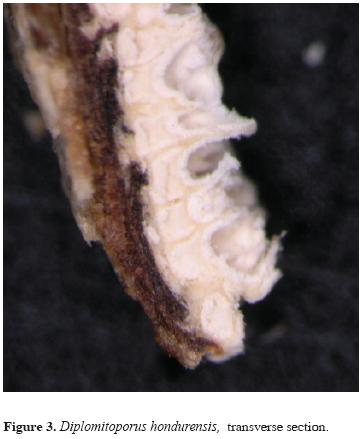
<body><![CDATA[<p align="justify"><font face="verdana" size="2"><b><i>Diplomitoporus hondurensis</i></b> (Murrill) Ryvarden, 2000: Mycotaxon 74(1): 121 (2000) &#150; (<a href="#f3">Figs. 3</a>, <a href="#f4">4</a>, <a href="#f5">5</a>)</font></p> 				    <p align="justify"><font face="verdana" size="2">&nbsp;</font></p> 				    <p align="center"><font face="verdana" size="2"><a name="f3"></a></font></p> 				    <p align="center"><font face="verdana" size="2"><img src="/img/revistas/rmbiodiv/v81n1/a2f3.jpg"></font></p> 				    <p align="center"><font face="verdana" size="2">&nbsp;</font></p> 				    <p align="center"><font face="verdana" size="2"><a name="f4"></a></font></p> 				    <p align="center"><font face="verdana" size="2"><img src="/img/revistas/rmbiodiv/v81n1/a2f4.jpg"></font></p> 				    <p align="center"><font face="verdana" size="2">&nbsp;</font></p> 				    <p align="center"><font face="verdana" size="2"><a name="f5"></a></font></p> 				    <p align="center"><font face="verdana" size="2"><img src="/img/revistas/rmbiodiv/v81n1/a2f5.jpg"></font></p> 				    ]]></body>
<body><![CDATA[<p align="justify"><font face="verdana" size="2">Basionym: <i>Poria hondurensis</i> Murrill 1920, Mycologia 12(6): 303 (1920)</font></p> 				    <p align="justify"><font face="verdana" size="2">Synonymy: <i>Grammothele hondurensis</i> (Murrill) Ryvarden, Mycotaxon 23: 185 (1985)</font></p> 				    <p align="justify"><font face="verdana" size="2">Basidiocarp 7 &times; 2 cm, scarcely 1mm thick, seemingly annual, totally resupinate, undetachable, firm, without sterile margin, pores becoming rudimentary toward the edge of fruitbody; hymenophore poroid, white, pores angular, irregular, with lacerate mouths, 2&#150;3 per mm (at the margin to 4 per mm). Conspicuous hyphal pegs can be observed on the walls of tubes. Tube layer is concolorous with the pore surface. Tube trama is formed as a semitranslucent ceraceous layer, which continues into white subiculum and divides it in pore&#150;wide sections (<a href="#f3">Figs. 3</a>, <a href="#f4">4</a>).</font></p> 				    <p align="justify"><font face="verdana" size="2">Hyphal system dimitic; generative hyphae with clamps, hyaline, thin&#150;walled, 3&#150;3.5 &micro;m in diam; skeletal hyphae hyaline, straight to sinuous, thick&#150;walled to solid, with large coarse crystal clumps, narrow, 2&#150;3 &micro;m in diam, not dissolving in KOH, inamyloid, dominating. Some types of skeletal hyphae are branched subjunctively and create a net of very thin projections. In dissepiments, remarkable endings of hyphae up to 10 &micro;m in diameter are formed (<a href="#f5">Fig. 5A</a>). Hymenium is developed also on the bottom of pores. Basidia clavate, 4&#150;sterigmate, with 4 &micro;m long sterigmata. Basidiospores ellipsoid, slightly navicular, tapering to the apiculus, hyaline, smooth and negative in Melzer's reagent, 5.5 &times; 2.8 &micro;m (<a href="#f5">Fig. 5B</a>).</font></p> 				    <p align="justify"><font face="verdana" size="2"><i>Locality:</i> Belize, Cockscomb Basin Wildlife Preserve, X. 2006, on dead hardwood, PRM 915288 and private herbarium of J. Kout (JK 3010/06R2).</font></p> 				    <p align="justify"><font face="verdana" size="2"><i>Note:</i> the type specimen of <i>D. hondurensis</i> (Murrill, 1920) originates from Belize (former British Honduras), and not from Honduras as stated by Ryvarden (2000). The Macroscopically similar <i>Diplomitoporus incisus</i> Ryvarden (2000) may be separated because of absence of hyphal pegs and variable endings of hyphae in dissepiments. The spores are more robust and tapering to the apiculus in <i>D. hondurensis</i> (Ryvarden, 1985). The proportions of basidiospores of both species are similar, though. Ryvarden (2000) gives similar values 5.5 &#150; 6.5 (7) &times; 2.5&#150;3 &micro;m for <i>D. incisus</i> and 5&#150;8 &times; 3&#150;3.5 &micro;m for <i>D. hondurensis</i>, but the shape is distinct. Tapering to the apiculus discriminates <i>D. hondurensis</i> spores well against oblong ellipsoid of <i>D. incisus.</i> This difference was not emphasized in the Ryvarden`s descriptions but it can be seen very well in the figure (Ryvarden 1985).</font></p> 				    <p align="justify"><font face="verdana" size="2">&nbsp;</font></p> 				    <p align="justify"><font face="verdana" size="2"><b>Remarks</b></font></p> 				    <p align="justify"><font face="verdana" size="2">The genus <i>Diplomitoporus</i> contains 17 recognized species (Domanski, 1970; Gilbertson and Ryvarden, 1986; Buchanan and Ryvarden, 1998; Loguercio&#150;Leite and Wright, 1998; Pieri and Rivoire, 1998; Lindblad and Ryvarden, 1999; Ryvarden, 2000; Ryvarden and Iturriaga, 2003; Gibertoni et al., 2004; Coelho, 2008, 2008a). Fourteen species are found in the Americas (3 of them are considered endemic to Venezuela&#150; EV, 3 in Brazil&#150; EB, and 1 in Costa Rica). The following species have been recorded in America:</font></p> 				    <p align="justify"><font face="verdana" size="2"><i>Diplomitoporus allantosporus </i>Ryvarden et Iturr. (2003)&#150; EV</font></p> 				    ]]></body>
<body><![CDATA[<p align="justify"><font face="verdana" size="2"><i>Diplomitoporus costaricensis</i> I. Lindblad et Ryvarden (1999)&#150; endemic to Costa Rica</font></p> 				    <p align="justify"><font face="verdana" size="2"><i>Diplomitoporus crustulinus</i> (Bres.) Domanski (1970)&#150; North America and Venezuela</font></p> 				    <p align="justify"><font face="verdana" size="2"><i>Diplomitoporus dilutabilis</i> Log.&#150;Leite et J. E. Wright (1998)&#150; Brazil, Costa Rica and Guatemala</font></p> 				    <p align="justify"><font face="verdana" size="2"><i>Diplomitoporus hondurensis</i> (Murrill) Ryvarden (2000)&#150; known from Puerto Rico and Belize</font></p> 				    <p align="justify"><font face="verdana" size="2"><i>Diplomitoporus incisus</i> Ryvarden (2000)&#150; found in Puerto Rico, French Guiana and Venezuela</font></p> 				    <p align="justify"><font face="verdana" size="2"><i>Diplomitoporus lindbladii</i> (Berk.) Gilb. et Ryvarden (1985)&#150; North and Central America</font></p> 				    <p align="justify"><font face="verdana" size="2"><i>Diplomitoporus marianoi&#150;rochae </i>G. Coelho (2008)&#150; EB</font></p> 				    <p align="justify"><font face="verdana" size="2"><i>Diplomitoporus navisporus</i> Gibertoni et Ryvarden (2004)&#150; EB</font></p> 				    <p align="justify"><font face="verdana" size="2"><i>Diplomitoporus overholtsii</i> (Pil&aacute;t) Gilb. et Ryvarden (1985)&#150; Central and North America </font></p> 				    <p align="justify"><font face="verdana" size="2"><i>Diplomitoporus rimosus </i>(Murrill) Gilb. et Ryvarden (1985)&#150; North America </font></p> 				    ]]></body>
<body><![CDATA[<p align="justify"><font face="verdana" size="2"><i>Diplomitoporus stramineus</i> Ryvarden et Iturr. (2003)&#150; EV</font></p> 				    <p align="justify"><font face="verdana" size="2"><i>Diplomitoporus taquarae</i> G. Coelho (2008)&#150; EB</font></p> 				    <p align="justify"><font face="verdana" size="2"><i>Diplomitoporus venezuelicus</i> Ryvarden et Iturr. (2003)&#150; EV</font></p> 				    <p align="justify"><font face="verdana" size="2">Overall 6 species of <i>Diplomitoporus</i> were collected in Central America. <i>Diplomitoporus costaricensis </i>is known only from Costa Rica and it differs from other Central American species by its very small pores (6&#150;8 per mm). <i>Diplomitoporus incisus</i>, with disjunctive distribution area is very close to <i>D. hondurensis</i>. They have similarly shaped basidiocarps, whitish color and incised pores (Ryvarden, 2000). <i>Diplomitoporus overholtsii </i>occurs mainly in the eastern part of the USA, but occasionally it may be found more to the south. It is characterized by wide (up to 5 &micro;m), ellipsoid spores and thick rhizomorphs (Gilbertson and Ryvarden, 1986). <i>Diplomitoporus lindbladii</i>, which is characterized by rather large pores with greyish tints and skeletals gelatinizing in KOH, is very common in northern USA and Europe, becoming rare to the south. Its occurrence in Central America is not well documented. Here it may be replaced by the recently described <i>D. meridionalis</i>, though probably it has been reported only from the Mediterranean area in France (Pieri and Rivoire 1998). Presently, we collected this species several times in pine woods in southern Florida (unpublished) and its occurrence in Central America can be expected. The species is similar to <i>D. crustulinus</i> but spores are ellipsoid and skeletals dissolve in KOH.</font></p> 				    <p align="justify"><font face="verdana" size="2">The list shows that many <i>Diplomitoporus</i> species are known only from small areas and about half of them are considered endemic for 1 country. Nevertheless, it can be expected that this is likely due to the limited knowledge of their true distribution. In fact, a large number of <i>Diplomitoporus</i> species has been recently described from South America, making South and Central America important centres of distribution of <i>Diplomitoporus</i> (Loguercio&#150;Leite and Wright, 1998; Lindblad and Ryvarden, 1999; Ryvarden, 2000; Ryvarden and Iturriaga, 2003; Gibertoni et al., 2004; Coelho, 2008, 2008a). As the mycological exploration of the neotropical world continues, even more <i>Diplomitoporus</i> species will likely be recorded throughout the area in the future. Our work contributes to the knowledge concerning 2 <i>Diplomitoporus</i> species occurring in Central America.</font></p> 				    <p align="justify"><font face="verdana" size="2">&nbsp;</font></p> 				    <p align="justify"><font face="verdana" size="2"><b>Literature cited</b></font></p> 				    <!-- ref --><p align="justify"><font face="verdana" size="2">Buchanan, P. K. and L. Ryvarden. 1998. New Zealand polypore fungi (Aphyllophorales): three new species and a new record. New Zealand Journal of Botany 36:219&#150;231.</font>&nbsp;&nbsp;&nbsp;&nbsp;&nbsp;&nbsp;&nbsp;&nbsp;[&#160;<a href="javascript:void(0);" onclick="javascript: window.open('/scielo.php?script=sci_nlinks&ref=7520424&pid=S1870-3453201000010000200001&lng=','','width=640,height=500,resizable=yes,scrollbars=1,menubar=yes,');">Links</a>&#160;]<!-- end-ref --> 				    <!-- ref --><p align="justify"><font face="verdana" size="2">Carranza Vel&aacute;zquez, J. and A. Ruiz&#150;Boyer. 2005. Checklist of polypores of Costa Rica. Revista Mexicana de Micolog&iacute;a 20:45&#150;52.</font>&nbsp;&nbsp;&nbsp;&nbsp;&nbsp;&nbsp;&nbsp;&nbsp;[&#160;<a href="javascript:void(0);" onclick="javascript: window.open('/scielo.php?script=sci_nlinks&ref=7520426&pid=S1870-3453201000010000200002&lng=','','width=640,height=500,resizable=yes,scrollbars=1,menubar=yes,');">Links</a>&#160;]<!-- end-ref --> 				    <!-- ref --><p align="justify"><font face="verdana" size="2">Coelho, G. 2008. <i>Diplomitoporus taquarae</i> G. Coelho, sp. nov. Fungal Planet 25.</font>&nbsp;&nbsp;&nbsp;&nbsp;&nbsp;&nbsp;&nbsp;&nbsp;[&#160;<a href="javascript:void(0);" onclick="javascript: window.open('/scielo.php?script=sci_nlinks&ref=7520428&pid=S1870-3453201000010000200003&lng=','','width=640,height=500,resizable=yes,scrollbars=1,menubar=yes,');">Links</a>&#160;]<!-- end-ref --> 				    <!-- ref --><p align="justify"><font face="verdana" size="2">Coelho, G. 2008a. <i>Diplomitoporus marianoi&#150;rochae</i> G. Coelho, sp. nov. Fungal Planet 26.</font>&nbsp;&nbsp;&nbsp;&nbsp;&nbsp;&nbsp;&nbsp;&nbsp;[&#160;<a href="javascript:void(0);" onclick="javascript: window.open('/scielo.php?script=sci_nlinks&ref=7520430&pid=S1870-3453201000010000200004&lng=','','width=640,height=500,resizable=yes,scrollbars=1,menubar=yes,');">Links</a>&#160;]<!-- end-ref --> 				    <!-- ref --><p align="justify"><font face="verdana" size="2">David, A. 1982. Etude monographique du genre <i>Skeletocutis</i> (Polyporaceae). Naturaliste Canadien 109:235&#150;272.</font>&nbsp;&nbsp;&nbsp;&nbsp;&nbsp;&nbsp;&nbsp;&nbsp;[&#160;<a href="javascript:void(0);" onclick="javascript: window.open('/scielo.php?script=sci_nlinks&ref=7520432&pid=S1870-3453201000010000200005&lng=','','width=640,height=500,resizable=yes,scrollbars=1,menubar=yes,');">Links</a>&#160;]<!-- end-ref --> 				    <!-- ref --><p align="justify"><font face="verdana" size="2">David, A. and M. Rajchenberg. 1992. West African polypores: new species and combinations. Mycotaxon 45:131&#150;148.</font>&nbsp;&nbsp;&nbsp;&nbsp;&nbsp;&nbsp;&nbsp;&nbsp;[&#160;<a href="javascript:void(0);" onclick="javascript: window.open('/scielo.php?script=sci_nlinks&ref=7520434&pid=S1870-3453201000010000200006&lng=','','width=640,height=500,resizable=yes,scrollbars=1,menubar=yes,');">Links</a>&#160;]<!-- end-ref --> 				    <!-- ref --><p align="justify"><font face="verdana" size="2">Domanski, S. 1970. Wood&#150;inhabiting fungi of Bialowieza virgin forests in Poland XIII. Two species of <i>Diplomitoporus</i> Doman., gen. nov. Acta Societatis Botanicorum Poloniae 39:191&#150;207.</font>&nbsp;&nbsp;&nbsp;&nbsp;&nbsp;&nbsp;&nbsp;&nbsp;[&#160;<a href="javascript:void(0);" onclick="javascript: window.open('/scielo.php?script=sci_nlinks&ref=7520436&pid=S1870-3453201000010000200007&lng=','','width=640,height=500,resizable=yes,scrollbars=1,menubar=yes,');">Links</a>&#160;]<!-- end-ref --> 				    <!-- ref --><p align="justify"><font face="verdana" size="2">Drechsler Santos, E. R., C. Groposo and C. Loguercio&#150;Leite. 2008. Additions to the knowledge of lignocellulolytic Basidiomycetes (Fungi) in forests from Santa Catarina State, Brazil. Mycotaxon 103:197&#150;200.</font>&nbsp;&nbsp;&nbsp;&nbsp;&nbsp;&nbsp;&nbsp;&nbsp;[&#160;<a href="javascript:void(0);" onclick="javascript: window.open('/scielo.php?script=sci_nlinks&ref=7520438&pid=S1870-3453201000010000200008&lng=','','width=640,height=500,resizable=yes,scrollbars=1,menubar=yes,');">Links</a>&#160;]<!-- end-ref --> 				    <!-- ref --><p align="justify"><font face="verdana" size="2">Gibertoni, T. B., L. Ryvarden and M. A. Queiros Cavalcanti. 2004. Studies in neotropical polypores 18. New species from Brazil. Synopsis Fungorum 18:44&#150;56.</font>&nbsp;&nbsp;&nbsp;&nbsp;&nbsp;&nbsp;&nbsp;&nbsp;[&#160;<a href="javascript:void(0);" onclick="javascript: window.open('/scielo.php?script=sci_nlinks&ref=7520440&pid=S1870-3453201000010000200009&lng=','','width=640,height=500,resizable=yes,scrollbars=1,menubar=yes,');">Links</a>&#160;]<!-- end-ref --> 				    <!-- ref --><p align="justify"><font face="verdana" size="2">Gilbertson, R. L. and L. Ryvarden. 1985. Some new combinations in Polyporaceae. Mycotaxon 22:363&#150;365.</font>&nbsp;&nbsp;&nbsp;&nbsp;&nbsp;&nbsp;&nbsp;&nbsp;[&#160;<a href="javascript:void(0);" onclick="javascript: window.open('/scielo.php?script=sci_nlinks&ref=7520442&pid=S1870-3453201000010000200010&lng=','','width=640,height=500,resizable=yes,scrollbars=1,menubar=yes,');">Links</a>&#160;]<!-- end-ref --> 				    <!-- ref --><p align="justify"><font face="verdana" size="2">Gilbertson, R. L. and L. Ryvarden. 1986. North American polypores 1. <i>Abortiporus&#150;Lindtneria</i>. Fungiflora, Oslo, Norway. 433 p.</font>&nbsp;&nbsp;&nbsp;&nbsp;&nbsp;&nbsp;&nbsp;&nbsp;[&#160;<a href="javascript:void(0);" onclick="javascript: window.open('/scielo.php?script=sci_nlinks&ref=7520444&pid=S1870-3453201000010000200011&lng=','','width=640,height=500,resizable=yes,scrollbars=1,menubar=yes,');">Links</a>&#160;]<!-- end-ref --> 				    <!-- ref --><p align="justify"><font face="verdana" size="2">Holmgren, P. K. and N. H. Holmgren 1998 &#91;continuously updated&#93;. Index Herbariorum: A global directory of public herbaria and associated staff. New York Botanical Garden's Virtual Herbarium. <a href="http://sweetgum.nybg.org/ih/" target="_blank">http://sweetgum.nybg.org/ih/</a>; 10.01.2009.</font>&nbsp;&nbsp;&nbsp;&nbsp;&nbsp;&nbsp;&nbsp;&nbsp;[&#160;<a href="javascript:void(0);" onclick="javascript: window.open('/scielo.php?script=sci_nlinks&ref=7520446&pid=S1870-3453201000010000200012&lng=','','width=640,height=500,resizable=yes,scrollbars=1,menubar=yes,');">Links</a>&#160;]<!-- end-ref --> 				    <!-- ref --><p align="justify"><font face="verdana" size="2">J&uuml;lich, W. 1981. Higher taxa of Basidiomycetes. Bibliotheca Mycologica 85:1&#150;485.</font>&nbsp;&nbsp;&nbsp;&nbsp;&nbsp;&nbsp;&nbsp;&nbsp;[&#160;<a href="javascript:void(0);" onclick="javascript: window.open('/scielo.php?script=sci_nlinks&ref=7520448&pid=S1870-3453201000010000200013&lng=','','width=640,height=500,resizable=yes,scrollbars=1,menubar=yes,');">Links</a>&#160;]<!-- end-ref --> 				    <!-- ref --><p align="justify"><font face="verdana" size="2">Lindblad, I. and L. Ryvarden. 1999. Studies in neotropical polypores 3. New and interesting basidiomycetes (Poriales) from Costa Rica. Mycotaxon 71:335&#150;359.</font>&nbsp;&nbsp;&nbsp;&nbsp;&nbsp;&nbsp;&nbsp;&nbsp;[&#160;<a href="javascript:void(0);" onclick="javascript: window.open('/scielo.php?script=sci_nlinks&ref=7520450&pid=S1870-3453201000010000200014&lng=','','width=640,height=500,resizable=yes,scrollbars=1,menubar=yes,');">Links</a>&#160;]<!-- end-ref --> 				    <!-- ref --><p align="justify"><font face="verdana" size="2">Loguercio&#150;Leite, C. and J. E. Wright. 1998. <i>Diplomitoporus dilutabilis</i> a new species of Polyporaceae (Aphyllophorales) from Santa Catarina Island, Brazil. Mycotaxon 68:47&#150;51.</font>&nbsp;&nbsp;&nbsp;&nbsp;&nbsp;&nbsp;&nbsp;&nbsp;[&#160;<a href="javascript:void(0);" onclick="javascript: window.open('/scielo.php?script=sci_nlinks&ref=7520452&pid=S1870-3453201000010000200015&lng=','','width=640,height=500,resizable=yes,scrollbars=1,menubar=yes,');">Links</a>&#160;]<!-- end-ref --> 				    <!-- ref --><p align="justify"><font face="verdana" size="2">Murrill, W. A. 1920. Light&#150;colored resupinate polypores II. Mycologia 12:299&#150;308.</font>&nbsp;&nbsp;&nbsp;&nbsp;&nbsp;&nbsp;&nbsp;&nbsp;[&#160;<a href="javascript:void(0);" onclick="javascript: window.open('/scielo.php?script=sci_nlinks&ref=7520454&pid=S1870-3453201000010000200016&lng=','','width=640,height=500,resizable=yes,scrollbars=1,menubar=yes,');">Links</a>&#160;]<!-- end-ref --> 				    <!-- ref --><p align="justify"><font face="verdana" size="2">Pieri, M. and B. Rivoire. 1998. A propos de quelques polypores (Aphyllophoromycetideae) rares ou critiques r&eacute;coltes r&eacute;cemment. II. Bulletin de la Soci&eacute;t&eacute; Mycologique de France 114:39&#150;52.</font>&nbsp;&nbsp;&nbsp;&nbsp;&nbsp;&nbsp;&nbsp;&nbsp;[&#160;<a href="javascript:void(0);" onclick="javascript: window.open('/scielo.php?script=sci_nlinks&ref=7520456&pid=S1870-3453201000010000200017&lng=','','width=640,height=500,resizable=yes,scrollbars=1,menubar=yes,');">Links</a>&#160;]<!-- end-ref --> 				    <!-- ref --><p align="justify"><font face="verdana" size="2">Rajchenberg, M. 1983. New South American resupinate polypores. Mycotaxon 16:500&#150;506.</font>&nbsp;&nbsp;&nbsp;&nbsp;&nbsp;&nbsp;&nbsp;&nbsp;[&#160;<a href="javascript:void(0);" onclick="javascript: window.open('/scielo.php?script=sci_nlinks&ref=7520458&pid=S1870-3453201000010000200018&lng=','','width=640,height=500,resizable=yes,scrollbars=1,menubar=yes,');">Links</a>&#160;]<!-- end-ref --> 				    <!-- ref --><p align="justify"><font face="verdana" size="2">Ryvarden, L. 1985. Type studies in the polyporaceae 17. Species described by W.A. Murril. Mycotaxon 23:169&#150;198.</font>&nbsp;&nbsp;&nbsp;&nbsp;&nbsp;&nbsp;&nbsp;&nbsp;[&#160;<a href="javascript:void(0);" onclick="javascript: window.open('/scielo.php?script=sci_nlinks&ref=7520460&pid=S1870-3453201000010000200019&lng=','','width=640,height=500,resizable=yes,scrollbars=1,menubar=yes,');">Links</a>&#160;]<!-- end-ref --> 				    <!-- ref --><p align="justify"><font face="verdana" size="2">Ryvarden, L. 2000. Studies in neotropical polypores 5. New and noteworthy species from Puerto Rico and Virgin Islands. Mycotaxon 74:119&#150;129.</font>&nbsp;&nbsp;&nbsp;&nbsp;&nbsp;&nbsp;&nbsp;&nbsp;[&#160;<a href="javascript:void(0);" onclick="javascript: window.open('/scielo.php?script=sci_nlinks&ref=7520462&pid=S1870-3453201000010000200020&lng=','','width=640,height=500,resizable=yes,scrollbars=1,menubar=yes,');">Links</a>&#160;]<!-- end-ref --> 				    <!-- ref --><p align="justify"><font face="verdana" size="2">Ryvarden, L. and R. L. Gilbertson. 1993. European Polypores 1. <i>Abortiporus &#150; Lindtneria</i>. Fungiflora, Oslo, Norway. 387 p.</font>&nbsp;&nbsp;&nbsp;&nbsp;&nbsp;&nbsp;&nbsp;&nbsp;[&#160;<a href="javascript:void(0);" onclick="javascript: window.open('/scielo.php?script=sci_nlinks&ref=7520464&pid=S1870-3453201000010000200021&lng=','','width=640,height=500,resizable=yes,scrollbars=1,menubar=yes,');">Links</a>&#160;]<!-- end-ref --> 				    <!-- ref --><p align="justify"><font face="verdana" size="2">Ryvarden, L. and T. Iturriaga. 2003. Studies in neotropical polypores 10. New polypores from Venezuela. Mycologia 95:1066&#150;1077.</font>&nbsp;&nbsp;&nbsp;&nbsp;&nbsp;&nbsp;&nbsp;&nbsp;[&#160;<a href="javascript:void(0);" onclick="javascript: window.open('/scielo.php?script=sci_nlinks&ref=7520466&pid=S1870-3453201000010000200022&lng=','','width=640,height=500,resizable=yes,scrollbars=1,menubar=yes,');">Links</a>&#160;]<!-- end-ref --> 				    <!-- ref --><p align="justify"><font face="verdana" size="2">Spirin, W. A. 2005. Notes on some rare polypores, found in Russia 2. <i>Junghuhnia vitellina</i> sp. nova, plus genera <i>Cinereomyces</i> and <i>Skeletocutis</i>. Karstenia 45:104&#150;113.</font>&nbsp;&nbsp;&nbsp;&nbsp;&nbsp;&nbsp;&nbsp;&nbsp;[&#160;<a href="javascript:void(0);" onclick="javascript: window.open('/scielo.php?script=sci_nlinks&ref=7520468&pid=S1870-3453201000010000200023&lng=','','width=640,height=500,resizable=yes,scrollbars=1,menubar=yes,');">Links</a>&#160;]<!-- end-ref --> 				    <!-- ref --><p align="justify"><font face="verdana" size="2">Spirin, W. A. and I. V. Zmitrovich. 2003. Notes on some rare polypores, found in Russia. I: Genera <i>Antrodiella, Gelatoporia, Irpex, Oxyporus, Pilatoporus</i>, and <i>Porpomyces</i>. Karstenia 43:67&#150;82.</font>&nbsp;&nbsp;&nbsp;&nbsp;&nbsp;&nbsp;&nbsp;&nbsp;[&#160;<a href="javascript:void(0);" onclick="javascript: window.open('/scielo.php?script=sci_nlinks&ref=7520470&pid=S1870-3453201000010000200024&lng=','','width=640,height=500,resizable=yes,scrollbars=1,menubar=yes,');">Links</a>&#160;]<!-- end-ref --> ]]></body><back>
<ref-list>
<ref id="B1">
<nlm-citation citation-type="journal">
<person-group person-group-type="author">
<name>
<surname><![CDATA[Buchanan]]></surname>
<given-names><![CDATA[P. K.]]></given-names>
</name>
<name>
<surname><![CDATA[Ryvarden]]></surname>
<given-names><![CDATA[L.]]></given-names>
</name>
</person-group>
<article-title xml:lang="en"><![CDATA[New Zealand polypore fungi (Aphyllophorales): three new species and a new record]]></article-title>
<source><![CDATA[New Zealand Journal of Botany]]></source>
<year>1998</year>
<volume>36</volume>
<page-range>219-231</page-range></nlm-citation>
</ref>
<ref id="B2">
<nlm-citation citation-type="journal">
<person-group person-group-type="author">
<name>
<surname><![CDATA[Carranza Velázquez]]></surname>
<given-names><![CDATA[J.]]></given-names>
</name>
<name>
<surname><![CDATA[Ruiz-Boyer]]></surname>
<given-names><![CDATA[A.]]></given-names>
</name>
</person-group>
<article-title xml:lang="en"><![CDATA[Checklist of polypores of Costa Rica]]></article-title>
<source><![CDATA[Revista Mexicana de Micología]]></source>
<year>2005</year>
<volume>20</volume>
<page-range>45-52</page-range></nlm-citation>
</ref>
<ref id="B3">
<nlm-citation citation-type="book">
<person-group person-group-type="author">
<name>
<surname><![CDATA[Coelho]]></surname>
<given-names><![CDATA[G.]]></given-names>
</name>
</person-group>
<source><![CDATA[Diplomitoporus taquarae G. Coelho, sp. nov.]]></source>
<year>2008</year>
<page-range>25</page-range><publisher-name><![CDATA[Fungal Planet]]></publisher-name>
</nlm-citation>
</ref>
<ref id="B4">
<nlm-citation citation-type="book">
<person-group person-group-type="author">
<name>
<surname><![CDATA[Coelho]]></surname>
<given-names><![CDATA[G.]]></given-names>
</name>
</person-group>
<source><![CDATA[Diplomitoporus marianoi-rochae G. Coelho, sp. nov.]]></source>
<year>2008</year>
<month>a</month>
<page-range>26</page-range><publisher-name><![CDATA[Fungal Planet]]></publisher-name>
</nlm-citation>
</ref>
<ref id="B5">
<nlm-citation citation-type="journal">
<person-group person-group-type="author">
<name>
<surname><![CDATA[David]]></surname>
<given-names><![CDATA[A.]]></given-names>
</name>
</person-group>
<article-title xml:lang="fr"><![CDATA[Etude monographique du genre Skeletocutis (Polyporaceae)]]></article-title>
<source><![CDATA[Naturaliste Canadien]]></source>
<year>1982</year>
<volume>109</volume>
<page-range>235-272</page-range></nlm-citation>
</ref>
<ref id="B6">
<nlm-citation citation-type="journal">
<person-group person-group-type="author">
<name>
<surname><![CDATA[David]]></surname>
<given-names><![CDATA[A.]]></given-names>
</name>
<name>
<surname><![CDATA[Rajchenberg]]></surname>
<given-names><![CDATA[M.]]></given-names>
</name>
</person-group>
<article-title xml:lang="en"><![CDATA[West African polypores: new species and combinations]]></article-title>
<source><![CDATA[Mycotaxon]]></source>
<year>1992</year>
<volume>45</volume>
<page-range>131-148</page-range></nlm-citation>
</ref>
<ref id="B7">
<nlm-citation citation-type="journal">
<person-group person-group-type="author">
<name>
<surname><![CDATA[Domanski]]></surname>
<given-names><![CDATA[S.]]></given-names>
</name>
</person-group>
<article-title xml:lang="en"><![CDATA[Wood-inhabiting fungi of Bialowieza virgin forests in Poland XIII: Two species of Diplomitoporus Doman., gen. nov.]]></article-title>
<source><![CDATA[Acta Societatis Botanicorum Poloniae]]></source>
<year>1970</year>
<volume>39</volume>
<page-range>191-207</page-range></nlm-citation>
</ref>
<ref id="B8">
<nlm-citation citation-type="journal">
<person-group person-group-type="author">
<name>
<surname><![CDATA[Drechsler Santos]]></surname>
<given-names><![CDATA[E. R]]></given-names>
</name>
<name>
<surname><![CDATA[Groposo]]></surname>
<given-names><![CDATA[C.]]></given-names>
</name>
<name>
<surname><![CDATA[Loguercio-Leite]]></surname>
<given-names><![CDATA[C.]]></given-names>
</name>
</person-group>
<article-title xml:lang="en"><![CDATA[Additions to the knowledge of lignocellulolytic Basidiomycetes (Fungi) in forests from Santa Catarina State, Brazil]]></article-title>
<source><![CDATA[Mycotaxon]]></source>
<year>2008</year>
<volume>103</volume>
<page-range>197-200</page-range></nlm-citation>
</ref>
<ref id="B9">
<nlm-citation citation-type="journal">
<person-group person-group-type="author">
<name>
<surname><![CDATA[Gibertoni]]></surname>
<given-names><![CDATA[T. B.]]></given-names>
</name>
<name>
<surname><![CDATA[Ryvarden]]></surname>
<given-names><![CDATA[L.]]></given-names>
</name>
<name>
<surname><![CDATA[Queiros Cavalcanti]]></surname>
<given-names><![CDATA[M. A.]]></given-names>
</name>
</person-group>
<article-title xml:lang="en"><![CDATA[Studies in neotropical polypores 18.: New species from Brazil]]></article-title>
<source><![CDATA[Synopsis Fungorum]]></source>
<year>2004</year>
<volume>18</volume>
<page-range>44-56</page-range></nlm-citation>
</ref>
<ref id="B10">
<nlm-citation citation-type="journal">
<person-group person-group-type="author">
<name>
<surname><![CDATA[Gilbertson]]></surname>
<given-names><![CDATA[R. L.]]></given-names>
</name>
<name>
<surname><![CDATA[Ryvarden]]></surname>
<given-names><![CDATA[L.]]></given-names>
</name>
</person-group>
<article-title xml:lang="en"><![CDATA[Some new combinations in Polyporaceae]]></article-title>
<source><![CDATA[Mycotaxon]]></source>
<year>1985</year>
<volume>22</volume>
<page-range>363-365</page-range></nlm-citation>
</ref>
<ref id="B11">
<nlm-citation citation-type="book">
<person-group person-group-type="author">
<name>
<surname><![CDATA[Gilbertson]]></surname>
<given-names><![CDATA[R. L.]]></given-names>
</name>
<name>
<surname><![CDATA[Ryvarden]]></surname>
<given-names><![CDATA[L.]]></given-names>
</name>
</person-group>
<source><![CDATA[North American polypores 1.: Abortiporus-Lindtneria]]></source>
<year>1986</year>
<page-range>433</page-range><publisher-loc><![CDATA[Oslo ]]></publisher-loc>
<publisher-name><![CDATA[Fungiflora]]></publisher-name>
</nlm-citation>
</ref>
<ref id="B12">
<nlm-citation citation-type="book">
<person-group person-group-type="author">
<name>
<surname><![CDATA[Holmgren]]></surname>
<given-names><![CDATA[P. K.]]></given-names>
</name>
<name>
<surname><![CDATA[Holmgren]]></surname>
<given-names><![CDATA[N. H.]]></given-names>
</name>
</person-group>
<source><![CDATA[Index Herbariorum: A global directory of public herbaria and associated staff]]></source>
<year>1998</year>
<publisher-name><![CDATA[New York Botanical Garden's Virtual Herbarium]]></publisher-name>
</nlm-citation>
</ref>
<ref id="B13">
<nlm-citation citation-type="journal">
<person-group person-group-type="author">
<name>
<surname><![CDATA[Jülich]]></surname>
<given-names><![CDATA[W.]]></given-names>
</name>
</person-group>
<article-title xml:lang="en"><![CDATA[Higher taxa of Basidiomycetes]]></article-title>
<source><![CDATA[Bibliotheca Mycologica]]></source>
<year>1981</year>
<volume>85</volume>
<page-range>1-485</page-range></nlm-citation>
</ref>
<ref id="B14">
<nlm-citation citation-type="journal">
<person-group person-group-type="author">
<name>
<surname><![CDATA[Lindblad]]></surname>
<given-names><![CDATA[I.]]></given-names>
</name>
<name>
<surname><![CDATA[Ryvarden]]></surname>
<given-names><![CDATA[L.]]></given-names>
</name>
</person-group>
<article-title xml:lang="en"><![CDATA[Studies in neotropical polypores 3.New and interesting basidiomycetes (Poriales) from Costa Rica]]></article-title>
<source><![CDATA[Mycotaxon]]></source>
<year>1999</year>
<volume>71</volume>
<page-range>335-359</page-range></nlm-citation>
</ref>
<ref id="B15">
<nlm-citation citation-type="journal">
<person-group person-group-type="author">
<name>
<surname><![CDATA[Loguercio-Leite]]></surname>
<given-names><![CDATA[C.]]></given-names>
</name>
<name>
<surname><![CDATA[Wright]]></surname>
<given-names><![CDATA[J. E.]]></given-names>
</name>
</person-group>
<article-title xml:lang="en"><![CDATA[Diplomitoporus dilutabilis a new species of Polyporaceae (Aphyllophorales) from Santa Catarina Island, Brazil]]></article-title>
<source><![CDATA[Mycotaxon]]></source>
<year>1998</year>
<volume>68</volume>
<page-range>47-51</page-range></nlm-citation>
</ref>
<ref id="B16">
<nlm-citation citation-type="journal">
<person-group person-group-type="author">
<name>
<surname><![CDATA[Murrill]]></surname>
<given-names><![CDATA[W. A.]]></given-names>
</name>
</person-group>
<article-title xml:lang="en"><![CDATA[Light-colored resupinate polypores II]]></article-title>
<source><![CDATA[Mycologia]]></source>
<year>1920</year>
<volume>12</volume>
<page-range>299-308</page-range></nlm-citation>
</ref>
<ref id="B17">
<nlm-citation citation-type="journal">
<person-group person-group-type="author">
<name>
<surname><![CDATA[Pieri]]></surname>
<given-names><![CDATA[M.]]></given-names>
</name>
<name>
<surname><![CDATA[Rivoire]]></surname>
<given-names><![CDATA[B.]]></given-names>
</name>
</person-group>
<article-title xml:lang="fr"><![CDATA[A propos de quelques polypores (Aphyllophoromycetideae) rares ou critiques récoltes récemment. II.]]></article-title>
<source><![CDATA[Bulletin de la Société Mycologique de France]]></source>
<year>1998</year>
<volume>114</volume>
<page-range>39-52</page-range></nlm-citation>
</ref>
<ref id="B18">
<nlm-citation citation-type="journal">
<person-group person-group-type="author">
<name>
<surname><![CDATA[Rajchenberg]]></surname>
<given-names><![CDATA[M.]]></given-names>
</name>
</person-group>
<article-title xml:lang="en"><![CDATA[New South American resupinate polypores]]></article-title>
<source><![CDATA[Mycotaxon]]></source>
<year>1983</year>
<volume>16</volume>
<page-range>500-506</page-range></nlm-citation>
</ref>
<ref id="B19">
<nlm-citation citation-type="journal">
<person-group person-group-type="author">
<name>
<surname><![CDATA[Ryvarden]]></surname>
<given-names><![CDATA[L.]]></given-names>
</name>
</person-group>
<article-title xml:lang="en"><![CDATA[Type studies in the polyporaceae 17.Species described by W.A. Murril]]></article-title>
<source><![CDATA[Mycotaxon]]></source>
<year>1985</year>
<volume>23</volume>
<page-range>169-198</page-range></nlm-citation>
</ref>
<ref id="B20">
<nlm-citation citation-type="journal">
<person-group person-group-type="author">
<name>
<surname><![CDATA[Ryvarden]]></surname>
<given-names><![CDATA[L.]]></given-names>
</name>
</person-group>
<article-title xml:lang="en"><![CDATA[Studies in neotropical polypores 5: New and noteworthy species from Puerto Rico and Virgin Islands]]></article-title>
<source><![CDATA[Mycotaxon]]></source>
<year>2000</year>
<volume>74</volume>
<page-range>119-129</page-range></nlm-citation>
</ref>
<ref id="B21">
<nlm-citation citation-type="book">
<person-group person-group-type="author">
<name>
<surname><![CDATA[Ryvarden]]></surname>
<given-names><![CDATA[L.]]></given-names>
</name>
<name>
<surname><![CDATA[Gilbertson]]></surname>
<given-names><![CDATA[R. L.]]></given-names>
</name>
</person-group>
<source><![CDATA[European Polypores 1: Abortiporus - Lindtneria]]></source>
<year>1993</year>
<page-range>387</page-range><publisher-loc><![CDATA[Oslo ]]></publisher-loc>
<publisher-name><![CDATA[Fungiflora]]></publisher-name>
</nlm-citation>
</ref>
<ref id="B22">
<nlm-citation citation-type="journal">
<person-group person-group-type="author">
<name>
<surname><![CDATA[Ryvarden]]></surname>
<given-names><![CDATA[L.]]></given-names>
</name>
<name>
<surname><![CDATA[Iturriaga]]></surname>
<given-names><![CDATA[T.]]></given-names>
</name>
</person-group>
<article-title xml:lang="en"><![CDATA[Studies in neotropical polypores 10: New polypores from Venezuela]]></article-title>
<source><![CDATA[Mycologia]]></source>
<year>2003</year>
<volume>95</volume>
<page-range>1066-1077</page-range></nlm-citation>
</ref>
<ref id="B23">
<nlm-citation citation-type="journal">
<person-group person-group-type="author">
<name>
<surname><![CDATA[Spirin]]></surname>
<given-names><![CDATA[W. A.]]></given-names>
</name>
</person-group>
<article-title xml:lang="en"><![CDATA[Notes on some rare polypores, found in Russia 2. Junghuhnia vitellina sp. nova, plus genera Cinereomyces and Skeletocutis]]></article-title>
<source><![CDATA[Karstenia]]></source>
<year>2005</year>
<volume>45</volume>
<page-range>104-113</page-range></nlm-citation>
</ref>
<ref id="B24">
<nlm-citation citation-type="journal">
<person-group person-group-type="author">
<name>
<surname><![CDATA[Spirin]]></surname>
<given-names><![CDATA[W. A.]]></given-names>
</name>
<name>
<surname><![CDATA[Zmitrovich]]></surname>
<given-names><![CDATA[I. V.]]></given-names>
</name>
</person-group>
<article-title xml:lang="en"><![CDATA[Notes on some rare polypores, found in Russia. I: Genera Antrodiella, Gelatoporia, Irpex, Oxyporus, Pilatoporus, and Porpomyces]]></article-title>
<source><![CDATA[Karstenia]]></source>
<year>2003</year>
<volume>43</volume>
<page-range>67-82</page-range></nlm-citation>
</ref>
</ref-list>
</back>
</article>