Description of a new species of Ischnodemus from Peru, and the male and immature stages of I. subflavus (Hemiptera: Heteroptera: Lygaeoidea: Blissidae)
Descripción de una especie nueva de Ischnodemus de Perú y del macho y estadios inmaduros de I. subflavus (Hemiptera: Heteroptera: Lygaeoidea: Blissidae)
Pablo Matías Dellapé* and Sara Itzel Montemayor
División Entomología, Facultad de Ciencias Naturales y Museo, Universidad Nacional de La Plata, Paseo del Bosque, 1900 La Plata, Argentina.
]]> * Correspondent:
Recibido: 18 noviembre 2008
Aceptado: 02 marzo 2009
Abstract
A new species, Ischnodemus brusai, from Ucayali, Peru is described and illustrated, including characters of the male genitalia. Adult males and females, and immature specimens of I. subflavus Slater and Wilcox 1969 were collected on Sporobolus rigens (Trinius) Desvaux (Poaceae) in the province of Chubut, Argentina. This is the first record of the male for this species. Descriptions and illustrations of a male individual, as well as male and female genitalia and immature stages II to V are provided. Affinities with other Neotropical species of Ischnodemus are discussed.
Key words: Ischnodemus brusai, new species, Ischnodemus subflavus, immature stages, Peru, Argentina.
]]> Resumen
Se describe e ilustra una especie nueva, Ischnodemus brusai de Uyacali, Perú, incluyendo caracteres de los genitales masculinos. Se recolectaron adultos machos, hembras y estadios inmaduros de I. subflavus Slater and Wilcox 1969 sobre Sporobolus rigens (Trinius) Desvaux (Poaceae) en la provincia de Chubut, Argentina. Éste es el primer registro de un macho para esta especie. Se proveen descripciones e ilustraciones del macho, genitales masculinos y femeninos, y los estadios II a IV. Se discuten las afinidades con otras especies neotropicales del género.
Palabras clave: Ischnodemus brusai, especie nueva, Ischnodemus subflavus, estadios inmaduros, Perú, Argentina.
Introduction
The members of the Blissidae feed on the sap of plant tissues, with most of the species living between leaf sheaths (Slater, 1979). All the known members of the family breed only upon species of monocotyledons (Slater, 1976; Schuh and Slater, 1995). The diversity of this worldwide family is poorly known in the Neotropics. The species of Ischnodemus Fieber occur in all the major biogeographic regions of the world and is one of the largest and most complex taxa in the family (Slater and Wilcox, 1969). In the Neotropical region, it is represented by 33 species, 19 of which have been recorded from Argentina and only 2 from Peru. In this paper, a new species of Ischnodemus from Peru is described and illustrated. Males of I. subflavus Slater and Wilcox 1969 are recorded for the first time together with females and nymphs. Descriptions and illustrations of the male, as well as male and female genitalia, and immature stages II to V are also provided.
Material and methods
The studied material belongs to the Museo de La Plata (MLP). Vouchers of the immature stages of I. suflavus are preserved in 70% alcohol. The number of nymphal instars studied are 2 IIs, 9 IIIs, 34 IVs and 52 Vs; 31 adults of I. subflavus were studied, 24 males and 7 females, and 1 male of I. brusai. Measurements are given in millimeters, range and mean values are provided, the latter in parentheses. For recognition of the abdominal sclerites, we used the coding system proposed by Slater and Wilcox (1973).
]]> Description
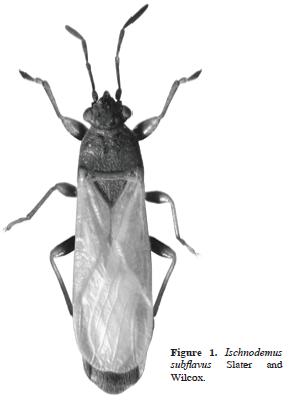
Ischnodemus subflavus Slater and Wilcox 1969 (Figs. 1–11, Figure 1, 2–7, 8–11)

Description was based on 3 female specimens from the Argentinean provinces of Río Negro and Catamarca. Specimens studied were collected on Sporobolus rigens (Trinius) Desvaux (Poaceae), in the province of Chubut. This is the first record of the family for this province and represents the most austral distribution of the family for Argentina.
Male and female studied agree with the female description of Slater and Wilcox, differing only in coloration, possibly because the type specimens have been dry preserved for a long time. These characters are: pronotum dull gray–black except for a tranverse shiny band posteriorly; tylus and antennae brown; coxae and femora brown; and trochanters, apex of femur, tibia and tarsi pale brown. Other additional characters observed are the brown rostrum; dull and gray–black pleura and sterna; the contrastingly orange–brown metathoracic scent gland orifice and the thoracic pleura sparsely clothed with upright and semidecumbent sericeus setae.
]]> Male genitalia. Pygophore (Fig. 2): rounded in dorsal view, anterior margin of dorsal aperture subacute, parandria triangular. Parameres (Figs. 3–4): blade curved, outer projection short and rounded, inner subasal projection angled toward base. Sperm reservoir (Fig. 5): Wings broad, strongly tapering laterad; median sac elongated, broader ventrally.Female genitalia. Spermatheca (Fig. 6) with a large prominent and globular bump, elongate and linear pump and a long duct. Ovipositor divides sixth sternum (Fig. 7). Measurements N=5 males; N=5 females: Total length 5.35–5.80 (5.53) 6.25–7.20 (6.87); head length 0.65–0.68 (0.67) 0.75–0.80 (0.78); head width 0.85–0.90 (0.88) 0.95–1.00 (0.98); interocular space 0.55–0.58 (0.56) 0.63–0.65 (0.63); pronotum length 0.90–0.98 (0.93) 1.03–1.10 (1.07); pronotum width 1.20–1.25 (1.24) 1.48–1.53 (1.49); scutellum length 0.50–0.60 (0.56) 0.65–0.68 (0.67); scutellum width 0.63–0.70 (0.67) 0.83–0.88 (0.86); distance apex clavus –apex corium 1.15–1.25 (1.20) 1.40–1.55 (1.49); distance apex corium – apex abdomen 1.50–1.80 (1.66) 2.20–2.53 (2.35); rostral segment I0.43–0.41 (0.42) 0.50–0.53 (0.52); II 0.39–0.44 (0.43) 0.43–0.53 (0.49); III 0.31–0.36 (0.33) 0.36–0.39 (0.37); IV 0.29–0.33 (0.31) 0.36–0.39 (0.37); scapus 0.21–0.24 (0.23) 0.24–0.29 (0.25); pedicellus 0.57–0.60 (0.58) 0.60–0.67 (0.64); basiflagellomere 0.49–0.50 (0.50) 0.50–0.54 (0.53); distiflagellomere 0.61–0.64 (0.63) 0.63–0.74 (0.68).
Material examined. 24 males and 7 females. Argentina: Chubut: Península Valdes, Reserva San Pablo, 42°38'41.9"S 64°10'37.3"W, 23–II–2007, on Sporobolus rigens (Trinius) Desvaux, P. Dellapé col. (MLP).
Remarks
Slater and Wilcox (1969) used external features and characters from the male genitalia to establish "species groups" for Neotropical Ischnodemus. These authors placed I. subflavus in the I. stali group because of its similarities with the other members of the group in general habitus, but they did not consider characters from the male genitalia as the male was not yet known. The evidence provided by the male genitalia relates this species with the tibialis group based on the sperm reservoir with the wings strongly tapering laterad and not projecting, and the slender parameres with the inner basal area produced into a short projection. Ischnodemus subflavus also shares with the other members of the I. tibialis group a complete sub–basal shining pronotal band but is the only species whose membrane is uniformly pale.
The host plant, S. rigens, is endemic to Argentina and Chile, and extends along the arid regions of Argentina. It has been recorded from several Argentinean provinces including Catamarca and Río Negro, where I. subflavus was previously collected. Sporobolus rigens grows in sand dunes with deep sandy soils where it can extend its rhizomes. The plant is used mainly in the production of brooms and handicrafts, such as bags, carpets and hats and is important in small regional economies.
Description of immature stages of I. subflavus
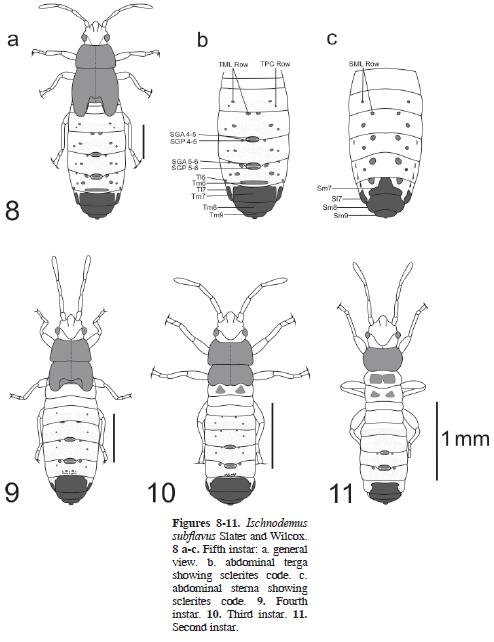
Nymph V (Fig. 8 a–c). Total length 5.15–6.25 (5.82); length head 0.63–0.65 (0.64), width 0.83–0.88 (0.85); length pronotum 0.68–0.75 (0.72), width 1.15–1.28 (1.23); wing pad extending to anterior margin of abdominal tergum III, length wing pad 1.25–1.50 (1.39); Antennal segments: scapus 0.19–0.21 (0.21), pedicellus 0.50–0.53 (0.51), basiflagellomere 0.43–0.47 (0.44), distiflagellomere 0.54–0.61 (0.57). Head, distal half of distiflagellomere, pronotum, wing pads, pleura, femora and tibia dark brown; scapus, pedicellus, basiflagellomere proximal half of distiflagellomere, coxae, trochanters, apex of femora and tarsi pale brown; head ventrally, margins of pleura, pro and mesosternum, abdomen ventrally and posterior half of abdominal terga III to VI reddish; metasternum and some portions of abdomen yellowish, see dorsal pattern of reddish and yellowish tonalities in figure 8. TML spots from terga 3 to 6 (1+2+2+2), ovoid, wider than long, moderately small; TPC spots from tergum 3 to 6 (1+1+1+2) or (1+1+1+1), circular, smaller than TML spots; SG sclerites 4–5 smaller than 5–6, moderately large, subovoid; TM sclerites present from tergum 6; TM6 ovoid, wider than long, occupying posterior 1/3 of tergum, TL sclerites on terga 6 and 7, TL6 small, ovoid, longer than wide, absent in some specimens; TM7 large, rectangular, anteriorly slightly constricted, laterally more prominent, covering nearly entire tergum, medially in contact with tergum 6, well separated from large ovoid TL7, longer than wide, which extends anteriorly 3/4, TM8 and TM9 large, occupying the entire terga (Fig. 8 b). SML row from sterna 3 to 7 (1+2+2+2+1), rounded increasing it sizes posteriorly, SL7 subrectangular, SM spots from sterna 7 to 9, SM7 subtriangular occupying the entire length of the segments, SM8 and 9 occupying all the sterna (Fig 8 c).
]]> Remarks. In the world key for the known fifth instars of the Blissinae (Slater, 1979), I. subflavus has characteristics that lead to couplet 22, where the options are TL6 present (sometimes reduced to a few small spots) or TL6 absent. If we follow the first option (most of the nymphs examined present the TL6 as small spots), we should go to couplet 25 where I. propius and I. praecultus are identified. Ischnodemus subflavus agrees most closely with I. praecultus.Nymph IV (Fig. 9). Total length 3.63–4.28 (3.94); length head 0.47–0.50 (0.49), width 0.61–0.66 (0.63); length pronotum 0.43–0.50 (0.46), width 0.80–0.89 (0.85); wing pad extending to anterior half of abdominal tergum I, length wing pad 0.54–0.63 (0.58); antennal segments: scapus 0.14–0.14 (0.14), pedicellus 0.30–0.31 (0.31), basiflagellomere 0.30–0.36 (0.32), distiflagellomere 0.40–0.50 (0.45). Coloration pattern as described for nymph V. Abdominal sclerites similar to fifth instar but smaller and less conspicuous.
Nymph III (Fig. 10). Total length 2.88–3.00 (2.94); length head 0.43–0.47 (0.45), width 0.50–0.53 (0.51); length pronotum 0.29–0.33 (0.32), width 0.64–0.73 (0.67); length of wing pads 0.24–0.29 (0.27); antennal segments: scapus 0.11–0.14 (0.12), pedicellus 0.21–0.24 (0.23), basiflagellomere 0.21–0.24 (0.23), distiflagellomere 0.31–0.40 (0.36). Coloration pattern similar to previous instar but the head, pronotum, wing pads and legs are paler and the distiflagellomere is entirely brown. Abdominal sclerite pattern less evident.
Nymph II (Fig. 11). Total length 2.36–2.47; length head 0.39–0.43, width 0.41–0.44; length pronotum 0.23–0.24, width 0.51–0.57; antennal segments: scapus 0.05–0.06, pedicellus 0.10–0.11, basiflagellomere 0.16–0.19, distiflagellomere 0.30–0.31. Coloration pattern similar to previous instar.
Ischnodemus brusai n. sp. (Figs. 12–17 Figure 13–17)


Description. Total length: 4.5 (Fig. 12). Body moderately robust, with abdomen broad; head, pronotum and scutellum dull pruinose uniformly gray–black; pronotum lacking subasal transverse shining bar; hemelytron pruinose gray–black except for yellowish anterior 2/3 of lateral corial margin, margins of membrane paler, membrane ochraceous; abdomen black, connexivum pale brown; coxa dark reddish brown, rest of the leg pale brown; scapus pale brown, pedicellus pale brown becoming darker distally, basi and distiflagellomeres dark brown, distiflagellomere darker; rostrum brown, segment I and apex of segment IV darker; head faintly rugose, pronotum and scutellum conspicuously, shallowly and evenly punctate. Head, pronotum, scutellum and hemelytra with semierect and erect hairs longer on pronotum; antenna with semierect hairs more abundant distally and with sparse erect hairs on all joints; legs with moderately abundant erect and semierect hairs; abdomen covered with short decumbent hairs, dorsal posterior margin with long erect hairs. Head short, broad, slightly declivent, eyes very large, covering most of lateral head margin very close to anterolateral pronotal margins, ovoid, tuberculate, tylus not reaching half of scapus, head length 0.52, width 0.88, interocular space 0.50, interocellar space 0.28; pronotum longer than broad, broadening posteriorly, transverse impression broad shallow and complete, posterior margin straight with caudolateral lobes, length pronotum 0.88, width pronotum 1.12; length scutellum 0.50, width scutellum 0.57; hemelytra with lateral corial margin concave, membrane extending to middle of abdominal tergum VII, leaving connexiva well exposed, distance from apex of clavus to apex of corium 0.93, distance from apex of corium to apex of abdomen 1.38; metathoracic scent gland orifice broad; fore femora moderately incrassate, mutic; labium very short not reaching forecoxa, length labial segments I: 0.21, II: 0.16, III: 0.14, IV: 0.21; scapus short and robust, pedicellus terete, basiflagellomere slightly clavate, distiflagellomere fusiform, length antennal articles: scapus 0.21, pedicellus 0.60, basiflagellomere 0.64, distiflagellomere 0.78. Male genitalia: Pygophore (Figs. 13, 14): rounded in dorsal view, anterior margin of dorsal aperture oval. Parameres (Figs. 15–16): blade strongly curved, outer projection thumb–like, inner projection developed into a blunt lobe. Sperm reservoir (Fig. 17): Wings broad, strongly tapering laterad and projecting both dorsally and ventrally, median sac ovoid and elongated.
Material examined. Holotype male, Perú, Ucayali, Breu, 9°32.078'S 72°45.343–W, 20–VIII–2008, light trap, F. Brusa Col. (MLP).
Etymology. Named after our friend and collage Francisco Brusa, who during his field work kindly collects true bugs.
Remarks
In the key to the Neotropical species of Ischnodemus (Slater and Wilcox, 1969) I. brusai runs to couplet 19 where I. propius and I. transitius are identified. Ischnodemus brusai can be distinguished from these species by the shorter labium. In I. transitius, the labium surpasses the fore coxae reaching at least the posterior margin of the prosternum and in I. propius the labium reaches the fore coxae. The labium of I. brusae does not reach the fore coxae. Among the groups proposed by Slater and Wilcox (1969), I. propius and I. transitius are placed in the I. propius group, which is characterized mainly by the completely pruinose pronotum and the very large eyes. Only the male genitalia of I. propius are known, having the sperm reservoir with the lateral edge of the plates strongly projecting forward and the paramere with a narrow blade, and an acute recurved inner basal process. In addition to male genitalia, external characters ally, I. brusai to these species.
Acknowledgments
This work was supported by the Consejo Nacional de Investigaciones Científicas y Técnicas (CONICET). We thank the Fundación Vida Silvestre Argentina and Andrés Johnson of the "Reserva de Vida Silvestre San Pablo de Valdés" for permission to collect specimens.
]]>Literature cited
Schuh, R. T. and J. A. Slater. 1995. True bugs of the world (Hemiptera: Heteroptera). Cornell University Press, Ithaca. 336 p. [ Links ]
Slater, J. A. 1976. Monocots and chinch bugs: A study of host plant relationships in the lygaeid subfamily Blissinae (Hemiptera: Lygaeidae). Biotropica 8:143–165. [ Links ]
Slater, J. A. 1979. The systematics, phylogeny, and zoogeography of the Blissinae of the world (Hemiptera, Lygaeidae). Bulletin of the American Museum of Natural History 165:1–180. [ Links ]
Slater, J. A. and D. B. Wilcox. 1969. A revision of the genus Ischnodemus in the Neotropical region (Hemiptera: Lygaeidae; Blissinae). Miscellaneous Publications of the Entomological Society of America 6:199–238. [ Links ]
Slater, J. A. and D. B. Wilcox. 1973. The chinch bugs or Blissinae of South Africa (Hemiptera: Lygaeidae). Memoirs of the Entomological Society of South Africa 12:1–135. [ Links ] ]]>