<?xml version="1.0" encoding="ISO-8859-1"?><article xmlns:mml="http://www.w3.org/1998/Math/MathML" xmlns:xlink="http://www.w3.org/1999/xlink" xmlns:xsi="http://www.w3.org/2001/XMLSchema-instance">
<front>
<journal-meta>
<journal-id>1870-3453</journal-id>
<journal-title><![CDATA[Revista mexicana de biodiversidad]]></journal-title>
<abbrev-journal-title><![CDATA[Rev. Mex. Biodiv.]]></abbrev-journal-title>
<issn>1870-3453</issn>
<publisher>
<publisher-name><![CDATA[Instituto de Biología]]></publisher-name>
</publisher>
</journal-meta>
<article-meta>
<article-id>S1870-34532009000300001</article-id>
<title-group>
<article-title xml:lang="en"><![CDATA[Ciliates (Protozoa) from dried sediments of a temporary pond from Argentina]]></article-title>
<article-title xml:lang="es"><![CDATA[Ciliados (Protozoa) de sedimentos secos de una charca temporaria de la Argentina]]></article-title>
</title-group>
<contrib-group>
<contrib contrib-type="author">
<name>
<surname><![CDATA[Küppers]]></surname>
<given-names><![CDATA[Gabriela Cristina]]></given-names>
</name>
<xref ref-type="aff" rid="A01"/>
</contrib>
<contrib contrib-type="author">
<name>
<surname><![CDATA[Claps]]></surname>
<given-names><![CDATA[María Cristina]]></given-names>
</name>
<xref ref-type="aff" rid="A01"/>
</contrib>
<contrib contrib-type="author">
<name>
<surname><![CDATA[Lopretto]]></surname>
<given-names><![CDATA[Estela Celia]]></given-names>
</name>
<xref ref-type="aff" rid="A02"/>
</contrib>
</contrib-group>
<aff id="A01">
<institution><![CDATA[,Instituto de Limnología Dr. R. A. Ringuelet  ]]></institution>
<addr-line><![CDATA[Buenos Aires ]]></addr-line>
<country>Argentina</country>
</aff>
<aff id="A02">
<institution><![CDATA[,Universidad Nacional de La Plata Facultad de Ciencias Naturales y Museo ]]></institution>
<addr-line><![CDATA[La Plata Buenos Aires]]></addr-line>
<country>Argentina</country>
</aff>
<pub-date pub-type="pub">
<day>00</day>
<month>12</month>
<year>2009</year>
</pub-date>
<pub-date pub-type="epub">
<day>00</day>
<month>12</month>
<year>2009</year>
</pub-date>
<volume>80</volume>
<numero>3</numero>
<fpage>581</fpage>
<lpage>592</lpage>
<copyright-statement/>
<copyright-year/>
<self-uri xlink:href="http://www.scielo.org.mx/scielo.php?script=sci_arttext&amp;pid=S1870-34532009000300001&amp;lng=en&amp;nrm=iso"></self-uri><self-uri xlink:href="http://www.scielo.org.mx/scielo.php?script=sci_abstract&amp;pid=S1870-34532009000300001&amp;lng=en&amp;nrm=iso"></self-uri><self-uri xlink:href="http://www.scielo.org.mx/scielo.php?script=sci_pdf&amp;pid=S1870-34532009000300001&amp;lng=en&amp;nrm=iso"></self-uri><abstract abstract-type="short" xml:lang="en"><p><![CDATA[Temporary ponds represent special environments that are inhabited by organisms adapted to changing environmental conditions. Ciliates are able to survive complete loss of water in these transient habitats through cyst formation. However, ciliates from the Neotropical region in general have been poorly studied with modern techniques. The main goal of this study is to describe the ciliates in dried sediments of a temporary pond from Buenos Aires Province, Argentina, through sampling efforts that were performed 2003-2005. Soil samples were obtained during drought phases and re wetted in laboratory to establish raw and enriched cultures. Ciliates were then studied both in vivo and after impregnation with protargol. In this study, we present 4 new records for Argentina (Gonostomum affine (Stein, 1859) Sterki, 1878, Stylonychia bifaria (Stokes, 1887) Berger, 1999, Pleurotricha lanceolata (Ehrenberg, 1835) Stein, 1859, Meseres corlissi Petz and Foissner, 1992), 1 for South America (Blepharisma americanum (Suzuki, 1954) Hirshfield, Isquith and Bhandary, 1965), and 2 for the Neotropical Realm (Gonostomum strenuum (Engelmann, 1862) Sterki, 1878, Stylonychia lemnae Ammermann and Schlegel, 1983).]]></p></abstract>
<abstract abstract-type="short" xml:lang="es"><p><![CDATA[Los cuerpos de agua temporarios son ambientes particulares que se encuentran habitados por organismos adaptados a condiciones fluctuantes. Los ciliados son capaces de sobrevivir a la pérdida completa de agua del ambiente gracias a la formación de estructuras de resistencia. Por otra parte, los ciliados de la región Neotropical han sido poco investigados con técnicas modernas. El objetivo de este estudio es referir los ciliados que se desarrollaron a partir de los sedimentos secos de una charca temporaria de la provincia de Buenos Aires, Argentina, en la que se realizaron muestreos durante el período 2003-2005. Las muestras de suelo fueron obtenidas durante las fases de sequía y luego resuspendidas en el laboratorio para realizar cultivos naturales y enriquecidos. Los ciliados fueron estudiados in vivo y luego de la impregnación argéntica con protargol. En este trabajo se presentan 4 nuevos registros de especies para la fauna de ciliados de la Argentina (Gonostomum affine (Stein, 1859) Sterki, 1878, Stylonychia bifaria (Stokes, 1887) Berger, 1999, Pleurotricha lanceolata (Ehrenberg, 1835) Stein, 1859, Meseres corlissi Petz and Foissner, 1992), 1 para América del Sur (Blepharisma americanum (Suzuki, 1954) Hirshfield, Isquith and Bhandary, 1965) y 2 para la región Neotropical (Gonostomum strenuum (Engelmann, 1862) Sterki, 1878, Stylonychia lemnae Ammermann and Schlegel, 1983).]]></p></abstract>
<kwd-group>
<kwd lng="en"><![CDATA[ephemeral freshwater environment]]></kwd>
<kwd lng="en"><![CDATA[soil samples]]></kwd>
<kwd lng="en"><![CDATA[Ciliophora]]></kwd>
<kwd lng="en"><![CDATA[Buenos Aires Province]]></kwd>
<kwd lng="es"><![CDATA[limnótopo efímero]]></kwd>
<kwd lng="es"><![CDATA[muestras de suelo]]></kwd>
<kwd lng="es"><![CDATA[Ciliophora]]></kwd>
<kwd lng="es"><![CDATA[provincia de Buenos Aires]]></kwd>
</kwd-group>
</article-meta>
</front><body><![CDATA[ <p align="justify"><font face="verdana" size="4">Taxonom&iacute;a y sistem&aacute;tica</font></p>     <p align="justify"><font face="verdana" size="2">&nbsp;</font></p>     <p align="center"><font face="verdana" size="4"><b>Ciliates (Protozoa) from dried sediments of a temporary pond from Argentina</b></font></p>     <p align="justify"><font face="verdana" size="2">&nbsp;</font></p>     <p align="center"><font face="verdana" size="3"><b>Ciliados (Protozoa) de sedimentos secos de una charca temporaria de la Argentina</b></font></p>     <p align="justify"><font face="verdana" size="2">&nbsp;</font></p>     <p align="center"><font face="verdana" size="2"><b>Gabriela Cristina K&uuml;ppers<sup>1,</sup>*, Mar&iacute;a Cristina Claps<sup>1</sup> and Estela Celia Lopretto<sup>2</sup></b></font></p>     <p align="justify"><font face="verdana" size="2">&nbsp;</font></p>     <p align="justify"><font face="verdana" size="2"><i><sup>1</sup>&nbsp;Instituto de Limnolog&iacute;a Dr. R. A. Ringuelet (CONICET&#150;UNLP), Av. Calchaqu&iacute; Km 23,5, (1888) Florencio Varela, provincia de Buenos Aires, Argentina.</i></font></p>     <p align="justify"><font face="verdana" size="2"><i><sup>2</sup>&nbsp;Facultad de Ciencias Naturales y Museo, Universidad Nacional de La Plata, Paseo del Bosque s/n, (1900) La Plata, provincia de Buenos Aires, Argentina.</i></font></p>     ]]></body>
<body><![CDATA[<p align="justify"><font face="verdana" size="2">&nbsp;</font></p>     <p align="justify"><font face="verdana" size="2"><b>* Correspondent: </b>    <br>   <a href="mailto:gkuppers@fcnym.unlp.edu.ar">gkuppers@fcnym.unlp.edu.ar</a>; <a href="mailto:gabrielakuppers@yahoo.com.ar">gabrielakuppers@yahoo.com.ar</a></font></p>     <p align="justify"><font face="verdana" size="2">&nbsp;</font></p>     <p align="justify"><font face="verdana" size="2">Recibido: 01 agosto 2008    <br> Aceptado: 20 febrero 2009</font></p>     <p align="justify"><font face="verdana" size="2">&nbsp;</font></p>     <p align="justify"><font face="verdana" size="2"><b>Abstract</b></font></p>     <p align="justify"><font face="verdana" size="2">Temporary ponds represent special environments that are inhabited by organisms adapted to changing environmental conditions. Ciliates are able to survive complete loss of water in these transient habitats through cyst formation. However, ciliates from the Neotropical region in general have been poorly studied with modern techniques. The main goal of this study is to describe the ciliates in dried sediments of a temporary pond from Buenos Aires Province, Argentina, through sampling efforts that were performed 2003&#150;2005. Soil samples were obtained during drought phases and re wetted in laboratory to establish raw and enriched cultures. Ciliates were then studied both <i>in vivo </i>and after impregnation with protargol. In this study, we present 4 new records for Argentina <i>(Gonostomum affine </i>(Stein, 1859) Sterki, 1878, <i>Stylonychia bifaria </i>(Stokes, 1887) Berger, 1999, <i>Pleurotricha lanceolata </i>(Ehrenberg, 1835) Stein, 1859, <i>Meseres corlissi </i>Petz and Foissner, 1992), 1 for South America <i>(Blepharisma americanum </i>(Suzuki, 1954) Hirshfield, Isquith and Bhandary, 1965), and 2 for the Neotropical Realm <i>(Gonostomum strenuum </i>(Engelmann, 1862) Sterki, 1878, <i>Stylonychia lemnae </i>Ammermann and Schlegel, 1983).</font></p>     <p align="justify"><font face="verdana" size="2"><b>Key words: </b>ephemeral freshwater environment, soil samples, Ciliophora, Buenos Aires Province.</font></p>     ]]></body>
<body><![CDATA[<p align="justify"><font face="verdana" size="2">&nbsp;</font></p>     <p align="justify"><font face="verdana" size="2"><b>Resumen</b></font></p>     <p align="justify"><font face="verdana" size="2">Los cuerpos de agua temporarios son ambientes particulares que se encuentran habitados por organismos adaptados a condiciones fluctuantes. Los ciliados son capaces de sobrevivir a la p&eacute;rdida completa de agua del ambiente gracias a la formaci&oacute;n de estructuras de resistencia. Por otra parte, los ciliados de la regi&oacute;n Neotropical han sido poco investigados con t&eacute;cnicas modernas. El objetivo de este estudio es referir los ciliados que se desarrollaron a partir de los sedimentos secos de una charca temporaria de la provincia de Buenos Aires, Argentina, en la que se realizaron muestreos durante el per&iacute;odo 2003&#150;2005. Las muestras de suelo fueron obtenidas durante las fases de sequ&iacute;a y luego resuspendidas en el laboratorio para realizar cultivos naturales y enriquecidos. Los ciliados fueron estudiados <i>in vivo </i>y luego de la impregnaci&oacute;n arg&eacute;ntica con protargol. En este trabajo se presentan 4 nuevos registros de especies para la fauna de ciliados de la Argentina <i>(Gonostomum affine </i>(Stein, 1859) Sterki, 1878, <i>Stylonychia bifaria </i>(Stokes, 1887) Berger, 1999, <i>Pleurotricha lanceolata </i>(Ehrenberg, 1835) Stein, 1859, <i>Meseres corlissi </i>Petz and Foissner, 1992), 1 para Am&eacute;rica del Sur <i>(Blepharisma americanum </i>(Suzuki, 1954) Hirshfield, Isquith and Bhandary, 1965) y 2 para la regi&oacute;n Neotropical <i>(Gonostomum strenuum </i>(Engelmann, 1862) Sterki, 1878, <i>Stylonychia lemnae </i>Ammermann and Schlegel, 1983).</font></p>     <p align="justify"><font face="verdana" size="2"><b>Palabras clave:</b> limn&oacute;topo ef&iacute;mero, muestras de suelo, Ciliophora, provincia de Buenos Aires.</font></p>     <p align="justify"><font face="verdana" size="2">&nbsp;</font></p>     <p align="justify"><font face="verdana" size="2"><b>Introduction</b></font></p>     <p align="justify"><font face="verdana" size="2">Ciliate assemblages from temporary ponds have been scarcely studied (Andrushchyshyn et al., 2003), especially those populations from ponds whose water supply comes mainly from rainfall. Freshwater ciliates in general have been poorly investigated in Argentina and in South America in general with most studies being based solely on live observations (Cela,  1972; Dioni, 1972; Claps and Modenutti, 1984, 1988; Modenutti and Claps, 1986; Pettigrosso and Cazzaniga, 1987; Foggetta and Boltovskoy, 1995; Zaleski and Claps, 1999, 2001; Modenutti and P&eacute;rez, 2001; Guill&eacute;n et al., 2003; among others). Only recently have some researchers employed modern techniques to study the microorganisms from such aquatic environments in Brazil (Paiva and da Silva&#150;Neto, 2004a; 2004b; 2004c; 2005; 2006; 2007) and in Argentina (K&uuml;ppers et al., 2006a; 2006b; 2007a; 2007b). In temporary ponds, the bed becomes part of the terrestrial habitat during drought periods and the species adapted to survive such stressful conditions are forced either to migrate to another body of water or to produce quiescent structures (Williams, 1987). Many ciliates are able to form resting cysts (Foissner, 1987) that enable them to persist in the sediments of transient habitats and thereafter colonize the water body during the filling phase through excystment. Bamforth (1980) has stated that the ciliate assemblages that develop from rewetted sediments are similar to those found during the initial stages of colonization of transient habitats.</font></p>     <p align="justify"><font face="verdana" size="2">This study has the aim of describing the morphology of Argentinean populations of certain ciliates collected from the dried sediments of a temporary pond using observations made both <i>in vivo </i>and after protargol staining, and comparing the characteristics of these ciliates to populations from different geographical locations.</font></p>     <p align="justify"><font face="verdana" size="2">&nbsp;</font></p>     <p align="justify"><font face="verdana" size="2"><b>Materials and methods</b></font></p>     ]]></body>
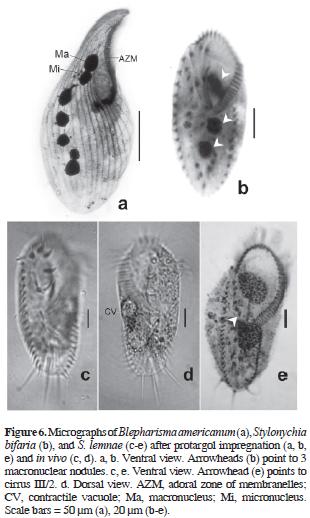
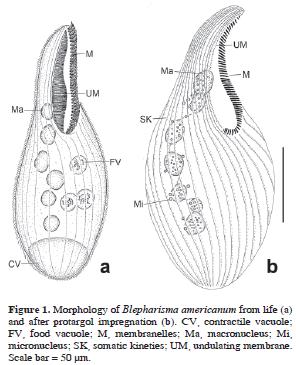
<body><![CDATA[<p align="justify"><font face="verdana" size="2">Samplings were made from a freshwater temporary pond in Buenos Aires Province, Argentina (35&deg; 05' S, 57&deg; 48' W) during 2003&#150;2005. For a detailed description of the study site, see K&uuml;ppers et al. (2006a). During droughts, which occur mainly in summer, dried sediments of the pond bed were collected along with leaf litter and the decomposing macrophytes from the pond. Some samples were re&#150;suspended soon after sampling, while the rest of the samples were stored for subsequent re&#150;suspension during the years 2006, 2007, and 2008. Some species were also recorded during hydric phases, when conductivity, temperature, and pH were measured with a multiparameter sensor and dissolved oxygen estimated by the Winkler method (Clesceri et al., 1998). In the laboratory, soil samples were air&#150;dried for almost a month and then rewetted with distilled water in Petri dishes for qualitative examination, following the so&#150;called nonflooded Petri dish method (Foissner, 1992). Crushed wheat kernels were added to the cultures, kept at room temperature (ca. 15 &deg;C), to promote bacterial growth and thus facilitate ciliate development. Ciliates were taken from the cultures with micropipettes under the stereomicroscope in order to make live observations with a bright&#150;field microscope at magnifications of 100X, 400X, and 1 000X. The organisms were also fixed in Bouin's solution and treated by the protargol technique according to the protocol of Wilbert (1975). Photographs were then taken under bright&#150;field microscopy. Drawings of impregnated cells were made with the aid of a tracing device, while drawings of the live specimens were sketched freehand. Measurements were obtained with a calibrated ocular micrometer in the bright&#150;field microscope.  The abbreviations  in the biometric tables are as follows: Ant., anterior; AZM, adoral zone of membranelles; M, median; N, number of observations; post., posterior; SD, standard deviation; <i><img src="/img/revistas/rmbiodiv/v80n3/a1s1.jpg">, </i>arithmetic mean; Xm, minimum observation; XM, maximum observation. Voucher slides have been deposited in the Colecci&oacute;n de Invertebrados from the Museo de La Plata, Argentina, and have the catalogue numbers: <i>Blepharisma americanum </i>MLP32; <i>Gonostomum affine </i>MLP39; <i>G. strenuum </i>MLP38; <i>Stylonychia bifaria </i>MLP35; <i>S. lemnae </i>MLP36; <i>Pleurotricha lanceolata </i>MLP40; <i>Meseres corlissi </i>MLP44.</font></p>     <p align="justify"><font face="verdana" size="2">&nbsp;</font></p>     <p align="justify"><font face="verdana" size="2"><b>Results</b></font></p>     <p align="justify"><font face="verdana" size="2">Seven ciliate species from the sediments of the dried pond bed were recorded for the first time in Argentina, and in some instances these ciliates were also new for the Neotropical region as well. Their morphology is briefly described in the following paragraphs.</font></p>     <p align="justify"><font face="verdana" size="2"><b><i>Blepharisma  americanum  </i>(Suzuki,  1954)  </b>Hirshfield, Isquith and Bhandary, 1965 (<a href="/img/revistas/rmbiodiv/v80n3/a1t1.jpg" target="_blank">Table 1</a>; <a href="#f1">Figs. 1</a>, <a href="#f6">6a</a>)</font></p>     <p align="center"><font face="verdana" size="2"><a name="f1"></a></font></p>     <p align="center"><font face="verdana" size="2"><img src="/img/revistas/rmbiodiv/v80n3/a1f1.jpg"></font></p>     <p align="center"><font face="verdana" size="2"><a name="f6"></a></font></p>     <p align="center"><font face="verdana" size="2"><img src="/img/revistas/rmbiodiv/v80n3/a1f6.jpg"></font></p>     <p align="justify"><font face="verdana" size="2">The body <i>in vivo </i>measured 182&#150;280 &micro;m in length and 42&#150;84 &micro;m in width and the cytoplasm was pale to dark pink&#150;colored. The contractile vacuole was normal for the species. The nuclear apparatus had 5&#150;8 interconnected macronuclear nodules and 6&#150;15 micronuclei. The oral ciliature was composed of 53&#150;63 membranelles and a paroral membrane typical of this genus. There were 20&#150;29 somatic kineties, of which 12&#150;17 abutted on the adoral zone membranelles, plus 3 short ventral postoral kineties.</font></p>     ]]></body>
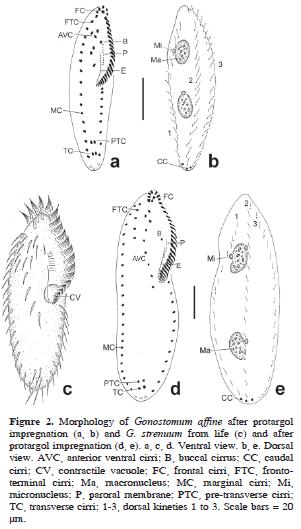
<body><![CDATA[<p align="justify"><font face="verdana" size="2">Data on the frequency of occurrence and the physicochemical variables describing the conditions in which the species was found are detailed in <a href="/img/revistas/rmbiodiv/v80n3/a1t8.jpg" target="_blank">Table 8</a>.</font></p>     <p align="justify"><font face="verdana" size="2"><b><i>Gonostomum affine </i>(Stein, 1859) Sterki, 1878 </b>(<a href="/img/revistas/rmbiodiv/v80n3/a1t2.jpg" target="_blank">Table 2</a>; <a href="#f2">Figs. 2a, b</a>)</font></p>     <p align="center"><font face="verdana" size="2"><a name="f2"></a></font></p>     <p align="center"><font face="verdana" size="2"><img src="/img/revistas/rmbiodiv/v80n3/a1f2.jpg"></font></p>     <p align="justify"><font face="verdana" size="2">After protargol impregnation the body measured 56&#150;80 &micro;m in length and 26.6 &micro;m in width. Unfortunately, the cell could not be measured in its living state. The contractile vacuole and nuclear apparatus were typical of the species. The oral ciliature was composed of 24&#150;27 oral membranelles and paroral and endoral membranes typical of the genus. Somatic ciliature was normal for the species and consisted of 3 frontal cirri, 1 buccal cirrus, 5 anterior ventral cirri, 2 fronto&#150;terminal cirri, 2 pretransverse cirri, 2 transverse cirri, 2 rows of marginal cirri, 3 rows of dikinetids, and 3 caudal cirri.</font></p>     <p align="justify"><font face="verdana" size="2">Data on the frequency occurrence of the species are detailed in <a href="/img/revistas/rmbiodiv/v80n3/a1t8.jpg" target="_blank">Table 8</a>.</font></p>     <p align="justify"><font face="verdana" size="2"><b><i>Gonostomum strenuum </i>(Engelmann, 1862) Sterki, 1878 </b>(<a href="/img/revistas/rmbiodiv/v80n3/a1t3.jpg" target="_blank">Table 3</a>; <a href="#f2">Figs. 2c&#150;e</a>)</font></p>     <p align="justify"><font face="verdana" size="2">The body <i>in vivo </i>measured 98&#150;119 &micro;m in length and 21 &#150;42 &micro;m in width and had refractive cortical granules. The contractile vacuole and nuclear apparatus were typical of the species. The adoral zone of membranelles and paroral and endoral membranes were in a pattern characteristic of the genus. There were 25&#150;30 oral polykineties. Somatic ciliature was normal for the species; being composed of 3 frontal cirri, 1 buccal cirrus, 10&#150;11 anterior ventral cirri, 4&#150;5 fronto&#150;terminal cirri, 2&#150;3 pretransverse cirri, 2 transverse cirri, and 2 rows marginal cirri. The dorsal side presented 3 rows of dikinetids and 3 caudal cirri.</font></p>     <p align="justify"><font face="verdana" size="2">Data on the occurrence frequency of the species are detailed in <a href="/img/revistas/rmbiodiv/v80n3/a1t8.jpg" target="_blank">Table 8</a>.</font></p>     <p align="justify"><font face="verdana" size="2"><b><i>Stylonychia bifaria </i>(Stokes, 1887) Berger, 1999 </b>(<a href="/img/revistas/rmbiodiv/v80n3/a1t4.jpg" target="_blank">Table 4</a>; <a href="#f3">Figs. 3a&#150;c</a>, <a href="#f6">6b</a>)</font></p>     ]]></body>
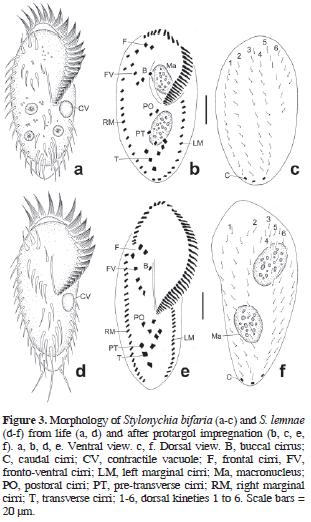
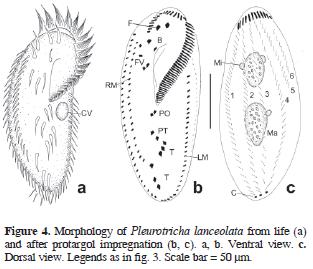
<body><![CDATA[<p align="center"><font face="verdana" size="2"><a name="f3"></a></font></p>     <p align="center"><font face="verdana" size="2"><img src="/img/revistas/rmbiodiv/v80n3/a1f3.jpg"></font></p>     <p align="justify"><font face="verdana" size="2">The body <i>in vivo </i>measured 98&#150;119 &micro;m in length and 35&#150;42 &micro;m in width. The contractile vacuole and nuclear apparatus were typical of the species. The micronuclei were either faintly impregnated or not at all. One specimen (N = 32) presented 3 spherical macronuclear nodules (<a href="#f6">Fig. 6b</a>). The oral ciliature consisted of 25&#150;32 membranelles and paroral and endoral membranes in a pattern typical of the genus. The ventral and dorsal ciliature were characteristic of the species.</font></p>     <p align="justify"><font face="verdana" size="2">Data on the occurrence frequency of the species are detailed in <a href="/img/revistas/rmbiodiv/v80n3/a1t8.jpg" target="_blank">Table 8</a>.</font></p>     <p align="justify"><font face="verdana" size="2"><b><i>Stylonychia lemnae </i>Ammermann and Schlegel, 1983 </b>(<a href="/img/revistas/rmbiodiv/v80n3/a1t5.jpg" target="_blank">Table 5</a>; <a href="#f3">Figs. 3d&#150;f,</a> <a href="#f6">6c&#150;e</a>)</font></p>     <p align="justify"><font face="verdana" size="2">The body <i>invivo </i>measured 133&#150;168 &micro;m in length and 42&#150;63 &micro;m in width. The dorsal side presented a postperistomial bulge. The contractile vacuole and nuclear apparatus were characteristic of the species. The oral ciliature consisted of 38&#150;58 polykineties and paroral and endoral membranes in a pattern typical of <i>Stylonychia. </i>The ventral and dorsal somatic ciliature were typical of the species, but the dorsal kinety 3 is composed of 21&#150;27 (N = 6) dikinetids and the dorsal kinety 4 of 18&#150;22 (N = 4) dikinetids.</font></p>     <p align="justify"><font face="verdana" size="2">Data on the occurrence frequency and the physicochemical variables pertaining to the conditions under which the species was found are detailed in <a href="/img/revistas/rmbiodiv/v80n3/a1t8.jpg" target="_blank">Table 8</a>.</font></p>     <p align="justify"><font face="verdana" size="2"><b><i>Pleurotricha lanceolata </i>(Ehrenberg, 1835) Stein, 1859 </b>(<a href="/img/revistas/rmbiodiv/v80n3/a1t6.jpg" target="_blank">Table 6</a>; <a href="#f4">Figs. 4a&#150;c</a>, <a href="/img/revistas/rmbiodiv/v80n3/a1f7.jpg" target="_blank">7a</a>)</font></p>     <p align="center"><font face="verdana" size="2"><a name="f4"></a></font></p>     <p align="center"><font face="verdana" size="2"><img src="/img/revistas/rmbiodiv/v80n3/a1f4.jpg"></font></p>     ]]></body>
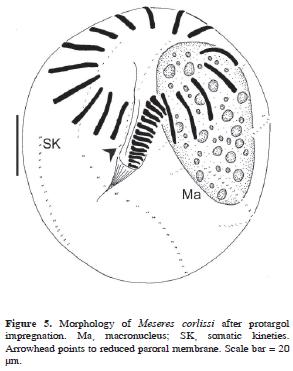
<body><![CDATA[<p align="justify"><font face="verdana" size="2">The body <i>in vivo </i>measured 196 &micro;m in length and 70 &micro;m in width. Although these ciliates usually have 2 macronuclear nodules and 2 micronuclei, 3 specimens here possessed 3 macronuclear nodules and 1 micronucleus while another specimen 3 micronuclei. The adoral zone of membranelles consisted in 45&#150;68 polykineties. The paroral and endoral membranes were arranged in a pattern typical of the genus. The ventral and dorsal somatic ciliature was normal for the species, but there were either 2 or 3 rows of marginal cirri on the right side of the body (27 specimens, though, with 2 and 11 with 3), the third of which rows (the innermost one), when present, possessed fewer and wider&#150;spaced cirri.</font></p>     <p align="justify"><font face="verdana" size="2"><i>Pleurotricha lanceolata </i>was also collected during the filling phase of the pond and its food vacuoles contained small ciliates, such as <i>Tetrahymena </i>sp. and <i>Cyclidium glaucoma, </i>along with pennate diatoms.</font></p>     <p align="justify"><font face="verdana" size="2">Data on the occurrence frequency and the physicochemical variables pertaining to the conditions under which the species was found are detailed in <a href="/img/revistas/rmbiodiv/v80n3/a1t8.jpg" target="_blank">Table 8</a>.</font></p>     <p align="justify"><font face="verdana" size="2"><b><i>Meseres corlissi </i>Petz and Foissner, 1992 </b>(<a href="/img/revistas/rmbiodiv/v80n3/a1t7.jpg" target="_blank">Table 7</a>; <a href="#f5">Figs. 5</a>, <a href="/img/revistas/rmbiodiv/v80n3/a1f7.jpg" target="_blank">7b&#150;c</a>)</font></p>     <p align="center"><font face="verdana" size="2"><a name="f5"></a></font></p>     <p align="center"><font face="verdana" size="2"><img src="/img/revistas/rmbiodiv/v80n3/a1f5.jpg"></font></p>     <p align="justify"><font face="verdana" size="2">The body after protargol impregnation measured 84&#150;126 &micro;m in length and 66.5&#150;112 &micro;m in width. Unfortunately, the cell could not be measured in its living state. The contractile vacuole and the nuclear apparatus were typical of the species. The oral apparatus consisted of 16 anterior polykineties, 13&#150;18 ventral polykineties, and the endoral membrane. A pair of cilia&#150;bearing kinetosomes was observed to the right of the proximal end of the endoral membrane (reduced paroral membrane). The somatic ciliature was normal for the species, being composed of 7&#150;8 kineties with 16&#150;21 pairs of kinetosomes (N = 17) within each kinety.</font></p>     <p align="justify"><font face="verdana" size="2">The food vacuoles of <i>M. corlissi </i>contained pennate diatoms.</font></p>     <p align="justify"><font face="verdana" size="2">Data on the occurrence frequency of the species are detailed in <a href="/img/revistas/rmbiodiv/v80n3/a1t8.jpg" target="_blank">Table 8</a>.</font></p>     <p align="justify"><font face="verdana" size="2">&nbsp;</font></p>     ]]></body>
<body><![CDATA[<p align="justify"><font face="verdana" size="2"><b>Discussion</b></font></p>     <p align="justify"><font face="verdana" size="2">Temporary ponds constitute special kinds of habitats where organisms from various freshwater and soil communities can develop depending upon the conditions of the pond. During droughts, resistant structures from certain freshwater species remain in the sediments and are later able to colonize the pond during the filling phase. By contrast, a genuine soil community can possibly develop during prolonged drought periods. Soil ciliates from the Neotropical region have been scarcely investigated, with South America being  almost  completely unexplored. Only a few studies on soil ciliates can be cited, including one from Peru (Hemberger, 1985) and another from Venezuela, Peru, Brazil, and Costa Rica (Foissner, 1997a). Although most ciliates have a cosmopolitan distribution, species with restricted distributions also exist (Foissner et al., 2005a). In the end, the further survey of unexplored regions and particular habitats will serve to increase our knowledge about the true extent of the diversity of free&#150;living ciliates.</font></p>     <p align="justify"><font face="verdana" size="2"><i>Blepharisma americanum </i>was described based on specimens cultured from North American freshwater samples (Suzuki, 1954), and Foissner and O'Donoghue (1990) presented a detailed description of the morphology and infraciliature of specimens from an Australian freshwater population. Aladro&#150;Lubel et al. (2007) also recorded this species in freshwaters from Mexico. In terms of soil biotopes, although Aescht and Foissner (1998) found <i>B. americanum </i>in soil samples from Costa Rica in Central America, our finding here represents a new recording for South America. Its morphometric characters generally coincide with those observed bythe above cited authors and its infraciliature with the data of Foissner and O'Donoghue (1990). The number of somatic kineties observed by Wilfert (1972) in a German population, however, is lower than in the specimens studied in the present investigation (14 &plusmn; 2 vs. 23 &plusmn; 3).</font></p>     <p align="justify"><font face="verdana" size="2"><i>Gonostomum   affine   </i>is   a  cosmopolitan   and  very abundant species in terrestrial habitats or in limnetic environments with terrestrial influences (Berger, 1999). Moreover, several morphotypes exist (Foissner et al., 2001). Within South America, the species was previously found by Foissner (1997a) and Foissner et al. (2001) in soil samples from Brazil, Venezuela, and Peru. In Argentina, however, <i>G. affine </i>represents a new finding. Although few specimens were measured <i>in vivo </i>or were even well impregnated, the species could nevertheless be identified. Most of the morphological variability in this ciliate is in body size and in the number and arrangement of the fronto&#150;ventral&#150;transverse cirri. The morphometric characteristics of our Argentinean isolates coincide with those observed by other authors in other geographical regions, and particularly with the morphotypes recorded by Foissner et al. (2001) in Venezuela and Brazil (South America) and in Namibia (Africa).</font></p>     <p align="justify"><font face="verdana" size="2"><i>Gonostomum strenuum </i>was recorded by other authors in Mexico (Morelos State), Eurasia, Australia, and Africa (Madrazo&#150;Garibay and L&oacute;pez&#150;Ochoterena, 1973; Berger, 1999; Foissner et al., 2001, 2005a). This species is, however, a new record for the Neotropical region. Generally, <i>G. strenuum </i>prefers limnetic environments, but it has also been found in edaphic biotopes (Berger, 1999; Foissner et al., 2001, 2005a). Its morphometric characteristics coincide with those observed by Foissner et al. (2001) in Australian populations.</font></p>     <p align="justify"><font face="verdana" size="2"><i>Stylonychia bifaria </i>is possibly cosmopolitan and was previously recorded by other authors for South America in Colombia, Venezuela, and Brazil, although these findings were not substantiated by morphometric data (Berger, 1999). The species is recorded here for the first time in Argentina.  <i>Stylonychia bifaria </i>was generally found in stagnant freshwater environments (Berger, 1999), although records of this species in edaphic biotopes from Brazil do also exist (Foissner, 1997a). Its morphometric characteristics generally coincide with the observations of other authors (Berger, 1999).</font></p>     <p align="justify"><font face="verdana" size="2"><i>Stylonychia lemnae </i>has been cited by other authors in Germany, China, North America, and Japan (Berger, 1999); but the documentation of its presence here represents a new finding for the Neotropical region. This species is common in freshwater environments and has also previously been found in soil samples from Japan (Berger, 1999). With respect to its morphology, the most significant difference from that of <i>S. mytilus </i>is the position of the posteriormost frontoventral cirrus (Berger, 1999). Gupta et al. (2001) established a new Indian species, <i>S. ammermanni, </i>which belongs to the <i>Stylonychia mytilus&#150;lemnae </i>complex, but differs from <i>S. lemnae </i>by lacking a postperistomial bulge and because there is a gap between the last frontoventral cirri and the anterior ones. Most morphometric characteristics of the specimens studied by us coincide with those observed by other authors, although the number of dikinetids in the third and fourth dorsal kineties was lower than those mentioned in Berger (1999; i. e., 21&#150;27 and 18&#150;22 vs. 33&#150;40 and 30&#150;39, respectively).</font></p>     <p align="justify"><font face="verdana" size="2"><i>Pleurotricha lanceolata </i>is probably cosmopolitan and was recorded by other authors in freshwater environments from Germany, Africa, Spain, China, India, Mexico, and the USA (Rico&#150;Ferrat et al., 1987; Berger, 1999). Cunha (1913), moreover, recorded this species in Brazil, but without describing or illustrating its morphology. The present report constitutes the first finding of <i>P. lanceolata </i>in Argentina. The morphometric data of the specimens studied coincide with those observed by Jeffries and Mellot (1968), but with an important difference being in the number of right marginal rows of cirri. The ventral infraciliature is also variable, according to the cited authors, and coincides with specimens a&#150;c from Fig. 189, p. 704 in Berger (1999).</font></p>     <p align="justify"><font face="verdana" size="2"><i>Meseres corlissi </i>is considered a rare species, although it does have a global distribution. It was previously found by other authors in Austria, Namibia, Australia, China, Venezuela, Brazil, and the Dominican Republic, in a variety of habitats such as in the sediments of a temporary pond, in a salt pan with regular floodings, in a river floodplain, in flooded soils, and within a bromeliad (Weisse, 2004; M&uuml;ller et al., 2006). As in the present study, the species was sporadically found in unstable environments (Weisse, 2004). This present finding, however, is the first recording of <i>M. corlissi </i>in Argentina. Although its morphometric characteristics coincide with those observed by Petz and Foissner (1992), the Argentinean specimens presented a greater size (65.6 &micro;m vs. 99.3 &micro;m in their average length), and the numbers of their somatic kineties were more variable (8 constantly, N = 30 vs. 7&#150;8, respectively). The morphology of the resting cysts and the processes of cyst formation and excystment have been well documented for this species (Foissner, 2005; Foissner et al., 2005b, 2006), while their resistance within completely dried edaphic material has been estimated to be several months and even 2 years in soil samples from the type locality (M&uuml;ller et al., 2006). In the present study, the species was found only once in soil samples that were rewetted soon after its collection, but not in later resuspensions of the same soil material (1 year later). Although <i>M. corlissi </i>exhibits a global distribution, this species is not adapted to wide ranges of environmental conditions. Weisse (2004) stated that <i>M. corlissi </i>prefers unstable habitats with warm temperatures, where it survives through its characteristic resting cysts. As was shown by the cited author, the process of excystment of <i>M. corlissi </i>from a tree bromeliad was influenced by conditions of warm temperature. Other authors, however, proposed that the excystment of <i>M. corlissi </i>depended on a "soil factor", probably a soluble soil component and/or certain bacterial metabolites present (M&uuml;ller et al., 2006).</font></p>     <p align="justify"><font face="verdana" size="2">Most species in the present report are cosmopolitan; nevertheless new isolates were also found among those published previously (K&uuml;ppers et al., 2006b, 2007a, b). Although the majority of free&#150;living ciliates are globally distributed, there are also unexplored geographical regions and specific environments that could be inhabited by organisms with restricted distributions. Within the soil biotope, ciliates remain as resting cysts most of the time, but the techniques used for the reactivation of these structures usually lead to an undersampling, thus resulting in an underestimation of the soil ciliate diversity (Foissner, 1997b). In spite of this limitation, almost 50% of the species discovered by Foissner (1997b) in African soils were new ones. This fact points to a great underestimation of soil ciliate biodiversity, an assessment that will increase as new regions are explored. Nevertheless, there are few ciliate taxonomists presently working in the Neotropical region, and soil ciliates in particular have been poorly investigated.</font></p>     ]]></body>
<body><![CDATA[<p align="justify"><font face="verdana" size="2">&nbsp;</font></p>     <p align="justify"><font face="verdana" size="2"><b>Acknowledgements</b></font></p>     <p align="justify"><font face="verdana" size="2">The authors wish to thank Santiago Nenda for his help with the photographs; the Consejo Nacional de Investigaciones Cient&iacute;ficas y T&eacute;cnicas (CONICET) for its financial support; and Dr. Donald F. Haggerty, for review of our English.</font></p>     <p align="justify"><font face="verdana" size="2">&nbsp;</font></p>     <p align="justify"><font face="verdana" size="2"><b>Literature cited</b></font></p>     <!-- ref --><p align="justify"><font face="verdana" size="2">Aescht, E. and W. Foissner. 1998. Divisional morphogenesis in <i>Blepharisma americanum, B. undulans, </i>and <i>B. hyalinum </i>(Ciliophora: Heterotrichida). Acta Protozoologica 37: 71&#150;92.</font>&nbsp;&nbsp;&nbsp;&nbsp;&nbsp;&nbsp;&nbsp;&nbsp;[&#160;<a href="javascript:void(0);" onclick="javascript: window.open('/scielo.php?script=sci_nlinks&ref=7551824&pid=S1870-3453200900030000100001&lng=','','width=640,height=500,resizable=yes,scrollbars=1,menubar=yes,');">Links</a>&#160;]<!-- end-ref --><!-- ref --><p align="justify"><font face="verdana" size="2">Aladro&#150;Lubel, M. A., M. Reyes&#150;Santos, F. Olvera&#150;Bautista and M. N. Robles&#150;Briones. 2007. Ciliados y otros protozoos. <i>In </i>Gu&iacute;a ilustrada de la Cantera Oriente: caracterizaci&oacute;n ambiental e inventario biol&oacute;gico, Lot, A. (coordinador). Coordinaci&oacute;n de la Investigaci&oacute;n Cient&iacute;fica. Secretar&iacute;a Ejecutiva de la Reserva Ecol&oacute;gica del Pedregal de San &Aacute;ngel de Ciudad Universitaria, M&eacute;jico. p. 97&#150;122.</font>&nbsp;&nbsp;&nbsp;&nbsp;&nbsp;&nbsp;&nbsp;&nbsp;[&#160;<a href="javascript:void(0);" onclick="javascript: window.open('/scielo.php?script=sci_nlinks&ref=7551825&pid=S1870-3453200900030000100002&lng=','','width=640,height=500,resizable=yes,scrollbars=1,menubar=yes,');">Links</a>&#160;]<!-- end-ref --><!-- ref --><p align="justify"><font face="verdana" size="2">Andrushchyshyn, O., A. K. Magnusson and D. D. Williams. 2003. Ciliate populations in temporary freshwater ponds: seasonal dynamics and influential factors. Freshwater Biology 48: 548&#150;564.</font>&nbsp;&nbsp;&nbsp;&nbsp;&nbsp;&nbsp;&nbsp;&nbsp;[&#160;<a href="javascript:void(0);" onclick="javascript: window.open('/scielo.php?script=sci_nlinks&ref=7551826&pid=S1870-3453200900030000100003&lng=','','width=640,height=500,resizable=yes,scrollbars=1,menubar=yes,');">Links</a>&#160;]<!-- end-ref --><!-- ref --><p align="justify"><font face="verdana" size="2">Bamforth, S. S. 1980. Terrestrial Protozoa. Journal of Protozoology 27: 33&#150;36.</font>&nbsp;&nbsp;&nbsp;&nbsp;&nbsp;&nbsp;&nbsp;&nbsp;[&#160;<a href="javascript:void(0);" onclick="javascript: window.open('/scielo.php?script=sci_nlinks&ref=7551827&pid=S1870-3453200900030000100004&lng=','','width=640,height=500,resizable=yes,scrollbars=1,menubar=yes,');">Links</a>&#160;]<!-- end-ref --><!-- ref --><p align="justify"><font face="verdana" size="2">Berger, H. 1999. Monograph of the Oxytrichidae (Ciliophora, Hypotrichia). Monographiae Biologicae 78: 1&#150;1080.</font>&nbsp;&nbsp;&nbsp;&nbsp;&nbsp;&nbsp;&nbsp;&nbsp;[&#160;<a href="javascript:void(0);" onclick="javascript: window.open('/scielo.php?script=sci_nlinks&ref=7551828&pid=S1870-3453200900030000100005&lng=','','width=640,height=500,resizable=yes,scrollbars=1,menubar=yes,');">Links</a>&#160;]<!-- end-ref --><!-- ref --><p align="justify"><font face="verdana" size="2">Cela, A. M. 1972. Algunos ciliados vinculados a la vegetaci&oacute;n flotante. Physis 31: 559&#150;577.</font>&nbsp;&nbsp;&nbsp;&nbsp;&nbsp;&nbsp;&nbsp;&nbsp;[&#160;<a href="javascript:void(0);" onclick="javascript: window.open('/scielo.php?script=sci_nlinks&ref=7551829&pid=S1870-3453200900030000100006&lng=','','width=640,height=500,resizable=yes,scrollbars=1,menubar=yes,');">Links</a>&#160;]<!-- end-ref --><!-- ref --><p align="justify"><font face="verdana" size="2">Claps, M. C. and B. E. Modenutti. 1984. Contribuci&oacute;n al conocimiento   de   los   ciliados   (Ciliophora   Peritricha) dulceacu&iacute;colas de Argentina, n. Limnobios 2: 581&#150;585.</font>&nbsp;&nbsp;&nbsp;&nbsp;&nbsp;&nbsp;&nbsp;&nbsp;[&#160;<a href="javascript:void(0);" onclick="javascript: window.open('/scielo.php?script=sci_nlinks&ref=7551830&pid=S1870-3453200900030000100007&lng=','','width=640,height=500,resizable=yes,scrollbars=1,menubar=yes,');">Links</a>&#160;]<!-- end-ref --><!-- ref --><p align="justify"><font face="verdana" size="2">Claps, M. C. and B. E. Modenutti. 1988. Ciliados dulceacu&iacute;colas de Argentina. IV. Suctorios del r&iacute;o Luj&aacute;n. Iheringia, S&eacute;rie Zoologia 67: 127&#150;136.</font>&nbsp;&nbsp;&nbsp;&nbsp;&nbsp;&nbsp;&nbsp;&nbsp;[&#160;<a href="javascript:void(0);" onclick="javascript: window.open('/scielo.php?script=sci_nlinks&ref=7551831&pid=S1870-3453200900030000100008&lng=','','width=640,height=500,resizable=yes,scrollbars=1,menubar=yes,');">Links</a>&#160;]<!-- end-ref --><!-- ref --><p align="justify"><font face="verdana" size="2">Clesceri, L. S., A. E. Greenberg and A. D. Eaton (eds.). 1998. Standard methods for the examination of water and wastewater. 20th edition. American Public Health Association, Washington, D.C. 1325 p.</font>&nbsp;&nbsp;&nbsp;&nbsp;&nbsp;&nbsp;&nbsp;&nbsp;[&#160;<a href="javascript:void(0);" onclick="javascript: window.open('/scielo.php?script=sci_nlinks&ref=7551832&pid=S1870-3453200900030000100009&lng=','','width=640,height=500,resizable=yes,scrollbars=1,menubar=yes,');">Links</a>&#160;]<!-- end-ref --><!-- ref --><p align="justify"><font face="verdana" size="2">Cunha, A. M. da. 1913. Contribui&ccedil;&atilde;o para o conhecimento da fauna de protozo&aacute;rios do Brasil. Mem&oacute;rias do Instituto Oswaldo Cruz 5: 101&#150;122.</font>&nbsp;&nbsp;&nbsp;&nbsp;&nbsp;&nbsp;&nbsp;&nbsp;[&#160;<a href="javascript:void(0);" onclick="javascript: window.open('/scielo.php?script=sci_nlinks&ref=7551833&pid=S1870-3453200900030000100010&lng=','','width=640,height=500,resizable=yes,scrollbars=1,menubar=yes,');">Links</a>&#160;]<!-- end-ref --><!-- ref --><p align="justify"><font face="verdana" size="2">Dioni, W. 1972. Un nuevo g&eacute;nero de Folliculinidae de agua dulce: <i>Botticula ringueleti </i>nov. gen. nov. sp. del r&iacute;o Paran&aacute; medio. Acta Zool&oacute;gica Lilloana 29: 304&#150;313.</font>&nbsp;&nbsp;&nbsp;&nbsp;&nbsp;&nbsp;&nbsp;&nbsp;[&#160;<a href="javascript:void(0);" onclick="javascript: window.open('/scielo.php?script=sci_nlinks&ref=7551834&pid=S1870-3453200900030000100011&lng=','','width=640,height=500,resizable=yes,scrollbars=1,menubar=yes,');">Links</a>&#160;]<!-- end-ref --><!-- ref --><p align="justify"><font face="verdana" size="2">Foggetta, M. and A. Boltovskoy. 1995. Ciliated Protozoa from oxygen depleted waters from Cassaffousth reservoir (C&oacute;rdoba, Argentina). Revista de la Asociaci&oacute;n de Ciencias Naturales del Litoral 26: 25&#150;31.</font>&nbsp;&nbsp;&nbsp;&nbsp;&nbsp;&nbsp;&nbsp;&nbsp;[&#160;<a href="javascript:void(0);" onclick="javascript: window.open('/scielo.php?script=sci_nlinks&ref=7551835&pid=S1870-3453200900030000100012&lng=','','width=640,height=500,resizable=yes,scrollbars=1,menubar=yes,');">Links</a>&#160;]<!-- end-ref --><!-- ref --><p align="justify"><font face="verdana" size="2">Foissner, W. 1987. Soil Protozoa: fundamental problems, ecological significance, adaptations in ciliates and testaceans, bioindicators, and guide to the literature. Progress in Protistology 2: 69&#150;212.</font>&nbsp;&nbsp;&nbsp;&nbsp;&nbsp;&nbsp;&nbsp;&nbsp;[&#160;<a href="javascript:void(0);" onclick="javascript: window.open('/scielo.php?script=sci_nlinks&ref=7551836&pid=S1870-3453200900030000100013&lng=','','width=640,height=500,resizable=yes,scrollbars=1,menubar=yes,');">Links</a>&#160;]<!-- end-ref --><!-- ref --><p align="justify"><font face="verdana" size="2">Foissner, W. 1992. Estimating the species richness of soil protozoa using the "non&#150;flooded petri dish method". <i>In </i>Protocols in Protozoology, Lee, J. J. and A. T. Soldo (eds.). Society of Protozoology, Allen Press, USA. p. B&#150;10.1.</font>&nbsp;&nbsp;&nbsp;&nbsp;&nbsp;&nbsp;&nbsp;&nbsp;[&#160;<a href="javascript:void(0);" onclick="javascript: window.open('/scielo.php?script=sci_nlinks&ref=7551837&pid=S1870-3453200900030000100014&lng=','','width=640,height=500,resizable=yes,scrollbars=1,menubar=yes,');">Links</a>&#160;]<!-- end-ref --><!-- ref --><p align="justify"><font face="verdana" size="2">Foissner, W. 1997a. Soil ciliates (Protozoa: Ciliophora) from evergreen rain forests of Australia, South America and Costa Rica: diversity and description of new species. Biology and Fertility of Soils 25: 317&#150;339.</font>&nbsp;&nbsp;&nbsp;&nbsp;&nbsp;&nbsp;&nbsp;&nbsp;[&#160;<a href="javascript:void(0);" onclick="javascript: window.open('/scielo.php?script=sci_nlinks&ref=7551838&pid=S1870-3453200900030000100015&lng=','','width=640,height=500,resizable=yes,scrollbars=1,menubar=yes,');">Links</a>&#160;]<!-- end-ref --><!-- ref --><p align="justify"><font face="verdana" size="2">Foissner, W. 1997b. Global soil ciliate (Protozoa, Ciliophora) diversity: a probability&#150;based approach using large sample collections from Africa, Australia and Antarctica. Biodiversity and Conservation 6: 1627&#150;1638.</font>&nbsp;&nbsp;&nbsp;&nbsp;&nbsp;&nbsp;&nbsp;&nbsp;[&#160;<a href="javascript:void(0);" onclick="javascript: window.open('/scielo.php?script=sci_nlinks&ref=7551839&pid=S1870-3453200900030000100016&lng=','','width=640,height=500,resizable=yes,scrollbars=1,menubar=yes,');">Links</a>&#160;]<!-- end-ref --><!-- ref --><p align="justify"><font face="verdana" size="2">Foissner, W. 2005. The unusual, lepidosome&#150;coated resting cysts of <i>Meseres corlissi </i>(Ciliophora: Oligotrichea): transmission electron microscopy and phylogeny. Acta Protozoologica 44: 217&#150;230.</font>&nbsp;&nbsp;&nbsp;&nbsp;&nbsp;&nbsp;&nbsp;&nbsp;[&#160;<a href="javascript:void(0);" onclick="javascript: window.open('/scielo.php?script=sci_nlinks&ref=7551840&pid=S1870-3453200900030000100017&lng=','','width=640,height=500,resizable=yes,scrollbars=1,menubar=yes,');">Links</a>&#160;]<!-- end-ref --><!-- ref --><p align="justify"><font face="verdana" size="2">Foissner W. and P. J. O'Donoghue. 1990. Morphology and infraciliature of some freshwater ciliates (Protozoa: Ciliophora) from western and south Australia. Invertebrate Taxonomy 3: 661&#150;696.</font>&nbsp;&nbsp;&nbsp;&nbsp;&nbsp;&nbsp;&nbsp;&nbsp;[&#160;<a href="javascript:void(0);" onclick="javascript: window.open('/scielo.php?script=sci_nlinks&ref=7551841&pid=S1870-3453200900030000100018&lng=','','width=640,height=500,resizable=yes,scrollbars=1,menubar=yes,');">Links</a>&#160;]<!-- end-ref --><!-- ref --><p align="justify"><font face="verdana" size="2">Foissner, W., T. Stoeck, H. Schmidt and H. Berger. 2001. Biogeographical differences in a common soil ciliate, <i>Gonostomum affine </i>(Stein), as revealed by morphological and RAPD&#150;fingerprint analysis. Acta Protozoologica 40: 83&#150;97.</font>&nbsp;&nbsp;&nbsp;&nbsp;&nbsp;&nbsp;&nbsp;&nbsp;[&#160;<a href="javascript:void(0);" onclick="javascript: window.open('/scielo.php?script=sci_nlinks&ref=7551842&pid=S1870-3453200900030000100019&lng=','','width=640,height=500,resizable=yes,scrollbars=1,menubar=yes,');">Links</a>&#160;]<!-- end-ref --><!-- ref --><p align="justify"><font face="verdana" size="2">Foissner, W., S. Agatha and H. Berger. 2005a. Soil ciliates (Protozoa, Ciliophora) from Namibia (Southwest Africa), with emphasis on two contrasting environments, the Etosha Region and the Namib Desert. Denisia 5: 1&#150;1063.</font>&nbsp;&nbsp;&nbsp;&nbsp;&nbsp;&nbsp;&nbsp;&nbsp;[&#160;<a href="javascript:void(0);" onclick="javascript: window.open('/scielo.php?script=sci_nlinks&ref=7551843&pid=S1870-3453200900030000100020&lng=','','width=640,height=500,resizable=yes,scrollbars=1,menubar=yes,');">Links</a>&#160;]<!-- end-ref --><!-- ref --><p align="justify"><font face="verdana" size="2">Foissner, W., H. M&uuml;ller and T. Weisse. 2005b. The unusual, lepidosome&#150;coated resting cysts of <i>Meseres corlissi </i>(Ciliophora: Oligotrichea): light and scanning electron microscopy, cytochemistry. Acta Protozoologica 44: 201&#150;215.</font>&nbsp;&nbsp;&nbsp;&nbsp;&nbsp;&nbsp;&nbsp;&nbsp;[&#160;<a href="javascript:void(0);" onclick="javascript: window.open('/scielo.php?script=sci_nlinks&ref=7551844&pid=S1870-3453200900030000100021&lng=','','width=640,height=500,resizable=yes,scrollbars=1,menubar=yes,');">Links</a>&#160;]<!-- end-ref --><!-- ref --><p align="justify"><font face="verdana" size="2">Foissner, W., M. Pichler, K. Al&#150;Rasheid and T. Weisse. 2006. The unusual, lepidosome&#150;coated resting cyst of <i>Meseres </i><i>corlissi </i>(Ciliophora: Oligotrichea): encystment and genesis and release of the lepidosomes. Acta Protozoologica 45: 323&#150;338.</font>&nbsp;&nbsp;&nbsp;&nbsp;&nbsp;&nbsp;&nbsp;&nbsp;[&#160;<a href="javascript:void(0);" onclick="javascript: window.open('/scielo.php?script=sci_nlinks&ref=7551845&pid=S1870-3453200900030000100022&lng=','','width=640,height=500,resizable=yes,scrollbars=1,menubar=yes,');">Links</a>&#160;]<!-- end-ref --><!-- ref --><p align="justify"><font face="verdana" size="2">Guill&eacute;n G., E. Morales and R. Severino. 2003. Adiciones a la fauna de protozooarios de los pantanos de Villa, Lima, Per&uacute;. Revista Peruana de Biolog&iacute;a 10: 175&#150;182.</font>&nbsp;&nbsp;&nbsp;&nbsp;&nbsp;&nbsp;&nbsp;&nbsp;[&#160;<a href="javascript:void(0);" onclick="javascript: window.open('/scielo.php?script=sci_nlinks&ref=7551846&pid=S1870-3453200900030000100023&lng=','','width=640,height=500,resizable=yes,scrollbars=1,menubar=yes,');">Links</a>&#160;]<!-- end-ref --><!-- ref --><p align="justify"><font face="verdana" size="2">Gupta, R., K. Kamra, S. Arora and G. R. Sapra. 2001. <i>Stylonychia ammermanni </i>sp. n., a new oxytrichid (Ciliophora: Hypotrichida) ciliate from the river Yamuna, Delhi, India. Acta Protozoologica 40: 75&#150;82.</font>&nbsp;&nbsp;&nbsp;&nbsp;&nbsp;&nbsp;&nbsp;&nbsp;[&#160;<a href="javascript:void(0);" onclick="javascript: window.open('/scielo.php?script=sci_nlinks&ref=7551847&pid=S1870-3453200900030000100024&lng=','','width=640,height=500,resizable=yes,scrollbars=1,menubar=yes,');">Links</a>&#160;]<!-- end-ref --><!-- ref --><p align="justify"><font face="verdana" size="2">Hemberger, H. 1985. Neue Gattungen und Arten hypotricher Ciliaten. Archiv f&uuml;r Protistenkunde 130: 397&#150;417.</font>&nbsp;&nbsp;&nbsp;&nbsp;&nbsp;&nbsp;&nbsp;&nbsp;[&#160;<a href="javascript:void(0);" onclick="javascript: window.open('/scielo.php?script=sci_nlinks&ref=7551848&pid=S1870-3453200900030000100025&lng=','','width=640,height=500,resizable=yes,scrollbars=1,menubar=yes,');">Links</a>&#160;]<!-- end-ref --><!-- ref --><p align="justify"><font face="verdana" size="2">Hirshfield, H. I., I. R. Isquith and A. V. Bhandary. 1965. A proposed organization of the genus <i>Blepharisma </i>Perty and description of four new species. Journal of Protozoology 12: 136&#150;144.</font>&nbsp;&nbsp;&nbsp;&nbsp;&nbsp;&nbsp;&nbsp;&nbsp;[&#160;<a href="javascript:void(0);" onclick="javascript: window.open('/scielo.php?script=sci_nlinks&ref=7551849&pid=S1870-3453200900030000100026&lng=','','width=640,height=500,resizable=yes,scrollbars=1,menubar=yes,');">Links</a>&#160;]<!-- end-ref --><!-- ref --><p align="justify"><font face="verdana" size="2">Jeffries W. B. and J. L. Mellot. 1968. New observations on the anatomy of <i>Pleurotricha lanceolata. </i>Journal of Protozoology 15: 741&#150;747.</font>&nbsp;&nbsp;&nbsp;&nbsp;&nbsp;&nbsp;&nbsp;&nbsp;[&#160;<a href="javascript:void(0);" onclick="javascript: window.open('/scielo.php?script=sci_nlinks&ref=7551850&pid=S1870-3453200900030000100027&lng=','','width=640,height=500,resizable=yes,scrollbars=1,menubar=yes,');">Links</a>&#160;]<!-- end-ref --><!-- ref --><p align="justify"><font face="verdana" size="2">K&uuml;ppers, G. C., E. C. Lopretto and M. C. Claps. 2006a. Morphological aspects and seasonal changes of some planktonic ciliates (Protozoa) from a temporary pond in Buenos Aires Province, Argentina. Pan&#150;American Journal of Aquatic Sciences 1: 74&#150;90.</font>&nbsp;&nbsp;&nbsp;&nbsp;&nbsp;&nbsp;&nbsp;&nbsp;[&#160;<a href="javascript:void(0);" onclick="javascript: window.open('/scielo.php?script=sci_nlinks&ref=7551851&pid=S1870-3453200900030000100028&lng=','','width=640,height=500,resizable=yes,scrollbars=1,menubar=yes,');">Links</a>&#160;]<!-- end-ref --><!-- ref --><p align="justify"><font face="verdana" size="2">K&uuml;ppers, G. C., E. C. Lopretto and M. C. Claps. 2006b. <i>Pelagostrobilidium wilberti </i>n. sp. (Oligotrichea, Choreotrichida): morphology and morphogenesis. Journal of Eukaryotic Microbiology 53: 477&#150;484.</font>&nbsp;&nbsp;&nbsp;&nbsp;&nbsp;&nbsp;&nbsp;&nbsp;[&#160;<a href="javascript:void(0);" onclick="javascript: window.open('/scielo.php?script=sci_nlinks&ref=7551852&pid=S1870-3453200900030000100029&lng=','','width=640,height=500,resizable=yes,scrollbars=1,menubar=yes,');">Links</a>&#160;]<!-- end-ref --><!-- ref --><p align="justify"><font face="verdana" size="2">K&uuml;ppers, G. C., M. C. Claps and E. C. Lopretto. 2007a. Description of <i>Notohymena pampasica </i>n. sp. (Ciliophora, Stichotrichia). Acta Protozoologica 46: 221&#150;227.</font>&nbsp;&nbsp;&nbsp;&nbsp;&nbsp;&nbsp;&nbsp;&nbsp;[&#160;<a href="javascript:void(0);" onclick="javascript: window.open('/scielo.php?script=sci_nlinks&ref=7551853&pid=S1870-3453200900030000100030&lng=','','width=640,height=500,resizable=yes,scrollbars=1,menubar=yes,');">Links</a>&#160;]<!-- end-ref --><!-- ref --><p align="justify"><font face="verdana" size="2">K&uuml;ppers, G. C., E. C. Lopretto and M. C. Claps. 2007b. Description of <i>Deviata rositae </i>n. sp., a new ciliate specie (Ciliophora, Stichotrichia) from Argentina. Journal of Eukaryotic Microbiology 54: 443&#150;447.</font>&nbsp;&nbsp;&nbsp;&nbsp;&nbsp;&nbsp;&nbsp;&nbsp;[&#160;<a href="javascript:void(0);" onclick="javascript: window.open('/scielo.php?script=sci_nlinks&ref=7551854&pid=S1870-3453200900030000100031&lng=','','width=640,height=500,resizable=yes,scrollbars=1,menubar=yes,');">Links</a>&#160;]<!-- end-ref --><!-- ref --><p align="justify"><font face="verdana" size="2">Madrazo&#150;Garibay, M. and E. L&oacute;pez&#150;Ochoterena. 1973. Protozoarios ciliados de M&eacute;xico. XIX. Estudio biol&oacute;gico de algunas especies recolectadas en Salto San Ant&oacute;n, Estado de Morelos. Revista de la Sociedad Mexicana de Historia Natural 34: 63&#150;69.</font>&nbsp;&nbsp;&nbsp;&nbsp;&nbsp;&nbsp;&nbsp;&nbsp;[&#160;<a href="javascript:void(0);" onclick="javascript: window.open('/scielo.php?script=sci_nlinks&ref=7551855&pid=S1870-3453200900030000100032&lng=','','width=640,height=500,resizable=yes,scrollbars=1,menubar=yes,');">Links</a>&#160;]<!-- end-ref --><!-- ref --><p align="justify"><font face="verdana" size="2">Modenutti, B. E. and M. C. Claps. 1986. Ciliados dulceacu&iacute;colas de la Argentina, III: Ciliophora&#150;Peritricha. Revista de la Asociaci&oacute;n de Ciencias Naturales del Litoral 17: 71&#150;78.</font>&nbsp;&nbsp;&nbsp;&nbsp;&nbsp;&nbsp;&nbsp;&nbsp;[&#160;<a href="javascript:void(0);" onclick="javascript: window.open('/scielo.php?script=sci_nlinks&ref=7551856&pid=S1870-3453200900030000100033&lng=','','width=640,height=500,resizable=yes,scrollbars=1,menubar=yes,');">Links</a>&#160;]<!-- end-ref --><!-- ref --><p align="justify"><font face="verdana" size="2">Modenutti, B. E. and G. L. P&eacute;rez. 2001. Planktonic ciliates from an oligotrophic south Andean lake, Morenito lake (Patagonia, Argentina). Brazilian Journal of Biology 61: 389&#150;395.</font>&nbsp;&nbsp;&nbsp;&nbsp;&nbsp;&nbsp;&nbsp;&nbsp;[&#160;<a href="javascript:void(0);" onclick="javascript: window.open('/scielo.php?script=sci_nlinks&ref=7551857&pid=S1870-3453200900030000100034&lng=','','width=640,height=500,resizable=yes,scrollbars=1,menubar=yes,');">Links</a>&#160;]<!-- end-ref --><!-- ref --><p align="justify"><font face="verdana" size="2">M&uuml;ller, H., W. Foissner and T. Weisse. 2006. Role of soil in the life cycle of <i>Me seres corlissi </i>(Ciliophora: Oligotrichea): experiments with two clonal strains from the type locality, an astatic meadow pond. Aquatic Microbial Ecology 42: 109&#150;208.</font>&nbsp;&nbsp;&nbsp;&nbsp;&nbsp;&nbsp;&nbsp;&nbsp;[&#160;<a href="javascript:void(0);" onclick="javascript: window.open('/scielo.php?script=sci_nlinks&ref=7551858&pid=S1870-3453200900030000100035&lng=','','width=640,height=500,resizable=yes,scrollbars=1,menubar=yes,');">Links</a>&#160;]<!-- end-ref --><!-- ref --><p align="justify"><font face="verdana" size="2">Paiva, T. da S. and I. D. da Silva&#150;Neto. 2004a. Comparative morphometric study of three species of <i>Apoamphisiella </i>Foissner, 1997 (Ciliophora: Hypotrichea) from Brazilian locations, including a description of <i>Apoamphisiella foissneri </i>sp. n. Zootaxa 505: 1&#150;26.</font>&nbsp;&nbsp;&nbsp;&nbsp;&nbsp;&nbsp;&nbsp;&nbsp;[&#160;<a href="javascript:void(0);" onclick="javascript: window.open('/scielo.php?script=sci_nlinks&ref=7551859&pid=S1870-3453200900030000100036&lng=','','width=640,height=500,resizable=yes,scrollbars=1,menubar=yes,');">Links</a>&#160;]<!-- end-ref --><!-- ref --><p align="justify"><font face="verdana" size="2">Paiva, T. da S. and I. D. da Silva&#150;Neto. 2004b. Description of <i>Parentocirrus brasiliensis </i>sp. n. (Ciliophora: Spirotrichea), a new ciliate protist present in activated sludge. Zootaxa 504: 1&#150;10.</font>&nbsp;&nbsp;&nbsp;&nbsp;&nbsp;&nbsp;&nbsp;&nbsp;[&#160;<a href="javascript:void(0);" onclick="javascript: window.open('/scielo.php?script=sci_nlinks&ref=7551860&pid=S1870-3453200900030000100037&lng=','','width=640,height=500,resizable=yes,scrollbars=1,menubar=yes,');">Links</a>&#160;]<!-- end-ref --><!-- ref --><p align="justify"><font face="verdana" size="2">Paiva, T. da S. and I. D. da Silva&#150;Neto. 2004c. Ciliate protists from Cabi&uacute;nas Lagoon (Restinga de Jurubatiba, Maca&eacute; &#150; Rio de Janeiro) with emphasis on water quality indicator species and description of <i>Oxytricha marcili </i>sp. n. Brazilian Journal of Biology 64: 465&#150;478.</font>&nbsp;&nbsp;&nbsp;&nbsp;&nbsp;&nbsp;&nbsp;&nbsp;[&#160;<a href="javascript:void(0);" onclick="javascript: window.open('/scielo.php?script=sci_nlinks&ref=7551861&pid=S1870-3453200900030000100038&lng=','','width=640,height=500,resizable=yes,scrollbars=1,menubar=yes,');">Links</a>&#160;]<!-- end-ref --><!-- ref --><p align="justify"><font face="verdana" size="2">Paiva, T. da S. and I. D. da Silva&#150;Neto. 2005. <i>Deviata estevesi </i>sp. n. (Ciliophora: Spirotrichea), a new ciliate protist from a restinga lagoon in Rio de Janeiro, Brazil. Acta Protozoologica 44: 351&#150;362.</font>&nbsp;&nbsp;&nbsp;&nbsp;&nbsp;&nbsp;&nbsp;&nbsp;[&#160;<a href="javascript:void(0);" onclick="javascript: window.open('/scielo.php?script=sci_nlinks&ref=7551862&pid=S1870-3453200900030000100039&lng=','','width=640,height=500,resizable=yes,scrollbars=1,menubar=yes,');">Links</a>&#160;]<!-- end-ref --><!-- ref --><p align="justify"><font face="verdana" size="2">Paiva, T. da S. and I. D. da Silva&#150;Neto. 2006. <i>Pseudourostyla pelotensis </i>sp. nov. (Ciliophora, Stichotrichia, Urostylida): a new psammophilic ciliate from the southern Brazil. Zootaxa 1247: 43&#150;58.</font>&nbsp;&nbsp;&nbsp;&nbsp;&nbsp;&nbsp;&nbsp;&nbsp;[&#160;<a href="javascript:void(0);" onclick="javascript: window.open('/scielo.php?script=sci_nlinks&ref=7551863&pid=S1870-3453200900030000100040&lng=','','width=640,height=500,resizable=yes,scrollbars=1,menubar=yes,');">Links</a>&#160;]<!-- end-ref --><!-- ref --><p align="justify"><font face="verdana" size="2">Paiva, T. da S. and I. D. da Silva&#150;Neto. 2007. Morphology and morphogenesis of <i>Strongylidium pseudocrassum </i>Wang and Nie, 1935, with redefinition of <i>Strongylidium </i>Sterki, 1878 (Protista: Ciliophora: Stichotrichia). Zootaxa 1559: 31&#150;57.</font>&nbsp;&nbsp;&nbsp;&nbsp;&nbsp;&nbsp;&nbsp;&nbsp;[&#160;<a href="javascript:void(0);" onclick="javascript: window.open('/scielo.php?script=sci_nlinks&ref=7551864&pid=S1870-3453200900030000100041&lng=','','width=640,height=500,resizable=yes,scrollbars=1,menubar=yes,');">Links</a>&#160;]<!-- end-ref --><!-- ref --><p align="justify"><font face="verdana" size="2">Pettigrosso, R. E. and N. J. Cazzaniga. 1987. Registro de tres especies de <i>Aspidisca </i>(Ciliophora: Hypotrichida) en la Argentina. Anales del Museo de Historia Natural de Valpara&iacute;so 18: 5&#150;12.</font>&nbsp;&nbsp;&nbsp;&nbsp;&nbsp;&nbsp;&nbsp;&nbsp;[&#160;<a href="javascript:void(0);" onclick="javascript: window.open('/scielo.php?script=sci_nlinks&ref=7551865&pid=S1870-3453200900030000100042&lng=','','width=640,height=500,resizable=yes,scrollbars=1,menubar=yes,');">Links</a>&#160;]<!-- end-ref --><!-- ref --><p align="justify"><font face="verdana" size="2">Petz, W. and W. Foissner. 1992. Morphology and morphogenensis of <i>Strobilidium caudatum </i>(Fromentel), <i>Meseres corlissi </i>n. <i>sp., Halteria grandinella </i>(M&uuml;ller), and <i>Strombidium rehwaldi </i>n. sp., and a proposed phylogenetic system for oligotrich ciliates (Protozoa, Ciliophora). Journal of Protozoology 39: 159&#150;176.</font>&nbsp;&nbsp;&nbsp;&nbsp;&nbsp;&nbsp;&nbsp;&nbsp;[&#160;<a href="javascript:void(0);" onclick="javascript: window.open('/scielo.php?script=sci_nlinks&ref=7551866&pid=S1870-3453200900030000100043&lng=','','width=640,height=500,resizable=yes,scrollbars=1,menubar=yes,');">Links</a>&#160;]<!-- end-ref --><!-- ref --><p align="justify"><font face="verdana" size="2">Rico&#150;Ferrat, G., G. Vilchis&#150;Canales and E. L&oacute;pez&#150;Ochoterena. 1987. Los protozoarios del suelo en la Reserva de la Biosfera de Mapim&iacute;, Durango. Revista de la Sociedad Mexicana de Historia Natural 39: 21&#150;26.</font>&nbsp;&nbsp;&nbsp;&nbsp;&nbsp;&nbsp;&nbsp;&nbsp;[&#160;<a href="javascript:void(0);" onclick="javascript: window.open('/scielo.php?script=sci_nlinks&ref=7551867&pid=S1870-3453200900030000100044&lng=','','width=640,height=500,resizable=yes,scrollbars=1,menubar=yes,');">Links</a>&#160;]<!-- end-ref --><!-- ref --><p align="justify"><font face="verdana" size="2">Suzuki, S. 1954. Taxonomic studies on <i>Blepharisma undulans japonicum </i>Suzuki, with special reference to the macronuclear variation. Journal of Science of the Hiroshima University, Serie B&#150;Division. I, Zoology 15: 205&#150;220.</font>&nbsp;&nbsp;&nbsp;&nbsp;&nbsp;&nbsp;&nbsp;&nbsp;[&#160;<a href="javascript:void(0);" onclick="javascript: window.open('/scielo.php?script=sci_nlinks&ref=7551868&pid=S1870-3453200900030000100045&lng=','','width=640,height=500,resizable=yes,scrollbars=1,menubar=yes,');">Links</a>&#160;]<!-- end-ref --><!-- ref --><p align="justify"><font face="verdana" size="2">Weisse, T. 2004. <i>Meseres corlissi: </i>a rare oligotrich ciliate adapted to warm water and temporary habitats. Aquatic Microbial Ecology 37: 75&#150;83.</font>&nbsp;&nbsp;&nbsp;&nbsp;&nbsp;&nbsp;&nbsp;&nbsp;[&#160;<a href="javascript:void(0);" onclick="javascript: window.open('/scielo.php?script=sci_nlinks&ref=7551869&pid=S1870-3453200900030000100046&lng=','','width=640,height=500,resizable=yes,scrollbars=1,menubar=yes,');">Links</a>&#160;]<!-- end-ref --><!-- ref --><p align="justify"><font face="verdana" size="2">Wilbert, N. 1975. Eine verbesserte Technik der Protargolimpr&auml;gnation f&uuml;r Ciliaten. Mikrokosmos 64: 171&#150;179.</font>&nbsp;&nbsp;&nbsp;&nbsp;&nbsp;&nbsp;&nbsp;&nbsp;[&#160;<a href="javascript:void(0);" onclick="javascript: window.open('/scielo.php?script=sci_nlinks&ref=7551870&pid=S1870-3453200900030000100047&lng=','','width=640,height=500,resizable=yes,scrollbars=1,menubar=yes,');">Links</a>&#160;]<!-- end-ref --><!-- ref --><p align="justify"><font face="verdana" size="2">Wilfert, M. 1972. Zytologische Untersuchungen an dem Ciliaten <i>Blepharisma americanum </i>Suzuki, 1954, Stamm Berlin (Heterotrichida, Spirostomatidae) sowie Bemerkungen zur Taxonomie und Systematik der Gattung <i>Blepharisma </i>Perti 1849. Archiv f&uuml;r Protistenkunde 114: 152&#150;230.</font>&nbsp;&nbsp;&nbsp;&nbsp;&nbsp;&nbsp;&nbsp;&nbsp;[&#160;<a href="javascript:void(0);" onclick="javascript: window.open('/scielo.php?script=sci_nlinks&ref=7551871&pid=S1870-3453200900030000100048&lng=','','width=640,height=500,resizable=yes,scrollbars=1,menubar=yes,');">Links</a>&#160;]<!-- end-ref --><!-- ref --><p align="justify"><font face="verdana" size="2">Williams, D. D. 1987. The ecology of temporary waters. Croom Helm, London. 205 p.</font>&nbsp;&nbsp;&nbsp;&nbsp;&nbsp;&nbsp;&nbsp;&nbsp;[&#160;<a href="javascript:void(0);" onclick="javascript: window.open('/scielo.php?script=sci_nlinks&ref=7551872&pid=S1870-3453200900030000100049&lng=','','width=640,height=500,resizable=yes,scrollbars=1,menubar=yes,');">Links</a>&#160;]<!-- end-ref --><!-- ref --><p align="justify"><font face="verdana" size="2">Zaleski, M. and M. C. Claps. 1999. First records of epiphytic limnetic ciliates from Argentina. Natura Neotropicalis 30: 77&#150;84.</font>&nbsp;&nbsp;&nbsp;&nbsp;&nbsp;&nbsp;&nbsp;&nbsp;[&#160;<a href="javascript:void(0);" onclick="javascript: window.open('/scielo.php?script=sci_nlinks&ref=7551873&pid=S1870-3453200900030000100050&lng=','','width=640,height=500,resizable=yes,scrollbars=1,menubar=yes,');">Links</a>&#160;]<!-- end-ref --><!-- ref --><p align="justify"><font face="verdana" size="2">Zaleski, M. and M. C. Claps. 2001. First record of some peritrichs ciliates for San Miguel del Monte pond (Buenos Aires, Argentina). Gayana 65: 39&#150;49.</font>&nbsp;&nbsp;&nbsp;&nbsp;&nbsp;&nbsp;&nbsp;&nbsp;[&#160;<a href="javascript:void(0);" onclick="javascript: window.open('/scielo.php?script=sci_nlinks&ref=7551874&pid=S1870-3453200900030000100051&lng=','','width=640,height=500,resizable=yes,scrollbars=1,menubar=yes,');">Links</a>&#160;]<!-- end-ref --> ]]></body><back>
<ref-list>
<ref id="B1">
<nlm-citation citation-type="journal">
<person-group person-group-type="author">
<name>
<surname><![CDATA[Aescht]]></surname>
<given-names><![CDATA[E]]></given-names>
</name>
<name>
<surname><![CDATA[Foissner]]></surname>
<given-names><![CDATA[W]]></given-names>
</name>
</person-group>
<article-title xml:lang="en"><![CDATA[Divisional morphogenesis in Blepharisma americanum, B. undulans, and B. hyalinum (Ciliophora: Heterotrichida)]]></article-title>
<source><![CDATA[Acta Protozoologica]]></source>
<year>1998</year>
<volume>37</volume>
<page-range>71-92</page-range></nlm-citation>
</ref>
<ref id="B2">
<nlm-citation citation-type="book">
<person-group person-group-type="author">
<name>
<surname><![CDATA[Aladro-Lubel]]></surname>
<given-names><![CDATA[M. A.]]></given-names>
</name>
<name>
<surname><![CDATA[Reyes-Santos]]></surname>
<given-names><![CDATA[M]]></given-names>
</name>
<name>
<surname><![CDATA[Olvera-Bautista]]></surname>
<given-names><![CDATA[F]]></given-names>
</name>
<name>
<surname><![CDATA[Robles-Briones]]></surname>
<given-names><![CDATA[M. N.]]></given-names>
</name>
</person-group>
<article-title xml:lang="es"><![CDATA[Ciliados y otros protozoos]]></article-title>
<person-group person-group-type="editor">
<name>
<surname><![CDATA[Lot]]></surname>
<given-names><![CDATA[A]]></given-names>
</name>
</person-group>
<source><![CDATA[Guía ilustrada de la Cantera Oriente: caracterización ambiental e inventario biológico]]></source>
<year>2007</year>
<page-range>97-122</page-range><publisher-name><![CDATA[Coordinación de la Investigación CientíficaSecretaría Ejecutiva de la Reserva Ecológica del Pedregal de San Ángel de Ciudad Universitaria]]></publisher-name>
</nlm-citation>
</ref>
<ref id="B3">
<nlm-citation citation-type="journal">
<person-group person-group-type="author">
<name>
<surname><![CDATA[Andrushchyshyn]]></surname>
<given-names><![CDATA[O]]></given-names>
</name>
<name>
<surname><![CDATA[Magnusson]]></surname>
<given-names><![CDATA[A. K.]]></given-names>
</name>
<name>
<surname><![CDATA[Williams]]></surname>
<given-names><![CDATA[D. D.]]></given-names>
</name>
</person-group>
<article-title xml:lang="en"><![CDATA[Ciliate populations in temporary freshwater ponds: seasonal dynamics and influential factors]]></article-title>
<source><![CDATA[Freshwater Biology]]></source>
<year>2003</year>
<volume>48</volume>
<page-range>548-564</page-range></nlm-citation>
</ref>
<ref id="B4">
<nlm-citation citation-type="journal">
<person-group person-group-type="author">
<name>
<surname><![CDATA[Bamforth]]></surname>
<given-names><![CDATA[S. S.]]></given-names>
</name>
</person-group>
<article-title xml:lang="en"><![CDATA[Terrestrial Protozoa]]></article-title>
<source><![CDATA[Journal of Protozoology]]></source>
<year>1980</year>
<volume>27</volume>
<page-range>33-36</page-range></nlm-citation>
</ref>
<ref id="B5">
<nlm-citation citation-type="journal">
<person-group person-group-type="author">
<name>
<surname><![CDATA[Berger]]></surname>
<given-names><![CDATA[H]]></given-names>
</name>
</person-group>
<article-title xml:lang="en"><![CDATA[Monograph of the Oxytrichidae (Ciliophora, Hypotrichia)]]></article-title>
<source><![CDATA[Monographiae Biologicae]]></source>
<year>1999</year>
<volume>78</volume>
<page-range>1-1080</page-range></nlm-citation>
</ref>
<ref id="B6">
<nlm-citation citation-type="journal">
<person-group person-group-type="author">
<name>
<surname><![CDATA[Cela]]></surname>
<given-names><![CDATA[A. M.]]></given-names>
</name>
</person-group>
<article-title xml:lang="es"><![CDATA[Algunos ciliados vinculados a la vegetación flotante]]></article-title>
<source><![CDATA[Physis]]></source>
<year>1972</year>
<volume>31</volume>
<page-range>559-577</page-range></nlm-citation>
</ref>
<ref id="B7">
<nlm-citation citation-type="journal">
<person-group person-group-type="author">
<name>
<surname><![CDATA[Claps]]></surname>
<given-names><![CDATA[M. C.]]></given-names>
</name>
<name>
<surname><![CDATA[Modenutti]]></surname>
<given-names><![CDATA[B. E.]]></given-names>
</name>
</person-group>
<article-title xml:lang="es"><![CDATA[Contribución al conocimiento de los ciliados (Ciliophora Peritricha) dulceacuícolas de Argentina, n.]]></article-title>
<source><![CDATA[Limnobios]]></source>
<year>1984</year>
<volume>2</volume>
<page-range>581-585</page-range></nlm-citation>
</ref>
<ref id="B8">
<nlm-citation citation-type="journal">
<person-group person-group-type="author">
<name>
<surname><![CDATA[Claps]]></surname>
<given-names><![CDATA[M. C.]]></given-names>
</name>
<name>
<surname><![CDATA[Modenutti]]></surname>
<given-names><![CDATA[B. E.]]></given-names>
</name>
</person-group>
<article-title xml:lang="es"><![CDATA[Ciliados dulceacuícolas de Argentina. IV. Suctorios del río Luján]]></article-title>
<source><![CDATA[Iheringia]]></source>
<year>1988</year>
<volume>67</volume>
<page-range>127-136</page-range></nlm-citation>
</ref>
<ref id="B9">
<nlm-citation citation-type="book">
<person-group person-group-type="author">
<name>
<surname><![CDATA[Clesceri]]></surname>
<given-names><![CDATA[L. S.]]></given-names>
</name>
<name>
<surname><![CDATA[Greenberg]]></surname>
<given-names><![CDATA[A. E.]]></given-names>
</name>
<name>
<surname><![CDATA[Eaton]]></surname>
<given-names><![CDATA[A. D.]]></given-names>
</name>
</person-group>
<source><![CDATA[Standard methods for the examination of water and wastewater]]></source>
<year>1998</year>
<edition>20</edition>
<page-range>1325</page-range><publisher-loc><![CDATA[Washington, D.C. ]]></publisher-loc>
<publisher-name><![CDATA[American Public Health Association]]></publisher-name>
</nlm-citation>
</ref>
<ref id="B10">
<nlm-citation citation-type="journal">
<person-group person-group-type="author">
<name>
<surname><![CDATA[Cunha]]></surname>
<given-names><![CDATA[A. M. da]]></given-names>
</name>
</person-group>
<article-title xml:lang="pt"><![CDATA[Contribuição para o conhecimento da fauna de protozoários do Brasil]]></article-title>
<source><![CDATA[Memórias do Instituto Oswaldo Cruz]]></source>
<year>1913</year>
<volume>5</volume>
<page-range>101-122</page-range></nlm-citation>
</ref>
<ref id="B11">
<nlm-citation citation-type="journal">
<person-group person-group-type="author">
<name>
<surname><![CDATA[Dioni]]></surname>
<given-names><![CDATA[W]]></given-names>
</name>
</person-group>
<article-title xml:lang="es"><![CDATA[Un nuevo género de Folliculinidae de agua dulce: Botticula ringueleti nov. gen. nov. sp. del río Paraná medio]]></article-title>
<source><![CDATA[Acta Zoológica Lilloana]]></source>
<year>1972</year>
<volume>29</volume>
<page-range>304-313</page-range></nlm-citation>
</ref>
<ref id="B12">
<nlm-citation citation-type="journal">
<person-group person-group-type="author">
<name>
<surname><![CDATA[Foggetta]]></surname>
<given-names><![CDATA[M]]></given-names>
</name>
<name>
<surname><![CDATA[Boltovskoy]]></surname>
<given-names><![CDATA[A]]></given-names>
</name>
</person-group>
<article-title xml:lang="en"><![CDATA[Ciliated Protozoa from oxygen depleted waters from Cassaffousth reservoir (Córdoba, Argentina)]]></article-title>
<source><![CDATA[Revista de la Asociación de Ciencias Naturales del Litoral]]></source>
<year>1995</year>
<volume>26</volume>
<page-range>25-31</page-range></nlm-citation>
</ref>
<ref id="B13">
<nlm-citation citation-type="journal">
<person-group person-group-type="author">
<name>
<surname><![CDATA[Foissner]]></surname>
<given-names><![CDATA[W]]></given-names>
</name>
</person-group>
<article-title xml:lang="en"><![CDATA[Soil Protozoa: fundamental problems, ecological significance, adaptations in ciliates and testaceans, bioindicators, and guide to the literature]]></article-title>
<source><![CDATA[Progress in Protistology]]></source>
<year>1987</year>
<volume>2</volume>
<page-range>69-212</page-range></nlm-citation>
</ref>
<ref id="B14">
<nlm-citation citation-type="book">
<person-group person-group-type="author">
<name>
<surname><![CDATA[Foissner]]></surname>
<given-names><![CDATA[W]]></given-names>
</name>
</person-group>
<article-title xml:lang="en"><![CDATA[Estimating the species richness of soil protozoa using the "non-flooded petri dish method"]]></article-title>
<person-group person-group-type="editor">
<name>
<surname><![CDATA[Lee]]></surname>
<given-names><![CDATA[J. J.]]></given-names>
</name>
<name>
<surname><![CDATA[Soldo]]></surname>
<given-names><![CDATA[A. T.]]></given-names>
</name>
</person-group>
<source><![CDATA[Protocols in Protozoology]]></source>
<year>1992</year>
<page-range>B-10.1</page-range><publisher-name><![CDATA[Society of ProtozoologyAllen Press]]></publisher-name>
</nlm-citation>
</ref>
<ref id="B15">
<nlm-citation citation-type="journal">
<person-group person-group-type="author">
<name>
<surname><![CDATA[Foissner]]></surname>
<given-names><![CDATA[W]]></given-names>
</name>
</person-group>
<article-title xml:lang="en"><![CDATA[Soil ciliates (Protozoa: Ciliophora) from evergreen rain forests of Australia, South America and Costa Rica: diversity and description of new species]]></article-title>
<source><![CDATA[Biology and Fertility of Soils]]></source>
<year>1997</year>
<volume>25</volume>
<page-range>317-339</page-range></nlm-citation>
</ref>
<ref id="B16">
<nlm-citation citation-type="journal">
<person-group person-group-type="author">
<name>
<surname><![CDATA[Foissner]]></surname>
<given-names><![CDATA[W]]></given-names>
</name>
</person-group>
<article-title xml:lang="en"><![CDATA[Global soil ciliate (Protozoa, Ciliophora) diversity: a probability-based approach using large sample collections from Africa, Australia and Antarctica]]></article-title>
<source><![CDATA[Biodiversity and Conservation]]></source>
<year>1997</year>
<volume>6</volume>
<page-range>1627-1638</page-range></nlm-citation>
</ref>
<ref id="B17">
<nlm-citation citation-type="journal">
<person-group person-group-type="author">
<name>
<surname><![CDATA[Foissner]]></surname>
<given-names><![CDATA[W]]></given-names>
</name>
</person-group>
<article-title xml:lang="en"><![CDATA[The unusual, lepidosome-coated resting cysts of Meseres corlissi (Ciliophora: Oligotrichea): transmission electron microscopy and phylogeny]]></article-title>
<source><![CDATA[Acta Protozoologica]]></source>
<year>2005</year>
<volume>44</volume>
<page-range>217-230</page-range></nlm-citation>
</ref>
<ref id="B18">
<nlm-citation citation-type="journal">
<person-group person-group-type="author">
<name>
<surname><![CDATA[Foissner]]></surname>
<given-names><![CDATA[W]]></given-names>
</name>
<name>
<surname><![CDATA[O'Donoghue]]></surname>
<given-names><![CDATA[P. J.]]></given-names>
</name>
</person-group>
<article-title xml:lang="en"><![CDATA[Morphology and infraciliature of some freshwater ciliates (Protozoa:Ciliophora) from western and south Australia]]></article-title>
<source><![CDATA[Invertebrate Taxonomy]]></source>
<year>1990</year>
<volume>3</volume>
<page-range>661-696</page-range></nlm-citation>
</ref>
<ref id="B19">
<nlm-citation citation-type="journal">
<person-group person-group-type="author">
<name>
<surname><![CDATA[Foissner]]></surname>
<given-names><![CDATA[W]]></given-names>
</name>
<name>
<surname><![CDATA[Stoeck]]></surname>
<given-names><![CDATA[T]]></given-names>
</name>
<name>
<surname><![CDATA[Schmidt]]></surname>
<given-names><![CDATA[H]]></given-names>
</name>
<name>
<surname><![CDATA[Berger]]></surname>
<given-names><![CDATA[H]]></given-names>
</name>
</person-group>
<article-title xml:lang="en"><![CDATA[Biogeographical differences in a common soil ciliate, Gonostomum affine (Stein), as revealed by morphological and RAPD-fingerprint analysis]]></article-title>
<source><![CDATA[Acta Protozoologica]]></source>
<year>2001</year>
<volume>40</volume>
<page-range>83-97</page-range></nlm-citation>
</ref>
<ref id="B20">
<nlm-citation citation-type="journal">
<person-group person-group-type="author">
<name>
<surname><![CDATA[Foissner]]></surname>
<given-names><![CDATA[W]]></given-names>
</name>
<name>
<surname><![CDATA[Agatha]]></surname>
<given-names><![CDATA[S]]></given-names>
</name>
<name>
<surname><![CDATA[Berger]]></surname>
<given-names><![CDATA[H]]></given-names>
</name>
</person-group>
<article-title xml:lang="en"><![CDATA[Soil ciliates (Protozoa, Ciliophora) from Namibia (Southwest Africa), with emphasis on two contrasting environments, the Etosha Region and the Namib Desert]]></article-title>
<source><![CDATA[Denisia]]></source>
<year>2005</year>
<volume>5</volume>
<page-range>1-1063</page-range></nlm-citation>
</ref>
<ref id="B21">
<nlm-citation citation-type="journal">
<person-group person-group-type="author">
<name>
<surname><![CDATA[Foissner]]></surname>
<given-names><![CDATA[W]]></given-names>
</name>
<name>
<surname><![CDATA[Müller]]></surname>
<given-names><![CDATA[H]]></given-names>
</name>
<name>
<surname><![CDATA[Weisse]]></surname>
<given-names><![CDATA[T]]></given-names>
</name>
</person-group>
<article-title xml:lang="en"><![CDATA[The unusual, lepidosome-coated resting cysts of Meseres corlissi (Ciliophora: Oligotrichea): light and scanning electron microscopy, cytochemistry]]></article-title>
<source><![CDATA[Acta Protozoologica]]></source>
<year>2005</year>
<volume>44</volume>
<page-range>201-215</page-range></nlm-citation>
</ref>
<ref id="B22">
<nlm-citation citation-type="journal">
<person-group person-group-type="author">
<name>
<surname><![CDATA[Foissner]]></surname>
<given-names><![CDATA[W]]></given-names>
</name>
<name>
<surname><![CDATA[Pichler]]></surname>
<given-names><![CDATA[M]]></given-names>
</name>
<name>
<surname><![CDATA[Al-Rasheid]]></surname>
<given-names><![CDATA[K]]></given-names>
</name>
<name>
<surname><![CDATA[Weisse]]></surname>
<given-names><![CDATA[T]]></given-names>
</name>
</person-group>
<article-title xml:lang="en"><![CDATA[The unusual, lepidosome-coated resting cyst of Meseres corlissi (Ciliophora: Oligotrichea): encystment and genesis and release of the lepidosomes]]></article-title>
<source><![CDATA[Acta Protozoologica]]></source>
<year>2006</year>
<volume>45</volume>
<page-range>323-338</page-range></nlm-citation>
</ref>
<ref id="B23">
<nlm-citation citation-type="journal">
<person-group person-group-type="author">
<name>
<surname><![CDATA[Guillén]]></surname>
<given-names><![CDATA[G]]></given-names>
</name>
<name>
<surname><![CDATA[Morales]]></surname>
<given-names><![CDATA[E]]></given-names>
</name>
<name>
<surname><![CDATA[Severino]]></surname>
<given-names><![CDATA[R]]></given-names>
</name>
</person-group>
<article-title xml:lang="es"><![CDATA[Adiciones a la fauna de protozooarios de los pantanos de Villa, Lima, Perú]]></article-title>
<source><![CDATA[Revista Peruana de Biología]]></source>
<year>2003</year>
<volume>10</volume>
<page-range>175-182</page-range></nlm-citation>
</ref>
<ref id="B24">
<nlm-citation citation-type="journal">
<person-group person-group-type="author">
<name>
<surname><![CDATA[Gupta]]></surname>
<given-names><![CDATA[R]]></given-names>
</name>
<name>
<surname><![CDATA[Kamra]]></surname>
<given-names><![CDATA[K]]></given-names>
</name>
<name>
<surname><![CDATA[Arora]]></surname>
<given-names><![CDATA[S]]></given-names>
</name>
<name>
<surname><![CDATA[Sapra]]></surname>
<given-names><![CDATA[G. R.]]></given-names>
</name>
</person-group>
<article-title xml:lang="en"><![CDATA[Stylonychia ammermanni sp. n., a new oxytrichid (Ciliophora: Hypotrichida) ciliate from the river Yamuna, Delhi, India]]></article-title>
<source><![CDATA[Acta Protozoologica]]></source>
<year>2001</year>
<volume>40</volume>
<page-range>75-82</page-range></nlm-citation>
</ref>
<ref id="B25">
<nlm-citation citation-type="journal">
<person-group person-group-type="author">
<name>
<surname><![CDATA[Hemberger]]></surname>
<given-names><![CDATA[H]]></given-names>
</name>
</person-group>
<article-title xml:lang="en"><![CDATA[Neue Gattungen und Arten hypotricher Ciliaten]]></article-title>
<source><![CDATA[Archiv für Protistenkunde]]></source>
<year>1985</year>
<volume>130</volume>
<page-range>397-417</page-range></nlm-citation>
</ref>
<ref id="B26">
<nlm-citation citation-type="journal">
<person-group person-group-type="author">
<name>
<surname><![CDATA[Hirshfield]]></surname>
<given-names><![CDATA[H. I]]></given-names>
</name>
<name>
<surname><![CDATA[Isquith]]></surname>
<given-names><![CDATA[I. R.]]></given-names>
</name>
<name>
<surname><![CDATA[Bhandary]]></surname>
<given-names><![CDATA[A. V.]]></given-names>
</name>
</person-group>
<article-title xml:lang="en"><![CDATA[A proposed organization of the genus Blepharisma Perty and description of four new species]]></article-title>
<source><![CDATA[Journal of Protozoology]]></source>
<year>1965</year>
<volume>12</volume>
<page-range>136-144</page-range></nlm-citation>
</ref>
<ref id="B27">
<nlm-citation citation-type="journal">
<person-group person-group-type="author">
<name>
<surname><![CDATA[Jeffries]]></surname>
<given-names><![CDATA[W. B]]></given-names>
</name>
<name>
<surname><![CDATA[Mellot]]></surname>
<given-names><![CDATA[J. L.]]></given-names>
</name>
</person-group>
<article-title xml:lang="en"><![CDATA[New observations on the anatomy of Pleurotricha lanceolata]]></article-title>
<source><![CDATA[Journal of Protozoology]]></source>
<year>1968</year>
<volume>15</volume>
<page-range>741-747</page-range></nlm-citation>
</ref>
<ref id="B28">
<nlm-citation citation-type="journal">
<person-group person-group-type="author">
<name>
<surname><![CDATA[Küppers]]></surname>
<given-names><![CDATA[G. C.]]></given-names>
</name>
<name>
<surname><![CDATA[Lopretto]]></surname>
<given-names><![CDATA[E. C.]]></given-names>
</name>
<name>
<surname><![CDATA[Claps]]></surname>
<given-names><![CDATA[M. C.]]></given-names>
</name>
</person-group>
<article-title xml:lang="en"><![CDATA[Morphological aspects and seasonal changes of some planktonic ciliates (Protozoa) from a temporary pond in Buenos Aires Province, Argentina]]></article-title>
<source><![CDATA[Pan-American Journal of Aquatic Sciences]]></source>
<year>2006</year>
<volume>1</volume>
<page-range>74-90</page-range></nlm-citation>
</ref>
<ref id="B29">
<nlm-citation citation-type="journal">
<person-group person-group-type="author">
<name>
<surname><![CDATA[Küppers]]></surname>
<given-names><![CDATA[G. C.]]></given-names>
</name>
<name>
<surname><![CDATA[Lopretto]]></surname>
<given-names><![CDATA[E. C.]]></given-names>
</name>
<name>
<surname><![CDATA[Claps]]></surname>
<given-names><![CDATA[M. C.]]></given-names>
</name>
</person-group>
<article-title xml:lang="en"><![CDATA[Pelagostrobilidium wilberti n. sp. (Oligotrichea, Choreotrichida):morphology and morphogenesis]]></article-title>
<source><![CDATA[Journal of Eukaryotic Microbiology]]></source>
<year>2006</year>
<volume>53</volume>
<page-range>477-484</page-range></nlm-citation>
</ref>
<ref id="B30">
<nlm-citation citation-type="journal">
<person-group person-group-type="author">
<name>
<surname><![CDATA[Küppers]]></surname>
<given-names><![CDATA[G. C.]]></given-names>
</name>
<name>
<surname><![CDATA[Claps]]></surname>
<given-names><![CDATA[M. C.]]></given-names>
</name>
<name>
<surname><![CDATA[Lopretto]]></surname>
<given-names><![CDATA[E. C.]]></given-names>
</name>
</person-group>
<article-title xml:lang="en"><![CDATA[Description of Notohymena pampasica n. sp. (Ciliophora, Stichotrichia)]]></article-title>
<source><![CDATA[Acta Protozoologica]]></source>
<year>2007</year>
<volume>46</volume>
<page-range>221-227</page-range></nlm-citation>
</ref>
<ref id="B31">
<nlm-citation citation-type="journal">
<person-group person-group-type="author">
<name>
<surname><![CDATA[Küppers]]></surname>
<given-names><![CDATA[G. C.]]></given-names>
</name>
<name>
<surname><![CDATA[Lopretto]]></surname>
<given-names><![CDATA[E. C.]]></given-names>
</name>
<name>
<surname><![CDATA[Claps]]></surname>
<given-names><![CDATA[M. C.]]></given-names>
</name>
</person-group>
<article-title xml:lang="en"><![CDATA[Description of Deviata rositae n. sp., a new ciliate specie (Ciliophora, Stichotrichia) from Argentina]]></article-title>
<source><![CDATA[Journal of Eukaryotic Microbiology]]></source>
<year>2007</year>
<volume>54</volume>
<page-range>443-447</page-range></nlm-citation>
</ref>
<ref id="B32">
<nlm-citation citation-type="journal">
<person-group person-group-type="author">
<name>
<surname><![CDATA[Madrazo-Garibay]]></surname>
<given-names><![CDATA[M]]></given-names>
</name>
<name>
<surname><![CDATA[López-Ochoterena]]></surname>
<given-names><![CDATA[E]]></given-names>
</name>
</person-group>
<article-title xml:lang="es"><![CDATA[Protozoarios ciliados de México. XIX. Estudio biológico de algunas especies recolectadas en Salto San Antón, Estado de Morelos]]></article-title>
<source><![CDATA[Revista de la Sociedad Mexicana de Historia Natural]]></source>
<year>1973</year>
<volume>34</volume>
<page-range>63-69</page-range></nlm-citation>
</ref>
<ref id="B33">
<nlm-citation citation-type="journal">
<person-group person-group-type="author">
<name>
<surname><![CDATA[Modenutti]]></surname>
<given-names><![CDATA[B. E.]]></given-names>
</name>
<name>
<surname><![CDATA[Claps]]></surname>
<given-names><![CDATA[M. C.]]></given-names>
</name>
</person-group>
<article-title xml:lang="es"><![CDATA[Ciliados dulceacuícolas de la Argentina, III: Ciliophora-Peritricha]]></article-title>
<source><![CDATA[Revista de la Asociación de Ciencias Naturales del Litoral]]></source>
<year>1986</year>
<volume>17</volume>
<page-range>71-78</page-range></nlm-citation>
</ref>
<ref id="B34">
<nlm-citation citation-type="journal">
<person-group person-group-type="author">
<name>
<surname><![CDATA[Modenutti]]></surname>
<given-names><![CDATA[B. E.]]></given-names>
</name>
<name>
<surname><![CDATA[Pérez]]></surname>
<given-names><![CDATA[G. L.]]></given-names>
</name>
</person-group>
<article-title xml:lang="en"><![CDATA[Planktonic ciliates from an oligotrophic south Andean lake, Morenito lake (Patagonia, Argentina)]]></article-title>
<source><![CDATA[Brazilian Journal of Biology]]></source>
<year>2001</year>
<volume>61</volume>
<page-range>389-395</page-range></nlm-citation>
</ref>
<ref id="B35">
<nlm-citation citation-type="journal">
<person-group person-group-type="author">
<name>
<surname><![CDATA[Müller]]></surname>
<given-names><![CDATA[H]]></given-names>
</name>
<name>
<surname><![CDATA[Foissner]]></surname>
<given-names><![CDATA[W]]></given-names>
</name>
<name>
<surname><![CDATA[Weisse]]></surname>
<given-names><![CDATA[T]]></given-names>
</name>
</person-group>
<article-title xml:lang="en"><![CDATA[Role of soil in the life cycle of Me seres corlissi (Ciliophora:Oligotrichea): experiments with two clonal strains from the type locality, an astatic meadow pond]]></article-title>
<source><![CDATA[Aquatic Microbial Ecology]]></source>
<year>2006</year>
<volume>42</volume>
<page-range>109-208</page-range></nlm-citation>
</ref>
<ref id="B36">
<nlm-citation citation-type="journal">
<person-group person-group-type="author">
<name>
<surname><![CDATA[Paiva]]></surname>
<given-names><![CDATA[T. da S.]]></given-names>
</name>
<name>
<surname><![CDATA[Silva-Neto]]></surname>
<given-names><![CDATA[I. D. da]]></given-names>
</name>
</person-group>
<article-title xml:lang="en"><![CDATA[Comparative morphometric study of three species of Apoamphisiella Foissner, 1997 (Ciliophora: Hypotrichea) from Brazilian locations, including a description of Apoamphisiella foissneri spn.]]></article-title>
<source><![CDATA[Zootaxa]]></source>
<year>2004</year>
<volume>505</volume>
<page-range>1-26</page-range></nlm-citation>
</ref>
<ref id="B37">
<nlm-citation citation-type="journal">
<person-group person-group-type="author">
<name>
<surname><![CDATA[Paiva]]></surname>
<given-names><![CDATA[T. da S.]]></given-names>
</name>
<name>
<surname><![CDATA[Silva-Neto]]></surname>
<given-names><![CDATA[I. D. da]]></given-names>
</name>
</person-group>
<article-title xml:lang="en"><![CDATA[Description of Parentocirrus brasiliensis sp. n. (Ciliophora: Spirotrichea), a new ciliate protist present in activated sludge]]></article-title>
<source><![CDATA[Zootaxa]]></source>
<year>2004</year>
<volume>504</volume>
<page-range>1-10</page-range></nlm-citation>
</ref>
<ref id="B38">
<nlm-citation citation-type="journal">
<person-group person-group-type="author">
<name>
<surname><![CDATA[Paiva]]></surname>
<given-names><![CDATA[T. da S.]]></given-names>
</name>
<name>
<surname><![CDATA[Silva-Neto]]></surname>
<given-names><![CDATA[I. D. da]]></given-names>
</name>
</person-group>
<article-title xml:lang="en"><![CDATA[Ciliate protists from Cabiúnas Lagoon (Restinga de Jurubatiba, Macaé - Rio de Janeiro) with emphasis on water quality indicator species and description of Oxytricha marcili sp. n.]]></article-title>
<source><![CDATA[Brazilian Journal of Biology]]></source>
<year>2004</year>
<volume>64</volume>
<page-range>465-478</page-range></nlm-citation>
</ref>
<ref id="B39">
<nlm-citation citation-type="journal">
<person-group person-group-type="author">
<name>
<surname><![CDATA[Paiva]]></surname>
<given-names><![CDATA[T. da S.]]></given-names>
</name>
<name>
<surname><![CDATA[Silva-Neto]]></surname>
<given-names><![CDATA[I. D. da]]></given-names>
</name>
</person-group>
<article-title xml:lang="en"><![CDATA[Deviata estevesi sp. n. (Ciliophora: Spirotrichea), a new ciliate protist from a restinga lagoon in Rio de Janeiro, Brazil]]></article-title>
<source><![CDATA[Acta Protozoologica]]></source>
<year>2005</year>
<volume>44</volume>
<page-range>351-362</page-range></nlm-citation>
</ref>
<ref id="B40">
<nlm-citation citation-type="journal">
<person-group person-group-type="author">
<name>
<surname><![CDATA[Paiva]]></surname>
<given-names><![CDATA[T. da S.]]></given-names>
</name>
<name>
<surname><![CDATA[Silva-Neto]]></surname>
<given-names><![CDATA[I. D. da]]></given-names>
</name>
</person-group>
<article-title xml:lang="en"><![CDATA[Pseudourostyla pelotensis sp. nov. (Ciliophora, Stichotrichia, Urostylida): a new psammophilic ciliate from the southern Brazil]]></article-title>
<source><![CDATA[Zootaxa]]></source>
<year>2006</year>
<volume>1247</volume>
<page-range>43-58</page-range></nlm-citation>
</ref>
<ref id="B41">
<nlm-citation citation-type="journal">
<person-group person-group-type="author">
<name>
<surname><![CDATA[Paiva]]></surname>
<given-names><![CDATA[T. da S.]]></given-names>
</name>
<name>
<surname><![CDATA[Silva-Neto]]></surname>
<given-names><![CDATA[I. D. da]]></given-names>
</name>
</person-group>
<article-title xml:lang="en"><![CDATA[Morphology and morphogenesis of Strongylidium pseudocrassum Wang and Nie, 1935, with redefinition of Strongylidium Sterki, 1878 (Protista: Ciliophora: Stichotrichia)]]></article-title>
<source><![CDATA[Zootaxa]]></source>
<year>2007</year>
<volume>1559</volume>
<page-range>31-57</page-range></nlm-citation>
</ref>
<ref id="B42">
<nlm-citation citation-type="journal">
<person-group person-group-type="author">
<name>
<surname><![CDATA[Pettigrosso]]></surname>
<given-names><![CDATA[R. E.]]></given-names>
</name>
<name>
<surname><![CDATA[Cazzaniga]]></surname>
<given-names><![CDATA[N. J.]]></given-names>
</name>
</person-group>
<article-title xml:lang="es"><![CDATA[Registro de tres especies de Aspidisca (Ciliophora: Hypotrichida) en la Argentina]]></article-title>
<source><![CDATA[Anales del Museo de Historia Natural de Valparaíso]]></source>
<year>1987</year>
<volume>18</volume>
<page-range>5-12</page-range></nlm-citation>
</ref>
<ref id="B43">
<nlm-citation citation-type="journal">
<person-group person-group-type="author">
<name>
<surname><![CDATA[Petz]]></surname>
<given-names><![CDATA[W]]></given-names>
</name>
<name>
<surname><![CDATA[Foissner]]></surname>
<given-names><![CDATA[W]]></given-names>
</name>
</person-group>
<article-title xml:lang="en"><![CDATA[Morphology and morphogenensis of Strobilidium caudatum (Fromentel), Meseres corlissi n. sp., Halteria grandinella (Müller), and Strombidium rehwaldi n. sp., and a proposed phylogenetic system for oligotrich ciliates (Protozoa, Ciliophora)]]></article-title>
<source><![CDATA[Journal of Protozoology]]></source>
<year>1992</year>
<volume>39</volume>
<page-range>159-176</page-range></nlm-citation>
</ref>
<ref id="B44">
<nlm-citation citation-type="journal">
<person-group person-group-type="author">
<name>
<surname><![CDATA[Rico-Ferrat]]></surname>
<given-names><![CDATA[G]]></given-names>
</name>
<name>
<surname><![CDATA[Vilchis-Canales]]></surname>
<given-names><![CDATA[G]]></given-names>
</name>
<name>
<surname><![CDATA[López-Ochoterena]]></surname>
<given-names><![CDATA[E]]></given-names>
</name>
</person-group>
<article-title xml:lang="es"><![CDATA[Los protozoarios del suelo en la Reserva de la Biosfera de Mapimí, Durango]]></article-title>
<source><![CDATA[Revista de la Sociedad Mexicana de Historia Natural]]></source>
<year>1987</year>
<volume>39</volume>
<page-range>21-26</page-range></nlm-citation>
</ref>
<ref id="B45">
<nlm-citation citation-type="journal">
<person-group person-group-type="author">
<name>
<surname><![CDATA[Suzuki]]></surname>
<given-names><![CDATA[S]]></given-names>
</name>
</person-group>
<article-title xml:lang="en"><![CDATA[Taxonomic studies on Blepharisma undulans japonicum Suzuki, with special reference to the macronuclear variation]]></article-title>
<source><![CDATA[Journal of Science of the Hiroshima University, Serie B-Division. I, Zoology]]></source>
<year>1954</year>
<volume>15</volume>
<page-range>205-220</page-range></nlm-citation>
</ref>
<ref id="B46">
<nlm-citation citation-type="journal">
<person-group person-group-type="author">
<name>
<surname><![CDATA[Weisse]]></surname>
<given-names><![CDATA[T]]></given-names>
</name>
</person-group>
<article-title xml:lang="en"><![CDATA[Meseres corlissi: a rare oligotrich ciliate adapted to warm water and temporary habitats]]></article-title>
<source><![CDATA[Aquatic Microbial Ecology]]></source>
<year>2004</year>
<volume>37</volume>
<page-range>75-83</page-range></nlm-citation>
</ref>
<ref id="B47">
<nlm-citation citation-type="journal">
<person-group person-group-type="author">
<name>
<surname><![CDATA[Wilbert]]></surname>
<given-names><![CDATA[N]]></given-names>
</name>
</person-group>
<article-title xml:lang="de"><![CDATA[Eine verbesserte Technik der Protargolimprägnation für Ciliaten]]></article-title>
<source><![CDATA[Mikrokosmos]]></source>
<year>1975</year>
<volume>64</volume>
<page-range>171-179</page-range></nlm-citation>
</ref>
<ref id="B48">
<nlm-citation citation-type="journal">
<person-group person-group-type="author">
<name>
<surname><![CDATA[Wilfert]]></surname>
<given-names><![CDATA[M]]></given-names>
</name>
</person-group>
<article-title xml:lang="de"><![CDATA[Zytologische Untersuchungen an dem Ciliaten Blepharisma americanum Suzuki, 1954, Stamm Berlin (Heterotrichida, Spirostomatidae) sowie Bemerkungen zur Taxonomie und Systematik der Gattung Blepharisma Perti 1849]]></article-title>
<source><![CDATA[Archiv für Protistenkunde]]></source>
<year>1972</year>
<volume>114</volume>
<page-range>152-230</page-range></nlm-citation>
</ref>
<ref id="B49">
<nlm-citation citation-type="book">
<person-group person-group-type="author">
<name>
<surname><![CDATA[Williams]]></surname>
<given-names><![CDATA[D. D.]]></given-names>
</name>
</person-group>
<source><![CDATA[The ecology of temporary waters]]></source>
<year>1987</year>
<page-range>205</page-range><publisher-loc><![CDATA[London ]]></publisher-loc>
<publisher-name><![CDATA[Croom Helm]]></publisher-name>
</nlm-citation>
</ref>
<ref id="B50">
<nlm-citation citation-type="journal">
<person-group person-group-type="author">
<name>
<surname><![CDATA[Zaleski]]></surname>
<given-names><![CDATA[M]]></given-names>
</name>
<name>
<surname><![CDATA[Claps]]></surname>
<given-names><![CDATA[M. C.]]></given-names>
</name>
</person-group>
<article-title xml:lang="en"><![CDATA[First records of epiphytic limnetic ciliates from Argentina]]></article-title>
<source><![CDATA[Natura Neotropicalis]]></source>
<year>1999</year>
<volume>30</volume>
<page-range>77-84</page-range></nlm-citation>
</ref>
<ref id="B51">
<nlm-citation citation-type="journal">
<person-group person-group-type="author">
<name>
<surname><![CDATA[Zaleski]]></surname>
<given-names><![CDATA[M]]></given-names>
</name>
<name>
<surname><![CDATA[Claps]]></surname>
<given-names><![CDATA[M. C.]]></given-names>
</name>
</person-group>
<article-title xml:lang="en"><![CDATA[First record of some peritrichs ciliates for San Miguel del Monte pond (Buenos Aires, Argentina)]]></article-title>
<source><![CDATA[Gayana]]></source>
<year>2001</year>
<volume>65</volume>
<page-range>39-49</page-range></nlm-citation>
</ref>
</ref-list>
</back>
</article>