<?xml version="1.0" encoding="ISO-8859-1"?><article xmlns:mml="http://www.w3.org/1998/Math/MathML" xmlns:xlink="http://www.w3.org/1999/xlink" xmlns:xsi="http://www.w3.org/2001/XMLSchema-instance">
<front>
<journal-meta>
<journal-id>1870-3453</journal-id>
<journal-title><![CDATA[Revista mexicana de biodiversidad]]></journal-title>
<abbrev-journal-title><![CDATA[Rev. Mex. Biodiv.]]></abbrev-journal-title>
<issn>1870-3453</issn>
<publisher>
<publisher-name><![CDATA[Instituto de Biología]]></publisher-name>
</publisher>
</journal-meta>
<article-meta>
<article-id>S1870-34532009000200010</article-id>
<title-group>
<article-title xml:lang="en"><![CDATA[A review of the Mexican Frankliniella paricutinensis species assemblage in the Intonsa group (Insecta, Thysanoptera: Thripidae), with description of a new species]]></article-title>
<article-title xml:lang="es"><![CDATA[Revisión del ensamble específico mexicano Frankliniella paricutinensis en el grupo Intonsa y descripción de una especie nueva (Insecta, Thysanoptera: Thripidae)]]></article-title>
</title-group>
<contrib-group>
<contrib contrib-type="author">
<name>
<surname><![CDATA[Johansen]]></surname>
<given-names><![CDATA[Roberto M.]]></given-names>
</name>
<xref ref-type="aff" rid="A01"/>
</contrib>
<contrib contrib-type="author">
<name>
<surname><![CDATA[Mojica-Guzmán]]></surname>
<given-names><![CDATA[Áurea]]></given-names>
</name>
<xref ref-type="aff" rid="A01"/>
</contrib>
</contrib-group>
<aff id="A01">
<institution><![CDATA[,Universidad Nacional Autónoma de México Instituto de Biología Departamento de Zoología]]></institution>
<addr-line><![CDATA[México D.F.]]></addr-line>
<country>México</country>
</aff>
<pub-date pub-type="pub">
<day>00</day>
<month>08</month>
<year>2009</year>
</pub-date>
<pub-date pub-type="epub">
<day>00</day>
<month>08</month>
<year>2009</year>
</pub-date>
<volume>80</volume>
<numero>2</numero>
<fpage>349</fpage>
<lpage>356</lpage>
<copyright-statement/>
<copyright-year/>
<self-uri xlink:href="http://www.scielo.org.mx/scielo.php?script=sci_arttext&amp;pid=S1870-34532009000200010&amp;lng=en&amp;nrm=iso"></self-uri><self-uri xlink:href="http://www.scielo.org.mx/scielo.php?script=sci_abstract&amp;pid=S1870-34532009000200010&amp;lng=en&amp;nrm=iso"></self-uri><self-uri xlink:href="http://www.scielo.org.mx/scielo.php?script=sci_pdf&amp;pid=S1870-34532009000200010&amp;lng=en&amp;nrm=iso"></self-uri><abstract abstract-type="short" xml:lang="en"><p><![CDATA[A second review of the 13 Mexican species in the Frankliniella paricutinensis Johansen species assemblage is presented, including the description of a new species. It was sampled from the onion Allium cepa L. agro-ecosystem, in 2 different localities in southern Tamaulipas. The study includes new records for 7 of the 13 previously described species. New morphological data, measurements of several specimens, and illustrations of head, thorax and abdomen, together with some ecological comments, are also included for the new species. A new key for the determination of the 14 species in the F. paricutinensis assemblage is provided.]]></p></abstract>
<abstract abstract-type="short" xml:lang="es"><p><![CDATA[Se hace la segunda revisión de las 13 especies mexicanas integrantes del ensamble específico Frankliniella paricutinensis Johansen. También se incluye la descripción de una especie nueva afín a este ensamble específico encontrada en agroecosistemas de cebolla Allium cepa L. en 2 localidades del sur del estado de Tamaulipas. El estudio incluye registros nuevos de 7 de las 13 especies previamente descritas. Se incluyen con la descripción de la especie nueva, datos morfológicos, medidas de varios ejemplares, así como ilustraciones de cabeza, tórax y abdomen, junto con algunos comentarios ecológicos. Se incluye una clave nueva para la determinación de las 14 especies del ensamble F. paricutinensis.]]></p></abstract>
<kwd-group>
<kwd lng="en"><![CDATA[Thysanoptera]]></kwd>
<kwd lng="en"><![CDATA[Frankliniella]]></kwd>
<kwd lng="en"><![CDATA[Mexico]]></kwd>
<kwd lng="es"><![CDATA[Thysanoptera]]></kwd>
<kwd lng="es"><![CDATA[Frankliniella]]></kwd>
<kwd lng="es"><![CDATA[México]]></kwd>
</kwd-group>
</article-meta>
</front><body><![CDATA[ <p align="justify"><font face="verdana" size="4">Taxonom&iacute;a y sistem&aacute;tica</font></p>     <p align="justify"><font face="verdana" size="2">&nbsp;</font></p>     <p align="center"><font face="verdana" size="4"><b>A review of the Mexican <i>Frankliniella paricutinensis </i>species assemblage in the Intonsa group (Insecta, Thysanoptera: Thripidae), with description of a new species</b></font></p>     <p align="justify"><font face="verdana" size="2">&nbsp;</font></p>     <p align="center"><font face="verdana" size="3"><b>Revisi&oacute;n del ensamble espec&iacute;fico mexicano <i>Frankliniella paricutinensis </i>en el grupo Intonsa y descripci&oacute;n de una especie nueva (Insecta, Thysanoptera: Thripidae)</b></font></p>     <p align="justify"><font face="verdana" size="2">&nbsp;</font></p>     <p align="center"><font face="verdana" size="2"><b>Roberto M. Johansen* y &Aacute;urea Mojica&#150;Guzm&aacute;n</b></font></p>     <p align="justify"><font face="verdana" size="2">&nbsp;</font></p>     <p align="justify"><font face="verdana" size="2"><i>Colecci&oacute;n Nacional de Insectos, Departamento de Zoolog&iacute;a, Instituto de Biolog&iacute;a, Universidad Nacional Aut&oacute;noma de M&eacute;xico. Apartado postal 70&#150;153, 04510 M&eacute;xico, D.F., M&eacute;xico.</i></font></p>     <p align="justify"><font face="verdana" size="2">&nbsp;</font></p>     ]]></body>
<body><![CDATA[<p align="justify"><font face="verdana" size="2"><b>*Correspondencia:</b>     <br> <a href="mailto:naime@ibiologia.unam.mx">naime@ibiologia.unam.mx</a></font></p>     <p align="justify"><font face="verdana" size="2">&nbsp;</font></p>     <p align="justify"><font face="verdana" size="2">Recibido: 25 septiembre 2007    <br>   Aceptado: 15 noviembre 2008</font></p>     <p align="justify"><font face="verdana" size="2">&nbsp;</font></p>     <p align="justify"><font face="verdana" size="2"><b>Abstract</b></font></p>     <p align="justify"><font face="verdana" size="2">A second review of the 13 Mexican species in the <i>Frankliniella paricutinensis </i>Johansen species assemblage is presented, including the description of a new species. It was sampled from the onion <i>Allium cepa </i>L. agro&#150;ecosystem, in 2 different localities in southern Tamaulipas. The study includes new records for 7 of the 13 previously described species. New morphological data, measurements of several specimens, and illustrations of head, thorax and abdomen, together with some ecological comments, are also included for the new species. A new key for the determination of the 14 species in the <i>F. paricutinensis </i>assemblage is provided.</font></p>     <p align="justify"><font face="verdana" size="2"><b>Key words: </b>Thysanoptera, <i>Frankliniella, </i>Mexico.</font></p>     <p align="justify"><font face="verdana" size="2">&nbsp;</font></p>     ]]></body>
<body><![CDATA[<p align="justify"><font face="verdana" size="2"><b>Resumen</b></font></p>     <p align="justify"><font face="verdana" size="2">Se hace la segunda revisi&oacute;n de las 13 especies mexicanas integrantes del ensamble espec&iacute;fico <i>Frankliniella paricutinensis </i>Johansen. Tambi&eacute;n se incluye la descripci&oacute;n de una especie nueva af&iacute;n a este ensamble espec&iacute;fico encontrada en agroecosistemas de cebolla <i>Allium cepa </i>L. en 2 localidades del sur del estado de Tamaulipas. El estudio incluye registros nuevos de 7 de las 13 especies previamente descritas. Se incluyen con la descripci&oacute;n de la especie nueva, datos morfol&oacute;gicos, medidas de varios ejemplares, as&iacute; como ilustraciones de cabeza, t&oacute;rax y abdomen, junto con algunos comentarios ecol&oacute;gicos. Se incluye una clave nueva para la determinaci&oacute;n de las 14 especies del ensamble <i>F. paricutinensis.</i></font></p>     <p align="justify"><font face="verdana" size="2"><b>Palabras clave: </b>Thysanoptera, <i>Frankliniella, </i>M&eacute;xico.</font></p>     <p align="justify"><font face="verdana" size="2">&nbsp;</font></p>     <p align="justify"><font face="verdana" size="2"><b>Introduction</b></font></p>     <p align="justify"><font face="verdana" size="2">The microcosmic Thysanoptera genus <i>Frankliniella </i>is the second largest in the family Thripidae with 159 valid species, of which 151 are native to the New World, 7 to the Old World (Palearctic Region), and 1 is known only from Amsterdam Island, in the Indian Ocean (Nakahara, 1997). According to Nakahara (1997), 42 species are endemic to Mexico; an additional 44 species have been added recently (Johansen 1998a, 1998b, 2000, 2002; Johansen and Mojica, 1998, 2002). Furthermore, another 10 recently synonymized Mexican species (Nakahara, 1997) might be validated with additional taxonomic work. Trybom described the European species <i>Thrips intonsa </i>(Trybom, 1895). Karny erected the genus <i>Frankliniella </i>and included some species from the genus <i>Euthrips </i>(Karny, 1910); subsequently (Karny, 1912) he classified <i>Thrips intonsa </i>Trybom, as <i>Frankliniella intonsa </i>(Trybom) for the first time. Hood (1914) designated <i>Frankliniella intonsa </i>(Trybom) as the type species of the genus <i>Frankliniella. </i>Hood (1925) grouped the species of genus <i>Frankliniella </i>Karny based on the morphology of the pedicel in antennal segment III; thus, he erected 3 species groups: 1), the <i>"Frankliniella minuta </i>(Moulton) species group" with the pedicel in antennal segment III simple, cylindrical or slightly swollen, and with the interocellar and major pronotal anteroangular and anteromarginal setae reduced; 2), the <i>"Frankliniella intonsa </i>(Trybom) species group" with the pedicel in antennal segment III simple, cylindrical or slightly swollen, and with the interocellar and major pronotal anteroangular and anteromarginal setae variable, from very short to elongated, and 3), the <i>"Frankliniella cephalica </i>(D. L. Crawford) species group" with the pedicel in antennal segment III enlarged, with an angulation or sharp&#150;edged saucerlike ring, and interocellar and major pronotal setae long. Later, Moulton (1948), in his world review of the genus <i>Frankliniella, </i>followed Hood's grouping system, but he added as a species identifying character the position of the interocellar setae. Another contribution of Moulton (1948) was the subgrouping of the Intonsa Group in 3 species series: Intonsa Series, Insularis Series and Tenuicornis Series. The Cephalica group was also subgrouped in 2 species series: the Cephalica Series and the Tritici Series.</font></p>     <p align="justify"><font face="verdana" size="2">Mound and Marullo (1996) reviewed and produced a key for the Central and South American species of <i>Frankliniella, </i>but did not accept the previous species grouping of Hood (1925) and Moulton (1948).</font></p>     <p align="justify"><font face="verdana" size="2">The following species assemblages have been proposed in the "Intonsa Group": the Mexican <i>Frankliniella desertileonidum </i>Watson assemblage (Johansen, 1998a); the Mexican <i>Frankliniella paricutinensis </i>Johansen assemblage (Johansen, 2000); the Mexican <i>Frankliniella fusca </i>(Hinds), <i>F. pallida </i>(Uzel), and <i>F. schultzei </i>(Trybom) assemblages (Johansen (2002); the Mexican <i>Frankliniella anitahoffmanae </i>Johansen and Mojica assemblage (Johansen and Mojica&#150;Guzm&aacute;n, 1998); the Mexican <i>Frankliniella aurea </i>Moulton, <i>F. bisetaevenusta </i>Johansen and Mojica, and <i>F. prothoraciglabra </i>Johansen and Mojica assemblages (Johansen and Mojica&#150;Guzm&aacute;n, 2003).</font></p>     <p align="justify"><font face="verdana" size="2">Finally, Johansen (1998b) erected the <i>"Frankliniella curiosa </i>Priesner species Group" (including 8 new Mexican species), because of the outstanding morphology of the antennal segment III in adults, in which a ventrally projected beak covers the cylindrical or slightly swollen pedicel. The group was divided in 4 species assemblages.</font></p>     <p align="justify"><font face="verdana" size="2">Johansen (2000) erected the <i>Frankliniella paricutinensis </i>species assemblage to include 13 new Mexican species, whose descriptions were based only in adults of both sexes. Each diagnosis was based on several morphological characters, as follows: 8 from the head, 15 from the thorax, and 8 from the abdomen. Also considered were color characters of the head (including antennae), thorax (including wings and legs), and abdomen. A close relationship between this assemblage and the <i>F. desertileonidum </i>Watson species assemblage was proposed, based mainly on features of the postocular setae formula which lacks the first setae: ii&#150;iii, IV, according to Johansen (1998). All the species of the <i>F. paricutinensis </i>species assemblage are known from the Mexican Transverse Volcanic Range (at altitudes from 2 190 to 4 100 m, except <i>F. vulcanorizabensis, </i>which was also collected in the Sierra Madre Oriental, at an altitude of 1 900 m. In this study, we report new locality records for 7 of the above species and describe a new species from southern Tamaulipas.</font></p>     ]]></body>
<body><![CDATA[<p align="justify"><font face="verdana" size="2">This genus is one of the largest in the family Thripidae (227 species, 90 % from the Neotropics), only surpassed by the genus <i>Thrips </i>Linnaeus, 1758 (280 species worldwide), according to Jacot&#150;Guillarmod (1979), Moulton (1948), and Nakahara (1997). The genus is homogeneous in the range of body form and characters (head outline and sculpture; antennae; pronotum ouline and sculpture; major and minor setae; pterothorax meso&#150;and metanotum sculpture; the outline of meso&#150; and metasternum plates; the morphology of the mesofurca and metafurca ; the sculpture of abdominal tergite I ; the posteromarginal comb, in tergite VIII; tergites IX and X chaetotaxy; morphology and number of sternal glands in the males). More details are given by Hood (1925); Stannard (1968); Sakimura and O'Neill (1979); Mound and Nakahara (1994); Johansen (1998a, 1998b, 2000); Johansen and Mojica (1998, 2003), and Berzosa and Maroto (2003). Despite great taxonomic progress in the group by discovering, describing and publishing species, the characterization of immature stages and biology has only been accomplished for a few species of economic importance: (Harrison 1963; Lacasa and Llor&eacute;ns 1996, 1998): <i>F. bispinosa </i>(Morgan). <i>F. fusca </i>(Hinds), <i>F. insularis </i>(Franklin), <i>F. intonsa </i>(Trybom), <i>F. minuta </i>(Moulton), <i>F. occidentalis </i>(Pergande), <i>F. pallida </i>(Uzel), <i>F. parvula </i>Hood, <i>F. </i>schultzei (Trybom), and <i>F. tenuicornis </i>(Uzel).</font></p>     <p align="justify"><font face="verdana" size="2">&nbsp;</font></p>     <p align="justify"><font face="verdana" size="2"><b>Material and methods</b></font></p>     <p align="justify"><font face="verdana" size="2">The newly recorded specimens are deposited in the Colecci&oacute;n Nacional de Insectos, Instituto de Biolog&iacute;a, Universidad Nacional Aut&oacute;noma de M&eacute;xico, M&eacute;xico, D. F. (IBUNAM). Specimens were sampled directly from onion plants, using a fine brush moistened with 70 <i>% </i>ethanol. Specimens were subsequently dehydrated in the laboratory, with a series of 80, 95 and 100 % (absolute) ethanol, washed with xylene for clearing, and finally mounted on slides with Canada balsam. Illustrations of the new species were based on the mounted specimens using camera lucida equipment under 2 different magnifications (400 and 1000 X).</font></p>     <p align="justify"><font face="verdana" size="2">The following abbreviations were employed: </font></p>     <p align="justify"><font face="verdana" size="2">Head</font></p>     <p align="justify"><font face="verdana" size="2">Intocc = interocellar setae (pair III) </font></p>     <p align="justify"><font face="verdana" size="2">Postoc = postocular setae ii&#150;iii, IV </font></p>     <p align="justify"><font face="verdana" size="2">Pronotum</font></p>     <p align="justify"><font face="verdana" size="2">AA = Major anteroangular setae </font></p>     ]]></body>
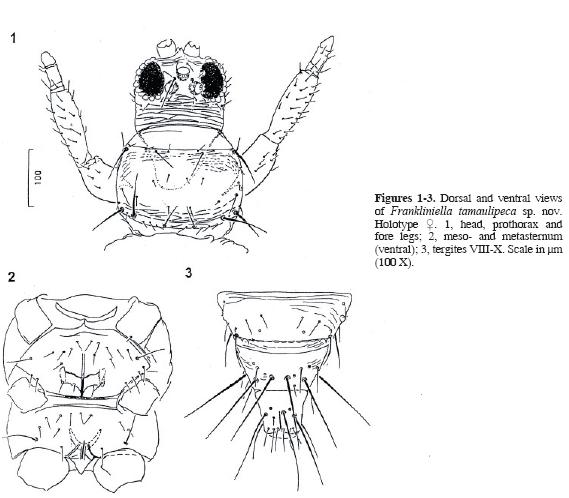
<body><![CDATA[<p align="justify"><font face="verdana" size="2">AM = Major anteromarginal setae </font></p>     <p align="justify"><font face="verdana" size="2">PA = Major posteroangular setae </font></p>     <p align="justify"><font face="verdana" size="2">am = minor anteromarginal setae </font></p>     <p align="justify"><font face="verdana" size="2">pm = minor posteromarginal setae </font></p>     <p align="justify"><font face="verdana" size="2">Abdomen</font></p>     <p align="justify"><font face="verdana" size="2">IXi, IXii, IXiii = Tergite IX major caudal setae; XI, Xii Tergite X major subposteromarginal setae.</font></p>     <p align="justify"><font face="verdana" size="2">&nbsp;</font></p>     <p align="justify"><font face="verdana" size="2"><b>Results</b></font></p>     <p align="justify"><font face="verdana" size="2">The   <i>Frankliniella   paricutinensis   </i>Johansen   2000, species assemblage.</font></p>     <p align="justify"><font face="verdana" size="2"><i>Diagnosis. </i>Small species (females: 1.35&#150;1.86; males: 1.21&#150;1.49 mm in length) in the Intonsa group. Body color predominantly dark chestnut to blackish brown, with abundant orange subhypodermal pigment. Antennal segments III&#150;V bicolored yellow and brown. Tarsi yellow to yellowish&#150;brown. Fore wings dark chestnut brown, with a white&#150;hyaline sub&#150;basal transverse band; hind wings whitish yellow, with a dark brown median longitudinal vitta. Ocellar crescents orange to red. Body setae dark blackish&#150;brown. Morphology. Head (<a href="#f1f3">Fig. 1</a>) broader than long in posterior half; occiput sculptured with open, parallel and confluent (at middle and sides) striae. Postocular setae formula: ii&#150;iii, IV, v&#150;vi. Compound eyes ellipsoidal, slightly or not protruding. Antennal segments typical in the group (<a href="#f4f7">Fig. 4</a>), III with slightly swollen or fungiform pedicel, IV&#150;VI globose elongate. Mouth cone pointed, shorter to longer than the dorsal length of head. Pronotum (<a href="#f1f3">Fig. 1</a>) with its surface mainly smooth, but with some faint transverse striae in anterior margin, which become stronger in posterior margin. Mesonotal plate (<a href="#f4f7">Fig. 5</a>) transverse, hexagonal and with open transverse striae, which become confluent at center and sides; with a pair of apical campaniform sensilla. Metanotal scutum (<a href="#f4f7">Fig. 6</a>) with polygonal reticulation forming a triangle at center (transverse anteriorly, longitudinal behind), and longitudinal striae at sides; setae in anterior margin; with a pair of sub&#150;basal campaniform sensilla. Pterosternum (<a href="#f1f3">Fig. 2</a>) with a transverse hexagonal to nearly pentagonal mesosternum, mesofurca and spinula strong. Tergite VIII commonly with a complete posteromarginal comb, rarely broadly interrupted at middle (<a href="#f1f3">Fig. 3</a>). Segment X longer than broad. Males of only 5 species with 1 circular to slightly ellipsoidal glandular area on each of sternites II&#150;VII.</font></p>     ]]></body>
<body><![CDATA[<p align="center"><font face="verdana" size="2"><a name="f1f3"></a></font></p>     <p align="center"><font face="verdana" size="2"><img src="/img/revistas/rmbiodiv/v80n2/a10f1f3.jpg"></font></p>     <p align="center"><font face="verdana" size="2"><a name="f4f7"></a></font></p>     <p align="center"><font face="verdana" size="2"><img src="/img/revistas/rmbiodiv/v80n2/a10f4f7.jpg"></font></p>     <p align="justify"><font face="verdana" size="2">&nbsp;</font></p>     <p align="justify"><font face="verdana" size="2"><b>Remarks</b></font></p>     <p align="justify"><font face="verdana" size="2">Females and males of <i>F. paricutinensis </i>Johansen, <i>F. desertileonidum </i>Watson <i>and F. aurea </i>Moulton are different from species of other assemblages within the "Intonsa group" due to their lack of postocular seta I, thus giving the setae formula: ii&#150;iii, IV, v&#150;vi. In other complexes the formula is i&#150;iii, IV, v&#150;vi. In the case of the <i>F. paricutinensis </i>Johansen assemblage, the forewing color, which is dark brown with a white sub&#150;basal transverse band (a shared character with the species in the <i>Frankliniella intonsa </i>Trybom and <i>F. insularis </i>(Franklin) assemblages) is the main difference with the <i>F. desertileonidum </i>Watson assemblage. In this species assemblage, the forewing is dark brown with 2 white transverse bands, 1 sub&#150;basal, the other one apical in the sense of Johansen (1998). In the case of the <i>F. aurea </i>Moulton, <i>F. bisaetaevenusta </i>and <i>F. prothoraciglabra </i>species assemblages, a clear yellow forewing is a shared character with the <i>F. occidentalis </i>(Pergande) species assemblage (Johansen and Mojica 2003).</font></p>     <p align="justify"><font face="verdana" size="2">New records</font></p>     <p align="justify"><font face="verdana" size="2"><i>Frankliniella axochcoensis </i>Johansen, 2000</font></p>     <p align="justify"><font face="verdana" size="2">ESTADO DE M&Eacute;XICO: Montes de Ocuilan, km 7&#150;8 on road to Lagunas de Zempoala 2700 m. (Volcanic Range); 25&#150;I&#150;1987, 1 <img src="/img/revistas/rmbiodiv/v80n2/a10s1.jpg"> in flowers of Asteraceae <i>in Abies religiosa </i>(Kunth) Schltdl and Chami and <i>Pinus </i>spp. forest (R. M. Johansen).</font></p>     ]]></body>
<body><![CDATA[<p align="justify"><font face="verdana" size="2"><img src="/img/revistas/rmbiodiv/v80n2/a10l1.jpg"></font></p>     <p align="justify"><font face="verdana" size="2">&nbsp;</font></p>     <p align="justify"><font face="verdana" size="2"><img src="/img/revistas/rmbiodiv/v80n2/a10l2.jpg"></font></p>     <p align="justify"><font face="verdana" size="2">&nbsp;</font></p>     <p align="justify"><font face="verdana" size="2"><img src="/img/revistas/rmbiodiv/v80n2/a10l3.jpg"></font></p>     <p align="justify"><font face="verdana" size="2">&nbsp;</font></p>     <p align="justify"><font face="verdana" size="2"><i>Frankliniella copilcoensis </i>Johansen, 2000. </font></p>     <p align="justify"><font face="verdana" size="2">ESTADO DE M&Eacute;XICO: on road to Nevado de Toluca Volcano, 3480 m. (Volcanic Range), 3400 m.; 30&#150;V&#150;1987, 1<img src="/img/revistas/rmbiodiv/v80n2/a10s1.jpg"> in Poaceae in <i>Pinus </i>forest (R.M. Johansen).    <br> <i>IDEM ET IBIDEM:   </i>30&#150;XI&#150;1987,   1 <img src="/img/revistas/rmbiodiv/v80n2/a10s2.jpg">in  flowers  of Asteraceae in <i>Pinus </i>forest (R.M. Johansen).</font></p>     <p align="justify"><font face="verdana" size="2"><i>Frankliniella nauhcampatepetlensis </i>Johansen, 2000.    ]]></body>
<body><![CDATA[<br> DISTRITO FEDERAL: Sierra de Ajusco, km 42 on road M&eacute;x&#150;95 (Volcanic Range),   3000 m.; 24&#150;I&#150;1987, 2 <img src="/img/revistas/rmbiodiv/v80n2/a10s3.jpg"> in flowers of <i>Senecio </i>sp. and <i>Baccharis </i>sp. in <i>Pinus </i>spp. forest (R.M. Johansen).</font></p>     <p align="justify"><font face="verdana" size="2"><i>Frankliniella paricutinensis </i>Johansen, 2000.    <br> ESTADO DE M&Eacute;XICO: on road to Nevado de Toluca Volcano, (Volcanic Range) 3480 m.;  1<img src="/img/revistas/rmbiodiv/v80n2/a10s1.jpg"> in Poaceae <i>(Muhlenbergia </i>sp.?) in <i>Pinus </i>forest, (R.M. Johansen). <i>    <br> IDEM ET IBIDEM: </i>1 <img src="/img/revistas/rmbiodiv/v80n2/a10s1.jpg"> in flowers of Asteraceae in <i>Pinus </i>forest (R.M. Johansen).</font></p>     <p align="justify"><font face="verdana" size="2"><i>Frankliniella vulcanorizabensis </i>Johansen, 2000.     <br>   ESTADO DE M&Eacute;XICO: on road to Nevado de Toluca Volcano (Volcanic Range), 3880 m.; 20&#150;XI&#150;1987, 1 <img src="/img/revistas/rmbiodiv/v80n2/a10s2.jpg"> in Poaceae <i>(Muhlenbergia </i>sp.?) in <i>Pinus </i>forest (R.M. Johansen).    <br> DISTRITO FEDERAL: Sierra de Ajusco, km 42 on road M&eacute;x&#150;95 (Volcanic Range), 3000 m.; 1 <img src="/img/revistas/rmbiodiv/v80n2/a10s2.jpg"><i> </i>by beating <i>senecio </i>sp. and <i>bacharis </i>sp. bushes in <i>Pinus </i>spp. forest (R.M. Johansen).</font></p>     <p align="justify"><font face="verdana" size="2"><i>Frankliniella vulcanoperotensis </i>Johansen, 2000.    <br> ESTADO DE M&Eacute;XICO: km 9 on road to Lagunas de Santa Martha (Volcanic Range); 21&#150;V&#150;1989, 1<img src="/img/revistas/rmbiodiv/v80n2/a10s1.jpg">, 1 <img src="/img/revistas/rmbiodiv/v80n2/a10s2.jpg">(no further data), (anonymous).</font></p>     <p align="justify"><font face="verdana" size="2"><i>Frankliniella vulcanotolucensis </i>Johansen, 2000.    ]]></body>
<body><![CDATA[<br> ESTADO DE M&Eacute;XICO: km 4 on road to Nevado de Toluca Volcano (Volcanic range), 3680 m.; 21&#150;III&#150;1987, 1<img src="/img/revistas/rmbiodiv/v80n2/a10s1.jpg"> in flowers of <i>Senecio salignus </i>in <i>Pinus </i>forest (R.M. Johansen).    <br> <i>IDEM ET IBIDEM: </i>5&#150;XII&#150;1987, 1 <i><img src="/img/revistas/rmbiodiv/v80n2/a10s2.jpg"> </i>in Poaceae in <i>Pinus </i>forest <i>(Muhlenbergia </i>sp. ?) (R.M. Johansen).</font></p>     <p align="justify"><font face="verdana" size="2"><i>Frankliniella tamaulipeca </i>sp. nov. (<a href="#f1f3">Figs. 1</a>&#150;<a href="#f4f7">7</a>) </font></p>     <p align="justify"><font face="verdana" size="2"><i>Female. </i>Body color dark chestnut brown with abundant orange subhypodermal pigment, except yellowish&#150;brown at middle of head and in thorax. Antennal segments: I light brown; II yellowish&#150;brown; III dark brown slightly clear at base; IV&#150;V dark brown, yellowish in basal one half and one fifth respectively; VI&#150;VIII dark brown. All tarsi and tibiae yellow; femora dark brown, yellow in both extremes. Fore wings typical: light brown darker in veins, lighter at base; hind wings whitish, brownish at base and with a dark brown median longitudinal vitta. Ocellar crescents light orange. Body setae dark chestnut brown. </font></p>     <p align="justify"><font face="verdana" size="2"><i>Morphology. </i>Head in dorsal aspect (<a href="#f1f3">Fig. 1</a>), broader at eyes (1.41 times) and at middle (1.014) times than long: cheeks slightly sinuouse; occiput with parallel striae, confluent near middle and both sides. Antennal segments (<a href="#f4f7">Fig. 4</a>), III longer than IV, VI the longest. Mouth cone rounded and shorter than head. Pronotum (<a href="#f1f3">Fig. 1</a>) almost smooth, but with faint transverse and confluent striae on anterior and posterior margins; with a median pair of subposteromarginal setae. Pterothrorax; mesonotum (<a href="#f4f7">Fig. 5</a>) with parallel and open transverse striae and, with a pair of very broadly separated apical campaniform sensilla; metanotum (<a href="#f4f7">Fig. 6</a>) sculptured with almost concentric equiangular (at center) and longitudinal polygons, with a pair of basal campaniform sensilla; pterosternum (<a href="#f1f3">Fig. 2</a>), mesosternal plate hexagonal and transverse, mesofurca as shown in <a href="#f1f3">Fig. 2</a>. Abdomen, tergite I (<a href="#f4f7">Fig. 7</a>); tergite VIII (<a href="#f1f3">Fig. 3</a>), with the posteromarginal comb broadly interrupted at middle (with a discrete craspedum) and only present by 2 microthrichia at both extreme sides. </font></p>     <p align="justify"><font face="verdana" size="2"><i>Measurements </i>(holotype <img src="/img/revistas/rmbiodiv/v80n2/a10s1.jpg">, 5 paratypes <img src="/img/revistas/rmbiodiv/v80n2/a10s3.jpg"> in (&micro;m). Body length: 1.485&#150;1.638 mm.</font></p>     <p align="justify"><font face="verdana" size="2">Head dorsal length: 96&#150;116. Width at eyes: 134&#150;142, behind eyes: 130&#150;138, middle: 132&#150;140, basal: 126&#150;138. Chaetotaxy, intocc: 40&#150;50; postoc: ii 10&#150;12, iii 9&#150;10, IV 14&#150;16. Compound eyes, length: 56&#150;60, width: 40&#150;50. Ocelli, fore: 12&#150;20, hind: 12&#150;14. Antennal segments, length (width): I 22&#150;24 (24&#150;28), II 32&#150;36 (22&#150;26), III 40&#150;46 (16&#150;22), IV 34&#150;44 (18&#150;20), V 40&#150;44 (16), VI 46&#150;50 (14&#150;16), VII 8&#150;12 (6&#150;8), VIII 14&#150;16 (4&#150;6). Thorax; pronotum, length: 116&#150;130; width at middle:  180&#150;202. Chaetotaxy, major setae: AA 50&#150;60, AM 34&#150;38; PA, outer: 54&#150;58, inner: 66&#150;72; minor setae: aa 18&#150;22, am 10&#150;12; pm i: 16&#150;18, ii: 34&#150;38, iii: 12&#150;16. Mesothorax, width: 238&#150;274; metathorax, width: 222&#150;270. Fore wings, width at base: 80&#150;100, middle: 44&#150;60; veins chaetotaxy, fore: 16&#150;19, hind: 11&#150;14. Abdomen; width at segment IV: 270&#150;338. Tergite IX setae, IX i: 114&#150;126, IX ii: 120&#150;134. Tergite X setae, X i: 106&#150;128. </font></p>     <p align="justify"><font face="verdana" size="2"><i>Material examined. </i>Holotype <img src="/img/revistas/rmbiodiv/v80n2/a10s1.jpg">, paratypes 6 <img src="/img/revistas/rmbiodiv/v80n2/a10s3.jpg">, TAMAULIPAS: Gonz&aacute;lez near Altamira 110 m.; 29&#150;I&#150;2004 (Holotype, 4 paratypes) in onion plants <i>Allium cepa </i>L. (G. Vel&aacute;squez), in IBUNAM.</font></p>     <p align="justify"><font face="verdana" size="2">Altamira 26&#150;30 m., 2&#150;II&#150;2004 (2 paratypes) in onion plants <i>Allium cepa </i>L. (G. Vel&aacute;zquez), in IBUNAM.</font></p>     <p align="justify"><font face="verdana" size="2"><i>Comments. Frankliniella tamaulipeca </i>sp. nov. is different from the remaining species belonging to the <i>F. paricutinensis assemblage, </i>because its female adults lack a complete posteromarginal comb in tergite VIII (only present at both sides, by a pair of microthrichia), and because in the mesonotal plate the anteroangular campaniform sensilla are broadly separated. These characters are presumably apomorphic, whereas the plesiomorphic condition is probably possession of a complete posteromarginal comb in tergite VIII with the mesonotal sensilla closely placed. The lack of a complete posteromarginal comb (only present at both sides by 2&#150;5 microtrichia) is not a common character in adults of either sex of <i>Frankliniella </i>species. Well known examples with this trait are <i>Frankliniella cephalica </i>(D.L.Crawford), <i>F. bispinosa </i>(Morgan) and <i>F. melanommata </i>Williams (all in the Cephalica Group, according to Moulton, 1949), but <i>also F. schultzei </i>(Trybom, 1910) according to Nakahara (1997) and Johansen (2002). However, in <i>Frankliniella fusca </i>(Hinds, 1902), <i>F. seneciofusca </i>Johansen (2002), <i>F. vulcanofusca </i>(2002), <i>F. pallida </i>(Uzel, 1895), <i>F. pallidatagetes </i>Johansen (2002), <i>F. seneciopallida </i>Johansen (2002), <i>F. zapotecafusca </i>Johansen (2002), and the adult males <i>of F. hemerocallis </i>J.C. Crawford (1948), the posteromarginal comb in tergite VIII is entirely absent. <i>Derivatio nominis. </i>From the huasteca language: tamaulipa, singular for the indigenous people the tamaulipas (plural) of northeastern Mexico; also meaning "a flower place", "place of flowers".</font></p>     ]]></body>
<body><![CDATA[<p align="justify"><font face="verdana" size="2"><i>Biological and ecological aspects. </i>None of the immature (larvae and pupae) stages of any of the species in the <i>Frankliniella paricutinensis </i>species assemblage has been recorded. Only adults were available for observation and study. There is enough information to record this stage, or to establish that the adults are flower dwellers in Poaceae and Asteraceae, according to Johansen (2000). <i>Frankliniella tamaulipeca </i>sp. nov. is the only species in the assemblage recorded   in an agroecosystem <i>(Alllium </i><i>cepa </i>L.), sharing this microhabitat with <i>Thrips tabaci </i>Lindeman (onion thrips). Furthermore, some adults of <i>F. tamaulipeca </i>were found as flower dwellers. Finally, <i>F. tamaulipeca </i>is the only species in the <i>F. paricutinensis </i>assemblage that occurs at an altitude near sea level, in the Gulf of Mexico Coastal Plain, whereas the other 13 species are high&#150;altitude (1 990&#150;4 100 m) inhabitants of natural ecosystems.</font></p>     <p align="justify"><font face="verdana" size="2">&nbsp;</font></p>     <p align="justify"><font face="verdana" size="2"><b>Acknowledgements</b></font></p>     <p align="justify"><font face="verdana" size="2">To   Ing.   Agr.    Servando   Qui&ntilde;ones,   from   Dow Agrosciences, for his kind donation of the specimens of the new species. To Dr. Atilano Contreras Ramos, Departamento de Zoolog&iacute;a, and to Dr. David S. Gernandt, Herbario Nacional MEXU, Instituto de Biolog&iacute;a, UNAM, for their careful revision that greatly improved the manuscript.</font></p>     <p align="justify"><font face="verdana" size="2">&nbsp;</font></p>     <p align="justify"><font face="verdana" size="2"><b>Literature cited</b></font></p>     <!-- ref --><p align="justify"><font face="verdana" size="2">Berzosa, J. and J. Maroto. 2003. New Neotropical species of the Genus <i>Frankliniella </i>Karny (Insecta: Thysanoptera: Thripidae). Studies on Neotropical Fauna and Environment 38:135&#150;144.</font>&nbsp;&nbsp;&nbsp;&nbsp;&nbsp;&nbsp;&nbsp;&nbsp;[&#160;<a href="javascript:void(0);" onclick="javascript: window.open('/scielo.php?script=sci_nlinks&ref=7539539&pid=S1870-3453200900020001000001&lng=','','width=640,height=500,resizable=yes,scrollbars=1,menubar=yes,');">Links</a>&#160;]<!-- end-ref --><!-- ref --><p align="justify"><font face="verdana" size="2">Harrison, J. O. 1963. Notes on the biology of the banana flower thrips <i>Frankliniella parvula </i>in the Dominican Republic (Thysanoptera: Thripidae). Annals of the Entomological Society of America 56:664&#150;666.</font>&nbsp;&nbsp;&nbsp;&nbsp;&nbsp;&nbsp;&nbsp;&nbsp;[&#160;<a href="javascript:void(0);" onclick="javascript: window.open('/scielo.php?script=sci_nlinks&ref=7539540&pid=S1870-3453200900020001000002&lng=','','width=640,height=500,resizable=yes,scrollbars=1,menubar=yes,');">Links</a>&#160;]<!-- end-ref --><!-- ref --><p align="justify"><font face="verdana" size="2">Hood, J. D. 1914. On the proper generic names for certain Thysanoptera of economic importance. Proceedings Entomological Society of Washington 14:129&#150;160.</font>&nbsp;&nbsp;&nbsp;&nbsp;&nbsp;&nbsp;&nbsp;&nbsp;[&#160;<a href="javascript:void(0);" onclick="javascript: window.open('/scielo.php?script=sci_nlinks&ref=7539541&pid=S1870-3453200900020001000003&lng=','','width=640,height=500,resizable=yes,scrollbars=1,menubar=yes,');">Links</a>&#160;]<!-- end-ref --><!-- ref --><p align="justify"><font face="verdana" size="2">Hood, J. D. 1925. New species <i>of Frankliniella </i>(Thysanoptera). Bulletin of the Brooklin Entomological Society 20:71&#150;83.</font>&nbsp;&nbsp;&nbsp;&nbsp;&nbsp;&nbsp;&nbsp;&nbsp;[&#160;<a href="javascript:void(0);" onclick="javascript: window.open('/scielo.php?script=sci_nlinks&ref=7539542&pid=S1870-3453200900020001000004&lng=','','width=640,height=500,resizable=yes,scrollbars=1,menubar=yes,');">Links</a>&#160;]<!-- end-ref --><!-- ref --><p align="justify"><font face="verdana" size="2">Karny, H. 1910. Neue Thysanopteren der Wiener Gegend. Mitteilungen des Naturwissenschaftlinchen Vereins and der Universit&auml;t Wien 2:47&#150;57.</font>&nbsp;&nbsp;&nbsp;&nbsp;&nbsp;&nbsp;&nbsp;&nbsp;[&#160;<a href="javascript:void(0);" onclick="javascript: window.open('/scielo.php?script=sci_nlinks&ref=7539543&pid=S1870-3453200900020001000005&lng=','','width=640,height=500,resizable=yes,scrollbars=1,menubar=yes,');">Links</a>&#160;]<!-- end-ref --><!-- ref --><p align="justify"><font face="verdana" size="2">Karny, H. 1912. Revision der von Serville Aufgestellten Thysanopteren&#150;Genera. Zoologische Analen 4:321&#150;344.</font>&nbsp;&nbsp;&nbsp;&nbsp;&nbsp;&nbsp;&nbsp;&nbsp;[&#160;<a href="javascript:void(0);" onclick="javascript: window.open('/scielo.php?script=sci_nlinks&ref=7539544&pid=S1870-3453200900020001000006&lng=','','width=640,height=500,resizable=yes,scrollbars=1,menubar=yes,');">Links</a>&#160;]<!-- end-ref --><!-- ref --><p align="justify"><font face="verdana" size="2">Lacasa&#150;Plasencia, A. and J. M. Ll&oacute;rens Clients. 1996. Trips y su Control Biol&oacute;gico (I). Regi&oacute;n de Murcia. Consejer&iacute;a de Medio Ambiente y Agua. Serie Divulgaci&oacute;n T&eacute;cnica Num. 17:218 p.</font>&nbsp;&nbsp;&nbsp;&nbsp;&nbsp;&nbsp;&nbsp;&nbsp;[&#160;<a href="javascript:void(0);" onclick="javascript: window.open('/scielo.php?script=sci_nlinks&ref=7539545&pid=S1870-3453200900020001000007&lng=','','width=640,height=500,resizable=yes,scrollbars=1,menubar=yes,');">Links</a>&#160;]<!-- end-ref --><!-- ref --><p align="justify"><font face="verdana" size="2">Lacasa&#150;Plasencia, A. and J. M. Ll&oacute;rens Climent, 1998. Trips y su Control Biol&oacute;gico (y II). Regi&oacute;n de Murcia. Consejer&iacute;a de Medio Ambiente y Agua. Serie Divulgaci&oacute;n T&eacute;cnica Num. 18:312 p.</font>&nbsp;&nbsp;&nbsp;&nbsp;&nbsp;&nbsp;&nbsp;&nbsp;[&#160;<a href="javascript:void(0);" onclick="javascript: window.open('/scielo.php?script=sci_nlinks&ref=7539546&pid=S1870-3453200900020001000008&lng=','','width=640,height=500,resizable=yes,scrollbars=1,menubar=yes,');">Links</a>&#160;]<!-- end-ref --><!-- ref --><p align="justify"><font face="verdana" size="2">Jacot&#150;Guillarmod, C. F. 1974 Catalogue of the Thysanoptera of the World, Part 3&#150; Annals of the Cape Province Museum (Natural History) 7:517&#150;976.</font>&nbsp;&nbsp;&nbsp;&nbsp;&nbsp;&nbsp;&nbsp;&nbsp;[&#160;<a href="javascript:void(0);" onclick="javascript: window.open('/scielo.php?script=sci_nlinks&ref=7539547&pid=S1870-3453200900020001000009&lng=','','width=640,height=500,resizable=yes,scrollbars=1,menubar=yes,');">Links</a>&#160;]<!-- end-ref --><!-- ref --><p align="justify"><font face="verdana" size="2">Johansen, R. M. 1979. Una nueva especie Mexicana de <i>Frankliniella </i>Karny (Thysanoptera: Thripidae), de la Sierra Madre Oriental. Anales del Instituto de Biolog&iacute;a, Universidad Nacional Aut&oacute;noma de M&eacute;xico, Serie Zoolog&iacute;a 48:71&#150;76 (para 1977).</font>&nbsp;&nbsp;&nbsp;&nbsp;&nbsp;&nbsp;&nbsp;&nbsp;[&#160;<a href="javascript:void(0);" onclick="javascript: window.open('/scielo.php?script=sci_nlinks&ref=7539548&pid=S1870-3453200900020001000010&lng=','','width=640,height=500,resizable=yes,scrollbars=1,menubar=yes,');">Links</a>&#160;]<!-- end-ref --><!-- ref --><p align="justify"><font face="verdana" size="2">Johansen, R. M. 1981 a. Seis nuevos tisan&oacute;pteros (Terebrantia: Heterothripidae; Thripidae), de Chiapas, M&eacute;xico. Anales del Instituto de Biolog&iacute;a, Universidad Nacional Aut&oacute;noma de M&eacute;xico, Serie Zoolog&iacute;a 50:159&#150;178 (para 1979)</font>&nbsp;&nbsp;&nbsp;&nbsp;&nbsp;&nbsp;&nbsp;&nbsp;[&#160;<a href="javascript:void(0);" onclick="javascript: window.open('/scielo.php?script=sci_nlinks&ref=7539549&pid=S1870-3453200900020001000011&lng=','','width=640,height=500,resizable=yes,scrollbars=1,menubar=yes,');">Links</a>&#160;]<!-- end-ref --><!-- ref --><p align="justify"><font face="verdana" size="2">Johansen, R. M. 1981 b. Cinco nuevos tisan&oacute;pteros (Terebrantia Heterothripidae; Thripidae), de Chiapas, M&eacute;xico. Anales del Instituto de Biolog&iacute;a, Universidad Nacional Aut&oacute;noma de M&eacute;xico, Serie Zoolog&iacute;a 51:321&#150;335.</font>&nbsp;&nbsp;&nbsp;&nbsp;&nbsp;&nbsp;&nbsp;&nbsp;[&#160;<a href="javascript:void(0);" onclick="javascript: window.open('/scielo.php?script=sci_nlinks&ref=7539550&pid=S1870-3453200900020001000012&lng=','','width=640,height=500,resizable=yes,scrollbars=1,menubar=yes,');">Links</a>&#160;]<!-- end-ref --><!-- ref --><p align="justify"><font face="verdana" size="2">Johansen, R. M. 1998 a. The Mexican <i>Frankliniella desertileonidum </i>Watson species assemblage, in the "Intonsa Group" (Insecta, Thysanoptera: Thripidae). Acta Zool&oacute;gica Mexicana (n. s.) 75:143&#150;161.</font>&nbsp;&nbsp;&nbsp;&nbsp;&nbsp;&nbsp;&nbsp;&nbsp;[&#160;<a href="javascript:void(0);" onclick="javascript: window.open('/scielo.php?script=sci_nlinks&ref=7539551&pid=S1870-3453200900020001000013&lng=','','width=640,height=500,resizable=yes,scrollbars=1,menubar=yes,');">Links</a>&#160;]<!-- end-ref --><!-- ref --><p align="justify"><font face="verdana" size="2">Johansen, R. M. 1998 b. The <i>Frankliniella curiosa species group</i> (Thysanoptera: Thripidae). Revista de Biolog&iacute;a Tropical 46:717&#150;738.</font>&nbsp;&nbsp;&nbsp;&nbsp;&nbsp;&nbsp;&nbsp;&nbsp;[&#160;<a href="javascript:void(0);" onclick="javascript: window.open('/scielo.php?script=sci_nlinks&ref=7539552&pid=S1870-3453200900020001000014&lng=','','width=640,height=500,resizable=yes,scrollbars=1,menubar=yes,');">Links</a>&#160;]<!-- end-ref --><!-- ref --><p align="justify"><font face="verdana" size="2">Johansen, R. M. 2000. The Mexican <i>Frankliniellaparicutinensis </i>sp. nov. species assemblage, in the "Intonsa Group" (Insecta, Thysanoptera: Thripidae). Acta Zool&oacute;gica Mexicana (n.s.) 80:1&#150;49.</font>&nbsp;&nbsp;&nbsp;&nbsp;&nbsp;&nbsp;&nbsp;&nbsp;[&#160;<a href="javascript:void(0);" onclick="javascript: window.open('/scielo.php?script=sci_nlinks&ref=7539553&pid=S1870-3453200900020001000015&lng=','','width=640,height=500,resizable=yes,scrollbars=1,menubar=yes,');">Links</a>&#160;]<!-- end-ref --><!-- ref --><p align="justify"><font face="verdana" size="2">Johansen, R. M. 2002. The Mexican <i>Frankliniella fusca </i>(Hinds), <i>F. pallida </i>(Uzel) and <i>F. schultzei </i>(Trybom) species assemblages, in the "Intonsa Group" (Insecta, Thysanoptera: Thripidae). Acta Zool&oacute;gica Mexicana (n. s.) 85:51&#150;82.</font>&nbsp;&nbsp;&nbsp;&nbsp;&nbsp;&nbsp;&nbsp;&nbsp;[&#160;<a href="javascript:void(0);" onclick="javascript: window.open('/scielo.php?script=sci_nlinks&ref=7539554&pid=S1870-3453200900020001000016&lng=','','width=640,height=500,resizable=yes,scrollbars=1,menubar=yes,');">Links</a>&#160;]<!-- end-ref --><!-- ref --><p align="justify"><font face="verdana" size="2">Johansen, R. M. y A. Mojica&#150;Guzm&aacute;n, 1989. Dos especies nuevas de <i>Frankliniella </i>Karny (Insecta, Thysanoptera: Thripidae) del Grupo Intonsa, del Eje Volc&aacute;nico Transversal de M&eacute;xico. Anales del Instituto de Biolog&iacute;a, Universidad Nacional Aut&oacute;noma de M&eacute;xico, Serie Zoolog&iacute;a 60:191&#150;198.</font>&nbsp;&nbsp;&nbsp;&nbsp;&nbsp;&nbsp;&nbsp;&nbsp;[&#160;<a href="javascript:void(0);" onclick="javascript: window.open('/scielo.php?script=sci_nlinks&ref=7539555&pid=S1870-3453200900020001000017&lng=','','width=640,height=500,resizable=yes,scrollbars=1,menubar=yes,');">Links</a>&#160;]<!-- end-ref --><!-- ref --><p align="justify"><font face="verdana" size="2">Johansen, R. M. and A. Mojica&#150;Guzm&aacute;n, 1998. The Mexican <i>Frankliniella anitahoffmannae </i>sp. nov. Species assemblage, in the "Intonsa Group" (Insecta; Thysanoptera: Thripidae). Acta Zool&oacute;gica Mexicana (n. s.) 75:1&#150;16.</font>&nbsp;&nbsp;&nbsp;&nbsp;&nbsp;&nbsp;&nbsp;&nbsp;[&#160;<a href="javascript:void(0);" onclick="javascript: window.open('/scielo.php?script=sci_nlinks&ref=7539556&pid=S1870-3453200900020001000018&lng=','','width=640,height=500,resizable=yes,scrollbars=1,menubar=yes,');">Links</a>&#160;]<!-- end-ref --><!-- ref --><p align="justify"><font face="verdana" size="2">Johansen, R. M. y A. Mojica&#150;Guzm&aacute;n. 2003. The Mexican <i>Frankliniella aurea </i>assemblages in the "Intonsa Group" (Insecta, Thysanoptera: Thripidae). Acta Zool&oacute;gica Mexicana (n. s.) 89:201&#150;240</font>&nbsp;&nbsp;&nbsp;&nbsp;&nbsp;&nbsp;&nbsp;&nbsp;[&#160;<a href="javascript:void(0);" onclick="javascript: window.open('/scielo.php?script=sci_nlinks&ref=7539557&pid=S1870-3453200900020001000019&lng=','','width=640,height=500,resizable=yes,scrollbars=1,menubar=yes,');">Links</a>&#160;]<!-- end-ref --><!-- ref --><p align="justify"><font face="verdana" size="2">Moulton, D. 1949. The genus <i>Frankliniella </i>Karny, with keys for the determination of Species Thysanoptera. Revista de Entomologia (Rio de Janeiro) 19:55&#150;114</font>&nbsp;&nbsp;&nbsp;&nbsp;&nbsp;&nbsp;&nbsp;&nbsp;[&#160;<a href="javascript:void(0);" onclick="javascript: window.open('/scielo.php?script=sci_nlinks&ref=7539558&pid=S1870-3453200900020001000020&lng=','','width=640,height=500,resizable=yes,scrollbars=1,menubar=yes,');">Links</a>&#160;]<!-- end-ref --><!-- ref --><p align="justify"><font face="verdana" size="2">Mound, L. A. and R. Marullo, 1996. The thrips of Central and South America, an introduction, Vol. 6. Associated Publishers, Gainesville. p. 1&#150;487.</font>&nbsp;&nbsp;&nbsp;&nbsp;&nbsp;&nbsp;&nbsp;&nbsp;[&#160;<a href="javascript:void(0);" onclick="javascript: window.open('/scielo.php?script=sci_nlinks&ref=7539559&pid=S1870-3453200900020001000021&lng=','','width=640,height=500,resizable=yes,scrollbars=1,menubar=yes,');">Links</a>&#160;]<!-- end-ref --><!-- ref --><p align="justify"><font face="verdana" size="2">Mound, L. A. and S. Nakahara, 1994.  The genus <i>Frankliniella </i>(Thysanoptera); Thripidae): character assessment at generic and species levels. Zoology (Journal of Pure and Applied Zoology) 4:287&#150;295.</font>&nbsp;&nbsp;&nbsp;&nbsp;&nbsp;&nbsp;&nbsp;&nbsp;[&#160;<a href="javascript:void(0);" onclick="javascript: window.open('/scielo.php?script=sci_nlinks&ref=7539560&pid=S1870-3453200900020001000022&lng=','','width=640,height=500,resizable=yes,scrollbars=1,menubar=yes,');">Links</a>&#160;]<!-- end-ref --><!-- ref --><p align="justify"><font face="verdana" size="2">Nakahara, S. 1997. Annotated list of the <i>Frankliniella </i>species of the world (Thysanoptera: Thripidae). Contributions on Entomology, International 2:355&#150;389.</font>&nbsp;&nbsp;&nbsp;&nbsp;&nbsp;&nbsp;&nbsp;&nbsp;[&#160;<a href="javascript:void(0);" onclick="javascript: window.open('/scielo.php?script=sci_nlinks&ref=7539561&pid=S1870-3453200900020001000023&lng=','','width=640,height=500,resizable=yes,scrollbars=1,menubar=yes,');">Links</a>&#160;]<!-- end-ref --><!-- ref --><p align="justify"><font face="verdana" size="2">Sakimura, K. and K O'Neill 1979. <i>Frankliniella </i>redefinition of genus and revision of minuta group species (Thysanoptera: Thipidae). United States Department of Agriculture Technical Bulletin 1572. 49 p.</font>&nbsp;&nbsp;&nbsp;&nbsp;&nbsp;&nbsp;&nbsp;&nbsp;[&#160;<a href="javascript:void(0);" onclick="javascript: window.open('/scielo.php?script=sci_nlinks&ref=7539562&pid=S1870-3453200900020001000024&lng=','','width=640,height=500,resizable=yes,scrollbars=1,menubar=yes,');">Links</a>&#160;]<!-- end-ref --><!-- ref --><p align="justify"><font face="verdana" size="2">Stannard, L. J. 1968. The thrips or Thysanoptera of Illinois. Bulletin of the Illinois Natural History Survey 29:213.552.</font>&nbsp;&nbsp;&nbsp;&nbsp;&nbsp;&nbsp;&nbsp;&nbsp;[&#160;<a href="javascript:void(0);" onclick="javascript: window.open('/scielo.php?script=sci_nlinks&ref=7539563&pid=S1870-3453200900020001000025&lng=','','width=640,height=500,resizable=yes,scrollbars=1,menubar=yes,');">Links</a>&#160;]<!-- end-ref --><!-- ref --><p align="justify"><font face="verdana" size="2">Trybom,   F.    1895.   Iakttagleser   om   vissa   BlasÃ¥fotingars (Physapoders) upptr&auml;dand I gr&auml;ssens blomst&auml;llningar j&auml;mte nagra drag ur sl&auml;ktet <i>Phloeothrips </i>utvecklinghistoria. 60 Entomologisk Tidskraft 16:157&#150;194.</font>&nbsp;&nbsp;&nbsp;&nbsp;&nbsp;&nbsp;&nbsp;&nbsp;[&#160;<a href="javascript:void(0);" onclick="javascript: window.open('/scielo.php?script=sci_nlinks&ref=7539564&pid=S1870-3453200900020001000026&lng=','','width=640,height=500,resizable=yes,scrollbars=1,menubar=yes,');">Links</a>&#160;]<!-- end-ref --> ]]></body><back>
<ref-list>
<ref id="B1">
<nlm-citation citation-type="journal">
<person-group person-group-type="author">
<name>
<surname><![CDATA[Berzosa]]></surname>
<given-names><![CDATA[J.]]></given-names>
</name>
<name>
<surname><![CDATA[Maroto]]></surname>
<given-names><![CDATA[J.]]></given-names>
</name>
</person-group>
<article-title xml:lang="en"><![CDATA[New Neotropical species of the Genus Frankliniella Karny (Insecta: Thysanoptera: Thripidae)]]></article-title>
<source><![CDATA[Studies on Neotropical Fauna and Environment]]></source>
<year>2003</year>
<volume>38</volume>
<page-range>135-144</page-range></nlm-citation>
</ref>
<ref id="B2">
<nlm-citation citation-type="journal">
<person-group person-group-type="author">
<name>
<surname><![CDATA[Harrison]]></surname>
<given-names><![CDATA[J. O.]]></given-names>
</name>
</person-group>
<article-title xml:lang="en"><![CDATA[Notes on the biology of the banana flower thrips Frankliniella parvula in the Dominican Republic (Thysanoptera: Thripidae)]]></article-title>
<source><![CDATA[Annals of the Entomological Society of America]]></source>
<year>1963</year>
<volume>56</volume>
<page-range>664-666</page-range></nlm-citation>
</ref>
<ref id="B3">
<nlm-citation citation-type="journal">
<person-group person-group-type="author">
<name>
<surname><![CDATA[Hood]]></surname>
<given-names><![CDATA[J. D.]]></given-names>
</name>
</person-group>
<article-title xml:lang="en"><![CDATA[On the proper generic names for certain Thysanoptera of economic importance]]></article-title>
<source><![CDATA[Proceedings Entomological Society of Washington]]></source>
<year>1914</year>
<volume>14</volume>
<page-range>129-160</page-range></nlm-citation>
</ref>
<ref id="B4">
<nlm-citation citation-type="journal">
<person-group person-group-type="author">
<name>
<surname><![CDATA[Hood]]></surname>
<given-names><![CDATA[J. D.]]></given-names>
</name>
</person-group>
<article-title xml:lang="en"><![CDATA[New species of Frankliniella (Thysanoptera)]]></article-title>
<source><![CDATA[Bulletin of the Brooklin Entomological Society]]></source>
<year>1925</year>
<volume>20</volume>
<page-range>71-83</page-range></nlm-citation>
</ref>
<ref id="B5">
<nlm-citation citation-type="journal">
<person-group person-group-type="author">
<name>
<surname><![CDATA[Karny]]></surname>
<given-names><![CDATA[H.]]></given-names>
</name>
</person-group>
<article-title xml:lang="de"><![CDATA[Neue Thysanopteren der Wiener Gegend]]></article-title>
<source><![CDATA[Mitteilungen des Naturwissenschaftlinchen Vereins and der Universität Wien]]></source>
<year>1910</year>
<volume>2</volume>
<page-range>47-57</page-range></nlm-citation>
</ref>
<ref id="B6">
<nlm-citation citation-type="journal">
<person-group person-group-type="author">
<name>
<surname><![CDATA[Karny]]></surname>
<given-names><![CDATA[H.]]></given-names>
</name>
</person-group>
<article-title xml:lang="de"><![CDATA[Revision der von Serville Aufgestellten Thysanopteren-Genera]]></article-title>
<source><![CDATA[Zoologische Analen]]></source>
<year>1912</year>
<volume>4</volume>
<page-range>321-344</page-range></nlm-citation>
</ref>
<ref id="B7">
<nlm-citation citation-type="book">
<person-group person-group-type="author">
<name>
<surname><![CDATA[Lacasa-Plasencia]]></surname>
<given-names><![CDATA[A.]]></given-names>
</name>
<name>
<surname><![CDATA[Llórens Clients]]></surname>
<given-names><![CDATA[J. M.]]></given-names>
</name>
</person-group>
<source><![CDATA[Trips y su Control Biológico (I): Región de Murcia]]></source>
<year>1996</year>
<volume>17</volume>
<page-range>218</page-range><publisher-name><![CDATA[Consejería de Medio Ambiente y Agua]]></publisher-name>
</nlm-citation>
</ref>
<ref id="B8">
<nlm-citation citation-type="book">
<person-group person-group-type="author">
<name>
<surname><![CDATA[Lacasa-Plasencia]]></surname>
<given-names><![CDATA[A.]]></given-names>
</name>
<name>
<surname><![CDATA[Llórens Climent]]></surname>
<given-names><![CDATA[J. M.]]></given-names>
</name>
</person-group>
<source><![CDATA[Trips y su Control Biológico (y II): Región de Murcia]]></source>
<year>1998</year>
<volume>18</volume>
<page-range>312</page-range><publisher-name><![CDATA[Consejería de Medio Ambiente y Agua]]></publisher-name>
</nlm-citation>
</ref>
<ref id="B9">
<nlm-citation citation-type="journal">
<person-group person-group-type="author">
<name>
<surname><![CDATA[Jacot-Guillarmod]]></surname>
<given-names><![CDATA[C. F.]]></given-names>
</name>
</person-group>
<article-title xml:lang="en"><![CDATA[Catalogue of the Thysanoptera of the World, Part 3-]]></article-title>
<source><![CDATA[Annals of the Cape Province Museum]]></source>
<year>1974</year>
<volume>7</volume>
<numero>^sNatural History</numero>
<issue>^sNatural History</issue>
<supplement>Natural History</supplement>
<page-range>517-976</page-range></nlm-citation>
</ref>
<ref id="B10">
<nlm-citation citation-type="journal">
<person-group person-group-type="author">
<name>
<surname><![CDATA[Johansen]]></surname>
<given-names><![CDATA[R. M.]]></given-names>
</name>
</person-group>
<article-title xml:lang="es"><![CDATA[Una nueva especie Mexicana de Frankliniella Karny (Thysanoptera: Thripidae), de la Sierra Madre Oriental]]></article-title>
<source><![CDATA[Anales del Instituto de Biología]]></source>
<year>1979</year>
<month>19</month>
<day>77</day>
<numero>48^sSerie Zoología</numero>
<issue>48^sSerie Zoología</issue>
<supplement>Serie Zoología</supplement>
<page-range>71-76</page-range><publisher-name><![CDATA[Universidad Nacional Autónoma de México]]></publisher-name>
</nlm-citation>
</ref>
<ref id="B11">
<nlm-citation citation-type="journal">
<person-group person-group-type="author">
<name>
<surname><![CDATA[Johansen]]></surname>
<given-names><![CDATA[R. M.]]></given-names>
</name>
</person-group>
<article-title xml:lang="es"><![CDATA[Seis nuevos tisanópteros (Terebrantia: Heterothripidae; Thripidae), de Chiapas, México]]></article-title>
<source><![CDATA[Anales del Instituto de Biología]]></source>
<year>1981</year>
<numero>50^sSerie Zoología</numero>
<issue>50^sSerie Zoología</issue>
<supplement>Serie Zoología</supplement>
<page-range>159-178</page-range><publisher-name><![CDATA[Universidad Nacional Autónoma de México]]></publisher-name>
</nlm-citation>
</ref>
<ref id="B12">
<nlm-citation citation-type="journal">
<person-group person-group-type="author">
<name>
<surname><![CDATA[Johansen]]></surname>
<given-names><![CDATA[R. M.]]></given-names>
</name>
</person-group>
<article-title xml:lang="es"><![CDATA[Cinco nuevos tisanópteros (Terebrantia Heterothripidae; Thripidae), de Chiapas, México]]></article-title>
<source><![CDATA[Anales del Instituto de Biología]]></source>
<year>1981</year>
<numero>51^sSerie Zoología</numero>
<issue>51^sSerie Zoología</issue>
<supplement>Serie Zoología</supplement>
<page-range>321-335</page-range><publisher-name><![CDATA[Universidad Nacional Autónoma de México]]></publisher-name>
</nlm-citation>
</ref>
<ref id="B13">
<nlm-citation citation-type="journal">
<person-group person-group-type="author">
<name>
<surname><![CDATA[Johansen]]></surname>
<given-names><![CDATA[R. M.]]></given-names>
</name>
</person-group>
<article-title xml:lang="en"><![CDATA[The Mexican Frankliniella desertileonidum Watson species assemblage, in the "Intonsa Group" (Insecta, Thysanoptera: Thripidae)]]></article-title>
<source><![CDATA[Acta Zoológica Mexicana]]></source>
<year>1998</year>
<volume>75</volume>
<page-range>143-161</page-range></nlm-citation>
</ref>
<ref id="B14">
<nlm-citation citation-type="journal">
<person-group person-group-type="author">
<name>
<surname><![CDATA[Johansen]]></surname>
<given-names><![CDATA[R. M.]]></given-names>
</name>
</person-group>
<article-title xml:lang="en"><![CDATA[The Frankliniella curiosa species group (Thysanoptera: Thripidae)]]></article-title>
<source><![CDATA[Revista de Biología Tropical]]></source>
<year>1998</year>
<numero>46</numero>
<issue>46</issue>
<page-range>717-738</page-range></nlm-citation>
</ref>
<ref id="B15">
<nlm-citation citation-type="journal">
<person-group person-group-type="author">
<name>
<surname><![CDATA[Johansen]]></surname>
<given-names><![CDATA[R. M.]]></given-names>
</name>
</person-group>
<article-title xml:lang="en"><![CDATA[The Mexican Frankliniella paricutinensis sp. nov. species assemblage, in the "Intonsa Group" (Insecta, Thysanoptera: Thripidae)]]></article-title>
<source><![CDATA[Acta Zoológica Mexicana]]></source>
<year>2000</year>
<volume>80</volume>
<page-range>1-49</page-range></nlm-citation>
</ref>
<ref id="B16">
<nlm-citation citation-type="journal">
<person-group person-group-type="author">
<name>
<surname><![CDATA[Johansen]]></surname>
<given-names><![CDATA[R. M.]]></given-names>
</name>
</person-group>
<article-title xml:lang="en"><![CDATA[The Mexican Frankliniella fusca (Hinds), F. pallida (Uzel) and F. schultzei (Trybom) species assemblages, in the "Intonsa Group" (Insecta, Thysanoptera: Thripidae)]]></article-title>
<source><![CDATA[Acta Zoológica Mexicana]]></source>
<year>2002</year>
<volume>85</volume>
<page-range>51-82</page-range></nlm-citation>
</ref>
<ref id="B17">
<nlm-citation citation-type="journal">
<person-group person-group-type="author">
<name>
<surname><![CDATA[Johansen]]></surname>
<given-names><![CDATA[R. M.]]></given-names>
</name>
<name>
<surname><![CDATA[Mojica-Guzmán]]></surname>
<given-names><![CDATA[A.]]></given-names>
</name>
</person-group>
<article-title xml:lang="es"><![CDATA[Dos especies nuevas de Frankliniella Karny (Insecta, Thysanoptera: Thripidae) del Grupo Intonsa, del Eje Volcánico Transversal de México]]></article-title>
<source><![CDATA[Anales del Instituto de Biología]]></source>
<year>1989</year>
<volume>60</volume>
<numero>^sSerie Zoología</numero>
<issue>^sSerie Zoología</issue>
<supplement>Serie Zoología</supplement>
<page-range>191-198</page-range><publisher-name><![CDATA[Universidad Nacional Autónoma de México]]></publisher-name>
</nlm-citation>
</ref>
<ref id="B18">
<nlm-citation citation-type="journal">
<person-group person-group-type="author">
<name>
<surname><![CDATA[Johansen]]></surname>
<given-names><![CDATA[R. M.]]></given-names>
</name>
<name>
<surname><![CDATA[Mojica-Guzmán]]></surname>
<given-names><![CDATA[A.]]></given-names>
</name>
</person-group>
<article-title xml:lang="en"><![CDATA[The Mexican Frankliniella anitahoffmannae sp. nov. Species assemblage, in the "Intonsa Group" (Insecta; Thysanoptera: Thripidae)]]></article-title>
<source><![CDATA[Acta Zoológica Mexicana]]></source>
<year>1998</year>
<volume>75</volume>
<page-range>1-16</page-range></nlm-citation>
</ref>
<ref id="B19">
<nlm-citation citation-type="journal">
<person-group person-group-type="author">
<name>
<surname><![CDATA[Johansen]]></surname>
<given-names><![CDATA[R. M.]]></given-names>
</name>
<name>
<surname><![CDATA[Mojica-Guzmán]]></surname>
<given-names><![CDATA[A.]]></given-names>
</name>
</person-group>
<article-title xml:lang="en"><![CDATA[The Mexican Frankliniella aurea assemblages in the "Intonsa Group" (Insecta, Thysanoptera: Thripidae)]]></article-title>
<source><![CDATA[Acta Zoológica Mexicana]]></source>
<year>2003</year>
<volume>89</volume>
<page-range>201-240</page-range></nlm-citation>
</ref>
<ref id="B20">
<nlm-citation citation-type="journal">
<person-group person-group-type="author">
<name>
<surname><![CDATA[Moulton]]></surname>
<given-names><![CDATA[D.]]></given-names>
</name>
</person-group>
<article-title xml:lang="en"><![CDATA[The genus Frankliniella Karny, with keys for the determination of Species Thysanoptera.]]></article-title>
<source><![CDATA[Revista de Entomologia]]></source>
<year>1949</year>
<volume>19</volume>
<page-range>55-114</page-range><publisher-loc><![CDATA[Rio de Janeiro ]]></publisher-loc>
</nlm-citation>
</ref>
<ref id="B21">
<nlm-citation citation-type="book">
<person-group person-group-type="author">
<name>
<surname><![CDATA[Mound]]></surname>
<given-names><![CDATA[L. A.]]></given-names>
</name>
<name>
<surname><![CDATA[Marullo]]></surname>
<given-names><![CDATA[R.]]></given-names>
</name>
</person-group>
<source><![CDATA[The thrips of Central and South America, an introduction]]></source>
<year>1996</year>
<volume>6</volume>
<page-range>1-487</page-range><publisher-loc><![CDATA[Gainesville ]]></publisher-loc>
<publisher-name><![CDATA[Associated Publishers]]></publisher-name>
</nlm-citation>
</ref>
<ref id="B22">
<nlm-citation citation-type="journal">
<person-group person-group-type="author">
<name>
<surname><![CDATA[Mound]]></surname>
<given-names><![CDATA[L. A.]]></given-names>
</name>
<name>
<surname><![CDATA[Nakahara]]></surname>
<given-names><![CDATA[S.]]></given-names>
</name>
</person-group>
<article-title xml:lang="en"><![CDATA[The genus Frankliniella (Thysanoptera); Thripidae): character assessment at generic and species levels]]></article-title>
<source><![CDATA[Zoology (Journal of Pure and Applied Zoology)]]></source>
<year>1994</year>
<volume>4</volume>
<page-range>287-295</page-range></nlm-citation>
</ref>
<ref id="B23">
<nlm-citation citation-type="journal">
<person-group person-group-type="author">
<name>
<surname><![CDATA[Nakahara]]></surname>
<given-names><![CDATA[S.]]></given-names>
</name>
</person-group>
<article-title xml:lang="en"><![CDATA[Annotated list of the Frankliniella species of the world (Thysanoptera: Thripidae)]]></article-title>
<source><![CDATA[Contributions on Entomology, International]]></source>
<year>1997</year>
<volume>2</volume>
<page-range>355-389</page-range></nlm-citation>
</ref>
<ref id="B24">
<nlm-citation citation-type="journal">
<person-group person-group-type="author">
<name>
<surname><![CDATA[Sakimura]]></surname>
<given-names><![CDATA[K.]]></given-names>
</name>
<name>
<surname><![CDATA[O'Neill]]></surname>
<given-names><![CDATA[K]]></given-names>
</name>
</person-group>
<article-title xml:lang="en"><![CDATA[Frankliniella redefinition of genus and revision of minuta group species (Thysanoptera: Thipidae)]]></article-title>
<source><![CDATA[United States Department of Agriculture Technical Bulletin]]></source>
<year>1979</year>
<volume>1572</volume>
<page-range>49</page-range></nlm-citation>
</ref>
<ref id="B25">
<nlm-citation citation-type="journal">
<person-group person-group-type="author">
<name>
<surname><![CDATA[Stannard]]></surname>
<given-names><![CDATA[L. J.]]></given-names>
</name>
</person-group>
<article-title xml:lang="en"><![CDATA[The thrips or Thysanoptera of Illinois]]></article-title>
<source><![CDATA[Bulletin of the Illinois Natural History Survey]]></source>
<year>1968</year>
<volume>29</volume>
<page-range>213.552</page-range></nlm-citation>
</ref>
<ref id="B26">
<nlm-citation citation-type="journal">
<person-group person-group-type="author">
<name>
<surname><![CDATA[Trybom]]></surname>
<given-names><![CDATA[F.]]></given-names>
</name>
</person-group>
<article-title xml:lang="sv"><![CDATA[Iakttagleser om vissa BlasÃ¥fotingars (Physapoders) uppträdand I grässens blomställningar jämte nagra drag ur släktet Phloeothrips utvecklinghistoria]]></article-title>
<source><![CDATA[Entomologisk Tidskraft]]></source>
<year>1895</year>
<volume>16</volume>
<page-range>157-194</page-range></nlm-citation>
</ref>
</ref-list>
</back>
</article>
