<?xml version="1.0" encoding="ISO-8859-1"?><article xmlns:mml="http://www.w3.org/1998/Math/MathML" xmlns:xlink="http://www.w3.org/1999/xlink" xmlns:xsi="http://www.w3.org/2001/XMLSchema-instance">
<front>
<journal-meta>
<journal-id>1870-3453</journal-id>
<journal-title><![CDATA[Revista mexicana de biodiversidad]]></journal-title>
<abbrev-journal-title><![CDATA[Rev. Mex. Biodiv.]]></abbrev-journal-title>
<issn>1870-3453</issn>
<publisher>
<publisher-name><![CDATA[Instituto de Biología]]></publisher-name>
</publisher>
</journal-meta>
<article-meta>
<article-id>S1870-34532009000100025</article-id>
<title-group>
<article-title xml:lang="en"><![CDATA[Landscape change and conservation priorities: Mexican herpetofaunal perspectives at local and regional scales]]></article-title>
<article-title xml:lang="es"><![CDATA[Cambios en el paisaje y prioridades de conservación: una perspectiva herpetofaunística mexicana a escalas local y regional]]></article-title>
</title-group>
<contrib-group>
<contrib contrib-type="author">
<name>
<surname><![CDATA[Sigala-Rodríguez]]></surname>
<given-names><![CDATA[J. Jesús]]></given-names>
</name>
<xref ref-type="aff" rid="A01"/>
</contrib>
<contrib contrib-type="author">
<name>
<surname><![CDATA[Greene]]></surname>
<given-names><![CDATA[Harry W.]]></given-names>
</name>
<xref ref-type="aff" rid="A01"/>
</contrib>
</contrib-group>
<aff id="A01">
<institution><![CDATA[,Cornell University Department of Ecology and Evolutionary Biology ]]></institution>
<addr-line><![CDATA[N.Y. ]]></addr-line>
<country>USA</country>
</aff>
<pub-date pub-type="pub">
<day>00</day>
<month>04</month>
<year>2009</year>
</pub-date>
<pub-date pub-type="epub">
<day>00</day>
<month>04</month>
<year>2009</year>
</pub-date>
<volume>80</volume>
<numero>1</numero>
<fpage>231</fpage>
<lpage>240</lpage>
<copyright-statement/>
<copyright-year/>
<self-uri xlink:href="http://www.scielo.org.mx/scielo.php?script=sci_arttext&amp;pid=S1870-34532009000100025&amp;lng=en&amp;nrm=iso"></self-uri><self-uri xlink:href="http://www.scielo.org.mx/scielo.php?script=sci_abstract&amp;pid=S1870-34532009000100025&amp;lng=en&amp;nrm=iso"></self-uri><self-uri xlink:href="http://www.scielo.org.mx/scielo.php?script=sci_pdf&amp;pid=S1870-34532009000100025&amp;lng=en&amp;nrm=iso"></self-uri><abstract abstract-type="short" xml:lang="en"><p><![CDATA[Few studies have demonstrated historical human impact on biodiversity at local and regional scales, largely due to lack of baseline information and long term monitoring for most taxa. In 1958 and 1959 researchers from the Museum of Vertebrate Zoology (MVZ) visited the Mexican state of Aguascalientes and increased its documented amphibian and reptile fauna from 21 to 30 species. Using MVZ collections, field notes, and landscape photographs taken during that expedition, we resurveyed those same localities in 2004 to document herpetofaunal changes coincident with greatly increased human activities. Despite its small area, Aguascalientes encompasses several biogeographic regions and the threat of local extinction at species' distributional limits has broader implications for regional biotas. New discoveries raise to 71 the number of species known for that state, but our comparisons suggest a gloomy future for amphibians and reptiles in Aguascalientes. Paradoxically, human impact is managed primarily at state and municipal levels, often devoid of locally relevant context. Our findings illustrate the conservation value of intensive small-scale studies, focused on the natural history of particular species and localities, as complements to large-scale biodiversity assessments on country wide and continental scales.]]></p></abstract>
<abstract abstract-type="short" xml:lang="es"><p><![CDATA[Pocos estudios han demostrado el impacto humano histórico en la biodiversidad a escalas local y regional debido a la carencia de monitoreo para la mayoría de los grupos taxonómicos. En 1958 y 1959 investigadores del Museum of Vertebrate Zoology (MVZ) visitaron Aguascalientes, México y elevaron de 21 hasta 30 el número de especies de anfibios y reptiles para el estado. Usando la colección, notas de campo y fotografías de paisaje tomadas durante esas expediciones, visitamos esas localidades en 2004 para documentar cambios en la herpetofauna asociados con el incremento en actividades humanas. En Aguascalientes se encuentran varias regiones biogeográficas, y la posibilidad de extinciones locales en los límites de distribución de especies tiene implicaciones importantes para la fauna regional. Nuevos descubrimientos elevan a 71 el número de especies, pero nuestras comparaciones sugieren un futuro pesimista para la herpetofauna. Paradójicamente, aunque el impacto humano principalmente tiene un manejo estatal y municipal, frecuentemente se hace sin un contexto local relevante. Nuestros hallazgos ilustran el valor complementario para la conservación de estudios locales e intensivos con foco en la historia natural de especies, en conjunción con evaluaciones de biodiversidad a nivel de país y de continente.]]></p></abstract>
<kwd-group>
<kwd lng="en"><![CDATA[Aguascalientes]]></kwd>
<kwd lng="en"><![CDATA[reptiles]]></kwd>
<kwd lng="en"><![CDATA[amphibians]]></kwd>
<kwd lng="en"><![CDATA[landscape history]]></kwd>
<kwd lng="en"><![CDATA[conservation]]></kwd>
<kwd lng="es"><![CDATA[Aguascalientes]]></kwd>
<kwd lng="es"><![CDATA[reptiles]]></kwd>
<kwd lng="es"><![CDATA[anfibios]]></kwd>
<kwd lng="es"><![CDATA[historia de paisaje]]></kwd>
<kwd lng="es"><![CDATA[conservación]]></kwd>
</kwd-group>
</article-meta>
</front><body><![CDATA[ <p align="justify"><font face="verdana" size="4">Conservaci&oacute;n</font></p>     <p align="justify"><font face="verdana" size="2">&nbsp;</font></p>     <p align="center"><font face="verdana" size="4"><b>Landscape change and conservation priorities: Mexican herpetofaunal perspectives at local and regional scales</b></font></p>     <p align="justify"><font face="verdana" size="2">&nbsp;</font></p>     <p align="center"><font face="verdana" size="3"><b>Cambios en el paisaje y prioridades de conservaci&oacute;n: una perspectiva herpetofaun&iacute;stica mexicana a escalas local y regional</b></font></p>     <p align="justify"><font face="verdana" size="2">&nbsp;</font></p>     <p align="center"><font face="verdana" size="2"><b>J. Jes&uacute;s Sigala&#150;Rodr&iacute;guez* and Harry W. Greene</b></font></p>     <p align="justify"><font face="verdana" size="2">&nbsp;</font></p>     <p align="justify"><font face="verdana" size="2"><i>Department of Ecology and Evolutionary Biology, Corson Hall, Cornell University, Ithaca, N.Y. USA.</i></font></p>     <p align="justify"><font face="verdana" size="2">&nbsp;</font></p>     ]]></body>
<body><![CDATA[<p align="justify"><font face="verdana" size="2"><b>Correspondent: </b>    <br>   <a href="mailto:js324@cornell.edu">js324@cornell.edu</a></font></p>     <p align="justify"><font face="verdana" size="2">&nbsp;</font></p>     <p align="justify"><font face="verdana" size="2">Recibido: 02 octubre 2007    <br>   Aceptado: 13 septiembre 2008</font></p>     <p align="justify"><font face="verdana" size="2">&nbsp;</font></p>     <p align="justify"><font face="verdana" size="2"><b>Abstract</b></font></p>     <p align="justify"><font face="verdana" size="2">Few studies have demonstrated historical human impact on biodiversity at local and regional scales, largely due to lack of baseline information and long term monitoring for most taxa. In 1958 and 1959 researchers from the Museum of Vertebrate Zoology (MVZ) visited the Mexican state of Aguascalientes and increased its documented amphibian and reptile fauna from 21 to 30 species. Using MVZ collections, field notes, and landscape photographs taken during that expedition, we resurveyed those same localities in 2004 to document herpetofaunal changes coincident with greatly increased human activities. Despite its small area, Aguascalientes encompasses several biogeographic regions and the threat of local extinction at species' distributional limits has broader implications for regional biotas. New discoveries raise to 71 the number of species known for that state, but our comparisons suggest a gloomy future for amphibians and reptiles in Aguascalientes. Paradoxically, human impact is managed primarily at state and municipal levels, often devoid of locally relevant context. Our findings illustrate the conservation value of intensive small&#150;scale studies, focused on the natural history of particular species and localities, as complements to large&#150;scale biodiversity assessments on country wide and continental scales.</font></p>     <p align="justify"><font face="verdana" size="2"><b>Key words: </b>Aguascalientes, reptiles, amphibians, landscape history, conservation.</font></p>     <p align="justify"><font face="verdana" size="2">&nbsp;</font></p>     ]]></body>
<body><![CDATA[<p align="justify"><font face="verdana" size="2"><b>Resumen</b></font></p>     <p align="justify"><font face="verdana" size="2">Pocos estudios han demostrado el impacto humano hist&oacute;rico en la biodiversidad a escalas local y regional debido a la carencia de monitoreo para la mayor&iacute;a de los grupos taxon&oacute;micos. En 1958 y 1959 investigadores del Museum of Vertebrate Zoology (MVZ) visitaron Aguascalientes, M&eacute;xico y elevaron de 21 hasta 30 el n&uacute;mero de especies de anfibios y reptiles para el estado. Usando la colecci&oacute;n, notas de campo y fotograf&iacute;as de paisaje tomadas durante esas expediciones, visitamos esas localidades en 2004 para documentar cambios en la herpetofauna asociados con el incremento en actividades humanas. En Aguascalientes se encuentran varias regiones biogeogr&aacute;ficas, y la posibilidad de extinciones locales en los l&iacute;mites de distribuci&oacute;n de especies tiene implicaciones importantes para la fauna regional. Nuevos descubrimientos elevan a 71 el n&uacute;mero de especies, pero nuestras comparaciones sugieren un futuro pesimista para la herpetofauna. Parad&oacute;jicamente, aunque el impacto humano principalmente tiene un manejo estatal y municipal, frecuentemente se hace sin un contexto local relevante. Nuestros hallazgos ilustran el valor complementario para la conservaci&oacute;n de estudios locales e intensivos con foco en la historia natural de especies, en conjunci&oacute;n con evaluaciones de biodiversidad a nivel de pa&iacute;s y de continente.</font></p>     <p align="justify"><font face="verdana" size="2"><b>Palabras clave:</b> Aguascalientes, reptiles, anfibios, historia de paisaje, conservaci&oacute;n.</font></p>     <p align="justify"><font face="verdana" size="2">&nbsp;</font></p>     <p align="justify"><font face="verdana" size="2"><b>Introduction</b></font></p>     <p align="justify"><font face="verdana" size="2">Biological conservation is fundamentally concerned with human impacts on species and their environments; however, few studies have shown in detail how we have historically affected the persistence of vertebrates in natural habitats, due in large part to lack of long term monitoring. Most temporal comparisons of diversity span less than 1 generation of the organisms under study (Willis et al., 2005) and we generally lack baselines with which to evaluate biotic changes. Repetitions of historical surveys thus provide excellent opportunities to assess long&#150;term changes due to anthropomorphic effects, especially if collecting efforts and techniques can be replicated. Re&#150;censusing can supply information on presence and absence of species, as well as document changes in population size and distribution, promote the discovery of new species, and guide management of natural areas (Knight, 2003).</font></p>     <p align="justify"><font face="verdana" size="2">Projects that evaluate landscape change with historical information are scarce and their results contradictory: some have increased the number of species known for a surveyed region, others reported persistence of species, and still others documented species extinctions and colonizations (Lannoo et al., 1994; Robinson, 1999; Mendoza&#150;Quijano et al., 2001; Gibbs et al., 2005; Hossack et al., 2005). Although frequently qualitative rather than quantitative, and only rarely repeatable in a consistent and statistically comparable fashion, historical databases have nonetheless been important because they are the only standard we have with which to estimate diversity, population trends, and suggest factors responsible for species declines and colonizations (Lannoo et al., 1994; Robinson, 1999; Brodman et al., 2002; Gibbs et al., 2005). Historical studies of landscape changes have been used to document the effects of human activities (Mendoza&#150;Quijano et al., 2001), assess extinction risks for songbirds (Schrott et al., 2005), and evaluate changes in species richness and population sizes (Robinson, 1999).</font></p>     <p align="justify"><font face="verdana" size="2">Most studies of historical ecological change have focused on temperate regions and conservation assessments have increasingly emphasized large spatial scales. The recent publication of a country&#150;wide analysis of distributional patterns in M&eacute;xico's herpetofauna (Ochoa Ochoa and Flores Villela, 2006) is an invaluable contribution to tropical conservation planning and underscores the need for complementary, fine scale studies. We chose the central Mexican state of Aguascalientes for analysis of landscape change and conservation of amphibians and reptiles for several reasons: 1) historical information from expeditions by personnel from the University of California Museum of Vertebrate Zoology (MVZ) almost 50 years ago is available as a baseline; 2) Aguascalientes has an area of 5,589 km<sup>2</sup> (INEGI, 1995), making it the fifth smallest state in M&eacute;xico and suitable for rapid, yet thorough assessment; 3) Aguascalientes is positioned at the intersection of several biogeographically interesting faunal components: Sierra Madrean and Trans&#150;Volcanic Belt forests, arid Mexican Plateau deserts, and subtropical vegetation dividing the 2 main forested areas, Sierra Fr&iacute;a and Sierra del Laurel (INEGI, 2005).</font></p>     <p align="justify"><font face="verdana" size="2">Using the MVZ records and documented collection localities, we resurveyed amphibians and reptiles across Aguascalientes, with the goal of assessing faunal changes concomitant with almost a half century of continuing human impact. Our results show that the herpetofauna remains substantially intact but is widely threatened by extensive land conversion. We also pinpoint specific taxa and ecosystems for emphasis in management planning, and highlight the importance of natural history research in local and regional conservation activities (Greene, 2005).</font></p>     <p align="justify"><font face="verdana" size="2">&nbsp;</font></p>     ]]></body>
<body><![CDATA[<p align="justify"><font face="verdana" size="2"><b>Material and methods</b></font></p>     <p align="justify"><font face="verdana" size="2">The amphibians and reptiles of Aguascalientes began to receive attention early in the past century, and intensive collecting efforts commenced more recently when W. Z. Lidicker and colleagues at the MVZ surveyed the state in 1958 and 1959 (Anderson and Lidicker, 1963). This expedition was the most important zoological collecting effort up to that time, in both number of species newly reported for the state and geographic coverage. The MVZ expedition sampled almost every major physiographic region and increased from 21 to 30 the known number of species of amphibians and reptiles in the state. Several publications since then dealt exclusively with the state's reptiles and amphibians, and thus the herpetofauna is becoming well known. As of 2008, 71 species of amphibians and reptiles were recorded for Aguascalientes, representing the 6% of the species reported for the country and making it 1 of the states with the lowest number of species of amphibians and reptiles (Flores Villela and Gerez, 1994; Flores&#150;Villela and Canseco, 2004). The rate of species discovery has been constant since 1945 and shows no sign of an asymptote (<a href="/img/revistas/rmbiodiv/v80n1/a25f1.jpg" target="_blank">Fig. 1</a>), with all species being native but <i>Hemidactylus turcicus </i>(Mediterranean Gecko) and <i>Ramphotyphlops braminus </i>(Braminy Blind Snake).</font></p>     <p align="justify"><font face="verdana" size="2">We used the baseline information from the MVZ (Anderson and Lidicker, 1963) to compare the status of several collection localities for amphibians and reptiles over a period of ca. 45 years. We examined all relevant field notes and specimens, and interviewed W. Z. Lidicker Jr. regarding details of the expedition. For brevity, we sometimes refer to the 1958&#150;1959 expeditions as <i>original </i>or <i>MVZ </i>and to our 2004 surveys as <i>recent.</i></font></p>     <p align="justify"><font face="verdana" size="2">The original expeditions included an exploratory/non&#150;collecting trip in 1956 and periods of intensive fieldwork in July of 1958 and 1959. Eighteen collecting localities were mentioned by Anderson and Lidicker (1963) and 6 localities were photographed with recognizable landscape features. After checking field notes and visiting the actual collecting localities we determined that 2 were the same site visited on 2 separate occasions, 5 were geographically too close to recognize individually (making them effectively 2 localities), and 2 did not yield herpetological material. The final number of collecting localities in 2004 was thus reduced to 12 (<a href="/img/revistas/rmbiodiv/v80n1/a25f2.jpg" target="_blank">Fig. 2</a>, <a href="/img/revistas/rmbiodiv/v80n1/a25t2.jpg" target="_blank">Table 2</a>), and field work was planned such that roughly the same amount of time was spent at each locality. The MVZ expeditions spent a total of 36 days in the field between July 8&#150;28 in 1958 and 1959, whereas we worked for 26 field days between July 6 and August 20 in 2004.</font></p>     <p align="center"><font face="verdana" size="2"><a href="/img/revistas/rmbiodiv/v80n1/a25t1.jpg" target="_blank">Table 1. Details for the surveyed localities</a></font></p>     <p align="justify"><font face="verdana" size="2">The number of people participating in fieldwork was the same in both surveys. We sampled opportunistically, walking in the areas surrounding the localities and paying attention to suitable microhabitats (Casas&#150;Andreu et al., 1991<b>; </b>Simmons, 2002), such that 579 person&#150;hours were spent searching, looking for original locations, and questioning local residents about photographs when it was difficult to find the original photographed locality. We also re&#150;photographed 6 sites that had recognizable features in the 1956 to 1959 images, insofar as possible from the same vantage points, to evaluate historical changes at the landscape level. Finally, shared ecological characteristics of species have proved important for identifying causes of populations declines and extinctions (Kotiaho et al., 2005), and we therefore used natural history data for the Aguascalientes herpetofauna to identify species especially prone to conservation threats.</font></p>     <p align="justify"><font face="verdana" size="2">&nbsp;</font></p>     <p align="justify"><font face="verdana" size="2"><b>Results</b></font></p>     <p align="justify"><font face="verdana" size="2">The total number of specimens encountered in the surveys was 99 in 1958&#150;1959 and 114 in 2004. We documented 37 species in 2004, compared to 18 in the original surveys. We found 16 out of the 18 species found in 1958&#150;1959 and 21 additional species (<a href="/img/revistas/rmbiodiv/v80n1/a25t2.jpg" target="_blank">Table 2</a>). Among those found in 2004, the colubrid snakes <i>Coluber taeniatus </i>(Striped Whipsnake) and <i>Tantilla wilcoxi </i>(Chihuahuan Black&#150;headed Snake), both from the poorly studied northeastern portion, were new records for Aguascalientes (see references in caption for <a href="/img/revistas/rmbiodiv/v80n1/a25f1.jpg" target="_blank">Figure 1</a>). In addition, reports in progress on <i>Pseudoeurycea bellii </i>(Bell's Salamander), the gecko <i>Hemydactylus turcicus, </i>and the snakes <i>Pituophis catenifer </i>(Gopher Snake) and <i>Storeria storerioides </i>(Mexican Brown Snake) will bring the total number of species of amphibians and reptiles to 71 (V&aacute;zquez&#150;D&iacute;az and Quintero&#150;D&iacute;az, 2005). We did not find 2 species that were recorded in 1958&#150;1959<b>, </b><i>Craugastor augusti </i>(Barking Frog) and <i>Holbrookia maculata </i>(Lesser Earless Lizard).</font></p>     <p align="justify"><font face="verdana" size="2">The 6 localities photographed in the original surveys represent a diverse array of environments and regions in Aguascalientes, encompassing the more xeric eastern portion of the state, high elevation oak forest in the west, and mid&#150;elevation thorn shrub in central and southern parts of the state (<a href="#f3">Fig. 3</a> for a selection of photographs). Comparison between the original and the new photographs reveal several patterns: all of them show signs of human disturbance in one way or another; 5 of the 6 photographs show agricultural crops replacing almost completely the natural vegetation; 3 have drastic changes in vegetation composition that are not due to agricultural crops, but only 1 displays favorable changes in the sense of an increase in oaks, while in the other 2 oaks and grasses were replaced by <i>Dodonaea  viscosa,   </i>a plant  indicative  of habitat degradation. Four photographs have bigger or new roads in them and 1 shows the increase in size of Calvillo, the most populous human settlement in western Aguascalientes.</font></p>     ]]></body>
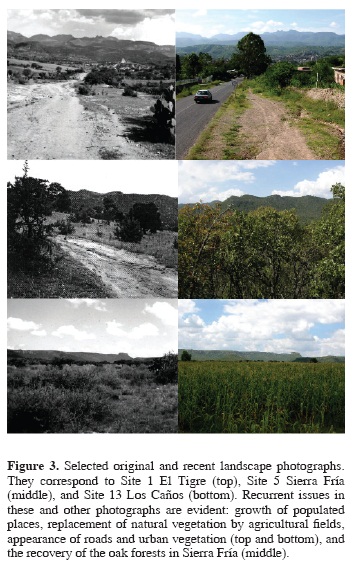
<body><![CDATA[<p align="center"><font face="verdana" size="2"><a name="f3"></a></font></p>     <p align="center"><font face="verdana" size="2"><img src="/img/revistas/rmbiodiv/v80n1/a25f3.jpg"></font></p>     <p align="justify"><font face="verdana" size="2">&nbsp;</font></p>     <p align="justify"><font face="verdana" size="2"><b>Discussion</b></font></p>     <p align="justify"><font face="verdana" size="2">Our study evaluated changes in the herpetofauna of Aguascalientes over a period of almost 50 years, by using historical data and landscape photographs in the context of intensive re&#150;sampling. Of the only 2 species missing in our recent surveys, <i>Craugastor augusti </i>is a frog with cryptic behavior and ecology (Goldberg and Schwalbe, 2004), and we have found it in previous years in the Sierra Fr&iacute;a, so it is still present in the state. The first specimen of <i>Holbrookia maculata </i>in Aguascalientes was collected in 1959, several individuals were observed and 1 collected in 1971 (Anderson and Lidicker, 1963; McCranie and Wilson, 2001), and its absence in our recent surveys is puzzling, especially because this is a conspicuous species in other localities where it does occur (Stebbins, 2003). The <i>H. maculata </i>locality is in the middle of the first irrigation district in M&eacute;xico, and its establishment, with the subsequent increase in agricultural activities and change in land use, might explain the absence of <i>H. maculata. </i>Perhaps this species is more vulnerable than previously thought, as elsewhere it has disappeared even where it was abundant as recently as 1982 (Taggart, 2006). Although we can not confidently assert that the species is eradicated from Aguascalientes, we encourage studies focused on this species to determine with certainty its status in the state.</font></p>     <p align="justify"><font face="verdana" size="2">The taxonomic status of the several species of <i>Lithobates </i>(Frost et al., 2006) in the southern part of the Mexican Plateau has been historically in flux, and older references to <i>L. pipiens </i>may have pertained to several species in the <i>L. pipiens </i>complex (Hillis, 1988). The specimens found in Aguascalientes in 1958 and 1959 seem to be part of what is now known as the <i>Stertirana </i>complex (Hillis and Wilcox, 2005) and most similar to <i>L. montezumae, </i>a species common throughout the state and that we found in 2004.</font></p>     <p align="justify"><font face="verdana" size="2">Several new records of amphibians and reptiles for Aguascalientes resulted from our 2004 and other recent surveys, and clearly, the rate of species discovery has not yet reached a plateau. That we encountered more species in 2004 than were found in 1958&#150;1959 cannot be attributed to the improvement of habitat conditions in subsequent decades, and invasions seem unlikely. Instead, we think the differences refl ect the MVZ expeditions' preoccupation with mammals and birds, whereas we focused exclusively on amphibians and reptiles; they recorded 40 species of birds and 39 species of mammals, and contemporary studies might well document changes in those groups relative to the MVZ baseline collections.</font></p>     <p align="justify"><font face="verdana" size="2">A common criticism of comparative studies of survey data is that they could easily be biased by high environmental variability among years. This problem is especially relevant for amphibians and reptiles because their daily and seasonal activities are heavily infl uenced by environmental conditions. In Aguascalientes, as in many other regions, the number of species found in dry years is typically small compared to those with high precipitation. Fortunately for our comparisons, both 1959 and 2004 were years with high levels of precipitation following a period of drier years in Aguascalientes (Sosa&#150;Ram&iacute;rez, 1998).</font></p>     <p align="justify"><font face="verdana" size="2">The original and new landscape photographs provide a glimpse of historical changes at a geographically and ecologically diverse set of localities, and have important implications for conservation planning. Our findings reveal extensive corn plantations replacing thorn shrub vegetation, guava fruit plantations displacing large areas in the southwestern portion of the state that were formerly tropical deciduous forest, and widespread urbanization. These habitat modifications undoubtedly diminish the likelihood that many species of vertebrates can persist in the long term. Photographs from Sierra Fr&iacute;a, the largest remaining forests in Aguascalientes, show an increase in oak <i>(Quercus sp.) </i>coverage, with much of the change visible as young trees. This corroborates previous research comparing aerial photographs that revealed a replacement of pines and pine&#150;oak forests by <i>Juniperus deppeana </i>and other arbustive species after the intensive logging extraction in Sierra Fr&iacute;a between 1920 and 1950 (Minnich et al., 1994). The consequences of these changes for faunal communities remain to be explored.</font></p>     <p align="justify"><font face="verdana" size="2">Tropical deciduous forest hosts high levels of biological endemicity, is globally endangered (Flores&#150;Villela and Gerez, 1994), and its persistence in Aguascalientes might be threatened. This vegetation type covers a small area in the southwestern part of the state, harbors elements of the humid Pacific Coast biota, and unfortunately, as shown in the photographs, has recently been extensively displaced by fruit plantations. Otherwise widely distributed species that reach Aguascalientes only in tropical deciduous forest, like the colubrid snakes <i>Drymarchon melanurus </i>(Central American Indigo Snake), <i>Oxybelis aeneus </i>(Brown Vinesnake), and <i>Senticolis triaspis </i>(Green Ratsnake) will likely become locally extinct when this habitat type disappears.</font></p>     ]]></body>
<body><![CDATA[<p align="justify"><font face="verdana" size="2">Ecological and natural history data suggest that certain species are particularly vulnerable to extinction in Aguascalientes. Among amphibians, <i>Smilisca dentata </i>(Upland Burrowing Treefrog) has a highly restricted distribution and is present only in the southern tip of the state and nearby areas in northern Jalisco; the Aguascalientes locality is heavily used by cattle and there are plans to subdivide and sell the land (Quintero D&iacute;az, pers. comm.). The plethodontid salamander <i>Pseudoeurycea bellii, </i>was only discovered in Aguascalientes in 2003 in the Sierra Fr&iacute;a after being missed in previous years of work; its presence was predicted (McCranie and Wilson, 2001), and perhaps this species is particularly secretive or unusually rare there. Most Mexican ambystomatids are declining due to pollution, habitat modification, loss of preferred habitats, and widespread introduction of exotic fishes for human consumption (Huacuz&#150;El&iacute;as, 2001). While pollution and intense farming don't seem to <i>threaten Ambystoma tigrinum </i>(Tiger Salamander) in New M&eacute;xico, USA (Degenhardt et al., 1996), the effects of those impacts and non&#150;native predators have not been evaluated in Aguascalientes.</font></p>     <p align="justify"><font face="verdana" size="2">Among reptiles in Aguascalientes, <i>Phrynosoma modestum </i>(Round&#150;tailed Horned Lizard) is at the southernmost limit of its distribution (Sherbrooke, 2003) and known from a single specimen (McCranie and Wilson, 2001) in the northeastern part of the state; several attempts to locate additional specimens have been unsuccessful. <i>Drymarchon melanurus </i>is large, active and in Aguascalientes associated with humid environments in tropical deciduous forest; the first specimen dates to 1980 (McCranie, 1980) and a second one was captured in 2005 (Quintero&#150;D&iacute;az, pers. comm.). <i>Crotalus pricei </i>(Twin Spotted Rattlesnake) is known for the state from only 3 specimens, reaches the southern tip of its distribution there, and although it occurs widely in the Sierra Madre Occidental and Sierra Madre Oriental, the population in Aguascalientes is isolated and has proven elusive despite intensive efforts in the last decade. Similarly, the distribution of <i>C. aquilus </i>(Queretaran Dusky Rattlesnake) barely reaches Aguascalientes through the Sierra del Laurel in the southwestern part of the state; this species is primarily associated with the Trans&#150;volcanic belt in central M&eacute;xico.</font></p>     <p align="justify"><font face="verdana" size="2">Those species of amphibians and reptiles recorded by at most a few specimens emphasize that Aguascalientes, despite its small size, encompasses the distributional limits of several species due to the junction of several diverse physiographical regions. The study of peripheral populations and comparison with those in the core of the distribution ranges are critical in the conservation efforts of endangered species (Channell and Lomolino, 2000), and emphasizes the importance of the state for the biogeography and conservation of Mexican herpetofauna.</font></p>     <p align="justify"><font face="verdana" size="2">Aguascalientes has between 60% and 80% of its surface altered by human activity (Flores&#150;Villela and Gerez, 1994), and unfortunately this mirrors the global environmental crisis. Our results call attention to high rates of change as natural environments are displaced by anthropogenic activities, as well as a key way that scientific collections, given their intrinsically historical nature, can aid in conservation. More than a century ago, Joseph Grinnell at the MVZ envisioned this role for natural history museums (Shaffer et al., 1998), and we urge increased support for field research in the service of protecting nature (Greene, 2005).</font></p>     <p align="justify"><font face="verdana" size="2">&nbsp;</font></p>     <p align="justify"><font face="verdana" size="2"><b>Acknowledgments</b></font></p>     <p align="justify"><font face="verdana" size="2">We thank W. Lidicker for graciously sharing field notes, photographic material and stories about his expeditions to Aguascalientes; J. Valencia Villegas, G. Gonz&aacute;lez Adame, J. I. Sigala Rodr&iacute;guez, J. Rodr&iacute;guez Femat, A. Valencia Villegas, E. Meza Rangel, S. Sigala Meza and E. Sigala Meza for help and companionship in the field; C. Moritz, K. Klitz and J. McGuire for access to specimens and documents at MVZ; T. Devitt and M. Mitchell for help during the visit of JJSR to the MVZ; J. Robertson, K. Zamudio, and G. Quintero for helpful comments on the manuscript; A. Guerrero P&eacute;rez and C. Guerrero P&eacute;rez for allowing us to work in their land; L. Leon for advice on locating a difficult place in Sierra Fr&iacute;a; and J. Sigala Valencia and B. Rodr&iacute;guez Obreg&oacute;n for help with field logistics. We received financial support from the Consejo de Ciencia y Tecnolog&iacute;a del Estado de Aguascalientes, Consejo Nacional de Ciencia y Tecnolog&iacute;a at M&eacute;xico, the Museum of Vertebrate Zoology at the University of California Berkeley, the department of Ecology and Evolutionary Biology, and the Latin American Studies Program at Cornell University to JJSR, and from the Lichen Foundation to HWG.</font></p>     <p align="justify"><font face="verdana" size="2">&nbsp;</font></p>     <p align="justify"><font face="verdana" size="2"><b>Literature cited</b></font></p>     <!-- ref --><p align="justify"><font face="verdana" size="2">Anderson, J. D. and W. Z. Lidicker, Jr. 1963. A contribution of our knowledge of the Herpetofauna of the Mexican State of Aguascalientes. Herpetologica 19:40&#150;51.</font>&nbsp;&nbsp;&nbsp;&nbsp;&nbsp;&nbsp;&nbsp;&nbsp;[&#160;<a href="javascript:void(0);" onclick="javascript: window.open('/scielo.php?script=sci_nlinks&ref=7498853&pid=S1870-3453200900010002500001&lng=','','width=640,height=500,resizable=yes,scrollbars=1,menubar=yes,');">Links</a>&#160;]<!-- end-ref --><!-- ref --><p align="justify"><font face="verdana" size="2">Banta, B. H. 1962. The amphibians and reptiles from the state of Aguascalientes, M&eacute;xico, in the collections of the California Academy of Sciences. Wasmann Journal of Biology 20: 99&#150;105.</font>&nbsp;&nbsp;&nbsp;&nbsp;&nbsp;&nbsp;&nbsp;&nbsp;[&#160;<a href="javascript:void(0);" onclick="javascript: window.open('/scielo.php?script=sci_nlinks&ref=7498854&pid=S1870-3453200900010002500002&lng=','','width=640,height=500,resizable=yes,scrollbars=1,menubar=yes,');">Links</a>&#160;]<!-- end-ref --><!-- ref --><p align="justify"><font face="verdana" size="2">Brodman, R., S. Cortwright and A. Resetar. 2002. Historical changes of reptiles and amphibians of northwest Indiana fish and wildlife properties. American Midland Naturalist 147: 135&#150;144.</font>&nbsp;&nbsp;&nbsp;&nbsp;&nbsp;&nbsp;&nbsp;&nbsp;[&#160;<a href="javascript:void(0);" onclick="javascript: window.open('/scielo.php?script=sci_nlinks&ref=7498855&pid=S1870-3453200900010002500003&lng=','','width=640,height=500,resizable=yes,scrollbars=1,menubar=yes,');">Links</a>&#160;]<!-- end-ref --><!-- ref --><p align="justify"><font face="verdana" size="2">Burt, C. E. 1931. A study of the Teiid lizards of the genus <i>Cnemidophorus </i>with special reference to their phylogenetic relationships. United States National Museum Bulletin: viii + 1&#150;286.</font>&nbsp;&nbsp;&nbsp;&nbsp;&nbsp;&nbsp;&nbsp;&nbsp;[&#160;<a href="javascript:void(0);" onclick="javascript: window.open('/scielo.php?script=sci_nlinks&ref=7498856&pid=S1870-3453200900010002500004&lng=','','width=640,height=500,resizable=yes,scrollbars=1,menubar=yes,');">Links</a>&#160;]<!-- end-ref --><!-- ref --><p align="justify"><font face="verdana" size="2">Camper, J. D. 1996. <i>Masticophis taeniatus. </i>Catalogue of American Amphibians and Reptiles 637: 1&#150;6.</font>&nbsp;&nbsp;&nbsp;&nbsp;&nbsp;&nbsp;&nbsp;&nbsp;[&#160;<a href="javascript:void(0);" onclick="javascript: window.open('/scielo.php?script=sci_nlinks&ref=7498857&pid=S1870-3453200900010002500005&lng=','','width=640,height=500,resizable=yes,scrollbars=1,menubar=yes,');">Links</a>&#160;]<!-- end-ref --><!-- ref --><p align="justify"><font face="verdana" size="2">Casas&#150;Andreu, G., G. Valenzuela&#150;L&oacute;pez and A. Ram&iacute;rez&#150;Bautista. 1991. C&oacute;mo hacer una colecci&oacute;n de anfibios y reptiles. Instituto de Biolog&iacute;a UNAM. M&eacute;xico, D.F. 68 p.</font>&nbsp;&nbsp;&nbsp;&nbsp;&nbsp;&nbsp;&nbsp;&nbsp;[&#160;<a href="javascript:void(0);" onclick="javascript: window.open('/scielo.php?script=sci_nlinks&ref=7498858&pid=S1870-3453200900010002500006&lng=','','width=640,height=500,resizable=yes,scrollbars=1,menubar=yes,');">Links</a>&#160;]<!-- end-ref --><!-- ref --><p align="justify"><font face="verdana" size="2">Channell, R. and M. V. Lomolino. 2000. Dynamic biogeography and conservation of endangered species. Nature 403: 84&#150;86.</font>&nbsp;&nbsp;&nbsp;&nbsp;&nbsp;&nbsp;&nbsp;&nbsp;[&#160;<a href="javascript:void(0);" onclick="javascript: window.open('/scielo.php?script=sci_nlinks&ref=7498859&pid=S1870-3453200900010002500007&lng=','','width=640,height=500,resizable=yes,scrollbars=1,menubar=yes,');">Links</a>&#160;]<!-- end-ref --><!-- ref --><p align="justify"><font face="verdana" size="2">CONABIO (Comisi&oacute;n Nacional para el Conocimiento y Uso de la Biodiversidad). 1998. INEGI &#150; INE (1996) "Uso de suelo y vegetaci&oacute;n". Agrupado por CONABIO. Escala 1:1 000 000. M&eacute;xico.</font>&nbsp;&nbsp;&nbsp;&nbsp;&nbsp;&nbsp;&nbsp;&nbsp;[&#160;<a href="javascript:void(0);" onclick="javascript: window.open('/scielo.php?script=sci_nlinks&ref=7498860&pid=S1870-3453200900010002500008&lng=','','width=640,height=500,resizable=yes,scrollbars=1,menubar=yes,');">Links</a>&#160;]<!-- end-ref --><!-- ref --><p align="justify"><font face="verdana" size="2">Chrapliwy, P. S. 1956. Extensions of known ranges of certain amphibians and reptiles of Mexico. Herpetologica 12: 121&#150;124.</font>&nbsp;&nbsp;&nbsp;&nbsp;&nbsp;&nbsp;&nbsp;&nbsp;[&#160;<a href="javascript:void(0);" onclick="javascript: window.open('/scielo.php?script=sci_nlinks&ref=7498861&pid=S1870-3453200900010002500009&lng=','','width=640,height=500,resizable=yes,scrollbars=1,menubar=yes,');">Links</a>&#160;]<!-- end-ref --><!-- ref --><p align="justify"><font face="verdana" size="2">Chrapliwy, P. S., K. Williams and H. M. Smith. 1961. Noteworthy records of amphibians from Mexico. Herpetologica 17: 85&#150;90.</font>&nbsp;&nbsp;&nbsp;&nbsp;&nbsp;&nbsp;&nbsp;&nbsp;[&#160;<a href="javascript:void(0);" onclick="javascript: window.open('/scielo.php?script=sci_nlinks&ref=7498862&pid=S1870-3453200900010002500010&lng=','','width=640,height=500,resizable=yes,scrollbars=1,menubar=yes,');">Links</a>&#160;]<!-- end-ref --><!-- ref --><p align="justify"><font face="verdana" size="2">Crother, B. I. (ed.) (2008). Scientific and standard English names of amphibians and reptiles of North America North of Mexico. SSAR Herpetological Circular 37. p. 1&#150;84.</font>&nbsp;&nbsp;&nbsp;&nbsp;&nbsp;&nbsp;&nbsp;&nbsp;[&#160;<a href="javascript:void(0);" onclick="javascript: window.open('/scielo.php?script=sci_nlinks&ref=7498863&pid=S1870-3453200900010002500011&lng=','','width=640,height=500,resizable=yes,scrollbars=1,menubar=yes,');">Links</a>&#160;]<!-- end-ref --><!-- ref --><p align="justify"><font face="verdana" size="2">Degenhardt, W. G., C. W. Painter and A. H. Price. 1996. The amphibians and reptiles of New Mexico. Albuquerque, University of New Mexico Press. xix, 431 p.</font>&nbsp;&nbsp;&nbsp;&nbsp;&nbsp;&nbsp;&nbsp;&nbsp;[&#160;<a href="javascript:void(0);" onclick="javascript: window.open('/scielo.php?script=sci_nlinks&ref=7498864&pid=S1870-3453200900010002500012&lng=','','width=640,height=500,resizable=yes,scrollbars=1,menubar=yes,');">Links</a>&#160;]<!-- end-ref --><!-- ref --><p align="justify"><font face="verdana" size="2">Flores&#150;Villela, O. A. and P. Gerez. 1994. Biodiversidad y conservaci&oacute;n en M&eacute;xico: vertebrados, vegetaci&oacute;n y uso del suelo. Mexico, Comisi&oacute;n Nacional para el Conocimiento y Uso de la Biodiversidad y Universidad Nacional Aut&oacute;noma de M&eacute;xico. xvi, 1&#150;439 p. </font>&nbsp;&nbsp;&nbsp;&nbsp;&nbsp;&nbsp;&nbsp;&nbsp;[&#160;<a href="javascript:void(0);" onclick="javascript: window.open('/scielo.php?script=sci_nlinks&ref=7498865&pid=S1870-3453200900010002500013&lng=','','width=640,height=500,resizable=yes,scrollbars=1,menubar=yes,');">Links</a>&#160;]<!-- end-ref --><!-- ref --><p align="justify"><font face="verdana" size="2">Flores&#150;Villela, O. A. y L. Canseco&#150;Marquez. 2004. Nuevas especies y cambios taxon&oacute;micos para la herpetofauna de M&eacute;xico. Acta Zoologica Mexicana (n.s.) 20:115&#150;144. </font>&nbsp;&nbsp;&nbsp;&nbsp;&nbsp;&nbsp;&nbsp;&nbsp;[&#160;<a href="javascript:void(0);" onclick="javascript: window.open('/scielo.php?script=sci_nlinks&ref=7498866&pid=S1870-3453200900010002500014&lng=','','width=640,height=500,resizable=yes,scrollbars=1,menubar=yes,');">Links</a>&#160;]<!-- end-ref --><!-- ref --><p align="justify"><font face="verdana" size="2">Frost, D. R., T. Grant, J. Faivovich, R. Bain, A. Haas, C. F. B. Haddad, R. O. de S&aacute;, A. Channing, M. Wilkinson, S. C. Donnellan, C. J. Raxworthy, J. A. Campbell, B. L. Blotto, P. Moler, R. C. Drewes, R. A. Nussbaum, J. D. Lynch, D. M. Green and W. C. Wheeler. 2006. The amphibian tree of life. Bulletin of the American Museum of Natural History 297:1&#150;370. </font>&nbsp;&nbsp;&nbsp;&nbsp;&nbsp;&nbsp;&nbsp;&nbsp;[&#160;<a href="javascript:void(0);" onclick="javascript: window.open('/scielo.php?script=sci_nlinks&ref=7498867&pid=S1870-3453200900010002500015&lng=','','width=640,height=500,resizable=yes,scrollbars=1,menubar=yes,');">Links</a>&#160;]<!-- end-ref --><!-- ref --><p align="justify"><font face="verdana" size="2">Gibbs, J. P., K. K. Whiteleather and F. W. Schueler. 2005. Changes in frog and toad populations over 30 years in New York State. Ecological Applications  15:   1148&#150; 1157. </font>&nbsp;&nbsp;&nbsp;&nbsp;&nbsp;&nbsp;&nbsp;&nbsp;[&#160;<a href="javascript:void(0);" onclick="javascript: window.open('/scielo.php?script=sci_nlinks&ref=7498868&pid=S1870-3453200900010002500016&lng=','','width=640,height=500,resizable=yes,scrollbars=1,menubar=yes,');">Links</a>&#160;]<!-- end-ref --><!-- ref --><p align="justify"><font face="verdana" size="2">Goldberg, C. S. and C. R. Schwalbe. 2004. Considerations for monitoring a rare anuran <i>(Eleutherodactylus augusti). </i>The Southwestern Naturalist 49:442&#150;448. </font>&nbsp;&nbsp;&nbsp;&nbsp;&nbsp;&nbsp;&nbsp;&nbsp;[&#160;<a href="javascript:void(0);" onclick="javascript: window.open('/scielo.php?script=sci_nlinks&ref=7498869&pid=S1870-3453200900010002500017&lng=','','width=640,height=500,resizable=yes,scrollbars=1,menubar=yes,');">Links</a>&#160;]<!-- end-ref --><!-- ref --><p align="justify"><font face="verdana" size="2">Greene, H. W. 2005. Organisms in nature as a central focus for biology. Trends in Ecology and Evolution 20:23&#150;27. </font>&nbsp;&nbsp;&nbsp;&nbsp;&nbsp;&nbsp;&nbsp;&nbsp;[&#160;<a href="javascript:void(0);" onclick="javascript: window.open('/scielo.php?script=sci_nlinks&ref=7498870&pid=S1870-3453200900010002500018&lng=','','width=640,height=500,resizable=yes,scrollbars=1,menubar=yes,');">Links</a>&#160;]<!-- end-ref --><!-- ref --><p align="justify"><font face="verdana" size="2">Harris, H. S. and R. S. Simmons.  1978. A preliminary account of the rattlesnakes with the descriptions of four new subspecies. Bulletin of the Maryland Herpetological Society 14:105&#150;211. </font>&nbsp;&nbsp;&nbsp;&nbsp;&nbsp;&nbsp;&nbsp;&nbsp;[&#160;<a href="javascript:void(0);" onclick="javascript: window.open('/scielo.php?script=sci_nlinks&ref=7498871&pid=S1870-3453200900010002500019&lng=','','width=640,height=500,resizable=yes,scrollbars=1,menubar=yes,');">Links</a>&#160;]<!-- end-ref --><!-- ref --><p align="justify"><font face="verdana" size="2">Hillis, D. M. 1988. Systematics of the <i>Rana pipiens </i>complex: puzzle and paradigm. Annual Review of Ecology and Systematics. 19:39&#150;63. </font>&nbsp;&nbsp;&nbsp;&nbsp;&nbsp;&nbsp;&nbsp;&nbsp;[&#160;<a href="javascript:void(0);" onclick="javascript: window.open('/scielo.php?script=sci_nlinks&ref=7498872&pid=S1870-3453200900010002500020&lng=','','width=640,height=500,resizable=yes,scrollbars=1,menubar=yes,');">Links</a>&#160;]<!-- end-ref --><!-- ref --><p align="justify"><font face="verdana" size="2">Hillis, D. M. and T. P. Wilcox. 2005. Phylogeny of the New World true frogs <i>(Rana). </i>Molecular Phylogenetics and Evolution 34:299&#150;314. </font>&nbsp;&nbsp;&nbsp;&nbsp;&nbsp;&nbsp;&nbsp;&nbsp;[&#160;<a href="javascript:void(0);" onclick="javascript: window.open('/scielo.php?script=sci_nlinks&ref=7498873&pid=S1870-3453200900010002500021&lng=','','width=640,height=500,resizable=yes,scrollbars=1,menubar=yes,');">Links</a>&#160;]<!-- end-ref --><!-- ref --><p align="justify"><font face="verdana" size="2">Hossack, B. R., P. S. Corn and D. Pilliod. 2005. Lack of significant changes in the herpetofauna of Theodore Roosevelt National Park, North Dakota, since the 1920s. American Midland Naturalist 154:423&#150;432. </font>&nbsp;&nbsp;&nbsp;&nbsp;&nbsp;&nbsp;&nbsp;&nbsp;[&#160;<a href="javascript:void(0);" onclick="javascript: window.open('/scielo.php?script=sci_nlinks&ref=7498874&pid=S1870-3453200900010002500022&lng=','','width=640,height=500,resizable=yes,scrollbars=1,menubar=yes,');">Links</a>&#160;]<!-- end-ref --><!-- ref --><p align="justify"><font face="verdana" size="2">Huacuz&#150;El&iacute;as, D.  C.  2001. Estado de conservaci&oacute;n del g&eacute;nero <i>Ambystoma </i>en Michoac&aacute;n,  M&eacute;xico. M&eacute;xico, Universidad Michoacana de San Nicol&aacute;s de Hidalgo&#150; UNAM&#150;SEMARNAT. Morelia. 44 p. </font>&nbsp;&nbsp;&nbsp;&nbsp;&nbsp;&nbsp;&nbsp;&nbsp;[&#160;<a href="javascript:void(0);" onclick="javascript: window.open('/scielo.php?script=sci_nlinks&ref=7498875&pid=S1870-3453200900010002500023&lng=','','width=640,height=500,resizable=yes,scrollbars=1,menubar=yes,');">Links</a>&#160;]<!-- end-ref --><!-- ref --><p align="justify"><font face="verdana" size="2">INEGI   (Instituto  Nacional   de  Estad&iacute;stica,   Geograf&iacute;a  e Inform&aacute;tica). 1995. Estad&iacute;sticas del Medio Ambiente. M&eacute;xico 1994. Aguascalientes. 447 p. </font>&nbsp;&nbsp;&nbsp;&nbsp;&nbsp;&nbsp;&nbsp;&nbsp;[&#160;<a href="javascript:void(0);" onclick="javascript: window.open('/scielo.php?script=sci_nlinks&ref=7498876&pid=S1870-3453200900010002500024&lng=','','width=640,height=500,resizable=yes,scrollbars=1,menubar=yes,');">Links</a>&#160;]<!-- end-ref --><!-- ref --><p align="justify"><font face="verdana" size="2">INEGI   (Instituto  Nacional   de  Estad&iacute;stica,   Geograf&iacute;a  e Inform&aacute;tica). 2005. Anuario Estad&iacute;stico. Aguascalientes. Aguascalientes,   M&eacute;xico,   Gobierno   del   Estado   de Aguascalientes. 564 p. </font>&nbsp;&nbsp;&nbsp;&nbsp;&nbsp;&nbsp;&nbsp;&nbsp;[&#160;<a href="javascript:void(0);" onclick="javascript: window.open('/scielo.php?script=sci_nlinks&ref=7498877&pid=S1870-3453200900010002500025&lng=','','width=640,height=500,resizable=yes,scrollbars=1,menubar=yes,');">Links</a>&#160;]<!-- end-ref --><!-- ref --><p align="justify"><font face="verdana" size="2">Knight, J.2003 .Zoologists prime traps for California wildlife survey. Nature 424:987. </font>&nbsp;&nbsp;&nbsp;&nbsp;&nbsp;&nbsp;&nbsp;&nbsp;[&#160;<a href="javascript:void(0);" onclick="javascript: window.open('/scielo.php?script=sci_nlinks&ref=7498878&pid=S1870-3453200900010002500026&lng=','','width=640,height=500,resizable=yes,scrollbars=1,menubar=yes,');">Links</a>&#160;]<!-- end-ref --><!-- ref --><p align="justify"><font face="verdana" size="2">Kotiaho, J. S., V. Kaitala, A. Komonen and J. Paivinen. 2005. Predicting the risk of extinction from shared ecological characteristics. Proceedings of the National Academy of Sciences USA 102:1963&#150;1967. </font>&nbsp;&nbsp;&nbsp;&nbsp;&nbsp;&nbsp;&nbsp;&nbsp;[&#160;<a href="javascript:void(0);" onclick="javascript: window.open('/scielo.php?script=sci_nlinks&ref=7498879&pid=S1870-3453200900010002500027&lng=','','width=640,height=500,resizable=yes,scrollbars=1,menubar=yes,');">Links</a>&#160;]<!-- end-ref --><!-- ref --><p align="justify"><font face="verdana" size="2">Lannoo, M. J., K. Lang, T. Waltz and G. S. Phillips. 1994. An altered amphibian assemblage: Dickinson County, Iowa, 70 years after Frank Blanchard's survey. American Midland Naturalist 131:311&#150;319. </font>&nbsp;&nbsp;&nbsp;&nbsp;&nbsp;&nbsp;&nbsp;&nbsp;[&#160;<a href="javascript:void(0);" onclick="javascript: window.open('/scielo.php?script=sci_nlinks&ref=7498880&pid=S1870-3453200900010002500028&lng=','','width=640,height=500,resizable=yes,scrollbars=1,menubar=yes,');">Links</a>&#160;]<!-- end-ref --><!-- ref --><p align="justify"><font face="verdana" size="2">Liner, E. A. 1994. Scientific and common names for the amphibians  and reptiles  of Mexico  in English and Spanish. SSAR Herp. Circular 23. Lawrence. p. 1&#150;113. </font>&nbsp;&nbsp;&nbsp;&nbsp;&nbsp;&nbsp;&nbsp;&nbsp;[&#160;<a href="javascript:void(0);" onclick="javascript: window.open('/scielo.php?script=sci_nlinks&ref=7498881&pid=S1870-3453200900010002500029&lng=','','width=640,height=500,resizable=yes,scrollbars=1,menubar=yes,');">Links</a>&#160;]<!-- end-ref --><!-- ref --><p align="justify"><font face="verdana" size="2">McCranie, J. R. 1980. <i>Drymarchon, D. corais. </i>Catalogue of American Amphibians and Reptiles. Society for the study of Amphibians and Reptiles. Lawrence. p. 267.1&#150;267.4. </font>&nbsp;&nbsp;&nbsp;&nbsp;&nbsp;&nbsp;&nbsp;&nbsp;[&#160;<a href="javascript:void(0);" onclick="javascript: window.open('/scielo.php?script=sci_nlinks&ref=7498882&pid=S1870-3453200900010002500030&lng=','','width=640,height=500,resizable=yes,scrollbars=1,menubar=yes,');">Links</a>&#160;]<!-- end-ref --><!-- ref --><p align="justify"><font face="verdana" size="2">McCranie, J. R. and L. D. Wilson. 1984. New herpetological records    for    the    Mexican    state    of   Aguascalientes. Herpetological Review 15:22. </font>&nbsp;&nbsp;&nbsp;&nbsp;&nbsp;&nbsp;&nbsp;&nbsp;[&#160;<a href="javascript:void(0);" onclick="javascript: window.open('/scielo.php?script=sci_nlinks&ref=7498883&pid=S1870-3453200900010002500031&lng=','','width=640,height=500,resizable=yes,scrollbars=1,menubar=yes,');">Links</a>&#160;]<!-- end-ref --><!-- ref --><p align="justify"><font face="verdana" size="2">McCranie, J. R. and L. D. Wilson. 2001. The herpetofauna of the Mexican State of Aguascalientes. Courier Forschungsinstitut Senckenberg 230:1&#150;57. </font>&nbsp;&nbsp;&nbsp;&nbsp;&nbsp;&nbsp;&nbsp;&nbsp;[&#160;<a href="javascript:void(0);" onclick="javascript: window.open('/scielo.php?script=sci_nlinks&ref=7498884&pid=S1870-3453200900010002500032&lng=','','width=640,height=500,resizable=yes,scrollbars=1,menubar=yes,');">Links</a>&#160;]<!-- end-ref --><!-- ref --><p align="justify"><font face="verdana" size="2">McDiarmid, R. W. and N. J.  Scott, Jr.  1970.  Geographic variation and systematic status of Mexican lyre snakes of the <i>Trimorphodon tau </i>Group (Colubridae). Los Angeles County Museum Contributions in Science 48:1&#150;43. </font>&nbsp;&nbsp;&nbsp;&nbsp;&nbsp;&nbsp;&nbsp;&nbsp;[&#160;<a href="javascript:void(0);" onclick="javascript: window.open('/scielo.php?script=sci_nlinks&ref=7498885&pid=S1870-3453200900010002500033&lng=','','width=640,height=500,resizable=yes,scrollbars=1,menubar=yes,');">Links</a>&#160;]<!-- end-ref --><!-- ref --><p align="justify"><font face="verdana" size="2">Mendoza&#150;Quijano, F., S. d. M. A. Mejenes L&oacute;pez, V. H. Reynoso&#150; Rosales,  M.  A.  Estrada Hern&aacute;ndez and M.  Rodr&iacute;guez Blanco. 2001. Anfibios y reptiles de la sierra de Santa Rosa, Guanajuato: cien a&ntilde;os despu&eacute;s. Anales del Instituto de Biolog&iacute;a, UNAM. Serie Zoolog&iacute;a 72:233&#150;243. </font>&nbsp;&nbsp;&nbsp;&nbsp;&nbsp;&nbsp;&nbsp;&nbsp;[&#160;<a href="javascript:void(0);" onclick="javascript: window.open('/scielo.php?script=sci_nlinks&ref=7498886&pid=S1870-3453200900010002500034&lng=','','width=640,height=500,resizable=yes,scrollbars=1,menubar=yes,');">Links</a>&#160;]<!-- end-ref --><!-- ref --><p align="justify"><font face="verdana" size="2">Minnich, R., J. Sosa Ram&iacute;rez, E. Franco Vizca&iacute;no, J. Barry and M. E. Siqueiros Delgado. 1994. Reconocimiento preliminar de la vegetaci&oacute;n y de los impactos de las actividades humanas en la Sierra Fr&iacute;a, Aguascalientes, M&eacute;xico. Investigaci&oacute;n y Ciencia 12:23&#150;29. </font>&nbsp;&nbsp;&nbsp;&nbsp;&nbsp;&nbsp;&nbsp;&nbsp;[&#160;<a href="javascript:void(0);" onclick="javascript: window.open('/scielo.php?script=sci_nlinks&ref=7498887&pid=S1870-3453200900010002500035&lng=','','width=640,height=500,resizable=yes,scrollbars=1,menubar=yes,');">Links</a>&#160;]<!-- end-ref --><!-- ref --><p align="justify"><font face="verdana" size="2">Ochoa Ochoa, L. M. and O. A. Flores Villela. 2006. &Aacute;reas de Diversidad y Endemismo de la Herpetofauna Mexicana., UNAM&#150;CONABIO, M&eacute;xico, D. F. 211 p. </font>&nbsp;&nbsp;&nbsp;&nbsp;&nbsp;&nbsp;&nbsp;&nbsp;[&#160;<a href="javascript:void(0);" onclick="javascript: window.open('/scielo.php?script=sci_nlinks&ref=7498888&pid=S1870-3453200900010002500036&lng=','','width=640,height=500,resizable=yes,scrollbars=1,menubar=yes,');">Links</a>&#160;]<!-- end-ref --><!-- ref --><p align="justify"><font face="verdana" size="2">Quintero&#150;D&iacute;az, G., J. V&aacute;zquez&#150;D&iacute;az and H. M. Smith. 1999a. Geographic     distribution.    <i>Elgaria    kingii    ferruginea. </i>Herpetological Review 30:233&#150;234. </font>&nbsp;&nbsp;&nbsp;&nbsp;&nbsp;&nbsp;&nbsp;&nbsp;[&#160;<a href="javascript:void(0);" onclick="javascript: window.open('/scielo.php?script=sci_nlinks&ref=7498889&pid=S1870-3453200900010002500037&lng=','','width=640,height=500,resizable=yes,scrollbars=1,menubar=yes,');">Links</a>&#160;]<!-- end-ref --><!-- ref --><p align="justify"><font face="verdana" size="2">Quintero&#150;D&iacute;az,   G.,   J.   V&aacute;zquez&#150;D&iacute;az   and   H.   M.   Smith. 1999b.   Geographic   distribution.   <i>Thamnophis   scaliger. </i>Herpetological Review 30:237. </font>&nbsp;&nbsp;&nbsp;&nbsp;&nbsp;&nbsp;&nbsp;&nbsp;[&#160;<a href="javascript:void(0);" onclick="javascript: window.open('/scielo.php?script=sci_nlinks&ref=7498890&pid=S1870-3453200900010002500038&lng=','','width=640,height=500,resizable=yes,scrollbars=1,menubar=yes,');">Links</a>&#160;]<!-- end-ref --><!-- ref --><p align="justify"><font face="verdana" size="2">Quintero&#150;D&iacute;az, G. E., G. Gonz&aacute;lez&#150;Adame, J. V&aacute;zquez&#150;D&iacute;az, J. J. Sigala&#150;Rodr&iacute;guez, R. W. Bryson, Jr. and G. T. Salmon. 2001.  Geographic  Distribution:  <i>Lampropeltis  mexicana. </i>Herpetological Review 32:278. </font>&nbsp;&nbsp;&nbsp;&nbsp;&nbsp;&nbsp;&nbsp;&nbsp;[&#160;<a href="javascript:void(0);" onclick="javascript: window.open('/scielo.php?script=sci_nlinks&ref=7498891&pid=S1870-3453200900010002500039&lng=','','width=640,height=500,resizable=yes,scrollbars=1,menubar=yes,');">Links</a>&#160;]<!-- end-ref --><!-- ref --><p align="justify"><font face="verdana" size="2">Quintero D&iacute;az, G. E., Sigala Rodr&iacute;guez, J. J.,  J. V&aacute;quez D&iacute;az, J. L. Carrasco, J. I. Sigala Rodriguez, L. F. Lozano Rom&aacute;n and R. Galv&aacute;n de la Rosa. 2007. <i>Masticophis flagellum </i>(Distribution). Herpetological Review 38:488. </font>&nbsp;&nbsp;&nbsp;&nbsp;&nbsp;&nbsp;&nbsp;&nbsp;[&#160;<a href="javascript:void(0);" onclick="javascript: window.open('/scielo.php?script=sci_nlinks&ref=7498892&pid=S1870-3453200900010002500040&lng=','','width=640,height=500,resizable=yes,scrollbars=1,menubar=yes,');">Links</a>&#160;]<!-- end-ref --><!-- ref --><p align="justify"><font face="verdana" size="2">Ram&iacute;rez&#150;Bautista, A., J. V&aacute;zquez&#150;D&iacute;az and G. Quintero&#150;D&iacute;az. 1998. Geographic distribution. <i>Gerrhonotus liocephalus. </i>Herpetological Review 29:174. </font>&nbsp;&nbsp;&nbsp;&nbsp;&nbsp;&nbsp;&nbsp;&nbsp;[&#160;<a href="javascript:void(0);" onclick="javascript: window.open('/scielo.php?script=sci_nlinks&ref=7498893&pid=S1870-3453200900010002500041&lng=','','width=640,height=500,resizable=yes,scrollbars=1,menubar=yes,');">Links</a>&#160;]<!-- end-ref --><!-- ref --><p align="justify"><font face="verdana" size="2">Robinson, W. D. 1999. Long&#150;Term Changes in the Avifauna of Barro Colorado Island, Panama, a Tropical Forest Isolate. Conservation Biology 13:85&#150;97. </font>&nbsp;&nbsp;&nbsp;&nbsp;&nbsp;&nbsp;&nbsp;&nbsp;[&#160;<a href="javascript:void(0);" onclick="javascript: window.open('/scielo.php?script=sci_nlinks&ref=7498894&pid=S1870-3453200900010002500042&lng=','','width=640,height=500,resizable=yes,scrollbars=1,menubar=yes,');">Links</a>&#160;]<!-- end-ref --><!-- ref --><p align="justify"><font face="verdana" size="2">Schrott, G. R., K. A. With and A. W. King. 2005. On the importance of landscape history for assessing extinction risk. Ecological Applications 15: 493&#150;506. </font>&nbsp;&nbsp;&nbsp;&nbsp;&nbsp;&nbsp;&nbsp;&nbsp;[&#160;<a href="javascript:void(0);" onclick="javascript: window.open('/scielo.php?script=sci_nlinks&ref=7498895&pid=S1870-3453200900010002500043&lng=','','width=640,height=500,resizable=yes,scrollbars=1,menubar=yes,');">Links</a>&#160;]<!-- end-ref --><!-- ref --><p align="justify"><font face="verdana" size="2">Shaffer, H. B., R. N. Fisher and C. Davidson. 1998. The role of natural history collections in documenting species declines. Trends in Ecology and Evolution 13: 27&#150;30. </font>&nbsp;&nbsp;&nbsp;&nbsp;&nbsp;&nbsp;&nbsp;&nbsp;[&#160;<a href="javascript:void(0);" onclick="javascript: window.open('/scielo.php?script=sci_nlinks&ref=7498896&pid=S1870-3453200900010002500044&lng=','','width=640,height=500,resizable=yes,scrollbars=1,menubar=yes,');">Links</a>&#160;]<!-- end-ref --><!-- ref --><p align="justify"><font face="verdana" size="2">Sherbrooke, W. C. 2003. Introduction to horned lizards of North America. Berkeley, University of California Press. xiii, 177 p. </font>&nbsp;&nbsp;&nbsp;&nbsp;&nbsp;&nbsp;&nbsp;&nbsp;[&#160;<a href="javascript:void(0);" onclick="javascript: window.open('/scielo.php?script=sci_nlinks&ref=7498897&pid=S1870-3453200900010002500045&lng=','','width=640,height=500,resizable=yes,scrollbars=1,menubar=yes,');">Links</a>&#160;]<!-- end-ref --><!-- ref --><p align="justify"><font face="verdana" size="2">Sigala Rodr&iacute;guez, J. J. and J. V&aacute;zquez&#150;D&iacute;az. 1996. Serpientes venenosas de Aguascalientes. Aguascalientes, M&eacute;xico, OCA Gobierno del Estado de Aguascalientes. 33 p. </font>&nbsp;&nbsp;&nbsp;&nbsp;&nbsp;&nbsp;&nbsp;&nbsp;[&#160;<a href="javascript:void(0);" onclick="javascript: window.open('/scielo.php?script=sci_nlinks&ref=7498898&pid=S1870-3453200900010002500046&lng=','','width=640,height=500,resizable=yes,scrollbars=1,menubar=yes,');">Links</a>&#160;]<!-- end-ref --><!-- ref --><p align="justify"><font face="verdana" size="2">Sigala Rodr&iacute;guez, J. J., J. V&aacute;quez D&iacute;az, G. E. Quintero D&iacute;az, J. I. Sigala Rodr&iacute;guez, and R. Reyes Ardit. 2008. <i>Coluber </i><i>(=Masticophis)   taeniatus   </i>(Distribution).   Herpetological Review 39:240. </font>&nbsp;&nbsp;&nbsp;&nbsp;&nbsp;&nbsp;&nbsp;&nbsp;[&#160;<a href="javascript:void(0);" onclick="javascript: window.open('/scielo.php?script=sci_nlinks&ref=7498899&pid=S1870-3453200900010002500047&lng=','','width=640,height=500,resizable=yes,scrollbars=1,menubar=yes,');">Links</a>&#160;]<!-- end-ref --><!-- ref --><p align="justify"><font face="verdana" size="2">Simmons, J. E. 2002. Herpetological collecting and collections management. Revised Edition. Salt Lake City, Utah, Society for the Study of Amphibians and Reptiles. 153 p. </font>&nbsp;&nbsp;&nbsp;&nbsp;&nbsp;&nbsp;&nbsp;&nbsp;[&#160;<a href="javascript:void(0);" onclick="javascript: window.open('/scielo.php?script=sci_nlinks&ref=7498900&pid=S1870-3453200900010002500048&lng=','','width=640,height=500,resizable=yes,scrollbars=1,menubar=yes,');">Links</a>&#160;]<!-- end-ref --><!-- ref --><p align="justify"><font face="verdana" size="2">Smith,   H.  M.   and  R.  B.   Smith.   1979.   Synopsis   of the herpetofauna of Mexico. Volume VI. Guide to Mexican turtles biblographic addendum III. North Bennington, John Johnson. xviii + 1044 p. </font>&nbsp;&nbsp;&nbsp;&nbsp;&nbsp;&nbsp;&nbsp;&nbsp;[&#160;<a href="javascript:void(0);" onclick="javascript: window.open('/scielo.php?script=sci_nlinks&ref=7498901&pid=S1870-3453200900010002500049&lng=','','width=640,height=500,resizable=yes,scrollbars=1,menubar=yes,');">Links</a>&#160;]<!-- end-ref --><!-- ref --><p align="justify"><font face="verdana" size="2">Smith, H. M. and E. H. Taylor. 1945. An annotated checklist and key to the snakes of Mexico. Bulletin United States National Museum 187:1&#150;239. </font>&nbsp;&nbsp;&nbsp;&nbsp;&nbsp;&nbsp;&nbsp;&nbsp;[&#160;<a href="javascript:void(0);" onclick="javascript: window.open('/scielo.php?script=sci_nlinks&ref=7498902&pid=S1870-3453200900010002500050&lng=','','width=640,height=500,resizable=yes,scrollbars=1,menubar=yes,');">Links</a>&#160;]<!-- end-ref --><!-- ref --><p align="justify"><font face="verdana" size="2">Smith, H. M. and E. H. Taylor. 1948. An annotated ckecklist and key to the amphibia of M&eacute;xico. Bulletin United States National Museum 194:1&#150;118. </font>&nbsp;&nbsp;&nbsp;&nbsp;&nbsp;&nbsp;&nbsp;&nbsp;[&#160;<a href="javascript:void(0);" onclick="javascript: window.open('/scielo.php?script=sci_nlinks&ref=7498903&pid=S1870-3453200900010002500051&lng=','','width=640,height=500,resizable=yes,scrollbars=1,menubar=yes,');">Links</a>&#160;]<!-- end-ref --><!-- ref --><p align="justify"><font face="verdana" size="2">Smith, H. M. and E. H. Taylor. 1950. An annotated ckecklist and key to the reptiles of M&eacute;xico exclusive of the snakes. Bulletin United States National Museum199:1&#150;253. </font>&nbsp;&nbsp;&nbsp;&nbsp;&nbsp;&nbsp;&nbsp;&nbsp;[&#160;<a href="javascript:void(0);" onclick="javascript: window.open('/scielo.php?script=sci_nlinks&ref=7498904&pid=S1870-3453200900010002500052&lng=','','width=640,height=500,resizable=yes,scrollbars=1,menubar=yes,');">Links</a>&#160;]<!-- end-ref --><!-- ref --><p align="justify"><font face="verdana" size="2">Sosa&#150;Ram&iacute;rez, J. 1998. Agua y sustentabilidad en Aguascalientes. Aguascalientes,   Centro   de   Investigaciones   y   Estudios Multidisciplinarios de Aguascalientes A. C. y Gobierno del Estado de Aguascalientes. 121 p. </font>&nbsp;&nbsp;&nbsp;&nbsp;&nbsp;&nbsp;&nbsp;&nbsp;[&#160;<a href="javascript:void(0);" onclick="javascript: window.open('/scielo.php?script=sci_nlinks&ref=7498905&pid=S1870-3453200900010002500053&lng=','','width=640,height=500,resizable=yes,scrollbars=1,menubar=yes,');">Links</a>&#160;]<!-- end-ref --><!-- ref --><p align="justify"><font face="verdana" size="2">Stebbins, R. C. 2003. A field guide to western reptiles and amphibians. Boston, Houghton Mifflin. xiii, 533 p. </font>&nbsp;&nbsp;&nbsp;&nbsp;&nbsp;&nbsp;&nbsp;&nbsp;[&#160;<a href="javascript:void(0);" onclick="javascript: window.open('/scielo.php?script=sci_nlinks&ref=7498906&pid=S1870-3453200900010002500054&lng=','','width=640,height=500,resizable=yes,scrollbars=1,menubar=yes,');">Links</a>&#160;]<!-- end-ref --><!-- ref --><p align="justify"><font face="verdana" size="2">Taggart, T. W. 2006. Where have the <i>Holbrookia </i>gone? Journal of Kansas Herpetology 19:10. </font>&nbsp;&nbsp;&nbsp;&nbsp;&nbsp;&nbsp;&nbsp;&nbsp;[&#160;<a href="javascript:void(0);" onclick="javascript: window.open('/scielo.php?script=sci_nlinks&ref=7498907&pid=S1870-3453200900010002500055&lng=','','width=640,height=500,resizable=yes,scrollbars=1,menubar=yes,');">Links</a>&#160;]<!-- end-ref --><!-- ref --><p align="justify"><font face="verdana" size="2">Thomas, R. A. and J. R. Dixon.  1976. A re&#150;evaluation of the <i>Sceloporus scalaris </i>group  (Sauria:  Iguanidae).  The Southwestern Naturalist 20:523&#150;536. </font>&nbsp;&nbsp;&nbsp;&nbsp;&nbsp;&nbsp;&nbsp;&nbsp;[&#160;<a href="javascript:void(0);" onclick="javascript: window.open('/scielo.php?script=sci_nlinks&ref=7498908&pid=S1870-3453200900010002500056&lng=','','width=640,height=500,resizable=yes,scrollbars=1,menubar=yes,');">Links</a>&#160;]<!-- end-ref --><!-- ref --><p align="justify"><font face="verdana" size="2">V&aacute;zquez&#150;D&iacute;az, J. and G. Quintero&#150;D&iacute;az. 1997. Anfibios y Reptiles de Aguascalientes. Aguascalientes, CIEMA, Gobierno del Estado de Aguascalientes. 144 p. </font>&nbsp;&nbsp;&nbsp;&nbsp;&nbsp;&nbsp;&nbsp;&nbsp;[&#160;<a href="javascript:void(0);" onclick="javascript: window.open('/scielo.php?script=sci_nlinks&ref=7498909&pid=S1870-3453200900010002500057&lng=','','width=640,height=500,resizable=yes,scrollbars=1,menubar=yes,');">Links</a>&#160;]<!-- end-ref --><!-- ref --><p align="justify"><font face="verdana" size="2">V&aacute;zquez&#150;D&iacute;az,  J.  and G.  Quintero&#150;D&iacute;az.   1999.  Geographic distribution.  <i>Geophis dugesi aquilonaris.  </i>Herpetological Review 30:235. </font>&nbsp;&nbsp;&nbsp;&nbsp;&nbsp;&nbsp;&nbsp;&nbsp;[&#160;<a href="javascript:void(0);" onclick="javascript: window.open('/scielo.php?script=sci_nlinks&ref=7498910&pid=S1870-3453200900010002500058&lng=','','width=640,height=500,resizable=yes,scrollbars=1,menubar=yes,');">Links</a>&#160;]<!-- end-ref --><!-- ref --><p align="justify"><font face="verdana" size="2">V&aacute;zquez&#150;D&iacute;az,  J.  and G.  Quintero&#150;D&iacute;az.  2005.  Anfibios  y Reptiles de Aguascalientes. CONABIO, CIEMA. Mexico, D.F. 318 p. </font>&nbsp;&nbsp;&nbsp;&nbsp;&nbsp;&nbsp;&nbsp;&nbsp;[&#160;<a href="javascript:void(0);" onclick="javascript: window.open('/scielo.php?script=sci_nlinks&ref=7498911&pid=S1870-3453200900010002500059&lng=','','width=640,height=500,resizable=yes,scrollbars=1,menubar=yes,');">Links</a>&#160;]<!-- end-ref --><!-- ref --><p align="justify"><font face="verdana" size="2">V&aacute;zquez&#150;D&iacute;az, J., G. Quintero&#150;D&iacute;az and A. Ram&iacute;rez&#150;Bautista. 1998a.   Geographic   distribution.   <i>Ambystoma   tigrinum. </i>Herpetological Review 29:171. </font>&nbsp;&nbsp;&nbsp;&nbsp;&nbsp;&nbsp;&nbsp;&nbsp;[&#160;<a href="javascript:void(0);" onclick="javascript: window.open('/scielo.php?script=sci_nlinks&ref=7498912&pid=S1870-3453200900010002500060&lng=','','width=640,height=500,resizable=yes,scrollbars=1,menubar=yes,');">Links</a>&#160;]<!-- end-ref --><!-- ref --><p align="justify"><font face="verdana" size="2">V&aacute;zquez&#150;D&iacute;az, J., G. Quintero&#150;D&iacute;az and A. Ram&iacute;rez&#150;Bautista. 1998b.    Geographic    distribution.    <i>Heterodon    nasicus. </i>Herpetological Review 29:113. </font>&nbsp;&nbsp;&nbsp;&nbsp;&nbsp;&nbsp;&nbsp;&nbsp;[&#160;<a href="javascript:void(0);" onclick="javascript: window.open('/scielo.php?script=sci_nlinks&ref=7498913&pid=S1870-3453200900010002500061&lng=','','width=640,height=500,resizable=yes,scrollbars=1,menubar=yes,');">Links</a>&#160;]<!-- end-ref --><!-- ref --><p align="justify"><font face="verdana" size="2">V&aacute;zquez&#150;D&iacute;az, J., G. Quintero&#150;D&iacute;az and A. Ram&iacute;rez&#150;Bautista. 1998c.     Geographic     distribution.     <i>Oxybelis     aeneus. </i>Herpetological Review 29:115. </font>&nbsp;&nbsp;&nbsp;&nbsp;&nbsp;&nbsp;&nbsp;&nbsp;[&#160;<a href="javascript:void(0);" onclick="javascript: window.open('/scielo.php?script=sci_nlinks&ref=7498914&pid=S1870-3453200900010002500062&lng=','','width=640,height=500,resizable=yes,scrollbars=1,menubar=yes,');">Links</a>&#160;]<!-- end-ref --><!-- ref --><p align="justify"><font face="verdana" size="2">V&aacute;zquez&#150;D&iacute;az, J., G. Quintero&#150;D&iacute;az and H. M. Smith. 1999a. Geographic distribution. <i>Rhadinaea hesperia. </i>Herpetological Review 30:236. </font>&nbsp;&nbsp;&nbsp;&nbsp;&nbsp;&nbsp;&nbsp;&nbsp;[&#160;<a href="javascript:void(0);" onclick="javascript: window.open('/scielo.php?script=sci_nlinks&ref=7498915&pid=S1870-3453200900010002500063&lng=','','width=640,height=500,resizable=yes,scrollbars=1,menubar=yes,');">Links</a>&#160;]<!-- end-ref --><!-- ref --><p align="justify"><font face="verdana" size="2">V&aacute;zquez&#150;D&iacute;az, J., G. Quintero&#150;D&iacute;az and H. M. Smith. 1999b. Geographic   distribution.   <i>Sceloporus   clarki   boulengeri. </i>Herpetological Review 30:234.</font>&nbsp;&nbsp;&nbsp;&nbsp;&nbsp;&nbsp;&nbsp;&nbsp;[&#160;<a href="javascript:void(0);" onclick="javascript: window.open('/scielo.php?script=sci_nlinks&ref=7498916&pid=S1870-3453200900010002500064&lng=','','width=640,height=500,resizable=yes,scrollbars=1,menubar=yes,');">Links</a>&#160;]<!-- end-ref --><!-- ref --><p align="justify"><font face="verdana" size="2">Willis, K. J., L. Gillson, T. M. Brncic and B. L. Figueroa&#150;Rangel. 2005. Providing baselines for biodiversity measurement. Trends in Ecology and Evolution 20: 107&#150;108.</font>&nbsp;&nbsp;&nbsp;&nbsp;&nbsp;&nbsp;&nbsp;&nbsp;[&#160;<a href="javascript:void(0);" onclick="javascript: window.open('/scielo.php?script=sci_nlinks&ref=7498917&pid=S1870-3453200900010002500065&lng=','','width=640,height=500,resizable=yes,scrollbars=1,menubar=yes,');">Links</a>&#160;]<!-- end-ref --><!-- ref --><p align="justify"><font face="verdana" size="2">Wilson,  L.  D.  and J.  R.  McCranie.   1979.  Notes  on the herpetofauna of two mountain ranges in M&eacute;xico (Sierra Fr&iacute;a, Aguascalientes, and Sierra Morones, Zacatecas). Journal of Herpetology 13:271&#150;278.</font>&nbsp;&nbsp;&nbsp;&nbsp;&nbsp;&nbsp;&nbsp;&nbsp;[&#160;<a href="javascript:void(0);" onclick="javascript: window.open('/scielo.php?script=sci_nlinks&ref=7498918&pid=S1870-3453200900010002500066&lng=','','width=640,height=500,resizable=yes,scrollbars=1,menubar=yes,');">Links</a>&#160;]<!-- end-ref --><!-- ref --><p align="justify"><font face="verdana" size="2">Zweifel, R. 1968. <i>Rana tarahumarae. </i>Catalogue of American Amphibians and Reptiles 66:1&#150;2.</font>&nbsp;&nbsp;&nbsp;&nbsp;&nbsp;&nbsp;&nbsp;&nbsp;[&#160;<a href="javascript:void(0);" onclick="javascript: window.open('/scielo.php?script=sci_nlinks&ref=7498919&pid=S1870-3453200900010002500067&lng=','','width=640,height=500,resizable=yes,scrollbars=1,menubar=yes,');">Links</a>&#160;]<!-- end-ref --> ]]></body><back>
<ref-list>
<ref id="B1">
<nlm-citation citation-type="journal">
<person-group person-group-type="author">
<name>
<surname><![CDATA[Anderson]]></surname>
<given-names><![CDATA[J. D.]]></given-names>
</name>
<name>
<surname><![CDATA[Lidicker]]></surname>
<given-names><![CDATA[W. Z.]]></given-names>
</name>
</person-group>
<article-title xml:lang="en"><![CDATA[A contribution of our knowledge of the Herpetofauna of the Mexican State of Aguascalientes]]></article-title>
<source><![CDATA[Herpetologica]]></source>
<year>1963</year>
<volume>19</volume>
<page-range>40-51</page-range></nlm-citation>
</ref>
<ref id="B2">
<nlm-citation citation-type="journal">
<person-group person-group-type="author">
<name>
<surname><![CDATA[Banta]]></surname>
<given-names><![CDATA[B. H.]]></given-names>
</name>
</person-group>
<article-title xml:lang="en"><![CDATA[The amphibians and reptiles from the state of Aguascalientes, México, in the collections of the California Academy of Sciences]]></article-title>
<source><![CDATA[Wasmann Journal of Biology]]></source>
<year>1962</year>
<volume>20</volume>
<page-range>99-105</page-range></nlm-citation>
</ref>
<ref id="B3">
<nlm-citation citation-type="journal">
<person-group person-group-type="author">
<name>
<surname><![CDATA[Brodman]]></surname>
<given-names><![CDATA[R.]]></given-names>
</name>
<name>
<surname><![CDATA[Cortwright]]></surname>
<given-names><![CDATA[S.]]></given-names>
</name>
<name>
<surname><![CDATA[Resetar]]></surname>
<given-names><![CDATA[A.]]></given-names>
</name>
</person-group>
<article-title xml:lang="en"><![CDATA[Historical changes of reptiles and amphibians of northwest Indiana fish and wildlife properties]]></article-title>
<source><![CDATA[American Midland Naturalist]]></source>
<year>2002</year>
<volume>147</volume>
<page-range>135-144</page-range></nlm-citation>
</ref>
<ref id="B4">
<nlm-citation citation-type="journal">
<person-group person-group-type="author">
<name>
<surname><![CDATA[Burt]]></surname>
<given-names><![CDATA[C. E.]]></given-names>
</name>
</person-group>
<article-title xml:lang="en"><![CDATA[A study of the Teiid lizards of the genus Cnemidophorus with special reference to their phylogenetic relationships]]></article-title>
<source><![CDATA[United States National Museum Bulletin]]></source>
<year>1931</year>
<volume>viii</volume>
<page-range>1-286</page-range></nlm-citation>
</ref>
<ref id="B5">
<nlm-citation citation-type="journal">
<person-group person-group-type="author">
<name>
<surname><![CDATA[Camper]]></surname>
<given-names><![CDATA[J. D.]]></given-names>
</name>
</person-group>
<article-title xml:lang="en"><![CDATA[Masticophis taeniatus]]></article-title>
<source><![CDATA[Catalogue of American Amphibians and Reptiles]]></source>
<year>1996</year>
<volume>637</volume>
<page-range>1-6</page-range></nlm-citation>
</ref>
<ref id="B6">
<nlm-citation citation-type="book">
<person-group person-group-type="author">
<name>
<surname><![CDATA[Casas-Andreu]]></surname>
<given-names><![CDATA[G.]]></given-names>
</name>
<name>
<surname><![CDATA[Valenzuela-López]]></surname>
<given-names><![CDATA[G.]]></given-names>
</name>
<name>
<surname><![CDATA[Ramírez-Bautista]]></surname>
<given-names><![CDATA[A.]]></given-names>
</name>
</person-group>
<source><![CDATA[Cómo hacer una colección de anfibios y reptiles]]></source>
<year>1991</year>
<page-range>68</page-range><publisher-loc><![CDATA[México^eD.F. D.F.]]></publisher-loc>
<publisher-name><![CDATA[Instituto de Biología UNAM]]></publisher-name>
</nlm-citation>
</ref>
<ref id="B7">
<nlm-citation citation-type="journal">
<person-group person-group-type="author">
<name>
<surname><![CDATA[Channell]]></surname>
<given-names><![CDATA[R.]]></given-names>
</name>
<name>
<surname><![CDATA[Lomolino]]></surname>
<given-names><![CDATA[M. V.]]></given-names>
</name>
</person-group>
<article-title xml:lang="en"><![CDATA[Dynamic biogeography and conservation of endangered species]]></article-title>
<source><![CDATA[Nature]]></source>
<year>2000</year>
<volume>403</volume>
<page-range>84-86</page-range></nlm-citation>
</ref>
<ref id="B8">
<nlm-citation citation-type="">
<collab>Comisión Nacional para el Conocimiento y Uso de la Biodiversidad</collab>
<source><![CDATA[INEGI - INE (1996) "Uso de suelo y vegetación". Agrupado por CONABIO. Escala 1:1 000 000]]></source>
<year>1998</year>
</nlm-citation>
</ref>
<ref id="B9">
<nlm-citation citation-type="journal">
<person-group person-group-type="author">
<name>
<surname><![CDATA[Chrapliwy]]></surname>
<given-names><![CDATA[P. S.]]></given-names>
</name>
</person-group>
<article-title xml:lang="en"><![CDATA[Extensions of known ranges of certain amphibians and reptiles of Mexico]]></article-title>
<source><![CDATA[Herpetologica]]></source>
<year>1956</year>
<volume>12</volume>
<page-range>121-124</page-range></nlm-citation>
</ref>
<ref id="B10">
<nlm-citation citation-type="journal">
<person-group person-group-type="author">
<name>
<surname><![CDATA[Chrapliwy]]></surname>
<given-names><![CDATA[P. S.]]></given-names>
</name>
<name>
<surname><![CDATA[Williams]]></surname>
<given-names><![CDATA[K.]]></given-names>
</name>
<name>
<surname><![CDATA[Smith]]></surname>
<given-names><![CDATA[H. M.]]></given-names>
</name>
</person-group>
<article-title xml:lang="en"><![CDATA[Noteworthy records of amphibians from Mexico]]></article-title>
<source><![CDATA[Herpetologica]]></source>
<year>1961</year>
<volume>17</volume>
<page-range>85-90</page-range></nlm-citation>
</ref>
<ref id="B11">
<nlm-citation citation-type="">
<person-group person-group-type="author">
<name>
<surname><![CDATA[Crother]]></surname>
<given-names><![CDATA[B. I.]]></given-names>
</name>
</person-group>
<source><![CDATA[Scientific and standard English names of amphibians and reptiles of North America North of Mexico]]></source>
<year>2008</year>
<volume>37</volume>
<page-range>1-84</page-range></nlm-citation>
</ref>
<ref id="B12">
<nlm-citation citation-type="book">
<person-group person-group-type="author">
<name>
<surname><![CDATA[Degenhardt]]></surname>
<given-names><![CDATA[W. G.]]></given-names>
</name>
<name>
<surname><![CDATA[Painter]]></surname>
<given-names><![CDATA[C. W.]]></given-names>
</name>
<name>
<surname><![CDATA[Price]]></surname>
<given-names><![CDATA[A. H.]]></given-names>
</name>
</person-group>
<source><![CDATA[The amphibians and reptiles of New Mexico]]></source>
<year>1996</year>
<volume>xix</volume>
<page-range>431</page-range><publisher-loc><![CDATA[Albuquerque ]]></publisher-loc>
<publisher-name><![CDATA[University of New Mexico Press]]></publisher-name>
</nlm-citation>
</ref>
<ref id="B13">
<nlm-citation citation-type="book">
<person-group person-group-type="author">
<name>
<surname><![CDATA[Flores-Villela]]></surname>
<given-names><![CDATA[O. A.]]></given-names>
</name>
<name>
<surname><![CDATA[Gerez]]></surname>
<given-names><![CDATA[P.]]></given-names>
</name>
</person-group>
<source><![CDATA[Biodiversidad y conservación en México: vertebrados, vegetación y uso del suelo]]></source>
<year>1994</year>
<volume>xvi</volume>
<page-range>1-439</page-range><publisher-name><![CDATA[Comisión Nacional para el Conocimiento y Uso de la BiodiversidadUniversidad Nacional Autónoma de México]]></publisher-name>
</nlm-citation>
</ref>
<ref id="B14">
<nlm-citation citation-type="journal">
<person-group person-group-type="author">
<name>
<surname><![CDATA[Flores-Villela]]></surname>
<given-names><![CDATA[O. A.]]></given-names>
</name>
<name>
<surname><![CDATA[Canseco-Marquez]]></surname>
<given-names><![CDATA[L.]]></given-names>
</name>
</person-group>
<article-title xml:lang="es"><![CDATA[Nuevas especies y cambios taxonómicos para la herpetofauna de México]]></article-title>
<source><![CDATA[Acta Zoologica Mexicana]]></source>
<year>2004</year>
<volume>20</volume>
<page-range>115-144</page-range></nlm-citation>
</ref>
<ref id="B15">
<nlm-citation citation-type="journal">
<person-group person-group-type="author">
<name>
<surname><![CDATA[Frost]]></surname>
<given-names><![CDATA[D. R.]]></given-names>
</name>
<name>
<surname><![CDATA[Grant]]></surname>
<given-names><![CDATA[T.]]></given-names>
</name>
<name>
<surname><![CDATA[Faivovich]]></surname>
<given-names><![CDATA[J.]]></given-names>
</name>
<name>
<surname><![CDATA[Bain]]></surname>
<given-names><![CDATA[R.]]></given-names>
</name>
<name>
<surname><![CDATA[Haas]]></surname>
<given-names><![CDATA[A.]]></given-names>
</name>
<name>
<surname><![CDATA[Haddad]]></surname>
<given-names><![CDATA[C. F. B.]]></given-names>
</name>
<name>
<surname><![CDATA[de Sá]]></surname>
<given-names><![CDATA[R. O.]]></given-names>
</name>
<name>
<surname><![CDATA[Channing]]></surname>
<given-names><![CDATA[A.]]></given-names>
</name>
<name>
<surname><![CDATA[Wilkinson]]></surname>
<given-names><![CDATA[M.]]></given-names>
</name>
<name>
<surname><![CDATA[Donnellan]]></surname>
<given-names><![CDATA[S. C.]]></given-names>
</name>
<name>
<surname><![CDATA[Raxworthy]]></surname>
<given-names><![CDATA[C. J.]]></given-names>
</name>
<name>
<surname><![CDATA[Campbell]]></surname>
<given-names><![CDATA[J. A.]]></given-names>
</name>
<name>
<surname><![CDATA[Blotto]]></surname>
<given-names><![CDATA[B. L.]]></given-names>
</name>
<name>
<surname><![CDATA[Moler]]></surname>
<given-names><![CDATA[P.]]></given-names>
</name>
<name>
<surname><![CDATA[Drewes]]></surname>
<given-names><![CDATA[R. C.]]></given-names>
</name>
<name>
<surname><![CDATA[Nussbaum]]></surname>
<given-names><![CDATA[R. A.]]></given-names>
</name>
<name>
<surname><![CDATA[Lynch]]></surname>
<given-names><![CDATA[J. D.]]></given-names>
</name>
<name>
<surname><![CDATA[Green]]></surname>
<given-names><![CDATA[D. M.]]></given-names>
</name>
<name>
<surname><![CDATA[Wheeler]]></surname>
<given-names><![CDATA[W. C.]]></given-names>
</name>
</person-group>
<article-title xml:lang="en"><![CDATA[The amphibian tree of life]]></article-title>
<source><![CDATA[Bulletin of the American Museum of Natural History]]></source>
<year>2006</year>
<volume>297</volume>
<page-range>1-370</page-range></nlm-citation>
</ref>
<ref id="B16">
<nlm-citation citation-type="journal">
<person-group person-group-type="author">
<name>
<surname><![CDATA[Gibbs]]></surname>
<given-names><![CDATA[J. P.]]></given-names>
</name>
<name>
<surname><![CDATA[Whiteleather]]></surname>
<given-names><![CDATA[K. K.]]></given-names>
</name>
<name>
<surname><![CDATA[Schueler]]></surname>
<given-names><![CDATA[F. W.]]></given-names>
</name>
</person-group>
<article-title xml:lang="en"><![CDATA[Changes in frog and toad populations over 30 years in New York State]]></article-title>
<source><![CDATA[Ecological Applications]]></source>
<year>2005</year>
<volume>15</volume>
<page-range>1148- 1157</page-range></nlm-citation>
</ref>
<ref id="B17">
<nlm-citation citation-type="journal">
<person-group person-group-type="author">
<name>
<surname><![CDATA[Goldberg]]></surname>
<given-names><![CDATA[C. S.]]></given-names>
</name>
<name>
<surname><![CDATA[Schwalbe]]></surname>
<given-names><![CDATA[C. R.]]></given-names>
</name>
</person-group>
<article-title xml:lang="en"><![CDATA[Considerations for monitoring a rare anuran (Eleutherodactylus augusti)]]></article-title>
<source><![CDATA[The Southwestern Naturalist]]></source>
<year>2004</year>
<volume>49</volume>
<page-range>442-448</page-range></nlm-citation>
</ref>
<ref id="B18">
<nlm-citation citation-type="journal">
<person-group person-group-type="author">
<name>
<surname><![CDATA[Greene]]></surname>
<given-names><![CDATA[H. W.]]></given-names>
</name>
</person-group>
<article-title xml:lang="en"><![CDATA[Organisms in nature as a central focus for biology]]></article-title>
<source><![CDATA[Trends in Ecology and Evolution]]></source>
<year>2005</year>
<volume>20</volume>
<page-range>23-27</page-range></nlm-citation>
</ref>
<ref id="B19">
<nlm-citation citation-type="journal">
<person-group person-group-type="author">
<name>
<surname><![CDATA[Harris]]></surname>
<given-names><![CDATA[H. S.]]></given-names>
</name>
<name>
<surname><![CDATA[Simmons]]></surname>
<given-names><![CDATA[R. S.]]></given-names>
</name>
</person-group>
<article-title xml:lang="en"><![CDATA[A preliminary account of the rattlesnakes with the descriptions of four new subspecies]]></article-title>
<source><![CDATA[Bulletin of the Maryland Herpetological Society]]></source>
<year>1978</year>
<volume>14</volume>
<page-range>105-211</page-range></nlm-citation>
</ref>
<ref id="B20">
<nlm-citation citation-type="journal">
<person-group person-group-type="author">
<name>
<surname><![CDATA[Hillis]]></surname>
<given-names><![CDATA[D. M.]]></given-names>
</name>
</person-group>
<article-title xml:lang="en"><![CDATA[Systematics of the Rana pipiens complex: puzzle and paradigm]]></article-title>
<source><![CDATA[Annual Review of Ecology and Systematics]]></source>
<year>1988</year>
<volume>19</volume>
<page-range>39-63</page-range></nlm-citation>
</ref>
<ref id="B21">
<nlm-citation citation-type="journal">
<person-group person-group-type="author">
<name>
<surname><![CDATA[Hillis]]></surname>
<given-names><![CDATA[D. M.]]></given-names>
</name>
<name>
<surname><![CDATA[Wilcox]]></surname>
<given-names><![CDATA[T. P.]]></given-names>
</name>
</person-group>
<article-title xml:lang="en"><![CDATA[Phylogeny of the New World true frogs (Rana)]]></article-title>
<source><![CDATA[Molecular Phylogenetics and Evolution]]></source>
<year>2005</year>
<volume>34</volume>
<page-range>299-314</page-range></nlm-citation>
</ref>
<ref id="B22">
<nlm-citation citation-type="journal">
<person-group person-group-type="author">
<name>
<surname><![CDATA[Hossack]]></surname>
<given-names><![CDATA[B. R.]]></given-names>
</name>
<name>
<surname><![CDATA[Corn]]></surname>
<given-names><![CDATA[P. S.]]></given-names>
</name>
<name>
<surname><![CDATA[Pilliod]]></surname>
<given-names><![CDATA[D.]]></given-names>
</name>
</person-group>
<article-title xml:lang="en"><![CDATA[Lack of significant changes in the herpetofauna of Theodore Roosevelt National Park, North Dakota, since the 1920s]]></article-title>
<source><![CDATA[American Midland Naturalist]]></source>
<year>2005</year>
<volume>154</volume>
<page-range>423-432</page-range></nlm-citation>
</ref>
<ref id="B23">
<nlm-citation citation-type="book">
<person-group person-group-type="author">
<name>
<surname><![CDATA[Huacuz-Elías]]></surname>
<given-names><![CDATA[D. C.]]></given-names>
</name>
</person-group>
<source><![CDATA[Estado de conservación del género Ambystoma en Michoacán, México]]></source>
<year>2001</year>
<page-range>44</page-range><publisher-loc><![CDATA[Morelia ]]></publisher-loc>
<publisher-name><![CDATA[Universidad Michoacana de San Nicolás de HidalgoUNAMSEMARNAT]]></publisher-name>
</nlm-citation>
</ref>
<ref id="B24">
<nlm-citation citation-type="">
<collab>Instituto Nacional de Estadística, Geografía e Informática</collab>
<source><![CDATA[Estadísticas del Medio Ambiente]]></source>
<year>1995</year>
<page-range>447</page-range><publisher-loc><![CDATA[Aguascalientes ]]></publisher-loc>
</nlm-citation>
</ref>
<ref id="B25">
<nlm-citation citation-type="book">
<collab>Instituto Nacional de Estadística, Geografía e Informática</collab>
<source><![CDATA[Anuario Estadístico]]></source>
<year>2005</year>
<page-range>564</page-range><publisher-loc><![CDATA[Aguascalientes^eAguascalientes Aguascalientes]]></publisher-loc>
<publisher-name><![CDATA[Gobierno del Estado de Aguascalientes]]></publisher-name>
</nlm-citation>
</ref>
<ref id="B26">
<nlm-citation citation-type="journal">
<person-group person-group-type="author">
<name>
<surname><![CDATA[Knight]]></surname>
<given-names><![CDATA[J.]]></given-names>
</name>
</person-group>
<article-title xml:lang="en"><![CDATA[Zoologists prime traps for California wildlife survey]]></article-title>
<source><![CDATA[Nature]]></source>
<year>2003</year>
<volume>424</volume>
<page-range>987</page-range></nlm-citation>
</ref>
<ref id="B27">
<nlm-citation citation-type="journal">
<person-group person-group-type="author">
<name>
<surname><![CDATA[Kotiaho]]></surname>
<given-names><![CDATA[J. S.]]></given-names>
</name>
<name>
<surname><![CDATA[Kaitala]]></surname>
<given-names><![CDATA[V.]]></given-names>
</name>
<name>
<surname><![CDATA[Komonen]]></surname>
<given-names><![CDATA[A.]]></given-names>
</name>
<name>
<surname><![CDATA[Paivinen]]></surname>
<given-names><![CDATA[J.]]></given-names>
</name>
</person-group>
<article-title xml:lang="en"><![CDATA[Predicting the risk of extinction from shared ecological characteristics]]></article-title>
<source><![CDATA[Proceedings of the National Academy of Sciences]]></source>
<year>2005</year>
<volume>102</volume>
<page-range>1963-1967</page-range></nlm-citation>
</ref>
<ref id="B28">
<nlm-citation citation-type="journal">
<person-group person-group-type="author">
<name>
<surname><![CDATA[Lannoo]]></surname>
<given-names><![CDATA[M. J.]]></given-names>
</name>
<name>
<surname><![CDATA[Lang]]></surname>
<given-names><![CDATA[K.]]></given-names>
</name>
<name>
<surname><![CDATA[Waltz]]></surname>
<given-names><![CDATA[T.]]></given-names>
</name>
<name>
<surname><![CDATA[Phillips]]></surname>
<given-names><![CDATA[G. S.]]></given-names>
</name>
</person-group>
<article-title xml:lang="en"><![CDATA[An altered amphibian assemblage: Dickinson County, Iowa, 70 years after Frank Blanchard's survey]]></article-title>
<source><![CDATA[American Midland Naturalist]]></source>
<year>1994</year>
<volume>131</volume>
<page-range>311-319</page-range></nlm-citation>
</ref>
<ref id="B29">
<nlm-citation citation-type="book">
<person-group person-group-type="author">
<name>
<surname><![CDATA[Liner]]></surname>
<given-names><![CDATA[E. A.]]></given-names>
</name>
</person-group>
<source><![CDATA[Scientific and common names for the amphibians and reptiles of Mexico in English and Spanish]]></source>
<year>1994</year>
<volume>23</volume>
<page-range>1-113</page-range><publisher-name><![CDATA[Lawrence]]></publisher-name>
</nlm-citation>
</ref>
<ref id="B30">
<nlm-citation citation-type="book">
<person-group person-group-type="author">
<name>
<surname><![CDATA[McCranie]]></surname>
<given-names><![CDATA[J. R.]]></given-names>
</name>
</person-group>
<source><![CDATA[Drymarchon, D. corais. Catalogue of American Amphibians and Reptiles]]></source>
<year>1980</year>
<publisher-name><![CDATA[Society for the study of Amphibians and ReptilesLawrence]]></publisher-name>
</nlm-citation>
</ref>
<ref id="B31">
<nlm-citation citation-type="journal">
<person-group person-group-type="author">
<name>
<surname><![CDATA[McCranie]]></surname>
<given-names><![CDATA[J. R.]]></given-names>
</name>
<name>
<surname><![CDATA[Wilson]]></surname>
<given-names><![CDATA[L. D.]]></given-names>
</name>
</person-group>
<article-title xml:lang="en"><![CDATA[New herpetological records for the Mexican state of Aguascalientes]]></article-title>
<source><![CDATA[Herpetological Review]]></source>
<year>1984</year>
<volume>15</volume>
<page-range>22</page-range></nlm-citation>
</ref>
<ref id="B32">
<nlm-citation citation-type="journal">
<person-group person-group-type="author">
<name>
<surname><![CDATA[McCranie]]></surname>
<given-names><![CDATA[J. R.]]></given-names>
</name>
<name>
<surname><![CDATA[Wilson]]></surname>
<given-names><![CDATA[L. D.]]></given-names>
</name>
</person-group>
<article-title xml:lang="en"><![CDATA[The herpetofauna of the Mexican State of Aguascalientes]]></article-title>
<source><![CDATA[Courier Forschungsinstitut Senckenberg]]></source>
<year>2001</year>
<volume>230</volume>
<page-range>1-57</page-range></nlm-citation>
</ref>
<ref id="B33">
<nlm-citation citation-type="book">
<person-group person-group-type="author">
<name>
<surname><![CDATA[McDiarmid]]></surname>
<given-names><![CDATA[R. W.]]></given-names>
</name>
<name>
<surname><![CDATA[Scott]]></surname>
<given-names><![CDATA[N. J.]]></given-names>
</name>
</person-group>
<source><![CDATA[Geographic variation and systematic status of Mexican lyre snakes of the Trimorphodon tau Group (Colubridae)]]></source>
<year>1970</year>
<volume>48</volume>
<page-range>1-43</page-range><publisher-name><![CDATA[Los Angeles County Museum Contributions in Science]]></publisher-name>
</nlm-citation>
</ref>
<ref id="B34">
<nlm-citation citation-type="journal">
<person-group person-group-type="author">
<name>
<surname><![CDATA[Mendoza-Quijano]]></surname>
<given-names><![CDATA[F.]]></given-names>
</name>
<name>
<surname><![CDATA[Mejenes López]]></surname>
<given-names><![CDATA[S. d. M. A.]]></given-names>
</name>
<name>
<surname><![CDATA[Reynoso- Rosales]]></surname>
<given-names><![CDATA[V. H.]]></given-names>
</name>
<name>
<surname><![CDATA[Estrada Hernández]]></surname>
<given-names><![CDATA[M. A.]]></given-names>
</name>
<name>
<surname><![CDATA[Rodríguez Blanco]]></surname>
<given-names><![CDATA[M.]]></given-names>
</name>
</person-group>
<article-title xml:lang="es"><![CDATA[Anfibios y reptiles de la sierra de Santa Rosa, Guanajuato: cien años después]]></article-title>
<source><![CDATA[Anales del Instituto de Biología]]></source>
<year>2001</year>
<volume>72</volume>
<page-range>233-243</page-range><publisher-name><![CDATA[UNAM]]></publisher-name>
</nlm-citation>
</ref>
<ref id="B35">
<nlm-citation citation-type="journal">
<person-group person-group-type="author">
<name>
<surname><![CDATA[Minnich]]></surname>
<given-names><![CDATA[R.]]></given-names>
</name>
<name>
<surname><![CDATA[Sosa Ramírez]]></surname>
<given-names><![CDATA[J.]]></given-names>
</name>
<name>
<surname><![CDATA[Franco Vizcaíno]]></surname>
<given-names><![CDATA[E.]]></given-names>
</name>
<name>
<surname><![CDATA[Barry]]></surname>
<given-names><![CDATA[J.]]></given-names>
</name>
<name>
<surname><![CDATA[Siqueiros Delgado]]></surname>
<given-names><![CDATA[M. E.]]></given-names>
</name>
</person-group>
<article-title xml:lang="es"><![CDATA[Reconocimiento preliminar de la vegetación y de los impactos de las actividades humanas en la Sierra Fría, Aguascalientes, México]]></article-title>
<source><![CDATA[Investigación y Ciencia]]></source>
<year>1994</year>
<volume>12</volume>
<page-range>23-29</page-range></nlm-citation>
</ref>
<ref id="B36">
<nlm-citation citation-type="book">
<person-group person-group-type="author">
<name>
<surname><![CDATA[Ochoa Ochoa]]></surname>
<given-names><![CDATA[L. M.]]></given-names>
</name>
<name>
<surname><![CDATA[Flores Villela]]></surname>
<given-names><![CDATA[O. A.]]></given-names>
</name>
</person-group>
<source><![CDATA[Áreas de Diversidad y Endemismo de la Herpetofauna Mexicana]]></source>
<year>2006</year>
<page-range>211</page-range><publisher-loc><![CDATA[México^eD. F. D. F.]]></publisher-loc>
<publisher-name><![CDATA[UNAMCONABIO]]></publisher-name>
</nlm-citation>
</ref>
<ref id="B37">
<nlm-citation citation-type="journal">
<person-group person-group-type="author">
<name>
<surname><![CDATA[Quintero-Díaz]]></surname>
<given-names><![CDATA[G.]]></given-names>
</name>
<name>
<surname><![CDATA[Vázquez-Díaz]]></surname>
<given-names><![CDATA[J.]]></given-names>
</name>
<name>
<surname><![CDATA[Smith]]></surname>
<given-names><![CDATA[H. M.]]></given-names>
</name>
</person-group>
<article-title xml:lang="en"><![CDATA[Geographic distribution. Elgaria kingii ferruginea]]></article-title>
<source><![CDATA[Herpetological Review]]></source>
<year>1999</year>
<volume>30</volume>
<page-range>233-234</page-range></nlm-citation>
</ref>
<ref id="B38">
<nlm-citation citation-type="journal">
<person-group person-group-type="author">
<name>
<surname><![CDATA[Quintero-Díaz]]></surname>
<given-names><![CDATA[G.]]></given-names>
</name>
<name>
<surname><![CDATA[Vázquez-Díaz]]></surname>
<given-names><![CDATA[J.]]></given-names>
</name>
<name>
<surname><![CDATA[Smith]]></surname>
<given-names><![CDATA[H. M.]]></given-names>
</name>
</person-group>
<article-title xml:lang="en"><![CDATA[Geographic distribution. Thamnophis scaliger]]></article-title>
<source><![CDATA[Herpetological Review]]></source>
<year>1999</year>
<volume>30</volume>
<page-range>237</page-range></nlm-citation>
</ref>
<ref id="B39">
<nlm-citation citation-type="journal">
<person-group person-group-type="author">
<name>
<surname><![CDATA[Quintero-Díaz]]></surname>
<given-names><![CDATA[G. E.]]></given-names>
</name>
<name>
<surname><![CDATA[González-Adame]]></surname>
<given-names><![CDATA[G.]]></given-names>
</name>
<name>
<surname><![CDATA[Vázquez-Díaz]]></surname>
<given-names><![CDATA[J.]]></given-names>
</name>
<name>
<surname><![CDATA[Sigala-Rodríguez]]></surname>
<given-names><![CDATA[J. J.]]></given-names>
</name>
<name>
<surname><![CDATA[Bryson]]></surname>
<given-names><![CDATA[R. W.]]></given-names>
</name>
<name>
<surname><![CDATA[Salmon]]></surname>
<given-names><![CDATA[G. T.]]></given-names>
</name>
</person-group>
<article-title xml:lang="en"><![CDATA[Geographic Distribution: Lampropeltis mexicana]]></article-title>
<source><![CDATA[Herpetological Review]]></source>
<year>2001</year>
<volume>32</volume>
<page-range>278</page-range></nlm-citation>
</ref>
<ref id="B40">
<nlm-citation citation-type="journal">
<person-group person-group-type="author">
<name>
<surname><![CDATA[Quintero Díaz]]></surname>
<given-names><![CDATA[G. E.]]></given-names>
</name>
<name>
<surname><![CDATA[Sigala Rodríguez]]></surname>
<given-names><![CDATA[J. J.]]></given-names>
</name>
<name>
<surname><![CDATA[Váquez Díaz]]></surname>
<given-names><![CDATA[J.]]></given-names>
</name>
<name>
<surname><![CDATA[Carrasco]]></surname>
<given-names><![CDATA[J. L.]]></given-names>
</name>
<name>
<surname><![CDATA[Sigala Rodriguez]]></surname>
<given-names><![CDATA[J. I.]]></given-names>
</name>
<name>
<surname><![CDATA[Lozano Román]]></surname>
<given-names><![CDATA[L. F.]]></given-names>
</name>
<name>
<surname><![CDATA[Galván de la Rosa]]></surname>
<given-names><![CDATA[R.]]></given-names>
</name>
</person-group>
<article-title xml:lang="en"><![CDATA[Masticophis flagellum (Distribution)]]></article-title>
<source><![CDATA[Herpetological Review]]></source>
<year>2007</year>
<volume>38</volume>
<page-range>488</page-range></nlm-citation>
</ref>
<ref id="B41">
<nlm-citation citation-type="journal">
<person-group person-group-type="author">
<name>
<surname><![CDATA[Ramírez-Bautista]]></surname>
<given-names><![CDATA[A.]]></given-names>
</name>
<name>
<surname><![CDATA[Vázquez-Díaz]]></surname>
<given-names><![CDATA[J.]]></given-names>
</name>
<name>
<surname><![CDATA[Quintero-Díaz]]></surname>
<given-names><![CDATA[G.]]></given-names>
</name>
</person-group>
<article-title xml:lang="en"><![CDATA[Geographic distribution. Gerrhonotus liocephalus]]></article-title>
<source><![CDATA[Herpetological Review]]></source>
<year>1998</year>
<volume>29</volume>
<page-range>174</page-range></nlm-citation>
</ref>
<ref id="B42">
<nlm-citation citation-type="journal">
<person-group person-group-type="author">
<name>
<surname><![CDATA[Robinson]]></surname>
<given-names><![CDATA[W. D.]]></given-names>
</name>
</person-group>
<article-title xml:lang="en"><![CDATA[Long-Term Changes in the Avifauna of Barro Colorado Island, Panama, a Tropical Forest Isolate]]></article-title>
<source><![CDATA[Conservation Biology]]></source>
<year>1999</year>
<volume>13</volume>
<page-range>85-97</page-range></nlm-citation>
</ref>
<ref id="B43">
<nlm-citation citation-type="journal">
<person-group person-group-type="author">
<name>
<surname><![CDATA[Schrott]]></surname>
<given-names><![CDATA[G. R.]]></given-names>
</name>
<name>
<surname><![CDATA[With]]></surname>
<given-names><![CDATA[K. A.]]></given-names>
</name>
<name>
<surname><![CDATA[King]]></surname>
<given-names><![CDATA[A. W.]]></given-names>
</name>
</person-group>
<article-title xml:lang="en"><![CDATA[On the importance of landscape history for assessing extinction risk]]></article-title>
<source><![CDATA[Ecological Applications]]></source>
<year>2005</year>
<volume>15</volume>
<page-range>493-506</page-range></nlm-citation>
</ref>
<ref id="B44">
<nlm-citation citation-type="journal">
<person-group person-group-type="author">
<name>
<surname><![CDATA[Shaffer]]></surname>
<given-names><![CDATA[H. B.]]></given-names>
</name>
<name>
<surname><![CDATA[Fisher]]></surname>
<given-names><![CDATA[R. N.]]></given-names>
</name>
<name>
<surname><![CDATA[Davidson]]></surname>
<given-names><![CDATA[C.]]></given-names>
</name>
</person-group>
<article-title xml:lang="en"><![CDATA[The role of natural history collections in documenting species declines]]></article-title>
<source><![CDATA[Trends in Ecology and Evolution]]></source>
<year>1998</year>
<volume>13</volume>
<page-range>27-30</page-range></nlm-citation>
</ref>
<ref id="B45">
<nlm-citation citation-type="book">
<person-group person-group-type="author">
<name>
<surname><![CDATA[Sherbrooke]]></surname>
<given-names><![CDATA[W. C.]]></given-names>
</name>
</person-group>
<source><![CDATA[Introduction to horned lizards of North America]]></source>
<year>2003</year>
<volume>xiii</volume>
<page-range>177</page-range><publisher-loc><![CDATA[Berkeley ]]></publisher-loc>
<publisher-name><![CDATA[University of California Press]]></publisher-name>
</nlm-citation>
</ref>
<ref id="B46">
<nlm-citation citation-type="book">
<person-group person-group-type="author">
<name>
<surname><![CDATA[Sigala Rodríguez]]></surname>
<given-names><![CDATA[J. J.]]></given-names>
</name>
<name>
<surname><![CDATA[Vázquez-Díaz]]></surname>
<given-names><![CDATA[J.]]></given-names>
</name>
</person-group>
<source><![CDATA[Serpientes venenosas de Aguascalientes]]></source>
<year>1996</year>
<page-range>33</page-range><publisher-loc><![CDATA[Aguascalientes ]]></publisher-loc>
<publisher-name><![CDATA[OCA Gobierno del Estado de Aguascalientes]]></publisher-name>
</nlm-citation>
</ref>
<ref id="B47">
<nlm-citation citation-type="journal">
<person-group person-group-type="author">
<name>
<surname><![CDATA[Sigala Rodríguez]]></surname>
<given-names><![CDATA[J. J.]]></given-names>
</name>
<name>
<surname><![CDATA[Váquez Díaz]]></surname>
<given-names><![CDATA[J.]]></given-names>
</name>
<name>
<surname><![CDATA[Quintero Díaz]]></surname>
<given-names><![CDATA[G. E.]]></given-names>
</name>
<name>
<surname><![CDATA[Sigala Rodríguez]]></surname>
<given-names><![CDATA[J. I.]]></given-names>
</name>
<name>
<surname><![CDATA[Reyes Ardit]]></surname>
<given-names><![CDATA[R.]]></given-names>
</name>
</person-group>
<article-title xml:lang="en"><![CDATA[Coluber (=Masticophis) taeniatus (Distribution)]]></article-title>
<source><![CDATA[Herpetological Review]]></source>
<year>2008</year>
<volume>39</volume>
<page-range>240</page-range></nlm-citation>
</ref>
<ref id="B48">
<nlm-citation citation-type="book">
<person-group person-group-type="author">
<name>
<surname><![CDATA[Simmons]]></surname>
<given-names><![CDATA[J. E.]]></given-names>
</name>
</person-group>
<source><![CDATA[Herpetological collecting and collections management]]></source>
<year>2002</year>
<page-range>153</page-range><publisher-loc><![CDATA[Salt Lake^eUtah Utah]]></publisher-loc>
<publisher-name><![CDATA[Society for the Study of Amphibians and Reptiles]]></publisher-name>
</nlm-citation>
</ref>
<ref id="B49">
<nlm-citation citation-type="book">
<person-group person-group-type="author">
<name>
<surname><![CDATA[Smith]]></surname>
<given-names><![CDATA[H. M.]]></given-names>
</name>
<name>
<surname><![CDATA[Smith]]></surname>
<given-names><![CDATA[R. B.]]></given-names>
</name>
</person-group>
<source><![CDATA[Synopsis of the herpetofauna of Mexico. Volume VI: Guide to Mexican turtles biblographic addendum III]]></source>
<year>1979</year>
<publisher-loc><![CDATA[North Bennington ]]></publisher-loc>
<publisher-name><![CDATA[John Johnson]]></publisher-name>
</nlm-citation>
</ref>
<ref id="B50">
<nlm-citation citation-type="journal">
<person-group person-group-type="author">
<name>
<surname><![CDATA[Smith]]></surname>
<given-names><![CDATA[H. M.]]></given-names>
</name>
<name>
<surname><![CDATA[Taylor]]></surname>
<given-names><![CDATA[E. H.]]></given-names>
</name>
</person-group>
<article-title xml:lang="en"><![CDATA[An annotated checklist and key to the snakes of Mexico]]></article-title>
<source><![CDATA[Bulletin United States National Museum]]></source>
<year>1945</year>
<volume>187</volume>
<page-range>1-239</page-range></nlm-citation>
</ref>
<ref id="B51">
<nlm-citation citation-type="journal">
<person-group person-group-type="author">
<name>
<surname><![CDATA[Smith]]></surname>
<given-names><![CDATA[H. M.]]></given-names>
</name>
<name>
<surname><![CDATA[Taylor]]></surname>
<given-names><![CDATA[E. H.]]></given-names>
</name>
</person-group>
<article-title xml:lang="en"><![CDATA[An annotated ckecklist and key to the amphibia of México]]></article-title>
<source><![CDATA[Bulletin United States National Museum]]></source>
<year>1948</year>
<volume>194</volume>
<page-range>1-118</page-range></nlm-citation>
</ref>
<ref id="B52">
<nlm-citation citation-type="journal">
<person-group person-group-type="author">
<name>
<surname><![CDATA[Smith]]></surname>
<given-names><![CDATA[H. M.]]></given-names>
</name>
<name>
<surname><![CDATA[Taylor]]></surname>
<given-names><![CDATA[E. H.]]></given-names>
</name>
</person-group>
<article-title xml:lang="en"><![CDATA[An annotated ckecklist and key to the reptiles of México exclusive of the snakes]]></article-title>
<source><![CDATA[Bulletin United States National Museum]]></source>
<year>1950</year>
<volume>199</volume>
<page-range>1-253</page-range></nlm-citation>
</ref>
<ref id="B53">
<nlm-citation citation-type="book">
<person-group person-group-type="author">
<name>
<surname><![CDATA[Sosa-Ramírez]]></surname>
<given-names><![CDATA[J.]]></given-names>
</name>
</person-group>
<source><![CDATA[Agua y sustentabilidad en Aguascalientes]]></source>
<year>1998</year>
<page-range>121</page-range><publisher-loc><![CDATA[Aguascalientes ]]></publisher-loc>
<publisher-name><![CDATA[Centro de Investigaciones y Estudios Multidisciplinarios de Aguascalientes A. C.Gobierno del Estado de Aguascalientes]]></publisher-name>
</nlm-citation>
</ref>
<ref id="B54">
<nlm-citation citation-type="book">
<person-group person-group-type="author">
<name>
<surname><![CDATA[Stebbins]]></surname>
<given-names><![CDATA[R. C.]]></given-names>
</name>
</person-group>
<source><![CDATA[A field guide to western reptiles and amphibians]]></source>
<year>2003</year>
<volume>xiii</volume>
<page-range>533</page-range><publisher-loc><![CDATA[Boston ]]></publisher-loc>
<publisher-name><![CDATA[Houghton Mifflin]]></publisher-name>
</nlm-citation>
</ref>
<ref id="B55">
<nlm-citation citation-type="journal">
<person-group person-group-type="author">
<name>
<surname><![CDATA[Taggart]]></surname>
<given-names><![CDATA[T. W.]]></given-names>
</name>
</person-group>
<article-title xml:lang="en"><![CDATA[Where have the Holbrookia gone?]]></article-title>
<source><![CDATA[Journal of Kansas Herpetology]]></source>
<year>2006</year>
<volume>19</volume>
<page-range>10</page-range></nlm-citation>
</ref>
<ref id="B56">
<nlm-citation citation-type="journal">
<person-group person-group-type="author">
<name>
<surname><![CDATA[Thomas]]></surname>
<given-names><![CDATA[R. A.]]></given-names>
</name>
<name>
<surname><![CDATA[Dixon]]></surname>
<given-names><![CDATA[J. R.]]></given-names>
</name>
</person-group>
<article-title xml:lang="en"><![CDATA[A re-evaluation of the Sceloporus scalaris group (Sauria: Iguanidae)]]></article-title>
<source><![CDATA[The Southwestern Naturalist]]></source>
<year>1976</year>
<volume>20</volume>
<page-range>523-536</page-range></nlm-citation>
</ref>
<ref id="B57">
<nlm-citation citation-type="book">
<person-group person-group-type="author">
<name>
<surname><![CDATA[Vázquez-Díaz]]></surname>
<given-names><![CDATA[J.]]></given-names>
</name>
<name>
<surname><![CDATA[Quintero-Díaz]]></surname>
<given-names><![CDATA[G.]]></given-names>
</name>
</person-group>
<source><![CDATA[Anfibios y Reptiles de Aguascalientes]]></source>
<year>1997</year>
<page-range>144</page-range><publisher-loc><![CDATA[Aguascalientes ]]></publisher-loc>
<publisher-name><![CDATA[CIEMA, Gobierno del Estado de Aguascalientes]]></publisher-name>
</nlm-citation>
</ref>
<ref id="B58">
<nlm-citation citation-type="journal">
<person-group person-group-type="author">
<name>
<surname><![CDATA[Vázquez-Díaz]]></surname>
<given-names><![CDATA[J.]]></given-names>
</name>
<name>
<surname><![CDATA[Quintero-Díaz]]></surname>
<given-names><![CDATA[G.]]></given-names>
</name>
</person-group>
<article-title xml:lang="en"><![CDATA[Geographic distribution. Geophis dugesi aquilonaris]]></article-title>
<source><![CDATA[Herpetological Review]]></source>
<year>1999</year>
<volume>30</volume>
<page-range>235</page-range></nlm-citation>
</ref>
<ref id="B59">
<nlm-citation citation-type="book">
<person-group person-group-type="author">
<name>
<surname><![CDATA[Vázquez-Díaz]]></surname>
<given-names><![CDATA[J.]]></given-names>
</name>
<name>
<surname><![CDATA[Quintero-Díaz]]></surname>
<given-names><![CDATA[G.]]></given-names>
</name>
</person-group>
<source><![CDATA[Anfibios y Reptiles de Aguascalientes]]></source>
<year>2005</year>
<page-range>318</page-range><publisher-loc><![CDATA[Mexico^eD.F. D.F.]]></publisher-loc>
<publisher-name><![CDATA[CONABIOCIEMA]]></publisher-name>
</nlm-citation>
</ref>
<ref id="B60">
<nlm-citation citation-type="journal">
<person-group person-group-type="author">
<name>
<surname><![CDATA[Vázquez-Díaz]]></surname>
<given-names><![CDATA[J.]]></given-names>
</name>
<name>
<surname><![CDATA[Quintero-Díaz]]></surname>
<given-names><![CDATA[G.]]></given-names>
</name>
<name>
<surname><![CDATA[Ramírez-Bautista]]></surname>
<given-names><![CDATA[A.]]></given-names>
</name>
</person-group>
<article-title xml:lang="en"><![CDATA[Geographic distribution. Ambystoma tigrinum]]></article-title>
<source><![CDATA[Herpetological Review]]></source>
<year>1998</year>
<volume>29</volume>
<page-range>171</page-range></nlm-citation>
</ref>
<ref id="B61">
<nlm-citation citation-type="journal">
<person-group person-group-type="author">
<name>
<surname><![CDATA[Vázquez-Díaz]]></surname>
<given-names><![CDATA[J.]]></given-names>
</name>
<name>
<surname><![CDATA[Quintero-Díaz]]></surname>
<given-names><![CDATA[G.]]></given-names>
</name>
<name>
<surname><![CDATA[Ramírez-Bautista]]></surname>
<given-names><![CDATA[A.]]></given-names>
</name>
</person-group>
<article-title xml:lang="en"><![CDATA[Geographic distribution. Heterodon nasicus]]></article-title>
<source><![CDATA[Herpetological Review]]></source>
<year>1998</year>
<volume>29</volume>
<page-range>113</page-range></nlm-citation>
</ref>
<ref id="B62">
<nlm-citation citation-type="journal">
<person-group person-group-type="author">
<name>
<surname><![CDATA[Vázquez-Díaz]]></surname>
<given-names><![CDATA[J.]]></given-names>
</name>
<name>
<surname><![CDATA[Quintero-Díaz]]></surname>
<given-names><![CDATA[G.]]></given-names>
</name>
<name>
<surname><![CDATA[Ramírez-Bautista]]></surname>
<given-names><![CDATA[A.]]></given-names>
</name>
</person-group>
<article-title xml:lang="en"><![CDATA[Geographic distribution. Oxybelis aeneus]]></article-title>
<source><![CDATA[Herpetological Review]]></source>
<year>1998</year>
<volume>29</volume>
<page-range>115</page-range></nlm-citation>
</ref>
<ref id="B63">
<nlm-citation citation-type="journal">
<person-group person-group-type="author">
<name>
<surname><![CDATA[Vázquez-Díaz]]></surname>
<given-names><![CDATA[J.]]></given-names>
</name>
<name>
<surname><![CDATA[Quintero-Díaz]]></surname>
<given-names><![CDATA[G.]]></given-names>
</name>
<name>
<surname><![CDATA[Smith]]></surname>
<given-names><![CDATA[H. M.]]></given-names>
</name>
</person-group>
<article-title xml:lang="en"><![CDATA[Geographic distribution. Rhadinaea hesperia]]></article-title>
<source><![CDATA[Herpetological Review]]></source>
<year>1999</year>
<volume>30</volume>
<page-range>236</page-range></nlm-citation>
</ref>
<ref id="B64">
<nlm-citation citation-type="journal">
<person-group person-group-type="author">
<name>
<surname><![CDATA[Vázquez-Díaz]]></surname>
<given-names><![CDATA[J.]]></given-names>
</name>
<name>
<surname><![CDATA[Quintero-Díaz]]></surname>
<given-names><![CDATA[G.]]></given-names>
</name>
<name>
<surname><![CDATA[Smith]]></surname>
<given-names><![CDATA[H. M.]]></given-names>
</name>
</person-group>
<article-title xml:lang="en"><![CDATA[Geographic distribution. Sceloporus clarki boulengeri]]></article-title>
<source><![CDATA[Herpetological Review]]></source>
<year>1999</year>
<volume>30</volume>
<page-range>234</page-range></nlm-citation>
</ref>
<ref id="B65">
<nlm-citation citation-type="journal">
<person-group person-group-type="author">
<name>
<surname><![CDATA[Willis]]></surname>
<given-names><![CDATA[K. J.]]></given-names>
</name>
<name>
<surname><![CDATA[Gillson]]></surname>
<given-names><![CDATA[L.]]></given-names>
</name>
<name>
<surname><![CDATA[Brncic]]></surname>
<given-names><![CDATA[T. M.]]></given-names>
</name>
<name>
<surname><![CDATA[Figueroa-Rangel]]></surname>
<given-names><![CDATA[B. L.]]></given-names>
</name>
</person-group>
<article-title xml:lang="en"><![CDATA[Providing baselines for biodiversity measurement]]></article-title>
<source><![CDATA[Trends in Ecology and Evolution]]></source>
<year>2005</year>
<volume>20</volume>
<page-range>107-108</page-range></nlm-citation>
</ref>
<ref id="B66">
<nlm-citation citation-type="journal">
<person-group person-group-type="author">
<name>
<surname><![CDATA[Wilson]]></surname>
<given-names><![CDATA[L. D.]]></given-names>
</name>
<name>
<surname><![CDATA[McCranie]]></surname>
<given-names><![CDATA[J. R.]]></given-names>
</name>
</person-group>
<article-title xml:lang="en"><![CDATA[Notes on the herpetofauna of two mountain ranges in México (Sierra Fría, Aguascalientes, and Sierra Morones, Zacatecas)]]></article-title>
<source><![CDATA[Journal of Herpetology]]></source>
<year>1979</year>
<volume>13</volume>
<page-range>271-278</page-range></nlm-citation>
</ref>
<ref id="B67">
<nlm-citation citation-type="journal">
<person-group person-group-type="author">
<name>
<surname><![CDATA[Zweifel]]></surname>
<given-names><![CDATA[R.]]></given-names>
</name>
</person-group>
<article-title xml:lang="en"><![CDATA[Rana tarahumarae]]></article-title>
<source><![CDATA[Catalogue of American Amphibians and Reptiles]]></source>
<year>1968</year>
<volume>66</volume>
<page-range>1-2</page-range></nlm-citation>
</ref>
</ref-list>
</back>
</article>
