<?xml version="1.0" encoding="ISO-8859-1"?><article xmlns:mml="http://www.w3.org/1998/Math/MathML" xmlns:xlink="http://www.w3.org/1999/xlink" xmlns:xsi="http://www.w3.org/2001/XMLSchema-instance">
<front>
<journal-meta>
<journal-id>1870-3453</journal-id>
<journal-title><![CDATA[Revista mexicana de biodiversidad]]></journal-title>
<abbrev-journal-title><![CDATA[Rev. Mex. Biodiv.]]></abbrev-journal-title>
<issn>1870-3453</issn>
<publisher>
<publisher-name><![CDATA[Instituto de Biología]]></publisher-name>
</publisher>
</journal-meta>
<article-meta>
<article-id>S1870-34532008000300018</article-id>
<title-group>
<article-title xml:lang="en"><![CDATA[A new species of Spauligodon (Nematoda: Pharyngodonidae) in Sceloporus (Squamata: Phrynosomatidae) from the Reserve of the Biosphere Barranca de Metztitlán, Hidalgo, Mexico]]></article-title>
<article-title xml:lang="es"><![CDATA[Una especie nueva de Spauligodon (Nematoda: Pharyngodonidae) en Sceloporus (Squamata: Phrynosomatidae) de la Reserva de la Biosfera Barranca de Metztitlán, Hidalgo, México]]></article-title>
</title-group>
<contrib-group>
<contrib contrib-type="author">
<name>
<surname><![CDATA[Monks]]></surname>
<given-names><![CDATA[Scott]]></given-names>
</name>
<xref ref-type="aff" rid="A01"/>
</contrib>
<contrib contrib-type="author">
<name>
<surname><![CDATA[Escorcia-Ignacio]]></surname>
<given-names><![CDATA[Rafaela]]></given-names>
</name>
<xref ref-type="aff" rid="A01"/>
</contrib>
<contrib contrib-type="author">
<name>
<surname><![CDATA[Pulido-Flores]]></surname>
<given-names><![CDATA[Griselda]]></given-names>
</name>
<xref ref-type="aff" rid="A01"/>
</contrib>
</contrib-group>
<aff id="A01">
<institution><![CDATA[,Universidad Autónoma del Estado de Hidalgo Centro de Investigaciones Biológicas Laboratorio de Morfología Animal]]></institution>
<addr-line><![CDATA[Pachuca Hidalgo]]></addr-line>
<country>México</country>
</aff>
<pub-date pub-type="pub">
<day>00</day>
<month>08</month>
<year>2008</year>
</pub-date>
<pub-date pub-type="epub">
<day>00</day>
<month>08</month>
<year>2008</year>
</pub-date>
<volume>79</volume>
<fpage>129</fpage>
<lpage>133</lpage>
<copyright-statement/>
<copyright-year/>
<self-uri xlink:href="http://www.scielo.org.mx/scielo.php?script=sci_arttext&amp;pid=S1870-34532008000300018&amp;lng=en&amp;nrm=iso"></self-uri><self-uri xlink:href="http://www.scielo.org.mx/scielo.php?script=sci_abstract&amp;pid=S1870-34532008000300018&amp;lng=en&amp;nrm=iso"></self-uri><self-uri xlink:href="http://www.scielo.org.mx/scielo.php?script=sci_pdf&amp;pid=S1870-34532008000300018&amp;lng=en&amp;nrm=iso"></self-uri><abstract abstract-type="short" xml:lang="en"><p><![CDATA[A new species of Spauligodon collected from the digestive tract of Sceloporus minor and Sceloporus grammicus is described. The species is assigned to Spauligodon because the caudal alae start at the level of the precloacal papillae and embed the adcloacal papillae. The species described herein is most similar to S. garciaprietoi, S. goldbergi, and S. mearnsi because all of them present spicules; diagnostic traits include having male worms with 1-5 spines in the tail, tripartite lateral alae with 5 ridges, females with spines in the tail and eggs that are fusiform. Spauligodon lamothei n. sp. was found in 4 of 9 individuals of S. minor and 1 of 5 individuals of S. grammicus. This species is the tenth recorded in the neotropics and the third from Mexico.]]></p></abstract>
<abstract abstract-type="short" xml:lang="es"><p><![CDATA[Se describe una especie nueva de Spauligodon colectada del tubo digestivo de Sceloporus minor y Sceloporus grammicus. La especie fue asignada a Spauligodon porque el ala caudal inicia al nivel de la papila precloacal y la papilla adcloacal está embebida en la misma. La especie que se describe es similar a S. garciaprietoi, S. goldbergi, y S. mearnsi porque todas presentan espículas, los machos presentan de 1-5 espinas en la cola, ala lateral tripartita con 5 crestas, las hembras presentan espinas en la cola, y huevos fusiformes. Spauligodon lamothei n. sp. se encontró en 4 de 9 ejemplares de S. minor y en 1 de 5 individuos de S. grammicus. Esta especie representa el décimo registro en el neotrópico y el tercero de México.]]></p></abstract>
<kwd-group>
<kwd lng="en"><![CDATA[Spauligodon lamothei n. sp.]]></kwd>
<kwd lng="en"><![CDATA[Sceloporus grammicus]]></kwd>
<kwd lng="en"><![CDATA[Sceloporus minor]]></kwd>
<kwd lng="en"><![CDATA[description]]></kwd>
<kwd lng="en"><![CDATA[Hidalgo]]></kwd>
<kwd lng="en"><![CDATA[Mexico]]></kwd>
<kwd lng="es"><![CDATA[Spauligodon lamothei n. sp.]]></kwd>
<kwd lng="es"><![CDATA[Sceloporus grammicus]]></kwd>
<kwd lng="es"><![CDATA[Sceloporus minor]]></kwd>
<kwd lng="es"><![CDATA[descripción]]></kwd>
<kwd lng="es"><![CDATA[Hidalgo]]></kwd>
<kwd lng="es"><![CDATA[México]]></kwd>
</kwd-group>
</article-meta>
</front><body><![CDATA[  	    <p align="center"><font face="verdana" size="4"><b>A new species of <i>Spauligodon</i> (Nematoda: Pharyngodonidae) in <i>Sceloporus</i> (Squamata: Phrynosomatidae) from the Reserve of the Biosphere Barranca de Metztitl&aacute;n, Hidalgo, Mexico</b></font></p> 	    <p align="justify"><font face="verdana" size="2">&nbsp;</font></p> 	    <p align="center"><font face="verdana" size="3"><b>Una especie nueva de <i>Spauligodon</i> (Nematoda: Pharyngodonidae) en <i>Sceloporus</i> (Squamata: Phrynosomatidae) de la Reserva de la Biosfera Barranca de Metztitl&aacute;n, Hidalgo, M&eacute;xico</b></font></p> 	    <p align="center"><font face="verdana" size="2">&nbsp;</font></p> 	    <p align="center"><font face="verdana" size="2"><b>Scott Monks*, Rafaela Escorcia&#150;Ignacio and Griselda Pulido&#150;Flores</b></font></p> 	    <p align="justify"><font face="verdana" size="2">&nbsp;</font></p> 	    <p align="justify"><font face="verdana" size="2"><i>Laboratorio de Morfolog&iacute;a Animal, Centro de Investigaciones Biol&oacute;gicas, Universidad Aut&oacute;noma del Estado de Hidalgo, Apartado postal 1&#150;69, 42001 Pachuca, Hidalgo, M&eacute;xico.</i></font></p> 	    <p align="justify"><font face="verdana" size="2">&nbsp;</font></p> 	    <p align="justify"><font face="verdana" size="2"><b>*Correspondent:</b>     ]]></body>
<body><![CDATA[<br>       <a href="mailto:smonks@uaeh.edu.mx">smonks@uaeh.edu.mx</a></font></p> 	    <p align="justify"><font face="verdana" size="2">&nbsp;</font></p> 	    <p align="justify"><font face="verdana" size="2">Recibido: 08 julio 2007    <br> Aceptado: 13 noviembre 2008</font></p> 	    <p align="justify"><font face="verdana" size="2">&nbsp;</font></p> 	    <p align="justify"><font face="verdana" size="2"><b>Abstract</b></font></p> 	    <p align="justify"><font face="verdana" size="2">A new species of <i>Spauligodon</i> collected from the digestive tract of <i>Sceloporus minor</i>  and <i>Sceloporus grammicus</i> is described. The species is assigned to <i>Spauligodon</i> because the caudal alae start at the level of the precloacal papillae and embed the adcloacal papillae. The species described herein is most similar to <i>S. garciaprietoi</i>, <i>S. goldbergi</i>, and <i>S. mearnsi</i> because all of them present spicules; diagnostic traits include having male worms with 1&#150;5 spines in the tail, tripartite lateral alae with 5 ridges, females with spines in the tail and eggs that are fusiform. <i>Spauligodon lamothei</i> n. sp. was found in 4 of 9 individuals of <i>S. minor</i> and 1 of 5 individuals of <i>S. grammicus</i>. This species is the tenth recorded in the neotropics and the third from Mexico. </font></p> 	    <p align="justify"><font face="verdana" size="2"><b>Key words:</b> <i>Spauligodon lamothei</i> n. sp., <i>Sceloporus grammicus</i>, <i>Sceloporus minor</i>, description, Hidalgo, Mexico.</font></p> 	    <p align="justify"><font face="verdana" size="2">&nbsp;</font></p> 	    <p align="justify"><font face="verdana" size="2"><b>Resumen</b></font></p> 	    ]]></body>
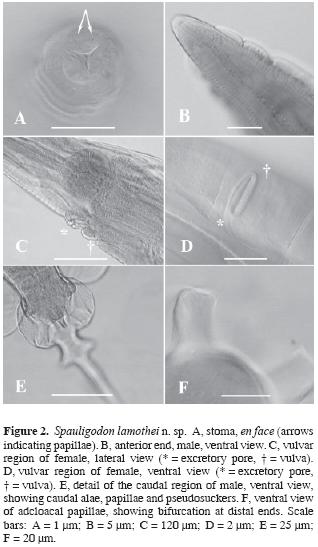
<body><![CDATA[<p align="justify"><font face="verdana" size="2">Se describe una especie nueva de <i>Spauligodon</i> colectada del tubo digestivo de <i>Sceloporus minor</i> y <i>Sceloporus grammicus</i>. La especie fue asignada a <i>Spauligodon</i> porque el ala caudal inicia al nivel de la papila precloacal y la papilla adcloacal est&aacute; embebida en la misma. La especie que se describe es similar a <i>S. garciaprietoi</i>, <i>S. goldbergi</i>, y <i>S. mearnsi</i> porque todas presentan esp&iacute;culas, los machos presentan de 1&#150;5 espinas en la cola, ala lateral tripartita con 5 crestas, las hembras presentan espinas en la cola, y huevos fusiformes. <i>Spauligodon lamothei</i> n. sp. se encontr&oacute; en 4 de 9 ejemplares de <i>S. minor</i> y en 1 de 5 individuos de <i>S. grammicus</i>. Esta especie representa el d&eacute;cimo registro en el neotr&oacute;pico y el tercero de M&eacute;xico.</font></p> 	    <p align="justify"><font face="verdana" size="2"><b>Palabras clave:</b> <i>Spauligodon lamothei</i> n. sp., <i>Sceloporus grammicus</i>, <i>Sceloporus minor</i>, descripci&oacute;n, Hidalgo, M&eacute;xico.</font></p> 	    <p align="justify"><font face="verdana" size="2">&nbsp;</font></p> 	    <p align="justify"><font face="verdana" size="2"><b>Introduction</b></font></p> 	    <p align="justify"><font face="verdana" size="2">During an ongoing study of the biodiversity of the Reserve of the Biosphere Barranca de Metztitl&aacute;n, Hidalgo, Mexico, individuals of <i>Sceloporus grammicus</i> Wiegmann, 1828 and <i>Sceloporus minor</i> Cope, 1885 were found to be infected with nematodes of an undescribed species of <i>Spauligodon</i> Skrjabin, Schikhobalova and Lagodovskaja, 1960. Currently, 43 species have been assigned to this cosmopolitan genus of pharyngodonid nematodes (Bursey et al., 2005); 4 of them occur in the Nearctic region and 8 in the Neotropical region, 2 of which have been described from Mexican hosts. The purpose of this work is to describe a third species from Mexican lizards.</font></p> 	    <p align="justify"><font face="verdana" size="2">&nbsp;</font></p> 	    <p align="justify"><font face="verdana" size="2"><b>Materials and methods</b></font></p> 	    <p align="justify"><font face="verdana" size="2">Specimens of <i>Sceloporus minor</i> (9 individuals) and <i>S. grammicus</i> (5) were collected by hand in the Reserve of the Biosphere Barranca de Metztitl&aacute;n, Hidalgo, Mexico, between September 2004 and June 2005. Lizards were killed by an overdose of ethyl ether within 12 hr after capture. Carcasses were processed for preservation and deposition in museums by conventional techniques for reptiles; symbiotype and type specimens are deposited in the Colecci&oacute;n de Helmintos (CHE), Centro de Investigaciones Biol&oacute;gicas, Universidad Aut&oacute;noma del Estado de Hidalgo, Pachuca, Hidalgo, and Colecci&oacute;n Nacional de Helmintos (CNHE), Instituto de Biolog&iacute;a, Universidad Nacional Aut&oacute;noma de M&eacute;xico, M&eacute;xico D.F., Mexico. Viscera and body cavity of each lizard were examined for parasites and nematodes were killed in glacial acetic acid and stored in 70% ethanol. Subsequently, nematodes were cleared in glycerol and identified following Ramallo et al. (2002) and Jim&eacute;nez&#150;Ruiz et al. (2003). Drawings were made with the aid of a drawing tube. Measurements are given in micrometers (&micro;m), unless otherwise noted, in the form range (average&plusmn;standard deviation; <i>n=</i> number of measurements taken). Because the study location is part of a fragile national reserve, and thus at risk of destruction by unauthorized collectors, exact coordinates of the locality are only available to scientists holding valid collecting permits through direct contact with the administrators of the reserve. </font></p> 				    <p align="justify"><font face="verdana" size="2"><b>Description</b></font></p> 				    <p align="justify"><font face="verdana" size="2"><i>Spauligodon lamothei</i> n. sp. (<a href="/img/revistas/rmbiodiv/v79sago/a18f1.jpg" target="_blank">Figs. 1</a>&#150;<a href="#f2">2</a>)</font></p> 				    ]]></body>
<body><![CDATA[<p align="justify"><font face="verdana" size="2">Description based on 83 adult specimens (74 females and 9 males). Small nematodes, both ends tapering gradually (<a href="/img/revistas/rmbiodiv/v79sago/a18f1.jpg" target="_blank">Figs.1A, 1F</a>). Cuticle with fine transverse striations (<a href="#f2">Figs.2B&#150;2D</a>). Males with lateral alae, absent in females. Stoma with 3 lips, each lip with 2 papillae (<a href="#f2">Fig.2A</a>), esophagus divided into corpus and esophageal bulb (<a href="/img/revistas/rmbiodiv/v79sago/a18f1.jpg" target="_blank">Figs.1A,1F</a>, <a href="#f2">2C</a>). Excretory pore with lightly cuticularized walls, posterior to esophageal bulb in males and at level of bulb in females (<a href="/img/revistas/rmbiodiv/v79sago/a18f1.jpg" target="_blank">Figs.1A,1F</a>,<a href="#f2">2C&#150;D</a>).</font></p> 				    <p align="center"><font face="verdana" size="2"><a name="f2"></a></font></p> 				    <p align="center"><font face="verdana" size="2"><img src="/img/revistas/rmbiodiv/v79sago/a18f2.jpg"></font></p> 				    <p align="justify"><font face="verdana" size="2"><i>Male:</i> Based on 9 specimens. Nematodes, white color in vivo, 1750&#150;2200 (1999&plusmn;172, <i>n=</i>9) long and 125&plusmn;20 (84&plusmn;150, <i>n=</i>9) wide at level of esophageal bulb. Cuticle with striations at intervals of 5&#150;8 (7&plusmn;1, <i>n=</i>9). Lateral alae tripartite, 1170&#150;1575 (1366&plusmn;147, <i>n=</i>9) long by 42&#150;94 (67&plusmn;18, <i>n=</i>9) at widest part, starting slightly anterior to nerve ring and extending to cloacal level (<a href="/img/revistas/rmbiodiv/v79sago/a18f1.jpg" target="_blank">Figs.1A</a>,<a href="#f2">2B</a>); alae ornamented with 5ridges (<a href="/img/revistas/rmbiodiv/v79sago/a18f1.jpg" target="_blank">Fig.1C</a>). Esophagus, including bulb, 225&#150;352 (291&plusmn;44, <i>n=</i>9) long and 22&#150;29 (26&plusmn;2, <i>n=</i>9) wide at mid&#150;esophagus; bulb 65&#150;78 (71&plusmn;5, <i>n=</i>9) long and 56&#150;84 (73&plusmn;9, <i>n=</i>9) wide. Nerve ring and excretory pore at 85&#150;110 (96&plusmn;9, <i>n=</i>8) and 370&#150;530 (467&plusmn;48, <i>n=</i>8) from anterior end, respectively. Caudal alae 60&#150;70 (64&plusmn;4, <i>n=</i>8) long and 72&#150;95 (83&plusmn;7, <i>n=</i>8) wide. Three pairs of mamiliform genital papillae present (<a href="/img/revistas/rmbiodiv/v79sago/a18f1.jpg" target="_blank">Figs.1B</a>,<a href="#f2">2E&#150;F</a>); first pair anterior to prominent genital cone. Anterior 2 pairs of papillae embedded in the caudal alae and posteriormost pair situated at base of tail; adcloacal pair of papillae bifurcate (="forked" sensu Edgerly, 1952). Pseudosucker with rows of lateral spines located anterior to genital cone. Single spicule 55&#150;96 (79&plusmn;15, <i>n=</i>8) long (<a href="/img/revistas/rmbiodiv/v79sago/a18f1.jpg" target="_blank">Fig.1E</a>). Anal opening immediately anterior to base of genital cone. Tail filiform, 380&#150;565 (480&plusmn;61, <i>n=</i>8) long (<a href="/img/revistas/rmbiodiv/v79sago/a18f1.jpg" target="_blank">Figs.1A&#150;B</a>), with 1&#150;5 (2&plusmn;1, <i>n=</i>9) cuticular spines. </font></p> 				    <p align="justify"><font face="verdana" size="2">Female: Based on 74 gravid specimens. Length larger than males, pale yellow color <i>in vivo</i>, 3515&#150;7600 (5756&plusmn;1091, <i>n=</i>72) long by 225&#150;420 (292&plusmn;42, <i>n=</i>72) wide at maximum width (level of esophageal bulb). Cuticle with striations at intervals of 6&#150;18 (12&plusmn;3, <i>n=</i>71). Esophagus, including bulb, 475&#150;700 (632&plusmn;46, n =71) long and 29&#150;42 (36&plusmn;2, <i>n=</i>74) wide at mid&#150;esophagus; bulb 114&#150;142 (128&plusmn;6, <i>n=</i>73) long and 125&#150;150 (138&plusmn;6, <i>n=</i>74) wide. Nerve ring, excretory pore, and vulva at 90&#150;204 (135&plusmn;31, <i>n=</i>48), 490&#150;800 (614&plusmn;72, <i>n=</i>71), and 475&#150;950 (702&plusmn;87, <i>n=</i>67) from anterior end, respectively (Fig. 9). Ovijector thin&#150;walled; 2 uteri present. Tail filiform, 700&#150;1020 (855&plusmn;70, <i>n=</i>72) long with 8&#150;16 (13&plusmn;2, <i>n=</i>72) cuticular spines (<a href="/img/revistas/rmbiodiv/v79sago/a18f1.jpg" target="_blank">Fig.1F</a>). Eggs fusiform, slightly flattened at one pole, 38&#150;108 (60&plusmn;19, <i>n=</i>59) long by 12&#150;42 (20&plusmn;8, <i>n=</i>59) wide (<a href="/img/revistas/rmbiodiv/v79sago/a18f1.jpg" target="_blank">Fig.1D</a>). </font></p> 				    <p align="justify"><font face="verdana" size="2"><b>Taxonomic summary</b></font></p> 				    <p align="justify"><font face="verdana" size="2"><i>Type&#150;host:</i> <i>Sceloporus minor</i> Cope, 1885.</font></p> 				    <p align="justify"><font face="verdana" size="2"><i>Type locality:</i> Reserve of the Biosphere Barranca de Metztitl&aacute;n, Zona n&uacute;cleo 1, between the parallels 98&deg;23'00" and 98&deg;57'08" W and 20&deg;14'15" and 20&deg;45'26" N, with elevations between 1 000 and 2 000m.</font></p> 				    <p align="justify"><font face="verdana" size="2"><i>Site of infection:</i> stomach, small intestine, and large intestine. </font></p> 				    <p align="justify"><font face="verdana" size="2"><i>Prevalence and intensity:</i> 4 of 9 individuals of <i>S. minor</i> and 1 of 5 individuals of <i>S. grammicus</i>; 1&#150;29 (19.5) and 5 (5), respectively.</font></p> 				    ]]></body>
<body><![CDATA[<p align="justify"><font face="verdana" size="2"><i>Additional hosts:</i> <i>S. grammicus</i> Wiegmann, 1828.</font></p> 				    <p align="justify"><font face="verdana" size="2"><i>Type specimens:</i> holotype male, CNHE&#150;5992; allotype CNHE&#150;5993; paratypes CNHE&#150;5994, 5995; CHE F&#150;0013. </font></p> 				    <p align="justify"><font face="verdana" size="2"><i>Symbiotype:</i> <i>Sceloporus minor</i>, collected 22 September 2001, CHE H&#150;0063, <i>S. grammicus</i>, CHE H&#150;0064; voucher specimens CHE H&#150;0065. </font></p> 				    <p align="justify"><font face="verdana" size="2"><i>Etymology:</i> the specific epithet honors Dr. Rafael Lamothe&#150;Argumedo, Instituto de Biolog&iacute;a, Universidad Nacional Aut&oacute;noma de M&eacute;xico, for his lifelong work as a teacher and leader of parasitologists in Mexico, of whom GP&#150;F and SM are proud to be counted. </font></p> 				    <p align="justify"><font face="verdana" size="2"><b>Remarks</b></font></p> 				    <p align="justify"><font face="verdana" size="2">Three genera of pharyngodonid nematodes are commonly found in reptiles and exhibit a vulvar opening in the anterior part of the body, just posterior to the postbulbar excretory pore: <i>Pharyngodon</i> Diesing, 1861, <i>Skrjabinodon</i> Inglis, 1968, and <i>Spauligodon</i>. These genera can be separated by the relationship of the caudal alae to the genital papillae (Bursey and Goldberg, 1995). Males of <i>Skrjabinodon</i> do not have caudal alae. Males of both <i>Pharyngodon</i> and <i>Spauligodon</i> have caudal alae: in the former all genital papillae are embedded in the caudal alae and in the latter only the 2 anteriormost pairs of papillae are embedded in the alae. The described specimens are assigned to <i>Spauligodon</i> based on males of the species having the 2 anteriormost pair of papillae embedded in the alae. </font></p> 				    <p align="justify"><font face="verdana" size="2">Species of <i>Spauligodon</i> are distinguished on the basis of the presence or absence of a spicule, the presence or absence of spines on the tail filament of adults, the shape of the egg, and the geographical distribution (Bursey et al., 2005; Chabaud and Brygoo, 1962). Of the 43 known species, 12 species occur in the Nearctic and Neotropical realms (Table I., Bursey et al., 2005). The species described herein and these 12 species can be divided arbitrarily into 2 groups based on the presence or absence of a spicule in the male. Only <i>S.lamothei</i> n. sp., <i>S. garciaprietoi</i>, <i>S. goldbergi</i>, and <i>S. mearnsi</i> have males that possess spicules; however, the ranges in length overlap and thus are not diagnostic (55&#150;96, 53&#150;82, 80&#150;90, and 75&#150;80, respectively). Both <i>S. lamothei</i> n. sp. and <i>S. goldbergi</i> have males that possess tails with spines (1&#150;5 and 3&#150;7, respectively) and those of <i>S. garciaprietoi</i>, and <i>S. mearnsi</i> are aspinose. The range in number of spines on the tail of males of <i>S.lamothei</i> n. sp. and <i>S. goldbergi</i> overlaps (1&#150;5 and 3&#150;7, respectively), but the former has 5 ridges on the lateral alae and the adcloacal papillae are bifurcate while the latter has only 1 ridge on the lateral alae and the adcloacal papillae are not bifurcate. Males of <i>S. mearnsi</i> also have adcloacal papillae that are bifurcate but the males of that species have aspinose tails. The species described herein has males with tripartite lateral alae with 5 ridges and males of <i>S. garciaprietoi</i> have alae that are unipartite with 2 ridges; of the 4 species mentioned herein, only males of <i>S.lamothei</i> n. sp. have tripartite lateral alae. The tail of females of <i>S.lamothei</i> n. sp. and <i>S. mearnsi</i> are spinose and those of the other 2 species are aspinose. <i>Spauligodon lamothei</i> n. sp. and <i>S. mearnsi</i> can be distinguished on the basis of egg shape (fusiform and barrel&#150;shaped, respectively).</font></p> 				    <p align="justify"><font face="verdana" size="2">&nbsp;</font></p> 				    <p align="justify"><font face="verdana" size="2"><b>Discussion</b></font></p> 				    <p align="justify"><font face="verdana" size="2">A search of the literature revealed only 3 known species with adcloacal papillae that are not unipartite: <i>S.lamothei</i> n. sp., <i>S. mearnsi</i>, and <i>S.dimorpha</i> (Chabaud and Brygoo, 1962). Hosts of the first are individuals of <i>Sceloporus</i> sp., the second, <i>Petrosaurus mearnsi</i> (Stejneger, 1894) (as Streptosaurus mearnsi) from California (Edgerly, 1952), and the third, <i>Chamaeleo pardalis</i> Cuvier, 1829 from Madagascar (Chabaud and Brygoo, 1962). Males of both <i>S.lamothei</i> n. sp. and <i>S. mearnsi</i> exhibit bifurcate adcloacal papillae while males of <i>S.dimorpha</i> are described as having trifurcate adcloacal papillae. However, Fig.11 of (pg.587; Chabaud and Brygoo, 1962) shows a male with bifurcate adcloacal papillae and their Fig.12 (pg.588) depicts a male with what could be interpreted have having trifurcate papillae; the authors describe the papillae as having "â€¦tr&egrave;s gros p&eacute;donculesâ€¦" (p.588).</font></p> 				    ]]></body>
<body><![CDATA[<p align="justify"><font face="verdana" size="2"><i>Spauligodon lamothei</i> n. sp. is the ninth species recorded in the neotropics, and it may be added to the list provided by Bursey et al. (2005) according to the features mentioned above. It is only the third species described from Mexico, an extremely complex biogeographic zone (Jim&eacute;nez&#150;Ruiz et al., 2002; Jim&eacute;nez&#150;Ruiz et al., 2003). <i>Spauligodon oxkutzcabiensis</i> and <i>S. garciaprietoi</i> previously were described from Mexican hosts and <i>S.giganticus</i> also has been reported previously (Goldberg et al., 1996; Goldberg et al., 2003). However, despite a long tradition of parasitological studies, as indicated by the great number of species known from Mexican hosts (Lamothe&#150;Argumedo et al., 1997, and more recent works), it is expected that a large part of the helminth diversity of Mexico is still unknown to science (P&eacute;rez&#150;Ponce de Le&oacute;n et al., 2002). <i>Spauligodon lamothei</i> n. sp. is the first member of that genus described from Hidalgo, Mexico, and it and its hosts, <i>Sceloporus minor</i> and <i>Sceloporus grammicus</i>, are reported for the first time from the Reserve of the Biosphere Barranca de Metztitl&aacute;n.</font></p> 				    <p align="justify"><font face="verdana" size="2">&nbsp;</font></p> 				    <p align="justify"><font face="verdana" size="2"><b>Acknowledgements</b></font></p> 				    <p align="justify"><font face="verdana" size="2">The authors would like to thank the administrators of the Reserva de la Biosfera Barranca de Metztitl&aacute;n, Hidalgo, Mexico, for their contribution to this project. Andr&eacute;s L&oacute;pez&#150;Morales and Jes&uacute;s Fern&aacute;ndez&#150;Fern&aacute;ndez assisted in collection of animals and Aurelio Ram&iacute;rez&#150;Bautista (UAEH) identified the lizards. The Programa de Mejoramiento del Profesorado (PROMEP), the Consejo Nacional de Ciencia y Tecnolog&iacute;a, Sistema de Investigaci&oacute;n "Ignacio Zaragoza" (SIZA&#150;CONACYT&#150;project 20020803006), Fondos Mixtos (FOMIX CONACYT&#150;Hidalgo, project 8695), and the Programa Anual de Investigaci&oacute;n "Dra. Honoris Causa Elisa Vargas&#150;Lugo Rangel" (projects 19B and 20B of SM and GP&#150;F, respectively) provided funding for this project. Initial data for this study was reported by Escorcia&#150;Ignacio (2007).</font></p> 				    <p align="justify"><font face="verdana" size="2">&nbsp;</font></p> 				    <p align="justify"><font face="verdana" size="2"><b>Literature cited</b></font></p> 				    <!-- ref --><p align="justify"><font face="verdana" size="2">Bursey, C. R. and S. R. Goldberg. 1995. <i>Spauligodon caymanensis</i> sp. n. (Nematoda: Pharyngodonidae) from <i>Anolis conspersus</i> (Sauria: Polychridae) from Grand Cayman Island, British West Indies. Journal of the Helminthological Society of Washington 62:183&#150;187.</font>&nbsp;&nbsp;&nbsp;&nbsp;&nbsp;&nbsp;&nbsp;&nbsp;[&#160;<a href="javascript:void(0);" onclick="javascript: window.open('/scielo.php?script=sci_nlinks&ref=7494318&pid=S1870-3453200800030001800001&lng=','','width=640,height=500,resizable=yes,scrollbars=1,menubar=yes,');">Links</a>&#160;]<!-- end-ref --> 				    <!-- ref --><p align="justify"><font face="verdana" size="2">Bursey, C. R., S. R. Goldberg and F. Kraus. 2005. New species of <i>Spauligodon</i> (Nematoda: Pharyngodonidae) in <i>Lepidodactylus novaeguineae</i> (Sauria: Gekkonidae) from Papua New Guinea. Journal of Parasitology 91:324&#150;328.</font>&nbsp;&nbsp;&nbsp;&nbsp;&nbsp;&nbsp;&nbsp;&nbsp;[&#160;<a href="javascript:void(0);" onclick="javascript: window.open('/scielo.php?script=sci_nlinks&ref=7494320&pid=S1870-3453200800030001800002&lng=','','width=640,height=500,resizable=yes,scrollbars=1,menubar=yes,');">Links</a>&#160;]<!-- end-ref --> 				    ]]></body>
<body><![CDATA[<!-- ref --><p align="justify"><font face="verdana" size="2">Chabaud, A. G. and E. R. Brygoo. 1962. N&eacute;matodes parasites de Cam&eacute;leons malgaches. Deuxi&eacute;me note. Annales de Parasitologie Humaine et Compar&eacute;e 37:569&#150;602.</font>&nbsp;&nbsp;&nbsp;&nbsp;&nbsp;&nbsp;&nbsp;&nbsp;[&#160;<a href="javascript:void(0);" onclick="javascript: window.open('/scielo.php?script=sci_nlinks&ref=7494322&pid=S1870-3453200800030001800003&lng=','','width=640,height=500,resizable=yes,scrollbars=1,menubar=yes,');">Links</a>&#160;]<!-- end-ref --> 				    <!-- ref --><p align="justify"><font face="verdana" size="2">Edgerly, R. H. 1952. Two new species of Nematoda <i>Strongyluris riversidensis</i> and <i>Pharyngodon mearnsi</i>. Transactions of the American Microscopical Society 71:288&#150;292.</font>&nbsp;&nbsp;&nbsp;&nbsp;&nbsp;&nbsp;&nbsp;&nbsp;[&#160;<a href="javascript:void(0);" onclick="javascript: window.open('/scielo.php?script=sci_nlinks&ref=7494324&pid=S1870-3453200800030001800004&lng=','','width=640,height=500,resizable=yes,scrollbars=1,menubar=yes,');">Links</a>&#160;]<!-- end-ref --> 				    <!-- ref --><p align="justify"><font face="verdana" size="2">Escorcia&#150;Ignacio, R. 2007. Descripci&oacute;n de una nueva especie de <i>Spauligodon</i> (Nematoda: Pharyngodonidae) en algunas especies de <i>Sceloporus</i> (Sauria: Phrynosomatidae) y la caracterizaci&oacute;n de su infecci&oacute;n de algunas localidades de la Reserva de la Biosfera Barranca de Metztitl&aacute;n, Hidalgo, Mexico. Bachelor's thesis, &Aacute;rea Acad&eacute;mica de Biolog&iacute;a, Universidad Aut&oacute;noma del Estado de Hidalgo, Pachuca. 55 p.</font>&nbsp;&nbsp;&nbsp;&nbsp;&nbsp;&nbsp;&nbsp;&nbsp;[&#160;<a href="javascript:void(0);" onclick="javascript: window.open('/scielo.php?script=sci_nlinks&ref=7494326&pid=S1870-3453200800030001800005&lng=','','width=640,height=500,resizable=yes,scrollbars=1,menubar=yes,');">Links</a>&#160;]<!-- end-ref --> 				    <!-- ref --><p align="justify"><font face="verdana" size="2">Goldberg, S. R., C. R. Bursey and R. L. Bezy. 1996. Gastrointestinal helminths of Yarrow's spiny lizard, <i>Sceloporus jarrovii</i> (Phyrnosomatidae) in Mexico. American Midland Naturalist 135:299&#150;309.</font>&nbsp;&nbsp;&nbsp;&nbsp;&nbsp;&nbsp;&nbsp;&nbsp;[&#160;<a href="javascript:void(0);" onclick="javascript: window.open('/scielo.php?script=sci_nlinks&ref=7494328&pid=S1870-3453200800030001800006&lng=','','width=640,height=500,resizable=yes,scrollbars=1,menubar=yes,');">Links</a>&#160;]<!-- end-ref --> 				    <!-- ref --><p align="justify"><font face="verdana" size="2">Goldberg, S. R., C. R. Bursey and J. L. Camarillo&#150;Rangel. 2003. Gastrointestinal helminths of seven species of sceloporine lizards from Mexico. Southwestern Naturalist 48:208&#150;217.</font>&nbsp;&nbsp;&nbsp;&nbsp;&nbsp;&nbsp;&nbsp;&nbsp;[&#160;<a href="javascript:void(0);" onclick="javascript: window.open('/scielo.php?script=sci_nlinks&ref=7494330&pid=S1870-3453200800030001800007&lng=','','width=640,height=500,resizable=yes,scrollbars=1,menubar=yes,');">Links</a>&#160;]<!-- end-ref --> 				    ]]></body>
<body><![CDATA[<!-- ref --><p align="justify"><font face="verdana" size="2">Jim&eacute;nez&#150;Ruiz, F. A., L. Garc&iacute;a&#150;Prieto and G. P&eacute;rez&#150;Ponce de Le&oacute;n. 2002. Helminth infracommunity structure of the sympatric garter snakes <i>Thamnophis eques</i> and <i>Thamnophis melanogaster</i> from the Mesa Central of Mexico. Journal of Parasitology 88:454&#150;60.</font>&nbsp;&nbsp;&nbsp;&nbsp;&nbsp;&nbsp;&nbsp;&nbsp;[&#160;<a href="javascript:void(0);" onclick="javascript: window.open('/scielo.php?script=sci_nlinks&ref=7494332&pid=S1870-3453200800030001800008&lng=','','width=640,height=500,resizable=yes,scrollbars=1,menubar=yes,');">Links</a>&#160;]<!-- end-ref --> 				    <!-- ref --><p align="justify"><font face="verdana" size="2">Jim&eacute;nez&#150;Ruiz, F. A., V. Le&oacute;n&#150;R&egrave;gagn&oacute;n and J. A. Campbell. 2003. A new species of <i>Spauligodon</i> (Nematoda: Pharyngodonidae) parasite of <i>Cnemidophorus</i> spp. (Lacertilia: Teiidae) from southern Mexico. Journal of Parasitology 89:351&#150;355.</font>&nbsp;&nbsp;&nbsp;&nbsp;&nbsp;&nbsp;&nbsp;&nbsp;[&#160;<a href="javascript:void(0);" onclick="javascript: window.open('/scielo.php?script=sci_nlinks&ref=7494334&pid=S1870-3453200800030001800009&lng=','','width=640,height=500,resizable=yes,scrollbars=1,menubar=yes,');">Links</a>&#160;]<!-- end-ref --> 				    <!-- ref --><p align="justify"><font face="verdana" size="2">Lamothe&#150;Argumedo, R., L. Garc&iacute;a&#150;Prieto, D. Osorio&#150;Sarabia and G. P&eacute;rez&#150;Ponce de Le&oacute;n. 1997. Cat&aacute;logo de la Colecci&oacute;n Nacional de Helmintos. Instituto de Biolog&iacute;a, Universidad Nacional Aut&oacute;noma de M&eacute;xico y CONABIO. 211 p.</font>&nbsp;&nbsp;&nbsp;&nbsp;&nbsp;&nbsp;&nbsp;&nbsp;[&#160;<a href="javascript:void(0);" onclick="javascript: window.open('/scielo.php?script=sci_nlinks&ref=7494336&pid=S1870-3453200800030001800010&lng=','','width=640,height=500,resizable=yes,scrollbars=1,menubar=yes,');">Links</a>&#160;]<!-- end-ref --> 				    <!-- ref --><p align="justify"><font face="verdana" size="2">P&eacute;rez&#150;Ponce de Le&oacute;n, G., L. Garc&iacute;a&#150;Prieto and U. Razo&#150;Mendivil. 2002. Species richness of helminth parasites in Mexican amphibians and reptiles. Diversity and Distributions 8:211&#150;218.</font>&nbsp;&nbsp;&nbsp;&nbsp;&nbsp;&nbsp;&nbsp;&nbsp;[&#160;<a href="javascript:void(0);" onclick="javascript: window.open('/scielo.php?script=sci_nlinks&ref=7494338&pid=S1870-3453200800030001800011&lng=','','width=640,height=500,resizable=yes,scrollbars=1,menubar=yes,');">Links</a>&#160;]<!-- end-ref --> 				    <!-- ref --><p align="justify"><font face="verdana" size="2">Ramallo, G., C. R. Bursey and S. R. Goldberg. 2002. <i>Spauligodon loboi</i> n. sp. (Nematoda: Pharyngodonidae) parasite of <i>Liolaemus</i> spp. (Iguania: Liolaemidae) from northwestern Argentina. Journal of Parasitology 88:370&#150;374.</font>&nbsp;&nbsp;&nbsp;&nbsp;&nbsp;&nbsp;&nbsp;&nbsp;[&#160;<a href="javascript:void(0);" onclick="javascript: window.open('/scielo.php?script=sci_nlinks&ref=7494340&pid=S1870-3453200800030001800012&lng=','','width=640,height=500,resizable=yes,scrollbars=1,menubar=yes,');">Links</a>&#160;]<!-- end-ref --> ]]></body><back>
<ref-list>
<ref id="B1">
<nlm-citation citation-type="journal">
<person-group person-group-type="author">
<name>
<surname><![CDATA[Bursey]]></surname>
<given-names><![CDATA[C. R]]></given-names>
</name>
<name>
<surname><![CDATA[Goldberg]]></surname>
<given-names><![CDATA[S. R.]]></given-names>
</name>
</person-group>
<article-title xml:lang="en"><![CDATA[Spauligodon caymanensis sp. n. (Nematoda: Pharyngodonidae) from Anolis conspersus (Sauria: Polychridae) from Grand Cayman Island, British West Indies]]></article-title>
<source><![CDATA[Journal of the Helminthological Society of Washington]]></source>
<year>1995</year>
<volume>62</volume>
<page-range>183-187</page-range></nlm-citation>
</ref>
<ref id="B2">
<nlm-citation citation-type="journal">
<person-group person-group-type="author">
<name>
<surname><![CDATA[Bursey]]></surname>
<given-names><![CDATA[C. R]]></given-names>
</name>
<name>
<surname><![CDATA[Goldberg]]></surname>
<given-names><![CDATA[S. R.]]></given-names>
</name>
<name>
<surname><![CDATA[Kraus]]></surname>
<given-names><![CDATA[F]]></given-names>
</name>
</person-group>
<article-title xml:lang="en"><![CDATA[New species of Spauligodon (Nematoda: Pharyngodonidae) in Lepidodactylus novaeguineae (Sauria: Gekkonidae) from Papua New Guinea]]></article-title>
<source><![CDATA[Journal of Parasitology]]></source>
<year>2005</year>
<volume>91</volume>
<page-range>324-328</page-range></nlm-citation>
</ref>
<ref id="B3">
<nlm-citation citation-type="journal">
<person-group person-group-type="author">
<name>
<surname><![CDATA[Chabaud]]></surname>
<given-names><![CDATA[A. G]]></given-names>
</name>
<name>
<surname><![CDATA[Brygoo]]></surname>
<given-names><![CDATA[E. R.]]></given-names>
</name>
</person-group>
<article-title xml:lang="en"><![CDATA[Nématodes parasites de Caméleons malgaches. Deuxiéme note]]></article-title>
<source><![CDATA[Annales de Parasitologie Humaine et Comparée]]></source>
<year>1962</year>
<volume>37</volume>
<page-range>569-602</page-range></nlm-citation>
</ref>
<ref id="B4">
<nlm-citation citation-type="journal">
<person-group person-group-type="author">
<name>
<surname><![CDATA[Edgerly]]></surname>
<given-names><![CDATA[R. H]]></given-names>
</name>
</person-group>
<article-title xml:lang="en"><![CDATA[Two new species of Nematoda Strongyluris riversidensis and Pharyngodon mearnsi]]></article-title>
<source><![CDATA[Transactions of the American Microscopical Society]]></source>
<year>1952</year>
<volume>71</volume>
<page-range>288-292</page-range></nlm-citation>
</ref>
<ref id="B5">
<nlm-citation citation-type="">
<source><![CDATA[]]></source>
<year></year>
<page-range>55</page-range></nlm-citation>
</ref>
<ref id="B6">
<nlm-citation citation-type="journal">
<person-group person-group-type="author">
<name>
<surname><![CDATA[Goldberg]]></surname>
<given-names><![CDATA[S. R]]></given-names>
</name>
<name>
<surname><![CDATA[Bursey]]></surname>
<given-names><![CDATA[C. R.]]></given-names>
</name>
<name>
<surname><![CDATA[Bezy]]></surname>
<given-names><![CDATA[R. L.]]></given-names>
</name>
</person-group>
<article-title xml:lang="en"><![CDATA[Gastrointestinal helminths of Yarrow's spiny lizard, Sceloporus jarrovii (Phyrnosomatidae) in Mexico]]></article-title>
<source><![CDATA[American Midland Naturalist]]></source>
<year>1996</year>
<volume>135</volume>
<page-range>299-309</page-range></nlm-citation>
</ref>
<ref id="B7">
<nlm-citation citation-type="journal">
<person-group person-group-type="author">
<name>
<surname><![CDATA[Goldberg]]></surname>
<given-names><![CDATA[S. R]]></given-names>
</name>
<name>
<surname><![CDATA[Bursey]]></surname>
<given-names><![CDATA[C. R.]]></given-names>
</name>
<name>
<surname><![CDATA[Camarillo-Rangel]]></surname>
<given-names><![CDATA[J. L.]]></given-names>
</name>
</person-group>
<article-title xml:lang="en"><![CDATA[Gastrointestinal helminths of seven species of sceloporine lizards from Mexico]]></article-title>
<source><![CDATA[Southwestern Naturalist]]></source>
<year>2003</year>
<volume>48</volume>
<page-range>208-217</page-range></nlm-citation>
</ref>
<ref id="B8">
<nlm-citation citation-type="journal">
<person-group person-group-type="author">
<name>
<surname><![CDATA[Jiménez-Ruiz]]></surname>
<given-names><![CDATA[F. A]]></given-names>
</name>
<name>
<surname><![CDATA[García-Prieto]]></surname>
<given-names><![CDATA[L]]></given-names>
</name>
<name>
<surname><![CDATA[Pérez-Ponce de León]]></surname>
<given-names><![CDATA[G]]></given-names>
</name>
</person-group>
<article-title xml:lang="en"><![CDATA[Helminth infracommunity structure of the sympatric garter snakes Thamnophis eques and Thamnophis melanogaster from the Mesa Central of Mexico]]></article-title>
<source><![CDATA[Journal of Parasitology]]></source>
<year>2002</year>
<volume>88</volume>
<page-range>454-60</page-range></nlm-citation>
</ref>
<ref id="B9">
<nlm-citation citation-type="journal">
<person-group person-group-type="author">
<name>
<surname><![CDATA[Jiménez-Ruiz]]></surname>
<given-names><![CDATA[F. A]]></given-names>
</name>
<name>
<surname><![CDATA[León-Règagnón]]></surname>
<given-names><![CDATA[V]]></given-names>
</name>
<name>
<surname><![CDATA[Campbell]]></surname>
<given-names><![CDATA[J. A.]]></given-names>
</name>
</person-group>
<article-title xml:lang="en"><![CDATA[A new species of Spauligodon (Nematoda: Pharyngodonidae) parasite of Cnemidophorus spp. (Lacertilia: Teiidae) from southern Mexico]]></article-title>
<source><![CDATA[Journal of Parasitology]]></source>
<year>2003</year>
<volume>89</volume>
<page-range>351-355</page-range></nlm-citation>
</ref>
<ref id="B10">
<nlm-citation citation-type="book">
<person-group person-group-type="author">
<name>
<surname><![CDATA[Lamothe-Argumedo]]></surname>
<given-names><![CDATA[R]]></given-names>
</name>
<name>
<surname><![CDATA[García-Prieto]]></surname>
<given-names><![CDATA[L]]></given-names>
</name>
<name>
<surname><![CDATA[Osorio-Sarabia]]></surname>
<given-names><![CDATA[D]]></given-names>
</name>
<name>
<surname><![CDATA[Pérez-Ponce de León]]></surname>
<given-names><![CDATA[G]]></given-names>
</name>
</person-group>
<source><![CDATA[Catálogo de la Colección Nacional de Helmintos]]></source>
<year>1997</year>
<page-range>211</page-range><publisher-name><![CDATA[Instituto de Biología, Universidad Nacional Autónoma de MéxicoCONABIO]]></publisher-name>
</nlm-citation>
</ref>
<ref id="B11">
<nlm-citation citation-type="journal">
<person-group person-group-type="author">
<name>
<surname><![CDATA[Pérez-Ponce de León]]></surname>
<given-names><![CDATA[G]]></given-names>
</name>
<name>
<surname><![CDATA[García-Prieto]]></surname>
<given-names><![CDATA[L]]></given-names>
</name>
<name>
<surname><![CDATA[Razo-Mendivil]]></surname>
<given-names><![CDATA[U]]></given-names>
</name>
</person-group>
<article-title xml:lang="en"><![CDATA[Species richness of helminth parasites in Mexican amphibians and reptiles]]></article-title>
<source><![CDATA[Diversity and Distributions]]></source>
<year>2002</year>
<volume>8</volume>
<page-range>211-218</page-range></nlm-citation>
</ref>
<ref id="B12">
<nlm-citation citation-type="journal">
<person-group person-group-type="author">
<name>
<surname><![CDATA[Ramallo]]></surname>
<given-names><![CDATA[G]]></given-names>
</name>
<name>
<surname><![CDATA[Bursey]]></surname>
<given-names><![CDATA[C. R.]]></given-names>
</name>
<name>
<surname><![CDATA[Goldberg]]></surname>
<given-names><![CDATA[S. R.]]></given-names>
</name>
</person-group>
<article-title xml:lang="en"><![CDATA[Spauligodon loboi n. sp. (Nematoda: Pharyngodonidae) parasite of Liolaemus spp. (Iguania: Liolaemidae) from northwestern Argentina]]></article-title>
<source><![CDATA[Journal of Parasitology]]></source>
<year>2002</year>
<volume>88</volume>
<page-range>370-374</page-range></nlm-citation>
</ref>
</ref-list>
</back>
</article>
