<?xml version="1.0" encoding="ISO-8859-1"?><article xmlns:mml="http://www.w3.org/1998/Math/MathML" xmlns:xlink="http://www.w3.org/1999/xlink" xmlns:xsi="http://www.w3.org/2001/XMLSchema-instance">
<front>
<journal-meta>
<journal-id>1870-3453</journal-id>
<journal-title><![CDATA[Revista mexicana de biodiversidad]]></journal-title>
<abbrev-journal-title><![CDATA[Rev. Mex. Biodiv.]]></abbrev-journal-title>
<issn>1870-3453</issn>
<publisher>
<publisher-name><![CDATA[Instituto de Biología]]></publisher-name>
</publisher>
</journal-meta>
<article-meta>
<article-id>S1870-34532008000200016</article-id>
<title-group>
<article-title xml:lang="en"><![CDATA[Genetic homogeneity between two populations of the parthenogenetic lizard Aspidoscelis cozumela]]></article-title>
<article-title xml:lang="es"><![CDATA[Homogeneidad genética entre dos poblaciones de la lagartija partenogenética Aspidoscelis cozumela]]></article-title>
</title-group>
<contrib-group>
<contrib contrib-type="author">
<name>
<surname><![CDATA[Manríquez-Morán]]></surname>
<given-names><![CDATA[Norma L.]]></given-names>
</name>
<xref ref-type="aff" rid="A01"/>
</contrib>
<contrib contrib-type="author">
<name>
<surname><![CDATA[Méndez-de la Cruz]]></surname>
<given-names><![CDATA[Fausto R.]]></given-names>
</name>
<xref ref-type="aff" rid="A02"/>
</contrib>
</contrib-group>
<aff id="A01">
<institution><![CDATA[,Universidad Autónoma del Estado de Hidalgo Centro de Investigaciones Biológicas Laboratorio de Sistemática Molecular]]></institution>
<addr-line><![CDATA[Mineral de la Reforma Hidalgo]]></addr-line>
<country>México</country>
</aff>
<aff id="A02">
<institution><![CDATA[,Universidad Nacional Autónoma de México Instituto de Biología Laboratorio de Herpetología]]></institution>
<addr-line><![CDATA[México D. F.]]></addr-line>
<country>México</country>
</aff>
<pub-date pub-type="pub">
<day>00</day>
<month>12</month>
<year>2008</year>
</pub-date>
<pub-date pub-type="epub">
<day>00</day>
<month>12</month>
<year>2008</year>
</pub-date>
<volume>79</volume>
<numero>2</numero>
<fpage>421</fpage>
<lpage>426</lpage>
<copyright-statement/>
<copyright-year/>
<self-uri xlink:href="http://www.scielo.org.mx/scielo.php?script=sci_arttext&amp;pid=S1870-34532008000200016&amp;lng=en&amp;nrm=iso"></self-uri><self-uri xlink:href="http://www.scielo.org.mx/scielo.php?script=sci_abstract&amp;pid=S1870-34532008000200016&amp;lng=en&amp;nrm=iso"></self-uri><self-uri xlink:href="http://www.scielo.org.mx/scielo.php?script=sci_pdf&amp;pid=S1870-34532008000200016&amp;lng=en&amp;nrm=iso"></self-uri><abstract abstract-type="short" xml:lang="en"><p><![CDATA[We used skin-grafting to assess the genetic variability between 2 populations of the parthenogenetic lizard Aspidoscelis cozumela. We transplanted 238 skin fragments among individuals of 2 coastal populations at Cozumel Island. Grafts belonging to individuals that survive more than 60 days suggested genetic homogeneity between both populations, consistent with the existence of only 1 clone within this unisexual species.]]></p></abstract>
<abstract abstract-type="short" xml:lang="es"><p><![CDATA[Se utilizó el método de transplantes de piel para evaluar la variabilidad genética entre 2 poblaciones de la lagartija partenogenética Aspidoscelis cozumela. Se transplantaron 238 fragmentos de piel entre individuos de 2 poblaciones costeras de Isla Cozumel. Los transplantes pertenecientes a individuos que vivieron más de 60 días, mostraron homogeneidad genética entre ambas poblaciones, lo cual sugiere la existencia de 1 sólo clon dentro de esta especie unisexual.]]></p></abstract>
<kwd-group>
<kwd lng="en"><![CDATA[histocompatibility]]></kwd>
<kwd lng="en"><![CDATA[parthenogenesis]]></kwd>
<kwd lng="en"><![CDATA[skin-grafting]]></kwd>
<kwd lng="en"><![CDATA[Cozumel]]></kwd>
<kwd lng="es"><![CDATA[histocompatibilidad]]></kwd>
<kwd lng="es"><![CDATA[partenogénesis]]></kwd>
<kwd lng="es"><![CDATA[transplantes de piel]]></kwd>
<kwd lng="es"><![CDATA[Cozumel]]></kwd>
</kwd-group>
</article-meta>
</front><body><![CDATA[  				    <p align="justify"><font face="verdana" size="4">Ecolog&iacute;a</font></p> 				    <p align="justify"><font face="verdana" size="2">&nbsp;</font></p> 				    <p align="center"><font face="verdana" size="4"><b>Genetic homogeneity between two populations of the parthenogenetic lizard <i>Aspidoscelis cozumela</i></b></font></p> 				    <p align="center"><font face="verdana" size="2">&nbsp;</font></p> 				    <p align="center"><font face="verdana" size="3"><b>Homogeneidad gen&eacute;tica entre dos poblaciones de la lagartija partenogen&eacute;tica <i>Aspidoscelis cozumela</i></b></font></p> 				    <p align="center"><font face="verdana" size="2">&nbsp;</font></p> 				    <p align="center"><font face="verdana" size="2"><b>Norma L. Manr&iacute;quez&#150;Mor&aacute;n<sup>1</sup>* and Fausto R. M&eacute;ndez&#150;de la Cruz<sup>2</sup></b></font></p> 				    <p align="center"><font face="verdana" size="2">&nbsp;</font></p> 				    <p align="justify"><font face="verdana" size="2"><i><sup>1</sup> Laboratorio de Sistem&aacute;tica Molecular, Centro de Investigaciones Biol&oacute;gicas. Universidad Aut&oacute;noma del Estado de Hidalgo. Km. 4.5 Carr. Pachuca&#150;Tulancingo s/n. Col. Carboneras, 42182, Mineral de la Reforma, Hidalgo, M&eacute;xico. </i></font></p> 				    ]]></body>
<body><![CDATA[<p align="justify"><font face="verdana" size="2"><i><sup>2</sup> Laboratorio de Herpetolog&iacute;a, Instituto de Biolog&iacute;a, Universidad Nacional Aut&oacute;noma de M&eacute;xico. Tercer Circuito Exterior s/n, Ciudad Universitaria, 04510, M&eacute;xico, D. F., M&eacute;xico.</i></font></p> 				    <p align="justify"><font face="verdana" size="2">&nbsp;</font></p> 				    <p align="justify"><font face="verdana" size="2"><b>*Correspondent:</b> <a href="mailto:mnorma@uaeh.edu.mx" target="_blank">    <br> 			    mnorma@uaeh.edu.mx</a></font></p> 				    <p align="justify"><font face="verdana" size="2">&nbsp;</font></p> 				    <p align="justify"><font face="verdana" size="2">Recibido: 19 febrero 2007    <br> 			    Aceptado: 23 enero 2008 </font></p> 				    <p align="justify"><font face="verdana" size="2">&nbsp;</font></p> 				    <p align="justify"><font face="verdana" size="2"><b>Abstract</b></font></p> 				    <p align="justify"><font face="verdana" size="2">We used skin&#150;grafting to assess the genetic variability between 2 populations of the parthenogenetic lizard <i>Aspidoscelis cozumela</i>. We transplanted 238 skin fragments among individuals of 2 coastal populations at Cozumel Island. Grafts belonging to individuals that survive more than 60 days suggested genetic homogeneity between both populations, consistent with the existence of only 1 clone within this unisexual species.</font></p> 				    ]]></body>
<body><![CDATA[<p align="justify"><font face="verdana" size="2"><b>Key words:</b> histocompatibility, parthenogenesis, skin&#150;grafting, Cozumel.</font></p> 				    <p align="justify"><font face="verdana" size="2">&nbsp;</font></p> 				    <p align="justify"><font face="verdana" size="2"><b>Resumen</b></font></p> 				    <p align="justify"><font face="verdana" size="2">Se utiliz&oacute; el m&eacute;todo de transplantes de piel para evaluar la variabilidad gen&eacute;tica entre 2 poblaciones de la lagartija partenogen&eacute;tica <i>Aspidoscelis cozumela</i>. Se transplantaron 238 fragmentos de piel entre individuos de 2 poblaciones costeras de Isla Cozumel. Los transplantes pertenecientes a individuos que vivieron m&aacute;s de 60 d&iacute;as, mostraron homogeneidad gen&eacute;tica entre ambas poblaciones, lo cual sugiere la existencia de 1 s&oacute;lo clon dentro de esta especie unisexual.</font></p> 				    <p align="justify"><font face="verdana" size="2"><b>Palabras clave:</b> histocompatibilidad, partenog&eacute;nesis, transplantes de piel, Cozumel.</font></p> 				    <p align="justify"><font face="verdana" size="2">&nbsp;</font></p> 				    <p align="justify"><font face="verdana" size="2"><b>Introduction</b></font></p> 				    <p align="justify"><font face="verdana" size="2">Immunological studies have demonstrated that grafts transplanted between members of the same gonochoristic species are rejected in response to genetic differences among histocompatibility genes (Cuellar and Smart, 1977; Zapata and Cooper, 1990). The transplanted graft acts as a trigger that promotes an immune response that will eventually destroy the foreign tissue (Zapata and Cooper, 1990). In contrast, various studies involving unisexual vertebrates have demonstrated absence of immunological response and hence genetic homogeneity among individuals of the same clone (Hern&aacute;ndez&#150;Gallegos et al., 1998; Abuhteba et al., 2000; Hern&aacute;ndez&#150;Gallegos et al., 2003). This homogeneity has been attributed to clonal reproduction (Cuellar and Smart, 1977). In this case, the transplanted graft establishes cell connections with the host tissue and is permanently retained.</font></p> 				    <p align="justify"><font face="verdana" size="2">Skin&#150;grafting is a technique sensitive enough to detect slight differences in the Major Histocompatibility Complex genes (Vrijenhoek et al., 1977), which constitutes one of the most variable family of genes in all jawed vertebrates (Miller et al., 2006). For this reason, the method has been extensively used to establish genetic structure in clones of parthenogenetic lizards and to make inferences on their origin and evolution (Maslin, 1967; Cuellar, 1976, 1977; Cuellar and Wright, 1992; Hern&aacute;ndez&#150;Gallegos et al., 1998; Abuhteba et al., 2000, 2001; Hern&aacute;ndez&#150;Gallegos et al., 2003).</font></p> 				    <p align="justify"><font face="verdana" size="2">Previous skin&#150;grafting studies have demonstrated that unisexual lizards reject grafts from individuals originated from different hybridization events (different clones). In contrast, individuals of parthenogenetic species normally accept grafts from individuals belonging to the same clone. Postformational mutations could provoke small rates of rejection among individuals that constitute an ancient clone (Maslin, 1967; Cuellar, 1976, 1977, 1984; Cuellar and Wright, 1992; Hern&aacute;ndez&#150;Gallegos et al., 1998; Abuhteba et al., 2000, 2001, Hern&aacute;ndez&#150;Gallegos et al., 2003).</font></p> 				    ]]></body>
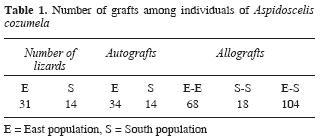
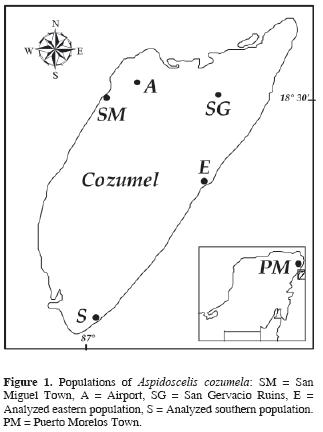
<body><![CDATA[<p align="justify"><font face="verdana" size="2">The <i>Aspidoscelis cozumela</i> complex is composed of 3 unisexual lizard species endemic to the Yucat&aacute;n Peninsula. Earlier studies have shown that these species originated as a result of 2 independent hybridization events between females of A. angusticeps and males of <i>A. deppii</i> (Moritz et al., 1992; Hern&aacute;ndez&#150;Gallegos et al., 1998; Manr&iacute;quez&#150;Mor&aacute;n, 2002; Hern&aacute;ndez&#150;Gallegos et al., 2003): one of them originating <i>A. rodecki</i> and the other one <i>A. maslini</i> and <i>A. cozumela</i>, taxa that were recognized as distinct species based on morphological differences (Taylor and Cooley, 1995). Karyotypic and mtDNA sequencing data suggested that <i>Aspidoscelis cozumela</i> evolved from the unisexual <i>A. maslini</i> (Manr&iacute;quez&#150;Mor&aacute;n, 2002). The comparison of partial sequences of 2 mitochondrial genes showed that individuals belonging to <i>A. cozumela</i> exhibit the same haplotype as individuals of <i>A. maslini</i> from Puerto Morelos (<a href="#f1">Fig. 1</a>), Quintana Roo (Manr&iacute;quez&#150;Mor&aacute;n, 2002), and possess a karyotype that evolved as a consequence of multiple centric fissions in the hybrid karyotype of <i>A. maslini</i> (Manr&iacute;quez&#150;Mor&aacute;n et al., 2000).</font></p> 				    <p align="center"><font face="verdana" size="2"><a name="f1"></a></font></p> 				    <p align="center"><font face="verdana" size="2"><img src="/img/revistas/rmbiodiv/v79n2/a16f1.jpg" alt=""></font></p> 				    <p align="justify"><font face="verdana" size="2">Although different studies have suggested the existence of only 1 major clone within <i>Aspidoscelis cozumela</i> (Hern&aacute;ndez&#150;Gallegos et al., 1998; Manr&iacute;quez&#150;Mor&aacute;n et al., 2000; Manr&iacute;quez&#150;Mor&aacute;n, 2002; Hern&aacute;ndez&#150;Gallegos et al., 2003), differences in size and color have been observed among individuals from different areas of Cozumel Island. We used skin&#150;grafting to assess genetic variability between 2 populations of <i>A. cozumela</i> at the eastern side of Cozumel, as different color patterns may be the result of genetic change in clonal species (Taylor et al., 2003).</font></p> 				    <p align="justify"><font face="verdana" size="2">&nbsp;</font></p> 				    <p align="justify"><font face="verdana" size="2"><b>Material and methods</b></font></p> 				    <p align="justify"><font face="verdana" size="2">Individuals of <i>Aspidoscelis cozumela</i> were collected at Cozumel Island (20&deg; 36' N and 86&deg; 44' W; <a href="#f1">Fig. 1</a>) during spring and summer of 1995 and 1996 from 2 populations, one of them located 20 km southeast of the town of San Miguel (N = 31; <a href="#f1">Fig. 1</a>, E) and the other one at 34 km south of San Miguel (N = 14: <a href="#f1">Fig. 1</a>, S). Although the 2 sites are located in the coastal zone of the island, they exhibit differences in vegetation and moisture. The southernmost area consists predominately of rocky soil covered with an association of halophytic vegetation and cacti. The eastern site exhibits halophytic vegetation characteristic of the coastal dunes, which is composed of erect and prostrate plants with shrubby and herbaceous life forms (Tellez et al., 1989). </font></p> 				    <p align="justify"><font face="verdana" size="2">Lizards were permanently marked by toe clipping in the laboratory. An average of 5 individuals were kept in each of a number of covered plastic terraria (78 x 48 x 21 cm) filled with 5 cm of sterile sandy substrate. Infrared and Vita&#150;Lite lamps located at the top of terrariums were automatically controlled to supply 6&#150;9 h. of heat and light per day. Lizards were fed with wax worms, crickets and tenebrionid larvae, and water was provided <i>ad libitum</i>.</font></p> 				    <p align="justify"><font face="verdana" size="2">Before being transplanted, animals were anesthetized by an injection of 10% ketamine. A biopsy punch was used to cut circular dorsal patches (2&#150;2.5 cm diameter) of skin previously covered with surgical adhesive. Grafts were reciprocally transplanted within and between individuals of both populations of <i>Aspidoscelis cozumela</i>, and coated with adhesive to prevent premature detachment (Cuellar, 1976, 1977). Each donor graft was placed perpendicular to the recipient's dosolateral stripes for easier observation. Graft acceptation or rejection was evaluated according to the criteria of Cuellar (1976, 1977, 1984).</font></p> 				    <p align="justify"><font face="verdana" size="2">Nine experiments were conducted among 45 individuals (<a href="/img/revistas/rmbiodiv/v79n2/a16f2.jpg" target="_blank">Fig. 2</a>). A total of 238 grafts were transplanted, 48 were autografts, 86 intrapopulation allografts and 104 interpopulation allografts (<a href="#t1">Table 1</a>).</font></p> 				    ]]></body>
<body><![CDATA[<p align="center"><font face="verdana" size="2"><a name="t1"></a></font></p> 				    <p align="center"><font face="verdana" size="2"><img src="/img/revistas/rmbiodiv/v79n2/a16t1.jpg" alt=""></font></p> 				    <p align="justify"><font face="verdana" size="2">&nbsp;</font></p> 				    <p align="justify"><font face="verdana" size="2"><b>Results</b></font></p> 				    <p align="justify"><font face="verdana" size="2">A previous skin&#150;grafting analysis showed that individuals of <i>Aspidoscelis cozumela</i> exhibited an immunological response within the first 2 months, when they were transplanted with tissues from individuals of <i>A. rodecki</i>. The first evidence of rejection was present 15 days after transplantation when some of the grafts started to appear darker. After 2 months, the grafts sloughed off (Manr&iacute;quez&#150;Mor&aacute;n, 1998). Therefore, only those individuals that lived more that 60 days after transplantation were included in the analysis.</font></p> 				    <p align="justify"><font face="verdana" size="2">Nineteen of 45 individuals initially used were excluded from the analysis because of premature death (natural characteristic of <i>A. cozumela</i>; Hern&aacute;ndez&#150; Gallegos et al., 2003). The range of survivorship after transplantation of the 26 remaining individuals was from 60 to 251 days. The 124 grafts analyzed were characterized by the absence of any sign of rejection. The scales of the 24 autografts, 42 intrapopulation allografts and 58 interpopulation allografts maintained original characteristics of form, color, size and luster, indicating transplant acceptance (<a href="/img/revistas/rmbiodiv/v79n2/a16t2.jpg" target="_blank">Table 2</a>).</font></p> 				    <p align="justify"><font face="verdana" size="2">&nbsp;</font></p> 				    <p align="justify"><font face="verdana" size="2"><b>Discussion</b></font></p> 				    <p align="justify"><font face="verdana" size="2">Histocompatibility within (100%) and between (100%) populations of <i>Aspidoscelis cozumela</i> indicates that all individuals of this species share a same origin. A single origin may be assumed if individuals from different populations of a clonal species exhibit genetic homogeneity (Cuellar, 1976). Isogenicity has been demonstrated in several species of the genus <i>Aspidoscelis</i> throughout its geographical range: <i>A. tesselata</i> (Maslin, 1967), <i>A. neomexicana</i> (Cuellar, 1976, 1977), <i>A. maslini</i> (Hern&aacute;ndez&#150;Gallegos et al., 1998) and <i>A. rodecki</i> (Hern&aacute;ndez&#150;Gallegos et al., 2003).</font></p> 				    <p align="justify"><font face="verdana" size="2">The present evidence suggests that Aspidoscelis cozumela originated from a single female that derived from a continental population of <i>A. maslini</i>, as these species share histocompatibility genes (Hern&aacute;ndez&#150;Gallegos et al., 1998). Mitochondrial DNA sequencing revealed that the founder female possessed a haplotype characteristic of individuals from Puerto Morelos (Manr&iacute;quez&#150;Mor&aacute;n, 2002). Karyotypical and morphological differences between <i>A. cozumela</i> and <i>A. maslini</i> suggest that the parthenogenetic female that arrived to Cozumel suffered chromosomic and morphological transformations that were transmitted to individuals that colonized the island.</font></p> 				    ]]></body>
<body><![CDATA[<p align="justify"><font face="verdana" size="2">On the other hand, a morphological study carried out by Taylor and Cooley (1995), revealed that <i>Aspidoscelis cozumela</i> and <i>A. maslini</i> are the most variable species within the <i>Aspidoscelis cozumela</i> complex. Variability in <i>A. maslini</i> may be explained both by genetic differences produced via mutation (Manr&iacute;quez&#150;Mor&aacute;n, 2002) or environmental factors (Hern&aacute;ndez&#150;Gallegos et al., 2003). Neither option can be rejected, as populations genetically different from A. maslini are geographically isolated. In contrast, morphological variation in <i>A. cozumela</i> might be the result of small changes in environmental conditions within Cozumel Island. Several studies have shown that incubation temperatures (Flatt et al., 2001) and various other environmental factors (Sorci et al., 1996) can affect phenotypic and ecological characteristics of lizards. Moreover, field observations revealed that individuals inhabiting the beaches differ in color and size from lizards that occur in tropical forest (San Gervacio ruins; <a href="#f1">Fig. 1</a>, SG). Individuals from tropical forests are longer and lighter in color than those from the beaches. Unfortunately, the tourist infrastructure of Cozumel Island has resulted in the disappearance of <i>A. cozumela</i> from the west side of the island (except around the airport; <a href="#f1">Figure 1</a>, A) and therefore it was impossible to evaluate the complete genetic and morphological variability of this species.</font></p> 				    <p align="justify"><font face="verdana" size="2">Skin&#150;grafting, like karyotypic (Manr&iacute;quez&#150;Mor&aacute;n et al., 2000) and mtDNA studies (Moritz et al., 1992; Manr&iacute;quez&#150;Mor&aacute;n, 2002), revealed that <i>Aspidoscelis cozumela</i> is an unisexual lizard originated from a single parthenogenetic female. However, unlike other uniparental species, <i>A. cozumela</i> is not a hybrid produced between 2 gonochoristic species, but a parthenogenetic species derived from a previously existing hybrid.</font></p> 				    <p align="justify"><font face="verdana" size="2">In the past few years many authors considered that it was not possible to demonstrate an independent origin between <i>A. cozumela</i> and <i>A maslini</i>, and proposed that these taxa were conspecific (Cole, 1985; Frost and Wright, 1988; Moritz et al., 1992; Hern&aacute;ndez&#150;Gallegos et al., 1998). However, existing evidence does not support that idea; the 2 parthenogenetic species are not product of the same hybridization event. Only the female that gave rise to <i>A. maslini</i> was produced by hybridization between <i>A. angusticeps</i> and <i>A. deppii</i>; <i>A. cozumela</i> was derived recently from a female from Puerto Morelos (Manr&iacute;quez&#150;Mor&aacute;n, 2002). Prior to 1995 Aspidoscelis maslini and <i>A. cozumela</i> were considered subspecies of <i>A. cozumela</i> (Fritts, 1969; Moritz et al., 1992). However, Taylor et al. (2005) have recently pointed out some reasons for rejecting this taxonomic arrangement: Karyotypic and mtDNA sequencing evidences suggest that <i>A. cozumela</i> is a mutational derivative of <i>A. maslini</i> (Manr&iacute;quez&#150;Mor&aacute;n, 2002), and this relationship might be ignored if <i>A. maslini</i> is viewed as a variant form of <i>A. cozumela</i>. Furthermore, these taxa show morphological differences comparable to those exhibited by <i>A. maslini</i> and <i>A. rodecki</i>, species that have originated through 2 independent hybridization events (Taylor and Cooley, 1995).</font></p> 				    <p align="justify"><font face="verdana" size="2">Genetic similarity has been considered as an indicator of coespecificity among parthenogenetic species; however, genetic change in the histocompatibility complex is not a requisite for speciation. Phenotypic variation and differential genetic expression produced by invasion to new environments can produce divergence and eventual speciation between 2 gonochoristic or parthenogenetic entities (West&#150;Eberhard, 2005).</font></p> 				    <p align="justify"><font face="verdana" size="2">&nbsp;</font></p> 				    <p align="justify"><font face="verdana" size="2"><b>Acknowledgments </b></font></p> 				    <p align="justify"><font face="verdana" size="2">We thank DGAPA (project IN210594), DGEP&#150;UNAM, CONACYT, PAEP&#150;UNAM (projects 101315 and 201317) and Theodore Rooselvet Memorial Fund, for financial support and DGAPA&#150;UNAM by the postdoctoral fellowship given to NLMM. </font></p> 				    <p align="justify"><font face="verdana" size="2">&nbsp;</font></p> 				    <p align="justify"><font face="verdana" size="2"><b>Literature Cited</b></font></p> 				    <!-- ref --><p align="justify"><font face="verdana" size="2">Abuhteba, R. M., J. M. Walker and J. E. Cordes. 2000. Genetic homogeneity based on skin histocompatibility and the evolution and systematics of parthenogenetic <i>Cnemidophorus laredoensis</i> (Sauria: Teiidae). Canadian Journal of Zoology 78:895&#150;904.</font>&nbsp;&nbsp;&nbsp;&nbsp;&nbsp;&nbsp;&nbsp;&nbsp;[&#160;<a href="javascript:void(0);" onclick="javascript: window.open('/scielo.php?script=sci_nlinks&ref=7522896&pid=S1870-3453200800020001600001&lng=','','width=640,height=500,resizable=yes,scrollbars=1,menubar=yes,');">Links</a>&#160;]<!-- end-ref --> 				    <!-- ref --><p align="justify"><font face="verdana" size="2">Abuhteba, R. M., J. M. Walker and J. E. Cordes. 2001. Histocompatibility between clonal complexes A and B of parthenogenetic <i>Cnemidophorus laredoensis</i>: evidence from separate hybrid origins. Copeia 2001:262&#150;266.</font>&nbsp;&nbsp;&nbsp;&nbsp;&nbsp;&nbsp;&nbsp;&nbsp;[&#160;<a href="javascript:void(0);" onclick="javascript: window.open('/scielo.php?script=sci_nlinks&ref=7522898&pid=S1870-3453200800020001600002&lng=','','width=640,height=500,resizable=yes,scrollbars=1,menubar=yes,');">Links</a>&#160;]<!-- end-ref --> 				    <!-- ref --><p align="justify"><font face="verdana" size="2">Cole, C. J. 1985. Taxonomy of parthenogenetic species of hybrid origin. Systematic Zoology 34:359&#150;363.</font>&nbsp;&nbsp;&nbsp;&nbsp;&nbsp;&nbsp;&nbsp;&nbsp;[&#160;<a href="javascript:void(0);" onclick="javascript: window.open('/scielo.php?script=sci_nlinks&ref=7522900&pid=S1870-3453200800020001600003&lng=','','width=640,height=500,resizable=yes,scrollbars=1,menubar=yes,');">Links</a>&#160;]<!-- end-ref --> 				    <!-- ref --><p align="justify"><font face="verdana" size="2">Cuellar, O. 1976. Intraclonal histocompatibility in a parthenogenetic lizard: evidence of genetic homogeneity. Science 193:150&#150;153.</font>&nbsp;&nbsp;&nbsp;&nbsp;&nbsp;&nbsp;&nbsp;&nbsp;[&#160;<a href="javascript:void(0);" onclick="javascript: window.open('/scielo.php?script=sci_nlinks&ref=7522902&pid=S1870-3453200800020001600004&lng=','','width=640,height=500,resizable=yes,scrollbars=1,menubar=yes,');">Links</a>&#160;]<!-- end-ref --> 				    <!-- ref --><p align="justify"><font face="verdana" size="2">Cuellar, O. 1977. Genetic homogeneity and speciation in the parthenogenetic lizards <i>Cnemidophorus velox</i> and <i>C. neomexicanus</i>: evidence from intraspecific histocompatibility. Evolution 31:24&#150;31.</font>&nbsp;&nbsp;&nbsp;&nbsp;&nbsp;&nbsp;&nbsp;&nbsp;[&#160;<a href="javascript:void(0);" onclick="javascript: window.open('/scielo.php?script=sci_nlinks&ref=7522904&pid=S1870-3453200800020001600005&lng=','','width=640,height=500,resizable=yes,scrollbars=1,menubar=yes,');">Links</a>&#160;]<!-- end-ref --> 				    <!-- ref --><p align="justify"><font face="verdana" size="2">Cuellar, O. and C. Smart. 1977. Analysis of histoincompatibility in a natural population of the bisexual whiptail lizard Cnemidophorus tigris. Transplantation 24:127&#150;133.</font>&nbsp;&nbsp;&nbsp;&nbsp;&nbsp;&nbsp;&nbsp;&nbsp;[&#160;<a href="javascript:void(0);" onclick="javascript: window.open('/scielo.php?script=sci_nlinks&ref=7522906&pid=S1870-3453200800020001600006&lng=','','width=640,height=500,resizable=yes,scrollbars=1,menubar=yes,');">Links</a>&#160;]<!-- end-ref --> 				    <!-- ref --><p align="justify"><font face="verdana" size="2">Cuellar, O. 1984. Histocompatibility in Hawaiian and Polynesisan populations of the parthenogenetic gecko <i>Lepidodactylus lugubris</i>. Evolution 38:176&#150;185.</font>&nbsp;&nbsp;&nbsp;&nbsp;&nbsp;&nbsp;&nbsp;&nbsp;[&#160;<a href="javascript:void(0);" onclick="javascript: window.open('/scielo.php?script=sci_nlinks&ref=7522908&pid=S1870-3453200800020001600007&lng=','','width=640,height=500,resizable=yes,scrollbars=1,menubar=yes,');">Links</a>&#160;]<!-- end-ref --> 				    <!-- ref --><p align="justify"><font face="verdana" size="2">Cuellar, O. and J. W. Wright. 1992. Isogenicity in the unisexual lizard <i>Cnemidophorus velox</i>. Compte&#150;rendus des S&eacute;ances de la Soci&eacute;t&eacute; de Biog&eacute;ographie 68:157&#150;160.</font>&nbsp;&nbsp;&nbsp;&nbsp;&nbsp;&nbsp;&nbsp;&nbsp;[&#160;<a href="javascript:void(0);" onclick="javascript: window.open('/scielo.php?script=sci_nlinks&ref=7522910&pid=S1870-3453200800020001600008&lng=','','width=640,height=500,resizable=yes,scrollbars=1,menubar=yes,');">Links</a>&#160;]<!-- end-ref --> 				    <!-- ref --><p align="justify"><font face="verdana" size="2">Flatt, T., R. Shine, P. A. Borges&#150;Landaez and S. J. Downes. 2001. Phenotypic variation in an oviparous montane lizard (<i>Bassiana duperreyi</i>): the effects of thermal and hydric incubation environments. Biological Journal of the Linnean Society 74:339&#150;350.</font>&nbsp;&nbsp;&nbsp;&nbsp;&nbsp;&nbsp;&nbsp;&nbsp;[&#160;<a href="javascript:void(0);" onclick="javascript: window.open('/scielo.php?script=sci_nlinks&ref=7522912&pid=S1870-3453200800020001600009&lng=','','width=640,height=500,resizable=yes,scrollbars=1,menubar=yes,');">Links</a>&#160;]<!-- end-ref --> 				    <!-- ref --><p align="justify"><font face="verdana" size="2">Fritts, T. H., 1969. The systematics of the parthenogenetic lizards of the <i>Cnemidophorus cozumela</i> complex. Copeia 1969:519&#150;535.</font>&nbsp;&nbsp;&nbsp;&nbsp;&nbsp;&nbsp;&nbsp;&nbsp;[&#160;<a href="javascript:void(0);" onclick="javascript: window.open('/scielo.php?script=sci_nlinks&ref=7522914&pid=S1870-3453200800020001600010&lng=','','width=640,height=500,resizable=yes,scrollbars=1,menubar=yes,');">Links</a>&#160;]<!-- end-ref --> 				    <!-- ref --><p align="justify"><font face="verdana" size="2">Frost, D. R. and J. W. Wright. 1988. The taxonomy of uniparental species, with special reference to parthenogenetic <i>Cnemidophorus</i> (Squamata: Teiidae). Systematic Zoology 37:202&#150;209.</font>&nbsp;&nbsp;&nbsp;&nbsp;&nbsp;&nbsp;&nbsp;&nbsp;[&#160;<a href="javascript:void(0);" onclick="javascript: window.open('/scielo.php?script=sci_nlinks&ref=7522916&pid=S1870-3453200800020001600011&lng=','','width=640,height=500,resizable=yes,scrollbars=1,menubar=yes,');">Links</a>&#160;]<!-- end-ref --> 				    <!-- ref --><p align="justify"><font face="verdana" size="2">Hern&aacute;ndez&#150;Gallegos, O., N. L. Manr&iacute;quez&#150;Mor&aacute;n, F. R. M&eacute;ndez&#150;de la Cruz, M. Villagr&aacute;n&#150;Santa Cruz and O. Cuellar. 1998. Histocompatibility in parthenogenetic lizards of the <i>Cnemidophorus cozumela</i> complex from the Yucatan Peninsula of M&eacute;xico. Biogeographica 74:117&#150;124.</font>&nbsp;&nbsp;&nbsp;&nbsp;&nbsp;&nbsp;&nbsp;&nbsp;[&#160;<a href="javascript:void(0);" onclick="javascript: window.open('/scielo.php?script=sci_nlinks&ref=7522918&pid=S1870-3453200800020001600012&lng=','','width=640,height=500,resizable=yes,scrollbars=1,menubar=yes,');">Links</a>&#160;]<!-- end-ref --> 				    <!-- ref --><p align="justify"><font face="verdana" size="2">Hern&aacute;ndez&#150;Gallegos, O., C. Ballesteros&#150;Barrera, M. Villagr&aacute;n&#150;Santa Cruz, D. Alonzo&#150;Parra and F. R. M&eacute;ndez&#150;de la Cruz. 2003. Actividad reproductora estacional de las hembras del g&eacute;nero <i>Aspidoscelis</i> (Reptilia: Teiidae), en la Pen&iacute;nsula de Yucat&aacute;n, M&eacute;xico. Biogeographica 79:1&#150;17.</font>&nbsp;&nbsp;&nbsp;&nbsp;&nbsp;&nbsp;&nbsp;&nbsp;[&#160;<a href="javascript:void(0);" onclick="javascript: window.open('/scielo.php?script=sci_nlinks&ref=7522920&pid=S1870-3453200800020001600013&lng=','','width=640,height=500,resizable=yes,scrollbars=1,menubar=yes,');">Links</a>&#160;]<!-- end-ref --> 				    <!-- ref --><p align="justify"><font face="verdana" size="2">Hern&aacute;ndez&#150;Gallegos, O., F. R. M&eacute;ndez&#150;de la Cruz, M. Villagr&aacute;n&#150;Santa Cruz and O. Cuellar. 2003. Genetic homogeneity between populations of <i>Aspidoscelis rodecki</i>, a parthenogenetic lizard from Yucat&aacute;n Peninsula. Journal of Herpetology 37:527&#150;532.</font>&nbsp;&nbsp;&nbsp;&nbsp;&nbsp;&nbsp;&nbsp;&nbsp;[&#160;<a href="javascript:void(0);" onclick="javascript: window.open('/scielo.php?script=sci_nlinks&ref=7522922&pid=S1870-3453200800020001600014&lng=','','width=640,height=500,resizable=yes,scrollbars=1,menubar=yes,');">Links</a>&#160;]<!-- end-ref --> 				    <!-- ref --><p align="justify"><font face="verdana" size="2">McCoy, C. J. and T. P. Maslin. 1962. A review of the lizard <i>Cnemidophorus cozumelus</i> and the recognition of a new race, <i>Cnemidophorus cozumelus rodecki</i>. Copeia 1962:620&#150;627.</font>&nbsp;&nbsp;&nbsp;&nbsp;&nbsp;&nbsp;&nbsp;&nbsp;[&#160;<a href="javascript:void(0);" onclick="javascript: window.open('/scielo.php?script=sci_nlinks&ref=7522924&pid=S1870-3453200800020001600015&lng=','','width=640,height=500,resizable=yes,scrollbars=1,menubar=yes,');">Links</a>&#160;]<!-- end-ref --> 				    <!-- ref --><p align="justify"><font face="verdana" size="2">Manr&iacute;quez&#150;Mor&aacute;n, N. L., 1998. Origen, histocompatibilidad y ciclo reproductor de la lagartija partenogen&eacute;tica <i>Cnemidophorus cozumela</i> (Reptilia: Teiidae). Tesis maestr&iacute;a, Facultad de Ciencias, Universidad Nacional Aut&oacute;noma de M&eacute;xico. M&eacute;xico, D. F. 94 p.</font>&nbsp;&nbsp;&nbsp;&nbsp;&nbsp;&nbsp;&nbsp;&nbsp;[&#160;<a href="javascript:void(0);" onclick="javascript: window.open('/scielo.php?script=sci_nlinks&ref=7522926&pid=S1870-3453200800020001600016&lng=','','width=640,height=500,resizable=yes,scrollbars=1,menubar=yes,');">Links</a>&#160;]<!-- end-ref --> 				    <!-- ref --><p align="justify"><font face="verdana" size="2">Manr&iacute;quez&#150;Mor&aacute;n, N. L., M. Villagr&aacute;n&#150;Santa Cruz and F. R. M&eacute;ndez&#150;de la Cruz. 2000. Origin and evolution of the parthenogenetic lizards, <i>Cnemidophorus maslini</i> and <i>C. cozumela</i>. Journal of Herpetology 34:634&#150;637.</font>&nbsp;&nbsp;&nbsp;&nbsp;&nbsp;&nbsp;&nbsp;&nbsp;[&#160;<a href="javascript:void(0);" onclick="javascript: window.open('/scielo.php?script=sci_nlinks&ref=7522928&pid=S1870-3453200800020001600017&lng=','','width=640,height=500,resizable=yes,scrollbars=1,menubar=yes,');">Links</a>&#160;]<!-- end-ref --> 				    <!-- ref --><p align="justify"><font face="verdana" size="2">Manr&iacute;quez&#150;Mor&aacute;n, N. L., 2002. Origen y diversidad clonal en las especies de lagartijas partenogen&eacute;ticas del complejo <i>Cnemidophorus cozumela</i> (Reptilia: Teiidae). Tesis doctorado, Instituto de Biolog&iacute;a, Universidad Nacional Aut&oacute;noma de M&eacute;xico. M&eacute;xico, D.F. 108 p.</font>&nbsp;&nbsp;&nbsp;&nbsp;&nbsp;&nbsp;&nbsp;&nbsp;[&#160;<a href="javascript:void(0);" onclick="javascript: window.open('/scielo.php?script=sci_nlinks&ref=7522930&pid=S1870-3453200800020001600018&lng=','','width=640,height=500,resizable=yes,scrollbars=1,menubar=yes,');">Links</a>&#160;]<!-- end-ref --> 				    <!-- ref --><p align="justify"><font face="verdana" size="2">Maslin, T. P., 1967. Skin grafting in bisexual teiid lizard <i>Cnemidophorus sexlineatus</i> and the unisexual <i>C. tesselatus</i>. Journal of Experimental Zoology 166:137&#150;149.</font>&nbsp;&nbsp;&nbsp;&nbsp;&nbsp;&nbsp;&nbsp;&nbsp;[&#160;<a href="javascript:void(0);" onclick="javascript: window.open('/scielo.php?script=sci_nlinks&ref=7522932&pid=S1870-3453200800020001600019&lng=','','width=640,height=500,resizable=yes,scrollbars=1,menubar=yes,');">Links</a>&#160;]<!-- end-ref --> 				    <!-- ref --><p align="justify"><font face="verdana" size="2">Miller, H. C., K. Belov and C. H. Daugherty. 2006. MHC class I genes in the tuatara (<i>Sphenodon</i> spp.): evolution of the MHC in an ancient reptilian order. Molecular Biology and Evolution 23:949&#150;956.</font>&nbsp;&nbsp;&nbsp;&nbsp;&nbsp;&nbsp;&nbsp;&nbsp;[&#160;<a href="javascript:void(0);" onclick="javascript: window.open('/scielo.php?script=sci_nlinks&ref=7522934&pid=S1870-3453200800020001600020&lng=','','width=640,height=500,resizable=yes,scrollbars=1,menubar=yes,');">Links</a>&#160;]<!-- end-ref --> 				    <!-- ref --><p align="justify"><font face="verdana" size="2">Moritz, C., J. W. Wright, V. Singh and W. M. Brown. 1992. Mitochondrial DNA analyses and the origin and relative age of parthenogenetic <i>Cnemidophorus</i>. V. The cozumela species group. Herpetologica 48:417&#150;424.</font>&nbsp;&nbsp;&nbsp;&nbsp;&nbsp;&nbsp;&nbsp;&nbsp;[&#160;<a href="javascript:void(0);" onclick="javascript: window.open('/scielo.php?script=sci_nlinks&ref=7522936&pid=S1870-3453200800020001600021&lng=','','width=640,height=500,resizable=yes,scrollbars=1,menubar=yes,');">Links</a>&#160;]<!-- end-ref --> 				    <!-- ref --><p align="justify"><font face="verdana" size="2">Sorci, G., J. Clobert and S. Belichon. 1996. Phenotypic plasticity of growth and survival in the common lizard <i>Lacerta vivipara</i>. Journal of Animal Ecology 65:781&#150;790.</font>&nbsp;&nbsp;&nbsp;&nbsp;&nbsp;&nbsp;&nbsp;&nbsp;[&#160;<a href="javascript:void(0);" onclick="javascript: window.open('/scielo.php?script=sci_nlinks&ref=7522938&pid=S1870-3453200800020001600022&lng=','','width=640,height=500,resizable=yes,scrollbars=1,menubar=yes,');">Links</a>&#160;]<!-- end-ref --> 				    <!-- ref --><p align="justify"><font face="verdana" size="2">Taylor, H. L. and C. R. Cooley. 1995. A multivariate analysis of morphological variation among parthenogenetic teiid lizards of the <i>Cnemidophorus cozumela</i> complex. Herpetologica 51:67&#150;76.</font>&nbsp;&nbsp;&nbsp;&nbsp;&nbsp;&nbsp;&nbsp;&nbsp;[&#160;<a href="javascript:void(0);" onclick="javascript: window.open('/scielo.php?script=sci_nlinks&ref=7522940&pid=S1870-3453200800020001600023&lng=','','width=640,height=500,resizable=yes,scrollbars=1,menubar=yes,');">Links</a>&#160;]<!-- end-ref --> 				    <!-- ref --><p align="justify"><font face="verdana" size="2">Taylor, H. L., C. J. Cole, H. C. Dessauer and E. D. Parker. 2003. Congruent patterns of genetic and morphological variation in the parthenogenetic lizard <i>Aspidoscelis tesselata</i> (Squamata: Teiidae) and the origins of color pattern classes and genotypic clones in eastern New Mexico. American Museum Novitates 3424:1&#150;40</font>&nbsp;&nbsp;&nbsp;&nbsp;&nbsp;&nbsp;&nbsp;&nbsp;[&#160;<a href="javascript:void(0);" onclick="javascript: window.open('/scielo.php?script=sci_nlinks&ref=7522942&pid=S1870-3453200800020001600024&lng=','','width=640,height=500,resizable=yes,scrollbars=1,menubar=yes,');">Links</a>&#160;]<!-- end-ref --> 				    <!-- ref --><p align="justify"><font face="verdana" size="2">Taylor, H. L., J. M. Walker, J. E. Cordes and G. J. Manning. 2005. Application of the evolutionary species concept to parthenogenetic entities: Comparison of postformational divergence in two clones of <i>Aspidoscelis tesselata</i> and between <i>Aspidoscelis cozumela</i> and <i>Aspidoscelis maslini</i> (Squamata: Teiidae). Journal of Herpetology 39:266&#150;277. </font>&nbsp;&nbsp;&nbsp;&nbsp;&nbsp;&nbsp;&nbsp;&nbsp;[&#160;<a href="javascript:void(0);" onclick="javascript: window.open('/scielo.php?script=sci_nlinks&ref=7522944&pid=S1870-3453200800020001600025&lng=','','width=640,height=500,resizable=yes,scrollbars=1,menubar=yes,');">Links</a>&#160;]<!-- end-ref --> 				    <!-- ref --><p align="justify"><font face="verdana" size="2">Tellez&#150;Vald&eacute;z, O., E. F. Cabrera&#150;Cano, E. Linares&#150;Mazari and R. Bye. 1989. The plants of Cozumel (touristic&#150;botanic guide of the Cozumel Island, Quintana Roo). Instituto de Biolog&iacute;a, Universidad, Nacional Aut&oacute;noma de M&eacute;xico. 75 p. </font>&nbsp;&nbsp;&nbsp;&nbsp;&nbsp;&nbsp;&nbsp;&nbsp;[&#160;<a href="javascript:void(0);" onclick="javascript: window.open('/scielo.php?script=sci_nlinks&ref=7522946&pid=S1870-3453200800020001600026&lng=','','width=640,height=500,resizable=yes,scrollbars=1,menubar=yes,');">Links</a>&#160;]<!-- end-ref --> 				    <!-- ref --><p align="justify"><font face="verdana" size="2">Vrijenhoek, R. C., R. A. Angus and R. J. Schultz. 1977. Variation and heterozygosity in sexual vs. clonally reproducing populations of <i>Poeciliopsis</i>. Evolution 31:767&#150;781.</font>&nbsp;&nbsp;&nbsp;&nbsp;&nbsp;&nbsp;&nbsp;&nbsp;[&#160;<a href="javascript:void(0);" onclick="javascript: window.open('/scielo.php?script=sci_nlinks&ref=7522948&pid=S1870-3453200800020001600027&lng=','','width=640,height=500,resizable=yes,scrollbars=1,menubar=yes,');">Links</a>&#160;]<!-- end-ref --> 				    <!-- ref --><p align="justify"><font face="verdana" size="2">West&#150;Eberhard, M. J. 2005. Developmental plasticity and the origin of species differences. Proceedings of the National Academy of Sciences 102:6543&#150;6549.</font>&nbsp;&nbsp;&nbsp;&nbsp;&nbsp;&nbsp;&nbsp;&nbsp;[&#160;<a href="javascript:void(0);" onclick="javascript: window.open('/scielo.php?script=sci_nlinks&ref=7522950&pid=S1870-3453200800020001600028&lng=','','width=640,height=500,resizable=yes,scrollbars=1,menubar=yes,');">Links</a>&#160;]<!-- end-ref --> 				    <!-- ref --><p align="justify"><font face="verdana" size="2">Wright, W. J. and C. H. Lowe. 1967. Evolution of the alloploid parthenospecies <i>Cnemidophorus tesselatus</i> (Say). Mammalogy Chromosome Newsletter. 8:95&#150;96.</font>&nbsp;&nbsp;&nbsp;&nbsp;&nbsp;&nbsp;&nbsp;&nbsp;[&#160;<a href="javascript:void(0);" onclick="javascript: window.open('/scielo.php?script=sci_nlinks&ref=7522952&pid=S1870-3453200800020001600029&lng=','','width=640,height=500,resizable=yes,scrollbars=1,menubar=yes,');">Links</a>&#160;]<!-- end-ref --> 				    <!-- ref --><p align="justify"><font face="verdana" size="2">Zapata, A. G. and E. L. Cooper. 1990. The immune system: comparative histophysiology. John Wiley and Sons. Chichester (England). 334p.	</font>&nbsp;&nbsp;&nbsp;&nbsp;&nbsp;&nbsp;&nbsp;&nbsp;[&#160;<a href="javascript:void(0);" onclick="javascript: window.open('/scielo.php?script=sci_nlinks&ref=7522954&pid=S1870-3453200800020001600030&lng=','','width=640,height=500,resizable=yes,scrollbars=1,menubar=yes,');">Links</a>&#160;]<!-- end-ref --> 	     ]]></body><back>
<ref-list>
<ref id="B1">
<nlm-citation citation-type="journal">
<person-group person-group-type="author">
<name>
<surname><![CDATA[Abuhteba]]></surname>
<given-names><![CDATA[R. M]]></given-names>
</name>
<name>
<surname><![CDATA[Walker]]></surname>
<given-names><![CDATA[J. M.]]></given-names>
</name>
<name>
<surname><![CDATA[Cordes]]></surname>
<given-names><![CDATA[J. E.]]></given-names>
</name>
</person-group>
<article-title xml:lang="en"><![CDATA[Genetic homogeneity based on skin histocompatibility and the evolution and systematics of parthenogenetic Cnemidophorus laredoensis (Sauria: Teiidae)]]></article-title>
<source><![CDATA[Canadian Journal of Zoology]]></source>
<year>2000</year>
<volume>78</volume>
<page-range>895-904</page-range></nlm-citation>
</ref>
<ref id="B2">
<nlm-citation citation-type="journal">
<person-group person-group-type="author">
<name>
<surname><![CDATA[Abuhteba]]></surname>
<given-names><![CDATA[R. M]]></given-names>
</name>
<name>
<surname><![CDATA[Walker]]></surname>
<given-names><![CDATA[J. M.]]></given-names>
</name>
<name>
<surname><![CDATA[Cordes]]></surname>
<given-names><![CDATA[J. E.]]></given-names>
</name>
</person-group>
<article-title xml:lang="en"><![CDATA[Histocompatibility between clonal complexes A and B of parthenogenetic Cnemidophorus laredoensis: evidence from separate hybrid origins]]></article-title>
<source><![CDATA[Copeia]]></source>
<year>2001</year>
<volume>2001</volume>
<page-range>262-266</page-range></nlm-citation>
</ref>
<ref id="B3">
<nlm-citation citation-type="journal">
<person-group person-group-type="author">
<name>
<surname><![CDATA[Cole]]></surname>
<given-names><![CDATA[C.J.]]></given-names>
</name>
</person-group>
<article-title xml:lang="en"><![CDATA[Taxonomy of parthenogenetic species of hybrid origin]]></article-title>
<source><![CDATA[Systematic Zoology]]></source>
<year>1985</year>
<volume>34</volume>
<page-range>359-363</page-range></nlm-citation>
</ref>
<ref id="B4">
<nlm-citation citation-type="journal">
<person-group person-group-type="author">
<name>
<surname><![CDATA[Cuellar]]></surname>
<given-names><![CDATA[O.]]></given-names>
</name>
</person-group>
<article-title xml:lang="en"><![CDATA[Intraclonal histocompatibility in a parthenogenetic lizard: evidence of genetic homogeneity]]></article-title>
<source><![CDATA[Science]]></source>
<year>1976</year>
<volume>193</volume>
<page-range>150-153</page-range></nlm-citation>
</ref>
<ref id="B5">
<nlm-citation citation-type="journal">
<person-group person-group-type="author">
<name>
<surname><![CDATA[Cuellar]]></surname>
<given-names><![CDATA[O.]]></given-names>
</name>
</person-group>
<article-title xml:lang="en"><![CDATA[Genetic homogeneity and speciation in the parthenogenetic lizards Cnemidophorus velox and C. neomexicanus: evidence from intraspecific histocompatibility]]></article-title>
<source><![CDATA[Evolution]]></source>
<year>1977</year>
<volume>31</volume>
<page-range>24-31</page-range></nlm-citation>
</ref>
<ref id="B6">
<nlm-citation citation-type="journal">
<person-group person-group-type="author">
<name>
<surname><![CDATA[Cuellar]]></surname>
<given-names><![CDATA[O.]]></given-names>
</name>
<name>
<surname><![CDATA[Smart]]></surname>
<given-names><![CDATA[C.]]></given-names>
</name>
</person-group>
<article-title xml:lang="en"><![CDATA[Analysis of histoincompatibility in a natural population of the bisexual whiptail lizard Cnemidophorus tigris]]></article-title>
<source><![CDATA[Transplantation]]></source>
<year>1977</year>
<volume>24</volume>
<page-range>127-133</page-range></nlm-citation>
</ref>
<ref id="B7">
<nlm-citation citation-type="journal">
<person-group person-group-type="author">
<name>
<surname><![CDATA[Cuellar]]></surname>
<given-names><![CDATA[O.]]></given-names>
</name>
</person-group>
<article-title xml:lang="en"><![CDATA[Histocompatibility in Hawaiian and Polynesisan populations of the parthenogenetic gecko Lepidodactylus lugubris]]></article-title>
<source><![CDATA[Evolution]]></source>
<year>1984</year>
<volume>38</volume>
<page-range>176-185</page-range></nlm-citation>
</ref>
<ref id="B8">
<nlm-citation citation-type="journal">
<person-group person-group-type="author">
<name>
<surname><![CDATA[Cuellar]]></surname>
<given-names><![CDATA[O.]]></given-names>
</name>
<name>
<surname><![CDATA[Wright]]></surname>
<given-names><![CDATA[J. W.]]></given-names>
</name>
</person-group>
<article-title xml:lang="en"><![CDATA[Isogenicity in the unisexual lizard Cnemidophorus velox]]></article-title>
<source><![CDATA[Compte-rendus des Séances de la Société de Biogéographie]]></source>
<year>1992</year>
<volume>68</volume>
<page-range>157-160</page-range></nlm-citation>
</ref>
<ref id="B9">
<nlm-citation citation-type="journal">
<person-group person-group-type="author">
<name>
<surname><![CDATA[Flatt]]></surname>
<given-names><![CDATA[T]]></given-names>
</name>
<name>
<surname><![CDATA[Shine]]></surname>
<given-names><![CDATA[R.]]></given-names>
</name>
<name>
<surname><![CDATA[Borges-Landaez]]></surname>
<given-names><![CDATA[P. A.]]></given-names>
</name>
<name>
<surname><![CDATA[Downes]]></surname>
<given-names><![CDATA[S. J.]]></given-names>
</name>
</person-group>
<article-title xml:lang="en"><![CDATA[Phenotypic variation in an oviparous montane lizard (Bassiana duperreyi): the effects of thermal and hydric incubation environments]]></article-title>
<source><![CDATA[Biological Journal of the Linnean Society]]></source>
<year>2001</year>
<volume>74</volume>
<page-range>339-350</page-range></nlm-citation>
</ref>
<ref id="B10">
<nlm-citation citation-type="journal">
<person-group person-group-type="author">
<name>
<surname><![CDATA[Fritts]]></surname>
<given-names><![CDATA[T. H.]]></given-names>
</name>
</person-group>
<article-title xml:lang="en"><![CDATA[The systematics of the parthenogenetic lizards of the Cnemidophorus cozumela complex]]></article-title>
<source><![CDATA[Copeia]]></source>
<year>1969</year>
<volume>1969</volume>
<page-range>519-535</page-range></nlm-citation>
</ref>
<ref id="B11">
<nlm-citation citation-type="journal">
<person-group person-group-type="author">
<name>
<surname><![CDATA[Frost]]></surname>
<given-names><![CDATA[D.R.]]></given-names>
</name>
<name>
<surname><![CDATA[Wright]]></surname>
<given-names><![CDATA[J. W.]]></given-names>
</name>
</person-group>
<article-title xml:lang="en"><![CDATA[The taxonomy of uniparental species, with special reference to parthenogenetic Cnemidophorus (Squamata: Teiidae)]]></article-title>
<source><![CDATA[Systematic Zoology]]></source>
<year>1988</year>
<volume>37</volume>
<page-range>202-209</page-range></nlm-citation>
</ref>
<ref id="B12">
<nlm-citation citation-type="journal">
<person-group person-group-type="author">
<name>
<surname><![CDATA[Hernández-Gallegos]]></surname>
<given-names><![CDATA[O]]></given-names>
</name>
<name>
<surname><![CDATA[Manríquez-Morán]]></surname>
<given-names><![CDATA[N. L.]]></given-names>
</name>
<name>
<surname><![CDATA[Méndez-de la Cruz]]></surname>
<given-names><![CDATA[F. R.]]></given-names>
</name>
<name>
<surname><![CDATA[Villagrán-Santa Cruz]]></surname>
<given-names><![CDATA[M.]]></given-names>
</name>
<name>
<surname><![CDATA[Cuellar]]></surname>
<given-names><![CDATA[O.]]></given-names>
</name>
</person-group>
<article-title xml:lang="en"><![CDATA[Histocompatibility in parthenogenetic lizards of the Cnemidophorus cozumela complex from the Yucatan Peninsula of México]]></article-title>
<source><![CDATA[Biogeographica]]></source>
<year>1998</year>
<volume>74</volume>
<page-range>117-124</page-range></nlm-citation>
</ref>
<ref id="B13">
<nlm-citation citation-type="journal">
<person-group person-group-type="author">
<name>
<surname><![CDATA[Hernández-Gallegos]]></surname>
<given-names><![CDATA[O]]></given-names>
</name>
<name>
<surname><![CDATA[Ballesteros-Barrera]]></surname>
<given-names><![CDATA[C.]]></given-names>
</name>
<name>
<surname><![CDATA[Villagrán-Santa Cruz]]></surname>
<given-names><![CDATA[M.]]></given-names>
</name>
<name>
<surname><![CDATA[Alonzo-Parra]]></surname>
<given-names><![CDATA[D.]]></given-names>
</name>
<name>
<surname><![CDATA[Méndez-de la Cruz]]></surname>
<given-names><![CDATA[F. R.]]></given-names>
</name>
</person-group>
<article-title xml:lang="es"><![CDATA[Actividad reproductora estacional de las hembras del género Aspidoscelis (Reptilia: Teiidae), en la Península de Yucatán, México]]></article-title>
<source><![CDATA[Biogeographica]]></source>
<year>2003</year>
<volume>79</volume>
<page-range>1-17</page-range></nlm-citation>
</ref>
<ref id="B14">
<nlm-citation citation-type="journal">
<person-group person-group-type="author">
<name>
<surname><![CDATA[Hernández-Gallegos]]></surname>
<given-names><![CDATA[O]]></given-names>
</name>
<name>
<surname><![CDATA[Méndez-de la Cruz]]></surname>
<given-names><![CDATA[F. R.]]></given-names>
</name>
<name>
<surname><![CDATA[Villagrán-Santa Cruz]]></surname>
<given-names><![CDATA[M.]]></given-names>
</name>
<name>
<surname><![CDATA[Cuellar]]></surname>
<given-names><![CDATA[O.]]></given-names>
</name>
</person-group>
<article-title xml:lang="en"><![CDATA[Genetic homogeneity between populations of Aspidoscelis rodecki, a parthenogenetic lizard from Yucatán Peninsula]]></article-title>
<source><![CDATA[Journal of Herpetology]]></source>
<year>2003</year>
<volume>37</volume>
<page-range>527-532</page-range></nlm-citation>
</ref>
<ref id="B15">
<nlm-citation citation-type="journal">
<person-group person-group-type="author">
<name>
<surname><![CDATA[McCoy]]></surname>
<given-names><![CDATA[C.J.]]></given-names>
</name>
<name>
<surname><![CDATA[Maslin]]></surname>
<given-names><![CDATA[T. P.]]></given-names>
</name>
</person-group>
<article-title xml:lang="en"><![CDATA[A review of the lizard Cnemidophorus cozumelus and the recognition of a new race, Cnemidophorus cozumelus rodecki]]></article-title>
<source><![CDATA[Copeia]]></source>
<year>1962</year>
<volume>1962</volume>
<page-range>620-627</page-range></nlm-citation>
</ref>
<ref id="B16">
<nlm-citation citation-type="">
<person-group person-group-type="author">
<name>
<surname><![CDATA[Manríquez-Morán]]></surname>
<given-names><![CDATA[N. L.]]></given-names>
</name>
</person-group>
<source><![CDATA[Origen, histocompatibilidad y ciclo reproductor de la lagartija partenogenética Cnemidophorus cozumela (Reptilia: Teiidae)]]></source>
<year>1998</year>
<page-range>94</page-range></nlm-citation>
</ref>
<ref id="B17">
<nlm-citation citation-type="journal">
<person-group person-group-type="author">
<name>
<surname><![CDATA[Manríquez-Morán]]></surname>
<given-names><![CDATA[N. L]]></given-names>
</name>
<name>
<surname><![CDATA[Villagrán-Santa Cruz]]></surname>
<given-names><![CDATA[M.]]></given-names>
</name>
<name>
<surname><![CDATA[Méndez-de la Cruz]]></surname>
<given-names><![CDATA[F. R.]]></given-names>
</name>
</person-group>
<article-title xml:lang="en"><![CDATA[Origin and evolution of the parthenogenetic lizards, Cnemidophorus maslini and C. cozumela]]></article-title>
<source><![CDATA[Journal of Herpetology]]></source>
<year>2000</year>
<volume>34</volume>
<page-range>634-637</page-range></nlm-citation>
</ref>
<ref id="B18">
<nlm-citation citation-type="">
<person-group person-group-type="author">
<name>
<surname><![CDATA[Manríquez-Morán]]></surname>
<given-names><![CDATA[N. L.]]></given-names>
</name>
</person-group>
<source><![CDATA[Origen y diversidad clonal en las especies de lagartijas partenogenéticas del complejo Cnemidophorus cozumela (Reptilia: Teiidae)]]></source>
<year>2002</year>
<page-range>108</page-range></nlm-citation>
</ref>
<ref id="B19">
<nlm-citation citation-type="journal">
<person-group person-group-type="author">
<name>
<surname><![CDATA[Maslin]]></surname>
<given-names><![CDATA[T. P.]]></given-names>
</name>
</person-group>
<article-title xml:lang="en"><![CDATA[Skin grafting in bisexual teiid lizard Cnemidophorus sexlineatus and the unisexual C. tesselatus]]></article-title>
<source><![CDATA[Journal of Experimental Zoology]]></source>
<year>1967</year>
<volume>166</volume>
<page-range>137-149</page-range></nlm-citation>
</ref>
<ref id="B20">
<nlm-citation citation-type="journal">
<person-group person-group-type="author">
<name>
<surname><![CDATA[Miller]]></surname>
<given-names><![CDATA[H. C]]></given-names>
</name>
<name>
<surname><![CDATA[Belov]]></surname>
<given-names><![CDATA[K.]]></given-names>
</name>
<name>
<surname><![CDATA[Daugherty]]></surname>
<given-names><![CDATA[C. H.]]></given-names>
</name>
</person-group>
<article-title xml:lang="en"><![CDATA[MHC class I genes in the tuatara (Sphenodon spp.): evolution of the MHC in an ancient reptilian order]]></article-title>
<source><![CDATA[Molecular Biology and Evolution]]></source>
<year>2006</year>
<volume>23</volume>
<page-range>949-956</page-range></nlm-citation>
</ref>
<ref id="B21">
<nlm-citation citation-type="journal">
<person-group person-group-type="author">
<name>
<surname><![CDATA[Moritz]]></surname>
<given-names><![CDATA[C]]></given-names>
</name>
<name>
<surname><![CDATA[Wright]]></surname>
<given-names><![CDATA[J. W.]]></given-names>
</name>
<name>
<surname><![CDATA[Singh]]></surname>
<given-names><![CDATA[V.]]></given-names>
</name>
<name>
<surname><![CDATA[Brown]]></surname>
<given-names><![CDATA[W. M.]]></given-names>
</name>
</person-group>
<article-title xml:lang="en"><![CDATA[Mitochondrial DNA analyses and the origin and relative age of parthenogenetic Cnemidophorus V. The cozumela species group]]></article-title>
<source><![CDATA[Herpetologica]]></source>
<year>1992</year>
<volume>48</volume>
<page-range>417-424</page-range></nlm-citation>
</ref>
<ref id="B22">
<nlm-citation citation-type="journal">
<person-group person-group-type="author">
<name>
<surname><![CDATA[Sorci]]></surname>
<given-names><![CDATA[G]]></given-names>
</name>
<name>
<surname><![CDATA[Clobert]]></surname>
<given-names><![CDATA[J.]]></given-names>
</name>
<name>
<surname><![CDATA[Belichon]]></surname>
<given-names><![CDATA[S.]]></given-names>
</name>
</person-group>
<article-title xml:lang="en"><![CDATA[Phenotypic plasticity of growth and survival in the common lizard Lacerta vivipara]]></article-title>
<source><![CDATA[Journal of Animal Ecology]]></source>
<year>1996</year>
<volume>65</volume>
<page-range>781-790</page-range></nlm-citation>
</ref>
<ref id="B23">
<nlm-citation citation-type="journal">
<person-group person-group-type="author">
<name>
<surname><![CDATA[Taylor]]></surname>
<given-names><![CDATA[H.L.]]></given-names>
</name>
<name>
<surname><![CDATA[Cooley]]></surname>
<given-names><![CDATA[C. R.]]></given-names>
</name>
</person-group>
<article-title xml:lang="en"><![CDATA[A multivariate analysis of morphological variation among parthenogenetic teiid lizards of the Cnemidophorus cozumela complex]]></article-title>
<source><![CDATA[Herpetologica]]></source>
<year>1995</year>
<volume>51</volume>
<page-range>67-76</page-range></nlm-citation>
</ref>
<ref id="B24">
<nlm-citation citation-type="journal">
<person-group person-group-type="author">
<name>
<surname><![CDATA[Taylor]]></surname>
<given-names><![CDATA[H. L.]]></given-names>
</name>
<name>
<surname><![CDATA[Cole]]></surname>
<given-names><![CDATA[C. J.]]></given-names>
</name>
<name>
<surname><![CDATA[Dessauer]]></surname>
<given-names><![CDATA[H. C.]]></given-names>
</name>
<name>
<surname><![CDATA[Parker]]></surname>
<given-names><![CDATA[E. D.]]></given-names>
</name>
</person-group>
<article-title xml:lang="en"><![CDATA[Congruent patterns of genetic and morphological variation in the parthenogenetic lizard Aspidoscelis tesselata (Squamata: Teiidae) and the origins of color pattern classes and genotypic clones in eastern New Mexico]]></article-title>
<source><![CDATA[American Museum Novitates]]></source>
<year>2003</year>
<numero>3424</numero>
<issue>3424</issue>
<page-range>1-40</page-range></nlm-citation>
</ref>
<ref id="B25">
<nlm-citation citation-type="journal">
<person-group person-group-type="author">
<name>
<surname><![CDATA[Taylor]]></surname>
<given-names><![CDATA[H. L]]></given-names>
</name>
<name>
<surname><![CDATA[Walker]]></surname>
<given-names><![CDATA[J. M.]]></given-names>
</name>
<name>
<surname><![CDATA[Cordes]]></surname>
<given-names><![CDATA[J. E.]]></given-names>
</name>
<name>
<surname><![CDATA[Manning]]></surname>
<given-names><![CDATA[G. J.]]></given-names>
</name>
</person-group>
<article-title xml:lang="en"><![CDATA[Application of the evolutionary species concept to parthenogenetic entities: Comparison of postformational divergence in two clones of Aspidoscelis tesselata and between Aspidoscelis cozumela and Aspidoscelis maslini (Squamata: Teiidae)]]></article-title>
<source><![CDATA[Journal of Herpetology]]></source>
<year>2005</year>
<volume>39</volume>
<page-range>266-277</page-range></nlm-citation>
</ref>
<ref id="B26">
<nlm-citation citation-type="book">
<person-group person-group-type="author">
<name>
<surname><![CDATA[Tellez-Valdéz]]></surname>
<given-names><![CDATA[O.]]></given-names>
</name>
<name>
<surname><![CDATA[Cabrera-Cano]]></surname>
<given-names><![CDATA[E. F.]]></given-names>
</name>
<name>
<surname><![CDATA[Linares-Mazari]]></surname>
<given-names><![CDATA[E.]]></given-names>
</name>
<name>
<surname><![CDATA[Bye]]></surname>
<given-names><![CDATA[R.]]></given-names>
</name>
</person-group>
<source><![CDATA[The plants of Cozumel (touristic-botanic guide of the Cozumel Island, Quintana Roo)]]></source>
<year>1989</year>
<page-range>75</page-range><publisher-name><![CDATA[Instituto de Biología, Universidad, Nacional Autónoma de México]]></publisher-name>
</nlm-citation>
</ref>
<ref id="B27">
<nlm-citation citation-type="journal">
<person-group person-group-type="author">
<name>
<surname><![CDATA[Vrijenhoek]]></surname>
<given-names><![CDATA[R. C]]></given-names>
</name>
<name>
<surname><![CDATA[Angus]]></surname>
<given-names><![CDATA[R. A.]]></given-names>
</name>
<name>
<surname><![CDATA[Schultz]]></surname>
<given-names><![CDATA[R. J.]]></given-names>
</name>
</person-group>
<article-title xml:lang="en"><![CDATA[Variation and heterozygosity in sexual vs clonally reproducing populations of Poeciliopsis]]></article-title>
<source><![CDATA[Evolution]]></source>
<year>1977</year>
<volume>31</volume>
<page-range>767-781</page-range></nlm-citation>
</ref>
<ref id="B28">
<nlm-citation citation-type="journal">
<person-group person-group-type="author">
<name>
<surname><![CDATA[West-Eberhard]]></surname>
<given-names><![CDATA[M.J.]]></given-names>
</name>
</person-group>
<article-title xml:lang="en"><![CDATA[Developmental plasticity and the origin of species differences]]></article-title>
<source><![CDATA[Proceedings of the National Academy of Sciences]]></source>
<year>2005</year>
<volume>102</volume>
<page-range>6543-6549</page-range></nlm-citation>
</ref>
<ref id="B29">
<nlm-citation citation-type="journal">
<person-group person-group-type="author">
<name>
<surname><![CDATA[Wright]]></surname>
<given-names><![CDATA[W.J.]]></given-names>
</name>
<name>
<surname><![CDATA[Lowe]]></surname>
<given-names><![CDATA[C. H.]]></given-names>
</name>
</person-group>
<article-title xml:lang="en"><![CDATA[Evolution of the alloploid parthenospecies Cnemidophorus tesselatus (Say)]]></article-title>
<source><![CDATA[Mammalogy Chromosome Newsletter.]]></source>
<year>1967</year>
<volume>8</volume>
<page-range>95-96</page-range></nlm-citation>
</ref>
<ref id="B30">
<nlm-citation citation-type="book">
<person-group person-group-type="author">
<name>
<surname><![CDATA[Zapata]]></surname>
<given-names><![CDATA[A. G.]]></given-names>
</name>
<name>
<surname><![CDATA[Cooper]]></surname>
<given-names><![CDATA[E. L.]]></given-names>
</name>
</person-group>
<source><![CDATA[The immune system: comparative histophysiology]]></source>
<year>1990</year>
<page-range>334</page-range><publisher-loc><![CDATA[Chichester ]]></publisher-loc>
<publisher-name><![CDATA[John Wiley and Sons]]></publisher-name>
</nlm-citation>
</ref>
</ref-list>
</back>
</article>