<?xml version="1.0" encoding="ISO-8859-1"?><article xmlns:mml="http://www.w3.org/1998/Math/MathML" xmlns:xlink="http://www.w3.org/1999/xlink" xmlns:xsi="http://www.w3.org/2001/XMLSchema-instance">
<front>
<journal-meta>
<journal-id>1870-3453</journal-id>
<journal-title><![CDATA[Revista mexicana de biodiversidad]]></journal-title>
<abbrev-journal-title><![CDATA[Rev. Mex. Biodiv.]]></abbrev-journal-title>
<issn>1870-3453</issn>
<publisher>
<publisher-name><![CDATA[Instituto de Biología]]></publisher-name>
</publisher>
</journal-meta>
<article-meta>
<article-id>S1870-34532008000200011</article-id>
<title-group>
<article-title xml:lang="en"><![CDATA[Morphological and genetic comparative analyses of populations of Zoogoneticus quitzeoensis (Cyprinodontiformes: Goodeidae) from Central Mexico, with description of a new species]]></article-title>
<article-title xml:lang="es"><![CDATA[Análisis comparativo morfológico y genético de diferentes poblaciones de Zoogoneticus quitzeoensis (Cyprinodontiformes:Goodeidae) del Centro de México, con la descripción de una especie nueva]]></article-title>
</title-group>
<contrib-group>
<contrib contrib-type="author">
<name>
<surname><![CDATA[Domínguez-Domínguez]]></surname>
<given-names><![CDATA[Omar]]></given-names>
</name>
<xref ref-type="aff" rid="A01"/>
</contrib>
<contrib contrib-type="author">
<name>
<surname><![CDATA[Pérez-Rodríguez]]></surname>
<given-names><![CDATA[Rodolfo]]></given-names>
</name>
<xref ref-type="aff" rid="A01"/>
</contrib>
<contrib contrib-type="author">
<name>
<surname><![CDATA[Doadrio]]></surname>
<given-names><![CDATA[Ignacio]]></given-names>
</name>
<xref ref-type="aff" rid="A02"/>
</contrib>
</contrib-group>
<aff id="A01">
<institution><![CDATA[,Universidad Michoacana de San Nicolás de Hidalgo Facultad de Biología Laboratorio de Biología Acuática]]></institution>
<addr-line><![CDATA[Morelia Michoacán]]></addr-line>
<country>México</country>
</aff>
<aff id="A02">
<institution><![CDATA[,Museo Nacional de Ciencias Naturales Departamento de Biodiversidad y Biología Evolutiva ]]></institution>
<addr-line><![CDATA[Madrid ]]></addr-line>
<country>España</country>
</aff>
<pub-date pub-type="pub">
<day>00</day>
<month>12</month>
<year>2008</year>
</pub-date>
<pub-date pub-type="epub">
<day>00</day>
<month>12</month>
<year>2008</year>
</pub-date>
<volume>79</volume>
<numero>2</numero>
<fpage>373</fpage>
<lpage>383</lpage>
<copyright-statement/>
<copyright-year/>
<self-uri xlink:href="http://www.scielo.org.mx/scielo.php?script=sci_arttext&amp;pid=S1870-34532008000200011&amp;lng=en&amp;nrm=iso"></self-uri><self-uri xlink:href="http://www.scielo.org.mx/scielo.php?script=sci_abstract&amp;pid=S1870-34532008000200011&amp;lng=en&amp;nrm=iso"></self-uri><self-uri xlink:href="http://www.scielo.org.mx/scielo.php?script=sci_pdf&amp;pid=S1870-34532008000200011&amp;lng=en&amp;nrm=iso"></self-uri><abstract abstract-type="short" xml:lang="en"><p><![CDATA[A genetic and morphometric study of populations of Zoogoneticus quitzeoensis (Bean, 1898) from the Lerma and Ameca basins and Cuitzeo, Zacapu and Chapala Lakes in Central Mexico was conducted. For the genetic analysis, 7 populations were sampled and 2 monophyletic groups were identified with a genetic difference of D HKY= 3.4% (3-3.8%), one being the populations from the lower Lerma basin, Ameca and Chapala Lake, and the other populations from Zacapu and Cuitzeo Lakes. For the morphometric analysis, 4 populations were sampled and 2 morphotypes identified, 1 from La Luz Spring in the lower Lerma basin and the other from Zacapu and Cuitzeo Lakes drainages. Using these 2 sources of evidence, the population from La Luz is regarded as a new species Zoogoneticus purhepechus sp. nov. The new species differs from its sister species Zoogoneticus quitzeoensis in having a shorter preorbital distance (Prol/SL <img border=0 src="../../../../../img/revistas/rmbiodiv/v79n2/a11s1.jpg" > or =  0.056, SD = 0.01), longer dorsal fin base length (DFL/SL <img border=0 src="../../../../../img/revistas/rmbiodiv/v79n2/a11s1.jpg" > or =  0.18, SD = 0.03) and 13-14 rays in the dorsal fin. The new species differs from both members of its sister taxon (Zoogoneticus tequila and Z. quitzeoensis) at 10 fixed nucleotide positions in the cytochrome b gene. We have determined that Zoogoneticus purhepechus is distributed in the lower Lerma, upper Ameca, Armeria and Santiago river basins, and Chapala Lake. This new species should be considered endangered of extinction according to the criteria of the MER (Aii,Bi,Ci,Di) and for the IUCN (A-1,b,c,e).]]></p></abstract>
<abstract abstract-type="short" xml:lang="es"><p><![CDATA[Se realizó un estudio genético y morfométrico en poblaciones de Zoogoneticus quitzeoensis (Bean, 1898) pertenecientes a las cuencas de los ríos Lerma y Ameca y los lagos de Cuitzeo, Zacapu y Chapala en el centro de México. Para el análisis genético se analizaron 7 poblaciones, identificándose 2 grupos monofiléticos bien diferenciados, con distancias genéticas entre ellos de D HKY = 3.4% (3-3.8%), uno de los grupos se distribuye por las cuencas de los ríos Ameca y bajo Lerma y en el lago de Chapala, mientras que el otro incluye las poblaciones de los lagos de Zacapu y Cuitzeo. Se emplearon 4 poblaciones para los análisis morfométricos identificándose 2 morfotipos, 1 de la localidad del manantial La Luz en la cuenca del bajo Lerma y el otro a los lagos de Zacapu y Cuitzeo. Con estas 2 fuentes de evidencia, la población de La Luz es considerada como una nueva especie Zoogoneticus purhepechus n. sp. La especie nueva difiere de su especie hermana, Z. quitzeoensis por tener una distancia preorbital más corta (PrOL/SL <img border=0 src="../../../../../img/revistas/rmbiodiv/v79n2/a11s1.jpg" > o =  0.05 -0.06), la base de la aleta dorsal más larga (DFL/SL <img border=0 src="../../../../../img/revistas/rmbiodiv/v79n2/a11s1.jpg" > o =  0.17-0.20) y presentar entre 13 y 14 radios en la aleta dorsal. La especie nueva difiere de las 2 especies descritas en el género (Zoogoneticus tequila y Z. quitzeoensis) en 10 posiciones nucleotídicas fijadas para el gen citocromo b. Zoogoneticus purhepechus se distribuye por las cuencas de los ríos Ameca, Armería, Santiago y bajo Lerma, así como en el lago de Chapala. Z. purhepechus debe ser considerada en peligro de extinción de acuerdo a los criterios del MER (Aii,Bi,Ci,Di) y de la UICN (A-1,b,c,e).]]></p></abstract>
<kwd-group>
<kwd lng="en"><![CDATA[Zoogoneticus]]></kwd>
<kwd lng="en"><![CDATA[cytochrome b]]></kwd>
<kwd lng="en"><![CDATA[new species]]></kwd>
<kwd lng="en"><![CDATA[Mesa Central]]></kwd>
<kwd lng="en"><![CDATA[Mexico]]></kwd>
<kwd lng="en"><![CDATA[morphometry]]></kwd>
<kwd lng="es"><![CDATA[Zoogoneticus]]></kwd>
<kwd lng="es"><![CDATA[cytochrome b]]></kwd>
<kwd lng="es"><![CDATA[Mesa Central]]></kwd>
<kwd lng="es"><![CDATA[México]]></kwd>
<kwd lng="es"><![CDATA[morfometría]]></kwd>
</kwd-group>
</article-meta>
</front><body><![CDATA[  				    <p align="justify"><font face="verdana" size="4">Taxonom&iacute;a y Sistem&aacute;tica </font></p> 				    <p align="justify"><font face="verdana" size="2">&nbsp;</font></p> 				    <p align="center"><font face="verdana" size="4"><b>Morphological and genetic comparative analyses of populations of <i>Zoogoneticus quitzeoensis</i> (Cyprinodontiformes: Goodeidae) from Central Mexico, with description of a new species</b></font></p> 				    <p align="center"><font face="verdana" size="2">&nbsp;</font></p> 				    <p align="center"><font face="verdana" size="3"><b>An&aacute;lisis comparativo morfol&oacute;gico y gen&eacute;tico de diferentes poblaciones de <i>Zoogoneticus quitzeoensis</i> (Cyprinodontiformes:Goodeidae) del Centro de M&eacute;xico, con la descripci&oacute;n de una especie nueva</b></font></p> 				    <p align="center"><font face="verdana" size="2">&nbsp;</font></p> 				    <p align="center"><font face="verdana" size="2"><b>Dom&iacute;nguez&#150;Dom&iacute;nguez Omar<sup>1</sup>*, P&eacute;rez&#150;Rodr&iacute;guez Rodolfo<sup>1</sup> and Doadrio Ignacio<sup>2</sup></b></font></p> 				    <p align="justify"><font face="verdana" size="2">&nbsp;</font></p> 				    <p align="justify"><font face="verdana" size="2"><i><sup>1</sup> Laboratorio de Biolog&iacute;a Acu&aacute;tica, Facultad de Biolog&iacute;a, Universidad Michoacana de San Nicol&aacute;s de Hidalgo, Fuente de las Rosas 65, Fraccionamiento Fuentes de Morelia, 58088 Morelia, Michoac&aacute;n, M&eacute;xico </i></font></p> 				    ]]></body>
<body><![CDATA[<p align="justify"><font face="verdana" size="2"><i><sup>2</sup> Departamento de Biodiversidad y Biolog&iacute;a Evolutiva, Museo Nacional de Ciencias Naturales, Jos&eacute; Guti&eacute;rrez Abascal 2, 28006 Madrid, Espa&ntilde;a.</i></font></p> 				    <p align="justify"><font face="verdana" size="2">&nbsp;</font></p> 				    <p align="justify"><font face="verdana" size="2"><b>*Correspondent:</b> <a href="mailto:odoming@jupiter.umich.mx" target="_blank">    <br> 			    odoming@jupiter.umich.mx</a></font></p> 				    <p align="justify"><font face="verdana" size="2">&nbsp;</font></p> 				    <p align="justify"><font face="verdana" size="2">Recibido: 17 septiembre 2007    <br> 			    Aceptado: 24 enero 2008</font></p> 				    <p align="justify"><font face="verdana" size="2">&nbsp;</font></p> 				    <p align="justify"><font face="verdana" size="2"><b>Abstract</b></font></p> 				    <p align="justify"><font face="verdana" size="2">A genetic and morphometric study of populations of <i>Zoogoneticus quitzeoensis</i> (Bean, 1898) from the Lerma and Ameca basins and Cuitzeo, Zacapu and Chapala Lakes in Central Mexico was conducted. For the genetic analysis, 7 populations were sampled and 2 monophyletic groups were identified with a genetic difference of D<sub>HKY</sub>= 3.4% (3&#150;3.8%), one being the populations from the lower Lerma basin, Ameca and Chapala Lake, and the other populations from Zacapu and Cuitzeo Lakes. For the morphometric analysis, 4 populations were sampled and 2 morphotypes identified, 1 from La Luz Spring in the lower Lerma basin and the other from Zacapu and Cuitzeo Lakes drainages. Using these 2 sources of evidence, the population from La Luz is regarded as a new species <i>Zoogoneticus purhepechus</i> sp. nov. The new species differs from its sister species Zoogoneticus quitzeoensis in having a shorter preorbital distance (Prol/SL <img src="/img/revistas/rmbiodiv/v79n2/a11s1.jpg" alt="">  = 0.056, SD = 0.01), longer dorsal fin base length (DFL/SL <img src="/img/revistas/rmbiodiv/v79n2/a11s1.jpg" alt="">  = 0.18, SD = 0.03) and 13&#150;14 rays in the dorsal fin. The new species differs from both members of its sister taxon (<i>Zoogoneticus tequila</i> and <i>Z. quitzeoensis</i>) at 10 fixed nucleotide positions in the cytochrome <i>b</i> gene. We have determined that <i>Zoogoneticus purhepechus</i> is distributed in the lower Lerma, upper Ameca, Armeria and Santiago river basins, and Chapala Lake. This new species should be considered endangered of extinction according to the criteria of the MER (Aii,Bi,Ci,Di) and for the IUCN (A&#150;1,b,c,e). </font></p> 				    ]]></body>
<body><![CDATA[<p align="justify"><font face="verdana" size="2"><b>Key words:</b> <i>Zoogoneticus</i>, cytochrome b, new species, Mesa Central, Mexico, morphometry.</font></p> 				    <p align="justify"><font face="verdana" size="2">&nbsp;</font></p> 				    <p align="justify"><font face="verdana" size="2"><b>Resumen</b></font></p> 				    <p align="justify"><font face="verdana" size="2">Se realiz&oacute; un estudio gen&eacute;tico y morfom&eacute;trico en poblaciones de <i>Zoogoneticus quitzeoensis</i> (Bean, 1898) pertenecientes a las cuencas de los r&iacute;os Lerma y Ameca y los lagos de Cuitzeo, Zacapu y Chapala en el centro de M&eacute;xico. Para el an&aacute;lisis gen&eacute;tico se analizaron 7 poblaciones, identific&aacute;ndose 2 grupos monofil&eacute;ticos bien diferenciados, con distancias gen&eacute;ticas entre ellos de D<sub>HKY</sub> = 3.4% (3&#150;3.8%), uno de los grupos se distribuye por las cuencas de los r&iacute;os Ameca y bajo Lerma y en el lago de Chapala, mientras que el otro incluye las poblaciones de los lagos de Zacapu y Cuitzeo. Se emplearon 4 poblaciones para los an&aacute;lisis morfom&eacute;tricos identific&aacute;ndose 2 morfotipos, 1 de la localidad del manantial La Luz en la cuenca del bajo Lerma y el otro a los lagos de Zacapu y Cuitzeo. Con estas 2 fuentes de evidencia, la poblaci&oacute;n de La Luz es considerada como una nueva especie <i>Zoogoneticus purhepechus</i> n. sp. La especie nueva difiere de su especie hermana, Z. quitzeoensis por tener una distancia preorbital m&aacute;s corta (PrOL/SL <img src="/img/revistas/rmbiodiv/v79n2/a11s1.jpg" alt=""> = 0.05 &#150;0.06), la base de la aleta dorsal m&aacute;s larga (DFL/SL <img src="/img/revistas/rmbiodiv/v79n2/a11s1.jpg" alt=""> = 0.17&#150;0.20) y presentar entre 13 y 14 radios en la aleta dorsal. La especie nueva difiere de las 2 especies descritas en el g&eacute;nero (<i>Zoogoneticus tequila</i> y <i>Z. quitzeoensis</i>) en 10 posiciones nucleot&iacute;dicas fijadas para el gen citocromo b. <i>Zoogoneticus purhepechus</i> se distribuye por las cuencas de los r&iacute;os Ameca, Armer&iacute;a, Santiago y bajo Lerma, as&iacute; como en el lago de Chapala. Z. purhepechus debe ser considerada en peligro de extinci&oacute;n de acuerdo a los criterios del MER (Aii,Bi,Ci,Di) y de la UICN (A&#150;1,b,c,e).</font></p> 				    <p align="justify"><font face="verdana" size="2"><b>Palabras clave:</b> <i>Zoogoneticus</i>, cytochrome b, Mesa Central, M&eacute;xico, morfometr&iacute;a. </font></p> 				    <p align="justify"><font face="verdana" size="2">&nbsp;</font></p> 				    <p align="justify"><font face="verdana" size="2"><b>Introduction</b></font></p> 				    <p align="justify"><font face="verdana" size="2">The Mesa Central of Mexico is characterized by its high diversity of freshwater fishes (Barbour, 1973; Echelle and Echelle, 1984; Dom&iacute;nguez&#150;Dom&iacute;nguez et al., 2005). A total of 100 native species have been reported, of which 70% are endemic (Guzm&aacute;n&#150;Arroyo, 1994). This important biological diversity has been attributed to the complex geological and zoogeographic history of central Mexico (Miller and Smith, 1986; Dom&iacute;nguez&#150;Dom&iacute;nguez et al., 2006a). Of the endemic fish fauna of the Mesa Central, the cyprinodontiform fish subfamily Goodeinae (family Goodeidae) is one of the most diverse and interesting. The subfamily exhibits internal fertilization, matrotrophy and viviparity (Parenti, 1981; Grudzien et al., 1992). When the genus <i>Zoogoneticus</i> Meek, 1902, was described, the 14 species of goodeines were included in the Poeciliidae, which also comprised the presently recognized families Profundulidae, Fundulidae, Rivulidae, Cyprinodontidae, and Anablepidae (sensu Parenti, 1981). Meek (1904) placed <i>Fundulus robustus</i> Bean 1892, <i>Platypoecilus quitzeoensis</i> Bean, 1898 and <i>Fundulus dugesii</i> Bean, 1887 in <i>Zoogoneticus</i>, and simultaneously described 2 new species (<i>Z. diazi</i> Bean, 1887 and <i>Z. miniatus</i> Bean, 1887).</font></p> 				    <p align="justify"><font face="verdana" size="2">Regan (1908) proposed the synonymy of <i>Z. miniatus</i> with <i>Z. diazi</i> and <i>Z. maculatus</i> Regan 1904 with <i>Z. robustus</i> (Bean, 1892). The revision by Hubbs andTurner (1939), based on the anatomy of the ovary and the trophotaeniae, restricted the genus to include only <i>Z. quitzeoensis</i> (Bean, 1898), removing other taxa to what are presently 3 different genera of goodeines (<i>Allotoca</i> Hubbs and Turner, 1937, <i>Alloophorus</i> Hubbs and Turner, 1937 and <i>Allodontichthys</i> Hubbs and Turner, 1937). Based on molecular characters the genus <i>Zoogoneticus</i> is currently placed in the tribe <i>Chapalichthyini</i> (sensu Doadrio and Dom&iacute;nguez, 2004). The genus is currently comprised of the species <i>Z. quitzeoenesis</i> and <i>Z. tequila</i> Webb and Miller, 1988. <i>Zoogoneticus quitzeo</i>ensis is widely distributed in Central Mexico whereas <i>Z. tequila</i> has a restricted distribution. The former is considered endangered and the second has been considered extinct in the wild (Espinosa&#150;P&eacute;rez et al., 1993; Webb and Miller, 1998; SEMARNAT 2002), although a small and restricted population was recently reported (De la Vega&#150;Salazar et al., 2003). Genetic studies have shown that populations of <i>Z. quitzeoensis</i> have a geographical structure with a consistently high degree of genetic divergence among populations (Doadrio and Dom&iacute;nguez, 2004; Dom&iacute;nguez&#150;Dom&iacute;nguez et al., 2007).</font></p> 				    <p align="justify"><font face="verdana" size="2">The causes of the ancient population structure may be explained by several volcanic and tectonic events during the Plio&#150;Pleistocene; the population has been subject to different events of dispersion and vicariance that differ in spatial and temporal scale (Dom&iacute;nguez&#150;Dom&iacute;nguez et al., 2006a). Thus, genetic and morphological differences within and between populations have been observed in other non&#150;goodeid fishes from Central Mexico including <i>Poeciliopsis infans</i> (Woolman, 1894) (Mateos et al., 2002) and the genus <i>Notropis</i> Rafinesque 1818 (Sch&ouml;nhuth and Doadrio, 2003).</font></p> 				    ]]></body>
<body><![CDATA[<p align="justify"><font face="verdana" size="2">According to a phylogenetic hypothesis proposed by Doadrio and Dom&iacute;nguez (2004), the westernmost populations of <i>Z. quitzeoensis</i> are genetically different from populations from the Lake Zacapu and La Mintzita, the latter in the Lake Cuitzeo systems. These results suggest that a morphological and more extensive molecular revision of <i>Zoogoneticus</i> needs to be conducted to better establish the taxonomic identity of the different populations of the genus that still exist in nature. These patterns of variation between population in the lower and middle Lerma drainages, with evidence of separated closely related clades, are paralleled by the sister species <i>Skiffia lermae</i> Meek 1902, and <i>S. multipunctata</i> (Pellegrin, 1901). It is hypothesized that both groups of species owe their origins to the same vicariant event between 1 and 3.5 Mya (Dom&iacute;nguez&#150;Dom&iacute;nguez et al., 2006a).</font></p> 				    <p align="justify"><font face="verdana" size="2">The purpose of this study, therefore, is to analyze the morphologic and genetic differences among populations of the genus <i>Zoogoneticus</i> and to provide the description of a newly recognized species. </font></p> 				    <p align="justify"><font face="verdana" size="2">&nbsp;</font></p> 				    <p align="justify"><font face="verdana" size="2"><b>Materials and methods</b></font></p> 				    <p align="justify"><font face="verdana" size="2">The study was based on specimens collected using hand and seine nets and electrofishing. All of the sampled specimens were preserved in 70% ethanol. Voucher specimens are housed at the Universidad Michoacana de San Nicol&aacute;s de Hidalgo (CPUM), the Museo Nacional de Ciencias Naturales de Madrid (MNCN) and the Instituto de Biolog&iacute;a, Universidad Nacional Aut&oacute;noma de M&eacute;xico (CNP). The tissues used in genetic analysis are housed at the Museo Nacional de Ciencias Naturales de Madrid (voucher numbers MEX 38, 4271, 4272, 506 and 508).</font></p> 				    <p align="justify"><font face="verdana" size="2"><i>Morphological analysis</i>. Specimens from the type locality (San Cristobal, Cuitzeo Lake, Michoacan) and 3 other populations of Z. quitzeoensis, (La Luz&#150;Spring, Zamora, Michoacan; La Mintzita Spring, Morelia, Michoacan and Zacapu Lake, Zacapu, Michoacan) were analyzed (<a href="/img/revistas/rmbiodiv/v79n2/a11t1.jpg" target="_blank">Table 1</a> and <a href="/img/revistas/rmbiodiv/v79n2/a11f1.jpg" target="_blank">Fig. 1</a>). Twenty morphometric characters were measured with digital calipers (0.01 mm) and 4 meristic variables were recorded using a stereoscopic microscope. The abbreviations used for morphometric variables are: SL, standard length; HL, head length; PrOL, preorbital length; ED, eye diameter; InOW, interorbital width; BD, body depth; BLD, body least depth; PAD, pelvic&#150;anal fin distance; PDD, pelvic&#150;dorsal fin distance; PODE, pelvic fin origin to dorsal fin posterior extent distance; DAD, dorsal&#150;anal fin distance; DOAE, dorsal fin origin to anal fin posterior extent distance; DFL, dorsal fin length; DEAO, dorsal fin posterior extent to anal fin origin distance; AFL, anal fin length; AEDE, anal fin posterior extent to dorsal fin posterior extent distance; EDUP, end of dorsal fin&#150;upper extreme of caudal peduncle distance; EDLP, end of dorsal fin&#150;lower extreme of caudal peduncle distance; EAUP, end of the anal fin&#150;upper extreme of caudal peduncle distance; EALP, end of the anal fin&#150; lower extreme of caudal peduncle distance. The abbreviations for meristic characters are: D, dorsal fin rays; A, anal fin rays; P, pectoral fin rays; GR, gill rakers. All the measurements are in millimetres.</font></p> 				    <p align="justify"><font face="verdana" size="2">A two&#150;way analysis of variance (ANOVA), comparing both morphometric and meristic characters, was conducted to test sexual dimorphism and variation between populations. Burnaby's method was used to correct size effect (Burnaby, 1966; Rohlf and Bookstein, 1987; Doadrio et al., 2002). All analyses were conducted with the corrected matrix. To identify the variables that contributed most to the variability between populations, a principal components analysis (PCA) was conducted using the covariance matrix for morphometric characters and the correlation matrix for meristic characters. The classificatory hypothesis obtained by PCA was tested by a discriminate function analysis (DFA). All analyses were conducted with the statistics packages NTSYS v.2.1 (Rohlf, 2000) and SPSS v.13.0. Both sets of characters, morphometric and meristic, were analyzed independently. Because of sexual dimorphism involved in the morphometric measurements, these were analysed separately for males and females.</font></p> 				    <p align="justify"><font face="verdana" size="2"><i>Genetic analysis</i>. Six sequences of the gene Cytochrome <i>b</i> of <i>Zoogoneticus</i> spp. from different localities (<a href="/img/revistas/rmbiodiv/v79n2/a11t1.jpg" target="_blank">Table 1</a> and <a href="/img/revistas/rmbiodiv/v79n2/a11f1.jpg" target="_blank">Fig. 1</a>) were obtained from GenBank (AF510751&#150;AF510755 and AF510757) and 1 was obtained for the outgroup (<i>Xenoophorus captivus</i> (Hubbs, 1924), AF510758). The other sequences (including specimens from the type locality of the new species and specimens from the type locality for <i>Z. quitzeoensis</i>) were obtained using the following protocol. Total cellular DNA was isolated from tissues by a standard proteinase K and phenol/chloroform extraction method (Sambrook et al., 1989). Two overlapping fragments of the cytochrome b gene (total of 1140 bp) were ampliï¬ed via polymerase chain reaction (PCR) for each individual DNA sample.</font></p> 				    <p align="justify"><font face="verdana" size="2">The primers used for cytochrome <i>b</i> in all species were those discussed in Machordom and Doadrio (2001). The amplification process was conducted as follows: 94 &deg;C (2 min), 35 cycles at 94 &deg;C (45 s), 48 &deg;C (1 min), 72 &deg;C (90 s), and 72 &deg;C (5 min). PCR mixtures were prepared in 25 &micro;l reactions with a final concentration of 0.4 &micro;M of each primer, 0.2mM of each dNTP, 1.5mM MgCl2, and 1U of Taq DNA polymerase (Biotools). PCR products were checked on 1.5% agarose gels, and cloned using the pGEM&#150;T vector (Promega) into <i>Escherichia coli</i> JM109. Positive clones were sequenced using the Big Dye Deoxy Terminator cycle&#150;sequencing kit (Applied Biosystems). DNA sequences of both strands were obtained using M13 universal (forward and reverse) sequencing primers. All samples were sequenced on an Applied Biosystems 3700 DNA sequencer following manufacturer's instructions. Chromatograms and alignments were visually checked.</font></p> 				    <p align="justify"><font face="verdana" size="2">The model of DNA substitution that best fitted the data set was selected using Modeltest 3.7 (Posada and Crandall 1998) using the Bayesian information criterion (BIC). The aligned data were analysed with the Bayesian inference method with the program Mr. Bayes 3.1.1 (Hueselsenbeck and Ronquist, 2001) by simulating a Markov chain for 1,000,000 cycles. Based on the HKY+G model obtained by Modeltest, a genetic distance between the 2 groups was obtained using the program Sequencer 6.1.0 (written by B. Kessing and available at <a href="http://nmg.si.edu/" target="_blank">http://nmg.si.edu/</a>). </font></p> 				    ]]></body>
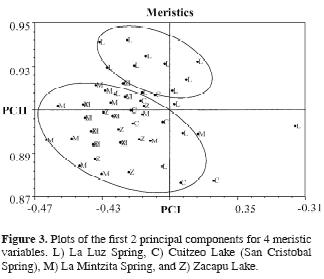
<body><![CDATA[<p align="justify"><font face="verdana" size="2">&nbsp;</font></p> 				    <p align="justify"><font face="verdana" size="2"><b>Results</b></font></p> 				    <p align="justify"><font face="verdana" size="2"><i>Morphometrics</i>. Analysis of variance showed significant differences (<u>&lt;</u> 0.05) between species for most of the morphometric variables mainly due to differences in standard length, except for the dorsal&#150;fin origin to end of the anal fin. We inferred from this result that the longer dorsal&#150;fin base in <i>Z. purhepechus</i> n. sp. influences the DOAE measurement 0.32&#150;0.25 (<img src="/img/revistas/rmbiodiv/v79n2/a11s1.jpg" alt=""> = 0.29) (<a href="#t2">Table 2</a>). ANOVA for sexual dimorphism showed significant differences in all variables except in the end of the anal&#150;fin to end of the dorsal&#150;fin distance, thus showing that females have a narrower caudal peduncle than males.</font></p> 				    <p align="center"><font face="verdana" size="2"><a name="t2"></a></font></p> 				    <p align="center"><font face="verdana" size="2"><img src="/img/revistas/rmbiodiv/v79n2/a11t2.jpg" alt=""></font></p> 				    <p align="justify"><font face="verdana" size="2">The interaction between populations and sexes in most of the morphometric characters do not show significant differences, except for preorbital length. On the contrary, in the meristic characters, the significant differences are only between populations (Table 2). These results justify the separation of morphometric but not meristic analyses by sex.</font></p> 				    <p align="justify"><font face="verdana" size="2">In an exploratory PCA with the morphometric measurements, PCI explains 90.29% of the variation in males and 90.03% in females; for both sexes, the eigenvectors show closed values with the same symbol, suggesting an influence of the standard length in the results (Doadrio et al., 2002). A second PCA with a Burnaby corrected matrix, accumulates 45.53% of the variance in the PCII in males and 52.42% in females. For males, the high values in eigenvectors were preorbital length, dorsal fin length and anal fin length in the PCI, and interorbital width and FAD&#150;ESPC in the PCII. For females, the high values in eigenvectors were preorbital length, dorsal fin length and FAD&#150;ESPC in the PCI, and anal fin length in the PCII (<a href="/img/revistas/rmbiodiv/v79n2/a11t3.jpg" target="_blank">Table 3</a>). In both sexes, the variation patterns were determined by the preorbital length and dorsal fin length in the PCI. This analysis shows a clear tendency to form 2 groups (ellipses in <a href="/img/revistas/rmbiodiv/v79n2/a11f2.jpg" target="_blank">Fig. 2 A and B</a>), from the lower Lerma basin (La Luz Spring) and middle Lerma (San Cristobal and La Mintzita Springs in the Cuitzeo drainage and Zacapu Lake). With respect to the PCA with meristic characters, PCII accumulates 76.05% of the explained variance, and the high values in the eigenvectors were dorsal fin rays and gill rakers in the PCI, and pectoral fin rays in the PCII (<a href="#t4">Table 4</a>). Similar to morphometric characters, the meristic characters show a variation pattern with the formation of 2 groups (ellipses in <a href="#f3">Fig. 3</a>).</font></p> 				    <p align="center"><font face="verdana" size="2"><a name="t4"></a></font></p> 				    <p align="center"><font face="verdana" size="2"><img src="/img/revistas/rmbiodiv/v79n2/a11t4.jpg" alt=""></font></p> 				    <p align="center"><font face="verdana" size="2"><a name="f3"></a></font></p> 				    ]]></body>
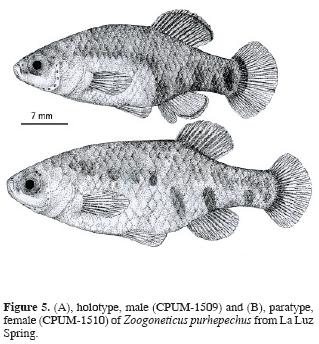
<body><![CDATA[<p align="center"><font face="verdana" size="2"><img src="/img/revistas/rmbiodiv/v79n2/a11f3.jpg" alt=""></font></p> 				    <p align="justify"><font face="verdana" size="2">Starting with the classificatory hypothesis (formation of 2 groups), the DFA shows a significant difference (&alpha; <u>&lt;</u> 0.05) with the intermediate distances of morphometric characters in males (<i>P </i>= 0.003) and females (<i>P</i> = 0.010), and with the meristic characters (<i>P</i> = 0.000). These results agree with the proposed classificatory hypothesis and corroborate the variation pattern found in the PCA. </font></p> 				    <p align="justify"><font face="verdana" size="2"><i>Genetics</i>. In the data set, 106 characters were variable, and 35 were parsimony informative. Third codon positions were the most informative characters (24 informative characters), followed by the first codon position (10 characters). Saturation of transition and transversion changes was checked by plotting the absolute number of changes of each codon position against patristic distances. There was no ingroup evidence of saturation at any of the 3 positions (not shown). The HKY&#150;G model was selected as the best fit to the data set. Rate matrix parameters were: &#150;lnL = 2205.0105; K = 5; BIC = 4456.7324. The base frequencies were: freqA = 0.2522; freqC = 0.2685; freqG = 0.1390; freqT = 0.3402. Among&#150;site rate variation was approximated with gamma distribution shape parameter &alpha; = 0.1976. The phylogenetic tree obtained by the Bayesian analysis after discarding the initial 500 burn&#150;in chains (<a href="/img/revistas/rmbiodiv/v79n2/a11f4.jpg" target="_blank">Fig. 4</a>) showed the formation of 2 well differentiated groups, with a posterior probability of the branches of 100 for the <i>Z. quitzeoensis</i> clade (including the type locality) and 96 for the clade which contains the new species <i>Z. purhepechus</i> sp nov. The genetic distance obtained by the model HKY&#150;G within groups was 3.4% (3&#150;3.8%).</font></p> 				    <p align="justify"><font face="verdana" size="2">&nbsp;</font></p> 				    <p align="justify"><font face="verdana" size="2"><b>Description</b></font></p> 				    <p align="justify"><font face="verdana" size="2"><i>Zoogoneticus purhepechus</i> n. sp. (<a href="#f5">Figures 5 A&#150;B</a>, <a href="/img/revistas/rmbiodiv/v79n2/a11t5.jpg" target="_blank">Table 5</a>)</font></p> 				    <p align="center"><font face="verdana" size="2"><a name="f5"></a></font></p> 				    <p align="center"><font face="verdana" size="2"><img src="/img/revistas/rmbiodiv/v79n2/a11f5.jpg" alt=""></font></p> 				    <p align="justify"><font face="verdana" size="2">D = (13) 14; A = 13&#150;14; P = (11&#150;12) 13&#150;15; GR = (7) 9&#150;12. Morphometric measurements are shown in <a href="/img/revistas/rmbiodiv/v79n2/a11t5.jpg" target="_blank">Table 5</a>. Body relatively deep, laterally compressed and elongated, maximum height <img src="/img/revistas/rmbiodiv/v79n2/a11s1.jpg" alt=""> = 3.1 (range = 2.8&#150;3.6) times the standard length in males and <img src="/img/revistas/rmbiodiv/v79n2/a11s1.jpg" alt=""> = 3.3 (range = 2.9&#150;3.7) times in females.  Minimum body height <img src="/img/revistas/rmbiodiv/v79n2/a11s1.jpg" alt=""> = 6.5 (range = 6.2&#150;7) times the standard length for males and <img src="/img/revistas/rmbiodiv/v79n2/a11s1.jpg" alt=""> = 7 (range = 6.2&#150;7.7) in females. Head short, cephalic length <img src="/img/revistas/rmbiodiv/v79n2/a11s1.jpg" alt=""> = 3.5 (range = 3.3&#150;3.7) times standard length in males and <img src="/img/revistas/rmbiodiv/v79n2/a11s1.jpg" alt=""> = 3.7 (range = 3.3&#150;4.1) in females. Preorbital distance short, preorbital distance <img src="/img/revistas/rmbiodiv/v79n2/a11s1.jpg" alt=""> = 16.6 (range = 14.6&#150;21.8) times standard length in males and <img src="/img/revistas/rmbiodiv/v79n2/a11s1.jpg" alt=""> = 20 (range = 12.8&#150;27.4) in females. Anal fin inserted before origin dorsal fin at same axis. Dorsal fin length long <img src="/img/revistas/rmbiodiv/v79n2/a11s1.jpg" alt=""> = 5.2 (range = 3.4&#150;7) standard length in males and <img src="/img/revistas/rmbiodiv/v79n2/a11s1.jpg" alt=""> = 5.8 (range = 5.3&#150;6.6) in females. </font></p> 				    <p align="justify"><font face="verdana" size="2"><i>Pigmentation pattern</i>. When alive, both sexes exhibit a light brown coloration, with dark brown and moderately large spots on the posterior part of the body, starting at the base of the caudal fin. In the anterior part of the body, a mottling pattern of small spots can be distinguished at the top of the ventral region. They show a pair of dark brown spots laterally aligned at the base of the caudal peduncle, in the region of the hypural plate. In males, during the breeding season, these spots could not be distinguished. The ventral region lacks spots. Adult males are slightly darker than females and may show a slightly bluish or greenish hue on the lateral side of the body and some scales can produce iridescence. The males from the type locality show an intense red band at the end of the pelvic and dorsal fins. In specimens from other localities, this band may be an intense orange. Alcohol preserved specimens are light brown on the body with the abdominal region yellowish, and from the caudal peduncle approximately to the insertion of the anal fin showing moderately large, dark brown spots. From the anal fin forward, spots are smaller and irregularly shaped. The red band in the dorsal and anal fins and the slightly bluish or greenish hue are faint or are less intense. </font></p> 				    ]]></body>
<body><![CDATA[<p align="justify"><font face="verdana" size="2"><i>Sexual dimorphism</i> and reproduction. As in all members of the subfamily Goodeinae, males have the first 2 to 7 anal rays shorter. These rays form a short lobe that is inferred to function in sperm transfer (Parenti, 1981) (<a href="#f5">Fig. 5A</a>). Differences in size were found between sexes, with females being larger than males. As in Z. quitzeoensis, the caudal peduncle is narrower (SL/BLD <img src="/img/revistas/rmbiodiv/v79n2/a11s1.jpg" alt=""> = 7.0 , range= 6.2&#150;7.7) and longer (SL/EDUP <img src="/img/revistas/rmbiodiv/v79n2/a11s1.jpg" alt=""> = 4.1, range= 3.4&#150;4.7) in females than in males (SL/BLD x = 6.5 , range= 6.1&#150;7.0 and SL/EDUP <img src="/img/revistas/rmbiodiv/v79n2/a11s1.jpg" alt=""> = 3.8 , range= 3.5&#150;4.4). The males have a stripe with intense red coloration at the end of the dorsal and anal fin. The sex of males can be distinguished at a few weeks after birth. In captive conditions (temperature 21&deg;C &plusmn; 2&deg;C), the males and females can become sexually mature between 8 and 12 weeks. Gestation requires 7 to 9 weeks. Reproduction occurs throughout the year, but peaks when the temperature is between 20 and 21&deg;C. The number of offspring per reproductive event in captivity oscillates between 15 and 45. The fry are usually 9 to 12 mm in standard length at birth and feed on the second day after birth. First parturition females usually have a low number of offspring.</font></p> 				    <p align="justify"><font face="verdana" size="2">&nbsp;</font></p> 				    <p align="justify"><font face="verdana" size="2"><b>Taxonomic summary</b></font></p> 				    <p align="justify"><font face="verdana" size="2"><i>Material examined. Holotype</i>: (<a href="/img/revistas/rmbiodiv/v79n2/a11t5.jpg" target="_blank">Table 5</a>, <a href="#f5">Fig. 5A</a>) CPUM 1509, adult male 34.12 mm SL, La Luz Spring (lower Lerma), Zamora, Michoac&aacute;n, M&eacute;xico, Ludo Couvreur, Jan de Moree, Kees de Jong, Juan C. Merino and Luis Escalera&#150;V&aacute;zquez, November 2002.</font></p> 				    <p align="justify"><font face="verdana" size="2"><i>Paratypes</i>: CPUM 1055, (10 individuals); MNCN 246184 (15 individuals); CNP&#150;IBUNAM 14425&#150;14427 (3 individuals). Collected with the holotype.</font></p> 				    <p align="justify"><font face="verdana" size="2"><i>Distribution</i>: in accordance with the molecular and morphometric diagnostic characters, we hypothesized that the populations from Ameca, Santiago and Armer&iacute;a basins and Chapala Lake, identified as <i>Z. quitzeoensis</i>, should henceforth be considered as <i>Z. purhepechus</i>. Thus, the distribution of <i>Z. purhepechus</i> occupies the lower Lerma basin, the upper part of the Armeria, Santiago and Ameca basins and Chapala Lake (<a href="/img/revistas/rmbiodiv/v79n2/a11f1.jpg" target="_blank">Fig. 1</a>).</font></p> 				    <p align="justify"><font face="verdana" size="2"><i>Habitat</i>: the type locality of Z. purhepechus is La Luz Spring. La Luz is a permanent spring of lentic and clear waters and forms a small pond of approximately 1500 m2. Once, the water of this spring flowed to the Duero River, which forms part of the lower Lerma River basin. Currently, the water of this spring is used for irrigation and as a water supply to the population. It has an average depth of 1.5 m with a maximum depth of 3.5 m. The bottom is rocky in its periphery and muddy in most of the pond. Aquatic vegetation is <i>Iris</i> sp. and Ceratophyllum sp, emergent vegetation <i>Typha</i> sp. and <i>Scirpus</i> sp., and the introduced species <i>Eichhornia</i> sp, and terrestrial vegetation is of the subtropical forest type.</font></p> 				    <p align="justify"><font face="verdana" size="2">The associated fish fauna are the native species, <i>Alloophorus robustus</i> (Bean, 1892); <i>Chapalichthys encaustus</i> (Jordan and Snyder, 1899); <i>Goodea atripinnis</i> Jordan 1880; <i>Skiffia multipunctata</i> (Goodeidae); <i>Poeciliopsis infans</i> (Poeciliidae); and <i>Lampetra geminis</i> (Alvarez, 1964) (Petromyzontidae); and the introduced species <i>Poecilia mexicana</i> Steindachner 1863; <i>Xiphophorus hellerii</i> Heckel 1848, (Poeciliidae); <i>Oreochromis</i> spp (Cichlidae); and <i>Cyprinus carpio</i> Linnaeus 1758, <i>Ctenopharingodon idella</i> (Valenciennes 1844) (Cyprinidae).</font></p> 				    <p align="justify"><font face="verdana" size="2"><i>Conservation</i>: although this species has been taken from a number of localities, and is widely distributed in different drainages along the occidental part of Central Mexico, in the last 5 years, a reduction in its distribution of almost 75% of the historical occurrence points has been observed (<a href="/img/revistas/rmbiodiv/v79n2/a11f1.jpg" target="_blank">Fig. 1</a>). The most common alterations reported in the localities where the species has disappeared are the introduction of exotic species, water pollution and desiccation (De la Vega&#150;Salazar et al., 2003; Dom&iacute;nguez&#150;Dom&iacute;nguez et al., 2005; Dom&iacute;nguez&#150;Dom&iacute;nguez et al., 2006b). Genetic erosion related with human perturbations of the population of this new species was demonstrated recently (Dom&iacute;nguez&#150;Dom&iacute;nguez et al., 2007). This species should be considered as in danger of extinction, following the criteria and categories of the MER&#150;Aii,Bi,Ci,Di (SEMARNAT 2002) and the International Union for the Conservation of Nature and Natural Resources IUCN&#150;A,1a,c,e. (IUCN, 2001&#150;<a href="http://app.iucn.org/" target="_blank">http://app.iucn.org/webfiles/doc/SSC/RedList/RedListGuidelines.pdf</a>).</font></p> 				    <p align="justify"><font face="verdana" size="2"><i>Etymology</i>: the name "purhepechus" comes from purhepecha, the name of the indigenous ethnic group which inhabited part of the distribution range of this species, including the type locality.</font></p> 				    ]]></body>
<body><![CDATA[<p align="justify"><font face="verdana" size="2">&nbsp;</font></p> 				    <p align="justify"><font face="verdana" size="2"><b>Remarks</b></font></p> 				    <p align="justify"><font face="verdana" size="2"><i>Zoogoneticus purhepechus</i> n. sp. differs from its sister species, <i>Z. quitzeoensis</i> by the following combination of characters: 13&#150;14 branched rays in the dorsal fin (vs. 12, rarely 11 or 13 branched dorsal rays in <i>Z. quitzeoensis</i>), long dorsal fin base length (DFL/SL  = 0.18, SD = 0.03 vs. <img src="/img/revistas/rmbiodiv/v79n2/a11s1.jpg" alt=""> = 0.16, SD = 0.01 in <i>Z. quitzeoensis</i>) and short pre&#150;orbital length (Prol/SL <img src="/img/revistas/rmbiodiv/v79n2/a11s1.jpg" alt=""> = 0.056, SD = 0.01 vs <img src="/img/revistas/rmbiodiv/v79n2/a11s1.jpg" alt=""> = 0.066, SD = 0.008 in <i>Z. quitzeoensis</i>); 2 conspicuous dark brown spots in the hypural plate region, except in males within the reproductive season; 10 molecular autapomorphies in the cytochrome <i>b</i> gene also differentiate <i>Zoogoneticus purhepechus</i> sp. nov. from <i>Z. tequila</i> and <i>Z. quitzeoensis</i> (<a href="/img/revistas/rmbiodiv/v79n2/a11t6.jpg" target="_blank">Table 6</a>). Divergences in the cytochrome <i>b</i> gene is D<sub>HKY</sub> = 3.4% (3&#150;3.8%) compared to <i>Z. quitzeoensis</i> and D<sub>HKY</sub> = 11% (9&#150;13%) compared to <i>Z. tequila</i>.</font></p> 				    <p align="justify"><font face="verdana" size="2">The genus <i>Zoogoneticus</i> is characterized by the presence of some distinctive characteristics, exhibiting 2 to 6 melanic patches in the post&#150;ventral region of the body (Webb and Miller, 1998). Two dark brown spots in the hypural plate region are characteristic, more evident in <i>Z. quitzeoensis</i> and <i>Z. purhepechus</i> than in <i>Z. tequila</i>, in which the spots are less evident or are fused. The trophotaenia is a ribbon&#150;type with 9&#150;14 termini. The genetic and morphometric variation pattern within the populations of the 2 species analysed here show the separation of 2 well&#150;defined groups, supporting previous findings made with molecular characters (Doadrio and Dom&iacute;nguez, 2004). The ANOVA analysis between populations shows that DOAE distance differs between them. We inferred that this is a result of the larger DFL distance in <i>Z. purhepechus</i> and this inference is supported by the PCA. In the same manner, differences in PrOL were obtained and supported by the minus preorbital length obtained as a diagnostic character in PCA. The morphometric diagnostic characters are preorbital length and dorsal fin length in the PCI. Accordingly, with this classification, which was corroborated by the DFA, the <i>Z. quitzeoensis</i> populations (San Cristobal Spring and La Mintzita Spring in the Cuitzeo drainage and Zacapu Lake) have a larger superior mandible and a shorter base of the dorsal fin. On the other hand <i>Z. purhepechus</i> (La Luz Spring) exhibits a shorter upper mandible, a larger dorsal fin base and a higher number of dorsal rays.</font></p> 				    <p align="justify"><font face="verdana" size="2">This grouping model is congruent with the results of the Bayesian analysis, and the high genetic divergences between <i>Z. quitzeoensis</i> and <i>Z. purhepechus</i> (DHKY= 3.4%, range= 3&#150;3.8%). These values are higher than those described for the family Goodeidae, in which an intraspecific pairwise uncorrected "p" distance of 0.001 to 1.7% was found, and are similar to those found in interspecific distances of 1.7 to 11% (Doadrio and Dom&iacute;nguez, 2004). In the same manner, the middle Lerma and lower Lerma basins are considered to have undergone a pattern of isolation and union, which correlates with vicariant events inferred to promote cladogenetic processes in at least 2 pairs of sister species within the Goodeinae (e.g. Skiffia lermae&#150;Skiffia multipunctata and <i>Zoogonetius</i> quitzeoensis&#150;<i>Z. purhepechus</i>) (Dom&iacute;nguez&#150;Dom&iacute;nguez et al., 2006a).</font></p> 				    <p align="justify"><font face="verdana" size="2">&nbsp;</font></p> 				    <p align="justify"><font face="verdana" size="2"><b>Acknowledgments</b></font></p> 				    <p align="justify"><font face="verdana" size="2">The authors are grateful to Luis Escalera, Asdrubal Molina, Hugo Mejia, Rogelio Rosas, Jen Nightingale, Jean de Moree, Ludo Couvreur, Kees de Jong, Juan Carlos Merino and Adrian Pompa for their help during field trips. Partial funds to conduct this research were provided by the COECyT Michoac&aacute;n and Chester Zoo Garden, England to OD and by the project CGL2006&#150;12325/BOS. We thank Ivan Dibble for his support to the Hobbyist Aqualab Conservation Project (HALCP) that receives funds from European and North American aquarist associations. OD and RP thank the Consejo Nacional de Ciencia y Tecnolog&iacute;a for the scholarship. </font></p> 				    <p align="justify"><font face="verdana" size="2">&nbsp;</font></p> 				    <p align="justify"><font face="verdana" size="2"><b>Literature cited</b></font></p> 				    ]]></body>
<body><![CDATA[<!-- ref --><p align="justify"><font face="verdana" size="2">Barbour, C. D. 1973. A biogeographical history of <i>Chirostoma</i> (Pisces: Atherinidae): A species flock from the Mexican Plateau. Copeia 1973:533&#150;556.</font>&nbsp;&nbsp;&nbsp;&nbsp;&nbsp;&nbsp;&nbsp;&nbsp;[&#160;<a href="javascript:void(0);" onclick="javascript: window.open('/scielo.php?script=sci_nlinks&ref=7488393&pid=S1870-3453200800020001100001&lng=','','width=640,height=500,resizable=yes,scrollbars=1,menubar=yes,');">Links</a>&#160;]<!-- end-ref --> 				    <!-- ref --><p align="justify"><font face="verdana" size="2">Burnaby, T. P. 1966. Growth&#150;invariant discriminant functions and generalized distances. Biometrics 22: 96&#150;110.</font>&nbsp;&nbsp;&nbsp;&nbsp;&nbsp;&nbsp;&nbsp;&nbsp;[&#160;<a href="javascript:void(0);" onclick="javascript: window.open('/scielo.php?script=sci_nlinks&ref=7488395&pid=S1870-3453200800020001100002&lng=','','width=640,height=500,resizable=yes,scrollbars=1,menubar=yes,');">Links</a>&#160;]<!-- end-ref --> 				    <!-- ref --><p align="justify"><font face="verdana" size="2">De la Vega&#150;Salazar, M., E. Avila&#150;Luna and C. Mac&iacute;as&#150;Garc&iacute;a. 2003. Ecological evaluation of local extinction: the case of 2 genera of endemic Mexican fish, Zoogoneticus and Skiffia. Biodiversity and Conservation 12:2043&#150;2056.</font>&nbsp;&nbsp;&nbsp;&nbsp;&nbsp;&nbsp;&nbsp;&nbsp;[&#160;<a href="javascript:void(0);" onclick="javascript: window.open('/scielo.php?script=sci_nlinks&ref=7488397&pid=S1870-3453200800020001100003&lng=','','width=640,height=500,resizable=yes,scrollbars=1,menubar=yes,');">Links</a>&#160;]<!-- end-ref --> 				    <!-- ref --><p align="justify"><font face="verdana" size="2">Doadrio, I., J. A. Carmona and C. Fern&aacute;ndez&#150;Delgado. 2002. Morphometric study of the Iberian <i>Aphianus</i> (Actinopterygii, Cyprinodontiformes), with description of a new species. Folia Zoologica 51:67&#150;79.</font>&nbsp;&nbsp;&nbsp;&nbsp;&nbsp;&nbsp;&nbsp;&nbsp;[&#160;<a href="javascript:void(0);" onclick="javascript: window.open('/scielo.php?script=sci_nlinks&ref=7488399&pid=S1870-3453200800020001100004&lng=','','width=640,height=500,resizable=yes,scrollbars=1,menubar=yes,');">Links</a>&#160;]<!-- end-ref --> 				    <!-- ref --><p align="justify"><font face="verdana" size="2">Doadrio, I. and O. Dom&iacute;nguez. 2004. Phylogenetic relationships within the fish family Goodeidae based on cytochrome b sequence data. Molecular Phylogenetics and Evolution 31:416&#150;430.</font>&nbsp;&nbsp;&nbsp;&nbsp;&nbsp;&nbsp;&nbsp;&nbsp;[&#160;<a href="javascript:void(0);" onclick="javascript: window.open('/scielo.php?script=sci_nlinks&ref=7488401&pid=S1870-3453200800020001100005&lng=','','width=640,height=500,resizable=yes,scrollbars=1,menubar=yes,');">Links</a>&#160;]<!-- end-ref --> 				    ]]></body>
<body><![CDATA[<!-- ref --><p align="justify"><font face="verdana" size="2">SEMARNAT (Secretar&iacute;a de Medio Ambiente y Recursos Naturales). 2002. Norma Oficial Mexicana NOM&#150;059&#150;ECOL&#150;2001, Protecci&oacute;n ambiental&#150;Especies nativas de M&eacute;xico de flora y fauna silvestres&#150;Categor&iacute;as de riesgo y especificaciones para su inclusi&oacute;n, exclusi&oacute;n o cambio&#150;Lista de especies en riesgo. Diario Oficial de la Federaci&oacute;n. 6 de marzo de 2002, Primera secci&oacute;n. M&eacute;xico, DF.</font>&nbsp;&nbsp;&nbsp;&nbsp;&nbsp;&nbsp;&nbsp;&nbsp;[&#160;<a href="javascript:void(0);" onclick="javascript: window.open('/scielo.php?script=sci_nlinks&ref=7488403&pid=S1870-3453200800020001100006&lng=','','width=640,height=500,resizable=yes,scrollbars=1,menubar=yes,');">Links</a>&#160;]<!-- end-ref --> 				    <!-- ref --><p align="justify"><font face="verdana" size="2">Dom&iacute;nguez&#150;Dom&iacute;nguez, O., N. Mercado&#150;Silva, J. Lyons and H. J. Grier. 2005. The viviparous Goodeid fish. In Proceedings of the second international symposium of viviparous fishes, M. C. Uribe and H. J. Grier (eds.). New Life Publications, Homestead, Florida. p. 505&#150;549.</font>&nbsp;&nbsp;&nbsp;&nbsp;&nbsp;&nbsp;&nbsp;&nbsp;[&#160;<a href="javascript:void(0);" onclick="javascript: window.open('/scielo.php?script=sci_nlinks&ref=7488405&pid=S1870-3453200800020001100007&lng=','','width=640,height=500,resizable=yes,scrollbars=1,menubar=yes,');">Links</a>&#160;]<!-- end-ref --> 				    <!-- ref --><p align="justify"><font face="verdana" size="2">Dom&iacute;nguez&#150;Dom&iacute;nguez, O., I. Doadrio and G. P&eacute;rez&#150;Ponce de Le&oacute;n. 2006a. Historical biogeography of some river basins in Central Mexico evidenced by their goodeiine freshwater fishes: A preliminary hypothesis using secondary Brooks Parsimony Analysis (BPA). Journal of Biogeography 30:1437&#150;1447. </font>&nbsp;&nbsp;&nbsp;&nbsp;&nbsp;&nbsp;&nbsp;&nbsp;[&#160;<a href="javascript:void(0);" onclick="javascript: window.open('/scielo.php?script=sci_nlinks&ref=7488407&pid=S1870-3453200800020001100008&lng=','','width=640,height=500,resizable=yes,scrollbars=1,menubar=yes,');">Links</a>&#160;]<!-- end-ref --> 				    <!-- ref --><p align="justify"><font face="verdana" size="2">Dom&iacute;nguez&#150;Dom&iacute;nguez O., E. Mart&iacute;nez&#150;Meyer, L. Zambrano and G. P&eacute;rez&#150;Ponce de Le&oacute;n. 2006b. Using ecological&#150;niche modeling as a conservation tool for freshwater species: the live&#150;bearing fishes (Goodeidae) in Central Mexico. Conservation Biology. 20: 1730&#150;1739.</font>&nbsp;&nbsp;&nbsp;&nbsp;&nbsp;&nbsp;&nbsp;&nbsp;[&#160;<a href="javascript:void(0);" onclick="javascript: window.open('/scielo.php?script=sci_nlinks&ref=7488409&pid=S1870-3453200800020001100009&lng=','','width=640,height=500,resizable=yes,scrollbars=1,menubar=yes,');">Links</a>&#160;]<!-- end-ref --> 				    <!-- ref --><p align="justify"><font face="verdana" size="2">Dom&iacute;nguez&#150;Dom&iacute;nguez O, L. Boto, F. Alda, G. P&eacute;rez&#150;Ponce de Le&oacute;n and I. Doadrio. 2007. Human impacts on Basins of the Mesa Central of Mexico, and its genetic effects on an endangered fish, Zoogoneticus quitzeoensis. Conservation Biology 21:168&#150;180.</font>&nbsp;&nbsp;&nbsp;&nbsp;&nbsp;&nbsp;&nbsp;&nbsp;[&#160;<a href="javascript:void(0);" onclick="javascript: window.open('/scielo.php?script=sci_nlinks&ref=7488411&pid=S1870-3453200800020001100010&lng=','','width=640,height=500,resizable=yes,scrollbars=1,menubar=yes,');">Links</a>&#160;]<!-- end-ref --> 				    ]]></body>
<body><![CDATA[<!-- ref --><p align="justify"><font face="verdana" size="2">Echelle, A. A. and A. F. Echelle. 1984. Evolutionary genetics of a "species flock:" Atherinid fishes on the Mesa Central of Mexico. In Evolution of fish species flocks, A. A. Echelle and I. Kornfield (eds.). University of Maine Press, Orono. p. 93&#150;110. </font>&nbsp;&nbsp;&nbsp;&nbsp;&nbsp;&nbsp;&nbsp;&nbsp;[&#160;<a href="javascript:void(0);" onclick="javascript: window.open('/scielo.php?script=sci_nlinks&ref=7488413&pid=S1870-3453200800020001100011&lng=','','width=640,height=500,resizable=yes,scrollbars=1,menubar=yes,');">Links</a>&#160;]<!-- end-ref --> 				    <!-- ref --><p align="justify"><font face="verdana" size="2">Espinoza&#150;P&eacute;rez, H., M. T. Gaspar&#150;Dillanes and P. Fuentes&#150;Mata. 1993. Listados faun&iacute;sticos de M&eacute;xico. III. Los peces dulceacu&iacute;colas mexicanos. Instituto de Biolog&iacute;a, Universidad Nacional Aut&oacute;noma de M&eacute;xico, M&eacute;xico, D.F. 98 pp.</font>&nbsp;&nbsp;&nbsp;&nbsp;&nbsp;&nbsp;&nbsp;&nbsp;[&#160;<a href="javascript:void(0);" onclick="javascript: window.open('/scielo.php?script=sci_nlinks&ref=7488415&pid=S1870-3453200800020001100012&lng=','','width=640,height=500,resizable=yes,scrollbars=1,menubar=yes,');">Links</a>&#160;]<!-- end-ref --> 				    <!-- ref --><p align="justify"><font face="verdana" size="2">Grudzien, T. A., M. M. White and B. J. Turner. 1992. Biochemical systematics of the viviparous fish family Goodeidae. Journal of Fish Biology 40:810&#150;814.</font>&nbsp;&nbsp;&nbsp;&nbsp;&nbsp;&nbsp;&nbsp;&nbsp;[&#160;<a href="javascript:void(0);" onclick="javascript: window.open('/scielo.php?script=sci_nlinks&ref=7488417&pid=S1870-3453200800020001100013&lng=','','width=640,height=500,resizable=yes,scrollbars=1,menubar=yes,');">Links</a>&#160;]<!-- end-ref --> 				    <!-- ref --><p align="justify"><font face="verdana" size="2">Guzm&aacute;n&#150;Arroyo, F. 1994. Osteolog&iacute;a y variaci&oacute;n no geogr&aacute;fica de la suspensi&oacute;n de la aleta anal de <i>Goodea luitpoldi</i>, (Osteichthyes: Goodeidae). Universidad, Ciencia y Tecnolog&iacute;a 3:33&#150;41.</font>&nbsp;&nbsp;&nbsp;&nbsp;&nbsp;&nbsp;&nbsp;&nbsp;[&#160;<a href="javascript:void(0);" onclick="javascript: window.open('/scielo.php?script=sci_nlinks&ref=7488419&pid=S1870-3453200800020001100014&lng=','','width=640,height=500,resizable=yes,scrollbars=1,menubar=yes,');">Links</a>&#160;]<!-- end-ref --> 				    <!-- ref --><p align="justify"><font face="verdana" size="2">Hubbs, C. L. and C. L. Turner. 1939. Studies of the fishes of the Order Cyprinodontes. XVI. A revision of the Goodeidae. Miscellaneous Publications of the Museum of Zoology. University of Michigan 42:1&#150;80.</font>&nbsp;&nbsp;&nbsp;&nbsp;&nbsp;&nbsp;&nbsp;&nbsp;[&#160;<a href="javascript:void(0);" onclick="javascript: window.open('/scielo.php?script=sci_nlinks&ref=7488421&pid=S1870-3453200800020001100015&lng=','','width=640,height=500,resizable=yes,scrollbars=1,menubar=yes,');">Links</a>&#160;]<!-- end-ref --> 				    ]]></body>
<body><![CDATA[<!-- ref --><p align="justify"><font face="verdana" size="2">Hueselsenbeck, J. P. and F. R. Ronquist. 2001. MrBayes: Bayesian inference of phylogeny. Bioinformatics 17:754&#150;755.</font>&nbsp;&nbsp;&nbsp;&nbsp;&nbsp;&nbsp;&nbsp;&nbsp;[&#160;<a href="javascript:void(0);" onclick="javascript: window.open('/scielo.php?script=sci_nlinks&ref=7488423&pid=S1870-3453200800020001100016&lng=','','width=640,height=500,resizable=yes,scrollbars=1,menubar=yes,');">Links</a>&#160;]<!-- end-ref --> 				    <!-- ref --><p align="justify"><font face="verdana" size="2">IUCN (International Union for the Conservation of Nature and Natural Resources). 1994. IUCN Red List Categories. Prepared by the IUCN Species Survival Commission. Gland: IUCN, Switzerland.</font>&nbsp;&nbsp;&nbsp;&nbsp;&nbsp;&nbsp;&nbsp;&nbsp;[&#160;<a href="javascript:void(0);" onclick="javascript: window.open('/scielo.php?script=sci_nlinks&ref=7488425&pid=S1870-3453200800020001100017&lng=','','width=640,height=500,resizable=yes,scrollbars=1,menubar=yes,');">Links</a>&#160;]<!-- end-ref --> 				    <!-- ref --><p align="justify"><font face="verdana" size="2">Machordom, A. and I. Doadrio. 2001. Evidence of a Cenozoic Betic&#150;Kabilian connection based on freshwater sh phylogeography (Luciobarbus, Cyprinidae). Molecular Phylogenetics and Evolution 18:252&#150;263.</font>&nbsp;&nbsp;&nbsp;&nbsp;&nbsp;&nbsp;&nbsp;&nbsp;[&#160;<a href="javascript:void(0);" onclick="javascript: window.open('/scielo.php?script=sci_nlinks&ref=7488427&pid=S1870-3453200800020001100018&lng=','','width=640,height=500,resizable=yes,scrollbars=1,menubar=yes,');">Links</a>&#160;]<!-- end-ref --> 				    <!-- ref --><p align="justify"><font face="verdana" size="2">Mateos, M., O. I. Sanjur and R. C. Vrijenhoek. 2002. Historical biogeography of the livebearing fish genus <i>Poeciliopsis</i> (Poeciliidae: Cyprinodontiformes). Evolution 56:972&#150;984.</font>&nbsp;&nbsp;&nbsp;&nbsp;&nbsp;&nbsp;&nbsp;&nbsp;[&#160;<a href="javascript:void(0);" onclick="javascript: window.open('/scielo.php?script=sci_nlinks&ref=7488429&pid=S1870-3453200800020001100019&lng=','','width=640,height=500,resizable=yes,scrollbars=1,menubar=yes,');">Links</a>&#160;]<!-- end-ref --> 				    <!-- ref --><p align="justify"><font face="verdana" size="2">Meek, S. E. 1904. The fresh&#150;water fishes of Mexico north of the Isthmus of Tehuantepec. Field Columbian Museum Publications 5:1&#150;252.</font>&nbsp;&nbsp;&nbsp;&nbsp;&nbsp;&nbsp;&nbsp;&nbsp;[&#160;<a href="javascript:void(0);" onclick="javascript: window.open('/scielo.php?script=sci_nlinks&ref=7488431&pid=S1870-3453200800020001100020&lng=','','width=640,height=500,resizable=yes,scrollbars=1,menubar=yes,');">Links</a>&#160;]<!-- end-ref --> 				    ]]></body>
<body><![CDATA[<!-- ref --><p align="justify"><font face="verdana" size="2">Miller, R. R. and M. L. Smith. 1986. Origin and geography of the fishes of central Mexico. In The zoogeography of the North American Freshwater Fishes, C. H. Hocutt and E. O. Wiley (eds.). John Wiley and Sons, New York. p. 487&#150;517.</font>&nbsp;&nbsp;&nbsp;&nbsp;&nbsp;&nbsp;&nbsp;&nbsp;[&#160;<a href="javascript:void(0);" onclick="javascript: window.open('/scielo.php?script=sci_nlinks&ref=7488433&pid=S1870-3453200800020001100021&lng=','','width=640,height=500,resizable=yes,scrollbars=1,menubar=yes,');">Links</a>&#160;]<!-- end-ref --> 				    <!-- ref --><p align="justify"><font face="verdana" size="2">Parenti, L. 1981. A phylogenetic and biogeographic analysis of cyprinidontiform fishes (Teleostei, Atherinomorpha). Bulletin of the American Museum of Natural History 168:335&#150;557.</font>&nbsp;&nbsp;&nbsp;&nbsp;&nbsp;&nbsp;&nbsp;&nbsp;[&#160;<a href="javascript:void(0);" onclick="javascript: window.open('/scielo.php?script=sci_nlinks&ref=7488435&pid=S1870-3453200800020001100022&lng=','','width=640,height=500,resizable=yes,scrollbars=1,menubar=yes,');">Links</a>&#160;]<!-- end-ref --> 				    <!-- ref --><p align="justify"><font face="verdana" size="2">Posada, D. and K. A. Crandall. 1998. Modeltest: testing the model of DNA substitution. Bioinformatics 14: 817&#150;818.</font>&nbsp;&nbsp;&nbsp;&nbsp;&nbsp;&nbsp;&nbsp;&nbsp;[&#160;<a href="javascript:void(0);" onclick="javascript: window.open('/scielo.php?script=sci_nlinks&ref=7488437&pid=S1870-3453200800020001100023&lng=','','width=640,height=500,resizable=yes,scrollbars=1,menubar=yes,');">Links</a>&#160;]<!-- end-ref --> 				    <!-- ref --><p align="justify"><font face="verdana" size="2">Regan, C. T. 1908. Pisces. In Biologia Centrali&#150;Americana, F. D. Godman and O. Salvin (eds.). London, United Kingdom. p. 1&#150;203.</font>&nbsp;&nbsp;&nbsp;&nbsp;&nbsp;&nbsp;&nbsp;&nbsp;[&#160;<a href="javascript:void(0);" onclick="javascript: window.open('/scielo.php?script=sci_nlinks&ref=7488439&pid=S1870-3453200800020001100024&lng=','','width=640,height=500,resizable=yes,scrollbars=1,menubar=yes,');">Links</a>&#160;]<!-- end-ref --> 				    <!-- ref --><p align="justify"><font face="verdana" size="2">Rohlf, F. J. and F. L. Bookstein. 1987. A comment on shearing as a method for size correction. Systematic Zoology 36:356&#150;367. </font>&nbsp;&nbsp;&nbsp;&nbsp;&nbsp;&nbsp;&nbsp;&nbsp;[&#160;<a href="javascript:void(0);" onclick="javascript: window.open('/scielo.php?script=sci_nlinks&ref=7488441&pid=S1870-3453200800020001100025&lng=','','width=640,height=500,resizable=yes,scrollbars=1,menubar=yes,');">Links</a>&#160;]<!-- end-ref --> 				    ]]></body>
<body><![CDATA[<!-- ref --><p align="justify"><font face="verdana" size="2">Rohlf, F. J. 2000. NTSYS&#150;pc: Numerical taxonomy and multivariate analysis system, version 2.1. Setauket, New York.</font>&nbsp;&nbsp;&nbsp;&nbsp;&nbsp;&nbsp;&nbsp;&nbsp;[&#160;<a href="javascript:void(0);" onclick="javascript: window.open('/scielo.php?script=sci_nlinks&ref=7488443&pid=S1870-3453200800020001100026&lng=','','width=640,height=500,resizable=yes,scrollbars=1,menubar=yes,');">Links</a>&#160;]<!-- end-ref --> 				    <!-- ref --><p align="justify"><font face="verdana" size="2">Sambrook, J., E. F. Fritsch and T. Maniatis. 1989. Molecular Cloning: A Laboratory Manual. New York: Cold Spring Harbor Laboratory. </font>&nbsp;&nbsp;&nbsp;&nbsp;&nbsp;&nbsp;&nbsp;&nbsp;[&#160;<a href="javascript:void(0);" onclick="javascript: window.open('/scielo.php?script=sci_nlinks&ref=7488445&pid=S1870-3453200800020001100027&lng=','','width=640,height=500,resizable=yes,scrollbars=1,menubar=yes,');">Links</a>&#160;]<!-- end-ref --> 				    <!-- ref --><p align="justify"><font face="verdana" size="2">Sch&ouml;nhuth, M. S. and I. Doadrio. 2003. Phylogenetic relationships of Mexican minnows of the genus <i>Notropis</i> (Actinopterygii, Cyprinidae). Biological Journal of the Linnean Society 80:323&#150;337.</font>&nbsp;&nbsp;&nbsp;&nbsp;&nbsp;&nbsp;&nbsp;&nbsp;[&#160;<a href="javascript:void(0);" onclick="javascript: window.open('/scielo.php?script=sci_nlinks&ref=7488447&pid=S1870-3453200800020001100028&lng=','','width=640,height=500,resizable=yes,scrollbars=1,menubar=yes,');">Links</a>&#160;]<!-- end-ref --> 				    <!-- ref --><p align="justify"><font face="verdana" size="2">Webb, S. A. and R. R. Miller. 1998. <i>Zoogoneticus tequila</i> a new goodeid fish (Cyprinodontiformes) from Ameca drainage of Mexico, and a rediagnosis of the genus. Occasional Papers of the Museum of Zoology, University of Michigan 725:1&#150;23.	</font>&nbsp;&nbsp;&nbsp;&nbsp;&nbsp;&nbsp;&nbsp;&nbsp;[&#160;<a href="javascript:void(0);" onclick="javascript: window.open('/scielo.php?script=sci_nlinks&ref=7488449&pid=S1870-3453200800020001100029&lng=','','width=640,height=500,resizable=yes,scrollbars=1,menubar=yes,');">Links</a>&#160;]<!-- end-ref --> 	     ]]></body><back>
<ref-list>
<ref id="B1">
<nlm-citation citation-type="journal">
<person-group person-group-type="author">
<name>
<surname><![CDATA[Barbour]]></surname>
<given-names><![CDATA[C.D.]]></given-names>
</name>
</person-group>
<article-title xml:lang="en"><![CDATA[A biogeographical history of Chirostoma (Pisces: Atherinidae): A species flock from the Mexican Plateau]]></article-title>
<source><![CDATA[Copeia]]></source>
<year>1973</year>
<volume>1973</volume>
<page-range>533-556</page-range></nlm-citation>
</ref>
<ref id="B2">
<nlm-citation citation-type="journal">
<person-group person-group-type="author">
<name>
<surname><![CDATA[Burnaby]]></surname>
<given-names><![CDATA[T.P.]]></given-names>
</name>
</person-group>
<article-title xml:lang="en"><![CDATA[Growth-invariant discriminant functions and generalized distances]]></article-title>
<source><![CDATA[Biometrics]]></source>
<year>1966</year>
<volume>22</volume>
<page-range>96-110</page-range></nlm-citation>
</ref>
<ref id="B3">
<nlm-citation citation-type="journal">
<person-group person-group-type="author">
<name>
<surname><![CDATA[De la Vega-Salazar]]></surname>
<given-names><![CDATA[M]]></given-names>
</name>
<name>
<surname><![CDATA[Avila-Luna]]></surname>
<given-names><![CDATA[E.]]></given-names>
</name>
<name>
<surname><![CDATA[Macías-García]]></surname>
<given-names><![CDATA[C.]]></given-names>
</name>
</person-group>
<article-title xml:lang="en"><![CDATA[Ecological evaluation of local extinction: the case of 2 genera of endemic Mexican fish, Zoogoneticus and Skiffia]]></article-title>
<source><![CDATA[Biodiversity and Conservation]]></source>
<year>2003</year>
<volume>12</volume>
<page-range>2043-2056</page-range></nlm-citation>
</ref>
<ref id="B4">
<nlm-citation citation-type="journal">
<person-group person-group-type="author">
<name>
<surname><![CDATA[Doadrio]]></surname>
<given-names><![CDATA[I]]></given-names>
</name>
<name>
<surname><![CDATA[Carmona]]></surname>
<given-names><![CDATA[J. A.]]></given-names>
</name>
<name>
<surname><![CDATA[Fernández-Delgado]]></surname>
<given-names><![CDATA[C.]]></given-names>
</name>
</person-group>
<article-title xml:lang="en"><![CDATA[Morphometric study of the Iberian Aphianus (Actinopterygii, Cyprinodontiformes), with description of a new species]]></article-title>
<source><![CDATA[Folia Zoologica]]></source>
<year>2002</year>
<volume>51</volume>
<page-range>67-79</page-range></nlm-citation>
</ref>
<ref id="B5">
<nlm-citation citation-type="journal">
<person-group person-group-type="author">
<name>
<surname><![CDATA[Doadrio]]></surname>
<given-names><![CDATA[I.]]></given-names>
</name>
<name>
<surname><![CDATA[Domínguez]]></surname>
<given-names><![CDATA[O.]]></given-names>
</name>
</person-group>
<article-title xml:lang="en"><![CDATA[Phylogenetic relationships within the fish family Goodeidae based on cytochrome b sequence data]]></article-title>
<source><![CDATA[Molecular Phylogenetics and Evolution]]></source>
<year>2004</year>
<volume>31</volume>
<page-range>416-430</page-range></nlm-citation>
</ref>
<ref id="B6">
<nlm-citation citation-type="journal">
<collab>SEMARNAT (Secretaría de Medio Ambiente y Recursos Naturales)</collab>
<article-title xml:lang="es"><![CDATA[Norma Oficial Mexicana NOM-059-ECOL-2001, Protección ambiental-Especies nativas de México de flora y fauna silvestres-Categorías de riesgo y especificaciones para su inclusión, exclusión o cambio-Lista de especies en riesgo]]></article-title>
<source><![CDATA[Diario Oficial de la Federación]]></source>
<year>2002</year>
<month>6 </month>
<day>de</day>
<publisher-loc><![CDATA[México ]]></publisher-loc>
</nlm-citation>
</ref>
<ref id="B7">
<nlm-citation citation-type="book">
<person-group person-group-type="author">
<name>
<surname><![CDATA[Domínguez-Domínguez]]></surname>
<given-names><![CDATA[O]]></given-names>
</name>
<name>
<surname><![CDATA[Mercado-Silva]]></surname>
<given-names><![CDATA[N.]]></given-names>
</name>
<name>
<surname><![CDATA[Lyons]]></surname>
<given-names><![CDATA[J.]]></given-names>
</name>
<name>
<surname><![CDATA[Grier]]></surname>
<given-names><![CDATA[H. J.]]></given-names>
</name>
</person-group>
<article-title xml:lang="en"><![CDATA[The viviparous Goodeid fish]]></article-title>
<person-group person-group-type="editor">
<name>
<surname><![CDATA[Uribe]]></surname>
<given-names><![CDATA[M. C.]]></given-names>
</name>
<name>
<surname><![CDATA[Grier]]></surname>
<given-names><![CDATA[H. J.]]></given-names>
</name>
</person-group>
<source><![CDATA[Proceedings of the second international symposium of viviparous fishes]]></source>
<year>2005</year>
<page-range>505-549</page-range><publisher-loc><![CDATA[Homestead^eFlorida Florida]]></publisher-loc>
<publisher-name><![CDATA[New Life Publications]]></publisher-name>
</nlm-citation>
</ref>
<ref id="B8">
<nlm-citation citation-type="journal">
<person-group person-group-type="author">
<name>
<surname><![CDATA[Domínguez-Domínguez]]></surname>
<given-names><![CDATA[O]]></given-names>
</name>
<name>
<surname><![CDATA[Doadrio]]></surname>
<given-names><![CDATA[I.]]></given-names>
</name>
<name>
<surname><![CDATA[Pérez-Ponce de León]]></surname>
<given-names><![CDATA[G.]]></given-names>
</name>
</person-group>
<article-title xml:lang="en"><![CDATA[Historical biogeography of some river basins in Central Mexico evidenced by their goodeiine freshwater fishes: A preliminary hypothesis using secondary Brooks Parsimony Analysis (BPA)]]></article-title>
<source><![CDATA[Journal of Biogeography]]></source>
<year>2006</year>
<month>a</month>
<volume>30</volume>
<page-range>1437-1447</page-range></nlm-citation>
</ref>
<ref id="B9">
<nlm-citation citation-type="journal">
<person-group person-group-type="author">
<name>
<surname><![CDATA[Domínguez-Domínguez]]></surname>
<given-names><![CDATA[O]]></given-names>
</name>
<name>
<surname><![CDATA[Martínez-Meyer]]></surname>
<given-names><![CDATA[E.]]></given-names>
</name>
<name>
<surname><![CDATA[Zambrano]]></surname>
<given-names><![CDATA[L.]]></given-names>
</name>
<name>
<surname><![CDATA[Pérez-Ponce de León]]></surname>
<given-names><![CDATA[G.]]></given-names>
</name>
</person-group>
<article-title xml:lang="en"><![CDATA[Using ecological-niche modeling as a conservation tool for freshwater species: the live-bearing fishes (Goodeidae) in Central Mexico]]></article-title>
<source><![CDATA[Conservation Biology.]]></source>
<year>2006</year>
<month>b</month>
<volume>20</volume>
<page-range>1730-1739</page-range></nlm-citation>
</ref>
<ref id="B10">
<nlm-citation citation-type="journal">
<person-group person-group-type="author">
<name>
<surname><![CDATA[Domínguez-Domínguez]]></surname>
<given-names><![CDATA[O]]></given-names>
</name>
<name>
<surname><![CDATA[Boto]]></surname>
<given-names><![CDATA[L.]]></given-names>
</name>
<name>
<surname><![CDATA[Alda]]></surname>
<given-names><![CDATA[F.]]></given-names>
</name>
<name>
<surname><![CDATA[Pérez-Ponce de León]]></surname>
<given-names><![CDATA[G.]]></given-names>
</name>
<name>
<surname><![CDATA[Doadrio]]></surname>
<given-names><![CDATA[I.]]></given-names>
</name>
</person-group>
<article-title xml:lang="en"><![CDATA[Human impacts on Basins of the Mesa Central of Mexico, and its genetic effects on an endangered fish, Zoogoneticus quitzeoensis]]></article-title>
<source><![CDATA[Conservation Biology]]></source>
<year>2007</year>
<volume>21</volume>
<page-range>168-180</page-range></nlm-citation>
</ref>
<ref id="B11">
<nlm-citation citation-type="book">
<person-group person-group-type="author">
<name>
<surname><![CDATA[Echelle]]></surname>
<given-names><![CDATA[A.A.]]></given-names>
</name>
<name>
<surname><![CDATA[Echelle]]></surname>
<given-names><![CDATA[A. F.]]></given-names>
</name>
</person-group>
<article-title xml:lang="en"><![CDATA[Evolutionary genetics of a "species flock: Atherinid fishes on the Mesa Central of Mexico]]></article-title>
<person-group person-group-type="editor">
<name>
<surname><![CDATA[Echelle]]></surname>
<given-names><![CDATA[A. A.]]></given-names>
</name>
<name>
<surname><![CDATA[Kornfield]]></surname>
<given-names><![CDATA[I.]]></given-names>
</name>
</person-group>
<source><![CDATA[Evolution of fish species flocks]]></source>
<year>1984</year>
<page-range>93-110</page-range><publisher-loc><![CDATA[Orono ]]></publisher-loc>
<publisher-name><![CDATA[University of Maine Press]]></publisher-name>
</nlm-citation>
</ref>
<ref id="B12">
<nlm-citation citation-type="book">
<person-group person-group-type="author">
<name>
<surname><![CDATA[Espinoza-Pérez]]></surname>
<given-names><![CDATA[H.]]></given-names>
</name>
<name>
<surname><![CDATA[Gaspar-Dillanes]]></surname>
<given-names><![CDATA[M. T.]]></given-names>
</name>
<name>
<surname><![CDATA[Fuentes-Mata]]></surname>
<given-names><![CDATA[P.]]></given-names>
</name>
</person-group>
<source><![CDATA[Los peces dulceacuícolas mexicanos]]></source>
<year>1993</year>
<volume>III</volume>
<page-range>98</page-range><publisher-loc><![CDATA[México^eD.F. D.F.]]></publisher-loc>
<publisher-name><![CDATA[Instituto de Biología, Universidad Nacional Autónoma de México]]></publisher-name>
</nlm-citation>
</ref>
<ref id="B13">
<nlm-citation citation-type="journal">
<person-group person-group-type="author">
<name>
<surname><![CDATA[Grudzien]]></surname>
<given-names><![CDATA[T. A]]></given-names>
</name>
<name>
<surname><![CDATA[White]]></surname>
<given-names><![CDATA[M. M.]]></given-names>
</name>
<name>
<surname><![CDATA[Turner]]></surname>
<given-names><![CDATA[B. J.]]></given-names>
</name>
</person-group>
<article-title xml:lang="en"><![CDATA[Biochemical systematics of the viviparous fish family Goodeidae]]></article-title>
<source><![CDATA[Journal of Fish Biology]]></source>
<year>1992</year>
<volume>40</volume>
<page-range>810-814</page-range></nlm-citation>
</ref>
<ref id="B14">
<nlm-citation citation-type="journal">
<person-group person-group-type="author">
<name>
<surname><![CDATA[Guzmán-Arroyo]]></surname>
<given-names><![CDATA[F.]]></given-names>
</name>
</person-group>
<article-title xml:lang="es"><![CDATA[Osteología y variación no geográfica de la suspensión de la aleta anal de Goodea luitpoldi, (Osteichthyes: Goodeidae)]]></article-title>
<source><![CDATA[Universidad, Ciencia y Tecnología]]></source>
<year>1994</year>
<volume>3</volume>
<page-range>33-41</page-range></nlm-citation>
</ref>
<ref id="B15">
<nlm-citation citation-type="journal">
<person-group person-group-type="author">
<name>
<surname><![CDATA[Hubbs]]></surname>
<given-names><![CDATA[C.L.]]></given-names>
</name>
<name>
<surname><![CDATA[Turner]]></surname>
<given-names><![CDATA[C. L.]]></given-names>
</name>
</person-group>
<article-title xml:lang="en"><![CDATA[Studies of the fishes of the Order Cyprinodontes. XVI: A revision of the Goodeidae]]></article-title>
<source><![CDATA[Miscellaneous Publications of the Museum of Zoology]]></source>
<year>1939</year>
<volume>42</volume>
<page-range>1-80</page-range><publisher-name><![CDATA[University of Michigan]]></publisher-name>
</nlm-citation>
</ref>
<ref id="B16">
<nlm-citation citation-type="journal">
<person-group person-group-type="author">
<name>
<surname><![CDATA[Hueselsenbeck]]></surname>
<given-names><![CDATA[J.P.]]></given-names>
</name>
<name>
<surname><![CDATA[Ronquist]]></surname>
<given-names><![CDATA[F. R.]]></given-names>
</name>
</person-group>
<article-title xml:lang="en"><![CDATA[MrBayes: Bayesian inference of phylogeny]]></article-title>
<source><![CDATA[Bioinformatics]]></source>
<year>2001</year>
<volume>17</volume>
<page-range>754-755</page-range></nlm-citation>
</ref>
<ref id="B17">
<nlm-citation citation-type="book">
<collab>International Union for the Conservation of Nature and Natural Resources</collab>
<source><![CDATA[IUCN Red List Categories: Prepared by the IUCN Species Survival Commission]]></source>
<year>1994</year>
<publisher-loc><![CDATA[Gland ]]></publisher-loc>
<publisher-name><![CDATA[IUCN]]></publisher-name>
</nlm-citation>
</ref>
<ref id="B18">
<nlm-citation citation-type="journal">
<person-group person-group-type="author">
<name>
<surname><![CDATA[Machordom]]></surname>
<given-names><![CDATA[A.]]></given-names>
</name>
<name>
<surname><![CDATA[Doadrio]]></surname>
<given-names><![CDATA[I.]]></given-names>
</name>
</person-group>
<article-title xml:lang="en"><![CDATA[Evidence of a Cenozoic Betic-Kabilian connection based on freshwater sh phylogeography (Luciobarbus, Cyprinidae)]]></article-title>
<source><![CDATA[Molecular Phylogenetics and Evolution]]></source>
<year>2001</year>
<volume>18</volume>
<page-range>252-263</page-range></nlm-citation>
</ref>
<ref id="B19">
<nlm-citation citation-type="journal">
<person-group person-group-type="author">
<name>
<surname><![CDATA[Mateos]]></surname>
<given-names><![CDATA[M]]></given-names>
</name>
<name>
<surname><![CDATA[Sanjur]]></surname>
<given-names><![CDATA[O. I.]]></given-names>
</name>
<name>
<surname><![CDATA[Vrijenhoek]]></surname>
<given-names><![CDATA[R. C.]]></given-names>
</name>
</person-group>
<article-title xml:lang="en"><![CDATA[Historical biogeography of the livebearing fish genus Poeciliopsis (Poeciliidae: Cyprinodontiformes)]]></article-title>
<source><![CDATA[Evolution]]></source>
<year>2002</year>
<volume>56</volume>
<page-range>972-984</page-range></nlm-citation>
</ref>
<ref id="B20">
<nlm-citation citation-type="journal">
<person-group person-group-type="author">
<name>
<surname><![CDATA[Meek]]></surname>
<given-names><![CDATA[S.E.]]></given-names>
</name>
</person-group>
<article-title xml:lang="en"><![CDATA[The fresh-water fishes of Mexico north of the Isthmus of Tehuantepec]]></article-title>
<source><![CDATA[Field Columbian Museum Publications]]></source>
<year>1904</year>
<volume>5</volume>
<page-range>1-252</page-range></nlm-citation>
</ref>
<ref id="B21">
<nlm-citation citation-type="book">
<person-group person-group-type="author">
<name>
<surname><![CDATA[Miller]]></surname>
<given-names><![CDATA[R.R.]]></given-names>
</name>
<name>
<surname><![CDATA[Smith]]></surname>
<given-names><![CDATA[M. L.]]></given-names>
</name>
</person-group>
<article-title xml:lang="en"><![CDATA[Origin and geography of the fishes of central Mexico]]></article-title>
<person-group person-group-type="editor">
<name>
<surname><![CDATA[Hocutt]]></surname>
<given-names><![CDATA[C. H.]]></given-names>
</name>
<name>
<surname><![CDATA[Wiley]]></surname>
<given-names><![CDATA[E. O.]]></given-names>
</name>
</person-group>
<source><![CDATA[The zoogeography of the North American Freshwater Fishes]]></source>
<year>1986</year>
<page-range>487-517</page-range><publisher-loc><![CDATA[New York ]]></publisher-loc>
<publisher-name><![CDATA[John Wiley and Sons]]></publisher-name>
</nlm-citation>
</ref>
<ref id="B22">
<nlm-citation citation-type="journal">
<person-group person-group-type="author">
<name>
<surname><![CDATA[Parenti]]></surname>
<given-names><![CDATA[L.]]></given-names>
</name>
</person-group>
<article-title xml:lang="en"><![CDATA[A phylogenetic and biogeographic analysis of cyprinidontiform fishes (Teleostei, Atherinomorpha)]]></article-title>
<source><![CDATA[Bulletin of the American Museum of Natural History]]></source>
<year>1981</year>
<volume>168</volume>
<page-range>335-557</page-range></nlm-citation>
</ref>
<ref id="B23">
<nlm-citation citation-type="journal">
<person-group person-group-type="author">
<name>
<surname><![CDATA[Posada]]></surname>
<given-names><![CDATA[D.]]></given-names>
</name>
<name>
<surname><![CDATA[Crandall]]></surname>
<given-names><![CDATA[K. A.]]></given-names>
</name>
</person-group>
<article-title xml:lang="en"><![CDATA[Modeltest: testing the model of DNA substitution]]></article-title>
<source><![CDATA[Bioinformatics]]></source>
<year>1998</year>
<volume>14</volume>
<page-range>817-818</page-range></nlm-citation>
</ref>
<ref id="B24">
<nlm-citation citation-type="">
<person-group person-group-type="author">
<name>
<surname><![CDATA[Regan]]></surname>
<given-names><![CDATA[C.T.]]></given-names>
</name>
</person-group>
<article-title xml:lang="en"><![CDATA[Pisces]]></article-title>
<person-group person-group-type="editor">
<name>
<surname><![CDATA[Godman]]></surname>
<given-names><![CDATA[F. D.]]></given-names>
</name>
<name>
<surname><![CDATA[Salvin]]></surname>
<given-names><![CDATA[O.]]></given-names>
</name>
</person-group>
<source><![CDATA[Biologia Centrali-Americana]]></source>
<year>1908</year>
<page-range>1-203</page-range><publisher-loc><![CDATA[London ]]></publisher-loc>
</nlm-citation>
</ref>
<ref id="B25">
<nlm-citation citation-type="journal">
<person-group person-group-type="author">
<name>
<surname><![CDATA[Rohlf]]></surname>
<given-names><![CDATA[F.J.]]></given-names>
</name>
<name>
<surname><![CDATA[Bookstein]]></surname>
<given-names><![CDATA[F. L.]]></given-names>
</name>
</person-group>
<article-title xml:lang="en"><![CDATA[A comment on shearing as a method for size correction]]></article-title>
<source><![CDATA[Systematic Zoology]]></source>
<year>1987</year>
<volume>36</volume>
<page-range>356-367</page-range></nlm-citation>
</ref>
<ref id="B26">
<nlm-citation citation-type="">
<person-group person-group-type="author">
<name>
<surname><![CDATA[Rohlf]]></surname>
<given-names><![CDATA[F. J.]]></given-names>
</name>
</person-group>
<source><![CDATA[NTSYS-pc: Numerical taxonomy and multivariate analysis system, version 2.1]]></source>
<year>2000</year>
<publisher-loc><![CDATA[Setauket^eNew York New York]]></publisher-loc>
</nlm-citation>
</ref>
<ref id="B27">
<nlm-citation citation-type="book">
<person-group person-group-type="author">
<name>
<surname><![CDATA[Sambrook]]></surname>
<given-names><![CDATA[J.]]></given-names>
</name>
<name>
<surname><![CDATA[Fritsch]]></surname>
<given-names><![CDATA[E. F.]]></given-names>
</name>
<name>
<surname><![CDATA[Maniatis]]></surname>
<given-names><![CDATA[T.]]></given-names>
</name>
</person-group>
<source><![CDATA[Molecular Cloning: A Laboratory Manual]]></source>
<year>1989</year>
<publisher-loc><![CDATA[New York ]]></publisher-loc>
<publisher-name><![CDATA[Cold Spring Harbor Laboratory]]></publisher-name>
</nlm-citation>
</ref>
<ref id="B28">
<nlm-citation citation-type="journal">
<person-group person-group-type="author">
<name>
<surname><![CDATA[Schönhuth]]></surname>
<given-names><![CDATA[M.S.]]></given-names>
</name>
<name>
<surname><![CDATA[Doadrio]]></surname>
<given-names><![CDATA[I.]]></given-names>
</name>
</person-group>
<article-title xml:lang="en"><![CDATA[Phylogenetic relationships of Mexican minnows of the genus Notropis (Actinopterygii, Cyprinidae)]]></article-title>
<source><![CDATA[Biological Journal of the Linnean Society]]></source>
<year>2003</year>
<volume>80</volume>
<page-range>323-337</page-range></nlm-citation>
</ref>
<ref id="B29">
<nlm-citation citation-type="journal">
<person-group person-group-type="author">
<name>
<surname><![CDATA[Webb]]></surname>
<given-names><![CDATA[S.A.]]></given-names>
</name>
<name>
<surname><![CDATA[Miller]]></surname>
<given-names><![CDATA[R. R.]]></given-names>
</name>
</person-group>
<article-title xml:lang="en"><![CDATA[Zoogoneticus tequila a new goodeid fish (Cyprinodontiformes) from Ameca drainage of Mexico, and a rediagnosis of the genus]]></article-title>
<source><![CDATA[Occasional Papers of the Museum of Zoology, University of Michigan]]></source>
<year>1998</year>
<volume>725</volume>
<page-range>1-23</page-range></nlm-citation>
</ref>
</ref-list>
</back>
</article>