<?xml version="1.0" encoding="ISO-8859-1"?><article xmlns:mml="http://www.w3.org/1998/Math/MathML" xmlns:xlink="http://www.w3.org/1999/xlink" xmlns:xsi="http://www.w3.org/2001/XMLSchema-instance">
<front>
<journal-meta>
<journal-id>1870-3453</journal-id>
<journal-title><![CDATA[Revista mexicana de biodiversidad]]></journal-title>
<abbrev-journal-title><![CDATA[Rev. Mex. Biodiv.]]></abbrev-journal-title>
<issn>1870-3453</issn>
<publisher>
<publisher-name><![CDATA[Instituto de Biología]]></publisher-name>
</publisher>
</journal-meta>
<article-meta>
<article-id>S1870-34532007000200007</article-id>
<title-group>
<article-title xml:lang="en"><![CDATA[First records of freshwater molluscs from the ecological reserve El Edén, Quintana Roo, México]]></article-title>
<article-title xml:lang="es"><![CDATA[Primeros registros de moluscos dulceacuícolas de la Reserva Ecológica El Edén, Quintana Roo, México]]></article-title>
</title-group>
<contrib-group>
<contrib contrib-type="author">
<name>
<surname><![CDATA[Cózatl-Manzano]]></surname>
<given-names><![CDATA[Roberto]]></given-names>
</name>
<xref ref-type="aff" rid="A01"/>
</contrib>
<contrib contrib-type="author">
<name>
<surname><![CDATA[Naranjo-García]]></surname>
<given-names><![CDATA[Edna]]></given-names>
</name>
<xref ref-type="aff" rid="A02"/>
</contrib>
</contrib-group>
<aff id="A01">
<institution><![CDATA[,University of Essex  ]]></institution>
<addr-line><![CDATA[ ]]></addr-line>
</aff>
<aff id="A02">
<institution><![CDATA[,Universidad Nacional Autónoma de México Instituto de Biología Departamento de Zoología]]></institution>
<addr-line><![CDATA[México D. F.]]></addr-line>
<country>México</country>
</aff>
<pub-date pub-type="pub">
<day>00</day>
<month>12</month>
<year>2007</year>
</pub-date>
<pub-date pub-type="epub">
<day>00</day>
<month>12</month>
<year>2007</year>
</pub-date>
<volume>78</volume>
<numero>2</numero>
<fpage>303</fpage>
<lpage>310</lpage>
<copyright-statement/>
<copyright-year/>
<self-uri xlink:href="http://www.scielo.org.mx/scielo.php?script=sci_arttext&amp;pid=S1870-34532007000200007&amp;lng=en&amp;nrm=iso"></self-uri><self-uri xlink:href="http://www.scielo.org.mx/scielo.php?script=sci_abstract&amp;pid=S1870-34532007000200007&amp;lng=en&amp;nrm=iso"></self-uri><self-uri xlink:href="http://www.scielo.org.mx/scielo.php?script=sci_pdf&amp;pid=S1870-34532007000200007&amp;lng=en&amp;nrm=iso"></self-uri><abstract abstract-type="short" xml:lang="en"><p><![CDATA[The diversity of the freshwater molluscs at El Edén was unknown. This is the first treatment of them, allowing us to compare spatial and temporal species distribution. Eleven species of freshwater molluscs were found in 2 surveys carried in March (dry season) and September (rainy season) 1998 at the reserve El Edén. A total of 266 individuals were collected; 8 pulmonates, Mayabina spiculata, Mexinauta impluviatus, Physa sp., Biomphalaria havanensis, Drepanotrema lucidum, Drepanotrema kermatoides, Planorbella (Pierosoma) trivolvis, and Planorbula armigera; 2 prosobranchs, Pyrgophorus sp. and Pomacea flagellata; and one bivalve, Musculium transversum. Pulmonata dominate over Prosobranchia species in diversity. No significant differences were observed in diversity between dry and rainy seasons. However, species abundance recorded in both seasons was very low, probably due to a combination of inadequate food resources and disadvantageous climate (periodic conditions of drought and flooding). Further studies using a combination of different sampling methods and more frequent samplings are needed to confirm or identify these factors. We suggest that future studies should focus on cultivation of species with economic potential such as the apple snail Pomacea flagellata.]]></p></abstract>
<abstract abstract-type="short" xml:lang="es"><p><![CDATA[La diversidad de moluscos dulceacuícolas de la Reserva Ecológica El Edén se desconocía; este estudio constituye su primer registro. Asimismo, esta investigación permite comparar la distribución espacial y temporal de las especies registradas. Las recolectas se efectuaron en marzo (temporada de sequía) y septiembre (lluvia) de 1998. Se registran 11 especies (266 individuos en total), 8 pulmonados: Mayabina spiculata, Mexinauta impluviatus, Physa sp., Biomphalaria havanensis, Drepanotrema lucidum, Drepanotrema kermatoides, Planorbella (Pierosoma) trivolvis y Planorbula armigera; dos prosobranquios: Pyrgophorus sp. y Pomacea flagellata, y un bivalvo: Musculium transversum. Los pulmonados son dominantes sobre los prosobranquios en diversidad; además, la diversidad de especies en la región es superior a la registrada en publicaciones anteriores. No hubo diferencias significativas entre los valores de diversidad de las temporadas de sequía y lluvia. La abundancia en ambas temporadas fue muy baja, posiblemente debido a una combinación de factores negativos, como recursos alimenticios inadecuados y condiciones climáticas desfavorables (períodos contínuos de sequía e inundación). Para confirmar o identificar los factores que controlan estas poblaciones en El Edén, será necesario realizar estudios más detallados utilizando métodos de muestreo combinados y cuyo esfuerzo de muestreo sea mayor. Se sugiere que investigaciones futuras podrían enfocarse al establecimiento de cultivos de especies con potencial económico como por ejemplo, del caracol manzana Pomacea flagellata.]]></p></abstract>
<kwd-group>
<kwd lng="en"><![CDATA[freshwater snails]]></kwd>
<kwd lng="en"><![CDATA[bivalves]]></kwd>
<kwd lng="en"><![CDATA[Yucatan Peninsula]]></kwd>
<kwd lng="en"><![CDATA[diversity]]></kwd>
<kwd lng="en"><![CDATA[abundance]]></kwd>
<kwd lng="es"><![CDATA[caracoles]]></kwd>
<kwd lng="es"><![CDATA[bivalvos]]></kwd>
<kwd lng="es"><![CDATA[dulceacuícolas]]></kwd>
<kwd lng="es"><![CDATA[península de Yucatán]]></kwd>
<kwd lng="es"><![CDATA[diversidad]]></kwd>
<kwd lng="es"><![CDATA[abundancia]]></kwd>
</kwd-group>
</article-meta>
</front><body><![CDATA[ <p align="justify"><font face="verdana" size="4">Taxonom&iacute;a y Sistem&aacute;tica </font></p>     <p align="center"><font face="verdana" size="2">&nbsp;</font></p>     <p align="center"><font face="verdana" size="4"><b>First records of freshwater molluscs from the ecological reserve El Ed&eacute;n, Quintana Roo, M&eacute;xico</b></font></p>     <p align="center"><font face="verdana" size="2">&nbsp;</font></p>     <p align="center"><font face="verdana" size="3"><b>Primeros registros de moluscos dulceacu&iacute;colas de la Reserva Ecol&oacute;gica El Ed&eacute;n, Quintana Roo, M&eacute;xico.</b></font></p>     <p align="justify"><font face="verdana" size="2">&nbsp;</font></p>     <p align="center"><font face="verdana" size="2"><b>Roberto C&oacute;zatl&#150;Manzano<sup>1</sup> y Edna Naranjo&#150;Garc&iacute;a<sup>2</sup>*</b></font></p>     <p align="justify"><font face="verdana" size="2">&nbsp;</font></p>     <p align="justify"><font face="verdana" size="2"><i><sup>1</sup> UK Data Archive, University of Essex, Colchester CO4 3SQ, U.K.</i></font></p>     <p align="justify"><font face="verdana" size="2"><i><sup>2</sup> Departamento de Zoolog&iacute;a, Instituto de Biolog&iacute;a, Universidad Nacional Aut&oacute;noma de M&eacute;xico, Apartado postal 70&#150;153, 04510 M&eacute;xico D. F., M&eacute;xico.</i></font></p>     ]]></body>
<body><![CDATA[<p align="justify"><font face="verdana" size="2">&nbsp;</font></p>     <p align="justify"><font face="verdana" size="2"><b>* Correspondent:</b> <a href="mailto:naranjo@servidor.unam.mx">    <br> naranjo@servidor.unam.mx</a></font></p>     <p align="justify"><font face="verdana" size="2">&nbsp;</font></p>     <p align="justify"><font face="verdana" size="2">Recibido: 22 marzo 2006    <br> Aceptado: 15 febrero 2007&nbsp;</font></p>     <p align="justify"><font face="verdana" size="2">&nbsp;</font></p>     <p align="justify"><font face="verdana" size="2"><b>Abstract</b></font></p>     <p align="justify"><font face="verdana" size="2">The diversity of the freshwater molluscs at El Ed&eacute;n was unknown. This is the first treatment of them, allowing us to compare spatial and temporal species distribution. Eleven species of freshwater molluscs were found in 2 surveys carried in March (dry season) and September (rainy season) 1998 at the reserve El Ed&eacute;n. A total of 266 individuals were collected; 8 pulmonates, <i>Mayabina spiculata, Mexinauta impluviatus, Physa </i>sp., <i>Biomphalaria havanensis, Drepanotrema lucidum, Drepanotrema kermatoides, Planorbella (Pierosoma) trivolvis, </i>and <i>Planorbula armigera; </i>2 prosobranchs, <i>Pyrgophorus </i>sp. and <i>Pomacea flagellata; </i>and one bivalve, <i>Musculium transversum. </i>Pulmonata dominate over Prosobranchia species in diversity. No significant differences were observed in diversity between dry and rainy seasons. However, species abundance recorded in both seasons was very low, probably due to a combination of inadequate food resources and disadvantageous climate (periodic conditions of drought and flooding). Further studies using a combination of different sampling methods and more frequent samplings are needed to confirm or identify these factors. We suggest that future studies should focus on cultivation of species with economic potential such as the apple snail <i>Pomacea flagellata.</i></font></p>     <p align="justify"><font face="verdana" size="2"><b>Key words:</b> freshwater snails, bivalves, Yucatan Peninsula, diversity, abundance.</font></p>     ]]></body>
<body><![CDATA[<p align="justify"><font face="verdana" size="2">&nbsp;</font></p>     <p align="justify"><font face="verdana" size="2"><b>Resumen</b></font></p>     <p align="justify"><font face="verdana" size="2">La diversidad de moluscos dulceacu&iacute;colas de la Reserva Ecol&oacute;gica El Ed&eacute;n se desconoc&iacute;a; este estudio constituye su primer registro. Asimismo, esta investigaci&oacute;n permite comparar la distribuci&oacute;n espacial y temporal de las especies registradas. Las recolectas se efectuaron en marzo (temporada de sequ&iacute;a) y septiembre (lluvia) de 1998. Se registran 11 especies (266 individuos en total), 8 pulmonados: <i>Mayabina spiculata, Mexinauta impluviatus, Physa </i>sp., <i>Biomphalaria havanensis, Drepanotrema lucidum, Drepanotrema kermatoides, Planorbella (Pierosoma) trivolvis </i>y <i>Planorbula armigera; </i>dos prosobranquios: <i>Pyrgophorus </i>sp. y <i>Pomacea flagellata, </i>y un bivalvo: <i>Musculium transversum. </i>Los pulmonados son dominantes sobre los prosobranquios en diversidad; adem&aacute;s, la diversidad de especies en la regi&oacute;n es superior a la registrada en publicaciones anteriores. No hubo diferencias significativas entre los valores de diversidad de las temporadas de sequ&iacute;a y lluvia. La abundancia en ambas temporadas fue muy baja, posiblemente debido a una combinaci&oacute;n de factores negativos, como recursos alimenticios inadecuados y condiciones clim&aacute;ticas desfavorables (per&iacute;odos cont&iacute;nuos de sequ&iacute;a e inundaci&oacute;n). Para confirmar o identificar los factores que controlan estas poblaciones en El Ed&eacute;n, ser&aacute; necesario realizar estudios m&aacute;s detallados utilizando m&eacute;todos de muestreo combinados y cuyo esfuerzo de muestreo sea mayor. Se sugiere que investigaciones futuras podr&iacute;an enfocarse al establecimiento de cultivos de especies con potencial econ&oacute;mico como por ejemplo, del caracol manzana <i>Pomacea flagellata.</i></font></p>     <p align="justify"><font face="verdana" size="2"><b>Palabras clave: </b>caracoles, bivalvos, dulceacu&iacute;colas, pen&iacute;nsula de Yucat&aacute;n, diversidad, abundancia.</font></p>     <p align="justify"><font face="verdana" size="2">&nbsp;</font></p>     <p align="justify"><font face="verdana" size="2"><b>Introduction</b>&nbsp;</font></p>     <p align="justify"><font face="verdana" size="2">A number of surveys on mollusc fauna have been conducted  in   the  Yucat&aacute;n  Peninsula  (e.g.,   Morelet, 1849,   1851; Fischer and Crosse,   1870&#150;1878; Pilsbry, 1891; Martens, 1890&#150;1901, Bequaert and Clench, 1933; Richards, 1937; Harry, 1950; Rehder, 1966). However, very few studies (i.e., Richards, 1937; Rehder, 1966) are specific to the Quintana Roo fauna.</font></p>     <p align="justify"><font face="verdana" size="2">Due to the low number of records and the fact that terrestrial snails are often the primary targets of these surveys, freshwater molluscs in the northeastern part of the peninsula remain poorly studied. This holds true despite the fact that the zone constitutes an important center of endemism within the Yucatan Peninsula (Lazcano&#150;Barrero et al., 1992).</font></p>     <p align="justify"><font face="verdana" size="2">The ecological reserve El Ed&eacute;n was established in 1990. It is the first non&#150;governmental reserve focusing on biological conservation in Mexico and is situated in Quintana Roo at 21&deg; 13' N and 87&deg; 11' W (<a href="#f1">Figure 1</a>). The ecological reserve has an extension of 1492 hectares. The climate is Aw1 (x') (Garc&iacute;a, 1981) with an average annual temperature of 24.7 &deg;C and an annual precipitation of 1511.9 mm (Reserva Ecol&oacute;gica El Ed&eacute;n, 1995). Heavy rainfall combined with a series of karstic depressions called the Holbox fracture (Weidie, 1982) contributes to the formation of seasonally flooded wetlands (Morrison, 2000). In this ecosystem, water remains trapped in natural holes or sinkholes. These sinkholes or "solution features" are the result of CO2 enriched rainwater reacting chemically with limestone bedrock to dissolve it (Back, 1985). As a result of these interactions, a patchy network of water crevices is formed.</font></p>     <p align="center"><font face="verdana" size="2"><a name="f1"></a></font></p>     ]]></body>
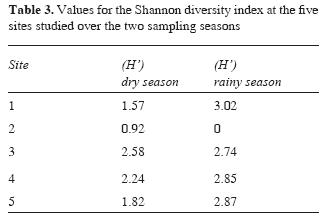
<body><![CDATA[<p align="center"><font face="verdana" size="2"><img src="/img/revistas/rmbiodiv/v78n2/a7f1.jpg"></font></p>     <p align="justify"><font face="verdana" size="2">Perennial sources of water are available in the form of small lakes and ponds in the tropical dry forest and savanna forest. This habitat diversity could promote the coexistence of several freshwater species in the same general area. However, abrupt seasonal changes make an impact on habitat stability (e.g., perennial vs. temporal) and thus may constrain populations spatially or temporally.</font></p>     <p align="justify"><font face="verdana" size="2">Since no previous taxonomic or ecological records exist for this locality, the main aim of this initial survey was to assess the current diversity of freshwater molluscs and compare the species distribution spatially, in various sites within the ecological reserve, and temporally, in the dry and rainy seasons.</font></p>     <p align="justify"><font face="verdana" size="2">&nbsp;</font></p>     <p align="justify"><font face="verdana" size="2"><b>Material and methods</b></font></p>     <p align="justify"><font face="verdana" size="2">Surveys were conducted in March and September 1998 as these months correspond to the dry and rainy seasons. After an initial inspection of several water bodies in the ecological reserve, five sampling sites were chosen to evaluate species composition. The sampling sites had different characteristics and were thought to be a small but representative sample of the different aquatic habitats in the ecological reserve (<a href="/img/revistas/rmbiodiv/v78n2/a7t1.jpg" target="_blank">Table 1</a>). The chosen sites were sampled using 0.09 m<sup>2</sup> quadrats (sample unit). The number of quadrats sampled was weighted against sites' characteristics, with densely vegetated sites being sampled more intensely than ponds with fewer vegetational associations and substrata. Quadrats were inspected visually for molluscs and substrata and macrophytes within the quadrats were swept with a small sampling net (mesh 1 mm, frame aperture 140 x 100 mm, bag depth 80 mm). Live organisms were treated with a 10% ethanol solution previous to fixation to ensure relaxation of tissues (Green et al., 1981). A 70% ethanol solution was used as final fixative. Empty shells were also collected and cleaned using a soft soap solution and then sonicated for 15 to 20 seconds. Shells were sonicated separately to avoid friction or ruptures. Variations in shell morphology and size ranges, as reported in specialized literature (e.g. Baker, 1945; Burch, 1989; Burch and Cruz Reyes, 1987; Herrington, 1962; Fischer and Crosse, 1870&#150;1900; Pennack, 1989 and Martens, 1890&#150;1901), were used to make identifications. Also, whenever organisms were available, comparisons of the reproductive system were made through dissections. Based on the number of species and relative abundance, the species richness (S), and the Shannon diversity index (H') were calculated for each sampling site. The Wilcoxon Matched&#150;Pairs Signed Ranks test (Wtest) was used to compare the diversity (H') values between the dry and rainy seasons in all sample sites.</font></p>     <p align="justify"><font face="verdana" size="2">&nbsp;</font></p>     <p align="justify"><font face="verdana" size="2"><b>Results</b></font></p>     <p align="justify"><font face="verdana" size="2">Sampling sites chosen for the study ranged from large perennial ponds to small ephemeral micro&#150; <i>cenotes </i>or sinkholes (<a href="/img/revistas/rmbiodiv/v78n2/a7t1.jpg" target="_blank">Table 1</a>). A total of eleven species of freshwater molluscs were found inhabiting the sites at El Ed&eacute;n ecological reserve (<a href="/img/revistas/rmbiodiv/v78n2/a7t2.jpg" target="_blank">Table 2</a>). The dominant group was the subclass Pulmonata (eight species). The subclass Prosobranchia and the class Bivalvia were represented with two and one species, respectively. The balance between prosobranchs and pulmonates was similar to that reported for other parts of the peninsula (Bequaert and Clench, 1933) but the number of species was higher in this study. However, species identification was based almost entirely on shells, as only 10.9% of the total number of individuals collected (n = 256) were living. Seventy four shells/organisms were found in the dry season and 182 shells/organisms were found during the rainy season. The molluscan material collected by one of us (RCC&#150;M) at El Ed&eacute;n Ecological Reserve was deposited at the Colecci&oacute;n Nacional de Moluscos CNMO (National Malacological Collection) of Instituto de Biolog&iacute;a de la Universidad Nacional Aut&oacute;noma de M&eacute;xico (IBUNAM) (see <a href="/img/revistas/rmbiodiv/v78n2/a7t2.jpg" target="_blank">Table 2</a>). <i>Species richness. </i><a href="/img/revistas/rmbiodiv/v78n2/a7t1.jpg" target="_blank">Table 1</a> shows species richness as the mean and the cumulative (maximum) value for each sampling site. Sites 3, 4 and 5 (two perennial and one temporal) had the highest number of species throughout the study (all of them a cumulative number of species equal to 10) whereas sampling site 2 registered only two species. Data in <a href="/img/revistas/rmbiodiv/v78n2/a7t2.jpg" target="_blank">Table 2</a> show that species richness increased during the rainy season collection in four out of five sites (sites 1, 3, 4 and 5) but the overall abundance only increased in three out five sites (sites 1, 3 and 4) during the rainy season. Four species from the Suborder Pulmonata (two Physidae and two Planorbidae) were only recorded in this latter season. The overall species richness found in this study is low compared to that reported for the Yucatan peninsula.</font></p>     <p align="justify"><font face="verdana" size="2"><i>Diversity within sites and seasons. </i>Molluscan diversity did not differ significantly between the two seasons (Wtest, <i>p </i>= 0.312, NS) and was generally low in all sampling sites (<a href="#t3">Table 3</a>). All perennial sites (sites 1, 3 and 5) and one temporal site (site 4) became more diverse in the rainy season whereas site 2 (temporal) became less diverse and just one organism was registered during the rainy season collection.</font></p>     ]]></body>
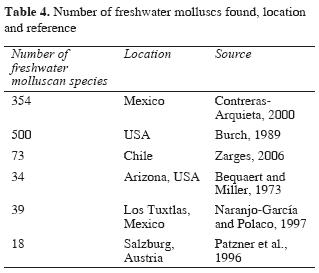
<body><![CDATA[<p align="center"><font face="verdana" size="2"><a name="t3"></a></font></p>     <p align="center"><font face="verdana" size="2"><img src="/img/revistas/rmbiodiv/v78n2/a7t3.jpg"></font></p>     <p align="justify"><font face="verdana" size="2">&nbsp;</font></p>     <p align="justify"><font face="verdana" size="2"><b>Discussion</b></font></p>     <p align="justify"><font face="verdana" size="2">This first field survey in the ecological reserve showed little occupancy and a low abundance of freshwater molluscs in the sampling sites. However, due to the lack of previous surveys in the zone, it was not possible to compare the present findings with previous data. As was to be expected, perennial sites seemed to hold consistently higher numbers of species than temporal ones, but, during this study, it was seen that even perennial sites suffer environmental alterations as a consequence of drought (see C&oacute;zatl&#150;Manzano, 1999). This could explain the increment in species richness and diversity values observed for the rainy season. Environmental alterations such as prolonged drought could also explain the higher number of pulmonate species relative to prosobranchs as the former group is thought to be better adapted to deal with drought conditions than the latter (Hunter, 1964). Indeed, some of the pulmonate species recorded consistently for both seasons in the ecological reserve (i.e., <i>B. havanensis, P. trivolvis) </i>are known to tolerate harsh environmental conditions (Dazo, 1965; Clarke, 1969). The presence of only prosobranchs such as the amphibious <i>P. flagellata </i>supports the idea that only tolerant species are able to colonize these habitats.</font></p>     <p align="justify"><font face="verdana" size="2">Species   richness   in   the   Yucatan   Peninsula   was considered low by Bequaert and Clench (1933,  1936 and 1938), who reported a total of 16 species plus 2 subspecies of freshwater molluscs; today these numbers have been reduced to 11 species and 1 subspecies due to taxonomic changes; the number of freshwater molluscan species is variable in other regions of the world (<a href="#t4">Table 4</a>), perhaps due to the different historical environmental conditions prevailing in each site (such as type of climate and vegetation). Mexico's freshwater molluscan fauna is incompletely known; however, Contreras&#150;Arquieta (2000) has compiled a total of 310 species and 44 subspecies that have been recorded for the country. Rusell&#150;Hunter (1978) noticed that freshwater molluscan genera of the world are relatively low in number.</font></p>     <p align="center"><font face="verdana" size="2"><a name="t4"></a></font></p>     <p align="center"><font face="verdana" size="2"><img src="/img/revistas/rmbiodiv/v78n2/a7t4.jpg"></font></p>     <p align="justify"><font face="verdana" size="2">The current freshwater malacological composition at El Ed&eacute;n could be explained in part by the numerous marine transgressions that kept most of the Yucatan peninsula under seawater at different geological periods, and as late as post&#150;Pliocene times (Richards, 1937). These transgressions might have not allowed for a significant increase in molluscan species diversity and might also explain the lack of endemic groups. Indeed, these transgressions might have restricted the distribution of several other freshwater invertebrate communities in the peninsula (see Su&aacute;rez&#150;Morales, 2003). Bequaert and Clench (1933) reasoned that several points could explain the relatively low number of freshwater molluscan species: the young age of the Peninsula of Yucatan (geologically speaking), and the low number of freshwater bodies.</font></p>     <p align="justify"><font face="verdana" size="2">Regarding species distribution, <i>Mayabina spiculata </i>is located from central Campeche to Yucatan and Quintana Roo (Taylor, 2003), and up to the present time this species has been located only at the Yucatan peninsula. <i>Mexinauta impluviatus </i>inhabits from eastern Chiapas to Guatemala (Taylor, 2003). <i>Biomphalaria havanensis </i>has a distribution from southern Sonora to Colima, Western Mexico, central and southern Oaxaca and from Tamaulipas to Yucatan on the East (Naranjo&#150;Garc&iacute;a, 1983), it is also present in Florida, Louisiana and Texas in the US (Burch, 1989), in Cuba and Jamaica, Central America and Venezuela (Yong et al. 1995, 2001), in Guatemala it is recorded from Lake Due&ntilde;as, in Belize from a pond at Boston Village, in San Salvador at El Salvador as <i>Biomphalaria obstructa </i>(Paraense, 2003). The species <i>Drepanotrema lucidum </i>is distributed in Mexico (Harry and Hubendick, 1964), Central America (Paraense, 2003), Central America, the Greater Antilles, some Bahama Islands, and many of the lesser Antilles (Harry and Hubendick, 1964); it also inhabits in Brazil (Paraense, 1975; Thiengo et al.,2004), Peru (Paredes et al., 1999), Uruguay (Scarabino, 2004) and Argentina (Paraense, 2005; Guti&eacute;rrez Gregoric et al., 2006). <i>Drepanotrema kermatoides </i>inhabits Florida, Texas, Mexico, Central America, Venezuela, Peru, Brazil and Lesser Antilles (Burch, 1989) at Brazil from Rio Grande do Sul and Matto Grosso (Paraense, 1975), it is also found in Peru (Paredes et al., 1999), Uruguay (Scarabino, 2004) and Argentina (Paraense, 2005; Guti&eacute;rrez Gregoric et al., 2006). <i>Planorbula armigera </i>occurs in New Brunswick, Western to South&#150;Eastern Ontario, West to Saskatchewan, Canada, South Georgia and Louisiana and West to Nebraska in the US (Burch, 1989), this is the second record of the genus in Mexico (Naranjo&#150;Garc&iacute;a &#150;2004&#150; collected it in north east Mexico at Tamaulipas state). <i>Planorbella (Pierosoma) trivolvis </i>is distributed in Canada, the United States (Alaska, the Atlantic coast and the Mississippi River, Tennessee and Missouri) (Burch, 1989), in Mexico at Veracruz and Central America (Nicaragua at Lake Nicaragua; Guatemala at Lake San Crist&oacute;bal; Costa Rica from Coris River) (Paraense, 2003); Paredes et al. (1999) have also recorded <i>P. trivolvis </i>from Peru (as <i>Helisoma trivolvis). Pomacea flagellata </i>is distributed from northern Veracruz, Tabasco, Quintana Roo, Chiapas in Mexico, Central America to Colombia (Naranjo&#150;Garc&iacute;a and Garc&iacute;a&#150;Cubas, 1986). The genus <i>Pyrgophorus </i>is widely distributed in the Antilles, North America Central America and South America (Hershler and Thompson, 1992). <i>Musculium transversum </i>is found from Canada, the US (Burch, 1975), north of Mexico (Sonora and Tamaulipas) to Tabasco (Bequaert and Miller, 1973).</font></p>     ]]></body>
<body><![CDATA[<p align="justify"><font face="verdana" size="2">Data from the Shannon diversity index (H') obtained in this study offered little information. Mason (1977) and Hughes (1978) recognize that factors such as an infrequent sampling program or the use of a single sampling method could potentially bias results when conducting field surveys. In this case, the small number of ponds surveyed, but moreover, the small number of organisms found alive in this first study, make it difficult to get a clear view of the possible effects of environmental changes in molluscan diversity. Particularly, we believe that results from the seasonal analysis should be interpreted cautiously as there was no effective way to establish if a shell found in the dry season had belonged to an organism still alive in the previous season.</font></p>     <p align="justify"><font face="verdana" size="2">Nevertheless, there are still some important results derived from this first survey. For example, it was found that animals of certain species are below the average size reported at other localities in the Yucatan Peninsula (C&oacute;zatl&#150;Manzano, 1999). It is possible that the quality of resources available in the ecological reserve, the nature of the landscape (e.g., absence of rivers, few perennial lakes and soils with little organic matter) and the prolonged desiccation periods might be limiting development of some of these groups. At the ecological reserve, a scenario in which certain taxa benefit more than others from particular conditions and are thus able to dominate particular microhabitats seems feasible. In contrast, populations of other species currently at the reserve may exist very close to their population threshold; for example, pulmonate taxa feeding on algae and other sessile components on the periphyton of the ecological reserve. Indeed, analysis of the periphyton composition in the ecological reserve suggests that it might not be a dietary option for some of the herbivores, as it is constituted mainly of cyanophytic algae (Novelo and Tavera, 2003) a very 'heavy' (toxic in some cases) diet (Novelo and Tavera, personal communication). Further studies are needed to establish whether or not the quality of the available resources might be undermining the reproductive and growth potential of some species. Such studies could be of use, particularly if applied to economically important (edible) species in the reserve like the apple snail <i>Pomacea flagellata </i>(Lobo&#150;Vargas, 1986). For future surveys we recommend longer, and more frequent sampling efforts combining visual inspections and net sweeping with other sampling techniques such as the use of Surber or cylinder samplers.</font></p>     <p align="justify"><font face="verdana" size="2">&nbsp;</font></p>     <p align="justify"><font face="verdana" size="2"><b>Acknowledgments</b></font></p>     <p align="justify"><font face="verdana" size="2">We are grateful to Arturo G&oacute;mez&#150;Pompa, Francisco Vega&#150;Vera and all members from El Ed&eacute;n ecological reserve for the facilities and guidance provided for this study. This work was funded by PROBETEL of the UNAM foundation, through a scholarship awarded to R.C.M. To Fernando Chiang&#150;Cabrera, who made several comments that improved the manuscript.</font></p>     <p align="justify"><font face="verdana" size="2">&nbsp;</font></p>     <p align="justify"><font face="verdana" size="2"><b>Literature cited</b></font></p>     <!-- ref --><p align="justify"><font face="verdana" size="2">Back,   W.   1985.   Hydrogeology   of  Yucatan,   p.   99&#150;102.   <i>In </i>Geology and Hydrogeology of the Yucatan and Quaternary Geology of Northeastern Yucatan Peninsula, W. C. Ward, A.E. Weidie and W. Back (eds.). New Orleans Geological Society, New Orleans. 160 p. </font>&nbsp;&nbsp;&nbsp;&nbsp;&nbsp;&nbsp;&nbsp;&nbsp;[&#160;<a href="javascript:void(0);" onclick="javascript: window.open('/scielo.php?script=sci_nlinks&ref=7520400&pid=S1870-3453200700020000700001&lng=','','width=640,height=500,resizable=yes,scrollbars=1,menubar=yes,');">Links</a>&#160;]<!-- end-ref --><!-- ref --><p align="justify"><font face="verdana" size="2">Baker, F.C.  1945. The molluscan family Planorbidae. University of Illinois Press, Urbana, Illinois. 530 p. </font>&nbsp;&nbsp;&nbsp;&nbsp;&nbsp;&nbsp;&nbsp;&nbsp;[&#160;<a href="javascript:void(0);" onclick="javascript: window.open('/scielo.php?script=sci_nlinks&ref=7520401&pid=S1870-3453200700020000700002&lng=','','width=640,height=500,resizable=yes,scrollbars=1,menubar=yes,');">Links</a>&#160;]<!-- end-ref --><!-- ref --><p align="justify"><font face="verdana" size="2">Bequaert, J. C. and J. Clench.  1933. The non&#150;marine Molluscs of Yucatan. Carnegie Institution Washington Publication 431:525&#150;545. </font>&nbsp;&nbsp;&nbsp;&nbsp;&nbsp;&nbsp;&nbsp;&nbsp;[&#160;<a href="javascript:void(0);" onclick="javascript: window.open('/scielo.php?script=sci_nlinks&ref=7520402&pid=S1870-3453200700020000700003&lng=','','width=640,height=500,resizable=yes,scrollbars=1,menubar=yes,');">Links</a>&#160;]<!-- end-ref --><!-- ref --><p align="justify"><font face="verdana" size="2">Bequaert, J. C. and J. Clench. 1936. A second contributionto the molluscan fauna of Yucatan. Carnegie InstitutionWashington Publication 457:61&#150;75. </font>&nbsp;&nbsp;&nbsp;&nbsp;&nbsp;&nbsp;&nbsp;&nbsp;[&#160;<a href="javascript:void(0);" onclick="javascript: window.open('/scielo.php?script=sci_nlinks&ref=7520403&pid=S1870-3453200700020000700004&lng=','','width=640,height=500,resizable=yes,scrollbars=1,menubar=yes,');">Links</a>&#160;]<!-- end-ref --><!-- ref --><p align="justify"><font face="verdana" size="2">Bequaert, J. C. and J. Clench. 1938. A third contribution tothe molluscan fauna of Yucatan. Carnegie Institution Washington Publication 491:257&#150;260. </font>&nbsp;&nbsp;&nbsp;&nbsp;&nbsp;&nbsp;&nbsp;&nbsp;[&#160;<a href="javascript:void(0);" onclick="javascript: window.open('/scielo.php?script=sci_nlinks&ref=7520404&pid=S1870-3453200700020000700005&lng=','','width=640,height=500,resizable=yes,scrollbars=1,menubar=yes,');">Links</a>&#160;]<!-- end-ref --><!-- ref --><p align="justify"><font face="verdana" size="2">Bequaert, J. C. and W. B. Miller. 1973. The mollusks of the arid southwest. With an Arizona Check list. The University of Arizona Press, Tucson. i&#150;xvi + 271 p. </font>&nbsp;&nbsp;&nbsp;&nbsp;&nbsp;&nbsp;&nbsp;&nbsp;[&#160;<a href="javascript:void(0);" onclick="javascript: window.open('/scielo.php?script=sci_nlinks&ref=7520405&pid=S1870-3453200700020000700006&lng=','','width=640,height=500,resizable=yes,scrollbars=1,menubar=yes,');">Links</a>&#160;]<!-- end-ref --><!-- ref --><p align="justify"><font face="verdana" size="2">Burch,   J.   B.   1975.   Freshwater   Sphaeriacean   clams (Mollusca:     Pelecypoda)     of     North     America. Malacological Publications, Hamburg, Michigan. I&#150;XI+ 96 p. </font>&nbsp;&nbsp;&nbsp;&nbsp;&nbsp;&nbsp;&nbsp;&nbsp;[&#160;<a href="javascript:void(0);" onclick="javascript: window.open('/scielo.php?script=sci_nlinks&ref=7520406&pid=S1870-3453200700020000700007&lng=','','width=640,height=500,resizable=yes,scrollbars=1,menubar=yes,');">Links</a>&#160;]<!-- end-ref --><!-- ref --><p align="justify"><font face="verdana" size="2">Burch, J. B. 1989. Freshwater North American Snails. Malacological   Publications,   Hamburg,   Michigan. 365 p. </font>&nbsp;&nbsp;&nbsp;&nbsp;&nbsp;&nbsp;&nbsp;&nbsp;[&#160;<a href="javascript:void(0);" onclick="javascript: window.open('/scielo.php?script=sci_nlinks&ref=7520407&pid=S1870-3453200700020000700008&lng=','','width=640,height=500,resizable=yes,scrollbars=1,menubar=yes,');">Links</a>&#160;]<!-- end-ref --><!-- ref --><p align="justify"><font face="verdana" size="2">Burch, J. B. and A. Cruz&#150;Reyes. 1987. Clave Gen&eacute;rica para la identificaci&oacute;n de Gaster&oacute;podos de agua dulce en M&eacute;xico. Instituto de Biolog&iacute;a, UNAM. 46 p. </font>&nbsp;&nbsp;&nbsp;&nbsp;&nbsp;&nbsp;&nbsp;&nbsp;[&#160;<a href="javascript:void(0);" onclick="javascript: window.open('/scielo.php?script=sci_nlinks&ref=7520408&pid=S1870-3453200700020000700009&lng=','','width=640,height=500,resizable=yes,scrollbars=1,menubar=yes,');">Links</a>&#160;]<!-- end-ref --><!-- ref --><p align="justify"><font face="verdana" size="2">Clarke, A. H. 1969. Some aspects of adaptive radiation inrecent freshwater molluscs. Malacologia 9:263&#150;270. </font>&nbsp;&nbsp;&nbsp;&nbsp;&nbsp;&nbsp;&nbsp;&nbsp;[&#160;<a href="javascript:void(0);" onclick="javascript: window.open('/scielo.php?script=sci_nlinks&ref=7520409&pid=S1870-3453200700020000700010&lng=','','width=640,height=500,resizable=yes,scrollbars=1,menubar=yes,');">Links</a>&#160;]<!-- end-ref --><!-- ref --><p align="justify"><font face="verdana" size="2">Contreras&#150;Arquieta,    A.    2000.    Bibliograf&iacute;a   y    lista taxon&oacute;mica de las especies de moluscos dulceacu&iacute;colas en M&eacute;xico. Mexicoa 2:40&#150;53. </font>&nbsp;&nbsp;&nbsp;&nbsp;&nbsp;&nbsp;&nbsp;&nbsp;[&#160;<a href="javascript:void(0);" onclick="javascript: window.open('/scielo.php?script=sci_nlinks&ref=7520410&pid=S1870-3453200700020000700011&lng=','','width=640,height=500,resizable=yes,scrollbars=1,menubar=yes,');">Links</a>&#160;]<!-- end-ref --><!-- ref --><p align="justify"><font face="verdana" size="2">C&oacute;zatl&#150;Manzano, R. 1999. Sistem&aacute;tica de los moluscos dulceacu&iacute;colas en la reserva ecol&oacute;gica "El Ed&eacute;n"Quintana Roo, M&eacute;xico. Tesis. Facultad de Ciencias, UNAM. 59 p. </font>&nbsp;&nbsp;&nbsp;&nbsp;&nbsp;&nbsp;&nbsp;&nbsp;[&#160;<a href="javascript:void(0);" onclick="javascript: window.open('/scielo.php?script=sci_nlinks&ref=7520411&pid=S1870-3453200700020000700012&lng=','','width=640,height=500,resizable=yes,scrollbars=1,menubar=yes,');">Links</a>&#160;]<!-- end-ref --><!-- ref --><p align="justify"><font face="verdana" size="2">Dazo, B. Z. 1965. The morphology and natural history of   <i>Pleurocera   acuta   </i>and   <i>Goniobasis   livescens.</i> Malacologia 2:1&#150;80. </font>&nbsp;&nbsp;&nbsp;&nbsp;&nbsp;&nbsp;&nbsp;&nbsp;[&#160;<a href="javascript:void(0);" onclick="javascript: window.open('/scielo.php?script=sci_nlinks&ref=7520412&pid=S1870-3453200700020000700013&lng=','','width=640,height=500,resizable=yes,scrollbars=1,menubar=yes,');">Links</a>&#160;]<!-- end-ref --><!-- ref --><p align="justify"><font face="verdana" size="2">Fischer, M. P. and H. Crosse. 1870&#150;1878. Etudes sur les mollusques terrestres et fluviatiles du Mexique et dans L'Amerique Centrale. Recherches Zoologiques. S&eacute;ptime parte. Paris. 702 p. </font>&nbsp;&nbsp;&nbsp;&nbsp;&nbsp;&nbsp;&nbsp;&nbsp;[&#160;<a href="javascript:void(0);" onclick="javascript: window.open('/scielo.php?script=sci_nlinks&ref=7520413&pid=S1870-3453200700020000700014&lng=','','width=640,height=500,resizable=yes,scrollbars=1,menubar=yes,');">Links</a>&#160;]<!-- end-ref --><!-- ref --><p align="justify"><font face="verdana" size="2">Garcia, E. 1981. Modificaciones al sistema de Clasificaci&oacute;n Clim&aacute;tica de K&ouml;ppen. Offset Larios S. A. M&eacute;xico D.F. 252 p. </font>&nbsp;&nbsp;&nbsp;&nbsp;&nbsp;&nbsp;&nbsp;&nbsp;[&#160;<a href="javascript:void(0);" onclick="javascript: window.open('/scielo.php?script=sci_nlinks&ref=7520414&pid=S1870-3453200700020000700015&lng=','','width=640,height=500,resizable=yes,scrollbars=1,menubar=yes,');">Links</a>&#160;]<!-- end-ref --><!-- ref --><p align="justify"><font face="verdana" size="2">Green, J., J. E. Morton, D. Nichols and D. Wakelin. 1981. Practical Invertebrate Zoology. Blackwell Sci. Pub. New York. 356 p. </font>&nbsp;&nbsp;&nbsp;&nbsp;&nbsp;&nbsp;&nbsp;&nbsp;[&#160;<a href="javascript:void(0);" onclick="javascript: window.open('/scielo.php?script=sci_nlinks&ref=7520415&pid=S1870-3453200700020000700016&lng=','','width=640,height=500,resizable=yes,scrollbars=1,menubar=yes,');">Links</a>&#160;]<!-- end-ref --><!-- ref --><p align="justify"><font face="verdana" size="2">Guti&eacute;rrez Gregoric, D.E., V. N&uacute;&ntilde;ez, A. Rumi and M.A.Roche. 2006. Freshwater gastropods from Del Plata Basin, Argentina. Checklist and new locality records. Comunicaciones de la Sociedad Malacol&oacute;gica del Uruguay 9:51&#150;60. </font>&nbsp;&nbsp;&nbsp;&nbsp;&nbsp;&nbsp;&nbsp;&nbsp;[&#160;<a href="javascript:void(0);" onclick="javascript: window.open('/scielo.php?script=sci_nlinks&ref=7520416&pid=S1870-3453200700020000700017&lng=','','width=640,height=500,resizable=yes,scrollbars=1,menubar=yes,');">Links</a>&#160;]<!-- end-ref --><!-- ref --><p align="justify"><font face="verdana" size="2">Harry, H. W. 1950. Studies on the non&#150; marine Mollusca of Yucatan. Occasional Papers of the Museum   of Zoology, University of Michigan 524:1&#150;34. </font>&nbsp;&nbsp;&nbsp;&nbsp;&nbsp;&nbsp;&nbsp;&nbsp;[&#160;<a href="javascript:void(0);" onclick="javascript: window.open('/scielo.php?script=sci_nlinks&ref=7520417&pid=S1870-3453200700020000700018&lng=','','width=640,height=500,resizable=yes,scrollbars=1,menubar=yes,');">Links</a>&#160;]<!-- end-ref --><!-- ref --><p align="justify"><font face="verdana" size="2">Harry H. W. and B. Hubendick. 1964. The freshwater pulmonate Mollusca of Puerto Rico. Meddelanden Goteborgs Musei Zoologiska Avdelning 136, Ser. B, 9:1&#150;77. </font>&nbsp;&nbsp;&nbsp;&nbsp;&nbsp;&nbsp;&nbsp;&nbsp;[&#160;<a href="javascript:void(0);" onclick="javascript: window.open('/scielo.php?script=sci_nlinks&ref=7520418&pid=S1870-3453200700020000700019&lng=','','width=640,height=500,resizable=yes,scrollbars=1,menubar=yes,');">Links</a>&#160;]<!-- end-ref --><!-- ref --><p align="justify"><font face="verdana" size="2">Herrington, H.B. 1962. A revision of the Sphaeriidae of North America (Mollusca: Pelecypoda). Miscellaneous Publications, University of Michigan 118:75 p. </font>&nbsp;&nbsp;&nbsp;&nbsp;&nbsp;&nbsp;&nbsp;&nbsp;[&#160;<a href="javascript:void(0);" onclick="javascript: window.open('/scielo.php?script=sci_nlinks&ref=7520419&pid=S1870-3453200700020000700020&lng=','','width=640,height=500,resizable=yes,scrollbars=1,menubar=yes,');">Links</a>&#160;]<!-- end-ref --><!-- ref --><p align="justify"><font face="verdana" size="2">Hershler, R.  and F.  G.  Thompson.   1992.  A reviewof the  aquatic  gastropod  subfamily  Cochliopinae (Prosobranchia: Hydrobiidae). Malacological Review (Suppl. 5). 140 p. </font>&nbsp;&nbsp;&nbsp;&nbsp;&nbsp;&nbsp;&nbsp;&nbsp;[&#160;<a href="javascript:void(0);" onclick="javascript: window.open('/scielo.php?script=sci_nlinks&ref=7520420&pid=S1870-3453200700020000700021&lng=','','width=640,height=500,resizable=yes,scrollbars=1,menubar=yes,');">Links</a>&#160;]<!-- end-ref --><!-- ref --><p align="justify"><font face="verdana" size="2">Hughes, B. D. 1978. The influence of factors other than pollution on the value of Shannon's diversity index forbenthic macroinvertebrates in streams. Water Research 12:357&#150;364. </font>&nbsp;&nbsp;&nbsp;&nbsp;&nbsp;&nbsp;&nbsp;&nbsp;[&#160;<a href="javascript:void(0);" onclick="javascript: window.open('/scielo.php?script=sci_nlinks&ref=7520421&pid=S1870-3453200700020000700022&lng=','','width=640,height=500,resizable=yes,scrollbars=1,menubar=yes,');">Links</a>&#160;]<!-- end-ref --><!-- ref --><p align="justify"><font face="verdana" size="2">Hunter, R.W.  1964. Physiological Aspects of Ecology in Nonmarine Molluscs. p. 83&#150;126. <i>In </i>Physiology of Mollusca, Vol. 1, K.M. Wilbur and C.M. Yonge (eds.). Academic Press, New York, New York. 473 p. </font>&nbsp;&nbsp;&nbsp;&nbsp;&nbsp;&nbsp;&nbsp;&nbsp;[&#160;<a href="javascript:void(0);" onclick="javascript: window.open('/scielo.php?script=sci_nlinks&ref=7520422&pid=S1870-3453200700020000700023&lng=','','width=640,height=500,resizable=yes,scrollbars=1,menubar=yes,');">Links</a>&#160;]<!-- end-ref --><!-- ref --><p align="justify"><font face="verdana" size="2">Lazcano &#150; Barrero M.A., I. J. March, H. N&uacute;&ntilde;ez, E. Ruelas, A. Mu&ntilde;oz&#150;Alonso and R. Mart&iacute;nez. 1992. Inventario faun&iacute;stico de la Reserva El Ed&eacute;n, Quintana Roo: Una Prospecci&oacute;n. Reporte T&eacute;cnico. ECOSFERA A. C., San Crist&oacute;bal de las Casas, M&eacute;xico 54 p. </font>&nbsp;&nbsp;&nbsp;&nbsp;&nbsp;&nbsp;&nbsp;&nbsp;[&#160;<a href="javascript:void(0);" onclick="javascript: window.open('/scielo.php?script=sci_nlinks&ref=7520423&pid=S1870-3453200700020000700024&lng=','','width=640,height=500,resizable=yes,scrollbars=1,menubar=yes,');">Links</a>&#160;]<!-- end-ref --><!-- ref --><p align="justify"><font face="verdana" size="2">Lobo&#150;Vargas, X. 1986. Estudio de algunos aspectos de la biolog&iacute;a del molusco <i>Pomacea flagellata </i>(Say) (Prosobranchia, Ampullariidae). Tesis. Universidad de Costa Rica. 54 p. </font>&nbsp;&nbsp;&nbsp;&nbsp;&nbsp;&nbsp;&nbsp;&nbsp;[&#160;<a href="javascript:void(0);" onclick="javascript: window.open('/scielo.php?script=sci_nlinks&ref=7520424&pid=S1870-3453200700020000700025&lng=','','width=640,height=500,resizable=yes,scrollbars=1,menubar=yes,');">Links</a>&#160;]<!-- end-ref --><!-- ref --><p align="justify"><font face="verdana" size="2">Mason, C. F. 1977. The performance of a diversity index in describing the zoobenthos of two lakes. Journal of Applied Ecology 14:363&#150;367. </font>&nbsp;&nbsp;&nbsp;&nbsp;&nbsp;&nbsp;&nbsp;&nbsp;[&#160;<a href="javascript:void(0);" onclick="javascript: window.open('/scielo.php?script=sci_nlinks&ref=7520425&pid=S1870-3453200700020000700026&lng=','','width=640,height=500,resizable=yes,scrollbars=1,menubar=yes,');">Links</a>&#160;]<!-- end-ref --><!-- ref --><p align="justify"><font face="verdana" size="2">Morelet, A. 1849 and 1851. Testacea novissima insulae Cubanae et America Centralis (parts I and II) 31, 30 p. </font>&nbsp;&nbsp;&nbsp;&nbsp;&nbsp;&nbsp;&nbsp;&nbsp;[&#160;<a href="javascript:void(0);" onclick="javascript: window.open('/scielo.php?script=sci_nlinks&ref=7520426&pid=S1870-3453200700020000700027&lng=','','width=640,height=500,resizable=yes,scrollbars=1,menubar=yes,');">Links</a>&#160;]<!-- end-ref --><!-- ref --><p align="justify"><font face="verdana" size="2">Morrison, B. 2000. Ancient Maya Settlements of the Yalahau region:  An example from the El Eden Wetland.  Ph.D.  Thesis, University of California, Riverside. 210 p. </font>&nbsp;&nbsp;&nbsp;&nbsp;&nbsp;&nbsp;&nbsp;&nbsp;[&#160;<a href="javascript:void(0);" onclick="javascript: window.open('/scielo.php?script=sci_nlinks&ref=7520427&pid=S1870-3453200700020000700028&lng=','','width=640,height=500,resizable=yes,scrollbars=1,menubar=yes,');">Links</a>&#160;]<!-- end-ref --><!-- ref --><p align="justify"><font face="verdana" size="2">Martens, E. von 1890&#150;1901. Land and Freshwater Mollusca. Biologia Centrali Americana. Zoolog&iacute;a 9:1&#150;706. </font>&nbsp;&nbsp;&nbsp;&nbsp;&nbsp;&nbsp;&nbsp;&nbsp;[&#160;<a href="javascript:void(0);" onclick="javascript: window.open('/scielo.php?script=sci_nlinks&ref=7520428&pid=S1870-3453200700020000700029&lng=','','width=640,height=500,resizable=yes,scrollbars=1,menubar=yes,');">Links</a>&#160;]<!-- end-ref --><!-- ref --><p align="justify"><font face="verdana" size="2">Naranjo&#150;Garc&iacute;a E. 1983. Nuevo registro y consideraciones morfol&oacute;gicas  de <i>Biomphalaria obstructa  </i>(Morelet, 1849) (Mollusca: Gastr&oacute;poda) en M&eacute;xico. Anales del Instituto de Biolog&iacute;a, Universidad Nacional Aut&oacute;noma de M&eacute;xico 53 (1982), Serie Zoolog&iacute;a:39&#150;47.</font>&nbsp;&nbsp;&nbsp;&nbsp;&nbsp;&nbsp;&nbsp;&nbsp;[&#160;<a href="javascript:void(0);" onclick="javascript: window.open('/scielo.php?script=sci_nlinks&ref=7520429&pid=S1870-3453200700020000700030&lng=','','width=640,height=500,resizable=yes,scrollbars=1,menubar=yes,');">Links</a>&#160;]<!-- end-ref --><!-- ref --><p align="justify"><font face="verdana" size="2">Naranjo&#150;Garc&iacute;a E. 2004. Notes on the knowledge of the freshwater mollusks of Mexico. Annual Meeting of the Western Society of Malacologists. Ensenada, Baja California, M&eacute;xico. Abstracts: 67.</font>&nbsp;&nbsp;&nbsp;&nbsp;&nbsp;&nbsp;&nbsp;&nbsp;[&#160;<a href="javascript:void(0);" onclick="javascript: window.open('/scielo.php?script=sci_nlinks&ref=7520430&pid=S1870-3453200700020000700031&lng=','','width=640,height=500,resizable=yes,scrollbars=1,menubar=yes,');">Links</a>&#160;]<!-- end-ref --><!-- ref --><p align="justify"><font face="verdana" size="2">Naranjo&#150;Garc&iacute;a E. and A. Garc&iacute;a&#150;Cubas. 1986. Algunas consideraciones sobre el g&eacute;nero <i>Pomacea </i>(Gastropoda: Pilidae) en M&eacute;xico y Centroam&eacute;rica. Anales del Instituto de Biolog&iacute;a, Universidad Nacional Aut&oacute;noma de M&eacute;xico 56 (1985), Serie Zoolog&iacute;a: 603&#150;606.</font>&nbsp;&nbsp;&nbsp;&nbsp;&nbsp;&nbsp;&nbsp;&nbsp;[&#160;<a href="javascript:void(0);" onclick="javascript: window.open('/scielo.php?script=sci_nlinks&ref=7520431&pid=S1870-3453200700020000700032&lng=','','width=640,height=500,resizable=yes,scrollbars=1,menubar=yes,');">Links</a>&#160;]<!-- end-ref --><!-- ref --><p align="justify"><font face="verdana" size="2">Naranjo&#150;Garc&iacute;a, E. and O. J. Polaco. 1997. Moluscos continentales. <i>In </i>Historia natural de Los Tuxtlas, Veracruz, Gonz&aacute;lez&#150;Soriano, E., Dirzo, R. and R. Vogt (eds.). Instituto de Biolog&iacute;a, Instituto de Ecolog&iacute;a and CONABIO. 647p.</font>&nbsp;&nbsp;&nbsp;&nbsp;&nbsp;&nbsp;&nbsp;&nbsp;[&#160;<a href="javascript:void(0);" onclick="javascript: window.open('/scielo.php?script=sci_nlinks&ref=7520432&pid=S1870-3453200700020000700033&lng=','','width=640,height=500,resizable=yes,scrollbars=1,menubar=yes,');">Links</a>&#160;]<!-- end-ref --><!-- ref --><p align="justify"><font face="verdana" size="2">Novelo, E. and R. Tavera. 2003. The role of periphyton in the regulation and supply of nutrients in a wetland at El Ed&eacute;n, Quintana Roo. P. 217&#150;239. <i>In </i>The lowland Maya Area. Three Millennia at the Human&#150;Wildland Interface, A. G&oacute;mez&#150;Pompa, M.F. Allen, S.L. Fedick and J. J. Jim&eacute;nez&#150;Osornio (eds.). The Haworth Press, Binghamton, New York. 659 p.</font>&nbsp;&nbsp;&nbsp;&nbsp;&nbsp;&nbsp;&nbsp;&nbsp;[&#160;<a href="javascript:void(0);" onclick="javascript: window.open('/scielo.php?script=sci_nlinks&ref=7520433&pid=S1870-3453200700020000700034&lng=','','width=640,height=500,resizable=yes,scrollbars=1,menubar=yes,');">Links</a>&#160;]<!-- end-ref --><!-- ref --><p align="justify"><font face="verdana" size="2">Paraense, W. L. 1975. Estado atual da sistem&aacute;tica dos planorb&iacute;deos brasileiros (Mollusca, Gastropoda). Arquivos do Museu Nacional, Rio de Janeiro 55:105&#150;128.</font>&nbsp;&nbsp;&nbsp;&nbsp;&nbsp;&nbsp;&nbsp;&nbsp;[&#160;<a href="javascript:void(0);" onclick="javascript: window.open('/scielo.php?script=sci_nlinks&ref=7520434&pid=S1870-3453200700020000700035&lng=','','width=640,height=500,resizable=yes,scrollbars=1,menubar=yes,');">Links</a>&#160;]<!-- end-ref --><!-- ref --><p align="justify"><font face="verdana" size="2">Paraense, W. L. 2003. A bird's eye survey of Central American Planorbid Molluscs. Memorias del Instituto Oswaldo Cruz, R&iacute;o de Janerio 98:51&#150;67.</font>&nbsp;&nbsp;&nbsp;&nbsp;&nbsp;&nbsp;&nbsp;&nbsp;[&#160;<a href="javascript:void(0);" onclick="javascript: window.open('/scielo.php?script=sci_nlinks&ref=7520435&pid=S1870-3453200700020000700036&lng=','','width=640,height=500,resizable=yes,scrollbars=1,menubar=yes,');">Links</a>&#160;]<!-- end-ref --><!-- ref --><p align="justify"><font face="verdana" size="2">Paraense, W. L. 2005. Planorbidae, Lymnaeidae and Physidae of Argentina (Mollusca: Basommatophora). Memorias del Instituto Oswaldo Cruz, Rio de Janeiro 100:491&#150;493.</font>&nbsp;&nbsp;&nbsp;&nbsp;&nbsp;&nbsp;&nbsp;&nbsp;[&#160;<a href="javascript:void(0);" onclick="javascript: window.open('/scielo.php?script=sci_nlinks&ref=7520436&pid=S1870-3453200700020000700037&lng=','','width=640,height=500,resizable=yes,scrollbars=1,menubar=yes,');">Links</a>&#160;]<!-- end-ref --><!-- ref --><p align="justify"><font face="verdana" size="2">Paredes, C., P. Huam&aacute;n, F. Cardoso, R. Vivar and V. Vera. 1999. Estado actual del conocimiento de los moluscos acu&aacute;ticos en el Per&uacute;. Revista Peruana de Biolog&iacute;a 6:1&#150;17.</font>&nbsp;&nbsp;&nbsp;&nbsp;&nbsp;&nbsp;&nbsp;&nbsp;[&#160;<a href="javascript:void(0);" onclick="javascript: window.open('/scielo.php?script=sci_nlinks&ref=7520437&pid=S1870-3453200700020000700038&lng=','','width=640,height=500,resizable=yes,scrollbars=1,menubar=yes,');">Links</a>&#160;]<!-- end-ref --><!-- ref --><p align="justify"><font face="verdana" size="2">Patzner, R. A., S. Ellmauthaler and U. Rathmayr. 1996. The aquatic molluscs in the Samer Mosl (City of Salzburg). A contribution to the aquatic molluscs in the country of Salzburg. Linzer Biologische Beitraege 28:197&#150;210.</font>&nbsp;&nbsp;&nbsp;&nbsp;&nbsp;&nbsp;&nbsp;&nbsp;[&#160;<a href="javascript:void(0);" onclick="javascript: window.open('/scielo.php?script=sci_nlinks&ref=7520438&pid=S1870-3453200700020000700039&lng=','','width=640,height=500,resizable=yes,scrollbars=1,menubar=yes,');">Links</a>&#160;]<!-- end-ref --><!-- ref --><p align="justify"><font face="verdana" size="2">Pennak, R.W. 1989. Freshwater invertebrates of the Unites States: Protozoa to Mollusca. John Wiley, New York. 628 p.</font>&nbsp;&nbsp;&nbsp;&nbsp;&nbsp;&nbsp;&nbsp;&nbsp;[&#160;<a href="javascript:void(0);" onclick="javascript: window.open('/scielo.php?script=sci_nlinks&ref=7520439&pid=S1870-3453200700020000700040&lng=','','width=640,height=500,resizable=yes,scrollbars=1,menubar=yes,');">Links</a>&#160;]<!-- end-ref --><!-- ref --><p align="justify"><font face="verdana" size="2">Pilsbry, H. A. 1891. Land and Freshwater molluscs collected in Yucatan and Mexico. Proceedings of the Academy of Natural Sciences of Philadelphia. p. 310&#150;333.</font>&nbsp;&nbsp;&nbsp;&nbsp;&nbsp;&nbsp;&nbsp;&nbsp;[&#160;<a href="javascript:void(0);" onclick="javascript: window.open('/scielo.php?script=sci_nlinks&ref=7520440&pid=S1870-3453200700020000700041&lng=','','width=640,height=500,resizable=yes,scrollbars=1,menubar=yes,');">Links</a>&#160;]<!-- end-ref --><!-- ref --><p align="justify"><font face="verdana" size="2">Rehder, H. A. 1966. The non&#150;marine molluscs of Quintana Roo, Mexico. Proceedings of the Biological Society of Washington 79:273&#150;296. </font>&nbsp;&nbsp;&nbsp;&nbsp;&nbsp;&nbsp;&nbsp;&nbsp;[&#160;<a href="javascript:void(0);" onclick="javascript: window.open('/scielo.php?script=sci_nlinks&ref=7520441&pid=S1870-3453200700020000700042&lng=','','width=640,height=500,resizable=yes,scrollbars=1,menubar=yes,');">Links</a>&#160;]<!-- end-ref --><!-- ref --><p align="justify"><font face="verdana" size="2">Reserva Ecol&oacute;gica "El Ed&eacute;n". 1995. Participaci&oacute;n del sector privado en la conservaci&oacute;n y el desarrollo sustentable. Reporte T&eacute;cnico, Quintana Roo, M&eacute;xico. 13 p. </font>&nbsp;&nbsp;&nbsp;&nbsp;&nbsp;&nbsp;&nbsp;&nbsp;[&#160;<a href="javascript:void(0);" onclick="javascript: window.open('/scielo.php?script=sci_nlinks&ref=7520442&pid=S1870-3453200700020000700043&lng=','','width=640,height=500,resizable=yes,scrollbars=1,menubar=yes,');">Links</a>&#160;]<!-- end-ref --><!-- ref --><p align="justify"><font face="verdana" size="2">Richards, H. G. 1937. Land and freshwater molluscs from the island of Cozumel, Mexico, and their bearing on the geological history of the region. Proceedings of the American Philosophical Society 77:249&#150;262. </font>&nbsp;&nbsp;&nbsp;&nbsp;&nbsp;&nbsp;&nbsp;&nbsp;[&#160;<a href="javascript:void(0);" onclick="javascript: window.open('/scielo.php?script=sci_nlinks&ref=7520443&pid=S1870-3453200700020000700044&lng=','','width=640,height=500,resizable=yes,scrollbars=1,menubar=yes,');">Links</a>&#160;]<!-- end-ref --><!-- ref --><p align="justify"><font face="verdana" size="2">Russell&#150;Hunter,  W.  D.   1978.  Ecology  of freshwater pulmonates. <i>In </i>Pulmonates, Vol. 2A, V. Fretter and J. Peake (eds.). Academic Press, London. 540 p. </font>&nbsp;&nbsp;&nbsp;&nbsp;&nbsp;&nbsp;&nbsp;&nbsp;[&#160;<a href="javascript:void(0);" onclick="javascript: window.open('/scielo.php?script=sci_nlinks&ref=7520444&pid=S1870-3453200700020000700045&lng=','','width=640,height=500,resizable=yes,scrollbars=1,menubar=yes,');">Links</a>&#160;]<!-- end-ref --><!-- ref --><p align="justify"><font face="verdana" size="2">Scarabino, F. 2004. Lista sistem&aacute;tica de los Gastropoda dulciacu&iacute;colas vivientes de Uruguay. Comunicaciones de la Sociedad Malacol&oacute;gica del Uruguay 8:347&#150; 356. </font>&nbsp;&nbsp;&nbsp;&nbsp;&nbsp;&nbsp;&nbsp;&nbsp;[&#160;<a href="javascript:void(0);" onclick="javascript: window.open('/scielo.php?script=sci_nlinks&ref=7520445&pid=S1870-3453200700020000700046&lng=','','width=640,height=500,resizable=yes,scrollbars=1,menubar=yes,');">Links</a>&#160;]<!-- end-ref --><!-- ref --><p align="justify"><font face="verdana" size="2">Su&aacute;rez&#150;Morales, E. 2003. Historical biogeography and distribution   of  the  freshwater  calanoid  copepods (Crustacea:   Copepoda)  of the Yucatan Peninsula, Mexico. Journal of Biogeography 30:1851&#150;1859. </font>&nbsp;&nbsp;&nbsp;&nbsp;&nbsp;&nbsp;&nbsp;&nbsp;[&#160;<a href="javascript:void(0);" onclick="javascript: window.open('/scielo.php?script=sci_nlinks&ref=7520446&pid=S1870-3453200700020000700047&lng=','','width=640,height=500,resizable=yes,scrollbars=1,menubar=yes,');">Links</a>&#160;]<!-- end-ref --><!-- ref --><p align="justify"><font face="verdana" size="2">Taylor, D. W. 2003. Introduction to Physidae (Gastropoda: Hygrophila): biogeography, classification, morphology. Revista de Biologia Tropical 51 (suppl.1): I&#150;XIII + 299p.</font>&nbsp;&nbsp;&nbsp;&nbsp;&nbsp;&nbsp;&nbsp;&nbsp;[&#160;<a href="javascript:void(0);" onclick="javascript: window.open('/scielo.php?script=sci_nlinks&ref=7520447&pid=S1870-3453200700020000700048&lng=','','width=640,height=500,resizable=yes,scrollbars=1,menubar=yes,');">Links</a>&#160;]<!-- end-ref --><!-- ref --><p align="justify"><font face="verdana" size="2">Thiengo, S. C., A. C. Mattos, M. F. Boaventura, M. S. Loureiro, S. B. Santos, M. A. Fernandez. 2004. Freshwater snails and schistosomiasis mansoni in the State of Rio de Janeiro, Brazil: V &#150;Norte Fluminense Mesoregion. Memorias del Instituto Oswaldo Cruz, Rio de Janeiro, 99 (Suppl. 1):99&#150;103.</font>&nbsp;&nbsp;&nbsp;&nbsp;&nbsp;&nbsp;&nbsp;&nbsp;[&#160;<a href="javascript:void(0);" onclick="javascript: window.open('/scielo.php?script=sci_nlinks&ref=7520448&pid=S1870-3453200700020000700049&lng=','','width=640,height=500,resizable=yes,scrollbars=1,menubar=yes,');">Links</a>&#160;]<!-- end-ref --><!-- ref --><p align="justify"><font face="verdana" size="2">Weidie, A. E. 1982. Lineaments of the Yucatan Peninsula and Fractures of the central Quintana Roo Coast. Geological Society of America, Annual Meeting 10: 21&#150;25.</font>&nbsp;&nbsp;&nbsp;&nbsp;&nbsp;&nbsp;&nbsp;&nbsp;[&#160;<a href="javascript:void(0);" onclick="javascript: window.open('/scielo.php?script=sci_nlinks&ref=7520449&pid=S1870-3453200700020000700050&lng=','','width=640,height=500,resizable=yes,scrollbars=1,menubar=yes,');">Links</a>&#160;]<!-- end-ref --><!-- ref --><p align="justify"><font face="verdana" size="2">Yong, M., G. Perera and A. Gutierrez. 1995. <i>Biomphalaria havanensis </i>y <i>Biomphalaria orbignyi </i>(Pulmonata: Planorbidae). &iquest;Dos especies en sinonimia? Instituto de Medicina Tropical "Pedro Kouri", Comunicaci&oacute;n Breve. p. 209&#150;210.</font>&nbsp;&nbsp;&nbsp;&nbsp;&nbsp;&nbsp;&nbsp;&nbsp;[&#160;<a href="javascript:void(0);" onclick="javascript: window.open('/scielo.php?script=sci_nlinks&ref=7520450&pid=S1870-3453200700020000700051&lng=','','width=640,height=500,resizable=yes,scrollbars=1,menubar=yes,');">Links</a>&#160;]<!-- end-ref --><!-- ref --><p align="justify"><font face="verdana" size="2">Yong, M., A. Gutierrez, G. Perera, P. Durand and J.P. Pointier. 2001. <i>The Biomphalaria havanensis </i>complex (Gastropoda: Planorbidae) in Cuba: a morphological and genetic study. Journal of Molluscan Studies 67:103&#150;111.</font>&nbsp;&nbsp;&nbsp;&nbsp;&nbsp;&nbsp;&nbsp;&nbsp;[&#160;<a href="javascript:void(0);" onclick="javascript: window.open('/scielo.php?script=sci_nlinks&ref=7520451&pid=S1870-3453200700020000700052&lng=','','width=640,height=500,resizable=yes,scrollbars=1,menubar=yes,');">Links</a>&#160;]<!-- end-ref --><!-- ref --><p align="justify"><font face="verdana" size="2">Zarges, C. V. 2006. Estado del conocimiento de los gastropodos dulceacu&iacute;colas de Chile. Gayana 70:88&#150;95.</font>&nbsp;&nbsp;&nbsp;&nbsp;&nbsp;&nbsp;&nbsp;&nbsp;[&#160;<a href="javascript:void(0);" onclick="javascript: window.open('/scielo.php?script=sci_nlinks&ref=7520452&pid=S1870-3453200700020000700053&lng=','','width=640,height=500,resizable=yes,scrollbars=1,menubar=yes,');">Links</a>&#160;]<!-- end-ref --> ]]></body><back>
<ref-list>
<ref id="B1">
<nlm-citation citation-type="book">
<person-group person-group-type="author">
<name>
<surname><![CDATA[Back]]></surname>
<given-names><![CDATA[W]]></given-names>
</name>
</person-group>
<article-title xml:lang="en"><![CDATA[Hydrogeology of Yucatan]]></article-title>
<person-group person-group-type="editor">
<name>
<surname><![CDATA[Ward]]></surname>
<given-names><![CDATA[W. C]]></given-names>
</name>
<name>
<surname><![CDATA[Weidie]]></surname>
<given-names><![CDATA[A.E]]></given-names>
</name>
<name>
<surname><![CDATA[Back]]></surname>
<given-names><![CDATA[W]]></given-names>
</name>
</person-group>
<source><![CDATA[Geology and Hydrogeology of the Yucatan and Quaternary Geology of Northeastern Yucatan Peninsula]]></source>
<year>1985</year>
<page-range>160</page-range><publisher-loc><![CDATA[New Orleans ]]></publisher-loc>
<publisher-name><![CDATA[New Orleans Geological Society]]></publisher-name>
</nlm-citation>
</ref>
<ref id="B2">
<nlm-citation citation-type="book">
<person-group person-group-type="author">
<name>
<surname><![CDATA[Baker]]></surname>
<given-names><![CDATA[F.C]]></given-names>
</name>
</person-group>
<source><![CDATA[The molluscan family Planorbidae]]></source>
<year>1945</year>
<page-range>530</page-range><publisher-loc><![CDATA[Urbana^eIllinois Illinois]]></publisher-loc>
<publisher-name><![CDATA[University of Illinois Press]]></publisher-name>
</nlm-citation>
</ref>
<ref id="B3">
<nlm-citation citation-type="book">
<person-group person-group-type="author">
<name>
<surname><![CDATA[Bequaert]]></surname>
<given-names><![CDATA[J. C]]></given-names>
</name>
<name>
<surname><![CDATA[Clench]]></surname>
<given-names><![CDATA[J]]></given-names>
</name>
</person-group>
<source><![CDATA[The non-marine Molluscs of Yucatan]]></source>
<year>1933</year>
<volume>431</volume>
<page-range>525-545</page-range><publisher-name><![CDATA[Carnegie Institution Washington Publication]]></publisher-name>
</nlm-citation>
</ref>
<ref id="B4">
<nlm-citation citation-type="book">
<person-group person-group-type="author">
<name>
<surname><![CDATA[Bequaert]]></surname>
<given-names><![CDATA[J. C]]></given-names>
</name>
<name>
<surname><![CDATA[Clench]]></surname>
<given-names><![CDATA[J]]></given-names>
</name>
</person-group>
<source><![CDATA[A second contributionto the molluscan fauna of Yucatan]]></source>
<year>1936</year>
<volume>457</volume>
<page-range>61-75</page-range><publisher-name><![CDATA[Carnegie Institution Washington Publication]]></publisher-name>
</nlm-citation>
</ref>
<ref id="B5">
<nlm-citation citation-type="book">
<person-group person-group-type="author">
<name>
<surname><![CDATA[Bequaert]]></surname>
<given-names><![CDATA[J. C]]></given-names>
</name>
<name>
<surname><![CDATA[Clench]]></surname>
<given-names><![CDATA[J]]></given-names>
</name>
</person-group>
<source><![CDATA[A third contribution tothe molluscan fauna of Yucatan]]></source>
<year>1938</year>
<volume>491</volume>
<page-range>257-260</page-range><publisher-name><![CDATA[Carnegie Institution Washington Publication]]></publisher-name>
</nlm-citation>
</ref>
<ref id="B6">
<nlm-citation citation-type="book">
<person-group person-group-type="author">
<name>
<surname><![CDATA[Bequaert]]></surname>
<given-names><![CDATA[J. C]]></given-names>
</name>
<name>
<surname><![CDATA[Miller]]></surname>
<given-names><![CDATA[W. B]]></given-names>
</name>
</person-group>
<source><![CDATA[The mollusks of the arid southwest: With an Arizona Check list]]></source>
<year>1973</year>
<page-range>i-xvi + 271</page-range><publisher-loc><![CDATA[Tucson ]]></publisher-loc>
<publisher-name><![CDATA[The University of Arizona Press]]></publisher-name>
</nlm-citation>
</ref>
<ref id="B7">
<nlm-citation citation-type="book">
<person-group person-group-type="author">
<name>
<surname><![CDATA[Burch]]></surname>
<given-names><![CDATA[J. B]]></given-names>
</name>
</person-group>
<source><![CDATA[Freshwater Sphaeriacean clams (Mollusca: Pelecypoda) of North America]]></source>
<year>1975</year>
<page-range>I-XI+ 96</page-range><publisher-loc><![CDATA[Hamburg^eMichigan Michigan]]></publisher-loc>
<publisher-name><![CDATA[Malacological Publications]]></publisher-name>
</nlm-citation>
</ref>
<ref id="B8">
<nlm-citation citation-type="book">
<person-group person-group-type="author">
<name>
<surname><![CDATA[Burch]]></surname>
<given-names><![CDATA[J. B]]></given-names>
</name>
</person-group>
<source><![CDATA[Freshwater North American Snails]]></source>
<year>1989</year>
<page-range>365</page-range><publisher-loc><![CDATA[Hamburg^eMichigan Michigan]]></publisher-loc>
<publisher-name><![CDATA[Malacological Publications]]></publisher-name>
</nlm-citation>
</ref>
<ref id="B9">
<nlm-citation citation-type="book">
<person-group person-group-type="author">
<name>
<surname><![CDATA[Burch]]></surname>
<given-names><![CDATA[J. B]]></given-names>
</name>
<name>
<surname><![CDATA[Cruz-Reyes]]></surname>
<given-names><![CDATA[A]]></given-names>
</name>
</person-group>
<source><![CDATA[Clave Genérica para la identificación de Gasterópodos de agua dulce en México]]></source>
<year>1987</year>
<page-range>46</page-range><publisher-name><![CDATA[Instituto de Biología, UNAM]]></publisher-name>
</nlm-citation>
</ref>
<ref id="B10">
<nlm-citation citation-type="journal">
<person-group person-group-type="author">
<name>
<surname><![CDATA[Clarke]]></surname>
<given-names><![CDATA[A. H]]></given-names>
</name>
</person-group>
<article-title xml:lang="en"><![CDATA[Some aspects of adaptive radiation inrecent freshwater molluscs]]></article-title>
<source><![CDATA[Malacologia]]></source>
<year>1969</year>
<numero>9</numero>
<issue>9</issue>
<page-range>263-270</page-range></nlm-citation>
</ref>
<ref id="B11">
<nlm-citation citation-type="journal">
<person-group person-group-type="author">
<name>
<surname><![CDATA[Contreras-Arquieta]]></surname>
<given-names><![CDATA[A]]></given-names>
</name>
</person-group>
<article-title xml:lang="es"><![CDATA[Bibliografía y lista taxonómica de las especies de moluscos dulceacuícolas en México]]></article-title>
<source><![CDATA[Mexicoa]]></source>
<year>2000</year>
<numero>2</numero>
<issue>2</issue>
<page-range>40-53</page-range></nlm-citation>
</ref>
<ref id="B12">
<nlm-citation citation-type="">
<person-group person-group-type="author">
<name>
<surname><![CDATA[Cózatl-Manzano]]></surname>
<given-names><![CDATA[R]]></given-names>
</name>
</person-group>
<source><![CDATA[Sistemática de los moluscos dulceacuícolas en la reserva ecológica "El Edén"Quintana Roo, México]]></source>
<year>1999</year>
<page-range>59</page-range></nlm-citation>
</ref>
<ref id="B13">
<nlm-citation citation-type="journal">
<person-group person-group-type="author">
<name>
<surname><![CDATA[Dazo]]></surname>
<given-names><![CDATA[B. Z]]></given-names>
</name>
</person-group>
<article-title xml:lang="en"><![CDATA[The morphology and natural history of Pleurocera acuta and Goniobasis livescens]]></article-title>
<source><![CDATA[Malacologia]]></source>
<year>1965</year>
<numero>2</numero>
<issue>2</issue>
<page-range>1-80</page-range></nlm-citation>
</ref>
<ref id="B14">
<nlm-citation citation-type="book">
<person-group person-group-type="author">
<name>
<surname><![CDATA[Fischer]]></surname>
<given-names><![CDATA[M. P]]></given-names>
</name>
<name>
<surname><![CDATA[Crosse]]></surname>
<given-names><![CDATA[H]]></given-names>
</name>
</person-group>
<source><![CDATA[Etudes sur les mollusques terrestres et fluviatiles du Mexique et dans L'Amerique Centrale]]></source>
<year></year>
<page-range>702</page-range><publisher-loc><![CDATA[Paris ]]></publisher-loc>
<publisher-name><![CDATA[Séptime parte]]></publisher-name>
</nlm-citation>
</ref>
<ref id="B15">
<nlm-citation citation-type="book">
<person-group person-group-type="author">
<name>
<surname><![CDATA[Garcia]]></surname>
<given-names><![CDATA[E]]></given-names>
</name>
</person-group>
<source><![CDATA[Modificaciones al sistema de Clasificación Climática de Köppen]]></source>
<year>1981</year>
<page-range>252</page-range><publisher-loc><![CDATA[México^eD.F. D.F.]]></publisher-loc>
<publisher-name><![CDATA[Offset Larios S. A.]]></publisher-name>
</nlm-citation>
</ref>
<ref id="B16">
<nlm-citation citation-type="book">
<person-group person-group-type="author">
<name>
<surname><![CDATA[Green]]></surname>
<given-names><![CDATA[J]]></given-names>
</name>
<name>
<surname><![CDATA[Morton]]></surname>
<given-names><![CDATA[J. E]]></given-names>
</name>
<name>
<surname><![CDATA[Nichols]]></surname>
<given-names><![CDATA[D]]></given-names>
</name>
<name>
<surname><![CDATA[Wakelin]]></surname>
<given-names><![CDATA[D]]></given-names>
</name>
</person-group>
<source><![CDATA[Practical Invertebrate Zoology]]></source>
<year>1981</year>
<page-range>356</page-range><publisher-loc><![CDATA[New York ]]></publisher-loc>
<publisher-name><![CDATA[Blackwell Sci. Pub.]]></publisher-name>
</nlm-citation>
</ref>
<ref id="B17">
<nlm-citation citation-type="journal">
<person-group person-group-type="author">
<name>
<surname><![CDATA[Gutiérrez Gregoric]]></surname>
<given-names><![CDATA[D.E]]></given-names>
</name>
<name>
<surname><![CDATA[Núñez]]></surname>
<given-names><![CDATA[V]]></given-names>
</name>
<name>
<surname><![CDATA[Rumi]]></surname>
<given-names><![CDATA[A]]></given-names>
</name>
<name>
<surname><![CDATA[Roche]]></surname>
<given-names><![CDATA[M.A]]></given-names>
</name>
</person-group>
<article-title xml:lang="en"><![CDATA[Freshwater gastropods from Del Plata Basin, Argentina: Checklist and new locality records]]></article-title>
<source><![CDATA[Comunicaciones de la Sociedad Malacológica del Uruguay]]></source>
<year>2006</year>
<numero>9</numero>
<issue>9</issue>
<page-range>51-60</page-range></nlm-citation>
</ref>
<ref id="B18">
<nlm-citation citation-type="book">
<person-group person-group-type="author">
<name>
<surname><![CDATA[Harry]]></surname>
<given-names><![CDATA[H. W]]></given-names>
</name>
</person-group>
<source><![CDATA[Studies on the non- marine Mollusca of Yucatan: Occasional Papers of the Museum of Zoology]]></source>
<year>1950</year>
<volume>524</volume>
<page-range>1-34</page-range><publisher-name><![CDATA[University of Michigan]]></publisher-name>
</nlm-citation>
</ref>
<ref id="B19">
<nlm-citation citation-type="book">
<person-group person-group-type="author">
<name>
<surname><![CDATA[Harry]]></surname>
<given-names><![CDATA[H. W]]></given-names>
</name>
<name>
<surname><![CDATA[Hubendick]]></surname>
<given-names><![CDATA[B]]></given-names>
</name>
</person-group>
<source><![CDATA[The freshwater pulmonate Mollusca of Puerto Rico]]></source>
<year>1964</year>
<volume>9</volume>
<page-range>1-77</page-range><publisher-loc><![CDATA[Meddelanden ]]></publisher-loc>
<publisher-name><![CDATA[Goteborgs Musei Zoologiska Avdelning]]></publisher-name>
</nlm-citation>
</ref>
<ref id="B20">
<nlm-citation citation-type="book">
<person-group person-group-type="author">
<name>
<surname><![CDATA[Herrington]]></surname>
<given-names><![CDATA[H.B]]></given-names>
</name>
</person-group>
<source><![CDATA[A revision of the Sphaeriidae of North America (Mollusca: Pelecypoda)]]></source>
<year>1962</year>
<volume>118</volume>
<page-range>75</page-range><publisher-name><![CDATA[University of Michigan]]></publisher-name>
</nlm-citation>
</ref>
<ref id="B21">
<nlm-citation citation-type="journal">
<person-group person-group-type="author">
<name>
<surname><![CDATA[Hershler]]></surname>
<given-names><![CDATA[R]]></given-names>
</name>
<name>
<surname><![CDATA[Thompson]]></surname>
<given-names><![CDATA[F. G]]></given-names>
</name>
</person-group>
<article-title xml:lang="en"><![CDATA[A reviewof the aquatic gastropod subfamily Cochliopinae (Prosobranchia: Hydrobiidae)]]></article-title>
<source><![CDATA[Malacological Review]]></source>
<year>1992</year>
<numero>^s5</numero>
<issue>^s5</issue>
<supplement>5</supplement>
<page-range>140</page-range></nlm-citation>
</ref>
<ref id="B22">
<nlm-citation citation-type="journal">
<person-group person-group-type="author">
<name>
<surname><![CDATA[Hughes]]></surname>
<given-names><![CDATA[B. D]]></given-names>
</name>
</person-group>
<article-title xml:lang="en"><![CDATA[The influence of factors other than pollution on the value of Shannon's diversity index forbenthic macroinvertebrates in streams]]></article-title>
<source><![CDATA[Water Research]]></source>
<year>1978</year>
<numero>12</numero>
<issue>12</issue>
<page-range>357-364</page-range></nlm-citation>
</ref>
<ref id="B23">
<nlm-citation citation-type="book">
<person-group person-group-type="author">
<name>
<surname><![CDATA[Hunter]]></surname>
<given-names><![CDATA[R.W]]></given-names>
</name>
</person-group>
<article-title xml:lang="en"><![CDATA[Physiological Aspects of Ecology in Nonmarine Molluscs]]></article-title>
<person-group person-group-type="editor">
<name>
<surname><![CDATA[Wilbur]]></surname>
<given-names><![CDATA[K.M]]></given-names>
</name>
<name>
<surname><![CDATA[Yonge]]></surname>
<given-names><![CDATA[C.M]]></given-names>
</name>
</person-group>
<source><![CDATA[Physiology of Mollusca]]></source>
<year>1964</year>
<volume>1</volume>
<page-range>473</page-range><publisher-loc><![CDATA[New YorkNew York ]]></publisher-loc>
<publisher-name><![CDATA[Academic Press]]></publisher-name>
</nlm-citation>
</ref>
<ref id="B24">
<nlm-citation citation-type="book">
<person-group person-group-type="author">
<name>
<surname><![CDATA[Lazcano - Barrero]]></surname>
<given-names><![CDATA[M.A]]></given-names>
</name>
<name>
<surname><![CDATA[March]]></surname>
<given-names><![CDATA[I. J]]></given-names>
</name>
<name>
<surname><![CDATA[Núñez]]></surname>
<given-names><![CDATA[H]]></given-names>
</name>
<name>
<surname><![CDATA[Ruelas]]></surname>
<given-names><![CDATA[E]]></given-names>
</name>
<name>
<surname><![CDATA[Muñoz-Alonso]]></surname>
<given-names><![CDATA[A]]></given-names>
</name>
<name>
<surname><![CDATA[Martínez]]></surname>
<given-names><![CDATA[R]]></given-names>
</name>
</person-group>
<source><![CDATA[Inventario faunístico de la Reserva El Edén, Quintana Roo: Una Prospección]]></source>
<year>1992</year>
<page-range>54</page-range><publisher-loc><![CDATA[San Cristóbal de las Casas ]]></publisher-loc>
<publisher-name><![CDATA[ECOSFERA A. C.]]></publisher-name>
</nlm-citation>
</ref>
<ref id="B25">
<nlm-citation citation-type="">
<person-group person-group-type="author">
<name>
<surname><![CDATA[Lobo-Vargas]]></surname>
<given-names><![CDATA[X]]></given-names>
</name>
</person-group>
<source><![CDATA[Estudio de algunos aspectos de la biología del molusco Pomacea flagellata (Say) (Prosobranchia, Ampullariidae)]]></source>
<year>1986</year>
<page-range>54</page-range></nlm-citation>
</ref>
<ref id="B26">
<nlm-citation citation-type="journal">
<person-group person-group-type="author">
<name>
<surname><![CDATA[Mason]]></surname>
<given-names><![CDATA[C. F]]></given-names>
</name>
</person-group>
<article-title xml:lang="en"><![CDATA[The performance of a diversity index in describing the zoobenthos of two lakes]]></article-title>
<source><![CDATA[Journal of Applied Ecology]]></source>
<year>1977</year>
<numero>14</numero>
<issue>14</issue>
<page-range>363-367</page-range></nlm-citation>
</ref>
<ref id="B27">
<nlm-citation citation-type="">
<person-group person-group-type="author">
<name>
<surname><![CDATA[Morelet]]></surname>
<given-names><![CDATA[A]]></given-names>
</name>
</person-group>
<source><![CDATA[Testacea novissima insulae Cubanae et America Centralis (parts I and II) 31]]></source>
<year></year>
<page-range>30</page-range></nlm-citation>
</ref>
<ref id="B28">
<nlm-citation citation-type="">
<person-group person-group-type="author">
<name>
<surname><![CDATA[Morrison]]></surname>
<given-names><![CDATA[B]]></given-names>
</name>
</person-group>
<source><![CDATA[Ancient Maya Settlements of the Yalahau region: An example from the El Eden Wetland]]></source>
<year>2000</year>
<page-range>210</page-range></nlm-citation>
</ref>
<ref id="B29">
<nlm-citation citation-type="journal">
<person-group person-group-type="author">
<name>
<surname><![CDATA[Martens]]></surname>
<given-names><![CDATA[E. von]]></given-names>
</name>
</person-group>
<article-title xml:lang="en"><![CDATA[Land and Freshwater Mollusca: Biologia Centrali Americana]]></article-title>
<source><![CDATA[Zoología]]></source>
<year></year>
<numero>9</numero>
<issue>9</issue>
<page-range>1-706</page-range></nlm-citation>
</ref>
<ref id="B30">
<nlm-citation citation-type="book">
<person-group person-group-type="author">
<name>
<surname><![CDATA[Naranjo-García]]></surname>
<given-names><![CDATA[E]]></given-names>
</name>
</person-group>
<source><![CDATA[Nuevo registro y consideraciones morfológicas de Biomphalaria obstructa (Morelet, 1849) (Mollusca: Gastrópoda) en México]]></source>
<year>1983</year>
<volume>53</volume><volume>Serie Zoología</volume>
<page-range>39-47</page-range><publisher-name><![CDATA[Anales del Instituto de Biología, Universidad Nacional Autónoma de México]]></publisher-name>
</nlm-citation>
</ref>
<ref id="B31">
<nlm-citation citation-type="">
<person-group person-group-type="author">
<name>
<surname><![CDATA[Naranjo-García]]></surname>
<given-names><![CDATA[E]]></given-names>
</name>
</person-group>
<source><![CDATA[Notes on the knowledge of the freshwater mollusks of Mexico: Annual Meeting of the Western Society of Malacologists]]></source>
<year>2004</year>
<page-range>67</page-range><publisher-loc><![CDATA[Ensenada^eBaja California Baja California]]></publisher-loc>
</nlm-citation>
</ref>
<ref id="B32">
<nlm-citation citation-type="book">
<person-group person-group-type="author">
<name>
<surname><![CDATA[Naranjo-García]]></surname>
<given-names><![CDATA[E]]></given-names>
</name>
<name>
<surname><![CDATA[García-Cubas]]></surname>
<given-names><![CDATA[A]]></given-names>
</name>
</person-group>
<source><![CDATA[Algunas consideraciones sobre el género Pomacea (Gastropoda: Pilidae) en México y Centroamérica]]></source>
<year>1986</year>
<volume>56</volume>
<page-range>603-606</page-range><publisher-name><![CDATA[Anales del Instituto de Biología, Universidad Nacional Autónoma de México]]></publisher-name>
</nlm-citation>
</ref>
<ref id="B33">
<nlm-citation citation-type="book">
<person-group person-group-type="author">
<name>
<surname><![CDATA[Naranjo-García]]></surname>
<given-names><![CDATA[E]]></given-names>
</name>
<name>
<surname><![CDATA[Polaco]]></surname>
<given-names><![CDATA[O. J]]></given-names>
</name>
</person-group>
<article-title xml:lang="es"><![CDATA[Moluscos continentales]]></article-title>
<person-group person-group-type="editor">
<name>
<surname><![CDATA[González-Soriano]]></surname>
<given-names><![CDATA[E]]></given-names>
</name>
<name>
<surname><![CDATA[Dirzo]]></surname>
<given-names><![CDATA[R]]></given-names>
</name>
<name>
<surname><![CDATA[Vogt]]></surname>
<given-names><![CDATA[R]]></given-names>
</name>
</person-group>
<source><![CDATA[Historia natural de Los Tuxtlas, Veracruz]]></source>
<year>1997</year>
<page-range>647</page-range><publisher-name><![CDATA[Instituto de BiologíaInstituto de EcologíaCONABIO]]></publisher-name>
</nlm-citation>
</ref>
<ref id="B34">
<nlm-citation citation-type="book">
<person-group person-group-type="author">
<name>
<surname><![CDATA[Novelo]]></surname>
<given-names><![CDATA[E]]></given-names>
</name>
<name>
<surname><![CDATA[Tavera]]></surname>
<given-names><![CDATA[R]]></given-names>
</name>
</person-group>
<article-title xml:lang="en"><![CDATA[The role of periphyton in the regulation and supply of nutrients in a wetland at El Edén, Quintana Roo]]></article-title>
<person-group person-group-type="editor">
<name>
<surname><![CDATA[Gómez-Pompa]]></surname>
<given-names><![CDATA[A]]></given-names>
</name>
<name>
<surname><![CDATA[Allen]]></surname>
<given-names><![CDATA[M.F]]></given-names>
</name>
<name>
<surname><![CDATA[Fedick]]></surname>
<given-names><![CDATA[S.L]]></given-names>
</name>
<name>
<surname><![CDATA[Jiménez-Osornio]]></surname>
<given-names><![CDATA[J. J]]></given-names>
</name>
</person-group>
<source><![CDATA[The lowland Maya Area: Three Millennia at the Human-Wildland Interface]]></source>
<year>2003</year>
<page-range>659</page-range><publisher-loc><![CDATA[Binghamton^eNew York New York]]></publisher-loc>
<publisher-name><![CDATA[The Haworth Press]]></publisher-name>
</nlm-citation>
</ref>
<ref id="B35">
<nlm-citation citation-type="journal">
<person-group person-group-type="author">
<name>
<surname><![CDATA[Paraense]]></surname>
<given-names><![CDATA[W. L]]></given-names>
</name>
</person-group>
<article-title xml:lang="es"><![CDATA[Estado atual da sistemática dos planorbídeos brasileiros (Mollusca, Gastropoda)]]></article-title>
<source><![CDATA[Arquivos do Museu Nacional]]></source>
<year>1975</year>
<numero>55</numero>
<issue>55</issue>
<page-range>105-128</page-range><publisher-loc><![CDATA[Rio de Janeiro ]]></publisher-loc>
</nlm-citation>
</ref>
<ref id="B36">
<nlm-citation citation-type="journal">
<person-group person-group-type="author">
<name>
<surname><![CDATA[Paraense]]></surname>
<given-names><![CDATA[W. L]]></given-names>
</name>
</person-group>
<article-title xml:lang="en"><![CDATA[A bird's eye survey of Central American Planorbid Molluscs]]></article-title>
<source><![CDATA[Memorias del Instituto Oswaldo Cruz]]></source>
<year>2003</year>
<numero>98</numero>
<issue>98</issue>
<page-range>51-67</page-range><publisher-loc><![CDATA[Río de Janerio ]]></publisher-loc>
</nlm-citation>
</ref>
<ref id="B37">
<nlm-citation citation-type="journal">
<person-group person-group-type="author">
<name>
<surname><![CDATA[Paraense]]></surname>
<given-names><![CDATA[W. L]]></given-names>
</name>
</person-group>
<article-title xml:lang="en"><![CDATA[Planorbidae, Lymnaeidae and Physidae of Argentina (Mollusca: Basommatophora)]]></article-title>
<source><![CDATA[Memorias del Instituto Oswaldo Cruz]]></source>
<year>2005</year>
<numero>100</numero>
<issue>100</issue>
<page-range>491-493</page-range><publisher-loc><![CDATA[Rio de Janeiro ]]></publisher-loc>
</nlm-citation>
</ref>
<ref id="B38">
<nlm-citation citation-type="journal">
<person-group person-group-type="author">
<name>
<surname><![CDATA[Paredes]]></surname>
<given-names><![CDATA[C]]></given-names>
</name>
<name>
<surname><![CDATA[Huamán]]></surname>
<given-names><![CDATA[P]]></given-names>
</name>
<name>
<surname><![CDATA[Cardoso]]></surname>
<given-names><![CDATA[F]]></given-names>
</name>
<name>
<surname><![CDATA[Vivar]]></surname>
<given-names><![CDATA[R]]></given-names>
</name>
<name>
<surname><![CDATA[Vera]]></surname>
<given-names><![CDATA[V]]></given-names>
</name>
</person-group>
<article-title xml:lang="es"><![CDATA[Estado actual del conocimiento de los moluscos acuáticos en el Perú]]></article-title>
<source><![CDATA[Revista Peruana de Biología]]></source>
<year>1999</year>
<numero>6</numero>
<issue>6</issue>
<page-range>1-17</page-range></nlm-citation>
</ref>
<ref id="B39">
<nlm-citation citation-type="journal">
<person-group person-group-type="author">
<name>
<surname><![CDATA[Patzner]]></surname>
<given-names><![CDATA[R. A]]></given-names>
</name>
<name>
<surname><![CDATA[Ellmauthaler]]></surname>
<given-names><![CDATA[S]]></given-names>
</name>
<name>
<surname><![CDATA[Rathmayr]]></surname>
<given-names><![CDATA[U]]></given-names>
</name>
</person-group>
<article-title xml:lang="en"><![CDATA[The aquatic molluscs in the Samer Mosl (City of Salzburg). A contribution to the aquatic molluscs in the country of Salzburg]]></article-title>
<source><![CDATA[Linzer Biologische Beitraege]]></source>
<year>1996</year>
<numero>28</numero>
<issue>28</issue>
<page-range>197-210</page-range></nlm-citation>
</ref>
<ref id="B40">
<nlm-citation citation-type="book">
<person-group person-group-type="author">
<name>
<surname><![CDATA[Pennak]]></surname>
<given-names><![CDATA[R.W]]></given-names>
</name>
</person-group>
<source><![CDATA[Freshwater invertebrates of the Unites States: Protozoa to Mollusca]]></source>
<year>1989</year>
<page-range>628</page-range><publisher-loc><![CDATA[New York ]]></publisher-loc>
<publisher-name><![CDATA[John Wiley]]></publisher-name>
</nlm-citation>
</ref>
<ref id="B41">
<nlm-citation citation-type="book">
<person-group person-group-type="author">
<name>
<surname><![CDATA[Pilsbry]]></surname>
<given-names><![CDATA[H. A]]></given-names>
</name>
</person-group>
<source><![CDATA[Land and Freshwater molluscs collected in Yucatan and Mexico]]></source>
<year>1891</year>
<page-range>310-333</page-range><publisher-name><![CDATA[Proceedings of the Academy of Natural Sciences of Philadelphia]]></publisher-name>
</nlm-citation>
</ref>
<ref id="B42">
<nlm-citation citation-type="book">
<person-group person-group-type="author">
<name>
<surname><![CDATA[Rehder]]></surname>
<given-names><![CDATA[H. A]]></given-names>
</name>
</person-group>
<source><![CDATA[The non-marine molluscs of Quintana Roo, Mexico]]></source>
<year>1966</year>
<volume>79</volume>
<page-range>273-296</page-range><publisher-name><![CDATA[Proceedings of the Biological Society of Washington]]></publisher-name>
</nlm-citation>
</ref>
<ref id="B43">
<nlm-citation citation-type="">
<collab>Reserva Ecológica "El Edén"</collab>
<source><![CDATA[Participación del sector privado en la conservación y el desarrollo sustentable: Reporte Técnico]]></source>
<year>1995</year>
<page-range>13</page-range><publisher-loc><![CDATA[Quintana Roo ]]></publisher-loc>
</nlm-citation>
</ref>
<ref id="B44">
<nlm-citation citation-type="book">
<person-group person-group-type="author">
<name>
<surname><![CDATA[Richards]]></surname>
<given-names><![CDATA[H. G]]></given-names>
</name>
</person-group>
<source><![CDATA[Land and freshwater molluscs from the island of Cozumel, Mexico, and their bearing on the geological history of the region]]></source>
<year>1937</year>
<volume>77</volume>
<page-range>249-262</page-range><publisher-name><![CDATA[Proceedings of the American Philosophical Society]]></publisher-name>
</nlm-citation>
</ref>
<ref id="B45">
<nlm-citation citation-type="book">
<person-group person-group-type="author">
<name>
<surname><![CDATA[Russell-Hunter]]></surname>
<given-names><![CDATA[W. D]]></given-names>
</name>
</person-group>
<article-title xml:lang="en"><![CDATA[Ecology of freshwater pulmonates]]></article-title>
<person-group person-group-type="editor">
<name>
<surname><![CDATA[Fretter]]></surname>
<given-names><![CDATA[V]]></given-names>
</name>
<name>
<surname><![CDATA[Peake]]></surname>
<given-names><![CDATA[J]]></given-names>
</name>
</person-group>
<source><![CDATA[Pulmonates]]></source>
<year>1978</year>
<volume>2A</volume>
<page-range>540</page-range><publisher-loc><![CDATA[London ]]></publisher-loc>
<publisher-name><![CDATA[Academic Press]]></publisher-name>
</nlm-citation>
</ref>
<ref id="B46">
<nlm-citation citation-type="">
<person-group person-group-type="author">
<name>
<surname><![CDATA[Scarabino]]></surname>
<given-names><![CDATA[F]]></given-names>
</name>
</person-group>
<source><![CDATA[Lista sistemática de los Gastropoda dulciacuícolas vivientes de Uruguay]]></source>
<year>2004</year>
<volume>8</volume>
<page-range>347-356</page-range></nlm-citation>
</ref>
<ref id="B47">
<nlm-citation citation-type="journal">
<person-group person-group-type="author">
<name>
<surname><![CDATA[Suárez-Morales]]></surname>
<given-names><![CDATA[E]]></given-names>
</name>
</person-group>
<article-title xml:lang="en"><![CDATA[Historical biogeography and distribution of the freshwater calanoid copepods (Crustacea: Copepoda) of the Yucatan Peninsula, Mexico]]></article-title>
<source><![CDATA[Journal of Biogeography]]></source>
<year>2003</year>
<numero>30</numero>
<issue>30</issue>
<page-range>1851-1859</page-range></nlm-citation>
</ref>
<ref id="B48">
<nlm-citation citation-type="journal">
<person-group person-group-type="author">
<name>
<surname><![CDATA[Taylor]]></surname>
<given-names><![CDATA[D. W]]></given-names>
</name>
</person-group>
<article-title xml:lang="en"><![CDATA[Introduction to Physidae (Gastropoda: Hygrophila): biogeography, classification, morphology]]></article-title>
<source><![CDATA[Revista de Biologia Tropical]]></source>
<year>2003</year>
<numero>51^s1</numero>
<issue>51^s1</issue>
<supplement>1</supplement>
<page-range>I-XIII + 299</page-range></nlm-citation>
</ref>
<ref id="B49">
<nlm-citation citation-type="journal">
<person-group person-group-type="author">
<name>
<surname><![CDATA[Thiengo]]></surname>
<given-names><![CDATA[S. C]]></given-names>
</name>
<name>
<surname><![CDATA[Mattos]]></surname>
<given-names><![CDATA[A. C]]></given-names>
</name>
<name>
<surname><![CDATA[Boaventura]]></surname>
<given-names><![CDATA[M. F]]></given-names>
</name>
<name>
<surname><![CDATA[Loureiro]]></surname>
<given-names><![CDATA[M. S]]></given-names>
</name>
<name>
<surname><![CDATA[Santos]]></surname>
<given-names><![CDATA[S. B]]></given-names>
</name>
<name>
<surname><![CDATA[Fernandez]]></surname>
<given-names><![CDATA[M. A]]></given-names>
</name>
</person-group>
<article-title xml:lang="en"><![CDATA[Freshwater snails and schistosomiasis mansoni in the State of Rio de Janeiro, Brazil: V -Norte Fluminense Mesoregion]]></article-title>
<source><![CDATA[Memorias del Instituto Oswaldo Cruz]]></source>
<year>2004</year>
<numero>99^s1</numero>
<issue>99^s1</issue>
<supplement>1</supplement>
<page-range>99-103</page-range><publisher-loc><![CDATA[Rio de Janeiro ]]></publisher-loc>
</nlm-citation>
</ref>
<ref id="B50">
<nlm-citation citation-type="book">
<person-group person-group-type="author">
<name>
<surname><![CDATA[Weidie]]></surname>
<given-names><![CDATA[A. E]]></given-names>
</name>
</person-group>
<source><![CDATA[Lineaments of the Yucatan Peninsula and Fractures of the central Quintana Roo Coast]]></source>
<year>1982</year>
<volume>10</volume>
<page-range>21-25</page-range><publisher-name><![CDATA[Geological Society of America]]></publisher-name>
</nlm-citation>
</ref>
<ref id="B51">
<nlm-citation citation-type="book">
<person-group person-group-type="author">
<name>
<surname><![CDATA[Yong]]></surname>
<given-names><![CDATA[M]]></given-names>
</name>
<name>
<surname><![CDATA[Perera]]></surname>
<given-names><![CDATA[G]]></given-names>
</name>
<name>
<surname><![CDATA[Gutierrez]]></surname>
<given-names><![CDATA[A]]></given-names>
</name>
</person-group>
<source><![CDATA[Biomphalaria havanensis y Biomphalaria orbignyi (Pulmonata: Planorbidae): ¿ Dos especies en sinonimia?]]></source>
<year>1995</year>
<page-range>209-210</page-range><publisher-name><![CDATA[Instituto de Medicina Tropical "Pedro Kouri"]]></publisher-name>
</nlm-citation>
</ref>
<ref id="B52">
<nlm-citation citation-type="journal">
<person-group person-group-type="author">
<name>
<surname><![CDATA[Yong]]></surname>
<given-names><![CDATA[M]]></given-names>
</name>
<name>
<surname><![CDATA[Gutierrez]]></surname>
<given-names><![CDATA[A]]></given-names>
</name>
<name>
<surname><![CDATA[Perera]]></surname>
<given-names><![CDATA[G]]></given-names>
</name>
<name>
<surname><![CDATA[Durand]]></surname>
<given-names><![CDATA[P]]></given-names>
</name>
<name>
<surname><![CDATA[Pointier]]></surname>
<given-names><![CDATA[J.P]]></given-names>
</name>
</person-group>
<article-title xml:lang="en"><![CDATA[The Biomphalaria havanensis complex (Gastropoda: Planorbidae) in Cuba: a morphological and genetic study]]></article-title>
<source><![CDATA[Journal of Molluscan Studies]]></source>
<year>2001</year>
<numero>67</numero>
<issue>67</issue>
<page-range>103-111</page-range></nlm-citation>
</ref>
<ref id="B53">
<nlm-citation citation-type="journal">
<person-group person-group-type="author">
<name>
<surname><![CDATA[Zarges]]></surname>
<given-names><![CDATA[C. V]]></given-names>
</name>
</person-group>
<article-title xml:lang="es"><![CDATA[Estado del conocimiento de los gastropodos dulceacuícolas de Chile]]></article-title>
<source><![CDATA[Gayana]]></source>
<year>2006</year>
<numero>70</numero>
<issue>70</issue>
<page-range>88-95</page-range></nlm-citation>
</ref>
</ref-list>
</back>
</article>