<?xml version="1.0" encoding="ISO-8859-1"?><article xmlns:mml="http://www.w3.org/1998/Math/MathML" xmlns:xlink="http://www.w3.org/1999/xlink" xmlns:xsi="http://www.w3.org/2001/XMLSchema-instance">
<front>
<journal-meta>
<journal-id>1870-3453</journal-id>
<journal-title><![CDATA[Revista mexicana de biodiversidad]]></journal-title>
<abbrev-journal-title><![CDATA[Rev. Mex. Biodiv.]]></abbrev-journal-title>
<issn>1870-3453</issn>
<publisher>
<publisher-name><![CDATA[Instituto de Biología]]></publisher-name>
</publisher>
</journal-meta>
<article-meta>
<article-id>S1870-34532005000100012</article-id>
<title-group>
<article-title xml:lang="en"><![CDATA[Historical biogeography in the age of complexity: expansion and integration]]></article-title>
<article-title xml:lang="es"><![CDATA[Biogeografía histórica en la era de la complejidad: expansión e integración]]></article-title>
</title-group>
<contrib-group>
<contrib contrib-type="author">
<name>
<surname><![CDATA[Brooks]]></surname>
<given-names><![CDATA[Daniel R.]]></given-names>
</name>
<xref ref-type="aff" rid="A01"/>
</contrib>
</contrib-group>
<aff id="A01">
<institution><![CDATA[,University of Toronto Department of Zoology Centre for Comparative Biology and Biodiversity]]></institution>
<addr-line><![CDATA[Toronto Ontario]]></addr-line>
<country>Canada</country>
</aff>
<pub-date pub-type="pub">
<day>00</day>
<month>06</month>
<year>2005</year>
</pub-date>
<pub-date pub-type="epub">
<day>00</day>
<month>06</month>
<year>2005</year>
</pub-date>
<volume>76</volume>
<numero>1</numero>
<fpage>79</fpage>
<lpage>94</lpage>
<copyright-statement/>
<copyright-year/>
<self-uri xlink:href="http://www.scielo.org.mx/scielo.php?script=sci_arttext&amp;pid=S1870-34532005000100012&amp;lng=en&amp;nrm=iso"></self-uri><self-uri xlink:href="http://www.scielo.org.mx/scielo.php?script=sci_abstract&amp;pid=S1870-34532005000100012&amp;lng=en&amp;nrm=iso"></self-uri><self-uri xlink:href="http://www.scielo.org.mx/scielo.php?script=sci_pdf&amp;pid=S1870-34532005000100012&amp;lng=en&amp;nrm=iso"></self-uri><abstract abstract-type="short" xml:lang="en"><p><![CDATA[Historical biogeography has recently experienced a significant advancement in three integrated areas. The first is the adoption of an ontology of complexity, replacing the traditional ontology of simplicity, or a priori parsimony; simple and elegant models of the biosphere are not sufficient for explaining the geographical context of the origin of species and their post-speciation movements, producing evolutionary radiations and complex multi-species biotas. The second is the development of a powerful method for producing area cladograms from complex data, especially cases of reticulated area relationships, without loss of information. That method, called Phylogenetic Analysis for Comparing trees (PACT), is described herein. The third element is the replacement of the model of maximum vicariance with the model called the Taxon Pulse hypothesis. Using PACT analysis for a data set of 33 different clades occurring in 9 different areas of endemism in Mexico, I show how taxon pulses can be detected. Finally, I show how PACT results can be used to provide a phylogenetic context for analyses of species-area relationships.]]></p></abstract>
<abstract abstract-type="short" xml:lang="es"><p><![CDATA[Recientemente, la biogeografía histórica ha experimentado un avance significativo en tres aspectos integrales. El primero, es la adopción de una ontología de la complejidad, que reemplaza a la tradicional ontología de la simplicidad o parsimonia a priori; los modelos elegantes y sencillos para representar a la biósfera no son suficientes para explicar el contexto geográfico del origen de las especies y sus movimientos posteriores, generadores de radiaciones evolutivas y biotas multiespecíficas complejas. El segundo es el desarrollo de un método capaz de producir cladogramas de área a partir de datos complejos, especialmente casos de relaciones reticuladas de áreas, sin pérdida de información. Aquí describo ese método, llamado Análisis Filogenético para la Comparación de Árboles (PACT por sus siglas en inglés). El tercer aspecto, es la sustitución del modelo de máxima vicarianza por el modelo llamado hipótesis de pulsación de los taxa. Utilizando PACT para analizar 33 clados diferentes que ocurren en 9 áreas de endemismo en México, muestro cómo pueden detectarse las pulsaciones de los taxa. Finalmente, muestro cómo pueden utilizarse los resultados de PACT para proveer un contexto filogenético para el análisis de relaciones especies- área.]]></p></abstract>
<kwd-group>
<kwd lng="en"><![CDATA[Phylogenetic analysis for comparing trees]]></kwd>
<kwd lng="en"><![CDATA[PACT]]></kwd>
<kwd lng="en"><![CDATA[taxon pulse hypothesis]]></kwd>
<kwd lng="en"><![CDATA[areas of endemism]]></kwd>
<kwd lng="en"><![CDATA[Mexico]]></kwd>
<kwd lng="es"><![CDATA[Análisis filogenético para comparar árboles]]></kwd>
<kwd lng="es"><![CDATA[PACT]]></kwd>
<kwd lng="es"><![CDATA[hipótesis de pulsación de los taxa]]></kwd>
<kwd lng="es"><![CDATA[áreas de endemismo]]></kwd>
<kwd lng="es"><![CDATA[México]]></kwd>
</kwd-group>
</article-meta>
</front><body><![CDATA[ <p align="justify"><font face="Verdana" color="#000000" size="4">Biogeograf&iacute;a</font></p>     <p align="justify"><font face="Verdana" color="#000000" size="2">&nbsp;</font></p>     <p align="justify"><font face="Verdana" color="#000000" size="4"><b>Historical biogeography in the age of complexity:    expansion and integration </b></font></p>     <p align="justify"><font face="Verdana" color="#000000" size="4"><b>Biogeograf&iacute;a hist&oacute;rica en la era          de la complejidad: expansi&oacute;n e integraci&oacute;n </b></font></p>           <p align="justify"><font face="Verdana" color="#000000" size="2">&nbsp;</font></p>           <p align="justify"><font face="Verdana" color="#000000" size="2">Daniel R. Brooks </font></p>           <p align="justify"><font face="Verdana" color="#000000" size="2"><i>Centre for Comparative Biology and Biodiversity, Department          of Zoology, University of Toronto, Toronto, Ontario, Canada M5S 3G5     <br>       *correspondencia: <a href="mailto:dbrooks@zoo.utoronto.ca">dbrooks@zoo.utoronto.ca</a>      </i></font></p>           <p align="justify"><font face="Verdana" color="#000000" size="2">&nbsp;</font></p>           <p align="justify"><font face="Verdana" color="#000000" size="2">Recibido: 27 de febrero del 2005     ]]></body>
<body><![CDATA[<br>       Aceptado: 11 de mayo del 2005</font></p>           <p align="justify"><font face="Verdana" color="#000000" size="2">&nbsp; </font></p>           <p align="justify"><font face="Verdana" color="#000000" size="2"><b>Abstract. </b>Historical          biogeography has recently experienced a significant advancement in three          integrated areas. The first is the adoption of an ontology of complexity,          replacing the traditional ontology of simplicity, or a priori parsimony;          simple and elegant models of the biosphere are not sufficient for explaining          the geographical context of the origin of species and their post-speciation          movements, producing evolutionary radiations and complex multi-species          biotas. The second is the development of a powerful method for producing          area cladograms from complex data, especially cases of reticulated area          relationships, without loss of information. That method, called Phylogenetic          Analysis for Comparing trees (PACT), is described herein. The third element          is the replacement of the model of maximum vicariance with the model called          the Taxon Pulse hypothesis. Using PACT analysis for a data set of 33 different          clades occurring in 9 different areas of endemism in Mexico, I show how          taxon pulses can be detected. Finally, I show how PACT results can be          used to provide a phylogenetic context for analyses of species-area relationships.  </font></p>           <p align="justify"><font face="Verdana" color="#000000" size="2">Key words: Phylogenetic analysis for comparing          trees, PACT, taxon pulse hypothesis, areas of endemism, Mexico. </font></p>           <p align="justify"><font face="Verdana" color="#000000" size="2"><b>Resumen. </b>Recientemente,          la biogeograf&iacute;a hist&oacute;rica ha experimentado un avance significativo          en tres aspectos integrales. El primero, es la adopci&oacute;n de una          ontolog&iacute;a de la complejidad, que reemplaza a la tradicional ontolog&iacute;a          de la simplicidad o parsimonia a priori; los modelos elegantes y sencillos          para representar a la bi&oacute;sfera no son suficientes para explicar          el contexto geogr&aacute;fico del origen de las especies y sus movimientos          posteriores, generadores de radiaciones evolutivas y biotas multiespec&iacute;ficas          complejas. El segundo es el desarrollo de un m&eacute;todo capaz de producir          cladogramas de &aacute;rea a partir de datos complejos, especialmente          casos de relaciones reticuladas de &aacute;reas, sin p&eacute;rdida de          informaci&oacute;n. Aqu&iacute; describo ese m&eacute;todo, llamado An&aacute;lisis          Filogen&eacute;tico para la Comparaci&oacute;n de &Aacute;rboles (PACT          por sus siglas en ingl&eacute;s). El tercer aspecto, es la sustituci&oacute;n          del modelo de m&aacute;xima vicarianza por el modelo llamado hip&oacute;tesis          de pulsaci&oacute;n de los taxa. Utilizando PACT para analizar 33 clados          diferentes que ocurren en 9 &aacute;reas de endemismo en M&eacute;xico,          muestro c&oacute;mo pueden detectarse las pulsaciones de los taxa. Finalmente,          muestro c&oacute;mo pueden utilizarse los resultados de PACT para proveer          un contexto filogen&eacute;tico para el an&aacute;lisis de relaciones          especies- &aacute;rea. </font></p>           <p align="justify"><font face="Verdana" color="#000000" size="2">Palabras clave: An&aacute;lisis filogen&eacute;tico          para comparar &aacute;rboles, PACT, hip&oacute;tesis de pulsaci&oacute;n          de los taxa, &aacute;reas de endemismo, M&eacute;xico. </font></p>           <p align="justify"><font face="Verdana" color="#000000" size="2"><b>Introduction </b></font></p>           <p align="justify"><font face="Verdana" color="#000000" size="2">In a universe structured by laws, science is the search          for theories providing powerful general explanations, and development          of methods to explain data in terms of the general laws. This is the ontology          of simplicity. Embodied in the principle of parsimony (Latin <i>parcere,</i>          to spare), also known as the principle of simplicity. Aristotle (350 B.C.E.)          postulated that &laquo;nature operates in the shortest way possible&raquo;          and &laquo;the more limited, if adequate, is always preferable&raquo;.          This sense of the principle postulates that nature itself is parsimonious          in some manner, and the principle is therefore ontological rather than          epistemological. The principle is also linked with the English philosopher          and Franciscan monk William of Ockham (ca. 1285-1349), who advocated the          use of what is known as  &lsquo;Ockham&lsquo;s razor&lsquo;: &laquo; <i>Pluralitas non est          ponenda sine neccesitate </i>&raquo; (&laquo;plurality should not be posited          without necessity&raquo;) and &laquo; <i>non sunt multiplicanda entia          praeter necessitatem </i>&raquo; (&laquo;entities should not be multiplied          unnecessarily&raquo;). In this sense, the principle of simplicity represents          only an epistemological tool, or rule of thumb, which obliges us to favor          theories or hypotheses that make the fewest unwarranted, or <i>ad hoc,</i>          assumptions about the data from which they are derived. This epistemological          use of parsimony does not necessarily imply that nature itself is parsimonious.          Indeed, despite the best efforts of philosophers for more than 700 years,          no link between parsimony and truth has ever been established. Nonetheless,          most scientists conduct their research as if they believe that Nature          is parsimonious in some sense, and they rely on theories that are simple.        </font></p>           <p align="justify"><font face="Verdana" color="#000000" size="2">In the second half of the 20 th century, historical biogeography          produced two simple and elegant theories. The first of these was the Equilibrium          Theory of Island Biogeography (ETIB) (MacArthur and Wilson, 1963; 1967).          This theory is based on the view that dispersal from source areas to &laquo;islands&raquo;          (actual or metaphorical), mediated by island size and distance, produces          linear log-normal species-area relationships. Noise in the system, or          the effects of contingency comprise in situ speciation and extinction.          From this, one infers that data that conflict with the expected pattern          (the &laquo;law&raquo;) are the result of historical contingencies, and          it is therefore permissible to remove or modify them. As a result, island          biogeographers are admonished to study small, young islands, in order          to minimize the potential for such historical contingencies that cloud          our ability to see the true (and simple) pattern. The second simplicity          theory was the Maximum Vicariance Hypothesis (MaxVic), also known as vicariance          biogeography or cladistic biogeography (Humphries and Parenti, 1999).          In contradistinction to ETIB, MaxVic is based on the theory that in situ          speciation and extinction produce simple area cladograms in which each          area appears once. Noise in the system, or the effects of contingency,          result from dispersal. From this, one infers that data that conflict with          a single area cladogram in which each area appears once (the &laquo;law&raquo;)          are the result of historical contingencies, and it is therefore permissible          to remove or modify them. As a result, cladistic biogeographers developed          Assumption 1 and 2 to remove or modify (&laquo;reconcile&raquo;) incongruent          data with a single simple area cladogram. </font></p>           <p align="justify"><font face="Verdana" color="#000000" size="2">One persistent concern about both these paradigms is          this: If it is necessary to remove and modify data, and restrict one&lsquo;s          scope of analysis, just how general and powerful are the explanations          produced? A closer comparison of the two paradigms reveals another interesting          feature: they are complementary theories, each one excluding the other&lsquo;s          domain of explanation. What is missing from ETIB are assessments of the          geographic origin of species, even though this is what distinguishes a          &laquo;source&raquo; from an &laquo;island&raquo;. What is missing in          MaxVic are assessments of post-speciation movements, and yet this is how          ancestral species become widespread enough to be affected by vicariance.          These are not new observations - the original formulation of ETIB contained          a term, g, meant to represent in situ phenomena, and early discussions          of MaxVic acknowledged the importance of dispersal. </font></p>           ]]></body>
<body><![CDATA[<p align="justify"><font face="Verdana" color="#000000" size="2">If each of these theories describes something valid,          and each one excludes the other&lsquo;s explanatory domain, perhaps the problem          lies in the adoption of ontological parsimony. That is, perhaps we should          abandon simple theories. This requires the integration of three elements;          (1) a formal basis for an ontology of complexity in evolution; (2) a method          for detecting complexity in historical biogeographic relationships; and          (3) a new model of biogeography that integrates both ETIB and MaxVic.          I suggest that all three elements exist, and thus the basis for a new          synthesis in historical biogeography is emerging. </font></p>           <p align="justify"><font face="Verdana" color="#000000" size="2"><i>1. The Ontology of Complexity in Evolution. </i></font></p>           <p align="justify"><font face="Verdana" color="#000000" size="2">I submit that the ontology of complexity already exists          - it is called Darwinism. Many forget that Darwinism is at its core not          a simple theory. In Darwin &lsquo;s own words </font></p>           <blockquote>             <p align="justify"><font face="Verdana" color="#000000" size="2">&laquo;... there are two factors: namely, the nature            of the organism and the nature of the conditions. The former seems to            be much more the important; for nearly similar variations sometimes arise            under, as far as we can judge, dissimilar conditions; and, on the other            hand, dissimilar variations arise under conditions which appear to be            nearly uniform.&raquo;     <br>           -C. Darwin, 1872 </font></p>       </blockquote>           <p align="justify"><font face="Verdana" color="#000000" size="2">a sentiment that was underscored more than 70 years later          by one of the founders of the New Synthesis </font></p>           <blockquote>             <p align="justify"><font face="Verdana" color="#000000" size="2">&laquo;...in every part of the whole, wonderful history            of life, all the modes and all the factors of evolution are inextricably            interwoven. The total process cannot be made simple, but it can be analyzed            in part. It is not understood in all its appalling intricacy, but some            understanding is in our grasp, and we may trust our own powers to obtain            more.&raquo;     <br>         - G.G. Simpson, 1944 </font></p>       </blockquote>           ]]></body>
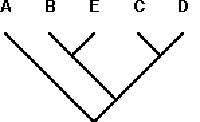
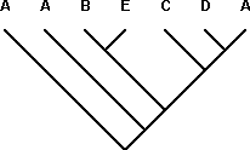
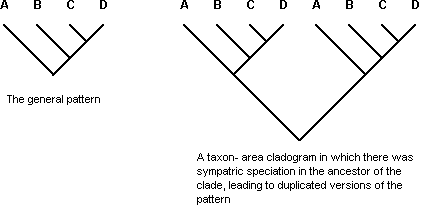
<body><![CDATA[<p align="justify"><font face="Verdana" color="#000000" size="2">Darwin used two metaphors, a phylogenetic tree and the          tangled bank, to visualize the complexity of evolution. By referring to          species as &laquo;communities of descent&raquo;, Darwin emphasized that          the fundamental explanatory principle is shared history. Evolution has          been so complex and historically contingent, however, that the history          includes both general (lawlike) and unique (contingent) phenomena. Extending          this to biogeography leads us to predict that historical biogeographical          patterns should be historically unique combinations of dispersal (ETIB)          and in situ events (MaxVic). Furthermore, we would predict that our ability          to document those patterns would be obscured most by the use of models          and methods that over-simplify the process by invoking a priori assumptions          or prohibitions. This leads us to recognize several essential elements          of the analytical method required to study historical biogeography as          a complex phenomenon. </font></p>           <p align="justify"><font face="Verdana" color="#000000" size="2">First, it is not permissible to remove or modify data.          Wiley (1986, 1988a,b) and Zandee and Roos (1987) already formalized this          as &laquo;Assumption 0,&raquo; which states that you must analyze all          species and all distributions in each input phylogeny without modification,          and your final analysis must be logically consistent with all input data.          Recognition of the fundamental importance of Assumption 0 was obscured          by Page (1990), who used &laquo;Assumption 0&raquo; to refer to the protocol          of coding &laquo;absence&raquo; as &laquo;0&raquo; in preparing a matrix          of data for analysis. Brooks (1981) proposed that protocol because computer          programs at that time did not accept missing data. It was eliminated when          Wiley (1986) proposed using missing data coding for absences for analyses          using Brooks&lsquo; method, which Wiley dubbed Brooks Parsimony Analysis (BPA).          The confusion over what was really Assumption 0 led Van Soest and Hajdu          (1997) to propose what they called a new NA (no assumption) protocol,          apparently not realizing this was BPA a la Wiley (1986). Even more recently,          Porzecanski and Cracraft (2005) proposed modifications of Parsimony Analysis          of Endemicity (PAE) apparently not realizing they were also reinventing          BPA a la Wiley (1986). </font></p>           <p align="justify"><font face="Verdana" color="#000000" size="2">Second, complex area cladograms must include reticulated          area relationships. If each area on this planet had a singular history          with respect to all the species living in it, either there would be either          one species per area or one clade per area. Nowhere on earth does this          occur, so we must assume that reticulated area relationships have been          common. If we use a method of analysis that produces simple area cladograms          (i.e. ones in which each area appears only once), Assumption 0 will be          violated whenever an area has a reticulated history. Assumption 0 can          be satisfied in such cases by duplicating areas with reticulated histories.          Therefore, a method of analysis for handling complexity requires a Duplication          Rule, a mechanism by which areas are listed for each evolutionary event          affecting them. </font></p>           <p align="justify"><font face="Verdana" color="#000000" size="2">Finally, if you allow all possibilities, including area          reticulations, a priori for all species in each clade being analyzed,          and if we expect historical biogeographical patterns to be combinations          of unique and general phenomena, how can you find the general patterns?          For this, we use an epistemological corollary of the Duplication Rule          - Make only enough duplications to satisfy Assumption 0. This is simply          a rendering of Ockham&lsquo;s Razor - Do not duplicate areas beyond necessity.          Simplicity is thus used to determine IF there are general patterns, it          is not used to impose simplicity on the data. </font></p>           <p align="justify"><font face="Verdana" color="#000000" size="2"><i>2. A Method for Detecting Complex Historical Biogeographical          Patterns.</i></font></p>           <p align="justify"><font face="Verdana" color="#000000" size="2">Recent studies of the general properties of the methods          of cladistic biogeography have shown that all of them behave in internally          inconsistent ways when dealing with complex data (Van Veller et al., 1999,          2000, 2001, 2002, 2003; Dowling, 2002; Dowling et al., 2003). In choosing          a parsimonious model of biotic evolution, advocates of vicariance biogeography,          and particularly cladistic biogeography, have developed methods that explained          geographic distributions of sister groups based on a restricted range          of evolutionary processes. All methods recognize three classes of biogeographic          patterns: (1) complete matching between the general pattern and any given          taxon-area cladogram, usually interpreted as indicating vicariance, but          recognized by some as possibly being the result of sequential speciation          by colonization in each clade (<a href="#a11f1">Fig. 1</a>); (2) incomplete matching, suggesting          extinction in one of the lineages (also known as &laquo;lineage sorting&raquo;)          (<a href="#a11f2">Fig. 2</a>); (3) duplication of all or part of the pattern, suggesting sympatric          speciation in the common ancestor of the duplicated lineages (also known          as &laquo;lineage duplication&raquo;) (<a href="#a11f3">Fig. 3</a>). </font></p>           <p align="justify"><a name="a11f1"></a></p>           <p align="center"><font face="Verdana" color="#000000" size="2"><img src="/img/revistas/rmbiodiv/v76n1/a12f1.gif"></font></p>           <p align="justify"><font face="Verdana" color="#000000" size="2"><b>Figure 1. </b>A          taxon-area cladogram showing a particular set of area relationships involving          areas A, B, C, and D, stipulated to be the general pattern (left), and          a second taxon-area cladogram showing the same area relationships as the          general pattern (right). Letters = areas. </font></p>           <p align="justify"><a name="a11f2"></a></p>           ]]></body>
<body><![CDATA[<p align="center"><font face="Verdana" color="#000000" size="2"><img src="/img/revistas/rmbiodiv/v76n1/a12f2.gif"></font></p>           <p align="justify"><font face="Verdana" color="#000000" size="2"><b>Figure 2. </b>A          taxon-area cladogram showing a particular set of area relationships involving          areas A, B, C, and D, stipulated to be the general pattern (left), and          a second taxon-area cladogram showing area relationships among areas A,          C, and D, interpreted as having lost, through extinction (also known as          lineage sorting) a species occurring in area B that was the sister species          of the common ancestor of the species occurring in areas C and D (right).          Letters = areas. </font></p>           <p align="justify"><a name="a11f3"></a></p>           <p align="center"><font face="Verdana" color="#000000" size="2"><img src="/img/revistas/rmbiodiv/v76n1/a12f3.gif"></font></p>           <p align="justify"><font face="Verdana" color="#000000" size="2"><b>Figure 3. </b>A          taxon-area cladogram showing a particular set of area relationships involving          areas A, B, C, and D, stipulated to be the general pattern (left), and          a second taxon-area cladogram of two major parts, each of which shows          the same area relationships as the first taxon-area cladogram, interpreted          as having experienced a sympatric speciation event (lineage duplication)          in the common ancestor of the clade (right). Letters = areas. </font></p>           <p align="justify"><font face="Verdana" color="#000000" size="2">Three additional types of patterns have been considered          complicating factors that obscure the general area relationships, and          have been excluded from the simple area cladograms produced by all methods          of vicariance biogeography except the one known as secondary BPA (Brooks,          1990; Brooks and McLennan, 1991, 2002; Brooks et al., 2001). One of these          is speciation by dispersal on the part of one or more members of the co-occurring          clades (peripheral isolates allopatric speciation), introducing unique          area relationships (<a href="#a11f4">Fig. 4</a>). The remaining two types of patterns represent          cases in which more than one phylogenetic event affects the same area,          producing reticulated area relationships: (a) two or more separate speciation          events within a clade each resulting in at least two non-sister species          inhabiting the same area (<a href="#a11f5">Fig. 5</a>) and (b) post-speciation dispersal leading          to the occurrence of the same species in more than one area (also known          as the widespread species problem) (<a href="#a11f6">Fig. 6</a>). If the geography of evolution          has been complex, the methods of vicariance biogeography will produce          internally inconsistent results in direct proportion to the complexity          in real data the methods must explain away with auxiliary assumptions,          even if they are called costs, likelihoods, or probabilities. Or, (ontological)          simplicity is not always the most parsimonious (epistemological) depiction          of the real world (Van Veller and Brooks, 2001). </font></p>           <p align="justify"><a name="a11f4"></a></p>           <p align="center"><font face="Verdana" color="#000000" size="2"><img src="/img/revistas/rmbiodiv/v76n1/a12f4.gif"></font></p>           <p align="justify"><font face="Verdana" color="#000000" size="2"><b>Figure 4. </b>A          taxon-area cladogram showing a particular set of area relationships involving          areas A, B, C, and D, stipulated to be the general pattern (left), and          a second taxon-area cladogram showing area relationships among areas A,B,C,D,          and E, with the addition in area E of a sister species of the species          occurring in area B in the second taxon-area cladogram, interpreted as          an instance of peripheral isolates speciation (allopatric speciation by          dispersal) (right). Letters = areas. </font></p>           <p align="justify"><a name="a11f5"></a></p>           ]]></body>
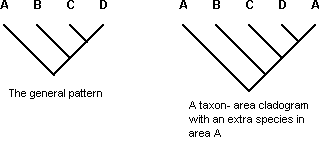
<body><![CDATA[<p align="center"><font face="Verdana" color="#000000" size="2"><b><img src="/img/revistas/rmbiodiv/v76n1/a12f5.gif"></b></font></p>           <p align="justify"><font face="Verdana" color="#000000" size="2"><b>Figure 5. </b>A          taxon-area cladogram showing a particular set of area relationships involving          areas A, B, C, and D, stipulated to be the general pattern (left), and          a second taxon-area cladogram showing the same area relationships, with          the addition of a species in area A that is the sister species of the          species occurring in area D, indicating that the species occurring in          area A arose from two different ancestors. Area A is thus said to have          a reticulated history (right). Letters = areas. </font></p>           <p align="justify"><a name="a11f6"></a></p>           <p align="center"><font face="Verdana" color="#000000" size="2"><img src="/img/revistas/rmbiodiv/v76n1/a12f6.gif"></font></p>           <p align="justify"><font face="Verdana" color="#000000" size="2"><b>Figure 6. </b>A          taxon-area cladogram showing a particular set of area relationships involving          areas A, B, C, and D, stipulated to be the general pattern (left), and          a second taxon-area cladogram showing the same area relationships as the          first taxon-area cladogram, except that the species occurring in area          A also occurs in area D; and a general area cladogram representing the          area relationships supported by both taxon-area cladograms (right). The          species occurring in areas A and D is interpreted as a case of post-speciation          dispersal from area A to area D. Letters = areas. </font></p>           <p align="justify"><font face="Verdana" color="#000000" size="2">Recent studies using secondary BPA have shown extensive          dispersal and reticulated area relationships (Spironello and Brooks, 2003;          Bouchard et al., 2004), even for data sets carefully chosen to emphasize          vicariance (e.g., Brooks and McLennan, 2001; McLennan and Brooks, 2002;          Halas et al., 2005). Most notable among these was the discovery that 70%          of the areas recognized in the so-called &laquo;classic case of vicariance,&raquo;          the Mesoamerican freshwater fishes <i>Xiphophorus </i> and <i>Heterandria,</i>          are not vicariant areas of endemism, and have reticulated biogeographical          histories (Green et al., 2002). </font></p>           <p align="justify"><font face="Verdana" color="#000000" size="2">As noted above, secondary BPA is the only method of vicariance          biogeography that attempts to depict the full range of distributions exhibited          by all species in multiple taxon-area cladograms, including widespread          species and reticulated area relationships. BPA can be implemented using          standard methods in phylogenetic analysis (Brooks and McLennan, 2002,          2003), but only with laborious manipulations of the data. All taxon-area          cladograms need to be converted into binary matrices, and each area duplication          requires that the matrix be re-formulated. This re-formulation produces          large numbers of pseudo-missing data codes representing the areas not          affected by the unique events requiring the duplication (Brooks and McLennan,          1991, 2002). Performing such an analysis for complex data sets is thus          time-consuming. In addition, because one cannot specify the number and          types of area duplications that will be needed a priori, some have been          led to believe that the duplication convention in BPA idiosyncratic rather          than algorithmic (e.g., Ronquist, 2002; Siddall and Perkins, 2003). </font></p>           <p align="justify"><font face="Verdana" color="#000000" size="2">Wojcicki and Brooks (2005) produced an algorithm for          deriving area cladograms that embodies the strengths of Secondary BPA          while eliminating its weaknesses. The inspiration for this algorithm comes          from considering Venn diagram representations of host cladograms as strings          of hierarchically organized characters. The algorithm uses the string          input to build a tree-like data structure that can be searched for points          of agreement and disagreement with additional input host cladograms (Cormen          et al., 2001). We assume that the history of the host context of speciation,          dispersal, and extinction for any assemblage of parasite clades comprises          a long and complex combination of strings. We also assume that no single          parasite clade contains the complete information, even about its own particular          history. By combining the partial information from each of many parasite          clades, however, we can reconstruct substantial parts of the coevolutionary          record of life by integrating information from multiple clades. Since          the hierarchical organization of the strings of characters stems from          phylogenetic relationships, we refer to this algorithm as Phylogenetic          Analysis for Comparing Trees (PACT). </font></p>           <p align="justify"><font face="Verdana" color="#000000" size="2"><i>3. A &laquo;New&raquo; General Theory of Historical          Biogeography: The Taxon Pulse. </i></font></p>           <p align="justify"><font face="Verdana" color="#000000" size="2">Formal methods of historical biogeographic analysis using          phylogenetic trees began appearing more than 25 years ago (Platnick and          Nelson, 1978). At the time, their conceptual underpinnings seemed straightforward.          Episodes of allopatric speciation resulting from the formation of a geographic          barrier, called vicariant speciation, or vicariance, would produce biogeographical          patterns of distributions of sister species mirroring the history of barrier          formation. Furthermore, such barrier formation would affect multiple clades          at the same time, so the biogeographic patterns produced by episodes of          vicariance would be general, or redundant patterns. Phenomena such as          postspeciation dispersal, peripheral isolates speciation (allopatric speciation          by dispersal), and extinction, were assumed to be clade-specific, producing          patterns incongruent with the general area relationships. The research          program became widely known as vicariance biogeography following the publication          of the proceedings of a major symposium (Nelson and Rosen, 1981) and of          a text devoted to the subject (Nelson and Platnick, 1981). </font></p>           ]]></body>
<body><![CDATA[<p align="justify"><font face="Verdana" color="#000000" size="2">Vicariance biogeography has spawned two distinct research          programs. Cladistic biogeography (Humphries and Parenti, 1999) is based          on the view that the function of historical biogeography is to determine          general area relationships, and that each area has a singular history          with respect to the species occurring in it; in a sense, to produce a          phylogeny of areas. Phylogenetic biogeography sensu Van Veller and Brooks          (2001; see also Brundin, 1966, 1972), by contrast, views historical biogeography          as a means to assess the temporal and spatial context of evolutionary          radiations, modes of initiating speciation, and sequences of biotic assembly          (Brooks and McLennan, 1991, 2002). Despite their fundamentally different          perspectives on the goals of historical biogeography, advocates of both          programs have always agreed that general biogeographic patterns are the          result of vicariance. </font></p>           <p align="justify"><font face="Verdana" color="#000000" size="2">At nearly the same time the maximum vicariance paradigm          emerged, Erwin (1979, 1981) proposed the taxon pulse hypothesis as a model          incorporating both dispersal and vicariance. Erwin&lsquo;s model stemmed from          an idea proposed by Darlington (1943) later named the &laquo;taxon cycle&raquo;          by Wilson (1959, 1961). Taxon pulse and taxon cycle models both assume          that species and their adaptations arise in &laquo;centers of diversification&raquo;          and that distributional ranges of taxa periodically fluctuate around a          more stable, continuously occupied centre. This general biotic dispersal          may be interrupted by the formation of barriers, producing episodes of          vicariant speciation. Breakdown of those barriers produces new episodes          of biotic expansion, setting the stage for yet more episodes of vicariance.          Taxon cycles occur over relatively short periods of time (&laquo;ecological          time&raquo;) and involve species that disperse actively and colonize new          areas during expansion episodes, then contract their ranges during periods          of habitat contraction, without producing new species. Taxon pulses, by          contrast, occur over relatively long periods of time (&laquo;evolutionary          time&raquo;) and are characterized by dispersal along a broad front during          expansion into suitable habitat when previous barriers break down. During          this expansion phase, different species within a biota encounter additional          geographic heterogeneity, including <i></i>range contractions. Such heterogeneity          may: (1) stop the expansion of some species, resulting in species of restricted          distributions; (2) affect only the rate of expansion for some species,          producing widespread species; or (3) act as barriers to dispersal of sufficient          magnitude to produce new species as a result of peripheral isolates speciation.          Geological evolution, operating on longer time scales than biological          evolution, may also produce barriers, resulting in episodes of vicariant          speciation affecting members of these same biotas. </font></p>           <p align="justify"><font face="Verdana" color="#000000" size="2">Despite the existence of an alternative to maximum vicariance,          and despite concerns that exemplar taxa were being carefully selected          to show a preponderance of vicariance (Simberloff et al., 1981; Simberloff,          1987), vicariance has become the default explanation for any observation          of allopatry. And yet, the maximum vicariance model has always been deficient          because it neglects the issue of how ancestral species of many clades          become widespread enough to be affected by vicariant events. If vicariance          affects many members of ancestral biotas in the same way, it seems reasonable          to assume that at some point in the past, the members of the biota expanded          their geographic ranges to such an extent that they could be affected          by the subsequent vicariance event. Advocates of vicariance biogeography          have acknowledged that this must happen: Wiley (1981) noted that some          circumstances, such as colonization of islands, might produce general          distribution patterns based on dispersal rather than vicariance, and Endler          (1982) suggested that such correlated dispersal patterns might be common.          In practice, however, historical biogeographers have simply assumed that          such dispersal does not produce general patterns, so it is permissible          to invoke dispersal only to explain departures from the general pattern,          which is always explained as the result of vicariance (Wiley, 1986, 1988a,b;          Brooks and McLennan, 1991, 2002). <i></i></font></p>           <p align="justify"><font face="Verdana" color="#000000" size="2">Taxon pulse-driven biotic diversification differs from          vicariance-driven biotic diversification in three important ways. First,          because diversification is driven by biotic expansion, we expect to find          general patterns associated with dispersal, not just with vicariance.          General patterns resulting from biotic expansion occur when barriers to          dispersal, especially the large-scale ones leading to vicariance, break          down. Second, episodes of biotic expansion, even those involving large          areas, will inevitably lead to reticulated historical relationships among          areas, and biotas within areas of endemism comprising species of different          ages derived from different sources. Third, the absence of particular          clades in particular areas is more parsimoniously explained as a lack          of participation in that particular expansion episode by a particular          clade, rather than dispersal with extinction. Taxon pulses are also historically          contingent, meaning that at any given time, different clades comprising          a complex biota may form a mosaic of area relationships. Halas et al.          (2005) illustrated their protocols using the extensive data set presented          by Marshall and Liebherr (2000), representing 33 clades of insects, vertebrates,          and flowering plants, occurring throughout Mexico and parts of Central          America, which is particularly relevant for this contribution. <b><i></i></b></font></p>           <p align="justify"><font face="Verdana" color="#000000" size="2"><b>Materials and Methods </b></font></p>           <p align="justify"><font face="Verdana" color="#000000" size="2">Producing the area cladogram. A Precis of PACT. <i></i></font></p>           <p align="justify"><font face="Verdana" color="#000000" size="2"><i>Step 1. </i> Convert all phylogenetic trees of interest          into taxon-area cladograms. This is accomplished by replacing the names          of the species with the areas they inhabit. </font></p>           <p align="justify"><font face="Verdana" color="#000000" size="2"><i>Step 2. </i> Convert the taxon-area cladograms into          Venn diagrams (<a href="#a11t1">Table I</a>). The Venn diagrams comprise two classes of elements,          &laquo;leaves&raquo; and &laquo;nodes&raquo;. A leaf is a single area,          and a node is any grouping of at least 2 areas. Nodes are represented          by inclusive open [&laquo;(&laquo;] and closed [&laquo;)&raquo;] parentheses          in the Venn diagram. When a given species inhabits more than one area,          a leaf designates each of the areas and all the areas inhabited by that          species are contained within a single node. </font></p>           <p align="justify"><a name="a11t1"></a></p>           <p align="center"><font face="Verdana" color="#000000" size="2">&nbsp;<img src="/img/revistas/rmbiodiv/v76n1/a12t1.jpg"></font></p>           ]]></body>
<body><![CDATA[<p align="justify"><font face="Verdana" color="#000000" size="2"><i>Step 3. </i> Choose any taxon-area cladogram from          the set of taxon-area cladograms to be analyzed, and determine its elements.          We will refer to this as the Template Area Cladogram. </font></p>           <p align="justify"><font face="Verdana" color="#000000" size="2">Template Area Cladogram (Taxon-area Cladogram 1 in <a href="#a11t1">Table          I</a>): (A(B(CD))) </font></p>           <p align="justify"><font face="Verdana" color="#000000" size="2">The algorithm reads the Venn diagram representing the          second taxon-area cladogram from left to right, element by element. Each          time a closed parenthesis [')'] is encountered, indicating a grouping          of at least 2 areas, the algorithm moves backwards, until it reaches an          open parenthesis [&lsquo;(&lsquo; ], collecting the data for the grouping thus created.          Next, the algorithm represents the grouping signified by the inclusive          parentheses by a node, which is a data structure designating a grouping          and which is used in integrating the taxon-area cladogram with the template          area cladogram. In this case, the first closed parenthesis is reached          after D. The algorithm then reads backwards (to the left) collecting leaves          and nodes until it reaches the open parenthesis, in this case C + D. Once          the data collection is complete a node containing the leaves CD replaces          the parentheses around C and D. If we called that node &laquo;X&raquo;,          the Venn diagram would now be (A(BX)). The algorithm continues reading          to the left, searching for the next open parenthesis. The next open parenthesis          bracket forming a node, &lsquo;Y&lsquo;, containing the leaf B and X. The taxon-area          cladogram is now modified to (AY), a grouping that receives its own node,          &lsquo;Z&lsquo;. The template area cladogram is now represented by 4 leaves and 3          nodes: A, B,C, D, Z[A(B(CD)))], Y [(B(CD))], and X [(CD)]. </font></p>           <p align="justify"><font face="Verdana" color="#000000" size="2"><i>Step 4. </i> Select a second taxon-area cladogram.          Determine its elements as in step 1, and then compare each of them with          the template area cladogram. </font></p>     <p align="justify"><font face="Verdana" color="#000000" size="2">Template Area Cladogram: (A(B(CD)))     <br>         Taxon-area cladogram 2 (<a href="#a11t1">Table I</a>): (A(B(CD))) </font></p>           <p align="justify"><font face="Verdana" color="#000000" size="2">PACT reads the second taxon-area cladogram in the same          manner as it read the template area cladogram. In this case, the first          closed parenthesis is reached after D. PACT then reads to the left, collecting          leaves and nodes until it reaches the open parenthesis, in this case it          collects leaves C + D. Once the data collection is complete, the parentheses          around C and D are replaced by a node containing the leaves CD. The next          open parenthesis forms a node, containing the leaf B and the node (CD).          Finally, the last open parenthesis forms a node containing the leaf A          and the node (B(CD)). The taxon-area cladogram is now represented by 4          leaves and 3 nodes: A, B,C, D, (A(B(CD))), (B(CD)), and (CD). The next          step is to integrate the taxon-area cladogram with the template area cladogram.          This is accomplished by maximizing the matches between their respective          leaves and nodes, and then adding novel elements by creating novel nodes          at appropriate levels in the template area cladogram. Next, PACT re-reads          the elements of the taxon-area cladogram, comparing them with the elements          of the template area cladogram. Each element in the input taxon-area cladogram          that also occurs in the template area cladogram is designated with a &lsquo;Y&lsquo;;          any element of the input taxon-area cladogram that is not found in the          template area cladogram is designated with a &lsquo;N&lsquo;: </font></p>           <p align="justify"><font face="Verdana" color="#000000" size="2">(A(B(CD))) -Y; A-Y + (B(CD))-Y; B-Y + (CD)-Y; C-Y + D-Y        </font></p>           <p align="justify"><font face="Verdana" color="#000000" size="2">This produces the first, and most basic rule of PACT,          the &lsquo;Y + Y = Y&lsquo; rule. In this case, each element of the input taxon-area          cladogram is congruent with an element in the template area cladogram          (all elements in tree 2 are Y&lsquo;s), so trees 1 and 2 can be combined completely.          The general area cladogram resulting from the combination of trees 1 and          2 is thus (A(B(CD))) (<a href="#a11f7">Fig. 7</a>). </font></p>           <p align="justify"><a name="a11f7"></a></p>           ]]></body>
<body><![CDATA[<p align="center"><font face="Verdana" color="#000000" size="2"><img src="/img/revistas/rmbiodiv/v76n1/a12f7.gif"></font></p>           <p align="justify"><font face="Verdana" color="#000000" size="2"><b>Figure 7.</b> PACT-derived          area cladogram for taxon-area cladograms 1- 4 in <a href="#a11t1">Table 1</a>. Letters = areas.  </font></p>           <p align="justify"><font face="Verdana" color="#000000" size="2">PACT performs this search in the sequence in which groups          appear in the input taxon-area cladogram to be combined with those in          the template area cladogram. This speeds up the process of analyzing the          new cladogram and making combinations and addition to the template. In          the case above, for example, PACT would have recognized that, because          (A(B(CD))) = Y in the input taxon-area cladogram, all elements in the          input taxon-area cladogram corresponded to elements in the template area          cladogram, and would have made the combination immediately. </font></p>           <p align="justify"><font face="Verdana" color="#000000" size="2"><i>Step 5. </i>Add a third taxon-area cladogram (tree          3), and repeat steps 2 and 3, comparing it with the tree resulting from          the combination of the previous steps. </font></p>           <p align="justify"><font face="Verdana" color="#000000" size="2">Template Area Cladogram: (A(B(CD)))     <br>         <b>(</b>A(B(CD))); A + (B(CD)); B + (CD); C + D     <br>         Taxon-area Cladogram 3 (<a href="#a11t1">Table I</a>): A(CD))     <br>         (A(CD))-N; A-Y + (CD)-Y; C-Y + D-Y </font></p>           <p align="justify"><font face="Verdana" color="#000000" size="2">In this case, there is a mismatch between the template          area cladogram and the input taxon-area cladogram at the initial level,          indicated by N. At this point no decision can be made as to why the mismatch          occurs, so PACT does not produce any changes and moves on. All remaining          elements in taxon-area cladogram 3 are &lsquo;Y&lsquo;, so we can combine them with          the template area cladogram. At this point we can begin to consider the          mismatch, but we discover that in this case, the entire input taxon-area          cladogram has been combined with the template area cladogram. The &lsquo;N&lsquo;          seems to have disappeared. The reason for this is that the template area          cladogram differs from the input taxon-area cladogram only by containing          information not found in the input taxon-area cladogram. The absence of          B in the input taxon-area cladogram does not affect the placement of B          in the template area cladogram, and thus does not affect the topology          of the area cladogram. The general area cladogram for trees 1+2+3 is still          (A(B(CD))) (<a href="#a11f7">Fig. 7</a>). </font></p>           <p align="justify"><font face="Verdana" color="#000000" size="2"><i>Step 6. </i>Add the next tree (4) and repeat steps          2-3. </font></p>           ]]></body>
<body><![CDATA[<p align="justify"><font face="Verdana" color="#000000" size="2">Template Area Cladogram: (A(B(CD)))     <br>         (A(B(CD))); A + (B(CD)); B + (CD); C + D     <br>         Taxon-area Cladogram 4 (<a href="#a11t1">Table I</a>): (A(B(CD)))(A(B(CD))))     <br>         (A(B(CD)))(A(B(CD))))-N; (A(B(CD)))-Y; A-Y + (B(CD))-Y; B-Y + (CD)-Y;          C-Y + D-Y; (A(B(CD)))-Y; A-Y + (B(CD))-Y; B-Y + (CD)-Y; C-Y + D-Y </font></p>           <p align="justify"><font face="Verdana" color="#000000" size="2">Once again, the only N occurs at the level of the entire          input taxon-area cladogram, and that N disappears once the lower levels          are combined with the template. In this case, the input taxon-area cladogram          appears more complex than the template, but only because it contains two          identical representations of the template area cladogram. This is the          diagnostic signature of lineage duplication, sympatric speciation <i>within          </i> an ancestor producing two co-occurring lineages. This does not affect          the pattern of relationships <i>among </i> areas, so the general area          cladogram for trees 1+2+3+4 is still (A(B(CD))) (<a href="#a11f7">Fig. 7</a>). </font></p>           <p align="justify"><font face="Verdana" color="#000000" size="2"><i>Step 7. </i> Add the next tree (5) and repeat steps          2-3. </font></p>           <p align="justify"><font face="Verdana" color="#000000" size="2">Template Area Cladogram: (A(B(CD)))     <br>         (A(B(CD))); A + (B(CD)); B + (CD); C + D     <br>         Taxon-area Cladogram 5: (A((BE)(CD)))     <br>         (A((BE)(CD)))-N; A-Y + ((BE)(CD))-N; (BE)- N + (CD)-Y; B-Y + E-N; C-Y          + D-Y </font></p>           ]]></body>
<body><![CDATA[<p align="justify"><font face="Verdana" color="#000000" size="2">Reading from the left, PACT encounters (BE); B in the          input taxon-area cladogram is Y, and because B and BE are connected at          the same node, both B&lsquo;s can be combined. E, which is not found in the          template area cladogram, is thus a novel (&lsquo;N&lsquo;) element, and added to the          template area cladogram at that point, creating a (BE) grouping (a new          node) in the template. The next closed parenthesis is encountered at (CD);          both C and D as well as the grouping CD are Y in the template area cladogram,          so there is no change at this point. The next closed parenthesis is ((BE)(CD)).          This combination already exists in the template area cladogram due to          the modification made earlier in which E was added to the template area          cladogram. Finally, PACT encounters A, which is Y, and is combined with          the template. The resulting area cladogram is (A((BE)(CD))) (<a href="#a11f8">Fig. 8</a>).        </font></p>           <p align="justify"><font face="Verdana" color="#000000" size="2"><i>Step 8. </i> Add the next tree (6) and repeat steps          2-3, comparing it with the tree produced by 1+2+3+4+5 (<a href="#a11f8">Fig. 8</a>). </font></p>           <p align="justify"><a name="a11f8"></a></p>           <p align="center"><font face="Verdana" color="#000000" size="2"><img src="/img/revistas/rmbiodiv/v76n1/a12f8.gif"></font></p>           <p align="justify"><font face="Verdana" color="#000000" size="2"><b>Figure 8.</b> PACT-derived          area cladogram for taxon-area cladograms 1- 5 in <a href="#a11t1">Table 1</a>. Letters = areas.  </font></p>           <p align="justify"><font face="Verdana" color="#000000" size="2">Template Area Cladogram: (A((BE)(CD))))     <br>         (A((BE)(CD)))); A + ((BE)(CD)); (BE) + (CD); B + E; C + D     <br>         Taxon-area Cladogram 6: (A(B(C(DA))))     <br>         (A(B(C(DA))))-N; <b>A-Y* </b> + (B(C(DA)))-N; B-Y + (C(DA))-N;          C-Y + (DA)-N; D-Y + <b>A- Y* </b></font></p>           <p align="justify"><font face="Verdana" color="#000000" size="2">This case is directly analogous to the previous one.          Reading from left to right, PACT initially encounters (AD), which is not          found in the template area cladogram (&lsquo;N&lsquo;). The &lsquo;A&lsquo; in (AD) is thus considered          a novel element (&lsquo;N&lsquo;) and the input taxon-area cladogram is modified to        </font></p>           ]]></body>
<body><![CDATA[<p align="justify"><font face="Verdana" color="#000000" size="2">(A(B(C(DA))))-N; <b>A-Y </b> + (B(C(DA)))-N;          B-Y + (C(DA))-N; C-Y + (DA)-N; D-Y + <b>A-N </b></font></p>           <p align="justify"><font face="Verdana" color="#000000" size="2">Next, PACT encounters (CD) in the template tree and (C(DA))          in the input taxon-area cladogram tree. C is a common element in both          cladograms, and can be combined. This leaves D in the template area cladogram          and (DA) in the input taxon-area cladogram connected at the same node.          This means that both D&lsquo;s can be combined, creating a (C(DA)) grouping          (and new node) in the template area cladogram. At the next node, we find          the grouping (BE) in the template area cladogram and the leaf B in the          input taxon-area cladogram. As in step 7, above, both B&lsquo;s can be combined,          leaving the grouping (BE) in the template area cladogram inPACT. At the          next level, we encounter leaf A in both cladograms, which are combined.          This confirms PACT&lsquo;s initial assessment of Y for leaves A (basal most),          B, C and D. The input taxon-area cladogram contains a novel grouping (DA)          not found in the template and the template contains a grouping (BE) not          seen in the input taxon-area cladogram. The resulting area cladogram is          (A((BE)(C(DA)))) (<a href="#a11f9">Fig. 9</a>). </font></p>           <p align="justify"><a name="a11f9"></a></p>           <p align="center"><font face="Verdana" color="#000000" size="2"><img src="/img/revistas/rmbiodiv/v76n1/a12f9.gif"></font></p>           <p align="justify"><font face="Verdana" color="#000000" size="2"><b>Figure 9.</b> PACT-derived          area cladogram for taxon-area cladograms 1- 6 in <a href="#a11t1">Table 1</a>. Letters = areas.  </font></p>           <p align="justify"><font face="Verdana" color="#000000" size="2">The situation presented by taxon-area cladograms 5 and          6, above, represent cases of what we call the &lsquo;Y + YN = YN&lsquo; rule. For          clade 5, &lsquo;Y&lsquo; = B and &lsquo;YN&lsquo; = BE; for clade 6 &lsquo;Y&lsquo; = D and &lsquo;YN&lsquo; = DA. Next,          we consider taxon-area cladograms 7 and 8 in <a href="#a11t1">Table I</a> on their own, in          order to demonstrate a final combination rule. </font></p>           <p align="justify"><font face="Verdana" color="#000000" size="2"><i>Step 9. </i> Choose one area cladogram to be the template          (we choose 7 in this case, but one could also choose 8 without changing          the results). </font></p>           <p align="justify"><font face="Verdana" color="#000000" size="2">Taxon-area Cladogram 7: (A(BE))     <br>         Taxon-area Cladogram 8: (A(CD))     <br>         (A(BE)); A + (BE); B + E (A(CD))-N; A-Y + (CD)-N; C-N + D-N </font></p>           ]]></body>
<body><![CDATA[<p align="justify"><font face="Verdana" color="#000000" size="2">A is the only common element (Y) in both taxon-area cladograms.          The groups (BE) and (CD) contain no elements in common, but each is connected          at a node with A. In this case, although many dichotomous area cladograms          consistent with the data are possible, we have no evidence supporting          any particular one. Therefore, the resultant area cladogram is (A(BE)(CD))          (<a href="#a11f10">Fig. 10</a>). This is an example of what we call the &lsquo;YN + YN = YNN&lsquo; rule,          where &lsquo;A&lsquo; = Y, &lsquo;(BE)&lsquo; = N and &lsquo;(CD)&lsquo; = N. </font></p>           <p align="justify"><font face="Verdana" color="#000000" size="2"><i>Step 10. </i>We can now combine the area cladogram          for taxon-area cladograms 7 and 8 (<a href="#a11f10">Fig. 10</a>) with the template area cladogram          (<a href="#a11f9">Fig. 9)</a>. </font></p>           <p align="justify"><a name="a11f10"></a></p>           <p align="center"><font face="Verdana" color="#000000" size="2"><img src="/img/revistas/rmbiodiv/v76n1/a12f10.gif"></font></p>           <p align="justify"><font face="Verdana" color="#000000" size="2"><b>Figure 10.</b> PACT-derived          area cladogram for taxon-area cladograms 7- 8 in <a href="#a11t1">Table 1</a>. Letters = areas.  </font></p>           <p align="justify"><font face="Verdana" color="#000000" size="2">Template Area Cladogram for clades 1-6: (A((BE)(C(DA))))          Area cladogram for clades 7-8: (A(BE)(CD))     <br>         (A(BE)(CD))-N; A-Y + (BE)-Y + (CD)-N; B-Y + E-Y; C-Y + D-Y </font></p>           <p align="justify"><font face="Verdana" color="#000000" size="2">D in the area cladogram for clades 7-8 and (DA) in the          template area cladogram is a case of the &lsquo;Y + YN = YN&lsquo; rule, so D in the          area cladogram for areas 7-8 is combined with D in (DA) in the template          area cladogram); therefore (CD) in the area cladogram for clades 7-8 is          combined with (C(DA)) in the template. A and (BE) are both Y, so they          are combined; At this point, all elements in the area cladogram for clades          7-8 have been integrated with the template area cladogram (A((BE)(C(DA))))          (<a href="#a11f9">Fig. 9</a>). </font></p>           <p align="justify"><font face="Verdana" color="#000000" size="2"><i>Step 11. </i> Add taxon-area cladogram 9 in <a href="#a11t1">table          I</a> to the Template Area Cladogram. </font></p>           <p align="justify"><font face="Verdana" color="#000000" size="2">Template Area Cladogram: (A((BE)(C(DA))))     ]]></body>
<body><![CDATA[<br>         (A((BE)(C(DA)))); A + ((BE)(C(DA))); (BE) + (C(DA)); C + (DA); B + E;          D + A     <br>         Taxon-area Cladogram 9: (A(A(B(CD))))     <br>         (A(A(B(CD))))-N; A-Y* + A(B(CD))-N; A-Y* + (B(CD))-N; B-Y + (CD)-N; C-Y          + D-Y </font></p>           <p align="justify"><font face="Verdana" color="#000000" size="2">Once again, reading from left to right, the algorithm          first encounters (CD). We begin with CD in the input taxon-area cladogram          + (C(DA)) in the template area cladogram. This is a case of the &lsquo;Y + YN          = YN&lsquo; rule, so D in the taxon-area cladogram is combined with (DA) in          the template area cladogram. Next, (B(CD)) in the input taxon-area cladogram,          now considered (B(C(DA))), is connected at the same node in the template          area cladogram as ((BE)(C(DA))). (C(DA)) is the same in both cases, so          they are combined, leaving B and (BE), another case of the &lsquo;Y + YN = YN&lsquo;          rule. At the next node, the template area cladogram and the taxon-area          cladogram are both A, so they are combined. </font></p>           <p align="justify"><font face="Verdana" color="#000000" size="2">Finally, the input taxon-area cladogram has an additional          A, originally designated Y, because A occurs twice in the template area          cladogram and twice in the taxon-area cladogram. At this point, we have          already accounted for both A&lsquo;s in the template area cladogram, so PACT          must still account for the second A in the input taxon-area cladogram.          One possibility is that the two A&lsquo;s in the taxon-area cladogram are paraphyletic          because they represent an episode of sympatric speciation (lineage duplication),          in which case both could be combined. PACT does not combine these A&lsquo;s,          for a methodological and a biological reason, respectively. First, single          areas are not sufficient grounds for grouping or combining areas. PACT          will not create groupings of areas in the absence of any evidence of groupings.          Second, sympatric speciation is not the only possible explanation for          the paraphyletic status of the area A&lsquo;s. Combining the two A&lsquo;s would be          tantamount to making a choice in favor of sympatric speciation in the          face of ambiguity, rather than waiting for additional data (more taxon-area          cladograms) to resolve the ambiguity. </font></p>           <p align="justify"><font face="Verdana" color="#000000" size="2">This provision in PACT prevents over-combining data;          we call it the &laquo;Y(Y-&raquo; = &laquo;Y(Y-&raquo;or &laquo;Y(Y- &sup1;          Y&raquo; rule, or &laquo;do not combine single common areas attached to          different nodes&raquo;. All current methods, including secondary BPA,          violate this rule by over-combining data. In matrix representation methods,          including BPA, this is called inclusive ORing, which is known to create          other systemic analytical problems (Cressey et al., 1983; Brooks and McLennan,          1991, 2002) and internal inconsistencies (Van Veller et al., 1999, 2000,          2001, 2002). Consider the taxon-area cladograms ((AC)B) + (A(AB)). PACT          produces (A((AC)B)) for these two taxon-area cladograms. If we combine          the A&lsquo;s in taxon-area cladogram 2, the result would be ((AC)B). Now add          a third taxon-area cladogram, (A(CB)). The PACT result is still (A((AC)B)),          supporting an interpretation that all 3 taxon-area cladograms are parts          of a single complex pattern, one part of which is missing in each. If          we had combined the A&lsquo;s in taxon-area cladogram 2, however, the result          would be an unresolved polytomy (ACB). At this point, all methods, including          secondary BPA, would infer that the taxon-area cladograms had no information          in common. </font></p>           <p align="justify"><font face="Verdana" color="#000000" size="2">PACT thus treats the basal-most A as a new element added          to the template area cladogram, which is modified to (A(A((BE)(C(DA)))))                <br>       (<a href="#a11f11">Fig. 11</a>). </font></p>           <p align="justify"><a name="a11f11"></a></p>           <p align="center"><font face="Verdana" color="#000000" size="2"><img src="/img/revistas/rmbiodiv/v76n1/a12f11.gif"></font></p>           ]]></body>
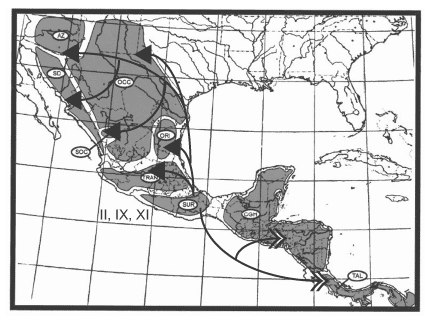
<body><![CDATA[<p align="justify"><font face="Verdana" color="#000000" size="2"><b>Figure 11. </b> PACT-derived          area cladogram for taxon-area cladograms 1- 9 in <a href="#a11t1">Table 1</a>. Letters = areas.  </font></p>           <p align="justify"><font face="Verdana" color="#000000" size="2">All available taxon-area cladograms have now been incorporated,          resulting in the final area cladogram (<a href="#a11f11">Fig. 11</a>). Some may notice at this          point that either of the two basal A&lsquo;s in taxon-area cladogram 9 could          be considered the same as the basal A in the template area cladogram.          This ambiguity does not affect the construction of the area cladogram,          only the mapping of particular species onto the area cladogram when we          begin to derive evolutionary inferences from the area cladogram. </font></p>           <p align="justify"><font face="Verdana" color="#000000" size="2"><i>Distinguishing General Nodes due to Vicariance from          General Nodes due to Biotic Expansion. </i></font></p>           <p align="justify"><font face="Verdana" color="#000000" size="2">Lieberman (2000, 2003a, b) proposed a protocol for distinguishing          general nodes due to vicariance from those due to biotic expansion in          area cladograms. General nodes associated with vicariance exhibit decreasing          numbers of areas occupied, whereas general nodes associated with biotic          expansion are associated with increasing numbers of areas occupied (break-down          of a barrier). Vicariance nodes should also be characterized by splits          between areas caused by the documented formation of a geological, geographical,          or climatological barrier of sufficient magnitude and duration to produce          speciation (i.e., irreversible splitting of lineages) in multiple clades.          For ambiguous cases, we assume vicariance as the default explanation.        </font></p>           <p align="justify"><font face="Verdana" color="#000000" size="2"><b>Results and Discussion </b></font></p>           <p align="justify"><font face="Verdana" color="#000000" size="2">The core of the PACT area cladogram for the Marshall          and Liebherr (2000) data set is shown in <a href="#a11f12">Fig. 12</a>. The remaining portions,          which can be obtained from the author, depict a complex biogeographic          history in which every area shows evidence of reticulation. The area cladogram          in <a href="#a11f12">Fig. 12</a> has 15 nodes (Roman numerals). Following Lieberman&lsquo;s rationale,          six of those nodes are vicariance nodes. Three correspond to repeated          episodes of the same split, between the Transmexican Volcanic Belt + Sierra          Madre del Sur and the Chiapan Guatemalan Highlands + Talamancan Cordillera:          <i>Node I,</i> represented by 7 clades; <i>Node VIII,</i> represented          by 21 clades; and <i>Node XV,</i> represented by 16 clades. Donoghue and          Moore (2003) recently asserted that all current methods of historical          biogeographic analysis were susceptible to pseudo-congruence, but neither          secondary BPA nor PACT suffer from that flaw. The other vicariant nodes          include <i>Node III,</i> represented by 19 clades, corresponding to a          vicariant split between the Sierra Madre del Sur + Transmexican Volcanic          Belt and the areas to the north (Arizona, the Sonoran Desert, the Sierra          Madre Occidental, the Southern Sierra Madre Occidental, and the Sierra          Madre Oriental); <i>Node X,</i> represented by 14 clades, corresponding          to a split between the Transmexican Volcanic Belt and the Sierra Madre          del Sur; and <i>Node VII, </i> represented by 7 clades, corresponding          to a split between Arizona + Sonoran Desert and the Sierra Madre Occidental          + Southern Sierra Madre Occidental + Sierra Madre Oriental. A map of these          vicariance events is shown in <a href="#a11f13">Fig. 13</a>. </font></p>           <p align="justify"><font face="Verdana" color="#000000" size="2">The remaining nine nodes depicted in <a href="#a11f12">Fig. 12</a> are biotic          expansion nodes, corresponding to three distinct classes of dispersal          episodes. The first of these comprises dispersal out of the Sierra Madre          del Sur (area 7) primarily northward. The oldest of these is <i>Node II,</i>          including 20 clades, and exhibits general dispersal, including some southward          movement. More recent dispersal episodes out of the Sierra Madre del Sur          include <i>Node IX,</i> including 15 clades, with dispersal primarily          into the Transmexican Volcanic Belt and the Sierra Madre Occidental; and          <i>Node XI,</i> including 9 clades, exhibiting general dispersal, primarily          northward. The second class of dispersal episodes involves three sequential          dispersal events out of the Sierra Madre Occidental + Sierra Madre Oriental:          <i>Node IV,</i> including 18 clades, represents dispersal primarily into          Arizona + North </font></p>           <p align="justify"><a name="a11f12"></a></p>           <p align="justify"><font face="Verdana" color="#000000" size="2">&nbsp;</font></p>           <p align="center"><font face="Verdana" color="#000000" size="2"><img src="/img/revistas/rmbiodiv/v76n1/a12f12.gif"></font></p>           ]]></body>
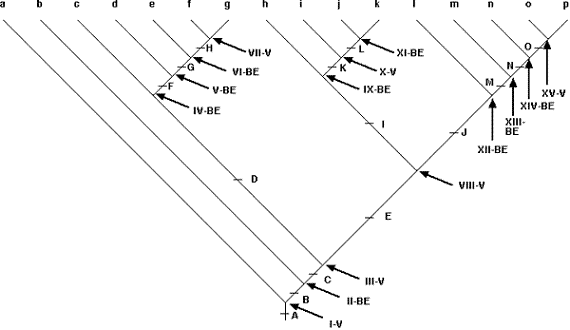
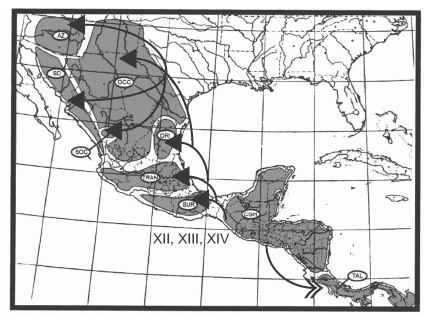
<body><![CDATA[<p align="justify"><font face="Verdana" color="#000000" size="2"><b>Figure 12.</b> Partial representation          of the area cladogram produced by secondary BPA of nine areas of endemism          in Mexico and Central America, based on 33 clades used by Marshall &amp;          Liebherr (2000). Roman numerals denote the 15 general nodes, each supported          by at least 7 clades, accompanied by an indication of whether the node          indicates an episode of Vicariance (V) or Biotic Expansion (BE). Upper-case          and lower-case letters refer to sub-area cladograms depicting the entire          pattern of historical biogeographic diversity indicated by the members          of the 33 clades. For details, conPACT corresponding author. </font></p>           <p align="justify"><a name="a11f13"></a></p>           <p align="center"><font face="Verdana" color="#000000" size="2"><img src="/img/revistas/rmbiodiv/v76n1/a12f13.gif"></font></p>           <p align="justify"><font face="Verdana" color="#000000" size="2"><b>Figure 13.</b> Map with vicariance          splits plotted on it. AZ = Arizona; SD = Sonoran Desert; OCC = Sierra          Madre Occidental; SOC = Southern Sierra Madre Occidental; ORI = Sierra          Madre Oriental; TRAN = Sierra Transvolcanica; SUR = Sierra Madre del Sur;          CGH = Chiapan Guatemalan Highlands; TAL = Talamancan Cordillera. (From          Halas et al., 2005). </font></p>           <p align="justify"><font face="Verdana" color="#000000" size="2">America, but with some southward dispersal; <i>Node V,</i>          including 9 clades, represents dispersal in all directions and into all          9 areas, with successively fewer clades proceeding southward; and <i>Node          VI,</i> including 8 clades, represents dispersal into Arizona + Sonoran          Desert. Finally, there are three sequential dispersal events out of the          Chiapan Guatemalan Highlands: <i>Node XII,</i> including 17 clades, represents          dispersal primarily southward into the Talamancan Cordillera, but with          some northward dispersal; <i>Node XIII,</i> including 19 clades, represents          dispersal northward; and <i>Node XIV,</i> including 19 clades, represents          dispersal northward, primarily into the Sierra Madre del Sur but with          a few clades dispersing farther northward. The dispersal routes out of          these three areas are depicted in <a href="#a11f14">Figures 14,</a> <a href="#a11f15">15</a>, <a href="#a11f16">16</a>. </font></p>           <p align="justify"><a name="a11f14"></a></p>           <p align="center"><font face="Verdana" color="#000000" size="2"><i><img src="/img/revistas/rmbiodiv/v76n1/a12f14.gif"></i></font></p>           <p align="justify"><font face="Verdana" color="#000000" size="2"><b>Figure 14.</b> Dispersal          from the Sierra Madre del Sur. <b>Figures 14-16.</b> Maps depicting          dispersal routes out of three areas identified as sources of biotic expansion          depicted in <a href="#a11f12">Fig.12</a>. (From Halas et al., 2005). </font></p>           <p align="justify"><a name="a11f15"></a></p>           <p align="center"><font face="Verdana" color="#000000" size="2"><img src="/img/revistas/rmbiodiv/v76n1/a12f15.gif"></font></p>           ]]></body>
<body><![CDATA[<p align="justify"><font face="Verdana" color="#000000" size="2"><b>Figure 15.</b> Dispersal          from the Sierra Madre Occidental + Sierra Madre Oriental. (From Halas          et al., 2005). </font></p>           <p align="justify"><a name="a11f16"></a></p>           <p align="center"><font face="Verdana" color="#000000" size="2"><img src="/img/revistas/rmbiodiv/v76n1/a12f16.gif"></font></p>           <p align="justify"><font face="Verdana" color="#000000" size="2"><b>Oriental. 16.</b> Dispersal          from the Chiapan Guatemalan Highlands. Arrows with closed heads indicate          primary dispersal routes; arrows with open heads indicate secondary dispersal          routes. AZ = Arizona; SD = Sonoran Desert; OCC = Sierra Madre Occidental;          SOC = Southern Sierra Madre Occidental; ORI = Sierra Madre Oriental; TRAN          = Sierra Transvolcanica; SUR = Sierra Madre del Sur; CGH = Chiapan Guatemalan          Highlands; TAL = Talamancan Cordillera. </font></p>           <p align="justify"><font face="Verdana" color="#000000" size="2">Overall, nine of the 15 general nodes (60%) are biotic          expansion nodes, involving general dispersal events from three areas (Sierra          Madre del Sur, Sierra Madre Occidental + Sierra Madre Oriental, and Chiapan          Guatemalan Highlands), and six (40%) are vicariance nodes, created by          splits between the Transmexican Volcanic Belt + Sierra Madre del Sur and          the Chiapan Guatemalan Highlands + Talamancan Cordillera (three times),          between the Transmexican Volcanic Belt and the Sierra Madre del Sur (once),          between the Transmexican Volcanic Belt + Sierra Madre del Sur and Arizona          + Sonoran Desert + Sierra Madre Occidental + Southern Sierra Madre Occidental          + Sierra Madre Oriental (once), and between Arizona + Sonoran Desert and          the Sierra Madre Occidental + Southern Sierra Madre Occidental + Sierra          Madre Oriental (once). In addition, with only a single exception (between          nodes III and VIII), each vicariance node is separated by at least one          biotic expansion node. This complex pattern of area relationships strongly          supports an interpretation of taxon pulse-driven diversification for these          biotas, with post-vicariance biotic dispersal producing widespread species          that set the stage for succeeding episodes of vicariance. </font></p>           <p align="justify"><font face="Verdana" color="#000000" size="2">Phylogenetic Inference of Modes of Initiating Speciation.          <i></i></font></p>           <p align="justify"><font face="Verdana" color="#000000" size="2">Assessing the modes of speciation for the members of          the clades being analyzed is an important test of any hypothesis of taxon          pulse-driven evolutionary radiation. If the general nodes interpreted          as episodes of biotic expansion are evidence of taxon-pulse diversification,          the more detailed portions of the area cladogram (denoted by upper- case          and lower-case letters in <a href="#a11f12">Fig. 12</a>), should exhibit clade-specific examples          of (1) species with restricted ranges, (2) widespread species, and (3)          clades of species produced by within-area speciation and by sequential          peripheral isolates speciation. </font></p>           <p align="justify"><font face="Verdana" color="#000000" size="2">When general nodes due to biotic expansion are differentiated          from vicariant nodes, inferring speciation modes becomes complex. Vicariant          speciation events are all those which occur at vicariance nodes (<a href="#a11f12">Fig.          12</a>). Thus, all vicariant speciation in this data set is accounted for          by the six nodes discussed in part II, along with an additional minor          vicariance node in subtree a, splitting the Chiapan Guatemalan Highlands          from the Talamancan Cordillera. There are three patterns associated with          vicariance nodes: the clade undergoes a vicariant split (<a href="#a11f17">Fig. 17</a>), the          clade does not respond to the vicariance event (<a href="#a11f18">Fig. 18</a>), so that there          is only one species subsequent to the vicariance event, found in all vicariant          areas, or the clade undergoes a split, followed by extinction in one of          the vicariant areas (<a href="#a11f19">Fig. 19</a>). </font></p>           <p align="justify"><a name="a11f17"></a><a name="a11f18"></a><a name="a11f19"></a><a name="a11f20"></a><a name="a11f21"></a><a name="a11f22"></a><a name="a11f23" id="a11f23"></a><a name="a11f24"></a><a name="a11f25"></a></p>           <p align="center"><font face="Verdana" color="#000000" size="2"><img src="/img/revistas/rmbiodiv/v76n1/a12f17.gif"></font></p>           ]]></body>
<body><![CDATA[<p align="justify"><font face="Verdana" color="#000000" size="2"> <b>Figures 17-25. </b>Historical          biogeographic patterns used in inferring speciation modes. 6-11. Basal          node indicates an inferred vicariance event splitting areas 1 and 2. <b>17</b>.          Vicariance only - species A and B are sister species occurring in          areas 1 and 2, respectively. <b>18</b>. Non-response to vicariance          - species A and C are sister species occurring in areas 1 and 2, respectively,          whereas species B is a member of a second clade, found in both areas 1          and 2. <b>19</b>. Extinction - species A and B are sister          species occurring in areas 1 and 2, respectively, whereas species C is          a member of a second clade found only in area 2. The absence of a sistser          species of C in area 1 is inferred to be due to extinction because the          basal node is a vicariant node. <b>20</b>. Vicariance splitting          areas 1 and 2, with post speciation dispersal into area 1, followed by          a new vicariance episode, again splitting areas 1 and 2, producing reticulated          area relationships. Clade (A(BC)) shows both vicariant events; clade (DE)          is inferred to have experienced both vicariance events and an extinction          event in area 2; and clade (FG) is inferred not to have dispersed back          into area 1, thus not experiencing the second vicariance event. <b>21</b>.          Vicariance + peripheral isolates speciation - species A and B are          the result of vicariance splitting areas 1 and 2, with species C the result          of dispersal into area 3. <b>22</b>. Vicariance + within-area          speciation - species A and B are the result of vicariance splitting          areas 1 and 2, with species C the result of speciation within area 2.          <b>23</b>. Within-area speciation - the event producing          species A and B occurred within areas 1+2. <b>24</b>. Within-area          speciation and post-speciation dispersal - - the event producing          species A and B occurred within areas 1+2, with species A dispersing subsequently          into area 4 and species B dispersing subsequently into area 6. <b>25</b>.          Peripheral isolates speciation producing reticulated area relationships          - because the basal node is a biotic expansion node from area 1,          species B is inferred to have been produced by dispersal from area 1 to          area 2, and species C produced by dispersal from area 2 into area 1. </font></p>           <p align="justify"><font face="Verdana" color="#000000" size="2">Asynchronous vicariance events splitting the same areas          introduce an additional complication. Consider the following scenario:          (a) a vicariance event splits two areas, 1 and 2, producing a pair of          sister species, one in each area, (b) the species in area 2 subsequently          disperses back into area 1, where (c) a second vicariant event between          areas 1 and 2 occurs. Absence of a member of the clade in area 2 after          the second vicariance event is still most parsimoniously counted as an          inferred extinction event, but absence of a member of the clade in area          1 after the second vicariance event is more parsimoniously explained as          a failure by that clade to disperse back into area 1 after the first vicariance          event, in which case no inference of extinction is needed (<a href="#a11f20">Fig. 20</a>). </font></p>           <p align="justify"><font face="Verdana" color="#000000" size="2">Most of the vicariance nodes in the data set are followed          by peripheral isolates or within-area speciation events. In counting species          formed due to vicariance events, we do not infer that subsequent peripheral          isolates or within-area speciation events cause the extinction of the          vicariant species (<a href="#a11f21">Figs. 21</a>, <a href="#a11f22">22</a>). In the case of a vicariant speciation          event followed by a within-area speciation event (<a href="#a11f22">Fig. 22</a>), it is impossible          to determine, given our data, which of the descendant species represents          the persistent ancestor; in such cases, we have assigned vicariance to          one of the species arbitrarily for purposes of counting events. Actual          determination of which, if any, of the two species in such cases represents          the persistent ancestor would require more information about habitat heterogeneity,          details of geographic distribution within the area, and information about          ecological and/or behavioral divergence between sister species (Brooks          and McLennan, 2002). </font></p>           <p align="justify"><font face="Verdana" color="#000000" size="2">Biotic expansion nodes may include both peripheral isolates          and within-area speciation events. At a biotic expansion node, if the          range of a descendant species is outside that of the inferred ancestor          at the node, the speciation event is counted as peripheral isolates. If          the range of the descendant species includes that of the inferred ancestor          at the node, the speciation is considered to be a within-area speciation                <br>       (<a href="#a11f23">Fig. 23</a>). Throughout the data set, the existence of ancestor and descendant      species in at least partially overlapping ranges is held to be evidence      of within-area speciation; any discrepancy in ranges is counted as post-speciation      dispersal (<a href="#a11f24">Fig. 24</a>). This is because within-area speciation followed by      dispersal is more parsimonious than peripheral isolates speciation followed      by dispersal back into the ancestral range. An exception can occur at      biotic expansion nodes, however. Since a biotic expansion is a coordinated      event, in which multiple clades react to the same breakdown of a barrier,      the ancestral range is determined for the tree as a whole, not for each      individual clade. An individual clade may thus show a pattern which suggests      within-area speciation but, upon comparison with the general expansion      pattern, is better explained as peripheral isolates speciation followed      by dispersal back into the ancestral range (<a href="#a11f25">Fig. 25</a>). Note the similarity      in pattern between figure 20 and figure 25, underscoring the importance      of distinguishing vicariance nodes from biotic expansion nodes. </font></p>           <p align="justify"><font face="Verdana" color="#000000" size="2">Cases in which a clade does not participate in a biotic          expansion node are explained as a failure to disperse. While a vicariance          event will necessarily split the species present in that area into two          separate populations, allowing for speciation, the breakdown of a barrier          at a biotic expansion node only creates the conditions that allow for          dispersal. Extinction no doubt occurs among the clades which take part          in biotic expansions, but it cannot be inferred based on the expansion          pattern alone: further evidence is required to determine that an extinction          event has taken place. </font></p>           <p align="justify"><font face="Verdana" color="#000000" size="2">Biotic expansion nodes include species which have speciated          sympatrically and then dispersed outward as the barrier associated with          the expansion node broke down, forming a widespread species; species which          dispersed following the breakdown of the barrier and speciated in the          newly-colonized area, forming peripheral isolates species; and also species          which dispersed outward, speciated, and then dispersed back into their          ancestral range during a subsequent pulse, producing additional widespread          species or peripheral isolates species. At minor nodes in sub-trees and          along internodes, peripheral isolates and within-area speciation are distinguished          in the same manner as at expansion nodes: if the range of a species overlaps          at all with that of its inferred ancestor, it is counted as a within-area          species; otherwise, it is considered a peripheral isolates species. Peripheral          isolates speciation followed by within-area speciation creates the same          problem as vicariance followed by peripheral isolates speciation. One          of the two species following a within-area speciation must be counted          as a persistent ancestor and the other as a species formed by peripheral          isolates speciation. It is impossible to tell, without further data, which          of the two species is the persistent ancestor, so the designation is made          arbitrarily for the purposes of counting. </font></p>           <p align="justify"><font face="Verdana" color="#000000" size="2">Within-area speciation is not restricted to sympatric          speciation. Under the protocol used for determining mode of speciation,          within-area speciation is almost always inferred when adjacent species          in a clade co-occur in at least one area. Many such cases, however, are          likely to be episodes of vicariance and peripheral isolates speciation          occurring on spatial scales smaller than those of the areas used by Marshall          and Liebherr (2000). Another possibility for widespread species explained          as within-area speciation is peripheral isolates speciation followed by          postspeciation dispersal back into the ancestral area. For each case in          which sister species partially overlap in range, it is more parsimonious          to assume that within-area speciation occurred in the shared area, followed          by post-speciation dispersal, than it is to assume that an initial episode          of dispersal occurred, producing peripheral isolates speciation, followed          by a second episode of dispersal, back into the ancestral range. It is          unrealistic to think, however, that cases of peripheral isolates speciation          with subsequent dispersal never occur. Indeed, the taxon pulse model gives          additional reason to assume that such events do, in fact, occur. Under          the taxon pulse model, species undergo periods of dispersal when barriers          break down, followed by contraction and speciation as barriers reform;          dispersal occurs again as the new barriers break down. A population could          thus disperse to a new area during the initial expansion phase, become          isolated and speciate during the contraction phase, and then disperse          back into the range of its ancestor during the second expansion phase.          Recognizing such cases requires additional information about geographic          distributions within each area, likely resulting in further sub-division          of the areas of endemism used by Marshall and Liebherr (2000), as well          as information about habitat heterogeneity within each area and episodes          of ecological diversification associated with particular speciation events          (for protocols, see Brooks and McLennan, 2002). </font></p>           <p align="justify"><font face="Verdana" color="#000000" size="2">A total of 56% of the nodes in the taxon-area cladograms          in the Marshall and Liebherr (2000) data pertain to within-area speciation          events; hence, inferences of among-area relationships are based on only          44% of the speciation events in the data set. That 44% is further divided          between vicariance (19%) and peripheral isolates speciation (25%). The          inferences about speciation, therefore, also support the predictions of          taxon pulse-driven diversification rather than vicariance-driven diversification.        </font></p>           <p align="justify"><font face="Verdana" color="#000000" size="2"><i>Phylogenetic Influences on Species-Area Relationships          in the Assemblage of Biotas. </i></font></p>           ]]></body>
<body><![CDATA[<p align="justify"><font face="Verdana" color="#000000" size="2">That larger islands have greater species richness than          smaller islands, and that &laquo;islands&raquo; need not be oceanic because          species richness increases with any increased sample of area, has long          been recognized. This increase follows a simple power function mathematically          expressed as S=cA<sup>z</sup> (Preston, 1962). Figure 26 shows the results          of correlating species richness and area size for the 33 clades and 9          areas in Mexico and Central America examined herein (for details see Halas          et al., 2005). The low correlation coefficient for the species-area curve          (r<sup>2</sup> =0.47) is due primarily to relatively small areas containing unusually          large numbers of species. </font></p>           <p align="justify"><font face="Verdana" color="#000000" size="2">The Equilibrium Theory of Island Biogeography (ETIB:          MacArthur and Wilson, 1963, 1967) predicts a linear relationship between          species richness and the size of an island resulting from a dynamic balance          between immigration, that is, colonization from a source area, and extinction.          The extinction rate is assumed to increase with the number of species          present on any island, so that small areas with higher species richness          than expected have a higher extinction rate than immigration rate and          are not yet in equilibrium. Correlating extinction events and species          richness for this data set (Fig. 27) produces a high correlation coefficient          (r<sup>2</sup> =0.75), indicating strong support for this prediction of the ETIB.        </font></p>           <p align="justify"><font face="Verdana" color="#000000" size="2">Immigration rate to any given island is expected to decrease          with increasing species richness, reaching zero when all species from          the source area have colonized the island. As immigration is the only          source of new species, we would therefore expect species richness to increase          with number of colonization events. Correlating colonization events (peripheral          isolates speciation + post-speciation dispersal) and species richness          for this data set (Fig. 28), however, produces a relatively low correlation          coefficient (r<sup>2</sup> = 0.36). This suggests that colonization is not the primary          mechanism contributing to species richness in these areas. This is underscored          when colonization events are correlated with area size (Fig. 29), which          produces a very low correlation coefficient (r<sup>2</sup> = 0.05), separately from          <i>in situ </i> speciation events (vicariance + within-area speciation)          and area size (Fig. 30), which produces a much higher correlation coefficient          (r<sup>2</sup> =0.60). It is clear that <i>in situ </i> speciation contributes more          to the species-area relationship than does colonization. </font></p>           <p align="justify"><font face="Verdana" color="#000000" size="2">The original mathematical expression of the ETIB is:          change in species number, &laquo;s, equals immigration, M, plus within-area          speciation, G, minus species extinction, D, or &laquo;s = M + G - D. MacArthur          and Wilson (1963: 380) stated, however, that &laquo;for most cases it          was probably safe to omit G from the model&raquo; as the effect of <i>in          situ </i>speciation on the species-area relation is &laquo;probably significant          only in the oldest, largest, and most isolated islands.&raquo; MacArthur          and Wilson (1963) acknowledged that &lsquo;local speciation&lsquo; (<i>in situ </i>          speciation) would confound the species-area relationship, and more recent          discussions have suggested that such historical phenomena require closer          investigation (e.g., Heaney, 2000; Whittaker, 2000). Losos and Schluter          (2000) reported that, for <i>Anolis </i> lizards on large Caribbean islands,          inferred extinction rates were low and <i>in situ </i> speciation was          a more important source of species richness than colonization. They predicted          that effects similar to those they observed on the largest islands should          be found on continental islands. The results for 33 clades on large continental          islands corroborate all those predictions: <i>in situ </i> speciation          correlates better with area size than does colonization, and inferred          extinction rates are low. The protocol produces inferences of 19 extinction          events involving 16 of the 33 clades. This is a minimal inference of extinction          rate, because it permits parsimonious inferences of extinction associated          only with episodes of vicariance. If extinction rates are the same following          biotic expansion events, which account for 60% of the general nodes, the          number of inferred extinctions increases only from 19 to 48, compared          with 333 observed species inferred to be the product of 281 speciation          events. </font></p>           <p align="justify"><font face="Verdana" color="#000000" size="2">These data provide additional insight into the evolutionary          relationship between colonization and <i>in situ </i> speciation. There          is a very poor correlation between colonization and <i>in situ </i> speciation          (Fig. 31; r<sup>2</sup> = 0.02), indicating that these phenomena are relatively          independent of each other. We suggest that the reason historical effects          on large islands confound the species-area relationship is not colonization          or the <i>in situ </i> production of species <i>per se,</i> but rather          the subsequent dispersal of some species produced <i>in situ </i>to other          islands, so that sources become islands and islands become sources on          evolutionary time scales. All nine areas discussed above have been colonized          and have produced colonizers, thus acting as both sources and islands          at different times and to different degrees. Even the areas identified          in <a href="#a11f12">figure 12</a> as sources of biotic expansion events, the Sierra Madre del          Sur, the Sierra Madre Occidental + Sierra Madre Oriental, and the Chiapan          Guatemalan Highlands, have acted as islands for colonization. The Transmexican          Volcanic Belt has acted as an &laquo;island&raquo;, receiving species          by colonization, for all 9 biotic expansion nodes in <a href="#a11f12">figure 12</a>, whereas          the Sierra Madre del Sur has acted as a dispersal source for three of          the biotic expansion nodes in <a href="#a11f12">figure 12</a>. At the same time, both areas          were involved in five of the six vicariance nodes in <a href="#a11f12">figure 12</a>. This explains          why these relatively small areas are disproportionately species-rich,          without any evidence of an accompanying high extinction rate. </font></p>           <p align="justify"><font face="Verdana" color="#000000" size="2"><b>Conclusions </b></font></p>           <p align="justify"><font face="Verdana" color="#000000" size="2">The maximum vicariance hypothesis, and all methods of          historical biogeographic analysis stemming from it, have produced an inadequate          and inaccurate representation of historical biogeographic patterns and          processes. This is due to the overly simplistic nature of the underlying          model of maximum vicariance, and the overly restrictive range of processes          permitted by the methods designed to represent historical biogeographic          patterns. Although the model of maximum vicariance has been falsified,          vicariance remains an integral part of historical biogeography. The taxon          pulse hypothesis proposes that biotic evolution is the result of alternating          episodes of vicariance and biotic expansion, each producing general patterns          of geographic relationships. Recent empirical studies, using secondary          BPA and PACT, which provide an accurate depiction of biogeographical patterns          and which are less restrictive in terms of permitted processes, corroborate          the taxon pulse hypothesis. I therefore propose that the taxon pulse be          considered the new general model for historical biogeography. </font></p>           <p align="justify"><font face="Verdana" color="#000000" size="2">In addition to providing a more accurate representation          of historical patterns, PACT permits historical biogeography, represented          by the taxon pulse, and ecological biogeography, represented by the ETIB,          to begin the long-overdue process of integration, which almost occurred          in the mid-1980s (Brooks, 2004). This complements recent calls by, e.g.,          Heaney (2000), and Whittaker (2000) for modifications of the ETIB to incorporate          complex patterns of immigration, extinction, and diversification occurring          on various spatial scales and on both ecological and evolutionary time          scales. </font></p>           <p align="justify"><font face="Verdana" color="#000000" size="2"><b>Acknowledgments </b></font></p>           <p align="justify"><font face="Verdana" color="#000000" size="2">I express special thanks to the Organizing Comitee of          the &laquo;Primera Reuni&oacute;n Mexicana de Biolog&iacute;a Filogen&eacute;tica&raquo;          Xalapa, Mexico, June, 2004, particularly Ana Barahona and Gerardo P&eacute;rez          Ponce de Le&oacute;n for inviting me to present these ideas. I also owe          a special debt of gratitude to Deborah McLennan (University of Toronto),          Rick Winterbottom (Royal Ontario Museum), Eric Hoberg (US National Parasite          Collection), Rino Zandee (Leiden University), Marco Van Veller (Wageningen          University), Bruce Lieberman (University of Kansas), Brian Crother (Southeastern          Louisiana University), Brett Riddle (University of Nevada-Las Vegas),          Ashley Dowling (University of Michigan), and Maggie Wojcicki, David Zamparo,          Dominik Halas, Mike Spironello, and Marc Green (University of Toronto)          for helpful discussions and critical insights. This study was supported          by a grant from the Natural Sciences and Engineering Research Council          (NSERC) of Canada. </font></p>           ]]></body>
<body><![CDATA[<p align="justify"><font face="Verdana" color="#000000" size="2"><b>Literature cited </b></font></p>           <!-- ref --><p align="justify"><font face="Verdana" color="#000000" size="2">Bouchard, P., D. R. Brooks, and D. K. Yeates. 2004. Mosaic          macroevolution in Australian wet tropics arthropods: Community assemblage          by taxon pulses. <i>In </i>Rainforest: Past, Present, Future, C. Moritz          and E. Bermingham (eds.), University of Chicago Press, Chicago. pp 425-469.</font>&nbsp;&nbsp;&nbsp;&nbsp;&nbsp;&nbsp;&nbsp;&nbsp;[&#160;<a href="javascript:void(0);" onclick="javascript: window.open('/scielo.php?script=sci_nlinks&ref=7503178&pid=S1870-3453200500010001200001&lng=','','width=640,height=500,resizable=yes,scrollbars=1,menubar=yes,');">Links</a>&#160;]<!-- end-ref --><!-- ref --><p align="justify"><font face="Verdana" color="#000000" size="2"> Brooks, D. R. 1981. Hennig's Parasitological method:          A proposed solution. Systematic Zoology 30: 229-249.</font>&nbsp;&nbsp;&nbsp;&nbsp;&nbsp;&nbsp;&nbsp;&nbsp;[&#160;<a href="javascript:void(0);" onclick="javascript: window.open('/scielo.php?script=sci_nlinks&ref=7503179&pid=S1870-3453200500010001200002&lng=','','width=640,height=500,resizable=yes,scrollbars=1,menubar=yes,');">Links</a>&#160;]<!-- end-ref --><!-- ref --><p align="justify"><font face="Verdana" color="#000000" size="2">Brooks, D. R. 1990. Parsimony analysis in historical          biogeography and coevolution: methodological and theo- retical update.          Systematic Zoology 39: 14-30. </font>&nbsp;&nbsp;&nbsp;&nbsp;&nbsp;&nbsp;&nbsp;&nbsp;[&#160;<a href="javascript:void(0);" onclick="javascript: window.open('/scielo.php?script=sci_nlinks&ref=7503180&pid=S1870-3453200500010001200003&lng=','','width=640,height=500,resizable=yes,scrollbars=1,menubar=yes,');">Links</a>&#160;]<!-- end-ref --><!-- ref --><p align="justify"><font face="Verdana" color="#000000" size="2"> Brooks, D. R. 2004. Reticulations in historical biogeogra-          phy: the triumph of time over space in evolution. <i>In </i>Frontiers          of Biogeography. New Directions in the Geo- graphy of Nature, M. V. Lomolino          and L. R. Heaney (eds.). Sinauer Associates, Sunderland,Massachusetts.          pp. 125-144. </font>&nbsp;&nbsp;&nbsp;&nbsp;&nbsp;&nbsp;&nbsp;&nbsp;[&#160;<a href="javascript:void(0);" onclick="javascript: window.open('/scielo.php?script=sci_nlinks&ref=7503181&pid=S1870-3453200500010001200004&lng=','','width=640,height=500,resizable=yes,scrollbars=1,menubar=yes,');">Links</a>&#160;]<!-- end-ref --><!-- ref --><p align="justify"><font face="Verdana" color="#000000" size="2"> Brooks, D. R. and McLennan, D. A. 1991. Phylogeny, Eco-          logy and Behavior: A Research Program in Comparative Biology. University          of Chicago Press, Chicago. 434 p. </font>&nbsp;&nbsp;&nbsp;&nbsp;&nbsp;&nbsp;&nbsp;&nbsp;[&#160;<a href="javascript:void(0);" onclick="javascript: window.open('/scielo.php?script=sci_nlinks&ref=7503182&pid=S1870-3453200500010001200005&lng=','','width=640,height=500,resizable=yes,scrollbars=1,menubar=yes,');">Links</a>&#160;]<!-- end-ref --><!-- ref --><p align="justify"><font face="Verdana" color="#000000" size="2"> Brooks, D. R. and McLennan, D. A. 2001. A comparison          of a discovery-based and an event-based method of historical biogeography.          Journal of Biogeography 28:757-767. </font>&nbsp;&nbsp;&nbsp;&nbsp;&nbsp;&nbsp;&nbsp;&nbsp;[&#160;<a href="javascript:void(0);" onclick="javascript: window.open('/scielo.php?script=sci_nlinks&ref=7503183&pid=S1870-3453200500010001200006&lng=','','width=640,height=500,resizable=yes,scrollbars=1,menubar=yes,');">Links</a>&#160;]<!-- end-ref --><!-- ref --><p align="justify"><font face="Verdana" color="#000000" size="2">Brooks, D. R. and McLennan, D. A. 2002. The Nature of          Diversity: An Evolutionary Voyage of Discovery. Univer- sity of Chicago          Press, Chicago,676p.</font>&nbsp;&nbsp;&nbsp;&nbsp;&nbsp;&nbsp;&nbsp;&nbsp;[&#160;<a href="javascript:void(0);" onclick="javascript: window.open('/scielo.php?script=sci_nlinks&ref=7503184&pid=S1870-3453200500010001200007&lng=','','width=640,height=500,resizable=yes,scrollbars=1,menubar=yes,');">Links</a>&#160;]<!-- end-ref --><!-- ref --><p align="justify"><font face="Verdana" color="#000000" size="2">Brooks, D. R. and McLennan, D. A. 2003. Extending phy-          logenetic studies of coevolution: secondary Brooks par- simony analysis,          parasites, and the Great Apes. Cladistics 19: 104-119. </font>&nbsp;&nbsp;&nbsp;&nbsp;&nbsp;&nbsp;&nbsp;&nbsp;[&#160;<a href="javascript:void(0);" onclick="javascript: window.open('/scielo.php?script=sci_nlinks&ref=7503185&pid=S1870-3453200500010001200008&lng=','','width=640,height=500,resizable=yes,scrollbars=1,menubar=yes,');">Links</a>&#160;]<!-- end-ref --><!-- ref --><p align="justify"><font face="Verdana" color="#000000" size="2">Brooks, D. R., Van Veller, M. G. P., and McLennan, D.          A. 2001. How to do BPA, Really. Journal of Biogeography 28: 345-358. </font>&nbsp;&nbsp;&nbsp;&nbsp;&nbsp;&nbsp;&nbsp;&nbsp;[&#160;<a href="javascript:void(0);" onclick="javascript: window.open('/scielo.php?script=sci_nlinks&ref=7503186&pid=S1870-3453200500010001200009&lng=','','width=640,height=500,resizable=yes,scrollbars=1,menubar=yes,');">Links</a>&#160;]<!-- end-ref --><!-- ref --><p align="justify"><font face="Verdana" color="#000000" size="2">Brundin, L. 1966. Transantarctic relationships and their          significance, as evidenced by chironomid midges. Kungliga Svenska Vetenskaps          Akademiens Handlingar, FjSrde Serien11: 1-472. </font>&nbsp;&nbsp;&nbsp;&nbsp;&nbsp;&nbsp;&nbsp;&nbsp;[&#160;<a href="javascript:void(0);" onclick="javascript: window.open('/scielo.php?script=sci_nlinks&ref=7503187&pid=S1870-3453200500010001200010&lng=','','width=640,height=500,resizable=yes,scrollbars=1,menubar=yes,');">Links</a>&#160;]<!-- end-ref --><!-- ref --><p align="justify"><font face="Verdana" color="#000000" size="2">Brundin, L. 1972. Evolution, causal biology and classifica-          tion. Zoologica Scripta 1: 107-120. </font>&nbsp;&nbsp;&nbsp;&nbsp;&nbsp;&nbsp;&nbsp;&nbsp;[&#160;<a href="javascript:void(0);" onclick="javascript: window.open('/scielo.php?script=sci_nlinks&ref=7503188&pid=S1870-3453200500010001200011&lng=','','width=640,height=500,resizable=yes,scrollbars=1,menubar=yes,');">Links</a>&#160;]<!-- end-ref --><!-- ref --><p align="justify"><font face="Verdana" color="#000000" size="2">Cormen, T. H., C. E. Leiserson,R. L. Rivest, and S. Clifford.          2001. Introduction to algorithms. McGraw-Hill, Toronto, 1184 p. </font>&nbsp;&nbsp;&nbsp;&nbsp;&nbsp;&nbsp;&nbsp;&nbsp;[&#160;<a href="javascript:void(0);" onclick="javascript: window.open('/scielo.php?script=sci_nlinks&ref=7503189&pid=S1870-3453200500010001200012&lng=','','width=640,height=500,resizable=yes,scrollbars=1,menubar=yes,');">Links</a>&#160;]<!-- end-ref --><!-- ref --><p align="justify"><font face="Verdana" color="#000000" size="2">Cressey, R. F., B. Collette, and J. Russo. 1983. Copepods          and scombrid fishes: A study in host-parasite relationships. Fisheries          Bulletin 81: 227-265. </font>&nbsp;&nbsp;&nbsp;&nbsp;&nbsp;&nbsp;&nbsp;&nbsp;[&#160;<a href="javascript:void(0);" onclick="javascript: window.open('/scielo.php?script=sci_nlinks&ref=7503190&pid=S1870-3453200500010001200013&lng=','','width=640,height=500,resizable=yes,scrollbars=1,menubar=yes,');">Links</a>&#160;]<!-- end-ref --><!-- ref --><p align="justify"><font face="Verdana" color="#000000" size="2">Darlington, P. J. 1943. Carabidae of mountains and islands:          data on the evolution of isolated faunas, and on atrophy of wings. Ecological          Monographs 13: 37-61. </font>&nbsp;&nbsp;&nbsp;&nbsp;&nbsp;&nbsp;&nbsp;&nbsp;[&#160;<a href="javascript:void(0);" onclick="javascript: window.open('/scielo.php?script=sci_nlinks&ref=7503191&pid=S1870-3453200500010001200014&lng=','','width=640,height=500,resizable=yes,scrollbars=1,menubar=yes,');">Links</a>&#160;]<!-- end-ref --><!-- ref --><p align="justify"><font face="Verdana" color="#000000" size="2">Darwin, C. 1872. Origin of Species. 6 th ed., John Murray,          London,502 p. </font>&nbsp;&nbsp;&nbsp;&nbsp;&nbsp;&nbsp;&nbsp;&nbsp;[&#160;<a href="javascript:void(0);" onclick="javascript: window.open('/scielo.php?script=sci_nlinks&ref=7503192&pid=S1870-3453200500010001200015&lng=','','width=640,height=500,resizable=yes,scrollbars=1,menubar=yes,');">Links</a>&#160;]<!-- end-ref --><!-- ref --><p align="justify"><font face="Verdana" color="#000000" size="2">Donoghue, M. J. and Moore, B. R. 2003. Toward an integra-          tive historical biogeography. Integrative and Comparative Biology 43:          261-270. </font>&nbsp;&nbsp;&nbsp;&nbsp;&nbsp;&nbsp;&nbsp;&nbsp;[&#160;<a href="javascript:void(0);" onclick="javascript: window.open('/scielo.php?script=sci_nlinks&ref=7503193&pid=S1870-3453200500010001200016&lng=','','width=640,height=500,resizable=yes,scrollbars=1,menubar=yes,');">Links</a>&#160;]<!-- end-ref --><!-- ref --><p align="justify"><font face="Verdana" color="#000000" size="2">Dowling, A. P. G. 2002. Testing the accuracy of TreeMap          and Brooks parsimony analyses of coevolutionary patterns using artificial          associations. Cladistics 18: 416-435. </font>&nbsp;&nbsp;&nbsp;&nbsp;&nbsp;&nbsp;&nbsp;&nbsp;[&#160;<a href="javascript:void(0);" onclick="javascript: window.open('/scielo.php?script=sci_nlinks&ref=7503194&pid=S1870-3453200500010001200017&lng=','','width=640,height=500,resizable=yes,scrollbars=1,menubar=yes,');">Links</a>&#160;]<!-- end-ref --><!-- ref --><p align="justify"><font face="Verdana" color="#000000" size="2">Dowling, A. P. G., M. G. P. van Veller, E. P. Hoberg,          and D.R. Brooks. 2003. <i>A priori </i> and <i>a posteriori </i> methods          in comparative evolutionary studies of host-parasite asso- ciations. Cladistics          19: 240-253. </font>&nbsp;&nbsp;&nbsp;&nbsp;&nbsp;&nbsp;&nbsp;&nbsp;[&#160;<a href="javascript:void(0);" onclick="javascript: window.open('/scielo.php?script=sci_nlinks&ref=7503195&pid=S1870-3453200500010001200018&lng=','','width=640,height=500,resizable=yes,scrollbars=1,menubar=yes,');">Links</a>&#160;]<!-- end-ref --><!-- ref --><p align="justify"><font face="Verdana" color="#000000" size="2">Endler, J. A. 1982. Problems in distinguishing historical          from ecological factors in biogeography. American Zoo-logist 22: 441-452.        </font>&nbsp;&nbsp;&nbsp;&nbsp;&nbsp;&nbsp;&nbsp;&nbsp;[&#160;<a href="javascript:void(0);" onclick="javascript: window.open('/scielo.php?script=sci_nlinks&ref=7503196&pid=S1870-3453200500010001200019&lng=','','width=640,height=500,resizable=yes,scrollbars=1,menubar=yes,');">Links</a>&#160;]<!-- end-ref --><!-- ref --><p align="justify"><font face="Verdana" color="#000000" size="2">Erwin, T. L. 1979. Thoughts on the evolutionary history          of ground beetles: hypotheses generated from comparative faunal analyses          of lowland forest sites in temperate and tropical regions. <i>In </i>          Carabid Beetles: Their Evolution, Natural History, and Classification,          T. L. Erwin, G. E. Ball and D. R. Whitehead (eds.), W. Junk Eds., The          Hague, pp. 539-592. </font>&nbsp;&nbsp;&nbsp;&nbsp;&nbsp;&nbsp;&nbsp;&nbsp;[&#160;<a href="javascript:void(0);" onclick="javascript: window.open('/scielo.php?script=sci_nlinks&ref=7503197&pid=S1870-3453200500010001200020&lng=','','width=640,height=500,resizable=yes,scrollbars=1,menubar=yes,');">Links</a>&#160;]<!-- end-ref --><!-- ref --><p align="justify"><font face="Verdana" color="#000000" size="2">Erwin, T. L. 1981. Taxon pulses, vicariance, and dispersal:          an evolutionary synthesis illustrated by carabid beetles. <i>In </i> Vicariance          Biogeography - A Critique, G. Nelson and D. E. Rosen, (eds.), Columbia          University Press, New York, pp. 159-196. </font>&nbsp;&nbsp;&nbsp;&nbsp;&nbsp;&nbsp;&nbsp;&nbsp;[&#160;<a href="javascript:void(0);" onclick="javascript: window.open('/scielo.php?script=sci_nlinks&ref=7503198&pid=S1870-3453200500010001200021&lng=','','width=640,height=500,resizable=yes,scrollbars=1,menubar=yes,');">Links</a>&#160;]<!-- end-ref --><!-- ref --><p align="justify"><font face="Verdana" color="#000000" size="2">Green, M., M. G. P. Van Veller, and D. R. Brooks. 2002.          Assessing modes of speciation: range asymmetry and biogeographical congruence.          Cladistics 18: 112-124. </font>&nbsp;&nbsp;&nbsp;&nbsp;&nbsp;&nbsp;&nbsp;&nbsp;[&#160;<a href="javascript:void(0);" onclick="javascript: window.open('/scielo.php?script=sci_nlinks&ref=7503199&pid=S1870-3453200500010001200022&lng=','','width=640,height=500,resizable=yes,scrollbars=1,menubar=yes,');">Links</a>&#160;]<!-- end-ref --><!-- ref --><p align="justify"><font face="Verdana" color="#000000" size="2">Halas, D., D. Zamparo, and D. R. Brooks. 2005. A protocol          for studying biotic diversification by taxon pulses. Journal of Biogeography          32: 249-260. </font>&nbsp;&nbsp;&nbsp;&nbsp;&nbsp;&nbsp;&nbsp;&nbsp;[&#160;<a href="javascript:void(0);" onclick="javascript: window.open('/scielo.php?script=sci_nlinks&ref=7503200&pid=S1870-3453200500010001200023&lng=','','width=640,height=500,resizable=yes,scrollbars=1,menubar=yes,');">Links</a>&#160;]<!-- end-ref --><!-- ref --><p align="justify"><font face="Verdana" color="#000000" size="2">Heaney, L. R. 2000. Dynamic disequilibrium: a long-term,          large-scale perspective on the equilibrium model of island biogeography.          Global Ecology and Biogeography 9: 59- 74. </font>&nbsp;&nbsp;&nbsp;&nbsp;&nbsp;&nbsp;&nbsp;&nbsp;[&#160;<a href="javascript:void(0);" onclick="javascript: window.open('/scielo.php?script=sci_nlinks&ref=7503201&pid=S1870-3453200500010001200024&lng=','','width=640,height=500,resizable=yes,scrollbars=1,menubar=yes,');">Links</a>&#160;]<!-- end-ref --><!-- ref --><p align="justify"><font face="Verdana" color="#000000" size="2">Humphries C. J. and L. R. Parenti. 1999. Cladistic Biogeo-          graphy. Second edition: Interpreting patterns of plant and animal distributions.          Oxford University Press, New York. 187 p. </font>&nbsp;&nbsp;&nbsp;&nbsp;&nbsp;&nbsp;&nbsp;&nbsp;[&#160;<a href="javascript:void(0);" onclick="javascript: window.open('/scielo.php?script=sci_nlinks&ref=7503202&pid=S1870-3453200500010001200025&lng=','','width=640,height=500,resizable=yes,scrollbars=1,menubar=yes,');">Links</a>&#160;]<!-- end-ref --><!-- ref --><p align="justify"><font face="Verdana" color="#000000" size="2">Lieberman, B. S. 2000. Paleobiogeography. Plenum/Kluwer          Academic, New York,222 p. </font>&nbsp;&nbsp;&nbsp;&nbsp;&nbsp;&nbsp;&nbsp;&nbsp;[&#160;<a href="javascript:void(0);" onclick="javascript: window.open('/scielo.php?script=sci_nlinks&ref=7503203&pid=S1870-3453200500010001200026&lng=','','width=640,height=500,resizable=yes,scrollbars=1,menubar=yes,');">Links</a>&#160;]<!-- end-ref --><!-- ref --><p align="justify"><font face="Verdana" color="#000000" size="2">Lieberman, B. S. 2003a Unifying theory and methodology          in biogeography. Evolutionary Biology 33: 1-25. </font>&nbsp;&nbsp;&nbsp;&nbsp;&nbsp;&nbsp;&nbsp;&nbsp;[&#160;<a href="javascript:void(0);" onclick="javascript: window.open('/scielo.php?script=sci_nlinks&ref=7503204&pid=S1870-3453200500010001200027&lng=','','width=640,height=500,resizable=yes,scrollbars=1,menubar=yes,');">Links</a>&#160;]<!-- end-ref --><!-- ref --><p align="justify"><font face="Verdana" color="#000000" size="2">Lieberman, B.S. 2003b. Paleobiogeography: The relevance          of fossils to biogeography. Annual Review of Ecology,Evolution, and Systematics          34: 51-69. </font>&nbsp;&nbsp;&nbsp;&nbsp;&nbsp;&nbsp;&nbsp;&nbsp;[&#160;<a href="javascript:void(0);" onclick="javascript: window.open('/scielo.php?script=sci_nlinks&ref=7503205&pid=S1870-3453200500010001200028&lng=','','width=640,height=500,resizable=yes,scrollbars=1,menubar=yes,');">Links</a>&#160;]<!-- end-ref --><!-- ref --><p align="justify"><font face="Verdana" color="#000000" size="2">Losos, J. B. and Schluter, D. 2000. Analysis of an evolu-          tionary species-area relationship. Nature 408: 847- 850.</font>&nbsp;&nbsp;&nbsp;&nbsp;&nbsp;&nbsp;&nbsp;&nbsp;[&#160;<a href="javascript:void(0);" onclick="javascript: window.open('/scielo.php?script=sci_nlinks&ref=7503206&pid=S1870-3453200500010001200029&lng=','','width=640,height=500,resizable=yes,scrollbars=1,menubar=yes,');">Links</a>&#160;]<!-- end-ref --><!-- ref --><p align="justify"><font face="Verdana" color="#000000" size="2"> MacArthur, R. H. and Wilson, E. O. 1963. An equilibrium          theory of insular zoogeography. Evolution 17: 373-387. </font>&nbsp;&nbsp;&nbsp;&nbsp;&nbsp;&nbsp;&nbsp;&nbsp;[&#160;<a href="javascript:void(0);" onclick="javascript: window.open('/scielo.php?script=sci_nlinks&ref=7503207&pid=S1870-3453200500010001200030&lng=','','width=640,height=500,resizable=yes,scrollbars=1,menubar=yes,');">Links</a>&#160;]<!-- end-ref --><!-- ref --><p align="justify"><font face="Verdana" color="#000000" size="2">MacArthur, R. H. and Wilson, E. O. 1967. The Theory of          Island Biogeography. Princeton University Press Princeton, N. J. 203 p.        </font>&nbsp;&nbsp;&nbsp;&nbsp;&nbsp;&nbsp;&nbsp;&nbsp;[&#160;<a href="javascript:void(0);" onclick="javascript: window.open('/scielo.php?script=sci_nlinks&ref=7503208&pid=S1870-3453200500010001200031&lng=','','width=640,height=500,resizable=yes,scrollbars=1,menubar=yes,');">Links</a>&#160;]<!-- end-ref --><!-- ref --><p align="justify"><font face="Verdana" color="#000000" size="2">Marshall, C. J. and Liebherr, J. K. 2000. Cladistic biogeo-          graphy of the Mexican transition zone. Journal of Biogeo- graphy 27: 203-216.        </font>&nbsp;&nbsp;&nbsp;&nbsp;&nbsp;&nbsp;&nbsp;&nbsp;[&#160;<a href="javascript:void(0);" onclick="javascript: window.open('/scielo.php?script=sci_nlinks&ref=7503209&pid=S1870-3453200500010001200032&lng=','','width=640,height=500,resizable=yes,scrollbars=1,menubar=yes,');">Links</a>&#160;]<!-- end-ref --><!-- ref --><p align="justify"><font face="Verdana" color="#000000" size="2">McLennan, D. A. and Brooks, D. R. 2002. Complex histories          of speciation and dispersal: An example using some Australian birds. Journal          of Biogeography 29:1055-1066. </font>&nbsp;&nbsp;&nbsp;&nbsp;&nbsp;&nbsp;&nbsp;&nbsp;[&#160;<a href="javascript:void(0);" onclick="javascript: window.open('/scielo.php?script=sci_nlinks&ref=7503210&pid=S1870-3453200500010001200033&lng=','','width=640,height=500,resizable=yes,scrollbars=1,menubar=yes,');">Links</a>&#160;]<!-- end-ref --><!-- ref --><p align="justify"><font face="Verdana" color="#000000" size="2">Nelson, G. and Platnick, N. I. 1981. Systematics and          Bio- geography: Cladistics and Vicariance. Columbia University Press,          New York,567p. </font>&nbsp;&nbsp;&nbsp;&nbsp;&nbsp;&nbsp;&nbsp;&nbsp;[&#160;<a href="javascript:void(0);" onclick="javascript: window.open('/scielo.php?script=sci_nlinks&ref=7503211&pid=S1870-3453200500010001200034&lng=','','width=640,height=500,resizable=yes,scrollbars=1,menubar=yes,');">Links</a>&#160;]<!-- end-ref --><!-- ref --><p align="justify"><font face="Verdana" color="#000000" size="2">Nelson, G. and Rosen, D. E. (eds). 1981. Vicariance Bio-          geography: A Critique. Columbia University Press, New York,593 p. </font>&nbsp;&nbsp;&nbsp;&nbsp;&nbsp;&nbsp;&nbsp;&nbsp;[&#160;<a href="javascript:void(0);" onclick="javascript: window.open('/scielo.php?script=sci_nlinks&ref=7503212&pid=S1870-3453200500010001200035&lng=','','width=640,height=500,resizable=yes,scrollbars=1,menubar=yes,');">Links</a>&#160;]<!-- end-ref --><!-- ref --><p align="justify"><font face="Verdana" color="#000000" size="2">Page, R. D. M. 1990. Temporal congruence and cladistic          analysis of biogeography and cospeciation. Systematic Zoology 39: 205-226.</font>&nbsp;&nbsp;&nbsp;&nbsp;&nbsp;&nbsp;&nbsp;&nbsp;[&#160;<a href="javascript:void(0);" onclick="javascript: window.open('/scielo.php?script=sci_nlinks&ref=7503213&pid=S1870-3453200500010001200036&lng=','','width=640,height=500,resizable=yes,scrollbars=1,menubar=yes,');">Links</a>&#160;]<!-- end-ref --><!-- ref --><p align="justify"><font face="Verdana" color="#000000" size="2"> Platnick, N. I. and Nelson, G. 1978. A method of analysis          for historical biogeography. Systematic Zoology 27: 1- 16. </font>&nbsp;&nbsp;&nbsp;&nbsp;&nbsp;&nbsp;&nbsp;&nbsp;[&#160;<a href="javascript:void(0);" onclick="javascript: window.open('/scielo.php?script=sci_nlinks&ref=7503214&pid=S1870-3453200500010001200037&lng=','','width=640,height=500,resizable=yes,scrollbars=1,menubar=yes,');">Links</a>&#160;]<!-- end-ref --><!-- ref --><p align="justify"><font face="Verdana" color="#000000" size="2">Porzecanski, A.L. and J. Cracraft. 2005. Cladistic analysis          of distributions and endemism (CADE): using raw distributions of birds          to unravel the biogeography of the South American aridlands. Journal of          Biogeography 32: 261- 275. </font>&nbsp;&nbsp;&nbsp;&nbsp;&nbsp;&nbsp;&nbsp;&nbsp;[&#160;<a href="javascript:void(0);" onclick="javascript: window.open('/scielo.php?script=sci_nlinks&ref=7503215&pid=S1870-3453200500010001200038&lng=','','width=640,height=500,resizable=yes,scrollbars=1,menubar=yes,');">Links</a>&#160;]<!-- end-ref --><!-- ref --><p align="justify"><font face="Verdana" color="#000000" size="2">Preston,F. W. 1962. The canonical distribution of common-          ness and rarity: Part I. Ecology 43: 185-215. </font>&nbsp;&nbsp;&nbsp;&nbsp;&nbsp;&nbsp;&nbsp;&nbsp;[&#160;<a href="javascript:void(0);" onclick="javascript: window.open('/scielo.php?script=sci_nlinks&ref=7503216&pid=S1870-3453200500010001200039&lng=','','width=640,height=500,resizable=yes,scrollbars=1,menubar=yes,');">Links</a>&#160;]<!-- end-ref --><!-- ref --><p align="justify"><font face="Verdana" color="#000000" size="2">Ronquist, F. 2002. Parsimony analysis of coevolving species          associations. <i>In </i> Tangled Trees R. D. M. Page (ed.), University          of Chicago Press, Chicago, pp 22-64. </font>&nbsp;&nbsp;&nbsp;&nbsp;&nbsp;&nbsp;&nbsp;&nbsp;[&#160;<a href="javascript:void(0);" onclick="javascript: window.open('/scielo.php?script=sci_nlinks&ref=7503217&pid=S1870-3453200500010001200040&lng=','','width=640,height=500,resizable=yes,scrollbars=1,menubar=yes,');">Links</a>&#160;]<!-- end-ref --><!-- ref --><p align="justify"><font face="Verdana" color="#000000" size="2">Siddall, M. E. and Perkins, S. L. 2003. Brooks Parsimony          Analysis: A valiant failure. Cladistics 19: 554-564. </font>&nbsp;&nbsp;&nbsp;&nbsp;&nbsp;&nbsp;&nbsp;&nbsp;[&#160;<a href="javascript:void(0);" onclick="javascript: window.open('/scielo.php?script=sci_nlinks&ref=7503218&pid=S1870-3453200500010001200041&lng=','','width=640,height=500,resizable=yes,scrollbars=1,menubar=yes,');">Links</a>&#160;]<!-- end-ref --><!-- ref --><p align="justify"><font face="Verdana" color="#000000" size="2">Simberloff, D. 1987. Calculating probabilities that clado-          grams match: a method of biogeographical inference.Systematic Zoology          36: 175-195. </font>&nbsp;&nbsp;&nbsp;&nbsp;&nbsp;&nbsp;&nbsp;&nbsp;[&#160;<a href="javascript:void(0);" onclick="javascript: window.open('/scielo.php?script=sci_nlinks&ref=7503219&pid=S1870-3453200500010001200042&lng=','','width=640,height=500,resizable=yes,scrollbars=1,menubar=yes,');">Links</a>&#160;]<!-- end-ref --><!-- ref --><p align="justify"><font face="Verdana" color="#000000" size="2">Simberloff, D., K. L. Heck, E. D. McCoy, and E. F. Connor.          1981. There have been no statistical tests of cladistic biogeographic          hypotheses. <i>In </i> Vicariance Biogeography: A Critique, G. Nelson          and D. E. Rosen (eds.): Columbia University Press, New York pp. 40-63.        </font>&nbsp;&nbsp;&nbsp;&nbsp;&nbsp;&nbsp;&nbsp;&nbsp;[&#160;<a href="javascript:void(0);" onclick="javascript: window.open('/scielo.php?script=sci_nlinks&ref=7503220&pid=S1870-3453200500010001200043&lng=','','width=640,height=500,resizable=yes,scrollbars=1,menubar=yes,');">Links</a>&#160;]<!-- end-ref --><!-- ref --><p align="justify"><font face="Verdana" color="#000000" size="2">Simpson, G. G. 1944. Tempo and Mode in Evolution. New          York: Columbia University Press. 242 p. </font>&nbsp;&nbsp;&nbsp;&nbsp;&nbsp;&nbsp;&nbsp;&nbsp;[&#160;<a href="javascript:void(0);" onclick="javascript: window.open('/scielo.php?script=sci_nlinks&ref=7503221&pid=S1870-3453200500010001200044&lng=','','width=640,height=500,resizable=yes,scrollbars=1,menubar=yes,');">Links</a>&#160;]<!-- end-ref --><!-- ref --><p align="justify"><font face="Verdana" color="#000000" size="2">Soest, R. W. M. van and E. Hajdu. 1997. Marine area rela-          tionships from twenty sponge phylogenies. A comparison of methods and          coding strategies. Cladistics 13: 1- 20. </font>&nbsp;&nbsp;&nbsp;&nbsp;&nbsp;&nbsp;&nbsp;&nbsp;[&#160;<a href="javascript:void(0);" onclick="javascript: window.open('/scielo.php?script=sci_nlinks&ref=7503222&pid=S1870-3453200500010001200045&lng=','','width=640,height=500,resizable=yes,scrollbars=1,menubar=yes,');">Links</a>&#160;]<!-- end-ref --><!-- ref --><p align="justify"><font face="Verdana" color="#000000" size="2">Spironello, M. and D. R. Brooks. 2003. Dispersal and          diversification in the evolution of <i>Inseliellium,</i>an archi- pelagic          dipteran group. Journal of Biogeography 30: 1563- 1573. </font>&nbsp;&nbsp;&nbsp;&nbsp;&nbsp;&nbsp;&nbsp;&nbsp;[&#160;<a href="javascript:void(0);" onclick="javascript: window.open('/scielo.php?script=sci_nlinks&ref=7503223&pid=S1870-3453200500010001200046&lng=','','width=640,height=500,resizable=yes,scrollbars=1,menubar=yes,');">Links</a>&#160;]<!-- end-ref --><!-- ref --><p align="justify"><font face="Verdana" color="#000000" size="2">Van Veller, M. G. P. and D. R. Brooks. 2001. When simpli-          city is not parsimonious: <i>A priori </i>and <i>a posteriori </i>methods          in historical biogeography. Journal of Biogeography 28: 1-11. </font>&nbsp;&nbsp;&nbsp;&nbsp;&nbsp;&nbsp;&nbsp;&nbsp;[&#160;<a href="javascript:void(0);" onclick="javascript: window.open('/scielo.php?script=sci_nlinks&ref=7503224&pid=S1870-3453200500010001200047&lng=','','width=640,height=500,resizable=yes,scrollbars=1,menubar=yes,');">Links</a>&#160;]<!-- end-ref --><!-- ref --><p align="justify"><font face="Verdana" color="#000000" size="2">Van Veller, M. G. P., D. R. Brooks, and M. Zandee. 2003.          Cladistic and phylogenetic biogeography: the art and the science of discovery.          Journal of Biogeography 30: 319 329. </font>&nbsp;&nbsp;&nbsp;&nbsp;&nbsp;&nbsp;&nbsp;&nbsp;[&#160;<a href="javascript:void(0);" onclick="javascript: window.open('/scielo.php?script=sci_nlinks&ref=7503225&pid=S1870-3453200500010001200048&lng=','','width=640,height=500,resizable=yes,scrollbars=1,menubar=yes,');">Links</a>&#160;]<!-- end-ref --><!-- ref --><p align="justify"><font face="Verdana" color="#000000" size="2">Van Veller, M. G. P., D. J. Kornet, and M. Zandee. 2000.          Methods in vicariance biogeography: assessment of the implementation of          assumptions zero, 1 and 2. Cladistics 16: 319-345. </font>&nbsp;&nbsp;&nbsp;&nbsp;&nbsp;&nbsp;&nbsp;&nbsp;[&#160;<a href="javascript:void(0);" onclick="javascript: window.open('/scielo.php?script=sci_nlinks&ref=7503226&pid=S1870-3453200500010001200049&lng=','','width=640,height=500,resizable=yes,scrollbars=1,menubar=yes,');">Links</a>&#160;]<!-- end-ref --><!-- ref --><p align="justify"><font face="Verdana" color="#000000" size="2">Van Veller, M. G. P., D. J. Kornet, and M. Zandee. 2001          <i>A </i> <i>posteriori </i> and <i>a priori </i> methodologies for testing          hypotheses of causal processes in vicariance biogeography. Cladistics          17: 248-259. </font>&nbsp;&nbsp;&nbsp;&nbsp;&nbsp;&nbsp;&nbsp;&nbsp;[&#160;<a href="javascript:void(0);" onclick="javascript: window.open('/scielo.php?script=sci_nlinks&ref=7503227&pid=S1870-3453200500010001200050&lng=','','width=640,height=500,resizable=yes,scrollbars=1,menubar=yes,');">Links</a>&#160;]<!-- end-ref --><!-- ref --><p align="justify"><font face="Verdana" color="#000000" size="2">Van Veller, M. G. P., M. Zandee, and D. J. Kornet. 1999.          Two requirements for obtaining valid common patterns under different assumptions          in vicariance biogeography. Cladistics 15: 393-406. </font>&nbsp;&nbsp;&nbsp;&nbsp;&nbsp;&nbsp;&nbsp;&nbsp;[&#160;<a href="javascript:void(0);" onclick="javascript: window.open('/scielo.php?script=sci_nlinks&ref=7503228&pid=S1870-3453200500010001200051&lng=','','width=640,height=500,resizable=yes,scrollbars=1,menubar=yes,');">Links</a>&#160;]<!-- end-ref --><!-- ref --><p align="justify"><font face="Verdana" color="#000000" size="2">Van Veller, M. G. P., M. Zandee, and D. J. Kornet. 2002.          Testing hypotheses regarding general patterns in vica- riance biogeography          with a posteriori and a priori methods. Cladistics 18: 207-217. </font>&nbsp;&nbsp;&nbsp;&nbsp;&nbsp;&nbsp;&nbsp;&nbsp;[&#160;<a href="javascript:void(0);" onclick="javascript: window.open('/scielo.php?script=sci_nlinks&ref=7503229&pid=S1870-3453200500010001200052&lng=','','width=640,height=500,resizable=yes,scrollbars=1,menubar=yes,');">Links</a>&#160;]<!-- end-ref --><!-- ref --><p align="justify"><font face="Verdana" color="#000000" size="2">Whittaker, R. 2000. Scale, succession and complexity          in island biogeography: are we asking the right questions? Global Ecology          and Biogeography 9: 75-85. </font>&nbsp;&nbsp;&nbsp;&nbsp;&nbsp;&nbsp;&nbsp;&nbsp;[&#160;<a href="javascript:void(0);" onclick="javascript: window.open('/scielo.php?script=sci_nlinks&ref=7503230&pid=S1870-3453200500010001200053&lng=','','width=640,height=500,resizable=yes,scrollbars=1,menubar=yes,');">Links</a>&#160;]<!-- end-ref --><!-- ref --><p align="justify"><font face="Verdana" color="#000000" size="2">Wiley, E. O. 1981. Phylogenetics: The Theory and Practice          of Phylogenetic Systematics. Wiley and Sons, New York, 439 p. </font>&nbsp;&nbsp;&nbsp;&nbsp;&nbsp;&nbsp;&nbsp;&nbsp;[&#160;<a href="javascript:void(0);" onclick="javascript: window.open('/scielo.php?script=sci_nlinks&ref=7503231&pid=S1870-3453200500010001200054&lng=','','width=640,height=500,resizable=yes,scrollbars=1,menubar=yes,');">Links</a>&#160;]<!-- end-ref --><!-- ref --><p align="justify"><font face="Verdana" color="#000000" size="2">Wiley, E. O. 1986. Methods in vicariance biogeography.          <i>In </i>Systematics and Evolution P. Hovenkamp (ed.). University of          Utrecht Press, Utrecht,pp. 283-306. </font>&nbsp;&nbsp;&nbsp;&nbsp;&nbsp;&nbsp;&nbsp;&nbsp;[&#160;<a href="javascript:void(0);" onclick="javascript: window.open('/scielo.php?script=sci_nlinks&ref=7503232&pid=S1870-3453200500010001200055&lng=','','width=640,height=500,resizable=yes,scrollbars=1,menubar=yes,');">Links</a>&#160;]<!-- end-ref --><!-- ref --><p align="justify"><font face="Verdana" color="#000000" size="2">Wiley, E. O. 1988a. Parsimony analysis and vicariance          biogeography. Systematic Zoology 37: 271-290. </font>&nbsp;&nbsp;&nbsp;&nbsp;&nbsp;&nbsp;&nbsp;&nbsp;[&#160;<a href="javascript:void(0);" onclick="javascript: window.open('/scielo.php?script=sci_nlinks&ref=7503233&pid=S1870-3453200500010001200056&lng=','','width=640,height=500,resizable=yes,scrollbars=1,menubar=yes,');">Links</a>&#160;]<!-- end-ref --><!-- ref --><p align="justify"><font face="Verdana" color="#000000" size="2">Wiley, E. O. 1988b. Vicariance biogeography. Annual Review          of Ecology and Systematics 19: 513-542. </font>&nbsp;&nbsp;&nbsp;&nbsp;&nbsp;&nbsp;&nbsp;&nbsp;[&#160;<a href="javascript:void(0);" onclick="javascript: window.open('/scielo.php?script=sci_nlinks&ref=7503234&pid=S1870-3453200500010001200057&lng=','','width=640,height=500,resizable=yes,scrollbars=1,menubar=yes,');">Links</a>&#160;]<!-- end-ref --><!-- ref --><p align="justify"><font face="Verdana" color="#000000" size="2">Wilson, E. O. 1959. Adaptive shift and dispersal in a          tropical and fauna. Evolution 13: 122-144. </font>&nbsp;&nbsp;&nbsp;&nbsp;&nbsp;&nbsp;&nbsp;&nbsp;[&#160;<a href="javascript:void(0);" onclick="javascript: window.open('/scielo.php?script=sci_nlinks&ref=7503235&pid=S1870-3453200500010001200058&lng=','','width=640,height=500,resizable=yes,scrollbars=1,menubar=yes,');">Links</a>&#160;]<!-- end-ref --><!-- ref --><p align="justify"><font face="Verdana" color="#000000" size="2">Wilson, E. O. 1961. The nature of the taxon cycle in          the Melanesian ant fauna. American Naturalist 95: 169-193. </font>&nbsp;&nbsp;&nbsp;&nbsp;&nbsp;&nbsp;&nbsp;&nbsp;[&#160;<a href="javascript:void(0);" onclick="javascript: window.open('/scielo.php?script=sci_nlinks&ref=7503236&pid=S1870-3453200500010001200059&lng=','','width=640,height=500,resizable=yes,scrollbars=1,menubar=yes,');">Links</a>&#160;]<!-- end-ref --><!-- ref --><p align="justify"><font face="Verdana" color="#000000" size="2">Wojicki, M. and D. R. Brooks. 2005. PACT: A simple and          efficient algorithm for generating area cladograms. Journal of Biogeography.          32: 755- 774. </font>&nbsp;&nbsp;&nbsp;&nbsp;&nbsp;&nbsp;&nbsp;&nbsp;[&#160;<a href="javascript:void(0);" onclick="javascript: window.open('/scielo.php?script=sci_nlinks&ref=7503237&pid=S1870-3453200500010001200060&lng=','','width=640,height=500,resizable=yes,scrollbars=1,menubar=yes,');">Links</a>&#160;]<!-- end-ref --><!-- ref --><p align="justify"><font face="Verdana" color="#000000" size="2">Zandee, M. and M. C. Roos. 1987. Component-compatibility          in historical biogeography. Cladistics 3: 305-332.</font>&nbsp;&nbsp;&nbsp;&nbsp;&nbsp;&nbsp;&nbsp;&nbsp;[&#160;<a href="javascript:void(0);" onclick="javascript: window.open('/scielo.php?script=sci_nlinks&ref=7503238&pid=S1870-3453200500010001200061&lng=','','width=640,height=500,resizable=yes,scrollbars=1,menubar=yes,');">Links</a>&#160;]<!-- end-ref --> ]]></body><back>
<ref-list>
<ref id="B1">
<nlm-citation citation-type="book">
<person-group person-group-type="author">
<name>
<surname><![CDATA[Bouchard]]></surname>
<given-names><![CDATA[P.]]></given-names>
</name>
<name>
<surname><![CDATA[Brooks]]></surname>
<given-names><![CDATA[D. R.]]></given-names>
</name>
<name>
<surname><![CDATA[Yeates]]></surname>
<given-names><![CDATA[D. K.]]></given-names>
</name>
</person-group>
<article-title xml:lang="en"><![CDATA[Mosaic macroevolution in Australian wet tropics arthropods: Community assemblage by taxon pulses]]></article-title>
<person-group person-group-type="editor">
<name>
<surname><![CDATA[Moritz]]></surname>
<given-names><![CDATA[C.]]></given-names>
</name>
<name>
<surname><![CDATA[Bermingham]]></surname>
<given-names><![CDATA[E.]]></given-names>
</name>
</person-group>
<source><![CDATA[Rainforest: Past, Present, Future]]></source>
<year>2004</year>
<page-range>425-469</page-range><publisher-loc><![CDATA[Chicago ]]></publisher-loc>
<publisher-name><![CDATA[University of Chicago Press]]></publisher-name>
</nlm-citation>
</ref>
<ref id="B2">
<nlm-citation citation-type="journal">
<person-group person-group-type="author">
<name>
<surname><![CDATA[Brooks]]></surname>
<given-names><![CDATA[D. R.]]></given-names>
</name>
</person-group>
<article-title xml:lang="en"><![CDATA[Hennig&#8216;s Parasitological method: A proposed solution]]></article-title>
<source><![CDATA[Systematic Zoology]]></source>
<year>1981</year>
<volume>30</volume>
<page-range>229-249</page-range></nlm-citation>
</ref>
<ref id="B3">
<nlm-citation citation-type="journal">
<person-group person-group-type="author">
<name>
<surname><![CDATA[Brooks]]></surname>
<given-names><![CDATA[D. R.]]></given-names>
</name>
</person-group>
<article-title xml:lang="en"><![CDATA[Parsimony analysis in historical biogeography and coevolution: methodological and theoretical update]]></article-title>
<source><![CDATA[Systematic Zoology]]></source>
<year>1990</year>
<volume>39</volume>
<page-range>14-30</page-range></nlm-citation>
</ref>
<ref id="B4">
<nlm-citation citation-type="book">
<person-group person-group-type="author">
<name>
<surname><![CDATA[Brooks]]></surname>
<given-names><![CDATA[D. R.]]></given-names>
</name>
</person-group>
<article-title xml:lang="en"><![CDATA[Reticulations in historical biogeography: the triumph of time over space in evolution]]></article-title>
<person-group person-group-type="editor">
<name>
<surname><![CDATA[Lomolino]]></surname>
<given-names><![CDATA[M. V.]]></given-names>
</name>
<name>
<surname><![CDATA[Heaney]]></surname>
<given-names><![CDATA[L. R.]]></given-names>
</name>
</person-group>
<source><![CDATA[Frontiers of Biogeography: New Directions in the Geography of Nature]]></source>
<year>2004</year>
<page-range>125-144</page-range><publisher-loc><![CDATA[Sunderland^eMassachusetts Massachusetts]]></publisher-loc>
<publisher-name><![CDATA[Sinauer Associates]]></publisher-name>
</nlm-citation>
</ref>
<ref id="B5">
<nlm-citation citation-type="book">
<person-group person-group-type="author">
<name>
<surname><![CDATA[Brooks]]></surname>
<given-names><![CDATA[D. R.]]></given-names>
</name>
<name>
<surname><![CDATA[McLennan]]></surname>
<given-names><![CDATA[D. A.]]></given-names>
</name>
</person-group>
<source><![CDATA[Phylogeny, Ecology and Behavior: A Research Program in Comparative Biology]]></source>
<year>1991</year>
<page-range>434</page-range><publisher-loc><![CDATA[Chicago ]]></publisher-loc>
<publisher-name><![CDATA[University of Chicago Press]]></publisher-name>
</nlm-citation>
</ref>
<ref id="B6">
<nlm-citation citation-type="journal">
<person-group person-group-type="author">
<name>
<surname><![CDATA[Brooks]]></surname>
<given-names><![CDATA[D. R.]]></given-names>
</name>
<name>
<surname><![CDATA[McLennan]]></surname>
<given-names><![CDATA[D. A.]]></given-names>
</name>
</person-group>
<article-title xml:lang="en"><![CDATA[A comparison of a discovery-based and an event-based method of historical biogeography]]></article-title>
<source><![CDATA[Journal of Biogeography]]></source>
<year>2001</year>
<volume>28</volume>
<page-range>757-767</page-range></nlm-citation>
</ref>
<ref id="B7">
<nlm-citation citation-type="book">
<person-group person-group-type="author">
<name>
<surname><![CDATA[Brooks]]></surname>
<given-names><![CDATA[D. R.]]></given-names>
</name>
<name>
<surname><![CDATA[McLennan]]></surname>
<given-names><![CDATA[D. A.]]></given-names>
</name>
</person-group>
<source><![CDATA[The Nature of Diversity: An Evolutionary Voyage of Discovery]]></source>
<year>2002</year>
<page-range>676</page-range><publisher-loc><![CDATA[Chicago ]]></publisher-loc>
<publisher-name><![CDATA[University of Chicago Press]]></publisher-name>
</nlm-citation>
</ref>
<ref id="B8">
<nlm-citation citation-type="journal">
<person-group person-group-type="author">
<name>
<surname><![CDATA[Brooks]]></surname>
<given-names><![CDATA[D. R.]]></given-names>
</name>
<name>
<surname><![CDATA[McLennan]]></surname>
<given-names><![CDATA[D. A.]]></given-names>
</name>
</person-group>
<article-title xml:lang="en"><![CDATA[Extending phylogenetic studies of coevolution: secondary Brooks parsimony analysis, parasites, and the Great Apes]]></article-title>
<source><![CDATA[Cladistics]]></source>
<year>2003</year>
<volume>19</volume>
<page-range>104-119</page-range></nlm-citation>
</ref>
<ref id="B9">
<nlm-citation citation-type="journal">
<person-group person-group-type="author">
<name>
<surname><![CDATA[Brooks]]></surname>
<given-names><![CDATA[D. R.]]></given-names>
</name>
<name>
<surname><![CDATA[Van Veller]]></surname>
<given-names><![CDATA[M. G. P.]]></given-names>
</name>
<name>
<surname><![CDATA[McLennan]]></surname>
<given-names><![CDATA[D. A.]]></given-names>
</name>
</person-group>
<article-title xml:lang="en"><![CDATA[How to do BPA, Really]]></article-title>
<source><![CDATA[Journal of Biogeography]]></source>
<year>2001</year>
<volume>28</volume>
<page-range>345-358</page-range></nlm-citation>
</ref>
<ref id="B10">
<nlm-citation citation-type="journal">
<person-group person-group-type="author">
<name>
<surname><![CDATA[Brundin]]></surname>
<given-names><![CDATA[L.]]></given-names>
</name>
</person-group>
<article-title xml:lang="en"><![CDATA[Transantarctic relationships and their significance, as evidenced by chironomid midges]]></article-title>
<source><![CDATA[Kungliga Svenska Vetenskaps Akademiens Handlingar]]></source>
<year>1966</year>
<volume>11</volume>
<page-range>1-472</page-range></nlm-citation>
</ref>
<ref id="B11">
<nlm-citation citation-type="journal">
<person-group person-group-type="author">
<name>
<surname><![CDATA[Brundin]]></surname>
<given-names><![CDATA[L.]]></given-names>
</name>
</person-group>
<article-title xml:lang="en"><![CDATA[Evolution, causal biology and classification]]></article-title>
<source><![CDATA[Zoologica Scripta]]></source>
<year>1972</year>
<volume>1</volume>
<page-range>107-120</page-range></nlm-citation>
</ref>
<ref id="B12">
<nlm-citation citation-type="book">
<person-group person-group-type="author">
<name>
<surname><![CDATA[Cormen]]></surname>
<given-names><![CDATA[T. H.]]></given-names>
</name>
<name>
<surname><![CDATA[Leiserson]]></surname>
<given-names><![CDATA[C. E.]]></given-names>
</name>
<name>
<surname><![CDATA[Rivest]]></surname>
<given-names><![CDATA[R. L.]]></given-names>
</name>
<name>
<surname><![CDATA[Clifford]]></surname>
<given-names><![CDATA[S.]]></given-names>
</name>
</person-group>
<source><![CDATA[Introduction to algorithms]]></source>
<year>2001</year>
<page-range>1184</page-range><publisher-loc><![CDATA[Toronto ]]></publisher-loc>
<publisher-name><![CDATA[McGraw-Hill]]></publisher-name>
</nlm-citation>
</ref>
<ref id="B13">
<nlm-citation citation-type="journal">
<person-group person-group-type="author">
<name>
<surname><![CDATA[Cressey]]></surname>
<given-names><![CDATA[R. F.]]></given-names>
</name>
<name>
<surname><![CDATA[Collette]]></surname>
<given-names><![CDATA[B.]]></given-names>
</name>
<name>
<surname><![CDATA[Russo]]></surname>
<given-names><![CDATA[J.]]></given-names>
</name>
</person-group>
<article-title xml:lang="en"><![CDATA[Copepods and scombrid fishes: A study in host-parasite relationships]]></article-title>
<source><![CDATA[Fisheries Bulletin]]></source>
<year>1983</year>
<volume>81</volume>
<page-range>227-265</page-range></nlm-citation>
</ref>
<ref id="B14">
<nlm-citation citation-type="journal">
<person-group person-group-type="author">
<name>
<surname><![CDATA[Darlington]]></surname>
<given-names><![CDATA[P. J.]]></given-names>
</name>
</person-group>
<article-title xml:lang="en"><![CDATA[Carabidae of mountains and islands: data on the evolution of isolated faunas, and on atrophy of wings]]></article-title>
<source><![CDATA[Ecological Monographs]]></source>
<year>1943</year>
<volume>13</volume>
<page-range>37-61</page-range></nlm-citation>
</ref>
<ref id="B15">
<nlm-citation citation-type="book">
<person-group person-group-type="author">
<name>
<surname><![CDATA[Darwin]]></surname>
<given-names><![CDATA[C.]]></given-names>
</name>
</person-group>
<source><![CDATA[Origin of Species]]></source>
<year>1872</year>
<edition>6</edition>
<page-range>502</page-range><publisher-loc><![CDATA[London ]]></publisher-loc>
<publisher-name><![CDATA[John Murray]]></publisher-name>
</nlm-citation>
</ref>
<ref id="B16">
<nlm-citation citation-type="journal">
<person-group person-group-type="author">
<name>
<surname><![CDATA[Donoghue]]></surname>
<given-names><![CDATA[M. J.]]></given-names>
</name>
<name>
<surname><![CDATA[Moore]]></surname>
<given-names><![CDATA[B. R.]]></given-names>
</name>
</person-group>
<article-title xml:lang="en"><![CDATA[Toward an integrative historical biogeography]]></article-title>
<source><![CDATA[Integrative and Comparative Biology]]></source>
<year>2003</year>
<volume>43</volume>
<page-range>261-270</page-range></nlm-citation>
</ref>
<ref id="B17">
<nlm-citation citation-type="journal">
<person-group person-group-type="author">
<name>
<surname><![CDATA[Dowling]]></surname>
<given-names><![CDATA[A. P. G.]]></given-names>
</name>
</person-group>
<article-title xml:lang="en"><![CDATA[Testing the accuracy of TreeMap and Brooks parsimony analyses of coevolutionary patterns using artificial associations]]></article-title>
<source><![CDATA[Cladistics]]></source>
<year>2002</year>
<volume>18</volume>
<page-range>416-435</page-range></nlm-citation>
</ref>
<ref id="B18">
<nlm-citation citation-type="journal">
<person-group person-group-type="author">
<name>
<surname><![CDATA[Dowling]]></surname>
<given-names><![CDATA[A. P. G.]]></given-names>
</name>
<name>
<surname><![CDATA[van Veller]]></surname>
<given-names><![CDATA[M. G. P.]]></given-names>
</name>
<name>
<surname><![CDATA[Hoberg]]></surname>
<given-names><![CDATA[E. P.]]></given-names>
</name>
<name>
<surname><![CDATA[Brooks]]></surname>
<given-names><![CDATA[D.R.]]></given-names>
</name>
</person-group>
<article-title xml:lang="en"><![CDATA[A priori and a posteriori methods in comparative evolutionary studies of host-parasite associations]]></article-title>
<source><![CDATA[Cladistics]]></source>
<year>2003</year>
<volume>19</volume>
<page-range>240-253</page-range></nlm-citation>
</ref>
<ref id="B19">
<nlm-citation citation-type="journal">
<person-group person-group-type="author">
<name>
<surname><![CDATA[Endler]]></surname>
<given-names><![CDATA[J. A.]]></given-names>
</name>
</person-group>
<article-title xml:lang="en"><![CDATA[Problems in distinguishing historical from ecological factors in biogeography]]></article-title>
<source><![CDATA[American Zoologist]]></source>
<year>1982</year>
<volume>22</volume>
<page-range>441-452</page-range></nlm-citation>
</ref>
<ref id="B20">
<nlm-citation citation-type="book">
<person-group person-group-type="author">
<name>
<surname><![CDATA[Erwin]]></surname>
<given-names><![CDATA[T. L.]]></given-names>
</name>
</person-group>
<article-title xml:lang="en"><![CDATA[Thoughts on the evolutionary history of ground beetles: hypotheses generated from comparative faunal analyses of lowland forest sites in temperate and tropical regions]]></article-title>
<person-group person-group-type="editor">
<name>
<surname><![CDATA[Erwin]]></surname>
<given-names><![CDATA[T. L.]]></given-names>
</name>
<name>
<surname><![CDATA[Ball]]></surname>
<given-names><![CDATA[G. E.]]></given-names>
</name>
<name>
<surname><![CDATA[Whitehead]]></surname>
<given-names><![CDATA[D. R.]]></given-names>
</name>
</person-group>
<source><![CDATA[Carabid Beetles: Their Evolution, Natural History, and Classification]]></source>
<year>1979</year>
<page-range>539-592</page-range><publisher-loc><![CDATA[The Hague ]]></publisher-loc>
<publisher-name><![CDATA[W. Junk Eds.]]></publisher-name>
</nlm-citation>
</ref>
<ref id="B21">
<nlm-citation citation-type="book">
<person-group person-group-type="author">
<name>
<surname><![CDATA[Erwin]]></surname>
<given-names><![CDATA[T. L.]]></given-names>
</name>
</person-group>
<article-title xml:lang="en"><![CDATA[Taxon pulses, vicariance, and dispersal: an evolutionary synthesis illustrated by carabid beetles]]></article-title>
<person-group person-group-type="editor">
<name>
<surname><![CDATA[Nelson]]></surname>
<given-names><![CDATA[G.]]></given-names>
</name>
<name>
<surname><![CDATA[Rosen]]></surname>
<given-names><![CDATA[D. E.]]></given-names>
</name>
</person-group>
<source><![CDATA[Vicariance Biogeography: A Critique]]></source>
<year>1981</year>
<page-range>159-196</page-range><publisher-loc><![CDATA[New York ]]></publisher-loc>
<publisher-name><![CDATA[Columbia University Press]]></publisher-name>
</nlm-citation>
</ref>
<ref id="B22">
<nlm-citation citation-type="journal">
<person-group person-group-type="author">
<name>
<surname><![CDATA[Green]]></surname>
<given-names><![CDATA[M.]]></given-names>
</name>
<name>
<surname><![CDATA[Van Veller]]></surname>
<given-names><![CDATA[M. G. P.]]></given-names>
</name>
<name>
<surname><![CDATA[Brooks]]></surname>
<given-names><![CDATA[D. R.]]></given-names>
</name>
</person-group>
<article-title xml:lang="en"><![CDATA[Assessing modes of speciation: range asymmetry and biogeographical congruence]]></article-title>
<source><![CDATA[Cladistics]]></source>
<year>2002</year>
<volume>18</volume>
<page-range>112-124</page-range></nlm-citation>
</ref>
<ref id="B23">
<nlm-citation citation-type="journal">
<person-group person-group-type="author">
<name>
<surname><![CDATA[Halas]]></surname>
<given-names><![CDATA[D.]]></given-names>
</name>
<name>
<surname><![CDATA[Zamparo]]></surname>
<given-names><![CDATA[D.]]></given-names>
</name>
<name>
<surname><![CDATA[Brooks]]></surname>
<given-names><![CDATA[D. R.]]></given-names>
</name>
</person-group>
<article-title xml:lang="en"><![CDATA[A protocol for studying biotic diversification by taxon pulses]]></article-title>
<source><![CDATA[Journal of Biogeography]]></source>
<year>2005</year>
<volume>32</volume>
<page-range>249-260</page-range></nlm-citation>
</ref>
<ref id="B24">
<nlm-citation citation-type="journal">
<person-group person-group-type="author">
<name>
<surname><![CDATA[Heaney]]></surname>
<given-names><![CDATA[L. R.]]></given-names>
</name>
</person-group>
<article-title xml:lang="en"><![CDATA[Dynamic disequilibrium: a long-term, large-scale perspective on the equilibrium model of island biogeography]]></article-title>
<source><![CDATA[Global Ecology and Biogeography]]></source>
<year>2000</year>
<volume>9</volume>
<page-range>59-74</page-range></nlm-citation>
</ref>
<ref id="B25">
<nlm-citation citation-type="book">
<person-group person-group-type="author">
<name>
<surname><![CDATA[Humphries]]></surname>
<given-names><![CDATA[C. J.]]></given-names>
</name>
<name>
<surname><![CDATA[Parenti]]></surname>
<given-names><![CDATA[L. R.]]></given-names>
</name>
</person-group>
<source><![CDATA[Cladistic Biogeography: Second edition: Interpreting patterns of plant and animal distributions]]></source>
<year>1999</year>
<page-range>187</page-range><publisher-loc><![CDATA[New York ]]></publisher-loc>
<publisher-name><![CDATA[Oxford University Press]]></publisher-name>
</nlm-citation>
</ref>
<ref id="B26">
<nlm-citation citation-type="book">
<person-group person-group-type="author">
<name>
<surname><![CDATA[Lieberman]]></surname>
<given-names><![CDATA[B. S.]]></given-names>
</name>
</person-group>
<source><![CDATA[Paleobiogeography]]></source>
<year>2000</year>
<page-range>222</page-range><publisher-loc><![CDATA[New York ]]></publisher-loc>
<publisher-name><![CDATA[Plenum/Kluwer Academic]]></publisher-name>
</nlm-citation>
</ref>
<ref id="B27">
<nlm-citation citation-type="journal">
<person-group person-group-type="author">
<name>
<surname><![CDATA[Lieberman]]></surname>
<given-names><![CDATA[B. S.]]></given-names>
</name>
</person-group>
<article-title xml:lang="en"><![CDATA[Unifying theory and methodology in biogeography]]></article-title>
<source><![CDATA[Evolutionary Biology]]></source>
<year>2003</year>
<volume>33</volume>
<page-range>1-25</page-range></nlm-citation>
</ref>
<ref id="B28">
<nlm-citation citation-type="journal">
<person-group person-group-type="author">
<name>
<surname><![CDATA[Lieberman]]></surname>
<given-names><![CDATA[B.S.]]></given-names>
</name>
</person-group>
<article-title xml:lang="en"><![CDATA[Paleobiogeography: The relevance of fossils to biogeography]]></article-title>
<source><![CDATA[Annual Review of Ecology,Evolution, and Systematics]]></source>
<year>2003</year>
<volume>34</volume>
<page-range>51-69</page-range></nlm-citation>
</ref>
<ref id="B29">
<nlm-citation citation-type="journal">
<person-group person-group-type="author">
<name>
<surname><![CDATA[Losos]]></surname>
<given-names><![CDATA[J. B.]]></given-names>
</name>
<name>
<surname><![CDATA[Schluter]]></surname>
<given-names><![CDATA[D.]]></given-names>
</name>
</person-group>
<article-title xml:lang="en"><![CDATA[Analysis of an evolutionary species-area relationship]]></article-title>
<source><![CDATA[Nature]]></source>
<year>2000</year>
<numero>408</numero>
<issue>408</issue>
<page-range>847- 850</page-range></nlm-citation>
</ref>
<ref id="B30">
<nlm-citation citation-type="journal">
<person-group person-group-type="author">
<name>
<surname><![CDATA[MacArthur]]></surname>
<given-names><![CDATA[R. H.]]></given-names>
</name>
<name>
<surname><![CDATA[Wilson]]></surname>
<given-names><![CDATA[E. O.]]></given-names>
</name>
</person-group>
<article-title xml:lang="en"><![CDATA[An equilibrium theory of insular zoogeography]]></article-title>
<source><![CDATA[Evolution]]></source>
<year>1963</year>
<volume>17</volume>
<page-range>373-387</page-range></nlm-citation>
</ref>
<ref id="B31">
<nlm-citation citation-type="book">
<person-group person-group-type="author">
<name>
<surname><![CDATA[MacArthur]]></surname>
<given-names><![CDATA[R. H.]]></given-names>
</name>
<name>
<surname><![CDATA[Wilson]]></surname>
<given-names><![CDATA[E. O.]]></given-names>
</name>
</person-group>
<source><![CDATA[The Theory of Island Biogeography]]></source>
<year>1967</year>
<page-range>203</page-range><publisher-loc><![CDATA[Princeton^eN. J. N. J.]]></publisher-loc>
<publisher-name><![CDATA[Princeton University Press]]></publisher-name>
</nlm-citation>
</ref>
<ref id="B32">
<nlm-citation citation-type="journal">
<person-group person-group-type="author">
<name>
<surname><![CDATA[Marshall]]></surname>
<given-names><![CDATA[C. J.]]></given-names>
</name>
<name>
<surname><![CDATA[Liebherr]]></surname>
<given-names><![CDATA[J. K.]]></given-names>
</name>
</person-group>
<article-title xml:lang="en"><![CDATA[Cladistic biogeography of the Mexican transition zone]]></article-title>
<source><![CDATA[Journal of Biogeography]]></source>
<year>2000</year>
<volume>27</volume>
<page-range>203-216</page-range></nlm-citation>
</ref>
<ref id="B33">
<nlm-citation citation-type="journal">
<person-group person-group-type="author">
<name>
<surname><![CDATA[McLennan]]></surname>
<given-names><![CDATA[D. A.]]></given-names>
</name>
<name>
<surname><![CDATA[Brooks]]></surname>
<given-names><![CDATA[D. R.]]></given-names>
</name>
</person-group>
<article-title xml:lang="en"><![CDATA[Complex histories of speciation and dispersal: An example using some Australian birds]]></article-title>
<source><![CDATA[Journal of Biogeography]]></source>
<year>2002</year>
<volume>29</volume>
<page-range>1055-1066</page-range></nlm-citation>
</ref>
<ref id="B34">
<nlm-citation citation-type="book">
<person-group person-group-type="author">
<name>
<surname><![CDATA[Nelson]]></surname>
<given-names><![CDATA[G.]]></given-names>
</name>
<name>
<surname><![CDATA[Platnick]]></surname>
<given-names><![CDATA[N. I.]]></given-names>
</name>
</person-group>
<source><![CDATA[Systematics and Biogeography: Cladistics and Vicariance]]></source>
<year>1981</year>
<page-range>567</page-range><publisher-loc><![CDATA[New York ]]></publisher-loc>
<publisher-name><![CDATA[Columbia University Press]]></publisher-name>
</nlm-citation>
</ref>
<ref id="B35">
<nlm-citation citation-type="book">
<person-group person-group-type="author">
<name>
<surname><![CDATA[Nelson]]></surname>
<given-names><![CDATA[G.]]></given-names>
</name>
<name>
<surname><![CDATA[Rosen]]></surname>
<given-names><![CDATA[D. E.]]></given-names>
</name>
</person-group>
<source><![CDATA[Vicariance Biogeography: A Critique]]></source>
<year>1981</year>
<page-range>593</page-range><publisher-loc><![CDATA[New York ]]></publisher-loc>
<publisher-name><![CDATA[Columbia University Press]]></publisher-name>
</nlm-citation>
</ref>
<ref id="B36">
<nlm-citation citation-type="journal">
<person-group person-group-type="author">
<name>
<surname><![CDATA[Page]]></surname>
<given-names><![CDATA[R. D. M.]]></given-names>
</name>
</person-group>
<article-title xml:lang="en"><![CDATA[Temporal congruence and cladistic analysis of biogeography and cospeciation]]></article-title>
<source><![CDATA[Systematic Zoology]]></source>
<year>1990</year>
<volume>39</volume>
<page-range>205-226</page-range></nlm-citation>
</ref>
<ref id="B37">
<nlm-citation citation-type="journal">
<person-group person-group-type="author">
<name>
<surname><![CDATA[Platnick]]></surname>
<given-names><![CDATA[N. I.]]></given-names>
</name>
<name>
<surname><![CDATA[Nelson]]></surname>
<given-names><![CDATA[G.]]></given-names>
</name>
</person-group>
<article-title xml:lang="en"><![CDATA[A method of analysis for historical biogeography]]></article-title>
<source><![CDATA[Systematic Zoology]]></source>
<year>1978</year>
<volume>27</volume>
<page-range>1- 16</page-range></nlm-citation>
</ref>
<ref id="B38">
<nlm-citation citation-type="journal">
<person-group person-group-type="author">
<name>
<surname><![CDATA[Porzecanski]]></surname>
<given-names><![CDATA[A.L.]]></given-names>
</name>
<name>
<surname><![CDATA[Cracraft]]></surname>
<given-names><![CDATA[J.]]></given-names>
</name>
</person-group>
<article-title xml:lang="en"><![CDATA[Cladistic analysis of distributions and endemism (CADE): using raw distributions of birds to unravel the biogeography of the South American aridlands]]></article-title>
<source><![CDATA[Journal of Biogeography]]></source>
<year>2005</year>
<volume>32</volume>
<page-range>261- 275</page-range></nlm-citation>
</ref>
<ref id="B39">
<nlm-citation citation-type="journal">
<person-group person-group-type="author">
<name>
<surname><![CDATA[Preston]]></surname>
<given-names><![CDATA[F. W.]]></given-names>
</name>
</person-group>
<article-title xml:lang="en"><![CDATA[The canonical distribution of commonness and rarity: Part I]]></article-title>
<source><![CDATA[Ecology]]></source>
<year>1962</year>
<volume>43</volume>
<page-range>185-215</page-range></nlm-citation>
</ref>
<ref id="B40">
<nlm-citation citation-type="book">
<person-group person-group-type="author">
<name>
<surname><![CDATA[Ronquist]]></surname>
<given-names><![CDATA[F.]]></given-names>
</name>
</person-group>
<article-title xml:lang="en"><![CDATA[Parsimony analysis of coevolving species associations]]></article-title>
<person-group person-group-type="editor">
<name>
<surname><![CDATA[Page]]></surname>
<given-names><![CDATA[R. D. M.]]></given-names>
</name>
</person-group>
<source><![CDATA[Tangled Trees]]></source>
<year>2002</year>
<page-range>22-64</page-range><publisher-loc><![CDATA[Chicago ]]></publisher-loc>
<publisher-name><![CDATA[University of Chicago Press]]></publisher-name>
</nlm-citation>
</ref>
<ref id="B41">
<nlm-citation citation-type="journal">
<person-group person-group-type="author">
<name>
<surname><![CDATA[Siddall]]></surname>
<given-names><![CDATA[M. E.]]></given-names>
</name>
<name>
<surname><![CDATA[Perkins]]></surname>
<given-names><![CDATA[S. L.]]></given-names>
</name>
</person-group>
<article-title xml:lang="en"><![CDATA[Brooks Parsimony Analysis: A valiant failure]]></article-title>
<source><![CDATA[Cladistics]]></source>
<year>2003</year>
<volume>19</volume>
<page-range>554-564</page-range></nlm-citation>
</ref>
<ref id="B42">
<nlm-citation citation-type="journal">
<person-group person-group-type="author">
<name>
<surname><![CDATA[Simberloff]]></surname>
<given-names><![CDATA[D.]]></given-names>
</name>
</person-group>
<article-title xml:lang="en"><![CDATA[Calculating probabilities that cladograms match: a method of biogeographical inference]]></article-title>
<source><![CDATA[Systematic Zoology]]></source>
<year>1987</year>
<volume>36</volume>
<page-range>175-195</page-range></nlm-citation>
</ref>
<ref id="B43">
<nlm-citation citation-type="book">
<person-group person-group-type="author">
<name>
<surname><![CDATA[Simberloff]]></surname>
<given-names><![CDATA[D.]]></given-names>
</name>
<name>
<surname><![CDATA[Heck]]></surname>
<given-names><![CDATA[K. L.]]></given-names>
</name>
<name>
<surname><![CDATA[McCoy]]></surname>
<given-names><![CDATA[E. D.]]></given-names>
</name>
<name>
<surname><![CDATA[Connor]]></surname>
<given-names><![CDATA[E. F.]]></given-names>
</name>
</person-group>
<article-title xml:lang="en"><![CDATA[There have been no statistical tests of cladistic biogeographic hypotheses]]></article-title>
<person-group person-group-type="editor">
<name>
<surname><![CDATA[Nelson]]></surname>
<given-names><![CDATA[G.]]></given-names>
</name>
<name>
<surname><![CDATA[Rosen]]></surname>
<given-names><![CDATA[D. E.]]></given-names>
</name>
</person-group>
<source><![CDATA[Vicariance Biogeography: A Critique]]></source>
<year>1981</year>
<page-range>40-63</page-range><publisher-loc><![CDATA[New York ]]></publisher-loc>
<publisher-name><![CDATA[Columbia University Press]]></publisher-name>
</nlm-citation>
</ref>
<ref id="B44">
<nlm-citation citation-type="book">
<person-group person-group-type="author">
<name>
<surname><![CDATA[Simpson]]></surname>
<given-names><![CDATA[G. G.]]></given-names>
</name>
</person-group>
<source><![CDATA[Tempo and Mode in Evolution]]></source>
<year>1944</year>
<page-range>242</page-range><publisher-loc><![CDATA[New York ]]></publisher-loc>
<publisher-name><![CDATA[Columbia University Press]]></publisher-name>
</nlm-citation>
</ref>
<ref id="B45">
<nlm-citation citation-type="journal">
<person-group person-group-type="author">
<name>
<surname><![CDATA[Soest]]></surname>
<given-names><![CDATA[R. W. M. van]]></given-names>
</name>
<name>
<surname><![CDATA[Hajdu]]></surname>
<given-names><![CDATA[E.]]></given-names>
</name>
</person-group>
<article-title xml:lang="en"><![CDATA[Marine area relationships from twenty sponge phylogenies: A comparison of methods and coding strategies]]></article-title>
<source><![CDATA[Cladistics]]></source>
<year>1997</year>
<volume>13</volume>
<page-range>1- 20</page-range></nlm-citation>
</ref>
<ref id="B46">
<nlm-citation citation-type="journal">
<person-group person-group-type="author">
<name>
<surname><![CDATA[Spironello]]></surname>
<given-names><![CDATA[M.]]></given-names>
</name>
<name>
<surname><![CDATA[Brooks]]></surname>
<given-names><![CDATA[D. R.]]></given-names>
</name>
</person-group>
<article-title xml:lang="en"><![CDATA[Dispersal and diversification in the evolution of Inseliellium,an archipelagic dipteran group]]></article-title>
<source><![CDATA[Journal of Biogeography]]></source>
<year>2003</year>
<volume>30</volume>
<page-range>1563- 1573</page-range></nlm-citation>
</ref>
<ref id="B47">
<nlm-citation citation-type="journal">
<person-group person-group-type="author">
<name>
<surname><![CDATA[Van Veller]]></surname>
<given-names><![CDATA[M. G. P.]]></given-names>
</name>
<name>
<surname><![CDATA[Brooks]]></surname>
<given-names><![CDATA[D. R.]]></given-names>
</name>
</person-group>
<article-title xml:lang="en"><![CDATA[When simplicity is not parsimonious: A priori and a posteriori methods in historical biogeography]]></article-title>
<source><![CDATA[Journal of Biogeography]]></source>
<year>2001</year>
<volume>28</volume>
<page-range>1-11</page-range></nlm-citation>
</ref>
<ref id="B48">
<nlm-citation citation-type="journal">
<person-group person-group-type="author">
<name>
<surname><![CDATA[Van Veller]]></surname>
<given-names><![CDATA[M. G. P.]]></given-names>
</name>
<name>
<surname><![CDATA[Brooks]]></surname>
<given-names><![CDATA[D. R.]]></given-names>
</name>
<name>
<surname><![CDATA[Zandee]]></surname>
<given-names><![CDATA[M.]]></given-names>
</name>
</person-group>
<article-title xml:lang="en"><![CDATA[Cladistic and phylogenetic biogeography: the art and the science of discovery]]></article-title>
<source><![CDATA[Journal of Biogeography]]></source>
<year>2003</year>
<volume>30</volume>
<page-range>319-329</page-range></nlm-citation>
</ref>
<ref id="B49">
<nlm-citation citation-type="journal">
<person-group person-group-type="author">
<name>
<surname><![CDATA[Van Veller]]></surname>
<given-names><![CDATA[M. G. P.]]></given-names>
</name>
<name>
<surname><![CDATA[Kornet]]></surname>
<given-names><![CDATA[D. J.]]></given-names>
</name>
<name>
<surname><![CDATA[Zandee]]></surname>
<given-names><![CDATA[M.]]></given-names>
</name>
</person-group>
<article-title xml:lang="en"><![CDATA[Methods in vicariance biogeography: assessment of the implementation of assumptions zero, 1 and 2]]></article-title>
<source><![CDATA[Cladistics]]></source>
<year>2000</year>
<volume>16</volume>
<page-range>319-345</page-range></nlm-citation>
</ref>
<ref id="B50">
<nlm-citation citation-type="journal">
<person-group person-group-type="author">
<name>
<surname><![CDATA[Van Veller]]></surname>
<given-names><![CDATA[M. G. P.]]></given-names>
</name>
<name>
<surname><![CDATA[Kornet]]></surname>
<given-names><![CDATA[D. J.]]></given-names>
</name>
<name>
<surname><![CDATA[Zandee]]></surname>
<given-names><![CDATA[M.]]></given-names>
</name>
</person-group>
<article-title xml:lang="en"><![CDATA[A posteriori and a priori methodologies for testing hypotheses of causal processes in vicariance biogeography]]></article-title>
<source><![CDATA[Cladistics]]></source>
<year>2001</year>
<volume>17</volume>
<page-range>248-259</page-range></nlm-citation>
</ref>
<ref id="B51">
<nlm-citation citation-type="journal">
<person-group person-group-type="author">
<name>
<surname><![CDATA[Van Veller]]></surname>
<given-names><![CDATA[M. G. P.]]></given-names>
</name>
<name>
<surname><![CDATA[Zandee]]></surname>
<given-names><![CDATA[M.]]></given-names>
</name>
<name>
<surname><![CDATA[Kornet]]></surname>
<given-names><![CDATA[D. J.]]></given-names>
</name>
</person-group>
<article-title xml:lang="en"><![CDATA[Two requirements for obtaining valid common patterns under different assumptions in vicariance biogeography]]></article-title>
<source><![CDATA[Cladistics]]></source>
<year>1999</year>
<volume>15</volume>
<page-range>393-406</page-range></nlm-citation>
</ref>
<ref id="B52">
<nlm-citation citation-type="journal">
<person-group person-group-type="author">
<name>
<surname><![CDATA[Van Veller]]></surname>
<given-names><![CDATA[M. G. P.]]></given-names>
</name>
<name>
<surname><![CDATA[Zandee]]></surname>
<given-names><![CDATA[M.]]></given-names>
</name>
<name>
<surname><![CDATA[Kornet]]></surname>
<given-names><![CDATA[D. J.]]></given-names>
</name>
</person-group>
<article-title xml:lang="en"><![CDATA[Testing hypotheses regarding general patterns in vicariance biogeography with a posteriori and a priori methods]]></article-title>
<source><![CDATA[Cladistics]]></source>
<year>2002</year>
<volume>18</volume>
<page-range>207-217</page-range></nlm-citation>
</ref>
<ref id="B53">
<nlm-citation citation-type="journal">
<person-group person-group-type="author">
<name>
<surname><![CDATA[Whittaker]]></surname>
<given-names><![CDATA[R.]]></given-names>
</name>
</person-group>
<article-title xml:lang="en"><![CDATA[Scale, succession and complexity in island biogeography: are we asking the right questions?]]></article-title>
<source><![CDATA[Global Ecology and Biogeography]]></source>
<year>2000</year>
<volume>9</volume>
<page-range>75-85</page-range></nlm-citation>
</ref>
<ref id="B54">
<nlm-citation citation-type="book">
<person-group person-group-type="author">
<name>
<surname><![CDATA[Wiley]]></surname>
<given-names><![CDATA[E. O.]]></given-names>
</name>
</person-group>
<source><![CDATA[Phylogenetics: The Theory and Practice of Phylogenetic Systematics]]></source>
<year>1981</year>
<page-range>439</page-range><publisher-loc><![CDATA[New York ]]></publisher-loc>
<publisher-name><![CDATA[Wiley and Sons]]></publisher-name>
</nlm-citation>
</ref>
<ref id="B55">
<nlm-citation citation-type="book">
<person-group person-group-type="author">
<name>
<surname><![CDATA[Wiley]]></surname>
<given-names><![CDATA[E. O.]]></given-names>
</name>
</person-group>
<article-title xml:lang="en"><![CDATA[Methods in vicariance biogeography]]></article-title>
<person-group person-group-type="editor">
<name>
<surname><![CDATA[Hovenkamp]]></surname>
<given-names><![CDATA[P.]]></given-names>
</name>
</person-group>
<source><![CDATA[Systematics and Evolution]]></source>
<year>1986</year>
<page-range>283-306</page-range><publisher-loc><![CDATA[Utrecht ]]></publisher-loc>
<publisher-name><![CDATA[University of Utrecht Press]]></publisher-name>
</nlm-citation>
</ref>
<ref id="B56">
<nlm-citation citation-type="journal">
<person-group person-group-type="author">
<name>
<surname><![CDATA[Wiley]]></surname>
<given-names><![CDATA[E. O.]]></given-names>
</name>
</person-group>
<article-title xml:lang="en"><![CDATA[Parsimony analysis and vicariance biogeography]]></article-title>
<source><![CDATA[Systematic Zoology]]></source>
<year>1988</year>
<volume>37</volume>
<page-range>271-290</page-range></nlm-citation>
</ref>
<ref id="B57">
<nlm-citation citation-type="journal">
<person-group person-group-type="author">
<name>
<surname><![CDATA[Wiley]]></surname>
<given-names><![CDATA[E. O.]]></given-names>
</name>
</person-group>
<article-title xml:lang="en"><![CDATA[Vicariance biogeography]]></article-title>
<source><![CDATA[Annual Review of Ecology and Systematics]]></source>
<year>1988</year>
<volume>19</volume>
<page-range>513-542</page-range></nlm-citation>
</ref>
<ref id="B58">
<nlm-citation citation-type="journal">
<person-group person-group-type="author">
<name>
<surname><![CDATA[Wilson]]></surname>
<given-names><![CDATA[E. O.]]></given-names>
</name>
</person-group>
<article-title xml:lang="en"><![CDATA[Adaptive shift and dispersal in a tropical and fauna]]></article-title>
<source><![CDATA[Evolution]]></source>
<year>1959</year>
<volume>13</volume>
<page-range>122-144</page-range></nlm-citation>
</ref>
<ref id="B59">
<nlm-citation citation-type="journal">
<person-group person-group-type="author">
<name>
<surname><![CDATA[Wilson]]></surname>
<given-names><![CDATA[E. O.]]></given-names>
</name>
</person-group>
<article-title xml:lang="en"><![CDATA[The nature of the taxon cycle in the Melanesian ant fauna]]></article-title>
<source><![CDATA[American Naturalist]]></source>
<year>1961</year>
<volume>95</volume>
<page-range>169-193</page-range></nlm-citation>
</ref>
<ref id="B60">
<nlm-citation citation-type="journal">
<person-group person-group-type="author">
<name>
<surname><![CDATA[Wojicki]]></surname>
<given-names><![CDATA[M.]]></given-names>
</name>
<name>
<surname><![CDATA[Brooks]]></surname>
<given-names><![CDATA[D. R.]]></given-names>
</name>
</person-group>
<article-title xml:lang="en"><![CDATA[PACT: A simple and efficient algorithm for generating area cladograms]]></article-title>
<source><![CDATA[Journal of Biogeography]]></source>
<year>2005</year>
<volume>32</volume>
<page-range>755- 774</page-range></nlm-citation>
</ref>
<ref id="B61">
<nlm-citation citation-type="journal">
<person-group person-group-type="author">
<name>
<surname><![CDATA[Zandee]]></surname>
<given-names><![CDATA[M.]]></given-names>
</name>
<name>
<surname><![CDATA[Roos]]></surname>
<given-names><![CDATA[M. C.]]></given-names>
</name>
</person-group>
<article-title xml:lang="en"><![CDATA[Component-compatibility in historical biogeography]]></article-title>
<source><![CDATA[Cladistics]]></source>
<year>1987</year>
<volume>3</volume>
<page-range>305-332</page-range></nlm-citation>
</ref>
</ref-list>
</back>
</article>