<?xml version="1.0" encoding="ISO-8859-1"?><article xmlns:mml="http://www.w3.org/1998/Math/MathML" xmlns:xlink="http://www.w3.org/1999/xlink" xmlns:xsi="http://www.w3.org/2001/XMLSchema-instance">
<front>
<journal-meta>
<journal-id>1870-249X</journal-id>
<journal-title><![CDATA[Journal of the Mexican Chemical Society]]></journal-title>
<abbrev-journal-title><![CDATA[J. Mex. Chem. Soc]]></abbrev-journal-title>
<issn>1870-249X</issn>
<publisher>
<publisher-name><![CDATA[Sociedad Química de México A.C.]]></publisher-name>
</publisher>
</journal-meta>
<article-meta>
<article-id>S1870-249X2014000300007</article-id>
<title-group>
<article-title xml:lang="en"><![CDATA[Carbonaceous and Protein Constituents in Dairy Wastewater Lead to a Differentiated Current Generation in Microbial Fuel Cells (MFCs)]]></article-title>
</title-group>
<contrib-group>
<contrib contrib-type="author">
<name>
<surname><![CDATA[Cercado]]></surname>
<given-names><![CDATA[Bibiana]]></given-names>
</name>
<xref ref-type="aff" rid="A01"/>
</contrib>
<contrib contrib-type="author">
<name>
<surname><![CDATA[Vega-Guerrero]]></surname>
<given-names><![CDATA[Ana Laura]]></given-names>
</name>
<xref ref-type="aff" rid="A01"/>
</contrib>
<contrib contrib-type="author">
<name>
<surname><![CDATA[Rodríguez-Valadez]]></surname>
<given-names><![CDATA[Francisco]]></given-names>
</name>
<xref ref-type="aff" rid="A01"/>
</contrib>
<contrib contrib-type="author">
<name>
<surname><![CDATA[Hernández- López]]></surname>
<given-names><![CDATA[José Luis]]></given-names>
</name>
<xref ref-type="aff" rid="A01"/>
</contrib>
<contrib contrib-type="author">
<name>
<surname><![CDATA[Cházaro-Ruiz]]></surname>
<given-names><![CDATA[Luis Felipe]]></given-names>
</name>
<xref ref-type="aff" rid="A02"/>
</contrib>
<contrib contrib-type="author">
<name>
<surname><![CDATA[Délia]]></surname>
<given-names><![CDATA[Marie-Line]]></given-names>
</name>
<xref ref-type="aff" rid="A03"/>
</contrib>
<contrib contrib-type="author">
<name>
<surname><![CDATA[Bergel]]></surname>
<given-names><![CDATA[Alain]]></given-names>
</name>
<xref ref-type="aff" rid="A03"/>
</contrib>
</contrib-group>
<aff id="A01">
<institution><![CDATA[,Centro de Investigación y Desarrollo Tecnológico en Electroquímica S.C.  ]]></institution>
<addr-line><![CDATA[Pedro Escobedo Querétaro]]></addr-line>
<country>México</country>
</aff>
<aff id="A02">
<institution><![CDATA[,Instituto Potosino de Investigación Científica y Tecnológica, A. C.  ]]></institution>
<addr-line><![CDATA[San Luis Potosí ]]></addr-line>
<country>México</country>
</aff>
<aff id="A03">
<institution><![CDATA[,Universite de Toulouse Laboratoire de Génie Chimique ]]></institution>
<addr-line><![CDATA[Toulouse Haute-Garonne]]></addr-line>
<country>Francia</country>
</aff>
<pub-date pub-type="pub">
<day>00</day>
<month>09</month>
<year>2014</year>
</pub-date>
<pub-date pub-type="epub">
<day>00</day>
<month>09</month>
<year>2014</year>
</pub-date>
<volume>58</volume>
<numero>3</numero>
<fpage>309</fpage>
<lpage>314</lpage>
<copyright-statement/>
<copyright-year/>
<self-uri xlink:href="http://www.scielo.org.mx/scielo.php?script=sci_arttext&amp;pid=S1870-249X2014000300007&amp;lng=en&amp;nrm=iso"></self-uri><self-uri xlink:href="http://www.scielo.org.mx/scielo.php?script=sci_abstract&amp;pid=S1870-249X2014000300007&amp;lng=en&amp;nrm=iso"></self-uri><self-uri xlink:href="http://www.scielo.org.mx/scielo.php?script=sci_pdf&amp;pid=S1870-249X2014000300007&amp;lng=en&amp;nrm=iso"></self-uri><abstract abstract-type="short" xml:lang="en"><p><![CDATA[The effect of real dairy wastewater (DWW) additions on the current density generated by a bioanode was evaluated in a half cell configuration under potentiostatic control, thus simulating the anodic chamber of a Microbial Fuel Cell. Low substrate additions increased current density up to 1655 ± 136 mA m&#8722;2, forming a two-current peak pattern. Then the system was tested with a casein-lactose synthetic media. A high protein concentration reduced the current density; individual compounds led to the highest current (330.5 mA m&#8722;2 with casein; 1276 mA m&#8722;2 with lactose). Moreover, the protein reduced the current start up time.]]></p></abstract>
<abstract abstract-type="short" xml:lang="es"><p><![CDATA[Se evaluó la densidad de corriente de un bioánodo con adiciones de agua residual lacto-alimenticia. A menor volumen de substrato adicionado, se observó mayor producción de densidad de corriente (1655 ± 136 mA m&#8722;2), con un patrón de dos picos de corriente. El sistema evaluado con un medio sintético de caseína-lactosa mostró que una alta concentración de proteína afectó negativamente la corriente producida; los componentes individuales generaron los valores más altos de corriente (330.5 mA m&#8722;2 con caseína; 1276 mA m&#8722;2 con lactosa). Adicionalmente la proteína favoreció el inicio de generación de corriente.]]></p></abstract>
<kwd-group>
<kwd lng="en"><![CDATA[Microbial fuel cell]]></kwd>
<kwd lng="en"><![CDATA[dairy wastewater]]></kwd>
<kwd lng="en"><![CDATA[bioanode]]></kwd>
<kwd lng="en"><![CDATA[current density]]></kwd>
<kwd lng="en"><![CDATA[casein]]></kwd>
<kwd lng="en"><![CDATA[lactose]]></kwd>
<kwd lng="es"><![CDATA[Celda de combustible microbiana]]></kwd>
<kwd lng="es"><![CDATA[agua residual de industria lacto-alimenticia]]></kwd>
<kwd lng="es"><![CDATA[bioánodo]]></kwd>
<kwd lng="es"><![CDATA[densidad de corriente]]></kwd>
<kwd lng="es"><![CDATA[caseína]]></kwd>
<kwd lng="es"><![CDATA[lactosa]]></kwd>
</kwd-group>
</article-meta>
</front><body><![CDATA[ <p align="justify"><font face="Verdana" size="4">Article</font></p>     <p align="justify"><font face="Verdana" size="2">&nbsp;</font></p>     <p align="center"><font face="verdana" size="4"><b>Carbonaceous and Protein Constituents in Dairy Wastewater Lead to a Differentiated Current Generation in Microbial Fuel Cells (MFCs)</b></font></p>     <p align="justify"><font face="Verdana" size="2">&nbsp;</font></p>     <p align="center"><font face="verdana" size="2"><b>Bibiana Cercado,<sup>1</sup>* Ana Laura Vega&#45;Guerrero,<sup>1</sup> Francisco Rodr&iacute;guez&#45;Valadez,<sup>1</sup> Jos&eacute; Luis Hern&aacute;ndez&#45; L&oacute;pez,<sup>1</sup> Luis Felipe Ch&aacute;zaro&#45;Ruiz,<sup>2</sup> Marie&#45;Line D&eacute;lia,<sup>3</sup> and Alain Bergel<sup>3</sup></b></font></p>     <p align="justify"><font face="Verdana" size="2">&nbsp;</font></p>     <p align="justify"><font face="verdana" size="2"><i><sup>1</sup> Centro de Investigaci&oacute;n y Desarrollo Tecnol&oacute;gico en Electroqu&iacute;mica, S.C. Parque Tecnol&oacute;gico Quer&eacute;taro S/N, Sanfandila, Pedro Escobedo, Quer&eacute;taro, C.P. 76703, Mexico.</i> <a href="mailto:bcercado@cideteq.mx">bcercado@cideteq.mx</a>.</font></p>     <p align="justify"><font face="verdana" size="2"><sup><i>2</i></sup><i> Instituto Potosino de Investigaci&oacute;n Cient&iacute;fica y Tecnol&oacute;gica A.C. Divisi&oacute;n de Ciencias Ambientales. Camino a la Presa San Jos&eacute; No. 2055, Lomas 4&ordf; Secci&oacute;n, 78216 San Luis Potos&iacute;, San Luis Potos&iacute;, Mexico.</i></font></p>     <p align="justify"><font face="verdana" size="2"><sup><i>3</i></sup><i> Laboratoire de G&eacute;nie Chimique (LGC), CNRS, Universit&eacute; de Toulouse (INPT), 4 all&eacute;e Emile Monso, BP 84234, 31432 Toulouse, France.</i></font></p>     <p align="justify"><font face="Verdana" size="2">&nbsp;</font></p>     ]]></body>
<body><![CDATA[<p align="justify"><font face="verdana" size="2">Received January 20<sup>th</sup>, 2014    <br> Accepted April 2<sup>nd</sup>, 2014.</font></p>     <p align="justify"><font face="Verdana" size="2">&nbsp;</font></p>     <p align="justify"><font face="verdana" size="2"><b>Abstract</b></font></p>     <p align="justify"><font face="verdana" size="2">The effect of real dairy wastewater (DWW) additions on the current density generated by a bioanode was evaluated in a half cell configuration under potentiostatic control, thus simulating the anodic chamber of a Microbial Fuel Cell. Low substrate additions increased current density up to 1655 &plusmn; 136 mA m<sup>&minus;2</sup>, forming a two&#45;current peak pattern. Then the system was tested with a casein&#45;lactose synthetic media. A high protein concentration reduced the current density; individual compounds led to the highest current (330.5 mA m<sup>&minus;2</sup> with casein; 1276 mA m<sup>&minus;2</sup> with lactose). Moreover, the protein reduced the current start up time.</font></p>     <p align="justify"><font face="verdana" size="2"><b>Key words:</b> Microbial fuel cell, dairy wastewater, bioanode, current density, casein, lactose.</font></p>     <p align="justify"><font face="Verdana" size="2">&nbsp;</font></p>     <p align="justify"><font face="verdana" size="2"><b>Resumen</b></font></p>     <p align="justify"><font face="verdana" size="2">Se evalu&oacute; la densidad de corriente de un bio&aacute;nodo con adiciones de agua residual lacto&#45;alimenticia. A menor volumen de substrato adicionado, se observ&oacute; mayor producci&oacute;n de densidad de corriente (1655 &plusmn; 136 mA m<sup>&minus;2</sup>), con un patr&oacute;n de dos picos de corriente. El sistema evaluado con un medio sint&eacute;tico de case&iacute;na&#45;lactosa mostr&oacute; que una alta concentraci&oacute;n de prote&iacute;na afect&oacute; negativamente la corriente producida; los componentes individuales generaron los valores m&aacute;s altos de corriente (330.5 mA m<sup>&minus;2</sup> con case&iacute;na; 1276 mA m<sup>&minus;2</sup> con lactosa). Adicionalmente la prote&iacute;na favoreci&oacute; el inicio de generaci&oacute;n de corriente.</font></p>     <p align="justify"><font face="verdana" size="2"><b>Palabras clave</b>: Celda de combustible microbiana, agua residual de industria lacto&#45;alimenticia, bio&aacute;nodo, densidad de corriente, case&iacute;na, lactosa.</font></p>     ]]></body>
<body><![CDATA[<p align="justify"><font face="Verdana" size="2">&nbsp;</font></p>     <p align="justify"><font face="verdana" size="2"><b>Introduction</b></font></p>     <p align="justify"><font face="verdana" size="2">The microbial fuel cells (MFC) are devices that convert the chemical energy in organic matter into electrical energy by the catalytic activity of electrochemical active microorganisms. MFCs have been used for simultaneous generation of electricity and wastewater treatment; more recently energy vectors such as hydrogen or chemical products are produced using bioelectrochemical systems &#91;1&#93;.</font></p>     <p align="justify"><font face="verdana" size="2">The <a href="#f1">Fig. 1A</a> schematizes basics of MFC operation. Two compartments, anodic and cathodic are joined by a selective membrane that allows the ion H<sup>+</sup> diffusion from the anolyte toward the catolyte. Bacteria consume organic matter in the anolyte forming an electrochemically active biofilm on the anode. The electrons produced by the microbial metabolic activities are transferred to the anode, and then circulate through an external connection to the cathode producing an electrical current. The electrical circuit is closed on the cathode, where the ions H<sup>+</sup> and the arriving electrons reduce the oxidant present in the catolyte, generally the oxygen. Because of the variety of wastewater that can be used as fuel or substrate, research on food industrial wastewater plays a real and practical role nowadays.</font></p>     <p align="center"><a name="f1"></a></p>     <p align="center"><img src="/img/revistas/jmcs/v58n3/a7f1.jpg"></p>     <p align="justify"><font face="verdana" size="2">A review on the use of industrial wastewater has been reported by Pant et al. &#91;2&#93;. Although real industrial wastewater is a complex mixture, investigations on the effect of its compounds on MFCs performance are seldom reported. Very frequently carbonaceous substrates such as acetate, are preferred to start up and operate MFCs, moreover research on the effect of proteins on MFCs performance are less frequent, but it has been reported the cysteine effect on current generation &#91;3&#93;, and the effect of protein content in meat pack industrial wastewater on the power generation in MFCs &#91;4&#93;.</font></p>     <p align="justify"><font face="verdana" size="2">In this respect, dairy wastewater (DWW) has been evaluated for energy generation in various systems (<a href="/img/revistas/jmcs/v58n3/a7c1.jpg" target="_blank">Table 1</a>). The different MFC design, inoculum, and DWW characteristics result in a current density range from 0.037 to 2250 mA m<sup>&minus;2</sup>. Based on these broad differences, it was remarked that the necessity of more investigation on the effect of DWW compounds on the current generation in MFC systems.</font></p>     <p align="justify"><font face="verdana" size="2">In the present work, the effect of real DWW additions on the current density generated by a bioanode was evaluated in a half cell configuration under potentiostatic control, thus the anodic chamber of a MFC. In the second stage, the effect of individual DWW compounds on current generation was evaluated using a synthetic media composed by casein and lactose mixtures. Finally, it was identified that the casein&#45;lactose mixture held the highest current density.</font></p>     <p align="justify"><font face="Verdana" size="2">&nbsp;</font></p>     ]]></body>
<body><![CDATA[<p align="justify"><font face="verdana" size="2"><b>Experimental</b></font></p>     <p align="justify"><font face="verdana" size="2"><b>Inoculum source and experimental setup</b></font></p>     <p align="justify"><font face="verdana" size="2">The inoculum source was obtained from compost leachate. It was prepared by mixing 1 L yard compost with a 10 mM NaCl solution to reach a 3 L final volume. The mixture was agitated for 12 h and then filtered through a felt cloth. The filtrate was used as an inoculum, which had the following characteristics: 1.7 g L<sup>&minus;1</sup> protein concentration, pH 7.56, and 2.56 mS cm<sup>&minus;1</sup> conductivity.</font></p>     <p align="justify"><font face="verdana" size="2">Bioanode formation was achieved under potentiostatic control &#91;5, 6&#93;. A graphite felt electrode (2 cm x 2 cm, Carbone Lorraine) was placed in a three&#45;electrode electrochemical cell containing 150 mL compost leachate, then a potential equal to +0.1 V/SCE was imposed during 1&#45;2 d with a potenciostat/galvanostat BioLogic SAS (software EC&#45;Lab ver.10.14). The applied potential was selected after results showed the anode potential evolution in a two&#45;chamber MFC fed with DWW &#91;5&#93;. The electrochemical cells were maintained in a water bath at 40 &deg;C (Julabo). A Standard calomel electrode (SCE) was used as reference and a platinum mesh (2 cm x 2 cm) as a counter&#45;electrode (<a href="#f1">Fig. 1B</a>).</font></p>     <p align="justify"><font face="verdana" size="2"><b>Real dairy wastewater experiments</b></font></p>     <p align="justify"><font face="verdana" size="2">The carbon felt electrodes were pretreated by dairy waste impregnation in order to promote biofilm development on the nutritious layer &#91;7&#93;. The electrodes were immersed in a container with DWW, and sonicated for 10 min to enhance fibers and waste contact. The pretreated electrodes were placed in the electrochemical cells containing compost lixiviates and the biofilm was developed for 1 day at a +0.1V/SCE fixed potential. Once the bioanode was formed, 100, 300, 900 and 2500 &micro;L of DWW were added in the cells. DWW had the following characteristics: pH 3.6&#45;4.8, 4&#45;6 mS cm<sup>&minus;1</sup> conductivity, and 136.5 &plusmn; 37.9 g L<sup>&minus;1</sup> chemical oxygen demand (COD). Current generation was determined in duplicate cells for each condition by 14 d.</font></p>     <p align="justify"><font face="verdana" size="2"><b>Casein&#45;Lactose synthetic media experiments</b></font></p>     <p align="justify"><font face="verdana" size="2">Biofilm was developed for 2 d on carbon felt electrodes immersed in compost lixiviate at +0.1V/SCE fixed potential. Once the bioanodes were formed, they were transferred to electrochemical cells containing the casein&#45;lactose mixtures.</font></p>     <p align="justify"><font face="verdana" size="2">The casein&#45;lactose mixtures were prepared in a humic acid&#45;solution (1.5 g L<sup>&minus;1</sup>) to simulate compost lixiviate &#91;17&#93;. Casein was dosed at 0, 1.5, and 15 g L<sup>&minus;1</sup> concentrations, and lactose was at 0, 0.5, 5 g L<sup>&minus;1</sup> concentrations, then the 9 casein&#45;lactose mixtures were prepared. The middle concentrations (1.5 g L<sup>&minus;1</sup> casein; 0.5 g L<sup>&minus;1</sup> lactose) were selected according to the real concentrations in DWW.</font></p>     <p align="justify"><font face="verdana" size="2"><b>Chemical and electrochemical analysis</b></font></p>     ]]></body>
<body><![CDATA[<p align="justify"><font face="verdana" size="2">The pH and conductivity of solutions were measured with a potentiometer (CG 882 Schott Gerate GmbH) and a conductimeter (Metrohm 660). Wastewater parameters COD and total organic carbon (TOC) were determined with the Hach Company kit 8000 and 10128 methods respectively. Briefly, for the COD reflux method, 2 mL sample were incubated during 2 h at 550 &deg;C in a reaction tube containing an oxidant solution (K<sub>2</sub>CrO<sub>7</sub> in H<sub>2</sub>SO<sub>4</sub>). Then the chromic ion was quantified at 600 nm against a reaction blank in a spectrophotometer (HACH France SAS). TOC determination was based on the organic carbon oxidation by persulfate in acid medium, and the color change of the pH indicator measured at 598 and 430 nm. The lactose was quantified by an enzymatic method following the supplier indications (Boehringer Mannheim/R&#45;Biopharm UV method). Briefly, the lactose was hydrolyzed to galactose and glucose, then the galactose was oxidized by NAD+, and the NADH formed was quantified at 340 nm. The casein was monitored by the Lowry colorimetric method for protein quantification &#91;18&#93;.</font></p>     <p align="justify"><font face="verdana" size="2">Current generation was followed by chronoamperometry at fixed potential +0.1 V/SCE along 13&#45;15 d tests. Experimental charge was calculated from chronoamperograms by integration of the current along the experimental period.</font></p>     <p align="justify"><font face="Verdana" size="2">&nbsp;</font></p>     <p align="justify"><font face="verdana" size="2"><b>Results and Discussion</b></font></p>     <p align="justify"><font face="verdana" size="2"><b>Current generation with real dairy wastewater</b></font></p>     <p align="justify"><font face="verdana" size="2">The current density during biofilm development (0&#45;1 d) was stabilized in the range from 200 to 500 mA m<sup>&minus;2</sup>. Thereafter, 100, 300, 900 or 2500 &micro;L of DWW were added. The current density profiles were similar for all the DWW aliquots supplemented. The profiles showed a maximum and then decreased slowly without reaching the base line. Without another substrate addition, the current density increased again to reach a maximum that was higher than the first peak observed. <a href="#f2">Fig. 2A</a> shows the chronoamperograms for 100 &#956;L DWW addition as example.</font></p>     <p align="center"><font face="verdana" size="2"><a name="f2"></a></font></p>     <p align="center"><font face="verdana" size="2"><img src="/img/revistas/jmcs/v58n3/a7f2.jpg"></font></p>     <p align="justify"><font face="verdana" size="2">It was observed that the current generation decreased by increasing DWW volume additions. The lowest volume added (100 &micro;L DWW) resulted in an instantaneous current increase, while the highest volume added (2500 &micro;L) generated current densities even lower than the current observed during the biofilm formation (<a href="#f2">Fig. 2B</a>).</font></p>     <p align="justify"><font face="verdana" size="2">As it was mentioned before, two current peaks were observed with only an initial substrate addition. It was noted that the peaks appeared earlier when low volume aliquots were added. The first peaks were formed between 1.8 and 4.7 d, while the second peaks appeared between 6.5 and 11.9 d. The current density reached for the first peaks was in the range from 1009 to 1289 mA m<sup>&minus;2</sup>, and no relation between current and DWW volume added was detected. Conversely, the maximum current density of the second peaks decreased lightly with the volume added; in this case 1433 to 1796 mA m<sup>&minus;2</sup> was attained.</font></p>     ]]></body>
<body><![CDATA[<p align="justify"><font face="verdana" size="2">As shown in the <a href="/img/revistas/jmcs/v58n3/a7c1.jpg" target="_blank">Table 1</a>, different MFC designs and inoculum sources have been used to test DWW as substrate. The performance of these systems varies from hundreds to thousands of mili&#45;amperes normalized to the anode surface. The current reached in the present work was among the highest performance reported and similar to 1632&#45;2040 mA m<sup>&minus;2</sup> obtained for a two&#45;chamber MFC &#91;10&#93;.</font></p>     <p align="justify"><font face="verdana" size="2">The reduction of current density with high DWW volume added was observed in this work, which agrees with the reduction in the MFC performance with high COD substrate fed in a two&#45;chamber MFC reported by Elakkiya et al. &#91;16&#93;. However, the contrary effect has been also reported. A MFC fed with molasses mixed sewage wastewater showed the highest power density with the full strength wastewater (9968 mg COD L<sup>&minus;1</sup>), followed by the half&#45;diluted wastewater, and finally by the centrifuged sample &#91;19&#93;.</font></p>     <p align="justify"><font face="verdana" size="2">The differences between the effects of strength wastewater on the MFC performance are very likely due to differences in wastewater composition. DWW contains proteins and lipids that in increasing concentrations could build&#45;up the surface of the bioanode, thus hindering the mass transfer of soluble substrates toward the biofilm. Otherwise, the reduction of current density could be explained by the divergent electron fluxes from the microbial metabolism towards other compounds present in the complex medium, provoking a reduction of electron transfer to the anode &#91;20&#93;.</font></p>     <p align="justify"><font face="verdana" size="2">Because the use of DWW to fuel MFCs seems to require a dilution step, the strategy followed by Sevda et al. &#91;19&#93; consisting in mixing high strength with low strength wastewaters could be applied to this particular system.</font></p>     <p align="justify"><font face="verdana" size="2">Comparisons considering the experimental charge produced as function of DWW volume added were also achieved. The current refers to the electron transfer rate, and the experimental charge indicates the total electrons transferred in a period, thus the maximum current could be high and the charge low or vice versa. In this work, the experimental charge had the same comportment than the current density with the DWW additions; both the experimental charge and the current density were lower for the first current peaks than for the second current peaks (<a href="#f3">Fig. 3A</a>, <a href="#f3">B</a>).</font></p>     <p align="center"><font face="verdana" size="2"><a name="f3"></a></font></p>     <p align="center"><font face="verdana" size="2"><img src="/img/revistas/jmcs/v58n3/a7f3.jpg"></font></p>     <p align="justify"><font face="verdana" size="2">The two current peaks observed could be due to an evolution of DWW organic compounds. In an anaerobic environment, the organic matter evolves to volatile fatty acids (VFAs) and alcohols. These VFAs have been reported as substrate in MFCs, being the short chain acids easier to consume to produce electricity than the long&#45;chain acids. That kind of stepwise oxidation was suggested by results of cyclic voltammetry in a MFC fed with fermentation effluents &#91;21&#93;.</font></p>     <p align="justify"><font face="verdana" size="2">Moreover, long&#45;chain organic acids are transformed to acetate by the microorganisms, and the acetate ultimately led to current generation. VFAs mixtures have shown to produce two current peaks; however the current reached in the second peak was much lower than the first current peak since only a small amount of acetate was newly formed &#91;22&#93;.</font></p>     <p align="justify"><font face="verdana" size="2">A second possible reason for the two current peaks developed is a diauxic behavior of the substrates consumption, i.e., substrate is consumed in two or more phases caused by the presence of two or more substrates, one of them being easier to metabolize. Once the concentration of the first substrate descends, the microorganisms begin to consume the second one. Because the second current peak in this work was much higher than the first, and the main compounds in DWW are lactose and casein, it was investigated the possibility of a diauxic consumption of lactose and casein the former being easier to metabolize than the later.</font></p>     ]]></body>
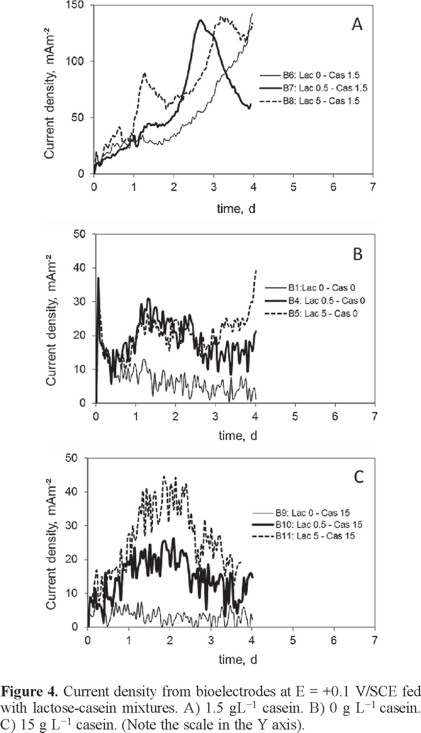
<body><![CDATA[<p align="justify"><font face="verdana" size="2"><b>Effect of casein and lactose on the current generation</b></font></p>     <p align="justify"><font face="verdana" size="2">In this stage, electrodes with biofilm previously formed were immersed in casein&#45;lactose mixtures. It was observed that the casein concentration had a high influence on the current generation. Both, in the absence of casein (0 g L<sup>&minus;1</sup>) and in its maximum concentration (15 g L<sup>&minus;1</sup>), the current generation was lower than 40 mA m<sup>&minus;2</sup>, but the middle casein concentration (1.5 g L<sup>&minus;1</sup>) resulted in 140 mA m<sup>&minus;2</sup> in four days (<a href="#f4">Fig. 4</a>).</font></p>     <p align="center"><font face="verdana" size="2"><a name="f4"></a></font></p>     <p align="center"><font face="verdana" size="2"><img src="/img/revistas/jmcs/v58n3/a7f4.jpg"></font></p>     <p align="justify"><font face="verdana" size="2">The current density without casein or lactose, i.e., the current due to the humic substances, decreased from 10 to 2 mA m<sup>&minus;2</sup> in 4 d. Therefore it was assumed that humic substances did not participate in the current measurements.</font></p>     <p align="justify"><font face="verdana" size="2">Both protein and sugar allowed current production. Using the maximum lactose concentration (5 g L<sup>&minus;1</sup>), the startup of current generation had a delay of 4 d when casein was not added, and 1 d delay with a middle casein concentration (1.5 g L<sup>&minus;1</sup>). These observations suggest that the protein compound triggered the current generation (<a href="#f5">Fig. 5A</a>). Furthermore, with the maximum casein concentration (15 g L<sup>&minus;1</sup>) the current density was lower than 40 mA m<sup>&minus;2</sup>, suggesting that an inhibition by high substrate concentration took place (<a href="#f5">Fig. 5B</a>).</font></p>     <p align="center"><font face="verdana" size="2"><a name="f5"></a></font></p>     <p align="center"><font face="verdana" size="2"><img src="/img/revistas/jmcs/v58n3/a7f5.jpg"></font></p>     <p align="justify"><font face="verdana" size="2">On the other hand, even in absence of lactose a current was generated, which indicates that the protein compound was used as a substrate for the current generation. One possible reason for this performance could be the acetate formation during the amino&#45;acids metabolism, particularly the shorter alanine and glycine &#91;23&#93;. Being the acetate, the model substrate for MFCs, possibly the newly formed acetate led to the observed current after protein was metabolized.</font></p>     <p align="justify"><font face="verdana" size="2">However, the maximum casein concentration (15 g L<sup>&minus;1</sup>) inhibited the current generation, while the middle casein concentration produced current up to 320 mA m<sup>&minus;2</sup> (<a href="#f6">Fig. 6A</a>).</font></p>     ]]></body>
<body><![CDATA[<p align="center"><font face="verdana" size="2"><a name="f6"></a></font></p>     <p align="center"><font face="verdana" size="2"><img src="/img/revistas/jmcs/v58n3/a7f6.jpg"></font></p>     <p align="justify"><font face="verdana" size="2">In a similar comportment, without casein, a current generation was obtained, nevertheless in all cases a delay in the current startup was observed. The maximum lactose concentration (5 g L<sup>&minus;1</sup>) provoked a decrease in the current density in comparison with the current reached using the middle lactose concentration, which was up to 1400 mA m<sup>&minus;2</sup> (<a href="#f6">Fig. 6B</a>).</font></p>     <p align="justify"><font face="verdana" size="2">The maximum current densities obtained with each casein&#45;lactose mixtures are shown in <a href="#c2">Table 2</a>.</font></p>     <p align="center"><font face="verdana" size="2"><a name="c2"></a></font></p>     <p align="center"><font face="verdana" size="2"><img src="/img/revistas/jmcs/v58n3/a7c2.jpg"></font></p>     <p align="justify"><font face="verdana" size="2">Overall, the current density reached with the bioanode immersed in the synthetic media, was lower than the current using the real DWW (1009 &#45; 1796 mA m<sup>&minus;2</sup> ; <a href="#f3">Fig. 3A</a>). These observations could be explained by the absence of suspended microorganisms during the experiments with a synthetic medium. Suspended and fixed microorganisms maintain ecological interactions to survive, to achieve metabolic activities, and to obtain the highest energy gain &#91;23, 24&#93;. In addition, the biofilm ecology includes the detachment and attachment of bacteria to and from the medium; particularly for electrochemically active biofilms, the electron transfer to the anode may be affected by electron shuttles produced by planktonic bacteria &#91;25&#93;. Consequently the lack of suspended microorganism had an impact on the electron transfer, which was reflected as a lower current density. Additionally, the synthetic media lacked of other kind of nutrients (organic acids, lactalbumin, Ca, etc.), and trace elements that certainly were present in the real DWW sample contributing to the biofilm performance observed.</font></p>     <p align="justify"><font face="verdana" size="2">Even though the current density was lower with synthetic media, this test revealed that the majority individual compounds (casein or lactose) in DWW favor the current generation in comparison to the mixtures. In this way, the highest current density were obtained with 1.5 g L<sup>&minus;1</sup> casein and 0 g L<sup>&minus;1</sup> lactose, reaching 331 mA m<sup>&minus;2</sup> (or 0.132 mA), and with 0 g L<sup>&minus;1</sup> casein and 0.5 g L<sup>&minus;1</sup> lactose, attaining 1276 mA m<sup>&minus;2</sup> (or 0.51 mA).</font></p>     <p align="justify"><font face="verdana" size="2">Interestingly, previous reports on individual lactose and casein substrates have shown a similar trend (<a href="/img/revistas/jmcs/v58n3/a7c1.jpg" target="_blank">Table 1</a>). A two&#45;chamber MFC fed with lactose produced 0.8 mA &#91;8&#93;, and a single&#45;chamber MFC fed with casein reached 0.11 mA &#91;9&#93;. These performances are quite similar to that obtained in this work; unfortunately no additional data on substrate concentrations were reported.</font></p>     <p align="justify"><font face="verdana" size="2">Overall, these results support the initial assumption of a diauxic substrate consumption using DWW, even the real DWW composition is more complex, the observations suggest that the current startup is promoted by the protein compound.</font></p>     ]]></body>
<body><![CDATA[<p align="justify"><font face="verdana" size="2">Analyzing the effect of casein on current generation, it was noticeable that without the limitation of substrate (15 g L<sup>&minus;1</sup>casein), the current increased with the lactose concentration. However the maximum protein concentration resulted in the lowest current densities of all the casein&#45;lactose mixtures. For all lactose concentrations, the current decreased with the increase of the casein concentration (<a href="/img/revistas/jmcs/v58n3/a7c1.jpg" target="_blank">Table 1</a>).</font></p>     <p align="justify"><font face="verdana" size="2">The overall nutrient consumption was determined by the total organic carbon final concentration (TOC). Final TOC was in the range from 30 to 71 mg TOC L<sup>&minus;1</sup> for all mixtures, except for the maximum casein concentration (15 g L<sup>&minus;1</sup>), where final concentration was from 416 to 447 mg TOC L<sup>&minus;1</sup>. This information suggests that the maximum protein concentration was inhibitory to microbial activity, thus the substrate was not consumed and the electrons were not transferred.</font></p>     <p align="justify"><font face="verdana" size="2">Using synthetic media allowed evaluate in controlled conditions the current generation associated to the majority compounds in DWW. Nevertheless, no mixture generated the two&#45;peak profile observed by using real DWW (<a href="#f2">Fig. 2</a>, <a href="#f3">3</a>). Clearly, the effect of the diverse compounds in real industrial wastewaters on current generation in MFCs requires more systematic investigation in order to understand and optimize these bioelectrochemical systems.</font></p>     <p align="justify"><font face="Verdana" size="2">&nbsp;</font></p>     <p align="justify"><font face="verdana" size="2"><b>Conclusions</b></font></p>     <p align="justify"><font face="verdana" size="2">In the present work it was evaluated the current generation by a bioanode formed from compost lixiviate as a function of real DWW additions. It was found that the highest current density is obtained with low substrate concentrations, moreover current profiles showed two peaks, being in the range from 1009 to 1289 mA m<sup>&minus;2</sup> for the first group of peaks, and from 1433 to 1796 mA m<sup>&minus;2</sup> for the second group of peaks. In order to investigate the possibility of diauxic behavior substrate consumption, it was investigated the effect of casein and lactose on current generation using a synthetic medium. It was revealed that high protein concentration was inhibitory to current generation; the individual protein and sugar compounds led to the highest current density, 330.5 mA m<sup>&minus;2</sup> with 1.5 g L<sup>&minus;1</sup> casein, and 1276 mA m<sup>&minus;2</sup> with 0.5 g L<sup>&minus;1</sup> lactose. In addition, the protein promoted the current startup. These findings confirm that DWW is an alternative fuel to MFC, even though its complex composition. The differentiated current production as a function of dairy proteins and sugars could be useful to accelerate the startup of MFCs by selecting different dairy effluents according to their composition.</font></p>     <p align="justify"><font face="Verdana" size="2">&nbsp;</font></p>     <p align="justify"><font face="verdana" size="2"><b>Acknowledgements</b></font></p>     <p align="justify"><font face="verdana" size="2">B. Cercado was supported by the European Union Programme of High Level Scholarships for Latin America (Program Alban), scholarship No. E06D101223MX. We thank the kind support of LGC&#45;Toulouse for the use of their analytical infrastructure.</font></p>     <p align="justify"><font face="Verdana" size="2">&nbsp;</font></p>     ]]></body>
<body><![CDATA[<p align="justify"><font face="verdana" size="2"><b>References</b></font></p>     <!-- ref --><p align="justify"><font face="verdana" size="2">1. Pant, D.; Singh, A.; Van Bogaert, G.; Olsen, S.I.; Nigam, P.S.; Diels, L.; Vanbroekhoven, D. <i>RSC Adv</i>. <b>2012,</b> <i>2</i>, 1248&#45;1263.    &nbsp;&nbsp;&nbsp;&nbsp;&nbsp;&nbsp;&nbsp;&nbsp;[&#160;<a href="javascript:void(0);" onclick="javascript: window.open('/scielo.php?script=sci_nlinks&ref=4977880&pid=S1870-249X201400030000700001&lng=','','width=640,height=500,resizable=yes,scrollbars=1,menubar=yes,');">Links</a>&#160;]<!-- end-ref --></font></p>     <!-- ref --><p align="justify"><font face="verdana" size="2">2. Pant, D.; Van Boagaert, G.; Diels, L.; Vanbroejhoven, K. <i>Bioresour. Technol.</i> <b>2010,</b> <i>101</i>, 6, 1533&#45;1543.    &nbsp;&nbsp;&nbsp;&nbsp;&nbsp;&nbsp;&nbsp;&nbsp;[&#160;<a href="javascript:void(0);" onclick="javascript: window.open('/scielo.php?script=sci_nlinks&ref=4977882&pid=S1870-249X201400030000700002&lng=','','width=640,height=500,resizable=yes,scrollbars=1,menubar=yes,');">Links</a>&#160;]<!-- end-ref --></font></p>     <!-- ref --><p align="justify"><font face="verdana" size="2">3. Logan, B. E.; Murano, C.; Scott, K.; Gray, N. D.; Head; I. M. <i>Water Res.</i> <b>2005,</b> <i>39</i>, 942&#45;952.    &nbsp;&nbsp;&nbsp;&nbsp;&nbsp;&nbsp;&nbsp;&nbsp;[&#160;<a href="javascript:void(0);" onclick="javascript: window.open('/scielo.php?script=sci_nlinks&ref=4977884&pid=S1870-249X201400030000700003&lng=','','width=640,height=500,resizable=yes,scrollbars=1,menubar=yes,');">Links</a>&#160;]<!-- end-ref --></font></p>     <!-- ref --><p align="justify"><font face="verdana" size="2">4. Heilmann, J.; Logan, B. E. <i>Water Environ. Res.</i> <b>2006,</b> <i>78</i>, 5, 531&#45;537.    &nbsp;&nbsp;&nbsp;&nbsp;&nbsp;&nbsp;&nbsp;&nbsp;[&#160;<a href="javascript:void(0);" onclick="javascript: window.open('/scielo.php?script=sci_nlinks&ref=4977886&pid=S1870-249X201400030000700004&lng=','','width=640,height=500,resizable=yes,scrollbars=1,menubar=yes,');">Links</a>&#160;]<!-- end-ref --></font></p>     <!-- ref --><p align="justify"><font face="verdana" size="2">5. Cercado&#45;Quezada, B.; Delia, M.&#45;L.; Bergel, A. <i>Bioresour. Technol.</i> <b>2010,</b> <i>101</i>, 2748&#45;2754.    &nbsp;&nbsp;&nbsp;&nbsp;&nbsp;&nbsp;&nbsp;&nbsp;[&#160;<a href="javascript:void(0);" onclick="javascript: window.open('/scielo.php?script=sci_nlinks&ref=4977888&pid=S1870-249X201400030000700005&lng=','','width=640,height=500,resizable=yes,scrollbars=1,menubar=yes,');">Links</a>&#160;]<!-- end-ref --></font></p>     <!-- ref --><p align="justify"><font face="verdana" size="2">6. Pant, D.; Van Bogaert, G.; Porto&#45;Carrero, C.; Diels, L.; Vanboekhoven, K. <i>Water Sci. Technol.</i> <b>2011,</b> <i>63</i>, 10, 2457&#45;2461.    &nbsp;&nbsp;&nbsp;&nbsp;&nbsp;&nbsp;&nbsp;&nbsp;[&#160;<a href="javascript:void(0);" onclick="javascript: window.open('/scielo.php?script=sci_nlinks&ref=4977890&pid=S1870-249X201400030000700006&lng=','','width=640,height=500,resizable=yes,scrollbars=1,menubar=yes,');">Links</a>&#160;]<!-- end-ref --></font></p>     <!-- ref --><p align="justify"><font face="verdana" size="2">7. Cercado&#45;Quezada, B.; Delia, M.&#45;L.; Bergel, A. <i>J. Appl. Electrochem.</i> <b>2010,</b> <i>40</i>, 225&#45;232.    &nbsp;&nbsp;&nbsp;&nbsp;&nbsp;&nbsp;&nbsp;&nbsp;[&#160;<a href="javascript:void(0);" onclick="javascript: window.open('/scielo.php?script=sci_nlinks&ref=4977892&pid=S1870-249X201400030000700007&lng=','','width=640,height=500,resizable=yes,scrollbars=1,menubar=yes,');">Links</a>&#160;]<!-- end-ref --></font></p>     <!-- ref --><p align="justify"><font face="verdana" size="2">8. Roller S. D.; Benetto, H. P.; Delaney, g. M.; Mason, J. R.; Stirling, J. L.; Thurston, C. F.; White, Jr. D. R. <i>Proc. First World Conference on Commercial Applications and Implications of Biotechnology BIOTECH'83.</i> Online Publications. London. 1983</font>&nbsp;&nbsp;&nbsp;&nbsp;&nbsp;&nbsp;&nbsp;&nbsp;[&#160;<a href="javascript:void(0);" onclick="javascript: window.open('/scielo.php?script=sci_nlinks&ref=4977894&pid=S1870-249X201400030000700008&lng=','','width=640,height=500,resizable=yes,scrollbars=1,menubar=yes,');">Links</a>&#160;]<!-- end-ref --><!-- ref --><p align="justify"><font face="verdana" size="2">9. Melhuish, C.; Ieropoulos, I.; Greenman, <i>J. Auton Robot</i> <b>2006,</b> <i>21</i>, 187&#45;198.    &nbsp;&nbsp;&nbsp;&nbsp;&nbsp;&nbsp;&nbsp;&nbsp;[&#160;<a href="javascript:void(0);" onclick="javascript: window.open('/scielo.php?script=sci_nlinks&ref=4977895&pid=S1870-249X201400030000700009&lng=','','width=640,height=500,resizable=yes,scrollbars=1,menubar=yes,');">Links</a>&#160;]<!-- end-ref --></font></p>     <!-- ref --><p align="justify"><font face="verdana" size="2">10. Mathuriya, A. S.; Sharma, V. N. <i>J. Biochem. Tech.</i> <b>2009,</b> <i>2</i>, 133&#45;137.    &nbsp;&nbsp;&nbsp;&nbsp;&nbsp;&nbsp;&nbsp;&nbsp;[&#160;<a href="javascript:void(0);" onclick="javascript: window.open('/scielo.php?script=sci_nlinks&ref=4977897&pid=S1870-249X201400030000700010&lng=','','width=640,height=500,resizable=yes,scrollbars=1,menubar=yes,');">Links</a>&#160;]<!-- end-ref --></font></p>     ]]></body>
<body><![CDATA[<!-- ref --><p align="justify"><font face="verdana" size="2">11. Venkata Mohan, S.; Mohanakrishna, G.; Velvizhi, G.; Lalit Babu, V.; Sarma, P.N. <i>Biochem. Eng. J.</i> <b>2010,</b> <i>51</i>, 32&#45;39.    &nbsp;&nbsp;&nbsp;&nbsp;&nbsp;&nbsp;&nbsp;&nbsp;[&#160;<a href="javascript:void(0);" onclick="javascript: window.open('/scielo.php?script=sci_nlinks&ref=4977899&pid=S1870-249X201400030000700011&lng=','','width=640,height=500,resizable=yes,scrollbars=1,menubar=yes,');">Links</a>&#160;]<!-- end-ref --></font></p>     <!-- ref --><p align="justify"><font face="verdana" size="2">12. Velasquez&#45;Orta, S. B.; Head, I. M.; Curtis, T. P.; Scott, K. <i>Bioresour. Technol.</i> <b>2011,</b> <i>102</i>, 8 5105&#45;5112.    &nbsp;&nbsp;&nbsp;&nbsp;&nbsp;&nbsp;&nbsp;&nbsp;[&#160;<a href="javascript:void(0);" onclick="javascript: window.open('/scielo.php?script=sci_nlinks&ref=4977901&pid=S1870-249X201400030000700012&lng=','','width=640,height=500,resizable=yes,scrollbars=1,menubar=yes,');">Links</a>&#160;]<!-- end-ref --></font></p>     <!-- ref --><p align="justify"><font face="verdana" size="2">13. Ayyaru; S.; Dharmalingam, S. <i>Bioresour. Technol.</i> <b>2011,</b> <i>102</i>, 24 11167&#45;11171.    &nbsp;&nbsp;&nbsp;&nbsp;&nbsp;&nbsp;&nbsp;&nbsp;[&#160;<a href="javascript:void(0);" onclick="javascript: window.open('/scielo.php?script=sci_nlinks&ref=4977903&pid=S1870-249X201400030000700013&lng=','','width=640,height=500,resizable=yes,scrollbars=1,menubar=yes,');">Links</a>&#160;]<!-- end-ref --></font></p>     <!-- ref --><p align="justify"><font face="verdana" size="2">14. Nimje, V. R.; Chen, C. Y.; Chen, H. R.; Chen, C. C.; Huang, Y. M.; Tseng, M. J.; Cheng, K. C.; Chang, Y. F. <i>Bioresour. Technol.</i> <b>2012,</b> <i>104</i>, 315&#45;323.    &nbsp;&nbsp;&nbsp;&nbsp;&nbsp;&nbsp;&nbsp;&nbsp;[&#160;<a href="javascript:void(0);" onclick="javascript: window.open('/scielo.php?script=sci_nlinks&ref=4977905&pid=S1870-249X201400030000700014&lng=','','width=640,height=500,resizable=yes,scrollbars=1,menubar=yes,');">Links</a>&#160;]<!-- end-ref --></font></p>     <!-- ref --><p align="justify"><font face="verdana" size="2">15. Mardanpour, M. M.; Esfahany, M. N.; Behzad, T.; Sedaqatvand, R. <i>Biosens. Bioelectron.</i> <b>2012,</b> <i>38</i>, 1, 264&#45;269.    &nbsp;&nbsp;&nbsp;&nbsp;&nbsp;&nbsp;&nbsp;&nbsp;[&#160;<a href="javascript:void(0);" onclick="javascript: window.open('/scielo.php?script=sci_nlinks&ref=4977907&pid=S1870-249X201400030000700015&lng=','','width=640,height=500,resizable=yes,scrollbars=1,menubar=yes,');">Links</a>&#160;]<!-- end-ref --></font></p>     ]]></body>
<body><![CDATA[<!-- ref --><p align="justify"><font face="verdana" size="2">16. Elakkiya, E.; Matheswaran, M. <i>Bioresour. Technol.</i> <b>2013,</b> <i>136</i>, 407&#45;412.    &nbsp;&nbsp;&nbsp;&nbsp;&nbsp;&nbsp;&nbsp;&nbsp;[&#160;<a href="javascript:void(0);" onclick="javascript: window.open('/scielo.php?script=sci_nlinks&ref=4977909&pid=S1870-249X201400030000700016&lng=','','width=640,height=500,resizable=yes,scrollbars=1,menubar=yes,');">Links</a>&#160;]<!-- end-ref --></font></p>     <!-- ref --><p align="justify"><font face="verdana" size="2">17. Thygesen, A.; Poulsen, F. W.; Min, B.; Angelidaki, I.; Thomsen, A. B. <i>Bioresour. Technol.</i> <b>2009,</b> <i>100</i>, 1186&#45;1191.    &nbsp;&nbsp;&nbsp;&nbsp;&nbsp;&nbsp;&nbsp;&nbsp;[&#160;<a href="javascript:void(0);" onclick="javascript: window.open('/scielo.php?script=sci_nlinks&ref=4977911&pid=S1870-249X201400030000700017&lng=','','width=640,height=500,resizable=yes,scrollbars=1,menubar=yes,');">Links</a>&#160;]<!-- end-ref --></font></p>     <!-- ref --><p align="justify"><font face="verdana" size="2">18. Sapan, C. V.; Lundbald, R. L.; Price, N. C. <i>Biotechnol. Appl. Biochem.</i> <b>1999,</b> <i>29</i>, 99&#45;108.    &nbsp;&nbsp;&nbsp;&nbsp;&nbsp;&nbsp;&nbsp;&nbsp;[&#160;<a href="javascript:void(0);" onclick="javascript: window.open('/scielo.php?script=sci_nlinks&ref=4977913&pid=S1870-249X201400030000700018&lng=','','width=640,height=500,resizable=yes,scrollbars=1,menubar=yes,');">Links</a>&#160;]<!-- end-ref --></font></p>     <!-- ref --><p align="justify"><font face="verdana" size="2">19. Sevda, S.; Dominguez&#45;Benetton, X.; Vanbroekhoven, K.; De Wever, H.; Sreekrishnan, T.R.; Pant, D. <i>Appl. Energy</i>. <b>2013,</b> <i>105</i>, 194&#45;206.    &nbsp;&nbsp;&nbsp;&nbsp;&nbsp;&nbsp;&nbsp;&nbsp;[&#160;<a href="javascript:void(0);" onclick="javascript: window.open('/scielo.php?script=sci_nlinks&ref=4977915&pid=S1870-249X201400030000700019&lng=','','width=640,height=500,resizable=yes,scrollbars=1,menubar=yes,');">Links</a>&#160;]<!-- end-ref --></font></p>     <!-- ref --><p align="justify"><font face="verdana" size="2">20. Freguia, S.; Rrabaey, K.; Keller, J. <i>11th IWA World Congress on anaerobic Digestion</i>. <b>2007</b>. Brisbane, Australia.    &nbsp;&nbsp;&nbsp;&nbsp;&nbsp;&nbsp;&nbsp;&nbsp;[&#160;<a href="javascript:void(0);" onclick="javascript: window.open('/scielo.php?script=sci_nlinks&ref=4977917&pid=S1870-249X201400030000700020&lng=','','width=640,height=500,resizable=yes,scrollbars=1,menubar=yes,');">Links</a>&#160;]<!-- end-ref --></font></p>     ]]></body>
<body><![CDATA[<!-- ref --><p align="justify"><font face="verdana" size="2">21. Pant, D.; Arslan, D.; Van Bogaert, G.; Gallego, Y.A.; De Wever, H.; Diels, L.; Vanbroekhoven, K. <i>Environ. Technol</i>. <b>2013,</b> <i>34</i>, 13&#45;14, 1935&#45;1945.    &nbsp;&nbsp;&nbsp;&nbsp;&nbsp;&nbsp;&nbsp;&nbsp;[&#160;<a href="javascript:void(0);" onclick="javascript: window.open('/scielo.php?script=sci_nlinks&ref=4977919&pid=S1870-249X201400030000700021&lng=','','width=640,height=500,resizable=yes,scrollbars=1,menubar=yes,');">Links</a>&#160;]<!-- end-ref --></font></p>     <!-- ref --><p align="justify"><font face="verdana" size="2">22. Torres, C.I.; Kato, M.A.; Rittmann, B.E. <i>Microbiol. Biotechnol.</i> <b>2007,</b> <i>77</i>, 3, 689&#45;697.    &nbsp;&nbsp;&nbsp;&nbsp;&nbsp;&nbsp;&nbsp;&nbsp;[&#160;<a href="javascript:void(0);" onclick="javascript: window.open('/scielo.php?script=sci_nlinks&ref=4977921&pid=S1870-249X201400030000700022&lng=','','width=640,height=500,resizable=yes,scrollbars=1,menubar=yes,');">Links</a>&#160;]<!-- end-ref --></font></p>     <!-- ref --><p align="justify"><font face="verdana" size="2">23. Madigan, M. T.; Martinko, J. M.; Parker, J. Brock Biology of Microorganisms. 10th ed<i>.</i> Prentice Hall. N.J. 2003.    &nbsp;&nbsp;&nbsp;&nbsp;&nbsp;&nbsp;&nbsp;&nbsp;[&#160;<a href="javascript:void(0);" onclick="javascript: window.open('/scielo.php?script=sci_nlinks&ref=4977923&pid=S1870-249X201400030000700023&lng=','','width=640,height=500,resizable=yes,scrollbars=1,menubar=yes,');">Links</a>&#160;]<!-- end-ref --></font></p>     <!-- ref --><p align="justify"><font face="verdana" size="2">24. Schneider, I.; Topalova, Y. <i>Biotechnol. Biotechnological Equipment.</i> <b>2013,</b> <i>27</i>, 3, 3782&#45;3786.    &nbsp;&nbsp;&nbsp;&nbsp;&nbsp;&nbsp;&nbsp;&nbsp;[&#160;<a href="javascript:void(0);" onclick="javascript: window.open('/scielo.php?script=sci_nlinks&ref=4977925&pid=S1870-249X201400030000700024&lng=','','width=640,height=500,resizable=yes,scrollbars=1,menubar=yes,');">Links</a>&#160;]<!-- end-ref --></font></p>     <!-- ref --><p align="justify"><font face="verdana" size="2">25. Chen J.J.; Chen, W.; He, H.; Li, D&#45;B.; Li, W&#45;W.; Xiong, L.; Yu, H&#45;Q. <i>Env. Sci. Technol.</i> <b>2013,</b> <i>47</i>, 1033&#45;1039.    &nbsp;&nbsp;&nbsp;&nbsp;&nbsp;&nbsp;&nbsp;&nbsp;[&#160;<a href="javascript:void(0);" onclick="javascript: window.open('/scielo.php?script=sci_nlinks&ref=4977927&pid=S1870-249X201400030000700025&lng=','','width=640,height=500,resizable=yes,scrollbars=1,menubar=yes,');">Links</a>&#160;]<!-- end-ref --></font></p>     ]]></body>
<body><![CDATA[ ]]></body><back>
<ref-list>
<ref id="B1">
<label>1</label><nlm-citation citation-type="journal">
<person-group person-group-type="author">
<name>
<surname><![CDATA[Pant]]></surname>
<given-names><![CDATA[D.]]></given-names>
</name>
<name>
<surname><![CDATA[Singh]]></surname>
<given-names><![CDATA[A.]]></given-names>
</name>
<name>
<surname><![CDATA[Van Bogaert]]></surname>
<given-names><![CDATA[G.]]></given-names>
</name>
<name>
<surname><![CDATA[Olsen]]></surname>
<given-names><![CDATA[S.I.]]></given-names>
</name>
<name>
<surname><![CDATA[Nigam]]></surname>
<given-names><![CDATA[P.S.]]></given-names>
</name>
<name>
<surname><![CDATA[Diels]]></surname>
<given-names><![CDATA[L.]]></given-names>
</name>
<name>
<surname><![CDATA[Vanbroekhoven]]></surname>
<given-names><![CDATA[D.]]></given-names>
</name>
</person-group>
<source><![CDATA[RSC Adv.]]></source>
<year>2012</year>
<volume>2</volume>
<page-range>1248-1263</page-range></nlm-citation>
</ref>
<ref id="B2">
<label>2</label><nlm-citation citation-type="journal">
<person-group person-group-type="author">
<name>
<surname><![CDATA[Pant]]></surname>
<given-names><![CDATA[D.]]></given-names>
</name>
<name>
<surname><![CDATA[Van Boagaert]]></surname>
<given-names><![CDATA[G.]]></given-names>
</name>
<name>
<surname><![CDATA[Diels]]></surname>
<given-names><![CDATA[L.]]></given-names>
</name>
<name>
<surname><![CDATA[Vanbroejhoven]]></surname>
<given-names><![CDATA[K.]]></given-names>
</name>
</person-group>
<source><![CDATA[Bioresour. Technol.]]></source>
<year>2010</year>
<volume>101</volume>
<page-range>6, 1533-1543</page-range></nlm-citation>
</ref>
<ref id="B3">
<label>3</label><nlm-citation citation-type="journal">
<person-group person-group-type="author">
<name>
<surname><![CDATA[Logan]]></surname>
<given-names><![CDATA[B. E.]]></given-names>
</name>
<name>
<surname><![CDATA[Murano]]></surname>
<given-names><![CDATA[C.]]></given-names>
</name>
<name>
<surname><![CDATA[Scott]]></surname>
<given-names><![CDATA[K.]]></given-names>
</name>
<name>
<surname><![CDATA[Gray]]></surname>
<given-names><![CDATA[N. D.]]></given-names>
</name>
<name>
<surname><![CDATA[Head;]]></surname>
<given-names><![CDATA[I. M.]]></given-names>
</name>
</person-group>
<source><![CDATA[Water Res.]]></source>
<year>2005</year>
<volume>39</volume>
<page-range>942-952</page-range></nlm-citation>
</ref>
<ref id="B4">
<label>4</label><nlm-citation citation-type="journal">
<person-group person-group-type="author">
<name>
<surname><![CDATA[Heilmann]]></surname>
<given-names><![CDATA[J.]]></given-names>
</name>
<name>
<surname><![CDATA[Logan]]></surname>
<given-names><![CDATA[B. E.]]></given-names>
</name>
</person-group>
<source><![CDATA[Water Environ. Res.]]></source>
<year>2006</year>
<volume>78</volume>
<numero>5</numero>
<issue>5</issue>
<page-range>531-537</page-range></nlm-citation>
</ref>
<ref id="B5">
<label>5</label><nlm-citation citation-type="journal">
<person-group person-group-type="author">
<name>
<surname><![CDATA[Cercado-Quezada]]></surname>
<given-names><![CDATA[B.]]></given-names>
</name>
<name>
<surname><![CDATA[Delia]]></surname>
<given-names><![CDATA[M.-L.]]></given-names>
</name>
<name>
<surname><![CDATA[Bergel]]></surname>
<given-names><![CDATA[A.]]></given-names>
</name>
</person-group>
<source><![CDATA[Bioresour. Technol.]]></source>
<year>2010</year>
<volume>101</volume>
<page-range>2748-2754</page-range></nlm-citation>
</ref>
<ref id="B6">
<label>6</label><nlm-citation citation-type="journal">
<person-group person-group-type="author">
<name>
<surname><![CDATA[Pant]]></surname>
<given-names><![CDATA[D.]]></given-names>
</name>
<name>
<surname><![CDATA[Van Bogaert]]></surname>
<given-names><![CDATA[G.]]></given-names>
</name>
<name>
<surname><![CDATA[Porto-Carrero]]></surname>
<given-names><![CDATA[C.]]></given-names>
</name>
<name>
<surname><![CDATA[Diels]]></surname>
<given-names><![CDATA[L.]]></given-names>
</name>
<name>
<surname><![CDATA[Vanboekhoven]]></surname>
<given-names><![CDATA[K.]]></given-names>
</name>
</person-group>
<source><![CDATA[Water Sci. Technol.]]></source>
<year>2011</year>
<volume>63</volume>
<page-range>10, 2457-2461</page-range></nlm-citation>
</ref>
<ref id="B7">
<label>7</label><nlm-citation citation-type="journal">
<person-group person-group-type="author">
<name>
<surname><![CDATA[Cercado-Quezada]]></surname>
<given-names><![CDATA[B.]]></given-names>
</name>
<name>
<surname><![CDATA[Delia]]></surname>
<given-names><![CDATA[M.-L.]]></given-names>
</name>
<name>
<surname><![CDATA[Bergel]]></surname>
<given-names><![CDATA[A.]]></given-names>
</name>
</person-group>
<source><![CDATA[J. Appl. Electrochem.]]></source>
<year>2010</year>
<volume>40</volume>
<page-range>225-232</page-range></nlm-citation>
</ref>
<ref id="B8">
<label>8</label><nlm-citation citation-type="">
<person-group person-group-type="author">
<name>
<surname><![CDATA[Roller]]></surname>
<given-names><![CDATA[S. D.]]></given-names>
</name>
<name>
<surname><![CDATA[Benetto]]></surname>
<given-names><![CDATA[H. P.]]></given-names>
</name>
<name>
<surname><![CDATA[Delaney]]></surname>
<given-names><![CDATA[g. M.]]></given-names>
</name>
<name>
<surname><![CDATA[Mason]]></surname>
<given-names><![CDATA[J. R.]]></given-names>
</name>
<name>
<surname><![CDATA[Stirling]]></surname>
<given-names><![CDATA[J. L.]]></given-names>
</name>
<name>
<surname><![CDATA[Thurston]]></surname>
<given-names><![CDATA[C. F.]]></given-names>
</name>
<name>
<surname><![CDATA[White]]></surname>
<given-names><![CDATA[Jr. D. R.]]></given-names>
</name>
</person-group>
<source><![CDATA[Proc. First World Conference on Commercial Applications and Implications of Biotechnology BIOTECH'83]]></source>
<year>1983</year>
<publisher-loc><![CDATA[London ]]></publisher-loc>
</nlm-citation>
</ref>
<ref id="B9">
<label>9</label><nlm-citation citation-type="journal">
<person-group person-group-type="author">
<name>
<surname><![CDATA[Melhuish]]></surname>
<given-names><![CDATA[C.]]></given-names>
</name>
<name>
<surname><![CDATA[Ieropoulos]]></surname>
<given-names><![CDATA[I.]]></given-names>
</name>
<name>
<surname><![CDATA[Greenman]]></surname>
<given-names><![CDATA[J.]]></given-names>
</name>
</person-group>
<source><![CDATA[Auton Robot]]></source>
<year>2006</year>
<volume>21</volume>
<page-range>187-198</page-range></nlm-citation>
</ref>
<ref id="B10">
<label>10</label><nlm-citation citation-type="journal">
<person-group person-group-type="author">
<name>
<surname><![CDATA[Mathuriya]]></surname>
<given-names><![CDATA[A. S.]]></given-names>
</name>
<name>
<surname><![CDATA[Sharma]]></surname>
<given-names><![CDATA[V. N.]]></given-names>
</name>
</person-group>
<source><![CDATA[J. Biochem. Tech.]]></source>
<year>2009</year>
<volume>2</volume>
<page-range>133-137</page-range></nlm-citation>
</ref>
<ref id="B11">
<label>11</label><nlm-citation citation-type="journal">
<person-group person-group-type="author">
<name>
<surname><![CDATA[Venkata Mohan]]></surname>
<given-names><![CDATA[S.]]></given-names>
</name>
<name>
<surname><![CDATA[Mohanakrishna]]></surname>
<given-names><![CDATA[G.]]></given-names>
</name>
<name>
<surname><![CDATA[Velvizhi]]></surname>
<given-names><![CDATA[G.]]></given-names>
</name>
<name>
<surname><![CDATA[Lalit Babu]]></surname>
<given-names><![CDATA[V.]]></given-names>
</name>
<name>
<surname><![CDATA[Sarma]]></surname>
<given-names><![CDATA[P.N.]]></given-names>
</name>
</person-group>
<source><![CDATA[Biochem. Eng. J.]]></source>
<year>2010</year>
<volume>51</volume>
<page-range>32-39</page-range></nlm-citation>
</ref>
<ref id="B12">
<label>12</label><nlm-citation citation-type="journal">
<person-group person-group-type="author">
<name>
<surname><![CDATA[Velasquez-Orta]]></surname>
<given-names><![CDATA[S. B.]]></given-names>
</name>
<name>
<surname><![CDATA[Head]]></surname>
<given-names><![CDATA[I. M.]]></given-names>
</name>
<name>
<surname><![CDATA[Curtis]]></surname>
<given-names><![CDATA[T. P.]]></given-names>
</name>
<name>
<surname><![CDATA[Scott]]></surname>
<given-names><![CDATA[K.]]></given-names>
</name>
</person-group>
<source><![CDATA[Bioresour. Technol.]]></source>
<year>2011</year>
<volume>102</volume>
<page-range>8 5105-5112</page-range></nlm-citation>
</ref>
<ref id="B13">
<label>13</label><nlm-citation citation-type="journal">
<person-group person-group-type="author">
<name>
<surname><![CDATA[Ayyaru;]]></surname>
<given-names><![CDATA[S.]]></given-names>
</name>
<name>
<surname><![CDATA[Dharmalingam]]></surname>
<given-names><![CDATA[S.]]></given-names>
</name>
</person-group>
<source><![CDATA[Bioresour. Technol.]]></source>
<year>2011</year>
<volume>102</volume>
<page-range>24 11167-11171</page-range></nlm-citation>
</ref>
<ref id="B14">
<label>14</label><nlm-citation citation-type="journal">
<person-group person-group-type="author">
<name>
<surname><![CDATA[Nimje]]></surname>
<given-names><![CDATA[V. R.]]></given-names>
</name>
<name>
<surname><![CDATA[Chen]]></surname>
<given-names><![CDATA[C. Y.]]></given-names>
</name>
<name>
<surname><![CDATA[Chen]]></surname>
<given-names><![CDATA[H. R.]]></given-names>
</name>
<name>
<surname><![CDATA[Chen]]></surname>
<given-names><![CDATA[C. C.]]></given-names>
</name>
<name>
<surname><![CDATA[Huang]]></surname>
<given-names><![CDATA[Y. M.]]></given-names>
</name>
<name>
<surname><![CDATA[Tseng]]></surname>
<given-names><![CDATA[M. J.]]></given-names>
</name>
<name>
<surname><![CDATA[Cheng]]></surname>
<given-names><![CDATA[K. C.]]></given-names>
</name>
<name>
<surname><![CDATA[Chang]]></surname>
<given-names><![CDATA[Y. F.]]></given-names>
</name>
</person-group>
<source><![CDATA[Bioresour. Technol.]]></source>
<year>2012</year>
<volume>104</volume>
<page-range>315-323</page-range></nlm-citation>
</ref>
<ref id="B15">
<label>15</label><nlm-citation citation-type="journal">
<person-group person-group-type="author">
<name>
<surname><![CDATA[Mardanpour]]></surname>
<given-names><![CDATA[M. M.]]></given-names>
</name>
<name>
<surname><![CDATA[Esfahany]]></surname>
<given-names><![CDATA[M. N.]]></given-names>
</name>
<name>
<surname><![CDATA[Behzad]]></surname>
<given-names><![CDATA[T.]]></given-names>
</name>
<name>
<surname><![CDATA[Sedaqatvand]]></surname>
<given-names><![CDATA[R.]]></given-names>
</name>
</person-group>
<source><![CDATA[Biosens. Bioelectron.]]></source>
<year>2012</year>
<volume>38</volume>
<page-range>1, 264-269</page-range></nlm-citation>
</ref>
<ref id="B16">
<label>16</label><nlm-citation citation-type="journal">
<person-group person-group-type="author">
<name>
<surname><![CDATA[Elakkiya]]></surname>
<given-names><![CDATA[E.]]></given-names>
</name>
<name>
<surname><![CDATA[Matheswaran]]></surname>
<given-names><![CDATA[M.]]></given-names>
</name>
</person-group>
<source><![CDATA[Bioresour. Technol.]]></source>
<year>2013</year>
<volume>136</volume>
<page-range>407-412</page-range></nlm-citation>
</ref>
<ref id="B17">
<label>17</label><nlm-citation citation-type="journal">
<person-group person-group-type="author">
<name>
<surname><![CDATA[Thygesen]]></surname>
<given-names><![CDATA[A.]]></given-names>
</name>
<name>
<surname><![CDATA[Poulsen]]></surname>
<given-names><![CDATA[F. W.]]></given-names>
</name>
<name>
<surname><![CDATA[Min]]></surname>
<given-names><![CDATA[B.]]></given-names>
</name>
<name>
<surname><![CDATA[Angelidaki]]></surname>
<given-names><![CDATA[I.]]></given-names>
</name>
<name>
<surname><![CDATA[Thomsen]]></surname>
<given-names><![CDATA[A. B.]]></given-names>
</name>
</person-group>
<source><![CDATA[Bioresour. Technol.]]></source>
<year>2009</year>
<volume>100</volume>
<page-range>1186-1191</page-range></nlm-citation>
</ref>
<ref id="B18">
<label>18</label><nlm-citation citation-type="journal">
<person-group person-group-type="author">
<name>
<surname><![CDATA[Sapan]]></surname>
<given-names><![CDATA[C. V.]]></given-names>
</name>
<name>
<surname><![CDATA[Lundbald]]></surname>
<given-names><![CDATA[R. L.]]></given-names>
</name>
<name>
<surname><![CDATA[Price]]></surname>
<given-names><![CDATA[N. C.]]></given-names>
</name>
</person-group>
<source><![CDATA[Biotechnol. Appl. Biochem.]]></source>
<year>1999</year>
<volume>29</volume>
<page-range>99-108</page-range></nlm-citation>
</ref>
<ref id="B19">
<label>19</label><nlm-citation citation-type="journal">
<person-group person-group-type="author">
<name>
<surname><![CDATA[Sevda]]></surname>
<given-names><![CDATA[S.]]></given-names>
</name>
<name>
<surname><![CDATA[Dominguez-Benetton]]></surname>
<given-names><![CDATA[X.]]></given-names>
</name>
<name>
<surname><![CDATA[Vanbroekhoven]]></surname>
<given-names><![CDATA[K.]]></given-names>
</name>
<name>
<surname><![CDATA[De Wever]]></surname>
<given-names><![CDATA[H.]]></given-names>
</name>
<name>
<surname><![CDATA[Sreekrishnan]]></surname>
<given-names><![CDATA[T.R.]]></given-names>
</name>
<name>
<surname><![CDATA[Pant]]></surname>
<given-names><![CDATA[D.]]></given-names>
</name>
</person-group>
<source><![CDATA[Appl. Energy.]]></source>
<year>2013</year>
<volume>105</volume>
<page-range>194-206</page-range></nlm-citation>
</ref>
<ref id="B20">
<label>20</label><nlm-citation citation-type="">
<person-group person-group-type="author">
<name>
<surname><![CDATA[Freguia]]></surname>
<given-names><![CDATA[S.]]></given-names>
</name>
<name>
<surname><![CDATA[Rrabaey]]></surname>
<given-names><![CDATA[K.]]></given-names>
</name>
<name>
<surname><![CDATA[Keller]]></surname>
<given-names><![CDATA[J.]]></given-names>
</name>
</person-group>
<source><![CDATA[11th IWA World Congress on anaerobic Digestion]]></source>
<year>2007</year>
<publisher-loc><![CDATA[Brisbane ]]></publisher-loc>
</nlm-citation>
</ref>
<ref id="B21">
<label>21</label><nlm-citation citation-type="journal">
<person-group person-group-type="author">
<name>
<surname><![CDATA[Pant]]></surname>
<given-names><![CDATA[D.]]></given-names>
</name>
<name>
<surname><![CDATA[Arslan]]></surname>
<given-names><![CDATA[D.]]></given-names>
</name>
<name>
<surname><![CDATA[Van Bogaert]]></surname>
<given-names><![CDATA[G.]]></given-names>
</name>
<name>
<surname><![CDATA[Gallego]]></surname>
<given-names><![CDATA[Y.A.]]></given-names>
</name>
<name>
<surname><![CDATA[De Wever]]></surname>
<given-names><![CDATA[H.]]></given-names>
</name>
<name>
<surname><![CDATA[Diels]]></surname>
<given-names><![CDATA[L.]]></given-names>
</name>
<name>
<surname><![CDATA[Vanbroekhoven]]></surname>
<given-names><![CDATA[K.]]></given-names>
</name>
</person-group>
<source><![CDATA[Environ. Technol.]]></source>
<year>2013</year>
<volume>34</volume>
<page-range>13-14, 1935-1945</page-range></nlm-citation>
</ref>
<ref id="B22">
<label>22</label><nlm-citation citation-type="journal">
<person-group person-group-type="author">
<name>
<surname><![CDATA[Torres]]></surname>
<given-names><![CDATA[C.I.]]></given-names>
</name>
<name>
<surname><![CDATA[Kato]]></surname>
<given-names><![CDATA[M.A.]]></given-names>
</name>
<name>
<surname><![CDATA[Rittmann]]></surname>
<given-names><![CDATA[B.E.]]></given-names>
</name>
</person-group>
<source><![CDATA[Microbiol. Biotechnol.]]></source>
<year>2007</year>
<volume>77</volume>
<page-range>3, 689-697</page-range></nlm-citation>
</ref>
<ref id="B23">
<label>23</label><nlm-citation citation-type="book">
<person-group person-group-type="author">
<name>
<surname><![CDATA[Madigan]]></surname>
<given-names><![CDATA[M. T.]]></given-names>
</name>
<name>
<surname><![CDATA[Martinko]]></surname>
<given-names><![CDATA[J. M.]]></given-names>
</name>
<name>
<surname><![CDATA[Parker]]></surname>
<given-names><![CDATA[J.]]></given-names>
</name>
</person-group>
<source><![CDATA[Brock Biology of Microorganisms]]></source>
<year>2003</year>
<edition>10</edition>
<publisher-loc><![CDATA[N.J. ]]></publisher-loc>
<publisher-name><![CDATA[Prentice Hall]]></publisher-name>
</nlm-citation>
</ref>
<ref id="B24">
<label>24</label><nlm-citation citation-type="journal">
<person-group person-group-type="author">
<name>
<surname><![CDATA[Schneider]]></surname>
<given-names><![CDATA[I.]]></given-names>
</name>
<name>
<surname><![CDATA[Topalova]]></surname>
<given-names><![CDATA[Y.]]></given-names>
</name>
</person-group>
<article-title xml:lang="en"><![CDATA[Biotechnol. Biotechnological]]></article-title>
<source><![CDATA[Equipment.]]></source>
<year>2013</year>
<volume>27</volume>
<numero>3</numero>
<issue>3</issue>
<page-range>3782-3786</page-range></nlm-citation>
</ref>
<ref id="B25">
<label>25</label><nlm-citation citation-type="journal">
<person-group person-group-type="author">
<name>
<surname><![CDATA[Chen]]></surname>
<given-names><![CDATA[J.J.]]></given-names>
</name>
<name>
<surname><![CDATA[Chen]]></surname>
<given-names><![CDATA[W.]]></given-names>
</name>
<name>
<surname><![CDATA[He]]></surname>
<given-names><![CDATA[H.]]></given-names>
</name>
<name>
<surname><![CDATA[Li]]></surname>
<given-names><![CDATA[D-B.]]></given-names>
</name>
<name>
<surname><![CDATA[Li]]></surname>
<given-names><![CDATA[W-W.]]></given-names>
</name>
<name>
<surname><![CDATA[Xiong]]></surname>
<given-names><![CDATA[L.]]></given-names>
</name>
<name>
<surname><![CDATA[Yu]]></surname>
<given-names><![CDATA[H-Q.]]></given-names>
</name>
</person-group>
<source><![CDATA[Env. Sci. Technol.]]></source>
<year>2013</year>
<volume>47</volume>
<page-range>1033-1039</page-range></nlm-citation>
</ref>
</ref-list>
</back>
</article>