<?xml version="1.0" encoding="ISO-8859-1"?><article xmlns:mml="http://www.w3.org/1998/Math/MathML" xmlns:xlink="http://www.w3.org/1999/xlink" xmlns:xsi="http://www.w3.org/2001/XMLSchema-instance">
<front>
<journal-meta>
<journal-id>1870-249X</journal-id>
<journal-title><![CDATA[Journal of the Mexican Chemical Society]]></journal-title>
<abbrev-journal-title><![CDATA[J. Mex. Chem. Soc]]></abbrev-journal-title>
<issn>1870-249X</issn>
<publisher>
<publisher-name><![CDATA[Sociedad Química de México A.C.]]></publisher-name>
</publisher>
</journal-meta>
<article-meta>
<article-id>S1870-249X2014000100013</article-id>
<title-group>
<article-title xml:lang="es"><![CDATA[Product Prediction: Intermediates Formed During Rare Earth Reactions]]></article-title>
</title-group>
<contrib-group>
<contrib contrib-type="author">
<name>
<surname><![CDATA[Castañeda]]></surname>
<given-names><![CDATA[Rodrigo]]></given-names>
</name>
<xref ref-type="aff" rid="A01"/>
<xref ref-type="aff" rid="A02"/>
</contrib>
<contrib contrib-type="author">
<name>
<surname><![CDATA[Chavira]]></surname>
<given-names><![CDATA[Elizabeth]]></given-names>
</name>
<xref ref-type="aff" rid="A01"/>
</contrib>
<contrib contrib-type="author">
<name>
<surname><![CDATA[Peralta]]></surname>
<given-names><![CDATA[Oscar]]></given-names>
</name>
<xref ref-type="aff" rid="A02"/>
</contrib>
</contrib-group>
<aff id="A01">
<institution><![CDATA[,Universidad Nacional Autónoma de México Instituto de Investigaciones en Materiales ]]></institution>
<addr-line><![CDATA[México DF]]></addr-line>
<country>México</country>
</aff>
<aff id="A02">
<institution><![CDATA[,Universidad Nacional Autónoma de México Centro de Ciencias de la Atmósfera ]]></institution>
<addr-line><![CDATA[México DF]]></addr-line>
<country>México</country>
</aff>
<pub-date pub-type="pub">
<day>00</day>
<month>03</month>
<year>2014</year>
</pub-date>
<pub-date pub-type="epub">
<day>00</day>
<month>03</month>
<year>2014</year>
</pub-date>
<volume>58</volume>
<numero>1</numero>
<fpage>82</fpage>
<lpage>87</lpage>
<copyright-statement/>
<copyright-year/>
<self-uri xlink:href="http://www.scielo.org.mx/scielo.php?script=sci_arttext&amp;pid=S1870-249X2014000100013&amp;lng=en&amp;nrm=iso"></self-uri><self-uri xlink:href="http://www.scielo.org.mx/scielo.php?script=sci_abstract&amp;pid=S1870-249X2014000100013&amp;lng=en&amp;nrm=iso"></self-uri><self-uri xlink:href="http://www.scielo.org.mx/scielo.php?script=sci_pdf&amp;pid=S1870-249X2014000100013&amp;lng=en&amp;nrm=iso"></self-uri><abstract abstract-type="short" xml:lang="en"><p><![CDATA[Thermal analyses, X-ray diffraction (XRD), and HR-XRD (High Resolution XRD) were used to identify thermal behavior products in a family of solid-state reactions involving rare earth (REE) reagents. REE where sorted in light and heavy groups. The general reactions under study were: REE2O3 + Fe2O3+ As2O3 &#8594; 2REEFeO3 + As2O3&#8593;and 2REE(OH)3 + Fe2O3 + As2O3 &#8594; 2REEFeO3 + As2O3&#8593; + 3H2O&#8593;, REE= La, Ce, Nd, Sm, Gd, Dy, Ho, Er, and Yb. Based on the experimental results, it is possible to predict the different compounds of REE products in a series of reactions analyzing only three of the reactions, two for light REE and one for heavy REE.]]></p></abstract>
<abstract abstract-type="short" xml:lang="es"><p><![CDATA[Se realizaron análisis térmicos, difracción de rayos X (DRX) y DRX-AR (DRX de Alta Resolución) para identificar el comportamiento térmico de los productos de reacciones en estado sólido con tierras raras. Las tierras raras se agruparon en ligeras y pesadas. Las reacciones que se estudiaron fueron: REE2O3 + Fe2O3 + As2O3 &#8594; 2REEFeO3 + As2O3&#8593; y 2REE(OH)3 + Fe2O3 + As2O3 &#8594; 2REEFeO3 + As2O3&#8593; + 3H2O&#8593;, REE= La, Ce, Nd, Sm, Gd, Dy, Ho, Er, y Yb. Basándonos en los resultados de este procedimiento experimental, se pueden predecir los diferentes compuestos en una familia de reacciones analizando solo tres de las reacciones, dos para los REE ligeros y una para los REE pesados.]]></p></abstract>
<kwd-group>
<kwd lng="en"><![CDATA[Rare-earth]]></kwd>
<kwd lng="en"><![CDATA[XRD]]></kwd>
<kwd lng="en"><![CDATA[TG-DSC]]></kwd>
<kwd lng="en"><![CDATA[solid-state reaction]]></kwd>
<kwd lng="en"><![CDATA[thermal stability]]></kwd>
<kwd lng="es"><![CDATA[Tierra rara]]></kwd>
<kwd lng="es"><![CDATA[DRX]]></kwd>
<kwd lng="es"><![CDATA[TG-DSC]]></kwd>
<kwd lng="es"><![CDATA[reacción en estado sólido]]></kwd>
<kwd lng="es"><![CDATA[estabilidad térmica]]></kwd>
</kwd-group>
</article-meta>
</front><body><![CDATA[  	    <p align="justify"><font face="verdana" size="4">Article</font></p>  	    <p align="justify"><font face="verdana" size="4">&nbsp;</font></p>  	    <p align="center"><font face="verdana" size="4"><b>Product Prediction: Intermediates Formed During Rare Earth Reactions</b></font></p>  	    <p align="center"><font face="verdana" size="2">&nbsp;</font></p>  	    <p align="center"><font face="verdana" size="2"><b>Rodrigo Casta&ntilde;eda,*<sup>1,2</sup> Elizabeth Chavira,<sup>1</sup> and Oscar Peralta<sup>2</sup></b></font></p>  	    <p align="center"><font face="verdana" size="2">&nbsp;</font></p>  	    <p align="justify"><font face="verdana" size="2"><i><sup>1</sup> Instituto de Investigaciones en Materiales, Universidad Nacional Aut&oacute;noma de M&eacute;xico, 04510 M&eacute;xico DF, M&eacute;xico</i>. E&#45;mail: <a href="mailto:rodrigorho@yahoo.com" target="_blank">rodrigorho@yahoo.com</a>; <a href="mailto:chavira@iim.unam.mx" target="_blank">chavira@iim.unam.mx</a></font></p>  	    <p align="justify"><font face="verdana" size="2"><i><sup>2</sup> Centro de Ciencias de la Atm&oacute;sfera, Universidad Nacional Aut&oacute;noma de M&eacute;xico, 04510 M&eacute;xico DF, M&eacute;xico.</i> E&#45;mail: <a href="mailto:oscar@atmosfera.unam.mx" target="_blank">oscar@atmosfera.unam.mx</a></font></p>  	    <p align="justify"><font face="verdana" size="2">&nbsp;</font></p>  	    ]]></body>
<body><![CDATA[<p align="justify"><font face="verdana" size="2">Received May 7, 2013.    <br> 	Accepted October 8, 2013.</font></p>  	    <p align="justify"><font face="verdana" size="2">&nbsp;</font></p>  	    <p align="justify"><font face="verdana" size="2"><b>Abstract</b></font></p>  	    <p align="justify"><font face="verdana" size="2">Thermal analyses, X&#45;ray diffraction (XRD), and HR&#45;XRD (High Resolution XRD) were used to identify thermal behavior products in a family of solid&#45;state reactions involving rare earth (REE) reagents. REE where sorted in light and heavy groups. The general reactions under study were: REE<sub>2</sub>O<sub>3</sub> + Fe<sub>2</sub>O<sub>3</sub>+ As<sub>2</sub>O<sub>3</sub> &#8594; 2REEFeO<sub>3</sub> + As<sub>2</sub>O<sub>3</sub>&#8593;and  2REE(OH)<sub>3</sub> + Fe<sub>2</sub>O<sub>3</sub> + As<sub>2</sub>O<sub>3</sub> &#8594; 2REEFeO<sub>3</sub> + As<sub>2</sub>O<sub>3</sub>&#8593; + 3H<sub>2</sub>O&#8593;, REE= La, Ce, Nd, Sm, Gd, Dy, Ho, Er, and Yb. Based on the experimental results, it is possible to predict the different compounds of REE products in a series of reactions analyzing only three of the reactions, two for light REE and one for heavy REE.</font></p>  	    <p align="justify"><font face="verdana" size="2"><b>Keywords:</b> Rare&#45;earth, XRD, TG&#45;DSC, solid&#45;state reaction, thermal stability.</font></p>  	    <p align="justify"><font face="verdana" size="2">&nbsp;</font></p>  	    <p align="justify"><font face="verdana" size="2"><b>Resumen</b></font></p>  	    <p align="justify"><font face="verdana" size="2">Se realizaron an&aacute;lisis t&eacute;rmicos, difracci&oacute;n de rayos X (DRX) y DRX&#45;AR (DRX de Alta Resoluci&oacute;n) para identificar el comportamiento t&eacute;rmico de los productos de reacciones en estado s&oacute;lido con tierras raras. Las tierras raras se agruparon en ligeras y pesadas. Las reacciones que se estudiaron fueron: REE<sub>2</sub>O<sub>3</sub> + Fe<sub>2</sub>O<sub>3</sub> + As<sub>2</sub>O<sub>3</sub> &#8594; 2REEFeO<sub>3</sub> + As<sub>2</sub>O<sub>3</sub>&#8593; y 2REE(OH)<sub>3</sub> + Fe<sub>2</sub>O<sub>3</sub> + As<sub>2</sub>O<sub>3</sub> &#8594; 2REEFeO<sub>3</sub> + As<sub>2</sub>O<sub>3</sub>&#8593; + 3H<sub>2</sub>O&#8593;, REE= La, Ce, Nd, Sm, Gd, Dy, Ho, Er, y Yb. Bas&aacute;ndonos en los resultados de este procedimiento experimental, se pueden predecir los diferentes compuestos en una familia de reacciones analizando solo tres de las reacciones, dos para los REE ligeros y una para los REE pesados.</font></p>  	    <p align="justify"><font face="verdana" size="2"><b>Palabras clave:</b> Tierra rara, DRX, TG&#45;DSC, reacci&oacute;n en estado s&oacute;lido, estabilidad t&eacute;rmica.</font></p>  	    ]]></body>
<body><![CDATA[<p align="justify"><font face="verdana" size="2">&nbsp;</font></p>  	    <p align="justify"><font face="verdana" size="2"><b>Introduction</b></font></p>  	    <p align="justify"><font face="verdana" size="2">Rare earth orthoferrites, REEFeO<sub>3</sub> present interesting properties when iron is substituted &#91;1, 2&#93; with another transition metal. For example, a partial Fe substitution with Mn in the yttrium orthoferrite, YFe<sub>1&#45;x</sub>Mn<sub>x</sub>O<sub>3</sub>, changes its magnetic behavior dramatically &#91;1&#93;. The substitution induces a spin&#45;reorientation transition from the low&#45;temperature antiferromagnetic state to a high&#45;temperature weak ferromagnetic state. As far as we know, there are no studies around the substitution of arsenic in rare earth orthoferrites. Trivalent arsenic (As<sup>3+</sup>), in an octahedral site, is the same size as Mn<sup>3</sup>+, roughly 72 pm. It is interesting to research that cation substitution.</font></p>  	    <p align="justify"><font face="verdana" size="2">There is a lack of literature on the formation of rare earth orthoferrites. One of the few available reference found was that of Parida. Parida <i>et al.</i> &#91;3&#93; studied the thermodynamic properties of LaFeO<sub>3</sub> and determined its enthalpy increments and standard molar Gibbs energy of formation; but the thermal stability and reactions expected phases that precede the main product remain unknown.</font></p>  	    <p align="justify"><font face="verdana" size="2">On our study, rare earth elements were separated into two groups sorted by molecular weight using the classification by Barret and Dhesi &#91;4&#93;: a) light rare earth, from lanthanum to samarium, and b) heavy rare earth, from gadolinium to lutetium. Within each group, the chemical properties of the elements are very similar. The advantage of studying the REE as light and heavy is that the chemical behavior of each group is expected to be the same. The reactions selected were REE<sub>2</sub>O<sub>3</sub> + Fe<sub>2</sub>O<sub>3</sub> + As<sub>2</sub>O<sub>3</sub> &#8594; 2REEFeO<sub>3</sub> + As<sub>2</sub>O<sub>3</sub>&#8593; and 2REE(OH)<sub>3</sub> + Fe<sub>2</sub>O<sub>3</sub> + As<sub>2</sub>O<sub>3</sub> &#8594; 2REEFeO<sub>3</sub> + As<sub>2</sub>O<sub>3</sub>&#8593; + 3H<sub>2</sub>O&#8593;. The reagents used were: La<sub>2</sub>O<sub>3</sub>, La(OH)<sub>3</sub>, Gd<sub>2</sub>O<sub>3</sub>, CeO<sub>2</sub>, Pr<sub>6</sub>O<sub>11</sub>, and the corresponding oxides of Nd, Sm, Dy, Ho, Er, and Yb (REE<sub>2</sub>O<sub>3</sub>).</font></p>  	    <p align="justify"><font face="verdana" size="2">Only La<sub>2</sub>O<sub>3</sub>, La(OH)<sub>3</sub>, and Gd<sub>2</sub>O<sub>3</sub> were treated to guarantee their chemical form, all the other rare earth reagents were used as were stored, some of the reagents were in hydroxide form.</font></p>  	    <p align="justify"><font face="verdana" size="2">Thermal analyses (thermogravimetric analysis, TG, and differential scanning calorimetry, DSC) were used to determine the thermal stability of the compounds and temperatures at which thermal events occur. To understand the reactions process, three reactions, that are representative of the light and heavy REE groups, were fully studied to determine the intermediate products at selected temperatures; two with ligh REE, La<sub>2</sub>O<sub>3</sub> + As<sub>2</sub>O<sub>2</sub> + Fe<sub>2</sub>O<sub>3</sub>, and La(OH)<sub>3</sub> + As<sub>2</sub>O<sub>3</sub> + Fe<sub>2</sub>O<sub>3</sub>, and one with a heavy REE Gd<sub>2</sub>O<sub>3</sub> + As<sub>2</sub>O<sub>3</sub> + Fe<sub>2</sub>O<sub>3</sub>. Light REE oxides can absorb water easily and transform to hydroxides, which is why the analysis contemplate both forms. Temperatures between thermal events were chosen for each of the three reactions to determine their behavior at each temperature. Using the first derivative of the DSC (<a href="/img/revistas/jmcs/v58n1/a13f1.jpg" target="_blank">Fig. 1</a> and <a href="/img/revistas/jmcs/v58n1/a13f2.jpg" target="_blank">2</a>) the thermal events between 25 to 700 &deg;C can be determine, in the middle of two thermal events a temperature was chosen. At the selected temperatures, a sample of reactants was heated and then cooled gradually (C) inside the furnace and quenched in ice (Q) in a platinum pan. Cooling gradually allows the reactions to form stable compounds. Quenching in ice permits the identification of metastable compounds. X&#45;ray diffraction (XRD) was used to identify reagents, products, and intermediate products between thermal events for the reactions with La<sub>2</sub>O<sub>3</sub> and Gd<sub>2</sub>O<sub>3</sub>, while HR&#45;XRD (High Resolution X&#45;Ray Diffraction) was performed for the La(OH)<sub>3</sub> reaction. The use of HR&#45;XRD allowed to identify the intermediate products clearly.</font></p>  	    <p align="justify"><font face="verdana" size="2">The reactions REE<sub>2</sub>O<sub>3</sub> + Fe<sub>2</sub>O<sub>3</sub> + As<sub>2</sub>O<sub>3</sub> &#8594; 2REEFeO<sub>3</sub> + As<sub>2</sub>O<sub>3</sub>&#8593; and 2REE(OH)<sub>3</sub>+Fe<sub>2</sub>O<sub>3</sub>+As<sub>2</sub>O<sub>3</sub>&#8594;2REEFeO<sub>3</sub>+As<sub>2</sub>O<sub>3</sub>&#8593; + 3H<sub>2</sub>O&#8593; were selected to study the substitution of arsenic in the iron site of orthoferrites. The thermal characterization was necessary to understand step by step the reaction process. After analyzing the TG and DSC curves it was decided to do the identification of phases between thermal events because of the similarities in the thermal (TG and DSC) behavior of all the reactions.</font></p>  	    <p align="justify"><font face="verdana" size="2">&nbsp;</font></p>  	    <p align="justify"><font face="verdana" size="2"><b>Results and Discussion</b></font></p>  	    ]]></body>
<body><![CDATA[<p align="justify"><font face="verdana" size="2">The investigation consisted of two main procedures: the thermal characterization of the reactions and the identification of phases in the reactions. For the thermal characterization of the reactions, TG and DSC were selected. The thermal analyses for each of the eleven reactions between 25 and 700 &deg;C were done. The second procedure consisted of the identification of phases formed at different temperatures in a range from 25 to 700 &deg;C for the reactions with La<sub>2</sub>O<sub>3</sub>, La(OH)<sub>3</sub>, and Gd<sub>2</sub>O<sub>3</sub> using two cooling methods; gradually cooled (C) in air until ambient temperature was reached and quenched in ice (Q) at about 1 &deg;C.</font></p>  	    <p align="justify"><font face="verdana" size="2">&nbsp;</font></p>  	    <p align="justify"><font face="verdana" size="2"><b>Thermal characterization</b></font></p>  	    <p align="justify"><font face="verdana" size="2">TG and DSC analyses are compared in <a href="/img/revistas/jmcs/v58n1/a13f1.jpg" target="_blank">Figs. 1</a> and <a href="/img/revistas/jmcs/v58n1/a13f2.jpg" target="_blank">2</a>, TG (dotted line), DSC (solid black) and the first derivative of DSC (solid gray). There was weight loss between 28% for the reaction with Er, and 37% for La(OH)<sub>3</sub>. The weight loss took place with two distinct patterns. The first pattern had one slope, for the reactions with La<sub>2</sub>O<sub>3</sub> Ce, Gd<sub>2</sub>O<sub>3</sub>, Dy, Ho, Er, and Yb, that started approximately at 190 &deg;C and ended around 270 &deg;C. The second pattern had two slopes for reactions with La(OH)<sub>3</sub>, Pr, Nd, and Sm; the first slope behaved similarly to the one in the first pattern with same start and end temperatures. The second slope started approximately at 270 &deg;C and ended at 350 &deg;C. There was a clear relatio between the reactions with the same behavior.</font></p>  	    <p align="justify"><font face="verdana" size="2">Neumann <i>et al.</i> &#91;5&#93; studied the decomposition of pure La(OH)<sub>3</sub> where TG presented two slopes similar to the present case. They found for pure La(OH)<sub>3</sub> that the total weight loss was 15% and the first slope started at 320 &deg;C and ended at 400 &deg;C. The second slope started at 400 &deg;C and ended at 550 &deg;C. The reported reactions for the decomposition of pure La(OH)<sub>3</sub> are 2La(OH)<sub>3</sub> &#8594; 2LaOOH + 2H<sub>2</sub>O&#8593; &#8594; La<sub>2</sub>O<sub>3</sub> + H<sub>2</sub>O&#8593;. The decomposition of pure La(OH)<sub>3</sub> shed light in the possible intermediates that could be found. In the case of our reaction, 2La(OH)<sub>3</sub> + Fe<sub>2</sub>O<sub>3</sub> + As<sub>2</sub>O<sub>3</sub> &#8594; 2REEFeO<sub>3</sub> + As<sub>2</sub>O<sub>3</sub>&#8593; + 3H<sub>2</sub>O&#8593;, the weight loss was 37% and the first slope started at 190 &deg;C. There is a shift in temperature, comparing the decomposition of pure La(OH)<sub>3</sub> with our reaction with La(OH)<sub>3</sub>, caused by the mixture of compounds and the presence of As<sub>2</sub>O<sub>3</sub>. The weight loss posed a more sophisticated process to explain.&nbsp;</font></p>  	    <p align="justify"><font face="verdana" size="2">Weight loss cannot be superficial water; all reagents were dried at 120 &deg;C for 24 h prior synthesis. A theoretical analysis of the maximum amount of water that these reactions could lose if the REE reagent was RE(OH)<sub>3</sub> was done. The loss weight due to water would be between 12% for reaction with yttrium hydroxide and 14% for reaction with lanthanum hydroxide. <a href="/img/revistas/jmcs/v58n1/a13t1.jpg" target="_blank">Table 1</a> portrays the theoretical weight loss of the reactions assuming all rare earth reagents were in their hydroxide form. Other factors for the loss weight are the reagents in question: Fe<sub>2</sub>O<sub>3</sub> has a melting point of 1565 &deg;C &#91;6&#93;, while REE oxides have a melting point between 2230 &deg;C for Ce<sub>2</sub>O<sub>3</sub> to 2435 &deg;C for Yb<sub>2</sub>O<sub>3</sub> &#91;7&#93;. The melting points of As<sub>2</sub>O<sub>3</sub> polymorphs are 272 &#45; 315 &deg;C for arsenolite &#91;8, 9, 10, and 11&#93;, 193 &#45; 314 &deg;C &#91;9, 10, and 12&#93; for claudetite, and the boiling point for both compounds are 460 &deg;C &#91;9&#93;. The weight loss was because the As<sub>2</sub>O<sub>3</sub>, which represented between 26% for the reaction with Yb<sub>2</sub>O<sub>3</sub> and 36% for the reaction with La(OH)<sub>3</sub>, evaporated. The evaporation of arsenic oxide was complete, the weight loss was higher for &nbsp;every reaction that the As<sub>2</sub>O<sub>3</sub> could be accounted for.</font></p>  	    <p align="justify"><font face="verdana" size="2">The reactions with La<sub>2</sub>O<sub>3</sub> Ce, Gd<sub>2</sub>O<sub>3</sub>, Dy, Ho, Er, and Yb had two principal thermal events, while for the reactions with La(OH)<sub>3</sub>, Pr, Nd, and Sm there are three main thermal events. Comparing the thermal analyses (TG and DSC) of light REE with La<sub>2</sub>O<sub>3</sub> and La(OH)<sub>3</sub>, indicated that each different compound found for these reactions ought to be the same for all other light REE reactions, and all the compounds found in the Gd<sub>2</sub>O<sub>3</sub> reaction must be the same for the heavy REE reactions. The temperature of the formation of each compound changes from reaction to reaction, but that temperature can be obtained using the DSC analysis.</font></p>  	    <p align="justify"><font face="verdana" size="2">The final product LnFeO<sub>3</sub> (Ln = La, Ce, Pr, Nd, Sm, Gd, Dy, Ho, Er and Yb) was analyzed by XRD, indicating that all structures were orthorhombic with a space group <i>Pnma,</i> No. 62. As the compositions were isostructural, the changes of the compounds found should be similar in light and in heavy REE reactions.</font></p>  	    <p align="justify"><font face="verdana" size="2">&nbsp;</font></p>  	    <p align="justify"><font face="verdana" size="2"><b>Identification of phases</b></font></p>  	    ]]></body>
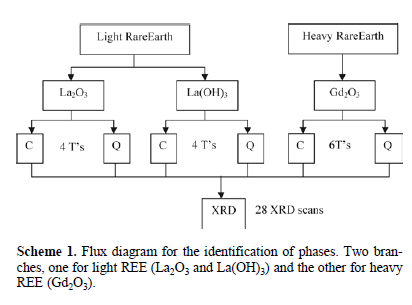
<body><![CDATA[<p align="justify"><font face="verdana" size="2">The reactions with La(OH)<sub>3</sub>, La<sub>2</sub>O<sub>3</sub> and Gd<sub>2</sub>O<sub>3</sub> were further studied to found the compounds synthesized for each reaction between thermal events. A set of temperatures were selected for each of these three reactions between thermal events. The following temperatures were chosen for La<sub>2</sub>O<sub>3</sub> (175, 308, 380, and 575 &deg;C); for La(OH)<sub>3</sub> (200, 310, 440, and 600 &deg;C), and for Gd<sub>2</sub>O<sub>3</sub> (150, 345, 510, 590, 630, and 666 &deg;C) in order to study the phases present in the reactions. The temperatures were selected using the first derivative of the DSC; the first step was identifying the pikes, temperatures at which a thermal event occurs, and the second step was selecting a temperature between two pikes, between thermal events.</font></p>  	    <p align="justify"><font face="verdana" size="2">About 0.2 g of each reactive reagents were heated at every temperature and then cooled by two methods, gradually cooling (C) and quenching in ice (Q). The cooled samples were studiedby XRD, for La<sub>2</sub>O<sub>3</sub> and Gd<sub>2</sub>O<sub>3</sub> reaction, and by HRXRD, forthe reaction with La(OH)<sub>3</sub>, at room temperature. All the phases found by Q and C for the La<sub>2</sub>O<sub>3</sub>, La(OH)<sub>3</sub>, and Gd<sub>2</sub>O<sub>3</sub> reactions are shown in <a href="/img/revistas/jmcs/v58n1/a13t2.jpg" target="_blank">Table 2</a>. Also, the nine HR&#45;XRD diffractograms for La(OH)<sub>3</sub> reaction are presented in <a href="/img/revistas/jmcs/v58n1/a13f3.jpg" target="_blank">Fig. 3</a>, the main peaks for each of the six phases found are labeled.</font></p>  	    <p align="justify"><font face="verdana" size="2">The reaction with La<sub>2</sub>O<sub>3</sub> and Gd<sub>2</sub>O<sub>3</sub> showed, as was presented earlier, the evaporation of arsenic oxide, As<sub>2</sub>O<sub>3</sub>, as the principal thermal event. Only three compounds were found in those reactions in the whole range of temperature. In the La(OH)<sub>3</sub> reaction, however, six different compounds were found between 25&#45;700 &deg;C. The addition of OH<sup>&#45;</sup> radicals, with La(OH)<sub>3</sub>, changed the reaction because those groups tend to easily react with the surrounding atoms. We deduce that the hydroxyl group was capable of stabilizing the arsenide oxide; while with La<sub>2</sub>O<sub>3</sub> and Gd<sub>2</sub>O<sub>3</sub> the arsenic oxide evaporated, in the reaction with La(OH)<sub>3</sub>, As<sub>2</sub>O<sub>3</sub> reacted and formed para&#45;symplesite (Fe<sub>3</sub>(AsO<sub>4</sub>)<sub>2</sub>&#183;8(H<sub>2</sub>O)).</font></p>  	    <p align="justify"><font face="verdana" size="2">The state of the reagent's rare earth compound, REE<sub>2</sub>O<sub>3</sub> or REE(OH)<sub>3</sub> REE= La, Ce, Nd, Sm, Gd, Dy, Ho, Er, and Yb for the other eight reactions, can be identified comparing the TG curves (<a href="/img/revistas/jmcs/v58n1/a13f1.jpg" target="_blank">Figs. 1</a> and <a href="/img/revistas/jmcs/v58n1/a13f2.jpg" target="_blank">2</a>) to the thermal analyses of La<sub>2</sub>O<sub>3</sub>, La(OH)<sub>3</sub>, and Gd<sub>2</sub>O<sub>3</sub> reactions. The following compounds were in oxide form, REE<sub>2</sub>O<sub>3</sub>: cerium, dysprosium, holmium, erbium, and ytterbium. These compounds were found to have lost weight in one stage, as in La<sub>2</sub>O<sub>3</sub> and Gd<sub>2</sub>O<sub>3</sub> reactions. The hydroxides, REE(OH)<sub>3</sub> were praseodymium, neodymium, and samarium. All these compounds had a two&#45;stage weight loss, as in the reaction with La(OH)<sub>3</sub>.</font></p>  	    <p align="justify"><font face="verdana" size="2">Knowing the conditions at which a compound is going to be synthesized could be of great service to other researchers. For example, Hosono <i>et al.</i> &#91;13&#93; aimed at obtaining a superconductor thin film using a pulsed laser deposition technique. The temperature of the substrate was set to 600 and 800 &deg;C, at these temperatures their search was for nought, had the present paper been available, it would have shed light into the fact that at 600 and 800 &deg;C the stableproducts are a mixture of compounds (La<sub>2</sub>O<sub>3</sub>, LaOF, LaAs, LaFeO<sub>3</sub>, FeAs and Fe<sub>2</sub>As) &#91;13&#93;, and that the product they looked for was hardly going to be synthesized under such conditions.</font></p>  	    <p align="justify"><font face="verdana" size="2">To conclude, the system of implementation put forward here is simple and can be used to predict what compounds can be expected with different reagents in the same family, especially in rare earth reactions, at different temperatures between thermal events. The mixture of compounds and phases can be obtained using the same reaction path, stoichiometry, and heat temperature associated to a TG and DSC analysis. The reactions REE<sub>2</sub>O<sub>3</sub> + Fe<sub>2</sub>O<sub>3</sub> + As<sub>2</sub>O<sub>3</sub> &#8594; 2REEFeO<sub>3</sub> + As<sub>2</sub>O<sub>3</sub>&#8593; are straight forward when the rare earth reagent is in oxide form, the main event is the evaporation of arsenic oxide. When the reagent is in hydroxide form, 2REE(OH)<sub>3</sub> + Fe<sub>2</sub>O<sub>3</sub> + As<sub>2</sub>O<sub>3</sub> &#8594; 2REEFeO<sub>3</sub> + As<sub>2</sub>O<sub>3</sub>&#8593; + 3H<sub>2</sub>O&#8593;, the reaction is complex. Six products were found in the La(OH)<sub>3</sub> reaction, including para&#45;symplesite. It is important to predict what phases are going to be formed in a series of reactions, rare earth reactions in this case, to optimize time and resources.</font></p>  	    <p align="justify"><font face="verdana" size="2">&nbsp;</font></p>  	    <p align="justify"><font face="verdana" size="2"><b>Experimental</b></font></p>  	    <p align="justify"><font face="verdana" size="2">The thermal characterization of the reactions, REE<sub>2</sub>O<sub>3</sub> + Fe<sub>2</sub>O<sub>3</sub> + As<sub>2</sub>O<sub>3</sub> &#8594; 2REEFeO<sub>3</sub> + As<sub>2</sub>O<sub>3</sub>&#8593; and 2REE(OH)<sub>3</sub> + Fe<sub>2</sub>O<sub>3</sub> + As<sub>2</sub>O<sub>3</sub> &#8594; 2REEFeO<sub>3</sub> + As<sub>2</sub>O<sub>3</sub>&#8593; + 3H<sub>2</sub>O&#8593; REE= La, Ce,Nd, Sm, Gd, Dy, Ho, Er, and Yb, was done by TG and DSC(Figs. 1 and 2). Reagents, except La<sub>2</sub>O<sub>3</sub>, La(OH)<sub>3</sub>, and Gd<sub>2</sub>O<sub>3</sub>, were used without modification to their storage conditions. To ensure the presence of lanthanum oxide and gadolinium oxide, the compounds were dehydrated in a furnace at 1000 &deg;C for 12 h in air and corroborated by XRD. Superficial water was eliminated heating all the reagents at 120 &deg;C for 24 h in air. REE, Fe<sub>2</sub>O<sub>3</sub>, and As<sub>2</sub>O<sub>3</sub> poly&#45;crystals (purities above 99.9%) were mixed in an agate mortar and pestle until the mixture became homogeneous. The main product was identified using XRD (not presented in this paper).</font></p>  	    <p align="justify"><font face="verdana" size="2">The second procedure consisted on the identification of phases formed from 25 &deg;C to 700 &deg;C fo the following reactions: a) La(OH)<sub>3</sub> + Fe<sub>2</sub>O<sub>3</sub> + As<sub>2</sub>O<sub>3</sub>, b) La<sub>2</sub>O<sub>3</sub> + Fe<sub>2</sub>O<sub>3</sub> + As<sub>2</sub>O<sub>3</sub>, and c) Gd<sub>2</sub>O<sub>3</sub> + Fe<sub>2</sub>O<sub>3</sub> + As<sub>2</sub>O<sub>3</sub>. To identify the changes in phases, the DSC was examined to determine temperatures between thermal events. A mixture of the reagents, about 0.2 g, was heated at these temperatures for 20 minutes in a platinum pan and then cooled down by two methods: i) by quenching (Q) in ice and ii) by gradually cooling (C) in air inside the furnace. These procedures allowed the identification of stable and metastable phases. Cooling by quenching allowed us to identify metastable phases because that phase gets trapped at that temperature, gradually cooling allows the phase to rearrange and return to a stable phase. The resulting phases were characterized using XRD for the reactions with La2O and Gd<sub>2</sub>O<sub>3</sub> and HR&#45;XRD for the La(OH)<sub>3</sub> reaction, <a href="/img/revistas/jmcs/v58n1/a13f3.jpg" target="_blank">Fig. 3</a> shows the HR&#45;XRD for the reaction with lanthanum hydroxide. <a href="#e1">Scheme 1</a> illustrates the process.</font></p>  	    ]]></body>
<body><![CDATA[<p align="center"><font face="verdana" size="2"><a name="e1"></a></font></p>  	    <p align="center"><font face="verdana" size="2"><img src="/img/revistas/jmcs/v58n1/a13e1.jpg"></font></p>  	    <p align="center"><font face="verdana" size="2">&nbsp;</font></p>  	    <p align="justify"><font face="verdana" size="2"><b>Characterization techniques</b></font></p>  	    <p align="justify"><font face="verdana" size="2">TG and DSC measurements were performed in a TA Instruments SDT Q600 at 10 &deg;C min<sup>&#45;1</sup> and 60 mL min<sup>&#45;1</sup> flow rate of air with sample weight between 3.5 and 3.9 mg in alumina open crucible. The thermal program was 25&#45;700&#45;25 &deg;C.</font></p>  	    <p align="justify"><font face="verdana" size="2">The samples were characterized at room temperature in air by XRD on a Bruker D&#45;8 diffractometer coupled to a copper X&#45;ray anode tube and a graphite diffracted beam monochromator (Cu&#45;K<sub><i>&#945;</i></sub>; <i>&#955;</i> = 1.54 &#197;). The diffractograms were measured from 10&deg; to 75&deg; (2&#952;) with a 0.016&deg; (2&#952;) step scanning.</font></p>  	    <p align="justify"><font face="verdana" size="2">For the reactions with La(OH)<sub>3</sub>, HR&#45;XRD was used. The measurement was done at Argone National Laboratory in Beamline 11&#45;BM. The wavelength used was 0.412239 &#197; and the scan was measured from 0 to 30 &deg;2&#952; with a step size of 0.003 &deg;2&#952;. The photon source is obtained with a bending magnet (BM) with a critical energy of 19.5 keV that delivers around 5x10<sup>11</sup> phs/s @ 30 keV, and a monochromator of Si(111). Detection was done with 12 independent analyzers with a 2 &deg;2&#952; separation. The analyzer consisted on Si(111) crystals and LaCl<sub>3</sub> scintillation detectors.</font></p>     <p align="justify"><font face="verdana" size="2">&nbsp;</font></p>  	    <p align="justify"><font face="verdana" size="2"><b>Acknowledgements</b></font></p>  	    <p align="justify"><font face="verdana" size="2">We thank Pedro Bosch for his help, Esteban Fregoso&#45;Israel for the thermal analysis, Leticia Ba&ntilde;os and Adriana Tejeda for the XRD discussion and analysis. Matthew Suchomel for the HR&#45;XRD and for his valuable help. Aidee Vega&#45;Rodriguez, Luis Islas, Gisella Giordani and Rafael Ibarra for reviewing this work. Thanks to Comisi&oacute;n Nacional de Ciencia y Tecnolog&iacute;a (CONACyT) for the funding (project 80380). And lastly, thanks to the Programa de Posgrado en Ciencas Qu&iacute;micas (UNAM) for its support.</font></p>  	    ]]></body>
<body><![CDATA[<p align="justify"><font face="verdana" size="2">&nbsp;</font></p>  	    <p align="justify"><font face="verdana" size="2"><b>References</b></font></p>  	    <!-- ref --><p align="justify"><font face="verdana" size="2">1.&nbsp;Sundarayya, Y.; Mandal, P.; A. Sundaresan; C.N.R. Rao. <i>Phys. Condens. Matter.</i> <b>2011,</b> <i>23,</i> 436001.    &nbsp;&nbsp;&nbsp;&nbsp;&nbsp;&nbsp;&nbsp;&nbsp;[&#160;<a href="javascript:void(0);" onclick="javascript: window.open('/scielo.php?script=sci_nlinks&ref=4973990&pid=S1870-249X201400010001300001&lng=','','width=640,height=500,resizable=yes,scrollbars=1,menubar=yes,');">Links</a>&#160;]<!-- end-ref --></font></p>  	    <!-- ref --><p align="justify"><font face="verdana" size="2">2.&nbsp;Acharya, S.; Chakrabarti, P.K. <i>Solid State Commun.</i> <b>2010,</b> 750, 1234&#45;1237.    &nbsp;&nbsp;&nbsp;&nbsp;&nbsp;&nbsp;&nbsp;&nbsp;[&#160;<a href="javascript:void(0);" onclick="javascript: window.open('/scielo.php?script=sci_nlinks&ref=4973992&pid=S1870-249X201400010001300002&lng=','','width=640,height=500,resizable=yes,scrollbars=1,menubar=yes,');">Links</a>&#160;]<!-- end-ref --></font></p>  	    <!-- ref --><p align="justify"><font face="verdana" size="2">3.&nbsp;Parida, S. C.; Singh, Z.; Dash, S., Prasal, R.; Venugopal, V. <i>J. All. Comp.</i> <b>1998,</b> <i>280,</i> 94&#45;98.    &nbsp;&nbsp;&nbsp;&nbsp;&nbsp;&nbsp;&nbsp;&nbsp;[&#160;<a href="javascript:void(0);" onclick="javascript: window.open('/scielo.php?script=sci_nlinks&ref=4973994&pid=S1870-249X201400010001300003&lng=','','width=640,height=500,resizable=yes,scrollbars=1,menubar=yes,');">Links</a>&#160;]<!-- end-ref --></font></p>  	    <!-- ref --><p align="justify"><font face="verdana" size="2">4.&nbsp;Cotton, S.E.; Dhesi, S.S. <i>The structure of rare&#45;earth metal surfaces,</i> London Imperial College, <b>2001.    &nbsp;&nbsp;&nbsp;&nbsp;&nbsp;&nbsp;&nbsp;&nbsp;[&#160;<a href="javascript:void(0);" onclick="javascript: window.open('/scielo.php?script=sci_nlinks&ref=4973996&pid=S1870-249X201400010001300004&lng=','','width=640,height=500,resizable=yes,scrollbars=1,menubar=yes,');">Links</a>&#160;]<!-- end-ref --></b></font></p>  	    ]]></body>
<body><![CDATA[<!-- ref --><p align="justify"><font face="verdana" size="2">5.&nbsp;Neumann, A.; Walter, D. <i>Thermochim. Acta.</i> <b>2006,</b> <i>445,</i> 200&#45;204.    &nbsp;&nbsp;&nbsp;&nbsp;&nbsp;&nbsp;&nbsp;&nbsp;[&#160;<a href="javascript:void(0);" onclick="javascript: window.open('/scielo.php?script=sci_nlinks&ref=4973998&pid=S1870-249X201400010001300005&lng=','','width=640,height=500,resizable=yes,scrollbars=1,menubar=yes,');">Links</a>&#160;]<!-- end-ref --></font></p>      <!-- ref --><p align="justify"><font face="verdana" size="2">6.&nbsp;Cotton, F. A.; Wilkinson, G.; Murillo, C.A.; Bochmann, M. <i>Advanced Inorganic Chemistry,</i> John Wiley &amp; Sons, <b>1999.    &nbsp;&nbsp;&nbsp;&nbsp;&nbsp;&nbsp;&nbsp;&nbsp;[&#160;<a href="javascript:void(0);" onclick="javascript: window.open('/scielo.php?script=sci_nlinks&ref=4974000&pid=S1870-249X201400010001300006&lng=','','width=640,height=500,resizable=yes,scrollbars=1,menubar=yes,');">Links</a>&#160;]<!-- end-ref --></b></font></p>  	    <!-- ref --><p align="justify"><font face="verdana" size="2">7.&nbsp;Dean, J.A. <i>Lange's Handbook of Chemistry,</i> 5<sup>th</sup> edition, McGraw&#45;Hill, Inc., <b>1999.    &nbsp;&nbsp;&nbsp;&nbsp;&nbsp;&nbsp;&nbsp;&nbsp;[&#160;<a href="javascript:void(0);" onclick="javascript: window.open('/scielo.php?script=sci_nlinks&ref=4974002&pid=S1870-249X201400010001300007&lng=','','width=640,height=500,resizable=yes,scrollbars=1,menubar=yes,');">Links</a>&#160;]<!-- end-ref --></b></font></p>  	    <!-- ref --><p align="justify"><font face="verdana" size="2">8.&nbsp;Knacke, I.; Barin, O. <i>Thermochemical properties of inorganic substances,</i> 15<sup>th</sup> edition, Springer, <b>1973.    &nbsp;&nbsp;&nbsp;&nbsp;&nbsp;&nbsp;&nbsp;&nbsp;[&#160;<a href="javascript:void(0);" onclick="javascript: window.open('/scielo.php?script=sci_nlinks&ref=4974004&pid=S1870-249X201400010001300008&lng=','','width=640,height=500,resizable=yes,scrollbars=1,menubar=yes,');">Links</a>&#160;]<!-- end-ref --></b></font></p>  	    <!-- ref --><p align="justify"><font face="verdana" size="2">9.&nbsp;Barin, A. <i>Thermochemical Data of Pure Substances,</i> VCH Verlags&#45;Gesellschaft GmbH, Weinheim, <b>1989.    &nbsp;&nbsp;&nbsp;&nbsp;&nbsp;&nbsp;&nbsp;&nbsp;[&#160;<a href="javascript:void(0);" onclick="javascript: window.open('/scielo.php?script=sci_nlinks&ref=4974006&pid=S1870-249X201400010001300009&lng=','','width=640,height=500,resizable=yes,scrollbars=1,menubar=yes,');">Links</a>&#160;]<!-- end-ref --></b></font></p>  	    ]]></body>
<body><![CDATA[<!-- ref --><p align="justify"><font face="verdana" size="2">10.&nbsp;Wells, F. <i>Structural Inorganic Chemistry,</i> 5<sup>th</sup> edition, Clarendon press, Oxford, <b>1984.    &nbsp;&nbsp;&nbsp;&nbsp;&nbsp;&nbsp;&nbsp;&nbsp;[&#160;<a href="javascript:void(0);" onclick="javascript: window.open('/scielo.php?script=sci_nlinks&ref=4974008&pid=S1870-249X201400010001300010&lng=','','width=640,height=500,resizable=yes,scrollbars=1,menubar=yes,');">Links</a>&#160;]<!-- end-ref --></b></font></p>  	    <!-- ref --><p align="justify"><font face="verdana" size="2">11.&nbsp;Rushton, E. R.; Daniels, F. <i>J. Am. Chem. Soc.</i> <b>1926,</b> 48, 384.    &nbsp;&nbsp;&nbsp;&nbsp;&nbsp;&nbsp;&nbsp;&nbsp;[&#160;<a href="javascript:void(0);" onclick="javascript: window.open('/scielo.php?script=sci_nlinks&ref=4974010&pid=S1870-249X201400010001300011&lng=','','width=640,height=500,resizable=yes,scrollbars=1,menubar=yes,');">Links</a>&#160;]<!-- end-ref --></font></p>  	    <!-- ref --><p align="justify"><font face="verdana" size="2">12.&nbsp;Weast, R.C. <i>CRC Handbook of Chemistry and Physics,</i> The Chemical Rubber Co., Ohio, <b>1970.    &nbsp;&nbsp;&nbsp;&nbsp;&nbsp;&nbsp;&nbsp;&nbsp;[&#160;<a href="javascript:void(0);" onclick="javascript: window.open('/scielo.php?script=sci_nlinks&ref=4974012&pid=S1870-249X201400010001300012&lng=','','width=640,height=500,resizable=yes,scrollbars=1,menubar=yes,');">Links</a>&#160;]<!-- end-ref --></b></font></p>  	    <!-- ref --><p align="justify"><font face="verdana" size="2">13.&nbsp;Hiramatsu, H.; Kamiya, T.; Hirano, M.; Hosono, H. <i>Physica C.</i> <b>2009,</b> 469, 657&#45;666.    &nbsp;&nbsp;&nbsp;&nbsp;&nbsp;&nbsp;&nbsp;&nbsp;[&#160;<a href="javascript:void(0);" onclick="javascript: window.open('/scielo.php?script=sci_nlinks&ref=4974014&pid=S1870-249X201400010001300013&lng=','','width=640,height=500,resizable=yes,scrollbars=1,menubar=yes,');">Links</a>&#160;]<!-- end-ref --></font></p>      ]]></body><back>
<ref-list>
<ref id="B1">
<label>1</label><nlm-citation citation-type="journal">
<person-group person-group-type="author">
<name>
<surname><![CDATA[Sundarayya]]></surname>
<given-names><![CDATA[Y.]]></given-names>
</name>
<name>
<surname><![CDATA[Mandal]]></surname>
<given-names><![CDATA[P.]]></given-names>
</name>
<name>
<surname><![CDATA[A. Sundaresan;]]></surname>
<given-names><![CDATA[C.N.R.]]></given-names>
</name>
</person-group>
<source><![CDATA[Rao. Phys. Condens. Matter.]]></source>
<year>2011</year>
<volume>23</volume>
<page-range>436001</page-range></nlm-citation>
</ref>
<ref id="B2">
<label>2</label><nlm-citation citation-type="journal">
<person-group person-group-type="author">
<name>
<surname><![CDATA[Acharya]]></surname>
<given-names><![CDATA[S.]]></given-names>
</name>
<name>
<surname><![CDATA[Chakrabarti]]></surname>
<given-names><![CDATA[P.K.]]></given-names>
</name>
</person-group>
<source><![CDATA[Solid State Commun.]]></source>
<year>2010</year>
<volume>750</volume>
<page-range>1234-1237</page-range></nlm-citation>
</ref>
<ref id="B3">
<label>3</label><nlm-citation citation-type="journal">
<person-group person-group-type="author">
<name>
<surname><![CDATA[Parida]]></surname>
<given-names><![CDATA[S. C.]]></given-names>
</name>
<name>
<surname><![CDATA[Singh]]></surname>
<given-names><![CDATA[Z.]]></given-names>
</name>
<name>
<surname><![CDATA[Dash, S., Prasal]]></surname>
<given-names><![CDATA[R.]]></given-names>
</name>
<name>
<surname><![CDATA[Venugopal]]></surname>
<given-names><![CDATA[V.]]></given-names>
</name>
</person-group>
<source><![CDATA[J. All. Comp.]]></source>
<year>1998</year>
<volume>280</volume>
<page-range>94-98</page-range></nlm-citation>
</ref>
<ref id="B4">
<label>4</label><nlm-citation citation-type="book">
<person-group person-group-type="author">
<name>
<surname><![CDATA[Cotton]]></surname>
<given-names><![CDATA[S.E.]]></given-names>
</name>
<name>
<surname><![CDATA[Dhesi]]></surname>
<given-names><![CDATA[S.S.]]></given-names>
</name>
</person-group>
<source><![CDATA[The structure of rare-earth metal surfaces]]></source>
<year>2001</year>
<publisher-name><![CDATA[London Imperial College]]></publisher-name>
</nlm-citation>
</ref>
<ref id="B5">
<label>5</label><nlm-citation citation-type="journal">
<person-group person-group-type="author">
<name>
<surname><![CDATA[Neumann]]></surname>
<given-names><![CDATA[A.]]></given-names>
</name>
<name>
<surname><![CDATA[Walter]]></surname>
<given-names><![CDATA[D.]]></given-names>
</name>
</person-group>
<source><![CDATA[Thermochim. Acta.]]></source>
<year>2006</year>
<volume>445</volume>
<page-range>200-204</page-range></nlm-citation>
</ref>
<ref id="B6">
<label>6</label><nlm-citation citation-type="book">
<person-group person-group-type="author">
<name>
<surname><![CDATA[Cotton]]></surname>
<given-names><![CDATA[F. A.]]></given-names>
</name>
<name>
<surname><![CDATA[Wilkinson]]></surname>
<given-names><![CDATA[G.]]></given-names>
</name>
<name>
<surname><![CDATA[Murillo]]></surname>
<given-names><![CDATA[C.A.]]></given-names>
</name>
<name>
<surname><![CDATA[Bochmann]]></surname>
<given-names><![CDATA[M.]]></given-names>
</name>
</person-group>
<source><![CDATA[Advanced Inorganic Chemistry]]></source>
<year>1999</year>
<publisher-name><![CDATA[John Wiley & Sons]]></publisher-name>
</nlm-citation>
</ref>
<ref id="B7">
<label>7</label><nlm-citation citation-type="book">
<person-group person-group-type="author">
<name>
<surname><![CDATA[Dean]]></surname>
<given-names><![CDATA[J.A.]]></given-names>
</name>
</person-group>
<source><![CDATA[Lange's Handbook of Chemistry]]></source>
<year>1999</year>
<edition>5</edition>
<publisher-name><![CDATA[McGraw-Hill, Inc.]]></publisher-name>
</nlm-citation>
</ref>
<ref id="B8">
<label>8</label><nlm-citation citation-type="book">
<person-group person-group-type="author">
<name>
<surname><![CDATA[Knacke]]></surname>
<given-names><![CDATA[I.]]></given-names>
</name>
<name>
<surname><![CDATA[Barin]]></surname>
<given-names><![CDATA[O.]]></given-names>
</name>
</person-group>
<source><![CDATA[Thermochemical properties of inorganic substances]]></source>
<year>1973</year>
<edition>15</edition>
<publisher-name><![CDATA[Springer]]></publisher-name>
</nlm-citation>
</ref>
<ref id="B9">
<label>9</label><nlm-citation citation-type="book">
<person-group person-group-type="author">
<name>
<surname><![CDATA[Barin]]></surname>
<given-names><![CDATA[A.]]></given-names>
</name>
</person-group>
<source><![CDATA[Thermochemical Data of Pure Substances]]></source>
<year></year>
<publisher-loc><![CDATA[Weinheim ]]></publisher-loc>
<publisher-name><![CDATA[VerlagsGesellschaft]]></publisher-name>
</nlm-citation>
</ref>
<ref id="B10">
<label>10</label><nlm-citation citation-type="book">
<person-group person-group-type="author">
<name>
<surname><![CDATA[Wells]]></surname>
<given-names><![CDATA[F.]]></given-names>
</name>
</person-group>
<source><![CDATA[Structural Inorganic Chemistry]]></source>
<year>1984</year>
<edition>5</edition>
<publisher-loc><![CDATA[Oxford ]]></publisher-loc>
<publisher-name><![CDATA[Clarendon press]]></publisher-name>
</nlm-citation>
</ref>
<ref id="B11">
<label>11</label><nlm-citation citation-type="journal">
<person-group person-group-type="author">
<name>
<surname><![CDATA[Rushton]]></surname>
<given-names><![CDATA[E. R.]]></given-names>
</name>
<name>
<surname><![CDATA[Daniels]]></surname>
<given-names><![CDATA[F.]]></given-names>
</name>
</person-group>
<source><![CDATA[J. Am. Chem. Soc.]]></source>
<year>1926</year>
<volume>48</volume>
<page-range>384</page-range></nlm-citation>
</ref>
<ref id="B12">
<label>12</label><nlm-citation citation-type="book">
<person-group person-group-type="author">
<name>
<surname><![CDATA[Weast]]></surname>
<given-names><![CDATA[R.C.]]></given-names>
</name>
</person-group>
<source><![CDATA[CRC Handbook of Chemistry and Physics]]></source>
<year>1970</year>
<publisher-loc><![CDATA[^eOhio Ohio]]></publisher-loc>
<publisher-name><![CDATA[The Chemical Rubber Co.]]></publisher-name>
</nlm-citation>
</ref>
<ref id="B13">
<label>13</label><nlm-citation citation-type="journal">
<person-group person-group-type="author">
<name>
<surname><![CDATA[Hiramatsu]]></surname>
<given-names><![CDATA[H.]]></given-names>
</name>
<name>
<surname><![CDATA[Kamiya]]></surname>
<given-names><![CDATA[T.]]></given-names>
</name>
<name>
<surname><![CDATA[Hirano]]></surname>
<given-names><![CDATA[M.]]></given-names>
</name>
<name>
<surname><![CDATA[Hosono]]></surname>
<given-names><![CDATA[H.]]></given-names>
</name>
</person-group>
<source><![CDATA[Physica C.]]></source>
<year>2009</year>
<volume>469</volume>
<page-range>657-666</page-range></nlm-citation>
</ref>
</ref-list>
</back>
</article>
