<?xml version="1.0" encoding="ISO-8859-1"?><article xmlns:mml="http://www.w3.org/1998/Math/MathML" xmlns:xlink="http://www.w3.org/1999/xlink" xmlns:xsi="http://www.w3.org/2001/XMLSchema-instance">
<front>
<journal-meta>
<journal-id>1870-249X</journal-id>
<journal-title><![CDATA[Journal of the Mexican Chemical Society]]></journal-title>
<abbrev-journal-title><![CDATA[J. Mex. Chem. Soc]]></abbrev-journal-title>
<issn>1870-249X</issn>
<publisher>
<publisher-name><![CDATA[Sociedad Química de México A.C.]]></publisher-name>
</publisher>
</journal-meta>
<article-meta>
<article-id>S1870-249X2013000400001</article-id>
<title-group>
<article-title xml:lang="en"><![CDATA[Statistical Treatment of Bleaching Kaolin by Iron Removal]]></article-title>
</title-group>
<contrib-group>
<contrib contrib-type="author">
<name>
<surname><![CDATA[Hernández Hernández]]></surname>
<given-names><![CDATA[Román Ángel]]></given-names>
</name>
<xref ref-type="aff" rid="A01"/>
</contrib>
<contrib contrib-type="author">
<name>
<surname><![CDATA[Legorreta García]]></surname>
<given-names><![CDATA[Felipe]]></given-names>
</name>
<xref ref-type="aff" rid="A01"/>
</contrib>
<contrib contrib-type="author">
<name>
<surname><![CDATA[Hernández Cruz]]></surname>
<given-names><![CDATA[Leticia Esperanza]]></given-names>
</name>
<xref ref-type="aff" rid="A01"/>
</contrib>
<contrib contrib-type="author">
<name>
<surname><![CDATA[Martínez Luévanos]]></surname>
<given-names><![CDATA[Antonia]]></given-names>
</name>
<xref ref-type="aff" rid="A02"/>
</contrib>
</contrib-group>
<aff id="A01">
<institution><![CDATA[,Universidad Autónoma del Estado de Hidalgo Área Académica de Ciencias de la Tierra y Materiales ]]></institution>
<addr-line><![CDATA[ Hidalgo]]></addr-line>
<country>México</country>
</aff>
<aff id="A02">
<institution><![CDATA[,Universidad Autónoma de Coahuila  ]]></institution>
<addr-line><![CDATA[Saltillo Coahuila]]></addr-line>
<country>México</country>
</aff>
<pub-date pub-type="pub">
<day>00</day>
<month>12</month>
<year>2013</year>
</pub-date>
<pub-date pub-type="epub">
<day>00</day>
<month>12</month>
<year>2013</year>
</pub-date>
<volume>57</volume>
<numero>4</numero>
<fpage>261</fpage>
<lpage>266</lpage>
<copyright-statement/>
<copyright-year/>
<self-uri xlink:href="http://www.scielo.org.mx/scielo.php?script=sci_arttext&amp;pid=S1870-249X2013000400001&amp;lng=en&amp;nrm=iso"></self-uri><self-uri xlink:href="http://www.scielo.org.mx/scielo.php?script=sci_abstract&amp;pid=S1870-249X2013000400001&amp;lng=en&amp;nrm=iso"></self-uri><self-uri xlink:href="http://www.scielo.org.mx/scielo.php?script=sci_pdf&amp;pid=S1870-249X2013000400001&amp;lng=en&amp;nrm=iso"></self-uri><abstract abstract-type="short" xml:lang="en"><p><![CDATA[Abstract In the present study, oxalic acid was used as a leaching reagent to remove iron from a kaolin mineral. Statistical analysis was conducted to determine the most influential factors in the dissolution of iron from the kaolin mineral. Our goal was ferric iron solubilization and its reduction to ferrous iron to improve the iron removal in the acid medium. Leaching experiments were conducted at atmospheric pressure. A two-level factorial design of the type 2(4) was utilized. The dependent variable was the percentage of dissolved iron, and the dependent variables in this study were acid concentration (0.35 and 0.50 M), temperature (75 °C and 100 °C), leaching time (2 and 4 h), and pH (1.5 and 2.5). An analysis of variance revealed that the effects of the factors temperature (b), pH (d), and the combined effects of temperature and time (bc) resulted in the maximum dissolution of iron of 88% at 100 °C, giving a kaolin mineral with a whiteness index 93.50%.]]></p></abstract>
<abstract abstract-type="short" xml:lang="es"><p><![CDATA[Resumen Se presenta el tratamiento estadístico de la disolución de hierro de un mineral caolinítico utilizando soluciones de ácido oxálico como agente lixiviante. La base de este proceso es la solubilización de hierro férrico y su reducción a hierro ferroso para mejorar su remoción. Los experimentos de lixiviación a presión atmosférica se realizaron bajo un diseño estadístico factorial 2(4). La variable de respuesta fue el porcentaje de hierro disuelto, los factores estudiados y que tuvieron un efecto importante en la lixiviación fueron: la concentración de ácido oxálico (0.35 y 0.50 M), la temperatura (75° C y 100 °C), el tiempo de lixiviación (2 y 4 horas) y el pH (1.5 y 2.5). El análisis de varianza indicó que los factores temperatura (b) y pH (d), así como la combinación temperatura-tiempo (bc) permitieron conseguir una máxima disolución de hierro de 88% a 100 °C obteniendo mineral caolinítico con un índice de blancura de 93.5 %.]]></p></abstract>
<kwd-group>
<kwd lng="en"><![CDATA[Kaolin mineral]]></kwd>
<kwd lng="en"><![CDATA[dissolution of iron]]></kwd>
<kwd lng="en"><![CDATA[oxalic acid]]></kwd>
<kwd lng="en"><![CDATA[factorial design]]></kwd>
<kwd lng="es"><![CDATA[Mineral caolín]]></kwd>
<kwd lng="es"><![CDATA[disolución de hierro]]></kwd>
<kwd lng="es"><![CDATA[ácido oxálico]]></kwd>
<kwd lng="es"><![CDATA[diseño factorial]]></kwd>
</kwd-group>
</article-meta>
</front><body><![CDATA[ <p align="justify"><font face="verdana" size="4">Article</font></p>      	    <p align="justify"><font face="verdana" size="2">&nbsp;</font></p>              <p align="center"><font face="verdana" size="4"><b>Statistical Treatment of Bleaching Kaolin by Iron Removal</b></font></p>              <p align="justify"><font face="verdana" size="2">&nbsp;</font></p>              <p align="center"><font face="verdana" size="2"><b>Rom&aacute;n &Aacute;ngel Hern&aacute;ndez Hern&aacute;ndez,*<sup>1</sup> Felipe Legorreta Garc&iacute;a,<sup>1</sup> Leticia Esperanza Hern&aacute;ndez Cruz,<sup>1</sup> and Antonia Mart&iacute;nez Lu&eacute;vanos<sup>2</sup></b></font></p>              <p align="justify"><font face="verdana" size="2">&nbsp;</font></p>              <p align="justify"><font face="verdana" size="2"><sup><i>1</i></sup> <i>Universidad Aut&oacute;noma del Estado de Hidalgo. &Aacute;rea Acad&eacute;mica de Ciencias de la Tierra y Materiales. Carretera Pachuca&#45;Tulancingo, Km 4.5 s/n, Mineral de la Reforma, Hidalgo, M&eacute;xico., C.P. 42184. </i><a href="mailto:angelitofox3@hotmail.com">angelitofox3@hotmail.com</a>.</font></p>              <p align="justify"><font face="verdana" size="2"><i><sup>2</sup> Universidad Aut&oacute;noma de Coahuila, M&eacute;xico. Blvd. V. Carranza y Gonz&aacute;lez Lobo s/n; Saltillo, Coahuila., M&eacute;xico., C. P.</i></font></p>              <p align="justify"><font face="verdana" size="2">&nbsp;</font></p>              <p align="justify"><font face="verdana" size="2">Received August 07, 2012.    ]]></body>
<body><![CDATA[<br> Accepted May 3, 2013.</font></p>              <p align="justify"><font face="verdana" size="2">&nbsp;</font></p>              <p align="justify"><font face="verdana" size="2"><b>Abstract</b></font></p>              <p align="justify"><font face="verdana" size="2">In the present study, oxalic acid was used as a leaching reagent to remove iron from a kaolin mineral. Statistical analysis was conducted to determine the most influential factors in the dissolution of iron from the kaolin mineral. Our goal was ferric iron solubilization and its reduction to ferrous iron to improve the iron removal in the acid medium. Leaching experiments were conducted at atmospheric pressure. A two&#45;level factorial design of the type 2<sup>4</sup> was utilized. The dependent variable was the percentage of dissolved iron, and the dependent variables in this study were acid concentration (0.35 and 0.50 M), temperature (75 &deg;C and 100 &deg;C), leaching time (2 and 4 h), and pH (1.5 and 2.5). An analysis of variance revealed that the effects of the factors temperature (b), pH (d), and the combined effects of temperature and time (bc) resulted in the maximum dissolution of iron of 88% at 100 &deg;C, giving a kaolin mineral with a whiteness index 93.50%.</font></p>              <p align="justify"><font face="verdana" size="2"><b>Keywords:</b> Kaolin mineral, dissolution of iron, oxalic acid, factorial design.</font></p>              <p align="justify"><font face="verdana" size="2">&nbsp;</font></p>              <p align="justify"><font face="verdana" size="2"><b>Resumen</b></font></p>              <p align="justify"><font face="verdana" size="2">Se presenta el tratamiento estad&iacute;stico de la disoluci&oacute;n de hierro de un mineral caolin&iacute;tico utilizando soluciones de &aacute;cido ox&aacute;lico como agente lixiviante. La base de este proceso es la solubilizaci&oacute;n de hierro f&eacute;rrico y su reducci&oacute;n a hierro ferroso para mejorar su remoci&oacute;n. Los experimentos de lixiviaci&oacute;n a presi&oacute;n atmosf&eacute;rica se realizaron bajo un dise&ntilde;o estad&iacute;stico factorial 2<sup>4</sup>. La variable de respuesta fue el porcentaje de hierro disuelto, los factores estudiados y que tuvieron un efecto importante en la lixiviaci&oacute;n fueron: la concentraci&oacute;n de &aacute;cido ox&aacute;lico (0.35 y 0.50 M), la temperatura (75&deg; C y 100 &deg;C), el tiempo de lixiviaci&oacute;n (2 y 4 horas) y el pH (1.5 y 2.5). El an&aacute;lisis de varianza indic&oacute; que los factores temperatura (b) y pH (d), as&iacute; como la combinaci&oacute;n temperatura&#45;tiempo (bc) permitieron conseguir una m&aacute;xima disoluci&oacute;n de hierro de 88% a 100 &deg;C obteniendo mineral caolin&iacute;tico con un &iacute;ndice de blancura de 93.5 %.</font></p>              <p align="justify"><font face="verdana" size="2"><b>Palabras clave:</b> Mineral caol&iacute;n, disoluci&oacute;n de hierro, &aacute;cido ox&aacute;lico, dise&ntilde;o factorial.</font></p>              <p align="justify"><font face="verdana" size="2">&nbsp;</font></p>              ]]></body>
<body><![CDATA[<p align="justify"><font face="verdana" size="2"><b>Introduction</b></font></p>              <p align="justify"><font face="verdana" size="2">Kaolin is a clay mineral which has been used since antiquity for the manufacture of ceramic utensils and containers, is currently used in multiple applications in various industries. Kaolin clay is a hydrated aluminum silicate that is the product of the decomposition of feldspathic rocks. The term generally refers to kaolin clays in compounds in which the predominant mineral is kaolinite (Al<sub>2</sub>O<sub>3</sub>.2SiO<sub>2</sub>.2H<sub>2</sub>O) &#91;1&#93;.</font></p>              <p align="justify"><font face="verdana" size="2">The presence of impurities, particularly iron and titanium bearing materials, impart color to kaolin. During the formation of kaolin by either hydrothermal alteration or weathering, significant levels of iron oxides can be deposited on the kaolinitic clay to dramatically reduce their industrial application.</font></p>              <p align="justify"><font face="verdana" size="2">Consequently, several chemical methods have historically been applied to kaolin beneficiation in order to reduce these contaminants &#91;2, 3&#45;5&#93;.</font></p>              <p align="justify"><font face="verdana" size="2">The use of different organic and inorganic acids to dissolve iron compounds using a factorial statistical design have been evaluated in several studies &#91;3, 6&#93; in an attempt to replace the expensive high&#45;temperature technique of chlorination (750 &deg;C&#45;900 &deg;C) &#91;7&#93;.</font></p>              <p align="justify"><font face="verdana" size="2">Ambikadevi &#91;8&#93; and Mart&iacute;nez Lu&eacute;vanos &#91;9&#93; used various organic acids (acetic, formic, citric, ascorbic, etc.) to dissolve iron compounds and concluded that oxalic acid is the most efficient for dissolving iron oxide ceramic minerals. Oxalic acid has a lower risk of contaminating the treated material after calcination, has good complexing properties, and a high reducing power compared to other organic acids.</font></p>              <p align="justify"><font face="verdana" size="2">Panias et al. &#91;10&#93; concluded that the dissolution of iron with oxalic acid involves three distinct processes that take place simultaneously, including: (a) the adsorption of the organic acid on the surface of iron oxide, (b) the non&#45;reductive dissolution, and (c) the reductive dissolution.</font></p>              <p align="justify"><font face="verdana" size="2">The dissolution process must also be optimized with respect to the concentration of oxalate and pH to minimize the precipitation of ferrous oxalate. Oxalic acid solution (H<sub>2</sub>C<sub>2</sub>O<sub>4</sub>) ionizes to form the ion bi&#45;oxalate (HC<sub>2</sub>O<sub>4</sub><sup>&minus;</sup>):</font></p>              <p align="center"><font face="verdana" size="2"><img src="/img/revistas/jmcs/v57n4/a1e1.jpg"></font></p>              <p align="justify"><font face="verdana" size="2">Furthermore, the formed bi&#45;oxalate ionizes to form the oxalate ion (C<sub>2</sub>O<sub>4</sub><sup>2&minus;</sup>):</font></p>              ]]></body>
<body><![CDATA[<p align="center"><font face="verdana" size="2"><img src="/img/revistas/jmcs/v57n4/a1e2.jpg"></font></p>              <p align="justify"><font face="verdana" size="2">These two species were considered to bi&#45;oxalate, and are responsible for the iron dissolution &#91;4&#93;:</font></p>              <p align="center"><font face="verdana" size="2"><img src="/img/revistas/jmcs/v57n4/a1e3.jpg"></font></p>              <p align="justify"><font face="verdana" size="2">Therefore, the conditions of the acid solution should be favorable for the prevalence of ion bi&#45;oxalate HC<sub>2</sub>O<sub>4</sub>.</font></p>              <p align="justify"><font face="verdana" size="2">We statistically treated experimental variables affecting the dissolution of iron from kaolinitic clays (e.g., acid concentration, temperature, time, and pH) to obtain a mineral useful for various industrial applications.</font></p>              <p align="justify"><font face="verdana" size="2">&nbsp;</font></p>              <p align="justify"><font face="verdana" size="2"><b>Results and Discussion</b></font></p>              <p align="justify"><font face="verdana" size="2"><b>Mineralogical analysis</b></font></p>              <p align="justify"><font face="verdana" size="2">X&#45;ray diffraction analysis revealed the nature of the crystalline phases present in the mineral as shown in <a href="#f1">Fig. 1</a>. The study sample is mainly constituted by the kaolinite mineral with minor contributions of silica were also detected as quartz and tridymite. Iron is considered to be an impurity and is present as magnetite (Fe<sub>3</sub>O<sub>4</sub>), hematite (Fe<sub>2</sub>O<sub>3</sub>), titanium oxide&#45;ferrous (Fe<sub>2</sub>TiO<sub>4</sub>), and greigite (Fe<sub>3</sub>O<sub>4</sub>).</font></p>              <p align="center"><font face="verdana" size="2"><a name="f1"></a></font></p>              ]]></body>
<body><![CDATA[<p align="center"><font face="verdana" size="2"><img src="/img/revistas/jmcs/v57n4/a1f1.jpg"></font></p>              <p align="justify"><font face="verdana" size="2">It is important to make this identification because several studies &#91;2&#45;3, 8, 11&#93;, have reported the dissolution of magnetite, hematite, and greigite using oxalic acid, and agree that the dissolution of the hematite is much slower than the dissolution of magnetite and other hydrated iron oxides such as goethite (&#945;&#45;FeOOH) and lepidocrocite (&#947;&#45;FeOOH). This suggests that the use of different chemicals and experimental conditions can explain the mechanism of dissolution of hematite and magnetite.</font></p>              <p align="justify"><font face="verdana" size="2"><i>Factorial design</i></font></p>              <p align="justify"><font face="verdana" size="2">The results obtained from the analysis of variance (ANOVA) in terms of iron extraction percentage were analyzed in order to determine the statistical effects of the variables investigated, as well as their interactions. The dependent variable of the process used in developing the ANOVA was the percentage yield of dissolution of iron.</font></p>              <p align="justify"><font face="verdana" size="2"><a href="/img/revistas/jmcs/v57n4/a1t1.jpg" target="_blank">Table 1</a> presents ANOVA results obtained from the experiments leaching iron from kaolin. This analysis demonstrated that the of temperature (b) and pH (d), and the interaction between temperature and time (bc) have a highly significant effect on the percentage of iron extraction. The concentration in this range was not significant.</font></p>              <p align="justify"><font face="verdana" size="2"><a href="#f2">Fig. 2</a> and <a href="#f3">3</a> show the graphs of principal effects and normal effects, respectively. Concentration does not have a significant effect in the range from 0.35 M to 0.50 M; however, the effects of temperature, pH and the combined effects of temperature and time are significant.</font></p>              <p align="center"><font face="verdana" size="2"><a name="f2"></a></font></p>              <p align="center"><font face="verdana" size="2"><img src="/img/revistas/jmcs/v57n4/a1f2.jpg"></font></p>              <p align="center"><font face="verdana" size="2"><a name="f3"></a></font></p>              <p align="center"><font face="verdana" size="2"><img src="/img/revistas/jmcs/v57n4/a1f3.jpg"></font></p>              ]]></body>
<body><![CDATA[<p align="justify"><font face="verdana" size="2"><i>Effect of temperature</i></font></p>              <p align="justify"><font face="verdana" size="2"><a href="#f4">Fig. 4</a> shows that iron removal increases with temperature and is greater at the temperature of 100 &deg;C. This result is attributed to the fact that the non&#45;reductive dissolution pathway is a simple desorption process. It involves desorption of the adsorbed surface ferric complex ions and their transfer to the acidic solution. The non&#45;reductive dissolution mechanism removes only the more reactive sites of the oxide surface, which increases with decreasing pH and increasing temperature &#91;10&#93;. At temperatures below 90 &deg;C, it is not an operative pathway and the dissolution rate is not proportional over the entire surface of the iron oxide.</font></p>              <p align="center"><font face="verdana" size="2"><a name="f4"></a></font></p>              <p align="center"><font face="verdana" size="2"><img src="/img/revistas/jmcs/v57n4/a1f4.jpg"></font></p>              <p align="justify"><font face="verdana" size="2">Therefore, the dissolution of iron using oxalic acid must be thermally activated to be efficient. This is an indicator that the system exhibits chemical control. This result coincides with similar results obtained for other kaolinitic minerals reported in previous studies &#91;4, 11&#93;.</font></p>              <p align="justify"><font face="verdana" size="2"><i>Effect of concentration</i></font></p>              <p align="justify"><font face="verdana" size="2">Factorial design results did not show a significant effect for oxalic acid concentration. This result can be explained as follows: at the stoichiometric ratio (oxalate/iron oxide) of 5:1 as per Eq. (3), a concentration of 0.50 M represents an approximately 12&#45;fold excess of the stoichiometric requirement for oxalate. This may be caused by the gradual formation of a passivation layer of iron oxalate Fe(C<sub>2</sub>O<sub>4</sub>)(s) with respect to time, which is favored by the presence of soluble Fe(II) produced during the dissolution process that can accumulate near the reaction interface &#91;3&#93;. As illustrated in <a href="#f5">Fig. 5</a>, the temperature&#45;time relationship influences the dissolution rate of iron. At 2 h of dissolution at 75 &deg;C and 100 &deg;C, the percentages were 64% and 74%, respectively, whereas at 4 h, the percentages were 71% and 74%, respectively.</font></p>              <p align="center"><font face="verdana" size="2"><a name="f5"></a></font></p>              <p align="center"><font face="verdana" size="2"><img src="/img/revistas/jmcs/v57n4/a1f5.jpg"></font></p>              <p align="justify"><font face="verdana" size="2"><i>Effect of pH</i></font></p>              ]]></body>
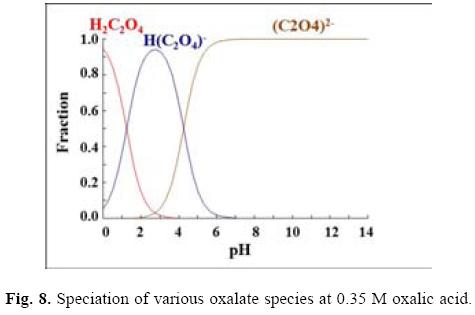
<body><![CDATA[<p align="justify"><font face="verdana" size="2"><a href="#f6">Fig. 6</a> and <a href="#f7">7</a> show that pH has a significant effect on the dissolution of iron, and is most evident at 2 h.</font></p>              <p align="center"><font face="verdana" size="2"><a name="f6"></a></font></p>              <p align="center"><font face="verdana" size="2"><img src="/img/revistas/jmcs/v57n4/a1f6.jpg"></font></p>              <p align="center"><font face="verdana" size="2"><a name="f7"></a></font></p>              <p align="center"><font face="verdana" size="2"><img src="/img/revistas/jmcs/v57n4/a1f7.jpg"></font></p>              <p align="justify"><font face="verdana" size="2">To better explain the effect of pH on iron dissolution, we developed stability and distribution diagrams (<a href="#f8">Fig. 8</a>) and EhpH diagrams (<a href="#f9">Fig. 9</a>) using the software Medusa (Chemical Equilibrium Diagrams).</font></p>              <p align="center"><font face="verdana" size="2"><a name="f8"></a></font></p>              <p align="center"><font face="verdana" size="2"><img src="/img/revistas/jmcs/v57n4/a1f8.jpg"></font></p>              <p align="center"><font face="verdana" size="2"><a name="f9"></a></font></p>              <p align="center"><font face="verdana" size="2"><img src="/img/revistas/jmcs/v57n4/a1f9.jpg"></font></p>              ]]></body>
<body><![CDATA[<p align="justify"><font face="verdana" size="2">As described above, the species responsible for iron dissolution is the bi&#45;oxalate (HC<sub>2</sub>O<sub>4</sub><sup>&#45;</sup>) ion according to equation (3). As shown in fFigure 8, the distribution of three species of oxalic acid at a concentration of 0.35 M (i.e. H<sub>2</sub>C<sub>2</sub>O<sub>4</sub>, HC<sub>2</sub>O<sub>4</sub> , and C<sub>2</sub>O<sub>4</sub><sup>2&#45;</sup>), where the HC<sub>2</sub>O<sub>4</sub>&#45; ion is the predominant species in the pH range 2.5&#45;3.0, explains why the reaction rate increases over this pH range. This coincides with previous results &#91;4, 9, 11&#93;, in which a change in predominance was not due to acid concentration.</font></p>              <p align="justify"><font face="verdana" size="2">pH values of 1.5 and 2.5 were examined, and we found that the fractions of bi&#45;oxalate (HC<sub>2</sub>O<sub>4</sub><sup>&#45;</sup>) were 70% and 90%, respectively. This indicates that the best results are obtained at a pH of 2.5, resulting in a largely dissociated oxalic acid. In developing the Eh&#45;pH diagram shown in figure 9, however, the level of Fe used in this study (0.0087 M total Fe) hindered the solution because of the presence of solid Fe(C<sub>2</sub>O<sub>4</sub>)(s), which shows a passivation mechanism due to the formation of this solid on the oxide surface and is governed by its precipitation from solution &#91;4&#93;. For a pH of 1.5, the solid is stable over a pH range of 1.14&#45;2.80.</font></p>         <p align="justify"><font face="verdana" size="2">At a pH of 2.5, the range is 1.12&#45;2.80. Therefore, at a pH of 1.5, only 70% dissociation of oxalic acid is obtained as it is close to the zone of stability of the Fe<sup>2+</sup> and away from the zone of formation of solid Fe(C<sub>2</sub>O<sub>4</sub>)(s).</font></p>         <p align="justify"><font face="verdana" size="2">At a pH of 2.5, the dissociation of oxalic acid was more than 90%; however, this is further away from the zone of stability for Fe<sup>2+</sup> and is well within the zone of stability of solid Fe(C<sub>2</sub>O<sub>4</sub>)(s).</font></p>              <p align="justify"><font face="verdana" size="2"><i>Whiteness index</i></font></p>              <p align="justify"><font face="verdana" size="2"><a href="#f10">Figure 10</a> shows the percentage of dissolved iron, and the index or ratio of whiteness obtained using an oxalic acid concentration of 0.35 M, pH 1.5, 100 &deg;C, and time of 2 h. The whiteness index increases with the same trend as that observed for the dissolution of iron, yielding a maximum whiteness index of 93.55%. This result confirms that the decrease in the percentage of iron oxides in the mineral increases the whiteness index &#91;4&#93;.</font></p>              <p align="center"><font face="verdana" size="2"><a name="f10"></a></font></p>              <p align="center"><font face="verdana" size="2"><img src="/img/revistas/jmcs/v57n4/a1f10.jpg"></font></p>              <p align="justify"><font face="verdana" size="2">&nbsp;</font></p>              <p align="justify"><font face="verdana" size="2"><b>Experimental</b></font></p>              ]]></body>
<body><![CDATA[<p align="justify"><font face="verdana" size="2"><b>Reagents and materials</b></font></p>              <p align="justify"><font face="verdana" size="2">The kaolin mineral sample was obtained from Agua Blanca de Iturbide, Hidalgo (Mexico), which was previously reduced in size and classified by ASTM mesh. Mineral particles of an average size of 35 &micro;m were used in the leaching experiment. A complete chemical analysis by atomic absorption spectrophotometry is shown in <a href="#t2">Table 2</a>. The iron content in the mineral was 0.70 &plusmn; 0.01 % (iron content in the minerals was 0.506 % Fe and is reported as Fe<sub>3</sub>0<sub>4</sub> with a value of 0.70 %). Oxalic acid (reagent&#45;grade; Aldrich, St. Louis, MO, USA) was used as a leaching agent. The leaching system used consisted of a heating mantle, a Pyrex glass reactor of 500 mL with a condenser, and magnetic stirring. A centrifuge was used (Model 228, Fisher Scientific, Waltham, MA, USA) for solid&#45;liquid separation of the sample collected for quantification of dissolved iron. Iron was quantified using atomic absorption spectrophotometry (Optima 3000 XL, Perkin Elmer Waltham, MA, USA). To determine the mineral species present in the kaolin samples a X&#45;ray diffraction patterns were determined using an Equinox 2000, Inel, Artenay, France, diffractometer with Cu K&#945; radiation at 40 kV and 40 mA. The whiteness index was determined using reflectance spectrophotometry (XTS Color Eye Software, GretagMacbeth).</font></p>              <p align="center"><font face="verdana" size="2"><a name="t2"></a></font></p>              <p align="center"><font face="verdana" size="2"><img src="/img/revistas/jmcs/v57n4/a1t2.jpg"></font></p>              <p align="justify"><font face="verdana" size="2"><i>Experimental design</i></font></p>              <p align="justify"><font face="verdana" size="2">Leaching experiments were carried out according to a 2<sup>4</sup> factorial design with two replicates. The independent variables included the concentration of oxalic acid (0.35 and 0.50 M), temperature (75 &deg;C and 100 &deg;C), extraction time (2 and 4 h), and pH (1.5 and 2.5). The dependent variable was the percent age of dissolved iron. The factors and the levels investigated are shown in <a href="#t3">Table 3</a> and the treatments of the factorial experiment are shown in <a href="/img/revistas/jmcs/v57n4/a1t4.jpg" target="_blank">Table 4</a>.</font></p>              <p align="center"><font face="verdana" size="2"><a name="t3"></a></font></p>              <p align="center"><font face="verdana" size="2"><img src="/img/revistas/jmcs/v57n4/a1t3.jpg"></font></p>              <p align="justify"><font face="verdana" size="2"><i>Leaching of kaolin</i></font></p>              <p align="justify"><font face="verdana" size="2">Leaching experiments were carried out in a 500 mL round bottom glass reactor. Stirring was conducted magnetically and at constant temperature. In leaching tests at 100 &deg;C, the reactor, equipped with a thermometer and a reflux condenser, was heated with a thermostatically controlled heating mantle. All leaching tests were conducted at atmospheric pressure. For each run, 400 mL of oxalic acid solution (C<sub>2</sub>H<sub>2</sub>O<sub>4</sub>), reagent grade) was added to the reactor and the temperature was set to the desired value. Next, 40 g of clay are added to the reactor while under 700 rpm magnetic stirring. Periodically (5, 15, 30, 60, 90, 120, 150, 180, 210, and 240 min), a 10 mL sample was taken from the leach slurry and filtered using a vacuum, and then centrifuged immediately at 300 rpm for 15 min. A clear 5&#45;mL aliquot of the solution was collected for total iron determination. In all experiments, we used a solid&#45;liquid ratio of 10 g of kaolin and 100 mL of leaching solution. Experiments were performed in duplicate.</font></p>              ]]></body>
<body><![CDATA[<p align="justify"><font face="verdana" size="2">&nbsp;</font></p>              <p align="justify"><font face="verdana" size="2"><b>Conclusions</b></font></p>              <p align="justify"><font face="verdana" size="2">In this study, a factorial design was used to examine the dissolution of iron by oxalic acid. Experimental results were used to determine the main effects and interactions of the factors investigated. We found that temperature and pH strongly influenced iron dissolution; temperature&#45;time interactions had a less significant influence. Furthermore, the concentration of oxalic acid showed a slight effect on iron extraction, which was attributed to the formation of Fe(C<sub>2</sub>O<sub>4</sub>)(s). This results in a passivation mechanism due to the formation of this solid on the surface of iron oxide or is governed by its precipitation from the bulk solution. It was confirmed that decreasing the percentage of iron oxides increases whiteness index.</font></p>              <p align="justify"><font face="verdana" size="2">The best results were obtained under the following experimental conditions: removal of 88% iron and whiteness index of 93.50% at 100 &deg;C, 0.35 M oxalic acid, and pH 1.5 over a time period of 2 h.</font></p>              <p align="justify"><font face="verdana" size="2">&nbsp;</font></p>              <p align="justify"><font face="verdana" size="2"><b>References</b></font></p>              <!-- ref --><p align="justify"><font face="verdana" size="2">1. Guggenheim, S. <i>Clays minerals</i> <b>1995</b>, <i>43</i>, 255&#45;256.    &nbsp;&nbsp;&nbsp;&nbsp;&nbsp;&nbsp;&nbsp;&nbsp;[&#160;<a href="javascript:void(0);" onclick="javascript: window.open('/scielo.php?script=sci_nlinks&ref=4967705&pid=S1870-249X201300040000100001&lng=','','width=640,height=500,resizable=yes,scrollbars=1,menubar=yes,');">Links</a>&#160;]<!-- end-ref --></font></p>              <!-- ref --><p align="justify"><font face="verdana" size="2">2. Veglio, F.; Passariello, B.; Toro, L.; Marabini, A. <i>Ind. Eng. Chem. Res.</i> <b>1996</b>, <i>35</i>, 1680&#45;1687.    &nbsp;&nbsp;&nbsp;&nbsp;&nbsp;&nbsp;&nbsp;&nbsp;[&#160;<a href="javascript:void(0);" onclick="javascript: window.open('/scielo.php?script=sci_nlinks&ref=4967707&pid=S1870-249X201300040000100002&lng=','','width=640,height=500,resizable=yes,scrollbars=1,menubar=yes,');">Links</a>&#160;]<!-- end-ref --></font></p>              ]]></body>
<body><![CDATA[<!-- ref --><p align="justify"><font face="verdana" size="2">3. Lee Sung Oh, Tran Tam Y., Park Y., Kim S. J., and Kim M. J., <i>Int. J. Miner. Process,</i> <b>2006,</b> 80, 144&#45;152.    &nbsp;&nbsp;&nbsp;&nbsp;&nbsp;&nbsp;&nbsp;&nbsp;[&#160;<a href="javascript:void(0);" onclick="javascript: window.open('/scielo.php?script=sci_nlinks&ref=4967709&pid=S1870-249X201300040000100003&lng=','','width=640,height=500,resizable=yes,scrollbars=1,menubar=yes,');">Links</a>&#160;]<!-- end-ref --></font></p>              <!-- ref --><p align="justify"><font face="verdana" size="2">4. Lee Sung Oh, Tran Tam, Jung Byoung Hi, Kim Seong Jun, Kim Myong Jun, <i>Hydrometallurgy,</i> <b>2007</b>, <i>87</i>, 91&#45;99.    &nbsp;&nbsp;&nbsp;&nbsp;&nbsp;&nbsp;&nbsp;&nbsp;[&#160;<a href="javascript:void(0);" onclick="javascript: window.open('/scielo.php?script=sci_nlinks&ref=4967711&pid=S1870-249X201300040000100004&lng=','','width=640,height=500,resizable=yes,scrollbars=1,menubar=yes,');">Links</a>&#160;]<!-- end-ref --></font></p>              <!-- ref --><p align="justify"><font face="verdana" size="2">5. Legorreta Garc&iacute;a F., Hern&aacute;ndez Cruz L.E., Mata Mu&ntilde;oz P.F., <i>Rev. LatinAm. Metal. Mat.</i> , <b>2013;</b> <i>33 (2)</i>, 1&#45;8</font>&nbsp;&nbsp;&nbsp;&nbsp;&nbsp;&nbsp;&nbsp;&nbsp;[&#160;<a href="javascript:void(0);" onclick="javascript: window.open('/scielo.php?script=sci_nlinks&ref=4967713&pid=S1870-249X201300040000100005&lng=','','width=640,height=500,resizable=yes,scrollbars=1,menubar=yes,');">Links</a>&#160;]<!-- end-ref --><!-- ref --><p align="justify"><font face="verdana" size="2">6. Veglio F., Passariello B., Toro L., and Marabini A. M., <i>Ind. Eng.</i> <i>Chem. Res.</i> <b>1996</b>, <i>35</i>, 1680&#45;1687</font>&nbsp;&nbsp;&nbsp;&nbsp;&nbsp;&nbsp;&nbsp;&nbsp;[&#160;<a href="javascript:void(0);" onclick="javascript: window.open('/scielo.php?script=sci_nlinks&ref=4967714&pid=S1870-249X201300040000100006&lng=','','width=640,height=500,resizable=yes,scrollbars=1,menubar=yes,');">Links</a>&#160;]<!-- end-ref --><!-- ref --><p align="justify"><font face="verdana" size="2">7. Gonz&aacute;lez J.A., Ruiz M. del C., <i>App. Clay Science</i>, <b>2006</b>, <i>33</i>, 219&#150;229.    &nbsp;&nbsp;&nbsp;&nbsp;&nbsp;&nbsp;&nbsp;&nbsp;[&#160;<a href="javascript:void(0);" onclick="javascript: window.open('/scielo.php?script=sci_nlinks&ref=4967715&pid=S1870-249X201300040000100007&lng=','','width=640,height=500,resizable=yes,scrollbars=1,menubar=yes,');">Links</a>&#160;]<!-- end-ref --></font></p>              <!-- ref --><p align="justify"><font face="verdana" size="2">8. Ambikadevi V.R., Lalithambika M., <i>App. Clay Science</i>, <b>2000,</b> <i>16</i>, 133&#45;145.    &nbsp;&nbsp;&nbsp;&nbsp;&nbsp;&nbsp;&nbsp;&nbsp;[&#160;<a href="javascript:void(0);" onclick="javascript: window.open('/scielo.php?script=sci_nlinks&ref=4967717&pid=S1870-249X201300040000100008&lng=','','width=640,height=500,resizable=yes,scrollbars=1,menubar=yes,');">Links</a>&#160;]<!-- end-ref --></font></p>              ]]></body>
<body><![CDATA[<!-- ref --><p align="justify"><font face="verdana" size="2">9. Mart&iacute;nez Lu&eacute;vanos A., Rodr&iacute;guez Delgado M.G., Uribe Salas A., Carrillo Pedroza F.R., Osuna Alarc&oacute;n J.G., <i>App. Clay Science</i>, <b>2011</b>, <i>51</i>, 473&#150;477.    &nbsp;&nbsp;&nbsp;&nbsp;&nbsp;&nbsp;&nbsp;&nbsp;[&#160;<a href="javascript:void(0);" onclick="javascript: window.open('/scielo.php?script=sci_nlinks&ref=4967719&pid=S1870-249X201300040000100009&lng=','','width=640,height=500,resizable=yes,scrollbars=1,menubar=yes,');">Links</a>&#160;]<!-- end-ref --></font></p>              <!-- ref --><p align="justify"><font face="verdana" size="2">10. Panias D., Taxiarchou M., Paspaliaris I., Kontopoulos A., <i>Hydro</i><i>metallurgy</i>, <b>1996</b>, <i>42</i>, 257&#150;265.    &nbsp;&nbsp;&nbsp;&nbsp;&nbsp;&nbsp;&nbsp;&nbsp;[&#160;<a href="javascript:void(0);" onclick="javascript: window.open('/scielo.php?script=sci_nlinks&ref=4967721&pid=S1870-249X201300040000100010&lng=','','width=640,height=500,resizable=yes,scrollbars=1,menubar=yes,');">Links</a>&#160;]<!-- end-ref --></font></p>              <!-- ref --><p align="justify"><font face="verdana" size="2">11. Mandal S. K., and Banerjee P. C., <i>Int. J. Miner. Process</i>, <b>2004</b>, <i>74</i>, 263&#45;270.    &nbsp;&nbsp;&nbsp;&nbsp;&nbsp;&nbsp;&nbsp;&nbsp;[&#160;<a href="javascript:void(0);" onclick="javascript: window.open('/scielo.php?script=sci_nlinks&ref=4967723&pid=S1870-249X201300040000100011&lng=','','width=640,height=500,resizable=yes,scrollbars=1,menubar=yes,');">Links</a>&#160;]<!-- end-ref --></font></p>      ]]></body><back>
<ref-list>
<ref id="B1">
<label>1</label><nlm-citation citation-type="journal">
<person-group person-group-type="author">
<name>
<surname><![CDATA[Guggenheim]]></surname>
<given-names><![CDATA[S.]]></given-names>
</name>
</person-group>
<source><![CDATA[Clays minerals]]></source>
<year>1995</year>
<volume>43</volume>
<page-range>255-256</page-range></nlm-citation>
</ref>
<ref id="B2">
<label>2</label><nlm-citation citation-type="journal">
<person-group person-group-type="author">
<name>
<surname><![CDATA[Veglio]]></surname>
<given-names><![CDATA[F.]]></given-names>
</name>
<name>
<surname><![CDATA[Passariello]]></surname>
<given-names><![CDATA[B.]]></given-names>
</name>
<name>
<surname><![CDATA[Toro]]></surname>
<given-names><![CDATA[L.]]></given-names>
</name>
<name>
<surname><![CDATA[Marabini]]></surname>
<given-names><![CDATA[A.]]></given-names>
</name>
</person-group>
<source><![CDATA[Ind. Eng. Chem. Res.]]></source>
<year>1996</year>
<volume>35</volume>
<page-range>1680-1687</page-range></nlm-citation>
</ref>
<ref id="B3">
<label>3</label><nlm-citation citation-type="journal">
<person-group person-group-type="author">
<name>
<surname><![CDATA[Sung Oh]]></surname>
<given-names><![CDATA[Lee]]></given-names>
</name>
<name>
<surname><![CDATA[Y.]]></surname>
<given-names><![CDATA[Tran Tam]]></given-names>
</name>
<name>
<surname><![CDATA[Park]]></surname>
<given-names><![CDATA[Y.]]></given-names>
</name>
<name>
<surname><![CDATA[Kim]]></surname>
<given-names><![CDATA[S. J.]]></given-names>
</name>
<name>
<surname><![CDATA[Kim]]></surname>
<given-names><![CDATA[M. J.]]></given-names>
</name>
</person-group>
<source><![CDATA[Int. J. Miner. Process]]></source>
<year>2006</year>
<volume>80</volume>
<page-range>144-152</page-range></nlm-citation>
</ref>
<ref id="B4">
<label>4</label><nlm-citation citation-type="journal">
<person-group person-group-type="author">
<name>
<surname><![CDATA[Sung Oh]]></surname>
<given-names><![CDATA[Lee]]></given-names>
</name>
<name>
<surname><![CDATA[Tam]]></surname>
<given-names><![CDATA[Tran]]></given-names>
</name>
<name>
<surname><![CDATA[Byoung Hi]]></surname>
<given-names><![CDATA[Jung]]></given-names>
</name>
<name>
<surname><![CDATA[Seong Jun]]></surname>
<given-names><![CDATA[Kim]]></given-names>
</name>
</person-group>
<source><![CDATA[Hydrometallurgy]]></source>
<year>2007</year>
<volume>87</volume>
<page-range>91-99</page-range></nlm-citation>
</ref>
<ref id="B5">
<label>5</label><nlm-citation citation-type="journal">
<person-group person-group-type="author">
<name>
<surname><![CDATA[Legorreta García]]></surname>
<given-names><![CDATA[F.]]></given-names>
</name>
<name>
<surname><![CDATA[Hernández Cruz]]></surname>
<given-names><![CDATA[L.E.]]></given-names>
</name>
<name>
<surname><![CDATA[Mata Muñoz]]></surname>
<given-names><![CDATA[P.F.]]></given-names>
</name>
</person-group>
<source><![CDATA[Rev. LatinAm. Metal. Mat.]]></source>
<year>2013</year>
<volume>33</volume>
<numero>2</numero>
<issue>2</issue>
<page-range>1-8</page-range></nlm-citation>
</ref>
<ref id="B6">
<label>6</label><nlm-citation citation-type="journal">
<person-group person-group-type="author">
<name>
<surname><![CDATA[Veglio]]></surname>
<given-names><![CDATA[F.]]></given-names>
</name>
<name>
<surname><![CDATA[Passariello]]></surname>
<given-names><![CDATA[B.]]></given-names>
</name>
<name>
<surname><![CDATA[Toro]]></surname>
<given-names><![CDATA[L.]]></given-names>
</name>
<name>
<surname><![CDATA[Marabini]]></surname>
<given-names><![CDATA[A. M.]]></given-names>
</name>
</person-group>
<source><![CDATA[Ind. Eng. Chem. Res.]]></source>
<year>1996</year>
<volume>35</volume>
<page-range>1680-1687</page-range></nlm-citation>
</ref>
<ref id="B7">
<label>7</label><nlm-citation citation-type="journal">
<person-group person-group-type="author">
<name>
<surname><![CDATA[González]]></surname>
<given-names><![CDATA[J.A.]]></given-names>
</name>
<name>
<surname><![CDATA[Ruiz]]></surname>
<given-names><![CDATA[M. del C.]]></given-names>
</name>
</person-group>
<source><![CDATA[App. Clay Science]]></source>
<year>2006</year>
<volume>33</volume>
<page-range>219-229</page-range></nlm-citation>
</ref>
<ref id="B8">
<label>8</label><nlm-citation citation-type="journal">
<person-group person-group-type="author">
<name>
<surname><![CDATA[Ambikadevi]]></surname>
<given-names><![CDATA[V.R.]]></given-names>
</name>
<name>
<surname><![CDATA[Lalithambika]]></surname>
<given-names><![CDATA[M.]]></given-names>
</name>
</person-group>
<source><![CDATA[App. Clay Science]]></source>
<year>2000</year>
<volume>16</volume>
<page-range>133-145</page-range></nlm-citation>
</ref>
<ref id="B9">
<label>9</label><nlm-citation citation-type="journal">
<person-group person-group-type="author">
<name>
<surname><![CDATA[Martínez Luévanos]]></surname>
<given-names><![CDATA[A.]]></given-names>
</name>
<name>
<surname><![CDATA[Rodríguez Delgado]]></surname>
<given-names><![CDATA[M.G.]]></given-names>
</name>
<name>
<surname><![CDATA[Uribe Salas]]></surname>
<given-names><![CDATA[A.]]></given-names>
</name>
<name>
<surname><![CDATA[Carrillo Pedroza]]></surname>
<given-names><![CDATA[F.R.]]></given-names>
</name>
<name>
<surname><![CDATA[Osuna Alarcón]]></surname>
<given-names><![CDATA[J.G.]]></given-names>
</name>
</person-group>
<source><![CDATA[App. Clay Science]]></source>
<year>2011</year>
<volume>51</volume>
<page-range>473-477</page-range></nlm-citation>
</ref>
<ref id="B10">
<label>10</label><nlm-citation citation-type="journal">
<person-group person-group-type="author">
<name>
<surname><![CDATA[Panias]]></surname>
<given-names><![CDATA[D.]]></given-names>
</name>
<name>
<surname><![CDATA[Taxiarchou]]></surname>
<given-names><![CDATA[M.]]></given-names>
</name>
<name>
<surname><![CDATA[Paspaliaris]]></surname>
<given-names><![CDATA[I.]]></given-names>
</name>
<name>
<surname><![CDATA[Kontopoulos]]></surname>
<given-names><![CDATA[A.]]></given-names>
</name>
</person-group>
<source><![CDATA[Hydrometallurgy]]></source>
<year>1996</year>
<volume>42</volume>
<page-range>257-265</page-range></nlm-citation>
</ref>
<ref id="B11">
<label>11</label><nlm-citation citation-type="journal">
<person-group person-group-type="author">
<name>
<surname><![CDATA[Mandal]]></surname>
<given-names><![CDATA[S. K.]]></given-names>
</name>
<name>
<surname><![CDATA[Banerjee]]></surname>
<given-names><![CDATA[P. C.]]></given-names>
</name>
</person-group>
<source><![CDATA[Int. J. Miner. Process]]></source>
<year>2004</year>
<volume>74</volume>
<page-range>263-270</page-range></nlm-citation>
</ref>
</ref-list>
</back>
</article>