<?xml version="1.0" encoding="ISO-8859-1"?><article xmlns:mml="http://www.w3.org/1998/Math/MathML" xmlns:xlink="http://www.w3.org/1999/xlink" xmlns:xsi="http://www.w3.org/2001/XMLSchema-instance">
<front>
<journal-meta>
<journal-id>1870-249X</journal-id>
<journal-title><![CDATA[Journal of the Mexican Chemical Society]]></journal-title>
<abbrev-journal-title><![CDATA[J. Mex. Chem. Soc]]></abbrev-journal-title>
<issn>1870-249X</issn>
<publisher>
<publisher-name><![CDATA[Sociedad Química de México A.C.]]></publisher-name>
</publisher>
</journal-meta>
<article-meta>
<article-id>S1870-249X2013000300007</article-id>
<title-group>
<article-title xml:lang="en"><![CDATA[New Isoniazid Complexes, Promising Agents Against Mycobacterium tuberculosis]]></article-title>
</title-group>
<contrib-group>
<contrib contrib-type="author">
<name>
<surname><![CDATA[Poggi]]></surname>
<given-names><![CDATA[Mariana]]></given-names>
</name>
<xref ref-type="aff" rid="A01"/>
</contrib>
<contrib contrib-type="author">
<name>
<surname><![CDATA[Barroso]]></surname>
<given-names><![CDATA[Rafael]]></given-names>
</name>
<xref ref-type="aff" rid="A02"/>
</contrib>
<contrib contrib-type="author">
<name>
<surname><![CDATA[Costa-Filho]]></surname>
<given-names><![CDATA[Antonio José]]></given-names>
</name>
<xref ref-type="aff" rid="A02"/>
</contrib>
<contrib contrib-type="author">
<name>
<surname><![CDATA[Barbosa de Barros]]></surname>
<given-names><![CDATA[Heloisa]]></given-names>
</name>
<xref ref-type="aff" rid="A03"/>
</contrib>
<contrib contrib-type="author">
<name>
<surname><![CDATA[Pavan]]></surname>
<given-names><![CDATA[Fernando]]></given-names>
</name>
<xref ref-type="aff" rid="A03"/>
</contrib>
<contrib contrib-type="author">
<name>
<surname><![CDATA[Queico Leite]]></surname>
<given-names><![CDATA[Clarice]]></given-names>
</name>
<xref ref-type="aff" rid="A03"/>
</contrib>
<contrib contrib-type="author">
<name>
<surname><![CDATA[Gambino]]></surname>
<given-names><![CDATA[Dinorah]]></given-names>
</name>
<xref ref-type="aff" rid="A01"/>
</contrib>
<contrib contrib-type="author">
<name>
<surname><![CDATA[Helvecia Torre]]></surname>
<given-names><![CDATA[María]]></given-names>
</name>
<xref ref-type="aff" rid="A01"/>
</contrib>
</contrib-group>
<aff id="A01">
<institution><![CDATA[,Universidad de la República Facultad de Química ]]></institution>
<addr-line><![CDATA[Montevideo ]]></addr-line>
<country>Uruguay</country>
</aff>
<aff id="A02">
<institution><![CDATA[,Universidade de São Paulo Faculdade de Filosofia, Ciências e Letras de Ribeirão Preto ]]></institution>
<addr-line><![CDATA[Ribeirão Preto SP]]></addr-line>
<country>Brazil</country>
</aff>
<aff id="A03">
<institution><![CDATA[,Universidade Estadual Paulista Faculdade de Ciências Farmacêuticas Departamento de Ciências Biológicas]]></institution>
<addr-line><![CDATA[Araraquara SP]]></addr-line>
<country>Brazil</country>
</aff>
<pub-date pub-type="pub">
<day>00</day>
<month>09</month>
<year>2013</year>
</pub-date>
<pub-date pub-type="epub">
<day>00</day>
<month>09</month>
<year>2013</year>
</pub-date>
<volume>57</volume>
<numero>3</numero>
<fpage>198</fpage>
<lpage>204</lpage>
<copyright-statement/>
<copyright-year/>
<self-uri xlink:href="http://www.scielo.org.mx/scielo.php?script=sci_arttext&amp;pid=S1870-249X2013000300007&amp;lng=en&amp;nrm=iso"></self-uri><self-uri xlink:href="http://www.scielo.org.mx/scielo.php?script=sci_abstract&amp;pid=S1870-249X2013000300007&amp;lng=en&amp;nrm=iso"></self-uri><self-uri xlink:href="http://www.scielo.org.mx/scielo.php?script=sci_pdf&amp;pid=S1870-249X2013000300007&amp;lng=en&amp;nrm=iso"></self-uri><abstract abstract-type="short" xml:lang="en"><p><![CDATA[Tuberculosis (TB) is a public health disease that produces several million deaths annually worldwide. Due to this critical situation and the appearance of drug-resistant microbial strains, innovation in TB drug discovery is a research priority. In this work, the synthesis and characterization by elemental analysis, thermogravimetry, conductimetric measurements and spectroscopies UV-Vis, IR and EPR of [Cu(INH)(H2O)]SO4 &#8901;2H2O (Cu-INH) and [CoCl(INH)2(H2O)] Cl&#8901;2.5H2O (Co-INH) complexes with isoniazid (INH) are reported. Besides, the lipophilicity, the activity against Mycobacterium tuberculosis (MIC Cu-INH = 0.78 µg/mL and MIC Co-INH = 0.19 µg/mL) and the cytotoxicity (IC50 = 48.8 and 625 µg/mL for the copper and cobalt complexes, respectively) were measured and the selectivity index (62.5 for Cu-INH and 3205 for Co-INH) was calculated. These results indicate that these complexes are good candidates for further studies.]]></p></abstract>
<abstract abstract-type="short" xml:lang="es"><p><![CDATA[La tuberculosis (TB) es una enfermedad pública que produce varios millones de muertes anualmente en todo el mundo. Debido a esta crítica situación y a la aparición de cepas resistentes a los fármacos usuales, la investigación de nuevas moléculas para el tratamiento de la TB se ha vuelto una prioridad. En este trabajo se reporta la síntesis y caracterización por análisis elemental, termogravimetría, medidas conductimétricas y espectroscopías UV-Vis, IR y EPR de los complejos [Cu(INH)(H2O)]SO4 &#8901;2H2O (Cu-INH) y [CoCl(INH)2(H2O)]Cl&#8901;2.5H2O (Co-INH) con isoniacida (INH). Por otra parte, se determinó la actividad anti-Mycobacterium tuberculosis (CIM Cu-INH = 0.78 µg/mL y CIM Co-INH = 0.19 µg/mL) y la citotoxicidad de los complejos (IC50 = 48.8 and 625 µg/mL respectivamente para los complejos de cobre y cobalto) y se calculó el índice de selectividad (62.5 para Cu-INH y 3205 para Co-INH). Estos resultados indican que estos complejos son buenos candidates para continuar estudios futuros.]]></p></abstract>
<kwd-group>
<kwd lng="en"><![CDATA[copper and cobalt complexes]]></kwd>
<kwd lng="en"><![CDATA[isoniazid]]></kwd>
<kwd lng="en"><![CDATA[antimycobacteria activity]]></kwd>
<kwd lng="en"><![CDATA[tuberculosis]]></kwd>
<kwd lng="en"><![CDATA[spectroscopy]]></kwd>
<kwd lng="es"><![CDATA[complejos de cobre y cobalto]]></kwd>
<kwd lng="es"><![CDATA[isoniacida]]></kwd>
<kwd lng="es"><![CDATA[actividad antimicobacteria]]></kwd>
<kwd lng="es"><![CDATA[tuberculosis]]></kwd>
<kwd lng="es"><![CDATA[espectroscopía]]></kwd>
</kwd-group>
</article-meta>
</front><body><![CDATA[  	    <p align="justify"><font face="verdana" size="4">Article</font></p>  	    <p align="justify"><font face="verdana" size="2">&nbsp;</font></p>  	    <p align="center"><font face="verdana" size="4"><b>New Isoniazid Complexes, Promising Agents Against <i>Mycobacterium tuberculosis</i></b></font></p> 	    <p align="center">&nbsp;</p> 	    <p align="center"><font face="verdana" size="2"><b>Mariana Poggi,<sup>1</sup> Rafael Barroso,<sup>2</sup> Antonio Jos&eacute; Costa&#45;Filho,<sup>2</sup> Heloisa Barbosa de Barros,<sup>3</sup> Fernando Pavan,<sup>3</sup> Clarice Queico Leite,<sup>3</sup> Dinorah Gambino,*<sup>1</sup> and Mar&iacute;a Helvecia Torre*<sup>1</sup></b></font></p>     <p align="center"><font face="verdana" size="2">&nbsp;</font></p>  	    <p align="justify"><font face="verdana" size="2"><i><sup>1</sup> C&aacute;tedra de Qu&iacute;mica Inorg&aacute;nica, Facultad de Qu&iacute;mica, Universidad de la Rep&uacute;blica, Gral Flores 2124, C. C. 1157, 11800 Montevideo, Uruguay.</i></font></p>  	    <p align="justify"><font face="verdana" size="2"><i><sup>2</sup> Faculdade de Filosofia, Ci&ecirc;ncias e Letras de Ribeir&atilde;o Preto, Universidade de S&atilde;o Paulo, 14040&#45;901, Ribeir&atilde;o Preto (SP), Brazil.</i></font></p>  	    <p align="justify"><font face="verdana" size="2"><i><sup>3</sup> Departamento de Ci&ecirc;ncias Biol&oacute;gicas, Faculdade de Ci&ecirc;ncias Farmac&ecirc;uticas, Universidade Estadual Paulista, UNESP, Rodovia Araraquara Jau&#769; Km, 01, 14801&#45;902 Araraquara, SP, Brazil.</i> <a href="mailto:mtorre@fq.edu.uy">mtorre@fq.edu.uy</a>, <a href="mailto:dgambino@fq.edu.uy">dgambino@fq.edu.uy</a></font></p>  	    ]]></body>
<body><![CDATA[<p align="justify"><font face="verdana" size="2">&nbsp;</font></p>  	    <p align="justify"><font face="verdana" size="2">Received February 27, 2013    <br> 	Accepted June 5, 2013</font></p>  	    <p align="justify"><font face="verdana" size="2">&nbsp;</font></p>  	    <p align="justify"><font face="verdana" size="2"><b>Abstract</b></font></p>  	    <p align="justify"><font face="verdana" size="2">Tuberculosis (TB) is a public health disease that produces several million deaths annually worldwide. Due to this critical situation and the appearance of drug&#45;resistant microbial strains, innovation in TB drug discovery is a research priority. In this work, the synthesis and characterization by elemental analysis, thermogravimetry, conductimetric measurements and spectroscopies UV&#45;Vis, IR and EPR of &#91;Cu(INH)(H<sub>2</sub>O)&#93;SO<sub>4</sub> &sdot;2H<sub>2</sub>O (Cu&#45;INH) and &#91;CoCl(INH)<sub>2</sub>(H<sub>2</sub>O)&#93; Cl&sdot;2.5H<sub>2</sub>O (Co&#45;INH) complexes with isoniazid (INH) are reported. Besides, the lipophilicity, the activity against <i>Mycobacterium tuberculosis</i> (MIC<sub>Cu&#45;INH</sub> = 0.78 &micro;g/mL and MIC<sub>Co&#45;INH</sub> = 0.19 &micro;g/mL) and the cytotoxicity (IC<sub>50</sub> = 48.8 and 625 &micro;g/mL for the copper and cobalt complexes, respectively) were measured and the selectivity index (62.5 for Cu&#45;INH and 3205 for Co&#45;INH) was calculated. These results indicate that these complexes are good candidates for further studies.</font></p>  	    <p align="justify"><font face="verdana" size="2"><b>Keywords:</b> copper and cobalt complexes, isoniazid, antimycobacteria activity, tuberculosis, spectroscopy.</font></p>  	    <p align="justify"><font face="verdana" size="2">&nbsp;</font></p>  	    <p align="justify"><font face="verdana" size="2"><b>Resumen</b></font></p>  	    <p align="justify"><font face="verdana" size="2">La tuberculosis (TB) es una enfermedad p&uacute;blica que produce varios millones de muertes anualmente en todo el mundo. Debido a esta cr&iacute;tica situaci&oacute;n y a la aparici&oacute;n de cepas resistentes a los f&aacute;rmacos usuales, la investigaci&oacute;n de nuevas mol&eacute;culas para el tratamiento de la TB se ha vuelto una prioridad. En este trabajo se reporta la s&iacute;ntesis y caracterizaci&oacute;n por an&aacute;lisis elemental, termogravimetr&iacute;a, medidas conductim&eacute;tricas y espectroscop&iacute;as UV&#45;Vis, IR y EPR de los complejos &#91;Cu(INH)(H<sub>2</sub>O)&#93;SO<sub>4</sub> &sdot;2H<sub>2</sub>O (Cu&#45;INH) y &#91;CoCl(INH)<sub>2</sub>(H<sub>2</sub>O)&#93;Cl&sdot;2.5H<sub>2</sub>O (Co&#45;INH) con isoniacida (INH). Por otra parte, se determin&oacute; la actividad anti&#45;<i>Mycobacterium tuberculosis</i> (CIM<sub>Cu&#45;INH</sub> = 0.78 &micro;g/mL y CIM<sub>Co&#45;</sub><sub>INH</sub> = 0.19 &micro;g/mL) y la citotoxicidad de los complejos (IC<sub>50</sub> = 48.8 and 625 &micro;g/mL respectivamente para los complejos de cobre y cobalto) y se calcul&oacute; el &iacute;ndice de selectividad (62.5 para Cu&#45;INH y 3205 para Co&#45;INH). Estos resultados indican que estos complejos son buenos candidates para continuar estudios futuros.</font></p>  	    ]]></body>
<body><![CDATA[<p align="justify"><font face="verdana" size="2"><b>Palabras clave:</b> complejos de cobre y cobalto, isoniacida, actividad antimicobacteria, tuberculosis, espectroscop&iacute;a.</font></p>  	    <p align="justify"><font face="verdana" size="2">&nbsp;</font></p>  	    <p align="justify"><font face="verdana" size="2"><b>Introduction</b></font></p>  	    <p align="justify"><font face="verdana" size="2">Tuberculosis (TB) is a public health disease that produces several millions deaths annually worldwide &#91;1&#93;. In developing countries is a leading cause of mortality. Nowadays, the number of infections is growing also in developed countries, especially in immunocompromised patients such as those co&#45;infected with human immunodeficiency virus (HIV), and in individuals receiving anti&#45;tumour therapy or diabetics &#91;2&#45;4&#93;.</font></p>  	    <p align="justify"><font face="verdana" size="2">A big associated problem is the alarming increase of drug&#45;resistant microbial strains (MDR&#45;TB) that makes difficult the effective control of the disease. Besides, to further complicate the matter, drug&#45;drug interactions between TB drugs and anti&#45;HIV treatments or other chronic disease medications such as those used in diabetics are observed &#91;2&#93;.</font></p>  	    <p align="justify"><font face="verdana" size="2">Due to this critical situation, innovation in TB drug discovery and evolving strategies to bring new agents with best performance is a current health priority.</font></p>  	    <p align="justify"><font face="verdana" size="2">One strategy to obtain new antimycobacterial drugs is the development of new molecules by reengineering old drugs with the aim to improve the antimycobacteria activity and to obtain better resistance profiles, bioavailability and tolerability, among others &#91;3&#93;. In particular, the coordination of metal cations with organic drugs is a promising strategy that has been successful in many cases with different pharmacological activities &#91;5&#45;7&#93;. In particular, in the research of new antimycobacteria compounds with best activity and/or lower resistant effects, several metallic complexes were reported in the literature. For example, silver complexes with &#945;&#45;hydroxycarboxilic acids have proved to be effective antimycobacterial compounds, potential candidates for antiseptic or disinfectant products &#91;8&#93;. On the other hand, several series of homoleptic and heteroleptic iron, copper and ruthenium compounds were developed being more active than the free ligands against <i>Mycobacteria tuberculosis (M. tuberculosis)</i> &#91;9&#45;14&#93;<i>.</i></font></p>  	    <p align="justify"><font face="verdana" size="2">Taking into account these antecedents and as a part of our work in the research of new antimicrobial molecule &#91;15&#45;19&#93;, in this article the development of new Cu(II) and Co(II) complexes with isoniazid (INH) is reported and the activity against <i>M. tuberculosis</i> is evaluated. Besides, the cytotoxicity in mammalian cells was determined and the selectivity index was calculated.</font></p>  	    <p align="justify"><font face="verdana" size="2">Isoniazid (<a href="#f1">Figure 1</a>), the first effective drug discovered for the treatment of tuberculosis &#91;20&#93;, is included in the group of the first&#45;line antimycobacterial drugs used in prevention and treatment of tuberculosis. However, shortly after its discovery, INH resistant <i>M. tuberculosis</i> strains were reported &#91;21&#93;. Although this, INH is one of the most used drugs today.</font></p>  	    <p align="center"><font face="verdana" size="2"><a name="f1"></a></font></p>  	    ]]></body>
<body><![CDATA[<p align="center"><font face="verdana" size="2"><img src="/img/revistas/jmcs/v57n3/a7f1.jpg"></font></p>  	    <p align="justify"><font face="verdana" size="2">INH is able to coordinate with metal cations through different chemical groups: heterocyclic nitrogen from the pyridine ring and/or carbonylic O and N atoms of the hydrazide group. For this versatility it is also an interesting ligand from the chemical point of view.</font></p>  	    <p align="justify"><font face="verdana" size="2">&nbsp;</font></p>  	    <p align="justify"><font face="verdana" size="2"><b>Results and discussion</b></font></p>  	    <p align="justify"><font face="verdana" size="2"><b>Analytical results</b></font></p>  	    <p align="justify"><font face="verdana" size="2">The elemental analyses of the complexes were:</font></p>  	    <p align="justify"><font face="verdana" size="2">&#91;Cu(INH)(H<sub>2</sub>O)&#93;SO<sub>4</sub> &sdot;2H<sub>2</sub>O (Code Cu&#45;INH), <i>Anal</i> C 21.2%, N 11.9%, H 3.4%, calcd for C<sub>6</sub>N<sub>3</sub>H<sub>13</sub>O<sub>8</sub>SCu, C 21.5%, N 12.0%, H 3.7%; yield: 70%, 135mg.</font></p>  	    <p align="justify"><font face="verdana" size="2">&#91;CoCl(INH)<sub>2</sub>(H<sub>2</sub>O)&#93;Cl&sdot;2,5H<sub>2</sub>O (Code Co&#45;INH), <i>Anal</i> C 31.33%, N17.21%, H4.69%, Cl 15.40%, calcd for C<sub>12</sub>N<sub>6</sub>H<sub>21</sub>O<sub>5.5</sub>CoCl<sub>2</sub>, C 30.82%, N 17.98%, H 4.49%, Cl 15.20%; yield: 76%, 196 mg.</font></p>  	    <p align="justify"><font face="verdana" size="2">These results agree with the proposed stoichiometries.</font></p>  	    <p align="justify"><font face="verdana" size="2"><b>Thermogravimetric and conductimetric measurements</b></font></p>  	    ]]></body>
<body><![CDATA[<p align="justify"><font face="verdana" size="2">Thermogravimetric results are shown in <a href="#c1">Table 1</a>.</font></p>  	    <p align="center"><font face="verdana" size="2"><a name="c1"></a></font></p>  	    <p align="center"><font face="verdana" size="2"><img src="/img/revistas/jmcs/v57n3/a7c1.jpg"></font></p>  	    <p align="justify"><font face="verdana" size="2">Experimental mass losses agree with calculated values for the two complexes.</font></p>  	    <p align="justify"><font face="verdana" size="2">The thermal process corresponding to Cu&#45;INH firstly shows the release of two hydration water molecules at 58.5 &deg;C while the release of the coordinated water molecule took place at 112.9 &ordm;C, as expected. The decomposition of the organic moiety starts above 140 &ordm;C forming the copper oxide at the end of calcination. Similarly, the thermogram of Co&#45;INH indicates that the complex has 2.5 hydration water molecules and one coordinated molecule.</font></p>  	    <p align="justify"><font face="verdana" size="2">Results of the conductimetric measurements in dimethyl sulfoxide (DMSO) solutions are shown in <a href="#c2">Table 2</a>.</font></p>  	    <p align="center"><font face="verdana" size="2"><a name="c2"></a></font></p>  	    <p align="center"><font face="verdana" size="2"><img src="/img/revistas/jmcs/v57n3/a7c2.jpg"></font></p>  	    <p align="justify"><font face="verdana" size="2">According to previous reports the conductivities obtained for both complexes are in agreement with the assigned formula for a 1:1 electrolyte type in DMSO &#91;22&#45;23&#93;<b>.</b></font></p>  	    <p align="justify"><font face="verdana" size="2">In addition, the conductivity was measured in the same solutions after 48 hs and no major changes were observed showing the stability of the complexes in DMSO.</font></p>  	    ]]></body>
<body><![CDATA[<p align="justify"><font face="verdana" size="2"><b>Spectroscopic measurements</b></font></p>  	    <p align="justify"><font face="verdana" size="2"><i>Infrared spectra</i></font></p>  	    <p align="justify"><font face="verdana" size="2">The IR spectra of the complexes were compared with those of the free ligands and previously reported complexes &#91;24&#45;27&#93;.</font></p>  	    <p align="justify"><font face="verdana" size="2"><a href="#c3">Table 3</a> shows the tentative assignments of the main bands of free isoniazid and the metal complexes.</font></p>  	    <p align="center"><font face="verdana" size="2"><a name="c3"></a></font></p>  	    <p align="center"><font face="verdana" size="2"><img src="/img/revistas/jmcs/v57n3/a7c3.jpg"></font></p>  	    <p align="justify"><font face="verdana" size="2"><i>Analysis of Cu&#45;INH spectrum</i></font></p>  	    <p align="justify"><font face="verdana" size="2">According to bibliographic reports &#91;24, 25&#93;, the INH spectrum presents two bands at 3300 and 3209 cm<sup>&#45;1</sup> corresponding to asymmetric and symmetric stretching of NH<sub>2</sub> group. Upon copper complexation the &#957;<sub>a</sub>(NH<sub>2</sub>) shifted to lower frequencies while the &#957;<sub>s</sub>(NH<sub>2</sub>) was not identified due to the broad bands in the region &#91;26&#93;. Besides, the band assigned as &#957;(N&#45;H) doesn't shift in the complex showing that this group does not participate in the coordination. On the other hand, INH spectrum shows one band at 1667 cm<sup>&#45;1</sup> assigned as &#957;(C=O). In the complex this band shifted to 1655 cm<sup>&#45;1</sup> remarking the copper coordination through this group. Similar shifts were observed in complexes where the metal coordinate through the &#150;C=O group &#91;27, 28&#93;. This behavior permits to propose that INH acts as a bidentate ligand coordinating through the &#150;NH<sub>2</sub> and the C=O groups.</font></p>  	    <p align="justify"><font face="verdana" size="2">Regarding the &#957;(C&#45;N)<sub>amide</sub> and &#957;(N&#45;N) bands the coordination affects only the first one. A plausible explanation would be that the coordination through the C=O group weakens the C&#45;O bond and consequently reinforces the N&#45;H one, shifting the &#957;(C&#45;N)<sub>amide</sub> to a higher frequency.</font></p>  	    <p align="justify"><font face="verdana" size="2">Upon complex formation, the shifts of pyridine vibrations in the high&#45;frequency region usually are small, whereas those corresponding to bendings are more evident and shifted to higher frequencies &#91;26&#93;. As <a href="#c3">Table 3</a> shows, in the high&#45;frequency region the band corresponding to &#957;<sub>a</sub>(C&#45;N)<sub>py</sub> (1635 cm<sup>&#45;1</sup>), &#957;<sub>s</sub>(C&#45;N)<sub>py</sub> (1557 cm<sup>&#45;1</sup>) and &#948;(C&#45;N&#45;C)<sub>py</sub> (888 cm<sup>&#45;1</sup>) show minor shifts (13&#45;24 cm <sup>&#45;1</sup>) to higher or lower frequencies. On the contrary, the low&#45;frequency region evidences more clearly the coordination through the heterocyclic nitrogen atom. Especially the band at 504 cm<sup>&#45;1</sup> assigned as a ring C&#45;C&#45;C bending &#91;29&#93; shifted to 570 cm<sup>&#45;1</sup>, confirming the coordination through pyridine. Due to the fact that the aromatic pyridine ring is rigid, the coordination through the heterocyclic N atom should be given with another copper ion different than that coordinated with the hydroxamine group, in a dimeric or polymeric structure.</font></p>  	    ]]></body>
<body><![CDATA[<p align="justify"><font face="verdana" size="2">Regarding the metal&#45;ligand bands, only one band was observed at 281 cm<sup>&#45;1</sup> and it was assigned as &#957;(Cu&#45;O) taking into account previous work &#91;26, 29&#93;.</font></p>  	    <p align="justify"><font face="verdana" size="2">The inorganic sulfates present only one stretching band usually found in the range 1140&#45;1080 cm<sup>&#45;1</sup>. Besides, sulfate bonds can bend giving rise to one or two bands in the 680&#45;610 cm<sup>&#45;1</sup> range, sharper than the stretching bands &#91;26&#93;. In the case of Cu&#45;INH the bands at 1118 and 610 cm<sup>&#45;1</sup> confirm the presence of a sulfate counterion.</font></p>  	    <p align="justify"><font face="verdana" size="2">Besides, the broad band at 3409 cm<sup>&#45;1</sup> confirms the presence of water molecules in the complex.</font></p>  	    <p align="justify"><font face="verdana" size="2"><i>Analysis of the Co&#45;INH spectrum</i></font></p>  	    <p align="justify"><font face="verdana" size="2">The Co&#45;INH spectrum shows the shifts of &#957;<sub>a</sub>(NH<sub>2</sub>) and &#957;<sub>s</sub>(NH<sub>2</sub>) to lower frequencies (see <a href="#c3">Table 3</a>), according to the cobalt coordination through this group &#91;26&#93;. Besides, the &#957;(C=O) shifts to lower frequencies in a similar behavior to that observed in Cu&#45;INH spectrum. The &#957;(N&#45;H) does not change in the complex showing that this group does not participate in the coordination. Taking into account this analysis, we can propose that isoniazid acts as a bidentate ligand.</font></p>  	    <p align="justify"><font face="verdana" size="2">Unlike the case of the Cu&#45;INH, in the Co&#45;INH spectrum no significant changes in the pyridine vibrations were observed. This would discard the coordination through the heterocyclic nitrogen atom.</font></p>  	    <p align="justify"><font face="verdana" size="2">On the other hand, only one band was observed at 279 cm<sup>&#45;1</sup> and it was assigned as &#957;(Co&#45;O) taking into account previous reports &#91;26, 29&#93;.</font></p>  	    <p align="justify"><font face="verdana" size="2">Besides, the broad band at 3378 cm<sup>&#45;1</sup> confirms the presence of water molecules in the complex.</font></p>  	    <p align="justify"><font face="verdana" size="2"><i>Electronic spectra</i></font></p>  	    <p align="justify"><font face="verdana" size="2">Copper(II) complexes of lower coordination number can exist in a wide range of stereochemistries, some of them distorted, making it difficult to use electronic spectroscopy for identifying structures &#91;30&#93;. In the case of Cu&#45;INH, the electronic spectrum in a nujol suspension shows one poorly defined broad band at 600 nm almost overlapped by ligand bands. This result agrees with the report of similar complexes with a CuN<sub>2</sub>O<sub>2</sub> chromophore &#91;30&#93;.</font></p>  	    ]]></body>
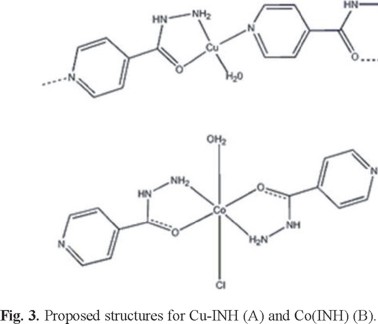
<body><![CDATA[<p align="justify"><font face="verdana" size="2">On the other hand, the Co&#45;INH is a pale pink powder, typically of octahedral complexes &#91;31&#93;. It is known that high spin six coordinate cobalt(II) complexes generally show, in a visible region, a multiple structured band assigned to <sup>4</sup>T<sub>1g</sub>(F) &rarr; <sup>4</sup>T<sub>1g</sub>(P) &#91;30&#93;. In the reflectance spectrum of Co&#45;INH three bands at 606, 695 and 725 nm, and a shoulder at 668 nm are observed.</font></p>  	    <p align="justify"><font face="verdana" size="2"><i>EPR spectra</i></font></p>  	    <p align="justify"><font face="verdana" size="2">The EPR spectrum of a polycrystalline sample of Cu&#45;INH at X&#45;band is shown in <a href="#f2">Figure 2</a>.</font></p>  	    <p align="center"><font face="verdana" size="2"><a name="f2"></a></font></p>  	    <p align="center"><font face="verdana" size="2"><img src="/img/revistas/jmcs/v57n3/a7f2.jpg"></font></p>  	    <p align="justify"><font face="verdana" size="2">This spectrum shows two main resonances centered around 290 and 325 mT and that are attributed to transitions allowed by the interaction between the magnetic moment of the unpaired electron and the spectrometer magnetic field (Zeeman interaction). Those two resonances are characteristic of an axially symmetric paramagnetic center with principal components of the g&#45;tensor given by g<sub>&perp;</sub> = 2.023 and g<sub>//</sub> = 2.236 as calculated directly from the resonance positions (in units of magnetic field) and from the frequency of microwave radiation used in the experiment. The relation g<sub>//</sub> &gt; g<sub>&perp;</sub> indicates that the unpaired electron is in a d<sub>x</sub><sup>2</sup><sub>&#45;y</sub><sup>2</sup> ground state orbital. Copper ions have nuclear spin of 3/2 that would give rise to extra resonance lines in their spectrum (hyperfine interaction). However, no such lines are observed in <a href="#f2">Figure 2</a>, which is a situation usually found in the cases where copper &#45; copper interactions are observed &#91;32&#45;36&#93;.</font></p>  	    <p align="justify"><font face="verdana" size="2">It is also worth noting the absence of extra resonances for both low (below 275 mT) and high (above 375 mT) fields and also of the so&#45;called half&#45;field transition, which is typical of copper pairs &#91;37&#93;. Together these features suggest that the copper ions in Cu&#45;INH are arranged as a polymeric structure in the solid state, as shown in <a href="#f3">Figure 3</a>.</font></p>  	    <p align="center"><font face="verdana" size="2"><a name="f3"></a></font></p>  	    <p align="center"><font face="verdana" size="2"><img src="/img/revistas/jmcs/v57n3/a7f3.jpg"></font></p>  	    <p align="justify"><font face="verdana" size="2">As a result of the experimental analytical data and the spectroscopic studies (IR, UV&#45;Vis and EPR) the proposed structures for the complexes are shown in <a href="#f3">Figure 3</a>.</font></p>  	    ]]></body>
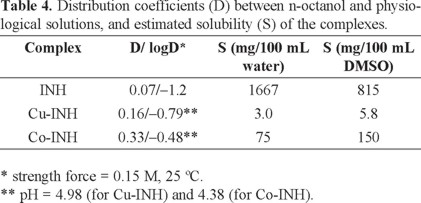
<body><![CDATA[<p align="justify"><font face="verdana" size="2"><i>Lipophilicity and solubility</i></font></p>  	    <p align="justify"><font face="verdana" size="2">Before the study of lipophilicity, the stability of complexes in physiological solution was determined. A thin&#45;layer chromatography using the experimental conditions presented in 3.4 was performed. The solutions analyzed were: saturated solution of Cu&#45;INH in physiological serum, saturated solution of Cu&#45;INH in water, saturated solution of Co&#45;INH in physiological serum and saturated solution of Co&#45;INH in water. After the experiment, only one spot was observed in each Co&#45;INH chromatogram and the R<sub>f</sub> were 0.73 in both solutions, showing that the presence of Cl<sup>&#45;</sup>does not affect the species in the physiological solution. The same behavior was observed in the case of Cu&#45;INH but the R<sub>f</sub> was almost 0 according to the low solubility of the complex in methanol.</font></p>  	    <p align="justify"><font face="verdana" size="2">With the aim to determine the lipophilic character of the complexes that can be correlated with biological properties like the passage through lipophilic barriers, distribution coefficients (D) between n&#45;octanol and physiological solutions were determined. Besides, the solubility in water and DMSO was estimated. These results are presented in <a href="#c4">Table 4</a>.</font></p>  	    <p align="center"><font face="verdana" size="2"><a name="c4"></a></font></p>  	    <p align="center"><font face="verdana" size="2"><img src="/img/revistas/jmcs/v57n3/a7c4.jpg"></font></p>  	    <p align="justify"><font face="verdana" size="2">The D values obtained for the complexes are higher than that of the free ligand. According to the results shown in <a href="#c4">Table 4</a>, the compound most soluble in water (isoniazid) was the less lipophilic while both complexes presented lower solubility and were more lipophilic than isoniazid, as expected.</font></p>  	    <p align="justify"><font face="verdana" size="2">The solubilities in DMSO are higher than the values obtained in aqueous solution. For this reason this solvent was used in the microbiological assays.</font></p>  	    <p align="justify"><font face="verdana" size="2"><i>Anti&#45;M. tuberculosis activity and cytotoxicity on mammalian cells</i></font></p>  	    <p align="justify"><font face="verdana" size="2">The minimum inhibitory concentration (MIC) values against <i>M. tuberculosis</i>, the IC<sub>50</sub> and the selectivity index of the metal&#45;INH complexes and the free ligand are presented in <a href="#c5">Table 5</a>. None of the metallic salt dilutions (CuSO<sub>4</sub> and CoCl<sub>2</sub>), used as control, inhibited the growth of mycobacterium. In the case of Cu&#45;INH, the molecular weight of the monomeric complex was used to calculate the MIC, due to the uncertainty in knowing the molecular weight in solution. If polymeric structures exist in solution the calculated MIC values expressed in &micro;M will be lower.</font></p>  	    <p align="center"><font face="verdana" size="2"><a name="c5"></a></font></p>  	    ]]></body>
<body><![CDATA[<p align="center"><font face="verdana" size="2"><img src="/img/revistas/jmcs/v57n3/a7c5.jpg"></font></p>  	    <p align="justify"><font face="verdana" size="2">As <a href="#c5">table 5</a> shows, both complexes were active against <i>M. tuberculosis</i>. The MIC values are lower than that of the ethambutol (MIC = 5.62 &#956;g/mL, 27.5 &#956;M) and p&#45;aminosalicylic (MIC = 1.25 &#956;g/mL, 8.16 &#956;M), antimycobacterial agents in clinical use.</font></p>  	    <p align="justify"><font face="verdana" size="2">Besides, Cu&#45;INH complex (MIC = 2.2 &#956;M) is less active than isoniazid (MIC = 0.063&#956;g/mL, 0.46 &#956;M) while Co&#45;INH (MIC = 0.41 &#956;M) has similar activity but both complexes presented MIC values well below 25 &micro;g/mL, considered as a limit to continue the anti&#45;mycobacterial studies, according to pipeline by Pavan <i>et al.</i>&#91;38&#93;.</font></p>  	    <p align="justify"><font face="verdana" size="2">One thing to note is that Co&#45;INH was more active than Cu&#45;INH and more lipophilic. However, isoniazid was less lipophilic than the complexes but it was the most active one. INH is a prodrug which is active after transformation, by a peroxidase, to isonicotinic acid that inhibits the synthesis of the mycolic acid required for the biosynthesis of mycobacterial cell wall &#91;9&#93;. INH enters into the cell by passive transportation &#91;39&#93; &#91;40&#93;. In spite of its polarity this molecule is a very powerful drug. In the case of our complexes, two mechanisms would be possible: the complexes would pass through the cell wall by a different mechanism than isoniazid or they would act through a different mechanism of action. Due to the fact that the mode of action of isoniazid requires the biotransformation to isonicotinic acid, the stable coordination to a metal center would block the whole process leading to an inactivation of isoniazid. In our case, both new metal complexes are active allowing to conclude that the mode of action of the complexes could be completely different to that of free isoniazid. If this hypothesis could be verified through further studies these compounds would be good drug candidates.</font></p>  	    <p align="justify"><font face="verdana" size="2">Another interesting aspect of these complexes is the cytotoxicity shown on two different mammalian cells lineages. The models chosen were the VERO (ATCC CCL81) and J774.A1 (ATCC TIB&#45;67) cells. VERO cells are considered normal cells and do not represent any disease. These cells are largely used as phenotypic screening in drug discovery in response of the cytotoxicity of the compounds. J774A.1 are macrophage cells, that represent the first ones of the immunological response. Also, mycobacteria has the ability to survive inside them. All the complexes showed moderate cytotoxicity on these cell lines and good selectivity indexes (<a href="#c5">Table 5</a>).</font></p>  	    <p align="justify"><font face="verdana" size="2">As a conclusion, the synthesis and characterization of two new isoniazid complexes are reported. According to the spectroscopic analysis the copper complex presents a polymeric structure where the isoniazid acts as a bridge between two different copper ions, coordinating through the heterocyclic nitrogen, the amine and carbonyl groups.</font></p>  	    <p align="justify"><font face="verdana" size="2">The cobalt complex presents an octahedral geometry where the isoniazid is a bidentate ligand. These two examples show the versatility of isoniazid as ligand.</font></p>  	    <p align="justify"><font face="verdana" size="2">Both complexes were active against <i>M. tuberculosis</i> showed MIC values well below 25 &micro;g/mL considered as a limit to continue the antimycobacterium studies. Besides, they showed low cytotoxicity on different mammalian cell lines and consequently they presented high selectivity indexes.</font></p>  	    <p align="justify"><font face="verdana" size="2">Due to these results, Cu&#45;INH and Co&#45;INH are interesting candidates for further studies.</font></p>  	    <p align="justify"><font face="verdana" size="2">&nbsp;</font></p>  	    ]]></body>
<body><![CDATA[<p align="justify"><font face="verdana" size="2"><b>Experimental</b></font></p>  	    <p align="justify"><font face="verdana" size="2">All starting materials were commercially available research&#45;grade chemicals and were used without further purification.</font></p>  	    <p align="justify"><font face="verdana" size="2"><b>Synthesis</b></font></p>  	    <p align="justify"><font face="verdana" size="2">The copper and cobalt complexes were synthesized mixing aqueous solutions of CuSO<sub>4</sub><sup>.</sup>5H<sub>2</sub>O (0.55 mmol, 137 mg) or CoCl<sub>2</sub>.6H<sub>2</sub>O</font></p>  	    <p align="justify"><font face="verdana" size="2">(0.55 mmol, 130 mg) and isoniazid (1.10 mmol, 150 mg) with continuous stirring for 30 min. The resulting green or pink precipitates corresponding to copper or cobalt complexes respectively were filtered, washed with small portions of water and dried at room temperature.</font></p>  	    <p align="justify"><font face="verdana" size="2">The elemental analysis was performed with a Carlo Erba EA1108 elemental analyser. Sulphate was identified by precipitation with BaCl<sub>2</sub> and chloride was quantified through a potentiometric method using AgNO<sub>3</sub>.</font></p>  	    <p align="justify"><font face="verdana" size="2"><b>Thermogravimetric and conductimetric measurements</b></font></p>  	    <p align="justify"><font face="verdana" size="2">Thermogravimetric measurements were performed with a Shimadzu TGA 50 thermobalance, with a platinum cell, working under flowing air (50 mL min<sup>&#45;1</sup>) and at a heating rate of 0.5 &deg;C min<sup>&#45;1</sup> until 80 &ordm;C and 1 &deg;C min<sup>&#45;1</sup> above 80 &ordm;C.</font></p>  	    <p align="justify"><font face="verdana" size="2">Conductimetric measurements using a Conductivity Meter 4310 Jenway were performed at 25 &deg;C in a DMSO solution (10<sup>&#45;4</sup> M), solvent used in the microbiological assays. The stability of the complexes in this solvent was followed by measuring conductivity of these solutions for 48 h of the dissolution and compared with the initial conductivity.</font></p>  	    <p align="justify"><font face="verdana" size="2"><b>Spectroscopic measurements</b></font></p>  	    ]]></body>
<body><![CDATA[<p align="justify"><font face="verdana" size="2">IR spectra, in the range between 4000 and 200 cm<sup>&#45;1</sup>, were recorded on a Bomem M 102 FTIR spectrophotometer using the KBr pellet technique.</font></p>  	    <p align="justify"><font face="verdana" size="2">Electronic spectra of complexes in a Nujol suspension were registered on a Shimadzu UV&#45;1603 spectrophotometer.</font></p>  	    <p align="justify"><font face="verdana" size="2">Room temperature EPR measurements of the copper complex were carried out on polycrystalline samples using a JEOL JES&#45;FA200 spectrometer. The experimental parameters were: microwave frequency, 9.4 GHz; microwave power, 10 mW; field modulation.</font></p>  	    <p align="justify"><font face="verdana" size="2">EPR measurements of the copper complex were carried out on polycrystalline samples using an X&#45;band Varian E109 spectrometer. The experimental parameters were microwave frequency: 9.4 GHz, microwave power: 10 mW, field modulation: 100 kHz, modulation amplitude: 0.2 mT, time constant: 0.03 s, scan time: 2 min. The parameters were optimized to avoid saturation and/or distortions.</font></p>  	    <p align="justify"><font face="verdana" size="2"><b>Thin&#45;layer chromatography</b></font></p>  	    <p align="justify"><font face="verdana" size="2">With the aim of studying the stability of complexes in physiological solution and in water, a thin&#45;layer chromatography was performed with a saturated solution of complexes in both solvents. A silica gel G, 250 &#956;m plate and a CH<sub>3</sub>OH: NH<sub>3</sub> (100:1.5) solution as a mobile phase were used. 10 &#956;L of each solution (saturated solution of Cu&#45;INH and Co&#45;INH in physiological solution, and saturated solutions of Cu&#45;INH and Co&#45;INH in water) were seeded in the plate. After the chromatography, the spots were detected with UV lamp &#91;41&#93;.</font></p>  	    <p align="justify"><font face="verdana" size="2"><b>Lipophilicity test and solubility</b></font></p>  	    <p align="justify"><font face="verdana" size="2">Lipophilicity tests at 25 &ordm;C were performed determining the partition coefficient (P) between n&#45;octanol and physiological solution &#91;42&#93;. The concentration of the compounds in the physiological solution before and after the contact with n&#45;octanol was determined by UV spectroscopy at 260 nm. This isoniazid band does not shift with complexation.</font></p>  	    <p align="justify"><font face="verdana" size="2">The solubility at 37 &deg;C in water and DMSO was also estimated.</font></p>  	    <p align="justify"><font face="verdana" size="2"><b>Anti&#45;<i>M. tuberculosis</i> activity</b></font></p>  	    ]]></body>
<body><![CDATA[<p align="justify"><font face="verdana" size="2">The anti&#45;MTB activity of the compounds was determined by the REMA (Resazurin Microtiter Assay) method according to Palomino <i>et al</i>, 2002 &#91;43&#93;. Stock solutions of the tested compounds were prepared in dimethyl sulfoxide (DMSO) and diluted in Middlebrook 7H9 broth (Difco) supplemented with oleic acid, albumin, dextrose and catalase (OADC enrichment &#45; BBL/Becton&#45;Dickinson), to obtain final drug concentration ranges of 0.09&#45;25 &micro;g/mL. The isoniazid was dissolved in distilled water, and used as standard drug. A suspension of the MTB H<sub>37</sub>Rv ATCC 27294 was cultured in Middlebrook 7H9 broth supplemented with OADC and 0.05% Tween 80. The culture was frozen at &#45;80 &ordm;C in aliquots. After two days was carried out the CFU/mL of a aliquot. The concentration was adjusted by 5x10<sup>5</sup> CFU/mL and 100 &micro;L of the inoculum was added to each well of a 96&#45;well microplate together with 100 &micro;L of the compounds. Samples were set up in triplicate. The plate was incubated for 7 days at 37 &deg;C. After 24 h, 30 &micro;L of 0.01% resazurin (solubilized in water) was added. The fluorescence of the wells was read after 24 h in a TECAN Spectrafluor<sup>&reg;</sup>. The MIC was defined as the lowest concentration resulting in 90% inhibition of growth of MTB.</font></p>  	    <p align="justify"><font face="verdana" size="2"><b>Cytotoxicity on mammalian cells</b></font></p>  	    <p align="justify"><font face="verdana" size="2"><i>In vitro</i> cytotoxicity assays (IC<sub>50</sub>) were performed first on the VERO epithelial cells (ATCC CCL81). Compounds with low cytotoxicity were investigated on the J774A.1 (ATCC TIB&#45;67) mouse cell line. Both studies as recommended by Pavan et al. 2010 &#91;44&#93;. The cells were routinely maintained in complete medium (DMEM for VERO and RPMI&#45;1640 (VitroCell<sup>&reg;</sup>) for J774A.1) supplemented with 10% heat&#45;inactivated fetal bovine serum (FBS) plus gentamicin (50 mg/L) and anfotericin B (2 mg/L), at 37 &deg;C, in a humidified 5% CO<sub>2</sub> atmosphere. After reaching confluence, the cells were detached and counted. For the cytotoxicity assay, 1 &times; 10<sup>5</sup> cells/mL were seeded in 200 &#956;L of complete medium in 96&#45;well plates (NUNC<sup>tm</sup>). The plates were incubated at same conditions for 24 h, to allow cell adhesion prior to drug testing. The compounds were dissolved in DMSO (5%) and subjected to two&#45;fold serial dilution from 1250 to 3.9 &#956;g/mL. Cells were exposed to the compounds at various concentrations for 24 h. Resazurin solution was then added to the cell cultures and incubated for 6 h. Cell respiration, as an indicator of cell viability was detected by reduction of resazurin to resorufin, whose pink colour and fluorescence indicates cell viability. A persistent blue colour of resazurin is a sign of cell death. The fluorescence measurements (530 nm excitation filter and 590 nm emission filter) were performed in a Tecan Spectrafluor Plus microfluorimeter. The IC<sub>50</sub> value was defined as the highest drug concentration at which 50% of the cells are viable relative to the control. Each test was set up in triplicate.</font></p>  	    <p align="justify"><font face="verdana" size="2"><b>Selectivity Index</b></font></p>  	    <p align="justify"><font face="verdana" size="2">The selectivity index (SI) was calculated by dividing IC<sub>50</sub> for the VERO cells by the MIC for the pathogen; if the SI is &ge;10, the compound is then investigated further.</font></p>  	    <p align="justify"><font face="verdana" size="2">&nbsp;</font></p>  	    <p align="justify"><font face="verdana" size="2"><b>Acknowledgements</b></font></p>  	    <p align="justify"><font face="verdana" size="2">The authors thank CYTED network (209RT0380), FAPESP (process. 2009/06499&#45;1 and 2011/11593&#45;7), ANII for the scholarship of Mariana Poggi (BE_INI_2010_1851) and Dr. Jorge Castiglioni for the collaboration on the thermogravimetric assays.</font></p>  	    <p align="justify"><font face="verdana" size="2">&nbsp;</font></p>  	    <p align="justify"><font face="verdana" size="2"><b>References</b></font></p>  	    ]]></body>
<body><![CDATA[<!-- ref --><p align="justify"><font face="verdana" size="2">1. World Health Organization, Global Tuberculosis Report 2012, <b>2012</b>, 3.    &nbsp;&nbsp;&nbsp;&nbsp;&nbsp;&nbsp;&nbsp;&nbsp;[&#160;<a href="javascript:void(0);" onclick="javascript: window.open('/scielo.php?script=sci_nlinks&ref=4945414&pid=S1870-249X201300030000700001&lng=','','width=640,height=500,resizable=yes,scrollbars=1,menubar=yes,');">Links</a>&#160;]<!-- end-ref --></font></p>  	    <!-- ref --><p align="justify"><font face="verdana" size="2">2. Koul, A.; Arnoult, E., Lounis, N.;Guillemont, J.; Andries, K. <i>Nature</i> <b>2011</b>, <i>469</i>, 483&#45;490.    &nbsp;&nbsp;&nbsp;&nbsp;&nbsp;&nbsp;&nbsp;&nbsp;[&#160;<a href="javascript:void(0);" onclick="javascript: window.open('/scielo.php?script=sci_nlinks&ref=4945416&pid=S1870-249X201300030000700002&lng=','','width=640,height=500,resizable=yes,scrollbars=1,menubar=yes,');">Links</a>&#160;]<!-- end-ref --></font></p>  	    <!-- ref --><p align="justify"><font face="verdana" size="2">3. Wolff, M.E., <i>Burger's Medicinal Chemistry and Drug Discovery</i>, Vol. 2. John Wiley &amp; Sons. Laguna Beach, <b>1996</b>.    &nbsp;&nbsp;&nbsp;&nbsp;&nbsp;&nbsp;&nbsp;&nbsp;[&#160;<a href="javascript:void(0);" onclick="javascript: window.open('/scielo.php?script=sci_nlinks&ref=4945418&pid=S1870-249X201300030000700003&lng=','','width=640,height=500,resizable=yes,scrollbars=1,menubar=yes,');">Links</a>&#160;]<!-- end-ref --></font></p>  	    <!-- ref --><p align="justify"><font face="verdana" size="2">4. Sweetman, S.C., <i>Martindale. Gu&iacute;a completa de consulta farmacoterap&eacute;utica</i>, Pharma Editores. Barcelona, <b>2008</b>.    &nbsp;&nbsp;&nbsp;&nbsp;&nbsp;&nbsp;&nbsp;&nbsp;[&#160;<a href="javascript:void(0);" onclick="javascript: window.open('/scielo.php?script=sci_nlinks&ref=4945420&pid=S1870-249X201300030000700004&lng=','','width=640,height=500,resizable=yes,scrollbars=1,menubar=yes,');">Links</a>&#160;]<!-- end-ref --></font></p>  	    <!-- ref --><p align="justify"><font face="verdana" size="2">5. Gambino, D.; Otero, L. <i>Inorg. Chim. Acta</i> <b>2012</b>, <i>393</i>, 103&#45;114.    &nbsp;&nbsp;&nbsp;&nbsp;&nbsp;&nbsp;&nbsp;&nbsp;[&#160;<a href="javascript:void(0);" onclick="javascript: window.open('/scielo.php?script=sci_nlinks&ref=4945422&pid=S1870-249X201300030000700005&lng=','','width=640,height=500,resizable=yes,scrollbars=1,menubar=yes,');">Links</a>&#160;]<!-- end-ref --></font></p>  	    ]]></body>
<body><![CDATA[<!-- ref --><p align="justify"><font face="verdana" size="2">6. Ruiz&#45;Azuara, L.; Bravo&#45;G&oacute;mez, M.E. <i>Curr. Med. Chem.</i> <b>2010</b>, <i>17</i>, 3606&#45;3615.    &nbsp;&nbsp;&nbsp;&nbsp;&nbsp;&nbsp;&nbsp;&nbsp;[&#160;<a href="javascript:void(0);" onclick="javascript: window.open('/scielo.php?script=sci_nlinks&ref=4945424&pid=S1870-249X201300030000700006&lng=','','width=640,height=500,resizable=yes,scrollbars=1,menubar=yes,');">Links</a>&#160;]<!-- end-ref --></font></p>  	    <!-- ref --><p align="justify"><font face="verdana" size="2">7. Ballin, J.C. <i>JAMA</i>, <b>1974</b>, <i>230,</i> 8, 1184&#45;1185.    &nbsp;&nbsp;&nbsp;&nbsp;&nbsp;&nbsp;&nbsp;&nbsp;[&#160;<a href="javascript:void(0);" onclick="javascript: window.open('/scielo.php?script=sci_nlinks&ref=4945426&pid=S1870-249X201300030000700007&lng=','','width=640,height=500,resizable=yes,scrollbars=1,menubar=yes,');">Links</a>&#160;]<!-- end-ref --></font></p>  	    <!-- ref --><p align="justify"><font face="verdana" size="2">8. Cuin, A.; Massabni, A.C.; Leite, C.Q.; Sato, D.N.; Neves, A.; Szpoganicz, B.; Silva, M.S.; Bortoluzzi, A. J. <i>J. Inorg. Biochem.</i> <b>2007</b>, <i>101,</i> 291&#45;296.    &nbsp;&nbsp;&nbsp;&nbsp;&nbsp;&nbsp;&nbsp;&nbsp;[&#160;<a href="javascript:void(0);" onclick="javascript: window.open('/scielo.php?script=sci_nlinks&ref=4945428&pid=S1870-249X201300030000700008&lng=','','width=640,height=500,resizable=yes,scrollbars=1,menubar=yes,');">Links</a>&#160;]<!-- end-ref --></font></p>  	    <!-- ref --><p align="justify"><font face="verdana" size="2">9. Oliveira, J. S.; Douza, E. H.S.; Basso, L.A.; Palaci, M.; Dietze, R.; Santos, D. S.; Moreira, I.S. <i>Chem. Commun.</i> <b>2004</b>, 312&#45;313.    &nbsp;&nbsp;&nbsp;&nbsp;&nbsp;&nbsp;&nbsp;&nbsp;[&#160;<a href="javascript:void(0);" onclick="javascript: window.open('/scielo.php?script=sci_nlinks&ref=4945430&pid=S1870-249X201300030000700009&lng=','','width=640,height=500,resizable=yes,scrollbars=1,menubar=yes,');">Links</a>&#160;]<!-- end-ref --></font></p>  	    <!-- ref --><p align="justify"><font face="verdana" size="2">10. Sousa, E.H.S.; Pontes, D.L.; Di&oacute;genes, I.C.N.; Lopes, L.G.F.; Oliveira, J.S.; Basso, L.A.; Santos, D. S.; Moreira, I.S. <i>J. Inorg. Biochem.</i> <b>2005</b>, <i>99</i>, 368&#45;375.    &nbsp;&nbsp;&nbsp;&nbsp;&nbsp;&nbsp;&nbsp;&nbsp;[&#160;<a href="javascript:void(0);" onclick="javascript: window.open('/scielo.php?script=sci_nlinks&ref=4945432&pid=S1870-249X201300030000700010&lng=','','width=640,height=500,resizable=yes,scrollbars=1,menubar=yes,');">Links</a>&#160;]<!-- end-ref --></font></p>  	    ]]></body>
<body><![CDATA[<!-- ref --><p align="justify"><font face="verdana" size="2">11. Oliveira , J. S.; Sousa, E. H. S.; Basso, L. A.; Palaci, M.; Dietze , R.; Santos, D. S.; Moreira, &Iacute;caro S. <i>Chem. Commun.</i><b>2004,</b> <i>3</i>, 312&#45;313.    &nbsp;&nbsp;&nbsp;&nbsp;&nbsp;&nbsp;&nbsp;&nbsp;[&#160;<a href="javascript:void(0);" onclick="javascript: window.open('/scielo.php?script=sci_nlinks&ref=4945434&pid=S1870-249X201300030000700011&lng=','','width=640,height=500,resizable=yes,scrollbars=1,menubar=yes,');">Links</a>&#160;]<!-- end-ref --></font></p>  	    <!-- ref --><p align="justify"><font face="verdana" size="2">12. Pavan, F. R.; Poelhsitz, G.V.; Barbosa, M. I. F.; Leite, S. R. A.; Batista, A. A.; Ellena, J.; Sato, L. S.; Franzblau, S.G.; Moreno, V.; Gambino, D.; Leite, C. Q. F. <i>Eur. J. Med. Chem.</i><b>2011</b>, <i>46</i>, 10, 5099&#45;5107.    &nbsp;&nbsp;&nbsp;&nbsp;&nbsp;&nbsp;&nbsp;&nbsp;[&#160;<a href="javascript:void(0);" onclick="javascript: window.open('/scielo.php?script=sci_nlinks&ref=4945436&pid=S1870-249X201300030000700012&lng=','','width=640,height=500,resizable=yes,scrollbars=1,menubar=yes,');">Links</a>&#160;]<!-- end-ref --></font></p>  	    <!-- ref --><p align="justify"><font face="verdana" size="2">13. Maccari, R.; Ottan&agrave;, R.;Bottari, B.; Rotondo, E.; Vigorita, M.G. <i>Bioorg. Med. Chem. Letters,</i> <b>2004</b>, <i>14</i>, 23, 5731&#45;5733.    &nbsp;&nbsp;&nbsp;&nbsp;&nbsp;&nbsp;&nbsp;&nbsp;[&#160;<a href="javascript:void(0);" onclick="javascript: window.open('/scielo.php?script=sci_nlinks&ref=4945438&pid=S1870-249X201300030000700013&lng=','','width=640,height=500,resizable=yes,scrollbars=1,menubar=yes,');">Links</a>&#160;]<!-- end-ref --></font></p>  	    <!-- ref --><p align="justify"><font face="verdana" size="2">14. Carmo, A.M.L.; Silva, F.M. C.; Machado, P. A.; Fontes, A.P.S.; Pavan, F. R.; Leite, C.Q.F.; Leite, S. R. De A.; Coimbra, E.S.; Da Silva, A.D. <i>Biom. Pharm.</i> <b>2011</b>, <i>65</i>, 3, 204&#45;209.    &nbsp;&nbsp;&nbsp;&nbsp;&nbsp;&nbsp;&nbsp;&nbsp;[&#160;<a href="javascript:void(0);" onclick="javascript: window.open('/scielo.php?script=sci_nlinks&ref=4945440&pid=S1870-249X201300030000700014&lng=','','width=640,height=500,resizable=yes,scrollbars=1,menubar=yes,');">Links</a>&#160;]<!-- end-ref --></font></p>  	    <!-- ref --><p align="justify"><font face="verdana" size="2">15. Tarallo; M.B.; Urquiola, C; Monge Vega, A.; Paraj&oacute;n Costa, B.; Ribeiro, R. R.;Costa&#45;Filho, A.J.; Mercader, R.C.; Pavan, F.; Leite, C.Q.; Torre, M.H.; Gambino, D. <i>J. Inorg. Biochem.</i> <b>2010</b>, <i>104</i>, 11, 1164&#45;1170.    &nbsp;&nbsp;&nbsp;&nbsp;&nbsp;&nbsp;&nbsp;&nbsp;[&#160;<a href="javascript:void(0);" onclick="javascript: window.open('/scielo.php?script=sci_nlinks&ref=4945442&pid=S1870-249X201300030000700015&lng=','','width=640,height=500,resizable=yes,scrollbars=1,menubar=yes,');">Links</a>&#160;]<!-- end-ref --></font></p>  	    ]]></body>
<body><![CDATA[<!-- ref --><p align="justify"><font face="verdana" size="2">16. Tarallo; M.B.; Costa&#45;Filho, A.J.;Viera, E.; Monge Vega, A.;Leite, C.Q.; Pavan, F.; Borthagaray, G.; Gambino, D.; Torre, M.H. <i>J. Argent. Chem. Soc.</i> <b>2009</b>, <i>97</i>, 1, 80&#45;89.    &nbsp;&nbsp;&nbsp;&nbsp;&nbsp;&nbsp;&nbsp;&nbsp;[&#160;<a href="javascript:void(0);" onclick="javascript: window.open('/scielo.php?script=sci_nlinks&ref=4945444&pid=S1870-249X201300030000700016&lng=','','width=640,height=500,resizable=yes,scrollbars=1,menubar=yes,');">Links</a>&#160;]<!-- end-ref --></font></p>  	    <!-- ref --><p align="justify"><font face="verdana" size="2">17. Mondelli, M; Pavan, F.; De Souza; Leite, C.Q.; Ellena, J.; Nascimento, O.R.; Facchin, G.; Torre, M.H. <i>J. Mol. Struct.</i><b>2012</b>, <i>1036</i>, 180&#45;187.    &nbsp;&nbsp;&nbsp;&nbsp;&nbsp;&nbsp;&nbsp;&nbsp;[&#160;<a href="javascript:void(0);" onclick="javascript: window.open('/scielo.php?script=sci_nlinks&ref=4945446&pid=S1870-249X201300030000700017&lng=','','width=640,height=500,resizable=yes,scrollbars=1,menubar=yes,');">Links</a>&#160;]<!-- end-ref --></font></p>  	    <!-- ref --><p align="justify"><font face="verdana" size="2">18. Mondelli, M;Brun&eacute; V.; Borthagaray, G.; Ellena, J.; Nascimento, O.R.; Leite, C.Q.; Batista, A.A.; Torre, M.H. <i>J. Inorg. Biochem.</i> <b>2008</b>, <i>102,</i> 285&#45;292.    &nbsp;&nbsp;&nbsp;&nbsp;&nbsp;&nbsp;&nbsp;&nbsp;[&#160;<a href="javascript:void(0);" onclick="javascript: window.open('/scielo.php?script=sci_nlinks&ref=4945448&pid=S1870-249X201300030000700018&lng=','','width=640,height=500,resizable=yes,scrollbars=1,menubar=yes,');">Links</a>&#160;]<!-- end-ref --></font></p>  	    <!-- ref --><p align="justify"><font face="verdana" size="2">19. Kremer, E; Facchin, G; Est&eacute;vez, E.;Albor&eacute;s P.;Baran, E.J.;Ellena; Torre, M.T. <i>J. Inorg. Biochem.</i> <b>2006</b>, <i>100,</i> 1167&#45;1175.    &nbsp;&nbsp;&nbsp;&nbsp;&nbsp;&nbsp;&nbsp;&nbsp;[&#160;<a href="javascript:void(0);" onclick="javascript: window.open('/scielo.php?script=sci_nlinks&ref=4945450&pid=S1870-249X201300030000700019&lng=','','width=640,height=500,resizable=yes,scrollbars=1,menubar=yes,');">Links</a>&#160;]<!-- end-ref --></font></p>  	    <!-- ref --><p align="justify"><font face="verdana" size="2">20. Bernstein, J.;Lott, W.A.; Steinberg, B.S.; Yale, H.L. <i>Am. Rev. Tuberc.</i><b>1952</b>, <i>65</i>, 357&#45;364.    &nbsp;&nbsp;&nbsp;&nbsp;&nbsp;&nbsp;&nbsp;&nbsp;[&#160;<a href="javascript:void(0);" onclick="javascript: window.open('/scielo.php?script=sci_nlinks&ref=4945452&pid=S1870-249X201300030000700020&lng=','','width=640,height=500,resizable=yes,scrollbars=1,menubar=yes,');">Links</a>&#160;]<!-- end-ref --></font></p>  	    ]]></body>
<body><![CDATA[<!-- ref --><p align="justify"><font face="verdana" size="2">21. Middlebrook, G. <i>Am. Rev. Tuberc.</i><b>1952</b>, <i>65</i>, 765&#45;767.    &nbsp;&nbsp;&nbsp;&nbsp;&nbsp;&nbsp;&nbsp;&nbsp;[&#160;<a href="javascript:void(0);" onclick="javascript: window.open('/scielo.php?script=sci_nlinks&ref=4945454&pid=S1870-249X201300030000700021&lng=','','width=640,height=500,resizable=yes,scrollbars=1,menubar=yes,');">Links</a>&#160;]<!-- end-ref --></font></p>  	    <!-- ref --><p align="justify"><font face="verdana" size="2">22. Geary, W.J. <i>Coord. Chem. Rev.</i><b>1971,</b> <i>7</i>, 81&#45;122.    &nbsp;&nbsp;&nbsp;&nbsp;&nbsp;&nbsp;&nbsp;&nbsp;[&#160;<a href="javascript:void(0);" onclick="javascript: window.open('/scielo.php?script=sci_nlinks&ref=4945456&pid=S1870-249X201300030000700022&lng=','','width=640,height=500,resizable=yes,scrollbars=1,menubar=yes,');">Links</a>&#160;]<!-- end-ref --></font></p>  	    <!-- ref --><p align="justify"><font face="verdana" size="2">23. Broomhead, J.A.; Kane&#45;Maguire, L.A.P. <i>J. Chem. Soc. A</i>, <b>1967</b>, 546&#45;553.    &nbsp;&nbsp;&nbsp;&nbsp;&nbsp;&nbsp;&nbsp;&nbsp;[&#160;<a href="javascript:void(0);" onclick="javascript: window.open('/scielo.php?script=sci_nlinks&ref=4945458&pid=S1870-249X201300030000700023&lng=','','width=640,height=500,resizable=yes,scrollbars=1,menubar=yes,');">Links</a>&#160;]<!-- end-ref --></font></p>  	    <!-- ref --><p align="justify"><font face="verdana" size="2">24. Lin&#45;Vien, D.; Colthup, N.B.; Fateley, W.G.; Grasselli, J.G. <i>The Handbook of Infrared and Raman Characteristic Frequencies of Organic Molecules</i>, Academic Press inc., Boston, <b>1991</b>.    &nbsp;&nbsp;&nbsp;&nbsp;&nbsp;&nbsp;&nbsp;&nbsp;[&#160;<a href="javascript:void(0);" onclick="javascript: window.open('/scielo.php?script=sci_nlinks&ref=4945460&pid=S1870-249X201300030000700024&lng=','','width=640,height=500,resizable=yes,scrollbars=1,menubar=yes,');">Links</a>&#160;]<!-- end-ref --></font></p>  	    <!-- ref --><p align="justify"><font face="verdana" size="2">25. Gunasekaran, S.; Sailatha,E.;Seshadri, S.;Kumaresan, S. <i>Indian J. Pure Ap. Phy.</i> <b>2009</b>, <i>47</i>, 12&#45;18.    &nbsp;&nbsp;&nbsp;&nbsp;&nbsp;&nbsp;&nbsp;&nbsp;[&#160;<a href="javascript:void(0);" onclick="javascript: window.open('/scielo.php?script=sci_nlinks&ref=4945462&pid=S1870-249X201300030000700025&lng=','','width=640,height=500,resizable=yes,scrollbars=1,menubar=yes,');">Links</a>&#160;]<!-- end-ref --></font></p>  	    ]]></body>
<body><![CDATA[<!-- ref --><p align="justify"><font face="verdana" size="2">26. Nakamoto, K. <i>Infrared and Raman Spectra of Inorganic and Coordination Compounds.</i> Part B. 5, John Wiley and Sons, New York, <b>1997</b>.    &nbsp;&nbsp;&nbsp;&nbsp;&nbsp;&nbsp;&nbsp;&nbsp;[&#160;<a href="javascript:void(0);" onclick="javascript: window.open('/scielo.php?script=sci_nlinks&ref=4945464&pid=S1870-249X201300030000700026&lng=','','width=640,height=500,resizable=yes,scrollbars=1,menubar=yes,');">Links</a>&#160;]<!-- end-ref --></font></p>  	    <!-- ref --><p align="justify"><font face="verdana" size="2">27. Tang, X.; Dou, W.; Chen, S.; Dang, F.; Liu, W. <i>Spectrochim. Acta Part A.</i> <b>2007</b>, <i>68,</i> 349&#45;353.    &nbsp;&nbsp;&nbsp;&nbsp;&nbsp;&nbsp;&nbsp;&nbsp;[&#160;<a href="javascript:void(0);" onclick="javascript: window.open('/scielo.php?script=sci_nlinks&ref=4945466&pid=S1870-249X201300030000700027&lng=','','width=640,height=500,resizable=yes,scrollbars=1,menubar=yes,');">Links</a>&#160;]<!-- end-ref --></font></p>  	    <!-- ref --><p align="justify"><font face="verdana" size="2">28. Nelwamondoa, A. N.;Eveb, D. J.; Watkinsb, G. M.;Brown, M. E. <i>Thermochim. Acta.</i> <b>1998,</b> <i>318</i>, 165&#45;175.    &nbsp;&nbsp;&nbsp;&nbsp;&nbsp;&nbsp;&nbsp;&nbsp;[&#160;<a href="javascript:void(0);" onclick="javascript: window.open('/scielo.php?script=sci_nlinks&ref=4945468&pid=S1870-249X201300030000700028&lng=','','width=640,height=500,resizable=yes,scrollbars=1,menubar=yes,');">Links</a>&#160;]<!-- end-ref --></font></p>  	    <!-- ref --><p align="justify"><font face="verdana" size="2">29. Smith, B. <i>Infrared Spectral Interpretation. A Systemic Approach</i>, CRS Press, Boca Rat&oacute;n, <b>1998</b>.    &nbsp;&nbsp;&nbsp;&nbsp;&nbsp;&nbsp;&nbsp;&nbsp;[&#160;<a href="javascript:void(0);" onclick="javascript: window.open('/scielo.php?script=sci_nlinks&ref=4945470&pid=S1870-249X201300030000700029&lng=','','width=640,height=500,resizable=yes,scrollbars=1,menubar=yes,');">Links</a>&#160;]<!-- end-ref --></font></p>  	    <!-- ref --><p align="justify"><font face="verdana" size="2">30. Lever, A.B.P., <i>Inorganic Electronic Spectroscopy</i>, Elsevier, New York, <b>1984</b>.    &nbsp;&nbsp;&nbsp;&nbsp;&nbsp;&nbsp;&nbsp;&nbsp;[&#160;<a href="javascript:void(0);" onclick="javascript: window.open('/scielo.php?script=sci_nlinks&ref=4945472&pid=S1870-249X201300030000700030&lng=','','width=640,height=500,resizable=yes,scrollbars=1,menubar=yes,');">Links</a>&#160;]<!-- end-ref --></font></p>  	    ]]></body>
<body><![CDATA[<!-- ref --><p align="justify"><font face="verdana" size="2">31. Cotton, F. A.; Wilkinson, G.; Murillo, C.A.; Bochmenn, M., <i>Advanced Inorganic Chemistry</i>, 6th Ed., Wiley &amp; sons, New York, <b>1999</b>.    &nbsp;&nbsp;&nbsp;&nbsp;&nbsp;&nbsp;&nbsp;&nbsp;[&#160;<a href="javascript:void(0);" onclick="javascript: window.open('/scielo.php?script=sci_nlinks&ref=4945474&pid=S1870-249X201300030000700031&lng=','','width=640,height=500,resizable=yes,scrollbars=1,menubar=yes,');">Links</a>&#160;]<!-- end-ref --></font></p>  	    <!-- ref --><p align="justify"><font face="verdana" size="2">32. Viera, I.; Gomez, M.A.; Ellena, J.; Costa&#45;Filho, A.J.;Migliaro, E.R.; Dominguez, L.; Torre, M.H. <i>Polyhedron</i>. <b>2009</b>, <i>28</i>, 3647&#45;3653.    &nbsp;&nbsp;&nbsp;&nbsp;&nbsp;&nbsp;&nbsp;&nbsp;[&#160;<a href="javascript:void(0);" onclick="javascript: window.open('/scielo.php?script=sci_nlinks&ref=4945476&pid=S1870-249X201300030000700032&lng=','','width=640,height=500,resizable=yes,scrollbars=1,menubar=yes,');">Links</a>&#160;]<!-- end-ref --></font></p>  	    <!-- ref --><p align="justify"><font face="verdana" size="2">33. Facchin, G.; Kremer, E.; Barrios, D.; Etcheverry, S.A.;Costa&#45;Filho, A.J.; Torre, M.H. <i>Polyhedron.</i> <b>2009</b>, <i>28</i>, 2329&#45;2334.    &nbsp;&nbsp;&nbsp;&nbsp;&nbsp;&nbsp;&nbsp;&nbsp;[&#160;<a href="javascript:void(0);" onclick="javascript: window.open('/scielo.php?script=sci_nlinks&ref=4945478&pid=S1870-249X201300030000700033&lng=','','width=640,height=500,resizable=yes,scrollbars=1,menubar=yes,');">Links</a>&#160;]<!-- end-ref --></font></p>  	    <!-- ref --><p align="justify"><font face="verdana" size="2">34. Das, K.; Sinha, C.; Datta, A.; Garribba, E.; Fondo, M.; Mautner, F.A. ; Fischer, R.C. <i>J. Chem. Res.</i><b>2012</b>, 36, <i>12,</i> 722&#45;725.    &nbsp;&nbsp;&nbsp;&nbsp;&nbsp;&nbsp;&nbsp;&nbsp;[&#160;<a href="javascript:void(0);" onclick="javascript: window.open('/scielo.php?script=sci_nlinks&ref=4945480&pid=S1870-249X201300030000700034&lng=','','width=640,height=500,resizable=yes,scrollbars=1,menubar=yes,');">Links</a>&#160;]<!-- end-ref --></font></p>  	    <!-- ref --><p align="justify"><font face="verdana" size="2">35. Sanmartin, J.; Bermejo, M.R.; Garcia&#45;Deibe, A.M. <i>Inorg. Chim. Acta</i>. <b>2001</b>, <i>318</i>, 1&#45;2, 135&#45;142.    &nbsp;&nbsp;&nbsp;&nbsp;&nbsp;&nbsp;&nbsp;&nbsp;[&#160;<a href="javascript:void(0);" onclick="javascript: window.open('/scielo.php?script=sci_nlinks&ref=4945482&pid=S1870-249X201300030000700035&lng=','','width=640,height=500,resizable=yes,scrollbars=1,menubar=yes,');">Links</a>&#160;]<!-- end-ref --></font></p>  	    ]]></body>
<body><![CDATA[<!-- ref --><p align="justify"><font face="verdana" size="2">36. Urquiola, C.; Gambino, D.; Cabrera, M.; Lavaggi, M.L.;Cerecetto, H.; Gonzalez, M.; Lopez de Cerain, A.; Monge Vega, A.; Costa&#45;Filho, A.J.; Torre, M.H. <i>J. Inorg. Biochem.</i> <b>2008</b>, <i>102</i>, 1, 119&#45;126.    &nbsp;&nbsp;&nbsp;&nbsp;&nbsp;&nbsp;&nbsp;&nbsp;[&#160;<a href="javascript:void(0);" onclick="javascript: window.open('/scielo.php?script=sci_nlinks&ref=4945484&pid=S1870-249X201300030000700036&lng=','','width=640,height=500,resizable=yes,scrollbars=1,menubar=yes,');">Links</a>&#160;]<!-- end-ref --></font></p>  	    <!-- ref --><p align="justify"><font face="verdana" size="2">37. Bencini, A.;Gatteschi, D., <i>Electron Paramagnetic Resonance of Exchange Coupled Systems</i>, Springer&#45;Verlag, Berlin, <b>1990</b>.    &nbsp;&nbsp;&nbsp;&nbsp;&nbsp;&nbsp;&nbsp;&nbsp;[&#160;<a href="javascript:void(0);" onclick="javascript: window.open('/scielo.php?script=sci_nlinks&ref=4945486&pid=S1870-249X201300030000700037&lng=','','width=640,height=500,resizable=yes,scrollbars=1,menubar=yes,');">Links</a>&#160;]<!-- end-ref --></font></p>  	    <!-- ref --><p align="justify"><font face="verdana" size="2">38. Pavan, F. R.; Sato, D. N.; Leite, C. Q. F. <i>An approach to the search for new drugs against tuberculosis</i>. In: Cardona, P.J. (Ed.). <i>Mycobacterium tuberculosis</i>, book 2. Intech, <b>2011</b>.    &nbsp;&nbsp;&nbsp;&nbsp;&nbsp;&nbsp;&nbsp;&nbsp;[&#160;<a href="javascript:void(0);" onclick="javascript: window.open('/scielo.php?script=sci_nlinks&ref=4945488&pid=S1870-249X201300030000700038&lng=','','width=640,height=500,resizable=yes,scrollbars=1,menubar=yes,');">Links</a>&#160;]<!-- end-ref --></font></p>  	    <!-- ref --><p align="justify"><font face="verdana" size="2">39. Bardou, F.; Raynaud, C.; Ramos, C.; Laneelle, M.A,; Laneelle, G. <i>Microbiology.</i> <b>1998</b>, <i>144</i>, 2539&#45;2544.    &nbsp;&nbsp;&nbsp;&nbsp;&nbsp;&nbsp;&nbsp;&nbsp;[&#160;<a href="javascript:void(0);" onclick="javascript: window.open('/scielo.php?script=sci_nlinks&ref=4945490&pid=S1870-249X201300030000700039&lng=','','width=640,height=500,resizable=yes,scrollbars=1,menubar=yes,');">Links</a>&#160;]<!-- end-ref --></font></p>  	    <!-- ref --><p align="justify"><font face="verdana" size="2">40. Scior, T.; Garc&eacute;s&#45;Eisele, S.J. <i>Curr. Med. Chem.</i> <b>2006</b><i>, 13,</i> 2205&#45;2219.    &nbsp;&nbsp;&nbsp;&nbsp;&nbsp;&nbsp;&nbsp;&nbsp;[&#160;<a href="javascript:void(0);" onclick="javascript: window.open('/scielo.php?script=sci_nlinks&ref=4945492&pid=S1870-249X201300030000700040&lng=','','width=640,height=500,resizable=yes,scrollbars=1,menubar=yes,');">Links</a>&#160;]<!-- end-ref --></font></p>  	    ]]></body>
<body><![CDATA[<!-- ref --><p align="justify"><font face="verdana" size="2">41. Poole C.F. <i>Thin&#45;layer Chromatography.</i> In: Moffat, A.C.; Osselton, M.D.; Widdop, B.; Watts, J.(Eds.). <i>Clarke's Analysis of Drugs and Poisons</i>, Pharmaceutical Press, <b>2011</b>.    &nbsp;&nbsp;&nbsp;&nbsp;&nbsp;&nbsp;&nbsp;&nbsp;[&#160;<a href="javascript:void(0);" onclick="javascript: window.open('/scielo.php?script=sci_nlinks&ref=4945494&pid=S1870-249X201300030000700041&lng=','','width=640,height=500,resizable=yes,scrollbars=1,menubar=yes,');">Links</a>&#160;]<!-- end-ref --></font></p>  	    <!-- ref --><p align="justify"><font face="verdana" size="2">42. Leo, A.; Hansch, C. D.; Elkins, <i>J. Chem. Soc.</i> <b>1971</b>, <i>71</i>, 525&#45;616.    &nbsp;&nbsp;&nbsp;&nbsp;&nbsp;&nbsp;&nbsp;&nbsp;[&#160;<a href="javascript:void(0);" onclick="javascript: window.open('/scielo.php?script=sci_nlinks&ref=4945496&pid=S1870-249X201300030000700042&lng=','','width=640,height=500,resizable=yes,scrollbars=1,menubar=yes,');">Links</a>&#160;]<!-- end-ref --></font></p>      <!-- ref --><p align="justify"><font face="verdana" size="2">43. Palomino, J.C.; Martin, A., Camacho, M.; Guerra, H.; Swings, J.; Portaela, F. <i>Antimicrob. Agents Chemother</i>. <b>2002</b>, <i>46</i>, 2720&#45;2722.    &nbsp;&nbsp;&nbsp;&nbsp;&nbsp;&nbsp;&nbsp;&nbsp;[&#160;<a href="javascript:void(0);" onclick="javascript: window.open('/scielo.php?script=sci_nlinks&ref=4945498&pid=S1870-249X201300030000700043&lng=','','width=640,height=500,resizable=yes,scrollbars=1,menubar=yes,');">Links</a>&#160;]<!-- end-ref --></font></p>  	    <!-- ref --><p align="justify"><font face="verdana" size="2">44. Pavan, F.R.; Maia, P.I.S.; Leite, S.R.A.; Deflon, V.M.; Batista, A.A.; Sato, D.N.; Franzblau, S.G.; Leite, C.Q.F. <i>Eur. J. Med. Chem.</i> <b>2010</b>, <i>45</i>, 1898&#45;1905.    &nbsp;&nbsp;&nbsp;&nbsp;&nbsp;&nbsp;&nbsp;&nbsp;[&#160;<a href="javascript:void(0);" onclick="javascript: window.open('/scielo.php?script=sci_nlinks&ref=4945500&pid=S1870-249X201300030000700044&lng=','','width=640,height=500,resizable=yes,scrollbars=1,menubar=yes,');">Links</a>&#160;]<!-- end-ref --></font></p>      ]]></body><back>
<ref-list>
<ref id="B1">
<label>1</label><nlm-citation citation-type="">
<source><![CDATA[World Health Organization, Global Tuberculosis Report 2012]]></source>
<year>2012</year>
<volume>3</volume>
</nlm-citation>
</ref>
<ref id="B2">
<label>2</label><nlm-citation citation-type="journal">
<person-group person-group-type="author">
<name>
<surname><![CDATA[Koul]]></surname>
<given-names><![CDATA[A.]]></given-names>
</name>
<name>
<surname><![CDATA[Arnoult]]></surname>
<given-names><![CDATA[E.]]></given-names>
</name>
<name>
<surname><![CDATA[Lounis]]></surname>
<given-names><![CDATA[N.]]></given-names>
</name>
<name>
<surname><![CDATA[Guillemont]]></surname>
<given-names><![CDATA[J.]]></given-names>
</name>
<name>
<surname><![CDATA[Andries]]></surname>
<given-names><![CDATA[K.]]></given-names>
</name>
</person-group>
<source><![CDATA[Nature]]></source>
<year>2011</year>
<volume>469</volume>
<page-range>483-490</page-range></nlm-citation>
</ref>
<ref id="B3">
<label>3</label><nlm-citation citation-type="book">
<person-group person-group-type="author">
<name>
<surname><![CDATA[Wolff]]></surname>
<given-names><![CDATA[M.E.]]></given-names>
</name>
</person-group>
<source><![CDATA[Burger's Medicinal Chemistry and Drug Discovery]]></source>
<year>1996</year>
<volume>2</volume>
<publisher-loc><![CDATA[Laguna Beach ]]></publisher-loc>
<publisher-name><![CDATA[John Wiley & Sons]]></publisher-name>
</nlm-citation>
</ref>
<ref id="B4">
<label>4</label><nlm-citation citation-type="book">
<person-group person-group-type="author">
<name>
<surname><![CDATA[Sweetman]]></surname>
<given-names><![CDATA[S.C.]]></given-names>
</name>
</person-group>
<source><![CDATA[Martindale. Guía completa de consulta farmacoterapéutica]]></source>
<year>2008</year>
<publisher-loc><![CDATA[Barcelona ]]></publisher-loc>
<publisher-name><![CDATA[Pharma Editores]]></publisher-name>
</nlm-citation>
</ref>
<ref id="B5">
<label>5</label><nlm-citation citation-type="journal">
<person-group person-group-type="author">
<name>
<surname><![CDATA[Gambino]]></surname>
<given-names><![CDATA[D.]]></given-names>
</name>
<name>
<surname><![CDATA[Otero]]></surname>
<given-names><![CDATA[L.]]></given-names>
</name>
</person-group>
<source><![CDATA[Inorg. Chim. Acta]]></source>
<year>2012</year>
<volume>393</volume>
<page-range>103-114</page-range></nlm-citation>
</ref>
<ref id="B6">
<label>6</label><nlm-citation citation-type="journal">
<person-group person-group-type="author">
<name>
<surname><![CDATA[Ruiz-Azuara]]></surname>
<given-names><![CDATA[L.]]></given-names>
</name>
<name>
<surname><![CDATA[Bravo-Gómez]]></surname>
<given-names><![CDATA[M.E.]]></given-names>
</name>
</person-group>
<source><![CDATA[Curr. Med. Chem.]]></source>
<year>2010</year>
<volume>17</volume>
<page-range>3606-3615</page-range></nlm-citation>
</ref>
<ref id="B7">
<label>7</label><nlm-citation citation-type="journal">
<person-group person-group-type="author">
<name>
<surname><![CDATA[Ballin]]></surname>
<given-names><![CDATA[J.C.]]></given-names>
</name>
</person-group>
<source><![CDATA[JAMA]]></source>
<year>1974</year>
<volume>230</volume>
<numero>8</numero>
<issue>8</issue>
<page-range>1184-1185</page-range></nlm-citation>
</ref>
<ref id="B8">
<label>8</label><nlm-citation citation-type="journal">
<person-group person-group-type="author">
<name>
<surname><![CDATA[Cuin]]></surname>
<given-names><![CDATA[A.]]></given-names>
</name>
<name>
<surname><![CDATA[Massabni]]></surname>
<given-names><![CDATA[A.C.]]></given-names>
</name>
<name>
<surname><![CDATA[Leite]]></surname>
<given-names><![CDATA[C.Q.]]></given-names>
</name>
<name>
<surname><![CDATA[Sato]]></surname>
<given-names><![CDATA[D.N.]]></given-names>
</name>
<name>
<surname><![CDATA[Neves]]></surname>
<given-names><![CDATA[A.]]></given-names>
</name>
<name>
<surname><![CDATA[Szpoganicz]]></surname>
<given-names><![CDATA[B.]]></given-names>
</name>
<name>
<surname><![CDATA[Silva]]></surname>
<given-names><![CDATA[M.S.]]></given-names>
</name>
<name>
<surname><![CDATA[Bortoluzzi]]></surname>
<given-names><![CDATA[A. J.]]></given-names>
</name>
</person-group>
<source><![CDATA[J. Inorg. Biochem.]]></source>
<year>2007</year>
<volume>101</volume>
<page-range>291-296</page-range></nlm-citation>
</ref>
<ref id="B9">
<label>9</label><nlm-citation citation-type="journal">
<person-group person-group-type="author">
<name>
<surname><![CDATA[Oliveira]]></surname>
<given-names><![CDATA[J. S.]]></given-names>
</name>
<name>
<surname><![CDATA[Douza]]></surname>
<given-names><![CDATA[E. H.S.]]></given-names>
</name>
<name>
<surname><![CDATA[Basso]]></surname>
<given-names><![CDATA[L.A.]]></given-names>
</name>
<name>
<surname><![CDATA[Palaci]]></surname>
<given-names><![CDATA[M.]]></given-names>
</name>
<name>
<surname><![CDATA[Dietze]]></surname>
<given-names><![CDATA[R.]]></given-names>
</name>
<name>
<surname><![CDATA[Santos]]></surname>
<given-names><![CDATA[D. S.]]></given-names>
</name>
<name>
<surname><![CDATA[Moreira]]></surname>
<given-names><![CDATA[I.S.]]></given-names>
</name>
</person-group>
<source><![CDATA[Chem. Commun.]]></source>
<year>2004</year>
<page-range>312-313</page-range></nlm-citation>
</ref>
<ref id="B10">
<label>10</label><nlm-citation citation-type="journal">
<person-group person-group-type="author">
<name>
<surname><![CDATA[Sousa]]></surname>
<given-names><![CDATA[E.H.S.]]></given-names>
</name>
<name>
<surname><![CDATA[Pontes]]></surname>
<given-names><![CDATA[D.L.]]></given-names>
</name>
<name>
<surname><![CDATA[Diógenes]]></surname>
<given-names><![CDATA[I.C.N.]]></given-names>
</name>
<name>
<surname><![CDATA[Lopes]]></surname>
<given-names><![CDATA[L.G.F.]]></given-names>
</name>
<name>
<surname><![CDATA[Oliveira]]></surname>
<given-names><![CDATA[J.S.]]></given-names>
</name>
<name>
<surname><![CDATA[Basso]]></surname>
<given-names><![CDATA[L.A.]]></given-names>
</name>
<name>
<surname><![CDATA[Santos]]></surname>
<given-names><![CDATA[D. S.]]></given-names>
</name>
<name>
<surname><![CDATA[Moreira]]></surname>
<given-names><![CDATA[I.S.]]></given-names>
</name>
</person-group>
<source><![CDATA[J. Inorg. Biochem.]]></source>
<year>2005</year>
<volume>99</volume>
<page-range>368-375</page-range></nlm-citation>
</ref>
<ref id="B11">
<label>11</label><nlm-citation citation-type="journal">
<person-group person-group-type="author">
<name>
<surname><![CDATA[Oliveira]]></surname>
<given-names><![CDATA[J. S.]]></given-names>
</name>
<name>
<surname><![CDATA[Sousa]]></surname>
<given-names><![CDATA[E. H. S.]]></given-names>
</name>
<name>
<surname><![CDATA[Basso]]></surname>
<given-names><![CDATA[L. A.]]></given-names>
</name>
<name>
<surname><![CDATA[Palaci]]></surname>
<given-names><![CDATA[M.]]></given-names>
</name>
<name>
<surname><![CDATA[Dietze]]></surname>
<given-names><![CDATA[R.]]></given-names>
</name>
<name>
<surname><![CDATA[Santos]]></surname>
<given-names><![CDATA[D. S.]]></given-names>
</name>
<name>
<surname><![CDATA[Moreira]]></surname>
<given-names><![CDATA[Ícaro S.]]></given-names>
</name>
</person-group>
<source><![CDATA[Chem. Commun.]]></source>
<year>2004</year>
<volume>3</volume>
<page-range>312-313</page-range></nlm-citation>
</ref>
<ref id="B12">
<label>12</label><nlm-citation citation-type="journal">
<person-group person-group-type="author">
<name>
<surname><![CDATA[Pavan]]></surname>
<given-names><![CDATA[F. R.]]></given-names>
</name>
<name>
<surname><![CDATA[Poelhsitz]]></surname>
<given-names><![CDATA[G.V.]]></given-names>
</name>
<name>
<surname><![CDATA[Barbosa]]></surname>
<given-names><![CDATA[M. I. F.]]></given-names>
</name>
<name>
<surname><![CDATA[Leite]]></surname>
<given-names><![CDATA[S. R. A.]]></given-names>
</name>
<name>
<surname><![CDATA[Batista]]></surname>
<given-names><![CDATA[A. A.]]></given-names>
</name>
<name>
<surname><![CDATA[Ellena]]></surname>
<given-names><![CDATA[J.]]></given-names>
</name>
<name>
<surname><![CDATA[Sato]]></surname>
<given-names><![CDATA[L. S.]]></given-names>
</name>
<name>
<surname><![CDATA[Franzblau]]></surname>
<given-names><![CDATA[S.G.]]></given-names>
</name>
<name>
<surname><![CDATA[Moreno]]></surname>
<given-names><![CDATA[V.]]></given-names>
</name>
<name>
<surname><![CDATA[Gambino]]></surname>
<given-names><![CDATA[D.]]></given-names>
</name>
<name>
<surname><![CDATA[Leite]]></surname>
<given-names><![CDATA[C. Q. F.]]></given-names>
</name>
</person-group>
<source><![CDATA[Eur. J. Med. Chem.]]></source>
<year>2011</year>
<volume>46</volume>
<numero>10</numero>
<issue>10</issue>
<page-range>5099-5107</page-range></nlm-citation>
</ref>
<ref id="B13">
<label>13</label><nlm-citation citation-type="journal">
<person-group person-group-type="author">
<name>
<surname><![CDATA[Maccari]]></surname>
<given-names><![CDATA[R.]]></given-names>
</name>
<name>
<surname><![CDATA[Ottanà]]></surname>
<given-names><![CDATA[R.]]></given-names>
</name>
<name>
<surname><![CDATA[Bottari]]></surname>
<given-names><![CDATA[B.]]></given-names>
</name>
<name>
<surname><![CDATA[Rotondo]]></surname>
<given-names><![CDATA[E.]]></given-names>
</name>
<name>
<surname><![CDATA[Vigorita]]></surname>
<given-names><![CDATA[M.G.]]></given-names>
</name>
</person-group>
<source><![CDATA[Bioorg. Med. Chem. Letters]]></source>
<year>2004</year>
<volume>14</volume>
<numero>23</numero>
<issue>23</issue>
<page-range>5731-5733</page-range></nlm-citation>
</ref>
<ref id="B14">
<label>14</label><nlm-citation citation-type="journal">
<person-group person-group-type="author">
<name>
<surname><![CDATA[Carmo]]></surname>
<given-names><![CDATA[A.M.L.]]></given-names>
</name>
<name>
<surname><![CDATA[Silva]]></surname>
<given-names><![CDATA[F.M. C.]]></given-names>
</name>
<name>
<surname><![CDATA[Machado]]></surname>
<given-names><![CDATA[P. A.]]></given-names>
</name>
<name>
<surname><![CDATA[Fontes]]></surname>
<given-names><![CDATA[A.P.S.]]></given-names>
</name>
<name>
<surname><![CDATA[Pavan]]></surname>
<given-names><![CDATA[F. R.]]></given-names>
</name>
<name>
<surname><![CDATA[Leite]]></surname>
<given-names><![CDATA[C.Q.F.]]></given-names>
</name>
<name>
<surname><![CDATA[Leite, S. R. De]]></surname>
<given-names><![CDATA[A.]]></given-names>
</name>
<name>
<surname><![CDATA[Coimbra]]></surname>
<given-names><![CDATA[E.S.]]></given-names>
</name>
<name>
<surname><![CDATA[Da Silva]]></surname>
<given-names><![CDATA[A.D.]]></given-names>
</name>
</person-group>
<source><![CDATA[Biom. Pharm.]]></source>
<year>2011</year>
<volume>65</volume>
<numero>3</numero>
<issue>3</issue>
<page-range>204-209</page-range></nlm-citation>
</ref>
<ref id="B15">
<label>15</label><nlm-citation citation-type="journal">
<person-group person-group-type="author">
<name>
<surname><![CDATA[Tarallo;]]></surname>
<given-names><![CDATA[M.B.]]></given-names>
</name>
<name>
<surname><![CDATA[Urquiola]]></surname>
<given-names><![CDATA[C]]></given-names>
</name>
<name>
<surname><![CDATA[Monge Vega]]></surname>
<given-names><![CDATA[A.]]></given-names>
</name>
<name>
<surname><![CDATA[Parajón Costa]]></surname>
<given-names><![CDATA[B.]]></given-names>
</name>
<name>
<surname><![CDATA[Ribeiro]]></surname>
<given-names><![CDATA[R. R.]]></given-names>
</name>
<name>
<surname><![CDATA[Costa-Filho]]></surname>
<given-names><![CDATA[A.J.]]></given-names>
</name>
<name>
<surname><![CDATA[Mercader]]></surname>
<given-names><![CDATA[R.C.]]></given-names>
</name>
<name>
<surname><![CDATA[Pavan]]></surname>
<given-names><![CDATA[F.]]></given-names>
</name>
<name>
<surname><![CDATA[Leite]]></surname>
<given-names><![CDATA[C.Q.]]></given-names>
</name>
<name>
<surname><![CDATA[Torre]]></surname>
<given-names><![CDATA[M.H.]]></given-names>
</name>
<name>
<surname><![CDATA[Gambino]]></surname>
<given-names><![CDATA[D.]]></given-names>
</name>
</person-group>
<source><![CDATA[J. Inorg. Biochem.]]></source>
<year>2010</year>
<volume>104</volume>
<page-range>11, 1164-1170</page-range></nlm-citation>
</ref>
<ref id="B16">
<label>16</label><nlm-citation citation-type="journal">
<person-group person-group-type="author">
<name>
<surname><![CDATA[Tarallo;]]></surname>
<given-names><![CDATA[M.B.]]></given-names>
</name>
<name>
<surname><![CDATA[Costa-Filho]]></surname>
<given-names><![CDATA[A.J.]]></given-names>
</name>
<name>
<surname><![CDATA[Viera]]></surname>
<given-names><![CDATA[E.]]></given-names>
</name>
<name>
<surname><![CDATA[Monge Vega]]></surname>
<given-names><![CDATA[A.]]></given-names>
</name>
<name>
<surname><![CDATA[Leite]]></surname>
<given-names><![CDATA[C.Q.]]></given-names>
</name>
<name>
<surname><![CDATA[Pavan]]></surname>
<given-names><![CDATA[F.]]></given-names>
</name>
<name>
<surname><![CDATA[Borthagaray]]></surname>
<given-names><![CDATA[G.]]></given-names>
</name>
<name>
<surname><![CDATA[Gambino]]></surname>
<given-names><![CDATA[D.]]></given-names>
</name>
<name>
<surname><![CDATA[Torre]]></surname>
<given-names><![CDATA[M.H.]]></given-names>
</name>
</person-group>
<source><![CDATA[J. Argent. Chem. Soc.]]></source>
<year>2009</year>
<volume>97</volume>
<numero>1</numero>
<issue>1</issue>
<page-range>80-89</page-range></nlm-citation>
</ref>
<ref id="B17">
<label>17</label><nlm-citation citation-type="journal">
<person-group person-group-type="author">
<name>
<surname><![CDATA[Mondelli]]></surname>
<given-names><![CDATA[M]]></given-names>
</name>
<name>
<surname><![CDATA[Pavan]]></surname>
<given-names><![CDATA[F.]]></given-names>
</name>
<name>
<surname><![CDATA[De Souza; Leite]]></surname>
<given-names><![CDATA[C.Q.]]></given-names>
</name>
<name>
<surname><![CDATA[Ellena]]></surname>
<given-names><![CDATA[J.]]></given-names>
</name>
<name>
<surname><![CDATA[Nascimento]]></surname>
<given-names><![CDATA[O.R.]]></given-names>
</name>
<name>
<surname><![CDATA[Facchin]]></surname>
<given-names><![CDATA[G.]]></given-names>
</name>
<name>
<surname><![CDATA[Torre]]></surname>
<given-names><![CDATA[M.H.]]></given-names>
</name>
</person-group>
<source><![CDATA[J. Mol. Struct.]]></source>
<year>2012</year>
<volume>1036</volume>
<page-range>180-187</page-range></nlm-citation>
</ref>
<ref id="B18">
<label>18</label><nlm-citation citation-type="journal">
<person-group person-group-type="author">
<name>
<surname><![CDATA[Mondelli]]></surname>
<given-names><![CDATA[M]]></given-names>
</name>
<name>
<surname><![CDATA[Bruné]]></surname>
<given-names><![CDATA[V.]]></given-names>
</name>
<name>
<surname><![CDATA[Borthagaray]]></surname>
<given-names><![CDATA[G.]]></given-names>
</name>
<name>
<surname><![CDATA[Ellena]]></surname>
<given-names><![CDATA[J.]]></given-names>
</name>
<name>
<surname><![CDATA[Nascimento]]></surname>
<given-names><![CDATA[O.R.]]></given-names>
</name>
<name>
<surname><![CDATA[Leite]]></surname>
<given-names><![CDATA[C.Q.]]></given-names>
</name>
<name>
<surname><![CDATA[Batista]]></surname>
<given-names><![CDATA[A.A.]]></given-names>
</name>
<name>
<surname><![CDATA[Torre]]></surname>
<given-names><![CDATA[M.H.]]></given-names>
</name>
</person-group>
<source><![CDATA[J. Inorg. Biochem.]]></source>
<year>2008</year>
<volume>102</volume>
<page-range>285-292</page-range></nlm-citation>
</ref>
<ref id="B19">
<label>19</label><nlm-citation citation-type="journal">
<person-group person-group-type="author">
<name>
<surname><![CDATA[Kremer]]></surname>
<given-names><![CDATA[E]]></given-names>
</name>
<name>
<surname><![CDATA[Facchin]]></surname>
<given-names><![CDATA[G]]></given-names>
</name>
<name>
<surname><![CDATA[Estévez]]></surname>
<given-names><![CDATA[E.]]></given-names>
</name>
<name>
<surname><![CDATA[Alborés]]></surname>
<given-names><![CDATA[P.]]></given-names>
</name>
<name>
<surname><![CDATA[Baran]]></surname>
<given-names><![CDATA[E.J.]]></given-names>
</name>
<name>
<surname><![CDATA[Ellena; Torre]]></surname>
<given-names><![CDATA[M.T.]]></given-names>
</name>
</person-group>
<source><![CDATA[J. Inorg. Biochem.]]></source>
<year>2006</year>
<volume>100</volume>
<page-range>1167-1175</page-range></nlm-citation>
</ref>
<ref id="B20">
<label>20</label><nlm-citation citation-type="journal">
<person-group person-group-type="author">
<name>
<surname><![CDATA[Bernstein]]></surname>
<given-names><![CDATA[J.]]></given-names>
</name>
<name>
<surname><![CDATA[Lott]]></surname>
<given-names><![CDATA[W.A.]]></given-names>
</name>
<name>
<surname><![CDATA[Steinberg]]></surname>
<given-names><![CDATA[B.S.]]></given-names>
</name>
<name>
<surname><![CDATA[Yale]]></surname>
<given-names><![CDATA[H.L.]]></given-names>
</name>
</person-group>
<source><![CDATA[Am. Rev. Tuberc.]]></source>
<year>1952</year>
<volume>65</volume>
<page-range>357-364</page-range></nlm-citation>
</ref>
<ref id="B21">
<label>21</label><nlm-citation citation-type="journal">
<person-group person-group-type="author">
<name>
<surname><![CDATA[Middlebrook]]></surname>
<given-names><![CDATA[G.]]></given-names>
</name>
</person-group>
<source><![CDATA[Am. Rev. Tuberc.]]></source>
<year>1952</year>
<volume>65</volume>
<page-range>765-767</page-range></nlm-citation>
</ref>
<ref id="B22">
<label>22</label><nlm-citation citation-type="journal">
<person-group person-group-type="author">
<name>
<surname><![CDATA[Geary]]></surname>
<given-names><![CDATA[W.J.]]></given-names>
</name>
</person-group>
<source><![CDATA[Coord. Chem. Rev.]]></source>
<year>1971</year>
<volume>7</volume>
<page-range>81-122</page-range></nlm-citation>
</ref>
<ref id="B23">
<label>23</label><nlm-citation citation-type="journal">
<person-group person-group-type="author">
<name>
<surname><![CDATA[Broomhead]]></surname>
<given-names><![CDATA[J.A.]]></given-names>
</name>
<name>
<surname><![CDATA[Kane-Maguire]]></surname>
<given-names><![CDATA[L.A.P.]]></given-names>
</name>
</person-group>
<source><![CDATA[J. Chem. Soc. A]]></source>
<year>1967</year>
<page-range>546-553</page-range></nlm-citation>
</ref>
<ref id="B24">
<label>24</label><nlm-citation citation-type="book">
<person-group person-group-type="author">
<name>
<surname><![CDATA[Lin-Vien]]></surname>
<given-names><![CDATA[D.]]></given-names>
</name>
<name>
<surname><![CDATA[Colthup]]></surname>
<given-names><![CDATA[N.B.]]></given-names>
</name>
<name>
<surname><![CDATA[Fateley]]></surname>
<given-names><![CDATA[W.G.]]></given-names>
</name>
<name>
<surname><![CDATA[Grasselli]]></surname>
<given-names><![CDATA[J.G.]]></given-names>
</name>
</person-group>
<source><![CDATA[The Handbook of Infrared and Raman Characteristic Frequencies of Organic Molecules]]></source>
<year>1991</year>
<publisher-loc><![CDATA[Boston ]]></publisher-loc>
<publisher-name><![CDATA[Academic Press inc.]]></publisher-name>
</nlm-citation>
</ref>
<ref id="B25">
<label>25</label><nlm-citation citation-type="journal">
<person-group person-group-type="author">
<name>
<surname><![CDATA[Gunasekaran]]></surname>
<given-names><![CDATA[S.]]></given-names>
</name>
<name>
<surname><![CDATA[Sailatha,E.;Seshadri]]></surname>
<given-names><![CDATA[S.]]></given-names>
</name>
<name>
<surname><![CDATA[Kumaresan]]></surname>
<given-names><![CDATA[S.]]></given-names>
</name>
</person-group>
<source><![CDATA[Indian J. Pure Ap. Phy.]]></source>
<year>2009</year>
<volume>47</volume>
<page-range>12-18</page-range></nlm-citation>
</ref>
<ref id="B26">
<label>26</label><nlm-citation citation-type="book">
<person-group person-group-type="author">
<name>
<surname><![CDATA[Nakamoto]]></surname>
<given-names><![CDATA[K.]]></given-names>
</name>
</person-group>
<source><![CDATA[Infrared and Raman Spectra of Inorganic and Coordination Compounds. Part B.]]></source>
<year>1997</year>
<volume>5</volume>
<publisher-loc><![CDATA[New York ]]></publisher-loc>
<publisher-name><![CDATA[John Wiley and Sons]]></publisher-name>
</nlm-citation>
</ref>
<ref id="B27">
<label>27</label><nlm-citation citation-type="journal">
<person-group person-group-type="author">
<name>
<surname><![CDATA[Tang]]></surname>
<given-names><![CDATA[X.]]></given-names>
</name>
<name>
<surname><![CDATA[Dou]]></surname>
<given-names><![CDATA[W.]]></given-names>
</name>
<name>
<surname><![CDATA[Chen]]></surname>
<given-names><![CDATA[S.]]></given-names>
</name>
<name>
<surname><![CDATA[Dang]]></surname>
<given-names><![CDATA[F.]]></given-names>
</name>
<name>
<surname><![CDATA[Liu]]></surname>
<given-names><![CDATA[W.]]></given-names>
</name>
</person-group>
<source><![CDATA[Spectrochim. Acta Part A]]></source>
<year>2007</year>
<volume>68</volume>
<page-range>349-353</page-range></nlm-citation>
</ref>
<ref id="B28">
<label>28</label><nlm-citation citation-type="journal">
<person-group person-group-type="author">
<name>
<surname><![CDATA[Nelwamondoa]]></surname>
<given-names><![CDATA[A. N.]]></given-names>
</name>
<name>
<surname><![CDATA[Eveb]]></surname>
<given-names><![CDATA[D. J.]]></given-names>
</name>
<name>
<surname><![CDATA[Watkinsb]]></surname>
<given-names><![CDATA[G. M.]]></given-names>
</name>
<name>
<surname><![CDATA[Brown]]></surname>
<given-names><![CDATA[M. E.]]></given-names>
</name>
</person-group>
<source><![CDATA[Thermochim. Acta.]]></source>
<year>1998</year>
<volume>318</volume>
<page-range>165-175</page-range></nlm-citation>
</ref>
<ref id="B29">
<label>29</label><nlm-citation citation-type="book">
<person-group person-group-type="author">
<name>
<surname><![CDATA[Smith]]></surname>
<given-names><![CDATA[B.]]></given-names>
</name>
</person-group>
<source><![CDATA[Infrared Spectral Interpretation. A Systemic Approach]]></source>
<year>1998</year>
<publisher-loc><![CDATA[Boca Ratón ]]></publisher-loc>
<publisher-name><![CDATA[CRS Press]]></publisher-name>
</nlm-citation>
</ref>
<ref id="B30">
<label>30</label><nlm-citation citation-type="book">
<person-group person-group-type="author">
<name>
<surname><![CDATA[Lever]]></surname>
<given-names><![CDATA[A.B.P.]]></given-names>
</name>
</person-group>
<source><![CDATA[Inorganic Electronic Spectroscopy]]></source>
<year>1984</year>
<publisher-loc><![CDATA[New York ]]></publisher-loc>
<publisher-name><![CDATA[Elsevier]]></publisher-name>
</nlm-citation>
</ref>
<ref id="B31">
<label>31</label><nlm-citation citation-type="book">
<person-group person-group-type="author">
<name>
<surname><![CDATA[Cotton]]></surname>
<given-names><![CDATA[F. A.]]></given-names>
</name>
<name>
<surname><![CDATA[Wilkinson]]></surname>
<given-names><![CDATA[G.]]></given-names>
</name>
<name>
<surname><![CDATA[Murillo]]></surname>
<given-names><![CDATA[C.A.]]></given-names>
</name>
<name>
<surname><![CDATA[Bochmenn]]></surname>
<given-names><![CDATA[M.]]></given-names>
</name>
</person-group>
<source><![CDATA[Advanced Inorganic Chemistry]]></source>
<year>1999</year>
<edition>6</edition>
<publisher-loc><![CDATA[New York ]]></publisher-loc>
<publisher-name><![CDATA[Wiley & sons]]></publisher-name>
</nlm-citation>
</ref>
<ref id="B32">
<label>32</label><nlm-citation citation-type="journal">
<person-group person-group-type="author">
<name>
<surname><![CDATA[Viera]]></surname>
<given-names><![CDATA[I.]]></given-names>
</name>
<name>
<surname><![CDATA[Gomez]]></surname>
<given-names><![CDATA[M.A.]]></given-names>
</name>
<name>
<surname><![CDATA[Ellena]]></surname>
<given-names><![CDATA[J.]]></given-names>
</name>
<name>
<surname><![CDATA[Costa-Filho]]></surname>
<given-names><![CDATA[A.J.]]></given-names>
</name>
<name>
<surname><![CDATA[Migliaro]]></surname>
<given-names><![CDATA[E.R.]]></given-names>
</name>
<name>
<surname><![CDATA[Dominguez]]></surname>
<given-names><![CDATA[L.]]></given-names>
</name>
<name>
<surname><![CDATA[Torre]]></surname>
<given-names><![CDATA[M.H.]]></given-names>
</name>
</person-group>
<source><![CDATA[Polyhedron.]]></source>
<year>2009</year>
<volume>28</volume>
<page-range>3647-3653</page-range></nlm-citation>
</ref>
<ref id="B33">
<label>33</label><nlm-citation citation-type="journal">
<person-group person-group-type="author">
<name>
<surname><![CDATA[Facchin]]></surname>
<given-names><![CDATA[G.]]></given-names>
</name>
<name>
<surname><![CDATA[Kremer]]></surname>
<given-names><![CDATA[E.]]></given-names>
</name>
<name>
<surname><![CDATA[Barrios]]></surname>
<given-names><![CDATA[D.]]></given-names>
</name>
<name>
<surname><![CDATA[Etcheverry]]></surname>
<given-names><![CDATA[S.A.]]></given-names>
</name>
<name>
<surname><![CDATA[Costa-Filho]]></surname>
<given-names><![CDATA[A.J.]]></given-names>
</name>
<name>
<surname><![CDATA[Torre]]></surname>
<given-names><![CDATA[M.H.]]></given-names>
</name>
</person-group>
<source><![CDATA[Polyhedron.]]></source>
<year>2009</year>
<volume>28</volume>
<page-range>2329-2334</page-range></nlm-citation>
</ref>
<ref id="B34">
<label>34</label><nlm-citation citation-type="journal">
<person-group person-group-type="author">
<name>
<surname><![CDATA[Das]]></surname>
<given-names><![CDATA[K.]]></given-names>
</name>
<name>
<surname><![CDATA[Sinha]]></surname>
<given-names><![CDATA[C.]]></given-names>
</name>
<name>
<surname><![CDATA[Datta]]></surname>
<given-names><![CDATA[A.]]></given-names>
</name>
<name>
<surname><![CDATA[Garribba]]></surname>
<given-names><![CDATA[E.]]></given-names>
</name>
<name>
<surname><![CDATA[Fondo]]></surname>
<given-names><![CDATA[M.]]></given-names>
</name>
<name>
<surname><![CDATA[Mautner]]></surname>
<given-names><![CDATA[F.A.]]></given-names>
</name>
<name>
<surname><![CDATA[Fischer]]></surname>
<given-names><![CDATA[R.C.]]></given-names>
</name>
</person-group>
<source><![CDATA[J. Chem. Res.]]></source>
<year>2012</year>
<volume>36</volume>
<page-range>12, 722-725</page-range></nlm-citation>
</ref>
<ref id="B35">
<label>35</label><nlm-citation citation-type="journal">
<person-group person-group-type="author">
<name>
<surname><![CDATA[Sanmartin]]></surname>
<given-names><![CDATA[J.]]></given-names>
</name>
<name>
<surname><![CDATA[Bermejo]]></surname>
<given-names><![CDATA[M.R.]]></given-names>
</name>
<name>
<surname><![CDATA[Garcia-Deibe]]></surname>
<given-names><![CDATA[A.M.]]></given-names>
</name>
</person-group>
<source><![CDATA[Inorg. Chim. Acta.]]></source>
<year>2001</year>
<volume>318</volume>
<numero>1</numero><numero>2</numero>
<issue>1</issue><issue>2</issue>
<page-range>135-142</page-range></nlm-citation>
</ref>
<ref id="B36">
<label>36</label><nlm-citation citation-type="journal">
<person-group person-group-type="author">
<name>
<surname><![CDATA[Urquiola]]></surname>
<given-names><![CDATA[C.]]></given-names>
</name>
<name>
<surname><![CDATA[Gambino]]></surname>
<given-names><![CDATA[D.]]></given-names>
</name>
<name>
<surname><![CDATA[Cabrera]]></surname>
<given-names><![CDATA[M.]]></given-names>
</name>
<name>
<surname><![CDATA[Lavaggi]]></surname>
<given-names><![CDATA[M.L.]]></given-names>
</name>
<name>
<surname><![CDATA[Cerecetto]]></surname>
<given-names><![CDATA[H.]]></given-names>
</name>
<name>
<surname><![CDATA[Gonzalez]]></surname>
<given-names><![CDATA[M.]]></given-names>
</name>
<name>
<surname><![CDATA[Lopez de Cerain]]></surname>
<given-names><![CDATA[A.]]></given-names>
</name>
<name>
<surname><![CDATA[Monge Vega]]></surname>
<given-names><![CDATA[A.]]></given-names>
</name>
<name>
<surname><![CDATA[Costa-Filho]]></surname>
<given-names><![CDATA[A.J.]]></given-names>
</name>
<name>
<surname><![CDATA[Torre]]></surname>
<given-names><![CDATA[M.H.]]></given-names>
</name>
</person-group>
<source><![CDATA[J. Inorg. Biochem.]]></source>
<year>2008</year>
<volume>102</volume>
<page-range>1, 119-126</page-range></nlm-citation>
</ref>
<ref id="B37">
<label>37</label><nlm-citation citation-type="book">
<person-group person-group-type="author">
<name>
<surname><![CDATA[Bencini]]></surname>
<given-names><![CDATA[A.]]></given-names>
</name>
<name>
<surname><![CDATA[Gatteschi]]></surname>
<given-names><![CDATA[D.]]></given-names>
</name>
</person-group>
<source><![CDATA[Electron Paramagnetic Resonance of Exchange Coupled Systems]]></source>
<year>1990</year>
<publisher-loc><![CDATA[Berlin ]]></publisher-loc>
<publisher-name><![CDATA[Springer-Verlag]]></publisher-name>
</nlm-citation>
</ref>
<ref id="B38">
<label>38</label><nlm-citation citation-type="book">
<person-group person-group-type="author">
<name>
<surname><![CDATA[Pavan]]></surname>
<given-names><![CDATA[F. R.]]></given-names>
</name>
<name>
<surname><![CDATA[Sato]]></surname>
<given-names><![CDATA[D. N.]]></given-names>
</name>
<name>
<surname><![CDATA[Leite]]></surname>
<given-names><![CDATA[C. Q. F.]]></given-names>
</name>
</person-group>
<article-title xml:lang="en"><![CDATA[An approach to the search for new drugs against tuberculosis]]></article-title>
<person-group person-group-type="editor">
<name>
<surname><![CDATA[Cardona]]></surname>
<given-names><![CDATA[P.J.]]></given-names>
</name>
</person-group>
<source><![CDATA[Mycobacterium tuberculosis]]></source>
<year>2011</year>
<volume>2</volume>
<publisher-name><![CDATA[Intech]]></publisher-name>
</nlm-citation>
</ref>
<ref id="B39">
<label>39</label><nlm-citation citation-type="journal">
<person-group person-group-type="author">
<name>
<surname><![CDATA[Bardou]]></surname>
<given-names><![CDATA[F.]]></given-names>
</name>
<name>
<surname><![CDATA[Raynaud]]></surname>
<given-names><![CDATA[C.]]></given-names>
</name>
<name>
<surname><![CDATA[Ramos]]></surname>
<given-names><![CDATA[C.]]></given-names>
</name>
<name>
<surname><![CDATA[Laneelle]]></surname>
<given-names><![CDATA[M.A]]></given-names>
</name>
<name>
<surname><![CDATA[Laneelle]]></surname>
<given-names><![CDATA[G.]]></given-names>
</name>
</person-group>
<source><![CDATA[Microbiology.]]></source>
<year>1998</year>
<volume>144</volume>
<page-range>2539-2544</page-range></nlm-citation>
</ref>
<ref id="B40">
<label>40</label><nlm-citation citation-type="journal">
<person-group person-group-type="author">
<name>
<surname><![CDATA[Scior]]></surname>
<given-names><![CDATA[T.]]></given-names>
</name>
<name>
<surname><![CDATA[Garcés-Eisele]]></surname>
<given-names><![CDATA[S.J.]]></given-names>
</name>
</person-group>
<source><![CDATA[Curr. Med. Chem.]]></source>
<year>2006</year>
<volume>13</volume>
<page-range>2205-2219</page-range></nlm-citation>
</ref>
<ref id="B41">
<label>41</label><nlm-citation citation-type="book">
<person-group person-group-type="author">
<name>
<surname><![CDATA[Poole]]></surname>
<given-names><![CDATA[C.F.]]></given-names>
</name>
</person-group>
<article-title xml:lang="en"><![CDATA[Thin-layer Chromatography]]></article-title>
<person-group person-group-type="editor">
<name>
<surname><![CDATA[Moffat]]></surname>
<given-names><![CDATA[A.C.]]></given-names>
</name>
<name>
<surname><![CDATA[Osselton]]></surname>
<given-names><![CDATA[M.D.]]></given-names>
</name>
<name>
<surname><![CDATA[Widdop]]></surname>
<given-names><![CDATA[B.]]></given-names>
</name>
<name>
<surname><![CDATA[Watts]]></surname>
<given-names><![CDATA[J.]]></given-names>
</name>
</person-group>
<source><![CDATA[Clarke's Analysis of Drugs and Poisons]]></source>
<year>2011</year>
<publisher-name><![CDATA[Pharmaceutical Press]]></publisher-name>
</nlm-citation>
</ref>
<ref id="B42">
<label>42</label><nlm-citation citation-type="journal">
<person-group person-group-type="author">
<name>
<surname><![CDATA[Leo]]></surname>
<given-names><![CDATA[A.]]></given-names>
</name>
<name>
<surname><![CDATA[Hansch]]></surname>
<given-names><![CDATA[C. D.]]></given-names>
</name>
<name>
<surname><![CDATA[Elkins]]></surname>
</name>
</person-group>
<source><![CDATA[J. Chem. Soc.]]></source>
<year>1971</year>
<volume>71</volume>
<page-range>525-616</page-range></nlm-citation>
</ref>
<ref id="B43">
<label>43</label><nlm-citation citation-type="journal">
<person-group person-group-type="author">
<name>
<surname><![CDATA[Palomino]]></surname>
<given-names><![CDATA[J.C.]]></given-names>
</name>
<name>
<surname><![CDATA[Martin, A., Camacho]]></surname>
<given-names><![CDATA[M.]]></given-names>
</name>
<name>
<surname><![CDATA[Guerra]]></surname>
<given-names><![CDATA[H.]]></given-names>
</name>
<name>
<surname><![CDATA[Swings]]></surname>
<given-names><![CDATA[J.]]></given-names>
</name>
<name>
<surname><![CDATA[Portaela]]></surname>
<given-names><![CDATA[F.]]></given-names>
</name>
</person-group>
<source><![CDATA[Antimicrob. Agents Chemother.]]></source>
<year>2002</year>
<volume>46</volume>
<page-range>2720-2722</page-range></nlm-citation>
</ref>
<ref id="B44">
<label>44</label><nlm-citation citation-type="journal">
<person-group person-group-type="author">
<name>
<surname><![CDATA[Pavan]]></surname>
<given-names><![CDATA[F.R.]]></given-names>
</name>
<name>
<surname><![CDATA[Maia]]></surname>
<given-names><![CDATA[P.I.S.]]></given-names>
</name>
<name>
<surname><![CDATA[Leite]]></surname>
<given-names><![CDATA[S.R.A.]]></given-names>
</name>
<name>
<surname><![CDATA[Deflon]]></surname>
<given-names><![CDATA[V.M.]]></given-names>
</name>
<name>
<surname><![CDATA[Batista]]></surname>
<given-names><![CDATA[A.A.]]></given-names>
</name>
<name>
<surname><![CDATA[Sato]]></surname>
<given-names><![CDATA[D.N.]]></given-names>
</name>
<name>
<surname><![CDATA[Franzblau]]></surname>
<given-names><![CDATA[S.G.]]></given-names>
</name>
<name>
<surname><![CDATA[Leite]]></surname>
<given-names><![CDATA[C.Q.F.]]></given-names>
</name>
</person-group>
<source><![CDATA[Eur. J. Med. Chem.]]></source>
<year>2010</year>
<volume>45</volume>
<page-range>1898-1905</page-range></nlm-citation>
</ref>
</ref-list>
</back>
</article>