<?xml version="1.0" encoding="ISO-8859-1"?><article xmlns:mml="http://www.w3.org/1998/Math/MathML" xmlns:xlink="http://www.w3.org/1999/xlink" xmlns:xsi="http://www.w3.org/2001/XMLSchema-instance">
<front>
<journal-meta>
<journal-id>1870-249X</journal-id>
<journal-title><![CDATA[Journal of the Mexican Chemical Society]]></journal-title>
<abbrev-journal-title><![CDATA[J. Mex. Chem. Soc]]></abbrev-journal-title>
<issn>1870-249X</issn>
<publisher>
<publisher-name><![CDATA[Sociedad Química de México A.C.]]></publisher-name>
</publisher>
</journal-meta>
<article-meta>
<article-id>S1870-249X2013000300006</article-id>
<title-group>
<article-title xml:lang="en"><![CDATA[Electrochemical Study of the Complex [Cu(pdto)(H2O)]2+ (pdto =1,8-bis(2-pyridyl)-3,6-dithiaoctane) in the Presence of the Superoxide. Toward an Electrochemical Method to Measure SOD Activity]]></article-title>
</title-group>
<contrib-group>
<contrib contrib-type="author">
<name>
<surname><![CDATA[Manzanera-Estrada]]></surname>
<given-names><![CDATA[Mayra]]></given-names>
</name>
<xref ref-type="aff" rid="A01"/>
</contrib>
<contrib contrib-type="author">
<name>
<surname><![CDATA[Hernández Ayala]]></surname>
<given-names><![CDATA[Luis Felipe]]></given-names>
</name>
<xref ref-type="aff" rid="A02"/>
</contrib>
<contrib contrib-type="author">
<name>
<surname><![CDATA[Osorio-Monreal]]></surname>
<given-names><![CDATA[Guadalupe]]></given-names>
</name>
<xref ref-type="aff" rid="A02"/>
</contrib>
<contrib contrib-type="author">
<name>
<surname><![CDATA[García-Ramos]]></surname>
<given-names><![CDATA[Juan Carlos]]></given-names>
</name>
<xref ref-type="aff" rid="A02"/>
</contrib>
<contrib contrib-type="author">
<name>
<surname><![CDATA[Ortiz-Frade]]></surname>
<given-names><![CDATA[Luis]]></given-names>
</name>
<xref ref-type="aff" rid="A01"/>
</contrib>
</contrib-group>
<aff id="A01">
<institution><![CDATA[,Centro de Investigación y Desarrollo Tecnológico en Electroquímica-Parque Tecnológico Querétaro Electrochemistry Department ]]></institution>
<addr-line><![CDATA[Pedro de Escobedo Querétaro]]></addr-line>
</aff>
<aff id="A02">
<institution><![CDATA[,Universidad Nacional Autónoma de México Facultad de Química Departamento de Química Inorgánica y Nuclear]]></institution>
<addr-line><![CDATA[México D.F.]]></addr-line>
<country>México</country>
</aff>
<pub-date pub-type="pub">
<day>00</day>
<month>09</month>
<year>2013</year>
</pub-date>
<pub-date pub-type="epub">
<day>00</day>
<month>09</month>
<year>2013</year>
</pub-date>
<volume>57</volume>
<numero>3</numero>
<fpage>192</fpage>
<lpage>197</lpage>
<copyright-statement/>
<copyright-year/>
<self-uri xlink:href="http://www.scielo.org.mx/scielo.php?script=sci_arttext&amp;pid=S1870-249X2013000300006&amp;lng=en&amp;nrm=iso"></self-uri><self-uri xlink:href="http://www.scielo.org.mx/scielo.php?script=sci_abstract&amp;pid=S1870-249X2013000300006&amp;lng=en&amp;nrm=iso"></self-uri><self-uri xlink:href="http://www.scielo.org.mx/scielo.php?script=sci_pdf&amp;pid=S1870-249X2013000300006&amp;lng=en&amp;nrm=iso"></self-uri><abstract abstract-type="short" xml:lang="en"><p><![CDATA[This work presents the electrochemical characterization of Cu(NO3)2&#8226;2.5H2O, [Cu(pdto)H2O](PF6)2 and superoxide ion in DMSO. The electrochemical processes Cu(II) + 2e &#8594; Cu(0), [Cu(pdto)(H2O)]2+ + 1e &#8594; [Cu(pdto)]+, [Cu(pdto)]+ + 1e &#8594; Cu(0), O2 &#8596; O2 + 1e-, and O2&#8226;- + 1e + H+ &#8594; OOH-were identified. The electrochemical response of a mixture of the complex [Cu(pdto)(H2O)]2+ with superoxide was studied and, according to this result, it was possible to establish a simple methodology that indicates if a compound presents a superoxide dismutase (SOD)-like mechanism.]]></p></abstract>
<abstract abstract-type="short" xml:lang="es"><p><![CDATA[En este trabajo se presenta la caracterización electroquímica de Cu(NO3)2&#8226;2.5H2O, [Cu(pdto)H2O](PF6)2 y del ion superóxido en DMSO. Se identificaron los procesos electroquímicos Cu(II) + 2e &#8594; Cu(0), [Cu(pdto)(H2O)]2+ + 1e &#8594; [Cu(pdto)]+, [Cu(pdto)]+ + 1e &#8594; Cu(0), O2&#8226;-&#8596; O2 + 1e-y O2&#8226;-+ 1e + H+ &#8594;OOH-. Posteriormente, se estudió la respuesta electroquímica de una mezcla del complejo [Cu(pdto)(H2O)]2+ con el ion superóxido y de acuerdo con este resultado, fue posible establecer una metodología sencilla que indica si un compuesto presenta un mecanismo tipo superoxido dismutasa, SOD.]]></p></abstract>
<kwd-group>
<kwd lng="en"><![CDATA[Copper (II) complex]]></kwd>
<kwd lng="en"><![CDATA[pdto=1,8-bis-(2-pyridyl)-3,6-dithiaoctane]]></kwd>
<kwd lng="en"><![CDATA[SOD mechanism]]></kwd>
<kwd lng="en"><![CDATA[electrochemistry]]></kwd>
<kwd lng="es"><![CDATA[Complejos de Cu(II)]]></kwd>
<kwd lng="es"><![CDATA[pdto=1,8-bis-(2-piridil)-3,6-ditioctano]]></kwd>
<kwd lng="es"><![CDATA[mecanismo SOD]]></kwd>
<kwd lng="es"><![CDATA[electroquímica]]></kwd>
</kwd-group>
</article-meta>
</front><body><![CDATA[  	    <p align="justify"><font face="verdana" size="4">Article</font></p>  	    <p align="justify"><font face="verdana" size="2">&nbsp;</font></p>  	    <p align="center"><font face="verdana" size="4"><b>Electrochemical Study of the Complex &#91;Cu(pdto)(H<sub>2</sub>O)&#93;<sup>2+</sup> (pdto =1,8&#45;bis(2&#45;pyridyl)&#45;3,6&#45;dithiaoctane) in the Presence of the Superoxide. Toward an Electrochemical Method to Measure SOD Activity</b></font></p>  	    <p align="justify"><font face="verdana" size="2">&nbsp;</font></p>  	    <p align="center"><font face="verdana" size="2"><b>Mayra Manzanera&#45;Estrada,<sup>1</sup> Luis Felipe Hern&aacute;ndez Ayala,<sup>2</sup> Guadalupe Osorio&#45;Monreal,<sup>2</sup> Juan Carlos Garc&iacute;a&#45;Ramos,<sup>2</sup> and Luis Ortiz&#45;Frade*<sup>1</sup></b></font></p>  	    <p align="justify"><font face="verdana" size="2">&nbsp;</font></p>  	    <p align="justify"><font face="verdana" size="2"><i><sup>1</sup> Electrochemistry Department. Centro de Investigaci&oacute;n y Desarrollo Tecnol&oacute;gico en Electroqu&iacute;mica S.C. Parque Tecnol&oacute;gico Quer&eacute;taro, Sanfandila, Pedro de Escobedo, C.P. 76703. Quer&eacute;taro, M&eacute;xico.</i> <a href="mailto:lortiz@cideteq.mx">lortiz@cideteq.mx</a></font></p>  	    <p align="justify"><font face="verdana" size="2"><i><sup>2</sup> Departamento de Qu&iacute;mica Inorg&aacute;nica y Nuclear, Facultad de Qu&iacute;mica, Universidad Nacional Aut&oacute;noma de M&eacute;xico, Av. Universidad 3000, Ciudad Universitaria, M&eacute;xico, D.F., 04510, M&eacute;xico.</i></font></p>  	    <p align="justify"><font face="verdana" size="2">&nbsp;</font></p>  	    ]]></body>
<body><![CDATA[<p align="justify"><font face="verdana" size="2">Received February 27, 2013    <br> 	Accepted June 5, 2013</font></p>  	    <p align="justify"><font face="verdana" size="2">&nbsp;</font></p>  	    <p align="justify"><font face="verdana" size="2"><b>Abstract</b></font></p>  	    <p align="justify"><font face="verdana" size="2">This work presents the electrochemical characterization of Cu(NO<sub>3</sub>)<sub>2</sub>&bull;2.5H<sub>2</sub>O, &#91;Cu(pdto)H<sub>2</sub>O&#93;(PF<sub>6</sub>)<sub>2</sub> and superoxide ion in DMSO. The electrochemical processes Cu(II) + 2e &rarr; Cu(0), &#91;Cu(pdto)(H<sub>2</sub>O)&#93;<sup>2+</sup> + 1e &rarr; &#91;Cu(pdto)&#93;<sup>+</sup>, &#91;Cu(pdto)&#93;<sup>+</sup> + 1e &rarr; Cu(0), O<sub>2</sub> &harr; O<sub>2</sub> + 1e<sup>&#45;</sup>, and O<sub>2</sub><sup>&bull;&#45;</sup> + 1e + H<sup>+</sup> &rarr; OOH<sup>&#45;</sup>were identified. The electrochemical response of a mixture of the complex &#91;Cu(pdto)(H<sub>2</sub>O)&#93;<sup>2+</sup> with superoxide was studied and, according to this result, it was possible to establish a simple methodology that indicates if a compound presents a superoxide dismutase (SOD)&#45;like mechanism.</font></p>  	    <p align="justify"><font face="verdana" size="2"><b>Keywords:</b> Copper (II) complex, <i>pdto</i>=1,8&#45;bis&#45;(2&#45;pyridyl)&#45;3,6&#45;dithiaoctane, SOD mechanism, electrochemistry.</font></p>  	    <p align="justify"><font face="verdana" size="2">&nbsp;</font></p>  	    <p align="justify"><font face="verdana" size="2"><b>Resumen</b></font></p>  	    <p align="justify"><font face="verdana" size="2">En este trabajo se presenta la caracterizaci&oacute;n electroqu&iacute;mica de Cu(NO<sub>3</sub>)<sub>2</sub>&bull;2.5H<sub>2</sub>O, &#91;Cu(pdto)H<sub>2</sub>O&#93;(PF<sub>6</sub>)<sub>2</sub> y del ion super&oacute;xido en DMSO. Se identificaron los procesos electroqu&iacute;micos Cu(II) + 2e &rarr; Cu(0), &#91;Cu(pdto)(H<sub>2</sub>O)&#93;<sup>2+</sup> + 1e &rarr; &#91;Cu(pdto)&#93;<sup>+</sup>, &#91;Cu(pdto)&#93;<sup>+</sup> + 1e &rarr; Cu(0), O<sub>2</sub><sup>&bull;&#45;</sup>&harr; O<sub>2</sub> + 1e<sup>&#45;</sup>y O<sub>2</sub><sup>&bull;&#45;</sup>+ 1e + H<sup>+</sup> <b>&rarr;</b>OOH<sup>&#45;</sup>. Posteriormente, se estudi&oacute; la respuesta electroqu&iacute;mica de una mezcla del complejo &#91;Cu(pdto)(H<sub>2</sub>O)&#93;<sup>2+</sup> con el ion super&oacute;xido y de acuerdo con este resultado, fue posible establecer una metodolog&iacute;a sencilla que indica si un compuesto presenta un mecanismo tipo superoxido dismutasa, SOD.</font></p>  	    <p align="justify"><font face="verdana" size="2"><b>Palabras clave:</b> Complejos de Cu(II), <i>pdto</i>=1,8&#45;bis&#45;(2&#45;piridil)&#45;3,6&#45;ditioctano, mecanismo SOD, electroqu&iacute;mica.</font></p>  	    ]]></body>
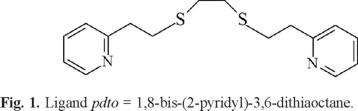
<body><![CDATA[<p align="justify"><font face="verdana" size="2">&nbsp;</font></p>  	    <p align="justify"><font face="verdana" size="2"><b>Introduction</b></font></p>  	    <p align="justify"><font face="verdana" size="2">Intracellular enzyme superoxide dismutase (SOD) in normal conditions, has the role of protecting the cell against oxygen radicals generated in the processes of cellular respiration. SOD enzyme transforms two superoxide radicals to hydrogen peroxide and molecular oxygen. Its active site is a coordination compound with transition metals, such as Cu, Zn, Fe, Mn or Ni, depending on the place where the biosynthesis takes place, with homologies in their sequences and three&#45;dimensional structure &#91;1, 2&#93;. Several studies have proposed that a decrease in Mn&#45;SOD and Cu&#45;Zn SOD activities is one of the most important differences between normal cells and tumor cells &#91;3&#45;5&#93;. The role of ZnCu&#45;SOD is manifested in a significant survival of mice with solid tumors, after a single administration dose (IV/IM) of this enzyme &#91;6&#93;. The above&#45;mentioned have attracted attention to design new SOD biomimetic compounds &#91;7&#45;13&#93;. The catalytic reaction mechanism that presents the ZnCu&#45;SOD, and therefore a biomimetic compound, consists in a disproportion of superoxide radical in two steps, first to generate molecular oxygen, O<sub>2</sub>, and subsequently the formation of hydrogen peroxide, H<sub>2</sub>O<sub>2</sub>, see equations 1 and 2. It has been proposed that for a SOD biomimetic complex, its formal electrode potential (Cu<sup>2+</sup>L/Cu<sup>+</sup>L) should be ranging from &#45;330 to 890 mV/NHE at pH = 7.0, &#91;14, 15&#93;.</font></p>  	    <p align="center"><font face="verdana" size="2">Cu<sup>2+</sup>L + O<sub>2</sub><sup>&#45;</sup> &rarr; Cu<sup>+</sup>L + O<sub>2</sub> (1)</font></p>  	    <p align="center"><font face="verdana" size="2">Cu<sup>+</sup>L + O<sub>2</sub><sup>&#45;</sup> + 2H<sup>+</sup> &rarr; Cu<sup>2+</sup>L + H<sub>2</sub>O<sub>2</sub> (2)</font></p>  	    <p align="justify"><font face="verdana" size="2">The aqueous formal electrode potential value for the complex &#91;Cu(pdto)(H<sub>2</sub>O)&#93;<sup>2+</sup> (<i>pdto</i> = 1,8&#45;bis&#45;(2&#45;pyridyl)&#45;3,6&#45;dithiaoctane) see <a href="#f1">figure 1</a>, and its interaction with DNA, led to our group to explore the biological activity of this complex with several tumor lines, finding a similar activity than those obtained for the compound <i>cis</i>&#45;platin in the tumor line Hela &#91;16&#45;20&#93;. However, in this study the reaction between the copper complex and the superoxide ion was not studied.</font></p>  	    <p align="center"><font face="verdana" size="2"><a name="f1"></a></font></p>  	    <p align="center"><font face="verdana" size="2"><img src="/img/revistas/jmcs/v57n3/a6f1.jpg"></font></p>  	    <p align="justify"><font face="verdana" size="2">A widely used test for determining if a compound presents a SOD&#45;like mechanism is the Xanthine oxidase bioassay. In the standard procedure the Xanthine/Xanthine oxidase system is used as a source of superoxide radicals and the native cytochrome c is used as a radical trapping. When the SOD enzyme is added in the assay, the reduction of cytochrome c presents a decrease, due to the disproportion of superoxide by the enzyme &#91;21&#93;. The reaction between superoxide and cytochrome c is followed spectrophotometrically at 550 nm. To evaluate the SOD activity, the enzyme is replaced by a compound of interest. The change in absorbance represents the percentage transformed, with the use of a plot concentration vs. volume, a value of SOD activity is obtained and referenced to the activity of the SOD enzyme &#91;9, 22&#93;. However, this method has several disadvantages which include the use of expensive reagents, highly controlled conditions, and interferences associated to interactions between the compound of interest with the radical generator (xanthine/xanthine oxidase) and the radical trapping (cytochrome c) &#91;21&#93;. These interferences can be avoided by using dimethylsulfoxide in alkaline conditions, which promote the generation of superoxide radicals &#91;23&#93;. Furthermore, in this bioassay the short half&#45;life of the superoxide in aqueous solution is not considered, thus the values of SOD activity are under estimated. Several electrochemical methods have been proposed for SOD activity measurements, based in the generation of superoxide ion by autoxidation of pyrogallol, 6&#45;hydroxy&#45;dopamine or O<sub>2</sub> &#91;24, 25&#93;. These methods present disadvantages, such as: being an indirect way to detect and to generate the superoxide ion, the presence of parallel reactions, the use of surfactants and the use of hanging drop mercury electrode (HDME). Therefore, it is necessary to find alternative methods that show evidence of a SOD&#45;like mechanism, considering the stability of the superoxide and with easy implementation in laboratory. According to the above&#45;mentioned, this work presents the electrochemical response of Cu(NO<sub>3</sub>)<sub>2</sub>&bull;2.5H<sub>2</sub>O and Cu(II)&#45;(pdto) in a solvent that stabilizes the superoxide ion, such as DMSO, in order to study the reaction between the complex and superoxide using simple electrochemical methods. The results obtained in this work allowed us to establish the feasibility of using simple electrochemical techniques to measure SOD activity.</font></p>  	    <p align="justify"><font face="verdana" size="2">&nbsp;</font></p>  	    ]]></body>
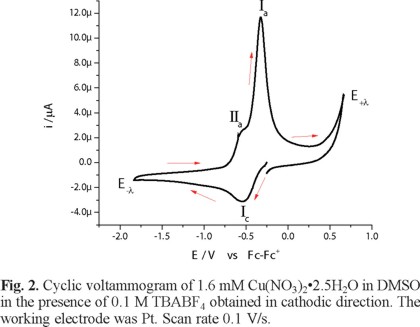
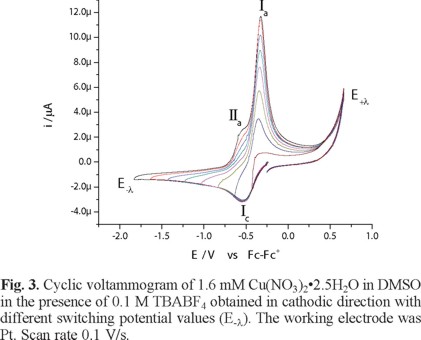
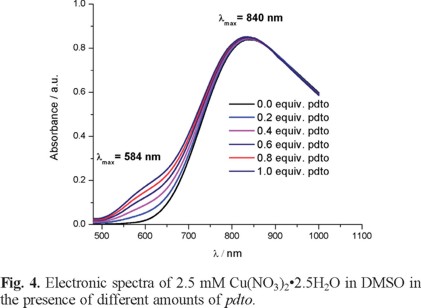
<body><![CDATA[<p align="justify"><font face="verdana" size="2"><b>Results and Discussion</b></font></p>  	    <p align="justify"><font face="verdana" size="2"><b>Spectroscopic and electrochemical characterization in DMSO of Cu(NO<sub>3</sub>)<sub>2</sub>&bull;2.5H<sub>2</sub>O</b></font></p>  	    <p align="justify"><font face="verdana" size="2">The electronic spectrum of Cu(NO<sub>3</sub>)<sub>2</sub>&bull;2.5H<sub>2</sub>O in DMSO shows a broad signal with maximum wavelength at 840 nm, attributed to an electronic transition d&#45;d, with a molar extinction coefficient value of 27 Lmol<sup>&#45;1</sup>cm <sup>&#45;1</sup> &#91;26&#93;. <a href="#f2">Figure 2</a> shows the voltammetric response, recorded in cathodic direction, of 1.6 mM Cu(NO<sub>3</sub>)<sub>2</sub>&bull;2.5H<sub>2</sub>O in DMSO, in the presence of 0.1 M TBABF<sub>4</sub> as supporting electrolyte. In this experiment, one reduction process <b>&#921;</b>c, with a peak potential value E<sub>pc</sub>(<b>&#921;</b>) = &#45;0.538 V/Fc&#45;Fc<sup>+</sup>, was observed. When the potential scan was inverted to anodic direction, two oxidation signals, <b>&#921;&#921;</b>a and <b>&#921;</b>a, are detected with peak potential values E<sub>pa</sub>(<b>&#921;&#921;</b>) = &#45;0.566 V/Fc&#45;Fc<sup>+</sup> and E<sub>pa</sub>(<b>&#921;</b>) = &#45;0.323 V/Fc&#45;Fc<sup>+</sup>. The low oxidation barrier near 0.6 V V/Fc&#45;Fc<sup>+</sup> is indicative of the presence of water from the copper salt. When the experiments were performed with a dehydrated copper salt, the oxidation barrier was observed near 1 V/Fc&#45;Fc<sup>+</sup>, experiments not shown. The immediate increase in cathodic current when the experiment was initiated could be related to the presence of two chemical species from different redox couples, being one of these the chemical species of Cu(II) that generate a mixed potential. <a href="#f3">Figure 3</a> presents a series of cyclic voltammograms with different switching potential values (E<sub>&#45;&#955;</sub>) in cathodic direction. As can be seen from this figure, the current associated to the processes <b>&#921;</b>a and <b>&#921;&#921;</b>a present an increase at switching potential values (E<sub>&#45;&#955;</sub>) near to potentials where the reduction process <b>&#921;</b>c is recorded; therefore, dependence between reduction and oxidation processes can be established.</font></p>  	    <p align="center"><font face="verdana" size="2"><a name="f2"></a></font></p>  	    <p align="center"><font face="verdana" size="2"><img src="/img/revistas/jmcs/v57n3/a6f2.jpg"></font></p>  	    <p align="center"><font face="verdana" size="2"><a name="f3"></a></font></p>  	    <p align="center"><font face="verdana" size="2"><img src="/img/revistas/jmcs/v57n3/a6f3.jpg"></font></p>  	    <p align="justify"><font face="verdana" size="2">The process <b>&#921;c</b> corresponds to the electrochemical reaction Cu(II) + 2e &rarr; Cu(0), while processes <b>&#921;a</b> and <b>&#921;&#921;a</b> can be associated with two copper stripping reactions, each one for a different chemical species of Cu(II) &#91;27&#93;.</font></p>  	    <p align="justify"><font face="verdana" size="2"><b>Study of the metal complex formation Cu(II)&#45;pdto in DMSO</b></font></p>  	    <p align="justify"><font face="verdana" size="2">In order to study the formation of coordination compound Cu(II)&#45;pdto in DMSO, spectroscopic and electrochemical experiments were carried out. <a href="#f4">Figure 4</a> shows typical UV&#45;Vis spectra of 2.5 mM Cu(NO<sub>3</sub>)<sub>2</sub>&bull;2.5H<sub>2</sub>O in DMSO in the presence of different amounts of <i>pdto</i>. This figure shows two electronic transitions at 840 nm and 584 nm, related to a Cu(II) complex with a Jahn Teller distortion &#91;26&#93;.</font></p>  	    ]]></body>
<body><![CDATA[<p align="center"><font face="verdana" size="2"><a name="f4"></a></font></p>  	    <p align="center"><font face="verdana" size="2"><img src="/img/revistas/jmcs/v57n3/a6f4.jpg"></font></p>  	    <p align="justify"><font face="verdana" size="2">The spectroscopic experiments allowed us to establish the formation of the metal complex. However, this response did not indicate the stabilization of Cu(I) and Cu(II) species, which is the first step to propose a SOD like mechanism. Therefore, electrochemical experiments were carried out. <a href="#f5">Figure 5</a> presents typical cyclic voltammograms of 2.5 mM Cu(NO<sub>3</sub>)<sub>2</sub>&bull;2.5H<sub>2</sub>O in DMSO + 0.1 M TBABF<sub>4</sub> in the presence of different equivalents of <i>pdto</i>. It is observed that the addition of <b><i>pdto</i></b> decreases the current associated with the processes <b>&#921;c</b>, <b>&#921;a</b> and <b>&#921;&#921;a</b>. Simultaneously, three new signals <b>&#921;'c</b>, <b>&#921;&#921;'c</b> and <b>&#921;&#921;'a</b> are observed, with peak potential values at &#45;0.250, &#45;0.970, and &#45;0.626 V/Fc + Fc, respectively.</font></p>  	    <p align="center"><font face="verdana" size="2"><a name="f5"></a></font></p>  	    <p align="center"><font face="verdana" size="2"><img src="/img/revistas/jmcs/v57n3/a6f5.jpg"></font></p>  	    <p align="justify"><font face="verdana" size="2">These results indicate that the chemical species &#91;Cu(<b><i>pdto</i></b>)&#93;<sup>+</sup> is stabilized at the electrode interface as a consequence of the flexibility of the <b><i>pdto</i></b> ligand towards the preferential geometry of the central atom, such as in their corresponding Cu (II) and Cu(I) complexes reported in literature &#91;17&#93;. Hence, it is possible to propose the next reduction processes:</font></p>  	    <p align="center"><font face="verdana" size="2">&#91;Cu(II)&#45;(<b><i>pdto</i></b>)L&#93;<sup>2+</sup> + 1e &rarr; &#91;Cu(I)&#45;(<b><i>pdto</i></b>)&#93;<sup>+</sup> +L L=DMSO or H<sub>2</sub>O <b>I'c</b></font></p>  	    <p align="center"><font face="verdana" size="2">&#91;Cu(I)&#45;(<b><i>pdto</i></b>)&#93;<sup>+</sup>+ 1e &rarr; Cu(0) <b>II'c</b></font></p>  	    <p align="justify"><font face="verdana" size="2">The anodic processes <b>&#921;a</b>, <b>&#921;&#921;a</b> and <b>&#921;&#921;'a</b> correspond to the stripping of Cu(0). The shift to more negative peak potential value for signal <b>&#921;&#921;'a</b> compared with <b>&#921;&#921;a</b> is caused by the formation and stabilization of &#91;Cu(<b><i>pdto</i></b>)&#93;<sup>+</sup> in the redissolution process. A detailed study of these signals is beyond the scope of this paper.</font></p>  	    <p align="justify"><font face="verdana" size="2">In situ reaction between Cu(NO<sub>3</sub>)<sub>2</sub>&bull;2.5H<sub>2</sub>O and <i>pdto</i> in DMSO release water from the copper salt to the medium, making the superoxide ion unstable and causing a low oxidation barrier. Therefore, we decided to obtain the corresponding complex &#91;Cu(pdto)(H<sub>2</sub>O)&#93;(PF<sub>6</sub>)<sub>2</sub>, which contains the minimum amount of water, to study its reaction with the superoxide ion.</font></p>  	    ]]></body>
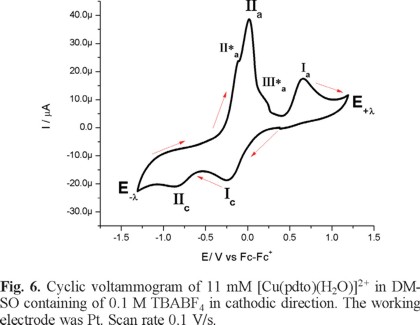
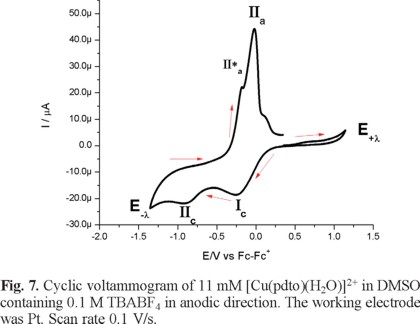
<body><![CDATA[<p align="justify"><font face="verdana" size="2"><b>Electrochemical behavior of the compound &#91;Cu(pdto)H<sub>2</sub>O&#93;(PF<sub>6</sub>)<sub>2</sub></b></font></p>  	    <p align="justify"><font face="verdana" size="2"><a href="#f6">Figure 6</a> presents a cyclic voltammogram, obtained in cathodic direction, for a 1mM solution of &#91;Cu(pdto)(H<sub>2</sub>O)&#93;(PF<sub>6</sub>)<sub>2</sub> in DMSO containing 0.1 M TBABF<sub>4</sub> as supporting electrolyte. In the whole potential scan two reduction processes, <b>&#921;</b>c and <b>&#921;&#921;</b>c, and three main oxidation processes, <b>&#921;&#921;*</b>a, <b>&#921;&#921;</b>a and <b>&#921;</b>a, were observed; with their corresponding values E<sub>pc</sub>(<b>&#921;</b>) = &#45;0.249 V/Fc&#45;Fc<sup>+</sup>, E<sub>pc</sub>(<b>&#921;&#921;</b>) = &#45;0.846 V/Fc&#45;Fc<sup>+</sup>, E<sub>pa</sub>(<b>&#921;&#921;*a</b>) = &#45;0.111 V/Fc&#45;Fc<sup>+</sup>, E<sub>pa</sub>(<b>&#921;&#921;</b>a) = &#45;0.015 V/Fc&#45;Fc<sup>+</sup> and E<sub>pa</sub>(<b>&#921;a</b>) = 0.649 V/Fc&#45;Fc<sup>+</sup>. When the experiment was performed in anodic direction, see <a href="#f7">figure 7</a>, the same signals were observed, with the exception of signal <b>&#921;</b>a. This last signal indicates the stabilization of a copper (I) species generated after the copper (0) stripping, due to the low content of water in the solution.</font></p>  	    <p align="center"><font face="verdana" size="2"><a name="f6"></a></font></p>  	    <p align="center"><font face="verdana" size="2"><img src="/img/revistas/jmcs/v57n3/a6f6.jpg"></font></p>  	    <p align="center"><font face="verdana" size="2"><a name="f7"></a></font></p>  	    <p align="center"><font face="verdana" size="2"><img src="/img/revistas/jmcs/v57n3/a6f7.jpg"></font></p>  	    <p align="justify"><font face="verdana" size="2">Considering the facultative nature of <b><i>pdto</i></b>, already mentioned, it is possible to propose for the principal reduction processes the following electrochemical reactions with their corresponding values of half wave potential E<sub>1/2</sub>:</font></p>  	    <p align="center"><font face="verdana" size="2">&#91;Cu(pdto)(H<sub>2</sub>O)&#93;<sup>2+</sup> + 1e &rarr; &#91;Cu(pdto)&#93;<sup>+</sup> E<sub>1/2</sub> = &#45;0.047V vs Fc&#45;Fc<sup>+</sup> <b>Ic'</b></font></p>  	    <p align="center"><font face="verdana" size="2">&#91;Cu(pdto)&#93;<sup>+</sup> + 1e &rarr;Cu(0) E<sub>1/2</sub> = &#45;0.735 V vs Fc&#45;Fc<sup>+</sup> IIc'</font></p>  	    <p align="justify"><font face="verdana" size="2">The anodic processes, <b>&#921;&#921;*a</b>, <b>&#921;&#921;&#921;*a</b>, and <b>&#921;&#921;a</b> can be also related with the formation of different chemical species from the copper stripping processes. Electrochemical Quartz Crystal Microbalance (EQCM) should be performed in order to confirm this idea, but this is beyond the scope of this paper.</font></p>  	    ]]></body>
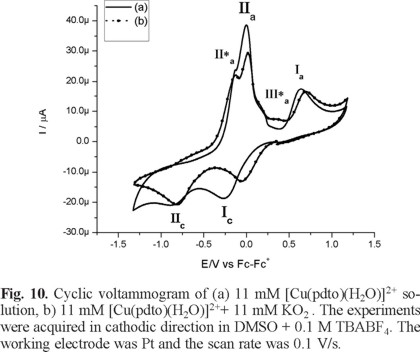
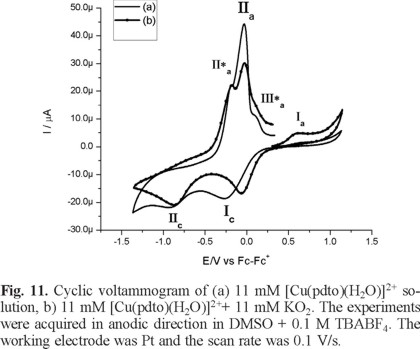
<body><![CDATA[<p align="justify"><font face="verdana" size="2"><b>Electrochemical characterization of superoxide in DMSO</b></font></p>  	    <p align="justify"><font face="verdana" size="2"><a href="#f8">Figure 8</a> shows the voltammetric response of superoxide O<sub>2</sub> <sup>&bull;&#45;</sup>(KO<sub>2</sub> + 2 equiv. of 18&#45;crown&#45;6 ether) in DMSO containing supporting electrolyte, recorded in anodic direction. It can be observed one oxidation process, <b>&#921;</b>a, and two reduction processes, <b>&#921;c</b> and <b>&#921;&#921;c</b>, with peak potential values E<sub>pa</sub>(<b>&#921;a</b>) = &#45;0.856, E<sub>pc</sub>(<b>&#921;c</b>) = &#45;1.073 and E<sub>pc</sub>(<b>&#921;Ic</b>) = &#45;1.596 V/Fc&#45;Fc<sup>+</sup>. The absence of the corresponding oxidation signal for <b>&#921;&#921;c</b> suggests a EC mechanism O<sub>2</sub> <sup>&bull;&#45;</sup>+ 1e + H<sup>+</sup> <b>&rarr;</b>OOH<sup>&#45;</sup>&#91;27,28&#93;. Water traces in the experimental conditions could be the source of proton donor in the coupled reaction.</font></p>  	    <p align="center"><font face="verdana" size="2"><a name="f8"></a></font></p>  	    <p align="center"><font face="verdana" size="2"><img src="/img/revistas/jmcs/v57n3/a6f8.jpg"></font></p>  	    <p align="justify"><font face="verdana" size="2">Additionally, the voltammetric response of superoxide O<sub>2</sub><sup>&bull;&#45;</sup> (KO<sub>2</sub> + of 2 equiv. of 18&#45;crown&#45;6 ether) in cathodic direction was recorded, see <a href="#f9">figure 9</a>. In this case one reduction process, <b>&#921;&#921;c</b> (Epc = &#45;1.561 V/Fc&#45;Fc<sup>+</sup>), and one oxidation process, <b>&#921;a</b> (Epa = &#45;0.818 V/Fc&#45;Fc<sup>+</sup>) are observed. This fact confirms the chemical reaction coupled in process <b>&#921;&#921;c</b> and indicates that their products affect the process <b>&#921;</b>.</font></p>  	    <p align="center"><font face="verdana" size="2"><a name="f9"></a></font></p>  	    <p align="center"><font face="verdana" size="2"><img src="/img/revistas/jmcs/v57n3/a6f9.jpg"></font></p>  	    <p align="justify"><font face="verdana" size="2">Based on the literature, process <b>&#921;</b> is attributed to the electrochemical reaction O<sub>2</sub> &harr; O<sub>2</sub> + 1e<sup>&#45;</sup>(E&deg; = &#45;0.965 V/Fc&#45;Fc<sup>+</sup>), while <b>&#921;&#921;</b> corresponds to the irreversible process O<sub>2</sub> + 1e + H<sup>+</sup> <b>&rarr;</b>OOH<sup>&#45;</sup>&#91;28&#93;. In order to establish the stability of the superoxide solutions, voltammetric experiments were recorded as a function of time. The results shown that there are not significant changes in peak potential values and current peak values for processes <b>&#921;</b> and <b>&#921;&#921; (</b>experiment not shown for simplicity) during three hours, indicating that the ion O<sub>2</sub> is stable in this time window.</font></p>  	    <p align="justify"><font face="verdana" size="2"><b><i>Electrochemical response of the reaction of complex</i> &#91;Cu(pdto)(H<sub>2</sub>O)&#93;<sup>2+</sup> <i>with superoxide</i></b></font></p>  	    <p align="justify"><font face="verdana" size="2"><a href="#f10">Figure 10</a> and <a href="#f11">Figure 11</a> show typical cyclic voltammograms in cathodic and anodic directions of &#91;Cu(pdto)(H<sub>2</sub>O)&#93;<sup>2+</sup> and its mixture with the superoxide ion (O<sub>2</sub> <sup>&bull;&#45;</sup>). An inspection of the reaction mixture voltammogram allow us to see a displacement in the peak potential value for process <b>&#921;c</b>, and a decrease in the current for processes <b>&#921;&#921;</b>a and <b>&#921;&#921;</b>a*. Additionally, the signals related to superoxide after the reaction mixtures are not observed. On the other hand, when the experiments were performed in anodic direction, the current <b>&#921;</b>a associated with the presence of &#91;Cu(pdto)&#93;<sup>+</sup> in solution was detected, <a href="#f11">figure 11</a>. This species was generated from the homogeneous electron transfer between the complex &#91;Cu(pdto)(H<sub>2</sub>O)&#93;<sup>2+</sup> and the superoxide ion, according to their respective values E<sub>1/2</sub> = &#45;0.047 V/Fc&#45;Fc<sup>+</sup> for process &#91;Cu(pdto)(H<sub>2</sub>O)&#93;<sup>2+</sup> + 1e &rarr; &#91;Cu(pdto)&#93;<sup>+</sup> and E&deg; = &#45;0.965 V/Fc&#45;Fc<sup>+</sup> for the process O<sub>2</sub> &harr; O<sub>2</sub> + 1e. These values also suggest that the coordination compound did not present a catalytic SOD mechanism. The presence of the species &#91;Cu(pdto)&#93;<sup>+</sup> and the shift in the peak potential value for signal <b>&#921;c</b>, attributed to chemical species with different coordination sphere, probably &#91;Cu(pdto)(OH)&#93;<sup>+</sup> or &#91;Cu(pdto)O<sub>2</sub> <sup>&bull;&#45;</sup>&#93;<sup>+</sup> confirm this idea. The results obtained in this work encourage us to study a system with a well&#45;known SOD&#45;like activity in a future paper.</font></p>  	    ]]></body>
<body><![CDATA[<p align="center"><font face="verdana" size="2"><a name="f10"></a></font></p>  	    <p align="center"><font face="verdana" size="2"><img src="/img/revistas/jmcs/v57n3/a6f10.jpg"></font></p>  	    <p align="center"><font face="verdana" size="2"><a name="f11"></a></font></p>  	    <p align="center"><font face="verdana" size="2"><img src="/img/revistas/jmcs/v57n3/a6f11.jpg"></font></p>  	    <p align="justify"><font face="verdana" size="2">&nbsp;</font></p>  	    <p align="justify"><font face="verdana" size="2"><b>Conclusions</b></font></p>  	    <p align="justify"><font face="verdana" size="2">By using cyclic voltammetry it was possible to study the electrochemical response of Cu(NO<sub>3</sub>)<sub>2</sub>&bull;2.5H<sub>2</sub>O and &#91;Cu(pdto)(H<sub>2</sub>O)&#93;<sup>2+</sup> in a solvent that stabilizes the superoxide ion as DMSO. The facultative nature of the ligand <i>pdto</i>, allowed us to observe the processes &#91;Cu(pdto)(H<sub>2</sub>O)&#93;<sup>2+</sup> + 1e &rarr; &#91;Cu(pdto)&#93;<sup>+</sup> and &#91;Cu(pdto)&#93;<sup>+</sup> + 1e &rarr; Cu(0) in DMSO. It was established that the metal complex &#91;Cu(pdto)(H<sub>2</sub>O)&#93;<sup>2+</sup> did not present a SOD&#45;like catalytic mechanism. However, the results presented here support the idea that it is possible to study by electrochemical techniques the reaction between superoxide and a compound of interest, in order to associate the biological activity with its ability to participate in a SOD&#45;like catalytic mechanism.</font></p>  	    <p align="justify"><font face="verdana" size="2">&nbsp;</font></p>  	    <p align="justify"><font face="verdana" size="2"><b>Experimental</b></font></p>  	    <p align="justify"><font face="verdana" size="2"><b>Chemicals</b></font></p>  	    ]]></body>
<body><![CDATA[<p align="justify"><font face="verdana" size="2">All chemicals were purchased from Aldrich or Acros Organics and were used as received. DMSO 99.7% Extra Dry over molecular sieve (Acros Organics) was used in all experiments.</font></p>  	    <p align="justify"><font face="verdana" size="2"><b>Synthesis</b></font></p>  	    <p align="justify"><font face="verdana" size="2">The ligand <b>1,8&#45;Bis(2&#45;pyridyl)&#45;3,6&#45;dithioctane</b> (<i>pdto</i>) was prepared by the method described by Goodwin and Lions. Yield 70% &#91;29&#93;. Elemental analysis: Calcd. for C<sub>16</sub>H<sub>20</sub>N<sub>2</sub>S<sub>2</sub>: %C, 63.1; %H, 6.6; %N, 9.2; %S, 20.1. Found: %C, 63.1; %H, 6.2; %N, 9.7; %S, 20.5.</font></p>  	    <p align="justify"><font face="verdana" size="2">The compound Aquo 1,8&#45;bis(2&#45;pyridyl)&#45;3,6&#45;dithiaoctane copper (II) hexaflurophosphate, &#91;Cu(pdto)(H<sub>2</sub>O)&#93;(PF<sub>6</sub>)<sub>2</sub> was obtained by mixing 0.304 g (1.0 mmol) of <i>pdto</i> and 0.294 g of Cu(NO<sub>3</sub>)<sub>2</sub> &middot;2.5 H<sub>2</sub>O (1.0 mmol) in 50 mL of anhydrous methanol. The solution was stirred and a deep blue color was observed. Two equivalents of ammonium hexafluorophosphate (0.0088 g) were added to the reaction mixtures and a blue precipitate was obtained. Elemental analysis: Calcd. for CuC<sub>16</sub>H<sub>21</sub>N<sub>2</sub>S<sub>2</sub>OP<sub>2</sub>F<sub>12</sub>; %C, 28.4; %H, 3.1; %N, 4.2; %S, 9.5. Found: %C, 28.1; %H, 3.0; %N, 4.7; %S, 9.3.</font></p>  	    <p align="justify"><font face="verdana" size="2"><b>UV&#45;Visible spectroscopy</b></font></p>  	    <p align="justify"><font face="verdana" size="2">UV&#45;Vis spectra were obtained with a Thermo Evolution Array spectrophotometer in a range from 200 to 1000 nm. All measurements were performed in a quartz cell with optical path of 1cm. The measurements were performed in anhydrous DMSO.</font></p>  	    <p align="justify"><font face="verdana" size="2"><b>Electrochemical experiments</b></font></p>  	    <p align="justify"><font face="verdana" size="2">The electrochemical experiments were performed using a potentiostat/galvanostat VoltaLab, PGZ 301, Radiometer Copenhagen, controlled with a PC. DMSO solutions containing 0.1 M TBABF<sub>4</sub> were used as supporting electrolyte. All electrochemical measurements were performed using a typical three&#45;electrode arrangement. A commercial platinum disk electrode (diameter = 2 mm) was used as working electrode, a platinum wire was used as auxiliary electrode and a silver wire was employed as pseudo&#45;reference electrode in all experiments. Prior to using the working electrode, it was polished with diamond powder, rinsed with distilled water and sonicated for 2 minutes. Before each measurement the electrode is polished with &#945;&#45;alumina (0.6 micron), rinsed with distilled water and dried. The solutions were also bubbled with nitrogen before each experiment. All potential values are reported vs the couple Fc/Fc<sup>+</sup>, according to the IUPAC convention &#91;30&#93;. Under the above conditions, cyclic voltammetry experiments were carried out in cathodic and anodic direction starting from open circuit potential (E<sub>i=0</sub>).</font></p>  	    <p align="justify"><font face="verdana" size="2"><b>Preparation of superoxide solutions in DMSO</b></font></p>  	    <p align="justify"><font face="verdana" size="2">7.4 mg (10mmol) of KO<sub>2</sub> and 26.2 mg (20 mmol) of 18&#45;crown&#45;6 ether were added to 10 mL of DMSO containing 0.1 M TBABF<sub>4</sub>, the mixture was stirred for 1 hour, until a pale yellow solution was obtained &#91;31&#93;. This solution was used for electrochemical measurements.</font></p>  	    ]]></body>
<body><![CDATA[<p align="justify"><font face="verdana" size="2">&nbsp;</font></p>  	    <p align="justify"><font face="verdana" size="2"><b>Acknowledgement</b></font></p>  	    <p align="justify"><font face="verdana" size="2">The authors thank CONACyT (130500) for financial support; M. M&#45;E thanks CONACyT for a scholarship</font></p>  	    <p align="justify"><font face="verdana" size="2">&nbsp;</font></p>  	    <p align="justify"><font face="verdana" size="2"><b>References</b></font></p>  	    <!-- ref --><p align="justify"><font face="verdana" size="2">1. McCord, J.M.; Fridovich, I. <i>Free Rad. Biol. Med</i>. <b>1988</b>, 5, 363&#45;369.    &nbsp;&nbsp;&nbsp;&nbsp;&nbsp;&nbsp;&nbsp;&nbsp;[&#160;<a href="javascript:void(0);" onclick="javascript: window.open('/scielo.php?script=sci_nlinks&ref=4938947&pid=S1870-249X201300030000600001&lng=','','width=640,height=500,resizable=yes,scrollbars=1,menubar=yes,');">Links</a>&#160;]<!-- end-ref --></font></p>  	    <!-- ref --><p align="justify"><font face="verdana" size="2">2. Batini&#263;&#45;Haberle, I.; Rebou&ccedil;as, J. S.; Spasojevi&#263;, I. <i>Antiox. Redox Sign</i>. <b>2010</b>, 13, 877&#45;918.    &nbsp;&nbsp;&nbsp;&nbsp;&nbsp;&nbsp;&nbsp;&nbsp;[&#160;<a href="javascript:void(0);" onclick="javascript: window.open('/scielo.php?script=sci_nlinks&ref=4938949&pid=S1870-249X201300030000600002&lng=','','width=640,height=500,resizable=yes,scrollbars=1,menubar=yes,');">Links</a>&#160;]<!-- end-ref --></font></p>  	    <!-- ref --><p align="justify"><font face="verdana" size="2">3. Dhar, S.K.; St Clair, D.K. <i>Free Radic. Biol. Med</i>. <b>2012</b>, 52, 2209&#45;2222.    &nbsp;&nbsp;&nbsp;&nbsp;&nbsp;&nbsp;&nbsp;&nbsp;[&#160;<a href="javascript:void(0);" onclick="javascript: window.open('/scielo.php?script=sci_nlinks&ref=4938951&pid=S1870-249X201300030000600003&lng=','','width=640,height=500,resizable=yes,scrollbars=1,menubar=yes,');">Links</a>&#160;]<!-- end-ref --></font></p>  	    <!-- ref --><p align="justify"><font face="verdana" size="2">4. Buettner G.R. <i>Anticancer Agents. Med. Chem</i>. <b>2011</b>, 11, 341&#45;346.    &nbsp;&nbsp;&nbsp;&nbsp;&nbsp;&nbsp;&nbsp;&nbsp;[&#160;<a href="javascript:void(0);" onclick="javascript: window.open('/scielo.php?script=sci_nlinks&ref=4938953&pid=S1870-249X201300030000600004&lng=','','width=640,height=500,resizable=yes,scrollbars=1,menubar=yes,');">Links</a>&#160;]<!-- end-ref --></font></p>  	    <!-- ref --><p align="justify"><font face="verdana" size="2">5. Pani, G; Colavitti, R.; Bedogni, B.; Fusco, S.; Ferraro, D.; Borrello, S.; Galeotti, T. <i>Curr Med Chem.</i> <b>2004</b>, 11, 1299&#45;308.    &nbsp;&nbsp;&nbsp;&nbsp;&nbsp;&nbsp;&nbsp;&nbsp;[&#160;<a href="javascript:void(0);" onclick="javascript: window.open('/scielo.php?script=sci_nlinks&ref=4938955&pid=S1870-249X201300030000600005&lng=','','width=640,height=500,resizable=yes,scrollbars=1,menubar=yes,');">Links</a>&#160;]<!-- end-ref --></font></p>  	    <!-- ref --><p align="justify"><font face="verdana" size="2">6. Oberley, W.L.; Buettner, R.G.; <i>Cancer Res.</i> <b>1979</b>, 39, 1141&#45;1149.    &nbsp;&nbsp;&nbsp;&nbsp;&nbsp;&nbsp;&nbsp;&nbsp;[&#160;<a href="javascript:void(0);" onclick="javascript: window.open('/scielo.php?script=sci_nlinks&ref=4938957&pid=S1870-249X201300030000600006&lng=','','width=640,height=500,resizable=yes,scrollbars=1,menubar=yes,');">Links</a>&#160;]<!-- end-ref --></font></p>  	    <!-- ref --><p align="justify"><font face="verdana" size="2">7. Azad, M.; Afzaal, M.O.; Brien, P. <i>Chem. Rev</i>. <b>2010</b>, 110, 4417&#45;4446.    &nbsp;&nbsp;&nbsp;&nbsp;&nbsp;&nbsp;&nbsp;&nbsp;[&#160;<a href="javascript:void(0);" onclick="javascript: window.open('/scielo.php?script=sci_nlinks&ref=4938959&pid=S1870-249X201300030000600007&lng=','','width=640,height=500,resizable=yes,scrollbars=1,menubar=yes,');">Links</a>&#160;]<!-- end-ref --></font></p>  	    <!-- ref --><p align="justify"><font face="verdana" size="2">8. Benyahia, B.; Campana, F.; Perderau, B; Gez, E.; Fourquet, A.; Magdelenat, H. <i>The Breast</i>, <b>1996</b>, 5, 75&#45;81.    &nbsp;&nbsp;&nbsp;&nbsp;&nbsp;&nbsp;&nbsp;&nbsp;[&#160;<a href="javascript:void(0);" onclick="javascript: window.open('/scielo.php?script=sci_nlinks&ref=4938961&pid=S1870-249X201300030000600008&lng=','','width=640,height=500,resizable=yes,scrollbars=1,menubar=yes,');">Links</a>&#160;]<!-- end-ref --></font></p>  	    <!-- ref --><p align="justify"><font face="verdana" size="2">9. Vecchio, G.; Lanza, V. <i>J. Chem. Educ.</i> <b>2009</b>, 86, 1419&#45;1421.    &nbsp;&nbsp;&nbsp;&nbsp;&nbsp;&nbsp;&nbsp;&nbsp;[&#160;<a href="javascript:void(0);" onclick="javascript: window.open('/scielo.php?script=sci_nlinks&ref=4938963&pid=S1870-249X201300030000600009&lng=','','width=640,height=500,resizable=yes,scrollbars=1,menubar=yes,');">Links</a>&#160;]<!-- end-ref --></font></p>  	    <!-- ref --><p align="justify"><font face="verdana" size="2">10. Carceller, V.J.A, Universidad de Lleida,Tesis, <b>2007</b>.    &nbsp;&nbsp;&nbsp;&nbsp;&nbsp;&nbsp;&nbsp;&nbsp;[&#160;<a href="javascript:void(0);" onclick="javascript: window.open('/scielo.php?script=sci_nlinks&ref=4938965&pid=S1870-249X201300030000600010&lng=','','width=640,height=500,resizable=yes,scrollbars=1,menubar=yes,');">Links</a>&#160;]<!-- end-ref --></font></p>  	    <!-- ref --><p align="justify"><font face="verdana" size="2">11. Gerasimchuk, N; Wang, Z; Sessler, J.L.; Magda, D.J. <i>J. Am. Chem. Soc</i>. <b>2005</b>, 110&#45;136.    &nbsp;&nbsp;&nbsp;&nbsp;&nbsp;&nbsp;&nbsp;&nbsp;[&#160;<a href="javascript:void(0);" onclick="javascript: window.open('/scielo.php?script=sci_nlinks&ref=4938967&pid=S1870-249X201300030000600011&lng=','','width=640,height=500,resizable=yes,scrollbars=1,menubar=yes,');">Links</a>&#160;]<!-- end-ref --></font></p>  	    <!-- ref --><p align="justify"><font face="verdana" size="2">12. Salvemini, D.; Riley, D. P. ; Cuzzocrea, S. <i>Nat. Rev. Drug Discov</i>. <b>2002</b>, 1, 367&#45;374.    &nbsp;&nbsp;&nbsp;&nbsp;&nbsp;&nbsp;&nbsp;&nbsp;[&#160;<a href="javascript:void(0);" onclick="javascript: window.open('/scielo.php?script=sci_nlinks&ref=4938969&pid=S1870-249X201300030000600012&lng=','','width=640,height=500,resizable=yes,scrollbars=1,menubar=yes,');">Links</a>&#160;]<!-- end-ref --></font></p>  	    <!-- ref --><p align="justify"><font face="verdana" size="2">13. Cabello, C.M.; Bair, W.B. 3rd; Wondrak G.T. <i>Curr. Opin. Investig. Drugs</i><b>, 2007,</b> 8, 1022&#45;1037.    &nbsp;&nbsp;&nbsp;&nbsp;&nbsp;&nbsp;&nbsp;&nbsp;[&#160;<a href="javascript:void(0);" onclick="javascript: window.open('/scielo.php?script=sci_nlinks&ref=4938971&pid=S1870-249X201300030000600013&lng=','','width=640,height=500,resizable=yes,scrollbars=1,menubar=yes,');">Links</a>&#160;]<!-- end-ref --></font></p>  	    <!-- ref --><p align="justify"><font face="verdana" size="2">14. Urquiola, C. ; Gambino, D.; Cabrera, M. ; Lavaggi, M.L.; Cerecetto, H.; Gonz&aacute;lez, M.; Cerain, A.L.; Monge, A.; Costa&#45;Filho, A.J.; Torre, M.H. <i>J. Inorg. Biochem</i>., <b>2008,</b> 102, 119&#45;126.    &nbsp;&nbsp;&nbsp;&nbsp;&nbsp;&nbsp;&nbsp;&nbsp;[&#160;<a href="javascript:void(0);" onclick="javascript: window.open('/scielo.php?script=sci_nlinks&ref=4938973&pid=S1870-249X201300030000600014&lng=','','width=640,height=500,resizable=yes,scrollbars=1,menubar=yes,');">Links</a>&#160;]<!-- end-ref --></font></p>  	    <!-- ref --><p align="justify"><font face="verdana" size="2">15. Jitsukawa, K.; Harata, M.; Arii, H.; Sakurai, H.; Masuda, H. <i>Inorg. Chim. Acta</i>, <b>2001</b>, 324, 108&#45;116.    &nbsp;&nbsp;&nbsp;&nbsp;&nbsp;&nbsp;&nbsp;&nbsp;[&#160;<a href="javascript:void(0);" onclick="javascript: window.open('/scielo.php?script=sci_nlinks&ref=4938975&pid=S1870-249X201300030000600015&lng=','','width=640,height=500,resizable=yes,scrollbars=1,menubar=yes,');">Links</a>&#160;]<!-- end-ref --></font></p>  	    <!-- ref --><p align="justify"><font face="verdana" size="2">16. Mahadevan, S.; Palaniandavar, M. <i>Inorg. Chim. Acta</i>, <b>1997</b>,254, 291&#45;302.    &nbsp;&nbsp;&nbsp;&nbsp;&nbsp;&nbsp;&nbsp;&nbsp;[&#160;<a href="javascript:void(0);" onclick="javascript: window.open('/scielo.php?script=sci_nlinks&ref=4938977&pid=S1870-249X201300030000600016&lng=','','width=640,height=500,resizable=yes,scrollbars=1,menubar=yes,');">Links</a>&#160;]<!-- end-ref --></font></p>  	    <!-- ref --><p align="justify"><font face="verdana" size="2">17. Thompson, M.; Whelan, J.; Zemon, D.J.; Bosnich, B. ; Solomon, E.I., Gray, H.B. <i>J. Am.Chem. Soc.</i> <b>1979,</b> 101, 2482&#45;2483.    &nbsp;&nbsp;&nbsp;&nbsp;&nbsp;&nbsp;&nbsp;&nbsp;[&#160;<a href="javascript:void(0);" onclick="javascript: window.open('/scielo.php?script=sci_nlinks&ref=4938979&pid=S1870-249X201300030000600017&lng=','','width=640,height=500,resizable=yes,scrollbars=1,menubar=yes,');">Links</a>&#160;]<!-- end-ref --></font></p>  	    <!-- ref --><p align="justify"><font face="verdana" size="2">18. Sakaguchi, U. ; Addison, A.W. <i>J. Chem. Soc., Dalton Trans.</i> <b>1979</b>, 600&#45;608.    &nbsp;&nbsp;&nbsp;&nbsp;&nbsp;&nbsp;&nbsp;&nbsp;[&#160;<a href="javascript:void(0);" onclick="javascript: window.open('/scielo.php?script=sci_nlinks&ref=4938981&pid=S1870-249X201300030000600018&lng=','','width=640,height=500,resizable=yes,scrollbars=1,menubar=yes,');">Links</a>&#160;]<!-- end-ref --></font></p>  	    <!-- ref --><p align="justify"><font face="verdana" size="2">19. Mahadevan, S.; Palaniandavar, M<i>. Inorg. Chim. Acta,</i> <b>1997</b>,254, 291&#45;302</font>&nbsp;&nbsp;&nbsp;&nbsp;&nbsp;&nbsp;&nbsp;&nbsp;[&#160;<a href="javascript:void(0);" onclick="javascript: window.open('/scielo.php?script=sci_nlinks&ref=4938983&pid=S1870-249X201300030000600019&lng=','','width=640,height=500,resizable=yes,scrollbars=1,menubar=yes,');">Links</a>&#160;]<!-- end-ref --><!-- ref --><p align="justify"><font face="verdana" size="2">20. Rodr&iacute;guez&#45;Torres, D.; Garc&iacute;a&#45;Ramos, J.C. ; Manr&iacute;quez, J. ; Moreno&#45;Esparza, R.; Altamirano Lozano, M.; Gonz&aacute;lez, I. ; Gracia&#45;Mora, I.; Ruiz&#45;Azuara, L. Anta&ntilde;o Lopez, R. Ortiz&#45;Frade, L. <i>Polyhedron</i> <b>2009</b>, 28, 1186&#45;1190.    &nbsp;&nbsp;&nbsp;&nbsp;&nbsp;&nbsp;&nbsp;&nbsp;[&#160;<a href="javascript:void(0);" onclick="javascript: window.open('/scielo.php?script=sci_nlinks&ref=4938984&pid=S1870-249X201300030000600020&lng=','','width=640,height=500,resizable=yes,scrollbars=1,menubar=yes,');">Links</a>&#160;]<!-- end-ref --></font></p>  	    <!-- ref --><p align="justify"><font face="verdana" size="2">21. Kuthan, H.; Haussmann, H.&#45;J. ; Werringloer, J<i>. Biochem. J</i>. <b>1986</b>, 237, 175&#45;180.    &nbsp;&nbsp;&nbsp;&nbsp;&nbsp;&nbsp;&nbsp;&nbsp;[&#160;<a href="javascript:void(0);" onclick="javascript: window.open('/scielo.php?script=sci_nlinks&ref=4938986&pid=S1870-249X201300030000600021&lng=','','width=640,height=500,resizable=yes,scrollbars=1,menubar=yes,');">Links</a>&#160;]<!-- end-ref --></font></p>  	    <!-- ref --><p align="justify"><font face="verdana" size="2">22. Beauchamp, C.; Fridovich, I. <i>Anal. Biochem</i>., <b>1971</b>, 44, 276&#45;287.    &nbsp;&nbsp;&nbsp;&nbsp;&nbsp;&nbsp;&nbsp;&nbsp;[&#160;<a href="javascript:void(0);" onclick="javascript: window.open('/scielo.php?script=sci_nlinks&ref=4938988&pid=S1870-249X201300030000600022&lng=','','width=640,height=500,resizable=yes,scrollbars=1,menubar=yes,');">Links</a>&#160;]<!-- end-ref --></font></p>      <!-- ref --><p align="justify"><font face="verdana" size="2">23. Hyland, K. ; Voisin, E. ; Banoun, H.; Auclair, C. <i>Anal. Biochem</i>., <b>1983</b>, 135, 280&#45;287.    &nbsp;&nbsp;&nbsp;&nbsp;&nbsp;&nbsp;&nbsp;&nbsp;[&#160;<a href="javascript:void(0);" onclick="javascript: window.open('/scielo.php?script=sci_nlinks&ref=4938990&pid=S1870-249X201300030000600023&lng=','','width=640,height=500,resizable=yes,scrollbars=1,menubar=yes,');">Links</a>&#160;]<!-- end-ref --></font></p>  	    ]]></body>
<body><![CDATA[<!-- ref --><p align="justify"><font face="verdana" size="2">24. Moscone, D.; Mascini, M. <i>Anal. Chim. Acta</i>. <b>1988,</b> 211<b>,</b> 195&#45;204</font>&nbsp;&nbsp;&nbsp;&nbsp;&nbsp;&nbsp;&nbsp;&nbsp;[&#160;<a href="javascript:void(0);" onclick="javascript: window.open('/scielo.php?script=sci_nlinks&ref=4938992&pid=S1870-249X201300030000600024&lng=','','width=640,height=500,resizable=yes,scrollbars=1,menubar=yes,');">Links</a>&#160;]<!-- end-ref --><!-- ref --><p align="justify"><font face="verdana" size="2">25. Rigo, A.; Viglino, P.; Rotilio, G. <i>Anal. Biochem.</i> <b>1975</b>, 68, 1&#45;8</font>&nbsp;&nbsp;&nbsp;&nbsp;&nbsp;&nbsp;&nbsp;&nbsp;[&#160;<a href="javascript:void(0);" onclick="javascript: window.open('/scielo.php?script=sci_nlinks&ref=4938993&pid=S1870-249X201300030000600025&lng=','','width=640,height=500,resizable=yes,scrollbars=1,menubar=yes,');">Links</a>&#160;]<!-- end-ref --><!-- ref --><p align="justify"><font face="verdana" size="2">26. Lever, A. B. P., Inorganic Electronic Spectroscopy, 2a Ed. Elsevier, <b>1984</b>.    &nbsp;&nbsp;&nbsp;&nbsp;&nbsp;&nbsp;&nbsp;&nbsp;[&#160;<a href="javascript:void(0);" onclick="javascript: window.open('/scielo.php?script=sci_nlinks&ref=4938994&pid=S1870-249X201300030000600026&lng=','','width=640,height=500,resizable=yes,scrollbars=1,menubar=yes,');">Links</a>&#160;]<!-- end-ref --></font></p>  	    <!-- ref --><p align="justify"><font face="verdana" size="2">27. Bard, A. J.; Faulkner, L. R. <i>Electrochemical Methods</i>, <i>Fundamentals and Applications</i>; Ed. John Wiley and Sons, <b>1980</b>.    &nbsp;&nbsp;&nbsp;&nbsp;&nbsp;&nbsp;&nbsp;&nbsp;[&#160;<a href="javascript:void(0);" onclick="javascript: window.open('/scielo.php?script=sci_nlinks&ref=4938996&pid=S1870-249X201300030000600027&lng=','','width=640,height=500,resizable=yes,scrollbars=1,menubar=yes,');">Links</a>&#160;]<!-- end-ref --></font></p>  	    <!-- ref --><p align="justify"><font face="verdana" size="2">28. Sawyer, D.T.; Sobkowiak A, L. J.; Roberts J. <i>Electrochemistry for chemists</i>. 2a Ed., New York, <b>1995</b>.    &nbsp;&nbsp;&nbsp;&nbsp;&nbsp;&nbsp;&nbsp;&nbsp;[&#160;<a href="javascript:void(0);" onclick="javascript: window.open('/scielo.php?script=sci_nlinks&ref=4938998&pid=S1870-249X201300030000600028&lng=','','width=640,height=500,resizable=yes,scrollbars=1,menubar=yes,');">Links</a>&#160;]<!-- end-ref --></font></p>  	    <!-- ref --><p align="justify"><font face="verdana" size="2">29. Goodwin, H.A; Lions F. <i>J. Am. Chem. Soc</i>. <b>1960</b>, 82, 5013&#45;5023.    &nbsp;&nbsp;&nbsp;&nbsp;&nbsp;&nbsp;&nbsp;&nbsp;[&#160;<a href="javascript:void(0);" onclick="javascript: window.open('/scielo.php?script=sci_nlinks&ref=4939000&pid=S1870-249X201300030000600029&lng=','','width=640,height=500,resizable=yes,scrollbars=1,menubar=yes,');">Links</a>&#160;]<!-- end-ref --></font></p>  	    ]]></body>
<body><![CDATA[<!-- ref --><p align="justify"><font face="verdana" size="2">30. Gritzner, G.; K&uuml;ta, J. <i>Pure Appl. Chem</i>., <b>1984</b>, 4, 461&#45;466</font>&nbsp;&nbsp;&nbsp;&nbsp;&nbsp;&nbsp;&nbsp;&nbsp;[&#160;<a href="javascript:void(0);" onclick="javascript: window.open('/scielo.php?script=sci_nlinks&ref=4939002&pid=S1870-249X201300030000600030&lng=','','width=640,height=500,resizable=yes,scrollbars=1,menubar=yes,');">Links</a>&#160;]<!-- end-ref --><!-- ref --><p align="justify"><font face="verdana" size="2">31. Valeriy, S.V; Roth, J.P. <i>J. Am. Chem. Soc</i>. <b>2006</b>, 128, 3683&#45;3695.    &nbsp;&nbsp;&nbsp;&nbsp;&nbsp;&nbsp;&nbsp;&nbsp;[&#160;<a href="javascript:void(0);" onclick="javascript: window.open('/scielo.php?script=sci_nlinks&ref=4939003&pid=S1870-249X201300030000600031&lng=','','width=640,height=500,resizable=yes,scrollbars=1,menubar=yes,');">Links</a>&#160;]<!-- end-ref --></font></p>      ]]></body><back>
<ref-list>
<ref id="B1">
<label>1</label><nlm-citation citation-type="journal">
<person-group person-group-type="author">
<name>
<surname><![CDATA[McCord]]></surname>
<given-names><![CDATA[J.M.]]></given-names>
</name>
<name>
<surname><![CDATA[Fridovich]]></surname>
<given-names><![CDATA[I.]]></given-names>
</name>
</person-group>
<source><![CDATA[Free Rad. Biol. Med.]]></source>
<year>1988</year>
<volume>5</volume>
<page-range>363-369</page-range></nlm-citation>
</ref>
<ref id="B2">
<label>2</label><nlm-citation citation-type="journal">
<person-group person-group-type="author">
<name>
<surname><![CDATA[Batini&#263;-Haberle]]></surname>
<given-names><![CDATA[I.]]></given-names>
</name>
<name>
<surname><![CDATA[Rebouças]]></surname>
<given-names><![CDATA[J. S.]]></given-names>
</name>
<name>
<surname><![CDATA[Spasojevi&#263;]]></surname>
<given-names><![CDATA[I.]]></given-names>
</name>
</person-group>
<source><![CDATA[Antiox. Redox Sign.]]></source>
<year>2010</year>
<volume>13</volume>
<page-range>877-918</page-range></nlm-citation>
</ref>
<ref id="B3">
<label>3</label><nlm-citation citation-type="journal">
<person-group person-group-type="author">
<name>
<surname><![CDATA[Dhar]]></surname>
<given-names><![CDATA[S.K.]]></given-names>
</name>
<name>
<surname><![CDATA[St Clair]]></surname>
<given-names><![CDATA[D.K.]]></given-names>
</name>
</person-group>
<source><![CDATA[Free Radic. Biol. Med.]]></source>
<year>2012</year>
<volume>52</volume>
<page-range>2209-2222</page-range></nlm-citation>
</ref>
<ref id="B4">
<label>4</label><nlm-citation citation-type="journal">
<person-group person-group-type="author">
<name>
<surname><![CDATA[Buettner]]></surname>
<given-names><![CDATA[G.R.]]></given-names>
</name>
</person-group>
<source><![CDATA[Anticancer Agents. Med. Chem.]]></source>
<year>2011</year>
<volume>11</volume>
<page-range>341-346</page-range></nlm-citation>
</ref>
<ref id="B5">
<label>5</label><nlm-citation citation-type="journal">
<person-group person-group-type="author">
<name>
<surname><![CDATA[Pani]]></surname>
<given-names><![CDATA[G]]></given-names>
</name>
<name>
<surname><![CDATA[Colavitti]]></surname>
<given-names><![CDATA[R.]]></given-names>
</name>
<name>
<surname><![CDATA[Bedogni]]></surname>
<given-names><![CDATA[B.]]></given-names>
</name>
<name>
<surname><![CDATA[Fusco]]></surname>
<given-names><![CDATA[S.]]></given-names>
</name>
<name>
<surname><![CDATA[Ferraro]]></surname>
<given-names><![CDATA[D.]]></given-names>
</name>
<name>
<surname><![CDATA[Borrello]]></surname>
<given-names><![CDATA[S.]]></given-names>
</name>
<name>
<surname><![CDATA[Galeotti]]></surname>
<given-names><![CDATA[T.]]></given-names>
</name>
</person-group>
<source><![CDATA[Curr Med Chem.]]></source>
<year>2004</year>
<volume>11</volume>
<page-range>1299-308</page-range></nlm-citation>
</ref>
<ref id="B6">
<label>6</label><nlm-citation citation-type="journal">
<person-group person-group-type="author">
<name>
<surname><![CDATA[Oberley]]></surname>
<given-names><![CDATA[W.L.]]></given-names>
</name>
<name>
<surname><![CDATA[Buettner]]></surname>
<given-names><![CDATA[R.G.]]></given-names>
</name>
</person-group>
<source><![CDATA[Cancer Res.]]></source>
<year>1979</year>
<volume>39</volume>
<page-range>1141-1149</page-range></nlm-citation>
</ref>
<ref id="B7">
<label>7</label><nlm-citation citation-type="journal">
<person-group person-group-type="author">
<name>
<surname><![CDATA[Azad]]></surname>
<given-names><![CDATA[M.]]></given-names>
</name>
<name>
<surname><![CDATA[Afzaal]]></surname>
<given-names><![CDATA[M.O.]]></given-names>
</name>
<name>
<surname><![CDATA[Brien]]></surname>
<given-names><![CDATA[P.]]></given-names>
</name>
</person-group>
<source><![CDATA[Chem. Rev.]]></source>
<year>2010</year>
<volume>110</volume>
<page-range>4417-4446</page-range></nlm-citation>
</ref>
<ref id="B8">
<label>8</label><nlm-citation citation-type="journal">
<person-group person-group-type="author">
<name>
<surname><![CDATA[Benyahia]]></surname>
<given-names><![CDATA[B.]]></given-names>
</name>
<name>
<surname><![CDATA[Campana]]></surname>
<given-names><![CDATA[F.]]></given-names>
</name>
<name>
<surname><![CDATA[Perderau]]></surname>
<given-names><![CDATA[B]]></given-names>
</name>
<name>
<surname><![CDATA[Gez]]></surname>
<given-names><![CDATA[E.]]></given-names>
</name>
<name>
<surname><![CDATA[Fourquet]]></surname>
<given-names><![CDATA[A.]]></given-names>
</name>
<name>
<surname><![CDATA[Magdelenat]]></surname>
<given-names><![CDATA[H.]]></given-names>
</name>
</person-group>
<source><![CDATA[The Breast]]></source>
<year>1996</year>
<volume>5</volume>
<page-range>75-81</page-range></nlm-citation>
</ref>
<ref id="B9">
<label>9</label><nlm-citation citation-type="journal">
<person-group person-group-type="author">
<name>
<surname><![CDATA[Vecchio]]></surname>
<given-names><![CDATA[G.]]></given-names>
</name>
<name>
<surname><![CDATA[Lanza]]></surname>
<given-names><![CDATA[V.]]></given-names>
</name>
</person-group>
<source><![CDATA[J. Chem. Educ.]]></source>
<year>2009</year>
<volume>86</volume>
<page-range>1419-1421</page-range></nlm-citation>
</ref>
<ref id="B10">
<label>10</label><nlm-citation citation-type="">
<person-group person-group-type="author">
<name>
<surname><![CDATA[Carceller]]></surname>
<given-names><![CDATA[V.J.A]]></given-names>
</name>
</person-group>
<source><![CDATA[]]></source>
<year></year>
</nlm-citation>
</ref>
<ref id="B11">
<label>11</label><nlm-citation citation-type="journal">
<person-group person-group-type="author">
<name>
<surname><![CDATA[Gerasimchuk]]></surname>
<given-names><![CDATA[N]]></given-names>
</name>
<name>
<surname><![CDATA[Wang]]></surname>
<given-names><![CDATA[Z]]></given-names>
</name>
<name>
<surname><![CDATA[Sessler]]></surname>
<given-names><![CDATA[J.L.]]></given-names>
</name>
<name>
<surname><![CDATA[Magda]]></surname>
<given-names><![CDATA[D.J.]]></given-names>
</name>
</person-group>
<source><![CDATA[J. Am. Chem. Soc.]]></source>
<year>2005</year>
<page-range>110-136</page-range></nlm-citation>
</ref>
<ref id="B12">
<label>12</label><nlm-citation citation-type="journal">
<person-group person-group-type="author">
<name>
<surname><![CDATA[Salvemini]]></surname>
<given-names><![CDATA[D.]]></given-names>
</name>
<name>
<surname><![CDATA[Riley]]></surname>
<given-names><![CDATA[D. P.]]></given-names>
</name>
<name>
<surname><![CDATA[Cuzzocrea]]></surname>
<given-names><![CDATA[S.]]></given-names>
</name>
</person-group>
<source><![CDATA[Nat. Rev. Drug Discov.]]></source>
<year>2002</year>
<volume>1</volume>
<page-range>367-374</page-range></nlm-citation>
</ref>
<ref id="B13">
<label>13</label><nlm-citation citation-type="journal">
<person-group person-group-type="author">
<name>
<surname><![CDATA[Cabello]]></surname>
<given-names><![CDATA[C.M.]]></given-names>
</name>
<name>
<surname><![CDATA[Bair]]></surname>
<given-names><![CDATA[W.B. 3rd]]></given-names>
</name>
<name>
<surname><![CDATA[Wondrak]]></surname>
<given-names><![CDATA[G.T.]]></given-names>
</name>
</person-group>
<source><![CDATA[Curr. Opin. Investig. Drugs]]></source>
<year>2007</year>
<volume>8</volume>
<page-range>1022-1037</page-range></nlm-citation>
</ref>
<ref id="B14">
<label>14</label><nlm-citation citation-type="journal">
<person-group person-group-type="author">
<name>
<surname><![CDATA[Urquiola]]></surname>
<given-names><![CDATA[C.]]></given-names>
</name>
<name>
<surname><![CDATA[Gambino]]></surname>
<given-names><![CDATA[D.]]></given-names>
</name>
<name>
<surname><![CDATA[Cabrera]]></surname>
<given-names><![CDATA[M.]]></given-names>
</name>
<name>
<surname><![CDATA[Lavaggi]]></surname>
<given-names><![CDATA[M.L.]]></given-names>
</name>
<name>
<surname><![CDATA[Cerecetto]]></surname>
<given-names><![CDATA[H.]]></given-names>
</name>
<name>
<surname><![CDATA[González]]></surname>
<given-names><![CDATA[M.]]></given-names>
</name>
<name>
<surname><![CDATA[Cerain]]></surname>
<given-names><![CDATA[A.L.]]></given-names>
</name>
<name>
<surname><![CDATA[Monge]]></surname>
<given-names><![CDATA[A.]]></given-names>
</name>
<name>
<surname><![CDATA[Costa-Filho]]></surname>
<given-names><![CDATA[A.J.]]></given-names>
</name>
<name>
<surname><![CDATA[Torre]]></surname>
<given-names><![CDATA[M.H.]]></given-names>
</name>
</person-group>
<source><![CDATA[J. Inorg. Biochem.]]></source>
<year>2008</year>
<volume>102</volume>
<page-range>119-126</page-range></nlm-citation>
</ref>
<ref id="B15">
<label>15</label><nlm-citation citation-type="journal">
<person-group person-group-type="author">
<name>
<surname><![CDATA[Jitsukawa]]></surname>
<given-names><![CDATA[K.]]></given-names>
</name>
<name>
<surname><![CDATA[Harata]]></surname>
<given-names><![CDATA[M.]]></given-names>
</name>
<name>
<surname><![CDATA[Arii]]></surname>
<given-names><![CDATA[H.]]></given-names>
</name>
<name>
<surname><![CDATA[Sakurai]]></surname>
<given-names><![CDATA[H.]]></given-names>
</name>
<name>
<surname><![CDATA[Masuda]]></surname>
<given-names><![CDATA[H.]]></given-names>
</name>
</person-group>
<source><![CDATA[Inorg. Chim. Acta]]></source>
<year>2001</year>
<volume>324</volume>
<page-range>108-116</page-range></nlm-citation>
</ref>
<ref id="B16">
<label>16</label><nlm-citation citation-type="journal">
<person-group person-group-type="author">
<name>
<surname><![CDATA[Mahadevan]]></surname>
<given-names><![CDATA[S.]]></given-names>
</name>
<name>
<surname><![CDATA[Palaniandavar]]></surname>
<given-names><![CDATA[M.]]></given-names>
</name>
</person-group>
<source><![CDATA[Inorg. Chim. Acta]]></source>
<year>1997</year>
<volume>254</volume>
<page-range>291-302</page-range></nlm-citation>
</ref>
<ref id="B17">
<label>17</label><nlm-citation citation-type="journal">
<person-group person-group-type="author">
<name>
<surname><![CDATA[Thompson]]></surname>
<given-names><![CDATA[M.]]></given-names>
</name>
<name>
<surname><![CDATA[Whelan]]></surname>
<given-names><![CDATA[J.]]></given-names>
</name>
<name>
<surname><![CDATA[Zemon]]></surname>
<given-names><![CDATA[D.J.]]></given-names>
</name>
<name>
<surname><![CDATA[Bosnich]]></surname>
<given-names><![CDATA[B.]]></given-names>
</name>
<name>
<surname><![CDATA[Solomon]]></surname>
<given-names><![CDATA[E.I.]]></given-names>
</name>
<name>
<surname><![CDATA[Gray]]></surname>
<given-names><![CDATA[H.B.]]></given-names>
</name>
</person-group>
<source><![CDATA[J. Am.Chem. Soc.]]></source>
<year>1979</year>
<volume>101</volume>
<page-range>2482-2483</page-range></nlm-citation>
</ref>
<ref id="B18">
<label>18</label><nlm-citation citation-type="journal">
<person-group person-group-type="author">
<name>
<surname><![CDATA[Sakaguchi]]></surname>
<given-names><![CDATA[U.]]></given-names>
</name>
<name>
<surname><![CDATA[Addison]]></surname>
<given-names><![CDATA[A.W.]]></given-names>
</name>
</person-group>
<source><![CDATA[J. Chem. Soc., Dalton Trans.]]></source>
<year>1979</year>
<page-range>600-608</page-range></nlm-citation>
</ref>
<ref id="B19">
<label>19</label><nlm-citation citation-type="journal">
<person-group person-group-type="author">
<name>
<surname><![CDATA[Mahadevan]]></surname>
<given-names><![CDATA[S.]]></given-names>
</name>
<name>
<surname><![CDATA[Palaniandavar]]></surname>
<given-names><![CDATA[M.]]></given-names>
</name>
</person-group>
<source><![CDATA[Inorg. Chim. Acta]]></source>
<year>1997</year>
<volume>254</volume>
<page-range>291-302</page-range></nlm-citation>
</ref>
<ref id="B20">
<label>20</label><nlm-citation citation-type="journal">
<person-group person-group-type="author">
<name>
<surname><![CDATA[Rodríguez-Torres]]></surname>
<given-names><![CDATA[D.]]></given-names>
</name>
<name>
<surname><![CDATA[García-Ramos]]></surname>
<given-names><![CDATA[J.C.]]></given-names>
</name>
<name>
<surname><![CDATA[Manríquez]]></surname>
<given-names><![CDATA[J.]]></given-names>
</name>
<name>
<surname><![CDATA[Moreno-Esparza]]></surname>
<given-names><![CDATA[R.]]></given-names>
</name>
<name>
<surname><![CDATA[Altamirano Lozano]]></surname>
<given-names><![CDATA[M.]]></given-names>
</name>
<name>
<surname><![CDATA[González]]></surname>
<given-names><![CDATA[I.]]></given-names>
</name>
<name>
<surname><![CDATA[Gracia-Mora]]></surname>
<given-names><![CDATA[I.]]></given-names>
</name>
<name>
<surname><![CDATA[Ruiz-Azuara]]></surname>
<given-names><![CDATA[L.]]></given-names>
</name>
<name>
<surname><![CDATA[Antaño Lopez]]></surname>
<given-names><![CDATA[R.]]></given-names>
</name>
<name>
<surname><![CDATA[Ortiz-Frade]]></surname>
<given-names><![CDATA[L.]]></given-names>
</name>
</person-group>
<source><![CDATA[Polyhedron]]></source>
<year>2009</year>
<volume>28</volume>
<page-range>1186-1190</page-range></nlm-citation>
</ref>
<ref id="B21">
<label>21</label><nlm-citation citation-type="journal">
<person-group person-group-type="author">
<name>
<surname><![CDATA[Kuthan]]></surname>
<given-names><![CDATA[H.]]></given-names>
</name>
<name>
<surname><![CDATA[Haussmann]]></surname>
<given-names><![CDATA[H.-J.]]></given-names>
</name>
<name>
<surname><![CDATA[Werringloer]]></surname>
<given-names><![CDATA[J.]]></given-names>
</name>
</person-group>
<source><![CDATA[Biochem. J.]]></source>
<year>1986</year>
<volume>237</volume>
<page-range>175-180</page-range></nlm-citation>
</ref>
<ref id="B22">
<label>22</label><nlm-citation citation-type="journal">
<person-group person-group-type="author">
<name>
<surname><![CDATA[Beauchamp]]></surname>
<given-names><![CDATA[C.]]></given-names>
</name>
<name>
<surname><![CDATA[Fridovich]]></surname>
<given-names><![CDATA[I.]]></given-names>
</name>
</person-group>
<source><![CDATA[Anal. Biochem.]]></source>
<year>1971</year>
<volume>44</volume>
<page-range>276-287</page-range></nlm-citation>
</ref>
<ref id="B23">
<label>23</label><nlm-citation citation-type="journal">
<person-group person-group-type="author">
<name>
<surname><![CDATA[Hyland]]></surname>
<given-names><![CDATA[K.]]></given-names>
</name>
<name>
<surname><![CDATA[Voisin]]></surname>
<given-names><![CDATA[E.]]></given-names>
</name>
<name>
<surname><![CDATA[Banoun]]></surname>
<given-names><![CDATA[H.]]></given-names>
</name>
<name>
<surname><![CDATA[Auclair]]></surname>
<given-names><![CDATA[C.]]></given-names>
</name>
</person-group>
<source><![CDATA[Anal. Biochem.]]></source>
<year>1983</year>
<volume>135</volume>
<page-range>280-287</page-range></nlm-citation>
</ref>
<ref id="B24">
<label>24</label><nlm-citation citation-type="journal">
<person-group person-group-type="author">
<name>
<surname><![CDATA[Moscone]]></surname>
<given-names><![CDATA[D.]]></given-names>
</name>
<name>
<surname><![CDATA[Mascini]]></surname>
<given-names><![CDATA[M.]]></given-names>
</name>
</person-group>
<source><![CDATA[Anal. Chim. Acta.]]></source>
<year>1988</year>
<volume>211</volume>
<page-range>195-204</page-range></nlm-citation>
</ref>
<ref id="B25">
<label>25</label><nlm-citation citation-type="journal">
<person-group person-group-type="author">
<name>
<surname><![CDATA[Rigo]]></surname>
<given-names><![CDATA[A.]]></given-names>
</name>
<name>
<surname><![CDATA[Viglino]]></surname>
<given-names><![CDATA[P.]]></given-names>
</name>
<name>
<surname><![CDATA[Rotilio]]></surname>
<given-names><![CDATA[G.]]></given-names>
</name>
</person-group>
<source><![CDATA[Anal. Biochem.]]></source>
<year>1975</year>
<volume>68</volume>
<page-range>1-8</page-range></nlm-citation>
</ref>
<ref id="B26">
<label>26</label><nlm-citation citation-type="book">
<person-group person-group-type="author">
<name>
<surname><![CDATA[Lever]]></surname>
<given-names><![CDATA[A. B. P.]]></given-names>
</name>
</person-group>
<source><![CDATA[Inorganic Electronic Spectroscopy]]></source>
<year>1984</year>
<edition>2</edition>
<publisher-name><![CDATA[Elsevier]]></publisher-name>
</nlm-citation>
</ref>
<ref id="B27">
<label>27</label><nlm-citation citation-type="book">
<person-group person-group-type="author">
<name>
<surname><![CDATA[Bard]]></surname>
<given-names><![CDATA[A. J.]]></given-names>
</name>
<name>
<surname><![CDATA[Faulkner]]></surname>
<given-names><![CDATA[L. R.]]></given-names>
</name>
</person-group>
<source><![CDATA[Electrochemical Methods, Fundamentals and Applications]]></source>
<year>1980</year>
<publisher-name><![CDATA[John Wiley and Sons]]></publisher-name>
</nlm-citation>
</ref>
<ref id="B28">
<label>28</label><nlm-citation citation-type="">
<person-group person-group-type="author">
<name>
<surname><![CDATA[Sawyer]]></surname>
<given-names><![CDATA[D.T.]]></given-names>
</name>
<name>
<surname><![CDATA[Sobkowiak A]]></surname>
<given-names><![CDATA[L. J.]]></given-names>
</name>
<name>
<surname><![CDATA[Roberts]]></surname>
<given-names><![CDATA[J.]]></given-names>
</name>
</person-group>
<source><![CDATA[Electrochemistry for chemists]]></source>
<year>1995</year>
<edition>2</edition>
<publisher-loc><![CDATA[New York ]]></publisher-loc>
</nlm-citation>
</ref>
<ref id="B29">
<label>29</label><nlm-citation citation-type="journal">
<person-group person-group-type="author">
<name>
<surname><![CDATA[Goodwin]]></surname>
<given-names><![CDATA[H.A]]></given-names>
</name>
<name>
<surname><![CDATA[Lions]]></surname>
<given-names><![CDATA[F.]]></given-names>
</name>
</person-group>
<source><![CDATA[J. Am. Chem. Soc.]]></source>
<year>1960</year>
<volume>82</volume>
<page-range>5013-5023</page-range></nlm-citation>
</ref>
<ref id="B30">
<label>30</label><nlm-citation citation-type="journal">
<person-group person-group-type="author">
<name>
<surname><![CDATA[Gritzner]]></surname>
<given-names><![CDATA[G.]]></given-names>
</name>
<name>
<surname><![CDATA[Küta]]></surname>
<given-names><![CDATA[J.]]></given-names>
</name>
</person-group>
<source><![CDATA[Pure Appl. Chem.]]></source>
<year>1984</year>
<volume>4</volume>
<page-range>461-466</page-range></nlm-citation>
</ref>
<ref id="B31">
<label>31</label><nlm-citation citation-type="journal">
<person-group person-group-type="author">
<name>
<surname><![CDATA[Valeriy]]></surname>
<given-names><![CDATA[S.V]]></given-names>
</name>
<name>
<surname><![CDATA[Roth]]></surname>
<given-names><![CDATA[J.P.]]></given-names>
</name>
</person-group>
<source><![CDATA[J. Am. Chem. Soc.]]></source>
<year>2006</year>
<volume>128</volume>
<page-range>3683-3695</page-range></nlm-citation>
</ref>
</ref-list>
</back>
</article>