<?xml version="1.0" encoding="ISO-8859-1"?><article xmlns:mml="http://www.w3.org/1998/Math/MathML" xmlns:xlink="http://www.w3.org/1999/xlink" xmlns:xsi="http://www.w3.org/2001/XMLSchema-instance">
<front>
<journal-meta>
<journal-id>1870-249X</journal-id>
<journal-title><![CDATA[Journal of the Mexican Chemical Society]]></journal-title>
<abbrev-journal-title><![CDATA[J. Mex. Chem. Soc]]></abbrev-journal-title>
<issn>1870-249X</issn>
<publisher>
<publisher-name><![CDATA[Sociedad Química de México A.C.]]></publisher-name>
</publisher>
</journal-meta>
<article-meta>
<article-id>S1870-249X2013000200002</article-id>
<title-group>
<article-title xml:lang="en"><![CDATA[Adsorption of Chromium(VI) on Radiation Grafted N,N-dimethylaminoethylmethacrylate onto Polypropylene, from Aqueous Solutions]]></article-title>
</title-group>
<contrib-group>
<contrib contrib-type="author">
<name>
<surname><![CDATA[Burillo]]></surname>
<given-names><![CDATA[Guillermina]]></given-names>
</name>
<xref ref-type="aff" rid="A01"/>
</contrib>
<contrib contrib-type="author">
<name>
<surname><![CDATA[Serrano-Gómez]]></surname>
<given-names><![CDATA[Juan]]></given-names>
</name>
<xref ref-type="aff" rid="A02"/>
</contrib>
<contrib contrib-type="author">
<name>
<surname><![CDATA[Bonifacio-Martínez]]></surname>
<given-names><![CDATA[Juan]]></given-names>
</name>
<xref ref-type="aff" rid="A02"/>
</contrib>
</contrib-group>
<aff id="A01">
<institution><![CDATA[,Universidad Nacional Autónoma de México Instituto de Ciencias Nucleares Departamento de Química]]></institution>
<addr-line><![CDATA[México D.F.]]></addr-line>
<country>México</country>
</aff>
<aff id="A02">
<institution><![CDATA[,Instituto Nacional de Investigaciones Nucleares  ]]></institution>
<addr-line><![CDATA[México D. F.]]></addr-line>
<country>México</country>
</aff>
<pub-date pub-type="pub">
<day>00</day>
<month>06</month>
<year>2013</year>
</pub-date>
<pub-date pub-type="epub">
<day>00</day>
<month>06</month>
<year>2013</year>
</pub-date>
<volume>57</volume>
<numero>2</numero>
<fpage>80</fpage>
<lpage>84</lpage>
<copyright-statement/>
<copyright-year/>
<self-uri xlink:href="http://www.scielo.org.mx/scielo.php?script=sci_arttext&amp;pid=S1870-249X2013000200002&amp;lng=en&amp;nrm=iso"></self-uri><self-uri xlink:href="http://www.scielo.org.mx/scielo.php?script=sci_abstract&amp;pid=S1870-249X2013000200002&amp;lng=en&amp;nrm=iso"></self-uri><self-uri xlink:href="http://www.scielo.org.mx/scielo.php?script=sci_pdf&amp;pid=S1870-249X2013000200002&amp;lng=en&amp;nrm=iso"></self-uri><abstract abstract-type="short" xml:lang="en"><p><![CDATA[Polypropylene (PP) grafted with dimethylaminoethylmethacrylate (DMAEMA), was prepared by irradiation with a 60Co &#947;source. The obtained PP-g-DMAEMA was used to study the Cr(VI) ion adsorption as a function of contact time, initial pH, initial concentration of metal ion and temperature. Chromium adsorption data on PP-g-DMAEMA at various initial concentration fit well the Freundlich and Langmuir isotherms. The maximum adsorption capacity (a max) was found to be 0.3103 × 0-4 mol g-1. The thermodynamic parameters &#916;H0, &#916;G0 and &#916;S0 were estimated showing the adsorption process to be exothermic and spontaneous.]]></p></abstract>
<abstract abstract-type="short" xml:lang="es"><p><![CDATA[Se preparó polipropileno (PP) injertado con dimetilaminoetilmetacrilato (DMAEMA) por irradiación con una fuente de radiación gamma de 60Co. El PP-g-DMAEMA se usó para estudiar la adsorción de iones de Cr(VI) como una función del tiempo de contacto, pH inicial, concentración inicial del ión metálico y la temperatura. Los datos de adsorción de cromo en PP-g-DMAEMA a varias concentraciones iniciales se ajustaron bien a las isotermas de Freundlich y Langmuir. Se encontró que la capacidad de adsorción máxima (a max) fue de 0.3103 × 10⁻⁴ mol g -1. Se calcularon los parámetros termodinámicos &#916;H0, &#916;G0 y &#916;S0, los cuales indican que el proceso de adsorción es un proceso exotérmico y espontáneo.]]></p></abstract>
<kwd-group>
<kwd lng="en"><![CDATA[Radiation grafting]]></kwd>
<kwd lng="en"><![CDATA[DMAEMA]]></kwd>
<kwd lng="en"><![CDATA[adsorption]]></kwd>
<kwd lng="en"><![CDATA[thermodynamics]]></kwd>
<kwd lng="en"><![CDATA[chromium]]></kwd>
<kwd lng="es"><![CDATA[Injerto por radiación]]></kwd>
<kwd lng="es"><![CDATA[DMAEMA]]></kwd>
<kwd lng="es"><![CDATA[adsorción]]></kwd>
<kwd lng="es"><![CDATA[termodinámica]]></kwd>
<kwd lng="es"><![CDATA[cromo]]></kwd>
</kwd-group>
</article-meta>
</front><body><![CDATA[  	    <p align="justify"><font face="verdana" size="4">Article</font></p>  	    <p align="justify"><font face="verdana" size="2">&nbsp;</font></p>  	    <p align="center"><font face="verdana" size="4"><b>Adsorption of Chromium(VI) on Radiation Grafted <i>N</i>,<i>N</i>&#45;dimethylaminoethylmethacrylate onto Polypropylene, from Aqueous Solutions</b></font></p>  	    <p align="justify"><font face="verdana" size="2">&nbsp;</font></p>  	    <p align="center"><font face="verdana" size="2"><b>Guillermina Burillo,<sup>1</sup> Juan Serrano&#45;G&oacute;mez,*<sup>2</sup> and Juan Bonifacio&#45;Mart&iacute;nez<sup>2</sup></b></font></p>  	    <p align="justify"><font face="verdana" size="2">&nbsp;</font></p>  	    <p align="justify"><font face="verdana" size="2"><i><sup>1</sup> Instituto de Ciencias Nucleares, Universidad Nacional Aut&oacute;noma de M&eacute;xico. Departamento de Qu&iacute;mica, Ciudad Universitaria, M&eacute;xico 04510 D.F. M&eacute;xico.</i></font></p>  	    <p align="justify"><font face="verdana" size="2"><i><sup>2</sup> Instituto Nacional de Investigaciones Nucleares. A. P. 18&#45;1027. Col. Escand&oacute;n. M&eacute;xico, D. F. 11801, M&eacute;xico.</i> <a href="mailto:juan.serrano@inin.gob.mx">juan.serrano@inin.gob.mx</a></font></p>  	    <p align="justify"><font face="verdana" size="2">&nbsp;</font></p>  	    ]]></body>
<body><![CDATA[<p align="justify"><font face="verdana" size="2">Received April 19, 2013    <br> 	Accepted April 5, 2013</font></p>  	    <p align="justify"><font face="verdana" size="2">&nbsp;</font></p>  	    <p align="justify"><font face="verdana" size="2"><b>Abstract</b></font></p>  	    <p align="justify"><font face="verdana" size="2">Polypropylene (PP) grafted with dimethylaminoethylmethacrylate (DMAEMA), was prepared by irradiation with a <sup>60</sup>Co &#947;source. The obtained PP&#45;<i>g</i>&#45;DMAEMA was used to study the Cr(VI) ion adsorption as a function of contact time, initial pH, initial concentration of metal ion and temperature. Chromium adsorption data on PP&#45;<i>g</i>&#45;DMAEMA at various initial concentration fit well the Freundlich and Langmuir isotherms. The maximum adsorption capacity (a<sub>max</sub>) was found to be 0.3103 &times; 0<sup>&#45;4</sup> mol g<sup>&#45;1</sup>. The thermodynamic parameters &#916;H<sup>0</sup>, &#916;G<sup>0</sup> and &#916;S<sup>0</sup> were estimated showing the adsorption process to be exothermic and spontaneous.</font></p>  	    <p align="justify"><font face="verdana" size="2"><b>Key words:</b> Radiation grafting, DMAEMA, adsorption, thermodynamics, chromium.</font></p>  	    <p align="justify"><font face="verdana" size="2">&nbsp;</font></p>  	    <p align="justify"><font face="verdana" size="2"><b>Resumen</b></font></p>  	    <p align="justify"><font face="verdana" size="2">Se prepar&oacute; polipropileno (PP) injertado con dimetilaminoetilmetacrilato (DMAEMA) por irradiaci&oacute;n con una fuente de radiaci&oacute;n gamma de <sup>60</sup>Co. El PP&#45;<i>g</i>&#45;DMAEMA se us&oacute; para estudiar la adsorci&oacute;n de iones de Cr(VI) como una funci&oacute;n del tiempo de contacto, pH inicial, concentraci&oacute;n inicial del i&oacute;n met&aacute;lico y la temperatura. Los datos de adsorci&oacute;n de cromo en PP&#45;g&#45;DMAEMA a varias concentraciones iniciales se ajustaron bien a las isotermas de Freundlich y Langmuir. Se encontr&oacute; que la capacidad de adsorci&oacute;n m&aacute;xima (a<sub>max</sub>) fue de 0.3103 &times; 10<sup>&#45;4</sup> mol g <sup>&#45;1</sup>. Se calcularon los par&aacute;metros termodin&aacute;micos &#916;H<sup>0</sup>, &#916;G<sup>0</sup> y &#916;S<sup>0</sup>, los cuales indican que el proceso de adsorci&oacute;n es un proceso exot&eacute;rmico y espont&aacute;neo.</font></p>  	    <p align="justify"><font face="verdana" size="2"><b>Palabras clave:</b> Injerto por radiaci&oacute;n, DMAEMA, adsorci&oacute;n, termodin&aacute;mica, cromo.</font></p>  	    ]]></body>
<body><![CDATA[<p align="justify"><font face="verdana" size="2">&nbsp;</font></p>  	    <p align="justify"><font face="verdana" size="2"><b>Introduction</b></font></p>  	    <p align="justify"><font face="verdana" size="2">Removal and recovery of heavy metals from industrial discharges is an economic and environmental problem. Toxic metals, such as chromium, should be removed before coming in contact with the environment. Chromium is a metal that exists in various oxidation states, and in aqueous solutions the most stable of them are the hexavalent, Cr(VI), and the trivalent, Cr(III) states. Hexavalent chromium compounds are significantly more toxic than trivalent ones, even at low concentrations, and they have a potential carcinogenic effect. Before discharging effluents contaminated with chromium to the environment, the content of this toxic element should be reduced to the allowable limit of 0.1 mg L<sup>&#45;1</sup>. Inorganic &#91;1&#45;5&#93;, organic and bio&#45;materials &#91;6&#45;11&#93; have been investigated to remove toxic metals from aqueous systems. Among the organic materials, polymers obtained by radiation processing of grafting and crosslinking &#91;12&#45;16&#93; have shown high performance for that purpose. However, most of the papers in the literature about the use of grafted and crosslinked polymers to remove heavy metals are devoted to metals that form cations in solution, and a very small number of papers report about toxic anion separation.</font></p>  	    <p align="justify"><font face="verdana" size="2">Radiation graft polymerization has many advantages over other conventional methods, such as, chemical and photochemical grafting. For instance, the method is relatively simple and no catalyst or additives are needed to initiate the reaction. It has been used for modification of polymeric materials; including polypropylene (PP), polyethylene (PE), poly ethylene terephthalate (PET) &#91;17&#45;18&#93;. Dimethylaminoethylmethacrylate (DMAEMA) is a pH responsive monomer, its amine groups causes stronger hydrophobic interactions at high pH, and undergoes an abrupt precipitation above pH 5.4 named critical pH point &#91;19&#93;. In DMAEMA grafted into PP (PP&#45;<i>g</i>&#45;DMAEMA) films, the critical pH point shifted to a lower pH of 5. This system shows reversibility of swelling&#45;deswelling behavior by varying the pH from 2.2 to 9 or the temperature from 293 to 323 K. DMAEMA is also a temperature stimuli&#45;responsive monomer, it exhibits a low critical solution temperature (LCST) in the range of 311&#45;313 K. The polymer is soluble below the LCST, while above this transition temperature, they become increasingly hydrophobic and insoluble. The aim of this work was to synthesize polypropylene (PP) films grafted with DMAEMA, by gamma radiation and to study the removal of Cr(VI) anions from aqueous solutions through their sorption on the grafted system and the parameters that affect the chromate adsorption process, such as contact time, pH, chromium concentration, and temperature.</font></p>  	    <p align="justify"><font face="verdana" size="2">&nbsp;</font></p>  	    <p align="justify"><font face="verdana" size="2"><b>Results and Discussion</b></font></p>  	    <p align="justify"><font face="verdana" size="2"><b>Grafting</b></font></p>  	    <p align="justify"><font face="verdana" size="2">The grafting yields of DMAEMA onto PP increases with increasing radiation absorption up to 30 kGy, and then levels off &#91;18&#93;. It is known that PP is a radiation crosslinkable polymer but essential changes in its structure, caused by &#947;radiation, occur at doses of about 100 kGy and more &#91;20&#93;. Initial results showed that maximum uptake of Cr(VI) ions was obtained at radiation grafting percentages of DMAEMA about 100%. To have these percentages the samples were radiation grafted at dose rate of 8.6 kGy h<sup>&#45;1</sup> with an absorption dose of 11 kGy and a monomer concentration of 50%vol. To carry out the batch sorption experiments, the PP<i>g</i>&#45;DMAEMA foils were cut into pieces (about 3x3 mm) and then thoroughly mixed. Taking into account the grafting percentage of all the cut foils the average grafting percentage of DMAEMA samples used in the sorption experiments was 103.74 &plusmn; 5.06. FTIR spectra confirm the grafting reaction of DMAEMA onto PP. Characteristics absorption bands of PP were &#150;CH<sub>3</sub> (2917 and 1456 cm<sup>&#45;1</sup>); but after the DMAEMA grafting an additional peak of &#150;C=O (1625 cm<sup>&#45;1</sup>) appeared (<a href="#f1">Fig. 1</a>).</font></p>  	    <p align="center"><font face="verdana" size="2"><a name="f1"></a></font></p>  	    <p align="center"><font face="verdana" size="2"><img src="/img/revistas/jmcs/v57n2/a2f1.jpg"></font></p>  	    ]]></body>
<body><![CDATA[<p align="justify"><font face="verdana" size="2"><b>Effect of contact time</b></font></p>  	    <p align="justify"><font face="verdana" size="2">The initial pH of the 1 &times; 10<sup>&#45;4</sup> M K<sub>2</sub>CrO<sub>4</sub> solution utilized in the batch experiments was 5.5. <a href="#f2">Figure 2</a> shows a plot of q versus shaking time, where q is the amount of chromate ions (in mmol) adsorbed per gram of PP&#45;<i>g</i>&#45;DMAEMA, at any time. The results shown in <a href="#f2">Figure 2</a> indicate that the Cr(VI) adsorption on the polymeric system PP&#45;<i>g</i>&#45;DMAEMA was rather slow and reached complete equilibrium within 10 hours of shaking time. At equilibrium, the adsorption of Cr(VI) on the adsorbent was found to be 6.44 &times; 10<sup>&#45;3</sup> mmol g<sup>&#45;1</sup>.</font></p>  	    <p align="center"><font face="verdana" size="2"><a name="f2"></a></font></p>  	    <p align="center"><font face="verdana" size="2"><img src="/img/revistas/jmcs/v57n2/a2f2.jpg"></font></p>  	    <p align="justify"><font face="verdana" size="2"><b>Effect of initial pH</b></font></p>  	    <p align="justify"><font face="verdana" size="2">The influence of initial pH on the chromium ions adsorption onto the PP&#45;<i>g</i>&#45;DMAEMA was studied by using a 1 &times; 10<sup>&#45;4</sup> mol L<sup>&#45;1</sup> KxCrO<sub>4</sub> aqueous solution, and the batch experiments were carried out at 293 K. No buffer was added to chromium solution in order to avoid the presence of any external electrolyte, which may influence the adsorption process. The initial pH of the Cr(VI) solutions was adjusted in the range from 2 to 12 by using concentrated HCl and a concentrated NaOH aqueous solution. The obtained results are shown in <a href="#f3">Figure 3</a> where <i>a</i><sub><i>e</i></sub>, the amount of chromate ions adsorbed at equilibrium per gram of PP&#45;<i>g&#45;</i>DMAEMA, has been plotted versus the initial pH. The chromate ion retention as a function of initial pH showed a maximum value at an initial pH 2.0 and then decreased as the initial pH was increased. PDMAEMA is a polymer that is both thermosensitive with a low critical solution temperature (LCST) around 311 K, and pH sensitive with a pH critical point of 5.4 &#91;19&#93;. It was observed by Burillo &#91;21&#93; that DMAEMA grafted onto PP which exhibit a LCST transitions at neutral pH, also exhibit hydration transitions at low pH that correspond to UCST&#45;type behavior; that is, a hydrophilic phase at pH 2 and hydrophobic phase at pH 6 or more. At pH 2.0 and with a chromium concentration of 1.0 &times; 10<sup>&#45;4</sup> mol L<sup>&#45;1</sup> , Cr(VI) ions exist mainly (about 99.9 %) as the anion HCrO<sub>4</sub> with a negligible amount of H<sub>2</sub>CrO<sub>4</sub>, as it was showed in the equilibrium diagram of chemical species of Cr(VI) as a function of pH (<a href="#f4">Fig. 4</a>). The equilibrium diagram was obtained by the Program Medusa &#91;22&#93; for the Cr(VI) concentration just mentioned. At pH 2, groups of the DMAEMA like <sup>_</sup>N(CH<sub>3</sub>)<sub>2</sub> present in the grafted polymer acquire a positive charge because of the attachment of a proton. Then, the chromium adsorption may occur through reactions 1 and 2, forming an ionic bond between the positive charged amino groups and HCrO<sub>4</sub><sup>&#45;</sup> ions:</font></p>  	    <p align="center"><font face="verdana" size="2">(CH<sub>3</sub>)<sub>2</sub><sup>_</sup>N<sup>_</sup>R + H<sup>+</sup> &harr; (CH<sub>3</sub>)<sub>2</sub><sup>_</sup>NH<sup>+_</sup>R (1)</font></p>  	    <p align="center"><font face="verdana" size="2">(CH<sub>3</sub>)<sub>2</sub><sup>_</sup>NH<sup>+_</sup>R + HCrO<sub>4</sub><sup>&#45;</sup> &harr; ((CH<sub>3</sub>)<sub>2</sub><sup>_</sup>NH<sup>+_</sup>R)(HCrO<sub>4</sub><sup>&#45;</sup>) (2)</font></p>  	    <p align="center"><font face="verdana" size="2"><a name="f3"></a></font></p>  	    <p align="center"><font face="verdana" size="2"><img src="/img/revistas/jmcs/v57n2/a2f3.jpg"></font></p>  	    ]]></body>
<body><![CDATA[<p align="center"><font face="verdana" size="2"><a name="f4"></a></font></p>  	    <p align="center"><font face="verdana" size="2"><img src="/img/revistas/jmcs/v57n2/a2f4.jpg"></font></p>  	    <p align="justify"><font face="verdana" size="2">where R represents the carbon chain of the grafted polymer. At pH 4, Cr(VI) is found only as HCrO<sub>4</sub><sup>&#45;</sup> ions in the aqueous solution &#91;22&#93;. At pH 6, besides HCrO<sub>4</sub><sup>&#45;</sup> ions, CrO<sub>4</sub><sup>2&#45;</sup> ions start appearing in the aqueous solution. Reaction (3) and (4) describe the adsorption reaction of CrO<sub>4</sub><sup>2&#45;</sup> ions onto the grafted polymer.</font></p>  	    <p align="center"><font face="verdana" size="2">(CH<sub>3</sub>)<sub>2</sub><sup>_</sup>N<sup>_</sup>R + H<sup>+</sup> &harr; (CH<sub>3</sub>)<sub>2</sub><sup>_</sup>NH<sup>+_</sup>R (3)</font></p>  	    <p align="center"><font face="verdana" size="2">2(CH<sub>3</sub>)<sub>2</sub><sup>_</sup>NH<sup>+_</sup>R + CrO<sub>4</sub><sup>2&#45;</sup> &harr; ((CH<sub>3</sub>)<sub>2</sub><sup>_</sup>NH<sup>+_</sup>R)<sub>2</sub>(CrO<sub>4</sub><sup>2&#45;</sup>) (4)</font></p>  	    <p align="justify"><font face="verdana" size="2">At pH 8, Cr(VI) is present mainly as CrO<sub>4</sub><sup>2&#45;</sup>ions and from 9 to 12 only CrO<sub>4</sub><sup>2&#45;</sup>ions &#91;22&#93; can be observed in the solutions. As pH is increased, the number of electrically charged positive active sites decreases strongly, which can explain the drastic reduction of chromium retention on the grafted polymer at high alkaline pH values.</font></p>  	    <p align="justify"><font face="verdana" size="2"><b>Effect of chromium concentration</b></font></p>  	    <p align="justify"><font face="verdana" size="2"><i>Adsorption Isotherms</i></font></p>  	    <p align="justify"><font face="verdana" size="2">The capacity of an adsorbent can be described by equilibrium sorption isotherm, which is characterized by certain constants whose values express the surface properties and affinity of the adsorbent. The sorption isotherms were investigated using two equilibrium models, which were namely the Freundlich and Langmuir isotherm models since they give valuable information about the sorption process. Thus, the effect of chromate ion concentration on its adsorption onto the grafted polymer was studied by carrying out batch experiments at 293 K and 24 h of shaking time. Solutions with the desired concentrations of chromium anions were prepared by successive dilutions of a stock solution of 1.0 &times; 10<sup>&#45;3</sup> mol L<sup>&#45;1</sup> K<sub>2</sub>CrO<sub>4</sub> in distilled water. In <a href="#f5">Figure 5</a> the logarithm of <i>a</i><sub><i>e</i></sub> has been plotted versus the logarithm of <i>C</i><sub><i>e.</i></sub> The obtained straight line is described by Freundlich equation:</font></p>  	    <p align="center"><font face="verdana" size="2"><img src="/img/revistas/jmcs/v57n2/a2e1.jpg"></font></p>  	    ]]></body>
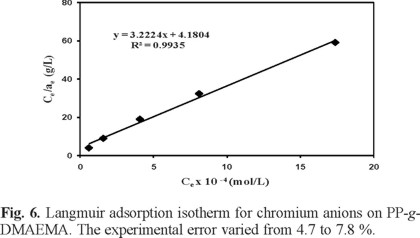
<body><![CDATA[<p align="center"><font face="verdana" size="2"><a name="f5"></a></font></p>  	    <p align="center"><font face="verdana" size="2"><img src="/img/revistas/jmcs/v57n2/a2f5.jpg"></font></p>  	    <p align="justify"><font face="verdana" size="2">where <i>C</i><sub><i>e</i></sub> is the equilibrium concentration of solution (mol/L), <i>K</i><sub><i>F</i></sub> and 1/<i>n</i> (0 &lt; 1/<i>n</i> &lt; 1) are the Freundlich constants corresponding to the adsorption capacity and intensity of adsorption, respectively, and a<sub>e</sub> was already defined above. These constants can be estimated by the intercept and the slope (less than 1) of the straight line, respectively. The values of K<sub>F</sub> and 1/<i>n</i>, computed by using the least square technique, were found to be 1.05 &times; 10<sup>&#45;4</sup> mol g<sup>&#45;1</sup> and 0.20, respectively, with a correlation coefficient of 0.9963. The value of 1/<i>n</i> (less than one) found in this work confirms that the Freundlich isotherm is valid for the Cr(VI) adsorption data on the grafted polymer. The value 1/<i>n</i>, less than unity, is attributed to a heterogeneous surface structure of the adsorbent and also indicates an exponential distribution of energy sites &#91;23&#93;. The linear form of the Freundlich isotherm indicates a physisorption process &#91;24&#93; in the Cr(VI) sorption reaction with PP&#45;<i>g</i>&#45;DMAEMA.</font></p>  	    <p align="justify"><font face="verdana" size="2">Langmuir isotherm was also used to test the Cr(VI) adsorption data on the grafted polymer. Langmuir isotherm equation is based on monolayer sorption onto a surface with finite number of identical sites. These identical sites are homogeneously distributed over the sorbent surface. The Langmuir isotherm in its linearized form is as follows:</font></p>  	    <p align="center"><font face="verdana" size="2"><img src="/img/revistas/jmcs/v57n2/a2e2.jpg"></font></p>  	    <p align="justify"><font face="verdana" size="2">where <i>k</i> and <i>a</i><sub><i>max</i></sub> are Langmuir constants related to the adsorption energy and the maximum adsorption capacity, respectively. <a href="#f6">Figure 6</a> shows the linear plot obtained when <i>C</i><sub><i>e</i></sub><i>/a</i><sub><i>e</i></sub> was plotted versus C<sub>e</sub>. The slope of this plot gives a maximum adsorption capacity (<i>a</i><sub><i>max</i></sub>) equal to 0.3103 &times; 10<sup>&#45;4</sup> mol g<sup>&#45;1</sup>, while the intercept yields the value of <i>k</i> = 3.223 &times; 10<sup>4</sup> L mol<sup>&#45;1</sup>, and <i>R</i><sup>2</sup> = 0.9946. For the Cr(VI) sorption on PP&#45;<i>g</i>&#45;DMAEMA the Freundlich isotherm has a higher correlation coefficient than the Langmuir isotherm, which indicates that the Cr(VI) sorption data fitted the Freundlich isotherm better than the langmuir isotherm.</font></p>  	    <p align="center"><font face="verdana" size="2"><a name="f6"></a></font></p>  	    <p align="center"><font face="verdana" size="2"><img src="/img/revistas/jmcs/v57n2/a2f6.jpg"></font></p>  	    <p align="justify"><font face="verdana" size="2"><b>Effect of Temperature</b></font></p>  	    <p align="justify"><font face="verdana" size="2">To investigate the temperature effect on chromium adsorption, batch experiments were carried out at 303, 313, 323 and 333 K with an initial Cr(VI) ion concentration of 1 &times; 10<sup>&#45;4</sup> M at pH 5.5 (near of the critical pH of 5), a contact time of 24 h and an adsorbent amount of 0.1 g. It was found that the amount of Cr(VI) adsorbed at equilibrium at various temperatures decreases with increasing temperature from 303 to 333 K. That is because the films were thermosensitive, and with an LCST of about 302 K, the swelling percentages decrease abruptly. Above this temperature the polymeric system was collapsed. The thermodynamic parameters (&#916;G<sup>0</sup>, &#916;H<sup>0</sup> and &#916;S<sup>0</sup>) for the adsorption of Cr(VI) on the polymeric system PP&#45;g&#45;DMAEMA were calculated using equilibrium constant, K<sub>c</sub> &#91;9&#93;:</font></p>  	    ]]></body>
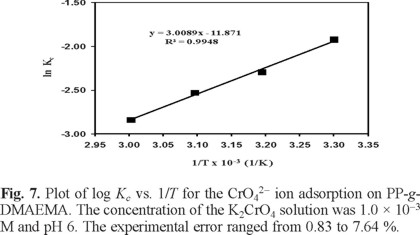
<body><![CDATA[<p align="center"><font face="verdana" size="2"><img src="/img/revistas/jmcs/v57n2/a2e3.jpg"></font></p>  	    <p align="justify"><font face="verdana" size="2">where <i>a</i><sub><i>e</i></sub> and <i>C</i><sub><i>e</i></sub> have the same meaning as in equation (5) and (6). Thus, &#916;H<sup>0</sup> and &#916;S<sup>0</sup> were obtained from the slop and intercept of van<sup>'</sup>t Hoff plots of ln <i>K</i><sub><i>c</i></sub> versus 1/<i>T</i> (<a href="#f7">Figure 7</a>):</font></p>  	    <p align="center"><font face="verdana" size="2"><img src="/img/revistas/jmcs/v57n2/a2e4.jpg"></font></p>  	    <p align="center"><font face="verdana" size="2"><a name="f7"></a></font></p>  	    <p align="center"><font face="verdana" size="2"><img src="/img/revistas/jmcs/v57n2/a2f7.jpg"></font></p>  	    <p align="justify"><font face="verdana" size="2">where <i>T</i> is the absolute temperature in degrees Kelvin and the gas constant <i>R =</i> 8.31434 kJ mol<sup>&#45;1</sup>K<sup>&#45;1</sup>.</font></p>  	    <p align="justify"><font face="verdana" size="2">The adsorption standard free energy changes &#916;G<sup>0</sup> can be calculated according to Eq. (9)</font></p>  	    <p align="center"><font face="verdana" size="2">&#916;<i>G</i><sup>0</sup>= &#45;<i>RT</i> ln <i>K</i><sub><i>c</i></sub> (9)</font></p>  	    <p align="justify"><font face="verdana" size="2"><a href="#c1">Table 1</a> shows the thermodynamic parameters of the chromate ions adsorption process. The values of &#916;H<sup>0</sup> and &#916;S<sup>0</sup> as obtained by using equation (8) were &#150;57.61 kJ mol<sup>&#45;1</sup> and &#45;227.31 J K<sup>&#45;1</sup> mol<sup>&#45;1</sup>, The negative value of DH<sup>0</sup> shows that the Cr(VI) sorption process is exothermic in nature. The negative value of DS<sup>0</sup> suggests that the adsorbed solvent molecules displaced from the adsorbent by chromate ions gain more translational entropy than is lost by the chromate ions. The values of &#916;G<sup>0</sup> obtained at 30, 40, 50 and 60<sup>o</sup>C are all positive, which indicates that the adsorption process involved in the Cr(VI) sorption on PP&#45;<i>g</i>&#45;DMAEMA is not spontaneous. The increasing in the change of the standard free energy with the rise in temperature suggests that a better adsorption is actually obtained at low temperatures.</font></p>  	    <p align="center"><font face="verdana" size="2"><a name="c1"></a></font></p>  	    ]]></body>
<body><![CDATA[<p align="center"><font face="verdana" size="2"><img src="/img/revistas/jmcs/v57n2/a2c1.jpg"></font></p>  	    <p align="justify"><font face="verdana" size="2">&nbsp;</font></p>  	    <p align="justify"><font face="verdana" size="2"><b>Conclusions</b></font></p>  	    <p align="justify"><font face="verdana" size="2">pH&#45;sensitive and thermosensitive grafted films have been prepared by the irradiation&#45;induced graft copolymerization of DMAEMA onto PP film (direct method). The chromium adsorption in the synthesized system was studied and found to decrease with temperature; further, it is at a minimum above the LCST of 302K. The optimum pH for the anion retention was found to be below the critical pH of the system, which presents an opposite behavior (high swelling at low pH and low swelling above the critical pH of 5). The study showed the ability of PP&#45;<i>g</i>&#45;DMAEMA to adsorb Cr(VI) ions from aqueous solutions. The adsorption in the equilibrium was found to be dependent on the initial concentration and temperature. Experimental adsorption isotherms of Cr(VI) ions on PP&#45;<i>g</i>&#45;DMAEMA fit well the Freundlich and Langmuir isotherms; while the negative value of the thermodynamic parameters DH<sup>0</sup> indicate that the Cr(VI) ion adsorption process is exothermic, while the positive values of DG<sup>0</sup> suggests that the adsorption process involved is not spontaneous.</font></p>  	    <p align="justify"><font face="verdana" size="2">&nbsp;</font></p>  	    <p align="justify"><font face="verdana" size="2"><b>Experimental</b></font></p>  	    <p align="justify"><font face="verdana" size="2"><b>Materials</b></font></p>  	    <p align="justify"><font face="verdana" size="2">The monomer (DMAEMA) was purchased from Aldrich Co., USA and purified by distillation under reduced pressure. (0.03 mmHg). Isotactic polypropylene (PP) films of 1 &times; 5 cm, 60 &micro;m&#45;thick and 71% crystallinity from PEMEX M&eacute;xico were washed in methanol for 24 h and then dried under reduced pressure (0.06 mm Hg) to a constant weight.</font></p>  	    <p align="justify"><font face="verdana" size="2"><b>Radiation Grafting</b></font></p>  	    <p align="justify"><font face="verdana" size="2">PP films were placed in glass ampoules which contained DMAEMA (50% V/V solution in toluene). The reaction mixtures were de&#45;aerated under vacuum by the method of freezing and thawing. The ampoules were then sealed and irradiated with a <sup>60</sup>Co &#947; source (Gammabeam 651 PT, Nordion International Inc.) at a dose rate of 5.5 kGy h<sup>&#45;1</sup> and doses from 1 to 40 kGy. The residual monomer and homopolymer formed during the irradiation were extracted with refluxing toluene for 10 h &#91;21&#93;. The films were then vacuum dried at 40 <sup>o</sup>C and the grafted percentage was estimated applying the equation: G(%) = &#91;(W<sub>f</sub> &#45;W<sub>i</sub>)/W<sub>i</sub>&#93; &times; 100; where W<sub>f</sub> and W<sub>i</sub> are the weight of PP film after and before grafting, respectively.</font></p>  	    ]]></body>
<body><![CDATA[<p align="justify"><font face="verdana" size="2"><b>Equilibrium water absorption time</b></font></p>  	    <p align="justify"><font face="verdana" size="2">Dried grafted films were immersed in distilled water at 293 K; the weights of samples were measured at various time intervals after soaking in water, and after the excess surface water was removed. The procedure was repeated until there was no further weight increase. The weight gain percentage was calculated by the equation: DW<sub>w</sub> (%) = &#91;(W<sub>f</sub> &#45;W<sub>i</sub>)/W<sub>i</sub>&#93; &times; 100 ; where <i>W</i><sub><i>f</i></sub> and <i>W</i><sub><i>i</i></sub> are the weights of the water soaked sample at time <i>t</i> and of the dried film, respectively. Once equilibrium was reached, the maximum weight gain (%<i>W</i><sub><i>w</i></sub>) was estimated. The equilibrium swelling time of the samples was reached within 3 h. The pH sensitivity was found by swelling measurements at pH values from 2 to 9, and the critical pH point was evaluated at the inflection point of the plot of swelling percentage as a function of pH, at room temperature. PP&#45;<i>g</i>&#45;DMAEMA samples have a critical pH point of 5.</font></p>  	    <p align="justify"><font face="verdana" size="2"><b>Batch Cr(VI) adsorption experiments</b></font></p>  	    <p align="justify"><font face="verdana" size="2">Batch&#45;type experiments were carried out at 293 K to determine the kinetic removal of Cr(VI) ions. Small flakes (100 mg) of PP&#45;<i>g</i>&#45;DMAEMA were shaken in closed vials with 10 mL aliquots of 1.0 &times; 10<sup>&#45;4</sup> mol L<sup>&#45;1</sup> Cr(VI) ions aqueous solution, which had a pH value of 5.5. Time intervals from 5 min to 24 h were used to attain the equilibrium distribution; then the liquid phase was recovered for chromium measurements. All of the experiments were performed in duplicate, by running two independent closed vials, simultaneously. The adsorption capacity of Cr(VI) ions by the grafted polymer was determined from the difference between the initial and final concentrations of Cr(VI) ions in the aqueous solutions, using a Shimadzu ultraviolet&#45;visible 265 spectrophotometer analyzer at &#955;= 370 nm. For the chromium concentration studies, solutions with the desired concentrations of Cr(VI) ions were prepared by successive dilutions of a stock solution of 1.0 &times; 10<sup>&#45;3</sup> mol L<sup>&#45;1</sup> K<sub>2</sub>CrO<sub>4</sub> in distilled water.</font></p>  	    <p align="justify"><font face="verdana" size="2">&nbsp;</font></p>  	    <p align="justify"><font face="verdana" size="2"><b>Acknowledgements</b></font></p>  	    <p align="justify"><font face="verdana" size="2">The authors wish to thank Francisco Garc&iacute;a from ICN, UNAM and Marcelino Villa Tomasa and Iris Z. L&oacute;pez from the Chemical Department, ININ for technical assistance, and DGAPA UNAM grant IN200210 for economical support.</font></p>  	    <p align="justify"><font face="verdana" size="2">&nbsp;</font></p>  	    <p align="justify"><font face="verdana" size="2"><b>References</b></font></p>  	    <!-- ref --><p align="justify"><font face="verdana" size="2">1. Jha, V. K.; Matsuda, M.; Miyake, M. <i>J. Hazard. Mater</i>. <b>2008</b>, 160, 148&#45;153.    &nbsp;&nbsp;&nbsp;&nbsp;&nbsp;&nbsp;&nbsp;&nbsp;[&#160;<a href="javascript:void(0);" onclick="javascript: window.open('/scielo.php?script=sci_nlinks&ref=4935123&pid=S1870-249X201300020000200001&lng=','','width=640,height=500,resizable=yes,scrollbars=1,menubar=yes,');">Links</a>&#160;]<!-- end-ref --></font></p>  	    <!-- ref --><p align="justify"><font face="verdana" size="2">2. Babel, S.; Kurniawan, T. A. <i>J. Hazard. Mater</i>. <b>2003</b>, 97, 219&#45;243.    &nbsp;&nbsp;&nbsp;&nbsp;&nbsp;&nbsp;&nbsp;&nbsp;[&#160;<a href="javascript:void(0);" onclick="javascript: window.open('/scielo.php?script=sci_nlinks&ref=4935125&pid=S1870-249X201300020000200002&lng=','','width=640,height=500,resizable=yes,scrollbars=1,menubar=yes,');">Links</a>&#160;]<!-- end-ref --></font></p>  	    <!-- ref --><p align="justify"><font face="verdana" size="2">3. Sayari, A.; Hamoudi, S.; Yang, Y. <i>Chem. Mater</i>. <b>2005</b>, 17, 212&#45;216.    &nbsp;&nbsp;&nbsp;&nbsp;&nbsp;&nbsp;&nbsp;&nbsp;[&#160;<a href="javascript:void(0);" onclick="javascript: window.open('/scielo.php?script=sci_nlinks&ref=4935127&pid=S1870-249X201300020000200003&lng=','','width=640,height=500,resizable=yes,scrollbars=1,menubar=yes,');">Links</a>&#160;]<!-- end-ref --></font></p>  	    <!-- ref --><p align="justify"><font face="verdana" size="2">4. Lalvani, S. B.; Wiltowski, T.; H&uuml;bner, A.; Weston, A.; Mandich, N. <i>Carbon.</i> <b>1998</b>, 36, 1219&#45;1226.    &nbsp;&nbsp;&nbsp;&nbsp;&nbsp;&nbsp;&nbsp;&nbsp;[&#160;<a href="javascript:void(0);" onclick="javascript: window.open('/scielo.php?script=sci_nlinks&ref=4935129&pid=S1870-249X201300020000200004&lng=','','width=640,height=500,resizable=yes,scrollbars=1,menubar=yes,');">Links</a>&#160;]<!-- end-ref --></font></p>  	    <!-- ref --><p align="justify"><font face="verdana" size="2">5. Lehmann, M.; Zouboulis, A. I.; Matis, K. A. <i>Chemosphere</i> <b>1999</b>, 39, 881&#45;892.    &nbsp;&nbsp;&nbsp;&nbsp;&nbsp;&nbsp;&nbsp;&nbsp;[&#160;<a href="javascript:void(0);" onclick="javascript: window.open('/scielo.php?script=sci_nlinks&ref=4935131&pid=S1870-249X201300020000200005&lng=','','width=640,height=500,resizable=yes,scrollbars=1,menubar=yes,');">Links</a>&#160;]<!-- end-ref --></font></p>  	    <!-- ref --><p align="justify"><font face="verdana" size="2">6. Sengupta, A. K.; Zhu, Y. <i>AIChE</i>. <b>1992</b>, 38, 153&#45;157.    &nbsp;&nbsp;&nbsp;&nbsp;&nbsp;&nbsp;&nbsp;&nbsp;[&#160;<a href="javascript:void(0);" onclick="javascript: window.open('/scielo.php?script=sci_nlinks&ref=4935133&pid=S1870-249X201300020000200006&lng=','','width=640,height=500,resizable=yes,scrollbars=1,menubar=yes,');">Links</a>&#160;]<!-- end-ref --></font></p>  	    <!-- ref --><p align="justify"><font face="verdana" size="2">7. Babu, B. V.; Gupta, S. <i>Adsorption</i> <b>2008,</b> 14, 85&#45;98.    &nbsp;&nbsp;&nbsp;&nbsp;&nbsp;&nbsp;&nbsp;&nbsp;[&#160;<a href="javascript:void(0);" onclick="javascript: window.open('/scielo.php?script=sci_nlinks&ref=4935135&pid=S1870-249X201300020000200007&lng=','','width=640,height=500,resizable=yes,scrollbars=1,menubar=yes,');">Links</a>&#160;]<!-- end-ref --></font></p>  	    <!-- ref --><p align="justify"><font face="verdana" size="2">8. Wang, J.; Chen, C. <i>Biotechnol. Adv</i>. <b>2009</b>, 27, 195&#45;226.    &nbsp;&nbsp;&nbsp;&nbsp;&nbsp;&nbsp;&nbsp;&nbsp;[&#160;<a href="javascript:void(0);" onclick="javascript: window.open('/scielo.php?script=sci_nlinks&ref=4935137&pid=S1870-249X201300020000200008&lng=','','width=640,height=500,resizable=yes,scrollbars=1,menubar=yes,');">Links</a>&#160;]<!-- end-ref --></font></p>  	    <!-- ref --><p align="justify"><font face="verdana" size="2">9. Ucun, H.; Bayhan, K. Y.; Kaya, Y. <i>J. Hazard. Mater</i>. <b>2008</b>, 153, 52&#45;59.    &nbsp;&nbsp;&nbsp;&nbsp;&nbsp;&nbsp;&nbsp;&nbsp;[&#160;<a href="javascript:void(0);" onclick="javascript: window.open('/scielo.php?script=sci_nlinks&ref=4935139&pid=S1870-249X201300020000200009&lng=','','width=640,height=500,resizable=yes,scrollbars=1,menubar=yes,');">Links</a>&#160;]<!-- end-ref --></font></p>  	    <!-- ref --><p align="justify"><font face="verdana" size="2">10. Tewari, N.; Vasudevan, P. <i>Biochem. Eng. J</i>. <b>2005</b>, 23, 185&#45;192.    &nbsp;&nbsp;&nbsp;&nbsp;&nbsp;&nbsp;&nbsp;&nbsp;[&#160;<a href="javascript:void(0);" onclick="javascript: window.open('/scielo.php?script=sci_nlinks&ref=4935141&pid=S1870-249X201300020000200010&lng=','','width=640,height=500,resizable=yes,scrollbars=1,menubar=yes,');">Links</a>&#160;]<!-- end-ref --></font></p>  	    <!-- ref --><p align="justify"><font face="verdana" size="2">11. Mahramanlioglu, M.; Bicer, I. O.; Misirli, T.; Kilislioglu, A. J. <i>Radianal. Nucl. Chem.</i> <b>2007</b>, 273, 621&#45;624.    &nbsp;&nbsp;&nbsp;&nbsp;&nbsp;&nbsp;&nbsp;&nbsp;[&#160;<a href="javascript:void(0);" onclick="javascript: window.open('/scielo.php?script=sci_nlinks&ref=4935143&pid=S1870-249X201300020000200011&lng=','','width=640,height=500,resizable=yes,scrollbars=1,menubar=yes,');">Links</a>&#160;]<!-- end-ref --></font></p>  	    <!-- ref --><p align="justify"><font face="verdana" size="2">12. Co&#351;nuk, R.; Soykan, C.; Sa&ccedil;ak, M. <i>Sep. Purif. Technol.</i> <b>2006</b>, 49, 107&#45;114.    &nbsp;&nbsp;&nbsp;&nbsp;&nbsp;&nbsp;&nbsp;&nbsp;[&#160;<a href="javascript:void(0);" onclick="javascript: window.open('/scielo.php?script=sci_nlinks&ref=4935145&pid=S1870-249X201300020000200012&lng=','','width=640,height=500,resizable=yes,scrollbars=1,menubar=yes,');">Links</a>&#160;]<!-- end-ref --></font></p>  	    <!-- ref --><p align="justify"><font face="verdana" size="2">13. Hegazy, E. A.; Abd El&#45;Rehim, H. A.; Shawky, H. A. <i>Rad. Phys. Chem</i>. <b>2000</b>, 57, 85&#45;95.    &nbsp;&nbsp;&nbsp;&nbsp;&nbsp;&nbsp;&nbsp;&nbsp;[&#160;<a href="javascript:void(0);" onclick="javascript: window.open('/scielo.php?script=sci_nlinks&ref=4935147&pid=S1870-249X201300020000200013&lng=','','width=640,height=500,resizable=yes,scrollbars=1,menubar=yes,');">Links</a>&#160;]<!-- end-ref --></font></p>  	    <!-- ref --><p align="justify"><font face="verdana" size="2">14. Bhattacharya, A.; Misra, B. N. <i>Prog. Polym. Sci.</i> <b>2004</b>, 29, 767&#45;814.    &nbsp;&nbsp;&nbsp;&nbsp;&nbsp;&nbsp;&nbsp;&nbsp;[&#160;<a href="javascript:void(0);" onclick="javascript: window.open('/scielo.php?script=sci_nlinks&ref=4935149&pid=S1870-249X201300020000200014&lng=','','width=640,height=500,resizable=yes,scrollbars=1,menubar=yes,');">Links</a>&#160;]<!-- end-ref --></font></p>  	    <!-- ref --><p align="justify"><font face="verdana" size="2">15. Seko, N.; Tamada, M.; Yoghi, F. <i>Nucl. Instrum. and Methods in Phys. Res.</i>, <i>Sect. B: Beam Interact. with Mater. and Atoms</i>. <b>2005</b>, 236, 21&#45;29.    &nbsp;&nbsp;&nbsp;&nbsp;&nbsp;&nbsp;&nbsp;&nbsp;[&#160;<a href="javascript:void(0);" onclick="javascript: window.open('/scielo.php?script=sci_nlinks&ref=4935151&pid=S1870-249X201300020000200015&lng=','','width=640,height=500,resizable=yes,scrollbars=1,menubar=yes,');">Links</a>&#160;]<!-- end-ref --></font></p>  	    <!-- ref --><p align="justify"><font face="verdana" size="2">16. &Ouml;zeroglu, C.; Keceli, G. <i>Radiochim. Acta</i> <b>2009</b>, 97, 709&#45;717.    &nbsp;&nbsp;&nbsp;&nbsp;&nbsp;&nbsp;&nbsp;&nbsp;[&#160;<a href="javascript:void(0);" onclick="javascript: window.open('/scielo.php?script=sci_nlinks&ref=4935153&pid=S1870-249X201300020000200016&lng=','','width=640,height=500,resizable=yes,scrollbars=1,menubar=yes,');">Links</a>&#160;]<!-- end-ref --></font></p>  	    <!-- ref --><p align="justify"><font face="verdana" size="2">17. Chapiro, A. <i>Radiation Chemistry of Polymeric System.</i> Interscience, New York, <b>1962.    &nbsp;&nbsp;&nbsp;&nbsp;&nbsp;&nbsp;&nbsp;&nbsp;[&#160;<a href="javascript:void(0);" onclick="javascript: window.open('/scielo.php?script=sci_nlinks&ref=4935155&pid=S1870-249X201300020000200017&lng=','','width=640,height=500,resizable=yes,scrollbars=1,menubar=yes,');">Links</a>&#160;]<!-- end-ref --></b></font></p>  	    <!-- ref --><p align="justify"><font face="verdana" size="2">18. Bucio, E.; Aliev, R.; Burillo, G. <i>Polymer. Bull.</i> <b>2002</b>, 45, 571&#45;577.    &nbsp;&nbsp;&nbsp;&nbsp;&nbsp;&nbsp;&nbsp;&nbsp;[&#160;<a href="javascript:void(0);" onclick="javascript: window.open('/scielo.php?script=sci_nlinks&ref=4935157&pid=S1870-249X201300020000200018&lng=','','width=640,height=500,resizable=yes,scrollbars=1,menubar=yes,');">Links</a>&#160;]<!-- end-ref --></font></p>  	    <!-- ref --><p align="justify"><font face="verdana" size="2">19. Contreras&#45;Garc&iacute;a, A.; Burillo, G.; Aliev, R.; Bucio, E. <i>Radiat. Phys. Chem</i>. <b>2008</b>, 77, 936&#45;940.    &nbsp;&nbsp;&nbsp;&nbsp;&nbsp;&nbsp;&nbsp;&nbsp;[&#160;<a href="javascript:void(0);" onclick="javascript: window.open('/scielo.php?script=sci_nlinks&ref=4935159&pid=S1870-249X201300020000200019&lng=','','width=640,height=500,resizable=yes,scrollbars=1,menubar=yes,');">Links</a>&#160;]<!-- end-ref --></font></p>  	    <!-- ref --><p align="justify"><font face="verdana" size="2">20. Woods, R. J.; Pikaev, A. K. <i>Applied Radiaton Chemistry: Radiation Processing.</i> John Wiley &amp; Sons, New York., <b>1994</b>.    &nbsp;&nbsp;&nbsp;&nbsp;&nbsp;&nbsp;&nbsp;&nbsp;[&#160;<a href="javascript:void(0);" onclick="javascript: window.open('/scielo.php?script=sci_nlinks&ref=4935161&pid=S1870-249X201300020000200020&lng=','','width=640,height=500,resizable=yes,scrollbars=1,menubar=yes,');">Links</a>&#160;]<!-- end-ref --></font></p>  	    <!-- ref --><p align="justify"><font face="verdana" size="2">21. Burillo, G.; Bucio, E.; Arenas, E.; L&oacute;pez, G. <i>Macromol. Mater. Eng</i>. <b>2007</b>, 292, 214&#45;219.    &nbsp;&nbsp;&nbsp;&nbsp;&nbsp;&nbsp;&nbsp;&nbsp;[&#160;<a href="javascript:void(0);" onclick="javascript: window.open('/scielo.php?script=sci_nlinks&ref=4935163&pid=S1870-249X201300020000200021&lng=','','width=640,height=500,resizable=yes,scrollbars=1,menubar=yes,');">Links</a>&#160;]<!-- end-ref --></font></p>  	    <!-- ref --><p align="justify"><font face="verdana" size="2">22. Puigdomenech, I.: Program MEDUSA (make equilibrium diagrams using sophisticated algorithms), <a href="http://www.inorg.Kth.se/Reserach/Ignasi;/index.html" target="_blank">http://www.inorg.Kth.se/Reserach/Ignasi;/index.html</a>.    &nbsp;&nbsp;&nbsp;&nbsp;&nbsp;&nbsp;&nbsp;&nbsp;[&#160;<a href="javascript:void(0);" onclick="javascript: window.open('/scielo.php?script=sci_nlinks&ref=4935165&pid=S1870-249X201300020000200022&lng=','','width=640,height=500,resizable=yes,scrollbars=1,menubar=yes,');">Links</a>&#160;]<!-- end-ref --></font></p>  	    <!-- ref --><p align="justify"><font face="verdana" size="2">23. Benes, P.; Majer, V. <i>Trace Chemistry of Aqueous Solutions. General Chemistry and Radiochemistry.</i> Elsevier Scientific Publishing Company, Amsterdam, <b>1980.    &nbsp;&nbsp;&nbsp;&nbsp;&nbsp;&nbsp;&nbsp;&nbsp;[&#160;<a href="javascript:void(0);" onclick="javascript: window.open('/scielo.php?script=sci_nlinks&ref=4935167&pid=S1870-249X201300020000200023&lng=','','width=640,height=500,resizable=yes,scrollbars=1,menubar=yes,');">Links</a>&#160;]<!-- end-ref --></b></font></p>  	    <!-- ref --><p align="justify"><font face="verdana" size="2">24. Ravichandran, P.; Hasmath Farzana, M.; Meenakshi, S. <i>Indian J. Chem. Technol</i>. <b>2012,</b> 19, 103&#45;110.    &nbsp;&nbsp;&nbsp;&nbsp;&nbsp;&nbsp;&nbsp;&nbsp;[&#160;<a href="javascript:void(0);" onclick="javascript: window.open('/scielo.php?script=sci_nlinks&ref=4935169&pid=S1870-249X201300020000200024&lng=','','width=640,height=500,resizable=yes,scrollbars=1,menubar=yes,');">Links</a>&#160;]<!-- end-ref --></font></p>      ]]></body><back>
<ref-list>
<ref id="B1">
<label>1</label><nlm-citation citation-type="journal">
<person-group person-group-type="author">
<name>
<surname><![CDATA[Jha]]></surname>
<given-names><![CDATA[V. K.]]></given-names>
</name>
<name>
<surname><![CDATA[Matsuda]]></surname>
<given-names><![CDATA[M.]]></given-names>
</name>
<name>
<surname><![CDATA[Miyake]]></surname>
<given-names><![CDATA[M.]]></given-names>
</name>
</person-group>
<source><![CDATA[J. Hazard. Mater.]]></source>
<year>2008</year>
<numero>160</numero>
<issue>160</issue>
<page-range>148-153</page-range></nlm-citation>
</ref>
<ref id="B2">
<label>2</label><nlm-citation citation-type="journal">
<person-group person-group-type="author">
<name>
<surname><![CDATA[Babel]]></surname>
<given-names><![CDATA[S.]]></given-names>
</name>
<name>
<surname><![CDATA[Kurniawan]]></surname>
<given-names><![CDATA[T. A.]]></given-names>
</name>
</person-group>
<source><![CDATA[J. Hazard. Mater.]]></source>
<year>2003</year>
<numero>97</numero>
<issue>97</issue>
<page-range>219-243</page-range></nlm-citation>
</ref>
<ref id="B3">
<label>3</label><nlm-citation citation-type="journal">
<person-group person-group-type="author">
<name>
<surname><![CDATA[Sayari]]></surname>
<given-names><![CDATA[A.]]></given-names>
</name>
<name>
<surname><![CDATA[Hamoudi]]></surname>
<given-names><![CDATA[S.]]></given-names>
</name>
<name>
<surname><![CDATA[Yang]]></surname>
<given-names><![CDATA[Y.]]></given-names>
</name>
</person-group>
<source><![CDATA[Chem. Mater.]]></source>
<year>2005</year>
<numero>17</numero>
<issue>17</issue>
<page-range>212-216</page-range></nlm-citation>
</ref>
<ref id="B4">
<label>4</label><nlm-citation citation-type="">
<person-group person-group-type="author">
<name>
<surname><![CDATA[Lalvani]]></surname>
<given-names><![CDATA[S. B.]]></given-names>
</name>
<name>
<surname><![CDATA[Wiltowski]]></surname>
<given-names><![CDATA[T.]]></given-names>
</name>
<name>
<surname><![CDATA[Hübner]]></surname>
<given-names><![CDATA[A.]]></given-names>
</name>
<name>
<surname><![CDATA[Weston]]></surname>
<given-names><![CDATA[A.]]></given-names>
</name>
<name>
<surname><![CDATA[Mandich]]></surname>
<given-names><![CDATA[N.]]></given-names>
</name>
</person-group>
<source><![CDATA[]]></source>
<year></year>
</nlm-citation>
</ref>
<ref id="B5">
<label>5</label><nlm-citation citation-type="journal">
<person-group person-group-type="author">
<name>
<surname><![CDATA[Lehmann]]></surname>
<given-names><![CDATA[M.]]></given-names>
</name>
<name>
<surname><![CDATA[Zouboulis]]></surname>
<given-names><![CDATA[A. I.]]></given-names>
</name>
<name>
<surname><![CDATA[Matis]]></surname>
<given-names><![CDATA[K. A.]]></given-names>
</name>
</person-group>
<source><![CDATA[Chemosphere]]></source>
<year>1999</year>
<numero>39</numero>
<issue>39</issue>
<page-range>881-892</page-range></nlm-citation>
</ref>
<ref id="B6">
<label>6</label><nlm-citation citation-type="journal">
<person-group person-group-type="author">
<name>
<surname><![CDATA[Sengupta]]></surname>
<given-names><![CDATA[A. K.]]></given-names>
</name>
<name>
<surname><![CDATA[Zhu]]></surname>
<given-names><![CDATA[Y.]]></given-names>
</name>
</person-group>
<source><![CDATA[AIChE.]]></source>
<year>1992</year>
<numero>38</numero>
<issue>38</issue>
<page-range>153-157</page-range></nlm-citation>
</ref>
<ref id="B7">
<label>7</label><nlm-citation citation-type="journal">
<person-group person-group-type="author">
<name>
<surname><![CDATA[Babu]]></surname>
<given-names><![CDATA[B. V.]]></given-names>
</name>
<name>
<surname><![CDATA[Gupta]]></surname>
<given-names><![CDATA[S.]]></given-names>
</name>
</person-group>
<source><![CDATA[Adsorption]]></source>
<year>2008</year>
<numero>14</numero>
<issue>14</issue>
<page-range>85-98</page-range></nlm-citation>
</ref>
<ref id="B8">
<label>8</label><nlm-citation citation-type="journal">
<person-group person-group-type="author">
<name>
<surname><![CDATA[Wang]]></surname>
<given-names><![CDATA[J.]]></given-names>
</name>
<name>
<surname><![CDATA[Chen]]></surname>
<given-names><![CDATA[C.]]></given-names>
</name>
</person-group>
<source><![CDATA[Biotechnol. Adv.]]></source>
<year>2009</year>
<numero>27</numero>
<issue>27</issue>
<page-range>195-226</page-range></nlm-citation>
</ref>
<ref id="B9">
<label>9</label><nlm-citation citation-type="journal">
<person-group person-group-type="author">
<name>
<surname><![CDATA[Ucun]]></surname>
<given-names><![CDATA[H.]]></given-names>
</name>
<name>
<surname><![CDATA[Bayhan]]></surname>
<given-names><![CDATA[K. Y.]]></given-names>
</name>
<name>
<surname><![CDATA[Kaya]]></surname>
<given-names><![CDATA[Y.]]></given-names>
</name>
</person-group>
<source><![CDATA[J. Hazard. Mater.]]></source>
<year>2008</year>
<numero>153</numero>
<issue>153</issue>
<page-range>52-59</page-range></nlm-citation>
</ref>
<ref id="B10">
<label>10</label><nlm-citation citation-type="journal">
<person-group person-group-type="author">
<name>
<surname><![CDATA[Tewari]]></surname>
<given-names><![CDATA[N.]]></given-names>
</name>
<name>
<surname><![CDATA[Vasudevan]]></surname>
<given-names><![CDATA[P.]]></given-names>
</name>
</person-group>
<source><![CDATA[Biochem. Eng. J.]]></source>
<year>2005</year>
<numero>23</numero>
<issue>23</issue>
<page-range>185-192</page-range></nlm-citation>
</ref>
<ref id="B11">
<label>11</label><nlm-citation citation-type="journal">
<person-group person-group-type="author">
<name>
<surname><![CDATA[Mahramanlioglu]]></surname>
<given-names><![CDATA[M.]]></given-names>
</name>
<name>
<surname><![CDATA[Bicer]]></surname>
<given-names><![CDATA[I. O.]]></given-names>
</name>
<name>
<surname><![CDATA[Misirli]]></surname>
<given-names><![CDATA[T.]]></given-names>
</name>
<name>
<surname><![CDATA[Kilislioglu]]></surname>
<given-names><![CDATA[A. J.]]></given-names>
</name>
</person-group>
<source><![CDATA[Radianal. Nucl. Chem.]]></source>
<year>2007</year>
<numero>273</numero>
<issue>273</issue>
<page-range>621-624</page-range></nlm-citation>
</ref>
<ref id="B12">
<label>12</label><nlm-citation citation-type="journal">
<person-group person-group-type="author">
<name>
<surname><![CDATA[Co&#351;nuk]]></surname>
<given-names><![CDATA[R.]]></given-names>
</name>
<name>
<surname><![CDATA[Soykan]]></surname>
<given-names><![CDATA[C.]]></given-names>
</name>
<name>
<surname><![CDATA[Saçak]]></surname>
<given-names><![CDATA[M.]]></given-names>
</name>
</person-group>
<source><![CDATA[Sep. Purif. Technol.]]></source>
<year>2006</year>
<numero>49</numero>
<issue>49</issue>
<page-range>107-114</page-range></nlm-citation>
</ref>
<ref id="B13">
<label>13</label><nlm-citation citation-type="journal">
<person-group person-group-type="author">
<name>
<surname><![CDATA[Hegazy]]></surname>
<given-names><![CDATA[E. A.]]></given-names>
</name>
<name>
<surname><![CDATA[Abd El-Rehim]]></surname>
<given-names><![CDATA[H. A.]]></given-names>
</name>
<name>
<surname><![CDATA[Shawky]]></surname>
<given-names><![CDATA[H. A.]]></given-names>
</name>
</person-group>
<source><![CDATA[Rad. Phys. Chem.]]></source>
<year>2000</year>
<numero>57</numero>
<issue>57</issue>
<page-range>85-95</page-range></nlm-citation>
</ref>
<ref id="B14">
<label>14</label><nlm-citation citation-type="journal">
<person-group person-group-type="author">
<name>
<surname><![CDATA[Bhattacharya]]></surname>
<given-names><![CDATA[A.]]></given-names>
</name>
<name>
<surname><![CDATA[Misra]]></surname>
<given-names><![CDATA[B. N.]]></given-names>
</name>
</person-group>
<source><![CDATA[Prog. Polym. Sci.]]></source>
<year>2004</year>
<numero>29</numero>
<issue>29</issue>
<page-range>767-814</page-range></nlm-citation>
</ref>
<ref id="B15">
<label>15</label><nlm-citation citation-type="journal">
<person-group person-group-type="author">
<name>
<surname><![CDATA[Seko]]></surname>
<given-names><![CDATA[N.]]></given-names>
</name>
<name>
<surname><![CDATA[Tamada]]></surname>
<given-names><![CDATA[M.]]></given-names>
</name>
<name>
<surname><![CDATA[Yoghi]]></surname>
<given-names><![CDATA[F.]]></given-names>
</name>
</person-group>
<source><![CDATA[Nucl. Instrum. and Methods in Phys. Res.]]></source>
<year>2005</year>
<numero>236</numero>
<issue>236</issue>
<page-range>21-29</page-range></nlm-citation>
</ref>
<ref id="B16">
<label>16</label><nlm-citation citation-type="journal">
<person-group person-group-type="author">
<name>
<surname><![CDATA[Özeroglu]]></surname>
<given-names><![CDATA[C.]]></given-names>
</name>
<name>
<surname><![CDATA[Keceli]]></surname>
<given-names><![CDATA[G.]]></given-names>
</name>
</person-group>
<source><![CDATA[Radiochim. Acta]]></source>
<year>2009</year>
<numero>97</numero>
<issue>97</issue>
<page-range>709-717</page-range></nlm-citation>
</ref>
<ref id="B17">
<label>17</label><nlm-citation citation-type="book">
<person-group person-group-type="author">
<name>
<surname><![CDATA[Chapiro]]></surname>
<given-names><![CDATA[A.]]></given-names>
</name>
</person-group>
<source><![CDATA[Radiation Chemistry of Polymeric System]]></source>
<year>1962</year>
<publisher-loc><![CDATA[New York ]]></publisher-loc>
<publisher-name><![CDATA[Interscience]]></publisher-name>
</nlm-citation>
</ref>
<ref id="B18">
<label>18</label><nlm-citation citation-type="journal">
<person-group person-group-type="author">
<name>
<surname><![CDATA[Bucio]]></surname>
<given-names><![CDATA[E.]]></given-names>
</name>
<name>
<surname><![CDATA[Aliev]]></surname>
<given-names><![CDATA[R.]]></given-names>
</name>
<name>
<surname><![CDATA[Burillo]]></surname>
<given-names><![CDATA[G.]]></given-names>
</name>
</person-group>
<source><![CDATA[Polymer. Bull.]]></source>
<year>2002</year>
<numero>45</numero>
<issue>45</issue>
<page-range>571-577</page-range></nlm-citation>
</ref>
<ref id="B19">
<label>19</label><nlm-citation citation-type="journal">
<person-group person-group-type="author">
<name>
<surname><![CDATA[Contreras-García]]></surname>
<given-names><![CDATA[A.]]></given-names>
</name>
<name>
<surname><![CDATA[Burillo]]></surname>
<given-names><![CDATA[G.]]></given-names>
</name>
<name>
<surname><![CDATA[Aliev]]></surname>
<given-names><![CDATA[R.]]></given-names>
</name>
<name>
<surname><![CDATA[Bucio]]></surname>
<given-names><![CDATA[E.]]></given-names>
</name>
</person-group>
<source><![CDATA[Radiat. Phys. Chem.]]></source>
<year>2008</year>
<numero>77</numero>
<issue>77</issue>
<page-range>936-940</page-range></nlm-citation>
</ref>
<ref id="B20">
<label>20</label><nlm-citation citation-type="book">
<person-group person-group-type="author">
<name>
<surname><![CDATA[Woods]]></surname>
<given-names><![CDATA[R. J.]]></given-names>
</name>
<name>
<surname><![CDATA[Pikaev]]></surname>
<given-names><![CDATA[A. K.]]></given-names>
</name>
</person-group>
<source><![CDATA[Applied Radiaton Chemistry: Radiation Processing]]></source>
<year>1994</year>
<publisher-loc><![CDATA[New York ]]></publisher-loc>
<publisher-name><![CDATA[John Wiley & Sons]]></publisher-name>
</nlm-citation>
</ref>
<ref id="B21">
<label>21</label><nlm-citation citation-type="journal">
<person-group person-group-type="author">
<name>
<surname><![CDATA[Burillo]]></surname>
<given-names><![CDATA[G.]]></given-names>
</name>
<name>
<surname><![CDATA[Bucio]]></surname>
<given-names><![CDATA[E.]]></given-names>
</name>
<name>
<surname><![CDATA[Arenas]]></surname>
<given-names><![CDATA[E.]]></given-names>
</name>
<name>
<surname><![CDATA[López]]></surname>
<given-names><![CDATA[G.]]></given-names>
</name>
</person-group>
<source><![CDATA[Macromol. Mater. Eng.]]></source>
<year>2007</year>
<numero>292</numero>
<issue>292</issue>
<page-range>214-219</page-range></nlm-citation>
</ref>
<ref id="B22">
<label>22</label><nlm-citation citation-type="">
<person-group person-group-type="author">
<name>
<surname><![CDATA[Puigdomenech]]></surname>
<given-names><![CDATA[I.]]></given-names>
</name>
</person-group>
<source><![CDATA[Program MEDUSA (make equilibrium diagrams using sophisticated algorithms)]]></source>
<year></year>
</nlm-citation>
</ref>
<ref id="B23">
<label>23</label><nlm-citation citation-type="book">
<person-group person-group-type="author">
<name>
<surname><![CDATA[Benes]]></surname>
<given-names><![CDATA[P.]]></given-names>
</name>
<name>
<surname><![CDATA[Majer]]></surname>
<given-names><![CDATA[V.]]></given-names>
</name>
</person-group>
<source><![CDATA[Trace Chemistry of Aqueous Solutions. General Chemistry and Radiochemistry]]></source>
<year>1980</year>
<publisher-loc><![CDATA[Amsterdam ]]></publisher-loc>
<publisher-name><![CDATA[Elsevier Scientific Publishing Company]]></publisher-name>
</nlm-citation>
</ref>
<ref id="B24">
<label>24</label><nlm-citation citation-type="journal">
<person-group person-group-type="author">
<name>
<surname><![CDATA[Ravichandran]]></surname>
<given-names><![CDATA[P.]]></given-names>
</name>
<name>
<surname><![CDATA[Hasmath Farzana]]></surname>
<given-names><![CDATA[M.]]></given-names>
</name>
<name>
<surname><![CDATA[Meenakshi]]></surname>
<given-names><![CDATA[S.]]></given-names>
</name>
</person-group>
<source><![CDATA[Indian J. Chem. Technol.]]></source>
<year>2012</year>
<numero>19</numero>
<issue>19</issue>
<page-range>103-110</page-range></nlm-citation>
</ref>
</ref-list>
</back>
</article>