<?xml version="1.0" encoding="ISO-8859-1"?><article xmlns:mml="http://www.w3.org/1998/Math/MathML" xmlns:xlink="http://www.w3.org/1999/xlink" xmlns:xsi="http://www.w3.org/2001/XMLSchema-instance">
<front>
<journal-meta>
<journal-id>1870-249X</journal-id>
<journal-title><![CDATA[Journal of the Mexican Chemical Society]]></journal-title>
<abbrev-journal-title><![CDATA[J. Mex. Chem. Soc]]></abbrev-journal-title>
<issn>1870-249X</issn>
<publisher>
<publisher-name><![CDATA[Sociedad Química de México A.C.]]></publisher-name>
</publisher>
</journal-meta>
<article-meta>
<article-id>S1870-249X2012000300016</article-id>
<title-group>
<article-title xml:lang="en"><![CDATA[GGA/PBE study of the spin isomers of Fe34,40, Co23,34, and Co12Cu Clusters with Selected Geometries]]></article-title>
</title-group>
<contrib-group>
<contrib contrib-type="author">
<name>
<surname><![CDATA[Aguilera-Granja]]></surname>
<given-names><![CDATA[Faustino]]></given-names>
</name>
<xref ref-type="aff" rid="A01"/>
</contrib>
<contrib contrib-type="author">
<name>
<surname><![CDATA[Vega]]></surname>
<given-names><![CDATA[Andrés]]></given-names>
</name>
<xref ref-type="aff" rid="A02"/>
</contrib>
<contrib contrib-type="author">
<name>
<surname><![CDATA[Balbás]]></surname>
<given-names><![CDATA[Luis Carlos]]></given-names>
</name>
<xref ref-type="aff" rid="A02"/>
</contrib>
</contrib-group>
<aff id="A01">
<institution><![CDATA[,Universidad Autónoma de San Luis Potosí Instituto de Física ]]></institution>
<addr-line><![CDATA[San Luis Potosí ]]></addr-line>
<country>México</country>
</aff>
<aff id="A02">
<institution><![CDATA[,Universidad de Valladolid Departamento de Física Teórica, Atómica y Óptica ]]></institution>
<addr-line><![CDATA[Valladolid ]]></addr-line>
<country>Spain</country>
</aff>
<pub-date pub-type="pub">
<day>00</day>
<month>09</month>
<year>2012</year>
</pub-date>
<pub-date pub-type="epub">
<day>00</day>
<month>09</month>
<year>2012</year>
</pub-date>
<volume>56</volume>
<numero>3</numero>
<fpage>331</fpage>
<lpage>337</lpage>
<copyright-statement/>
<copyright-year/>
<self-uri xlink:href="http://www.scielo.org.mx/scielo.php?script=sci_arttext&amp;pid=S1870-249X2012000300016&amp;lng=en&amp;nrm=iso"></self-uri><self-uri xlink:href="http://www.scielo.org.mx/scielo.php?script=sci_abstract&amp;pid=S1870-249X2012000300016&amp;lng=en&amp;nrm=iso"></self-uri><self-uri xlink:href="http://www.scielo.org.mx/scielo.php?script=sci_pdf&amp;pid=S1870-249X2012000300016&amp;lng=en&amp;nrm=iso"></self-uri><abstract abstract-type="short" xml:lang="en"><p><![CDATA[In a recent beam deflecting experiment was found that high and low spin states of pure Fe n and Co n clusters with n &#8804; 300 atoms coexist at cryogenic temperatures. In this work we have studied the high spin (HS) and low spin (LS) states of several structural isomers of Co23, Co34, Fe34, and Fe40 using the generalized gradient approximation (GGA) to density functional theory as implemented in the first-principles pseudo-potential code SIESTA. The calculated energy difference between these HS and LS isomers is not consistent with the observed coexistence, which can be due to an insufficient account of many body correlation effects in the GGA description, or to unknown isomer structures of these clusters. We have calculated within the same tools the magnetic isomers of Co12Cu cluster aimed to re-visit a former DFT prediction of an anti-ferromagnetic ground state. We find, however, a ferromagnetic ground state as expected on physical grounds. Our results exemplify the difficulties of the current DFT approaches to describe the magnetic properties of transition metal systems.]]></p></abstract>
<abstract abstract-type="short" xml:lang="es"><p><![CDATA[Hemos estudiado estados magnéticos de alto y bajo espín en los agregados Co23, Co34, Fe34 y Fe40, por medio de la aproximación de gradientes generalizada a la teoría del funcional de la densidad (DFT). Nuestro propósito era explicar la coexistencia de dichos estados observada recientemente en experimentos tipo Stern-Gerlach sobre haces de agregados de Cobalto y de Hierro a temperatura criogénica. Los cálculos predicen una diferencia en la energía de esos estados magnéticos demasiado grande para que puedan coexistir a la temperatura del experimento. Esto indica que el nivel teórico no es suficiente para dilucidar estos efectos magnéticos finos, o, más probablemente, ninguna de las estructuras optimizadas corresponde a la del estado fundamental. Por otro lado, usando la misma herramienta computacional, predecimos un estado base ferromagnético para Co12Cu, como cabe esperar por intuición física, mientras cálculos DFT previos predicen un estado antiferromagnético.]]></p></abstract>
<kwd-group>
<kwd lng="en"><![CDATA[DFT]]></kwd>
<kwd lng="en"><![CDATA[Iron and Cobalt Clusters]]></kwd>
<kwd lng="en"><![CDATA[Magnetism]]></kwd>
<kwd lng="es"><![CDATA[Teoría del funcional de la densidad]]></kwd>
<kwd lng="es"><![CDATA[agregados de hierro, cobalto y Co/Cu]]></kwd>
</kwd-group>
</article-meta>
</front><body><![CDATA[  	    <p align="justify"><font face="verdana" size="4">Art&iacute;culo</font></p>      <p align="justify"><font face="verdana" size="2">&nbsp;</font></p>  	    <p align="center"><font face="verdana" size="4"><b>GGA/PBE study of the spin isomers of Fe<sub>34,40</sub>, Co<sub>23,34</sub>,</b> <b>and Co<sub>12</sub>Cu Clusters with Selected Geometries</b></font></p>  	    <p align="justify"><font face="verdana" size="2">&nbsp;</font></p>  	    <p align="center"><font face="verdana" size="2"><b>Faustino Aguilera&#45;Granja,<sup>1</sup> Andr&eacute;s Vega,<sup>2</sup> and Luis Carlos Balb&aacute;s<sup>2,</sup><a href="#notas">*</a></b></font></p>  	    <p align="justify"><font face="verdana" size="2">&nbsp;</font></p>  	    <p align="justify"><font face="verdana" size="2"><sup><i>1</i></sup><i> Instituto de F&iacute;sica, Universidad Aut&oacute;noma de San Luis Potos&iacute;, 78000 San Luis Potos&iacute;, M&eacute;xico.</i></font></p>  	    <p align="justify"><font face="verdana" size="2"><i><sup>2</sup> Departamento de F&iacute;sica Te&oacute;rica, At&oacute;mica y &Oacute;ptica, Universidad de Valladolid, E&#45;47011 Valladolid. Spain.</i></font></p>  	    <p align="justify"><font face="verdana" size="2">&nbsp;</font></p>  	    ]]></body>
<body><![CDATA[<p align="justify"><font face="verdana" size="2">Received December 05, 2011.    <br> 	Accepted May 23, 2012.</font></p>  	    <p align="justify"><font face="verdana" size="2">&nbsp;</font></p>  	    <p align="justify"><font face="verdana" size="2"><b>Abstract</b></font></p>  	    <p align="justify"><font face="verdana" size="2">In a recent beam deflecting experiment was found that high and low spin states of pure Fe<sub>n</sub> and Co<sub>n</sub> clusters with <i>n</i> &#8804; 300 atoms coexist at cryogenic temperatures. In this work we have studied the high spin (HS) and low spin (LS) states of several structural isomers of Co<sub>23</sub>, Co<sub>34</sub>, Fe<sub>34</sub>, and Fe<sub>40</sub> using the generalized gradient approximation (GGA) to density functional theory as implemented in the first&#45;principles pseudo&#45;potential code SIESTA. The calculated energy difference between these HS and LS isomers is not consistent with the observed coexistence, which can be due to an insufficient account of many body correlation effects in the GGA description, or to unknown isomer structures of these clusters. We have calculated within the same tools the magnetic isomers of Co<sub>12</sub>Cu cluster aimed to re&#45;visit a former DFT prediction of an anti&#45;ferromagnetic ground state. We find, however, a ferromagnetic ground state as expected on physical grounds. Our results exemplify the difficulties of the current DFT approaches to describe the magnetic properties of transition metal systems.</font></p>  	    <p align="justify"><font face="verdana" size="2"><b>Key words:</b> DFT, Iron and Cobalt Clusters, Magnetism.</font></p>  	    <p align="justify"><font face="verdana" size="2">&nbsp;</font></p>  	    <p align="justify"><font face="verdana" size="2"><b>Resumen</b></font></p>  	    <p align="justify"><font face="verdana" size="2">Hemos estudiado estados magn&eacute;ticos de alto y bajo esp&iacute;n en los agregados Co<sub>23</sub>, Co<sub>34</sub>, Fe<sub>34</sub> y Fe<sub>40</sub>, por medio de la aproximaci&oacute;n de gradientes generalizada a la teor&iacute;a del funcional de la densidad (DFT). Nuestro prop&oacute;sito era explicar la coexistencia de dichos estados observada recientemente en experimentos tipo Stern&#45;Gerlach sobre haces de agregados de Cobalto y de Hierro a temperatura criog&eacute;nica. Los c&aacute;lculos predicen una diferencia en la energ&iacute;a de esos estados magn&eacute;ticos demasiado grande para que puedan coexistir a la temperatura del experimento. Esto indica que el nivel te&oacute;rico no es suficiente para dilucidar estos efectos magn&eacute;ticos finos, o, m&aacute;s probablemente, ninguna de las estructuras optimizadas corresponde a la del estado fundamental. Por otro lado, usando la misma herramienta computacional, predecimos un estado base ferromagn&eacute;tico para Co<sub>12</sub>Cu, como cabe esperar por intuici&oacute;n f&iacute;sica, mientras c&aacute;lculos DFT previos predicen un estado antiferromagn&eacute;tico.</font></p>  	    <p align="justify"><font face="verdana" size="2"><b>Palabras clave:</b> Teor&iacute;a del funcional de la densidad; agregados de hierro, cobalto y Co/Cu.</font></p>  	    ]]></body>
<body><![CDATA[<p align="justify"><font face="verdana" size="2">&nbsp;</font></p>  	    <p align="justify"><font face="verdana" size="2"><b>Introduction</b></font></p>  	    <p align="justify"><font face="verdana" size="2">Theoretical study of the magnetic isomers of transition metal (TM) clusters by means of Density Functional Theory (DFT) &#91;1&#45;3&#93; is a growing issue &#91;4&#45;19&#93;. Spin polarized DFT calculations yield the global magnetization of the system under study in terms of the difference between spin&#45;up and spin&#45;down electron densities, which are self&#45;consistently coupled to the total electrostatic potential of the system. Self consistency is a basis requirement in the DFT search of minimum energy equilibrium structures. Thus, the total electron density is not trivially a sum of spin&#45;up and spin&#45;down <i>fixed atomic</i> densities. Although it is possible to define after a self&#45;consistent DFT calculation the local magnetization of an atom of the system (e.g. via Mulliken population analysis), it is nothing to do with the fixed Heisenberg atomic magnets describing some systems by heuristic non first principles methods. However, that simplistic view was used recently to qualitatively explain recent experiments on spin isomers of Fe and Co clusters &#91;20&#93;.</font></p>  	    <p align="justify"><font face="verdana" size="2">On the other hand, DFT is a variational approach for the ground state of a fermionic system which, in practice, relies on approximations for the unknown exchange&#45;correlation (xc) functional describing all the many body effects. Thus, accurate DFT results arising from different xc&#45;functionals cannot be compared systematically, in contrast to ab&#45;initio electronic structure methods based on many body wave functions, which systematically add perturbation contributions of increasing order. Nevertheless, it has been established a hierarchy (the so called Jacob leader &#91;4&#93;) for the xc&#45;functional of DFT with increasing reliability, though of limited application because it depends not trivially on the type of system under study.</font></p>  	    <p align="justify"><font face="verdana" size="2">In the following (1) to (5) paragraphs we briefly comment a few illustrative examples of different DFT implementations applied to the study of magnetism in TM clusters. One of these examples, the calculation of the magnetic moment of CuCo<sub>12</sub> cluster, is revised in this paper showing that a previous DFT calculation do not achieved the ground state magnetic configuration. The other part of this paper is motivated by a recent experiment determining the coexistence of high spin (HS) and low spin (LS) near degenerate magnetic states of cobalt and iron clusters &#91;20&#93;. That experiment cannot be interpreted in terms of Heisenberg atomic magnets, as proposed in the original paper. Instead, we perform here first&#45;principles DFT calculations using state of the art approximations to the xc&#45;functional.</font></p>  	    <p align="justify"><font face="verdana" size="2">(1) Datta and coworkers &#91;4&#93; have studied the relative stability of the late 3d&#45;TM clusters with 19 atoms showing hcp and icosahedral symmetry. The plane&#45;wave pseudo&#45;potential method, as implemented in the Vienna <i>ab initio</i> simulation package () &#91;5&#93;, and the semi&#45;local generalized gradient approximation (GGA) &#91;6&#93; of Perdew&#45;Burke&#45;Ernzenhof (PBE) &#91;7&#93; for the exchange&#45;correlation (xc) functional were employed in these calculations. It was found that Co<sub>19</sub> prefers hcp structure while Fe<sub>19</sub>, Ni<sub>19</sub>, and Cu<sub>19</sub> prefer icosahedral symmetry. Such behavior was attributed to the interplay between the magnetic energy gain due to high id&#45;hybridization of hcp structures and the geometry stabilization of the icosahedral isomer.</font></p>  	    <p align="justify"><font face="verdana" size="2">(2) Khana and coworkers have found recently by means of DFT calculations (using PBE with the deMonk2k code &#91;8&#93;) that several structural isomers of Pd<sub>13</sub> exhibit different trend for their corresponding spin isomers &#91;9&#93;. Thus, whereas the ground state (C<sub>s</sub>) and first isomer (C<sub>3v</sub>) have spin magnetic moment 6 &#956;<sub>B</sub>, the 134 meV less stable distorted icosahedral (~ I<sub>h</sub>) isomer has magnetic moment 8 &#956;<sub>B</sub>. Then, the observed magnetic moment 5.2 &#956;<sub>B</sub> was interpreted as the thermal average of those isomers with different magnetic moments.</font></p>  	    <p align="justify"><font face="verdana" size="2">(3) Pradhan and Jena &#91;10&#93; described recently using code &#91;5&#93;, with projector augmented wave (PAW) &#91;11&#93; basis set and PW91 xc&#45;functional &#91;12&#93;, how the magnetic coupling between Co sites in Co<sub>2</sub> cobalt complexes changes from ferromagnetic to anti&#45;ferromagnetic order depending on the oxidation state (3+/4+) of the Co atoms within the several complexes.</font></p>  	    <p align="justify"><font face="verdana" size="2">(4) It has been also established that different xc&#45;approaches predict different magnetic moment of Rhodium clusters &#91;13, 14&#93;. For example, by means of the pseudo&#45;potential code SIESTA &#91;15&#93;, the magnetic moment of the first isomer of Rh<sub>6</sub>+ (triangular prism) is predicted to be 9 &#956;<sub>B</sub> using PBE functional &#91;7&#93;, but it results 5 &#956;<sub>B</sub> using the recent non&#45;local van der Waals correlation functional of Dion et al (vdW&#45;DF) &#91;16&#93;.</font></p>  	    <p align="justify"><font face="verdana" size="2">(5) The magnetic behavior of the several isomers of bimetallic Co/Cu clusters can be predicted differently depending on the DFT code. For example, Lu and coworkers &#91;17&#93; have investigated Co/Cu and Co/Pt bimetallic clusters with 13 atoms using the all electron Dmol3 code &#91;18&#93; and the GGA/PW91 xc&#45;approximation of Wang and Perdew (PW91) &#91;12&#93;. They obtained that the putative ground state structures are icosahedrons. As regards the magnetic properties, these authors predicted a quite unexpected behavior. Thus, in the case of Co/Cu clusters they predicted an anti&#45;ferromagnetic arrangement even in the limit of the Co rich phase Co<sub>12</sub>Cu, with total moment of only 1 &#956;<sub>B</sub> per atom, and with decreasing binding energy when the total magnetic moment increases. Since this trend is unexpected for clusters formed by late transition&#45;metal elements (whose bulks are ferromagnetic), we have performed &#91;19&#93; a more systematic study of Co<sub>12</sub>Cu cluster with two structures (icosahedral and biplanar), optimized via conjugate gradients algorithm, using GGA/PBE implemented in two different codes: the pseudo&#45;potentials SIESTA code &#91;15&#93; and the code &#91;5&#93;. The latter is an all&#45;electron method which uses the projector&#45;augmented wave (PAW) method &#91;11&#93;, and is supposed to be more realistic, in principle, than the pseudo&#45;potential code SIESTA. We will discuss in detail these calculations in the subsection 3.2 below. A possible reason for the erroneous interpretation of the results of Lu et al &#91;17&#93; will be also given.</font></p>  	    ]]></body>
<body><![CDATA[<p align="justify"><font face="verdana" size="2">(6) Recent deflecting experiments on cold cluster beams in an inhomogeneous magnetic field have revealed that Cobalt and Iron clusters with up to 300 atoms present coexistence of two spin isomers having magnetic moment per atom &#8776; 3 &#956;<sub>B</sub> (&#8776; 2 &#956;<sub>B</sub>) and &#8776; 1 &#956;<sub>B</sub> (&#8776; 1 &#956;<sub>B</sub>) for Iron (Cobalt) respectively &#91;20&#93;. Previous experiments &#91;21&#93; did not resolve these two states but rather determine that it is the ensemble average magnetic of the high spin (HS) and low spin (LS) states that rapidly converges to the bulk value. In the new experiment the HS and LS states become degenerate for a large size, while the measured ion&#45;ization potentials indicate that the energy gap between these two states closes with increasing size. These features were interpreted by de Heer and coworkers &#91;20&#93; as if the itinerant ferromagnetic state in <i>3d</i>&#45;transition metal clusters came out from two atomic states with different chemical valences. In this paper we will see that such interpretation is not supported by state of the art DFT calculations.</font></p>  	    <p align="justify"><font face="verdana" size="2">In this paper we present DFT results for the spin isomers of selected structures of Fe<sub>n</sub> and Co<sub>n</sub> clusters (n = 23, 34, 40), as well as for two structures of the Co<sub>12</sub>Cu mixed cluster. In section 2 are described the computational methods. In section 3 we present and discuss our results. In subsection 3.1 we present test calculations for the choice of the atomic pseudo&#45;potential and xc&#45;approach to be used within the SIESTA code. It comes out that the <i>4s<sup>1</sup>3d<sup>m</sup></i> configuration for the pseudo&#45;potential and the GGA/PBE approach for the xc&#45;functional are the choices in the present work. In the subsection 3.2 are discussed the results for the Co<sub>12</sub>Cu cluster, and in subsections 3.3, 3.4, and 3.5 are presented and discussed the results for Co<sub>23</sub>, Co<sub>34</sub>, and Fe<sub>34</sub>, respectively. Section 4 contains a summary and a few conclusions.</font></p>  	    <p align="justify"><font face="verdana" size="2">&nbsp;</font></p>  	    <p align="justify"><font face="verdana" size="2"><b>Results and discussion</b> </font></p> 	    <p align="justify"><font face="verdana" size="2"><b>Computational details</b></font></p>      <p align="justify"><font face="verdana" size="2">The first&#45;principles calculations were performed at the Kohn&#45;Sham DFT level &#91;1&#45;3&#93;. We have used the SIESTA code &#91;22&#93;, with two different implementations of the exchange correlation functional: i) the well&#45;known generalized gradient approximation (GGA), as parameterized by Perdew&#45;Burke&#45;Ernzerhof &#91;7&#93;, and ii) the fully nonlocal van der Waals functional as proposed by Klimes, Bowler, and Michaelides (vdW&#45;KBM) &#91;23&#93;. This functional has been implemented by Rom&aacute;n&#45;P&eacute;rez and Soler &#91;24&#93;. In the SIESTA code the core of atoms is described by norm&#45;conserving scalar spin&#45;dependent pseudo&#45;potentials &#91;25&#93; in their fully nonlocal form &#91;25&#93;. Scalar relativistic and nonlocal core corrections &#91;26&#93; have been included. The PBE and vdW atomic pseudo&#45;potentials for Fe and Co were generated using the configurations &#91;Kr&#93; 4s<sup>n</sup>3d<sup>m&#45;n</sup>, with <i>m</i> = 8 for Fe and <i>m</i> = 9 for Co. Initially, two pseudo&#45;potentials were generated for each element, one with n=1 and other with <i>n</i> = 2. For 4s, 4p, 3d, and 4f electrons the orbital core radius was the same, 2.0 &#197;, for both Fe and Co with <i>n</i> =1 and <i>n</i> =2, and the core correction radius was 0.7 &Aacute; for both Fe and Co.</font></p>  	    <p align="justify"><font face="verdana" size="2">The SIESTA code uses a flexible linear combination of numerical atomic orbitals as basis set, allowing unlimited multiple&#45;zeta and angular momenta, as well as polarization and off&#45;site orbitals. In order to limit the range of the basis pseudo&#45;atomic orbitals, they are slightly excited by a common energy shift and truncated at the resulting radial node. In the present calculations we used a double&#45;zeta polarized basis (DZP) of NAO with radii 8.0 &#197; for both <i>s</i> and <i>d</i> electrons. The basis functions and the electron density were projected into a uniform real&#45;space grid in order to calculate the Hartree and exchange&#45;correlation potentials and matrix elements. The grid fineness is controlled by the energy cutoff of the plane waves that can be represented in it without aliasing (250 Ry in this work). The electronic temperature (smearing) was 25 meV. All structures were optimized up to the forces on atoms were smaller than 0.006 eV/&#197;.</font></p>  	    <p align="justify"><font face="verdana" size="2">Among the explored xc&#45;functional flavors, the vdW&#45;DF one deserves particular attention. In particular the KBM flavor has proven to be superior to others vdW&#45;DF for the prediction of electronic properties of metallic systems, like the dipole moment and polarizability of sodium &#91;28&#93;, cesium &#91;29&#93;, and gold/mercury &#91;30&#93; clusters, as well as the bulk of these and other metals &#91;31&#93;. The vdW&#45;DF functional is based on the work of Dion and coworkers &#91;16&#93; who demonstrated that the vdW interaction can be expressed by a nonlocal functional depending only on the electron density. After that work, numerous efforts have been developed to include vdW forces within DFT &#91;32&#93;. Dion and coworkers proposed to divide the exchange&#45;correlation energy in three parts:</font></p>  	    <p align="center"><font face="verdana" size="2"><i>E</i><sub>xc</sub>&#91;<i>n</i>(<i>r</i>)&#93; = <i>E</i><sub>x</sub><sup>GGA</sup>&#91;<i>n</i>(<i>r</i>), |&#8711;n(r)|&#93; + <i>E</i><sub>c</sub><sup>LDA</sup>&#91;<i>n</i>(<i>r</i>)&#93; + <i>E</i><sub>c</sub><sup>nl</sup>&#91;<i>n</i>(<i>r</i>)&#93;</font></p>  	    <p align="justify"><font face="verdana" size="2">where</font></p>  	    ]]></body>
<body><![CDATA[<p align="center"><font face="verdana" size="2"><i>E</i><sub>x</sub><sup>GGA</sup> = &#8747;<i>d</i><sup>3</sup><i>r</i> <i>n</i>(<i>r</i>) &#949;<sub>x</sub><sup>GGA</sup>&#91;<i>n</i>(<i>r</i>), |&#8711;<i>n</i>(<i>r</i>)|&#93;</font></p>  	    <p align="justify"><font face="verdana" size="2">is the exchange energy functional described originally &#91;Dion&#93; through the semilocal generalized gradient approximation functional of Zhang and Yang &#91;33&#93;, and more recently Klimes et al &#91;21&#93; used an optimization of the Becke functional (B88) &#91;34&#93;. The expression</font></p>  	    <p align="center"><font face="verdana" size="2"><i>E</i><sub>c</sub><sup>LDA</sup> = &#8747;<i>d</i><sup>3</sup><i>r</i> <i>n</i>(<i>r</i>) &#949;<sub>c</sub><sup>LDA</sup>&#91;<i>n</i>(<i>r</i>)&#93;</font></p>  	    <p align="justify"><font face="verdana" size="2">is the correlation energy described in the local density approximation (LDA) parameterized by Perdew and Zunger &#91;34&#93;, and <i>E</i><sub>c</sub><sup>nl</sup> &#91;n(r)&#93; is a nonlocal contribution to the correlation energy which contains the dispersion interaction, given by</font></p>  	    <p align="center"><font face="verdana" size="2"><i>E</i><sub>c</sub><sup>nl</sup> &#91;<i>n</i>(<i>r</i>)&#93; = &#189;&#8747;&#8747;<i>d</i><sup>3</sup><i>r</i><sub>1</sub> <i>d</i><sup>3</sup><i>r</i><sub>2</sub> <i>n</i>(<i>r</i><sub>1</sub>) <i>n</i>(<i>r</i><sub>2</sub>) &#934;(<i>q</i><sub>1</sub>,<i>q</i><sub>2</sub>,<i>r</i><sub>12</sub>)</font></p>  	    <p align="justify"><font face="verdana" size="2">where <i>r</i><sub>12</sub> = |<i>r</i><sub>1</sub> &#45; <i>r</i><sub>2</sub>|, and <i>q</i><sub>1</sub>, <i>q</i><sub>2</sub> are the values of a universal function q&#91;n(r),|&#8711;<i>n</i>(<i>r</i>)|&#93;,</font></p>  	    <p align="center"><font face="verdana" size="2"><i>q</i>(<i>n</i>, |&#8711;<i>n</i>|) = &#91;1 + &#949;<sub>c</sub><sup>LDA</sup>/&#949;<sub>x</sub><sup>LDA</sup> + (0.8491/9)( |&#8711;<i>n</i>|/2<i>nk</i><sub>F</sub>)<sup>2</sup>&#93;<i>k</i><sub>F</sub></font></p>  	    <p align="justify"><font face="verdana" size="2">evaluated at r<sub>1</sub> and r<sub>2</sub>. The kernel &#934; has also a precise and universal form that in fact depends only on two variables, <i>d</i><sub>1</sub> = <i>q</i><sub>1</sub><i>r</i><sub>12</sub> and <i>d</i><sub>2</sub> = <i>q</i><sub>2</sub><i>r</i><sub>12</sub>, but it can be written also as a function of <i>q</i><sub>1</sub>, <i>q</i><sub>2</sub>, and <i>r</i><sub>12</sub>. As a matter of fact, it is written in terms of <i>D</i> = (<i>q</i><sub>1</sub>+<i>q</i><sub>2</sub>)<i>r</i><sub>12</sub>/2 and <i>&#948;</i> = (<i>q</i><sub>1</sub> &#45; <i>q</i><sub>2</sub>)<i>r</i><sub>12</sub>/2, and then it can be shown that: (i) <i>E</i><sub>c</sub><sup>nl</sup> is strictly zero for any system with constant density; and (ii) the interaction between any two molecules has the correct <i>r</i><sup>&#45;6</sup> dependence for large separations.</font></p>  	    <p align="justify"><font face="verdana" size="2">Due to the high computational cost to self&#45;consistently evaluate the E<sub>c</sub><sup>nl</sup> term, applications of this functional are still scarce. Nevertheless, Rom&aacute;n&#45;P&eacute;rez and Soler &#91;24&#93; have performed a very efficient self&#45;consistent implementation of vdW&#45;DFT functional in the SIESTA code, which allows &#91;15&#93; to simulate large systems with small additional cost as compared to LDA or GGA calculations.</font></p>  	    <p align="justify"><font face="verdana" size="2">In this work, the initial geometries were selected among those low lying isomers of Fe<sub>n</sub> and Co<sub>n</sub> giving in the Cambride Cluster Data Bases &#91;36&#93;. These structures were obtained from an extensive search for the Global Minimum geometries based on a Gupta empirical potential, with subsequent re&#45;optimization of many candidate structures. Our equilibrium geometries were obtained from unconstrained conjugate&#45;gradients structural relaxation using DFT forces. The structures were relaxed until the force on each atom was smaller than 0.01 eV/&#197;. Benchmark tests of the <i>4s<sup>2</sup>3d<sup>6</sup></i> and <i>4s<sup>1</sup>3d<sup>7</sup></i> pseudo&#45;potentials for GGA/PBE and vdW/KBM xc&#45;functional for Fe atom and Fe bcc bulk, as well as for Fe<sub>34</sub> and Fe<sub>40</sub> clusters, are presented and discussed in subsection 3.1.</font></p>  	    ]]></body>
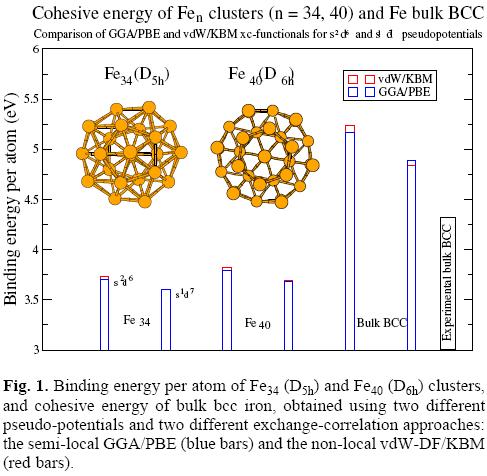
<body><![CDATA[<p align="justify"><font face="verdana" size="2">&nbsp;</font></p>  	    <p align="justify"><font face="verdana" size="2"><b>Test of pseudo potentials</b></font></p>  	    <p align="justify"><font face="verdana" size="2">The binding energy, E<sub>b</sub>(M<sub>n</sub>), of a cluster M<sub>n</sub> with <i>n</i> atoms (M = Fe, Co, in this paper) is defined as <i>E</i><sub>b</sub>(M<sub>n</sub>) = <i>n</i>E(M) &#45; <i>E</i>(M<sub>n</sub>), where <i>E</i>(M) and <i>E</i>(M<sub>n</sub>) are the total energy of the M atom and M<sub>n</sub> cluster, respectively. Thus, <i>E</i><sub>b</sub> is a positive quantity for stable clusters, that is, the cluster formation is an exothermic process. The binding energy per atom can be also called the cluster cohesive energy because its analogy with the definition of cohesive energy in bulk systems. Both names for the same concept will be used indistinctly along this paper. Note that the total energy difference between isomers is the same than the difference in their binding energies.</font></p>  	    <p align="justify"><font face="verdana" size="2">The importance of obtaining good atomic reference energies to calculate the binding energy of <i>3d</i>&#45;TM systems in local density approximation (LDA) &#91;2&#93; and GGA/PW91 &#91;12&#93; approaches was studied by Philipsen and Baerends &#91;37&#93;. They found that the effect of non&#45;spherical charge distributions is larger for GGA than for LDA, particularly for iron. Instead, allowing fractional occupations of <i>3d</i> and <i>4d</i> shells has negligible effects in both approaches. It was shown that GGA improves over the LDA binding energy of <i>3d</i> systems only if the lowest energy single determinant state for the atoms, without symmetry restrictions, is used to obtain the atomic reference energy. The restriction to integer occupation numbers was proved to have negligible influence on the GGA atomic energies &#91;37&#93;. In spherical symmetry the energy lowering is primarily due to spin polarization, although in some cases (Ti, V, Co, Ni) there is also a change of configuration (from <i>d<sup>n</sup>s<sup>2</sup></i> to <i>d<sup>n+1</sup>s<sup>1</sup>).</i> The multiplet method of Ziegler <i>et al</i> to calculate degenerate atomic ground states, is applicable to TM&#45;atoms by identifying among the ground states the one which is a pure state function obeying the Hund's rules: the lowest&#45;energy term of a configuration is the term with maximum <i>L</i> selected from all terms of maximum spin multiplicity, that is, the determinant with maximum <i>M<sub>L</sub></i> and <i>M<sub>S</sub></i>.</font></p>  	    <p align="justify"><font face="verdana" size="2">We have constructed scalar relativistic non&#45;local atomic pseudo&#45;potentials for Fe and Co from the configurations &#91;Kr&#93; 4s<sup>n</sup>3d<sup>mn</sup>, with <i>m =</i> 8 for Fe and <i>m =</i> 9 for Co, in both, GGA/ PBE and vdW/KBM approaches. For both values <i>n</i> = 1 and <i>n</i> = 2 Hund's rule of maximum total spin polarization, lead to a magnetic moment 4 &#956;<sub>B</sub> (3 &#956;<sub>B</sub>) for Fe (Co), since in DFT <i>s</i> and <i>d</i> electrons are considered. Instead, if <i>s</i> electrons does not contributes any magnetic moment, as assumed by de Heer &#91;20, 21&#93; (see section 1 above), these configurations should produce 4 &#956;<sub>B</sub> (3 &#956;<sub>B</sub>) for <i>n</i> = 2 (n = 1) in atomic Fe, and 3 &#956;<sub>B</sub> (1 &#956;<sub>B</sub>) for <i>n</i> = 2 (n = 1) in Co. We have constructed also two relativistic spin dependent pseudo&#45;potentials from the configurations &#91;Kr&#93; 4s<sup>2</sup>3d&#8593;<sup>r</sup> 3d&#8595;<sup>q</sup> with <i>r</i> + q = 6 for Fe and <i>r</i> + <i>q</i> = 7 for Co. The putative Hund's rule magnetic moment of Fe for r = 4, q = 2 is 2 &#956;<sub>B</sub>, and for <i>r</i> = 5 <i>q</i> = 1 it is 4 &#956;<sub>B</sub>. The calculated ionization potentials for the Fe relativistic vdW/KBM pseudo&#45;potentials &#91;Kr&#93; 4s<sup>1</sup>3d<sup>7</sup> and &#91;Kr&#93; 4s<sup>2</sup>3d<sup>6</sup> are 8.46 eV and 7.69 eV, respectively. For the corresponding GGA/PBE pseudo&#45;potentials we obtain 8.36 eV and 7.44 eV, respectively. Comparing these values with the experimental ionization potential (IP), 7.87 eV, we see that the &#91;Kr&#93; 4s<sup>2</sup>3d<sup>6</sup> relativistic pseudo&#45;potentials for both KBM and PBE approaches lead to the best agreement.</font></p>  	    <p align="justify"><font face="verdana" size="2">In <a href="#f1">figure 1</a> we compare the binding energy per atom for three iron systems (Fe<sub>34</sub> (D<sub>5h</sub>), Fe<sub>40</sub> (D<sub>6h</sub>), and bulk (bcc)) optimized within GGA/PBE and vdW/KBM approaches. In both cases we have tested two scalar relativistic pseudo&#45;potentials for Fe, namely, those constructed with the configurations &#91;<i>Kr</i>&#93;<i>4s<sup>2</sup>3d<sup>6</sup></i> and &#91;Kr&#93;<i>4s<sup>1</sup>3d<sup>7</sup>,</i> respectively. We see that the &#91;Kr&#93;<i>4s<sup>2</sup>3d<sup>6</sup></i> pseudo potential leads to larger (smaller) binding energy for clusters (bulk) than the &#91;Kr&#93;4s<sup>1</sup>3d<sup>7</sup> one. The vdW/KBM approach leads to slightly higher binding energy than GGA/PBE one, except for bulk bcc Fe with the &#91;Kr&#93;4s<sup>1</sup>3d<sup>7</sup> pseudo&#45;potential configuration. However, in that case we obtain the better agreement with the experimental cohesive energy. Since a good description of the cohesive energy is crucial for the present work, we will use the &#91;Kr&#93;<i>4s<sup>1</sup>3d<sup>7</sup></i> pseudo&#45;potential of atomic Fe in the remaining of this work. As the binding energy difference between GGA/ PBE and vdW/KBM calculations is very small, we will use in the following the GGA/PBE, which demands less computational resources than the vdW/KBM approach.</font></p>  	    <p align="center"><font face="verdana" size="2"><a name="f1"></a></font></p>  	    <p align="center"><font face="verdana" size="2"><img src="/img/revistas/jmcs/v56n3/a16f1.jpg"></font></p>  	    <p align="justify"><font face="verdana" size="2">&nbsp;</font></p>  	    <p align="justify"><font face="verdana" size="2"><b>Spin isomers of Co<sub>12</sub>Cu</b></font></p>  	    ]]></body>
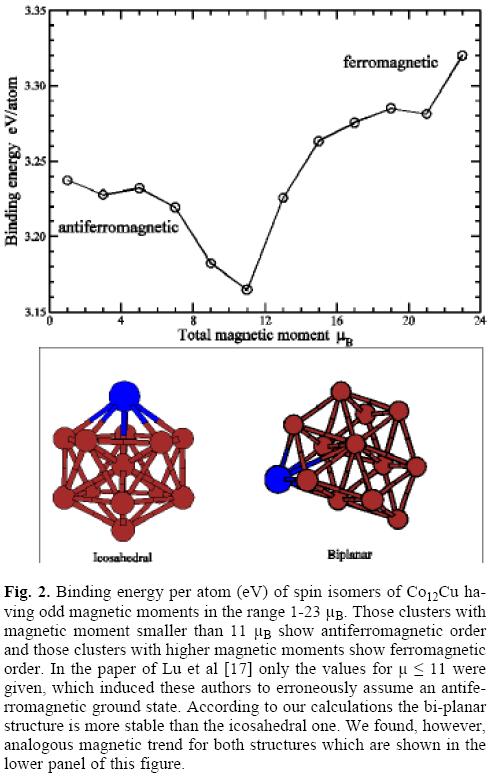
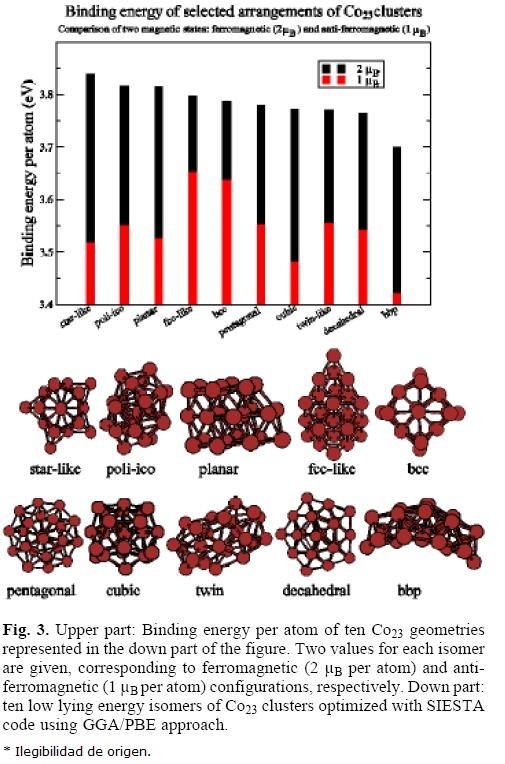
<body><![CDATA[<p align="justify"><font face="verdana" size="2">As quoted in the Introduction (Section 1), Lu et al &#91;17&#93; have predicted in the case of Co/Cu clusters an anti&#45;ferromagnetic arrangement even in the limit of the Co rich phase Co<sub>12</sub>Cu. For this cluster they obtained a total moment of only 1 &#956;<sub>B</sub> per atom, as well as magnetic isomers with decreasing binding energy when the total magnetic moment increases. We comment now the results of our calculations using the methods described in section 1 above.</font></p>  	    <p align="justify"><font face="verdana" size="2">First of all, we have calculated the spin isomer of Co<sub>12</sub>Cu imposing a total spin of 1 &#956;<sub>B</sub> per atom. This state, due to the formation of anti&#45;parallel magnetic couplings between Co atoms, has a considerable lower binding energy than the calculated state with total moment 2 &#956;<sub>B</sub> per Co atom and parallel couplings (the ferromagnetic&#45;like configuration). The difference of total binding energy between both self&#45;consistent magnetic solutions, obtained with both codes and the same xc&#45;functional used by Lu et al &#91;17&#93; (the so called PW91 &#91;12&#93;) results to be larger than 1 eV. This is at odd with Lu et al's predictions, although they do not report data for the ferromagnetic solution.</font></p>  	    <p align="justify"><font face="verdana" size="2">The next step was to perform calculations for other low spin isomers to try to find a clear picture of the possible antiferromagnetic excitations of this cluster. Once verified that SIESTA/PBE, /PBE and /PW91 gave essentially the same results, we selected SIESTA/PBE for these calculations due to the lower computational requirements as compared with , and also for the sake of comparison with the rest of results reported in the present work. In <a href="#f2">figure 2</a> we plot the binding energy as a function of the total magnetic moment of Co<sub>12</sub>Cu. The curve shows that all anti&#45;ferromagnetic states are magnetic excitations of the ground state with 23 &#956;<sub>B</sub> and ferromagneticlike order. However, it is interesting to note a non&#45;monotonic behavior as a function of the total spin, with a minimum of the binding energy obtained for a total spin moment of 11 &#956;<sub>B</sub>. This means that some anti&#45;ferromagnetic excitations, with rather compensated moments and correspondingly weak total magnetization, result more accessible than others with larger total moment. This unexpected trend was found by Lu et al.&#91;17&#93; for the four spin isomers with lowest total moment. We stress, however, that the ground state is ferromagnetic, and that the lowest energy spin isomers are those with a large total moment and a small degree of anti&#45;ferromagnetic order (only few atoms with their moments coupled anti&#45;parallel). Some comments are also pertinent in regard to the lowest energy structural configuration proposed by Lu et al &#91;17&#93;. SIESTA calculations predict a bi&#45;planar structure as the lowest energy one for Co<sub>13</sub> among those tested, including the icosahedrons. This bi&#45;planar structure has been also predicted for Co<sub>13</sub> in a recent work by Dong and Gong &#91;38&#93; using and results from the one found in the present work for the 12 atoms clusters plus an additional atom in. The difference in binding energy with respect to the icosahedral structure is about 1 eV. We guess that this biplanar structure resulted probably a high&#45;energy isomer in the genetic algorithm used by Lu et al. based on the Gupta potential, as it is well known that Gupta tends to favor spherical structures, in particular icosahedral ones. Nevertheless, our calculations give the same ground state ferromagnetic configuration for this structure and for the icosahedral one.</font></p>  	    <p align="center"><font face="verdana" size="2"><a name="f2"></a></font></p>  	    <p align="center"><font face="verdana" size="2"><img src="/img/revistas/jmcs/v56n3/a16f2.jpg"></font></p>  	    <p align="justify"><font face="verdana" size="2">&nbsp;</font></p>  	    <p align="justify"><font face="verdana" size="2"><b>C0<sub>23</sub></b></font></p>  	    <p align="justify"><font face="verdana" size="2">In the low panel of <a href="#f3">figure 3</a> are shown the geometries of ten atomic arrangements of Co<sub>23</sub> cluster which have been optimized using GGA/PBE approach for the high spin (HS = 2 &#956;<sub>B</sub>) and low spin (LS = l &#956;<sub>B</sub>) magnetic configurations. The corresponding binding energies per atom are represented in the upper panel of <a href="#f3">figure 3</a>. All the HS isomers have ferromagnetic order, but the LS isomers show partial anti&#45;ferromagnetic order. The more stable HS isomer shows star&#45;like (D<sub>5h</sub>) geometry, with binding energy per atom about 21~23 meV higher than those HS isomers with planar and poli&#45;icosahedral arrangements. Except the bi&#45;planar bbp isomer, all the HS configurations in <a href="#f3">figure 3</a> have binding energy per atom in a window ~ 70 meV. The binding energy per atom of the LS state of a given geometry is always smaller than the HS one, which is ferromagnetic. However, the stability of LS isomers follows a different sequence of geometries than the HS solutions. The smaller binding energy difference between HS and LS isomers occurs for the bcc and fcc&#45;like configurations, ~ 145 meV. However, the HS state of these isomers is ~ 45 meV. Thus, if HS and LS states coexist in the beam experiments of de Heer <i>et al.</i> &#91;20&#93;, they should surpass ~ 190 meV per atom which allows coexistence of several geometries with HS ferromagnetic state. Then, our calculations cannot explain the experimental fact, due, probably, to inaccuracy of the theoretical approach, or lack of the ground state isomer.</font></p>  	    <p align="center"><font face="verdana" size="2"><a name="f3"></a></font></p>  	    <p align="center"><font face="verdana" size="2"><img src="/img/revistas/jmcs/v56n3/a16f3.jpg"></font></p>  	    ]]></body>
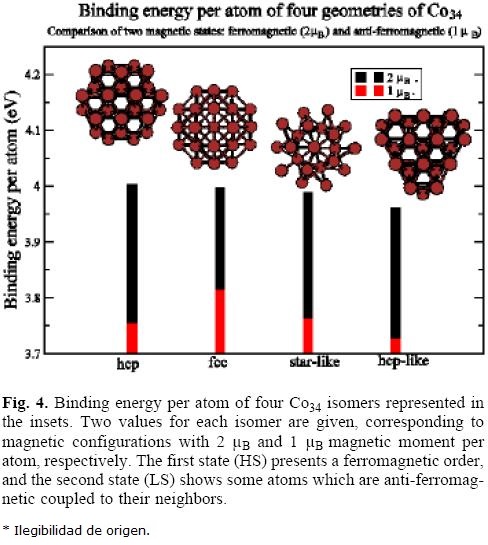
<body><![CDATA[<p align="justify"><font face="verdana" size="2">&nbsp;</font></p>  	    <p align="justify"><font face="verdana" size="2"><b>C0</b><sub>34</sub></font></p>  	    <p align="justify"><font face="verdana" size="2">In <a href="#f4">figure 4</a> are represented the binding energies of four Co<sub>34</sub> arrangements for two magnetic configurations, namely ferromagnetic (2 &#956;<sub>B</sub> per atom) and anti&#45;ferromagnetic (2 &#956;<sub>B</sub> per atom). Similar considerations to that noted above for Co<sub>23</sub> isomers can be done, but now the barrier between magnetic states is even larger.</font></p>  	    <p align="center"><font face="verdana" size="2"><a name="f4"></a></font></p>  	    <p align="center"><font face="verdana" size="2"><img src="/img/revistas/jmcs/v56n3/a16f4.jpg"></font></p>  	    <p align="justify"><font face="verdana" size="2">We have calculated the ionization potential of hcp Co34 for HS and LS magnetic states, with the results 6.08 eV for HS state and 5.60 eV for LS state. These values are a little bit higher than those reported by de Heer et al &#91;20&#93;, ~5.58 eV (HS) and ~5.40 eV (LS).</font></p>  	    <p align="justify"><font face="verdana" size="2">&nbsp;</font></p>  	    <p align="justify"><font face="verdana" size="2"><b>Fe<sub>34</sub></b></font></p>  	    <p align="justify"><font face="verdana" size="2">In <a href="#f5">figure 5</a> is represented the binding energy per atom of the HS (3 &#956;<sub>B</sub>) and LS (1 &#956;<sub>B</sub>) magnetic isomers of four configurations of Fe<sub>34</sub> cluster optimized within the GGA/LDA approach. The more stable geometry of the HS isomers is the start&#45;like (D5h), and the other geometries are less stable by about 50&#45;60 meV per atom. The binding energy of the start&#45;like LS isomer is about l50 meV smaller that the HS one and that difference is larger for the other geometries. Thus, we can be sure than none of these arrangements fulfill the requirement of magnetic isomers observed in the de Heer et al experiment.</font></p>  	    <p align="center"><font face="verdana" size="2"><a name="f5"></a></font></p>  	    ]]></body>
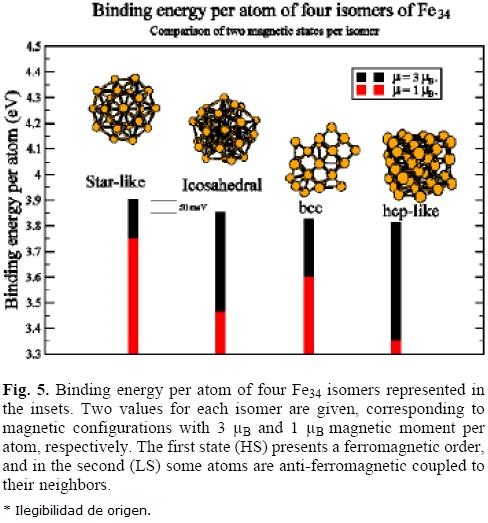
<body><![CDATA[<p align="center"><font face="verdana" size="2"><img src="/img/revistas/jmcs/v56n3/a16f5.jpg"></font></p>  	    <p align="justify"><font face="verdana" size="2">&nbsp;</font></p>  	    <p align="justify"><font face="verdana" size="2"><b>Conclusions</b></font></p>  	    <p align="justify"><font face="verdana" size="2">We have used the first principles code SIESTA to self&#45;consis&#45;tently solve the spin&#45;polarized Kohn&#45;Sham equations of DFT theory for the spin isomers of pure Fe<sub>34</sub>, Fe<sub>40</sub>, Co<sub>23</sub>, Co<sub>34</sub> and mixed C0<sub>12</sub>Cu transition metal clusters. For the choice of atomic&#45;pseudopotential we have tested two flavors of the xc&#45;functional, the semi&#45;local GGA/PBE and the more recent vdW&#45;DF/ KBM which contains a fully non&#45;local correlation functional taken into account long rang van der Waals interactions. For Fe clusters, two atomic norm&#45;conserving relativistic pseudo&#45;potentials were also tested, with valence configurations 4s<sup>1</sup>3d<sup>7</sup> and 4s<sup>2</sup>3d<sup>6</sup>. According to these tests, we chose the GGA/PBE xc&#45;approach, because is computationally less expensive than the vdW&#45;DF one, and the 4s<sup>1</sup>3d<sup>7</sup> (4s<sup>1</sup>3d<sup>8</sup>) pseudo&#45;potential for Fe (Co) because it leads to better agreement with experimental bulk cohesive energy.</font></p>  	    <p align="justify"><font face="verdana" size="2">Firstly, we obtain that the ground state of CuCo<sub>12</sub> mixed cluster is ferromagnetic with magnetic moment 23 &#956;<sub>B</sub> and biplanar geometry. The icosahedral isomer is also ferromagnetic with magnetic moment 23 &#956;<sub>B</sub> in contrast to the anti&#45;ferromagnetic state predicted in a previous study &#91;17&#93;.</font></p>  	    <p align="justify"><font face="verdana" size="2">Second, we have calculated the binding energy of selected geometries of Co<sub>23</sub>, Co<sub>34</sub>, and Fe<sub>34</sub> clusters with the HS and LS states detected in the de Heer experiments &#91;20&#93;. The calculated binding energy difference between these spin states is too large, and then their coexistence in the beam at cryogenic temperatures should not occur. We conclude that either the GGA/PBE is not enough accurate or the tested geometries are far from the true ground state isomer. Then, for this problem it is needed one or more of the following conditions: i) a more accurate code (for example an all&#45;electron DFT code without pseudo&#45;potentials), ii) a xc&#45;functional beyond the GGA/PBE approximation, and iii) a search of the global minimum structure of these clusters from first principles.</font></p>  	    <p align="justify"><font face="verdana" size="2">The coexistence of HS and LS states of Cobalt and Iron clusters which was found in recent experiments by de Heer <i>et al</i> &#91;20&#93; cannot explained by a simplistic model of atomic magnets. Specifically, these authors proposed that the Co<sub>n</sub> and Fen observed ground state magnetic moments are due to atomic electronic orbital configurations <i>3d</i>&#8593;<i><sup>5</sup>3d</i>&#8595;<i><sup>3</sup>4s<sup>1</sup></i> for Co and <i>3d</i>&#8593;<i><sup>5</sup>3d</i>&#8595;<i><sup>2</sup>4s<sup>1</sup></i> for Fe, leading to spin states (considering that only the <i>d</i> electrons contributes) <i>S = 1</i> (&#956; = 2 &#956;<sub>B</sub> ) for Co<sub>n</sub> and <i>S =</i> <i>3/2</i> (&#956; = 3 &#956;<sub>B</sub> ) for Fe<sub>n</sub> clusters. Instead, the observed excited states are also Heisenberg magnets with atomic configurations <i>3d</i>&#8593;<i><sup>5</sup>3d</i>&#8595;<i><sup>4</sup>4s<sup>0</sup> (S</i> = &#189;, &#956; = 1 &#956;<sub>B</sub>) for Co* and <i>3d</i>&#8593;<i><sup>4</sup>3d</i>&#8595;<i><sup>3</sup>4s<sup>1</sup> (S</i> = &#189;, &#956; = 1 &#956;<sub>B</sub>) for Fe*. Contrary to that simplistic proposal of de Heer &#91;20&#93; based on atomic valence configurations of Fe and Co whose 4s electrons have no spin, DFT calculations shows that <i>all</i> the occupied orbitals contribute to the total spin through the self&#45;consistent xc&#45;potential of the spin polarized formulation of DFT. Thus, the accurate account of the de Heer experiments &#91;20&#93; is a challenge for future DFT developments, both theoretical and methodological. Practical methods for the search of the global minimum structure of transition metal clusters are also needed.</font></p>  	    <p align="justify"><font face="verdana" size="2">&nbsp;</font></p>  	    <p align="justify"><font face="verdana" size="2"><b>Acknowledgements</b></font></p>  	    <p align="justify"><font face="verdana" size="2">We acknowledge the support of the Spanish "Ministerio de Ciencia e Innovaci&oacute;n", the European Regional Development Fund and "Junta de Castilla y Le&oacute;n" (Grants Nos. FIS2011&#45;22957 and VA104A11&#45;2). F.A&#45;G acknowledge the financial support from PROMEP&#45;SEP&#45;CA230, 162651 and the Ministerio de Educaci&oacute;n cultura y Deporte (SAB2011&#45;0024, Spain). F.A&#45;G acknowledges a grant of University of Valladolid, where part of this work was performed.</font></p>  	    ]]></body>
<body><![CDATA[<p align="justify"><font face="verdana" size="2">&nbsp;</font></p>  	    <p align="justify"><font face="verdana" size="2"><b>References</b></font></p>  	    <!-- ref --><p align="justify"><font face="verdana" size="2">1. Hohemberg, P.; Kohn, W. <i>Phys. Rev.</i> 1964, <i>136,</i> B864&#45;B871.    &nbsp;&nbsp;&nbsp;&nbsp;&nbsp;&nbsp;&nbsp;&nbsp;[&#160;<a href="javascript:void(0);" onclick="javascript: window.open('/scielo.php?script=sci_nlinks&ref=4927330&pid=S1870-249X201200030001600001&lng=','','width=640,height=500,resizable=yes,scrollbars=1,menubar=yes,');">Links</a>&#160;]<!-- end-ref --></font></p>  	    <!-- ref --><p align="justify"><font face="verdana" size="2">2. Kohn, W.; Sham, L. <i>Phys. Rev.</i> 1965, 140, A1133&#45;A1138.    &nbsp;&nbsp;&nbsp;&nbsp;&nbsp;&nbsp;&nbsp;&nbsp;[&#160;<a href="javascript:void(0);" onclick="javascript: window.open('/scielo.php?script=sci_nlinks&ref=4927332&pid=S1870-249X201200030001600002&lng=','','width=640,height=500,resizable=yes,scrollbars=1,menubar=yes,');">Links</a>&#160;]<!-- end-ref --></font></p>  	    <!-- ref --><p align="justify"><font face="verdana" size="2">3. von Barth, U.; Hedin, L. <i>J Phys C</i> 1972, 5, 1629.    &nbsp;&nbsp;&nbsp;&nbsp;&nbsp;&nbsp;&nbsp;&nbsp;[&#160;<a href="javascript:void(0);" onclick="javascript: window.open('/scielo.php?script=sci_nlinks&ref=4927334&pid=S1870-249X201200030001600003&lng=','','width=640,height=500,resizable=yes,scrollbars=1,menubar=yes,');">Links</a>&#160;]<!-- end-ref --></font></p>  	    <!-- ref --><p align="justify"><font face="verdana" size="2">4. J.P. Perdew, <i>J. Chem .Theor. Comp.</i> 2009, 5, 902&#45;908.    &nbsp;&nbsp;&nbsp;&nbsp;&nbsp;&nbsp;&nbsp;&nbsp;[&#160;<a href="javascript:void(0);" onclick="javascript: window.open('/scielo.php?script=sci_nlinks&ref=4927336&pid=S1870-249X201200030001600004&lng=','','width=640,height=500,resizable=yes,scrollbars=1,menubar=yes,');">Links</a>&#160;]<!-- end-ref --></font></p>  	    ]]></body>
<body><![CDATA[<!-- ref --><p align="justify"><font face="verdana" size="2">4. Datta, S.; Kabir, M.; Saha&#45;Dasgupta, T. <i>Phys. Rev. B,</i> 2011, <i>84,</i> 075429/1&#45;7.    &nbsp;&nbsp;&nbsp;&nbsp;&nbsp;&nbsp;&nbsp;&nbsp;[&#160;<a href="javascript:void(0);" onclick="javascript: window.open('/scielo.php?script=sci_nlinks&ref=4927338&pid=S1870-249X201200030001600005&lng=','','width=640,height=500,resizable=yes,scrollbars=1,menubar=yes,');">Links</a>&#160;]<!-- end-ref --></font></p>  	    <!-- ref --><p align="justify"><font face="verdana" size="2">5. Kresse G.; Furthm&uuml;ller J. <i>Phys. Rev. B,</i> 1996, 54, 11169.    &nbsp;&nbsp;&nbsp;&nbsp;&nbsp;&nbsp;&nbsp;&nbsp;[&#160;<a href="javascript:void(0);" onclick="javascript: window.open('/scielo.php?script=sci_nlinks&ref=4927340&pid=S1870-249X201200030001600006&lng=','','width=640,height=500,resizable=yes,scrollbars=1,menubar=yes,');">Links</a>&#160;]<!-- end-ref --></font></p>  	    <!-- ref --><p align="justify"><font face="verdana" size="2">6. Becke, A. D. <i>Phys. Rev. A</i> 1988, 38, 3098;    &nbsp;&nbsp;&nbsp;&nbsp;&nbsp;&nbsp;&nbsp;&nbsp;[&#160;<a href="javascript:void(0);" onclick="javascript: window.open('/scielo.php?script=sci_nlinks&ref=4927342&pid=S1870-249X201200030001600007&lng=','','width=640,height=500,resizable=yes,scrollbars=1,menubar=yes,');">Links</a>&#160;]<!-- end-ref --><!-- ref --> Perdew, J. P. <i>Phys.</i> <i>Rev. B</i> 1986, <i>38,</i> 3098.    &nbsp;&nbsp;&nbsp;&nbsp;&nbsp;&nbsp;&nbsp;&nbsp;[&#160;<a href="javascript:void(0);" onclick="javascript: window.open('/scielo.php?script=sci_nlinks&ref=4927343&pid=S1870-249X201200030001600008&lng=','','width=640,height=500,resizable=yes,scrollbars=1,menubar=yes,');">Links</a>&#160;]<!-- end-ref --></font></p>  	    <!-- ref --><p align="justify"><font face="verdana" size="2">7. Perdew, J. P.; Burke, K.; Ernzerhof, M. <i>Phys. Rev. Lett.</i> 1996, 77, 3865&#45;    &nbsp;&nbsp;&nbsp;&nbsp;&nbsp;&nbsp;&nbsp;&nbsp;[&#160;<a href="javascript:void(0);" onclick="javascript: window.open('/scielo.php?script=sci_nlinks&ref=4927345&pid=S1870-249X201200030001600009&lng=','','width=640,height=500,resizable=yes,scrollbars=1,menubar=yes,');">Links</a>&#160;]<!-- end-ref -->.</font></p>  	    <!-- ref --><p align="justify"><font face="verdana" size="2">8. <a href="http://www.deMon&#45;software.com" target="_blank">http://www.deMon&#45;software.com</a></font>&nbsp;&nbsp;&nbsp;&nbsp;&nbsp;&nbsp;&nbsp;&nbsp;[&#160;<a href="javascript:void(0);" onclick="javascript: window.open('/scielo.php?script=sci_nlinks&ref=4927347&pid=S1870-249X201200030001600010&lng=','','width=640,height=500,resizable=yes,scrollbars=1,menubar=yes,');">Links</a>&#160;]<!-- end-ref --><!-- ref --><p align="justify"><font face="verdana" size="2">9. K&ouml;ster, A. M.; Calaminici, P.; Orgaz, E.; Roy, D. R.; Reveles, J. U.; Khanna, S. N. <i>J. Am. Chem. Soc.,</i> 2011, 133, 12192&#45;12196.    &nbsp;&nbsp;&nbsp;&nbsp;&nbsp;&nbsp;&nbsp;&nbsp;[&#160;<a href="javascript:void(0);" onclick="javascript: window.open('/scielo.php?script=sci_nlinks&ref=4927348&pid=S1870-249X201200030001600011&lng=','','width=640,height=500,resizable=yes,scrollbars=1,menubar=yes,');">Links</a>&#160;]<!-- end-ref --></font></p>  	    <!-- ref --><p align="justify"><font face="verdana" size="2">10. Pradhan, K.; Jena, P. <i>Appl. Phys. Lett.</i> 2011, <i>99,</i> 153105/1&#45;3.    &nbsp;&nbsp;&nbsp;&nbsp;&nbsp;&nbsp;&nbsp;&nbsp;[&#160;<a href="javascript:void(0);" onclick="javascript: window.open('/scielo.php?script=sci_nlinks&ref=4927350&pid=S1870-249X201200030001600012&lng=','','width=640,height=500,resizable=yes,scrollbars=1,menubar=yes,');">Links</a>&#160;]<!-- end-ref --></font></p>  	    <!-- ref --><p align="justify"><font face="verdana" size="2">11. Kresse G.; Joubert D. <i>Phys. Rev. B</i> 1999, 59, 1758.    &nbsp;&nbsp;&nbsp;&nbsp;&nbsp;&nbsp;&nbsp;&nbsp;[&#160;<a href="javascript:void(0);" onclick="javascript: window.open('/scielo.php?script=sci_nlinks&ref=4927352&pid=S1870-249X201200030001600013&lng=','','width=640,height=500,resizable=yes,scrollbars=1,menubar=yes,');">Links</a>&#160;]<!-- end-ref --></font></p>  	    <!-- ref --><p align="justify"><font face="verdana" size="2">12. Wang, Y.; Perdew, J.P. <i>Phys. Rev. B</i> 1991, 43, 8911.    &nbsp;&nbsp;&nbsp;&nbsp;&nbsp;&nbsp;&nbsp;&nbsp;[&#160;<a href="javascript:void(0);" onclick="javascript: window.open('/scielo.php?script=sci_nlinks&ref=4927354&pid=S1870-249X201200030001600014&lng=','','width=640,height=500,resizable=yes,scrollbars=1,menubar=yes,');">Links</a>&#160;]<!-- end-ref --></font></p>  	    <!-- ref --><p align="justify"><font face="verdana" size="2">13. Aguilera&#45;Granja, F.; Balb&aacute;s, L. C.; Vega, A. <i>J. Phys. Chem. A</i> 2009, 113, 13483&#45;13491.    &nbsp;&nbsp;&nbsp;&nbsp;&nbsp;&nbsp;&nbsp;&nbsp;[&#160;<a href="javascript:void(0);" onclick="javascript: window.open('/scielo.php?script=sci_nlinks&ref=4927356&pid=S1870-249X201200030001600015&lng=','','width=640,height=500,resizable=yes,scrollbars=1,menubar=yes,');">Links</a>&#160;]<!-- end-ref --></font></p>  	    ]]></body>
<body><![CDATA[<!-- ref --><p align="justify"><font face="verdana" size="2">14. Torres, M. B.; Aguilera&#45;Granja, F.; Balb&aacute;s, L. C.; Vega, A. <i>J. Phys. Chem. A</i> 2011, 115, 8350&#45;8360.    &nbsp;&nbsp;&nbsp;&nbsp;&nbsp;&nbsp;&nbsp;&nbsp;[&#160;<a href="javascript:void(0);" onclick="javascript: window.open('/scielo.php?script=sci_nlinks&ref=4927358&pid=S1870-249X201200030001600016&lng=','','width=640,height=500,resizable=yes,scrollbars=1,menubar=yes,');">Links</a>&#160;]<!-- end-ref --></font></p>  	    <!-- ref --><p align="justify"><font face="verdana" size="2">15. Soler, J. M.; Artacho, E.; Gale, J. D.; Garc&iacute;a, A.; Junquera, J.; Ordej&oacute;n, P.; S&aacute;nchez&#45;Portal, D. <i>J. Phys.: Condens. Matter,</i> 2002, <i>14,</i> 2745&#45;2779.    &nbsp;&nbsp;&nbsp;&nbsp;&nbsp;&nbsp;&nbsp;&nbsp;[&#160;<a href="javascript:void(0);" onclick="javascript: window.open('/scielo.php?script=sci_nlinks&ref=4927360&pid=S1870-249X201200030001600017&lng=','','width=640,height=500,resizable=yes,scrollbars=1,menubar=yes,');">Links</a>&#160;]<!-- end-ref --></font></p>  	    <!-- ref --><p align="justify"><font face="verdana" size="2">16. Dion, M.; Rydberg, H.; Schr&ouml;der, E.; Langreth, D. C.; Lundqvist, B. I. <i>Phys. Rev. Lett.</i> 2004, <i>92,</i> 246401/1&#45;4.    &nbsp;&nbsp;&nbsp;&nbsp;&nbsp;&nbsp;&nbsp;&nbsp;[&#160;<a href="javascript:void(0);" onclick="javascript: window.open('/scielo.php?script=sci_nlinks&ref=4927362&pid=S1870-249X201200030001600018&lng=','','width=640,height=500,resizable=yes,scrollbars=1,menubar=yes,');">Links</a>&#160;]<!-- end-ref --></font></p>  	    <!-- ref --><p align="justify"><font face="verdana" size="2">17. Lu, Q. L.; Zhu, L. Z.; Ma, L.; Wang, G.H. <i>Chem. Phys. Lett.</i> 2005, 407, 176.    &nbsp;&nbsp;&nbsp;&nbsp;&nbsp;&nbsp;&nbsp;&nbsp;[&#160;<a href="javascript:void(0);" onclick="javascript: window.open('/scielo.php?script=sci_nlinks&ref=4927364&pid=S1870-249X201200030001600019&lng=','','width=640,height=500,resizable=yes,scrollbars=1,menubar=yes,');">Links</a>&#160;]<!-- end-ref --></font></p>  	    <!-- ref --><p align="justify"><font face="verdana" size="2">18. <a href="http://Accelrys.com" target="_blank">Accelrys.com</a></font>&nbsp;&nbsp;&nbsp;&nbsp;&nbsp;&nbsp;&nbsp;&nbsp;[&#160;<a href="javascript:void(0);" onclick="javascript: window.open('/scielo.php?script=sci_nlinks&ref=4927366&pid=S1870-249X201200030001600020&lng=','','width=640,height=500,resizable=yes,scrollbars=1,menubar=yes,');">Links</a>&#160;]<!-- end-ref --><!-- ref --><p align="justify"><font face="verdana" size="2">19. Aguilera&#45;Granja, F.; Torres, M. B.; Vega, A.; Balb&aacute;s, L. C. <i>J. Phys. Chem.</i> (DOI:10.1021/jp306353b).    &nbsp;&nbsp;&nbsp;&nbsp;&nbsp;&nbsp;&nbsp;&nbsp;[&#160;<a href="javascript:void(0);" onclick="javascript: window.open('/scielo.php?script=sci_nlinks&ref=4927367&pid=S1870-249X201200030001600021&lng=','','width=640,height=500,resizable=yes,scrollbars=1,menubar=yes,');">Links</a>&#160;]<!-- end-ref --></font></p>  	    <!-- ref --><p align="justify"><font face="verdana" size="2">20. Xu, X.; Yin, S.; Moro, R.; Liang, A.; Bowlan, J.; de Heer, W. A. <i>Phys. Rev. Lett.</i> 2011, 107, 057203/1&#45;4.    &nbsp;&nbsp;&nbsp;&nbsp;&nbsp;&nbsp;&nbsp;&nbsp;[&#160;<a href="javascript:void(0);" onclick="javascript: window.open('/scielo.php?script=sci_nlinks&ref=4927369&pid=S1870-249X201200030001600022&lng=','','width=640,height=500,resizable=yes,scrollbars=1,menubar=yes,');">Links</a>&#160;]<!-- end-ref --></font></p>  	    <!-- ref --><p align="justify"><font face="verdana" size="2">21. Billas, I. M. L.; Chatelain, A.; de Heer, W. A. <i>Science,</i> 1994, 265, 1682.    &nbsp;&nbsp;&nbsp;&nbsp;&nbsp;&nbsp;&nbsp;&nbsp;[&#160;<a href="javascript:void(0);" onclick="javascript: window.open('/scielo.php?script=sci_nlinks&ref=4927371&pid=S1870-249X201200030001600023&lng=','','width=640,height=500,resizable=yes,scrollbars=1,menubar=yes,');">Links</a>&#160;]<!-- end-ref --></font></p>  	    <!-- ref --><p align="justify"><font face="verdana" size="2">22. Klimes, J.; Bowler, D. R., Michaelis, A. <i>J. Phys.: Condens. Matter,</i> 2009, <i>22,</i> 022201.    &nbsp;&nbsp;&nbsp;&nbsp;&nbsp;&nbsp;&nbsp;&nbsp;[&#160;<a href="javascript:void(0);" onclick="javascript: window.open('/scielo.php?script=sci_nlinks&ref=4927373&pid=S1870-249X201200030001600024&lng=','','width=640,height=500,resizable=yes,scrollbars=1,menubar=yes,');">Links</a>&#160;]<!-- end-ref --></font></p>  	    <!-- ref --><p align="justify"><font face="verdana" size="2">23. Soler, J. M.; Artacho, E.; Gale, J. D.; Garc&iacute;a, A.; Junquera, J.; Ordej&oacute;n, P.; S&aacute;nchez&#45;Portal, D. <i>J. Phys: Condens. Matter</i> 2002, <i>14,</i> 2745.    &nbsp;&nbsp;&nbsp;&nbsp;&nbsp;&nbsp;&nbsp;&nbsp;[&#160;<a href="javascript:void(0);" onclick="javascript: window.open('/scielo.php?script=sci_nlinks&ref=4927375&pid=S1870-249X201200030001600025&lng=','','width=640,height=500,resizable=yes,scrollbars=1,menubar=yes,');">Links</a>&#160;]<!-- end-ref --></font></p>  	    <!-- ref --><p align="justify"><font face="verdana" size="2">24. Rom&aacute;n&#45;P&eacute;rez, G.; Soler, J. M. <i>Phys. Rev. Lett.</i> 2009, 103, 096102.    &nbsp;&nbsp;&nbsp;&nbsp;&nbsp;&nbsp;&nbsp;&nbsp;[&#160;<a href="javascript:void(0);" onclick="javascript: window.open('/scielo.php?script=sci_nlinks&ref=4927377&pid=S1870-249X201200030001600026&lng=','','width=640,height=500,resizable=yes,scrollbars=1,menubar=yes,');">Links</a>&#160;]<!-- end-ref --></font></p>  	    <!-- ref --><p align="justify"><font face="verdana" size="2">25. Troullier, N.; Martins, J. L. <i>Phys. Rev. B</i> 1991, 43, 1993.    &nbsp;&nbsp;&nbsp;&nbsp;&nbsp;&nbsp;&nbsp;&nbsp;[&#160;<a href="javascript:void(0);" onclick="javascript: window.open('/scielo.php?script=sci_nlinks&ref=4927379&pid=S1870-249X201200030001600027&lng=','','width=640,height=500,resizable=yes,scrollbars=1,menubar=yes,');">Links</a>&#160;]<!-- end-ref --></font></p>  	    <!-- ref --><p align="justify"><font face="verdana" size="2">26. Kleinman, L.; Bylander, D. M. <i>Phys. Rev. B</i> 1982, 48, 1425.    &nbsp;&nbsp;&nbsp;&nbsp;&nbsp;&nbsp;&nbsp;&nbsp;[&#160;<a href="javascript:void(0);" onclick="javascript: window.open('/scielo.php?script=sci_nlinks&ref=4927381&pid=S1870-249X201200030001600028&lng=','','width=640,height=500,resizable=yes,scrollbars=1,menubar=yes,');">Links</a>&#160;]<!-- end-ref --></font></p>  	    <!-- ref --><p align="justify"><font face="verdana" size="2">27. Louie, S. G.; Froyen, S.; Cohen, M. L. <i>Phys. Rev. B</i> 1982, 26, 1738.    &nbsp;&nbsp;&nbsp;&nbsp;&nbsp;&nbsp;&nbsp;&nbsp;[&#160;<a href="javascript:void(0);" onclick="javascript: window.open('/scielo.php?script=sci_nlinks&ref=4927383&pid=S1870-249X201200030001600029&lng=','','width=640,height=500,resizable=yes,scrollbars=1,menubar=yes,');">Links</a>&#160;]<!-- end-ref --></font></p>  	    <!-- ref --><p align="justify"><font face="verdana" size="2">28. Aguado, A.; Vega, A.; Balb&aacute;s, L. C. <i>Phys. Rev. B</i> 2011, 84, 165450/1&#45;10.    &nbsp;&nbsp;&nbsp;&nbsp;&nbsp;&nbsp;&nbsp;&nbsp;[&#160;<a href="javascript:void(0);" onclick="javascript: window.open('/scielo.php?script=sci_nlinks&ref=4927385&pid=S1870-249X201200030001600030&lng=','','width=640,height=500,resizable=yes,scrollbars=1,menubar=yes,');">Links</a>&#160;]<!-- end-ref --></font></p>  	    <!-- ref --><p align="justify"><font face="verdana" size="2">29. Aguado, A. J. <i>Phys. Chem. C</i> 2012, 116, 6841&#45;6851</font>&nbsp;&nbsp;&nbsp;&nbsp;&nbsp;&nbsp;&nbsp;&nbsp;[&#160;<a href="javascript:void(0);" onclick="javascript: window.open('/scielo.php?script=sci_nlinks&ref=4927387&pid=S1870-249X201200030001600031&lng=','','width=640,height=500,resizable=yes,scrollbars=1,menubar=yes,');">Links</a>&#160;]<!-- end-ref --><!-- ref --><p align="justify"><font face="verdana" size="2">30. Fern&aacute;ndez, E.; Balb&aacute;s, L. C. <i>Phys. Chem. Chem. Phys.</i> 2011, <i>13,</i> 20863.    &nbsp;&nbsp;&nbsp;&nbsp;&nbsp;&nbsp;&nbsp;&nbsp;[&#160;<a href="javascript:void(0);" onclick="javascript: window.open('/scielo.php?script=sci_nlinks&ref=4927388&pid=S1870-249X201200030001600032&lng=','','width=640,height=500,resizable=yes,scrollbars=1,menubar=yes,');">Links</a>&#160;]<!-- end-ref --></font></p>  	    <!-- ref --><p align="justify"><font face="verdana" size="2">31. Klimes, J.; Bowler, D. R., Michaelis, A. <i>Phys. Rev. B,</i> 2010, 83, 195131.    &nbsp;&nbsp;&nbsp;&nbsp;&nbsp;&nbsp;&nbsp;&nbsp;[&#160;<a href="javascript:void(0);" onclick="javascript: window.open('/scielo.php?script=sci_nlinks&ref=4927390&pid=S1870-249X201200030001600033&lng=','','width=640,height=500,resizable=yes,scrollbars=1,menubar=yes,');">Links</a>&#160;]<!-- end-ref --></font></p>  	    <!-- ref --><p align="justify"><font face="verdana" size="2">32. See, i.e., A. Becke, A.; Johnson, E. R. <i>J. Chem. Phys.</i> 2007, <i>127,</i> 154108.    &nbsp;&nbsp;&nbsp;&nbsp;&nbsp;&nbsp;&nbsp;&nbsp;[&#160;<a href="javascript:void(0);" onclick="javascript: window.open('/scielo.php?script=sci_nlinks&ref=4927392&pid=S1870-249X201200030001600034&lng=','','width=640,height=500,resizable=yes,scrollbars=1,menubar=yes,');">Links</a>&#160;]<!-- end-ref --></font></p>  	    <!-- ref --><p align="justify"><font face="verdana" size="2">33. Zhang, Y.; Yang, W. <i>Phys. Rev. Lett.</i> 1988, <i>80,</i> 890.    &nbsp;&nbsp;&nbsp;&nbsp;&nbsp;&nbsp;&nbsp;&nbsp;[&#160;<a href="javascript:void(0);" onclick="javascript: window.open('/scielo.php?script=sci_nlinks&ref=4927394&pid=S1870-249X201200030001600035&lng=','','width=640,height=500,resizable=yes,scrollbars=1,menubar=yes,');">Links</a>&#160;]<!-- end-ref --></font></p>  	    <!-- ref --><p align="justify"><font face="verdana" size="2">34. Becke, A. D. <i>Phys. Rev. A</i> 1988, 38, 3098.    &nbsp;&nbsp;&nbsp;&nbsp;&nbsp;&nbsp;&nbsp;&nbsp;[&#160;<a href="javascript:void(0);" onclick="javascript: window.open('/scielo.php?script=sci_nlinks&ref=4927396&pid=S1870-249X201200030001600036&lng=','','width=640,height=500,resizable=yes,scrollbars=1,menubar=yes,');">Links</a>&#160;]<!-- end-ref --></font></p>  	    ]]></body>
<body><![CDATA[<!-- ref --><p align="justify"><font face="verdana" size="2">35. Perdew, J.; Zunger, A, <i>Phys. Rev. B</i> 1981, 23, 5048.    &nbsp;&nbsp;&nbsp;&nbsp;&nbsp;&nbsp;&nbsp;&nbsp;[&#160;<a href="javascript:void(0);" onclick="javascript: window.open('/scielo.php?script=sci_nlinks&ref=4927398&pid=S1870-249X201200030001600037&lng=','','width=640,height=500,resizable=yes,scrollbars=1,menubar=yes,');">Links</a>&#160;]<!-- end-ref --></font></p>  	    <!-- ref --><p align="justify"><font face="verdana" size="2">36. The Cambridge Cluster Database, <a href="http://www&#45;wales.ch.cam.ac.uk/CCD.html" target="_blank">http://www&#45;wales.ch.cam.ac.uk/CCD.html</a></font>&nbsp;&nbsp;&nbsp;&nbsp;&nbsp;&nbsp;&nbsp;&nbsp;[&#160;<a href="javascript:void(0);" onclick="javascript: window.open('/scielo.php?script=sci_nlinks&ref=4927400&pid=S1870-249X201200030001600038&lng=','','width=640,height=500,resizable=yes,scrollbars=1,menubar=yes,');">Links</a>&#160;]<!-- end-ref --><!-- ref --><p align="justify"><font face="verdana" size="2">37. Philipsen, P. H. Y.; Baerends, E. J. <i>Phys. Rev. B</i> 1996, 54, 5326.    &nbsp;&nbsp;&nbsp;&nbsp;&nbsp;&nbsp;&nbsp;&nbsp;[&#160;<a href="javascript:void(0);" onclick="javascript: window.open('/scielo.php?script=sci_nlinks&ref=4927401&pid=S1870-249X201200030001600039&lng=','','width=640,height=500,resizable=yes,scrollbars=1,menubar=yes,');">Links</a>&#160;]<!-- end-ref --></font></p>  	    <!-- ref --><p align="justify"><font face="verdana" size="2">38. Dong, C.D.; Gong, X.G. <i>Phys. Rev. B</i> 2008, 78, 020409(R).    &nbsp;&nbsp;&nbsp;&nbsp;&nbsp;&nbsp;&nbsp;&nbsp;[&#160;<a href="javascript:void(0);" onclick="javascript: window.open('/scielo.php?script=sci_nlinks&ref=4927403&pid=S1870-249X201200030001600040&lng=','','width=640,height=500,resizable=yes,scrollbars=1,menubar=yes,');">Links</a>&#160;]<!-- end-ref --></font></p>  	    <p align="justify"><font face="verdana" size="2">&nbsp;</font></p>  	    <p align="justify"><font face="verdana" size="2"><a name="notas"></a><b>Note</b></font></p>  	    <p align="justify"><font face="verdana" size="2">* The asterisk indicates the name of the author to whom inquires about the paper should be addressed.</font></p>     ]]></body>
<body><![CDATA[ ]]></body><back>
<ref-list>
<ref id="B1">
<label>1</label><nlm-citation citation-type="journal">
<person-group person-group-type="author">
<name>
<surname><![CDATA[Hohemberg]]></surname>
<given-names><![CDATA[P.]]></given-names>
</name>
<name>
<surname><![CDATA[Kohn]]></surname>
<given-names><![CDATA[W.]]></given-names>
</name>
</person-group>
<source><![CDATA[Phys. Rev.]]></source>
<year>1964</year>
<volume>136</volume>
<page-range>B864-B871</page-range></nlm-citation>
</ref>
<ref id="B2">
<label>2</label><nlm-citation citation-type="journal">
<person-group person-group-type="author">
<name>
<surname><![CDATA[Kohn]]></surname>
<given-names><![CDATA[W.]]></given-names>
</name>
<name>
<surname><![CDATA[Sham]]></surname>
<given-names><![CDATA[L.]]></given-names>
</name>
</person-group>
<source><![CDATA[Phys. Rev.]]></source>
<year>1965</year>
<volume>140</volume>
<page-range>A1133-A1138</page-range></nlm-citation>
</ref>
<ref id="B3">
<label>3</label><nlm-citation citation-type="journal">
<person-group person-group-type="author">
<name>
<surname><![CDATA[von Barth]]></surname>
<given-names><![CDATA[U.]]></given-names>
</name>
<name>
<surname><![CDATA[Hedin]]></surname>
<given-names><![CDATA[L.]]></given-names>
</name>
</person-group>
<source><![CDATA[J Phys C]]></source>
<year>1972</year>
<volume>5</volume>
<page-range>1629</page-range></nlm-citation>
</ref>
<ref id="B4">
<label>4</label><nlm-citation citation-type="journal">
<person-group person-group-type="author">
<name>
<surname><![CDATA[Perdew]]></surname>
<given-names><![CDATA[J.P.]]></given-names>
</name>
</person-group>
<source><![CDATA[J. Chem .Theor. Comp.]]></source>
<year>2009</year>
<volume>5</volume>
<page-range>902-908</page-range></nlm-citation>
</ref>
<ref id="B5">
<label>4</label><nlm-citation citation-type="journal">
<person-group person-group-type="author">
<name>
<surname><![CDATA[Datta]]></surname>
<given-names><![CDATA[S.]]></given-names>
</name>
<name>
<surname><![CDATA[Kabir]]></surname>
<given-names><![CDATA[M.]]></given-names>
</name>
<name>
<surname><![CDATA[Saha-Dasgupta]]></surname>
<given-names><![CDATA[T.]]></given-names>
</name>
</person-group>
<source><![CDATA[Phys. Rev. B]]></source>
<year>2011</year>
<volume>84</volume>
<numero>075429</numero>
<issue>075429</issue>
<page-range>1-7</page-range></nlm-citation>
</ref>
<ref id="B6">
<label>5</label><nlm-citation citation-type="journal">
<person-group person-group-type="author">
<name>
<surname><![CDATA[Kresse]]></surname>
<given-names><![CDATA[G.]]></given-names>
</name>
<name>
<surname><![CDATA[Furthmüller]]></surname>
<given-names><![CDATA[J.]]></given-names>
</name>
</person-group>
<source><![CDATA[Phys. Rev. B]]></source>
<year>1996</year>
<volume>54</volume>
<page-range>11169</page-range></nlm-citation>
</ref>
<ref id="B7">
<label>6</label><nlm-citation citation-type="journal">
<person-group person-group-type="author">
<name>
<surname><![CDATA[Becke]]></surname>
<given-names><![CDATA[A. D.]]></given-names>
</name>
</person-group>
<source><![CDATA[Phys. Rev. A]]></source>
<year>1988</year>
<volume>38</volume>
<page-range>3098</page-range></nlm-citation>
</ref>
<ref id="B8">
<nlm-citation citation-type="journal">
<person-group person-group-type="author">
<name>
<surname><![CDATA[Perdew]]></surname>
<given-names><![CDATA[J. P.]]></given-names>
</name>
</person-group>
<source><![CDATA[Phys. Rev. B]]></source>
<year>1986</year>
<volume>38</volume>
<page-range>3098</page-range></nlm-citation>
</ref>
<ref id="B9">
<label>7</label><nlm-citation citation-type="journal">
<person-group person-group-type="author">
<name>
<surname><![CDATA[Perdew]]></surname>
<given-names><![CDATA[J. P.]]></given-names>
</name>
<name>
<surname><![CDATA[Burke]]></surname>
<given-names><![CDATA[K.]]></given-names>
</name>
<name>
<surname><![CDATA[Ernzerhof]]></surname>
<given-names><![CDATA[M.]]></given-names>
</name>
</person-group>
<source><![CDATA[Phys. Rev. Lett.]]></source>
<year>1996</year>
<volume>77</volume>
<page-range>3865-</page-range></nlm-citation>
</ref>
<ref id="B10">
<label>8</label><nlm-citation citation-type="">
<source><![CDATA[]]></source>
<year></year>
</nlm-citation>
</ref>
<ref id="B11">
<label>9</label><nlm-citation citation-type="journal">
<person-group person-group-type="author">
<name>
<surname><![CDATA[Köster]]></surname>
<given-names><![CDATA[A. M.]]></given-names>
</name>
<name>
<surname><![CDATA[Calaminici]]></surname>
<given-names><![CDATA[P.]]></given-names>
</name>
<name>
<surname><![CDATA[Orgaz]]></surname>
<given-names><![CDATA[E.]]></given-names>
</name>
<name>
<surname><![CDATA[Roy]]></surname>
<given-names><![CDATA[D. R.]]></given-names>
</name>
<name>
<surname><![CDATA[Reveles]]></surname>
<given-names><![CDATA[J. U.]]></given-names>
</name>
<name>
<surname><![CDATA[Khanna]]></surname>
<given-names><![CDATA[S. N.]]></given-names>
</name>
</person-group>
<source><![CDATA[J. Am. Chem. Soc.]]></source>
<year>2011</year>
<volume>133</volume>
<page-range>12192-12196</page-range></nlm-citation>
</ref>
<ref id="B12">
<label>10</label><nlm-citation citation-type="journal">
<person-group person-group-type="author">
<name>
<surname><![CDATA[Pradhan]]></surname>
<given-names><![CDATA[K.]]></given-names>
</name>
<name>
<surname><![CDATA[Jena]]></surname>
<given-names><![CDATA[P.]]></given-names>
</name>
</person-group>
<source><![CDATA[Appl. Phys. Lett.]]></source>
<year>2011</year>
<volume>99</volume>
<page-range>153105/1-3</page-range></nlm-citation>
</ref>
<ref id="B13">
<label>11</label><nlm-citation citation-type="journal">
<person-group person-group-type="author">
<name>
<surname><![CDATA[Kresse]]></surname>
<given-names><![CDATA[G.]]></given-names>
</name>
<name>
<surname><![CDATA[Joubert]]></surname>
<given-names><![CDATA[D.]]></given-names>
</name>
</person-group>
<source><![CDATA[Phys. Rev. B]]></source>
<year>1999</year>
<volume>59</volume>
<page-range>1758</page-range></nlm-citation>
</ref>
<ref id="B14">
<label>12</label><nlm-citation citation-type="journal">
<person-group person-group-type="author">
<name>
<surname><![CDATA[Wang]]></surname>
<given-names><![CDATA[Y.]]></given-names>
</name>
<name>
<surname><![CDATA[Perdew]]></surname>
<given-names><![CDATA[J.P.]]></given-names>
</name>
</person-group>
<source><![CDATA[Phys. Rev. B]]></source>
<year>1991</year>
<volume>43</volume>
<page-range>8911</page-range></nlm-citation>
</ref>
<ref id="B15">
<label>13</label><nlm-citation citation-type="journal">
<person-group person-group-type="author">
<name>
<surname><![CDATA[Aguilera-Granja]]></surname>
<given-names><![CDATA[F.]]></given-names>
</name>
<name>
<surname><![CDATA[Balbás]]></surname>
<given-names><![CDATA[L. C.]]></given-names>
</name>
<name>
<surname><![CDATA[Vega]]></surname>
<given-names><![CDATA[A.]]></given-names>
</name>
</person-group>
<source><![CDATA[J. Phys. Chem. A]]></source>
<year>2009</year>
<volume>113</volume>
<page-range>13483-13491</page-range></nlm-citation>
</ref>
<ref id="B16">
<label>14</label><nlm-citation citation-type="journal">
<person-group person-group-type="author">
<name>
<surname><![CDATA[Torres]]></surname>
<given-names><![CDATA[M. B.]]></given-names>
</name>
<name>
<surname><![CDATA[Aguilera-Granja]]></surname>
<given-names><![CDATA[F.]]></given-names>
</name>
<name>
<surname><![CDATA[Balbás]]></surname>
<given-names><![CDATA[L. C.]]></given-names>
</name>
<name>
<surname><![CDATA[Vega]]></surname>
<given-names><![CDATA[A.]]></given-names>
</name>
</person-group>
<source><![CDATA[J. Phys. Chem. A]]></source>
<year>2011</year>
<volume>115</volume>
<page-range>8350-8360</page-range></nlm-citation>
</ref>
<ref id="B17">
<label>15</label><nlm-citation citation-type="journal">
<person-group person-group-type="author">
<name>
<surname><![CDATA[Soler]]></surname>
<given-names><![CDATA[J. M.]]></given-names>
</name>
<name>
<surname><![CDATA[Artacho]]></surname>
<given-names><![CDATA[E.]]></given-names>
</name>
<name>
<surname><![CDATA[Gale]]></surname>
<given-names><![CDATA[J. D.]]></given-names>
</name>
<name>
<surname><![CDATA[García]]></surname>
<given-names><![CDATA[A.]]></given-names>
</name>
<name>
<surname><![CDATA[Junquera]]></surname>
<given-names><![CDATA[J.]]></given-names>
</name>
<name>
<surname><![CDATA[Ordejón]]></surname>
<given-names><![CDATA[P.]]></given-names>
</name>
<name>
<surname><![CDATA[Sánchez-Portal]]></surname>
<given-names><![CDATA[D.]]></given-names>
</name>
</person-group>
<source><![CDATA[J. Phys.: Condens. Matter]]></source>
<year>2002</year>
<volume>14</volume>
<page-range>2745-2779</page-range></nlm-citation>
</ref>
<ref id="B18">
<label>16</label><nlm-citation citation-type="journal">
<person-group person-group-type="author">
<name>
<surname><![CDATA[Dion]]></surname>
<given-names><![CDATA[M.]]></given-names>
</name>
<name>
<surname><![CDATA[Rydberg]]></surname>
<given-names><![CDATA[H.]]></given-names>
</name>
<name>
<surname><![CDATA[Schröder]]></surname>
<given-names><![CDATA[E.]]></given-names>
</name>
<name>
<surname><![CDATA[Langreth]]></surname>
<given-names><![CDATA[D. C.]]></given-names>
</name>
<name>
<surname><![CDATA[Lundqvist]]></surname>
<given-names><![CDATA[B. I.]]></given-names>
</name>
</person-group>
<source><![CDATA[Phys. Rev. Lett.]]></source>
<year>2004</year>
<volume>92</volume>
<numero>246401</numero>
<issue>246401</issue>
<page-range>1-4</page-range></nlm-citation>
</ref>
<ref id="B19">
<label>17</label><nlm-citation citation-type="journal">
<person-group person-group-type="author">
<name>
<surname><![CDATA[Lu]]></surname>
<given-names><![CDATA[Q. L.]]></given-names>
</name>
<name>
<surname><![CDATA[Zhu]]></surname>
<given-names><![CDATA[L. Z.]]></given-names>
</name>
<name>
<surname><![CDATA[Ma]]></surname>
<given-names><![CDATA[L.]]></given-names>
</name>
<name>
<surname><![CDATA[Wang]]></surname>
<given-names><![CDATA[G.H.]]></given-names>
</name>
</person-group>
<source><![CDATA[Chem. Phys. Lett.]]></source>
<year>2005</year>
<volume>407</volume>
<page-range>176</page-range></nlm-citation>
</ref>
<ref id="B20">
<label>18</label><nlm-citation citation-type="">
<source><![CDATA[Accelrys.com]]></source>
<year></year>
</nlm-citation>
</ref>
<ref id="B21">
<label>19</label><nlm-citation citation-type="journal">
<person-group person-group-type="author">
<name>
<surname><![CDATA[Aguilera-Granja]]></surname>
<given-names><![CDATA[F.]]></given-names>
</name>
<name>
<surname><![CDATA[Torres]]></surname>
<given-names><![CDATA[M. B.]]></given-names>
</name>
<name>
<surname><![CDATA[Vega]]></surname>
<given-names><![CDATA[A.]]></given-names>
</name>
<name>
<surname><![CDATA[Balbás]]></surname>
<given-names><![CDATA[L. C.]]></given-names>
</name>
</person-group>
<source><![CDATA[J. Phys. Chem.]]></source>
<year></year>
</nlm-citation>
</ref>
<ref id="B22">
<label>20</label><nlm-citation citation-type="journal">
<person-group person-group-type="author">
<name>
<surname><![CDATA[Xu]]></surname>
<given-names><![CDATA[X.]]></given-names>
</name>
<name>
<surname><![CDATA[Yin]]></surname>
<given-names><![CDATA[S.]]></given-names>
</name>
<name>
<surname><![CDATA[Moro]]></surname>
<given-names><![CDATA[R.]]></given-names>
</name>
<name>
<surname><![CDATA[Liang]]></surname>
<given-names><![CDATA[A.]]></given-names>
</name>
<name>
<surname><![CDATA[Bowlan]]></surname>
<given-names><![CDATA[J.]]></given-names>
</name>
<name>
<surname><![CDATA[de Heer]]></surname>
<given-names><![CDATA[W. A.]]></given-names>
</name>
</person-group>
<source><![CDATA[Phys. Rev. Lett.]]></source>
<year>2011</year>
<volume>107</volume><volume>057203</volume>
<page-range>1-4</page-range></nlm-citation>
</ref>
<ref id="B23">
<label>21</label><nlm-citation citation-type="journal">
<person-group person-group-type="author">
<name>
<surname><![CDATA[Billas]]></surname>
<given-names><![CDATA[I. M. L.]]></given-names>
</name>
<name>
<surname><![CDATA[Chatelain]]></surname>
<given-names><![CDATA[A.]]></given-names>
</name>
<name>
<surname><![CDATA[de Heer]]></surname>
<given-names><![CDATA[W. A.]]></given-names>
</name>
</person-group>
<source><![CDATA[Science]]></source>
<year>1994</year>
<volume>265</volume>
<page-range>1682</page-range></nlm-citation>
</ref>
<ref id="B24">
<label>22</label><nlm-citation citation-type="journal">
<person-group person-group-type="author">
<name>
<surname><![CDATA[Klimes]]></surname>
<given-names><![CDATA[J.]]></given-names>
</name>
<name>
<surname><![CDATA[Bowler]]></surname>
<given-names><![CDATA[D. R.]]></given-names>
</name>
<name>
<surname><![CDATA[Michaelis]]></surname>
<given-names><![CDATA[A.]]></given-names>
</name>
</person-group>
<source><![CDATA[. Phys.: Condens. Matter]]></source>
<year>2009</year>
<volume>22</volume>
<page-range>022201</page-range></nlm-citation>
</ref>
<ref id="B25">
<label>23</label><nlm-citation citation-type="journal">
<person-group person-group-type="author">
<name>
<surname><![CDATA[Soler]]></surname>
<given-names><![CDATA[J. M.]]></given-names>
</name>
<name>
<surname><![CDATA[Artacho]]></surname>
<given-names><![CDATA[E.]]></given-names>
</name>
<name>
<surname><![CDATA[Gale]]></surname>
<given-names><![CDATA[J. D.]]></given-names>
</name>
<name>
<surname><![CDATA[García]]></surname>
<given-names><![CDATA[A.]]></given-names>
</name>
<name>
<surname><![CDATA[Junquera]]></surname>
<given-names><![CDATA[J.]]></given-names>
</name>
<name>
<surname><![CDATA[Ordejón]]></surname>
<given-names><![CDATA[P.]]></given-names>
</name>
<name>
<surname><![CDATA[Sánchez-Portal]]></surname>
<given-names><![CDATA[D.]]></given-names>
</name>
</person-group>
<source><![CDATA[J. Phys:Condens. Matter]]></source>
<year>2002</year>
<volume>14</volume>
<page-range>2745</page-range></nlm-citation>
</ref>
<ref id="B26">
<label>24</label><nlm-citation citation-type="journal">
<person-group person-group-type="author">
<name>
<surname><![CDATA[Román-Pérez]]></surname>
<given-names><![CDATA[G.]]></given-names>
</name>
<name>
<surname><![CDATA[Soler]]></surname>
<given-names><![CDATA[J. M.]]></given-names>
</name>
</person-group>
<source><![CDATA[Phys. Rev. Lett.]]></source>
<year>2009</year>
<volume>103</volume>
<page-range>096102</page-range></nlm-citation>
</ref>
<ref id="B27">
<label>25</label><nlm-citation citation-type="journal">
<person-group person-group-type="author">
<name>
<surname><![CDATA[Troullier]]></surname>
<given-names><![CDATA[N.]]></given-names>
</name>
<name>
<surname><![CDATA[Martins]]></surname>
<given-names><![CDATA[J. L.]]></given-names>
</name>
</person-group>
<source><![CDATA[Phys. Rev. B]]></source>
<year>1991</year>
<month>19</month>
<day>93</day>
<volume>43</volume>
</nlm-citation>
</ref>
<ref id="B28">
<label>26</label><nlm-citation citation-type="journal">
<person-group person-group-type="author">
<name>
<surname><![CDATA[Kleinman]]></surname>
<given-names><![CDATA[L.]]></given-names>
</name>
<name>
<surname><![CDATA[Bylander]]></surname>
<given-names><![CDATA[D. M.]]></given-names>
</name>
</person-group>
<source><![CDATA[Phys. Rev. B]]></source>
<year>1982</year>
<volume>48</volume>
<page-range>1425</page-range></nlm-citation>
</ref>
<ref id="B29">
<label>27</label><nlm-citation citation-type="journal">
<person-group person-group-type="author">
<name>
<surname><![CDATA[Louie]]></surname>
<given-names><![CDATA[S. G.]]></given-names>
</name>
<name>
<surname><![CDATA[Froyen]]></surname>
<given-names><![CDATA[S.]]></given-names>
</name>
<name>
<surname><![CDATA[Cohen]]></surname>
<given-names><![CDATA[M. L.]]></given-names>
</name>
</person-group>
<source><![CDATA[Phys. Rev. B]]></source>
<year>1982</year>
<volume>26</volume>
<page-range>1738</page-range></nlm-citation>
</ref>
<ref id="B30">
<label>28</label><nlm-citation citation-type="journal">
<person-group person-group-type="author">
<name>
<surname><![CDATA[Aguado]]></surname>
<given-names><![CDATA[A.]]></given-names>
</name>
<name>
<surname><![CDATA[Vega]]></surname>
<given-names><![CDATA[A.]]></given-names>
</name>
<name>
<surname><![CDATA[Balbás]]></surname>
<given-names><![CDATA[L. C.]]></given-names>
</name>
</person-group>
<source><![CDATA[Phys. Rev. B]]></source>
<year>2011</year>
<volume>84</volume>
<numero>165450</numero>
<issue>165450</issue>
<page-range>1-10</page-range></nlm-citation>
</ref>
<ref id="B31">
<label>29</label><nlm-citation citation-type="journal">
<person-group person-group-type="author">
<name>
<surname><![CDATA[Aguado]]></surname>
<given-names><![CDATA[A.]]></given-names>
</name>
</person-group>
<source><![CDATA[J. Phys. Chem. C]]></source>
<year>2012</year>
<volume>116</volume>
<page-range>6841-6851</page-range></nlm-citation>
</ref>
<ref id="B32">
<label>30</label><nlm-citation citation-type="journal">
<person-group person-group-type="author">
<name>
<surname><![CDATA[Fernández]]></surname>
<given-names><![CDATA[E.]]></given-names>
</name>
<name>
<surname><![CDATA[Balbás]]></surname>
<given-names><![CDATA[L. C.]]></given-names>
</name>
</person-group>
<source><![CDATA[Phys. Chem. Chem. Phys.]]></source>
<year>2011</year>
<volume>13</volume>
<page-range>20863</page-range></nlm-citation>
</ref>
<ref id="B33">
<label>31</label><nlm-citation citation-type="journal">
<person-group person-group-type="author">
<name>
<surname><![CDATA[Klimes]]></surname>
<given-names><![CDATA[J.]]></given-names>
</name>
<name>
<surname><![CDATA[Bowler]]></surname>
<given-names><![CDATA[D. R.]]></given-names>
</name>
<name>
<surname><![CDATA[Michaelis]]></surname>
<given-names><![CDATA[A.]]></given-names>
</name>
</person-group>
<source><![CDATA[Phys. Rev. B]]></source>
<year>2010</year>
<volume>83</volume>
<page-range>195131</page-range></nlm-citation>
</ref>
<ref id="B34">
<label>32</label><nlm-citation citation-type="journal">
<person-group person-group-type="author">
<name>
<surname><![CDATA[See, i.e., A. Becke]]></surname>
<given-names><![CDATA[A.]]></given-names>
</name>
<name>
<surname><![CDATA[Johnson]]></surname>
<given-names><![CDATA[E. R.]]></given-names>
</name>
</person-group>
<source><![CDATA[J. Chem. Phys.]]></source>
<year>2007</year>
<volume>127</volume>
<page-range>154108</page-range></nlm-citation>
</ref>
<ref id="B35">
<label>33</label><nlm-citation citation-type="journal">
<person-group person-group-type="author">
<name>
<surname><![CDATA[Zhang]]></surname>
<given-names><![CDATA[Y.]]></given-names>
</name>
<name>
<surname><![CDATA[Yang]]></surname>
<given-names><![CDATA[W.]]></given-names>
</name>
</person-group>
<source><![CDATA[Phys. Rev. Lett.]]></source>
<year>1988</year>
<volume>80</volume>
<page-range>890</page-range></nlm-citation>
</ref>
<ref id="B36">
<label>34</label><nlm-citation citation-type="journal">
<person-group person-group-type="author">
<name>
<surname><![CDATA[Becke]]></surname>
<given-names><![CDATA[A. D.]]></given-names>
</name>
</person-group>
<source><![CDATA[Phys. Rev. A]]></source>
<year>1988</year>
<volume>38</volume>
<page-range>3098</page-range></nlm-citation>
</ref>
<ref id="B37">
<label>35</label><nlm-citation citation-type="journal">
<person-group person-group-type="author">
<name>
<surname><![CDATA[Perdew]]></surname>
<given-names><![CDATA[J.]]></given-names>
</name>
<name>
<surname><![CDATA[Zunger]]></surname>
<given-names><![CDATA[A]]></given-names>
</name>
</person-group>
<source><![CDATA[Phys. Rev. B]]></source>
<year>1981</year>
<volume>23</volume>
<page-range>5048</page-range></nlm-citation>
</ref>
<ref id="B38">
<label>36</label><nlm-citation citation-type="">
<source><![CDATA[The Cambridge Cluster Database]]></source>
<year></year>
</nlm-citation>
</ref>
<ref id="B39">
<label>37</label><nlm-citation citation-type="journal">
<person-group person-group-type="author">
<name>
<surname><![CDATA[Philipsen]]></surname>
<given-names><![CDATA[P. H. Y.]]></given-names>
</name>
<name>
<surname><![CDATA[Baerends]]></surname>
<given-names><![CDATA[E.]]></given-names>
</name>
</person-group>
<source><![CDATA[J. Phys. Rev. B]]></source>
<year>1996</year>
<volume>54</volume>
<page-range>5326</page-range></nlm-citation>
</ref>
<ref id="B40">
<label>38</label><nlm-citation citation-type="journal">
<person-group person-group-type="author">
<name>
<surname><![CDATA[Dong]]></surname>
<given-names><![CDATA[C.D.]]></given-names>
</name>
<name>
<surname><![CDATA[Gong]]></surname>
<given-names><![CDATA[X.G.]]></given-names>
</name>
</person-group>
<source><![CDATA[Phys. Rev. B]]></source>
<year>2008</year>
<volume>78</volume>
<page-range>020409(R)</page-range></nlm-citation>
</ref>
</ref-list>
</back>
</article>