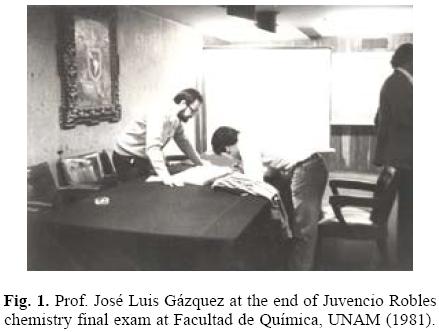
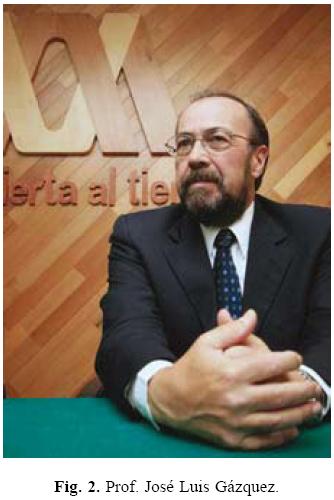
A little more than a year ago; I was honored and had the pleasure of being designated by Dr. Joaquin Tamariz —then Chair of the Editorial Board of the Journal of the Mexican Chemical Society (JMCS)— to serve as Guest Editor to collect a themed issue of the journal, devoted to theoretical and computational chemistry. Furthermore, and in recognition to his pioneer work done in this field in Mexico, this special issue is dedicated to Prof. José Luis Gázquez, who kindly accepted to be honored in this way. Prof. Gázquez was the main introducer and promoter of density functional theory (DFT) in México and his scientific work in the conceptual viewpoint of DFT has gained international recognition. Besides, he has been instrumental to the formation in Mexico of many researchers in DFT and quantum and theoretical chemistry in general.
Prof. Gázquez was born in Mexico City in 1948. This year he will be 64, joining the Beatles magic number generation. He got a B.S. degree in Chemical Engineering from the Universidad Nacional Autónoma de México (UNAM) in 1971 and he earned his Ph.D. in Theoretical Chemistry from the Johns Hopkins University in 1976. He then joined the chemistry faculty at UNAM in Mexico City from 1976 to 1982.
I had just begun my B.S. in Chemistry at UNAM in 1976 when I was fortunate enough to have my first undergrad course in quantum chemistry taught by Prof. Gázquez in 1978. After it was finished, I unresistingly succumbed to the "siren call" of quantum chemistry that José Luis impelled into his students and I was enrolled as an undergrad student in his just-forming research group at UNAM. I fondly remember those early days of acquaintance with José Luis and his first students (Alberto Vela, Marcelo Galván, Elba Ortiz, Andrés Cedillo) and other professors and students in the Theoretical Chemistry Department directed by the late Prof. Jaime Keller, as wonderful days of discovery and intellectual discussion and enlightenment (except for soccer issues where José Luis has his only known flaw regarding logical and scientific reasoning).
Prof. Gázquez later moved for a permanent position as full professor at the Universidad Autonoma Metropolitana (UAM) where he has worked since 1982, except for a short period at the Instituto Mexicano del Petróleo. In both UNAM and UAM he formed research groups that were eventually the seeds for a real theoretical and DFT school at the national level and with worldwide recognition. At the latter, he was also deeply committed with the university development and growth as a whole, so he decided to energetically engage in all fronts, teaching at both undergraduate and graduate levels, excelling as a researcher in theoretical and computational chemistry, as thesis advisor to many students, accepting administrative responsibilities all the way from Jefe de Area, to Department of Chemistry Chairman, Director of the Division of Basic Science and Engineering, Rector (President) of the Iztapalapa UAM campus and Rector General of the whole UAM system. From all these positions, he promoted not only the university growth but also managed to foster active collaborations and collective development of the whole mexican public university system.
Along his wide and extensive career, José Luis has been recognized in many ways: He is a member of the Mexican Academy of Science, member of the Mexican Chemical Society and other distinguished national and international scientific societies; he is a recipient of the Mexican government distinction Sistema Nacional de Investigadores Level 3, his university has designated him a Distinguished Professor, he received the SCOPUS 2007 prize for most cited authors; he was awarded the Mexican Chemical Society highest honor, the Andrés Manuel del Río 2008 National Prize for his career as a researcher. But perhaps, as it is fit for great characters such as José Luis, —both from a professional but also a human viewpoint—, he may find greater pleasure in the everyday recognition that he receives from his family (Alma and his children José Luis and Paulina) and all of us, his former students, his current students, colleagues, peers, coworkers in México and in many other countries, as the list of contributors to this JMCS issue dedicated to José Luis shows.
For this special issue we expected to have wide acceptance and enthusiastic response from the theoretical and computational chemistry community in Mexico. However we were fortunate to receive more than double the amount of manuscripts of a regular JMCS issue, from researchers in several institutions in Mexico, and also from other countries. After the rigorous JMCS peer-review and editorial process, we finally have 18 articles of very high level collected for this themed issue of JMCS.
]]> The topics chosen by our contributors reflect all major fields in the current state of the art work in DFT and quantum and theoretical chemistry in general. Among these fields the reader will enjoy the papers in this issue on: Theoretical developments in DFT towards chemical reactivity and electronic and molecular structure; assessment and definition of DFT reactivity descriptors; methods in conventional wave function quantum chemistry; an impressive array of applications of the above to areas as diverse as Hydrogen storage potential and new materials; theoretical chemical kinetics; molecular dynamics; biological, medicinal chemistry and drug-design applications; metal clusters, fullerenes and other nanocarbon forms and other nanostructured materials; catalysis; reaction mechanisms; atmospheric chemistry; reactivity applications of the Local Hard and Soft Acids and Bases Principle; and others.I want to thank all the contributors to this issue of the JMCS themed in theoretical and computational chemistry and dedicated to Prof. Gázquez, for the great scientific contributions they submitted and to all the referees that carefully reviewed these submissions, helping us to prepare a state of the art issue in our scientific field, which I am sure Prof. Gázquez and all the authors and readers will be proud of.
Congratulations José Luis! May this themed issue dedicated to you, in the field where you concentrated most of your life energy and shared intellectually and affectively with so many of us, be a permanent reminder of the scientific school you formed and the recognition of your academic community and the Mexican Chemical Society.
Prof. Juvencio Robles
Chair of the Editorial Board
Journal of the Mexican Chemical Society