<?xml version="1.0" encoding="ISO-8859-1"?><article xmlns:mml="http://www.w3.org/1998/Math/MathML" xmlns:xlink="http://www.w3.org/1999/xlink" xmlns:xsi="http://www.w3.org/2001/XMLSchema-instance">
<front>
<journal-meta>
<journal-id>1870-249X</journal-id>
<journal-title><![CDATA[Journal of the Mexican Chemical Society]]></journal-title>
<abbrev-journal-title><![CDATA[J. Mex. Chem. Soc]]></abbrev-journal-title>
<issn>1870-249X</issn>
<publisher>
<publisher-name><![CDATA[Sociedad Química de México A.C.]]></publisher-name>
</publisher>
</journal-meta>
<article-meta>
<article-id>S1870-249X2012000200024</article-id>
<title-group>
<article-title xml:lang="en"><![CDATA[Diligustilide: Enantiomeric Derivatives, Absolute Configuration and Cytotoxic Properties]]></article-title>
</title-group>
<contrib-group>
<contrib contrib-type="author">
<name>
<surname><![CDATA[León]]></surname>
<given-names><![CDATA[Alejandra]]></given-names>
</name>
<xref ref-type="aff" rid="A01"/>
</contrib>
<contrib contrib-type="author">
<name>
<surname><![CDATA[Delgado]]></surname>
<given-names><![CDATA[Guillermo]]></given-names>
</name>
<xref ref-type="aff" rid="A01"/>
</contrib>
</contrib-group>
<aff id="A01">
<institution><![CDATA[,Universidad Nacional Autónoma de México Instituto de Química ]]></institution>
<addr-line><![CDATA[México D.F.]]></addr-line>
</aff>
<pub-date pub-type="pub">
<day>00</day>
<month>06</month>
<year>2012</year>
</pub-date>
<pub-date pub-type="epub">
<day>00</day>
<month>06</month>
<year>2012</year>
</pub-date>
<volume>56</volume>
<numero>2</numero>
<fpage>222</fpage>
<lpage>226</lpage>
<copyright-statement/>
<copyright-year/>
<self-uri xlink:href="http://www.scielo.org.mx/scielo.php?script=sci_arttext&amp;pid=S1870-249X2012000200024&amp;lng=en&amp;nrm=iso"></self-uri><self-uri xlink:href="http://www.scielo.org.mx/scielo.php?script=sci_abstract&amp;pid=S1870-249X2012000200024&amp;lng=en&amp;nrm=iso"></self-uri><self-uri xlink:href="http://www.scielo.org.mx/scielo.php?script=sci_pdf&amp;pid=S1870-249X2012000200024&amp;lng=en&amp;nrm=iso"></self-uri><abstract abstract-type="short" xml:lang="en"><p><![CDATA[New enantiomeric amides (-)-6, (+)-7, (+)-6, and (-)-7 were formed by the reaction of the natural dimeric phthalide rac-diligustilide (rac-1) with (R)-(+)-&#945;-methylbenzylamine and (S)-(-)-&#945;-methylbenzylamine. The absolute configurations of compounds 6 and 7 were assigned by the analysis of electronic circular dichroism curves by means of the exciton chirality method. Compounds 1, 4, 5, (-)-6, (+)-6, (+)-7, and (-)-7 exhibited cytotoxic activity towards several human tumor cell lines.]]></p></abstract>
<abstract abstract-type="short" xml:lang="es"><p><![CDATA[Las amidas enantioméricas novedosas (-)-6, (+)-7, (+)-6 y (-)-7 fueron preparadas por medio de la reacción de la ftálida dimérica natural rac-diligustílida (rac-1) con (R)-(+)-a-metilbencilamina y (S)-(-)-&#945;-metilbencilamina. Las configuraciones absolutas de los compuestos 6 y 7 fueron asignadas por medio del análisis de las curvas de dicroísmo circular electrónico mediante el método de la quiralidad del excitón. Los compuestos 1, 4, 5, (-)-6, (+)-6, (+)-7 y (-)-7 mostraron actividad citotóxica frente a varias líneas celulares de tumores humanos.]]></p></abstract>
<kwd-group>
<kwd lng="en"><![CDATA[Ligusticum porteri]]></kwd>
<kwd lng="en"><![CDATA[diligustilide]]></kwd>
<kwd lng="en"><![CDATA[enantiopure derivatives]]></kwd>
<kwd lng="en"><![CDATA[electronic circular dichroism]]></kwd>
<kwd lng="en"><![CDATA[exciton chirality method]]></kwd>
<kwd lng="en"><![CDATA[cytotoxicity]]></kwd>
<kwd lng="es"><![CDATA[Ligusticum porteri]]></kwd>
<kwd lng="es"><![CDATA[diligustílida]]></kwd>
<kwd lng="es"><![CDATA[derivados enantiopuros]]></kwd>
<kwd lng="es"><![CDATA[dicroísmo circular electrónico]]></kwd>
<kwd lng="es"><![CDATA[método de la quiralidad del excitón]]></kwd>
<kwd lng="es"><![CDATA[citotoxicidad]]></kwd>
</kwd-group>
</article-meta>
</front><body><![CDATA[  	    <p align="justify"><font face="verdana" size="4">Article</font></p>  	    <p align="justify"><font face="verdana" size="2">&nbsp;</font></p>  	    <p align="center"><font face="verdana" size="4"><b>Diligustilide: Enantiomeric Derivatives, Absolute Configuration and Cytotoxic Properties</b></font></p>  	    <p align="center"><font face="verdana" size="2">&nbsp;</font></p>  	    <p align="center"><font face="verdana" size="2"><b>Alejandra Le&oacute;n and Guillermo Delgado*</b></font></p>  	    <p align="center"><font face="verdana" size="2">&nbsp;</font></p>  	    <p align="justify"><font face="verdana" size="2"><i>Instituto de Qu&iacute;mica de la Universidad Nacional Aut&oacute;noma de M&eacute;xico, Circuito Exterior, Ciudad Universitaria, Coyoac&aacute;n 04510, M&eacute;xico, D.F.</i> *<a href="mailto:delgado@unam.mx">delgado@unam.mx</a></font></p>  	    <p align="justify"><font face="verdana" size="2">&nbsp;</font></p>  	    <p align="justify"><font face="verdana" size="2">Received January 24, 2012.    ]]></body>
<body><![CDATA[<br> 	Accepted June 4, 2012.</font></p>  	    <p align="justify"><font face="verdana" size="2">&nbsp;</font></p>  	    <p align="justify"><font face="verdana" size="2"><b>Abstract</b></font></p>  	    <p align="justify"><font face="verdana" size="2">New enantiomeric amides (&#150;)<b>&#150;6, </b>(+)<b>&#150;7</b>, (+)<b>&#150;6</b>, and (&#150;)&#150;<b>7</b> were formed by the reaction of the natural dimeric phthalide rac&#150;diligustilide (<i>rac</i><b>&#150;1</b>) with (<i>R</i>)&#150;(+)&#150;&#945;&#150;methylbenzylamine and (<i>S</i>)&#150;(&#150;)&#150;&#945;&#150;methylbenzylamine. The absolute configurations of compounds <b>6</b> and <b>7</b> were assigned by the analysis of electronic circular dichroism curves by means of the exciton chirality method. Compounds <b>1</b>,<b> 4</b>,<b> 5</b>, (&#150;)<b>&#150;6</b>, (+)<b>&#150;6</b>, (+)<b>&#150;7</b>, and (&#150;)<b>&#150;7</b> exhibited cytotoxic activity towards several human tumor cell lines.</font></p>  	    <p align="justify"><font face="verdana" size="2"><b>Key words:</b> <i>Ligusticum porteri,</i> diligustilide, enantiopure derivatives, electronic circular dichroism, exciton chirality method, cytotoxicity.</font></p>  	    <p align="justify"><font face="verdana" size="2">&nbsp;</font></p>  	    <p align="justify"><font face="verdana" size="2"><b>Resumen</b></font></p>  	    <p align="justify"><font face="verdana" size="2">Las amidas enantiom&eacute;ricas novedosas (&#150;)<b>&#150;6</b>, (+)<b>&#150;7</b>, (+)&#150;<b>6</b> y (&#150;)<b>&#150;7</b> fueron preparadas por medio de la reacci&oacute;n de la ft&aacute;lida dim&eacute;rica natural <i>rac</i>&#150;diligust&iacute;lida <i>(rac</i><b>&#150;1)</b> con <i>(R</i>)&#150;(+)&#150;a&#150;metilbencilamina y <i>(S</i>)&#150;(&#150;)&#150;&#945;&#150;metilbencilamina. Las configuraciones absolutas de los compuestos <b>6</b> y <b>7</b> fueron asignadas por medio del an&aacute;lisis de las curvas de dicro&iacute;smo circular electr&oacute;nico mediante el m&eacute;todo de la quiralidad del excit&oacute;n. Los compuestos <b>1</b>,<b> 4</b>,<b> 5</b>, (&#150;)<b>&#150;6, </b>(+)<b>&#150;6</b>, (+)<b>&#150;7</b> y (&#150;)<b>&#150;7</b> mostraron actividad citot&oacute;xica frente a varias l&iacute;neas celulares de tumores humanos.</font></p>  	    <p align="justify"><font face="verdana" size="2"><b>Palabras clave:</b> <i>Ligusticum porteri,</i> diligust&iacute;lida, derivados enantiopuros, dicro&iacute;smo circular electr&oacute;nico, m&eacute;todo de la quiralidad del excit&oacute;n, citotoxicidad.</font></p>  	    <p align="justify"><font face="verdana" size="2">&nbsp;</font></p>  	    ]]></body>
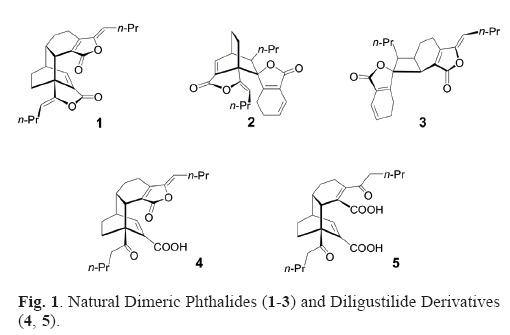
<body><![CDATA[<p align="justify"><font face="verdana" size="2"><b>Introduction</b></font></p>  	    <p align="justify"><font face="verdana" size="2">The rhizome of <i>Ligusticum porteri</i> C. &amp; R. (known as "osh&aacute;") has been used in traditional medicine to treat colds, sore throats and stomachaches &#91;1&#93;, and infusions are employed in ritual curing ceremonies by the Raramuri and the Zuni Indians &#91;2&#93;. The main components of <i>L. porteri</i> are <i>Z</i>&#150;ligustilide, <i>Z</i>&#150;butyli&#150;denephthalide, ferulic acid, <i>rac</i>&#150;diligustilide (<b>1</b>), <i>rac</i>&#150;tokinolide B (<b>2</b>), and <i>rac</i>&#150;riligustilide (<b>3</b>) among other constituents &#91;3,4&#93;. <i>Rac</i>&#150;diligustilide (<b>1</b>) and <i>rac</i>&#150;tokinolide B (2) have been obtained via &#91;&#960;4s + &#960;2s&#93; cycloaddition using <i>Z</i>&#150;ligustilide as diene and dienophile &#91;5, 6&#93;, and the acid catalyzed reaction of the monomer afforded linear dimeric products &#91;7&#93;. The chemical reactivity of <i>rac</i>&#150;diligustilide has been the subject of several studies. Treatment under basic conditions of <i>rac</i>&#150;diligustilide (<b>1</b>) afforded products with intramolecular carbon&#150;carbon and oxygen&#150;carbon connectivities &#91;8&#93;. The hydrolysis in basic media of 1 yielded a mixture of demethylwallichilide (4) and the diketo diacid of <i>rac</i>&#150;diligustilide (5) &#91;6&#93;. Base catalyzed treatment of <i>rac</i>&#150;diligustilide (1) under several reactions conditions afforded intramolecular condensation derivatives &#91;9&#93;. Recently, we reported the preparation of enantiomeric derivatives of <i>rac</i>&#150;tokinolide B (2), determined their absolute configurations and evaluated their cytotoxic activity &#91;10&#93;. In this context, we were interested in obtaining enantiomeric derivatives of rac&#150;diligustilide (1) that could be evaluated in some human cancer cell lines as cytotoxic agents.</font></p>  	    <p align="center"><font face="verdana" size="2"><img src="/img/revistas/jmcs/v56n2/a24f1.jpg"></font></p>  	    <p align="justify"><font face="verdana" size="2"><b>Results and Discussion</b></font></p>  	    <p align="justify"><font face="verdana" size="2">As an initial study for the preparation of enantiomerically pure derivatives of rac&#150;diligustilide (<b>1</b>), we examined different reaction conditions to prepare the diastereomeric salts from the carboxylic acids, <i>rac</i>&#150;demethylwallichilide (<b>4</b>) and the <i>rac</i>&#150;diketo diacid of diligustilide (<b>5</b>) with enantiomerically pure amines, and (<i>S</i>)&#150;(&#150;)&#150;&#945;&#150;methylbenzylamine. However, these reactions were unsuccessful, since lactonization (to produce <i>rac</i>&#150;<b>1</b>) is a competitive process under these reaction conditions. Therefore, we undertook direct attempts to transform the natural product <i>rac</i>&#150;<b>1</b> with optically active amines. Fortunately, treatment of rac&#150;diligustilide (<b>1</b>) in toluene under reflux with enantiomerically pure (<i>.</i> )&#150;(+)&#150; and <i>(S</i>)&#150;(&#150;)&#150;&#945;&#150;methylbenzyl&#150;amine led to a mixture of diastereomeric amides &#91;(&#150;)&#150;<b>6</b> + (+)&#150;<b>7</b> and (+)&#150;<b>6</b> + (&#150;)&#150;<b>7</b>, respectively&#93; (<a href="/img/revistas/jmcs/v56n2/a24s1.jpg" target="_blank">Scheme 1</a>) in a convenient preparative yield. The mixture of products from each reaction was separated by chromatographic procedures to obtain pure compounds as colorless oils. The stereochemical relationships were confirmed by their spectroscopic properties, the specific rotations and by the ECD curves. The stereoisomers (&#150;)<b>&#150;6</b>, (+)<b>&#150;7</b>, (+)<b>&#150;6</b>, and (&#150;)<b>&#150;7</b> had molecular formulae C<sub>32</sub>H<sub>39</sub>O<sub>4</sub>N, established by FAB&#150;HR&#150;MS, indicating the addition of the en&#150;antiomerically pure amines (C<sub>8</sub>H<sub>11</sub>N) to <i>rac</i>&#150;diligustilide (<b>1</b>) (C<sub>24</sub>H<sub>28</sub>O<sub>4</sub>). The IR spectra exhibited absorption bands for three carbonyl groups &#91;1763, 1705, 1656 cm<sup>&#150;1</sup> for (&#150;)<b>&#150;6</b> and (+)<b>&#150;6</b>; 1768, 1704, 1658 cm<sup>&#150;1</sup> for (+)<b>&#150;7</b> and (&#150;)<b>&#150;7</b>&#93;. The 32 carbon signals observed in the <sup>13</sup>C NMR spectra for each structure were assigned by DEPT analysis to three carbonyl groups: a ketone &#91;&#948;<sub>C</sub> 208.5, C&#150;3'&#93;, an &#945;,&#946;,&#947;,&#948;&#150;unsaturated<b>&#150;&#947;</b>&#150;lactone &#91;&#948;<sub>C</sub> 169.0, C&#150;1 for (&#150;)<b>&#150;6</b> and (+)<b>&#150;6;</b> 169.2, for (+)<b>&#150;7</b> and (&#150;)<b>&#150;7</b>&#93;, and the amide conjugated with an endocyclic double bond <b>&#91;</b>&#948;<sub>C</sub> 168.6, C&#150;1' for (&#150;)<b>&#150;6</b> and (+)<b>&#150;6</b>; 167.7, C&#150;1' for (+)<b>&#150;7</b> and (&#150;)<b>&#150;7</b>&#93;; one quaternary carbon <b>&#91;</b>&#948;<sub>C</sub> 152.8, C&#150;3a for (&#150;)<b>&#150;6</b> and (+)<b>&#150;6</b>; 153.0, C&#150;3a for <b>(+)&#150;7</b> and (&#150;)<b>&#150;7</b>&#93;; and a benzylic methyl group &#91;&#948;<sub>C</sub> 21.7, C&#150;9" for (&#150;)<b>&#150;6</b> and (+)<b>&#150;6</b>; 21.3 C&#150;9" for (+)<b>&#150;7</b> and (&#150;)<b>&#150;7</b>&#93;. The change in the chemical shift for C&#150;1', a new signal for C&#150;3' for the keto group, and the absence of the double bond C3'/C8' were evidences for the structure of the products. The signals for the moieties of the (<i>R</i>)&#150;(+)&#150; and (<i>S</i>)<b>&#150;</b>(&#150;)&#150;&#945;&#150;methylbenzylamine for each product were identified (see Experimental Section). The new signals in the <sup>1</sup>H NMR spectra at &#948;<sub>H</sub> 5.45, H&#150;1" for (+)<b>&#150;6</b> and (+)<b>&#150;6</b>; 5.68, H&#150;1" for (+)<b>&#150;7</b> and (&#150;)<b>&#150;7</b>; and 5.05, H&#150;2" for (&#150;)<b>&#150;6</b> and (+)<b>&#150;6;</b> 5.08 H&#150;2", for (+)<b>&#150;7</b> and (&#150;)<b>&#150;7</b> confirmed the addition of the (<i>R</i>)&#150;(+)&#150;&nbsp;and (<i>S</i>)&#150;(&#150;)<b>&#150;</b>&#945;&#150;methylbenzylamine to the starting material, securing the structures (&#150;)<b>&#150;6</b>, (+)<b>&#150;6</b>, (+)<b>&#150;7</b>, and (&#150;)<b>&#150;7.</b> The mechanism of the transformation involves opening of the &#947;&#150;lactone fused to the bicycle &#91;2.2.2&#93; via a nucleo&#150;philic attack of the enantiomerically pure amine at its carbonyl to afford the corresponding amides.</font></p>  	    <p align="justify"><font face="verdana" size="2">The absolute configurations of the diastereomeric amides (&#150;)<b>&#150;6</b>, (+)<b>&#150;6</b>, (+)<b>&#150;7</b>, and (&#150;)<b>&#150;7</b> were determined by the interpretation of the electronic circular dichroism (ECD) with the assistance of the exciton&#150;chirality method &#91;11&#150;13&#93; using the preferred conformations computed by energy minimization &#91;14&#93;.</font></p>  	    <p align="justify"><font face="verdana" size="2">The experimental ECD spectra for compounds (+)<b>&#150;6</b>, (<b>&#150;</b>)&#150;<b>6</b>, (+)<b>&#150;7</b>, and (&#150;)<b>&#150;7</b> were rather complicated due to the overlapof several exciton couplets of the different chromophores (the &#945;,&#946;,&#947;,&#948;&#150;unsaturated<b>&#150;</b>&#947;&#150;lactone, the ketone group, the &#945;,&#946;&#150;unsatu&#150;rated amide and the benzene moiety). To facilitate the interpretation of the ECD spectra, and particularly, for the identification of the spatial arrangement of the chromophores, we considered the Newman projections through five <b>a</b> bonds taking C&#150;7 at the front and C&#150;2" at the back as the extremes (<a href="#f2">Figures 2A</a> and <a href="#f2">2B</a> for compound (&#150;)<b>&#150;6</b> of the preferred conformation &#91;14&#93;. C&#150;7 and C&#150;2" are chiral carbons vicinal to the chromophores.</font></p>  	    <p align="center"><font face="verdana" size="2"><a name="f2"></a></font></p>  	    <p align="center"><font face="verdana" size="2"><img src="/img/revistas/jmcs/v56n2/a24f2.jpg"></font></p>  	    <p align="justify"><font face="verdana" size="2">In the low energy region of the CD of the levorotatory (and major) product of the reaction of <i>rac</i><b>&#150;1</b> with (<i>R</i>)&#150;(+)&#150;&#945;<b>&#150;</b>methylbenzylamine (<a href="#f3">Figure 3</a>, curve a) were observed two Cotton effects &#91;n&#8594;&#960;* 304 nm (&#916;&#949;+2.19); &#960;&#8594;&#960;*267 (&#916;&#949;&#150;5.25)&#93; which were weaker in intensity than those transitions attributed to the &#945;, &#946;, &#947;, &#948;,&#150;unsaturated &#947;&#150;lactone and benzene moieties. The first one was negative &#91;237 nm (&#916;&#949;&#150;11.46)&#93; and the second one was positive &#91;206 nm (&#916;&#949;+7.27)&#93;, defining a negative chirality, therefore, this curve was assigned to structure (&#150;)<b>&#150;6</b> in agreement with the spatial disposition of the two chromo&#150;phores for this structure (<a href="#f2">Figures 2C</a>,<a href="#f2">2D</a>), establishing the absolute stereochemistry 6. , 7. , 3'a. , 6'. , 2". for this compound (<a href="#f2">Figure 2</a>).</font></p>  	    ]]></body>
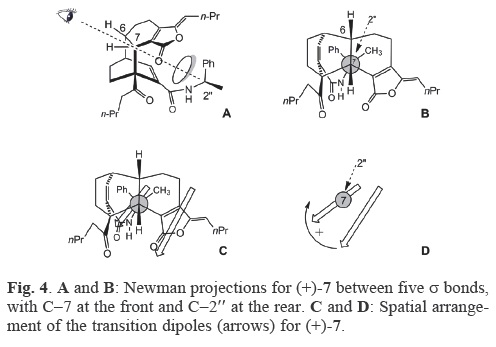
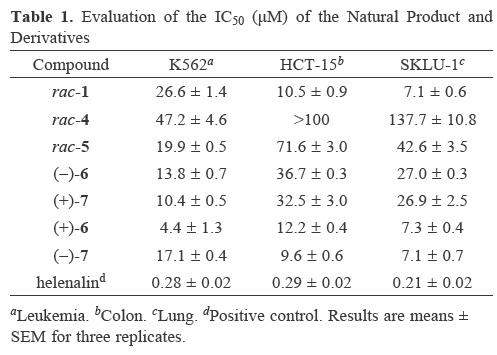
<body><![CDATA[<p align="center"><font face="verdana" size="2"><a name="f3"></a></font></p>  	    <p align="center"><font face="verdana" size="2"><img src="/img/revistas/jmcs/v56n2/a24f3.jpg"></font></p>  	    <p align="justify"><font face="verdana" size="2">On the other hand, (+)<b>&#150;7</b> (the minor product of the reaction of <i>rac</i><b>&#150;1</b> with (<i>R</i>)&#150;(+)&#150;&#945;&#150;methylbenzylamine) exhibited pseudoe&#150;nantiomeric ECD with respect to (&#150;)<b>&#150;6</b> (<a href="#f3">Figure 3b</a>). The Cotton effect signals of the ketone and amide group &#91;n&#8594;&#960;*, 302 nm (&#916;&#949; &#150;1.87) and &#960;&#151;&#960;*, 271 nm (&#916;&#949;+4.42)&#93; were weaker with respect to the absorption at 219 nm (&#916;&#949; +16.34) corresponding to the &#945;, &#946;, &#947;, &#948;&#150;unsaturated &#947;&#150;lactone. The second effect was positive &#91;205 nm (&#916;&#949; +11.4)&#93;, therefore, the spatial orientation of the transition dipoles of the chromophores (&#945;,&#946;,&#947;,&#948;&#150;unsaturated &#947;&#150;lactone and the benzene moiety) is clockwise. Considering the Newman projection through C&#150;7/C&#150;2" (<a href="#f4">Figure 4A</a>,<a href="#f4">B</a>), this clockwise contribution (<a href="#f4">Figure 4 C</a>, <a href="#f4">D</a>) defined the 6<i>S,</i> 7<i>S,</i> 3'a<i>S,</i> 6<i>'S</i> and 2". configuration for <b>(+)&#150;7.</b></font></p>  	    <p align="center"><font face="verdana" size="2"><a name="f4"></a></font></p>  	    <p align="center"><font face="verdana" size="2"><img src="/img/revistas/jmcs/v56n2/a24f4.jpg"></font></p> 	    <p align="center"><font face="verdana" size="2"><a name="f5"></a></font></p> 	    <p align="center"><font face="verdana" size="2"><img src="/img/revistas/jmcs/v56n2/a24f5.jpg"></font></p>  	    <p align="justify"><font face="verdana" size="2">The Cotton effect of the dextrorotatory (and major) product obtained for the reaction of <i>rac</i><b>&#150;1</b> with <i>(S</i>)&#150;(&#150;)&#150;&#945;&#150;methylben&#150;zylamine &#91;271 nm (&#916;&#949; +11.96) and 203 nm (&#916;&#949; &#150;8.23)&#93; was enantiomeric with respect to that of (&#150;)<b>&#150;6</b> and showed positive chirality, establishing 6<i>S,</i> 7<i>S,</i> 3'a<i>S,</i> 6'<i>S</i> and 2&quot;<i>S</i> as the absolute configuration for (+)<b>&#150;6.</b> Complementary to this, (&#150;)<b>&#150;7</b> exhibited only one ECD extreme at 272 nm (&#916;&#949; &#150;11.35) as the first Cotton effect, while the second effect was buried in a strong negative background ellipticity. A negative contribution of the benzene moiety and the &#945;,&#946;,&#947;,&#948;&#150;unsaturated &#947;&#150;lactone chromo&#150;phores established the absolute configuration 6<i>R</i>, 7<i>R</i>, 3'a<i>R</i>. , 6'<i>R</i>. and 2"<i>S</i> for (&#150;)<b>&#150;7</b> (<a href="/img/revistas/jmcs/v56n2/a24s1.jpg" target="_blank">Scheme 1</a>).</font></p>  	    <p align="justify"><font face="verdana" size="2">Considering the pharmacological importance of the dimeric phthalides and their potential as cytotoxic agents &#91;10,15,16&#93;, we tested the isolated derivatives against three human cancer cell lines following standard protocols &#91;10,17&#93;. The IC<sub>50</sub> values are shown in <a href="#t1">Table 1</a>. The results indicated that the natural product rac&#150;diligustilide (<b>1</b>) showed the best activity compared with its carboxylic derivatives <i>rac</i><b>&#150;4</b> and <i>rac</i><b>&#150;5.</b> There are differences in the bioactivities of the enantiomers, with (+)<b>&#150;6</b> being approximately 3&#150;fold more active than (&#150;)<b>&#150;6</b> and (&#150;)<b>&#150;7</b> being approximately 3&#150;fold more active than (+)<b>&#150;7</b> with the exception of the K562 line. While the enantiomeric derivatives (&#150;)<b>&#150;6</b>, (+)<b>&#150;7</b>, (+)<b>&#150;6</b> y (&#150;)<b>&#150;7</b> were promising, they were also nonselective and displayed only marginally better inhibitory activity than the parent compound toward the cell lines tested.</font></p>  	    <p align="center"><font face="verdana" size="2"><a name="t1"></a></font></p>  	    ]]></body>
<body><![CDATA[<p align="center"><font face="verdana" size="2"><img src="/img/revistas/jmcs/v56n2/a24t1.jpg"></font></p>  	    <p align="justify"><font face="verdana" size="2">These results confirm the unique features of the chemistry of dimeric phthalides &#91;3&#150;10&#93;. In this case, only the 1,2&#150;nu&#150;cleophilic addition of the chiral amine to one lactone was observed, confirming the relative stability of the &#945;,&#946;,&#947;,&#948;&#150;unsaturated &#947;&#150;lactone of <i>rac</i><b>&#150;1,</b> and no intramolecular reactions were observed. The differences in bioactivity of the enantiomeric lactams indicate the chiral nature of the targets.</font></p>  	    <p align="justify"><font face="verdana" size="2">&nbsp;</font></p>  	    <p align="justify"><font face="verdana" size="2"><b>Experimental Section</b></font></p>  	    <p align="justify"><font face="verdana" size="2"><b>General Experimental Procedures</b></font></p>  	    <p align="justify"><font face="verdana" size="2"><i>Rac</i>&#150;diligustilide (<b>1</b>) was isolated from the acetone extract of the rhizomes of <i>Ligusticum porteri</i> by column chromatography &#91;3&#93;, carried out on silica gel (230&#150;400 mesh, Merck). Thin layer chromatography analyses were done on aluminum&#150;backed silica gel 60 F254 plates (0.20 mm thickness) plates (Merck) and visualization of chromatograms were under UV lamp and then with solution of ammonium cerium sulfate. Infrared spectra were recorded with FTIR Bruker TENSOR 27 instrument. Ultraviolet spectra were determined on a Shimadzu UV160U Instrument. The optical rotation was measured in MeOH using a Perkin&#150;Elmer 341 polarimeter. The <sup>1</sup>H and <sup>13</sup>C NMR experiments were performed at 25 &deg;C using Varian UnityPlus 500 spectrometer (at 500/125 MHz), the spectra were recorded in CDCl<sub>3</sub> (7.26 and 77.0 ppm, for <sup>1</sup>H and <sup>13</sup>C NMR, respectively) as reference. The chemical shifts (5) are expressed in ppm relative to TMS, and the coupling constants (J) in Hz. EIMS and HRMS (FAB+) spectra were recorded on a JEOL SX102A mass spectrometer. The (<i>R</i>)&#150;(+)&#150; and (<i>S</i>)&#150;(&#150;)&#150;&#945;&#150;methylbenzylamine Chiraselect &gt; 99.0% (Sum of enantiomers, GC) were purchased from Fluka Sigma&#150;Aldrich.</font>	</p> 	    <p align="justify"><font face="verdana" size="2"><b>Preparation of <i>rac</i>&#150;demethylwallichilide (4) and <i>rac&#150;</i>diketodiacid of diligustilide (5)</b></font></p>  	    <p align="justify"><font face="verdana" size="2">Demethylwallichilide (<b>4</b>) &#91;6&#93; and rac&#150;2iketo2iaci2 of diligusti&#150;lide (<b>5</b>) &#91;9&#93; were prepared following the procedures previously described.</font></p>  	    <p align="justify"><font face="verdana" size="2"><b>Treatment of 4 with (R)&#150;(+)&#150;&#945;&#150;methylbenzylamine</b></font></p>  	    <p align="justify"><font face="verdana" size="2">Demethylwallichilide (<b>4</b>, 10 mg, 0.025 mmol) was dissolved in EtOAc (10 mL) and (<i>R</i>)&#150;(+)&#150;&#945;&#150;methylbenzylamine (6 (&#956;L, 0.04 mmol) was then added. The reaction mixture was stirred at room temperature and then refluxed for 5 h. After usual work up, a yellow oil was obtained which was purified by TLC preparative (<i>n</i>&#150;heptane/EtOAc, 2:3) to afford <i>rac</i>&#150;diligustilide (<b>1</b>) as the main product (5 mg, 52.4%) and starting material (2 mg, 20%) was recovered.</font></p>  	    ]]></body>
<body><![CDATA[<p align="justify"><font face="verdana" size="2"><b>Treatment of 5 with (<i>S</i>)&#150;(&#150;)&#150;&#945;&#150;methylbenzylamine</b></font></p>  	    <p align="justify"><font face="verdana" size="2"><b>5</b> (25 mg, 0.06 mmol) was dissolved in MeOH (10 mL) and (<i>S</i>)&#150;(&#150;)&#150;&#945;&#150;methylbenzylamine (11 (&#956;L, 0.09 mmol) was added, the mixture was stirring at room temperature for 1 h, then was refluxed for 5 h. After usual work up, only the starting material was recovered.</font></p>  	    <p align="justify"><font face="verdana" size="2"><b>Derivatization of <i>rac</i>&#150;Diligustilide (1) with (<i>R</i>)&#150;(+)&#150;&#945;&#150;methylbenzylamine</b></font></p>  	    <p align="justify"><font face="verdana" size="2">To a solution of <i>rac</i>&#150;diligustilide (<b>4</b>, 99.2 mg, 0.26 mmol) in dry toluene (10 mL) was added (<i>R</i>)&#150;(+)&#150;&#945;&#150;methylbenzylamine (57.12 mg, 0.47 mmol), the reaction mixture was stirred and refluxed under a nitrogen atmosphere for 20 h. The reaction mixture was cooled, neutralized with HCl (10%), extracted with EtOAc (3 x 10 mL), and the organic layers were joined and washed with brine, dried with Na2SO4, and the solvent evaporated under reduce pressure. The residue (yellow oil, 115.3 mg) was purified by preparative TLC (<i>n</i>&#150;hexane/EtOAc 7:3, developing three times) recovering 7.9% of starting material and affording 92.54 mg (70.8%) of two products:</font></p>  	    <p align="justify"><font face="verdana" size="2">(&#150;)<b>&#150;6</b> (43.18 mg, 33%) as a colorless oil; <i>Rf</i> 0.50 (n&#150;hex&#150;ane/EtOAc, 3:2, twice); &#91;&#945;&#93;<sup>25</sup><sub>D</sub> &#150;96.1 (c 1.3 x 10<sup>&#150;3</sup>, MeOH); UV (MeOH) &#955;<sub>max</sub> (log &#949;): 276 (3.6), 208 (4.3); CD (c 1.68 x 10<sup>&#150;5</sup>, MeOH): 304 nm (&#916;&#949; +2.19), 267 nm (&#916;&#949; &#150;5.25), 237 nm (&#916;&#949; &#150;11.46), 206 nm (&#916;&#949; +7.27); IR (CHCl<sub>3</sub>) v<sub>max</sub>: 3435, 3012, 2961, 2937, 2874, 1763, 1705, 1656, 1496, 1451, 1378, 1233, 1167, 1133, 997 cm<sup>&#150;1</sup>; <sup>1</sup>H NMR (CDC1<sub>3</sub>, 500 MHz; assignments by COSY, NOESY and HMQC) &#948; 7.30 (2H, 222, <i>J</i> = 8.5, 8.5, 1.0 Hz, H&#150;5", H&#150;7"), 7.27 (2H, 22, <i>J</i> = 8.5, 1.5 Hz, H&#150;4", H&#150;8"), 7.22 (1H, 2222, <i>J</i> = 8.5, 8.5, 1.5, 1.5, H&#150;6"), 6.50 (1H, 2, <i>J</i> = 6.5 Hz, H&#150;7'), 5.45 (1H, 2, <i>J</i> = 8.0 Hz, H&#150;1"), 5.09 (1H, t, <i>J</i> = 7.5 Hz, H&#150;8), 5.05 (1H, 2222, <i>J</i> = 7.5 Hz, H&#150;2"), 3.19 (1H, 2, <i>J</i> = 8.5 Hz, H&#150;7), 2.88 (1H, 222, <i>J</i> = 18.5, 7.5, 7.5 Hz, H&#150;8'a), 2.60&#150;2.53 (2H, m, H&#150;6', H&#150;8'b), 2.46&#150;2.44 (1H, m, H&#150;6), 2.31 (2H, 2222, <i>J</i> = 13.0, 7.5, 7.5, 7.5 Hz, H&#150;9a, H&#150;9b), 2.23 (1H, t, <i>J</i> = 4.5 Hz, H&#150;4a), 2.19&#150;2.16 (1H, m, H&#150;4b), 2.14 (1H, 222, <i>J</i> = 12.5, 6.0, 3.0, 3.0 Hz, H&#150;4'a), 1.88 (1H, 2222, <i>J</i> = 15.5, 6.5, 3.0, 3.0 Hz, H&#150;5a), 1.81 (1H, 2222, <i>J</i> = 14.0, 8.5, 4.0, 4.0 Hz, H&#150;5'a), 1.70&#150;1.63 (3H, m, H&#150;4'b, H&#150;9'a, H&#150;9'b), 1.63&#150;1.58 (1H, m, H&#150;5'b), 1.45 (2H, q, <i>J</i> = 7.5 Hz, H&#150;10a, H&#150;10b), 1.46 (1H, 2, <i>J</i> = 6.5 Hz, H&#150;9"), 1.43&#150;1.40 (1H, m, H&#150;5b), 1.36 (2H, 2222, <i>J</i> = 15.0, 7.5, 7.5, 7.5 Hz, H&#150;10'a, H&#150;10'b), 0.93 (3H, t, <i>J</i> = 7.0 Hz, H&#150;11), 0.92 (3H, t, <i>J</i> = 7.5 Hz, H&#150;11'); <sup>13</sup>C NMR (CDCl<sub>3</sub>, 125 MHz; assignments by DEPT, HSQC and HMBC) &#948; 208.5 (C&#150;3'), 169.0 (C&#150;1), 168.6 (C&#150;1'), 152.8 (C&#150;3a), 148.5 (C&#150;3), 143.8 (C&#150;3"), 141.8 (C&#150;7'a), 135.6 (C&#150;7'), 128.5 (C&#150;5", C&#150;7"), 128.1 (C&#150;7a), 127.0 (C&#150;6"), 126.1 (C&#150;4", C&#150;8"), 111.2 (C&#150;8), 57.3 (C&#150;3'a), 48.6 (C&#150;2"), 39.4 (C&#150;7), 39.2 (C&#150;8'), 37.9 (C&#150;6'), 37.6 (C&#150;6), 29.4 (C&#150;4'), 28.5 (C&#150;5'), 28.0 (C&#150;5), 27.9 (C&#150;9), 25.4 (C&#150;9'), 22.4 (C&#150;10), 22.4 (C&#150;10'), 21.7 (C&#150;9"),19.4 (C&#150;4), 14.1 (C&#150;11'), 13.8 (C&#150;11); EIMS <i>m/z</i> 501 &#91;M<sup>+</sup>&#93; (23), 461 (11), 444 (4), 381 (7), 311 (25), 226 (8), 191 (100), 120 (98), 105 (77), 79 (10), 57 (9), 43 (6), 29 (5); HRMS (FAB<sup>+</sup>) <i>m/z</i> 502.2955 (calcd for C32H39O4N+H<sup>+</sup> 502.2957).</font></p>  	    <p align="justify"><font face="verdana" size="2">(+)<b>&#150;7</b> (49.36 mg, 37.7%) as a colourless oil; <i>Rf</i> 0.45 (&laquo;&#150;hex&#150;ane/EtOAc, 3:2, twice); &#91;&#945;&#93;<sup>25</sup><sub>D</sub> +117.0 (c 1.35 x 10<sup>&#150;3</sup>, MeOH); UV (MeOH) &#955;<sub>max</sub>(log &#949;): 277 (3.5), 207.8 (4.3); CD (c 2.4 x 10<sup>&#150;5</sup>, MeOH): 302 nm (&#916;&#949; &#150;1.87), 271 nm (&#916;&#949; +4.42), 219 nm (&#916;&#949; +16.34), 205 nm (&#916;&#949; +11.40); IR (CHCl<sub>3</sub>) v<sub>max</sub>: 3436, 3012, 2961, 2874, 1768, 1704, 1658, 1496, 1450, 1377, 1232, 1167, 1133, 997, 920 cm<sup>&#150;1</sup>; <sup>1</sup>H NMR (CDC1<sub>3</sub>, 500 MHz; assignments by COSY, NOESY and HMQC) &#948; 7.31 (2H, ddd, <i>J</i> = 7.5, 7.5, 1.5 Hz, H&#150;5", H&#150;7"), 7.35 (2H, 22, <i>J</i> = 8.5, 1.5 Hz, H&#150;4", H&#150;8"), 7.23 (1H, 2222, <i>J</i> = 8.5, 7.0, 1.5, 1.5, H&#150;6"), 6.58 (1H, 2, <i>J</i> = 6.5 Hz, H&#150;7'), 5.68 (1H, 2, <i>J</i> = 8.0 Hz, H&#150;1"), 4.99 (1H, t, <i>J</i> = 8.0 Hz, H&#150;8), 5.08 (1H, 2222, <i>J</i> = 7.0 Hz, H&#150;2"), 3.29 (1H, b2, <i>J</i> = 9.0 Hz, H&#150;7), 2.95 (1H, 222, <i>J</i> = 15.0, 6.0, 6.0 Hz, H&#150;8'a), 2.59&#150;2.56 (1H, m, H&#150;8'b), 2.56&#150;2.53 (1H, m, H&#150;6'), 2.48&#150;2.44 (1H, m, H&#150;6), 2.28 (2H, q, <i>J</i> = 7.5, Hz, H&#150;9a, H&#150;9b), 2.22 (1H, q, <i>J</i> = 7.5 Hz, H&#150;4a), 2.14&#150;2.07 (2H, m, H&#150;4b, H&#150;4'a), 1.89 (1H, 2222, <i>J</i> = 15.5, 6.5, 3.5, 3.5 Hz, H&#150;5a), 1.79 (1H, 2222, <i>J</i> = 14.0, 8.5, 3.5, 3.5 Hz, H&#150;5'a), 1.69&#150;1.54 (4H, m, H&#150;4'b, H&#150;5'b, H&#150;9'a, H&#150;9'b), 1.34 (2H, q, <i>J</i> = 7.5 Hz, H&#150;10a, H&#150;10b), 1.47 (1H, 2, <i>J</i> = 6.5 Hz, H&#150;9"), 1.43&#150;1.40 (1H, m, H&#150;5b), 1.34 (2H, q, <i>J</i> = 7.5 Hz, H&#150;10'a, H&#150;10'b), 0.92 (3H, t, <i>J</i> = 7.5 Hz, H&#150;11), 0.89 (3H, t, <i>J</i> = 7.5 Hz, H&#150;11'); <sup>13</sup>C NMR (CDCl<sub>3</sub>, 125 MHz; assignments by DEPT, HSQC and HMBC) &#948; 208.5 (C&#150;3'), 169.2 (C&#150;1), 167.7 (C&#150;1'), 153.0 (C&#150;3a), 148.4 (C&#150;3), 143.2 (C&#150;3"), 141.5 (C&#150;7'), 136.5 (C&#150;7'), 128.5 (C&#150;5", C&#150;7"), 127.6 (C&#150;7a), 127.0 (C&#150;6"), 126.4 (C&#150;4", C&#150;8"), 111.0 (C&#150;8), 57.2 (C&#150;3'a), 48.3 (C&#150;2"), 39.4 (C&#150;7), 39.0 (C&#150;8'), 37.9 (C&#150;6'), 37.8 (C&#150;6), 29.8 (C&#150;4'), 28.4 (C&#150;5'), 28.2 (C&#150;5), 27.9 (C&#150;9), 25.6 (C&#150;9'), 22.4 (C&#150;10), 22.5 (C&#150;10'), 21.3 (C&#150;9"), 19.2 (C&#150;4), 14.0 (C&#150;11), 13.8 (C&#150;11'); EIMS <i>m/z</i> 501 &#91;M+&#93; (17), 461 (6), 444 (4), 381 (5), 341 (7), 311 (16), 227 (10), 191 (73), 105 (100), 79 (12), 60 (55), 43 (94), 29 (19), 18 (24); HRMS (FAB+) <i>m/z</i> 502.2961 (calcd for C<sub>32</sub>H<sub>39</sub>O<sub>4</sub>N+H+ 502.2957).</font>	</p> 	    <p align="justify"><font face="verdana" size="2"><b>Derivatization of rac&#150;Diligustilide (1) with (S)&#150;(&#150;)&#150;&#945;&#150;methylbenzylamine</b></font></p>  	    <p align="justify"><font face="verdana" size="2">To a solution of rac&#150;diligustilide <b>(1</b>, 100 mg, 0.26 mmol) in dry toluene (10 mL) was added (S)&#150;(&#150;)&#150;&#945;&#150;methylbenzylamine (63.7 mg, 0.52 mmol), the reaction mixture was stirred and refluxed under a nitrogen atmosphere for 20 h. The reaction mixture was cooled, then neutralized with a solution of HCl (10%) and extracted with EtOAc (3 x 10 mL), the organic layers were joined, washed with brine, dried with Na<sub>2</sub>SO<sub>4</sub>, and the solvent was evaporated under reduced pressure. The residue (yellow oil, 120 mg) was applied in a preparative TLC (<i>n</i>&#150;hexane/EtOAc 4:1, developing four times) recovering 6.3% of <b>4</b> and affording 92.36 mg (75.6%) of two products:</font></p>  	    <p align="justify"><font face="verdana" size="2">(+)<b>&#150;6</b> (48.13 mg, 39.5%) as a colourles oil; <i>Rf</i> 0.56 (n&#150;hexane/EtOAc, 2:3, twice); &#91;&#945;&#93;<sup>25</sup><sub>D</sub> +46.3 (c 9.5 x 10<sup>&#150;4</sup>, MeOH); UV (MeOH) &#955;,<sub>max</sub> (log &#949;): 276.5 (3.8), 207.5 (4.3); CD (c 2.2 x 10<sup>&#150;5</sup>, MeOH) 302 nm (&#916;&#949; &#150;4.80), 271 nm (&#916;&#949; +11.96), 243 nm (&#916;&#949; +8.01), 203 nm (&#916;&#949; &#150;8.23); HRMS (FAB+) <i>m/z</i> 502.2954 (calcd for C<sub>32</sub>H<sub>39</sub>O<sub>4</sub>N+H<sup>+</sup> 502.2957).</font></p>  	    <p align="justify"><font face="verdana" size="2">(&#150;)<b>&#150;7</b> (44.23 mg, 36.3%) as a colourless oils; <i>Rf</i> 0.54 (n&#150;hexane/EtOAc, 2:3, twice); &#91;&#945;&#93;<sup>25</sup><sub>D</sub> &#150;125.8 (c 8.5 x 10<sup>&#150;4</sup>, MeOH); UV (MeOH) &#955;<sub>max</sub> (log e): 278 (3.9), 207 (4.3); CD (c 1.9 x10<sup>&#150;5</sup>, MeOH) 303 nm (&#916;&#949; +4.47), 272 nm (&#916;&#949; &#150;11.35), 218 nm (&#916;&#949; &#150;11.82), 203 nm (&#916;&#949; &#150;12.50); HRMS (FAB+) <i>m/z</i> 502.2956 (calcd for C<sub>32</sub>H<sub>39</sub>O<sub>4</sub>N+H<sup>+</sup> 502.2957).</font>	</p>     ]]></body>
<body><![CDATA[<p align="justify"><font face="verdana" size="2"><b>Cytotoxicity assay</b></font></p>  	    <p align="justify"><font face="verdana" size="2">Colon (HCT&#150;15), leukemia (K&#150;562), and lung (SKLU&#150;1) human tumor cell lines were supplied by National Cancer Institute (NCI), USA. The cytotoxicity of the test compounds was 2etermine2 using the protein&#150;binding 2ye sulforhodamine B (SRB) &#91;17&#93;. The IC<sub>50</sub> values (mean &plusmn; standard error for three replicates) are shown in <a href="#t1">Table 1</a>.</font></p>  	    <p align="justify"><font face="verdana" size="2">&nbsp;</font></p>  	    <p align="justify"><font face="verdana" size="2"><b>Acknowledgments</b></font></p>  	    <p align="justify"><font face="verdana" size="2">Financial supports from CONACyT (scholarship 181999 and project 102158) and Programa de Posgrado en Ciencias Qu&iacute;micas de la UNAM are gratefully acknowledged. We thank the technical assistance of M. I. Ch&aacute;vez, B. Quiroz&#150;Garc&iacute;a, M. T.</font></p>  	    <p align="justify"><font face="verdana" size="2">&nbsp;</font></p>  	    <p align="justify"><font face="verdana" size="2">&nbsp;</font></p>  	    <p align="justify"><font face="verdana" size="2"><b>References</b></font></p>  	    <!-- ref --><p align="justify"><font face="verdana" size="2">1.&nbsp;Bye, R.; Linares, E. <i>J. Ethnobiol.</i> <b>1986,</b> <i>6</i>, 289&#150;306.    &nbsp;&nbsp;&nbsp;&nbsp;&nbsp;&nbsp;&nbsp;&nbsp;[&#160;<a href="javascript:void(0);" onclick="javascript: window.open('/scielo.php?script=sci_nlinks&ref=4952352&pid=S1870-249X201200020002400001&lng=','','width=640,height=500,resizable=yes,scrollbars=1,menubar=yes,');">Links</a>&#160;]<!-- end-ref --></font></p>  	    ]]></body>
<body><![CDATA[<!-- ref --><p align="justify"><font face="verdana" size="2">2.&nbsp;Linares, E.; Bye, R. <i>J. Ethnopharmacol.</i> <b>1987,</b> <i>19,</i> 153&#150;183.    &nbsp;&nbsp;&nbsp;&nbsp;&nbsp;&nbsp;&nbsp;&nbsp;[&#160;<a href="javascript:void(0);" onclick="javascript: window.open('/scielo.php?script=sci_nlinks&ref=4952354&pid=S1870-249X201200020002400002&lng=','','width=640,height=500,resizable=yes,scrollbars=1,menubar=yes,');">Links</a>&#160;]<!-- end-ref --></font></p>  	    <!-- ref --><p align="justify"><font face="verdana" size="2">3.&nbsp;Le&oacute;n, A.; Toscano, R. A.; Tortoriello, J.; Delgado, G. <i>Nat. Prod. Res.</i> <b>2011,</b> <i>25</i>, 1234&#150;1242.    &nbsp;&nbsp;&nbsp;&nbsp;&nbsp;&nbsp;&nbsp;&nbsp;[&#160;<a href="javascript:void(0);" onclick="javascript: window.open('/scielo.php?script=sci_nlinks&ref=4952356&pid=S1870-249X201200020002400003&lng=','','width=640,height=500,resizable=yes,scrollbars=1,menubar=yes,');">Links</a>&#160;]<!-- end-ref --></font></p>  	    <!-- ref --><p align="justify"><font face="verdana" size="2">4.&nbsp;Le&oacute;n, A.; Ch&aacute;vez, M. I.; Delgado, G. <i>Magn. Reson. Chem.</i> <b>2011,</b> <i>49</i>, 469&#150;476.    &nbsp;&nbsp;&nbsp;&nbsp;&nbsp;&nbsp;&nbsp;&nbsp;[&#160;<a href="javascript:void(0);" onclick="javascript: window.open('/scielo.php?script=sci_nlinks&ref=4952358&pid=S1870-249X201200020002400004&lng=','','width=640,height=500,resizable=yes,scrollbars=1,menubar=yes,');">Links</a>&#160;]<!-- end-ref --></font></p>  	    <!-- ref --><p align="justify"><font face="verdana" size="2">5.&nbsp;Ogawa, Y.; Mori, Y.; Maruno, M.; Wakamatsu, T. <i>Heterocycles</i> <b>1997,&nbsp;</b><i>45,</i> 1869&#150;1872.    &nbsp;&nbsp;&nbsp;&nbsp;&nbsp;&nbsp;&nbsp;&nbsp;[&#160;<a href="javascript:void(0);" onclick="javascript: window.open('/scielo.php?script=sci_nlinks&ref=4952360&pid=S1870-249X201200020002400005&lng=','','width=640,height=500,resizable=yes,scrollbars=1,menubar=yes,');">Links</a>&#160;]<!-- end-ref --></font></p>  	    <!-- ref --><p align="justify"><font face="verdana" size="2">6.&nbsp;Rios, M. Y.; Delgado, G.; Toscano, R. A. <i>Tetrahedron</i> <b>1998,</b> <i>54</i>, 3355&#150;3366.    &nbsp;&nbsp;&nbsp;&nbsp;&nbsp;&nbsp;&nbsp;&nbsp;[&#160;<a href="javascript:void(0);" onclick="javascript: window.open('/scielo.php?script=sci_nlinks&ref=4952362&pid=S1870-249X201200020002400006&lng=','','width=640,height=500,resizable=yes,scrollbars=1,menubar=yes,');">Links</a>&#160;]<!-- end-ref --></font></p>  	    ]]></body>
<body><![CDATA[<!-- ref --><p align="justify"><font face="verdana" size="2">7.&nbsp;Rios , M. Y.; Delgado, G. <i>J. Mex. Chem. Soc.</i> (former <i>Rev. Soc. Qu&iacute;m. M&eacute;x.)</i> <b>1999,</b> <i>43,</i> 127&#150;132.    &nbsp;&nbsp;&nbsp;&nbsp;&nbsp;&nbsp;&nbsp;&nbsp;[&#160;<a href="javascript:void(0);" onclick="javascript: window.open('/scielo.php?script=sci_nlinks&ref=4952364&pid=S1870-249X201200020002400007&lng=','','width=640,height=500,resizable=yes,scrollbars=1,menubar=yes,');">Links</a>&#160;]<!-- end-ref --></font></p>  	    <!-- ref --><p align="justify"><font face="verdana" size="2">8.&nbsp;Rios, M. Y.; Delgado, G.; Espinosa&#150;P&eacute;rez, G. <i>Tetrahedron Lett.</i> <b>1998,&nbsp;</b><i>39,</i> 6605&#150;6608.    &nbsp;&nbsp;&nbsp;&nbsp;&nbsp;&nbsp;&nbsp;&nbsp;[&#160;<a href="javascript:void(0);" onclick="javascript: window.open('/scielo.php?script=sci_nlinks&ref=4952366&pid=S1870-249X201200020002400008&lng=','','width=640,height=500,resizable=yes,scrollbars=1,menubar=yes,');">Links</a>&#160;]<!-- end-ref --></font></p>  	    <!-- ref --><p align="justify"><font face="verdana" size="2">9.&nbsp;Quiroz&#150;Garc&iacute;a, B.; Hern&aacute;ndez&#150;Ortega, S.; Sterner, O.; Delgado, G. <i>Tetrahedron</i> <b>2004,</b> <i>60</i>, 3681&#150;3688.    &nbsp;&nbsp;&nbsp;&nbsp;&nbsp;&nbsp;&nbsp;&nbsp;[&#160;<a href="javascript:void(0);" onclick="javascript: window.open('/scielo.php?script=sci_nlinks&ref=4952368&pid=S1870-249X201200020002400009&lng=','','width=640,height=500,resizable=yes,scrollbars=1,menubar=yes,');">Links</a>&#160;]<!-- end-ref --></font></p>  	    <!-- ref --><p align="justify"><font face="verdana" size="2">10.&nbsp;Le&oacute;n, A. Cogord&aacute;n, J. A.; Sterner, O.; Delgado, G. <i>J. Nat. Prod.</i> <b>2012,</b> <i>75</i>, 859&#150;864.    &nbsp;&nbsp;&nbsp;&nbsp;&nbsp;&nbsp;&nbsp;&nbsp;[&#160;<a href="javascript:void(0);" onclick="javascript: window.open('/scielo.php?script=sci_nlinks&ref=4952370&pid=S1870-249X201200020002400010&lng=','','width=640,height=500,resizable=yes,scrollbars=1,menubar=yes,');">Links</a>&#160;]<!-- end-ref --></font></p>  	    <!-- ref --><p align="justify"><font face="verdana" size="2">11.&nbsp;Harada, N.; Nakanishi, K. <i>Acc. Chem. Res.</i> <b>1972,</b> <i>5</i>, 257&#150;263.    &nbsp;&nbsp;&nbsp;&nbsp;&nbsp;&nbsp;&nbsp;&nbsp;[&#160;<a href="javascript:void(0);" onclick="javascript: window.open('/scielo.php?script=sci_nlinks&ref=4952372&pid=S1870-249X201200020002400011&lng=','','width=640,height=500,resizable=yes,scrollbars=1,menubar=yes,');">Links</a>&#160;]<!-- end-ref --></font></p>  	    ]]></body>
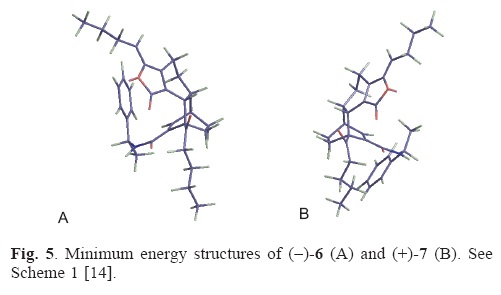
<body><![CDATA[<!-- ref --><p align="justify"><font face="verdana" size="2">12.&nbsp;Harada, N.; Nakanishi, K. Circular Dichroic Spectroscopy&#150;Exciton Coupling in Organic Stereochemistry; University Science Books, Mill Valley, CA, and Oxford University Press, Oxford, <b>1983.    &nbsp;&nbsp;&nbsp;&nbsp;&nbsp;&nbsp;&nbsp;&nbsp;[&#160;<a href="javascript:void(0);" onclick="javascript: window.open('/scielo.php?script=sci_nlinks&ref=4952374&pid=S1870-249X201200020002400012&lng=','','width=640,height=500,resizable=yes,scrollbars=1,menubar=yes,');">Links</a>&#160;]<!-- end-ref --></b></font></p>  	    <!-- ref --><p align="justify"><font face="verdana" size="2">13.&nbsp;Boiadjiev, S. E.; Lightner, D. A. <i>Monatshefte f&uuml;r Chemie</i> <b>2005,</b> <i>136,</i> 482&#150;509.    &nbsp;&nbsp;&nbsp;&nbsp;&nbsp;&nbsp;&nbsp;&nbsp;[&#160;<a href="javascript:void(0);" onclick="javascript: window.open('/scielo.php?script=sci_nlinks&ref=4952376&pid=S1870-249X201200020002400013&lng=','','width=640,height=500,resizable=yes,scrollbars=1,menubar=yes,');">Links</a>&#160;]<!-- end-ref --></font></p>  	    <p align="justify"><font face="verdana" size="2">14.&nbsp;Energy minimization was performed with MM2 force field using ChemBio3D Ultra 12.0. 1986&#150;2009 Cambridge Soft Corporation. The preferred conformations of (&#150;)<b>&#150;6</b> (<a href="#f5">Figure 5A</a>) and (+)<b>&#150;7</b> (<a href="#f5">Figure 5B</a>) showed similar features that included an extended conformation of the <i>n</i>&#150;propyl chains, a <i>pseudo</i> half boat conformation of the cyclohexene ring fused with the bicyle &#91;2.2.2&#93;, a <i>sec&#150; trans</i> arrangement for the &#945;,&#946;&#150;unsaturate2 lactam and a syn&#150;relationship between the amide nitrogen and the benzylic methine.</font></p>     <!-- ref --><p align="justify"><font face="verdana" size="2">15.&nbsp;Lin, G.; Chan, S. S. K.; Chung, H. S.; Li, S. L. In <i>Studies in Natural Products Chemistry,</i> Ed., Atta&#150;ur&#150;Rahman, Elsevier: Amsterdam, 2006; Vol. 32. Bioactive Natural Products Part L, pp. 611&#150;669.    &nbsp;&nbsp;&nbsp;&nbsp;&nbsp;&nbsp;&nbsp;&nbsp;[&#160;<a href="javascript:void(0);" onclick="javascript: window.open('/scielo.php?script=sci_nlinks&ref=4952379&pid=S1870-249X201200020002400014&lng=','','width=640,height=500,resizable=yes,scrollbars=1,menubar=yes,');">Links</a>&#160;]<!-- end-ref --></font></p>  	    <!-- ref --><p align="justify"><font face="verdana" size="2">16.&nbsp;Beck, J. J.; Chou, S. J. <i>J. Nat. Prod.</i> <b>2007,</b> <i>70</i>, 891&#150;900.    &nbsp;&nbsp;&nbsp;&nbsp;&nbsp;&nbsp;&nbsp;&nbsp;[&#160;<a href="javascript:void(0);" onclick="javascript: window.open('/scielo.php?script=sci_nlinks&ref=4952381&pid=S1870-249X201200020002400015&lng=','','width=640,height=500,resizable=yes,scrollbars=1,menubar=yes,');">Links</a>&#160;]<!-- end-ref --></font></p>  	    <!-- ref --><p align="justify"><font face="verdana" size="2">17.&nbsp;Monks, A.; Scudiero, D.; Skehan, P.; Shoemaker, R.; Paull, K.; Vistica, D.; Hose, C.; Langley, J.; Cronise, P.; Vaigro&#150;Wolff, A.; Gray&#150;Goodrich, M.; Campbell, H.; Mayo, J.; Boyd, M. <i>J. Natl. Cancer Inst.</i> <b>1991,</b> <i>83</i>, 757&#150;766.    &nbsp;&nbsp;&nbsp;&nbsp;&nbsp;&nbsp;&nbsp;&nbsp;[&#160;<a href="javascript:void(0);" onclick="javascript: window.open('/scielo.php?script=sci_nlinks&ref=4952383&pid=S1870-249X201200020002400016&lng=','','width=640,height=500,resizable=yes,scrollbars=1,menubar=yes,');">Links</a>&#160;]<!-- end-ref --></font></p>      ]]></body><back>
<ref-list>
<ref id="B1">
<label>1</label><nlm-citation citation-type="journal">
<person-group person-group-type="author">
<name>
<surname><![CDATA[Bye]]></surname>
<given-names><![CDATA[R.]]></given-names>
</name>
<name>
<surname><![CDATA[Linares]]></surname>
<given-names><![CDATA[E.]]></given-names>
</name>
</person-group>
<source><![CDATA[J. Ethnobiol.]]></source>
<year>1986</year>
<volume>6</volume>
<page-range>289-306</page-range></nlm-citation>
</ref>
<ref id="B2">
<label>2</label><nlm-citation citation-type="journal">
<person-group person-group-type="author">
<name>
<surname><![CDATA[Linares]]></surname>
<given-names><![CDATA[E.]]></given-names>
</name>
<name>
<surname><![CDATA[Bye]]></surname>
<given-names><![CDATA[R.]]></given-names>
</name>
</person-group>
<source><![CDATA[J. Ethnopharmacol.]]></source>
<year>1987</year>
<volume>19</volume>
<page-range>153-183</page-range></nlm-citation>
</ref>
<ref id="B3">
<label>3</label><nlm-citation citation-type="journal">
<person-group person-group-type="author">
<name>
<surname><![CDATA[León]]></surname>
<given-names><![CDATA[A.]]></given-names>
</name>
<name>
<surname><![CDATA[Toscano]]></surname>
<given-names><![CDATA[R. A.]]></given-names>
</name>
<name>
<surname><![CDATA[Tortoriello]]></surname>
<given-names><![CDATA[J.]]></given-names>
</name>
<name>
<surname><![CDATA[Delgado]]></surname>
<given-names><![CDATA[G.]]></given-names>
</name>
</person-group>
<source><![CDATA[Nat. Prod. Res.]]></source>
<year>2011</year>
<volume>25</volume>
<page-range>1234-1242</page-range></nlm-citation>
</ref>
<ref id="B4">
<label>4</label><nlm-citation citation-type="journal">
<person-group person-group-type="author">
<name>
<surname><![CDATA[León]]></surname>
<given-names><![CDATA[A.]]></given-names>
</name>
<name>
<surname><![CDATA[Chávez]]></surname>
<given-names><![CDATA[M. I.]]></given-names>
</name>
<name>
<surname><![CDATA[Delgado]]></surname>
<given-names><![CDATA[G.]]></given-names>
</name>
</person-group>
<source><![CDATA[Magn. Reson. Chem.]]></source>
<year>2011</year>
<volume>49</volume>
<page-range>469-476</page-range></nlm-citation>
</ref>
<ref id="B5">
<label>5</label><nlm-citation citation-type="journal">
<person-group person-group-type="author">
<name>
<surname><![CDATA[Ogawa]]></surname>
<given-names><![CDATA[Y.]]></given-names>
</name>
<name>
<surname><![CDATA[Mori]]></surname>
<given-names><![CDATA[Y.]]></given-names>
</name>
<name>
<surname><![CDATA[Maruno]]></surname>
<given-names><![CDATA[M.]]></given-names>
</name>
<name>
<surname><![CDATA[Wakamatsu]]></surname>
<given-names><![CDATA[T.]]></given-names>
</name>
</person-group>
<source><![CDATA[Heterocycles]]></source>
<year>1997</year>
<volume>45</volume>
<page-range>1869-1872</page-range></nlm-citation>
</ref>
<ref id="B6">
<label>6</label><nlm-citation citation-type="journal">
<person-group person-group-type="author">
<name>
<surname><![CDATA[Rios]]></surname>
<given-names><![CDATA[M. Y.]]></given-names>
</name>
<name>
<surname><![CDATA[Delgado]]></surname>
<given-names><![CDATA[G.]]></given-names>
</name>
<name>
<surname><![CDATA[Toscano]]></surname>
<given-names><![CDATA[R. A.]]></given-names>
</name>
</person-group>
<source><![CDATA[Tetrahedron]]></source>
<year>1998</year>
<volume>54</volume>
<page-range>3355-3366</page-range></nlm-citation>
</ref>
<ref id="B7">
<label>7</label><nlm-citation citation-type="journal">
<person-group person-group-type="author">
<name>
<surname><![CDATA[Rios]]></surname>
<given-names><![CDATA[M. Y.]]></given-names>
</name>
<name>
<surname><![CDATA[Delgado]]></surname>
<given-names><![CDATA[G.]]></given-names>
</name>
</person-group>
<source><![CDATA[J. Mex. Chem. Soc.]]></source>
<year>1999</year>
<volume>43</volume>
<page-range>127-132</page-range></nlm-citation>
</ref>
<ref id="B8">
<label>8</label><nlm-citation citation-type="journal">
<person-group person-group-type="author">
<name>
<surname><![CDATA[Rios]]></surname>
<given-names><![CDATA[M. Y.]]></given-names>
</name>
<name>
<surname><![CDATA[Delgado]]></surname>
<given-names><![CDATA[G.]]></given-names>
</name>
<name>
<surname><![CDATA[Espinosa-Pérez]]></surname>
<given-names><![CDATA[G.]]></given-names>
</name>
</person-group>
<source><![CDATA[Tetrahedron Lett.]]></source>
<year>1998</year>
<volume>39</volume>
<page-range>6605-6608</page-range></nlm-citation>
</ref>
<ref id="B9">
<label>9</label><nlm-citation citation-type="journal">
<person-group person-group-type="author">
<name>
<surname><![CDATA[Quiroz-García]]></surname>
<given-names><![CDATA[B.]]></given-names>
</name>
<name>
<surname><![CDATA[Hernández-Ortega]]></surname>
<given-names><![CDATA[S.]]></given-names>
</name>
<name>
<surname><![CDATA[Sterner]]></surname>
<given-names><![CDATA[O.]]></given-names>
</name>
<name>
<surname><![CDATA[Delgado]]></surname>
<given-names><![CDATA[G.]]></given-names>
</name>
</person-group>
<source><![CDATA[Tetrahedron]]></source>
<year>2004</year>
<volume>60</volume>
<page-range>3681-3688</page-range></nlm-citation>
</ref>
<ref id="B10">
<label>10</label><nlm-citation citation-type="journal">
<person-group person-group-type="author">
<name>
<surname><![CDATA[León]]></surname>
<given-names><![CDATA[A.]]></given-names>
</name>
<name>
<surname><![CDATA[Cogordán]]></surname>
<given-names><![CDATA[J. A.]]></given-names>
</name>
<name>
<surname><![CDATA[Sterner]]></surname>
<given-names><![CDATA[O.]]></given-names>
</name>
<name>
<surname><![CDATA[Delgado]]></surname>
<given-names><![CDATA[G.]]></given-names>
</name>
</person-group>
<source><![CDATA[J. Nat. Prod.]]></source>
<year>2012</year>
<volume>75</volume>
<page-range>859-864</page-range></nlm-citation>
</ref>
<ref id="B11">
<label>11</label><nlm-citation citation-type="journal">
<person-group person-group-type="author">
<name>
<surname><![CDATA[Harada]]></surname>
<given-names><![CDATA[N.]]></given-names>
</name>
<name>
<surname><![CDATA[Nakanishi]]></surname>
<given-names><![CDATA[K.]]></given-names>
</name>
</person-group>
<source><![CDATA[Acc. Chem. Res.]]></source>
<year>1972</year>
<volume>5</volume>
<page-range>257-263</page-range></nlm-citation>
</ref>
<ref id="B12">
<label>12</label><nlm-citation citation-type="book">
<person-group person-group-type="author">
<name>
<surname><![CDATA[Harada]]></surname>
<given-names><![CDATA[N.]]></given-names>
</name>
<name>
<surname><![CDATA[Nakanishi]]></surname>
<given-names><![CDATA[K.]]></given-names>
</name>
</person-group>
<source><![CDATA[Circular Dichroic Spectroscopy-Exciton Coupling in Organic Stereochemistry]]></source>
<year>1983</year>
<publisher-loc><![CDATA[Mill Valley^eCAOxford CA]]></publisher-loc>
<publisher-name><![CDATA[University Science BooksOxford University Press]]></publisher-name>
</nlm-citation>
</ref>
<ref id="B13">
<label>13</label><nlm-citation citation-type="journal">
<person-group person-group-type="author">
<name>
<surname><![CDATA[Boiadjiev]]></surname>
<given-names><![CDATA[S. E.]]></given-names>
</name>
<name>
<surname><![CDATA[Lightner]]></surname>
<given-names><![CDATA[D. A.]]></given-names>
</name>
</person-group>
<source><![CDATA[Monatshefte für Chemie]]></source>
<year>2005</year>
<volume>136</volume>
<page-range>482-509</page-range></nlm-citation>
</ref>
<ref id="B14">
<label>15</label><nlm-citation citation-type="book">
<person-group person-group-type="author">
<name>
<surname><![CDATA[Lin]]></surname>
<given-names><![CDATA[G.]]></given-names>
</name>
<name>
<surname><![CDATA[Chan]]></surname>
<given-names><![CDATA[S. S. K.]]></given-names>
</name>
<name>
<surname><![CDATA[Chung]]></surname>
<given-names><![CDATA[H. S.]]></given-names>
</name>
<name>
<surname><![CDATA[Li]]></surname>
<given-names><![CDATA[S. L.]]></given-names>
</name>
</person-group>
<person-group person-group-type="editor">
<name>
<surname><![CDATA[Rahman]]></surname>
<given-names><![CDATA[Atta-ur]]></given-names>
</name>
</person-group>
<source><![CDATA[Studies in Natural Products Chemistry]]></source>
<year>2006</year>
<volume>32</volume>
<publisher-loc><![CDATA[Amsterdam ]]></publisher-loc>
<publisher-name><![CDATA[Elsevier]]></publisher-name>
</nlm-citation>
</ref>
<ref id="B15">
<label>16</label><nlm-citation citation-type="journal">
<person-group person-group-type="author">
<name>
<surname><![CDATA[Beck]]></surname>
<given-names><![CDATA[J. J.]]></given-names>
</name>
<name>
<surname><![CDATA[Chou]]></surname>
<given-names><![CDATA[S. J.]]></given-names>
</name>
</person-group>
<source><![CDATA[J. Nat. Prod.]]></source>
<year>2007</year>
<volume>70</volume>
<page-range>891-900</page-range></nlm-citation>
</ref>
<ref id="B16">
<label>17</label><nlm-citation citation-type="journal">
<person-group person-group-type="author">
<name>
<surname><![CDATA[Monks]]></surname>
<given-names><![CDATA[A.]]></given-names>
</name>
<name>
<surname><![CDATA[Scudiero]]></surname>
<given-names><![CDATA[D.]]></given-names>
</name>
<name>
<surname><![CDATA[Skehan]]></surname>
<given-names><![CDATA[P.]]></given-names>
</name>
<name>
<surname><![CDATA[Shoemaker]]></surname>
<given-names><![CDATA[R.]]></given-names>
</name>
<name>
<surname><![CDATA[Paull]]></surname>
<given-names><![CDATA[K.]]></given-names>
</name>
<name>
<surname><![CDATA[Vistica]]></surname>
<given-names><![CDATA[D.]]></given-names>
</name>
<name>
<surname><![CDATA[Hose]]></surname>
<given-names><![CDATA[C.]]></given-names>
</name>
<name>
<surname><![CDATA[Langley]]></surname>
<given-names><![CDATA[J.]]></given-names>
</name>
<name>
<surname><![CDATA[Cronise]]></surname>
<given-names><![CDATA[P.]]></given-names>
</name>
<name>
<surname><![CDATA[Vaigro-Wolff]]></surname>
<given-names><![CDATA[A.]]></given-names>
</name>
<name>
<surname><![CDATA[Gray-Goodrich]]></surname>
<given-names><![CDATA[M.]]></given-names>
</name>
<name>
<surname><![CDATA[Campbell]]></surname>
<given-names><![CDATA[H.]]></given-names>
</name>
<name>
<surname><![CDATA[Mayo]]></surname>
<given-names><![CDATA[J.]]></given-names>
</name>
<name>
<surname><![CDATA[Boyd]]></surname>
<given-names><![CDATA[M.]]></given-names>
</name>
</person-group>
<source><![CDATA[J. Natl. Cancer Inst.]]></source>
<year>1991</year>
<volume>83</volume>
<page-range>757-766</page-range></nlm-citation>
</ref>
</ref-list>
</back>
</article>