<?xml version="1.0" encoding="ISO-8859-1"?><article xmlns:mml="http://www.w3.org/1998/Math/MathML" xmlns:xlink="http://www.w3.org/1999/xlink" xmlns:xsi="http://www.w3.org/2001/XMLSchema-instance">
<front>
<journal-meta>
<journal-id>1870-249X</journal-id>
<journal-title><![CDATA[Journal of the Mexican Chemical Society]]></journal-title>
<abbrev-journal-title><![CDATA[J. Mex. Chem. Soc]]></abbrev-journal-title>
<issn>1870-249X</issn>
<publisher>
<publisher-name><![CDATA[Sociedad Química de México A.C.]]></publisher-name>
</publisher>
</journal-meta>
<article-meta>
<article-id>S1870-249X2012000200021</article-id>
<title-group>
<article-title xml:lang="en"><![CDATA[Drug Design Outlook by Calculation of Second Virial Coefficient as a Nano Study]]></article-title>
</title-group>
<contrib-group>
<contrib contrib-type="author">
<name>
<surname><![CDATA[Monajjemi]]></surname>
<given-names><![CDATA[M.]]></given-names>
</name>
<xref ref-type="aff" rid="A01"/>
</contrib>
<contrib contrib-type="author">
<name>
<surname><![CDATA[Naderi]]></surname>
<given-names><![CDATA[F.]]></given-names>
</name>
<xref ref-type="aff" rid="A02"/>
</contrib>
<contrib contrib-type="author">
<name>
<surname><![CDATA[Mollaamin]]></surname>
<given-names><![CDATA[F.]]></given-names>
</name>
<xref ref-type="aff" rid="A03"/>
</contrib>
<contrib contrib-type="author">
<name>
<surname><![CDATA[Khaleghian]]></surname>
<given-names><![CDATA[M.]]></given-names>
</name>
<xref ref-type="aff" rid="A04"/>
</contrib>
</contrib-group>
<aff id="A01">
<institution><![CDATA[,Islamic Azad University Science and Research Branch Department of Chemistry]]></institution>
<addr-line><![CDATA[Tehran ]]></addr-line>
<country>Iran</country>
</aff>
<aff id="A02">
<institution><![CDATA[,Islamic Azad University Department of Chemistry ]]></institution>
<addr-line><![CDATA[Tehran ]]></addr-line>
<country>Iran</country>
</aff>
<aff id="A03">
<institution><![CDATA[,Islamic Azad University Department of Chemistry ]]></institution>
<addr-line><![CDATA[Qom ]]></addr-line>
<country>Iran</country>
</aff>
<aff id="A04">
<institution><![CDATA[,Islamic Azad University Department of Chemistry ]]></institution>
<addr-line><![CDATA[Tehran ]]></addr-line>
<country>Iran</country>
</aff>
<pub-date pub-type="pub">
<day>00</day>
<month>06</month>
<year>2012</year>
</pub-date>
<pub-date pub-type="epub">
<day>00</day>
<month>06</month>
<year>2012</year>
</pub-date>
<volume>56</volume>
<numero>2</numero>
<fpage>207</fpage>
<lpage>211</lpage>
<copyright-statement/>
<copyright-year/>
<self-uri xlink:href="http://www.scielo.org.mx/scielo.php?script=sci_arttext&amp;pid=S1870-249X2012000200021&amp;lng=en&amp;nrm=iso"></self-uri><self-uri xlink:href="http://www.scielo.org.mx/scielo.php?script=sci_abstract&amp;pid=S1870-249X2012000200021&amp;lng=en&amp;nrm=iso"></self-uri><self-uri xlink:href="http://www.scielo.org.mx/scielo.php?script=sci_pdf&amp;pid=S1870-249X2012000200021&amp;lng=en&amp;nrm=iso"></self-uri><abstract abstract-type="short" xml:lang="en"><p><![CDATA[Intermolecular potential energy surface for an interaction of drug with Na has been examined using HF level of theory with 6-31G* basis set. The name of drug is meso-tetrakis (p-sulphonatophenyl) porphyrin (here after abbreviated to TSPP) . The numbers of Na+ have a significant effect on the calculated potential energy curve (including position, depth, and width of the potential well). Counterpoise (CP) correction has been used to show the extent of the basis set superposition error (BSSE) on the potential energy curves obtained for TSPP-Na. The second virial coefficients are calculated by these data.]]></p></abstract>
<abstract abstract-type="short" xml:lang="es"><p><![CDATA[Se examina la superficie de energía potencial intermolecular para una interacción de un fármaco con Na usando el nivel de teoría HF con el conjunto de base 6-31G*. El nombre del fármaco es meso-tetrakis (p-fenilsulfonato) porfirina (subsecuentemente abreviado como TSPP). El número de Na+ tiene un efecto significativo en la curva de energía potencial calculada (incluyendo posición, profundidad, y ancho del pozo de potencial). Se utilizó la corrección de counterpoise (CP) para mostrar el tamaño del error de superposición de base (BSSE) en las curvas de energía potencial obtenidas para el TSPP-Na. Los segundos coeficientes viriales se calcularon a partir de estos datos.]]></p></abstract>
<kwd-group>
<kwd lng="en"><![CDATA[Drug]]></kwd>
<kwd lng="en"><![CDATA[virial coefficient]]></kwd>
<kwd lng="en"><![CDATA[potential energy surface]]></kwd>
<kwd lng="es"><![CDATA[Fármaco]]></kwd>
<kwd lng="es"><![CDATA[coeficiente virial]]></kwd>
<kwd lng="es"><![CDATA[superficie de energía potencial]]></kwd>
</kwd-group>
</article-meta>
</front><body><![CDATA[  	    <p align="justify"><font face="verdana" size="4">Article</font></p>  	    <p align="justify"><font face="verdana" size="2">&nbsp;</font></p>  	    <p align="center"><font face="verdana" size="4"><b>Drug Design Outlook by Calculation of Second Virial Coefficient as a Nano Study</b></font></p>  	    <p align="center"><font face="verdana" size="2">&nbsp;</font></p>  	    <p align="center"><font face="verdana" size="2"><b>M. Monajjemi,<sup>1</sup>'* F. Naderi,<sup>2</sup> F. Mollaamin,<sup>3</sup> and M. Khaleghian<sup>4</sup></b></font></p>  	    <p align="justify"><font face="verdana" size="2">&nbsp;</font></p>  	    <p align="justify"><font face="verdana" size="2"><sup>1</sup>&nbsp;<i>Department of Chemistry, Science and Research Branch, Islamic Azad University, Tehran, Iran.</i></font></p>  	    <p align="justify"><font face="verdana" size="2"><sup>2</sup>&nbsp;<i>Department of Chemistry, Shahr&#150;e Qods Branch, Islamic Azad University, Tehran, Iran.</i></font></p>  	    <p align="justify"><font face="verdana" size="2"><sup>3</sup>&nbsp;<i>Department of Chemistry, Qom Branch, Islamic Azad University, Qom, Iran.</i></font></p>  	    ]]></body>
<body><![CDATA[<p align="justify"><font face="verdana" size="2"><sup>4</sup>&nbsp;<i>Department of Chemistry, Eslamshahr Branch, Islamic Azad University, Tehran, Iran.</i> * <a href="mailto:m_monajjemi@yahoo.com">m_monajjemi@yahoo.com</a></font></p>  	    <p align="justify"><font face="verdana" size="2">&nbsp;</font></p>  	    <p align="justify"><font face="verdana" size="2">Received December 19, 2011.    <br> 	Accepted March 1, 2012.</font></p>  	    <p align="justify"><font face="verdana" size="2">&nbsp;</font></p>  	    <p align="justify"><font face="verdana" size="2"><b>Abstract</b></font></p>  	    <p align="justify"><font face="verdana" size="2">Intermolecular potential energy surface for an interaction of drug with Na has been examined using HF level of theory with 6&#150;31G* basis set. The name of drug is meso&#150;tetrakis (p&#150;sulphonatophenyl) porphyrin (here after abbreviated to TSPP) . The numbers of Na<sup>+</sup> have a significant effect on the calculated potential energy curve (including position, depth, and width of the potential well). Counterpoise (CP) correction has been used to show the extent of the basis set superposition error (BSSE) on the potential energy curves obtained for TSPP&#150;Na. The second virial coefficients are calculated by these data.</font></p>  	    <p align="justify"><font face="verdana" size="2"><b>Key words:</b> Drug, virial coefficient, potential energy surface.</font></p>  	    <p align="justify"><font face="verdana" size="2">&nbsp;</font></p>  	    <p align="justify"><font face="verdana" size="2"><b>Resumen</b></font></p>  	    ]]></body>
<body><![CDATA[<p align="justify"><font face="verdana" size="2">Se examina la superficie de energ&iacute;a potencial intermolecular para una interacci&oacute;n de un f&aacute;rmaco con Na usando el nivel de teor&iacute;a HF con el conjunto de base 6&#150;31G*. El nombre del f&aacute;rmaco es meso&#150;tetrakis (p&#150;fenilsulfonato) porfirina (subsecuentemente abreviado como TSPP). El n&uacute;mero de Na<sup>+</sup> tiene un efecto significativo en la curva de energ&iacute;a potencial calculada (incluyendo posici&oacute;n, profundidad, y ancho del pozo de potencial). Se utiliz&oacute; la correcci&oacute;n de counterpoise (CP) para mostrar el tama&ntilde;o del error de superposici&oacute;n de base (BSSE) en las curvas de energ&iacute;a potencial obtenidas para el TSPP&#150;Na. Los segundos coeficientes viriales se calcularon a partir de estos datos.</font></p>  	    <p align="justify"><font face="verdana" size="2"><b>Palabras clave:</b> F&aacute;rmaco, coeficiente virial, superficie de energ&iacute;a potencial.</font></p>  	    <p align="justify"><font face="verdana" size="2">&nbsp;</font></p>  	    <p align="justify"><font face="verdana" size="2"><b>Introduction</b></font></p>  	    <p align="justify"><font face="verdana" size="2">A way to obtain an intermolecular potential is made available by quantum chemistry. Using quantum chemical methods, detailed information about the interaction energy over a wide area of the potential surface can be derived.</font></p>  	    <p align="justify"><font face="verdana" size="2">A number of package codes, such as MOLPRO &#91;1&#93;, COLUMBUS &#91;2&#150;4&#93; are available. Unfortunately, these powerful tools do not currently solve all of the problems &#91;5&#93;.</font></p>  	    <p align="justify"><font face="verdana" size="2">However, apart from the simplest systems, one has to use some level of approximation in quantum chemical calculations.</font></p>  	    <p align="justify"><font face="verdana" size="2">In quantum chemistry, the computation of the energy and wavefunction of an average&#150;size molecule is a formidable task that is alleviated by the Born&#150;Oppenheimer (BO) approximation, named after Max Born and J. Robert Oppenheimer. For instance the benzene molecule consists of 12 nuclei and 42 electrons. The time independent Schr&ouml;dinger equation, which must be solved to obtain the energy and molecular wavefunc&#150;tion of this molecule, is a partial differential eigenvalue equation in 162 variables &#151;the spatial coordinates of the electrons and the nuclei. The BO approximation makes it possible to compute the wavefunction in two less complicated consecutive steps. This approximation was proposed in 1927, in the early period of quantum mechanics, by Born and Oppenheimer and is still indispensable in quantum chemistry.</font></p>  	    <p align="justify"><font face="verdana" size="2">Potential energy surfaces may be determined by ab initio electronic structure calculations. If one makes the Born&#150;Oppenheimer approximation, the molecular wave function is written as:</font></p>  	    <p align="center"><font face="verdana" size="2"><img src="/img/revistas/jmcs/v56n2/a21e1.jpg"></font></p>  	    ]]></body>
<body><![CDATA[<p align="justify"><font face="verdana" size="2">Where &#936;<sub>e</sub> is the electronic wave function, which depends on the electron coordinates r and nuclear coordinates R, and &#936;<sub>n</sub> is the nuclear wave function.</font></p>  	    <p align="justify"><font face="verdana" size="2">With the Born&#150;Oppenheimer separation, each electronic state of the chemical reactive system has a potential energy surface. Knowledge of the ion&#150;ion interaction potential is a key ingredient in the analysis of nuclear reactions. By using the potential between nuclei, we can estimate the cross sections of different nuclear reactions. The ion&#150;ion interaction potential related to the Coulomb repulsion force and the nuclear attraction force has, as a rule, the barrier and the capture potential well near a touching point. The Coulomb part of the ion&#150;ion potential is well&#150;known. In contrast, the nuclear part of the nucleus&#150;nucleus potential is less defined.</font></p>  	    <p align="justify"><font face="verdana" size="2">This paper reports a study on interaction of TSPP (<a href="#s1">Scheme 1</a>) with one, two, three and four Na<sup>+</sup> respectively. Porphyrines represent an interesting family of compounds used now for the photodynamic therapy (PDT) of malignant tumors &#91;6&#93;. Porphyrines have attracted large attention because of their role in the human body, ability to accumulate in many kinds of cancer cells, as well as magnetic and optical properties. These features make them useful in cancer medicine and photody&#150;namic therapy &#91;7&#93;. Porphyrins and metalloporphyrins provide a relatively unexplored class of compounds because of their large size, ease of synthesis, bioactivity, excellent thermal stability and the diversity of their coordination and catalytic chemistry. Furthermore, porphyrins provide an extremely versatile platform on which to build desired peripheral functionality with designed orientations. Functionalization of the porphyrin macro cycle has always received much attention, and considerable progress has been made over the past decades &#91;8&#150;11&#93;.</font></p>  	    <p align="center"><font face="verdana" size="2"><a name="s1"></a></font></p>  	    <p align="center"><font face="verdana" size="2"><img src="/img/revistas/jmcs/v56n2/a21s1.jpg"></font></p>  	    <p align="justify"><font face="verdana" size="2"><b>Theoretical back ground and computational method</b></font></p>  	    <p align="justify"><font face="verdana" size="2">Initially, structure of TSPP was fully optimized with the HF method and 6&#150;31G* basis set in order to locate the stationary points on the potential surface. Our calculations were performed by using the program package Gaussian 98 &#91;2&#93;.The interaction energy for each minimum was calculated by using the supermolecule method.</font></p>  	    <p align="justify"><font face="verdana" size="2">In ab initio calculations the basis set superposition error (BSSE) is of paramount importance. This error can be eliminated to some extent by using the counterpoise method (CP). In this method both the physicochemical compound A &#150; B and the A and B components at r = &#8734; are calculated by using the full basis set for the A &#150; B, hence</font></p>      <p align="center"><font face="verdana" size="2"><img src="/img/revistas/jmcs/v56n2/a21e2.jpg"></font></p>  	    <p align="justify"><font face="verdana" size="2">Where</font></p>  	    ]]></body>
<body><![CDATA[<p align="center"><font face="verdana" size="2"><img src="/img/revistas/jmcs/v56n2/a21e3.jpg"></font></p>  	    <p align="justify"><font face="verdana" size="2">This study has been carried out just in vacuum because of limitation in software and computers which we have. We tried to make constant the angle and position between the average plan of TSPP and the vector TSPP&#150;Na for 4 sides which Na approached.</font>	</p>     <p align="justify"><font face="verdana" size="2"><b>Ab initio calculation of the interaction energy in the system</b></font></p>  	    <p align="justify"><font face="verdana" size="2">Using quantum chemical methods, detailed information about the interaction energy over a wide area of the potential surface can be derived. This approach can be used to extract detailed information of the potential energy surface, which is sometimes difficult or practically impossible by other methods. The basis set superposition error has a significant effect on the calculated interaction potential and therefore it should be corrected for &#91;13&#93;.</font></p>  	    <p align="justify"><font face="verdana" size="2">The significant of the BSSE on the intermolecular interaction has been highlighted in a number of papers. The various points on the ab initio potential energy surface were used to obtain a fit to the Lennard&#150;Jones and Morse and Morse modified potential energy function.</font>	</p>     <p align="justify"><font face="verdana" size="2"><b>Virial Coefficients</b></font></p>  	    <p align="justify"><font face="verdana" size="2">The second virial coefficient as a pure two body interaction property has been calculated to give a first simple test of the quality of intermolecular interaction potential.</font></p>  	    <p align="justify"><font face="verdana" size="2">Assuming the known form for U(r), the hard sphere approximation leads to the following expression for the estimation of second virial coefficient &#91;14, 15&#93;:</font></p>  	    <p align="center"><font face="verdana" size="2"><img src="/img/revistas/jmcs/v56n2/a21e4.jpg"></font></p>  	    <p align="justify"><font face="verdana" size="2">where <i>N<sub>A</sub></i> is Avogadros number, <i>k</i> is the Boltzmann constant, <i>T</i> is the temperature. It was though for many years that the values for the second virial coefficient do not depend on the shape of the curve U(r) for the energy interaction but only on the integral that correspond to the area restricted by this curve.</font></p>  	    ]]></body>
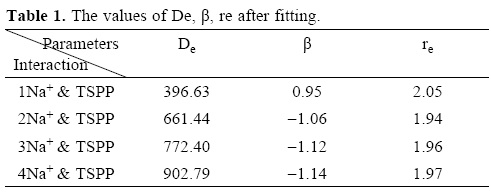
<body><![CDATA[<p align="justify"><font face="verdana" size="2">&nbsp;</font></p>  	    <p align="justify"><font face="verdana" size="2"><b>Results and Discussion</b></font></p>  	    <p align="justify"><font face="verdana" size="2">We calculated the intermolecular interaction energies of the TSPP with one, two, three and four Na<sup>+</sup> respectively.</font></p>  	    <p align="justify"><font face="verdana" size="2">The intermolecular potential energy interaction obtained at HF level of theory with the basis set 6&#150;31G* that plotted in <a href="/img/revistas/jmcs/v56n2/a21f1.jpg" target="_blank">figure 1</a> as function of R; the distance between TSPP and Na. Calculated potential energy curves, including position, depth and width of potential well were shown in <a href="/img/revistas/jmcs/v56n2/a21f1.jpg" target="_blank">Fig. 1</a>. The calculated potential energy surface can be compared based on the values of the position of the minimum point (r<sub>e</sub>) of the potential curves. As is evident from this table, these quantities are very sensitive to the number of metal used in the computations. In ab initio calculations the basis set superposition error is of paramount importance. BSSE corrected TSPP&#150;Na intermolecular potential energy curves corresponding to those calculated, are plotted against r in <a href="/img/revistas/jmcs/v56n2/a21f1.jpg" target="_blank">figure 1</a>. In this figure the values of U (calculated by Gaussian) and UM (calculated by Morse modified function are fitted by Excel) are shown.</font></p>  	    <p align="justify"><font face="verdana" size="2">Most of the popular approximation such as, for instance, the Lennard&#150;Jones potential and the exp&#150;6 potential and Kihara potential yielded unsatisfactory results. Finally, we have chosen the six&#150;parameter generalized Morse modified function &#91;16&#93;.</font></p>  	    <p align="justify"><font face="verdana" size="2">De, &#946; Re are positive and usually chosen to fit the bond dissociation energy, the harmonic vobration frequency and the equilibrium bond length.</font></p>  	    <p align="center"><font face="verdana" size="2"><img src="/img/revistas/jmcs/v56n2/a21e6.jpg"></font></p>  	    <p align="justify"><font face="verdana" size="2">D<sub>e,</sub>&#946;<sub>e,</sub>r<sub>e</sub> and A, B, C parameters are fitted in the approximation procedure. The results of search are shown in <a href="#t1">Table 1</a>.</font></p>  	    <p align="center"><font face="verdana" size="2"><a name="t1"></a></font></p>  	    <p align="center"><font face="verdana" size="2"><img src="/img/revistas/jmcs/v56n2/a21t1.jpg"></font></p>  	    ]]></body>
<body><![CDATA[<p align="justify"><font face="verdana" size="2">The values of U (calculated by Gaussian program) and UM (calculated by Morse modified function) and r are shown in <a href="/img/revistas/jmcs/v56n2/a21t2.jpg" target="_blank">tables 2</a>, <a href="/img/revistas/jmcs/v56n2/a21t3.jpg" target="_blank">3</a>, <a href="/img/revistas/jmcs/v56n2/a21t4.jpg" target="_blank">4</a>, <a href="/img/revistas/jmcs/v56n2/a21t5.jpg" target="_blank">5</a>.</font></p>  	    <p align="justify"><font face="verdana" size="2">The second virial coefficient as a pure two body interaction property has been calculated to give a first simple test of the quality of intermolecular interaction potential. The values of them are listed in <a href="/img/revistas/jmcs/v56n2/a21t6.jpg" target="_blank">tables 6</a>, <a href="/img/revistas/jmcs/v56n2/a21t7.jpg" target="_blank">7</a>, <a href="/img/revistas/jmcs/v56n2/a21t8.jpg" target="_blank">8</a>, <a href="/img/revistas/jmcs/v56n2/a21t9.jpg" target="_blank">9</a> and calculated results with using MATLAB and MAPLE software are plotted in <a href="/img/revistas/jmcs/v56n2/a21f2.jpg" target="_blank">figure 2</a>.</font></p>  	    <p align="justify"><font face="verdana" size="2">&nbsp;</font></p>  	    <p align="justify"><font face="verdana" size="2"><b>Conclusion</b></font></p>  	    <p align="justify"><font face="verdana" size="2">After study of the interaction of drug with Na using Hartree&#150;Fock method, it has been seen that the numbers of Na<sup>+</sup> Cations have a important effect on the theoretical calculated potential energy curve. Also, Counterpoise (CP) correction has been calculated to investigate the extent of the basis set superposition error on the potential energy curves obtained for TSPP&#150;Na and the second Virial coefficients are calculated by these data.</font></p>  	    <p align="justify"><font face="verdana" size="2">&nbsp;</font></p>  	    <p align="justify"><font face="verdana" size="2"><b>References</b></font></p>  	    <!-- ref --><p align="justify"><font face="verdana" size="2">1.&nbsp;Werner, H. J.; Knowles, P. J.; Almof, J.; Amos, R. D.; Deegan, M. J. O.; Elbert, S. T.; Hample, C.; Meyer, W.; Peterson, K.; Pitzer, R.; Ston, A. J.; Taylor, P. R.; Lindh, R. University of Birmingham, Birmingham, <b>1996.    &nbsp;&nbsp;&nbsp;&nbsp;&nbsp;&nbsp;&nbsp;&nbsp;[&#160;<a href="javascript:void(0);" onclick="javascript: window.open('/scielo.php?script=sci_nlinks&ref=4924032&pid=S1870-249X201200020002100001&lng=','','width=640,height=500,resizable=yes,scrollbars=1,menubar=yes,');">Links</a>&#160;]<!-- end-ref --></b></font></p>  	    <!-- ref --><p align="justify"><font face="verdana" size="2">2.&nbsp;Lischka, H.; Shepard, R.; Brown, F. B.; Shavitt, I. <i>Int. J. Quantum Chem., Quantum Chem. Symp.</i> <b>1981,</b> <i>75</i>, 91.    &nbsp;&nbsp;&nbsp;&nbsp;&nbsp;&nbsp;&nbsp;&nbsp;[&#160;<a href="javascript:void(0);" onclick="javascript: window.open('/scielo.php?script=sci_nlinks&ref=4924034&pid=S1870-249X201200020002100002&lng=','','width=640,height=500,resizable=yes,scrollbars=1,menubar=yes,');">Links</a>&#160;]<!-- end-ref --></font></p>  	    <!-- ref --><p align="justify"><font face="verdana" size="2">3.&nbsp;Shepard, R.; Shavitt, I.; Pitzer, R. M.; Comeau, D. C.; Pepper, M.; Lischka, H.; Szalay, P. G.; Ahlrichs, R.; Brown, F. B.; Zhao, J. <i>Int. J. Quantum Chem., Quantum Chem. Symp.</i> <b>1988,</b> <i>22</i>, 149.    &nbsp;&nbsp;&nbsp;&nbsp;&nbsp;&nbsp;&nbsp;&nbsp;[&#160;<a href="javascript:void(0);" onclick="javascript: window.open('/scielo.php?script=sci_nlinks&ref=4924036&pid=S1870-249X201200020002100003&lng=','','width=640,height=500,resizable=yes,scrollbars=1,menubar=yes,');">Links</a>&#160;]<!-- end-ref --></font></p>  	    <!-- ref --><p align="justify"><font face="verdana" size="2">4.&nbsp;Lischka, H.; Shepard, R.; Pitzer, R. M.; Shavitt, I.; Dallos, M.; Muller, T.; Szalay, P. G.; Seth, M.; Kedziora, G. S.; Yabushita, S.; Zhang, Z.; <i>Phys. Chem. Chem. Phys.</i> <b>2001,</b> <i>3</i>, 664.    &nbsp;&nbsp;&nbsp;&nbsp;&nbsp;&nbsp;&nbsp;&nbsp;[&#160;<a href="javascript:void(0);" onclick="javascript: window.open('/scielo.php?script=sci_nlinks&ref=4924038&pid=S1870-249X201200020002100004&lng=','','width=640,height=500,resizable=yes,scrollbars=1,menubar=yes,');">Links</a>&#160;]<!-- end-ref --></font></p>  	    <!-- ref --><p align="justify"><font face="verdana" size="2">5.&nbsp;Naroznik, M.; <i>J. Molecular Structure (Theochem),</i> <b>2003,</b> <i>624,</i> 267&#150;273.    &nbsp;&nbsp;&nbsp;&nbsp;&nbsp;&nbsp;&nbsp;&nbsp;[&#160;<a href="javascript:void(0);" onclick="javascript: window.open('/scielo.php?script=sci_nlinks&ref=4924040&pid=S1870-249X201200020002100005&lng=','','width=640,height=500,resizable=yes,scrollbars=1,menubar=yes,');">Links</a>&#160;]<!-- end-ref --></font></p>  	    <!-- ref --><p align="justify"><font face="verdana" size="2">6.&nbsp;Lukyanets, E. A.; Russ, <i>J. Chem.</i> <b>1998,</b> <i>42</i>, 9&#150;16.    &nbsp;&nbsp;&nbsp;&nbsp;&nbsp;&nbsp;&nbsp;&nbsp;[&#160;<a href="javascript:void(0);" onclick="javascript: window.open('/scielo.php?script=sci_nlinks&ref=4924042&pid=S1870-249X201200020002100006&lng=','','width=640,height=500,resizable=yes,scrollbars=1,menubar=yes,');">Links</a>&#160;]<!-- end-ref --></font></p>  	    <!-- ref --><p align="justify"><font face="verdana" size="2">7.&nbsp;Gaiduk, M. I.; Grigryants, V. V.; Mirnov, A. F.; Rumyantsera, V. D.; Ghissov, V. I.; Sukhin, G. M. <i>J. Photochem. Photobiol. B. Biol.,</i> <b>1990,</b> <i>7</i>, 15.    &nbsp;&nbsp;&nbsp;&nbsp;&nbsp;&nbsp;&nbsp;&nbsp;[&#160;<a href="javascript:void(0);" onclick="javascript: window.open('/scielo.php?script=sci_nlinks&ref=4924044&pid=S1870-249X201200020002100007&lng=','','width=640,height=500,resizable=yes,scrollbars=1,menubar=yes,');">Links</a>&#160;]<!-- end-ref --></font></p>  	    <!-- ref --><p align="justify"><font face="verdana" size="2">8.&nbsp;Morgan B. and Dolphin D. (Eds.) <i>Synthesis and Structure of Biomimetic Porphyrins,</i> Springer Verlag: Berlin, <b>1987,</b> <i>64</i>, 115.    &nbsp;&nbsp;&nbsp;&nbsp;&nbsp;&nbsp;&nbsp;&nbsp;[&#160;<a href="javascript:void(0);" onclick="javascript: window.open('/scielo.php?script=sci_nlinks&ref=4924046&pid=S1870-249X201200020002100008&lng=','','width=640,height=500,resizable=yes,scrollbars=1,menubar=yes,');">Links</a>&#160;]<!-- end-ref --></font></p>  	    <!-- ref --><p align="justify"><font face="verdana" size="2">9.&nbsp;Kim, R. M.; Fate, G. D.; Gonzales, J. E.; Lahiri, J.; Ungashe, S. B.; Groves, J. T. <i>NATO ASI Ser., Ser. C.</i> <b>1995,</b> <i>459</i>, 4956.    &nbsp;&nbsp;&nbsp;&nbsp;&nbsp;&nbsp;&nbsp;&nbsp;[&#160;<a href="javascript:void(0);" onclick="javascript: window.open('/scielo.php?script=sci_nlinks&ref=4924048&pid=S1870-249X201200020002100009&lng=','','width=640,height=500,resizable=yes,scrollbars=1,menubar=yes,');">Links</a>&#160;]<!-- end-ref --></font></p>  	    <!-- ref --><p align="justify"><font face="verdana" size="2">10.&nbsp;Ogoshi, H.; Mizutani, <i>T. Biomimetic Reactions Catalyzed by Metalloporphyrins;</i> Murakami Y. (Ed.) Vol. 4, Elsevier: Oxford, U.K., <b>1996,</b> 337&#150;385.    &nbsp;&nbsp;&nbsp;&nbsp;&nbsp;&nbsp;&nbsp;&nbsp;[&#160;<a href="javascript:void(0);" onclick="javascript: window.open('/scielo.php?script=sci_nlinks&ref=4924050&pid=S1870-249X201200020002100010&lng=','','width=640,height=500,resizable=yes,scrollbars=1,menubar=yes,');">Links</a>&#160;]<!-- end-ref --></font></p>  	    <!-- ref --><p align="justify"><font face="verdana" size="2">11.&nbsp;Kadish, K. M.; Smith, K. M.; Guilard, R. The Porphyrin Handbook (Eds.), Academic Press: San Diego, <b>2000&#150;2003,</b> <i>120.    &nbsp;&nbsp;&nbsp;&nbsp;&nbsp;&nbsp;&nbsp;&nbsp;[&#160;<a href="javascript:void(0);" onclick="javascript: window.open('/scielo.php?script=sci_nlinks&ref=4924052&pid=S1870-249X201200020002100011&lng=','','width=640,height=500,resizable=yes,scrollbars=1,menubar=yes,');">Links</a>&#160;]<!-- end-ref --></i></font></p>  	    <!-- ref --><p align="justify"><font face="verdana" size="2">12.&nbsp;Frisch, M. J. <i>et al.</i> Gaussian 98, Revision A.9, Gaussian, Inc., Pittsburgh, PA, <b>1998.    &nbsp;&nbsp;&nbsp;&nbsp;&nbsp;&nbsp;&nbsp;&nbsp;[&#160;<a href="javascript:void(0);" onclick="javascript: window.open('/scielo.php?script=sci_nlinks&ref=4924054&pid=S1870-249X201200020002100012&lng=','','width=640,height=500,resizable=yes,scrollbars=1,menubar=yes,');">Links</a>&#160;]<!-- end-ref --></b></font></p>  	    <!-- ref --><p align="justify"><font face="verdana" size="2">13.&nbsp;Boys, S. F.; Bernardi, F. <i>Mol. Phys.,</i> <b>1970,</b> <i>19,</i> 553.    &nbsp;&nbsp;&nbsp;&nbsp;&nbsp;&nbsp;&nbsp;&nbsp;[&#160;<a href="javascript:void(0);" onclick="javascript: window.open('/scielo.php?script=sci_nlinks&ref=4924056&pid=S1870-249X201200020002100013&lng=','','width=640,height=500,resizable=yes,scrollbars=1,menubar=yes,');">Links</a>&#160;]<!-- end-ref --></font></p>  	    <!-- ref --><p align="justify"><font face="verdana" size="2">14.&nbsp;Harold, C. "Molecular Schr&ouml;dinger Equation. VIII. A New Method for the Evaluation of Multidimensional Integrals", <i>Journal of Chemical Physics,</i> <b>1967,</b> <i>47</i>, 5307.    &nbsp;&nbsp;&nbsp;&nbsp;&nbsp;&nbsp;&nbsp;&nbsp;[&#160;<a href="javascript:void(0);" onclick="javascript: window.open('/scielo.php?script=sci_nlinks&ref=4924058&pid=S1870-249X201200020002100014&lng=','','width=640,height=500,resizable=yes,scrollbars=1,menubar=yes,');">Links</a>&#160;]<!-- end-ref --></font></p>  	    <!-- ref --><p align="justify"><font face="verdana" size="2">15.&nbsp;Kammerlingh Onnes, H. "Expression of the equation of state of gases and liquids by means of series", Communications from the Physical Laboratory of the University of Leiden <b>1901,</b> <i>71,</i> 3&#150;25.    &nbsp;&nbsp;&nbsp;&nbsp;&nbsp;&nbsp;&nbsp;&nbsp;[&#160;<a href="javascript:void(0);" onclick="javascript: window.open('/scielo.php?script=sci_nlinks&ref=4924060&pid=S1870-249X201200020002100015&lng=','','width=640,height=500,resizable=yes,scrollbars=1,menubar=yes,');">Links</a>&#160;]<!-- end-ref --></font></p>  	    <!-- ref --><p align="justify"><font face="verdana" size="2">16.&nbsp;Hase, W. L.; Mondro, S. L.; Duchovic, R. J.; Hirst, D. M. <i>J. Am.</i> <i>Chem. Soc.,</i> <b>1987,</b> <i>109,</i> 2916.    &nbsp;&nbsp;&nbsp;&nbsp;&nbsp;&nbsp;&nbsp;&nbsp;[&#160;<a href="javascript:void(0);" onclick="javascript: window.open('/scielo.php?script=sci_nlinks&ref=4924062&pid=S1870-249X201200020002100016&lng=','','width=640,height=500,resizable=yes,scrollbars=1,menubar=yes,');">Links</a>&#160;]<!-- end-ref --></font></p>      ]]></body><back>
<ref-list>
<ref id="B1">
<label>1</label><nlm-citation citation-type="book">
<person-group person-group-type="author">
<name>
<surname><![CDATA[Werner]]></surname>
<given-names><![CDATA[H. J.]]></given-names>
</name>
<name>
<surname><![CDATA[Knowles]]></surname>
<given-names><![CDATA[P. J.]]></given-names>
</name>
<name>
<surname><![CDATA[Almof]]></surname>
<given-names><![CDATA[J.]]></given-names>
</name>
<name>
<surname><![CDATA[Amos]]></surname>
<given-names><![CDATA[R. D.]]></given-names>
</name>
<name>
<surname><![CDATA[Deegan]]></surname>
<given-names><![CDATA[M. J. O.]]></given-names>
</name>
<name>
<surname><![CDATA[Elbert]]></surname>
<given-names><![CDATA[S. T.]]></given-names>
</name>
<name>
<surname><![CDATA[Hample]]></surname>
<given-names><![CDATA[C.]]></given-names>
</name>
<name>
<surname><![CDATA[Meyer]]></surname>
<given-names><![CDATA[W.]]></given-names>
</name>
<name>
<surname><![CDATA[Peterson]]></surname>
<given-names><![CDATA[K.]]></given-names>
</name>
<name>
<surname><![CDATA[Pitzer]]></surname>
<given-names><![CDATA[R.]]></given-names>
</name>
<name>
<surname><![CDATA[Ston]]></surname>
<given-names><![CDATA[A. J.]]></given-names>
</name>
<name>
<surname><![CDATA[Taylor]]></surname>
<given-names><![CDATA[P. R.]]></given-names>
</name>
<name>
<surname><![CDATA[Lindh]]></surname>
<given-names><![CDATA[R.]]></given-names>
</name>
</person-group>
<source><![CDATA[]]></source>
<year>1996</year>
<publisher-loc><![CDATA[Birmingham ]]></publisher-loc>
<publisher-name><![CDATA[University of Birmingham]]></publisher-name>
</nlm-citation>
</ref>
<ref id="B2">
<label>2</label><nlm-citation citation-type="journal">
<person-group person-group-type="author">
<name>
<surname><![CDATA[Lischka]]></surname>
<given-names><![CDATA[H.]]></given-names>
</name>
<name>
<surname><![CDATA[Shepard]]></surname>
<given-names><![CDATA[R.]]></given-names>
</name>
<name>
<surname><![CDATA[Brown]]></surname>
<given-names><![CDATA[F. B.]]></given-names>
</name>
<name>
<surname><![CDATA[Shavitt]]></surname>
<given-names><![CDATA[I.]]></given-names>
</name>
</person-group>
<source><![CDATA[Int. J. Quantum Chem.]]></source>
<year>1981</year>
<volume>75</volume>
<page-range>91</page-range></nlm-citation>
</ref>
<ref id="B3">
<label>3</label><nlm-citation citation-type="journal">
<person-group person-group-type="author">
<name>
<surname><![CDATA[Shepard]]></surname>
<given-names><![CDATA[R.]]></given-names>
</name>
<name>
<surname><![CDATA[Shavitt]]></surname>
<given-names><![CDATA[I.]]></given-names>
</name>
<name>
<surname><![CDATA[Pitzer]]></surname>
<given-names><![CDATA[R. M.]]></given-names>
</name>
<name>
<surname><![CDATA[Comeau]]></surname>
<given-names><![CDATA[D. C.]]></given-names>
</name>
<name>
<surname><![CDATA[Pepper]]></surname>
<given-names><![CDATA[M.]]></given-names>
</name>
<name>
<surname><![CDATA[Lischka]]></surname>
<given-names><![CDATA[H.]]></given-names>
</name>
<name>
<surname><![CDATA[Szalay]]></surname>
<given-names><![CDATA[P. G.]]></given-names>
</name>
<name>
<surname><![CDATA[Ahlrichs]]></surname>
<given-names><![CDATA[R.]]></given-names>
</name>
<name>
<surname><![CDATA[Brown]]></surname>
<given-names><![CDATA[F. B.]]></given-names>
</name>
<name>
<surname><![CDATA[Zhao]]></surname>
<given-names><![CDATA[J.]]></given-names>
</name>
</person-group>
<source><![CDATA[Int. J. Quantum Chem.]]></source>
<year>1988</year>
<volume>22</volume>
<page-range>149</page-range></nlm-citation>
</ref>
<ref id="B4">
<label>4</label><nlm-citation citation-type="journal">
<person-group person-group-type="author">
<name>
<surname><![CDATA[Lischka]]></surname>
<given-names><![CDATA[H.]]></given-names>
</name>
<name>
<surname><![CDATA[Shepard]]></surname>
<given-names><![CDATA[R.]]></given-names>
</name>
<name>
<surname><![CDATA[Pitzer]]></surname>
<given-names><![CDATA[R. M.]]></given-names>
</name>
<name>
<surname><![CDATA[Shavitt]]></surname>
<given-names><![CDATA[I.]]></given-names>
</name>
<name>
<surname><![CDATA[Dallos]]></surname>
<given-names><![CDATA[M.]]></given-names>
</name>
<name>
<surname><![CDATA[Muller]]></surname>
<given-names><![CDATA[T.]]></given-names>
</name>
<name>
<surname><![CDATA[Szalay]]></surname>
<given-names><![CDATA[P. G.]]></given-names>
</name>
<name>
<surname><![CDATA[Seth]]></surname>
<given-names><![CDATA[M.]]></given-names>
</name>
<name>
<surname><![CDATA[Kedziora]]></surname>
<given-names><![CDATA[G. S.]]></given-names>
</name>
<name>
<surname><![CDATA[Yabushita]]></surname>
<given-names><![CDATA[S.]]></given-names>
</name>
<name>
<surname><![CDATA[Zhang]]></surname>
<given-names><![CDATA[Z.]]></given-names>
</name>
</person-group>
<source><![CDATA[Phys. Chem. Chem. Phys.]]></source>
<year>2001</year>
<volume>3</volume>
<page-range>664</page-range></nlm-citation>
</ref>
<ref id="B5">
<label>5</label><nlm-citation citation-type="journal">
<person-group person-group-type="author">
<name>
<surname><![CDATA[Naroznik]]></surname>
<given-names><![CDATA[M.]]></given-names>
</name>
</person-group>
<source><![CDATA[J. Molecular Structure (Theochem)]]></source>
<year>2003</year>
<volume>624</volume>
<page-range>267-273</page-range></nlm-citation>
</ref>
<ref id="B6">
<label>6</label><nlm-citation citation-type="journal">
<person-group person-group-type="author">
<name>
<surname><![CDATA[Lukyanets]]></surname>
<given-names><![CDATA[E. A.]]></given-names>
</name>
<name>
<surname><![CDATA[Russ]]></surname>
</name>
</person-group>
<source><![CDATA[J. Chem.]]></source>
<year>1998</year>
<volume>42</volume>
<page-range>9-16</page-range></nlm-citation>
</ref>
<ref id="B7">
<label>7</label><nlm-citation citation-type="journal">
<person-group person-group-type="author">
<name>
<surname><![CDATA[Gaiduk]]></surname>
<given-names><![CDATA[M. I.]]></given-names>
</name>
<name>
<surname><![CDATA[Grigryants]]></surname>
<given-names><![CDATA[V. V.]]></given-names>
</name>
<name>
<surname><![CDATA[Mirnov]]></surname>
<given-names><![CDATA[A. F.]]></given-names>
</name>
<name>
<surname><![CDATA[Rumyantsera]]></surname>
<given-names><![CDATA[V. D.]]></given-names>
</name>
<name>
<surname><![CDATA[Ghissov]]></surname>
<given-names><![CDATA[V. I.]]></given-names>
</name>
<name>
<surname><![CDATA[Sukhin]]></surname>
<given-names><![CDATA[G. M.]]></given-names>
</name>
</person-group>
<source><![CDATA[J. Photochem. Photobiol. B. Biol.]]></source>
<year>1990</year>
<volume>7</volume>
<page-range>15</page-range></nlm-citation>
</ref>
<ref id="B8">
<label>8</label><nlm-citation citation-type="book">
<person-group person-group-type="author">
<name>
<surname><![CDATA[Morgan]]></surname>
<given-names><![CDATA[B.]]></given-names>
</name>
<name>
<surname><![CDATA[Dolphin]]></surname>
<given-names><![CDATA[D.]]></given-names>
</name>
</person-group>
<source><![CDATA[Synthesis and Structure of Biomimetic Porphyrins]]></source>
<year>1987</year>
<volume>64</volume>
<page-range>115</page-range><publisher-loc><![CDATA[Berlin ]]></publisher-loc>
<publisher-name><![CDATA[Springer Verlag]]></publisher-name>
</nlm-citation>
</ref>
<ref id="B9">
<label>9</label><nlm-citation citation-type="journal">
<person-group person-group-type="author">
<name>
<surname><![CDATA[Kim]]></surname>
<given-names><![CDATA[R. M.]]></given-names>
</name>
<name>
<surname><![CDATA[Fate]]></surname>
<given-names><![CDATA[G. D.]]></given-names>
</name>
<name>
<surname><![CDATA[Gonzales]]></surname>
<given-names><![CDATA[J. E.]]></given-names>
</name>
<name>
<surname><![CDATA[Lahiri]]></surname>
<given-names><![CDATA[J.]]></given-names>
</name>
<name>
<surname><![CDATA[Ungashe]]></surname>
<given-names><![CDATA[S. B.]]></given-names>
</name>
<name>
<surname><![CDATA[Groves]]></surname>
<given-names><![CDATA[J. T.]]></given-names>
</name>
</person-group>
<source><![CDATA[NATO ASI Ser., Ser. C.]]></source>
<year>1995</year>
<volume>459</volume>
<page-range>4956</page-range></nlm-citation>
</ref>
<ref id="B10">
<label>10</label><nlm-citation citation-type="book">
<person-group person-group-type="author">
<name>
<surname><![CDATA[Ogoshi]]></surname>
<given-names><![CDATA[H.]]></given-names>
</name>
<name>
<surname><![CDATA[Mizutani]]></surname>
<given-names><![CDATA[T.]]></given-names>
</name>
<name>
<surname><![CDATA[Murakami]]></surname>
<given-names><![CDATA[Y.]]></given-names>
</name>
</person-group>
<source><![CDATA[Biomimetic Reactions Catalyzed by Metalloporphyrins]]></source>
<year>1996</year>
<volume>4</volume>
<page-range>337-385</page-range><publisher-loc><![CDATA[Oxford ]]></publisher-loc>
<publisher-name><![CDATA[Elsevier]]></publisher-name>
</nlm-citation>
</ref>
<ref id="B11">
<label>11</label><nlm-citation citation-type="book">
<person-group person-group-type="author">
<name>
<surname><![CDATA[Kadish]]></surname>
<given-names><![CDATA[K. M.]]></given-names>
</name>
<name>
<surname><![CDATA[Smith]]></surname>
<given-names><![CDATA[K. M.]]></given-names>
</name>
<name>
<surname><![CDATA[Guilard]]></surname>
<given-names><![CDATA[R.]]></given-names>
</name>
</person-group>
<source><![CDATA[The Porphyrin Handbook]]></source>
<year>2000</year>
<month>-2</month>
<day>00</day>
<page-range>120</page-range><publisher-loc><![CDATA[San Diego ]]></publisher-loc>
<publisher-name><![CDATA[Academic Press]]></publisher-name>
</nlm-citation>
</ref>
<ref id="B12">
<label>12</label><nlm-citation citation-type="book">
<person-group person-group-type="author">
<name>
<surname><![CDATA[Frisch]]></surname>
<given-names><![CDATA[M. J.]]></given-names>
</name>
</person-group>
<source><![CDATA[Gaussian 98, Revision A.9]]></source>
<year>1998</year>
<publisher-loc><![CDATA[Pittsburgh^ePA PA]]></publisher-loc>
<publisher-name><![CDATA[Gaussian, Inc.]]></publisher-name>
</nlm-citation>
</ref>
<ref id="B13">
<label>13</label><nlm-citation citation-type="journal">
<person-group person-group-type="author">
<name>
<surname><![CDATA[Boys]]></surname>
<given-names><![CDATA[S. F.]]></given-names>
</name>
<name>
<surname><![CDATA[Bernardi]]></surname>
<given-names><![CDATA[F.]]></given-names>
</name>
</person-group>
<source><![CDATA[Mol. Phys.]]></source>
<year>1970</year>
<volume>19</volume>
<page-range>553</page-range></nlm-citation>
</ref>
<ref id="B14">
<label>14</label><nlm-citation citation-type="journal">
<person-group person-group-type="author">
<name>
<surname><![CDATA[Harold]]></surname>
<given-names><![CDATA[C.]]></given-names>
</name>
</person-group>
<article-title xml:lang="en"><![CDATA[Molecular Schrödinger Equation. VIII. A New Method for the Evaluation of Multidimensional Integrals]]></article-title>
<source><![CDATA[Journal of Chemical Physics]]></source>
<year>1967</year>
<volume>47</volume>
<page-range>5307</page-range></nlm-citation>
</ref>
<ref id="B15">
<label>15</label><nlm-citation citation-type="journal">
<person-group person-group-type="author">
<name>
<surname><![CDATA[Kammerlingh Onnes]]></surname>
<given-names><![CDATA[H.]]></given-names>
</name>
</person-group>
<article-title xml:lang="en"><![CDATA[Expression of the equation of state of gases and liquids by means of series]]></article-title>
<source><![CDATA[Communications from the Physical Laboratory of the University of Leiden]]></source>
<year>1901</year>
<volume>71</volume>
<page-range>3-25</page-range></nlm-citation>
</ref>
<ref id="B16">
<label>16</label><nlm-citation citation-type="journal">
<person-group person-group-type="author">
<name>
<surname><![CDATA[Hase]]></surname>
<given-names><![CDATA[W. L.]]></given-names>
</name>
<name>
<surname><![CDATA[Mondro]]></surname>
<given-names><![CDATA[S. L.]]></given-names>
</name>
<name>
<surname><![CDATA[Duchovic]]></surname>
<given-names><![CDATA[R. J.]]></given-names>
</name>
<name>
<surname><![CDATA[Hirst]]></surname>
<given-names><![CDATA[D. M.]]></given-names>
</name>
</person-group>
<source><![CDATA[J. Am. Chem. Soc.]]></source>
<year>1987</year>
<volume>109</volume>
<page-range>2916</page-range></nlm-citation>
</ref>
</ref-list>
</back>
</article>