<?xml version="1.0" encoding="ISO-8859-1"?><article xmlns:mml="http://www.w3.org/1998/Math/MathML" xmlns:xlink="http://www.w3.org/1999/xlink" xmlns:xsi="http://www.w3.org/2001/XMLSchema-instance">
<front>
<journal-meta>
<journal-id>1870-249X</journal-id>
<journal-title><![CDATA[Journal of the Mexican Chemical Society]]></journal-title>
<abbrev-journal-title><![CDATA[J. Mex. Chem. Soc]]></abbrev-journal-title>
<issn>1870-249X</issn>
<publisher>
<publisher-name><![CDATA[Sociedad Química de México A.C.]]></publisher-name>
</publisher>
</journal-meta>
<article-meta>
<article-id>S1870-249X2012000200018</article-id>
<title-group>
<article-title xml:lang="en"><![CDATA[Structural and Compositional Optimization of the LiNi0.8Co0.2O2 Electrode by New Synthesis Conditions]]></article-title>
</title-group>
<contrib-group>
<contrib contrib-type="author">
<name>
<surname><![CDATA[Mosqueda Laffita]]></surname>
<given-names><![CDATA[Yodalgis]]></given-names>
</name>
<xref ref-type="aff" rid="A01"/>
</contrib>
<contrib contrib-type="author">
<name>
<surname><![CDATA[Milian Pila]]></surname>
<given-names><![CDATA[Carlos. R.]]></given-names>
</name>
<xref ref-type="aff" rid="A01"/>
</contrib>
<contrib contrib-type="author">
<name>
<surname><![CDATA[Pomares Alfonso]]></surname>
<given-names><![CDATA[Mario]]></given-names>
</name>
<xref ref-type="aff" rid="A01"/>
</contrib>
<contrib contrib-type="author">
<name>
<surname><![CDATA[Rodríguez Hernández]]></surname>
<given-names><![CDATA[Joelis]]></given-names>
</name>
<xref ref-type="aff" rid="A01"/>
</contrib>
<contrib contrib-type="author">
<name>
<surname><![CDATA[Pérez Cappe]]></surname>
<given-names><![CDATA[Eduardo]]></given-names>
</name>
<xref ref-type="aff" rid="A01"/>
</contrib>
</contrib-group>
<aff id="A01">
<institution><![CDATA[,Havana University Institute of Materials Science and Technology ]]></institution>
<addr-line><![CDATA[Havana ]]></addr-line>
<country>Cuba</country>
</aff>
<pub-date pub-type="pub">
<day>00</day>
<month>06</month>
<year>2012</year>
</pub-date>
<pub-date pub-type="epub">
<day>00</day>
<month>06</month>
<year>2012</year>
</pub-date>
<volume>56</volume>
<numero>2</numero>
<fpage>188</fpage>
<lpage>193</lpage>
<copyright-statement/>
<copyright-year/>
<self-uri xlink:href="http://www.scielo.org.mx/scielo.php?script=sci_arttext&amp;pid=S1870-249X2012000200018&amp;lng=en&amp;nrm=iso"></self-uri><self-uri xlink:href="http://www.scielo.org.mx/scielo.php?script=sci_abstract&amp;pid=S1870-249X2012000200018&amp;lng=en&amp;nrm=iso"></self-uri><self-uri xlink:href="http://www.scielo.org.mx/scielo.php?script=sci_pdf&amp;pid=S1870-249X2012000200018&amp;lng=en&amp;nrm=iso"></self-uri><abstract abstract-type="short" xml:lang="en"><p><![CDATA[The optimization of Citrate Precursor Method to obtain the LiNi08Co02O2 oxide from the thermal decomposition of the citrate precursor (NH4)3LiNi08Co0.2(C6H5O7) is presented. The optimization procedure consists of both the lithium atmosphere and the reaction time control during the decomposition of the citrate precursor. Were obtained and characterized two kind of the (Li1-xNi x)(Ni08Co02)O2 oxides, with and without optimized synthesis conditions, identified as A and B oxides, respectively. The A and B oxides are characterized by compositional, structural and electrochemical studies. The results showed that is possible to reach the ordered oxide phase at smaller reaction time if the lithium atmosphere is controlled. From the combination of the chemical analysis by ICP and the DRX Rietveld structural refinement it is possible to establish the Li, Ni(II), Ni(III) and Co(III) composition with great accuracy. The resulted structural and compositional transformations have a close relation with technological parameters of the rechargeable lithium battery using Li Ni0.8Co0.2O2 oxide as cathode.]]></p></abstract>
<abstract abstract-type="short" xml:lang="es"><p><![CDATA[Se presenta la optimización del método citrato para obtener el óxido LiNi0.8Co0.2O2 a partir del precursor (NH4)3LiNi0,8Co0,2(C6H5 O7). La optimización del método consiste en el control de la atmósfera de litio y el tiempo de reacción durante la descomposición del precursor. Fueron obtenidos dos tipos de óxidos de composición general (Li1-xNi x)(Ni0.8Co02)O2, con y sin condiciones de optimización, los que fueron denominados A y B, respectivamente. Los óxidos A y B son caracterizados mediante estudios composicionales, estructurales y electroquímicos. Los resultados muestran que es posible obtener la fase ordenada del óxido a menor tiempo de reacción si durante el proceso de síntesis es controlada la atmósfera de Li. Combinando el análisis químico por ICP-OES y la refinación estructural por Rietveld es posible establecer la composición de Li, Ni(II), Ni(III) and Co (III) con exactitud. Se manifiesta una relación muy estrecha entre las transformaciones composicionales y estructurales y los parámetros tecnológicos resultantes para la batería recargable de Li con LiNi0.8Co0.2O2 como cátodo.]]></p></abstract>
<kwd-group>
<kwd lng="en"><![CDATA[Citrate Precursor]]></kwd>
<kwd lng="en"><![CDATA[LiNi0.8Co0.2O2]]></kwd>
<kwd lng="en"><![CDATA[lithium-rechargeable-battery]]></kwd>
<kwd lng="en"><![CDATA[DRX-Rietveld]]></kwd>
<kwd lng="en"><![CDATA[ICP-OES analysis]]></kwd>
<kwd lng="es"><![CDATA[Precursor-citrato]]></kwd>
<kwd lng="es"><![CDATA[Li- Ni-Co]]></kwd>
<kwd lng="es"><![CDATA[batería recargable de Li]]></kwd>
<kwd lng="es"><![CDATA[DRX Rietveld]]></kwd>
<kwd lng="es"><![CDATA[ICP-OES]]></kwd>
</kwd-group>
</article-meta>
</front><body><![CDATA[  	    <p align="justify"><font face="verdana" size="4">Article</font></p>  	    <p align="justify"><font face="verdana" size="2">&nbsp;</font></p>  	    <p align="center"><font face="verdana" size="4"><b>Structural and Compositional Optimization of the LiNi<sub>0.8</sub>Co<sub>0.2</sub>O<sub>2</sub> Electrode by New Synthesis Conditions</b></font></p>  	    <p align="center"><font face="verdana" size="2">&nbsp;</font></p>  	    <p align="center"><font face="verdana" size="2"><b>Yodalgis Mosqueda Laffita,* Carlos. R. Milian Pila, Mario Pomares Alfonso, Joelis Rodr&iacute;guez Hern&aacute;ndez, and Eduardo P&eacute;rez Cappe</b></font></p>  	    <p align="center"><font face="verdana" size="2">&nbsp;</font></p>  	    <p align="justify"><font face="verdana" size="2"><i>Institute of Materials Science and Technology, Havana University, Zapata y G, Plaza de la Revoluci&oacute;n, Vedado, 10400, Havana, Cuba.</i> *<a href="mailto:yodalgis@imre.oc.uh.cu">yodalgis@imre.oc.uh.cu</a></font></p>  	    <p align="justify"><font face="verdana" size="2">&nbsp;</font></p>  	    <p align="justify"><font face="verdana" size="2">Received October 10, 2011.    ]]></body>
<body><![CDATA[<br> 	Accepted April 5, 2012.</font></p>  	    <p align="justify"><font face="verdana" size="2">&nbsp;</font></p>  	    <p align="justify"><font face="verdana" size="2"><b>Abstract</b></font></p>  	    <p align="justify"><font face="verdana" size="2">The optimization of Citrate Precursor Method to obtain the LiNi<sub>08</sub>Co<sub>02</sub>O<sub>2</sub> oxide from the thermal decomposition of the citrate precursor (NH<sub>4</sub>)<sub>3</sub>LiNi<sub>08</sub>Co<sub>0.2</sub>(C<sub>6</sub>H<sub>5</sub>O<sub>7</sub>) is presented. The optimization procedure consists of both the lithium atmosphere and the reaction time control during the decomposition of the citrate precursor. Were obtained and characterized two kind of the (Li<sub>1&#150;x</sub>Ni<sub>x</sub>)(Ni<sub>08</sub>Co<sub>02</sub>)O<sub>2</sub> oxides, with and without optimized synthesis conditions, identified as A and B oxides, respectively. The A and B oxides are characterized by compositional, structural and electrochemical studies. The results showed that is possible to reach the ordered oxide phase at smaller reaction time if the lithium atmosphere is controlled. From the combination of the chemical analysis by ICP and the DRX Rietveld structural refinement it is possible to establish the Li, Ni(II), Ni(III) and Co(III) composition with great accuracy. The resulted structural and compositional transformations have a close relation with technological parameters of the rechargeable lithium battery using Li Ni<sub>0.8</sub>Co<sub>0.2</sub>O<sub>2</sub> oxide as cathode.</font></p>  	    <p align="justify"><font face="verdana" size="2"><b>Key words:</b> Citrate Precursor, LiNi<sub>0.8</sub>Co<sub>0.2</sub>O<sub>2</sub>, lithium&#150;rechargeable&#150;battery, DRX&#150;Rietveld, ICP&#150;OES analysis.</font></p>  	    <p align="justify"><font face="verdana" size="2">&nbsp;</font></p>  	    <p align="justify"><font face="verdana" size="2"><b>Resumen</b></font></p>  	    <p align="justify"><font face="verdana" size="2">Se presenta la optimizaci&oacute;n del m&eacute;todo citrato para obtener el &oacute;xido LiNi<sub>0.8</sub>Co<sub>0.2</sub>O<sub>2</sub> a partir del precursor (NH<sub>4</sub>)<sub>3</sub>LiNi<sub>0,8</sub>Co<sub>0,2</sub>(C<sub>6</sub>H<sub>5</sub> O<sub>7</sub>). La optimizaci&oacute;n del m&eacute;todo consiste en el control de la atm&oacute;sfera de litio y el tiempo de reacci&oacute;n durante la descomposici&oacute;n del precursor. Fueron obtenidos dos tipos de &oacute;xidos de composici&oacute;n general (Li<sub>1&#150;x</sub>Ni<sub>x</sub>)(Ni<sub>0.8</sub>Co<sub>02</sub>)O<sub>2</sub>, con y sin condiciones de optimizaci&oacute;n, los que fueron denominados A y B, respectivamente. Los &oacute;xidos A y B son caracterizados mediante estudios composicionales, estructurales y electroqu&iacute;micos. Los resultados muestran que es posible obtener la fase ordenada del &oacute;xido a menor tiempo de reacci&oacute;n si durante el proceso de s&iacute;ntesis es controlada la atm&oacute;sfera de Li. Combinando el an&aacute;lisis qu&iacute;mico por ICP&#150;OES y la refinaci&oacute;n estructural por Rietveld es posible establecer la composici&oacute;n de Li, Ni(II), Ni(III) and Co (III) con exactitud. Se manifiesta una relaci&oacute;n muy estrecha entre las transformaciones composicionales y estructurales y los par&aacute;metros tecnol&oacute;gicos resultantes para la bater&iacute;a recargable de Li con LiNi<sub>0.8</sub>Co0.2<sub>O2</sub> como c&aacute;todo.</font></p>  	    <p align="justify"><font face="verdana" size="2"><b>Palabras clave:</b> Precursor&#150;citrato, Li&#150; Ni&#150;Co, bater&iacute;a recargable de Li, DRX Rietveld, ICP&#150;OES.</font></p>  	    <p align="justify"><font face="verdana" size="2">&nbsp;</font></p>  	    ]]></body>
<body><![CDATA[<p align="justify"><font face="verdana" size="2"><b>Introduction</b></font></p>  	    <p align="justify"><font face="verdana" size="2">The LiNiO<sub>2</sub> oxide continues being studied &#91;1&#150;6&#93; owing to their better electrochemical properties in comparison with other systems when they are employed as a cathode material. To avoid the well&#150;known "structural disorder" in 3a positions (called cationic mixture), responsible for a detriment of the electrochemical properties in these compounds, the doping with different transition elements, which partially or totally substitute the nickel ions in its positions (3b), has been one of the used ways &#91;7&#150;29&#93;. Nevertheless of the high cost and toxicity of cobalt as a nickel substitute, the investigations with this transition metal as a doping material continue having a great actuality &#91;7, 9, 10, 12&#150;17, 19, 21, 23, 24, 26, 27, 29&#150;32&#93;. In the last ten years the studies &#91;7, 8, 10, 12, 15, 16, 27&#93; have been directed to diminish as high as possible the cobalt quantity without detriment of the electrochemical behaviour.</font></p>  	    <p align="justify"><font face="verdana" size="2">It has been reported &#91;8, 13, 15, 17, 32&#93;, that ordered LiNi&#150;<sub>y</sub>Co<sub>1&#150;y</sub>O<sub>2</sub> oxides have a &#945;&#150;NaFeO<sub>2</sub> type structure with trigonal symmetry (R<img src="/img/revistas/jmcs/v56n2/a18s1.jpg">m ) in which the lithium and the trivalent cations (Ni<sup>3</sup>+ and Co<sup>3+</sup>) are in the alternating layers of octahedral sites, in the spacial positions 3a (000) and 3b (001/2), respectively. It is known that, when the traditional ceramic method to obtain the nickel rich ( y &#8805; 0,6) materials is used, each Li<sup>+</sup> substitutes the Ni<sup>2+</sup> in the NiO cell, giving rise to a charge unbalance that provokes the oxidation of Ni<sup>2</sup>+ to Ni<sup>3</sup>+ for each substituted Ni<sup>2</sup>+. As the reaction takes place in an air atmosphere, at high temperature, it is always accompanied by loss of lithium. At the same time a quantity of Ni<sup>2</sup>+ ions is not substituted and not oxidized in the resulted new phase. These impurities of Ni<sup>2</sup>+ have an ionic radius of (0.63 <img src="/img/revistas/jmcs/v56n2/a18s2.jpg">) and accommodate in the octahedral Li sites (0.74 <img src="/img/revistas/jmcs/v56n2/a18s2.jpg">), giving rise to a phase mixture of Li<sup>+</sup> and Ni<sup>2</sup>+ excess in the 3a positions. This is usually represented as Li<sub>1&#150;x</sub>(Ni<sub>1&#150;y</sub>Co<sub>y</sub>)<sub>1+x</sub>O<sub>2</sub> (0 &#8804; x &#8804; 0,6, y &#8804;0,2) or (Li<sub>1&#150;x</sub> Ni<sub>x</sub>)(Ni<sub>1&#150;y</sub>Coy)O<sub>2</sub>.</font></p>  	    <p align="justify"><font face="verdana" size="2">The abundance of Ni<sup>2+</sup> over 5% in the Li positions (3a) leads to a change in the cationic arrangement in alternating layers which is observed in the XRD conventional analysis &#91;7, 8, 30&#150;32&#93;. When the occupancy is less than 5% it is necessary to apply most local determinations to observe these irregularities.</font></p>  	    <p align="justify"><font face="verdana" size="2">Several works have been performed on the structure determination of Li<sub>1&#150;x</sub>Ni<sub>1+x</sub>O<sub>2</sub> and (Li<sub>1&#150;x</sub> Ni<sub>x</sub>)(Ni<sub>1&#150;y</sub>Co<sub>y</sub>)O<sub>2</sub> compounds by Rietveld analysis of X&#150;rays data &#91;1, 7, 30&#150;33&#93;. Although most of these works should be considered as being correct, the resolving power of the X&#150;rays method is limited in accordance with the results obtained by Gover et al &#91;30&#150;32&#93;. They show that it is possible to estimate the occupation of 3a position by Ni<sup>2+</sup> ions with Rietveld analysis of X&#150;rays data with a difference of 1% in comparison to the results obtained by neutron diffraction data.</font></p>  	    <p align="justify"><font face="verdana" size="2">It was also noted by Gover et al &#91;30&#150;32&#93; that although the obtained lattice parameters are slightly different when determined by X&#150;rays and neutron diffraction methods, the trends are identical. Therefore, we assume that Rietveld analysis of X&#150;rays data is useful when a routine study to relate the structural disorder and electrochemical properties is needed in samples with different stochiometry and neutron analysis is not accessible.</font></p>  	    <p align="justify"><font face="verdana" size="2">Independently that the arguments offered by these authors to explain the less resolution of the Rietveld of X&#150;rays data analysis to detect the lighter elements such as Li are valid, some polemic aspects most be mentioned: although lithium ions (Z = 3) have a low scattering factor, the existence of <i>x</i> nickel ions (Z = 28) in 3a sites, is responsible for the XRD patterns sensitivity to lithium deficiency and thus for the accuracy for Rietveld of X&#150;rays data analysis.</font></p>  	    <p align="justify"><font face="verdana" size="2">On the other hand, studies reveal that the electrochemical properties of the LiNi<sub>y</sub>Co<sub>1</sub><sub>&#150;&#150;</sub><sub>y</sub>O<sub>2</sub> cathode are extremely dependent of the synthesis conditions &#91;7, 31, 32&#93; and hence its optimization is essential in order to minimize the above mentioned constraints.</font></p>  	    <p align="justify"><font face="verdana" size="2">Recently we reported &#91;8&#93; a new method of synthesis for nickel rich oxides in which the cationic mixture was minimized and the electrochemical properties improved in the lithium batteries. Nevertheless, the proposed method did not avoid the lithium losses and the time of reaction resulted as high as for the ceramic method (30 h), which prevents to reach the theoretical specific capacity for the lithium batteries application. Published works &#91;7, 31&#93; have shown that there is a sintering time and optimal Li composition for ordering in 3 a sites, which is specific for each oxide composition and the synthesis rout, however few methods reported lithium excess in the initial mixture in order to reduce lithium deficiency and only one &#91;33&#93; showed a systematic study to determine the optimal excess in Li<sub>l&#150;x</sub>Ni<sub>1+<i>x</i></sub>O<sub>2</sub>.</font></p>  	    <p align="justify"><font face="verdana" size="2">In this work we optimized the synthesis conditions to obtain LiNi<sub>08</sub>Co<sub>02</sub>O<sub>2</sub> with minimal Ni<sup>2+</sup> excess in 3a sites. From the same citrate precursor published in earlier work &#91;8&#93; we demonstrate that the time reaction and Li atmosphere control are necessary to reach a high structural ordering with the higher Li content which allow a best electrochemical behaviour. The different ordering in 3a sites determined by Rietveld X&#150;rays data analysis and ICP&#150;OES technique combination for several samples is compared with the results obtained for samples without this procedure and with those of similar composition reported by other authors. The estimated Li<sup>+</sup>/Ni<sup>2+</sup> occupation in 3a positions has been correlated with changes in the electrochemical charge/discharge properties for different compositions.</font></p>  	    ]]></body>
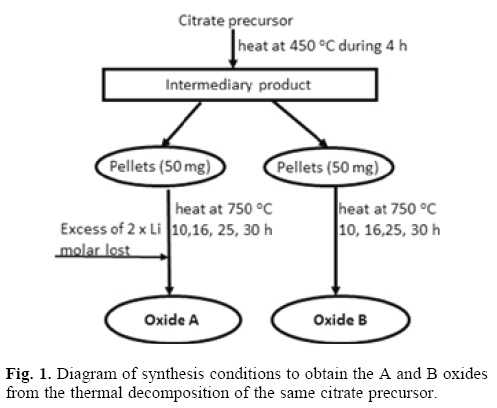
<body><![CDATA[<p align="justify"><font face="verdana" size="2">&nbsp;</font></p>  	    <p align="justify"><font face="verdana" size="2"><b>Results and discussion</b></font></p>  	    <p align="justify"><font face="verdana" size="2">The main focus of this work was centred on the development of a new and more effective method for preparation of LiNi<sub>0.8</sub>Co<sup>0.2</sup>O<sub>2</sub> oxide that could be used as an efficient positive electrode material for rechargeable lithium batteries. The (Li<sub>1&#150;x</sub> Ni<sub>x</sub>)(Ni<sub>0.8</sub>Co<sub>0.2</sub>)O<sub>2</sub> oxides obtained with and without &#91;8&#93; optimized synthesis conditions will be denominated as A and B oxides, respectively. The experimental procedure is showed in <a href="#f1">Figure 1</a>. This procedure was established by several approximations with the ICP and XRD assistance.</font></p>  	    <p align="center"><font face="verdana" size="2"><a name="f1"></a></font></p>  	    <p align="center"><font face="verdana" size="2"><img src="/img/revistas/jmcs/v56n2/a18f1.jpg"></font></p>  	    <p align="justify"><font face="verdana" size="2">The optimal reaction time to obtain the (Li<sub>1&#150;x</sub> Ni<sub>x</sub>)(Ni<sub>08</sub>Co<sub>02</sub>) ordered oxides (A and B oxides) was established by the XRD study as it is shown in <a href="/img/revistas/jmcs/v56n2/a18f2.jpg" target="_blank">Figure 2</a>. Is notable that from the same citrate precursor &#91;8&#93; the reaction time may be reduced, from 30 h (for the B oxide) to 16 h (for the A oxide) if the lithium atmosphere is controlled. In optimization conditions, for times less than 16 h, the trigonal phase exists, but a clear overlapping of the diffraction lines 006/102 and 108/110 indicated the presence of Ni<sup>2</sup>+ occupying at least a 5% of the Li ion positions as has been well established by many previous works.</font></p>  	    <p align="justify"><font face="verdana" size="2">Considering that the high vapour pressure of the Li compounds leads to losses of this element, causing deviations of the desired stoichiometry with a detriment of the gravimetric energy capacity of the cathodic material, we established the conditions of atmosphere control by the assistance of ICP analysis. In <a href="/img/revistas/jmcs/v56n2/a18t1.jpg" target="_blank">table 1</a> the results of ICP analysis are shown. This allowed us to know the quantity of sublimated Li during citrate precursor decomposition (&#126;2% of dried sample) and at the same time the necessary quantity of Li to be added in excess to have one mol by formula, that in the case of the A oxide resulted to be two times the quantity of Li lost.</font></p>  	    <p align="justify"><font face="verdana" size="2">In the citrate method, contrary to the traditional ceramic way of synthesis, the ions forming part of the oxide are separated at atomic distances (they form part of the same chemical entity) favouring the diffusion process that takes place in the reorganization of the new atomic arrangement. Moreover, the decomposition of the organic part of the citrate gives rise to a more porous and active material, that favours the reaction with the oxygen of the air. Finally, the control of the Li stoi&#150;chiometry (Li &#126; 1 mol by formula) for the A oxide allows the transition metals to be in oxidation state III and the cationic mixture to reach the minimal value. The more important results obtained from the optimization of the reaction time is that the control of lithium atmosphere allows the decreasing in 14 hours of the reaction time established for the all previous method &#91;8&#93; in the searching of the ordered oxide.</font></p>  	    <p align="justify"><font face="verdana" size="2">Results of the refinement process using the Rietveld method for the A oxide, summarized in <a href="/img/revistas/jmcs/v56n2/a18t2.jpg" target="_blank">table 2</a> for the optimized synthesis, complement the studies carried out by XRD and ICP on this material.</font></p>  	    <p align="justify"><font face="verdana" size="2">The obtained Rwp, Rp, &#967;%<sup>2</sup> and the graphic plot from the program Fullprof (see <a href="/img/revistas/jmcs/v56n2/a18f3.jpg" target="_blank">Figure 3</a>) are deemed sufficient to demonstrate the quality of Rietveld study. The crystallographic parameters are in good agreement with those reported by other authors &#91;13, 30&#150;32&#93; in the databases for this kind of lamellar oxides.</font></p>  	    ]]></body>
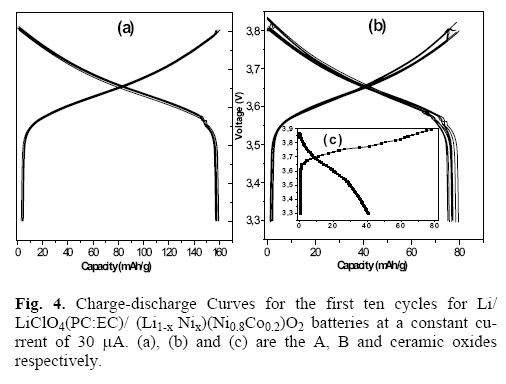
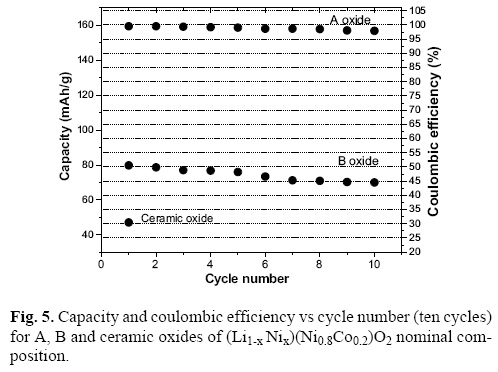
<body><![CDATA[<p align="justify"><font face="verdana" size="2">The resulted cationic distribution in the A oxide was Li<sub>0, 9756</sub>Ni<sup>2+</sup><sub>00192</sub>Ni<sup>3+</sup><sub>0</sub> <sub>80</sub>Co<sub>0</sub> <sub>20</sub>O<sub>2</sub> which is in good agreement with the results obtained by ICP analysis.</font></p>  	    <p align="justify"><font face="verdana" size="2"><a href="#f4">Figure 4</a> shows the first ten cycles of deinsertion (charge) and insertion (discharge) carried out in a electrochemical lithium battery with A and B oxides as cathodes at constant current of 30 &#956;A . For comparison is inserted <i>(picture c)</i> the electrochemical behaviour to the first cycle of (Li<sub>1&#150;x</sub> Ni<sub>x</sub>)(Ni<sub>08</sub>Co<sub>0.2</sub>)O<sub>2</sub> obtained by ceramic traditional method &#91;8&#93;. The existence of such a small quantity of Ni<sup>2+</sup> in the Li<sup>+</sup> sites (2%) has no relevant effect over the electrochemical behaviour for A oxide contrary to that observed in B and more drastically in ceramic oxides where the Ni<sup>2+</sup> content is higher than 5%.</font></p>  	    <p align="center"><font face="verdana" size="2"><a name="f4"></a></font></p>  	    <p align="center"><font face="verdana" size="2"><img src="/img/revistas/jmcs/v56n2/a18f4.jpg"></font></p>  	    <p align="justify"><font face="verdana" size="2">The monotonous increment of the voltage curves against composition for A oxide suggests the occurrence of the chargedischarge monophasic reaction, indicating that the Li deinsertion and insertion in the studied composition interval takes place in all the bulk of the sample, with a great reversibility from one cycle to another. This fact is a consequence of the cationic order in 3a sites and the resulted particle size in the nanoscale dimension obtained, when the solid state precursor method in rich lithium atmosphere is used.</font></p>  	    <p align="justify"><font face="verdana" size="2">The effect of the enhancement of the Li<sup>+</sup> / Ni<sup>2+</sup> content in 3a site over the electrochemical behaviour is more notorious in the lithium battery capacity and coulombic efficiency (capacity retention) as it is shown in <a href="#f5">Figure 5</a>.</font></p>  	    <p align="center"><font face="verdana" size="2"><a name="f5"></a></font></p>  	    <p align="center"><font face="verdana" size="2"><img src="/img/revistas/jmcs/v56n2/a18f5.jpg"></font></p>  	    <p align="justify"><font face="verdana" size="2">The A oxide shows the double of capacity than B oxide. In addition the A oxide almost reaches the 100% recovery of coulombic efficiency sustained during the first ten cycles which is in relationship with de major Li<sup>+</sup> (98%) and minor Ni<sup>2+</sup> (2%) content in 3a sites. The ceramic oxide having more than 5% of Ni<sup>2</sup>+ in 3a sites suffers a fast electrochemical deterioration.</font></p>  	    <p align="justify"><font face="verdana" size="2">The above behaviour is consistent with previous reports of other authors &#91;7, 31, 32&#93; who have obtained a reduction of capacity with the decreasing of Li in 3a sites. These results suggest that there is an optimum time reaction and lithium composition required for a good structural ordering and electrochemical behaviour for the Li&#150;Ni&#150;Co oxides obtained by citrate method, which in this case resulted to be of 16 hours and 4% Li excess.</font></p>  	    ]]></body>
<body><![CDATA[<p align="justify"><font face="verdana" size="2">&nbsp;</font>	</p>     <p align="justify"><font face="verdana" size="2"><b>Conclusion</b></font></p>  	    <p align="justify"><font face="verdana" size="2">It was possible to optimize the conditions of the citrate method of synthesis for the cathodic material LiNi<sub>0,8</sub>Co<sub>0,2</sub>O<sub>2</sub> The thermal decomposition of the precursor (NH<sub>4</sub>)<sub>3</sub>LiNi<sub>0,8</sub>Co<sub>0,2</sub>(C<sub>6</sub>H<sub>5</sub>O<sub>7</sub>)<sub>2</sub>, at 750 &deg;C during 16 h in lithium excess controlled atmosphere, guaranteed the cationic desirable Li composition and the necessary ordering expected to use the potentialities of this oxide as a cathodic material in rechargeable Li batteries. The refinement of Li<sup>+</sup> /Ni<sup>2+</sup> occupation in the 3a positions by XDR Rietveld, allowed to estimate the composition as Li<sub>0,98</sub>Ni<sub>0,8</sub>Co<sub>0.2</sub>O<sub>2</sub>. The transformations obtained are reflected in the improved technological parameters as the capacity and coulombic efficiency.</font></p>  	    <p align="justify"><font face="verdana" size="2">&nbsp;</font></p>  	    <p align="justify"><font face="verdana" size="2"><b>Experimental</b></font></p>  	    <p align="justify"><font face="verdana" size="2"><b>Synthesis</b></font></p>  	    <p align="justify"><font face="verdana" size="2">The optimization of the reaction time in the synthesis of the LiNi<sub>0,8</sub>Co<sub>0,2</sub>O<sub>2</sub> oxide, from the thermal decomposition of mixed citrates of Li, Ni and Co (previously synthesized &#91;8&#93; ) at 750 &deg;C during 10, 16 , 20, 25 and 30 h, was carried out. During the optimal time was selected, an experiment assisted by ICP to control the Li content in the oxide was designed. The procedure is represented in <a href="#f1">Figure 1</a>.</font></p>  	    <p align="justify"><font face="verdana" size="2">The (Li<sub>1&#150;x</sub> Ni<sub>x</sub>)(Ni<sub>0.8</sub>Co<sub>0.2</sub>)O<sub>2</sub> oxides obtained with and without above optimized synthesis conditions will be denominated as A and B oxide, respectively.</font></p>  	    <p align="justify"><font face="verdana" size="2">&nbsp;</font></p>  	    <p align="justify"><font face="verdana" size="2"><b>Characterization</b></font></p>  	    ]]></body>
<body><![CDATA[<p align="justify"><font face="verdana" size="2">The quantitative characterization of the three major elements Li, Ni and Co was carried out in an ICP spectrometer model 3300 DV (Perking&#150;Elmer, USA) in the axial mode of observation. The analytical procedure was recently published &#91;34&#93; by us for these materials.</font></p>  	    <p align="justify"><font face="verdana" size="2">The powder patterns were obtained in a PHILIPS equipment (PW 1710 model) using Cu&#150;K&#945;<sub>1</sub> (1.5406 <img src="/img/revistas/jmcs/v56n2/a18s3.jpg">) radiation at 42 kV, from 10&deg; to 120&deg; in two theta, with scanning speed of 0.01&deg;/s for the refinement and 2&deg;/s for the phase identification. Five parameters were refined by the Rietveld Method using a FullProf program. The Pseudo&#150;Voigt function was used to fit the peak's profile. The proportions referred to the Li+ and the Ni<sup>2</sup>+ contents for the 3a position were refined through the occupation factor. Additionally proportion referred to the Ni<sup>3+</sup> and the Co<sup>3+</sup> contents for the 3b position were fixed in 4:1 ratio.</font></p>  	    <p align="justify"><font face="verdana" size="2">The electrochemical measurements were carried out in a Li/LiClO<sub>4</sub>(PC:EC)/ (Li<sub>1&#150;x</sub> Ni<sub>x</sub>)(Ni<sub>08</sub>Co<sub>02</sub>)O<sub>2</sub> cell. The positive electrode consisted of a mixture of oxide and carbon black sintered pellets (0.13 cm diameter) pressed at 3T/cm<sup>2</sup>. The cells, assembled in an argon&#150;filled dry box, were galvanostatically cycled under 30 &#956;A current values.</font></p>  	    <p align="justify"><font face="verdana" size="2"><b>Acknowledgements</b></font></p>  	    <p align="justify"><font face="verdana" size="2">Financial support from the Grant 07&#150;149 of The Academy of Science for Developing Word, The Alma Mater&#150;2011 National Projects as well as the Project CONACYT/148997 is gratefully acknowledged.</font></p>  	    <p align="justify"><font face="verdana" size="2">&nbsp;</font></p>  	    <p align="justify"><font face="verdana" size="2"><b>References</b></font></p>  	    <!-- ref --><p align="justify"><font face="verdana" size="2">1.&nbsp;Kim, C. J.; Ahn, I. S.; Cho, K. K.; Lee, S. G.; Chung, J. K. <i>J. Alloys. Compd.</i> <b>2008,</b> <i>449,</i> 335&#150;338.    &nbsp;&nbsp;&nbsp;&nbsp;&nbsp;&nbsp;&nbsp;&nbsp;[&#160;<a href="javascript:void(0);" onclick="javascript: window.open('/scielo.php?script=sci_nlinks&ref=4923316&pid=S1870-249X201200020001800001&lng=','','width=640,height=500,resizable=yes,scrollbars=1,menubar=yes,');">Links</a>&#160;]<!-- end-ref --></font></p>  	    <!-- ref --><p align="justify"><font face="verdana" size="2">2.&nbsp;Laubach, S.; Laubach, S.; Schmidt, P. C.; Ensling, D.; Schmid, S.; Jaegermann, W.; Thi&szlig;en, A.; Nikolowski, K.; Ehrenberg, H. <i>Phys. Chem. Chem. Phys.</i> <b>2009,</b> <i>11,</i> 3278&#150;3289.    &nbsp;&nbsp;&nbsp;&nbsp;&nbsp;&nbsp;&nbsp;&nbsp;[&#160;<a href="javascript:void(0);" onclick="javascript: window.open('/scielo.php?script=sci_nlinks&ref=4923318&pid=S1870-249X201200020001800002&lng=','','width=640,height=500,resizable=yes,scrollbars=1,menubar=yes,');">Links</a>&#160;]<!-- end-ref --></font></p>  	    <!-- ref --><p align="justify"><font face="verdana" size="2">3.&nbsp;Coung&#150;Ah, J.; Sung&#150;Kwan, K.; Cang&#150;Soo, K.; Dae&#150;Hee, W.; Byung&#150;Il, K.; Kwang&#150;Soo, N. <i>J. Electroceram.</i> <b>2006,</b> <b>17</b>, 674671.    &nbsp;&nbsp;&nbsp;&nbsp;&nbsp;&nbsp;&nbsp;&nbsp;[&#160;<a href="javascript:void(0);" onclick="javascript: window.open('/scielo.php?script=sci_nlinks&ref=4923320&pid=S1870-249X201200020001800003&lng=','','width=640,height=500,resizable=yes,scrollbars=1,menubar=yes,');">Links</a>&#160;]<!-- end-ref --></font></p>  	    <!-- ref --><p align="justify"><font face="verdana" size="2">4.&nbsp;Han, C. H.; Kim, J. H.; Paeng, S. H.; Kwak, D. J.; Sung, C. M. <i>Thin Solid Films</i> <b>2009,</b> 4215&#150;4217.    &nbsp;&nbsp;&nbsp;&nbsp;&nbsp;&nbsp;&nbsp;&nbsp;[&#160;<a href="javascript:void(0);" onclick="javascript: window.open('/scielo.php?script=sci_nlinks&ref=4923322&pid=S1870-249X201200020001800004&lng=','','width=640,height=500,resizable=yes,scrollbars=1,menubar=yes,');">Links</a>&#160;]<!-- end-ref --></font></p>  	    <!-- ref --><p align="justify"><font face="verdana" size="2">5.&nbsp;Cao, J.; Guo, C.; Zou, H. <i>J. Solid State Chem.</i> <b>2009,</b> <i>182,</i> 555&#150;559.    &nbsp;&nbsp;&nbsp;&nbsp;&nbsp;&nbsp;&nbsp;&nbsp;[&#160;<a href="javascript:void(0);" onclick="javascript: window.open('/scielo.php?script=sci_nlinks&ref=4923324&pid=S1870-249X201200020001800005&lng=','','width=640,height=500,resizable=yes,scrollbars=1,menubar=yes,');">Links</a>&#160;]<!-- end-ref --></font></p>  	    <!-- ref --><p align="justify"><font face="verdana" size="2">6.&nbsp;Fergus, J. W. <i>J. Power Sources</i> <b>2010</b><i>, 195,</i> 939&#150;954.    &nbsp;&nbsp;&nbsp;&nbsp;&nbsp;&nbsp;&nbsp;&nbsp;[&#160;<a href="javascript:void(0);" onclick="javascript: window.open('/scielo.php?script=sci_nlinks&ref=4923326&pid=S1870-249X201200020001800006&lng=','','width=640,height=500,resizable=yes,scrollbars=1,menubar=yes,');">Links</a>&#160;]<!-- end-ref --></font></p>  	    <!-- ref --><p align="justify"><font face="verdana" size="2">7.&nbsp;Jang, W. L.; Lu, C. M.; Hwang, W. S.; Chen, W. C. <i>J. Eur. Ceram. Soc.</i> <b>2010,</b> <i>30,</i> 503&#150;508.    &nbsp;&nbsp;&nbsp;&nbsp;&nbsp;&nbsp;&nbsp;&nbsp;[&#160;<a href="javascript:void(0);" onclick="javascript: window.open('/scielo.php?script=sci_nlinks&ref=4923328&pid=S1870-249X201200020001800007&lng=','','width=640,height=500,resizable=yes,scrollbars=1,menubar=yes,');">Links</a>&#160;]<!-- end-ref --></font></p>  	    <!-- ref --><p align="justify"><font face="verdana" size="2">8.&nbsp;Hwang, B. J.; Santhanam, R.; Chen, C. H. <i>J. Power Sources</i> <b>2003</b><i>,114,</i> 244&#150;252.    &nbsp;&nbsp;&nbsp;&nbsp;&nbsp;&nbsp;&nbsp;&nbsp;[&#160;<a href="javascript:void(0);" onclick="javascript: window.open('/scielo.php?script=sci_nlinks&ref=4923330&pid=S1870-249X201200020001800008&lng=','','width=640,height=500,resizable=yes,scrollbars=1,menubar=yes,');">Links</a>&#160;]<!-- end-ref --></font></p>  	    <!-- ref --><p align="justify"><font face="verdana" size="2">9.&nbsp;Mosqueda, C.; P&eacute;rez&#150;Cappe, E.; Ruiz&#150;Hitzky, E.; Aranda, P. <i>Eur.</i> <i>J. Inorg. Chem.</i> <b>2005,</b> <i>13,</i> 2698&#150;2705.    &nbsp;&nbsp;&nbsp;&nbsp;&nbsp;&nbsp;&nbsp;&nbsp;[&#160;<a href="javascript:void(0);" onclick="javascript: window.open('/scielo.php?script=sci_nlinks&ref=4923332&pid=S1870-249X201200020001800009&lng=','','width=640,height=500,resizable=yes,scrollbars=1,menubar=yes,');">Links</a>&#160;]<!-- end-ref --></font></p>  	    <!-- ref --><p align="justify"><font face="verdana" size="2">10.&nbsp;Park, M. S.; Hyun, S. H.; Nam S. C.; Cho S. B. <i>Electrochim. Acta</i> <b>2008,</b> <i>53,</i> 5523&#150;5527.    &nbsp;&nbsp;&nbsp;&nbsp;&nbsp;&nbsp;&nbsp;&nbsp;[&#160;<a href="javascript:void(0);" onclick="javascript: window.open('/scielo.php?script=sci_nlinks&ref=4923334&pid=S1870-249X201200020001800010&lng=','','width=640,height=500,resizable=yes,scrollbars=1,menubar=yes,');">Links</a>&#160;]<!-- end-ref --></font></p>  	    <!-- ref --><p align="justify"><font face="verdana" size="2">11.&nbsp;Zhu , X. J.; Liu, H. X.; Gan, X. C.; Cao, M. H.; Zhou, J. W.; Chen, X. Q.; Ouyang, S. X. <i>J. Electroceram.</i> <b>2006,</b> <i>17</i>, 645&#150;649.    &nbsp;&nbsp;&nbsp;&nbsp;&nbsp;&nbsp;&nbsp;&nbsp;[&#160;<a href="javascript:void(0);" onclick="javascript: window.open('/scielo.php?script=sci_nlinks&ref=4923336&pid=S1870-249X201200020001800011&lng=','','width=640,height=500,resizable=yes,scrollbars=1,menubar=yes,');">Links</a>&#160;]<!-- end-ref --></font></p>  	    <!-- ref --><p align="justify"><font face="verdana" size="2">12.&nbsp;Khomane, R. B.; Agrawal, A. C.; Kulkarni, B. D.; Gopukumar, S.; Sivashanmugam, A. <i>Mater. Res. Bull.</i> <b>2008,</b> <i>43</i>, 2497&#150;2503.    &nbsp;&nbsp;&nbsp;&nbsp;&nbsp;&nbsp;&nbsp;&nbsp;[&#160;<a href="javascript:void(0);" onclick="javascript: window.open('/scielo.php?script=sci_nlinks&ref=4923338&pid=S1870-249X201200020001800012&lng=','','width=640,height=500,resizable=yes,scrollbars=1,menubar=yes,');">Links</a>&#160;]<!-- end-ref --></font></p>  	    <!-- ref --><p align="justify"><font face="verdana" size="2">13.&nbsp;Tong, D. G.; Tang, A. D.; Chu, W.; Tang, L. X.; Huang, K. L.; He, C.; Ji, X. C. <i>Mater. Chem. Phys.</i> <b>2008</b><i>,107,</i> 385&#150;391.    &nbsp;&nbsp;&nbsp;&nbsp;&nbsp;&nbsp;&nbsp;&nbsp;[&#160;<a href="javascript:void(0);" onclick="javascript: window.open('/scielo.php?script=sci_nlinks&ref=4923340&pid=S1870-249X201200020001800013&lng=','','width=640,height=500,resizable=yes,scrollbars=1,menubar=yes,');">Links</a>&#160;]<!-- end-ref --></font></p>  	    <!-- ref --><p align="justify"><font face="verdana" size="2">14.&nbsp;Li, D.; Peng, Z.; Ren, H.; Guo, W.; Zhou, C. <i>Mater. Chem. Phys.</i> <b>2008,</b> <i>107</i>, 171&#150;176.    &nbsp;&nbsp;&nbsp;&nbsp;&nbsp;&nbsp;&nbsp;&nbsp;[&#160;<a href="javascript:void(0);" onclick="javascript: window.open('/scielo.php?script=sci_nlinks&ref=4923342&pid=S1870-249X201200020001800014&lng=','','width=640,height=500,resizable=yes,scrollbars=1,menubar=yes,');">Links</a>&#160;]<!-- end-ref --></font></p>  	    <!-- ref --><p align="justify"><font face="verdana" size="2">15.&nbsp;Huang, J.; Cang, J.; Li, W.; Cai, W.; Jiang, Z. <i>Thin Solid Films</i> <b>2008,</b> <i>516</i>, 3314&#150;3319.    &nbsp;&nbsp;&nbsp;&nbsp;&nbsp;&nbsp;&nbsp;&nbsp;[&#160;<a href="javascript:void(0);" onclick="javascript: window.open('/scielo.php?script=sci_nlinks&ref=4923344&pid=S1870-249X201200020001800015&lng=','','width=640,height=500,resizable=yes,scrollbars=1,menubar=yes,');">Links</a>&#160;]<!-- end-ref --></font></p>  	    <!-- ref --><p align="justify"><font face="verdana" size="2">16.&nbsp;Xiao, L.; Cang, C.; Zhao, C.; Ai, X.; Cang, H.; Cao, C. <i>Electrochim. Acta.</i> <b>2008,</b> <i>53</i>, 3007&#150;3012.    &nbsp;&nbsp;&nbsp;&nbsp;&nbsp;&nbsp;&nbsp;&nbsp;[&#160;<a href="javascript:void(0);" onclick="javascript: window.open('/scielo.php?script=sci_nlinks&ref=4923346&pid=S1870-249X201200020001800016&lng=','','width=640,height=500,resizable=yes,scrollbars=1,menubar=yes,');">Links</a>&#160;]<!-- end-ref --></font></p>  	    <!-- ref --><p align="justify"><font face="verdana" size="2">17.&nbsp;Dahbi, M.; Saadoune, I.; Amarilla, J. M. <i>Electrochim. Acta.</i> <b>2008,</b> <i>53,</i> 5266&#150;5271.    &nbsp;&nbsp;&nbsp;&nbsp;&nbsp;&nbsp;&nbsp;&nbsp;[&#160;<a href="javascript:void(0);" onclick="javascript: window.open('/scielo.php?script=sci_nlinks&ref=4923348&pid=S1870-249X201200020001800017&lng=','','width=640,height=500,resizable=yes,scrollbars=1,menubar=yes,');">Links</a>&#160;]<!-- end-ref --></font></p>  	    <!-- ref --><p align="justify"><font face="verdana" size="2">18.&nbsp;Song, M. K.; Hong, S. D.; No, K. T. <i>J. Phys. Chem. Solid.</i> <b>2008,</b> <i>69</i>, 1249&#150;1252.    &nbsp;&nbsp;&nbsp;&nbsp;&nbsp;&nbsp;&nbsp;&nbsp;[&#160;<a href="javascript:void(0);" onclick="javascript: window.open('/scielo.php?script=sci_nlinks&ref=4923350&pid=S1870-249X201200020001800018&lng=','','width=640,height=500,resizable=yes,scrollbars=1,menubar=yes,');">Links</a>&#160;]<!-- end-ref --></font></p>  	    <!-- ref --><p align="justify"><font face="verdana" size="2">19.&nbsp;Sathiyamoorthi, R.; Chandrasekaran, R.; Gopalan, A.; Vasudevan, T. <i>Mater. Res. Bull.</i> <b>2008,</b> <i>43</i>, 1401&#150;1411.    &nbsp;&nbsp;&nbsp;&nbsp;&nbsp;&nbsp;&nbsp;&nbsp;[&#160;<a href="javascript:void(0);" onclick="javascript: window.open('/scielo.php?script=sci_nlinks&ref=4923352&pid=S1870-249X201200020001800019&lng=','','width=640,height=500,resizable=yes,scrollbars=1,menubar=yes,');">Links</a>&#160;]<!-- end-ref --></font></p>  	    <!-- ref --><p align="justify"><font face="verdana" size="2">20.&nbsp;Ma, X.; Wang, C.; Han, X.; Sun, J.; Sun, J. <i>J. Alloys. Compd.</i> <b>2008,</b> <i>453,</i> 352&#150;355.    &nbsp;&nbsp;&nbsp;&nbsp;&nbsp;&nbsp;&nbsp;&nbsp;[&#160;<a href="javascript:void(0);" onclick="javascript: window.open('/scielo.php?script=sci_nlinks&ref=4923354&pid=S1870-249X201200020001800020&lng=','','width=640,height=500,resizable=yes,scrollbars=1,menubar=yes,');">Links</a>&#160;]<!-- end-ref --></font></p>  	    <!-- ref --><p align="justify"><font face="verdana" size="2">21.&nbsp;Kim, B. H.; Kim, J. H.; Ha, S. J.; Hong, S. J.; Song, M. C. <i>J.</i> <i>Electroceram.</i> <b>2009,</b> <i>23,</i> 447&#150;451.    &nbsp;&nbsp;&nbsp;&nbsp;&nbsp;&nbsp;&nbsp;&nbsp;[&#160;<a href="javascript:void(0);" onclick="javascript: window.open('/scielo.php?script=sci_nlinks&ref=4923356&pid=S1870-249X201200020001800021&lng=','','width=640,height=500,resizable=yes,scrollbars=1,menubar=yes,');">Links</a>&#160;]<!-- end-ref --></font></p>  	    <!-- ref --><p align="justify"><font face="verdana" size="2">22.&nbsp;Zhu, Ch.; Cang, Ch.; Cang, W. D.; Hsieh, Ch. C.; Csai, H. M.; Chen, C. S. <i>J. Alloys Compd.</i> <b>2010,</b> <i>496,</i> 703&#150;709.    &nbsp;&nbsp;&nbsp;&nbsp;&nbsp;&nbsp;&nbsp;&nbsp;[&#160;<a href="javascript:void(0);" onclick="javascript: window.open('/scielo.php?script=sci_nlinks&ref=4923358&pid=S1870-249X201200020001800022&lng=','','width=640,height=500,resizable=yes,scrollbars=1,menubar=yes,');">Links</a>&#160;]<!-- end-ref --></font></p>  	    <!-- ref --><p align="justify"><font face="verdana" size="2">23.&nbsp;Saadoune, I.; Labrini, M.; Cahya, M.; Almaggoussi, A.; Ehrenberg, H. <i>Electrochim. Acta.</i> <b>2010,</b> <i>55</i>, 5180&#150;5185.    &nbsp;&nbsp;&nbsp;&nbsp;&nbsp;&nbsp;&nbsp;&nbsp;[&#160;<a href="javascript:void(0);" onclick="javascript: window.open('/scielo.php?script=sci_nlinks&ref=4923360&pid=S1870-249X201200020001800023&lng=','','width=640,height=500,resizable=yes,scrollbars=1,menubar=yes,');">Links</a>&#160;]<!-- end-ref --></font></p>  	    <!-- ref --><p align="justify"><font face="verdana" size="2">24.&nbsp;Mukai, K.; Sugiyama, J.; Aoki, C. <i>J. Solid State Chem.</i> <b>2010</b>, <i>183</i>, 1726&#150;1732.    &nbsp;&nbsp;&nbsp;&nbsp;&nbsp;&nbsp;&nbsp;&nbsp;[&#160;<a href="javascript:void(0);" onclick="javascript: window.open('/scielo.php?script=sci_nlinks&ref=4923362&pid=S1870-249X201200020001800024&lng=','','width=640,height=500,resizable=yes,scrollbars=1,menubar=yes,');">Links</a>&#160;]<!-- end-ref --></font></p>  	    <!-- ref --><p align="justify"><font face="verdana" size="2">25.&nbsp;Cheralathan, K. K.; Kang, N. C.; Park, H. S.; Lee, C. J.; Choi, W. Ch.; Ko, C. S.; Park, C. K. <i>J. Power Sources</i> <b>2010,</b> <i>195</i>, 1486&#150;1494.    &nbsp;&nbsp;&nbsp;&nbsp;&nbsp;&nbsp;&nbsp;&nbsp;[&#160;<a href="javascript:void(0);" onclick="javascript: window.open('/scielo.php?script=sci_nlinks&ref=4923364&pid=S1870-249X201200020001800025&lng=','','width=640,height=500,resizable=yes,scrollbars=1,menubar=yes,');">Links</a>&#160;]<!-- end-ref --></font></p>  	    <!-- ref --><p align="justify"><font face="verdana" size="2">26.&nbsp;Song, M. C.; Kwon, I.; Shim, S.; Song, J. H. <i>Ceram. Int.</i> <b>2010,</b> <i>36,</i> 1225&#150;1231.    &nbsp;&nbsp;&nbsp;&nbsp;&nbsp;&nbsp;&nbsp;&nbsp;[&#160;<a href="javascript:void(0);" onclick="javascript: window.open('/scielo.php?script=sci_nlinks&ref=4923366&pid=S1870-249X201200020001800026&lng=','','width=640,height=500,resizable=yes,scrollbars=1,menubar=yes,');">Links</a>&#160;]<!-- end-ref --></font></p>  	    <!-- ref --><p align="justify"><font face="verdana" size="2">27.&nbsp;Zeng, X. L.; Wu, P.; Luo, F. L.; Zhou, C.; Tong, D. G. <i>J. Phys.</i> <i>Chem. Solids</i> <b>2010,</b> <i>71</i>, 1404&#150;1409.    &nbsp;&nbsp;&nbsp;&nbsp;&nbsp;&nbsp;&nbsp;&nbsp;[&#160;<a href="javascript:void(0);" onclick="javascript: window.open('/scielo.php?script=sci_nlinks&ref=4923368&pid=S1870-249X201200020001800027&lng=','','width=640,height=500,resizable=yes,scrollbars=1,menubar=yes,');">Links</a>&#160;]<!-- end-ref --></font></p>  	    <!-- ref --><p align="justify"><font face="verdana" size="2">28.&nbsp;Bentaleb, C.; Saadoune, I.; Maher, K.; Saadi, L.; Fujimoto, K.; Ito, S. <i>J. Power Sources</i> <b>2010,</b> <i>195,</i> 1510&#150;1515.    &nbsp;&nbsp;&nbsp;&nbsp;&nbsp;&nbsp;&nbsp;&nbsp;[&#160;<a href="javascript:void(0);" onclick="javascript: window.open('/scielo.php?script=sci_nlinks&ref=4923370&pid=S1870-249X201200020001800028&lng=','','width=640,height=500,resizable=yes,scrollbars=1,menubar=yes,');">Links</a>&#160;]<!-- end-ref --></font></p>  	    <!-- ref --><p align="justify"><font face="verdana" size="2">29.&nbsp;Hua&#150;jun, G.; Xin&#150;hai, L.; Jie, X.; Zhi&#150;xing, W.; Wen&#150;jie, Peng.; Qian&#150;ming, S. <i>Ener. Convers. Manage</i> <b>2010,</b> <i>51</i>, 247&#150;252.    &nbsp;&nbsp;&nbsp;&nbsp;&nbsp;&nbsp;&nbsp;&nbsp;[&#160;<a href="javascript:void(0);" onclick="javascript: window.open('/scielo.php?script=sci_nlinks&ref=4923372&pid=S1870-249X201200020001800029&lng=','','width=640,height=500,resizable=yes,scrollbars=1,menubar=yes,');">Links</a>&#160;]<!-- end-ref --></font></p>  	    <!-- ref --><p align="justify"><font face="verdana" size="2">30.&nbsp;Gover, R. K. B.; Conemura, M.; Hirano, A.; Kanno, R.; Kawamoto, C.; Murphy, C.; Mitchell, B. J.; Richarson, J. W. <i>J. Power Source</i>s <b>1999,</b> <i>81&#150;82,</i> 535&#150;541.    &nbsp;&nbsp;&nbsp;&nbsp;&nbsp;&nbsp;&nbsp;&nbsp;[&#160;<a href="javascript:void(0);" onclick="javascript: window.open('/scielo.php?script=sci_nlinks&ref=4923374&pid=S1870-249X201200020001800030&lng=','','width=640,height=500,resizable=yes,scrollbars=1,menubar=yes,');">Links</a>&#160;]<!-- end-ref --></font></p>  	    <!-- ref --><p align="justify"><font face="verdana" size="2">31.&nbsp;Gover, R. K. B.; Kanno, R.; Mitchell, B.; Hirano, A.; Kawamoto, C. <i>J. Power Sources</i> <b>2000,</b> <i>90,</i> 82&#150;88.    &nbsp;&nbsp;&nbsp;&nbsp;&nbsp;&nbsp;&nbsp;&nbsp;[&#160;<a href="javascript:void(0);" onclick="javascript: window.open('/scielo.php?script=sci_nlinks&ref=4923376&pid=S1870-249X201200020001800031&lng=','','width=640,height=500,resizable=yes,scrollbars=1,menubar=yes,');">Links</a>&#160;]<!-- end-ref --></font></p>  	    <!-- ref --><p align="justify"><font face="verdana" size="2">32.&nbsp;Gover, R. K. B.; Kanno, R.; Mitchell, B.; Conemura, M.; Kawamoto, C. <i>J. Electrochem. Soc.</i> <b>2000,</b> <i>147,</i> 4045&#150;4051.    &nbsp;&nbsp;&nbsp;&nbsp;&nbsp;&nbsp;&nbsp;&nbsp;[&#160;<a href="javascript:void(0);" onclick="javascript: window.open('/scielo.php?script=sci_nlinks&ref=4923378&pid=S1870-249X201200020001800032&lng=','','width=640,height=500,resizable=yes,scrollbars=1,menubar=yes,');">Links</a>&#160;]<!-- end-ref --></font></p>  	    <!-- ref --><p align="justify"><font face="verdana" size="2">33.&nbsp;Kanno, R.; Kubo, H.; Kwamato, C.; Kamiyama, T.; Izumi, F.; Takeda, C.; Takano, M. <i>J. Solid State Chem.</i> <b>1994,</b> <i>110,</i> 216&#150;225.    &nbsp;&nbsp;&nbsp;&nbsp;&nbsp;&nbsp;&nbsp;&nbsp;[&#160;<a href="javascript:void(0);" onclick="javascript: window.open('/scielo.php?script=sci_nlinks&ref=4923380&pid=S1870-249X201200020001800033&lng=','','width=640,height=500,resizable=yes,scrollbars=1,menubar=yes,');">Links</a>&#160;]<!-- end-ref --></font></p>  	    <!-- ref --><p align="justify"><font face="verdana" size="2">34.&nbsp;Mosqueda, C.; Pomares, M.; P&eacute;rez&#150;Cappe, E.; Fari&ntilde;as, J. C.; Miranda, A. M.; Larrea, T. <i>Anal. Bioanal. Chem.</i> <b>2006,</b> <i>386,</i> 1855&#150;1862.    &nbsp;&nbsp;&nbsp;&nbsp;&nbsp;&nbsp;&nbsp;&nbsp;[&#160;<a href="javascript:void(0);" onclick="javascript: window.open('/scielo.php?script=sci_nlinks&ref=4923382&pid=S1870-249X201200020001800034&lng=','','width=640,height=500,resizable=yes,scrollbars=1,menubar=yes,');">Links</a>&#160;]<!-- end-ref --></font></p>      ]]></body><back>
<ref-list>
<ref id="B1">
<label>1</label><nlm-citation citation-type="journal">
<person-group person-group-type="author">
<name>
<surname><![CDATA[Kim]]></surname>
<given-names><![CDATA[C. J.]]></given-names>
</name>
<name>
<surname><![CDATA[Ahn]]></surname>
<given-names><![CDATA[I. S.]]></given-names>
</name>
<name>
<surname><![CDATA[Cho]]></surname>
<given-names><![CDATA[K. K.]]></given-names>
</name>
<name>
<surname><![CDATA[Lee]]></surname>
<given-names><![CDATA[S. G.]]></given-names>
</name>
<name>
<surname><![CDATA[Chung]]></surname>
<given-names><![CDATA[J. K.]]></given-names>
</name>
</person-group>
<source><![CDATA[J. Alloys. Compd.]]></source>
<year>2008</year>
<volume>449</volume>
<page-range>335-338</page-range></nlm-citation>
</ref>
<ref id="B2">
<label>2</label><nlm-citation citation-type="journal">
<person-group person-group-type="author">
<name>
<surname><![CDATA[Laubach]]></surname>
<given-names><![CDATA[S.]]></given-names>
</name>
<name>
<surname><![CDATA[Laubach]]></surname>
<given-names><![CDATA[S.]]></given-names>
</name>
<name>
<surname><![CDATA[Schmidt]]></surname>
<given-names><![CDATA[P. C.]]></given-names>
</name>
<name>
<surname><![CDATA[Ensling]]></surname>
<given-names><![CDATA[D.]]></given-names>
</name>
<name>
<surname><![CDATA[Schmid]]></surname>
<given-names><![CDATA[S.]]></given-names>
</name>
<name>
<surname><![CDATA[Jaegermann]]></surname>
<given-names><![CDATA[W.]]></given-names>
</name>
<name>
<surname><![CDATA[Thißen]]></surname>
<given-names><![CDATA[A.]]></given-names>
</name>
<name>
<surname><![CDATA[Nikolowski]]></surname>
<given-names><![CDATA[K.]]></given-names>
</name>
<name>
<surname><![CDATA[Ehrenberg]]></surname>
<given-names><![CDATA[H.]]></given-names>
</name>
</person-group>
<source><![CDATA[Phys. Chem. Chem. Phys.]]></source>
<year>2009</year>
<volume>11</volume>
<page-range>3278-3289</page-range></nlm-citation>
</ref>
<ref id="B3">
<label>3</label><nlm-citation citation-type="journal">
<person-group person-group-type="author">
<name>
<surname><![CDATA[Coung-Ah]]></surname>
<given-names><![CDATA[J.]]></given-names>
</name>
<name>
<surname><![CDATA[Sung-Kwan]]></surname>
<given-names><![CDATA[K.]]></given-names>
</name>
<name>
<surname><![CDATA[Cang-Soo]]></surname>
<given-names><![CDATA[K.]]></given-names>
</name>
<name>
<surname><![CDATA[Dae-Hee]]></surname>
<given-names><![CDATA[W.]]></given-names>
</name>
<name>
<surname><![CDATA[Byung-Il]]></surname>
<given-names><![CDATA[K.]]></given-names>
</name>
<name>
<surname><![CDATA[Kwang-Soo]]></surname>
<given-names><![CDATA[N.]]></given-names>
</name>
</person-group>
<source><![CDATA[J. Electroceram.]]></source>
<year>2006</year>
<volume>17</volume>
<page-range>674671</page-range></nlm-citation>
</ref>
<ref id="B4">
<label>4</label><nlm-citation citation-type="journal">
<person-group person-group-type="author">
<name>
<surname><![CDATA[Han]]></surname>
<given-names><![CDATA[C. H.]]></given-names>
</name>
<name>
<surname><![CDATA[Kim]]></surname>
<given-names><![CDATA[J. H.]]></given-names>
</name>
<name>
<surname><![CDATA[Paeng]]></surname>
<given-names><![CDATA[S. H.]]></given-names>
</name>
<name>
<surname><![CDATA[Kwak]]></surname>
<given-names><![CDATA[D. J.]]></given-names>
</name>
<name>
<surname><![CDATA[Sung]]></surname>
<given-names><![CDATA[C. M.]]></given-names>
</name>
</person-group>
<source><![CDATA[Thin Solid Films]]></source>
<year>2009</year>
<page-range>4215-4217</page-range></nlm-citation>
</ref>
<ref id="B5">
<label>5</label><nlm-citation citation-type="journal">
<person-group person-group-type="author">
<name>
<surname><![CDATA[Cao]]></surname>
<given-names><![CDATA[J.]]></given-names>
</name>
<name>
<surname><![CDATA[Guo]]></surname>
<given-names><![CDATA[C.]]></given-names>
</name>
<name>
<surname><![CDATA[Zou]]></surname>
<given-names><![CDATA[H.]]></given-names>
</name>
</person-group>
<source><![CDATA[J. Solid State Chem.]]></source>
<year>2009</year>
<volume>182</volume>
<page-range>555-559</page-range></nlm-citation>
</ref>
<ref id="B6">
<label>6</label><nlm-citation citation-type="journal">
<person-group person-group-type="author">
<name>
<surname><![CDATA[Fergus]]></surname>
<given-names><![CDATA[J. W.]]></given-names>
</name>
</person-group>
<source><![CDATA[J. Power Sources]]></source>
<year>2010</year>
<volume>195</volume>
<page-range>939-954</page-range></nlm-citation>
</ref>
<ref id="B7">
<label>7</label><nlm-citation citation-type="journal">
<person-group person-group-type="author">
<name>
<surname><![CDATA[Jang]]></surname>
<given-names><![CDATA[W. L.]]></given-names>
</name>
<name>
<surname><![CDATA[Lu]]></surname>
<given-names><![CDATA[C. M.]]></given-names>
</name>
<name>
<surname><![CDATA[Hwang]]></surname>
<given-names><![CDATA[W. S.]]></given-names>
</name>
<name>
<surname><![CDATA[Chen]]></surname>
<given-names><![CDATA[W. C.]]></given-names>
</name>
</person-group>
<source><![CDATA[J. Eur. Ceram. Soc.]]></source>
<year>2010</year>
<volume>30</volume>
<page-range>503-508</page-range></nlm-citation>
</ref>
<ref id="B8">
<label>8</label><nlm-citation citation-type="journal">
<person-group person-group-type="author">
<name>
<surname><![CDATA[Hwang]]></surname>
<given-names><![CDATA[B. J.]]></given-names>
</name>
<name>
<surname><![CDATA[Santhanam]]></surname>
<given-names><![CDATA[R.]]></given-names>
</name>
<name>
<surname><![CDATA[Chen]]></surname>
<given-names><![CDATA[C. H.]]></given-names>
</name>
</person-group>
<source><![CDATA[J. Power Sources]]></source>
<year>2003</year>
<volume>114</volume>
<page-range>244-252</page-range></nlm-citation>
</ref>
<ref id="B9">
<label>9</label><nlm-citation citation-type="journal">
<person-group person-group-type="author">
<name>
<surname><![CDATA[Mosqueda]]></surname>
<given-names><![CDATA[C.]]></given-names>
</name>
<name>
<surname><![CDATA[Pérez-Cappe]]></surname>
<given-names><![CDATA[E.]]></given-names>
</name>
<name>
<surname><![CDATA[Ruiz-Hitzky]]></surname>
<given-names><![CDATA[E.]]></given-names>
</name>
<name>
<surname><![CDATA[Aranda]]></surname>
<given-names><![CDATA[P.]]></given-names>
</name>
</person-group>
<source><![CDATA[Eur. J. Inorg. Chem.]]></source>
<year>2005</year>
<volume>13</volume>
<page-range>2698-2705</page-range></nlm-citation>
</ref>
<ref id="B10">
<label>10</label><nlm-citation citation-type="journal">
<person-group person-group-type="author">
<name>
<surname><![CDATA[Park]]></surname>
<given-names><![CDATA[M. S.]]></given-names>
</name>
<name>
<surname><![CDATA[Hyun]]></surname>
<given-names><![CDATA[S. H.]]></given-names>
</name>
<name>
<surname><![CDATA[Nam]]></surname>
<given-names><![CDATA[S. C.]]></given-names>
</name>
<name>
<surname><![CDATA[Cho]]></surname>
<given-names><![CDATA[S. B.]]></given-names>
</name>
</person-group>
<source><![CDATA[Electrochim. Acta]]></source>
<year>2008</year>
<volume>53</volume>
<page-range>5523-5527</page-range></nlm-citation>
</ref>
<ref id="B11">
<label>11</label><nlm-citation citation-type="journal">
<person-group person-group-type="author">
<name>
<surname><![CDATA[Zhu]]></surname>
<given-names><![CDATA[X. J.]]></given-names>
</name>
<name>
<surname><![CDATA[Liu]]></surname>
<given-names><![CDATA[H. X.]]></given-names>
</name>
<name>
<surname><![CDATA[Gan]]></surname>
<given-names><![CDATA[X. C.]]></given-names>
</name>
<name>
<surname><![CDATA[Cao]]></surname>
<given-names><![CDATA[M. H.]]></given-names>
</name>
<name>
<surname><![CDATA[Zhou]]></surname>
<given-names><![CDATA[J. W.]]></given-names>
</name>
<name>
<surname><![CDATA[Chen]]></surname>
<given-names><![CDATA[X. Q.]]></given-names>
</name>
<name>
<surname><![CDATA[Ouyang]]></surname>
<given-names><![CDATA[S. X.]]></given-names>
</name>
</person-group>
<source><![CDATA[J. Electroceram.]]></source>
<year>2006</year>
<volume>17</volume>
<page-range>645-649</page-range></nlm-citation>
</ref>
<ref id="B12">
<label>12</label><nlm-citation citation-type="journal">
<person-group person-group-type="author">
<name>
<surname><![CDATA[Khomane]]></surname>
<given-names><![CDATA[R. B.]]></given-names>
</name>
<name>
<surname><![CDATA[Agrawal]]></surname>
<given-names><![CDATA[A. C.]]></given-names>
</name>
<name>
<surname><![CDATA[Kulkarni]]></surname>
<given-names><![CDATA[B. D.]]></given-names>
</name>
<name>
<surname><![CDATA[Gopukumar]]></surname>
<given-names><![CDATA[S.]]></given-names>
</name>
<name>
<surname><![CDATA[Sivashanmugam]]></surname>
<given-names><![CDATA[A.]]></given-names>
</name>
</person-group>
<source><![CDATA[Mater. Res. Bull.]]></source>
<year>2008</year>
<volume>43</volume>
<page-range>2497-2503</page-range></nlm-citation>
</ref>
<ref id="B13">
<label>13</label><nlm-citation citation-type="journal">
<person-group person-group-type="author">
<name>
<surname><![CDATA[Tong]]></surname>
<given-names><![CDATA[D. G.]]></given-names>
</name>
<name>
<surname><![CDATA[Tang]]></surname>
<given-names><![CDATA[A. D.]]></given-names>
</name>
<name>
<surname><![CDATA[Chu]]></surname>
<given-names><![CDATA[W.]]></given-names>
</name>
<name>
<surname><![CDATA[Tang]]></surname>
<given-names><![CDATA[L. X.]]></given-names>
</name>
<name>
<surname><![CDATA[Huang]]></surname>
<given-names><![CDATA[K. L.]]></given-names>
</name>
<name>
<surname><![CDATA[He]]></surname>
<given-names><![CDATA[C.]]></given-names>
</name>
<name>
<surname><![CDATA[Ji]]></surname>
<given-names><![CDATA[X. C.]]></given-names>
</name>
</person-group>
<source><![CDATA[Mater. Chem. Phys.]]></source>
<year>2008</year>
<volume>107</volume>
<page-range>385-391</page-range></nlm-citation>
</ref>
<ref id="B14">
<label>14</label><nlm-citation citation-type="journal">
<person-group person-group-type="author">
<name>
<surname><![CDATA[Li]]></surname>
<given-names><![CDATA[D.]]></given-names>
</name>
<name>
<surname><![CDATA[Peng]]></surname>
<given-names><![CDATA[Z.]]></given-names>
</name>
<name>
<surname><![CDATA[Ren]]></surname>
<given-names><![CDATA[H.]]></given-names>
</name>
<name>
<surname><![CDATA[Guo]]></surname>
<given-names><![CDATA[W.]]></given-names>
</name>
<name>
<surname><![CDATA[Zhou]]></surname>
<given-names><![CDATA[C.]]></given-names>
</name>
</person-group>
<source><![CDATA[Mater. Chem. Phys.]]></source>
<year>2008</year>
<volume>107</volume>
<page-range>171-176</page-range></nlm-citation>
</ref>
<ref id="B15">
<label>15</label><nlm-citation citation-type="journal">
<person-group person-group-type="author">
<name>
<surname><![CDATA[Huang]]></surname>
<given-names><![CDATA[J.]]></given-names>
</name>
<name>
<surname><![CDATA[Cang]]></surname>
<given-names><![CDATA[J.]]></given-names>
</name>
<name>
<surname><![CDATA[Li]]></surname>
<given-names><![CDATA[W.]]></given-names>
</name>
<name>
<surname><![CDATA[Cai]]></surname>
<given-names><![CDATA[W.]]></given-names>
</name>
<name>
<surname><![CDATA[Jiang]]></surname>
<given-names><![CDATA[Z.]]></given-names>
</name>
</person-group>
<source><![CDATA[Thin Solid Films]]></source>
<year>2008</year>
<volume>516</volume>
<page-range>3314-3319</page-range></nlm-citation>
</ref>
<ref id="B16">
<label>16</label><nlm-citation citation-type="journal">
<person-group person-group-type="author">
<name>
<surname><![CDATA[Xiao]]></surname>
<given-names><![CDATA[L.]]></given-names>
</name>
<name>
<surname><![CDATA[Cang]]></surname>
<given-names><![CDATA[C.]]></given-names>
</name>
<name>
<surname><![CDATA[Zhao]]></surname>
<given-names><![CDATA[C.]]></given-names>
</name>
<name>
<surname><![CDATA[Ai]]></surname>
<given-names><![CDATA[X.]]></given-names>
</name>
<name>
<surname><![CDATA[Cang]]></surname>
<given-names><![CDATA[H.]]></given-names>
</name>
<name>
<surname><![CDATA[Cao]]></surname>
<given-names><![CDATA[C.]]></given-names>
</name>
</person-group>
<source><![CDATA[Electrochim. Acta.]]></source>
<year>2008</year>
<volume>53</volume>
<page-range>3007-3012</page-range></nlm-citation>
</ref>
<ref id="B17">
<label>17</label><nlm-citation citation-type="journal">
<person-group person-group-type="author">
<name>
<surname><![CDATA[Dahbi]]></surname>
<given-names><![CDATA[M.]]></given-names>
</name>
<name>
<surname><![CDATA[Saadoune]]></surname>
<given-names><![CDATA[I.]]></given-names>
</name>
<name>
<surname><![CDATA[Amarilla]]></surname>
<given-names><![CDATA[J. M.]]></given-names>
</name>
</person-group>
<source><![CDATA[Electrochim. Acta.]]></source>
<year>2008</year>
<volume>53</volume>
<page-range>5266-5271</page-range></nlm-citation>
</ref>
<ref id="B18">
<label>18</label><nlm-citation citation-type="journal">
<person-group person-group-type="author">
<name>
<surname><![CDATA[Song]]></surname>
<given-names><![CDATA[M. K.]]></given-names>
</name>
<name>
<surname><![CDATA[Hong]]></surname>
<given-names><![CDATA[S. D.]]></given-names>
</name>
<name>
<surname><![CDATA[No]]></surname>
<given-names><![CDATA[K. T.]]></given-names>
</name>
</person-group>
<source><![CDATA[J. Phys. Chem. Solid.]]></source>
<year>2008</year>
<volume>69</volume>
<page-range>1249-1252</page-range></nlm-citation>
</ref>
<ref id="B19">
<label>19</label><nlm-citation citation-type="journal">
<person-group person-group-type="author">
<name>
<surname><![CDATA[Sathiyamoorthi]]></surname>
<given-names><![CDATA[R.]]></given-names>
</name>
<name>
<surname><![CDATA[Chandrasekaran]]></surname>
<given-names><![CDATA[R.]]></given-names>
</name>
<name>
<surname><![CDATA[Gopalan]]></surname>
<given-names><![CDATA[A.]]></given-names>
</name>
<name>
<surname><![CDATA[Vasudevan]]></surname>
<given-names><![CDATA[T.]]></given-names>
</name>
</person-group>
<source><![CDATA[Mater. Res. Bull.]]></source>
<year>2008</year>
<volume>43</volume>
<page-range>1401-1411</page-range></nlm-citation>
</ref>
<ref id="B20">
<label>20</label><nlm-citation citation-type="journal">
<person-group person-group-type="author">
<name>
<surname><![CDATA[Ma]]></surname>
<given-names><![CDATA[X.]]></given-names>
</name>
<name>
<surname><![CDATA[Wang]]></surname>
<given-names><![CDATA[C.]]></given-names>
</name>
<name>
<surname><![CDATA[Han]]></surname>
<given-names><![CDATA[X.]]></given-names>
</name>
<name>
<surname><![CDATA[Sun]]></surname>
<given-names><![CDATA[J.]]></given-names>
</name>
<name>
<surname><![CDATA[Sun]]></surname>
<given-names><![CDATA[J.]]></given-names>
</name>
</person-group>
<source><![CDATA[J. Alloys. Compd.]]></source>
<year>2008</year>
<volume>453</volume>
<page-range>352-355</page-range></nlm-citation>
</ref>
<ref id="B21">
<label>21</label><nlm-citation citation-type="journal">
<person-group person-group-type="author">
<name>
<surname><![CDATA[Kim]]></surname>
<given-names><![CDATA[B. H.]]></given-names>
</name>
<name>
<surname><![CDATA[Kim]]></surname>
<given-names><![CDATA[J. H.]]></given-names>
</name>
<name>
<surname><![CDATA[Ha]]></surname>
<given-names><![CDATA[S. J.]]></given-names>
</name>
<name>
<surname><![CDATA[Hong]]></surname>
<given-names><![CDATA[S. J.]]></given-names>
</name>
<name>
<surname><![CDATA[Song]]></surname>
<given-names><![CDATA[M. C.]]></given-names>
</name>
</person-group>
<source><![CDATA[J. Electroceram.]]></source>
<year>2009</year>
<volume>23</volume>
<page-range>447-451</page-range></nlm-citation>
</ref>
<ref id="B22">
<label>22</label><nlm-citation citation-type="journal">
<person-group person-group-type="author">
<name>
<surname><![CDATA[Zhu]]></surname>
<given-names><![CDATA[Ch.]]></given-names>
</name>
<name>
<surname><![CDATA[Cang]]></surname>
<given-names><![CDATA[Ch.]]></given-names>
</name>
<name>
<surname><![CDATA[Cang]]></surname>
<given-names><![CDATA[W. D.]]></given-names>
</name>
<name>
<surname><![CDATA[Hsieh]]></surname>
<given-names><![CDATA[Ch. C.]]></given-names>
</name>
<name>
<surname><![CDATA[Csai]]></surname>
<given-names><![CDATA[H. M.]]></given-names>
</name>
<name>
<surname><![CDATA[Chen]]></surname>
<given-names><![CDATA[C. S.]]></given-names>
</name>
</person-group>
<source><![CDATA[J. Alloys Compd.]]></source>
<year>2010</year>
<volume>496</volume>
<page-range>703-709</page-range></nlm-citation>
</ref>
<ref id="B23">
<label>23</label><nlm-citation citation-type="journal">
<person-group person-group-type="author">
<name>
<surname><![CDATA[Saadoune]]></surname>
<given-names><![CDATA[I.]]></given-names>
</name>
<name>
<surname><![CDATA[Labrini]]></surname>
<given-names><![CDATA[M.]]></given-names>
</name>
<name>
<surname><![CDATA[Cahya]]></surname>
<given-names><![CDATA[M.]]></given-names>
</name>
<name>
<surname><![CDATA[Almaggoussi]]></surname>
<given-names><![CDATA[A.]]></given-names>
</name>
<name>
<surname><![CDATA[Ehrenberg]]></surname>
<given-names><![CDATA[H.]]></given-names>
</name>
</person-group>
<source><![CDATA[Electrochim. Acta.]]></source>
<year>2010</year>
<volume>55</volume>
<page-range>5180-5185</page-range></nlm-citation>
</ref>
<ref id="B24">
<label>24</label><nlm-citation citation-type="journal">
<person-group person-group-type="author">
<name>
<surname><![CDATA[Mukai]]></surname>
<given-names><![CDATA[K.]]></given-names>
</name>
<name>
<surname><![CDATA[Sugiyama]]></surname>
<given-names><![CDATA[J.]]></given-names>
</name>
<name>
<surname><![CDATA[Aoki]]></surname>
<given-names><![CDATA[C.]]></given-names>
</name>
</person-group>
<source><![CDATA[J. Solid State Chem.]]></source>
<year>2010</year>
<volume>183</volume>
<page-range>1726-1732</page-range></nlm-citation>
</ref>
<ref id="B25">
<label>25</label><nlm-citation citation-type="journal">
<person-group person-group-type="author">
<name>
<surname><![CDATA[Cheralathan]]></surname>
<given-names><![CDATA[K. K.]]></given-names>
</name>
<name>
<surname><![CDATA[Kang]]></surname>
<given-names><![CDATA[N. C.]]></given-names>
</name>
<name>
<surname><![CDATA[Park]]></surname>
<given-names><![CDATA[H. S.]]></given-names>
</name>
<name>
<surname><![CDATA[Lee]]></surname>
<given-names><![CDATA[C. J.]]></given-names>
</name>
<name>
<surname><![CDATA[Choi]]></surname>
<given-names><![CDATA[W. Ch.]]></given-names>
</name>
<name>
<surname><![CDATA[Ko]]></surname>
<given-names><![CDATA[C. S.]]></given-names>
</name>
<name>
<surname><![CDATA[Park]]></surname>
<given-names><![CDATA[C. K.]]></given-names>
</name>
</person-group>
<source><![CDATA[J. Power Sources]]></source>
<year>2010</year>
<volume>195</volume>
<page-range>1486-1494</page-range></nlm-citation>
</ref>
<ref id="B26">
<label>26</label><nlm-citation citation-type="journal">
<person-group person-group-type="author">
<name>
<surname><![CDATA[Song]]></surname>
<given-names><![CDATA[M. C.]]></given-names>
</name>
<name>
<surname><![CDATA[Kwon]]></surname>
<given-names><![CDATA[I.]]></given-names>
</name>
<name>
<surname><![CDATA[Shim]]></surname>
<given-names><![CDATA[S.]]></given-names>
</name>
<name>
<surname><![CDATA[Song]]></surname>
<given-names><![CDATA[J. H.]]></given-names>
</name>
</person-group>
<source><![CDATA[Ceram. Int.]]></source>
<year>2010</year>
<volume>36</volume>
<page-range>1225-1231</page-range></nlm-citation>
</ref>
<ref id="B27">
<label>27</label><nlm-citation citation-type="journal">
<person-group person-group-type="author">
<name>
<surname><![CDATA[Zeng]]></surname>
<given-names><![CDATA[X. L.]]></given-names>
</name>
<name>
<surname><![CDATA[Wu]]></surname>
<given-names><![CDATA[P.]]></given-names>
</name>
<name>
<surname><![CDATA[Luo]]></surname>
<given-names><![CDATA[F. L.]]></given-names>
</name>
<name>
<surname><![CDATA[Zhou]]></surname>
<given-names><![CDATA[C.]]></given-names>
</name>
<name>
<surname><![CDATA[Tong]]></surname>
<given-names><![CDATA[D. G.]]></given-names>
</name>
</person-group>
<source><![CDATA[J. Phys. Chem. Solids]]></source>
<year>2010</year>
<volume>71</volume>
<page-range>1404-1409</page-range></nlm-citation>
</ref>
<ref id="B28">
<label>28</label><nlm-citation citation-type="journal">
<person-group person-group-type="author">
<name>
<surname><![CDATA[Bentaleb]]></surname>
<given-names><![CDATA[C.]]></given-names>
</name>
<name>
<surname><![CDATA[Saadoune]]></surname>
<given-names><![CDATA[I.]]></given-names>
</name>
<name>
<surname><![CDATA[Maher]]></surname>
<given-names><![CDATA[K.]]></given-names>
</name>
<name>
<surname><![CDATA[Saadi]]></surname>
<given-names><![CDATA[L.]]></given-names>
</name>
<name>
<surname><![CDATA[Fujimoto]]></surname>
<given-names><![CDATA[K.]]></given-names>
</name>
<name>
<surname><![CDATA[Ito]]></surname>
<given-names><![CDATA[S.]]></given-names>
</name>
</person-group>
<source><![CDATA[J. Power Sources]]></source>
<year>2010</year>
<volume>195</volume>
<page-range>1510-1515</page-range></nlm-citation>
</ref>
<ref id="B29">
<label>29</label><nlm-citation citation-type="journal">
<person-group person-group-type="author">
<name>
<surname><![CDATA[Hua-jun]]></surname>
<given-names><![CDATA[G.]]></given-names>
</name>
<name>
<surname><![CDATA[Xin-hai]]></surname>
<given-names><![CDATA[L.]]></given-names>
</name>
<name>
<surname><![CDATA[Jie]]></surname>
<given-names><![CDATA[X.]]></given-names>
</name>
<name>
<surname><![CDATA[Zhi-xing]]></surname>
<given-names><![CDATA[W.]]></given-names>
</name>
<name>
<surname><![CDATA[Wen-jie]]></surname>
<given-names><![CDATA[Peng]]></given-names>
</name>
<name>
<surname><![CDATA[Qian-ming]]></surname>
<given-names><![CDATA[S.]]></given-names>
</name>
</person-group>
<source><![CDATA[Ener. Convers. Manage]]></source>
<year>2010</year>
<volume>51</volume>
<page-range>247-252</page-range></nlm-citation>
</ref>
<ref id="B30">
<label>30</label><nlm-citation citation-type="journal">
<person-group person-group-type="author">
<name>
<surname><![CDATA[Gover]]></surname>
<given-names><![CDATA[R. K. B.]]></given-names>
</name>
<name>
<surname><![CDATA[Conemura]]></surname>
<given-names><![CDATA[M.]]></given-names>
</name>
<name>
<surname><![CDATA[Hirano]]></surname>
<given-names><![CDATA[A.]]></given-names>
</name>
<name>
<surname><![CDATA[Kanno]]></surname>
<given-names><![CDATA[R.]]></given-names>
</name>
<name>
<surname><![CDATA[Kawamoto]]></surname>
<given-names><![CDATA[C.]]></given-names>
</name>
<name>
<surname><![CDATA[Murphy]]></surname>
<given-names><![CDATA[C.]]></given-names>
</name>
<name>
<surname><![CDATA[Mitchell]]></surname>
<given-names><![CDATA[B. J.]]></given-names>
</name>
<name>
<surname><![CDATA[Richarson]]></surname>
<given-names><![CDATA[J. W.]]></given-names>
</name>
</person-group>
<source><![CDATA[J. Power Sources]]></source>
<year>1999</year>
<page-range>81-82, 535-541</page-range></nlm-citation>
</ref>
<ref id="B31">
<label>31</label><nlm-citation citation-type="journal">
<person-group person-group-type="author">
<name>
<surname><![CDATA[Gover]]></surname>
<given-names><![CDATA[R. K. B.]]></given-names>
</name>
<name>
<surname><![CDATA[Kanno]]></surname>
<given-names><![CDATA[R.]]></given-names>
</name>
<name>
<surname><![CDATA[Mitchell]]></surname>
<given-names><![CDATA[B.]]></given-names>
</name>
<name>
<surname><![CDATA[Hirano]]></surname>
<given-names><![CDATA[A.]]></given-names>
</name>
<name>
<surname><![CDATA[Kawamoto]]></surname>
<given-names><![CDATA[C.]]></given-names>
</name>
</person-group>
<source><![CDATA[J. Power Sources]]></source>
<year>2000</year>
<volume>90</volume>
<page-range>82-88</page-range></nlm-citation>
</ref>
<ref id="B32">
<label>32</label><nlm-citation citation-type="journal">
<person-group person-group-type="author">
<name>
<surname><![CDATA[Gover]]></surname>
<given-names><![CDATA[R. K. B.]]></given-names>
</name>
<name>
<surname><![CDATA[Kanno]]></surname>
<given-names><![CDATA[R.]]></given-names>
</name>
<name>
<surname><![CDATA[Mitchell]]></surname>
<given-names><![CDATA[B.]]></given-names>
</name>
<name>
<surname><![CDATA[Conemura]]></surname>
<given-names><![CDATA[M.]]></given-names>
</name>
<name>
<surname><![CDATA[Kawamoto]]></surname>
<given-names><![CDATA[C.]]></given-names>
</name>
</person-group>
<source><![CDATA[J. Electrochem. Soc.]]></source>
<year>2000</year>
<volume>147</volume>
<page-range>4045-4051</page-range></nlm-citation>
</ref>
<ref id="B33">
<label>33</label><nlm-citation citation-type="journal">
<person-group person-group-type="author">
<name>
<surname><![CDATA[Kanno]]></surname>
<given-names><![CDATA[R.]]></given-names>
</name>
<name>
<surname><![CDATA[Kubo]]></surname>
<given-names><![CDATA[H.]]></given-names>
</name>
<name>
<surname><![CDATA[Kwamato]]></surname>
<given-names><![CDATA[C.]]></given-names>
</name>
<name>
<surname><![CDATA[Kamiyama]]></surname>
<given-names><![CDATA[T.]]></given-names>
</name>
<name>
<surname><![CDATA[Izumi]]></surname>
<given-names><![CDATA[F.]]></given-names>
</name>
<name>
<surname><![CDATA[Takeda]]></surname>
<given-names><![CDATA[C.]]></given-names>
</name>
<name>
<surname><![CDATA[Takano]]></surname>
<given-names><![CDATA[M.]]></given-names>
</name>
</person-group>
<source><![CDATA[J. Solid State Chem.]]></source>
<year>1994</year>
<volume>110</volume>
<page-range>216-225</page-range></nlm-citation>
</ref>
<ref id="B34">
<label>34</label><nlm-citation citation-type="journal">
<person-group person-group-type="author">
<name>
<surname><![CDATA[Mosqueda]]></surname>
<given-names><![CDATA[C.]]></given-names>
</name>
<name>
<surname><![CDATA[Pomares]]></surname>
<given-names><![CDATA[M.]]></given-names>
</name>
<name>
<surname><![CDATA[Pérez-Cappe]]></surname>
<given-names><![CDATA[E.]]></given-names>
</name>
<name>
<surname><![CDATA[Fariñas]]></surname>
<given-names><![CDATA[J. C.]]></given-names>
</name>
<name>
<surname><![CDATA[Miranda]]></surname>
<given-names><![CDATA[A. M.]]></given-names>
</name>
<name>
<surname><![CDATA[Larrea]]></surname>
<given-names><![CDATA[T.]]></given-names>
</name>
</person-group>
<source><![CDATA[Anal. Bioanal. Chem.]]></source>
<year>2006</year>
<volume>386</volume>
<page-range>1855-1862</page-range></nlm-citation>
</ref>
</ref-list>
</back>
</article>